


Archive
Posts Tagged ‘African American’
Family of creatives: Rudy Smith, Llana Smith, Q (Quiana) Smith
February 23, 2016
1 comment
Family of creatives: Rudy Smith, Llana Smith, Q (Quiana) Smith
©by Leo Adam Biga
Creativity can certainly run in families and one of the most blessed and beloved Omaha families I know of in this regard is the Rudy and Llana Smith family. He’s a photographer. She’s a playwright. One of their adult children, Q (Quiana) Smith, is an actress. Here is a collection of stories I’ve done about them individually over the years.
Rudy Smith
Rudy Smith’s own life is as compelling as any story he ever covered as a photojournalist. Both as a photographer and as a citizen, he was caught up in momentous societal events in the 1960s. This article for The Reader (www.thereader.com) examines some of the things he trained his eye and applied his intellect and gave his heart to — incidents and movements whose profound effects are still felt today. Rudy’s now retired, which only means he now has more time to work on a multitude of personal projects, including a book collaboration with his daughter Quiana, and to spend with his wife, Llana. This blog contains stories I did on Quiana and Llana. I have a feeling I will be writing about Rudy again before too long.
Hidden in plain view, Rudy Smith’s camera and memory fix on critical time in struggle for equality
©by Leo Adam Biga
Originally published in The Reader (www.thereader.com)
It was another August night in the newsroom when word came of a riot breaking out on Omaha’s near northside. If the report were true, it meant for the second time that summer of 1966 minority discontent was turning violent. Rudy Smith was the young Omaha World-Herald photojournalist who caught the story. His job at the newspaper was paying his way through then-Omaha University, where the Central High grad was an NAACP Youth Council and UNO student senate activist. Only three years before, he became the first black to join the Herald’s editorial staff. As a native north Omahan dedicated to his people’s struggle, Smith brought instant credibility to his assignments in the black community. In line with the paper’s unsympathetic civil rights stance at the time, he was often the only photographer sent to the near northside.
“And in many cases my colleagues didn’t want to go. They were fearful of the minority community, and so as a result I covered it. They would just send me,” said Smith, a mellow man whose soft voice disguises a fierce conviction. “As a result, the minority community that never had access to the World-Herald before began to gain access. More stories began to be written and more of the issues concerning north Omaha began to be reported, and from a more accurate perspective.”
It was all part of his efforts “to break down the barriers and the stereotypes.”
Archie Godfrey led the local NAACP Youth Council then. He said Smith’s media savvy made him “our underground railroad” and “bridge” to the system and the general public. “Without his leadership and guidance, we wouldn’t of had a ghost of an understanding of the ins and outs of how the media responds to struggles like ours,” said Godfrey, adding that Smith helped the group craft messages and organize protests for maximum coverage.
More than that, he said, Smith was sought out by fellow journalists for briefings on the state of black Omaha. “A lot of times, they didn’t understand the issues. And when splinter groups started appearing that had their own agendas and axes to grind, it became confusing. Reporters came to Rudy to sound him out and to get clarification. Rudy was familiar with the players. He informed people as to what was real and what was not. He didn’t play favorites. But he also never hid behind that journalistic neutrality. He was right out front. He had the pictures, too. This city will probably never know the balancing act he played in that.”
As a journalist and community catalyst, Smith has straddled two worlds. In one, he’s the objective observer from the mainstream press. In the other, he’s a black man committed to seeing his community’s needs are served. Somehow, he makes both roles work without being a sell out to either cause.
“My integrity has never been an issue,” he said. “As much as I’d like to be involved in the community, I can’t be, because sometimes there are things I have to report on and I don’t want to compromise my professionalism. My life is kind of hidden in plain view. I monitor what’s going on and I let my camera capture the significant things that go on — for a purpose. Those images are stored so that in the next year or two I can put them in book form. Because there are generations coming after me that will never know what really happened, how things changed and who was involved in changing the landscape of Omaha. I want them to have some kind of document that still lives and that they can point to with pride.”
For the deeply religious Smith, nothing’s more important than using “my God-given talents in service of humanity. I look at my life as one of an artist. An artist with a purpose and a mission. I’m driven. I’m working as a journalist on an unfinished masterpiece. My life is my canvas. And the people and the events I experience are the things that go onto my canvas. There is a lot of unfinished business still to be pursued in terms of diversity and opportunity. To me, my greatest contributions have yet to be made. It’s an ongoing process.”
The night of the riot, Smith didn’t know what awaited him, only that his own community was in trouble. He drove to The Hood, leaving behind the burnt orange hard hat a colleague gave him back at the office.
“I knew the area real well. I parked near 20th and Grace Streets and I walked through the alleys and back yards to 24th Street, and then back to 23rd.”
Most of the fires were concentrated on 24th. A restaurant, shoe shine parlor and clothing store were among the casualties. Then he came upon a church on fire. It was Paradise Baptist, where he attended as a kid.
“I cussed, repeating over and over, ‘My church, my church, my church,’ and I started taking pictures. Then I heard — ‘Hey, what are you doing here?’ — and there were these two national guardsmen pointing their guns at me. ‘I’m with the World-Herald,’ I said. I kept snapping away. Then, totally disregarding what I said, they told me, ‘Come over here.’ This one said to the other, ‘Let’s shoot this nigger,’ and went to me, ‘C’mon,’ and put the nuzzle of his rifle to the back of my head and pushed me around to the back of the building. As we went around there, I heard that same one say, ‘There ain’t nobody back here. Let’s off him, he’s got no business being here anyway.’ I was scared and looking around for help.
That’s when I saw a National Guard officer, the mayor and some others about a half-block away. I called out, ‘Hey! Hey! Hey!’ ‘Who is it?’ ‘Rudy Smith, World-Herald.’ ‘What the hell are you doing here?’ ‘I’m taking pictures and these two guys are going to shoot me.’ The officer said, ‘C’mon over here.’ ‘Well, they aren’t going to let me.’ ‘Come here.’ So, I went…those two guys still behind me. I told the man again who I was and what I was doing, and he goes, ‘Well, you have no damn business being here. You know you could have been killed? You gotta get out of here.’ And I did. But I got a picture of the guardsmen standing in front of that burning church, silhouetted by the fire, their guns on their shoulders. The Herald printed it the next day.”
Seeing his community go up in flames, Smith said, “was devastating.” The riots precipitated the near northside’s decline. Over the years, he’s chronicled the fall of his community. In the riots’ aftermath, many merchants and residents left, with only a shell of the community remaining. Just as damaging was the later North Freeway construction that razed hundreds of homes and uprooted as many families. In on-camera comments for the UNO Television documentary Omaha Since World War II, Smith said, “How do you prepare for an Interstate system to come through and divide a community that for 60-70 years was cohesive? It was kind of like a big rupture or eruption that just destroyed the landscape.” He said in the aftermath of so much destruction, people “didn’t see hope alive in Omaha.”
Today, Smith is a veteran, much-honored photojournalist who does see a bright future for his community. “I’m beginning to see a revival and resurgence in north Omaha, and that’s encouraging. It may not come to fruition in my lifetime, but I’m beginning to see seeds being planted in the form of ideas, directions and new leaders that will eventually lead to the revitalization of north Omaha,” he said.
-
 Rudy Smith, ©photo by Chris Machian, Omaha World-Herald
His optimism is based, in part, on redevelopment along North 24th. There are streetscape improvements underway, the soon-to-open Loves Jazz and Cultural Arts Center, a newly completed jazz park, a family life center under construction and a commercial strip mall going up. Then there’s the evolving riverfront and Creighton University expansion just to the south. Now that there’s momentum building, he said it’s vital north Omaha directly benefit from the progress. Too often, he feels that historically disenfranchised north Omaha is treated as an isolated district whose problems and needs are its own. The reality is that many cross-currents of commerce and interest flow between the near northside and wider (read: whiter) Omaha. Inner city residents work and shop outside the community just as residents from other parts of the city work in North O or own land and businesses there.
“What happens in north Omaha affects the entire city,” Smith said. “When you come down to it, it’s about economics. The north side is a vital player in the vitality and the health of the city, particularly downtown. If downtown is going to be healthy, you’ve got to have a healthy surrounding community. So, everybody has a vested interest in the well-being of north Omaha.”
It’s a community he has deep ties to. His involvement is multi-layered, ranging from the images he makes to the good works he does to the assorted projects he takes on. All of it, he said, is “an extension of my faith.” He and his wife of 37 years, Llana, have three grown children who, like their parents, have been immersed in activities at their place of worship, Salem Baptist Church. Church is just one avenue Smith uses to strengthen and celebrate his community and his people.
With friend Edgar Hicks he co-founded the minority investment club, Mite Multipliers. With Great Plains Black Museum founder Bertha Calloway and Smithsonian Institute historian Alonzo Smith he collaborated on the 1999 book, Visions of Freedom on the Great Plains: An Illustrated History of African Americans in Nebraska. Last summer, he helped bring a Negro Leagues Baseball Museum exhibit to the Western Heritage Museum. Then there’s the book of his own photos and commentary he’s preparing. He’s also planning a book with his New York theater actress daughter, Quiana, that will essay in words and images the stories of the American theater’s black divas. And then there’s the petition drive he’s heading to get Marlin Briscoe inducted into the National Football League Hall of Fame.
Putting others first is a Smith trait. The second oldest of eight siblings, he helped provide for and raise his younger brothers and sisters. His father abandoned the family after he was conceived. Smith was born in Philadelphia and his mother moved the family west to Omaha, where her sister lived. His mother remarried. She was a domestic for well-to-do whites and a teenaged Rudy a servant for black Omaha physician W.W. Solomon. Times were hard. The Smiths lived in such squalor that Rudy called their early residence “a Southern-style shotgun house” whose holes they “stuffed with rags, papers, and socks. That’s what we call caulking today,” he joked. When, at 16, his step-father died in a construction accident, Rudy’s mother came to him and said, “‘You’re going to take over as head of the family.’ And I said, ‘OK.’ To me, it was just something that had to be done.”
Smith’s old friend from the The Movement, Archie Godfrey, recalled Rudy as “mature beyond his years. He had more responsibilities than the rest of us had and still took time to be involved. He’s like a rock. He’s just been consistent like that.”
“I think my hardships growing up prepared me for what I had to endure and for decisions I had to make,” Smith said. “I was always thrust into situations where somebody had to step up to the front…and I’ve never been afraid to do that.”
When issues arise, Smith’s approach is considered, not rash, and reflect an ideology influenced by the passive resistance philosophies and strategies of such diverse figures as Machiavelli, Gandhi and King as well as the more righteous fervor of Malcolm X. Smith said a publication that sprang from the black power movement, The Black Scholar, inspired he and fellow UNO student activists to agitate for change. Smith introduced legislation to create UNO’s black studies department, whose current chair, Robert Chrisman, is the Scholar’s founder and editor. Smith also campaigned for UNO’s merger with the University of Nebraska system. More recently, he advocated for change as a member of the Nebraska Affirmative Action Advisory Committee, which oversees state departmental compliance with federal mandates for enhanced hiring, promotion and retention of minorities and women.
The camera, though, remains his most expressive tool. Whether it’s a downtown demonstration brimming with indignation or the haunted face of an indigent man or an old woman working a field or Robert Kennedy stumping in North O, his images capture poignant truth. “For some reason, I always knew whatever I shot was for historical purposes,” he said. “When it’s history, that moment will never be revisited again. Words can describe it, but images live on forever. Just like freedom marches on.”
__________________________________________________________________
Rudy Smith was a lot of places where breaking news happened. That was his job as an Omaha World-Herald photojournalist. Early in his career he was there when riots broke out on the Near Northside, the largely African-American community he came from and lived in. He was there too when any number of civil rights events and figures came through town. Smith himself was active in social justice causes as a young man and sometimes the very events he covered he had an intimate connection with in his private life. The following story keys off an exhibition of his work from a few years ago that featured his civil rights-social protest photography from the 1960s. You’ll find more stories about Rudy, his wife Llana, and their daughter Quiana on this blog.

Rudy Smith, ©photo by Bill Sitzman, Omaha Magazine
Brief history of Omaha’s civil rights struggle distilled in black and white by photographer Rudy Smith
©by Leo Adam Biga
Originally appeared in The Reader (www.thereader.com)
Coursing down North 24th Street in his car one recent afternoon, Rudy Smith retraced the path of the 1969 summer riots that erupted on Omaha’s near northside. Smith was a young Omaha World-Herald photographer then.
The disturbance he was sent to cover was a reaction to pent up discontent among black residents. Earlier riots, in 1966 and 1968, set the stage. The flash point for the 1969 unrest was the fatal shooting of teenager Vivian Strong by Omaha police officer James Loder in the Logan Fontenelle Housing projects. As word of the incident spread, a crowd gathered and mob violence broke out.
Windows were broken and fires set in dozens of commercial buildings on and off Omaha’s 24th Street strip. The riot leapfrogged east to west, from 23rd to 24th Streets, and south to north, from Clark to Lake. Looting followed. Officials declared a state of martial law. Nebraska National Guardsmen were called in to help restore order. Some structures suffered minor damage but others went up entirely in flames, leaving only gutted shells whose charred remains smoldered for days.
Smith arrived at the scene of the breaking story with more than the usual journalistic curiosity. The politically aware African-American grew up in the black area ablaze around him. As an NAACP Youth and College Chapter leader, he’d toured the devastation of Watts, trained in nonviolent resistance and advocated for the formation of a black studies program at the University of Nebraska at Omaha, where he was a student activist. But this was different. This was home.
On the night of July 1 he found his community under siege by some of its own. The places torched belonged to people he knew. At the corner of 23rd and Clark he came upon a fire consuming the wood frame St. Paul Baptist Church, once the site of Paradise Baptist, where he’d worshiped. As he snapped pics with his Nikon 35 millimeter camera, a pair of white National Guard troops spotted him, rifles drawn. In the unfolding chaos, he said, the troopers discussed offing him and began to escort him at gun point to around the back before others intervened.
Just as he was “transformed” by the wreckage of Watts, his eyes were “opened” by the crucible of witnessing his beloved neighborhood going up in flames and then coming close to his own demise. Aspects of his maturation, disillusionment and spirituality are evident in his work. A photo depicts the illuminated church inferno in the background as firemen and guardsmen stand silhouetted in the foreground.
The stark black and white ultrachrome prints Smith made of this and other burning moments from Omaha’s civil rights struggle are displayed in the exhibition Freedom Journeynow through December 23 at Loves Jazz & Arts Center, 2512 North 24th Street. His photos of the incendiary riots and their bleak aftermath, of large marches and rallies, of vigilant Black Panthers, a fiery Ernie Chambers and a vibrant Robert F. Kennedy depict the city’s bumpy, still unfinished road to equality.
The Smith image promoting the exhibit is of a 1968 march down the center of North 24th. Omaha Star publisher and civil rights champion Mildred Brown is in the well-dressed contingent whose demeanor bears funereal solemnity and proud defiance. A man at the head of the procession holds aloft an American flag. For Smith, an image such as this one “portrays possibilities” in the “great solidarity among young, old, white, black, clergy, lay people, radicals and moderates” who marched as one,” he said. “They all represented Omaha or what potentially could be really good about Omaha. When I look at that I think, Why couldn’t the city of Omaha be like a march? All races, creeds, socioeconomic backgrounds together going in one direction for a common cause. I see all that in the picture.”
Images from the OWH archives and other sources reveal snatches of Omaha’s early civil rights experience, including actions by the Ministerial Alliance, Citizens Coordinating Committee for Civil Liberties, De Porres Club, NAACP and Urban League. Polaroids by Pat Brown capture Rev. Martin Luther King, Jr. on his only visit to Omaha, in 1958, for a conference. He’s seen relaxing at the Omaha home of Ed and Bertha Moore. Already a national figure as organizer of the Birmingham (Ala.) bus boycott and the Southern Christian Leadership Conference, he’s the image of an ambitious young man with much ahead of him. Rev. Ralph David Abernathy, Jr. joined him. Ten years later Smith photographed Robert F. Kennedy stumping for the 1968 Democratic presidential bid amid an adoring crowd at 24th and Erskine. Two weeks later RFK was shot and killed, joining MLK as a martyr for The Cause.
Omaha’s civil rights history is explored side by side with the nation’s in words and images that recreate the panels adorning the MLK Bridge on Omaha’s downtown riverfront. The exhibit is a powerful account of how Omaha was connected to and shaped by this Freedom Journey. How the demonstrations and sit-ins down south had their parallel here. So, too, the riots in places like Watts and Detroit.
Acts of arson and vandalism raged over four nights in Omaha the summer of ‘69. The monetary damage was high. The loss of hope higher. Glimpses of the fall out are seen in Smith’s images of damaged buildings like Ideal Hardware and Carter’s Cafe. On his recent drive-thru the riot’s path, he recited a long list of casualties — cleaners, grocery stores, gas stations, et cetera — on either side of 24th. Among the few unscathed spots was the Omaha Star, where Brown had a trio of Panthers, including David Poindexter, stand guard outside. Smith made a portrait of them in their berets, one, Eddie Bolden, cradling a rifle, a band of ammunition slung across his chest. “They served a valuable community service that night,” he said.
Most owners, black and white, never reopened there. Their handsome brick buildings had been home to businesses for decades. Their destruction left a physical and spiritual void. “It just kind of took the heart out of the community,” Smith said. “Nobody was going to come back here. I heard young people say so many times, ‘I can’t wait to get out of here.’ Many went away to college and never came back. That brain drain hurt. It took a toll on me watching that.”
Boarded-up ruins became a common site for blocks. For years, they stood as sad reminders of what had been lost. Only in the last decade did the city raze the last of these, often leaving only vacant lots and harsh memories in their place. “Some buildings stood like sentinels for years showing the devastation,” Smith said.
His portrait of Ernie Chambers shows an engaged leader who, in the post-riot wake, addresses a crowd begging to know, as Smith said, “Where do we go from here?’
Smith’s photos chart a community still searching for answers four decades later and provide a narrative for its scarred landscape. For him, documenting this history is all about answering questions about “the history of north Omaha and what really happened here. What was on these empty lots? Why are there no buildings there today? Who occupied them?” Minus this context, he said, “it’d be almost as if your history was whitewashed. If we’re left without our history, we perish and we’re doomed to repeat” past ills. “Those images challenge us. That was my whole purpose for shooting them…to challenge people, educate people so their history won’t be forgotten. I want these images to live beyond me to tell their own story, so that some day young people can be proud of what they see good out here because they know from whence it came.”
An in-progress oral history component of the exhibit will include Smith’s personal accounts of the civil rights struggle.
__________________________________________________________________
Llana Smith

About a decade ago I became reacquainted with a former University of Nebraska at Omaha adjunct professor of photography, Rudy Smith, who was an award-winning photojournalist with the Omaha World-Herald. I was an abject failure as a photography student, but I have managed to fare somewhat better as a freelance writer-reporter. When I began covering aspects of Omaha‘s African-American community with some consistency, Rudy was someone I reached out to as a source and guide. We became friends along the way. I still call on him from time to time to offer me perspective and leads. I’ve gotten to know a bit of Rudy’s personal story, which includes coming out of poverty and making a life and career for himself as the first African-American employed in the Omaha World-Herald newsroom and agitating for social change on the UNO campus and in greater Omaha.
I have also come to know some members of his immediate family, including his wife Llana and their musical theater daughter Quiana or Q as she goes by professionally. Llana is a sweet woman who has her own story of survival and strength. She and and Rudy are devout Christians active in their church, Salem Baptist, where Llana continues a family legacy of writing-directing gospel dramas. She’s lately taken her craft outside Omaha as well. I have tried getting this story published in print publications to no avail. With no further adieu then, this is Llana’s story:
Gospel playwright Llana Smith enjoys her Big Mama’s time
©by Leo Adam Biga
When the spirit moves Llana Smith to write one of her gospel plays, she’s convinced she’s an instrument of the Lord in the burst of creative expression that follows. It’s her hand holding the pen and writing the words on a yellow note pad alright, but she believes a Higher Power guides her.
“I look at it as a gift. It’s not something I can just do. I’ve got to pray about it and kind of see where the Lord is leading me and then I can write,” said the former Llana Jones. “I’ll start writing and things just come. Without really praying about it I can write the messiest play you ever want to see.”
She said she can only be a vessel if she opens herself up “to be used.” It’s why she makes a distinction between an inspired gift and an innate talent. Her work, increasingly performed around the nation, is part of a legacy of faith and art that began with her late mother Pauline Beverly Jones Smith and that now extends to her daughter Quiana Smith.
The family’s long been a fixture at Salem Baptist Church in north Omaha. Pauline led the drama ministry program — writing-directing dramatic interpretations — before Llana succeeded her in the 1980s. For a time, their roles overlapped, with mom handling the adult drama programs and Llana the youth programs.
“My mother really was the one who started all this out,” Smith said. “She was gifted to do what she did and some of what she did she passed on to me.”
Married to photojournalist Rudy Smith, Llana and her mate’s three children grew up at Salem and she enlisted each to perform orations, sketches and songs. The youngest, Quiana, blossomed into a star vocalist/actress. She appeared on Broadway in a revival of Les Miserables. In 2004 Llana recruited Quiana, already a New York stage veteran by then, to take a featured role in an Easter production of her The Crucifixion: Through the Eyes of a Cross Maker at Salem.
Three generations of women expressing their faith. From one to the next to the other each has passed this gift on to her successor and grown it a bit more.

Pauline recognized it in Llana, who recalled her mother once remarked, “How do you come up with all this stuff? I could never have done that.” To which Llana replied, ‘Well, Mom, it just comes, it’s just a gift. You got it.” Pauline corrected her with, “No, I don’t have it like that. You really have the gift.”
“Them were some of the most important words she ever said to me,” Smith said.
Miss Pauline saw the calling in her granddaughter, too. “My mother would always say, ‘Quiana’s going to be the one to take this further — to take this higher.’ Well, sure enough, she has,” Smith said. “Quiana can write, she can direct, she can act and she can SING. She’s taken it all the way to New York. From my mother’s foundation all the way to what Quiana’s doing, it has just expanded to where we never could have imagined. It just went right on down the line.”
Whether writing a drama extracted from the gospels or lifted right from the streets, Smith is well-versed in the material and the territory. The conflict and redemption of gospel plays resonate with her own experience — from her chaotic childhood to the recent home invasion her family suffered.
Born in a Milford, Neb. home for young unwed mothers, Smith knew all about instability and poverty growing up in North O with her largely absentee, unemployed, single mom. Smith said years later Pauline admitted she wasn’t ready to be a mother then. For a long time Smith carried “a real resentment” about her childhood being stolen away. For example, she cared for her younger siblings while Pauline was off “running the streets.” “I did most of the cooking and cleaning and stuff,” Smith said. With so much on her shoulders she fared poorly in school.
She witnessed and endured physical abuse at the hands of her alcoholic step-father and discovered the man she thought was her daddy wasn’t at all. When her biological father entered her life she found out a school bully was actually her half-sister and a best friend was really her cousin.
It was only when the teenaged Llana married Rudy her mother did a “turnabout” and settled down, marrying a man with children she raised as her own. “She did a good job raising those kids. She became the church clerk. She was very well respected,” said Smith, who forgave her mother despite the abandonment she felt. “She ended up being my best friend. Nobody could have told me that.”

Until then, however, the only security Smith could count on was when her Aunt Annie and Uncle Bill gave her refuge or when she was at church. She’s sure what kept her from dropping out of school or getting hooked on drugs or turning tricks — some of the very things that befell classmates of hers — was her faith.
“Oh, definitely, no question about it, I could have went either way if it hadn’t really been for church.” she said. “It was the one basic foundation we had.”
In Rudy, she found a fellow believer. A few years older, he came from similar straits.
“I was poor and he was poor-poor,” she said. “We both knew we wanted more than what we had. We wanted out of this. We didn’t want it for our kids. To me, it was survival. I had to survive because I was looking at my sister and my brother and if they don’t have me well, then, sometimes they wouldn’t have nobody. I had to make it through. I never had any thought of giving up. I did wonder, Why me? But running away and leaving them, it never crossed my mind. We had to survive.”
Her personal journey gives her a real connection to the hard times and plaintive hopes that permeate black music and drama. She’s lived it. It’s why she feels a deep kinship with the black church and its tradition of using music and drama ministry to guide troubled souls from despair to joy.
Hilltop is a play she wrote about the driveby shootings and illicit drug activities plaguing the Hilltop-Pleasantview public housing project in Omaha. The drama looks at the real-life transformation some gangbangers made to leave it all behind.
Gospel plays use well-worn conventions, characters and situations to enact Biblical stories, to portray moments/figures in history or to examine modern social ills. Themes are interpreted through the prism of the black experience and the black church, lending the dramas an earthy yet moralistic tone. Even the more secular, contemporary allegories carry a scripturally-drawn message.
Not unlike an August Wilson play, you’ll find the hustler, the pimp, the addict, the loan shark, the Gs, the barber, the beauty salon operator, the mortician, the minister, the do-gooder, the gossip, the busy-body, the player, the slut, the gay guy, et cetera. Iconic settings are also popular. Smith’s Big Momma’s Prayer opens at a church, her These Walls Must Come Down switches between a beauty shop and a detail shop and her Against All Odds We Made It jumps back and forth from a nail shop to a hoops court.
The drama, typically infused with healthy doses of comedy, music, singing and dancing, revolves around the poor choices people make out of sheer willfulness. A breakup, an extramarital affair, a bad business investment, a drug habit or a resentment sets events in motion. There’s almost always a prodigal son or daughter that’s drifted away and become alienated from the family.
The wayward characters led astray come back into the fold of family and church only after some crucible. The end is almost always a celebration of their return, their atonement, their rebirth. It is affirmation raised to high praise and worship.
At the center of it all is the ubiquitous Big Mama figure who exists in many black families. This matriarch is the rock holding the entire works together.
“She’s just so real to a lot of us,” Smith said.
Aunt Annie was the Big Mama in Smith’s early life before her mother was finally ready to assume that role. Smith’s inherited the crown now.
If it all sounds familiar then it’s probably due to Tyler Perry, the actor-writer-director responsible for introducing Big Mama or Madea to white America through his popular plays and movies. His big screen successes are really just more sophisticated, secularized versions of the gospel plays that first made him a star. Where his plays originally found huge, albeit mostly black, audiences, his movies have found broad mainstream acceptance.
Madea is Perry’s signature character.
“When Madea talks she be talking stuff everybody can relate to,” Smith said. “Stuff that’s going on. Every day stuff. We can relate to any and everything she be saying. That character’s a trip. It’s the truth. One of my mother’s best friends was just like Madea. She smoked that cigarette, she talked from the corner of her mouth, she could cuss you out at the drop of a hat and she packed her knife in her bosom.”
Smith appreciates Perry’s groundbreaking work. “That is my idol…my icon. At the top of my list is to meet this man and to thank him for what he’s done,” she said. She also likes the fact “he attributes a lot of what he does to the Lord.”
Her own work shows gospel plays’ ever widening reach — with dramas produced at churches and at the Rose and Orpheum Theatres. She first made her mark with Black History Month presentations at Salem with actors portraying such figures as Medgar Evers, Harriet Tubman and Marian Anderson. Her mom once played Jean Pittman. A son played Martin Luther King Jr. She enjoys “bringing history to life.”
Her Easter-Christmas dramas grew ever grander. Much of that time she collaborated with Salem’s then-Minister of Music, Jay Terrell, and dance director, Shirley Terrell-Jordan. Smith’s recently stepped back from Salem to create plays outside Nebraska. That’s something not even her mother did, although Pauline’s Your Arms Are Too Short to Box with God did tour the Midwest and South.
At the urging of Terrell, a Gospel Workshop of America presenter and gospel music composer now at Beulahland Bible Church in Macon, Ga., Smith’s taking her gift “outside the walls of the church.” In 2005 her Big Momma’s Prayer was scored and directed by Terrell for a production at a Macon dinner theater. The drama played to packed houses. A couple years later he provided the music for her These Walls, which Smith directed to overflow audiences at Tabernacle Baptist Church in Wichita, Kansas. In 2008 her Against All Odds was a hit at Oakridge Missionary Baptist Church in Kansas City, Kan., where she, Terrell-Jordan and Jay Terrell worked with some 175 teens in dance-music-drama workshops.
Against All Odds took on new meaning for Smith when she wrote and staged the drama in the aftermath of a home invasion in which an intruder bound and gagged her, Rudy and a foster-daughter. Rudy suffered a concussion. A suspect in the incident was recently arrested and brought up on charges.
Smith’s work with Terrell is another way she continues the path her mother began. Doretha Wade was Salem’s music director when Pauline did her drama thing there. The two women collaborated on Your Arms Are Too Short, There’s a Stranger in Town and many other pieces. Wade brought the Salem Inspirational Choir its greatest triumph when she and gospel music legend Rev. James Cleveland directed the choir in recording the Grammy-nominated album My Arms Feel Noways Tired. Smith, an alto, sang in the choir, is on the album and went to the Grammys in L.A.
Terrell’s been a great encourager of Smith’s work and the two enjoy a collaboration similar to what Doretha and Pauline shared. “To see how Doretha and her worked to bring the music and the drama together was a big influence and, lo and behold, Jay and I have become the same,” she said.
Smith and Terrell have discussed holding gospel play workshops around the country. Meanwhile, she staged an elaborate production at Salem this past Easter. There’s talk of reviving a great big gospel show called Shout! that Llana wrote dramatic skits for and that packed The Rose Theatre. It’s all coming fast and furious for this Big Mama.
“This is like a whole new chapter in my life,” she said.
__________________________________________________________________
Quiana Smith
NOTE: I am reposting the following article because its subject, Quiana Smith, who goes by Q. Smith professionally, is back in our shared hometown of Omaha, Neb. with the national Broadway touring production of Mary Poppins. Quiana, recently promoted to the part of Miss Andrew, will perform as part of a 23-show run at the Orpheum Theater in Omaha, where loads of family and friends will be sure to cheer her on. This isn’t the first time she’s made a splash: she’s made waves off-Broadway (Fame) and on Broadway (Les Miserables) and in many regional theater productions. But this time she’s come home as part of a Broadway show. Sweet.
Quiana is a daughter of my good acquaintances Rudy and Llana Smith. She’s inherited their talent and drive and gone them one further by pursuing and realizing her dream of a musical theater career in New York. This profile of Quiana for The Reader (www.thereader.com) expresses this dynamic young woman’s heart and passion. It’s been a few years since I’ve spoken with her, and I’m eager to find out what she’s been up to lately, and how she and her father are coming along on a book project about African-American stage divas. Quiana is to write it and Rudy, a professional photographer, is to shoot it. Her mother, Llana, is a theater person, too — writing and directing gospel plays. My story on Llana Smith is posted on this site and I will soon be adding a story I did on Rudy Smith. They are a remarkable family.

Q. Smith played Miss Andrew in the touring production of “Mary Poppins.” (Courtesy photo)
Quiana Smith’s dream time takes her to regional, off-Broadway and Great White Way theater success
©by Leo Adam Biga
Originally published in The Reader (www.thereader.com)
Once the dream took hold, Quiana Smith never let go. Coming up on Omaha’s north side she discovered a flair for dramatics and a talent for singing she hoped would lead to a musical theater career. On Broadway. After a steady climb up the ladder her dream comes true tomorrow when a revival of Les Miserables open at the Broadhurst Theatre in New York. Q. Smith, as her stage name reads, is listed right there in the program, as a swing covering five parts, a testament to her versatility.
Before Les Miz is over Smith will no doubt get a chance to display her big, bold, brassy, bodacious self, complete with her shaved head, soaring voice, infectious laugh and broad smile. Her Broadway debut follows featured roles in the off-Broadway Fame On 42nd Street at NY‘s Little Shubert Theater in 2004 and Abyssinia at the North Shore Theater (Connecticut) in 2005. Those shows followed years on the road touring with musical theater companies or doing regional theater.
Fame’s story about young performers’ big dreams resonated for Smith and her own Broadway-bound aspirations. As Mabel, an oversized dancer seeking name-in-lights glory, she inhabited a part close to her ample self, projecting a passion akin to her own bright spirit and radiating a faith not unlike her deep spirituality. In an Act II scene she belted out a gospel-inspired tune, Mabel’s Prayer, that highlighted her multi-octave voice, impassioned vibrato and sweet, sassy, soulful personality. In the throes of a sacred song like this, Smith retreats to a place inside herself she calls “my secret little box,” where she sings only “to God and to myself. It’s very, very personal.” Whether or not she gets on stage this weekend in Les Miz you can be sure the 28-year-old will be offering praise and thanksgiving to her higher power.
It all began for her at Salem Baptist Church, where her grandmother and mother, have written and directed gospel plays for the dramatic ministry program. At her mother Llana’s urging, Smith and her brothers sang and acted as children. “My brothers got really tired of it, but I loved the attention, so I stuck with it,” said Smith, who began making a name for herself singing gospel hymns, performing skits and reciting poetry at Salem and other venues. She got attention at home, too, where she’d crack open the bathroom window and wail away so loud and finethat neighborhood kids would gather outside and proclaim, “You sure can sing, Quiana” “We were just a real creative house,” said Quiana’s mother.
Quiana further honed her craft in classes at the then-Emmy Gifford Children’s Theatre and, later, at North High School, where music/drama teacher Patrick Ribar recalls the impression Smith made on her. “The first thing I noticed about Quiana was her spark and flair for the stage. She was so creative…so diverse. She would do little things to make a part her own. I was amazed. She could hold an audience right away. She has such a warmth and she’s so fun that it’s hard not to like her.”
Still, performing was more a recreational activity than anything else. “Back then, I never knew I wanted to do this as a career,” Smith said. “I just liked doing it and I liked the great response I seemed to get from the audience. But as far as a career, I thought I was going to be an archaeologist.”
She was 15, and a junior at North, when her first brush with stardom came at the old Center Stage Theatre. She saw an audition notice and showed up, only to find no part for a black girl. She auditioned anyway, impressing executive directorLinda Runice enough to be invited back to tryout for a production of Dreamgirls. The pony-tailed hopeful arrived, in jeans and sweatshirt, sans any prepared music, yet director Michael Runice (Linda’s husband) cast her as an ensemble member.
Then, in classic a-star-is-born fashion, the leading lady phoned-in just before rehearsal the night before opening night to say she was bowing out due to a death-in-the-family. That’s when Mike Runice followed his instinct and plucked Smith from the obscurity of the chorus into a lead role she had less than 24 hours to master.
“It was like in a movie,” Smith said. “The director turned around and said to me, ‘It’s up to you, kid.’ I don’t know why he gave it to me to this day. You should have seen the cast. It was full of talented women. I was the youngest.” And greenest. Linda Runice said Smith got it because “she was so talented. She had been strongly considered for the role anyway, but she was so young and it’s such a demanding role. But she was one of those rare packages who could do it all. You saw the potential when she hit the stage, and she just blew them out of the theater.”
What began as a lark and segued into a misadventure, turned into a pressure-packed, once-in-a-lifetime opportunity. Not only did an already excited and scared Smith have precious little time to steel herself for the rigorous part and for the burden of carrying a show on her young shoulders, there was still school to think about, including finals, not to mention her turning sweet 16.
“The director wrote me a note to let me out of school early and he came to pick me up and take me to the theater. From 12 to 8, I was getting fitted for all the costumes, I was learning all the choreography, I was going over all the line readings, I was singing all the songs, and it was just crazy. A crash course.”
Smith pushed so hard, so fast to nail the demanding music in time for the show that she, just as the Runices feared, strained her untrained voice, forcing her to speak many of the songs on stage. That opening night is one she both savors and abhors. “That was the best and the worst thing that ever happened to me,” she said. “It was the best thing because if it wasn’t for that experience I’d probably be digging up fossils somewhere, which isn’t bad, but I wouldn’t be fulfilled. And it was the worst because I was so embarrassed.”
In true trouper tradition, Smith and the show went on. “What a responsiblity she carried for someone so young, and she carried it off with all the dignity and aplomb anyone could ever want,” Linda Runice said. Smith even kept the role the entire run. The confidence she gained via this baptism-by-fire fueled her ambition. “I told myself, If I can do this, I can do anything,” Smith said. Runice remembers her “as this bubbly, fresh teenager who was going to set the world on fire, and she has.”

Quiana Smith
To make her Broadway debut in Les Miz is poetic justice, as that show first inspired Smith’s stage aspirations. She heard songs from it in a North High music class and was really bit after seeing a Broadway touring production of it at the Orpheum.
“It was my introduction to musical theater. I fell in love with it,” she said. “I already had a double cassette of the cast album and I would listen to this song called ‘I Dreamed a Dream’ over and over. It was sung by Patti Lapone. I tried to teach myself to sing like that. When I finally met her last year I told her the story. That song is still in my audition book.”
Smith dreamed of doing Lez Miz in New York. Ribar recalls her telling him soon after they met, “‘One day I’m going to be on Broadway…’ She was bound and determined. Nothing was going to stop her. So, she goes there, and the next thing you know…she’s on Broadway. With her determination and talent, you just knew she was right on the edge of really brilliant things in her life. I brag about her to the kids as someone who’s pursued her dream,” he said. Stardom, he’s sure, isn’t far off. “Once the right role shows up, it’s a done deal.”
A scholarship led her to UNO, where she studied drama two years. All the while, she applied to prestigious theater arts programs back east to be closer to New York. Her plans nearly took a major detour when, after an audition in Chicago, she was accepted, on the spot, by the Mountview Conservatory in London to study opera. Possessing a fine mezzo soprano voice, her rendition of an Italian aria knocked school officials out. She visited the staid old institution, fell in love with London, but ultimately decided against it. “The opera world, to me, isn’t as exciting and as free as the musical theater world is,” she said. “Besides, it was a two or three-year conservatory program, and I really wanted the whole college experience to make me a whole person.”
 |
©photo by David Wells
Her musical theater track resumed with a scholarship to Ithaca (NY) College, where she and a classmate became the first black female grads of the school’s small theater arts program. She also took private voice and speech training. At Ithaca, she ran into racial stereotyping. “When I first got there everybody expected you to sing gospel or things from black musicals,” she said. “Everything was black or white. And I was like, It doesn’t have to be like that. I can do more than gospel. I can do more than R&B. I can do legit. I really had to work hard to prove myself.”
Her experience inspired an idea for a book she and her father, Omaha World-Herald photographer Rudy Smith, are collaborating on. She interviews black female musical theater actresses to reveal how these women overturn biases, break down barriers and open doors. “We’re rare,” she said of this sisterhood. “These women are an inspiration to me. They don’t take anything from anybody. They’re divas, honey. Back in the day, you would take any part that came to you because it was a job, but this is a new age and we are allowed to say, No. In college, I would have loved to have been able to read about what contemporary black females are doing in musical theater.” Her father photographs the profile subjects.
She’s had few doubts about performing being her destiny. One time her certainty did falter was when she kept applying for and getting rejected by college theater arts programs. She sought her dad’s counsel. “I said, ‘Dad…how do I know this is for me?’ He was like, ‘Sweetheart, it’s what you breath, right?’ It’s what you go to bed and wake up in the morning thinking about, right?’ I was like, ‘Yeah…’ ‘OK, then, that’s what you should be doing.’ And, so, I never gave up. I kept on auditioning and I finally got accepted to Ithaca.”
Smith has worked steadily since moving to the Big Apple. Her credits include speaking-singing parts in productions of Hair at the Zachary Scott Theatre and The Who’s Tommy at the Greenwich St. Theatre and performing gigs in five touring road shows. Those road trips taught her a lot about her profession and about herself. On a months-long winter tour through Germany with the Black Gospel Singers, which often found her and her robed choir mates performing in magnificent but unheated cathedrals, she got in touch with her musical-cultural heritage. “Gospel is my roots and being part of the gospel singers just brought my roots back,” she said.

New York is clearly where Smith belongs. “I just feel like I’ve always known New York. I always dreamed about it. It was so easy and comfortable when I first came here,” she said. “Walking the streets alone at 1 a.m., I felt at home, like it was meant to be. It’s in my blood or something.”
Until Fame and now Les Miz, New York was where she lived between tours. Her first of two cross-country stints in Smokey Joe’s Cafe proved personally and professionally rewarding. She understudied roles that called for her to play up in age, not a stretch for “an old soul” like Smith. She also learned lessons from the show’s star, Gladys Knight. “She was definitely someone who gave it 100 percent every night, no matter if she was hoarse or sick, and she demanded that from us as well,” Smith said, “and I appreciated that. The nights I didn’t go on, I would go out into the audience and watch her numbers and she just blew the house down every single night. And I was like, I want to be just like that. I learned…about perseverance and about dedication to the gift God has given you.”
For a second Smokey stint, starring Rita Coolidge, Q. was a regular cast member. Then, she twice ventured to Central America with the revues Music of Andrew Lloyd Weber andBlues in the Night. “That’s an experience I’ll never forget,” she said. “We went to a lot of poor areas in Guatemala and El Salvador. People walk around barefoot. Cows are in the road. Guns are all around. We performed in ruins from the civil wars. And there we were, singing our hearts out for people who are hungry, and they just loved it. It was a life-changing experience.”
She loves travel but loves performing more in New York, where she thinks she’s on the cusp of something big. “It’s a dream come true and I truly believe this is just the beginning,” said Smith, who believes a higher power is at work. “I know it’s not me that’s doing all this stuff and opening all these doors so quickly, because it’s taken some people years and years to get to this point. It’s nothing but the Lord. I have so much faith. That’s what keeps me in New York pursuing this dream.”

Connecting with long time friend Jia Taylor
While not a headliner with her name emblazoned on marquees just yet, she’s sure she has what it takes to be a leading lady, something she feels is intrinsic in her, just waiting for the chance to bust on out. “I’m a leading lady now. I’m a leading lady every day. Yes, I say that with confidence, and not because I’m so talented,” she said. “It’s not about having a great voice. It’s not about being a star. It’s about how you carry yourself and connect with people. It’s about having a great aura and spirit and outlook on life… and I think I’ve got that”
Her busy career gives Smith few chances to get back home, where she said she enjoys “chilling with my family and eating all the good food,” but she makes a point of it when she can. She was back in September, doing a workshop for aspiring young performers at the Hope Center, an inner city non-profit close to her heart. She also sang for a cousin’s wedding at Salem. On some breaks, she finds time to perform here, as when featured in her mother’s Easter passion play at Salem in 2004. She’d like one day to start a school for performing arts on the north side, giving children of color a chance to follow their own dreams.
Occasionally, a regional theater commitment will bring her close to home, as when she appeared in a summer 2005 production of Joseph and the Amazing Technicolor Dream Coatin Wichita. Despite lean times between acting-singing gigs, when she works with aspiring youth performers for the Camp Broadway company, Smith keeps auditioning and hoping for the break that lands her a lead or featured part on Broadway, in film or on television. She’s not shy about putting herself out there, either. She went up for a role opposite Beyonce in the film adaptation of Dreamgirls, the other show she dreams of doing on Broadway. She can see it now. “Q. Smith starring in…” She wants it all, a Tony, an Oscar, an Emmy. A career acting, singing, writing, directing, teaching and yes, even performing opera.
Smith’s contracted for the six-month run of Les Miz. Should it be extended, she may face a choice: stay with it or join the national touring company of The Color Purple, which she may be in line for after nearly being cast in the Broadway show.
That said, Smith is pursuing film/TV work in L.A. after the positive experience of her first screen work, a co-starring role in the Black Entertainment Network’s BETJ mini-series, A Royal Birthday. The Kim Fields-directed project, also being packaged as a film, has aired recently on BET and its Jazz off-shoot. A kind of romantic comedy infomercial for Royal Caribbean Cruise Lines, the project also features Gary Dourdan from CSI and gospel artist David Hollister.
The Royal Birthday shoot, unfolding on two separate Caribbean cruises, whet her appetite for more screen work and revealed she has much to learn. “It was absolutely beautiful. We went horseback riding, para-sailing, jet-skiing. I had never done any of those things,” she said. “I learned a lot about acting for the camera, too. I’m very theatrical, very animated in it. It doesn’t need to be that big.”
Should fame allude her on screen or on stage, she’s fine with that, too, she said, because “I’m doing something I truly love.” Besides, she can always find solace in that “little secret box” inside her, where it’s just her and God listening to the power of her voice lifted on high. Sing in exaltation.
Categories: African-American, African-American Culture, Family, Llana Smith, Music, Omaha, Omaha World-Herald, Photography, Playwright, Q (Quiana) Smith, Rudy Smith, Salem Baptist Church, Theater, Uncategorized
African American, African-American Culture, Broadway theatre, Gospel Plays, Llana Smith, Omaha, Photography, Playwright, Q (Quiana) Smith, Rudy Smith
Blacks of Distinction
February 18, 2016
1 comment

This set of profiles is from my large collection of Omaha African-American subjects. Read on and you will meet a gallery of compelling individuals who each made a difference in his or her own way. These figures represent a variety of endeavors and expertise, but what they all share in common is a passion for what they do. Along the way, they learned some hard lessons, and their individual and collective wisdom should give us all food for thought. These stories originally appeared in the New Horizons.
Blacks of Distinction
©by Leo Adam Biga
Originally published in the New Horizons
Frank Peak, Still An Activist After All These Years
Addressing the needs of underserved people became a lifetime vocation for Frank Peak only after he joined the Black Panther Party in the late 1960s.
Today, as administrator of community outreach service for the Creighton University Medical Center Partnership in Health and co-administrator of the Omaha Urban Area Health Education Center, he carries on the mission of the Panthers to help empower African-Americans.
The Omaha native returned home after a six-year (1962-1968) hitch in the U.S. Navy as a photographer’s mate 2nd class, duty that saw him hop from ship to ship in the South China Sea and from one hot zone to another in Vietnam, variously photographing or processing images of military life and wartime action.
The North High grad came back with marketable skills but couldn’t get a job in the media here. He went into the service in the first place, he said, to escape the limited horizons that blacks like himself and his peers faced at home.
“There weren’t a lot of opportunities for blacks in the city of Omaha.”
In the Navy he found what he believed to be a future career path when he was sent to photography school in Pensacola, Florida and excelled. It was a good fit, he said, as he’d always been a shutterbug. “I had always liked photography and I always took pictures with little Brownies and stuff.”
His duty entailed working as a military photojournalist and photo lab technician. Many of the pictures he took or processed were reproduced in civilian and military publications worldwide. In 1965 he prepared the production stills for an NBC television news documentary on the 25th anniversary of Pearl Harbor. He said the network even offered him a job, but he had to turn it down, as he’d already reenlisted. Despite that lost opportunity, he counts his Navy experience as one of the best periods of his life. Not only did he learn to become an expert photographer but he got to travel all over the Far East, much of the time with his younger brother, William, who followed him into the service.
The service is also where Peak became politicized as a strong, proud black man engaged in the struggle for equality.
“Back in the ‘60s there was such a lot of turmoil related to the war, related to the whole race struggle. You know, Malcolm, Martin…It all tied together. There were a lot of riots going on at a lot of the bases and on the ships. There was both bonding and animosity then between whites and blacks. It was a challenging time. ”
A buddy he was stationed with overseas helped Peak gain a deeper understanding of the black experience.
“I had a close friend, Bennie, who was a Navy photographer, too. He was from Savannah, Georgia and he really began to educate me. He was the one that really initiated me into the black experience. That’s when the term black was radical. Coming from Omaha, I was isolated from a lot of things he’d been involved in down South. Interestingly, I ended up a member of the Black Panther party and he ended up a member of the Black Muslims.”
After Peak got out of the Navy and came back to find doors still closed to him, despite the obvious skills he’d gained, he was disillusioned.
For example, he said the Omaha World-Herald wouldn’t even look at his portfolio when he applied there. For years, he said the local daily had only one black photographer on staff and made it clear they weren’t interested in hiring another.
Frustrated with the obstacles he and his fellow African-Americans faced, he was ripe for recruitment into the Black Panthers, a controversial organization that several of his activist friends joined. But he didn’t join right away. He was working as a photo technician when something happened that changed his mind. A black girl named Vivian Strong died from shots fired by a white Omaha police officer. The tragedy, which many in the black community saw as a racially motivated killing, touched off several nights of rioting on the north side.
“I got involved with the Black Panther party after that,” Peak said.
The Panther platform was an expression of the black power movement that sought, Peak said, “self-determination and liberation” for African-Americans. “It was about building capacity into the black community. It was working to end police violence in the black community. It was organizing breakfast programs for our children. Tutoring kids. Holding rallies, organizing protests and standing up for our rights.”
What made the Panthers dangerous in the minds of many authorities were the party’s incendiary language, paramilitary appearance — some members openly brandished firearms — and militant attitude.
“Our premise was we wanted our rights by any means necessary,” said Peak, a philosophy he feels was misconstrued by law enforcement as a subversive plot to undermine and overthrow the government. “What we meant by that was we wanted our education, we wanted to be a part of the political process, we wanted to be a part of determining our own destiny. We even asked, as part of our platform, to have a plebiscite, where blacks would vote to directly determine, for themselves, their own fate.”
Instead, the leadership of the Panthers and other radical black power groups were “crushed” and “dismantled” in a systematic crackdown led by the FBI. In Omaha, Peak was among those arrested and questioned when two local Panthers, Ed Poindexter and David Rice, were implicated and later convicted in the 1970 killing of Omaha police officer Larry Minard. The pair’s guilt or innocence has long been disputed. Appeals for new trials or new evidentiary hearings continue to this today. Peak was friends with both men and he believes they’re wrongfully imprisoned. “I don’t believe they got a fair trial,” he said. Ironically, it was his cousin, Duane Peak, who allegedly acted at the men’s behest in making the 911 call that lured Minard to the house where a suitcase bomb detonated. Doubt’s been cast on whether Duane Peak made the call or not and on the veracity of his court testimony.
Frank Peak traces “the roots” of his advocacy career to his time with the Panthers, when he helped set up “a liberation” school and breakfast program for kids. He said the Panther mission has been “very much diversified” in the work being done today by former party members in the political, social, health, education and human service fields. “The struggle goes on.”
He and other young blacks here were inspired to affect change from within by mentors. “Theodore Johnson put together community health programs. Dr. Earl Persons got us involved in the black political caucus. Jessie Allen got us involved as delegates to the Democratic party. He really brought us around and politicized us to mainstream politics. Dan Goodwin and Ernie Chambers had a great influence on us, too. They made sure we were accountable. They had high standards for us.” There was also Omaha Star publisher Mildred Brown, reporter/activist Charlie Washington and others. Peak’s education continued at the University of Nebraska at Omaha, where he earned a bachelor’s in journalism and psychology and a master’s in public administration. Lively discussions about black aspirations unfolded at UNO, the Urban League, Panther headquarters, Charlie Hall’s Fair Deal Cafe and Dan Goodwin’s Spencer Street Barbershop.

Frank Peak
The spirit of those ideals lives on in his post-Panthers work, ranging from substance abuse counseling to community health advocacy to he and his wife, Lyris Crowdy Peak, an Omaha Head Start administrator, serving as adoptive and foster parents. He sees today’s drug and gang culture as a major threat. He rues that standards once seen as sacrosanct have “gone out the window” in this age of relativism.
“The only way change is going to occur is if people make it happen,” he said. “If you wait around for somebody else to make it happen, it might not…So, we all have a responsibility to make a contribution and I’m trying to make one.”
He enjoys being a liaison between Creighton and the community in support of health initiatives, screenings and services aimed at minorities. “We just finished glaucoma screenings in south Omaha and we put together the first African-American prostate cancer campaign in north Omaha. We sponsor programs like My Sister’s Keeper, a breast cancer survivors program focused on African-American women.” He said in addition to assessment and treatment, Creighton also provides follow-up services and referrals for those lacking the access, the means, the insurance or the primary care provider to have their health care needs met.
“I’m somebody who believes in what he does. People ask me, Do you like your job? I say, Well, if you get paid for doing something you’d do for free, how could you not like it? That’s my philosophy. To think maybe in some small way you’ve been a part of growing a greater society, then that’s all the reward I need.”
Charles Hall’s Fair Deal
As landmarks go, the Fair Deal Cafe doesn’t look like much. The drab exterior is distressed by age and weather. Inside, it is a plain throwback to classic diners with its formica-topped tables, tile floor, glass-encased dessert counter and tin-stamped ceiling. Like the decor, the prices seem left over from another era, with most meals costing well under $6. What it lacks in ambience, it makes up for in the quality of its food, which has been praised in newspapers from Denver to Chicago.
Owner and chef Charles Hall has made The Fair Deal the main course in Omaha for authentic soul food since the early 1950s, dishing-up delicious down home fare with a liberal dose of Southern seasoning and Midwest hospitality. Known near and far, the Fair Deal has seen some high old times in its day.
Located at 2118 No. 24th Street, the cafe is where Hall met his second wife, Audentria (Dennie), his partner at home and in business for 40 years. She died in 1997. The couple shared kitchen duties (“She bringing up breakfast and me bringing up dinner,” is how Hall puts it.) until she fell ill in 1996. These days, without his beloved wife around “looking over my shoulder and telling me what to do,” the place seems awfully empty to Hall. “It’s nothing like it used to be,” he said. In its prime, it was open dawn to midnight six days a week, and celebrities (from Bill Cosby to Ella Fitzgerald to Jesse Jackson) often passed through. When still open Sundays, it was THE meeting place for the after-church crowd. Today, it is only open for lunch and breakfast.
The place, virtually unchanged since it opened sometime in the 1940s (nobody is exactly sure when), is one of those hole-in-the-wall joints steeped in history and character. During the Civil Rights struggle it was commonly referred to as “the black city hall” for the melting pot of activists, politicos and dignitaries gathered there to hash-out issues over steaming plates of food. While not quite the bustling crossroads or nerve center it once was, a faithful crowd of blue and white collar diners still enjoy good eats and robust conversation there.
 |
Fair Deal Cafe

Running the place is more of “a chore” now for Hall, whose step-grandson Troy helps out. After years of talking about selling the place, Hall is finally preparing to turn it over to new blood, although he expects to stay on awhile to break-in the new, as of now unannounced, owners. “I’m so happy,” he said. “I’ve been trying so hard and so long to sell it. I’m going to help the new owners ease into it as much as I can and teach them what I have been doing, because I want them to make it.” What will Hall do with all his new spare time? “I don’t know, but I look forward to sitting on my butt for a few months.” After years of rising at 4:30 a.m. to get a head-start on preparing grits, rice and potatoes for the cafe’s popular breakfast offerings, he can finally sleep past dawn.
The 80-year-old Hall is justifiably proud of the legacy he will leave behind. The secret to his and the cafe’s success, he said, is really no secret at all — just “hard work.” No short-cuts are taken in preparing its genuine comfort food, whose made-from-scratch favorites include greens, beans, black-eyed peas, corn bread, chops, chitlins, sirloin tips, ham-hocks, pig’s feet, ox tails and candied sweet potatoes.
In the cafe’s halcyon days, Charles and Dennie did it all together, with nary a cross word uttered between them. What was their magic? “I can’t put my finger on it except to say it was very evident we were in love,” he said. “We worked together over 40 years and we never argued. We were partners and friends and mates and lovers.” There was a time when the cafe was one of countless black-owned businesses in the district. “North 24th Street had every type of business anybody would need. Every block was jammed,” Hall recalls. After the civil unrest of the late ‘60s, many entrepreneurs pulled up stakes. But the Halls remained. “I had a going business, and just to close the doors and watch it crumble to dust didn’t seem like a reasonable idea. My wife and I managed to eke out a living. We never did get rich, but we stayed and fought the battle.” They also gave back to the community, hiring many young people as wait staff and lending money for their college studies.
Besides his service in the U.S. Army during World War II, when he was an officer in the Medical Administrative Corps assigned to China, India, Burma, Japan and the Philippines, Hall has remained a home body. Born in Horatio, Arkansas in 1920, he moved with his family to Omaha at age 4 and grew up just blocks from the cafe. “Almost all my life I have lived within a four or mile radius of this area. I didn’t plan it that way. But, in retrospect, it just felt right. It’s home,” he said. After working as a butcher, he got a job at the cafe, little knowing the owners would move away six months later to leave him with the place to run. He fell in love with both Dennie and the joint, and the rest is history. “I guess it was meant to be.”
Deadeye Marcus Mac McGee
When Marcus “Mac” McGee of Omaha thinks about what it means to have lived 100 years, he ponders a good long while. After all, considering a lifespan covering the entire 20th century means contemplating a whole lot of history, and that takes some doing. It is an especially daunting task for McGee, who, in his prime, buried three wives, raised five daughters, prospered as the owner of his own barbershop, served as the state’s first black barbershop inspector, earned people’s trust as a pillar of the north Omaha community and commanded respect as an expert marksman. Yes, it has been quite a journey so far for this descendant of African-American slaves and white slave owners.
A recent visitor to McGee’s room at the Maple Crest Care Center in Benson remarked how 100 years is a long time. “It sure is,” McGee said in his sweet-as-molasses voice, his small bright face beaming at the thought of all the high times he has seen. In a life full of rich happenings, McGee’s memories return again and again to the first and last of his loves — shooting and barbering. For decades, he avidly hunted small game and shot trap. In his late 80s he could still hit 100 out of 100 targets on the range. Yes, there was a time when McGee could shoot with anyone. He won more than his share of prizes at area trapshooting meets — from hams and turkeys to trophies to cold hard cash. As his reputation began to spread, he found fewer and fewer challengers willing to take him on. “I would break that target so easy. I’d tear it up every time. I’d whip them fellas down to the bricks. They wouldn’t tackle me. Oh, man, I was tough,” he said.
As owner and operator of the now defunct Tuxedo Barbershop on North 24th Street, he ran an Old School establishment where no fancy hair styles were welcome. Just a neat, clean cut from sparkling clippers and a smooth, close shave from well-honed straight-edge razors. “The best times for me was when I got that shop there. I got the business going really good. It was quite a shop. We had three chairs in there. New linoleum on the floor. There were two other barbers with me. We had a lot of customers. Sometimes we’d have 10-15 people outside the door waiting for us to come in. I enjoyed that. I enjoyed working on them — and I worked on them too. I’d give them good haircuts. I was quite a barber. Yes, sir, we used to lay some hair on the floor.”

McGee’s Tuxedo Barbershop was located in the Jewell Building
A fussy sort who has always taken great pains with his appearance, he made his own hunting vests, fashioned his own shells and watched what he ate. “I was particular about a lot of things,” he said. Unlike many Maple-Crest residents, who are disabled and disheveled, McGee walks on his own two feet and remains well-groomed and nattily-attired at all times. He entrusts his own smartly-trimmed hair to a barbering protege. Last September, McGee cut a dashing figure for a 100th birthday party held in his honor at Clair Memorial United Methodist Church. A crowd of family and friends, including dozens of grandchildren and great-grandchildren, gathered to pay tribute to this man of small stature but big deeds. Too bad he could not share it all with his wife of 53 years, LaVerne, who died in 1996.
Born and raised along the Mississippi-Louisiana border, McGee’s family of ten escaped the worst of Jim Crow intolerance as landowners under the auspices of his white grandmother Kizzie McGee, the daughter of the former plantation’s owner. McGee’s people hacked out a largely self-sufficient life down on the delta. It was there he learned to shoot and to cut hair. He left school early to help provide for the family’s needs, variously bagging wild game for the dinner table and cutting people’s hair for spare change. Just out of his teens, he followed the path of many Southern blacks and ventured north, where conditions were more hospitable and jobs more plentiful. During his wanderings he picked up money cutting heads of railroad gang crewmen and field laborers he encountered out on the open road.
He made his way to Omaha in the early 1920s, finding work in an Omaha packing plant before opening his Tuxedo shop in the historic Jewel Building. People often came to him for advice and loans. He ran the shop some 50 years before closing it in the late 1970s. He wasn’t done cutting heads though. He barbered another decade at the shop of a man he once employed before injuries suffered in an auto accident finally forced him to put down his clippers at age 88. “I loved to work. I don’t know why people retire.” As much as he regrets not working anymore, he pines even more for the chance to shoot again. “I miss everything about shooting.” He said he even dreams about being back on the hunt or on the range. Naturally, he never misses. “I always take the target. Yeah, man, I was one tough shooter.”
Proud, Poised Mary Dean Pearson
A life of distinction does not happen overnight. In the case of Omaha executive, educator, child advocate, community leader, wife and mother Mary Dean Pearson, the road to success began just outside Marion, La., where she grew up as one of nine brothers and sisters in a fiercely independent black family during the post World War II era — a period when the South was still segregated. From as far back as she can remember, Pearson (then Hunt) knew exactly what was expected of her and her siblings– great things. “I grew up in the South during the Crow era and my father instilled in all of his children a very profound sense of obligation to improve on what we were born into. To make it better. Whether that was our immediate economic circumstances or social status or whatever,” she said.
Despite the fact her parents, Ed and Rosa Hunt, never got very far in school they were high achievers. He was a respected landowner and entrepreneur and, together with Rosa, set rigorously high standards for their children. Even the daughters were expected to do chores, to complete high school and, unusual for the time, to attend college. “My father was a very driven, very aggressive man who believed it was our right and our duty to do well everyday. And to do only well. The consequences were quite severe if you didn’t do well. He also instilled a work ethic, which is probably unparalleled, in all of us,” said Pearson, a former Omaha Public Schools teacher and past director of the Nebraska Department of Social Services who, since 1995, has been president and CEO of the Boys and Girls Clubs of Omaha, Inc.
“I was his workhorse from time to time. I call him the father of women’s lib because he never hesitated to say, ‘Baby, do this,’ even if it was a heavy job traditionally reserved for men. I really credit him with helping me understand that anything that needed to be done, I perhaps had the capability of doing it, and so I just approached everything with that can-do sensibility. I got that from him, no doubt.”
Where her father cracked the whip, her mother applied the salve. “My mother was a gentle soul who was the one always to seek peace and to seek a solution. I think my attempt to become a peacemaker and facilitator was my desire to be more like her. She created an absolutely wonderful balance for our family. They were a dynamite team.” For Pearson, the lessons her parents taught her are bedrock values that never go out of style: “Honesty, integrity, loyalty, perseverance.”
Pearson and her siblings did not let their parents down, either. They became professionals and small business owners. She graduated with a liberal arts degree from Grambling State University, hoping for a career in law. Her plans were put on hold, however, after marrying her old beau Tom Harvey, who got a teaching contract in Omaha, where the young couple moved in the late 1960s. She tried finding work here to earn enough money for law school but found doors closed to her because of her color. Then, she joined the National Teacher Corps, a federal teaching training program pairing liberal arts majors with students in inner city schools. She soon found she could make a difference in young lives and abandoned law for education. “I discovered there were some young folks in this world who were absolutely starving for intellectual challenge, and I enjoyed providing that to them.”
As part of the program she earned a master’s degree in education at the University of Nebraska at Omaha, where former College of Education dean Paul Kennedy became the strong new mentor figure in her life. “If I ever thought I was going to slack off once I had left my father, I was wrong. Paul Kennedy saw my soul and demanded the very best from me.” After earning her teaching degree at UNO, she embarked on a 20-year education career that included serving as an OPS classroom teacher, assistant principal and principal. She treasures her experiences as an educator and holds the role of educator in the highest esteem.
“As a classroom teacher you can actually see you have touched someone. The satisfaction is immediate. As an administrator, the obligation is to give every child, every learner, the maximum opportunity for success. It is to say, ‘All children can learn.’” She is “proudest” of how successful some of her former students are. “They are carrying on the lessons they were taught to make our society a better one as teachers, lawyers, doctors, ministers.”
By 1986 Pearson was ready for some new challenges. Starting with her term as executive director of Girls Incorporated through her stewardship of the state’s social services agency (at then Gov. Ben Nelson’s request) and up to her current post as head of the Boys and Girls Clubs, she has focused on programs for disadvantaged youths that “improve their life chances.” While Pearson can one day see herself exploring new challenges outside the social service arena, she would miss impacting children. “Of all the groups present in our society, children are the one one group who need an advocate more than any other.”
Mildred Lee , Standing Her Ground
When brazen drug dealers threatened over-running her north Omaha neighborhood in the early 1990s, Mildred Lee reacted like most residents — at first. With an open-air drug market operating 24-hours a day within yards of her well-maintained property, she saw children wading through discarded drug paraphernalia and strewn garbage. She saw neighbors growing fearful. She saw things heading toward a violent end. That’s when she made it her crusade to pick-up debris and to let the pushers and addicts know by her defiant demeanor she wanted them out. She hoped they would all just go away. They didn’t.
As the criminal activity increased, Lee considered moving, but the idea of being run out of her own house infuriated her. A dedicated walker, she refused letting some punks stop her hikes. “I thought, ‘If I live in the neighborhood, I’m going to walk in the neighborhood.’ They attempted to intimidate me, but I wasn’t afraid of them. I just didn’t back off.” As months passed and she realized others on her block were too afraid to do anything, this widow, mother and grandmother decided to act. “I was disgusted. I could see that nobody else was going to do it, so I thought, ‘I’ll just do it myself.’”
Fed up, she called a friend, Rev. J.D. Williams, who had worked with local law enforcement to rid his own district of bad apples. He set-up a meeting with Omaha Police Department officials, who informed Lee they were aware of the problem but were waiting for residents to come forward to ask what could be done to reclaim the area.
What happened next was a transforming experience for Lee, who went from bystander to activist in a matter of weeks. It just so happened her coming forward coincided with the city’s first Weed and Seed program, a federally-funded initiative to weed out undesirables and to seed areas with positive activities. Several things happened next. First, the Fairfax Neighborhood Association was formed and Lee was elected its president. The association acted as a watchdog and liaison with law enforcement.
Then the Mayor’s Office proposed a Take Our Neighborhood Back rally to showcase residents’ solidarity against crime. The Mad Dads lent their support to the event, which saw a parade of citizens chanting and holding anti-drug slogans outside known drug dens and a convoy of trucks displaying caskets as a dramatic reminder that drugs kill. Police on horseback added symbolic fanfare. A brigade of citizens armed with rakes, shovels and brooms swept up litter in the area and others hauled away old appliances and assorted other junk from residents’ homes and deposited the items in dumpsters. As a reminder to criminals that police were ever-vigilant, a mobile command unit was stationed on-site around the clock. No parking and no loitering signs were posted on streets. Finally, sting operations conducted by police and FBI resulted in dozens of arrests.
Under Lee’s leadership, the Fairfax Association launched a latchkey program for school-age children at New Life Presbyterian Church, painted houses for elderly residents, converted a vacant lot into a mini-park and hosted Neighborhood Night Out block parties among other good works. Recognized as the driving force behind it all, Lee was asked to serve on the city’s Weed and Seed steering committee and her ideas were sought by public and private leaders. Not bad for someone who had never been a community activist before. She never had time. She was always too busy working (as an employment interviewer with the Nebraska Job Service) and, after her husband died from a massive heart attack at age 36, raising their four children alone.
As Lee became a focal point for taking back her neighborhood, she began fielding inquiries from residents of other areas facing similar problems. She shared her experiences in talks before vcommunity groups and received a slew of honors for her community betterment efforts, including the 1999 Spirit of Women award. With her work here now finished, Lee is preparing to move down South to start a new life with her new husband. The legacy she leaves behind is a community now brimming with active neighborhood associations, many modeled after Fairfax.
“One of the reasons we’ve gotten attention is we’re the neighborhood that stood up first,” she said. The whole experience, she said, has been empowering for her. “It brought to light a lot of things I didn’t know I could do. I never thought of being a leader before. But when you’re put in a certain position, you do what you have to do.” The message she imparts with audiences today is that we can all make a difference, if we care enough to try. “Most people are afraid. They don’t want anything to do with it. But they don’t realize you’ve already got something to do with it if drug dealers are in your neighborhood. You’ve just got to take charge. You can’t just sit back and wait for somebody else to do it.” She said doing good works gets to be contagious. “When other people see all you’re doing, then they want to start doing more too.”
____________________________________________________________________
Omaha’s African-American community is replete with doers, past and present, and every once in a while a local newspaper has me write profiles of some of these leaders, who range from community activists and small business owners to educators to administrators and executives. The following four individuals all made a difference here and though at least one has now passed on and another has retired and still another has moved out of the area, their impact remains.
Blacks of Distinction II
©by Leo Adam Biga
Originally published in the New Horizons
Edmae Swain: A Pioneering Educator
Edmae Swain helped change the face of public education locally when, in 1964, she became the first African-American female principal in the Omaha Public Schools. Upon arriving in Omaha from St. Louis at the end of World War II, she got a job with OPS as a substitute teacher, the only option then available to black educators in Omaha’s segregated public schools. She subbed at Howard Kennedy School, one of a few all-black schools serving the near northside. In 1947 she was among the first blacks hired as a regular teacher. She was assigned to Long School. She remained there until OPS Superintendent Paul Miller appointed her principal of Lake School. Years before, Eugene Skinner became the first black administrator here. Until her hiring, there hadn’t been another. Progress seemed to had passed over Omaha.
That’s why news of her appointment, coming as it did the same year the Civil Rights Act was passed, made headlines as far away as Kansas City and her native St. Louis and touched off a celebration at the home she and her husband, Howard Swain, Sr., shared with their son, Howard, Jr. In the context of the fight for equal rights, hers was a victory for Omaha’s black community and the wider freedom struggle.
“Yes it was,” Swain said. “It’s certainly one of the positive results of the struggle,” said retired Omaha educator Edwardene Armstrong, a teacher under Swain at Lake.
Recently, in the comfortable Immanuel Village suite that Edmae and Howard, Sr., now reside in, the 88-year-old Swain paged through a scrapbook containing the congratulatory telegrams and letters she received 41 years ago. For her, the most meaningful message came from the man that showed confidence in her — Paul Miller. A controversial figure, he had only a brief tenure as superintendent here, she said, because “he was too progressive for Omaha.” In his letter to her, he alluded to the pressure Swain felt in assuming the mantle for her race:
“I am glad to know you are nervous because this is your recognition of the fact that it is a big step from the classroom to the principal’s office…” I am confident “you will make this step cautiously yet firmly and with resolution to serve.”
Swain recalls having “butterflies” in her stomach a long time after getting that long overdue, high-profile post. She didn’t want to do anything that could reflect badly on her or her people. “More was expected of me. Therefore, there were things I just couldn’t do and places I couldn’t go after I became principal. I felt like I was in a bubble. All eyes were on me,” she said. Failure, she added, was not an option. “I knew I had to do it. I had to succeed for myself and all black Americans. I had to do well to make it possible for anyone that came after me.”
Despite the pressure, she made the transition with her characteristic grace and reserve. Friend and fellow educator Thelma Costen said that Swain, as always, carried herself “in a dignified manner. She was very firm and maintained excellent discipline. Everything was done in a positive manner.” Edwardene Armstrong said Swain handled the situation well. “Whatever pressures there were, it didn’t show. Edmae Swain is kind of a born leader. Her organizational skills are among her great assets. She was more than capable” when the opportunity came.
A few years later, Swain once again made history. When named principal at predominantly white Jackson School, she became the first black educator assigned to an Omaha public school outside the near northside. “I don’t know if she thinks of herself as a pioneer, but she really is,” said Costen. As before, Swain took on the job with professionalism. For Swain, it wasn’t so much about making history as breaking down another barrier. About time, too. It was another steep challenge, but faced with those circumstances, she said, “You do what you have to do.”
Any misgivings Swain had about how she’d be accepted at Jackson were soon eased by the support parents showed her. She was relieved. “They really embraced me. They had a wonderful PTA. A husband and wife were presidents and they saw to it parents participated in everything. They were all very cooperative. Anything I thought I needed, they would get it for me. I couldn’t ask for anything more.” The reception, she noted, “could have been far different,” particularly as her appointment coincided with the school district’s court-ordered desegregation plan — a hot-button issue that incited violence in other communities.
When she got to Jackson hers was the only black face with the exception of a lone female student. “I said to her, ‘Well, there’s two of us here now. We’ve integrated the building.’” Even with forced busing, few blacks ended up going to school there. It remained that way, she said, until she retired from education in 1977. It was another case of “talking about integration” but not doing much about it.
Inequality, discrimination and segregation are evils that Swain, who’s active in the NAACP, Urban League, Zion Baptist Church and National Baptist Convention, fought against. She participated in civil rights demonstrations. Once, while a teacher at Long School, she called her principal to say, “’I won’t be coming in. The activists are having a walk-in at city hall and I have to march with the group.’ When I got to school, my principal complimented me for doing what I felt was the thing to do.”
A recipient of the NAACP’s Freedom Fighter Award, Swain led a sheltered life as a girl growing up in the black neighborhood of St. Louis known as The Ville. Her parents later explained to her they purposely kept her away from the prejudice blacks encountered outside the hood. It was only a matter of time, however, before Swain ran into racism. She got her first brush with Jim Crow on a train trip down south. At a railroad station, she saw a sign reading, For Whites Only. And on the train itself she found strictly segregated dining cars and waiting rooms.
“That was really when I first knew there was something different about us.”
With little formal schooling of their own, Swain’s hog carrier father and homemaker mother worked hard to ensure Edmae and her sister got an education that prepared them to move ahead. “They had no formal education but they knew the advantages of our getting an education, and they saw to it we went to museums and libraries and places they thought would be helpful.” Even as a girl, Edmae was enamored with the idea of being a teacher, making sure she always assumed the role when she and her friends played school. It wasn’t long before she graduated from Stowe Teachers College in St. Louis and began her 44-year education career.
Like any former educator, she enjoys the successes of her former students, many of whom have gone on to fine professional careers, including a judge and an attorney she stays in contact with. “It makes me feel good knowing what I did wasn’t in vain. Maybe I gave them something to strive for.”
She’s seen many changes in the education system and decries today’s loss of discipline at school and in the home. She feels things were better when a village really did raise a child. Even though she virulently opposes segregation, she said the black schools model of the past did have the advantage of students being taught by committed staff who looked and sounded like the kids. “There was a strength in that,” she said. Besides making sure her students left school every day “knowing something new,” she included black history lessons not in the standard curriculum.
It turns out Swain’s still a trailblazer all these years later. When she and her husband moved into Immanuel Village a few years ago, they became the community’s first black residents. One other black couple has followed them since. Another example of how the struggle for equality continues. Her deep faith tells her “all things are possible with God” and that “we shall overcome some day.”
Erline Patrick: A Professional Woman with a Social Conscience
For a newcomer, Erline Patrick has made her presence felt since coming to work at Creighton University in 2001 after years in public school administration and senior government management service. Community involvement is the hallmark of her accomplished, far-ranging life and career that’s featured challenging jobs in many locations. Her local activities reflect her interests in education, theater, music, women’s issues and multi-cultural diversity. In only a short time, this stunning African-American woman has touched many lives here. Soon, though, she’ll be leaving for an as-yet unknown new challenge. This time it’s Phoenix, where her husband, Omaha Housing Authority director Alphonso Patrick, has taken a new post. Public service runs in this couple’s blood, and where service calls, they go.
As interim associate dean of faculty affairs and development in the Creighton School of Medicine, Erline Patrick provides administrative support to the school’s faculty, oversees recruitment of minority medical professionals and prepares grants that funnel millions of dollars towards the institution’s research efforts. Yet, somehow she finds time to volunteer. Her many good works here include: serving on the boards of the Jesuit Middle School and the John Beasley Theater & Workshop and as a Governor-appointed member of the Women’s Health Initiative Advisory Council; performing as cantor at St. Cecilia’s Cathedral; and mentoring folks on campus and in the community. She offers advice. She puts people together. She contributes funds. She sends care packages. She frets. She prays.
All this comes naturally to Patrick, a big sister, mother, grandmother and wife whose heart has never really left the roles of teacher and principal she filled back east. She talks wistfully about “how much I’ve missed working with young people,” but still makes a point of “mentoring young people. It’s very dear to me.”
She began teaching in her native, then-segregated Charlotte, N.C. and, later, in Lancaster, Penn. and Hartford, Conn. She eventually headed schools in Charlotte and Hartford, turning around a troubled urban high school with her characteristic high expectations and down home ways. Like any good leader, she makes people want to please her. She exudes warm Southern charm and displays genuine hospitality. She holds fast to old school values. She shares wise counsel with a mix of managerial authority and motherly concern. She is at once a professional to admire and a friend to confide in. A real mensch.
“It’s very important to me to be able to empower people. To help people reach their potential. To feel that I’m making a difference,” she said. “Most of my adult life I’ve been in management and leadership positions. I guess I must be a kind of born leader. I’ll be quiet and not stand out in a crowd — until somebody needs to take over…then I’ll do whatever needs to be done.”
A stickler for getting things right, she demands much from those she leads. “Today, there isn’t nearly the strive for a superior product there once was. I will not accept a shoddy product. I still hold myself to that standard, and anywhere I work will be held to that standard. And I may not be liked for it, but that’s just the way I am. I try not to be a tyrant about it.” She feels enough isn’t expected of today’s youth. “It’s appalling to hear some of our young people talk and to read their writing. A lot of that ‘dumbing down’ has been driven by television and by less structured home environments. The standards just aren’t as high.”
Aiming high was embedded in her by her mother and teachers. Her parents had little formal education. They’d been farmers and sharecroppers. Once moved to the city (Charlotte, N.C.), her father worked factories and construction and cut hair on weekends. Her mother was a domestic for well-to-do whites. “Mama was the matriarch and really guided us. She encouraged us all to go to college.” Erline and three of her four siblings ended up with college degrees.
A star in and out of the classroom, Erline was into everything at school. Her precocious talents as a singer, orator and writer included penning a song for the Decca Records label. For a time, her fine, church-honed singing voice earned her “a little bit of money singing with big bands in Charlotte. I was quite a little shapely, attractive young thing. I had a lot of admirers. But Mama trusted me. Besides, I knew how to take care of myself and the guys knew not to bother me.” Her torch singer days ended with a scholarship to Talladega College in Alabama, where she acted in theater productions and sang in the choir. Her knack for science led her to major in biology. Instead of once hoped for careers in drama or medicine, she chose teaching. With her versatility, she could have done anything. As a professor told her — Take what you have, and make what you want. That credo, she said, “has helped me tremendously. It motivates me to feel that all things are possible.”
Always in search of new horizons, she no sooner began teaching then she started work on her master’s degree in urban education. Then came her 6th Year Degree in administration and supervision. She earned two National Science Foundation grants, including one from Columbia University. She was later a National Education Policy Fellow at George Washington University. It wasn’t long after she earned her Ph.D in educational administration that she left the field for the private sector. And then Washington politics called her, first as a U.S. Senate staff member and then as a senior manager with the Small Business Administration. She made the grade wherever she went. “One of my strengths is that I’m a quick study. Wherever I’ve gone, there’s been a steep learning curve that I’ve mastered,” she said. She credits coming so far so fast to her faith. “How else could I be where I am today? So many miracles have happened in my life. I just don’t know what I would do without the Lord and that strength,” she said.
What appealed to her about The Beltway? “I wanted to learn about the legislative system and how it worked. It was new. It was exciting. And one of my goals was to work for then-Vice President George Bush. Then, in that serendipitous way my life has about it, he was elected President and I got a Presidential Appointment. It’s purely political. Somebody recommends you to the President’s chief-of-staff. At the time, I was in the Senate with Lowell Weiker. He lost the election. So, I was looking for the next thing to do when, before I knew it, I had an interview for a position in the Small Business Administration.” She got the job.
Then she was hired to manage the Minority Small Business and Capital Ownership Development Program, which oversees billions in federal procurements. “It was a huge responsibility,” she said. She took an unusual route to this senior-most management level. “I won the position competitively over many other candidates. I never took a civil service test. It was the first time it had ever been done in the agency.” She paid a price for being viewed as an interloper, “I really thought that if you do a job well, you’ll be admired. But you’re not. It’s just the opposite. It’s almost as if they’re waiting for you to falter. I think a part of it has to do with race and gender. It’s the white male patriarchal thing. Even now, I can be sitting in a board room and I’ll say something everybody agrees with, but until it comes out of the mouth of a white male, no attention is paid to it. It’s also a function of being an outsider, and that’s been the story of my post-education career. It doesn’t matter what you bring to the table. If you’re from the outside and if you rise quickly through the ranks, you’re the target of viciousness.”
Later, she fought against such attitudes as head of the SBA’s Office of Equal Employment Opportunity and Civil Rights Compliance. Creighton’s been a different story. “To their credit, Dr. Dan Wilson (former School of Medicine dean) and Father John Schlegel (CU president) saw the strength of my being an outside. I’ve gained so much here. I’ve made so many friends. And I think I’ve brought about needed change.” Now, as she readies to relocate again, she wants to indulge her artistic side. “I want to do a little more now that satisfies my soul. I don’t think I’ve used the talent enough God gave me.” In Omaha, she’s shown glimpses of that talent. Her contralto, mezzo soprano voice graces St. Cecilia’s masses, where she sings an occasional spiritual, and Creighton functions. She was Mama in The Beasley Theater’s staging of A Raisin in the Sun, a part she played in college.
“She’s an incredible talent,” said theater namesake, John Beasley. “She’s done an amazing job for us. She’s a woman full of knowledge. She’s even kept me in check at times. ‘Now, John…’ she’ll say. “That’s why I have respect for her. And she has a tremendous heart. She’s very thoughtful of others. I think she’s just a treasure. We’ll miss her, but she’s assured us she will come back to work at the theater.”
Until then, look out, Phoenix. A whirlwind named Erline is coming your way.
Al Goodwin: Community Development Catalyst
North Omaha economic development catalyst Al Goodwin grew up in a near northside teeming with commerce. This self-described “product of the area” is proud of his roots. In the 1950s, it was a tight, self-sufficient, well-maintained district where residents could get any good or service imaginable from the rows of businesses operating up and down North 24th Street. Day and night, the streets flowed with a tide of folks shopping, running errands, taking in movies, dining out, catching live music acts, feeding their soul, hailing a cab or jumping a streetcar.
Of course, this enclave was enforced by defacto segregation that told blacks to “stay in their place.” In this apartheid system, blacks did for themselves because they had to and, in the process, created a thriving, cohesive environment built on strong families and institutions,. By the time Goodwin graduated from Omaha University in the late-’60s, the community was hemorrhaging from riots that destroyed properties and scared off many merchants and residents. By the ’70s, the once bustling North 24th strip was a tattered eyesore of boarded-up, abandoned buildings and weed-choked vacant lots. Then, like a stake in the heart, the North Freeway’s construction severed the community — uprooting hundreds of families and razing many fine homes. Finally, in the face of attitudes and practices that denied blacks fair housing, good jobs and equal rights, young and middle-aged blacks left Omaha in droves to pursue better opportunities elsewhere.
Ever since the riots and the later youth gang epidemic that surfaced in the ‘80s, the area’s real and perceived crime problems have cast a shadow of fear and doubt over the community that’s kept both potential business investors and home owners away. Today, the near northside lacks many basic goods and services and its old housing stock and sewer system is in need of repair. Recently, however, signs of a turnaround have been cropping up in a series of housing, commercial and public developments. Al Goodwin is behind some of these and plans to be part of more.
He’s remained through it all, devoting his entire professional life to reviving the community he regards as home. As president of the Omaha Economic Development Corporation (OEDC), which he’s headed since founding the non-profit 401C3 in 1977, he leads Omaha’s oldest and perhaps largest entity dedicated to inner city revitalization. His work has won him respect as a key architect for change.
“I’ve always had a deep interest in and genuine love for my community,” he said. “You have to enjoy what you do for a living, and I thoroughly enjoy having a vision to make things better and pulling together the resources to do what needs to be done and which others are not willing to step up and do.”
Unlike organizations that mainly give lip service to affecting positive change, Goodwin can point to brick and mortar evidence of progress in the various multi-family housing, commercial and renovation projects his company’s engineered. OEDC’s renovation of the historic Jewell Building, home of the Dreamland Ballroom, preserved a piece of North 24th Street’s rich legacy. It’s where OEDC offices at. The largest of its projects, Kellom Heights, is a seven-phased, mixed-use residential and commercial development completed during the 1990s. Bounded by Cuming on the north, Hamilton on the south, 24th Street on the east and the North Freeway on the west, the 40-acre project features 378 living units and a retail/office strip center. Associated businesses, notably a State Farm service center, have been drawn to the area by the renewed economic activity there.
Today, Kellom Heights is a bright flower blooming in a once depressed area. Despite it and other hopeful signs like it, the near northside is still dismissed by many outsiders as a ghetto. Few investors — then or now — have the vision to see beyond the blight. Yet, Goodwin’s somehow succeeded in selling enough people on the dream that OEDC has pumped $40 million of reinvestment into the area, not to mention the many homes, businesses, services and jobs generated. He said this success stems from its strong board, strategic planning and rigorous standards.
Goodwin, a math and economics major in college, can crunch the numbers with the best in making the case for north Omaha investment. He can dangle tax credits in front of investors. He can appeal to people’s social conscience.
“When we first started, there were many professionals that advised us not to do redevelopment in the area,” he said. “‘How are you going to attract people into the area?’ they asked. But in spite of those comments we put together a public-private community-based partnership that raised and leveraged more than $19 million to complete the (Kellom) development over a 10-year period.”
“Above industry” occupancy rates in Kellom’s living-retail-office spaces have more than justified the investments made in the project. “That’s certainly an example of what can be done,” he said. Another example is the now under construction Long School Marketplace that’s building a new 63,500 square-foot commercial center at 24th and Hamilton. Future plans envision going “further north” with commercial-residential efforts designed to “bring the population back into the area” as well as provide “assistance to residents who want to improve their own property.”
He said the monies invested in such projects come back in the form of an increased tax and spending base. “We take unused properties that were off the tax rolls and make them into revenue generating properties. It makes economic sense.” Besides, he said “there are unique business opportunities in north Omaha’s underserved market. In a four or five square mile area, there’s only one grocery store and no dry cleaning establishment. Basic, fundamental kinds of services are absent,” he said. Few are willing to take the plunge, however, due to the area’s bad rap. Despite perceptions to the contrary, he said North O boasts a strong work force, plentiful disposable income, stable institutions and safe neighborhoods. “One of the things we want to do is change the perception by making investments here and by attracting national and regional retailers into the area,” he said.
He feels the only way to rebuild the inner city is with investment and the only way to achieve long-term growth is if the area gains economic parity with the rest of Omaha. More homes, businesses and amenities will create more commerce. In addition to the new market potential the area holds, he said it’s well-positioned by its close proximity to the airport, freeway, convention center-arena, riverfront and Creighton University. With Creighton and the riverfront booming, Goodwin wants north Omaha to share in the growth and not be isolated from it.
“Any development taking place near there should and must include north Omaha. We can’t have a thriving area adjacent to a declining one. It certainly is to the advantage of those entities that have made investments nearby to see north Omaha revitalized, not deteriorated. And we want to be part of the planning and implementation process — not left out or behind. All the development taking place ought to be seamless. There should be connectivity. That way you get a bigger multiplier effect for all. As they say, all ships rise together. Omaha is small enough and our problems manageable enough that we can do this very successfully and without it taking masses amounts of money to make any significant change. And while I’ve seen some progress, there’s much more that needs to be done.”
Goodwin, a player in the emerging riverfront scene and Creighton expansion, said, “I think we’ve got to be careful that, unintentionally or otherwise, artificial barriers are not put in place that would turn their back on north Omaha.” He feels people of color should no longer have to settle for leftovers when it comes to opportunity. He hopes one day the words of Martin Luther King are fully realized and all people can “sit down together at the table of brotherhood.” His beliefs are a product of his formative years. Of the Civil Rights Movement and parents who stressed he and his siblings make a difference in the struggle for equal rights. “If ever you want to be remembered for anything, you should be remembered for making a difference. If I can look back at my life and career and say that I’ve made a positive difference, then I think I’ve accomplished a lot,” he said.
District 2 Omaha City Councilman Frank Brown said Goodwin already has. “He’s left his mark — no doubt. He’s improved areas the private sector would not touch. And hopefully that drive and energy will stick around. My only worry is that when Al Goodwin retires, who’s out there to replace him?” Goodwin is hopeful. “There are people with dreams and vision that are making things happen to capitalize on the area’s rich heritage of jazz and sports,” he said, referring to recent streetscape improvements along North 24th, the completed jazz park, the soon-to-open Love Cultural Arts and Jazz Center and reports of a new sports museum. “This can serve as a linchpin to attact people back into the neighborhood.”

Dan Goodwin: A Strong Man True to His Beliefs
©by Leo Adam Biga
Dan Goodwin’s Spencer Street Barbershop, a classic six-chair operation at 3116 No. 24th Street, is where it all comes down. Old-school owner Dan Goodwin has been cutting heads there for half-a-century. He’s been listening to the pulse of his people all that time, using the airy environs as a lively forum for free expression.
Like any barbershop, his place is where customers come to relax, get a cut or shave and say what’s on their mind. Goodwin likes good conversation. He invites an open exchange of ideas. He isn’t afraid of folks voicing strong viewpoints.
In the 1960s he took on a brash young man by the name of Ernie Chambers as a barber. Soon, the Spencer Street became a forum for Chambers and his advocacy of black concerns and criticism of white racism. Anyone wanting to know the current black thought came to hear Ernie or others sound off. Along with the Fair Deal Cafe and a few other north side spots, it’s where young blacks met to air grievances, address problems, float ideas and formulate strategies and tactics in the civil rights struggle and black power movement.
“A lot of people came down to this barbershop to hear him speak to the problems. To be honest, a lot of people feared him because he spoke out so strong. He’s tough. Even now, he asks no quarters and he gives no quarters. He says what he wants to say and he’ll say it the way he wants to say it,” Goodwin said.
“A lot of people came to talk to me to discuss issues and it was a place where others would meet when they wanted to talk and just speak freely about what was on their mind. It was like a gathering place,” Chambers said.
The shop is immortalized thanks to Chambers being filmed there for segments of the 1967 Oscar-nominated documentary A Time for Burning, which focused on white Omaha’s staunch resistance to the kind of black independence he embodied.
He remained a part-time barber there even after becoming a state senator. His barber chair not only served as lectern and pulpit but as an extension of his public office and a conduit for his District 11 constituents. This was all made possible by Goodwin welcoming a vital ideological discourse and debate in his shop.
“Definitely,” Chambers said.
As outspoken as Goodwin is himself, he said he couldn’t very well deny the floor to someone else who believes in the credo — “I have to tell it like it is.”
Chambers found in Goodwin a kindred spirit. “I liked the kind of person he was. We got along very well. He’s true to his beliefs. He rented me a chair and I stayed there for years and years.” In him, Goodwin found “a young man who could articulate like nobody I’ve ever known. He always had answers. He did his homework. He knew what he was doing and saying. People were really impressed with him. And we communicated real good. We were really seeing things so much alike.” Not that they didn’t disagree. “Oh, we used to argue nose to nose.”
Even though Chambers long ago left his barber chair to focus full-time on his duties in the Nebraska Legislature, the two men remain close. “We talk all the time,” Goodwin said. “He’s a great influence. I’m just impressed with his brilliance. So, it’s friendship and mutual respect.”
He loathes the possibility of Chambers being forced out of office by term limits. “It’ll be a big void. Nobody’s more committed. His whole life is what he does in the legislature. I mean, everyday he’s working on something involving the people.”
Goodwin isn’t loud or rash when offering his own considered opinions. He listens intently to what others say. But, make no mistake, he’s The Man in the shop. He commands respect by virtue of the dues he’s paid as a small businessman, community activist, role model and mentor.
In the ‘60s he hit the streets protesting injustice as a member of the 4CL (Citizens Coordinating Committee for Civil Liberties). Unlike other organizations here that were reluctant “to confront” the system, the 4CL “believed in going out and demonstrating. It was an action group,” he said. “We integrated different places and we petitioned for jobs and open housing. We marched on city hall. We did things like this that brought about some changes. We were considered troublemakers and that’s what it takes to get the changes.”
Now in his sixth decade in business at essentially the same location (his shop was originally housed in a building directly north of his present site), Goodwin has seen it all along North 24th Street. He’s been there for the high times and the low times. For the promenade of people and cars that once made this strip the hub and spot to see and be seen. For the riots that torched or trashed much of the business district. For the inevitable decline that brought a great community down and emptied out most of the buildings (his is the only one on the west side of his block). And for the revival now underway in north Omaha.
He’s never left the area, he said, “because this is where I feel comfortable.”
Chambers admires Goodwin and applauds him for remaining in the heart of the community, where he and his shop provide stability and continuity. “And especially when he continues to grow personally and intellectually. It lets people know that not everybody who could go someplace else is going to do that. This is home and this is where we stay. People do need to see that, especially the young ones. When they can see people (like Goodwin) who are in a position where they don’t have to hang around, but they choose to, that lets them know there’s something of value in our community and a benefit to staying here.”
One of 14 children, Goodwin’s bedrock values come from his late parents, Joseph and Martha. As their bible-inspired names suggest, he said, “they were “strong believers. They were the best examples of living right I ever saw in my life. If we were seeing more of that today, we wouldn’t have the kind of problems we have.”
As he looks around at the way society’s changed with its relaxation of morals and standards in things like language, clothes, drugs, music, sex and violence, he said: “I feel a lot of frustration. There used to be rules. Nobody was perfect, but at least we knew right from wrong. There were certain lines you wouldn’t cross. Now, there’s no line. The message now is, Whatever you want to do, it’s OK. It’s out there. It’s a whole different culture, the drug culture. I don’t blame kids. I blame my generation. We allowed the rule book to get thrown out. And I’m not a fool or anything. I’m not even into religion. I’m into right. I’ll believe in right till I die.”
It hurts him to see his community still embroiled in the quest for equality.
“I think this community like all communities in the inner city in America has big problems and the problems are even bigger now than they have been. Schools are in trouble. The job situation is bad. Drugs. There are so many things plaguing us now. It’s really interfered with what we called The Struggle. A lot of our young people are not even enlightened about the things we did struggle to try to change. I don’t feel real good about it sometimes, but you can’t put up your hands. You just do what you can and keep pushing.”
His own social-political consciousness was formed, in part, by his experiences in the U.S. Navy. He left Tech High at age 17 to enlist. “I was like a kid on an adventure. I never considered making it a career,” he said. “It was a good experience. But I went through a lot in the military. I went through boot camp with only one other black in my company. In the tent I was in in the Philippines, I was the only black. I’d hear things. I didn’t start nothin’, but I wouldn’t take nothin’. Every time I had a fight, they thought they could just say anything — the ‘n’ word, you name it — and I didn’t take it. But, you know what, it wasn’t that I was tough. I was dealing with cowards and they weren’t looking for much of a reaction. I must admit sometimes after I finished off one of those people, the other Caucasians would say, ‘Man, he had it coming.’”
Once back home he confronted racism all over again. “Racism’s everywhere,” he said. But as a service veteran he was outraged when an Omaha Public Schools official discouraged him from completing his high school education. And he was angry at the way his people were denied opportunities, mistreated in public places and brutalized by police. His activism began as soon as he graduated barber school and opened his own shop. Being his own boss and his own man is everything to him.
“See, I could work for anybody, but I have to be treated like everybody else. If you’re going to make it a double standard, I couldn’t take it.”
Always one to improve himself, Goodwin began weight training at 40, jogging in his 50s and competitive power lifting at 68. A world-class competitor in the masters division, the ripped 73-year-old holds many state and national records. He’s traveled as far away as India and South Africa to compete. “I’m having a lot of fun. I’m really enjoying it.” The same with barbering. “I don’t even consider retiring. I’m doing what I like. I’m doing what takes care of me. It’s mine.”
Interface Web School: Coding, Collaboration, Community
December 14, 2015
Leave a comment
Shonna Dorsey is the face of one of Omaha’s new technology success stories, Interface Web School, and she does a great job of selling the endeavor through her personality and passion and her savvy use of social and traditional media. She’s the rare co-founder of a tech company with a real facility and flair for communication. This is a short piece I did for B2B Omaha Magazine on Shonna and Interface Web School. I will soon be posting a longer feature I did about her and the company for another publication. She is a real force on the Omaha startup scene and she does a great job, as the headline of my piece here says, of combining coding, collaboration and community. She’s passionate about putting the tools and skills of technology in the hands of more people. We will all be hearing much more from her in the years to come as she’s sure to consolidate her place as a dynamic leader and entrepreneur.

Interface Web School: Coding, Collaboration, Community
©by Leo Adam Biga
Appearing in the Winter 2016 issue of B2B Omaha Magazine
(http://omahamagazine.com/category/publications/b2b-magazine/)
Shonna Dorsey has merged an aptitude for technology with a desire to help others via Interface Web School, Omaha’s latest cyber ed alliteration. It’s not the first time she’s combined her entrepreneurial, networking and community interests. She’s done that as a Leadership Omaha participant and as co-founder of the monthly Coffee and Code meet-up she hosts with Autumn Pruitt of Aromas Coffee.
Long tabbed a real comer, Dorsey’s been recognized with the 40 Under 40 Award from the Midlands Business Journal.
In 2013 she cofounded Interface with Dundee Venture Capital’s Mark Hasebroock and others. She serves as managing director of the school that until recently housed in north downtown’s tech-haven Wareham Building but now offices in the AIM Building, which is also known as The Exchange at 19th and Harney Streets.
The North High graduate studied technology at the University of Nebraska at Omaha, where she earned bachelor’s and master’s degrees.
“A turning point for me as a master’s student came working on a project for an organization that serves child abuse survivors – Project Harmony. Our small student team developed an application to store and monitor videos. That was such a meaningful project. It really sparked something to see that people can really benefit from what techies like us know and do.
“It made me think, How can I do this and make it my career?”
While working corporate jobs she mentored for Hasebroock’s startup accelerator Straight Shot. Before long, they formed Interface.
“I’ve always had a knack for saying, ‘OK, this is risky but I can see the reward on the other side.’ That was how I felt about Interface,” Dorsey recalls. “Even though it was definitely a huge leap of faith at the time it made sense when I looked at the market and what the needs were.”
Many tech jobs go unfilled in-state due to a shortage of qualified prospects. Interface strives to bridge that gap.
“We’ve all been affected by this need for more talent in technology, whether it be web developers or project managers or user interface designers,” she articulated in a Nebraska Entrepreneurship video. “We wanted to put together a pretty intensive program people could go through, which started at 200 hours over 10 weeks and has been adjusted to 200 over 15 weeks, meeting three times per week to accommodate students who need to hold down full-time positions during training..”

Dorsey concedes there are online services that teach coding, but she says many Interface students “have tried those tools and realized a more structured approach is necessary.” Among the benefits of a physical versus virtual class is having on-site mentors who personally “help you overcome hurdles and explain why your code isn’t working.”
Interface serves largely nontraditional students.
She says, “Currently 80 percent are full-time employees. Ten percent are minorities. Most are mid-career, late 20s-early 30s, just looking for a way to transition into a new career in web development or tech or to add more skills in order to add more value to their organization. Or to potentially start their own business.
“We usually have a stay-at-home mom or two in every class.”
Interface requires prospects complete an on-line application, in-person interview and assessment.
“It’s been a really effective tool to gauge aptitude and motivation,” she says. “Those things help determine how successful applicants might be.”
Flexible, interactive class offerings are proving popular.
“Students complete weekly evaluations of their performance and how they feel about the class. It allows us to make tweaks and changes as they’re going through it. Students constantly apply what they learn, build on what they know. It’s all pretty hands-on. We’re able to get you to a level of proficiency where you’re marketable at the end.”
In 15-week courses, students design actual applications, portals, websites for nonprofits.
“That’s an important part of what we do. Students really get excited about creating something that is their own by applying what we’re teaching to something very specific. It’s pretty impactful knowing you’re helping organizations who otherwise couldn’t afford development work. It’s a great way for students to get experience working with a client and building a real-world product. It’s good for clients to understand what it’s like to work with developers.”

It all follows Interface’s emphasis on immersive serving learning.
“The nonprofit projects give our students a chance to extend the learning beyond the classroom and maybe learn something new.”
Developer-client Interactions are just as critical as programming.
“There’s so much to web development that cannot be taught in a class. Even if you’re a great technologist if you can’t work well with people then it makes it difficult to stay employed or get promoted. Skills like collaboration, project management and communication are important no matter what our students decide to do outside Interface.”
Dorsey says employers are hiring and promoting Interface grads, many of whom report salary gains. Some employers partner with Interface.
“We’re happily surprised with how much traction we’ve gained in terms of employer support. We have several companies, including Hudl and Agape Red, that offer tuition reimbursement for our students. That’s really helped us on the student enrollment side.”
Dorsey and her partners have cultivated” close relationships” with the AIM Institute and the Omaha Chamber of Commerce. Additionally, Heartland Workforce Solutions provides financial assistance and Affirm provides tuition financing.
From the school’s inception Dorsey’s been its most public face through the networking and training she does.
“I started offering free workshops through the Omaha Public Library. It proved a great way to get Interface’s name out there and help people get exposed to web development and all the opportunities available. Since then I’ve transitioned to teaching at small startups almost every weekend. We’re starting to offer workshops outside Omaha.”
She says when Interface announced its bootcamp approach, some skeptics questioned its effectiveness.
“Our average reported starting salary is $51,000 after training with us. We’ve had students make $20,000 a year more in a new position. That’s a pretty incredible return on investment. So, the outcomes are real and what students are able to do is real and their jobs are real.”
For Dorsey, having a hand in making people tech savvy and empowered is a heady thing.
“I really do enjoy it so much and I love what we’re able to do in terms of the life changes we help facilitate and get to witness. I could not ask for a better job.”
Visit https://interfaceschool.com/.
Shining Light: News of Omaha Star publisher’s illness spurs admiration for her stewardship and interest in historic paper’s future
December 7, 2015
Leave a comment
Shining Light: News of Omaha Star publisher’s illness spurs admiration for her stewardship and interest in historic paper’s future
©by Leo Adam Biga
Appearing in the December 2015 issue of The Reader (www.thereader.com)
One of the things that makes North Omaha North Omaha is the Omaha Star, the historic black newspaper made famous by Mildred Brown. For the first time since Marguerita Washington took it over from her late aunt in 1989, the future of the 77-year-old newspaper is unclear as Washington battles cancer. But those close to the situation say under no circumstances will they let the paper fold because it means too much to the community it serves. Check out my Reader story about the legacy of the Star under Brown and Washington and how strongly people feel about it and what it’s meant to them. Read, too, about people’s admiration for what these black women did to give Black Omahans a voice.
Categories: African-American, African-American Culture, Journalism, Marguerita Washington, Media, Mildred Brown, Newspaper, North Omaha, Omaha, Omaha Star, Writing
African American, African-American Culture, Black Journalism, Black Media, Black Newspapers, Marguerita Washington, Mildred Brown, North Omaha, Omaha, Omaha Star
Praise for my recent story, ‘Change in North Omaha, It’s Been a Long Time Coming…’
August 26, 2015
2 comments
Praise for my recent story, ‘Change in North Omaha, It’s Been a Long Time Coming…’
I am fortunate to have a dear acquaintance by the name of Paul Serrato who is a consummate jazz keyboardist and composer. He left Omaha a long time ago for New York City only to return to his hometown a few years ago. I have high admiration for his work, which deserves wider recognition. Well, he sent me the nicest note the other night expressing much praise for my August 2015 feature story in The Reader (www.thereader.com) headlined “Change in North Omaha, It’s Been a Long Time Coming…” I am aware the piece has found a receptive audience and apparently been the topic of and/or the catalyst for much conversation. Like any writer, I appreciate it when anyone bothers to actually read my work. To have someone carefully consider it and respond to it is, well, a rare and gratifying thing. Thank you, Paul.
With his kind permission, I am sharing his message below along with the following links to the story he is giving props to-
Change in North Omaha: It’s been a long time coming for northeast Omaha
Change in North Omaha: It’s been a long time coming for northeast Omaha
I have also posted the story below in two different layout formats.
I am proud of the piece and if you haven’t already read it, I hope that you do. I certainly don’t expect everyone to respond to it the way Paul did. By the way, he generously describes my work as “investigative journalism,”which it most decidely is not, nor does it pretend to be. Instead, it is alternative journalism that attempts to give some fresh perspectives on persistent issues. No more, no less.
Leo,
Congratulations on you first-class piece of investigative reporting, (The Reader, Aug. 15), “Change in North Omaha, It’s been a long time coming.” This was a serious piece of in-depth journalism on an overlooked topic crying for measured, authentic reporting. You’ve released authentic voices to be heard in contexts other than “candlelight vigils”. Who knew
so much good, caring work is being done by citizens who have risen to action in an effort to make a difference?As a relatively recent transplant to Omaha, I’ve been, at best, puzzled by and, at worst, depressed by the acute dichotomy I’ve observed of black and white here. (To be sure, I’ve noticed it with other groups, as well.)
Your piece belongs in the OWH. That it’s not there tells us, in itself, where a good part of the problem lies. Perhaps they can give you an award for “Best Investigative Reporting.”
Paul Serrato
Change in North Omaha: It’s been a long time coming for northeast Omaha
African-American residents weigh in on old-new challenges, opportunities, approaches to revitalize the area
©BY LEO ADAM BIGA
NOW APPEARING IN THE READER (WWW.THEREADER.COM)
Quality-of-life metrics assessing the state of African-American northeast Omaha paint a stark picture. Pockets experience some of America’s worst poverty and gun violence. Disparities contradict Omaha’s high best-place-to-live rankings.
Riot-scarred landscapes remain untouched decades later. Urban renewal brought distrust and dislocation. Combined with education, employment, income, home-business ownership gaps, it’s a stuck-in-time place. Stalled economic growth and limited opportunity drive many away. Others stay out of conviction or concession.
While North Omaha is the focus of unprecedented education initiatives and redevelopment efforts driven by major public-private coalitions, key markers show little’s changed where people’s lives are concerned.
With ex-pats back for the biennial Native Omaha Days, there’s much nostalgia and lament. Seven community-engaged residents trying to remedy the challenges recently shared their take on the situation.
After being away, Omaha native Michelle Troxclair, 46, Nebraska Writers Collective deputy director, says upon returning she noted “North Omaha and the people who live there were stagnate in many ways.”
“They became comfortable with nothingness. Our leadership appeared, for the most part, to be spinning their wheels and more concerned with the scraps they were getting than a place at the table. Then they began fighting for those scraps amongst themselves. I thought I could make a difference, and I did, but in a very different community. Yeah, we got a Walmart and Aldi’s. North (High) is getting a new stadium. They tore down the Hilltop projects. I see some new housing. Again–scraps.”
When Angel Martin, 31, moved to Omaha from Milwaukee she saw abandoned, boarded-up properties here as seeds of potential. Now she views them as emblems of lost opportunity.
“If people see that every day you’re unfortunately going to believe it’s the norm,” says Martin, who directs the Katherine Fletcher Center at Girls Inc. “We should have took on that mindset of taking back our community. It starts with the homes. We should have pooled our resources together to buy these houses.”
Preston Love Jr., 73, hails from a North O legacy family led by his late father, musician Preston Love Sr. He left for a while–to work for IBM and to manage political campaigns. He says when he came back home, “my community was in shambles. I got motivated to get involved because of what I found.” He’s since been on a “soap box” about this once great community being brought down by “residual negatives.”
“When I was growing up, North Omaha was rich in culture, rich in commerce, rich in religion and church. We had our own everything. We had each other. We had neighborhoods. We had love for your neighbors and spankings if you didn’t act right. We had all that.”
Discrimination and racism still ruled, however.
“We didn’t have the ability to go places, we didn’t have the ability to go downtown to see a movie, we couldn’t swim at Peony Park, we couldn’t go inside Joe Tess. We didn’t have this, we didn’t have that, and some of it was a little deeper than some carp.”
Love believes blacks “made a catastrophic mistake” choosing integration over desegregation.
“If you integrate you lose half the things you did have because you begin to water down your culture. When you integrate Walmart into this culture, mom and pops close. We should have affirmed all the things we had and fought for desegregation to get what we didn’t have.”
Sundiata Menelik, 57, has returned after decades as a developer and real estate magnate in Minnesota. He recalls as a kid the flourishing North 24th Street business district: “It was alive.” By the time he went away, however, it died. Job prospects for blacks dried up.
“Everybody from my generation was trying to escape this the way you escaped apartheid South Africa or any place that is hell on Earth. For us, that’s what it was.”

Sundiata Menelik
In Menelik’s opinion, “nothing’s happened” to reverse the black brain drain and narrow opportunities. He deems this stalemated community “backwards” compared to more progressive sister communities.
“This is a reservation right here and the same ills on the reservation are here, it’s just not in your face. A lot of this is institutional.”
Menelik also says North O is a separate world from the majority of the world. Some blacks can freely step in and out of both worlds. Others can’t.
“When you can’t escape, there’s nothing, What you see is bleak.”
“People feel oppressed,” Martin says. I think poverty is what comes from being oppressed. If you don’t have opportunities to get good paying jobs, then it’s difficult to rise above.”
Ean Garrett, 29, came up in North O’s poverty zone.
“Three to four generations growing up in poverty have come to believe poverty is their place in life as opposed to understanding they should be able to work hard and gain the fruits of this system,” Garrett says.
Menelik says inclusion is an illusion here for many.
“We’re the best place for startups, the best place to raise a family, but it don’t have nothing to do with black people. Nebraska’s as segregated and racist as anywhere in the United States.”
He asserts blacks here are “not looked at as full citizens.”

Ean Garrett
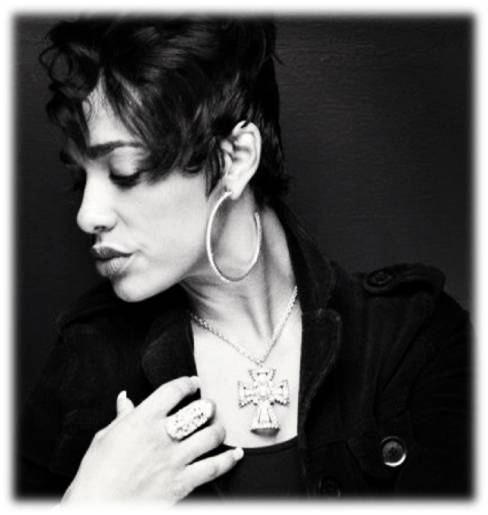
Aledia Kartchner
Garrett says it’s not just blacks getting the shaft in North O.
‘There’s still a lot of white people living here and they’re being given the short end of the stick as well.”
“What we have left is an impoverished community,” Love says. “That doesn’t mean everybody in it. When you have serious poverty like it is here you have a (drug-gang) subculture that’s figured out there’s no future in the (mainstream) community. So they created their own community and it’s thriving. Money’s flowing, big time. Everything’s working just fine. They may have to die but that’s OK because they’re not expected to live and all that logic. That subculture is created by poverty and breeds total disconnect from lawfulness.”
Menelik has lost loved ones to gun violence, He’s doing prevention work as local Mad Dads chapter president. He is also on the board of the Bryant Center Association that serves at-risk young people.
He sees an urgent need to intervene in the hopelessness.
“The game is over, man. The kids, they’re hollering out silently. If it was a movie you’d see a bunch of black hands reaching up and saying, ‘Where are you and when are you coming?’
“We’re taking it upon ourselves to do for ourselves and to do it right now. It’s crucial.”
“The only major solution is economic inclusion, economic health for this community,” Love says. “If you lay on the table jobs and alternatives a lot more will take it than people realize. Do we need better education? Yes, we’ve got educational gaps that need filling. We’ve got a high drop-out rate that needs improving. We need to reduce STDs. All of those are more factors than potential solutions.”
He says North O should demand more autonomy and accountability from the nonprofit social sector set up to address its myriad needs.
“We have a lot of people pimping the community. They don’t live in the community, they work in the community receiving what benefits there are coming into a poverty-infected area and then they escape out of it, taking the benefits of the drops, the crumbs.”
Menelik says after ignoring North O the power elites “understand they’ve got to do something because we’re right on the doorstep of North Downtown development. They want to come off [as] multicultural.” Whatever happens, he says “we want to see results, we want performance-based, sustainable, social-economic development.”
Garrett says, “You have an entire middle class that lives outside the North Omaha community that benefit by way of employment from programs addressing the issues in North Omaha. So if the issues in North Omaha go away, then a lot of those jobs go away as well. Our destiny is intertwined with the destiny of those that have the resources. What happens if the philanthropic dollars dry up?
“The philanthropic industry here in Nebraska is not sustainable–throwing money into a community and 10, 15, 20 years later not seeing any outcomes. Let’s takes those funds and use them towards outcome-based investments and address these issues from a private sector approach. That is the type of mindset and vigor we need.”
Garrett’s Infinite 8 Institute poses social impact models. He says too often nonprofits don’t produce the social good their grant applications promise and that he favors outcome-based models.
“If you give them the money up front and you don’t make them work for it, there’s no incentive to get the outcome.”
Garrett’s partner Aledia Kartchner, 36, says they find innovative ways to handle “the huge lack in North Omaha.” One is via non-cognitive life skills and work force development classes they teach at Bryant Center. However, programming costs money and resources are scarce.
“If you’re only giving us enough funds to keep the lights on then we can’t bring resources and people in to prepare these young people,” Garrett says. “We have to be able to close the deal. That means people at the top being willing to open up the doors of opportunity in a way that’s sincere and not just talk.”
Kartchner says they’re seeking investments “in human capital.”
Garrett says North O’s human resources get overlooked.
“These kids have been through so many traumatic experiences they are better prepared than many who live in the outer community. As an employer I don’t want somebody who hasn’t dealt with a tough problem before. These kids are having to solve tough problems on a daily basis. Those skills are transferrable in this new knowledge-based economy, where soft skills–the ability to adapt and to be resilient–are things employers applaud.
“If you just look at it at face value, you see thugs with impoverished, destitute, sad stories. But if you turn that around you see potential human capital that can really add value.”
He says the skills he teaches “are all the intangibles that made the difference between myself and those peers who maybe fell victim to unfortunate circumstances.”
“We’re working with kids from early childhood through 12th grade. Local elders volunteer, so it’s very intergenerational. We have a pipeline all within that one structure to measure long-term outcomes.”
He says another key thing taught is “mindfulness meditation to ensure kids focus on peace of mind when they go back to their chaotic environment and the negative energy around them–you can’t control what’s happening around you but you can control how you react.”
Infinite 8 seeks to raise $1.5 million for a social impact bond for violence prevention.
“As an organization one of the things we focus on is creating social impact financing,” says Garrett, who sees it as a litmus test for how serious Omaha is in finding fresh ways to tackle persistent issues.
“Omaha has so much wealth and prosperity but then you wonder why is it not circulating into northeast Omaha. There are people in the city who singlehandedly could eradicate poverty here. It’s a question of whether or not the powers that be actually want that to happen. If you’re trying to do something like turn around the most deadly place to be black in America and integrate that with one of America’s most highly acclaimed places, then I think you have to look at what resources are necessary in order to accomplish that.”
The public sector also has a role to play.
“If we’re not electing elected officials willing to fight those battles for equal distribution of tax revenues and other funding streams, we lose. We’ve paralyzed most of our elected officials because of where they’re financed to get elected, so they’re not willing to stand up and try to act like Ernie,” Love says, referring to firebrand Neb. state senator Ernie Chambers. “They’re nice people but they’re not independent. When it comes time to fight for the community, we ain’t got nobody there.
“The net effect is we’ve become a community on the receiving end and almost on the beg. So you’ve got a community that has to sit down. There’s only a few of us that stand up. That’s a problem. The community doesn’t have enough leverage to fight these battles.”
Garrett agrees. “It’s time for North Omaha to become independent. For North Omaha to be able to do for people in North Omaha we need our own resources. If you want to see us do better, than empower us but don’t beholden us. We have to recognize what’s in our own community and that we have what it takes. We do believe there are people willing to do the right thing and we want to work with them.”
Kevin Lytle Jr. with the Leadership Institute for Urban Education in Omaha, says, “I believe our biggest resource in North Omaha is the people who live and struggle there. We have not found an effective way to develop, foster and encourage true community and camaraderie amongst African-Americans in Omaha.”

Kevin Lytle Jr.
Menelik says “It’s like we’re waiting for somebody to come in out of the sky to save us, when sometimes you’ve got to go within yourself.”
Troxclair says “In the arts community many are coming together and their voices are starting to be heard. In every other major city’s revitalization effort, there is a concentration on arts investment. Omaha did not do that. We are connecting with each other and artist-allies who know we need to work together. Omaha’s leadership is still focused on housing and jobs. We get that, but every artist has created his-her own job and is an entrepreneur. White folks get it. How many people do the Holland, Joslyn, Bemis, Kaneko, Omaha Community Playhouse, Rose employ? We let the John Beasley Theatre go to waste. We let our stagnate leadership dictate the artist landscape and they have ignored our young people completely.”
Meanwhile, Angel Martin has noted a “halt” in the movement by young African Americans to get involved.
“A lot of young people (including herself) ran for the school board or the city council. There were a lot of new faces and voices with a lot to say. That was a prime time to tap into that energy. A lot of those people have since said, ‘I’m out of here,” and that energy’s kind of gone I sense. That’s a concern. Where are we going next?
“Some people are choosing to move on to where things are thriving more and it’s more progressive.”
Everyone concedes North O loses many of its best and brightest.
Martin doesn’t begrudge the defectors.
“I can definitely see why people do not choose to stay here. Some of those who do choose to stay are looking for ways out. Some elders have told me, ‘You might want to look to move on.'”
She’s seriously considered it.
“We don’t have affirmative action. A lot of employers don’t look for faces that look like mine.”
Martin expresses another concern many share.
“I think there’s a lot of outsiders dictating which direction North Omaha should go. There’s a lot stirring. My concern is who’s doing the stirring and what are they mixing up. Was everybody invited to sit at this table? A lot of deals have been made relating to North Omaha’s future. My only hope is my great aunt in North Omaha was kept in mind when they talked about redevelopment. I hope as a people we understand it’s our right to question, to ask for details.”
“We have to stand up together and fight. We’ve gotta put your foot down and say we’re not taking this lack of economic inclusion anymore and be willing to take the heat,” Love says.
Love recently put himself on the line by advocating minority contractors get a share of the $2.3 billion in waste water and sewer separation construction happening. He pressed the mayor and others hard on it. He expected the corporate backlash he got but not the flak from his own community.
“They don’t want you messing with ‘Mr. Charlie.'”
Too, often, black advocates are left standing alone.
Garrett feels the millennial generation offers new hope.
“They’re a lot more informed. Millinials, regardless of color or shade, believe in social good and they’ll put their money behind products and services that have a positive impact on the community and the environment. I believe there needs to be more courage from the outer community to stand up and do what really needs to be done and to do it in a way that sits well with the indigenous people in North Omaha.”
He says Infinite 8 has piloted programs in Kansas City, Mo. and other cities but runs into “a barrier to entry” here he attributes to decision-makers “not being open to new paradigms, ideas, best practices.” He’s not waiting for approval. Bryant Center kids are introduced to Bitcoin, drone technology, green sustainability, 3D printing and mobile Web programming. “We’re really focusing on what sectors have the most promising outlooks. We’re preparing young people with these skills so when they go into the workforce they actually have a leg up.”

Aledia Kartchner echoes others in saying she’s tired of her people being depicted as “just savages killing each other – there’s many positive things going on but they don’t focus on that.”
North O’s good people, neighborhoods, anchors, programs and events get obscured by the actions of a few knuckleheads.
Martin says, “It’s an unfair perception that’s very disheartening. If you never highlight the positive things going on you’ll never know. If you’re not in the area, you won’t know. When we take back our community as a people we’ll take back those perceptions.”
Troxclair takes exception to media depictions of “us as nincompoops holding candlelight vigils waiting on Jesus.” She says, “When a murder occurs, a murder occurs. Report that a murder occurred. Report who the suspects according to the facts. Do we really need to know the criminal record of the entire family?”
Where controlling the message is concerned, Melenik says North O could benefit from more black-owned media outlets and Martin suggests more blacks are needed in newsrooms.
Lytle, 32, repeats a mantra many sound–leaders are doing what they can with what they have. But he says, “We are not getting the job done. The role of leadership is to warn a people of potential dangers and opportunities, educate a people on how to navigate through that and create avenues in which a people can effectively execute and implement the steps that will best serve them.”
Yet, he adds, “I am hopeful for the future of blacks in Omaha and for the area of North Omaha because I believe the up and coming leadership is learning from the choices and paths laid by current symbolic individuals and will dedicate their efforts towards going against the grain and truly establishing community and ownership.”

Angel Martin
Martin feels the same. “We have a long way to go but I’m hopeful because I do think our people get it and we have a genuine love for each other and for North Omaha. I’m just hoping it’s not a day late and a dollar short.” She says even Native Omaha Days might be a catalyst for “capitalizing on connections, sharing ideas, holding roundtables, digging in and getting things moving. It takes all us all working together–those currently living here and those who used to live here.”
Love says The Days are not the pure fun they once were due to the specter of violence. The festival’s still a good time, “but when the dust settles we are still left with the new pure–poverty.”
Sundiata Menelik says all the community gatherings and dialogues are no substitute for “bootstrapping” grassroots action.
Despite much to be pessimistic about, Ean Garrett says, “We’re optimistic. We know there are people who are tired of the situation as it stands. I think there’s good people out there who do want to change some things and to do so in ways that empower people in the community to do it themselves.”
Visit http://www.infinite8institute.com/byinfinite8institute, http://www.bryantcenteromaha.org/ and nativeomahaclub.org.

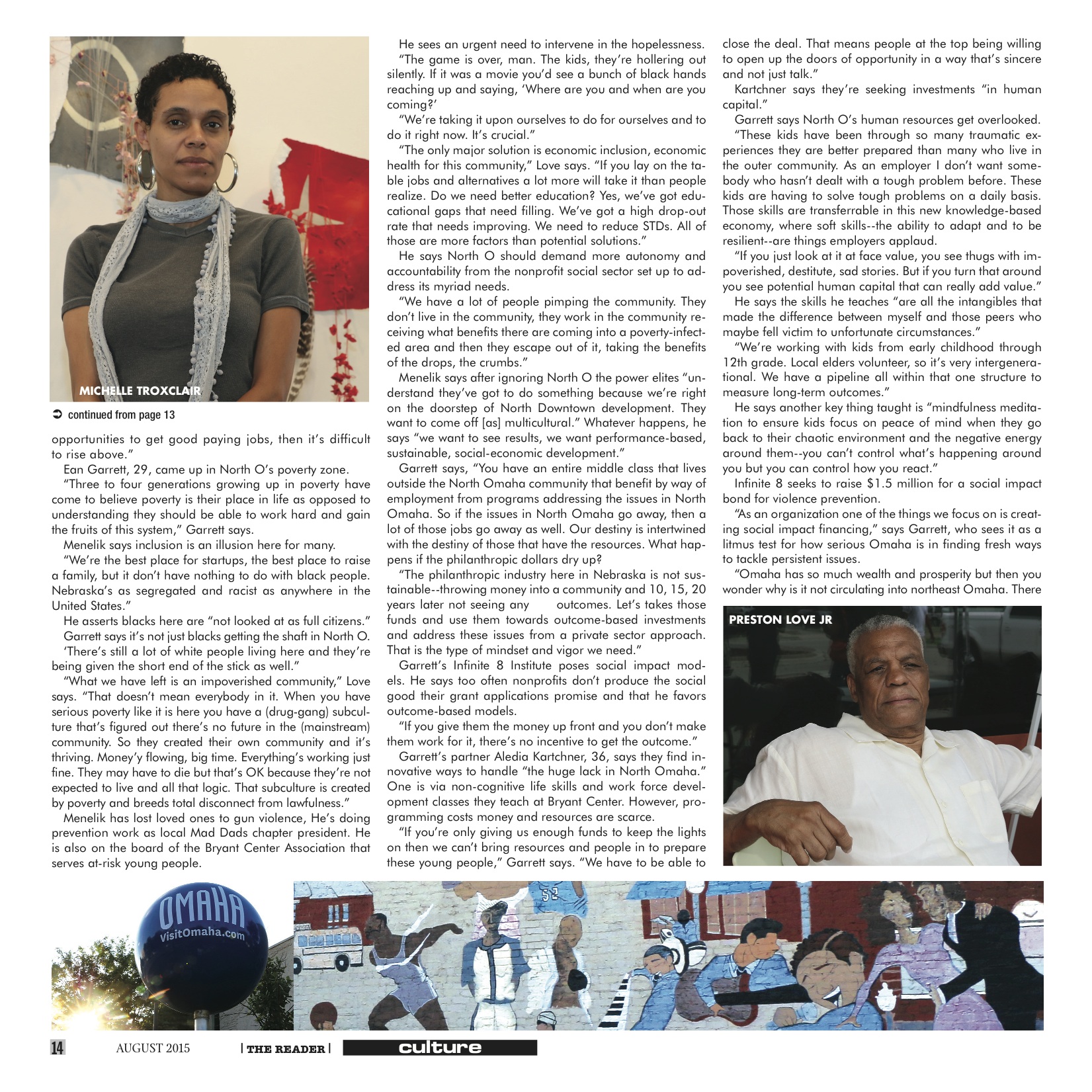
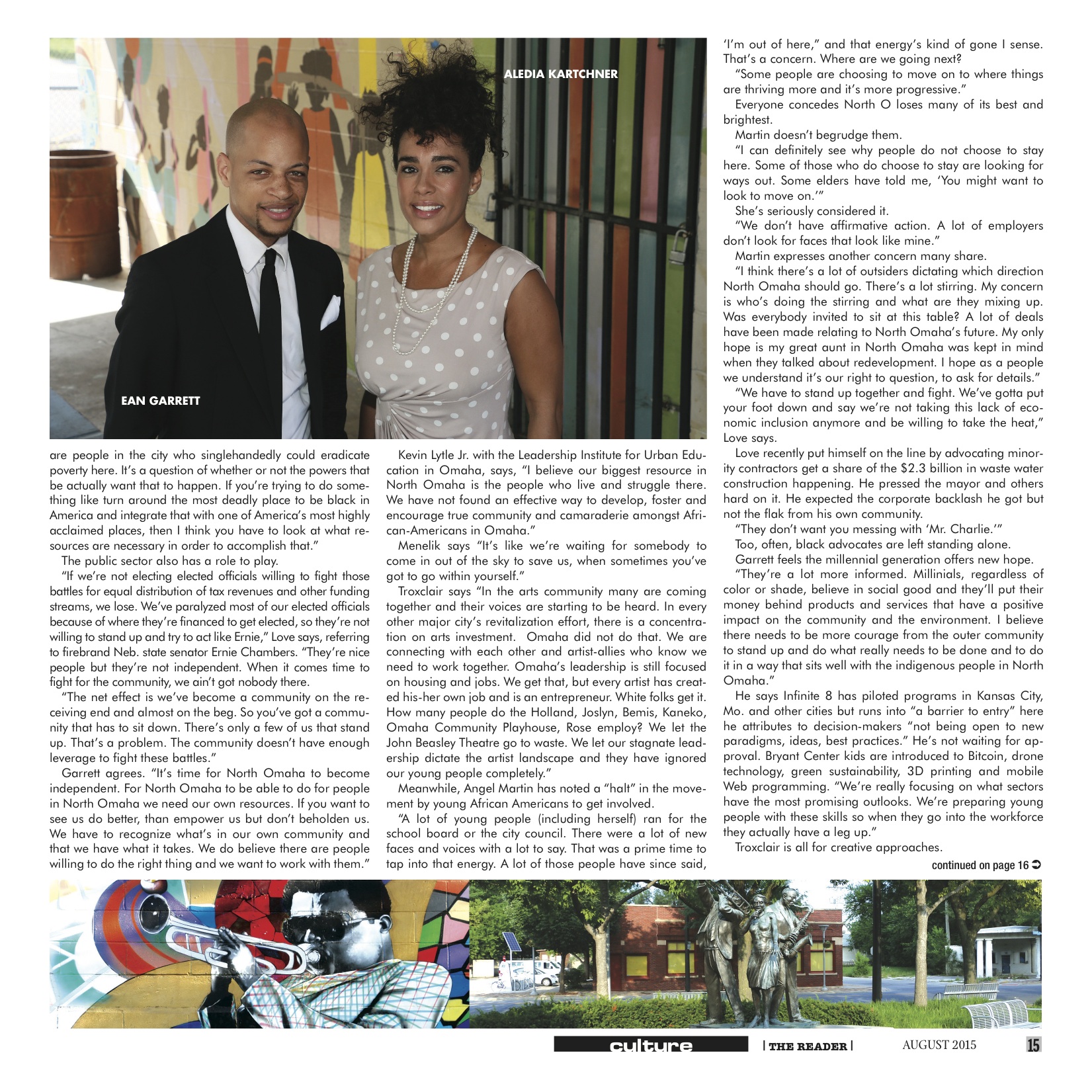
Change in North Omaha: It’s been a long time coming for northeast Omaha
August 3, 2015
3 comments
With Native Omaha Days having just concluded, it’s a good time for reflection. Here’s a new story I wrote for the August issue of The Reader (www.thereader.com) that sounds out some African-American residents for their take on old-new northeast Omaha challenges, opportunities and approaches to revitalize that area. Hard copies should now be out and about in North O, Benson, Midtown, Downtown and the Old Market.
I am presenting the story in this post in two layouts: the first is exclusively for my blog and the second is how the story appears in The Reader.
Change in North Omaha: It’s been a long time coming for northeast Omaha
African-American residents weigh in on old-new challenges, opportunities, approaches to revitalize the area
©BY LEO ADAM BIGA
NOW APPEARING IN THE READER (WWW.THEREADER.COM)
Quality-of-life metrics assessing the state of African-American northeast Omaha paint a stark picture. Pockets experience some of America’s worst poverty and gun violence. Disparities contradict Omaha’s high best-place-to-live rankings.
Riot-scarred landscapes remain untouched decades later. Urban renewal brought distrust and dislocation. Combined with education, employment, income, home-business ownership gaps, it’s a stuck-in-time place. Stalled economic growth and limited opportunity drive many away. Others stay out of conviction or concession.
While North Omaha is the focus of unprecedented education initiatives and redevelopment efforts driven by major public-private coalitions, key markers show little’s changed where people’s lives are concerned.
With ex-pats back for the biennial Native Omaha Days, there’s much nostalgia and lament. Seven community-engaged residents trying to remedy the challenges recently shared their take on the situation.
After being away, Omaha native Michelle Troxclair, 46, Nebraska Writers Collective deputy director, says upon returning she noted “North Omaha and the people who live there were stagnate in many ways.”
“They became comfortable with nothingness. Our leadership appeared, for the most part, to be spinning their wheels and more concerned with the scraps they were getting than a place at the table. Then they began fighting for those scraps amongst themselves. I thought I could make a difference, and I did, but in a very different community. Yeah, we got a Walmart and Aldi’s. North (High) is getting a new stadium. They tore down the Hilltop projects. I see some new housing. Again–scraps.”
When Angel Martin, 31, moved to Omaha from Milwaukee she saw abandoned, boarded-up properties here as seeds of potential. Now she views them as emblems of lost opportunity.
“If people see that every day you’re unfortunately going to believe it’s the norm,” says Martin, who directs the Katherine Fletcher Center at Girls Inc. “We should have took on that mindset of taking back our community. It starts with the homes. We should have pooled our resources together to buy these houses.”
Preston Love Jr., 73, hails from a North O legacy family led by his late father, musician Preston Love Sr. He left for a while–to work for IBM and to manage political campaigns. He says when he came back home, “my community was in shambles. I got motivated to get involved because of what I found.” He’s since been on a “soap box” about this once great community being brought down by “residual negatives.”
“When I was growing up, North Omaha was rich in culture, rich in commerce, rich in religion and church. We had our own everything. We had each other. We had neighborhoods. We had love for your neighbors and spankings if you didn’t act right. We had all that.”
Discrimination and racism still ruled, however.
“We didn’t have the ability to go places, we didn’t have the ability to go downtown to see a movie, we couldn’t swim at Peony Park, we couldn’t go inside Joe Tess. We didn’t have this, we didn’t have that, and some of it was a little deeper than some carp.”
Love believes blacks “made a catastrophic mistake” choosing integration over desegregation.
“If you integrate you lose half the things you did have because you begin to water down your culture. When you integrate Walmart into this culture, mom and pops close. We should have affirmed all the things we had and fought for desegregation to get what we didn’t have.”
Sundiata Menelik, 57, has returned after decades as a developer and real estate magnate in Minnesota. He recalls as a kid the flourishing North 24th Street business district: “It was alive.” By the time he went away, however, it died. Job prospects for blacks dried up.
“Everybody from my generation was trying to escape this the way you escaped apartheid South Africa or any place that is hell on Earth. For us, that’s what it was.”

Sundiata Menelik
In Menelik’s opinion, “nothing’s happened” to reverse the black brain drain and narrow opportunities. He deems this stalemated community “backwards” compared to more progressive sister communities.
“This is a reservation right here and the same ills on the reservation are here, it’s just not in your face. A lot of this is institutional.”
Menelik also says North O is a separate world from the majority of the world. Some blacks can freely step in and out of both worlds. Others can’t.
“When you can’t escape, there’s nothing, What you see is bleak.”
“People feel oppressed,” Martin says. I think poverty is what comes from being oppressed. If you don’t have opportunities to get good paying jobs, then it’s difficult to rise above.”
Ean Garrett, 29, came up in North O’s poverty zone.
“Three to four generations growing up in poverty have come to believe poverty is their place in life as opposed to understanding they should be able to work hard and gain the fruits of this system,” Garrett says.
Menelik says inclusion is an illusion here for many.
“We’re the best place for startups, the best place to raise a family, but it don’t have nothing to do with black people. Nebraska’s as segregated and racist as anywhere in the United States.”
He asserts blacks here are “not looked at as full citizens.”
Ean Garrett
Aledia Kartchner
Garrett says it’s not just blacks getting the shaft in North O.
‘There’s still a lot of white people living here and they’re being given the short end of the stick as well.”
“What we have left is an impoverished community,” Love says. “That doesn’t mean everybody in it. When you have serious poverty like it is here you have a (drug-gang) subculture that’s figured out there’s no future in the (mainstream) community. So they created their own community and it’s thriving. Money’s flowing, big time. Everything’s working just fine. They may have to die but that’s OK because they’re not expected to live and all that logic. That subculture is created by poverty and breeds total disconnect from lawfulness.”
Menelik has lost loved ones to gun violence, He’s doing prevention work as local Mad Dads chapter president. He is also on the board of the Bryant Center Association that serves at-risk young people.
He sees an urgent need to intervene in the hopelessness.
“The game is over, man. The kids, they’re hollering out silently. If it was a movie you’d see a bunch of black hands reaching up and saying, ‘Where are you and when are you coming?’
“We’re taking it upon ourselves to do for ourselves and to do it right now. It’s crucial.”
“The only major solution is economic inclusion, economic health for this community,” Love says. “If you lay on the table jobs and alternatives a lot more will take it than people realize. Do we need better education? Yes, we’ve got educational gaps that need filling. We’ve got a high drop-out rate that needs improving. We need to reduce STDs. All of those are more factors than potential solutions.”
He says North O should demand more autonomy and accountability from the nonprofit social sector set up to address its myriad needs.
“We have a lot of people pimping the community. They don’t live in the community, they work in the community receiving what benefits there are coming into a poverty-infected area and then they escape out of it, taking the benefits of the drops, the crumbs.”
Menelik says after ignoring North O the power elites “understand they’ve got to do something because we’re right on the doorstep of North Downtown development. They want to come off [as] multicultural.” Whatever happens, he says “we want to see results, we want performance-based, sustainable, social-economic development.”
Garrett says, “You have an entire middle class that lives outside the North Omaha community that benefit by way of employment from programs addressing the issues in North Omaha. So if the issues in North Omaha go away, then a lot of those jobs go away as well. Our destiny is intertwined with the destiny of those that have the resources. What happens if the philanthropic dollars dry up?
“The philanthropic industry here in Nebraska is not sustainable–throwing money into a community and 10, 15, 20 years later not seeing any outcomes. Let’s takes those funds and use them towards outcome-based investments and address these issues from a private sector approach. That is the type of mindset and vigor we need.”
Garrett’s Infinite 8 Institute poses social impact models. He says too often nonprofits don’t produce the social good their grant applications promise and that he favors outcome-based models.
“If you give them the money up front and you don’t make them work for it, there’s no incentive to get the outcome.”
Garrett’s partner Aledia Kartchner, 36, says they find innovative ways to handle “the huge lack in North Omaha.” One is via non-cognitive life skills and work force development classes they teach at Bryant Center. However, programming costs money and resources are scarce.
“If you’re only giving us enough funds to keep the lights on then we can’t bring resources and people in to prepare these young people,” Garrett says. “We have to be able to close the deal. That means people at the top being willing to open up the doors of opportunity in a way that’s sincere and not just talk.”
Kartchner says they’re seeking investments “in human capital.”
Garrett says North O’s human resources get overlooked.
“These kids have been through so many traumatic experiences they are better prepared than many who live in the outer community. As an employer I don’t want somebody who hasn’t dealt with a tough problem before. These kids are having to solve tough problems on a daily basis. Those skills are transferrable in this new knowledge-based economy, where soft skills–the ability to adapt and to be resilient–are things employers applaud.
“If you just look at it at face value, you see thugs with impoverished, destitute, sad stories. But if you turn that around you see potential human capital that can really add value.”
He says the skills he teaches “are all the intangibles that made the difference between myself and those peers who maybe fell victim to unfortunate circumstances.”
“We’re working with kids from early childhood through 12th grade. Local elders volunteer, so it’s very intergenerational. We have a pipeline all within that one structure to measure long-term outcomes.”
He says another key thing taught is “mindfulness meditation to ensure kids focus on peace of mind when they go back to their chaotic environment and the negative energy around them–you can’t control what’s happening around you but you can control how you react.”
Infinite 8 seeks to raise $1.5 million for a social impact bond for violence prevention.
“As an organization one of the things we focus on is creating social impact financing,” says Garrett, who sees it as a litmus test for how serious Omaha is in finding fresh ways to tackle persistent issues.
“Omaha has so much wealth and prosperity but then you wonder why is it not circulating into northeast Omaha. There are people in the city who singlehandedly could eradicate poverty here. It’s a question of whether or not the powers that be actually want that to happen. If you’re trying to do something like turn around the most deadly place to be black in America and integrate that with one of America’s most highly acclaimed places, then I think you have to look at what resources are necessary in order to accomplish that.”
The public sector also has a role to play.
“If we’re not electing elected officials willing to fight those battles for equal distribution of tax revenues and other funding streams, we lose. We’ve paralyzed most of our elected officials because of where they’re financed to get elected, so they’re not willing to stand up and try to act like Ernie,” Love says, referring to firebrand Neb. state senator Ernie Chambers. “They’re nice people but they’re not independent. When it comes time to fight for the community, we ain’t got nobody there.
“The net effect is we’ve become a community on the receiving end and almost on the beg. So you’ve got a community that has to sit down. There’s only a few of us that stand up. That’s a problem. The community doesn’t have enough leverage to fight these battles.”
Garrett agrees. “It’s time for North Omaha to become independent. For North Omaha to be able to do for people in North Omaha we need our own resources. If you want to see us do better, than empower us but don’t beholden us. We have to recognize what’s in our own community and that we have what it takes. We do believe there are people willing to do the right thing and we want to work with them.”
Kevin Lytle Jr. with the Leadership Institute for Urban Education in Omaha, says, “I believe our biggest resource in North Omaha is the people who live and struggle there. We have not found an effective way to develop, foster and encourage true community and camaraderie amongst African-Americans in Omaha.”
Kevin Lytle Jr.
Menelik says “It’s like we’re waiting for somebody to come in out of the sky to save us, when sometimes you’ve got to go within yourself.”
Troxclair says “In the arts community many are coming together and their voices are starting to be heard. In every other major city’s revitalization effort, there is a concentration on arts investment. Omaha did not do that. We are connecting with each other and artist-allies who know we need to work together. Omaha’s leadership is still focused on housing and jobs. We get that, but every artist has created his-her own job and is an entrepreneur. White folks get it. How many people do the Holland, Joslyn, Bemis, Kaneko, Omaha Community Playhouse, Rose employ? We let the John Beasley Theatre go to waste. We let our stagnate leadership dictate the artist landscape and they have ignored our young people completely.”
Meanwhile, Angel Martin has noted a “halt” in the movement by young African Americans to get involved.
“A lot of young people (including herself) ran for the school board or the city council. There were a lot of new faces and voices with a lot to say. That was a prime time to tap into that energy. A lot of those people have since said, ‘I’m out of here,” and that energy’s kind of gone I sense. That’s a concern. Where are we going next?
“Some people are choosing to move on to where things are thriving more and it’s more progressive.”
Everyone concedes North O loses many of its best and brightest.
Martin doesn’t begrudge the defectors.
“I can definitely see why people do not choose to stay here. Some of those who do choose to stay are looking for ways out. Some elders have told me, ‘You might want to look to move on.'”
She’s seriously considered it.
“We don’t have affirmative action. A lot of employers don’t look for faces that look like mine.”
Martin expresses another concern many share.
“I think there’s a lot of outsiders dictating which direction North Omaha should go. There’s a lot stirring. My concern is who’s doing the stirring and what are they mixing up. Was everybody invited to sit at this table? A lot of deals have been made relating to North Omaha’s future. My only hope is my great aunt in North Omaha was kept in mind when they talked about redevelopment. I hope as a people we understand it’s our right to question, to ask for details.”
“We have to stand up together and fight. We’ve gotta put your foot down and say we’re not taking this lack of economic inclusion anymore and be willing to take the heat,” Love says.
Love recently put himself on the line by advocating minority contractors get a share of the $2.3 billion in waste water and sewer separation construction happening. He pressed the mayor and others hard on it. He expected the corporate backlash he got but not the flak from his own community.
“They don’t want you messing with ‘Mr. Charlie.'”
Too, often, black advocates are left standing alone.
Garrett feels the millennial generation offers new hope.
“They’re a lot more informed. Millinials, regardless of color or shade, believe in social good and they’ll put their money behind products and services that have a positive impact on the community and the environment. I believe there needs to be more courage from the outer community to stand up and do what really needs to be done and to do it in a way that sits well with the indigenous people in North Omaha.”
He says Infinite 8 has piloted programs in Kansas City, Mo. and other cities but runs into “a barrier to entry” here he attributes to decision-makers “not being open to new paradigms, ideas, best practices.” He’s not waiting for approval. Bryant Center kids are introduced to Bitcoin, drone technology, green sustainability, 3D printing and mobile Web programming. “We’re really focusing on what sectors have the most promising outlooks. We’re preparing young people with these skills so when they go into the workforce they actually have a leg up.”
Michelle Troxclair, ©C4Photography
Troxclair is all for creative approaches.
“Rote methods are outdated and we all know the world of technology has changed the landscape. Young people don’t want to be bothered with minutia. Applicability, immediacy are what they’re looking for. The arts must be used to stimulate interest and academic motivation.”
Lytle says, “A huge factor not being deeply addressed is how our children are being taught and who is teaching our children.” He wonders “how effective are the educational lessons being transmitted in relation to the culture African-American students” interact with.
Garrett and Co. decry how elements of this civil society demonize and dismiss a segment of the city they have no direct experience with.
“Is it civil to deny opportunity to your own citizens? Are we uncivil because we have violence going on in our community? Is a person who sits back and watches the violence and does nothing more civil?”
Aledia Kartchner echoes others in saying she’s tired of her people being depicted as “just savages killing each other – there’s many positive things going on but they don’t focus on that.”
North O’s good people, neighborhoods, anchors, programs and events get obscured by the actions of a few knuckleheads.
Martin says, “It’s an unfair perception that’s very disheartening. If you never highlight the positive things going on you’ll never know. If you’re not in the area, you won’t know. When we take back our community as a people we’ll take back those perceptions.”
Troxclair takes exception to media depictions of “us as nincompoops holding candlelight vigils waiting on Jesus.” She says, “When a murder occurs, a murder occurs. Report that a murder occurred. Report who the suspects according to the facts. Do we really need to know the criminal record of the entire family?”
Where controlling the message is concerned, Melenik says North O could benefit from more black-owned media outlets and Martin suggests more blacks are needed in newsrooms.
Lytle, 32, repeats a mantra many sound–leaders are doing what they can with what they have. But he says, “We are not getting the job done. The role of leadership is to warn a people of potential dangers and opportunities, educate a people on how to navigate through that and create avenues in which a people can effectively execute and implement the steps that will best serve them.”
Yet, he adds, “I am hopeful for the future of blacks in Omaha and for the area of North Omaha because I believe the up and coming leadership is learning from the choices and paths laid by current symbolic individuals and will dedicate their efforts towards going against the grain and truly establishing community and ownership.”

Angel Martin
Martin feels the same. “We have a long way to go but I’m hopeful because I do think our people get it and we have a genuine love for each other and for North Omaha. I’m just hoping it’s not a day late and a dollar short.” She says even Native Omaha Days might be a catalyst for “capitalizing on connections, sharing ideas, holding roundtables, digging in and getting things moving. It takes all us all working together–those currently living here and those who used to live here.”
Love says The Days are not the pure fun they once were due to the specter of violence. The festival’s still a good time, “but when the dust settles we are still left with the new pure–poverty.”
Sundiata Menelik says all the community gatherings and dialogues are no substitute for “bootstrapping” grassroots action.
Despite much to be pessimistic about, Ean Garrett says, “We’re optimistic. We know there are people who are tired of the situation as it stands. I think there’s good people out there who do want to change some things and to do so in ways that empower people in the community to do it themselves.”
Visit http://www.infinite8institute.com/byinfinite8institute, http://www.bryantcenteromaha.org/ and nativeomahaclub.org.

Change in North Omaha: It’s been a long time coming for northeast Omaha
August 1, 2015
2 comments
With Native Omaha Days in full swing, here’s a new story I wrote for the August issue of The Reader that sounds out some African-American residents for their take on northeast Omaha’s challenges and what can be done to revitalize that area. Hard copies should now be out and about in North O, Midtown, Downtown and the Old Market, among other places.
Categories: African-American Culture, Civil Rights, Ean Garrett, Michelle Troxclair, North Omaha, Omaha, Preston Love Jr., Social Justice, Sundiata Menelik, Writing
African American, African-American Culture, Angel Martin, Ean Garrett, Inner City, Michelle Troxclair., North Omaha, Omaha, Poverty, Preston Love Jr., Sundiata Menelik, Urban Renewal
The Champ Goes to Africa: Terence Crawford Visits Uganda and Rwanda with his former teacher, this reporter and friends
June 26, 2015
3 comments
The Champ Goes to Africa
Terence Crawford Visits Uganda and Rwanda with his former teacher, this reporter and friends
Two-time world boxing champ Terence Crawford of Omaha has the means to do anything he wants. You might not expect then that in the space of less than a year he chose to travel not once but twice to a pair of developing nations in Africa wracked by poverty, infrastructure problems and atrocity scars: Uganda and Rwanda, I accompanied his last trip as the 2015 winner of the Andy Award for international journalism from the University of Nebraska at Omaha. Until now I’ve posted a little about the grant that took me to Africa along with a few pictures and anecdotes from the trip. But now I’m sharing the first in a collection of stories I’m writing about the experience, which is of course why I went there in fhe first place. This cover story in the coming July issue of The Reader (www.thereader.com) emphasizes Crawford within the larger context of what he and the rest of us saw, who we met and what we did. Future pieces for other publications will go even more into where his Africa sojourns fit into his evolving story as a person and as an athlete. But at least one of my upcoming stories from the trip will try to convey the totality of the experience from my point of view and that of others. I feel privilged to have been given the opportunity to chronicle this journey. Look for new posts and updates and announcements related to this and future stories from my Africa Tales series.
NOTE: This is at least the fifth major article I’ve written about Crawford. You can find all of them on this blog site. Find them at-
https://leoadambiga.com/?s=crawford
AFRICA TALES IN IMAGES
Here is a link to a video slideshow of the June trip I made to Uganda and Rwanda, Africa with The Champ, Terence Crawford and Alindra I Person, Jamie Fox Nollette, Scott Katskee, Joseph Sutter and Julia Brown.
The visuals were edited, set to music, given movement and in some cases captioned by my friend Victoria White, an Omaha filmmaker.
NOTE: I am available to make public presentations about the trip and the video slideshow will be a part of the talk that I give. We will be updating the video slideshow with new images to keep it fresh and to represent different aspects of the experience we had in those developing nations.
All my stories about the trip can also be found on this blog. Access them at-
https://leoadambiga.com/?s=africa

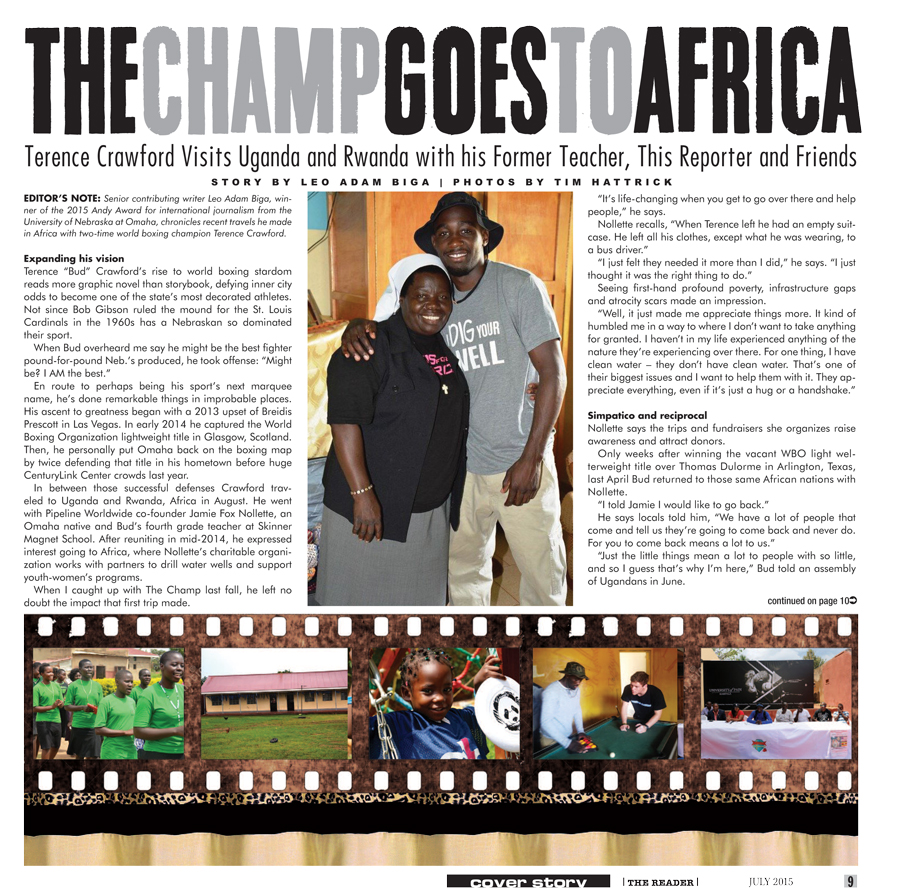

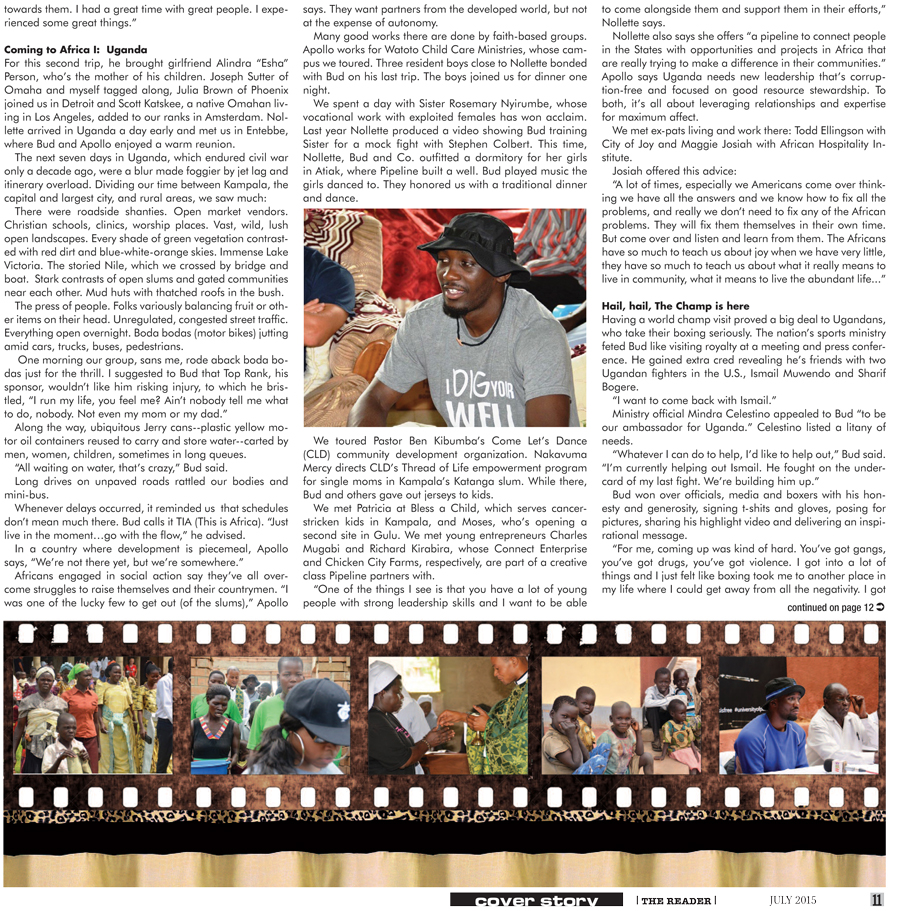

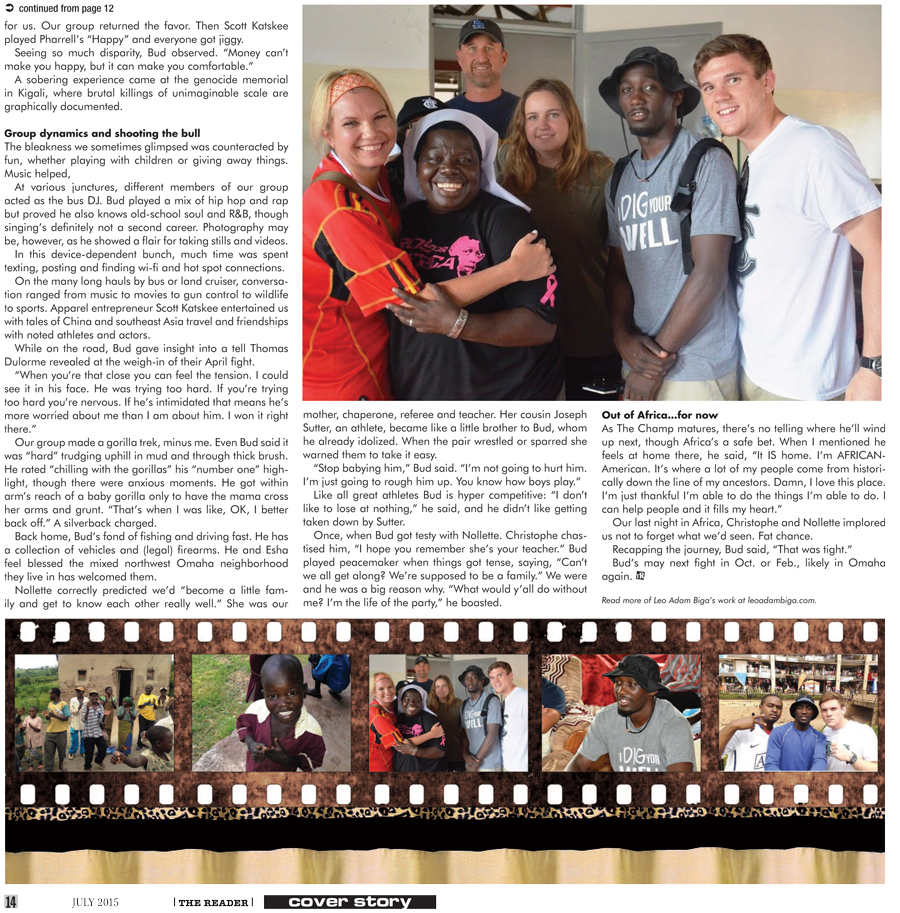
(Below is a text-only format of the same article)
The Champ Goes to Africa
Terence Crawford Visits Uganda and Rwanda with his former teacher, this reporter and friends
©by Leo Adam Biga
Originally appeared in The Reader (www.thereader.com)
EDITOR’S NOTE:
Senior contributing writer Leo Adam Biga, winner of the 2015 Andy Award for international journalism from the University of Nebraska at Omaha, chronicles recent travels he made in Africa with two-time world boxing champion Terence Crawford.
Expanding his vision
Terence “Bud” Crawford’s rise to world boxing stardom reads more graphic novel than storybook, defying inner city odds to become one of the state’s most decorated athletes. Not since Bob Gibson ruled the mound for the St. Louis Cardinals in the 1960s has a Nebraskan so dominated his sport.
When Bud overheard me say he might be the best fighter pound-for-pound Neb.’s produced, he took offense:. “Might be? I AM the best.”
En route to perhaps being his sport’s next marquee name, he’s done remarkable things in improbable places. His ascent to greatness began with a 2013 upset of Breidis Prescott in Las Vegas, In early 2014 he captured the WBO lightweight title in Glasgow, Scotland. He personally put Omaha back on the boxing map by twice defending that title in his hometown before huge CenturyLink Center crowds last year.
In between those successful defenses he traveled to Uganda and Rwanda, Africa in August. He went with Pipeline Worldwide co-founder Jamie Fox Nollette, an Omaha native and Bud’s fourth grade teacher at Skinner Magnet School. After reuniting in mid-2014, he expressed interest going to Africa, where her charitable organization works with partners to drill water wells and to support youth-women’s programs.
When I caught up with The Champ last fall, he left no doubt the impact that first trip made.
“It’s life-changing when you get to go over there and help people,” he says.
Nollette recalls, “When Terence left he had an empty suitcase. He left all his clothes, except what he was wearing, to a bus driver.”
“I just felt they needed it more than I did,” he says. ‘I just thought it was the right thing to do.”
Seeing first-hand profound poverty, infrastructure gaps and atrocity scars made an impression.
“Well, it just made me appreciate things more. It kind of humbled me in a way to where I don’t want to take anything for granted. I haven’t in my life experienced anything of the nature they’re experiencing over there. For one thing, I have clean water – they don’t have clean water. That’s one of their biggest issues and I want to help them with it. They appreciate everything, even if it’s just a hug or a handshake.”
Simpatico and reciprocal
Nollette says the trips and fundraisers she organizes raise awareness and attract donors.
Only weeks after winning the vacant WBO light welterweight title over Thomas Dulorme in Arlington, Texas last April Bud returned to those same African nations with Nollette.
“I told Jamie I would like to go back.”
He says locals told him, “We have a lot of people that come and tell us they’re going to come back and never do. For you to come back means a lot to us.”
“Just the little things mean a lot to people with so little, and so I guess that’s why I’m here,” Bud told an assembly of Ugandans in June.
None of this may have happened if he and Nollettte didn’t reconnect. Their bond transcends his black urban and her white suburban background. He supports Pipeline’s work and she raises funds for his B&B Boxing Academy in North O.
His first Africa trip never made the news because he didn’t publicize it. His June 1 through 12 trip is a different matter.
What about Africa drew this streetwise athlete to go twice in 10 months when so much is coming at him in terms of requests and appearances, on top of training and family obligations?
Beyond the cool machismo, he has a sweet, soft side and burning curiosity. “He really listens to what people say,” Nollette notes. “He wants to understand things.”
His pensive nature gets overshadowed by his mischievous teasing, incessant horseplay and coarse language.
This father of four is easy around children, who gravitate to him. He supports anything, here or in Africa, that gets youth off the streets.
He gives money to family, friends, homies and complete strangers. In 2014 he so bonded with Pipeline’s Uganda guide, Apollo Karaguba, that he flew him to America to watch his Nov. fight in Omaha.
“When I met Apollo I felt like I’ve been knowing him for years. I just liked the vibe I got. He’s a nice guy, he’s caring. He took real good care of us while we were out there.”
Bud says paying his way “was my turn to show him my heart.”
He respects Nollette enough he let her form an advisory committee for his business affairs as his fame and fortune grow.
Even with a lifelong desire to see “the motherland” and a fascination with African wildlife, it took Nollette reentering his life for him to go.
“Certain opportunities don’t come every day. She goes all the time and I trust her.”
His fondness for her goes back to when they were at Skinner. “She was one of the only teachers that really cared. She would talk to me.”
He needed empathy, he says, because “I got kicked out of school so much – a fight here, a fight there, I just always had that chip on my shoulder.” He says she took the time to find out why he acted out.
Catching the vision
Boxing eventually superseded school.
“I used to fall asleep studying boxing.”
Meanwhile, Nollette moved to Phoenix. On a 2007 church mission trip to Uganda she found her calling to do service there.
“It really impacted me,” she says. “I’ve always had a heart for kids and
I always had an interest in Africa.”
She went several times.
“There’s not really anything that can prepare you for it. The volume of people. The overwhelming poverty. Driving for hours and seeing all the want. I didn’t know what possibly could be done because everything seemed so daunting.
“But once I had a chance to go into some villages I started to see things that gave me hope. I was absolutely amazed at the generosity and spirit of these people – their hospitality and kindness, their gratitude. You go there expecting to serve and after you’re there you walk away feeling like you’ve been given a lot more. I was hooked.”
Bud got hooked, too, or as ex-pats say in Africa, “caught the vision.”
“I was very touched by the people and how gracious and humble and thankful they were about everything that came towards them. I had a great time with great people. I experienced some great things.”
Coming to Africa i:
Uganda
For this second trip via KLM Delta he brought girlfriend Alindra “Esha” Person, who’s the mother of his children. Joseph Sutter of Omaha and myself tagged along, Julia Brown of Phoenix joined us in Detroit and Scott Katskee, a native Omahan living in Los Angeles, added to our ranks in Amsterdam. Nollette arrived in Uganda a day early and met us in Entebbe, where Bud and Apollo enjoyed a warm reunion.
The next seven days in Uganda, which endured civil war only a decade ago, were a blur made foggier by jet lag and itinerary overload. Dividing our time between Kampala and rural areas we saw much.
Roadside shanties. Open market vendors. Christian schools, clinics, worship places. Vast, wild, lush open landscapes. Every shade of green vegetation contrasted with red dirt and blue-white-orange skies. Immense Lake Victoria. Crossing the storied Nile by bridge and boat.
The press of people. Folks variously balancing fruit or other items on their head. Unregulated, congested street traffic. Everything open overnight. Boda bodas (motor bikes) jutting amid cars, trucks, buses, pedestrians. One morning our group, sans me, rode aback boda bodas just for the thrill. I suggested to Bud Top Rank wouldn’t like him risking injury, and he bristled, “I run my life, you feel me? Ain’t nobody tell me what to do, nobody. Not even my mom or my dad.”
Ubiquitous Jerry cans – plastic yellow motor oil containers reused to carry and store water – carted by men, women, children, sometimes in long queues. “All waiting on water, that’s crazy,” Bud commented.
Stark contrasts of open slums and gated communities near each other. Mud huts with thatched roofs in the bush.
Long drives on unpaved roads rattled our bodies and mini-bus.
Whenever delays occurred it reminded us schedules don’t mean much there. Bud calls it TIA (This is Africa). “Just live in the moment…go with the flow,” he advised.
In a country where development’s piecemeal, Apollo says, “We’re not there yet, but we’re somewhere.”
Africans engaged in social action say they’ve all overcome struggles to raise themselves and their countrymen. “I was one of the lucky few to get out (of the slums),” Apollo says. They want partners from the developed world, but not at the expense of autonomy.
Many good works there are done by faith-based groups. Apollo works for Watoto Child Care Ministries, whose campus we toured. Three resident boys close to Nollette bonded with Bud on his last trip. The boys joined us for dinner one night.
We spent a day with Sister Rosemary Nyirumbe, whose vocational work with exploited females has won acclaim. Last year Nollette produced a video showing Bud training Sister for a mock fight with Stephen Colbert. This time, Nollette, Bud and Co. outfitted a dormitory for her girls in Atiak, where Pipeline built a well. Bud played music the girls danced to. They honored us with a traditional dinner and dance.
We toured Pastor Ben Kibumba’s Come Let’s Dance (CLD) community development organization. Bud and others gave out jerseys to kids.
Nakavuma Mercy directs CLD’s Thread of Life empowerment program for single moms in Kampala’s Katanga slum.
We met Patricia at Bless a Child, which serves cancer-stricken kids in Kampala, and Moses, who’s opening a second site in Gulu. We met young entrepreneurs Charles Mugabi and Richard Kirabira, whose Connect Enterprise and Chicken City Farms, respectively, are part of a creative class Pipeline partners with.
“One of the things I see is that you have a lot of young people with strong leadership skills and I want to be able to come alongside them and support them in their efforts,” Nollette says.
Apollo says Uganda needs new leadership that’s corruption-free and focused on good resource stewardship.
Nollette says she offers “a pipeline to connect people in the States with opportunities and projects in Africa that are really trying to make a difference in their communities.”
It’s all about leveraging relationships and expertise for maximum affect.
We met ex-pats living and work there: Todd Ellingson with City of Joy and Maggie Josiah with African Hospitality Institute.
Josiah offered this advice:
“A lot of times, especially we Americans come over thinking we have all the answers and we know how to fix all the problems, and really we don’t need to fix any of the African problems. They will fix them themselves in their own time. But come over and listen and learn from them. The Africans have so much to teach us about joy when we have very little, they have so much to teach us about what it really means to live in community, what it means to live the abundant life…”
Hail, hail, The Champ is here
Having a world champ visit proved a big deal to Ugandans, who take their boxing seriously. The nation’s sports ministry feted Bud like visiting royalty at a meeting and press conference. He gained extra cred revealing he’s friends with two Ugandan fighters in the U.S., Ismail Muwendo and Sharif Bogere.
“I want to come back with Ismail.”
Ministry official Mindra Celestino appealed to Bud “to be our ambassador for Uganda.” Celestino listed a litany of needs.
“Whatever I can do to help, I’d like to help out,” Bud said. “I’m currently helping out Ismail. He fought on the undercard of my last fight. We’re building him up.”
Bud won over officials, media and boxers with his honesty and generosity, signing t-shits and gloves, posing for pics, sharing his highlight video and delivering an inspirational message.
“For me coming up was kind of hard. You’ve got gangs, you’ve got drugs, you’ve got violence. I got into a lot of things and I just felt like boxing took me to another place in my life where I could get away from all the negativity. I got shot in my head in 2008 hanging out with the wrong crowd. At that time I knew I just wanted to do more with my life, so I started really pursuing my boxing career.
“I had a lot of days I wanted to quit. For you boxers out there this ain’t no easy sport. It’s hard, taking those punches. You might be in the best shape of your life, but mentally if you’re not in shape you’re going to break down.”
He emphasized how much work it takes to be great.
“Every day, any boxing I could watch, I would watch. I would take time out to study, like it was school. I would tell you to just work hard, stay dedicated, give your all every time you go in there and who knows maybe you can be the next champion of the world.”
He referred to the passion, discipline and motivation necessary to carry you past exhaustion or complacency.
“There’s going to be days you want to quit. Those are the days you’ve got to work the hardest. I never was given anything. I was one of those kids they said was never going to make it – I used that as an opportunity to prove them wrong.”
We did take time out to enjoy the outdoors, hiking to the top of Murchison Falls and going on safari at Paraa game preserve. I brought up the rear on the hike and Bud hung back to encourage me: “I’ve got you, Leo…you can do it.” On safari his fondest wish of seeing big cats was fulfilled when we came across two lion prides. He earlier spotted a rare leopard perched on a cliff.
Into Africa II:
Rwanda
Uganda still swam in our heads after flying into Kigali, Rwanda, a city less teeming than Kampala. Despite only a generation removed from genocide, urban Rwanda’s more developed than Uganda. There are even some street lights and stop signs, plus more Western-style construction. In the rural reaches, it’s a sprawling complex of hills and valleys unlike Uganda’s flatlands.
Our guide, Christophe Mbonyingabo, reunited with Bud at the airport.
Just as Bud was mistaken for Ugandan, Rwandans mistook him for one of theirs, too. He delighted in it, especially when residents tried engaging him in their language and he begged off, “I’m American.”
In both countries, access to clean water is a daily challenge.
“Whether you’re passionate about women or children or health or education, once a village gets access to clean drinking water, this very basic need, it just changes everything,” says Nollette. “If a village gets a well it all of a sudden gets a school, a clinic, some agriculture.”
We met young men hoping to make a difference when they complete their U.S. studies. Another, Olivier, lost his entire family in the genocide but has gone on to become a physician.
As Bud put it, we were “happy to meet new friends, new faces.”
Like the work Apollo does in Uganda, Christophe works to heal people in Rwanda. The eastern Congo native needed healing himself after losing his father and two brothers to violence there. He credits being spiritually saved with his founding CARSA (Christian Action for Reconciliation and Social Assistance), which counsels genocide survivors and perpetrators to find forgiveness. We met a man and woman – he was complicit in her husband’s murder and stole from her – who’ve come to a serene coexistence. They now share a cow.
All of us expressed awe at this turning-the-other-cheek model.
“They love each other, too, that’s the crazy part,” says Bud, though Christophe said not every survivor forgives and not every perpetrator makes amends.
Bud summed it up with, “Life’s about choices.”
We met a survivor widow for whom Pipeline’s building a new home.
Bud caught up with two boys he met last year. He nearly caused a riot when the gifts he gave and the backflips he performed were spent and a crowd of kids clamored for more.
On the drive into the hills, the stunning vistas resembled Calif. or Mediterranean wine country. It’s a sensory explosion of nature’s verdant, colorful abundance and folks plodding the roadsides on foot and bike, selling wares, hauling bundles, Jerry cans,. you name it.
Upon hiking into a pygmy village, a young woman, Agnes, impressed on us residents’ extreme poverty. Their subsistence living and limited water source pose problems. She shared aspirations to finish school. The villagers danced for us. Our group returned the favor. Then Scott Katskee played Pharrell’s “Happy” and everyone got jiggy.
Seeing so much disparity, Bud observed. “Money can’t make you happy, but it can make you comfortable.”
A sobering experience came at the genocide memorial in Kigali, where brutal killings of unimaginable scale are graphically documented.
Group dynamics and shooting the bull
The bleakness we sometimes glimpsed was counteracted by fun, whether playing with children or giving away things. Music helped. At various junctures, different members of our group acted as the bus DJ. Bud played a mix of hip hop and rap but proved he also knows old-school soul and R&B, though singing’s definitely not a second career. Photography may be, as he showed a flair for taking stills and videos.
In this device-dependent bunch, much time was spent texting, posting and finding wi-fi and hot spot connections.
On the many long hauls by bus or land cruiser, conversation ranged from music to movies to gun control to wildlife to sports. Apparel entrepreneur Scott Katskee entertained us with tales of China and southeast Asia travel and friendships with noted athletes and actors.
Bud gave insight into a tell Thomas Dulorme revealed at the weigh-in of their April fight.
“When you’re that close you can feel the tension. I could see it in his face. He was trying too hard. If you’re trying too hard you’re nervous. If he’s intimidated that means he’s more worried about me than I am about him. I won it right there.”
Our group made a gorilla trek, minus me. Even Bud said it was “hard” trudging uphill in mud and through thick brush. He rated “chilling with the gorillas” his “number one” highlight, though there were anxious moments. He got within arm’s reach of a baby gorilla only to have the mama cross her arms and grunt. “That’s when I was like, OK, I better back off.” A silverback charged.
Back home, Bud’s fond of fishing and driving fast. He has a collection of vehicles and (legal) firearms. He and Esha feel blessed the mixed northwest Omaha neighborhood they live in has welcomed them.
Nollette correctly predicted we’d “become a little family and get to know each other really well.” She was our mother, chaperone, referee and teacher. Her cousin Joseph Sutter, an athlete, became like a little brother to Bud, whom he already idolized. When the pair wrestled or sparred she warned them to take it easy.
“Stop babying him,” Bud said. “I’m not going to hurt him. I’m just going to rough him up. You know how boys play.”
Like all great athletes Bud’s hyper competitive – “I don’t like to lose at nothing,” he said – and he didn’t like getting taken down by Suetter.
Once, when Bud got testy with Nollette. Christophe chastised him, “I hope you remember she’s your teacher.” Bud played peacemaker when things got tense, saying, “Can’t we all get along? We’re supposed to be a family.” We were and he was a big reason why. “What would y’all do without me? I’m the life of the party,” he boasted.
Out of Africa…for now
As The Champ matures, there’s no telling where he’ll wind up next, though Africa’s a safe bet. When I mentioned he feels at home there, he said, “It IS home. I’m AFRICAN-American. It’s where a lot of my people come from historically down the line of my ancestors. Damn, I love this place. I’m just thankful I’m able to do the things I’m able to do. I can help people and it fills my heart.”
Our last night in Africa Christophe and Nollette implored us not to forget what we’d seen. Fat chance.
Recapping the journey, Bud said, “That was tight.”
Bud may next fight in Oct. or Feb., likely in Omaha again.
Next generation of North Omaha leaders eager for change: New crop of leaders emerging to keep momentum going
August 21, 2014
1 comment

North Omaha’s prospects are looking up, even as longstanding problems remain a drag on the largely African-American community, and a strong, established leadership base in place is a big part of the optimism for the area’s continued revival. These leaders are in fact driving the change going on. Working side by side or coming up right behind that veteran leadership cohort is a group of emerging leaders looking to put their own stamp on things. The following article for The Reader (www.thereader.com) takes a look at this next generation of North Omaha leaders and their take on opportunities and vehicles for being change agents.
Thomas Warren and Julia Parker
Next generation of North Omaha leaders eager for change: New crop of leaders emerging to keep momentum going
©by Leo Adam Biga
Now appearing in The Reader (www.thereader.com)
If redevelopment plans for northeast Omaha come to full fruition then that long depressed district will see progress at-scale after years of patchwork promises. Old and new leaders from largely African-American North Omaha will be the driving forces for change.
A few years and projects into the 30-year, $1.4 billion North Omaha Revitalization Village Plan, everyone agrees this massive revival is necessary for the area to be on the right side of the tipping point. The plan’s part of a mosaic of efforts addressing educational, economic, health care, housing, employment disparities. Behind these initiatives is a coalition from the private and public sectors working together to apply a focused, holistic approach for making a lasting difference.
Key contributors are African-American leaders who emerged in the last decade to assume top posts in organizations and bodies leading the charge. Empowerment Network Facilitator Willie Barney, Douglas Country Treasurer John Ewing, Urban League of Nebraska Executive Director Thomas Warren and Omaha City Councilman Ben Gray are among the most visible. When they entered the scene they represented a new leadership class but individually and collectively they’ve become its well-established players.
More recently, Neb. State Senator Tanya Cook and Omaha 360 Director Jamie Anders-Kemp joined their ranks. Others, such as North Omaha Development Corporation Executive Director Michael Maroney and former Omaha City Councilwoman and Neb. State Sen. Brenda Council, have been doing this work for decades.
With so much yet to come and on the line, what happens when the current crop of leaders drops away? Who will be the new faces and voices of transformation? Are there clear pathways to leadership? Are there mechanisms to groom new leaders? Is there generational tension between older and younger leaders? What does the next generation want to see happen and where do they see things headed?

Some North Omaha leaders
Transformational Leadership
The Reader asked veteran and emerging players for answers and they said talent is already in place or poised to assume next generation leadership. They express optimism about North O’s direction and a consensus for how to get there. They say leadership also comes in many forms. It’s Sharif Liwaru as executive director of the Malcolm X Memorial Foundation, which he hopes to turn into an international attraction. It’s his artist-educator wife Gabrielle Gaines Liwaru. Together, they’re a dynamic couple focused on community betterment. Union for Contemporary Arts founder-director Brigitte McQueen, Loves Jazz and Arts Center Executive Director Tim Clark and Great Plains Black History Museum Board Chairman Jim Beatty are embedded in the community leading endeavors that are part of North O’s revival.
Seventy-Five North Revitalization Corp. Executive Director Othello Meadows is a more behind-the-scenes leader. His nonprofit has acquired property and finished first-round financing for the Highlander mixed-used project, a key Village Plan component. The project will redevelop 40 acres into mixed income housing, green spaces and on-site support services for “a purpose-built” urban community.
Meadows says the opportunity to “work on a project of this magnitude in a city I care about is a chance of a lifetime.” He’s encouraged by the “burgeoning support for doing significant things in the community.” In his view, the best thing leaders can do is “execute and make projects a reality,” adding, “When things start to happen in a real concrete fashion then you start to peel back some of that hopelessness and woundedness. I think people are really tired of rhetoric, studies and statistics and want to see something come to life.” He says new housing in the Prospect Hill neighborhood is tangible positive activity.
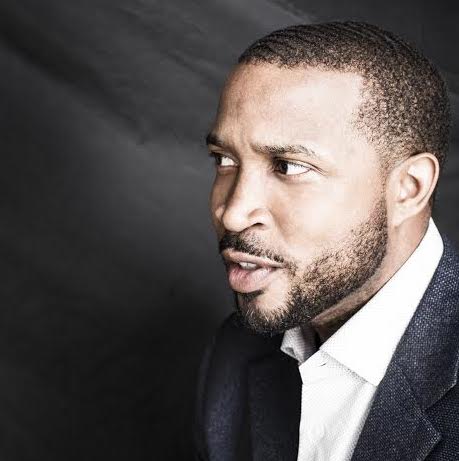
Othello Meadows
Meadows doesn’t consider himself a traditional leader.
“I think leadership is first and foremost about service and humility. I try to think of myself as somebody who is a vessel for the hopes and desires of this neighborhood. True leadership is service and service for a cause, so if that’s the definition of leadership, then sure, I am one.”
He feels North O’s suffered from expecting leadership to come from charismatic saviors who lead great causes from on high.
“In my mind we have to have a different paradigm for the way we consider leadership. I think it happens on a much smaller scale. I think of people who are leaders on their block, people who serve their community by being good neighbors or citizens. That’s the kind of leadership that’s overlooked. I think it has to shift from we’ve got five or six people we look to for leadership to we’ve got 500 or 600 people who are all active leaders in their own community. It needs to shift to that more grassroots, bottom-up view.”
Where can aspiring North O leaders get their start?
“Wherever you are, lead,” John Ewing says. “Whatever opportunities come, seize them. Schools, places of worship, neighborhood and elected office all offer opportunities if we see the specific opportunity.”
“They need to get in where they fit in and grow from there,” says Dell Gines, senior community development advisor, Omaha Branch at Federal Reserve Bank of Kansas City.
Empowerment Network board member and Douglas County Health Department health educator Aja Anderson says many people lead without recognition but that doesn’t make them any less leaders.
“There are individuals on our streets, in our classrooms, everywhere, every day guiding those around them to some greater destiny or outcome,” Anderson says.
Meadows feels the community has looked too often for leadership to come from outside.
“A community needs to guide its own destiny rather than say, ‘Who’s going to come in from outside and fix this?'”
He applauds the Empowerment Network for “trying to find ways to help people become their own change agents.”
Carver Bank Interim Director JoAnna LeFlore is someone often identified as an emerging leader. She in turn looks to some of her Next Gen colleagues for inspiration.
“I’m very inspired by Brigitte McQueen, Othello Meadows and Sharif Liwaru. They all have managed to chase their dreams, advocate for the well-being of North Omaha and maintain a professional career despite all of the obstacles in their way. You have to have a certain level of hunger in North Omaha in order to survive. What follows that drive is a certain level of humility once you become successful. This is why I look up to them.”
LeFlore is emboldened to continue serving her community by the progress she sees happening.
“I see more creative entrepreneurs and businesses. I see more community-wide events celebrating our heritage. I see more financial support for redevelopment. I feel my part in this is to continue to encourage others who share interest in the growth of North Omaha. I’ve built trusting relationships with people along the way. I am intentional about my commitments because those relationships and the missions are important to me. Simply being a genuine supporter, who also gets her hands dirty, is my biggest contribution.
“Moving forward, I will make an honest effort to offer my expertise to help build communication strategies, offer consultations for grassroots marketing and event planning and be an advocate for positive change. I am also not afraid to speak up about important issues.”
If LeFlore’s a Next Gen leader, then Omaha Small Business Network Executive Director Julia Parker is, too. Parker says, “There is certainly a changing of the guard taking place throughout Omaha and North O is not an exception. Over the next several years, I hope even more young professionals will continue to take high level positions in the community. I see several young leaders picking up the mic.” She’s among the new guard between her OSBN work and the Urban Collaborative: A Commitment to Community group she co-founded that she says “focuses on fostering meaningful conversation around how we can improve our neighborhoods and the entire city.”
Parker left her hometown for a time and she says, “Leaving Omaha changed my perspective and really prompted me to come home with a more critical eye and a yearning for change.”
Like Parker, Othello Meadows left here but moved back when he discerned he could make a “meaningful” impact on a community he found beset by despair. That bleak environment is what’s led many young, gifted and black to leave here. Old-line North O leader Thomas Warren says, “I am concerned about the brain drain we experience in Omaha, particularly of our best and brightest young African-Americans students who leave. We need to create an environment that is welcoming to the next generation where they can thrive and strive to reach their full potential.” Two more entrenched leaders, John Ewing and Douglas County Commissioner Chris Rodgers, are also worried about losing North O’s promising talents. “We have to identify, retain and develop our talent pool in Omaha,” Ewing says.

Tunette Powell
Omaha Schools Board member Yolanda Williams says leadership doors have not always been open to young transplants like herself – she’s originally from Seattle – who lack built-in influence bases.
“I had to go knock on the door and I knocked and knocked, and then I started banging on the door until my mentor John Ewing and I sat down for lunch and I asked, ‘How do younger leaders get in these positions if you all are holding these positions for years? How do I get into a leadership role if nobody is willing to get out of the way?’ They need to step out of the way so we can move up.
“It’s nothing against our elder leadership because I think they do a great job but they need to reach out and find someone to mentor and groom because if not what happens when they leave those positions?”
Ewing acknowledges “There has been and will always be tension between the generations,” but he adds, “I believe this creative tension is a great thing. It keeps the so-called established leaders from becoming complacent and keeps the emerging leaders hungry for more success as a community. I believe most of the relationships are cordial and productive as well as collaborative. I believe everyone can always do more to listen. I believe the young professional networks are a great avenue. I also believe organizations like the Empowerment Network should reach out to emerging leaders to be inclusive.”
Author, motivational speaker and The Truth Hurts director Tunette Powell says, “It’s really amazing when you get those older leaders on board because they can champion you. They’ve allowed me to speak at so many different places.” Powell senses a change afoot among veteran leaders, “They have held down these neighborhoods for so long and I think they’re slowly handing over and allowing young people to have a platform. i see that bridge.” As a young leader, she says, “it’s not like I want to step on their toes. We need this team. It’s not just going to be one leader, it’s not going to be young versus old, it’s going to be old and young coming together.”

Yolanda Williams
In her own case, Yolanda Williams says she simply wouldn’t be denied, “I got tired of waiting. I was diligent, I was purpose-driven. It was very much networking and being places and getting my name out there. I mean, I was here to stay, you were not just going to get rid of me.”
LeFlore agrees more can be done to let new blood in.
“I think some established leaders are ignoring the young professionals who have potential to do more.”
Despite progress, Powell says “there are not enough young people at the table.” She believes inviting their participation is incumbent on stakeholder organizations. She would also like to see Omaha 360 or another entity develop a formal mentoring program or process for older leaders “to show us that staircase.”
Some older leaders do push younger colleagues to enter the fray.
Shawntal Smith, statewide administrator for Community Services for Lutheran Family Services of Nebraska, says Brenda Council, Willie Barney and Ben Gray are some who’ve nudged her.
“I get lots of encouragement from many inside and outside of North Omaha to serve and it is a good feeling to know people trust you to represent them. It is also a great responsibility.”
Everyone has somebody who prods them along. For Tunette Powell, it’s Center for Holistic Development President-CEO Doris Moore. For Williams, it’s treasurer John Ewing. But at the end of the day anyone who wants to lead has to make it happen. Williams, who won her school board seat in a district-wide election, says she overcame certain disadvantages and a minuscule campaign budget through “conviction and passion,” adding, “The reality is if you want to do something you’ve got to put yourself out there.” She built a coalition of parent and educator constituents working as an artist-in-residence and Partnership 4 Kids resource in schools. Before that, Williams says she made herself known by volunteering. “That started my journey.”
Powell broke through volunteering as well. “I wasn’t from here, nobody knew me, so I volunteered and it’s transformed my life,” says the San Antonio native.
“The best experience, in my opinion, is board service,” OSBN’s Julia Parker says. “Young leaders have a unique opportunity to pull back the curtain and see how an organization actually functions or doesn’t. It’s a high level way to cut your teeth in the social sector.”

JoAnna LeFlore, ©omahamagazine.com
Chris Rodgers, director of community and government relations at Creighton University, agrees: “I think small non-profits looking for active, conscientious board members are a good start. Also volunteering for causes you feel deeply about and taking on some things that stretch you are always good.”
The Urban League’s Thomas Warren says, “We have to encourage the next generation of leaders to invest in their own professional growth and take advantage of leadership development opportunities. They should attend workshops and seminars to enhance their skills or go back to school and pursue advanced degrees. Acquiring credentials ensures you are prepared when opportunities present themselves.”
Gaining experience is vital but a fire-in-the-belly is a must, too. Yolanda Williams says she was driven to serve on the school board because “I felt like I could bring a voice, especially for North Omaha, that hadn’t yet been heard at the table as a younger single parent representing the concerns and struggles of a lot of other parents. And I’m a little bit outspoken I say what I need to say unapoligitically.”
Powell says young leaders like her and Williams have the advantage of “not being far removed from the hard times the people we’re trying to reach are experiencing.” She says she and her peers are the children of the war on drugs and its cycle of broken homes. “That’s a piece of what we are, so we get it. We can reach these young people because our generation reflects theirs. I see myself in so many young people.”
Just a few years ago Powell had quit college, was on food stamps and didn’t know what to do with her life. “People pulled me up, they elevated me, and I have to give that back,” she says. In her work with fatherless girls she says “what I find is you’ve got to meet them where they’re at. As younger leaders we’re not afraid to do that, we’re not afraid to take some risks and do some things differently. We’re seeing we need something fresh. Creativity is huge. When you look at young and old leaders, we all have that same passion, we all want the same thing, but how we go about it is completely different.”
Powell says the African-American Young Professionals group begun by fellow rising young star Symone Sanders is a powerful connecting point where “dynamic people doing great things” find a common ground of interests and a forum to network. “We respect each other because we know we’re all going in that direction of change.”
Sanders, who’s worked with the Empowerment Network and is now communications assistant for Democratic gubernatorial candidate Chuck Hassebrook, says AAYP is designed to give like-minded young professionals an avenue “to come together and get to know one another and to be introduced in those rooms and at those tables” where policy and program decisions get made.
Aja Anderson believes Next Gen leaders “bridge the gap,” saying, “I think this generation of leaders is going to be influential and do exceptionally well at creating unity and collaboration among community leaders and members across generations. We’re fueled with new ideas, creativity and innovation. Having this group of individuals at the table will certainly make some nervous, others excited and re-ignite passion and ideas in our established group.”

John Ewing
County treasure John Ewing sees the benefit of new approaches. “I believe our emerging leaders have an entrepreneurial spirit that will be helpful in building an African-American business class in Omaha.”
While Williams sees things “opening up,” she says, “I think a lot of potential leaders have left here because that opportunity isn’t as open as it should be.”
Enough are staying to make a difference.
“It’s exciting to see people I’ve known a long time staying committed to where we grew up,” 75 North’s Othello Meadows says. “It’s good to see other people who at least for awhile are going to play their role and do their part.”
Shawntal Smith of Lutheran Family Services is bullish on the Next Gen.
“We are starting to come into our own. We are being appointed to boards and accepting high level positions of influence in our companies, firms, agencies and churches. We are highly educated and we are fighting the brain drain that usually takes place when young, gifted minorities leave this city for more diverse cities with better opportunities. We are remaining loyal to Omaha and we are trying to make it better through our visible efforts in the community.
“People are starting to recognize we are dedicated and our opinions, ideas and leadership matter.”
Old and young leaders feel more blacks are needed in policymaking capacities. Rodgers and Anderson are eager to see more representation in legislative chambers and corporate board rooms.
Warren says, “I do feel there needs to be more opportunities in the private sector for emerging leaders who are indigenous to this community.” He feels corporations should do more to identify and develop homegrown talent who are then more likely to stay.
Shawntal Smith describes an added benefit of locally grown leaders.
“North Omahans respect a young professional who grew up in North Omaha and continues to reside in North Omaha and contribute to making it better. Both my husband and I live, shop, work, volunteer and attend church in North Omaha. We believe strongly in the resiliency of our community and we love being a positive addition to North Omaha and leaders for our sons and others to model.”
With leadership comes scrutiny and criticism.
“You have to be willing to take a risk and nobody succeeds without failure along the way to grow from,” Rodgers says. “If you fail, fail quick and recover. Learn from the mistake and don’t make the same mistakes. You have to be comfortable with the fact that not everybody will like you.”
Tunette Powell isn’t afraid to stumble because like her Next Gen peers she’s too busy getting things done.
“As Maya Angelou said, ‘Nothing will work unless you do,’ I want people to say about me, ‘She gave everything she had.'”
Read more of Leo Adam Biga’s work at leoadambiga.wordpress.com.
Categories: African-American Culture, African-American Empowerment Network, Community/Neighborhoods, JoAnna LeFlore, North Omaha, Omaha, Othello Meadows, Tunette Powell, Writing, Yolanda Williams
African American, African-American Empowerment Network, JoAnna LeFlore, John Ewing, North Omaha, North Omaha Leadership, Othello Meadows, Thomas Warren, Tunette Powell, Yolanda Williams
Nebraska’s Changing Face; UNO’s Changing Face
March 18, 2014
Leave a comment
I wrote the following feature and sidebar exploring some trends about the changing face of Neb. and the University of Nebraska at Omaha, my alma mater. Slowly but surely the state and some of its institutions are becoming more diverse. Some of the changes can be readily seen already, others not so much, but in a few decades they will be more obvious. It’s a healthy thing that’s happening, though diversity is still taking far too long to be fully felt and lived and embraced in all quarters, but that’s for another story.

Nebraska’s Changing Face
©by Leo Adam Biga
Nebraska’s “Plain Jane” sameness has long extended to its racial makeup. Diversity hasn’t held much truck here. Even when the foreign-born population was at its peak in the state’s first half century, the newcomers were predominantly of European ancestry.
An African-American migration from the Deep South to Omaha in the early 1900s established the city’s black base. Until a new immigration wave in the 1990s brought an influx of Africans and Latinos-Hispanics to greater Neb., the composite face of this Great Plains state was decidedly monotone.
The perception of Flyover Country as a bastion of white farmers has never been completely accurate. The state’s two largest metropolitan areas, for example, have always boasted some heterogeneity. Urban areas like Omaha and urban institutions such as the University of Nebraska at Omaha express more racial-ethnic diversity because of longstanding minority settlement patterns and the university drawing heavily from the metro.
But it is true Neb.’s minority population has always been among the nation’s smallest, which only supported the stereotype.
Finally, though, its minority numbers are going up and its diversity broadening.
Still, if Nebraskans posed for a group portrait as recently as 1980 more than 9 of every 10 would have beeb white. Only 6 percent identified as African-Americans, Latino-Hispanics, Native Americans or Asians.
The lack of diversity extended virtually everywhere. The largest minority group then, blacks, was highly concentrated in Omaha. Despite slow, steady gains blacks still account for only 13 percent of the city’s population and 4 percent of the state’s population.
But as recently announced by UNO researchers, Neb. is changing and with it the face of the state. A group picture taken today would reveal a noticeable difference compared to a quarter century ago, with whites now accounting for 8 of every 10 residents. Indeed, the state’s minority population has more than doubled the past four decades, with by far the largest increase among Latinos-Hispanics, who now comprise the largest minority segment. Latinos-Hispanics are on a linear growth trajectory. They tend to be young and their women of childbearing age.
Minority growth has been even greater in select communities, such as Lexington, where meat processing attracted newcomers.
Celebrated native son filmmaker Alexander Payne’s new movie “Nebraska” – set and shot primarily in the northeast part of the state – accurately portrays a slice of Neb.’s past and present through a large ensemble of characters, all of whom but two are white. The exceptions are both Hispanic. The Oscar-winning writer-director may next make a partly Spanish-language feature about the impact of the immigrant population on Neb.’s towns and cities.
New UNO Center for Public Affairs Research projections posit that by 2050 the state’s portrait will dramatically change as a result of major demographic trends well under way. Within four decades minorities will account for about 40 percent of the entire population. Nearly a quarter of the projected 2050 population of 2.2 million, or some 500,000, will be Latino-Hispanic.
It’s a sea change for a state whose diversity was traditionally confined to a few enclaves of color. Immigration, migration and natural causes are driving this new minority surge.
Everything is relative though. So while CPAR Research Coordinator David Drzod says, “Our diversity will increase,” he adds, “Neb. is one of the less diverse places countrywide and other states are going to become more diverse as well.”
Still, the snapshot of Neb. is changing due to real demographic shifts with significant longterm consequences. Just as the majority white base is holding static or declining, non-whites are proliferating. The results can be seen in the ever more diverse profiles of some communities, neighborhoods, schools and other settings.
Thus, for the first time in Neb. diversity is becoming more lived reality than aspirational goal.
Economic conditions were the main driver for the sharp rise in Latinos-Hispanics migrating here. Plentiful jobs, a low cost of living, coupled with aggressive industry recruitment, lured people to move here from places with comparatively weak economies, high cost of living and job shortages. Neb. grew its Latino-Hispanic base from points of origin in California, Texas. Mexico, Central America and South America, The state also saw its African and Asian populations increase as refugees from Sudan and Bhutan, for example, resettled here.
Drozd says, “People are not coming as directly for new jobs like in the ’90s when the meat processors were expanding and recruiting. We expect to see some regional migration that Neb. has typically seen from smaller locations to more urban locations that tend to have a diverse pool of job opportunities within various industries.”
While migration has slowed from its peak waves it’s expected to continue in fits and starts. Migration, researchers agree is “a wildcard” that can’t be accurately forecast, but Office of Latino and Latin American Studies Research Associate Lissette Aliaga Linares notes an uptick in Latinos-Hispanics from Arizona, which OLLAS Director Lourdes Gouvia attributes to that state’s anti-immigrant policies.
Drozd says Neb.’s minority experience is consistent with some surrounding states and inconsistent with others.
“We are typical of the Great Plains in that we tend to suffer from outmigration especially of young college-aged whites, which is counteracted by in-migration and increase in the minority population groups. On the other hand Neb. is unique in that we are growing faster in some of our metropolitan areas and not holding our population as well as some of the more rural areas.”
The emergence of more minorities is perhaps most visible in urban inner city public schools, where student enrollment naturally reflects the heavily minority communities these schools serve. Minority enrollment in the Omaha Public Schools stands at 68 percent.
“The diversity of UNO will continue to grow and one only has to look at the demographics in the metro area to understand that traditional middle school and high school students will increasingly be students of color,” says UNO Senior Vice Chancellor for Academic and Student Affairs B.J. Reed.
Some outstate school districts are now majority Latino-Hispanic.
The impact of diversity in this small population state that suffers from brain drain cannot be overstated.
“There’s a large part of Neb. that would be having population decline if it were not for minority growth,” says Drozd. “There’s all sorts of implications with respect to aging, the workforce, health care, education. From a gerontology standpoint you have the possibility of seeing a younger, more diverse working-age population caring for a predominantly white non-Hispanic aging population and will there be any issues associated there. With programs like Social Security you’re going to be relying more and more on an immigrant population to support payments for predominantly white people collecting from the program. So there are potentials for tension there and of course political ramifications and all sorts of factors.”
Gouveia, a sociology professor, reminds that “Latinos are going to imitate some trends of the larger population the more urban and educated they become,” adding. “The more women are able to work outside the home fertility rates will drop and the population will begin to age. It’s the life cycle.”
As minorities grow they become a larger sector of the tax and voting base that elected officials and prospective candidates must recognize.
Drozd says communities must adapt, whether offering English-as-a-Second Language programs or multicultural competency classes, in order to best serve minorities and their particular needs.
As more minorities graduate high school educators and employers hope that many of these college-bound grads and working-age young adults will attend school and find jobs in-state.
“As people have become upwardly mobile in Neb.’s past that has led to outmigration out of the state,” says Drozd. “It’s going to be a very policy relevant factor because people born in the early ’90s are now hitting age 18. Even if they choose a Neb. college where are they going to go to work? Will there be jobs and associated positions for them here in the state or will they go out of state?”
Just as preparing students to succeed in school is critical, so is preparing a workforce for today’s service and skilled jobs.
“Let’s make no mistake about this, without immigration Nebraskans may have to rethink how they are going to have a viable economy that produces not only jobs but payrolls that produce taxes from which an aging population will benefit greatly,” says Gouveia. “Without this population there won’t be services this Boomer population and this aspiring mini-global city of Omaha depends on. These are increasingly service economies and that means it’s very important for the economy to increasingly be based on higher pay jobs likely to grow, such as information technology or biotechnology.
“That also means educational institutions need to be able to truly know how to train this generation of children of immigrants. The children may not be immigrants themselves but a large number have immigrant parents who endured very poor, disadvantageous conditions that tend to disadvantage the educational achievement of their children. We have to have multidimensional. multidisciplinary perspectives to understand who this population is. And that goes to our research also.”
She believes minorities will succeed to the extent opportunities allow.
“We haven’t addressed the serious barriers to education that would guarantee that new face of America and of Neb. becomes a face with equal opportunities to participate in the prosperity all of us will want to share.” She says if barriers to upward mobility aren’t removed “it may prevent Neb. from truly harnessing what we call this demographic bonus that’s been gifted to this state. A state that was losing population were it not for minority growth and international migration would be in serious trouble today to have a viable economy and future.”
Daniel J. Shipp, UNO associate vice chancellor for student affairs, says schools must find ways to support minority students.
“When combined with the typical struggles of new college students the demographics of race-ethnicity will create even more difficult challenges in both access to and success in college. Not only must we continue to open our doors wider to traditionally under-served student populations but once on campus it is critical for all of us to see their success as a top institutional and community priority.”
UNO Associate Vice Chancellor for Academic and Student Affairs Pelema Morrice urges educators and employers to appreciate diversity’s many forms.
“We always focus on racial-ethnic diversity but I think intellectual diversity, geographic diversity, cultural diversity, all those different forms of diversity, really add a lot of value to everyone’s experience. There’s plenty of evidence that the more diverse environment we’re in the more we all have opportunities to learn from each other.
“So I think it’s incredibly important for an institution to be a welcoming and diverse environment where folks can learn from each other at a higher level. I think that adds to the educational experience and it provides students with really good training to go out and be productive citizens and to be successful in the workplace.”
Diversity is also the way of this flatter, interconnected world.
Reed from UNO’s Academic and Student Affairs office, says “Our students will grow up in a much more global environment requiring exposure to difference cultures and different experiences.”
Where diversity often must be programmed, Gouveia is heartened by students’ inherent embrace of it. “About this new Neb. mosaic, one thing I’m particularly hopeful about is the younger generation. I love our new students. From any background they are so much more prepared and so much more ahead of where we are as professors or department chairs or deans in terms of knowing how to do diversity. We are the ones who are often behind them.”
As Neb. becomes more multi-hued, UNO’s Morrice says representative stakeholders should discuss what diversity holds for the state.
“With these new demographics coming forward it means our student base will obviously be more diverse than it is now and that means the outcomes will be more diverse and so we’ll see more diverse workplaces and communities within the state. We’re just a piece of that puzzle but I think it’s a good collective conversation for everyone to have as the state continues to grow and it becomes clear that there will be different faces at the table.”

UNO’s Changing Face
©by Leo Adam Biga
The same demographic trends on pace to make the United States a minority majority population by 2050 and making Neb. a more racially-ethnically diverse place in the second decade of the new millennium, are increasingly being expressed at the University of Nebraska at Omaha.
Roughly a quarter of UNO’s 2013-2014 freshman class is minority and just under 20 percent of the school’s entire undergraduate enrollment is minority. Both are record marks for the school. In 2000, for example, UNO’s minority enrollment stood at 9 percent. The minority numbers are even greater among graduate students.
The 11 percent rise in UNO minority enrollment from 2000 until now reflects in large measure the Latino-Hispanic boom that happened in-state from 1980 to 2010, when that segment increased from about 37,000 to 167,000. The Latino-Hispanic population is expected to add another 370,000 residents by 2050, according to UNO’s Center for Public Affairs Research.
As a public institution with a state-wide reach, UNO’s a model for the changing face of Neb. Drawing principally from the Omaha metropolitan area, which as the state’s largest urban center has always been Neb.’s most racially-ethnically diverse spot, UNO is, as expected, one of the most diverse campuses in the University of Nebraska system.
At the University of Nebraska-Kearney minority undergraduate enrollment has nearly doubled since 1995. Today, nearly a quarter of its students are non-white or non-resident alien. Meanwhile, the University of Nebraska-Lincoln reports the most diverse student body in its history. UNL’s 2,328 minority undergrads are about 12 percent of the undergraduate total, a 9 percent increase just from last year. Just as at UNO, the largest minority gains at each school are in the Latino-Hispanic and international students categories,
As minorities comprise a growing segment of the state’s mainstream and of its public schools’ enrollment, institutions are tasked with incorporating these populations and responding to their needs.
“The good news for Omaha is that UNO has a proud tradition of supporting minority students through various educational equity and learning community investments such as Goodrich, Project Achieve and the newer Thompson Learning Community,” says UNO Associate Vice Chancellor for Student Affairs Daniel J. Shipp. “These programs provide student participants with a network of caring and concerned faculty, staff and peer mentors that help students to succeed and thrive in college. Moving forward, I expect we will continue to build on our national reputation for attracting and supporting the growing numbers of minority students and their families in the Omaha area and beyond.”
“Minority students are an important population but they are only one of an increasing mosaic of diversity at UNO, whether they are military, first generation, students of color or adult learners or transfer students,” says UNO Senior Vice Chancellor for Academic and Student Affairs B.J. Reed. “We are working every day to ensure that these students feel welcome at UNO and have the type of support services and environment that will make them want to be want to be here and to be successful. We do this for all our special populations of students. We have programs and learning communities as well as staff specifically directed at helping ease their transition to UNO and success in their academic goals.”
Reed says hiring faculty and staff who reflect the changing face of UNO “is a top priority,” adding, “We have made important strides in diversifying our staff but we lag behind where we want to be here and also with recruiting and retaining a more diverse faculty. We are working on reviewing existing policies and procedures and looking at incentives and support efforts to increase the diversity of faculty and staff to reflect the changing demographics of our student body.”
There’s wide agreement that diversity is a net sum experience for all involved.
“The benefits are substantial,” Reed says. “The workplace is becoming increasingly diverse and employers need and want an increasingly diverse group of employees. We cannot underestimate the shift occurring here. We need to provide a strong educational workforce for employers and UNO must be positioned to do that effectively.”
Office of Latino and Latin American Studies Director and Sociology Professor Lourdes Gouveia agrees that educators at UNO and elsewhere must increasingly consider diversity and its impact.
“We have to educate our professionals and student populations in ways that allow them to be skilled about global issues and diversity and to have multicultural competencies as the world is very connected,” she says. “But also we need to address structural barriers that may prevent Neb. from truly harnessing what we call this demographic bonus that has been gifted to this state. A state that was losing population if not for minority growth and international migration would be in serious trouble today to have a viable economy and a future.”
Categories: African-American Culture, Education, Latino/Hispanic, Nebraska, OLLAS (Office of Latino and Latin American Studies), Omaha, Race, University of Nebraska, UNO (University of Nebraska at Omaha), Writing
African American, Demographics, ethnicity, Latino/Hispanic, Nebraska, Office of Latino and Latin American Studies, Population, Race, University of Nebraska, University of Nebraska at Omaha


 Leo Adam Biga's My Inside Stories
