Enchantress “LadyMac” Gets Down
This is one in a batch of posts I am making in the lead-up to the 2011 Omaha Black Music and Community Hall of Fame on July 29 at the Slowdown. The late Buddy Miles is one in a long list of musicians from Omaha to find stardom or at least solid success in the upper reaches of the music industry. Miles is one of those who became a legend in his own time and since his untimely death in 2008 his legend is only growing. I did this story for The Reader (www.thereader.com) on the occasion of his induction in the Omaha Black Music Hall of Fame, which after a hiatus is back this year in conjunction with Native Omaha Days. My blog is thick with stories I’ve done about famous African American figures from Omaha who’ve enjoyed breakout success in the arts, athletics, and many other fields. You’ll also find stories about many other aspects of African American culture and life in these parts. Hope you enjoy the pieces as much as I enjoyed writing them.

©by Leo Adam Biga
Originally published in The Reader
Famed blues-rock drummer and singer Buddy Miles is coming home to accept the Omaha Star Award at the August 3 Omaha Black Music Hall of Fame ceremony, where he’ll also perform. The 2005 inductee is using the occasion to deliver a message about the needless waste of young people to violence.
Having grown up in the ‘50-’60s heyday of the hep North 24th Street music scene, he rues the loss of what used to be.
“Back in the day 24th Street is where all the clubs were. It certainly is nothing like it was then. It’s like a ghost town down there now…there’s nothing for kids to do,” he said. “That’s why there’s so much havoc and trouble in Omaha and…in every major city…People don’t know how to go and party anymore. There’s too many senseless shooting.s The time has come that we must band together as one….”
The lifetime train enthusiast hopes to convince Union Pacific Railroad to sponsor a nationwide tour, tracing the railroad’s lines, for him to educate young people “about how important their lives are.” His new CD, The Centennial, is named after the famous U.P. diesel engine at Kenefick Park.
He dreamed of being a train engineer. Instead he “followed in the footsteps” of his father, George A. Miles, Sr., who played upright bass with Ellington, Basie, Parker, Gordon. Buddy began playing drums at age 8. “I’ve been a musician all my life,” he said. “I’ve done nothing else.”
As a teen he gigged with his father’s band, the Bebops, and with Preston Love, Sr. and Lester Abrams. He first made it in New York, hooking up with Wilson Pickett. He jammed in the Village with Eric Clapton. His big break came when Michael Bloomfield plucked him for the Electric Flag, a blues-rock band Miles still considers the best he ever played in. He toured-recorded widely, opening for Cream and the Jimi Hendrix Experience, and playing on albums by Hendrix and Muddy Waters. More Hendrix collaborations followed. Jimi produced an album by the Buddy Miles Express. Miles played on Hendrix’s Electric Ladyland. Miles formed with Hendrix and Billy Cox the trio, Band of Gypsys, which released one album before Jimi’s death.


Buddy with Jimi Hendrix

Miles recorded hits and played with such artists as Carlos Santana, Stevie Wonder and David Bowie. His greatest commercial success came with his version of “I Heard It Through the Grapevine” for a California Raisins commercial. The gig made the classic song big again and spawned three Miles albums.
A 2005 stroke has not slowed Miles, who lives in Austin, Texas. He’s even throwing down a challenge to Motley Crew bad boy drummer Tommy Lee and the rocker’s MTV Husker bit. “I’ll have a duel with that dude anytime he wants…We can do it at a Nebraska football game, too,” Miles said, “because I’ll drum him a new ass.”
With the 2011 Omaha Black Music and Community Hall of Fame Awards coming up July 29 at the Slowdown, as part of Native Omaha Days, I am posting articles of mine from the last decade that celebrate various African-American figures from the area. The following story for The Reader (www.thereader.com) is about Lois “LadyMac” McMorris, one of many black musical artists who have come out of Omaha to forge successful careers in the music biz. I did a phone interview with her on the eve of her induction in the Hall of Fame, which returns this year after a few years absence. My blog is full of stories about high black achievers from Omaha.


Enchantress “LadyMac” Gets Down
©by Leo Adam Biga
Originally published in The Reader (www.thereader.com)
Casual music fans may not know Lois “LadyMac” McMorris, but this blues-jazz-rock guitarist from Omaha is paid homages by legends like B.B. King — “The girl is super bad.” After a hot solo Prince saw her play in Kansas City, where she lives, LadyMac said, “He came up to me and asked, ‘May I touch your guitar?’ I felt so honored. For my peers to recognize me is an amazing thing. That’s like a validation.”
More validation comes at the August 3 Omaha Black Music Hall of Fame ceremony. The 2005 inductee is the Jewel Award recipient for her lifetime achievements.
She grew up on the north side making art and music. Today she’s a gallery showing sculptor, painter and drawer and a still active headliner-sidewoman.
Inspired by guitar riffs on radio-television she taught herself to play as a young girl. “It touched me so deeply,” she said. She loved working on her chords and “learned lick for lick” famous solos. She first played publicly at 17, when she joined Joe Leslie and the Impacts. She had to prove to the cats she had the chops to play with them. Her baptism of fire came at Paul Allen’s Showcase on North 24th Street.
“Allen’s Showcase had been the premiere club since my parents’ time,” she said. “There were so many stellar African-American entertainers that would come through from Chicago, Des Moines, Kansas City…there was a kernel core of musicians…and the famous jam sessions and the things that ensued are just something to be written about.
“If you didn’t make it in that jam session either you were going to go home and woodshed and come back or you were going to stop, because it was intense.”
It was even hotter for her as the guys scrutinized her every move with skeptical eyes and sexist remarks. It was the same everywhere she went.
“The gender bigotry was just amazing,” she said. “Denigrated. Put down. Unappreciated. I ran into and still have to fight so much discrimination. It’s gotten a bit better, just as racism has eased a bit. It would go from things that are subtle to overt. Like I’d be told, ‘You can’t do that.’ I mean, over and over again. Please, let’s get real. It just made me more determined to express myself and to play and not be held back by that sort of thing. I cannot abide injustice.”
She made the mark at the Showcase, blowing the house away with her virtuosity and energy.
“For myself, when I finally performed there, it was the pinnacle…” said McMorris. She took those cats by surprise, having honed her gift off by herself, at home, where she’d incessantly listen and practice. “I did not develop my music around them. It was on my own. I just immersed myself in chords. What I hear I can play and I can play it fairly quickly, and then I can write it down as well. I can read, I can write charts. I do arrangements. It’s just in me. ”
What sets her apart, besides her sizzling solos, sultry fly looks and spiritual- inspirational vibe is her ability to both “dig in and just play” and to “express a showtime sensibility” in the way she moves, dresses and strokes.
Besides the Impacts, she played locally with the Persuaders, Seventh House and Poverty Movement and artists Andre Lewis and Preston Love, Sr.. Hanging with top musicians convinced her “larger vistas” awaited. Love advised her to seek new ops. “He told me, ‘You won’t grow your playing here. If you’re going to do something with it, leave.’” She lit out for L.A., where she soon landed a recording session gig with Love’s friend, blues guitarist Johnny Otis”
LadyMac was on her way, her dynamic musicianship-showmanship: sharing the stage with Tower of Power, Earl Klugh, Linda Hopkins; Cooilio, opening for Al Jarreau and Howard Hewitt and headlining the Playboy Jazz Festival. From L.A., she traveled the nation and the world to perform, only recently moving to K.C. to be near family. She’s fronted her own band, LadyMac Attack, and recorded. Her new CD is 500.
Her career mirrors that of many black musicians from Omaha — high caliber players with great creds, but few props outside the industry. She agrees with OBMHOF founder/director Vaughn Chatman that Omaha’s black music legacy is a great untold story, one, she said, people “should know about.”
“A lot of genius players came from Omaha’s near northside,” she said. “It’s a group of multi-talented musicians who can play many instruments, and that’s what’s so rare. Another thing — we’re cross-genre. We’re not just in one pocket. The straight-ahead cats can get busy and play the funk. They can play all those things. Also this sensibility of playing and coming with a show. It’s almost as if everyone incarnated around a certain time” to create “an Omaha sound…this flavor…”
Acknowledgement of groundbreaking black Omaha musicians has been slow to come, making the peer-based Hall award all the sweeter.
“Very often the people that are the vanguard are not always recognized while they’re doing it and that’s a hurtful thing,” she said. “But it’s not too late.”
I don’t see a huge amount of live theater, but I attend more than enough shows to give me a good feel for what’s out there. My hometown of Omaha has a strong theater scene and one of the more dynamic works I’ve seen here in recent years came and went without the attention I felt it deserved. It was called Walking Behind to Freedom, and it deal head-on with many persistent aspects of racism that tend to be trivialized or distorted. The fact that a fairly serious piece of theater dared to tackle the issue of race in a city that has long been divided along racial lines took courage and vision. Playwright Max Sparber, a former colleague and editor of mine at The Reader (www.thereader.com) based the play, which unfolds in a series of vignettes, on interviews he did with folks from all races around the community. He asked people to share experiences they’ve had with racism and how these encounters affected them. A local musical group called Nu Beginning wrote songs and music that expressed yet more layers of insight and emotion behind the dramatized experiences. A diverse group of cast and crew collaborated on a rousing, moving, thought-provoking night of musical theater. I had a personal investment in the show, too, in that my partner in life played a couple different speaking parts. She was quite good. My story about the show appeared in The Reader.
“Walking Behind to Freedom” – A musical theater examination of race
©by Leo Adam Biga
Originally published in The Reader (www.thereader.com)
The subject of race is like the elephant in the room. Everybody notices it, yet nobody breathes a word. The longer the silence, the more damage is done. Seen in another light, race is the label comprising the assumptions and perceptions others project on us, soley based on the shade of our skin or sound of our name. Seeing beyond labels sparks dialogue. Stopping there erects barriers to communication.
Race is as uncomfortable to discuss as sex. Yet, attitudes about race, like sex, permeate life. It’s right there, in your face, every day. You’re reminded of it whenever someone different from you enters your space or you’re the odd one out in a crowd or issues of profiling, preferences and quotas hit close to home.
It often seems Omaha’s predominantly white population wishes the topic would go away in a weary — Oh, didn’t-we-solve-racism-already? tone — or else makes limp liberal gestures toward more inclusion. Then there’s the majority reaction that pretends it’s not a problem. Take the Keystone neighborhood residents now opposing the Omaha Housing Authority’s planned Crown Creek public housing development. Opponents never mention race per se, but it’s implicit in their expressed concerns over property values being adversely affected by public housing whose occupants will include blacks. Nothing like rolling out the old welcome wagon for people trying to get ahead.
On the other side of the fence, militant minority views claim that race impacts everything, as well it might, but such sweeping indictments alienate people and chill discussion. How much an issue race is depends on who you are. If you have power, it’s not on your radar, unless it’s expedient to be. If you’re poor, it’s a factor you must account for because someone’s sure to make you aware of it.
If you doubt Omaha is beset by wide rifts along racial lines, you only need look at: its pronounced geographic segregation; its mainly white police presence in largely Latino south Omaha and African-American north Omaha; its rarely more than symbolic multicultural diversity at public-private gatherings; its few minority corporate heads and even fewer minority elected public officials. Then there’s the insidious every day racism that, intentionally or not, insults, demeans, excludes.
It’s in this climate that, last fall, Omaha Together One Community (OTOC) said: We need to talk. A faith-based community organizing group focusing on social justice issues, OTOC commissioned an original musical play, Walking Behind to Freedom, as a benefit forum for addressing the often ignored racial divide in Omaha and the need for more unity. It’s the second year in a row OTOC’s staged a play to frame issues and raise funds. In 2003, it presented a production of Working, the Broadway play based on the book of the same name by Studs Terkel.
With a book by Omaha playwright Max Sparber and music by the local quartet Nu Beginning, Walking Behind to Freedom premieres May 7 and 8 at First United Methodist Church. Performances run 7:30 p.m. each night at the church, 69th and Cass Street. Free-will donations of $10-plus are suggested. Proceeds go to underwrite OTOC operational expenses.
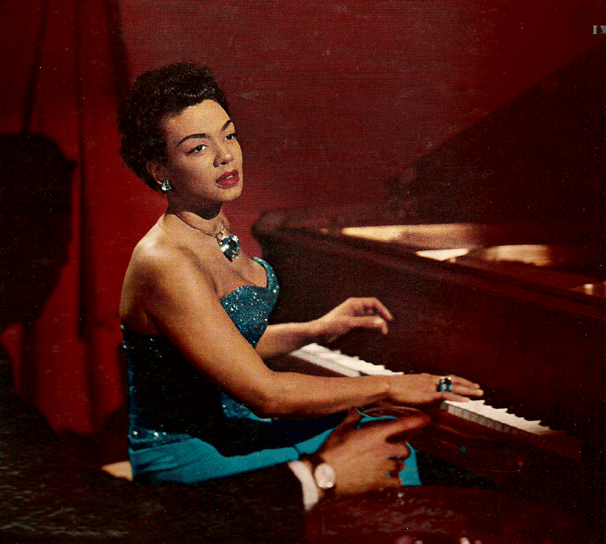
The play’s title is lifted from a famous quote by the late entertainer and Civil Rights activist, Hazel Scott, who posited, “Who ever walked behind anyone to freedom? If we can’t go hand in hand, I don’t want to go.” The show coincides with the 40th anniversary of Congress passing landmark Civil Rights legislation in 1964.

Max Sparber
As a foundation for the play, OTOC did what it does best: organize “house meetings” where citizens shared their anecdotes and perspectives on racial division. Sparber and Nu Beginning attended the meetings, held at OTOC-member churches city-wide, and the ensuing conversations informed the non-narrative play, which is structured as a series of thematic monologues, dialogues and songs.
“I built my script based on some of these interviews, along with some broader themes,” said Sparber, whose Minstrel Show dealt with an actual lynching in early Omaha. “We got some great stories out of it. The people who came to the meetings were very interested in the subject and I certainly got some stories that were invaluable. More than anything, we wanted this play to be specific to Omaha, and therefore we wanted its origins to be within Omahans’ own experiences.”
Surfacing prominently in those sessions was the theme of division and how by going unspoken it only deepens the divide. “This is a town that’s very separated geographically. The majority of blacks live in north Omaha. The majority of Latinos live in south Omaha. The majority of whites live in west Omaha. And, as a result, there’s not a lot of crossover,” Sparber said. “It’s really sad how closed up Omaha is,” said the play’s director, Don Nguyen, lately of the Shelterbelt Theater.
“Along with that, race is quickly becoming an undiscussed element in Omaha,” added Sparber. “I think a lot of whites believe we live in a post-racism world and, therefore, it’s not a subject that needs to be addressed. Whereas, black people experience this as not being a post-racism world at all and are kind of startled by this other viewpoint. So, there’s this disconnection based on understanding.”
 |
Two lines in the play comment on this dichotomy: “I think a lot of white people feel that racism ended in the Sixties, with Martin Luther King. The only thing about racism that ended in the Sixties WAS Martin Luther King.”
Any impression all the work is done alarms Betty Tipler, an OTOC leader. “A lot of us are in our comfortable spaces. We go inside our houses with our two garages and we think things are okay. Things are not okay. The issue of race has not been cured and, if we’re not careful, things will go backward,” she said. Despite the illusion all’s well, she added, the play reminds us people of color still contend with bias/discrimination in jobs, housing, policing. “We may as well face it.”
According to OTOC leader Margaret Gilmore, the process the play sprang from is at the core of how the organization works. “We’re about bringing different people in conversation with each other to talk about what’s in their hearts and minds,” she said. “It’s a process of learning to talk to each other and listen to each other and then seeing what we have in common to work together for change.” She said the meetings that laid the play’s groundwork crystallized the racial gulf that exists and the need to discuss it. “We don’t talk about this stuff enough. We don’t talk about it on a personal level and how it affects us, which is what I think this play gets to. When we ask the right questions and we’re willing to listen, then the experiences that people tell in their own words are dramatic and provocative.”
“It’s very important we listen to real people’s stories. The only way you can come up with the truth is to go to the people. We haven’t watered down or changed their stories, but literally portrayed them,” said OTOC’s Tipler, administrator at Mount Nebo Missionary Baptist Church, which hosted some of the house meetings.
Indeed, the vignettes carry the ring of reportorial truth to them. Most compelling are the monologues, which unfold in a rap-like stream-of-consciousness that is one part slam-poet-soliloquy and one part from-the-street-rant. Some stories resemble the bared soul testimony of people bearing witness, yet without ever droning on into didactic, pedantic sermons, lectures or diatribes. The language sounds like the real conversations you have inside your head or that spontaneously spring up among friends over a few drinks. Often, there’s a sense you’re listening in on the privileged, private exchanges of people from another culture as they describe what’s it like to be them, which is to say, apart from you.

Don Nguyen
For director Nguyen, the “real life testimonies” add a layer of truth that elevates the material to a “more powerful” plane. “I think it will definitely work for us that people know this is real. It’s not an overall work of fiction. This is real stuff.”
The misconceptions people have of each other are voiced throughout the work, often with satire. You’ve heard them before and perhaps been guilty yourself assigning these to people. You know, you see an Asian-American, like Nguyen, and you reflexively think he’s fluent in Vietmanese or expert in martial arts, some assumptions he’s endured himself. “Oh, yeah, my personal experiences definitely help me to relate,” he said. “Growing up in Lincoln I got in fights all the time. People making fun of me. Thinking I knew kung-fu or I only spoke Vietmanese, which is not true. But it’s not just the blatant racism. It’s the underlying stuff, too. Sometimes it’s not even intentional, but it’s just there. And it’s that gray stuff I think these pieces capture pretty well and that people need to hear more of.”
In the vignette Tricky, some women lay out the subtle nature of racism in Omaha. “…it’s like a fox. It’s tricky. It’s sly. You’ll be standing in line at a store, and the cashiers will be helping everybody except you…and you’re the only black person in line…and because it’s so sly, I think white people don’t notice it at all.”
The play also looks at racism from different angles. One has a guilt-ridden realtor rationalizing the unethical practice of steering, which is another form of red lining. The other has a new generation bigot defending his right to espouse white pride in response to black heritage celebrations. The concept of reverse racism is explored in the real life case of students protesting their school’s special recognition of black achievers at the expense of other minorities. And the wider fallout of racism is examined in the confession offered by an insurance agent, who reveals rates for car-house coverage are higher for residents of largely black north Omaha, including whites, because of the district’s perceived high crime rate.
The vignettes touch on ways race factors into every day life, whether its the unwanted attention a black couple attracts while out shopping or the hassle African-American men face when driving while black, or DWB, which is all it takes to be stopped by the cops. The shopping piece uses humor to highlight the absurd fears that prompt people to act out racist views. Music is used as heightened counterpoint to the boiling frustration of the DWB victim, whose cries of injustice are accompanied by the soulful strains of doo-wop singers.
Bridging the play’s series of one-acts are songs by Nu Beginning, whose music is a melange of hip-hop, R & B, soul, pop and gospel. A little edgy and a lot inspirational, the music drives home the unity message with its uplifting melodies, which are sung by choruses comprised of diverse singers.
Some pieces are heavier or angrier than others. Some are downright funny. And some, like Mirrors, speak eloquently and wittily to the concept of how, despite our apparent differences, we are all reflections of each other. Here, Nguyen employs a diverse roster of performers to represent the mirror symbol. Perhaps the most telling piece is Function. This beautifully-rendered and thought-provoking discourse is delivered by an architect, who suggests racism has survived as both an ornament of the past, akin to a Roman column on a modern house, and as a still-functional device for those in power, as when a politician plays the race card.
Whatever the context, there’s no dancing around the race card, which is just how Nguyen likes it, although when he first read the script he was surprised by how brazenly it took on taboo material, such as its use of the N-word.
“Typically, a script or show sugarcoats the issue of race. It’s a very cautious topic. You don’t want to offend or patronize people by saying the wrong stuff. But this piece is much different. All of its pretty much in your face,” Nguyen said. “What I mean is, it’s very direct. Max (Sparber) makes no bones what he’s writing about, which is great. It’s a big risk to take as a writer, but essentially it’s the most interesting path to take, too. And I’m all for stirring up trouble. I’m fine with that.”
OTOC’s Betty Tipler feels racial division is too important an issue to be coy about. “We’ve got to come out of the closet, so to speak, and talk about racism and differences” she said. “We tend to shy away from talking about it, but it won’t go away. We have got to come together, put it on the table, take a look at it and deal with it — no matter how much it hurts me or how much it hurts you. But before we can do that, we’ve gotta put it out there. We won’t get anywhere until we do. And I believe this play is a step toward doing that.”
Christy Woods, a singer/songwriter with Nu Beginning, said the play is about hope. “I believe if people are open to change, we can go hand-in-hand to freedom. Just because I’m this and you’re that, doesn’t mean I have to be one step behind you. Why can’t we go together? We want people to feel inspired to go out and make a change. We want to touch, but also to teach, and I believe this musical does that.”
Nguyen hopes the play attracts a mixed audience receptive to seeing race through the prism of different experiences. “That’s where I’m trying to aim the show. As we go through these vignettes, I want some people to identify with them and some people to be like, ‘Oh, I didn’t know that.’ That’s what I want to create.”
Magdalena Garcia is one of those one-woman bands whose all consuming devotion to her passion, art, is so complete that one finds it hard to imagine how the museum she founded and directs, El Museo Latino in Omaha, would ever survive without her. She is hands-on involved in virtually every aspect of the place, which for its relatively small size presents a tremendous number of exhibitions and programs. The museum is a real jewel in the city and was one of the redevelopment anchors that signaled to others the promise of the South Omaha community it resides in. When she opened the museum 18 years ago South Omaha was in decline but she stuck it out, found a great new site in the heart of the South O business district and she’s seen the area around it transition from nearly a ghost town look and feel to a vibrant, bustling hub of largely Latino owned and operated businesses. I did the following story for The Reader (www.thereader.com) a few years ago. Maggie, as she’s known, had already grown the museum into a first-rate arts venue of high quality exhibits and programs by that time, and she’s taken it to even greater heights since then.
El Museo Latino opened as Midwest’s first Latino art and history museum-cultural center
©by Leo Adam Biga
Originally published in The Reader (www.thereader.com)
As preparations for Cinco De Mayo festivities continued earlier this month at El Museo Latino, founder and executive director Magdalena Garcia seemed to be everywhere at once in the sprawling brick building housing the museum at 4701 1/2 South 25th Street. Now in its eighth year, the museum is very much a one-woman show.
With a small staff and a meager budget its survival depends on Garcia, whose formidable drive brought it from concept to reality in five short weeks in early 1993. She does everything from unpacking crates to framing works to leading tours to presenting lectures to schmoozing at fundraisers to writing grants to giving dance lessons. She even locks up at night. It’s her baby. And, despite protests to the contrary, she would not have it any other way. Her work is her life’s mission.
“It’s definitely a passion. I’m totally immersed in it. It’s never, never boring. There’s always something new to do and learn, and that’s exciting,” said Garcia, a Mexico City native who has kept close to her heritage since emigrating with her family to Omaha in the early 1960s. Such devotion is typical for Garcia.
She had an epiphany serving as a Joslyn Art Museum Docent during a 1984 exhibition of art and artifacts from the Maximilian-Bodmer collection on permanent loan to Joslyn from her then employer, Northern Natural Gas, where she was human resources manager. Her experience then inspired a desire to dig deeper into that world and eventually led her to reorder her life around art, something she’d only dabbled in before.
“I remember thinking how wonderful it would be to be that close to real art every day. That was an exciting prospect to me. After the exhibit ended I stayed on as a volunteer in the Joslyn’s art library. Then I found myself taking vacations to see exhibits in Boston, Los Angeles, Europe. As I saw more art I found traveling to exhibitions a few days a year wasn’t enough anymore. I wanted to make art my profession. To work in a museum. I just didn’t know how I was going to get there.”
Changing Paths
Her first step on that journey was to switch her major from business to art history while a part-time University of Nebraska at Omaha student. The next step came when her company downsized in 1988 and she accepted a severance package. She used the money to enter graduate school at Syracuse University, where she embarked on a dual master’s program in art history and museum studies. After a fateful decision to change her focus from Renaissance to Latin American art, her research on Mexican muralists took her to New York, Los Angeles (where she completed an internship at the L.A. County Museum of Art) and Mexico City. “It really brought me full circle,” she said.
![Magdalena-Garcia[1]](https://sumuseumstudiesalumni.files.wordpress.com/2014/04/magdalena-garcia1.jpg)
When New York’s illustrious Guggenheim Museum courted her to head-up its Latin American Art Department it confirmed her marketability as a bilingual woman with art and business expertise. “That was an eye-opener,” she said. “It showed me I could be a tremendous resource to an institution wanting to reach the growing Hispanic population.” She turned the Guggenheim down, however, because she could not justify stopping short of completing the academic path she had worked so long and hard to follow.
Then, in the fall of 1992, something happened to derail her conventional museum track. While in Omaha for a one-day Hispanic Heritage program and exhibit she was struck by the “overwhelming” requests she received to speak to school and community groups and by the “need for a space where we could show art year-round.” That’s when she got the idea of starting an Omaha Hispanic museum.
Bringing a Vision to Life
Her plan from the outset was for a museum to be based in its cultural center — South Omaha. When her search for a space turned-up a former print shop in the basement of the Livestock Exchange Building, she negotiated a one-year lease with eight months free rent in lieu of her cleaning up the ink, grease and smoke-stained site.
Armed with pledges of donated supplies from individuals and businesses, work proceeded at a fever pitch, especially once Garcia and her board decided to open in a mere 34 days to kick-off that year’s Cinco De Mayo celebration. Volunteers worked day and night to convert the space, putting-on the finishing touches minutes before the doors opened at 4 p.m. on May 5, 1993. Only a few years later, with the museum having quickly outgrown its space and the future of the Livestock Exchange Building and surrounding stockyards in doubt, Garcia looked for a larger, more permanent site and found it in the former Polish Home at the corner of 25th & L, a fitting symbol for the changing makeup of South Omaha’s ethnic community. In Garcia’s mind it was providence that led her to the building, which, with its brick walls, red tile roof and U-shape design framing a courtyard, resembles a Spanish colonial structure. “It probably was meant to be,” she said.
She believes that when El Museo Latino opened in its new digs it became the first Latino art and history museum and cultural center in the Midwest.
The eclectic museum is a reflection of her wide interests in and deep feelings for Hispanic art. What it lacks in polish or panache it makes up for in serious presentations of textiles, pottery, carvings, paintings, drawings and photographs revealing the breadth and depth of a rich culture. “Hopefully, anyone who comes to the museum will get a little glimpse or flavor of how varied Latin American art is. It’s not one thing. It’s not just cactus and mariachi. It’s not just a Mexican thing. It’s a variety of periods, countries and styles,” she said. “The thing I’ve been most pleased with is sharing this diversity not just with our community, but with the rest of the community and sharing how WE see our culture rather than someone else translating it and telling us what our culture is.”
Finding a Niche
Garcia feels the museum is taking hold in the mostly Hispanic district. “I’ve noticed people taking more ownership. That this is ‘our museum’ versus, the first years, this is ‘Maggie’s museum,’ and that’s great. There’s more of a community embrace and it’s grown out of a collaborative effort. Our people look to see what’s happening here and the wider community looks to us to see what the Hispanic community is doing.”
With a broad mission of collecting and exhibiting Hispanic art from the Americas and developing education and outreach programs around all its displays, El Museo Latino has set ambitious goals. To date, it has acquired a small collection of textiles and objects and averaged eight exhibits per year. Garcia hopes to increase acquisitions and add more exhibits, but for now funds are earmarked for renovations to the turn-of-the-century building, including an overhaul of its outmoded electrical and plumbing systems, a major roof repair and the addition of an elevator and dock. Then attention will turn to fully conditioning the former social hall into museum quality classroom and gallery spaces.
To meet those needs and allow for the building’s purchase, the museum is three-quarters of the way to reaching a $1 million fund drive goal. Meanwhile, Garcia said museum-sponsored classes and workshops overflow with students learning paper cutting, weaving and mola-making. Traditional Mexican folk dancing classes are also popular. Garcia, a dancer herself, leads a youth performance dance troupe. Lectures and concerts draw well too. Combined attendance (for exhibits, classes, concerts, etc.) is also up — to 52,000 visitors last year from 17,000 three years ago.
While there is always a chance she will take one of those high-profile museum jobs she still gets offered, she’s not going anywhere soon. “I’ve made a commitment to see this museum take off and really get on solid ground. We’re still pretty new. There’s a lot of work yet to be done,” she said. Besides, she finds renewal in the endlessly rich veins of art she explores. “One of the things I find exciting is that there’s so much out there. It’s like, What do we want to exhibit this time? Every time we have something new it’s a learning process. That part keeps me fresh.”
El Museo Latino is currently presenting a traveling exhibition of Alebrijes, brightly colored wood carvings of fantastic animals from the Mexican state of Oaxaca. The show continues through August. For more information, visit http://www.elmuseolatino.org or call 731-1137.
Up for best male actor in a musical at the 2011 Tony Awards was Omaha native Andrew Rannells in The Book of Mormon, the smash show from the creators of South Park that dominated the awards show. A few years before that another Omaha native, John Lloyd Young, was up for and won a Tony for his role in Jersey Boys. All of this reminded me of yet another stage thespian son of Omaha, Kevyn Morrow, who’s enjoyed his own share of theater success, albeit not starring on Broadway, though he’s appeared in several notable Broadway shows. He hasn’t landed a starring or featured role there yet, but that isn’t to say it still can’t happen. He has however made waves on The West End in London and in other theater strongholds. I wrote about Morrow when he was back in town to head the cast of the musical Ragtime for an Omaha Community Playhouse production. The show set records and Morrow and his fellow players received rave reviews. My story for The Reader (www.thereader.com) charts his journey as a workingman actor in musical theater just outside the heights of Broadway stardom.
More recently, Omaha native Q Smith (Quiana Smith) came back with the Broadway touring production of Mary Poppins to wow her hometown fans. You can find my story on her on this blog. These contemporary actors are following in the tradition of many others from here who’s found success on and off Broadway (Fred Astaire, Henry Fonda, Dorothy McGuire, Montgomery Clift, Marlon Brando, Sandy Dennis, Swoosie Kurtz). More will surface with time.
Kevyn Morrow’s homecoming
©by Leo Adam Biga
Originally published in The Reader (www.thereader.com)
Passion got actor Kevyn Morrow out of Omaha, onto Broadway and to London’s West End, and now it’s taken him home. His triumphant return this spring, by special engagement only, as Coalhouse Walker, Jr. in the smash Omaha Community Playhouse production of Ragtime has brought back a conquering hero from the world of theater. Nightly during the six-week run, ending this Sunday, he brings down the house to ovations. Every night is a coronation. In the greeting line afterwards, a reunion unfolds with handshakes and hugs from his childhood teachers, coaches, neighbors and friends as well as from total strangers. It’s a communal embrace that says, Bravo — for making it and sharing it with us.
The warm homecoming pricks his heart. “I treasure the response. I’ve had that kind of response before in my career, but it hasn’t affected me the same way that it does here. It’s kind of overwhelming. I really can’t explain it.”
Long before local wonder boy John Lloyd Young’s Tony Award-winning portrayal of Frankie Valli in Jersey Boys, Morrow paid his dues on Broadway. He was in the original companies of The Scarlett Pimpernel and Smokey Joe’s Cafe, a revival of Dreamgirls and the closing company of A Chorus Line. His big break came years earlier in the national touring company of Chorus Line. He’s fresh off London stage gigs in 125th Street and Ragtime, for which his Walker performance earned him an Olivier Award nod. He’s made films and recurring guest appearances on television. He’s performed with legends Phylicia Rashad, Audra McDonald, Ann-Margret and Cher. But he’s still hungry, still filled with dreams. He wants it all and now that he’s felt the love from his homies, he wants more of that, too.
“I’ve done so much in theater. I love it. It’s my first passion,” said the Northwest High grad. “I’m not where want to get to yet. I’m still on my way. I would like a little more notoriety in terms of my New York work, which seems like it’s coming. It’s just a longer process as a black actor. It’s been a long road — Lord. Anything I may achieve nobody will be able to take it away from me because I will have worked a long time to get there. I got there honestly and with a lot of work. I own it.”
As yet unrealized dreams are to star in his own TV series or land a fixed role in one. He’d like to do more films. Directing for theater — he’s helmed shows here (Chorus Line at the Center Stage) in L.A. and New York — is another ambition. “I would love to come back here and direct something. That’s another segment of my career I’d like to do more of, but I’m still working on performing.”
His Ragtime turn in Omaha, where he was born, raised and married, has whet his appetite for more homecomings. “I really need this more in my life,” he said. “The slower pace. The easier existence. I don’t know how I’m going to achieve that…”
Recognized as a precocious talent here in early adolescence by Claudette Valentine, his piano teacher and church’s music director, Morrow performed in Omaha Public Schools and community theater shows and Omaha Ballet productions. Retired OPS drama teacher Jim Eisenhardt cast him in white roles when that sort of thing raised the ire of bigots. His work with local dancing instructor Valerie Roche led to a Joffrey Ballet scholarship for a summer training program in New York. “I wanted to be the next Arthur Mitchell or the black Mikhail Baryshnikov.”

Seeing his first Broadway shows convinced him the theater was his destiny. His commitment to an actor’s life came when he called his folks to say he was quitting college to tour with Chorus Line. “They realized I wasn’t calling for their permission, I was calling for their blessing. It was my first adult decision. Were they amused? No. Were they supportive? Eventually. They were parents.” They’ve since embraced his career — seeing him perform in New York, Paris, London, etc.
That he’s made the role of Coalhouse Walker, Jr. his own speaks to the deep conviction he feels for what he felt fated to play. “When I first saw the movie Ragtime I remember going, ‘God, I would love to play a role like that — an articulate black man in a period piece who’s not chucking and jiving and carrying on. I can’t think of another leading black male musical role where he is your hero- protagonist. It’s a rarity. I knew I was going to play that role someday. I just knew. When it happened to come about for me it seemed serendipitous.”
His experience with it here reminds him good things follow good thoughts.
“I expected it to be really, really good because this is one of those shows people are dying to do. I figured the cream of what Omaha has to offer would be assembled and that’s the case. I didn’t expect it to be as really wonderful as it is. The thing that’s really getting me is these actors really wants to be here. The energy of them coming together…and seeming to enjoy me being with them — it’s like this give and take, back and forth. We’re having a blast. I know I am.”
It’s also confirmation dreams come true for those driven enough to see them through. “You have to believe. You have to have the passion and you have to see it, is what I’ve found,” he said. “And when I don’t see it is when it doesn’t transpire.” He thinks it “would be the bomb” if his appearance here inspires others to follow their star. Dream on Ragtime man, dream on.

Mary Goodwin-Clinkscale
One of my favorite personalities from the last few years is Dr. Mary Goodwin-Clinkscale, who applies her passion for the Lord, for youth, and for the arts in a dynamic educational program she runs called the GBT Academy. She is its heart and soul, but she has a lot of help by a lot of people who believe in her and her mission, which is really a ministry. I spent some time with her and her staff and some of the young people they work with as the academy prepped for a fund raiser performance to help restore the auditorium that a vandal-set fire partially destroyed. I first became aware of the academy at a program that featured their recreation of a famous incident in late 1960s Omaha. The sheer energy and conviction the performers brought to the performance made me take notice. Then, a year or two later when I read in the paper about the fire and the academy’s intention to go on, I decided it was time I wrote about the program. I still hadn’t met Dr. Clinkscale or Dr. C as she’s called, but no sooner than I did then I realized she needed to be the focus of my story. Her commitment to the program is unwavering. I still want to tell an expanded story about her one day. But for now my piece below for The Reader (www.thereader.com) will have to do.
GBT Academy in Omaha undergoes revival in wake of fire
©by Leo Adam Biga
Originally published in The Reader (www.thereader.com)
Mary J. Goodwin-Clinkscale considers herself “a survivor.” That’s why when a June 29, 2008 arson fire destroyed the auditorium of the Greater Beth-El Temple, the black Apostolic church that sponsors her nonprofit GBT (Growing and Building Together) Academy of the Arts at 1502 No. 52nd St., she and fellow church officials resolved to rebuild. Proceeds from GBT’s July 2 7 p.m. Through the Fire program at the UNO Strauss Performing Arts Center will help refurbish the auditorium, now just a shell awaiting a new floor, ceiling and stage, plus seating.
The fire deferred the dream of turning the former Beth Israel Synagogue into the church’s new sanctuary and GBT’s new home. Services unfold at the church’s old 25th and Erskine site in the interim. Greater Beth-El purchased the abandoned 52nd St. property in 2004 in the largely white Country Club neighborhood. The church runs the academy along with after-school and day-care programs from the mid-town campus. The church’s extensive landscaping has transformed what was an eyesore into a showplace. Interior work to the pale brick building converted offices into classrooms and updated HVAC systems. Volunteers donate all the work.
Academy executive director Goodwin-Clinkscale — Dr. C — has built a dynamic, multi-media, Christian-based curriculum serving at-risk, school-age youths. Her staff conducts music, dance, drama, speech, creative writing, art classes. GBT members are known for their poise and enthusiasm. They really know how to project. Life skills are integrated into lessons. She coined the Academy’s mantra, “Through the performing stage to the stage of life,” and its mission “to equip youth with the character values of respect, discipline, teamwork, perseverance and leadership through diverse forms of artistic expression.” She said, “We’re trying to instill things that will take these children where they want to go.”
The neighborhood teens who set the fire aided the clean-up as part of their community service work. Dr. C said, “I really believe the kids are sorry for what they did.” GBT will dramatize the story of the fire and its consequences at UNO. “We’re trying to show that if there were more places like this, then youths would have a place to go after school,” she said. “Our plea is, Help us to help them. That’s what this is all about. We’re trying to offer a place of safety, of refuge.”
Assistant Ella “Pat” Tisdel said GBT provides avenues for kids to express themselves “in constructive rather than destructive ways. We’re seeing that if we can pull that creativity out of children it helps them to feel better about themselves and they actually do better in school.”
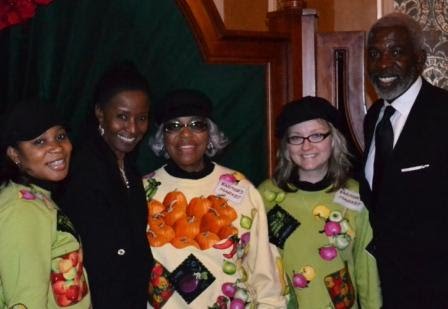
Mary Goodwin Clinkscale in the center
The Academy was incorporated in 2000 but Dr. C’s used the arts as empowering tools since ‘78. She produces/directs its energetic performances. Adults and kids collaborate on script, choreography, music, set design, costumes. African-American themed programs, some secular, others predominate. Performers as young as 6 share the stage with 20-somethings. Her five sons are GBT grads, including veteran television actor Randy Goodwin (Girlfriends). He’ll be back for the show along with special guest, stage/film/TV actor Obba Babatunde (Dreamgirls original cast).
Dr. C’s showcased GBT’s diverse talents at such high-profile gigs as the Holiday Lights Festival, Omaha Entertainment Awards and Omaha Black Music Hall of Fame. In 2006 her troupe performed a Tuskegee Airmen tribute in Milwaukee, Wis.
For this proud matriarch, the UNO show’s title refers not only to GBT rising-from-the-ashes and the arsonists finding redemption but to her own crucible. She was a high school drop-out and married teenage mother before turning her life around. A daughter of Arkansas sharecroppers, she worked the fields in the Jim Crow South, picking 300 pounds of cotton per day at age 10. “It takes a lot of cotton to weigh 300 pounds,” she said. She endured the back-breaking labor. Anything that doesn’t kill you makes you stronger, she believes.
She survived segregation and poverty. “I’ve always wanted more in life because we had nothing,” she said. She survived a fire to her family’s home. She was living with her grandmother then — her mother and uncles having gone to Omaha to work packinghouse jobs. After the fire Dr. C’s late mother brought her here, where she grew up in the Spencer Projects. She learned tough lessons from her Big Mama, a cook at the old Paxton Hotel downtown. “I got my work ethic from her.”
Dr. C earned her GED at Metropolitan Community College, where she won a scholarship for continuing education. “I went from there and started doing things.” Doctorates in theology and organizational administration from the International Apostolic University of Grace and Truth in Columbus, Ohio followed.
Her academic and youth ministry achievements only came after a born-again experience at Greater Beth-El in 1974. She was adrift then, without a church. “I just didn’t know what direction to go and the Lord led me to these people here,” she said. “I’d been looking for a church that offered something more than fashion or just a place to go hang out. I wanted truth.” She found it. “Before, my life didn’t have any meaning. There was no purpose until I came to the church. That’s when my life really began.” After being baptized she assumed lay leadership roles.
She was inspired “to implement” the teachings of her pastor in skits that engaged youth. “When I see a need, I go after it,” she said. Despite no formal arts background she said she felt prepared because “I’ve always been attracted to beauty. Raising my kids, decorating my home, making a garden, all that to me is an artistic expression. In everything you do there’s an art form to it. You just don’t throw things together. All my life I’ve been able to take a little something and make a lot out of it. I always strive for the best.” Two-hundred plus performances worth.
A perfectionist and task-master who describes herself as “hard but fair,” she views next week’s benefit as GBT’s coming-out party. “We started in January putting this together and we have worked our fingers to the bones on this production. It’s showcasing all the different facets of our talents. We want people to see there is something going on in this big historic building we can all be proud of.”
Her work with GBT has been recognized by the YWCA, UNO, Woodmen of the World, et cetera. GBT just received its first Nebraska Arts Council grant. She believes big things are ahead. She keeps meaning to step aside but, she said, “I never leave a job undone. I have to complete it.” As the soul song goes, “A Change is Gonna Come,” and she wants to be there to see her vision through the fire.
Dick Holland is the proverbial fat cat with a heart of gold. The avuncular Omaha philanthropist has been a major player on the local philanthropic scene for a few decades now. He was already a highly successful advertising executive when he heeded Warren Buffett’s advice and invested in Berkshire Hathaway. Holland and his late wife Mary became part of that circle of local investors who could trace their incredible wealth to that fateful decision to ride the Buffett-Berkshire snowball that made millionaires out of dozens of ordinary investors. Unlike some donors who prefer to remain silent, Holland is not shy about expressing his opinions about most anything. This classic liberal makes no bones about where he stands on social issues, and you have to give him credit – he really does put his money where his mouth is. The causes that he and Mary put their energies and dollars behind have helped shape the social, cultural, aesthetic landscape in Omaha.


Holland Performing Arts Center
Dick Holland responds to far-reaching needs in Omaha
©by Leo Adam Biga
Originally published in the New Horizons
When it comes to big time philanthropy in Omaha, a few individuals and organizations stand out. Richard Holland has become synonymous with king-sized generosity through the Holland Foundation he and his late wife Mary started.
If the 88 year-old retired advertising executive is not making some large financial gift he’s being feted for his achievements or contributions. In April he was honored in Washington, D.C. with the Horatio Alger Award “for his personal and professional success despite humble and challenging beginnings.” While his success is indisputable, how much adversity he faced is debatable. Closer to home Holland was presented the Grace Abbott Award by the Nebraska Children and Families Foundation “for his work in creating positive change for children through community.” No one questions his devotion to helping children and families, causes that legendary social worker Grace Abbott of Nebraska championed.
Several area buildings bear the Holland name in recognition of gifts the couple made, including the Holland Performing Arts Center in downtown Omaha and the Child Saving Institute in midtown. Mary was a CSI volunteer and benefactor. Her passion for its mission of improving the lives of at-risk children was shared by Dick once he saw for himself the pains that staff and volunteers go to in “restoring” broken children.
The couple made sharing their wealth, specifically giving back to their hometown, a major priority through the establishment of their foundation in 1997. Since Mary’s death in 2006 Dick, as he goes by, has continued using the foundation’s sizable assets, $60 million today and expected to be much more when he’s gone, to support a wide range of educational, art, health, human service and community projects.
True to his social justice leanings, Holland is a mover and shaker in Building Bright Futures. The birth-through-college education initiative provides an infrastructure of tutoring, mentoring, career advice and scholarship support for disadvantaged youth.
Like many mega donors he prefers deflecting publicity from himself to the organizations he supports. He makes some notable exceptions to that rule, however. For one thing, he vociferously advocates people of means like himself give for the greater good. For another, he believes in speaking his mind about issues he cares about and isn’t afraid to ruffle feathers along the way, even if those feathers belong to a political kingpin.
Just last March Holland took the occasion of accepting the NEBRASKAlander Award from Gov. Dave Heineman to criticize a stance by the conservative Republican leader. Heineman publicly opposes renewal of government-funded prenatal services for low income immigrant women in America illegally. Holland, who supports the care, used the evening’s platform to editorialize.
“No one should be denied prenatal care in Nebraska,” he bluntly told the black tie audience and the governor. His comments were viewed as ungracious or inappropriate by some and as a strategic use of the bully pulpit by others.
Consistent with his Depression-era roots, Holland is not rigidly bound by the constraints of political correctness and so he doesn’t mince words or tip-toe around controversy when he talks. Neither does he hide his political allegiance.
“I’m a liberal Democrat and I underline that,” said Holland, a Unitarian who also prides himself on his free-thinking ethos.

Dick Holland
He recently sat down for an interview at his home, where he readily shared his frank, colorful, unparsed, unapologetic impressions on the state of America in this prolonged recession. Critics may say someone as rich as Holland can afford to be opinionated because he’s already made his fortune and therefore nothing short of a mismanaged investment portfolio can hurt his standing. Besides, dozens of organizations and institutions rely on his goodwill and they’re not about to object to his pronouncements.
Those who know him understand that Holland’s just being himself when he says it like it is, or at least the way he sees it. Most would concede he’s earned the right to say his piece because unlike some fat cats, he worked for a living. His proverbial ship came in only after he’d launched a highly successful business. It was after that he followed his gut and his head and became an early Berkshire Hathaway investor. The millions he accrued made him a Player, but he first made a name for himself as a partner in one of Omaha’s premier advertising agencies, Holland, Dreves and Reilly, which later merged with a Lincoln agency to become Swanson, Rollheiser, Holland, Inc.
All along the way, from young-man-in-a-hurry to middle-aged entrepreneur to mature tycoon, he’s been speaking his mind, only when you carry the clout and bankroll he does, and make the kind of donations he makes, people are more apt to listen.
The Omaha Central High graduate came from an enterprising family. His father Lewis Holland emigrated to the States from London, by way of Canada, where a summer working the wheat fields convinced him his hands were better suited for illustration than harvesting. Lewis settled in Omaha and rose to advertising director for Orchard and Wilhelm Furniture. He later opened his own ad agency, where Dick eventually joined him and succeeded him.
Before Dick became a bona fide Mad Man in the ad game, he began studies at Omaha University. Then the Second World War intervened and after seeing service in the chemical corps he returned home to finish school, with no plans other than to make it in business and study art. Indeed, he was all set to go to New York when he met Mary. Their courtship kept him here, where he found the ad world fed his creative, intellectual, entrepreneurial instincts. He built Holland, Dreves, Reilly into the second biggest agency in the state, behind only Bozell and Jacobs.
He was certainly a well-connected, self-made man, but by no means rich. That is until he started investing with fellow Central High grad Warren Buffett, who is 10 years his junior. Much like Buffett, he’s careful about where he invests and donates his money. When Holland sees a problem or a need he can help with, he does his homework before committing any funds.
“I’m not throwing money at it,” he said, adding that the best thing about giving is getting “results.” He said, “It’s always great to have ideas but somehow or other somebody has to pay, and pay big, in order to get something done.”
The socially-conscious Holland is keenly aware that in these financially unstable times the gap between the haves and have-nots has only widened, something he finds unforgivable in what is held out to be a land of plenty for all
“What has happened in the United States over the past 40 years has been to make a helluva lot of people poor and less wealthy and to make a few people much richer, and we’ve done that by taxation, by trade policies, by not controlling health insurance costs,” he said. “We increased poverty during this period by at least 35 or 40 percent, but the worst thing that’s happened is the middle class itself, which was coming along after World War II very well, suddenly starting making no gain, particularly when inflation’s taken into account.”
He said the great promise of the middle class, that repository of the American Dream, has actually lost ground. The prospects of poor folks attaining middle class status and the-home-with-a-white-picket-fence dream that goes along with it seems unreachable for many given the gulf between minimum wage earnings and home mortgage rates
“It’s almost ridiculous,” he said. “We might as well say we’ve screwed ’em. I mean, it’s a really sad thing because this country is supposed to be a liberal democracy. The general idea is to provide an equal opportunity and life for almost everyone you possibly can. It sure as hell isn’t having huge groups of impoverished people going to prison and posing all kinds of social problems. All these things should be brought under control by education. It is not supposed to be a South American republic with wealth at the top and a whole vast lower class at the bottom, and we’re headed in that direction unless we make some serious changes in the way we approach this subject.”
When Holland considers the deregulated environment that led to unchecked corporate greed, the Wall Street bust, the home mortgage collapse and the shrinking safety net for the disadvantaged, he sees a recipe for disaster.
“We began to deregulate everything, thinking that regulations made things worse and deregulation would make everything better, and the truth is there are a lot of things that need to be regulated, including human behavior in the marketplace,” he said. “We just ignored that. In fact, it’s almost like saying our social system is every man for himself, and that’s crazy. It’s not every man for himself, we’re interdependent on one another on everything we do. This whole thing is wrong. We’re beginning to see we have to make some changes, but the changes I’ve seen so far are not nearly as drastic as I think they should be.
“I guess I sound like a doomsday guy, but I really believe unless we correct some of these things the United States risks its future.”
The health care reform debate brought into stark relief for Holland how far apart Americans are on basic remedies to cure social ills.
“Why can’t we get together more on this?” he asked rhetorically. “I have a hunch that part of it is misunderstanding, a growing ignorance among a large body of the populace, not recognizing just exactly what has happened. Talking about health care reform, poor people or middle class people objecting to it don’t seem to understand all the benefits they’re going to gain from it, they’re worried their health care won’t be as good as it was when it’ll be just as good,”
He said health care reform will help the self-employed and small business employees get the coverage they need but couldn’t afford before and will allow persons with preexisting conditions to qualify without being denied. Someone who will benefit from reform is right under his own roof.
“I have a helper who looks after the house. She has a preexisting condition. I pay her insurance, and it’s just over $1,300 a month,” an amount the woman couldn’t possibly afford on her own. “It’s absolutely wrong,” he said.He said the ever rising cost of health care under a present system of excess and waste drains the nation of vital resources that could be applied elsewhere.
“There’s no question in my mind that a nation as wealthy as the United States having to pay 17 percent of its gross national product for health care versus every other advanced country in the world sticking around 10 or 11 is just leaving several hundred billion dollars on the table that should be available for education, which at the primary level is in terrible shape.”Education has become the main focus of Holland’s philanthropy. Years ago he began seeing the adverse effects of inadequate education. He and Mary became involved in two local programs, Winners Circle and All Our Kids, that assist underachieving schools and students in at-risk neighborhoods. The couple saw the difference that extra resources make in getting kids to do better academically.

Dick and Mary Holland portrait by Debra Joy Groesser
He views education as the key to addressing many of the endemic problems impacting America’s inner cities, including Omaha’s. He wasn’t surprised by what a 2007 Omaha World-Herald series revealed in terms of African-American disparity. Blacks here experience some of the worst poverty in the nation and lag far behind the majority population in employment and education. He said he and other local philanthropists, such as Susan Buffett, were already looking into the issue and formulating Building Bright Futures as a means to close ever widening achievement gaps.
“I think one of the things we don’t really understand really well about cause is the effect of abject poverty,” said Holland. “Most people who have a decent life don’t understand that having no money, no transportation, not having an adequate diet or health care or stimulating opportunities for children in a very poor family is a straight line to prison and social problems. Those children, more than half of them, enter kindergarten not ready at all, with limited vocabularies of 400 words when they should have 1,200 to 1,500, and you can just go from there and it just all goes down hill.”
He said those critical of the job teachers do miss the point that too many kids enter school not ready to learn.
“That’s not because a bunch of teachers are dumb, that’s because there’s a bunch of kids that have not been looked after properly from the beginning. You can blame teachers until the cows come home, but I just say to you, How is a teacher going to teach a child who is that far behind? It’s almost impossible, and that’s the first great neglect. If we had been doing that differently, we would avoid an awful lot of this. In fact, we’d avoid most of it.”
When students enter school unprepared to learn, he said, there’s little that can be done.
“After they get into the grades, there again, there’s no family, no money, no reading, no looking after, no stimulation, no going places, and the net result is the child goes from 1st through 4th grade not catching up and instead starting to diminish. By the 7th and 8th grades they find out they can’t hack it and they get awfully damn tired of being regarded as dumb, and the net effect of that is dropping out.
“It’s as plain as the nose on your face this is what goes on and this is what we don’t do anything about. It’s a tragedy and one of the great national disasters.”
Things get more complicated for children who enter the foster care or juvenile justice systems. Teen pregnancy and truancy add more challenges. The entrenched gang activity and gun violence in Omaha, he said, has at its source poverty, broken homes, school drop outs, lack of job skills and few sustainable employment options.
He said the fact the majority of Omaha Public Schools students come from households whose income is so low they qualify for the free/reduced lunch program indicates how widespread the problem is. “When a child has to have a free lunch all you can say is something is terribly wrong,” he said.
To those who would indict an entire school district he points out OPS students attending schools in middle and upper middle class neighborhoods do as well or better than students in the Westside and Millard districts. He said the real disparity exists between students from affluent environments and those from impoverished environments.
“The way I sometimes put it to people is, ‘The kids make the school.’ It’s a funny thing how we don’t understand this. It’s very obvious to me,” he said, that on average children from “reasonable affluence” do better than children from poverty. He said Winners Circle and All Our Kids, two programs under the Building Bright Futures umbrella, are full of success stories, as is another effort he and Bright Futures endorses, Educare. Through these and other programs Bright Futures is very intentional in putting in place the support students need from early childhood on.
“We’re going to have a thousand kids this year in early childhood programs. We have organizations that are working in something like 12 or 14 schools. We’ve got five hundred volunteers of all kinds. And we actually have cases. From the very beginning it’s been shown that if we get a hold of a child, even after this bad beginning, and mentor him properly we can get him higher up in the education scale. In All Our Kids we have 40 kids in college, 50 that have graduated, several with master’s degrees, and every one of those kids was a kid at risk. So we know what to do if we work hard enough on it. What we have to overcome is the kid who doesn’t think he’s so hot. At home an impoverished child often gets put down, diminishing his ego. We have to overcome that, and that’s one of the things we really try to do.”
Mary Holland recognized there must be a continuum of support in place all through a student’s development. Dick said that’s why she encouraged the merger between Winners Circle, whose focus is on elementary school students, and All Our Kids, whose focus is on junior high and high school students.
“We’re trying to take those kids all the way through the 11th grade, taking them every where and teaching them what college requires, what businesses are like, exposing them to the world,” he said. “Bright Futures is not a five or six year program, it’s a 15-year program. It’s gotta be done like that.”
The idea is to get kids on the right track and keep them there. Getting kids to believe in themselves is a big part of it. “If you don’t have a lot of self-confidence you don’t try things, and we try to overcome that. With some kids it works. Some find out, I’m better than I thought, I can do that.”
The goal is qualifying students for college and their attaining a higher education degree. Towards that end, Bright Futures works with students from 12th grade through college.
“We follow you there,” said Holland. “We’ve set up things in universities to help people. We’re still trying to bring it all together. It’s an effort to refresh, restore, make them understand what they have to achieve in order to do anything in life.”
Enough funding is in place that cost is not an issue for Bright Futures students.
“We have adequate scholarship money for thousands, we don’t even have to worry about that, and yet we don’t have enough people to take them that qualify. Just because you graduate from high school doesn’t mean you’re ready for college. Sometimes I think they (schools) get ‘em out of high school just to get ‘em out of high school.”
Holland has a better appreciation than most for the barriers that make all this difficult in practice. He and Mary mentored some young people through All Our Kids and they experienced first-hand how things that most of us take for granted can be stumbling blocks for others. He recounted the time he and Mary mentored a young single mother. Things started out promisingly enough but then a familiar pattern set in that unraveled the whole scenario. He said the young woman got a job, her employer liked her and her performance, but she stopped coming to work and she got fired. The same thing happened at another job. And then another. Each time, he said, the challenge of affording child care, getting health problems addressed and finding reliable transportation sabotaged both the young mother’s and the Hollands’ best efforts.
“She couldn’t hold a job, and we gave up,” he said. It’s not something he’s proud of, but he’s honest about the frustration these situations can produce. Other mentoring experiences ended more positively but still highlighted the challenges people face.
“You find out an awful lot about how tough this is because they don’t have the same kind of get up and go confidence like my daughters, who think that nothing is beyond them. You try to instill that, and when you see a little bit of it happening it’s worth the price of admission.”
He acknowledges that despite government cutbacks there’s still plenty of public aid to help catch people who fall through the cracks. But he feels strongly that a different emphasis is required — one that helps people become self-sufficient contributors.
“We have all kinds of government programs designed to grab these people as they fall off the cliff. The failure is to raise them so they can climb cliffs. There’s no question in my mind sooner or later it’s going to be a major government project. It has to be.”
Policies also need to change in terms of guaranteeing people a living wage, he said.
“Let me give you an idea of how we look at things,” said Holland. “We had a $2 (hourly) minimum wage in 1975 and that was adequate to get people out of poverty, it really was. But since the ‘80s the minimum wage has not kept pace with the cost of living and inflation. It’s kept people in poverty. The Congress of the United States, Republicans and Democrats alike, failed to really go after that. They failed to understand it.”
He said despite the minimum wage having increased to $7.25 in Nebraska and higher in other states, “it ought to be $10 or $11” to give families a chance of not just getting by but getting ahead. “We’re not looking at this problem the right way, we’re just creating it. There’s a dismissal of the problem by people that don’t have it.”
Similarly, he said early childhood programs must be learning centers not babysitting or recreational centers, that address the entire needs of children.
“We have a fractional help system. Somebody helps them after school, somebody sets up a club, somebody sets up something else over here. Some of those after school things make you feel better, they’re fun to go to, they’ve got cookies, but that doesn’t focus on their actual intellectual needs. There’s a lot of that that goes on.”
Holland calls for systemic change that comprehensively affects lives.
“I’m more and more positive it’s going to take a revolution. We’re going to have to stop what we’re doing and start doing something along the lines I’ve talked about. At various times there’s been various suggestions about poverty, but one thing that will help alleviate poverty a helluva lot is money, there’s no getting around it. If it takes 5 or 10 percent of the gross national product it will be a benefit over time because once you have a little money you begin to be able to do a few things, and then you begin to learn a few things, and your children do the same.”
A model approach in his eyes is Educare’s holistic early childhood education. “We’re (surrogate) parents there, that’s what we are,” he said, “and the people that bring their children there know what’s happening, they know that suddenly the whole world is opening for that child. When those kids enter kindergarten they’re ready, they’ve got these big vocabularies. We know it can be done, but we also know the price.”
To those who might balk at the $12,000-$13,000 annual cost of caring for a child in a state-of-the-art center, he said it’s but a fraction of what it costs to incarcerate someone or to navigate someone through the justice system or the foster care system.
Agree or disagree with him, you can be sure Dick Holland will continue putting his money where his mouth is and where his heart is.
My usually eclectic blog has been theater heavy this week because I decided to celebrate the 2011 Great Plains Theatre Conference, which ends June 4, by sharing some of my theater stories from the recent and not so recent past. I’ll continue posting theater stories well after the conference closes because I discovered I have a nice cache of them, but I’ll also be back to showcasing the diversity of my work that regular followers have come to expect. I did the story below for The Reader (www.thereader.com) and it’s a look at how some Omaha theater professionals variously utilize the art form as insurrection, social commentary and corporate training tool.
Omaha theater as insurrection, social commentary and corporate training tool
©by Leo Adam Biga
Originally published in The Reader (www.thereader.com)
Making Images
Something subversive happened in the Old Market one recent Saturday evening.
From out of the blue, pedestrians converged on sidewalk corners and molded their bodies into dramatic sculpted “images.” One image included a man on his back cringing in terror as an assailant stood over him with a raised boot. Another posed father-and-son partners sealing a deal with a handshake that suddenly, inexplicably broke. A third linked people in a solid human chain until some unseen force rudely disturbed it.
If the symbolic frieze frames did not adequately convey their message of oppression, someone hanging anti-Initiative 416 (Defense of Marriage Amendment) signs around the individuals did, including one placard labeling the assault victim as a “Gay Man.” Just to be sure, another demonstrator handed out anti-416 leaflets.
These human tableauxs, so suggestive of figurative sculptures taking shape in front of your eyes, were in fact street theater pieces being used to focus awareness on the divisive 416 measure. The unfolding scenes were meant to make a statement, draw attention and engage people in dialogue about the issue. As the theater action progressed that night, a few curious passersby did stop to stare and proffer off-handed remarks. Then, when a plant in the crowd posing as an antagonist began spouting Biblical admonitions about same sex marriage and another plant posing as an initiative supporter began refuting his every protestation, some onlookers vigorously joined the debate on either side.
The ensuing discussion was the moment when this unorthodox piece of theater melded with genuine crowd reaction and, in so doing, accomplished exactly what organizers intended.
The Boal Way
So, was this event an example of art or theater or political activism? A little of all three, according to its instigator, University of Nebraska at Omaha Dramatic Arts Professor Doug Paterson. A self-described “insurrectionist” from the ‘60s, Paterson leads the UNO-based Thespis troupe (Theater Helping Everyone Solve Problems in Society), which follows many of the theories of Brazilian director Augusto Boal and his Theater of the Oppressed (T.O.) movement.
Boal, who came to Omaha in 1996 to give workshops, developed T.O. as a political tool to aid oppressed peoples around the world in their struggle for liberation. That night in the Market Paterson led his players in applying Boal’s image and invisible theater techniques (The professor played the antagonist in the crowd.). In keeping with their revolutionary roots, the drama that night was sprung – guerrilla-style – on unsuspecting folks in public spaces for the purpose of eliciting responses to a socially relevant issue. The ultimate aim, then or any time, is to incite action. Paterson organized a second theater event around the 416 measure at an October 31 rally on campus. Previous events have tackled the enduring UNO parking crisis.
Another Boal technique favored by Paterson – forum theater – utilizes workshops in which everyday people address problems at work or in their community through discussion and role playing led by a facilitator. In this interactive, outside-the-box approach to theater, the idea is to break down the Fourth Wall traditionally separating practitioner from audience and to build bridges connecting the two via conversation that works toward some resolution.
“Boal developed a theater that differs from the Western approach of pacifying you in the audience while actors describe a reality that you then take to be true. As an audience, you are powerless to change the story. You’re told, ‘This is the way it is,’ especially if you’re a minority. Boal believes in twisting things in a fun, open, community-based way that gives people a way to change the story. It’s what he calls interrogative theater. Rather than declare reality, it interrogates reality. It challenges the notion that it has to be this way — that it can’t be something else. It suggests new possibilities,” said Paterson, who has studied with Boal in Brazil.
Working It Out
Paterson has conducted forum theater workshops for many organizations, including the Omaha Public Schools, Creighton University and UNO. Workplace diversity issues are most commonly confronted, but not in the we talk-you listen vein.
“In forum theater we first play games to relax people and get them interacting with each other. Then we perform scenarios depicting some oppression, like a secretary given a last minute project by her boss when she needs to be someplace else,” he said. “The secretary tries overcoming her obstacle, but she just can’t. At some point we turn to the audience and say, “Okay, what would you do if you were her?’ Instead of having the audience sit there quietly we encourage them to talk to each other and share ideas to find some new solution.
“We encourage them to show how they would handle the situation differently, and it’s interesting because then it’s really them in the moment feeling sympathy for that character and the words almost become their own. Our attempt is to see if the audience is willing to be so moved and engaged by what’s happening that they really want to do something. Once they see something from their own life represented or dramatized, they think, ‘That’s me up there.’”
He said the response by participants is usually enthusiastic. “Often we can’t get through all the scenarios because there’s so much discussion. People get up and intervene and are very excited. I’ve never seen it fail.”
All the World’s a Stage
This grassroots theater has been a passion of Paterson’s since he discovered how deeply it resonated with his own emerging social consciousness amid the civil unrest in America a generation ago.
“I’ve been engaged in Theater for Living, Theater for Change or what has come to be known as Community-Based Theater since the mid-’70s,” he said. “I actively resisted the war in Vietnam while at Cornell University and it was during that time I formulated all my thinking about how culture works and how it is part of the oppressive process. I was really taken by the idea that if we could stake out new audiences, then we’d find a way to create a new culture in theater.
“Later, I started a small professional company in South Dakota whose purpose was to go into rural areas and engage farmers and ranchers in a kind of cultural salvage work where we found people’s stories and turned those into plays that we performed in these small towns.” He repeated the process when he came to UNO in 1981 – exploring the farm crisis with students in an original play (It Looks Good from the Road).
His students there included Omaha playwright Doug Marr and actress Laura Marr who, along with Paterson and others, formed the proletarian Diner Theater, which took this theater-happens-everywhere philosophy to heart. “
It drew a different group of people who might not have felt comfortable going to a regular theater setting,” Paterson said. “It was more neighborhood. It was more working class. It was site-specific. It was very exciting.”
Dramatic Results
The Marrs, along with fellow UNO theater grad Brent Noel, are adherents of Boal’s work and together operate a venture, Dramatic Results, incorporating the tenets of Boal in forum theater workshops at corporations.
“The trend today in business is to develop creativity and decision-making in employees, and Boal’s exercises are effective in helping build problem-solving skills,” Noel said. “We don’t offer answers or solve problems. We’re more interested in asking the right questions and encouraging people to think about possibilities. We offer a process whereby employees discover solutions. It’s empowering.” Noel said while many businesses are not yet ready to welcome theater techniques into their staid office settings, clients that do are satisfied. “Once they see how it works, most realize the value of it. It works in everything from sales to diversity to critical thinking training.”
I love University of Nebraska at Omaha theater professor Doug Paterson’s passion. In the following story for The Reader (www.thereader.com) I profile how he’s melded his art and his social activism in a seamless way through Theatre of the Oppressed, a theater form he’s mastered under founder Augusto Boal. My story appeared in advance of the international Theater of the Oppressed Conference that Paterson and UNO hosted a couple years ago. I am posting the story here to highlight different aspects of Omaha theater in the wake of the 2011 Great Plains Theatre Conference, which wraps up June 4.
Hey, you, get off of my cloud!
Doug Paterson is acolyte of Theatre of the Oppressed founder Augusto Boal and advocate of art as social action
©by Leo Adam Biga
Originally appeared in The Reader (www.thereader.com)
Doug Paterson’s always used theater as an instrument of his insurrectionist principles. As a student in the 1960s he actively protested against the Vietnam War and other burning social issues and gravitated to progressive theater that challenged the status quo.
But it wasn’t until he saw Brazilian Augusto Boal’s Theatre of the Oppressed in action that his social activism and his art merged into a philosophy and a way of life. Seventeen years later the University of Nebraska at Omaha professor is a leading adherent, practitioner, facilitator and teacher of T.O., as much a political movement dedicated to social change as a form of theater.
Much of T.O.’s work involves developing scenarios with audiences around the issues of racial, gender and class inequalities. The idea is to spark dialogue among citizens in a living or social theater environment. The end goal is to generate dialogue with decision-makers in the real world as a framework for addressing these matters with concerted action, even legislation.
It is meant to be an empowering process.
“We see something that affects us. Some oppression or injustice or wrong and we identify with it, we understand it and we yell, ‘Stop.’ To Boal the very act of saying we can stop this is by itself important,” Paterson said.
The premise of T.O., he said, is that the oppressed are “dictated to” by a privileged, power-wielding elite. “They’re not in the loop of determining what’s going to be the agenda of their life. They’re told what it’s going to be and often through force of violence.” What T.O. helps people do, he said, is “learn techniques and methods to interrogate the world. It’s developing a critical sensibility so they can talk to power and demand dialogue.”
Why theater as a device to elicit participation in the political process?
“Boal’s phrase is, ‘We’re all theater.’ We can all do this. We’re all doing it all the time because we’re all actors who can change the world,” Paterson said. “In Theatre of the Oppressed we just give it a little bit of shape — to help draw the power out of a person or a community, because it’s already there.”
Theater also provides a well-founded structure for protagonist-antagonist conflicts.
The UNO educator has studied with Boal, a short-list nominee for the Nobel Peace Prize, and “jokered” dozens of workshops with him and his son Julian Boal. Paterson’s led T.O. workshops in about a dozen states as well as in Canada, Israel, Palestine, Iraq and Africa.
T.O.’s organic, democratic system for giving the disenfranchised a voice is the focus of the May 22-25 International Pedagogy & Theatre of the Oppressed Conference in Omaha. Both Augusto and Julian Boal will give workshops using exercises and games that lead into T.O.’s Forum, Image, Invisible, Cop in the Head, Rainbow of Desire and Legislative theater.
The public’s invited to a free demonstration of Legislative Theatre at 7 p.m. on Thursday, May 22 in the Omaha City Council Chambers.
Six area elected officials will convene a mock legislative body to hear a set of scenes developed over three days of Forum workshops. These scenes built around local issues will be enacted and the floor thrown open for anyone to discuss, intervene, offer solutions. By the end of the session “legislation” will be devised and presented to the “council.” Paterson said Boal will then pose a question to the panel: “Would you support this legislation proposed by this temporary community?” That’s when the real dialogue and debate begins.
Paterson said to expect “a room “humming with activity,” lively discussion, laughter. “Nothing is coerced,” he said.

The dynamic interplay needs no formal introduction or explanation.
“If you see it you understand it immediately what it is and you can participate,” Boal said by phone from New York.
For Boal, T.O.’s not about finding solutions to problems but engaging people in exchanges that at least explore ways to combat or relieve oppression.
“I always say we should strive to have peace but the worst enemy of peace is passivity,” Boal said. “We must abolish passivity to try to do things in order to have real peace.”
True believers like Boal and Paterson believe in fighting oppression in whatever form it takes — violence, discrimination — through “the solidarity of the oppressed.” It is a movement of individuals and groups banded together in the belief that change is possible.

Paterson, who’s previously brought Boal to Omaha for this same conference, is a founder of the P.T.O. organization that puts the event on. This makes the seventh time Omaha’s hosted the event. It may also be the last, as Paterson plans to let new leadership take over.
The Omahan’s first direct exposure to T.O. came in Seattle in 1991. He was familiar with the tenets of Boal’s work but merely reading about it didn’t captivate him the way a demonstration did. Although Paterson had engaged in grassroots theater through the Dakota Caravan in the Black Hills and the Diner Theater in Omaha, he was still largely bound to traditional theater and its imposed world view that offer no mediation in or deviation from the end result.
Standing in stark contrast to that approach is T.O., which does not respect any fixed narrative or resolution. It’s all about inviting audiences and participants to intervene in and alter the story as a means for confronting and, if possible, ending oppression. Where traditional theater’s a monologue, T.O.’s a dialogue.
“I never got it,” Paterson said. “It sounded too serious. But then I saw it and it was so much fun and so interactive and so liberating that I said, ‘That’s it — I found where I’ve been heading for all my life.’ It just opened up possibilities. It’s asking through educational theater is it possible to transform the world to an equitable place economically, socially and politically.”
In Paterson’s view T.O. provides a structure for affecting change.
“Dealing with oppressed populations requires real dialogue…negotiation,” he said.
The goal, he said, is creating “a fair, equitable, humane world, a rational world where people have enough food and safe shelter, where crime is not encouraged by the economy, such as it is here, where poverty is not enforced, where violence is not the way of life. That’s what we want and all of us believe it’s possible.”
More than an academic or aesthetic construct, the work’s designed with real life applications in mind. Boal applies its techniques and forms to all kinds of community organizing, including his early-1990s bid for and election to the Rio de Janeiro city council as a member of the left-wing Workers Party. He used T.O. as an on-the-streets forum that gave people a sounding board to tell him what they wanted changed and he introduced legislation to try and bring about that change.
The more Paterson immersed himself in this new theater the more committed to it he became. The better he got to know Boal his conversion only deepened.

Augusto Boal
“I know Augusto as a mentor and quasi-father figure,” Paterson said. “I’ve spent a lot of time with him and we’ve talked far into the night. I really admire his work. I admire the mind that conceived of this and just kept relentlessly developing it. By continuing to work he made a path.”
Boal overturned his own traditional theater background in the ‘60s in response to oppressive military regimes in Brazil. At the time he headed the country’s national Arena theater, whose members began to resist the censorship and other government imposed strictures. Caught up in the struggle, Boal became politicized to a more militant, even radical stand. Branded a troublemaker, he was arrested, interrogated and tortured. Pressure from the West got him released but he soon became a political exile in Argentina and France.
He devised T.O. while in exile, drawing much inspiration from the late educational theorist Paulo Freire, author of Pedagogy of the Oppressed.
Boal was little known in the U.S. outside “a very narrow circle” when Paterson first contacted him and brought him to the states for the 1992 Association for Theatre in Higher Education national conference in Atlanta, Ga.
“Boal came to the conference and just carved a whole new channel for how to make theater and who to make theater for in the United States,” said Paterson. “It was a wonderful experience and we had a wonderful connection.”
T.O. is now practiced around the globe. It operates centers in several countries. Where the movement got scant media notice a decade ago it’s well covered today.
Paterson said there’s some resistance to the movement because “the word oppressed scares people.”
In Boal’s homeland, where he lives once again, the Workers Party-controlled state government has a program called Cultura Viva (Culture Alive) that, Boal said, “helps us spread the Theatre of the Oppressed all over Brazil.” The program enables T.O. to work with schools, mental health facilities, prisons and other entities.
“This is the first time the government has supported the work that we do,” said Boal, an outspoken critic of Brazilian government since the ‘60s.
Just as for Boal the work is not an abstraction, neither is it for Paterson or for conference registrants, who include theater educators and community activists from across the U.S., Europe and other parts of the world.
Locally, Paterson hopes it’s a model groups adopt for presenting grievances to local elected officials that address some of Omaha’s long-standing oppressions. He referred to African Americans’ disproportionate poverty here.
“We’ve really violated their human rights and we need dialogue,” said Paterson, noting Omaha’s high incidence of black on black crime and sexually transmitted diseases and the ongoing segregation that divides blacks and whites. “There’s so much to do.”
For all you theater wonks and aficionados out there, here’s another piece of mine from a years back, this one based on an interview I did with playwright/director Glyn O”Malley. Not many months after I spoke with him he passed awat, lending a poignancy to his comments about the future of the American theater, for which he held out great hope. He came to Omaha, as so many leading theater figures do, for the Great Plains Theatre Conference. The 2011 event runs through June 4. I am posting stories I’ve written about the event, some its many luminaries, and other aspects of Omaha theater. O’Malley is not the only Great Plains guest artist whose loss has been felt. Actress Patricia Neal was a regular and much-beloved fixture at the festival, and she’s gone now. Founder Jo Ann McDowell was also close to other giants of the American theater, namely Arthur Miller and August Wilson, and they too are gone. The point is though their work lives on, as does the theater.

Playwright-director Glyn O’Malley, measuring the heartbeat of the American Theater
©by Leo Adam Biga
Originally published in The Reader (www.thereader.com)
Playwright/director Glyn O’Malley of New York epitomized the distinguished guest artists here for the Great Plains Theatre Conference that closed last Saturday. Over the course of the eight-day gathering O’Malley, a Fellow at the Cherry Lane Theatre and a faculty member at Lehman College/SUNY, joined other major figures of the American theater in considering various aspects of stagecraft. They addressed everything from the work of new and established playwrights to the role of playwrighting in society to the richness of Omaha’s theater community, whose artists presented plays in lab readings and staged performances.
For O’Malley, just as for Edward Albee, the esteemed playwright whose imprimatur is on every aspect of the conference, it is neither a lark nor a vacation, but a working event that puts them through their paces. “There’s an awful lot to do,” said O’Malley. “I came in earlier to do a preconference workshop with 39 playwrights and then there are morning and afternoon panels and evening programs. So, there’s always something. It’s very intense, very packed.”
Artists use the occasion to measure the health of the American theater, whose state Edward Albee lamented at a Great Plains salute to the late Arthur Miller and August Wilson when he said, “our losses seem to keep outweighing our gains.” But O’Malley said the promise of a vital theater could also be seen in the conference.
“I have hope. There are new young voices emerging that, while they perhaps don’t have the gravitas yet to handle some of the larger questions, they’re touching and pulling up small pieces of the turf and handling it in ways that certainly exhibit an ability to grow into that. There’s work all along the fringes of Broadway that’s hopeful and inspiring. It’s simply a matter of time here in terms of maturation. Everyone who keeps doing this long enough and well enough carves out a place for themselves, a specific niche, and one can stay in it or move on,” O’Malley said.
Events such as the Great Plains, he said, showcase “an abundance of all sorts of plays and playwrights at different stages of maturation.” He added playwrights “all have things we’re attracted to and lean to — plays that are basically captivating enough to pull us into their orbit because of how they approach their subjects.”
What he’s seen of the Omaha theater scene gives him more reason for optimism.
“Well, I think it’s phenomenal. I’m thrilled you’ve got so many good people here — so many good theaters. I can’t believe how much theater there is,” he said. “I guess I’m surprised there isn’t a dominating professional regional theater here, but that may in fact be one of the reasons Omaha has such an abundance of different sorts of theaters that address specific missions and specific visions. I’m extremely impressed by that. There’s a lot going on here and I’ve wondered why it’s stayed relatively off the radar, because I would never have known about it had this conference not moved here.”
As home to the conference, reconstituted here from Valdez, Alaska, Omaha’s now at the center of the American theater’s process for new play development, which at its “core,” O’Malley said, “creates an environment where young playwrights just finding their way on the page can have discourse with people who have done it, done more of it and taken some of the risks they want to take. I think the only person who can really speak to a playwright in terms of really helpful sorts of response is another playwright, a director or an actor. It’s a very specific craft.”
He said if theater is “to gain, we’re going to have to do this right and keep it going” via events and programs that nurture new artists and new works. “These are all really important because otherwise the opportunities for new plays in the commercial market are very, very slight and they get slimmer each year. I think persistence is something we need to encourage. Not everyone’s going to have the trajectory in their careers that Edward Albee’s had. He’s a phenomenon. There is hope as long we encourage and promote responsible thinking and courageous, daring, bold, innovative plays…as opposed to merely good entertainment writing. There’s an abundance of that. There’s a lot of people who can do that. But there aren’t a lot of who can move an audience and cause them to turn over a thought in their mind, to walk out of the theater with it and discuss it over dinner, and let it haunt them for days after until they’ve made up their own mind about it.”
O’Malley, a one-time assistant to Albee and a leading interpreter of his work, agreed with remarks his mentor made at a May 29 Miller-Wilson salute, when Albee said: “Both Arthur and August understood playwrighting is a deeply profound social, philosophical, psychological and moral act. A playwright may not lie because a playwright at his very, very best is believed and must tell whatever truths he knows as clearly and in as tough a fashion as he possibly can. They understood what playwrighting is all about. They understood a play has no excuse for being merely escapism…merely frivolous. They understood the act of creating the play is holding a mirror up to people in the audience and saying, ‘Look, this is who you are, this is how you behave. If you don’t like what you see, don’t turn your back — change.’”

O’Malley embraces the weight Albee attaches to playwrighting, saying, “Plays need to open up worlds that other areas of society have concluded about, so that we can go in and personally experience them and begin to ask questions for ourselves. Most of the time we relegate somebody else to answer these things for us. But it’s always about the next question. I think that’s what one has to do. I’m led by that. That informs my choices of subject matter and how I write about it. I’m not interested in what’s known and concluded. I’m interested in finding my own way into things and then I find how I feel about them as well.”
He said Albee’s work “has always been” about probing, challenging the status quo, “and my own view is very much in agreement with that. I have very little patience with the merely frivolous. Obviously we have a great deal invested right now in our society into the pulling away from reality. If you come to New York and go to the theater you won’t be asked to think very often. You’ll be certainly entertained.”
Echoing something Albee declared in 1988, when he was last in Omaha and said, “If we prefer ignorance to dangerous thought, we will not be a society that matters,” O’Malley’s own play Paradise “was stopped from reaching production in Cincinnati. People were afraid of its power and what it would do. It examines how a 17-year-old Palestinian girl was coerced into becoming the third female suicide bomber. It is a very dangerous play because it is right on top of both…an Israeli and a Palestinian position. People want this very much to be an answer play, and it’s impossible. I don’t have the answers. It’s a question box play. It’s a play full of them and they’re all questions we need to be asking ourselves.”
Theater’s capacity to “be dangerous” and “an impetus for change,” O’Malley said, stems from its “immediacy. Theater is very much the vehicle by which we still gather together and view in the first-person with real live people. There isn’t the detachment one has with film. where you can sit back because it happened before and was put together before.” Or, as Albee likes to say, “film is then, theater is now.”
O’Malley, Albee and the rest are expected back next year for Great Plains II.


 Leo Adam Biga's My Inside Stories