Archive
Memories of Baseball Legend Buck O’Neil and the Negro Leagues Live On
Irrepressible Negro Leagues Baseball legend Buck O’Neil is someone I always wanted to interview and it finally happened on a trip to Kansas City, MO only months before he died. The following story, which appeared in the New Horizons newspaper and, later, in The Reader (www.thereader.com), may have been one of the last feature stories to contain a new, at-length interview with O’Neil.
The charming man I first came to know through the Ken Burns Baseball documentary proved to be every bit as charming in person. I consider it my great fortune to have met him and I hope his personality shines through in this piece, which by the way is as much about the Negro Leagues and the Negroe Leagues Baseball Museum in Kansas City as it is about O’Neil. That’s only right, too, as he became the face and voice of that long defunct chapter in black baseball and of that excellent museum he helped launch.

Memories of Baseball Legend Buck O’Neil and the Negro Leagues Live On
©by Leo Adam Biga
Originally appeared in The Reader (www.thereader.com)
A July visit to Kansas City, Mo.’s Negro Leagues Baseball Museum (NLBM) found Buck O’Neil in fine form. Sure he was stooped and moved haltingly, but the late elder statesman for African-American baseball history glowed with ardor — for life. He chatted up visitors and staff, flirting with women a quarter his age, flashing a devilish glint and smile, and generally charming everyone he met.
The image of a 94-year-old doing what he loves best — making friends, is forever fixed in the minds of people who saw him. A tall, ebullient man whose bright, jaunty attire reflected his disposition, O’Neil personified human warmth.
“The man never met a stranger in his life.“I’ll tell you what, he’s the most charismatic individual I’ve ever encountered. The energy he exerts at 94, it’s just amazing to me how he does it,” NLBM marketing director Bob Kendrick said then. Kendrick often traveled with O’Neil to spread the gospel of the museum’s mission.
Even the indefatiguable O’Neil had his limits. Last August he was admitted to a KC hospital for fatigue and died two months later from heart failture. After the National Baseball Hall of Fame‘s failure to induct him last spring into Cooperstown, it could be said he died of a broken heart. A great voice and conscience was lost, but his legacy lives on.
O’Neil’s many travels took him to Omaha, where in recent years he threw out the first pitch at an Omaha Royals game and spoke on a panel at the Durham Western Heritage Museum for a touring NLBM exhibit.
The much-beloved one was a familiar figure at the KC museum, where he held the title of chairman. He presided over the place like a bronze statue come to life from the “Field of Legends” display — eager to share the Negro leagues experience. He told it often and to great effect, most notably as narrator of the Negro leagues segment of Ken Burns’ acclaimed Baseball documentary. His vivid descriptions of the rousing place players-teams enjoyed in black communities, put a face on this story as never before. Long before the film, however, he lobbied for recognition of the Negro leagues and for induction of its stars in Cooperstown.
“I always thought the story should have been told and I’ve been telling it for the last 50 years,” O’Neil said in July. “But nobody listened to me until the Ken Burns documentary. Now everybody wants to talk to Buck about it.”
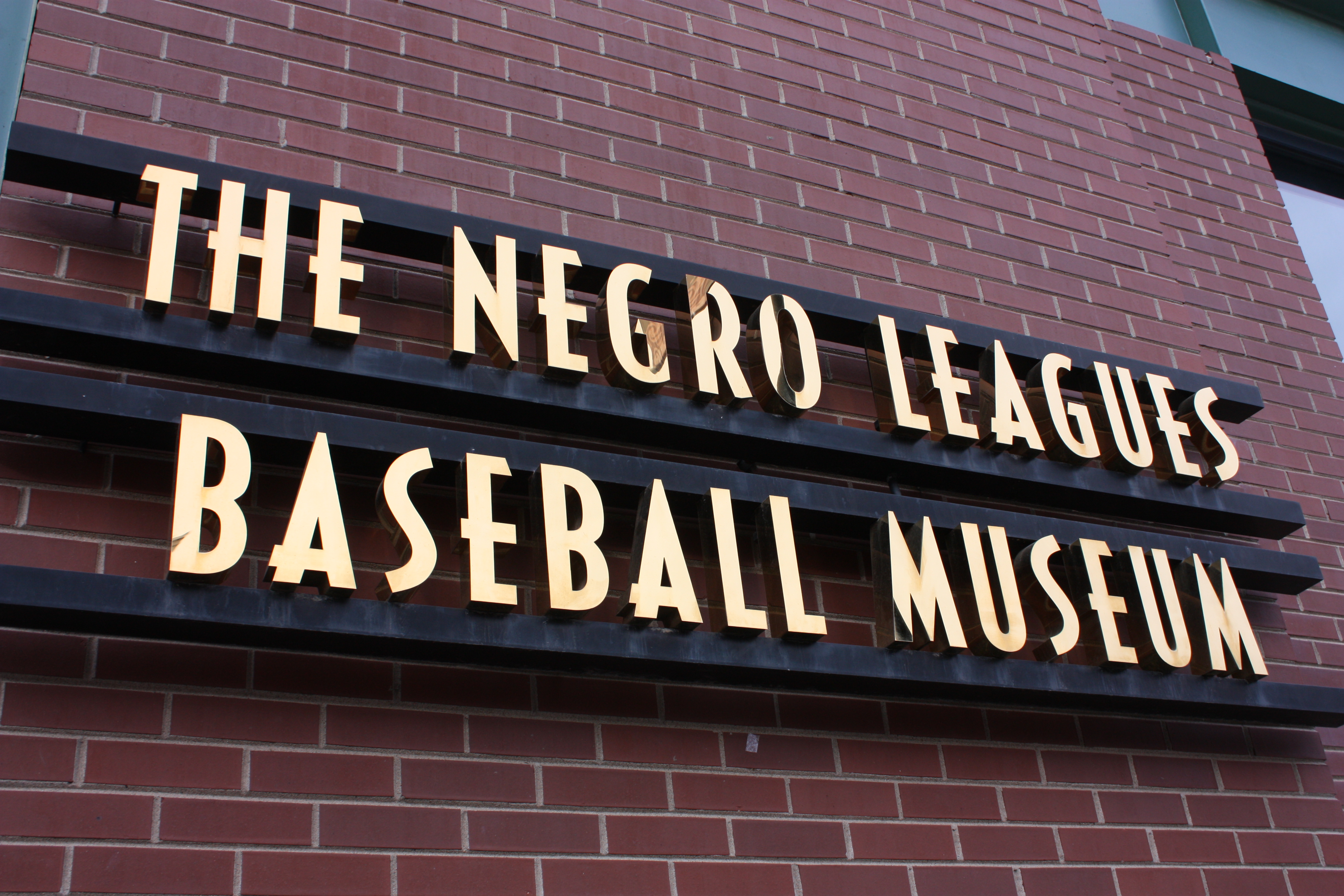
The story of a vital but long neglected chapter in the national pastime’s history is told at the museum. It’s only right the museum calls KC home, as the city gave birth to the Negro leagues and for decades hosted one of the great black ball clubs — the Monarchs. KC is also the adopted home of O’Neil, a Florida native whose father was the son of slaves. For 17 years O’Neil was a fixture at first base with the Monarchs of the Negro National League, A good, not great, player with a career .288 batting average, he four times topped the .300 mark, highlighted by a league-leading .353 average in ’46. He played in four East-West All Star games and two Negro Leagues World Series. In his later years he was a player-manager with the club, twice guiding the Monarchs to league titles.
He finally made the big leagues in ’56, as a scout, with the Chicago Cubs, with whom he became MLB’s first black coach. He was a Cubs dugout fixture for decades.
In the ’90s he played a key role in the start of the museum, located smack dab in the middle of the historic cultural hub of KC’s black community. The 18th and Vine District today is a gentrified area of brick, circa-1900s buildings, that once featured a 24/7 promenade of people taking in its clubs, eateries and stores.
O’Neil’s efforts with the NLBM no doubt helped get a record 17 Negro Leaguers and pre-Negro Leaguers elected to the Hall last year. A name conspicuous by its absence from the inductees was O’Neil’s. Kendrick said O’Neil knew well his place in baseball history and the shame of his exclusion.
“He’s a very proud man. He understands the fact he’s a trailblazer. He understands what this story represents to the core and he’s doing everything in his power to make sure others will have an opportunity to know about those who made great sacrifices and were trailblazers like himself,” Kendrick said. “And that’s why we felt so disheartened by the fact the doors to the Hall of Fame were shut on him.
“It’s difficult to assess his 70-plus-year baseball career and say he wasn’t worthy of inclusion as a contributor. You know, it leaves you to wonder what their criteria were, but certainly all of us understand the remarkable contributions this man has made to the game of baseball, across the board. Fans across the country were not just disappointed but outraged because he is the face of the Negro leagues now. He is the reason people care about the Negro leagues.”
Ever the diplomat, O’Neil downplayed the snub. “I had an idea I had a chance” to be elected “but having been on the Veterans Hall of Fame Committee for 20 years I knew what could happen.” He preferred taking the high road. He even spoke at the induction ceremony. Kendrick didn’t rule out O’Neil might one day still get in, but prayed it wasn’t too late. “We hope Buck will get this coronation at some point in time,” he said, “but the thing is we hope that it comes in his lifetime.” O’Neil fell one vote short of seeing it happen.
Hall or no Hall his name’s soon to grace the NLBM’s Buck O’Neil Education and Research Center at the nearby Paseo YMCA, a National Historic Landmark regarded as the birthplace of the Negro leagues. A $15 million rehab will provide state-of-the-art facilities for the museum’s oral history and archival work.
The museum O’Neil dedicated the last 16 years of his life to charts, in words and images, the rise and fall of the Negro leagues. If there’s a recurring theme, it’s that these teams and players made it possible for future generations of blacks to enter major league baseball. Without the Negro leagues, blacks in baseball and in society as a whole might have waited another generation for real progress.
“As Buck so eloquently put it,” Kendrick said, “it’s nice sometimes we celebrate those who built the bridge as opposed to those who crossed over the bridge. That’s what we’re doing here — we’re celebrating the bridge builders.”
Most captivating are the stories, told in interactive exhibits, that make history come alive. If O’Neil happened by, he regaled anyone within ear shot with tales of those halcyon times. He loved being a Negro leaguer. The way of life it afforded him. The people it allowed him to meet. The game he loved it enabled him to play.
“The only experience I would have traded it for would have been to have done it in the major leagues,” said O’Neil, the prime of whose playing career came before the color barrier fell. “Yeah, that’s the only thing.”
Until the color barrier was broken in ’47, the Negro leagues offered black ballplayers the next best thing. For a time, black baseball flourished.
“The painful images of blacks are pretty much out there — the images of slavery, the struggle of the civil rights movement — but very rarely are our success stories celebrated, and this is a success story” Kendrick said. “Blacks succeeded at the highest level you can succeed playing this game and went on to spark social change in this country. I think it’s an inspirational illustration of what blacks were able to accomplish in the face of tremendous adversity.”
The Negro leagues, he said, were not only “an economic stimulus” for black businesses, but “created a sense of pride…It’s a story of men who flat out refused to accept the notion they were unfit to play America’s so-called national pastime. They created leagues of their own…They were determined, they persevered, they did whatever they had to do to prove to the world they could play this game as well as anyone. That is the prevailing American spirit.”
In an era when a “gentlemen’s agreement” among major league owners and commissioners kept blacks off the field, AfricanAmericans created their own baseball universe. In 1920, Andrew “Rube” Foster — “the father of black baseball” — met with other black team owners to create the Negro National League, the first organized black pro league. Other leagues followed. The hope was the big leagues would take-in one team from each main Negro league. It never happened.
Instead, it took another 27 years before the majors let in blacks. In the meantime, the Negro leagues prospered. The first Colored World Series was held in 1924. New leagues followed. The boom was from 1933 to 1947, with teams in KC, St. Louis, Indianapolis, Chicago, Detroit, Cleveland, Pittsburgh, Philadelphia, Birmingham, Memphis, Baltimore, New York, et cetera.
The Negro leagues featured comparable talent as the majors and, as the museum highlights, offered innovations, such as night baseball, years ahead of the bigs. Also documented is the fact Negro league teams fared well against major league teams in exhibitions. “We would have been in the majors” a lot sooner, O’Neil said, “if it hadn’t been for the segregation. What kept us out…was not the fans, but in fact the owners. See, the baseball fans, all they ever asked — Could you play?”
This “parallel” baseball experience was relegated to the back pages of white newspapers and to the shadows of mainstream history, yet it enjoyed every bit the cachet and support among black fans the major leagues did among white fans.
Black baseball also attracted white fans, particularly when Negro league teams like the Monarchs barnstormed to play exhibitions versus local town teams or major league clubs. O’Neil and his Monarchs packed them in at Western League Park and Rosenblatt Stadium in Omaha and American Legion Baseball Park in Council Bluffs.
Blacks had extra motivation in Negro versus. Big League games. “We had something to prove. We wanted to prove to the world they weren’t superior because they were major leaguers and we weren’t inferiors because we were Negro leaguers,” O’Neil said. ‘We were going to show ’em we can play, too. It was great competition.”
The high times are what O’Neil recalled best. Black athletes and musicians were THE celebrities in black communities and they socialized together. In KC, they stayed at the Streets Hotel, near where the museum stands today. “At the Streets Hotel I might come down for breakfast and Duke Ellington and them might be there and say, ‘Come over and have breakfast with us this morning.” Or Sarah Vaughan. You’re talking about jazz and baseball. That was here, that was Kansas City,” said O’Neil, his plaintive voice rising and falling like a soft riff.
When the Monarchs were in town, it was news. “Yeah, we were very well respected,” he said. “I’ll tell you how much — I courted a preacher’s daughter.”
Churches heeded their presence. “Sunday, 11 o’clock service, but when the Monarchs were in town, service started at 10 o’clock so that they (churchgoers) could get to the ball park. And then they would come looking good — dressed to kill. It was actually not only a ball game, it was a social event. The Monarchs, this was the thing. You saw everybody that was somebody there at the ball park. People would hobnob with their friends. Yeah, mmmm…hmmm,” said O’Neil, his sing-song patios swelled with the solemnity of a preacher and the jive of a hipster.

Grave of John Jordan “Buck” O’Neil in Forest Hill Cemetery, Kansas City, Missouri. Negro League First Baseman “Buck” O’Neil played from 1937 through 1954. Also O’Neil led the effort to build a Negro Leagues Baseball Museum & Hall of Fame in Kansas City, MO, which opened its doors in 1990.
Home or away, O’Neil said he and his fellow Negro leaguers felt the passion of fans.
“Oh, man, listen, the Rev. Adam Clayton Powell, Jr. at his Abyssinian Baptist Church
in Harlem, New York, preached a baseball sermon for the New York Cubans, the New York Black Yankees, the Kansas City Monarchs and the Memphis Red Sox before a four-team doubleheader at Yankee Stadium,” he said. “He preached that sermon, and man, the church was full. They followed us to the ball park. We had 40,000 at Yankee Stadium. We played over at Branch Rickey’s place” — Ebbets Field, home to general manager Rickey’s Brooklyn Dodgers — “and we had 20,000 there.”
Even the bus trips reminded O’Neil how fortunate he was.
“All you needed was a bus and I’ll tell you what, we traveled in some of the best money could buy during that period. And actually we stayed in some of the best hotels in the country — they just happened to be black owned and operated. We ate in some of the best restaurants in the country. Of course, during that time, the best cooks in the world were black. In that bus you’d have 20 of the best athletes that ever lived. To be able to play, to participate, to compete with these type of athletes, oh, it was outstanding,” he said. “As a young man from Florida, yeah, up north here in Kansas City playing baseball, outstanding really,”
It was Branch Rickey who signed Jackie Robinson away from the Monarchs in ’45 and brought him to the majors in ’47. Robinson was one of five blacks called up to the majors that year. O’Neil said Rickey’s enlightened move to buck the system made sound business sense. “Branch Rickey, the astute businessman that he was, saw this as a brand new clientele” to be mined, O’Neil said
O’Neil insisted the men who broke baseball’s color barrier helped ignite a social revolution. “When Branch Rickey signed Jackie to that contract that was the beginning of the civil rights movement,” he said. “That was before Brown versus Board of Education. That was before sister Rosa Parks said, ‘I won’t go to the back of the bus today.’ Martin Luther King, Jr. was just a sophomore at Morehouse (College). Jackie started the ball rolling right there in baseball.”
Robinson’s success and the success of players like Larry Doby proved, once and for all, blacks belonged on the same field, paving the way for others to follow. The same way Latino players dominate the game today, blacks did for decades.
As a Cubs scout O’Neil brought great black talent to the bigs, signing future Hall of Famers Ernie Banks and Lou Brock. He later scouted for the Royals.
He didn’t think much about his own place in history. He was too busy “running all over the country raising money” for the museum. “But, you see, I’m 94 and I ain’t going to live but 20 more years,” he said last July, smiling. “After I’m gone I want this to be here forever. That’s why we need an endowment.” To garner that support he met with everyone from MLB superstars to commissioner Bud Selig to billionaires Warren Buffett and Bill Gates to Hollywood celebs to ordinary fans.
What made him a great ambassador for the museum and the game was his ability to engage folks from every walk of life. He said he’d like to be remembered as “a spokesman for the Negro leagues — to keep this memory alive.”
Back in July, O’Neil made the rounds at KC ‘s Madrid Theatre for a Legends Luncheon, a program that raises funds for the NLBM. He greeted folks with, “Good to see you guys,” “How ya’ doin’ today?”, signed autographs and posed for pics. During an auction of baseball memorabilia, he worked the crowd, imploring and cajoling them to up their bids. “We’re going to start this off at $40. Forty, who’s going to say 40 for Buck? Fifty? Who’s going to give me 55? C’mon, bro’. Thank you, brother. Who’s going to give me $60? What do you say, sugar? There you go, love. Going once, going twice…I’ve got to let her have it,” and with that he sauntered over to the winning female bidder, embraced her and planted a kiss on her cheek.
To close the luncheon he did what became his trademark at public appearances. He invited people to join hands and sing along with him a melody from a song that best expressed the way he felt about baseball and its fans. As he crooned, he drew out each word, face beaming, lingering in the moment, basking in reflected after-glow of his adoring public.
“The greatest thing, in all my life, is loving you. Thank you, folks.” Thank you, Buck. Rest in peace.
Related Articles
- Negro Leagues to begin fundraising drive (seattletimes.nwsource.com)
- New stamps to honor Negro League baseball (sfgate.com)
- Museum trying to keep history alive (thestar.com)
- Negro Leagues baseball featured on new stamps (boston.com)
- Bronzed Heroes – John ‘Buck’ O’Neil (csdscustomcards.wordpress.com)
- Negro Leagues star Buck O’Neil always saw the best, even in the worst of times (sports.espn.go.com)
- Hall of Fame celebrates O’Neil’s legacy (mlb.mlb.com)
- Negro Leagues Museum picks Kendrick as president (boston.com)
My Brother’s Keeper, The competitive drive MLB Hall of Fame pitcher Bob Gibson’s older brother, Josh, instilled in him (from my Omaha Black Sports Legends series, Out to Win: The Roots of Greatness)
The first time I met Major League Baseball Hall of Fame pitcher Bob Gibson he threw me for a loop, pun fully intended, when instead of the hour or so interview he agreed to he accorded me nearly five hours of his time. I had been steeled to expect the worst, having read and heard how difficult he could be to media types like me, but he was thoroughly charming, patiently answering question after question. Only once or twice I was on the receiving end of his icy stare, the same glowering, suffer-no-fools-gladly stare that had intimidated hundreds of batters. That marathon interview ended up feeding two profiles I did of him on the occasion of his second autobiography’s release.
The following story resulted from a second interview he gave me, this time by phone, that concentrated on his relationship with his late older brother Josh. He confirmed for me what an important figure Josh was in his life and in the lives of many young blacks in north Omaha. As the story reveals, it was Josh who really drove Bob to be the supreme competitor we came to marvel at. It was Josh, himself a fine athlete and coach in his day, who like so many blacks of an earlier era never got his own chance to shine.
A version of this story first appeared in The Reader (www.thereader.com) as part of an Omaha black sports legends series I wrote called Out to Win: The Roots of Greatness. I later updated it for Nebraska Life Magazine.

My Brother’s Keeper, the competitive drive MLB Hall of Fame pitcher Bob Gibson’s older brother, Josh, instilled in him (from my Omaha Black Sports Legends series, Out to Win: The Roots of Greatness)
©by Leo Adam Biga
Originally published in Nebraska Life Magazine (2005); an earlier version published in The Reader (2004) as part of my Omaha Black Sports Legends series, Out to Win: The Roots of Greatness
When Hall of Fame pitcher Bob Gibson dreams, he dreams baseball. “Oh, I dream all the time about it. It drives me crazy. I guess I’m going to do that the rest of my life,” he said. He may even relive some of the boyhood nights spent throwing from the crude mound his oldest brother Josh fashioned for him. He may see himself pitching and Josh catching, critiquing his every move. Together again, two brothers linked in a legacy of competitive excellence.
Gibson perfected the art of intimidation in a 17-year playing career with the St. Louis Cardinals. From atop the mound, he threw glaring daggers into batters, who felt the fury of his inscrutable game-face. Those foolish or brazen enough to lean-out over the plate got his trademark calling-card — a 95-mile-per-hour fastball, riding-in high-and-tight, perhaps grazing their shirt or helmet, sending the cowed interlopers cartwheeling backwards or even sprawling face down in the dirt.
The brushback or knockdown pitch sent a clear message: Back off, sucker, or I’ll put you down if you crowd the plate. It was all a mind game meant to gain Gibson an edge. He was a master at it. If anyone molded him to be this ultimate competitor it was his late brother, Leroy Josh Gibson, a guru, mentor, coach, teacher and worst nightmare all rolled into one. Growing up in the Logan Fontenelle Housing Projects of north Omaha, Bob learned from Josh how to be a winner.
‘Big Guy’
Born into a poor family, Bob was the asthmatic youngest of five brothers whose father, Pack, died before he was born, leaving much of his rearing up to Josh, 15 years his senior. From the time Josh wrapped a sickly 3-year-old Bob in a quilt and carried him to the hospital, his big brother was his “protector.” The formidable Josh was a hard-boiled World War II Army vet disenchanted by racism in the service and at home. A standout athlete, he briefly attended Alabama State, where he played some football. He was also adept at basketball and baseball. Bob wasn’t around to see Josh in his athletic prime, but he said even in his 30s his older brother “could run. He could move for a big guy.
Intent on being a public school teacher and coach, Josh found opportunities denied him and settled, temporarily, for a Swift packinghouse job. He began working at the local north Omaha YMCA and Boys Club, organizing and coaching teams in basketball, baseball and softball (with the late Marty Thomas), all the while pursuing a bachelor’s degree from then Omaha University and, later, a master’s from Creighton University. Before they were called select teams, Josh recruited top athletic talent from north O to form the High Y Travelers, an elite adult basketball team, and the High Y Monarchs, a crack youth baseball team. “He got the best of the best,” said former Traveler John Nared. The teams, comprised wholly of blacks, took on all-comers across Nebraska, western Iowa and northern Kansas.
Josh left a big impression on Bob and hundreds more he taught athletic and life lessons to. “More than anything else, he was a father-figure to most of the kids down in the housing projects, me included,” Bob said. “There were a lot of kids there like me that didn’t have fathers at home and he was respected even more for the role he played in that capacity than for being a coach. What impressed us more than anything else was him coming down to the ballpark carrying his college text books, which he’d put aside to train us. We figured, Hell, here’s an ‘old man’ still going to school — it’s gotta be important. You’d be surprised how many of those kids out of the housing project were influenced by that.”
Jim Morrison, a teammate of Bob’s, said Josh had “the ability to elicit the best out of young potential stars. He started with the head down, not the body up. He taught you how to compete by teaching the fundamentals.”
Indeed, Bob called Josh “a fundamentals freak.” Bob explained, “We would have a basketball practice and everybody, you know, wanted to shoot and score points and, instead, he’d make us play defense for I-don’t-know-how-long while he and some of his friends played offense. He made sure we knew how to play the game and that every one of us knew exactly what to do and when to do it. He taught us to think on our feet more than anything else.”
Josh was not content with players knowing the basics and going hard. They had to win, too. “You know how you’re growing up and people are always telling you, It’s not whether you won or lost, but how you played the game? Well,” Bob said, “he didn’t have that thought. Winning is everything — that’s the attitude he had, and I grew up with that. It was like, Hey, I’m not out here just to play and have fun — I’m out here to win. I want to be better than the next guy.”
Josh’s fire burned so deep he sometimes lit off during games when he felt his team was getting jobbed or dis’sed. “Oh, no, he wouldn’t stand for it at all,” Bob said. “He was a fierce competitor.” He recalled how during Monarchs road game, typically played in some backwoods town, an irate Josh would get so worked-up he’d walk “out to the middle of the field… challenging to fight everybody there. Nobody wanted to take him on. You know, he was a pretty big guy. I mean, he was an imposing figure…about 5’11 and 240 pounds.”
That defiance came to define Bob’s own disposition. “You see that stuff and that gets in the back of your mind,” he said, “and you ask yourself, Is this the way it’s supposed to be? Maybe you’re supposed to fight like that. Well, I had no problem fighting.” Bob also felt Josh’s fury during pick-up basketball games, something the Gibson brothers often engaged in. Even with his little brother, Josh gave no quarter, “Oh, yeah, Josh was a bully,” Bob said, laughing. “He wouldn’t hesitate to run right over you…It was really kind of funny because as a real young kid I was small and skinny. I was 5’0 tall and weighed 99 pounds when I got to high school. But as I got older and I got bigger he used to try and run over me and couldn’t do it because I was just as much a competitor as he was.”
‘Professional Man’
As hard as Josh drove his charges, he drove baby brother hardest. In his 1994 book Stranger to the Game Gibson writes, “There were…times when I wondered if Josh was going kill me himself. He was much harder on me than he was on the rednecks…no doubt because I had committed myself to becoming a pro ballplayer and Josh wasn’t going to let me default on the commitment. The other guys on the team would watch silently after practice when Josh would order me back on the field and hit me vicious ground balls until the sun set.”
It was the summer of 1947 when Josh first sat him down for a tough lecture about the then-11-year-old’s future as a “professional man,” by which Josh meant a pro athlete, a once distant dream made more real that summer by Jackie Robinson’s breaking the color barrier in major league baseball. Bob recalls Josh talking to him about making “the commitment” to become a ballplayer and for the next few years the big brother pushed his young sibling to the edge and back. Bob, who says his best sport from early youth on through college was basketball, naturally figured playing hoops would be his best shot at the pros. “I was actually a better basketball player and he realized that, too.” But he suspects Josh saw baseball as his ultimate ticket out of the ghetto. Indeed, it was Josh who first taught the future Hall of Famer how to pitch, even catching the wild but hard throwing youngster on a makeshift diamond outside Kellom School. Josh built-up a mound and marked-off a spot for home plate for what became a daily ritual.
“He used to have me pitch a lot,” Bob said.” He’d correct me on various things and teach me things. After I got a little bit older and I started doing a little thinking on my own, I disagreed with him a lot…the way kids do.” Under Josh’s tutelage, Bob’s natural gifts became apparent. “From March until the snow flew I had him out there throwing at me — starting at 10-minute stretches and moving up to a half hour,” Josh said in a 1964 Omaha World-Herald interview. “It wasn’t long before Robert could really hum that ball. There were times when he wanted to be off with the other boys, but I kept him at it.”
In games, Josh rarely pitched Bob. “I played outfield or shortstop most of the time, but I also played first base and I caught, too,” Bob said. The molding of Gibson did not go unnoticed and led to Bob and his friend, the late Jerry Parks, playing for different legion and sandlot teams. The pair were even recruited to play for a frequent road competitor — the Woodbine (Iowa) Whiz Kids, coached by Red Brummer. “We were kind of like ringers.”
But baseball was neither Gibson’s first love, nor his best sport. Former college basketball great and NBA All-Pro Bob Boozer, a teammate of Gibson’s for a short time at Omaha Technical High School and with the High Y Travelers, said, “He was a finer basketball player than baseball player. He could play. He could get up and hang.” When Gibson was coming up, word traveled fast that Josh’s kid brother had game. The buzz was, “This kid can really jump, man,” Tech teammate Lonnie McIntosh recalled. “He had to duck his head to dunk.”
As a prep hoops star, Gibson had few peers. His Tech High basketball coach, Neal Mosser, said, “He could have played today — that’s how good he was.”
Despite the time he spent developing his skills on the mound, Bob said Josh did not try swaying him to pursue baseball in favor of basketball. “He never tried to influence me one way or the other which I should do. Not at all.”
While his baseball prowess was more raw potential than reailty, Jim Morrison said, “He threw so hard, we called it a radio ball. You couldn’t see it coming. You just heard it.” He said Gibson exhibited his famous ferocity early on. “On the sideline, Bob could be sweet as honey, but when he got on the mound you were in big trouble. I don’t care who you were, you were in big trouble.”
During the summer American Legion baseball season before his junior year at Tech, Gibson earned all-city honors as a utility player. His talent was such that before graduating he got an offer from the Kansas City Monarchs of the Negro Leagues and long looks from scouts of several major league clubs. Even those credentials could not overcome racism back home in an era when public school coaches were uniformly white and either openly opposed playing blacks or did so sparingly. He even found himself turned-away by then-Tech baseball coach Ken Kennedy. It wasn’t until his senior year, under new coach Tom Murphy, he even got a chance to play baseball for Tech, making the team at shortstop.
Where the hard-driving Josh left off grooming Bob, Tech’s Mosser took over. “Neal Mosser was so much like my brother,” Bob said. “He taught fundamentals, too. He did a lot as far as me going from a young boy to a young man. It was more the way he carried himself than anything else and the respect he had for us as players.” By all accounts, Mosser was color-blind. “Race just never seemed to be a part of his thinking,” Gibson said. “As a matter of fact, we went to the state tournament in Lincoln my senior year and he started five black players. I give him a lot of credit for that. That night, you could hear a pin drop. And he didn’t give a shit. He just wanted to win.”
With the fast-breaking Tech team frustrated by Fremont High’s slow-down tactics, the referees seemingly conspired to give the edge in the nip-and-tuck stalemate to the Tigers. It was neither the first time nor the last time that a predominantly black team from Omaha got the shaft. As if he still can’t accept it, Gibson said, “By the end of the first-half four out of our five starters fouled-out, and within a couple minutes of the second half I fouled out, and I never fouled out. They were cheating us. It was that blatant. And Mosser did the same thing Josh did — he was out in the middle of the floor screaming, and I thought he was going to have a heart attack.”
There was nothing Mosser or anyone could do. Tech lost 40-39. Losing a game is one thing. Having it taken away is quite another. The pain of it made Gibson cry. He said it was the last time he ever shed a tear over a loss.
‘Desire to Win’
Gibson had his sights set on a major college hoops scholarship. He played summer AAU ball in an effort to capture the interest of powerhouse Indiana University. When Mosser contacted the Hoosiers’ head coach, he was told the program already had its “quota of blacks.” At Josh’s urging, hometown Creighton courted Bob and he accepted their scholarship offer, thus breaking the sports color line in the modern era there. He became CU’s career scoring leader. He also showed promise on the mound, further cementing his status as a pro prospect with his play in summer semi-pro ball.

Bob Gibson at Creighton University
Upon graduation, the only NBA feelers came from the Minneapolis Lakers, but when his play for a college all-star team sparked a rare win over the famed Harlem Globetrotters, he was promptly offered a contract to join the traveling hoops circus. Around the same time, he also signed with the St. Louis Cardinals. For a year, he pulled a Bo Jackson — playing two pro sports, pitching for the Cardinals Class A club in Omaha and, in the off-season, hooping it up with the Trotters on cross-country tours.
He moved quickly up the Cardinals’ farm system, joining the big league club in 1959. He became an everyday starter in ’61 and, by the mid-’60s, established himself as one of baseball’s premiere pitchers. In a 10-year stretch from 1963 to 1972 he was arguably the game’s best hurler, posting a 191-105 record, winning two Cy Young Awards, annually ranking near the top in strikeouts and ERA and leading the Cardinals to two World Series titles, capturing the series MVP award each time. His dominant 1968 MVP season was, as he put it in his book, “the year I mastered my craft.” In compiling a 1.12 ERA, 13 shut outs and 28 complete games, he enjoyed perhaps the best single year performance by a pitcher in the modern era.
Gibson, who’s observed his share of fine athletes during his days as a pitcher, coach (with the New York Mets and Atlanta Braves) and broadcaster, believes all the greats share some qualities. It’s no coincidence they include some of the same characteristics Josh helped instill in him years before. “Desire to win. Desire to be better than average,” he said. Then there are the unteachable things. “The will to stick with it. The focus to block out everything else going on around you. Ability doesn’t hurt, either.”
Along the way, Josh reveled in Bob’s ride to stardom and 1981 first-ballot induction into the Hall of Fame, although the two rarely talked about it. Not long before his enshrinement, Bob paid Josh the ultimate compliment, saying, “He’s the one who taught me to be an athlete.”
‘Mutual Respect’
During and after his career Gibson earned a reputation as a blunt, uncompromising man in speaking out against unfair housing practices and employment opportunities in St. Louis and Omaha, where he had various business ventures. For the past two decades, he’s lived with his second wife and family in Bellevue. Today, he maintains ties with the sports world by serving as a Cardinals special instructor in spring training and participating in fantasy baseball camps. From 1997 to 2004, he hosted an annual charity golf tournament that brought in dozens of sports legends.
He enjoys getting together with other athletes from the past and reminiscing about their shared youth. “I think one of the things that makes athletes different than the rest of society,” he said, “is that regardless of what game you play it allows you to remain as a youth…a child. You don’t get any older. You have that same type of feeling. As an athlete you want to cry when you have to quit. It’s something you’ll never be tired of.”
Hanging with Sandy Koufax or Bill Russell, Gibson feels young again. Then, too, there’s the unspoken warrior fraternity he and the others embody.
“There’s a mutual respect you have without even talking about it. It’s just simply understood.”
It’s the same way he and Josh felt about each other.
Related Articles
- It’s finally the Year of the Pitcher again (denverpost.com)
- Forever Connected (slidingintohome.blogspot.com)
- Ubaldo Jimenez, Roy Halladay, Armando Galarraga and now Stephen Strasburg — it’s the Year of the Pitcher in baseball, and we love it (sports.espn.go.com)
- Gibson (joeposnanski.si.com)
- Book Review: Sixty Feet, Six Inches by Bob Gibson & Reggie Jackson (othemts.wordpress.com)
- Back in the Day, Native Omaha Days is Reunion, Homecoming, Heritage Celebration and Party All in One (leoadambiga.wordpress.com)
- The Ties that Bind, One Family’s Celebration of Native Omaha Days (leoadambiga.wordpress.com)
- Lifetime Friends, Native Sons, Entrepreneurs Michael Green and Dick Davis Lead Efforts to Revive North Omaha and to Empower its Black Citizenry (leoadambiga.wordpress.com)


 Leo Adam Biga's My Inside Stories