Archive
Spread the “Alexander Payne: His Journey in Film” gospel at Kiwanis Club of Omaha today

Spread the “Alexander Payne: His Journey in Film” gospel at Kiwanis Club of Omaha today
Many thanks to the fine folks at Kiwanis Club of Omaha for having me speak at their weekly meeting today at UNO’s Scott Conference Center. I presented on Alexander Payne and even sold 7 or 8 copies of the new edition of my book “Alexander Payne: His Journey in Film”. Though the number of regular club members present was relatively small, there were some special guests on hand whose presence helped make the event a nearly full house. Those guests included an award-winning Swedish journalist covering the U.S. presidential election and a large group of students from various southeast Asia countries. Thanks to John Wehrle for inviting me to present and to Andy Bradley for introducing me. What a nice bunch of people they and their fellow Kiwianians are and what good work they do.

SOME KIWANIS FACTOIDS
Kiwanis Club of Omaha
Hosts a weekly meeting every Friday at the Scott Conference Center, 6450 Pine Street at 11:45 a.m.. There is always a speaker with a relevant topic of happenings in the community or in the nation. The Club is proud to have welcomed Tom Osborne, Nebraska Governors and Lt. Governors, K.C. Federal Reserve President Esther George, as well as many local CEOs and presidents.
Mission
Kiwanis is a global organization of volunteers dedicated to changing the world one child and one community at a time.
CONTACT INFO
Call (402) 330-0777
kiwanisomaha@cox.net
MORE ALEXANDER PAYNE: HIS JOURNEY IN FILM NEWS
Look for announcements in the near future about new Alexander Payne book events I will be having at The Bookworm, Indigo Bridge Books in Lincoln, the two Barnes & Noble stores in Omaha and Our Bookstore in the Old Market’s Passageway. Hope to see you at one of these.
If you would like to book me to speak to your group, organization or club about Alexander Payne and the book, contact me at leo32158@cox.net or 402-445-4666 or Inbox me on Facebook. I have other topics areas I present on as well, including Nebraska’s Screen Heritage and Omaha’s Black Sports Legends.
Anyone up for hosting a private Alexander Payne book event at their home? If so, then contact me at the above email or phone number or Facebook me.
Passion Project – Introducing the new “Alexander Payne: His Journey in Film”
“Alexander Payne: His Journey in Film: featured at Oakview Barnes & Noble
“Alexander Payne: His Journey in Film: featured at Oakview Barnes & Noble
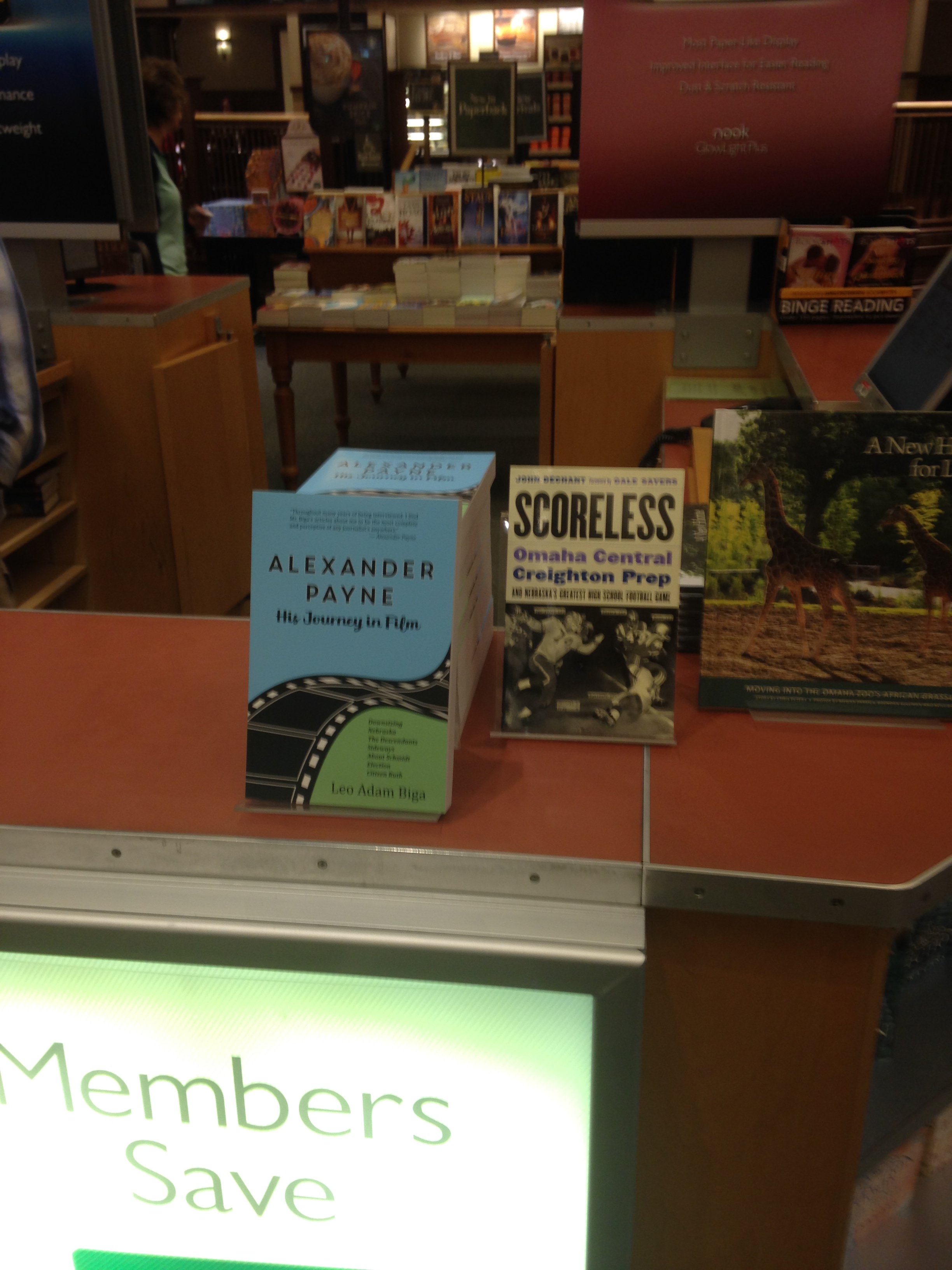
My Alexander Payne book is getting lots of love from the book guys and gals at the Oakview Barnes & Noble store in Omaha. They’ve kindly placed the book at the customer service counter for some prime store placement. “Alexander Payne: His Journey in Film” makes a great gift for yourself or for anyone in your life who loves movies, pop culture and reading about the path this Nebraskan has taken to achieve world cinema acclaim.
Look for an announcement about a book event I will be having at the Oakview Barnes & Noble later this fall. And look for announcements about more events around town where you can hear me talk about Payne, ask me questions and purchase the book. I will be very happy to sign your copy. I hope you can make it to one of these events, including the one described in this post – a Wednesday, Sept. 21 book talk-signing at the KANEKO-UNO Creativity Library in Omaha’s Old Market.
Come to Alexander Payne expert Leo Adam Biga’s Sept. 21 book talk-signing: “Alexander Payne: His Journey in Film” at KANEKO-UNO Creativity Library
Come to this relaxed book talk and signing by your friendly neighborhood Alexander Payne expert, Leo Adam Biga, the author of “Alexander Payne: His Journey in Film.” My passion project and labor of love is a must-read for movie buffs and fans. I will be selling and signing copies of the new edition before and after my 7 p.m. talk at the KANEKO-UNO Creativity Library, 12th and Jones Streets, in the Old Market, on Wednesday, September 21.
Let us know you’re coming at–
https://www.facebook.com/events/192453694506333/
The book sells for $25.95, plus tax. Available via Amazon, Barnes and Noble, Kindle and at select book stores and gift shops.
My informal presentation will offer insights into the Oscar-winning writer-director’s creative process gleaned from 20 years of interviewing and covering the filmmaker. The book is a collection of my extensive journalism about Payne and his work. I will also take questions from the audience.
Strong praise for “Alexander Payne: His Journey in Film”–
“This is without question the single best study of Alexander Payne’s films, as well as the filmmaker himself and his filmmaking process. In charting the first two decades of Payne’s remarkable career, Leo Adam Biga pieces together an indelible portrait of an independent American artist, and one that’s conveyed largely in the filmmaker’s own words. This is an invaluable contribution to film history and criticism – and a sheer pleasure to read as well.” – Thomas Schatz, Film scholar and author (“The Genius of the System”)
As many of you know, I am an Omaha author-journalist-blogger who often writes about film. In 2012 I turned my in-depth reporting about the celebrated filmmaker from Omaha into “His Journey in Film.”It is the most comprehensive study of Payne’s cinema career and work anywhere. Its collection of articles and essays is based on interviews I conducted with Payne and with many of his key collaborators. The new edition is releasing this fall through River Junction Press in Omaha and features expanded and enhanced content, including a Discussion Guide with Index. It makes a great resource for film buffs, critics, filmmakers, educators and students as well as more casual film fans who want a handy Payne primer and trivia goldmine.

The book is updated and current through Payne’s “Nebraska” and “Downsizing” projects.
“Downsizing’s” (2017) epic, tragicomic tale tackles big ideas having to do with pressing world crises and universal human conflicts. The story’s imagined solution to ever depleted world resources is downsizing human beings to a fraction of normal size, thus decreasing mankind’s footprint on planet Earth. Only the reduction experience doesn’t quite go the way that Paul, the Everyman hero played by Matt Damon, envisioned. We go down the rabbit hole of this dark wonderland with Matt into a mind-blowing, soul-stirring, heart-breaking and ultimately inspiring odyssey that traverses everything from geo-political intrigue to classism and racism to human trafficking to love.
The adventure immerses us into new worlds that may represent the new dawn of man. Payne and his collaborators have traveled the globe to make an ambitious film shooting in multiple countries and starring an international cast. It promises to be a cinematic experience filled with spectacle, pathos and satire, yet never losing touch with human intimacy. Every Payne film is about a physical, emotional, intellectual journey. The stakes for the journey Paul takes in “Downsizing” are high because, unbeknownst to Paul, humanity’s future rests on his actions.
Payne and his film should get lots of attention when it releases next year.
“His Journey in Film” takes you deep inside the creative process of this world cinema artist and follows the arc of his filmmaking journey over a 20-year span, when he went from brash indie newcomer to mature, consummate veteran. Along the way, he’s made a handful of the best reviewed American films of the past two decades and his movies have garnered many top honors at festivals and at the Independent Spirit Awards, the Golden Globes and the Academy Awards.
This is a must-get book for Nebraskans who want to know how this native son has arrived at rarefied heights and in the company of legends. Nebraskans love the fact that through all of Payne’s remarkable success, he has remained rooted to this place. There is much more to come from him and much more to be said about his work. But for now “Alexander Payne: His Journey in Film” is the definitive word on his journey and output.
Look for announcements about future Biga book talks-signings at:
Hot Movie Takes: “A Thousand Clowns” and other ’60s films begat golden age of ’70s cinema
Hot Movie Takes:
“A Thousand Clowns” and other ’60s films begat golden age of ’70s cinema
©by Leo Adam Biga
Author of Alexander Payne: His Journey in Film
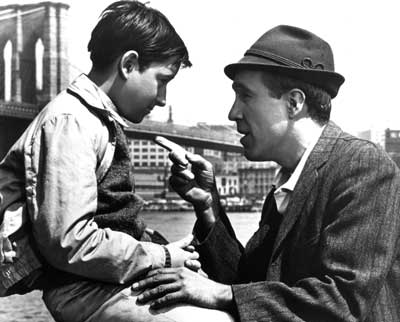
The other night on YouTube I watched a largely forgotten but seminal American movie from 1965 titled “A Thousand Clowns” and it reminded of two things: As a kid, that movie was way too mature and cerebral for me to fully appreciate; and it was part of a vanguard that helped usher in the New Hollywood. Those of us who regard the last Golden Age of American cinema to be the 1970s know full well that that New Wave of American film really began in the late 1950s-early 1960s, before finally becoming a full fledged movement in the late 1960s. That movement or wave marked by personal, humanistic-themed filmmaking led by auteurist directors hailing from television and film school persisted throughout the following decade. This was the period when the studios were “taken over” by the artists or so it seemed. The new freedom allowed a brash group of filmmakers to assert themselves on the American and world cinema scene. The new school directors whose work most stood out then included: Arthur Penn, John Frankenheimer, John Cassavetes, Mike Nichols. Francis Ford Coppola, Martin Scorsese, Hal Ashby, Peter Bogdanovich, William Friedkin, Robert Altman, Bob Rafelson, Richard Rush, Roman Polanski, Milos Forman, John Schlesinger, Karel Reisz, John Boorman, Peter Yates, Michael Cimino, Mel Brooks and Woody Allen.
But those hot new directors were not the only ones making waves then. Indeed, a few veteran studio directors long since having gone independent made some of their strongest works in that era, particularly John Huston (“Reflections in a Golden Eye,” “Fat City,” “The Man Who Would Be King,” “Wiseblood”). Then there were directors who made only one or very few notable films in that time only to disappear from the world of features or never to catch the magic again. “A Thousand Clowns” director Fred Coe was one of these. He was a writer and producer who had his biggest success in TV, but he made two films right in the thick of that transition in American features that caught the wave in their own idiosyncratic ways. The first was “A Thousand Clowns,” which writer Herb Gardner adapted from his own Broadway play. The other was “Me, Natalie,” which like “Clowns” has a great reputation, but I have never seen it to judge for myself. Before the film adaptation of “Clowns,” he directed the original Broadway play, which was a commercial and critical hit. For the film Jason Robards and Barry Gordon reprised their starring roles from the stage version.

Now having viewed “Clowns” for the first time through adult eyes – decades removed from when I last saw it – it is clearly part of a continuum in American film that pushed boundaries and assimilated stylistic techniques and humanistic themes prominent in the cinematic new waves of Italy, France and Great Britain and that reflected the growing social tumult. “Clown” stars Robards as a quintessential New York City nonconformist named Murray who has raised his nephew Nick (Barry Gordon) ever since his sister abandoned him to his care. He’s a sardonic writer hedonistically living off of his imagination and irascibility. Out of work by his own choice and none too eager to rejoin the Rat Race, he lives by his own rules and seemingly without adverse consequences. His nephew is, on the surface at least, more of an adult than he is and goes along with his flights of fancy as much to humor him as anything. Even when Murray’s guardianship of the boy is threatened by this carefree lifestyle and cavalier attitude that sees him run through women, defy authority and flee responsibility, he doesn’t change. Then, in the strangely melancholic and wonderfully anarchic spirit of the story – something of a cross between the Marx Brothers, “The Producers,” “Harold and Maude” and Woody Allen – a couple from the child welfare board visits the uncle and nephew’s apartment to make an assessment. William Daniels as Albert and Barbara Harris as Sandra play the romantically involved couple. He’s an uptight case worker and she’s an emotionally fragile psychologist and they have wildly different responses to the situation. He’s appalled and annoyed by Robards’ seeming indifference to this official inquiry and the threat of the nephew being taken from the home. She, however, is charmed by the Murray and Nick’s insouciance. The professional and personal relationship between the neurotic couple devolves right before Murray’s eyes and he takes up with her that very day. That still leaves the matter of Murray needing to find a job before a hearing in a few days to determine the boy’s fate.
NOTE: Nebraska’s own Sandy Dennis played Sandra in the Broadway play and won a Tony for her efforts.
Robards is perfectly cast as Murray. He had a gift for irony and larceny. I’ve always thought of him as the Bogart among his generation of actors. Gordon, who as an adult became the long tenured head of the Screen Actors Guild, plays prococious and worldy wise without cloying cuteness – something akin to what Jodie Foster did a decade later in “The Bad News Bears” and “Taxi Driver.”
Murray’s staid agent brother Arnold (Martin Balsam), frantically lines up interviews for him but Murray can’t or won’t sell-out and ends the day still unemployed. This causes Sandra to lay down an ultimatum: find a job or lose me. There’s a great scene between the brothers when an exasperated but loving Arnold explains to Murray why they are so different. Arnold needs the security that comes with showing up for work everyday. He’s settled for the consumerist American Dream, even if it is a fraud, and he’s willing to play by the rules to remain a sheep and to be comfortable. He has a family to support, after all. By contrast, Murray’s search for whimsy in a system designed to crush individuality and his penchant for calling out the hypocrisy around him leaves him fighting windmills that cannot be harnessed. Arnold admires and pities Murray;s inability or refusal to compromise. Murray feels anger and sorrow that Arnold long ago lost his freedom. In the end, Murray sacrifices his independence for the sake of the kid and the girlfriend and perhaps his own peace of mind by going back to work for Leo, the manic, egomaniacal host-producer of a children’s TV show, brilliantly played by Gene Saks. The ending bothers fans of the stage version, who feel the film makes it seem that Murray too has sold his soul to become just another sheep. But my take is that Murray’s simply adjusted his attitude, much like his hat, to appear to be a conformist on the outside when he’ll really always remain a free spirit and independent agent on the inside. It’s what you do for love, in this case his love for the boy and for the woman.

Director Coe opens up “A Thousand Clowns” by variously following Murray, Nick and Sandra cavorting about the city, their spontaneous play in stark contrast to the regimented patterns of workers moving in lockstep to and from work. These moments represent their escapes, if only fleeting, from harsh reality. These scenes give the film a kinetic, pure cinema look and feel that also emphasizes the whole theme of moving against the tide. My take away from the story is that Gardner views the constructs of 9 to 5 civilization as a game in which the House (corporations, society, government) is always going to “win” and the best antidote to staying sane and happy in this rigid, stacked paradigm is to see it for what it is and have a good time winking at it. Murray is not so much a rebel then as a survivor who gives as good as he gets on his own terms. He will always be an outlier with a barbed comment or silly joke or impulse to do something spontaneous. It’s his way of saying; I am here, I am alive. I own my own thoughts and behaviors. And I don’t give a damn what you may think of me. While it’s message may be muddled for some, I think it’s basically just saying; No matter what, be yourself. We all make compromises, but be true to yourself.
All of this is played out against the subtext of what was happening at the time in society with the civil rights and black power movements, the birth of women’s lib, the Vietnam War, the counterculture revolution led by rock, the growing drug culture and consumerism run amok. Things were on simmer in the early and mid’60s and would come to a full boil by the end of the decade. The film is a mood capsule for the dissatisfaction people were feeling without ever overtly referring to any of these things. But it’s all there between the lines.
“Clowns” came smack dab in the middle of a flood of films starting to redefine American cinema in the 1960s:
Shadows
The Hustler
Lolita
Wild River
The Manchurian Candidate
David and Lisa
America, America
Dr. Strangelove
A Hard Day’s Night
Nothing But a Man
Who’s Afraid of Virginia Wolf?
Lillith
In Cold Blood
Mickey One
The Graduate
Bonnie and Clyde
Point Blank
Faces
The Producers
A Funny Thing Happened on the Way to the Forum
Catch-22
Midnight Cowboy
Alice’s Restaurant
Easy Rider
Butch Cassidy and the Sundance Kid
MASH
Five Easy Pieces
The Landlord
Husbands
Harold and Maude
The French Connection
The Last Picture Show
Mean Streets
The Conversation
These and many other films brought a new freedom and excitement to bear that opened up American cinema more than at any time since the pre-code silent and early sound era. The best of these new films variously introduced new levels of naturalism, expressionism and impressionism to the screen. It was an anything goes time informed by the cinema of the world. America made its own indelible contributions to this rich cinema stew. “Clowns” rarely gets mentioned in appraisals or retrospectives of ’60s and ’70s film. It’s not nearly as well known as many of the films in the above list. While it’s not a great film – Coe doesn’t quite get the visuals aspects of the story right in my opinion and I think he doesn’t make full use of the dynamics between Murray and Nick – it’s a very good and important film. I can’t wait to discover more of these gems that have got lost in the shuffle.
Here is a link to a superb tribute essay written about Herb Gardner and “A Thousand Clowns”–
http://www.huffingtonpost.com/peter-dreier/herb-gardner_b_3993759.html
In a Western state of mind II
In a Western state of mind II
©by Leo Adam Biga
As a cinephile, I consider myself a connoisseur of certain genres, especially the Western. Like a lot of film buffs I sometimes make the mistake of thinking I’ve seen all the good films there are to see in a particular genre, in this case the Western, when I really ought to know better. I mean, in my lifetime I have seen my share of films of all types, including a good many Westerns, but my conceit can easily make me forget what I know to be the truth – that a whole lot of Westerns have come down the trail from the advent of motion pictures through today. Many hundreds of them. And while I have seen a couple hundred, that leaves a big number I still need to discover. This reality was impressed upon me the last few days when I viewed for the first time three fine Westerns. The first of these, “The Furies,” is one I have long been aware of and even seen bits and pieces of over the years. But Saturday was the first time I sat down to watch the film from beginning to end and I must say it more than lived up to its reputation. The 1950 black and white classic directed by Anthony Mann stars Barbara Stanwyck, Walter Huston, Wendell Corey, Gilbert Roland, Judith Anderson and Thomas Gomez. In this Shakespearean-inspired drama, Huston plays a feudal land baron whose only daughter has an unhealthy love turned hate for her father after she does something terribly wrong to his caddish new wife and he takes out his blood lust revenge against his daughter’s lifelong friend. The story is replete with patricide, corruption, racism, misogyny and betrayal.

Mann brought complex psychological themes to his Westerns and while his films don’t always hold up to the deep currents they tread, they do work on many levels. His films also anticipate the work of later Western directors such as Sam Peckinpah in their anti-heroic protagonists, ambivalent morality and uncompromising violence. As usual, Mann displays his gift for juxtaposing characters with exterior landscapes through stark visuals that poetically, dramatically frame men and women against their physical environment to emphasize humans at war with their own natures and with their surroundings.
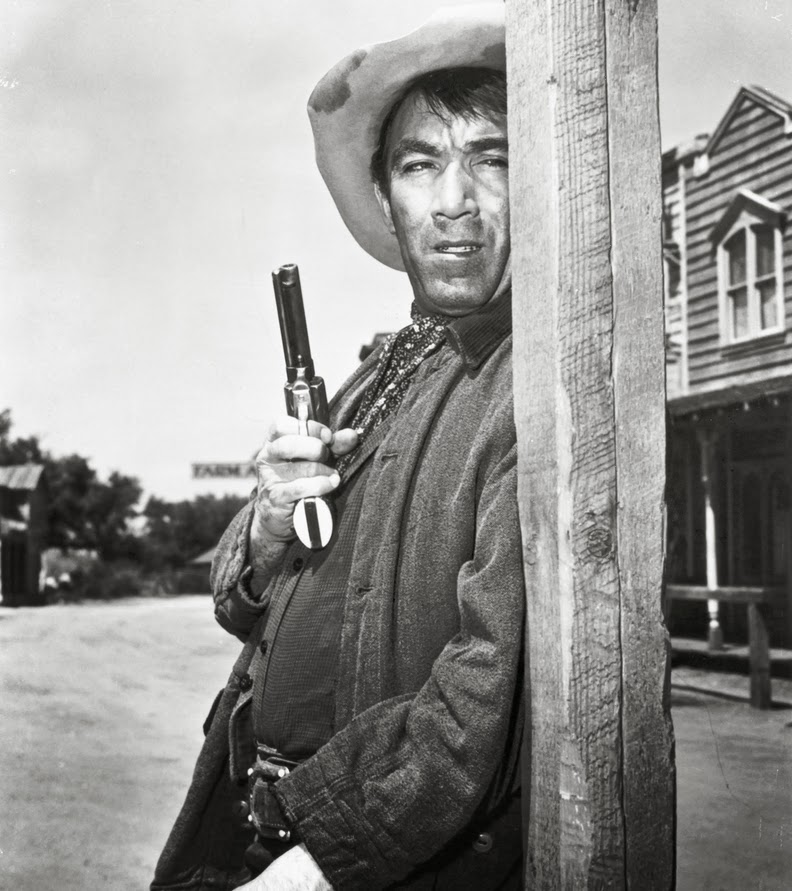
I had never even heard of, much less seen, the next two Westerns in my private cinema epiphany. “Man from Del Rio” (1956) stars Anthony Quinn and Katy Jurado in a gem of a story directed by Harry Horner, an Oscar-winning production designer who also directed for television and helmed a few features as well. The movie continually sets us up for seeming cliched story-lines and plot twists but nearly always surprises with unconventional choices. Quinn plays a lonely, roaming Mexican gunman out to avenge an old wound. When he rids a town of three bad men he takes the job of sheriff thinking its residents will embrace him, only to learn his trade and his ethnicity make him persona non grata. He is an outcast who cannot find inner peace because he’s invested his entire self-worth on his fast draw and steely resolve. The film’s showdown at the end is reminiscent of many others but only up to a point because, as before, it overturns our expectations. Quinn’s character has suffered an injury rendering his shooting hand useless and yet he still faces off with his nemesis on main street and manages to prevail without a shot being fired because he’s
learned to love himself and to trust his strength of character. His walk in that climactic duel is a piece of pure cinema in the determined way he moves and in the confident way he removes bandages from his injured wrist. It is a walk of sinister grace and quiet bravado.
Quinn gives one of his more subdued, nuanced performances. Horner makes great use of the backlot sets and lets the story build gradually. The black and white photography is suitably austere for this simple story of deep stirrings.
“Man from Del Rio”
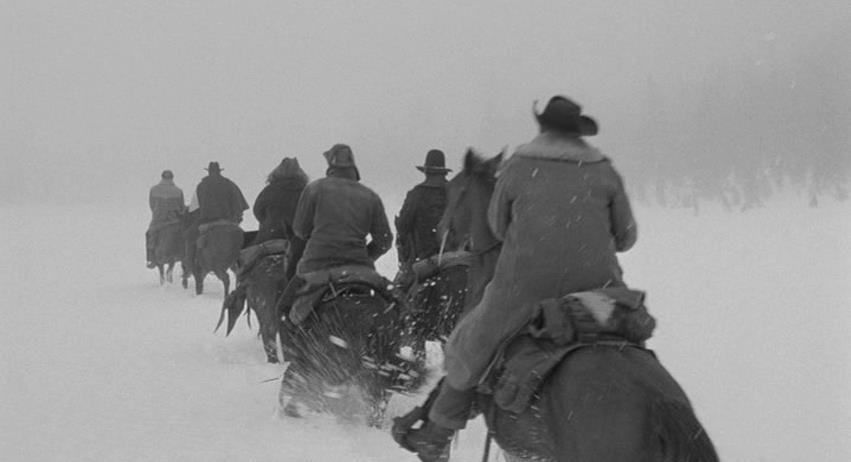
But the best discovery of all in my Western marathon has to be “Day of the Outlaw.” It is another black and white film, this time from the late 1950s (1959 to be precise), but it is far from being just another film. From the enigmatic opening title sequence to the ambivalent ending, it is a work of high aesthetics that compares favorably with much better known and more heralded Westerns. Director Andre de Toth made a lot of Westerns but this is the only one of his I have seen and after viewing it I will eagerly seek out more of his work. Several elements distinguish “Day of the Outlaw” from routine Western programmers: first, the story unfolds in the winter and de Toth and his cast and crew traveled to the American northwest to make the film on location in the wilds of Oregon; the film opens with two men on horseback in high country snow approaching a wagon on a spread filled with barbed wire; the taller man in the saddle, Robert Ryan, expresses to his riding companion, Nehemiah Persoff, a powerful disdain for wire fences and for the men who put them up. Persoff openly questions if it’s one man in particular he hates and if he’s riding into town to kill that man or to steal his wife. That opening couple minutes establishes much of what follows: a bleak, harsh wintertime landscape in the middle of nowhere; and Ryan’s principled but corrupt free range character holding a grudge against farmers who erect fences and harboring a particular hate for one man whose wife, played by Tina Louise, he also lusts after. Once Ryan and Persoff arrive in the isolated town of Bitters the story goes along in somewhat predictable fashion for a time as Ryan and Louise’s husband appear fated to confront one another in a deadly conflict that Ryan will surely win. Louise will do anything to spare her husband but Ryan will not be denied the satisfaction of killing the man who stands in the way of his freedom and of the woman he wants. But then the story takes a completely different turn when, out of nowhere, a band of evil men led by a disgraced former cavalry officer played by Burl Ives, who has the stain of a massacre he ordered on his black heart, seek refuge in town. They are thieves, rapists and murderers on the run from an Army detachment in hot pursuit. The outlaws proceed to terrorize the inhabitants and this changes the balance of everything, as Ryan becomes the hero who tries to keep harm from coming to the residents. He bargains with Ives, whom he recognizes himself in, for their lives and eventually leads the outlaws out of town on the ruse that he knows a way through the mountains to escape their Army pursuers. What Ives’ men don’t know is that he is dying and Ryan is taking him and the others on a trek from which he expects no one will survive. He is sacrificing everything so that the town may be rid of this plague. It is a redemption story without a hint of sentimentality, too. As Ryan explains to Louise before he leaves, he’s doing it for himself and for his own immortal soul and to lead bad people away from good people. He also convinces Ives that it’s better to die with some dignity and on his own terms rather than be responsible for another massacre and be captured or killed in a shootout with the Army.
“Day of the Outlaw”
The ending sequences are a great combination of location shooting in harsh conditions and realistic soundstage atmospherics. In this fatalistic story, Ryan doesn’t expect to come of the journey alive and in fact he tells Ives mid-journey that he doesn’t expect any of them will make it. On the other hand, Ryan’s character has the advantage of knowing the territory and surviving its weather, and even though outnumbered seven to one at the start, one by one the outlaws begin falling victim to the elements or to their own avarice.
Director de Toth, whether because of budget constraints or aesthetic reasons, frames much of the action at a distance, in medium or long shot, and makes great use of negative space, all of which enhances the sense of dread, loneliness, isolation and suspense that this movie elicits. Because of the set up involving a small group of people trapped in a frozen environment and preyed on by violent invader, the film, though a Western, plays very much like “The Thing” or “30 Days of Night” in terms of tone, just as it’s also reminiscent of similarly themed Westerns such as “Rio Bravo” and “Firecreek.”
The Ryan character has the moral ambiguity of so many Western anti-heroes of that era and of subsequent eras, thus reflecting the harsh attitudes of post-World War II America that also informed film noir.
Yes, I love Westerns. The geography, history and mythology bound up in them allow film artists to apply all manner of meanings and issues to these vast archetypal landscapes. The more I explore the genre, the more richness I find. Silent features with Harry Carey. Serials. B-oaters. Western comedies. The long reign of TV Westerns as the dominant category of episodic dramatic series. Singing cowboys. John Ford and Howard Hawks classics spanning the Golden Age of the old studio system through the dawn of the New Hollywood. John Wayne and Gary Cooper becoming the faces of the American Western. The two great Western franchises of the 1950s – Anthony Mann’s collaboration with James Stewart and Budd Boetticher’s collaboration with Randolph Scott. The idiosyncratic Westerns of Sam Peckinpah. Sergio Leone’s spaghetti Westerns and the emergence of Clint Eastwood as the new face of the Old West. Monte Hellman’s mid-1960s revisionist Westerns with Jack Nicholson. Robert Altman re-imagining the Western in “McCabe and Mrs. Miller.” The rise of Clint Eastwood as the new face of the Western anti-hero. A Western, “Unforgiven,” finally winning the Best Picture Oscar. The great TV Western mini-series “Lonesome Dove” and “Broken Trail.” The new realism of HBO’s “Deadwood.” The faithful adaptation of Omaha native Ron Hansen’s novel “The Assassination of Jesse James by the Coward Robert Ford.’ The remakes of “True Grit,” “3:10 to Yuma” and, now, “The Magnificent Seven.”
There was a time when the Western was considered dead, but it’s never gone away and it’s pretty clear by now that it never will. Filmmakers will continue finding ways to reinvent and reinvigorate this time honored genre whose interpretations and variations are as wide open as the Great Plains and the American West. Look for more dispatches from my Western cinema adventures and discoveries.
NOTE: The three Westerns that motivated this post were all viewed for free and in their entirety on YouTube. There are short ads built in with some but not all. I am finding an amazingly rich pool of not only Westerns but films of all genres and types available for free on the Web. Last night I thoroughly enjoyed “A Thousand Clowns,” a mid 1960s film that was part of the American New Wave that proceeded the New Hollywood. Watch for my post about, too.
Hot Movie Takes; “Downsizing” may elevate filmmaker to new heights
Hot Movie Takes:
“Downsizing” may elevate filmmaker to new heights
“Alexander Payne: His Journey in Film” your guide to his cinema universe
©by Leo Adam Biga
Author of “Alexander Payne: His Journey in Film”
The epic tragicomic tale told in Alexander Payne’s “Downsizing” (2017) tackles big ideas having to do with pressing world crises and universal, age-old human conflicts. The story’s imagined solution to ever depleted world resources is downsizing human beings to a fraction of normal size, thus decreasing mankind’s footprint on planet Earth. Only the reduction experience doesn’t quite go the way that Paul, the Everyman hero played by Matt Damon, envisioned. We go down the rabbit hole of this dark wonderland with Matt into a mind-blowing, soul-stirring, heart-breaking and ultimately inspiring odyssey that traverses everything from geo-political intrigue to classism and racism to human trafficking to love. The adventure takes us into new worlds that may or may not be the salvation of civilization but that just may be, for better or worse, the new dawn of man. Payne and his collaborators have traveled the globe to make an ambitious film shooting in multiple countries and starring an international cast. It promises to be a cinematic experience filled with spectacle, pathos and satire, yet never losing touch with human intimacy. As we know by now, every Payne film is about a physical, emotional, intellectual journey that tests its protagonists with some crucible they must endure in order to reach a new place, literally or metaphorically speaking. The stakes for the journey Paul takes in “Downsizing” are higher than for any journey in Payne’s other films because, unbeknownst to Paul, humanity’s future rests on his actions.
Payne and his film will get lots of attention when it releases mid-t0-late 2017. I think it will be the most talked about American film of the year. If it does resonate strongly enough with audiences it could very well catapult the filmmaker into a new category alongside such names as Tarantino, Scorsese, Cameron, Soderbergh and Nolan. Like their critically acclaimed movies that also become box office hits, Payne’s “Downsizing” may be his first film to not only reach the $100 million gross mark but to pull in well in excess of that number. It may also mark the film that finally wins him a Best Director Oscar. For someone like me who has closely covered Payne for a generation, there is much to anticipate and to report on in the coming year. After writing about the film last winter-spring and not much at all the last few months, I will be ramping up my coverage the remainder of this year through all of next year.

If you admire Payne’s films and want to know what goes into making them, then you will want to follow my reporting. You will also want to get a copy of my book”Alexander Payne: His Journey in Film.” It is updated and current through Payne’s “Nebraska” and “Downsizing” projects. This passion project and labor of love is a must-read for movie buffs and fans. It is your companion guide to understanding his cinema universe. As an author-journalist-blogger, I often write about film and in 2012 I turned my in-depth reporting about Payne into this book. It is the most comprehensive study of his cinema career and work to be found anywhere. Its collection of articles and essays is based on interviews I conducted with Payne and with many of his key collaborators. My new edition is releasing this fall through River Junction Press in Omaha and features expanded and enhanced content, including a Discussion Guide with Index. It makes a great resource for film buffs, critics, filmmakers, educators and students as well as more casual film fans who want a handy Payne primer and trivia goldmine.
“Alexander Payne: His Journey in Film” takes you deep inside the creative process of one of the world’s leading cinema artists and follows the arc of his filmmaking journey over a 20-year span, when he went from brash indie newcomer to mature, consummate veteran. Along the way, he’s made a handful of the best reviewed American films of the past two decades and his movies have garnered many top honors at festivals and at the Independent Spirit Awards, the Golden Globes and the Academy Awards.
Available via Amazon, Barnes and Noble, Kindle and at select book stores and gift shops.
I will be selling and signing copies of my new edition before and after my 7 p.m. book talk at the KANEKO-UNO Creativity Library, 1111 Jones Street, in the Old Market on Wednesday, September 21.
The book sells for $25.95, plus tax.
My informal presentation will offer insights into the Oscar-winning writer-director’s creative process gleaned from 20 years of interviewing and covering the filmmaker. I will also take questions from the audience.
Strong praise for “Alexander Payne: His Journey in Film”–
“This is without question the single best study of Alexander Payne’s films, as well as the filmmaker himself and his filmmaking process. In charting the first two decades of Payne’s remarkable career, Leo Adam Biga pieces together an indelible portrait of an independent American artist, and one that’s conveyed largely in the filmmaker’s own words. This is an invaluable contribution to film history and criticism – and a sheer pleasure to read as well.” – Thomas Schatz, Film scholar and author (“The Genius of the System”)
I hope to see you at the KANEKO-UNO Creativity Library. You can let us know you’re coming by linking to the Facebook event page and clicking GOING–
https://www.facebook.com/events/192453694506333/
If you can’t make this event, you’ll have more chances to get a copy signed by me during the fall. Look for announcements about future book talks-signings on my social media platforms:
https://www.facebook.com/LeoAdamBiga/
https://www.facebook.com/AlexanderPayneExpert/?fref=ts
Please remember that “Alexander Payne: His Journey in Film” makes a great gift for the film and book lover in your life.
It’s a must-get book for Nebraskans who want to know how this celebrated native son has arrived at rarefied heights and in the company of legends. Nebraskans love the fact that through all of Payne’s remarkable success, he has remained rooted to this place. His story will only get larger from here on out and this book is the foundation for appreciating how he has grown and what he has achieved in his first 20 years as a feature filmmaker.
There is much more to come from him and much more to be said about his work. But for now “Alexander Payne: His Journey in Film” is the definitive word on his creative ourney and output.
NEWS FLASH: “Alexander Payne: His Journey in Film” now available through Barnes & Noble
NEWS FLASH: “Alexander Payne: His Journey in Film”
Now available through Barnes & Noble. $25.95.
Passion Project. Introducing the new – “Alexander Payne: His Journey in Film”
https://www.facebook.com/AlexanderPayneExpert/?fref=ts
The book’s a must-read for film buffs, critics, filmmakers, educators and students as well as more casual film fans who want a handy Payne primer and trivia goldmine.
“This is without question the single best study of Alexander Payne’s films, as well as the filmmaker himself and his filmmaking process. In charting the first two decades of Payne’s remarkable career, Leo Adam Biga pieces together an indelible portrait of an independent American artist, and one that’s conveyed largely in the filmmaker’s own words. This is an invaluable contribution to film history and criticism – and a sheer pleasure to read as well.” – Thomas Schatz, Film scholar and author (“The Genius of the System”)
FROM YOUR ALEXANDER PAYNE EXPERT
Leo Adam Biga–
I am an Omaha-based author-journalist-blogger who often writes about film and in 2012 I turned my in-depth reporting about Oscar-winning writer-director Alexander Payne into a book entitled “Alexander Payne: His Journey in Film”. It is the most comprehensive study of his cinema career and work to be found anywhere. My collection of articles and essays is based on interviews I conducted with Payne and with many of his key collaborators. I have a new edition of the book releasing September 1 through a boutique press here called River Junction Press. This new edition features expanded and enhanced content, including a Discussion Guide with Index.
The book is updated and current through his “Nebraska” and “Downsizing” projects. I am quite proud of it. It’s received a wonderful endorsement from film scholar and author Thomas Schatz (see above).
“Alexander Payne: His Journey in Film” takes you deep inside the creative process of one of the world’s leading cinema artists and follows the arc of his filmmaking journey over a 20-year span, when he went from brash indie newcomer to mature, consummate veteran. Along the way, he’s made a handful of the best reviewed American films of the past two decades and his movies have garnered many top honors at festivals and at the Independent Spirit Awards, the Golden Globes and the Academy Awards.
The book has a staged release this fall, beginning September 1, 2016 through year’s end and well beyond, from River Junction Press in Omaha and sells for $25.95.
Available soon on Amazon, for Kindle and at select bookstores and gift shops. You can also order copies through my blogleoadambiga.com or via http://www.facebook.com/LeoAdamBiga or by emailing me at leo32158@cox.net.
More strong praise for”Alexander Payne: His Journey in Film”–
“Alexander is a master. Many say the art of filmmaking comes from experience and grows with age and wisdom but, in truth, he was a master on day one of his first feature. Leo Biga has beautifully captured Alexander’s incredible journey in film for us all to savor.” – Laura Dern, actress, star of “Citizen Ruth”
“Last night I finished your wonderful new book and I enjoyed it so much! Alexander Payne is such a terrific director and I loved reading about his films in detail. Congratulations.” – Joan Micklin Silver, filmmaker (“Hester Street” and “Crossing Delancey”)
“Alexander Payne is one of American cinema’s leading lights. How fortunate we are that Leo Biga has chronicled his rise to success so thoroughly.” – Leonard Maltin, film critic and best-selling author
“I’d be an Alexander Payne fan even if we didn’t share a Nebraska upbringing: he is a masterly, menschy, singular storyteller whose movies are both serious and unpretentious, delightfully funny and deeply moving. And he’s fortunate indeed to have such a thoughtful and insightful chronicler as Leo Biga.” – Kurt Andersen, novelist (“True Believers”) and Studio 360 host
“Alexander Payne richly deserves this astute book about his work by Leo Biga. I say this as a fan of both of theirs; and would be one even if I weren’t from Nebraska.” – Dick Cavett, TV legend
“Leo Biga brings us a fascinating, comprehensive, insightful portrait of the work and artistry of Alexander Payne. Mr. Biga’s collection of essays document the evolution and growth of this significant American filmmaker and he includes relevant historical context of the old Hollywood and the new. His keen reporter’s eye gives the reader an exciting journey into the art of telling stories on film.” – Ron Hull, Nebraska Educational Television legend, University of Nebraska emeritus professor of broadcasting, author of “Backstage”
“Perhaps the most intriguing feature of the book is Biga’s success at getting Payne to speak candidly about every step in the filmmaking process. These detailed insights include the challenges of developing material from conception to script, finding financing, moderating the mayhem of shooting a movie, and undertaking the slow, monk-like work of editing.” – Brent Spencer, educator and author (“The Lost Son”)
“This book became a primer for me, and introduced me to filmmaking in a way that I had never experienced in my years at film school. The intimacy and honesty in Biga’s writing, reporting and interviewing– and Payne’s unparalleled knowledge of cinema introduced me to filmmaking and film history from someone I quickly came to respect: Mr. Payne.” – Bryan Reisberg, filmmaker (“Big Significant Things”)
Hot Movie Takes: In a Road Pic State of Mind – Favorite Road Movies and Ones Still to See

Hot Movie Takes:
In a Road Pic State of Mind – Favorite Road Movies and Ones Still to See
©By Leo Adam Biga
Author of “Alexander Payne: His Journey in Film”
Having taken back to back road trips this summer, the cinephile in me got to thinking about road trip movies and how intrinsically satisfying they can be. It turns out that I have seen and you likely have too many good ones. There is also a large number of must-sees I have yet to view. I have curated here a list of notable movies I have seen that meet the basic criteria for a good road trip pic. There are many such flicks with great reps that I haven’t seen and I’ve also made a list of those that I intend to catch up with some day. Among those I have yet to see that are considered seminal road pics are “Wild Boys of the Road,” Kings of the Road” and “Two Lane Blacktop.”
On the list of road pics I have seen, three are by Omaha’s own Alexander Payne: “About Schmidt,” “Sideways” and “Nebraska.” His “The Descendants” could be considered a road pic as well. There are some selections that might better fit other categories, such as “The Terminator” franchise, but they absolutely work as road movies, too. A more recent example of this blurring or melding of categories might be “Mad Max: Fury Road” and the preceding films in that series.
I purposely excluded from my listings some movies I’ve seen that I know fit the road pic theme, such as the Hope-Crosby series and “It’s a Mad, Mad, Mad, Mad World” because for my tastes anyway they just don’t work very well, at least not today.
For the following lists, the movies are ordered in a rough approximation of their release dates.
Among my personal favorite road pics are:
The Grapes of Wrath
Sullivan’s Travels
The Treasure of the Sierra Madre
Gun Crazy
La Strada
The Searchers
Thunder Road
North by Northwest
Bonnie and Clyde
Easy Rider
Five Easy Pieces
The Out of Towners
Man in the Wilderness
Harold and Maude
The Getaway
Paper Moon,
The Last Run
Scarecrow
Badlands
The Last Detail
Emperor of the North
Thieves Like Us
Harry & Tonto
The Sugarland Express

Rafferty and the Gold Dust Twins
Bring Me the Head of Alfredo Garcia
The Man Who Would Be King
Freebie and the Bean
Sorcerer
The In-Laws
Rolling Thunder
Who’ll Stop the Rain?
Bite the Bullet
Handle with Care
The Blues Brothers
Melvin and Howard
Cutter’s Way
El Norte
Something Wild
Lost in America
Mountains of the Moon
Rain Man
Dumb and Dumber
Map of the Human Heart
The Straight Story
O Brother Where Art Thou
Three Kings
Joy Ride
Almost Famous
Aboout Schmidt
Y Tu Mama Tambien
Sideways
The Motorcycle Diaries
Little Miss Sunshine
Nebraska
Between both lists, that is the list of movies I’ve seen and the list of movies I haven’t seen, a surprising number were either shot or set in Nebraska or have production histories or back stories that intersect wth Nebraska, including the three Payne films as well as “The Rain People,” “Paper Moon,” “Badlands,” “Convoy” and “To Wong Foo, Thanks for Everything Julie Newmar.”
When I sat down to start thinking about and researching the subject of this post, it became very clear very early on that there are more really good road movies than I ever realized. Many top directors have explored this genre or sub-genre. It makes sense, of course, because characters on the open road, whether on foot or in a vehicle or in a stagecoach or aboard a train or on horseback, make for kinetic cinema, particularly when the characters are framed in space against dramatic landscapes and backdrops. There is nothing more elemental in cinema than figures moving through space and going on some journey. When the context for that movement, journey, trip, quest or escape includes elements of time or danger, or when the stakes are somehow raised because of the dramatic or comedic situation, then we are pulled right along on that path with the protagonists. It only works though if the basic narrative exposition is compelling enough. We’re only invested in the road adventure to the extent we are made to care about the characters and their dilemma or objective. The best of these films depict human yearning and growth through the physical act of travel, which invariably means encountering some kind of obstacles or conflicts en route. In one way or another, all of these movies are about searches – internal or external – and moving on to some desired destination or resolution or state of mind. These stories tap into the human heart and mind in terms of what makes us tick. For these reasons and more, road pics done well will always be relevant and engaging.

Here are virtually all the road pic movies I’ve seen that I can recommend:
It Happened One Night
You Only Live Once
Stagecoach
The Grapes of Wrath
They Live by Night
They Drive by Night
Sullivan’s Travels
The Treasure of the Sierra Madre
Detour
Gun Crazy
The Wild One
La Strada
Westward the Women
Wild Strawberries
Thunder Road
North by Northwest
The Great Race
Bonnie and Clyde
The Rain People
Easy Rider
The Out of Towners
Man in the Wilderness
Harold and Maude
Five Easy Pieces
Duel
The Getaway
The Last Run

Scarecrow
Badlands
The Last Detail
Paper Moon
Emperor of the North
Thieves Like Us
Harry & Tonto
The Sugarland Express
Rafferty and the Gold Dust Twins
Bring Me the Head of Alfredo Garcia
The Man Who Would Be King
Freebie and the Bean
The Bingo Long Traveling All-Stars & Motor Kings
Sorcerer
The In-Laws
Rolling Thunder
Who’ll Stop the Rain?
Bite the Bullet
Handle with Care
Smokey and the Bandit
Mad Max
The Blues Brothers
Melvin and Howard
National Lampoon’s Family Vacation
Cutter’s Way
The Road Warrior
El Norte
Starman
The Terminator
48 Hours
The Sure Thing
Stranger Than Paradise
Paris, Texas
Something Wild
Down by Law
Lost in America
Wild at Heart
Planes, Trains and Automobiles
Mountains of the Moon
Thelma and Louise
Rain Man
Map of the Human Heart
Crossing the Bridge
Terminator II: Judgement Day
Omaha the Movie
Dumb and Dumber
The Straight Story
Midnight Run
Flirting with Disaster
O Brother Where Art Thou?
Three Kings
Joy Ride
Almost Famous
About Schmidt
Terminator III: Rise of the Machines
Y Tu Mama También
Children of Men
Sideways
The Motorcycle Diaries
Little Miss Sunshine
Terminator Salvation
Nebraska

Here is a list of road pics I mean to get to one day:
Wild Boys of the Road
The Hitchhiker
The Wages of Fear
Journey to Italy
Il Sorpasso
Pierrot le Fou
Weekend
Wanda
Vanishing Point
Deadhead Miles
Two Lane Blacktop
Kings of the Road
Honky Tonk Freeway
The Living End
The Vanishing
Love and a .45
Vagabond
My Own Private Idaho
The Adventures of Priscilla, Queen of the Desert
To Wong Foo, Thanks for Everything! Julie Newmar
True Romance
Natural Born Killers
Get on the Bus
Smoke Signals
Central Station
Fear and Loathing in Las Vegas
In This World
Broken Flowers
Old Joy
Borat
Wendy and Lucy
Meek’s Cutoff
Mad Max: Fury Road
Grandma
Hot Movie Takes: Stanley Kubrick and Alexander Payne – An unexpected congruence
Hot Movie Takes:
Stanley Kubrick and Alexander Payne –
An unexpected congruence

©By Leo Adam Biga
Author of “Alexander Payne: His Journey in Film”
Been revisiting the work of the late Stanley Kubrick. While I’ve always regarded him as a true master and genius of cinema, my appreciation for just how far ahead he was of his times is deeper than before. He may be the boldest independent filmmaker to ever come out of America. When the Hollywood studio system still had an iron grip on the industry, as an outlier totally outside that apparatus he went ahead and taught himself filmmaking, got his work distributed and within a few years Hollywood came knocking at his door. He did this long before John Cassavettes. He did it long before there were film schools. He forced himself into the world cinema ranks without the benefit of having come up through the studio system or having a mentor or working in television or theater. He just made himself into a filmmaker through sheer will and talent. He eventually entered a longterm contract with Warner Brothers that gave him remarkable freedom to make films on his terms with little or no interference from the suits. It’s the same kind of arrangement Woody Allen later struck and still enjoys today. But what got Kubrick noticed by the studios in the first place were doc projects he audaciously made on his own, “The Day of the Fight” and “The Flying Padre,”followed by two narrative features he also made on his own, “Fear and Desire” and “Killer’s Kiss,” thus proving he could produce and direct as good a B picture as any of the studios. Whereas making commercially viable films outside the system is fairly routine today, doing so in the late 1940s-early 1950s as he did was unheard of. It helped that this once prodigy still photographer had done photo essays for Look Magazine. He was a brilliant visualist and storyteller and an astute cinephile, He learned practically everything he needed to know to be a filmmaker through his photography work and watching movies. Of course, someone like Kubrick or Alexander Payne doesn’t just watch a film, at least a compelling one, they analyze and absorb it. Their insatiable intellects make a study of everything that falls in their gaze.
In his early 20s, Kubrick rented a motion picture camera and shot those two documentary shorts with it, both of which he sold. Then came the two indie features. Neither is very good but each shows the filmmaker’s great eye for composing beautifully lit and evocative shots and for handling complex movements and actions. An indie distributor saw the first feature and got it shown in art houses. United Artists took interest in the second and offered Kubrick a deal to make a feature for them, which became “The Killing,” his inventive and effective racetrack heist picture that marked him as a serious talent. That led to his first masterpiece, the brilliant anti-war film “Paths of Glory.” It marked his first time working outside the U.S. and with a major star, Kirk Douglas. “Killing” and “Paths” displayed his sardonic sensibilities, visual poetry, precise compositions and facility for authenticity, all of which became trademarks for his subsequent work. Kubrick’s first full foray into big Hollywood studio filmmaking came when Douglas asked him to helm “Spartacus” after firing veteran A-list director Anthony Mann following the first few days of production. It was Kirk’s project. Just as Douglas clashed with Mann, he did with Kubrick, who hated being a director for hire without final say – a position he vowed never to be in again and he wasn’t – though the well-received project did boost his standing in the industry as a bankable artist. His next two projects, “Lolita” and “Dr. Strangelove,” were completely different than any American films of that era in their incredibly frank, intelligent and satiric treatment of very sensitive subjects that in lesser hands would have fallen flat or rang dishonest or been ridiculous.
And then he changed the face of cinema for evermore by making his most ambitious film to date, “2001: A Space Odyssey.” Before “2001” the best sci-fi film was “Forbidden Planet,” a very serious, big-budget project that I adore but that when compared to Kubrick’s work is a naive and simplistic cartoon. Outside the U.S. Fritz Lang made a German masterwork in “Metropolis,” but we’re confining this discussion to American films. Kubrick raised the genre to heights never before seen or imagined and arguably never since surpassed. It is a work of art unfraid to tackle the biggest questions concerning life on Earth, the universe and eternity. Which brings me to Alexander Payne and a certain congruence between his work and the work of Kubrick.
In rewatching Payne’s work to prepare for the release of the new edition of my book “Alexander Payne: His Journey in Film,” I realized that they are twinned satirists who insistently tweak, challenge, subvert and decry the worst in humankind yet offer a glimmer of hope in the end, though Kubrick’s endings are decidedly less hopeful and more pessimistic. But these artists’ works definitely share an affinity for the ambiguous, complex and dual natures of people. They both dislike authority, exploitation, manipulation and dishonesty. Their films seamlessly juggle multiple storylines. Their films also share the keen sense of observation that comes from analytical and intuitive minds that place us as viewers at a distance so as to keep us intellectually and emotionally involved without indicating too much what we are to feel. They each respect us enough to let us glean what we will without beating us over the head with cues. Visually. Payne is not at Kubrick’s level, at least not yet, though his compositions, cutting and visuals have become more and more cinematic, rhythmic and poetic. And where Kubrick was making and in many cases reinventing highly evolved genre films right from the start (“Day of the Fight” is a boxing film, “Fear and Desire” is a war story, “Killer’s Kiss” is a suspense film, “The Killing” is a heist pic, “Paths of Glory” is a war story, “Spartacus” is a historical epic, et cetera), Payne has not worked in hard and fast genres, except he calls everything he makes a comedy. “Citizen Ruth” is a social satire about abortion and a lot of other things. “Election” is a high school comedy about blind ambition and mid-life crisis. “About Schmidt” is a personal dramedy about identity crisis. “Sideways” is at once a buddy pic, road flick and love story. “The Descendants” is a family dramedy about infedlity, loss and love. “Nebraska” is an elegiac tone poem about aging, family and community. The film he still has in production “Downsizing” is, whether he agrees or not, a sci fi film that not unlike “2001” takes on major social, political, cultural, philosophical and spiritual topics. It’s also a love story. Payne has always talked about wanting to work in genres and this may be his first venture there, though this is a terrestrial story, not an extraterristial tale. No spaceships or monoliths or Star Child or self-aware Hal computer here. However, the entire plot does hinge on speculative new technology that makes it possible for humans to downsize or miniaturize themselves to a few inches tall and much of the story unfolds in the hypothesized Small World. There’s yet another fictional world depicted, this one akin to a Middle Earth, that also has a major role in what reads like a post-modernist fable. I am not suggesting that Payne’s “Downsizing” will be the cinematic landmark that “2001 was but then again, maybe, just maybe, it might be. I, for one, can’t wait to see.

Of course, Kubrick considered more big ideas in his subsequent genre films “A Clockwork Orange” (sci-fi), “Barry Lyndon” (historical epic), “The Shining” (horror), “Full Metal Jacket” (war) and “Eyes Wide Shut” (love/relationships). Perhaps Payne will get around to that Western he’s long talked about and, who knows, maybe he’ll try his hand at a war film or an historical drama. Whatever he does, you can be sure it will be done with ultimate care, rigor and agility. Just as Kubrick’s body work by his seventh film already made him a world cinema giant, Payne is at that same point, too. In fact, Payne’s first two features were far stronger than Kubrick’s. You might argue that Kubrick’s next few films on through “Strangelove” were somewhat more impressive than Payne’s work from “About Schmidt” on through “Nebraska.” By that mean, Kubrick’s work was also visionary and unconventional and groundbreaking. I can’t say that for Payne’s works, although within the conventions he works in his work is unmatched. And then Kubrick went to a whole other level with “2001.” Something tells me Payne will do the same thing with “Downsizing.”
NOTE: My Alexander Payne book releases Sept. 1 but now through August 27 it can be purchased at KANEKO, 1111 Jones Street in Omaha’s Old Market. It lists for $25.95. Or you can pre-order a copy at leo32158@cox.net. It will eventually be in select bookstores and gift shops and available on Amazon and for Kindle.
Hot Movie Takes: Do any Alexander Payne films rate among 100 greatest American films ever made?
Hot Movie Takes:
Do any Alexander Payne films rate among 100 greatest American films ever made?
©By Leo Adam Biga
Author of “Alexander Payne: His Journey in Film”
So, when the American Film Institute (AFI) gets around again to naming the 100 best American movies of all time along with the 100 best American comedies of all time, will any Alexander Payne films make the list? After recently rewatching all his work and putting together the new edition of my book “Alexander Payne: His Journey in Film” I would hazard to guess that enough time may have passed by now for as many as five of his films to crack these lists, though another decade or so may make the case better for some of them. In the Greatest movies category, I can make a great case right now for any or all of the following: “About Schmidt,” “Sideways,” “The Descendants” and “Nebraska” though I think the most likely of that group to be so homored is “Sideways.” Personally, I think the most deserving is “Nebraska.” When I review the current AFI Greatest rankings, there are several movies that to my tastes anyway have no business being there, including “Ben-Hur,” “Yankee Doodle Dandy,” “Swing Time,” “The Sixth Sense,” “Bringing Up Baby,” “Easy Rider,” “Titanic,” “All About Eve” and well a whole bunch more. Don’t get me wrong, they’re all fine films. But do they rise to Greatest ever heights? Let’s just say that on my Greatest list I would change out about half of the entries in the AFI list for other films I regard as better works. I definitely rate any of the Payne films I nomianted as Greatest candidates above the pictures I singled out here. I see that “The Last Picture Show” is on the AFI list, and while I admire the movie, I don’t think it’s as good as Payne’s “Nebraska,” another black and white, small town elegy story. There are very few comedies on the Greatest list and once again i would rate any of Payne’s comedies, with the exception of “Citizen Ruth,” right there with “The Apartment,” “Some Like It Hot,” “Tootsie,” “The Graduate,””Duck Soup,” “Sullivan’s Travels,” “City Lights,” “Modern Times” and “The General,” and I am a great admirer of all those films.
Looking over the AFI Greatest Laughs list, any or all of Payne’s films deserve a spot there. For many Payne buffs, his best comedy to date is “Election” and it certainly belonsg among the best screen comedies. Based on sheer fillmMaking and cinema as art consideratons, only a very few on the AFI list can match or exceed his work in my opinion, and that would be “Dr. Strangelove,” the aforementioned Chaplin films, Keaton’s “The General” and “The Navigator,” Woody Allen’s “Manhattan,” James L. Brook’s “Broadcast News” and the Coen Brothers’ “Fargo.” If you’re grading purely on comedy or laughs, well then several films may be funnier than Payne’s comedies, such as “The Producers” or “There’s Somtething About Mary” or “Animal House” but of course his movies don’t only operate as comedies. Indeed, they are as much dramas as comedies because he applies a sharp satiric lens to everything he looks at and he focuses that lens on some very tough subjects. Abortion. Addiction. Infidelity. Loneliness. Alienation. Identity crisis. Aging. Death. With his new film “Downsizing” he’s tackling even deeper, darker subjects. For my tastes anyway, his comedies are among the richest and most satisfying ever made for these very reasons. In this sense, he shares much in common with Charlie Chaplin, Buster Keaton, Frank Capra, Ernest Lubisch and Billy Wilder from the Golden Age of Cinema. Part of the fun of fillm is that everyone sees everything so differently.
NOTE: My Alexander Payne book releases Sept. 1 but now through August 27 it can be purchased at KANEKO, 1111 Jones Street in Omaha’s Old Market. It lists for $25.95. Or you can pre-order a copy at leo32158@cox.net. It will eventually be in select bookstores and gift shops and available on Amazon and for Kindle.

 ®
®
Get your copy of the new “Alexander Payne: His Journey in Film” @ July 21 event
Get your copy of the new “Alexander Payne: His Journey in Film” @ July 21 event
Very pleased to announce the new edition of my book “Alexander Payne: His Journey in Film” releases September 1. You have an early bird opportunity to buy the book and get it signed by me at a film program I am moderating that features Oscar-winning cinematographer Mauro Fiore on Thursday, July 21 at 7 p.m. at KANEKO.
See details below or link to more info, at–

Strong praise for”Alexander Payne: His Journey in Film”–
“This is without question the single best study of Alexander Payne’s films, as well as the filmmaker himself and his filmmaking process. In charting the first two decades of Payne’s remarkable career, Leo Adam Biga pieces together an indelible portrait of an independent American artist, and one that’s conveyed largely in the filmmaker’s own words. This is an invaluable contribution to film history and criticism – and a sheer pleasure to read as well.” –Thomas Schatz, Film scholar and author (“The Genius of the System”)
“Alexander Payne: His Journey in Film” charts the Oscar-winning filmmaker’s rise to the elite ranks of world cinema. Articles and essays take you deep inside the artist’s creative process. It is the most comprehensive look at Payne and his work to be found anywhere. This new edition features significant new content related to “Nebraska” and “Downsizing.” We have also added a Discussion Guide with Index for you film buffs and students. The book is also a great resource for more casual film fans who want a handy Payne primer and trivia goldmine. The book releases September 1 from River Junction Press.
The book sales for $25.95.
For inquiries and pre-orders, contact: leo32158@cox.net.
Follow my work at–
leaoadambiga.com and www.facebook.com/LeoAdamBiga.
_ _ _
Mauro Fiore: Writing with Light
Thursday, July 21 @ 7 p.m.
KANEKO, 1111 Jones St.
Tickets $10 General Admission. FREE for KANEKO Members
KANEKO hosts Academy Award winning director of photography Mauro Fiore for an audio-visual presentation exploring his career. Fiore’s filmography as a DP includes “Training Day,” “The A-Team,””Avatar” – for which he won the Oscar for Best Cinematography – and more recently “Real Steel,” “The Equalizer,””The Kingdom” and “Southpaw.” The Hollywood veteran is recognized for his skill with stylized light and realism. He’s collaborated with such major directors as Joe Carnahan, Michael Bay, James Cameron, Peter Berg and Antoine Fuqua. He and Fuqua have teamed on five features, the latest of which is the soon to release remake of “The Magnificent Seven.”
Fiore very much sees himself as a storyteller working in light and image to fulfill the vision of the writer and director.
The July 21 discussion will be moderated by yours truly. As an author-journalist-blogger I bring years of experience writing and reporting about film to the moderator’s chair.
Mauro Fiore: Writing with Light is a part of the Storytelling season at KANEKO June 3 – August 27. Learn more about the Storytelling exhibitions and programs at–
http://thekaneko.org/kaneko-programs/storytelling/
Hope to see you there.


 Leo Adam Biga's My Inside Stories