Archive
Hot Movie Takes – ‘Taxi Driver’
Hot Movie Takes – “Taxi Driver”
©By Leo Adam Biga, Author of “Alexander Payne: His Journey in Film”

It’s hard to imagine general American moviegoing audiences being prepared for “Taxi Driver” when it hit theaters in 1976. I mean, here was ostensibly a film noir that eschewed standard conventions for a dark fever dream of one man’s mounting paranoia and revulsion in the urban wasteland of New York City.
The character of Travis Bickle didn’t have any direct cinema antecedents but he did emerge from a long line of disturbed screen figures going back to Peter Lorre in “M,” James Cagney as Cody Jarrett in “White Heat,” Richard Basehart as Roy Martin in “He Walked By Nigh,” Robert Walker as Bruno Antony in “Strangers on a Train” and Robert Mitchum as Harry Powell in “Night of the Hunter.”
There are even some hints of Robert Ryan as Montgomery in “Crossfire” and as Earle Slater in “Odds Against Tomorrow” and of Anthony Perkins as Norman Bates in “Psycho” and as Dennis Pitt in “Pretty Poison.”
Bickle also anticiated many screen misfits to follow, including some of the whack jobs in Coen Brothers and Quentin Tarantino films.
As a disenfranchised loner who sees the world around him as a venal place, Bickle obsessively reinvents himself into a self-made avenging angel ridding the streets of scum. His response to the violent, lurid subculture of sex for sale is an explosive bloodletting that is, in his mind, a purification. In the end, after carrying out his self-appointed cleansing mission, are we to believe he is mad or merely misguided? Is he a product or symptom of urban isolation and decay?
Paul Schrader’s brilliant script, Martin Scorsese’s inspired direction and Robert De Niro’s indelible performance took what appeared to be Grade B grindhouse thematic material and elevated it into the realm of art-house mastery. They did this by making the story and character an intense psycho-social study of disturbance. Bickle is not some nut case aberration. Rather he is one of us, which is to say he is an Everyman cut off from any real connections around him. The way he’s wired and the way he views the world make him a ticking time bomb. It’s only a matter of time before he’s set off and goes from talking and fantasizing about doing extreme things to actually enacting them. He lives in his head and his head is filled with disgusting images and thoughts that occupy him as he drives his cab through the streets of what he considers to be a modern-day Gomorrah. He fixates on certain things and persons and he won’t be moved from his convictions, which may or may not be the result of psychosis or sociopathic tendencies.
Schrader’s script and Scorsese’s direction, greatly aided by Michael Chapman’s photography and Bernard Herrmann’s musical score, find wildly expressive ways to indicate Bickle’s conflicted state of mind. Atmospheric lighting captures a surreal landscape of garish neon signs, steam rising from the streets and back street porno theaters, strip clubs and whorehouses. He grows to hate the pimps and pushers, the johns and addicts littering the city. When he tries to intersect with normality, it’s a complete disaster. Languid, dream-like music underscores the moral turpitude bringing Bickle down. Emotionally-charged, driving music accompanies Bickle’s trance-like rituals and final hypnotic outburst that is simultaneously savage and serene.
Travis Bickle is a troubling symbol who straddles the legal, moral and psychological line of impulse and premeditation. Does he know what he’s doing? Is he responsible for his actions? Or is he insane?
De Niro’s transformation from mild-mannered cabbie to scary vigil ante, complete with the famous “Are you talking to me?” break with reality, is where the real power of the film resides. He somehow makes his character believably frightening, revolting, pathetic and sympathetic all at the same time. To me, it will always stand as one of his two or three greatest performances because he completely inhabits this disturbed character without ever going over the top or resorting to cliches. He creates a true original in the annals of cinema that belongs to him and him alone.
There are some fine supporting performances in the film by Peter Boyle, Cybill Shepherd. Albert Brooks, Harvey Keitel and, of course, Jodi Foster as the adolescent prostitute Bickle anoints himself as protector and rescuer of. They and De Niro share some strong moments together. But it’s when De Niro’s character is alone and brooding, stalking and staring, that he most comes alive as a terrible reflection of our dark side run amok.
You can read “Taxi Driver” anyway you want: as exploration or examination, as cautionary tale, as prescient forecast, as potboiler crime pic. But however you read it, it is a vital, compelling and singular work of its time that endures because no matter how bizarre the story and stylized the effects, it’s always grounded in the truth of its single-minded protagonist. The film never stops giving us his point of view, even at the height of his mania.
Like a lot of the best ’70s American movies, this one doesn’t leave you feeling good but you know you’ve had an experience that’s challenged your mind and emotions and perhaps even moved you to some new understanding about the human condition. That’s what the best movies are capable of doing and this one certainly hits the mark.

Hot Movie Takes – “Across the Universe”
Hot Movie Takes – “Across the Universe”
©By Leo Adam Biga, Author of “Alexander Payne: His Journey in Film”
Perhaps the best American dramatic film to deal with the 1960s since “Hair” came out a decade ago to some fanfare but it inextricably faded quickly despite being a distinctive marriage of words, images and music. I am referring to “Across the Universe.” the 2007 Julie Taymor-directed flick that uses the music of the Beatles and the content of their songs as narrative inspiration for its coming of age storylines and musical-dance flights of fancy.
It is a sometimes stunning, sometimes dubious pastiche of Taymor’s own Broadway (“The Lion King”) style, the frenetic Richard Lester Beatles’ movies of the ’60s, Golden Age Hollywood musical fantasy sequences and hopped-up psychedelia. At its best it captures the energy and spirit of the era in a visual and sonic feast that works on many levels. At its weakest, it’s not quite sure what it wants to be and lacks a driving core. In some scenes Taymor goes in for bold visual stylistics, going overboard in places, to boldly open up the story with great big sets or locations or visual effects, sometimes all at once. Other times she constricts scenes to intimate interior spaces. For my tastes anyway I thought sometimes she went big when she should have gone small and went in close when she should have pulled back and opened wide.
The love story at the heart of the film is actually quite good, even if we’ve seen variations of it in countless films. It’s strong enough though that the relationship engages us even apart from using the Beatles’ music variously as backdrop, context and exposition.
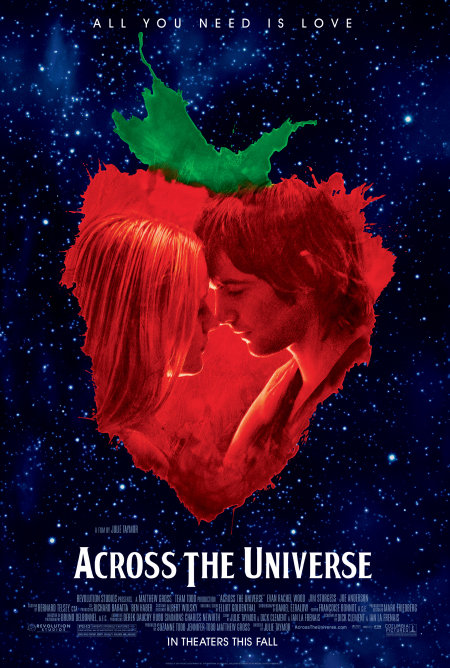
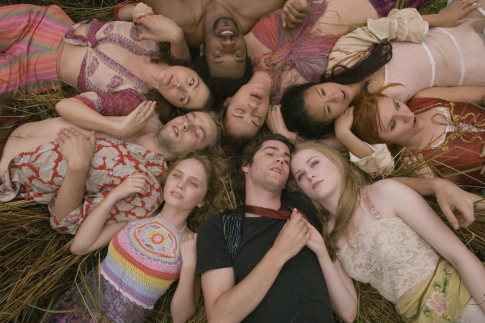

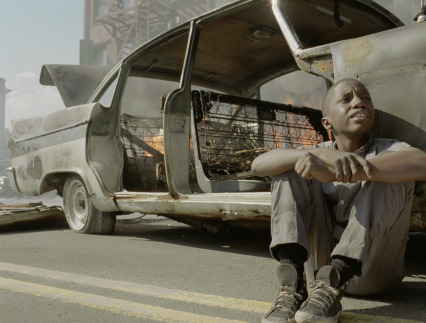

Brit Jim Sturgess is outstanding as Jude, a working stiff Libverpullian who crosses the pond to find the father he’s never met. He forms a best friend bond with Max, well played by Joe Anderson, and a romantic entanglement with Max’s sister, Lucy, portrayed with real depth by Evan Rachel Wood.
Pretty much every one of the principals was an unknown at the time. Dana Fuchs gives the showiest and grittiest performance as the Janis Joplin-like singer Sadie. Martin Luther brings the soul his Jimi Hendrix-like guitarist character demands. T.V. Caprio has just the right vulnerability as Prudence.
They’re all searchers eventually thrown together in the maelstrom of ’60s counterculture life in New York City. They meet or imagine a motley crew variously played by Joe Cocker. Eddie Izard, Bono and Salma Hyek, all of whom represent characters in Beatles songs or fictional versions of certain types found in that time and place.
The film touches on a great many of the currents that made the ’60s the ’60s, including civil rights, feminism, riots, protests, Vietnam, rock music, the drug culture, the sexual revolution and the generation gap.
There are some indelible images throughout. The Let It Be montage is an especially powerful melding of music and dramatic action.
The film plays like a series of related music videos and that gives it both its internal rhythmic strength and a disjointed self-limiting structure. The only thing holding the whole works together is the music and the boy meets girl plot. The songs are a series of set pieces unto their own though many of them are about love and searching. The thinly developed main characters’ moods and motivations get expressed through the music. When it all comes together, its thrilling stuff. When it doesn’t mesh, it seems a bit forced.
That said, I really admire the imagination and heart that went into this film. For the most part Taymor and her creative collaboratives found striking and moving ways to have the music carry a love story that is both singular and universal. The music and the story remind us that peace and love were counter-irritant strains in a decade of violence and hate. It’s also a reminder that love and life can endure no matter the tumult or conflict happening around us. Outside forces don’t have to keep us down or keep us apart.
This movie anticipated what was coming with movies like “La-La Land” and television shows like “Glee” and “The Get Down” and stands alone for capturing the vitality of an era when the whiff of anarchy and anything’s possible was in the air. And not surprisingly the music of the Beatles provided the soundtrack and narrative thread for decade that defined a new America.
Link to the film’s IMDB site at–
Hot Movie Takes Monday – ‘Mississippi Masala’

Hot Movie Takes Monday – “Mississippi Masala”
©By Leo Adam Biga, Author of “Alexander Payne: His Journey in Film”
Over the weekend I revisited one of my favorite films from the early 1990s – Mira Nair’s “Mississippi Masala.” I remembered it as one of the richest cross cultural dramas of that or any era and upon re-watching it on YouTube my impressions from then have been confirmed.
The story concerns an Indian family exiled from Uganda during Idi Amin’s reign of terror. They were forced to leave everything they owned and loved in terms of home, The patriarch of the family was born and raised in Uganda and lived there his entire life, building a life and career that made him feel at one with a nation his people had been brought to by the British to build railways. Though his ancestral roots are not of that continent, he identifies as African first, Indian second. The family ends up in Mississippi, owning and operating a motel and a liquor store. The patriarch, Jay, and his wife are the parents of an only child, Meena, who was a little girl when her left Uganda as refugees. When we meet her again she is a lovely, single 24 year old woman and still devoted daughter but strains under her parents’ overprotectiveness and their insisting she adhere to strict traditions concerning matrimonial matches and such. Those traditions aren’t such a good fit in America.
Also weighing heavily on Meena is the burden her father carries from being torn from his homeland. He can’t let that severing go. For years he’s petitioned the Ugandan government for a hearing to plead his case for his property and assets to be restored. He is a haunted figure. Part of what haunts him is the way he rebuked his black Ugandan friend from childhood, Okelo, when Amin’s military police rounded up foreigners for arrest, torture, deportation. Okelo is a devoted family friend who is like a brother to Jay and a grandfather to Meena. When Jay is arrested for making anti-Amiin remarks in a broadcast TV interview, Okelo bribes officials to free him. He tries to convince Jay that there is no future for him in Uganda anymore. Okelo tells him, “Africa is for black Africans.” He says it not out of malice but love. Jay is deeply hurt. He can’t accept this new reality but he realizes he and his family have no choice but to flee if they are to remain alive. Jay leaves without saying goodbye to Okelo. Meena sees and feels her father’s bitter anger and her beloved Okelo’s broken heart.

Grown-up Meena, played by Sarita Choudhury, lives with her parents in a diverse Mississippi town where they are the minority. A meet-cute accident brings together Meena and a young African-American man, Demetrius, played by Denzel Washington. He’s a devoted son who owns his own carpet cleaning business. He’s immediately attracted to Meena but at first he pays attention to her to get back at his ex, who’s in town and intent on belittling him. But things progress to the point where he and Meena spark the start of a real relationship. She meets his family and is embraced by them. Then the prejudice her extended family and community feels for blacks gets in the way and things get messy. As it always is with race, there are misunderstandings, assumptions and fears that cause rifts. Meena’s father is reminded of his own close-mindedness – that Indians in Africa wouldn’t allow their children to marry blacks. Demetrius and his circle must confront their own racist thinking.
Everyone in this film has their own wounds and stones of racism to deal with. No one is immune. No one gets off the hook. We’re all complicit. We all have something to learn from each other. It’s what we do with race that matters.
The theme of being strangers in homelands runs rife through the film. Just as African-Americans in Mississippi were enslaved and disenfranchised and often cut off from their African heritage, Indian exiles like Meena’s family are strangers wherever they go and distant from their own ancestral homeland of India.
Meena finally asserts her independence and her father finally gets his hearing. His bittersweet return to Uganda fills him with regret and longing, ironically enough, for America, which he realizes has indeed become his new home. The simple, sublime ending finds Jay in a street market where residents of the new Uganda revel in music and dance that are a mix of African and Western influences. As he watches the joy of a people no longer living in oppression, a black infant held by a man touches his face and Jay ends up holding the boy close to him, feeling the warmth and tenderness of unconditional love and trust.


There’s a great montage sequence near the end where the diverse currents of India, the American Deep South and Africa converge in images that some hot harmonica blues cover. By the end, the movie seems to tell us that home is a matter of the heart and identity is a state of mind and none of it need keep us apart if we don’t let it.
I saw the film when it first came out and though it spoke to me I was still a decade away from being in my first interracial relationship. I was already very curious about the possibilities of such a relationship and I was also acutely attuned to racial stereotypes and prejudices because of where and how I grew up. Seeing the film again today, as a 15 year veteran of mixed race couplings and a 21 year veteran of writing about race, it has even more resonance than before. And having visited Uganda in 2015 I now have a whole new personal connection to the film because of having been to that place so integral to the story.
This was the second movie by Nair I saw. The first, “Salaam Bombay,” was a hit on the festival circuit and that’s where I saw it – an outdoor screening at the Telluride Film Festival. Years later I saw another of her features, “Monsoon Wedding.” I still need to catch up with two of her most acclaimed later films, “The Perez Family” and “The Namesake.”
Watch the “Mississippi Masala” trailer at:
Hot Movie Takes Saturday – FIVE CAME BACK
Hot Movie Takes Saturday – FIVE CAME BACK
©by Leo Adam Biga, Author of “Alexander Payne: His Journey in Film”
Five Legendary Filmmakers went to war:
John Ford
William Wyler
Frank Capra
George Stevens
John Huston
Five Contemporary Filmmakers take their measure:
Paul Greengrass
Steven Spielberg
Guillermo del Toro
Lawrence Kasdan
Francis Ford Coppola
When the United States entered World War II these five great Hollywood filmmakers were asked by the government to apply their cinema tools to aid the war effort. They put their lucrative careers on hold to make very different documentaries covering various aspects and theaters of the war. They were all masters of the moving picture medium before their experiences in uniform capturing the war for home-front audiences, but arguably they all came out of this service even better, and certainly more mature, filmmakers than before. Their understanding of the world and of human nature grew as they encountered the best and worst angels of mankind on display.
The story of their individual odysseys making these U.S, government films is told in a new documentary series, “Five Came Back,” now showing on Netflix. The series is adapted from a book by the same title authored by Mark Harris. The documentary is structured so that five contemporary filmmakers tell the stories of the legendary filmmakers’ war work. The five contemporary filmmakers are all great admirers of their subjects. Paul Greengrass kneels at the altar of John Ford; Steven Spielberg expresses his awe of William Wyler; Guillermo del Toro rhapsodizes on Frank Capra; Lawrence Kasdan gushes about George Stevens; and Francis Ford Coppola shares his man crush on John Huston. More than admiration though, the filmmaker narrators educate us so that we can have more context for these late filmmakers and appreciate more fully where they came from, what informed their work and why they were such important artists and storytellers.
The Mission Begins
As World War II begins, five of Hollywood’s top directors leave success and homes behind to join the armed forces and make films for the war effort.

Combat Zones
Now in active service, each director learns his cinematic vision isn’t always attainable within government bureaucracy and the variables of war.

The Price of Victory
At the war’s end, the five come back to Hollywood to re-establish their careers, but what they’ve seen will haunt and change them forever.

Ford was a patriot first and foremost and his “The Battle of Midway” doc fit right into his work portraying the American experience. For Wyler, a European Jew, the Nazi menace was all too personal for his family and he was eager to do his part with propaganda. For Capra, an Italian emigre, the Axis threat was another example of powerful forces repressing the liberty of people. The “Why He Fight” series he produced and directed gave him a forum to sound the alarm. A searcher yearning to break free from the constraints of light entertainment, Stevens used the searing things he documented during the war, including the liberation of death camps, as his evolution into becoming a dramatist. Huston made perhaps the most artful of the documentaries. His “Let There Be Light” captured in stark terms the debilitating effects of PTSD or what was called shell shock then. His “Report from the Aleutians” portrays the harsh conditions and isolation of the troops stationed in Arctic. And his “The Battle of San Pietro” is a visceral, cinema verite masterpiece of ground war.
The most cantankerous of the bunch, John Ford, was a conservative who held dear his dark Irish moods and anti-authoritarian sentiments. Yet, he also loved anything to do with the military and rather fancied being an officer. He could be a real SOB on his sets and famously picked on certain cast and crew members to receive the brunt of his withering sarcasm and pure cussedness. His greatest star John Wayne was not immune from this mean-spiritedness and even got the brunt of it, in part because Wayne didn’t serve during the war when Ford and many of his screen peers did.
Decades before he was enlisted to make films during the Second World War, he made a film, “Four Sons,” about the First World War, in which he did not serve.
Following his WWII stint, Ford made several great films, one of which, “They Were Expendable,” stands as one of the best war films ever made. His deepest, richest Westerns also followed in this post-war era, including “Rio Grande,” “Fort Apache,” “She Wore a Yellow Ribbon,” “The Searchers,” “The Horse Soldiers” and “The Man Who Shot Liberty Valance.” Another war film he made in this period, “The Wings of Eagles,” is another powerful work singular for its focus on a real-life character (played by Wayne) who endures great sacrifices and disappointments to serve his country in war.
Even before the war Ford injected dark stirrings of world events in “The Long Voyage Home.”

William Wyler had already established himself as a great interpreter of literature and stage works prior to the war. His subjects were steeped in high drama. Before the U.S. went to war but was already aiding our ally Great Britain, he made an important film about the conflict, “Mrs. Miniver,” that brought the high stakes involved down to a very intimate level. The drama portrays the war’s effects on one British family in quite personal terms. After WWII, Wyler took this same closely observed human approach to his masterpiece, “The Best Years of Our Lives,” which makes its focus the hard adjustment that returning servicemen faced in resuming civilian life after having seen combat. This same humanism informs Wyler’s subsequent films, including “The Heiress,” “Roman Holiday,” “Carrie,” “The Big Country” and “Ben-Hur.”
Wyler, famous for his many takes and inability to articulate what he wanted (he knew it when he saw it), was revered for extracting great performances. He didn’t much work with Method actors and I think some of his later films would have benefited from the likes of Brando and Dean and all the rest. One of the few times he did work with a Method player resulted in a great supporting performance in a great film – Montgomery Clift in “The Heiress.” Indeed, it’s Clift we remember more than the stars, Olivia de Havilland and Ralph Richardson.

Frank Capra was the great populist director of the Five Who Came Back and while he became most famous for making what are now called dramedies. he took a darker path entering and exiting WWII, first with “Meet John Doe” in 1941 and then with “It’s a Wonderful Life” in 1946 and “State of the Union” in 1948. While serious satire was a big part of his work before these, Capra’s bite was even sharper and his cautionary tales of personal and societal corruption even bleaker than before. Then he seemed to lose his touch with the times in his final handful of films. But for sheer entertainment and impact, his best works rank with anyone’s and for my tastes anyway those three feature films from ’41 through ’48 are unmatched for social-emotional import.
Before the war George Stevens made his name directing romantic and screwball comedies, even an Astaire-Rogers musical, and he came out of the war a socially conscious driven filmmaker. His great post-war films all tackle universal human desires and big ideas: “A Place in the Sun,” “Shane,” “Giant,” “The Diary of Anne Frank.” For my tastes anyway his films mostly lack the really nuanced writing and acting of his Five Came Back peers, and that’s why I don’t see him in the same category as the others. In my opinion Stevens was a very good but not great director. He reminds me a lot of Robert Wise in that way.
That brings us to John Huston. He was the youngest and most unheralded of the five directors who went off to war. After years of being a top screenwriter, he had only just started directing before the U.S. joined the conflict. His one big critical and commercial success before he made his war-effort documentaries was “The Maltese Falcon.” But in my opinion he ended up being the best of the Five Who Came Back directors. Let this list of films he made from the conclusion of WWII through his death sink in to get a grasp of just what a significant body of work he produced:
The Treasure of the Sierra Madre
The Asphalt Jungle
Key Largo
The Red Badge of Courage
Heaven Knows Mr. Allison
Beat the Devil
Moby Dick
The Unforgiven
The Misfits
Freud
The List of Adrian Messenger
The Night of the Iguana
Reflections in a Golden Eye
Fat City
The Man Who Would Be King
Wiseblood
Under the Volcano
Prizzi’s Honor
The Dead
That list includes two war films, “The Red Badge of Courage” and “Heaven Knows Mr. Allison,” that are intensely personal perspectives on the struggle to survive when danger and death are all around you. Many of his other films are dark, sarcastic ruminations on how human frailties and the fates sabotage our desires, schemes and quests.
I believe Huston made the most intelligent, literate and best-acted films of the five directors who went to war. At least in terms of their post-war films. The others may have made films with more feeling, but not with more insight. Huston also took more risks than they did both in terms of subject matter and techniques. Since the other directors’ careers started a full decade or more before his, they only had a couple decades left of work in them while Huston went on making really good films through the 1970s and ’80s.
Clearly, all five directors were changed by what they saw and did during the war and their work reflected it. We are the ultimate beneficiaries of what they put themselves on the line for because those experiences led them to inject their post-war work with greater truth and fidelity about the world we live in. And that’s really all we can ask for from any filmmaker.
Hot Movie Takes: Alexander Payne’s ‘Downsizing’ promises to be a cinema feast
You can order signed copies by emailing me at leo32158@cox,net.
Here are links to some of my other “Downsizing” posts and articles:
https://leoadambiga.com/2017/02/17/the-incredible-s…s-60-years-apart/
https://leoadambiga.com/2016/07/31/stanley-kubrick-…ected-congruence/
https://leoadambiga.com/2016/08/28/downsizing-may-e…-cinema-universe/
https://leoadambiga.com/2016/04/01/lensing-april-1-…ous-film-to-date/
https://leoadambiga.com/2016/02/27/exclusive-on-ale…eese-witherspoon/
Movie buffs buzzing after early glimpse of Alexander Payne’s ‘Downsizing’

Director Alexander Payne, left, talks with Matt Damon before filming a scene for “Downsizing” in Omaha in April last year.


Alexander Payne’s next movie is already building some buzz, nine months ahead of its release.
Tuesday at the theater-owners convention CinemaCon, Paramount screened 10 minutes of footage from “Downsizing,” and audiences were reportedly blown away.
Payne’s sci-fi dramedy, parts of which were shot in Omaha last year, opens nationwide Dec. 22, a prime spot for movies seeking awards consideration.
“Downsizing,” starring Matt Damon, has been in the works for more than a decade. Payne and his writing partner, Jim Taylor, started the earliest version of the script in 2006. The film faced a few false starts along the way.
“It’s a movie that imagines what might happen if, as a solution to overpopulation and climate change, Norwegian scientists discover how to shrink organic material,” Payne said in an interview last spring. “The scientists propose to the world a 200- to 300-year transition from big to small as the only humane and inclusive solution to our biggest problem.”
In the film, Damon and Kristen Wiig play a married couple who decide to shrink themselves as a cost-saving measure.
The scale of the concept is new territory for the Omaha Oscar-winner, as are the bigger budget and heavy use of special effects.
In the clip screened at CinemaCon, Damon and Wiig attend a presentation about living the good life as a tiny person. An already-shrunk character played by Neil Patrick Harris makes the sales pitch. He lives in a dollhouse-sized mansion with his wife (played by Laura Dern). They get to live like kings for almost no money at all.
The convention clip also gave viewers the first look on what the shrinking process will look like. It apparently looks fantastic.
The Wrap reported that “the auditorium erupted in laughter at certain points throughout the clip, especially when the little miniature people came out of the shrinking machine. When the clip concluded, the audience cheered.”
Responses were across-the-board positive:
Variety: “‘Downsizing’ is something different entirely. It’s funny, to be sure, but it’s also Payne’s first foray into science fiction. Think of it as ‘Honey I Shrunk the Kids’ with a deeper social message.”
The Playlist: “Let’s be clear, Alexander Payne’s ‘Downsizing’ … was literally jaw-dropping. In a visual style and dramatic tone that is the most Kubrick-esque of his career, Payne screened what is effectively the first 10 minutes of the film. To say it’s one of the more original pieces of work I’ve seen in years is an understatement.”
Hollywood Elsewhere: “(The) CinemaCon preview of ‘Downsizing’ was awesome, brilliant, hilarious, sad and a tiny bit scary — an obvious Best Picture contender.”
The local reviews are good so far, too. Representatives of Aksarben Cinema got to see the footage. They said it’s amazing.
It’s of course impossible to judge a film on 10 minutes. But given the quality of Payne’s past work, the talent attached here, the warm reception the clip received and the prime holiday release Paramount is giving the film, this is one to maybe mark on your calendar.
Photos: Matt Damon, Kristen Wiig work on set in Omaha for Alexander Payne’s ‘Downsizing’

Director Alexander Payne plans a shot of the iconic La Casa sign at 4432 Leavenworth St, on Tuesday, April 12, 2016. Payne was filming his new movie, “Downsizing.” More photos.
Hot Movie Takes: John Huston, an appreciation
Hot Movie Takes
John Huston, an apprciation
By Leo Adam Biga, author of “Alexander Payne: His Journey in Film”
When I originally posted about the subject of this Hot Movie Take, the late John Huston, I forgot to note that his work, though very different in tone, shares a penchant for unvarnished truth with that of Alexander Payne. Huston was a writer-director just like Payne is and he was extremely well-read and well-versed in many art forms, again just as Payne is. The screenplays for Huston’s films were mostly adaptations of novels, short stories and plays, including some famous ones by iconic writers, and the scripts for Payne’s films are mostly adaptations as well. Huston also collaborated with a lot of famous writers on his films, including Truma Capote and Arthur Miller. The work of both filmmakers shares an affinity for ambiguous endings. I think at his best Huston was more of a classic storyteller than Payne and his films more literate. Where Huston mostly made straight dramas, he showed a real flair for comedy the few times he ventured that way (“The African Queen,” “Beat the Devil,” “The Life and Times of Judge Roy Bean” and “Prizzi’s Honor”). Payne insists that he makes comedies, though most would say he makes dramedies, a terrible descriptor that’s gained currency. More accurately, Payne’s comedy-dramas are satires. I think he’s more than capable of making a straight drama if he chose to, but so far he’s stayed true to himself and his strengths. If Payne is the ultimate cinema satirist of our tme, and I think he is, then Huston stands as the great film ironist of all time. With one using satire and the other using irony to great effect, their films get right to the bone and marrow of characters without a lot of facade. Just as it was for Huston, story and character is everything for Payne. And their allegiance to story and character is always in service to revealing truth.

Of all the great film directors to some out of the old studio system, only one, that craggy, gangly, hard angle of a man, John Huston, continued to thrive in the New Hollywood and well beyond.
It’s important to note Huston was a writer-director who asserted great independence even under contract. He began as a screenwriter at Universal and learned his craft there before going to work at Warner Brothers. But Huston was an accomplished writer long before he ever got to Hollywood. As a young man he found success as a journalist and short story writer, getting published in some of the leading magazines and newspapers of the day. Indeed, he did a lot things before he landed in Tinsel Town. He boxed, he painted, he became a horseman and cavalry officer in the Mexican uprisings, he hunted big gamma he acted and he caroused. His father Walter Huston was an actor in vaudeville before making it on the legitimate stage and then in films.
What he most loved though was reading. His respect for great writing formed early and it never left him. Having grown up the son of a formidable actor, he also respected the acting craft and the power and magic of translating words on a page into dramatic characters and incidents that engage and move us.
He admired his father’s talent and got to study his process up close. Before ever working in Hollywood, John Huston also made it his business to observe how movies were made.
But like most of the great filmmakers of that era, Huston lived a very full life before he ever embarked on a screen career. It’s one of the reasons why I think the movies made by filmmakers like Huston and his contemporaries seem more informed by life than even the best movies today. There’s a well lived-in weight to them that comes from having seen and done some things rather than rehashing things from books or film classes or television viewings.
Because of his diverse passions, Huston films are an interesting mix of the masculinity and fatalistic of, say. a Hemingway, and the ambiguity and darkness of, say, an F. Scott Fitzgerald or Eugene O’Neill. I use literature references because Huston’s work is so steeped in those traditions and influences. In film terms, I suppose the closest artists his work shares some kinship with are Wyler and John Ford, though Huston’s films are freer in form than Wyler’s and devoid of the sentimentality of Ford. As brilliantly composed as Wyler’s films are, they’re rather stiff compared to Huston’s. As poetic as Ford’s films are, they are rather intellectually light compared to Huston’s.
At Warners Huston developed into one of the industry’s top screenwriters with an expressed interest in one day directing his own scripts. Of all the Hollywood writers that transitioned to directing, he arguably emerged as the most complete filmmaker. While he never developed a signature visual style, he brought a keen intelligence to his work that emphasized character development and relationship between character and place. He made his directing invisible so as to better serve the story. When I think of Huston, I think of lean and spare. He perfected the art of cutting in the camera. He was precise in what he wanted in the frame and he got as close to what he had on the page and in his head as perhaps anyone who’s made feature-length narrative films. He did it all very efficiently and professionally but aesthetic choices came before any commercial considerations. He was known to be open to actors and their needs and opinions, but he was not easily persuaded to change course because he was a strong-willed artist who knew exactly what he wanted, which is to say he knew exactly what the script demanded.
His films are among the most literate of their or any era, yet they rarely feel stagy or artificial. From the start, Huston revealed a gift for getting nitty gritty reality on screen. He was also very big on location shooting when that was still more a rarity than not and he sometimes went to extreme lengths to capture the real thing, such as encamping in the Congo for “The African Queen.” Look at his “The Man Who Would Be King” and you’ll find it’s one of the last great epic adventure stories and Huston and Co.really did go to harsh, remote places to get its settings right.
The realism of his work is often balanced by a lyrical romanticism. But there are some notable exceptions to this in films like “Fat City.”
He sometimes pushed technical conventions with color experiments in “Moulin Rouge,” “Moby Dick” and “Reflections in a Golden Eye.”
As a young man learning the ropes, he reportedly was influenced by William Wyler and other masters and clearly Huston was a good student because right out of the gate with his first film as director, “The Maltese Falcon,” his work was fully formed.
In his first two decades as a writer-director, Huston made at least a half dozen classics. His best work from this period includes:
The Maltese Falcon
The Treasure of the Sierra Madre
The Asphalt Jungle
Key Largo
The Red Badge of Courage
Heaven Knows Mr. Allison
Beat the Devil
Moby Dick
The Unforgiven
Huston remained a relevant director through the 1960s with such films as:
The Misfits
Freud
The List of Adrian Messenger
The Night of the Iguana
Reflections in a Golden Eye
But his greatest work was still ahead of him in the 1970s and 1980s when all but a handful of the old studio filmmakers were long since retired or dead or well past their prime. Huston’s later works are his most complex and refined:
Fat City
The Man Who Would Be King
Wiseblood
Under the Volcano
Prizzi’s Honor
The Dead
I have seen all these films, some of them numerous times, so I can personally vouch for them. There are a few others I’ve seen that might belong on his best efforts list, including “The Roots of Heaven.” Even a near miss like “The Life and Times of Judge Roy Bean” is worth your time. And there are a handful of ’70s era Huston films with good to excellent reputations I’ve never gotten around to seeing, notably “The Kremlin Letter” and “The Mackintosh Man,” that I endeavor to see and judge for myself one day.

Three star-crossed iconic actors with Huston, Arthur Miller, Eli Wallach and Co. on the set of “The Misfits”
It would be easy for me to discuss any number of his films but I elect to explore his final and, to my tastes anyway, his very best film, “The Dead” (1987). For me, it is a masterpiece that distills everything Huston learned about literature, film, art, music, life, you name it, into an extraordinary mood piece that is profound in its subtleties and observations. For much of his career, Huston portrayed outward adventures of characters in search of some ill-fated quest. These adventures often played out against distinct, harsh urban or natural landscapes. By the end of his career, he turned more and more to exploring inward adventures. “The Dead” is an intimate examination of grief, love, longing and nostalgia. Based on a James Joyce short story, it takes place almost entirely within a private home during a Christmas gathering that on the surface is filled with merriment but lurking just below is bittersweet melancholia, particularly for a married couple stuck in the loss of their child. It is a tender tone poem whose powerful evocation of time, place and emotion is made all the more potent because it is so closely, carefully observed. Much of the inherent drama and feeling resides in the subtext behind the context. Discovering these hidden meaning sin measured parts is one of the many pleasures of this subdued film that has more feeling in one frame than any blockbuster does in its entirety. “The Dead” is as moving a meditation on the end of things, including human life, that I have ever seen.
Huston made the film while a very sick and physically feeble old man. He was in fact dying. But it might as well be the work of a young stallon because it’s that vital and rigorous. The fact that he was near death though gives his interpretation and expression of the story added depth and poignancy. He knew well the autumnal notes it was playing. The film starts his daughter Angelica Huston. It was their third and final collaboraton.
If you don’t know Huston the writer-director I urge you to seek out his work and even if you do you may discover he made films you didn’t associate with him. Just like we often don’t pay attention to the bylines of writers who author pieces we read and even enjoy, some of us don’t pay strict attention to who the directors of films are, even if we enjoy them. Some of you may even be more familiar with Huston’s acting than his directing. His turn in “Chinatown” is a superb example of character acting. My point is, whatever Huston means or doesn’t meant to you, seek out his work and put the pieces together of the many classics he made that you’ve seen and will make a point to see.
Hot Movie Takes Sunday: When cinema first seduced me – “On the Waterfront’
Hot Movie Takes Sunday
When cinema first seduced me – “On the Waterfront”
©by Leo Adam Biga
Author of “Alexander Payne: His Journey in Film”
Borrowing from the title of a famous film book, I share in this hot cinema take how I lost my virginity at the movies. It wasn’t a person who stole my innocence and awakened my senses, it was a film, a very special film: “On the Waterfront.” Though in a manner of speaking you could say I gave it up to the film’s star, Marlon Brando.
It was probably the end of the 1960s or beginning of the 1970s when I first saw that classic 1954 film. I would have been 11 or 12 watching it on the home Zenith television set. The film still has a hold on me all these years later. It moves me to tears and exultation as an adult just as it did as a child. I’m sure that will never change no matter how many times I see it, and I’ve seen it a couple dozen times by now, and no matter how old I am when I revisit it.
Nothing could have prepared me for that first viewing though. I mean, it stirred things in me that I didn’t yet have words or meanings for. I remember lying on the living room’s carpeted floor and variously feeling sad, excited, aroused, afraid, angry, disenchanted, triumphant and, though I didn’t know the word at the time, ambivalent.
The power of that movie is in its extraordinary melding of words, images, ideas, faces, locations, actions and dramatic incidents. Great direction by Elia Kazan. Great photography by Boris Kaufmann. Great music by Leonard Bernstein. Great script by Budd Schulberg, Great ensemble cast from top to bottom. But it was Marlon Brando who undid me. I mean, he’s so magnetic and enigmatic at the same time. There’s a charm and mystery to the man, combined with an intensity and truth, that projects a palpable, visceral energy unlike anything I’ve quite felt since from a film performance. His acting is so real, spontaneous and connected to every moment that it evokes intense emotional immediate responses in me. It happened the first time I saw it and it still happens all these decades later. What I’m describing, of course, is the very intent of The Method Brando brought to Hollywood, thus forever changing screen acting by the new level of naturalism and truth he brought to many of his roles.
His Terry Malloy is an Everyman on the mob-controlled docks of New York. He looks like just any other working stiff or mug except he’s not because he’s an ex-prizefigher and his older brother Charley (Rod Steiger) is in the employ of waterfront boss Johnny Friendly (Lee J. Cobb). The longshoremen can’t form a union and don;t dare to demand anything like decent work conditions or benefits as long as Friendly rules by threat and intimidation. In return for keeping the men in check, he and his crew take a cut of everything that comes in or goes out of those docks. And Terry, who’s part of Friendly’s mob by association, doesn’t have to lift a finger on the job. Not so long as he does what he’s told and keeps his mouth shut. A law enforcement investigation into waterfront racketeering has everyone on edge and the price for squealing is death.
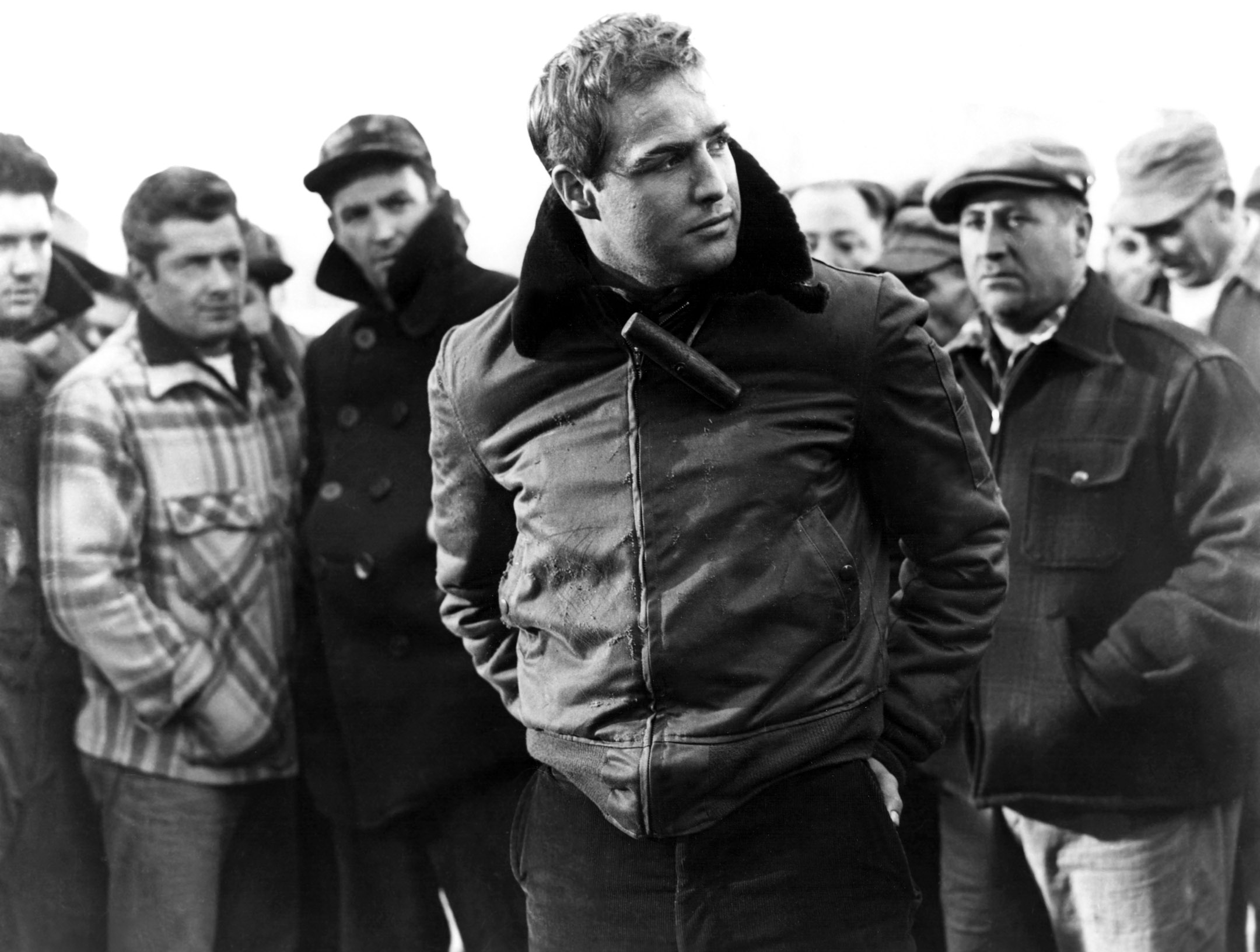
A conflicted Terry arrives at a moral crossroads after being used by Friendly’s bunch to set-up a buddy, Jimmy Dolan, that henchmen throw off the roof of a brownstone. Already racked by guilt for being an accomplice in his friend’s death, Terry then falls for Dolan’s attractive sister, Edie (Eva Marie Saint), who’s intent on finding the men responsible for her brother’s killing. At the same time, the waterfront priest, Father Barry (Karl Malden), urges the longshoremen to stand up and oppose Friendly by organizing themselves and telling what they know to the authorities. Terry is questioned by investigators, one of whom detects his anguish. But he can’t bring himself to tell Father Barry or Edie the truth,
With Friendly feeling the heat, he applies increased pressure and goon tactics. Concerned that Terry may turn stool pigeon under Edie’s and Father Barry’s influence, he orders Charley to get his brother in line – or else. Terry refuses the warning and Charley pays the price. Terry then lays it all on the line and comes clean with Edie, Father Barry and the authorities. All of it leads to Terry being ostracized before a climactic confrontation with Friendly and his stooges.
“On the Waterfront” could have been a melodramatic potboiler in the wrong hands but a superb cast and crew at the peak of their powers made a masterpiece instead. It’s the unadorned humanity of the film that moves us and lingers in the imagination. Then there’s the powerful themes it explores. The film is replete with symbols and metaphors for the human condition, good versus evil and principles of sacrifice, loyalty and redemption. The story also reflects Kazan’s and Schulberg’s view that “ratting” is a sometimes necessary act for a greater good. Like Terry, Kazan became persona non grata to some for naming names before the House Un-american Activities Committee at the height of this nation’s Red Scare hysteria. Some have criticized Kazan for making a self-serving message picture that at the end celebrates the rat as hero.

The film has come under the shadow cast by Kazan’s actions. Some say his cooperating with HUAC directly or indirectly made him complicit in Hollywood colleagues getting blacklisted by the industry. However you feel about what he did or didn’t do and what blame or condemnation can be laid at his feet, the film is a stand the test of time work of social consciousness that works seamlessly within the conventions of the crime or mob film. I think considering everything that goes into a narrative movie, it’s as good a piece of traditional filmmaking to ever come out of America. There have been more visually stunning pictures, more epic ones, better written ones, but none that so compellingly and pleasingly put together all the facets that make a great movie and that so effectively get under our skin and touch our heart.
It would be a decade from the time I first saw “On the Waterfront” before I reacted that strongly to another film, and that film was “It’s a Wonderful Life.”
Hot Movie Takes Friday – Indie Film: UPDATED-EXPANDED
Hot Movie Takes Friday
Indie Film
UPDATED-EXPANDED
©by Leo Adam Biga
Author of “Alexander Payne: His Journey in Film”
There’s a common misconception that indie films are something that only came into being in the last half-century when in fact indie filmmaking has been around in one form or another since the dawn of movies.
Several Nebraskans have demonstrated the indie spirit at the highest levels of cinema.
The very people who invented the motion picture industry were, by definition, independents. Granted, most of them were not filmmakers, but these maverick entrepreneurs took great personal risk to put their faith and money in a new medium. They were visionaries who saw the future and the artists working for them perfected a moving image film language that proved addictive. The original Hollywood czars and moguls were the greatest pop culture pushers who ever lived. Under their reign, the narrative motion picture was invented and it’s hooked every generation that’s followed. The Hollywood studio system became the model and center of film production. The genres that define the Hollywood movie, then and now, came out of that system and one of the great moguls of the Golden Age, Nebraska native Darryl F. Zanuck, was as responsible as anyone for shaping what the movies became by the projects he greenlighted and the ones he deep-sixed. The tastes and temperaments of these autocrats got reflected in the pictures their studios made but the best of these kingpins made exceptions to their rules and largely left the great filmmakers alone, which is to say they didn’t interfere with their work. If they did, the filmmakers by and large wouldn’t stand for it. After raising hell, the filmmakers usually got their way.

Zanuck made his bones in Hollywood but as the old studio system with its longterm contracts and consolidated power began to wane and a more open system emerged, even Zanuck became an independent producer.
The fat-cat dream-making factories are from the whole Hollywood story. From the time the major studios came into existence to all the shakeups and permutations that have followed right on through today, small independent studios, production companies and indie filmmakers have variously worked alongside, for and in competition with the established studios.
Among the first titans of the fledgling American cinema were independent-minded artists such as D.W. Griffith, Charles Chaplin and Douglas Faribanks, who eventually formed their own studio, United Artists. Within the studio system itself, figures like Griffith, Chaplin, Buster Keaton, Cecil B. De Mille, Frank Capra and John Ford were virtually unassailable figures who fought for and gained as near to total creative control as filmmakers have ever enjoyed. Those and others like Howard Hawks, William Wyler and Alfred Hitchcock pretty much got to do whatever they wanted on their A pictures. Then there were the B movie masters who could often get away with even more creatively and dramatically speaking than their A picture counterparts because of the smaller budgets and loosened controls on their projects. That’s why post-World War II filmmakers like Sam Fuller, Joseph E. Lewis, Nicholas Ray, Budd Boetticher and Phil Carlson could inject their films with all sorts of provocative material amidst the conventions of genre pictures and thereby effectively circumvent the production code.
Maverick indie producers such as David O. Selznick, Sam Spiegel and Joseph E. Levine packaged together projects of distinction that the studios wouldn’t or couldn’t initiate themselves. Several actors teamed with producers and agents to form production companies that made projects outside the strictures of Hollywood. Kirk Douglas and Burt Lancaster were among the biggest name actors to follow this trend. Eventually, it became more and more common for actors to take on producing, even directing chores for select personal projects, to where if not the norm it certainly doesn’t take anyone by surprise anymore.
A Nebraskan by the name of Lynn Stalmaster put aside his acting career to become a casting direct when he saw an opportunity in the changing dynamics of Hollywood. Casting used to be a function within the old studio system. As the studios’ contracted employee rosters began to shrink and as television became a huge new production center, Stalmaster saw the future and an opportunity. He knew just as films needed someone to guide the casting, the explosion of dramatic television shows needed casting expertise as well and so he practically invented the independent casting director. He formed his own agency and pretty much had the new field to himself through the 1950s, when he mostly did TV, on through the ’60s, ’70s’ and even the ’80s, when more of his work was in features. He became the go-to casting director for many of top filmmakers, even for some indie artists. His pioneering role and his work casting countless TV shows, made for TV movies and feature films, including many then unknowns who became stars, earned him a well deserved honorary Oscar at the 2017 Academy Awards – the first Oscar awarded for casting.

Lynn Stalmaster
Photo By Lance Dawes, Courtesy of AMPAS
In the ’50 and ’60s Stanley Kubrick pushed artistic freedom and daring thematic content to new limits as an independent commercial filmmaker tied to a studio. Roger Corman staked out ground as an indie producer-director whose low budget exploitation picks gave many film actors and filmmakers their start in the industry. In the ’70s Woody Allen got an unprecedented lifetime deal from two producers who gave him carte blanche to make his introspective comedies.
John Cassavetes helped usher in the indie filmmaker we identify today with his idiosyncratic takes on relationships that made his movies stand out from Hollywood fare.
Perhaps the purest form of indie filmmaking is the work done by underground and experimental filmmakers who have been around since cinema’s start. Of course, at the very start of motion pictures, all filmmkaers were by definition experimental because the medium was in the process of being invented and codified. Once film got established as a thing and eventually as a commerical industry, people far outside or on the fringes of that industry, many of them artists in other disciplines, boldly pushed cinema in new aesthetic and technical directions. The work of most of these filmmakers then or now doesn’t find a large audience but does make its way into art houses and festivals and is sometimes very influential across a wide spectrum of artists and filmmakers seeking new ways of seeing and doing things. A few of these experimenters do find some relative mass exposure. Andy Warhol was an example. A more recent example is Godfrey Reggio, whose visionary documentary trilogy “Koyaanisqatsi,” “Powaqqatsi” and “Naqoyqatsi” have found receptive audiences the world over. Other filmmakers, like David Lynch and Jim McBride, have crossed over into more mainstream filmmaking without ever quite leaving behind their experimental or underground roots.
Nebraska native Harold “Doc” Edgerton made history for innovations he developed with the high speed camera, the multiflash, the stroboscope, nighttime photography, shadow photography and time lapse photography and other techniques for capturing images in new ways or acquiring images never before captured on film. He was an engineer and educator who combined science with art to create an entire new niche with his work.
Filmmakers like Philip Kaufman, Brian De Palma, Martin Scorsese and many others found their distinctive voices as indie artists. Their early work represented formal and informal atttempts at discovering who they are as
Several filmmakers made breakthroughs into mainstream filmmaking on the success of indie projects, including George Romero, Jonathan Kaplan, Jonathan Demme, Omaha’s own Joan Micklin Silver, Spike Lee and Quentin Taratino.
If you don’t know the name of Joan Micklin Silver, you should. She mentored under veteran studio director Mark Robson on a picture (“Limbo”) he made of her screenplay about the wives of American airmen held in Vietnamese prisoner of war camps. Joan, a Central High graduate whose family owned Micklin Lumber, then wrote an original screenplay about the life of Jewish immigrants on New York’s Lower East Side in the early 20th century. She called it “Hester Street” and she shopped it around to all the studios in Hollywood as a property she would direct herself. They all rejected the project and her stipulation that she direct. Every studio had its reasons. The material was too ethnic, too obscure, it contained no action, it had no sex. Oh, and she insisted on making it in black and white,which is always a handy excuse to pass on a script. What the studios really objected to though was investing in a woman who would be making her feature film directing debut. Too risky. As late as the late 1970s and through much of the 1980s there were only a handful of American women directing feature and made for TV movies. It was a position they were not entrusted with or encouraged to pursue. Women had a long track record as writers, editors, art directors, wardrobe and makeup artists but outside of some late silent and early sound directors and then Ida Lapino in the ’50s. women were essentially shut out of directing. That’s what Joan faced but she wasn’t going to let it stop her.
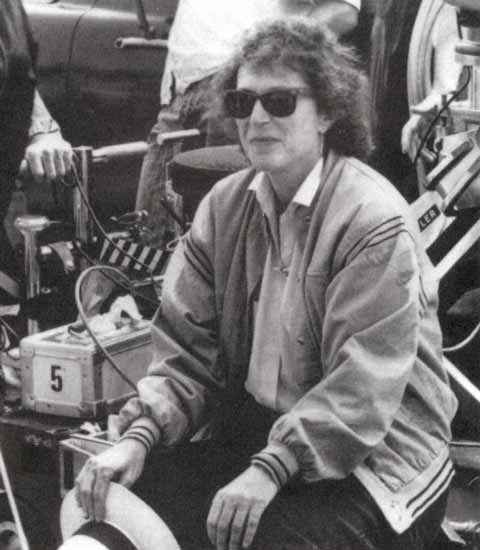
Long story short, Joan and her late husband Raphael financed the film’s production and post themselves and made an evocative period piece that they then tried to get a studio to pick up, but to no avail. That’s when the couple distributed the picture on their own and to their delight and the industry’s surprise the little movie found an audience theater by theater, city by city, until it became one of the big indie hits of that era. The film’s then-unknown lead, Carol Kane, was nominated for an Academy Award as Best Actress. The film’s success helped Joan get her next few projects made (“Between the Lines,” “Chilly Scenes of Winter”) and she went on to make some popular movies, including “Loverboy,” and a companion piece to “Hester Street” called “Crossing Delancey” that updated the story of Jewish life on the Lower East Side to the late 20th century. Joan later went on to direct several made for cable films. But “Hester Street” will always remain her legacy because it helped women break the glass ceiling in Hollywood in directing. Its historic place in the annals of cinema is recognized by its inclusion in the U.S. Library of Congress collection. She’s now penning a book about the making of that landmark film. It’s important she document this herself, as only she knows the real story of what obstacles she had to contend with to get the film made and seen. She and Raphael persisted against all odds and their efforts not only paid off for them but in the doors it opened for women to work behind the camera.
The lines between true independent filmmakers and studio-bound filmmakers have increasingly blurred. Another Omahan, Alexander Payne, is one of the leaders of the Indiewood movement that encompasses most of the best filmmakers in America. Payne and his peers maintain strict creative control in developing, shooting and editing their films but depend on Hollywood financing to get them made and distributed. In this sense, Payne and Co. are really no different than those old Hollywood masters, only filmmakers in the past were studio contracted employees whereas contemporary filmmakers are decidedly not. But don’t assume that just because a filmmaker was under contract he or she had less freedom than today’s filmmakers. Believe me, nobody told Capra, Ford, Hitchcock, Wyler, or for that matter Huston of Kazan, what to do. They called the shots. And if you were a producer or executive who tried to impose things on them, you’d invariably lose the fight. Most of the really good filmmakers then and now stand so fiercely behind their convictions that few even dare to challenge them.
But also don’t assume that just because an indie filmmaker works outside the big studios he or she gets everything they want. The indies ultimately answer to somebody. There’s always a monied interest who can, if push comes to shove, force compromise or even take the picture out of the filmmaker’s hands. Almost by definition indie artists work on low budgets and the persons controlling those budgets can be real cheapskates who favor efficiency over aesthetics.
Payne is the rarest of the rare among contemporary American filmmakers in developing a body of work with a true auteurist sensibility that doesn’t pander to formulaic conventions or pat endings. His comedies play like dramas and they’re resolutely based in intimate human relationships between rather mundane people in very ordinary settings. Payne avoids all the trappings of Hollywood gloss but still makes his movies engaging, entertaining and enduring. Just think of the protagonists and plotlines of his movies and it’s a wonder he’s gotten any of them made:
Citizen Ruth–When a paint sealer inhalant addict with a penchant for having kids she can’t take care of gets pregnant again, she becomes the unlikely and unwilling pivot figure in the abortion debate.
Election–A frustrated high school teacher develops such a hate complex for a scheming student prepared to do anything to get ahead that he rigs a student election against her.
About Schmidt–Hen-pecked Warren Schmidt no sooner retires from the job that defined him than his wife dies and he discovers she cheated on him with his best friend. He hits the road to find himself. Suppressed feelings of anger, regret and loneliness surface in the most unexpected moments.
Sideways–A philandering groom to be and a loser teacher who’s a failed writer go on a wine country spree that turns disaster. Cheating Jack gets the scare of his life. Depressed Miles learns he can find love again.
The Descendants–As Matt King deals with the burden of a historic land trust whose future is in his hands, he learns from his oldest daughter that his comatose wife cheated on him. With his two girls in tow, Matt goes in search of answers and revenge and instead rediscovers his family.
Nebraska–An addled father bound and determined to collect a phantom sweepstakes prize revisits his painful past on a road trip his son David takes him on.
Downsizing–With planet Earth in peril, a means to miniaturize humans is found and Paul takes the leap into this new world only to find it’s no panacea or paradise.
Payne has the cache to make the films he wants to make and he responsibly delivers what he promises. His films are not huge box office hits but they generally recoup their costs and then some and garner prestige for their studios in the way of critical acclaim and award nominations. Payne has yet to stumble through six completed films. Even though “Downsizing” represents new territory for him as a sci-fi visual effects movie set in diverse locales and dealing with global issues, it’s still about relationships and the only question to be answered is how well Payne combines the scale with the intimacy.
Then there are filmmakers given the keys to the kingdom who, through a combination of their own egomania and studio neglect, bring near ruin to their projects and studios. I’m thinking of Orson Welles on “The Magnificent Ambersons,” Francis Ford Coppola on “One from the Heart”, Michael Cimino on “Heaven’s Gate,” Elaine May on “Ishtar” and Kevin Costner on “Thw Postman” and “Waterworld.” For all his maverick genius, Welles left behind several unfinished projects because he was persona non grata in Hollywood, where he was considered too great a risk, and thus he cobbled together financing in a haphazard on the fly manner that also caused him to interrupt the filming and sometimes move the principal location from one site to another, over a period of time, and then try to match the visual and audio components. Ironically, the last studio picture he directed, “Touch of Evil,” came in on budget and on time but Universal didn’t understand or opposed how he wanted it cut and they took it out of his hands. At that point in his career, he was a hired gun only given the job of helming the picture at the insistence of star Charlton Heston and so Welles didn’t enjoy anything like the final cut privileges he held on “Citizen Kane” at the beginning of his career.
Other mavericks had their work compromised and sometimes taken from them. Sam Peckinpah fought a lot of battles. He won some but he ended up losing more and by the end his own demons more than studio interference did him in.
The lesson here is that being an independent isn’t always a bed of roses.
Then again, every now and then a filmmaker comes out of nowhere to do something special. Keeping it local, another Omahan did that very thing when a script he originally wrote as a teenager eventually ended up in the hands of two Oscar-winning actors who both agreed to star in his directorial debut. The filmmaker is Nik Fackler, the actors are Martin Landau and Ellen Burstyn and the film is “Lovely, Still.” It’s a good film. It didn’t do much business however and Fackler’s follow up film,” Sick Birds Die Easy,” though interesting, made even less traction. His film career is pretty much in limbo after he walked away from the medium to pursue his music. The word is he’s back focusing on film again.

Other contemporary Nebraskans making splashes with their independent feature work include actor John Beasley, actress Yolonda Ross and writer-directors Dan Mirvish, Patrick Coyle, Charles Hood and James E. Duff.
These folks do really good work and once in a while magic happens, as with the Robert Duvall film “The Apostle” that Beasley co-starred in. It went on to be an indie hit and received great critical acclaim and major award recognition. Beasley is now producing a well-budgeted indie pic about fellow Omahan Marlin Briscoe. Omahan Timothy Christian is financing and producing indie pics with name stars through his own Night Fox Entertainment company. Most of the films these individuals make don’t achieve the kind of notoriety “The Apostle” did but that doesn’t mean the work isn’t good. For example, Ross co-starred in a film, “Go for Sisters,” by that great indie writer-director John Sayles and I’m sure very few of you reading this have heard of it and even fewer have seen it but it’s a really good film. Hood’s comedy “Night Owls” stands right up there with Payne’s early films. Same for Duff’s “Hank and Asha.”
Indie feature filmmaking on any budget isn’t for the faint of heart or easily dissuaded. It takes guts and smarts and lucky breaks. The financial rewards can be small and the recognition scant. But it’s all about a passion for the work and for telling stories that engage people.
More Hot Movie Takes
More Hot Movie Takes
©by Leo Adam Biga
Author of Alexander Payne: His Journey in Film

Dennis O’Keefe
These riffs are about some very different cinema currents but they’re all inspired by recent screen discoveries I made once I put my movie snobbery in check.
My first riff concerns an actor from Old Hollywood I was almost entirely unfamiliar with and therefore I never thought to seek out his work: Dennis O’Keefe. I discovered O’Keefe only because I finally made an effort to watch some of Anthony Mann’s stellar film noirs from the 1940s. O’Keefe stars in two of them – T-Men” (1947) and “Raw Deal” (1948). Neither is a great film but the former has a very strong script and the latter is like an encyclopedia of noir and they both feature great cinematography by John Alton and good performances across the board. These are riveting films that stand up well against better known noirs, crime and police pics.
Whatever restrictions the filmmakers faced making these movies for small poverty eow studios they more than made up for with their inventiveness and passion.
As wildly atmospheric and evocative as Alton’s use of darkness, light and shadow is in these works, it’s O’Keefe’s ability to carry these films that’s the real revelation for me. I find him to be every bit as charismatic and complex as Humphrey Bogart. James Cagney, Robert Mitchum and other bigger name tough guys of the era were, and I’m certain he would have carried the best noirs they helped make famous. O’Keefe reminds me of a blend between Bogart and Cagney, with a touch of another noir stalwart, William Holden, thrown in. Until seeing him in these two pictures along with another even better pic, “Chicago Syndicate” (1955) directed by the underrated Fred F. Sears, who is yet another of the discoveries I’m opining about here, I had no idea O’Keefe delivered performances on par with the most iconic names from the classic studio system era. It just goes to show you that you don’t know what you don’t know. Before seeing it for myself – if you’d tried to tell me that O’Keefe was in these other actors’ league I would have scoffed at the notion because I would have assumed if this were so he’d have come to my attention by now. Why O’Keefe never broke through from B movies to A movies I’ll never know, but as any film buff will tell you those categories don’t mean much when it comes to quality or staying power. For example, the great noir film by Orson Welles Touch of Evil was a B movie all the way in terms of budget, source material, theme and perception but in reality it was a bold work of art by a master at the top of his game. It even won an international film prize in its time, though it took years for it to get the respect it deserved in America.

Like all good actors, O’Keefe emphatically yet subtly projects on screen what he’s thinking and feeling at any given moment. He embodies that winning combination of intelligence and intuition that makes you feel like he’s the smartest guy in the room, even if he’s in a bad fix.
My admittedly simplistic theory about acting for the screen is that the best film/TV actors convey an uncanny and unwavering confidence and veracity to the camera that we as the audience connect to and invest in with our own intellect and emotion. That doesn’t mean the actor is personally confident or needs to play someone confident in order to hook us, only that within the confines of playing characters they make it seem as though they believe every word they say and every emotion they express. Well, O’Keefe had this in spades.
Now that O’Keefe is squarely on my radar, I will search for of his work. I recommend you do the same.


By the way, another fine noir photographed by John Alton, “He Walks by Night,” starring Richard Basehart, may have been directed, at least in part, by Mann. Alton’s work here may be even more impressive than in the other films. The climactic scene is reminiscent of “The Third Man,” only instead of the post-war Vienna streets and canals, the action takes place in the Los Angeles streets and sewers. I must admit I was not familiar with Alton’s name even though I’d seen movies he photographed before I ever come upon the Mann trilogy. For example, Alton’s last major feature credit is “Elmer Gantry,” a film I’ve seen a few times and always admired. He also did the great noir pic “The Big Combo” directed by Joseph E. Lewis. And he lit the great dream sequence ballet in “”An American in Paris,” for which he won an Oscar. Now I will look at those films even more closely with respect to the photography, though I actually do remember being impressed by the photography in “Big Combo” and, of course, the dream sequence in “Paris.”
Alton was an outlier in going against prevailing studio practices of over-lighting sets. He believed in under-lighting and letting the blacks and greasy help set mood. The films he did are much darker, especially the night scenes, than any Hollywood films of that time. He studied the work of master painters to learn how they controlled light and he applied his lessons to the screen.
It turns out that Alton left Hollywood at the peak of his powers because he got fed up with the long hours and the many fights he had with producers and directors, many of whom insisted on more light and brighter exposures. Alton usually got his way because he knew his stuff, he worked very fast and he produced images that stood out from the pack. Apparently he just walked away from his very fine career sometime in the early 1960s to lead a completely distant but fulfilling life away from the movies.

Alton setting up a shot in “Raw Deal”

With actress Leslie Caron – “An American In Paris
Regarding the aforementioned “Chicago Syndicate,” it’s a surprisingly ambitious and labyrinthian story told with great verve and conviction by Fred Sears. It’s a neat bridge film between the very composed studio bound tradition and the freer practical location tradition. Sears was another in a long line of B movie directors with great skill who worked across genres in the 1930s through 1950s period. I watched a bit of a western he did and it too featured a real flair for framing and storytelling. His work has some of the great energy and dynamic tension of Sam Fuller and Budd Boetticher from that same period. I can’t wait to discover more films by Sears.
Alexander Payne: His Journey in Film
Alexander Payne: His Journey in Film
If you are an Omaha native like me, then I am sure you agree our shared hometown boasts many leading lights of merit. In arts-entertainment, fellow Omaha native Alexander Payne is at the top of his profession. The two-time Oscar winner’s craftsmanship makes him one of the Hollywood film industry’s most acclaimed and sought after professionals. His reputation as a writer-director extends worldwide.
As Nebraska celebrates 150 years, Payne represents the best this state has to offer in terms of talent, output, loyalty and work ethic. I am privileged to be the author of a book – “Alexander Payne: His Journey in Film” – that takes the full measure of the man and his work. My comprehensive look at his career is newly released in an expanded second edition.
I am happy to say that “Alexander Payne: His Journey in Film” has many champions.
Leonard Maltin gives it a big thumbs up with:
“Alexander Payne is one of American cinema’s leading lights. How fortunate we are that Leo Biga has chronicled his rise to success so thoroughly.”
Thomas Schatz, (“The Genius of the System”) recommends it with:
“This is without question the single best study of Alexander Payne’s films, as well as the filmmaker himself and his filmmaking process. In charting the first two decades of Payne’s remarkable career, Leo Adam Biga pieces together an indelible portrait of an independent American artist, and one that’s conveyed largely in the filmmaker’s own words. This is an invaluable contribution to film history and criticism – and a sheer pleasure to read as well.”
The publisher is River Junction Press LLC in Omaha and its distributor is Independent Publishers Group (IPG). The book is a available at Barnes & Noble and other fine bookstores nationwide, as well as on Amazon and for Kindle. In Nebraska, you can find it at all Barnes & Noble stores as well as at The Bookworm and Our Bookstore in Omaha, Indigo Bridge Books in Lincoln and in select gift shops statewide.
The easiest way to purchase it is at–
You can order signed copies by emailing your request to leo32158@cox,net.
Just as it’s my pleasure to showcase one of Nebraska’s greatest natural resources in Alexander Payne, I hope it’s your pleasure to read about his journey in film. That journey is about to take a dramatic new turn with the December 2017 release of his long-awaited film “Downsizing” starring Matt Damon. Look for my new Reader story about it in the April 2017 issue.


 Leo Adam Biga's My Inside Stories