

Archive
Posts Tagged ‘Sports’
It’s a Hoops Culture at The SAL, Omaha’s Best Rec Basketball League
June 6, 2010
3 comments

Image by Chapendra via Flickr
This is one of those scene-setting pieces I don’t do as much anymore. I like doing them, but they can take a lot of time and effort for very little return other than the satisfaction of doing these stories. The subject here is a recreational basketball league of the type that can be found in just about any urban neighborhood. The idea was to capture the vibe of this distinct subculture to the extent that I put you as the reader there in the bleachers with me. To make the story a visceral experience. The article originally appeared in The Reader (www.thereader.com). Written as a secondary feature, I was surprised when it ended up on the cover. It’s not the first time that’s happened and I suspect it won’t be the last.
It’s a Hoops Culture at The SAL, Omaha’s Best Rec Basketball League
©by Leo Adam Biga
Originally published in The Reader (www.thereader.com)
Once the hoops get rolling in the Sunday men’s recreational basketball league, the scene turns into the kind of urban soul fest you associate with Chicago, Detroit, Philly or New York. Only this is Omaha. In an intimate, interactive community setting, the best summer ball in town is played in The SAL, Omaha’s version of the Harlem Ruckers League.
Housed until recently in the Salvation Army North Corps center at 2424 Pratt Street, the league, by concensus, draws the area’s best players. Many have serious credentials. A typical game features jocks from the pro and college ranks, past and present, along with former and future legends from The Hood. All strut their stuff before a knowledgeable, appreciative, vociferous throng.
NBA journeyman Rodney Buford, the ex-Creighton star, is a regular, rarely missing a game or a mid-range jump shot. One Sunday, fellow NBA player and ex-Bluejay Kyle Korver showed, raining down 3s to the fans’ delight. The league is so competitive Buford’s teams have never won the title. “That lets you know right there” said team sponsor Talonno “Lon Mac” Wright. “If you can make it through here, you’re a player. It’s the best competition you’re going to get in the city,” league director Kurt Mayo said.
Former UNO Mav Eddie King, who grew up balling in Chicago, said, “I think it’s a staple of north Omaha and I think it’s the best basketball in Nebraska, period. Oh, yes, you’re going to get challenged every game. Every team has good players. You can never get comfortable.” He said the close confines and neighborhood feel create a special environment. “This is the best atmosphere because everyone has family and friends in the stands. It’s a small gym and everyone’s on top of each other. People talk a little smack. That makes it fun. Plus, it’s real competitive. It’s streetball, but at the same time it’s fundamental, because 80 percent of these guys played ball at a four-year college.”
Mayo formed the league with wife Melissa in 2002, reviving a gym fallen into disuse. Before the Salvation Army, the league operated under a differnt name at the LaFern Williams Center in south O and the Butler-Gast YMCA up the street, where it’s back again. Mayo met resistance when he announced plans to move things to the Y at 3501 Ames Avenue. Trading the homey, if dingy, old digs for the gleaming, if cold, new facilities was an issue. But “the grumbling” ceased when the league ended the summer season at the Y on August 7. By all accounts, the new venue’s a hit, even if it lacks character. It does, however, have a nice wood floor, not some tacky mat like the Salvation Army center has. Mayo hopes to reinvent the magic at the Y with an “elite” level men’s Sunday league starting September 11.
But The SAL is where the league gained the rep and made the memories. Where it found a fun yet gritty flavor as a combined sports venue and social club.
James Simpson is among many who come each Sunday. Besides enjoying friends play ball there, he said, “it’s good for the community. I’ll follow it wherever it goes.”
“It’s the thing to do,” Wright said. “It’s like, Let’s get dressed, we’re going to The SAL. Everyone comes to watch the games or to see the women. There’s music. You meet people. You see your friends. On a good day, it’s just wall-to-wall packed. It gets loud. The crowd gets into it. if they like you, they’re cheering on you. If they hate you, they’re booing on you. If someone does something good out on the court, they ‘oooh’ and ‘ahhh.’ Some people might run out on the court, just having fun. It’s just a nice hangout. No problems. Everybody gets along. A little fussing here and there, but no big deal.”
Ex-Husker Bruce Chubick said there’s no dogging it in The SAL: “You can’t really half step your way through because there are too many players that are good. Plus, you get a nice little crowd that comes out, and they’ll let you know about it if you make a bad play. So, you’ve got that motivation going. It’s entertaining.”
The league is a subculture unto itself. The many female fans include spouses, lovers and groupies. Some mothers have children in tow. The guys taking-it-in range from hoop junkies looking for another fix to coaches scouting talent to neighborhood cats looking to escape the weather. The common denominator is a love for the game. It’s why some folks view five or six contests in a single sitting.
The hold basketball has in urban America is a function of the sport’s simplicity and expressiveness. Only a ball and a bucket are needed, after all, for players to create signature moves on the floor and in the air that separate them, their game and their persona from the pack. Not surprisingly, the hip-hop scene grew out of streetball culture, where trash talking equals rap, where a sweet crossover dribble or soaring airborne slam resembles dance and where stylin’ gets you props from the crowd or your crew. Music and hoops go hand-in-hand.
The vast majority of players at The SAL and Butler-Gast Y are black, which makes it ironic that the two-time defending champs, Old School, are an all-white group of former Division I players led by Chubick. In what Mayo considers “a traditional” league, Old School is short on style but long on fundamentals.
Former Omaha South and University of Washington star Will Perkins said to cut it in this league, “you’ve got to be tough…you’ve got to be skilled. You can’t just take your college game or your streetball game here. You’ve got to have a mixture.”
As the action unfolds on the funky, tile-like court everybody complains about, the spectators join in a kind of call-and-response exchange with participants. A player jamming home a thunder dunk will stop, await his fate from the crowd, and then either get their love or take their poison. A guy blowing a dunk or a layup or drawing air on his jumper gets well-deserved catcalls. But here the good-natured smack directed at refs and players is often hurled right back.
“Man, you gotta finish that! What are you doing? You had a wide open layup. Hey, y’all gotta fight for this one, fellas. They’re not going to give it to you. C’mon!”
Unrestrained displays of emotion, usually shouted down from the bleaches, sometimes overflows onto the court. Despite threats and invectives, few incidents ever come to blows. Chest thumping and trash talking is just part of the heat and the edge. It’s all about respect out here. No one wants to be shown up.
As day wends into night, and one game bleeds into another, there’s a constant stream of humanity in and out of the cramped old gym, where music thumps from a boom box during time outs and between games, where burgers, dogs and nachos can be had on the cheap and where vendors hawk newly burned CDs and DVDs.
Amid the hustle and flow, players and fans intermingle, making it hard to tell them apart. There’s no barriers, no admission, no registration. It’s a straight-up come-and-go-as-you-please scene. As the small bleachers hold only a couple hundred people, the rest of the onlookers line both sides and ends of the court. Folks variously stand against walls, sit in folding chairs or sprawl on the floor.
The league serves many purposes. For college programs at UNO and Bellevue, it’s a way to keep teams sharp over the summer and toughened up for the coming NCAA season. Kevin McKenna, UNO head coach the past four years until rejoining the Creighton staff this summer, said, “I got my team to play down there the past few summers because I thought it was the best league. There was another league in town, but I felt this was the most competitive — where’d we get the most out of it.” Bellevue University coach Todd Eisner has recruited there. It helps Omaha Central grad and current Illinois-Chicago player Karl White get ready for the college grind.
For former college mates, like the Still Hoopin’ squad made up of such ex-Bluejays as Buford, Latrell Wrightsell and Duan Cole, it’s a chance to relive old times, stay fit and feed still hot competitive fires. For Buford, it’s one more workout in an off-season regimen before NBA training camps begin. For men pushing 30, 40 or older, it’s also a pride thing — to show they still have some game left. For them and guys not so far removed from the game like Alvin Mitchell, the former NU, Cincinnati and UNO player, or Andre Tarpley, a senior last year at UNO, or Luther Hall, a recent Bellevue U. grad, it’s both an outlet and a place to prep for pro tryouts.
Danai “Ice” Young, whose college hoops career stalled at NU, is using the league as a launching pad to try and make the ABA River City Ballers’ roster. Albert R. went from The SAL to a spot on the pro streetball tour, where he goes by “Memphis.”
For youngbloods, it’s a test to prove they can hang with the old dogs. “If you’re the best talent, or think you’re the best talent, this is where you’re going to be,” said veteran ref Mark LeFlore, Sr. Mayo said few high schoolers have had what it takes to play in The SAL. Two that did, guards Matt Culliver and Brandon McGruder, formed one of the highest scoring duos in the annals of the Metro Conference at Bryan High School last year. Both earned scholarships to play at the next level.
Another youth, Aaryon “Bird” Williams, is perhaps the most impressive of the pups as he’s only a senior-to-be at Omaha North, where he played in a handful of varsity games last year after moving here with his family from Gary, Indiana. Mayo sees a phenom in-the-making in Williams. “Man, he was dunkin’ on everybody. You have to see it to believe it. He’s definitely a man-child. He reminds me of a young K.G (Kevin Garnett), and I’m not exaggerating,” Mayo said. “He’s a beast.” It’s another example, Mayo said, of how top local talents “find their way” to the league. “I’m already missing The SAL, but I’m recreating it at the Y. The tradition continues.”
Related Articles
- King of the courts: Rucker Park defends its streetball crown (thegrio.com)
- Streetball legend ‘Homicide’ to turn in his kicks (nypost.com)
- Artest returns to streetball roots, wants second ring (nypost.com)
- Omaha Native Steve Marantz Looks Back at the City’s ’68 Racial Divide Through the Prism of Hoops in His New Book, ‘The Rhythm Boys of Omaha Central’ (leoadambiga.wordpress.com)
- Troy Jackson: Streetballer Nicknamed “Escalade” Dies at 35 (bleacherreport.com)
- Bismack Biyombo Breaks Out At Nike Hoop Summit As NBA-Ready Right Now (sbnation.com)
- Back in the Day, Native Omaha Days is Reunion, Homecoming, Heritage Celebration and Party All in One (leoadambiga.wordpress.com)
- The Ties that Bind, One Family’s Celebration of Native Omaha Days (leoadambiga.wordpress.com)
Categories: African-American Culture, Athletics, Basketball, Omaha, Pop culture, Sports, Writing
African-American Culture, Athletics, Basketball, NBA, Omaha, Pop Culture, Salvation Army, Sports
Ex-Prizefighter and Con Turned-Preacher Man Morris Jackson Spreads the Good News
June 4, 2010
Leave a comment

Image via Wikipedia
I knew the name Morris Jackson growing up because my older brother Dan was a boxing fan and I think he saw one of the grudge bouts between Jackson, the slick boxer, and Ron Stander, the Great White Hope slugger. Jackson was undeniably the superior boxer but it was Stander not Jackson who got a title shot against Joe Frazier. As the years went by I lost track of Jackson, only to read one day in the local daily about how he had gotten in trouble with the law and done time behind bars. There, he had a born again experience of such magnitude that after serving his time he went on to become a minister. His chosen ministry is poetic justice, too, as he pastors to incarcerated men. I finally got to meet and profile Jackson a few years ago. The story for The Reader (www.thereader.com) about Jackson and his transformation follows. My stories about Morris’ then-nemesis, Ron Stander, can also be found in this blog site, along with other stories about Omaha boxers, boxing coaches and gyms. Like most writers, I am always down for a good boxing story. There are several yet in me that I wish to tell and I am sure that others will reveal themselves when I least expect it.

Ex-Prizefighter and Con Turned-Preacher Man Morris Jackson Spreads the Good News
©by Leo Adam Biga
Originally published in The Reader (www.thereader.com)
In his best three-piece, GQ-style suit, Morris Jackson looks like just another slick do-gooder to prisoners seeing him for the first time at the Douglas County Correctional Facility, where he’s chaplain with Good News Jail and Prison Ministry. But the large man soon separates himself from the pack when he tells them he used to be a prizefighter. Rattling off the famous names he met inside the ring — Ron Stander, Ernie Shavers, Ron Lyle, Larry Holmes — usually gets their attention. If not, what he says next, does. “My number is 30398.” That’s right, this preacher man did time. The former convict now stands on the other side of the cell as a born-again Christian and International Assemblies of God-ordained minister.
His 1975 armed robbery conviction sent him to the Nebraska Men’s Reformatory for a term of three to nine years. He served 22 months, plus seven more on work release. But being locked away wasn’t enough to reform Morris. His rebirth only happened years later, after squandering his freedom in a fast life leading to perdition. Referring to that transformation, one of several makeovers in his life, is enough to make even hardcore recidivists listen to his message of redemption.
“Then they hang on every word you’ve got to say, because they see a change. They really can’t believe you were there once yourself. Having Christ in your life really makes a big difference. Actually, it’s almost a visible presence — in your eyes, in your demeanor, in your voice, in your conversation — that people can notice,” said Jackson, whose prison ministry work dates back to 1992.
He first returned to the correctional system doing mission work for northwest Omaha’s Glad Tidings Church, where he still worships today. Reliving his incarceration experience behind the secured walls made him anxious.
“The first time I went, it was with fear and trembling because the last place I wanted to be in was anybody’s jail, hearing the doors close behind me,” he said.
To his relief, though, he sensed he had found a calling as an evangelist to cons.
“It was just as if I was right where I was supposed to be. The words were there. The life. The testimony. The word of God. My studies. The first time I did a service in the county jail there were 66 men present and 44 of those professed faith in Jesus Christ when given the opportunity. I said, ‘Man, I like this. I could do this all the time.’ Like I tell people, ‘Be careful what you say, because God is listening.’ I’m exactly where God wants me to be and I’m doing exactly what he wants me to do.”
Jackson’s had many occasions to reinvent himself, stemming back to his Texas childhood. As a youth, he lived with his family in an upper middle class part of Dallas. Then, he found out the man he thought was his father was actually his step-father. His real father was killed when Jackson was a year-old. Soon after this revelation, his mother and step-father split up and his world unraveled again. His mother got custody of him and his sister, but she could only afford a place in the projects. Already distraught over the divorce and the discovery he’d been lied to, he expressed his rage on the streets, where fighting was a rite of passage and survival mechanism in an area ruled by gangs.
“In Dallas, in the projects, you either had to be a good fighter or a fast runner, and I never could run too fast. I went from being a person who would see a fight coming and move away from it, to initiating fights. If you’d so much as look at me wrong, I’d haul off and hit you. I was getting into three-four fights a week. It was crazy. I guess I was an angry young man. Yet, I considered myself a meek person. I describe a meek person as a steel fist in a velvet glove. I would do everything I could to get out of a fight, but when I got cornered and I had to fight, I never lost one. Sometimes, I lost my temper and did something stupid.”
During this time, he lived a kind of double life. He was a star high school football and basketball player and a regular churchgoer, but also a notorious gangsta. His mother had grown up in the church before drifting away. When she found religion again, she made Morris and his sister attend services. He chafed at the fire-and-brimstone admonitions hollered down from the pulpit.
“The church I was raised in, you never heard a lot about grace. It was a lot of dos and donts and laws. You don’t smoke…don’t chew…don’t drink…don’t mess with girls. Of course, when I came of age where I could make my own decisions, there was no way I could live that kind of life when everybody else was having fun and I wasn’t doing anything.”
When his rebellion got to be too much, his mother kicked him out of the house. He went to live with his sister, stealing food to help support themselves.
His mother relocated to Omaha, where she had family, and she sent for her unrepentant son, hoping he’d find himself here. For a time, he did. He even prayed to lose his hair’s-edge temper, and it did leave him. When a neighbor training for the Golden Gloves prodded the strapping Jackson to join him at the old Swedish Auditorium, the newcomer did and soon found a home in the sport. Recognizing his talent, veteran handlers Harley Cooper, Leonard Hawkins, Ronnie Sutton, Don Slaughter and Yano DiGiacomo variously worked with him at the Foxhole Gym.
In his first amateur bout, he laid out cold his hulking opponent in a Lincoln smoker. His very next fight pitted him against the man who proved to be his main nemesis — Ron “The Bluffs Butcher” Stander. From the late 1960s through the early 1970s, they met six times — four as amateurs and twice as pros — in highly competitive, well-attended bouts. “People came out to see us fight,” said Jackson. Their matches drew crowds of 6,000-7,000. Each took the measure of the other, although Stander, Omaha’s then-Great White Hope, usually came out on top. Stander took four of the contests, including one by KO, Morris won a decision and a sixth encounter ended in a controversial draw most felt should have been a Morris win.
“Every time I turned around, there was Morris. He was my biggest, toughest opponent,” Stander said.” “Yeah, we went at it quite a bit. We just happened to come along at the same time,” Jackson said.
The intense rivalry was tailor-made for fans as the fighters embodied the classic adage that styles make fights. Jackson was the boxer, Stander the puncher. Jackson relied on his feet. Stander, on his brawn. One was black, the other white. In the era of militant Muhammad Ali, Jackson was the closest thing Omaha had to a righteous Brother bringing down The Man. Stander, meanwhile, was a real-life Rocky who got his shot at the title in a 1972 bout with champ Joe Frazier.

Morris Jackson in his fighting days
“I don’t know if I patterned myself after Ali, but I was somewhat like him because I would stick, move, think, box. I was light on my feet. But I wasn’t the type of person who talked a lot. I didn’t have any gimmicks or shuffles. I just got in and took care of business,” Jackson said.
The two long retired fighters reside in Omaha, but rarely mix. While their rivalry was too close for them to ever be friends outside the ring during their fighting days, they’ve always maintained the mutual respect warriors have for each other.
Stander is well aware of the transformation Jackson has undergone and admires his old foe for it. “He turned himself around. Yeah, he went from bad to good in a big way. God blessed him. God grabbed Morris by the neck and said, ‘Come over to me.’ Yeah, he’s a beautiful man now, I’ll tell ya.”

Ron Stander, known as the Butcher, went face to fist with Joe Frazier in Omaha in 1972. CreditUnited Press International
By most measures, Stander’s career surpassed Jackson’s, whose early promise ended in missed chances, bad matches, poor management, and too small takes. The familiar litany of a club fighter who never got his shot the way Stander did. Former Omaha matchmaker Tom Lovgren feels Jackson could have gone farther. Still, the fighter was once in line to join promoter Don King’s stable. He was a main eventer in Omaha’s last Golden Era of boxing. A two-time Midwest Golden Gloves champion, he compiled a 28-5-1 career pro record, including a KO of then-British Commonwealth champion Dan McALinden, a win Lovgren rates as the top by any Omaha boxer in the ‘70s. Jackson was also a sparring partner for ring legends Ron Lyle, Ernie Shavers, Joe Bugner and future champ Larry Holmes.
But then the good times ended. His run-in with the law came during a dry spell when the journeyman “couldn’t get any fights.” As he tells it, “I started running with some old friends who’d been in the joint and I was influenced by them to make some quick money in the hold up a Shaver’s food mart.” Once nabbed, he was almost grateful, he said, “because eventually somebody was going to get hurt.”
His crime spree was brief but telling and foreshadowed a later descent that threatened to land him back in jail or kill him.
While serving his stretch, Jackson studied Islam and became a Black Muslim. His dalliance with spirituality was short-lived, however. After getting out, he tried resurrecting his career but after three fights called it quits. Like many an ex-pug, he had few prospects beyond the ring and, so, he grabbed the first thing offered — bouncing at strip clubs.
“I got caught up in this lifestyle. I got to smoking marijuana and doing all the things that go with that lifestyle. My wife was working days and I was bouncing nights. We hardly ever saw each other. I was just kind of in limbo and that led to the brawls and the drinking and the drugs,” he said.

Morris Jackson today
He never imagined being saved. “No. If someone would have told me, I would have said, ‘Yeah, right, you’re crazy man. Give me some of what you’re smoking.’” It was his mother who finally pulled him from the brink and back into the fold of the church. In March 1983 she staged a one-woman intervention with her wayward son. “My mother came over to my house to talk to me about what my life was like and how Christ was calling me. She shared the gospel with me in such a way as I’d never heard it before. She spoke of God’s grace. How He loves you. How He has a purpose and a plan for your life. And how it’s up to you to accept and follow the path God has for you.” What came next can only be called salvation.
“I had this sense and I heard this voice that said. ‘The line is drawn in the sand and if you don’t make the decision now, you’ll never get another chance.’ I know just as sure as I’m sitting here today that if I wouldn’t have accepted Jesus Christ in my life, I’d be gone. I’d be dead. My mother prayed. We prayed. And the next day I went to church with her.”
Church bible classes led to college religious studies and, ultimately, his ordination. His first ministry was on the streets of north Omaha. Then came the prison gig. In the mid-’90s, then-Nebraska Governor Ben Nelson granted him a full pardon.
Now, he can’t imagine going back to that old life, although he keeps memories of it nearby as a reminder of where he came from. “There’s a peace in my life. Serenity. Stability. Certainty. It makes a difference when you come from darkness to light,” he said. “I know what my life used to be like. The turmoil, the uncertainty. Spinning my wheels. Living for the weekends. No purpose.”
Living his faith, which he loudly proclaims from the inscription above his home’s front door to the message on his answering machine, is his way of telling the good news. As he tells prisoners: “You’ve got to believe in something.” He’s seen enough cons turn their lives around to know his story is not an aberration.
The proud old fighter sees his ministry as his new battleground, only instead of knocking heads, he’s about saving souls and staying straight. “Most of my teaching is biblical principles applied to our lives. I’m still a warrior. Only now when I put on my armor and go to war every day, I don’t feel turmoil. My wars are fought in my prayer closet. I pray before I do anything,” he said.
But once a fighter, always a fighter. He repeated something Ron Stander said: “If they told us to lace ‘em up again, we’d go at it.” The Preacher versus the Butcher. Now wouldn’t that be a card?
Related Articles
- World Heavyweight Boxing Championship 1960-1975 (sportales.com)
- Meldrick Taylor vs. Julio Caesar Chavez: The Greatest Prizefight Ever? (bleacherreport.com)
- James Kirkland: Ex-Convict Will KO Japanese Prizefighter Within 7 Rounds Tonight (bleacherreport.com)
A Good Deal: George Pfeifer and Tom Krehbiel are the Ties that Bind Boys Town Hoops
May 31, 2010
Leave a comment
Here’s another Boys Town sports story. It’s about tradition and legacy and giving back, George Pfeifer played for legendary Boys Town coach Skip Palrang when the school‘s founder, Father Edward Flanagan, was still there. After Pfeifer graduated high school and served in World War II he came back to Boys Town to coach under Palrang. Later, he took over as head basketball coach, leading the hoops program to some of its greatest successes. Now, many years into retirement, he’s back again, this time as a kind of unofficial coach and mentor, at the invitation of current head basketball coach Tom Krehbiel. The old coach and the young coach have bonded like father and son and together they’ve helped Boys Town recapture some of the magic that made the school’s athletic teams juggernauts back in the day.
The story originally appeared in the New Horizons.
A Good Deal: George Pfeifer and Tom Krehbiel are the Ties that Bind Boys Town Hoops
©by Leo Adam Biga
Originally published in the New Horizons
When George Pfeifer coached the Boys Town varsity basketball team in the 1960s to great success, he used an adage with his players, “Get a good deal,” as a way of impressing upon them the advantage of working the ball to get an open shot.
The 81-year-old is long retired but a special tie he’s forged with current BT head basketball coach Tom Krehbiel finds Pfeifer offering kids young enough to be his grandchildren the same sage advice he gave players decades before. Krehbiel credits the recent turnaround in BT hoops — culminating in a Class C-1 state title last season — to the input of his unofficial assistant. “Coach Pfeifer is, in my mind, the school’s all-time greatest basketball coach. I wanted to get him involved in the program. I reached out to him and he’s been a big part of our program ever since. I don’t think it’s a coincidence we started winning” once he got involved, said Krehbiel, who previously coached at Omaha Skutt High School.
The association between the men peaked last season when the Cowboys’ won their first state championship in 40 years. Until beating Louisville in the finals, the school hadn’t won a state roundball title since 1966, when Pfeifer was head coach. That ‘66 crown was the second of back-to-back Class A titles won by Pfeifer’s teams, squads considered two of the best ever to play in Nebraska prep history. It was an era of athletic dominance by the Cowboys.
Since the summer before the 2003-2004 season, when he accepted Krehbiel’s invitation, Pfeifer’s worked with BT hoops. When his arthritis isn’t too bad, the tall man with the folksy manner makes his way on campus, over to the Skip Palrang Memorial Field House named after the legendary man he played and coached under and where he toiled away countless hours on drills.
He’ll keenly observe practice from the sideline, noting things he sees need correcting. This recent Nebraska High School Sports Hall of Fame inductee is still a master diagnostician at breaking down systems and plays. He does the same when he goes to see a Boys Town game or analyzes tape of one, as his sharp mind dissects the action with razor precision.
“He’ll notice little technical things that only someone who knows basketball can detect. He really sees and knows the game. It’s amazing,” Krehbiel said.
Pfeifer shares his insights with the players, kids not unlike the ones he coached years ago — boys full of attitude but hungry for love. Krehbiel said Pfeifer knows just how to prod people to improve. “He doesn’t criticize — he kind of suggests.”
Tremayne Hill, a starting guard from last year’s team whom Pfeifer got close to, said the old coach got the most out of him with his “encouraging” words. “He told us to stay positive and to work hard in trying to overcome adversity. He was a lot like a father figure,” said Hill, adding Pfeifer and Krehbiel are like a father-son team.
It doesn’t surprise Pfeifer he can get through to kids weaned on PlayStation and X-Box, not Fibber Magee and Molly. You see, he was a BT resident himself from 1939 to 1943, giving him a bond he feels makes him forever simpatico with kids there. It’s why his reconnection with the institution is more than a former coach returning to the fold. It’s a son or brother coming home to his family. It’s why the vast age difference doesn’t hamper him in talking to today’s kids.
“I talk their language,” Pfeifer said. “I grew up there, so I know. When I first went back out there I said, ‘Yeah, I’m an old fogy, but I used to be out here. I know all the tricks you guys know, so you can’t trick me on anything. You can’t tell me anything I haven’t heard. I was just like you guys. My heart’s with you guys. I know what you’re going through. I’m here to be a friend of yours.’”
Hill said Pfeifer’s BT roots make a difference as “he knows the type of stuff we go through. He knows how to relate to us. More than another coach would.”
Pfeifer said he and the team developed a strong bond. “When I’d come out there, some of the kids warming up before the game would come over and say, ‘God, we’re glad to see you coach. You feeling alright? We’re going to play hard for you.’ That last night when they accepted the trophy the one kid held it up and said, ‘This is for you coach Pfeifer…’ Those are the kind of kids….” Choked with emotion, Pfeifer’s voice trailed off.
When Pfeifer coached in the ‘60s he did something rare then — starting five African Americans. One morning after a game, a caller demanded, “Why you playing all them n______s?” “Because they’re my five best players,” Pfeifer replied. Ken Geddes, a member of those teams, said race “was never even an issue.” Lamont McCarty, a teammate, said, “If you didn’t perform, you didn’t play… plain and simple. He was a wonderful coach. Same thing with Skip Palrang.”
As is now a custom, Krehbiel had Pfeifer address the assembled 2006-2007 team at a mid-November practice. It was Pfeifer’s first contact with the team. He’d have been there before if not for tending to his terminally ill wife Jean. Gathered round him were about two dozen players, many of them new faces after the loss of so many off last year’s team to graduation. Pfeifer owned their rapt attention.
He told them he was 13 when his father died. Left unsaid was the Depression was on, and with his widowed mother unable to support the poor Kansas farm family she sent him and a brother to Boys Town. There young George blossomed under iconic founder Rev. Edward Flanagan and star coach Skip Palrang..
Pfeifer also didn’t mention he became BT’s mayor (as did his brother) and excelled in football and basketball. That he developed an itch to give back to youth what he’d received. After serving in the U.S, Navy during World War II he coached at Fort Hays State down in Kansas, before accepting an offer to join Palrang’s BT staff. Intending to stay five years, Pfeifer, by then married with children, made it a 30-year career. He was a coach, a teacher and principal of the elementary school.
“I knew I wanted to be there to help those type of kids,” Pfeifer said of BT students past and present. “You know, they come there with a hole in their heart. Nobody cares about them, nobody encourages them –- they just think there’s no way they can make it. We set up goals and objectives. We praise them when they succeed. When a kid comes up to you and says, ‘God, I wish you were my dad,’ well, those kind of grab you. Then you know you made a difference.”
The campus holds a dear place in Pfeifer’s heart. It’s home. The people there, his family. He stays in touch with players by phone, letter, e-mail. He’s a regular at school reunions. But until Krehbiel asked him to come back as a consultant, Pfeifer hadn’t really felt welcome by previous coaches.
“I think he had a desire to get back close to the program, to his home and to this community, and so the timing was right,” said Krehbiel, a Burlington, Iowa native with his own ties to the place. His father worked there and as a youngster Krehbiel spent many a summer day on campus, running about and canoeing in the pond. “So I always knew Boys Town,” he said. “I loved it.”
As Pfeifer spoke to the kids that late afternoon in November, he was every inch the coach again, instilling values and commanding respect.
“There’s nobody working here that doesn’t love you, I guarantee you,” he told them in measured tones.” “So listen to your family teachers, listen to your coaches, work hard, study in school. You have great coaches, good facilities. You’ve got everything you need, except you got to do your part. You gotta keep your nose clean. Don’t get in no trouble. Do what you’re told. Coach is going to tell you what he wants you to learn, how you’re going to do this and he’s going to tell you why. Those are three really important parts of your basketball training.
“It takes a lot of hard work. You have to be focused. No matter what happens outside, you come here and be ready for basketball.”
After Pfeifer wished them good luck and some players responded with, “Thanks, coach,” the huddled team charged back into practice.
“If they know that you care about them and that you’re there for them, they’ll work for you — they’ll work hard. They appreciate you,” Pfeifer said.
“It’s funny. Kids today are real hip-hop, you know, with this Snoop Dog slang and coach uses old school terminology that I cringe at sometimes, assuming the kids think its kind of corny, but the kids like it. I think too he provides a grandfatherly figure,” Krehbiel said. “These kids, more than any kids I’ve ever been around, they want somebody to take an interest.
“He wants to help…It really comes down to his true interest and love for the kids in the program. He’s trying to give them that last tidbit…to help them on the court and help them in life. I think when he looks at our team and he’s rooting for these kids it’s like rooting for his family, his own kids or his own brothers….He gets emotional when he talks about this place. It’s his home.”
It’s that been there-done that experience Pfeifer brings that Krehbiel wanted for his players. Then there’s the “link to success” Pfeifer represents.
“He laid the foundation 40 years ago for all the nice things that have been said about us the last two or three years,” Krehbiel said. “I think we’re all proud to carry on a rich tradition. It’s just an honor to be associated with him. I was always taught to appreciate the people that came before you…You gotta respect the people who built up the history and this place is just full of history.”
What Krehbiel got in the figure of Pfeifer was more than he could have imagined.
“Coach has been a great mentor to me and a great resource for us,” he said. “You know he’s having an impact on our kids when after the state championship one of our starting five interviewed on TV” — Dwaine Wright — “spent his whole time on camera referencing coach Pfeifer, saying, ‘He told me in practice to get the good shots.’ We didn’t prompt him to do that. It just came out of his heart. You realize, Wow, this is an 80-some-year-old man having an affect on an 18-19 year-old kid. I was proud of our kids for the respect they showed coach. I’m proud of coach.”
Pfeifer appreciates that Krehbiel sought his counsel, thus allowing him to be a teacher again. “He was so sincere and open about establishing a good relationship. He was willing to receive me and invest in some of my knowledge,” Pfeifer said. “A lot of guys that coach, they think they know it all. But he’s really receptive. And that’s great for me because I didn’t feel that with some of the other people that were out there. I said, ‘I’ll be happy to help you out anyway I can.’”
When Krehbiel first approached him, he had no clear expectation other than getting some advice on the special demands of being a BT coach.
“This is a unique position,” Krehbiel said, “maybe as unique a position as there is in the country in high school because you’re in a home for boys. There’s not only the athletics parts of it but there’s the home campus part of it, dealing with the troubled youth, the homeless youth, with all the things they present.
“There are very few people who’ve had this position. There’s just a few of us around. There’s even fewer that have had the kind of success coach had.”
Krehbiel did some research in the BT and Omaha World-Herald archives in compiling a school record book and came away duly impressed by just “how successful” Pfeifer was at producing winning teams. In 14 years as head coach — 1959 to 1973 — his teams won 205 games and lost only 82. He led nine teams to the state tourney and guided a pair to state titles. His track and field teams were also a formidable bunch, always a threat at the state meet.
For Krehbiel, welcoming back someone like Pfeifer who’d given the best years of his life to BT was a way of honoring the man.
“My initial intention was to just try to give back to him for all the years he gave to Boys Town. My initial thought was to get him up here to one practice at the beginning of the year, and it’s morphed into a great relationship and friendship,” said Krehbiel, whose wife and five daughters all know Pfeifer.
Still, it took some convincing for Pfeifer to meet with Krehbiel that first time.
“I called him up out of the blue and introduced myself. He was real reluctant but I finally got him to agree to go lunch with me at Big Fred’s. He told stories for hours.
That’s when I told him, ‘You are welcome anytime.’ That fall I asked him to come out to practice. I gave him a pad of paper and a pen and said, ‘Watch me coach practice. Watch our kids. Give me some feedback about our team.’ He did that and from that point on he’s been popping in at practices whenever he feels like it.”
It didn’t happen overnight. Pfeifer eased his way in, not wanting to impose himself, less he undermine Krehbiel’s authority.
“When it first started we’d talk maybe once every couple weeks,” Krehbiel said. “He wouldn’t come to practices much. As he and I became closer and he became closer with all the other coaches, there was a comfort level. Last year he was out here about two or three times a week prior to the season opener, and we’d be talking about offenses and defenses and philosophies back and forth.
“I was reaching out initially to find out, ‘How did you handle the job? How did you handle the kids? What are the issues beyond basketball I should know about?’ Then when he and I started talking I found just how solid his philosophies are in basketball and in life and I really wanted to get to know him more. You just can’t help but sense the way he approached things and did things is probably the best way as well as the right way to have a lot of success. I try to emulate him.”
It doesn’t hurt that the two are cut from the same cloth. “Our personalities are a lot alike, so there’s a bond person-to-person, coach-to-coach,” Krehbiel said. That’s not to say these two see eye to eye on everything.
“He believes in zone defense and I believe in man to man,” Krehbiel said. “But that’s the fun of it — debating the merits of each. But,” he added, “as far as what we demand of our players, how we treat our players,” they’re on the same page.
It wasn’t until Krehbiel watched Pfeifer interact with the players that he understood all that the venerable old coach could bring.
“Then when I saw him around the kids and I saw how he still has a lot of viable, valuable contributions…and I saw the kids take to him, it obviously was a great idea to have him around. It’s just kind of matured into what it is today. He’s around quite a bit. As much as he wants to be. The door is always open.”
Along the way, Pfeifer’s shared some coaching secrets, including a list of offensive- defensive Dos and Donts and his mantra for teaching “technique, technique, technique” he got from coaching great Skip Palrang. Pfeifer’s passed along full-court press and matchup-zone tactics that made his teams so hard to beat. Above all, he’s preached taking the high percentage shot and protecting “the hole.”
“He gave me a file folder of his coaching notes and a card with his pregame preparation notes,” Krehbiel said. “I read through it all and I copied it down in my own words and style. That’s the relationship he and I’ve built up. For him to give that to me, I mean, what do you say? That should tell anyone a lot about his willingness to give. I think he really, really wants this program to be successful and those are the lengths he’s willing to go.”
What Pfeifer does for BT hoops can’t truly be measured.
“He doesn’t come out and design plays and run drills. He’s in the background helping the coaches. He’s really helped me in my preparation for games. He talks to players one one one,” Krehbiel said. “The last couple years he’d take some of our better players aside, real fatherly like, and say, ‘Here’s what I see in your game. Take the good shots, not the bad shots.’”
Wishing to remain in the background, Pfeifer chooses not to sit on the bench, but in the stands during games. He’s always watching, however.
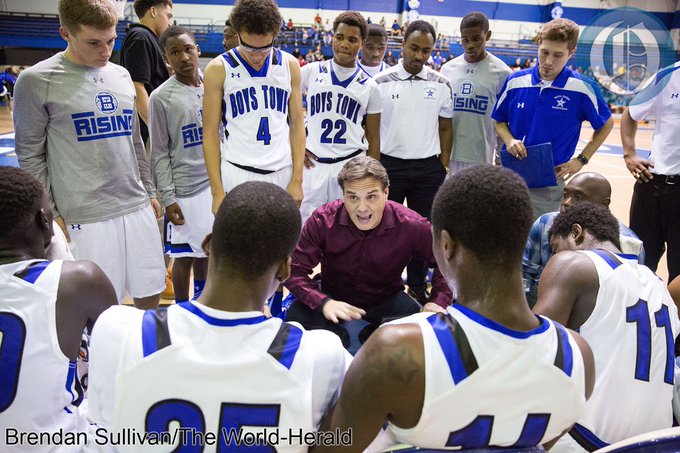
As last year’s team stormed through the season, losing only four times, including twice to Wahoo Neumann, Pfeifer noted a tendency for BT players to settle for three-point shots and to play soft in the middle. With his adjustments the Cowboys avenged Neumann in the first round of the state tourney.
When last year’s star player, starting center and then-BT Mayor Vince Marshall, felt good about a game in which he scored well but recorded few rebounds, Pfeifer had a heart to heart talk with him. “I said, ‘I was mayor when I was at Boys Town. You’re the mayor and you got only three rebounds last game. What the hell were you doing? You’re the mayor, you’re going to make me look bad. Get your ass on the boards.’ That’s the way we talked. We were brothers.”
Pfeifer’s known to intervene when emotions run over. Once, after a so-so practice on the eve of state, the admittedly “fiery” Krehbiel lost his cool when he noticed a couple players cutting up. “I lose it. I go up one kid and down another. I was furious they wouldn’t take this seriously,” Krehbiel said. “And here comes coach. He gets off his chair and gets right in the middle of us and says, ‘Wait a minute.’ I immediately shut up. He takes over and says something about not getting a big head and keeping yourself together and staying in the moment.
“He was just that calming influence and that’s what he’s been. I’ve really calmed my demeanor in regards to the sidelines and the game-time stuff in my conversations with him. He’s really helped me with the handling of the kids around here. He reminds me they’re always watching you and they’re going to play off your demeanor. He’s a sounding board. I can pick up the phone and say, ‘Coach, we’ve had this issue with a young man, how would you handle that?’ He gives me tidbits on how to handle certain situations as head coach.”
Pfeifer can still get fired up, as when he pulled his BT athletic jacket out of moth balls for a school pep rally to show how much he bleeds Big Blue. He told the crowd, “I’ve waited 40 years to wear this thing again.”
There’s the sense of a circle being closed. That what Pfeifer got from Palrang is being handed down to Krehbiel. Lessons from 65 years ago live on, no doubt to be carried on by the young men Krehbiel and Pfeifer work with today.
“The greatest thing for me, bar none, is to have my name linked with coach Pfeifer’s name and coach Palrang’s name in the same sentence. To be linked to that history is overwhelming,” Krehbiel said. When Pfeifer couldn’t get away to Lincoln to accept his Hall of Fame induction, he asked Krehbiel to accept in his place. For Pfeifer, Krehbiel was the natural choice. “I love him,” Pfeifer said of his coaching protege. “What an honor to accept for him. That just fortified our relationship. He’s a good old guy,” a tearful Krehbiel said.
Krehbiel met many athletes Pfeifer coached. They were disappointed he couldn’t make it. “They all love him. Guys came in from both coasts and from all over the country to honor him with this induction, which was long overdue,” Krehbiel said. One of Pfeifer’s favorites, Charles ”Deacon” Jones, a standout BT miler and football player who became a University of Iowa All American and two-time Olympic long distance runner, was inducted into the Hall the same night.
“I know it was killing coach not to be able to go and to be on the stage with Deacon,” Krehbiel said. But Deacon and the rest know Pfeifer was there with them in spirit. Like he always has been and will be. A brother under the skin.
Krehbiel never competed for Pfeifer, but considers it a privilege coaching with him and “seeing all he does around kids.” He said it seems he and the players benefit more from the relationship than Pfeifer does. However, he added, “I hope we’re helping keep him active.” It’s clear when Pfeifer talks hoops it takes his mind off, if only a little while, his wife. Krehbiel’s visited Pfeifer at his house during this hard time. Krehbiel’s daughters say prayers for Jean.
Perhaps the old coach’s greatest joy comes from watching his young protege catch the same passion he caught for Boys Town. Pfeifer said, “I’ve told him, ‘Tom, if you stay there long enough you’re going to get what I got.’ It’s a fever.” Krehbiel said the example of Pfeifer is one reason “why I stay here. It’s why I’ll always be here.”
Related Articles
- It took B.C. hoops stalwart Bill Disbrow a while to glean master’s secret (canada.com)
- Legendary Eathorne Touched Countless Lives (kitsapsun.com)
- Remembering John Wooden, the Wizard of Westwood (time.com)
- Legendary basketball coach Wooden dies (cnn.com)
Categories: Athletics, Basketball, Boys Town, Education, History, Mentoring, Omaha, Sports, Writing, Youth
Basketball, Boys Town, George Pfeifer, Mentoring, Omaha, Sports, Tom Krehbiel, Youth
Rich Boys Town sports legacy recalled
May 31, 2010
38 comments
I remember as a kid learning about the rich sports legacy at Boys Town, the youth development center founded by Father Edward Flanagan and forever immortalized in the MGM movie classic. When I looked into that athletic history a few years ago for a story I was struck by the amazing success Boys Town teams enjoyed for several decades and by how the football team in particular became a national powerhouse that actually traveled coast to cosat to play games against elite prep teams before big crowds in college and professional stadiums. Flanagan and his immediate successor seized upon athletics as a healthy outlet and socialization model for residents and as a promotional tool for the campus. The story of the football team’s many triumphs and travels would make a good movie itself. Football was the school’s poster sport, but Boys Town enjoyed tremendous success and followings in basketball, baseball, wrestling, and track and field as well. All the changes that came down at Boys Town beginning in the late 1960s and early 1970s resulted in the athletic program suffering several lean years. It’s only in the last decade that there’s been a resurgence in Boys Town sports, not to the heights of its former glory perhaps, but enough to link this era to that earlier Golden Age.
If you’re interested in another Boys Town sports story, then check out my story, “A Good Deal: George Pfeifer and Tom Krehbiel are the Ties that Bind Boys Town Hoops” on this blog. More o f my Boys Town stories on this site cover various topics, including the classic 1938 MGM film Boys Town, the friendship of Fr. Edward Flanagan and Jewish attorney Henry Monsky, and the 1972 Sun Newspapers Pulitzer Prize-winning investigation of Boys Town finances.
The following story originally appeared in Nebraska Life Magazine. Look for more Boys Town stories in future posts.
Rich Boys Town sports legacy recalled
©by Leo Adam Biga
Originally published in Nebraska Life Magazine
“I didn’t know a jock strap from a toothbrush,” said alumnus George Pfeifer of his arrival at Boys Town from a Kansas farm in 1939. Like some of the finest athletes at Rev. Edward Flanagan’s home for “lost” boys, the future coach had never played organized sports before coming there. Most of the boys were either poor inner city or rural kids who’d played only sandlot ball or street ball. They came from all parts of the country, boys with different racial, ethnic and religious backgrounds, and on their shoulders was built an athletic dynasty that became the envy of the nation.
From the Great Depression through the 1960s, the Boys Town football team played elite Catholic prep schools and military academies in Los Angeles, Chicago, Detroit, Pittsburgh, New York, Miami and other cites. The games attracted dignitaries and made headlines. Playing against the nation’s toughest competition in large stadiums before tens of thousands of fans, the Cowboys won more than twice as often as they lost.
During the same era, Boys Town won multiple state championships in football and basketball, and produced scores of all-state athletes and individual champions, even some high school All-Americans. Its great track-and-field athletes include two-time Olympian Charles “Deacon” Jones (1956 and 1960) and quarter-miler Jimmy Johnson, who won the Pan Am Games only a few years after graduating.
It began with the dream of Boys Town’s founder, Father Flanagan, who was a fair soccer and handball player in his day, and a vocal champion of sports. He made sports an integral, even compulsory part of residents’ experience at Boys Town. Intramural athletics became a big deal. In those days, the boys lived in dorms and staged competitions between their respective buildings to see who were kings of the field or the court. By the mid-1930s, Flanagan hired a coach and pushed for Boys Town to compete in sanctioned interscholastic events.
Born and raised in Ireland, Flanagan made his long-held dream for Boys Town a reality through conviction, blarney and bluff. With his silver-tongued brogue and big sad eyes, he elicited sympathy and loosened purse strings for the plight of America’s orphaned. With his politician’s ability to build consensus, he got people of all persuasions and faiths to contribute to the home.
It didn’t hurt that Flanagan harbored a bit of P.T. Barnum in his soul. Almost from the start of the home in 1917, he made use of the media to further the cause of children’s care and rights. In the 1920s he hosted a nationally syndicated Sunday radio program, “Links of Love,” broadcast from the old WOW studios in Omaha. On a larger scale, there was the 1938 MGM box office smash “Boys Town,” starring Spencer Tracy and Mickey Rooney. Tracy won the Best Actor Oscar for his portrayal of Flanagan.
The movie made Flanagan and BT household names. He used his and the home’s growing reputation to bring national figures, including sports stars, to “the city of little men.” The BT archives detail visits by such sports icons as Babe Ruth, Lou Gehrig, Jack Dempsey and Joe Louis. Hollywood celebrities were also frequent visitors. “Deacon” Jones, then learning the barber trade at BT, recalls being summoned with his clippers to the quarters of Flanagan’s successor, Rev. Nicholas Wegner, where he found Spencer Tracy in need of a haircut. Jones complied.

Coach Skip Palrang had a great influence on the start of Boys Town’s famous sports teams
Just as Flanagan earlier made the school band and choir ambassadors for BT, so he did with football. The same year the movie “Boys Town” was released, the football squad boarded the Challenger super liner at Omaha’s Union Station for a trip west, where they played a benefit game against Black Foxe Military Institute of Los Angeles. The film’s producer, John Considine, Jr., made it happen. Among the 10,000 or so in attendance at Gilmore Stadium were numerous Hollywood stars. Boys Town won, 20-12.
The good turnout seems to have convinced Flanagan to take his football team on the road as a gypsy, bring-on-all-comers sideshow featuring orphans from the world-famous Boys Town. The bigger the stage, the tougher the opponent, the more Flanagan liked it.
He would often wend his way to wherever the football team appeared, posing for photos, making pre-game or halftime on-the-field speeches, and generally getting the Boys Town name in the press. A big banquet, often in his honor, usually preceded or followed the game, giving Flanagan another chance to spread the gospel.
 BT alum Ed Novotny of Omaha, who played for Boys Town in the early 1940s, recalls the time Flanagan was on the field during pre-game festivities in New Jersey. Novotny says a press photographer asked to snap a few pictures of the famous priest doing a mock kickoff. Sensing a good photo op, Flanagan obliged. As he lined up for the kick, Novotny turned to an opposing player and said, “He’s in a bad spot” – meaning the photographer crouched in front of the ball, holding a Speed Graphic camera overhead.
“What do you mean?” the other player said.
“Father Flanagan can kick. He’ll blast that thing right over the goal post.”
“Really? A priest?”
Novotny will never forget what happened next. “No sooner did I say, ‘Yeah,’ than he kicked that ball and knocked that camera right out of the guy’s hands.”
Novotny recalls Flanagan as an enthusiastic presence on the sideline or in the locker room. The priest stood in the players’ circle to lead pre-game prayers. At basketball games he sat on the end of the bench with players and coaches. He greeted guys by name or with his favorite terms of endearment, “Dear” or “Laddie.”
To compete with the nation’s best, Flanagan hired Maurice “Skip” Palrang, who came to Boys Town after successful stints at Omaha Creighton Prep and Creighton University. Over his 29-year career at Boys Town, he led Cowboy teams to football, basketball and baseball titles. He won National Coach of the Year honors from the Pop Warner Foundation of Philadelphia, Pa., and Nebraska High School coaching plaudits from the Omaha World-Herald.
As athletic director, Palrang oversaw construction of a mammoth field house, modeled after those at Purdue and Michigan State. Its classic brick facade features sculpted panels of Greek-like figures in various athletic poses, stained glass windows and a vast arched metal roof that spans the length of a football field. Great facilities like these helped set BT apart.
Palrang hired coaches to carry BT’s dominance into other sports, but it was best known for football. “It wasn’t like Boys Town would play the weakest teams we could find – we’d play the baddest teams we could find,” said ’50s star halfback “Deacon” Jones. “We knew we played the best teams Skip could get to play. A lot of the players we played against went on to make All-American in college. Some went to the pros. We traveled to play Aquinas in Rochester, N.Y. That was like a Notre Dame prep school. And, whew, they had some tough players.”

Boys Town Bus Travels to Florida for exhibition game
Under Palrang, the Cowboys went 75-33-6 in these intersectional matchups. BT also participated in intersectional basketball and baseball contests, but on a far more limited basis.
Jones said players got “five dollars per trip for eating and fun money.” For some, like him, it was their first time on a train, a big deal for “kids that didn’t have anything,” he added. Seeing the sights was part of the experience – Chicago’s Field Museum, New York’s Rockefeller Center and Radio City Music Hall. But the road trips, which lasted up to three weeks, were not all fun and games. An instructor traveled with the team and made sure they kept up on their schoolwork.
Lessons of another kind came on the few road trips south of the Mason-Dixon Line. “We would go to some areas where they wouldn’t allow the black kids on our team to stay in the same hotel as the whites,” Pfeifer said. “A few times we had to arrange for those kids to stay with some people in the community. It was a terrible blow to Fr. Flanagan. That’s probably why we didn’t play that much in the South.”
Wilburn Hollis was among a black contingent denied access to a hotel. Although from the Jim Crow South, he’d been shielded from the worst of segregation – the same at color-blind Boys Town. “We were buddies, but even more than that we felt like we were brothers and we just lived like that,” said Hollis, a Possum Trot, Miss. native who became a high school All America quarterback at Boys Town and a signal caller for an Iowa University team that won a share of the Big 10 title. “I never heard anything racial.”
“At Boys Town I never thought about ethnicity or race,” said Ken Geddes, who grew up in Florida and went on to play for Nebraska and in the National Football League. “…We were all part of a family.”
Within that family of athletes, Palrang was the unchallenged head of household. “He was about six-four and probably 220 pounds and he was mean as a goat,” Hollis said. “But he was a wonderful coach. He loved the kids, he loved Boys Town….”
Hollis told of an incident involving Flanagan’s successor, Rev. Nicholas Wegner. (Flanagan died in 1948 on a goodwill mission in Berlin, Germany). Like his predecessor, Wegner was a sports booster, but apparently didn’t share Skip Palrang’s competitive philosophy. Once when BT was losing a football game, the priest tried to deliver a halftime pep talk. Wegner advised the team to do their best, Hollis recalls, “and honestly he used that old cliché, ‘It’s not if you win or lose, it’s how you play the game.’ Well, Skip was pretty hot and he said, ‘Bulls__t. We’re going to win this game.’ Monsignor was like, Oh-oh. And we went out and won the game.”
But Palrang’s success was based on more than force of will. Stern but fair, he was known for his precise preparation, a quality that fit his favorite hobby of watch repair. Ex-sportscaster Jack Payne of Omaha recalls Palrang in his field house office “hovered over a well-lighted table…wearing an eye shade, jeweler’s glasses, meticulously at work on a watch.”
An innovator, Palrang used his vast contacts to learn new offensive and defensive schemes from college and professional colleagues, often implementing packages years before anyone else at the prep level. He’d get reels of game or practice film with the latest sets to study. Sought out for his expertise, he often conducted clinics around the country. Pfeifer said that once, at the request of an old buddy, Palrang sent BT quarterback Jimmy Mitchell to Kansas State to help Wildcat signal callers learn the T-formation Skip helped initiate in high school.
The Cowboys often played far from home, so Palrang sent an assistant ahead to scout. Palrang’s protégé, George Pfeifer, inherited the thankless job. In order to see distant teams, he traveled by plane, train, automobile or any available mode of transport. He once flew into Chicago’s Midway Airport on his way to see an opponent that night in Wisconsin. In Chicago he was bumped from the last connecting flight north. With only a few hours until game time and hundreds of miles between him and the stadium, he was stuck. Desperate, he asked, “Is there any other way?” He was directed to a helicopter pad. For $15 and a slight case of nausea, he arrived “just about the time they were kicking off.”

Boys Town graduate Charles “Deacon” Jones competes in the 1956 Olympic Games in Melbourne, Australia, finishing ninth in the 3,000-meter steeplechase. Four years later, he would finish seventh in the same event in the Rome Olympics.
Skip Palrang’s physician son, Art, who played for his father one year at BT, said besides the advantage Palrang got by scouting opponents “the Boys Town kids in those days… were really tough, tough boys. They weren’t very big but they were tough… There weren’t a lot of distractions out there, like girls. He had kind of a captive audience.”
Palrang also had the advantage of working with kids who came out of BT pee-wee, freshman and junior varsity programs imbued with his coaching systems. By the time they made varsity, kids were well-schooled in the Palrang way. It led to potent team chemistry.
Despite offers to leave, Palrang remained loyal to Boys Town. Art Palrang believes this allegiance stemmed from Skip being an orphan himself. “His mother died when he was two and left his father with three boys and three girls,” he said. “He was always sympathetic to the Boys Town kids, although he was typical Irish in that he would not show his emotions.”
Today, Palrang’s accomplishments are commemorated in a big memorial just inside the field house dedicated in his honor. The memorial is next to a long row of display cases reserved for trophies and plaques won by Boys Town coaches, athletes and teams. There are hundreds of items. There’d be more, except Palrang made a habit of giving them away to kids.
By the time Palrang retired in 1972, he was only coaching his main passion, football. Years earlier, he’d entrusted the basketball program to Pfeifer, another coach often described as a “no-nonsense father figure.” Pfeifer’s basketball teams went 202-45 (two state titles), and his track teams (two titles) were always a threat. He recently joined his mentor in the Nebraska High School Sports Hall of Fame.
Like his predecessor, Pfeifer encountered racist attitudes toward his players, as when he started five black players on his state championship basketball teams of 1965 and 1966. One morning after a game, a caller demanded, “Why you playing all them n_____s?”
“Because they’re my five best players,” Pfeifer replied.
Boys Town’s barnstorming era was prompted by publicity and the guaranteed payoff for its football games. But BT was also compelled to travel for another reason. Once it became a winner, it could find only a handful of area schools willing to schedule games.
Despite many attempts, BT was long denied membership in the Omaha Inter-City League, comprised of large Omaha area schools. Pfeifer said Wegner reportedly had to threaten to withdraw funds from local banks to gain admittance. It finally happened when the Inter-City League was disbanded and the new Metropolitan High School Activities Association was created in 1964.
Everyone has a theory about the blacklisting. Speculation ranges from envy over BT’s athletic riches to rumors, denied by BT alums, that it practiced off-season, suited older student-athletes, or recruited prospects. An image of BT suiting up juvenile delinquents, true or not, may have also accounted for schools not wanting to schedule the Cowboys. BT athletic equipment manager and head baseball coach Jim Bayly said that when he was a player at Omaha South, “we were afraid of Boys Town.”
Shane Hankins, quarterback for BT this past season, senses that the “jail” or “criminal” perception still haunts BT. But far from intimidating foes, he said it makes them “want to fight us even harder to prove we’re not tougher.” He concedes BT has some rough players, but points out that the Cowboys win sportsmanship awards.
Even without conference membership, Boys Town had a metro rival. “In the middle ’40s, when Boys Town was really taking off,” Art Palrang said, “Creighton Prep was also in its heyday and they played bitter, bitter battles. Rumor has it the archbishop said, ‘Hey, you guys have got to stop this. We can’t have two Catholic teams fighting each other.’” Adding fuel to the fire was the fact Palrang once coached Prep. There was no one he enjoyed beating more.
Aside from Prep, Palrang said, “Boys Town was obviously cleaning up on everybody and Omaha didn’t want ’em in their league because… Boys Town would have won everything.” By contrast, Prep had long been a conference member. And once let in, BT proved as dominant as feared by soon piling up Metro titles.
Perhaps nothing explains the ostracism better than what one alum called BT being “an island unto itself.” A certain arrogance surely came with all that independence, winning and notoriety. Besides, there was the perception – if not reality – that BT didn’t really need to be in a local athletic league. In fact, cross-country travel was expensive and eventually became cost-prohibitive.

The 1985-1966 Cowboys basketball team wins the school’s second straight state basketball championship.
By the time Boys Town’s reign ended in the mid-1970s, BT had evolved from a place where boys lived in dormitories to a family housing model where residents – girls too – live with teacher parents. Changes in the way BT works with youth lowered the number of residents from a high of about a thousand (elementary and high school combined) to about half that today, and decreased the average stay from six or eight years to about 18 months. The smaller enrollment forced BT to drop from the big school to small school ranks, and the shorter stays gave coaches less time to develop athletes and mold teams. For years, BT athletic prowess declined.
Today’s BT coaches are again turning out winning teams and top athletes, their job complicated by kids who present complex behavioral disorders. BT teams again compete for titles, but in Class C1, not Class A. The football team has its rivals, but a road trip today is an hour by bus, not overnight by train.
Girls and Boys Town (as the institution has been known since 2000) still uses athletics to further its mission of helping at-risk youth develop life skills that prepare them for adulthood. Head football coach Kevin Kush sets a high bar for his players, and makes no exceptions in holding them accountable. By late September 2006, he’d already let a few of his best players go for violating team rules, which brought his varsity squad down to 26. He could have supplemented the varsity by promoting JV players, but he refused, saying, “They haven’t paid the price. I’m not going to change my philosophy. I’m not going to lower my standards. See, these kids have standards lowered for them for their whole lives. We don’t do that. We want our kids to be committed to something and a lot of them have never been committed to anything.”
This past season’s star quarterback, Shane Hankins, said he appreciates that coaches and others care enough to make football special again. “Our goal is to achieve, to shoot for something in our lives some people say is impossible for us to do since we’re here. But we prove them wrong. We want to bring more winning to this campus because before we came here, most of us weren’t recognized as winners.”
All last basketball season, head boys basketball coach Tom Krehbiel relied heavily on an unofficial assistant, the 81-year-old George Pfeifer who, despite health woes, came to practices weekly to distill some of his wisdom to players young enough to be his great-grandchildren. Pfeifer’s championship teams of 1965 and ’66 are still regarded as two of Nebraska’s best high school basketball teams ever.
“I wanted to get him involved in the program,” Krehbiel said of Pfeifer. “I reached out to him. We ate lunch, hit it off and he’s been a big part of our program ever since. I don’t think it’s a coincidence we started winning since then. Coach has been a great mentor to me and just a great resource for us. For our current players he’s a link to success.”
After last year’s team won Boys Town’s first state basketball championship in 40 years, guard Dwaine Wright dedicated the victory to Pfeifer live on Nebraska Educational Television.
Pfeifer said that after a period of adjustment, he and the team forged a strong bond. “When I’d come out there, some of the kids warming up before the game would come over and say, ‘God, we’re glad to see you coach. You feeling alright? We’re going to play hard for you.’ That last night when they accepted the trophy the one kid held it up and said, ‘This is for you, Coach Pfeifer…’ Those are the kind of kids….” Choked with emotion, Pfeifer’s voice trailed off.
The experience brought him full circle to how as a kid he was welcomed and encouraged by Father Flanagan, Skip Palrang and others, and how he did the same for kids as a BT coach, vocational education teacher and middle school principal. “I knew I wanted to be there to help those type of kids,” Pfeifer said of Boys Town students past and present. “You know, they come there with a hole in their heart. Nobody cares about them, nobody encourages them – they just think there’s no way they can make it. We set up goals and objectives. We praise them when they succeed. When a kid comes up to you and says, ‘God, I wish you were my dad’…then you know you made a difference.”
Note: The Boys Town Hall of History features displays and a film that relive some of BT’s glory years in football.
Related Articles
- Valor Christian’s athletic excellence has arrived quickly (denverpost.com)
- Many college football dynasties have roots in strength training (sports.espn.go.com)
- Top 15 Traditions in All of Sports: A Closer Look at the Best of the Best (bleacherreport.com)
- The George Steinbrenner of junior football (theglobeandmail.com)
- Sun Reflection, Revisiting the Omaha Sun’s Pulitzer-Prize Winning Expose on Boys Town (leoadambiga.wordpress.com)
Categories: Athletics, Boys Town, Education, Father Flanagan, Mentoring, Omaha, Sports, Writing, Youth
Athletics, Boys Town, Father Flanagan, George Pfeifer, History, Mentoring, Omaha, Skip Palrang, Sports, Youth
Ron Stander: One-time Great White Hope still making rounds for friends in need
May 31, 2010
20 comments
I did this follow up story on ex-Omaha heavyweight boxer Ron Stander about seven or eight years after the first story I did on him, which you will also find on this blog. In that earlier piece Stander was still fighting some demons, still in the throes of recovery. In the interim, Stander had come to terms with some things in his life and by the time I did this second story he seemed more at peace with himself and his place in the world. Stander was and is a tough dude, but he’s also a big teddy bear of a man with a heart of gold. That’s one thing that’s never changed about him. This story, which originally appeared in the New Horizons, portrays Stander as the good man he is, just a regular guy who helps his friends, including some fellow ex-boxers who have fallen on various hard times. To a man, his buddies love him. It’s heartening to know that Stander is now happily remarried and writing his life story. It should be a helluva read.

Ron Stander: One-time Great White Hope still making rounds for friends in need
©by Leo Adam Biga
Originally published in the New Horizons
Far from the spotlight he inhabited when he fought for the world heavyweight boxing title 35 years ago, Ron “The Bluffs Butcher” Stander goes about his daily routine these days in relative obscurity. That’s fine with him. He had his moment in the sun. He’d rather be remembered anyway as a good man, a good father and a good friend than as a good fighter.
“Yeah, right, that’s exactly it,” he said. “I just want to be a good person.”
He lives a simple life, both by choice and circumstance. He may be poor in finances, but he’s rich in friends. Despite his own problems, he aids folks less well-off and able than him, often making the rounds to visit old pals, many of whom he knows “from boxing.” Some, like Tony Novak, Gabe Barajas and Art Hernandez, are ex-fighters. Novak and Hernandez sparred with Stander back in the day.
Fred Gagliola coached a young Stander as an amateur Golden Gloves fighter. Maurice “Mad Dog” Vachon is an ex-pro wrestler quite popular here. Stander and Vachon know the highs and lows of life inside and outside the ring. Tom Lovgren was the matchmaker for many Stander fights and at one time managed him.
Each man suffers some kind of health impairment or disability. All befriended Stander at one time or another and he’s never forgotten it.
“They all helped me. Now I attempt to give back in some way. I like to help out. They were in my corner and now I’m in their corner,” said Stander, who variously does chores, runs errands and offers companionship for them.
Lovgren is afflicted with multiple sclerosis. The effects of the advanced disease confine him to a wheelchair. When his wife Jeaninne broke a leg last winter she could not get her large husband out of his chair into bed.
“So I called Ronnie and said, ‘Can you come down and help me into bed every night?’ — and he did,” Lovgren said. “He came down at 10:30 every night and put me to bed. I paid him, because he didn’t have to do that. He’s a good friend.”
Not long ago Lovgren took a fall at home, unable to get up by himself or even with an assist from his petite wife. Enter Stander.
“It was about 10 o’clock at night. I was beat, tired. I worked hard that day and I was all out of gas. I’d just had my first beer of the night when Jeaninne called. ‘Can you help out?’ I went down to their place. He was flat on the floor and I had to pick him up…and put him in his chair. It was a tough lift. Boy, he’s getting heavy. Probably weighs 250. Dead weight,” Stander said. “I about didn’t make it. Jeaninne had to get on his side and grab his pants and pull him up. We got him though.”
Stander’s glad to help the man who so much did for him. Lovgren not only got him fights, but was part of the team that readied him for his May 25, 1972 title bout with champ Joe Frazier in a jam-packed Civic Auditorium. Lovgren prodded Stander to get in fighting trim and stay away from late night beer binges.
“He would always get me to do the road work real good,” Stander said. “He’d take me running, count laps. He was a real disciplinarian. But fun, too. I respected him.”
Before he challenged for the championship, Lovgren arranged what Stander called a “steppingstone” match with future contender Earnie Shavers. Considered one of the hardest punchers in the heavyweight division, Shavers’ blows “felt like getting hit by a night stick or a ball bat,” Stander said. “It was like a whip cracking at the end.” After a slow start that saw him get pummeled, he KO’d Shavers in the fifth. Shavers reportedly had to be carried off by his corner.
That became Stander’s signature win. His most notable loss, of course, came in his title bid. After losing to Frazier, Stander sank into a deep depression and his career nose-dived. “I didn’t have any desire,” he said.
Except when Lovgren got him a marquee match against former contender Ken Norton on the undercard of the Muhammad Ali-Jimmy Young bout. Norton won when the fight was stopped in the fifth due to cuts he opened up on Stander, who was prone to bleed, but to this day “The Butcher” feels he would have had a tiring Norton “out of there in another round or two.”
Coulda’, woulda, shoulda’. “You can’t fight destiny” Stander said.

Away from the ring, the fighter admires how Lovgren has never given up in his own battle with MS. Despite the debilitating disease, Lovgren has raised a family, worked, traveled and maintained his passion for sports, especially boxing.
“He’s been an inspiration,” Stander said. “He’s paid his dues.”
The other men Stander helps are inspirations to him, too.
Former world middleweight contender Art Hernandez lost a leg after a freak fall from a roof, but he hasn’t let it stop him from living a life and enjoying his family. “I’ve got all the respect for him, too,” said Stander, who, like Lovgren, considers Hernandez to have been the best fighter, pound-for-pound, to ever come out of Nebraska. As an undersized but much quicker sparring partner, Hernandez used to frustrate Stander in the gym, confounding and evading the lumbering heavyweight. “I couldn’t hit him with a handful of rice,” Stander said.
Stander admires too how “Mad Dog” Vachon has not allowed the mishap that cost him a leg to embitter him.
“’Mad Dog’s’ a good guy,” he said. “He has a great attitude.”
Through “Mad Dog” Stander met an array of pro wrestling legends, such as Andre the Giant. “When I shook his hand it was like grabbing a pillow,” he said.
When Hernandez first got fitted with his prosthesis Stander brought him over to “Mad Dog’s” place so these two old warriors with artificial limbs would know they were not alone. The gesture touched the two men.
“He did me a favor that day,” Hernandez said.
“He’s got a heart of gold,” Vachon said. “He’s a very nice man. A real softee. He’s the kind of guy who would give you the shirt off his back.”
Since suffering a series of strokes Fred Gagliola, the man who helped show Stander the ropes as an amateur, has trouble getting by.
“I was just weeding in his yard the other day,” Stander said one summer morning outside the south downtown home of the man he calls Coach. “He can’t do much. I sweep and mop the floor for him.” “He cuts the grass, he throws out the garbage,” Coach said. “Whatever it takes,” added Stander. “I just try to help him however I can. He was on my side in the Gloves, you know. He backed me, supported me. He did favors, I do favors. He helped me, I try to help him now. So it’s pay back.”
Although he can use the money, Stander doesn’t lend a hand for the “couple bucks” he earns “here and there.” “Other things,” besides money, “make him happy,” Vachon said. Like doing good deeds.
Friends and family are all that are left once the money runs dry and the glory fades. “Mad Dog” and “The Butcher” made names for themselves in the late ‘60s and early ‘70s. Vachon reigned as an All-Star Wrestling king on cards at the Omaha Civic Auditorium. That’s where Stander enjoyed his greatest ring success, topped by challenging Frazier for “all the marbles” in what may have been the biggest sporting event Omaha’s ever seen.
The title fight was the pinnacle of his career. But life goes on. Things change. Stander was 27 and fighting on the biggest stage his sport has to offer — in his adopted hometown no less. Before friends and family and the assembled boxing world he put himself on the line and he failed. The fight was stopped after four rounds, Stander’s face a bloody, pulpy mask. He never went down, though. He pleaded for the fight to continue, but ringside physician Jack “Doc” Lewis made the only call he could given that Stander was blinded by blood from ugly gashes and could no longer defend himself. A longtime friend said Stander cried in the dressing room, sure he’d disappointed everyone. The friend assured him he hadn’t.
The incident reveals a couple things: how much Stander, often accused of taking a nonchalant approach to his training, cared about representing his hometown; and his never-say-die attitude. “I trained hard for the fights I cared about. I wanted to prove I was a legitimate contender,” he said. No one could ever call him a quitter.
“He’s got a heart the size of this room,” Lovgren said from his spacious living room. “When Joe Frazier is unloading on you and you’re still standing, you’re something special. Tough guy.”
Life hasn’t been a bed-of-roses since the Frazier fight. Stander’s contentious first marriage ended. He didn’t get to see much of his oldest two kids growing up. He remarried and had two boys before this second marriage soured. He has custody of the boys, Rowan and Ryan. He tried being an entrepreneur, owning his own bar, but that didn’t last. Long an imbiber, he developed a problem with alcohol and a DWI landed him behind bars. “I was stupid. I made some wrong decisions. I didn’t know when to say no. Let the good times roll. Let the party begin. When I had to go away for three months it was like shock treatment,” Stander said. “I was going to grow up sooner or later. Maybe it helped me to.”
The biggest blow — to both his pocketbook and ego — was losing the best job he ever had, as a machinist at Vickers. Through it all, he’s stayed sober and tried to do the right thing for his kids and his pals.
“He’s a good guy,” Lovgren said. “He’s a good father. He takes good care of those kids. He’s really a caring person. If you ask him to do something he makes a real effort to do that. If I need anything I know he’ll come.”
Largely unemployed since 2000, Stander leads a hand-to-mouth existence that finds him scrounging for discarded cans and car batteries he brings to the recycler for chump change. He also does odd jobs for people who reward him with scratch. “Most of the time I’m trying to hustle some gas money and food money,” he said.
One of his frequent stops is A. Marino Grocery, a South 13th Street throwback, or as Stander likes to say, “blast from the past.” Proprietor Frank Marino joked, “He’s my pacifier. If somebody doesn’t pay a bill we send him out to collect.” In reality, Marino said, “We have him do little things, cleanup a little bit, make a delivery every once in awhile for me.” “Take some boxes out,” added Stander, who on a recent visit grabbed a bundle of flattened cardboard boxes and deposited them in the dumpster out back. “It’s the same at Louie M’s (Burger Lust). We’re paisan.”
It puts a few extra dollars in Stander’s pocket. Otherwise, he gets by on his monthly Social Security check. There’s no pension, no nest egg to draw on. Fighters don’t have retirement plans. He does have a 401K through Vickers, but he’s had to dip into it to make ends meet. All of which makes things tight for a man raising his two youngest boys alone. One silver lining is that his house, a mere two blocks from Rosenblatt Stadium, is paid for. Another is that his son Rowan, a senior at Creighton Prep, is a top wrestler who might earn a college athletic scholarship.
Stander’s a robust 62, but he has health issues. He’s overweight, with high blood pressure and diabetes. He’s missing several teeth. For comic relief he slips his dentures out and opens wide to show his bare mouth. He has trouble remembering things. It’s what becomes of old fighters, even one as strong as an ox like him
He doesn’t complain much, except to bemoan the loss of that machinist’s job at Vickers, where he operated drill presses, grinders and lathes. The Omaha plant closed just before Christmas 2000, leaving him and more than 1,000 co-workers out in the cold. He was 55, an age when it’s hard to start over. With only a high school education and no marketable skills, he’s got few prospects.
“When Vickers closed up, that was it, that was the final straw for me,” he said, “because by the time you’re 55 or 60, if you’re not locked into something, you’re done, you’re screwed. So I’m screwed.”
He sometimes wonders if he did the right thing pursuing a boxing career. He began at Vickers in ‘65 while still an amateur. After turning pro in ‘69 he quit his job, even though his early purses were negligible. He got $75 his first fight. A few hundred each the next few bouts. Until Frazier his biggest purse was a few thousand.
“I had a good job at Vickers…If I had stayed there all those years and not taken a shot at the title I’d be retired right now. I went back to Vickers in ‘93 and when I finally started getting the big money in ‘95 they closed the plant. That’s what grieved me. People say, ‘Well, you can start over and work your way up again’ Yeah, right, whatever.”
Men his age aren’t in demand by employers.
“I’m ready to work, but people don’t want to hire ya. I’ve talked to friends in construction and they say, ‘We’re looking for guys 35, not 55. I talked to a friend in the heating and air business and he said, ‘Well, you know, Ron, at your age we don’t want you to be up on a roof when it’s 120 degrees working on an air conditioning unit. You could have a heart attack.’ There again, the age factor.”
He did attend Vatterott College to learn a trade. He was an apartment maintenance man, but tired of tenants calling in the middle of the night demanding their leaking toilets be fixed. His pride won’t let him take an $8 or $9-an-hour job. Until a few years ago he made extra dough refereeing boxing matches in Nebraska, Iowa, the Dakotas and Minnesota. He even did a few televised title bouts. But those gigs dried up with the loss of independent promoters. He’s shut out by the casinos, where the fight action is these days, and their contract refs. Besides, with two boys, in his care he can’t be gone on those overnighters anymore.
Like the old pug in Requiem for a Heavyweight, he’s at a loss what to do now. Fighting is all he knew. For a time he did have his own bar, The Sportsman’s Club, but his weakness for the drink made that an unhealthy environment for him to be in. He’s clean and sober now, but that alone doesn’t pay the bills.
Money worries nag at him, especially with the boys to clothe and feed. “It’s a struggle,” he said. “We live on $953 a month Social Security.”
Come College World Series time he pulls in some much-needed cash parking fans’ cars, at $5 a pop, on his property. His record for one game is 26 vehicles. But that happens only two weeks a year. He also makes some money from autograph signings he does in Omaha, Lincoln, Des Monies, et cetera.
Enough time has passed that he doesn’t carry the cachet he once did, when his mug and name were enough to buy him drinks and meals and perks wherever he went. As Omaha’s last Great White Hope, everyone wanted a piece of him then.
“It’s not like it used to be,” he said.
The Vickers job seemed like a sure thing and then, poof, it was gone — the steady paycheck, the security, his self-esteem. “When I had money, when I had a job,” life was good, he said, “before things went from sugar to shit in a short time.”
Quicker than you can say, Whatever happened to?, the career club fighter blew the six-figure purse he earned for his only shot at immortality. There were a handful of other big paydays. But the pay outs in his era were small potatoes compared to the millions contenders command today.
Long gone are the days when media hounded him for quotes. His last real exposure came in 2001, when he appeared with Joe Frazier, the man who gave him a Rockyesque chance at the title. For only the second time since that fight, the two warriors met — for a Big Brothers, Big Sisters of the Midlands promotional event in Omaha. In the way that old combatants do, they embraced like long lost buddies. They were never close, but the mutual respect is real.
The ensuing years wrought much change. Their hair’s flecked with gray, their mid-sections grown soft, their speech slowed. Yet, to their good fortune, each shows few effects from the punishing blows to the head they absorbed as sluggers who took many shots to land one of their own. They still have their wits about them.
But Stander’s life is a far cry from the ex-champ’s. Frazier is an icon within the larger sports canon for his Olympic gold medal, undisputed heavyweight crown, his three memorable fights with Muhammad Ali and the dramatic way he lost the championship against George Foreman. He has his own gym and other business interests in his hometown of Philly. His much sought-after autograph brings hundreds of dollars, compared to a fraction of that for Stander’s.
Where Frazier is a featured storyline in boxing history, “The Butcher” is a sidebar and footnote. Or an answer to a trivia question: Who was the last fighter Joe Frazier beat while world champ? Ron Stander. Stander’s match with “Smokin’ Joe” came between Frazier’s two most historic fights — eight months after beating Ali at New York’s Madison Square Garden and eight months before being brutally beaten in Jamaica by Foreman, who took the crown only to lose it a year later to Ali.
The boxing world can be a small community. Even though Stander’s career is
forgettable by all-time Ring Magazine standards, he’ll always be a part of boxing history for having fought for the title. The fight occasionally shows up on ESPN Classic. His bid, too, came at a time when the title was still unified. Plus, he squared off with some of the sport’s biggest names — Frazier, Shavers, Norton, Gerrie Coetzee. Then there’s the fact his career intersected with other legends, like Foreman, who was at the title bout in Omaha and reportedly saw something he exploited when he later faced and destroyed the champ.
Specifically, Stander worked on an uppercut to take advantage of a flaw in Frazier’s defenses. In the third round he saw his opening and let the uppercut fly, missing by an inch. He figured he’d only get one chance and he was right. Conversely, Foreman pushed Frazier off and caught him coming in with the same punch.

Then there were Stander’s meetings with The Greatest. He said on four occasions he was a surrogate member of Ali’s entourage. He said Ali liked having him around for his parodies of Aliisms like, “I’m the greatest of all time.” Stander does a fair impression of Ali, of sports broadcaster Howard Cosell, who once interviewed Stander, and of Mike Tyson, the troubled ex-champ.
Stander met Tyson in Las Vegas in the ‘90s, long after his own career had ended. There’s a story behind their encounter. In preparation for Frazier, Stander manager Dick Noland wanted him far from distractions and so shipped him off to Boston to work under famed Johnny Dunn. After the Frazier fight Stander parlayed the connections he’d made back east and went to the Catskills to train under legendary Cus D’Amato. It was D’Amato who went on to mentor the young Tyson.
Stander was in Vegas, where Tyson was training for a title defense against James Broad, when he paid a call on the then-champ. As dissimilar as the two men were, they did share a pedigree in the person of Cus D’Amato.
“He knew all of Cus’ disciples and he knew I was with Cus, so he let me in the gym. No introduction, he just came right up to me, ‘Hello, Mr. Stander.’ ‘Hey, champ, how ya doin’?.’ ‘I’m working on an uppercut that will drive that nose bone into the brain.’ ‘Yeah, that’s a good move, champ,’ said Stander in a wickedly dead-on Tyson impersonation — childlike voice, silly lisp and all. “He was something.”
“The Butcher” even ended up in a film, The Mouse, based on the life of his real-life friend, ex-boxer Bruce “The Mouse” Strauss.
Stander also hung out with non-sports celebrities — as a bodyguard for the Rolling Stones and The Eagles. He said Evel Knievel, whom he got to know, offered him $3,500 to work the security detail for his Snake River Canyon jump. Instead, Stander took a fight in Hawaii, where he’d never been, for the same money.
All these brushes with fame please Stander, but as he likes to say, “That and 50 cents will get you a cup of coffee.”
He experienced about everything you can in boxing. Good, bad, indifferent. He never really announced his retirement, but he knew when it was time to quit.
“You know when you’re almost done,” he said. “You don’t have the desire or the hunger. You’re tired of the running and the road work. You’re tired working out all the time. The stitches start mounting up. Your nose gets a little flatter. Your teeth get a little looser. Your brain gets a little jiggled. You just lose it.”
If anything, he hung on too long, waiting for one more big payday that never came. “Yeah, that’s probably right,” he said. “There at the end I fought a lot out of shape because I didn’t care. But a guy’s gotta have money. It wasn’t like I was gaining seniority working for U.P.”
Rather than work for meager wages today, he scrapes by. He’d like to run his own gym, but that takes moolah. One benefit of not having a regular job is that he has time to spend with his kids and help friends.
“I try to be a role model and do the right thing for these kids. I have to show them the right way to go,” he said.
As for his friends, Stander said, “They did right by me,” and now he’s trying to do right by them. Gabe Barajas appreciates having Stander as a friend. Barajas, the former owner of Zesto’s near the zoo and stadium, said, “We’re pretty close. He used to come up and help me out there, too, shaking everybody’s hand, bringing the heavy pop coolers up to us. He did lots of things. He ate a lot, too.”
Stander’s visits to the nursing home Barajas resides in bring a smile to his friend’s face. Stander sometimes takes Barajas, who has MS, for drives, down to old haunts. He lifts Barajas from the bed or recliner into his wheelchair and puts him and the chair in his car. Stander said his friend needs outings like these. Otherwise, “that’s his life — in that room and down in the dining hall,” he said.
Fred Gagliola, Stander’s old coach, knows he can count on him. “Oh, hell, yeah. He comes down here all the time to help me out,” Gagliola said. “He’s a good friend.”
Tony Novak, Stander’s first sparring partner, lives alone in a Carter Lake trailer home. Stander frets over his buddy’s health. “Ron’s been a good, true loyal friend for 40 years. He checks on my every day,” Novak said.
The breaks maybe haven’t gone “The Butcher’s” way since he lost to Frazier, but he just chalks it up to “fate” and appreciates what he does have.
“No matter how good you are, how smart you are, how well-built you are, you gotta have a little bit of luck to go along with it,” he said. And you gotta have “a few good friends.” That he has. It’s why he’s not about to quit now. There are too many rounds to go, too many friends in need.
“You gotta do whatchya gotta do. Hang in there. You can’t fight destiny.”
Related Articles
- World Heavyweight Boxing Championship 1960-1975 (sportales.com)
- Top ten hardest punchers in boxing history (trueslant.com)
- Foreman gains respect even in losing title (jta.org)
- Liston and Ali: the Ugly Bear and the Boy Who Would Be King by Bob Mee: review (telegraph.co.uk)
Categories: Athletics, Boxing, Omaha, Personalities-Characters, Pop culture, Ron Stander, Sports, Tom Lovgren, Writing
Athletics, Boxing, Earnie Shavers, Golden Gloves, Joe Frazier, Ken Norton, New Horizons, Omaha, Pop Culture, Ron Stander, Sports, the bluffs butcher, Tom Lovgren, World Heavyweight Boxing Championship
Requiem for a Heavyweight, the Ron Stander Story
May 31, 2010
Leave a comment
This is the first story I wrote about Omaha sports legend Ron Stander, a journeyman heavyweight boxer who got his Rocky and Great White Hope moment in the sun when he fought reigning world champion Joe Frazier for the title in the challenger’s adopted hometown of Omaha, Neb. My story appeared some 30 years after that 1972 bout in which Frazier bloodied and bruised but did not knock down Stander. The fight was called after four rounds. As a fighter, Stander was strong and brave and always stood a puncher’s chance. But he forever sabotaged whatever chance he had to be a legit heavyweight contender by the way he conducted his life, which was to overeat and drink and recreate and to avoid training whenever possible. He paid for that lack of discipline in a number of ways, both professionally and personally. But the reason why people have always loved Stander is that he’s a sweet, generous Every Man whose triumphs and struggles we can identify with. At the time I wrote this article he was somewhat a sad, down-and-out figure. More recently, his life has taken an upswing I am happy to report. I understand he’s now writing his life story. It should be one helluva read.

Requiem for a Heavyweight, the Ron Stander Story
©by Leo Adam Biga
Originally published in the defunct Omaha Weekly
It is tempting to cast local boxing legend Ron “The Bluffs Butcher” Stander in the role of a heavyweight in need of a symbolic requiem. A certain sadness surrounds this one-time contender who, since retiring from the ring in 1982, has often battled opponents he could not lay a glove on — including himself. While this smart ex-pug is no permanent resident of Palookaville and clearly still has all his wits about him, he does fit the part of a man haunted by having had the world in the grasp of his beefy hands only to let it all slip away.
Like some real-life Rockyesque figure, this hometown Great White Hope was just another up-and-coming club fighter when he got a once-in-a-lifetime chance to fight for the heavyweight championship of the world. It happened 30 years ago right here in Omaha, Neb. On May 25, 1972 he squared-off with “Smokin” Joe Frazier at a jam-packed Civic Auditorium. What transpired next has defined Stander ever since. Unlike the fictional “Rocky,” his moment in the sun ended not in fame or fortune but as the answer to a trivia question: “The last fight Frazier fought as champion? It was against me,” Stander will tell you at the drop of a hat.
Before sitting down for a recent interview at the comfortable south Omaha home he shares with his second wife Becky and their two children, he excused himself, saying, “I have to put my teeth in,” referring to the denture plate he inserts to replace the many ivories he lost over the course of his ring life. Reposed in a recliner, his fleshy face a contour map of scars and crevices, he spoke about the Frazier fight and its implications in his life.
For four brutal rounds the local slugger stood toe-to-toe with the fierce Frazier, then only months removed from having beaten Muhammad Ali in the first of their epic fights, and traded body blows and head butts with him. They were like two big-horned antelope locked in mortal combat, neither giving an inch. “We could have fought the fight in a telephone booth,” is how Stander describes it. The challenger got in a few good licks, even stunning the champ in the 1st, but by the time the bell sounded to end round 4 his pasty face was a bloody, swollen mask. Ringside physician Dr. Jack Lewis put a stop to the slaughter before the start of the 5th.

Heavyweight champion Joe Frazier (left) lands a punch against challenger Ron Stander during their May 25, 1972, title bout at the Omaha Civic
Local boxing fans fondly recall Stander’s courage in waging war the way he did. It was a frontal assault all the way, as he absorbed multiple blows just to connect one or two. His friend and former matchmaker, Tom Lovgren, said, “Ron Stander was not going to be embarrassed. He was not going down at the first thing that came close. He had a heart the size of a house. He’d walk right at you.”
Never one to pull his punches, even when discussing himself, Stander said, “As far as taking several punches to land one, that’s not the smartest thing. It was more a result of my short height and short reach.” Despite all the techniques and strategies he was taught over the years, in the heat of battle the Butcher always returned to his unschooled, bull-rush style. “You resort back to whatever comes natural to you, I guess,” he explained. “I was just a slugger. I was very aggressive.”
Much like he fought, Stander approached life head-on also, over-indulging in food and drink, taking risks, making rash decisions, leading with his chin and heart instead of keeping his guard up. He paid the price, too. His tempestuous first marriage ended in divorce. He became estranged from his first two children and his grandchildren. There were much publicized drunken driving offenses, the second of which landed him in a men’s reformatory and a detox unit for several months (“That was pretty bad.”) There was the failure of his Council Bluffs watering hole, The Sportsman’s Bar. His weight ballooned to nearly 300 pounds.
He lingered far past his prime as a prizefighter, hoping against hope another big pay day would emerge. It never did. He entered the title fight with a promising 21-1-1 record, including 15 KOs, and staggered to a disappointing 14-19-2 mark after it, often going into fights poorly conditioned and mentally unprepared. Near the end, Lovgren refused putting him in with heavy hitters or expert boxers for fear his fighter might be badly hurt. Friends feel Stander hung on too long. “Yeah, that’s probably true,” the Butcher said. “You know when you’re almost done. You don’t have the desire or the hunger. You’re tired of the roadwork. You’re tired of working out all the time. The stitches start mounting up. Your nose gets a little flatter. Your teeth get a little looser. Your brain gets a little more giggled. You just lose it. But a guy’s gotta have money. It wasn’t like I was earning a pension working for U.P. (Union Pacific).” He was a fighter. That’s all he knew.
Along the way, he was exposed to the seamier side of boxing. While training back east he met some wise guys who had their hooks into boxers. He heard stories of fighters refusing to take dives being thrown off a pier or getting their hands busted with hammers. “Yeah, it happened,” he said. “There’s a lot of backstabbers in boxing.” Then there’s the whole dirty business of being a gladiator under contract, which is like being an indentured servant. He got only a small piece of the financial pie. “Everybody gets their hands in the till, see? I got $100,000 for the Frazier fight and I only came home with $40,000 by the time my manager took his cut, somebody else took his and the IRS took theirs,” he said. On three occasions his contract was bought outright by managers in other states and he had no choice but to pack-up, relocate and take his marching orders from a new boss. “You move to their town, you train in their gym, you fight in their fights and they take half,” is how he put. All in all, though, he feels he was well treated, especially by Noland and Lovgren. “They did right by me.” One of the quirks of being a once-name fighter is hanging out with sports icons. On several occasions he was with Ali as The Greatest prepared for fights. He witnessed him practicing pre-fight poetry out loud like an actor running his lines and lording over his entourage like some sultan overseeing his minions. He was with a young Mike Tyson (of whom he does a dead-on impression) in Las Vegas. He chummed around with pro wrestlers like Jesse “The Body” Ventura. He made friends with such ringside characters as Cus D’Amato and Bruce “The Mouse” Strauss.
With the perspective of time, Stander now blames his many travails on the deep funk he says he descended into after losing the title shot. “After the Frazier fight I was really depressed. I wanted to win so bad,” This once hometown hero became seemingly overnight, a has-been. Upon his retirement he stayed on the fringes of the game refereeing bouts and appearing on fight cards, where he was a bloated shadow of his former self. He searched in vain for something, anything, that could replace the rush of stepping into the ring to throw leather. For a while, alcohol became his elixir. It didn’t help when he endured the loss of his mother and step-father, who adopted him and whom he idolized. As a child the future boxer and his mother were abandoned by his biological father. He said when she remarried (getting hitched to Frank Stander, a hard working World War II vet who accepted Ron as his own) it “was the greatest thing that ever happened to me.”
With the help of his second wife, Becky — “She’s a doll” — with whom he has two boys, ages 11 and 13, Stander is clean and sober these days, but out of work. When a reporter recently read him a litany of his troubles and asked what went wrong, this man who never took a dive in the ring answered candidly about the hard fall he took after hanging up the gloves. “Yeah…yeah…yeah. Depression. Losing the Frazier fight. Yeah, that and stupidity. Probably irresponsibility. I made some wrong decisions. I didn’t know when to say no. I was like, ‘Let the party begin.’ When I had to go away (for rehab) it was like shock treatment. I was going to grow up sooner or later and maybe going away helped me to. Now, I just want to raise these two kids and enjoy my grandkids and try to be a role model and do the right thing. I have to show them the right way to go,” he said sheepishly.
When the Vicker’s plant closed a few years ago, Stander lost his well-paying machinist’s job there and has lately been attending Vatterott College’s heating and air conditioning school in an attempt to learn a new trade. He worries, though, how a man his age can find a job that will enable him to support a family. “People say, ‘Well, you can start over and work your way up again.’ Yeah, right. Whatever,” he said, sarcasm dripping from his tongue. “I’m ready to go, I’m ready to work. But people don’t want to hire ya when you’re my age. I talked to friends at Hawkins Construction and they said, ‘We’re looking for guys 35, not 55.’ I talked to a friend who’s in the heating and air business and he said, ‘Well, you know Ron, we don’t want someone your age up on a roof when it’s 120-degrees. You could have a heart attack. Heart attack, hell, I feel fine. I can fight Frazier tonight.”
Like many athletes who once enjoyed success and celebrity, Stander clings to the memory of his halcyon days as the popular hard-hitting heavyweight who, as Lovgren said, “put asses in seats better than anyone ever has in Omaha, Nebraska.” Lovgren, a boxing historian, feels Stander was “one of the last good heavyweights under 6’0 tall.” To be sure, Stander made some waves in the fight game. Early in his career he peaked at just the right time for a fight with the formidable Earnie Shavers, widely considered one of the hardest punchers ever in the heavyweight ranks, and knocked Shavers out in five. In total, he faced nine men who fought for the title, never ducking anyone. But he admits he often didn’t train as hard as he should have. According to Lovgren, Stander lacked a fire in his belly. “It was hard to get Ron enthusiastic about fighting,” he said. “When he fought for me I was on him all the time, but there was no inner drive, no fire in the furnace, except for certain fights. I don’t know why he didn’t have it. I tried talking to him about it. I tried playing mind games with him. I did everything I could do.”
As for himself, Stander holds fast to the dream of what-might-have-been glory days if he had only connected with one solid blow that fateful May night 30 years ago. There is still enough cockeyed machismo and never-say-die hope left in him that when discussing old ring rivals Joe Frazier, Ken Norton and Muhammad Ali, he says, not entirely facetiously, “I have all the respect in the world for those guys, but the simple fact is if we fight today — I knock ‘em out. I’d knock ‘em all three out in less than one round because of their poor physical condition. Frazier’s got diabetes. His weight’s down. His arms look kind of arthritic. Norton was in a coma for months after a car wreck. He can’t hardly walk now. Ali’s got Parkinson’s.” Then, as if catching himself in the absurdity of boasting over dismantling such debilitated old men, he added, “That and 50 cents will get you a cup of coffee.”
Stander, today a robust 57 with a big belly and forearms as hard and round as telephone poles, appreciates the irony of how he, the once prohibitive underdog, would now be the odds-on favorite, given the ravages of time, in imaginary pugilistic contests against these old greats. Even though his own post-boxing life has been anything but a joy ride, Stander is physically unscarred compared to his fellow warriors. And he undoubtedly could whip their asses today, too. A lot of good that does him now, though. The point is, as he knows all too well, is that “when it really counted — when all the money was on the line, it would have been different,” he said. “I would still have been a 10-1 underdog.” And he still would have lost for the same reasons he did when he fought Frazier and met Norton in a matchup of former contenders. The simple fact is Stander, even in his prime, had a bad penchant for being cut in the ring. Sure, he could take you out with one punch, but the slim chance of landing a haymaker made him a long shot against elite fighters, who pummeled him at will and invariably opened up gashes over his eyes from which blood obscured his vision. Cuts led to the early stoppage of both the 1972 title bout and his 1976 fight with Norton. He never faced Ali, but if he had the results would surely have been the same. Making matters worse, Stander was a notoriously slow starter and sometimes he had barely warmed up before cuts opened up and the fight was halted.
Like the tough guy he is, Stander still believes he could have taken out both Frazier and Norton if the fights hadn’t been stopped on account of what he calls “chicken shit cuts.” Indeed, anyone who worked with Stander will tell you he was not hurt during those fights or during any of his fights for that matter, that he was rarely dropped and that he was never counted out. Despite ineffective defensive skills, his massive neck, sturdy chin, heavy leather and refusal to go down made him a pain-in-the-ass for any foe. His losses could be attributed more to his poor training and his accursed propensity for bleeding than anything else. Of his legendary ability to knock men out cold and to stay on his feet, he said, “I was just blessed with it. You either have it or you don’t, I guess.”
That’s not to say Stander didn’t incur his share of punishment during his ring career. His injuries included an oft-broken nose, fractured hands, shattered teeth and myriad cuts requiring more than 200 stitches. His face is a kind of Frankenstein monster’s patchwork. He feels fortunate he avoided long-term damage. Therefore, he does not take lightly how his more famous fellow ex-practitioners of The Sweet Science have suffered physically in recent years. About Frazier, with whom he was reunited last summer for a Boys and Girls Club of Omaha promotion, he said he was shocked by how much the former champ has failed. “I’m not putting him down. I’m just telling you the facts. He had 41 brutal rounds with Ali. And Big George Foreman scrambled his brain, too. Frazier’s a mucho-macho champion, but all that pounding takes its toll on a guy. Norton hasn’t been right since his car wreck. And Ali, with his rope-a-dope tactics, took a lot of shots he shouldn’t have late in his career.”
Still, Stander, who once said, “I’ll fight any living human and most animals,” can’t resist, as crazy as it sounds, entertaining the notion of a seniors boxing circuit pitting him against the men who kept the crown out of his reach. “Let’s do it, please. Line it up,” he said, smiling at the thought of cashing-in once more on his God-given KO punch, stiff chin and brave heart. As ludicrous as it may be, boxing is given to extremes, whether it’s an ancient George Foreman returning to fight after a more than decade-long hiatus or Roberto Duran still mixing it up well into his 50s. He knows the fights he imagines can’t happen, of course, but it’s all he has to content himself with after missing out on boxing’s money parade. As he puts it, “I fought the title in 1972, B.C. — that’s before cash and before cable.”
He has watched the film of the Frazier fight countless times by now. Viewing it is part penance and part nostalgia. He trained hard, even staying with Lovgren and his family in the weeks preceding the action so that Lovgren could act as a kind of chaperon closely monitoring his roadwork, escorting him to and from the Foxhole gym where he trained under the watchful eye of Leonard Hawkins, supervising his diet and ensuring he did not stray far from home for nights out on the town. Lovgren can recall Stander giving him the slip only once to, presumably, go out and party. But even with Stander mostly attending to business, there were distractions galore. Fans clamored for his autograph. Old “friends” came out of the woodwork and pleaded for tickets. The media hounded him for interviews, ranging from the foreign press calling to even the venerable CBS newsman Heywood Hel Broun showing up at Lovgren’s doorstep one day with a camera crew in tow. Then there was the marital strife Stander and his then wife Darlene, who was widely quoted disparaging her husband’s chances, were coping with. Finally, there was the broken nose he suffered two weeks before the fight while sparring with “Mighty” Joe Young in Boston, where Stander trained for a time under Johnny Dunne.
It all got to be too much. “It was annoying and aggravating,” he said. “I just know there were some distractions. It was hard to concentrate. It was a mess. Plus, the anxiety of it. It was for all the marbles. The stress was a factor. Well, you know how they say — Never let them see you sweat? — well, you would have seen me sweating fight night. My armpits were wet. I was anxious, you know? I wasn’t scared. It was psychological. You were going to fight no matter what, but you were just tense. Ready to rumble.”

©ringsidebooks.com
Then there was the pressure of the money involved. Win or lose, more jack was at stake than he he had ever seen before. His share was $100,000 where his previous best pay day was maybe $1,500. Should he have won, he knew he could command riches even far beyond that. As it was, the money disappeared all too soon and he would never take home more than $5,000 for a fight again.
Another factor rarely mentioned in accounts of the fight was the huge disparity in experience between the two combatants. Frazier had been a world class amateur competitor, winning America’s only boxing gold medal at the 1964 Tokyo Olympics. Heading into the Stander fight his pro career saw him face one leading contender after another in top venues like Madison Square Garden. By contrast, Stander had a limited amateur career against mostly local foes and as a pro had fought, with few exceptions, much lesser lights than Frazier. Then there was the fact Frazier routinely sparred with top flight men in Philadelphia’s talent-rich boxing gyms while Stander made do with whomever he could find here. In short, Frazier outclassed Stander in every way. “Experience was a big part of it,” said Stander. “I had less than 40 fights, amateur and pro combined whereas Frazier had 100-some fights. I turned pro in ‘69 and then in ‘72 I fought for the title.” So, was it a classic case of too much, too soon? “Yeah…maybe,” he said.
That the fight came off at all was a golden opportunity for Stander, plus a coup for his manager, the late Dick Noland, and for matchmaker Lovgren, who were the president and vice-president, respectively, of the now defunct Cornhusker Boxing Club. Negotiations for the event, Omaha’s first and last title card, bogged down at one point, Lovgren said, over the size of the take that Stander and his people would get. Frazier’s camp wanted the lion’s share and only when syndicated national television entered the picture and anteed up big bucks for the live broadcast rights did enough money appear on the table to satisfy both parties.
Regardless of whether Stander was a worthy opponent for Frazier, he was a natural choice because he fit the bill for what the champ’s camp was looking for in a last tuneup before the Frazier-Foreman bout: First, Stander was an action fighter who would eagerly mix it up with the champ and therefore give him a good workout and provide some crowd-pleasing moments; next, he was prone to cuts and so the odds were good the fight would not go anywhere near the distance; and, finally, he was a popular white contender — when that was fast-becoming an endangered commodity in a division dominated by African-Americans — who would attract enough fans to guarantee a nice pay day. Stander gave them just what they wanted, too. He fought gamely, he bowed out before Frazier got in any real danger and he helped fill the auditorium and generate a nearly quarter million dollar gate.
If his later career was a letdown, there were some highlights. Perhaps his most satisfying post-Frazier bout came in 1975 when he knocked out Terry Daniels in the first round. Daniels, another White Hope, had also lost to Frazier and by destroying him Stander hoped to proved that he was still “a legitimate contender.” That win helped him secure the matchup with Norton but after losing that one he never fought a marquee fight again.
All these years later Stander’s still slugging it out, only now his fight is about trying to make a go of it as a middle-aged blue collar breadwinner amid a landscape of layoffs, cutbacks and tough times. He sometimes wonders what-might-have-been had fortune turned the other way in his life. “As good as you are and as hard as you work, you need a little bit of luck on top of everything else. Things just never happened for me. Now, I’m lookin’ for a job.” But at least when he’s low he can always take heart in the fact he once fought for the most coveted title in boxing. “It’s the biggest sporting event for one man in the world. It was a great time.” That and 50 cents will get you a cup of coffee.
Related Articles
- World Heavyweight Boxing Championship 1960-1975 (sportales.com)
- Heavyweight Boxing Division Losing Popularity to Lighter Weights (bleacherreport.com)
- Great White Hope: Not Great, Little Hope Against Johnson (nytimes.com)
- Requiem for a Fake Heavyweight (popculturehasaids.wordpress.com)
- 40 Years Later, Ali-Frazier Still An MSG Classic (newyork.cbslocal.com)
- Was “The Fight of the Century” the Greatest Sporting Event of All Time? (bleacherreport.com)
Fight Girl Autumn Anderson
May 31, 2010
2 comments
I have to admit that when I saw an article about a female boxer in Omaha it was her picture, a provocative image of an attractive young woman, more than her story that enticed me to want to meet her and profile her for a local paper. When I met her at the gym she trains at she turned out to be every bit as good looking as that picture suggested but she was not at all stuck on herself or her good looks. Instead, I found a hard working athlete and U.S. Army Reservist who is dedicated to her sport and to her military commitment, and someone who has some high level goals she wants to achieve. She’s very much aware of how people perceive her and she’s quite smart about how she deals with all that. My story about her originally appeared in the Omaha City Weekly (www.omahacityweekly.com), a now defunct newspaper.
Fight Girl
©by Leo Adam Biga
Originally published in the City Weekly (www.omahacityweekly.com)
By rights, Autumn Anderson shouldn’t be boxing. Even ignoring the propriety of women duking it out, she doesn’t fit the fight girl profile. Not this bumble gum Reese Witherspoonesque blond whose self-described “girly-girl” good looks earn her modeling gigs. In nothing more revealing than a bikini in case you’re wondering.
Still, the 22-year-old Omahan looks more like the ring card girl than the main event fighter. More soft and feminine than chiseled bad ass.
“Every time, it works to my advantage,” she said, “especially with the black and Hispanic girls because they’re like, ‘White girl, huh — oh, she thinks she’s tough?’”
On close inspection Anderson’s hard, compact body is anything but delicate. Her 15-9 record backs up her ability to handle herself inside the ropes. Still, why risk such a pretty face in the ring? She’s heard it all before from her parents.
Her answer explains why she got into boxing to begin with.
“I kind of wanted to prove to people females could do anything they put their minds to,” said Anderson, who took up the sport at 16, “because a lot of males especially doubt women and their abilities, especially physical abilities.”
A one-time competitive swimmer and runner, she craved “something with contact” — that challenged her toughness on a more instinctual level.
“I wanted to do a more individual sport. Something more aggressive,” she said.
Her commitment to boxing’s been tested by the only two long-term boyfriends she’s had and the only prolonged layoff she’s taken from boxing.
“It’s always my boyfriends being like,“‘Why do you box?’ Blah-blah-blah. My first one convinced me not to. I’d go to the gym, there’d be all guys, and so it’d make him insecure. It made me not want to go because it made him uncomfortable. Then we broke up and then I got back into it like hardcore.”
She said there’s no reason a man should feel threatened by what she does. “When I go to the gym I dress like a guy. I don’t wear short-shorts or tank tops to show off anything. I wear bandanas. I don’t let my hair down. I’m here for business. I’m not here to like pick-up guys or to be distracting. I’m more like a tomboy.”
Anyone who’s a drag on her dreams, which include Olympic glory, she cuts loose, with the exception of her folks, who’ve since come around to support her.
“Everything’s a life-learning experience, especially when you have opportunities and somebody’s holding you back and they don’t support you,” she said. “You just have to let them realize you’re going to follow your dreams and nothing’s going to stop you. I’m pretty stubborn. If somebody feels I can’t do something, I have to prove them wrong.”

Despite proving doubters wrong boxing still seems an unlikely choice. Besides her cover girl puss there’s her background, which reads more Girl-Next-Door idyll than Girl-from-Ghetto trial.
Raised by a single mom, she’s technically from a broken home, but it’s not like she grew up scratching and clawing her way out of the projects. No, she grew up in the burbs of Kansas City, Mo. and Baltimore, Md. She says almost apologetically that she’s never been in a fight outside the ring.
She’s been on her own since age 16, first in Nebraska City, where she lived with an older sister, later with friends, and then in Omaha. Her first boxing mentor was a crusty old coach in Sidney, Iowa. Then she was taken by the late Kenny Wingo at the famed Downtown Boxing Club here.
Whatever gym she landed in it was always the same — show us you belong.
“That’s what they always do with a new girl,” she said. “They want you to get in the ring and spar and see if you have any heart. See if you’ll last. If you get your butt kicked once, are you going to quit. So, I’ve gotten beat-up a couple times, and I kept coming. I just fell in love with the sport.”
Her ringworthy rite-of-passage was more difficult than most.
“I definitely didn’t grow up fighting people in the streets, which is different than a lot of boxers. I had to learn to be mean. I had to learn to be aggressive.”
Hitting girls in the face didn’t come naturally for Anderson, who was into ballet and modeling from a young age. She’s always been athletic, but before boxing the most physical things she’d done were dancing, running and swimming.
When that guy she later dumped got her to hang up her gloves for a whole year, she ran cross country and track at William Penn College (Iowa). But, she said, “something was missing in my life. I was like, ‘Man, this is boring,’ I came back to boxing.” Not exactly a classic path to the Sweet Science. That’s not all that defies expectations about her. Anderson’s a full-time college student majoring in real estate and economics at the University of Nebraska at Omaha. She’s intent on getting her master’s in business administration.
She’s also a sergeant in the U.S. Army Reserves. This Motor Transportation Operator in the 443rd Transportation Company in Omaha does her battle assembly drills and training on weekends. She does her amateur fighting thing both inside and outside the confines of the Army, which has made her a poster girl.

The goarmy.com web site profiles Anderson’s multi-faceted life as reservist, student, boxer and young woman-going-places. She looks fetching in a portrait shot with an American flag backdrop. She stands tall, all 5-foot-5 of her, wearing a red tank top, her arms folded across her chest, her long blond hair framing her determined face and her gloves fecklessly slung over one shoulder. It’s a strong, sexy, confident, patriotic image.
Other photos show her in her Army fatigues and dress blues. She said snippets from the promo can be seen in GoArmy television spots. She felt like a pampered star when last July the Army sent a large production crew to the house she shares. “It took two days, about 12 hours each day. They did my hair and makeup,” she said.
The pitch is an obvious one. Anderson makes a cute and impressive testimonial figure in praise of the military, which not only pays her college tuition but pays her a stipend as well. She’s able to fulfill her service to the country while attending school, boxing and working as a part-time UNO fitness instructor.
“It’s a cool story for people who are interested in the Army,” she said.
Portraying her as a warrior is not a stretch. Not when you see her throw some leather in the ring. She can bring it. She’s tough enough to own the nation’s No. 5 women’s amateur ranking at 132 pounds. That ranking’s significance is debatable given the few women in the sport. But watch her spar and it’s clear she packs some power and possesses more than rudimentary skills. She has serious intent.
When not competing in Army tournaments she trains at the Northside Boxing Club in northwest Omaha. It’s an apt setting, given that the gym operates from one of the low-slung concrete block structures, Building 203, that housed elements of a former U.S. Air Force radar base. These days the multi-acre fenced-in compound at 11000 North 72nd Street belongs to construction Local Labor Union 1140.
While in training she’s at the gym five times a week. She’s now preparing for the August 4-9 Ringside World Amateur Boxing Championships in K.C., a signature event for a young woman with high aspirations.
My dream is to be a national champion and to fight in the Olympics,” she said.
Turning pro is another goal. Laila Ali has shown that talent and looks in the ring can lead to fame and fortune. But Anderson wants that trophy or medal first.
A national title may soon be within her reach. The Olympics will have to wait as its international governing body has not sanctioned women’s boxing. She hopes girl fighters like herself get their chance at the 2012 summer games.

Female boxing’s a fringe thing. Women’s Golden Gloves is still in its infancy. The small number who compete makes it difficult finding matches. Anderson’s fought one girl five times. To get action she must often travel. One of her last Nebraska fights stole the show on a 2007 Melee at InPlay card.
Sparse local/regional competition makes any national or international boxing event that much more important to her ambitions of being a title holder. Actually, she already owns one. She won the 2007 Armed Services Championships’ 132-pound division at Lackland Air Force Base in Texas. But she acknowledges she didn’t have the stiffest draw and captured the title on the basis of only two wins, both against fellow servicewomen. No, the championship she really wants is a civilian one, in an open tourney like Ringside that features more top drawer talent.
Her coaches, led by former Omaha amateur boxer Tim Pilant, had high hopes for her in the National Women’s Golden Gloves tourney earlier this year but she got sick and didn’t make the trip. Two years before Anderson stopped one opponent at these same nationals before dropping a 5-0 decision in her second bout.
Pilant, who runs the Northside Boxing Club with a crew of grizzled ring veterans, “adopted” Anderson three years ago at a national tourney in Colorado Springs when she didn’t have anyone working her corner. Her original coaches and boxing father figures had both died and she was competing on her own. Pilant cornered her and invited her to train at Northside back home. She’s been there ever since.
He admires her “commitment” and “dedication.”
To date, Anderson’s been stymied at the highest levels by two women who’ve dominated her weight class — Naquana Smalls and Carrie Barry. Smalls has since retired, leaving Barry as the foe Anderson must go through to realize her dream.
Preparing for her first nationals in 2003 Anderson saw a picture of Smalls, already a legend, and was, well, intimidated. “I remember looking at her face in the brochure and going, ‘Man, I hope I don’t fight that girl right away.’ She did. In the mismatch Smalls stopped her. She fared better with Barry but still lost a unanimous decision.
One day Anderson wants to be the woman nobody wants to face.
“That’s exactly right. I’ve actually built myself up that way. All you have to do is work towards it and it can be you. You just have to tell yourself it’s going to be you,” she said.
She may not ever be a Million Dollar Baby but her looks and her smarts, combined with her heart, should help her go the distance.
Related Articles
- NZ’s top women’s boxer could get world title fight (3news.co.nz)
- Sara Kuhn: Ready for her pro debut on September 11 (timesunion.com)
- Coloradans stand up and fight (denverpost.com)
- Canceled FX Boxing Show, ‘Lights Out,’ May Still Springboard Omahan Holt McCallany’s Career (leoadambiga.wordpress.com)
- Laila Ali Welcomes Second Child (bleacherreport.com)
- The Pit Boxing Club is an Old-School Throwback to Boxing Gyms of Yesteryear (leoadambiga.wordpress.com)
Categories: Athletics, Autumn Anderson, Boxing, Military, Omaha, Pop culture, Sports, Writing
Athletics, Autumn Anderson, Boxing, Gym, Nebraska City, Northside Boxing Club, Omaha, Omaha Nebraska, Pop Culture, Sports
University of Nebraska at Omaha Wrestling dynasty built on tide of social change
April 30, 2010
6 comments
Don Benning, center front row, with his magnificent wrestling team
THE LATEST: Requiem for a Dynasty will be the headline, if I get an assignment to write the story that is, for what transpired as expected with the UNO wrestling program. As anticipated and despite the most heartfelt efforts of the program’s coaches, student-athletes, alums, and supporters the NU Board of Regents approved UNO’s proposed move to the Summit League and NCAA Division I competition and with it the elimination of the wrestling and football programs. It’s a sad day for UNO when its administrators can discard history and tradition so easily for the sake of convenience. In this disposable culture two programs were thrown out as if they were useless refuse. Losing football hurts, but the rationale for excising it ultimately makes sense because it was never going to come close to making money. Dumping wrestling though to purportedly be in better alignment with the Summit League is pure hogwash. It’s really UNO and NU leaders saying that they don’t give a rat’s ass about wrestling, that they don’t really care about all the championships, the scores of All-Americans, the prestige, the community service, the lessons learned, the incredibly strong and tight family bond built up across generations. They don’t care that UNO hosted multiple national championships and the largest single day annual wrestling tournament in the country. Why not give a damn about those things universities are there to provide its student-athletes and constituents? My take is that no matter how much UNO wrestling achieved, and it achieved so very much, it was never accorded the respect or due it deserved. Not by the regents, not by administrators, not by major university donors, not by the media, not by the general public. It was always considered marginal and therefore expendable. When things got tight, UNO wrestling was an easy target despite being a dynasty. That sends a disturbing, dysfunctional message to anyone really paying attention.
Getting rid of wrestling was painless for the regents because it was done in the abstract. By the time the UNO wrestling community appeared before them to plead their case that the program be retained, by the time all the appeals and messages had been made via email and phone, the regents had already made up their minds. The March 25 hearing was perfunctory. It was a show to merely let wrestling vent and have its say in an open forum. If the regents had bothered to actually visit the UNO wrestling room and to see first-hand the sweat and blood and tears and love and joy that went into making the dynasty, then the program might have had a fair day in court, so to speak. If the regents had seen for themselves the championship banners and the roll calls of All-Americans and soaked up the atmosphere of excellence imbued in that room, it might have been a different story. Or not. This was a business decision made by UNO and given the thumbs up by the regents. Cold, calculated business. The administrators and the regents simply didn’t get it or didn’t want to get it. They would not be moved by emotion or history. To the end, the UNO wrestling family fought gallantly, never breaking ranks, always showing class, the bonds that hold them together more powerful than any bureaucratic decree, extending beyond the now ended program. UNO wrestling may be gone, but its spirit lives on. The relationships between the men forged in that room and in those duals and tournaments and in all the time spent on the road and cutting weight and hanging out will endure.
NEW UPDATE: With each passing day any window of opportunity for UNO wrestling to be saved grows smaller. Unless something dramatic should happen between now and March 25th, it appears likely then that the NU Board of Regents will approve the plan advanced by University of Nebraska at Omaha Chancellor John Christensen and Athletic Director Trev Alberts for UNO to move to Division I and to drop football and wrestling in the process. As a graduate of UNO, as a former Athletic Department staffer, as a UNO sports fan, and as a writer I have a perspective to offer many don’t. Football certainly has a longer tradition than wrestling at the school, but when it comes to sustained success there’s no comparison. Don’t get me wrong, I will miss UNO football. I variously kept stats at and cheered at probably a hundred home games over the years. Caniglia Field is a great venue to watch a game at and UNO consistently plays at a high standard . UNO football’s been one of the best entertainment bargains in the city. But the sad truth is the program rarely drew well and even if IUNO football came along for the ride to D-I there’s little reason to expect it would draw any better at that level. UNO football has had its share of winning but it’s never won a national title and generally failed in the post-season, on the biggest of stages. UNO wrestling is a whole different story. It has been an elite program for more than 40 years. It’s won multiple national titles, produced scores of All-Americans, and basically been the best D-II program over the past 20 years. No, it’snot a big draw, although by wrestling standards it does quite well, but in terms of national prestige UNO is one of the best things the university has going for it, period. The crazy thing is that the UNO administration makes clear it’s not finances driving the proposed elimination of wrestling and football, which gets at the heart of it: UNO administrators don’t care about the excellence that UNO football and particularly UNO wrestling represents. It’s inconceivable it is prepared to walk away from something so successful, but that is what is about to happen.
Therefore, it seems like a good idea to look back at the wrestling program’s early years in order to gain an appreciation for where it came from and the significance it had at a tempestuous time in the university’s and in the city’s and in the nation’s history. The story of what Don Benning and his wrestlers did to put UNO on the map and to make UNO wrestling a champion is one of the great legacies of the university, and one it has never really embraced or celebrated to the extent it deserves. Sadly, wrestling at the school has always been viewed as marginal and expendable, and the words and actions of the UNO administration today bear that out. So check out the story below — it’s my take on the tide of social change that UNO’s glorious wrestling program is built on. I wrote it early last year for The Reader, as UNO prepared to defend its national title, which it did, and did again this year. It’s sad to think the story may now be the Requiem for a Dynasty.
UPDATE: Trev Alberts has been putting his stamp on the University of Nebraska at Omaha Athletic Department since his from left-field arrival in the job of athletic director two years ago. Chancellor John Christensen hand-picked Alberts to lead a revitalization of UNO athletics and Alberts has surprised many by just how bold his moves have been — from hiring Dean Blais as head hockey coach to getting major donors whose support had waned to ante up big again for capital improvements. And now as the Omaha World-Herald is reporting Alberts and Christensen are about to shake the foundation of the school and the athletic department by moving UNO into Division I competition across the board — pending University of Nebraska Board of Regents approval — by joining the Summit League. The news of going D-I isn’t that big a surprise in and of itself, as UNO has made clear for more than a decade that is where it wanted to go, but what is is UNO doing it so soon and its decision that in order to make it work long-term it must sacrifice the school’s two winningest sports — football and wrestling. Alberts and Christensen say they and others have worked the numbers and the only way UNO can justify the leap into the big-time is by dropping the heavy financial burden of football, whose weight would only increase with the increased scholarships and improved facilities D-I necessitates. Besides, where football is a revenue generator at many schools it is not at UNO and even the prospect of D-I would likely do little for the program’s mass appeal given the shadow of Big Red. But the real shocker is that UNO is prepared to jettison its shining star, wrestling, whose program just captured its eighth national title over the March 11-12 weekend. UNO could choose to go independent in wrestling but the school is opting not to do that, which is odd because it’s perhaps the least financially onerous men’s program in terms of scholarships, equipment, travel, facilities. But more to the point — how do you just dismiss the incredible success that UNO wrestling has achieved? I would hope that UNO finds a way to preserve the wrestling program. For a look at some of its remarkable history, see my story below about how the UNO wrestling dynasty is built on a tide of social change. You can also find on this blog my stories about Don Benning, the coach who began UNO’s wrestling dynasty, and about Trev Alberts, who may go down as the man who took down that same dynasty.
It may be a moot point in the end, but the UNO wrestling program is not going down without a fight. Coaches, student athletes, alums, fans, and boosters gathered at UNO Sunday, March 13 in the wake of the startling announcement that the wrestling program will be disbanded. Coach Mike Denney was seen calmly addressing the gathering and coalescing support. In an interview he gave a local TV sports reporter he pointed out that some schools in the Summit League that UNO has been invited to join do have wrestling programs. Denney asked the question a lot of people are asking: If they can be in that league and keep wrestling, then why can’t we do it? UNO Chancellor John Christensen and Athletic Director Trev Alberts apparently came to this decision without consulting Denney or the UNO wrestling community or UNO student leaders. The two men are undoubtedly acting out of good intentions and in the long term interests of the school but to spring this decision without warning and without giving Denney and his assistant coaches and student-athletes the opportunity to weigh in and argue against it is cruel and ill-advised. I would not be surprised if Don Benning adds his voice to the chorus of disapproval over Christensen’s and Albert’s decision to throw away the history and tradition that UNO wrestling represents.
________________________________________________________________________________
In my view, one of the most underreported stories coming out of Omaha the last 50 years was what Don Benning achieved as a young black man at the University of Nebraska at Omaha. At a time and in a place when blacks were denied opportunity, he was given a chance as an educator and a coach and he made the most of the situation. The following story, a version of which appeared in a March 2010 issue of The Reader (www.thereader.com), charted his accomplishments on the 40th anniversary of making some history that has not gotten the attention it deserves.
One of the pleasures in doing this story was getting to know Don Benning, a man of high character who took me into his confidence. I shall always be grateful.
University of Nebraska at Omaha Wrestling dynasty built on tide of social change
©by Leo Adam Biga
Version of story published in a March 2010 issue of The Reader (www.thereader.com)
As the March 12-13 Division II national wrestling championships get underway at the University of Nebraska at Omaha, it’s good to remember wrestling, not hockey, is the school’s true marquee sport
Host UNO has been a dominant fixture on the D-II wrestling scene for decades. Its No. 1-ranked team is the defending national champs and is expected to finish on top again under Mike Denney, the coach for five of UNO’s six national wrestling titles. The first came 40 years ago amid currents of change.
Every dynasty has a beginning and a narrative. UNO’s is rooted in historic firsts that intersect racial-social-political happenings. The events helped give a school with little going for it much-needed cachet and established a tradition of excellence unbroken now since the mid-1960s.
It all began with then-Omaha University president Milo Bail hiring the school’s first African-American associate professor, Don Benning. The UNO grad had competed in football and wrestling for the OU Indians and was an assistant football coach there when Bail selected him to lead the fledgling wrestling program in 1963. The hire made Benning the first black head coach of a varsity sport (in the modern era) at a predominantly white college or university in America. It was a bold move for a nondescript, white-bread, then-municipal university in a racially divided city not known for progressive stances. It was especially audacious given that Benning was but 26 and had never held a head coaching position before.
Ebony Magazine celebrated the achievement in a March 1964 spread headlined, “Coach Cracks Color Barrier.” Benning had been on the job only a year. By 1970 he led UNO to its first wrestling national title. He developed a powerful program in part by recruiting top black wrestlers. None ever had a black coach before.
Omaha photographer Rudy Smith was a black activist at UNO then. He said what Benning and his wrestlers did “was an extension of the civil rights activity of the ’60s. Don’s team addressed inequality, racism, injustice on the college campus. He recruited people accustomed to challenges and obstacles. They were fearless. Their success was a source of pride because it proved blacks could achieve. It opened the door for other advancements at UNO by blacks. It was a monumental step and milestone in the history of UNO.”
Indeed, a few years after Benning’s arrival, UNO became the site of more black inroads. The first of these saw Marlin Briscoe star at quarterback there, which overturned the myth blacks could not master the cerebral position. Briscoe went on to be the first black starting QB in the NFL. Benning said he played a hand in persuading UNO football coach Al Caniglia to start Briscoe. Benning publicly supported efforts to create a black studies program at UNO at a time when black history and culture were marginalized. The campaign succeeded. UNO established one of the nation’s first departments of Black Studies. It continues today.
Once given his opportunity, Benning capitalized on it. From 1966 to 1971 his racially and ethnically diverse teams went 65-6-4 in duals, developing a reputation for taking on all comers and holding their own. Five of his wrestlers won a combined eight individual national championships. A dozen earned All-America status.
That championship season one of Benning’s two graduate assistant coaches was fellow African-American Curlee Alexander. The Omaha native was a four-time All-American and one-time national champ under Benning. He went on to be one of the winningest wrestling coaches in Nebraska prep history at Tech and North.
Benning’s best wrestlers were working-class kids like he and Alexander had been:
Wendell Hakanson, Omaha Home for Boys graduateRoy and
Mel Washington, black brothers from New York by way of cracker GeorgiaBruce “Mouse” Strauss, a “character” and mensch from back East
Paul and Tony Martinez, Latino south Omaha brothers who saw combat in Vietnam
Louie Rotella Jr., son of a prep wrestling legend and popular Italian bakery family
Gary Kipfmiller, a gentle giant who died young
Bernie Hospokda, Dennis Cozad, Rich Emsick, products of south Omaha’s Eastern European enclaves.
Jordan Smith and Landy Waller, prized black recruits from Iowa
Half the starters were recent high school grads and half nontraditional students in their 20s; some, married with kids. Everyone worked a job.
The team’s multicultural makeup was “pretty unique” then, said Benning. In most cases he said his wrestlers had “never had any meaningful relationships” with people of other races before and yet “they bonded tight as family.” He feels the way his diverse team came together in a time of racial tension deserves analysis. “It’s tough enough to develop to such a high skill level that you win a national championship with no other factors in the equation. But if you have in the equation prejudice and discrimination that you and the team have to face then that makes it even more difficult. But those things turned into a rallying point for the team. The kids came to understand they had more commonalities than differences. It was a social laboratory for life.”
“We were a mixed bag, and from the outside you would think we would have a lot of issues because of cultural differences, but we really didn’t,” said Hospodka, a Czech- American who never knew a black until UNO. “We were a real, real tight group. We had a lot of fun, we played hard, we teased each other. Probably some of it today would be considered inappropriate. But we were so close that we treated each other like brothers. We pushed buttons nobody else better push.”
“We didn’t have no problems. It was a big family,” said Mel Washington, who with his late brother Roy, a black Muslim who changed his name to Dhafir Muhammad, became the most decorated wrestlers in UNO history up to then. “You looked around the wrestling room and you had your Italian, your whites, your blacks, Chicanos, Jew, we all got together. If everybody would have looked at our wrestling team and seen this one big family the world would have been a better place.”
If there was one thing beyond wrestling they shared in common, said Hospodka, it was coming from hardscrabble backgrounds.
“Some of the kids came from situations where you had to be pretty tough to survive,” said Benning, who came up that way himself in a North O neighborhood where his was the only black family.
The Washington brothers were among 11 siblings in a sharecropping tribe that moved to Rochester, N.Y. The pair toughened themselves working the fields, doing odd-jobs and “street wrestling.”
Dhafir was the team’s acknowledged leader. Mel also a standout football lineman, wasn’t far behind. Benning said Dhafir’s teammates would “follow him to the end of the Earth.” “If he said we’re all running a mile, we all ran a mile,” said Hospodka.
Having a strong black man as coach meant the world to Mel and Dhafir. “Something I always wanted to do was wrestle for a black coach. It was about time for me to wrestle for my own race,” said Mel. The brothers had seen the Ebony profile on Benning, whom they regarded as “a living legend” before they ever got to UNO. Hospodka said Benning’s race was never an issue with him or other whites on the team.
Mel and Dhafir set the unrelenting pace in the tiny, cramped wrestling room that Benning sealed to create sauna-like conditions. Practicing in rubber suits disallowed today Hospodka said a thermostat once recorded the temperature inside at 110 degrees and climbing. Guys struggled for air. The intense workouts tested physical and mental toughness. Endurance. Nobody gave an inch. Tempers flared.
Gary Kipfmiller staked out a corner no one dared invade. Except for Benning, then a rock solid 205 pounds, who made the passive Kipfmiller, tipping the scales at 350-plus, a special project. “I rode him unmercifully,” said Benning. “He’d whine like a baby and I’d go, ‘Then do something about i!.” Benning said he sometimes feared that in a fit of anger Kipfmiller would drop all his weight on him and crush him.
Washington and Hospodka went at it with ferocity. Any bad blood was left in the room.
“As we were a team on the mat, off the mat we watched out for each other. Even though we were at each other’s throats on the wrestling mat, whatever happened on the outside, we were there. If somebody needed something, we were there,” said Paul Martinez, who grew up with his brother Tony, the team’s student trainer-manager, in the South O projects. The competition and camaraderie helped heal psychological wounds Paul carried from Vietnam, where he was an Army infantry platoon leader.
An emotional Martinez told Benning at a mini-reunion in January, “You were like a platoon leader for us — you guided us and protected us. Coming from a broken family, I not only looked at you as a coach but as a father.” Benning’s eyes moistened.
Joining them there were other integral members of UNO’s 1970 NAIA championship team, including Washington and Hospodka. The squad capped a perfect 14-0 dual season by winning the tough Rocky Mountain Athletic Conference tournament in Gunnison, Colo. and the nationals in Superior, Wis. It was the first national championship won by a scholarship team at the school and the first in any major sport by a Nebraska college or university.
Another milestone was that Benning became the first black coach to win an integrated national championship in wrestling and one of the first to do so in any sport at any level. He earned NAIA national coach of the year honors in 1969.
University of Washington scholar John C. Walter devotes a chapter to Benning’s historymaker legacy in a soon-to-be-published book, Better Than the Best. Walter said Benning’s “career and situation was a unique one” The mere fact Benning got the opportunity he did, said Walter, “was extraordinary,” not to mention that the mostly white student-athletes he taught and coached accepted him without incident. Somewhere else, he said, things might have been different.
“He was working in a state not known for civil rights, that’s for sure,” said Walter. “But Don was fortunate he was at a place that had a president who acted as a catalyst. It was a most unusual confluence. I think the reason why it happened is the president realized here’s a man with great abilities regardless of the color of his skin, and for me that is profound. UNO was willing to recognize and assist a young black man trying hard to distinguish himself and make a name for his university. That’s very important.”
Walter said it was the coach’s discipline and determination to achieve against all odds that prepared him to succeed.
Benning’s legacy can only be fully appreciated in the context of the time and place in which he and his student-athletes competed. For example, he was set to leave his hometown after being denied a teaching post with the Omaha Public Schools, part of endemic exclusionary practices here that restricted blacks from obtaining certain jobs and living in many neighborhoods. He only stayed when Bail chose him to break the color line, though they never talked about it in those terms.
“It always puzzled me why he did that knowing the climate at the university and in K-12 education and in the community pointed in a different direction. Segregation was a way of life here in Omaha. It took a tremendous amount of intestinal fortitude of doing what’s right, of being ready to step out on that limb when no other schools or institutions would touch African-Americans,” said Benning. He can only surmise Bail “thought that was the right thing to do and that I was the right person to do it.”
In assuming the burden of being the first, Benning took the flak that came with it.
“I flat out couldn’t fail because I would be failing my people. African-American history would show that had I failed it would have set things back. I was very aware of Jackie Robinson and what he endured. That was in my mind a lot. He had to take a lot and not say anything about it. It was no different for me. I had tremendous pressure on me because of being African-American. A lot of things I held to myself.”
Washington said though Benning hid what he had to contend with, some of it was blatant, such as snubs or slights on and off the mat. His white wrestlers recall many instances on the road when they or the team’s white trainer or equipment manager would be addressed as “coach” or be given the bill at a restaurant when it should have been obvious the well-dressed, no-nonsense Benning was in charge.
Hospodka said at restaurants “they just assumed the black guy couldn’t pay. They hesitated to serve us or they ignored us or they hoped we would go away.”
Washington could relate, saying, “I had a feeling what he was going through — the prejudice. They looked down on him. That’s why I put out even more for him because I wanted to see him on top. A lot of people would have said the heck with this, but he’s a man who stood there and took the heat and took it in stride.”
“He did it in a quiet way. He always thought his character and actions would speak for him. He went about his business in a dignified way,” said Hospodka.
UNO wrestlers didn’t escape ugliness. At the 1971 nationals in Boone, N.C., Washington was the object of a hate crime — an effigy hung in the stands. Its intended effect backfired. Said Washington, “That didn’t bother me. You know why? I was used to it. That just made me want to go out there more and really show ’em up.” He did, too.
“We were booed a lot when we were on the road,” Hospodka said. “Don always said that was the highest form of flattery. We thrived on it, it didn’t bother us, we never took it personal, we just went out and did our thing. You might say it (the booing) was because we were beating the snot out of them. I couldn’t help think having a black coach and four or five black wrestlers had something to do with it.”
Hospodka said wherever UNO went the team was a walking social statement. “When you went into a lot of small towns in the ’60s with four or five black wrestlers and a black coach you stuck out. It’s like, Why are these people together?” “There were some places that were awfully uncomfortable, like in the Carolinas,” said Benning. “You know there were places where they’d never seen an African-American.”
At least not a black authority figure with a group of white men answering to him.
The worst scene came at the Naval Academy, where the cold reception UNO got while holed up three days there was nothing compared to the boos, hisses, catcalls and pennies hurled at them during the dual. In a wild display of unsportsmanlike conduct Benning said thousands of Midshipmen left the stands to surround the mat for the crucial final match, which Kipfmiller won by decision to give UNO a tie.
The white wrestling infrastructure also went out of its way to make Benning and his team unwelcome.
“I think there were times when they seeded other wrestlers ahead of our wrestlers, one, because we were good and, two, because they didn’t look at it strictly from a wrestling standpoint, I think there was a little of the good old boy network there to try and make our road as tough as possible,” said Hospodka. “I think race played into that. It was a lot of subtle things. Maybe it wasn’t so subtle. Don probably saw it more because of the bureaucracy he had to deal with.”
“Some individuals weren’t too happy with me being an African-American,” said Benning. “I served on a selection committee that looked at different places to host the national tournament,. UNO hosted it in ’69, which was really very unusual, it broke a barrier, they’d never had a national championship where the host school had an African-American coach. That was pretty strange for them.”
He said the committee chairman exhibited outright disdain for him. Benning believes the ’71 championship site was awarded to Boone rather than Omaha, where the nationals were a big success, as a way to put him in his place. “The committee came up with Appalachian State, which just started wrestling. I swear to this day the only reason that happened was because of me and my team,” he said.
He and his wrestlers believe officials had it in for them. “There was one national tournament where there’s no question we just flat out got cheated,” said Benning. “It was criminal. I’m talking about the difference between winning the whole thing and second.” Refs’ judgements at the ’69 tourney in Omaha cost UNO vital points. “It was really hard to take,” said Benning. UNO had three individual champs to zero for Adams State, but came up short, 98-84. One or two disputed calls swung the balance.
Despite all the obstacles, Benning and his “kids” succeeded in putting UNO on the map. The small, white institution best known for its Bootstrapper program went from obscurity to prominence by making athletics the vehicle for social action. In a decade defined by what Benning termed “a social revolution,” the placid campus was the last place to expect a historic color line being broken.
The UNO program came of age with its dynamic black coach and mixed team when African-American unrest flared into riots across the country, including Omaha. A north side riot occurred that championship season. UNO’s black wrestlers, who could not find accommodations near the UNO campus, lived in the epicenter of the storm. Black Panthers were neighbors. Mel Washington, his brother Dhafir and other teammates watched North 24th St. burn. Though sympathetic to the outrage, they navigated a delicate line to steer clear of trouble but still prove their blackness.
A uniformed police cadet then, Washington said he was threatened once by the Panthers, who called him “a pig” and set off a cherry bomb outside the apartment he shared with his wife and daughter.
“I found those guys and said, ‘Anybody ever do that to my family again, and you or I won’t be living,’ and from then on I didn’t have no more problems. See, not only was I getting it from whites, but from blacks, too.”
Benning, too, found himself walking a tightrope of “too black or not black enough.” After black U.S. Olympians raised gloved fists in protest of the national anthem, UNO’s black wrestlers wanted to follow suit. Benning considered it, but balked. In ’69 Roy Washington converted to Islam. He told Benning his allegiance to Black Muslim leader Honorable Elijah Muhammad superseded any team allegiance. Benning released him from the squad. Roy’s brother Mel earlier rejected the separatist dogma the Black Muslims preached. Their differences caused no riff.
Dhafir (Roy) rejoined the team in December after agreeing to abide by the rules. He won the 150-pound title en route to UNO capturing the team title over Adams, 86-58. Hospodka said Dharfir still expressed his beliefs, but with “no animosity, just pride that black-is-beautiful. Dharfir’s finals opponent, James Tannehill, was a black man married to a white woman. Hospodka said it was all the reason Dharfir needed to tell Tannehill, “God told me to punish you.” He delivered good on his vow.
It was also an era when UNO carried the “West Dodge High” label. Its academic and athletic facilities left much to be desired. “The university didn’t have that many things to feel proud of,” said Benning. Wrestling’s success lifted a campus suffering an inferiority complex to the University of Nebraska-Lincoln. Wrestling was one area where UNO could best NU, whose NCAA wrestling program paled by comparison.
“Coach Benning and his wrestling teams elevated UNO right to the top, shoulder-to-shoulder with its big brother’s football team down the road,” said UNO grad Mary Jochim, part of a wrestling spirit club in 69-’70. “They gave everyone at the school a big boost of pride. The rafters would shake at those matches.”
“You’d have to say it was the coming-together of several factors that brought about a genuine excitement about wrestling at UNO in the late 1960s,” said former UNO Sports Information Director Gary Anderson. He was sports editor of the school paper, The Gateway, that championship season. “There were some outstanding athletes who were enthusiastic and colorful to watch, a very good coach, and UNO won a lot of matches. UNO had the market cornered. Creighton had no team and Nebraska’s team wasn’t as dominant as UNO. It created a perfect storm.”
Benning said, “It was more important we had the best wrestling team in the state than winning the national championship. Everybody took pride in being No. 1.” Anderson said small schools like UNO “could compete more evenly” then with big schools in non-revenue producing sports like wrestling, which weren’t fully funded. He said as UNO “wrestled and defeated ‘name’ schools it added luster to the team’s mystique.
NU was among the NCAA schools UNO beat during Benning’s tenure, along with Wyoming, Arizona, Wisconsin, Kansas and Cornell. UNO tied a strong Navy team at the Naval Academy in what Hospodka called “the most hostile environment I ever wrestled in.” UNO crowned the most champions at the Iowa Invitational, where if team points had been kept UNO would have outdistanced the big school field.
“We didn’t care who you were — if you were Division I or NAIA or NCAA, it just didn’t matter to us,” said Hospodka, who pinned his way to the 190-pound title in 1970. The confidence to go head-to-head with anybody was something Benning looked for in his wrestlers and constantly reinforced.
Said Hospodka,”Don always felt like we could compete against anybody. He knew he had talent in the room. He didn’t think we had to take a back seat to anybody when it came to our abilities. He had a confidence about him that was contagious.”
The sport’s bible, Amateur Wrestling News, proclaimed UNO one of the best teams in the nation, regardless of division. UNO’s five-years of dominance, resulting in one national championship, two runner-up finishes, a third-place finish and an eighth place showing, regularly made the front page of the Omaha World-Herald sports section.
The grapplers also wrestled with an aggression and a flair that made for crowd-pleasing action. Benning said his guys were “exceptional on their feet and exceptional pinners.” It wasn’t unusual for UNO to record four or five falls per dual. Washington said it was UNO’s version of “showtime.” He and his teammates competed against each other for the most stylish or quickest pin.
Hospodka said “the bitter disappointment” of the team title being snatched away in ’69 fueled UNO’s championship run the next season, when UNO won its 14 duals by an average score of 32-6. It works out to taking 8 of every 10 matches. UNO posted three shut outs and allowed single digits in seven other duals. No one scored more than 14 points on them all year. The team won every tournament it competed in.
Everything fell into place. “Nobody at our level came even close to competing with us,” said Hospodka. “The only close match we had was Athletes in Action, and those were all ex-Big 8 wrestlers training for the World Games or the Olympics. They were loaded and we still managed to pull out a victory (19-14).” At nationals, he said, “we never had a doubt. We had a very solid lineup the whole way, everybody was at the top of their game. We wrapped up the title before the finals even started.” Afterwards, Benning told the Gateway, “It was the greatest team effort I have ever been acquainted with and certainly the greatest I’ve ever seen.”
Muhammad won his third individual national title and Hospodka his only one. Five Mavs earned All-America status.
The foundation for it all, Hospodka said, was laid in a wrestling room a fraction the size of today’s UNO practice facility. “I’ve been in bigger living rooms,” he said. But it was the work the team put in there that made the difference. “It was a tough room, and if you could handle the room then matches were a breeze. The easy part of your week was when you got to wrestle somebody else. There were very few people I wrestled that I felt would survive our wrestling room.”
“It was great competition,” said Jordan Smith. “One thing I learned after my first practice was that I was no longer the toughest guy in the room. There were some recruits who came into that room and practiced with us for a few days and we never saw them again. I was part of something that really was special. It was a phenomenal feeling.”
This band of brothers is well represented in the Maverick Wrestling and UNO Halls of Fame. The championship team was inducted by UNO and by the Rocky Mountain Athletic Conference. Benning, Mel Washington, Dhafir Muhammad and Curlee Alexander are in the Nebraska Black Sports Hall of Fame. But when UNO went from NAIA to NCAA Division II in ’73 it seemed the athletic department didn’t value the past. Tony Martinez said he rescued the team’s numerous plaques and trophies from a campus dumpster. Years later he reluctantly returned them to the school, where some can be viewed in the Sapp Fieldhouse lobby.
UNO’s current Hall of Fame coach, Mike Denney, knows the program owes much to what Benning and his wrestlers did. The two go way back.
Benning left coaching in ’71 for an educational administration career with OPS. Mike Palmisano inherited the program for eight years, but it regressed.
When Denney took over in ’79 he said “my thing was to try to find a way to get back to the level Don had them at and carry on the tradition he built.” Denney plans having Benning back as grand marshall for the March of All-Americans at this weekend’s finals. “I have great respect for him.” Benning admires what Denney’s done with the program, which has risen to even greater heights. “He’s done an outstanding job”
As for the old coach, he feels the real testament to what he achieved is how close his diverse team remains. They don’t get together like they once did. When they do, the bonds forged in sweat and blood reduce them to tears. Their ranks are thinned due to death and relocation. They’re fathers and grandfathers now, yet they still have each other’s backs. Benning’s boys still follow his lead. Hospokda said he often asks himself, “What would Don want me to do?”
At a recent reunion Washington told Benning, “I’m telling you now in front of everyone — thank you for bringing the family together.”
Related Articles
- FBI tracked Alabama Crimson tide, Paul ‘Bear’ Bryant, documents show (sports.espn.go.com)
- University regents approve Nebraska-Omaha’s D-I move (sports.espn.go.com)
- Dean Blais Has UNO Hockey Dreaming Big (leoadambiga.wordpress.com)
Categories: African-American Culture, Athletics, Don Benning, History, Race, Social Justice, Sports, UNO (University of Nebraska at Omaha), Wrestling, Writing
African-American Culture, Athletics, Don Benning, History, Nebraska Black Sports Hall of Fame, Race, Social Justice, Sports, UNO (University of Nebraska at Omaha), Wrestling


 Leo Adam Biga's My Inside Stories