Archive
Artist Claudia Alvarez’s new exhibition considers immigration
I met and profiled artist Terry Rosenberg a few years ago but I never got to meet his life partner and fellow artist, Claudia Alvarez, until quite recently. Years apart, each came to Omaha for a Bemis Center for the Contemporary Arts residency – he in 1982 and she in 2005 – and each found the city to be a nurturing place for their work. Terry made Omaha his second home, commuting between here and New York City. Then Claudia came and the two found each other. They reside in New York City now but keep a place in the Old Market in Omaha and get back enough to maintain a strong presence here. My profile of Claudia below keys off a new exhibit of her work dealing with immigration. She and Terry are among the many artists and creatives from elsewhere who have infused Omaha with talent and energy. You can find my profile of Terry and his work on this blog as well. You’ll also find a story I did on the Bemis Center. Look for a coming depth story on Bemis founders Ree (Schonlau) Kaneko and her superstar artist husband Jun Kaneko and a much shorter, sampler story about the Kanekos. Their “Open Space for Your Mind” organization, KANEKO, and the multimedia Portals project that premiered there is the subject of yet another story.
 |
Artist Claudia Alvarez’s new exhibition considers immigration
©by Leo Adam Biga
Published in El Perico
For years Claudia Alvarez has created ceramic figures of beleaguered children as a metaphor for exploring social themes of poverty and violence. For a new solo exhibition in Omaha she uses childlike images to examine the experience of immigration and migration she knows first-hand..
The Monterrey, Mexico native came to the States at age 3 with her mother and siblings. Her father preceded the family to America. She grew up in Calif., where she earned her bachelor’s degree from the University of California Davis and her master’s from California College of Arts. Working as an ambulance driver for UC Davis Medical Center, she transported seriously ill children and seniors,, who in turn inspired her ceramic figures that look old and tired, yet resilient.
A Bemis Center for Contemporary Art residency brought her to Omaha in 2005, where she met her life partner, artist Terry Rosenberg. The couple now reside in New York but they retain deep ties to Omaha, where they’ve been two of the brightest lights on the local art scene.
“We still have a place here in the Old Market and we come quite a bit and work here. There’s something about Omaha that brings us back,” says Alvarez, which is why she readily accepted an invitation to show her work at the new Gallery of Art and Design at Metropolitan Community College’s Elkhorn Valley Campus, 204th and West Dodge Road. Admission is free.
Her History of Immigration runs through April 9 and is part of a Metro residency she did. She’s previously exhibited at the Bemis and El Museo Latino in Omaha, the Sheldon Museum of Art in Lincoln and the Museum of Nebraska Art in Kearney.
“When I came to the Bemis Center it just dramatically changed my life. For the first time I had an infrastructure that really supported my work,” says Alvarez. “It was a life changing experience. Before that I was teaching at a university and when I got accepted by the Bemis I quit my job. I thought I would be staying three-four months and then move on. But I met Terry and that was it. Everything kind of worked out.”

Living in New York and having strong connections to Nebraska and California makes Alvarez bicoastal and intercoastal. As a Mexico native with a great curiosity for the world, she’s a global citizen. She exhibits widely. She did a recent residency in Puerto Vallarta. Other residencies have taken her to France, Switzerland and China. She has shows opening in Mexico City, San Diego, Brooklyn and Miami.
Residing in the cultural melting pot of New York and being so well-traveled gives her a broader view of immigration as a universal human experience. Her Omaha exhibition uses sculpted children’s shoes and waif-like immigrant figures along with paintings of her and her family’s arrival in America to express the longing and struggle of people trekking from one land to another. Bound up in the work are notions of travel, escape, exhaustion, destination, assimilation, exile, refugee. The shoes bear the worn qualities of a journey made and a life lived.
“I’m really talking about immigration on a human universal level, so that hopefully different types of people can relate to this issue. We all have our journey. There’s a history, there’s the fingerprint. When I make the shoes I make them in porcelain and with my fingers I put the indentations where the toes and the sole are. I really work intuitively and try to make them very childlike, so they evoke emotions of innocence and memory. Each shoe has had its own history or past.”

Her immigrants could be anywhere, anytime.
“One is a little girl squatting in red underwear, with about 50 shoes scattered and somehow moving in the same direction. Then there’s two standing figures that appear to be walking forward in a big open space. In the corner is a cowboy boot on its side, with holes underneath it. They all reference immigration in some way. Some of them reflect really personal things, like my own childhood memories.
“The two figures walking forward are a very subtle insinuation. It’s how the simple act of stepping forward can mean so many things. It means a lot, for example, to Mexicans, who step forward for a better life, and really to any group of people that need to step forward and move forward in some way.”
Alvarez’s two paintings are drawn from her own life. The self-portrait “Green Card” is based on a photo of herself as an American newcomer. The other is taken from a photo of her newly arrived immigrant family.
 |
©”Green Card” by Claudia Alvarez, from her History of Immigration
Being in New York with its many vibrant, self-enclosed cultural enclaves has shown her that immigration doesn’t have to mean giving up one’s identity. As an immigrant herself she says it’s inevitable she dealt with the subject and she expects to explore the nature of ethnicity in future work.
“I’m really interested in the power of words and how one simple word like immigration is so loaded with meaning. It can bring out so many different reactions from people.”
She avoids overt images, preferring viewers to find their own meanings in her work.
“The more I simplify my work the more powerful it can be. It’s OK that people interpret it in different ways. It should evoke questions, reactions and dialogue.”
View Alvarez’s show during normal gallery hours: Monday-Friday, 9 a.m. to 5 p.m. and Saturday Noon to 5 p.m. Visit her website at http://www.claudiaalvarez.org.
Related articles
- Artist Vera Mercer’s Coming Out Party (leoadambiga.wordpress.com)
- ‘The Bagel: An Immigrant’s Story’ – Joan Micklin Silver and Matthew Goodman Team Up for a New Documentary Film (leoadambiga.wordpress.com)
- Joan Micklin Silver’s Classic ‘Hester Street’ Included in National Film Registry (leoadambiga.wordpress.com)
- 20 Top Artist Residencies and Retreats (newamericanpaintings.wordpress.com)
- Timeless Fashion Illustrator Mary Mitchell: Her Work Illustrating Three Decades of Style Now the Subject of a New Book and Exhibition (leoadambiga.wordpress.com)
For artist Terry Rosenberg, the moving human body offers canvas like no other
For artist Terry Rosenberg the moving human body offers a canvas like no other
©by Leo Adam Biga
Originally appeared in The Jewish Press
When he draws or paints bodies in motion, from dancers performing turns to ballplayers swinging bats, he sees things the rest of us miss. His intense focus enables him to see “more acutely or deeply” the complex kinesthetic, aesthetic, spatial dynamics of people moving in “highly concentrated ways.”
Terry Rosenberg, who commutes between Omaha and New York City, strives to capture not so much a frozen moment in time as the apogee of myriad moments. “What I’m doing is giving you kind of a still image at the end,” he said from his spacious, white, Old Market studio, “but the still image is of several moments. It’s of an event that’s happened and it’s a culmination of marks that kind of map an event.”
Rosenberg, a Hartford, Connecticut, native who grew up in Miami, and studied art there and in western New York state, first came to Omaha in 1982 for a workshop conducted by Bemis Center for Contemporary Arts founder Ree Schonlau.
By then he was living in NYC and already finding he sometimes needed to get away. “If you live in New York you just have to go somewhere else regularly. You just have to,” he said.
He and Schonlau became friends and in 1984 he came back to do an extended Bemis residency. That experience convinced him to make Omaha his second home, which he has for two decades. “It’s all about the Bemis,” he said. “I had a lot fun. It was like summer camp all year long. I have friends here and because I have so much history here, Omaha was just the natural place to come to outside of New York.”
The basis for all his art is drawing, but he’s also worked in sculpture and other forms. Much of his work the last 15 years has been consumed with moving bodies.
As models perform gestures, assume positions, take steps, execute leaps, none predetermined or posed, Rosenberg is right there in the swirl of it all, close enough to feel the rush of air from a ballerina’s pirouette or a batter’s follow through. Moves happen rapidly, spontaneously in front of him, whether in the rehearsal hall, the studio, the batting cage or the gym. “It’s wildly dynamic,” he said. To follow the model, he remains “structureless.”
Often, he must attend to multiple bodies moving around him. So much happens at once, yet he’s intent on rendering on paper or canvas these swift, ephemeral, ever-changing actions as they unfold and as he experiences them. The resulting images have a visceral, primal, sensual immediacy.
“It’s instinctual for sure,” he said.
In these sensory-laden sessions, he enters a zone where he becomes one with the subject. The rhythm of his applying charcoal, graphite, pastel, not with sticks or brushes, but with saturated sock or glove-covered hands and arms, is matched in synch with the model’s movements.
“It’s very physical,” he said.

Subdermal, Mark Jarecke 2002, Oil on Linen
“The tools of painting are not designed for speed,” he said, “and I keep trying to find better ways to make a painting where I don’t have to stop and look at the palette and reload on occasion, but where I can kind of keep going.” As so much goes on with such speed in a compressed period of time he can’t reproduce dance or sport in any conventional sense. Rather, his energetic lines, daubs, marks and splays are the visual equivalent of automatic writing. By eye to hand he charts the energy flows, thermal traces and physical essences of artists/athletes executing graceful, explosive, yet always expressive moves. “If there’s any strategy I have used it’s to try to stay in the present, always. I don’t want to go to memory. I don’t want to stop and go, What happened six minutes ago? What happened six seconds ago? I try to show the constant change in front of me. I’m drawing the thing that’s usually not able to be drawn,” he said.
 The body reveals so many things and a body in motion is a combination of all the psychological and emotional and physical systems working at once, and I’m trying to draw that combination …It gives you a different reading than what you’re used to seeing, one that’s more interesting and profound to me. And it’s different art historically as well.”
Technical issues arise from his method of repeatedly applying paint to the same areas. “Colors start to mix up quickly and turn to mud when you keep going over the same area,” he said.
Most often his subjects are modern dance or classical ballet. He’s done work based on observations of such renowned companies as the Mark Morris Dance Group, the Dance Theatre of Harlem, the American Ballet Theatre and the Kirov Ballet. He’s done studies, too, of Ballet Omaha and Chomari, the resident dance troupe at El Museo Latino. Then there’s his work with athletes, notably of the New York Yankees taking batting practice. He’s now preparing a series on University of Nebraska-Omaha wrestlers.
He also makes images of individuals. He’s done a series on Indian dancer Aparna Ramaswamy, a leading master of Bharatanatyam, as well as on an Omaha yoga practitioner and a New York actress.
Most of his works are titled after the names of the models he used. After all, he said, his images “are much like portraits, but just different kinds of portraits.”
Rosenberg’s bodies-in-motion work is widely exhibited and collected. In an unusual coincidence his work can now be seen in three solo Nebraska shows.
Through Aug. 31 at El Museo Latino, 4710 So. 25 St., is Ballet Folklorico Mexicano, drawings of Chomari’s festive, high energy dance suites. Through Aug. 17 in the Fred Simon Gallery at the Nebraska Arts Council, 1004 Farnam St., is Asanas — drawings of yoga mistress Adrienne Posey assuming meditative postures of her discipline. Also through Aug. 17 at the Governor’s mansion in Lincoln, 1425 ‘H’ St., is a set of four paintings of actress Meredith Napolitano in the throes of dramatic Method acting exercises.
©More works by Terry Rosenberg


The diverse expressions displayed in these shows confirm Rosenberg’s interest in looking for new forms of movement that challenge and fascinate him. For him, it’s all about engaging subjects without agenda, distraction or art historical reference.
“I call what I do highly focused abandon. I definitely have to be in a ‘screw-it’ mentality…in the sense everything goes out the window that I know,” he said. If he’s after anything, it’s the fluid, instant-by instant catharsis of change.
“I think when the body moves we’re in this kind of transitional mode. We’re unraveling, if you will, and the unraveling speaks as much of life as it does of death. It speaks of that place of change which people are freaked out about or exhilarated about,” he said. “The nature of what I’m drawing is just that — it’s the body in constant change and it’s provocative in a certain way of that fleeting moment. Life is happening and it’s dying at the same moment, and in the next moment, more life and death..
“The unraveling makes the body more transparent in a way. You see more facets of it. I find it emotionally and formally stimulating.”
He’s so attuned to what transpires in a live drawing session, he said, “it’s almost like time stops. Sometimes the act of drawing takes me into this place we call the moment of creation. It’s almost like I’m in some sub-atomic place. The creative act, if you’re open to it, creates things you never really expected to happen and that I find interesting and curious.”
From eye to hand, he translates the beauty and mystery of what he sees and feels.
“I find the hand is such an extended part of your internal world, like touch and speech,” he said. “It gives you access to a certain kind of voice.”
Related articles
- Artist Vera Mercer’s Coming Out Party (leoadambiga.wordpress.com)
- 20 Top Artist Residencies and Retreats (newamericanpaintings.wordpress.com)
- Living the Dream: Cinema Maven Rachel Jacobson – the Woman Behind Film Streams (leoadambiga.wordpress.com)
- Josie’s Dance of Life: Dancer/Choreographer/Educator Josie Metal-Corbin Affirms Life Through Dance (leoadambiga.wordpress.com)
- Nancy Bounds, A Timeless Arbiter of Fashion Beauty, Glamour, Poise (leoadambiga.wordpress.com)
- Omaha Fashion Past (leoadambiga.wordpress.com)
- Timeless Fashion Illustrator Mary Mitchell: Her Work Illustrating Three Decades of Style Now the Subject of a New Book and Exhibition (leoadambiga.wordpress.com)
- Old Market-Based Artist Sora Kimberlain: A Life in Art (leoadambiga.wordpress.com)
- A Synergy in North Omaha Harkens a New Arts-Culture District for the City (leoadambiga.wordpress.com)
- Kat Moser of Nouvelle Eve, A Life by Her Own Design (leoadambiga.wordpress.com)
- Peter Buffett Completes the Circle of Life Furthering the Legacy of Kent Bellows (leoadambiga.wordpress.com)
“The Bagel: An Immigrant’s Story” – Joan Micklin Silver and Matthew Goodman team up for new documentary
A highly anticipated project long-in-the-making is Joan Micklin Silver’s documentary, The Bagel: An Immigrant’s Story. She’s best known as a feature filmmaker (Hester Street, Between the Lines, Chilly Scenes of Winter, Crossing Delancey). With this project she has a great take on a favorite and familiar food that’s too easily taken for granted. Like any food that has ethnic origins, the bagel didn’t just show up out of nowhere in the States, it was brought here, in this case from Europe, and then it experienced its own assimilation process that saw it go from obscure ethnic enclave staple to ubiquitous item found in most any grocery store or bakery or coffees shop or convenience store. It’s even in some vending machines. The bagel’s become Americanized to the point few people associate it anymore with its Jewish provenance. But the bagel has a very particular history and heritage and its journey to America and its experience in the America melting pot parallels that of the human immigrants who brought it here, complete with its own labor disputes. Former Food Maven columnist and best-selling author (Jewish Food: The World at Table) Matthew Goodman is the documentary’s writer. I don’t know when the film will be completed and officially ready for screening, though you can find excerpts and rough cuts of it on the Web. My story below about the film actually appeared some years ago when Silver and Goodman were just launching the project and trying to find investors and sources for it. You’ll find several more stories by me about Joan Micklin Silver on this blog.
Silver was turned onto this story by noted food writer Matthew Goodman, author of the book Jewish Food: The World at Table and the former Food Maven columnist for The Forward. Co-producers on the project, Silver will direct Goodman’s script.
The bagel film project arose from a meeting Silver arranged with Goodman for his insights into the food of the Catskills, the famous East Coast Jewish resort that is the subject of a second documentary Silver is prepping. In the course of their Catskills conversation he mentioned his findings on the bagel and suggested it might make an interesting film.
According to Goodman, long an admirer of Silver’s films, she said, “’Would you like to work together on it?’ Of course, I was delighted. I think she has a wonderful literary sensibility when it comes to her work.”
As research by these first-time collaborators reveals, the rise of the bagel has strong reverberations with the greater immigrant story in America and the assimilation and discrimination that is part of it. “It came from Poland, it struggled and strained and went through everything most other immigrants do before it prospered,” Silver said. “That caught my imagination so totally when we figured that out that we decided, Okay, let’s do this.”

Joan Micklin Silver
Immigrant tales have long fascinated Silver, whose parents, the late Maurice and Doris Micklin, came here in the wake of the Russian revolution. Hester Street explores turn of the century life for newly arrived Jews on the Lower East Side and their struggles to blend in. Crossing Delancey eyes contemporary Jewish life in Manhattan and the conflict of traditional versus modern values.
The now ubiquitous bagel was brought here by Eastern European Jews, among whose members were artisan bakers steeped in the closely guarded tradition of Old World–read: handmade–bagel baking techniques.
“This was artisanal baking. These guys were the holders of the keys of the kingdom, as it were, when it came to bagels. This was the knowledge of the correct way to bake a bagel that had been passed down from generation to generation, going all the way back. The way to do it was a pretty tightly held secret,” Goodman said.
“They took great pride in their ability. It was not easy to do. The ovens were not easy to work. The dough unwieldy. It took a long time. You had to apprentice awhile before you became a member. So these guys really were craftsmen,” he said.
Unfortunately one of the things lost over time is that sense of artisanship, he added. “They were masters at making bagels. There was an art to it,” Silver said. “They were artists and they really cared about the quality of the product.”
Old-style bagels, much smaller than the modern variety, were distinctive for their hard crusts, chewy interiors and savory flavor. The International Bagel Bakers Union Local 338 formed to protect the recipes, methods and interests of the master bagel bakers. Only sons or nephews of current members could join. Every bagel in New York City came out of a union shop.
“Part of the story we’re telling in this film is that the demise of the union really led to the demise of the bagel as well,” Goodman said. “The machine just couldn’t make as good a bagel as the men could, for a number of reasons. One reason being the traditional bagel dough was too stiff to go through the bagel machine. It kept breaking down the machines. So bakery owners started adding water to the dough so it would go through the machines better, but that ended up making the bagel softer. And bagels since that time have gone through all sorts of changes with the addition of dough conditioners, which most bakeries use now, to relax the gluten in the dough immediately so bagels don’t have to sit overnight. It’s a big money saver for the bakery owners, but it reduces the flavor of the bagel significantly.
“A lot of places don’t even boil their bagels anymore before baking them, which is the hallmark of the bagel — boiled before baked. They just sort of steam them because they don’t want that hard crust. They think people don’t want to chew that hard.”
Goodman said the bagel’s transformation from hand-crafted, ethnic food stuff to homogenized, mass-produced staple reflects “the American public’s taste. The American public likes big, soft, bland, white baked goods. But that’s part of the story, too — that as the bagel became less Jewish and more mainstream American it had to take on more of mainstream America’s tastes.” A similar thing happened with pizza and many other ethnic foods whose authentic characteristics were diluted or distorted on the path to Americanization.
The story of the bagel in America is also the story of the IBBU Local 338. Bagel bakers fought hard to improve the arduous conditions they worked in, using their union as leverage in negotiations with employers.
“The conditions were terrible. The heat of the bakery while they were baking got to be like 110 degrees. Bakers often slept on benches in the bakery. They went through a lot. After a great deal of effort, they built a strong union. It was a terrific thing,” said Silver, who is doing much of her studies at the famed Yivo Institute of Jewish Research in New York, where former Omaha resident Leo Greenbaum is associate archivist-acquisitions archivist.
Goodman “discovered” the IBBU while doing research for an essay on the history of the bagel published in the Harvard Review. He’d never heard of the union.
“I just thought it was a fantastic thing, you know, a union composed entirely of bagel bakers,” he said. “And the more I looked into it the more fascinated I became by the story of a union that for several decades controlled all of the bagel bakeries in New York City and then within a span of less than a decade had been wiped out. I thought this was a really poignant story. It’s a little-known story. And also a story that allowed the telling of a larger story about the way ethnic foods assimilate in the larger society and also the demise of the labor movement.”

The IBBU, whose exclusive ranks never exceeded 300-some members at any one time, reached beyond New York, although that’s where it was centered.
“My sense of it is if you were a bagel baker anywhere in the country you were a member…It happened that the vast majority of bagel bakers were in New York, but I believe there were members in places like Chicago and Boston,” Goodman said.
Long before bagel machines replaced them and broke their union, Local 338 brethren faced challenges from bakery owners, who, Goodman said, used “strikebreakers and scabs” to try and crush their solidarity. Resistance to the union included the emergence of “non-union shops,” said Goodman, “many heavily subsidized by organized crime. So, there was certainly a lot to deal with.”
By the mid ’70s the union was no more.
“The older guys retired. Some ended up working in non-union shops, working in much poorer conditions than they had been working in previously. Some joined the general bakers union and went to work in other union shops, not necessarily baking bagels. A lot of the guys left New York and took off around the country to open their own bagel shops. That’s how bagels really got introduced to different parts of the country that had never known bagels before. That’s the first time places like Albuquerque or Sacramento had seen fresh baked bagels,” he said.
Goodman and Silver say a fair number of IBBU bakers are still around, but no one’s quite sure exactly how many. The filmmakers’ plans call for on-camera interviews with many of these men, some quite aged now. There’s a sense of urgency to record and preserve the bakers’ stories before the legacy of their craftsmanship and union is irretrievably lost. For his Harvard Review essay on the bagel Goodman interviewed some of the men, tapping memories of long ago.
Memories of favorite foods, especially aromas, are known to be among the strongest our brains store. As the bagel is a food bound up in ritual, whether along family ethnic lines or urban lifestyle lines or breakfast staple lines, it is a food that serves as a nostalgic “touchstone,” Silver said.
“People think about it and it’s sort of like Proust’s (Marcel) madeleines. It has kind of ringing memories for people.” Her own remembrances of things past take her back to when she was a little girl and her father brought her to a downtown Omaha bakery for “the best rye bread you can imagine and wonderful bagels.” Goodman too recalls the traditional bagels of his childhood.
The filmmakers are counting on the public’s bagel nostalgia, including memorabilia, to help illustrate their story. In a letter recently emailed to Jewish newspapers nationwide, the filmmakers made an appeal: “As part of our research for the film, we are interested in obtaining all manner of visual material concerning the history of bagels in America: old photographs of bagel shops or bagel bakers, home movies that include bagels, newspaper or magazine advertisements for bagels, etc.”
Readers with materials are asked to respond to bagelmovie@hotmail.com. The filmmakers’ letter ends with, “We would be very grateful for any assistance you might provide. We look forward to hearing from you.”
The pair hope to start production in late fall. They must first secure funding.
In a new immigrant twist on the bagel’s evolution in America, the filmmakers say the rare bagel made today in the traditional manner is usually crafted by…Thais. Oy vey!
Related articles
- Joan Micklin Silver’s Classic ‘Hester Street’ Included in National Film Registry (leoadambiga.wordpress.com)
- Last Location of New York City’s Legendary H&H Bagels Shut Down (laughingsquid.com)
- Are Florida’s “Brooklyn-Style Bagels” a Sham? [Food] (gizmodo.com)
- Man Who Brought Bagels to America Has Died (business-opportunities.biz)
Entrepreneur, strategist and nation builder Taylor Keen
Fascinating profile subjects abound everywhere I turn. Often times though I feel constrained to impart just how compelling a person’s story is by the limited space editors grant me. The subject of this of this profile, Taylor Keen, is a case in point. The 500 to 600 words allotted me to tell his story can only provide a hint of the complexity and nuance that attend his life and career journey. It’s a delightful writing challenge to be sure. All I can hope is that I leave you the reader with an engaging glimpse of the man and a thirst to know more.
Entrepreneur, strategist and nation builder Taylor Keen
©by Leo Adam Biga
Soon to appear in Omaha Magazine
As the son of prominent, college-educated Native American parents who found success in and out of traditional circles, Creighton University‘s Taylor Keen says he grew up with the expectation “you had to walk in both worlds.”
He hails from northeast Oklahoma, where his late attorney father, Ralph F. Keen, was a conservative big wheel in Cherokee nation politics. His liberal Omaha Indian mother, Octa Keen, is a veteran nursing professional. He credits her for his being well-versed in traditional dances, songs and prayer ceremonies.
He successfully navigates “dual worlds” at Creighton as director of the Native American Center and as executive director of the Halo Institute, a business incubator. He’s also managing partner of his own consulting firm. Talon Strategy, which provides clients competitive intelligence and strategic facilitation solutions.
Off-campus, he maintains ceremonial duties as a member of the Omaha Hethuska Warriors. He previously did economic development consulting for the Omaha and Cherokee nations and served a stint on the Cherokee National Council.
He joined Creighton in 2008 in the wake of a tribal political controversy that pitted him against fellow Cherokee nation elected leaders. The issue involved the descendants of slaves held by the Cherokee in earlier times. Keen, who had eyes on becoming chief, says he “committed political suicide” when he took an unpopular stance and advocated these descendants enjoy the same rights as all native Cherokees.
It wasn’t the first time Keen survived personal upset. When his parents divorced he and his siblings bounced back and forth between Oklahoma and Omaha. With deep roots in each place, Keen calls both home.
Even from his earliest dealings with the outside world he says he was always aware “I was very different from other people,” adding, “That was a crucial life lesson. Identity for all of us as human beings is where it begins and ends.” He says his own “strong sense of identity” has helped him thrive.
He graduated from Millard North and ventured east to attend a private boarding school in Massachusetts to improve his chances of getting into an Ivy League institution. His plan worked when Dartmouth accepted him. He also studied at Harvard University’s Kennedy School of Government and Harvard Business School. A paper he wrote attracted the attention of Metropolitan Fiber Systems, a spin-off of Peter Kiewit and Sons. “I was hired as a graduate intern at a very exciting time, working for all these powerful executives at a fresh young startup. I was hooked,” he says. “I returned the next summer and they sent me overseas.”
He remained with the firm after it was bought by World Com and then landed at Level 3 Communications, though it proved a short stay.
Swept up in the dot com-technology-telecom boom, he tried his hand at his own online business and though he says “it failed miserably,” he adds, “I learned a ton. I think all entrepreneurs learn more from their mistakes than from their successes.
My class at Harvard Business School, whether we like it or not, will be forever remembered as the dot com class. I believe 80 percent of us at least had some association with dot coms.”
Encouraged in the belief that his true calling lay in teaching, he’s found the right fit at Creighton. There he combines two of his favorite things by easing the path of Natives in higher education and by helping emerging businesses prepare themselves for angel investors .
“Creighton’s been very good to me,” he says. “It has very much let me play towards my passions and my strengths.”
Related articles
- Nick and Brook Hudson, Their YP Match Made in Heaven Yields a Bevy of Creative-Cultural-Style Results – from Omaha Fashion Week to La Fleur Academy to Masstige Beauty and Beyond (leoadambiga.wordpress.com)
Steve Gordon, the man behind RDQLUS Creative embodies creative class life and career
Everyone is all aflutter these days about the creative class. Sometimes it makes you wonder what all the fuss is all about. While there’s nothing really brand new, except perhaps the term itself, when it comes to people either identifying themselves as creatives or getting labeled with that name, there is undoubtedly a shift underway that finds more and more people working for themselves by pursuing some passion, often with a creative aspect to it. This phenomenon does tend to capture the public’s and the media’s imagination because there is a sense of freedom and adventure to what these folks are doing, though in most cases this notion of independence is rather romanticized or idealized because when you come right down to it creatives are, in their own ways, just as hidebound and constricted as the rest of the population. I mean, after all, they do have clients to please and deadlines to meet and taxes to pay, and on and on and on. It’s not like they’re living off the grid or anything like that. Indeed, creatives tend to be hyperconnected souls whose dependence on things like digital social media and social networking are to the extreme, which means that in an electrical power failure scenario they will be left untethered and disconnected more than most. Of course, I shouldn’t talk about creatives as if they are some alien species because I am one myself, except for the hyperconnected bit. The subject of this short profile, graphic designer Steve Gordon, is a prototypical creative in that everything he does is an expression of his branded creative self.
Steve Gordon, the man Behind RDQLUS Creative, embodies creative class life and career
©by Leo Adam Biga
Originally appeared in Omaha Magazine
Designer Steve Gordon’s urbanized sense for what’s in-vogue permeates his lifestyle and RDQLUS Creative signature work. He indulges a love for hip hop, sneakers and bikes. He provides brand development, identity design and creative direction services for corporate clients, big and small, near and far.
Growing up in the North Omaha projects, Gordon displayed an inquisitive mind and aptitude for art. Attending Omaha Creighton Prep exposed him to a larger world.
“I was encouraged to explore and I think exploration is a major part of creativity and innovation,” he says. “All of that comes from the wide open spaces of being able to reach and grasp at straws, get some things wrong. After I bought into that so many things opened up. At Prep I fell in love with architecture. It still drives a lot of the work I do. My work is a lot more structured than the free-form work of some other designers. Mine is very vertical and Art Deco influenced.”
His design endeavors shared time with his passions for music and competitive athletics. He “fell in love” with music as a kid and went on to success as a DJ, producer and remixer. His skill as a triple jumper earned him scholarship offers from top colleges and universities. After two years as a Cornhusker in Lincoln he transferred to the University of South Dakota, where he won multiple national titles. He was ranked among the world’s best.
His pursuit of an Olympic berth and a music career took him around the world. Back home, he worked corporate gigs before launching RDQLUS Creative in 2005.
“As an artist you want that creative outlet to do something a bit more outside the box, something you’re passionate about,” he says of going the indie route.
The sneaker aficionado recently combined two of his passions when NIKEiD invited him to design shoes and to document the process online.
“I didn’t want to just put some pretty colors on a shoe, I wanted there to be some story, some branding. I’m very much into fashion, style, aesthetics and athletics, and so I wanted to design a shoe that spoke to all of those things.
“Guys like myself, though we dress in denims and sneakers rather than wing-tips and a tie, we’re no less in tune with wanting to look sharp and present ourselves well.”
He’s authored two books on freelance design for Rockport Publishers, whose Rock, Paper, Ink blog features his column, Indie. He also does public speaking gigs about design. He’s a big tweeter, too.
“I love communicating with people.”
“At times I wonder how I keep everything up in the air. All of the things I’m involved in, I really have a true belief they feed each other. Someone asked me once, ‘What is it you do for a living?’ and I said, ‘I hope my answer is always, I live for a living.’ What I do to sustain that, well, that’s a different story.”
This one-man shop embodies the independent creative class spirit of engaging community. “Design and creativity are not about art,” he says, “but communication. We’re visual problem solvers.” He says “the really fervent” way he worked to better himself as an athlete “is a lot of like how I still approach life in general,” adding, “If I could work so hard at something that was a game and that gave me fulfillment and made a lasting legacy for myself, then how can I not enjoy life that same way?”

Related articles
- SkyVu Entertainment Pushes ‘Battle Bears’ Brand to Sky’s-the-Limit Vision of Mobile Games, TV, Film, Toys, Etc. (leoadambiga.wordpress.com)
- Nick and Brook Hudson, Their YP Match Made in Heaven Yields a Bevy of Creative-Cultural-Style Results – from Omaha Fashion Week to La Fleur Academy to Masstige Beauty and Beyond (leoadambiga.wordpress.com)
Part IV of four-part Q & A with Pulitzer-winner Isabel Wilkerson on Her Book, “The Warmth of Other Suns: The Epic Story of America’s Great Migration”
This is the final installment of my four-part Q&A with author Isabel Wilkerson about her book The Warmth of Other Suns: The Epic Story of America’s Great Migration. Here, she explains in more detail some of the things that distinguished the migration of African-Americans from the South to all points North and West and why it was an event of such momentous impact in the nation’s history. Wilkerson speaks April 12 in my burg, Omaha, Neb., and I for one plan to be there.
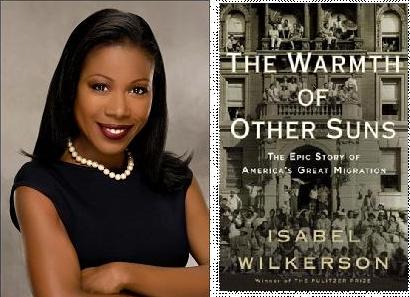
Part IV of four-part Q & A with Pulitzer-winner Isabel Wilkerson on her book, “The Warmth of Other Suns: The Epic Story of America’s Great Migration”
©by Leo Adam Biga
Published in The Omaha Star
The conclusion of my four-part interview with author Isabel Wilkerson explores some distinguishing features of the the migration experience covered in her book The Warmth of Other Suns: The Epic Story of America’s Great Migration.
Wilkerson will deliver a free talk about her book and sign copies April 12 at 7 p.m. at Countryside Community Church, 8787 Pacific Street.
LAB: Blacks migrated to the North and West the way immigrants arrived.
IW: “The only way they could be recognized (as citizens) was to leave one part of their own country for another part. That’s why they’re like immigrants but they’re not immigrants. To me, it makes the story even more poignant because they had to do what immigrants had to to do just to become (full) citizens.”
LAB: Resistance to black migrants led to segregated enclaves that still exist.
IW: “That in and of itself is a tragedy because much of this happened as a result of a complete misunderstanding of who the people were. The people who had arrived in these cities came from different parts of the world but they were all people of the land who had made this great leap of faith, the decision of their lives, and left all that they knew to take this great gamble that life might be better far from home. They landed in these big, forbidding, anonymous cities where their labor was wanted but there wasn’t clarity as what to do with the people.
“All of them were struggling, trying to make a way in this alien place. One group was pitted against the other as if they were direct competition to one another and what one got the other one was losing, and that’s one of the great tragedies of the 20th century, and we are still living with that to this day.”

LAB: Black migrants didn’t think in terms of participating in a movement, but they did.
IW: “It wasn’t a political movement in the formal sense of the word but it had the impact of seeking political asylum or defection, almost in comparison to the Cold War when people tried to get on the other side of the Iron Curtain and had to go to great lengths to do so. This is a similar kind of defection that occurred within the borders of our own country and yet the people who were part of it didn’t see themselves as part of any demographic wave, they saw themelves as making a decision for themselves and their families. Ultimately this was about a search for freedom
“I think the fact they would go to such great lengths is an indication of the desire and desperation and hopefulness they had that this next place will be a good place for me, and where things did not turn out as they hoped there’s a bittersweetness to the outcome for some people because they had made this great leap of faith and basically given up everything in order to take a chance on this place that had become a symbol of freedom for them. When it didn’t work out as they had hoped they then had to sort of regroup within their own minds and figure out how can we make this work in spite of the challenges.”
LAB: What about the black migration do we still not appreciate?
IW: “I came to the conclusion we often ask the wrong questions of any migration.
Was it a success or not a success cannot be answered in totality because each individual family would have a different answer to that question. Ultimately a migration is about determining for one’s self how one’s life is going to be and merely by living they are fulfilling the destiny and imperatives of their migration.
“For those who decided they could no longer live with the repression, they opted to plot out a course of their own choosing, and that is what a migration truly is. By just leaving they are doing the very thing they’re seeking to achieve. The leaving itself is the act of self determination and an act of courage.”
The Omaha Star and The Reader (www.thereader.com) are collecting migration stories. If you or a loved one migrated from the South email leo32158@cox.net or call 402-445-4666 to schedule an interview.

Related articles
- Part I of a Four-Part Q & A with Pulitzer-Winner Isabel Wilkerson On Her Book, ‘The Warmth of Other Suns: The Epic Story of America’s Great Migration’ (leoadambiga.wordpress.com)
- Part II of a Four-Part Series with Pulitzer-Winner Isabel Wilkerson, Author of ‘The Warmth of Other Suns: The Epic Story of America’s Great Migration’ (leoadambiga.wordpress.com)
- Part III of a Four-Part Q & A with Pulitzer-Winner Isabel Wilkerson on Her Book, ‘The Warmth of Other Suns: The Epic Story of America’s Great Migration’ (leoadambiga.wordpress.com)
- Most underreported story in American history (advancedreportingspring12.wordpress.com)
Talking screenwriting with Hollywood heavyweight Hawk Ostby: Omaha Film Festival panelist counts “Children of Men” and “Iron Man” among credits
Another indication the Omaha Film Festival has arrived as a major regional film event is the high caliber of special guests and panelists it continues to attract. The 2012 version counts actress-writer-director Jaime King (see story on this blog) and screenwriter Hawk Ostby, the subject of this story, among its featured attractions alongside the films themselves. My Q&A with Ostby, who with Mark Fergus has written Children of Men and Iron Man, finds him talking about craft, of course, but also about the persistence it takes to make it as a screenwriter. Go to http://www.omahafilmfestival.org for details about the March 7-11 festival and the appearances by King, Ostby, and others. This blog, by the way, is full of more film stories that might interest you.
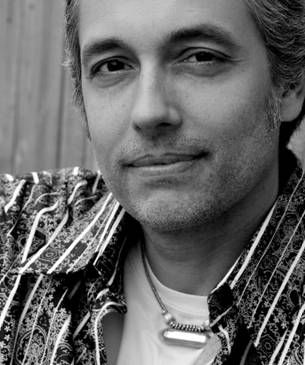
Talking screenwriting with Hollywood heavyweight Hawk Ostby
Omaha Film Festival panelist counts “Children of Men” and “Iron Man” among credits
©by Leo Adam Biga
Appeared in The Reader (www.thereader.com)
Hawk Ostby, one half of the scriptwriting team of Children of Men and Iron Man, will provide an insider’s take on the screenwriting trade at the Omaha Film Festival’s Filmmaking Conference.
Speaking by phone from his Vermont home, Ostby says a big part of making it in the industry is “perseverance and discipline.”
“You really get tested when you start off,” says Ostby, whose writing partner is Mark Fergus. “I was fortunate in that I knew somebody who had a foot in the door, and he said, ‘Look, if you really concentrate for three to five years you’ll be doing what you want to do,’ and I sort of had that tattooed behind my eyelids.
“Three to five years can be a really long time when you’re watching your friends go on to their careers, doing really well, and you’re still tapping away in a sweaty little band box, but then one day it happens. It doesn’t seem so weird or outlandish when somebody calls and says, ‘Hey, we read something of yours and we really like it and we want to try and make it.’ I think in your own mind you fantasize about that moment so often and then when it finally happens it feels right because you’ve done the work.”

Knowing your craft is essential.
“I just was so enamored with the idea of trying to make a living by writing, and I realized I enjoyed it so that it was going to be with me for the rest of my life anyway, so why not knuckle down and really try to learn what it is, what is a story?”
Hollywood seems unattainable but he says he and Fergus prove it’s not.
“Look, I’m not a genius by any means. I just love stories and I stuck with it. It was more like play, and I think if it’s that for you then you’ve got a shot. If you’re trying to get rich or famous, you can do it a lot easier than trying to make it in this business. It’s not really what it’s about. To learn storytelling and all those things it’s a long apprenticeship, at least it was for me. I know there are people who are way more natural who write two scripts and they’re smash hits and they go on to have long careers, but that certainly wasn’t my story, and not Mark’s.”
Collaborators 15 years, Ostby and Fergus play to their respective strengths.
“Mark is very analytical. He can look at a script and say right away, ‘Ah, page 7 is where it goes wrong.’ He’s very clever at those things and I’m not. I’m more instinctual. I’m not sure what’s wrong. I have to take it home to the cave and sort of chew on it. We don’t sit in the same room and fire dialogue back and forth, it’s more of a two-headed thing. We discuss at length the story and how to lay it down, and then Mark will go in, write the outline, sculpt it down to its essence, and then I will take that and do the first draft, and use that as guide for where we want to go. That draft is often written very maniacally and quickly. I don’t stop to edit myself. We used to write and edit at the same time and what happened was we never got the flow of it.”
After each makes another pass, he says, “usually we’re left with a couple things he’s holding onto and I’m holding onto and we just sort of argue those out and whoever has the best argument or is able to convince the other is what we go with. Sometimes we find a better solution spitballing things.”
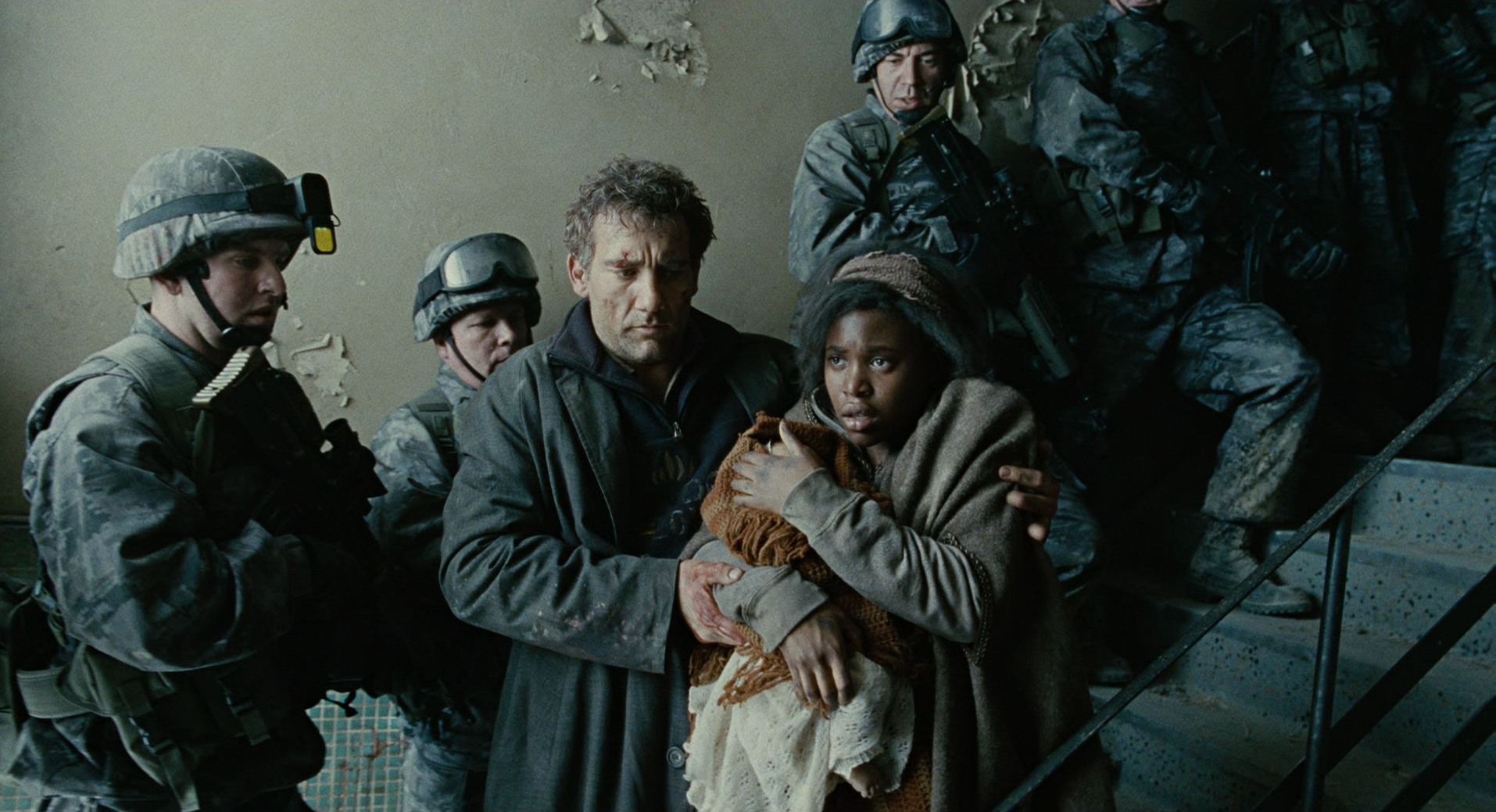
The pair have adapted Philip K.Dick (A Scanner Darkly), a comic book (Iron Man) and an animated film (the forthcoming Akira) but their adaptation of the P.D. James novel Children of Men may have been most instructive.
“If there’s one thing we learned, especially on Children of Men, you can’t always follow the book. It’s just a totally different experience. But if you can capture the feeling of the book then that’s what you’re really aiming for. The book just wasn’t working as a film. What broke it for us is when we came up with this idea that it’s really Casablanca set in a dystopian future, complete with a spiritually bankrupt protagonist who has nothing to live for and then finds something and sacrifices himself for something greater.”
The writers are trying to get a television series and two original feature scripts off the ground this year. One feature puts a twist on the heist genre and the other dramatizes a manhunt in the wilderness.
For details on Ostby’s OFF Filmmaking Conference panels, visit http://www.omahafilmfestival.org.

Related articles
- Model-Turned-Actress Jaime King Comes Home for Screening of Film She Wrote and Directed, ‘Latch Key,’ at the Omaha Film Festival (leoadambiga.wordpress.com)
- Omaha Film Festival Celebrates Seven Years of Growing the Local Film Culture (leoadambiga.wordpress.com)
Model-turned-actress Jaime King comes home for screening of film she wrote and directed, “Latch Key,” atOmaha Film Festival
When Jaime King made the move from modeling to acting I tried getting an interview with her in early-mid 2000s but I never got a response from her handlers. I guess I always figured I would catch up with one way or the other, and as fate would have it she’s coming to me in the sense that she’s coming back to our shared hometown of Omaha with a film she wrote and directed, Latch Key, which means she’s predisposed to promoting it. Thus, I finally got my interview with her. It was worth the wait. She has a great story and it turns out she’s very serious about the writing-directing track she’s on. It also turns out she gets back to Omaha, where all her family lives, with great frequency, which means she’s been closer than I thought all these years. I should note by the way that the Omaha Film Festival is an ever-growing event that increasingly lands major industry figures. In addition to King’s appearance, the fest is rightfully touting appearances by screenwriter Hawk Ostby (Children of Men, Iron Man), actress Famke Janssen, who’s apeparing with her directorial debut Bringing Up Bobby, and actor Chad Michael Murray (One Tree Hill). This blog is full of my stories on film. Look for my Q&A with Ostby in an upcoming post.

©by Leo Adam Biga
Soon to be published in The Reader (www.thereader.com)
In the 1990s Omaha native Jaime King‘s fresh face and lithe body graced the runway fantastic for the likes of Gucci and Alexander McQueen in New York and around the globe. She did provocative shoots for Vogue, Mademoiselle, Glamour, Cosmopolitan and other trendy mags. She appeared in music videos. She was a Revlon girl in the same media campaign as Halle Berry and Eva Mendes.
Heady stuff for a girl in her mid-teens who left Westside High School to pursue The Dream. She actually began modeling at Nancy Bounds Studios here. A New York agent discovered her at a fashion graduation show.
But when King comes for the Omaha Film Festival this weekend she’s arriving not as a model or actress – the career she’s known for today – but as a filmmaker. She’s appearing with a “deeply personal” dramatic short she wrote and directed titled Latch Key. She shot the movie in and around Omaha last winter, using local youth actors alongside industry veterans, including her husband, director Kyle Newman (Fanboys, The Crazies), who’s also one of the film’s producers.
Latch Key shows as part of a short film block on March 9 that starts at 6:15 p.m.
This writer-director thing is no passing fancy. The directing bug bit her in her teens and she angled for years to make her own films, debuting with the short The Break-In (2011). She now has several film projects in development, including a feature she co-wrote, Polar Seasons, that her good friend Selma Blair (who appears in Break-In) may co-star in. King’s interest in writing – she pens a style column for the Huffington Post – goes even further back, to her childhood in Omaha.
“Before I went to Westside it wasn’t that easy for me. I felt like I didn’t fit in. I wasn’t like a jock or a cheerleader or your typical type of kid in that way. I went through a lot of bullying in school. So I wrote a lot and that really helped me to get my feelings and emotions out. All I did was read and write, that was all I really cared about. I so immersed myself in all of these creative things.
“Writing for me has always been the most freeing part of my life.”
At 14 she turned to the pen when her boyfriend at the time died. That experience informs Latch Key, whose young protagonist, Emma, deals with a sudden loss.
“It comes from me having this experience of being young and losing someone very suddenly, and waking up not understanding how the world can continue when your whole world feels like its been shattered.”


Having to grow up fast the way she did informs another script she’s looking to develop, Life Guard.
“I write a lot about coming-of-age and what it’s like to grow up very quickly and how to handle that type of thing. I guess I’m inspired by what we have to go through to become adults or to make our way in this world, but I guess all good stories are about figuring out who you really are.”
Once considered an infant terrible and party girl, she’s many years sober after battling a substance abuse problem. She long ago made the successful transition from modeling to screen acting (Happy Campers, Blow, Pearl Harbor, Slackers, Two for the Money, Sin City). She has major roles in a pair of films due for a 2012 release: Pardon and Mother’s Day. She also stars in the CW comedy Hart of Dixie.
Does she harbor regrets about having gotten swept up in the high-pressure model subculture, with its ultra-thin obsession, stealing away as it did part of her youth?
“Not at all. I feel very blessed, I feel everything that’s happened in my life has been perfectly on track for me, through the ups and the downs, through everything, and I feel so incredibly lucky that I was discovered and that my parents stuck with me and made a difficult decision to let their young daughter go off into a big world.
“Through modeling I got to travel all over the world and I got to meet some of the most amazing people, and I was smart, I saved my money and I knew I wanted to go into filmmaking.”
Besides, being a model was her idea from the start. Always interested in fashion, style, photography and film, she set out to get noticed, make it to New York and use this platform as a springboard to a film career.
“I wanted to live a very creative life and not necessarily taking the traditional route of going straight through high school and onto college. I just didn’t feel that was right for me. I needed to be doing something creative. It may seem odd for someone that age but I just knew that was my direction.
“As an adult now looking back I feel a lot compassion and gratitude towards my parents for letting me foliow my dreams.”

King’s made it all happen, too, though walking away from lucrative modeling gigs didn’t set well with her entourage.
“When I told them I was quitting modeling at the height of my career people weren’t happy about that because they were making a lot of money off of me, but I was lucky to have some people who were supportive.”
She still does fashion spreads.
Of the high profile film roles she landed right out of the gate, she says, “It was just one thing after another and I think it happened because I never doubted myself, I went into it thinking that’s what I was meant to do.”
Acting’s worked out better for her than it has for many former top models. And as much as she finds that career satisfying she needs more to feed her creativity.
“I don’t feel completely whole just doing that. I feel whole when I’m writing and directing and acting, when I’m creating material and stories that I feel should be told and will move and entertain people,” she says. “As a creative person you just want to create.”
She could have made Latch Key anywhere but she felt pulled to do it in her hometown, where her entire family still lives and where she gets back to visit a few times a year.
“I have a really romantic view of where I was born and raised,” she says. “I have these very distinctive memories of every single season in Omaha and what it felt like to grow up there and to have a space of your own where you could run along the train tracks and be out in a park or farm by yourself or yet be in the Old Market and go find a great record or comic book or see a great show or concert.
“So much of my creativity started there, and I feel like there’s a great creative community there. I just really want to honor that.”

Her sister, Sandi King Larson, put up Jaime, her husband and two fellow producers and let her home stand-in as Emma’s dwelling.
King says she received excellent cooperation from Young Filmmakers In Nebraska in filling out the crew and from Ralston Public Schools officials in letting her use Ralston High School as a location. King had an inside woman there in her sister, who works at the school. The head of Ralston’s drama department, Todd Uhrmacher, helped King cast via Skype auditions-interviews. Alexis Jegeris, who plays Emma, is among several Ralston students in the film.
King says she was impressed by how her young cast “were really willing to go there for a film that’s very honest and raw and real,” adding, “I cant’ wait to come back for the film festival to show the kids what a beautiful job they did.”
Related articles
- Omaha Film Festival Celebrates Seven Years of Growing the Local Film Culture (leoadambiga.wordpress.com)
- Joan Micklin Silver’s Classic ‘Hester Street’ Included in National Film Registry (leoadambiga.wordpress.com)
- Vincent Alston’s Indie Film Debut, ‘For Love of Amy,’ is Black and White and Love All Over (leoadambiga.wordpress.com)
- From the Archives: Conquering Cannes, Alexander Payne’s Triumphant Cannes Film Festival Debut with ‘About Schmidt’ (leoadambiga.wordpress.com)
- Nancy Bounds, A Timeless Arbiter of Fashion Beauty, Glamour, Poise (leoadambiga.wordpress.com)
Having survived war in Sudan, refugee Akoy Agau discovered hoops in America and the major college recruit is now poised to lead Omaha Central to a third straight state title
2018 UPDATE: Since writing this story about Akoy Agau, the most heavily recruited Nebraska prep baskeball player in years, his collegiate hoops journey has gotten complicated. He started at Lousiville, then transferred to Georgetown, then detoured to SMU and now he’s back at Lousiville. A book about the places that basketball has taken him comes out the end of this year by Omaha native and Central High grad Steve Marantz, who authored a previous book, “The Rhythm Boys of Omaha Central,” that dealt with basketball and social upheaval.
UPDATE: I have no idea if Akoy Agau is even considering Nebraska or Creighton or UNO, but any local hoops fan has to hope that one of the three in-state Division I programs manages to land him. If you saw Agau lead Omaha Central High to the Class A state title against Omaha South the other night then you saw what a difference maker he can be. If you didn’t see him, then all you need to know is that he had 16 points, 13 rebounds and 14 blocks. That’s right, 14. It’s not the first time he’s put up numbers like these in the state tournament and with his senior year to go and Central returning far more than just him it’s a sure thing, barring injury, that he will dominate the tournament again next year. The University of Nebraska needs him the most. The program is mired in medicority and it needs a boost to go along with whoever the new head coach is going to be because it’s going to be players not coaches who turn things around and Agau is the type of player you can build a program around, especially if you surround him with eight or nine other legit prospects. Creighton is of course a rock solid program by comparison but a mid-major like CU is always in a precarious position and it needs him to infuse local talent into a program whose best players come from Iowa and everywhere else but Nebraska. When Antoine Young departs after this season there will not be a single scholarship player from the state left in the program. The fact that Agau is an Omaha Public Schools student and a rare quality big man would help solidify the program over the next five-six years. UNO is the least likely to get him but imagine what Agau’s presence could do in raising the profile of this fledgling D-I program. He could help turn it from a pretender to a contender in a very short time. Chances are, Agau will not stay home but instead take his considerable upside somewhere else. I hope I’m wrong.
Most of my writing these days covers the arts-culture-creative scene but I still jones to do a sports story every now and then, and here’s a new one for The Reader that I am fond of. It profiles Akoy Agau, a 17-year-old junior at Omaha Central High School, where he is both a top student and a major college basketball recruit whose team is heavily favored to win its third consecutive Class A (largest class in Nebraska) state title. Agau is not only very tall at 6’9 he is highly skilled and athletic, which makes him the rare quality big man in these parts. His story takes on another dimension when you add to it the fact that he and his family are Sudanese refugees who were displaced by war in their homeland and he was only introduced to basketball after he came to the States, where he’s adapted remarkably well and progressed his game at an exceedingly fast pace. He has another year of high school ball ahead of him, and then it will be off to play collegiately somewhere. Whether or not he becomes an impact player at that next level is beside the point given how much he’sovercome and how far he’s traveled.
Having survived war in Sudan, refugee Akoy Agau discovered hoops in America and the major college recruit is now poised to lead Omaha Central to a third straight state title
©by Leo Adam Biga
A truncated version of this story was published in The Reader (www.thereader.com)
In this sparsely populated state where basketball’s never fully taken root, the annual hoops crop is slim pickings, especially when it comes to big men. Only rarely does a promising post player emerge on the high school scene here and it’s even rarer for one to do much at the next level.
All of which explains some of the intrigue attending Omaha Central junior Akoy Agau, the intimidating 6’9, 230-pound inside presence for the two-time defending state champion and season-long No. 1 ranked Eagles. Only recently turned 17, he’s still growing physically and adding to an already formidable skill-set. A scary proposition for opponents. An enticing prospect for the many colleges recruiting him.
With five championships in the last six years, Central’s a dynasty program. Success only begets more, as the metro’s best talent now flocks to the old downtown school on the hill. Despite producing many all-state players, Central hasn’t had a really good big man since star-crossed Dwaine Dillard in the late 1960s. Until Agau.
He’s not only tall, he possesses a huge wing-span, can jump and run the floor better than most kids half his size and shows uncanny timing and instincts for blocking shots. Though he must work on his post moves, ball-handling and jumper, he displays a soft touch around the rim, in the lane and outside.
Adding to interest in him is how this South Sudan native, who never heard of basketball in Africa, came to be in Omaha at all, much less play at a high level. He lived with his refugee family in Khartoum, Sudan and in Cairo, Egypt for the first six years of his life owing to civil war and famine in his homeland.
His Christian Dinka family came to the United States. through a church-based NGO, settling outside Baltimore, Maryland in 2002. All his mother, Agaw Makeir, knew about the U.S. was that it was far off. Fears about not knowing English or American ways were eased by assurances that just as missionaries helped them in Africa other good samaritans would help them here.
“We put that in our head and our heart and said, ‘OK, let’s go.’ It was our dream to come here and for our kids to be able to come here and go to school and have clothes and shoes and sleep at night and not worry about the gun and that people are going to attack you in your home,” she says. “It was a very beautiful thing to come here.”
After a year in Maryland the family moved to Omaha, where refugee relatives preceded them. Omaha is where Agau was introduced to basketball. Central coach Eric Behrens first laid eyes on him when the then-14-year old was shooting hoops one summer day at the outdoor court adjoining the Mason Apartments that the Agaus and other Sudanese families resided in. The youth’s size naturally peeked the coach’s curiosity. Behrens got to know him at Norris Middle School, where Agau attended and where Central often practices. As the Norris basketball team would wind up workouts Behrens and Co would arrive. The two formed a bond. Yet Behrens was surprised when Akoy elected to go to Central because most Sudanese student-athletes were opting for Bryan.
Sudanese players have made their mark in the metro since the mid-2000s. Koang Duluony went to Indiana State. Mading Thok is headed to Ball State. But Agau is, as Husker hoops color man and former player and coach Andy Markowski puts it, “the whole package” compared to those earlier “projects.”
Agau’s made most of his considerable progress since 7th grade, when he first got serious about playing. He’s excelled with Team Nebraska select clubs, balling all over the city, often with older players. The last few summers he’s gone to elite AAU camps and tourneys around the nation to hone his game and raise his stock.
Upon meeting him the first thing that impresses you beyond his size is his composure and confidence. Struggling to survive and assimilate gave him life experiences rare for an American teen.
“It was a wild journey,” he says of the his family’s crucible.
He’s sure the journey wizened and toughened him.
“Sudan’s a lot different than here obviously. We had to work for a lot more things. When we needed to get things we had to go a far distance. I didn’t go to school, it was too far away. It was really hard. I think some of my maturity is because I really had to work hard when I wanted things. My parents taught me you have to work for everything you want. It’s just something that’s carried on and helps with everything I do.”
The war in Sudan did more than disrupt life, it claimed the lives of several loved ones. Akoy’s father Madut Agau lost his first wife. Akoy’s mother lost her father and five siblings.
The tranquility and pristine countryside Makeir knew growing up was shattered by conflict. “Then come the war, you could see all the grass and trees burned down and it didn’t look like home no more,” she says. “A lot died there. We saw a lot of people dying. We couldn’t help them.”
The family fled attacking government forces and warring factions. Once, Makeir fled with 3-year-old Akoy on her back an infant in her arms. Months on foot exposed them to danger and death by starvation, disease, wild animals, violence. Years of subsistence living in tent city refugee camps short on food and water gave way to starting over in America, where the family scraped for every dime and depended on the kindness of strangers until Akoy’s father found steady work at the IBP meatpacking plant in Denison, Iowa. The elder Agau stays there during the week, coming home weekends to be with his wife and children.
Having made it out the other side alive, Akoy exhibits a poise beyond his years. As a tall African refugee with a talent for the game, he’s the center of attention wherever he goes but he seems comfortable in his own skin.
“Very mature, very much so,” says his coach, Eric Behrens. “All those things that make you stand out, you can handle it in one of two ways – either you embrace it and you go the extroverted route or you kind of shy away from it and squeak into the corner. It’s hard to be in the middle when you’re a guy that gets a lot of attention like that. He’s definitely embraced it and fits in really well.
“He’s very outgoing. He knows kids from every different social setting. He’s a real popular kid. He’s good with adults, too, Very articulate. He knows how to speak to teachers. He’s like in four honors classes. He’s a really bright kid.”
And he can play a little, too.
Observers rate Agau as the state’s best Division I college basketball prospect, period, since Erick Strickland and Andre Woolridge in the early 1990s. Strickland and Woolridge were small guys though.

Behrens, a standout at Central himself in the early ’90, says, “I think defensively he has to rank among the all-time greats in Nebraska. His offensive game continues to develop but he has a chance to be really good on that end as well.”
The few big men from Nebraska who’ve attracted power conference suitors and made an impact in big-time college hoops include Rich King, Dave Hoppen and Chuck Jura.
“I didn’t get to watch Chuck Jura or Dave Hoppen or guys like that,” says Behrens, “so limiting the conversation to the last 15 or 20 years, Akoy’s as good as anybody since I’ve been around it. I can only think of Matt Hill (Lincoln Southeast / Texas) who would be in the same conversation as far as big guys go.”
Ranked a 4-star, top 100-150 recruit, Agau’s projected as a legit major or mid-major contributor in college at the power forward spot. The fact he’s come so far in such a short time bodes well for his future hoops.
He was barely 15 when he started for Central as a freshman. He was a factor right away but still largely a role player. His profile dramatically rose in the 2010 state finals when he erupted for a monster game versus Norfolk, recording 18 points, 15 rebounds and 9 blocks. His near triple double helped lock up the title and served notice Central would be all but unbeatable with him around.
He didn’t look it, but that big stage freaked him out.
“Well, first of all, that was probably the most nerve wracking game ever. When we were in the locker room Coach Behrens was like, ‘There’s a packed house and probably most of them are for Norfolk.’ I went out ready to warm up, looked up and saw so many people, and I turned around and ran right back to the locker room. I was so nervous, it was the scariest thing. But then once the game started everything was just normal. I basically just played and didn’t think about it.
“And truthfully I didn’t think I had that great of a game. I just went out there and played like I usually do, and then they told me the stats and I couldn’t believe it.”
A year later at state he and his team once again found themselves matched up with Norfolk, only in the semifinals, and this time he got his triple double with a 11-10-10 line. He went on to lead Central to the championship against Bryan.
Norfolk head coach Ben Ries, whose No. 2 ranked Panthers could face Agau and Central again at state this year, says, “He is the most dominating defensive player to compete at our level. His timing, length and athleticism pose a great challenge for every team. What has been impressive is his ability to be unselfish and know his role. When Central combines their athleticism on the perimeter with Akoy’s ability to protect the basket it becomes a struggle to score.”
With Agau and 6’6 Tre’Shawn Thurman choking the paint, contesting any shot launched near the basket, and smaller teammates pressing, Central held foes to a stingy 34 percent field goal mark. In the regular season the Eagles had 153 blocks to their opponents’ 22. They forced 470 turnovers, committing only 309.
At 27-0 entering the 2012 state tournament, Central is the overwhelming favorite to repeat as Class A champs this weekend at the Devaney Center in Lincoln. The Eagles dominated the regular season, winning by an average score of 71 to 45, and its most dominating player by far is Agau. He normally puts up modest stats, averaging about 12 points, 6 rebounds and 2.5 blocks per game. But as anyone who’s ever seen him play will tell you, it’s the intangibles that make him a difference-maker on a remarkably well-balanced squad that pressures foes with quickness, height, leaping ability, a deep bench and effective passing.
They get lots of steals that lead to fastbreak layups and dunks.
Behrens appreciates his big man not being a prima donna.
“He’s a great teammate. For as much attention and for as many Division I scholarship offers as he has he’s very unselfish. He’s really just focused on winning – whatever that takes, and that’s a really nice thing for us coaches and for his teammates to have, and it’s kind of rare.
“And he’s a real leader on the team. He’s really good at knowing when a guy needs a kick in the butt or a pat on the back. Plus, he’s a hard worker, both in the team stuff we do but also in terms of individual skill work he does outside of that, and that’s why he’s got so much better – he works at it, he works very hard at it. And he works hard in the weight room, so he’s gotten a lot stronger.”
On a team without a star, Agau is its MVP. When he fouled out of the regular season finale versus Bellevue East the Chieftans made a run. He sat out the district opener recovering from minor knee surgery and in his absence lowly Northwest played Central even until the Eagles pulled away at the end, among the few times anyone’s hung withthem that long. The lead is usually double digits at the half and the game long decided before the final quarter.
If Agau leads Central as expected to the Class A title, he will be three-fourths of the way toward a goal he set as a 13-year-old.
“It’s a funny story,” he says. “Since middle school I’ve been saying to my friends I’m going to win four state titles. I have this big thing where I would win four state titles and then when I win the fourth title when they interview you on TV after the game that’s when I’ll make my (college) decision public. But I don’t know if it’ll be all that.”
Local fans would love to see him end up a Husker, Bluejay or Maverick, but his offers extend far beyond Nebraska. He’s not hinting which way he’s leaning, though his mother makes no bones about preferring him to stay close to home.
“That’s something we talk about a lot,” she says. “We tell him if he would go to a different state it would be hard for us. Bur if he goes away that will be fine with us, too.”
Her fondest wish for the family’s move to America was for Akoy, her eldest, “to try and help himself for his future” and for all her kids to take advantage of opportunities unavailable in Sudan.
“I always tell them, ‘You guys are blessed to be here, and you should be happy for what you have,’ because what they have – me and their dad we didn’t have that. We didn’t have good school, good home.”
She’s thankful her kids can “focus on school and education.” She’s thankful, too, that Akoy is thriving and setting a good example for his brothers and sisters. “He’s a good big brother. We hope his brother Magay will follow him.” Magay is a very tall and talented freshman at Central.
The fact that Akoy still retains the Dinka language and some Arabic also pleases his mother, who keeps Sudanese cultural traditions alive at home.
There’s a conspiracy of hearts when it comes to Akoy, whose mother counts as allies and advisors Scott Hammer and Coach Behrens. With so many adults looking after his best interests, she says, “we teach him from both sides.”
Agau says his parents “don’t really understand” the sport or the success he’s enjoying, though his mother understands enough to say, “basketball is good for his college.” A family that had no prior exposure to the sport will likely have part of its American Dream realized through it. None of it may have unfolded under different circumstances but as Agau says, “We don’t dwell on what would have happened if we would have stayed back in Sudan, we just focus on being happy where we are now and what we have. We’re very grateful. Being able to go to school and get our education is most important. Getting to play basketball is an extra.”
Still, he’s keenly aware basketball is his ticket to larger opportunities. He’s also aware of the attendant expectations and hype that come with success.
“I can’t really get focused or take too seriously all these things people are saying about me. I just keep focusing on what I’m doing and just keep going to the gym and getting better because, personally, I don’t think I’ve done anything yet. I’m still in high school, there’s the next step of graduating from high school and then going to college. I still have a lot to do.”
That same low-key, taking-care-of-business attitude permeates the Central program. It helps explain why the Eagles have played consistently well, avoiding the lulls that happen when teams take opponents for granted or get too far ahead of themselves or get too full of themselves. It’s why the pressure to live up to being the Nebraska prep version of the high-flying Phi Slamma Jamma hasn’t derailed them.
Typically, Akoy takes it all in stride.
“That pressure is there now because everyone expects us to be good. We’ve been playing really well, so everyone expects us to win the state tournament. We just have to make sure we keep on getting better individually and as a team in order to be able to win state again.”
He has another year of high school ball ahead of him, and then it will be off to play collegiately somewhere. Whether or not he becomes an impact player at that next level is beside the point given how much he’s overcome and how far he’s traveled.
Related articles
- You: Sudan accused of fresh crackdown on Ethiopian opponents (menafn.com)
- Op-Ed Columnist: In Sudan, Seeing Echoes of Darfur (nytimes.com)
- Bombing attacks increase on Sudan border (foxnews.com)
- UNHCR seeks urgent aid for Sudanese refugees (devex.com)
- Omaha Hoops Legend John C. Johnson: Fierce Determination Tested by Repeated Run-Ins with the Law (leoadambiga.wordpress.com)
- From the series Out to Win: The Roots of Greatness – Black Women Make Their Mark in Athletics (leoadambiga.wordpress.com)


 Leo Adam Biga's My Inside Stories