Archive
Blue Tango Project features mash-up fusion of Latin rhythms, jazz and blues at its only Omaha performance
Blue Tango Project features mash-up fusion of Latin rhythms, jazz and blues at its only Omaha performance–
7 p.m., Friday, Oct. 16,
Joslyn Castle, Omaha, 3902 Davenport St.

AND NOW FOR SOMETHING COMPLETELY DIFFERENT
On Friday, October 16 at 7 p.m., Argentine Latin Grammy nominee singer-songwriter-acoustic guartist María Volonté and acclaimed California harmonica player Kevin Carrel Footer bring their Blue Tango Project to the Joslyn Castle in Omaha.
It is one of only two Midwest stops on the Blue Tango tour.
Hailing from the colorful and gritty La Boca neighborhood of Buenos Aires, Blue Tango Project is a ground-breaking exploration of the emotional and musical crossroads where tango and the blues embrace.
Volonte has been dubbed “Tango’s shimmering star!” (Global Rhythm). A member of the Tango Hall of Fame, she’s gathered a fervent international following which keeps her touring constantly. She’s conquered the world of tango with numerous award-winning CDs. This musical innovator’s current projects explore the fusion of Argentine music with other Latin American rhythms, jazz and the blues.
Kevin Carrel Footer (KCF) is an artist deeply inspired by the intense passions of tango and Buenos Aires. In words, images and music, he explores those twin passions in unexpected ways. He is the author of the book “A Tango before I Die” (2013). His photographs have been published in international magazines and graced the covers of award-winning CDs.
These two artists innovative fusion of tango with the blues, their genre-bending compositions and passionate live performances have thrilled audiences on three continents. Their latest CD “Blue Tango” (2014) captures the raw intensity of their live shows.
Enjoy old and new world rhythms in the beauty of Omaha’s only Scottsh Baronial castle. Let the multicultural vibes run free! The Castle is located at 3902 Davenport Street.
For more info, visit http://www.bluetangoproject.com/
Tickets are available at http://joslyncastle.com/. Cost is $20 for general admission; $15 for seniors, students, & military.
Omaha couple unofficial ambassadors for Ghana, West Africa

Omaha couple unofficial ambassadors for Ghana, West Africa
©by Leo Adam Biga
Now appearing in the Omaha Star
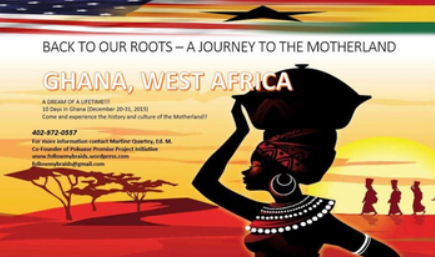
Omaha couple Martine and Sam Quartey’s passion for Ghana finds them promoting aspects of that West African nation through various cultural, commercial and charitable activities. One of their activities is an every-other-year group trip they lead to Ghana, where Sam was born and raised. They organize the trip via their own S&M Tours. The next tour is scheduled December 20-31. Reservations are closed.
They call their tours Back to Our Roots – A Journey to the Motherland. This time around the couple will take a travel party of eight to see various sights in and around the capital city of Accra and the country’s next largest city Kumasi. Among the historical spots they will visit are some of Ghana’s coastal slave castles where thousands of Africans were detained against their will bound for slave trade ships making The Passage to the Americas and the Caribbean.
Sam Quartey, who works as an automotive mechanic, said it’s not unusual to see visitors cry upon touring the slave castles. “It’s a big story and very emotional,” he said.
Martine Quartey said she found herself “overwhelmed” by the experience.
With its southern border situated on the Atlantic Ocean, Ghana today is a tourist magnet with stunning beachside resorts and history-laden landscapes. Rich in mineral deposits and in cocoa production, the country is more developed than many first time visitors expect.
The December tour will be the fourth the couple’s led to Ghana. They enjoy introducing travelers to a continent and a nation they feel has much more to offer than many realize.
“There’s a lot to see – the beautiful scenery, the vivid colors and bold patterns of the clothing, the entrepreneurial spirit of the people, the bustling markets, the highly developed cities,” Martine said. “There’s also the painful history of slavery and colonization and the successful bid for independence.
“We invite people to take the journey with us, to cross those bridges and cultural boundaries to experience something they don’t expect to find.”

Ghana, like all of Africa, is known for the warm hospitality of its people. Americans are well-received, Martine said, but for African-Americans it truly is a heritage homecoming with deep currents.
“Because we are of our ancestors, we are returning in a sense and Ghanians greets us by saying, ‘Welcome back my sister, welcome back my brother.’ It’s so beautiful to hear that because finally you feel like you’re at home.”
Ever since she met Sam she has been fascinated with his homeland and she has developed an appreciation for its food and fashion, among other things. She and Sam often dress in Ghana attire and he cooks many traditional dishes. He is president of the Ghana Friendship Association of Nebraska (http://www.ghanafan.org/). The organization holds events that keep alive traditional culture for Ghanians living here, it helps new arrivals from Ghana adjust to American life and it supports schools and clinics in Ghana.
Martine made her first trip to Ghana in 2011, a year after the couple married. Whenever the couple go they bring back authentic garments and accessories as well as natural bath and beauty products because they and Omaha’s resident African community crave such hard to find items here. There is also high demand by local African-Americans for Ghana-ware and incidentals.
Requests for these goods got so frequent the Quarteys saw a business opportunity. Thus, they opened their S&M African Boutique in August. The small store at 6058 Ames Ave. features a surprisingly large array of fashion, bags, jewelry, art, fragrances, oils and shea butter products.
“The boutique is kind of birthed out of feedback we were getting from friends and family” to have these things year-round,” Martine said.
S&M African Boutique is open only on Saturdays from 10 a.m. to 5 p.m. Visit https://www.facebook.com/SandMAfricanBoutique.
The Quarteys have also formed the Pokuase Promise Project Initiative to support a school they adopted in the village of Pokuase. Sam’s grandfather settled the village. Sam’s father and uncle followed as village leaders. In a spirit of giving back, the couple collect donated supplies (books, computers, markers) they variously ship or personally deliver to the school serviing elementary through senior high students.
To consolidate their school assistance efforts, the couple are building an International Headquarters house in nearby Accra. It will have ground floor storage bays for supplies and a second story private residence. When in Ghana the Quarteys will stay and operate the Pokuase Project from there. They hope to have someone run the Project in country when they are back in the States.
The International House also represents Sam fulfilling a commitment he made to his late mother. The family owns the land the house is being constructed on and Sam’s mother made him promise to do something of substance on it.
“I told my wife about it and she said, ‘Yeah, let’s honor her wishes,’ so we started the project,” Sam said.
His dream is to build a library for the school and dedicate it to the man responsible for him coming to America, the late Bishop William Henry Foeman, who was a much revered and recognized foreign missionary. Sam and his oldest son lived for a time with Foeman, who came to Omaha to pastor Mount Calvary Community Church, where Sam is still a member today.
Working with the school is meaningful to Martine, an education professional. She is an administrative assistant in the Omaha Public Schools’ superintendent’s office and a part-time adult education instructor at Metropolitan Community College.
The Quarteys’ Ghana work is borne of a love that keeps expanding.
“It’s a beautiful thing because it’s blossomed,” Martine said, “and it’s all connected. We have our trips, we have our boutique and we have the school.”
There is also the blog she writes, “Follow My Braids, I Love Ghana, West Africa” at https://followmybraids.wordpress.com/.
The couple are available to speak about Ghana to media and groups.
They will soon be taking reservations for a late fall 2017 trip to Ghana.
For more information, call 402-972-0557.


 Independence Arch (a part of the Independence Square – represents Ghana’s struggle for independence from Great Britain)
Year of the Startup invites entrepreneurs to come on-a my house
Omaha is all the rage as a burgeoning startup community and one of the latest hotbeds to emerge as an incubator and accelerator for entrepreneurs to grow their new ventures is the live-in model embodied by Year of he Startup. Sabastian Hunt and Jason Feldman have created an urban visionhouse where a snall, curated group of entrepreneurs reside while they nurture and cultivate their startups.
Read my Omaha B2B Magazine (http://omahamagazine.com/category/publications/b2b-magazine) story about how Hunt and Feldman have created this startup as a way to support fellow entrepreneurs and their startups in a communal setting that is residence, brainstorming center, vetting opportunity, office space, laboratory and discussion forum all in one.

Jason Feldman and Sebastian Hunt
Year of the Startup invites entrepreneurs to come on-a my house
©by Leo Adam Biga
Originally appeared in Omaha B2B Magazine (http://omahamagazine.com/category/publications/b2b-magazine/)
The emerging startup accelerator scene supports creative-minded risk-takers looking for an edge to follow their passion and to bring their ideas to fruition.
Sabastian Hunt. 25, is passionate about giving entrepreneurs like himself a nurturing space to test out their concepts. The University of Nebraska at Omaha economics graduate did internships with various local employers and surveyed the area startup community when an idea struck him for a by-application, curriculum-based residency program serving new entrepreneurs. That inspiration turned into Year of the Startup.
Since launching in 2014, the program’s operated out of a humble house at 4036 Burt Street in the St. Cecilia Cathedral neighborhood. Hunt and co-founder Jason Feldman, 28, room there with young residency fellows whose startup ventures range from making bio-fuels to providing night owl shuttle services. They are a millennial bunch who favors sneakers and sandals. They take informal meetings at nearby CaliCommons and Lisa’s Radial Cafe, They variously hunch over laptops or tablets and carry smart-phones as appendages.
This communal work-live space model for business mavericks is new to Omaha. The usual startup accelerator is a concentrated 90-day off-site program. Omaha has a few, notably Straight Shot. Hunt saw a need for a program that invites a broader range of people into the accelerator fold and that supports them much nearer the start of their dream than other programs typically do.
“We feel like we can take people very early stage because we are four times as long as the average program,” says Hunt, who adds that Year of the Startup is also not tech-centric like many programs tend to be. “In our model we substitute intensity for duration. I think a lot of the learning here comes through unstructured, serendipitous interactions we have that is not curriculum-based, it’s just happenstance.
“With a house there are so many different ways you can bring ideas and people together. I think that’s maybe that critical binding agent and sense of place that helps accomplish things.”
He says in this intimate environment “there’s no other choice but to immerse yourself in the setting,” adding, “We’re always hanging out in the living room or out back talking about startup stuff – monetization strategies, capitalization tables, vested equity entity structures.”
“It’s this immersive experience of camaraderie, of these natural flows and idea generation,” Feldman says.
Hunt says, “This is very difficult to get bored with because there’s always somebody whose business is either in crisis or growth stage or some interesting part of the curve.”

“How could we get bored when we’re creating a platform with four startups and all we get to do is ideation,” Feldman says. “It’s a constant buzz we get from interacting with these startup founders and helping them build their ideas.”
Built into the program are activities that encourage fellows to break out of their comfort zone and to offer honest criticism of each other’s ideas.
Hunt compiles multiple data points on the startups.
“We’re developing really deep insight about how do people start successful businesses.”
The program utilizes mentors from the entrepreneurial community.
“We bring in people who are experts in specific areas to talk on those topics,” Feldman says.
“They get ideas flowing,” Hunt says of the mentors.
Feldman says he regularly covers with fellows “the major components of what you need to look at to start your business” and then mentors like Mike Kolker, owner of graphic design firm Simplify, teach lessons about operational efficiency and “how to simplify running a business.”
Hunt is a newcomer to all this and has gone by instinct as much as research to support his vision.
“I just had an irrational confidence, market insights and a great theoretical background thanks to primary research I completed and to lessons I learned from Phillip Phillips, Michael O’Hara and Art Diamond in UNO’s economics department. I read constantly about who the players were in the startup world, so I was fairly prepared.”
Even though he directs a startup program, he’s only now participating in one himself (Venture School). He acknowledges Year of the Startup is a by-the-seat-of-your-pants experiment.
“Coming out of college I had student loans and not a ton of money. I’ve held two jobs to finance the project. Now the project is financed by a combination of me working and renting out one room. One-hundred percent of the money our entrepreneurs pay in rent will be returned in full and so everybody has a strong incentive to follow through with the program. That may be what makes us sustainable.”
He’s working on securing corporate sponsorship for the program. Meanwhile, he wants to help get participating startups to the next level.
“We’re functioning like a pre-accelerator at this point. We want to get our startups profitable and then refer them to the Straight Shots, so they can focus on growth in a pure accelerator program.”
With Year of the Startup moving into a larger house in Omaha’s Little Italy district on July 1 and a new class of fellows arriving in the fall, Hunt says there are “interesting talks happening right now to bring this to other cities.” He and Feldman say economic development agencies are willing to pay a license fee for them to do startup houses in other cities. The partners are having proprietary software developed that will enable new startup houses to replicate their branded Omaha model.
They look forward to engaging with the emerging 10th Street cultural district but may keep the midtown house to accommodate growth.
Hunt and Feldman believe they’re catching the wave or tipping point of a big new startup rush and they’re betting their model is poised to be a niche player in this wild frontier of entrepreneurial prospecting.
Visit http://yearofthestartup.com.
Lit Fest delves into what we fear, how we relate in extremis
By now, anyone familiar with the (downtown) Omaha Lit Fest knows that it is the epicurious and somewhat eccentric run off from whatever spills out of the overactive mind of founder-director Timothy Schaffert, who just happens to be one of America’s finest novelists. His intellect, imagination and interests run deep, as do that of his writer friends, and so every year he concocts a distinclty stimulating event that plays very much like his own personal salon. His 2015 Lit Fest on October 16-17 at the downtown W. Dale Clark Library features, as always, a diverse collection of national, regional and local authors who will participate in panels moderated by Schaffert himself. There are also exhibitions and other activities centered around literature. The theme for this fest is Nervosa: Science, Psyche & Body and that’s just both specfic and open-ended enough to give writers and readers alike a fertile field to play in.
Lit Fest delves into what we fear, how we relate in extremis
©by Leo Adam Biga
Originally appeared iin The Reader (www.thereader.com)
The 2015 downtown Omaha Lit Fest, whose theme is “Nervosa: Science, Psych & Story,” celebrates the reflective power of literature to explore human vulnerability.
Worry over terrorism, the economy, climate change, the singularity, genetic engineering and zombie apocalypse dread is backdrop for the free Oct. 16-17 fest at the W. Dale Clark Library.
The 6:30-9:30 Friday night opening party, Anxiety, features the Poetry Brothel by burntdistrict literary journal, paintings and drawings by Eric and Shari Post and wire and book sculptures by Jay Cochrane.
Starting at 1 p.m. on Saturday founder-director-novelist Timothy Schaffert (The Swan Gondola) moderates panel discussions and interviews with local and visiting authors.
The intimate annual fest plays like Schaffert’s personal salon.
“If you don’t like me you probably won’t like the show,” he quips .”I have the freedom to develop it the way I want and I do so with the support of the Omaha Public Library. They let me invite who I want to invite, they provide the space and they promote the event. It’s exciting to take on a project that isn’t mired in bureaucracy.”
He arrived at this year’s theme by noting what authors in his lit circle were writing about. He feels these times induce a collective high tension literature’s better prepared to reflect than social media.
“Literature is really competing with the social networks for that immediate connection people are seeking with each other and their desire to remain on top of every horrifying incident that occurs in the world. Ultimately there can be this overwhelming sense of everything is treacherous, that there’s terror waiting at every turn.”
He says where online communiques incite anxiety, literature brings analysis and rumination.
“We read books differently than we read most other text. We immerse ourselves in the world of the story. We’re looking for authoritative voice, for unique and useful perspective, and that requires a great deal of attention. A book calls for you to put everything else aside to spend time with it and to let the writer speak. I think that has historically been soothing to readers.”
For the panel “Diagnosis” two Omaha doctor-authors will discuss drawing on medical backgrounds in writing.
Retired transplant surgeon Bud Shaw says, “My essay ‘My Night with Ellen Hutchison’ is about a devastating personal and professional episode in my early career.”
“As I sat down to write about it, I discovered just how stubbornly I still held onto a version of that story that blamed others, that let me off the hook for the death of a patient during a liver transplant. I had to revisit that night over and over again for weeks to reconstruct a view that wasn’t about the cause of the failure so much as it was about the results. It wasn’t easy. I needed a fresh and far more human perspective, and that required a lot of processing I hadn’t done before. Now I don’t seem able to stop.”
His new book is Last Night in the OR: A Transplant Surgeon’s Odyssey.
Practicing physician Lydia Kang writes young adult sci-fi novels and scientific thrillers (Catalyst, Control).
“I find myself drawn to particular stories and struggles and often there is a medical-forensic-genetics aspect that happens along the way.”
Researching a congenital breathing disorder led Kang to cast the hero of Control with that condition.
Kang says wanting to “explain the details, whys and hows of things” in prose can result in “too much info-dumping.” “Curating the details for the sake of smooth reading and the storyline must work in concert with doing factual justice to the fictional patient and scenario.” Through her blog she consults writers dealing with health-science matters.

Schaffert is “fascinated by any effort to make science more readable and accessible.” At the University of Nebraska-Lincoln he teaches a Humanities in Medicine Minor course, “Illness and Health in Literature.”
“We look at everything from science journalism to personal essays.”
Another panel with Neb. writers will consider “Treachery” and outcasts. Novelist Douglas Otis Wesselman, aka radio host Otis Twelve, says, “Treachery is best understood by the old. We’ve had more practice at it – from both sides. We come to know we are betrayed and betrayers by nature. Our human lives seem to revolve around duplicity and it usually comes down to the ultimate deceit – our ability to lie to ourselves.”
In his new novel Tales of the Master a character deals with the anguish of undermining himself and others.
He says writers well fit the outcast bill – “at least if they write the truth.”
Ted Wheeler, author of the chapbook On the River, Down Where They Found Willy Brown and the related novel Kings of Broken Things, says, “So much of interesting literature is about social outcasts. I see that as the central duty of a writer – to tell the stories that shouldn’t be told, to make personal demons public, to dredge up buried history or explore the parts of society that have been pushed out to the margins. The literary writer’s job is to say what can’t be said in polite company.”
Schaffert says the work of Wheeler, Wesselman and fellow panelist Marilyn June Coffey has “a kind of mythology, whether folklore or historical incident or ancient mythology.”
Wheeler explores Will Brown’s 1919 lynching in Omaha.
“My main intention was to give it treatment in a way I hadn’t seen done in any history books. The trick wasn’t really in explaining why this horrible event happened here, but more about resisting the urge to rationalize a mass act of treachery by exploring what it was like to be at a race riot and get caught up it the swerve of violent extremism.
“What’s interesting to me and what’s unspeakable about it in a certain way is this point where mundane life intersects with a notorious crime.”
Coffey revisited Charles Starkweather and Caril Ann Fugate in an Atlantic Monthly cover article. She broke ground with her 1973 novel Marcella for its exploration of female autoeroticism. Her new book is Thieves, Rascals & Sore Losers: The Unsettling History of the Dirty Deals that Helped Settle Nebraska.
The panel “Empathy” will examine the psychology of identification.
“Reading literature builds empathy,” Lincoln, Neb. author Joy Castro says. “It asks us to imagine the lives and perspectives of people very different from ourselves, faced with situations we’ve never encountered. Entering into their stories expands our hearts. My new book How Winter Began is a collection of 28 short stories which pivot on the challenge of empathy.”
Arizona-based writer Julie Iromuanya, raised in Neb. by her Igo Nigernian immigrant parents, says, “To write, one has to practice the central feature of empathy – one has to imagine. It’s a complicated business to move beyond one’s subject position in order to inhabit the body of another. To me, beauty is about seeing characters in their most unvarnished form. My way into my characters is through their truth, but it’s a risky endeavor. Veer a little too far left and writing is sterile. Veer a little too far to the right and we’re left with sentimentality. Hit the right spot and there is a backdoor elegance.”
For her debut novel Mr. and Mrs. Doctor, she says, “One of the ways I leveraged this was through through humor, albeit dark humor, I’m both inside my characters and outside them. They act, they live their lives on the page, but I don’t let them get away with anything.”
Seattle writer Jennie Shortridge’s novel Love Water Memory considers the limits of love, trust and knowing through the prism of amnesia.
Schaffert will ask Canada native and New York City resident Emily St. John Mandel about the human psychology examined in her post-apocalyptic best-seller Station Eleven.
“It occurred to me an interesting way to consider the modern world would be to contemplate its absence,” Mandel says. “I was less interested in writing a narrative of collapse and more interested in writing about what comes next. The question I’ve attempted to address is, What remains? What might we long for and try to recreate if all of the trappings of the modern world were to fall away?”
Visit http://www.omahalitfest.com.
Sam Meisels leads early childhood mission through Buffett Institute
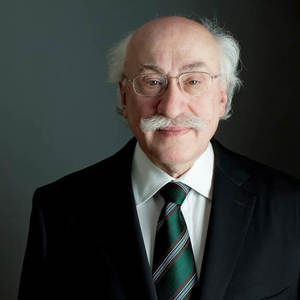
The more researchers explore the human brain the more evidence there is that very young children, even infants, learn from the very start of life and then so much of their continued development is dependent on how they are nurtured and stimulated and what they are exposed to. The more enriching and interacive the environment it seems, the more children thrive and the better prepared they are to succeed as they progress through those critical developmental years. Sam Meisels knows all about that and a lot more when it comes to early childhood. He leads the Buffett Early Childhood Institute at the University of Nebraska and he and his staff work hard to make Nebraska the standard by which early childhood progams and initiaitives are judged.
Sam Meisels
Sam Meisels leads early childhood mission through Buffett Institute
©by Leo Adam Biga
Originally appeared in The Reader (www.thereader.com)
Since Sam Meisels arrived in 2013 to head the Buffett Early Childhood Institute, he’s become the academic-based advocate ally to the socially conscious philanthropist who hired him, Susan A. Buffett.
The dynastic wealth of the Buffetts has always had a progressive bent, Billionaire investor Warren Bufffett’s first wife, the late Susan Thompson Buffett, gave generously to liberal causes.
The daughter has carried on this legacy by supporting quality education for children from low income families. Her Sherwood Foundation is a major player behind programs attempting to bridge achievement and opportunity gaps from birth through college. Her Buffett Early Childhood Fund backs Educare. The Fund created the Institute in partnership with the University of Nebraska.
The research, policy, outreach-armed Institute housed at the University of Nebraska at Omaha emerged from her conversations with NU-system leaders about the need to improve early childhood outcomes for at-risk populations. She and Meisels say since learning begins at birth any early deficits can contribute to later academic-reading struggles. That’s why enriching activities from infancy on are vital. As the Institute’s tag lines read: “Start Early, Start Well” and “All children need the opportunity to develop, learn and succeed in life.”
In Meisels, she tapped an early childhood guru as BECI’s founding executive director and as Neb.’s new Pied Piper for the cause.
“Sam is the real deal. He’s a world-class early childhood leader deeply committed to leveling the playing field for very young children growing up in families facing some very tough odds. Sam’s vision of making Neb. the best place in the country to be a baby is a vision inspiring more and more people, and I’m convinced we’ll get there,” she says.
“Children are born learning. Their earliest experiences set the trajectory for how they will succeed in school and life. Sam has put together a team at the Institute to help him and, really, to help all of us across the state close the student achievement gap and develop an early childhood workforce to do the critical work of nurturing Neb.’s youngest learners.”
Meisels came from Chicago, where he helped make Erikson Institute the nation’s leading graduate school in child development. Before joining Erikson in 2002, he held senior positions at prestigious schools.
The University of Rochester graduate with a master’s and Ph.D. from Harvard Graduate School of Education has ample experience with children both as a parent and as a former pre-school, kindergarten and first grade teacher. As a leading authority on the assessment of young children he’s spent much time observing early child ed programs.
Most of his time today is spent with stakeholders, including school district superintendents, education officials, legislators and philanthropists, as well as with fellow experts in devising strategies and policies for better assessment and training.
On September 11 the Buffett Institute and the Aspen Institute hosted a panel discussion featuring leading early childhood experts about the future of early childhood education and care.
Institute staff have traveled the state to meet with and speak to many constituencies. With the Buffett and NU names preceding them, Mesiels and Co. can get in any door and before any audience to advocate for quality, accessible early childhood programs that educate rather than warehouse, that have well-trained staff and that are accountable to state standards.
Meisels is impressed by the public-private support marshaled for early childhood efforts in Nebraska. Those initiatives are in part responses to societal failures. The state faces a crisis of young children living in poverty, a factor posing serious challenges for healthy development. The 2010 census showed 40 percent of all children birth through age 5 in the state meet the Nebraska Department of Education’s general at-risk criteria, including low income, English as a second language, having adolescent parents or being born prematurely. That percentage equates to 60,000 children statewide. The numbers keep growing.
These problems are magnified in families and communities lacking resources for quality out of home child ed and care. Meisels sees a need for more such programs wherever he visits.
“A lot of pre-schools I go into, not just in Neb. and certainly not just in Omaha, are places where kids spend time, but they don’t learn very much. They meet in places where there’s very little attention paid to something as simple as transitions, whether it’s from home to school or within school from one activity to another activity. Most very young children have trouble making transitions – being able to change what they’re doing into something else and do it in a way that makes sense in a group of 12 or 20 children.
“We’re talking also about relying not at all on television but relying instead on what takes place interactively. We’re talking about having art experiences, alphabet letters, displaying children’s work on the walls, having goals in the areas of social problem solving, literacy, math. Even for 3 year-olds and 4 year-olds you should have appropriate goals in those areas.”

Meisels doesn’t often see those things in place. He also sees disturbing disconnects in the continuum of early childhood programs.
“Right now in this area we have a number of 4 year-old programs sponsored with public dollars but very, very few programs for 3 year- olds. It’s like having sixth grade and fourth grade but no fifth grade.
That doesn’t work.”
Meisels not only finds it illuminating but rejuventating to visit pre-schools in order to get a handle on what’s happening in settings where young children spend much of their time.
“When I go into a pre-school I actually feel transformed, honestly. I’m taken over by the environment. The first thing I do is look around and see how many adults are there and how many children are there. Then I just listen for a little bit to get the tone – how are children talking to each other, how are adults talking to children, how are children tailing to adults. I note the interactions and how problems are solved.
“Then I start to walk around and note what the materials are like – are children able to reach them, are they in good repair, is there a good variety. Do we just have a few books and counters for math or are there blocks, is there a dress-up corner for dramatic play. On and on and on. That gives me a pretty darn good idea.”
He says while most out of home providers are motivated by the right reasons, some cut corners rather than put children first.
“If you’re going to be very concerned about the bottom-line, you’re going to try to have to hold costs down, most of which are for the personnel, and to that extent you’re going to short change everybody.”
He says most providers pay relatively poor salaries – on average $28,000 – to child care educators.
“That’s a terrible salary given that who’s more important to us in the world than our children. We’re also paying it all out of our pocket. The amount of federal and state dollars that goes into early childhood is very, very small compared to what goes into K-12 education. So who pays for it? Parents pay for it.
“Salaries, work conditions and benefits are very, very bad and the status of that profession, my profession, is low as a result.”
All of which serves as a disincentive to enter the field, leaving many inner city and rural communities wanting because there aren’t enough early childhood educators to meet the need.
With providers charging a few hundred dollars to a thousand dollars or more a month, parents must make hard decisions and sacrifices, perhaps going well out of their way in order to access child ed or care.
“These are generally young people and they can’t be stretched very far,” Meisels says.
Parents of limited means sometimes choose the more expedient rather than best option, including in-home providers operating off the radar and therefore outside the eyes of regulators.
“Many people are unlicensed and then they’re totally unregulated,” Meisels says.
Since not all children who receive out of home child care are in licensed-regulated settings, he says, “We have to find ways of reaching out to them through professional development, improving the quality of the programs as a general rule.” He says, “For those programs that do enroll children who receive any kind of state subsidy the state now has a quality rating system and so those programs over the coming years will have to meet certain minimum requirements of quality, not just health and safety, and we will work with that and try to improve that.”

The Institute has launched the Early Childhood Workforce Development Program in order to raise the standards and skill levels of early childhood staffers. It is hosting higher education faculty from across the state October 5-6 for the conference “Transforming the Early Childhood Workforce in Nebraska.”
Meisels says another challenge posed by the early childhood arena is variable quality in day cares and after school programs. ”
Some of them have educational goals, some of them have more fun, play-based goals. It’s a big issue all around. Actually United Way of the Midland here is focusing more of their attention now on trying to improve after school programs.”
A formal approach to the issue is the Achievement Gap Challenge through the Superintendents’ Early Childhood Plan mandated by the Nebraska Legislature (LB 585). The plan will be funded for three years by the Learning Community of Douglas and Sarpy Counties. Created in collaboration with 11 metro area school districts, the plan aims to reduce achievement gaps for children birth through age 8. It emphasizes creating more quality pre-school for 3 and 4 year-olds and enhancing teaching and curriculum for pre-K through third grade.
Home visits will target at-risk kids up to age 3. The idea is to educate families about activities and resources that aid development in situations where children may not be getting the stimuli they need.
“For example, we know if children aren’t exposed to a lot of words early in life that even as early as 18 months they’re going to show a deficit in vocabulary that can persist all the way through third grade,” Meisels says. “And we know there’s a very tight correlation between vocabulary and learning to read.
“So we want to teach people to talk, to read and to sing to their kids. We want to help them learn how to help their children grow in terms of physical well-being, fine motor and gross motor skills, all aspects. We need to communicate to parents – what are our goals for learning. how well is your child doing in terms of what has he learned about this and about that. We particularly want the parent to have a strong relationship with the child. What takes place between the parent and child is the driving force in childhood development.”
He says it’s not only parents who can stand to be schooled about children’s age appropriate behavior.
“We need to teach parents about why play is a valuable avenue of learning for young children, why there’s always a surplus of activity level in children. We need to teach teachers that, too. Some kids getting expelled are not wanting to sit down all day long or for a few hours, which is what we would expect for a 4 or 5 year-old. Some people don’t know that.”
He says the Institute will monitor and support early elementary ed outcomes with schools, centers and families.
“We’ve got to think in terms of families rather than parents because a lot of children are raised by other family members. We have to think about the family with the child all the time. There’s no such thing as an isolated child because as humans cannot survive alone. That’s not just our physical needs but our emotional needs, our intellectual needs. We need to be supported, scaffolded all the way, for a long time.”
He says education intervention is generally well-received.
“Because you’re very alone when you’re the parent of a very young child and a new-born especially, you want someone to talk about it with. How you do it is very important. Finding someone from the community who understands what you’ve been through is very important.”

He says the early childhood field’s come a long way.
“We have learned what to do with kids, we’ve learned how to do it better. We’ve learned that children can learn a great deal. We’ve learned the first five years of life is when the greatest amount of brain growth occurs. All of that is supportive of what we’re doing. We can teach very young children about letters, about numbers, about shapes, about space, about all kinds of things like that.
“A more recent revolution is we’ve learned we need to teach them about non-cognitive things, too, like taking responsibility for their actions, relating to others, being cooperative. It’s these non-cognitive factors that have a lot to do with how well they succeed then in life. Much of the evidence behind that has grown out of what we’ve learned from early childhood programs as we follow kids longitudinally through their early adult years.”
He says early childhood has more visibility “than at any time” and
“the research is pretty clear that if we can be persistent in our effort we will experience the persistence of effect.”
When it comes to assessment, Meisels says No Child Left Behind initiated “more testing than we’ve ever seen and most of it has not been useful.” He adds, “A lot of it has been punitive in nature. I think something that is punitive is not educational.”
“The assessment work I do,” he says, “is based upon teachers observing, recording and comparing to standards in order to differentiate what they do with individual children. You have to have evidence-based data. We learn how to observe so that we have some reliability and repeatability. Based on that I can see this is a child who learns in this way but not so well in that way and I can use that to help the child develop and have success.
“It is more resource-intensive for a teacher but teaching’s a tough job and this actually improves your teaching.”
Another punitive thing that happens in pre-schools, he says, is children being suspended or expelled for behavioral issues.
“It is a national problem. Boys are more frequently expelled than girls.”
Some reports suggest boys of color are disproportionately impacted.
Meisels isn’t surprised it happens given that the overwhelming early childhood workforce is white females.
“There are problems of identification with an authority figure who looks so different and is so different. Children from minority backgrounds may not have encountered a white authority figure before.”

He says the kinds of behaviors that can lead to disciplinary action are preventable and solvable.
“Often a teacher doesn’t know how to structure a physical space for pre-schoolers. Some kids will respond to your saying ‘no running,’ others won’t, they like to challenge, they like to test limits. which is a very natural healthy thing to do.
“It’s our job as adults to help the child cross that divide and we have to understand where the child is so we can be successful at that. It’s a huge responsibility for the teacher to bring a child into a learning world
and to expel a child at that age is a failure on the part of the teacher.”
Meisels sees a largely health early child landscape here.
“Some factors that led to the establishment of this Institute help Neb. stand out in a very positive way. That doesn’t mean we don’t have a lot of work to do, but it means there are points of excellence here. We have combined public-private programs focusing on the first three years of life that very few states have. We have four Educare schools. We have three colleges of education in the NU system.
“There are things that need to improve, too. We are a rural, low population state, so as you get into greater Neb. there are fewer people prepared at a high level. Our standards of qualification for taking care of children are not high. Some say if we made them too high we’d have nobody to serve the kids in need. We want to find ways of improving that situation. We have very few birth to 3 programs and very few programs for 3 year-olds.”
Overall, he says, “there’s room for a lot of improvement and there’s a lot of strength to build from.”
He says the investment made to support the Institute’s work sends a message that “the lives of young children at risk and their families are important enough that they would rise to be a priority of the university,” adding, “Most universities don’t do that and this is one saying that it’s important enough for us to do it.”
The Institute’s interdisciplinary-collaborative work spans across all four University of Nebraska campuses in Lincoln, Kearney and Omaha.
“What I say to the deans around these campuses is that we can identify where most of the children at risk are coming from and we want every single one of those children 18 years after they’re born to be eligible to apply and to be qualified to be accepted at the university.
“So in a way it’s a jobs program – that these kids should grow up and hold jobs and be real contributors here in this state. Early childhood I always say is not an inoculation, it’s an investment.”
Firmly Rooted: The Story of Husker Brothers
Here is the complete Hail Varsity (http://hailvarsity.com/) cover story I did on Husker football brothers. As the 2015 team struggles to find its way under a new coaching staff, this is a look back at sets of brothers who played during some of the glory years in the program, though a couple of these brothers also weathered the ups and downs of coaching transitions themselves. The story doesn’t so much focus on how the teams they played on fared as it does on the bonds that made these dudes so fiercely loyal to family and to Nebraska. As the headline puts it, these studs were firmly rooted in each other and in Big Red and nothing could shake them loose.

Firmly Rooted: The Story of Husker Brothers
Husker football sometimes truly becomes a band of brothers
©by Leo Adam Biga
Now appearing in Hail Varsity Magazine (http://hailvarsity.com/)
Nebraska recruits football players where it finds them. sometimes even in the same family. Several brother combos have played for NU. Once in a while they’re part of the same recruiting class but usually they arrive a few years apart.
Once in a great while a set of twins plays for the Huskers, including Josh and Daniel Bullocks (2001-2004). The 2015 recruit class includes another pair in Khalil and Carlos Davis, whose uncle is former Husker Lorenzo Hicks. The two freshmen are redshirting this year.
More than a few uncles, nephews and cousins have shared a familial Nebraska football lineage. There’ve been some father-son sets as well as father-son-grandson combos.
Some Husker brother duos have achieved fame on different sides of the ball (Grant and Tracey Wistrom) but most left their mark on the same side of the field, usually defense. Clete and Jim Pillen, Toby and Jimmy Williams, Christian and Jason Pete were all defensive stalwarts as were the Craver, Shanle and Booker brothers. In most cases, brother sets have been solid contributors rather than stars. That’s true of the Cottons, only that clan added a generational element. The patriarch, Barney, played at NU and sons Jake, Ben and now Sam have suited up for the Big Red. He coached two of them.
Waves of brothers come and go. The 1998 through 2003 classes saw a bumper crop. There was a dry spell until Jake and Spencer Long and the Cotton boys came long. More than a decade passed between Kris Brown and his much younger brother Drew playing for NU.
Saturday’s gridiron warriors are the subject of intense scrutiny at a Nebraska. When siblings wear the scarlet and cream, one’s success creates expectations for the other. It doesn’t always happen but more often than not success does carry over.
Four sets of siblings emblematic of this family heritage tradition are the Craigs (Curtis and Roger), the Makovickas (Jeff and Joel), the Ruuds (Barrett and Bo) and the Kelsays (Chad and Chris) Standout players, all. The Craigs and Makovickas did their thing on offense, while the Ruuds and Kelsays did theirs on defense. In each case, a younger brother followed an older brother’s lead. Their stories reveal genetics play a role, as do shared traits and values. Having a brother precede you or be there helps, but you still have to earn it yourself.

Curtis Craig dives to make a catch at the KU 1-yard line. NU vs. KU 1976. LJS Library archive photo
 Roger Craig
Curtis Craig was a Big Deal at Davenport (Iowa) Central High in the early 1970s. The all-everything back selected NU over other powerhouse programs. Bothered by a nagging high ankle sprain suffered at the end of his prep career, he never played I-back in Lincoln but found his niche at wingback.
By his senior year, his little brother Roger was making hay back in Davenport playing for the same coaches, Jim Fox and Jack Leabo, who mentored him. Separated by almost five years, Curtis was conscious of being a model for those behind him.
“I’m the oldest of seven kids,” he says. “The younger ones were watching me because they looked up to me, so I felt I had to step up and set the example. All I was doing was giving back what was given to me. That’s kind of how the tradition is. Whatever you learn in your time you look to give back to those trying to follow your footsteps.”
Roger took careful note of his big brother.
“I always followed him. He was kind of like my hero as a kid growing up. He was a great role model for me. He did all the right things. Without him I wouldn’t be where I am today,” says Roger, who starred at I-back and fullback at NU before a Hall of Fame-worthy NFL career.
Roger credits hanging around and playing pickup games with Curtis and his buddies for helping mature him beyond his years.
“I watched how he trained and practiced and I got in there and did things with him.”
Curtis says he was motivated to earn a college scholarship because his folks couldn’t afford to pay for school. His experience exposed Roger to NU coaches and provided an inside look at the program.
“I told him this is what’s going to happen, this is what you need to do.”
Curtis didn’t have that luxury when he arrived at NU.
“I didn’t have anybody to tell me what to do when I got there. I had to just kind of figure it out and then go from there.”
When Curtis was a senior he was still putting Roger through his paces
“He worked with me. He was like a coach,” Roger says.
Big brother touted his little brother to Husker coaches.
Curtis recalls, “I knew he was going to have the possibility to do more than what I did. I said to the staff, ‘ You need to go look at my brother, he’s going to be a good one,’ They did and the rest is history. When you come from a family that has a scholarship athlete the coaches always go back to try and recruit your siblings who are good athletes, too.”
As a tribute to Curtis, whose No. 33 was retired at Davenport Central, Roger wore that number with the San Francisco 49rs.
“I carried Curt with me in the NFL,” Roger says. “I have a lot of respect for my brother.”

Jeff and Joel Makovicka
A duo who took the walk-on route to Husker glory, Jeff and Joel Makovicka, may be the only brother ball carrier combo in Husker history. Reared on a Brainard, Neb. farm, these siblings separated by four years learned values about doing your best that carried them through 8-man football, careers at NU and all the way to the NFL.
Big brother Jeff says with kid brother Joel watching him, “it increased the importance that I did the right thing.”
The pair always saw themselves playing at NU, they just weren’t sure they’d ever get the chance.
Joel says seeing Jeff make, fueled his own fire.
“When Jeff got there and he succeeded I knew it became not just a goal that was a dream, it was more an attainable and achievable goal and so it made me work that much harder.”
Once Joel joined him on campus, Jeff showed him the ropes. “I knew i had to carry on what we were taught at home. We were in Lincoln, but I told Joel, ‘That doesn’t mean you leave the farm – the farm’s still in you and dad’s still around in your head.'”
Joel relied on Jeff to get him through his first year.
“I remember talking to him not knowing if this was going to be right for me and him saying, ‘Hang in there, everybody goes through this.’
There’s a lot of times I had to lean on him to get to where I wanted to be and he was there for me. It was an adjustment, especially from where we came from, playing 8-man football.”
Joel appreciates that Jeff’s road was tougher than his.
“It was lot harder for him to go to Nebraska because he was the first one to go. He kind of paved the way. He got his foot in the door and then widened the door for me to get there.”
Another advantage of Jeff being there ahead of him was Joel meeting the coaching staff, watching practice and “knowing what to expect.”
Jeff says it wasn’t all him helping Joel but Joel helping him as well.
“It provided a great amount of benefit to me having a younger brother there, especially when I was a senior. We roomed together on the road. For the pre-game routine we made a point to be out there stretching together. We’d often discuss points of the game. During the game, when I’d come off the field, I’d say to him, ‘Hey, did you see that set. Did you see that tendency?’ Did i get the cut block?’ And you’d get such a brutally honest assessment because it was your brother.”
Jeff recognizes the long odds he and Joel overcame to become fullbacks for national title teams (Jeff in 1994 and 1995 and Joel in 1997). Joel was Jeff’s backup in ’95.
“It’s really special. I knew he was going to be this great one because I’d seen him playing with guys three-four years older than him,” Jeff says.
In the ’95 season finale versus Oklahoma NU was driving late when Jeff came out and Joel went in and broke off a memorable scoring run marked by broken tackles, grit and determination.
“That kind of run in that game against that team solidified in my mind he was going to be OK and represented everything we’re about,” says Jeff about that passing-the-torch moment.
The Makovickas are proud of setting the physical tone for NU then.
“Theres no question,” Joel says. “We also take pride in carrying the banner for the walk-ons and kind of having that chip on our shoulder that, you know what, maybe you didn’t think we were good enough coming out of high school to earn a scholarship but you’re damn well going to give us one when we get there.”
Joel went onto a fine NFL career but injuries never allowed Jeff to stay healthy long enough to secure a spot.
The family pipeline continued with younger brothers Justin and Jordan, who grew up around the NU program, until they opted to leave.
 Bo Ruud

Speaking of pipelines, the Ruuds are a three-generation Husker clan. Clarence Swanson was an early 20th century stud. His great-grandson Tom Ruud was a force at linebacker six decades later. Other relatives and close family friends also played for the Huskers.
Tom’s two boys, Barrett and Bo, followed his example to become linebackers. They developed under the tutelage of youth coaches and Lincoln Southeast coach Chuck Mizerski and alongside future Division I athletes. it was like growing up in the “family business.”
“It was never like a pipe-dream to be successful at football,” Barrett says. “We saw a lot guys up close and personal live that out, so we knew it was attainable. The one thing our dad would point out to us is it takes a lot of work to get there and that the guys that work the hardest tend to have the most success. We weren’t pushed into any sports but once we decided that’s what we wanted to do we had a lot of resources as far as what it took to be successful. A lot of kids have no idea when they first start playing sports. The more serious we got we could ask questions about what did it take to reach the next level.”
Only a year-and-a-half apart, the Ruud boys grew up doing pretty much everything together, so whatever Barrett got into first, Bo followed suit.
Bo says, “We grew up playing against each other from day one. It was always great competition. We both loved it. We both loved playing football and basketball and golf and whatever we could do to play and compete at.”
When he first got to Nebraska, Barrett had to make his own way. When Bo arrived, his big brother had his back.
“I went in there as a freshman learning on the fly,” Barrett says, “as opposed to Bo coming in and having me already there. He had a little more of a comfort zone. He already knew the work he was getting into for the most part. That’s probably the biggest difference to having a brother in the program.”
Bo agrees, saying, “I think there’s a big advantage being the younger brother. You get to see how it’s done a little bit before you get there.
Plus, having your brother is another friend you’ve got on the team.”
Bo says playing together for a dynasty high school program and the storied Nebraska program they grew up idolizing is “a pretty neat deal.” “It just happened the way it happened without planning it. We both had a desire to make it to the next level and we obviously grew up in a Husker family. It’s just something we always wanted to do.” The brothers were with each on their respective NFL draft days. While Barrett’s long NFL career with Tampa Bay is well-documented, it’s not widely known that Bo’s final three weeks in The League were spent with Barrett in the Buccaneers’ preseason camp before being cut.
Always close, the brothers drew even closer when their mother, who was their biggest fan, died suddenly of a heart attack.
“You naturally lean on each other and your whole family when something like that happens,” Barrett says.
The brothers enjoy fly fishing together.

Chris Kelsay
 Chad Kelsay
Before Chad and Chris Kelsay came along, their hometown of Auburn, Neb. hadn’t produced a scholarship Husker football player in decades. Chad, the eldest by two years, was a Big Red fan but wasn’t sure he was D-I material until attending an NU camp.
“I tested out real well and that kind of put me on the radar of Nebraska.”
With Chris wrecking havoc the next year for Auburn, he became a hot recruiting target, too.
Chad says, “Chris got to know the coaching staff real well and as Chris was coming up through high school it was obvious he was going to have an opportunity to play football at the collegiate level he knew the coaching staff and they started recruiting him.”
“Having two brothers from a community the size of Auburn play at Nebraska was exciting for the town,” Chad says.
Two years apart in age, the brothers were there years apart in school.
Chad’s exploits at rush end naturally inspired Chris, who says his transition to college life and football was helped by having Chad there..
“Ever since we were little kids growing up I always looked up to him both in the classroom and on the football field in how he went about his business. So it was definitely a benefit I tried to take advantage of and I think in the long run it kind of put me ahead of the cart compared to a lot of guys coming in there.”
Neither brother was the most athletically gifted player, but they made up for it with a work ethic they ascribe to their rural growing up.
“If you don’t have it in you and its not how you’ve been brought up, it’s harder to just flip a switch and all of a sudden be a guy that’s going to work harder than everybody else,” Chad says.
Once again defying the odds, both made it to the NFL, though Chad’s stint there ended before Chris joined the league.
“That’s pretty special. Not too many people can say that. We’re blessed to have had the opportunity to do what we’ve done,” Chris says.
Long retired from the game, the Kelsays are together again, this time as sales representatives at Truck Center Companies in Omaha.
More praise and news for my new book with Father Ken Vavrina

“Crossing Bridges: A Priest’s Uplifting Life Among the Downtrodden”
5.0 out of 5 stars “A Humble Man with a Powerful Story” Sept. 1 2015
By Sandra Wendel – Published on Amazon.com
“As a book editor, I find that these incredible heroes among us cross our paths rarely. I am indeed lucky to have worked with Father Ken in shaping his story, which he finally agreed to tell the world. You will enjoy his modesty and humility while serving the poorest of the poor. His story of his first days in the leper colony in Yemen is indeed compelling, as is his survival in prison in Yemen. Later, his work in Calcutta, Liberia, and Cuba made a difference.”
____________________________________________________
5.0 out of 5 stars Father Ken Vavrina Sept. 28 2015
By Sandra L Vavrina – Published on Amazon.com
“Crossing Bridges. Father Ken’s life is amazing! He is my husband’s cousin and performed our wedding ceremony 51 years ago right after he was ordained.”
____________________________________________________
5.0 out of 5 stars “Great Book” Sept. 1 2015
By ken tuttle – Published on Amazon.com
“Such an amazing life story.”
____________________________________________________
BOOK NOTE:
After Father Ken recoups the cost of the book’s priting, all proceeds will go to Catholic Relief Services and Catholic Charities of the Archdiocese of Omaha.
BOOK NOTE:
COVER STORY NOTE:


 Leo Adam Biga's My Inside Stories