
Archive
Archive for the ‘African-American Empowerment Network’ Category
Next generation of North Omaha leaders eager for change: New crop of leaders emerging to keep momentum going
August 21, 2014
1 comment

North Omaha’s prospects are looking up, even as longstanding problems remain a drag on the largely African-American community, and a strong, established leadership base in place is a big part of the optimism for the area’s continued revival. These leaders are in fact driving the change going on. Working side by side or coming up right behind that veteran leadership cohort is a group of emerging leaders looking to put their own stamp on things. The following article for The Reader (www.thereader.com) takes a look at this next generation of North Omaha leaders and their take on opportunities and vehicles for being change agents.
Thomas Warren and Julia Parker
Next generation of North Omaha leaders eager for change: New crop of leaders emerging to keep momentum going
©by Leo Adam Biga
Now appearing in The Reader (www.thereader.com)
If redevelopment plans for northeast Omaha come to full fruition then that long depressed district will see progress at-scale after years of patchwork promises. Old and new leaders from largely African-American North Omaha will be the driving forces for change.
A few years and projects into the 30-year, $1.4 billion North Omaha Revitalization Village Plan, everyone agrees this massive revival is necessary for the area to be on the right side of the tipping point. The plan’s part of a mosaic of efforts addressing educational, economic, health care, housing, employment disparities. Behind these initiatives is a coalition from the private and public sectors working together to apply a focused, holistic approach for making a lasting difference.
Key contributors are African-American leaders who emerged in the last decade to assume top posts in organizations and bodies leading the charge. Empowerment Network Facilitator Willie Barney, Douglas Country Treasurer John Ewing, Urban League of Nebraska Executive Director Thomas Warren and Omaha City Councilman Ben Gray are among the most visible. When they entered the scene they represented a new leadership class but individually and collectively they’ve become its well-established players.
More recently, Neb. State Senator Tanya Cook and Omaha 360 Director Jamie Anders-Kemp joined their ranks. Others, such as North Omaha Development Corporation Executive Director Michael Maroney and former Omaha City Councilwoman and Neb. State Sen. Brenda Council, have been doing this work for decades.
With so much yet to come and on the line, what happens when the current crop of leaders drops away? Who will be the new faces and voices of transformation? Are there clear pathways to leadership? Are there mechanisms to groom new leaders? Is there generational tension between older and younger leaders? What does the next generation want to see happen and where do they see things headed?

Some North Omaha leaders
Transformational Leadership
The Reader asked veteran and emerging players for answers and they said talent is already in place or poised to assume next generation leadership. They express optimism about North O’s direction and a consensus for how to get there. They say leadership also comes in many forms. It’s Sharif Liwaru as executive director of the Malcolm X Memorial Foundation, which he hopes to turn into an international attraction. It’s his artist-educator wife Gabrielle Gaines Liwaru. Together, they’re a dynamic couple focused on community betterment. Union for Contemporary Arts founder-director Brigitte McQueen, Loves Jazz and Arts Center Executive Director Tim Clark and Great Plains Black History Museum Board Chairman Jim Beatty are embedded in the community leading endeavors that are part of North O’s revival.
Seventy-Five North Revitalization Corp. Executive Director Othello Meadows is a more behind-the-scenes leader. His nonprofit has acquired property and finished first-round financing for the Highlander mixed-used project, a key Village Plan component. The project will redevelop 40 acres into mixed income housing, green spaces and on-site support services for “a purpose-built” urban community.
Meadows says the opportunity to “work on a project of this magnitude in a city I care about is a chance of a lifetime.” He’s encouraged by the “burgeoning support for doing significant things in the community.” In his view, the best thing leaders can do is “execute and make projects a reality,” adding, “When things start to happen in a real concrete fashion then you start to peel back some of that hopelessness and woundedness. I think people are really tired of rhetoric, studies and statistics and want to see something come to life.” He says new housing in the Prospect Hill neighborhood is tangible positive activity.
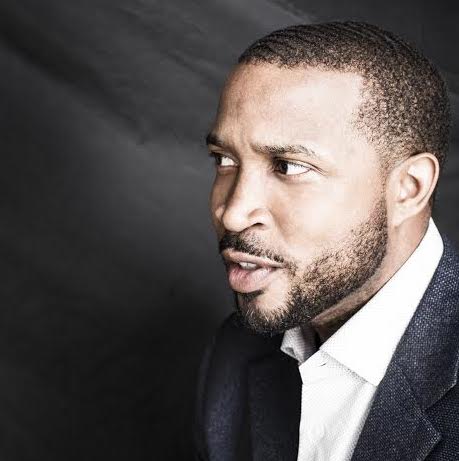
Othello Meadows
Meadows doesn’t consider himself a traditional leader.
“I think leadership is first and foremost about service and humility. I try to think of myself as somebody who is a vessel for the hopes and desires of this neighborhood. True leadership is service and service for a cause, so if that’s the definition of leadership, then sure, I am one.”
He feels North O’s suffered from expecting leadership to come from charismatic saviors who lead great causes from on high.
“In my mind we have to have a different paradigm for the way we consider leadership. I think it happens on a much smaller scale. I think of people who are leaders on their block, people who serve their community by being good neighbors or citizens. That’s the kind of leadership that’s overlooked. I think it has to shift from we’ve got five or six people we look to for leadership to we’ve got 500 or 600 people who are all active leaders in their own community. It needs to shift to that more grassroots, bottom-up view.”
Where can aspiring North O leaders get their start?
“Wherever you are, lead,” John Ewing says. “Whatever opportunities come, seize them. Schools, places of worship, neighborhood and elected office all offer opportunities if we see the specific opportunity.”
“They need to get in where they fit in and grow from there,” says Dell Gines, senior community development advisor, Omaha Branch at Federal Reserve Bank of Kansas City.
Empowerment Network board member and Douglas County Health Department health educator Aja Anderson says many people lead without recognition but that doesn’t make them any less leaders.
“There are individuals on our streets, in our classrooms, everywhere, every day guiding those around them to some greater destiny or outcome,” Anderson says.
Meadows feels the community has looked too often for leadership to come from outside.
“A community needs to guide its own destiny rather than say, ‘Who’s going to come in from outside and fix this?'”
He applauds the Empowerment Network for “trying to find ways to help people become their own change agents.”
Carver Bank Interim Director JoAnna LeFlore is someone often identified as an emerging leader. She in turn looks to some of her Next Gen colleagues for inspiration.
“I’m very inspired by Brigitte McQueen, Othello Meadows and Sharif Liwaru. They all have managed to chase their dreams, advocate for the well-being of North Omaha and maintain a professional career despite all of the obstacles in their way. You have to have a certain level of hunger in North Omaha in order to survive. What follows that drive is a certain level of humility once you become successful. This is why I look up to them.”
LeFlore is emboldened to continue serving her community by the progress she sees happening.
“I see more creative entrepreneurs and businesses. I see more community-wide events celebrating our heritage. I see more financial support for redevelopment. I feel my part in this is to continue to encourage others who share interest in the growth of North Omaha. I’ve built trusting relationships with people along the way. I am intentional about my commitments because those relationships and the missions are important to me. Simply being a genuine supporter, who also gets her hands dirty, is my biggest contribution.
“Moving forward, I will make an honest effort to offer my expertise to help build communication strategies, offer consultations for grassroots marketing and event planning and be an advocate for positive change. I am also not afraid to speak up about important issues.”
If LeFlore’s a Next Gen leader, then Omaha Small Business Network Executive Director Julia Parker is, too. Parker says, “There is certainly a changing of the guard taking place throughout Omaha and North O is not an exception. Over the next several years, I hope even more young professionals will continue to take high level positions in the community. I see several young leaders picking up the mic.” She’s among the new guard between her OSBN work and the Urban Collaborative: A Commitment to Community group she co-founded that she says “focuses on fostering meaningful conversation around how we can improve our neighborhoods and the entire city.”
Parker left her hometown for a time and she says, “Leaving Omaha changed my perspective and really prompted me to come home with a more critical eye and a yearning for change.”
Like Parker, Othello Meadows left here but moved back when he discerned he could make a “meaningful” impact on a community he found beset by despair. That bleak environment is what’s led many young, gifted and black to leave here. Old-line North O leader Thomas Warren says, “I am concerned about the brain drain we experience in Omaha, particularly of our best and brightest young African-Americans students who leave. We need to create an environment that is welcoming to the next generation where they can thrive and strive to reach their full potential.” Two more entrenched leaders, John Ewing and Douglas County Commissioner Chris Rodgers, are also worried about losing North O’s promising talents. “We have to identify, retain and develop our talent pool in Omaha,” Ewing says.

Tunette Powell
Omaha Schools Board member Yolanda Williams says leadership doors have not always been open to young transplants like herself – she’s originally from Seattle – who lack built-in influence bases.
“I had to go knock on the door and I knocked and knocked, and then I started banging on the door until my mentor John Ewing and I sat down for lunch and I asked, ‘How do younger leaders get in these positions if you all are holding these positions for years? How do I get into a leadership role if nobody is willing to get out of the way?’ They need to step out of the way so we can move up.
“It’s nothing against our elder leadership because I think they do a great job but they need to reach out and find someone to mentor and groom because if not what happens when they leave those positions?”
Ewing acknowledges “There has been and will always be tension between the generations,” but he adds, “I believe this creative tension is a great thing. It keeps the so-called established leaders from becoming complacent and keeps the emerging leaders hungry for more success as a community. I believe most of the relationships are cordial and productive as well as collaborative. I believe everyone can always do more to listen. I believe the young professional networks are a great avenue. I also believe organizations like the Empowerment Network should reach out to emerging leaders to be inclusive.”
Author, motivational speaker and The Truth Hurts director Tunette Powell says, “It’s really amazing when you get those older leaders on board because they can champion you. They’ve allowed me to speak at so many different places.” Powell senses a change afoot among veteran leaders, “They have held down these neighborhoods for so long and I think they’re slowly handing over and allowing young people to have a platform. i see that bridge.” As a young leader, she says, “it’s not like I want to step on their toes. We need this team. It’s not just going to be one leader, it’s not going to be young versus old, it’s going to be old and young coming together.”

Yolanda Williams
In her own case, Yolanda Williams says she simply wouldn’t be denied, “I got tired of waiting. I was diligent, I was purpose-driven. It was very much networking and being places and getting my name out there. I mean, I was here to stay, you were not just going to get rid of me.”
LeFlore agrees more can be done to let new blood in.
“I think some established leaders are ignoring the young professionals who have potential to do more.”
Despite progress, Powell says “there are not enough young people at the table.” She believes inviting their participation is incumbent on stakeholder organizations. She would also like to see Omaha 360 or another entity develop a formal mentoring program or process for older leaders “to show us that staircase.”
Some older leaders do push younger colleagues to enter the fray.
Shawntal Smith, statewide administrator for Community Services for Lutheran Family Services of Nebraska, says Brenda Council, Willie Barney and Ben Gray are some who’ve nudged her.
“I get lots of encouragement from many inside and outside of North Omaha to serve and it is a good feeling to know people trust you to represent them. It is also a great responsibility.”
Everyone has somebody who prods them along. For Tunette Powell, it’s Center for Holistic Development President-CEO Doris Moore. For Williams, it’s treasurer John Ewing. But at the end of the day anyone who wants to lead has to make it happen. Williams, who won her school board seat in a district-wide election, says she overcame certain disadvantages and a minuscule campaign budget through “conviction and passion,” adding, “The reality is if you want to do something you’ve got to put yourself out there.” She built a coalition of parent and educator constituents working as an artist-in-residence and Partnership 4 Kids resource in schools. Before that, Williams says she made herself known by volunteering. “That started my journey.”
Powell broke through volunteering as well. “I wasn’t from here, nobody knew me, so I volunteered and it’s transformed my life,” says the San Antonio native.
“The best experience, in my opinion, is board service,” OSBN’s Julia Parker says. “Young leaders have a unique opportunity to pull back the curtain and see how an organization actually functions or doesn’t. It’s a high level way to cut your teeth in the social sector.”

JoAnna LeFlore, ©omahamagazine.com
Chris Rodgers, director of community and government relations at Creighton University, agrees: “I think small non-profits looking for active, conscientious board members are a good start. Also volunteering for causes you feel deeply about and taking on some things that stretch you are always good.”
The Urban League’s Thomas Warren says, “We have to encourage the next generation of leaders to invest in their own professional growth and take advantage of leadership development opportunities. They should attend workshops and seminars to enhance their skills or go back to school and pursue advanced degrees. Acquiring credentials ensures you are prepared when opportunities present themselves.”
Gaining experience is vital but a fire-in-the-belly is a must, too. Yolanda Williams says she was driven to serve on the school board because “I felt like I could bring a voice, especially for North Omaha, that hadn’t yet been heard at the table as a younger single parent representing the concerns and struggles of a lot of other parents. And I’m a little bit outspoken I say what I need to say unapoligitically.”
Powell says young leaders like her and Williams have the advantage of “not being far removed from the hard times the people we’re trying to reach are experiencing.” She says she and her peers are the children of the war on drugs and its cycle of broken homes. “That’s a piece of what we are, so we get it. We can reach these young people because our generation reflects theirs. I see myself in so many young people.”
Just a few years ago Powell had quit college, was on food stamps and didn’t know what to do with her life. “People pulled me up, they elevated me, and I have to give that back,” she says. In her work with fatherless girls she says “what I find is you’ve got to meet them where they’re at. As younger leaders we’re not afraid to do that, we’re not afraid to take some risks and do some things differently. We’re seeing we need something fresh. Creativity is huge. When you look at young and old leaders, we all have that same passion, we all want the same thing, but how we go about it is completely different.”
Powell says the African-American Young Professionals group begun by fellow rising young star Symone Sanders is a powerful connecting point where “dynamic people doing great things” find a common ground of interests and a forum to network. “We respect each other because we know we’re all going in that direction of change.”
Sanders, who’s worked with the Empowerment Network and is now communications assistant for Democratic gubernatorial candidate Chuck Hassebrook, says AAYP is designed to give like-minded young professionals an avenue “to come together and get to know one another and to be introduced in those rooms and at those tables” where policy and program decisions get made.
Aja Anderson believes Next Gen leaders “bridge the gap,” saying, “I think this generation of leaders is going to be influential and do exceptionally well at creating unity and collaboration among community leaders and members across generations. We’re fueled with new ideas, creativity and innovation. Having this group of individuals at the table will certainly make some nervous, others excited and re-ignite passion and ideas in our established group.”

John Ewing
County treasure John Ewing sees the benefit of new approaches. “I believe our emerging leaders have an entrepreneurial spirit that will be helpful in building an African-American business class in Omaha.”
While Williams sees things “opening up,” she says, “I think a lot of potential leaders have left here because that opportunity isn’t as open as it should be.”
Enough are staying to make a difference.
“It’s exciting to see people I’ve known a long time staying committed to where we grew up,” 75 North’s Othello Meadows says. “It’s good to see other people who at least for awhile are going to play their role and do their part.”
Shawntal Smith of Lutheran Family Services is bullish on the Next Gen.
“We are starting to come into our own. We are being appointed to boards and accepting high level positions of influence in our companies, firms, agencies and churches. We are highly educated and we are fighting the brain drain that usually takes place when young, gifted minorities leave this city for more diverse cities with better opportunities. We are remaining loyal to Omaha and we are trying to make it better through our visible efforts in the community.
“People are starting to recognize we are dedicated and our opinions, ideas and leadership matter.”
Old and young leaders feel more blacks are needed in policymaking capacities. Rodgers and Anderson are eager to see more representation in legislative chambers and corporate board rooms.
Warren says, “I do feel there needs to be more opportunities in the private sector for emerging leaders who are indigenous to this community.” He feels corporations should do more to identify and develop homegrown talent who are then more likely to stay.
Shawntal Smith describes an added benefit of locally grown leaders.
“North Omahans respect a young professional who grew up in North Omaha and continues to reside in North Omaha and contribute to making it better. Both my husband and I live, shop, work, volunteer and attend church in North Omaha. We believe strongly in the resiliency of our community and we love being a positive addition to North Omaha and leaders for our sons and others to model.”
With leadership comes scrutiny and criticism.
“You have to be willing to take a risk and nobody succeeds without failure along the way to grow from,” Rodgers says. “If you fail, fail quick and recover. Learn from the mistake and don’t make the same mistakes. You have to be comfortable with the fact that not everybody will like you.”
Tunette Powell isn’t afraid to stumble because like her Next Gen peers she’s too busy getting things done.
“As Maya Angelou said, ‘Nothing will work unless you do,’ I want people to say about me, ‘She gave everything she had.'”
Read more of Leo Adam Biga’s work at leoadambiga.wordpress.com.
Categories: African-American Culture, African-American Empowerment Network, Community/Neighborhoods, JoAnna LeFlore, North Omaha, Omaha, Othello Meadows, Tunette Powell, Writing, Yolanda Williams
African American, African-American Empowerment Network, JoAnna LeFlore, John Ewing, North Omaha, North Omaha Leadership, Othello Meadows, Thomas Warren, Tunette Powell, Yolanda Williams
Sisters of song: Kathy Tyree connects with Ella Fitzgerald; Omaha singer feels kinship to her stage alter ego
March 12, 2014
4 comments
|

Sisters of song: Kathy Tyree connects with Ella Fitzgerald
Omaha singer feels kinship to her stage alter ego
©by Leo Adam Biga
Now appearing in The Reader (www.thereader.com)
Ella, the dramatic musical revue of the life of American songbook diva Ella Fitzgerald at the Omaha Community Playhouse, reveals the anguish behind the legendary performer’s sweet voice and carefree persona.
Call it kismet or karma, but the woman portraying her is veteran Omaha chanteuse Kathy Tyree, whose ebullient, easy-going public face has similarly disguised her own torment.
The high points surely outweigh the low points in their respective lives but Tyree’s experienced, much as Ella did, her share of failed relationships, including two divorces, and myriad financial struggles.
“I’m in a much better place now,” Tyree says.
Known for her bright spirit and giving heart, Tyree’s usually worked a regular job to support her and her son. Currently, she’s program manager at Omaha Healthy Start. A few years ago she used all her savings and 401K to launch her own production company and after a rousing start one bad show broke the business.
The enigmatic Fitzgerald died in 1996 at age 79 with few outside her inner circle knowing her private travails because her handlers sanitized her regal image as the First Lady of Song.
As Tyree researched Fitzgerald’s life for the role, which director Susie Baer Collins offered without an audition, she identified with what Ella did to separate, if not always reconcile, her private and public sides.
“She was very weak and very strong at the same time,” Tyree says of Ella. “She had all these secrets and these hurts, all this internal pain, but she always held it together. She was at the top, she was international, she was the goddess of scat.”
Fitzgerald was respected for her dignified demeanor, the purity of her well-modulated voice and her perfect elocution, though some criticized her for being too precise, too pristine, too white. All of it helped to popularize jazz.
Tyree says the adoration that flowed Ella’s way was due to her talent but also to “how she carried herself as a black woman,” adding, “She wasn’t Lady Day (Billie Holiday), she wasn’t drinking and popping pills and going through all these changes publicly. That takes a lot.”
Before getting the role Tyree was lukewarm about the singer. Her favorite female artists were Diana Ross, Patti Labelle and Cher. After months listening to the Ella canon, Tyree says ,”I have a completely different appreciation for her. Now I am a fan. This woman was a walking instrument. She could do just amazing things with her voice.”
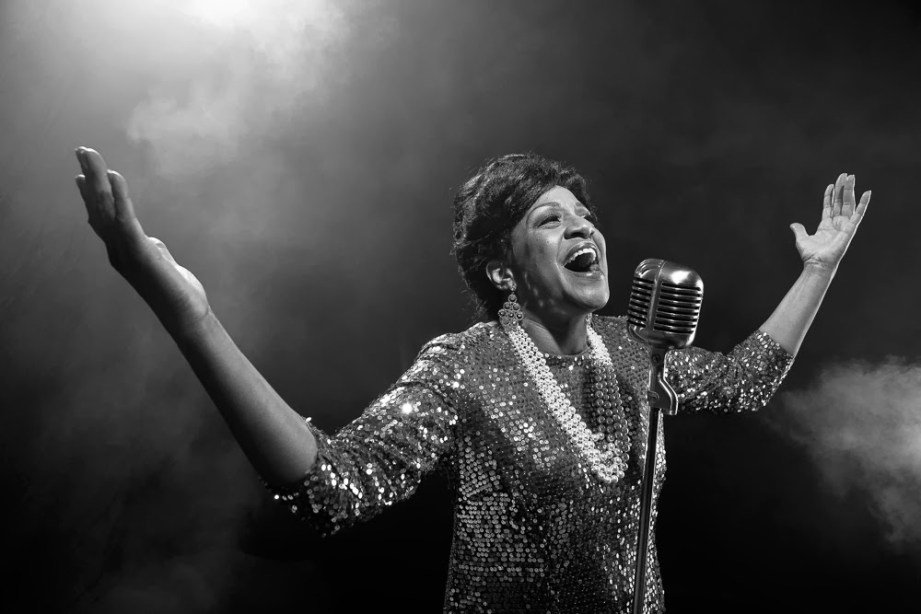
Because the script peels back the layers of myth around Fitzgerald’s antiseptic image, Tyree now feels connected to the real woman behind the silky voice and prim and proper mask
“There’s so much more to her than was allowed to be shared with the world. She definitely has a story, she definitely was singing from a place of pain. In rehearsals I began seeing a lot of the parallels between us.”
Both grew up fatherless and both lost a sister. By their mid-teens both were mixed up in the wrong crowd. Just as performing saved Fitzgerald, it gave the “rebellious” Tyree a purpose and discipline she’d lacked. She began singing in church, at Morningstar Baptist, where she still attends today, and at Omaha Technical High School. Outside of her faith, performing is Tyree’s spiritual sanctuary.
“For me theater and music are my therapy but from everything I’ve learned about Ella it was more like her drug. For me it takes me to another place and it gives me a peace and a calm. I leave everything outside. It’s like this is a whole other world.”
Just as performing helped Tyree cope with insecurities, she guesses it did so for Ella, whose character in the show says, “I’m always OK when I’m on the stage. When I’m not working, I turn off, I get lost.”
Tyree’s usual reticence about her own turmoil isn’t to protect a well-manufactured facade, but a personal credo she inherited.
“I shared with Susie (Baer Collins) in a read-through that in my family we have a rule – you never look like what you’re going through. Though I’ve been through a lot, I’ve had a lot of heartbreak and heartache, I never look like what I’m going through, and that was Ella.
“It’s a pride thing. I was raised by strong black women. These women had to work hard. Nobody had time for that crying and whining stuff.
It was, ‘Straighten your face up, get yourself together, keep it moving.'”
She says what she doesn’t like about Ella is “the very same thing I don’t like in myself,” adding, “Ella didn’t have enough respect for herself to know what she deserved. She didn’t have those examples, she didn’t have a father. People always say little boys need their fathers, well little girls need their fathers. too. They need somebody to tell them they’re beautiful. They deserve somebody in their life that isn’t going to abuse them. When you don’t have that you find yourself hittin’ and missin’, trying to figure it out, searching for that acceptance and that love. That’s very much our shared story.”
That potent back story infuses Tyree’s deeply felt interpretations of Fitzgerald standards. Tyree’s singing doesn’t really sound anything like her stage alter ego but she does capture her heart and soul.
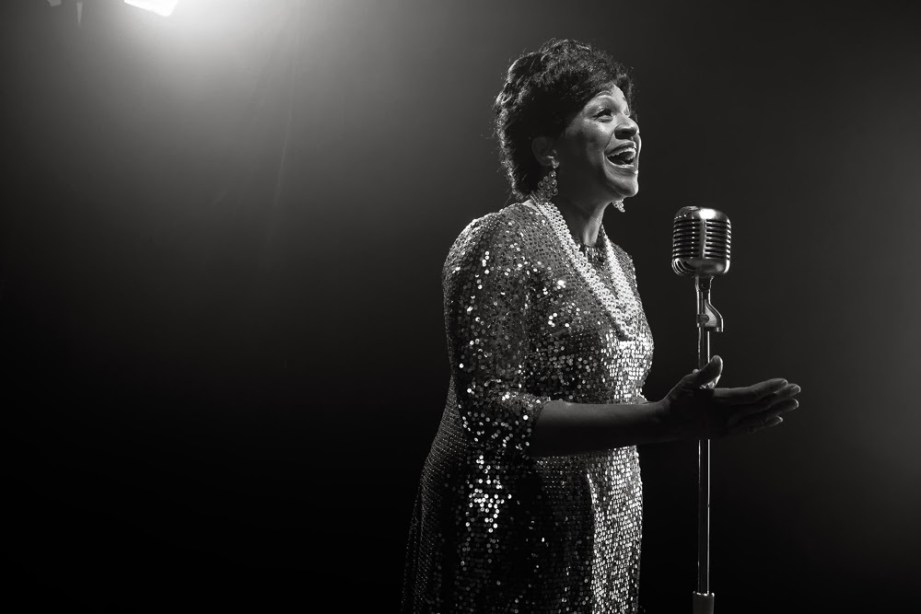
Tyree, a natural wailer, has found crooning ballad and scat-styles to conjure the spirit of Ella. Tyree makes up for no formal training and the inability to read music with perfect pitch and a highly adaptable voice.
“My voice is very versatile and my range is off the charts,” Tyree says matter-of-factly. “I can sing pretty much anything you put in front of me because it’s all in my ear. I’ve been blessed because they (music directors) can play it one time and I get it.”
She considers herself a singer first and an actress second, but in Ella she does both. She overcame initial doubts about the thick book she had to learn for the part.
“It’s a lot of lines and a lot of acting and a lot of transitions because I’m narrating her life from 15 years-old to 50.
But after months of rehearsal Tyree’s doing what she feels anointed to do in a space where she’s most at home.
“This is where I get to be lost and do what I do best, this is where I don’t miss. I think it’s because it’s coming from a sincere place. My number one goal is that everybody in the audience leaves blessed. I want to pour something out of me into them. I want ’em to leave on a high. It’s not about me when I’m on stage. This is God-given and there’s a lot of responsibility that comes with it to deliver.”
This popular performer with a deep list of musical theater credits (Ain’t Misbehavin’, Beehive) feels she’s inhabiting the role of a lifetime and one that may finally motivate her to stretch herself outside Omaha.
“I’m still like blown away they asked me to come do this show. I still have goals and dreams and things I want to do. As you go through your journey in life there’s things that hinder those goals and dreams and they cause you to second guess and doubt yourself – that maybe I don’t have what it takes. I’m hoping this will instill in me the courage to just go for it and start knocking on some of those doors.”
Ella continues through March 30. For times and tickets, visit http://www.omahacommunity playhouse.com.
Patique Collins Finds the Right Fit
January 3, 2014
Leave a comment
Patique Collins has got it going on. She is a high achieving African American woman with an alluring combination of physical besuty, spiritual enlightenment, business savvy, and passion for her life’s calling. The Omaha, Neb. fitness trainer loves empowering people to positively chnage their lives. In the short time between leaving a successful corporate career to starting her own buisness, she’s expertly branded her Right Fit company to grow its client base and to garner media attention. I discovered her through her heady, consistent use of Facebook as a social media marketing platform that gets her name and face and brand out there, not just through the usual promotional methods but through inspiring before and after pictorials and testimonials that demonstrate the difference that Right Fit workouts make and through affirmations she writes and shares to offer encouraging life lessons. My profile of Patique is for Omaha Magazine.

Patique Collins Finds the Right Fit
©by Leo Adam Biga
Originally published in Omaha Magazine
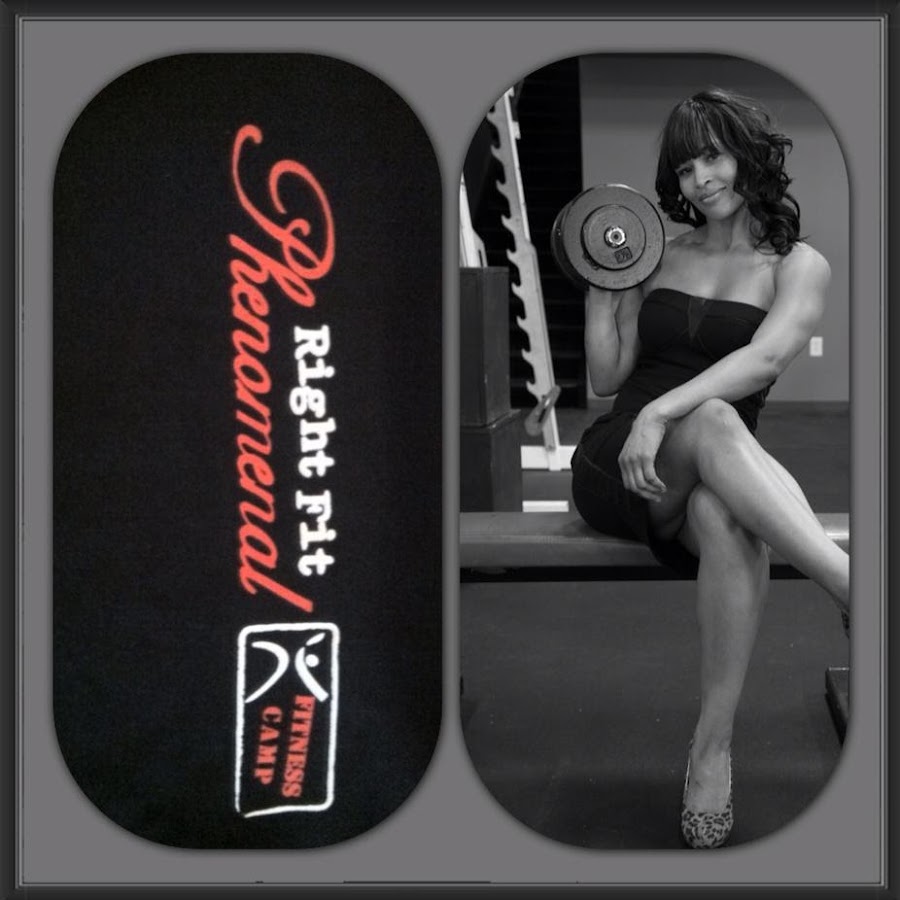
In 2011 Patique Collins left a two-decade corporate career to open a fitness gym. Two-and-a-half years later her Right Fit at 11067 West Maple Rd. jumps with clients.
Under her watchful eye and upbeat instruction, members do various aerobic and anaerobic exercises, kickboxing and Zumba included, all to pulsating music, sometimes supplied by DJ Mista Soul. She helps clients tone their bodies and build cardio, strength and flexibility.
The sculpted Omaha native is a longtime fitness convert. Nine years ago she added weight training to her running regimen and got serious about nutrition. She’d seen too many loved ones suffer health problems from poor diet and little exercise. The raw vegan describes her own workouts as “intense” and “extreme.”
She pushes clients hard.
“I really want to help every single person that comes in reach their maximum potential, and that is a big responsibility,” she says. “if you don’t give up on you, I won’t. I will do whatever I can to help you earn your goals if you’re ready to.”
She’s known to show up at your job if you skip class.
“There’s accountability here at Right Fit. I’m very passionate about my clients.”
She believes the relationships she builds with clients keeps them coming back.
“People will tend to stay if you develop a relationship and work towards results.”
Her gym. like her Facebook page, is filled with affirmations about following dreams. being persistent and never quitting.
“I think positivity is a part of my DNA.”
She keeps things fun with theme workouts, sometimes dressing as a superhero.
A huge influence in her life was her late maternal grandmother, Faye Jackson, who raised her after Collins and her siblings were thrown into the foster care system. “My grandmother told me I could be whatever I wanted to be and made me believe it.” Collins went on to attain multiple college degrees.
Motivated to help others, she made human resources her career. She and her then-husband Anthony Collins formed the Nothing But Foundation to assist at-risk youth. While working as a SilverStone Group senior consultant and as Human Resources Recruitment Administrator for the Omaha Public Schools she began “testing the waters” as a trainer conducting weekend fitness boot camps..
Stepping out from the corporate arena to open her own gym took a leap of faith for this now divorced mother of two small children..
“This is a lot of work. I am truly a one-woman show. Sometimes that can be challenging.
She’s proud to be a successful female African-American small business owner and humbled by awards she’s received for her business and community achievements.
Right Fit is her living but she works hard maintaining the right balance. Family and faith are er top priorities.
This former model, who’s emceed events and trained celebrities (Usher and LL Cool J), wants to franchise her business, produce workout videos and be a mind-body fitness national presenter.
She believes opportunities continue coming her way because of her genuine spirit.
“There’s some things you can’t fake and being authentic is one of them. I’m doing what I want to do, I think it’s my ministry. Everybody has their gifts, and this is mine.
I’m able to influence people not just physically but mentally.”

Wanda Ewing Exhibit: Bougie is as Bougie Does
December 8, 2013
3 comments
Omaha has lost one of its most respected and exibited artists, Wanda Ewing. As a memoriam to her, I am posting for the first on this blog a story I did about an exhibition of hers some years ago. When the assignment came I already knew her work and like most folks who experienced it I was quite impressed. I very much wanted to do a full-blown profile of her but I only got the go-ahead to focus on the exhibit. She was very gracious with her time in helping me understand where she was coming from in her work. Her untimely death has taken most of us, even those who knew her far better than me, by complete surprise. Facebook posts about her are filled with shock and admiration.
You can appreciate her work at http://www.wandaewing.com.

Wanda Ewing Exhibit: Bougie is as Bougie Does
©by Leo Adam Biga
Originally appeared in The Reader (www.thereader.com)

Wanda Ewing, ©(photograph by Dana Damewood)
Wanda Ewing is at it again. The Omaha printmaker known for her provocative spin on African-American images has created a sardonic collection of reductive linocuts and acrylic paintings that considers aspects of beauty, race and social status. The work has been organized in the solo exhibition, Bougie, at the Sheldon Memorial Art Gallery in Lincoln, where it continues through December 2.
The title comes from a slang term, derived from the French word bourgeois, used in the black community as a put down for anyone acting “uppity,” said Ewing, an assistant professor in the Department of Art and Art History at the University of Nebraska at Omaha. “It speaks to the level of acceptance due to your social and economic background, your physical appearance, all of it.”
She explores bougie through the template of popular magazine culture and its vacuous lifestyle advice. The heart of the show is 12 faux glossy covers, each a reductive linocut with vinyl lettering on acetate, depicting a slick monthly women’s mag of her imagination called Bougie. The garish covers are inspired by Essence and other Cosmo knockoffs whose content places style over substance.
Among the “bougie markers,” as Ewing calls them, are black cover girls with straight or long hair and “story tags” that embody those things compelling to bougie women — shopping, how to lose weight, money and getting a man. Some of the teasers get right to the point: “Not Hood enough? 25 ways to get ghetto fabulous.” Another reads, “It’s what’s on the outside that counts.” Among the many double entendres are, “Tom Tom Club, back on the scene” and “I’m dreaming of a white Christmas.”
“I wanted to achieve something that was funny to read, but had some grit to it,” she said.
Each “issue” is adorned by a head and shoulders illustration of a black glamazoid female, the features made just monstrous enough that it’s hard to recognize the real-life celebs Ewing based them on. One vixen is based on home girl Gabrielle Union. Other iconic models include Halle Berry, Mariah Carey, Beyonce, Tyra Banks, Janet Jackson, Eve, Star Jones and Queen Latifah.
Ewing “distorted” the images, in part, she said, as “I didn’t want them to be necessarily commentary on the celebrity, because it’s not about that,”
These cover girls represent impossible beauty standards and thus, in Ewing’s hands, become primping, leering creatures for the fashionista industry. Like the figures in her popular Pinup suite, she said, bougie women “are not shrinking violets.”
Contrasted with the plastic mag images are big, bold, beautiful head portraits of more realistically rendered black women and their different hair styles — bald, straight, permed, afroed, cornrowed — executed in intense acrylic and latex on canvas. These are celebratory tributes of black womanhood. The figures-colors jump out in the manner of comic book or billboard art. “I’m still holding onto being influenced by Pop Art,” Ewing said. “I love color. I’m not afraid of color.” The Hair Dresser Dummy works, as she calls them, are a reaction to the stamped-out glam look of the old Barbie Dress Doll series. Ewing’s “dolls” embody the inner and outer beauty of black women, distinct features and all. We’re talking serious soul, here.


There are also fetching portraits of women that play with the images of Aunt Jemima and Mammy and that refer to German half-doll figures Ewing ran across. Another painting, Cornucopia, is of a reposed woman’s opened legs amid a cascade of flowers — an ode to the source of life that a woman’s loins represent.
All these variations on the female form also comment on how “the art world likes to celebrate women,” she said, “especially if they’re naked and in pieces.”
Bougie examines women as objects and the whole “black is-black ain’t” debate that Ewing’s work often engages. Glam mags help inform the discussion. Ewing said black models were once shades darker and displayed kinkier hair than today, when they have a decidedly more European appearance. “I grew up looking at these images and felt bad because as hard as I tried, I couldn’t achieve what was being shown,” she said. At least before, she said, publications offered “a variety of the ways black women looked. Now, these magazines idealize the same type of woman with the same kind of features. I find that interesting and damaging on so many levels.”
Like the figures in her Pinup series, Bougie’s women are too self-possessed or confident to care what anyone thinks of them.
Leave it to a master satirist, Omaha author Timothy Schaffert, to put Ewing’s new work in relief. In an essay accompanying the show, he comments:
“The women…demonstrate a giddy indifference to their objectification, defying any interpretations other than the ones they choose to convey. See what you want to see, the women seem to be saying. You can’t change who I am, they taunt. Ewing portrays women in the act of posing, women possibly conscious of their degradation yet nonetheless seducing us with their self confidence. For Ewing’s women, the beauty myth becomes just another beauty mark…
“And yet the politics of fashion are what give Ewing’s work its sinister and satirical bent. Just beyond the coy winks and the toothpaste-peddling smiles and curve-hugging skirts of these fine black women is the sense that the images aren’t just about them” but about “the various co-conspirators in the invention of glamour. In Ewing’s work, black women assert themselves into the commercial, white-centric iconography of prettiness, and the result is at times funny, at times sad, at times grotesque, but often charming. Her women rise above the didactic, each one becoming a character in her own right, in full control of her lovely image.”
In the final analysis, beauty is in the eye of the beholder.
“Although this work is coming from an artist who is black, it is not limited to just the black community,” Ewing said. “Ultimately, the work is about beauty. That’s a conversation everyone can contribute to.”
A conversation is exactly what her work will provoke.
The Sheldon Gallery is located at 12th & R Streets. Admission is free. For gallery hours, call 402.472.2461 or visit www.sheldonartgallery.org.

Related articles
- Bougie… Insult or Badge of Honour? (crazyramblingsofaconversatingadult.wordpress.com)
- Black women need more self esteem. (blacksforabetterlife.wordpress.com)
Gray Matters: Ben and Freddie Gray fight the good fight helping young men and women find pathways to success
July 13, 2012
10 comments
Omaha’s African-American community has some power couples in John and Viv Ewing; Willie and Yolanda Barney; Dick and Sharon Davis, among others, but the couple with the broadest reach may be Ben and Freddie Gray. He serves on the Omaha City Council. She’s president of the Omaha Public Schools Board of Education. That’s really having your fingers on the pulse of Omaha. Ben is someone I use as a source from time to time for stories I write about North Omaha and he is the subject of an extensive profile you’ll find on this blog. Freddie is someone I’ve just begun to know and I expect I’ll be interviewing and profiling her again before too long. They both have compelling stories and individually and collectively they are dynamic people making a difference wherever they serve and it just so happens their passions allign in boosting urban, inner city North Omaha through a variety of community, youth, and education initiatives.

Freddie Gray
Gray Matters: Ben and Freddie Gray Fight the Good Fight Helping Young Men and Women Find Pathways to Success
©by Leo Adam Biga
To appear in the August edition of the New Horizons
If you follow local news then you can’t help know the names Ben Gray and Freddie Gray. What you may not know is that they are married.
He’s instantly recognizable as a vocal Omaha City Councilman (District 2). He’s also a prominent player in the Empowerment Network, One Hundred Black Men and other community initiatives. He was a public figure long before that as a KETV photojournalist and the activist-advocate executive producer and host of the public affairs program Kaleidoscope, which weekly found him reeling against injustice.
Until recently his wife wasn’t nearly as well known, though in certain circles she was tabbed a rising star. She actually preceded Ben in public service when appointed to the Douglas County Board of Health. At the time she was office manager at NOVA, a mental health treatment facility. Along with Ben she co-chaired the African-American Achievement Council. She was also a paid administrator with the organization, which works closely with the Omaha Public Schools. It’s not the first time the couple worked in tandem. They have a video production business together, Project Impact. He produces-directs. She’s in charge of continuity.
She’s also worked as a strategic planning and management consultant.
Her longstanding interest in education led her to volunteer with the Omaha Schools Foundation and serve as a member of the student assignment plan accountability committee. The Grays were vocal proponents of the “one city, one school district” plan. Her public stature began to rise when she replaced Karen Shepard on the Omaha Public Schools Board of Education in 2008. She’s since become board president. The demands of the position leave little time for consulting work, which she misses, but she may have found her calling as a public servant leader.
“I like governance, I really do,” she says. “I have a strong feel for it.”
The size of responsibility she carries can be daunting.
“Sometimes I think about what a big job it is. The Omaha Public Schools district is one of the largest employers in the state and I’m the president of the board that’s in control of this entity. That’s kind of scary. I am not as confident as it comes across but I have a voice and I believe in using it for all these kids.”
Since assuming the presidency her public profile’s increased. In truth her private life was compromised as soon as she became Ben Gray’s wife in 1991. “It put me in the spotlight. There’s so many things that marrying somebody in the public eye does, and you don’t have a choice, you’re going to be public at that point.”
She suspects that sharing his notoriety has worked to her advantage. “There’s a lot of stuff Ben has afforded me the opportunity to do. Without him people wouldn’t know me from a can of paint and that’s probably how I would have lived my life and I would have been comfortable and OK with that.”
That each half of this pair holds a highly visible public service office makes them an Omaha power couple both inside and outside the African-American community.
Each represents hundreds of thousands of constituents and each deals with public scrutiny and pressure that gets turned up when controversy arises. That was the case last spring when he led the fight for the nondiscrimination ordinance the council eventually passed and Mayor Jim Suttle signed into law. In June Freddie found herself squarely in the media glare in the fallout of the scandal that erupted when sexually explicit emails OPS superintendent hire Nancy Sebring made came to light and she resigned under fire.
The couple makes sure to show their solidarity and support in crisis. Just as she turned out for city council hearings on the ordinance he attended the first school board meeting after the Sebring flap.
They act as sounding boards for each other when they feel they need to. “Sometimes we do,” he says, “but most of the time we don’t.” “If I want to bounce something off of him I can do that but I have my board members to do that with and he has his council members,” she says.
“If you’re married and you’re connected you know when it’s time to intervene and say let’s have a discussion about this,” he says. “Sometimes you just want to come home and veg out. The last thing you want is to talk about it. I don’t bring it home unless there’s a strategy, like when the Sebring thing happened we needed my expertise as a journalist, we needed legal counsel, we needed all of that, so that week was all about that.”
He’s proud of “how well she handled that situation, adding, “That was her defining moment.”
“A lot of times the conversation is after the fact,” she says, “because I can’t wait to talk to him to respond to the media when they’re in my face. I know if i need to I can reach out and he’s going to respond. The other thing is, we don’t always agree with each other. There’s been times when we’ve been able to change each other’s opinion or stand but not real often. But we don’t fight about it.”
The Grays have been making a difference in their individual and shared pursuits for some time now. The seeds planted during their respective journeys have borne fruit in the public-community service work they do, much of it centered around youth and education.
“We believe in children, I can tell you that, we believe strongly in children,” says Ben. Freddie calls it “a passion.”
Their work has earned them many awards.
They have seven adult children from previous marriages. They mentor more. By all accounts, they’ve made their blended family work.
“One of the things we did was we started having family dinners, and we started that before we got married,” says Freddie, “I still had one daughter at home with me. My older daughter was away from home. His children were still at home with their mom. Both of us were smart enough to figure out that with this new young person, let alone me, in the picture spending time with him that could be difficult. So we started having family dinner on Sunday and all seven of the kids would come. And we still do family dinner today.
“It was a wonderful way to bring our families together. And when people talk about a blended family, if you’ve ever done something like that and made it a tradition of your house for everyone to come together, it really and truly does blend them.”
Two of their kids live out-of-state now, as does one of their 11 grandchildren (they also have a great grandchild), but that still leaves a houseful.
“So generally on Sunday it’s a zoo time,” she says. “He loves it. He’s like they could all move back tomorrow. I’m the one that says no they cannot move back here and they have to go home now. They’re so close.”
Though born and reared in Cleveland, Ben’s made Omaha his home ever since the U.S. Air Force brought him here in the early 1970s. He’s built a life and career for himself and raised a family in his adopted hometown.
She’s an Omaha native but her father’s own Air Force career uprooted her and her six sisters for a time so that she did part of her growing up in Bermuda and in Calif. She returned in the early 1960s. The Omaha Central High School graduate raised a family here while working.
Whether in vote deliberations or media interviews each seems so poised and at home in this milieu of politics. As accomplished as they are today each comes from hard times far removed from these circumstances.
For example, the man Omahans know as Ben Gray is called by his street name “Butch” in his old stomping grounds of East Cleveland, where after suffering the loss of his working class parents at age 13 he fell into a life of organized crime. Numbers running, pimping, drug dealing. His extended family was well-entrenched in the black criminal underworld there. Its pull was something he avoided as long as his parents were alive but once gone he succumbed to a life that he’s sure would have ended badly.
Ben’s older sister Mary Thompson, whom he calls “my guardian angel,” and her husband took Ben and his younger brother Doug in and raised the boys right, modeling a fierce work ethic. But the call of the streets won out.
“The guys that I was dealing with, the guys that I knew, were real life gangsters. They do stories about these guys. Shondor Birns. Don King.
Before he was a fight promoter Don King used to run Cleveland. He ran all the drugs. And then he stomped a guy to death and when he went to prison his territory was split up, primarily between three different individuals and one of them was my uncle.”
Gray was arrested and sentenced to a youth incarceration center. After graduating a year late and near the bottom of his class he entered the military. His life’s never been the same since. “The Air Force changed who I was,” he says. “The military was my way out. Had I not joined I don’t think I would be alive. I was headed down a pretty dark path.” He graduated from aerial photography with honors. “People ask, ‘What was different?’ My response is always the same – discipline and expectations.”
That training is so ingrained, he says, “I’m disciplined about everything,” whether the self-pressed clothes he wears, the tidy home he keeps, the legislation he advances or the youth outreach he does.
“The intention of the military is to complete the mission and I complete the mission. When it came to the equal employment ordinance I had to complete the mission. When it came to the budget I had to complete the mission.”
He says leaving his old environment behind was the best thing he could have done.
“My sister readily tells folks all the time that while she hated to see me go she was in a lot of ways glad to see me go because she didn’t think I was going to make it if I stayed there.”
“That’s what she told me once,” says Freddie. “She said, ‘We’d thought he’d be dead or in jail.’ But they’re so proud of who he is today.”
When he goes back to visit relatives and friends, as he did with Freddie in July, he’s clearly a different person than the one who ran the streets as a youth but to them he’s still Butch. Oh, they see he’s transformed alright, but he’s Butch just the same.
“When we’re in Cleveland I immediately go back to referring to him as Butch,” says Freddie. “That’s what everybody knows him as. I don’t think anybody knows him as Ben.”
“It’s interesting when you leave a place and you come back to it,” he says, “because when I visited the corners I used to be at – even though a lot of the same people were still there – it wasn’t the same for me. They knew it and I knew it. A friend of mine told me, ‘This is not your place anymore,’ and he was right, it wasn’t. I didn’t fit.
“When I was doing the things I was doing I fit right in, as a matter of fact I ran the show for the most part.”
On a plane ride the couple made 20 years ago to spend Thanksgiving with his family in Cleveland Ben revealed his past for the first time to Freddie.
“I said, ‘Babe, when we get to Cleveland you’re going to hear some stories about me.'”
Then he asked her to marry him.
“Yeah, that plane ride was interesting,” she says, “and I still said yes.”
Ben Gray commands respect from many quarters, including young people

Freddie gray presiding over an Omaha Public Schools Board of Education meeting
She has her own past.
Living in the South Omaha public housing projects called the Southside Terrace Garden Apartments, near the packinghouse kill floors her father worked after his military service ended, the future Mrs. Ben Gray grew up as Freddie Jean Stearns.
Life’s not always been a garden party for her. She got pregnant at age 17 and missed graduating with her senior class. She struggled as a young single mother before mentors helped her get her life together.
“It was not all a fairy tale life. The personal feeling of disappointment, not just letting my parents down but all those sisters behind me. That humbled me for a really long time.”
Long before marrying a celebrity and entering the public eye or serving on the school board, she quietly made young people her focus as a mother and mentor. She calls the young people under her wing “my babies.” Just as women helped guide her she does the same today.
She can identify with young single moms “who think their lives are over,” telling them, “I thought that was going to be it, that I was going to be on welfare for the rest of my life. I looked around at where I was, the projects, and I saw a lot of it around me. Mothers who had never been married. I was on public assistance for awhile and didn’t like that at all. I didn’t like the fact welfare workers could just come over my place and go through my stuff.”
She shares her experience of learning to listen to the right advice and to make better choices.
“I talk to these young women now, and I’m very open about it. I don’t preach.”
But she tries to do for them what women did for her. “I was blessed to have those women in my life. A number of them became my mentors. One of them was LaFern Williams. I’ll never forget her and Miss Alyce Wilson, the director of the Woodson Center in South Omaha. I spent so much time there. My big sister Lola Averett was another. There was a time when anything and everything she did I would do. She still models everything I could ever hope to do and to be.”
She says women like her sister, who worked at GOCA (Greater Omaha Community Action), along with Carolyn Green, Juanita James, Phyllis Evans, Sharon Davis and Beverly Wead Blackburn, among others, encouraged and inspired her. When Gray attended GOCA meetings she says she was at first too shy to speak up at but Lola and Co. helped her find her voice and confidence.
“They honestly would make me stand up and ask my question.”
“I’ve been very blessed in my life to have great female role models,” she says. “They took special care of me and others. They took care of the community, too. They made it safe. They protected and loved. These women touched a lot of lives.”
Those that survive continue fighting the good fight into their 70s and 80s. “They haven’t stopped. I wouldn’t even say they’ve slowed down.” She says when she sees them “you can bet your bottom dollar I’m in their ear saying, ‘I’m making you proud, I’m doing the right thing.'” It’s what Freddie’s babies do when they’re around her. All of it in the each-one-to-teach-one tradition.
“I’ve always had the passion for those who are behind me, young people. I just collect them, I don’t know what else to say. Anyone who really knows me knows that I talk about my babies. And they know who they are and they know what I expect from them. I can’t tell you how they’re selected, I don’t know how. But there is that group and they are my babies and I love them with all my heart.
‘I’ve told them, ‘My expectations are you’ve got to take care of Miss Freddie when she’s old.’ They laugh at that. But I need them to take care of me. They’re going to be my doctor, my mechanic, my attorney. And then they get it, they understand what I’m telling them. That they’re going to take care of me because I can’t do it forever. So they’re going to have to do these things, they’re going to need to be on the board of health, on the school board, work at NOVA. They need to take care of the world. They know that’s my expectation.”
She is a wise elder and revered Big Mama figure in their lives.
“When they see me they call me Mama Freddie or say, ‘How you doin’ Mama Freddie?'”
She recently lost one of her “babies.” When she got the news, she says, “it knocked me to my knees and I’m not talking figuratively. I was walking down the hall looking at Facebook on my phone when I saw it. I was very thankful Ben was here because I dropped to the floor. And then the phone started ringing and it was some of the other babies calling to check on me and me needing to check on them.”
Just as Freddie’s been a force in the lives of young people for a long time, so has Ben, who’s made at-risk youth his mission. As part of his long-time gang prevention and intervention work he even founded an organization, Impact One, that supports young people in continuing their education and becoming employable.
Because he’s been where they are, he feels he can reach young men and women whose lives are teetering on the edge of oblivion.
“It’s amazing how quickly you can spiral down into some really deep stuff if you let yourself, so I understand,” he says.”When people ask me why I do i deal with gang members it’s because I know ’em. I know how they think, I know what they think, I know most of ’em don’t want to do what they’re doing because I didn’t.
“But you get to a point after awhile where it becomes a lifestyle that makes it very difficult for you to get out of and the only choice you have sometimes, and the only choice I see for a lot of these young men, I hate to say this, is to leave here. I don’t like the brain drain. A lot of these people are really smart. But they’ve cast such a bad shadow that I don’t know how you stay here. I mean, I think there has to be some time between they’re leaving and coming back.”
He says something missing from today’s street dynamic is a kind of mentoring that used to unfold on the corner.
“At that time we had older guys that were able to talk to the younger guys.”
Kind of like what Ben does today.
“Someone might say, ‘Stop, don’t do that, that’s crazy.’ Or, ‘If this is what you’re going to do, here’s how you do it.’ Those kinds of things.
These young men don’t have that. A lot of them don’t. I’m talking about across the country. There’s nobody on that corner anymore who’s older who can tell them…”
“It used to be the young guys on the corner and the wise guys that went back to the corner gave people words of wisdom, and that’s gone,” says Freddie, who’s known her share of hard corners.
“That’s lost,” says Ben.
He says what’s missing from too many of today’s homes and schools in the inner city and elsewhere is the kind of discipline he got from his parents and sister and the military.
“I think most of us want it, we just don’t know we want it. Discipline is a method of working with people and molding people into what they should be as adults. That’s what it is. And that’s what my father tried to do for me in the brief time he was on this Earth.”
Gray sees a disconnect between some of today’s African-American youth and schools.
“I think what’s missing from majority minority schools is a pathway to get young people to know who they are. Our African-American students don’t know why they are. They don’t know the background. In the classroom they get a real strong dose of European history but they don’t get much about who they are.
“When there’s little or no discussion about you then how do you sit there and maintain an interest in being there?”
OPS has struggled closing the achievement gap between African-American students and nonblack students. Gray says before any real progress can be made “you’ve got to get them to stay there and keep them interested,” an allusion to the high truancy and drop-out rates among African-American students.
The problem has thus far defied attempted remedies.
He says, “In spite of efforts by the Empowerment Network, Building Bright Futures and others to address core problems like truancy and drop-outs in the (North Omaha) Village Zone we’re losing kids, they’re not staying in school. And they’re not staying in school because the influence of the street is such a strong influence. I know it. Those streets call you, man, and you can be in that classroom six hours a day but damnit you’ve got to go home and when you dog home you go to an environment that’s primarily unhealthy.
“So in spite of all we’ve done in that Village Zone we’re not winning.”
He doesn’t pretend to have the answers. He knows the problem is complex and requires multiple responses. But he does offer an illustration of one approach he thinks works.
“Teachers are constantly amazed I can address a school assembly and keep kids’ attention. Staff don’t get it. Freddie gets it. I talk about where the kids came from, I talk about who they are, I talk about what their history has been. They listen because they don’t (usually) hear that. That’s part of the missing piece of why they don’t stay. They don’t feel there’s anything there for them.”
He doesn’t claim miraculous results either.
“Any of us who are involved in this effort who talk to these kids know they’re not going to hear everything we say right away. They’re waiting to hear if we’re genuine. I tell them, ‘I’m not here to get all of you, I’m not here to convince any of you of anything. One of you is going to hear what I say, respond and react to what I say by becoming a leading citizen in this community. So I’m just here to get my one.’
“That’s when they start listening. They want to be the one.”

Flanked by Freddie Gray and Ben Gray, grieving parent Tabatha Manning at a press conference in the aftermatth of losing her 5-year-old child to gun violence.
Freddie appreciates better than most the challenge of educating children when so many factors bear on the results.
“We don’t produce widgets, we produce the citizens that are going to run this country. That’s exactly what we’re doing every single day. Every single one of these kids is an individual who deserves to have an individual touch them. It’s about that one-on-one relationship if we’re going to get kids to succeed, and if we don’t get this right then I think that says something about what the state of this country will be.
“Poverty is going to be the thing that kills us if we don’t take care of it and the only way I know to do that is to provide our children with the necessary skills to become employable.”
She’s keenly aware of criticism that the school board has ceded too much power to the superintendent.
“I understand people say that thing about the board being a rubber stamp but they don’t come and listen to the committee meetings and hear the board in dialogue. By the time theres a news sound bite we’ve already talked about it or figured it out or tabled it. Those things happen during the day (when the cameras aren’t on).
“But trust me we’ve got this. My job is to provide the superintendent with guidance in saying, ‘This is what you will do.’ There has to be parameters. We’ve got statutes to follow.”
In seeking solutions to bridge the achievement gap, she say, “I’m talking to other districts’ board presidents and members, not just when I’m on the Learning Community, but other times, too. That hasn’t happened much before.”
She says more collaboration is necessary because studies show that wherever kids live, whatever their race, if they live in poverty they underachieve.
“Poverty is a problem. If we’re not addressing poverty now than 20 years from now we’ll be having the same conversation.”
Breaking the cycle is a district goal.
“At the board level it’s looking at careers. We do kids a disservice when we say everybody’s going to college because that’s a lie and we all know it. But we do need to supply them with the necessary skill sets so they can be productive citizens.
“We’ve got to get these young people to the place where they can get jobs, where they can get out of poverty.”
She says OPS is finding success getting businesses to offer students internships that provide real life work experiences. He’s been active in the Empowerment Network’s Step-Up Omaha program to provide young people summer training and employment towards careers.
As both of them see it, everyone has a stake in this and a part to play, including schools, parents, business.
“There’s room at the table for everybody and everybody has to have a foot in this and has to step up. The focus has to be on what can we do together,” she says.
Now that she’s solidly in the public eye in such a prominent job she hopes African-American women follow her.
“I have to say this for other women who find themselves feeling like they’re voiceless: If you can see it, you can be it. There’s a lot of young African-American females who are just sharper than sharp, that could run rings around me all day doing this, but they don’t feel like they have a voice.
“And so I really hope they are paying attention because again Miss Freddie is not going to be doing this for the rest of her life and some of them are going to need to be sitting on this board.”
Ben Gray feels the same way about the young men and women of color he wants to see follow him into television or politics or wherever their passion lies.
Both with his own children and those he’s “adopted,” he’s taken great pains exposing them to African-American history and culture and encouraging them to engage in critical thinking and discussion.
“I wanted them to be more aware, I wanted all of our children to be aware of what’s around them and what it takes to survive. And to know who they are and what their history is, and some of them can tell you a lot better than I can tell you now.
“We have two that are like our own who are former gang members. Both of these guys are brilliant young men, and given a different set of circumstances would be someplace else.”
Ben and Freddie Gray are living proof what a difference new circumstances and second chances can make.
Related articles
- Masterful: Omaha Liberty Elementary School’s Luisa Palomo Displays a Talent for Teaching and Connecting (leoadambiga.wordpress.com)
- Fast Times at Omaha’s Liberty Elementary: The Evolution of a School (leoadambiga.wordpress.com)
- Negro Leagues Baseball Museum Exhibits on Display for the College World Series; In Bringing the Shows to Omaha the Great Plains Black History Museum Announces it’s Back (leoadambiga.wordpress.com)
- Kelly: It’s not about the ‘sex story,’ Freddie Gray says of Sebring (omaha.com)
- Brown v. Board of Education: Educate with an Even Hand and Carry a Big Stick (leoadambiga.wordpress.com)
- Omaha’s Malcolm X Memorial Foundation Comes into its Own, As the Nonprofit Eyes Grand Plans it Weighs How Much Support Exists to Realize Them (leoadambiga.wordpress.com)
Categories: African-American Culture, African-American Empowerment Network, Ben Gray, Education, Freddie Gray, Omaha Public Schools, Politics, Social Justice, Writing, Youth
Ben Gray, Empowerment Network, Freddie Gray, Impact One, Omaha African-American Achievement Council, Omaha City Council District 2, Omaha Public Schools, Omaha Public Schools Board of Education
Psychiatrist-Public Health Educator Mindy Thompson Fullilove Maps the Root Causes of America’s Inner City Decline and Paths to Restoration
July 4, 2012
5 comments
America’s inner cities are sick. Have been for a long time. They’re long overdue for a sweeping public health approach that gets to some of the root causes of their decliine over the past 40-some years. North Omaha (really northeast Omaha) is a case in point. It’s long been in need of a transformation and one finally is underway after years of neglect, half-starts, spotty redevelopment, counterproductive urban renewal efforts, and rampant disinvestment. Psychiatrist and public health educator Mindy Thompson Fullilove has done much research, writing, and speaking about what’s happened to drag down inner cities and what’s needed to bring them back and I wrote the following piece on the eve of a presentation she gave in Omaha. I interviewed her in advance of her talk. I did attend her program, and though I didn’t do a followup story to report what she said I can tell you she covered many of the same points she made with me in our session.

Mindy Thompson Fullilove
Psychiatrist-Public Health Educator Mindy Thompson Fullilove Maps the Root Causes of America’s Inner City Decline and Paths to Restoration
©by Leo Adam Biga
Originally appeared iin The Reader (www.thereader.com)
The low standard of living found in segments of Omaha’s inner city mirrors adverse urban conditions across America. Poverty, low test scores, unemployment, gang violence, teen pregnancy, HIV/AIDS and STDs, distressed/devalued properties all occur at disproportionately high rates in these sectors.
Psychiatrist Dr. Mindy Thompson Fullilove, a public health educator at Columbia ((N.Y.) University, studies the causes and consequences of marginalized communities. A pair of talks she’s giving in Omaha next week, one for the public and one for health professionals, will echo local efforts addressing economic-educational-health disparities, infectious diseases and inner city redevelopment.
By training and disposition Fullilove looks for the connections in things. Much of her research focuses on linkages between the collapse of America’s urban core and the corollary decline in health — physical, psychological, emotional, environmental, economic — endemic there. She blames much of the blight on fallout from late ‘40s through mid-‘70s urban renewal projects.
Many longtime Omaha residents rue the North Freeway for driving a stake through the heart of a once cohesive, stable community. Hundreds of homes and dozens of businesses were razed to build it. Critics say this physical-symbolic barrier divided and damaged an area already reeling from late ‘60s riots that destroyed the North 24th St. business district, which only hastened white flight.
These interrelated phenomena, Thompson Fullilove believes, caused widespread carnage in cities like Omaha — displacing families, disrupting lives, rupturing communities, dragging down quality of life, property values, self-esteem and hope. In her view urban renewal was part of policies that “destroyed neighborhoods” — as many as 2,500 nationwide by her calculation — in the guise of progress.

“Many of the ways in which we built at that time involved demolishment of a neighborhood,” she said by phone. “There were these very large projects put in so that the old grid of the city was fused into sort of super blocks and huge things built on them like cultural centers or universities that made a fundamental change in the flow of the city. A lot of these projects were really not very thoughtful and didn’t work. So we’re living with the aftermath of very bad urban development, much of which is now coming down and being replaced.”The kind of severing of neighborhoods that occurred when freeway projects cut through the heart inner cities
Witness the sprawling Logan Fontenelle public housing project that came down a few years ago in northeast Omaha. In the early ‘70s, large tracts of land dotted with homes and businesses in far east Omaha were cleared for airport expansion. Anytime people are forced to move from their home it’s a major stress that can dislocate them from family, friends, jobs, neighborhood, community.
“Displacement is always accompanied by violence,” said Thompson Fullilove. “When people are displaced they need help to get back on their feet but if there’s never any help then things can get worse and worse. You get anger, hostility, and then people, instead of being able to solve problems, are just trying to survive.”
She said when people live outside social networks-support systems, epidemics like AIDS, STDs or gun violence emerge and grow entrenched. Often she said, people displaced from their homes also get displaced from blue-collar jobs. “People have no way to make a living and no social network to fall back on, so it’s really a double whammy,” she said. The results? “Terrible crime as people try to do work in the underground economy.” Thus, the drug trade thrives, gangs go unchecked. Some observers say Omaha’s African American community is still hurting from the packinghouse/manufacturing/railroad jobs lost in the ‘60s-‘70s.
She said today’s info service-high tech economy leaves many workers behind. “You have to get people to learn skills, you have to get people more education and you have to be inventing what they’re going to work at, and all these require a stable, engaged city as a center of exchange not a city of haves against have-nots,” she said. “Until cities are places of development, we’re in bad trouble as a nation.”
A term she uses to describe displacement’s trauma, “root shock,” is also the title of a book she authored examining how the ripple effects of urban renewal impact whole swaths of cities and persist long after the bulldozers leave.
“It has a ripple both in time and in space,” she said. “So tearing up a neighborhood has ripples for a whole metropolitan area and it also has ripples over time for generations of people who live in that area. Also, when you demolish a big area it creates a ripple of destruction on the other side of the area you demolish — you also decrease the value and the stability of the properties. And as those properties decline in value and really fall apart the properties next to them fall apart, and then the properties next to them fall apart. So you can actually take a drive in a place where there was urban renewal and find the leading edge of the destruction, typically a couple of neighborhoods over from where the urban renewal was done and, sometimes, even further.”

Site of the former Logan Fontenelle Housing Projects now a park and single-family home neighborhood
She said the decline extended to downtowns.
“Many neighborhoods demolished for urban renewal were near downtown or part of the downtown,” she said, “so demolishing a lively neighborhood which added to the strength of a downtown shopping center contributed to the collapse of many American downtowns, which are only slowly coming back.”
Like a disease introduced into a larger host, she said as urban decline spread it compromised the health of entire cities.
“It installed something that was dysfunctional in a critical part of the landscape of the city,” she said, “Although we think of all the terrible things that happened to the African Americans who actually lived in many affected neighborhoods, the worst consequence is that we made our cities weaker, so the whole nation lives with that grievous error. Cities are important for our nation because they really are the economic engine. So undermining the cities the way we did weakened our whole economic prosperity. You might say one of the seeds of this current economic crisis is in the destruction of our cities.”
From her perspective, America hasn’t corrected these problems — “what we’re doing instead is continuing to use versions of the same process.” She said even where a city center may enjoy a renaissance “it’s being rebuilt with the goal of attracting people from the suburbs to come back to the city.” That’s gentrification. “So the goal is not to make the city a welcoming place for all people that might like to live there. As opposed to figuring out how do you make a city which is a place of exchange, you’re making a city a place of exclusion,” she said, “and that’s just as destructive as urban renewal.”
She notes there‘s not yet widespread understanding among policymakers, developers and stakeholders of processes that diminish-threaten public health. She’s hopeful conferences like one she was at earlier this month in NYC, Housing, Health and Serial Displacement, “really open up this conversation, because I think if we’re going to have exciting cities in the United States it requires really a new approach to how you build cities, not just pushing people out.” She and her husband, community organizer and sociomedical sciences expert Robert Fullilove, work with urbanists on strategies for sustainable, inclusive, built environments.
Through the couple’s think tank, Community Research Group, they study and advocate holistic, public health approaches to urban living dynamics that view cities as ecosystems with interdependent neighborhoods-communities. What happens in one district, affects the rest. If one area suffers, the whole’s infected.
“You can’t undermine stable living conditions in a neighborhood or a community without bringing down the quality of life of everybody in the area, and it’s a very large area that then gets affected,” Thompson Fullilove said. “The foundation of health is good living conditions. Health is sort of our ability to enjoy our lives.”
Related articles
- A Synergy in North Omaha Harkens a New Arts-Culture District for the City (leoadambiga.wordpress.com)
- A Brief History of Omaha’s Civil Rights Struggle Distilled in Black and White By Photographer Rudy Smith (leoadambiga.wordpress.com)
- Omaha’s Northwest Radial Highway’s Small Box Businesses Fight the Good Fight By Being Themselves (leoadambiga.wordpress.com)
- Demolition is Not Enough: Design After Decline Author Brent Ryan on Redevelopment in Philadelphia (pennpress.typepad.com)
- Bill Cosby Speaks His Mind on Education (leoadambiga.wordpress.com)
Lifetime Friends, Native Sons, Entrepreneurs Michael Green and Dick Davis Lead Efforts to Revive North Omaha and to Empower its Black Citizenry
August 20, 2011
12 comments
Two well-connected players on the Omaha entrepreneurial scene and two stalwart figures in efforts to revitalize predominantly African-American North Omaha are Michael Green and Dick Davis. The Omaha natives go way back together and they share a deep understanding of what it will take to turn around a community that lags far behind the rest of the city in terms of income, commerce, jobs, education, housing starts, et cetera.
Lifetime Friends, Native Sons, Entrepreneurs Michael Green and Dick Davis Lead Efforts to Revive North Omaha and to Empower its Black Citizenry
©by Leo Adam Biga
Originally appeared in the New Horizons
Growing up in the late 1940s-early 1950s, Michael Green and Dick Davis knew The Smell of Money from the pungent odors of the bustling packing plants and stockyards near the Southside Terrace apartments they lived in. Buddies from age 4, these now middle aged men began life in similar disadvantaged straits, yet each has gone on to make his fortune.
Instead of the old blue collar model they were exposed to as kids, they’ve achieved the Sweet Smell of Success associated with the fresh, squeaky clean halls of corporate office suites. Education got them there. Each man holds at least one post-graduate degree.
Along the way, there have been some detours. As kids they moved with their families to North O, where they became star athletes. They were teammates at Horace Mann Junior High before becoming opponents at rival high schools — Green at Tech and Davis at North. Both earned accolades for their gridiron exploits as running backs. Green, a sprint star in track, was a speed merchant, yet still rugged enough to play tackle, fullback and linebacker. Davis, a two-time unbeaten state wrestling champ, was a bruiser, yet still swift enough to outrun defenders.
The Division I football recruits reunited as teammates at Nebraska in the mid-’60s — excelling in the offensive backfield under head coach Bob Devaney and position coach Mike Corgan. They never saw action at the same time. Green, a halfback his first two years, co-captained the Huskers’ 1969 Sun Bowl championship team at fullback. Davis was in the mold of the classic blocking, short yardage fullback but he could also catch passes out of the backfield. Drafted a year apart by the NFL, they each pursued pro football careers, but not before getting their degrees — Green in economics and marketing and Davis in education. It wasn’t long before each opted to take a different route to success — one that involved brain, not brawn and three-piece-suits, not uniforms or helmets.
They ended up as executives with major Omaha companies. Today each is the owner of his own company. Green is founder, president and chief investment officer of Evergreen Capital Management, Nebraska’s only minority-owned registered investment advisor. Davis is CEO of Davis Cos., a holding company for firms providing insurance brokerage, financial consulting and contractor development services. Green handles hundreds of millions of dollars in managed assets for institutional clients. Davis Cos., with offices in multiple states, generates millions in revenues and is one of Omaha’s fastest growing firms.
The two men’s stories of entrepreneurial success are remarkable given that in the era they came up in there were few African American role models in business. Back in the day, blacks’ best hopes for good paying jobs were with the packing plants, the railroad or in construction. Few blacks made it past high school. One gateway out of the ghetto and into higher education was through athletics, and both Green and Davis were talented enough to earn scholarships to Nebraska. The opportunities and lessons NU afforded them — both in the classroom and on the field — opened up possibilities that otherwise may have eluded them.
Having come so far from such humble beginnings, neither man has lost sight of his people’s struggle. Both are immersed in efforts to address the problems and needs facing inner city African Americans. Green and Davis are leaders in a growing Omaha movement of educated and concerned blacks working together with broad private-public coalitions to make a difference in key quality of life categories. These initiatives are putting in place covenants, strategies, plans, programs and opportunities to help spur economic development, create jobs, provide scholarships and do whatever else is needed to help blacks help themselves.
Some efforts are community-driven, with Green and Davis serving as committee members/chairs. Others are spearheaded by the men themselves. For example, Davis is the driving force behind the North Omaha Foundation for Human Development, the Davis-Chambers Scholarship Endowment and Omaha 20/20, efforts aimed at community betterment, educational opportunities and economic development, respectively. Green has led a minority internship program that guides young black men and women into the financial services field. He helps direct the Ahman Green Foundation for Youth Development, which awards grants to youth organizations and holds a week-long football/academic camp. The foundation’s namesake, Husker legend Ahman Green, is his nephew.
Individually and collectively Green and Davis represent some high aspirations and achievements. They’re trying to give fellow blacks the tools to dream and reach those things for themselves. The two defied the long odds and low expectations society set for them and now actively work to improve the chances and raise the bar for others. The paths forged by these men offer a road to success. They’re putting in place guideposts for new generations to follow in their footsteps.
Recently, Green and Davis sat down with the New Horizons. In separate interviews they discussed their own journey and the road map for setting more blacks on the path to the American Dream.
Michael Green
Responsibility and leadership came early for Michael Green. As the oldest of five kids whose single mother worked outside the house, he was often charged with the task of looking after his younger siblings. His mom, Katherine Green, worked in the Douglas County Hospital kitchens before getting on with the U.S. Postal Service, where she retired after 30-plus years. Sundays meant getting dressed for services and bible school at Salem Baptist Church. He remains in awe of what his mom did to take care of the family.
“My mother raised us kids as a single working mom,” he said. “A very stable person. We didn’t know what poor was. I mean, she provided for us. We didn’t have the best of everything but we always had a place to live and food on the table. She was always home when she wasn’t working. On Saturday mornings she’d always get up and cook us a big breakfast with eggs and pancakes and everything and it conditioned me so much there’s hardly a Saturday morning I don’t crave eggs.”
 |
Michael Green
It was an era of segregation and limited horizons for blacks but families and neighborhoods were tighter and in many ways, Green said, “it was really better times back then. Our parents worked. They provided for us. We didn’t even have the equivalent of cell phones or iPods and stuff like that, but we played, we improvised, we made our own skateboards and soap box derby carts and sling shots. If you were doing something you weren’t supposed to be doing bad news, as we’d say, would probably beat you home because neighbors knew who you were and knew who your parents were. They’d call and say, ‘Michael’s down the street doing this’ and by the time you got home you’d hear about it.”
His mother, he said, “had one mantra — get an education. I can remember in my childhood saying I wanted to play pro baseball. She said, ‘That’s fine, but make sure you know how to do something else.’ I had no clue what she was talking about. ‘What do you mean? I won’t have to. I’m going to play pro baseball. What else is there?’” Years passed before he knew how firmly her advice sunk in.
“It’s just funny how God works,” he said, “because it wasn’t until I walked across the stage to accept my (college) diploma that conversation popped into the front of my head. It just kind of stuck back there in my subconscious. I had made up my mind I was going to get my degree, so I knew I could do something else.”
Green didn’t get involved in organized athletics until junior high. Pickup games were common at Kountze Park, the YMCA and area schools. He and his kid brother David first flashed their speed at Horace Mann, where gym teacher/athletic coach Bob Rose saw their ability.
“He was a father on the field for many of us,” Green said of Rose. Green’s parents never married and his father was mostly out of the picture.
The Green brothers were not alone making their mark athletically on the north side. The area was then and is now a fertile ground for athletic excellence. A relatively small geographic area produced such standouts as Bob Gibson, Bob Boozer and Fred Hare. Before the Green brothers there were the Sayers brothers (Gale, Roger and Ron), the Nared boys (Rich and John) and the Boones (Ron and Co.). The same time the Greens were turning heads Dick Davis and his older brother Ricky Davis were doing the same. Leslie Webster starred. Joe Orduna, Phil Wise, Johnny Rodgers, John C. Johnson, Mike McGee and a host of others followed.
Green and his brother David ended up at Tech, rather than at North like his childhood friend Dick Davis, because it was where mom went to school.
“Tech, like a lot of the inner city schools, has a history where a lot of family generations went through that school,” he said. “My family’s a prime example. My mom graduated from Tech. My brother and I did. Cousins. It has a lot of emotional legacy for us Tech grads, primarily because Tech is closed now.”
The feeling runs so deep that Green chairs the Tech High Auditorium Restoration Project that’s raising funds for refurbishing the building’s 2,000-plus seat venue — one that hosted world class performing artists and public figures in its heyday.
“Professionals who have come and looked at it — from acoustics experts to engineers of various kinds — have said it’s in tremendous condition and just needs to be updated and restored,” he said.
Coming out of Tech to play for the “jovial” Devaney was not a hard sell.
“He and I hit it off right away. Very down to earth. He wasn’t like the Lombardi caricature of a coach. More of a father figure,” Green said.

Bob Devaney with 1969 co-captains Dana Stephenson and Mike Green, No. 34
Something Green didn’t appreciate until years later is how Devaney showed unusual sensitivity for the time by taking into account that except for a few athletes NU had markedly few black students. He said the Old Irishman even expressed interest in enrolling more blacks at Lincoln — athletes or not — in order to create a more comfortable environment for blacks.
Green said admiringly, “He was very concerned about the black experience we would have off the field.” It would be some years yet, he said, before the black population on campus increased appreciably.
When Green played, team captain honors always went to seniors. As a senior in ‘69 he was expecting the quarterback to get the offensive captain’s nod but halfway through fall scrimmage no vote had been taken yet to name anyone. He recalled being upset after “a particularly sloppy scrimmage” in preparation for the season opener against perennial power Southern Cal. “I started yelling at everybody on the sideline. I just went off on ‘em. Then we had a team meeting to elect the captains and somebody nominated me. They all voted and it was overwhelming they wanted me to be captain. I was just shocked.”
The experience taught him something he’s carried with him through life.
“I guess what I learned is that if you’re proactive about the way you go about things you don’t wait for something to happen, you don’t wait for somebody else to do something. You see something you want to do and you figure out how you want to get it done,” he said. Even if that means saying some hard things.
That motivated approach led him to get his degree before he left school for the NFL and to have a Plan B in place in case things didn’t work out with football.
The San Diego Chargers drafted him in the later rounds. He made the cut but this was a time before free agency. Players were property that could be bought, sold, traded with impunity. Seeing veterans traded overnight, their life and the lives of their loved ones disrupted, was a wake up call.
“What was sobering for me was the business end of pro ball where if you weren’t starting you could be living in San Diego today be shipped off to Cleveland tomorrow. That happened to a guy in training camp. You were strictly at the mercy of the team…There was no contract negotiation. You had to be a real star to have some leverage. Your only alternative was to hold out.”
If the NFL didn’t pan out he was going to have other options. He said athletics taught him not only how to compete but “how to grow from defeat,” he said. “It’s not some big epiphany but every single week after a game, win or lose, we’d go into film sessions and get critiqued on what we did right and wrong. Well, that kind of process conditions you to learn from mistakes automatically. It also conditions you to not be afraid to fail. You take a real, unemotional, objective look at what happened.” That same calculated analysis has served him well in life.
When he left the Chargers, his Plan B was already in motion due to some good fortune and foresight. He’d graduated from NU in the spring of ‘70 and was preparing for his shot at the NFL when he and Husker teammate Guy Ingles were invited to participate in a promotion at Omaha National Bank (now US Bank). At the gig Green said he met bank big wig Michael Yanney and “we took a liking to each other.” The next thing Green knew, he was offered a job.
When he saw the writing on the wall after that one season in San Diego, Green came back to Omaha knowing he had a job waiting for him.
“Talk about things happening for a reason,” Green said, still struck by the sequence of events that launched his financial services career.
By the time he worked his way up to the commercial lending area, Green knew banking was a good fit. The work introduced him to small local business owners, whose entrepreneurial spirit planted the seed of a dream in him.
“I was really impressed with these people — that they had their own destinies in their own hands. They weren’t like fabulously wealthy but they were doing quite well. And the thing that attracted me was they were their own boss. That experience made me say, I want to work for myself. It was more of a dream than a plan at that point.”
Harsh reality pushed his dream into action when he realized there was a glass ceiling at the bank for women and people of color.
“I learned after awhile there was a snowball’s chance in hell of a minority becoming a senior officer at the bank,” he said. “The irony is that this same institution paid for me to get my MBA (taking night classes at UNO). They paid for the whole thing and yet they allowed me to walk out the door two years later,” he said, referring to his taking a better offer from Northern Natural Gas Co. (part of Enron).
What convinced him to leave the bank was seeing less qualified individuals promoted or hired ahead of him.
“I was there eight years, working my way up through the organization and I saw people brought into the bank that didn’t have degrees. But they had worked in the agricultural divisions of small banks. Omaha National at that time did a lot of agricultural lending. These guys would be brought in and given titles and positions of authority much higher than mine.”
In some cases, he said, the new hires got the job only because they were the sons of rich cattle ranch owners. They were all white, of course.
“That was the first real dose of corporate racism,” said Green, adding, “I would have stayed had they just treated me like they treated everybody else — because I liked banking.”
Sadly, he said the experience of blacks being passed over for upper management is still common in corporate Omaha, a red flag for a city whose black population has one of the nation’s highest poverty rates and smallest middle classes.
“Even today…you don’t have a lot of blacks, women or other minorities reporting to CEOs or to the second in command. And Omaha’s different than a lot of other cities in that,” he said. “For some reason, the practice of inclusion and diversity has not completely permeated the corporate fabric. We haven’t gotten there yet — even after all these years.
“In a perfect world, if you threw out all the opportunities on the table and everybody had an equal chance to grab at those…and do with them what they would, then Omaha would look very much the same as far as the buildings on the outside. But the makeup of people on the inside would look very different.”
Reversing the dearth of black executives and entrepreneurs and the small black middle class can’t be mandated, he said. “There’s no government legislation that’s going to change that. That’s a social and cultural phenomenon that has to be rectified in the corporate suites.”
In his opinion there’s a disconnect in Omaha between supporting affirmative action with words and implementing it with deeds.
“And regardless of what the corporate leaders in this town say they only need to look at their organizations,” he said.
He said no matter how much lip service is paid to diversity firms will struggle recruiting and retaining people of color as long as they only have white faces at the top. “You tell me you want to welcome me into an inclusive organization,” he said, “but the picture you’re showing me is totally opposite…”
He said racial division lines in Omaha extend to select neighborhoods, country clubs, social groups and high society events that are mostly if not exclusively white.
“When we go into a different or new environment the normal human response is to look for folks who are like us and have had similar experiences to start bonding and getting immersed…” he said. Absent that, you feel uncomfortable and unwelcome.
Omaha pays a heavy price for exclusion. Companies that practice diversity are less likely to locate here, he said, because they don’t see diversity in Omaha’s own executive ranks. And countless black Omahans have left here for more inclusive, more tolerant, more integrated communities that offer more opportunities.
In considering why Omaha’s not on board with diversity he said there “is one phenomenon it might be attributed to. With the exception of Union Pacific, most of the large corporations here — the Mutuals, the First Nationals. ConAgra — grew up here in this environment where there wasn’t that kind of diversity among their corporate brethren.”
After nine years in financial management at Enron Green found the corporate ladder once again only went up so high for minorities. Then the company moved to Houston. Offered a transfer, he instead opted for a buy out. This time, he didn’t have so much a Plan B in mind as he did a dream. To be his own boss. To reach it he struck a deal with Omaha investment banking firm Kirkpatrick Pettis, Smith, Polian Inc., which provided in-kind start-up help in the form of office space, clerical support and computer systems in exchange for half his revenues.
“It worked out pretty good and after three years I went out on my own,” he said.
He formed EverGreen Capital Management in 1989. Dream realized. As his business took off Green’s stature as a community leader grew with his stints on the Douglas County Board and, later, the Metropolitan Entertainment & Convention Authority, where he oversaw construction of the $300 million Qwest Center. He’s on the board of the Omaha Sports Commission, which under his watch successfully bid for such major amateur sports events, as the U.S. Olympic Swim Trials.
The value-investing strategy he uses to select stocks is consistent with his credo for life. “You don’t get involved with anything that is outside your sphere of intelligence or comprehension. If I don’t understand it, I don’t invest in it. In investing, you just keep it simple.”
That same philosophy applies to his community service, particularly the north Omaha revitalization efforts he’s involved in.
The grassroots African American Empowerment Network he’s a part of has held a series of meetings to craft covenants and strategies that give blacks the means to improve their economic well being and overall quality of life.
“The Empowerment Network has done a good job of bringing together concerned citizens from all over the community to identify issues that if addressed would have a positive impact on the community,” he said. “Instead of complaining about what’s wrong we’re trying to see what we can do to make things better.”
Fundamental to the network is blacks being empowered to take action themselves.
“It’s self-determination,” Green said.
So is the public-private North Omaha Development Project he’s active in. It has major corporate players working in concert with black community leaders on committees that identify needs — from employment to enterprise zones to housing — and formulate action plans for meeting those needs. Unlike previous North O studies-plans, this Chamber-backed initiative has delegated responsibilities, timelines, deadlines and goals. “We have very powerful, committed people leading these committees who have the freedom to explore whatever solutions or make whatever recommendations they deem appropriate,” Green said. “The thing that’s different is that it not only has the support but the involvement of people from the north Omaha community who will be affected by it.”
Why is this concerted, comprehensive effort happening now? “It happens when it happens,” he said. “There are now more educated African Americans than I’ve ever known in this community and that alone equips this community to really find some positive solutions.” It appears a critical mass has been reached to foster change.
Green said finding ways to spur economic development on the north side is crucial and long overdue but will take time: “This whole process will be evolutionary and not revolutionary. This could be a generational endeavor. Do I have hope? Hell, yes.” Macro and micro approaches are needed.
“What we want to do, just like the city and state do, is provide economic incentives for businesses to locate and do business and bring employment to that area of town,” he said.
He said commercial-residential development has flourished everywhere except in Noth O. “It’s the hole in the donut,” he said” He blames negative perceptions that the area is dangerous and its residents unemployable for slowing progress.
“The challenge is to overcome that pervasive fear. It’s nothing more than rooted in racism,” said Green, who doesn’t deny that problems with crime, violence, truancy and unskilled labor exist. “The condition is simply this — poverty, unemployment, undereducation all lead to the kind of social conditions that exist in north Omaha and to stop the wheel from spinning in that direction you’re going to have to put a stake in somewhere. My frustration is that what’s not being explored is the very economic vitality that alleviates those social conditions.”
He challenges corporations to locate plants or offices there to “start creating jobs.” He said, “If you want to deal with crime start giving people the means and reasons not to go out and commit crime. You will give people the means to be consumers and investors.” He points to the rebirth of south Omaha, which not long ago was a depressed area and is now a vibrant commercial-residential-industrial district. He said the longer Omaha waits to act, North O’s ills will only spread.
Community service runs in the family, as his wife Carolyn Green is director of operations at Girls Inc. The couple’s only child, Angela Green, worked at Girls Inc. and is now a stay-at-home mom raising her two children.
Dick Davis
Hard times in pre-Civil Rights era Omaha did not get the late Mary Davis down and her keep-on-keeping-on attitude served her and her four children well. The single black working mom raised her kids — Ricky, Dicky, Vicky and Micky — to be confident, do-for-yourself individuals who always put family first. Her second oldest, Dick Davis, has taken this approach to unimagined heights — first as an athlete, than as an educator and more recently as a corporate and community leader. Family has played a large part in his success.
His mom worked at packing plants and all kinds of jobs to support the family while dad went AWOL. “My dad was out of the home for the vast majority of our childhood and came back into our lives when I was 34,” he said.
Growing up in south Omaha and then north Omaha Davis moved several times with his family. In some cases the moves were to keep one step ahead of creditors. In other cases, mom was sick and out of work and the kids had to stay with grandma. It was all about “survival,” he said. “You try to find a home where you can.” He and Ricky both worked to help make ends meet. “Friday night was put your money on the table to see how we survive that week,” he said. All that moving around meant he attended four different elementary schools. As he learned first as a student and then as an educator in the inner city this high mobility pattern among disadvantaged kids puts them at risk for underachievement in the classroom.
As a youth he had “his challenges.” He was placed in the “slow” track in school. That affected his self-esteem, especially comparing himself to his big brother, Ricky, who excelled at everything. “I always thought I was a bit thick,” he said.
But his late brother, who died prematurely of pancreatic cancer at age 44, and his mother would not let him get down on himself. “He was unselfish in his commitment to make me as good as I could be,” he said of Ricky. “When you talk about sibling rivalry, there was none. He wanted the best for me.” Davis said he not only admired Ricky but had “strong love and affection” for him.
He recalled how a teacher once criticized in the presence of his mom, listing how he failed to measure up to Ricky. “Unmotivated, lazy, uninspired, dull. Every time he’d say something,” Davis said, “I shrunk in my seat a little bit more. When my mother and I left she said, ‘How do you feel?’ I said, ‘He was pretty tough.’ ‘Well, what do you think about yourself?’ I said, ‘I think I’m better than that.’ ‘Well, I think you are, too, son, so don’t worry about what other folks be thinking you gotta be doing. Worry about what you think you gotta be doing.’”
Davis was given the gift of unconditional love by his mother, who told him to not get caught up in comparisons. “She said, ‘I think every kid of mine has their unique talents and gifts, and Dick you just keep doing what you’re doing because your momma still loves you.’ And she had some very good, strong, capable kids.”
By the time he was 16, he said, “we had a stable family living situation.” He began doing better in school. Like his pal Mike Green, Davis’ athletic ability was spotted early onby Bob Rose at Horace Mann. Also by Don Benning, who coached at the north Y before coaching the wrestling team at then-Omaha U., where he developed champions. Benning saw Davis’ potential and worked with him to hone his raw talent. Once at North High Davis was dominant on the mat. For a good work out he’d go to UNO, where Benning had stiff competition for him in All-American George Crenshaw. Dick’s brother, Ricky, wrestled for Benning in college. Ricky also played football on the same teams Marlin Briscoe starred on and ran track at UNO.
Davis said his success in wrestling was the first time he got positive feedback from something he did. It told him, he said, “I am somebody. I’m a winner.” Those positive strokes prompted him “to try and get a little bit better” each day. He said the fact he was surrounded by so many great athletes in The Hood pushed him and others “to want to be better and better.” That ultra competitive environment, he said, may explain why North O owns such a rich history of sports legends.
But it was his attitude that made the difference in going from an average back to an All-American his senior year at North, when he rumbled for more than 10 yards a carry, and in going from a below par student to a high performer. Success, he’s learned, is a function of rigorous self-appraisal and self-motivation. It’s how he managed to make assistant principal at age 24 and principal before he was 30. It’s how he’s gone from one field of endeavor to another.
“It’s mindset, it’s expectations, it’s trying to figure out who you are and trying to do the best you can for who you are and not trying to be somebody else,” he said.
“There are some defining moments in your life. You need to assess who you are, what your abilities are and try to match those up the best you can to the opportunities out there.”
He said it’s vital to “recognize that where you come from doesn’t mean that’s where you’re going to end up.” He’s living proof, having come a long way from the projects and his early struggles in school to all his success. He’s done it by looking inward and applying what he’s learned to new situations.
“Knowledge and life experience is highly transferable,” he said. “Just think: I was an art guy, then a pro athlete, then an educator, then an administrator, then a corporate manager, and now an owner. The issue is there still are basic principles no matter what you do in life, so you just live by them.”
Academics and athletics became means to an end but, he said, if it hadn’t been for Nebraska giving him a football scholarship, he wouldn’t have been able to afford college. He’s sure he would have found a way to go anyway.
Always an independent thinker, Davis also has a creative side, so much so that he studied art in college, where he added a more practical major in education, which became his career once he was finished with pro football. He said he was “very analytical” in choosing education as something he could be successful at later. To ensure he graduated on time he loaded up on credits each summer.
“I was hugely focused,” he said. “I’ve always been an old soul in a young body. Now I’m finally caught up to myself.”
While at NU he supplied caricatures of Husker coaches for the 1968 football brochure. He was an All Big 8 performer on the field in ‘67, when he was also named to the all-conference and national scholastic squads. He graduated in ‘69.
Drafted by the NFL’s Cleveland Browns, he also spent time with the Denver Broncos and New Orleans Saints. His pro career was no great shakes but he did satisfy himself he was “good enough to play at that level.” Like Mike Green, Davis was turned off by the cold, hard reality of seeint veterans who were “gifted athletes,” like ex-Huskers Wayne Meylan and Walt Barnes, ruthlessly cut. He began plotting his post-football life after doing some research and finding that, statistically, he was unlikely to last the minimum five years in the league to qualify for a pension. Even if he did, an NFL vet’s life expectancy then was 55 — the age the pension kicked in.
“The numbers didn’t add up,” he said.
Once he left the game he never looked back. Back home, he began his 10-year career with the Omaha Public Schools, first as an art teacher, than as assistant principal at his alma mater, North, and finally as principal at McMillan Junior High, where he and his mentor, Don Benning, would wrestle on their lunch break to saty in shape. At the time, McMillan was the largest junior high in Nebraska, with some 1,400 kids crammed into a building meant for 1,000. Adding to the tension that comes with overcrowding and the angst that attends adolescence was the school’s transition from a largely white student base to a predominantly black student base. Somehow Davis and his staff made it work.
“We were basically making a difference and you could see the difference. We affected change in terms of student achievement, the school culture, parental involvement. True results,” he said. “It absolutely turned me on to know we were impacting people’s lives.”
He said his success got him thinking, “If I can do this here, why can’t I do it district-wide?” He prepared by earning his master’s from UNO and his doctorate from NU. But when he made known his desire to one day be OPS superintendent he was paternalistically told he was best suited to stay at McMillan. Davis said institutions like OPS historically profile black employees as having “great people skills,” which usually confines them to teaching, principal, human resources, public relations, disciplinary positions but denies them access to the more technical finance-administrative posts required for the superintendent track.
Not seeing an opportunity to go that direction, he left to join Northern Plains Natural Gas Co. (Enron). He held out the possibility of returning but found his niche in business. “Well, life moves forward. I never went back,” he said. Still, he said, “education was the most challenging and rewarding of all the things I’ve done in my life. I’m still a teacher, just by nature, so I approach things in that way. If you look at my business-entrepreneurial career, you will see strong educational components to everything I do, because that’s my thing. Education is my thing.”
At Enron he did risk management and strategic planning but found the proverbial glass ceiling. “No question about that,” he said. But his not rising to the top, he said, had as much to do with his skills set not being the right fit for a company that was basically “nothing but accountants and engineers.” That was especially true when Enron decided “to just do piping,” which in their eyes made expendable several auxiliary companies that began as spinoffs from Northern Plains. Where Enron saw excess, Davis saw “a fabulous opportunity that could be grown.”
He went to the higher-ups to ask if he could take those auxiliary companies off their hands — scott free. To his surprise, he said, he was told yes. Davis got the suits to put it in writing and those businesses now form the core of his Davis Cos.
“Don’t you love America?” said Davis, letting loose his big booming laugh.
The Davis family has been integral to his company’s success. Wife Sharon served as president of Davis Insurance Co., which his brother Ricky founded and his mother and brother Micky joined. His daughter-in-law Lisa Davis is the Davis Cos. controller and soon-to-be CEO. Davis hopes his and his family’s success demonstrates how much is possible when we don’t place limits on ourselves.
“I believe I am an ordinary person doing extraordinary things,” he said.
The Davis story exemplifies a pay-it-forward philosophy that can work on a larger scal. He said the investment he and his wife have made in their children, Dick II and Shaynel, and in other loved ones is helping this next generation realize their dreams and control their destinies. He wants to see more black families move into financial independence and entrepreneurship so they too can invest in their future and in the future of their community.
He feels if he and other successful African Americans can get people to buy into that model than the resulting assets can accrue to the entire black community and pay dividends for generations.
“If by sharing my experiences I can inspire folks who do not believe to believe than I think that’s a good thing. That’s what we should be all about. If you can change the expectations of folks and allow them to dream, you’ve affected life very personally and that makes me feel good. If we can spread the spirit of don’t despair, I think we can move mountains.”
The slogan of the North Omaha Foundation for Human Development he founded in 1980 is, We believe in people. But Davis is about more than slogans. He’s about action. That’s why the foundation — a partnership with OPS — awards grants to youth programs and services. The Davis-Chambers Scholarship, named for Davis family members and for state Sen. Ernie Chambers, has been awarding minority students scholarships since 1989. To date, the public-private fund has given out more than $3 million for students’ higher education. He’s working on plans to grow the fund and the number of scholarships it offers.

New North Downtown headquarters for Davis Cos.
His Omaha 20/20 initiative is an economic development catalyst aimed at helping blacks achieve full employment in jobs that lead to careers that, in turn, create entrepreneurs and investors. The alliance partners with many of the same players in the African American Empowerment Network, whose economic and education committees he chairs, and shares the same self-empowering goals. He’s also participating in the North Omaha Development Project and Building Bright Futures. All these initiatives share a common goal of impacting the whole community.
“A rising tide raises all ships — that’s the approach we’re taking.”
Davis said everyone has a role in helping bring about needed change. “My gift is that I can bring people together that in most cases don’t talk to each other. I can also give some money, raise some funds, provide some scholarships and spur some economic development. I go to white folks and black folks and say, ‘Here’s how I’m stepping up. Tell me how you’re going to step up.’ That doesn’t mean necessarily just by money. But once you step up I want you to be accountable for it.” People are providing expertise and much more.
He said the fact that people from across the entire socioeconomic-racial-religious-political spectrum are stepping up to assume “shared responsibility and accountability is what makes it feel different” than past efforts.
Davis, who mentors youth, said that “in my first conversation with every young person I always say, ‘Do you truly understand that before you take your first step, you need to know what your 10th step is? Because if you don’t know…you’re going to have a problem getting there and you’re going to get there longer and your goal might not be there when you get there.’”
That same deliberate, forward-thinking vision is required, he said, if north Omaha and the black community are to seize this moment and this opportunity in history.
Dick Davis, like his good friend, Mike Green, said he intends to visualize and follow through those steps for success in order “to make a difference.”
Related articles
- Overarching Plan for North Omaha Development Now in Place, Disinvested Community Hopeful Long Promised Change Follows (leoadambiga.wordpress.com)
- Native Omahans Take Stock of the African-American Experience in Their Hometown (leoadambiga.wordpress.com)
- Native Omaha Days: A Black is Beautiful Celebration, Now, and All the Days Gone By (leoadambiga.wordpress.com)
- Back in the Day, Native Omaha Days is Reunion, Homecoming, Heritage Celebration and Party All in One (leoadambiga.wordpress.com)
- The Ties that Bind, One Family’s Celebration of Native Omaha Days (leoadambiga.wordpress.com)
- Dick Holland Responds to Far Reaching Needs in Omaha (leoadambiga.wordpress.com)
- Omowale Akintunde’s In-Your-Face Race Film for the New Millennium, ‘Wigger,’ Introduces America to a New Cinema Voice (leoadambiga.wordpress.com)
Categories: African-American Culture, African-American Empowerment Network, Athletics, Business, Entrepreneurial, North Omaha, South Omaha, Sports, University of Nebraska, Writing
African American, Davis Cos., Dick Davis, EverGreen Capital Management, Michael Green, North Omaha Nebraska, Salem Baptist Church
Overarching plan for North Omaha development now in place: Disinvested community hopeful long promised change follows
July 29, 2011
20 comments
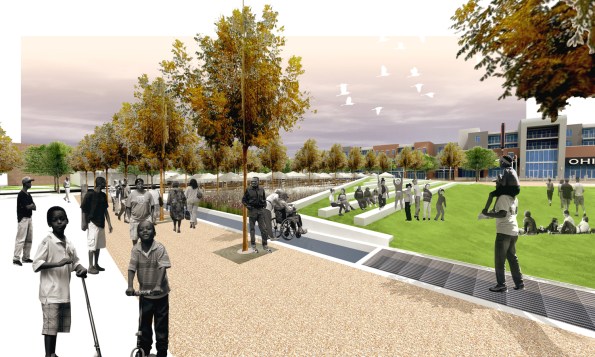

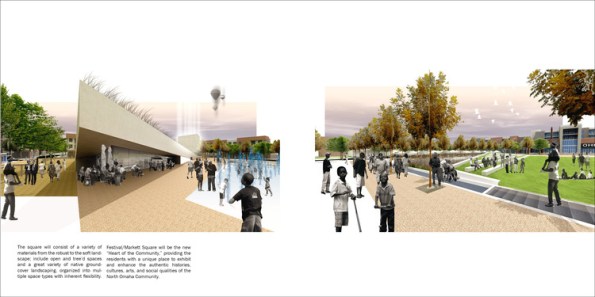
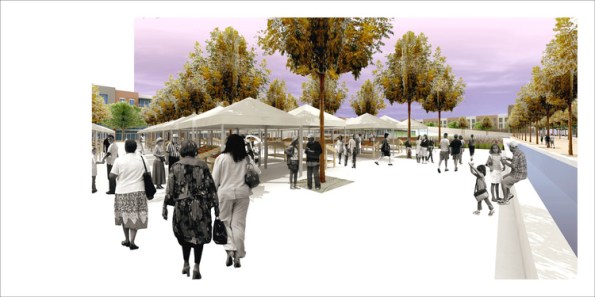
North Omaha Village Revitalization Plan and Empowerment Network leaders after 7-0 City Council vote approving plan
Here’s a cover story I did for The Reader (www.thereader.com) about a plan and a vision that may at last signal the start of significant turnaround for long stagnated North Omaha. To be more precise – Northeast Omaha, where the predominantly African-American community is located and has awaited meaningful change for going on half-a-century. If it doesn’t happen now, then when?
Overarching plan for North Omaha development now in place: Disinvested community hopeful long promised change follows
©by Leo Adam Biga
As published in The Reader (www.thereader.com)
Recent adoption of the North Omaha Village Revitalization Plan into the city master plan gives direction and impetus to energizing a stagnated, disinvested area never fully recovered from decades-ago civil disturbance and urban renewal.
Unanimous approval by the Omaha Planning Board and City Council sends a strong signal to public-private funders and developers the plan provides an officially endorsed blueprint for action. What happens next to realize its 30-year vision is up to stakeholders, entrepreneurs, elected officials, movers and shakers.
The Empowerment Network initiated plan, which drew input from residents, business concerns, philanthropists, planning consultants and others, envisions $1.43 billion in redevelopment along key corridors. The initiative puts the Northside in the crosshairs of major transformation as never before.
Some plan contributors and likely implementers recently spoke with The Reader about what this means for a section of the city that’s long awaited significant change.
“One reason it’s important is to show the people who participated, who live in the community, that we’re serious about a North Omaha that is a strong component of the overall city, one that shares in the successes and in the future of the whole city,” says Omaha Planning Director Rick Cunningham.
“It’s important because as the Planning Department this gives us then our marching orders. This is what we then work with with developers to compare their ideas and plans against. It gives people a clear understanding of what the vision is and where they can best take their dollars and invest them.”
Omaha Economic Development Corporation president Michael Maroney sees the plan as “absolutely essential” for addressing some sobering realities.
“I’ve been working in this community for over 40 years and over that period of time I’ve heard over and over again from the political leadership of this city, from the corporate-business community, why can’t North Omaha leadership get together and speak with a single voice in terms of what the needs are.
“And this whole effort going back five years in the creation of the Empowerment Network was really in part a response to that, because we recognized we had to start doing things differently.”
The need for a new approach became painfully obvious, he says, in the wake of a 2005 study. It showed that in every quality of life measure constituting a healthy community blacks “were either no better off or worse off compared to the majority community” than they were in 1977, he says.
“That basically said all the good work all of us thought we were doing wasn’t making a difference, not in the overall scheme of things. Something was missing.”
The community action coalition African American Empowerment Network was born.
“We sat around a table and said we’ve got to start working together, we’ve got to start collaborating, we’ve got to start connecting with each other, and bring all our combined talents together,” says Maroney. “That led to this village revitalization visioning we did.”
To those who might regard the resulting plan’s price tag as excessive, he says, “We cannot be afraid of reality. Now we’re not saying we’re going to go out and get a $1.43 billion commitment tomorrow. It’s a 30 year process, and it’s not going to come from any one entity or one source or one area. Government has a role in this, the private sector has a role in this, there’s going to be a lot of bank financing in this thing.”
“When $3 billion has been spent in downtown and midtown, what’s a billion dollars for North Omaha to make it a strong resource, a strong player, a big part of the tapestry for a sustainable Omaha?” asks Cunningham.
It’s no exaggeration to say the plan is a put-up or shut-up moment in Omaha history.
Maroney says, “For decades the greater community has said come together and the support will be there. Well, we’ve done that now, and I have to say we’ve had good vibes all along the way from those various entities. But the proof is going to be in the pudding. We now have a very solid process we’ve gone through that creates a long term vision for the community. We’ve done this in a collaborative way that engaged the city and the business and philanthropic community. Now the question becomes, Will you step up to the plate? We’ve got this down, we’ve got it in phases, we’ve got even the first couple projects identified. So we’re moving to that next level and we’ll see if what has been suggested and indicated for years will actually happen.”
Empowerment Network president Willie Barney says the plan’s “going to take focus and commitment from the community itself,” adding, “New businesses and venues will only be sustainable to the level they’re supported by the people who live here.”
For the area to thrive, says Maroney, “it’s more than just brick and mortar because we know if people don’t feel safe and secure, I don’t care how nice we make it, they’re not going to be there, they’re not going to come.”
Observers agree infrastructure needs like the sewer-separation project must proceed to lay the way for large scale development.
Seventy Five North Revitalization Corp. executive director Othello Meadows says whatever happens next, the Network deserves credit for making North O a priority.
“I’m encouraged by what the Empowerment Network is doing,” he says. “They’ve been consistent, they haven’t let the momentum fizzle out. They’ve been diligent. They’ve put together a really comprehensive plan. Anybody can quibble with aspects of it, but the fact they’ve put this together is a major accomplishment.
“They’ve kept the conversation going long enough to get the attention of the right people and it’s moved to a very concrete step being part of the master plan.”
He’s confident North O has the players it needs to drive the plan to fruition.
“I think there’s far more executors than they’re used to be. There’s more people who are used to being held accountable, to executing and getting things done and who are much less interested in talking about it and much more interested in doing it. That’s the single biggest component of what will make North Omaha successful.”
Another aspect of economic development the plan implicitly addresses is improving work skill readiness and creating more living wage to career job pathways.
“Omaha has one of the lowest unemployment rates in the nation, yet we still have in North Omaha a very high unemployment rate,” says Barney. “We have not really bridged that gap yet. We really haven’t come to grips with job creation and development. I think more so now than ever the business community is alongside us in looking at how to solve this. There are training programs through the Urban League, Heartland Workforce Solutions, Metro Community College that I think will do a more effective job of getting people ready.”
The Chamber of Commerce’s Workforce Solutions partners with local employers, Metro and Goodwill Industries to train skill deficient workers for entry level professional jobs. Meadows, who headed the Omaha Workforce Collaborative, says too many North Omaha residents still have “the steepest of hills to climb” to become proficient.
North Omaha is a much studied, social serviced area suffering disproportionately from poverty, unemployment, underemployment, educational-skill gaps and health problems. As Omaha as a whole has prospered, North O’s languished, cut off from the mainstream of commerce and affluence that ranks the city among the nation’s best places to live. For half a century its predominantly black population has seen their community cast as a crime-ridden danger zone and charitable mission district.
Branded as an undesirable place to live or do business in, major investment has bypassed it. Thus, it lacks goods and services, its population is down, its housing stock deteriorated, its vacant, condemned properties number in the thousands. Added to this is a sparse entrepreneurial class and scarcity of entertainment options-attractions.

Planning Director Cunningham says though efforts have “stabilized what was a declining part of town, it doesn’t mean there isn’t a lot of work to do,” adding. “To say we’ve stabilized is not great, but it does give us a platform upon which to move forward.”
“If North Omaha is to be a sustainable community, and that means it really takes care of itself and it doesn’t need to be a welfare community, we have to have a different mind set,” says Maroney. “That does not mean we forsake those in need, but we have to create the atmosphere by which we not only bring back people with higher incomes but we elevate those people within upward. We must create a community that is generating resources that turn around in the community by creating jobs, creating opportunity.”
“The whole idea is to make North Omaha a neighborhood of choice,” says Cunningham. “That not only people who live there now stay, because they can afford to stay, because of new jobs and opportunities, but people who moved away are invited-enticed to move back and people looking for a new place to raise their families move there.”
He says the plan mitigates against gentrification pricing out residents.
“The concept is to not have just one type of housing but a full range of housing types and income levels. I think that’s all through the plan.”
Facilitating mixed income housing projects is what Seventy Five North plans doing. The new nonprofit, in partnership with Purpose Building Communities, is quietly acquiring properties to infuse new life into neighborhoods.
Prospect Hill has recently seen the addition of new “green” homes to its stock of older homes courtesy of a collaborative venture between OEDC, Alliance Building Communities, Holy Name Housing, Wells Fargo Bank and Family Housing Advisory Services. More partnerships like this are needed, says OEDC’s Maroney.
Cunningham says if North Omaha is to be a prime development landscape the same way other parts of the city are, “we need to identify innovative and new ways we can invest. So we’re looking at the economic development tools we have to make it just as easy to develop and reinvest there. We’ve got to do that. We’ve got to utilize the resources of this city.” He says, “A plan like this is a catalyst that begins people thinking about, What if? Why not? and people are doing that already. There are partners (emerging) out there the public doesn’t know about at this point.”
Othello Meadows feels a serious attitude change is necessary.
“One of the things I see a lot is almost this antithetical attitude to people coming into North Omaha to make money,,” he says, “as if it’s almost a bad or exploitive thing, and I don’t understand that. The only way North Omaha grows in a sustainable way is if somebody sees an opportunity to go in there and make some money. That’s how North Omaha gets tied to the rest of the economic prosperity the city has enjoyed.”

Othello Meadows
Nurturing more entrepreneurs, says Maroney, “is absolutely key. It’s an area we’re working on. It needs a lot of help. A lot of it is access to credit and capital. A lot of its entrepreneurial development training. That’s critical because as we develop all this brick and mortar we need to have people ready to move in and create businesses and jobs and hopefully make a lot of money.”
The city and Chamber are actively recruiting black businesses outside Nebraska to open operations in North Omaha. Consultant Jim Beatty heads an Atlanta initiative that’s imported one business thus far, All(n)1 Security. He says aggressive, wide net efforts like these are needed to market the revitalization plan to entrepreneurs, philanthropists and developers. “I think we need to present North Omaha as an opportunity for investment, and we need to tell that story, not only locally but nationally,” says Beatty, who chairs the Black History Museum board.
The Chamber’s Ed Cochran, who heads the North Omaha Development Project, says, “There are several ways to grow business in a community. One is to grow it organically
through inspiring entrepreneurs with brand new businesses. Another is to strengthen and grow existing businesses. A third is to import businesses from other locations.” He says North Omaha needs all these approaches.
For too long, says Meadows, the Northside has been treated as a charity case.
“I feel like there’s almost a patriarchal type relationship that always leaves North Omaha in a secondary position. At this point North Omaha doesn’t have the capital, in a lot of ways it doesn’t have the personnel, kind of by way of brain drain, to transition itself organically without outside resources. At this point it needs help from philanthropy and individuals whose hearts are in the right place, who simply want to do the right thing.
“I think the compassion that exists in this city is rare, especially in the philanthropic community, but I think we have to have a little bit more analytical, clinical approach.”
While the adjacent downtown, riverfront and mid-town have bloomed, North O’s seen piecemeal, stop-gap change, with pockets of redevelopment surrounded by neglect.
“Historically what we’ve done, and I’ve been a part of that, is have a scattered gun approach toward development,” Maroney says. “A lot of good things have been done, but they’ve been done in isolation. We need to better coordinate and understand how these things relate to each other, and then how you build on top of those. We’re now trying to take a more deliberative and directed approach toward development.”
Backers of the revitalization plan see it as a guide and stimulus to making North O a destination to live, work and recreate in. Among the early focal points is developing 24th and Lake into a heavily trafficked, tourist-friendly arts-culture district.
“In North Omaha one of the real epicenters is 24th and Lake, where you have a really nice combination of history and communal feeling,” says Meadows. “It’s one of the hubs of the community. I think you could make a tremendous splash by focusing on that area. You can’t find somebody who grew up in North Omaha that hasn’t spent a lot of time in that area, whether they got their cut there or they went to church there. So to me it makes sense to start with an area that touches so much of North Omaha.
“If I were a developer I’d start right there. It’s close enough to downtown to draw from a lot of different nodes, which is important.”
Anticipated commercial development would build on existing anchors in strategic areas:
24th and Lake (Bryant Center, Jewell Building, Omaha Star, Family Housing Advisory Services, Blue Lion Centre, Loves Jazz & Arts Center, Omaha Business & Technology Center, Great Plains Black History Museum)
30th and Lake (Salem Baptist Church, Salem Village, Miami Heights, Urban League, Charles Drew Health Center)
Adams Park and the Malcolm X Memorial Foundation
Refinements to 16th and Cuming and the 24th and 30th St. corridors are meant to spur a “seamless transition” from north downtown to North Omaha. Cunningham says “development there would integrate with the downtown and begin to bring the flow of people, goods, enterprise and economic development over into and overlapping with what has been historically the North Side.”
He adds, “We’re working now with 24th Street and an existing building there housing an historic business to revamp their footprint so that it says this is a front door rather than a back door. We’re also working with Creighton (University) and their plans for 24th and Cuming. That’s an entry portal for them too. They’re a partner in this and they have a vision for what’s happening there, really from 30th to 16th Streets, in creating a Cuming that is not a barrier, not a border, but a strong component of activity.”
Asked if it’s vital the first projects find success, Cunningham says. “Absolutely, because that builds momentum. We have to have successes early because it will be easier for the next developer to come in.” Sources indicate government funded projects are likely to launch first to “prime the pump” for private investment to follow.
Sustainability will be critical.
“Each one of those projects, particularly ones in the initial stages, have to be able to stand on their own in the event nothing else happens so that 20 years from now that project will still be there, will still be functioning,” says Maroney. “Not only do we look at what is it going to cost to create that project, but what is it going to take to sustain it over time. We nee to make sure thats built in also.”
Meadows says, “The same kind of rigor, due diligence and economic models that went into determining the feasibility of midtown and downtown development projects needs to take place with each North Omaha project” to ensure their sustainability.
More than anything, Meadows just wants to see change.
“When my friends come to visit from out of town there’s very little positive to show them on the Northside, very little you can point out and say, ‘Wow!’ So I’m glad we potentially have some things to be proud about in our neighborhood, in my community.
“I think North Omaha is really poised. I think residents are getting ready to see actual movement, they’re getting ready to drive down certain streets and see real development, real improvement. I can’t remember when that’s happened here.”
Related articles
- Back in the Day, Native Omaha Days is Reunion, Homecoming, Heritage Celebration and Party All in One (leoadambiga.wordpress.com)
- Native Omaha Days: A Black is Beautiful Celebration, Now, and All the Days Gone By (leoadambiga.wordpress.com)
- Native Omahans Take Stock of the African-American Experience in Their Hometown (leoadambiga.wordpress.com)
- Walking Behind to Freedom, A Musical Theater Examination of Race (leoadambiga.wordpress.com)
- An Omaha Legacy Ends, Wesley House Shutters after 139 Years – New Use for Site Unknown (leoadambiga.wordpress.com)
- Where Hope Lives, Hope Center for Kids in North Omaha (leoadambiga.wordpress.com)
- Omowale Akintunde’s In-Your-Face Race Film for the New Millennium, ‘Wigger,’ Introduces America to a New Cinema Voice (leoadambiga.wordpress.com)
- Lifetime Friends, Native Sons, Entrepreneurs Michael Green and Dick Davis Lead Efforts to Revive North Omaha and to Empower its Black Citizenry (leoadambiga.wordpress.com)
- A Decent House for Everyone, Jesuit Brother Mike Wilmot Builds Affordable Homes for the Working Poor Through Gesu Housing (leoadambiga.wordpress.com)
- Tired of Being Tired Leads to a New Start at the John Beasley Theater (leoadambiga.wordpress.com)
- Soon Come: Neville Murray’s Passion for the Loves Jazz & Arts Center and its Role in Rebirthing North Omaha (leoadambiga.wordpress.com)
- Miss Leola Says Goodbye (leoadambiga.wordpress.com)
- After a Steep Decline, the Wesley House Rises Under Paul Bryant to Become a Youth Academy of Excellence in the Inner City (leoadambiga.wordpress.com)
Categories: African-American Culture, African-American Empowerment Network, Business, City Planning/Urbanism, Entrepreneurial, North Omaha, Writing
African-American Culture, African-American Empowerment Network, Business, Entrepreneurial, North Omaha Nebraska, North Omaha Village Revitalization Plan, North Omaha Village Zone
Good Shepherds of North Omaha: Ministers and churches making a difference in area of great need
July 4, 2011
2 comments
If you have visited the site a few times in the last week or two then you’ve probably noticed I’ve been changing things up even more than normal by posting stories that cover an unusually broad range of topics. That diversity of content is one of the things that I think distinguishes this site from a lot of others. The following long story is actually a package of profiles I did for The Reader (www.thereader) of ministers and churches serving predominantly African American northeast Omaha. These good shepherds are in some cases at the forefront of large community-based initiatives attempting to engineer a turnaround of the area, which has great needs, and in other cases leading smaller grassroots efforts focused on changing one block, one neighborhood at a time. The story tries to convey the role of black ministers and churches today and yesterday and where they fit into the fabric of community engagement and redevelopment.

North 24th Street, photo by lachance (Andrew Lachance)
Good Shepherds of North Omaha: Ministers and churches making a difference in area of great need
©by Leo Adam Biga
A shorter version of the story appeared in The Reader (www.thereader.com)
Church is universally the tie that binds and the salve that heals. Its significance in the black community is even more profound given African Americans’ historical disenfranchisement.
“Faith has always been the element that motivated us and allowed us to continue forward in perilous times,” says Salem Baptist Church pastor Selwyn Bachus. “When we didn’t have anything else the one thing we did have was faith and the one institution we had and still have is the African American church. Every major movement in the history of African Americans has been founded on faith and out of the church. It’s the primary thing and everything else kind of grows out of that.
“You can use the visual of a bicycle wheel. Faith is that hub and the other efforts are really spokes out of that hub, which is the thing that holds it together.”
He says church remains central but its “interaction with congregants is not as intense as it once was.” As blacks’ living patterns have grown more dispersed, many no longer live in the immediate area their church occupies. Bachus says Salem members come from all over. He reminds, however, Omaha remains segregated, thus blacks still predominately live on the north side of the inner city, where most black churches are located.
With worshipers’ lives more mobile, their time more pressed, the family structure more fractured and people’s needs more acute, he says church ministries have evolved to focus on youths, couples, families, seniors. Everything from financial to computer literacy to life skills training is offered. The church is meeting place, mobilization center, sanctuary, conscience, healer, forum, refuge. It’s where fellowship’s found, tradition preserved and ritual celebrated — where the cycle of life plays out.
The black minister is shepherd, counselor, confessor, educator, orator, leader, role model and, depending on who wears the collar and what the times call for, agitator, protester, witness, critic, community organizer and social activist.
Five preachers pastoring North O churches are profiled here. Each discusses ministering to their people in times that, if not perilous, are challenging.
Apostle Vanessa Ward, Afresh Anointing Church, 4757 No. 24th St.
From the front porch of her northeast Omaha home, Apostle Vanessa Ward describes the transformation her block’s undergone in a decade. Situated in an area called Death Valley for its frequent, sometimes fatal gun violence, the Omaha native no sooner states, “This is a high risk neighborhood,” when the crackle of gunfire interrupts the mid-summer afternoon quiet.
“We gotta pray. That was not good,” Ward says solemnly, head bowed in prayer.

©photo by Eric Gregory, Lincoln Journal Star
An ugly reminder gang bangers still menace these streets. But not on her block. Not anymore. Not since this wife and mother of four began ministering right where she lives — not just from the Sunday isolation of the pulpit at the 75-member Afresh Anointing Church (Body of Christ) she pastors. She admits she was like everyone else. Too apathetic and afraid to do anything about the chaos around her.
“This neighborhood used to be so bad there was no way you and I could be sitting outside like this,” she says to a visitor, “without filth in the street, loud music, prostitution, corner boys, as we call them, selling drugs on every corner. Oh, 10 years ago, you never would have been able to do what we’re doing now.
“I remember watching a 7-year-old in the back of my house selling drugs.”
She remembers consoling the mother of a young man killed in a driveby right in front of her house.
A large, now abandoned home she points to just up the block was a gang den.
“They would sit right there and throw dice in the daytime. Shoot, argue or do whatever they want because when the neighborhood’s disconnected nobody cares as long as it doesn’t hit my house or affect my child. And that’s a mistake.”
She says she was part of the culture of silence that prevails in North O, where “the rules of this kind of community are, don’t get involved, don’t call the law, mind your own business, pull the shade down.” Her own blind eye to it all bothered her. It led her to do some serious soul searching.
“I was praying. My main question was this: How can I be so powerful in my pulpit and powerless on my block? Why isn’t anything changing around me? Because it first had to change within me.” That revelation, she says, “took me on a journey.” She charts that journey in her new book, Somebody Do Something.
She felt called to organize a block party with food, music, information booths set up by community agencies, a police presence. It meant talking to gang members.
“The rules for a block party are that everybody on the block has to give their consent, so that forced me to have to go and approach what most would call undesirables. It took a lot of courage. It took a lot of stamina. But I just knew it needed to be done.”
She asked them to abide by three rules — no drugs, no alcohol, no weapons — and “they agreed.” From that first party in 1996 through the most recent one last July, she says, not a single incident’s occurred.
“No violence, no drug charges, nothing at any of these events that get as big as 600 people,” she says with pride and thanksgiving.
Apostle Vanessa Ward
The parties became the impetus for broader, long-term change or “healing.” She began doing cleanups — picking up litter. Others followed her lead. Pretty soon, homeowners were fixing up their properties and looking out for each other. It continues today. The negative elements faded away once residents interacted as concerned neighbors taking a collective stand in reclaiming their block.
“The neighbors started buying in,” she says “and now these neighbors do their own. The example was set.”
For Ward, being able to “bring a neighborhood together” is an expression of “signs and wonders” at work. That success, she says, validates what citizens can do “on a small ghetto block” and, she hopes, offers a model for doing it on a wider scale.
There’s much to emulate. Her leadership’s helped make the area’s Central Park Neighborhood Association a proactive force for positive change.
Neighbors maintain two community gardens on the block. The Peace Garden grows vegetables “that everybody in the neighborhood can glean,” she says, and the Hope Garden is a budding fruit-flower bed on one side of her house.
Ward envisions turning portions of the Hope Garden into a playground as well as a space for arts-craft activities, mentoring and job/trade training. She dreams of converting the vacant, former drug house into “a community center” for GED training, drug rehab and other services. She sees the home she now occupies one day being a mission house for those wishing to serve the neighborhood’s needs.
It’s all part of her belief that efforts to overturn social ills must be community-based, like her own “trench ministry.” Says Ward, “A lot of times if you don’t work it from the inside out what tends to happen is it doesn’t have longevity.” She realizes she needs to be right at ground zero to make the most impact. “The people need it,” she says. “They don’t know neighborhood, they don’t know community. We preach about it and we talk about it but people need to see a true evidence that Jesus is still alive. They need to touch it, it needs to be tangible.”
Just as Christ “met people where they were,” so does Ward, a highly visible figure in The Hood. Engaging people where they live, she says, requires change agents rid themselves of prejudices and resentments. She had to herself. Where before she wanted to tune out and cut off after a long day, she makes herself available 24/7. Her door always open — to anyone. She’s the block’s eyes, ears, voice, heart, soul.
“If you’re really looking to make a difference in people’s lives you’ve got to start with yourself,” she says. It’s about being authentic. “People can tell it. The street knows the street. They know if you’re faking, if you’re shaking, if you’re only going so far, if you don’t approve. It’s all over you.”
If we expect kids to leave gang life behind, she says, we need “to offer a better way.” Better options. Like real jobs. “That kind of encouragement is inclusive, it’s not exclusive.” She leads several youth ministries that attempt to do just that. The Omaha-based African American Empowerment Network she’s a part of has been working with gang members to get them to leave that life and placed in jobs. She co-chairs the Network’s crime prevention covenant with John Ewing.
Her outspoken Apostleship, she says, makes her “controversial.” Being a female minister, she says, makes her “unwelcome in some pulpits.” None of that stops her from proselytizing her concepts for building community as a speaker, panelist, trainer, facilitator and organizer. Her message is always the same: “Don’t just talk about it, don’t just preach about it, don’t just teach about it. Do something.”
Rev. Portia Cavitt, Clair Memorial United Methodist Church, 5544 Ames Ave.
Newly installed Clair Memorial United Methodist Church pastor Rev. Portia Cavitt is still getting a feel for North Omaha. She was previously at Allen Chapel AME Church on the south side. She grew up in St. Louis and moved to Omaha for the first time in 2004 to pastor Allen. That followed years as “an itinerant Elder” serving churches in San Francisco, Seattle, St. Louis and Hutchinson, Kan.
When Clair called on her this year, it meant changing denominations and geographic locales. She continues serving Allen until it finds a new pastor.

Pastor Portia Cavitt
She sees similarities between the two inner city sectors in terms of segregation, poverty, gang violence and education gaps. The needs in North O, she realizes, are even more pronounced. The STD-HIV/AIDS epidemic among African Americans is much on her mind. She’s active in efforts to raise awareness, promote testing and advocate safe sex. The high jobless rate found her asking employers at a Clair job fair tough questions — namely, why employers offer black applicants mostly entry level customer service-telemarketing posts that don’t pay a living wage.
Her first priority at Clair, an old-line church of 200 members atop an Ames Avenue hill, is getting to know her flock, one that’s old and weary. Members have drifted away. Her mantra to bring folks back is, “come get your hillside experience.” She wants Clair to be a “beacon of light” for an area beset by despair.
She wants believers to “come and hear a word that will encourage them, that will empower them to go out and make a difference.” That will give them a voice “to speak up and declare what is it that your community needs. I mean, is there a Neighborhood Association that would help you take pride back in your block, your home, your property, your community? That’s what I’m hoping to offer.”
For Clair or for any church to prosper, she says, there must be a multi-generational membership that includes intact families. The broken family syndrome in black culture puts a strain on community and church. Historically, she says, the black church has been an extension of the family.
Cavitt feels the black church is still the inspiration and anchor it’s always been but that as times have changed new leadership needs to emerge alongside the church.
“The people still hold their pastors in high esteem as a community leader, as a spokesman for them,” she says. “But I think people today have lost their own voice and need to find their voice. Back in the ‘60s, during the civil rights movement, yes, the black church was deemed being the center. That’s where the meetings or rallies were. The pastors spoke. But there were also community leaders. And they locked hands together and the people followed and participated.
“Now I think the people have gotten quiet and they want the leaders to do the leading. But I want my congregation to realize, yes, I might be your leader but I can only do so much as we lock hands together and go together. I’m not the only spokesperson. Some of you are more equipped and knowledgeable and outspoken than I am on some issues. We need to stand and support each other on all issues.”

Clair Memorial United Methodist Church
If the disparities are to be rectified, she believes the black church will be involved — if for no other reason than that’s where the majority of African Americans gather. It’s where pledges are made and coalitions built. “Because we still view the church as that power source,” she says. “On Sundays or during mid-week service I know the people are listening and you have an opportunity to encourage them. We try to address our violence and our unemployment issues. We’ve got to. The Bible speaks to all of that and so I have to make that come alive.”
The black church is where hope springs eternal. It’s where, she says, people “have an opportunity to band together to make a difference — as long as people can see that change is on the way. Sometimes change is slow. But as long as you’re working toward a goal, it doesn’t matter how long it takes you to get to it.”
Cavitt, like her friend Apostle Vanessa Ward, sees black churches beginning to work more collaboratively but still having a ways to go. “It can get better,” Cavitt says. “We are not as cohesive as we can be.”
Again, like Ward, she feels being a strong female minister poses problems for some — making unity difficult. “We have to embrace each other and respect each other regardless if I’m a female or not. I don’t have time to play games. I won’t take a back seat to anyone. I mean, you don’t have to respect me for my sex but you should respect me for what I represent. I’m in a main line denomination at a major church. I can be a radical at times but after all of these years I have so much to offer that I can’t go backwards, I can only continue to move forward.”
The fact that Clair, which had a female minister once before, chose her is all the validation she needs. “For this church to lift my name and desire to have me says a lot about my ministry here in Omaha. They wanted a pastor like me.”
The single and childless Cavitt says “it would be nice to come home to someone who takes care of me but I don’t need that because my members are my family.”
Rev. Jeremiah McGhee, Mt. Sinai Church, 4504 Bedford Ave.
The core needs of Omaha’s black community have changed little since the civil rights era. The black church has been there for the whole ride. Since the ‘70s Rev. Jeremiah McGhee’s worked the front lines to address inequities. He says churches play a vital role in this work but have their limitations. He notes, pastors can’t be experts in everything and seldom can a problem be tackled in isolation from others.
Thus, any serious discussion of community needs must encompass multiple factors from a broad range of informed perspectives.
“We gotta find jobs, we gotta help people get better educated, we gotta help people with their health problems, we gotta help right down the line,” he says.
For churches or other organizations to face these matters alone, he says, “it gets overwhelming.” The best-intentioned efforts then tend to “fizzle out.” That’s why he’s encouraged by some new initiatives, especially the African American Empowerment Network, that target these issues through expert-based coalitions or covenants.
“We’ve got our best and brightest leading,” he says. Ministers like himself and churches like his own, the non-denominational Mt. Sinai, a 70-member congregation he pastors, are part of the Network. The community-wide effort, he says, promotes public-private, religious-secular partnerships, thus taking the pressure off churches in an era when a shrinking social safety net finds churches offering services and programs far beyond what they once did.
Mt. Sinai’s typical of most churches today in providing things like an after-school program, a computer lab, a pantry or a homeless ministry, et cetera. It’s not like it was when he grew up, when “we were one big family — the neighborhood, the village. Because of that brokenness today, a lot more has fallen on the church.”
He says strengthening families is a must. He also says churches can be relieved of responses better suited to others as more community-based solutions develop.
“That makes it easy for us,” says McGhee, who’s married and a father of 10, “because we don’t have to be everything to everybody anymore.”
McGhee’s led Mt. Sinai to do “extensive outreach to the homeless.” It began with church volunteers feeding the homeless downtown. It expanded to sheltering people, first in members’ homes, then at the Colonial Hotel. It grew into New Creations, a five-building, 28-apartment complex converted to transitional housing for homeless men, women and families. New Creations operated from 1996 until earlier this year, when Mt. Sinai’s partnership with another non-profit failed. McGhee’s looking to restructure and reopen New Creations.
All along, he says, black churches “gave attention” to the very concerns the Empowerment Network focuses on “but we lacked experience, we lacked expertise.” Then there’s the question of time and resources and pastors spreading themselves or their churches too thin. Not to mention the resistance some put up to anything smacking of religion.
He says the black church’s traditional social justice mission has never wavered but is perhaps less visible or recognized now because its emissary may not wear a collar. “The church is there, it’s just not the pastor — it’s a member of the congregation that’s there,” he says. “As pastors we’re encouraging our people to get involved in politics, education, economics. We’ve got sophisticated, educated members of our congregations that go do those things.”
Wherever McGhee is involved he makes no bones where he’s coming from.
“We don’t want to be Bible-thumpers,” he says, “but I’m going to live my faith. You can’t expect me not to be who I am or to act the way I believe just because I’ve got a lot of people around me who maybe believe different or don’t believe at all.”
In the end, any coalition must put aside competing egos, agendas and philosophies and attend to what needs doing.
“The street’s dirty, let’s sweep. We need houses built, let’s build ‘em. We’ve got kids that are undereducated, what are going to do about that? And so as we approach those things in that way across the board we’re finding a greater acceptance,” McGhee says.
He said he and pastors of different faiths are getting better at “building relationships.” Fewer turf wars. More cooperation. More compromise.
“They listen to me, I listen to them, and we manage to work at it a lot stronger and to keep focused on the prize.”
He says it’s no accident the Network, for example, made faith the first of its 13 covenants or that members work hard at building alliances. Many steering committee-leadership team members “are very strong in faith,” he says. “They’re believers.” Some are clergy, some are not.
“We have decided we will be solutions-oriented. I have never been more impressed with African Americans that have come together who want to work together, who like each other,” he says.
All this partnering is bringing black churches in closer contact. His church was one of several on the north side to collaborate on a summer youth program at Adams Park Recreation Center. McGhee heads the Interdenominational Ministerial Alliance (IMA) and says that group and other black faith-based groups are increasingly “coming together. We’re talking about things regularly. We’re keeping each other informed. We’ve got good relationships and out of those grow commitments. Now when we hear anything about what’s going on, we’re connecting.”
“Before we’d seem to come together and we’d kind of spin our wheels awhile and in the end a little got done but not as hard-hitting as today,” he says. “We’re determined. This group of pastors is working together. We share the same interests. We live in the same community. We’re pastoring the same class of folk — that are struggling. Divided we fall. We can’t make it if we don’t begin to put our heads together and work smart and that’s what we’re doing now.”
He says it’s vital churches fulfill their historical leadership mission. If churches are to lead by example, he says, they must be open. The same with the IMA, which he acknowledges has been resistant to women members.
“We’re learning to get past that,” he says, because a welcoming church excludes no one. “It’s men, it’s women, it’s interracial, its intergenerational, its interdenominational. As pastors we need to lead the way. We need the congregations and the community to see us leading and taking charge in that.”
Rev. LeRoy Adams, Morning Star Baptist Church, 2019 Burdette St.
Morning Star Baptist Church represents the dichotomy of Omaha’s black community. Its magnificent, multi-million dollar facility bespeaks a place of worship that’s well attended and supported. With 1,500 members and growing, Morning Star is a success story. Its pastor, Rev. LeRoy Adams, a rising star in the Baptist Church nationally, in demand as an inspirational speaker and leader.
The 83-year-old institution’s a neighborhood anchor flanked by two more community stalwarts — Conestoga Magnet Center and the Hope Center. Nice new homes on North 20th Street are nearby.

Morning Star Baptist Church
Like most of North O, the area’s basically safe. The normal rhythms of daily life unwind in well-kept neighborhoods with families, businesses, schools, churches. It’s also true that routine is interrupted at times by gun violence. An illicit drug-sex trade operates openly. The perception from the outside looking in is that all of North O’s a war zone or wasteland. Not so. However, the reality is that gun violence and other social ills are persistent problems. While not unique to that area they are predominantly centered there due to a high concentration of conditions — poverty, unemployment, gang activity — that cultivate them.
Adams, a Buffalo, N.Y. native who’s married with two kids, dislikes how the media disproportionately highlights problems over success stories in his community.
“Sometimes I get very perturbed about that because we know what’s happening here. There’s the good and there’s the bad. But we get this stereotypical negative view that North Omaha is a place of reproach. That it’s a mission field for the churches in West Omaha to come. There’s no balance. There’s no appreciation for this being a very large area that’s also doing great things.”
Like it or not, shootings on the north side get reported. He and his church hardly ignore the violence there. He’s made the issue a priority of Concerned Clergy of North Omaha, which he heads. He advises Mayor Mike Fahey on ways to intervene in the gun culture. Morning Star provides youths positive alternatives to street life. His church organized the summer sleepover program at the Adams Park rec center. The rev leads prayer marches and vigils. It’s through efforts like these black churches act as stabilizing forces every day — a fact he feels gets overlooked.
As he’s well aware, solidarity and indignation only go so far. Public-private responses that give kids alternatives to gang-street life are needed.
He agrees with friend and fellow clergyman Rev. Jeremiah McGhee that the black church has much help in the social justice struggle today. “That particular burden is not just upon us anymore,” says Adams, “it is shared by many.” Rather than diminish the church, he contends sharing the load with other institutions enhances the church’s work and increases its reach.
He says collaboration’s healthy as long as “we don’t forget and ignore the influence of the church. Our history will remind us our church has always been the foundation of change in America.” Whether a local effort like the Empowerment Network or a national one, he adds, “it comes right back to the church. Our history has always been the church. Our hope has been inspired by the church.”
An institution the size of Morning Star can also afford to extend its reach in ways little imagined in the past. For example, Adams says his church is planning to build a family life or wellness center with a range of programs, activities and services for black seniors. Additionally, he says, Morning Star’s looking “to be a little bit more entrepreneurial by creating jobs in our community” through such church-owned businesses as a book store, a restaurant and a beauty/barbershop.
This kind of economic reinvestment in the community, he says, “provides us a foothold beyond the norm” for Omaha but common among large churches in other cities. “That’s kind of where we want to lead our congregation, so that we can be a dominant presence in our community. I’m kind of excited about it.”
Adams sees the black church enjoying a renaissance today. “Not only are we growing numerically but we’re seeing this diversity,” he says. Morning Star, which he describes as “progressive,” is an illustration of these trends. It’s more than doubled its rolls since he arrived nine years ago and attracts a mixed house of worshipers by race, ethnicity, income, affiliation — from a wide geographic area.
The black church is also a model for other faith groups.
“We’re seeing many other denominations taking some of our culture” — gospel music, praise and worship, call-and-response — “and adopting it to their style of worship, and that’s gratifying to see that,” says Adams.
Omaha has many black churches but he feels the bigger ones like Morning Star and Salem Baptist Church too often overshadow their smaller counterparts.
“There are several others that are doing a great job. Every church and every minister that serves in some capacity is important.”
Unlike McGhee, he sees Omaha churches “yet divided” denominationally and geographically. “There is a splinterization that exists in many ways, in many forms, in many fashions and Omaha is too small of a city to be that way,” he says. “Whether it has to do with race, reconciliation or dealing with poverty we have the persons and resources here to invest in making Omaha what she can be.” Now it’s just a matter of getting those stakeholders “involved in changing Omaha.”
Selwyn Bachus, Salem Baptist Church, 3131 Lake St.
Salem Baptist Church is a rock in northeast Omaha. The landmark owns the largest membership, more than 3,000, and most glorious worship center of any black church in the state. In a metaphorical sense African American leaders here hope to build upon its solid foundation and that of other institutions and organizations in the area by implementing strategies that, if successful there, will revive an area smack dab in the heart of the black community.
Rev. Selwyn Bachus has pastored Salem only since 2005 but he owns a long history with the 86-year-old church dating back to his childhood in Kansas City, Mo., where his minister father was a friend of then-Salem pastor J.C. Wade. Bachus accompanied his parents on visits to Omaha and Salem, which became like a second home. That background gives Bachus, who’s married with two children, a deep appreciation for Salem’s legacy.

Pastor Selwyn Bachus
He came here after stints in Virginia and Ohio. The challenges and opportunities posed by Omaha’s inner city are similar to those of urban black communities elsewhere. When the head of Omaha’s most prosperous, influential black institution talks, people listen, and what Bachus says bodes well for a community that’s struggled to find sustainable economic development. Decades of instability have marked the area since the late ‘60s. But Bachus sees a turnaround in the offing and attributes the promise of better times ahead to a confluence of shared interests.
“I’ve lived in four different cities for fairly significant periods of time and have never been able to see the community unified in such a way. And so that excites me to see that people can bring to the table their efforts and say clearly that we want to do what’s best for the community as a whole.”
He refers to Omaha’s African American Empowerment Network and to parallel initiatives underway here whose leaders “bring expertise and experience” to focused efforts aimed at raising the black community.
Bachus is active in the Network, whose Empower Omaha covenants encompass everything from improving educational achievement to spurring economic development to creating affordable homes to supporting black businesses. The Network looks to apply all 13 covenants to the area Salem resides in.
That section is slated as a target or test site because there are anchors in place in Salem and in the neighboring Urban League of Nebraska, Charles Drew Health Center, Salem Village senior residential community and Aframerican Book Store, among others, and in the stately Miami Heights homes. A planned redevelopment of the Pleasantview projects is on the drawing board.
Even with these stabilizers, residents experience poverty, unemployment, violence, health issues and a myriad of other problems in disproportionate numbers. The Network seeks to use existing anchors as building blocks to strengthen the area overall and impact those specific inequities. Success there could be replicated throughout the community to realize the larger revival of North O envisioned.
Salem’s already made huge commitments. In 2000 its $7.5 million worship-education center opened and that’s spurred added redevelopment in the neighborhood. Its multiple ministries reach out to people across the board. It’s planning a community development center. Still only in the conceptual stages, the facility may include an early childhood development program, a gym, a stage, classrooms and a pantry. Bachus is encouraged that fellow stakeholders in the community have expressed support for the center and the various programs and activities it can host.
The synergy Bachus sees is not a moment too soon in his opinion.
“African Americans in Omaha are at a crisis point,” he says. “We’re at a crossroads. There’s extreme possibilities. There’s great possibility for greatness in our community but we have to do it now.”
The World-Herald’s reporting on the extent of poverty in Omaha’s black community, he says, “gave us a dose of reality that was not very palatable. I think it really awakened something within us.” For Bachus it’s unconscionable “a city as wealthy as Omaha” can allow the hypocrisy of “five Fortune 500 companies almost literally within a stone’s throw of a poverty stricken community.”
He expresses dismay “at seeing some of the progress made over the past 40 years begin to erode.” He says that loss, too, has been a wake up call to action. “If not now, never,” is the mantra. The time for rhetoric, he says, is over. It’s time to act.
“No longer will we talk about the problem without seeking to alleviate the problem,” he says. “If we don’t fix the problem we’re a part of the problem itself. Don’t just talk about it, be about it. Don’t protest or criticize if you’re not part of the solution.”

Salem Baptist Church
Bachus says coming out of the civil rights experience blacks “looked for a leader to motivate us and give us a vision,” ala a King or Jackson, “and I think what we’ve come to realize is there’s no one leader at this point that’s going to be able to do that. And so as a result we’ve seen the effectiveness of collaborating as leaders.”
Barack Obama may prove a catalyst for sweeping change but there’s a sense African Americans are more diffused politically-socially-religiously than assumed. Even someone as dynamic as Obama may only get the support of a segment of blacks when it comes to social policies or programs.
The days when a single figure, elected or unelected, can marshal a nationwide movement may be over. The days when the black church can be out front leading the charge may be past. But Bachus echoes his colleagues in saying the church is still a bastion of black culture, it just operates in a more collegial, cooperative, community-oriented way. That’s why Bachus and his fellow ministers now partner with a broad coalition of public and private sector figures and entities.\par
“It’s a collaborative effort that brings persons and expertise to the table to allow us to do what we do even more effectively.”
He’s optimistic about progress being made behind the scenes by the Empowerment Network and other efforts. He says the strength of these approaches is that clergy, activists and social service professionals are working with strategically-placed public-private lay leaders in key indicators like education, employment, economic development, housing. The church is not taking a back seat but walking hand in hand with change agents, many of whom are leaders at their churches.
Clergy or not, Bachus says the blacks taking the lead in Omaha “have a sense of calling, a sense of direction. It doesn’t come from the world, it comes from God.”
If the black community is to arise, he’s sure it will be a faith-inspired resurrection.
More Shepherds for the Faith and the Cause
©by Leo Adam Biga
Fr. Ken Vavrina, St. Benedict the Moor Catholic Church, 2423 Grant St.
African American Catholics comprise a minority within a minority. Historically. Omaha’s home base for this small but persistent segment has been St. Benedict the Moor Catholic Church, whose black namesake and gospel music-infused services reflect black culture.
After decades serving the poorest of the poor on Native American reservations, in India and in Africa, Father Ken Vavrina ministers to Omaha’s most disadvantaged residents as St. Benedict’s pastor. He knows The Hood well. He pastored at Sacred Heart Catholic Church in the late ‘60s-early ‘70s. He knew Black Panthers. He was on Nprth 24th Street when it burned during the riots.
“It has not come back since then,” he says.
After serving St. Richard Church he took over St. Ben’s in 2007 at his request. Before him, assigned priests lived off-site for years, leaving a void and disconnect with parishioners and neighbors. Vavrina, a Clarkson, Neb. native, insisted he reside at the rectory. “You gotta live here. You gotta live in your community,” he says.
His small parish today is at “ground zero.” Yes, there are pockets of stability and revitalization but this zone’s depressed by poverty, prostitution, drugs, gangs, gun violence and scant economic development. Within view of his rectory is an open market for crack cocaine and human trafficking. On one side you buy dope. On the other, sex. Whatever your fix, suppliers stand ready. Walking a visitor outside, Vavrina points to “the girls” working the streets down the block. Parish members counsel some of these young women in the hope they’ll make better choices.
“A lot of our young boys and some girls are being sucked into the street, and they’re good kids,” he says, “but they have to develop the discipline to make short-term sacrifices for long-term benefits. We need to be able to help these kids have that discipline.”
He’s sending a message that we “won’t be intimidated by the violence” and he’s putting in place mentoring programs that impact young people where they live.
An Adopt-a-Family program matches at-risk families headed by single mothers with volunteers from metro area churches. With the right advice and support, the goal is to turn clients’ lives around. The program grew out of St. Ben’s ongoing support of a neighborhood family impacted by gun violence. The church has also rededicated the Bryant Center, a once popular recreation facility on its grounds whose outdoor basketball courts had grown largely dormant and run down until recent efforts to refurbish them. A new summer/fall hoops league with coaches, referees, strict supervision and police security has taken off.
For projects like these to work Vavrina knows ecumenical partnerships are needed and therefore he’s formed broad alliances across the public-private-Christian spectrum. For example, he often works with clergy from area Protestant churches.
Fr. Tom Fangman, Sacred Heart Catholic Church, 2207 Wirt St.
The Sacred Heart Catholic Church congregation is marked by racial, ethnic, socioeconomic diversity. Like St. Ben’s, Sacred Heart embraces gospel music and black religious iconography to reflect the predominant culture it inhabits.
The church operates one of a dwindling number of inner city private schools. Sacred Heart Elementary School serves African American students from largely low income families. Few of the students are Catholic but their parents prize “a faith-based education,” says church pastor and school president Father Tom Fangman. The school’s much-copied Life Skills, Building Blocks for Success Program aims to prepare students for real world experiences.
Support comes from CUES or Christian Urban Education Services, a nonprofit whose board members of different races and faiths endorse the school’s mission and track record. Fangman says 98 percent of Sacred Heart grads complete high school compared to 72 percent of students on average from other area schools.

Sacred Heart Church
The church also serves the community via its Heart Ministry Center, which provides needy residents with clothes, household goods and food. Its pantry allows clients to self-select their own groceries. Education programs are also offered. Youth-adult ed classes cover everything from nutrition to early pregnancy to literacy.
“It’s a hub for outreach,” Fangman says. “I mean, things are just constantly happening there. We’re forming all these great relationships with the community. I would put this up with just about any social service agency in North Omaha.”
Partnerships abound, including cooperative ventures with other churches, Creighton University and the University of Nebraska Medical Center.
Fangman says Sacred Heart provides a consistent presence in a neighborhood sorely lacking stability. “I believe we’re an anchor,” he says. “We’ve been here a long time and so we have a history. And the people in the community know the school’s making a big difference in lots of kids’ lives, which I think brings hope.”
The Omaha native’s exactly where he wants to be. “I always wanted to do inner city ministry,” he says. “It’s a ministry I find fulfilling every day.”
Rev. Johnice Orduna, New Life Presbyterian Church, 4060 Pratt St.
“I’m one of those born-and-bred called-to people, because I never knew anything but the church,” says Rev. Johnice Orduna, an Omaha native whose life’s been one long faith journey.
Orduna, a licensed/certified missionary, started out a Baptist. She’s ministered in Episcopal, Lutheran, Presbyterian churches on the north side. One of her Nebraska Synod assignments was at Omaha’s Augustana Lutheran Church, where she brought the perspective of “a crusader” and the reputation of “a dangerous black woman” to a congregation once resistant to interracial fellowship. She did formal anti-racism training for the Lutheran Church.
As a mission developer she formed a congregation that became Fontenelle Community Church. Her ministry reached out to youths and families in crisis.
Semi-retired today, she’s now filling a temporary post at New Life Presbyterian Church, which lost its pastor. She’s doing “supply preaching” until a new pastor’s found. New Life’s a blending of the former Calvin and Fairview Presbyterian Churches, whose congregations were all-black and all-white, respectively. When the inner city parishes faced closure due to declining membership they merged, and a mixed race church was born.
Racial diversity in the pews is a rarity. She says, “We gotta get past this business of Sunday being the most segregated day of the year. If we can put our barriers down and not operate in our little heresies that say, ‘My way’s the only way to get to God,’ then we really could enrich each other.
“We haven’t gotten there. It’s too safe to do it the other way.”

New Life Presbyterian Church
She admires New Life, saying it’s a congregation “where people just come in and be who they are. I mean, they have their tiffs. We all do. But it’s never a gamebreaker. These folks have made a decision — We’re going to be here and we’re going to be together doing this, regardless, and we’ll work through whatever it takes. If more congregations would do that then we wouldn’t have these rifts. There would be so much that we could empower ourselves to do.”
In her opinion, churches get bogged down in a survival mode of maintaining the status quo. She advocates getting outside the four walls to do evangelization.
“Our neighborhoods are lost. We’ve got kids killing each other in the street who have no clue what the inside of a church looks like,” she says. “That’s where you have to be — literally out on the streets. There’s a fearlessness required. You can’t go in your house and lock the door and keep yourself safe. You gotta be willing to go to the 7-Eleven parking lot where the kids are and greet them with dignity and respect and then begin to let them know who you are and who Jesus is.
“I think Jesus is as transforming as ever but it’s how you deliver the message. You cannot assume anymore that kids are going to have heard any of that.”
Orduna rues the loss of intimacy that once permeated the black community. She believes the black church is not as unified as it was in the civil rights struggle but remains critical for instilling or restoring a “sense of community” in neighborhoods.
Related articles
- Back in the Day, Native Omaha Days is Reunion, Homecoming, Heritage Celebration and Party All in One (leoadambiga.wordpress.com)
- Native Omahans Take Stock of the African-American Experience in Their Hometown (leoadambiga.wordpress.com)
- Native Omaha Days: A Black is Beautiful Celebration, Now, and All the Days Gone By (leoadambiga.wordpress.com)
- Walking Behind to Freedom, A Musical Theater Examination of Race (leoadambiga.wordpress.com)
- The Ties that Bind, One Family’s Celebration of Native Omaha Days (leoadambiga.wordpress.com)
- Rev. Everett Reynolds Gave Voice to the Voiceless (leoadambiga.wordpress.com)
- Where Hope Lives, Hope Center for Kids in North Omaha (leoadambiga.wordpress.com)
- Omowale Akintunde’s In-Your-Face Race Film for the New Millennium, ‘Wigger,’ Introduces America to a New Cinema Voice (leoadambiga.wordpress.com)
- Omaha Address by Cuban Archbishop Jaime Ortega Sounds Hopeful Message that Repression in Cuba is Lifting (leoadambiga.wordpress.com)
- Overarching Plan for North Omaha Development Now in Place, Disinvested Community Hopeful Long Promised Change Follows (leoadambiga.wordpress.com)
- Soon Come: Neville Murray’s Passion for the Loves Jazz & Arts Center and its Role in Rebirthing North Omaha (leoadambiga.wordpress.com)
- Lifetime Friends, Native Sons, Entrepreneurs Michael Green and Dick Davis Lead Efforts to Revive North Omaha and to Empower its Black Citizenry (leoadambiga.wordpress.com)
- A Decent House for Everyone, Jesuit Brother Mike Wilmot Builds Affordable Homes for the Working Poor Through Gesu Housing (leoadambiga.wordpress.com)
- Everyone’s Welcome at Table Talk, Where Food for Thought and Sustainable Race Relations Happen Over Breaking Bread Together (leoadambiga.wordpress.com)
- North Omaha Champion Frank Brown Fights the Good Fight (leoadambiga.wordpress.com)
- Making the Case for a Nebraska Black Sports Hall of Fame (leoadambiga.wordpress.com)
- The Great Migration Comes Home: Deep South Exiles Living in Omaha Participated in the Movement Author Isabel Wilkerson Writes About in Her Book, ‘The Warmth of Other Suns’ (leoadambiga.wordpress.com)
- Blacks of Distinction II (leoadambiga.wordpress.com)
- A Synergy in North Omaha Harkens a New Arts-Culture District for the City (leoadambiga.wordpress.com)
- A Brief History of Omaha’s Civil Rights Struggle Distilled in Black and White By Photographer Rudy Smith (leoadambiga.wordpress.com)
- Omaha’s Malcolm X Memorial Foundation Comes into its Own, As the Nonprofit Eyes Grand Plans it Weighs How Much Support Exists to Realize Them (leoadambiga.wordpress.com)
- Negro Leagues Baseball Museum Exhibits on Display for the College World Series; In Bringing the Shows to Omaha the Great Plains Black History Museum Announces it’s Back (leoadambiga.wordpress.com)
- Gray Matters: Ben and Freddie Gray Fight the Good Fight Helping Young Men and Women Find Pathways to Success (leoadambiga.wordpress.com)
- Omaha Tri-Faith Pioneers Seeing the Fruits of Their Interfaith Collaborative Take Shape (leoadambiga.wordpress.com)
Categories: African-American Culture, African-American Empowerment Network, Family, North Omaha, Omaha, Religion, Sacred Heart Catholic Church, Salem Baptist Church, Social Justice, Writing
African-American Culture, Apostle Vanessa Ward, North Omaha Nebraska, Rev. Jeremiah McGhee, Rev. LeRoy Adams, Rev. Portia Cavitt, Rev. Selwyn Bachus, The Black Church
Native Omahans Take Stock of the African-American Experience in Their Hometown
July 4, 2011
44 comments
With the 2011 Native Omaha Days, July 27-August 1, just around the corner I am posting stories I’ve written about this every two years African American heritage and homecoming event and how it serves a kind of litmus test for the black community here to take stock of itself in terms of where it’s been, where it is today, and where it’s heading. The following story appeared just as the 2009 Native Omaha Days concluded. I spoke to a number of individuals for their take on the state of Black Omaha at a time when there is both much despair and much promise for the predominantly African American northeast Omaha community. I interviewed folks who grew up here and stayed here and those who left here but who retain deep ties here and come back for events like the Days in order to get a cross-section of perspectives on what the past, present, and future holds for North Omaha. This much discussed community, where generational problems of poverty and underachievement are rampant but where many success stories have also been launched, is finally getting the kind of attention it’s long required. Initiatives like the African American Empowerment Network are helping drive a planned revitalization that seems much closer to reality today than it did even two years ago. The role of Native Omaha Days shouldn’t be overlooked because it does bring together thousands of current and former Omaha residents whose individual and collective vision and energy are helping fuel what is about to be a major North Omaha revival. That doesn’t mean all the challenges that face that community will be eradicated overnight. It took decades for those problems and wounds to become embedded and it will take decades to heal them, and events like Native Omaha Days help give a purpose and focus to affecting change.
Native Omahans Take Stock of the African-American Experience in Their Hometown
©by Leo Adam Biga
Originally published in The Reader (www.thereader.com)
The 2009 African-American heritage celebration Native Omaha Days concluded Monday. Natives came from across America to indulge memories of this touchstone place. The biennial, week-long Days lends itself to gauging the African-American experience here — past, present, future.
Taking stock has added import with North Omaha at a tipping point. Ambitious new housing and commercial developments, job training programs, educational reform efforts and gang intervention initiatives are in the works. All in response to endemic problems of poverty and unemployment, low job readiness, poor academic performance, high dropout rates, epidemic-level STDs and ongoing drug traficking-gang violence. North O has a strong sense of identity and purpose yet struggles with scarce opportunities. The persistent challenges of segregation and inequality have led many natives over time to leave for better prospects elsewhere, but a sense of home and family keeps their ties to Omaha strong.
The Days brings thousands of natives back to meet up with friends and relatives for homecomings, large and small. Last week’s public events included: a mixer at the Native Omahans Club; a parade along North 30th Street; a dance at the Mid-America Center; appearances by NBA star Dwayne Wade and actress Gabrielle Union at North High School; and a picnic at Levi Carter Park.
Visitors helped swell the numbers at Jazz on the Green, at clubs and bars on the north side and at black church services. Celebrants were out in force too at school reunions. Then there were untold family reunions and block parties that unfolded in people’s homes and yards, in the streets, and in parks all over the city.
Northeast Omaha was jumping as visitors mixed with residents to sight-see or just kick it. Kountze Park, the Native Omahans Club, the Love’s Jazz & Arts Center, the Bryant Center, Skeets Barbecue and other haunts were popular gathering spots. Joe Tess on the south side was a popular stop. Streams of cars toured the black community’s historical corridors. Many made the rounds at post-card amenities like the riverfront, the Old Market, Lauritzen Gardend and Henry Doorly Zoo.
Nobody seems to know how many expatriates arrive for The Days. That’s a shame, as these visitors represent resources for a strapped city and state hurting from a brain drain and a small tax base. Many natives who come back are the same upwardly mobile blacks Omaha has trouble retaining, a costly decades-long trend. The city’s black population is small to begin with, so every talented native lost is felt acutely by a community with a paucity of black entrepreneurs and professionals for a city this size.
Hometown girl Felicia Webster has twice left for the East Coast but has since returned to live here with her young son. She wonders what would happen if residents collaborated with visitors on visioning new initiatives, ventures, projects, even start-up businesses aimed at reviving North Omaha.
“I feel Native Omaha Days right now is a good opportunity and a wonderful manifestation of African-American people coming together of one accord and building and talking and socializing. It would be nice to just have a really huge collective on what could actually happen with development here,” said Webster, a spoken word artist, “because, you know, people come from everywhere that are doing all kinds of things. They can bring their knowledge and tools with them to share something fresh, new and vital here. I personally would like to see that.”
Felecia Webster
What about The Days serving as a catalyst for brainstorming-networking forums that capitalize on the skill sets and entrepreneurial ideas and investment dollars of natives near and far? All geared toward building the kind of self-sufficiency that black leaders point to as the most sustainable path for black prosperity.
Nate Goldston III left Omaha as a young man and went on to found Gourmet Services in Atlanta, Ga., one of the nation’s largest food service companies. He’s doing just what Webster advocates by working with locals on stimulating new development. The self-made millionaire has been advising the Omaha Chamber of Commerce and the North Omaha Development Project on the landscape for new North O investment. He’s bullish on the prospects for that long depressed district.
“I think it’s going to grow, but you’ve got to plant the seeds first and that’s what were interested in helping do with some business development there in the food service area,” Goldston said by phone from Atlanta.
He’s close to finalizing plans for a brick-and-mortar Gourmet Services backed project here to provide entrepreneurial opportunities for local African Americans.
“If we can bring this business opportunity there and put some young people in place and let them have a little piece of the action and begin to develop a franchise type operation, and then allow them to go on and grow it themselves, manage and own at the same time, that’ll bring that missing link and fill that gap in the economic development portion. At least a small portion of it,” he said.
He said it’s the kind of grassroots development that’s required. “It’s not the Chamber’s job to develop North Omaha. North Omaha needs to be developed by people from or attached to North Omaha, and the kinds of things that need to go in need to be done from within as opposed to from without.” Goldston’s impressed with the “pro-business, pro-development, pro-North Omaha” focus of the Chamber and city. “They just need the right teammates, they need the right partners to help them do it, and that’s the first time I’ve ever noticed that collaborative attitude in Omaha. I think there’s a real chance there.”
New Omaha City Planning Director Rick Cunningham, who most recently lived on the East Coast, is a native who hopes to implement Mayor Jim Suttle’s vision for a revitalized north side. “His agenda includes a strong commitment to North Omaha,” Cunningham said of Suttle. “He has a goal for 24th and Lake Street to become a new Dundee for Omaha.”
Cunningham knows first-hand Northeast Omaha’s prolonged decline. He also knows “there have been pockets of success,” including the Blue Lion Center at 24th and Lake he served as project manager for under Omaha architect and mentor Ambrose Jackson. He said most North O redevelopment has come from “investments in new rooftops, in new housing,” and while that needs to continue he said there must be a focus on creating more employable residents and attracting businesses and services that generate new jobs and commerce. “To bring Omaha into a very livable community with an environment that all residents and visitors can enjoy we’ve got to make sure we’ve got a diverse economy.”
He looks forward to being part of solutions that “return North 24 to the vibrancy it had, when 24th and Lake was the heart and soul. We will be engaged in that effort.” He looks forward to meeting with community partners from the public and private sectors to “build synergy in accomplishing those goals.” He said the city cannot afford to let North Omaha wallow. “If there is an area that suffers in Omaha than the entire city suffers,” he said. “It’s important we revitalize the core area. Those communities that are alive and thriving have inner cities that are alive.”

Nate Goldston III
Goldston vividly recalls when North O had a greater concentration of black-owned businesses than it does today, but he said even in its heyday Omaha’s black community had few major black entrepreneurs.
“Omaha’s African-American community has always been job-oriented as opposed to entrepreneurial-oriented,” he said. “I see great opportunity and I see opportunity that’s been missed only because I don’t know that we’ve been blessed with a lot of entrepreneurs that have had the path or the ability to develop businesses in the area. We had the model of the bars, the nightclubs, the pool halls.”
He could have added restaurants, barbershops, beauty salons, clothing stores and filling stations. There were also black professionals in private practice — doctors, dentists, attorneys, accountants, pharmacists, architects.
Their example “gave me inspiration and hope,” said attorney Vaughn Chatman, a native Omahan who made it back for The Days from Calif. North 24th Street was once a thriving hub of black and white-owned businesses. Few, however, survived the ‘60s riots and their aftermath. Urban renewal did in more. Once the packing house and railroad jobs that employed many blacks vanished, few good-paying employment options surfaced. “My friends and I had no desire to leave Omaha until opportunities for us began to disappear,” said Chatman . “Most, if not all my friends, faced with lack of opportunity have left Omaha. My friends and relatives (still) there tell me the quality of life for them and their generation has not gotten any better despite the best efforts of a number of individuals and organizations.”
Several new businesses have popped up but many have come and gone over time. Despite some redevelopment North 24th is largely barren today.
“That positive feeling of inspiration and hope is what I miss the most about the North Omaha I grew up in,” said Chatman.
An old-line exception is the Omaha Star, a black weekly now 70-plus years strong. Founder Mildred Brown was one of America’s few black women publishers. She earned a national reputation for her crusading work during the civil rights movement. Goldston learned valuable lessons working for the Star as a kid.
“The Omaha Star was my entree to entrepreneurship,” he said. “That’s what taught me to create a marketing sense, the ability to be able to develop a customer base and customer service and the whole nine yards.”
Cathy Hughes is another Star veteran who credits her experience there and at Omaha black-owned radio station KOWH with helping give her the impetus to be a broadcast owner and eventually build her Radio One empire.
“It encouraged me to go ahead and to try to own my own radio station because I saw some folks in Omaha do it,” she said by phone from her Maryland home. “You lead by example. When you do something, you never know who you’re touching. you never know who you’re having an impact on. I saw Bob Gibson and Rodney Wead and Bob Boozer and Gale Sayers come together and buy a radio station, so I knew it was possible, and now I’m the largest black-owned broadcast corporation in America and the only African-American woman to head a publicly traded corporation. None of that would have been possible if I hadn’t seen the examples I saw in Omaha, if I hadn’t seen Mildred Brown keeping her newspaper not only afloat but providing her with a very comfortable existence for that day and time.”
Cathy Hughes
Hughes, like Goldston, is pleased by gains that have been made via new housing developments, streetscape improvements and the Love’s Center, but is dismayed there aren’t more Mildred Brown figures in Omaha by now. In Hughes’ estimation Omaha should be much further along than it is in black entrepreneurship.
“It has a long ways to go,” she said.
Hughes is also concerned that strong community leaders like North O developer Al Goodwin, educator Katherine Fletcher and job training director Bernice Dodd are no longer on the scene. She’s warily watching the new generation of local black leadership to assess their commitment to redevelopment.
Goldston said black businesses in Omaha are not as visible as they once were.
“Those things have all gone away,” he said, adding that Omaha “is miles apart” from the dynamic black business culture found in Atlanta. “I think other opportunities were just not there (in Omaha) at that time to start and build a business.”
All these years later, he said, few if any Omaha businesses have made the Black Enterprise 100 list of the largest African-American owned businesses.
Most black-owned Omaha businesses of any size are not located on the north side today. Out of sight, out of mind. Hard to emulate what you don’t see. “I think we flourish when we see reflections of ourselves in the community where we live,” said Webster. “And when you don’t see that, what do you have to strive for?”
Introducing students to Omaha black achievers via school curricula is something Vaughn Chatman, founder of the Omaha Black Music Hall of Fame, advocates.
Webster presents programs in schools that attempt to expand kids’ vision. “I want them to see a bigger picture, a bigger view of the world than what they normally see, and I hope that by my being African-American young boys and girls are seeing reflections of themselves in me of what they possibly could attain,” she said.
Hughes and Goldston are concerned about the education gap that finds black students on average lagging behind whites. The truancy and drop-out rates for blacks are higher. The two are alarmed by how far Omaha’s inner city schools trail their suburban counterparts. “We’re going to have to really cure that before anybody can make any progress,” said Goldston, who’s challenged a national organization he once led, 100 Black Men, with making a difference in schools.
Webster said she was fortunate to have parents who stressed education and showed her “the world was bigger than Omaha.” Omaha’s segregation meant she would often frequent places and be the only black person there. Cathy Hughes had the same experience coming of age here. “That’s challenging,” said Webster. The first time Webster left, for Philadelphia, in the early ‘90s, Omaha was viewed as a dull place by many young people — black and white.
“A lot of my close friends did end up leaving and going to more heavily populated cities, and I think a lot of that had to do with not only wanting to explore the world but what opportunities they saw. For some, it was a larger African-American presence. For others, it was bigger metropolitan areas where you felt like you were getting paid what you were worth and could fulfill what you desired.
“Coming back this time I can see Omaha is really growing but I think Omaha is still a work in progress. I have friends with degrees who are still making $12 an hour, and I think that’s a challenge. They can’t find jobs with livable wages. And I find I’m still the only person that looks like me when I go certain places.”
Webster likes that Omaha has far more going on now than even five years ago, but she said she misses Philly’s constant slate of cultural activities and larger base of African-Americans to share them with. The big city scene “reignites” her.
Author Carleen Brice (Orange Mint and Honey, Children of the Waters) is a native living in Denver, Colo. with mixed feelings about Omaha.
“It’s always complex being from a small city and having big dreams,” said Brice. “I can’t speak for others, but I felt I needed to leave Omaha to achieve what I wanted to achieve. Part of that had to do with my specific family background. When my parents divorced, we went through some bad times and so I associate Omaha with those negative memories as well as with the positive ones.
Carleen Brice
“What I sense the most in Omaha is a kind of small thinking, small dreaming. Strange since Omaha does have a lot going for it. But I also think every city is what you make of it. I live in Denver and think it’s great, but I have friends who grew up here and feel very much like it’s a tiny, backwards city. I’ve begun to think that if I moved back to Omaha I could experience it differently, without feeling so blinded by my past.”
Still, Brice said she senses North Omaha’s quality of life is worse today. “I know my grandmother is saddened by the decline of that part of the city. My friends don’t see much improvement in how people actually interact or how they are treated, which makes them feel depressed. Back to that word depressed again. It’s sad, but true, I think Omaha is depressed.”
Beaufield Berry is a playwright and actress who’s come and gone from her hometown several times. She’s here again. She feels a big part of what holds Omaha back is its “small town ideas” that don’t readily embrace diversity. She believes North Omaha will not reach its potential until the cycle of inequity and despair is broken.
“For Omaha’s black population to really thrive I think you’ve got to start at the poverty line. You have to start at where the people may not have the role models that other kids do. You have to make it so they can see a father figure or an older brother making the right decisions.”

But Berry sees much to be hopeful about, too. “On the flip side of that I see so many amazingly talented young people of all different races who are really working towards something, who can really make a difference, not only with their work but with their words, with their presence, and I want to see more of that. I think that’s how Omaha, black or white, will start to thrive citywide.”
Webster sees Omaha progressing but like many blacks she’d like to see more done.
“I think with a collective idea and voice from all kinds people that it could kind of put a faster spark into it happening. It could manifest into something where everybody that lives here really enjoys it. I think it would be amazing.”
Related articles
- Back in the Day, Native Omaha Days is Reunion, Homecoming, Heritage Celebration and Party All in One (leoadambiga.wordpress.com)
- The Ties that Bind, One Family’s Celebration of Native Omaha Days (leoadambiga.wordpress.com)
- A Rich Music History Long Untold is Revealed and Celebrated at the Omaha Black Music Hall of Fame (leoadambiga.wordpress.com)
- Walking Behind to Freedom, A Musical Theater Examination of Race (leoadambiga.wordpress.com)
- Enchantress “LadyMac” Gets Down (leoadambiga.wordpress.com)
- Native Omaha Days: A Black is Beautiful Celebration, Now, and All the Days Gone By (leoadambiga.wordpress.com)
- Omowale Akintunde’s In-Your-Face Race Film for the New Millennium, ‘Wigger,’ Introduces America to a New Cinema Voice (leoadambiga.wordpress.com)
- Luigi’s Legacy, The Late Omaha Jazz Artist Luigi Waites Fondly Remembered (leoadambiga.wordpress.com)
- Big Bad Buddy Miles (leoadambiga.wordpress.com)
- An Inner City Exhibition Tells a Wide Range of Stories (leoadambiga.wordpress.com)
- Lifetime Friends, Native Sons, Entrepreneurs Michael Green and Dick Davis Lead Efforts to Revive North Omaha and to Empower its Black Citizenry (leoadambiga.wordpress.com)
- Soon Come: Neville Murray’s Passion for the Loves Jazz & Arts Center and its Role in Rebirthing North Omaha (leoadambiga.wordpress.com)
- After a Steep Decline, the Wesley House Rises Under Paul Bryant to Become a Youth Academy of Excellence in the Inner City (leoadambiga.wordpress.com)
- Soul on Ice – Man on Fire: The Charles Bryant Story (from my Omaha Black Sports Legends series, Out to Win: The Roots of Greatness) (leoadambiga.wordpress.com)
- Tired of Being Tired Leads to a New Start at the John Beasley Theater (leoadambiga.wordpress.com)
Categories: African-American Culture, African-American Empowerment Network, Business, Native Omaha Days, North Omaha, Omaha, Omaha Black Music Hall of Fame, Social Justice, Writing
African American, African-American Culture, African-American Empowerment Network, Native Omaha Days, North Omaha Nebraska


 Leo Adam Biga's My Inside Stories