Archive
Opera Omaha enlists Jun Kaneko for new take on “The Magic Flute” – co-production of Mozart masterpiece features stunning designs setting the opera world abuzz
Opera and Omaha may not be synonymous in your head but this grand and venerable art form and this conservative Midwest city have quite a relationship. In fact, Opera Omaha has a reputation for groundbreaking work that you wouldn’t expect from a company its size and or from this part of the country but for many years now Opera Omaha has taken on ambitious productions, staged American and world premieres, and given the stage to phenomenal artists. In recent years the organization has developed a relationsip with Omaha-based and internationally acclaimed artist Jun Kaneko, whose designs for an original Opera Omaha production of Madama Butterfly drew raves and toured the nation. Now, Opera Omaha has partnered with several other companies to have Kaneko design a new production of The Magic Flute and it too is setting the opera world abuzz. My Metro Magazine cover story about Kaneko and his Magic Flute follows.

Opera Omaha enlists Jun Kaneko for new take on “The Magic Flute” – co-production of Mozart masterpiece features stunning designs setting the opera world abuzz
©by Leo Adam Biga
Now appearing in Metro Magazine
A new Opera Omaha co-production of Mozart’s masterwork The Magic Flute featuring costumes, sets and animations three years in the making by internationally acclaimed Omaha artist Jun Kaneko is making waves in the opera world. Following performances on both coasts the opera comes home to the Orpheum Theater February 22 and 24.
Flute finds Opera Omaha in good company
Opera Omaha’s among five producing partners of this Flute, whose world premiere last June in San Francisco earned raves for Kaneko’s boldly imaginative designs. The coproduction of San Francisco Opera, Opera Carolina, Washington National Opera, Opera Omaha and Lyric Opera Kansas City is expected to draw national attention here.
Not since the Kaneko-designed Puccini classic Madama Butterfly in 2006 has the metro’s hometown opera company been in the spotlight like this. Executive director Roger Weitz says sharing the production with the likes of the prestigious San Francisco Opera “puts us on a similar footing as these major opera companies,” adding, “It maintains and furthers Opera Omaha’s reputation as a company known for quality, exciting, adventurous new work. Companies of our size aren’t always able to be that adventurous and cutting edge and Opera Omaha has a reputation over its history of national and world premieres, commissioning artists like Jun Kaneko and launching singers like Rene Fleming.”
He suggests Flute represents the best Omaha has to offer:
“Great cities have great arts and the fact that Opera Omaha can be a producer of great art is really important. We’re a cultural exporter, and that’s great for Omaha.”
Collaborating with others also has “a practical” side. “When you think about these amazingly complex and expensive operas in these big houses, we could never afford to have the kinds of production values we have in this without combining our resources together and entering into a coproduction,” he says.

Kaneko’s process
The visual palette that stands this Flute apart is entirely Kaneko’s and only came to him after he repeatedly immersed himself in the opera’s music.
“I listened to it at least twice a day for two or three months,” Kaneko says. “That’s the only way I know how to start an idea for opera – in a very true, direct way. Without music there’s no opera anyway. You can’t help it, that is the foundation. And, sure, theater, the visual part of it, the set and costume designs, those things are part of it but music has to be the starting point.”
Much of his process involves leaving himself open to inspiration.
“My way of working is pretty much intuitive. I don’t have any (preconceived) ideas when I start. You start developing an idea and it’s just like a big river running in front of you. You cant say stop and say, ‘I’ll be back tomorrow and start again from that point.’ It doesn’t work that way in my mind. Once it gets going you have to go with it.”
The concept for the seamless projected animations that distinguish his Flute revealed itself as he searched for a way to streamline the many set changes he felt interrupted the opera’s flow.
“That sort of bothered me, that it’s not graceful enough, so I started to think, Can I do something to change all that? That’s how I started to think about projection. I started to play with that idea and after a couple months it just made sense for me to get that basic movement of the opera change really smooth using projection.”
Omaha’s Clark Creative Group animated his abstract paintings.
“I wasn’t trying to do something new or crazy,” Kaneko says. “At first the producers weren’t sure. They felt this might really be too much. So we had a lot of discussions and finally they said, ‘We think we can handle it.'”
The technical challenges of realizing his vision are immense. A state-of-the-art projection system must work in concert with the lighting, the music and the action on stage to create a harmonious balance with his cascade of images.
“To me, all of those elements have to work as one piece. I’m always thinking about the total stage,” says Kaneko.
He made sketches, he worked with a scale model maquette of the stage and saw digital renderings of his designs. When he finally saw them full size,, he says, “It really surprised me. It was much better than what I thought.”

A mosaic completed and brought to life
“I think he really has created among the most spectacular evenings in the theater I’ve been a part of,” says Flute stage director Harry Silverstein. “The movement of these spectacular animations he’s done have the effect of a painting unfolding. It’s a combination of stunning artistry and real technical brilliance that brought this production to the stage.”
Weitz says Kaneko and Silverstein pushed things to such a limit creatively and technically that it made him and his fellow opera company directors nervous.
“Because he’s such a unique artist and his Flute designs are so new we just weren’t sure. But it’s beautiful. The digital projections are on these large floor-to-ceiling screens and these images are all moving – swirling, dripping – and they’re so well done. The images and costumes are so vibrant and crisp. It’s just like a living, breathing Kaneko. You got the sense you were witnessing something new. People were just enthralled.”
The thunderous reception that followed, including a standing ovation for Kaneko, affirmed for Weitz “this is what Opera Omaha could be doing and should be doing. It was just a warm, exciting feeling. I thought, Wow, wait till it comes to Omaha.”
The wait is over. For tickets, visit www.operaomaha.org/operas or call 402-346-7372.
The Wonderful World of Artist and Social Entrepreneur Jeffrey Owen Hanson
Jeffrey Owen Hanson is one of those unexpected and inspirational success stories I run into from time to time. This young artist and social entrepreneur has found his niche as a pop art painter in spite of or perhaps because of his low vision and he’s using the sell of his much coveted work to support charitable causes. The following profile I did on hin for an upcoming issue of Omaha Fashion Week explores how he came to discover his artistic gift and to make it the vehicle for philanthropy and details how he’s come to hand-paint dresses showcased at Omaha Fashion Week.
The Wonderful World of Artist and Social Entrepreneur Jeffrey Owen Hanson
©by Leo Adam Biga
Soon to appear in Omaha Fashion Magazine
The unexpected artist
Self-taught artist Jeffrey Owen Hanson likes saying “I see through Swiss cheese” to explain the visual impairment an optic nerve tumor left him and the unique way it gives him of apprehending the world. Chemotherapy and radiation treatments destroyed the tumor and curbed any further vision loss. The tumor, along with some learning disabilities, are the result of a genetic disorder he’s lived with since birth called Neurofibromatosis.
None of it’s impeded his remarkable ascent as an artist and social entrepreneur. His highly collectible abstract renderings, including hand-painted dresses, are sought after by celebrities and raise major monies for charitable causes close to his heart. At 19 he’s on pace to reach his goal of raising $1 million in charitable proceeds by age 20.
He’s even grateful for his limited visual perception because it’s led him to use color and texture in original ways that make his vibrant, tactile art singularly his own. Indeed, before his vision got really bad he’d never shown the slightest inclination for art.
“I painted on rocks and I did dot art and that type of thing” as a child, he says. “He did the kinds of crafts and arts things that kids always do but really his art wasn’t anything special,” his mother Julie Hanson confirmed. At her suggestion he began painting notecards for something he and his friends could do when he had visitors over while recovering from treatments, What began as a routine diversion soon evolved into a serious artistic and philanthropic outlet. His early watercolors on notecards were sold from a lemonade stand next to his mom’s homebred goodies in the driveway of the family’s suburban home. Within a few years he’d gravitated to acrylics on canvas sold in galleries and auctions, the works commanding five figure prices apiece. Commissions for his work now flood in every week from around the nation, even around the world.
It’s why his parents have come to call their only child “the accidental artist.”
The fact he’s turned an impairment into a gift and made his art a platform for helping others is why his work and story have touched people from all walks of life and well beyond his Overland Park, Kansas home. The Hanson magic has even reached Omaha, where his first line of hand-painted dresses debuted during the grand finale of last August’s Omaha Fashion Week. He’ll have a new line for the OFW Spring show and another in the August showcase.
The standing ovation he received in Omaha for artwork adorning dresses designed by Caine Westergard added to his growing recognition. He’s been named Young Entrepreneur of the Year, he’s been profiled in the Huffington Post, he’s met everyone from Warren Buffett to Elton John. He’s the subject of a YouTube video and a new book authored by his father, Dr. Hal Hanson, entitled “Lessons from Clod.” Clod is the name Jeffrey gave his tumor. Among the lessons he learned from that old nemesis he eventually embraced as a friend is that it’s better to focus on what you can do than on what you can’t do.
Seven years since clod’s disappearance he’s sold hundreds of paintings, enjoyed solo exhibitions, and seen his work purchased by the rich and famous at live charity auctions.
None of this was supposed to have happened.
Seeing past blindness
His father, an emergency room physician at Ransom Memorial Hospital in Ottawa, Kansas, simply calls what’s transpired “amazing,” adding, “We call Jeff the accident artist because no one was intending art being anything more than a childhood hobby. What started out as kid art just sort of evolved. He’s a person that’s totally naive to art, totally untrained, didn’t go to art school, and yet he’s become an in-demand artist with a whole career in front of him.”
Julie Hanson says right from the start of Jeff painting the notecards he showed an aptitude the other kids didn’t. “Jeff’s notecards were fabulous and this consistently kept happening.”
The mystery of how he could go from no apparent artistic ability and without any formal training to exceptional ability and the admiration of professionals may never be fully answered though the family has some theories. Much of his approach to art seems intuitive rather than drawn from any obvious influence, though his impressionistic landscapes are often inspired by places he’s visited.
“There’s no talent in our family for art to start with,” Jeff says by way of eliminating the possibility of some inherited art gene from his immediate lineage.
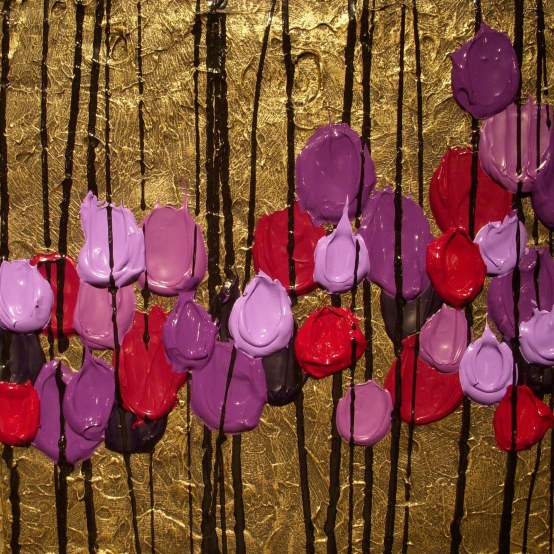
Where does he think his talent comes from then? “I don’t know,” he says. “I just think I have a good eye for color.” And texture. “Almost all of my paintings have really thick modeling paste spread all over it to give it texture.” He often incorporates wire, rope and other materials into his work, even making woven canvases, to add layers of depth and form. Always though his work exudes the most iridescent tones. “The colors I like to use are bright colors, like lime green, pink, purple. Bright happy colors.” The buoyant colors are a direct reflection of his joyful personality.
Could his visual impairment somehow give him a heightened appreciation for color as a way of compensating for other deficits? “Maybe, I don’t know, possibly,” he says. “Well. I mean I don’t know what I cant see. I see through Swiss cheese. My vision has holes.”

In preparing the book about their son and his unexpected journey in art his parents pressed Jeff about his methodology and discovered things that shed light on how and why he creates what he does.
“We started talking to Jeff about, ‘Well, how did you decide to paint that? Why did you put those two colors together?’ We asked him, ‘What are your rules here?” And we came up with a dozen things that he does that aren’t even at a conscious level for him,” says Hal Hanson. “He doesn’t sit and think about it, but when we tried to pin him down he would say things like, ‘Well, I have low vision so I don’t like to put two light colors next to each other. I have to put a dark color next to a light color because it’s high contrast and I can see the border. And I don’t like things that are flat. I like things that are chunky because I can see the texture when the light catches it.’ So he likes things that are really high contrast, high texture and with big, bold loud colors.
“He doesn’t like any piece of art that has a million little things going on all over it.
It’s gotta have big expanses of calm with nothing going on because it’s hard for him to see a million little things. His eye doesn’t know where to go. So it turns out a lot of what he does is guided by his low vision. Where we once thought his art is popular despite of his low vision, it’s popular because of his low vision. His vision is peculiar enough or impaired enough that it kind of forces him into a certain style. It has sort of guided him in a direction of, ‘Well, here’s what works for me,'”
Then there’s the possibility other guidance is at work, too,
“Don’t you think this is a gift from God?” Julie asks Jeff at one point during the interview. “Yeah,” he answers matter-of-factly.
How else to explain Jeff creating paintings that captivate so many?
Art as career and mission
It took a long time for his mother and father to realize his paintings appealed to far more than just their parental pride. When others began responding to his art they at first thought people were simply being kind or sympathetic to his overcoming challenges to raise funds for NF research. But as his art kept getting more and more attention and interest, they realized something bigger was at work.
“We saw this going on but none of the three of us ever intended this to go anywhere,” says Hal. “For the longest time I thought what they really wanted was a piece of the story. That they’d heard about this kid who had low vision who was painting and giving the paintings to charity auctions. That they weren’t really interested in the art, they just wanted a piece of the story.
“I didn’t consider the possibility that people liked his art for its own sake until we found out people were buying it and they didn’t even know the story, they didn’t know he had low vision and gave the money to charity. That was sort of a revelation to us that, ‘Oh my God, people actually like the art.’ His fans, his clients kept telling us, ‘This isn’t just kid art.’ What we thought was something you would put on your refrigerator with a magnet turned into things selling at an auction for $10,000 and $15,000.”
Artist Rachel Mindrup of Omaha responds to both Jeff’s story and his art. She’s made him a subject in a series of portraits she’s painting of people with Neurofibromatosis who, she says, “are changing the world.” She says he’s a deserving subject for the series she calls The Many Faces of NF “because he’s done so much for NF and for the Children’s Tumor Foundation.”
Like many others, she finds Hanson to be an inspiration.
“Not only has he overcome many limitations he’s going way beyond expectations,” Mindrup says. “It’s cool when an idea like his art philanthropy takes on a life of its own and goodness begets goodness. If you have a good heart and you’re doing things to help other people that seems to grow exponentially.”
As she’s gotten to know Jeff she’s come to admire his “strong work ethic,” adding,
“He’s a working, living artist. He gets up and works every day. He does what any artist should be doing. I find him to be really inspiring, I really do. Here’s a kid who had this disability and instead of woe-is-me he’s doing something positive.”
Even if he didn’t have a heart-tugging story, she says, his art’s good enough to stand on its own.
“His artwork is a treasure in and of itself regardless of his genetic code. Who cares if he has NF or not? It’s like the paintings speak for themselves. They’ve got vivid colors and juicy brush strokes, they’re tactile, they’ve visually pleasing. Anybody who looks at the paintings, regardless if they know Jeff’s story or not, will find them engaging and interesting and will react to them, enjoy them. Without even knowing his biography, they work, they’re wonderful.”
Interior designer Emily Dugger of Omaha treasures the two Hanson paintings hanging in her home, including a custom piece she and her husband commissioned him to make using colors they selected. “We love them both,” she says of his works. “He’s very talented and he’s just extremely sweet. I’m very drawn to his story and his life and his passion.”
Before the Hansons knew it, the accidental artist selling his wares from a lemonade stand morphed into a full-fledged art enterprise. Jeff’s parents recently worked with a professional to devise a strategic plan for finding ever new revenue streams for Jeff’s art in order to sustain his career and his philanthropy.
“It was never intended to be a career at all, it kept snowballing to the point that we realized one day, ‘I guess we have an art business,’ and here we are,” says Hal Hanson.
“The whole world is moving so fast that if you want to continue to have a career in art and be successful you’d better be entrepreneurial and philanthropic,” Julie Hanson explains. “Theres all kinds of things we keep simmering in the business. We’re trying to let this be his career and be very successful at it while also giving to the world.”

Hanson’s new frontier: Hand-painted dresses
Fashion art wasn’t something the Hansons conceived Jeff doing until a consultant identified it as a viable option.
“Fashion certainly was in that plan,” says Julie. “There was no intent of doing it quite so soon, however Omaha Fashion Week caught wind of Jeff and producer Brook Hudson said, ‘What if he would try hand painting dresses?’ And we talked with them about it. because that was exactly what we wanted to do. Jeff was invited to be in the grand finale. The door of opportunity opened and when it opens, Jeff…” “Run and go do it,” he says to finish his mother’s thought.
The next order of business was finding a designer whose dresses he could hand paint. It just so happened that Jeff’s cousin Heather has a friend at Iowa State University studying apparel design, Caine Westergard. Working on a tight schedule mere weeks from the OFW show’s start, Westergard and the Hansons collaborated on three dresses.
“I went ahead and started sketching and used some patterns I had,” says Westergard. “They sent me some paintings they thought would be interesting on some garments and let me have free reign of all the designing aspects of taking which paintings I liked and completely designing the dresses as to what I would think would complement their design. Then I mailed my dresses to the Hansons and they went ahead and painted them.”
“She came up w three blank slates, three blank canvasses if you will for Jeff to apply three different hand-painted styles on these dresses,” says Julie Hanson. “And there’s no secret, we have to help Jeff with that kind of thing a lot. Imagine being given one hand-made original dress and fresh paint is going to go onto it, and guess what, you can’t mess it up, and Jeff’s visually impaired, so we help Jeff with that a lot.”
Westergard appreciates how “extremely textured” Jeff’s work is. “Until you actually see it in person you don’t realize how many different levels and pieces there are
and what is actually beneath the paint and built up. They truly are works of art.”
Inspired by some his impressionistic landscapes, she created three dresses. For “The Grasse”s she imagined “standing out in an open field or prairie” and being caressed by the wind and the colors of the grass. “I really wanted that dress to be long and flowy. I wanted it to have a kind of wave as it walked down the runway with high-low skirt.”
“For “The Poppy” dress I cued off its vibrant color to create a more elegant feel. I wanted to make more of a ball gown of that dress. For “The Water Reservation” or “On the Water Rez” there’s so many different blocks and colors. It’s very bright and flowy. I just chose a very simple black satin with a peek-a-boo skirt. When you look at the garment you can see a little bit of the painting but not until the model walks and the peek-a-boo skirt opens can you actually see the painting on the skirt.”
She couldn’t be sure how Jeff’s art would work with her dresses until the hand-painting was complete.
“The first time I saw the dresses totally finished with my work and their work was the day of the fashion show. It was a little nerve wracking. I had complete faith in them but hand-painting a dress you only have one shot at it. It wasn’t like we had time for me to design another dress or for them to re-hand paint it. But they really turned out to be three really unique pieces that I’m definitely proud of and I know they’re really excited about.”
The audience roared its approval, too. “Seeing that our work was really impacting people was really neat.”
Refilling the bank of dreams
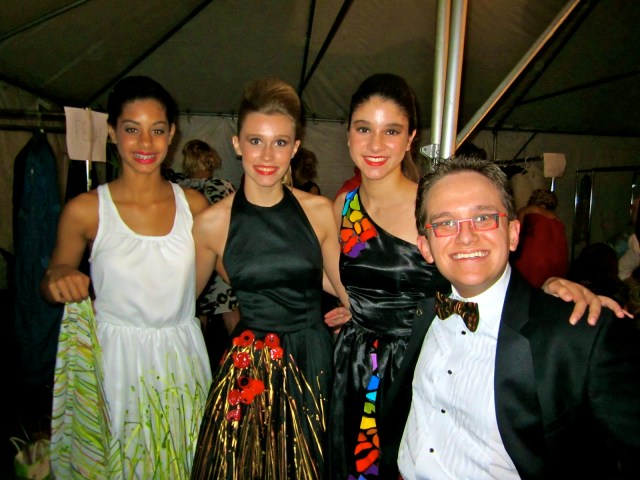
Hal Hanson never anticipated it would come to this. His son walking down the runway hand-in-hand with a promising young designer, surrounded by gorgeous models wearing hand-painted Hanson originals, lapping up the adoring cheers and applause of onlookers.
“I’m speechless,” Hanson says. “As a father, your kid is born and you have this dream bank. You look at your baby for the first time and you think, ‘OK, you’re going to be the quarterback of the football team’ or whatever and then events start occurring that start chipping away at your dreams. And you realize, ‘I guess we’re not going to do that,’ and before you know it he can’t drive a bicycle or roller-skate or see stars in the sky and you keep making withdrawals from your dream bank to the point you don’t’ have any more dreams.
“And that’s where I got pretty rock bottom. I was like, ‘I don’t see anything he can do between his learning problems and his vision problems.’ And then for him to start making and selling art, are you kidding me? Till the day you’re on this runway and people are liking these dresses. It’s just miraculous. My dream bank is bulging with deposits now. It was depleted five years ago, so it’s a huge turnaround.
“It’s turned into something amazing.”
Keep up with Jeff’s burgeoning career at http://jeffreyowenhanson.com.
Related articles
- Low Vision Resource Center helps blind and visually impaired residents (mysanantonio.com)
- Artist Adriana Groza Launches Debut Paintings Collection 2013 (fineartamerica.com)
- A Colorful Life: Claire Desjardins (artsyforager.com)
- How One Social Entrepreneur Is Tackling Poverty in Cambodia (fuzeus.wordpress.com)
Old Market Pioneer Roger duRand
Omaha’s popular arts-culture district the Old Market didn’t happen by accident, it evolved with the careful nurturing of landlords, entrepreneurs, and artists whose vision for the city’s historic wholesale produce center went against the tide at a time the district’s future was up for grabs. The late 19th and early 20th century warehouses that now are home to shops, restaurants, galleries, and condos might easily have been lost to the wrecking ball if not for visionaries and pioneers like Roger duRand, a designer who took a firm hand in becoming a creative stakeholder there. This short profile of duRand for Encounter Magazine provides some insight into the forces that helped shape the Old Market in the face of certain obstacles.

Old Market Pioneer Roger duRand
©by Leo Adam Biga
Originally appeared in Encounter Magazine
Omaha designer Roger duRand didn’t invent the Old Market, but he played a key role shaping the former wholesale produce and jobbing center into a lively arts-culture district.
His imprint on this historic urban residential-commercial environment is everywhere. He’s designed everything from Old Market business logos to chic condos over the French Cafe and Vivace to shop interiors. He’s served as an “aesthetic consultant” to property and business owners.
He’s been a business owner there himself. He once directed the Gallery at the Market. For decades he made his home and office in the Old Market.
The Omaha native goes back to the very start when the Old Market lacked a name and identity. It consisted of old, abandoned warehouses full of broken windows, and pigeon and bat droppings. City leaders saw no future for the buildings and planned tearing them down. Only a few visionaries like duRand saw their potential.
He’d apprenticed under his engineer-architect father, the late William Durand, a Renaissance Man who also designed and flew experimental aircraft. The son had resettled in Omaha after cross-country road trips to connect with the burgeoning counter-culture movement, working odd jobs to support himself, from fry cook to folk singer to sign painter to construction worker. He even shot pool for money.
He and a business partner, Wade Wright, ran the head shop The Farthest Outpost in midtown. A friend, Percy Roche, who had a British import store nearby, told them about the Old Market buildings owned by the Mercer family. Nicholas Bonham Carter, a nephew of Mercer family patriarch Samuel Mercer, led a tour.
“We trudged through all the empty buildings and I was really charmed by how coherent the neighborhood was,” says duRand. “It was really intact. The buildings all had a relationship with each other, they were all of the same general age, they were all designed in a very unselfconsciously commercial style.
“They were such an asset.”
“When I first came down here the space where M’s Pub is now was Subby Sortino’s potato warehouse and there were potatoes to the ceiling,” recalls duRand. “Across the street was his brother John Sortino, an onion broker. There were produce brokerage offices in some of the upper floors. There were a couple cafes that catered to the truck drivers and railroad guys. There was a lot of jobbing, with suppliers of all kinds of mechanical stuff – heating and cooling, plumbing and industrial supplies. The railroad cars would go up and down the alleys at night for freight to be loaded and unloaded.
“A really interesting urban environment.”
He thought this gritty, rich-in-character built domain could be transformed into Omaha’s Greenwich Village.
“I had in mind kind of an arts neighborhood with lots of galleries and artist lofts.”
That eventually happened thanks to Ree (Schonlau) Kaneko and the Bemis Center for Contemporary Arts.
duRand and Wright’s head shop at 1106 Howard St. was joined by more entrepreneurs and artists doing their thing.
The early Market scene became an underground haven.
“In 1968 it was really artsy, edgy, political, kind of druggy,” says duRand.
Experimental art, film, theater and alternative newspapers flourished there.
City officials looked with suspicion on the young, long-haired vendors and customers.
“We had all kinds of trouble with building inspectors,” whom he said resisted attempts to repurpose the structures. “The idea of a hippie neighborhood really troubled a lot of people. This was going to be the end of civilization as they knew it if they allowed hippies to get a foothold. It was quite a struggle the first few years. We really had a lot of obstacles thrown in our path, but we persevered. It succeeded in spite of the obstructionists.
“And then it became more fashionable with the little clothing stores, bars and gift shops. Adventuresome young professionals would come down to have cocktails and to shop.”
The French Cafe helped establish the Old Market as viable and respectable.
Te social experiment of the Old Market thrived, he says, “because it was genuine, it wasn’t really contrived, it evolved authentically,” which jives with his philosophy of “authentic design” that’s unobtrusive and rooted in the personality of the client or space. “Sometimes the best thing to do is nothing at all. The main criterion wasn’t profit, it was for interesting things to happen. We made it very easy for interesting people to get a foothold here.”
Having a hand in its transformation, he says, “was interesting, exciting, exhilarating because it was all new and it was a creative process. The whole venture was kind of an artwork really. I do have a sense of accomplishment in making something out of nothing. That was really the fun part.”
He fears as the Market’s become gentrified – “really almost beyond recognition – it’s lost some of its edge though he concedes remains a hipster hub. “I’m a little awed by the juggernaut it’s become. It’s taken on a much bigger life than I imagined it would. I never imagined I would be designing million-dollar condos in the Old Market or that a Hyatt hotel would go in.”
duRand and his wife Jody don’t live in the Market anymore but he still does work for clients there and it’s where he still prefers hanging out. Besides, all pathways seem take this Old Market pioneer back to where it all began anyway.
Learn about his authentic design at http://rogerdurand.com.

Related articles
- Carver Building Rebirthed as Arts-culture Haven; Theaster Gates, Rebuild and Bemis Reimagine North Omaha (leoadambiga.wordpress.com)
Carver Building rebirthed as arts-culture haven; Theaster Gates, Rebuild and Bemis reimagine North Omaha
Art meets urban planning meets community engagement in the work of Theaster Gates. The Chicago-based artist and planner is the driving force and facilitator behind a collaborative between his own Rebuild Foundation, the Bemis Center for Contemporary Arts, and the City of Omaha in giving new life to an abandoned building in the inner city. In an era when red lining practices confined blacks to certain areas the former Carver Savings and Loan Association helped them get into homes of their own, where they wanted to live, and now its old offices will be home to black artists from North Omaha as well as to an art gallery and a Big Mama’s sandwich shop. I write about the venture in the following piece appearing in The Reader (www.thereader.com), and allude to how this project is one of several developments in North O that are laying the foundation for the envisioned arts-culture district in the 24th and Lake area. I will be revisiting this story over time.

Carver Building rebirthed as arts-culture haven; Theaster Gates, Rebuild and Bemis reimagine North Omaha
©by Leo Adam Biga
Appeared in The Reader (www.thereader.com)
A once prominent but long vacant building in Omaha‘s African-American hub is now reborn thanks to catalysts bridging the divide between need and opportunity.
The former Carver Savings and Loan Association at 2416 Lake St. was Omaha’s first black-owned financial institution. The lender helped black families avoid red lining practices to become home owners. The newly restored site now houses Carver Bank, a combined artists residency, gallery and Big Mama’s Sandwich Shop. In its new life Carver will once again provide “homes,” only this time studio work spaces for North Omaha minority artists. It also means an area once rich in jazz and blues players will again be a haven for creatives.
The endeavor is the brainchild of Chicago-based artist-developer Theaster Gates, who partnered with his own Rebuild Foundation and the Bemis Center for Contemporary Arts in Omaha. Artist-craftsman Sean R. Ward led the construction. Volunteers from North High, Impact One and the FACT design lab at the Univerity of Nebraska-Lincoln assisted.
Gates repurposes vacant inner city spaces for new uses that support artists and engage community. He was brought to Omaha by the Bemis. The Carver Bank idea took shape after Town Hall listening sessions with stakeholders and city officials.
“On one level the city has a problem with vacant buildings and on another level there’s this tremendous need for space artists articulated,” says Gates.
Bemis chief curator Hesse McGraw says his organization’s artists residency history meshes well with what Gates does.
“The Bemis mission is to support artists,” McGraw says, “and Theaster’s ambition is to build up new infrastructures to support artists in places where artists had no support previously, specifically in black communities, in places disinvested or under-resourced.
“There’s so many places where capital has left but value still exists. I think North Omaha is such a place. If you look hard you find incredibly talented, creative visionary young artists that bring a lot of value to their surroundings but have no institutional support. We can support artists in a very focused and strategic way.”
Carver program coordinator Jessica Scheuerman says the project “discovers and recognizes emerging artists who maybe don’t have a platform or a space to present or produce their work.”
The venue’s seen as a harbinger of positive changes for a struggling inner city district poised for redevelopment. The hope is that Carver is a magnet for visitors.
The 24th and Lake intersection is ground zero for a projected arts-culture district. Players in the effort gathered for an Oct. 16 press conference at the adjacent Loves Jazz & Arts Center to announce the city’s $100,000 Our Town grant from the National Endowment for the Arts. Some of the monies support Carver and LJAC programming.
Carver’s the latest building block in what the Empowerment Network, the Greater Omaha Chamber of Commerce, the city and others envision as a revitalized 24th and Lake corridor. Loves Jazz is the anchor. The Union for Contemporary Art and its own artists residency program is a recent addition. The proposed centerpiece is Festival Square. Plans call for new Great Plains Black History Museum and John Beasley Theater facilities.
Gates described his role as “a catalyst or flux to help move things forward and to help deliver a product or opportunity,” adding, “We had to be really sensitive to the fact people made their own plans already for cultural life in the neighborhood and those plans have been approved.” He says he applied to Omaha “the body of knowledge we’ve gained from restoring buildings in Chicago and St. Louis” and a track record for getting buildings occupied and busy.
“Our mission is to be open, to be a beacon,” says Scheuerman. “We’re going to be a space people can reliably come to, where they can encounter the arts, get food from Big Mama’s and really count on us to be part of the social fabric of the neighborhood.
“The (artist) residents will have 24/7 access to their studios, so they’re going to be ambassadors of this project. They’re going to exhibit their work and be part of the community. We’re going to have programming that reflects and challenges and stretches the neighborhood. We’ll bring other elements of Omaha art here to have those cultural exchanges you wouldn’t necessarily imagine taking place on 24th and Lake.”
Gates says it’s all a result of identifying artists who need work spaces with small businesses wanting to grow into them. It required artists and the Bemis and the Empowerment Network and the Omaha Planning Commission to make this one modest intervention happen. But this modest intervention has the capacity to do all this other stuff.” He says he simply uncovered hidden potential and forged new partnerships.
“Sometimes I feel like the work I do is shining a light on the good things already there. It’s really about framing things. Then after a while the work doesn’t need me to do any light shining anymore. Other people will shine the light. I just kind of rang the alarm. Now I think the only thing I have to offer is encouragement.”
The linchpin for the whole project, Gates says, was getting Big Mama’s on board.
“I think having Big Mama’s on the block is going to be huge. People come from all over the city to Big Mama’s. I can envision a lot of people being present who are not currently present on 24th and Lake. I think people might hang out and hanging out is super cool and leads to new friendships and to people to getting hungry and needing to use the bathroom and wanting to know what’s happening next door to the thing they came to.
“People are going to be curious about what’s happening at the Union and Loves Jazz and Carver. People who give to Bemis will have other places to land their generosity.”
He can imagine a larger impact that “will effectively model what culture looks like in North Omaha and that will create a desire for other people to model cultural activity there, which is the part that feels like catalytic work.”
He and McGraw feel Carver adds another element to a growing mix of arts attractions to drive traffic to North O.
“What I often find is that people don’t come to a place because they ain’t been invited or they don’t know something’s happening in that place,” says Gates. “Having these spaces that will have the occasion for people to come – I’m really excited about what that does.”

Gates believes all the organizations will benefit from working together informally or via a planned North Omaha Arts Alliance. He and Scheuerman say the Bemis provides strong backing. “The Bemis has got reach, history, reputation,” says Scheuerman. “It’s a huge benefit to have that type of infrastructure.”
McGraw expects Carver and its companion attractions are just the start:
“It’s taken a long time to get there but maybe that is a metaphor or analogy to the neighborhood on a larger scale. There has been a lot of small conversations happening and a big vision produced and now is a moment when the city is starting to see aspects of that vision come to life in a tangible and exciting way. When the pieces start to come together in a coordinated way you really begin to see there are huge possibilities within this neighborhood. It’s very exciting for us to be centered around artists and culture, not even so much in a historic or nostalgic way, but in a contemporary and real time way.”
Scheuerman sees mentoring possibilities for aspiring artists and arts managers. Gates sees skilled wood and metalworkers training apprentices to fabricate interiors for new eateries as part of emerging “cultural economies.”
The Carver hosted a December 1 open house as part of the Christmas in the Village celebration. Gates is expected to partcipate in more Carver open house events this month leading up to the project’s anticipated January 2013 launch.
Related articles
- Here’s the Thing: Theaster Gates’ “Soul Manufacturing Corporation” Asks, What Does It Mean to Make Things? (saltyeggs.com)
- New School Prize Goes to Theaster Gates (artsbeat.blogs.nytimes.com)
- $100K grant will aid plans for arts district at 24th and Lake (omaha.com)
- Theaster Gates – My Labor Is My Protest – Bermondsey 2012 (teanbiscuits.com)
Community-builders Jose and Linda Garcia devote themselves to a life promoting Latino art, culture, history
Jose and Linda Garcia live and breathe Latino art, culture, and history, devoting much of their lives to researching, collecting, exhibiting, and preserving it. This Omaha couple embody a passion and magnificent obsession in what they do. The following cover story for the New Horizons keys off their most ambitious program to date, a month-long celebration of the Day of the Dead or Dia de los Muertos that they’re calling Music to My Bones.
Community-builders Jose and Linda Garcia devote themselves to a life promoting Latino art, culture, history
©by Leo Adam Biga
Origibally appeared in the New Horizons
Jose Francisco Garcia and Linda Garcia are one of those meant-to-be couples you rarely meet in real life. They’ve very different people in some ways and clealry alike in others but what they have at their core is an abiding respect and appreciation for each other.
Call them simpatico.
These retirees are two of the busiest people you’ll ever know. They immerse themselves in community activities that seek to enrich, educate and entertain.
Both bring diverse experiences and gifts to their relationship and to their community-centered work. Jose, 67, has business and organizational acumen from his years as an activist, program developer and corporate officer. He also brings a certain discipline from his stint in the U.S. Army. Linda, 66, is a artist, storyteller, teacher and former children’s librarian, with a fine aesthetic sensibility and keen intuition.
He’s the fly-in-the-ointment agitator. She’s the smooth-everything-over nurturer.
Though he says he’s a loner by nature, he doesn’t mind public displays and isn’t shy about promoting himself or Linda or their work. That’s not the case with her. You won’t find the many awards she’s been honored with displayed in their home.
“I’m not a commodity. I don’t want to be. I have a real hard time tooting my own horn,” she says. “To get people to pull stuff from me is real hard. I don’t like to be in the limelight that much. There for a while I couldn’t even sign my artwork because it’s not really just me, it’s a gift that comes through me. I really feel that.”
The multimedia artist works with lots of recycled materials, including cardboard and paper, to create sculptures, cutouts, toys and dolls.
She says she gets so lost in her work that “time is distorted,” adding, “I could be working on a project thinking it’s only been an hour and it’s been six hours.”
“The real world means nothing to her” in those creative reveries, says Jose, who credits whatever aesthetic awareness he’s gained to her.
Each is knowledgable and passionate about the art, culture and history of their shared Chicano roots. They’ve spent countless hours studying Mexican art, traveling to exhibitions, workshops, conferences. For decades they’ve collected Mexican art objects and materials and shared them with the public.
“We’re Chicanos. What we do is we share art history and culture – that’s what Chicanos do and we’ve lived by that credo,” says Jose.
Their largest scale event to date is Music to My Bones, an exhibition and celebration of Dia de los Muertos or The Day of the Dead that runs October 6 through November 12 at the Bancroft Street Market in South Omaha.
In addition to displaying original artwork by contemporary artists from the metro and Mexico the multimedia event features art presentations, art classes and live music and dance performances.
“We’re showing all those aspects of the Day of the Dead, from the traditional to the modern, and how people in the United States and in other regions, especially artists, have embraced the Day of the Dead,” says Linda. “It’s crossed cultures, it’s crossed religions, it’s crossed ages, it’s crossed regions as an expression of death, of talking about death in a positive way.”
The exhibit is dedicated to the memories of Isabel “Chavela” Gonzales Hernandez and the Barrientos brothers – Vidal, Juan and Panfilo – and their musical contributions to the community. Linda’s designed a large music ofrenda installation in honor of those two families and other Latino artists.
“We want it to be multidimensional for people who honestly want to know the tradition and culture of Dia de los Muertos.” says Jose. “We’ll have everything from ofrendas to presentations to kiosks to musical groups. We want to blanket it as best we can. And we have so much material we can put into action. It’s going to be relevant and traditional and not made up. The art’s going to be primo.
“We have a collection of metal works – candelabras – from Mexico. We have a huge collection of calaveras sugar skulls. Dioramas. So it’s a chance for us to utilize our collection.”
Jose will also be drawing on his huge Spanish music archive “to give body to the work.”
The dozens of artists and musicians participating in the show were “hand-picked” by Linda. “I want to highlight these artists and musicians. I feel like a mom to them,” she says.D
Among the featured artists she’s adopted is Bart Vargas, who’s come to appreciate what she and Jose contribute to artists like himself.
“Personally, I am very pleased to be working with Jose and Linda,” he says. “As a mixed blood artist I have often struggled with having a metaphorical foot in two worlds, never quite feeling a sense of belonging to either. As a child I had very little exposure to half of my origins, often feeling like an immigrant to my own Mexican heritage. I am excited to work with Jose and Linda because the upcoming exhibit is the first time that I get to work within the context of my own cultural heritage. Both Jose and Linda are very generous, knowledgeable and approachable. I have already learned much from them and look forward to working with them again.”
Much as the Garcias collect art, they collect artists, whom they work with over and over again. The exhibits the couple curate flow from their collection, which they began accumulating shortly after marrying in 1977.
“She didn’t become a material collector until I come around,” Jose says of Linda. “She was a spiritual collector. Everything was here,” he says, indicating her head.
Many of their acquisitions come from trips they’ve made to their ancestral homeland. They’ve now amassed private holdings that would be the envy of any museum. Their multi-story Bemis Park neighborhood home, whose oak-finished interior is in the Craftsman style, is filled with art and artifacts from basement to attic.
“We surround ourselves with our collection,” Linda says. “You’ll see we don’t take care of some household things because we spend all our money on art and books.”
Off-site storage units contain the rest.
At one point they did operate the Las Artes Cultural Center in South Omaha as a venue for showing some of their vast Mexican wares. More recently they formed the Mexican American Historical Society of the Midlands as a kind of extension of their collection. They now serve on the board of the organization, for whom they curate exhibitions and programs.
They often dip into their collection for presentations and workshops. Linda is an artist for the Nebraska Arts Council Artist in Schools and Communities residency program. She just finished a three-month summer residency at the Omaha South Branch Library, where she taught Mexican folk arts. She covered repujado (metal embossing), pinturas de amate (bark painting), nichos (Mexican decorative boxes), papel picado (Mexican paper cutting art), pinata making, printmaking and yarn painting of the indigenous Huichols and wood carving and painting of the indigenous Oaxaca people.
Maria Teresa Gaston, emeritus director of the Center for Service and Justice at Creighton University, has had the pleasure of being taught by Linda.
“One of my favorite experiences with Linda was attending an art workshop she led when she and Jose had Las Artes. She taught us how to make Mexican-styled cut metal ornaments from soda cans. I loved being in her presence and being led to connect with ancient traditions and release my own creative spirit. I have often thought of that Saturday morning and longed for more of that mentoring.
“She has a way of teaching that calls out beauty and belief in all who are with her.”
Gaston’s also enjoyed Garcia’s storytelling talent.
“This past summer I had the opportunity to hear Linda present stories and lead 50 young Latinas in hands-on artwork and personal exploration as a part of the Latina Summer Academy. Linda had the girls in the palm of her hand. They listened so attentively as she presented folk stories of love and beauty.”
Linda also teaches at Granville Villa Retirement Center, the South Omaha Boys and Girls Club, the Joslyn Art Museum and other sites.
Whatever the program or subject or theme, the Garcias likely have a ready archive or reference or example at hand to give the project depth or perspective. If they don’t have what they need themselves, they get it.
“We’ve used our material to design exhibits and as teaching materials. I use it a lot to teach,” says Linda. “Anything we do, whether an exhibit or a talk, we do a lot of research. That’s the reason we have a collection, because we use it.”
Jose says the sizable library they’ve cultivated invariably contains books that “bubble up whenever we have a project.”
Their teaching and research often lead to new collecting interests.
For example, as soon as the couple began teaching about Oaxacan wood carvings, Jose says they had to have them, and so they collected them. “Now we own about 15 Oaxacan wood carving objects. Thats’ the story of our lives.” Thus, the collection ever expands as they add new elements. Their hard cover book collection alone numbers in the thousands.
Linda’s not alone in presenting the material. Jose, a trustee with the Nebraska State Historical Society and a former Douglas County Historical Society board member, also does his share of presenting and teaching. Gaston can attest to his ability to hold an audience.
“I fondly remember a presentation Jose gave on the life of Frida Kahlo (the Mexican painter and wife of Diego Rivera). Jose is a great teacher and his words were accompanied by the power of the images he presented and the beautiful papel picado hanging behind him – works of Linda’s hands.”
Jose has also taken it upon himself to document Omaha Latino life through photographs. He makes a point of showing up and snapping pics, these days mostly with a digital camera, at countless community events. He posts the images to his Picasa web albums on Google-Plus. Sometimes his photos are published in El Perico and other local publications.
Gaston says, “I love seeing Jose around the community at events of all kinds.”
“You can call him a community photographer,” says Linda.
He also searches out documents and photos that illustrate the long, rich history and culture of Latino Omaha. Just one of his discoveries is an original framed poster printed in Spanish promoting a 1935 Cinco de Mayo celebration in Omaha. The event was sponsored by the Sociedad Mutualista Mexicana or Mexican Mutual Aid Society, founded in 1928. He says the society operated a school called Lazaro de Cardenas, where English was taught to Mexican immigrants, and took a census.
What’s important to know, he says, is that “we had neighborhoods that had experiences with our ancestral artistic and historic culture that was relevant to American history but we weren’t being taught it, we never learned it in public school. We learned from our own community. There was a Mexican community.”
He says most of the local Mexican population then was based in South Omaha. The railroads and packinghouses were their main employers.
“The history and contributions of Mexican-Americans to Omaha is such an important part of our story,” says Gaston, “and Jose so reverently, professionally and passionately keeps this history alive for Latinos and non-Latinos. He presents the courage and beauty and also the luchas (battles) and sufferings of La Raza (Spanish-speaking peoples). His leadership and advocacy on behalf of the Latino community have inspired young and old.”
She says the Garcias are nothing less than “community builders,” adding, “Jose and Linda’s incredible dedication to the well-being of the Latino community and the Omaha community deserves great thanks.”
Both Garcias are on the Speakers Bureau for the Nebraska Humanities Council. She’s a storyteller with NHC’s Prime Time Family Reading program at the South Branch Library.
Because of the amount of material in the Garcias’ possession, ranging from sculpture to fabric to paper objects to books, only a fraction can be displayed at any given time. So they bring out small selections to present with their talks and programs, et cetera.
“We don’t have a gallery, so our gallery is the community,” says Jose, and for Music to My Bones their gallery is the Bancroft Street Market.
The fall exhibition, which has been made possible by grant funding, “is a Jose and Linda Garcia production,” he says. “We’ll receive no compensation for our activities. It is all in benefit of the Mexican American Historical Society and to keep this historical objective going.”


These life partners enjoy collaborating on projects.
“Some people say relationships are like rivers and you’re within the same bank but with us it’s more than that. We’re a symbiotic relationship,” he says. “She’s kind of like my Jiminy Cricket. I’m very aggressive, I’m in your face, I’m an attack dog, that’s what I do. And she reels me in.”
Linda admires his tell-it-like-it-is style.
“You may not like what he says but he speaks up and says it in front of you. One thing I really learned from Jose is to speak out and not be this timid girl. I saw the respect people would give him because he would ask for what he wanted.
I’ve learned to ask for what I want.”
She believes they make an effective team. “I think to an extent we balance with each other. I think we do blend well.” And they genuinely enjoy each other’s company.”We like to spend time with each other. We share a lot of things. We have stacks of stuff we’ve written together. Some of it’s real personal.”
Jose, who grew up in Kansas City, Mo. and lost his mother at age 6, lived a kind of vagabond life until he wound up in Omaha and met Linda. He was going through a divorce at the time and he and Linda were just friends at first before becoming serious. He appreciates what he found in her.
“Linda is a very natural creature of her element,. She’s like an angel without being blessed. Everything is full of life and energy and she just can’t wait to tap into it, to share it. Linda has never brought a negative or bad influence into our relationship or into our domestic life or into the way that we raised our family.”
The couple have two grown sons, Che and Carlos Garcia, and two granddaughters, London and Elliette.
“The Chicano movement was about identity,” Jose explains. “Yes, we were American and yes we knew English and yes we were third generation and yes we had college degrees but there was a certain disconnect between our life experience as Mexican Americans and George Washington. And then when the Chicano movement started welling up…Rev. Robert Navarro was the seminal guy, the match that lit the Chicano movement here in Omaha. Then all of a sudden nothing made sense, especially when you started hearing about all of this art and culture that had a thousand years of equity – the Mayans, the Aztecs – that was never even approached in our educational experiences. It drove Linda to find out what was going on.”
It drove Jose to find himself.
“I suppose part of the motivation to seek out an identity began way back on the 31st of January, 1966. At my Army induction-swearing in ceremony, I had a copy of my birth certificate I had never seen. On it my name was listed as Jose Francisco Garcia. This was an identity taken away from me by my kindergarten teacher Miss Margaret, when she changed my name to Joe Frank. So I enlisted in the US Army as Jose Francisco Garcia. To this day everyone in K.C. that is family knows me by Joe Frank.”
He served one tour in Vietnam with an engineer battalion operating in and around a support base, Dong Tam, near the city of My Tho. He was apolitical entering the service but he came out highly politicized.
“Emotionally, I changed and became obsessed with ending the war when I returned stateside. To this day I see every environment I am in as a possible threat and am under constant alert for intruders, danger, checking for escape routes, just in case. The Vietnam experience literally buried the joy of being alive and changed it into the anxiety of living.”
Back home he not only joined the antiwar effort he intersected with the burgeoning Chicano Movement. Much of his activism centered around the two colleges he attended in his native Kansas City.
At Penn Valley Metropolitan Community College, he says, “I connected with every radical group on the face of the planet, including the Weathermen, SNCC (Student Nonviolent Coordinating Committee), the Brown Berets, the Black Panthers. Always a loner, I gathered my causes in a singular manner and marched as they say to my own drums. After a stint on the student council, I organized Libra, an alternate bookstore.
“My first action as a student activist was taking over our chancellors’ office because he refused to install a ramp for a veteran that had been wounded in action and for other handicapped people.”
He says at the University of Missouri Kansas City he organized a group called United Mexican American Students and “became involved in West Side actions, blow-outs, marches, demonstrations.”
After getting his bachelor’s degree from UMKC he worked as a program developer with the Kansas Council of Low Income Peoples and Migrant Workers in Garden City, Kansas. He made several trips to D.C. to negotiate proposals for housing and health services.
Before coming to Omaha in 1976 he married and worked a series of jobs. He was employed at Xerox, twice, he became a hypnotist helping people lose weight and reduce stress,, he sold cemetery lots, he sold Kirby vacuum cleaners door to door, he even picked apples one harvest season in Kansas.
“I couldn’t keep a job. Then I came to Omaha and I started the whole thing all over again. I did various things here.”
He eventually got on with the Chicago Northwestern Railroad as a clerk and worked his way up to training personnel. The railroad was purchased by Union Pacific and years later he took his buy out from them.
Among his early Omaha gigs was serving as director of the Chicano Awareness Center. It’s where he met Linda, who was already active in the organization.
Omaha Latino activist Abelardo Hernandez says then as now Jose and Linda were a force to be reckoned with.
“She helped us with our art classes and later joined us in our folkloric dance troupe. She sacrificed a lot of her time to help the young kids understand the arts and traditions of our people. Linda has never let up in our struggle for knowledge.
Jose was able to identify with what we as Chicanos were trying to attain. He has managed to find some great archives that people have entrusted unto him.He has also given a lot of his time towards communicating with city and state officials. He seems to know what buttons to push when working in our behalf.”
When it came to relationships, Linda says she was dead set against marriage and had a whole rationale worked out to justify her attitude.
“I knew clear back as a girl that nobody was going to make me happy. I wasn’t going to give that responsibility to a person, no matter who it was,. Happiness does not come from outside, and I knew that when I was in the third grade. I don’t know what it was. I tell people I was born with old lady eyes. I was an old soul.”
Jose was immediately taken by her beauty and spirit. Linda, on the other hand, says, “I didn’t want a thing to do with him. I was involved with somebody else at the time anyway. Besides, I just didn’t think it was in the cards for me. I was older, kind of set in my ways being single. I wanted to do my own thing.”
She began warming however to this newcomer. He intrigued her.
“It was more curiosity about each other. We found out we could talk. Love and all that didn’t come until much much, much later, and I don’t even think we spoke it then. We just both knew we’d be together. He was one of the few people I could talk to and he really listened and he really looked at you and he had opinions.” We were compatible.”
Just as Jose did, underwent her own identity catharsis.
“When I went to Mexico my senior year at College of St. Mary I came back very disappointed knowing I had taken four years of art history and the only time anything Mexican was mentioned was one period, and it was just four muralists, and they were all male,” she recalls.
Mexico opened a whole new world to her she was eager to explore.
“In the marketplace I’d watch the women grab a piece of material and roll it and before your eyes came out a doll. It was amazing.”
She was enthralled by the handmade art, some of the techniques going back centuries, she came upon. Then there was all the history she discovered.
“It hit me really hard when I came back. First, it was a cultural shock. It was like, ‘Why didn’t anybody ever tell me this?’ And the answer was because it wasn’t up to them to tell you in any way, it’s up to you. But how do you know to look?
“I just became really hungry for getting my hands on this and the Chicano movement. It was like an awakening. That happened to a lot of people. What was awakened was the art, literature, of becoming who you are as a Chicano. I’m not really Mexican, I’m an American, but the combination made me a Chicana, which means I seek knowledge, but it’s not enough to stop there, you must transmit it to other people and share it. In other words, be a teacher.
“It’s not enough to collect and learn and keep it all to ourselves. Thats’ the reason for this place,” she says, referreing the Mexican American Historical Society.
It’s the reason for Music to My Bones.
“It is stuff to people, it’s more than that to us. It’s more than leaving things to people, it’s leaving the story. Without the story it’s absolutely meaningless.
“I made the commitment to show the kids I was teaching that there’s so much more. I just started digging. In the process of learning you have to do the research, you have to go out there and dig.”
There’s also the matter of leaving and passing on a legacy.
“I think everybody wants to do that in a way – to say, ‘I was here, I want to leave a mark.’ Like with the Day of the Dead they say there’s three deaths: the first death is the physical and then when you’re buried and nobody can see you, but the worst death is to be forgotten.
“We want to leave a legacy, OK, but it’s more than that, it’s trying to teach the community. They also have a legacy and they also have a responsibility to carry their family traditions and to know how to take care of photographs and keepsakes.”
About their role as historians, curators and culturalists, they say, “Somebody’s gotta do it.”
Their work is far from done in their estimation. They’d like to form a free research and public library containing their catalogued and digitized collection. They’d like to have a permanent exhibition space.
“We don’t have a million dollars but were Chicanos, we’re going to do what we have to do to get it done.,” says Jose.
And these two will do it together as long as they can.
“We’ve become two old souls together,” he says.
For Music to My Bones details call 402-651-9918 or visit http://www.bancroftstreetmarket.com.
Related articles
- SOULS OF THE CITY / Dia De Los Muertos (freesolarts.wordpress.com)
- A Conversation on Chicano Art: Artist Jose Lozano and Collector Armando Duron (kcet.org)
- 6 Stunning Day of the Dead Makeup Looks (bellasugar.com)
- Latino Writers Collective supports aspiring KC authors and artists (kansascity.com)
- The Garcia Girls (leoadambiga.wordpress.com)
- When a Building isn’t Just a Building (leoadambiga.wordpress.com)
Revival of Benson Business District Gives Omaha a New Destination Place
When proclamations start getting made about some new area of my city, Omaha, being a hot new spot my natural cynicism tells me I need to see for myself if there’s anything to the claims or if it’s just manufactured puffery. That was my cautious, cynical first response (in my head) when an editor asked me to write a piece about the purported revival going on in a neighborhood, Benson, I know fairly well from having grown up a mile east of it. Specifically, it is the Benson business district that many proprietors and observers say is undergoing a revival or rejuvenation or transformation that is making this strip a destination place. I must admit that though I had my doubts about it I have now seen it for myself and while I may be giving what’s happening there more credence than it deserves it is clear that something vital is unfolding in Benson that cannot be ignored. The dynamism there is well under way. It’s one part of a redeveloping North Omaha whose next big awakening and remaking will be playing out in the northeast boundaries once known as the Near Northside. It all bodes well for parts of the inner city here that have too long gone to seed. It only shows that with the right care and cultivation these older neighborhoods can be born again to blossom anew.

Revival of Benson Business District Gives Omaha a New Destination Place
©by Leo Adam Biga
Appearing in the Sept/Oct 2012 issue Omaha Magazine
The quaint, sleepy Benson you once breezed through to get somewhere else is suddenly the hip new place to be.
This working class neighborhood’s old-line business district has been made new again as a full-fledged entertainment strip. Music, drinking, dining establishments, along with art galleries, line both sides of Maple Street from 58th to 70th, many attractions housed in historic century-old buildings. The nightlife joints mix with anchors Haney Shoe Store, the Benson Community Center, a U.S. Postal Service station, bank branches, Kremer Funeral Home, thrift stores and Jane’s Health Market.
The activity really picks up at night, when parking’s tight.
Enhanced street lights and historical signs add ambience. Plans call for more amenities and streetscape improvements, including a revamped East entrance, better traffic flow, more pedestrian-friendly walkways and communal green space.

Benson’s revival is reminiscent of when the Old Market went from tired warehouse district to vital arts-culture hub. Some feel it’s already a destination.
“The Old Market has nothing on us,” says Hargiss Stringed Instruments owner and Benson historian John Hargiss.
Few but Hargiss saw this in store for Benson, where six years ago vacant storefronts and empty streets made it a ghost town at night.
“I knew it was coming, I knew it was on its way. It’s hard to keep this little town down,” he says. “I mean it’s seen the worst. It’s seen the Easter Sunday tornado it’s seen annexation, but it’s pretty damn resilient. It comes right back. When I got here in 1987 it was really going down the tubes. And then you saw this weird period when nobody would come to Benson because it wasn’t a nice place to come to.”
Pizza Shoppe (PS) Collective owner Amy Ryan says rough trade bars and petty crimes have given way to a new dynamic.
“In the last six years it’s exploded. Benson is definitely party town now,” says Hargiss. “There’s a young generation that owns this town in the evening.”
“We’re inspired is what it is,” says Ryan. whose enthusiasm led her to acquire the old Benson Theatre, which she hopes to restore as a multi-use arts-community space. “The news on the street is that Benson’s so much fun. People are really enjoying it.”

Espana restaurant-tapas bar helped make Benson a destination but the real catalyst came when The Waiting Room Lounge and live music venue opened in 2008.
“The Waiting Room was huge. It was the big solidifier for the neighborhood,” says John Larkin, co-owner of Jake’s Cigars & Spirits and The Beercade.
Benson Business Improvement District co-chair D’Ann Lonowski, whose Mint Design Group is in downtown Benson, says “gone are the days when Espana and The Waiting Room were the only two reasons people came down here.”
Indeed, a half-dozen eateries have opened on the strip or nearby, the cuisines ranging from New American (Lot 2, Mantra) to cajun (Ethel Mae’s) to Peruvian (Taita). Some hold-over diners (Leo’s, Joe’s) remain. A gourmet sandwich shop (Star Deli) is coming.

Craft beer bars have entered the scene, including The Sydney and Krug Park, whose owners, Marc Leibowitz and Jim Johnson, are the men behind One Percent Productions and The Waiting Room. New bars, including a brewery, are on tap.
“The bars are the driving force behind what’s happening down here,” says Larkin, but increasingly restaurants are too. Lot 2’s proved a sensation.
Paper Doll vintage clothing store, the Pet Shop Gallery and the 402 Arts Collective. are new entries.
The buzz, affordable property rates, tight-knit community and brisk Maple Street Corridor make Benson a prime site biz location.
Larkin says opening in Benson was a no-brainer because “the price was right.”
Lot 2 owners Brad and Johanna Marr already lived in Benson but now they’ve put business stakes there. “Benson is a great neighborhood and the perfect fit for our concept,” says Brad. “We saw the activity and energy going on and we wanted to contribute to the neighborhood’s progression.”
Community events bring added exposure. The July Benson Days celebrated Benson’s 125th anniversary with fireworks and concerts. Block parties and a weekly farmer’s market bring people out. First Friday art walks initiated by artists Alex Jochim and Jamie Hardy (Pet Shop Gallery) are proving popular.

“I feel like that’s a good example of what Benson is all about,” says Johnson. “That was started by these two artists who wanted to do it and it’s been a huge success. I think a lot of Benson is like that. It’s filled with people who have good ideas and are very community-based. Most of the buildings and businesses are owned by private individuals. There’s no big development group.”
“It’s all done independently, it’s all locally owned businesses,” notes Larkin. “It really creates that sense of pride.”
“For me it’s very much full-circle,” says Ryan. “Benson’s history is based on entrepreneurship. Mom and Pop shops. That’s what it’s always been.”
Today, Benson’s an eclectic community of self-made men and women growing their ventures organically on dreams and sweat equity. Owners like Ryan, Larkin and Johnson have invested so much there they intend staying.
“It’s been exponential growth. We’ve certainly crossed the threshold of making it and I only see this getting bigger and better,” says Larkin.
The various interests representing Benson are collaborative. Benson Neighborhood Association president Liz Muldenhauer says, “Even though we have some distinct personalties these individuals and groups are working together to make positive changes to make our community better.”

Owners say they throw everything they make back into their businesses for restoration and expansion. Several storefronts sport new facades.
Hargiss, who’s reluctantly leaving Benson for a bigger space, feels good about the new blood doing business there: “They put back here as much as they can.”
“It’s really wonderful to see these entrepreneurs coming in and getting behind this community,” Ryan says. “What Benson has going for it is an incredible grassroots spirit. People are so eager to assist each other.”
Marr agrees, saying, “Everybody is very supportive of one another.”
Ryan, who comes from a community development background, opens the PS Collective to meetings, art exhibits and live music concerts.
Being in a self-sustainable neighborhood appeals to Lonowski.
“The first thing I do when I need a service in my building is look for somebody in Benson. I want to support the people around me that support me,” she says.
She’s eager for others to discover all it has to offer. “We want people who maybe haven’t taken a second look at Benson in awhile to come down to see what a diamond-in-the-rough it is,” says Lonowski, who touts its “creative vibe.”
Muldenhauer embraces the creatives community but the “small town atmosphere, character and great value” are what sold her on moving there. “I love it,” she says. “There’s so many good things going on.”
Related articles
- Documentary Considers Omaha’s Changing Face Since World War II (leoadambiga.wordpress.com)
- From My Series Out to Win: The Roots of Greatness, A Brief History of Omaha’s Black, Urban, Inner-City Hoops Scene (leoadambiga.wordpress.com)
- A Synergy in North Omaha Harkens a New Arts-Culture District for the City (leoadambiga.wordpress.com)
- Omaha’s Northwest Radial Highway’s Small Box Businesses Fight the Good Fight By Being Themselves (leoadambiga.wordpress.com)
- Berkshire Hathaway Annual Shareholders Meeting Turns Omaha into Buffettville Destination (leoadambiga.wordpress.com)
Proteges of Model School Diva Nancy Bounds Pay it Forward Building the Omaha Fashion Ecosystem
This is a story I did a couple years ago for Omaha Fashion Week Magazine that I’m only now posting.
As Omaha and fashion become less and less incompatible and mutually exclusive, I find myself continuing to write about aspects of the growing fashion scene here. The piece looks at Omaha’s fashion past through the work being done today by Alyssa Dilts, Robin Jones Gifford, Stephen Hall, and Michael Dar, all proteges of the late modeling school director Nancy Bounds, who was a legend. Each is paying forward lessons learned under Bounds in terms of developing and showcasing emerging models. They’re some of the professionals Brook Hudson is calling on to assist the model development efforts of Omaha Fashion Week and Fashion Institute Midwest, and all part of what Hudson refers to as growing the Omaha fashion ecosystem. You can find profiles of Brook Hudson and her hubby Nick Hudson, along with stories about Omaha Fashion Week, on this blog. You can also find a full-blown profile of Nancy Bounds. Special thanks to fashion photographer Michael Dar for his wonderful photo of Nancy, who was very careful about her image and reluctant to have her picture taken. She liked to be the director. She didn’t like being directed. Dar said the image (at the bottoom of the post) is from the only time she let him do her hair and makeup. The photograph was made a year before her death.
Proteges of Model School Diva Nancy Bounds Pay it Forward Building the Omaha Fashion Ecosystem
©by Leo Adam Biga
Soon to be published in Omaha Fashion Magazine
There was a time when aspiring Omaha models took their cues from a pair of divas with their fingers on the pulse of the high fashion world.
J.L. Brandeis & Sons fashion merchandizer Elaine Jabenis drew on her experience as a stage actress and regular attendee at New York and Paris fashion weeks to produce runway extravaganzas.
But for training there was no one like the late modeling-acting-finishing school director Nancy Bounds, a charismatic figure whose theatrical graduation shows were legendary. Her Nancy Bounds Studios developed countless young men and women for careers in fashion.
When Jabenis retired in the late 1990s and Bounds died in 2007 it left a gap. With the growth of Omaha Fashion Week, the launch of modeling schools by Bounds proteges Alyssa Dilts and Robin Jones Gffford and the formation of Fashion Institute Midwest the metro now has the makings of a fashion infrastructure unseen here before.
Nebraska natives Dilts and Gifford are just two of many success stories who came out of the Bounds Studios. Others include former model Renee Jeffus, models-turned-actresses Jaime King and Rebecca Staab, actress January Jones, photographer Michael Dar, Factor Women Model Management women’s division director Stephen Hall and Ford Models Chicago director of scouting Shannon Lang.
“She gave people like us our start in the industry,” Dilts says of Bounds. “We kind of have this little network.”
Dar, who began as a model and stylist before turning fashion shooter, says Bounds gave him and others the “belief anything’s possible. She taught us to be fearless and to step outside the box. It’s amazing the things she instilled. She was such a pygmalion. Quite a force.”
Hall, who also modeled before becoming a scout, says he utilizes daily things Bounds taught him to prepare models.
“Nancy was one of the originals for this whole concept of what a modeling school is,” says Hall. “I realized when I got out in the industry how together and tight Nancy had her program and how prepared her graduates were when they got through there.
“I think she was one of the first people that really understood there’s so much more to being a model than being beautiful and having correct measurements. She somehow had the foresight to understand the direction the business is going in, which is the girl who has the right personality and knows how to handle herself on camera.”

A New Wave
Dilts and Gifford represent a new wave of local talent developers with connections to the past. Each brings years of top-flight national experience in the industry. Their classes are inspired by what they learned from Bounds and other industry pros. Just as Bounds did, both women expose students to many different facets of the fashion biz.
Following a brief modeling stint Dilts, an Omaha North graduate, taught for Bounds. After studying at the International Academy of Design in Chicago she headed the runway division for Elite Model Development there. She later worked as the agency’s director of New Faces and Development, traveling the U.S. scouting and developing new models.
A talented newcomer she developed, Maria Bradley, opened Alexander Wang’s 2011 New York Fashion Week show. Dilts accompanied her to Milan for a Versace show and to Paris for a Balenciaga show.
Dilts recently returned to Omaha to launch her own modeling school and placement agency, Development. Its name reflects her passion.
“That’s what I do, that’s what I’m known for, that’s such an integral part of the modeling industry. That’s why I decided to lend my expertise and follow my heart, which is giving young people opportunities.”
To blossom.
Gifford modeled internationally four years then scouted, developed, styled and booked new models for IMG Models in New York City. She worked at Taxi magazine before serving as director of scouting at Elite in the Big Apple, where she got her professional modeling start. She returned to her hometown of Lincoln in 1991, married, raised a family and worked in the nonprofit and corporate worlds before launching her own company, Springboard for Success, in 2007.
“I love using what I know as a model and agent to find and develop young girls,” she says. “Young models have to get development somewhere. If they go to New York and somebody takes them under their wing that’s great but it can be a very expensive venture.”
Like Bounds before them Gifford and Dilts emphasize personal development over strictly modeling instruction.
“Really what we do in our school is teach life skills so they can be successful in anything they do,” says Gifford. “I use all of my background to teach communication, interviewing, etiquette, presentations, making first impressions. Students learn poise, confidence, how to command a room. We really drill that home first and then we teach the modeling on top of it.”
Giving students a solid foundation for how to carry themselves is more important than ever, say Gifford and Dilts, because few young people are taught such things anymore and rising interest in modeling is making an already competitive field harder than ever to break into.

Modeling 101
“I think back in the day girls wanted to be Miss America and now they strive to be models,” says Dilts.
She says until recently a young person living somewhere far from the fashion capitals had little access to the industry except through magazines. That’s all changed.
“Now our whole industry is pushed forward through the Internet and reality TV shows like America’s Next Top Model.”
That exposure, she says, gives young people the sense “it could be a possibility for them as well.”
Gifford says shows like that also offer a distorted view of the industry, leading many aspirants to mistakenly believe modeling is easy and is only about having a pretty face and slim body.
“They’re not doing their research They don’t understand there are height and measurement requirements. You have to be fit and healthy. We want girls who know their angles, who can sell clothes, who know how to speak with their face. One look with a smile is not enough.
“You have to have the right mentality. You have to be serious about it, you have to be on time. They don’t realize it’s a job, it’s hard, it’s a business. You’re your own brand when you’re a model and if you don’t understand that and you can’t figure out how to create it, then it’s not going to happen for you.”
Hall says, “There’s definitely a method to it and there’s definitely things a model does need to be prepared for.”
Gifford says a must resource for would-be models is the website models.com. “It’s the industry bible.” She also advises anyone serious about it get busy acting since so much of modeling is role-playing.
Mostly, Gifford hammers home the realities of the modeling industry.
“I tell them the truth. I tell them how hard it is. That even most girls who sign with agencies don’t make it because they just cant take it. If someone’s still willing to go through my school after I tell them all that then they’re there for the right reason.”
She gives students a further dose of reality by taking a group to New York City once or twice a year.
“We visit models’ apartments, we visit agencies, we go behind the scenes at magazines and with designers.”
She took six girls to NYC in July. Last year her group did New York Model Camp, where she says top model Coco Rocha personally taught “the girls posing, how to come alive on camera, how to move their body, how to show tension and anger and anything you’d want.”
She says Rocha impressed upon the girls know they don’t need to do lingerie and nude work to succeed. “She’s one of the top-paid model and she hasn’t. She told them, ‘Make the choice for yourself before you get in those situations.'”
Dilts also stresses the standards necessary to break through are high and the pitfalls many. Having a professional coach who’s lived it is an advantage.
“You have to up your game. Schools like mine that really know what the industry is about can give the girls the upper hand,” says Dilts. “If I represent someone with potential I can get her straight to the person making the decision because I have those contacts. They’re contacts you can’t get walking into an open call.
“My agency is very much focused on the highest caliber of talent because I know what the top agencies are looking for.”
“It’s still all about being an individual and finding your passion,” says Dar, who credits Bounds with teaching him “not to do what everyone else is doing.”
In order to make it, he says, “you have to want it,” adding, “It takes that I-want-to-get-out-of-here drive.”
Gifford and Dilts supply models to Omaha Fashion Week. Dilts conducts “boot camps” for participating models. Half-measures don’t cut it on the unforgiving runway. Every facet of a model’s walk and look must be scrutinized and honed.
“If their skill level is not up to par it’s very noticeable,” says Dilts.

Platform, Showcase, Resource
OFW gives fashion the kind of stage it hasn’t had here since the big shows Nancy Bounds and Elaine Jabenis organized.
“They really put on quite a show in Omaha, I was really impressed,” says Dar, who attended the spring shows.
Not only has OFW become a destination event, it’s given designers, models, stylists and photographers a high profile platform to display their wares. It’s new nonprofit arm, Fashion Midwest Institute, is a mentoring-training-development resource to help designers take their work to the next level. Because designers and models are joined at the hip and depend on one another to make fashion lines look fabulous, any edge designers get only helps models raise their performance.
“The mission is to support the fashion ecosystem in the Midwest, especially young designers,” says director Brook Hudson. “We have different program pillars: skills development, resource development, business incubation. It’s a great holistic approach to helping designers no matter where they are in their career.”
Hudson says the Institute is collaborative like the industry it supports.
“We’re looking to leverage and partner with others who are doing things that we can bring to bear to help our designers. In March we did two programs during Omaha Fashion Week for designers in the Institute. One was a pattern grading workshop taught by Isabelle Lott from Pattern Works International.

Brook Hudson
“Another was a creativity workshop in partnership with Development. Jerell Scott of Bravo’s Project Runway All-stars spent time working with designers showing in the spring shows.”
More recently, the Institute partnered with Princess Lasertron to deliver apitch workshop to help designers prepare presentations on their collection proposals for the OFW selection panel.
Dilts and Gifford look forward to working with more models to help best show off designers’ creations. They say as OFW, the Institute and their own own schools continue growing there may be more opportunities for Nebraskans to establish careers in fashion.
“I think we’ll see individuals emerging that may not have had a chance to emerge without this support,” Gifford says.
Dilts agrees, adding she’s impressed by what OFW and the Institute have done already. “They really understand the industry and have a handle on what is needed for our city. They understand we can give back to the community by nurturing and showcasing this talent we have here to further their skills.”
Hall, who’s attending his first Omaha Fashion Week in August, sees great value in “encouraging young talent” here because the industry is full of professionals who come out of small markets like Omaha.

In a real sense, Dilts and Gifford are trying to do for young people what Nancy Bounds did for them. Gifford says Bounds could be a taskmaster but her demanding ways “absolutely” helped prepare her for the rigors of modeling and other fashion jobs.
“There’s a reason why there are so many of us that came out of her school who are over the world working in different capacities, as agents, models, actors, you name it,” says Gifford.
And just as Bounds gave graduating models a runway grand finale that drew scouts from leading agencies around the world (it’s how Jaime King was discovered), Dilts and Gifford do the same.
“If you have the connections with those top agencies they’ll fly in to scout those events and see the talent,” says Dilts.
Bounds had the connections. She also had a flair for staging what Dar calls “spectacular shows” that compare with anything he’s seen. Hall agrees, saying the Bounds productions were matchless.
“Everyone knew her name,” says Dilts, “and any scout or agent of a certain age has fond memories of flying into Omaha and finding great girls, and that’s what I want to bring back.”
She looks forward to having one of her own models discovered.
“I can’t wait until I get a girl or a guy with enough potential placed. They’ll forever be ‘mine.’ I think it will be extremely gratifying.”
Related articles
- So You Want to V a Model? (fabsugar.com)
- Fashion talent that’s home-grown (rep-am.com)
- Jane Fonda Comes Home (leoadambiga.wordpress.com)
- Fab Flash: Model Too Young For Aussie Fashion Week (fabsugar.com)
- How Well Do You Know Your Fashion Week Catwalkers? (fabsugar.com)
- Puerto Rico High Fashion Week Calls for Models (repeatingislands.com)
- Is the Look at Fashion Week More “Natural” This Year? (bellasugar.com)
- 10 Models to Look Out For This Fashion Week (bellasugar.com)
Playwright Carlos Murillo’s work explores personal mythmaking
When interviewing an artist there’s always the point where you ask the obvious question, Where do your ideas come from? or What influences does your work draw on? And, of course, the answers are at once right in front of us, because ideas spring from life, and concealed, because ideas also germinate in the imagination and subconscious. And since every artist’s life is individual there are as many variations to those inspirational sources as there are artists. Playwright Carlos Murillo is someone I interviewed many months ago in anticipation of one of his plays being performed at the University of Nebraska at Omaha. Our conversation veered into some of the touchstone experiences that help shape who he is and what he writes about.
Playwright Carlos Murillo’s work explores personal mythmaking
©by Leo Adam Biga
Originally appeared in El Perico
Playwright and DePaul University theater professor Carlos Murillo has established a national reputation with such works as Dark Play or Stories for Boys, which UNO Theatre is staging Feb. 23-26 and March 2-5.
The theater world is small. For example, a University of Nebraska at Omaha grad student met Murillo at a Kennedy Center theater festival in Washington, D.C. Aware Murillo’s Dark Play was slated for production by UNO, the student set the wheels in motion for the playwright’s campus visit in January. At UNO Murillo guest taught a class, observed a rehearsal and attended a reading and a discussion of his work.
“It was a really fun experience,” says Murillo, who spoke to El Perico by phone from Chicago.
He enjoys interacting with students and teachers over his work.
“It’s a really cool thing when a group of people you don’t know are engaging with something you’ve created. Making theater is like solving a very complex problem,” he says, adding he likes contributing to the process of unlocking a play’s mysteries. His participation, he says, is “sort of honoring that people are committing to something that’s meaningful to them and that hopefully will have some impact in their training or in their thinking about the world.”
Catching up to productions of his plays “is sort of like visiting your kid after they graduate from college,” he says. “They’re trucking along doing their own thing and you meet up with them every now and then and check in.”
The concepts or issues his work explores become talking points in the classes he teaches. “It keeps the mind in shape and it serves as a great laboratory of ideas,” he says. While he didn’t set out to be an educator, he’s come to embrace the role.
“I do love it.”
There’s also a more practical side to teaching.
“Making a living as a playwright is next to impossible,” he says, “Most of the writers I know either have teaching gigs or write for TV or do other stuff because it’s very difficult to make a living just off of ones playwriting.”
His path has been both traditional and nonconventional.
Born in the U.S to immigrant parents — his mother’s Puerto Rican and his father Colombian — Murillo mostly grew up in Long Island, NY. As a boy he spent three years in South America, where his father was transferred by his employer, Bank of America. Wherever Murillo lived, he was drawn to creative expression.
“As far as writing’s concerned it was something I was always interested in from the time I was a kid. I was always writing poems and short stories and stuff like that. I also had a real passion for theater early on. I acted in a lot of plays in junior high and high school, and those twin passions kind of merged and I became a playwright.”
During a long theater apprenticeship his family encouraged him and still does.
“My parents are remarkably supportive. I’m grateful for that.”
Murillo attended Syracuse University to study acting but dropped out and traveled for a time before returning to New York to work at various theaters. All the while, he continued writing. He learned under several master practitioners, including acclaimed director Robert Woodruff. “He was a huge influence,” says Murillo.
As the Public Theater’s associate literary manager Murillo came into contact with “a parade of extraordinary artists,” adding, “It’s an amazing institution and it was kind of like the best grad school you can imagine.”
A writers group led him to “two hugely influential teachers” — Eduardo Machado and Maria Irene Fornes.
Murillo went from self-produced plays in small Manhattan venues to being invited to developmental residencies and his work being widely read and produced.
A consistent theme in his work, he says, is “the idea of personal mythmaking — the stories we tell ourselves or tell to other people about ourselves and the relationship of those stories to the actual reality of who we are.” Dark Play examines what happens when a character spins fictions that have real life consequences.
As a playwright Murillo straddles different worlds and must be a quick study in each, skills he’s well practiced in because of the way he grew up. “While my parents spoke Spanish and English at home my cultural references were rock music, TV and all the pop culture things most Americans have,” he says. “I had the experience of living in South America as well. It’s like having one foot in two different identities.”
He writes about Latino identity in oblique and direct ways. Never Whistle While You’re Pissing is autobiographical about what it means to be Latino in America. A fictional playwright, Javier C., is a recurring character in his plays.
Related articles
- Video: Latino playwright Nilo Cruz sees each of his plays as a “miracle” (latinalista.com)
Peter Buffett completes circle of life furthering Kent Bellows legacy
The Buffetts are to Omaha what the Vanderbilts and the Rockefellers and the Fords were to their home cities only the Buffetts don’t build brick and mortar edifices as expressions of their wealth they way those other mega-rich families did. No, the Buffetts are creatives, not industrialists, and therefore the contributions they make are in ledger books and programs and services and, in the case of Peter Buffett, in compositions. This is a story I did a few years ago for Metro Magazine about Peter and his passions for music, art, youth, and social justice. It also goes into the encouragement he received from his late mentor, the artist Kent Bellows of Omaha and his support for the Kent Bellows Studio and Center for Visual Arts in Omaha.
-
 Peter Buffett
Peter Buffett completes circle of life furthering Kent Bellows legacy
©by Leo Adam Biga
Originally published in Metro Magazine
The sudden death in 2005 of American Realism master Kent Bellows reverberated throughout the art world. Among those affected by his passing was musician Peter Buffett, an Omaha native and youngest son of billionaire investor Warren Buffett.
Decades earlier Peter was befriended by Bellows, eight years his senior, when his parents became the artist’s patrons. Bellows, who had an affinity for young people, mentored Peter. Over time, the two remained close, a relationship that lasted until the artist’s death at age 56 from natural causes at his mid-town studio.
In the back of that studio, whose loft contained Bellows’ living quarters, the artist held court with a coterie of friends, creatives all. Buffett was a frequent visitor.
“I just really found his intellectual curiosity, coupled with his creativity, infectious,” Buffett said by phone from his New York City home. “He was just a very warm, open, likable person. He also played piano. I loved to hear him play. He had a very unique style.”
The widely collected and exhibited Bellows lived and worked in a century old structure overbrimming with the toils of his discipline. The building’s now home to the Kent Bellows Studio and Center for Visual Arts, 3303 Leavenworth St., where his tools, ephemera and backdrops are preserved the way he left them. The result is a tableaux-like, three-dimensional still life of the creative process.
The center, whose mission is to “ignite the create spark” in individuals and encourage their “potential through self-expression in the visual arts,” conducts a mentoring program pairing professional artists with area high school students.
Fulfilling potential is a theme of Buffett’s new book, Life is What You Make It (Harmony Books), a part memoir, part inspirational primer.

On April 30 he presented Life is What You Make It, A Concert and Conversation benefit for the nonprofit center. Performing before a packed house at Joslyn Art Museum‘s Witherspoon Concert Hall, he sang and spoke about finding one’s bliss.
“I think self-reflection and responsibility is sometimes the missing piece for people. They’re not really willing to take a hard look at their own actions,” he said. “It’s much easier to blame something or someone else.”
He believes “a lot of people short change themselves. Our own minds can wreak havoc on our dreams for sure. It is too bad we get trapped by our own thinking that we’re not good enough.” He said he held himself back musically for years because of self-doubt. In his book he discusses some of his failures or missed opportunities. Recognizing those moments can help us seize the next day, he says.
He credits encouragement from his parents and from mentor figures like Bellows for preparing him to fulfill his own potential.
Event proceeds also supported a Bellows exhibition opening September 25 at Joslyn, the first major retrospective of the artist’s work since his death. A young Bellows studied masterworks in Joslyn’s galleries and some of his own early work showed there.
The Bellows center and exhibition are close to Buffett’s heart because they perpetuate the spirt of a man whose loss is still fresh for him and they complete the circle of life.
-
 Kent Bellows
“Kent’s somebody I think about very often,” said Buffett. “When you know anybody well there’s certain things about them you remember. He had a great laugh, he had a great quality to his voice. So, viscerally you can feel and hear his presence. He’s definitely still around.”
Buffett’s built a life embodying the Bellows mantra of following one’s passion. Buffett’s parents modeled a similar philosophy: his father Warren as entrepreneur and philanthropist; his late mother Susie as community activist and singer. Peter suspects Susie saw Bellows as a kindred spirit who would nurture and guide him .
Bellows center executive director Anne Meysenburg said of Peter, “He’s a product of Kent’s mentoring.” Buffett agrees and often references the influence of his departed friend. As Kent did, Buffett’s carved out a creative niche for himself that expresses his deepest feelings. As a Kent Bellows Foundation founder and board member, he’s keenly aware of carrying on the generosity Bellows was famous for.
“As Kent was to me, the foundation is to the kids it’s mentoring and supporting. That was the brilliance I think of Kent’s sisters and Anne (Meysenburg) really saying, What was Kent’s role in the lives of the people he touched and how can that be extended to what the foundation does? They’ve really hit it, too. It really is that supporting, mentoring role.”
“The center gets to give that back to young people in perpetuity,” said Meysenburg.
In turn, mentors and students engage the communit in positive social action through public art projects. Meysenburg said Buffett is “a guiding force. He’s got a very holistic view. He comes from a funder’s perspective but he also understands the plight of the nonprofit. He provides a lot of insight. He has incredible passion for the organization. Peter is very focused on the two sides of our mission, which are honoring Kent’s legacy and creative development in the community.”
Giving back is a dimension of Buffett’s humanist ideals. He and his wife Jennifer’s NoVo Foundation works to empower girls in developing nations. He said this focus is predicated on the belief societies need to move “from domination and exploitation to collaboration and partnership” by valuing the disenfranchised.
“We talk about that in the context of girls and women because they’re certainly wildly misrepresented in the world compared to their numbers,” he said.
He believes supporting girls and women has a ripple effect through families and communities.
“The bottom-line for me is that only a girl will be the mother of every child and because of that if you can support, educate, provide health care and a livelihood to a girl she’s going to be a different kind of mother, and therefore everyone will be better off. It’s not unlike my father’s investment philosophy — you find something undervalued in the marketplace, you recognize its true value, you invest in it, support it, and wait until the market catches up and your investment pays off. And to me that’s a girl, she’s undervalued. That’s where we want to put our money.”
He said there’s no substitute for visiting a country to understand its challenges. “It’s invaluable to do. My line is, ‘You won’t know if you don’t go.'” Jennifer was recently in Uganda for the foundation. The couple log many miles together. The Uganda visit was the first major foundation trip he’s not been on.
Not long ago Buffett was best known as a composer-producer of New Age-style projects, but he’s fast-gained notoriety for personal recordings, some political, featuring his singing voice. The first social justice awakening in his music came with his Native American work (Spirit – The Seventh Fire) and a collaboration with Chief Hawk Pope. He’s lately collaborated with R&B artist/rapper Akon and Afropop artist Angelique Kidjo. He and Akon performed in the United Nations General Assembly in remembrance of slave trade victims.
He said his ever evolving career “is a testament to following what you love” as opposed to a rigid goal. “I’m much more into being than doing because I’m finding the more I follow this thing that’s inside of me I’m able to put these interior feelings in the music in a way that people respond to.” He never imagined himself a singer but he believes events opened him to the possibility.
“Kent’s death was a big piece of that, as was my mom dying the year before. Jennifer and I went through a very difficult time, so songs started coming out, and I really just wrote them for myself and my relationship. I was surprised by the fact they sounded OK. I still don’t think of myself as a singer. I’m still getting used to it frankly. But when you’re sitting in the General Assembly of the U.N. and Akon is singing with you and Nile Rodgers is backing you up on guitar, you think, How the hell did this happen? How cool is this?”
Buffett is the only male to perform on stage for V-Day, a movement to stamp out violence against females. By using music to speak out against social ills, such as his songs “Can We Love?” and “Bought and Sold,” he’s fulfilling a long-held desire. He said, “I always wanted the music to do something — to serve a higher purpose.”
In an era of diminishing resources and widening inequities, he’s a proponent of people in developed countries making do with less.
“We’re stuck in this world that tells us we need things to feel whole,” he said. “I think you can never fill whatever inside you that feels empty with stuff. Some brilliant ad man a long time ago figured out that you can make people think that they can. Now we’ve built an economy on it, and when it collapses what will we have? We won’t have the sense of community and connections we’ll need to really survive.”

He appreciates the irony of someone from privilege raising the question, “How much is enough?,” but points out that for all the Buffett’s riches they live frugally and do give back. His father’s famously earmarked his fortune to charitable causes, including foundations run by Peter and his siblings that address social problems.
Peter advocates social networking as a means to promote social justice and supports efforts like the social action web site, IsThereSomethingICanDo.com.
Meysenburg said the Bellows center’s community engagement piece aligns closely with Buffett’s interests. Students and mentors will participate in a graffiti abatement program this summer with juvenile offenders. Buffet’s involvement in the Bellows Foundation is a big reason why Meysenburg said the start-up’s grown quickly and formed multiple partnerships. His April concert was the second fund-raising gig he’s performed on its behalf.
Peter visits the Bellows center whenever in town. He enjoys seeing the student-mentor dynamic at work. He cannot help but think back to when he and Bellows filled those roles. It’s an interaction he finds almost sacred beauty in.
He’s seen the progress made in transforming the old Bellows work space into a contemporary gallery, offices, education wing and artistic playground. Work continues as funds allow. Renovations have necessitated the center’s classes meeting in the Bemis Underground in the Old Market. The Bemis Center for Contemporary Arts is a major partner of the Bellows program.
Buffett said he and fellow Bellows Foundation members are conscious of living up to the legacy of the man whose life exuded the nurturing, creative spark. He’s satisfied they’re on the right track.
“It makes us all feel good we’re doing something we know he would love. None of us forget that.”
Related articles
- Life Lessons from “Life Is What You Make It” (heybudblogger.wordpress.com)
- Jane Fonda Comes Home (leoadambiga.wordpress.com)
Old Market-based artist Sora Kimberlain: A life in art


Painter, drawer, sculptor, installation artist Sora Kimberlain visited Omaha in the early 1980s. The kindred spirits she met here convinced her to stay.
The Cincinnati native lived in Calif. then. The fresh-from-art-school bohemian came to see an Omaha friend and soon got swept up by Megan Terry and Jo Ann Schmidman and their experimental Omaha Magic Theatre.
For years Kimberlain helped create touring, multi-media, performance art-theater pieces that broke the Fourth Wall. The OMT has since closed, but its impact remains.
“Creating the installation pieces in the theater is really altering a space. Sometimes I see that influence come out in my sculpture work,” she said, referring to her small bronze figures in self-contained environments and convergent, theater-like installations.
Her work often depicts flowing figures interacting with the spaces they inhabit. The figures’ charged presence alters the lived environment around them.
“The moving image, the kinetic part of it, has been a strong piece of who I am going way back to art school,” she said. “My painting has always been more on the expressionistic side, so from the very beginning I was intrigued about the energy of people.”
A new series of paintings captures the ephemeral, effervescent figure in motion.
“It’s kind of a continual inspiration for me, this very kinetic energy, and that basically at our core we’re real electrical beings. I love that, I find it endlessly fascinating.”
She enjoys the physical, tactile experience of making art. Each medium she works in, she said, gives her “a different fuel” for what she wants to express.
On one level or another her work reveals narrative.
“We are the stories written on us and we’re the stories that we give off in that energy,” she said. “If it’s not a tattoo, it’s something else, a scar or something we say or the way we move, it’s something distinct about us. We all have these amazing stories that are kind of intrinsic to who we are. It’s always in flux.”

“I’m really interested right now in the juxtaposition of the things that we think are really lasting in our lives with the impermanence of it all. It’s that thing about, Where are we all going? We take things so seriously sometimes.”
Kimberlain said a work is only truly finished “when somebody engages with it, somebody wants to live with it,” adding, “When they buy it and take it home, the work is complete now, it’s got its home.”
She’s exhibited locally at the Bemis and the RNG Gallery and farther afield in San Francisco, Sicily and Bali.
“A huge passion is seeing other parts of the world,” she said. “Whenever I get that opportunity or luxury, I’m off. I get such inspiration from other cultures.”
As much as she loves “going in and out” of Omaha, what keeps her rooted here is “a lot of great friends,” including her interior design life partner. The longtime downtown resident is “content” with her neighborhood in the shadow of the 10th Street Bridge. She has a studio in her “perfect place” apartment at the historic Bull
Durham Building in the Old Market and a second studio a couple blocks away.
The growing Omaha arts community pleases her. While she doesn’t make much of an income from art, she said, “I try to live true to what I am.”
Visit Sora’s website at www.sorakimberlain.com.


 Leo Adam Biga's My Inside Stories