Archive
What do Oscar-winning filmmaker Alexander Payne and WBO world boxing champion Terence “Bud” Crawford have in common?
What do Oscar-winning filmmaker Alexander Payne and WBO world boxing champion Terence “Bud” Crawford have in common?
These newsmakers share the same hometown of Omaha, Neb. but more than that they share an unflinching loyalty to their roots. Payne could elect to or be swayed to make films anywhere but he repeatedly comes back to Omaha and greater Neb. to create his acclaimed works, often resisting studio efforts to have him shoot elsewhere. Crawford doesn’t get to call the shots about where he fights but for his first two title defenses he did convince Top Rank and HBO that Omaha could and would support a world title card. Besides, it’s tradition that a world champion gets to defend his title on his own home turf. And when there was talk his first title defense might move across the river to Council Bluffs, he wasn’t having it. Now that he’s been proven right that Omaha is a legitimate market for big-time fights and is a formidable hometown advantage for him, he will undoubtedly press to fight here over and over again and opponents will certainly resist coming into his own backyard. As he moves up a division and the stakes get higher, there may come a time when the CenturyLink and Omaha can’t provide the same pay-day that a Las Vegas and one of its mega venues can. Whether Omaha could ever become a main event host for fighters other than Crawford is an open question. The same holds true for whether Neb. could ever attract a major feature film to fix its entire shooting schedule here outside a Payne project. The only way that will happen, it appears, is if the state enacts far more liberal tax incentives for moviemakers than it currently offers. But that is neither here nor there, as Crawford’s done right by Omaha and his adoring fans have reciprocated, just as Payne has done right by his home state and his fellow Nebraskans have responded in kind.

Chris Farina/Top Rank

The Crawford parallel to Payne goes even deeper. Just as Payne maintains a significant presence here, living part of the year in his downtown condo, serving on the board of Film Streams and bringing in world class film figures for special events, Crawford lives year-round in Omaha except when he goes off to train in Colorado and he owns and operates a boxing gym here, the B&B Boxing Academy, that’s open to anyone. Just as Payne looks to grow the film culture here Crawford hopes to grow the boxing scene and each has made major strides in those areas. A major Hollywood film besides one of his own still hasn’t come to shoot here, though he’s lobbied the state legislature to give studios and filmmakers the incentives they need. No world-class fighter has emerged here yet as a protege of Crawford’s or as someone showing promise to be “next Bud Crawford.” Similarly, “the next Alexander Payne” hasn’t announced him or herself yet here.
Another way in which these two Omaha figures – each so different on the surface, with one the product of white privilege and the other the product of Omaha’s poor inner city – are similar is that each has been embraced and endorsed by the Omaha establishment. They’ve been honored with the keys to the city, feeted at banquets and preened over by the media. When Mayor Stothert showed up for a photo op with Bud at his pre-Thanksgiving turkey giveaway and Warren Buffett appeared at one oh most title defenses, you knew that Crawford had made it.
I don’t know if Payne and Crawford have met, but I would enjoy the intersection of two different yet not so different Omaha’s meeting. At the end of the day, after all, each is in a segment of show business or entertainment. Each is a professional who has reached world class stature in his profession. Each has worked and sacrificed for his craft and been rewarded for it.
I have been covering Payne for going on 20 years, I have been covering Crawford for three years. I admire both men for having come so far with their passion. I congratulated Payne on his latest achievement, the film “Nebraska,” one in a long line of filmic successes. And I now say congrats to Terence “Bud” Crawford on defending his WBO world boxing title in his hometown of Omaha for the third time in the space of a year. The 11,000 fans on hand for each of those fights at the CenturyLink arena were there to support their own and they roared and cheered and gave shout-outs to Bud, who’s become a much beloved folk hero here. Feeding off their energy he’s displayed a full boxing arsenal in thoroughly dominating tough challengers who ultimately proved no match for his all-around fighting prowess. Every time his pressing opponents tried to trap Bud along the ropes or in the corners, The Champ used his superior quickness and agility to turn the tables with sharp counterpunching, By the last few rounds Bud was doing all the attacking, thwarting the few rallies his foes mounted and frustrating them at every turn. Each of Bud’s performances has been an impressive boxing display and further proof that the talk about him being pound for pound one of the best fighters in the world today is no hype. He’s the real deal and almost certainly the best prizefighter to ever come of Nebraska. As I articulated above, the fact that he remains rooted to his community and brings his success back home reminds me of what filmmaker Alexander Payne does in another arena, filmmaking.
Bud’s main events turn into veritable love-ins and as much love as the crowd gives to one of their own he gives it right back. That exchange is a beautiful thing that happens in what can be a brutal sport and a heartless game. After not making a film in his hometown of Omaha for more than a decade another local hero, Payne, is coming back to shoot his new feature “Downsizing” here in the spring 2016. By its nature, filmmaking doesn’t lend itself to cheering crowds the way boxing matches do. Most sets are in fact closed from the public, even the media. But Payne is recognized everywhere he goes, especially back home, and just like Bud he handles well-wishers and autograph-seekers and photo-op fans with great aplomb and charm. Look for my stories about him and “Downsizing” throughout 2016.
Look for my new story about Bud in the next issue of Revive! Omaha Magazine. Meanwhile, you can read my previous stories about Bud at this link:
https://leoadambiga.com/?s=terence+crawford
You can find excerpts of my many past stories about Alexander Payne on my blog, leoadambiga.com. You can also buy my book, “Alexander Payne: His Journey in Film,” which is a collection of my extensive journalism about the artist and his work. The second edition of the book is now available and features new content about “Nebraska” and his slated for late 2017 film “Downsizing” as well as the addition of a discussion guide. The book is available via Amazon, Barnes & Noble and select other sites and booksellers. You can also order it directly from me.
Bud Rising: Terence “Bud” Crawford’s tight family has his back as he defends title in his own backyard

Historically, Omaha has never been a great fight town the way Detroit or Boston or Philadelphia or New York City or Las Vegas have been and in some instances still are. Outside the local, hardcore boxing set, even a knowledable fight fan would be hard-pressed to name more than a handful of boxers, trainers, managers, and gyms here that ever made a real dent in the sport, amateur or professional. But boxing did once command a loyal and sizable following here for the Golden Gloves and for some of the few pros who made names for themselves, such as the Hernandez brothers and Ron Stander. That support may or may not come back with the emergence of Terence “Bud” Crawford, the recently crowned WBO lightweight champ who defends his title June 28 in his hometown of Omaha. An indication of just how far off the tracks Omaha’s boxing scene went is that his June 28 title defense will be the first time in 24 pro fights Crawford has fought in his hometown. There’s no question he’s already made history as the first world boxing titlist from here since the 1930s (Max Bear) and he’ll be the first from here to defend his title on his home turf. Boxing’s been close to dead here for 20 years and whether or not his bout with challenger Yuriorkis Gamboa will mean the dawn of a new era in boxing here nobody knows. It’s unlikely given the sport’s overall decline in popularity and this city’s traditionally at-arm’s-length approach to the ring business. Even if no boxing revival happens, Crawford’s shaken things up. As one old-line boxing observer who attended the press conference for the Crawford-Gamboa fight told me, “When Bob Arum showed up in Omaha, Neb. I almost dropped my shorts.” Not since Joe Frazier defended his heavyweight title against local Great White Hope Ron Stander in 1972 has there been anything of this magnitude boxing-wise here. But as that same observer noted, Frazier was one of eight total world champs then whereas today there are many dozens of “champions” because of the alphabet soup proliferation of fight sanctioning bodies. In other word, boxing has been dilluted. It’s lost serious lustre and cred in this age of mixed martial arts fighting, whose elite practitioners tend to command as much or more interest and respect than do boxing’s elite. The story that follows on Bud Crawford is my third about him (you can find the others on this blog). This one portrays him in the context of his tight family. I recently enjoyed meeting his mother, grandmother, sisters, and girlfriend, who’s also the mother of his two sons, and their words, along with those of family friend and attorney Hugh Reefe, describe Bud as a family-first man who has come a long way from the immature boy who fell in love with boxing but too often wanted to fight the world.
Bud Rising; Terence “Bud” Crawford’s tight family has his back as he defends title in his own backyard
Sometimes rocky journey for WBO lightweight champ from Omaha comes full circle
©by Leo Adam Biga
Appearing this week in The Reader (www.thereader.com)


When Terence “Bud” Crawford defends his WBO lightweight title June 28 at the CenturyLink Center, he’ll fight for himself, his tight-knit family and a boxing community that’s not seen anything like this since 1972.
Forty-two years ago heavyweight champion Joe Frazier came to town to battle local Great White Hope Ron Stander. Omaha was thrilled to host boxing’s ultimate event, but Stander never had more than a puncher’s chance. Predictably, he was outclassed and dismantled.
This is different. Crawford’s the hometown kid who realized his dream of being a world champ by unanimously decisioning Ricky Burns in Scotland March 1. He’s the title holder and Cuban opponent Yuriorkis Gamboa the contender. The champ and challenger enter this HBO main event with identical 23-0 (16 by KO) records. Crawford’s a skilled technician who’s never been dropped or hurt as a pro. By contrast, Stander was a slugger and bleeder who used brute force, not sweet science, in the ring. Though Stander didn’t hit the canvas much, he lost 21 bouts.
Another important difference is that while The Butcher fought in Omaha, he actually hailed from Council Bluffs. Crawford is Omaha through and through. When it was suggested the Bluffs and its casinos host Crawford’s title defense the fighter flatly refused, offended by the very notion he go across the river.
“I’m the type of person if I don’t want to do something I’m not going to do it,” he says. “I’m my own man. If I felt like they weren’t going to bring it to Omaha then we were going to go somewhere else and it wasn’t going to be Council Bluffs.”
Known for representing with trunks that read “Omaha,” he’s fiercely loyal to his Omaha-based boxing and biological families.
“They’re always going to be there for me, win or lose,” he says. “They’ve been with me the whole way.”
His peeps comprise Team Crawford. Most members of his training camp go back more than a decade when he was pegged a ring prodigy. His longtime trainer Midge Minor is like a father. His co-manager Brian “BoMac” McIntyre is one of his best buddies. They jointly opened the B & B Boxing Academy two years ago.
Omaha attorney Hugh Reefe, a former amateur boxer who now dispenses legal advice to the fighter, recalls seeing the young Crawford at the CW Boxing Club, where Bud got his start. The CW is the through-line that connects the champ’s boxing crew.
“Everybody knew who he was because he was different,” Reefe says. “He was outstanding. He really had all the skills. Everybody was talking about him. He just had a buzz around him. He’s got these cobra eyes that give him the peripheral vision to bob and weave but still have you locked in his sights.”
Victory Boxing coach John Determan, whose unbeaten son Johnny is on the June 28 undercard, says, “I’ve known Bud for a long time. The first time I saw him fight was early in his career in Joplin, Missouri. I remember driving home and telling my family ‘he’s going to be a great one.’ He is a true champion and not the type of guy who gets a big head. He’s worked hard for everything he’s done.”
Longtime boxing observer and historian Tom Lovgren says simply, “He’s the best that I’ve seen in Neb. He’s the Real McCoy.”
Crawford’s seemingly been called to his boxing ascension. His mother Debra Crawford says he came out of the womb “with his fists balled up,” as if ready to fight. He’s from a long line of pugilists: his grandfather, father and uncle all fought. Debra says Bud’s father “always said he’s going to be a million dollar baby boy.” Debra, who’s gone a round or two with her headstrong son and knows the difference between a jab and a cross, says, “God gave him a gift.”
Everyone confirms young Bud himself was convinced he was destined for greatness. “He’d always tell me, ‘Mom, I’m going to make it, I’m going to be something. I’m going to be a world champ,” Debra says.
Lots of kids say that, his friend Kevin notes, “but they ain’t got the same dedication as him,” adding, “He’s been after this for years.”

Terence “Bud” Crawford
Now that he’s done it, Reefe says, “It seems a little surreal.” Even Bud’s mom admits, “Sometimes it’s like a dream.” Especially dreamlike given all he’s overcome. Possessing a notorious temper as a youth, the stubborn Crawford had scores of verbal and physical run-ins.
“Bud used to get in trouble in the gym and they used to send him home,” Debra says. Sometimes, he wanted no part of it. “One time, he hid in his room when Midge came by to pick him up. He told me to tell Midge he ain’t home. I went out and told Midge, ‘He’s in here, come and get him.’ Bud said ‘Mom, you’re a snitch.’ Yeah, I had to keep him out of trouble. I’d rather him be in the gym than out in the street.”
Other times, says maternal grandma Velma Jones, sporting a Team Crawford T-shirt, he couldn’t stand to be away from the ring.
“I used to have him ride along with me when I had to go places and he’d be like, ‘I have to get to the gym…’ He loved that gym.”
Crawford came up in a Hood where street life claims many young men. He avoided the pitfalls but still found trouble. The youngest of three siblings, he sometimes got into scrapes with older, bigger kids and his two sisters would come to his rescue. You fight one Crawford, “you gotta fight us all,” his sister Shawntay says.Debra recalls, “One day I saw Bud getting beat up by this older boy and I told those two (her daughters), ‘Y’all better get out there and help your brother.” They did and together with Bud dispatched the bully. Bud’s sister Latisha remembers, “The guy came back and apologized that he took that ass whuppin’ ” If any Crawfords ever got beat they’d be the ones apologizing for letting the family down.
Family, friends, coaches all attest to how competitive he is.
His girlfriend Iesha Person, with whom he has two sons, says, “He don’t like to lose at anything – darts, cards, basketball, pool. Everything is a competition with him, everything. He’s very determined to win in everything he does. Like he just learned how to play chess not too long ago and now he’s beating the people that taught him. So I can’t even picture him losing.”
Reefe, who’s been trounced by him in chess, says, “He likes to talk and rub it in, too, when he’s winning.”
Everyone agrees he’s always had a mouth on him. Insubordinate behavior earned Crawford school suspensions and expulsions. He caused his mom headaches.
“Yes, he did,” she says. “He went to a bunch of schools. He even went to a couple alternative schools. Yeah, he stayed in some trouble. One time he shot up the Edmonson (recreation) center with a BB gun. He was on probation for like three or four years.”
Few expected much of him.
“When he was young I know a lot of people told him, ‘Oh, you ain’t going to be nothing, you’ll probably end up in the penitentiary.’ But like I told him, ‘Don’t let them folks get you down talking about you won’t be nothing, you go ahead and do what you have to do.’ And he kept on with it,” his grandma says.
“I’m very proud of him because I told him he wasn’t going to be shit,” Debra says. “He tells me now, ‘Mom, remember what you said?’ We laugh about it.”
She says things really turned around for him at Bryan High School.
“The principal really helped him. He still keeps in touch with him, too. His teachers are surprised he’s made it this far. They’re proud of him. They didn’t think he was going to be able to make it but he made it.”
Debra marvels her once problem son has “put Omaha on the map as a black young man.” It’s been a journey with some stumbles. He was considered an Olympics prospect but fell out of grace with USA Boxing. He was a favorite to win the National Golden Gloves in Omaha but lost a close decision he felt was payback for his bad boy image.
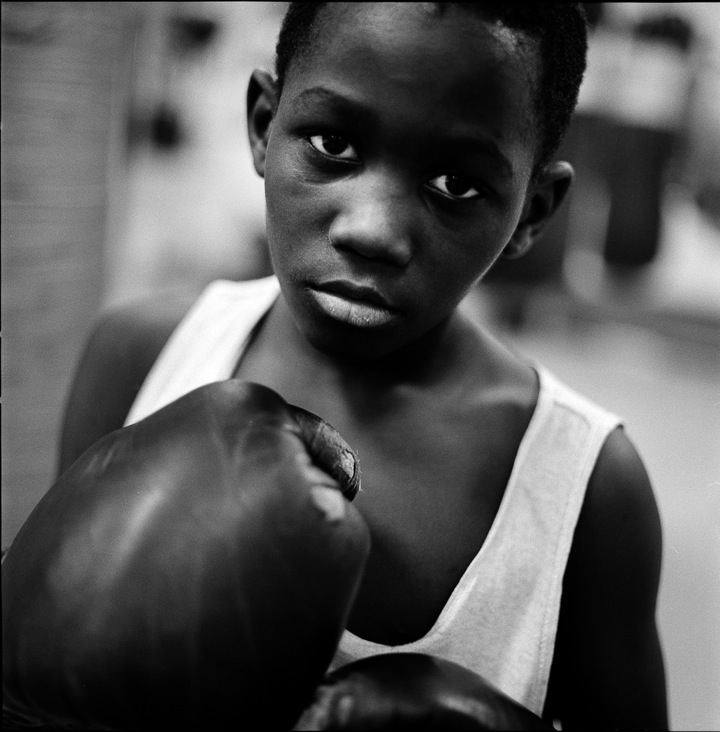
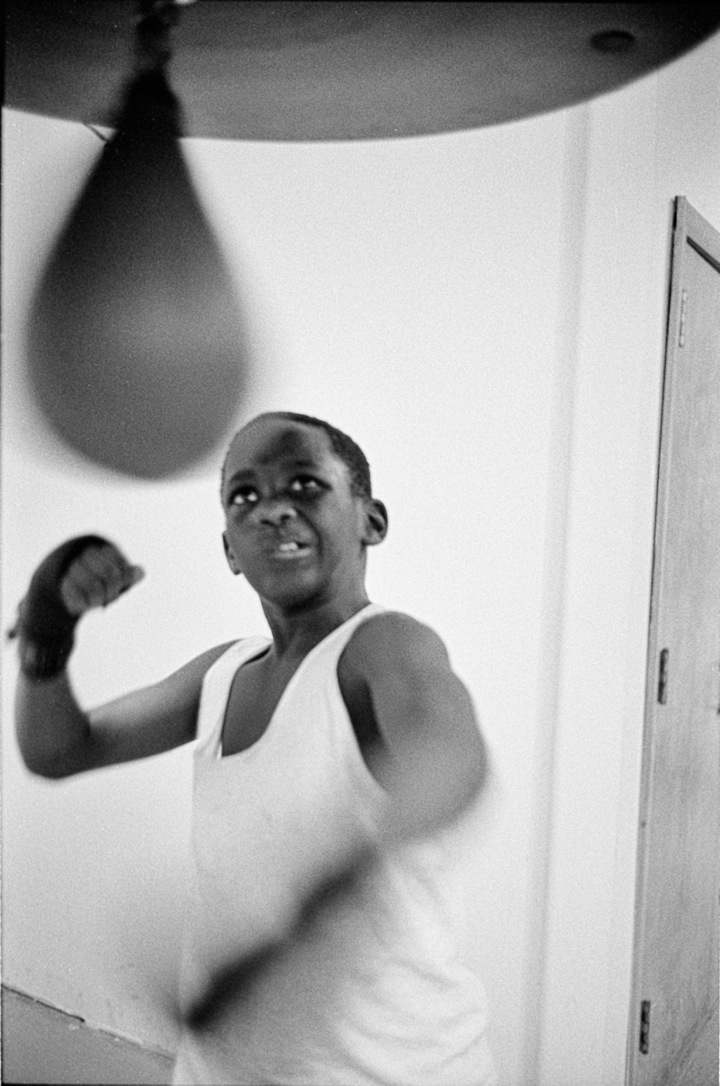 This image and the one above are of a very young Bud at the CW Boxing Club, ©photos courtesy Jim Krantz
Early in his pro career he nearly lost his life in a shooting the week of a fight when he joined a dice game that went sour and as he left in a car someone fired a shot that hit his head. He went to the nearest hospital.
Debra recalls getting the news at home.
“I was asleep when my mom woke me up to tell me. ‘Bud just got shot.’ I waited a minute, got up and came downstairs. Then my sister and I went out there. They wouldn’t let me see him. When they finally called me in Bud was sitting on the edge of the bed laughing, saying, ‘I’m still going to fight on Friday.’ I said, ‘No, you’re not, they’ve got to stitch your head up.’ He was lucky because the bullet bounced off his head. The doctor told me, ‘He’s got a hard head.'”
As if the family needed proof.
Bud and everyone around him traces his new-found maturity to that incident and to becoming a father.
“He’s come a long ways,” grandma Jones says.
“He’s more focused,” Kevin says.
“He’s a great father,” says Iesha. “He took care of me and my daughter before we had a son together.”
Bud’s sister Lastisha says she gets emotional thinking about how far Bud’s come.
“I used to have bad dreams and then when he got shot one of the dreams kind of came true. When he went in that ring and won that championship I thought back to how he was when he was little, hot-headed, and just didn’t want to listen to nobody. And to see him now it’s like, Wow, my little brother for real is world champion. I’m like really, really proud of him.”
Velma says some of her grandson’s drive to excel is fueled by the decisions in the ring he feels he was robbed of as an amateur. It’s why as a pro he takes no chances and strives to dominate from start to finish, just as he did against Burns in taking all three judges’ cards.
“After that fight in Scotland he told me he was scared they were going to take some points away from him. He thought they’d use some kind of technicality to make him lose the fight. But he come on through. He showed ’em y’all cant do no stealing from me, not tonight.'”
Co-manager BoMac says Crawford feeds off “always being the underdog and always having something against him – that lights his fire and makes him train harder.”
Bud’s boisterous family will be out in force come fight night just as they were in Glasgow. Only this time the Crawford contingent will be much larger, with relatives coming from both coasts and lots of points in between. He welcomes their presence, no matter their size.
“It’s not going to be a distraction or anything,” he says. “They’re there any other fight, so it’s just another day in the gym for me. When I was in Scotland…Dallas…Orlando…Vegas, they were there with me, so you know I’m used to having them cheering me on and not letting them interfere with what I’ve got to do in the ring. You’ve got to keep your mind focused on the task at hand.”


Bud training in Colorado Springs
Per his custom, he trained in Colorado Springs several weeks before returning June 22. Back home he’s fine-tuned his body and mind.
“I just chill and visualize what I’m going to do in there and then just go ahead and do it. You’ve got to see it to be able to do it. When I put my mind to it, it’s already done.”
Iesha, who saw him training six-plus hours a day in Colo., admires
that “he puts so much work into it.” “Hard work and dedication” has gotten him this far and he isn’t about to slack off now, Latishsa says.
Crawford’s unsure whether Omaha will ever fully embrace him as its champion. His family’s glad he’s getting his due after years toiling in obscurity. The Gamboa fight will be his first as a pro in his hometown.
“He’s finally getting noticed,” Debra says, adding people claiming to be cousins have been coming out of the woodwork since winning the title.
Hugh Reefe is impressed by how success, fame and big paydays have not changed Crawford’s lifestyle.
“He’s a pretty simple guy and I like that he’s kept everything the same. He’s handling it really well, he’s got really good instincts, He’s intuitive. He’s always concerned and thoughtful about how things affect his family.”
Those closest to him sense that after waiting so long for this stage he’s going to put on a show.
Iesha says, “I know he’s not giving up that belt.”
Everyone agrees Gamboa may regret saying at the press conference Bud hasn’t fought the caliber of fighters he has. Latisha says as soon as he uttered those words Bud vowed, “I’m going to kick your butt.”
Debra and her daughters predict Bud winning by knockout. “I pick the 6th round because Bud likes to figure him out. If Gamboa hits Bud, Bud’s going to angry and it’s going to be all over,” she says.
God forbid it comes down to a controversial decision that goes against Bud. “He’d probably go nuts if he feel he got cheated,” Latisha says.
“But he ain’t got to worry about that,” Shawntay says, “because he ain’t going to lose. We got this.”
Latisha can see he’s ready for Saturday. “I know when he’s serious, he’s got the eye of the tiger. There’s just something about his eyes that you just know that he’s about to go handle it.”
Reefe, who drove Iesha and the kids to see Bud in Colo., saw a fighter in peak condition. “I realized I was watching a world-class athlete. He was getting getting it on in a workmanlike, no-nonsense manner, going from one workout to the next, station to station, not being lazy about anything. He was in charge.”
BoMac confirms that Crawford “just looks at it like he’s got a job to go do,” adding, “He’s like, ‘Let me do my job, everyone else do their job, let’s go about our business and let’s go home.” He says Crawford’s “will and determination” separate him from the pack.
That intensity is often masked by his laidback demeanor. “He likes to joke and play around, wrestle, he’s a kid, you know,” Reefe says. “He’s always been like that,” says Debra, fingering a stack of title fight posters. “He’s so easygoing you wouldn’t believe he’s got a big fight coming up,” adds grandma. Shawntay points out, “He don’t ever talk about the fight, he just goes in there and fights.”
As for the fighter himself, he’s using any real or perceived slight – from Gamboa’s words to what he sees as a lack of local corporate sponsors to the Bluffs controversy – as motivation to leave no doubts June 28.
“I’m still hungry to get better and to prove to the world that I belong here. This is just a stepping stone.”
The Crawford-Gamboa fight can be seen live on HBO Boxing After Dark starting at 9 p.m. (CST).
For tickets to the fight, visit http://www.ticketmaster.com.
Terence “Bud” Crawford in the fight of his life for lightweight title: top contender from Omaha’s mean streets looks to make history

UPDATE: The subject of this story, Terence “Bud” Crawford of Omaha, won the WBO world lightweight championship in convincing fashion on March 1 over Ricky Burns in Glasgow, Scotland. My Reader cover story about Crawford appeared right on the eve of his title bid and just as was his gameplan he left no doubt and nothing to chance in claiming a unanimous 12-round decision.
Boxing in Omaha was never necessarily big the way it’s been in certain cities and towns but for a long time it definitely exerted a presence and enjoyed a loyal following here on both the amateur and professional ends of the sport. Starting around the 1980s and certainly by the 1990s interest among participants and spectators fell off rather dramatically. Part of that is explained by the general decline in boxing that happened nationwide as the sport found itself increasingly criticized for the injuries and deaths and longterm disabilities suffered by fighters as well as scandalized by the lax rules and ethics attending the game that allowed professional opponents like Omaha’s own Bruce “The Mouse” Strauss to take fight after fight in close order under assumed names and with little or no training. The reprehensible and mondo bizzaro antics of various high profile fighters didn’t help its standing. With boxing under attack and more and more relegated to a frringe actviity mixed martial arts arrived on the scene to offer something new and different and ever since then boxing’s struggled to keep apace or even hold on in some cases. It’s not so much that society rejects violent or extreme sports, otherwise how to explain the popularity of MMA, but that boxing is seen as something archaic or passe in a world of many high adrenalin, high risk sports that push the envelope, whether it be MMA, snowboarding, skateboarding, hang gliding, windsurfing, base jumping, rock climbing, mountain biking, et cetera. The list goes on and on. Omaha boxing gyms used to number a dozen or more at any given time but now that number is a fraction of what it used to be. Many gyms offer heavy and speed bags and perhaps even a ring for shadowboxing but these are more fitness centers focused on the conditioning benefits of boxing rather than on specifically training boxers to do actual combat. A sure sign of boxing’s decline here was when Omaha hosted the National Golden Gloves a few years ago and the crowds numbered a few thousand at most, which was less than what local-regional boxing tournaments here used to draw.
Nebraska’s produced some good fighters over time but very, very few who could be considered world class. The top flight fighters out of here have become even fewer and farther between. With this as the background and context for where boxing resides in Omaha a local fighter named Terence “Bud” Crawford is contending for the WBO lightweight championship in Glasgow, Scotland on March 1. Considering what Crawford is going for there should be more buzz around here about his title bid but then again the lack of attention, awareness, and excitement is an accurate reflection of boxing’s tenuous position these days. As I say in the following cover story about Crawford I wrote for The Reader (www.thereader.com) , which hits the stands Feb. 27, if this were happening decades ago Crawford would be the toast of this sports town. But these days Creighton men’s basketball is the preferred sports flavor and its superstar Doug McDermott is the man of the hour, not Crawford. There are a lot of reasons for that beyond those I described above and I allude to some of them in my Reader piece.
On this blog you can find an earlier New Horizons story I wrote about Crawford and his close relationship with trainer Midge Minor. You can also find stories about the CW Boxing Gym, also known as the CW Boxing Club and CW Youth Resource Center, which is where Crawford got his start. And for that matter you can find several more boxing pieces I’ve done over the years about Ron Stander, Morris Jackson, the Hernandez Brothers, Servando Perales, Tom Lovgren, Kenny Wingo and the Downtown Boxing Club, et cetera.
A photo montage of Terence “Bud’ Crawford:

Terence “Bud” Crawford in the fight of his life for lightweight title: top contender from Omaha’s mean streets looks to make history
©by Leo Adam Biga
Soon to appear in The Reader (www.thereader.com)
As Omaha glories in Creighton Bluejays hoops superstar Doug McDermott’s historic season, another local sports figure going for greatness flies under the radar.
Boxer Terence “Bud” Crawford challenges for the WBO lightweight title March 1 against champion Ricky Burns in the title holder’s native Scotland. The scheduled 12-rounder is being televised in the States by AWE, a hard to find cable-satellite network. The fight is scheduled for 2 p.m. (CST).
The CU campus McDermott’s put on the map is mere few blocks from The Hood Crawford grew up in and where his recently opened gym, B & B Boxing Academy, 3034 Sprague Street, is located. But these two stars might as well be worlds apart. McDermott’s a product of white privilege. His biggest challenge was deciding whether to return for his senior year or sign an NBA contract. The African-American Crawford is a product of the inner city. He grew up fighting in the streets and getting kicked out of schools. On the eve of his first pro bout he was shot in the head on the same mean streets of his youth.
McDermott, soon to be a three-time All-American, is the consensus favorite to win national player of the year honors. He competes before 18,000 adoring home fans. Crawford’s compiled a 22-0 record, 16 by knockout, yet he’s never once fought professionally in his hometown though he trains and resides here. Where McDermott excels at a team sport embedded in popular culture, Crawford toils at a lone wolf game that’s lost traction in this mixed martial arts age. While McDermott’s every move is celebrated and scrutinized, Crawford operates in relative obscurity. Unless you follow boxing on HBO, you’ve likely not seen him fight and until reading this were oblivious to his upcoming title shot.
Decades ago, when boxing still mattered in places like Omaha and when there weren’t alphabet soup titles with deluded value, Crawford’s world championship bid would have been big news. Still, just getting in this position should be cause for celebration today. If he prevails in Glasgow – oddsmakers and experts give him anywhere from a decent to an excellent chance – he’d be the first major boxing champ from Neb. since heavyweight Max Bear in 1934. The last time a local fought for an undisputed title was 1972, when Ron “The Bluffs Butcher” Stander met heavyweight king Joe Frazier at the Civic Auditorium and got bloodied like a stuck pig for his trouble.
Co-manager-trainer Brian “BoMac” McIntyre feels Omaha’s not embracing this historic moment involving one of its own. He says given the way Crawford represents by proudly identifying his hometown on his trunks and giving it props in interviews, it’s a shame Omaha doesn’t “stand up” for him in return. If that lack of love bothers Crawford the hard-as-nails pragmatist with washboard abs isn’t admitting it. He’s aware boxing is dead here and he’s intent on reviving it. He did soak up support from friends, family and well-wishing fans at a send-off party at Brewsky’s before Team Crawford left Feb. 22.
Ask what winning a world title might mean to his community and Crawford answers, “Honestly, I really don’t know because Omaha is really big on MMA, Creighton and Nebraska and nobody really talks about boxing that much. I feel if I was to bring that title back here it could boost us or it could just stay the same, where like a handful of people acknowledge what just happened and the rest are still like, Oh, it’s just boxing.
“We’ve got a lot of talent in Omaha but a lot of people give up because of no resources and backing. As a professional you have to go to your opponent’s backyard because we don’t really have professional boxing in Omaha. I can’t remember the last time we had a full professional boxing card in Omaha. It’s real down here, so it’s real hard to get motivated on boxing.”
He hopes his academy does for youth what the CW Boxing Club where he started and still has ties did for him and many others.
“We want to help kids that need help with that father figure in their life by talking to them, teaching them to stay in school and listen to their parents and elders, things like that. A lot of kids in the neighborhood don’t have nowhere to be after school. They can just come in here, relieve some stress, relieve some anger. We don’t know what’s going on in their household. They might be going through a lot and boxing might be the outlet to relieve some of that rather than doing something they’ll regret the rest of their life.”
Crawford hasn’t let Omaha’s tepid interest hold him back.
“You know what, he don’t give a f___ about that, I swear to God he don’t,” McIntyre says. “He looks at it like, ‘If they do get behind me so be it, if they don’t, oh well.’ They really weren’t behind him when he was an amateur and now that he’s here they’re really still not behind him. That’s just more fuel to the fire to win the fight.”
McIntyre, a Team Crawford member since the fighter was a top amateur for the CW, whose namesake Carl Washington discovered the young scrapper, says Crawford’s always fought an uphill battle for respect. As a teen Crawford’s hot temper made him a handful. After some false starts, CW coach Midge Minor took him under his wing.
“I was a bad kid, when I came in I was just rough, I didn’t care about training, nothing, I just wanted to fight,” recalls Crawford. “Midge would throw me in there with anybody, he didn’t care. Sometimes I’d get beat up, sometimes I’d win. The thing that separated me from everybody else was if I got beat up by one of the older kids I’d come back the next day like, ‘I want to spar him, I don’t want nobody else but him.’ And Midge would be looking at me, ‘You’ve got heart, I like you.’ So I’d get in there and keep sparring until I started beating them. I think that’s what really elevated me to where I’m at.”

Minor, who’s old enough to be Crawford’s grandpa, has been the main wise counsel and steadying influence for the fighter.
“Anytime I needed anything or needed someone to talk to he was always there,” Crawford says. “He’s played a big factor in my life. He’s a great father figure in my life.”
Following stints at alternative schools, Crawford finally found a home at Bryan High School, where he graduated, Despite great success as an amateur, his hard case attitude alienated him from the boxing establishment. He also ran up against the stigma that fighters from here traditionally fare poorly at nationals. Crawford dispelled that image by advancing to the semis of the National Golden Gloves in Omaha. Outside the Gloves he beat virtually everyone in his weight and age class. But the politics of the sport pegged him a bad apple and so certain opportunities bypassed him.
McIntyre says, “He wasn’t the poster boy for USA boxing. Terence was a bodacious kid. He’s always been the underdog. When he went to the nationals and to the Olympic Trials people said you can’t do it because you’re from Neb. and they always get beat in the first round, so he’s always had something against him.”
Crawford never let those perceptions stop him, even after being kicked off the USA team, thus spoiling any chance of fighting in the Olympics, which was fine with the fighter, who had a bigger dream in mind.
Then, as now, nothing gets in the way of what Crawford wants.
“He was ranked number one and there was a national tournament in Calif. we couldn’t afford to go to,” says McIntyre. “USA Boxing gave him a stipend every other month and he saved his money and paid for his own ticket and hotel. At 17 he went out there by himself, he found a coach to get him to the weigh-ins. He found a way. That will and determination separates him from anybody I’ve ever run into.”
Crawford’s not only kept McIntyre and Minor in his camp. he’s assembled a team made up of his old sparring partners and coaches. Loyalty is big with him. His other co-manager is Cameron Dunkin, a Las Vegas-based boxing magnet who handles the business side.
Some predict the highly skilled Crawford, who combines quick hands and feet with deft moves and some power, will handle the more experienced Burns. The champ’s 36-2-1 record includes many high stakes fights but some recent disputed decisions. Others question how Crawford will deal with such a big stage before a hostile crowd.
Crawford says, “It’s going to be a different atmosphere, everybody’s going to be against me, but I like it like that because that’s just going to feed me energy to shut ’em up and keep ’em quiet.”
He’s well aware he can’t afford to leave anything to chance and give the judges any wiggle room to score the fight in favor of the home boy.
“That’s the plan – to dominate like I’e been doing with all my other opponents. In my 22 fights I can’t think of a fighter I’ve fought that won two rounds, so I’ve just got to be me and do what I do best.”
He’s keeping his emotions in check leading up to the bout
“Honestly, I ain’t got no feeling at all, like I’m not excited whatsoever. The other day BoMac said, ‘Man, ain’t you anxious?’ and I was like, ‘Naw, I’m just ready to fight’ I’ve been doing this all my life, this is my dream. I never wanted to be an Olympian, I never wanted to win a gold medal, I always wanted to be a world champion. I wanted to turn pro at 17 but they insisted I try out for the Olympic team.”
With him finally on the cusp of HIS dream he can’t afford giddiness.
“This is what I wanted to do, so now that it’s here I’m the one who’s got to go in there and handle my business and then when I win it I’m going to be happy. It’s strictly business right now. I’m not happy I’m fighting for a world title, no. I’m going to be happy when I win it though.
“I’m ready to do what I’ve been doing all my life and that’s showing people how good my talent is.”
Many Omaha boxing scene veterans believe Crawford may just be the best fighter, pound-for-pound, to ever come out of here.
Crawford, the father of two children, says his confidence is high because he’s left nothing to chance in training. Sticking with a routine that’s worked before, he began training for Burns in Omaha, then went to Colorado Springs for the added conditioning high altitude promotes and the better sparring available there, the site of USA Boxing. Being away from home also helped eliminate distractions. McIntyre says it’s all about getting focused and following a regimented workout process from 8 to 8 daily that ensures he didn’t peak too early.
After the four-week camp Crawford returned home mid-February to fine-tune, stay sharp and maintain just the right edge.
Even after weeks of intense training that encompassed running, swimming, sit-ups and sparring, Crawford says there’s still an element of doubt that naturally attends any fight.
“There’s always going to be a doubt and a what-if with any fighter, I don’t care who he is. They’re going to always have doubt in the back of their mind. Did they do enough? What if this happens? What if that happens? But that’s when you got to adapt and you got to adjust to the situation and that’s what I plan to do.”
All the coaching and strategizing in the world doesn’t mean anything, he says, if you can’t execute it.
“It’s up to me to establish it and carry it on into the ring. We can train all day, every day, we can do this and that. Like Ricky Burns, he can say he’s got something new, he’s going do this and that, but all that don’t matter if you get in the ring and you can’t establish what you want to do. When we get in the ring then it’s all going to tell.”
Crawford refuses to fight out of character. He’s too smart to be drawn into adopting a style or forcing the action that’s not in his best interest. Even when boos rained down on him in Orlando, Fla. as he dismantled Russian Andrey Klimov in an Oct. 4, 2013 fight, Crawford was content to stick with his plan of outboxing his foe even though going for a KO would have pleased onlookers and HBO executives. He says he’ll neither get into a brawling match with Burns nor take undue chances testing the champ’s repaired jaw, which was broken in his last title defense, for the sake of pleasing the crowd or boosting ratings.
“I’m not going to go out there and just go for haymakers and get caught with stupid stuff. I’m just going to go out there and do what I do and if the knockout comes it comes, if it don’t it don’t. I’m just going out there to win that title and that’s the only thing on my mind.”
He maintains a healthy respect for Burns or any opponent.
“I don’t underestimate nobody. Even if it’s a fight I know I’m going to knock the dude out I always go in there like, What if? It keeps me driving, it keeps me on my Ps and Qs, it keeps me more focused because you never know – one punch can beat you.”
He says you also won’t catch him doing any pre-fight grandstanding or gamesmanship at the weigh-in press conference. Not his style, though he’s says if Burns comes at him he’ll come right back. However, Crawford does use those occasions to size up his opponent and what he finds can be revealing.
“Sometimes I’ll see right through you. I can see in your eyes a little twitch. On the outside you look like you’re this big bad guy but on the inside you’re afraid for your life. You’re a nervous wreck.”
At the end of the day, there’s nothing about this fight or any fight that scares him. Compared to a bullet in the head it’s no big deal.
“I’ve been shot, I’m not going over there worried about what’s going to happen in the ring. I’m ready, period. I’ve got my mind made up, I’ve got my goals set, and I’m going up there and I’m going to get it. I’m not going to let nothing or nobody stop me from conquering my dreams.”
Do the right thing Omaha and stand up for your own as he goes for history.
Giving kids a fighting chance: Carl Washington and his CW Boxing Club and Youth Resource Center

Giving kids a fighting chance: Carl Washington and his CW Boxing Club and Youth Resource Center
©by Leo Adam Biga
Originally appeared in The Reader (www.thereader.com)
Organizations serving at-risk kids come and go but few stay the course the way the CW Youth Resource Center, 1510 Cass Street, has since opening in 1978.
Founder-director Carl Washington hosts a Nov. 29 open house at CW from 4 to 8 p.m. to celebrate 35 years of structured youth activities.
His experience mentoring youth began a decade earlier, when he was like a big brother to his nephew Howard Stevenson. After Stevenson was shot and killed by an Omaha police officer in the wake of a 1968 civil disturbance in North Omaha, Washington was angry. A bully and street fighter at the time, he went to the old Swedish Auditorium boxing gym looking to release his rage.
“I went down there and picked on the first guy I thought maybe I should be able to beat up, a chubby kid by the name of Ron Stander.”
That’s Ron Stander, aka the Bluffs Butcher, who fought heavyweight champion Joe Frazier in a 1972 title bout. But when Washington first laid eyes on him Stander was still a pudgy, no-name amateur.
“Everyone was paying attention to him. My thought was, Knock him off and then you can be the top guy. It didn’t work that way.”
After weeks pestering coaches to let him spar Stander, the exhibition was set. Washington was so confident he brought an entourage. He knew he’d miscalculated when he landed his best blows and Stander didn’t even blink. The first punch Washington absorbed was the hardest he’d even been hit. After a few more punishing shots he feigned injury to end the onslaught.
Washington wanted to quit the sport right then but Stander encouraged him. The two men became friends. While Stander went on to make boxing his career, Washington only fought a year. Well-schooled by the late trainer Leonard “Hawk” Hawkins, Washington saw his true calling not as a fighter but as a coach. He believed boxing could give kids a safe activity in place of running the streets.
He first tried forming the gym in 1971 but it didn’t take. Seven years later he gave it another go, this time with help from two mentors. A lifelong inner city resident, Washington daily saw unsupervised kids getting into mischief and brawls, hungry for structure, and he felt he could give them the healthy alternative they needed.
“A group of kids I ran across were fighting and I broke it up and took them downstairs to my basement and started working with them. We took two of them to a boxing show at the National Guard Armory and they both won trophies. We put the trophies up on the mantel and the other kids wanted to win trophies, too. So, it grew from there.”
He’d have two dozen youths training in his basement at one time with another similar-sized group out on a long run before they took their turn hitting the bags.
CW took the local amateur boxing scene by storm, winning hundreds of individual and team trophies at smokers and the Midwest Golden Gloves.
“A couple years we won every weight division,” he says of the Gloves.
Washington ran a tight ship. “I instilled discipline. Our guys had to walk the line.”
He bemoans the lax standards commonplace today.
“I see a lack of respect for one another from a lot of kids, a lot of people, Respect is not on the table like it used to be. Respect is an art we should be going back to. I think a lot of that is lost. When all those factors are gone that’s why there’s so much chaos.”
He insists boxing’s a useful tool for instilling values.
“Out of a hundred kids probably one of them might box and go all the way to the Gloves and do all he’s supposed to do in boxing. But for the rest of them it might open the door for them to get into wrestling, football, basketball and other sports. We can give them that discipline.”
He says that discipline carries over to school, work and family life.
The kids he started with are now parents and send their kids to him.
Reaching kids takes patience and instinct. “I have a feel for when I meet a kid exactly what the kid really wants – if he wants to box or to get in shape or if he’s down here because his mother needs a baby sitter. Sometimes they may have aspirations of becoming a champion.”
Terence “Bud” Crawford is a once in a lifetime phenom who came up through the CW ranks and now is on the verge of fighting for the world lightweight title. He remains loyal to the CW, where he still trains under the man who got him started there, Midge Minor, and is managed by another CW alum, Brian McIntyre.
In its early years CW was a predominantly African American gym. Its fighters weren’t always well received.
“We ran into a lot of negativity in the beginning. Some cities we boxed in weren’t too friendly. It seemed like the ones closest to Omaha were the unfriendliest,” says Washington. He recalls that before a Wahoo, Neb. boxing show his fighters got debris and racial slurs hurled at them. They silenced the crowd with excellence.
“A lot of parents with me wanted us to leave and I said, ‘No, we’re not going to leave.’ We parked the cars going toward the street just in case we had to get out of there in a hurry. I said, ‘We’re going to go back in there, box, and act like gentlemen and we’re not going to respond to the crowd. We had 16 bouts that day and we won all 16.”
Boxing hasn’t been the only avenue for youth to explore at CW, which moved from his basement to the Fontenelle Park pavilion to south downtown to its current spot in the early 1990s. CW once featured recording studios and a dance floor to feed the rap and breakdance demand. Washington organized talent showcases and concerts highlighting the club’s many homegrown performing artists
“We were involved in a little bit of everything. We were doing anything we thought could reach kids.”
He says he put on the first gang reconciliation concert back in the mid-1980s when he was doing gang prevention-intervention work before it had a name.
He cobbled together support from grants, donations, fundraisers and raffle sales.
“We had to jump over a lot of hurdles in the beginning. What really built the club was raffle tickets. We were out on the corners and kids sold raffle tickets. I was able to do the (initial) restoration here through the raffle sales.”
At the boxing gym’s peak, he says, “We were going all over the country with kids in the car to boxing shows and coming back with a lot of trophies.” But he feels CW was never fully embraced by its hometown, where fans booed the club’s fighters when the national Golden Gloves were fought here. Boxing’s also lost kids to martial arts and other activities.
Looking back, he says he’s proudest of just “being able to survive,” adding, “We’ve been pretty blessed.”
Though CW doesn’t have as many competitive boxers as it once did, he’s seeing more kids come as a result of Bud Crawford’s success. He scaled down the club’s entertainment facets after frictions surfaced between performers. He stopped holding concerts after a drive-by shooting outside the club. He recently formed a hoops program as a new outlet .
One thing that hasn’t changed, he says, is “I open my doors to everybody and I never charge a membership fee.”
For more information about the CW’s programs, call 402-671-8477.
Related articles
- The kid with the Golden Gloves (wafb.com)
In his corner: Midge Minor is trainer, friend, father figure to pro boxing contender Terence “Bud” Crawford
As I’ve said before on this blog nearly every writer gets around to writing about boxing at one time or another. I did my first boxing story in the late 1990s and every now and then I get the craving to do a new one. I’ve built up quite a collection of boxing pieces this way and you can access them all on the blog. The following story for the New Horizons in Omaha profiles an up and coming pro lightweight contender, Terence “Bud” Crawford, and the older man in his corner who is trainer, friend, father figure and more to him, Midge Minor. They are as tight as two people nearly 50 years apart in age can be. Crawford has been under the wing of Minor from the time he was a little boy and he still relies on his sage advice today as he prepares for an expected world title fight. The loyal Crawford is an Omaha native and resident who’s never left his hometown or the gym he grew up in, the CW, and he’s not about to leave the man who’s guided him this far.
©by Leo Adam Biga
Originally appeared in the New Horizons
Nebraska‘s best ever hope for a world professional boxing champion works out of the CW Boxing Gym in north downtown Omaha.
As 25-year-old lightweight contender Terence “Bud” Crawford goes through his paces, he’s watched intently by an older man in a sweatsuit, Midge Minor. Though separated in age by four-plus decades, the two men enjoy a warm, easy relationship marked by teasing banter.
Crawford: “I’ll beat this dude up right now.”
Minor: “You’re scared of me, you know that.”
Crawford: “You be dreaming about me.”
Minor: “You stick that long chin out to the wrong man.”
They’ve been going back and forth like this for decades. At age 7 Crawford got his boxing start under Minor at the CW, 1510 Davenport St., and he still trains there under Minor’s scrutiny all these years later.
The facility is part of the CW Youth Resource Center, whose founder and director, Carl Washington, spotted Crawford when he was a kid and brought him to the gym.
Crawford, an Omaha native and resident, owns a 21-0 pro record and a reputation among some experts as the best fighter in the 135-pound division. The smart money says it’s only a matter of time before he wins a title. That time may come in January when the Top Rank-promoted boxer is expected to get his title shot and the opportunity to earn his first six-figure payday.

Midge Minor
Since showing well in two recent HBO-telecast fights, he’s riding a wave of fame. He’s the pride of the CW, where the number of fighters is up because he learned to box there, made it big and never left.
“He’s one of the causes of our gym being full now,” says Minor. “They all look up to him. It’s kind of like he put us on the map.”
Crawford doesn’t act the star though.
“I’m the same person, I’m regular, I just want to be able to make it and provide for my family,” he says earnestly.
He engages everyone at the gym and offers instruction to fighters.
“I’m always going to have CW somewhere inside of me because this is where I started from. Never forget where you came from. I’m always going to be a CW fighter. I just feel comfortable here. It does feel like home when I walk through them doors because it’s the only gym I knew when I was coming up. I’ve been coming here and going to the donut shop (the adjacent Pettit’s Pastry) ever since I was 7.”
For a long time he was pressured to leave Omaha, where quality sparring partners are rare and pro boxing cards even rarer. But he’s remained true to his team and his home.
“A lot of people came at me with deals wanting to get me to fight for them, sign with them and move out of town. They kept telling me I can’t make it from Omaha and need new cornermen – that they took me as far as they could. But I’m loyal and a lot of people respect me for it. My coaches have faith in me and trust me that I’m not going to do nothing to jeopardize our relationship, and I trust them and have faith in them.
“I’ve just stayed with it and continued to have confidence in my team. I just keep pushing forward.”
He keeps a tight circle of confidantes around him and all share his same CW and Omaha lineage.
“We all family,” he says..”Every person I turn to in my corner that’s giving me instructions came up under Midge.”

CW Boxing Club is located in the CW Youth Resource Center
For his last fight Crawford, who always sports Big Red gear to show his Nebraska pride, wore trunks emblazoned with “Omaha” on them.
As Crawford shadow boxes inside the ring, looking at his reflected image in a bank of mirrors against the near wall, the 73 year-old Minor takes it all in from his spot in the corner, just outside the ropes. Minor has been in Crawford’s corner, both literally and figuratively, since the fighter first got serious about the sport at age 12. They initially met five years before that, when Crawford became argumentative with the trainer. Minor demands obedience. He barks orders in his growl of a voice. He’s known to curse, even with kids. He doesn’t take guff from anyone, especially a brash, back-talking little boy. When Crawford wouldn’t mind him, Minor banned him from the CW.
The trainer hated letting Crawford go, too, because he recognized the kid as something special.
“I saw that he had a lot of heart and that goes a long way in boxing. He never wanted to quit on me.”
The boy’s heart reminded Minor of his own. Back in the day, Minor was a top amateur flyweight, twice winning the Midwest Golden Gloves. But prospect or no prospect, Minor wasn’t going to stand for disrespect. The two eventually reconnected.
“I kicked him out of the gym for five years,” says Minor, a father many times over, “and then I brought him back when he got a little more mature and then we went from there.”
Crawford acquired some rough edges growing up in The Hood. Being physically tested was a rite of passage in his family and neighborhood. It toughened him up. He needed to be tough too because he was small and always getting into scuffles and playing against bigger, older guys in football, basketball, whatever sport was in season. He learned to always stand his ground. The more he held his own, the more courage and confidence he gained.
“I was taught to never be scared…to never back down. That was instilled in me at a young age,” Crawford says. “My big cousins pushing me, punching me, slamming me, roughing me up. My dad wrestling me. After going against them it wasn’t nothing to me going against somebody my size, my age.
“I’d fall and get jacked up or get bitten by dogs or get scratched. I’d need stitches here and there, and my mom would be like, ‘You’re all right.’ There was no going home and crying to your parents or nothing like that. No babying me. I don’t know what it feels like to be babied.”
There was something about Crawford, even as a child, that pegged him for greatness.
“Before I even started boxing my dad used to make me punch on his hands, teach me wrestling moves, throw the ball with me. He always said, ‘You’re going to be a million dollar baby.’ Ever since I was little he was like, ‘You can be whatever you want to be, just go out there and do it, don’t let nobody hold you down or hold you back.'”
His father, grandfather and an uncle all boxed and wrestled in their youth. His dad and uncle trained at the CW. His grandfather boxed with Minor. They all had talent.
“It was just in me, it was in the blood line for me. I just took after them. My dad always gave me pointers.”
By the time Crawford came back to the gym, he was less belligerent and more ready to learn. The non-nonsense Minor and the hot-tempered youth bonded. Like father and son.
“When I came back to the gym Midge and I were like instantly close.
Midge was like my dad,” says Crawford.
What was the difference the second time around?
“I don’t know. maybe it’s because I accepted Midge ain’t going to change for nobody. I didn’t really know him like that at the start. so for him to be talking to me crazy I took that as disrespect. I was offended by it. But when i came back I realized that’s just Midge being Midge. Some people get intimidated by him but one thing about Midge is if he likes you he’s going to roll with you. If he don’t like you, he don’t like you and there’s nothing nobody can do to make him like you. And if he’s with you he’s with you to the end.
“When I got to know him more I realized Midge will have my back till the day he dies and I’ll have his back to the day I die, and that’s just how close we are. Midge put a real big hold on me.”
When you ask Crawford if he could have gotten this far without him he says, “Probably not because Midge kept me out of the streets. He taught me a lot. Without Midge, I don’t think so, He taught me a lot of responsibility.”
Crawford came to know he could depend on Minor for anything, which only made him trust him more and made him want to please him more.
“I used to ride my bike to the gym with a big old bag on my back, that’s how dedicated I was. Then Midge started taking me to the gym. Over holidays he’d come to my house to take me to the gym. On school days he’d come get me at school and take me to his house. We’d just sit there together and watch boxing tapes. I would watch any kind of fighter just for the simple fact that you never know when you might see that style. He’d tell me what they’re doing wrong and what I could do to beat ’em.”
Minor also became Crawford’s mentor.
“Anytime I needed anything or needed someone to talk to he was always there,” says Crawford. “He’s a great father figure in my life.
Just an all around good guy. He loves kids.”
All of Minor’s work with Crawford inside and outside the ring had the full support of Bud’s mother.
“It was a little like school to me. Sometimes I’d try to duck him and tell my mom to tell him I wasn’t there and she wasn’t having it. Sometimes my mom would call him and say, ‘Come and get him Midge’ and I’d spend the night at his house, watch tapes, work out. It was like that.”
When he got in trouble at school his mother informed Minor because she knew he’d hold him accountable. When Minor got his hands on him he worked him extra hard. it was all about getting the young man to learn lessons and to pay his dues. Instead of resisting it, Crawford took it all in stride. He says, “It was instilled in me early that what don’t kill you will make you stronger.I looked at it that it was helping me.”
“He appreciated it. He respected me,” says Minor. “We got along real well.”
The troubled boy no one could reach found a friend and ally to push him and inspire him.
“Midge always instilled in me, ‘Nobody can beat you, especially if you work hard and put your heart into your training.’ He drilled that in my head. He believed in me so much. There were times I kind of doubted myself in my mind and he was just like, ‘Nobody can beat you.’ The fight’s the easy part. Preparing for it, that’s the hard part. I’ve been fighting all my life so to get in there and fight, that’s easy. That’s 30 minutes. Sometimes only three minutes or 30 seconds if I get an early knockout. That’s compared to training for hours and hours a day.”
Minor routinely put him in the ring with much more experienced guys.
“That’s how much confidence he had in me. Seeing him have that much confidence in me made me even more confident,” says Crawford.
“It didn’t make no difference who I fought him with because he was going to fight ’em. I’ve had a lot fighters but they didn’t have the heart that he has.”
The legend of Terence “Bud” Crawford began to grow when as a teen amateur he sparred pros and outfought them. Even today he likes to spar bigger guys.
“I like to try myself.”
Crawford is now on the cusp of boxing royalty and Minor is still the one Bud puts his complete faith in.
“He’s still there for me taking good care of me,” Crawford says. “I’m always going to have his back. You know he looked out for me when I was little and I’m going to look out for him now that he’s older.”
Having Minor in his camp as he preps for the biggest fight of his life is exactly where Crawford wants him. Having him in his corner on fight night is where he needs him.
“It means a lot to have Midge there. Midge is the brain. Everything goes through Midge before it’s all said and done for me to go in there and fight. Without the brain we can’t do nothing, so it’s very important that Midge is there.
“Before every fight I bring him a disc of who I’m fighting and I ask him what he thinks about the guy and he tells me what I should do and we go from there.”
The strategy for any fight, he says, is “a team effort” between his co-managers Brian McIntyre and Cameron Dunkin, trainer Esau Diegez, Minor and himself.
“We all work together and dissect our opponent but Midge is always the one that’s like, ‘Alright, this is what you’re going to do to beat this guy. This is how you’re going to fight ’em.’ And we all go by what Midge sats. He’s great for seeing things I don’t see and making me see it.
“He gives me the instructions to beat ’em, and all I have to do is follow ’em. He’s got the wisdom.”
Minor says Crawford is a great student who picks things up quickly, including a knack for altering his style to counter his opponent’s style.
“He can observe different fighters and he can adapt to their styles. He doesn’t have no problem adjusting to them,” says Minor. “He listens to me and he produces for me.”
“Oh yeah. I see it one time and I do it,” Crawford says. “You gotta practice it to though, you can’t just think you’re going to perfect it by doing it one time. You gotta keep on trying it in the gym. You might not get it the first time, you might not get it the second time, but you gotta keep trying until you get it right.”
Still, when all is said and done, it’s Crawford who’s alone in the ring come fight night.
“You can tell me this, you can tell me that, at the end of the day I’m the one that’s gotta take those punches and get hit upside my head. The difference between me and other people is that I’m willing to go through the fire to see the light.”
Crawford’s aware of the strides he’s made in recent years.
“I feel like I’m more relaxed in the ring. I know more about the game.
I know what to do, when to do it, and I’m not just throwing punches just to be throwing them. I’m pinpointing my shots more. Yeah, all around my whole arsenal is just way better.”
“Early in his career he used to just throw punches,” says Minor. “He learned to settle down and adjust.”
Crawford says his overall skill set has developed to the point that he doesn’t have an obvious weakness.
“I can adapt to any style. I’m a boxer, a puncher, I’m elusive, I’m whatever I need to be. I’m always confident and I just come to win.
I’ve got it all – hand speed, power, movement, smarts. I can take a punch.”
He’s always in shape and lives a clean lifestyle, Minor says admiringly. The trainer never has to worry his fighter’s not working hard enough.
Minor’s trained several successful pros, including Grover Wiley and Dickie Ryan, but he says he’s never had anyone as accomplished as Crawford this early in their career.
Neither feels he’s reached his full potential.
“I’ve got a lot of things to work on,” says Crawford. “So I figure once I get those bad habits out of the way then I’ll be better than I am now. Little things like not keeping my hands up, not moving my head. Sometimes I’ll get in there and I’ll feel like he can’t hurt me, and I just want to walk through him without coming with the jab.”
Minor’s always watching to make sure Crawford doesn’t abandon his fundamentals. The veteran trainer guided Crawford through a highly successful amateur career that saw the fighter compete on the U.S, Pan American Games team and advance all the way to the national Golden Gloves semi-finals in his hometown of Omaha. Crawford dropped a controversial decision in the semis that left him disillusioned by the politics of amateur scoring and Minor “broken-hearted.”
Minor continues to be the guru Crawford turns to for advice. Perhaps a turning point in their relationship and in the fighter’s development was getting past the anger that seemed to fuel Crawford early on and that threatened to derail his career.
When his temper got the better of him Crawford was suspended from the U.S, national team. He says American amateur boxing officials “put a bad rep out for my name,” adding, “They called me hot-headed and a thug.” He feels the stigma hurt him in his bid to make the U.S. Olympic team.
The fighter acknowledges he had issues. He got expelled from several schools for fighting and arguing. He grew up playing sports and fighting in the streets, parks and playgrounds of northeast Omaha, where his mother mostly raised him and his two older sisters. His father, Terence Sr., served in the U.S, Navy and was separated from his mother, only periodically reappearing in Bud’s life.
No one seemed able to get to the root of Crawford’s rage. Not even himself.
“I really can’t say about my temper. It was just something that was in me. Everybody asked me, ‘Why do you be so mad?’ and I never could pinpoint it or tell them why. I’d be like, ‘I’m not angry.’ But deep down inside I really was. I was ready to fight at any given time and that’s how mainly I got kicked out of all the schools.
“I was in counseling, anger management, all that stuff. None of it ever worked…”
His favorite way of coping with the turmoil was to go fishing at the Fontenelle Park pond.
He knows he could have easily fallen prey to the lures and risks of the inner city. Friends he ran with included gang members. On the eve of his first big nationally televised pro fight he got shot in the head after leaving a heated dice game he had no business being in in the first place. He was told by doctors that if the bullet hadn’t been slowed by the window it passed through in his car it would have likely killed him.
“I was lucky, I was blessed. That just opened my eyes more. I took it as a sign, as a wakeup call.”
Becoming a father – he and his girlfriend Alindra are raising their son and her daughter – also helped him mature.
Through it all Minor was that steadying voice telling him to do the right thing.
Crawford’s temper cooled and his life got more settled.
“It took him a while,” says Minor. “He was hard-headed. I used to make him come over to my house and I’d sit em down to watch boxing tapes and the more he observed other fighters he learned that his temperament had to change to be where he’s at now.”
Crawford also credits two men who took him under their wing at Omaha Bryan High School, then principal Dave Collins and assistant principal Todd Martin.
“They would always talk to me if I got in trouble. They put it in terms like I was in the gym training. They’d say, ‘You cant talk back to the teachers when they’re trying to tell you something you need to know. You don’t talk back to your coach when he’s teaching you how to throw a punch.’ I began to look at it like that and I said, ‘You’re right, i messed up.’ That really got me through my high school years doing what I had to do.”
Now that Crawford’s come so far he’s looking “to give back” to the community through his own boxing gym in the same community he grew up in. He wants his North O-based B & B Boxing Academy, which he recently opened with Brian McIntyre, to be a place that keeps kids off the street and gives them something structured to do.
Bringing a world title belt back to Omaha is his main focus though.
“Oh, it would be great. A lot of people look up to me so for me to bring that belt home to Omaha it would mean a lot, not only to me but to Omaha. Boxing is not real big in Omaha. I used to be and I’m trying to bring it back and I feel I can do that. I could inspire some little guy that later on could be the champion of the world. Who knows?”
He’s not leaving anything to chance in his bid for glory.
“I’ve got my mind made up, I’ve got my goals set, and I’m going to get it. I’m not going to let nothing or nobody keep me from conquering my dreams.”
“That’s that confidence.” Minor says. “I’m so proud of him.”
Crawford knows he wouldn’t be where he is today without Minor. “He’s played a big factor in my life.” He values all that Minor’s meant to him.
“You got to. Nothing lasts forever, so cherish it while it’s here.”
Related articles
- Terence Crawford – The World Awaits! (boxingjunkie.wordpress.com)
- BSO Interview: Lightweight Boxing Prospect Terence “Bud” Crawford (blacksportsonline.com)
- Terence Crawford Gets a 6th-Round KO Win Over Alejandro Sanabria (sportsnippets.com)
The Boxers – Sweet Scientists from The Hood (from my Omaha Black Sports Legends series – Out to Win Series: The Roots of Greatness)
Omaha has never been much of a boxing hotbed. Oh, there’s been the occasional fighter worth following from here who’s shown well in the amateur ranks at, say, the national golden gloves (though I’m not sure any native Nebraskan has made it to the Olympic Games in boxing) and in the pro ranks. Precious few have ever fought for a championship or even in the prelims of a title card. Unless you’re from Nebraska or live here or you have a strong rooting interest in or connection to Omaha boxers chances are you can’t name more than two or three ring worthies to ever come out of the state and do something memorialized in the boxing annals or the sport’s bible, Ring Magazine. The following story from my Out to Win: The Roots of Greatness series about Omaha’s Black Sports Legends does highlight a few of the better fighters Omaha’s produced though it’s by no means a comprehensive list. You’ll find the rest of my Out to Win installments by going to the Categories drop down menu or typing the title in the Search box.
The Boxers – Sweet Scientists from The Hood (from my Omaha Black Sports Legends series: Out to Win Series: The Roots of Greatness
©by Leo Adam Biga
Originally appeared in The Reader (www.thereader.com)
If any Omaha inner city boxing legend had most of the prized fighting attributes, it was Harley Cooper, a two-time national Golden Gloves champion and 1964 Olympic qualifier. A tough Savannah, Ga. native, Cooper grew up fighting in ‘the hood,‘ but learned to box in the military. After he won the second of his Gloves titles while based at Offutt Air Force Base, he then became the U.S. Olympic light heavyweight entry. In peak form and riding an unbeaten streak, he was primed to bust heads in Tokyo. But on the eve of leaving for Japan, he was medically disqualified.
After transferring to Omaha, his new training ground became Hawk’s Gym, where his sparring partners included future pro heavyweight Lou Bailey. He shot up the amateur ranks by sweeping his first Golden Gloves. But he was no rookie, having compiled hundreds of hours in the ring and dozens of military bouts, winning service titles wherever he was assigned, including Japan and Europe.
“Everybody wanted him to fight for them,” said Omaha boxing historian Tom Lovgren, a former prize fight matchmaker and longtime local observer. “The first time anybody saw him in the gym they knew this guy was going to be a national champion. He could punch. He could box. He could do it all. He was the most complete fighter I ever saw from around here. I never saw Harley Cooper lose a round in amateur fights in Omaha. He was that dominant.”
Cooper twice won the Gloves Trinity when he took the Omaha, Midwest and National tournaments in both ’63 and ’64. His first title run came, unexpectedly, as aheavyweight and culminated at the ’64 Chicago finals.
Cooper was a natural light-heavyweight, but after an overseas transfer to Nebraska he didn’t meet the weight requirements before the local Gloves tourney. Over the light-heavyweight limit, his handlers convinced him, against his better judgment, to compete as a heavyweight. He was an undersized 183 pounds. Even after he won the local-regional heavyweight titles, he wanted to move back to light-heavy, where he was more comfortable. “They wouldn’t let me move down,” he said of his trainers. “They kept saying, ‘Well, let’s see how far you can go.'” He went all the way. The underdog used superior quickness to offset his opponents’ size and power advantages to win just the second national Gloves title by a Nebraskan since the 1930s. In ’64, Cooper fought at his accustomed light-heavy spot and plowed through to the Nationals in Nashville. Cooper’s win in Nashville put him into the Olympic Trials box-off in New York, which he won.
Despite attractive offers, he never turned pro. First, there was his Air Force career. Second, he had a big family to feed, and a sure thing was better than a dream. Since retiring in ’73, his life has centered on kids at the North Omaha Boys Club, Glenwood State School and the Cornhusker Striders track program. But the pull of boxing never left, and so for 30 years he’s volunteered with the Great Plains Amateur Boxing Association. That body organizes and sanctions local-regional boxing cards like the Golden Gloves. He recently announced Omaha will host the 2006 national Gloves tournament.
“I love boxing. I’m lucky I have a wife that understands it’s such a big part of me.”
Occasional what-might-have-beens creep into his conversation. “There’s still some times when I kind of wish I had of (turned pro),” he said. “I was better than I realized I was at the time. I see these guys now and they just don’t look that good to me, man.”

Joey Parks
An earlier Golden Gloves star who did go pro is Joey Parks, a lightweight contender in the late ’50s-early ’60s. A Kansas native, Parks moved to Omaha in 1950. Back home, he competed in football, basketball and baseball and always listened to the Friday night fights on the radio. His late brother, Jerry Parks, was a fine baseball player and longtime Omaha Parks and Recreation director.
Joey trained at the old City Mission Boxing Club at 22nd and Cass under legendary trainer Leonard Hawkins, who later became his father-in-law. Parks’ amateur career began slowly – he lost his first Gloves bout. He developed his skills during an Army hitch in South Korea and, when he returned, dominated. He won City and Midwest Gloves titles in ’55 and ’56, and advanced to the national finals the first year and to the semi-finals the next.
Parks went pro in ’57 and once held a No. 9 world ranking. His career highlights include three close, 10-round, non-title bouts with all-time lightweight champion Joe “Old Bones” Brown. Their first tussle, fought at the State Fair Coliseum in Albuquerque, NM, ended in a disputed draw that cost Parks a title shot. Parks opened a cut over Brown’s eye and dropped him for a one-count in the final round.
Parks lost the rematches by decisions. As great as Brown was, Parks said his toughest foe was future welterweight champ Curtis Cokes, who stopped him.
“He hit like a mule,” he said.
Parks took pride in being a busy, crowd-pleasing favorite. “I had the type of style where I pressed the fight. I kept going forward all the way. I always carried the fight to my opponent. I wouldn’t short change nobody. They got their money’s worth.” The Omahan relied on superb conditioning. “I stayed in tip-top shape. I did my road work every morning. I chopped wood. I sparred.”
He quit the ring in ’63 after a rope gave way in a fight down in Santa Fe, NM and he was sent sprawling, head first, into the ring apron. He was out cold for three minutes. Weeks of double vision later, he hung up his gloves. “A cat has nine lives, but I only have one.” Now 71, he stays fit walking and dancing. Long gone is the popularity that meant people stopped him on the street and treated him to meals, but he remembers his boxing career with pleasure. “It was sweet.”
One of the most devastating Omaha punchers is Lamont Kirkland. From 1975 to 1980 he won a record-tying six Midwest Golden Gloves titles by simply pummeling people into submission. After coming close, including a loss to future light-heavy champ Michael Spinks, Kirkland finally won a national championship – at 165-pounds – in 1980. He’s the last local fighter to win a national Gloves title. He enjoyed a good pro career that climaxed in a 1987 USBA super middleweight title fight against Lindell Holmes that Kirkland lost by TKO. “I never saw anybody give him a tough fight here,” local boxing expert Tom Lovgren said.
More Fighters and Some Coaches/Trainers
Midge Minor won multiple Omaha and Midwest Golden Gloves titles in the 1950s. Reggie Hughes and Willie “Boots” Washington were among other good boxers from that era’s inner city. Illinois-native Lou Bailey moved to Omaha and had a pro heavyweight career that saw him fight a future champ in George Foreman and many contenders. His son, Lou Bailey, Jr. won three light-heavy Midwest amateur titles.
Heavyweight Morris Jackson was the main rival of Ron “Bluffs Butcher” Stander, whom he met five times as an amateur and pro. “Yeah, we had some knockdown-dragouts,” said Jackson, who once beat the British Commonwealth champ.
After a run-in with the law (for armed robbery) that saw him do 29 months in jail, Jackson turned his life around and, in ’88, was ordained a minister in the Independent Assemblies of God Church. Now the chaplain at the Douglas County Correctional Center, he finds satisfaction in “being able to see men take responsibility for their lives and become better citizens, husbands, fathers. You can’t go through life without believing.” He received a full pardon from then-Gov. Ben Nelson in 1995.
Among Midwest champs, a trio of three-time titlists stands out: Sammy Cribbs was a ferocious puncherin the early ’80s; Kenny Friday was a sharp boxer in the early ’90s; and Bernard Davis was the class of 1998-2001. These and other champion boxers came out of Omaha’s CW Boxing Club. Carl Washington, the CW’s founder, director and namesake, coached with great success before assembling staffers like Midge Minor to continue training champions.
The late Leonard Hawkins was a trainer and coach for scores of amateur champions. His teams won numerous city titles. Based out of a series of gyms over the years, Hawkins also trained a talented stable of pros, most notably at the Fox Hole Gym, where he worked with Art Hernandez, Ron Stander and Lamont Kirkland, among others.
- Wes Bascomb dies; boxing champ hung up his gloves and went to college to teach in the St. Louis schools (stltoday.com)
- Beaufort legend Joe Frazier honored with Order of the Palmetto (islandpacket.com)
- America’s heavyweight hope (salon.com)
The Pit Boxing Club is Old-School Throwback to Boxing Gyms of Yesteryear
If you’ve spent any time poking around this blog or if you’re a sucker for boxing stories, then this piece and several others by me on the blog should satisfy your interests in reading about The Sweet Science. The following story profiles The Pit, one of several Omaha boxing gyms I’ve had occasion to spend time in as a journalist. Owner Paul Anderson is a no-nonsense guy who came up under the tutelage of another no-nonsense figure, the late Kenny Wingo, whose Downtown Boxing Club became the emblem for old-school boxing gyms in the metro. You’ll find on this blog profiles I did of Kenny and the Downtown.
The Pit Boxing Club is Old-School Throwback to Boxing Gyms of Yesteryear
©by Leo Adam Biga
Originally published in Nebraska Sports America
For a young man, Omaha native Paul Anderson takes an Old School attitude toward boxing. The ex-prizefighter’s love for The Sweet Science infuses The Pit Boxing Club, the back-to-basics gym he started a year ago in an old trophy shop at 2104 Military Avenue. The spacious venue caters to amateur fighters, although pros are welcome, too. Anderson, whose missing front teeth and bent nose represent battle scars earned in the ring, opened the gym as an oasis from the new age fitness scene and its trendy aerobics and martial arts. At The Pit, boxing rules.
“Because I love the sport, I want to be pure. I want to stay true to my roots,” said the 35-year-old Marine Corps veteran with tattoos etched on his massive arms. “People have been bugging me that I should have tai bao and boxercize classes, but I consider it line dancing. I like to think I’m a little bit more traditional than that.”
The owner of his own construction firm, Anderson knows well the territory he speaks of, too. Since his discharge from the Corps in 1985 he has rigorously trained in various forms of self-defense. After earning a black belt in karate, he learned the ropes in the square circle, eventually fighting dozens of amateur bouts as both a traditional boxer and kick boxer. He won the 1989 City Golden Gloves and the 1990 state ABF light-heavyweight titles under the tutelage of Kenny Wingo of the Downtown Boxing Club. Then he turned pro, logging a 5-0 record as a pugilist and a 15-1-1 mark as a kick boxer, before a detached retina in his right eye ended his competitive career. Since then he’s coached hundreds of individuals, of all ages and skill levels, at various gyms around town. Fed up with the franchise fitness culture, he sought his own training domain and House of Pain.
“To be honest, I just wanted a place to call my own where I could train the way I like to train and where I didn’t have to listen to anybody’s guff. I would have been happy with an old garage or something with just enough room to put in a ring and heavy bags,” he said. Instead, he got a great deal on a 4,500-square foot site. Every inch is utilized. Right inside the street-level door is a compact ring whose tight confines he prefers because it keeps fighters busy. The long main floor features a dozen or so bags of all shapes and sizes. The basement is outfitted with free weights. The upstairs includes a heavy bag station, an equipment/locker room and a large office from which Anderson and his wife Darla operate things.
Well aware of the unsavory reputation boxing suffers, Anderson is intent on running a user-friendly space free of intimidation. His clients range from beginners to veterans and strictly fitness buffs to hardcore competitors. “People hear the name Pit and they probably think we’re a bunch of thugs, but it’s not like that. I mean, I’ve got some tough guys down here, but I’ve got people from all walks of life. Training with us now are a lawyer, an auto mechanic, a probation officer and a Creighton women’s soccer player. There’s no big egos here. No one really tries to take each other’s head off. We just want to get in the work. We save the hostility for competition,” he said.
To ensure control, he takes a hands-on role with everyone. “When you come in, I’ll work with you,” said Anderson, The Pit’s only coach. “I’ll get you started on the basics – jumping rope, shadow boxing, working the heavy bags, doing speed bag work. After maybe a few weeks, you’ll do a little light sparring. I can look at the physical attributes of a person working out and decipher what techniques are going to work well and what won’t. But I don’t pressure anybody into fighting if they don’t want to. I don’t want people competing unless they’re into it. You’ve got to be into it. I’m not going to put someone in the ring if I think they’re going to get hurt or make a fool of themselves. It takes a certain person to get in there and trade gloves with somebody. It’s not for everybody and, to be honest, I don’t want everybody doing it because if everybody did it, there’d be no mystique about it.”
Kick boxer Undra Eggleston likes the no-bull atmosphere at The Pit. Recently relocated to Omaha from Indiana, the champion amateur now turned pro said, “I visited several gyms. I talked to Paul and I liked what I saw. I liked his commitment. He’s got everything I need and he works with the fighters real well.”

Ever the purist, Anderson draws the line at kick boxing. No grapplers, no belts, no gis allowed. He has fashioned the place after his old stomping grounds, the classic Downtown Boxing Club, whose venerable manager, Kenny Wingo, is a mentor. “Yeah, I love that place,” he said. “I’m trying to model my gym after Kenny’s. I want to keep it a nice, simple boxing club and train some good fighters. Nothing too fancy. No nonsense.” Anderson called Wingo to “ask his blessing” before opening The Pit. “He’s done a lot for me. He’s the one who got me fired up about it (boxing).” Wingo, who helped his protege stage a recent boxing show, sees a kindred spirit in Anderson. “I went into it with the same intensity as he’s going at it. He’s put a lot into that place. He’s a great kid. Boxing has a real friend there.”
Anderson has seen local interest in boxing grow lately after slumping in the ‘90s. “It’s coming back a little bit. We’ve had some pretty good turnouts at smokers and the most recent Gloves tourney.” He hopes one day to build a large enough stable of fighters to enter an entire team in area amateur events. To date, a handful of fighters have competed under The Pit banner, including a 12-year-old who won his first bout. Anderson is currently preparing some adult novices, including a couple heavyweights, for upcoming smokers. He enjoys helping these raw boxers “develop,” adding, “Boxing builds character. You find out a lot about yourself in the ring. I respect anyone who gets in there and does it.”
Outside the competitive arena, he enjoys seeing boxing gain acceptance as a top fitness regimen. “A lot of people are finding that boxing is a great workout.”
The Pit, its name emblazoned in bold lettering on a marquee above the front entrance, is making waves in local boxing circles. Notables Ron Stander and Bruce Strauss have dropped in. Anderson hopes The Pit is one day well-established enough to become a regular stopover for pros, past and present. “I want to have one of the best clubs in the Midwest. I’d like to get bigger. I would like to see pros coming through town train at The Pit. It would be a heckuva feather in my cap if after 20 years here I could look up at a bunch of pictures on the wall of me with Joe Frazier or Evander Holyfield or George Foreman.”
Related articles
- Born Again Ex-Gang Banger and Pugilist, Now Minister, Servando Perales Makes Victory Boxing Club His Mission Church for Saving Youth from the Streets (leoadambiga.wordpress.com)
- Amateur women take to boxing – now an Olympic sport (seattletimes.nwsource.com)
- This Land: The Butcher and the Joe Frazier-Ron Stander Bout – Dan Barry / This Land (nytimes.com)
- Ladies, men’s boxing is a thing of beauty (telegraph.co.uk)
- South Bronx Gym Is Going Down for the Count (cityroom.blogs.nytimes.com)
Born again ex-gangbanger and pugilist, now minister, Servando Perales makes Victory Boxing Club his mission church for saving youth from the streets
It’s doubtful that another amateur boxing club has received as much ink and video coverage in the short time Victory Boxing has since starting about a decade ago. The magnet for the attraction is founder Servando Perales, whose personal story of transformation and redemption and unbridled passion for helping at-risk youth are the driving forces behind his boxing gym. The gym is really his mission church and sanctuary for getting kids out of the gang life that consumed him and landed him in prison. That’s where his own turnaround began. If you’re a boxing fan, then check out the boxing category on the right — I have many stories there about pro and amateur fighting, past and present.

Born again ex-gangbanger and pugilist, now minister, Servando Perales, makes Victory Boxing Club his mission church for saving youth from the streets
©by Leo Adam Biga
Originally appeared in The Reader (www.thereader.com)
Rev. Servando Perales and his faith-based Victory Boxing Club at 3009 R Streets is a story of redemption laced with irony. He’s eager to share the story at its April 25 grand opening, when from 1 to 3 p.m. the public’s invited to experience the program USA Boxing magazine recently named national club of the month.
In terms of redemption, consider how this one-time boxer and gang-banger from south Omaha survived The Life of a drug dealer-abuser only to undergo a profound transformation in prison. Behind bars Perales found God with the help of fellow con Frankie Granados, an old friend he’d run with on the outside. Granados already had his own born again experience in the pen and he worked on Servando to take the plunge, too. It took time but Perales finally “surrendered.”
On the curious side, consider that Victory head coach John Determan is both a former corrections officer and cop. He donated Victory’s first ring. He appreciates the oddity of a gringo badge and a Latino fist teaming up.
“I knew him as a bad guy when I was a cop,” said Determan, a former Mills County (Iowa) deputy. “That’s what’s cool, you know — bad guy-cop coming together to do something like this,” said Determan, whose son Johnny, a nationally-rated 119-pound amateur, and daughter Jessica, a former amateur world champ, train there.
Beyond their lawman-outlaw roles, Determan and Perales knew one another from boxing circles. They even traded blows in the ring when the older Determan was a journeyman pro fighter and Perales a feisty young amateur. They dispute who got the better of each other in those long ago sparring sessions.

Victory Boxing partnered with Jimmy John’s to purchase their gym at 3009 S. R. Street
Fighting’s not all they share in common. Both are devout Christians. Determan ran a faith-based boxing club in Glenwood, Iowa. The evangelists boldly fly their Christian colors at Victory, whose “t” is an oversized cross with a pair of boxing gloves hanging from it. A wooden cross adorns a wall inside, where Perales ends pep talks with, ‘You guys ready for the risen Lord? Alright, amen.’” The pair hold weekly Bible studies on Thursdays. All part of the signs and wonders that distinguish Victory from other gyms, where Christ is more apt to be an expletive than a prayer.
“The thing that separates us from all the other ones is that we’re Christ-centered,” said Perales. “We do not waver our faith, our values, and we stand firm on who can change a person’s life, and it’s Jesus Christ. That’s my strong belief and that’s what sets us apart. That’s why you see 30 kids in here. It’s not because we’re the best coaches or because we have the best fighters, it’s because they sense a presence of God in this place. I actually believe that.
“We acknowledge that God is the only one that can change circumstances and change people. If He did it for me he can do it for anybody.”
“It’s great when we have our Bible studies,” Determan said. “They’re really hot topics where we talk to the kids about things they might struggle with and they’re hearing it from two perspectives — the gang member and the cop. And that’s one of our testimonies to our kids — that it doesn’t matter who anybody is, skin color, background or any of that, you can come together.”
Perales, a father of five, said the fact he and Determan can speak with first-hand authority about both sides of the law, gives them an edge in dealing with kids who may have problems at home or school and be veering off track.
“They can’t pull a fast one over on either one of us,” said Perales, whose gym serves members ages 10 and up. The coaches field calls from kids at all hours.
The cop connection doesn’t end there. Retired Omaha deputy police chief Mark Martinez believes enough in what Perales does that he volunteers at the gym.
“Servando knows the challenges some young people face, having traveled that road himself, so he has an incredible ability to relate. His story is real and he has much credibility with youngsters. Consequently, he’s very effective, especially in helping troubled youth be positive and productive citizens,” said Martinez.
When storm damage made Victory’s previous site uninhabitable last summer, the gym was homeless. Martinez told a friend about it. Perales and the benefactor met and Victory soon had a spacious new home in the former Woodson Center.

“Actually, we wouldn’t be in this building had it not been for (ex) deputy chief Martinez. He’s the one who helped us get in this building by introducing us to a gentleman that actually put $65,000 up for this building,” said Perales.
A Weed and Seed grant purchased a new ring. The minister sees Victory as a partner with law enforcement to provide safe havens and activities. The gym hosts all-night lock-ins, takes kids camping and has them participate in community events, from parades to Easter egg hunts. Cops are frequent visitors. Some come to train, others just to kick it with kids. “We have a lot of cops that are friends,” Perales said. “Law enforcement is really deep out here. They’re strong. The gang unit, I know those guys personally. I grew up with them. We’re working, we’re doing everything in our power to keep the streets of south Omaha safe.”
It’s only logical the local Latino Peace Officers Association (LPOA) is a major backer of the gym, given its makeup and location in Hispanic-rich south Omaha and the club’s predominantly Hispanic members. But what you wouldn’t expect is that past LPOA president Virgil Patlan, the man who arrested Perales in ‘96 in a bust that sent Perales away for 18-months, ardently champions Victory. Once on opposite sides of the law, Patlan and Perales are friends and admirers today.
Perales attributes this turn of events to divine whimsy. “Yeah, God has a sense of humor, man — He put an ex-gangster and a cop together, and all for the glory of God,” said Perales, whose tats are remnants of the old life he left behind.

Patlan admits being dubious of Servando’s change of heart until hearing him preach and talking with him. “I was real skeptical at first because you hear this all the time about cons,” said Patlan. “It took a lot of ice-breaking but we became good friends. I knew he had a heart to help young people. I knew he didn’t want them to go through what he went through. I know if someone’s trying to pull the wool over my eyes — he’s not. He’s authentic, he’s genuine.”
An Omaha Police Department retiree, Patlan is an active community advocate and neighborhood association volunteer. He and Perales collaborate on projects.
“I think that’s where the trust and the respect came for each other,” said Patlan, “and we’ve just kept doing programs for the neighborhood.”
A program they formed called This is Your Neighborhood makes presentations to school-age kids about the evils of gang affiliation-activity and the importance of staying in school. By his late teens Perales was incorrigible and got expelled from South High. His troubles escalated after that. It’s why Victory requires members abide by a strict code of conduct that includes maintaining good grades and refraining from swearing, gang signs and any disrespectful behavior.
Since Victory’s inception Patlan’s helped with donations. He and his wife are planning a “fun run” to raise funds for the program’s operating expenses. Patlan and Perales share so many values they don’t dwell on the divergent paths that led them to the close bond they enjoy today.
“Now I don’t even think of it. It’s natural. We call each other brother,” said Patlan.

Something more than fate led Perales back to his roots. Before he got mixed up in a gang, he trained under Kenny Wingo at the Downtown Boxing Club. The promising amateur soon wasted his potential, using his skills to protect turf and wreak havoc. After his conversion and ‘97 prison release Perales turned pro. “The Messenger” once fought on the undercard of a world heavyweight bout. He hung up the gloves with a 9-5 record. His heart wasn’t in it anymore.
Between matches he’d already begun missionary work with at-risk kids in his old South O stomping grounds — steering youths away from bad influences he’d succumbed to and bad choices he’d made. His regular job as a YMCA membership coordinator reflects the Christian outreach he’s felt drawn to. Unable to ignore the call to serve, he was ordained a minister in the Assemblies of God Church in 2005. He launched Victory in his garage that same year, using “the gift of boxing” to coach/mentor/minister kids from the same streets he ran wild on.
“This is my church,” he said of Victory. “God called me to do this. It wasn’t by accident I boxed for 20 years. But with that comes responsibility, man.”
It’s no accident the Downtown club let an alum — Perales — train his kids there after the storm left Victory homeless. No accident he reunited with Determan, who took over Downtown after Wingo died. They’re family. It’s all come full circle for Perales. He sees in kids today the same hunger for love he craved at their age.
“Hopefully, God-willing, they learn and they feel valued here, because that’s the thing man — they’re all searching really for a sense of belonging,” said Perales, whose alcoholic father ditched the family. “For the most part they embrace our values and they love it here. 90 percent come to the Bible studies, and it’s optional. They want to be there. We tell ‘em, ‘You don’t have to join gangs to belong to something bigger than yourself. You don’t have to be a follower, man, you can be a leader.’ And that’s why were here — to provide that outlet.”
He said kids find escape at Victory from lives on the edge. “There’s maybe a couple I keep a close eye on and talk to one-on-one,” he said. Impressive prospect Luis Rodriguez, a gang member before Perales turned him onto Christ and boxing, “is one I think about a lot,” Perales said, “He’s been with me for about three years. I keep him very close to him. He and his little brother Ezekiel. They really respect our values.” Success stories include three Victory alums now in the military.
Peer pressure though is a constant worry. “I’m not going to lie, some kids have come and gone,” said Perales. “They didn’t embrace our values. They didn’t like the fact they couldn’t cuss, they couldn’t bag and sag, they couldn’t fight out on the streets. We’re not teaching them how to box so they can go out and hurt people. That’s what I did and I regret every minute of it.”
Victory’s road from humble beginnings to its envied new 10,000 square foot facility is the start of “a dream” Perales has to create a full-service “hope center.” A rec room’s set-up but computers are needed. The kitchen needs a new stove and fridge. The training area holds two rings and assorted bags and free weights but boxing equipment wears out fast. Hundreds of spectators can fit on the main level and balcony for boxing shows, which provide revenue for the nonprofit gym. But Victory struggles making the $2,000 monthly rent. Overdue repairs await fixes.
Meanwhile, he said, grant monies have run out. More donations would secure Victory’s future as a community center. “It’s got so much potential, there’s so much room to grow. But one day at a time. It’s only been five months since we moved in,” he said. He’s counting on the grand opening adding new members and support. “I’ve personally invited all the organizations in this community and hopefully they’ll make it out.”
He worries but then he remembers to trust in his Higher Power. “We’ve been walking in faith the whole time. He hasn’t left us yet. He didn’t bring us here to leave us hanging. He opened this door for us. I know He’ll take care of us.” Amen.
Related articles
- Gangs Are an Epidemic in Indian Country – But They Can Be Stopped (indiancountrytodaymedianetwork.com)
- Head Boxing Coach for Mixed Martial Arts Conditioning Association Alan Kemp Inducted Into Buffalo Boxing Hall of Fame (pr.com)
Canceled FX boxing show, “Lights Out,” may still springboard Omahan Holt McCallany’s career
As noted here before, storytellers are drawn to boxing for the rich drama and conflict inherent in the sport. So when I learned that Holt McCallany, star of the new FX series, Lights Out, spent a formative part of his youth in my hometown of Omaha and that his mother is singer Julie Wilson, a native Omahan, I naturally went after an interview with the actor, and setting it up proved unusually easy. In wake of the series’ cancellation, I know why. Producers and publicists were desperate to get the show all the good press they could but even though the show was almost universally praised by small and big media alike it never found enough of an audience to satisfy advertisers or the network. Because I enjoy charting the careers of Nebraskans who make their mark in the arts, particularly in cinema, I expect I will be writing more about McCallanay, who is a great interview, in the future. In addition to his television work, which between episodic dramas and made-for-TV movies is extensive, he has a fine tack record in features as well. I am also planning a piece on his mother, the noted cabaret artist Julie Wilson.
Canceled FX boxing show, “Lights Out,” may still springboard Omahan Holt McCallany’s career
©By Leo Adam Biga
As published in The Reader (www.thereader.com)
Storytellers drawn to boxing’s inherent drama invariably find redemption at its soul and conflict as its heart.
Ring tales are on a roll thanks to Mark Wahlberg’s Oscar-winning film The Fighter and FX’s series, “Lights Out,” (the series finale airs next Tuesday, April 5 at 9 p.m.). Although FX recently announced it has decided not to renew the show for a second season, the show received favorable reviews from critics while generating more than usual interest locally, as it stars former home boy Holt McCallany in the breakout role of the fictitious Patrick “Lights” Leary, an ex-heavyweight champ attempting a comeback.
McCallany grew up in Omaha, the eldest of two rambunctious sons of Omaha native and legendary New York musical theater actress and cabaret singer Julie Wilson, and the late Irish American actor/producer Michael McAloney.
Like his hard knocks character, McCallany was truant and quick to fight. He was expelled from Creighton Prep. He says most of the “unsavory crew” he ran with outside school “wound up in jail.” At 14, he ran away from home — flush with the winnings from a poker game — to try to make it as an actor in Los Angeles.
“I was a very rebellious and a very ambitious kid,” he says.
In the spirit of second chances linking real life to fiction, he got some tough love at a boarding school in Ireland and returned to graduate from Prep in 1981, a year behind Alexander Payne, whom he hopes to work with in the future. McCallany, who’s returning to Omaha for his class’s 30th reunion in July, appreciates the school not giving up on him.
“I got kicked out but they eventually took me back, and they didn’t have to do that. Near my graduation I said to one of the priests, ‘Why did you guys take me back?’ and he said, ‘Because we believe in your talent, Holt. We see a lot of boys come through here and we believe you can be one of the first millionaires out of your class and a good alumnus.’ When you’re a kid you take that stuff to heart and it kind of stays with you, and if you believe it, other people will believe it about you, too.”
Tragedy struck when his troubled kid brother died at 26 in search of another fix. It’s a path Holt might have taken if not for finding his passion in acting.
“I felt like I had a calling. My brother didn’t have that, and my brother’s dead now, and I can tell you a lot of the pain and suffering he went through is related to this subject. When you don’t know what it is you want to be and you’re lost and you’re floundering and you’re going from job to job and kicking around and nothing really works out, it’s a very dispiriting place to be. It can lead to substance abuse and a lot of negative things.”
In the show, Leary’s a devoted husband and father trying to rise above boxing’s dirty compromises, but he and his younger brother get sullied in the process.
McCallany, who infuses Lights with his own mix of macho and sensitivity, is the proverbial “overnight sensation.” He’s spent 25 years as a journeyman working actor in film (Three Kings) and TV (Law & Order), mostly as a supporting player, all the while honing his craft — preparing for when opportunity knocked.
Everyone from co-star Stacy Keach, as his trainer-father, to series executive producer Warren Leight to McCallany himself says this is a part he was born to play. Why? Start with his passion for The Sweet Science.

“Boxing was my first love, and way back when I was a teenage boy in Omaha. My brother won the Golden Gloves. We had an explosive sort of relationship, he and I. We would often get into fistfights and all of a sudden he was getting really good.”
As for himself, McCallany’s a gym rat. He’s logged countless hours sparring — “sometimes those turn into real wars” — and training with pros. He appeared in the boxing pics Fight Club and Tyson. He’s steeped in boxing lore. He brought in his friend, world-class trainer Teddy Atlas, as technical adviser on Lights Out.
The pains taken to get things right have won the show high praise. The only critics who matter to McCallany are pugilists. “The response from the boxing community has been really positive,” he says.
“There are a lot of similarities I find between boxing and acting,” he says. “In the theater the curtain goes up at 8 and the audience is in their seats and you’ve got to come out and give a performance, and it’s similar in boxing — there’s an appointed day and appointed time when you know people are going to be there ringside and it’s time for you to come out and perform.”
In both arenas, nerves must be harnessed.
“The anxiety is your friend,” he says. “That’s what’s going to ensure you’re going to do what you’re trained to do and, as Ernest Hemingway said, ‘remain graceful under pressure,’ which is really what it’s about.”
As much as he admires great boxing films he says “Lights Out” is not constrained by the limits of biography or a two-hour framework.
“We have all of this time to explore in rich detail a boxer’s life and his relationships and his psychology,” he says. “With this character the writers and I have the freedom to really create and really see where this journey is going to take us, and that’s very exciting. I can’t tell you exactly what’s going to happen in season two because I’m not sure, and I promise you they’re not sure either. That’s what’s different.”
While they’ll be no second season now, McCallany’s up for a part in the nextBatman installment and has a script in play with
Related Articles
- Holt McCallany and Warren Leight Interview LIGHTS OUT (collider.com)
- Five Reasons to Watch Lights Out (seattlepi.com)
- ‘Lights Out’: A Total Knockout Of A Boxing Drama (npr.org)
- FX’s ‘Lights Out’ has more than punches to throw at viewers (latimesblogs.latimes.com)
- So long, “Lights Out” — you coulda been a contender (salon.com)
- Life is a Cabaret, the Anne Marie Kenny Story: From Omaha to Paris to Prague and Back to Omaha, with Love (leoadambiga.wordpress.com)
- Home Girl Karrin Allyson Gets Her Jazz Thing On (leoadambiga.wordpress.com)
- Home Boy Nicholas D’Agosto Makes Good on the Start ‘Election’ Gave Him; Nails Small But Showy Part in New Indie Flick ‘Dirty Girl’ (leoadambiga.wordpress.com)

Houston Alexander, “The Assassin”
Fighters have always had a certain appeal, whether doing their fighting in the street or in the ring or, since the advent of mixed martial arts events, in the octagon. Houston Alexander of Omaha has pretty much done it all and he’s turned his talent for fisticuffs, combined with his good looks and charisma, into a bit of a run in the Ultimate Fighting Championship, although he ended up losing more than he won. He’s also a radio DJ, graffiti artist, self-styled hip-hop educator, and man-about-town, making him more than the sum of his parts. The following story I did on him for The Reader (www.thereader.com) hit just as he was on his way up, and even though his star has since dimmed, he’s a survivor who knows how to work his image. He and his family didn’t like some of the things in my story, but he also knows that comes with the territory.

DJ Doc Beat Box and Houston on a school Culture Shock Tour
Houston Alexander, “The Assassin“
©by Leo Adam Biga
Originally published in The Reader (www.thereader.com)
Ultimate fighter Houston “The Assassin” Alexander of Omaha is being a good soldier for the photo shoot. Stripping down to his trunks, he poses in the middle of a south downtown street one late summer afternoon. He’s asked to look menacing, hardly a stretch for the chiseled, tattooed, head-shaved graffiti artist-street thug turned Ultimate Fighting Championship contender. He remarks about “those guys looking out those windows” at his half-naked ass, meaning inmates at the Douglas County Correctional Center peering out the razor-wired windows of the facility just down the block. He once peered out those same windows upon this very street.
“I was inside the cage in ‘97. I just got through beating up a cop and they took me down,” he says matter-of-factly. “The cop tried to grab me and I swung back and hit the guy. It was illegal what he was trying to do to me in the first place. He was trying to beat me up. I didn’t get charged for hitting a cop. I got charged for something else. I did like six months.”
It’s not his only run-in with the law. He alludes to “a whole bunch of domestic,” referring to disturbances with a woman that police responded to.
The fact he has a record only seems to add to his street cred as one tough M.F.. His fans don’t seem to mind his indiscretions. Passersby shout out props. “What’s up, Houston Alexander?” a guy calls out from his sedan. Another, on foot, invites him to a suburban sports bar where, the homey says, “they all love you out there.”
Now that Alexander is a certified UFC warrior, he’s handling all the hoopla that goes with it like a man. He seems unfazed by the endorsement deals, sponsorships, personal appearance requests, interviews, blog appraisals and fan frenzy demands coming his way these days.
Increasingly recognized wherever he goes, he eagerly acknowledges the attention with his trademark greeting, “What’s up, brother?” and firm handshake, giving love to grown men and boys whose star-struck expressions gleam with admiration for his fighting prowess. The African-American community particularly embraces him as a home boy made good. A strong, hard-working single father of six who came up an urban legend for his scribbing and street fighting. He’s one of their own and it’s them he’ll most be representing come next fight night.
Barely three months have passed since his furious UFC debut on May 26, when the light heavyweight put an octagon whupping on contender Keith Jardine at UFC 71 in Las Vegas. After getting knocked down in the first 10 seconds, Alexander quickly regrouped. His relentless pressing style backed Jardine against the fence, where he unleashed a flurry of knees, elbows, uppercuts and hooks to score a technical knockout. Now Alexander’s primed for his next step up the sport’s elite ladder.
He and his local coaching-training team led by Mick Doyle and Curlee Alexander, the same men who got him ready for his dismantling of “The Dean of Mean“ Jardine, left for Great Britain on Monday to make final preparations for a September 8 clash with Italian Alessio Sakara on the UFC 75 card at London’s O2 Arena.
Doyle, a native of Ireland, is a former world champion martial arts fighter. His Mick Doyle Mixed Martial Arts Center at 108th and Blondo is the baddest gym around. He’s trained and worked the corner of several world champs. Curlee Alexander, a cousin of Houston’s, is a former NAIA All-America wrestler at UNO and the longtime head wrestling coach at North High School, where he’s produced numerous individual and team state champions.
Houston Alexander when to North, but other than brief forays in wrestling and football, he didn’t really compete in organized sports, unless you count weight lifting and body shaping. He was a two-time Mr. North. There was never enough money or time, he explains. By high school he was already a burgeoning entrepreneur with his art and music. Besides, he said, “I always had responsibilities at home.” But everyone knew he was gifted athletically.
The way Doyle puts it, Alexander’s “a freak” of nature for his rare combo of power and speed. The 205-pounder can bench press more than twice his body weight, yet he’s not muscle bound. He’s remarkably agile and flexible. Alexander came to him a “raw” specimen, but with abundant natural talent and instincts. Alexander knows he has a tendency to resort to street fighting, but Doyle recently reassured him by saying, “Everything we’re showing you sticks because it’s brand new. It’s not really replacing anything that anyone else taught you.” A blank slate.
“He wants to learn,” Doyle said. “He’s very confident, but he’s grounded. It’s a joy to coach someone like him.”
Curlee Alexander, a lifelong boxing devotee, has rarely seen the likes of his cousin, who’s made this old-school grappler a UFC convert. He, too, tells Houston not to change what’s worked, street fighting and all, but to harness it with technique. When Houston came to him eight months ago asking that he condition him, Curlee was dubious. Houston’s work ethic won him over. “He’s certainly determined.” His dismantling of Jardine convinced him he was in the corner of a special athlete.
“It was the most amazing night as far as being a coach I’ve ever had. All the things we had worked on were coming to fruition. He was doing it. He put all this stuff together at that moment. Incredible.”

For his part, The Assassin credits his coaches with getting him to the next level.
“Without Mick and Curlee, there’s no me. I had the raw skills, but they’re fine tuning what I have to turn me into this champ I need to be,” he said. “I love those guys. They’re the real deal. No joke. They know what they’re talking about. I do whatever they tell me to do. There’s no getting away with anything, brother, believe me. But I wouldn’t want to cheat myself anyway.”
With their help, he said, “I’m more technical and all the power and strength I have is programmed a whole different way. More controlled. But don’t get it twisted. If I need to turn it up and go hard in the paint, it can easily change.”
A win Saturday night should put the fighter in the Top 10 and that much closer to what some anticipate will be a world title challenge within a year. Doyle told Alexander as much after an August meeting to breakdown the tape of the Jardine fight. “I told you this would be a two-year process. We’re only three months into this deal and look how much better you’ve gotten. Just think in another year where you’re going to be. You’ll be able to get in the ring with Wanderlei Silva (the legendary Brazilian world champ, late of the PRIDE series, now a UFC star).”
“We understand the window of opportunity on this thing is short,” Doyle said. “We want to get it there.” Asked if Alexander’s age, 35, is part of the urgency, he said, “Maybe some of it. If he gets an injury he’s not going to heal like a 25-year-old. He’s got some years left, but let’s get him the money. He’s got six kids.”
The Sakara-Alexander tussle is key for both fighters. Doyle calls Sakara “a stepping stone” for his fighter, whom he said must “prove the Jardine thing wasn’t a fluke.” He describes it as “a make or break fight” for Sakara, who’s coming off two straight losses at 185 pounds. “He’s gotta win to stay in the UFC. Sakara’s in the way of bigger and better things, so he’s gotta go.”
Cool, suave, laidback, playful. Quick to crack on someone. Alexander’s extreme physicality manifests in the way he grabs your hand or brushes against you or delivers none too gentle love taps or engages in horse play. When he needs to, he can turn off the imp and attend to business. He’s all, ‘Yes, coach…‘Yes, sir,’ with his trainers, putting in hour after hour of roadwork, skipping rope, weight lifting, calisthenics, stretching, grappling, sparring and shadow boxing under their watch.
For months he’s trained three times a day, up to six to eight hours per day, six days a week, devoting full-time to what not long ago was just “a hobby.” He’s disciplined and motivated enough to have transformed his physique and refined his fight style. After years of itinerant club fighting, all without a manager or trainer, only himself to count on, he began formal, supervised training less than a year ago. He worked with Doyle a few weeks before the Jardine clash, which also marked the first time he prepped for a specific foe and followed a nutritional supplement regimen. By all accounts he followed the strategy laid out for him to a tee.
“I have no problem working,” he said. “I’ve been working all my life.”
Doing what needs to be done is how he’s handled himself as an artist, DJ, father, blue collar worker and pro fighter. Whatever’s come down, he’s been man enough to take it, from completing large mural projects to getting custody of his kids to donating a kidney to daughter Elan to breaking a hand in a bout yet toughing the injury out to win. “Most people don’t know I’m fighting with one kidney,” he said. He’s paid the price when he’s screwed up, too, serving time behind bars.
The UFC is all happening fast for Alexander, which is fine for this dynamo. But the thing is, he’s come to this breakthrough at an age when most folks settle into a comfortable rut. No playing it safe or easy for him though. The truth is this opportunity’s been a long time in the making for Alexander, who enjoyed local celebrity status way before the UFC entered his life.
The veteran Omaha hip hop culture scion, variously known as Scrib, FAS/ONE and The Strong Arm, has always rolled with the assurance of a self-made man and standup brother. All the way back to the day when he protected the honor of his siblings and cousins with his heavy fists, first on the mean streets of East St. Louis, Ill., then in north O, where his mother moved he and his two younger siblings after she left their father. Alexander was all of 8 when he became the man of the family.
“I’m the oldest, so I was always expected to be the leader of the whole bunch. See, I’ve fought all my life, and that’s no exaggeration. It was always a situation where I couldn’t walk away, like somebody putting their hands on my girl cousins. I got into a lot of fights because of my brother,” he said. “I don’t interfere with no one’s business, but if you put your hands on my family, then it becomes my business. A lot of people got beat up because of that.”
Respect is more than an Aretha Franklin anthem for him.
“I don’t go around disrespecting people unless they disrespect me. There’s always a line you can’t cross.”
Growing up in a single-parent home, he started hustling early on to help support the family. What began as childhood diversions — fighting and music — became careers. When he wasn’t busting heads on the street, he was rhyming, break dancing, producing and graffiti tagging as a local hip hop “pioneer.” His Midwest Alliance and B-Boys have opened for national acts. He had his own small record label for a time, His scrib work adorns buildings, bridges and railroad box cars in the area. He mostly does murals on commission these days but still goes out on occasion with his crew to scrib structures that just beg to be tagged.
It wasn’t until 2001 he began getting paid to fight, earning $500-$600 a bout. He estimates having more than 200 fights since then, of which he’s only been credited with seven by the UFC, sometimes getting in the ring multiple times per night, on small mixed martial arts cards in Omaha, Lincoln, Sioux City, Des Moines. These take-on-all-comers type of events, held at bars (Bourbon Street), concert venues (Royal Grove), outdoor volleyball courts, casinos, matched him against traditional boxers as well as kickboxers, wrestlers and practitioners of jujitsu and muay thai.
“I fought everybody, man. I fought every type of fighter there is,” he said. “Fat, short, tall. I fought a guy 400 pounds in Des Moines. Picked him up from behind and slammed him on his neck and beat him senseless. I’m a street fighter, man. When you street fight you don’t care what size and what style. It don’t matter.”
There were times he’d MC a rap concert and fight on the same venue. “Dude, it was funny, man, because first people would see me on stage saying, ‘Hey, get your hands in the air,’ and then five hours later I’m kicking somebody’s ass in the ring.”
MMA promoter Chad Mason, who promoted many of Alexander’s pre-UFC matches, confirmed the fighter saw an inordinate amount of action in a short time.
“Sometimes he was doing two-three fights in a night. He’d do ‘em in Des Moines and then turn around two days later and go to Sioux City and fight a couple more times there. So there were times he probably had six fights in a week,” Mason said. “Of course everybody he fought wasn’t top of the line competition, but he was beating Division I college wrestlers, pro boxers, pro kick boxers, guys that had years of experience. They could come out of the woodwork to just try against Houston, and he’d beat ‘em. I mean, he’d knock ‘em out.”
By Alexander’s own reckoning his personal record was fighting and winning five times in one night in Sioux City.
“I was feeling it that night. It was just crazy, man.”
He began fathering kids 15 years ago and now has custody of his three boys and three girls, by three different mothers. Four of the kids are from his ex-wife of 10 years. He, his kids and his hottie of a new girl friend, Elana, share a three-room northwest Omaha apartment until he finds the right house to buy. He has the perfect crib in mind — a three-bedroom brick house with wood floors.
As a single daddy he has a new appreciation for raising kids. He makes it work amid his training and other commitments with some old-fashioned parenting.

“My kids have structure. It’s all military style. We have to do everything together. We all have breakfast together. We all sit down at the table together for dinner. It can’t work any other way,” he said.
Between school and extracurricular activities, he said, “I try to keep them as active as I can.” He helps coach his boys club football team, the Gladiators. One girl’s in ballet, another in basketball. “I’m always moving, so they’re always moving.”
He vows his children, ranging in age from 15 to 4, are his prime motivation for making this fight thing pay off.
“I want to win to secure a financial future for my kids’ college education. Again it always goes back to the kids.”
To makes ends meet he worked on highway construction crews for nearly 10 years. Until the UFC discovered him, he was perhaps best known locally for his radio career, first at Hot 94.1 and now at Power 106.9, where he does everything from sales to promotions to engineering to hosting his own independent music show on Sunday nights.
He’s also an educator of sorts by virtue of his long-running School Culture Shock Tour that finds him presenting the history of hip hop to students.
Whatever it takes to put food on the table, he does. “I’m a hustler, man. This is true. That’s why I have Corn Hustler on my forearms,” he said, brandishing his massive, graffiti-inked limbs. “That’s a street term. I stay busy. I have always kept busy.”
He strives to be “well-rounded” and therefore “I’m always in that mode to where I’m doing something to better myself.”
Always looking for fresh angles, a pro sports career is right up his alley with its marketing possibilities and mix of athletics and entertainment. Besides catching on like wildfire, the sport is a crowd-pleasing showcase for men wishing to turn their cut bodies, mixed martial arts skills, macho facades, charismatic personalities and catchy names into national, even international, brands. Having built to this moment for years, he leaves little doubt he’s ready to take advantage of it, confident he will neither lose himself if he succeeds nor crash should he fail.
“I give myself five or six years, maybe more than that if I keep training and don’t get hurt. (Randy) Couture is 43 and he fought a younger guy and whupped his ass. If it doesn’t work out with the UFC, who cares? I was never a UFC fan anyway.”
Would he ever return to those $500 paydays in Sioux City? “Yeah, in a hearbeat. Why not? I love fighting, man. That’s the whole thing — I love fighting.”
What is it ultimately about fighting that’s such a turn on?
“I think it’s the rush,” he said. “I know have the ability to beat the guy, but it’s still the rush of not knowing. You’re out there to prove to this guy that you know how to whip his ass. You think Jardine had remotely in his mind he was going to get done like that? I don’t think so. But I knew. Because I know deep down in my heart what type of abilities I have.”
As he says, the UFC was never really his goal until promoter and friend Chad Mason hooked him up with fight manager Monty Cox. What little Alexander’s seen of the competition out there doesn’t impress him. No high octane attacks like his.
“I never really watched the UFC. When I started watching it all I saw was this assembly line of guys. I really haven’t seen anyone come with it or bring it. Maybe the guys they bring in are not as passionate about it as I am. I really love fighting. When I get in the ring I love doing it, so I’m going to bring it to the guy 110 percent. If a guy’s trying to slack off on me and he wants to me wear me down, nu-uh, we’re going to pick up the pace a little bit and we’re going to go at it.
“If you want to try to wrestle and do all that, OK, that’s fine, but you’re going to get kneed and you’re going to get elbowed and you’re going to get disrupted.”
Disruption could be his alter ego name inside the octagon. It’s a mantra for what he tries to do to opponents. “Always disrupt, man, always disrupt,” he said. “To where they can’t think, because if you can’t think, you can’t react. That’s been my concept through the years,”
He said a quick review of the Jardine fight will reveal “I had hands in his face all the time. I was so close to him to where he couldn’t use those long arms, and I kept applying the pressure. Like my coaches said, ‘Always apply the pressure,’ and that’s what I did with that guy. I kept him disrupted.”
Alexander puts much stock in his “explosiveness.” “Once a guy tries to attack me,” he said, “my counter moves are so swift and fast and powerful, that definitely we’ll take the guy out. They’re all in short bursts.”
Doyle doesn’t even want Alexander thinking about leaving his feet. He wants him to dispatch Sakara on Saturday night the same way he did Jardine — standing straight up, his trunk and feet forming a triangle base, throwing blunt force trauma blows with knees, elbows and fists. Back in July Doyle told his fighter, “Just like in the Jardine fight, you don’t need to go to the ground. We’re going to knock the guy out or make the referee stop it. That will get you a title quicker. He’s gotta go.”
“That’s our motto for 2007 — he’s gotta go. He’s in the way. The Italian guy has got to go. Chow, baby,” Alexander said of Sakara. “I really want to go in and knock this guy out or really do something bad to him. I want people to be scared when they look at the footage. I want to show them what I’ve got.”
In his soft Irish brogue Doyle explained to his fighter how keeping an element of mystery is a good thing.
“Dude, if you go out there and knock this guy out, people are still going to wonder, What else can Alexander do? You know what, let them try to find out. If we can finish this guy on our feet, let’s do it. You don’t need to show people any more of your game than what is necessary to get the job done — until you come up with an opponent who makes you show more,” he said. “Keep it simple.”
Doyle, a Dublin native who came to America in ‘86, has tried to prepare Alexander for any technical tricks opponents might try to spring on him. He’s had him go toe-to-toe with athletes skilled in boxing, wrestling, kicking, you name it, bringing in top sparring partners from places like Chicago and sending him to Minneapolis to work with world-class submission artists good enough to make him tap out.
The fighter will have seen everything that can be thrown at him by fight night.
“They’ll get that move on you one time, and that’ll be the last time,” Doyle told Alexander. “That way when you step in the ring, and a guy goes to make his moves, you’ll feel ‘em coming, you’ll see ‘em coming, you’ll know what to do.”
Doyle and his team have spent much time honing Alexander’s footwork and stance, making sure his weight is balanced. It’s all done to harness his natural power, which becomes “more dangerous” when leveraged from below. The uppercuts that devastated Jardine were practiced repeatedly. The force behind those vicious shots, Doyle reminded him, comes from “using your legs,” which is why he harps on Alexander to maintain the foundation of a solid base.
To improve his quickness, Alexander often spars with lighter, faster guys and wears heavy gloves, so that when fight time arrives his hands and feet move like lightning.
The gameplan with Sakara is to pepper him with double jabs, then push off or slide step in to follow up with an arsenal of kill shots. For all his bravado and bull-rush style, Alexander is all about “protecting myself,” which is why a point of emphasis for the Sakara fight has been to keep his hands up against this classical boxer.
“As long as you keep your hands up you’re not going to get hurt,” Doyle said after an August sparring session. “None of the guys out there are just like that much better than you. But if you give them a mistake, they are more experienced and more technical to capitalize on it than you are right now. In a year, it’s all going to be different. Just like this guy Sakara, we’re going to make him give us a mistake.”
Sakara’s habit of keeping his hands low is one Alexander expects to exploit.

One thing Alexander said he’ll never be is intimidated.
“It’s important to inject fear. Everyone gets scared of the way a guy looks. I truly believe that half these people get scared by looking at the guy in the ring. I think Jardine beat a lot of people by the way he looked,” he said. Not that it was ever a possibility in his own mind, but Alexander said Jardine lost whatever edge he might have had when he heard him give an interview and out came a voice that didn’t match the Mr. Mean persona. “There’s no way I’m going to get my butt kicked by a guy that sounds like Michael Jackson,” he said.
Jardine’s comments leading up to the fight led Alexander and his camp to believe the veteran UFC fighter took the newcomer lightly. Alexander warns future foes not to make the same mistake.
“If anybody approaches me the same way to where they’re not taking me serious, that’s what’s going to happen. Every time. I’m going to be passionate about it. I’m going to be right or die with it. That means I’ll die in the ring before I actually lose. That’s how I feel about winning. Winning is everything, I don’t care what nobody says. If I hadn’t of won…you wouldn’t be talking to me,” he told a reporter.
It’s not hard to imagine Alexander gets an edge, both by the ripped, powerful figure he projects, and the calm demeanor he exudes. His serenity is no act.
“I’m mentally prepared for this thing,” he said. “I’ve always been mentally strong…tough. Make no mistake about it, the mental game I have down. No one’s going to out-mental me. No one’s going to deter me left or right, forward or back, because I have it down. Guys ask me, ‘Are you going to be nervous going out in front of 50,000 people?’ No, because I’ve done it before. I’ve done it with concerts. I’ve hosted concerts with 10,000 people. I do the school thing every week with 700-800 kids. Kids are the worst critics ever. If you can’t get kids’ attention, you’re garbage, and every week I get those kids’ attention. My working in radio, having 30,000 people listening every time I crack that mike, that’s pressure. So for me being in front of a crowd is nothing.”
Like all supreme athletes, Alexander exudes a Zen-like tranquility. His senseis — Mick and Curlee and company — have brought out the samaurai in him. It’s why he’s such “a calm fighter” entering the octagon.
“What it comes down to, you just have to play it out all the way and see where the chips fall,” Alexander said. “Everything happens for a reason. It is what it is.”
Related Articles
- UFC cuts The Dean of Mean (theglobeandmail.com)
- The Ten Greatest Upsets in MMA History (bleacherreport.com)
- Five Fighters Who Failed to Live Up to the Hype (bleacherreport.com)
- Inside The Undercard! UFC on Versus Live – Jones vs. Matyushenko (fighters.com)
- Alexander-Irvin Rematch Ticketed for Shark Fights 14 (evilmasterreport.com)


 Leo Adam Biga's My Inside Stories