Archive
Pot Liquor Love: Big Mama’s Keeps It Real, A Soul Food Sanctuary in Omaha
Thanks to the Tyler Perry franchise of popular movies and plays and the character Madea he plays and to the Martin Lawrence series of films, the term Big Mama has come into the mainstream lexicon. This is no doubt part of the appeal behind a soul food eatery and catering operation in Omaha, Big Mama’s, that has enjoyed breakout success since I profiled its namesake owner, Patricia Barron, soon after her place opened. The breakfast and lunch crowds there are steady, the catering orders high, and in the past few years she’s seen her business featured in a slew of newspapers and magazines, then by the Food Network’s Diners, Drive-ins and Dives, and more recently by another national cable food show. But I think what people really respond to is the story of her preserving her family’s heritage and recipes through her cooking. The deep current of passion that she and her daughters, who help run the place, have for family and community and tradition is expressed in all the framed pictures hanging there, so many that it’s practically a retrospective of African-American Omaha history. Those pictures, combined with the homey arts and crafts touches adorning the former cafeteria she converted into Big Mama’s, create a warm atmosphere that complements the down home meals she serves. All that, plus the fact that she pined to open her own restaurant for decades while raising her family and working in the corporate world, makes hers one of those magnificent obsession stories fulfilled that I love telling.
Follow my Pot Liquor Love food blogging at leoadambiga.com and on Facebook at My Inside Stories. And since food and movies are such a good pair, remember to follow my Hot Movie Takes on the same two social media platforms.

Pot Liquor Love:
Big Mama’s Keeps It Real, A Soul Food Sanctuary in Omaha: As Seen on ‘Diners, Drive-ins and Dives’
©by Leo Adam Biga
Originally published in The Reader
In some African American families tradition demands the matriarch be called Big Mama. That’s true with Patricia Barron’s family. The 60-something Omahan never cared for the “countrified” term, which her late maternal grandmother Lillie Johnson earned. But when Barron’s grandkids began calling her that sobriquet it became, she said, “the name that was stuck on me.”
Barron proudly carries on the name in her soul food place, Big Mama’s Kitchen & Catering. Located on the Turning Point youth services campus at 45th and Bedford, former site of the Nebraska School for the Deaf, Big Mama’s opened Dec. 10 serving breakfast and lunch. Barron, along with daughters Delena and Gladys and friend, “adopted daughter and chief cook” Valerie, are prepping for a Jan. 15 grand opening, when dinner service should be up and running, too.
For some 30 years Barron operated a catering business from her home. Last August she began a popular soul food dinner at her church, North Side Christian Center. An eatery was a long-held dream. More than once she put her dream on hold to climb the corporate ladder and raise her kids. Stymied in her search for a small business loan and a facility, she stayed the course. That’s typical of Barron and her husband, Earnest Wallace. When the couple and their five daughters moved into their Benson home they endured eggings and racial slurs. They didn’t budge. Now, with the help of volunteers whose work, she said, “has warmed my heart,” she’s converted a kitchen/cafeteria into Big Mama’s. Leopard-pattern oil cloths and flower-filled vases adorn the tables. Earth tone decor warms what could otherwise be a cold space. A display case features her signature desserts.
Barron’s right where she’s supposed to be. “I think I was born to do this. I love to cook. I can be ever so tired but once I get in the kitchen it’s like a rush of energy and I’m ready to go,” she said. “Now it’s time for me to do my second career — what I really wanted to do.”
Aptly, she’s found a home for Big Mama’s on a campus filled with ministries that inspire hope. “We like it here,” she said, “and we’re just pleased to be a part of all that’s going on.” In its own way she sees Big Mama’s as a ministry that rekindles a time when North O was one big clique and families came together over dinner.
“I want to bring people back to the table,” she said.
Anymore, authentic soul food’s hard to find here. She reconnects some folks to their roots and introduces others to the cuisine for the first time. As she likes to explain, soul food’s been handed down through the generations. It’s tradition.
“In our neighborhood we used to hear the term ‘eating high off the hog,’ and that derived,” she said, “from when the master got the best cuts and the slaves were left with scraps. We took those scraps and made delicacies out of them. Made entire meals out of them. That’s really what it is.”
Soul food’s slow-cooked goodness is also a byproduct of slave times. “You worked in the fields 10-12 hours and you had to come home to something to eat, and so your food had to be slow-cooked all day long,” she said. Fresh, savory ingredients cooked for hours at low temps make for succulent eats.
More than the Big Mama name, Barron carries on “Miss Lillie’s” way with soul food. Sundays Lillie put out a spread fit for a wedding banquet. After church the whole family gathered to indulge at her 34th and Bedford home in an area called Plum Nelly. With your chicken, ribs, catfish or gumbo — on holidays there was a choice of entrees — you got greens, chitlins, rice, beans, mac and cheese, cornbread, biscuits and desserts like sweet potato cheesecake and fried pies filled with prune or apricot. All made from scratch, memory and love on a wood-burning stove.
As a girl Barron spent summers with Big Mama, under whose apron a young Patricia learned to cook, propped up on a wooden soda pop case. Later, Barron took it upon herself to preserve grandma’s best dishes. Derived in part from oral history and observation, these dishes form the core of Barron’s menu at Big Mama’s.

(Photo by Hilary Stohs-Krause, NET News)
With your breakfast staples — omelets, casseroles, french toast, pancakes, bacon and eggs — you can get grits or biscuits. Lunch is skimpy on soul food for now with its catfish sandwich, fried shrimp, trio of burgers — including an Afro burger — pizza bread and taco salad. Sides range from greens to cornbread to sweet potato pudding. For dessert there’s pound cake, sweet potato cheesecake, tea cakes and fried pies. Try the sweet raspberry ice tea. Prices are a bit high but not bad.
Big Mama’s enormous, varied catering menu offers hundreds of dishes, half of which are traditional soul food, the other half home-cooked favorites, with some gourmet thrown in. There’s ribs, roasts, chops, oven fried chicken and greens made every which way. A shopping cart is soon coming to her web site — bigmamaskitchen.com.
But will enough folks wend their way to her digs on the institutional, fenced-in grounds? Situated in an old, red-brick structure, Big Mama’s is in Building A at 3223 No. 45th Street. Banners and signs direct you there. Nothing fancy or chic — just real. Clean, too. Barron and crew make you feel welcome with their warm smiles and greetings. Don’t be surprised if Big Mama herself sidles right up beside you.
Open for breakfast and lunch, Monday-Saturday, 7 a.m.-3 p.m. Call 455-6262.
Related articles
- Health-Friendly Soul Food (theoraclemag.wordpress.com)
- Favorite Sons, Weekly Omaha Pasta Feeds at Sons of Italy Hall in, Where Else?, Little Italy (leoadambiga.wordpress.com)
- Community and Coffee at Omaha’s Perk Avenue Cafe (leoadambiga.wordpress.com)
- Chef Mike Does a Rebirth at the Community Cafe (leoadambiga.wordpress.com)
- A Change is Gonna Come, the GBT Academy in Omaha Undergoes Revival in the Wake of Fire (leoadambiga.wordpress.com)
- The Ties that Bind, One Family’s Celebration of Native Omaha Days (leoadambiga.wordpress.com)
- Native Omaha Days: A Black is Beautiful Celebration, Now, and All the Days Gone By (leoadambiga.wordpress.com)
- Native Omahans Take Stock of the African-American Experience in Their Hometown (leoadambiga.wordpress.com)
- Back in the Day, Native Omaha Days is Reunion, Homecoming, Heritage Celebration and Party All in One (leoadambiga.wordpress.com)
- Luigi’s Legacy, The Late Omaha Jazz Artist Luigi Waites Fondly Remembered (leoadambiga.wordpress.com)
- Lit Fest Brings Author Carleen Brice Back Home Flush with the Success of Her First Novel, ‘Orange Mint and Honey’ (leoadambiga.wordpress.com)
- Arno Lucas, Serious Sidekick (leoadambiga.wordpress.com)
Two graduating seniors fired by dreams and memories, also saddened by closing of school, St. Peter Claver Cristo Rey High
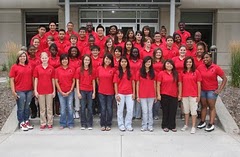
Two graduating seniors fired by dreams and memories, also saddened by closing of school, St. Peter Claver Cristo Rey High
©by Leo Adam Biga
As published in The Reader (www.thereader.com)Four years ago Daniel Mayorga-Alvarez and Treasure Anderson took the challenge of enrolling in a brand new high school with strict disciplinary codes, high academic standards and the requirement of working a paid internship.
The teens signed on to the inaugural, all-freshman class at St. Peter Claver Cristo Rey High School. The Cristo Rey Network affords youths from low income families a quality Catholic education and professional work experience.
The Class of 2011 filled this start-up’s blank slate with memories and traditions,. embodying the school nickname, Trailblazers.
The gregarious Daniel and shy Treasure thrived in the rigorous work-study environment even as classmates transferred or were expelled.
Entering this year, the pair were among about 50 seniors set to graduate May 26. Then came the February 11 Archdiocese of Omaha announcement the school would close in June due to its $7 million debt. The Cristo Rey model calls for employer partners to subsidize student tuition with paid internships. SPC’s struggle to find enough Hire4ED partners gravely impacted revenues.
School and archdiocese officials say the recession exacerbated the shortfall. With no endowment as a cushion, the hole was deemed too deep from which to recover.
Thus, the senior class, now 45, will go down as not just the first but the only in Claver’s abbreviated history. Since the shocking news, delivered at a school assembly that turned emotional, a countdown’s ensued to the end of this once promising experiment.
Former school president, now chaplain, Rev. Jim Keiter, admires what Daniel, Treasure and Co. did.
“The entire class will forever be etched in my mind,” he says. “They were pioneers. It took guts to come to a new school that never existed and that sent you to work one day a week. It took guts to be the only class, with no upper class to look up to. It took guts to come to a school without all the electives at most any other school. These were courageous kids. They still are. What I’ll remember most is their courage, their trust, their perseverance, their diligence.”

He says Daniel and Treasure exemplify what Claver accomplished.
“They learned incredible things about the importance of work, education, setting goals, being honest, seeking to be a good Christian, a good human being, a good citizen. They’ve demonstrated tremendous growth — spiritually, emotionally, mentally, academically. These are two kids that have done well. They’ve persevered and have overcome challenges.”
The Reader first profiled Daniel and Treasure in May 2008, near the end of that flush-with-excitement opening year. Today, these poster students describe mixed emotions as the reality sets in they won’t have a school to come back to anymore.
Much has happened in three years. Most dramatically, Treasure is now a mother and her chronically ill father, Christopher Anderson, received the kidney transplant he’d been waiting on. Meanwhile, Daniel’s been balancing school with working 30 hours a week to help support his Mexican immigrant family.
Each is bound for college on a scholarship.
Student transition director Joe Ogba says they “know how to deal with adversity and they know how to be leaders, because they had to be leaders from day one.”
Despite the school’s impending demise, Daniel and Treasure harbor no regrets for taking a leap of faith.
School administrators and staff stung by the collapse remain convinced of Cristo Rey’s work-study approach and see success ahead for Claver students.
Daniel, who will attend the University of Nebraska at Omaha in the fall, says, “If I had gone to a public school I don’t think I would be where I’m at, and I wouldn’t have learned lessons I learned here. The teachers are so supportive. I’ve made good friends. As for my education, it didn’t slack in challenging you.”
His mother, Maria Mayorga Alvarez, says she appreciates how her youngest of three boys “has become more independent” and assertive.
For the second consecutive year Daniel’s internship has been at Woodmen of the World Life Insurance Company, where he’s found a niche.
“The internships have really kind of opened my eyes to just what I have a passion for,” he says. “When I hit Woodmen I really liked it. I liked the whole corporate setting, everything I do over there. I fell in love with business these past few years.”
He credits Claver with expanding his horizons.
“It’s shown me the sky’s the limit. You can really go anywhere you want to just as long as you try and put in the effort,” says Daniel, whose parents work blue collar jobs. “It definitely boosted my confidence and made me more determined. It gives me more inspiration for the future. I’m eager to go ahead to put myself out there and see what I can accomplish.”
Ogba recalls the irrepressible Daniel making an immediate impression when as a 14-year-old he volunteered to address a thank you luncheon for employers providing internships.
“We kind of put him on the spot…but he went up there and did it, and he did a phenomenal job,” says Ogba. “That there let me know this kid is destined for success. He’s not scared of anything, he’s definitely a go-getter.
“That’s what it’s all about — giving kids an opportunity and watching them make the most of it.”
Ogba says Daniel also benefits from a “strong, loving family” that supports his educational aspirations.
Treasure’s father is glad she went to a school that demanded so much.
“It’s a blessing for her to go to that school. I believe it helped her tremendously — the structure of the school, the academics. Numerous colleges wanted her. I’m happy to see she’s grown up the way she has,” says Christopher Anderson. “She’s very independent thinking. She’s not a follower, thats for sure. The maturity, it’s always been there, but she’s voicing it more.
“She has a lot of determination. Her potential is unlimited.”
Treasure says she feels like an old soul, particularly after giving birth to her daughter Kera in October. She and the infant’s father, Derrick Jackson, whom she met at Claver, are preparing to live on their own. He works two jobs. She describes him as” my best friend,” adding, “he’s really involved” in caring for Kera.
“We’re teenagers, we’re in love, we have a child, we’re happy,” she says.
The goal-oriented young woman credits much of her resiliency to her father and how he’s handled his health crises, including a serious setback last year.
“It was really hard — that really tested him, but he got through it,” she says. “It’s the struggles that get us through life. That’s how we build ourselves. They make us who we are. He has made me who I am today and I am thankful for him in every way possible. He’s a strong man, he’s been through a lot. I love him to death for it, I do.”
Getting pregnant her junior year, then getting sick enough to be hospitalized, then giving birth resulted in her missing much school. She fell behind but she got back on track.
“The struggles, the obstacles, being thrown a curve ball every now and then have impacted on my life, they have made me who I am,” she says. “I’m stronger. I’m not afraid to say, ‘This is hard’ or ‘I need help,’ because there’s always another day, there’s always another chance to get back up and keep going.”
Ogba’s struck by how she’s weathered it all. For example, he says, “she never brought it to school with her when her dad was sick,” adding, “She held it together real well.” He’s seen the same grit in her since she became a mother. He says her “strong, caring family” at home and second family at school pulled her through.
“Teachers made sure she was able to get work made up, they kept encouraging her not to give up, it’s not the end of the world. That persistence from the home and the school sides,” Ogba says, “is the reason why she kept on pace to graduate, kept applying to colleges, and will be starting at Bellevue University in the fall.”
She attributes her endurance to “being an Anderson.” The prospect of her not finishing school, Christopher Anderson says, “never was a concern to me — I knew she had the support. School was her first and main and only (priority). My mom watched Kera and now Derrick’s mom watches her. She had every option available to her. She had a sister that offered to adopt if she couldn’t handle the baby.”
The baby never became an excuse for sloughing off or feeling sorry for herself.
“She was never ever shamed about being pregnant,” Anderson says.
Says Treasure, “There was no doubt in my mind I would complete high school because I knew I had the capability to.” Likewise, she never considered giving up her baby or her dreams, saying, “I do have strong expectations of myself.” She feels ready for raising a child as a young single mom and new college student.
“I have no doubt it will be hard. That struggle doesn’t scare me. I think it will work out.”
She plans getting a full-time summer job, confident her impressive work history, which includes stints at Immanuel Hospital, Creighton University, the Open Door Mission and the Henry Doorly Zoo, will get her hired.
“With my resume I feel I do deserve a good job and I will excel.”
Daniel says his internships helped him land his call center job at Oriental Trading.
Treasure says she gained valuable office and people skills at her internships, although some positions were eliminated when the economy tanked. The same thing happened to dozens of Claver students. “A lot of us were let go,” she says. She and classmates ended up working at the school with little to do, in effect biding time in study hall.
Daniel was among the lucky few with internships not impacted by the downturn. His supervisor at Woodmen, advertising manager Tonya Kalb, says she feels fortunate to have had Daniel work there two years.
“He’s been an asset to the team,” Kalb says. “He’s so open to ideas and learning things. He catches on so quickly. I’ve been able to teach him more and more about the company and advertising as time goes on, and everybody enjoys working with him. He’s just so approachable and so energized. He’s kind of a breath of fresh air.”
She sees a bright future ahead for him.
“With his personality I can see him getting into sales, he’s just so good with people.
He’s really easy to talk to and he’s so positive.”
Ogba sees Treasure’s nurturing personality meshing well with her interest in human services work.
Just as Treasure’s academics suffered during her pregnancy, Daniel lost focus working long hours outside school before, Ogba says, “he toed the line and got back on track, which shows his maturity and his ability to see the big picture.”
Kalb hired Daniel last summer. She’s already lined him up for this summer and hopes to employ him again when he starts college . She says Woodmen was a major employer of Claver student interns and looked forward to hiring more.
“We’ve been involved from the beginning,” she says. “It’s too bad about the closing because we see nothing but positive outcomes from the whole model.”
In the end, there weren’t enough employers who embraced the program like Woodmen. Deacon Tim McNeil, chancellor of the Omaha archdiocese, says, “The job program was the weak link at the school.” Fr. Keiter says fundraising lagged as well. The failure of Claver and the struggles of other start-up Cristo Rey schools explain why the network now requires new schools have $2 million secured before opening, says McNeil.
While Daniel and Treasure get to finish what they started at Claver, the school’s underclassmen must find new schools.
“That’s probably the saddest part,” says Daniel. “I really do feel for them.”
Treasure says she regrets her younger siblings “won’t be able to come here and have the opportunities I had.” She says it will be weird not having a school to visit.
“I can’t bring my daughter here down the road and introduce her to teachers and tell her, ‘These are the hallways I walked,’ because it won’t be here. The building itself might be, but the love in it, the passion, the people will be gone, and it’s really kind of sad.”
With the seniors’ last day the 20th, there’s no time for tears. Plenty were shed when the school’s closure broke. Everyone expects the graduation at the Kroc Center on the 26th to be a big cry-fest. Claver staffer Joe Ogba says, “I’m bringing my own box of tissues.”
Even without an alumni office, Daniel and Treasure anticipate their class will stay connected through social media because of how tight their small numbers grew over four years. Annual retreats helped build bonds.
For now though Treasure says she’s focused on “my family, my friends, my career, my love, my passion, my desire.” She intends studying behavioral sciences toward a hoped-for career in social work. Daniel just wants to be successful for his family.
Christopher Anderson’s gotten to know the Class of 2011 at open houses and other events and he says “they are just as mature and goal oriented and futuristic and determined” as his daughter. “I believe they’re going to succeed.” He says the school’s closing is just one more thing that’s made them stronger.
Fr. Keiter agrees, saying, “They’re going to do very well. They’ll have their ups and downs, but I think they have the skills and the gifts and the talents to be resilient.”
Related articles
- OLLAS, the Office of Latino and Latin American Studies at the University of Nebraska at Omaha, A Melting Pot of Latino/Latin American Concerns (leoadambiga.wordpress.com)
- New push for Cristo Rey school raises ‘what if’ moment for old N. Catholic High families (philly.com)
- Omaha’s St. Peter Catholic Church Revival Based on Restoring the Sacred (leoadambiga.wordpress.com)
- Omaha Native Steve Marantz Looks Back at the City’s ’68 Racial Divide Through the Prism of Hoops in His New Book, ‘The Rhythm Boys of Omaha Central’ (leoadambiga.wordpress.com)
- Where Hope Lives, Hope Center for Kids in North Omaha (leoadambiga.wordpress.com)
Related articles
- Where Hope Lives, Hope Center for Kids in North Omaha (leoadambiga.wordpress.com)
Alice’s wonderland: Former InStyle accessories editor Alice Kim brings NYC style sense to Omaha’s Trocadero
Alice Kim’s story reads like a pitch line for a new reality television series. Growing up back east she began cultivating an intense interest in Omaha of all places, and her fascination grew more acute with each encounter she would have with someone from this Midwest city. She never visited here, mind you, she just read about it and kept running into Omahans, and every encounter and exposure reinforced in her mind this idealized version of Omaha as the embodiment of the All-American city. The thing is, her magnificent obsession didn’t wane after she carved out a career in New York City’s fashion and style industry, primarily as an editor with InStyle magazine. In fact, she kept cultivating this fixation and then one day she left her life and career in the Big Apple behind in order to transform her life in the middle of the country, far from the tastemaking and trendsetting scene of New York. The following story and sidebar for The Reader (www.thereader.com) describe how Kim has transferred her fashionista sensibilities to my hometown of Omaha and reinvented herself at the same time as a first-time mom and soon to be bride. Her fairytale life change is the subject of her delightful blog, Postcards from Omaha, and of a book she hopes to complete by year’s end.
There’s a nice symmetry to her story as well: Now that this accessories maven is well ensconced in Omaha with her lifestyle boutique, Trocadero, she’s helping prepare young Nebraska women with designs on having career sin fashion and style in New York City realize their dreams.
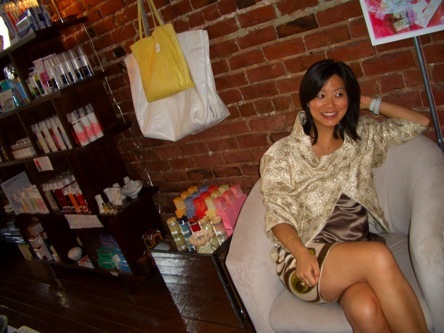
Alice’s wonderland:
Former InStyle accessories editor Alice Kim brings NYC style sense to Omaha’s Trocadero
©by Leo Adam Biga
As appeared in The Reader (www.thereader.com)
Alice Kim’s story of leaving New York City for Omaha has gotten much play.
In 2007, the then-InStyle magazine accessories editor acted on her admittedly “weird,” long-held preoccupation with Omaha by moving here and opening the Old Market lifestyles boutique, Trocadero.
“My store is in some ways InStyle come to life,” she says.
Her experience recommending the best of this or that gives Trocadero customers the benefit of her branded, expert, insider’s advice.
“I have that kind of finger on the pulse of what people want.”
Still, her store has struggled amid the recession and conservative Midwest buying habits that don’t mesh with her somewhat frivolous merchandise.
Cognoscenti, however, regard this Big Apple sophisticate as a style maven and tastemaker. Her exclusive, discriminating suggestions for just the right hand bag, pair of shoes or home decor item is heeded.
She cops to not being a salesperson but says, “I can always convince somebody that this is a great something or other.” Her spin, she says, goes something like: “’It’s a total New York brand, it’s not sold everywhere, it’s at a great price point.’ And all of a sudden there’s a story and they’re like, Really? And they buy it.
“It’s like sharing industry secrets,” she says. “I feel I have a unique angle, which is really telling people about the stuff that we as editors love.”
Everything she sells or endorses, she says, “I stand by.”
If her style sensibility were a tag line she says it would be “practically perfect,” adding, “It’s always going to be practical and it’s going to close to darn perfect.”
She has the professional chops and personal élan to articulate her discerning aesthetic without sounding smug, whether selecting things to sell in her shop or for her own wardrobe or excising the dull dross from a client’s closet.
“I feel very confident in my skills,” she says over sushi at Hiro 88 West. “I’ve always known how to style. I think a lot of it is innate. It’s just having the eye. It’s like being a good editor. But, of course, I’ve been trained. When I arrived in New York, from Pittsburgh, in 1992, I certainly was not a fashion diva then and I certainly didn’t look the part. I was doughty.”
She’s a long way from doughty today, though she felt that way while pregnant last year with her first child. Since the birth of her daughter Annabel she’s pined to retire her formless maternity clothes and return to some chic wear, such as the classic black dress she wore at lunch, accented by pearls.
“I don’t want to look messy anymore,” she says.
Kim is marrying Annabel’s father, entrepreneur Adrian Blake, this summer. She’s also step-mom to his two children as the two households recently merged.
Even before her pregnancy, Kim says she’d gotten lazy about her look and gained weight thanks to Omaha’s more sedentary lifestyle. Actually, she says her casual phase began near the burned-out close of her frenetic New York career.
“There were times when towards the end of my working days I just didn’t care anymore. I was just so busy. I’d wear flip flops because I was hoofing it all the time, walking from the garment district back to the office with bags of accessories. I wasn’t going to teeter in high heels.
“I was on the New York fashionista diet [champagne and finger food[. I was definitely much thinner when I lived in New York.”

Then there were those times, she says, “when I wanted to get dressed up, so then I’d wear a beautiful jacket with a dress and heels. It really depended on my day. If I knew I was going to be in the office all day then I would wear something nicer because I wouldn’t have to be schlepping around town for shoots and samples.
“When I first started the store [Trocadero],” she says, “I wanted to look nice — to be representative of fashion in New York in Omaha. I probably worked harder (at it) and then gradually just became more casual.”
For a year she bought her clothes at Target as a concession to mommy practicalities. Besides, she says, good style “doesn’t have to be super expensive.” Balancing being a new mom and fashionista at 41 means remaking herself, so she’s back to shopping at Von Maur to outfit herself more appropriately.
“I’m in my 40s — I really can’t keep dressing like a teenager. It’s just having to embrace that I’m an adult. I feel better now because I have grown-up clothes. I can look equally fine walking to the kids’ school or coming to lunch here or going to the supermarket.
“My thing is cardigans.”
Her lifetime hunt for the perfect black leather motorcycle jacket continues.
Making one’s self or home polished, she says, is all about investing in a few high quality things and making them pop with the right accessories.
“I think my house reflects my store, which is always about the accessories, the details, the accent pieces. Like I have this plain, white, Danish-modern couch. What makes it interesting is the hand-painted, embroidered pillows on it.”
When it comes to clothes, she says as clichéd as it sounds, “you start with a little black dress and the way you accessorize it is what gives it its style.”
It’s about transformation. Like opting to live out her version of the American Dream in Omaha. After a whirlwind start, she began doubting her life makeover, but now that she’s found her man and become a mother, she says, “I feel content.”
Her magnificent obsession is the subject of her blog,” Postcards from Omaha,” and a book she hopes to finish soon.
Trocadero is located at 1208 1/2 Howard St. in the Old Market. For more information call 402.934.8389 or visit shoptrocadero.com.
Living the NYC Fashion Dream
©by Leo Adam Biga
As appears in The Reader (www.thereader.com)
With all the fabulous things Alice Kim ‘s done in New York City and now her entrepreneurial foray in Omaha, she says what she’s proudest of is helping people.
At InStyle she says she found great satisfaction “helping small designers get nationwide recognition.”
The fashion business is all about networking, and Kim worked hard cultivating and nurturing relationships with designers, photographers and publicists.
At Trocadero she’s parlayed old contacts and made new ones. She’s also availed herself as a go-to resource for young people with designs on their own NYC fashion careers. Several area women who came to her with their aspirations ended up as Trocadero interns. Each is now pursuing life in the Big Apple.
They credit “Alice’s Fashion Finishing School” with preparing them.
“It was a great experience to learn from someone that had actually been in the industry and really knew what it was about. She’s been a great mentor and a kind of guardian angel,” says Hannah Rood, an account executive with LaForce-Stevens. “We learned so much about things like sense of urgency and attention to detail that have carried over into what I’m doing now.”
“Alice’s influence continues to impact my life,” says Kathleen Flood, an associate editor and blogger with The Creators Project. “When I was working for her, she was not only a boss and mentor, but a friend, and even an older sister figure at times.
“Now that I have my own interns, I’m starting to teach them little tricks she taught me.”
“She definitely expanded my vision of success … and has truly guided me to where I am today,” says Ellie Ashford, a freelance public relations assistant at Polo Ralph Lauren.
They all refer to doors Kim helped open for them. The Omaha transplants say they’re keeping a pact to stay connected.
As for Trocadero as a launching pad, Kim says, “I feel like I’ve created a special space that people really consider to be a home away from home. I offer myself as much I can.” Before she’ll recommend an intern to a New York contact, she says, “you have to prove to me you’re ready for the big time.”
Kim enjoys following her former interns’ progress. “They’re all leading their own lives and having their own adventures. They’re doing it — they’re doing what I did 20 years ago. They’re living the dream.”
Related articles
- 5 Easy Steps to Flawless Style with InStyle (beso.com)
- Home Girl Karrin Allyson Gets Her Jazz Thing On (leoadambiga.wordpress.com)
Chancellor Harvey Perlman Passionate About the University of Nebraska, its Future and NU Joining ‘Common Friends’ in the Big Ten
A few years ago, during one of the endless news spasms about the University of Nebraska football program, New Horizons editor Jeff Reinhardt floated the idea of our profiling the school’s chancellor, Harvey Perlman, who at the time was adroitly handling the latest firing and hiring. As the musical chairs continued playing out it became clear that Perlman was more than the public point man speaking on behalf of the university about these changes, but the orchestrator of these moves. Below is the profile os this man at the top who speaks softly but carries a big stick.
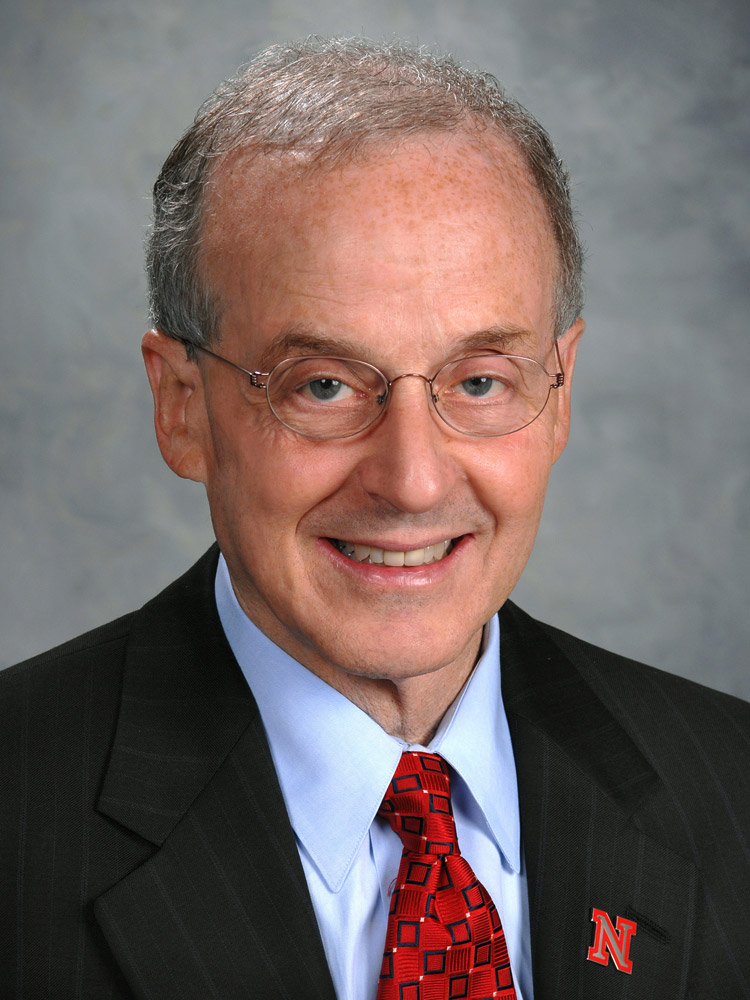
Harvey Perlman
Chancellor Harvey Perlman Passionate About the University of Nebraska, its Future and NU Joining ‘Common Friends’ in the Big Ten
©by Leo Adam Biga
Originally published in the New Horizons
Most of you probably first laid eyes on University of Nebraska-Lincoln Chancellor Harvey Perlman in October of 2007.
That’s when his face was all over the media in the wake of his firing Steve Pederson as Nebraska athletic director and hiring Husker coaching legend Tom Osborne to rejoin the Big Red family as the new AD.
Even though by then Perlman had already put in six years as the university’s CEO, chances are his name, much less the position he filled, barely registered with the average Nebraskan. You might have known he was a top NU administrator, but it’s unlikely you could have picked him out of a lineup or identified anything he put his stamp on.
You also probably didn’t know he’s an NU alumnus, as is his wife Susan and their two daughters and their husbands.
“We like to keep it in the family,” he said of this legacy.
It’s unlikely you knew he was previously the longtime dean of NU’s law college. Or that he joined the NU law faculty in 1967 after being mentored in the profession under the legendary Robert Kutak, who cultivated in his protege a love of art.
In 1974 Perlman left NU to teach at the University of Virginia Law School. He returned to NU in 1983 to head up the Nebraska Law College, a position he held for 15 years. He served as the university’s interim chancellor in 2000 before being named chancellor in 2001.
Obviously, much of his life is bound up in the university. Because the chancellor’s job continues to engage him he doesn’t have any plans to step down soon.
“I’m still excited about the possibilities. I care a lot about the university so it’s not an abstraction to me, it’s a passion,” he said from his office in UNL’s Canfield Administration Building
Being a native son, he said, probably opens some doors he might otherwise find closed.
“I think the fact I’m a Nebraskan gives me entree into some circles easier than an outsider would find.”
Perlman kept a low profile until the merry-go-round of athletic directors and football coaches the past 10 years. That’s when he became a focal point of attention. Perhaps for the first time then the power he wields was apparent for all to see. There he was intervening in what had become a circus of speculation and vitriol involving the topsy turvy fortunes of that precious commodity — Husker football. He acted as both architect and messenger for a sea change in NU athletics that continues making waves today.
The added scrutiny doesn’t much phase him. He knows it comes with the territory, though it can be a bit much.
“I’m used to it by now I guess. I think in part lawyers are trained to handle those kinds of circumstances, so that doesn’t give me any discomfort. The discomfort of being a public figure is probably not when you’re in public but the fact that you’re always in the public eye. I can’t go to the grocery store without people giving me advice about the football team and things like that.
“I never thought I’d be on the sports pages. I didn’t have the athletic talent to get there”
It’s not as though Perlman was invisible before the beleaguered Pederson was let go and the beloved Osborne brought back as the athletic department’s savior. Perlman had, after all, been involved in the machinations that followed Bill Byrne’s departure as AD and the much hyped arrival of native son Pederson. But when Pederson fired head football coach Frank Solich and replaced him with Bill Callahan Perlman was in the background while Pederson was out front. Critics of Pederson would assert it was just more grandstanding and arrogance on display.
Ironically, the unprepossessing Perlman took center stage when he gave Pederson the boot and brought Osborne back into the fold. It’s worked out that Perlman’s returned to the public spotlight since then. First, there was the housecleaning he began with Pederson’s ouster and that Osborne finished by axing Callahan, replacing him with fan favorite Bo Pelini. After the Callahan debacle, it’s certain the Pelini hire didn’t happen without Perlman’s approval.
Then he pushed for the Nebraska State Fair to make way for the Innovation Campus.
More recently, as NU’s Big 12 Conference affiliation grew shaky in the midst of possible league defections and the specter of Texas dominance, Perlman and Osborne teamed up to take NU in a dramatic new direction. Last summer the two men announced the stunning news NU was leaving the contentious Big 12 and joining the solidarity of the Big 10. It turned out the pair had worked feverishly behind the scenes with Big 10 commissioner Jim Delany to petition the conference for NU’s admission. Everything fell into place quicker than anyone anticipated. The switch took many by surprise and the bold move made national headlines.
So it was that the pensive, pin-striped Perlman once more found himself splashed in print and television stories, this time spinning the news of how the Big 10 would be a better cultural fit for NU than the Big 12.
Perlman, a lawyer by training, is expert at parsing words in order to be diplomatic and so he’s careful when explaining why the Big 10 is ultimately a better home for NU.
“Well, at the most fundamental level it’s a feeling on the back of your neck that you’re among common friends, not to suggest we weren’t friendly with the Big 12,” he said.
Perlman feels the Big 10 alliance is a cohesive match because like NU the conference’s other schools are Midwestern public research universities with similar institutional histories and goals when it comes to both academics and athletics .
“When you talk about the Big 12,” he said, “you can’t say that because you’ve got some Midwestern institutions, you’ve got some agriculturally-based land grant institutions, you’ve got Texas, which in many ways is an institution all of its own, with widely divergent reputations. You’ve got Texas Tech, which is different…The schools up and down that corridor are very, very different, so there is not a common culture. And it’s not a bad thing — I mean, they’re all fine institutions — but they’re very different. It’s just that in the Big Ten we just kind of felt that it was (a common culture).”

He acknowledges that NU “will be, next to Northwestern, the smallest institution in the Big 10,” adding, “But we’re still a public research university that fits that environment and that has a good history and tradition of intercollegiate athletics.”
There’s a prestige factor in all this that cannot be discounted because all 11 schools NU is joining are rated among the top academic and research institutions in America, along with most having strong athletic programs.
“Well, I mean you are who you associate with in some respects,” Perlman said, “and so there’s a stature of the Big 10…there’s a kind brand it has in common…”
He said those high standards give NU new avenues for excellence.
“It elevates the opportunities you have. Now we’ve got to take advantage of them, but at least it opens those opportunities. The Big 10 has traditionally had broad institutional cooperation in which it’s focused to provide collaborative activities within the Big 10, which the Big 12 does not.”
When it looked like the Big 12 might lose Texas and other anchor schools, suddenly the conference appeared fragile, which left Nebraska in a vulnerable spot. With things up in the air, Perlman and Osborne were not about to let NU hang in the wind, subject to an uncertain fate, and so they sought a stable new home for the school should the league dissolve.
Nebraska and the Big 10 had always shared a mutual admiration. Bob Devaney thought it a natural marriage years ago, before the Big 8 morphed into the Big 12, and before the Big 10 added Penn State. Then, in 2010, circumstances arose that soon made the prospect of NU being in the Big 10 relevant, even logical. For NU it meant security. For the Big 10 it meant another major player in its family.
“Yes, stability was critical for us because we didn’t have any place to go,” said Perlman. “I mean, we’re here, we have a good brand, that seemed to be clear. I think we could go in many directions, but if we were playing in the Big East for example the burden on our kids and our fans would be terrible. So you sit here and you look and you say, What are your options? There weren’t very many.”
At least not many that made sense or that were congruent with NU’s profile, whereas the Big 10 was a mirror image of the school and offered close proximity.
“Again, the culture fit,” said Perlman. “We seem to be a comfortable fit with the Big10 institutions. There’s some geographic adjacency, and that’s important.”
Perlman’s quest for a more secure footing in the athletic-academic arena was not unlike his wooing back Osborne, the winningest coach in NU history, from retirement to provide a calm center amid a storm of discontent.
“It was a very disruptive time for the program. We had to make a change. I had no hint that he was available or would be interested,” Perlman said of Osborne.
It turned out Osborne was both available and interested. The result was just what Perlman hoped.
“The value Tom brought clearly was stability,” the NU chancellor said.
Perlman said Osborne benefited from having “the confidence” of NU regents, administrators, coaches and student-athletes as well as university-athletic department supporters.
The experience of changing head football coaches and pursuing entry in the Big 10 brought Perlman and Osborne in close contact.
“We’ve built a working relationship that we didn’t have before,” said Perlman. “I think we have respect for each other. We’ve gone through a number of issues together and I think we both recognize we each contribute to getting those issues resolved. He has become a very fine athletic director. He has a good sense of the program beyond football, which was a concern of some, but he’s been very supportive of the range of athletic programs and he’s done a good job of managing the finances” the facilities, the coaches.
Osborne returns the compliment, saying, “I find Harvey Perlman to be someone who is a very bright person who thinks things through and does not say much until he has formulated his thoughts very carefully. He is able to be firm when the situation calls for it and is a good communicator.”
Some suggest that NU and other schools with big-time athletic programs find themselves in the equivalent of an ever escalating arms race that requires more and more expenditures on sports. When is enough, enough?
The two men, both raised in small Nebraska towns in post-World War Ii America — Perlman in York and Osborne in Hastings — share similar values and experiences based in humility and frugality. Yet they find themselves overseeing mammoth expansion programs and budgets.
“There’s clearly excesses in intercollegiate athletics,” Perlman said. “The idea that we’re competing with other schools and that you have to make investments in order to compete is not one I’m upset about. We’re doing that on the academic side all the time. It’s just not as visible. We’re competing for facilities, we’re competing for faculty. If you’re going to go out and attract top talent you’ve got to pay their price. You have to invest in the facilities.
“It’s a very competitive world in higher education across the board. Athletics is just where the numbers are larger. We’re fortunate here that the athletic department is self-supporting (thanks to enormous football revenues and generous booster donations). We don’t have to use tax dollars or tuition revenues to subsidize the department. In fact, they subsidize the academic side in a variety of different ways, so to that extent it’s hard to say, Let’s not compete. I mean, Nebraska has a position within the constellation of athletic powers, and as long as we’re successful we ought to try and compete.”
Some also question if in building a great university a great athletic department is really necessary.
“You can do it without one,” said Perlman. “In our circumstance I think we’ve achieved a lot of synergies between academics and athletics. Moving into the Big 10 is the clearest example. We wouldn’t have got into the Big 10 were it not for our brand on the athletic side, but we also wouldn’t have got into the Big 10 if we hadn’t had made the progress on the academic side that we’ve made in the last 10 years.”
Perlman points with pride to several advances the school’s made during his tenure, including more research grants, greater international engagement, improved educational programs and a growing enrollment that now exceeds 24,000.
He said NU’s influence and reach in areas such as agriculture and engineering extend across the globe.
“We may be small but we’re still a force in the world in terms of our presence in China, India, Africa…”
Sometimes the gains made in academics get obscured by what’s going on with athletics. He said the challenge is that the imprint of athletics “is so loud and prominent every day. The significance is clear — you win or you lose. A lot of the great things that happen on the academic side are not as clear, it’s more indirect, it’s more long term.” He favors “trying to even out the voice within the institution” to create more of a balance between academic and athletic achievement and recognition.
While football revenues and private donations keep NU athletics in the black and competitive with other elite programs, the university’s state-allocated academic operational budget has been subject to almost annual cuts as the state’s coffers have suffered in recent years. In a public address Perlman compared the budget slashing to the torture-execution method known as lingchi or death by a thousand cuts, saying, “I do not think a university can constantly cut its way to greatness.”
He neither wishes to sound like an alarmist nor an unbridled optimist. Instead, like the attorney he is he provides a considered pro and con analysis of the situation.
“I think there are significant cuts we’ve made that have not damaged the university for a variety of reasons. Every businessman will tell you every once in a while a budget cut is not a bad idea, just to be more efficient. Most of our cuts probably haven’t made the university worse off, some probably made it better, but as I’ve said you can’t do that continually and expect to be successful.”
Asked when diminishing returns set in and he answered:
“I don’t know, but there is a point at which quality does suffer. Our policy has been not to reduce the quality of all programs and cut across the board. We have in fact narrowed the scope — we’ve eliminated programs. I’d much rather eliminate a program then mandate, for example, a 4 percent across the board budget cut. You can’t get anywhere doing that. At some point I think you start to do real damage to your university, and more significantly real damage to the state of Nebraska.
“To the extent I cut programs that means the students and graduates of high schools in Nebraska who want that program are going to leave the state. Obviously one of the key needs for the state of Nebraska is to keep young people here, and you’re not going to do that if you continue to cut.”
As a small population state, Nebraska’s particularly impacted by the so-called “brain drain” that’s seen many of its best and brightest high school grads leave to attend college out of state. Perlman said NU’s “doing our part” to reverse the trend.
“I think for the most part we’re meeting that challenge. If you look at the top percentage of high school graduates in Nebraska who stay in the state and come to the university we’ve seen a significant increase in the last 10 years. If you look at non-resident students that are being attracted to the university that’s on a significant increase.”
He said these gains are due to “a lot of hard work by a lot of people across the whole university,” including faculty engaged in the recruiting effort.
Just a few months after NU’s entrance in the Big 10 Perlman noted the school’s enrollment spiked with more enrollees from Big 10 country than ever before.
“Coincidentally we’ve been very successful in trying to build pipelines for undergraduate enrollment in cities that happen to be in the Big 10 (Chicago, Milwaukee, Minneapolis, et cetera), and we see an uptick there now that we’re in the Big 10.”
Being in a tradition-rich power conference and having high profile, elite football or basketball teams that consistently win and net national media exposure can and does help in recruiting students.
“It’s not so crazy,” said Perlman. “It has an impact. I think what most people don’t think about is that intercollegiate athletics, particularly football, has such a kind of central place in the culture of America. We shouldn’t be surprised if students looking for a place to get their undergraduate education consider the entire environment that they’re in and one of those would be the success of the athletic programs.”
Recruiting top students and faculty is a priority for NU but there must be sufficient rewards in place to secure and retain them. Perlman suggests that just as NU must prepare students for careers, employers must ensure there are enough jobs to keep young people here once they earn their degree. He sees gains there too.
“For our college graduates there is a better chance they will stay in Nebraska for the jobs that are available,” he said. “That’s why Innovation Campus is so important, because we’re trying to do our part in terms of creating the kinds of jobs that college graduates would find attractive.”
Perlman has been a promoter of UNL’s Innovation Campus — envisioned as a multi-million dollar initiative on the sprawling former state fairgrounds site. It’s hoped a mix of public-private enterprises, both established and start-up, will do business and research there. The goal is that a critical mass of stimulus actviity will generate economic development through the products and services companies offer, the jobs they create and the taxes they pay.

“What we want to accomplish out there is clear,” he said, “and that is we want to leverage the research activity in the university to bring greater economic growth to Nebraska by getting private sector companies to locate on the property and to be adjacent to that research effort. That’s the idea. Can we fill up almost 200 acres with that kind of activity? I don’t know. We’ll try.”
In terms of what types of companies might locate there, he said “food, water and energy are the most likely attractives because that’s where our strengths are and that’s where Nebraska is, but we see other areas that could have potential. Software development is not out of the range of possibility. We don’t have any limits on what (might work).” He said NU hasn’t yet aggressively pursued potential companies “because more planning needs to be done to address the site’s infrastructure needs…” A faculty advisory committee is looking at the best ways to combine public-private efforts there.
By any measure, Innovation Campus will take time to develop.
“You look at the Research Triangle in North Carolina, it took them 50 years to get where they are,” he said. “I think we’ll move faster because the world is turning faster. Private sector companies are looking for universities” as partners and facilitators and hosts for incubation and innovation. “That process is ongoing. Fifty years ago that probably wasn’t true. I would hope that it would move quickly, but we’ve said to 20-25 years.”
The project is a stakeholder’s dream or nightmare depending on what happens.
“Some of us who were ardently in favor of getting the land and moving the state fair probably have a lot more personal reputation at stake on its success,” he said. “Realistically the university could be a great university without Innovation Campus but we wouldn’t have taken advantage of the opportunities that are available.”
Recruiting and keeping top faculty is a priority and there UNL could do more, Perlman said, to make it difficult for teachers to say no or to leave, though he says the school’s held its own in this regard.
“I think faculty salaries are not fully competitive with where they should be. With most other public universities incurring significant budget reductions over the last two or three years Nebraska’s been in relatively good shape, so we haven’t seen a lot of attrition.”
Recruiting and retaining good people is “key,” he said. All the innovation and efficiency in the world doesn’t matter, he said, “if you can’t attract talent.”
Despite some disadvantages NU has compared with its Big 10 brethren in terms of the state’s small population and the school’s smaller enrollment numbers and proportionally smaller alumni base, Nebraska finds ways to remain competitive. Perlman said the same work ethic and generosity that the state is imbued with permeates the university’s faculty and staff and supporters. That commitment, he said, gives him “not only a sense of pride but a great sense of relief.” “It is incredible,” he said, adding, “There’s a set of issues that other university presidents have to deal with that I don’t.”
If anything, he faults NU and Nebraskans for being too modest and reticent.
“I think it’s our traditional Midwestern reluctance to set really high goals and ambitions and to celebrate our successes.”
With opportunities come challenges, and vice versa. For example, based on the metrics that go into rating academic and research performance NU sits at the bottom of the Big 10. And while Perlman has said it’s not such a bad thing to be last among such prestigious company, he’s quick to add, “We’re not content to be last either — we’re not going to be last 10 years from now the way I see it.”

Harvey Perlman waves to the crowd following his final State of the University address on Wednesday. Perlman, the University of Nebraska-Lincoln chancellor since April 1, 2001, will retire in June.
Perlman reminds skeptics that as much as NU courted the Big 10 the conference coveted the school. In other words, it wasn’t only a case of what NU could gain from being in the conference, it was what the league could gain from NU’s presence.
“I think it’s the brand,” Perlman said by way of explanation. “You know all the speculation was that Nebraska wouldn’t have a chance to get in the Big 10 because of the number of television sets was low relative to other schools that were mentioned (as prospective Big 10 additions). And that comes back to the assumption that all that university presidents worry about is the money, and it’s not true. Money’s significant, it’s a competitive thing, but it isn’t everything. In fact it wasn’t everything in the Big 10 when the school presidents voted (to accept NU as a new member).
“We’re a school with a good brand. We might not have a lot of television sets but we’ve probably got a lot of eyeballs across the country. We draw well” (both in the stands and in TV ratings).
Unlike the AD and coaching changes that sparked controversy and sometimes harsh attacks, the conference change was almost uniformly embraced.
“We have gotten almost no criticism within the state of Nebraska for this move,” said Perlman. “My wife continues to remind me that we can go 6-6 next year (in football), but right now everyone is pretty pleased. I’m surprised by the number of comments I get that recognize this was a major step for the academic side of the university as well as the athletic side.”
He forecasts the university’s leadership role will be ever more crucial for the state. He said the fact that NU is a close reflection of the industrious people it serves positions it to be an influential player in Nebraska’s economic growth.
“You would think its major institution would be that way and you wouldn’t want it any other way,” he said. “It also gives you an opportunity to lead. I mean, that’s the thing, especially in this economy — if you don’t have a strong research university taking a strong leadership role moving forward I don’t think we’ll be successful. I believe that. President Obama believes it, the minister of China believes it, the prime minister of India…The countries that want to be competitive are making major investments in higher education.”
He feels confident the University of Nebraska is poised to lead the way.
“I think it is coming into its own. The quality, the productivity, the ability to be competitive across the country is significant.”
Related Articles
- UNL picks Utah developer for new research park ()
- Monday Reads (skydancingblog.com)
- Nebraska to increase Memorial Stadium expansion (seattletimes.nwsource.com)
- Delany calls Nebraska the Packers of Big Ten (sports.espn.go.com)
- University Of Nebraska Announces $5M In Cuts (huffingtonpost.com)
- Big 12 agrees to dish out more cash for members with loss of Nebraska, Colorado (collegefootballtalk.nbcsports.com)
Tyler Owen: Man of MAHA

Image by ruralocity via Flickr
UPDATE: The 2011 MAHA Music Festival lineup has just been announced and the headliners for the August 13 event are major indie artists: Guided by Voices; Matisyahu; and Cursive. The subject of my story below, Tyler Owen, is one of the founders and driving forces of this emerging Omaha festival.
One of the best parts of my job is getting to meet people who are making things happen in my community, the proverbial movers and shakers we all read about but rarely ever encounter. Well, as a cultural journalist in my hometown of Omaha, Neb. I consistently get the chance to meet all manner of individuals who are making a difference here and elsewhere. My assignments interviewing and profiling these figures allows me the opportunity and privilege of sharing their stories and activities with not only the Omaha community but with the larger community that the Web makes possible. The following story is about one of Omaha’s young professionals, Tyler Owen, now making his mark on the scene in business, the arts, community service, and leadership. As Omaha’s Old Guard begins to fade away Owen and others from his generation are poised to take over the reins, much as he’s done in his own family’s business. I look forward to Owen and his peers in the 30 and 40-something age group to continue the growth and momentum that’s helped Omaha come out of its shell the last decade to become one of the great urban success stories in America. My story appears in the March issue of Metro Magazine (www.spiritofomaha.com/Metro-Magazine/March-2011/Tyler-Owen-Cover-Story/).
Tyler Owen: Man of MAHA
©by Leo Adam Biga
Originally published in Metro Magazine (www.spiritofomaha.com/Metro-Magazine/March-2011/Tyler-Owen-Cover-Story)
Tyler Owen hails from an Omaha legacy family who has made a fortune in the steel industry and who spreads their wealth around. The Owen Foundation funds higher education, cultural programs, social agencies and the Henry Doorly Zoo. While he may not have a big red “S” printed across his chest, this fourth generation homegrown entrepreneur/philanthropist has already staked his claim as (okay, not METROPOLIS’ but MAHA’s) “man of steel”.
As a young professional, Tyler Owen carries on his family’s legacy of giving back. He’s also staked out his own territory as a volunteer with various creative and community endeavors close to his heart.
BREAKING THE MOLD
He doesn’t fit the mold of a steel executive. For starters, he’s a one-time actor and a lifelong rocker. Growing up, the Westside High graduate spent far more time practicing the piano and playing the guitar than he did grooming to be a titan of industry. He fronted his own garage band, The Bottom Line.
After graduating from the University of Colorado he pursued acting and music careers on the west coast. He parlayed his good looks, easy charm and modest talent into screen extra gigs– his credits include a minor speaking part in a Murder She Wrote– and releases of original recordings with his group, The Eye. He headed his own small record label. Along the way he wrote an unpublished novel and learned to fly.
Throughout this period of finding himself his family encouraged him.
“My parents were incredibly supportive,” he said. “They were like, ‘You’ve gotta go do whatever you want to do and you’ve got to come back to this (the family business) on your terms– not stay here on our terms.’ It’s great because I don’t have a single ounce of resentment about being in the business. If anything, it was worth leaving and maturing to the point where I accepted it, rather than being thrust [into] it.”
UP FROM THE ROOTS
Tyler and his wife Lisa returned to Omaha for good in 2001 to start a family. Following tradition, he began at the bottom of Paxton & Vierling Steel, a steel processor, in order to learn the operation from the ground up.
Today, the 38 year-old is the fourth generation of his family at Owen Industries, of which the Carter Lake, Iowa-based P & V is one of several divisions. He heads day to day operations at Lincoln Structural Solutions, a Lincoln, Neb. supplier of nuclear grade construction materials. Playing to his creative strengths, he handles marketing and branding for Owen Industries. P & V’s “iron is in our blood” tag is his.
As businessman, husband and father of four, Owen’s not so much abandoned his free-spirited ways as settled down to focus on a few key passions.
In 2009 he helped found the local MAHA Music Festival, a one-day phantasmagorical immersion in rock. The free, nonprofit event takes place at the Lewis & Clark Landing on the downtown riverfront. The fest’s expressed aim is “community building.” MAHA 2011 is set for August 13th.
He served two terms on the City of Omaha’s Human Rights and Relations Board. His tenure coincided with the public flap over the police auditor office. He fought hard to retain the auditor but in the end the post was eliminated by the city.
The self-described “bibliophile” is in his fifth year on the Omaha Public Library Foundation Board, a period that’s included the resignation of library director Rivkah Sass, the hiring of her successor, Gary Wasdin, and staving off budget cuts.
Owen’s steeped in the local philanthropic community through his and his family’s long involvement in Ak-Sar-Ben, which he calls “a great organization.” He and Lisa have also helped organize major fundraisers for the Omaha Boys and Girls Club.
The example of being a good steward has always been there as expectation and obligation. Whether donating time or money, he learned it’s the right thing to do.
THE SPIRIT OF OMAHA
“There seems to be an overwhelming sense of giving back in this community and of our being greater than the sum of our parts. There’s this kind of bonding together into making something bigger,” Owen said. “I think that comes back to an Omaha thing. I don’t think people in Omaha suffer a lot of grandiose, inflated egos, so there is this spirit of– let’s actually create something, rather than bluster about something.”
The Omaha work ethic of getting things done is one his family’s exemplified. Now that he’s in a position to lead, he finds few things as satisfying as giving back.
“I think any time you serve something outside of yourself it’s a satisfying experience. People may quibble with where donor dollars go, but in the end,” he said, “it’s not important how you give, it’s only important that you give.”
An advantage Omaha offers, he said, is that it’s still small enough for an individual or an organization or a small group of philanthropists to make a big difference. “One person can change the world from here,” he said.
Social media is only helping Owen (and others like him who want to make a difference) in their efforts to communicate and collaborate. “People are more connected and more aware of what other people are doing,” he said, “and so that offers more opportunities for overlap.”
THE SOCIAL NETWORK
MAHA’s an example of a few kindred spirits joining forces to launch an event that depends on social media for its traction. Owen, together with Tre Brashear, Mike App and Mike Toohey, made MAHA happen after years of kicking around the idea.
Owen’s smart enough to pull in some veteran live music promoters, including Jeff Davis the first two years (and now Marc Leibowitz) to lend their expertise. “I’m surrounded by incredibly bright guys,” he said. A team of volunteers stages and manages the event, with sponsors underwriting and promoting it.
All that help and experience, he said, has helped MAHA go off without any major hitches. Attendance grew from year one to year two. The goal is to evolve it into a multi-day fest with various arts offerings. Festival planning goes on all year.
MULIT-DIMENSIONAL
For Owen, there’s no conflict jumping from his music thing (he still writes, plays and releases his own music and he’s reunited with his band from high school) to his corporate thing.
“I’m pretty balanced between left and right brain, so I have this ability to switch back and forth. I don’t really see them separately.”
Whether rocking in his basement or strategizing a P & V campaign or designing MAHA T-shirts or playing with his kids, he’s feeding that same seeking spirit that drives him. “Life is about taking advantage of opportunity,” he said.
Tyler Owen may not follow his old mantra of “you’ve got to try everything once,” but he’s still burning to make his mark on the world.
Related Articles
- Omaha Arts-Culture Scene All Grown Up and Looking Fabulous (leoadambiga.wordpress.com)
- A Magazine and a Mission Founded on a Spirit of Giving: Metro Magazine Publisher Andy Hoig Celebrates Philanthropy (leoadambiga.wordpress.com)
- Spoon playing NJ’s free Union County MusicFest & other dates (brooklynvegan.com)
- Nomad Lounge, An Oasis for Creative Class Nomads (leoadambiga.wordpress.com)
- The Joy of Giving Sets Omaha’s Child Saving Institute on Solid Ground for the Future (leoadambiga.wordpress.com)
- Where Hope Lives, Hope Center for Kids in North Omaha (leoadambiga.wordpress.com)
Magazine and mission founded on spirit of giving: Metro Magazine publisher Andy Hoig celebrates philanthropy

Image by herzogbr via Flickr
As a contributing writer to newspapers and magazines for going on 25 years I’ve had about every kind of assignment imaginable. However, there’s always room for a new first. The following story is just such a case. Metro Magazine publisher Andy Hoig asked me to write a story about her publication, which is celebrating 20 years in print. I’ve been a regular contributor to the mag for a couple years and I appreciated her thinking of me for a project that meant a lot to her. As a freelancer I don’t usually get to know very well the publishers and editors and staffers at the various pubs I contribute to because I essentially work out of my home and the vast majority of my contact with these clients is by email and phone. It’s the same with Metro, though in working on this assignment I do feel I got to know Andy and her team a bit better. Of course, there’s something to be said too for keeping a professional distance in these matters. In preparing the story below I felt like a distant third cousin writing a family history I was only dimly aware of before, and that is I think how it should be. I now feel more invested in that family, an apt word for Metro because it was actually started by Andy’s father, veteran newspaperman Bob Hoig. I first met Andy while working for her father’s Midlands Business Journal and for what was originally called the Omaha Metro Update, later known as the Metro Monthly. And so, you see, I’ve always been a part of the family, though there was a 20-year interruption in our relationship while I went off to pursue other freelance options and Andy grew the publication in wonderful new directions. We’re together again and I value the reunion.

Magazine and mission founded on spirit of giving: Metro Magazine publisher Andy Hoig celebrates philanthropy
©by Leo Adam Biga
Published in the January/February issue of Metro Magazine (www.spiritofomaha.com)
2011 finds the intrepid creatives behind metroMagazine releasing a collective sigh of relief after the tumultuous events of last year.
What was to have been a celebratory milestone marking the magazine’s 20th anniversary became a time to regroup and express gratitude. A January 7, 2010 middle-of-the-night fire destroyed the offices of ALH Publications along with three neighboring businesses in the Boardwalk mall. No one was hurt.
Ironically, a magazine whose niche is chronicling the charitable scene suddenly found itself in need. With the community rallying behind it, Metro continued publishing without interruption. After 10 months in temporary digs Metro has a new home and a rededication to fulfill its mission to “inform, educate and inspire.”
The night of the fire was one of the coldest on record. Publisher Andy Hoig and creative vice president Rob Kilmer arrived to survey the smoldering devastation as firefighters pumped water. Hoig saw everything she had built up being lost.

“I was crying,” said Hoig. “It wasn’t really crying for me. Fire is such a powerful thing and when you’re watching it burn your stuff there’s an emotional connection.
“I just remember laughing and saying, ‘You know, this would be a really respectful way to end this if I wanted to. I’ve been doing this for 20 years, maybe this is a sign.’ Well, within 24 hours I knew this was not one of the reasons this happened, because people just started coming out of the woodwork.”
The outpouring of support began while the fire still raged and news reports leaked out.
“It wasn’t an hour after the fire started I started getting text messages,” said Hoig. “I got phone calls and emails. People genuinely wanted to help.”
Detailing how the giving community addresses myriad needs is what Hoig does for a living. Being on the other end things of took some getting used to.
“It was something I didn’t really know how to handle at first,” she said. “I’m used to being the one who says, How can we help? Now I was on the flip side of having people reach out to me. I actually learned that by receiving gracefully is a gift you actually give people. By not receiving we’re denying the person who’s giving to us.”
The expressions of concern gave her a new perspective on the value of her work.
“You know, you do what you do and you do it every day, and you get so far into it you don’t see outside of it. I often times wondered, Does anybody really even care about this?”
A tangible demonstration of how much metroMagazine matters came at a Feb. 22 Omaha Community Playhouse event that raised funds to assist Metro.
“Some friends of the magazine put on this event,” Hoig said, “and all these people showed up because they actually cared about what the publication’s doing. I remember mentioning that I thought about discontinuing it and people were like, ‘No, you cant do that,’ and I was like, OK, so we have been doing something here.
“It’s funny how it takes a catastrophe to affirm what you’re doing has made a difference. Out of this whole situation that was the biggest gift I could have ever received.”
Veteran Omaha charitable professional Ellen Wright was there. She said the event was a show of appreciation.
“When you pick up the Metro you know you’re going to be reading about the nonprofits in the community and the community leadership,” she said. “It’s become THE source, THE number one place you go. It’s an opportunity for nonprofits to talk about what they do. It gives people a chance to read about agencies and their missions. It lets people see how rich the community is with volunteer and charitable opportunities to give your time and treasure to. It fills an important niche. It’s something we didn’t have before.”
Hoig said, “The vision has always been to inspire people to make a difference, whether you look at something and say, ‘I want to be a part of that,’ or, ‘That looks like fun,’ or reading stories about people who are doing inspirational things.
“I look at the magazine as having this ripple effect. I want people to have an emotional experience reading it and when they’re done to kind of sit back and self reflect. It’s really about who’s getting involved, how are people getting involved, and how can you get involved.”
Hal and Mary Daub are big fans. The couple consider Metro a lifeline to happenings.
“My wife and I like the current events nature of it,” said Hal. “It keeps us up to speed on what’s going on. It gives us a great deal of pride every time we finish reading it about how much is going on in our community we want to be sure to catch up to. It always portrays Omaha in such a positive way — the volunteers, the organizations. We love the volunteerism of this town. The magazine captures all that.”

Wright said the way the philanthropic community responded to Metro’s setback was an expression of how much it would be missed if gone.
“I think the fire shook us that this precious little jewel could have been lost, but Andy wasn’t going to let that happen. People recognized how she’s extended herself to so many and how she’s filled a huge gap for us and how we are so incredibly fortunate to have this vehicle.”
Methodist Hospital Foundation president and CEO Cynthia Peacock said Metro “is a champion of collaborative community betterment. They are to be applauded for their continued commitment.”
As Wright sees it, Metro reflects Omaha’s famous generosity.
“People in Omaha care so greatly. I feel philanthropy makes this city, makes this state function. Business and philanthropy are intertwined, and Andy’s been able to mirror that. Her motivation is sincere. She wants not only to do good but she sees the importance of these agencies.”
Although there’s always been a philanthropic focus, it took Hoig some time before she felt invested in the giving culture herself.
“Eventually over the years it became a passion,” she said. “I myself personally started getting involved. The business got more involved.”
What many don’t know is that Metro was launched by her father, Midlands Business Journal publisher Bob Hoig. Originally a tabloid-format newspaper, it began as the Metro Update in 1990 and became the Metro Monthly. Andy got her start as a Metro photographer and later learned layout and other production skills.
By the mid-‘90s the paper struggled enough that Bob was about to shut it down. That’s when he got his first glimmer of his daughter’s ambition and grit.
“She asked if I would consider letting her take it over. My answer was, ‘Sure, I’ll sell it to you for a dollar.’ But I required she sign a small piece of paper I drew up on the spot agreeing to refund subscribers any money coming to them if the Metro later folded. She was to take over full legal ownership.”
What happened next both surprised and pleased him.
“Andy had practically no business experience at the time and I doubted she could make a go of the Metro. I hadn’t counted on her determination and her putting in whatever time and energy it would take to succeed as an entrepreneur.”
He added, “Andy gave new life and direction” to the enterprise by focusing on “charities and causes she believes in” and by transforming the newsprint tabloid into a glossy magazine.
As she matured as a publisher, Andy branded Metro as not just a magazine but a resource. She launched the Big Event Book, a comprehensive annual directory of nonprofits, and the Big Event, an awards recognition gala for area charities. More innovations followed: The Spirit of Omaha website; the weekly INSIDER e-newsletter; and the FACES – Omaha’s Model Search.
The Journeys series features in-depth profiles of inspired doers and givers.
“There has been growth. It’s been a trial and error evolution,” she said. “Part of it is reaching out to different demographics. We have an incredible YP (young professionals) community here that looks to get involved and that has been contributing to our growth.”
The event book and web site offer links and referrals to guide people’s giving and volunteering.
“We should not underestimate Metro’s potential as a connector — making a difference in the lives of nonprofits, donors and beneficiaries of the generous, caring community we call home,” said Methodist Foundation’s Cynthia Peacock.
Community volunteer Cheryl Wild said Metro’s coverage of fundraisers, particularly small grassroots ones, draws crucial interest and support: “I attribute so much of my success with events to the great coverage.”
The full-color magazine’s look and feel get ever more sophisticated.
“I think Andy’s really intuitive and I dare say a little bit cosmopolitan,” said Data Media Solutions CEO and president Jeff Wilke. “She gets the fact that if she’s not changing she’s probably going to be left behind and she’s always looking for the next opportunity to make sure she’s evolving with her clients.”
Hoig also surrounds herself with dedicated staffers and interns and a stable of top freelance writers and photographers.
“One of the things I’ve discovered about myself, especially this past year, is that I love creating and visioning,” she said. “Then I’ve got great people that take that vision and make it a reality. Starting the creation process is what I absolutely love to do and I look forward to the day when that’s what I do all day long, and that day will come. I want to get Metro to a place where it is rock solid and running on its own so I can go make a global impact someplace.”
On the fire’s one-year anniversary the Metro team uncorked a bottle of champagne that survived the blaze, raising glasses to a trying but growth-filled period and toasting the start of the mag’s next 20 years. Having experienced first-hand the Spirit of Omaha, the Metro family is poised to take things to a whole new level.
Related Articles
- Magazine names 100 best corporate citizens in America (reuters.com)
- Philanthropy as a Business Model? (entrepreneur.com)
- A breakfast that feeds souls and community farms (seattletimes.nwsource.com)
- Tyler Owen – Man of MAHA (leoadambiga.wordpress.com)
- Omaha Arts-Culture Scene All Grown Up and Looking Fabulous (leoadambiga.wordpress.com)
- Where Hope Lives, Hope Center for Kids in North Omaha (leoadambiga.wordpress.com)
- Jo Ann McDowell’s Theater Passion Leads Her on the Adventure of Her Life: Friend, Confidante, Champion of Leading Playwrights, Directors, Actors and Organizer of Major Theater Festivals and Conferences (leoadambiga.wordpress.com)
- The Joy of Giving Sets Omaha’s Child Saving Institute on Solid Ground for the Future (leoadambiga.wordpress.com)
The much anticipated return of the Bagel Bin

Bagel (Photo credit: Wikipedia)
There’s a popular, family-owned bagel shop or bagel factory in Omaha that was out of commission for 10 months due to a fire that destroyed the place and even though the family, the Brezacks, almost immediately set about rebuilding, delays of one kind of another kept the new Bagel Bin from reopening. That left its die-hard customers, of which there are many, without their fix for the New York-style bagels that the family, who came to Omaha from Long Island, serves up. The following article for The Reader (www.thereader.com) appeared in the midst of the Brezacks’ frustration with the red tape that was preventing them from reopening. Since the piece appeared on Dec. 1, 2010, the Bagel Bin has indeed reopened and its bagelmaniacs are reportedly flocking there in record numbers. Even though the Bagel Bin has been around for 30-plus years in my hometown, I had to admit to the owners that I had never eaten there, and so one of my must-dos this weekend is to stop by and indulge in some of their famous bagels, which for my taste and for a lot of other folks are a perfect food group unto themselves. The place even makes authentic New York style pizza, another perfect food group. Can’t go wrong there.
The much anticipated return of the Bagel Bin
©by Leo Adam Biga
Originally appeared in The Reader (www.thereader.com)
Coming soon.
The words on the hand printed sign affixed to the glass doors of the rebuilt Bagel Bin, 1215 South 119th Street, seem benign enough. Behind the hopeful words though is the bittersweet story of a family-owned kosher bakery that went up in flames Jan. 7.
The three-alarm blaze left a total loss of the beloved business the Brezack family opened there in 1978. It meant starting from scratch and a touchstone neighborhood place being out of commission.
Owner Sue Brezack, whose late husband Joel started the Bin, says she and her family were inundated with expressions of concern from people: “Anything we can do for you? We hope you’re coming back.”
The decision to rebuild was easy for her and sons David and Scott, who’ve run the business with her since Joel’s death in 2004
“We realize we’re kind of an icon in this area. Everybody meets here,” she says.
For weeks though the reopening has been pushed back by pending city inspector approvals and contractor delays.
“It’s been a long year,” she says. “It puts us into a stress mode because you think you’re going to open on a date and then somebody throws a monkey wrench in. Something has to be done, then it has to be ordered and installed. Then you need to get the permit.”
“Everything’s done. We have enough supplies we could open today,” David said two weeks ago.
“We keep telling everybody, it’s not us,” says Sue. “The codes are crazy.”
Rather than risk disappointing people again, she says, “We’re not going to commit to any dates.”
All the while the rabid fan base, evidenced by a Rebuild Bagel Bin Facebook page numbering hundreds of friends with comments of support, press the owners for a firm relaunch. Regular customers call or email, some stopping by to gauge progress and kibitz. Members of the Monday Breakfast Bunch, who’ve met there for years, peek in, reserving their spots for when the joint’s up and running again.

“We love seeing them as they come up here,” Sue says. “It’s great to know they’re all around. If we’re in any other big city and we had this fire I don’t think anybody would have been that upset. People would have just moved on. But Omaha’s such a wonderful place. People are very caring here.”
Her customers’ devotion, she says, “makes me cry.”
She and Joel felt Omaha’s embrace when they made a leap of faith in 1977 to relocate here from Long Island, New York. She says “the community kind of came together” for them, a young Jewish couple who invested everything in the start-up. It’s remained a staple in the Jewish community, though most customers are Christian.
Why Omaha? Sue did part of her growing up here when her father was hired as chief programmer at Strategic Air Command. After she moved to New York she and Joel, a Brooklyn native, married and started their family. On vacations, Joel fell in love with the city’s quiet and its slow pace, except he couldn’t find a decent bagel in town. That deficit, he figured, could be his gain, and so he learned the bagel biz inside-out before moving Sue and the family to the Midwest to become bagel evangelists-entrepreneurs. They had the territory to themselves, before competition arrived, but as David says, “we’re still here.”
“We found our niche here,” adds Sue.
The couple’s three sons were enlisted right from the start. When Joel died David and Scott were already helping run things. Their brother Glenn is in construction and he finished out the rich new interior at the remade Bin. The spiffy new digs has some worried the homey old charm will be no more but David insists, “nothing’s changed.”
Feelings run deep, say the Brezacks, because it’s an old-school place where repeat customers are known by name and preference. As soon as they pull in the parking lot their favorite bagel’s toasted and coffee’s poured. Regulars love being pampered almost as much as exchanging good-natured barbs with the owners and counter staff.

“The people are just great, they really are,” says Sue.
All that’s left to reopen is the city’s final approval. Well, that and “we need our oven lit by the rabbi”, says Sue, adding, “But we can’t have him do that until we get the OK.”
Off-the-record, Dec. 1 became the new target date.
“It’s going to be a crazy place,” says David.
For updates call 334-2744 or visit www.bagelbin.com.
Related Articles
- New York makes the best bagels. Period (charactercompany.wordpress.com)
- New York Bagels: 7 Spots… What’s Your Favorite? (PHOTOS) (huffingtonpost.com)
- Eltana Wood-Fired Bagel Cafe offers something new to the local bagel scene (seattletimes.nwsource.com)
- Bagel Schmagel (thegypsycook.wordpress.com)
- bagels! (eatsleepreadlove.wordpress.com)
Former Husker All-American Trev Alberts Tries Making UNO Athletics’ Slogan, ‘Omaha’s Team,’ a Reality


Like most Nebraska football fans I watched Trev Alberts play on some very good Husker teams in the early 1990s without ever seeing him in person, by seeing him play on television. I’ve been a Big Red fan since just before the dawn of my teens but I’ve only attended a couple games at Memorial Stadium in Lincoln in all that time. So, my relationship with Alberts remained a virtual one until I interviewed him for the following story I did for The Reader (www.thereader,com). Alberts was a high draft choice of the Indianapolis Colts but repeated injuries cut short his NFL career before he could ever really establish himself. Then, the telegenic Alberts embarked on a successful career as an on-air college football analyst with ESPN. He left the network in a dispute that received a fair amount of attention. The, totally unexpected, he wound up as athletic director at Division II University of Nebraska at Omaha, where he’s in his second year on the job trying to right what had becomes a wayward department. Although some have speculated he took the post as a way to season and position himself for eventually replacing his old coach, Tom Osborne, as NU athletic director, an assertion by the way that both Alberts and Osborne deny, he seems genuinely satisfied to be doing a very unglamorous job at a very unglamorous institution. But as he reveals in my story, he is all about work ethic, seeing a job through, and teamwork, which I believe will keep him at UNO for the foreseeable future, not that I would rule out him one day moving over to NU.

Former Husker All-American Trev Alberts Tries Making UNO Athletics’ Slogan, ‘Omaha’s Team,’ a Reality
©by Leo Adam Biga
Originally published in The Reader (www.thereader.com)
UNO athletics has always been the overlooked step-child on the area sports scene.
The University of Nebraska at Omaha is still primarily a commuter school, making athletics a hard sell to students and alums. Most have a distant relationship with UNO, whose athletic success rarely translates into fans in the stands save for Maverick hockey, a few football games and a couple wrestling meets.
Things got tenuous four years ago amid revelations the school hushed up athletic budget shortfalls and secretly funneled general university funds to make up the difference. Then-chancellor Nancy Belck came under fire for loose department oversight. The cash cow UNO’s tied its wagon to, Division I hockey, sputtered.
UNO quickly went through three athletic directors. The budget and staff absorbed cuts. Some major boosters criticized school leaders and pulled support. Things stabilized when John Christensen became chancellor in 2007. His April 2009 hiring of Trev Alberts, the former University of Nebraska football All-American (1990-93), Indianapolis Colt and ESPN analyst, turned heads. Getting the chiseled, charismatic Alberts was a bold, outside-the-box move to pump life, credibility and pizazz into a floundering, faceless enterprise.
Some questioned Alberts’ lack of sports administration experience. Not Christensen.
“I wasn’t looking for an administrator, I was looking for a leader, and those are very different things,” said Christensen.
The two have big plans for UNO, including new campus facilities for baseball, softball, soccer and hockey. There’s talk of one day going D-I across the board. UNO is being touted as “Omaha’s Team.” By all accounts, confidence is restored in the department. Alberts’ hiring last year of iconic Dean Blais as hockey coach signaled a sea change in how UNO brands itself. The pretender’s now the contender.
Alberts set the tone at the press conference introducing him as AD, saying, “I believe the potential for UNO’s athletic programs is unlimited.” He hasn’t backed off on that. He sent a message with the Blais hire.
“We wanted to make a statement we weren’t going to mess around anymore, we were going to get into the arena competition and we were going to win and we were going to win the right way. I have never been a part of anything that didn’t attempt to do excellence.”
The rub is that while UNO’s located in a much larger metro than most D-II competitors, it must contend with many more divided loyalties and attractions than, say, a Northwest Missouri State, which is the only game in town in Maryville, Mo.
Husker mania looms large here. Creighton athletic programs are fan favorites. The College of St. Mary, Bellevue College and Iowa Western Community College have their followings. High school athletic contests regularly outdraw UNO’s. The Royals, the Beef, the Lancers, and now the Nighthawks, have committed fan bases, too.
Still, UNO is convinced it can capture more fans and revenue through upgrades, a must anyway if the school’s to ever seriously entertain going D-I, said Christensen.
“Right now, are we Omaha’s team? No, not the way we’re currently structured,” said Alberts. “No, not when you ask your baseball fans to drive to Boys Town to watch a game, you drive your softball fans to Westgate, you drive your hockey fans to the Qwest (Center). Think about it, we’ve been doing everything we could to make it extraordinarily difficult and inconvenient to support UNO athletics. You’re supposed to bring people to your campus.
“Imagine if we had facilities that were convenient, that met market expectations and were on or near the UNO campus.”

Alberts can sound like a pitchman, and that ability to spin things, to charm, to energize, to win hearts and minds, is why supporters like David Sokol are back in the fold. For Alberts, though, the heavy lifting’s just begun.
“We’re still a burden on campus until we’re able to realize that revenue from hockey. Do we have the kind of players, coaches, teams representative of what the market demands? We’re getting closer. I mean, it’s about winning. You gotta win, you gotta win consistently. The moniker ‘Omaha’s Team’ is really a reminder to our staff and coaches of what we aspire to become.”
Alberts said UNO must meet “market expectations of excellence of Lincoln and Creighton and the College World Series.” In some respects, he said, UNO’s done so by winning 11 national championships, adding that feedback from the community, however, indicates UNO’s fallen short in most ways.
Then there’s the awkwardness of dual NCAA membership. Yes, UNO has a D-I hockey program, but it’s a D-II, school, making for a tail-wagging-the-dog scenario.
“At strictly Division II schools, their (athletic) budgets are about three-and-a half to four million. Our budget’s approaching nine million with one Division I sport. When you have dual membership one of two things happens: you either treat all of your programs like their Division II, which is problematic to NCAA compliance. or you end up running your whole department like you’re Division I. That’s equally dangerous, because now in our budget we have all the support units of a Division I department and our Division II programs are benefitting from it.
“We’ve got strength and conditioning staff, compliance staff, three full time sports information staffers, a marketing department — you don’t need a marketing department when you’re Division II. We have a ticketing office. A five-person athletic medicine staff I’ll put up against anybody. The point is, we’re a Division I athletic department whether we like it or not, but we compete at the Division II level. It’s naturally divisive. That’s why the NCAA views dual memberships as problematic.
“That’s why Dean Blais was so important. His personality, his humility — he doesn’t walk around here like…He’s just a Midwestern guy, he’s one of us. Now, he has expectations, don’t get me wrong.”
If other UNO coaches are upset by hockey’s anointed status, Alberts said they haven’t said so. Regardless, there’s no turning back.
“We’ve tried hard to communicate from the day I took the job that that’s the way it’s going to be. You can be frustrated, but if hockey is not successful, we are not successful.”
For now, he said UNO must balance the trappings of its lone D-I sport with the low corporate sponsorships and game guarantees of a D-II school.
“We simply didn’t have the ability and maybe still don’t to deliver the product this market demands, and that’s why this job’s so hard,” he said.
Much of his job is creating a culture of integrity that’s about “making the right decision, not the convenient one.” It’s why he and Christensen talk regularly and why Alberts seeks counsel from his old coach/mentor, Nebraska athletic director Tom Osborne. He also keeps former UNO athletic director Don Leahy close by as advisor and watchdog.
“It’s transparency,” Alberts said. “You know, Nebraskans are a common sense group. Trying to fool people is simply not going to work. First of all you have to be honest with yourself, understand your limitations, your strengths, and show enough humility to welcome the input of others. The first thing we had to do was create a belief. A lot of our coaches have been promised things for years. I would never promise somebody something I couldn’t actually keep.”
He’s impressed by “the passion for this place” that’s kept several veteran coaches and staff members at UNO when they could have bolted for other opportunities. He feels UNO athletics is poised for growth despite a tough economy and NU system-wide cuts.
“We’ve never been in a more difficult position than we’re currently in. What’s encouraging to me is a lot of our problems are self-inflicted and they’re solvable, and we’re committed to finding solutions.”
Related Articles
- A Former Division II Doormat Has Taken Some Big Steps Up (nytimes.com)
- Penn State Starting A Division I Hockey Program (huffingtonpost.com)
- Howard, Morehouse may renew football rivalry (washingtonpost.com)
- UNO Wrestling Dynasty Built on a Tide of Social Change (leoadambiga.wordpress.com)
- Dean Blais Has UNO Hockey Dreaming Big (leoadambiga.wordpress.com)
- College Hockey’s Seismic Shift Begins Today in Colorado Springs (pikespeaklife.wordpress.com)
A Passion for Fashion: Omaha Fashion Week emerges as major cultural happening

Image via Wikipedia
Omaha‘s emerging fashion scene just concluded its annual coming out party, Omaha Fashion Week. This story was a preview that appeared in Metro Magazine (www.spiritofomaha.com). Ironically, I’ve written extensively about Omaha Fashion Week without ever having attended it. I’ve interviewed most of the key players behind it, many of the designers featured in it, and I’ve viewed video excerpts from it, but I’ve never actually been there. Not because I haven’t wanted to, but circumstances just haven’t afforded me the opportunity. Besides, I’ve never been invited by organizers, this despite helping build a brand for it through my work. This year, I had expected to do some reporting on scene, but an assignment never materialized. Maybe next year. Everything I’ve learned about the event tells me that fashion is the next big thing to come out of the Omaha cultural stew pot that’s already nourished strong literary, theater, film, and music scenes. To see more of my writing about Omaha fashion, check out my post titled, My Omaha Fashion Magazine Work.” It features the articles I did for the new Omaha Fashion Magazine (www.omahafashionweek.com).
A Passion for Fashion: Omaha Fashion Week emerges as major cultural happening
©by Leo Adam Biga
Originally published in Metro Magazine (www.spiritofomaha.com)
More than an event, the September 13-18 Omaha Fashion Week is a networking asset for the local design community. In only three years, OFW has become a cultural mainstay and hot ticket on the city’s burgeoning creative scene.
British transplant Nick Hudson‘s passion for Omaha’s entrepreneurial and creative class led him to co-found OFW and the Halo Institute, both of which grew out of his Nomad Lounge in the Old Market. As chic Nomad evolved into a performance art, exhibition, fashion forum and social networking site, Hudson realized the creative-entrepreneurial set needed support. He, along with Nomad marketing and events director Rachel Richards and photographer/designer Dale Heise, launched OFW to coalesce Omaha’s energetic but then unfocused fashion design culture.

Nick Hudson
Similarly, Hudson and Creighton University College of Business officials formed Halo to connect entrepreneurs with targeted resources, strategies and counsel.
Halo and Nomad, located in adjoining early 20th century buildings, are each incubators for young, entrepreneurial talent.
Fashion Week links designers with stylists, make-up artists, models, photographers and boutiques, parties who previously lacked a formal hook-up. OFW and its week-long September event bring this fashion forward community together in a nurturing environment that serves as a springboard for collaboration and opportunity.
“There has been such a need for these designers, stylists, makeup artists, models to have a forum and I think Omaha Fashion Week provides that stage, that platform, that opportunity. It’s really filled a void,” said operations director Caroline Moore.
OFW’s small, indoor runway shows culminate in the grand, outdoor finale held in the urban canyon right outside Nomad.
Things began rather humbly. Hudson admits it was a struggle to find enough designers and models in year one. “We didn’t really get the word out very well. We sort of scraped it together. We couldn’t really get many sponsors. I just sort of wrote a check for the whole thing. We begged and borrowed equipment to make it happen on a budget the best we could.” Makeshift or not, he said the final product “looked really impressive. It was one of those magical things when you tap into something and it’s better than what you ever imagined.”
Last year saw everything double, in terms of budget, designers, models, volunteers and attendees. The scale has increased again in year three, with 37 designers slated to show collections, hundreds of models signed up to sashay down catwalks and upwards of 6,000 to 7,000 viewers expected to turn out the entire week. The weeknight runway shows are expanded and the weekend runway finale is primed to be bigger and glitzier than ever.
”We have been blessed with an overwhelming amount of talent this year,” said Richards, OFW event director. “From designers to models to sponsors to hairstylists to spectators, all of Omaha wants to be a part of this premiere event.”
“It’s definitely grown in scale, and the opportunities have been broadened for those who are participating,” said Moore. “There’s a lot of people excited about this momentum happening and wanting to get on board, even as volunteers, and that is just wonderful. We need all of those people on board to grow the event.” Moore said the breadth and depth of designer lines has increased: “There’s everything from extreme and unique couture-type pieces to marketable off-the-rack items.”
Richards broke fashion week down by the numbers: “Each night fashionistas and their friends can view between three to five designers Monday through Friday with a fundraiser for the Women’s Fund of Greater Omaha on Thursday. Local artists will be donating their time and talent to our Jane Doe project. Eight life size mannequins will be painted, sculpted, et cetera, and be on display throughout the entire week in Fifth Avenue-inspired windows designed by interior designer and vintage expert Melanie Gillis.”

Rachel Richards
Weeknight runway showsstart at 8pm. A cocktail reception precedes each show. Following the September 16th show, a DJ-hosted dance party is set for 10 p.m. at Nomad. Tickets are $5 at the door.
All of it is prelude to the September 18th bash.
“The runway finalewill be taking place between 9th and 11th and Jones Street on Saturday night,” said Richards. “The runway will grow from 130 to 260 feet with 75 VIP tables surrounding the catwalk. Over 150 models will walk the 260-foot runway as an expected audience of 5,000-plus watch the 15 designers’ designs pass before them.”
VIP ticket holdersare invited to an exclusive pre-party inside Nomad from 6 to 7:45 p.m. The big show kicks off outdoors at 8. A VIP ticket also nets red carpet access, front row seating, valet parking and a swag bag. VIP tickets start at $100. Reserved tickets are $40 and general admission $20. “We wanted to make it even more VIP and glam for these guests,” said Richards.
Moore said a local vendor area will be new this year. Organizing it all is a year-long process. But OFW is about more than a single week. It’s an ongoing initiative to support and highlight the design scene.
“What I see happening is Omaha Fashion Week becoming a voice and an expert in the Omaha community for fashion and a facilitator for fashion design and creative conversation in Omaha,” said Moore. “It’s also a way for designers to have a very low risk, high return opportunity to showcase their collections. Most fashion weeks charge designers to participate, but this is an open, no-cost opportunity.”
“There’s a lot of social media buzz, certainly,” said Moore. “People follow us on Facebook and Twitter. We get e-mails. Lately, people moving to Omaha have been contacting us saying they want to get involved.”
Designer Eliana Smith is a fresh new face in Omaha, by way of Salt Lake City, Utah and Argentina, who will show her fall collection during the September 16th runway show. She’s impressed with the support OFW provides.
“What an amazing programthis is that a designer can get so much help,” Smith said. “That is so rare. It’s like having a best friend holding your hand and helping you out. It really gives opportunity to new and upcoming talent, so what a great place to start out as a designer. They’re there for you, helping every step of the way. If you need photographers or models, they’re like, ‘We’re on it.’ What a treasure it is to have that.”
Native Omahan Emma Erickson is coming back to show her line for the runway finale. The Academy of Art University in San Francisco graduate will present her work mere days after showing her school’s textile collaboration at New York Fashion Week. Until now, Erickson said, Omaha hasn’t had much of a fashion scene, but OFW “is a really big opportunity for young designers who need some nourishment or feedback. It’s a huge thing, and it’s free.”
New this year are workshops leading up to Fashion Week. Presenters include experienced designers and entrepreneurs sharing tips with emerging designers on how to develop and market their brand and grow their business. Another new segue to Fashion Week is Vogue’s September 10 Fashions Night Out, a celebration of local-national design trends at select boutiques. The night culminates at Nomad with the unveiling of Metro Magazine’s Faces Model competition winner and the new SpiritofOmaha.com website.
The winner of OFW’s new Idol with Style competition will perform at intermission of the runway finale. Moore anticipates there will ultimately be an annual spring and fall fashion week. OFW held its first spring (preview) in March.
As a new vehicle to promote local fashion, OFW debuted Omaha Fashion Magazine over the summer. The free publication is distributed to metro salons, boutiques, specialty stores. The next issue is due out in March.
It’s all added momentum for what Hudson calls “the biggest Midwest fashion event by a sizable margin. The community should be proud of that. We’re really committed to keep growing Fashion Week, keep making it more professional, keep making it a better event.”
Related Articles
- Watching the Catwalk, and Clicking ‘Add to Cart’ (nytimes.com)
- Sukhinder Singh Cassidy: The Democratization of the Runway (huffingtonpost.com)
- Vivienne Westwood Red Label Spring 2011 – Runway Review (stylelist.com)
- It Runway: Alexandre Herchcovitch Spring 2011. (myitthings.com)
- Omaha Fashion Show: VIP Spring Runway Show (thebrunetteone.com)
- Boston Fashion Week (houseofbyson.wordpress.com)
- How Social Media is Changing the Face of Toronto’s Fashion Week (fashionjrn.wordpress.com)
A Writer’s Lament, A Call to Action, or, So You Want to be a Writer, Huh? The Cold Hard Facts and Dismal Prospects for Getting Paid What You’re Worth

Image via Wikipedia
A Writer’s Lament, A Call to Action, or, So You Want to be a Writer, Huh? The Cold Hard Facts and Dismal Prospects for Getting Paid What You’re Worth
These are the best of times and the worst of times to be a writer…
I am going off script with this post to do what many bloggers do, which is to open up with some of deeply held feelings and thoughts, in this case pertaining to my life as a freelance journalist. It is one measure of these unstable, pernicious times that despite being a veteran, award-winning journalist of some 25 years, with literally thousands of published stories to my credit, I am finding it increasingly difficult to ply my trade and still make a living at it.
The problem is not that there is a shortage of work available. Indeed, there are more writing opportunities than ever. Ah, but not every writing gig is worth the trouble or the toil. I write for many reasons, including the satisfaction it gives me, but at the end of the day it is how I make my living. And, increasingly, some of the publishers and editors I have been working with have been slashing the already below market rates they pay contributing writers. Writing for newspapers and magazines has been my stock and trade, but much to my consternation some of these publications are reducing rates to such an extent that I cannot justify the time and energy of doing assignments for them at slave labor wages.
In two instances, I was abruptly informed that the agreed-upon rate I had been receiving would be cut by half or more due to budget constraints. In another instance, a publication I had been counting on as a major client in 2011 simply decided they could no longer afford my services, end of story. At least two other clients pulled the same shit.
In each case I contributed much value to the publication in question, and its editors/publishers consistently expressed great satisfaction with my work, but when push came to shove they showed no loyalty or gratitude and simply pulled the rug out from under me with little or no warning.
The issue is far bigger and more pervasive than a few publications treating writers poorly. By and large, the print and online world grossly underpays contributing writers, offering far less than fair market value and no where near the professional service fees writers deserve. Sure, there is no end of print and online writing opportunities, but the vast majority of them pay next to nothing, which is a slap in the face to all professional writers, particularly to those, like me, who have been at this for some time and have established ourselves in the field.
Writing may be the only professional service field where compensation has not only stagnated but retrenched. No matter how you look at it, writers have lost whatever tenuous ground they held. For example, when I began freelancing 23-plus years ago in Omaha I was making about the same amount per article, perhaps a bit less, then what most publications here are paying today. The crazy thing is that in a few instances I was making far more then than I do now for like projects. This illogical, inconsistent payment structure has everything to do with the fact that there are no standards in place for writing compensation in this arena. Writers are, outside a few special circumstances, not organized, not unionized, and not agitating for their rights with one unified voice. Every freelancer is a lone wolf out for his or her own best interests and free to negotiate whatever he or she can, although in the publications market, negotiation is rarely even possible. Most newspapers and magazines operate from a set pay structure that the writer either accepts or declines. If you decline, you are out of an assignment and likely blacklisted from being considered for hire by that newspaper or magazine.
Outside of publications, such as writing for corporations and institutions, writers can largely set their own prices or at the very least have great latitude in negotiating terms with clients. This is the lucrative realm of freelance writing where the real money is, but those gigs are hard to come by. I’ve had my share and I hope to have more, because in that world clients are used to paying writers professional service fees akin to what they would pay any other service professionals, whether lawyers or advertising agencies or consulants.
Unfortunately, as writers we are often our own worst enemies. That’s because every time a writer accepts less than fair market value, he or she is hurting not just himself or herself but all fellow writers. With so many new writers popping up everywhere, there are far too many who are willing to work for nothing or next to nothing just to get their name and content out there, and unfortunately there are far too many editors and publishers willing to accept substandard work.
It is not that I am looking for special treatment, but when I have put in the time and the effort to deliver the goods, to elevate my craft, to do my due diligence, then I should be justly rewarded. But there are many factors at work here that work against this writer and others like me. Start with the fact that there is a glut of writers today competing for the same shrinking editorial space in print and for the Wild Web writing opportunities that the Internet offers. So many people call themselves writers these days that sometimes it seems that the old joke about every other person in L.A. trying to pitch a screenplay has now become a generalized reality, only in this new age of YouTube, e-books, social media, and blogging there are more and more avenues of writing within people’s grasp and more and more are taking advantage of them.
The new Web media landscape is creating an ever increasing demand for content. Thus, the blogger, the citizen or backpack journalist, along with more traditional journalists, authors, poets, playwrights, and just plain folks, are writing like crazy. There are so many writers out there, whether professionals or amateurs or wannabes, that the truth of the matter is I am eminently expendable in the eyes of editors or publishers, who damn well know that if I balk at accepting a fee as too low they can readily replace me with any number of writers willing to work for a pittance. It leaves me with little or no leverage. The usury rates most publications pay are no where near being commensurate with the amount of time I devote to a project. Doing the math, I end up getting minimum wage or worse for most publication assignments when I factor in the number of hours I put in corresponding, researching, writing, editing, rewriting.
The real problem is that far too few publications reward excellence and long-standing contributions of merit.
I do not expect this situation will ever change unless writers do somehow band together. I cannot realistically see that happening. I for one am increasingly standing my ground and refusing to be taken advantage of, even if it means losing clients. It’s my way of sending a message that I will not be trampled upon. It’s a message not likely to reverberate very far, but at least I can sleep better at night knowing I didn’t devalue myself or my work.
Related Articles
- The Top Learning Resources To Be A Better Freelance Writer (makeuseof.com)
- From Freelancer to Thought Leader in 5 Easy Steps (freelanceswitch.com)
- Silicon Alley Insider: Links Don’t Chop Up The Web – They Knit It Together (businessinsider.com)
- Hilary Mantel on winning the 2009 Man Booker prize (telegraph.co.uk)


 Leo Adam Biga's My Inside Stories