Archive
The Magnificent Obsession of Art Storz Jr., the Old Man and the Mansion
The late Art Storz Jr. was a strange, lovely man whose fierce devotion to his family and to their legacy as successful beer brewers, as civic leaders, as philanthropists, knew no end. He was a mass of contradictions. Generous to a fault. Shy, unassuming, and eccentric to the end. Getting him to give me an interview the first time was like pulling teeth, and then when he did what should have taken an hour or two became a marathon session of three or four hours, followed by another, before he finally got comfortable with me. The following story, which appeared in the New Horizons, was the first I wrote about him. I did a subsequent piece, which I have also posted. The mansion in the headline or title of the story offered here really was Art’s magnificent obsession. He finally did have to leave there for a nursing home, where I visited Art a few years ago. He was as sweet and squirrelly as ever. A little broken-hearted, too. He’s gone now but hardly forgotten. He will always remain one of the most unforgettable characters in my life.
Arthur C. Storz Jr. or as I knew him, Art Storz Jr.
The Magnificent Obsession of Art Storz Jr., the Old Man and the Mansion
©by Leo Adam Biga
Originally published in the New Horizons
First-time visitors to the historic Storz mansion are unsure what to make of the shy, self-effacing old man greeting them at the front door. In his ball cap, T-shirt, baggy trousers and sneakers, he might be mistaken for hired help or an overripe guest when actually he’s a reluctant heir to the Storz Brewing Co. fortune.
The 77-year-old eccentric is Art Storz. He lives austerely in the brawny, brick Farnam Street mansion that his beer baron grandfather, Gottlieb, had built in 1907. While the sole occupant of the imposing, gabled, gargoyle-adorned home on Omaha’s fabled Gold Coast, he’s never quite alone there. Not with a well of precious memories to tap. Memories of a golden bygone era that, for him, is never far away or forgotten.
Anyone familiar with his oft-troubled past must find it ironic that this one-time “heller” ended up master of the mansion after committing some highly publicized indiscretions. The most infamous episode came in 1943 when, as a U.S. Army Air Forces pilot, he guided his four-engine Flying Fortress dangerously low over a wide swath of Omaha for the thrill of “buzzing” his hometown.
During the brazen stunt, which he describes today with both sheepish regret and cockeyed pride, he used St. Cecilia Cathedral’s spires as pylons to angle the massive B-17 bomber right past the Blackstone Hotel and over the mansion. Then he repeated the maneuver. The sight and roar of a low flying bomber caused a minor panic, including a stampede of pedestrians and rash of auto pile-ups.
“Thank God nobody got hurt,” he said in a recent interview at the opulent mansion. “If I would of ever hit anything, I’d of wiped out things for blocks. I could have killed a lot of people. I think I was a good enough pilot that I didn’t have to worry about that, but it’s easy to say that now.”
Amazingly, after causing all that commotion mid-town he headed west to “buzz” the homes of an uncle and aunt. “My uncle was shaving with a straight-edge razor when I went through his backyard. He damn near became Robert “Van Gogh” Storz because he nearly clipped off his ear,” the nephew recalls impishly, adding that his aunt, who liked imbibing, was so shaken that she “was fishin’ bottles out of the chandeliers.”
The stunt got him in hot water with civilian and military officials and he was ultimately given a general court-martial. He remained in the service, but never went overseas and never rose beyond the rank of captain during a 29-year Air Force reserve career. His punishment might have been more severe if not for his late father, Arthur C. Storz, a former flier and well-connected aviation supporter.
It was a scandal the family found hard living down. There were to be others, including a divorce. Always, Storz most acutely felt the disapproval of his father, a stern family brewing chief and taskmaster. “My dad used to like to put me down because I was kind of the Peck’s Bad Boy of the family,” he said. “But I deserved to be put down. I was an embarrassment to the family – and he didn’t like it. And he didn’t let me forget it. He really was a good guy, but boy, was he tough. He’d really take it out on you if you got out of line. He had a stringent yardstick.”
Storz also lived in the shadow of his younger brother, Robert Hart Storz, an Abel to his Cain and the apple of their father’s eye. Art suffered by comparison. Where he was a self-described “rebel,” Bob was a model citizen. Where he disgraced his uniform, Bob was a decorated hero. Where he was barely tolerated at the brewery, Bob was made a top executive.
Controversy followed Art in later years too, most notably in the battle he waged in the 1980s to hold onto the mansion in the wake of foreclosure proceedings. Despite his black sheep image, he has a genuine personal stake in the Storz success story. He was, after all, the brewery’s advertising director during some of its fattest years – designing multi-media campaigns that won numerous awards, even if his father discounted them.

Inside the 27-room home today, he’s surrounded by mementos that recall an era when his family’s empire still reigned – before national brewers’ predatory pricing strategies forced the sale of the company in 1966. “It was like cutting my heart out when Storz Brewing Co. was sold,” he said, “because I’d always hoped my brother and I would get a chance to run it. I loved the brewing business.”
For three-quarters of a century Storz beer dominated the Nebraska market, flowing from taps like pure gold. At peak capacity, the firm’s north
Omaha plant employed hundreds of workers, ferrying its own fleet of refrigerated box cars and trucks. The Storz name carried enough clout to open doors and get things done.
Storz likes nothing better than immersing himself in such sweet remembrances of things past. Of rich old times at the mansion – when the family entertained on a grand scale with lavish parties, fancy balls and sumptuous feasts. When prominent industrialists, politicians, military officials and screen idols were feted there and well-trained servants manned each of its three floors. When it wasn’t just a home, but a showplace. If its walls could only talk, oh, the stories they might tell. Of back room business deals and garden romances. Of juicy gossip and heated debate. Of late nights filled with music, laughter and lively conversation.
Fortunately, Storz is around to serve as storyteller and guide, even if it comes hard for someone so shy. He’s never been comfortable being the son of industrial titans and society mavens.
“I was terribly intimidated by it all. My family left some big footprints and I’ve always been very insecure because I’ve known I was never going to walk in any of their footsteps. I just wasn’t cut out to be what they were.”
To avoid meeting people he’d make himself scarce at social functions. “It was so painful for me that I would take a powder. My brother and sister were just the opposite. They were polished and self-assured. I never had that. I just always felt very inadequate. And I still deal with that to this day.”
Yet for all his insecurity, he loves showing off the home. It’s held special meaning for him as long as he can remember. After his grandparents’ deaths, he moved there with his siblings and parents in 1939. He’s lived there continuously since the mid-’50s. His father died at home in 1978, and his mother, Margaret, lived there until shortly before her death in 1981. He helped care for his parents in their final years. Near the end, his father finally uttered the words he’d always craved: “He said, ‘Art, I love you,’ and he kissed me on the side of the face. I always knew he loved me, I’d just never heard him say it,” he emotionally recalls.

| Arthur C. Storz Sr., a World War I Airman and influential Omaha civic leader, helped developed Strategic Air Command (SAC) at Offutt Air Force Base. Storz was a charter member of the SAC Consultation Committee, serving as chair from 1963 to 1971 and Chair Emeritas from 1971 until his death in 1978.
Storz was a respected spokesperson for civil aviation and exercised leadership in expanding the Omaha Municipal Airport into the Jet Age. He helped motivate the Omaha City Council to establish the Omaha Airport Authority, serving as its first chair from 1959 to 1969 and Chair Emeritasfrom 1969 to 1978. In recognition of his dedicated efforts and accomplishments, the expressway between Eppley Airfield and the Interstate is named in his honor.
|
A promise he made to himself in 1981– to stay in the home and care for it – still drives him today. His fondness for it runs so deep that he’s risked everything to save it. He nearly lost it several times in the face of legal challenges and financial crises. His fight to retain the home even pitted him against family members. What made him persevere and pay such a steep personal price?
“It’s been a love affair,” he said. “It really is a deep feeling of love for the place and for the history of the Storz family. I doubt if any home in Omaha can even come close to it as far as its history and as far as the significant people that have been in and out of here. There’s too much history here for me to walk away…I’d go to hell for this house today. I would give up anything for it – anything. I’d even give up my life.”
Some say it is his life. When people arrive for tours, his dour demeanor visibly changes. His eyes brighten, voice lightens, posture straightens and step quickens as he swells with pride at the prospect of telling the Storz saga again. And what a saga it is. A dynasty marked by entrepreneurial spirit, philanthropic generosity, civic boosterism, visionary deeds and fabulous bashes.
Gilded memories are among the few luxuries Storz has allowed himself since renouncing his inheritance during a 1981estate dispute with his siblings. Aside from straining his relationship with his brother and sister, he said, “That wasn’t hard, because money’s never been important to me. What hurt really bad was when my kids got control of the money and tried selling me down the river.” He alludes to when his two adult children, from whom he’s now estranged, tried ousting him from the home.
Since the early ‘80s he’s subsisted almost entirely on his monthly Social Security check, a small pension and the largess of friends. He has no car and can often be found pounding the pavement many blocks from home. Except for a part-time helper, he maintains the extensive, well-manicured grounds himself. While recent hernia surgery has slowed him, his passion for the home and its vibrant history remains unabated.
Only with the help of friends has he nourished his dream for the mansion. A dream for this Omaha landmark and National Register of Historic Places designee to be preserved as a museum and lasting monument to the Storz legacy.
He has indeed made the home a kind of shrine to his family’s storied past. Throughout are displayed photos, paintings, letters, awards and assorted other memorabilia that document far-ranging activities and accomplishments.
He’s turned a basement room into “The Eagle’s Nest.” There, framed photos and newspaper clippings salute his father’s prominent role in aviation, which had its beginnings in World War I flying alongside ace Eddie Rickenbacker. Over the years, the elder Storz kept in touch with the flying fraternity and keenly followed aviation advances. As WWII dawned, he counted among his close friends such Air Force luminaries as Gen. James “Jimmy” Doolittle, Gen. Curtis LeMay and Brig. Gen. James Stewart, the late beloved actor. During the Cold War, he played a key role in selling top military brass on the idea of locating the Strategic Air Command here and he spearheaded the development of Eppley Airfield. He was awarded the military’s highest civilian honors.
Another passion of Papa Storz’s was the great outdoors, and his son has converted a basement room into a mini-“Ducklore Lodge” – the family’s beloved hunting resort near Lisco, Neb. – whose walls practically sag from the weight of so many trophy fish and fowl the old man hooked and bagged. Family brewing patriarch Gottlieb Storz built the home and two equally impressive family palaces nearby as conspicuous symbols of Storz success. Edifices to the American Dream made good. While all three homes survive, only the Farnam mansion remains in the family. Nothing was spared in its design or construction, which took three years. Much of it appears as it did in its heyday. A glaring exception is the interior’s painted-over walls and ceilings, which obscure their original quarter-sawn oak finish. Storz one day hopes to have the paint stripped and the wood restored, but that project – like others on hold – awaits needed funding.
The mansion’s Old World craftsmanship survives in leaded-glass doors, stained-glass windows, Tiffany lamps, ornately carved woodwork, mosaic tile fireplaces, exquisite murals and countless other fine details. The pale brick facade includes limestone panel carvings depicting the stuff of the brewmaster’s art – barley, hops, corn.

The third-floor ballroom, where the legendary Fred and Adele Astaire began dancing, is off-limits while awaiting renovation. The main-floor solarium is a sublime replica of the sun room aboard the famed Bremen oceanliner his grandparents sailed on. The study, music room, parlor and dining room are arranged and decorated in period detail.
Storz can offer insights about every room, antique and feature and recall anecdotes of stars (Wallace Beery, Robert Taylor, Arthur Godfrey) and dignitaries (Doolittle, LeMay) who dined there.
Those close to him agree his near obsession with the home is a Prodigal Son’s symbolic attempt to win his father’s approval. Storz himself said hopefully: “I think my father would probably say, ‘Art, you did a helluva job.’ I think he really would be proud of me.”
The demands of maintaining an elaborate old home have strained his own meager finances and those of the Storz Preservation Foundation he created in 1982. Things have gotten so tight at times that the utilities have been shut off. “I was in some terrible messes,” he recalls. “I was totally broke once, and I was petrified.” When he first took on the project, friends and family members considered it Art’s latest folly. “I felt that way, yes,” said his brother. “I felt it was too much. There was too much involved to preserve it.”
Art said he was tempted to sell the home – “to take the money and run” – rather than keep it. “The reason I wanted to run is because I was afraid I would embarrass the family name. I really couldn’t visualize managing this operation. It’s a helluva big job. I knew it was going to cost a lot of money. And I thought, ‘Where the hell is it going to come from?’”

But he stubbornly stayed on. “I never did run because the love’s too great,” he said. He takes satisfaction in the fact he eventually kept the mansion despite the many hurdles, long odds and nagging doubts. “I gave it everything I had – my heart and soul – because I love the place. I think I’ve really been tested. There were times when it felt like I’d been in the ring with Muhammad Ali. I hung in even when I was whipped.”His brother, with whom he’s grown close again, has come to respect his devotion: “I give him credit. I don’t know how he did it. I have admiration for him. He loves that house. It’s a love affair – it really is.”
Others still marvel he pulled it off: “I was afraid he was going to lose the whole shootin’ match and end up on his rear out in the cold,” said Omahan Dick Deaver, a fellow flier and lifelong friend. “I give him credit for seeing it through.”
The constant struggle did take its toll. As Art explains, “The pressure was just tremendous. That kind of stress had a disastrous effect on me. I got really depressed. I was just browbeat so bad that I didn’t even want to be around anybody. I let the place go. And I hate to even admit this, but I got suicidal.” He purchased a gun for the deed. “I was really going to knock myself off, but I never could pull the trigger,” he said. Storz, who still suffers from depression, adds, “I’d rather take a good whippin’ physically then take one that emotionally tears you into little pieces.” In the end, he couldn’t bear disgracing his family that way. Besides, he still had his mission – the home.
Retired Omaha World-Herald reporter Howard Silber, who’s known Storz for years, said, “I don’t think he’d be alive today if it weren’t for that mission and that zeal. He lives for that.”
Storz survived his darkest days with the aid of friends. “When I look back and think about the people who helped me, I just thank God I had friends like that. I’ll never forget what they did for me. And don’t think it wasn’t hard for me to accept. I feel a great debt.”
His lowest point came in 1988 when, due to delinquent property tax payments totaling more than $73,000, the home was auctioned off at a forced sheriff’s sale. It was purchased by a bidder who planned turning it into a restaurant. A judge gave Storz two years to redeem the taxes and allowed him to remain in the home. When an effort to raise the needed money failed, things looked bleak. With the deadline only weeks off, a father-son tandem of Las Vegas gambling magnates came to the rescue. The father, Jackie Gaughan, was a classmate of Storz’s at Creighton University, and when he heard his old chum was in trouble he enlisted his son Michael’s support. Once the taxes were paid and the home reclaimed, Michael Gaughan became its legal owner and Storz its chief trustee. A trust fund helps defray the property’s operating costs and taxes.
“If the Gaughans hadn’t bailed me out, I would have gone down,” said Storz. “They were my biggest benefactors.” He’s also grateful to the local media for its sympathetic coverage of his plight. “The media made me sort of like David and the people trying to knock me out like Goliath,” he said. That depiction suits him fine. “I’m a staunch competitor. I would never quit.”
Even with the home’s immediate future secured, he frets what will happen after he dies. “I’ve got 16 years here of fighting for my life and I don’t want to lose it now. Everything I’ve done has come from my heart. When I’m gone I hope somebody says, ‘Well, he’s carried it far enough – it should be kept intact.’”
Related Articles
- Great dynasties of the world: The Bushes (guardian.co.uk)
- Time-warp mansion opens after century in dark (cnn.com)
- Gothic Mansion in London Reopens (intransit.blogs.nytimes.com)
- Is tony montana’s mansion a real mansion (wiki.answers.com)
The Brandeis Story: Great Plains family-owned department store empire
For anyone of a certain age, shopping at the downtown J.L. Brandeis & Sons Department Store in Omaha was a pinnacle experience for the sheer size, opulence, and wonder of it all. Any city of size had its equivalent, but I didn’t grow up in any city, I grew up in Omaha, and Brandeis was all I knew when it came to mega department stores. It was my Macy’s or Gimbels or Marshall Fields. This two-part story is my attempt at taking stock of the Brandeis legacy, which eventually grew to include many stores in many locations, although the downtown flagship store was always the one people remembered. I certainly did. I used to go there as a kid with my mom. It was always an occasion. The family that owned the downtown store and ultimately a whole chain of stores and other business enterprises lived liked royalty, and my story is as much about them as anything. Whether or not you grew up with Brandeis as I did, I hope you will find this interesting if for no other reason than the larger-than-life qualities of that store and that family. My story originally appeared in the Jewish Press and served as the basis for a script I wrote on the same subject for a documentary film.

Omaha, NE Brandeis & Sons Department Store entrance in 1938 (Photo credit: army.arch)
Although most remnants of the Brandeis department store empire are long gone, the jewel in the crown, namely, the downtown store building, remains intact, though retrofitted as a condominium tower. I know a man who lives atop that building in the fabled penthouse, but that’s a story for another day perhaps, another forum, not on this blog.
The Brandeis Story: Great Plains family-owned department store empire
Part I: On Becoming an Institution and Tradition
©by Leo Adam Biga
Originally published in the Jewish Press
There was a time when every great downtown featured an immense department store. New York had its Macy’s and Gimbels. Chicago had its Marshall Field’s. Further west, smack dab in the middle of the Great Plains, Omaha had Brandeis. As local family dynasties go, few evoke the nostalgia the Brandeis name conjures. That’s because for a century J.L. Brandeis & Sons ruled the department store market in Omaha, serving hundreds of thousands of customers each year.
In its heyday, the symbol of the company’s and the family’s success was the downtown store. Period advertisements billed it as “the greatest store in the West.” Modeled after Marshall Field’s, nothing quite as elaborate as Brandeis could be found from the Windy City to the Rockies.


Another exterior shot


“Any city of any pretension, any city of any caliber developed a huge department store,” said Omaha historian Dennis Mihelich. “When Brandeis built that store…Omaha was the 20th most populace city in the United States. That meant a city had arrived. It’s kind of like saying you’re a major league city today…If we go back to the turn of the century, what gave a city cachet…one thing would be that symbol. ‘Look where we get to shop.’ They were architectural symbols in the city.”
Designed by John Latenser Sr. in the Second Renaissance Revival style, the half-million square foot, brownstone edifice included ornate ceilings, Corinthian columns and marble floors. Its vast, sweeping spaces contained every imaginable good and service. So distinct was the store, it became a destination stop for anyone visiting Omaha. Its sheer size, fabulous amenities, everything under-one-roof selection and first-rate customer service set it apart from the competition.
“Brandeis was really the source of most of the things you wanted. It was where you bought your first suit. It was where you went to have dinner with your friends…it was 10 floors of just a wonderful array of things,” Omaha historian Barry Combs said.
All things have their seasons and as downtowns lost their competitive edge to suburban malls in the 1950s and 1960s department stores began to feel the pinch. Many closed in the ensuing years. Omaha and Brandeis were no exception. As the suburbs beckoned, Brandeis followed — building a mall, opening outlets.
At its peak in the early 1970s, the family-owned retail chain grew to 15 stores, 3,000 employees and $100 million in sales. As fewer folks shopped downtown the flagship store became a drag. When, in 1980, Brandeis closed the downtown store as part of a general downsizing, it marked the end of an era. A leaner Brandeis became profitable again by the time Younkers bought it in 1987. More than 100 years of Brandeis retailing was no more.
The dynasty dates back to company founder Jonas Leopold Brandeis. This family patriarch set The Great Man precedent. Born in 1837, the Austrian-Jewish immigrant was a tanner by trade in his native Prague. J.L. came to the U. S. in his late teens, part of a flood of immigrants helping settle the frontier. His self-made success story in America began as a merchant in the wilds of Wisconsin, where he traded with Indians. He married Fanny Teweles of Milwaukee and the couple made a life for themselves and their family in Manitowoc.
A sportsman tradition that runs through the Brandeis family began with J.L., whose prowess with a gun became legendary.
He next set his sights south on Omaha, a booming transportation, mercantile and livestock hub with excellent rail and river access. He, Fannie and their four children, Sara, Arthur, Emil and Hugo, moved to Omaha in the early 1880s. J.L. built the first of what would be several downtown Brandeis merchandising enterprises. The first retail venture, The Fair, opened at 506 South 13th Street. By 1888 J.L. and his boys were full partners when they rented a new site at 114 South 16th Street, calling it The Boston Store, a then-popular name for retail outlets. The J.L. Brandeis & Sons name first appeared over the door there and would appear, on building plates, on all future Brandeis stores.
Business soon outgrew that location and in 1891 the family built a second Boston store on the northwest corner of 16th and Douglas, near what would become the anchor spot for the burgeoning Brandeis empire. J.L. was determined to succeed and not even the total loss of the building in an 1894 fire could deter him. He built a new, larger, better store on the same site.
It didn’t take long for the mutton-chopped J.L. to make his mark, drawing much attention with lighted store windows at night and illustrations in newspaper ads. Every Saturday he released a dozen balloons containing coupons redeemable for a free suit of clothes. Thus, from the very start, Brandeis was known as a pacesetter and innovator. These qualities would distinguish the company and the family members who ran it throughout the 20th century.
“It seemed like Brandeis was always very progressive with the things they did,” said Omahan Ted Baer, whose father, the late Alan Baer, was a great-grandson of J.L and the company’s last owner/president.
As a savvy merchant, J.L. knew a prospering city and Jewish community meant more good will and business for Brandeis and so he and his wife immersed themselves in civic pursuits. He was involved in helping establish one of Nebraska’s first synagogues. He, along with Carl Brandeis, a relative he brought to Omaha, actively worked to create a chapter of the Independent Order of B’nai B’rith. An Omaha chapter was founded by Carl, who remained active in Jewish activities.
Fannie organized a sewing class for Russian Jewish immigrants and led efforts to establish the area’s first Jewish hospital — Wise Memorial — as a sanctuary from bias. When Fannie died the hospital board paid tribute to her with a resolution:
“With patience and perseverance, undaunted by discouragement, she courageously carried forward her plan of founding a permanent institution…open and free to the afflicted without distinction as to creed or race.”
Fannie and J.L. were also on the committee that promoted the largest event in Omaha history — the 1898 Trans-Mississippi & International Exposition, a five month-long fair of more than 4,000 exhibits on 108 city blocks that drew 2.5 million visitors. The Brandeis’ also served on the city parks commission that extended the system of parks and boulevards.
By the early 1900s the Brandeis name owned currency with customers and vendors. His sons were already running things and they embarked on the family’s biggest expansion to date, construction of the giant Brandeis store, between 16th and 17th and Douglas Streets. Work began in 1906 and the $1 million building opened to much fanfare in 1907, displaying the latest goods from the post London and Paris trade centers. Eleven-year-old E.John Brandeis — Arthur’s son — was accorded the honor of laying the cornerstone.
Originally 8-stories, the building qualified as a skyscraper by that era’s standards. Later additions brought the structure to its present height, complete with an Art Deco-style penthouse bungalow atop the 10th floor.
Ads ballyhooed the new store as “absolutely fireproof,” a reference to the fire that destroyed The Boston Store a dozen years earlier.
Brandeis pulled out all the stops to assure the public this store was unlike any before it. Elaborate window displays drew lines of spectators. Mihelich said, “Those window displays were virtual museum exhibits. They would change regularly and would reflect the seasons and the holidays. They were used to entice people in. People literally did window shop.”
Former Brandeis VP Gene Griffin of Omaha said it was a showplace: “People came from near and far to see what was going on…”
Gleaming glass counters and mirrors, polished marble floors and overbrimming bins filled the cavernous interior. “The display was key,” Mihelich said. “Christmas, of course, would be the most important of all.” At Christmas the 10th floor was transformed into Toy Land, a Santa’s workshop-inspired seasonal display that thousands of children and parents visited. Lines of kids waited to sit on Santa’s lap and to have their picture taken with Old Saint Nick. Ex-Brandeis VP Vic Mason of Omaha said, “People looked forward to going downtown and shopping at the store, especially at Christmas time, when they had those fabulous displays on the 16th and Douglas corner and the big Toy Land up on the 10th floor.”
Any time of year the main floor mezzanine was a take-your-breath-away sight with its gilded columns, hanging chandeliers, copper-plated ceiling and brass-fixtured elevators hand-operated by white gloved attendants. A large clock near the 17th Street entrance was a popular meeting spot. A mosaic-tiled balcony offered secluded shopping and custom services. The bargain basement floor attracted teeming crowds. An arcade included an array of eateries — the Pompeian Room, the Tea Room, Hamburger Heaven and a cafeteria.
“…there was a certain elegance to the department store. You had a shopping experience that you certainly wouldn’t have in a big box store today,” Omaha historian Harl Dalstrom said. “…just the surroundings, the showcases, the decor inside the building, the majestic construction of the buildings themselves, the high ceilings, the display of merchandise and, of course, the windows…”

The Brandeis brand stood for something special, representing an ultimate shopping experience unequaled in these parts. A one-time Brandeis VP, the late Sam Marchese, may have put it best when a newspaper quoted him saying:
“When my grandfather came to this country he could speak only three words of English: ‘Hello,’ ‘goodbye,’ and ‘Brandeis.’ From Omaha there are only four real institutions in the state: the University of Nebraska, the Omaha World-Herald, Creighton and Brandeis.”
More than a flagship, the downtown store was THE center for commerce. It’s where people shopped and dined and caught up with friends or associates. It’s where you went to be seen. Where big wigs did business, sealed deals, made plans. Brandeis hosted fashion shows, parties, receptions, graduations and meetings.
Dalstrom said, “You would find going to the big department stores such as Brandeis part of an overall urban experience. When you look at the Brandeis experience you need to consider it too as part of an overall orientation toward during important things downtown..,and so downtown shopping was very much the thing.”
Not to be overlooked, Brandeis was viewed as one of Omaha’s own.
“Locally-owned. Local ties. That was different than all the other department stores. It was kind of funny growing up because everybody I knew either had somebody in their family who did work or had worked at Brandeis,” Ted Baer said.
Every city has its movers and shakers. Big wheels turned early Omaha from a prairie town outfitting Western Plains settlers into a modern metropolis of railroad, meatpacking, livestock, banking and mercantile interests. The names of those who made it happen — Kountze, Storz, Joslyn, Dodge, Reed, Hitchcock, Clarkson, Millard, Doorly — adorn streets and public places. The Brandeis name lives on, too.
The executives guiding the company were more than merchants. They were part of the elite inner circle that called the shots. Through the years Brandeis family members filled the top executive slots in the company, but with its growth Brandeis increasingly looked outside the family. Family or not, the Brandeis name opened doors. When Brandeis spoke, people listened.
“At one time, Brandeis ran this town,” said former VP Helmuth Dahlke. “… in the heyday Brandeis pretty much controlled every corner of downtown Omaha, strategically, so that no one could move in. They controlled the real estate…owned the buildings, the properties. When we wanted something we called and one minute later they called you back. We had muscle.”
“Yes, the Brandeis family and other major corporate executives of Brandeis provided substantial leadership in the business community, in civic affairs, in philanthropy,” Mihelich said. “They did it individually, serving on things like the board of governors of Ak-Sar-Ben…In all of these numerous kinds of activities the Brandeis family and the Brandeis company certainly for the better part of a century were as influential as any of the other major Omaha players.”
Befitting their means, the Brandeis family lived like Midwestern rajahs with their mansions, stables of horses, recreational activities, parties, appointments, titles, world travels and charitable work. Newspapers detailed their comings and goings. Cousins George and E. John Brandeis cut dashing figures with their good looks and active pursuits. Fellow sportsmen, their exploits made much news: George with his prized horses and hunting of fowl in western Nebraska; and E. John riding, yachting, hunting on one of his big-game safaris or squiring eligible young women.
“The Brandeis family were like rock stars,” Ted Baer said. “One of them was on the Titanic. E. John lived like the young Howard Hughes, playing polo, flying all over the place and doing pretty much anything he wanted to do.”
There would be many stars in the Brandeis firmament, but none quite as bright as J.L. By his death in 1903, the company was already viewed as a linchpin in the local economy. An Omaha Bee article proclaimed:
“…its prosperity has been a part of the growth of the city and its faith in the city has been shown by its constant endeavor to grow within the city.”
Even in death, J.L. continued giving, as his will directed generous gifts to several charities, including the Creche, the Omaha Benevolent Society and Temple Israel, beginning a long tradition of charity by Brandeis heirs and descendants.
Following in his footsteps, J.L.’s sons continued as community stewards. Arthur, Hugo and George each served on the Ak-Sar-Ben board of governors. The family’s association with the civic-philanthropic organization would last generations.

After J.L.’s passing, his three sons found their niches. Arthur, the visionary, assumed the presidency. Emil, the builder, handled supervised construction and maintenance of the company’s early building projects. Hugo, the retailer, sent buyers to foreign markets and managed the store’s sales policies.
Cousin George Brandeis joined them at the department store, first at J.L.’s urging and later at Arthur’s. George’s presence proved invaluable when a series of tragedies struck down J.L.’s boys, leaving George to take over.
The first of these tragedies befell Emil. The lifelong bachelor had concluded his annual overseas trip in the spring of 1912, touring the European continent and Egypt with his niece and her husband. For his return trip, he boarded the Titanic as a first-class passenger and died in its sinking. He was 45. His body was recovered on an ice floe by the MacKay Bennett. He was wearing a dark suit, brown shirt with blue stripes, black shoes and silk socks. Among his effects were diamond cuff links, a gold knife, a platinum and diamond watch chain, a gold pencil case, a gold ring, a gold cigarette case and match box, a pearl tie-pin and a 500 francs note.
Personal accounts of the disaster to reach the Brandeis family placed Emil at a card table when the “unsinkable” luxury liner struck the iceberg that spelled its doom.
An old friend who survived the sinking, Mrs. Henry B. Harris, wired the family her own account of her and her husband dining with Emil on the ill-fated maiden voyage and how he proudly boasted to them of his recent travels. Once the ship was damaged and the evacuation begun, Mrs. Harris was put safely out to sea on a jampacked lifeboat and watched Emil and Mr. Harris remain among the throng of men on deck, stoically awaiting their fate, she reported, “without fear.”
Emil was remembered as a solid citizen in a statement issued by the Knights of Ak-Sar-Ben published in the Omaha World-Herald:
“In the consideration of his distinguished services in the upbuilding of Omaha and in appreciation in the loss of his loyal devotion to her interests that his home city has sustained in his tragic death, we…have called a public meeting in memory of our late fellow citizen, Emil Brandeis…”
Upon his death, Emil’s will directed funds to the Visiting Nurses Association, an organization the family continues supporting today.
Only months following Emil’s death, brother Hugo died, after an operation, leaving Arthur as the only Brandeis at the helm. Soon, Arthur cast his eye to diversify Brandeis interests with development of the Brandeis Theater, which opened up next door in 1910, joining the spate of motion picture houses downtown.

Meanwhile, Arthur’s son, E. John, began learning the business as a boy, occasionally accompanying his father on buying trips overseas.
With the loss of his two brothers, Arthur turned to cousin George, then manager of the Boston Store in Chicago, to join the family empire. By 1914 a restless Arthur left the store’s leadership to George in order to attend to his extensive realty holdings and to become vice president of Stern Brothers dry goods store in New York, where he took up residence. When Arthur died in 1916, his will left in excess of $1 million in personal property and real estate, in a trust, to his son, E. John.
As a boy E. John had laid the cornerstone of the Brandeis department store. E. John had worked under his father at Stern Brothers, but at 21 was not yet deemed ready to take over the reins at Brandeis, where George remained in charge as general manager. E. John would have to learn the business from the ground up. George mentored the heir apparent.
George’s tenure at the top lasted longer than anyone’s in Brandeis history. He grew up in Lieben, Austria. His uncle, old J.L., was already a success in America when he visited Lieben in the early 1890s. Impressed by his uncle’s tales of riches, young George returned to America with J.L., who put him to work at the family’s Boston Store in Omaha. George began humbly enough — checking parcels for customers.
Upon returning to Omaha to help manage Brandeis he told a reporter:
“It was one of the surprises of my life to find…Omaha has grown to such a thriving city. And I was also greatly surprised at the enormous amount of business my cousin is doing. Why, they are selling higher class goods here…than in Chicago.”
On his watch George is credited with growing the store’s market share. The growth continued despite the Great Depression and two world wars. Just as Arthur Brandeis brought George on board to guide the company, George brought in a key lieutenant of his own, only this time someone from outside the family, Karl Louis, a German immigrant. Brandeis and Louis met at Chicago’s Boston Store, where the two men forged a professional and personal relationship that lasted 36 years.
Louis got the nickname “Cyclone Kid,” as his arrival coincided with the horrific Easter Sunday tornado that laid waste to miles of Omaha on March 23rd, 1913.
Louis was George’s top aide and eventually made vice president and general merchandise manager. Helmuth Dahlke has fond memories of Louis. “He was a great merchant. He was a great guy. He ran the company all those years — under George — but he ran it. Longer than anyone else. I was in total awe of him.”
With Louis looking after the store, George Brandeis turned his attention to developing Omaha’s downtown business district. Always looking to consolidate the store’s position and spur growth around it, George directed the Brandeis Investment Company in providing the land and the impetus for construction of the Fontenelle Hotel, the Omaha Athletic Club, the Elks Club and the Medical Arts Building. All became fixtures on the vital downtown scene.
As Ak-Sar-Ben president George swelled the organization’s membership and led the drive to give Omaha toll-free bridges across the Missouri River. He was crowned King of Ak-Sar-Ben in 1931. Ak-Sar-Ben bestowed on him the honorary office of chairman of the board. Active in the Omaha Chamber of Commerce, George’s leadership extended to serving as a director of Omaha’s Union Stock Yards Company, operator of the world’s largest livestock market, and head of the Central Land and Cattle Company.
Mihelich said, “George Brandeis…was a mover and shaker…with a vision and a passion for his city…His name was associated with virtually everything going on.”
George raised and trained show horses on his farm west of Omaha. Many of his saddle and harness horses won ribbons on the show circuit. He also owned a prized thoroughbred gelding, Hal Mahone, once valued at $20,000. Long before media titan Ted Turner invested in Nebraska’s rich ranch lands, Brandeis purchased a 30,000-acre Sand Hills spread, the T-O, south of Valentine, where he raised cattle.
When Brandeis died in 1948 he was memorialized by newspapers as “a merchant and civic leader” and more:
“Mr. Brandeis’ civic-mindedness reached into all corners of Omaha life. The story of George Brandeis…is the oft-told tale of the immigrant who achieved great business success. It is the story of a man who worked to build his community while building businesses.”
With George gone, cousin E. John installed himself as president. His early immersion in the family business was interrupted by military service during World War I. E. John was assigned a machine-gun unit at Camp Funston, Kansas and later made inspections of aircraft production. After the war he returned to the fold, opening Brandeis’s New York office, from where he networked with big Eastern jobbers and traveled to European markets. He remained in the Army Reserves, retaining a captain’s commission. On many of his store buying trips — to acquire textiles, chinaware and leather goods — his companion was the “Cyclone Kid,” Karl Louis.
In 1924 E. John came into possession of the Brandeis store and investment company held in trust for him since his father’s death. Confident in cousin George’s management ability, he leftwell enough alone and remained a background figure. E. John bided his time, waiting for his chance at the top. t came in the late 1940s. He would guide Brandeis through the early 1970s.
A dynamic man with a penchant for high living and the outdoors, he spent most of his time at his ranch in California, where he moved in elite social circles. While on the coast or off on one of his many jaunts around the world, he received regular briefings on Brandeis affairs. On monthly visits to Omaha he attended to business. So it was this largely absentee owner oversaw the company at its time of greatest growth.
Change was in the wind, however, and Brandeis would meet new opportunities and challenges that forever changed the company and hinted at its fate.
The Brandeis Story: Great Plains family-owned department store empire
Part II: The Dynasty Has It’s Last Hurrah
©by Leo Adam Biga
Originally published in the Jewish Press
By 1948 Omaha department store J.L. Brandeis & Sons ruled the roost with its grand downtown emporium. Founder Jonas Leopold Brandeis built an empire that his three sons, Hugo, Emil and Arthur, and a nephew, George, grew. Arthur’s boy, E. John Brandeis, took over as president/owner following George’s death in ‘48.
When E. John assumed control Brandeis was still the only game in town. Its 10-story store was bigger, more impressive and offered more goods and services than any competitor around. Downtown was still the center of everything and Brandeis dominated that retail market. Things pretty well remained that way for the next decade. But the winds of change were blowing. By the late ‘50s-early ‘60s Brandeis faced an altered landscape. The new playing field changed the company’s status and forced a whole new way of doing business. Navigating Brandeis through this transition was E. John and his successor, nephew Alan Baer.
Each Brandeis titan exerted his own style and influence. Without a doubt, E. John proved the most flamboyant. Start with his California retreat, the Open Bar Diamond ranch, whose house was a replica of his favorite big game hunting lodge in Kenya, Africa. A man who indulged his passion for the outdoors, he worked the spread himself. He lived most of the year at the ranch, but stayed in his Omaha penthouse atop the 10th floor of the Brandeis building on monthly Omaha visits. He held court there, playing bridge and hosting parties. The penthouse, appointed in Native American art and big game head trophies he collected, was featured in an Architectural Digest spread. Its interior was inspired by his ranch’s rustic decor.
Despite spending much time away from Omaha and leaving daily operations to others, E. John professed a love affair for his hometown:
“I’m a million percent loyal to Omaha. This is my life. I’ve traveled everywhere, hunted everything, but I still love to come back to Omaha and the store. I was born and raised here and I’ve got a confidence in the Midwest.”
In an address he once made to store employees he spelled out just how closely Brandeis’ and Omaha’s fortunes were aligned. What set Brandeis apart from its competitors, he said, was its local-ownership and community-mindedness. He articulated how Brandeis ties to the area reaped loyal customers:
“This is the only Omaha store owned by Omaha, owned by Brandeis. Nobody can even touch us because we are Omaha and Omaha is Brandeis. All the other stores take it out of Omaha, but we put it back into Omaha and Nebraska. That’s why this is the best store. We are the only store that has EVERYTHING.”
The store that has everything became a mantra. For much of the store’s history it carried full hard and soft lines, from furniture to clothes, including all accessories and assundries. If Brandeis didn’t have something a customer wanted, it got it. No excuses. No questions asked. E. John made the policy crystal clear:
“…if I find we haven’t got EVERYTHING, we must have it…”
“We were very, very keen on making sure we had what the customer wanted,” former Brandeis vice president Helmuth Dahlke said. “Anytime a customer would come to the store and something wasn’t available our clerks had to write it down on a slip and it came through a system to central. It was typed up and then brought back to the buyer with the order, Buy this. The other thing is, we shopped our competition all the time for comparison.”

E. John’s disciplined habits found him riding and playing tennis most days. He was a regular at the Los Angeles Tennis Club, then the center for tennis in the U.S., and at Omaha’s Dewey Park courts. On the coast his playing partners included top pros and movie stars. When he wasn’t recreating, he was off on one of his hunting jaunts to Africa, India, Alaska or some other exotic locale. He bagged lions, tigers, rhinos, bears. He was on safari in Africa when word reached him the U.S. had entered World War II. At his request he went back on Army active duty, serving in the Transportation Corps at bases on the west coast. By war’s end he’d made the rank of lieutenant colonel. He remained on reserve status for years afterwards.
When at his California ranch, he called daily to get sales reports. A top-line man, he always insisted on 10 percent increases across the board, regardless of conditions. E. John declared:
“…I want the store to be running 10 percent ahead because if you don’t run 10 percent ahead you’re running behind…”
The bottom line and details didn’t interest him. He spent an average of one week a month in Omaha, where he conducted inspections, chaired meetings, presided over special functions and hosted guests. No big changes in the company happened without his approval. Said Dahlke, “There wasn’t anything major that would happen when E. John wasn’t around, without E. John giving his blessing. He would call every morning from wherever he was and want to know how business is. He knew exactly what was going on.”
Punctual to a fault, he expected the same from others, especially for the noon executive meeting or the two o’clock tennis game.
“If you were delayed, if it was even 12:01, you would not dare to enter the executive dining room,” Dahlke said. “If you got to the court at 2:01, you wouldn’t play. I mean, he was fiendish about it.”
E. John’s military-style inspections of the downtown store were legendary. With operations manager Ray Powers and other execs in tow, Brandeis would begin his tour on the 10th floor and work his way down to the basement, setting a brisk pace, alert to any speck of dirt or anything askew.
“He marched. He literally marched,” former VP Gene Griffin said. “And the executives that were with him — just making sure to keep up. If they saw something out of place they’d try to hide it before he got to it.”
“He was totally fanatical about cleanliness. I mean, if he saw anything amiss, he’d let you have it,” Dahlke noted.
Always immaculately attired and groomed, he expected the same from his employees, who could expect a stern dressing-down if they didn’t look just right. Knowing he despised long hair on men, managers scrambled to hide, out of sight, personnel with offending locks. Even worse was if he overheard an employee say the store didn’t carry a certain item.
And one never balked at an E. John order or request. “My predecessor made a big mistake one time,” Ray Powers recalled. “Mr. Brandeis was talking to him about something and this guy said, ‘Well, that’s not my job.’ I thought, ‘Oh, he’s dead,’ and he was dead,” Fired. On the spot.
“He was quite a formidable man, and you didn’t walk up to him just to say hello,” said Marcia Baer, whose late husband Alan Baer was E. John’s nephew and the man who succeeded him as president.
Dahlke saw another side of E. John. “He was a very direct, very strong, very firm leader. He was a dominant person but a good person and the most loyal person,” he said. “In those days we had some people that needed to be let go…and he would not allow it. He was very loyal to his people.”
As in any kingdom, Brandeis also had department heads who ruled over their territories like lords. Maury Aresty had the Bargain Basement. Meyer Reuben, “The Famous Fifth,” where high-trafficked hard-lines were sold. Lester Marcus, the main floor. Turf wars were common on the sales floor. It’s what came with high-pressure jobs, strong personalities and rivalries to see who sold more.
“These were the merchandise managers. They were tough guys. Brandeis was a rough-and-tumble environment. We had people working there that were big shots. I mean, they were kings,” Dahlke said.
Away from the fray of the sales floor, things were more serene — usually.
Much as George Brandeis immersed himself in shaping Omaha, E. John made it a point to convene meetings with fellow movers and shakers. These confabs, held in a private executive dining room at the downtown store, would bring Brandeis together with titans of commerce and industry. Their discussions put in motion projects to revive a restructured downtown amidst rapid westward expansion.
Dahlke recalled, “At Brandeis you made it when you became a member of the private dining room and I worked very hard to get there…You would have E. John Brandeis, Alan Baer, Peter Kiewit, Leo Daly, the head of At & T, the head of the World-Herald, and these people ran this town, period. It was a working lunch. Basically, they discussed the city. They discussed projects.”
In line with post-war trends that made Americans more dependent on creature-comforts, E. John, with Karl Louis and Ed Pettis now as his right-hand men, began a modernization program that saw the installation of escalators and air-conditioning. Responding to Americans’ love affair with their cars and a tight parking situation downtown, E. John ordered construction of the 18th Street parking garage.
Affordable vehicles and gas meant greater mobility, a vital economy meant more disposable income, prompting the Great American migration to the suburbs. All of which led Brandeis to look at expanding beyond downtown. Omaha’s mid-town Center Mall was a harbinger of the future. Brandeis kept a close eye on it. When VPs Karl Louis and Ed Pettis broached the idea of leasing land on the outskirts of Omaha, at 72nd and Dodge, for a future outlet, E. John approved the acquisition. Louis and Pettis drafted plans for a dramatic new chapter in Brandeis history.

“They had that property, which was pretty much the end of Omaha. That’s where the streetcars and the buses stopped. It was nothing but cornfields. And they were very nervous about it,” Dahlke said.
Ted Baer, a son of Alan and Marcia Baer, said, “That was pretty progressive thinking…Stores didn’t have outlets like that back in that time. There weren’t malls yet really. They probably took a lot of heat for it, too.” Marcia confirmed the skepticism, saying, “Yeah, it was, How crazy can they get to think this would work?” But it did work.
Brandeis took the plunge in 1959 qirh construction of the $10 million Crossroads Mall, anchored by the first new Brandeis store in half-a-century. Crossroads opened in 1960 to a lukewarm response before the mall caught on with the public.
“We were very disappointed with the grand opening and the initial performance of Crossroads,” Dahlke said. “It was so new, so different. But then gradually it took off and it became a $36-$40 million anchor store for us and a very, very successful shopping center for us.”
The project set in motion an era of unprecedented expansion, including the purchase of Gold’s department store in Lincoln, Neb. and construction of a massive distribution center in west Omaha.
“…the Brandeis family saw that expansion was necessary, that anchoring the entire business on the one store downtown was not likely to continue,” Omaha historian Dennis Mihelich said. Fellow Omaha historian Harl Dalstrom said it showed “Brandeis could and did adapt to the changing times.”
Guiding much of the later expansion was Alan Baer, the next generation to rise to prominence in the Brandeis dynasty. A nephew of E. John and a great-grandson of J.L., Baer was an Army veteran. He grew up in the San Francisco area. On summer visits to Omaha he got a taste of the retail trade. After the war E. John invited Alan to take a greater role in the store’s operations. Alan moved to Omaha and learned the ropes under Karl Louis, his mentor. With Louis’ death in 1959, Baer’s influence in the company grew. More and more, E. John deferred to Baer.
“They had a tremendous relationship,” Dahlke said.
Considered a visionary, Baer became the chief architect of Brandeis expansion with the addition of new stores in north, south and west Omaha, and for the first time — in out state Nebraska and in Iowa. Dahlke recalled, “Alan would have more ideas in an hour than most people have in a lifetime. He was an amazingly mentally agile person.” When E. John was still in charge, Baer would pitch him ideas, pushing for new stores, new ways of doing things. Not everything Baer proposed made the grade but enough did to keep Brandeis ahead of the curve.
“Basically the guy that would sell it to him was Alan Baer. He would sell it to him and he know how to sell it to him and many times he had to…” Dahlke said.
E. John put into words and Alan Baer put into action the Brandeis motto:
“We have to keep rolling. If you don’t go ahead, you fall behind.”
In his last few years, E. John’s active involvement waned except for pronouncements, groundbreakings, ribbon cuttings. He was more ceremonial figurehead than CEO. He continued making inspection tours. He also gave generously: $60,000 for construction of the Hanscom-Brandeis Indoor Tennis Center; and animals and big game trophies to the Henry Doorly Zoo.
Where E. John had little input in day-to-day business, VP Ed Pettis did. “He was a crusty old guy. Very strong,” Dahlke said of Pettis.
Pettis carried on the tradition of Brandeis executives involved in civic affairs. Dubbed “Mr. Omaha,” Pettis chaired the Golden Spike Days celebration in 1939 and directed Omaha Industrial Development Council activities. He lent his expertise to 4-H, United Community Services and Creighton University. He’s best remembered as general chairman of the College World Series when the popular event was still in its infancy. Pettis, along with advertising giant Maury Jacobs and Omaha mayor Johnny Rosenblatt, made the early CWS a success.
“Ed Pettis was the one who really got the College World Series going. Without him and Maury Jacobs, it wouldn’t have happened,” said former VP Vic Mason.
When Pettis died in 1963, Brandeis executive Jack Diesing Sr. assumed many of his duties, among them chairing the series. Diesing is credited with building the CWS into a national phenomenon and keeping it in Omaha. Today, his son, Jack Diesing Jr., heads College World Series, Inc.
“…I think Brandeis had a lot to do with the College World Series being here. There’s a lot of things Brandeis did as a community service,” Ted Baer said.
More than anyone except E. John, Jack Diesing Sr. became the face of Brandeis. From the early ‘60s through the early ‘70s, the executive team of E. John, Alan Baer, Diesing, Vic Mason, Lester Marcus and Ray Powers charted the course. Where E. John and Diesing were public ambassadors, the others were classic behind-the-scenes men.
Much as George Brandeis did with Karl Louis, E. John found in another German emigre, Helmuth Dahlke, an ambitious young man brought into the Brandeis sphere. As the trusted assistant to Alan Baer, Dahlke became an important cog in the Brandeis machine. He would remain with Baer long after the stores were sold.
E. John’s 1974 passing brought an end to an era of bigger-than-life leadership. A newspaper described him as “a fascinating and colorful figure.” In his eulogy, Rev. Carl Reinert said:
“Brandeis believed the God-given pleasures of this world are to be enjoyed with zest….He showed a fatherly concern for the large family of Brandeis employees.”
He was also a major supporter of the Pratt Institute for Individual Instruction. He left an estate valued at $12.7 million, half of which went to the E. John Brandeis Foundation, now the Alan and Marcia Baer Foundation. He also left $1.5 million to nephew Alan Baer, who took full control of Brandeis upon his death.
Where E. John was a fashionplate who lived large, Baer was an introspective eccentric whose austere, frugal, bargain basement tastes fit his simple lifestyle. In his unconventional way, Baer might plop himself down on the floor during a business meeting. “But that’s the way he operated. A little eccentric. But a brilliant mind,” former VP Gene Griffin said. “Totally disarming. He was what I call an ice-breaker,” Dahlke said.Where E. John made a show of inspections, Baer made himself inconspicuous, passing himself off as a shopper. His door was always open but he wasn’t always in his office. He might be out on the floor or playing tennis — he loved the game almost as much as his uncle — or traveling to some exotic spot.

By the late ‘70s Baer saw the changing retail landscape and realized it posed a threat. The emergence of national discounters like Target and the inroads made by departments store chains like Dillards and Younkers squeezed the market, cutting into Brandeis’ share and putting the Omaha company at a competitive disadvantage. A great booster of downtown — just as J.L., George and E. John were — Baer adored the flagship store but realized consumers preferred shopping at suburban malls. The times were making the giant downtown facility a white elephant.
“He was very interested and he was way ahead of the crew because he felt department stores as they existed in the ‘60s were dinosaurs,” Mason said, “and he was kind of right.”
“Brandeis was a big deal locally, but when you looked at it in the big picture, Dillards was ten, probably, a hundred times bigger,” Ted Baer said. “Brandeis could compete with a Dillards or with a Younkers, but we really couldn’t compete with both of them at the same time.”
“It was very apparent that going forward a private company like ours would have a tough, tough time staying in business with the big boys — the national companies,” Dahlke said.
In a move to streamline operations and maximize profits, Alan brought in new management teams from outside Omaha, the first led by Jim Gibson and the second by Sid Pearlman. Departments were scaled back. Hard line, big ticket items dropped. Brandeis could no longer afford to be “everything to everybody.”
The resulting staff downsizings were tough. Tougher decisions followed, none more so than the 1980 closing of the downtown store — the monument of the whole Brandeis empire — along with closing three other stores. The announcement made headlines. The downtown store’s last close-out days drew huge crowds. Generations of customers and employees expressed their nostalgia. It was like losing a beloved family member or dear friend.
The building remained as a mixed retail and office center but with Brandeis gone the tradition was lost.
The Brandeis store at the Crossroads became the chain’s new flagship. Renovations were made. But try as company officials might, it just wasn’t the same anymore. The oomph and awe were gone. Baer’s decision to close downtown was not made lightly. It meant letting go people who in some cases worked there decades. In larger terms, it meant abandoning the very core of what Brandeis represented. But as much as he wanted to keep the downtown store alive, he couldn’t.
Ted Baer recalled, “It definitely was not a popular decision, either in the Brandeis community or within the larger community, because Brandeis was really one of the last stores to hang on and keep downtown, downtown. I know it was a very, very tough decision for him. Gut-wrenching. It was a tradition, Brandeis.”
Still, Brandeis moved on and rebuilt its financial health. A fifth generation family member, Ted Baer, was being groomed to take over one day. Just as Alan and Marcia did, Ted and wife Kathy met working at Brandeis.
When Dillards and Younkers tendered attractive offers to buy the company, Alan Baer ran the numbers and decided to sell the family business to Younkers in 1987. The sale price: $33.9 million. It was a classic case of head over heart. He wanted to keep the stores that were his family’s legacy but Brandeis neither generated the profits nor owned the capital to stay competitive.
Once the deal was struck he didn’t look back, except to offer a hint of regret that Brandeis hadn’t parlayed its success to become a regional giant like Younkers.
He told a reporter: “My goal had been to hang in there until I died. If we had the bucks behind us…if we’d had the finances and the courage, we could have done what Younkers is doing.”
Alan kept ownership of Brandeis Food Service and began Alan Baer & Associates, an umbrella company for wide-ranging business interests — from coffee and nuts to travel services to publishing to sports teams to butterflies. Ted and his father’s longtime assistant, Helmuth Dahlke, joined Alan in the new venture, which gained a reputation for turning around small companies..
Dahlke remains a bit in awe of Alan Baer: “He was a man of incredible curiosity and quick wit. His energy was endless. Alan would ask lots of questions and, to be sure, he knew all of the answers…Alan was a networker. He always worked. He was always on the phone, always talking to someone. He was always exploring something. He went after everything. An uncommon common man.”
Father and son continued the family’s sportsmen tradition: Alan as an avid tennis player and Ted as a championship-level amateur bowler. They bought an amateur hockey team, the Omaha Lancers, that became a phenomenal success under Ted’s guidance. After his father’s death Ted went on to own a second amateur hockey franchise, the Tri-City Storm. He’s since divested himself of his hockey interests to concentrate his sports holdings in bowling with the Thunder Alley and Thunderbowl centers.
Another Brandeis tradition, philanthropy, has continued. “Alan and Marcia were very generous. A lot of their generosity got no publicity,” Dahlke said” Countless examples abound, he said, of them quietly paying the rent or medical/dental bills of Brandeis employees in need. As it has for decades, the Alan and Marcia Baer Foundation grants monies to local cultural, educational and health initiatives.
To the end Alan Baer searched for new endeavors to engage him, always on the look out for businesses to invest in, new challenges to overcome. It’s why Baer & Associates had a piece of so many different things.
“You know what I always thought it was? It was like Brandeis, but not under one roof, because we had everything. We did everything,” Ted Baer said.
Baer, who died in 2002, lived the credo that was the Brandeis slogan under his uncle. E. John Brandeis:
“To build a business that will never know completion, to create an enviable reputation and be worthy of it, to satisfy every customer individually, through quality merchandise and friendly service.”
Marcia Baer admits she doesn’t know much about early members of this fabulous family she married into. “I don’t know anything about them, except they obviously built a place called Brandeis,” she said.
The solid foundation J.L. laid down, and that successive generations added onto, stood Brandeis alone, at the top of the heap among retailers and the city’s leadership. All things have their season, and after a century of success, Brandeis left the scene. Except it will never quite be gone. The downtown building where so much of its history was made still stands. It still goes by the Brandeis name. A dynamic new use for it is under way. Then there are the memories, which never quite seem to fade.
Ted Baer said, “When we run into an old Brandeis employee it’s like we’re seeing an old family member we haven’t seen in awhile. It’s like old home week.” “Yeah, it’s like suddenly a step back in time, but it’s a good step back,” Marcia said.
“Yeah, it’s a very nice warm feeling,” added Ted.
Related Articles
- Target buys space for retail store downtown (seattletimes.nwsource.com)
- Epstein’s Retail Real Estate Prophecy Proven Right-On (prweb.com)
- My Seattle recession (seattletimes.nwsource.com)
- Native Omaha Days: A Black is Beautiful Celebration, Now, and All the Days Gone By (leoadambiga.wordpress.com)
- Native Omahans Take Stock of the African-American Experience in Their Hometown (leoadambiga.wordpress.com)
- Finding the Essence of Omaha in All the Right Places Leads You to Obvious and Obscure Sites (leoadambiga.wordpress.com)
There’s No Place Like Home Sums Up Home Instead Senior Care Philosophy

From oh-so-humble beginnings Home Instead Senior Care has become a huge business that founders Paul and Lori Hogan have built from a single good idea based on some core principals that come directly from their lives, not from a manual or focus group. This short story provides a glimmer of what makes them and their business tick. The piece originally appeared in B2B Magazine.
There’s No Place Like Home Sums of Home Instead Senior Care Philosophy
©by Leo Adam Biga
Originally published in B2B Magazine
Home Instead Senior Care co-founders Paul and Lori Hogan take a similar strategic approach running their business as they do their marriage and family. The principles that guide their professional life are congruent with their personal life because they authentically express the couple’s beliefs.
That consistent message helps explain how in 15 years they’ve grown from a single desk in Paul’s mother’s home to a new Omaha corporate headquarters with 100-plus employees. What began as a handful of caregivers and clients now encompasses 872 independently owned and operated franchises employing some 60,000 caregivers serving more than one million clients worldwide.

Along the way the Hogans helped create a new industry for delivering nonmedical home care and companionship and are recognized leaders in the field.
“One of the things we did before we started the business was we established our set of corporate objectives, which are to honor God in all we do, treat each other with dignity and respect, encourage growth in ourselves and others, and build value in service to others,” said Paul. “As I look back, that is the single most important thing we ever did in the business. The second most important thing is we shared those with absolutely everybody that’s ever joined the company — as a franchise owner, caregiver, staff person. Therefore, before deciding whether to join us or not. you know where we’re coming from. Those two things done in the very beginning have played out now to be invaluable.
“I suspect it’s turned some people off, but those that identify with those values join us and thrive. They can be themselves and can achieve excellence, and that’s really the foundation for the chemistry that exists in the corporation.”
At the heart of it all is the story of Paul’s late maternal grandmother, Eleanor Manhart, whom family members cared for at the home of her daughter, Catherine Hogan (Paul’s mother). Grandma Manhart didn’t want to go to a nursing home. Paul and Lori were among her caregivers. The example of how Grandma thrived with personal, attentive, in-home care gave Paul the idea for the business. “Slowly her strength came back and she regained the will to live,” he said. “Without that experience there wouldn’t even be a business. It was the impetus to give me and Lori the confidence this is needed and it works.”
He learned “the fear of being isolated, lonely and institutionalized” is universal, as is “the basic human need” or desire to stay at home. “That was the inspiration — the promise of home,” said Paul. He also learned “It’s not so much how well the towels get folded,” it’s how well people connect. The quality of that connection has become the paradigm for Home Instead’s model.
“It’s one relationship at a time,” he said, “and the larger we get the more important it is we continue to find ways to focus on our core strengths, and our core strength is our relationships with people. We’ve actually measured it. The most important aspect of our service between our caregiver and our client is the relationship.”
That relationship model is expressed in a new Home Instead tag line: To us, it’s personal. “We all realize that is the key to success yesterday, today and the future,” said Paul. “So that’s a way we continue to build upon our core strength. It’s aspirational. Every time that phone rings, that’s how we deal with people.”
“As we get bigger we keep going back to those core values and with every decision ask, Does it line up with our core values? If it doesn’t, it’s best we don’t do it,” said Lori, “and I think that’s been a really good guide for us to measure against.”
Home Instead is highly selective in awarding franchises. It has to be the right fit. A proprietary evaluation system is used to determine if candidates possess the right mix of five key talents deemed necessary for success. Paul meets every prospect.

“Caring and competitiveness are two of the five I’ll talk about,” said Paul. “If competitiveness is really high and caring’s really low that’s a bad formula, or if caring’s really high and competitiveness is low you’re not going to be aggressive enough to do what it takes to make it. We’ve turned down 25 to 35 (applicants) a year for the last seven or eight years, where the chemistry was just not right. If we were out just to sell franchises and put more money in the bank we wouldn’t care about that, but that’s obviously not a good approach because the more that don’t make become a bad reflection on the brand.
“I think another part of the formula is we’re not a public company, we’re privately held. Therefore we can make those decisions, we’re not pressured by quarterly earnings statements that compel you to sell just to make the numbers. Not having that pressure continues to be to our advantage.”
Communication is essential. Paul and his senior team leaders maintain contact with franchise owners. “We’re always getting feedback from our franchise owners before we go into making our next year’s plan. Therefore we’ve always been out in front of things — issues and challenges and opportunities as opposed to being in crisis mode. It’s helped us as a couple to continue to enjoy the business, build the business, feel like we’re in control of the business…”
Home Instead was not the first nonmedical home care provider, but it introduced focus and professionalism. Paul first learned the corporate world working at Merry Maids, an Omaha-based company that found franchise success. Founder Dallen Peterson became a mentor. “I saw how he took a very simple service concept — home cleaning — and made it a professional service by developing a system that ensured quality work,” said Paul. “So I took that experience into this and I was the first one to really do that in the industry. Secondly we focused on doing one thing and just doing it really well. Before we came along there were other home health companies doing both medical and nonmedical, and there still are today.”
Building a niche, Lori said, has proved smart, as Home Instead’s positioned itself as THE expert in the private duty home care field.
“We have the goal by 2025 to be among the world’s most admired companies by actively changing the face of aging,” said Paul. “Today, the face is fear. We want to replace that with hope. We want to replace loneliness with companionship. The old face is institution — we want to change that to home. That’s why we’re writing a book called Stages of Senior Care, Your Step by Step Guide to Making the Best Decisions (McGraw Hill).”
The book is slated for a fall release.
Home Instead does public awareness campaigns via print, video, online guides that help adult children and older parents navigate aging issues early on. There are tips on how to start the conversation about Mom and Dad’s living arrangements, bringing home care into the picture, et cetera.
Opening this fall will be the Home instead Center for Successful Aging, a partnership with the University of Nebraska Medical Center. The mid-town drive-up facility will offer health and wellness services and clinicians and will conduct research. Said Paul, “We sponsored that center because we want to be a part of the solution. Maybe Home Instead can be a part of discovering some breakthroughs about Parkinson’s or Alzheimer’s and so on. We’re going to avail to UNMC the thousands of clients we have to help with clinical trials.”
The Hogans view their work as a calling. “We see it as our purpose and we see it as our mission,” Paul said. “It makes us feel like we’re doing something relevant and we realize how that’s not easy to come by. We recognize how special that is.”
“We feel blessed,” said Lori.
Related Articles
- Battle of the Ages — Caring for Aging Parents (prweb.com)
- Caregivers suffering depression, rage (theglobeandmail.com)
- Seniors and the Information Gap: Home Care Sonoma County (slideshare.net)
- Health Care Workers On Verge Of Winning Equal Rights, Higher Pay (huffingtonpost.com)
What’s in a brand? For Rebel Interactive, everything

Image via Wikipedia
This is a story about a pair of accomplished women who are partners in life and in work and who have branded themselves and their company as Rebel. M.J. McBride and Caroline Wilson form a dynamic couple. Their passion for what they do and how they do it attracted me to them and their story, and I believe this article for the City Weekly (www.omahacityweekly,com), which ran a shorter version of the piece, does them justice. I think you’ll like them as much as I do.
What’s in a brand? For Rebel Interactive, everything
©by Leo Adam Biga
A shorter version of this story appeared in the City Weekly (www.omahacityweekly.com)
When you’re audacious enough to go by Rebel, you better live up to the name. It turns out M.J. McBride and Caroline Wilson, owners of Omaha branding agency Rebel Interactive, are mavericks in most everything they do.
For starters, consider that these women left corporate careers to go in business for themselves. The move was also a commitment to their personal relationship, as they’re partners in both business and in life. The couple enjoy an openly gay relationship in conservative Nebraska, a state notoriously unfriendly to same sex unions. Imagine the risk McBride and Wilson take in being up front about who they are in social/business circles that undoubtedly include some homophobes.
The couple’s quite comfortable sharing their life status with people they meet for the first time, which is certainly rebel in these parts. That’s the point. McBride and Wilson are comfortable enough in their own skins to declare their love, to have it published, without fear of repercussion. Why? Because they’re all about being true to themselves. The truth will set you free. That, as much as Rebel, is the credo behind their own personal-professional brand.
“A powerful aspect of the Rebel brand is being authentic,” said McBride. “This applies to all aspects of our lives, and our business is a big part of our lives. Caroline and I believe that being open and real is our opportunity to educate, create possibility and make a difference in the world we live in.”
Living out loud is nothing new to this pair. “We’ve lived more than half of our lives ‘out,’ so it’s common to us,” said McBride. “What I recall is being in a much more powerful place when I was open and willing to educate people who needed more understanding. The other principle I always remembered — and this goes for anything — is your silence will not protect you.”
Far from silent, the couple’s chosen, especially McBride, to publicly advocate for gay rights. She’s past president of Citizens for Equal Protection (CFEP).
“What’s important to us today is letting people know that same sex couples need the same rights and responsibilities as married couples. Caroline and I are at an extreme disadvantage legally,” McBride said. “Most are shocked when we explain that when either of us dies we will pay a 48 percent-plus tax to pass assets to each other. Nebraska has (among) the highest combined taxes. And I believe it is our responsibility to bring about the change we want to see in the world. Working with organizations like CFEP is a great way to do this.
“Educational activism is Rebel.”
Ah, there it is again, the “r” word. Since this is a story about business/life partners who brand themselves and their company as Rebel, it’s important to note McBride and Wilson are far more than the sum of their parts. To just say they’re rebel is as superficial as calling them Lesbian Ad Babes or using some other misogynistic, gay-bashing label. By itself, rebel doesn’t represent what the partners and their company, a full-service marketing, advertising, Internet agency, are all about, which is designing innovative, interactive experiences that connect clients to customers.
The desired result: commerce. Selling clients’ brands/products in the marketplace.

M.J. McBride
McBride and Wilson work the way corporate consultants do. They interview client management/staff, review current marketing efforts, gauge customer attitudes, discover what makes a company tick, what distinguishes its products or services. Rebel figures out what works, what doesn’t, what needs tweaking or overhauling. Rebel also operates like industrial psychologists in determining a client’s values, personality, character. Where its healthy, where its dysfunctional, where what it promises to provide fails to match what it delivers.
Gaps between perception and reality are identified, addressed. Think of it as image inventory. Brainstorming occurs in Discovery Workshops, Ignite Sessions and the Rebel Think Tank. It’s all part of the proprietary branding process that’s become Rebel’s M.O. Before Rebel externally launches a brand, McBride said, the brand must be understood, embraced internally, among owners, managers, employees. Only then does it go live. Among Rebel’s promises is “bringing brands to life.”
“We talk about being your brand, in all levels, all layers, in every single thing you do and say — your hiring practices, how you pay people, the choices you make, the partnerships you make, the vendor relationships you make and definitely the customer relationships you have and the products you build,” McBride said. “It’s either all brand-enhancing or brand-damaging.”
Visit Rebel’s web site, rebel-interactive.com, or its offices at 1217 So. 13th St., or view any of its self-promotion print pieces, from business cards to letterhead, and you’ll see a consistently sleek, spare red-white-black design and color scheme.
“It’s our colors,” McBride said. She calls this coordinated, integrated strategy “environmental branding.” It can be accessorized, too, to fit any occasion. “It’s about making everything rhyme, wardrobing your brand basically. The concept is it’s an inclusive wardrobe that is YOU, whether you’re at a cocktail party or the pool or the office.” Thus, Rebel has its tuxedo and its casual outfits. Wilson’s collectible red Honda 450 motorcycle is often parked in the client lounge.

Caroline Wilson
The Rebel Gals, as they’re sometimes referred to, practice their own principles. McBride, who can sound preachy at times, even goes by “The Brand Evangelist.” She’s the author of a book, Small Business Brand Plan, a motivational seminar, “Access to Personal Brand Power,” and s workshop, “Be Your Brand Technology.”
Internalizing this whole brand thing is not just about tags or slogans or mantras for McBride-Wilson, it’s the way they do business, it’s the way they interact with the world. It’s their lifestyle. They embody what it is to be your brand.
“It shows up in family, at home, at work, in our professional affiliations, in the pro bono work we do and in the other communities we participate in,” said McBride.
Sharing the same brand helps them successfully live and work together.
“When you have two people that are really passionate about what they do and each other,” McBride said, “it just becomes your life. It’s all a part of your life. We’re the perfect yin-yang balance. I have global brand-managing experience. I know brands inside and out. I know what’s going to work for our clients. I am extremely comfortable consulting any size client any time of day. Caroline brings banking and operations and what we call razor sharp creative and then client research. She’s just an encyclopedia of information.”
Both love people. McBride enjoys developing staff, Wilson doing customer relations.
Rebel gets clients to see branding as a 24/7 proposition. “The fastest way to get them to understand that is to talk about what it costs them to not be their brand or to have a brand that is fragmented. It exponentially costs more to have a confused brand,” said McBride. “When you have clarity with your brand and everybody understands it then you’re just prone to have more brand enhancing activity going on and therefore you’re having an exponential result, which is what we train our customers to think about — exponential results on brand value.”
McBride offered classic examples: Coca Cola’s “the real thing,” Nike’s “just do it” or YouTube’s “broadcast yourself” campaigns. Simple, clear, enduring, identifiable messages that encapsulate each company, its culture, its product, its image.
Rebel-designed brands include “Edgeworthy” for Fringes Salon, “Progressive Christian thinking” for Augustana Lutheran Church and “The Benson Beat” for the Benson/Ames Alliance. Clients range from small businesses and nonprofits to large corporations and organizations to neighborhoods and communities. All need a hook.
“A tag line is a perfect tool for clarity when it comes to a brand,” McBride said, “so if a company has a tag line that actually is relevant to internal and external audiences then we are excited about bringing it to life. If it doesn’t relate, if it’s generic, if it doesn’t present any competitive advantage or create an experience, then it’s really just some words. What we want to do is create a cohesive, clear message. The more clear your brand is then the easier it is to break through all the noise, all the clutter and actually deliver that message.”
Said Wilson, “Brand alliteration may stand the test of time, like BMW — ‘the ultimate driving machine.’ You still see that, they still use that, and they’ve used that as a campaign for at least 25 years. I like to use cars because cars are an excellent example of big brands, big advertising dollars, big names, global reach. Chevy, ‘like a rock.’ Like a rock stood a long time, people still relate to that. It’s still part of their brand and it really illuminates Chevrolet and who they are. So it can start as a tag line and be a powerful alliteration and then it can just take on a life of its own.”
Tag lines are just one tactic, McBride emphasized. “Not all companies are going to use that tactic but sometimes they’ll use that and then other tactics,” she said.
An effective branding campaign, she added, is an expression of “how we experience the brand through our senses. To the degree you can have a hook into those different areas and build on those, the more relevant your brand becomes. Then you can create brand loyalty and then develop new products, extend your brand and grow your business with a lot less effort.”
“A great example is Rebel,” said Wilson. “Exponential Results was our brand. It was under everything, it was on everything, and that was our promise, that was our brand. Now that lives on, that’s still our promise, but its really the experience now people have” that brands the agency. “Everything we do at Rebel in terms of branding — the thinking, the methodology, how we start here and just keep pushing it up — that’s what we give our clients,” she said.
“What makes them rebel is they’re not afraid to get out there. They’re very bold, they have very cutting-edge, fresh ideas, they’re very fun,” said Bluestone Development’s Christian Christensen. “We’ve been very impressed with what they do. And they’re just fun to be around.”

The agency’s name grew out of Rebel Graphics, which Wilson opened in ‘99. M.J. joined her and their boutique agency took off in ‘05. They now employ six people.
“We had the opportunity when we started the company to call it Wilson-McBride, McBride-Wilson and Associates, which is fine, but then we started looking at other ways to name the company and Rebel was it because we knew we were rebel for all these reasons,” said Wilson. “We wanted to start our own company, which isn’t something everybody does every day. We left great jobs, great companies to do that, and everyone thought we were nuts. We just said, ‘This is going to work, this is something we want to do, we’re going to make a difference.’”
A catchy, provocative name by itself is not enough, McBride pointed out. “A name and a logo is not a brand. We’re talking about much, much bigger than that.” So, what is a brand? “Well, it’s everything,” Wilson said.
Using Rebel as a case study, McBride said the two of them asked themselves, “What are we really passionate about?” The answer: “We’re passionate about what’s possible,” said McBride. “When clients come in here and they start talking to us about what they need to accomplish we’re interested in what is possible. What is possible means you haven’t thought of it yet. It’s like a breakthrough concept. We are passionately driven by what’s possible for us, for our employees, for our community, for our clients, for our planet. That’s what we’re excited about.”
The way Rebel applies that passion, McBride said, is by “giving our clients what they want, so really listening to them and laying our expertise on top of that and then making that a reality. We exist to help our clients have exponential results, exponential growth and profitability. If it’s not about money then it’s about prosperity.” Thus, the Rebel brand states, “brand, interact, profit.”
Getting people to buy into the whole brand concept is easy today, the partners said, but was a real stretch when they first opened shop. Mention branding then, McBride said, and people asked, “Are you talking about branding cattle?” Wilson said, “Yes, people literally said, ‘What do you mean by branding?’ So we were talking about it before most people, at least in Omaha for sure.”
McBride said while her evangelizing helped sell the concept here, Omaha finally caught on to the branding movement. “Other parts of the world are experts at branding and they got the concept a long time ago,” she said. “Now it’s a very strategic way to manage a business and it’s caught on and it’s here to stay.”
The current economic crisis would seem to be a bad environment for advertisers and advertising. Yet McBride said Rebel business has never been better. “We always say the best business to be in is branding, marketing and advertising or alcohol in these kinds of times,” she said, smiling. Skittish consumers, she added, are more apt to buy a strong, well-defined, easy-to-see brand.
“Customers are looking for stability and they want to go with winners,” she said, “and if you’re going to market during these times you’re going to be viewed differently than those dropping out of the market or not visible.”
Pulling ads sends the wrong message, she said. “People are going to assume you’re not doing well and you’re not a viable solution for whatever they want to be. Everything cycles and right now there’s less clutter, less noise in the market, so if you’re willing, like some of our ‘A’ clients are, to be in the game promoting your brand, you’re going to be way ahead when the cycle comes back to normal. Everybody else may be catching up or trying to reestablish or reinvent,” she said.
McBride said feel-good appeals lack traction right now.
“In these times it’s no longer about what people want or want to associate with, it’s about what they need,” she said. “We’re doing workshops on recession branding, working with clients on how to tailor their brand strategy for this kind of an environment. There’s lots of different strategies you can employ right now and really it’s about working with branding experts like us and then looking at what it is your brand is up against and finding creative, breakthrough solutions.”
Increasingly, Rebel’s designing wired, social connectivity campaigns for clients.
“There’s always a new opportunity to build their brand and to be in front of their customers,” McBride said, “and right now we’re developing a lot of social media packages for clients who already have a terrific online presence. We’re using all the applications Google has available, integration with Facebook, Twitter and all the popular social media outlets. We do eblasts or text messages that go directly to people’s phones. This is not random, it’s solicited, so it’s very powerful. All of a sudden our clients have a whole new universe of customers.
“Traditional marketing is very passive, whereas social media is right on target with authentic branding because it’s not passive, it’s participatory. It’s a one-on-one relationship and it’s very intimate.”“That’s exciting,” said Wilson.
A social consciousness attends Rebel’s popular social networking events. Its Rebel Yells and Rebelation Keynotes are forums for smart ways of doing business and for discussing community issues. Rebel taps its vast data base to get things done.
“Officially or unofficially we have a rebel network of extraordinary people we deal with as part of doing business,” said McBride. “For example, we sent out an appeal one Thanksgiving to help a family and in three minutes we had thousands of dollars donated. That got us thinking about the generosity of our clients.” That led to the Rebel Women’s Fund, a nascent micro-lending program “to support people who have an entrepreneurial spirit, just like Rebel, and want to really create something of value for their community and need the money to do it.”
McBride said a new, trademarked online donations product by Rebel is helping nonprofits across the nation raise money to support various women’s causes.
Wilson’s a driving force behind the South 13th Street Community, an association of area business-property owners and residents. She and McBride not only office in the neighborhood just south of the Old Market, they live there, sharing a Rose at SoMa residence. Wilson said the district has “a lot of potential, a lot of activity. It’s a great corridor into downtown. A lot of people are coming back into this area. Thirteenth St. was just designated an area of community importance or an ACI. That’s pretty much establishing a baseline for everything going forward there needing to map onto a specific code of design, so that’s exciting.”
The partners serve as “a conduit” for community development. It’s part of being good neighbors and social entrepreneurs. How very Rebel of them.
Related Articles
- Brand Image: You Are What Your Followers Say You Are (socialmediatoday.com)
- Nostalgia brands – what to do if you spot one (adliterate.com)
- Someone has to hate your brand (drewsmarketingminute.com)
- Everything Matters – Part II (keithiveymarcomm.wordpress.com)
- WikiLeaks: The outlaw brand turns to spin and merchandising to cement its rebel status (daveibsen.typepad.com)
Verne Holoubek’s Road Less Traveled: How Harley Davidson, Printed T-Shirts, and the Counter-Culture Movement Helped this Former Nebraska Farm Boy Make Pop Culture History

Image via Wikipedia
I likely stumbled upon Verne Holoubek’s story the way I do a lot of figures I end up profiling — by coming across an article or item mentioning them or by someone telling me about them. Sometimes I’m given a fairly full portrait of the person, other times just a sketch. In the case of Holoubek, it was another profile subject of mine, folklorist and author Roger Welsch, who mentioned his friend Holoubek in the course of an interview as someone I should look up. Long story short, I heeded Welsch’s advice and arranged to meet Holoubek, and I’m glad I did. He has a helluva story. My take on his story originally appeared in The Reader (www.thereader,com).
Verne Holoubek’s Road Less Traveled: How Harley Davidson, Printed T-Shirts, and the Counter-Culture Movement Helped this Former Nebraska Farm Boy Make Pop Culture History
©by Leo Adam Biga
When Verne Holoubek left his family’s homestead farm near Clarkson, Neb. in 1961 for the state university in Lincoln, he fully intended on getting an ag degree, then coming home to help his dad run the place. It’s what the eldest son of a traditional Czech farming family was expected to do. But by year two a restless Holoubek embarked on an unimagined path as a hip entrepeneur in the printed apparel field.
He was in his 20s when the dreamer in him — he expressed a talent for drawing in high school — merged with the pragmatist in him. It all began with magic markers and army surplus jackets. Holoubek applied basic designs to white parkas he sold at home Husker football games. Then came T-shirts, what became the core of the company he formed, Holoubek Inc. Fraternities snatched them up. His operation evolved from the Alpha Gamma Rho fraternity house basement to the regional festival-fair circuit to a downtown Lincoln print shop to a full-scale production plant in Pewaukee, Wis., a Milwaukee bedroom community. Holoubek Inc., became an industry legend and made him a fortune. Many of his T-shirts are collectibles.
His journey from farmland to boardroom took some unusual routes. He did time as a “Forty Miler,” a reference to his early days as a carny hand-painting T-shirts at carnivals within a 40-mile radius of home. The allure of the road beckoned him to travel ever farther out. He got his ag degree alright, but opted to make a go of this T-shirt thing with his wife, Terri. The company survived many early struggles.
By the late ‘60s-early ‘70s, this once summer sideline turned serious business venture. A big break came when a then-fledgling discount store called Target gave him end-cap display space. His T-shirts sold-out. At the height of the T-shirt craze Holoubek designs were in every shop in every mall in every town in America. He expanded, going international. Along the way he acquired a client, Harley Davidson, whose open road nonconformity and anti-authoritarian spirit fit his own.
“I was a rebel from the beginning,” he said. “I’ve never liked the status quo. I’m not real big on authority. I mean, I always kind of go around it if I can.”
On a recent Nebraska visit Holoubek stood in a dirt road that intersects the small family farm he grew up on to consider how he’s come so far from so little. He used to ride a pony to the wood-frame, one-room school house just up the road. As he looked past the undulating corn and soybean fields to the far rolling hills poet Ted Kooser likes to call the “Bohemian Alps,” he grew quiet, only the sound of wind and meadowlark interrupting the stillness. Then he spoke.
“I guess I was always looking at these horizons wondering what’s over there. When you stood atop a haystack over here,” he said, indicating a field, “you saw all the lights in David City across the river. That’s about 46 miles. It’s just that curiosity. Intense curiosity. The word ‘vision’ has been used in a lot of interviews I’ve done. Where I get that, I don’t know.”
Upon further reflection, he gave his father props. “My dad was really forward thinking,” he said, “and maybe that’s where I picked up some of that vision. He always used the latest stuff” on the farm. “He was big into conservation” before it was popular. “We terraced all these fields. He built the first steel shed in the area.” It’s still standing. “He and Mom hired an architect to build their house. It has innovations that still seem modern.”
Holoubek’s sense for this place and for the land is profound. He’s never really left it or it him. “That’s really where it starts. Growing up on a farm, learning how to work, learning how to have fun — freedom, independence. Every day you made you own day,” he said. He proudly showed two visitors from the city the tiny Catholic church, long abandoned, and the adjoining cemetery where his family attended services and where his grandparents are buried, respectively. He pointed out, too, where he ran a tractor over the only rock in a field, the ditch he slid his car into and the gully he and his pals partied in.
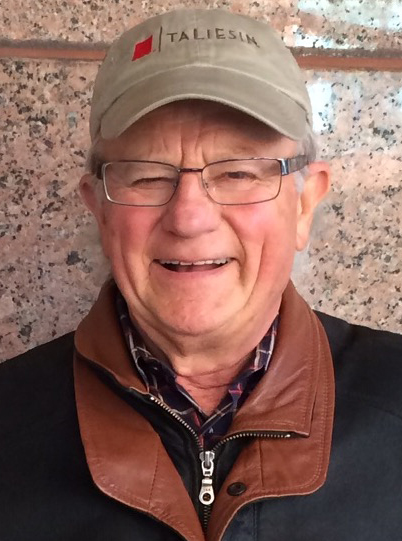
Verne Holoubek
His parents, now in their late 80s, still live on the land. When they’re gone, he said, “we don’t know what’s going to happen to this farm. There’s nobody left in the family to run it.” He admires how his parents hung on there. How his dad diversified with an automotive service business. Verne’s followed in his footsteps, always keeping hands in different pots. And just as the old man bucked convention agitating for agricultural reforms as a National Farmers Organization activist, Verne’s gone his own way the whole ride.
Known as a pioneer in printed apparel, Holoubek found innovative applications of words and images by pen-and-ink, air-brush and silk-screen, iron-on heat-transfer, which he’s an originator of, and multi-color press. He fed the counter culture movement’s creation of a new casual wear market for shirts emblazoned with ads, artwork, pop icon figures, sport team logos, protests, phrases, lyrics, poems, jokes, names or just about anything else. Few anticipated the demand. Poised to capitalize on it, he helped make the heretofore naked white T-shirt a colorful medium for commercial exploitation and personal self-expression. A walking billboard/canvas equated with cool.
“People wanted to identify with something or identify themselves,” he said. “I think rock ‘n’ roll and the Vietnam War gave it a little help because it was a protest…a statement. You could say things, you could be comical, you could be serious, you could be political, you could be religious, you know, whatever you wanted to put on your shirt.”
Wherever he looked, he saw opportunity. He plugged his company into a then- burgeoning lakefront Milwaukee music festival called Summer Fest, where upwards of a million people come see name acts over ten days. In charge of merchandising, Holoubek-printed T-shirts sold big and fast. He also tapped the rock-pop-country music concert scene, printing T-shirts for KISS and Charlie Daniels, among others. And right from the start he hopped on the Hollywood merchandising bandwagon that began with Star Wars and Superman.
Besides the vision to see these trends, Holoubek was in the very age bracket that gave them life. He was an unreformed hippie. He looked the part, too.
“I was young and looked young. Full beard, long hair, cowboy boots, outrageous clothes. Nobody thought people that young should own businesses,” he said. “The concept of entrepreneur wasn’t discovered yet. Nobody knew how to pronounce it, spell it. I was always the youngest one in meetings with lawyers and bankers and marketing guys. I was kind of an oddity.”
By the time the company took off in the early ‘70s, he was “the old guy” at 31. The average age of his 150 employees was 23. “A lot of college kids,” he said. “That’s when college kids used to work in factories for the summer. We had great parties…great picnics. Charlie Daniels played at one of our company picnics.”
Emboldened by youth, “we came in and just blew away” competitors-vendors, he said. “We were brash and kind of cocky, but we took care of our customers.” At trade shows the team “put on the dog. It was show time. Maybe that came from the carnival,” he said, where setting up your booth is “flashing your joint. A joint was a store then. It’s all different now.”
Holoubek Inc. didn’t have to look hard for new artists-designers. “We were a hot name in town, so people wanted to work there,” he said. “The talent came.”
A big break came when he cultivated the Harley account. He’d printed Harley decals and stickers but not apparel, where the real money lay. With Harley’s rebirth in the mid-’80s, he pushed the Skull and Cross Bones rebel image to new heights as the brand’s exclusive apparel licensee. The gig made him a multi-millionaire. His Harley sales went from $350,000 to $40 million. Along the way, he got hooked on the cycle subculture he still embraces today at 63.
The Harley mystique, he said, “does capture you. First, it starts with love of motorcycling. If you ride, there’s nothing like it. It is just a thrill and you want to ride all the time. You can’t get enough of it.” Then there’s the image, as much a product of apparel-accessory lines and marketing pitches as the bikes themselves.
“Harley was brilliant enough to offer this clothing line,” Holoubek said. “It’s very expensive stuff. Their leather jackets cost $200 more than any other jacket, but people want the logo. The T-shirts sort of augment that. You wear your Harley stuff when you’re not riding. For sure, you wear it when you are riding. People want that identity. The real phenomenon is when people travel to rallies. They buy a T-shirt wherever they go. Pretty soon they’ve got a closet with a couple hundred shirts. It just kind of caught fire and it became THE thing.”
His own immersion in all things Harley happened almost by osmosis. “It was pretty easy to get into the Harley mystique because I was already around them,” he said. Before his indoctrination into that world he was “into bikes” as far back as college. “I actually rode to my graduation from college on my bike,” he said. “So, I’ve always had a bike,” but he admits, “I didn’t ride Harleys and I was not a biker. I was a college biker. My first bike was a Honda.”
He makes a point to differentiate between “real bikers” and motorcycle enthusiasts. He feels the real bikers comprise “about 1 percent” of the riding population. “I think bikers come in degrees,” he said, “I’m in the 99 percent group. Its hard to peg, but there is some biker in everybody.”
Ever the rebel, he once “took up motocross. Not racing, but riding for fun,” he said. “After work a bunch of guys would sneak into the Evinrude Proving grounds. The company tested snowmobiles there in the winter. We trespassed all summer.”
He’s an active member of a Harley biker club called the Ugly M/C. He wears a belt buckle with the name-insignia stamped on it. The Uglies possess a rich lore. “Uglies were able to go to Hells Angels parties and they came to ours,” he said of the respect they carried in hardcore biker circles. The Uglies also did security details for concerts-festivals, but enforced things less violently than their Angels brethren.
His Uglies II chapter includes celebrity brothers Peter Fonda and Larry Hagman. It’s for riders. No dilettantes allowed in this Wild Angels–Easy Rider crowd, even if members are senior, tax-sheltered rebels-without-a-cause now.
“Yeah, it’s a riding club. We ride hard. They’re just great guys and a lot of fun,” said Holoubek, who prints the club’s various shirts.
Aficionados will tell you Holoubek printed the best of the Harley collection. “They’re classics,” Fonda said. “There’s some great art there,” Hagman said.
As proud as Holoubek is that his work stands the test of time, he’s really jacked by his Uglyhood. “You have to ask” to join, he said. He did, and a Harley dealer sponsored him. Verne paid his dues for a year. “Here the rubber meets the road,” he said of this trial period. “You cook, clean, wash bikes, and do other duties as assigned. No rough initiation. It’s all in good fun. Ugly members are for life and we are careful to pick guys that will fit in for the long term. More do not make it in than do. One ‘no’ vote keeps you out of the club. Sometimes it takes three votes before you make it.” He won’t say how many it took him, but “they made me Ugly.”

Fellow Ugly Peter Fonda, now a close friend, met Holoubek when he rode out to Milwaukee for Harley’s 90th anniversary. He said they hit it right off despite their “very different backgrounds.” Then again, he said, they share a connection to Nebraska and its virtues. “He’s worked very hard to get where he is in life and he deserves every penny of it in my mind. The first thing I noticed is he has a very genuine heart. He’s a very generous person,” Fonda said. “When my wife had back surgery and it got botched, all my friends were concerned about me because I was really down. Verne flew out, for no other reason than to see me — to see I was alright and taking care of myself. Now that’s a true friend.”
Holoubek’s Wisconsin home is a kind of base camp for Uglies attending Sturgis rallies and Harley events. His “second home,” a beach front property in Akumal, Mexico, is always open to friends. “It’s beautiful down there,” Fonda said. “He likes to share his good fortune with friends. I think it only means something to him when he’s able to share it.” Fonda returns the favor by having Holoubek and company to his Montana ranch. Verne stays in Brigit’s room.
Nebraska author Roger Welsch tells an anecdote about how he and Holoubek met in a neo-nouvelle rich way. “I get a call one day from Akumal, Mexico on the Yucatan (Peninsula),” Welsch said. “The voice on the other end” is Holoubek’s. He wants to talk to Welsch about a book he has in mind. Welsch tells him, “‘Well, it’s really stupid to be talking about writing a book on the telephone. Shouldn’t we be sitting on a nice wide beach sucking on tequilas?’” To Welsch’s surprise, Verne says, “‘Good idea. There’ll be a ticket waiting for you…’” And there was. “It’s guys like this who know how to spend their money right you want to have as friends,” Welsch said. “He’s just a super guy. Easy going. A sweetheart.”
Fonda confirms Holoubek knows how to relax. It’s easier now that he’s retired and not wired to his business. “We enjoy doing the same things and we enjoy doing those things together,” said Fonda. Similarly, Larry Hagman and his wife enjoy travel with the Holoubeks, including a recent Costa Rica trip the couples made.
Terri Holoubek often joins Verne on rides. He describes his wife, an Omaha native, as “an equal partner in my life” and “in the business. She was there from nearly the beginning and we have worked together on every aspect of the venture. She did take the time to raise four great kids while keeping me in food and clothes and lots of advice on major decisions. She’s very intuitive.”
They’ve made some epic rides together. “We did 3,600 miles on the Glacier National Park ride — the Ride to the Sun. On the way back we rendezvoused at Peter’s (Fonda’s) ranch. From there we took off for the ride to Sturgis. On the ride into Sturgis from Devil’s Tower we road two-abreast at 80-miles an hour in formation, not the kind of thing you normally do. That was a great ride.”
He said the Sturgis experience, “which has been a regular stop for me over the last 20 years, is the REAL DEAL for bikers. Originally a race and hill climb, bikers camped in the city park in town. Over the years it has grown into the mainstream much like Harley Davidson has became an acceptable” brand. “The biggest change is that the riding public became more middle class just in time for the boomers to take part. It’s a lot of fun.”
The couple have ridden to the Four Corners and Daytona Beach They do charity events, including the famous Love Ride in Glendale, Calif. They would normally be up in Sturgis this week for the big rally. But a double-vision problem has idled Verne’s riding for now. That doesn’t stop them from having a good time. Between scuba diving at their ocean-front get-away in Akumal, touring old Europe, cruising in their classic ‘56 Packard or making Lake Michigan waves in their speed boat, this couple has fun. Earlier this year the couple celebrated their 40th wedding anniversary in Paris and Amsterdam.
Over the years Holoubek sold off most parts of the business, keeping only the prized Harley licensee segment. In 2004 he sold it too — to clothing manufacturer giant VF. Some hard feelings soured the Holoubek-Harley romance, but he doesn’t talk about them except to say, “It’s a big company now. It ain’t like it used to be when the family ran everything.” One Harley legend he remains close to is chief designer Willie G. Davidson, a grandson of the founder.
Holoubek tried retiring “once before.” He put “a management team in place and it just didn’t work out,” he said. “Either I didn’t run the team right or I didn’t have the right guidelines or I didn’t know how to be a chairman of the board and let somebody else run your company. I take the business very, very personally. I think about it 24 hours a day.” When sales went flat and good people left, he “came back to work.” He dealt with irate customers and vendors who felt his absence. That first day back he and Terri vowed, “‘Next time, we sell.’” That’s what they did.
The sale and retirement leave ample money and time. He could live anywhere, but still resides in Wisconsin and keeps close ties to Nebraska. While he never came back home to live again once he reinvented himself in college, he’s remained close to his family, most of whom still live in state. He keeps busy with vintage automobile and tractor collections, amateur photography and 400 acres of land he and Terri farm at their Wisconsin retreat. They also run a charitable foundation.
Fonda worries that without the action of a business to run, Holoubek might have problems. “I remind him, ‘Don’t retire, because that’s when people die,’” Fonda said. Holoubek says Fonda needn’t worry. First, he stays busy. “Life in retirement is very full,” he said. Second, he’s having too much fun. “I don’t believe you have to work your whole life,” he said. “I’ve watched people work to the grave in their business. There’s so many other things to do in the world I think I can do than just run that business.”
Passion drives Holoubek. It’s what gave him “a passport” and “a way out” of the farm in the first place. Finding “that avenue where you can create your own” destiny, he said, is a gift. “You’ve got to want to do something from the heart, and I feel very fortunate I’ve been able to do that.”
Related Articles
- Out Of Print: Books on shirts. Shirts on a mission. (couturecult.com)
- Ugmonk (coolhunting.com)
- Famous Men and Their Motorcyles (artofmanliness.com)
- Clothing company grew up in a barn (thestar.com)
- In pictures: custom Harley-Davidsons (telegraph.co.uk)


 Leo Adam Biga's My Inside Stories