
Archive
Archive for the ‘Health/Wellness’ Category
A Story of Inspiration and Transformation: Though Living on the Margins, Aisha Okudi Gives Back, and She Nurtures Big Dreams for Her Esha Jewelfire Mission Serving Africa
December 11, 2011
4 comments

Aisha Okudi with Dell Gines at North O Cultural & Arts Expo
Life is what you make of it, the saying goes. Attitude is everything, goes another. Aisha Okudi is living proof that when these aphroisms are put into action life can take on a whole new meaning and direction. By being intentional about how she apprehends the world, Okudi is no longer living the self-centered life that led to ruinous consequences. Her life today is focused on positive self-empowerment through service to others. That doesn’t mean hard things don’t still happen to her. But she’s much better equipped to handle what the world deals her in healthy ways rather than the destructive ways she used before. Her inspirational story of transformation and recovery is beginning to get her noticed. That has a lot to do with her charming personality, high-energy, and humanitarian vision. She has very little in the way of monetary means or material goods, yet she’s embarked on an international mission that she seems destined to fulfill. She’s not likely to let anything stand in her way either. You go, girl!
A Story of Inspiration and Transformation: Though Living on the Margins, Aisha Okudi Gives Back, and She Nurtures Big Dreams for Her Esha Jewelfire Mission Serving Africa
©by Leo Adam Biga
When buoyant, self-made social entrepreneur, visionary and humanitarianAisha Chemmine Mure Okudi reviews how far she’s come in only a few years she can hardly believe it herself. It’s not so much that her three-year old Shea Luminous by Esha Jewelfire line of organic shea butter bodycare products is such a thriving success. It’s more to do with her business being an expression of her ongoing recovery from unfortunate life choices and setbacks as well as a conduit for her African missionary work.
At the base of her products is butter extracted from the shea nut, a natural plant indigenous to the very rural West African provinces she serves.
After years helping poor African children from long-distance by sending supplies and donations, she visited Niger, West Africa for the first time last spring through the auspices of the international NGO, Children in Christ. She engaged children in arts and crafts and games and she enlisted the support of tribal leaders, church-based volunteers, Nigerian government representatives and American embassy officials. She purchased a missionary house to accommodate more evangelists.
She says she’s tried getting local churches on board with her missionary work but has been rebuked. She suspects being a woman of little means and not having a church or a title explains it. Undaunted, she works closely with CIC Niger national director, Festus Haba, who calls her work “a blessing.”
She intends returning to Africa in May. Her long-range plan is to move to Niger. She envisions growing her business enough to employ Africans and to open holistic herbal health clinics. She’s studying to be a holistic health practitioner.
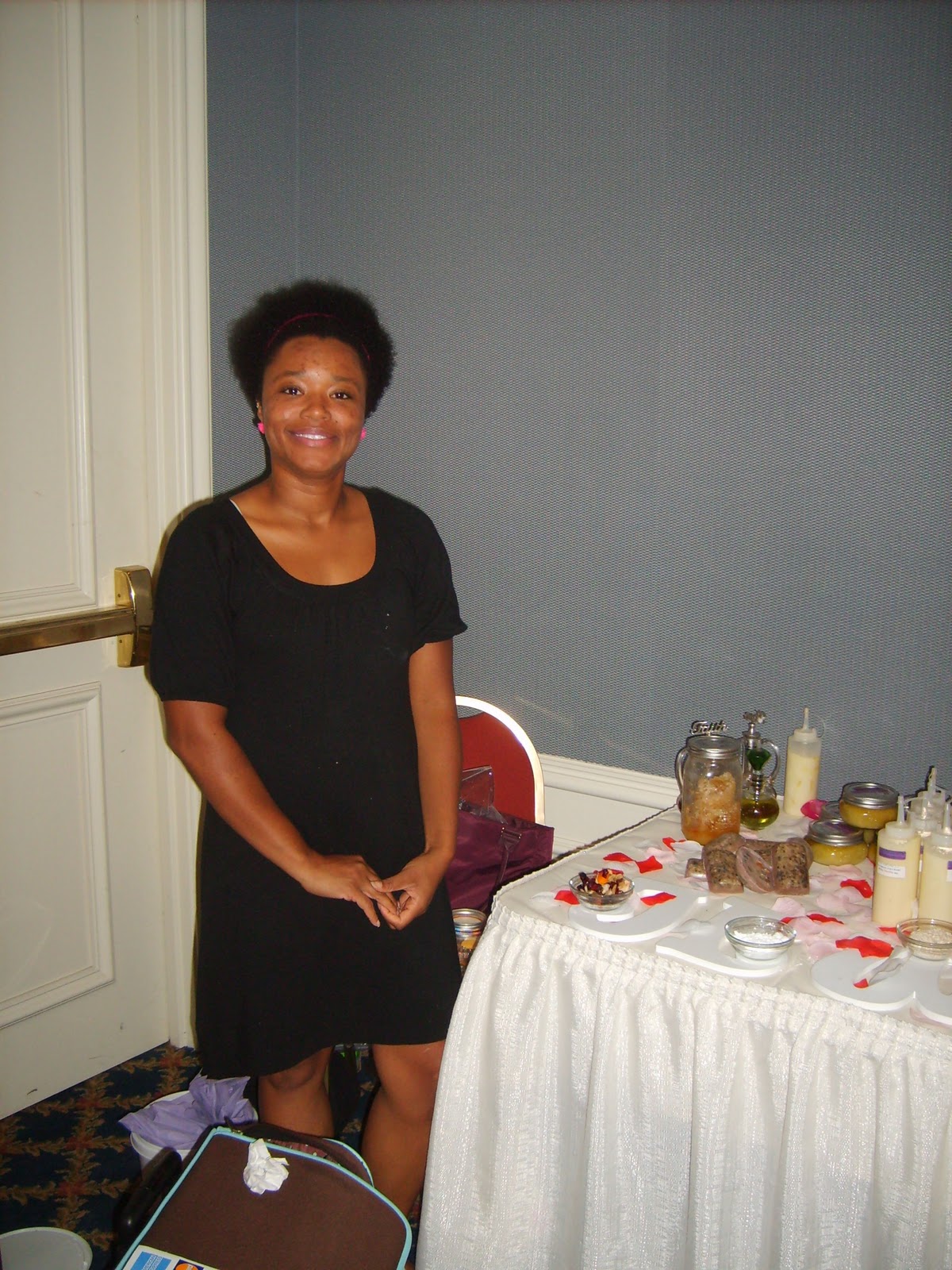
Aisha Okudi
Contrast this with the desperate young woman she was in 2004. The dissolute life she led then found her crying in an Iowa jail cell after her second Operating While Intoxicated offense. Her arrest came after she left the strip club where she performed, bombed out of her head.
“I had to get drunk so I could let these men touch me all night,” says Okudi, who ended up driving her car atop a railroad embankment, straddling the tracks and poised to head for a drop-off that led straight into a river.
The Des Moines native had been heading for a fall a long time. Growing up, her family often moved. Finances were always tight. She was a head-strong girl who didn’t listen to her restless mother and alcoholic father.
“There were issues at home. I was always told no coming up and I got sick of hearing that. I felt I was a burden, so I was like, ‘I’m going to get out and get my own stuff.'”
At 15 she left home and began stripping. A year later she got pregnant. She gave birth to the first of her four children at 17.
“I found myself moving around a lot. I really didn’t know what stability was. I never had stability, whether having a stable home or just being stable, period, in life. I was young and doing my thing. My dad walked in the club where I was stripping. My sister told on me.”
The confrontation that ensued only drew her and her parents farther apart.
“I was trying to live that life. I wanted to have whatever I wanted to have. My mom and dad struggled and we didn’t get everything I thought we needed, so I did my own thing. I danced, I sold my body and I made lots of money from it. I did it for about 12 years. I wanted to have it all, but it was not the right way.”
She got caught up in the alcohol and drug abuse that accompany this sordid life. Stealing, too.
“I was in and out of prison a lot. I used to steal to make money. I was in and out of trouble and the streets.”

She served a one year sentence for theft by receiving stolen property.
That night in jail seven years ago is when it all came to a head. “I just sat there and I thought about my kids and what I just did,” she says.
She felt sure she’d messed up one too many times and was going to lose her children and any chance of salvaging her life, “I was crying out and begging to God. I had begged before but this time it was a beg of mercy. I was at my bottom. I surrendered fully.”
To her great surprise and relief the judge didn’t give her jail time. “I told the judge, ‘I will never do this.’ He said, ‘If I ever see you in my courtroom again it will be the last time.’ I burnt my strip clothes when I got out, and I didn’t turn back. I got myself into treatment.” She’d been in treatment before but “this time,” she says, “it was serious. It wasn’t a game because it used to be a game to me. I enrolled in school.”
Seven years later she has her own business and a higher calling and, she says, “I ain’t doin’ no jail time, I’ve paid all my fines, I never looked back, I kept going. I’m so proud that I write the judge and tell him how I’m doing.” She’s learned how to live a healthy lifestyle and not surround herself with negative influences and enablers.
Her life has turned many more times yet since getting straight and sober.
In 2006 she seemingly found her soulmate in George Okudi, an ordained Ugandan minister and award winning gospel artist. They began a new life in Washington DC and had two children together. Then she discovered he was still married to another woman in Africa. The couple is separated, awaiting a divorce.
“He didn’t treat me right — the way he should have,” she says. “Facing that really hurts. God, I wasted these years with this man. But my kids are a blessing. I love them. They’ve really kept me focused. I try not to be bitter, I’ve forgiven him. I’m friends with him. We do have kids”

If there’s one thing she’s learned in her own recovery journey, she says, “You’ve really got to forgive, forget and let God, and He will move you in ways you can’t even believe.”
But she’s only human, therefore doubt and self-pity still creep in when she considers her sundry “trials and tribulations.” Even though she’s forgiven her husband, the betrayal still stings. “I’m going through that, too,” she says.
“Even though I’ve grown,” she says, “sometimes it feels like, When is it going to end?’ But to much is given, much is required. You’ve just gotta consistently stay on track. No matter what it is, stay focused.”
The last three years have been equal measures triumphs and tests. The difference this time around is that when good times happen or adversity strikes she doesn’t get too high or too low, she doesn’t feel entitled to act out.
She claims she experienced an epiphany in which God spoke to her and set her on her Esha Jewelfire mission.
“When I had that vision and dream I was pregnant with my youngest son. I was living with my grandmother (in Des Moines). I was newly separated from my husband. I said to my grandmother, ‘I don’t know if I’m going crazy or what, but the Lord said I will build like King Solomon and go and help my people in Africa.'”

A typical rural Niger village mud hut
Since childhood Okudi’s cultivated a fascination with all things African, including a desire to help alleviate poverty and hunger there. Her visit to Niger last spring and the overwhelming reception she received confirmed she’s meant to serve there.
“It was immediate. I was able to blend in wherever I went. I’m a true African and I know that’s where my calling is. It’s natural. I cook African, my children are African, my friends are African. It’s just a natural thing for me.”
She even speaks some of the native dialects.
She’s long made a habit of sending clothes and other needed items to Africa. But a call to build was something else again.
“Where am I going to get the money from to help these people in Africa?” she asked her grandma. “I didn’t know.”
Then by accident or fate or divine providence a friend introduced her to shea butter, an oil extracted from the shea nut that grows in West Africa and is used in countless bath and beauty products. “And that’s how the idea for my business came up,” Okudi says.

Shea nuts
In its gritty, foul-smelling natural state, sheer butter held no interest for her. But, she says, “I researched it and found that it moisturizes, it cleanses, it refreshens, it brightens, it just makes you shine. So figured out what I needed to do with it.”
She experimented with the substance and developed organically sweet shea butter products and began marketing them under the name, Esha Jewelfire, which means to empower, serve and honor the almighty.
She gets the raw shea in big blocks she breaks down by chopping and melting. She incorporates into her handmade products natural oats and grains as well as fruit and herb oils to lend pleasing textures and scents. She presses the fresh fruit and herbs herself. Nothing’s processed. “All this stuff comes from God’s green earth — oils and spices and herbs, organic cane sugar,” she says. Nothing’s written down either. “I have it all in my head. I know every ingredient in everything I make. Everything is made fresh to order and customized. I hand-package everything, too.”

Selling at networking events, trade shows, house parties, off the Internet, the small business “started really growing and taking off for me,” she says. “It was prophesied to me I will have a warehouse and be a millionaire one day and I believe that. Getting prepared is all I’ve been doing.”
Her business has been based at various sites, including the Omaha Small Business Network. Production unfolds in her mother’s kitchen, in a friend’s attic or wherever she can find usable space. She’s placed her products in several small stores but having a store of her own is attractive, too. Earlier this year “an angel” came into her life in the form of Robert Wolsmann, who within short order of meeting Okudi wrote her a check for $10,000 — as a loan — to help her open her own shop.
Wolsmann of Omaha is not in the habit of lending such amounts to near total strangers but something in Okudi struck him. Besides, he says, “I could see she needed help. She showed me what she made and I was so impressed that I presented her with that money. I couldn’t resist investing.”
“He’s an awesome person,” Aisha says of Wolsmann. “We’ve become great friends.”
She says her dynamic personality has always attracted people to her. She feels what Wolsmann did is evidence that “things work in mysterious ways — you don’t know what’s going to happen, you’ve just got to be prepared.”
Her Organically Sweet Shea Butter Body Butter Store at 3019 Pinkney St. opened last spring after she returned from Africa. It was a labor of love but it proved a star-crossed venture when after two months her landlord evicted her.
Her reaction was to ask, “What is going on God and why does this keep happening to me? I didn’t have nowhere to go. I was seeing myself back living from place to place like I’ve always been, still trying to take care of my kids and do my business.”
Stripping’s fast money tempted her before she rejected the idea. Then she found a haven at Restored Hope, a downtown transitional housing program for women and kids.
“Restored Hope has been stability for me. It’s a year program. It keeps me focused on my mission. I’ve been called to be that missionary, so I’m not so upset anymore about why I’ve been bounced around or why things have happened the way they have. There’s a way bigger purpose. If you just be really humble and wait and be patient to see what God’s doing, He’ll turn things around.”

A Restored Hope residence
It’s why she doesn’t dwell on the past or worry about what she doesn’t have right now.
“Nothing matters when it comes to material things. The only thing that matters to me is my health and just doing what I know is right in my heart to do. Even though I live the way I live, basically homeless, I realize I am very blessed. And I’m grateful.”
She’s aware her ability to stay positive and keep moving forward amid myriad struggles inspires others. She says some of her fellow Restored Hope residents tell her as much,
“It reminds me who I am and that when I don’t think people are watching me they are. I’ve always been a happy person. Even when I’m going through something, I pick myself up. I’ve always been a giving, loving person. Even my father said, ‘Because of you my life’s changed. I’ve seen where God has taken you through and you still hang on. If you can be changed from where you came from, I know there’s a God.’ Now he’s stopped drinking. He’s reborn.”
Her own rebirth would be hard for some to believe. “People who knew me in my past might say, ‘Oh no, not Aisha, with what she used to do?'” She doesn’t let skepticism or criticism get her down.
“I just get up knowing I gotta do what I gotta do, and I live one day at a time. I don’t let my financial and emotional path haunt me. I’m not in control, God’s in control. There’s nothing you can do but do what you need to do every day and be a part of hope.
“Too many people are hopeless. You can see it in their facial expressions and the way they do things. There’s no light in them. I’m not about that, I’m about life and living to the fullest and being happy with what I have and where I’m at because I know greatness will come some day for me. I’m a very favored woman in all things I do.”
She suspects she’s always had it in her to be the “apostolic entrepreneur” she brands herself today. “Sometimes you don’t discover it until things happen to you. I think I had it but I didn’t embrace it then. I heard so much negative in my life coming up that it turned me away…I said, ‘I’ll show you,’ and I made wrong decisions. What the devil meant for bad, God turned it for good.
“I’m a natural born hustler but I hustle in the right way now.”
View Aisha’s entire product line and read about how you can help her African mission at eshajewelfirellc.homestead.com.

Related articles
- I Am Because We Are: African Wisdom in Image and Proverb (gumption.typepad.com)
- Why Women Are the Future of Africa (hueintheworld.wordpress.com)
OPEN WIDE, Dr. Mark Manhart’s Journey in Dentistry, Theatre, Education, Family, and Life /A Biography
October 28, 2011
2 comments

-
- The rest of the fall expect occasional excerpts like this one from my first book, Open Wide, a biography of an interesting fellow named Mark Manhart. He asked me to tell his life story in book form and once I satisfied myself he had a story worth sharing and the ability to compensate me we struck a deal and over the course of a couple years I feel I got to know him well enough to at least put down a reasonably informed appreciation and examination of his life for posterity’s sake. You can order the book at the following links:
- http://www.conciergemarketing.com/open-wide
- http://www.barnesandnoble.com/w/open-wide-leo-adam-biga
- http://www.calciumtherapy.com/latest-news/open-wide
OPEN WIDE
Dr. Mark Manhart’s Journey in Dentistry, Theatre, Education, Family, and Life /A Biography
©by Leo Adam Biga

Mark Manhart
A Life in the Open
We all lead a few lives or, if you prefer, double lives. Mark Manhart knows something about the mirrors of life. In his professional life, he is a dentist. In his personal life, he is a writer, director, history buff, landscaper, father, grandfather, and husband among a few different pursuits. “I think everybody has that kind of dual life going, especially people who get into such specialized things as dentistry. A professional has to lead two lives. Your open life and your other lives,” he said. The Omaha, Nebraska resident has an opinion on most everything, and he usually has a philosophy to support his viewpoint. Try this one on for size: “One needs a real work-a-day life and then at least one other life, some hobby, avocation, distraction, to work on to nearly inane proportions, so one can return to home base refreshed, go to bat again, and make your way before the inning and game is played out. I have gone through many family and professional things that were very much like sitting in the dental chair. All have been adventuresome.”
For this man of many interests and talents, life is also full of what he likes to call “natural wonders”—those unforgettable people and events that he enjoys experiencing and cultivating. He is all about opening new horizons of discovery in his personal and professional lives.
One domain feeds the other; one dimension offers solace from the other. “All of this, in any position or occupation, is terribly important to one’s sanity, pleasure, growth, and accomplishment,” is how he sees it.
For fifty years Manhart has indeed left the confines of home for the office, leaving behind his domestic incarnation for that of the highly trained, working professional who not only practices dentistry but is actively engaged in developing new treatments or therapies.
Then there is the life that revolves around some inner passion that enables him to return to work recharged, ready to resume life in the open and persevere. For Manhart, it is the world of arts and letters that feeds or fulfills him with the sustenance to carry on with renewed vigor. Specifically, it is the life of the theatre and his work as a playwright and director, and occasionally as an actor, that is a source of satisfaction, of solace, of energy, of intellectual and emotional discovery that offers a balance or complement to his professional and family endeavors.
There is also the life he maintains with his spouse. Here, too, Manhart is well-versed in that song and dance called marriage. He has been married twice. His first marriage lasted more than two decades and resulted in eight children. That union ended in divorce, but when he was ready to start a new chapter in his life, he did not hesitate to marry again, to a woman with a pair of children of her own. This second marriage-go-round has now exceeded more than two decades itself, which would seem to indicate he is the marrying kind.
He and his wife, a spitfire named Bonnie Gill, make it work despite being very different personalities. They may not see eye to eye on many things, and they may handle situations quite differently, but when it comes to what is important in life, they are simpatico. They are both searchers, ever inquisitive to turn the next page in life, to see what is over the next hilltop, to experience a new culture or way of doing things. Both are principled people. Both would rather give than take. Both are creative souls.
It seems Mark Manhart’s thirty-year dental partnership with Dr. Tom Steg can be thought of as a kind of marriage in itself. The two men are opposites in most ways but are kindred spirits where it counts most, as people of high character, intense curiosity, extreme professionalism, and with a penchant for pushing beyond the norm of dentistry to find the best ways of caring for patients.
With his tall frame, angular features, shock of silver hair, confident pose, resonant voice, formal manner, and reserved personality, Manhart cuts a striking, classic figure. He comes across at once as a bold, magnetic personality with an authoritative air and yet at the same time as a quiet, pensive, somewhat shy, even insecure soul. It is that duality that is so much a part of him. It is an expression of his charm and his complexity.
Call it fate or coincidence, but this practitioner of the healing art of dentistry also became a creative artist somewhere along the line. More likely, he was an artist right from the start and his muse simply waited for when the time was right to finally bloom. Many of the qualities that make up a healer, after all, are much the same as those that characterize an artist: empathy, discernment, problem- solving, discipline, craft, even imagination.
Manhart still lives that personal brand, striking a balance between right- and left-brain activities that put him squarely in the mix of Omaha culture, community, and commerce. Long before social networking became a catch-word and lifestyle for the online era, he was engaging people from all walks of life and exploring ideas from disparate sources.

Calcium Therapy Institute
He was ahead of the curve on the Internet as well, launching a website for his practice back in 1995. He is on LinkedIn, Facebook, and all the other go-to social media sites. He blogs. He even conducts online training sessions for dentists from around the globe. He is as connected as anyone of his generation.
His inclusive, progressive approach to dentistry may best illustrate how open-minded and receptive he can be to new ideas and new collaborators. Eager to always improve his craft, he makes a habit of seeking out the latest advances by poring over dental journals from around the globe. Staying current this way has spurred him to make his own breakthroughs and to share his advancements with peers in the United States and abroad.
Away from dentistry, his work as a playwright and theatre director reflects his eclectic tastes, ranging from sentimental love stories to historical dramas to bawdy comedies to high- brow treatises to full-blooded biographies to English manor mysteries. From kitsch to classic, Manhart embodies it all.
Not so very different from the way he seeks to break new ground in dentistry, he actively seeks out new forums and challenges in theatre. He has done the same in education, too, as a champion for the Montessori method of early childhood instruction and for home-schooling. Although he has been a clinician most of his working life, he has also taught dentistry formally at the university level and informally in workshops and trainings.
Whether navigating the worlds of medicine, business, education, or art, he is an enterprising, energetic innovator open to new, even unconventional ways of doing things. He is what some people call today “a creative.” It is really another word for “eccentric” or for how one of his own children described him—“a half bubble away from genius.” That missing other half of the effervescent bubble can sometimes make him look like a fool or an idiot some people very close to him will tell you. It is a risk he is willing to take.
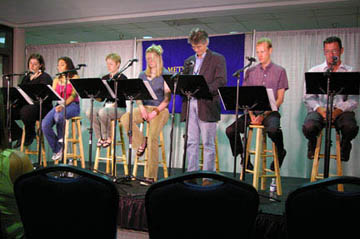
Great Plains Theatre Conference
His work and life are expressions of an inquisitive mind and a sensitive disposition. His office displays pictures of the charming digs he kept in The Passageway of Omaha’s historic Old Market district, the cultural heart and soul of the city he felt right at home in. Once the wholesale produce center for the city, the district was redeveloped beginning in the late 1960s and early 1970s into a European-style marketplace.
The Mercer family of Omaha led efforts to preserve and reuse the century-old warehouses as restaurants, galleries, theaters, shops, and residences. Manhart fit right in with the Old Market’s creative class denizens.
The Old Market has become one of the state’s largest tourist attractions, along with the world-class Henry Doorly Zoo as a magnet bringing visitors to the city. Due to health issues of his own, Manhart long ago had to set aside this second office in The Passageway at 10th and Howard Streets. The Market and his affection for that Old World location is evident in the photographs he displays of the brick-hewn office and environs he practiced in there. He also keeps an antique dentist’s chair in his West Omaha office as a token of his appreciation for “good old-fashioned” dentistry, craftsmanship, and values.
Manhart’s full life is not just a professional or aesthetic exercise. His life extends to family. He came from a huge clan, and he is the father of eight himself.
“I always wanted a large family of twelve children. A lot of kids who could become ‘adult’ adults. As a granddad, it is hard to see much success in that regard, so I must wait it out. I think I was a good father but that is slightly biased. People would say I am too harsh, too outspoken, too busy elsewhere, distracted too easily, too liberal, too persistent, frugal to cheap, an exaggerator, cold with little emotion, a trouble starter, and more. An old friend, a Jewish lady, hit it for me: ‘You are a starter. We have enough finishers.’ My obligation to the kids was to house, feed, protect them from others and each other in a way that they would be able to do the same as adults, and love them. Most of the love was, and will remain, secret between each one and me. Some day I want to write about that,” he said.
Cast members of plays from Great Plains Theatre Conference
Those who know Manhart from his life in the arts may not even know he is a family man, much less a dentist. Just as those who identify him as a dentist may not be aware of his other lives. That is all par for the course for someone who throws himself passionately into whatever endeavor he is engaged in at the moment. It is not as though he focuses on a passion to the outright exclusion of everything else, but he does tend to lose himself in whatever it is he is engaged in at the moment.
His single-minded devotion is evident in his dental career. He has been in private practice now forty-five years. Counting his time doing dentistry in the United States Air Force Dental Corps and his time in dental college, he has been actively engaged in the field of dentistry for more than half a century. However, the way he has chosen to practice, by utilizing noninvasive calcium treatments of his own design, has made him an outcast of sorts within his field. And being shunned by the dentistry establishment was just the beginning; legal action to stop him followed, but each case served to strengthen his resolve.
To further his somewhat nontraditional approach to dentistry, he founded and directs the Calcium Therapy Institute in his hometown of Omaha. The Institute is the vehicle for Manhart to do dentistry and science side-by-side, using his preternatural inquisitiveness and idiosyncrasy to investigate dental problems and treatment options along lines that do not necessarily conform or adhere to organized dentistry’s prescribed ways. That is just the way he likes it, too. Tweaking the nose of authority is a Manhart trait.
He enjoys playing the contrarian. Much the same way his late father, a farmer-turned-attorney-turned-inventor, was his own man who went his own way, damn the consequences, Manhart is a maverick accountable only to himself. He takes the road less traveled, whether in his personal or professional affairs, following an inner muse that neither brooks compromise nor suffers fools gladly nor worries about what people say.
There have been times when he has severed major threads in his life in order to do what he felt was right, regardless of how others perceived him and his decisions. For example, he and his first sweetheart, Mary, married and raised a large family together. She is the mother of his eight kids. After the kids were grown, the couple decided to end the marriage.
“Mary and I were happily married for a long time,” he said. Then they simply reached a place in time when they determined they would be better off apart.
Following years as an active member of the American Dental Association and officer in the ADA’s Omaha branch, he set aside organized dentistry as well. He has practiced without direct affiliation with the dental establishment— that is, his ADA membership and a position teaching at his dental school. However, the tradeoffs became more focused on his patient care, clinical research, and life beyond dentistry. At the time he won a lawsuit over patient treatment that was egged on by dentists who opposed his research in the advanced uses of calcium materials. When a number of specialists testified against him, there were subsequent, immeasurable losses to his reputation and health.
Aside from getting some of his findings published in the preeminent international dental journal more than twenty- five years ago, and in a few minor journals, his attempts to publish his work in America have been repeatedly rebuffed, much to his frustration. Nonetheless, in 2009 a prestigious European dental journal published his latest findings almost immediately and without reservation. His perceived banishment in the United States is a source of bitterness with him but just how much it bothers him is hard to gauge as he tends to dismiss it or brush it aside as no big deal. His wife, Bonnie, knows differently.

Bonnie Gill
How much has he been hurt by all this? “Very hurt. More than you can imagine,” she said. “I cannot even talk to him about it, and some of it I think he has brought on himself. But I think as he gets older it is killing him and I keep telling him, ‘You gotta let it go.’”
Bonnie said her husband can be hard to read, even for her, because he is such a mix of things and because he can hide behind an inscrutable, sphinx-like mask that serves to insulate and isolate him from those around him.
“I know him probably better than anybody else, I would say better than any human being on Earth,” she said. “He is a very complicated soul and a very kind person. It is sometimes the bane of his existence and actually what probably drew me to him. I knew before I ever got hooked up with him that he was incredibly honest. What I do not admire is that he can seem to turn that on and off and be extremely cruel when he wants to be, too. This is one of his flaws—it’s my way or no way—he cannot ever see the gray areas on some of this stuff, which he is very good at seeing on other things.”
She has no trouble standing up to him when she feels he is wrong and telling him so. He can handle being called out on his mistakes and has no problem with Bonnie’s candidness and her telling him like it is.
Bonnie said, “You know, it takes a pretty strong guy to accept being told, ‘I think you’re full of it.’ But that is the kind of relationship we have. It’s perfect because I do not ever have to get up wondering who I should be today.” In other words, she can be herself. With Mark,” she said, “I always know I can be who I am, warts and all, and it might be a little grumpy, but it’s going to get worked out.”
She has been there through the highs and lows of his dental life. She has seen the toll it has taken on him to seek the kind of vindication and recognition he wants but that has not been forthcoming and that likely will not come anytime soon, much less in his lifetime. “One time I asked Mark in the throes of this, ‘Do you want to be rich or do you want to be famous?’ And I did not even have to ask him because I knew what the answer was. He threw me a curve ball though by saying, ‘Both.’ I said, ‘You cannot have both, you can only have one.’ And then he said, ‘Famous,’ and I said, ‘I knew that.’”
Despite setbacks he has doggedly carried on, determined to prove people wrong. Call him intransigent or stubborn or willful or simply determined, he is like the proverbial dog that won’t give up a favorite bone without a scrap. As stressful and contentious as his dentistry battles have been, the bulk of his work in the field has been fulfilling. It is why he still does what he does at an age when the vast majority of his peers are long retired.
“Look at when dentists retire. I mean, dentists retire pretty darn early, and I passed that opportunity up fifteen years ago. I keep on because our calcium therapy works and it is such a delight to practice dentistry,” he said. “You know every day I see people who have troubles and we solve them. What more of an ego trip could you want?”
A pursuit quite apart from dentistry that Manhart is no less passionate or obstinate about is the theatre. This dramatic arts enthusiast has taken the hobby seriously enough to have helped form and operate three community theatre venues: the Rudyard Norton, the Kingsmark II, and the Grande Olde Players (GOP). He co-founded and directed the latter with Bonnie. Their Grande Olde Players established a niche by producing works featuring seniors and intergenerational casts. After a twenty-four year run the Grande Olde Players Theatre, which also featured jazz concerts, staged its final season in 2008.
Manhart has also participated in the Great Plains Theatre Conference hosted by Metropolitan Community College. The college’s historic Fort Omaha campus is the site of play labs where Manhart’s work has been read and where he and Bonnie have directed play lab readings of works by other playwrights. The conference receives submissions from playwrights across America, even from abroad. It is an intensive week-long concentration on craft. Some of theatre’s greatest talents participate as readers, respondents, mentors, and panelists, all in service of furthering the work of new and emerging playwrights.
Manhart does not kid himself. He knows he is not in the same league as many of the participants, who have included Pulitzer, Tony, and Obie award winners. The experience of having his work critically evaluated has not discouraged him but has emboldened him to keep writing and improving.
He has already accomplished much in local theatre. Without a lick of formal training he taught himself how to write, produce, cast, and direct productions and to manage theatre companies. He still writes plays and he still takes directing assignments today. Bonnie also continues to write and direct. Much like his experience in dentistry, he has often butted heads with theatre colleagues and collaborators, but, right or wrong, he has always remained true to himself, which is that of a stubborn, “tough old German,” as he likes to say with a wry smile. He is actually Swiss and German, with a little French thrown in, although the borders of those countries changed so often in the not-so-distant past that his precise lineage on his father’s side, the German side, cannot be determined with absolute certainty. On his mother’s side, the Swiss side, however, the family line can be traced back some eight hundred forty years.
The worlds of dentistry and theatre could not be more unalike on the surface. But look closer and what at first seems incongruent reveals similarities, which is why Manhart has drawn from each to enrich the other. Of course, when you think about it, dentistry entails a performance aspect. After all, the practitioner fulfills the role of expert healer for the patient, who comes in search of relief. The drama and expectation alone make it a kind of theatre. Conflict is at the heart of any drama and the inherent conflict in the doctor- patient relationship is that the healer may have to cause the patient discomfort, even pain, before healing occurs.
For many patients the mere thought of going to the dentist produces extreme anxiety. Sitting in the examination chair, surrounded by all that cold, hard, sterile equipment, which for all the world resembles instruments of torture, is enough to raise anyone’s blood pressure. Then there is the whir of the drill. Add to that the unpleasant past experiences many have had in a dental office, from scrapings to extractions to injections, and you have the makings for a tense situation.
Then there is the often exorbitant cost of dentistry that not all patients have the insurance to cover. The financial burden of care is a source of some resentment. It is routine nowadays for a few extractions or a root canal, for example, to cost many hundreds of dollars. When you talk about bridges, crowns, and implants, the bill ratchets up into the thousands. Finally, some doctors do not exactly have a winning chairside manner with their condescending, paternalistic I-speak-you- listen, I am-the-expert-you-are-the-patient attitude.

Manhart went to India to lecture on calcium therapies
In stark contrast to that dysfunctional model, Manhart goes out of his way to provide high-quality service at a reasonable rate and to deal with patients in a respectful manner that makes them a part of the care plan. He has also refined his craft to the point that his supple hands have a sure touch. He said there are qualities, some tangible, some intangible, that separate a master practitioner from a run-of- the-mill one.
“It is their touch, their approach, their finesse, whatever you want to call it,” he said. As a young dentist he had a chance to not only see but to feel some masters at work. “I thought, there is the kind of practitioner I would like to be.” By all accounts, he has become one. He said, “My rule always has been, man, if I can get my hands on you, you will never go anywhere else.”
Such finesse only comes through an assurance and confidence that cannot be approximated or faked. You either have it or you don’t. “That’s everything, yeah,” said Manhart. “You cannot really hide it. It’s there and it’s in everything you do. I worked for an orthodontist named Dr. Elmer Bay, and as a teacher this guy was absolutely wonderful because you never knew you were being taught. I used to make his appliances for orthodontics, and I saw his superlative results in everything. He was very old-fashioned. A few years ago Dr. Steg [Manhart’s dental partner] said to me, ‘I had a patient who was told by so- and-so she should not go to us because we are old-fashioned dentists.’ Well, that is the best compliment anybody has ever given us because those old-fashioned dentists like a whole lot we grew up with were just wonderful.”
One old-time dentist Manhart worked with, Dr. Leo Ripp, was so well-loved and appreciated that at his funeral mourners eulogized what a great dentist he was. Manhart never heard of such a thing. “Old Dr. Ripp, he could make the most beautiful gold crown you could ever believe seeing with the oldest crap you could ever think of using,” he said. “He really just was superb. He would put a crown in someone’s mouth, and if it did not stay forty years, something was wrong here.”
Manhart has the utmost respect for the men who taught him because they were working dentists. They were the first practitioners and second teachers he has tried emulating.
“Most of my training was given to me by dentists who were practicing fulltime and coming in a little bit each week and teaching. That kind of dentist is a clinical, hands-on dentist. They really know what is going on. But since the middle 1970s or somewhere in there, the dental school faculties have been dominated by fulltime teachers who go to practice a little bit and that changes the whole picture. That changes it even in the sense of the patient-dentist relationship. When you are working on your own patients and you are listening to them, you are really listening to them, number one, and you are making decisions together, number two, and you know little things like if this patient is not happy, they are going to go home and tell seventeen people. Now you either make them happy or you are in big trouble,” he said.
Conversely, he said a sense of accountability tends to be in shorter supply among dentists who teach fulltime because in college dental clinics dentists are not seeing their own patients, they are seeing whoever walks in for treatment, and these patients are apt not to get the same attention they would in a private setting. From where Manhart sits, too, there is something to the old adage, “Those who can, do, and those who can’t, teach.” Therefore, let the buyer beware.
In such a setting, he said, the dentist tends to be insulated from any repercussions that attend substandard care. A gulf or separation existing between dentist and patient is not consistent with quality care. He feels this insularity is engendered, too, in some dentists who belong to the American Dental Association, who use the organization as a buffer. “That insulation makes you act differently,” he said. Less compassionately or less empathetically perhaps. Rather than hide behind an association, Manhart puts himself right out there, taking full ownership of who he is and what he does. “When you go onto the Internet—this is the first thing I found out—you open yourself up to the entire world and a lot of dentists cannot allow themselves to do that,” he said.
Furthermore, Manhart strives to do the most for his patients with the least overhead for fancy equipment. He has developed an array of techniques, products, and applications that treats patients in minimally invasive or entirely noninvasive ways that are also quick and painless. He is efficient enough to get patients in and out of his office in short order but without resorting to shortcuts or rushing through procedures. That is because he has reduced procedures from several steps to just a few steps, eliminating waste, excess, and overkill. Yet he still takes time to actually examine the inside of the patient’s mouth, explain things, ask questions, and lay out options. He is all about finding long-term solutions, not quick fixes. It is the way informed consent is supposed to work, he said.
Arlene Nelson has been a patient of his for nearly forty years, and she appreciates his inclusive approach. “He shows me the X-rays every time. He says, ‘I want you to look at this.’ He just explains things to you and you just get a clear picture of what is going to be done and how long it is going to take and how many treatments or whatever. You feel like you are a part of the improvement. You really are, too. He puts you right in there. You are right there and you are a part of the healing process. He gives you an ear-by-ear, side-by-side walk with the healing,” she said. “He has really done me right. I have just been very pleased. He is very gentle, very sure.”
His old-fashioned approach is something she appreciates. “You know, I kind of like that. Not only that, but I had a tooth that was bothering me that was way in the back, and I actually called him at home on a Sunday and he said, ‘I want you to meet me at the office at one o’clock,’ and I did. I did not ever think I would be calling a dentist at home. It turned out he had someone flying in from wherever for treatment that day. I thought, oh my gosh. He is just so ready to help me. He is my kind of dentist.”
Paul Luc appreciates the holistic way Manhart treats dental problems. A Hong Kong native living and working in Tennessee, he is typical of Manhart’s patients from all over the country, even all over the globe, who have discovered the Calcium Therapy Institute (CTI) via the World Wide Web. Dozens more do every day.
Diagnosed with advanced periodontal disease, Luc studied the CTI website, contacted Manhart, and arranged to come to Omaha for a treatment. People from coast to coast and from overseas venture in every other week. Like so many of Manhart’s patients, Luc came to the Institute after “seeing and consulting with a variety of general dentists and periodontists … the options offered to me were not satisfactory. The mainstream approach may be clinically acceptable, but it is too generic and statistical in nature and not patient- oriented,” said Luc, who is a scientist. “I was searching for a holistic dentist. The trip was everything I had hoped for and more. Dr. Manhart’s approach is entirely patient-oriented. His method of treatment and diagnosis is very practical, realistic, and above all very scientific. There was no pain, no surgery, no blood, no X-ray, and no anesthesia. Within twenty-four hours after the initial treatment, my condition was under control. It improved drastically after two more days of intensive treatment.”
Luc found Manhart’s “genuine concern” encouraging. He also appreciated that Manhart was willing to share his immense knowledge with him, patiently answering his many questions and offering him the best options for his particular needs. Like more and more CTI patients, Luc uses several of its self-care products at home, including the Calcium Toothbrush, the Oral-Cal mouthwash, and the Calcium Chip set. “My gums and teeth are getting better every day. I am really amazed by the power and effectiveness of the simple, common sense approach and solution.”
There is more to the story. Luc was so taken by the results that he began focusing his scientific mind on a practical application for determining the presence of periodontal disease. Long story short, Luc devised a home test that he then presented to Manhart, who immediately saw that his patient had hit upon something worth developing.
“Paul came up with a superb test for periodontal disease,” he said. “It is very neat. He adapted our products in a certain way so that you test yourself at home to tell whether you have periodontal disease or anything to worry about with your gums being infected. Paul is very creative, and he came up with a very clever oxidase process for testing. All I did was tweak it and put it in a sequence of what to do. If we had some company to work with, it could be made very inexpensively with materials we have.”
A doctor being open to accepting an idea from a patient is rare enough. It shows that Manhart is not so high and mighty as to dismiss something a mere civilian suggests or, in this case, invents. He has too often been on the other side himself of being cast as the amateur or dilettante intruding into the holy domain of the experts or specialists. So he knows what it is like to be ridiculed and spurned and not taken seriously. He has a long history of being open to ideas from many quarters.
Manhart found a high standard of care in India
In September 2009 he and Bonnie were presenting the calcium therapies in Nice, France, when one of the attendees answered the following question Manhart posed: “What causes such an infection?” To which a man in the audience responded with, “Thumb sucking.” Manhart, the expert dentist, was bewildered that he had never thought of that explanation.
In his practice Manhart must be a people-person and thus he can turn on the charm and therefore transform the often awkward patient-doctor interaction into a relaxed exchange that disarms patients and makes them collaborators in their own care. Humility goes much further than arrogance he has learned. But with him, there is no ring of phoniness to the interaction. He is genuinely engaged and in the moment with you. You feel his full attention on you.
“I always remember how theatre helped me become a better dentist, because you have to play a role,” he said. “If you go into the office and play the role of a student, people do not buy it. If you cannot play the role of a dentist who is competent, who knows what the hell you are doing even though you maybe have to go in your office and read a little to make sure you know what you are doing, then you are going to fail at it. And it works the other way, too. You learn things on stage that work and make sense that can be applied to your dental work, and one of them for me was that we were always taught in dental school never to say things like, ‘Ooops’ or ‘Sorry, I didn’t mean to cut your lip off.’ You were taught to be impervious to mistakes. Well, it is an everyday thing because you are hurting people every day, and so how do you respond?
“I remember we were taught you never give a person an injection and say, ‘I’m sorry.’ That is heresy or it used to be, maybe it is not so much anymore. I just figured out, no, I have to say that, and so it has gotten to be a habit with me. Almost every time I give someone an injection and I know I have hurt them, I have to say, ‘I’m sorry,’ and it has to be real. That makes a person a better dentist, just simple empathy. Otherwise, it is not believable.”
Just as he has learned that genuineness is a big part of being a healing arts practitioner, he has learned it is equally critical to being an artist on the stage. In each circumstance it is about transparency and professionalism. It is all about being authentic or real. Anything less than that will not hold or convince the audience. People can smell a phony act from a mile away.
He has taken his ability to authentically, transparently engage people a step further by devoting much time to teaching his craft. For four years he was an associate professor at his alma mater, Creighton University Dental School in Omaha. One of his former students, Tom Steg, is now his partner. The two make an interesting contrast. Manhart is the tall, thick figure whose bigger-than-life vibe and presence draws eyes to him. Steg is a slight man with an insular personality and a just-above-a-whisper voice. But where they differ outwardly they share the same probing intellect that enjoys the give- and-take of rigorous inquiry.
For years, Manhart has demonstrated techniques to colleagues at dental conventions across America, even abroad. At various times he conducts seminars for dentists in his office or their offices, turning the quarters into teaching labs where he works on actual patients while dentists and hygienists observe. His work as a clinician-teacher is widely respected because he is not only skilled and informative but knows how to play to the crowd and work a room. He makes eye contact, he changes the inflection of his voice, he pauses for effect, he gestures with the tools of his trade in his hands. Like any good actor or orator, he uses his entire body and whatever props are available as expressive instruments of communication.
Being able to “perform” in front of people when the pressure is on is a knack he developed early on in competitive athletics and refined as a dentist and later in Rotary International and community theatre. The Rotary International website’s “About Us” section describes itself as “the world’s first service club organization, with more than one million members in thousands of clubs worldwide. Rotary club members are volunteers who work locally, regionally, and internationally to combat hunger, improve health and sanitation, provide education and job training, promote peace, and eradicate polio under the motto Service Above Self.”
Sounds like a hand-to-glove fit for Manhart, the man of varied interests, especially when the Rotary site gets around to the part that says “the benefits of a Rotarian include serving the community, networking and friendship, and promoting ethics and leadership skills.” That is Manhart to a tee. He can and did hold his own with Omaha movers-and-shakers when he was active in Rotary. He is not so much active in it anymore, but he still follows the organization’s principles in his private and professional lives.
He suffered stage fright during his first forays in theatre but interacting with patients and with peers as a dentist and getting up and addressing an audience at Rotary meetings helped instill a composure that he then transferred to the stage. In turn, he took what he learned in theatre and applied it to his profession, especially to the public speaking, demonstrations, and teaching he does. “It taught me in a way how to present myself in giving a clinic or giving a lecture. It taught me that talent,” he said.
He remembers the first time he ever went and presented anything in Chicago, host of the dental convention in America. He said, “It is like being on the best stage in dentistry, it really is,” and how much smoother and assured he was in that rarefied environment after honing his public speaking and theatre chops. He likes being on stage, whether in the playhouse or the examination room or the classroom or the convention hall. His hands are sure, his voice steady, his posture erect, and his demeanor confident in these respective arenas. Each is a turf he feels completely comfortable and competent on.
He transferred this same nonplused quality to local cable television, for which he wrote, directed, and hosted talk shows that produced some one hundred programs featuring guests from all walks of life. He developed and hosted a talk show on Omaha’s KLNG Radio for a time. He has also appeared in a number of local TV and radio commercials. The ham in him cannot help it. Besides, he is just one of those high- energy people, as is Bonnie, who has to be doing something.
Add to that his boundless curiosity, his stage presence, and his gift for gab and you have the proverbial talking head.
He is sure there is a correlation between the intuitive breakthroughs that have come to him in dentistry and the creative breakthroughs he has experienced as an actor- writer-director. Breakthroughs only come if you are open and available to them. It means preparing yourself for invention by putting in the work ahead of time and then letting your subconscious take over to incubate and birth ideas when they are ready to emerge.
“To me it is allowing your subconscious to think for you because your subconscious is always going,” he said. “A lot of these discoveries in dentistry were being worked on just like anything else and then suddenly there it was in front of you.”
He recalls the time the idea came to him of how a paper point used in root canals can be coated with calcium. “I always remember there it was right in front of me all along on the bracket table, and I had seen that a thousand times before, but now my subconscious had put two and two together, and I saw that putting the paper point plus the calcium together gave you a wonderful way of getting calcium where you need it—inside the tooth. I really think there are people who do not allow their subconscious to do much for them or they think, If I don’t think of something right now, I am never going to. But the harder you try, the worse it is. That surrender to the subconscious—I will think of it later—is where those discoveries come from. And one kind of discovery leads to discoveries in other fields.”

Manhart demonstrating techniques in Poland
His life in theatre has not only served as an inspiration and gateway for his professional career, it has also served as a buffer and sanctuary from his life in dentistry. For Manhart, there is no greater satisfaction than knowing he has rendered service to patients. But the demands of dentistry, as with any profession, can be taxing. That is why he prizes having the theatre to go to. He can leave the work-a-day world behind in order to lose himself in a realm of make-believe.
“It is such a welcome distraction from dentistry because dentistry would drive any person crazy. The theatre is such a complete change that it’s good for you. It is wonderful to go from the office and go do theatre, and completely forget you are a dentist and really use a lot of your talents and experiences to create something on stage,” he said. “And for so many people, myself included, the theatre is where you discover talents and abilities you never dreamed you had. Theatre is so much a part of the world and you can learn so much from it. In other words, if you can play something on stage and you can do it in front of people and make them a part of what you are doing, you make people laugh and cry and solve their problems … that is irreplaceable.”
“The most fulfilling thing about my involvement in theatre,” he said, “is that I get to show that the world is a stage and it is more rewarding to realize it in different ways than to be lost in a black hole of politics or religion.”
As he says, the theatre can be a place to work things out, such as unresolved issues and emotions. It is a freeing space. Therapeutic even. Seen in that light, it is no accident he has gravitated to the therapeutic side of dentistry. You might say it is his calling. Reading, painting, listening to music, landscaping, dining out, and traveling are other pursuits that help him escape. Tennis used to do the same for him. Before that, as a youth, it was basketball. “Those kinds of things let your other mind work, free it up,” is how he describes it.

Logo for the Grande Olde Players Theatre
His appreciation for the finer things extends to home. The residence he and Bonnie share is an open modern showplace whose many windows bathe the interior in natural light. Their passion for art and music is seen throughout the spacious, muted living quarters, including paintings he has done that hang on the walls and an upright piano in the dining room. They love to entertain, and their jazz nights transform their place into an intimate atmosphere.
Their love of nature and design is expressed in a walkout patio and garden whose landscaping Manhart conceived and executed. His knack for gardening comes from his mother and her proverbial “green thumb.”
The serene yet dynamic living space is an aesthetic retreat that reflects the cultured couple who inhabit it. It is easy to see what drew them there.
“We looked for almost a decade for this home, stumbled on it, and bought it the next day in September of 2000,” he said. “It and the three houses to our east were designed by
Stanley How, who must have been a serious student of Frank Lloyd Wright, the iconic architect of Fallingwater, the most famous residence in modern architecture. The design of our home, which was built in 1963, is nothing less than genius. Its modern layout is for all the senses and weather of this area of the world. The only things we did were move the laundry upstairs, put in some mirrors Wright would have liked and kept it simple and uncluttered. I hope to die in it. We have studied Wright’s architecture a long time and have toured his buildings and homes, especially his Taliesin East and West homes. I see our home as an homage to his concrete, long-lasting contribution to American culture.”
Then, too, there is the life we experience with our own siblings or kids. This is a bit more problematic where Manhart is concerned. He likes children. He fathered and helped raise eight of them, after all. But he has been by his own admission a somewhat distracted parent with a tendency to get caught up in his own activities to the diminution of his kids’. He can also be a bit of a distant curmudgeon who unconsciously withholds the affection and approval that presumably his children, even though they are all grown now with families and careers of their own, still crave from him, the strong, patrician-style patriarch. He also is not inclined to do family things or to attend family reunions unless persuaded or nudged, and then he invariably enjoys the gatherings.
Moreover, there is the life we carry on with friends, with neighbors, with associates, and so on. Manhart can hardly count the lives he has touched in the various guises he has filled, whether as doctor or teacher or speaker or director or friend or neighbor. His has been a long, varied life well- lived and one marked by all the connections he has made with people in his many roles. He likes the many hats he has worn and continues to wear. The fact there are many different constituencies and peer groups he can call his own is a manifestation of his diverse life.
Certainly, each of us leads an intense private existence that exists apart from but not entirely separate from our gainfully employed experience. A life of any length accrues with it a host of endeavors, roles, affiliations, associations, not to mention baggage, of both the personal and professional kind, whose whole is greater than the sum of the parts—each a reflection of different aspects of our self.
If nothing else, the biographical subject of this book, veteran dentist Mark Manhart, leads a rich life that seems a bundle of contradictions upon first glance. Now in his seventies, the native Omahan is equal parts old-fashioned practitioner, alternative dentist, “mad scientist,” artist, pragmatist, dreamer, searcher, connoisseur, businessman, inventor, family man, lover, disciplinarian, libertarian, and iconoclast.
A contemporary of Manhart’s, Father Jim Schwertley of Omaha, once told him, “Manhart, you are just like mercury, just when we think we have got a hold of you, you squirt out someplace else.”
Manhart admits, “That is a fair assessment.” Manhart’s wife said, “I am going to put that (the mercury epitaph) on your tombstone.” That is how “perfect” Bonnie thinks the metaphor is in capturing her mate’s fluidity.
The word mercury comes from the quixotic Greek god of the same name. A derivation of that word is mercurial. One definition of mercurial reads: “being quick and changeable in character.” That is not to suggest Manhart is a chameleon or that he acts a certain way one instant and another way the next, at least not anymore than the rest of us play various roles to suit the company or the occasion or the situation. No, it is just that he is one of those people who cannot be easily pinned down or pigeonholed because he is into so many things and seemingly all over the place at once. So, for the purposes of this bio, he might be dubbed Manhart the Mercurial. It not only has a nice, alliterative ring to it, it happens to accurately describe the man’s multifarious nature.
All are expressions of his different sides and lives. But in truth there is no secret life for Manhart. His life is an open book, relatively. Isn’t everything relative? His very public theatre work has certainly been no secret. His running for the Omaha City Council put him out there on the front lines of public-media scrutiny. His lay leadership in the Omaha Archdiocese made him a lightning rod for church- lay issues. His wholehearted embrace of the Montessori method of early childhood education put him at odds with the local education cabal. His attempts to introduce some of his calcium therapy innovations in the classroom met with stiff resistance and, eventually, resulted in his outright dismissal. His outspoken objection to traditional endodontic and periodontal approaches in favor of noninvasive calcium- based alternatives made him a pariah among dentistry’s specialist community.
The person we become at seventy or seventy-five, if we live long enough to find out, is naturally an accumulation and a conglomeration of everything that has gone on before: the incidents, the milestones, the highs, the lows, the decisions, and the mistakes we made. Our lives are the product of many commissions and omissions. No one is without fault or blame. The best we can do, as Twelve-Step recovery programs phrase it, is to strive for progress, not perfection.
Manhart has something to say about this live-and-let-live ethos, too: “Long, long ago I decided to avoid reliving the past myself or through others, like raising the kids. If I had done one thing different, I would not be here talking about all this. All since would have changed, so history is what it is and regret is a cop out or a waste. I try to learn from the past, repeat the good parts. I love to read history and concentrate on the present, and maybe on tomorrow till about noon. I do not wake till 10 a.m., nor believe in God till after lunch. I try to see people from angles and steal the good sides.”
Related articles
- A Hospice House Story: How Phil Hummel’s End of Life Journey in Hospice Gave His Family Peace of Mind and Granted Him a Gentle, Dignified Death (leoadambiga.wordpress.com)
- Tired of Being Tired Leads to a New Start at the John Beasley Theater (leoadambiga.wordpress.com)
- Omaha Theater as Insurrection, Social Commentary and Corporate Training Tool (leoadambiga.wordpress.com)
- Omaha Lit Fest: ‘People who like this sort of thing will find this the sort of thing they like’ (leoadambiga.wordpress.com)
- Nancy Kirk: Arts Maven, Author, Communicator, Entrepreneur, Interfaith Champion (leoadambiga.wordpress.com)
- Art as Revolution: Brigitte McQueen’s Union for Contemporary Art Reimagines What’s Possible in North Omaha (leoadambiga.wordpress.com)
- Photographer Jim Krantz and His Artist Grandfather, the Late David Bialac: An Art Conversation Through the Generations (leoadambiga.wordpress.com)
- An Inner City Exhibition Tells a Wide Range of Stories (leoadambiga.wordpress.com)
- From the Archives: Golden Boy Dick Mueller of Omaha Leads Firehouse Theatre Revival (leoadambiga.wordpress.com)
- Memories of the Jewish Midwest: Mom and Pop Grocery Stores, Omaha, Lincoln, Greater Nebraska and Southwest Iowa (leoadambiga.wordpress.com)
Categories: Authors/Literature, Books, Health/Wellness, Leo Adam Biga, Mark Manhart, Medical, Omaha, Open Wide: Dr. Mark Manhart's Journey in Denistry, Theatre, Education, Family and Life, Writing
Calcium Therapy Institute, Dentist, Dentistry, Grande Olde Players Theatre, Mark Manhart, Open Wide by Leo Adam Biga
A Hospice House Story: How Phil Hummel’s End of Life Journey in Hospice Gave His Family Peace of Mind and Granted Him a Gentle, Dignified Death
October 27, 2011
4 comments

When Omaha Magazine inquired if I would be interested in tackling a story that followed a family’s experience with hospice I immediately jumped on it because both my parents received hospice care in their final days. The Hospice House in Omaha offered their cooperation and identified the family who I profile in the story that follows, the Hummels. The plan was for me to spend an extensive amount of time with the patient, Phil Hummel, and his family and I did at first and then, as things often unfold in such situations, circumstances changed and I was unable to get the same access I had before. But I did get to know Phil, his wife Jo Ann, and their son Al fairly well before Phil passed and then I got to visit with Jo Ann and Al the day of their loss. My piece is the cover story in the November/December issue of the magazine, which is distributed at select sites all over the metro. You can subscribe to the publication. To see the story as it appears in its 12-page spread visit omahapublications.com or http://www.readonlinenow.com.

Phil Hummel near the close of his coaching-teaching career
A Hospice House Story: How Phil Hummel’s End of Life Journey in Hospice Gave His Family Peace of Mind and Granted Him a Gentle, Dignified Death
©by Leo Adam Biga
Published in Omaha Magazine
Even though the end of life comfort care known as hospice is better understood today than decades ago, misconceptions linger. Some mistake it as denying care. Others assume it’s only for special cases. The myths and misapprehensions make sense given how death and dying tend to be topics avoided rather then engaged in America. No two end of life scenarios unfold alike. But charting a real life journey through hospice can remove some of the fear and unknown that follow a terminal prognosis, which is why the Hummel family agreed to share their experience at Hospice House, the Josie Harper Residence. Executive director Gary George welcomed this reporter in to give readers a glimpse at a patient-family-caregiver story. The center, at 7415 Cedar Street. just east of the Bergan Mercy Medical Center, is a collaborative between Alegent Health, Methodist Hospital, the Visiting Nurse Association and the Nebraska Medical Center.

Inducted into Iowa Association of Track Coaches Hall of Fame.
A Rich Life
Family patriarch Phil Hummel of Woodbine, Iowawas a resident there 10 weeks last summer. Hospice provided a dignified end of life path and offered loved ones peace of mind his every need was met. Hummel, 78, died gently in Room 2 on September. 1. That last day, like each of the 69 preceding it, Phil’s wife JoAnn and son Alan were present. They were with him when he drew his last breath. In the weeks leading up to his death, his daughter Gail was on hand along with other family members and figures from his career as a high school educator and coach.
Married 56 years, JoAnn and Phil met at Tarkio (Mo.) College. She attended on an academic scholarship. He, on an athletic scholarship. Phil, a Riverton, Iowa native, excelled in sports at Sidney High School, where’s he’s a Hall of Fame member. His football-track exploits also earned him a spot in the Tarkio College Athletic Hall of Fame. After the couple married Phil was drafted in the U.S. Army and JoAnn followed him, first to New Jersey, then to Japan.

JoAnn and Phil in Japan
Back home, his military hitch over, the couple started their family and taught together at Woodbine High School. Her speciality was business ed. He taught U.S. government and American history. Summers he ran a house painting crew that did work all over western Iowa and the Omaha metro area. He was by all accounts as demanding a boss as he was a coach. During a highly decorated coaching career he led teams in many different sports but mostly made his mark as a cross country and track coach. He won several coach of the years honors and was a longtime Drake Relays official. The Iowa Association of Track Coaches Hall of Fame inductee twice led USA Track and Field youth teams to China. “Sports were a big part of our life, that’s for sure,” said JoAnn. “He was really busy coaching, and then on the side he was an official, and he refereed. He was gone a lot. And then when he wasn’t doing that he was hunting and fishing. It was a good thing I loved sports because that was Phil’s life. I was at all the games.”
 Hummel pictured with a star runner, Brady Dickinson.
Phil earlier in his coaching-teaching career
Her husband, who made his runners take the steep cemetery hills on the west edge of town, was a living legend. “Phil was known all over the state of Iowa,” she said. A measure of the impact he had on young people is the seven pages worth of condolence memories on the Fouts Funeral Home web page after his death. Like any good coach, Hummel was a surrogate father to his athletes. One young man he drew especially close to was Guy Mefferd, who with Phil’s guidance turned his life around and went on to serve as a U.S. Navy SEAL. Jan Sauvain, a family friend Phil coached in basketball, said he could be a strict disciplinarian “but never vindictive or to humiliate you or to demean you, just to give you a little insight into what you did wrong, and he cared about the kids after they graduated.” She said Hummel, unsolicited, recommended her to an AAU basketball coach in Omaha and wrote a glowing reference letter for her brother. “He did care, absolutely,” said JoAnn, who typed her hubby’s correspondence in her unofficial role as “Phil Hummel’s administrative assistant.” She said, “He was always interested to see what happened to students down the line. That’s why so many people came to see him in the Hospice House. Sometimes we had five to ten a day. They came from all over.”
Comfort and Care
When word got out Phil was dying, scores of athletes he coached, along with fellow coaches, even old teammates, came to see him. Each shared a piece of Phil’s end of life journey with him. As did Hospice House staff and volunteers. With its many windows looking out on nature and the great room’s soaring cedar ceiling, there’s a bright, uplifting feel to Hospice House. Also an intimacy and communal aspect quite unlike a hospital. Community meals are convened. Families and volunteers share treats. Musicians come to perform music. Children and therapy pets visit. The emphasis, said Ann Cole, a staff registered nurse, is comfort. ”
Death is really the final stage of growth and dying is a natural part of life and if we have enough time to work with people we can help them and make this really a positive time,” she said. “We can help them to accept what’s going on. First of all, we’re able to control the adverse symptoms that go along with the dying process — things like pain, nausea, vomiting, anxiety, constipation, agitation. Those are all things we often see in varying stages as the dying process progresses. “If we can control those symptoms and the patient knows you’re going to be with them, you’re going to support them, and you have enough time to develop this relationship, then there’s always something we can offer to comfort them. We can control these symptoms, make them the least they can be, so they can live a really comfortable life until death comes naturally. This is our area of expertise.”
Because Phil was alert and active almost his entire stay, he savored many moments with those dear to him and developed rapport with caregivers. He felt well enough most days to relax in the courtyard. He even went on regular outings to favorite haunts, such as the Horseshoe Casino and Olive Garden restaurant. He told stories and shared memories but mostly he listened, laughed and cajoled, holding court on the deck or in his room.
My intro to the Hummels came via a phone call to JoAnn’s cell. She answered from Phil’s room with, “We just got back from the casino with some of Phil’s friends. Phil just ordered Jimmy Johns.'” It’s not what I expected — a dying man living it up, so to speak. I came to see it as his serene surrender to fate — making the most of what time he had and appreciating everybody and everything around him. “He wasn’t scared,” said JoAnn.
Phil loved singing the praises of Hospice House. “Oh, I mean, they are so good it’s unbelievable,” he told me, his voice a heavy rasp from the radiation that seared his mouth and throat tissues. “That doesn’t mean we get everything we want. It’s just — they have a care and a love, and people come in and it doesn’t take long for people to understand that. I don’t know where you can move to a better place. There might be one, but I don’t know of any.”
For those, like Phil, given the opportunity to appreciate the life left to them, hospice is not the dour, bitter end but the last bright stage of things.
Bonds
“People think of hospice as a death sentence so often and it’s really about quality of life,” said Cole. “Hospice is working with the patient and family — supporting, teaching, making that quality of life a real possibility, and I think that’s what we did for Phil. If you can help families know what to expect, what will be done, and follow through on those things, they really learn to trust and the trusting relationship is very important.”
JoAnn and Alan praise the staff for easing the path. “They were wonderful there. It’s just a fantastic place,” she said. When she and her son left to go home at night, she said, they could be assured Phil was in good hands. Said JoAnn, “We knew if he needed any little thing they’d be running right over here because the nurse’s station is just around the corner.”
Alan admits he wasn’t sold on Hospice House before placing his father there. After moving him in though he became a convert. “Looking back now it could have been a cave as long as those people were there. The people that work there make that place what it is. Ninety-nine point nine percent go far beyond the call of duty.” JoAnn, a native Missourian with a show-me attitude, noted the sincere empathy. “When they had kind words to say I never felt they were just making it up to make me feel good. I think they really felt that way. That’s why they’re there.” A little warmth goes a long way. Besides, said Ann Carol, “Who wants a cold nurse?”
It wasn’t just healthcare providers who impressed JoAnn either. “The volunteers are fantastic. Like the Cookie Lady. Her husband was a resident there and she wanted to do something for the Hospice House, so she decided she’d bake cookies. Every Thursday she brings them in. It smells so good. Even the cleaning ladies are fantastic. Nice, pleasant, do a beautiful job.”
Gary George, who’s headed the center since its 1998 opening, said everyone who works there embodies “a sense of passion,” adding, “We want to be doing this kind of work.” He describes it as “a calling to be working with people at end of life that then links to an honoring of life and a recognition that end of life is part of life, not something to be feared, not something to be run from. It’s recognizing all the rich…things that can come out of end of life when people are being walked through that journey.”
“Compassion,” is the common denominator said certified nursing assistant Joanne Waltsky, who, like Ann Cole, got close to Phil. “These people are like our family. We get some of the crabbiest people in the world and they always end up loving us — I mean, always. It’s awesome, it just makes us feel good.” The Hummels shared how Waltsky’s habit of singing while making her rounds rubbed Phil the wrong way, at first, before he melted under her buoyant charms.
“The first night I came in here it was a helluva night,” Phil said. “Six o’clock the next morning, somebody came in here singing. Who the hell can be that happy in the morning? I told my wife,’ I don’t think I can put up with that.’ By noon she had me won over. You want to know why? This gal had everything we needed whenever we needed it, before we knew we needed it. That’s not a joke. “And she’s still going, and the others are just like her, just happy as clams, which made us happy of course. I can’t say any more about this place than if I tried, and I’m trying, because they’re good.”
The following was read at the funeral:
A Thank You from Phil:
How can you thank your wife for almost 57 years of support and loyalty and
for the work doing the driving to Omaha 60 miles down, 60 miles back, not
letting anyone share the load?How do you tell your children thanks for being the people they are after their father spent more time with other people’s children?
How do I show Bob Sauvain my feelings about my old hunting and fishing
buddy, who took me with him even when he knew I was long past my prime?There are others in my neighborhood.like Dave and Jane Gardner for the
food. And Jane for getting the flowers and planting them in the pots on our
deck, knowing how well I like the deck with flowers.To Bob and Sharon’s kindness and help at our beckon call.
To Joe and Cheryl Book for the many times they helped us out of many
simple things we were unable to do anymore.To Randy Taylor for all the help that was given to us.
To John, Peggy and Matt Monahan for helping us during the winter snows
and also the summer yard work.I was blessed to be hired by the Woodbine School District and to able to
teach and coach with some of the best in the profession. With me it became a love affair each day. I was where I wanted to be.To Carter Oliver, who always stopped by in the evenings to see how the old
folks were doing.I was lucky to meet many coaches across the state and many in the Mid-West who shared their views and thoughts.
Thanks to the Iowa Association of Track and Field Coaches for the many
cards, letters, phone calls and emails. Particularly Denny White, Steve
Halligan Family, Ira Dunworth and Kirk Schmaltz for the visit.driving all
the way to Omaha from Ames to see me.To The Boys Association and Drake University for the opportunity to serve
on their committees and Drake Jury.Thank you to all in the Woodbine community for support in taking the
Washington, DC trips, trusting me to take their children for 6 days on a trip
they would remember for a lifetime.To Sue: I was off to college and in the Army before you became my little
sister. Had things been a little different, I know we could have been a lot
closer.Last but not the least, Brother Ted: I love you Ted. The one thing most I
remember is when we were growing up in the summer. Every day when
breakfast was over, dishes done, I was out door. I would grab the bat, ball,
glove, jump on the old bike, down the hill, go up the dusty road stirring as
much dust for you as I could. All the time you were yelling wait for me, give me a ride, take me with you. How I wished I had stopped and picked you up.Thank you All.It’s been a great run.
Posted by: Gail Hummel – Sioux Falls, SD – daughter Sep 16, 2011
Because Phil was there so long and his wife and son there so much, the bonds between caregivers, patient and family had time to to ripen. “Everybody was really attached to him and they were really fond of him,” Alan said. “They want to keep from getting attached but your dad won them over,” JoAnn told Alan. “They won him over,” Alan replied.
Attitude is Everything
Waltsky said in contrast to some patients who sink into despair and wallow there despite her and her workmates’ best efforts, Phil embraced his remaining life. “We try to bring people up but they don’t always want to,” she said, “but Phil every morning got the day planned and told us what he was doing. He touched everybody there. He was so independent. He was everybody’s friend. He had so many visitors. When his coaching friends and past students would come in he’d always introduce me like I was family. I just loved him.”
She said the entire Hummel family made an impression. She was struck by how JoAnn and Alan befriended a woman without any family in the room next to Phil’s, checking in on her, bringing her goodies. “They’re just loving people, you know, and everybody loved that. They were just joy.” JoAnn Hummel returns the compliment by saying she never conceived hospice would be such “a positive thing. I’m so glad we went there. That was the only place for that kind of care. It was either that or go back to Woodbine to a nursing home, and Phil didn’t want to do that. This was just perfect.” She’s certain Hospice House helped extend his life. When he arrived in June, he was given less than a week to live. Ten weeks later, he was still there.
A Life Interrupted
His cancer jolted the couple. They were busy enjoying their hard-earned retirement, traveling to Las Vegas, wintering at a Florida condo, spending time with family and friends. The Council Bluffs casinos were favorite getaways. Phil loved the outdoors. Then, in April, he discovered a large lump on his throat while shaving. After going in for tests at Methodist Hospital, the bleak diagnosis of cancer unsettled his and JoAnn’s world. “The worst you can have,” is how a physician put it. Inoperable. An aggressive regimen of chemo and radiation in Omaha followed. “I truly think the doctors knew it was an impossible slide but worth a shot and I thought it was worth a shot, because the alternative would not be any good if you just left it alone,” said Phil. “I had all the faith in the world the treatments were going to fix it,” said JoAnn.
Only Phil didn’t get better. The tumor didn’t respond as hoped. “I just saw him get sicker and sicker and more miserable,” said JoAnn. Making one-hour drives each way for debilitating treatments took their toll. “We would drive back and forth every day,” she said. “On the weekends he would just go in the bedroom and stay in there in the dark. He couldn’t eat. It was terrible. His neck was getting worse and worse, just burned.” “I couldn’t get anything down,” Phil said. On Mondays it began all over again. “It was a hard time,” said JoAnn. Spring turned into summer when the oncologist reported what the couple already suspected — the tumor wasn’t shrinking. “That was a bad day for me when he said we are going to stop all treatment,” said JoAnn. “I know when it was exactly — the 22nd of June. We came in here (Hospice House) the 24th.”
Phil was precariously near death. “When we came in here the doctor said maybe five days,” JoAnn recalled, “Phil hadn’t had anything to eat or drink for two weeks, only kept alive with hydration. He couldn’t raise his head off his chest.” “I couldn’t move. I was bad,” Phil said to me.
Phil Accepts Impending Death but Continues Embracing Life in Hospice
But then a remarkable thing happened. “When the swelling began to go down from the radiation treatments he began to be able to sip a couple sips of water and eat a little apple sauce,” said JoAnn. “It wasn’t long before he was eating more things.” Alan plied his father with food but Phil could never hold it down. Yet the better Phil felt, the hungrier he got for his favorites, including hamburgers. It’s all he talked about. Alan was reluctant to give him one, until he finally threw caution to the wind. “It took us awhile to figure out it doesn’t matter — give him whatever he wants. I went to Five Guys Burgers and Fries and brought it back. He didn’t eat very much of it but it was the first time in at least a week he was able to hold down food,” recounted Alan. “You would have thought it was the first hamburger, the best hamburger, some kind of divine hamburger. Seriously, the look on his face…That hamburger is when he turned the corner from being where we thought there was no way to maybe there’s some hope he’ll hang in there a little while, and it was.”
Rebounding
Phil gradually regained strength. Not long after his rebound began, tells JoAnn, the doctor that gave Phil precious little time to live stopped by Phil’s room. “He sat down and pulled his chair right up to Phil’s face.” “Nose to nose,” is how Phil put it. “And,” JoAnne continued, “that doctor said, ‘I can’t believe what I’m seeing.’ That he’d come around. And you have to give a lot of credit to this place because it’s a wonderful place.” Phil agreed, saying, “You know, I feel so far from where I was when I came in, but I accepted it (his fate). Maybe it’ll give me some more days down the road, I don’t know.” “It’s a miracle you’re even here,” Alan told him then. Five days turned into 10, 10 into 20…
Certainly no one expected Phil to venture out, albeit confined to a wheelchair, to eateries and attractions, but that’s what he did and if residents get there early enough it’s how hospice ideally transpires.
“The fact he was so positive about going out on his little excursions, and I’m sure he probably didn’t always feel the best, is what hospice is about. It’s to go out and do the things you love to do. You’re not confined to bed in this place. We encourage people to do what they can do. We’ve had people go home and stay overnight a couple days and come back,” said Cole.
The turnaround Phil experienced, said George, “is neither usual nor unusual, it happens sometimes, and for who knows how many reasons.” He added, “Sometimes people do seem to have some spark, some different amount of energy when they get here, and for some people it may be due to more stimulation and activity, for other people it might be a sense of relief — some sort of freeing up and letting go of responsibilities, letting loose of some things.
“Lots of people bring treasures here that mean things to them. For many people that’s photos. For one guy it was a full life-size cutout of John Wayne. For one of our earliest residents, John, it was a little bookshelf filled with these thick novels and I said, ‘Oh, John, you must have brought along your favorite books,’ and he said, ‘Oh, those aren’t my favorites, those are just ones I have left to read.’ I don’t know how many he got to read while he was here but that’s what he planned to do. I thought that was amazing. “People come with a bit of a sense of adventure sometimes. I always admire that attitude of here’s something new and different — kind of leaning into it.”
That same leaning into one’s dying days is what Phil Hummel exemplified. A small bulletin board in his room displayed photos of things and people he cherished: family, friends, track. An American flag emblem. And a hand printed Bible verse from his granddaughter Jessica about the virtues of love. He literally lived for visits by friends and loved ones, former schoolboy tracksters, hunting-fishing cronies, and for those casino-restaurant forays. Not everyone can be so active. For most, their illness is too advanced to allow for much mobility or independence, whereas Phil prided himself on going to the bathroom alone.
“Our residents tend to come to us later in their disease process then they used to, so on the continuum Phil was a little bit more on the active end of things when he came,” said George. “Most of our residents are no longer at a point where they’re any longer coming and going so freely and wanting to do that even. But he also was a person who came, it seems to me, with that drive — this is what I want to do, this is how I want to do this. He kind of made that happen along with his family.”

An Unforgettable Character
Phil himself theorized his “cantankerous” spirit may have spurred his comeback. Action follows attitude, even when dying. Phil Hummel’s gregarious, generous attitude set the tone for his end of life experience and everyone around him. “You know, he was one of those patients none of us will ever forget,” said Cole. “He was just a delight, really a people lover. I picked that up. He really, really cared about people. He talked about his coaching days. It was so obvious he cared about everybody. And even the last couple of days, he was not a complainer. “You had to really take a lot of nonverbal cues as to what’s going on, which is something we do all the time. He always thought about other people, never about himself. ‘How was your weekend?’ he’d say.”
Alan Hummel remarked, “I don’t know how he did it. I thought he was in a bad mood for maybe only one day — and that was the first day.”
The Beginning of the End
After thriving for so long, the end came rather abruptly. On Friday, August 26 Phil was, if not a picture of health, a still vital man. He was keen for the college football season to start so he could root on his beloved Iowa Hawkeyes. Still stinging from a “disasterous” day at the casino, he anticipated better-luck-next-time. He played amiable host to two journalists in his room. Small talk came easy to him as he relaxed in the tranquil courtyard. The last image of him was a tired but content man ready to meet whatever life next presented him, even death.
When I called JoAnn Wednesday, August 31about stopping by she informed me in a taught, severe voice, “Phil’s taken a turn for the worse.” The morning after I saw him he’d suffered a bathroom fall, not breaking any bones, but hitting his head and scuffing his arms and legs. He didn’t lose consciousness. JoAnn and Alan were there. Alan was the first one in to help his father. The nurses were soon on the scene to attend to his scrapes and bruises and make him as comfortable as possible in his recliner. The fall precipitated a rather rapid decline.
“Thats what started it. From then on it was down hill all the way,” said JoAnn. “He whacked his head pretty good. I think he might have been a little concussed,” said Alan. “I don’t know he was in a lot of pain, he didn’t talk about pain,” said JoAnn. “He would have never told anybody if he was,” said Alan. “Had to be strong,” added JoAnn.
Acting on cues, the nurses gave him morphine. “We left him in his chair and he slept the whole day, and then that made him sore,” said JoAnn. “He didn’t eat anything. That was Saturday.” “He slept all day Sunday,” said Alan.”He was conscious but he just didn’t want anything to eat, and he really didn’t want to talk,” said JoAnn. Another sign Phil’s body was shutting down and he was slipping away was when he stopped showing interest in the therapy dogs he used to enjoy. Through the weekend and into Monday and Tuesday he was more and more in a somnambulant state. “He’d wake up, talk a little bit, say a few words, and go right back to sleep,” said JoAnn. “He started babbling, too, like talking to someone who wasn’t there, reaching for stuff,” said Alan. “It was the beginning of the end I’m afraid,” said JoAnn.
Into Wednesday though Phil clung on to what he could. “When they tried to put him into bed he absolutely refused,” said Alan. “They had to sedate him to get him out of his recliner into the bed. Mom said he didn’t want to go to the bed because he knew once he did that was it — he wouldn’t come out…” The robust Phil they knew soon disappeared. “That’s the last we heard from him. When his eyes would open it looked like no one was home…they were all glassy,” said Alan. “Usually when I said something he would look toward me,” said JoAnn. No more. “That was extremely hard to watch, extremely,” said Alan.
The Gift of Time
For the family, there was the consolation of two extra months. A true gift. “How many times did I say that today?” Alan said to his mother the day Phil died. Even though they knew it was coming, losing a loved one still hurts. “At the risk of being cliche, and Mom said it this morning, too — you say you’re prepared, you think you’re prepared, and there is no preparing. You just can’t be prepared,” Alan said. “I figured we would have been at this point a long time ago. We knew the outcome was going to be bad, but he had a good couple of months, seriously.”
Sitting at the dining room table in Alan’s home only hours after Phil passed, son and mother recounted the blessing the Hospice House turned out to be. “All those people who came to see him. Dozens and dozens and dozens of people,” JoAnn said. “I should have kept track of the names.” “It’s been really good,” said Alan. “I think he actually had fun.” “He did,” JoAnn confirmed. “It sounds horrible, but it’s true, I think he had a good time,” added Alan. “When all the track people came from eastern Iowa, they stayed five hours. They sat out on the patio and Phil ordered Jimmy Johns. They all had lunch out there. He had a great time. It made him forget what the situation was,” said JoAnn.
If we have the choice, maybe we should all go the way Phil did. “Absolutely,” said Alan. “Millions of people never get that opportunity.” JoAnn said while “it hasn’t been easy” what helped make it more tolerable was the gradual transition Phil made “from one stage to the next stage,” the “wonderful” care he received and his own serene attitude. “Phil was just resigned, too. He didn’t fight it. If this is the way it’s going to be, it’s the way it’s going to be.”
Hospice House became such a routine in the family’s life that being separated from it feels like a loss, too. “I’m going to miss it, I hate to say that. It’s going to be funny not to go there,” said Alan. “We were there a lot of days,” JoAnn said. “It was weird to leave there after cleaning out the room and it was empty. No one there. None of my favorite girls around,” said Alan.
Lasting Impressions and a Request Fulfilled
What workers were present the day Phil died were moved by Phil’s passing. “A lot of tears were shed that day by the staff,” JoAnn said. He seemingly touched everyone there.
“Phil was a leader and teacher all the way to the end of his life,” said Gary George. “I will remember Phil and his family taking every opportunity to continue to come and go from Hospice House to enjoy life to its fullest. On many occasions I saw them heading out the front door for some adventure together.” The same front doors Phil and family came in and out of are the doors Phil exited for the final time after his death. “We do not want to ‘usher death out a side door,’ or make it seem that death is too awful to look at ” George said. “This I believe is an important feature of Hospice House.”
For Ann Cole and Joanne Waltsky, Room 2 will always be Phil’s. Said Cole, “You couldn’t help but love the guy. He was totally about seeking the positive things in people and affirming that and making them better. You would walk away from his room and just feel so good and hope that you had given him half of what he gave you. He was, oh, so gracious.”
George said when a resident dies “families and friends are given the time, space support they need and my co-workers stand by ready to offer whatever they can,” adding, “This may involve tears, hugs, tissues, offers of a beverage, another chair, a shoulder to cry on…silence, storytelling, or tears mixed with laughter.”
The giving goes both ways. JoAnn and Alan brought flowers from Phil’s funeral to Hospice House, where, per tradition, a candle burned in his memory. JoAnn will be back — she has walnuts and gooseberries for the Cookie Lady. The family asked that memorial donations be made to Hospice House and many were made. Typical of the man, Phil Hummel wasn’t interested in how he would be portrayed. But he did request we emphasize the quality caregiving and warm sense of community at Hospice House. “I want you to give as much attention as you can to this facility,” he said.
Related articles
- A Journey’s End Becomes Mainstream Medicine (kitsapsun.com)
- What Is Hospice? (mademan.com)
- A Special Space (psychologytoday.com)
- Book Spotlight: Death with Dignity by Robert Orfali (bookmarketingbuzz.com)
Categories: Aging, Health/Wellness, Hospice, Medical, Omaha, Writing
Comfort Care, End of Life Care, Gary George, Hospice, Hospice House, Hospice Stories, JoAnn Hummel, Phil Hummel, Woodbine Iowa
The Film Dude, Nik Fackler, goes his own way again, this time to Nepal and Gabon
August 17, 2011
5 comments
As time goes by it becomes ever clearer that filmmaker Nik Fackler is someone who can never be pigeonholed as this or that. Barely out of his mid-20s, he’s already produced a body of work that ranges far and wide, from his trippy music vidoes to his post-modernist short films to his profound debut feature, Lovely, Still. Now, he’s back at, only this time hes making like Robert Flaherty or Merian C. Cooper or Werner Herzog by tramping off, National Geographic style, to the ends of the Earth to make two feature-length documentaries about enlightenment. He recently returned from Nepal to document a young holy man and he just left for Gabon, Africa to immerse himself in the Bwiti culture and its use of the mind-altering iboga root. He goes back to Nepa in the fall. Meanwhile, he’s gearing up to make his next two narrative features, one a puppet adaptation of the work of illustrator Tony Millionaire, the other a mythological epic. Nothing he does next will surprise me from now on. Look for updates here on Nik’s Nepal and Gabon documentary projects. This blog contains several articles of mine about Nik and his work, particularly his debut feature, Lovely, Still, which I am proud to champion.
The Film Dude, Nik Fackler, goes his own way again, this time to Nepal and Gabon to shoot psychotropic documentaries about a young buddha and the Bwiti Culture’s Iboga initiation
©by Leo Adam Biga
As published in The Reader (www.thereader.com)
Fresh off the warm reception to his debut feature, Lovely, Still, Omaha‘s Film Dude, Nik Fackler, is unexpectedly making his next two film projects documentaries.
Following the path of cinema adventurer Werner Herzog, Fackler’s tramping off to shoot one film in Nepal and the other in Gabon, Africa, drawn to each exotic locale by his magnificent obsession with indigenous cultures and ways.
Fackler, Lovely producer Dana Altman and two other crew left August 11 for Gabon in west central Africa. They plan living weeks with the shamanistic Mitsogo, whose practice of Bwiti involves ingesting the hallucinogenic iboga root. The mind-altering initiation ritual is about healing.
“Part of it is you’ve got to prove yourself to the tribe,” says Fackler. “They don’t just give it to anybody, especially Westerners.”
The extreme project is based in a fascination with and use of ancient, underground medicines and practices.
“I have a great interest in dreams and a great interest in psychedelic experience. I’ve had a lot of healing I’ve gone through using silicide mushrooms,” says Fackler.
A heroin addict friend is along for this exploration.
A quest for spiritual enlightenment brought Fackler and Lovely DP Sean Kirby to Nepal in May to film the end of a six-year fasting and meditative regimen by Dharma Sangha. The filmmakers followed Boy Buddha’s exodus, with tens of thousands of followers gathered, and plan returning in the fall.
Fackler is tackling the unlikely projects while awaiting financing for his next two narrative features: an untitled puppet film with illustrator Tony Millionaire; and a phantasmagorical mythology pic called We the Living.
The docs square nicely with Fackler’s eclectic interests in alternative therapies and philosophies.

Dharma Sangha
“I’m always searching. There’s so many beautiful cultures out there. I have to explore and learn as much as I possibly can. I have to go out there to discover them, document them, before they disappear into the weird one-world culture we’re heading towards.”
Mere days before leaving for Africa he still wasn’t sure the Bwiti cultists were on board, but put his faith in miracles.
“I suppose I’m in the mindset of looking at everything in a magical way rather than an intellectual way. That’s sort of where I need to be to make a film like this.”
Related articles
- Werner Herzog Eats His Shoe (wornjournal.com)
- Gabon leader wants Obama to spotlight Africa (sfgate.com)
- New search for missing US trekker in Nepal (sfgate.com)
- Omowale Akintunde’s In-Your-Face Race Film for the New Millennium, ‘Wigger,’ Introduces America to a New Cinema Voice (leoadambiga.wordpress.com)
- African Shamanism (raymondjclements.wordpress.com)
Bob Kerrey weighs in on PTSD, old wars, new wars, endings and new beginnings
January 27, 2011
6 comments
For many Nebraskans, myself included, Bob Kerrey has always been a fascinating figure. Unusual for a politician from this state, he exuded a charisma, some of it no doubt innate and genuine, and some of it I suspect the reflected after glow of our idealized projections. As a combat war veteran who overcame the loss of a leg in service to his country, he was a valiant survivor . As a brash political upstart and liberal Democrat in solidly conservative and old-boy-network Republican Nebraska his was a new voice. His good-looks and suave ways gave him a certain It appeal. When he landed in the governor’s office and struck up a romance with actress Debra Winger, who was in state to shoot scenes for the film Terms of Endearment, it only confirmed Kerrey as a rising star and player in his own right. His long career in the U.S. Senate is probably most memorable for the number of times he was mentioned as a possible candidate for the Democratic presidential nominee race. He did end up running but it soon became clear his magic did not resonate with the masses. More recently, he dealt with the unpleasant truth of hard things his unit did during the Vietnam War. He left the political arena for a university presidency only to find himself at odds with faculty and student groups who eventually called for his ouster. As he prepares to leave the world of academics for some as yet unnamed new venture, he seems like a lot of us who come to a point in life where it’s time for reinvention and renewal. The following story for The Reader (www.thereader.com) is obstensibly a sampler of his views on Post Traumatic Stress Disorder as it relates to active duty military and war veterans, but it also serves as a look into how he approaches and articulates issues. I also have him weigh in on the Tucson shooting. At the end of the piece I address some of the currents in his professional life that find him, if not adrift exactly, then searching for a new normal.

Bob Kerrey
Bob Kerrey weighs in on PTSD, old wars, new wars, Eedings and new beginnings
©by Leo Adam Biga
Published in The Reader (www.thereader.com)
Vietnam war veteran and former Nebraska governor and U.S. Senator Bob Kerrey will be in Omaha Jan. 31 to salute At Ease, an Omaha program providing confidential behavioral health services to active duty military personnel and family members.
Founded by Omaha advertising executive Scott Anderson, At Ease is administered by Lutheran Family Services of Nebraska. Kerrey, whose embattled New School (New York) presidency ended January 1, is the featured speaker for the At Ease benefit luncheon at Qwest Center Omaha.
Reports estimate up to one in five Iraq and Afghanistan war veterans — some 300,000 individuals — suffer from Post Traumatic Stress Disorder (PTSD) or major depression. Controversy over strict U.S. Veterans Administration guidelines for PTSD claims has led to new rules that lessen diagnostic requirements and streamline benefits processing.
Last summer Kerrey, a board member with the Iraq and Afghan Veterans of America (IAVA), publicly criticized a VA policy banning its physicians from recommending medical marijuana to patients.
“There are doctors who are strongly of the view that marijuana prescribed and monitored can be beneficial for a number of physical and mental conditions,” he says. “And in those states where medical marijuana is legal I think the VA should allow it.
“If a doctor can prescribe medical marijuana for somebody who’s not a veteran, it doesn’t seem to me to be right for that doctor not to be able to prescribe it for a veteran.”
Kerrey, speaking by phone, says he keeps fairly close tabs on veterans’ affairs.
“I would say I stay more current on veterans health and veterans issues than I do on other issues. I’ve made a few calls on the Veterans Bill of Rights that (Sen.) Jim Webb pushed. I get called from time to time to help people that are having problems. It’s much harder to help somebody when you’re not holding the power of a senate office or a governor’s office.”
Kerrey strongly advocates the work of IAVA, founded in 2004 by Paul Rieckhoff, a former Army First Lieutenant and infantry rifle platoon leader in Iraq.
“It’s a very good organization for any Iraq or Afghan veteran that’s looking for somebody they can talk to,” says Kerrey. “They’re very careful not to duplicate what the VFW (Veterans of Foreign Wars) and the DAV (Disabled American Veterans) and the (American) Legion are doing.
“They don’t have buildings, they just have basically networks of Iraq and Afghan veterans who are trying to help each other.”
He suggests the number of veterans needing help for PTSD is so vast that only a combined public-private initiatives can adequately address the problem.
“You start off with an estimate of 300,000 PTSD sufferers from Iraq and Afghanistan and multiply by it two or three, depending on how many family members are going to be affected, and you’re talking about maybe a million people,” he says.
“This is a difficult thing for the Veterans Administration or other government entities to handle all by themselves. Non-governmental efforts are typically supplemental — all by themselves they’re not going to get the job done (either).”
He views At Ease as a non-governmental response that can help address problems at the local level.
“It’s hard to figure out what to do for a million, but if you’re talking about 50 or 60 or a hundred or just one, there’s something you can do, and that’s what At Ease is doing through Lutheran Family Services. It’s a great example of how when you say, I’d like to do something to help, there are venues, there are ways to help. It’s a terrific story.”
His remarks at the fund raiser will make that very point.
“My focus will be on how possible it is for a single individual, in this case Scott Anderson, a nonmilitary citizen with no direct contact with PTSD, to do something. And his program’ saved lives, it’s made lives better.”
In this belt-tightening era, Kerrey says nonprofit-volunteer efforts can make an especially vital impact.
“We hear so much about things unique to America that there’s a tendency at times to be skeptical. But our nation’s volunteer, not-for-profit efforts are unique in the world. The financial and volunteer time giving that occurs is a real source of strength that doesn’t show up on economic analyses,” he says, adding that veterans’ problems are “not going to be made easier if in a moment of budget cuts we cut back on mental health services.”
Attitudes about mental health disorders are much different now than when he returned from combat in Vietnam, where he led a Navy SEAL team. Kerrey was awarded the Medal of Honor. Thankfully, he says, the stigma of PTSD is not what it used to be.
“First of all, I think mental illness is seen much differently today — much more mainstream, much more comparable to physical illness. I think you’d probably have a hard time finding somebody in Nebraska that doesn’t have somebody who’s experienced a trauma producing some kind of disability.
“I would say the mental trauma is in a demonstrable way more disabling than the physical trauma. And the two can be connected. I think generally today people accept that. I’m sure there’s still a lot of people who think of PTSD as connected to Vietnam but I think that’s the exception rather than the rule. The rule is it’s seen more broadly as a condition that can affect anybody, both in and out of combat.”
Repeated deployments in Iraq and Afghan, he says, have added new stressors for “guys rotating in and out multiple times. It’s one thing to go over your first time and wonder whether or not an IED is going to take you out, but to have to go over a second, a third, a fourth (time) — at some point it has to harden you when you get home. It has to have a terrible impact on you.”
He believes whatever care veterans receive must be personal and consistent.
“The most important thing is sustained support because what you need is somebody you can call when you’re having trouble,” he says.
Although he never suffered PTSD, he dealt with losing a limb and adjusting to a prosthesis. He endured physical pain and memory-induced night sweats. He says while recovering from his injuries “some of the most important things given to me were by volunteers who would just come in and say, ‘It’s going to be all right.’ It’s extremely important for another human being to be there and demonstrate they care enough about you to spend time with you.”
On other topics, Kerrey says the recent Tucson shooting may hold cautionary lessons. Alleged gunman Jared Lee Loughner made threats against his target, Congresswoman Gabrielle Giffords, a Democrat sharply criticized by the Right. Kerrey says while rhetoric is part of this society’s free exchange of ideas, labeling an elected official a danger may trigger an unstable person to act violently.
Meanwhile, Kerrey, who was to have remained New School president through July, has given way to David Van Zandt. Kerrey remains affiliated with the school. His fate as president was sealed when senior faculty returned a 2009 no-confidence vote. Until last summer Kerrey had been in negotiations with the Motion Picture Association of America to become the trade group’s president.
About his New School experience, he says, “I’m grateful for the chance to have done it. I learned a lot. I got a lot done. I made a lot of friends.” He also ran afoul of vocal student-faculty blocs. His well-known political skills failed him in the end.
“I certainly didn’t expect my term as university president was going to be free of situations where something was going to be upsetting. I was not an altogether cooperative student when I went to the University of Nebraska. I’ve seen university presidents hounded, harassed, criticized before I became one, so it didn’t really surprise me.”
With the MPAA no longer courting him, Kerrey says he’s looking to do “something in public service — something I think is not going to get done unless I do it,” adding, “It’s much more likely I’m going to be spending more time back there (Nebraska).”
Related articles
- PTSD Programs for Families (vabenefitblog.com)
- What are the signs of PTSD? (zocdoc.com)
- PTSD Affects Entire Families – Caring for the Caregivers (offthebase.wordpress.com)
- Advice for Parents of PTSD Soldiers (brighthub.com)
- Former SEAL Team Six Member Releases An Incredibly Well-Timed Memoir (mediaite.com)
- Bob Kerrey: Why Washington Isn’t Working for the American People (huffingtonpost.com)
Unforgettable Patricia Neal
September 6, 2010
1 comment

Image via Wikipedia
I meant to post the following article immediately after hearing that Hollywood icon Patricia Neal had passed. Better later than never. I had the pleasure of interviewing her a couple times, once by phone and another time in person, and in each instance I felt I was dealing with a member of Hollywood royalty, although she never lorded her status over me. Quite the opposite. She was delightfully informal and humble. My interviews with her, along with seeing her make some public appearances, all happened as a result of several visits she made to Omaha, where I live. The first of these occurred in conjunction with a screening here of The Day the Earth Stood Still. My article below resulted from a phone interview I did with her and the piece appeared in advance of the event. She was the guest of honor at the screening and that was the occasion when I first saw her in person. A few years I later got to meet her when she made two or three appearances at the Great Plains Theatre Conference here. During one of these conference appearances she made her As I Am presentation at the Joslyn Art Museum and afterwards my girlfriend and I were lucky enough to meet her backstage, where I conducted a short interview with her. She was as charming and radiant up close as she was on the phone or on the stage. I was making arrangements with her good friend and fellow actor Joel Vig for me to accompany her to a local bingo parlor – she loved playing bingo – and do a piece about her passion for the game. It never worked out, as her increasingly frail health made travel more difficult.
Her life was filled with great triumphs and tragedies, and I feel privileged to have had my small brushes with her larger than life presence.
Unforgettable Patricia Neal
©by Leo Adam Biga
Originally published in the New Horizons
There is an elusive, indefinable yet unmistakable quality separating certain motion picture actors from the pack and, in a bit of celluloid alchemy, transforming them from mere players into bona fide stars. Whatever It is, then Academy Award-winning actress Patricia Neal has got it. In spades.
With her dreamy eyes, dark hair, fair complexion, musky voice, keen wit and earthy Southern charm she’s cast an indelible presence on the big screen since her 1947 debut. Always at her best playing unadorned, independent women, she still retains an element of mystery about her. She was Alma, the sensuous but no-nonsense housekeeper spurning heartbreaker Paul Newman’s advances in “Hud,” a role which won her the 1963 Oscar for Best Actress. She was Maggie, the tough yet tender nurse romanced by John Wayne in “In Harm’s Way.” And she was the beleaguered but unbowed wife and mother in “The Subject was Roses.”
The spunk this native Kentuckian has displayed as a performer is no act. Her spirited determination in recovering from massive strokes suffered in the mid-1960s has made her a role model for stroke victims and an outspoken champion of physical rehabilitation efforts. Her fight back from the debilitating strokes, which left her partially paralyzed and unable to speak, has been documented in her 1988 autobiography “As I Am” and in a 1981 TV film, “The Patricia Neal Story.” In 1978, her example of courage led Fort Sanders Regional Medical Center in Knoxville, TN, where she grew up, to dedicate the Patricia Neal Rehabilitation Center.

It isn’t often a genuine Hollywood legend passes through these parts, so you can imagine the buzz building in anticipation of Neal’s scheduled appearance this month at the Indian Hills Theater in Omaha. The actress is coming from her home in New York City for a special revival showing here of one of her earliest and best pictures, “The Day the Earth Stood Still” (1951), which she co-starred in with the late Michael Rennie and Hugh Marlowe.
The one-night-only presentation, on Saturday, October 9 at 7:30 p.m., is the latest classic cinema showcase of Omaha film impresario Bruce Crawford. In addition to Neal, actor and former child star Billy Gray, who played her son in the film, will be on hand, along with a replica of the film’s famous robot, Gort.
The sold-out event is a fund raiser for Children’s Square USA.
Although largely absent from the screen the past two decades, the 73-year-old Neal, also a noted stage and television actress with a Tony Award and many Emmy nominations to her credit, recently made a triumphant return to the movies with her critically-acclaimed performance as the eccentric, pipe-smoking title character in the Robert Altman feature “Cookie’s Fortune.” There’s even talk Neal may get an Oscar nomination.
She’s come a long way from Packard, KY, the now defunct coal mining camp she was born in in 1926. Her father worked as traffic manager for the local coal company. After moving with her family to Knoxville, she showed an early interest in acting, reciting monologues at church meetings and social gatherings. As a Christmas present her parents enrolled her in acting lessons when she was only seven. After her high school graduation she attended Northwestern University and its prestigious speech and drama department. Two years later she joined her drama coach for summer theater in Eagles Mere, Pa. and then followed her fancy to New York, where like so many aspiring actresses she supported herself with modeling jobs while studying her craft (as an early member of the Actor’s Studio) and auditioning for parts on Broadway. The theater was her first love.
“I wanted to be a STAGE actress,” she emphasized in her throaty voice during a recent phone conversation.
After debuting on Broadway in 1946 she made her mark the next year when she reprised the role of Regina originated by Tallulah Bankhead in Lillian Hellman’s “Another Part of the Forest.” Her performance wowed critics and audiences alike, earning her the coveted Tony and Drama Critics’ Awards. Soon, Hollywood came courting and she signed with Warner Brothers Studio and headed West.
“Well, I was thrilled to go,” she explained. “The play I was in closed and everybody wanted me in Hollywood and so I thought, ‘Why not?’ So I went under contract with Warner Bros. and I was with them three or four years until we parted and then I did some pictures for Metro Goldwyn Mayer, some for 20th Century Fox and some for Universal.”
Her early years in Tinsel Town were frustrating ones. She found it difficult adjusting to the new medium. And it seemed studio moguls were unsure what to make of this lovely new starlet. Neither a glamour queen nor a femme fatale, she was instead a smart down-to-earth woman whose grit let her hold her own with any man on screen, yet whose aura of deep lament lent her an appealing vulnerability. A character actress at heart, she simply didn’t fit the leading lady mold of the day and found herself assigned to a string of weak parts in mediocre pictures.
She ultimately did cause a stir those early years, but not for her acting. When the single Neal’s romantic involvement with married American screen icon Gary Cooper was made public, a scandal ensued. Cooper and Neal had starred together in “The Fountainhead” and “Bright Leaf” and while news of the affair left his stardom untarnished it unquestionably hurt her fledgling career.
Still reeling from her failed tryst, she started work on “The Day the Earth Stood Still.” Understandably, she held small hope for the project, which appeared another in a long line of forgettable films. After all, it was “just” a science fiction story, which in that era usually meant a low budget, low brow B-picture aimed at the Saturday matinee crowd.
One plus, however, was its director, Robert Wise, whom she’d worked with previously and admired. Even though Wise was then a still up-and-coming filmmaker, his reputation for quality and professionalism preceded him.
Referring to Wise, she said, “He was very good. A fine director. I had done “Three Secrets’ with him and obviously he liked me because he wanted me for his next one.” Still, she said, she found it hard to take “The Day the Earth Stood Still” seriously. “Oh, I thought it was hysterical when I did it. I didn’t buy all that outer space stuff. I could hardly keep a straight face, but boy it turned out to be a good one didn’t it? Oh, I love that movie.”
Her jaundiced reaction then is understandable given the plot. Capitalizing on the UFO scare at the time, the film opens with a flying saucer landing near the Washington monument. Emerging from the craft is an alien emissary, Klaatu (Rennie), and his robot protector-enforcer, Gort. Klaatu announces an ultimatum: If humans cannot mend their violent ways, Planet Earth will be destroyed. Klaatu is shot and imprisoned and, after escaping, hunted. The strange visitor is finally befriended by Neal’s character, an earnest single mother, and her son. Now regarded as a classic, “Day” is a message picture in the guise of sci-fi. It is both an ageless plea for peace and tolerance and a time-capsule glimpse at the paranoia and tension existing under the placid surface of post-war prosperity.

While all quite silly to Neal, it was business as usual for Billy Gray, then 13 and far too young to appreciate the film’s campy elements or its serious intentions.
“It was more business-like than a romp in the park,” he said by phone from his home in Tapango, Ca. “I didn’t realize how brave it’s subject matter was. I didn’t have any understanding of its message. I’ve had a chance to see the film a few times over the last two decades and it’s amazing how well it holds up as a piece of movie making. You buy into it even though it’s a bit stylized. You accept the concept and just go along for the ride.”
After the film Gray went on to his best-remembered role, as Bud, in TV’s popular “Father Knows Best” series. He still acts occasionally on TV and in theater.
Following the film Patricia Neal appeared in a few more pictures before returning to the stage. She met and married author Roald Dahl, now deceased, and started a family with him. The couple eventually raised five children in his native Great Britain. In 1957 she was lured back to Hollywood by the opportunity to appear in “A Face in the Crowd,” a brilliantly-written and acted film under the direction of Elia Kazan, who directed her on stage in “Cat on a Hot Tin Roof.” Despite glowing notices, the film did little for Neal’s career, so she resumed stage work and raised her children.
As the decade of the ‘60s dawned, Neal and her family endured a series of tragedies that ironically coincided with her greatest success as a movie actress. First, her infant son Theo suffered severe injuries when hit by a taxi in his pram. Next, her daughter Olivia contracted measles encephalitis and died at age seven.
“Sad things have happened in our family,” she said.
Then, in 1962, along came “Hud,” and the Oscar. In 1965 she was fresh off co-starring in Otto Preminger’s “In Harm’s Way” when she started work on legendary director John Ford’s last film “Seven Women.” It was while in production on the Ford film that Neal, then three months pregnant, suffered the strokes that altered her life.
Neal credits Dahl with devising an innovative rehabilitation program enlisting the intensive aid of family and friends. Little by little her recovery progressed.
“Roald didn’t like the idea the doctors were going to send a person once a week for 15 minutes, so he had all my friends come in and teach me, and that was so good. They played bridge and croquet with me. It really worked perfectly. Roald did a lot, you know.”
Years later, she and Dahl divorced.
Miraculously, the child Neal was pregnant with at the time of her strokes was born a healthy girl, named Lucy. It turns out Lucy is her lucky charm.
Neal, who made her a heroic film comeback in “The Subject was Roses,” had not done a feature since 1989 when Lucy, now a screenwriter, ran into director Robert Altman at last year’s Cannes Film Festival and discovered he was still looking for someone to fill the title role of Cookie in his new film. Lucy suggested her mom. Altman liked the idea. Later, Lucy arranged for the two to meet at a part she threw at her Hollywood home. Altman hired Neal on the spot.

As Cookie, Neal plays a colorful older woman who talks a blue streak, just the kind of part she likes sinking her teeth into. “Oh, I loved it. I’m a character actress. I’m meant to be 85 in it, but I ain’t that old, so I’m really made up. I have a wig on. It’s fantastic.”
Asked to explain her method of creating characters, she answers: “I sort of have an actor’s feeling for things. That’s all I can tell you. I just do my best.” When it’s suggested she purposely shunned fame, she surprisingly replies, “Oh, I’d like to be a star. I’d like to be a bigger star than I am. But I’ve done all right.”
Finally, asked to venture why so few roles have come her way recently, she quips, “Oh, I don’t know, but I’m getting, shall we say, not a lot younger.”
When not acting she stays busy traveling as an enthusiastic participant in the Theater Guild’s Theater-At-Sea cruise programs, which have taken her from Alaska to Australia. “I love to travel. Oh, it’s gorgeous.” From Omaha she’ll travel to Atlanta to belatedly celebrate the 100th birthday of her mother, Eura Petrie Neal.
She often visits with fellow stroke victims and is a vocal advocate for rehab efforts addressing the whole person. She’s pleased by the progress made in brain injury therapy. “It’s wondrous what they do now for people with strokes.”
Also a frequent public speaker, Neal talks about her life and recovery in the hope she can provide inspiration to other disabled individuals. Her simple message: “Never give up.”
Related Articles
- Knoxville friends mourn loss of iconic actress Patricia Neal (knoxnews.com)
- Patricia Neal: American actress and former wife of Roald Dahl who won an Oscar for her performance in ‘Hud’ (independent.co.uk)
- Oscar-winning actress Patricia Neal dies at age 84 (today.msnbc.msn.com)
- Patricia Neal’s Heart (onecatholicnews.wordpress.com)
- A Q & A with Theater Director Marshall Mason, Who Discusses the Process of Creating Life on Stage (leoadambiga.wordpress.com)

Categories: Aging, Broadway, Cinema, Film, Great Plains Theatre Conference, Health/Wellness, Hollywood, Movies, Oscar Winners, Patricia Neal, Personalities-Characters, Writing
A Face in the Crowd, Broadway, Cookie's Fortune, Film, Great Plains Theatre Conference, Hollywood, Hud, Movies, Patricia Neal, The Subject Was Roses
One Day at a Time, A Recovering Alcoholic’s Story
August 4, 2010
4 comments

Image by The Library of Congress via Flickr
I met the subject of this New Horizons story, John H., while on assignment for another story. His intelligence and honesty struck me and when he revealed some hard things about his life I knew I wanted to write his story. This is the result. This account of his struggle with alcoholism is written mostly in John’s own words. After all, he’s lived it, and because he came out the other side to become a treatment specialist at a detox unit, he can speak with the authority of someone who’s been there, done that. I lost track of John after the story appeared. I don’t even know if he’s still around. I really like him though. Maybe I’ll make a call and see if he’s still in town. I have no doubt that if he’s still living, he’s still helping others out of the dark and into the light., because that very service is part of his own recovery process.
One Day at a Time, A Recovering Alcoholic‘s Story
©by Leo Adam Biga
Originally published in the New Horizons
“I always knew I was going to die drunk. Now I know I will die a drunk, but hopefully a sober one. And there’s a difference.”
The bittersweet words belong to John H., an Omaha resident and recovering alcoholic who works as a treatment specialist in the detox unit at the Omaha Campus for Hope, a Catholic Charities counseling and shelter site formerly known as St. Gabriel’s. It is precisely where John finally got dried out some 11 years ago after decades of abusing alcohol and other drugs. If nothing else, his journey from client to staff member there proves addicts can make a fresh start if they really want to.
Born into a family of heavy drinkers in Chicago, John tried quitting booze several times but could never stay on the wagon more than a few months. His drinking wrecked four marriages, strained relations with his children, cost him several jobs and sent him on an odyssey around the country as he fruitlessly searched to escape his worst enemy — himself and his addiction. He suffered frequent blackouts, developed cirrhosis of the liver and squandered opportunities in a constant quest for getting his next buzz or fix. In the end, it took a savage assault that nearly left him dead before he realized a higher power was looking after him and he finally accepted the fact his life was too valuable to waste away in a permanent vodka-induced stupor.

Omaha Campus for Hope
Today, John shares a modest home in north Omaha with his youngest child, Shawn. The house, whose exterior is ablaze in color from all the flowers John has planted, is mere blocks from both his job and from the scene of his catharsis. A witty and intelligent man with an Irishman’s gift for turning phrases, John works one-on-one with active drunks and drug addicts in trying to help them kick the habit. In detox he sees desperate people contending with the agony of withdrawal.
“Getting clean hurts,” he said. “It’s easier to stay clean than it is to get clean.” It is not a pretty sight between the night sweats and the hallucinations, but it is exactly what John himself went through himself and that experience allows him to empathize with clients and, hopefully, use his own story as a model of sobriety. “I love it,” he said of his job. “Where I work we try to share our experience, strength and hope. That’s all we can do. I think sometimes it helps if clients know you’ve been there yourself. I let them know I have.”
As he sees it, the job boils down to providing unconditional support to those with no where else to turn. “We can’t fix anybody,” he said. “What we try to do is help them fix themselves by talking straight to them. No alcoholic-addict gets clean and sober until they hit bottom and the only place they can go then is up. What we try to do is raise their bottom so they don’t have to go so far down. We never see our successes. They go out and lead normal lives and we never see them again. We see the failures. We don’t really consider them failures as individuals, but they’re people who just haven’t got it right yet and keep coming back.”
He said the last thing users need is reprimanding because that only exacerbates the depression and self-loathing that accompany drug abuse. “Alcoholics-addicts have no self-esteem and no self-worth. I think they know what they’re doing isn’t right, but telling them that won’t do any good. They’re already down and all you’re doing then is deflating their own low opinion of themselves. Besides, they have a disease. It’s not a matter of choice after awhile.”
With the perspective of time, John has come to understand how and why drinking overwhelmed his life. The roots of his problem extend to early childhood, when he and his siblings were weaned on alcohol as a rite of passage.
“Both of my folks were alcoholics, as were my grandfolks and aunts and uncles. From a very early age there was always drinking around me. Being the oldest of four kids, I saw how my folks would pour some Rock and Rye in a glass and stick their finger in it and rub my sisters’ and brother’s gums. So, I suppose, that’s when I started drinking too. My folks were also the type of people who gave us a small glass of wine or a weak high ball with dinner when we were children. The assumption was, ‘Well, they’re going to drink when they get on the outside, so they may as well learn how to do it at home.’ The whole family drank. It was just the status quo. There were lots of arguments because of the booze. It got very, very ugly at times.”
Drinking shadowed every family activity, even the clan’s shared passion for the Chicago Cubs. One of his clearest schoolboy memories is coming home after class and finding his mother well on the way to tying one on while rooting for the Cubs. “We lived in a 3rd floor apartment within walking distance of Wrigley Field and in the summer I can remember coming home from school and entering the apartment, which had no air conditioning, and there would be my mother in her bra and half-slip with a quart of beer in a Pilsner glass in one hand and an iron in the other while watching the Cub game on television.”
Wrigley Field and surrounding neighborhood
His own serious drinking habit developed in his teens. “In retrospect, I know now that I was more than likely an alcoholic in high school,” he said. As a young man, he somewhat successfully masked his drinking but in reality he was what he calls “a functional alcoholic.” He adds, “I could still maintain some decorum of sensibility and reasonableness. Then, by the end of the disease, I would just fall off the edge of the world when I drank.” Bothered by the turmoil in his family, he often stayed away from home. He left home for good at 17 when he and his girlfriend eloped the night of their high school graduation. The young couple lived in Texas and a number of other places before the marriage collapsed. He worked his “way back up north” and it was in Kansas City that he met wife No. 2. She was an Omaha native and her desire to return to her roots first led John here.
In his mid 20s John and his second wife suffered the loss of a young child to cancer, an event that may have triggered more intense drinking in the grieving father, who acknowledges he was bitter and inconsolable over his son’s death.
With no real skills to speak of, other than a gift for gab and an intimate knowledge of liquor, he gravitated to the one line of work he seemed eminently qualified for — bartender. He was a natural, plus the job gave him access to all the booze he could guzzle on the sly, only he didn’t always get away with it. “I was a good bartender at first until, toward the end, when I became my own best customer. Then it was not so good. It got me fired a couple of times,” he said.
Between bartending gigs he put his people skills to work selling women’s shoes and hawking greeting cards as a traveling salesman. For several years he hit the road selling door to door, relocating several times along the way. including to Atlanta and Nashville. When regular jobs like these petered out, he always went back to tending bar. All this moving around, he said, was his desperate bid to find “the geographical cure for alcoholism,” which, of course, doesn’t exist. By the time he moved back to Omaha in the 1970s, John had been through three broken marriages and several careers. He was back to tending bar again and his drinking was worse than ever. He was descending into a kind of oblivion whose end result was inevitably going to be imprisonment or death.
“Alcoholism is a progressive disease. It keeps getting worse. By the time I finally got help there was no high, there was no enjoyment, there was no pleasure in drinking. I drank so I didn’t get sick. It was pure maintenance drinking.”

His first couple attempts at getting help did not take. “I was in two treatment programs. First, I went to Immanuel Hospital as an out-patient and after a few weeks, I said, ‘I’m wasting your time and my money because by coming in only a couple times a week I keep going right back to the same environment doing the same things.’ Later, I went to Immanuel as an in-patient and I stayed there a month. I stayed clean and sober for, oh, maybe three months and then I went back and stayed out for maybe eight years.” Why didn’t these tries at sobriety work? “I wasn’t ready,” he said. “It wasn’t anybody’s fault. It was on me. Alcoholism is a disease where you’re not going to get clean and sober until you’re ready to get clean and sober. It just depends on you. It’s strictly up to you.”
For a long time, he convinced himself he could control his drinking by moderating it. He knows now he was fooling himself. “I will never control it. Even now, going on 11 years of sobriety, I don’t control it. Abstinence is the only thing that will work for me. So, as long as I don’t take the first one (drink), I don’t have to worry about the last one.”
The leap from dependency to sobriety is a great one because it involves changing an entire mind-set. As John explains, an addict is obsessed with the acquisition and consumption of his/her drug of choice. “Your life revolves around the alcohol or drugs. You wake up in the morning planning on using. I would wake up at a quarter to six. By the time I got up, got dressed and walked to the liquor store on 30th and Laurel, it was 6 o’clock. I would get a half-pint of vodka. That was my breakfast. I would drink it on the way home, come into the house, smoke two cigarettes and start getting the kids up for school. Then I would go back and get a larger bottle and get serious about it.”
As the disease evolves John said an alcoholic alienates and isolates himself more and more from the mainstream of life until he or she is totally, utterly alone. “You start out drinking socially but you eventually hit a point where it’s just you and the bottle. You weed out people one at a time because you don’t even want your fellow drinkers to know how much you’re drinking. I had a drinking buddy for, oh, like 19 years. He had an old, battered pickup truck and we would drive to a park and sit there and drink. He and I would take turns trying to get sober. He did get sober a year before I did and that was the longest year I ever spent in my life because now it was just me and the bottle.”
Just as in the classic 1941 drama about alcoholism, The Lost Weekend, John said the shame of addiction led him to try and conceal his drinking from disapproving spouses and the disorientation of drunkenness put him on constant edge.
“You think you’re hiding it, but you’re not hiding anything. Everybody knows you have a problem except you.” In his case, he usually confined his drinking to public settings, although he sometimes snuck a bottle home. “I would very seldom bring a bottle in the house. I would just go up to the store and get some and drink it on the way back. I could kill a pint of straight booze in a few blocks. When I finished it I’d just throw it in the alley. Once in a while I would bring a pint home and hide it somewhere. I would go to bed, wake up an hour later and take a couple nips, then go back to bed and wake up another hour later to take a couple more. Well, you do this three or four times and you get paranoid, and you move it. Now, the next time you get up you can’t find it. You don’t know whether you can’t remember where you put it or whether your wife found it and threw it away. And you sure enough can’t ask her, ‘Did you find the bottle I hid in here last night?’”
By 1990 John was a wreck. He was separated from his fourth wife and raising their two oldest children alone. He functioned, but moved through life like a ghost. Life was a blur. Everything was muted and dulled in a kind of permanent haze or fog. He was about to get a rude awakening.
On a September night he walked from his house to fetch — what else? — a half-pint of vodka on his way to a meeting at the Viking Ship community center in nearby Miller Park.
“I was cutting through the park and I saw three guys sitting on the side of a hill and one of them stood up as I approached and asked me if I had a cigarette. I reached down to grab one and as I looked up I got hit in the face and that’s the last thing I remember for a month,” he said.

Immanuel Medical Center
The beating he absorbed at the hands of the strangers, who were never apprehended, left him with five fractured ribs, a jaw busted in three places, broken bones above and below his left eye (whose sight is permanently damaged), a broken nose and countless cuts and abrasions. Amazingly, he managed walking home, where his kids answered the door to find a grotesque figure sagging on the porch. They did not even recognize their own father for all the blood, bruising and swelling. He was rushed to St. Joseph Hospital, where he drifted in and out of consciousness and needed weeks for his concussion and other injuries to heal.
What happened to John that night had nothing at all to do with his alcoholism, yet he attributes the event and others following it with finally getting him to make the pledge to stop drinking stick.
“I have very mixed emotions about it,” he said of the beating. “It was a negative event but it had a positive result.”
Before he could make the commitment to stop drinking, he still had one last bender to go on.
“My jaw was wired shut and when I got it unwired I went out and got drunk that night, and I drank for a couple months. My last drunk was like a two-week drunk and it was a real bad one. Eight consecutive days are a total black out. Then, I finally got sick enough that I quit. In the meantime, my wife filed papers with the Douglas County Attorney that I was a danger to myself and others, and I more than likely was. Sheriff’s deputies came to my house and hauled me off in handcuffs to the psyche unit at Immanuel Hospital (Medical Center).

“Sitting there at three-four in the morning the light bulb finally went off in my head and I thought, ‘Hey, whoever is keeping you alive isn’t doing it so you can go get drunk again.’ And at that time I finally made peace with God. Ever since I lost my son to cancer, God and I didn’t get along. We agreed to disagree for about 30 years. But after I made peace with Him it got easier. And from that point on I’ve never really had the urge to go drink.”
After his release from Immanuel John checked himself into then St. Gabriel’s detox unit. Before entering detox, however, he had a whole weekend on his hands at home, which posed yet another test to his resolve. “I had free reign to do what I wanted and yet I found myself not even wanting to drink. Even in my fuddled-up condition I thought, ‘There’s hope now.’ That was the start of it.”
Upon completing treatment at St. Gabe’s, he joined Alcoholics Anonymous, whose program he continues in today and that he intends participating in the remainder of his life. These days John is a content man who finds love and support among both his AA family and his own family. His son Shawn is living with him and sharing in his new life. He said, “Shawn got a lot of the benefits of my being sober. I’ve taken him places and done things with him that I never did with the older kids, who were out of the house by time I got sober. There was some resentment by my older kids, but we’ve been able to talk about it and work our way through it.” John’s dream is to one day retire to Mesa, AZ, where his beloved Cubs have spring training. Until then, he remains ever vigilant.
“Recovery is a continuing process. The first time I think I’m recovered, I’m drunk. I was an alcoholic yesterday. I’m one today. I’ll be one tomorrow. They’ll always make the stuff. They’ll always sell it. I’ll always be addicted to it. That doesn’t mean I have to give into it, though,” he said.
He realizes that without the support of his AA sponsor and circle of friends, he would be lost again. His philosophy about sobriety reflects the AA creed.
“It starts with attitude. And for the first time in my life I am comfortable in a sober world. I am not comfortable with my sobriety in that I take it for granted. I do what I have to do to maintain it.”
That means attending daily AA meetings. For John and others like him, sobriety is a one day at a time thing,
“All it is a daily reprieve,” he said.
Related Articles
- AA marks 75 years of helping alcoholics ‘rise from the depths of hell’ (seattletimes.nwsource.com)
- Getting Sober: Hope In the Rooms and Online (beliefnet.com)
- Alcoholism: The Basics (addictionts.com)
- A Dry Drunk is a just as mean as a wet one (spreadinformation.wordpress.com)
- Alcoholism and alcohol abuse (addictiontreatmentnow.wordpress.com)
- Is addiction a brain disorder? (theage.com.au)
Men of Science
August 2, 2010
Leave a comment

Image via Wikipedia
Once in a while I have an idea for a story that entails my doing a set of short profiles of individuals sharing some common characteristic. In the case of this story, I profiled four senior men of science, all medical professionals and researchers of one kind or another in Omaha, Neb. I really enjoyed the challenge of trying to capture the essence of these men and their work in relatively few words. The story originally appeared in the New Horizons, and I suspect you will be as impressed as I was by some of their groundbreaking and lifesaving activities and findings.
Men of Science
©by Leo Adam Biga
Originally published in the New Horizons
The Man Who Would Slow Aging
Denham Harman, professor emeritus and world-renowned researcher at the University of Nebraska Medical Center, humbly chalks up his work uncovering the mysteries of aging to a series of chance occurrences. Born in San Francisco and raised in Berkeley, Calif., he displayed an inquisitive mind early on, developing a passion for building model airplanes and setting his sights on studying aeronautical engineering. But then one day in the 1930s his father bumped into an oil executive at a Bay area tennis club where Harman’s brothers played and landed Denham a job as a lab assistant with Shell Development Co. “This was in the midst of the Depression — there were no jobs,” Harman said from the cubbyhole office he still works in every day at age 86. This chance encounter affording an opportunity he dare not refuse set him on a new course — “I got shifted, so to speak, and I was very lucky” — that within two decades found him posing a radical theory of aging now accepted by the scientific community.
While working for Shell he earned his undergraduate and doctoral degrees in chemistry from the University of California, Berkeley, which, just happened to be one of the top chemistry schools in the nation. After working on lubricating oils he was transferred to the reaction kinetics department where, he said, “just by chance our primary concern was free radical reactions, which in those days was a very unusual focus. There was not that much known.” His research helped Shell gain 35 patents, including one for the Shell No-Pest strip. Then, in 1945, his wife Helen unwittingly planted the seed for Harman’s breakthrough postulation when she showed him a magazine article —Tomorrow You May Be Younger — about aging research in Russia. It got him so hooked on the idea of aging as a biochemical process he made the rash decision, at 33, to halt his career as an industrial chemist to enter medical school. When Cal-Berkeley flatly turned him down, telling him, ironically, “You’re too old,” he went to Stanford. Why change careers in mid-stream? “I just thought here’s a field that’s real interesting and which I know nothing about,” he said. Besides, the question of aging still dogged him enough he sought a broader knowledge base with which to tackle the enigma.
During a 1950s stint at Donner Laboratory in Berkeley where, he said, “I didn’t have anything to do but think, I figured it was a great time to look at this problem. So, I asked myself the question man has asked for a long, long time and still asks: What causes aging? What causes that transition? Everyone goes through it. We’re all familiar with it. We more or less accept it. There’s a lot of theories that try to account for that but no one theory is accepted. I looked at the problem from the premise there’s a single basic cause. Mother Nature uses the same things over and over again and this is what you would expect. Also, it was obvious genetics and environment were involved. So, what could cause this to take place? I thought of everything I could think of, but it just didn’t jive. I began to think maybe I had wasted my time getting on about aging — that maybe I didn’t know enough.”
Then, in one of those moments when a burst of inspiration arrives only after much deliberation, it came to him. He recalls, “I was sitting at my desk reading at the Donner Lab when all of a sudden it flashed in my mind — free radicals. I don’t know where it came from, but there it was. I looked at that problem and everything fitted — the chemistry-biology fitted.” The trouble is, initially almost no one else agreed with what he dubbed “the free-radical theory of aging.” He was all alone, out on a limb and his many detractors “were trying to chop it off,” he said. By the time he joined the UNMC staff in 1958, he was engaged in animal tests to support his theory. What kept him at it in the face of doubtful colleagues was, he said, his view the aging process is “a very important problem — it’s the thing that kills us” — and his belief that the theory is correct. That’s the reason I’m still at this problem. It works. Otherwise, as a chemist, I wouldn’t waste my time if it didn’t.”
So, what are free radicals and how do they impact aging? Free radicals are molecules with an unpaired electron. These lone wolf electrons create havoc in cells, setting off damaging chain reactions that account, he said, for the effects we experience as aging. Free radical production is stimulated by oxygen, which provides the energy we need to survive, and by environmental sources, but over time free radical reactions increase to a threshold the body cannot tolerate and we die. Harman contends an increase in antioxidant — vitamin E, vitamin C, beta carotene — consumption decreases free radical reactions, thereby slowing the aging process. “You’re putting in a preservative, in effect, that counteracts the deleterious effects.” The benefits of antioxidants — from increased life expectancy and reduced incidence of disease — have been shown in studies of rodents and birds. His efforts to promote antioxidant use — he’s long followed a daily regimen himself — has succeeded. “Americans spend around $4 or $5 billion a year on supplements, most of which are antioxidants, and even though I can’t prove it,” he said, “I’m sure a lot of those people will live longer then they would otherwise.”
Harman, whose research was long supported by a patroness, the late Mrs. Leon Millard, has in recent years seen funding dry up, a frustrating turn of events he ascribes to changing research priorities. Of more concern, he said, is the scant work being done on life prolongation and disease prevention using his theory’s tenets. “A great deal can be done, but we’re not doing it, and that’s disturbing.” As for himself, he continues writing articles, making presentations and giving interviews that lay out his ideas. Retirement doesn’t enter his mind. “I think you’re much better doing something,” he said. While he suspects his own life span may have been shortened due to recent health problems, he said time remains his main asset. “It’s what I have most of, but these are things you can’t predict.”
An Uncommon Man’s Search for Cancer’s Hereditary Links
As just one example of the uncommon life he’s led, Henry Lynch grew up a school drop-out and street fighter in a rough section of 1930s New York but persevered to become a medical doctor and noted cancer researcher. “I didn’t pick fights but, boy, the neighborhood I lived in it was a very common occurrence to meet bullies, and you had to defend yourself,” said Lynch, chair of the Department of Preventive Medicine and president of the Hereditary Cancer Institute at Creighton University. Even though he never attended high school — a result of his wartime service and working to support his family — he cultivated his naturally brilliant mind by reading “voraciously,” saying, “I did it on my own. I spent every free moment I had looking up things in the library. I had no doubt in my intellectual abilities.” Or in his physical prowess, which he put to use as a stevedore, farm hand and prizefighter.

Henry Lynch
Still a hulk of a man at 75, Lynch enlisted in the Navy as an under-age, but over-sized 16 year-old seaman in 1944. Serving as a gunner on freighters and transports, his tour of duty took him from the North Atlantic to the Mediterranean to the South Pacific. He boxed during his two-year hitch and once back stateside he resumed fighting as an amateur before turning pro. “I loved to fight,” he said, adding he boxed under assumed names in a 20-bout pro heavyweight career in order to retain amateur status in a hoped-for bid to play college football.
At first, it was as much his desire to play football at the University of Oklahoma under legendary coach Bud Wilkinson as it was his need to feed his hungry mind that led this then street-wise New York tough to enroll in college there in the late 1940s. By the time his failed tryout with the powerhouse Sooners ended his gridiron dreams, he was “consumed with studying.” He continued his studies at the University of Colorado and at Denver University and the University of Texas in Galveston. Trained in genetics, Lynch was serving an internal medicine residency at UNMC in 1961 when the course of his professional career changed. “I was called to see a family with multiple cases of colon cancer, but with no polyps. That was something I thought was quite unique. I studied that family. I went into great detail…not just studying the immediate relatives but extending it as far as I could to grandparents, aunts, uncles, cousins,” he said. “And I collected pathology extensively and wrote up all the clinical histories so I could put together and really understand how this could be a syndrome, and ultimately it emerged as one.” For his pioneering work, the syndrome was named after him. That first case history led him to track more families with colorectal and other cancers and it “influenced my whole decision to become a medical oncologist,” he said. It was also the start of a massive hereditary cancer data base he manages at Creighton, whose staff he joined in 1967.
Like any new idea, Lynch’s assertion some cancers have a hereditary basis was dismissed those early years. “People thought I was crazy. They kind of laughed or said I must be dealing with a chance situation or with an environmental factor,” he recalls, adding he often paid for fact-gathering trips out of his own pocket in lieu of grant support. His faith in his findings did not waver, he said, because “with a background in genetics I saw what we call a segregated model in the way cancers were moving through families and I knew it had to be hereditary. Finally, it wasn’t until the late 1960s that people began taking me seriously.” Today, Lynch is an acknowledged leader in his field, the author of 12 books and hundreds medical journal articles and a keynote speaker at medical conferences around the world. Despite his lofty status, he still goes out in the field recording case histories. He said getting good data “is not just a matter of the history, it’s winning confidence from the family members and gaining rapport. You’ve got to really care and they can tell right away whether you care or not. And I care. I really do. I care about them not just as research subjects but as human beings and they appreciate that.”
He and his colleagues not only track but identify pathological genes that cause disease and they apply preventive methodologies, including prophylactic surgeries, that remove or reduce the risk of cancer in patients. Genetic engineering, he said, will one day allow physicians to manipulate mutant genes. “If we can figure out the chemistry we might be able to design drugs that are the antithesis to what that gene is making, so we can block it and we can cure cancer and other diseases. That’s on the horizon. No question about it.” Where does Lynch draw the line in genetic intervention? “I don’t think we can foresee specific boundaries to this at this moment,” he said. “But if used prudently with the cardinal feature being the interest of our patients and following the orthodoxy of do-no-harm, then I think it’s fair to progress and to use all the tools God gave us to help humanity.”
Still actively engaged in work at an age when most of his peers are retired, Lynch can’t imagine quitting his passion. “Well, I will never retire. I just love my work. Besides, I don’t have any hobbies. I don’t know what I would do. My whole life is in this direction and I see a whole lot of problems there and some of them we can solve,” said Lynch, who has a wife, Jane, and three grown children. “It’s a joy knowing maybe I can help people.”
The King of Calcium
When Creighton University endocrinology expert Robert Heaney discusses the benefits of good nutrition in fighting the onset or progression of disease, he has a knack for making what could be a dry recitation of facts into an engaging discussion. For example, listen to his explanation of why our calorie-rich modern diets are actually nutritionally poor in comparison with our forbearers: Hunter-gatherers, he said, enjoyed an amazingly varied diet by foraging off the land and its bounty of nutritionally-rich nuts, roots, leaves and berries, whereas since the agricultural revolution our diets have been dominated by cultivated seed plant-derived foods — cereals, breads, legumes, wheat, rice, corn, millet — that provide high energy but low nutrition. “One of the issues modern nutrition is confronting,” he said, “is the role it may play in the chronic diseases that affect human kind today — cancer, degenerative cardiovascular disease and dementia. Does nutrition play a role there? Nobody knows. But there’s some evidence it does.”
Muddying the works, said Heaney, an Omaha native and Creighton grad who, with wife Barbara, has seven grown children, is the often spurious nutrition claims promoted by quacks and charlatans. “A lot of this stuff is just made up by people who don’t know anything about what they’re talking about,” he said. “I’m not going to sit here like a crank and say, It’s all nutrition — if you just ate right you wouldn’t have any problems. That’s not true. But I am convinced there is a role nutrition does play. The field I’ve worked in, osteoporosis, is an example.” He said the high incidence of osteoporosis today is likely due to diets low in calcium and vitamin D, two essentials for keeping bones healthy and strong into old age. “If your calcium intake is low,” said Heaney, the author of the book Calcium and Common Sense, “you are constantly withdrawing calcium from your bone bank in order to meet the needs your body has today. The problem is that as that goes on day-after-day, year-after-year, 24-7, that revs up bone remodeling and leads to structural weaknesses. So…much of the damage associated with osteoporosis is due to this high level of remodeling, which makes the bone more fragile.” While some progress is being made in assessing who is at risk for osteoporosis, he said identification is complicated by the fact “we’re immersed in a society in which everybody has low calcium intake but not everybody gets osteoporosis because some are more sensitive to low calcium and others are more resistant.” He said factors that impact the equation are starting to be “worked out. For example, African-Americans have a bony apparatus that tends to protect them against low calcium intake whereas whites will tear down their skeleton much more readily.”

Robert Heaney
Research by Heaney and others clearly makes the case for calcium and vitamin D in reducing bone fracture rates in older patients. He said where he used to be asked by science writers if calcium is vital or not, “I don’t get those questions anymore. There’s a high awareness of the importance of calcium and I suspect that’s due to the media. What the general public doesn’t know is how much calcium they need and what amounts are contained in the foods they eat.”
According to Heaney, calcium is also a marker for a nutrition-poor diet. “We did a study at Creighton of 300 or 400 volunteers that found those who had low calcium intakes — meaning less than 70 percent of the recommended daily intake — tended to get less than 70 percent of the recommended intake of four other key nutrients. So, a low calcium intake tends to translate to having a poor overall diet low in lots of other nutrients.” He said the preferred way to get patients to increase calcium is through diet. “The best way to get the nutrients we need is from eating other organisms. We don’t know enough to put it all into pills. So, we stress food. If I can get you to eat calcium-rich foods then I know I’ll have a much better chance of your getting all the nutrients you need because dairy foods are such good sources of so many of these nutrients. We recommend fortified foods as a second or third line of defense and only recommend supplements as a last resort.” He is quick to note calcium is not the only nutrient crucial in osteoporosis and nutrition is not the only factor impacting the disease.
Even at 75 Heaney is still at the top of his game, evidence of which came with his being honored as the 2003 recipient of the E.V. McCollum Award from the American Society for Clinical Nutrition for his creative work as a clinical investigator in generating and testing new concepts in nutrition. For him, research is a never-ending exploration, journey and challenge. “It’s all those things. It’s always a question of why and how. Those are the interesting questions,” he said, adding he’s had a curiosity for how things work since he was a kid taking clocks apart. He said he “doesn’t waste a lot of time pondering” retirement, adding he’s too busy anyway between his research, writing and speaking commitments. Besides, the grant funds he secures for CU’s osteoporosis research center are what keep it open. “The day I stop, the work stops. That’s why I’m happy to keep doing it.”
High Flying, Straight Shooting Doc
University of Nebraska Medical Center otolaryngology physician-professor and retired Air Force veteran Anthony Yonkers has applied his healing arts in a wide variety of settings. He’s served as flight surgeon aboard jets, provided medical advice to Stratcom leaders running nuclear scenarios in its underground command post, taught medical students and resident physicians in training, conducted research into new head-neck procedures and performed countless operations that improved patients’ lives. The Muskegon, Mich. native and University of Michigan grad came to Omaha in 1968 as an active duty Air Force major assigned to Erhling Bergquist Hospital at Offutt Air Force Base. As an ex-serviceman, Yonkers is widely respected in his role as an attending clinician at Omaha’s V.A. Medical Center.
While never an Air Force pilot, he learned to fly in the Offutt AeroClub and even got to take the stick of T-38 trainers on flights he accompanied. These days, he pilots his own single-engine Mooney to medical conferences, family get-togethers and relief efforts undertaken by the Order of St. Lazarus, a humanitarian organization he is active in that provides medical care to leper colonies around the world. He and his wife Mary have four grown children.
When Yonkers neared the end of his Air Force active duty in the late ‘60s, he was set to go back to Michigan when a position opened in the new Department of Otolaryngology at UNMC, where he’d volunteered. “I was only going to stay a year or two to see how this brand new department worked out…and lo and behold I’m still here 35 years later,” said Yonkers, who continued as a reservist, rising to the rank of brigadier general, until 1998. “It’s been kind of exciting to see the department develop as we’ve added more staff and areas of concentration,” including a center treating patients with head and neck cancers, a prosthetic division building radiation shielding devices to help save tissue and molding false ears and noses and a sleep institute addressing patients’ chronic sleep disorders.
Yonkers and his UNMC colleagues participate in studies looking at everything from sinus infections to breathing disturbances to cleft lip and palette repairs to the treatment of papillomas of the voice box. He said new insights into treating medical conditions often arise from clinical experiences that prompt questions that in turn spur quests for answers through “studies of what best proven methods or accepted techniques work best in a given set of circumstances.”
For Yonkers, one of the most pleasing aspects of his work comes in his role as a teacher. “It’s fun in that you’re seeing young people develop. You’re taking a medical student with maybe one year of general surgery training and in four years you’re turning him or her into a specialist that can go anywhere in the country and hold their own. That makes you feel good.” He said practicing medicine gives him great satisfaction. “It’s a fascinating area. It’s an opportunity to work with people and to do something to alleviate their discomfort and to make their lives better. It’s very satisfying.” At 65, his passion for his work remains undiminished. “That’s the reason I’m still here and not retired,” he said. While he knows there may come a time when it’s prudent to lay down his scalpel, he believes older docs like himself offer what cannot be taught or replaced. “Through the years you build a feel or sixth sense for things and it takes awhile to accumulate those assets and nuances. That kind of knowledge is hard to measure and is lost in a forced retirement.”
Related Articles
- It’s Not Just Your Gene Pool (lewrockwell.com)
- Study: Anti-Aging Supplements Best Taken in Middle Age (livescience.com)
- Why Prostate Cancer May Not Run in Families (newsweek.com:80)
- Mayo researchers develop new laboratory cell lines to study treatment for ATC (eurekalert.org)
- Experts find gene variants for stomach cancer (reuters.com)
- Alternative Treatment for Osteoporosis (brighthub.com)
- Calcium and the Law of Unintended Consequences (theness.com)
Categories: Education, Health/Wellness, Omaha, Science Fact/Fiction, Writing
Antioxidant, Berkeley, California, Cancer, Creighton University, Education, Free-radical theory, Health, Health/Wellness, Pop Culture, Radical (chemistry), Research, San Francisco, Science, United States, University of California, University of California-Berkeley, University of Nebraska Medical Center
Whatsoever You Do to the Least of My Brothers, that You Do Unto Me: Mike Saklar and the Siena/Francis House Provide Tender Mercies to the Homeless
August 1, 2010
2 comments

Image via Wikipedia
Before I did the following story on Mike Saklar, I only knew him from media reports about the Siena/Francis House homeless facility he ran then and continues running today. Even in sound bites he comes off as a thoughtful, highly competent man deeply committed to his work. When I finally met him a couple years ago to interview him and spend some time around the shelter and residential treatment program there, I found he was all those things and more. This is quite an extensive profile of him and his work, and yet this was one of those occasions when I never heard word one back from him or anyone else for that matter at the Siena/Francis House about my story. That lack of feedback is in itself not that unusual per se, but for a story of this length it definitely is. So, if you happen upon this Mr. Saklar or perhaps one of your colleagues or supporters do, shoot me a comment or two, just so I have the satisfaction of knowing that at least somebody there read it.
Mike Saklar
Whatsoever You Do to the Least of My Brothers, that You Do Unto Me: Mike Saklar and the Siena/Francis House Provide Tender Mercies to the Homeless
©by Leo Adam Biga
Originally published in the New Horizons
The plight of the homeless tends to make news seasonally, during winter and summer, and then fades away the rest of the year. Out of sight, out of mind. Trouble is, even when the homeless stand in plain view you likely don’t see them. That’s because society makes them invisible, untouchable.
If you take a good look, though, the homeless are easy to spot downtown. They’re fixtures in the Gene Leahy Mall, hanging out, panhandling, lining up for free lunches. They camp out at the W. Dale Clark Library, reading, dozing, drying out, coming down. These discarded, dispossessed figures occupy a limbo, killing time between some indeterminate goal or destination — perhaps a ride, a meal, a roof over their head or their next fix.
They’re an inconvenient reminder the fabric of America is torn, its safety net not catching everyone who suffers a fall.
The homeless often habituate Omaha’s east corridor, where several nonprofits serve the population. The state’s largest homeless shelter, the Siena/Francis House, is situated on the fringes of NoDo or North Downtown. This multiplex at 17th and Nicholas St. is an oasis for the lost and the misbegotten.
Siena/Francis executive director Mike Saklar has never been homeless himself but he’s seen the lives of street people wrecked by neglect and transformed by support. After 28 years in the Omaha City Planning Department, where he began working with area homeless programs, he now focuses on breaking the cycle of homelessness. That’s the mission of Siena/Francis, which he’s directed since 2002.
It wasn’t like the job was a long-held dream. But being there doing this work makes sense given his background and the choices he’s made. Siena/Francis men’s shelter manager James Hayes said he believes Saklar “has been in training for this job since day one. All of his experiences in life up to the day he took this job prepared him in some way or another to be one of the most sincere, compassionate, hard working, help-anyone-in-any-way-he-can individuals I have ever met.”
Saklar confirmed he’s “experienced different things during my life” that have helped him connect with the poor and to value them as human beings. Giving to the less fortunate is a practice his elders modeled. His father was a traveling salesman, his mom a stay-at-home matriarch.
“My extended family’s always been big in helping others,” he said. “My grandfather was director of one of Omaha’s early homeless shelters in the 1930s. My parents and grandparents helped and befriended many people, often opening their homes to them. I open my home to a select few who I know well. I do bring some homeless to dinner on Christmas and Thanksgiving.”
He came into contact with more homeless working at Peony Park, near where he grew up. The amusement park’s owners, the Malecs, used to hire what were called ‘bums” then. They worked the grounds and the gardens.
Though a teen at the time, Saklar did a man’s job at the amusement park, sometimes working alongside the transients.
“I put in 10-12 hour days. It was a lot of hard work. I did everything from operating rides to putting out a couple thousand pounds of charcoal in these great big pits, preparing barbecue sauce from scratch in these giant vats, to cutting up chickens, washing them, cooking them, making potato salad for 2,500 people, to working as a bus boy for the bartenders at night. I’d bring up the ice and the beer from the basement, pop the popcorn, clean up afterwards. I did all that.
“It was really a life experience…meeting lots of people.”
Doing manual labor, being around diverse people set the tone for his adult life. “I love different cultures and I know a lot of people from a lot of different cultures,” he said. A person he got “particularly close to” at Peony Park was a homeless man who worked there. Saklar said, “When I was about 13-years-old I had my first homeless friend, Joel Craig. I liked him. We got to be talking friends. We talked a lot. I don’t remember how he got to be homeless.”
Saklar lost touch with Craig. Years passed before they were reunited. By then it was the ‘70s and Saklar was an Omaha Community Development trainee with the City. His job — relocating east Omaha residents to make way for progress. Eppley Airfield expansion meant displacing hundreds of families. In the process of notifying homeowners he came upon Craig living in a tiny but tidy bungalow that had to go.
“He had somehow put his life together a little bit, still at a very low level, but he’d married and he and his wife lived together in this house,” Saklar recalled. “I thought it was so cool to run into him again later and to be able to help them get another house. I helped them move.”
Living conditions in east Omaha then, he said, were akin to Appalachia with its crushing poverty, only minus the coal dust and hills. The small shotgun houses were substandard. Being exposed to such hardships opened Saklar’s eyes.
“This was two minutes from downtown and they didn’t have sewers. Some of them still had outhouses, dirt floors. I was in houses where there were five kids sleeping on a dirt floor in the basement. With the jet liners rumbling over your head every 15 or 20 minutes you couldn’t talk or hear. It would just vibrate like heck. Some homes were heated just by wood space heaters. Residents chopped the lumber.
“It was really a backwards community, and it was very very poor. I was amazed. It would have been the most blighted, poorest census tract in Douglas County by far, maybe one of the poorest in the state per capita.”
Despite the disruption to people’s lives and the rupture to communities that went with razing people’s homes to make way for public works projects, Saklar believes dislocated residents came out ahead in the long run.
“It was a great experience because you’re not just kicking people off this land — you’re working with them and helping them to better themselves, and with all the federal laws you’re providing relocation assistance in order to help them buy a decent home,” he said.
Before he ever got into city planning Saklar embarked on a path that made him empathetic to people living on the margins. After graduating Westside High School in the late ‘60s he enrolled at the University of Nebraska-Lincoln. He paid his own way and when his funds ran dry he dropped out. No sooner did he leave school then Uncle Sam drafted him into the U.S. Army. The Vietnam War was escalating. Seeing action was a real possibility.
He ended up in airborne training and made the cut as a paratrooper in the famed 82nd Airborne division. In ‘69 he shipped overseas to Korea, via Japan. He couldn’t wait for his chance at combat duty in ‘Nam. As fate had it, he never got the call.
“I was very disappointed. If you go through airborne training and then to the 82nd Airborne you’re ready to go anywhere and to do whatever you have to do.”
Instead, he tested into an operations intelligence specialist post with the 7th infantry division’s command in Seoul. He rated top secret clearance. The work was interesting but what most fascinated him was the Korean culture. “I liked to walk around and peruse through the markets, see the action, right.”
Everything the naive 21-year-old saw made an impression. He came across situations that would inform his later work with Omaha’s homeless. South Korea was still reeling from the war that ended 16 years before and, thus, unchecked diseases, shortages of basic goods and other hardships were rampant.
“When I was overseas I ran into leper camps, really terrible situations, lots of homeless people, and I think maybe that helped create something inside me, right.”
The resiliency and ingenuity of the Korean people struck Saklar. After meeting his wife there and visiting several times over the years he remains impressed today.
“I admire the work ethic of the Korean culture. It doesn’t seem to matter if a person’s job is street sweeper, teacher, businessman or doctor, they will do their very best and do it in a very professional way. I don’t know how to explain this. Koreans are very respectful of others, and if you walk around, say, in Seoul, the capital city, you will be hard-pressed to find trash blowing around. It is a very clean city. Korea offers a lot to admire. The culture goes back some 5,500 years. I love Korean history, architecture, anthropology, geography, sociology, et cetera.”
He said Koreans well-deserve their reputation for being driven to achieve, especially in the classroom. “They are way too smart.”
During his overseas tour Saklar met a bright Korean national attached to his unit, Han Chil Song, who let the curious American know his sister, Chong, worked in a Seoul tailor shop. “She measured me up for a number of suits,” said Saklar. “For some reason, I kept going back to purchase some very nice and very inexpensive suits.” Love bloomed. The pair married. Her brother died tragically.

Saklar learned the harrowing story of how Chong’s family escaped North Korea after the Communists came to power and implemented a purge that targeted figures like Chong’s banker father. Chong was not yet born. The family made it to Seoul, South Korea, where they survived the war.
“I think it was rough going,” said Saklar. “I mean, that whole country was devastated and destroyed. I was just there, and the mountains surrounding Seoul still don’t have any trees on them yet. They’re just bare. The trees were blasted out or people cut them down to survive. It’s unbelievable.”
Saklar became a father shortly before his Army release. In the States his small family settled in Omaha, where his Greek-American clan embraced his Korean wife and Amerasian son. “I think it was pretty exciting for all of them, especially since we had a child.” His Korean wife and biracial kids — he and Chong have three grown children — have been subject to some prejudice, he said, but mostly welcomed.
Back home, Saklar returned to school on the G.I. Bill but with a family to support he needed a job. He tried driving a taxi, working construction — “whatever I could do just to make ends meet,” he said. He began his own roofing business. “I was struggling. I went to Nebraska Job Service and I saw an opening for this new city department (Omaha Community Development), and I was the last person they hired, at the lowest ranking of all the staff.”
Acquisition/relocation work transitioned to developing affordable housing in largely African-American northeast Omaha neighborhoods. All of it was an education.
“There’s lots of things I was exposed to — a myriad of housing programs. I was active working to get housing built for first-time home buyers all the way down to the homeless shelters. I just learned on the way.”
His professional interest in the homeless began in the mid-’80s, when laws emptied mental health institutions, dumping countless people into the streets without a system to assist them or the communities they inhabited. He became Omaha’s point person for developing plans and capturing funds to deal with homelessness. He assembled the land the Siena/Francis, the Open Door Mission and the Campus of Hope occupy today. He secured a building and funds for the Stephen Center.
“Omaha City Planning became a leader in the nation,” he said. “I developed almost every homeless strategic plan since the very first one starting in 1987. And so I just got really interested in it. I got really good at bringing in money. I brought in like tens of millions of dollars worth of (community block) grants. In about 1995 some homeless agencies came and asked me to take the leadership in trying to create community partnerships with all the programs. Up until then it was all turf wars — fighting over the money and philosophical differences on strategy. It was terrible.”
The resulting Metro Area Continuum of Care for the Homeless, a collaborative network of 100 homeless providers that coordinates and maximizes resources to prevent and eliminate homelessness, has been recognized nationally.
“It was all just creative juices flowing, without any knowledge of really how to do it. Just learn as you go and do it with openness and honesty,” Saklar said of the process that launched MACCH in ‘96. “It just evolved, as everything does. I got to meet the directors of probably a hundred programs or more, becoming their friend and colleague and guiding them — they sought my advice and I sought theirs. We were just finding ways to do this. Programs flourished. Collaborative efforts formed.
“It’s become so good we’ve became a model for other communities. I find myself in Washington, D.C. or Charlotte (N.C.) at seminars showing them our strategy — this is how we did it. I get calls from all over the country for advice.”
Overcoming old turf battles in Omaha, he said, “involved bringing all the agencies and programs together. We tried to create some values within this system, to get the agencies to recognize they’re all just a piece of the puzzle and they have to respect each other’s philosophies on how to deal with homeless people. I could use the money as the carrot or as the stick of no funding if you don’t hop on board and get on this program. I did that quite effectively I believe. I made people that wouldn’t even talk to each other become partners, and jointly funded them.”
While the homeless problem in big cities overwhelmed those communities, Omaha’s situation was more manageable. Still, many service gaps existed. Saklar’s seen much improvement. “Omaha’s made huge strides,” he said. “Omaha’s been very, very good in dealing with the homeless.” He’s one reason why. The plaques on his office wall honoring his service attest to it. In 2001 MACCH was singled out among hundreds of programs nationwide by Innovations in American Government. “It said Omaha was doing the right thing and on its way,” he said of the award.
Omaha city planner James Thele, a colleague of Saklar’s, said “what makes Mike effective is he’s a very caring person. He’s also a very practical person. He understands budgets and money. He understands that things take time. He’s also adept at building concensus to move forward with new projects.” Thele said Saklar “has the ability to create a vision of how to address homelessness from a continuum standpoint based on the needs of the individual.”
Saklar was drawn to the work of Siena/Francis before ever working there. The shelter was begun by two nuns in ‘75. It was on Cuming Street then. From the start he liked that it accepted whomever came to its doors. No discrimination. Saklar’s own life is all about embracing diversity and making multiculturalism a way of life.
“The thing about Siena/Francis House was it had unconditional acceptance,” said Saklar. “It’s the only program that’s not a religion, that’s not a church itself or that doesn’t have restrictions. The other shelters at that time wouldn’t let you in if you had even alcohol on your breath. And so for the active addict, the active alcoholic, the Siena/Francis House was the only place they could stay.”
“So there’s this huge unattended need,” he said of active users unmet at other agencies. “When I was a city official,” he said, “there’d be huge arguments almost always against Siena/Francis House — that they were just enabling this lifestyle.”
The way Saklar and Siena/Francis staff see it, however, an addict can’t get sober until basic human needs for food, clothing, shelter and security are met. Then the process of recovery can begin. Siena/Francis operates the state’s largest residential chemical addiction program in its Miracles Recovery Treatment Center. He said his agency serves the vast majority of this area’s chronic homeless.
Everything about Siena/Francis appealed to him and so when the opportunity to head it up came he accepted. “This place is a hidden jewel and I knew that when I was at city hall,” he said. “I loved city hall, l loved my colleagues, what I was doing. I was at age 55 and I could retire but I thought, I would love to do something else, I could have another career. This job opened up and I took it.”
Administrative duties aside, Saklar goes out of his way to engage homeless “guests.” Some wind up staffers like James Hayes.
“I’ve found that not only does he handle the very important decisions and planning that goes into keeping the Siena Francis House above water but also he is always concerned with each individual homeless person he comes in contact with,” said Hayes. “And, believe me, there are many of our guests he knows personally and has helped in a number of ways.”
Women’s shelter guest manager Patricia Cunningham was once a resident there. “Mike was and is a very big part of my recovery,” she said. “He showed me how honesty and integrity could and did change my life.” Saklar leads a large weekly AA meeting on campus, where he’s warmly greeted by staff and guests. “I like being a mentor,” said Saklar. “That’s one of the best things I have going here. I’m able to mentor people who are very dysfunctional, have lots of issues and problems, and maybe offer some advice. Every day I talk to people.”
Spend any time with Saklar making the rounds and you’ll witness this. Usually he greets guests with, “How we doing?” One March morning he came across a client in the treatment program and stopped to speak with him.
“Are you doing good?” asked Saklar. “Yeah, I just got back from Metro,” the man reported. “You going to college?” Saklar inquired. “Yeah,” the man said, “I just have to follow those same (12) steps here…” “Right, exactly, good,” Saklar said. “OK, well, just keep moving forward — you’re just doing a remarkable job here. I’m glad to have you as a friend.” “I’m glad to be your friend,” the man replied.
Later, Saklar told a visitor, “I’m so glad to see this guy succeeding in the program. You wouldn’t even have recognized him a few months ago — he was a hardcore street person.” It’s miracles like these and the sobriety anniversaries and treatment center graduations celebrated there that keep Saklar motivated. “It just shows that treament, especially in this facility, works. It works very well and we can all accomplish the goals if we just put our minds to it,” he said.
That same March day Saklar got a report from Miracles program director Bill Keck that three ex-homeless addicts are still making it on the outside.
“They live in the Gold Manor Apartments up by Immanuel Hospital — they were all hardcore street people and they all graduated (from treatment) about the same time and they’re all doing well. All employed. Haven’t abused or used drugs or alcohol for a number of years,” said Saklar, “and I’m talking about some long-term addicts that if you saw them on the street and you saw them today you wouldn’t even think they’re the same person. Those are the good things.
“My greatest pleasure is when I run into a formerly homeless person who is housed, employed, reunited with family and, basically, doing very well. Or them sending me pictures of their children that were born here, showing me they’re doing OK. I’ve had a lot of parents hug me and tell me I saved their son’s life. This whole issue of homelessness — it is often a matter of life or death.”
Positive feedback is vital in an arena that has more casualties than victories.
“Otherwise, you do get totally burned out. You still do to some degree,” he said. “The discouraging times come when homeless guests with whom I am working give up or leave, or something or someone interferes with progress. This happens a lot. Maybe someone who was dealing with an addiction was doing real well and then a brother comes and messes up his life. Things like that.
“The heartbreaking situations come in many forms. Obviously, a lot of homeless people whom I befriended have died — in the neighborhood of 100 in the seven years I’ve been at Siena/Francis House. I watched a lot of them waste away due to their alcoholism or cancer or other illness. We always hold memorial services for the homeless who die. I didn’t know when I took this job I would be doing that.”
Saklar is someone the homeless go to when they lose a loved one.
“Not too long ago I had to write a eulogy for a father whose two young sons and ex-wife had been murdered. He didn’t know what to say and came to me for help. I knew the children and mother had been homeless at times. I sat in the back of the funeral home and watched. He did a very good job under trying circumstances.”
Then there are the unsettling reminders of how homelessness can touch people who look just like us. Call these there-but-for-the-grace-of-God-go-I moments.

“I had two recent experiences that were very depressing to me,” said Saklar. “First, my 16-month-old granddaughter was visiting. I spent a Sunday bouncing her on my lap, looking into her big blue eyes. Then, when I arrived at work the next day I immediately ran into a 16-month-old girl whose mother had just checked into the Siena House. She had big, beautiful, blue eyes. She was unkempt, her clothes dirty and torn. I held her and tried to be happy but it tore me up inside.
“The same thing happened with my other granddaughter, who’s 11. We baby-sit every Wednesday. One Thursday morning I arrived at work to be introduced to an 11-year-old homeless girl and her mother. That bothered the heck out of me.”
Stereotypes abound about the homeless. We’re taught to avert our eyes from THEM or to avoid THEM because they’re unclean, dangerous, crazy derelicts. The truth is, something’s happened to bring them to this point. Every single one has a story of how they got there. Saklar said the chronic homeless account for most of Omaha’s down-and-outs. Others are pushed into desperate straits by a job loss, an illness, an addiction, an abusive relationship, before getting back on their feet.
“Most homeless do have an addiction or a mental illness, or both. Most have criminal histories. Most are not job-ready or housing-ready,” said Saklar. “Most have had disasterous lives since childhood. Too many are illiterate. Never got beyond fifth grade. It’s very unbelievable the number of people who never learned to read and write. Beyond that, they are all very unique individuals.”
Pass through downtown and you’ll glimpse some of these vagabonds and nomads. Some lug their possessions in bags, others in grocery carts. Weather allowing, men mill about the Siena/Francis compound. Most stay inside, protected from the elements, under the supervision of professionals who care. Were it not for safe environments like this the homeless would resort to dumpster diving, begging, stealing, loitering on corners, in alleys, in stairwells, in parks, living in shanties. Street life is no life at all. It’s a survival-of-the-fittest grind.
The current economic crisis with its high unemployment is spiking pantry and homeless shelter usage. Human service directors like Saklar worry the slump will impact the donations they depend on.
“Our budget this year is going to be $1.8 million but that’s counting a lot of grants for things, like a $200,000 (matching) grant from Kiewit for the new day services program. When I first came here the previous year’s budget was $600,000. I’d never run a business in my life. This is a business — you’ve got cash flow, you’ve got bills, you’ve got salaries, you’ve got employment laws just like every place you work.”
What he found when he arrived, he said, were “a lot of cash flow problems. I’m here a little over a year and I borrowed $60,000 to keep the doors open. We had a little line of credit and I used it.” He acknowledges that first year or two “was a challenge personally trying to learn all this and figure out what I got myself into.”
With time, it’s all worked out. “We turned all that around nicely as far as the fundraising,” he said. Siena holds an annual walk/run that raises money for the agency’s programs. And where before Siena rarely sent out solicitation letters asking for help it sends out several a year now. “I changed that. I had to — we would never have survived. There’s a lot of competition out there.”
Even though the agency’s financially stable today he said it never fails that “by October we’re always in the red.” He said, “Last year we were like $300,000 in the hole but amazingly in this business 50 percent of all our donations come in that fourth quarter. Every year it happens. You have to have faith.”

“In 2008, he said, “probably 83 to 85 percent of all our funding support just came from people in the community responding to our fundraising letters, probably six percent came from government” and the rest from foundations, corporations, etc.
Siena/Francis does much with little. Last year it provided 126,000 nights of shelter and 330,000 meals. “We probably average 350 (guests) a night,” said Saklar. “In addition to the mental health and addictions treatment one of the major efforts we have is the employment training program. We’ve got about 105 men and women in employment training. They help us run the programs and operate the facilities. We only have 26 salaried employees — everybody else is in employment training. It enables us to operate 24 hours-a-day, seven days-a-week.”
Saklar said the needs are great and more services required. He pulled out blueprints to reveal the expanded campus and services he has in mind. “This is going to be the centerpiece,” he said, indicating a rendering of a bright, airy building. “This is a human resource center or empowerment center — everybody has a different name for it — but it’s going to be a multipurpose facility with a healthcare center, strictly for the homeless, a dental clinic, respite care. It will provide every service a homeless person would need right out of this facility.”
This master collaborator envisions a one-stop campus where every appropriate service provider will have a presence. “One agency can’t do everything. I want Salvation Army involved, Heartland Family Services, all the mental health programs, Douglas County, Social Security, everybody. They can just do it right here.” Currently, homeless often must shuttle to off-site provider offices around town.
His vision doesn’t end there. “We’re going to build permanant supportive housing units,” he said, giving qualifying homeless a place to call their own. What would it mean to a homeless individual to have his/her own home? “When I walk over to our men’s shelter at night I see people sandwiched on the mats we spread out all over the floor. These people lying around, their self-esteem is so low — they think this is all they deserve. Then I think of the pride of knowing you have your own little apartment. What a huge lift up it’d be for these people.”
The plans also include “an employment-based center, where guests will do day labor. Perhaps an on-site manufacturer will put homeless people to work.
The price tag for the proposed 21-acre social service campus: $36 million. That includes an estimated $10 million in on-site improvements already completed.
He feels urgency to get it done but is pragmatic enough to be patient. “It needs to happen today,” he said. “This has been on the books for a long time. I think this is going to become a very worthwhile campus. It’s all part of the big picture.” Realistically, he thinks the campus could be completed in four years. He’s looking at funding avenues to realize the dream.
One nagging worry is potential opposition to a homeless campus in trendy NoDo, especially once the ballpark’s built. NoDo’s once hard streets are undergoing urban renewal, as warehouses, junk yards, manufacturing plants, bars and flop houses give way to gentrified new digs by Creighton University, the City and commercial developers. Fancy brick and mortar facades don’t change the fact homelessness exists. It’s a reality not going away anytime soon. Turning a blind eye won’t solve it. Moving shelters elsewhere only isolates the homeless from helping agencies.
Saklar’s advocated to keep services downtown, where, historically, the homeless congregate. “Somebody might want to come and take this place out. I know it could happen, and so I’m doing everything I can to solidify this agency-this campus,” he said. He’s weighed in on the NoDo development plan and he’s active in the Jefferson Square Business Association, assuring stakeholders a homeless campus can be a good neighbor. The more entrenched his homeless oasis, he figures, “the more impractical, more expensive” it is to remove.
“But you always have that danger,” he said. “So I’ve taken steps to ensure this is the appropriate place. One of those steps is working with Mayor (Mike) Fahey. He sees value in what we’re trying to do here. He’s been supportive from day one.”
City hall and Saklar work well together. He has strong allies there. It’s how the new day shelter Siena/Francis runs got built. Lameduck Fahey sings Saklar’s praises. “Mike has served Omaha’s homeless population with great distinction,” he said. “Under Mike’s leadership, the Siena/Francis House and the City of Omaha have developed an outstanding partnership through the establishment of a permanent homeless day shelter. Mike has gone the extra mile to help those in need.”
Is Saklar concerned what stance the next mayor may take? “No, because I think I’ve got relationships with everybody that’s running,” he said. “I think we’ll be fine.” He noted that the designs call for “a beautiful campus with green boundaries, landscaping, elevations that isolate it without having to erect fences.”
Once hired, Saklar gave himself 10 years on the job. Seven years in, he’s intent on reaching certain goals before he’s ready to call it quits. It may be three years, it may be more, “nothing’s set in stone.”
“Siena/Francis House needs to concentrate on getting better. We’ll get everything in place and then this agency needs to prove it can effectively deal with homelessness. I want to complete the vision I have,” he said. “I want everything operating at full capacity, doing what it’s supposed to be doing.” Then, and only then, he said, might he feel comfortable to “slowly maybe slip away…”
Related Articles
- How the Homeless Services Sector Fails the Short-Term Homeless (homelessness.change.org)
- Downtown L.A. homeless shelter to begin charging for some beds (latimesblogs.latimes.com)
- City To Create Name Registry For Homeless (chicagoist.com)
- San Diego Will Help the Homeless, Whether They Like it or Not (homelessness.change.org)
I’ll Be Seeing You, An Alzheimer’s Story
July 11, 2010
Leave a comment
Alzheimer’s scares me. I suspect it does many people. I cannot hardly think of anything more devastating or tragic than having your mind slip away or watching helplessly as a loved one’s mind fades into confusion, and ultimately oblivion. All of which is to say I was a bit queasy when I got the assignment to profile a woman with Alzheimer’s, or more accurately to profile a family and their odyssey with the afflicted loved one in their care. But I was struck by the love this family has for each other and for their beloved Lorraine, who was variously a wife, mother, grandmother to them. The way they rallied behind her is a testament to the family. Of course, not all families are as close or loving, and not all Alzheimer’s victims are fortunate to have such attentive support. If you’re in the mood for a sentimental story that is based in fact, than this might be your cup of tea. The piece originally appeared in the New Horizons.

I’ll Be Seeing You, An Alzheimer’s Story
©by Leo Adam Biga
Originally published in the New Horizons
I’ll be seeing you in all the old familiar places, and in all the old familar faces…
Blessed with the voice of an angel, the former Lorraine Clines of Omaha enchanted 1930s-1940s audiences with her lilting renditions of romantic ballads as the pert, pretty front singer for local bands. Billed as Laurie Clines, she was also featured on WOW radio’s “Supreme Serenade,” whose host, Lyle DeMoss, made her one of his “discoveries.”
From an early age, she used her fine singing voice to help her poor Irish Catholic family get by during the Great Depression — winning cash prizes in talent contests as a child and, after turning professional in her teens, earning steady paychecks singing with, among others, the Bobby Vann and Chuck Hall orchestras at area clubs and ballrooms. After the war, she gave up her performing career to marry Joe Miklas, an Army veteran, semi-pro baseball player and Falstaff Brewery laborer. The couple raised seven children and boast 17 grandchildren.
The memories and meanings bound up in such a rich past took on added poignancy at a recent Miklas family gathering during which Lorraine, a victim of Alzheimer’s Disease since 1990, sang, in a frail but charming voice, some standards she helped popularize in the big band era. Her family used the occasion to preserve her voice on tape, thus ensuring they will have a record of her singing in her senior years to complement the sound of her voice on platters she cut years before. While even advanced Alzheimer’s patients retain the ability to hum or sing, Lorraine has clung to music with an unusual ardor that reflects her deep feeling for it and the significant role this joyous activity has played in her and her family’s life.
“There was always music in the house — singing, records, dancing,” daughter Kathy Miklas said. “When we were little we each learned two songs Mom recorded, “Playmate” and “Little Sir Echo,” and we all learned how to dance to “Ball and the Jack.” At their mother’s insistence, the Miklas kids took piano lessons and at their father’s urging, they played ball. “We really were lucky Dad loved sports and Mom loved music. It was a great combination. They made sure we did both. It was a nice foundation to have,” daughter Theresa Ryan said, adding the family participated in neighborhood talent shows and competed in softball leagues as the Miklas team.

Even though she went from headliner to homemaker, Lorraine never stopped making music. She harmonized doing chores at home. She sang lullabies to her kids. She broke into tunes on holidays and birthdays. Away from home, she taught music at St. Adalberts Elementary School, vocalized in the church choir, led singalongs on family road trips and performed for her children’s weddings. Ryan said she and her siblings knew that whenever Mama made music, she was in a merry mood.
“You would get a yes if you asked her a favor while she was singing. You knew that was a good time.” Even now, despite the ravages of Alzheimer’s, music continues to hold a special place in Lorraine’s mind and heart. In a reflective moment one September Sunday afternoon Lorraine commented, ‘We gotta get all the music we can.” And then, as if remembering how music enriched life for her and her family despite scant material comforts, she said, “We haven’t had a lot of other things, but we sure have had a lot of music.” Accompanied on piano by Carolyn Wright, Lorraine found most of the words, with some prodding from husband Joe, to ballads like “I’ll Walk Alone” and “Girl of My Dreams.” When she got around to singing the bittersweet “I’ll Be Seeing You,” which is about being true to an absent loved one, Joe broke down in tears — the lyrics hitting too close to home.
“Not having her around” is the worst agony for Joe, who loses a little more of his wife each year. “It’s hard to live alone,” said Joe, breaking down with emotion. As he has seen Lorraine slip further and further away into the fog that is Alzheimer’s, he has had to content himself with memories of “the good old days.” He said, simply, “We had some good times.” A son, Joe Miklas, Jr., said the cruel reality of the degenerative disease is that it feels like losing a loved one, only the afflicted is not dead but stranded in a dementia that makes them increasingly unreachable. unknowable, unrecognizable. They are present, yet removed, their essence obscured in a vague shadowland of the mind. “Physically, she’s there, but she’s not Mom anymore. We’ve lost our mother and yet she’s still here.” Kathy Miklas describes the experience as akin to “a slow grieving process.”
Bill Miklas, the youngest among his siblings, is convinced his mother is, on some level, aware of the prison her impaired brain has confined her to, although she is unable to articulate her predicament. Evidence of that came only last year when, Kathy Miklas said, her mother confided to her, “‘I think something’s wrong with me, but I don’t know what it is. It makes me feel bad that people are having to do things for me that I used to have to do for them.’”
The sad thing, Bill said, is “this disease has forced her to be isolated, not only from those around her, but from herself. She has to live within her world. She has to travel this journey, for however long, by herself. It must be very frustrating to her to realize when she talks she’s not making sense. She can see the reactions on our faces, but her pride won’t allow her to show she’s debilitated. It’s hard for her to look me in the face and say, ‘I don’t remember your name.’ Yet even as debilitating as this disease can be…she still likes to sit and talk, and she’s still a happy person.”
As Alzheimer’s evolves, its victim presents changing deficiencies, behaviors and needs. Mirroring the patient’s own journey are the changing emotions and demands felt by family members. Just as no two sufferers are alike, the experience for each family is individual. Every step of the way, the Miklas clan has made Lorraine’s plight a family affair. “Everybody just kind of took their part in it and did what had to be done,” said Ryan. “I don’t know what I would have done without them,” Joe said of his family’s pitching-in. Not everyone always sees eye-to-eye on how to handle things, but the Miklas’s remain united in their commitment to do right by Mom. And, no matter what, they’ve stuck together, through thick and thin, in illness and in health. “We’ve kind of become our own support group,” Joe, Jr. said. “We don’t always agree, but we always communicate, which is the key.”
Married 54 years, Joe and Lorraine hail from a generation for whom the vow “for better and for worse” has real import. That’s why when she was stricken with Alzheimer’s he put his life on hold to become her primary care giver at the couple’s home, where she continued living up until about a year ago. Lorraine’s first symptoms were shrugged off as routine forgetfulness, but as her memory deficits and confused states grew more frequent and pronounced, her family could no longer ignore what was going on. It all began with Lorraine making repeat phone calls to family members without knowing who she was dialing and not remembering she made the exact same call just minutes before.
Ryan said, “At first, we laughed it off among ourselves. It was like, ‘Oh, did Mom call again to ask who’s making the turkey for Thanksgiving? I told her 10 times.’ And then, we got a little upset with her. We’d say, ‘Mom, would you pay attention. You’re just not listening.’ There were other signs. Normally a precise, productive person who kept on top of her large family’s many goings-on, she could no longer keep track of things. She let the house and herself go. She grew disorganized. And she seemed to just shut down. “I think one of the things we first started noticing is that she just wasn’t doing as many things as she was doing before,” Kathy said. “One of the striking differences was she’d always been very organized and efficient” but not anymore.
Concerned, Kathy convinced her mother to be evaluated by the University of Nebraska Medical Center geriatric team. “When the doctors said she didn’t have any physical reason for this — that it’s probably Alzheimer’s — I was totally shocked,” she said. The entire family was. Lorraine went on living at home with Joe. “I think our family…was in denial,” Bill said. “We didn’t want to mention Alzheimer’s in front of Mom. I think a lot of us thought there was a mixed diagnosis. That, you know, it’s not really Alzheimer’s — Mom just forgets things. It’s not that big a deal.” From denial, the family gradually accepted Lorraine’s fate, the diminished capacity that accompanies it and the demands her care requires.
To get to that point, however, the Miklas children first had to come to terms with how their mother’s condition was affecting their father. “We were all kind of going on with our lives,” Ryan said, “but I don’t think we were focused too much on the disease because Dad was there to do the day to day caring.” As the disease progressed and Lorraine grew more unmanageable, the job of caring for her 24/7 consumed Joe’s life. He halted his active recreational life to attend to her needs. “Dad started to give up a lot of the things he likes to do,” Ryan said. It got so that it was dangerous leaving her alone, even for brief periods, and no longer possible for anyone untrained like Joe, now 79, to always be on call. Overwhelmed by it all, he could no longer hack it alone, and that’s when the family began the long, winding odyssey to find the right care giving situation.

Kathy, a private practice speech-language pathologist, steeped herself in Alzheimer’s — from possible causes to drug therapies to support services to care providers. “I felt like I could deal with it better if I understood it. So, I started talking to the Alzheimer’s Association and reading lots of stuff. As a family, we shared information about what Alzheimer’s is and what goes on with it. I didn’t want to miss an opportunity to do something or to have something because we didn’t know about it.”
Family members also attended conferences to glean more understanding — from health professionals and family care givers alike — about what to expect from Alzheimer’s and what adjustments the family could make to ease things for themselves and for Lorraine. For further insight about her condition and how to manage it, they consulted one of the world’s preeminent Alzheimer’s experts, Dr. Patricio Reyes, director of the Center for Aging, Alzheimer’s Disease and Neurodegenerative Disorders at Creighton University Medical Center. “We just lived and made adaptations and accommodations as needed,” Kathy said. “We knew not to ask Mom to do certain things because she wouldn’t remember them and we reminded her to do things she maybe still remembered how to do.”
The family explored several care giving options: first, enrolling her in a respite day care program; next, arranging for a home health nurse to come each morning to assist with her personal needs; and, then, when respite/home care was no longer sufficient to accommodate her unfolding illness, they sought more intensive aid.
“In November, we decided it was not a good idea for Dad to have to constantly be on duty all the time,” Kathy said. “We could see his health deteriorating from the stress…so we started looking at nursing homes.” Lorraine was placed in one, but the family found its medically-based approach and strictly-regulated environment stifling for their mobile, verbal, social mother, who felt uneasy in such a restrictive setting.
According to Kathy, the site “just wasn’t set-up to handle somebody like Mom. They had everybody get up at seven, eat breakfast at eight and go to bed by seven-thirty. Well, having been a singer — Mom never gets up at seven and she’s used to going to bed at about one o’clock in the morning. Plus, they had her heavily medicated. One night, they called and said, ‘Your mom is having a behavior episode we can’t manage.’ Well, I got there and she was having ice cream with a nurse. She was fine. Mom was very frustrated because in her mind this was her house and at night she got terrified. She would ask, ‘Why are all these people in my house?’ After a month of that place, we decided it wasn’t working out.”
Searching for the best care facility for a love one means weighing many complex issues and making many difficult decisions, not the least of which are financial. Although the nursing home was unsatisfactory, it did have the advantage of being Medicaid certified. As the Miklas’s looked around for an alternative, they discovered most quality care centers do not accept Medicaid patients, are cost prohibitive on a private pay basis and, even if the family could afford to pay privately, they would face a two or three-year waiting list.
“We were struggling with what we were going to do,” Kathy said. That’s when they found new hope and the right fit in Betty’s House, a residential assisted care facility, where Lorraine resides today. Where, at the large, institutional nursing home, Lorraine was anxious and irritable, the family has seen “a dramatic difference” in her mood at Betty’s House, Kathy said, adding: “It’s been a godsend. It’s small and home-like, not like a nursing home. The lady who runs it, Mary Jo Wilson, cared for her own Alzheimer’s-sticken mother for 10 years. She knows how to do Alzheimer’s. She knows what you say, when you argue, when you don’t argue, what’s important, what’s not important and she teaches her staff…that you give residents praise and tell them how happy you are they’re there, and I really think that positive feedback is part of the reason Mom’s been so calm and so happy the past few months. She’s doing well.”
And, relieved from the pressure of daily care giving, Joe Miklas began doing better, too. “Now, he can relax,” Kathy said.
Joe is just relieved Lorraine is situated where she seems at peace. “She’s safe. She seems to be happy,” he said. “They’re very good out there. The owner does a hands-on job. She’s always around, supervising things. She’s got some good help. It makes a lot of difference. I try to make it out there every other day if I can. Lorraine talks about coming home, and I’m not sure whether she has this (he gestured to mean their home) in mind or what. I thought she considered that (Betty’s House) her home. It’s hard to know.”
He does know she’s content whenever she breaks into song, as she did upon overhearing a conversation he had with another visitor to Betty’s House. “We got to talking about music when Lorraine suddenly sang ‘When Irish Eyes Are Smiling’ and she just took it up right from there.” Anything Irish elicits a response from her, said Kathy. “She’s always been passionate about her heritage. St. Patrick’s Day was a big day at our house. She’d sing Irish songs. Even now, when you mention something about being Irish, she’ll go into her version of an Irish brogue” and maybe start up a song.
Music remains a vital conduit to the past. “Still, in spite of all the things she can’t do, if you put a microphone in front of her, she turns into Laurie Clines, the singer,” Kathy said. “Her body moves as a singer. Her voice changes and her intonation, her breath and her rhythm become that of the singer again.” This transformation was evident the night son Tim Miklas appeared with his band, the Pharomoans, at Harvey’s Casino. “I went down into the crowd where Mom was and we sang “When Irish Eyes Are Smiling” together. That was pretty special,” Tim said.
Family and faith have defined Lorraine’s and Joe’s lives. Growing up within blocks of each other in south Omaha, each lost their father at a young age and each began working early on to support their family during tough times. They attended the same school and church, St. Adalberts, but didn’t start dating until after the war.
“I thought she was the prettiest girl in school,” Joe said, “but I didn’t think I had a chance to get a date with her, so I just kind of put it out of my mind.” After marrying and starting their own family, the pair made sure all their kids attended parochial school, scraping together the tuition from his modest Falstaff salary, and even saved enough for family vacations. “Family was very big to her and she passed that on,” Theresa Ryan said. “I think they both wanted that family environment and worked very hard to achieve it.” Bill Miklas added, “One of their man ambitions was to raise a great family, and I think they did a wonderful job.”
Through the process of Lorraine’s sickness, the Miklas’s, always close to begin with, have drawn ever closer. If there’s anything they’ve learned about dealing with a loved who has Alzheimer’s it is, Tim Miklas said, “to try to maintain the courage to go on and make sure that person is still a member of your family. Maintain your relationship with that person as much as possible. At some level, some of the things get through to them.” Whatever the family occasion, Joe knows his wife still “wants to be part of it, that’s for sure.”
Kathy Miklas advises others to “really value the time and the experiences you have with your loved one because you don’t know what it’s going to be like three months or six months from now. Like many people with Alzheimer’s, physically Mom’s going to last a lot longer than she is mentally.” Another piece of advice she has is: “Give people choices. Give people dignity and the ability to have some control over their lives. For example, giving my mother the choice of when gets dressed eliminated a lot of arguments.”
In the end, this Alzheimer’s story is about the enduring love of a man and a woman and of a resilient family. “Theirs was a very subtle love,” Bill Miklas said of his parents. “It was something you always felt. The same with the faith they lived. It was a constant. There was never a question — never a doubt. It was a very stable reality. I think Mom taught us a lot about faith and about commitment — to ourselves and to our family. She taught us not to focus on what you don’t have but to enjoy what you do have and to find the value in that. Somehow, if I can take that to my family than that will be Mom’s greatest legacy.”
I’ll see you in the morning sun and when the sky is grey. I’ll be looking at the moon, but I’ll be seeing you…
Related Articles
- ‘Memory Show’ a sweet, painful portrait of Alzheimer’s toll (boston.com)
- Caring for a Loved One With Alzheimer’s: New Insight on Memory Care (health.usnews.com)
- Test may catch Alzheimer’s in earliest stage (abclocal.go.com)
- Maria Shriver Raises Awareness of Alzheimer’s Disease (psychologytoday.com)
- Progress made on blood test screening for Alzheimer’s (ctv.ca)
- Half of All Alzheimer Cases Might Be Preventable (newser.com)
Categories: Aging, Alzheimer's, Family, Health/Wellness, Medical, Omaha, Writing
Aging, Alzheimer's, Alzheimer's disease, Dementia, Family, Health, Medical, Mother, Omaha


 Leo Adam Biga's My Inside Stories