Archive
In Case You Missed It – Hot Movie Takes from July-August 2017
Hot Movie Takes – “The Crooked Way”
©By Leo Adam Biga, Author of “Alexander Payne: His Journey in Film”
If you’re a fan of great black and white photography and specifically the work of master of light John Alton, who helped establish the look of film noir, then “The Crooked Way” (1949) is a must-see. This is not a great film, but it is a good one. If only the script, direction and acting were at the same level of artistry as the lighting and cinematography, it would be remembered as a classic. But it’s well worth a watch if you’re in the mood for a solid crime, mystery, suspense story whose shadow world is gorgeous to behold in the hands of Alton. The hook behind this film is quite compelling. A mild-mannered World War II U.S. Army combat vet has suffered a head wound that’s left him with a total amnesia break The military is only able to tell him he had some connection to Los Angeles. Otherwise, he has no family or history to go on to tell him who he is and what he did in life before the war. John Payne plays the poor sap who goes to L.A, in search of answers and almost immediately two cops pick him up and take him to headquarters, where he discovers he was a notorious criminal that LAPD ran out of town and warned never to return. From there, Payne’s character begins piecing together his unsavory profile and it leads him into ever murkier, more dangerous territory, until he has both the underworld and law enforcement gunning for him. It’s all very Jason Bourne-like but the creators of this film didn’t have the imagination or instincts or good sense to show us that Payne’s character is a lethal weapon. Instead, he’s always taking his lumps and never dishing them out. Until the very end. And even then he’s a bit of a weak sister. The story needed him to be much tougher. Payne had the build and looks to pull it off, but that’s not how the filmmakers saw his character, and it hurts the piece. Bourne is a great character because he’s active, never passive, whereas this character is far too prone to take a beating rather than to dish one out.
Payne was a rather stiff, emotionally stunted actor whose limited range imposed limits on what he could bring to a part. He was always better when he played with good people and here he’s not helped much by actors playing, his rival, Sonny Tufts, and his love interest, Ellen Drew. Rhys Williams adds some life and blarney to the cop after all of them. Percy Helton added his usual eccentric presence to the proceedings.
The location for the showdown at the end offered a visual playground for Alton and director Robert Florey to work with and they made the most of it. This may be the only film of Florey’s I’ve seen and from what I read he was a second-feature director working in crime and horror genres and later a prolific TV director. Some of his B films are held in high regard and so I have to assume he was responsible for some of the arresting visual flourishes here as well as for the very good pace the film maintains. It would have been interesting to see what he could do with a better script and cast. I already know he made the most of Alton’s talents and the visual palette of this film is still the primary reason to see it, though you won’t feel shortchanged in the entertainment department either.
“The Crooked Way” is available in full and for free on YouTube.
https://www.youtube.com/watch?v=QA08f63E4RU
Hot Movie Takes – Jerry Lewis, RIP
©By Leo Adam Biga, Author of “Alexander Payne: His Journey in Film”
Few popular entertainers have been as polarizing in their own lifetime as comic, filmmaker and humanitarian Jerry Lewis managed to be. In the years immediately after World War II he became one-half of perhaps the biggest live entertainment act in show biz history – Martin and Lewis. He played the silly clown that entertainers like Tim Conway, Robin Williams, Jim Carrey and Adam Sandler would take up after him. Martin and Lewis also teamed up for a large number of hit feature films. After Lewis and Martin split to pursue very successful solo careers, Lewis headlined some films but soon got the itch to creatively control his own starring vehicles, and so he made himself a do-everything comedy writer, director, actor in the tradition of Chaplin and Keaton. He was a very talented man but he wasn’t in their league. Mel Brooks and Woody Allen would follow Lewis. While Brooks’ best films were about on par with those of Lewis, Allen proved to be a far superior filmmaker than them. Lewis did enjoy a solid decade or so of success with the comedy films he made, even developing a hard to explain critical and popular following in France, where he was revered as an auteur and genius of comic cinema. Go figure. My personal take on this is that Lewis was unafraid to play the fool who was often a weak failure and the French liked that he punctured the American facade of superiority, strength and success. Lewis was an innovator in film production by becoming one of the first if not the first directors to use video playback technology on the set. Some of his comic bits were quite inspired. He was also capable of moving us with empathy, bordering on pity. Too often, however, his material was awkward, tone deaf, even amateurish. When he was on, his silliness worked, but when he was off, his work read just plain stupid, and that’s a kiss of death.
His films began to fall increasingly out of favor with audiences and out of touch with the times. For a long time he became better known as the Muscular Dystrophy Telethon host than for his screen and stage work. But, like the survivor he was, he then reinvented himself as a fine dramatic actor in film and television. If you’ve never seen Martin Scorsese’s “The King of Comedy” starring Robert De Niro, make a point to, because its a great dark comedy in which De Niro’s never been better and Lewis gives a superb straight dramatic performance that nearly steals the picture out from under De Niro. Lewis also received raves for his work in TV’s “Wiseguy” and in some later features. As the telethon turned into an ever harder to watch spectacle and his political incorrectness made him a fringe figure, a never completed Holocaust feature he made in Europe and tried to suppress – “The Day the Clown Cried” – came to light. When snippets from the never released picture began leaking on the Web, this bold, some say misguided attempt to stretch himself became an object of great speculation and scrutiny. What little there is to see is quite provocative. I believe Lewis made a stipulation in his will that the film not be shown publicly until years after his death.
Here’s a link to my Hot Movie Take on “King of Comedy”:
https://leoadambiga.com/…/king-of-comedy-a-dark-reflection-of-our-times/
Hot Movie Takes – “The Seven-Ups”
@By Leo Adam Biga, Author of “Alexander Payne: His Journey in Film”
Philip D’Antoni produced two of the best police-crime pictures of their era in “Bullit” and “The French Connection” and, depending on how you look at it, he paid homage to or ripped off those earlier films by producing and directing “The Seven-Ups.” I always avoided seeing “The Seven-Ups” because I remember reading that it was a pale imitation of “The French Connection” but now that I’ve seen it for myself I have to report that while it owes a huge amount to that great film and to “Bullit” it is a very strong work in its own right. “The Seven-Ups” may not be quite as good as those two, but it’s well worth your time. This is the only feature film D’Antoni directed and he proved more than adequate to the task. Indeed, working with some of the very creatives and consultants behind “French Connection,” including editor Gerald B. Greenberg, technical advisor Sonny Grasso, composer Don Ellis , star Roy Scheider and co-star Tony Lo Bianco, he captures the same gritty reality and intense energy that William Friedken so indelibly committed to the screen. Scheider’s detective character of Buddy is based on Grasso’s own exploits just as they were in “French Connection.” Here, Scheider is basically playing the same character of Buddy, only this time leading a secret New York City mob investigative unit that goes by the name “The Seven-Ups” and uses extra-legal methods to make its cases. Unlike “French Connection,” Buddy and his colleagues are strictly working a domestic angle in “The Seven-Ups” that has them breaking up protection rackets. Buddy’s chief informant Vito (Tony Lo Bianco), a wise guy connected pal from the neighborhood they grew up in, turns out to be playing Buddy and the mob in a dangerous business of kidnappings for cash. When one score goes awry and one of Buddy’s men is killed, the film turns from investigation to revenge story.
The portrayals of the cops and mobsters are very believable and it’s clear each side uses unsavory tactics to get what they want. In this way, it’s very much a shades of gray story the way “Bullit” and “french Connection” are. D’Antoni makes great use of actual New York locations and stages an outstanding car chase midway through and an excellent manhunt climax .Scheider is superb as the grizzled detective who will practically go to any means in order to make a case or to get even. Scheider has that world-weary, existential thing about him that makes him a good fit for this kind of material. This was perhaps his first starring role and he makes the most of it. He’s just about as impressive as Gene Hackman was as Popeye Doyle in “French Connection.” The actors portraying his fellow investigators aren’t given much to work with in terms of dialogue but they also didn’t bring much to their parts except for a sense of working stiff commitment, solidarity and camaraderie.
The whole film rests on the uneasy relationship between old friends on opposite sides of the law and the eventual betrayal and rupture that occurs. Scheider and Lo Bianco are electric together. Less effective is the inside look at the mob. It’s not bad, but just not up to the deep, convincing takes you find in the films of Coppola or Scorsese, for example. But that’s a minor quibble since this story is mainly told from the police POV and it gets that insular world down pat. The bad guys we do spend the most time with are mob associates and rogues looking to get over The Man and they are the rank opportunists they appear to be.
Hot Movie Takes – 1967: A Memorable Year in Movies
©By Leo Adam Biga, Author of “Alexander Payne: His Journey in Film”
Some of my recent Hot Movie Takes have focused on films celebrating 50 year anniversaries this year. In reviewing what I wrote, it occurred to me that an unusual number of very good English-language films were originally released in 1967. More than I previously thought. My previous posts about films from that banner year covered “Guess Who’s Coming to Dinner,” “In the Heat of the Night,” “Bonnie and Clyde,” “Point Blank” and “The Graduate,” respectively. In doing some online checking, I found several more notable films from ’67, including some I hold in very high regard, Thus, I feel compelled to write about some of them, too. In this new post I reflect on this overlooked year in movies and give some capsule analyses about the pictures I’ve seen and feel most strongly about. I may eventually develop separate posts on ’67 movies of special merit or with special meaning to me.
Let me start by listing the movies I consider to be the best from that year of those I’ve seen. In descending order, my ’67 picks are:
Will Penny
Bonnie and Clyde
In Cold Blood
The Producers
The Graduate
In the Heat of the Night
Cool Hand Luke
Reflections in a Golden Eye
Point Blank
The Fearless Vampire Killers
Who’s that Knocking at My Door?
Guess Who’s Coming to Dinner
El Dorado
You Only Live Twice
The Dirty Dozen
To Sir, with Love
Barefoot in the Park
The War Wagon
Tobruk
Beach Red
Wait Until Dark
Throughly Modern Millie
That list includes a crazy range of cinema representing the crossroads the medium found itself at in that bridge year between Old and New Hollywood. A couple venerable but still vibrant filmmakers contributed to the year’s output: John Huston with his then-unappreciated and misunderstood “Reflections in a Golden Eye” and Howard Hawks with the middle film, “El Dorado,” of his Western trilogy that began with “Rio Bravo” and ended with “Rio Lobo.”
Richard Brooks, who rose to prominence as a screenwriter before becoming a highly successful writer-director, had the best movie of his career released in ’67, “In Cold Blood,” which is still as riveting, disturbing and urgent today as it was a half century ago. It captures the essence of the masterful; Truman Capote book it’s adapted from. The semi-documentary feel and the atmospheric black and white look are incredibly evocative. Though neither was exactly a newcomer, Robert Blake and Scott Wilson were strokes of genius casting decisions and they thoroughly, indelibly own their parts. I believe “In Cold Blood” features one of the best opening credit sequences in movie history. Even though the film doesn’t actually show overt violence, the intimate, voyeuristic way the Clutter killings are handled actually make the horror of what happened even more disturbing. Those scenes took what Hitchcock did in “Psycho” and pushed them further and really set the stage for what followed in the crime and horror genres.
Distinguished producer turned director Stanley Kramer chose that year to give us the most pregnant message picture of his career – “Guess Who’s Coming to Dinner.” Burt Kennedy, who owns a special place in movie history for his writing and producing that great string of Westerns directed by Budd Boetticher starring Randolph Scott, gave us an entertaining as hell if less than classic Western he wrote and directed – “The War Wagon” – starring John Wayne and Kirk Douglas.
More random cinema stirrings from that list:
Warren Beatty asserted himself a Player with the success of “Bonnie and Clyde,” which he produced and starred in. Its director, Arthur Penn, had made a splash with his second feature, “The Miracle Worker,” only to recede into the shadows until “Bonnie and Clyde” made gave him instant cachet again. The film also helped make Faye Dunaway a star. And it was the launching pad for its writing team, Robert Benton and David Newman, to become in-demand talents, both together and individually. Finally. that film, along with “The Wild Bunch,” took American cinema violence to a new place and stylistically introduced European New Wave elements into the mainstream.
“The Graduate” similarly ignited the New Hollywood with its inventive visual style, contemporary soundtrack and cool irony. Beneath that cool exterior are red hot emotions that finally burst forth in the latter part of the picture.
“Will Penny,” the film I have as the best from that decade among the pictures I’ve seen, may not be familiar to many of you. It should be. The Tom Gries written and directed Western contains the best performance of Charlton Heston’s career. The stiff, arrogant, larger-than-life weightiness that made him a star but that also trapped him is no where to be seen here. He is the very epitome of the low-key laconic cowhand he’s asked to play and he’s absolutely brilliant in the minimalistic realism he brings to the role. The supporting players are really good, too, including a great performance by Joan Hackett as the love interest, strong interpretations by Lee Majors and Anthony Zerbe as his riding companions, and superb character turns by Clifton James, G.D. Spradlin, Ben Johnson and William Schallert. The villains are well played by Donald Pleasance as the evening angel patriarch of a mercenary family and Bruce Dern as one of his evil sons. Schallert, as a prairie outpost doc, beautifully delivers one of my favorite lines in movie history when put upon by Will (Heston) and Blue (Majors) to fix their ailing companion Dutchy (Zerbe) and, smelling their rankness and shaking his head at their daftness, sends Will and Blue away so he can get to work with: “Children, dangerous children.”
The story of “Will Penny” is exquisitely modulated and even if the climax is a little frenetic and over the top, it absolutely works for the drama and then the story ends on its more characteristic underplayed realism. The satire of the piece is really rather stunning, especially for a Western. This was an era of American filmmaking when certain genre films, especially Westerns and film noirs, were generally not deemed worthy material for Oscar nominations. If “Will Penny” came out years later or even today it would be hailed as a great film and be showered with awards the way Clint Eastwood’s “Unforgiven” was (“Will Penny’s” better in my book).
The crime story that is the backdrop of “In the Heat of the Night” is pretty pedestrian and mundane but what makes the picture sing is the core dramatic conflict between black Northern cop Virgil Tibbs and white Southern cop Bill Gillespie in the angst of 1960s Mississippi. That’s where this film really lives and gets its cultural significance. Sidney Poitier and Rod Steiger are crazy good working off each other.
“Cool Hand Luke” was the latest vehicle for the series of rebel figures Paul Newman played that made him a star (“Somebody Up There Likes Me,” “The Long Hot Summer,” “Hud,” “The Hustler,” “Harper”) and he took this one to the hilt. It’s not really a great movie, though it’s very engaging, but Newman is a treat to watch as he repeatedly tests authority. The film includes an amazing number of then obscure but soon to be well-known character actors.
For my tastes, “The Producers” is the best comedy ever made. It is an inspired work of looniness that decades later transferred into a successful Broadway musical. No offense to Nathan Lane, but he’s no Zero Mostel in the role of Max Bialystock. Everything hinges on Max, the brash, boorish, desperate, impossible has-been of a producer reduced to seducing wealthy old women to get some of their cash to live on. When he hires nebbish accountant Leo Bloom to examine his books and hears Leo muse to himself that a play could make more as a failure than as a success by raising, in advance, far more money than the play will ever cost to put on, Max instantly seizes on the wild-hair idea as a scheme to get rich. After terrorizing and seducing sweet, dissatisfied Leo to participate in this larceny, the two embark on a grand guignol adventure to find and mount the worst play they can find. They’re sure they’ve found it in “Springtime for Hitler,” a demented musical homage to the fuhrer penned by a certifiable lunatic who believes what he’s written is a serious work of art. Not taking any chances, Max hires a raving drag queen director and encourages him to go over the top with Busby Berkeley numbers and a dim-witted lead playing Hitler as a drug-crazed hippy. Despite their best efforts and complete confidence the play will open and close in one night to disastrous reviews and the audience walking out in disgust, Max and Leo discover to their despair that they have a hit on their hands. “Where did we go right”” a desolate Max asks rhetorically. Mel Brooks wrote a greet screenplay and perfectly cast Mostel and Wilder as the fraudsters. They were never better on screen than here. We care about them, too, because the heart of the comedy is a love story between these two men, who are opposites in every way except in their mutual affection for each other. You might say each completes the other.
Kenneth Mars and Dick Shawn deliver truly inspired performances as the stark raving mad playwright and as the flower child Hitler, respectively.
That same year, 1967, introduced the world to a future cinema giant in Martin Scorsese. His little seen debut feature “Who’s that Knocking at My Door?” – starring a very young Harvey Keitel – contains themes that we have come to identify with the filmmaker’s work. Sure, it’s raw, but it’s easy to see the characteristic visual and sound flourishes, urban settings and dark-spiritual obsessions that would infuse his “Mean Streets,” “Taxi Driver,” “Raging Bull,” “King of Comedy” and “Goodfellas.”
It was also the year that Roman Polanski released his first American film, “The Fearless Vampire Killers,” a sumptuous feast for the eyes send-up of the vampire genre.
I know “The Dirty Dozen” is a popular flick with an eclectic and even iconic cast in a wartime adventure that’s pure entertainment hokum but I find it too much of it canned and over-produced. Lee Marvin holds the whole thing together but outside of his performance and some routine training and combat scenes, there’s not a whole lot there. It pales in comparison to other anti-war films of that era, such as “Paths of Glory,” “Dr. Strangelove” and “MASH.”
“Barefoot in the Park” is a contrived but endearing romantic comedy that showcases Robert Redford and Jane Fonda in two of their more liable if less than taxing parts. They’re both good light comedians when they want to be and early in their careers there was little to suggest in their screen work they would be fine dramatic actors as well. Charles Boyer and Mildred Natwick basically steal the show with their overripe but delicious performances as the parallel older couple to the young couple engaged in navigating the hazards of love.
The conceits of “Wait Until Dark” were barely acceptable when I was a kid, but not so much anymore We’re asked to believe that a blind woman, Susy, (Audrey Hepburn) alone in her apartment can summon the courage and presence of ming to ward off a gang of thieves, one of whom is a cold-blooded killer. The henchmen, played by Alan Arkin, Richard Crenna and Jack Weston, concoct elaborate games of deception to try and get what they want, which is a drug stash she unknowingly possesses. The whole con setup is way too implausible as is the way Susy prevails against all odds. I mean, it’s one of those movies where we know the protagonist is going to survive but we’re asked to put aside our intelligence and common sense. I don’t what the picture looks like on a big screen, as I’ve only seen it on television, but on the small screen at least it badly suffers from the apartment supposedly being in total blackness, and thus blinding the last bad guy, when Susy’s clearly visible.
Here are several more films of note from ’67. It’s also quite a hodgepodge. I’ve seen portions of many of them but not enough of any one film to comment on it.
Bedazzled
Two for the Road
Hombre
How I Won the War
The President’s Analyst
The Night of the Generals
Accident
Far from the Madding Crowd
The Way West
In Like Flint
Casino Royale
Camelot
Valley of the Dolls
Hour of the Gun
The Taming of the Shrew
Five Million Years to Earth
Poor Cow
A Guide for the Married Man
How to Succeed in Business Wothout Really Trying
The Trip
Hells Angels on Wheels
The Honey Pot
The Happiest Millionaire
The St. Valentine’s Day Massacre
Rough Night in Jericho
Tony Rome
The Flim-Flam Man
Countdown
Up the Down Staircase
The Whisperers
A Matter of Innocence
The Incident
The Comedians
Woman Times Seven
Marat/Sade
Divorce American Style
Hot Movie Takes – “Bonnie and Clyde”
©By Leo Adam Biga, Author of “Alexander Payne: His Journey in Film”
Fifty years have not aged “Bonnie and Clyde” in the least. This seminal American film from 1967 plays just as fresh and vital today as it did half a century ago. In their script David Newman and Robert Benton treated the story of the Depression-era bank robbing couple of the title in such a way as to make their criminal escapades resonant with the social-cultural rebellion of the Sixties. Director Arthur Penn, in turn, found just the right approach – visually, rhythmically and musically speaking – to make Bonnie Parker, Clyde Barrow and their gang romantic, tragic and pathetic all at once. The casting is superb. Warren Beatty has never topped his performance as the enigmatic Clyde. Faye Dunaway makes what could have been a one-dimensional part complex with her multi-layered portrayal of Bonnie. Gene Hackman is a life force as Buck Barrow. Estelle Parsons almost goes too far as Blanche but keeps it together just enough to add an hysterical tone. And Michael J. Pollard brings his characteristic weirdness as CW Moss. Gene Wilder adds manic glee in a brief but memorable interlude as Eugene Grizzard. There are some great turns by nonactors, including Mabel Cavitt as Bonnie’s mother, that add authenticity. There is a free, open, rollicking, bordering on cartoonish levity to the gangster proceedings artfully counterpointed by fatalistic grimness. The story unfolds in the Dust Bowl, Bible Belt ruins of poverty, farm foreclosures, bank runs, desperation, conservatism and fundamentalism and all that comes through in various scenes and sets. It’s also the story of two star-crossed lovers who can never quite consummate their attraction for each other, perhaps because they negate rather than fulfill each other.
More than most films, “Bonnie and Clyde” captures the parallel strains of American naivety, idealism and dream-making alongside its penchant for venality, corruption and violence.
Penn made some very good films, but this was his best, with the possible exception of “Night Moves.” I believe “Bonnie and Clyde” works so well because the script is so good at describing a very specific world and Penn and Co. are so good at realizing that on screen. It’s said the Robert Towne also contributed to the script. Like with any great film, you can feel the all-out commitment its makers had in capturing something truly original. Yes, the film is in a very long line of gangster pics, but rarely before or after has one so effectively balanced comedy and drama, myth and history, romanticism and reality. Editor Dede Allen’s work in creating the frenetic yet highly controlled pace of the film is outstanding. Burnett Guffey’s cinematography is a splendid blend of Hollywood gloss meet documentary meets French New Wave. The different tones of the film made old-line Warner Brothers studio execs nervous because they didn’t know what to make of it or do with it. Some veteran critics didn’t get it upon their first look. Most notably, New York Times critic Bosley Crowther, was practically shamed into giving the film a second watch when his initial negative review was so out of step with the critical mainstream who saw it as a bold, exciting and entertaining take on an old Hollywood genre.
Sure, the film may seem somewhat tepid or tame in the wake of Quentin Tarantino’s and Christopher Nolan’s darkly comic visions of gangster worlds. But there had to a “Bonnie and Clyde” before there could be a “Reservoir Dogs” or “Pulp Fiction” and a “Memento” or “The Dark Night.”
“Bonnie and Clyde” is credited with jumpstarting the American New Wave or New Hollywood that we associate with the late ’60s through the late ’70s. If that’s true, then several other films from around that same decade, some of them made years before “Bonnie and Clyde,” also greatly contributed to that movement, including:
Splendor in the Grass
The Manchurian Candidate
Wild River
David and Lisa
Nothing But a Man
A Thousand Clowns
Lilith
Who’s Afraid of Virginia Woolf?
The Graduate
Point Blank
In the Heat of the Night
The Producers
Bullit
The Wild Bunch
East Rider
Midnight Cowboy
Take the Money and Run
Catch-22
MASH
Five Easy Pieces
The Landlord
Harold and Maude
Dirty Harry
Beatty produced “Bonnie and Clyde” and it was THE project that made him a real Player in Hollywood. He’s gone on to act in and produce and direct some very good films but I’m not sure he’s ever done anything that worked so well as this. He did make one other great film as an actor in Robert Altman’s “McCabe and Mrs. Miller.” I am a big fan of two films Beatty acted in, wrote and directed: “Heaven Can Wait” and “Reds,” which are rather safe and conventional compared to “Bonnie and Clyde” but no less entertaining. But for my tastes anyway Beatty’s never made a better film than the very first one he appeared in: “Splendor in the Grass.” On that project he had the very good fortune to work with a master at the peak of his powers in director Elia Kazan and to inherit a great script by William Inge. Beatty learned from the outset how important it is to align himself with the best talent and aside from a few notable exceptions, he did that during the ’60s and ’70s.
Hot Movie Takes – “Diplomatic Courier”
©By Leo Adam Biga, Author of “Alexander Payne: His Journey in Film”
The Cold War became a topic of many 1950s and 1960s Hollywood films and one of the early ones to deal with the subject was 1952’s “Diplomatic Courier” directed by Henry Hathaway from a script by Casey Robinson and Liam O’Brien. The screenplay was an adaptation of a novel by Peter Cheyney. Pretty much any Hathaway film is a safe bet for being engaging, solidly produced entertainment and this picture is no different. But he was a director of limitations and here working with a script that’s good but not great, the result is an espionage tale that just isn’t smart enough to be anything more than a slightly better than average routine thriller. The best things about it are its lead players Tyrone Power as the title character, Patricia Neal as a mysterious American woman he gets entangled with and Hildegard Knef as the Romanian woman of intrigue who throws his world in disarray. Then there is the excellent use of actual Eastern European locations and visceral exterior and interior photography by Lucien Ballard. The story also gets great mileage out of its premise that a U.S. State Department courier with no special training or ability gets caught up in dangerous, deadly spy games that become very personal for him.
Power makes a believable and sympathetic ordinary man thrust into extraordinary circumstances figure when his old U.S. Navy veteran pal doesn’t hand off the diplomatic pouch as expected behind the Iron Curtain. A complicated sequence on a train and in train stations ensues that ensnares Power deep into a brewing international incident. I kept thinking that Power would have made a very good leading man in a Hitchcock film. I am very impressed by Knef, whom I’d never heard of before. She practically steals the picture out from everyone else with her portrayal of a refugee playing different sides against each other. Neal never looked more beautiful than she does in this pic and her ability to play both hard and soft comes in handily here as a widow who is and is not what she appears to be. Stephen McNally gives his typical no-nonsense, hard as nails performance as a U.S. Army officer who enlists Power for more hazard duty. Karl Malden brings some color to his part as a good-old-boy sergeant who keeps coming to Power’s rescue. As a by-the book and eager-beaver M.P. Lee Marvin, in one of his first speaking parts, gets to banter a few words with Power. Despite only being on screen for a minute. the dynamic Marvin makes his presence felt. Michael Ansara is appropriately dour and menacing as a Soviet bad guy. And Charles Bronson looks aptly Slavic and tough as another Soviet goon, though he doesn’t get to speak any lines.
On the down side, there are some gaping logic and credibility holes, the clumsily.staged action scenes land flat and the stock Soviet agents lack the verve of three dimensional characters. I mean, one part of me knew that Power would somehow negotiate the duplicity and survive the ordeal, but another part of me would have liked for things to get a bit more harrier than they do, though by the end the stakes are for keeps. But the whole thing is played a bit too much by the numbers safe and antiseptic where it could have used more down and dirty grit. On the whole though, it’s probably a better movie than it needed to be in terms of sheer production value and performance. Not quite a classic, but a worthy addition to anyone’s curated spy and mystery cinema collection.
“Diplomatic Courier” is available for free and in full on YouTube.
https://www.movie–trailer.co.uk/trailers/1952/diplomatic-courier
Hot Movie Takes – “Nightmare Alley”
©By Leo Adam Biga, Author of “Alexander Payne: His Journey in Film”
Ever encounter a movie you heard about your whole life that you build up certain expectations around only to finally see it and have it leave you wanting? Well, that’s my experience with “Nightmare Alley,” a 1947 drama starring Tyrone Power, Joan Blondell, Colleen Gray, Helen Walker, Taylor Holmes, Mike Mazurki and Ian Keith. The hothouse script is by Jules Furthman (from a William Lindsay Gresham novel) and the taut direction is by Edmund Goulding. The brooding photography is by Lee Garmes. I think the film suffers a bit from false advertising because today it’s billed as a film noir and I just don’t see it neatly fitting that genre. I consider it more akin to the Todd Browning horror show “Freaks” than any of the classic noirs from that period, with the possible exception of Edgar Ullmer’s “Detour.” Sure, “Nightmare Alley” reeks with darkness – from its theme to its look – but that alone does not make a noir. Its plot of a man reaching too far and then suffering a terrible fall is more a classical narrative than a noir narrative. Tyrone Power plays the ill-fated protagonist – an overambitious carny willing to do anything to get ahead. Many consider this to be Power’s best film performance. He is quite good in it. He fought hard for the movie to be made and for him to go against type and I admire him for it.
Indeed, I feel Power was a very underrated actor. I think his extreme good looks worked against him in terms of the kinds of parts he was forced to settle for in the old studio system. While he didn’t have the talent of another incredibly handsome actor, Montgomery Clift, he did have a grit and depth, besides his considerable charm and charismam that often times wasn’t acknowledged. The part in “Nightmare Alley” demanded a lot and he was up to it. I think he could have had the same kind of postwar career another pretty boy, William Holden, enjoyed had he been given the same caliber parts. Whenever Power did get a superior script and director, he rose to the occasion, as in “Witness for the Prosecution” for Billy Wilder, “Rawhide” for Henry Hathaway and “The Long Gray Line” for John Ford.
“Nightmare Alley” is in the spirit of the pre-Code exploitation movies that depicted the depravity of desperate in zealous pursuit of money, power, fame. Its harsh, unsparing stuff. Joan Blondell is just okay as the spiritualist but the movie would have been much better with a stronger actress in the part. Barbara Stanwyck would have been perfect. Blondell’s character and her alcoholic husband, in a superb performance by Ian Keith, have a low rent act together in a small-time carnival. The couple used to be headliners in vaudeville and in posh clubs. They devised a code that became the key to their act but ever since the bottle brought him down they’ve been reduced to traveling side show performers. In the carnival, Power is a part of the act, and behind Keith’s back he and Blondell carry on an affair and eventually scheme to leave him behind and reconstitute the act using the code. When Keith dies by accidentally drinking poison he thought was liquor, Power is taught the code by Blondell and by a young performed played by Colleen Gray who adores him. Power isn’t above playing the field with her and when the two are forced to marry he convinces her they should leave the carnival and strike out on their own. The pair soon make it big with their mentalist act. But Power isn’t satisfied and his relentless coveting after more gets him mixed up with a hustler even more cunning and dangerous than him. He crosses many ethical. moral lines to get what he wants. His inevitable and even foretold epic fall is eerily parallel to what happened to Keith and other former headliners who suffered similar fates. There’s a moralistic salve at the end that lessens the impact but it’s still a powerful conclusion to a nightmarish tale.
I have to think this movie would have been a classic in the hands of Fritz Lang, Billy Wilder or Orson Wells, whose baroque visual styles and cynical tones would have been tailor made for the material. Edmund Goulding was a journeyman pro who lacked their dark visions and sensibilities. I got the impression he tried to sanitize the film and raise it from its B origins when in fact he should have reveled in its perversity and celebrated its exploitation roots. That may have been a studio-imposed thing, too.
https://http://www.rottentomatoes.com/m/1144535_nightmare_alley
Hot Movie Takes – “The Longshot”
©By Leo Adam Biga, Author of “Alexander Payne: His Journey in Film”
I admit it, I something of a film snob, but the other night I put away my elitism long enough to watch a quirky, sometimes hilarious, even inventive, but more often just plain silly and ultimately too dumb 1986 Tim Conway scripted and starring comedy vehicle called “The Longshot.” It’s an odd little number for several reasons, not the least of which is that it was directed by Paul Bartel of “Eating Raoul” fame and executive produced by Tony and Oscar-winning director Mike Nichols. Conway is the ringleader of a dimwitted group of friends hopelessly addicted to playing the ponies and hoping they will finally score big even though they always find ways to lose, even when they have a sure thing. His loser cohorts are played by Harvey Korman, Jack Weston and Ted Wass. Each character is actually more fully developed than you would expect from a B film like this and that is one of its saving graces. These are good actors given a chance to play with some rich comic parts and they have a field day with it. There are some nice character turns by actors playing the various archetypes found at any race track – in this case Hollywood Race track.
The boys believe they’ve stumbled onto an inside fix that will make them big winners. They need to play large in order to bet large but they are good as broke. So in typical nitwit fashion they borrow money from the mob. Along the way Conway’s character barely escapes becoming a gelding at the hands of a deranged woman played by Stella Stevens. When the sure thing at the track ends up being a ruse, it looks like curtains for our four stooges until Conway remembers what their horse’s former trainer told him about getting the nag to run like the wind.
Much of the film plays like a Jerry Lewis comedy, which is to say that when it’s works it’s surprisingly good but when it falters it really stinks and in between it’s just okay. The first third of “The Longshot” is quite strong and had me thinking it just might be a worthy companion piece to one of my all-time comedy favorites, “Let It Ride,” which is about a horse player, but “The Longshot” is unable to sustain things. Like most films that show some real promise and then let you down, this one settles for things that in better hands would never be acceptable and, when all is said and done, it’s just not smart enough. Yes, even a film about four dummies needs to be really smart in order for the gags to come off (witness the Farrelly brothers comedies).
On the positive side, Conway, Korman, Weston and Wass work very well off each other and each has some shining individual moments. Some of the physical comedy bits are pretty inspired. And there are some very good lines and scenes, though not nearly enough. Conway and Bartel also tend to let many comic bits go on too long and to beat some tired old gags to death.
https://www.videodetective.com/movies/the-longshot/2007
Hot Movie Takes – “The Mountain Road”
©By Leo Adam Biga, Author of “Alexander Payne: His Journey in Film”
Daniel Mann’s feature film directorial career got off to rousing start in the 1950s with “Come Back, Little Sheba,” “About Mrs. Leslie,” “The Rose Tattoo,” “I’ll Cry Tomorrow,” “Hot Spell,” “The Last Angry Man” and “Butterfield 8,” all prestige pictures based on plays or novels. Mann knew his way around a drama and there are some fine things that stand the test of time in those films, though they all pale against the best films of that or any era.
One of his lesser known efforts, “The Mountain Road” (1960), may be his most enduring big screen work. Mann very ably directed an Alfred Hayes script based on a Theodore White novel to create a mature, unvarnished look at racism and cultural dissonance in the American military campaign aiding China’s resistance of invading Japanese forces in World War II. This movie has much in common with John Ford’s “The Searchers” in that they both deal head-on with a racist protagonist hell-bent on revenge against indigenous peoples. In the Ford film, it’s John Wayne’s Ethan Edwards who hates Native Americans and will stop at nothing, even killing his own niece, to exact his brand of justice. Like all racists, Edwards dehumanizes the Native to justify his attitudes and actions. He’s a returning Civil War veteran who lost his way and his connection to civilized society in the years after the war. When Indians attack and kill family members, kidnapping his niece, he sets out on an epic, blood-thirsty manhunt. In “The Mountain Road’ James Stewart’s Major Baldwin is a civilian engineer turned Army demolition officer assigned to blow up an airfield and bridge in the face of advancing Japanese troops. Baldwin is a good man but he can’t hide his antipathy for the Chinese. All the men in his unit harbor the same ill feelings, with the notable exception of Collins (Glenn Corbett), who admires Chinese culture and tries hard respecting Chinese ways.
In addition to Corbett, there are some very fine supporting performances by actors playing the other men comprising the demo team: Harry Morgan, Rudy Bond, Mike Kellin, James Best, Eddie Firestone, Alan Baxter. Frank Silvera plays a Chinese colonel attached to the unit.
Baldwin commits his men to extra duty when he agrees to have them block a key mountain pass and to blow a major ammunition dump. The small convoy is repeatedly delayed by the refugee-choked roads. The assignment develops a further complication when the outfit is obliged to transport an indigenous woman whose Chinese officer husband was executed by the Japanese. Lisa Lu plays the educated, high principled Madame Su-Mei Hung who acts as a buffer between the Americans and the Chinese. En route to where the Americans are taking her, Baldwin and Hung develop romantic feelings for each other. But even their warm regard cannot survive the enmity he exhibits when one of his men is trampled to death by starving refugees and the rage he goes into when two more of his men are killed and their bodies desecrated by irregular Chinese soldiers. Baldwin systematically, brutally seeks retribution against the renegades and leads his men in committing a war crime to exact payback. Madame Su-Mei Hung is horrified by their actions but is particularly sickened that he would not only condone but actively participate in such behavior.
Dealing so frankly with American G.I. xenophobia and atrocity in a Hollywood film was pretty much unheard of at the time. I mean, this goes far beyond “South Pacific” and “Sayonara” and is closer to “Bad Day at Black Rock” in terms of its malevolent tone and social critique.
https://http://www.rottentomatoes.com/m/mountain_road
Hot Movie Takes – “Jackie Brown”
©By Leo Adam Biga, Author of “Alexander Payne: His Journey in Film”
Quentin Tarantino dug Hollywood exploitation movies of the 1970s and ’80s and he cast two veteran actors from those movies, Pam Grier and Robert Forster, to play the leads in his superb “Jackie Brown” (1997). The film’s a faithful adaptation of the Elmore Leonard Novel “Run Punch.” This is my personal favorite among the Tarantino movies I’ve seen (the others being “Reservoir Dogs,” “Pulp Fiction,” “Kill Bill,” “Inglorious Basterds”) because it has the clearest exposition lines and the tightest control over his often florid verbal and visual language. Tarantino knew he wanted Grier for the role and so he changed the character from a Caucasian in the book to African-American and changed her name, too, I knew something of Grier before the film but I’d never seen any of her movies in their entirety and so her performance as the title character was a revelation to me. She brings total conviction and believability to playing a strong, street-smart, together woman trying to get by the best way she knows how as a stewardess for a crap airline. But the job doesn’t pay squat and so she has a little action going on the side – running illegal arms money from L.A. to Mexico and back for Ordell Robbie (Samuel L. Jackson). Jackie knows the risks and how the system works and so when she’s caught she begins working the system against itself and against her criminal employer.
Forster is equally convincing as bail bondsman Max Cherry, a real pro at what he does but at a point in life where he’s looking for an opportunity to get make a chance. Max is street wise, too, and he knows that in Jackie Brown he’s met someone who is at least his match. He’s older than her but she appreciates his integrity and keeping it real with her, He admires her beauty, her savvy and how she carries herself and her business with a real calm in the midst of chaos. He does the same in his own way and it’s why Jackie comes to trust him with her scheme.
Perhaps the best thing Tarantino does as a writer-director is to create rich, multi-dimensional characters and then to cast the right actors in those roles so that we feel they really inhabit the worlds they traverse. His characters seem so real because they carry – through the words they speak, the situations they appear in and the behaviors they exhibit – a history and context that is palpable, even if not seen. It’s right there in the dialogue and the actions, the gestures and the expressions, the body language and the settings.
Jackson has never been better as the charismatic gun runner Ordell, who stands in the way of Jackie and Max steering his stash, which is exactly what they conspire to do. Early on, we see how Ordell is ruthless in protecting his interests when he kills an associate he only thinks may inform on him. Later, when he suspects Jackie is turning state’s evidence against him, he plots eliminating her, too, but he finds she is not so easily intimidated or disposed of. Robert De Niro is wonderfully low key as fresh out of prison life criminal Louis Gara, an old associate of Ordell’s, Gara is more than a little lost in the outside world and becomes the next loose cannon threatening to bring down Ordell’s world. Bridget Fonda is very good as the irritating Melanie, a white surfer girl Ordell keeps as a front for his illicit activities. And Michael Keaton shines as overly eager federal agent Ray Nicolette.
While the film has all the treachery and duplicity we’ve come to expect from a Tarantino flick,, there’s a subtle romance story at the heart of this one that separates it from all the rest. Grier and Forster generate real sparks together even though they only fertilely act on the mutual attraction that binds them.
As a film, the whole works runs like a finely-tuned mechanism, without a false start or note or measure. The two-hours go by in a flash. Tarantino’s penchant for bending time and revisiting moments from different perspectives can be off-putting and jarring, but not here. This technique adds layers of meaning and depth to the mosaic.
It’s a great looking and sounding film, too, with gritty cinematography by Guillermo Navarro and a pitch-perfect music soundtrack of black power soul and R&B songs that help set the mood and tell the story.
I love the fact that Jackie, a middle-aged black woman, is the mastermind heroine who uses all her wiles to beat both the law and Ordell. She’s not a femme fatale because she’s totally straight with Max from the start. He knowingly and willingly goes along with her plan and when they pull it off she clearly wants him to go away with her to enjoy the score they made as a team. The ambiguous ending leaves to our imagination if Max and Jackie will end up together. That’s only right since these two mature, independent-minded people only found each other by coincidence and then used each other to get what they wanted. Even though they have feelings for each other, this story is not about finding love – but freedom and getting out from under The Man.
“Jackie Brown” is available on Netflix.
http://www.youtube.com/watch?v=G7HkBDNZV7s
Hot Movie Takes – “Human Desire”
©By Leo Adam Biga, Author of “Alexander Payne: His Journey in Film”
Part of my sick at home triple feature yesterday was the 1954 Fritz Lang film noir “Human Desire,” which I’d only seen a few minutes of before, and I must say this is a very good film. Lang makes great use of actual settings for this story of a railroad engineer who gets sucked into a whirlpool of deceit and murder that threatens to bring him down. Glenn Ford plays the engineer, a recently returned single war veteran looking to make s fresh start in his hometown. His uncomplicated life turns nightmare when he begins an affair with a manipulative married woman (Gloria Grahame) who is embroiled in a sick relationship with her abusive husband (Broderick Crawford). When the controlling Crawford character goes too far in a jealous rage, he holds this act over Grahame and it binds her to him despite their mutual loathing for each other. When she begins reeling in Ford to do her dirty work for her and eliminate her husband from the equation, he finds himself going down an ever darker path with no good end in sight.
This picture pretty much has it all in terms of film noir:
a brazen femme fatale; a fatalistic plotline; a conflicted protagonist; a brutish villain; and dream-like, expressionistic black and white photography by Burnett Guffey that captures both the harsh and romantic aspects of rail life and the sweet and confining aspects of small town America. Lang makes the trains, their whistles and schedules both a practical and symbolic part of the narrative. Ford’s character represents the wide open freedom of the rails. He’s his own man – until he’s not, For Grahame’s character, the sound of a train is a wistful reminder of how close yet distant her own freedom is from the trap she’s made of her life. And for Crawford, the harsh, hard, unbending rails are a prison of his own making.
The inspiration for this movie is the Emile Zola novel “La Bete humaine,” which Jean Renoir made into a classic film. I’m not sure the Lang version is a classic but it’s certainly a better than average noir. I think a stronger cast would have made the film better, and here I’m referring to Ford and Grahame. Neither was a great actor. They both do an adequate job here but I would have preferred, say, William Holden and Elizabeth Taylor. As the heavy, Crawford is fine, though again I would have preferred, say, Rod Steiger or Ernest Borgnine or Robert Ryan.
I also found ridiculous that the daughter of Ford’s best friend, played by Edgar Buchanan, has supposedly grown from awkward teen to mature young woman in the space of the three years Ford was gone to war. The actress playing her has got to be around 30. And she’s a real dish and it’s hard to conceive that Ford would jeopardize everything for Grahame’s neurotic and married character and ignore this real catch, who by the way adores him, under his own roof (he’s boarding with her family). I guess it’s an instance of the guy going for the bad girl over the good girl just the way some women do for guys.
The film reminds of Hitchcock’s “Shadow of a Doubt” and of the James M. Cain classic “The Postman Always Rings Twice,” but in the end it is a singular, stand-alone American cinema work.
Hot Movie Takes – “The Lineup”
©By Leo Adam Biga, Author of “Alexander Payne: His Journey in Film”
Got another old crime film fix in last night watching “The Lineup” on YouTube. This 1958 Don Siegel directed and Stirling Silliphant scripted police procedural is a tale of two movies about police investigating an illicit drug smuggling ring in San Francisco. When the movie is focused on the two detectives and their colleagues trying to crack the case, it’s pretty routine, nothing special to write home about fare. But when focused on the crooks and their accomplices, it’s quite engaging for giving us two out of the ordinary villains in killer Dancer played by Eli Wallach and his Svengali-like associate, Julian. played by Robert Keith (father of Brian Keith). Dancer is a from the streets tough being groomed in the finer things by the erudite Julian. Their unusual, philosophical, literate, irreverent, sarcastic repartee is something akin to what the Samuel L. Jackson and John Travolta characters exhibit in “Pulp Fiction.” The exchanges between Dancer and Julian almost make you forget they’re cold blooded sociopaths – until their malice and menace leak through.
The violence in the movie is also harsher and more jarring than what you’re used to from the cinema of that era. There’s an extended car chase at the end that ranks among the best in screen history. The callous tone of the film was certainly influenced by the Cold War.
Siegel and cinematographer Hal Mohr make great use of Frisco locations and Siegel and Bruce Surtees would do the same years later in “Dirty Harry.” Indeed, one of the distinguishing marks of Siegel’s work was his obvious interest in and flair for shooting on location and using actual places. It’s visible in virtually all his best movies and gives them a vital realism. Siegel also knew how to cut his films for maximum pace and urgency, though the older he got the slower the rhythms he employed, and not always to the work’s advantage.
If the detectives, played by stiff Warner Anderson and ambivalent Emile Meyer, had been made half as interesting as the bad guys, this could have been a minor masterpiece. But as it is, the dull, strictly by the numbers police stuff bogs down the film and is out of balance with the far more dynamic criminal goings-on and characterizations. Even so, it’s a better than average crime picture. Better than the last Siegel film I posted about – “Private Hell 36,” which he made a few years earlier. Siegel was already a good director by the ’50s but he got better as his career went on. He would go on to make some superior genres pics starting in the late ’50s trough the late ’70s:
Edge of Eternity
Hell is for Heroes
The Killers
Coogan’s Bluff
Two Mules for Sister Sara
The Beguiled
Dirty Harry
Charley Varrick
The Shootist
Escape from Alcatraz
I consider “Hell is for Heroes,” “Dirty Harry,” “Charley Varrick” and “The Shootist” as genuine classics and I greatly admire the rest of those films as well,
A couple more of his films from this period have very good reputations, including “Madigan,” but I’ve only seen a few minutes of it and so I need to make an effort to watch the whole thing before making a call on it.
Of course, before “The Lineup,” Siegel made some very good films as well, most notably “Invasion of the Body Snatchers” and “The Big Steal.” There are a few others from that earlier period that are well thought of that I need to see, including “Riot in Cell Block 11.”
By the way, the Wallach and Keith characters are not the only charismatic villains in “The Lineup.” Richard Jaeckel is good as the getaway driver Sandy McLain and Vaughn Taylor is superb as the enigmatic The Man, Larry Warner, a Mr. Big figure who’s reference throughout the whole picture and only seen near the very end. Taylor only has a couple minutes to make an impression and he does.
“The Lineup” was inspired by a radio and TV series of the same name and theme.
http://www.youtube.com/watch?v=qjN2gyhNSRA
Hot Movie Takes – “The Producers”
©By Leo Adam Biga, Author of “Alexander Payne: His Journey in Film”
Mel Brooks has had a hand in a few comedy film classics as both writer and director, One of them, “Young Frankenstein,” he co-wrote with its star Gene Wilder. But it was Brooks and Brooks alone who wrote his very first feature, “The Producers.” It’s a farce in the same spirit of Billy Wilder’s 1960 “Some Like It Hot,” though with a very different plot. Like that earlier film, “The Producers” (1967/1968) is so damn good because the writing is truly inspired and the pitch perfect cast throw themselves into their roles with such aplomb. The central idea behind both films is cute and in lesser hands would not have been able to hold up for 90 or 100 minutes. But Brooks, whose writing can be plain bad and whose comedic can be wildly uneven, structured a very strong, cohesive script that only has a few lapses in judgment and taste in it. I believe the real strength of the piece is in the very inventive plot. Two desperate losers, Max and Leo, scheme to make a fortune by getting investors to put up far more capital than the actual budget and then doing everything possible to ensure the play is a one-night only flop, thus leaving the producers off the hook to pay back their financiers. Max and Leo endeavor to find the worst possible material and are sure they’ve done so with “Springtime for Hitler,” a staggeringly bad, offensive tribute to the fuhrer and Nazism. They take further precautions by hiring a director whose tasteless vision for the story is beyond belief. And as final insurance, they cast an actor in the lead role of Hitler who makes the evil dictator a misunderstood hippie.
Convinced their production is a dreadful abomination sure to turn off any audience and thus destined to bomb on opening night, the producers are shocked when their play is warmly received as a novelty comedy. As a devastated Max says to Leo, “Where did we go right?” Because the play’s a hit, it’s only a matter of time before the fraud the producers committed is found out and they can’t possibly satisfy all their investors. But what really makes the story sing is the humanity of Max and Leo, who are total opposites, and their love for each other. Max is loud, crude, abrasive and afraid to show his vulnerable side, whereas Leo is a meek, gentle soul afraid to risk anything outside the box. Both are lonely, unfilled men looking for a reason to live. Each finds in the other what’s missing in himself. Of course, having two actors perfect for those parts brought the characters to full, vivid life. We really care about them.
The other thing that makes “The Producers” work so well is how Brooks isn’t timid at all in tackling outlandish, sensitive, controversial subject matter. He manages to do this without being tacky and where he is tacky it works for the story. With plot-lines that include a mad playwright obsessed with celebrating Hitler, a drag queen director turning the play into a Busy Berkley-“Hair” hybrid and a producer (Max) not above seducing little old ladies out of their money, this farce plays like a dark comedy. That’s just how it is with “Some Like It Hot” with its gender-bending plot and Jack Lemmon’s character seemingly changing sexual preference by movie’s end. And just as Lemmon and Curtis were totally committed to their parts, so are Wilder and Mostel. The sheer, unadulterated, ballsy freedom of the material and its interpretation is what captured me when I first saw “The Producers” and it’s still what captures me today.
When I first heard that Brooks had adapted “The Producers” into a musical, I was taken aback, until I realized its over-the-top quality, combined with it already being about staging a musical, provided a ready-made canvas for such a treatment. I mean, Max and Leo are practically comic opera characters as originally written anyway and even watching the film now it’s not hard to imagine them bursting into song amidst such emotionally-keyed, histrionic and campy goings-on.
I’ve never seen the Broadway version or the new movie made from it, both with Nathan Lane and Matthew Broderick in the parts that Zero Mostel and Gene Wilder so memorably played, and I don’t care to. The original is just too dear to me and I’m afraid I would be most unkind to any updating. For me and for a lot of other fans, the original is an untouchable cinema classic.
The Producers (1968) trailer – YouTube
Hot Movie Takes – “The Heroes of Telemark”
©By Leo Adam Biga, Author of “Alexander Payne: His Journey in Film”
Kirk Douglas enjoyed a brilliant career from the late 1940s through the mid-1960s before an inexplicable drought in quality films that’s now lasted half a century. No actor in Hollywood made more good films than he did from about 1947 through about 1967. But from that point forward, it’s hard to find even a single good film he made with the possible exceptions of “Posse,” which he also directed, “The Fury” and “The Man from Snowy River.” Last night on YouTube I rewatched a film from the latter part of his quality years – the 1965 war thriller “The Heroes of Telemark” directed by Anthony Mann. It’s a good film based on true life events but it doesn’t compare with another World War Ii movie he appeared in that same year, Otto Preminger’s “In Harm’s Way.” The point is, Douglas was still a major star in important projects. No one could know it at the time but his real peak occurred at the end of the ’40s through the early ’60s, and he would never again regain relevance or stature, not even as a character actor and supporting player. It’s hard to explain.
At the peak of his powers he worked with great directors on excellent films:
William Wyler, “Detective Story”
Billy Wilder, “Ace in the Hole”
Howard Hawks, “The Big Sky”
Vincente Minnelli, “Lust for Life”
Stanley Kubrick, “Paths of Glory”
Alexander Mackedrick, “The Devil’s Disciple”
John Sturges, “Last Train from Gun Hill”
John Frankenheimer, “Seven Days in May”
And let’s not forget “Champion,” “The Bad and the Beautiful,” “Gunfight at the OK Corral,” “Lonely are the Brave” and the aforementioned “The Vikings” and “In Harm’s Way.”
Some point to Douglas’ scenery-chewing propensities for why he fell out of favor with filmmakers and audiences but this is an actor capable of great subtly too. Indeed, his best performance may be in the very understated role of a modern day cowboy in “Lonely are the Brave,” which was the favorite of his films by the way. And if overacting, very much a subjective, in-the-eye-of-the-beholder thing, is such a mortal sin, then how do you explain the sustained excellent careers of Jack Lemmon, Jack Nicholson Al Pacino, Samuel L. Jackson or even Johnny Depp?
“The Heroes of Telemark” is one of those well-mounted big physical productions in which the characters tend to get lost amidst all the outdoor locations and the action. Much of it was shot in and around the very mountainous sites in Norway where the actual events the movie depicts took place. Even with its fidelity to place, and we’re talking gorgeous snow covered slopes and cliffs turned treacherous by marauding Nazi troops, the characters become more props than human beings. That’s not the actors’ fault. It’s the fault of a script by Ben Barzman and Ivan Moffat and of the direction by Mann that leave some gaping exposition and character development holes that no amount of local color or scenery or derring-do can cover up. This is ironic, too, because Mann was a director known for staging high drama in rugged outdoor locales (see his series of Westerns with James Stewart) and expertly having the settings and the characters communicate with each other. For whatever reason, he wasn’t able to pull that off with this war movie.
Still, the film mostly works and takes you on a satisfying ride filled with suspense, adventure, heroism. It’s just that there’s something missing. It doesn’t help that Douglas and co-star Richard Harris don’t seem to have much of chemistry. I mean,I know they start as antagonists and only eventually become friends, but there’s no there-there when the pair are on screen together. The part of Kirk’s love interest and ex-wife played by Ulla Jacobsson is okay but nothing special. Her father is played by Michael Redgrave, and in many ways he delivers the most interesting performance in the film but unfortunately he’s only on screen for a few minutes.
The actors playing the various German officers are appropriately sinister.
The upload of this film online is pretty darn good but the clarity, especially in the night scenes, is somewhat muddy,
Hot Movie Takes – “The Vikings”
©By Leo Adam Biga, Author of “Alexander Payne: His Journey in Film”
Richard Fleischer was a journeyman Hollywood director from the mid-1940s through the late 1980s who moved indiscriminately from one genre to another and from projects of certifiable to dubious quality. Because his work was all over the place and he wasn’t a writer per se himself, it’s hard to assign a particular style to him except to say his better films consistently showed visual flair and his stories crackled with real verve. His father was the great animator Max Fleischer and if anything the son Richard Fleischer displayed an almost graphic novel sensibility to the way his movies looked, sounded and played. That was brought home to me last night watching one of his biggest hits, “The Vikings,” a sumptuous 1958 epic starring Kirk Douglas, Tony Curtis, Ernest Borgnine, Janet Leigh, James Donald and Alexander Knox. It’s grand entertainment served up with stunning Nordic locations and rich, if stereotypical, portrayals,, of Viking life. The film demonstrates Fleischer’s ability to handle epics, and he made several of them, but this was probably his most successful alongside “20,000 Leagues Under the Sea” and “Barrabas.”
Helming the Disney adaptation of the Jules Verne classic about the fictional Captain Nemo, he got a reputation as a special effects director and went on to make many films that relied on heavy effects work, such as “Fantastic Voyage,” “Doctor Doolittle,” “Tora, Tora, Tora,” “Amityville 3D” and “Conan the Destroyer.” But there was another side of Fleischer that he should have cultivated even more and that was his real gift for making taut crime thrillers. As good as “The Vikings” is and it actually holds up very well (it would make a great revival pic on the big screen), Fleischer’s best work came on pictures like “The Narrow Margin,” “Violent Saturday,””Compulsion,” “The Boston Strangler,” “The Last Run,” “10 Rillington Place,” “The New Centurions” and “Mr. Majestyk.” But he kept returning to period costume pics that were more about exploitation (“Mandigo,” “Red Sonja”) than evocation.
“The Vikings” is a happy hybrid of exploitation and history, resulting in an always gorgeous to look at spectacle that falls short of great because of a mediocre script. Cinematographer Jack Cardiff, who went on to direct his own Viking feature in “The Long Ships,” helped Fleischer create a visually beautiful film. Fleischer and his team of craftsmen worked with real ships on real fjords and with genuine castles in authentic locations to execute many of the film’s dynamic set pieces and action sequences.
The stirring score by Mario Nascimbene hits just the right notes of legendaric saga, vigor and adventure.
Ernest Borgnine and Kirk Douglas deliver full-blooded performances as a high-spirited Viking father and son duo bedeviled by a scheming English slave, played by a sullen Tony Curtis. Early in the film, Douglas and Curtis have a confrontation that results in Douglas sustaining a terrible injury. Curtis is bound to rocks off shore to drown but is saved by the Gods and claimed by an English spy (James Donald) employed by the Vikings to make maps that guide their raids on the English countryside. The spy recognizes a talisman around the slave’s neck that has great implications. It turns out the Curtis character, who was taken as a child in a Viking raid, is the heir to both Viking and English kingdoms. His blood father is the Borgnine character (who impregnated an English princess during a raid) and his blood brother is the Douglas character. Only Donald doesn’t tell him who his father is. When the Vikings kidnap an English princess (Janet Leigh) for ransom, Curtis vies for her affections with Douglas. The two men are sworn enemies and a deadly conflict to the end is ensured when Curtis escapes with Leigh. In the aftermath of the pursuit, Borgnine meets a spectacular death. The climactic fight between Curtis and Douglas lives up to the expectation.
Something’s that’s always bothered me about the film and still does after watching it again last night is that the Curtis and Leigh characters are not well developed and they both come across as cold, rather cruel individuals. They’re cardboard cutouts compared to Douglas and Borgnine, who are full of life. But, given Hollywood mores of the time, the Vikings are cast as barbarian villains who rape and pillage, and the English are cast as cultured victims. Things were a little more complex than that. I think the movie would be more satisfying if everybody got what they wanted rather than killing off the supposed bad guys. I mean, they’re way more interesting than the heroes here. And it’s not like the English characters don’t have all kinds of guilt, manipulation and blood on their hands. I guess it’s all in how you look at it.
This was one of several films that Curtis and Leigh made together when they were married.
Douglas followed this epic by producing and starring in one of the greatest epics ever made, “Spartacus,” directed by Stanley Kubrick.
By the way, until recently there were only awful uploads of “The Vikings” on YouTube, but someone has put up a superb upload of the film. Better watch it while it lasts. The same for another Douglas flick, “The Heroes of Telemark.” I’m watching it tonight.
http://www.youtube.com/watch?v=z0FF9JLIj1c
Hot Movie Takes – “Fruitvale Station”
©By Leo Adam Biga, Author of “Alexander Payne: His Journey in Film”
I saw and greatly admired writer-director Ryan Coogler’s “Creed” (2016) before I watched the film that first put him on the map, the 2013 drama “Fruitvale Station.” Now that I’ve absorbed the earlier film and found it an impressive work as well, it’s abundantly clear that Coogler’s one of the bright new American filmmakers to have arrived on the scene. He’s also part of a New Wave of African-American filmmakers making their marks (Barry Jenkins, Malik Vitthal, Dee Rees, Jordan Peele).
“Fruitvale” is a bio-pic that dramatizes the last day in the life of Oscar Grant III, who in 2009 was wrongfully killed by an Oakland rapid transit police officer. Before the shooting, Grant and his male friends were brutalized by officers. There was no cause for the officers’ actions. The young African-American men got into a brief undeventful altercation with some race baiting white supremacist gang bangers on the train New Year’s night. No one was hurt. The black men were clearly profiled by the white officers because they were the only ones detained. None of this is conjuncture, Virtually the entire encounter was captured on video by several onlookers. The cops, not the young men, were the problem here. Coogler sets up the final tragic moments of Grant’s life through an unvarnished, semi-documentary approach that portrays the 22-year-old, warts and all, as someone trying to better himself and the lives of his girlfriend and daughter. Like too many young black males from inner cities, Grant faced a lot of challenges. As the movie plays out, we learn about his criminal and incarceration history, his anger issues, his problems holding a job and the street life pressures and threats he confronts that can turn violent in an instant. We also learn he’s a sweet, silly kid with a lot of growing up to do who deeply cares for his family and is desperate to make a new start. He just doesn’t know how and society doesn’t do well by individuals like him.
Outrage over his unnecessary death at the rail system’s Fruitvale Station, among a series of officer involved wrongful death scenarios around the nation, was a flash-poins for the Black Lives Matter movement.
Coogler drew on his own experience as a young black man in America and his work counseling youth on a San Francisco correctional facility to humanize the story and keep it real. Michael B. Jordan, who went on to star in Coogler’s “Creed,” brings a very authentic balance of harshness and gentleness, street smarts and naivete to his interpretation of Grant. Melonie Diaz and Ariana Neal are believable as his girlfriend and daughter, respectively. They, along with his mother, played beautifully by Octavia Spencer, all worry about Oscar because they know that trouble follows him and that danger lurks in the streets. Sadly, ironically, his death comes not at the hands of a gang banger or a stereotypical bad guy, but at the hands of rouge cops overreacting to a situation and doing the exact opposite of what they’re called to do: protect and serve.
Coogler favors an intimacy and immediacy to the way his films look and feel, and he was well served in this regard on “Fruitvale” by cinematographer Rachel Morrison. When Coogler and Morrison do go wide or long or slow, it has a greater effect than it would otherwise because of the intimacy and fluidity of what precedes and follows it. Coogler and cinematographer Maryse Alberti found the same balance on “Creed.”
Both of Coogler’s first two features have musical scores by Ludwig Göransson.
The emergence of African-American filmmakers en mass the last several years is a healthy development in U.S. cinema as fresh, dynamic new voices and perspectives are added to the cultural stew. The days when Gordon Parks, Melvin Van Peebles, Michael Schultz, Sidney Poitier, Stan Lathan, Bill Duke, Charles Burnett, Charles Lane and Spike Lee were pretty much the only black American filmmakers are long gone. Individuals such as Carl Franklin, Kasi Lemmons, John Singleton, Julie Dash, Tim Reid, Cheryl Dunye, Kenny Leon, Antoine Fuqua, Regiald Hudlin, the Hughes Bros., F. Gary Gray, Tyler Perry began asserting themselves. And now a whole new wave has appeared after them, led by Ryan Coogler, Barry Jenkins, Mailk Vitthal, Dee Rees, and Jordan Peele, and more yet.
“Fruitvale Station” is showing on Netflix.
http://m.imdb.com/title/tt2334649/
Hot Movie Takes – “Private Hell 36”
©By Leo Adam Biga, Author of “Alexander Payne: His Journey in Film”
Besides Netflix, my other regular source for discovering films these days is YouTube. I am always a sucker for a good film noir and so I decided to give “Private Hell 36” a look. Before seeing it, I was excited because the 1954 film had several things going for it. Director Don Siegel always showed a real flair for crime dramas. Co-writers Collier Young and Ida Lupino were true-crime screen veterans. Stars Howard Duff, Steve Cochran, Dean Jagger, Dorothy Malone, plus Lupino doing triple duty as supporting co-star and co-producer through her and Collier’s own Filmways company, all brought some acting chops. Cinematographer Burnett Guffey lit many classic crime films.
In terms of execution, the black and white picture does feature appropriately moody photography and music for its tale of one bad cop (Cochran) coercing his partner (Duff) into absconding with a large stash of counterfeit money tied to a murder suspect they’ve been investigating. Cochran’s character of Cal Bruner is a rogue and loose cannon who sees an opportunity to cash in quick and goes for it. He’s single and involved with a key witness in the case, a nightclub singer played by Lupino Duff’s character of Jack Farnham is a stable, honest cop and a married man (his wife’s played by Malone) with a kid. He’s a straight-shooter and though at first tempted to take the money himself he wants nothing to do with the hot loot. Meanwhile. Bruner doesn’t hesitate to pocket it, Farnham tries talking him out of it and then reluctantly goes along to get along with his partner. But Farnham is increasingly tormented by this criminal act he’s a party to. The secrets and lies to cover up the deed make him hate himself and the world. With Farnham ready to crack and spill the beans, Bruner’s liable to do anything to stop him.
It’s a good plot-line but getting to that moral conflict takes way too long and the writing and acting just don’t go deep enough to make this a classic, which I think it had the potential to be in more talented hands. I believe the film strayed too far from the core dramatic tension and spent too much time on the budding relationship between the bad cop and the singer-witness. There are also several dull scenes with the cops and witness scouting a race track to try and spot the suspect, who’s known to play the ponies. These scenes nearly stop the movie in its tracks – no pun intended. One telling scene there would have sufficed. And the wise police captain played by Jagger is a totally routine stock character who adds very little to the story except for the contrivances involving him at the end.
Much more could have been done with the stash site for the ill-gotten gains that is the inspiration for the film’s title.
All in all, it’s a fair to good movie that should keep you watching, but this is B movie fare all the way., which is to say that this potboiler didn’t have aspirations to anything more, and if it did, it failed to realize them.
Look for my Hot Movie Take on another. better crime film from that same era, “The Hitch-Hiker,” which Lupino directed, produced and co-wrote. She was a maverick woman filmmaker in Hollywood when there was no one else of her gender directing features or episodic television shows.
https://www.movie-trailer.co.uk/trailers/1954/private-hell-36
Hot Movie Takes – “The Hitch-Hiker” (1953)
©By Leo Adam Biga, Author of “Alexander Payne: His Journey in Film”
After hemming and hawing about watching one of the six features that Ida Lupino directed (she did not receive credit for two more features she had a hand in directing), I finally sat down to see what’s considered to be one of her best efforts. the 1953 film noir “The Hitch-Hiker.” By the way, I don’t really consider this to be a noir work, not because it mostly takes place in daylight outdoors, but because it lands for me more for me as a crime picture with a homicidal maniac at the center of it than it does as some fatalistic black mood piece. Besides, there’s no femme fatale in it. The film plays a lot like the Cagney classic “White Heat,” although this is not up to that level. Part of the reason why this film doesn’t rise to that quality is that William Talman, though quite good as the hitchhiking fiend escaped convict, is no Cagney, and Lupino is no Raoul Walsh (the director of “White Heat”). It doesn’t help that the actors, Frank Lovejoy and Edmund O’Brien, playing the two buddies taken hostage by the killer, have their own limitations. Lovejoy lacks personality or charisma, O’Brien tends to overact. Together, the two have zero chemistry. But the real problem here is the script by Lupino and Collier Young. It’s just not smart enough. The dialogue is lacking. And to my thinking anyway the film has far too many cutaways from the central conflict around the two hostages being forced to drive the killer to his intended getaway and their presumed deaths. The action and tension keep getting interrupted by these cutaways to the progress of the police manhunt. This really dilutes the power of the suspense of the men being trapped in an impossible situation. It would have been better to stay with their peril and to only monitor the manhunt and roadblocks via the car radio.
Also, I question the film’s interpretation of the killer as a bully who uses his gun to intimidate and control people. A bully is one thing. A sociopath is another.
I also don’t like the film’s ending, I mean, you know that our two heroes are somehow going to get out of this dilemma, so there’s no real sense of relief when they do. But the way that the killer, when it comes right down to it, is so easily overpowered and apprehended is a real letdown. A crime film is only as good as the menace of the villain and here the villain is ultimately made out to be a coward and a pushover. That works against the basic premise of good crime movies, which is that the villain is a deadly threat who can only be defeated by overwhelming force or by extraordinary bravery or extreme cunning. But that’s not at all what happens. Instead, the movie chooses a moralistic position that this killer and by implication all killers really are nothing more than cowards hiding behind their gun or knife. In other words. that they’re bullies. Take their weapon away from them, it suggests, and they’re nothing.
Still, the movie has many things that do work. The men in danger scenes are strong. The rough-hewn settings are interesting. Even with those annoying cutaways, the film has a well-paced, urgent rhythm. The photography by Nicholas Musuraca makes good dramatic use of the claustrophobic interior car scenes and of the exterior desert and waterfront scenes. But I felt more could have been made of the isolated locales the protagonists traverse and of the treacherous interactions the three men have with people during the several stops along the way they make for repairs and supplies.
Much like the other ’50s noir I posted about today, “Private Hell 36,” this film is definitely no classic, not even of its genre, but it does work. Just not as well as it might have with a better script and cast. And it certainly proved that a woman, in this case Lupino, could direct an effective male-driven action picture.
https://www.rottentomatoes.com/m/the_hitch_hiker_1953
Hot Movie Takes – “The Numbers Station”
©By Leo Adam Biga, Author of “Alexander Payne: His Journey in Film”
No sooner did I get off the heavy subject movie bandwagon, then I jumped right back on, and this time it was the 2013 thriller “The Numbers Station” starring John Cusack. He plays an American assassin named Emerson whose pangs of conscience on a job get him sent from active field duty to a desk job at a secure rural England site where ciphers are broadcast to agents in the field. He was on the receiving end of those broadcasts and now he’s charged with protecting their very existence and dissemination. His colleague at the station, which is an old U.S. military base, is a female civilian named Katherine played by Malin Akerman. The two work in a reinforced bunker and his task is to ensure that she arrives at work every day and executes her broadcasting duties. If she doesn’t show up or perform her duties, the implication is that she will be killed. She doesn’t know at first that the ciphers she sends out activate hits and bombings outside the bounds of normal governmental-military operations. When the site is compromised by a team of terrorists who force another broadcaster to release execution orders against higher ups in “the company,” protocol calls for Emerson to kill Katherine because she knows too much about these black-op, extra-legal goings-on. Emerson, of course, has developed some feelings for Katherine and can’t bring himself to follow those orders. Meanwhile, the station is still under siege and Emerson is pressured by both the company he works for and by the rouge trespassers left to eliminate her if he has any expectation of walking away from the situation. At a certain point, she discovers who he really is and what he’s not only capable of doing but is bound to do. Thus, he finds himself in a fight for his life and with his conscience to do the right thing before confronting one or the other of the threats outside the station. He must also try to convince her that he means her no harm and that they are in this predicament together.
Cusack is very good as the programmed killer struggling with feelings of empathy and ideas of morality in a secretive, by the numbers world where emotions and values s are seen as liabilities. But Cusack’s intelligent, ironical nature is better suited to other kinds of films and his talents are, frankly, wasted here in a part that, as written, doesn’t have much depth to it. He does what he can to deepen the material, but there’s just not much there to work with. It doesn’t help that Akerman lacks charisma and she and Cusack have very little chemistry with one another. The whole broadcast station scenario is fairly original but the story devolves along very routine lines we’ve seen a hundred times before and you just know that the two lead characters are going to become each other’s allies and survive no matter how steep the odds. The routine, formulaic thriller and action sequences to get there don’t really make the investment of 90 minutes worth it. Indeed, the movie seems longer than it actually is because the screenplay by F. Scott Frazier and the direction by Kasper Barfoed just isn’t good enough to engage you moment by moment. At a certain point I even found myself wondering, When is this thing going to be over? It’s just good enough that I stuck with it through the end, but if I never see it again, I won’t mind.
http://m.youtube.com/watch?v=u70c60FYT7Y
Hot Movie Takes – “Mistress”
©By Leo Adam Biga, Author of “Alexander Payne: His Journey in Film”
One of my favorite movies about Hollywood is 1992’s “Mistress” starring Robert Wuhl and a great cast of supporting players led by the late Martin Landau and Eli Wallach as well as Robert De Niro, Danny Aiello, Sheryl Lee Ralph, Tuesday Knight, Jean Smart, Laurie Metcalf, Jace Alexander, Christopher Walken and Stefan Gierasch. Enest Borgnine has a brief cameo as himself. Barry Primus, best known as an actor, co-wrote the film with J..F. Lawton (“Pretty Woman,” “Under Siege”) and directed it. This dark comedy capture,s better than most movies about Hollywood, the ruthless, dog-eat-dog world of the industry, especially for those on the wrong side of the tracks or who have seen better days.
The tone is every bit as caustic as “Sunset Boulevard” and the comparisons to Hollywood types with gangsters are every bit as inspired as “Get Shorty’s.” Its depiction of the delirium that affects people in the industry and those wanting in is remindful of “The Player.”
Wuhl plays Marvin, a once hot writer-director reduced to directing public access television shows. Landau plays Jack, a one-time major studio producer now scrounging amidst the scrap heap of losers and failures. Each has-been was brought down by traumatic career events and have no leverage to get back in the game. Marvin believes he’s left behind the naked hunger to have his work produced until Jack stumbles upon an old script of his and expresses interest in producing it. Jack comes off sunny and light but theres’s a desperate street sensibility in him that leaks through and it becomes increasingly obvious he’s willing to do almost anything to regain the status he once owned. Marvin, at first indignant and defiant at even the suggestion he change anything in his script, almost immediately, imperceptibly begins compromising his principles at the mere chance of getting his script made. By the end, he’s so desperate to get it made that he’s willing to discard everything and everyone dear to him in order feed that ambition.
Jack forces a young wannabe writer named Stuart on Marvin to freshen up the script and make it more marketable. The three backers Jack finds for the picture are earthy monied men who make hard bargains. As a condition for putting up the financing, each requires that his mistress appear in the movie. Each mistress is a head trip all her own. The allure of making movies or being associated with the picture business is a mistress in itself. The whole story is about the seductive appeal of the industry and how people lose perspective when they project things onto the moviemaking process. The idealized excitement and glamour of it all distorts people’s thinking. A veteran screenwriter character in the piece remarks how there’s a weird respect for people who get movies made, no matter how awful they are.
Marvin initially resists the intrusions and compromises Jack throws his way, but he eventually capitulates to all of them the closer it gets him to saying “action” on the set of his bona fide film. The whole house of cards is doomed to collapse when the three backers and their mistresses end up in the same space and all their jealousies, insecurities, hangups, egos and interpersonal dramas spill out.
Even though Jack’s backstreet wheeling and dealing has drawn Marvin into a no-win scenario, Jack really cares about his profession and won’t go down or give in without a fight. Marvin is left dazed and disillusioned by the whole ordeal. But when the phone rings again and the siren call of a meeting with a backer is broached, he’s once again pulled into that intense dream state.
If you’ve never heard of the pic, it may be because this one came and went without much fanfare or box-office. it could have been a classic and maybe even a hit with someone else in the lead part, maybe Richard Dreyfuss or Jeff Bridges in place of Wuhl. It’s not that Wuhl is bad, it’s just that he has limited charisma and depth. Otherwise, the casting is spot on. Landau was never better than as the mass of contradictions he portrays in Jack – at once a dreamer and schemer, a mensch and son-of-a-bitch, an age-less optimist and a bitter, defeated old man. As the three backers, De Niro, Wallach and Aiello find distinctive colors for their greedy, cheating characters. As the mistresses, Tuesday Knight and Jean Smart are good and Sheryl Lee Ralph is great, nearly stealing the entire show.
Laurie Metcalf does an effective job as Marvin’s wife. Christopher Walken gives his usual enigmatic performance – this time as a disturbed actor whose rash decision on the set of a movie many years earlier sent Marvin’s life and career on the skids.
Another director might have also sharpened everything and made the work stronger, but Primus did a serviceable job of bringing to life a very good but not quite great script.
You can find the full movie for free on YouTube.
https://www.movie-trailer.co.uk/trailers/1992/mistress
Hot Movie Takes – “Harry and the Hendersons”
©By Leo Adam Biga, Author of “Alexander Payne: His Journey in Film”
After watching so many heavy movies on Netflix these past six months, it was time to lighten things up and so Pam and I gave “Harry and the Hendersons” a watch. She’d never seen it. I had, but it was at least 25 years since that viewing, so my memory of it was a bit hazy. I did recall being surprised by how much I liked this comedy about a family that adopts a Big Foot after accidentally hitting it with their car on a forest road. Re-engaging with the movie after all this time, I found myself still enjoying the silly but well executed premise of Big Foot turning out to be a very endearing, not-so-distant human cousin. Harry, as this Big Foot is dubbed, grows extremely attached to the family and they to Harry. I knew Pam would find this a laugh riot and she did. We both agree it’s mindless entertainment but the actor who plays Harry in combination with the puppeteering and the visual effects creates such a vivid reality around Harry, especially its expressive eyes and mouth, that we couldn’t help but being emotionally involved, The whole movie depends on this and it largely succeeds in getting its hooks in you and keeping them there. The other reason for the film’s success is John Lithgow. I’m not a huge fan of his, but he’s really good as the husband-father whose entire life and way of thinking is changed by having Harry around and developing a bond that won’t be broken. Melinda Dillon is wasted as his wife. The actors who play their kids are serviceable but none too memorable. David Suchet is fine as the villainous Big Foot hunter but his character and the whole sub-plot of him tracking Harry down is an annoying contrivance. Don Ameche is also a bright spot as a Big Foot researcher who has his world shaken when he comes face to face with the creature he’d begun to despair really was a myth after all.
I honestly never noticed the name of the film’s director, William Dear, the first time I saw the picture and I’ve not seen anything else from his long list of feature credits, but he does have a knack for comedy. If you’re looking for a good throwback family-run movie, you could do worse, or you could do better, but this movie will satisfy most audiences.
https://www.movie-trailer.co.uk/trailers/1987/harry-and-the-hendersons
Hot Movie Takes – “Shadow Dancer”
©By Leo Adam Biga, Author of “Alexander Payne: His Journey in Film”
The 2012 film “Shadow Dancer” portrays the Irish Republican Army’s domestic terrorism and the MI5 or British security service’s extra-legal responses as equally morally bankrupt and provocative opposing sides of an untenable conflict.
Andrea Riseborough is mesmerizing as the protagonist Colette McVeigh, a young woman following her family’s legacy hatred of the British by committing acts of terror in the service of the IRA. We are introduced to her as a young girl, when she loses a brother at the hands of occupying British forces in her native Belfast. When we next meet her, she’s a young mother of one whose conscience or anxiety or both prevent her from fully carrying out a terroristic act in London. Detained and recruited by MI5 agents who’ve been monitoring her, she’s presented a choice by agent Mac, played by Clive Owen. Because they have her cold, it’s a foregone conclusion she will be convicted and go to prison. Perhaps for a very long time. Her boy may very well end up in state care. Or she can turn informant and help bring down operations involving her own brothers. Should she not live up to her end of the bargain, the deal is off and her freedom and life as she knew it is essentially over, The impossibility of her personal dilemma becomes the metaphor for the entire, larger conflict. Whatever she decides to do – and she does agree to be a snitch – she will betray herself, her family and the cause, which for her seems more about avenging the death of her brother than it is about any social-political ideology. Her loyalties are to her family first, the cause second.
As the plot unfolds and we see just how deeply and treacherously the hooks of the IRA are in her and in her family, not unlike underlings having to do the bidding of the Mob, it becomes obvious that she’s having to play the middle against two devils. This no-win predicament of facing threats and doubts from both law enforcement and her own gang is brought home when the scene near the start in which Mac enlists her into informing is paralleled by a later scene in which an IRA officer interrogates her, clearly distrusting her veracity and loyalty. Mac also questions her commitment. The pressure on her is unbearable. Then, with no one else to turn to, she and Mac make things even more complicated when they develop an emotional dependency on one another. Getting involved is against all protocol he’s supposed to follow and he further compromises the whole set-up when he allows his feelings for her to openly question how his superiors are cavalierly using her and then demands she be placed in the equivalent of the witness protection program. He pushes things more with his direct supervisor, played by Gillian Anderson, who recognizes he’s fallen for Colette.
Making matters worse, the local IRA chief, Kevin, is pressing hard to find a mole in the works after an operation’s botched. He suspects that Colette or one of her brothers leaked information and it’s clear he will stop at nothing, including interrogation, torture or murder, until he’s satisfied. With danger all about her, Colette and Mac plan to drop out together and run away. Then he finds case files that explain for the first time who the state is really interested in protecting in this situation and when he tries warning the family, it’s either too late or the information’s been passed onto the IRA. Betrayed once more, Colette and one of her brothers do what they’ve steeled themselves to do since childhood. For them, the war is never over and Mac ends up being just another symbol of what they hate.
Riseborough is well-matched with Owen, who gives his usual authentic angst-ridden performance. He’s one of those actors naturally adept at projecting intelligence and expressing the inner conflict of wrestling with difficult choices.
Tom Bradby adapted his own novel into the screenplay and James Marsh directed. The gritty cinematography by Rob Hardy combined with the severe locations amplify the gray, morally ambiguous and empty no-man’s-land these characters navigate at their own and others’ peril.
“Shadow Dancer” is available on Netflix.
Hot Movie Takes – “Nightcrawler”
©By Leo Adam Biga, Author of “Alexander Payne: His Journey in Film”
The best film I’ve seen in 2017 is one from 2014, “Nightcrawler,” now showing on Netflix. Jake Gyllenhaal gives a performance as sociopath Louis Bloom that is on par with Robert De Niro’s similarly disturbed Travis Bickle in “Taxi Driver.” Indeed, “Nightcrawler” reminds me a lot of that classic 1976 Martin Scorsese film written by Paul Schrader. It also reminds me, in terms of certain tones and story-lines, of “Network,” “The Public Eye,” the two films titled “Crash,” “American Psycho” and “Christine” (2016), which I recently reviewed here.
But the rhythms and themes are most reminiscent of “Taxi Driver.” There, the underbelly world traversed by its sociopath is New York City, where Travis Bickle uneasily straddles the mainstream and underworld of that metropolis. From his taxi, he sees a venal world in need of cleansing. As Travis grows more and more alienated and unhinged, he’s unable to interact with the mainstream in a healthy way and turns his obsession into a self-styled vigil ante mission in the underworld, In “Nightcrawler,” the subterranean world that Lou Bloom negotiates is Los Angeles. In his work as a freelance news photographer he sees the random violence and death that is his canvass as fodder for the masses.
When Bickle’s violent, blood-soaked catharsis is finished, he is made out to be a hero. Similarly, in “Nightcrawler,” Lou finds a hungry market for his own obsession and becomes a successful entrepreneur and legitimized news photographer despite operating outside any approved code of conduct.
Writer-director Dan Gilroy does a masterful job of making you believe that a Lou Bloom can not only survive but thrive in society as a predator and voyeur in service of television news. Bloom exists on the fringes, stealing, manipulating, killing to get whatever he fixes on that he wants. When he happens upon a freelance stringer videographer, Joe Loder (Bill Paxton), at the scene of a bloody accident, he quickly finds himself drawn to the cold calculation of the work. His ability to dissociate from feelings in order to capture breaking news, no matter how private or gruesome, makes him ideal in some respects for the job. His dark intentions to gain a competitive advantage and his willingness to enact what others might only fantasize, makes him a very scary and dangerous figure. Because he has no boundaries, he crosses all moral, ethical, legal lines in obtaining footage that is pornographic because of its graphic, exploitative nature.
In the character of Nina Romina (Rene Russo), the news director for a ratings poor TV station, he finds a morally-ethically flexible peer so desperate to boost shares that she buys his material and in so doing encourages and becomes complicit in his outside the lines actions. But their bizarre relationship goes much deeper that. He compromises and blackmails her by finding where she’s most vulnerable and thus she not only pays exorbitant prices for his increasingly exclusive and questionable footage but she agrees to tout his work and to give him sexual favors. The filmmaker seems to be commenting on how far people are prepared to go to feed the insatiable appetites of people for the sensational, the gory, the tabloid.
I can’t say enough about Gyllenhaal’s performance. It is brilliant in its veracity and detail, depth and subtlety, intensity and modulation. This is great work. Because his characterization is mainly interior, I enjoyed it far more than I did his characterization in “Southpaw,” which was much more exterior focused. In “Nightcrawler” Gyllenhaal really climbs into the belly of the beast and draws us into the vortex of his madness with a weird charisma that makes it impossible to take your eyes off him. Russo is very good as his accomplice. Paxton is strong in his brief but telling role. And Riz Ahmed is very good as the assistant Lou hires and pulls deeper and deeper into his demented dark universe. It is a creepy, never less than riveting experience and the very fact that we can’t stop watching it despite the repulsive things it shows or suggests only goes to prove the point the story makes that we are all participants, willing or not, in this voyeuristic media-age.
http://www.tvguide.com/movies/nightcrawler/714399
Hot Movie Takes – “The Andersonville Trial”
©By Leo Adam Biga, Author of “Alexander Payne: His Journey in Film”
After years of hearing about a legendary television production of the anti-war play “The Andersonville Trial,” I finally saw it on YouTube. While it didn’t quite live up to my expectations, this adaptation of the Sol Levitt play is compelling enough for me to recommend it. There’s really nothing wrong with the physical and aesthetic aspects of the production itself. The content on the other hand is sometimes stilted by the didactic nature of Levitt’s dialogue, which is two hours worth of philosophizing, moralizing and arguing, with long stretches of calm, reasoned reflection broken up by intense rants.
George C. Scott, who starred in the piece on Broadway, directed the TV version for broadcast in 1970. He assembled a great cast to perform what is essentially a filmed play. The trial is a dramatization of the war crimes trial brought against the man in charge of the infamous, open-air Confederate prisoner of war stockade, Camp Sumter, near Andersonville, Georgia, where as many as 40,000 men were confined without shelter, sanitation, provisions. Some 14,000 died there. Swiss native Henry Wirz ran the camp under orders from higher command. After the war he was charged with “combining, confederating and conspiring, together with others to injure the health and destroy the lives of soldiers in the military service of the United States.” The charges carried the penalty of death by hanging. Through the course of the trial, the play explores what the personal culpability of Wirz was and really what that of anyone is in wartime for acts that result in the loss of human life. Does merely following orders excuse one from moral responsibility? While his superiors denied access to better care and more provisions for the prisoners, couldn’t Wirz have contravened those orders and done the right thing anyway, regardless of the disciplinary consequences to himself? Couldn’t he have refused the command? Wirz argues in the trial that in the event he did he would have faced court martial proceedings and that in time of war he may have been found guilty of treason and thus faced death just as he did in this trial.
Wirz was accused of personally injuring and killing some of the prisoners but the evidence for this was flimsy and largely discredited. However, there is no doubt of the horrible conditions he presided over and allowed to not only continue but to worsen, until eventually a hundred men died per day on average.
But the evidence also seems to show he found himself in an untenable human criss often referred to in the play as “hell” over which he had little control and that he became the scapegoat for the atrocities there. The fact he was an unrepentant Confederate autocrat who spoke with a thick accent likely made it easier for the tribunal to cast him as the evil monster deserving of death.
William Shattner stars as the U.S. Army’s prosecuting attorney Col. Chipman. Jack Cassidy is the defense attorney Otis Baker. Cameron Mitchell is the tribunal’s lead judge General Wallace. Richard Basehart is Wirz. They’re all very good. As you would expect, Shattner sometimes overacts in his impassioned pleas. Cassidy delivers the most intelligent performance. Mitchell is very good as the conflicted Wallace. And Basehart well captures the complexity of the desperate Wirz. These principal actors are joined by an astounding array of familiar faces and names in small but affecting roles, including Buddy Ebsen, Albert Salmi, Whit Bissell, John Anderson and Martin Sheen. Even the tribunal’s ranks feature some heavyweight actors, including Charles McGraw and Kenneth Tobey in nonspeaking but nonetheless weighty roles as men bearing witness to proceedings that anticipated the war crime trials and arguments following World War Ii.
I earlier saw this summer on YouTube John Frankenheimer’s 1996 TNT movie “Andersonville” and I recommend it as an excellent companion piece to “The Andersonville Trial” for its depiction of the horrors only talked about in the latter movie.
https://www.movie–trailer.co.uk/trailers/1970/the-andersonville-trial
Hot Movie Takes – “In Cold Blood”
©By Leo Adam Biga, Author of “Alexander Payne: His Journey in Film”
Seldom has a film so thoroughly imparted a sense of dread, looming physical violence and dark, broken spirits as “in Cold Blood,” the 1967 semi-documentary style adaptation of the Truman Capote classic book. Writer-director Richard Brooks, cinematographer Conrad Hall and composer Quincy Jones create a chilling black and white world in which sociopaths Dick Hickcock and Perry Smith prey with cold calculation upon a world that on the surface they appear to be a part of but they’re really estranged from. They can lie, cheat, steal and kill without compunction because they’re cut off from their own humanity and thus dehumanize the people they encounter. Separate from each other, they’re petty life criminals, but together they form a two-headed monster capable of the atrocity they commit against the Clutter family.
Brooks found just the right balance of a dispassionate yet expressionistic point of view that offers up the pair as curious case studies who blew in like some evil aberration or fairy tale menace on the stark Plains. The naturalism imparted to the film was a marked departure for Brooks, who came out of the old studio system, and it worked quite effectively in bringing to believable life the characters and incidents at the heart of the story.
Scott Wilson as Hickcock and Robert Blake as Smith are extraordinary alone and together in this picture. They endow these characters with details that, along with the writing and settings, reveal shades of their complex personalities and the possible origins of their dysfunction and disturbance.
There are some very good character turns in the movie as well, particularly by Jeff Corey (as Hickcock’s father) and Charles McGraw (as Smith’s father.
For my tastes, I considered this the best true life crime movie I’d seen until “The Executioner’s Song.” The two stories and films share much in common with the exception of the romance angle in the latter. Indeed, the only romantic theme in the earlier film is the thinly veiled reference to a possible attraction or more between the two men.
Brooks did some very strong work in his career, which saw him go from writer to writer-director but this is probably his best film, followed by “Elmer Gantry,” which appears a bit stiff and artificial by comparison.
The unconventional (for him). perhaps New Wave-influenced approach he took “In Cold Blood” gives the film a visceral look and feel that stands the test of time.
Please note that the trailer for the film linked below is oddly old-fashioned in style and doesn’t capture the vitality or verisimilitude of the actual film experience. So, if you’ve never seen the picture, don’t discount it by that trailer. Find the film and watch it.
http://www.tcm.com/mediaroom/video/156643/In-Cold-Blood-Original-Trailer-.html
Hot Movie Takes – “The Two Faces of January”
©By Leo Adam Biga, Author of “Alexander Payne: His Journey in Film”
Another really good film from 2014 captured my imagination and tickled my fancy last night: “The Two Faces of January,” which is now available on Netflix. It is writer-director Hossein Amini’s adaptation of a Patricia Highsmith (“Strangers on a Train”) novel about three Americans in 1962 Greece brought together by deceit and desire into a moral quagmire that has fatal consequences for two of them. The dark, acerbic material is loaded with human treachery and Hossein’s calculating treatment of it plays a lot like a Roman Polanski film. Viggo Mortensen and Kirsten Dunst play a seemingly well to do and happily married couple, Chester and Colette, vacationing on the island, where they meet a fellow American, Rydal, played by Oscar Issac, working as a tour guide. Very quickly into things we learn that the couple’s leisurely idyll is really their escape from dire troubles at home and that Rydal, who proves a hustler, is running from something, too.
There’s a strange mutual attraction-repulsion dynamic among the three characters. Rydal sees aspects of his recently departed father, from whom he was estranged, in Chester. The young man still seeking to find himself admires the older, self-made man in his midst. Rydal is also attracted to Colette, who is much closer to his age than she is to the middle-aged Chester. She, in turn, is obviously attracted by Rydal’s natural charm and charisma. The confident but scared Chester knows a con man when he meets one and so even though he likes Rydal, he’s wary of him as a possible romantic threat and criminal complication.
When the trouble Chester and Colette have fled from violently catches up to them, Rydal stumbles onto its aftermath and helps clean up the mess, making the two men accomplices and wanted suspects. The rest of the story revolves around the increasing tension among these three desperate people, each of whom has something on the other. Mortensen, Dunst and Issac are superb. The interplay between Mortensen and Issac is particularly impressive because they convincingly play two men filled with self-hate who recognize much of themselves in each other and therefore both love and despise what they see. Chester is a lifelong criminal capable of extreme violence and yet he has a good heart. Rydal is a sweet man whose petty larceny is more about survival and sport than a way of being. They’re both cunning and adept at adapting quickly in the face of scuttled plans and looming threats.
Chester has money, violence and street smart instincts as his aces in the hole but the handicap of Rydal knowing his secrets. Rydal has the advantage of knowing the language and the burden of the truth.
The film reminded me of “A Simple Plan” in its cascade of ever more dangerous deceptions committed out of fear, lust, greed, jealousy, love and hate.
I personally feel that “The Two Faces of January” loses the considerable head of steam it builds in the first quarter of the picture. The rest of the story works well enough as the machinations turn ever more malicious. But even without knowing exactly where the drama is heading because I’ve never read its source material nor any reviews of the picture, I was also not surprised by what happens. The climax is effective but it didn’t move me as perhaps it might have had the characters’ intentions not been telegraphed so bluntly.
The anxious music. cinematography and editing all heighten the sense of people outside their comfort zones relying on guile and guts to live another day. The exotic locations serve to further the feeling that these people are out of their elements, though here, too, Rydal has the edge on his friend turned adversary.
There are also some nice allusions to the cruel tricks the gods play on mere mortal humans who are subject to the failings and weaknesses of red hot emotions and desires.
http://www.magpictures.com/twofacesofjanuary/
Hot Movie Takes – “The Manhattan Project”
©By Leo Adam Biga, Author of “Alexander Payne: His Journey in Film”
“The Manhattan Project” is a 1986 movie that can’t help but remind one of “War Games.” Both have a precocious male teen protagonist with an unhealthy obsession for things that not only get them in serious trouble but pose a nuclear nightmare in the bargain. In “The Manhattan Project,” the insouciant Paul pulls off the unusual combo of being both a cool kid and a nerd. When a scientist played by John Lithgow learns of his interest in lasers, he invites him to tour the lab he runs and Paul (played by Christopher Collet) immediately suspects the biomedical facility is really a cover for producing weapons-grade plutonium. Collet, with a personality and delivery strikingly similar to the young Matthew Broderick who played the computer geek in “War Games,” decides to secretly build a nuclear bomb and spring it on the national science project he enters. He and his girlfriend Jenny (Cynthia Nixon) want to expose the lab’s work and Paul also wants to show the world just how smart he is. In “War Games” Broderick’s character hacks into the U.S. military’s missile defense system and engages in a game with a computer that interprets his actions as a real threat and brings the world to the brink of nuclear war. That is probably an easier scenario to imagine happening than what Paul does, which is to single-handedly steal plutonium from the secure lab, in his spare time build an operational bomb from cannibalized parts found around his home and somehow not suffer radiation sickness or blow himself up in the process. Yet the movie does a credible job getting us to buy into the scheme and that’s largely due to the writing of writer-director Marshall Brickman and the acting and chemistry of Collet and Nixon. Brickman finds a mostly successful balance between comedy and drama, though sometimes the movie veers oddly in one direction or another and seems to forget or be confused that at it’s heart it’s a light comedy with heavy themes in which no real harm will come to its protagonist. The climactic sequence plays like a flat-out drama, and it works, but its tone does contradict what preceded it. Maybe that contrast is precisely what Brickman intended. Maybe he was setting us up for that tense, high stakes final sequence. But I can how the film’s veering from one extreme to the other could be off-putting to some viewers. Having it both ways is okay, but I’m not sure Brickman’s writing or direction is up to the task. He famously collaborated on the scripts of some very good, even great Woody Allen films, but he’s no Allen as a writer and director. I mean, he’s quite good, but he doesn’t handle the various moving parts of his movie as fluidly and coherently and pleasingly as Allen does at his best.
By the way, the film’s trailer plays like the story is a straight dramatic suspenser, which it most definitely is not, which indicates to me the studio didn’t know what it had on its hands and so took the most expedient means to market it.
I think Christopher Collet does a fine job as the dashing egg-head lead and I’m rather surprised he didn’t have more of a feature career but the may he may have been one of those teen actors who didn’t transition gracefully to adult roles. I’m not overly fond of John Lithgow, even though I admire his talent. I just happen to find his voice and mannerisms a bit annoying and cloying. He is well cast, however, as the scientist who gets caught up in the drama of the story. Cynthia Nixon shines the brightest as the girlfriend of our protagonist. She almost seems too mature and worldly wise for the part but she practically steals the picture every time she’s on screen, though she’s really not given enough to do. Jill Eikenberrry is also good in an underwritten part but she does have more to play as the story moves toward its conclusion. Two more heavyweight actors appear in the piece: John Mahoney as a military officer and Richard Jenkins as the lab administrator. They’re both solid, of course, but their talents are largely wasted in generic parts.
You can watch “The Manhattan Project’ on Netflix.
http://www.youtube.com › watch?v=spOWFb7zfOo
‘Alexander Payne: His Journey in Film’ book signing meet and greet @ Our Bookstore
“Alexander Payne: His Journey in Film”
Book signing meet and greet
@Our Bookstore, Old Market Passageway
Monday, Nov. 13
5-7 p.m.

This Fall is a cinema showcase to remember in Nebraska:

‘Alexander Payne: His Journey in Film’ Now a Metropolitan Community College non-credit Continuing Education class
“Alexander Payne: His Journey in Film”
Now a Metropolitan Community College non-credit Continuing Education class taught by yours truly.
Alexander Payne’s Journey in Film
Movie Discussion Club
9/26-10/24 (five classes offered ala carte or bundled)
MCC @ Do Space
7205 Dodge Street (catalog has the incorrect address)
Must be 18 years old
Watch for your MCC catalog in the mail. Register: mccneb.edu/ce • 531-MCC-5231
Explore the creative process of Oscar-winning Indiewood filmmaker Alexander Payne through screenings and discussions of his work. The book “Alexander Payne: His Journey in Film” serves as informal guide for this appreciation of the American cinema master who calls Omaha home and describes all his films as comedies. Payne’s in a long line of Nebraskans in Hollywood, yet he’s the only one who makes A-list films here. He not only brings the industry here via his productions, he hosts major film artists for special events and supports Omaha’s arts community.
Don’t be surprised if some film artists drop in to share a few things about Payne and their own cinema careers.
Purchase optional book from me for $25.95
Bundle all five classes to receive a discount.
MCC at Do Space
Tuesdays
5:45-8:45pm
09/26-10/24
Alexander Payne: Introduction/Overview/The Passion of Martin
Discover the influences that shaped Payne and how far he’s come on his writer-director journey. The film nerd fell in love with movies growing up in Omaha. Many travels and studies later, he embarked on a filmmaking path at UCLA. His student thesis short “The Passion of Martin” was his ticket to Hollywood. Rated R.
MCC at Do Space
Tue. 09/26
5:45-8:45pm
$10
Alexander Payne: Citizen Ruth
Though Payne got a production deal with a major studio right out of college, several years passed before he made his feature debut with “Citizen Ruth” and emerged as a filmmaker to be watched. For his first film, he chose an audacious subject: abortion. Laura Dern stars as Ruth Stoops, an unlikely symbol of both abortion camps. Rated R.
MCC at Do Space
Tue. 10/03
5:45-8:45pm
$10
Alexander Payne: Election
Payne’s second feature “Election” established him as a sharp new voice on the world cinema scene and earned him his first Academy Award nomination for this satire about a teacher and student engaged in a war of principles that’s more about their own insecurities. Matthew Broderick and Reese Witherspoon star as the embattled teacher and student, respectively. Rated R.
MCC at Do Space
Tue. 10/10
5:45-8:45pm
$10
Alexander Payne: About Schmidt
Working with a big budget and superstar (Jack Nicholson) for the first time, Payne scored a critical and commercial hit with “About Schmidt.” In the story a man set adrift by life events hits the road in search of meaning. The film’s success brought Payne, Nicholson and the film much adulation. Rated R.
MCC at Do Space
Tue. 10/17
5:45-8:45pm
$10
Alexander Payne: Sideways
Shooting his first feature outside Nebraska, Payne’s “Sideways” became a surprise box-office smash and elicited the best reviews of any of his films to that point. The story follows two loser buddies on a road trip in lush California wine country that results in more than they bargained for. The script won Payne and co-writer Jim Taylor their first Oscars for Best Adapted Screenplay. Rated R.
MCC at Do Space
Tue. 10/24
5:45p-8:45p
$10
Bundle all five classes for a total of $40 ($8 per class)


In a North Omaha state of mind …


In a North Omaha state of mind …
As many of you know, North Omaha holds a special place in my heart. I grew up there and went to school there (Holy Name). Through age 47, my home address was 4129 Maple Street. I began writing about North Omaha while still a North O resident. Since moving to northwest Omaha, my interest in North O has remained strong and I continue making it a subject of my work. With Native Omaha Days here and the Bryant-Fisher 100th family reunion coming up, I felt nostalgic about the hundreds of thousands of words I’ve committed to that community.
So, without further adieu, enjoy this curated list of links to North O stories from my archive. Some go back a minute. Others are as recent as this month. Hopefully, the articles provide a fair and balanced view of that community: past, present and moving forward.
African-American Empowerment Network | Leo Adam Biga’s My …
https://leoadambiga.com/…/african-american-empowerment-network/
Overarching plan for North Omaha development now in place – The …
http://thereader.com/news/overarching_plan_for_north_omaha_development_now_in_place/.
North Omaha beckons investment, combats gentrification
https://www.morningsky.com/omaha/…/north-omaha-beckons-investment- combats-gentrification
Behind the Vision: Othello Meadows of 75 North Revitalization Corp.
https://morningsky.com/…/othello-meadows-lifting-up-a-community-called- home


North Omaha: Where for art thou? | Leo Adam Biga’s My Inside Stories
https://leoadambiga.com/2017/03/…/north-omaha-where-for-art-thou/
North Omaha: Voices and Visions for Change | Leo Adam Biga’s My …
https://leoadambiga.com/…/north-omaha-voices-and-visions-for-change/
Black Lives Matter – The Reader
http://thereader.com/news/From_Social_Media_to_the_Streets/
Malcolm X Memorial Foundation coming into its own – The Reade
http://www.thereader.com/post/malcolm_x_memorial_foundation_coming_into_its_own.
Two to One – The Reader
http://thereader.com/visual-art/two_to_one/
Returning To Society – The Reader
http://thereader.com/news/returning_to_society/
Girls, Inc. Expands & Renovates – The Reader
http://thereader.com/news/girls_inc-_expands_renovates/
North Star Foundation | Leo Adam Biga’s My Inside Stories
https://leoadambiga.com/tag/north-star-foundation/
Where Hope Lives, Hope Center for Kids in North Omaha | Leo …
https://leoadambiga.com/…/where-hope-lives-hope-center-for-kids-in-north- omaha/
The Nelson Mandela Way | Omaha Magazine
http://omahamagazine.com/articles/the-nelson-mandela-way
Play considers North Omaha history through the eyes … – The Reader
http://thereader.com/arts/play_considers_north_omaha_history_thorugh_the_eyes_of_mildred_bown/.
Change, it’s been a long time coming for northeast Omaha – The …
http://thereader.com/news/change_its_been_a_long_time_coming_for_northeast_omaha/
Next generation of North Omaha leaders eager for change – The …
http://thereader.com/news/next_generation_of_north_omaha_leaders_eager_for_change/.
Abide applies holistic approach to building community – The Reader
http://thereader.com/news/abide_applies_holistic_approach_to_building_community/
Making community – The Reader
http://thereader.com/news/making_community/.
Big Mama, Bigger Heart | Omaha Magazine
http://omahamagazine.com/articles/big-mama-bigger-heart/
Entrepreneur and craftsman John Hargiss invests in North Omaha …
http://thereader.com/visual-art/entrepreneur_and_craftsman_john_hargiss_invests_in_north_omaha/.
Revival of Benson Business District Gives Omaha a New …
https://leoadambiga.com/…/revival-of-benson-business-district-gives-omaha-a -new-destination-place/
Omaha Northwest Radial Hwy | Leo Adam Biga’s My Inside Stories
https://leoadambiga.com/tag/omaha-northwest-radial-hwy/


A Brief History of Omaha’s Civil Rights Struggle Distilled in Black …
https://leoadambiga.com/…/a-brief-history-of-omahas-civil-rights-struggle- distilled-in-black-and-white-by-photographer-rudy-smith/
A WASP’s racial tightrope resulted in enduring book – The Reader
http://thereader.com/news/a_wasps_racial_tightrope_resulted_in_enduring_book/
When New Horizons dawned for African Americans in Omaha – The …
http://thereader.com/news/when_new_horizons_dawned_for_african_americans_in_omaha/
De Porres Club | Leo Adam Biga’s My Inside Stories
https://leoadambiga.com/tag/de-porres-club/
UNO Wrestling Dynasty Built on a Tide of Social Change – OnToplist …
http://www.ontoplist.com/articles/uno-wrestling-dynasty-built-on-a-tide-of-social-change_4c46fa1dc6d11/
[PDF] civil rights: standing up for what’s right to make a difference
https://www.education.ne.gov/nebooks/ebooks/peony_park.pdf
Goodwin’s Spencer Street Barber Shop – Leo Adam Biga’s My Inside …
Goodwin’s Spencer Street Barber Shop: We Cut Heads and Broaden Minds, Too


Free Radical Ernie Chambers – The Reader
http://www.thereader.com/post/free_radical_ernie_chambers.
North’s Star: Gene Haynes builds legacy as education leader with …
https://leoadambiga.com/…/norths-star-gene-haynes-builds-legacy-as- education-leader-with-omaha-public-schools-and-north-high-school…
Preston Love, His Voice Will Not Be Stilled | Leo Adam Biga’s My …
https://leoadambiga.com/…/preston-love-his-voice-will-not-be-stilled/
Cool Cat Billy and the Sportin’ Life | Leo Adam Biga’s My Inside Stories
https://leoadambiga.com/2010/07/01/sportin-life/
Wesley House | Leo Adam Biga’s My Inside Stories
https://leoadambiga.com/tag/wesley-house/
Coloring History, A Long, Hard Road for UNO Black Studies | Leo …
https://leoadambiga.com/…/coloring-history-a-long-hard-road-for-uno-black- studies/
Burden of Dreams: The Trials of Omaha’s Black Museum | Leo Adam …
https://leoadambiga.com/…/burden-of-dreams-the-trials-of-omaha’s-black- museum/
Great Plains Black History Museum Asks for Public Input on its …
https://leoadambiga.com/…/great-plains-black-history-museum-asks-for- public-input-on-its-latest-evolution/
Long and Winding Saga of the Great Plains Black History Museum …
https://leoadambiga.com/…/long-and-winding-saga-of-the-great-plains-black- history-museum-takes-a-new-turn-2/

Charles Hall’s Fair Deal Cafe | Leo Adam Biga’s My Inside Stories
Soul Food | Leo Adam Biga’s My Inside Stories
https://leoadambiga.com/tag/soul-food/
Chef Mike Does a Rebirth at the Community Cafe | Leo Adam Biga’s …
https://leoadambiga.com/…/chef-mike-does-a-rebirth-at-the-community-cafe/
Time Out Foods | Omaha Magazine
http://omahamagazine.com/articles/tag/time-out-foods/
Omaha Rockets Kanteen | Omaha Magazine
http://omahamagazine.com/articles/tag/omaha-rockets-kanteen
A synergy in North Omaha harkens a new arts-culture … – The Reader
http://thereader.com/news/a_synergy_in_north_omaha_harkens_a_new_arts-culture_district_for_the_city/
Art as Revolution: Brigitte McQueen’s Union for Contemporary Art …
https://leoadambiga.com/…/art-as-revolution-brigitte-mcqueens-union-for- contemporary-art-reimagines-whats-possible-in-north-omaha/
Brigitte McQueen Shew’s Union of art and community uses new Blue …
https://leoadambiga.com/…/brigitte-mcqueen-shews-union-of-art-and- community-uses-new-blue-lion-digs-to-expand-community-engage…
Loves Jazz & Arts Center | Leo Adam Biga’s My Inside Stories
https://leoadambiga.com/category/loves-jazz-arts-center/
Carver Building Rebirthed as Arts-culture Haven; Theaster Gates …
https://leoadambiga.com/…/carver-building-rebirthed-as-arts-culture-haven- theaster-gates-rebuild-and-bemis-reimagine-north-omaha/
Artists running with opportunity to go to the next level; Carver Bank …
https://leoadambiga.com/…/artists-running-with-opportunity-to-go-to-the- next-level-carver-bank-resident-artists-bring-new-life-to-area/

Omaha Black Music Hall of Fame | Leo Adam Biga’s My Inside Stories
https://leoadambiga.com/category/omaha-black-music-hall-of-fame/
Making the Case for a Nebraska Black Sports Hall of Fame | Leo …
https://leoadambiga.com/…/making-the-case-for-a-nebraska-black-sports-hall -of-fame/
The Artist in the Mill: Linda Meigs Brings Agriculture, History and Art …
https://leoadambiga.com/…/linda-meigs-brings-agriculture-history-and-art- together-at-florence-mill/
The Rhythm Boys of Omaha Central | Leo Adam Biga’s My Inside …
https://leoadambiga.com/tag/the-rhythm-boys-of-omaha-central/
A Homecoming Like No Other – The Reader
http://thereader.com/news/a-homecoming-like-no-other/
Native Omaha Days: A Black is Beautiful Celebration, Now, and All …
https://leoadambiga.com/…/native-omaha-days-a-black-is-beautiful- celebration-now-and-all-the-days-gone-by/
Bryant-Fisher | Omaha Magazine
http://omahamagazine.com/articles/tag/bryant-fisher/.
A Family Thing – The Reader
http://thereader.com/news/a_family_thing/


Good Shepherds of North Omaha: Ministers and Churches Making a …
https://leoadambiga.com/…/the-shepherds-of-north-omaha-ministers-and- churches-making-a-difference-in-area-of-great-need/
Heart Ministry Center | Leo Adam Biga’s My Inside Stories
https://leoadambiga.com/category/heart-ministry-center/
Sacred Heart Freedom Choir | Leo Adam Biga’s My Inside Stories
https://leoadambiga.com/tag/sacred-heart-freedom-choir/
Salem’s Voices of Victory Gospel Choir Gets Justified with the Lord …
https://leoadambiga.com/…/salems-voices-of-victory-gospel-choir-gets- justified-with-the-lord/
When Omaha’s North 24th Street Brought Together Jews and Blacks …
https://leoadambiga.com/…/when-omahas-north-24th-street-brought-together -jews-and-blacks-in-a-melting-pot-marketplace-that-is-no-more/
OUT TO WIN – THE ROOTS OF GREATNESS: OMAHA’S BLACK …
https://leoadambiga.com/out-to-win-the-r…k-sports-legends/
Opening Installment from My Series Out to Win: The Roots of …
https://leoadambiga.com/…/from-my-series-out-to-win-the-roots-of-greatness -an-exploration-of-omahas-black-sports-legends/
Closing Installment from My Series Out to Win: The Roots of …
https://leoadambiga.com/…/closing-installment-from-my-series-out-to-win- the-roots-of-greatness-an-exploration-of-omahas-black-sports-legen…


2017 Nebraska Book Festival: Saturday, July 15 in Lincoln
Source: Announcing the Nebraska Book Festival
I am proud to be a part of the 2017 Nebraska Book Festival this weekend in Lincoln’s Union Plaza. The Saturday, July 15 event is an all-day (9 a.m. to 6 p.m.) celebration of the written word featuring presentations by several Nebraska authors, including yours truly. As the following description explains, I will share my writer’s life as an author-journalist-blogger. Since the figure and subject of Alexander Payne plays a prominent part in my career, I will discuss my book “Alexander Payne: His Journey in Film” and sign copies of it.
2:15-3:15 p.m.
Jane Snyder Trails Center
“My Adventures as a Nonfiction Book Author, Freelance Journalist and Compulsive Blogger” with Leo Adam Biga
Sponsored by Nebraska Writers Guild
Veteran Omaha writer Leo Adam Biga has done a little of everything in his career. He started in public relations in the arts and athletics fields, then became a freelance journalist for business and health publications. His work today as a contributing writer for newspapers, magazines and online sites ranges across many topics – from boxing to books and movies to food to social justice issues. His extensive work on Oscar-winning filmmaker Alexander Payne is the basis of his book Alexander Payne: His Journey in Film, one of a handful of books that Biga has written. He will share insights into what the life of a full-time writer entails, including its challenges, rewards and opportunities.
Click links for the complete schedule of author presentations and festival events and activities.
I hope to see some of my Lincoln friends there. And if any of you from Omaha can make it, so much the better.
Wish I could make it to the festival kick-off party the evening of Friday, July 14, but my schedule won’t allow it. Hope to see you there on Saturday.


In case you missed it – Hot Movie Takes from May-June 2017
A montage of film reviews and rumblings by Leo Adam Biga, Author of “Alexander Payne: His Journey in Film.”
Hot Movie Takes– Ten for Ten, A Film Streams series celebrating ten years of the Ruth Sokolof Theater
Author of “Alexander Payne: His Journey in Film”
Here is the Film Streams presser on the series:
Film Streams proudly announces Ten for Ten (July 15 – August 17), a retrospective selected by the nonprofit’s staff and board members to celebrate the tenth anniversary of their North Downtown location, the Ruth Sokolof Theater.
The process of determining the series began by creating individual top tens, which involved sifting through more than 1,600 films that illuminated the screens of the Ruth Sokolof Theater during its first decade. Though the lists varied wildly, when tallied what emerged was a series that champions some of the finest independent and foreign films released in the past ten years, and one indelible classic.
Selections include some of the biggest hits ever screened at the Ruth Sokolof Theater (SLUMDOG MILLIONAIRE, MOONRISE KINGDOM, BIRDMAN) and the granddaddy of them all (NEBRASKA). It also includes smaller films that loom large in memory (LET THE RIGHT ONE IN, WINTER’S BONE, BEASTS OF THE SOUTHERN WILD, AMOUR). A recent pick (2016’s MOONLIGHT) and a repertory selection (1996’s FARGO) testify to the ongoing magic of film.
The tenth anniversary of the Ruth Sokolof Theater comes in the midst of a momentous year. Work is under way on Film Streams’ renovation of the 92-year-old Dundee Theater. When reopened, the historic theater will become the nonprofit’s second location.
Unless otherwise noted, tickets for all showings in the series are $9 general, $7 for seniors, students, teachers, military, and those arriving by bicycle, and $4.50 for Film Streams Members. For more information, questions or requests, please contact Patrick Kinney at (402) 933-0259 x 11 or patrick@filmstreams.org.
For details, visit http://bit.ly/2tYc5db.
PERSONAL NOTES:
I am thrilled Film Streams is bringing back some films I didn’t see during their original release and have not had a chance to catch up with – unti now. Thank you, Film Streams.
Can’t wait to finally see:
SLUMDOG MILLIONAIRE
MOONRISE KINGDOM
BIRDMAN
LET THE RIGHT ONE IN
WINTER’S BONE
BEASTS OF THE SOUTHERN WILD
AMOUR
And being the Alexander Payne book guy that I am, you know I’m excited that Payne’s NEBRASKA is a part of the series. Of course, I’ve seen that one a number of times, but I will definitely be back to see it again. If for some strange reason you’ve never seen NEBRASKA, this would be the time and place to see it. I’ve also seen FARGO and MOONLIGHT and I highly recommend them as well.
Finally, a hearty congratulations to the staff, board and members of Film Streams for gifting Omaha with this remarkable cultural asset and resource. Since its inception, and I’ve been reporting on it from the start, this organization has elevated the cinema culture here in countless ways. With the soon to re-open Dundee Theatre under its umbrella, the Film Streams cultural, educational impact will only grow.
Hot Movie Takes – “Brace for Impact” aka “Final Destiny”
©By Leo Adam Biga, Author of “Alexander Payne: His Journey in Film”
I don’t know if the 2016 made-for-TV “Brace for Impact,” which also goes by “Final Destiny,” was made with the intention of being a pilot for a television series based on the protagonist, federal aviation crash investigator Sofia Gilchrist. But her character would make a compelling series lead. Kerry Condon does a fine job bringing the complex Sofia to life on screen in this Canadian-American co-production. Sofia is a brilliant but compulsive investigator who alienates everyone around her with her Sherlock Holmesesque obsessiveness, arrogance and defiance. She has all the requisite traits of a classic neurotic mind: intensely focused, analytical to a fault, socially awkward, afflicted with a fear of flying and prone to seeing criminal conspiracies in every case. Cursed with an ego that won’t be silenced, she feels she’s always right and she rankles at anything smacking of sexist, patronizing Old Boys Network behavior in her male-dominated field. She often feels her bosses and peers are trying to quiet or discredit her. She’s also paranoid and suffers from a persecution complex, so it’s hard to know what’s real and what’s not. Making matters worse, her temper sometimes gets the better of her and she says and does things, even getting physical, that get her in trouble and could be actionable in terms of losing her job and freedom. Indeed, when we first meet her she’s on suspension for an altercation with her supervisor, whom she detests.
She’s attending a fear of flying support group in preparation for a trip she’s promised to make with her brother. She’s no sooner buckled in her seat while the plane’s being readied for take-off than her intuition and anxiety kick in and her overwhelming sense of dread finds her unapologetically bolting off the aircraft – her exasperated but not altogether surprised brother going on without her. Minutes later, she learns the plane went down sometime after a fire was reported on board and crashed in a fireball with no survivors. She’s devastated by grief and guilt. Her very next reaction is pure Sofia: she heads right for the crash site to try and find out what happened. When her boss orders her to leave because she’s off-duty and emotionally comprised, she reacts violently before finally, reluctantly going. The rest of the story details her tenacious, often outside the bounds of protocol attempts to investigate the case with the help of confederates on the inside. Her suspicions of foul play go into overdrive when it’s confirmed the plane incurred a mid-air explosion of unknown origin. She stops at nothing to get answers and to run down leads for her theory, which appears flimsy at first. that a domestic terrorist act or plot was behind the explosion that brought down the plane. Her actions to try and prove her theory grow increasingly extreme. She’s caught breaking and entering and is forcibly arrested, she begins distrusting her only friend and she eventually risks not only her career but her life in pursuit of evidence.
Driving her is her own hyper-dedication to the work, her unshakeable hunch that mischief was involved and the haunting spirit of her brother demanding that she discover the truth.
The character of Sofia is alternately fascinating and irritating and there are times when you wonder, regardless of how good she is at her job, why anyone would tolerate her insufferable manner. But I found myself admiring her anyway, idiosyncrasies, quirks and all, because she’s a relatable flawed human being who cares so damn much that it nearly drives her mad. Sofia is a lot like the character Holly Hunter played in “Broadcast News.” Anal and impossible but so damn talented. I suspect some of the negative reviews I’ve found of the film have to do with some people being put-off by a strong female lead who does not take no for an answer and does not play by the rules. Somehow I think if her character was a man then all this Type-A personality stuff would have been more accepted by viewers.
There are some good supporting performances in the piece but everyone takes a back seat to Sofia, which is consistent with the force of nature she is. Director Michel Poulette and screenwriter Ian Carpenter do a good job pacing the story and always keeping Sofia’s neuroses center stage while never letting the core plot-line of her desperate search for clues stray.
The movie is available on Netflix.
Hot Movie Takes – “Unthinkable”
©By Leo Adam Biga, Author of “Alexander Payne: His Journey in Film”
In the disturbing 2010 film “Unthinkable” Samuel L. Jackson plays “H” a CIA-military contracted torturer tasked with making a captured terrorist reveal the whereabouts of three nuclear bombs he’s placed in major urban American population centers and timed to detonate in a few days. The national security stakes are deemed so high that H’s brutal methodology, though abhorrent to most, is sanctioned in a black op, off the grid operation that has built in deniability written all over it, Michael Sheen plays Steven Arthur Younger, the radicalized American Muslim terrorist who purposely gets caught knowing his demands will not be met and he will be tortured and thus martyr himself to the cause . Carrie-Anne Moss plays FBI Special Agent Helen Brody, who’s asked to assist in the case and objects to the leeway given H. The film is graphic in its depiction of the torture tactics employed by H and the suffering endured by Younger/Mohammed. I assume the makers want us to be drawn in by the moral gray area the action straddles. For the greater good, H is allowed unchecked latitude to inflict pain and fear in the captive. In order to save millions of lives, the state is willing and able to condone the torture of the terrorist and even his family. H is pragmatic about it. Brody represents the conscience of the story. But she too finds herself willing to go beyond her own limits as time begins running out.
If the writer and director wanted me to intellectually-morally wrestle with the situation, I did not because I found the horror show of the torture scenes, which dominate the picture, outweighed any values calculus. By going so extreme, the story loses its power to stimulate that kind of refined examination and instead plays as a grind house, grade B exploitation flick. On that level and that level alone, the film works. As for any political-polemical-philosophical imperative, it fails rather miserably.
The best thing about it is the performance by Sheen as the terrorist willing to give up his life for his beliefs. The interplay and tension between Jackson and Moss is okay, but she’s pretty much overwhelmed by his larger than life presence, even in the part of a torturer who swear he’s not a sadist but whose actions say otherwise. The film tries to make Jackson’s character a complicated, conflicted soul, but i didn’t buy it. The film does a better job portraying the hypocrisy of our nation. We decry terrorism and torture but routinely engage in it ourselves. We rationalize it away or else deny it ever happened. And the film makes the point that we depend on people like H to do our dirty work for us. We turn him loose and then want nothing to with him or with the consequences of his actions. We wash our hands of it. This kind of behavior is as old as recorded history.
The drama is intense and engaging, up to a point, and then it just becomes a matter of how far H will go and what those around him are prepared to accept. The same goes for us in the audience. It would have been far better showing less and implying more. This movie is not terrible, just miscalculated and unmodulated, which muddles any thought-provoking intentions about the murky borderlines of what constitute moral imperatives and war crimes. I can see why it went straight to video.
You can watch it on Netflix. Just don’t expect too much.
http://www.metacafe.com/watch/4450474/unthinkable_movie_trailer
Hot Movie Takes – “Promised Land”
©By Leo Adam Biga, Author of “Alexander Payne: His Journey in Film”
The more movies I see, the more obvious it is that filmmakers trying to be ironical and satirical fall well short of the mark set by the contemporary master of that style of comedy, Alexander Payne. The latest example I’ve seen of a well-intended but not quite right effort in this regard is 2012’s “Promised Land.” The Matt Damon-John Krasinski project was co-written by Damon and Krasinski and directed by Gus Van Sant. Damon and Krasinski co-star along with Frances McDormand, Rosemarie DeWitt, Terry Kinney and Hal Holbrook, Despite all that talent, the film plods and meanders for long stretches that kind of go nowhere and really don’t serve to move the story forward or even to enlighten us more. In my opinion the makers got so caught up in trying to capture local color and to be authentic that they lost the core story in the process. To my eyes and ears, the earnest, slightly acerbic naturalism seems forced. Too much of the dialogue sounds like it was written and read, rather than just flowing spontaneously in the moment. Don’t get me wrong, there are some very good things in this movie, including good performances by all the principals and some of the supporting players. Amidst all the unnecessary layers of narrative, there is a good story that holds our interest and even has a message in the process. Damon and McDormand play salespeople who go to rural towns to buy leases on people’s land where natural gas has been found and will be extracted via fracking. They work for a powerful company that is prepared to do almost anything to get people to sign over their land. Damon’s character, Steve Butler, is a true believer in what he’s doing, until he comes face to face with his own familial past and the dirty business he is a part of and was oblivous to before. His nemesis is an environmentalist played by Krasinski who turns out to be the image in the mirror of himself that Steve increasingly doesn’t like seeing. Steve’s journey in self-awareness is interesing if predictaable and it is a bit of an endurance test to get there. There is a dramatic big twist and a satsifying final payoff at the end. both of which are contrived, but they do work for the story.
The film is available on Netflix.
http://www.youtube.com/watch?v=AHQt1NAkhIo
Hot Movie Takes – 1967: A Memorable Year in Movies
©By Leo Adam Biga, Author of “Alexander Payne: His Journey in Film”
Some of my recent Hot Movie Takes have focused on films celebrating 50 year anniversaries this year. In reviewing what I wrote, it occurred to me that an unusual number of very good English-language films were originally released in 1967. More than I previously thought. My previous posts about films from that banner year covered “Guess Who’s Coming to Dinner,” “In the Heat of the Night,” “Bonnie and Clyde,” “Point Blank” and “The Graduate,” respectively. In doing some online checking, I found several more notable films from ’67, including some I hold in very high regard, Thus, I feel compelled to write about some of them, too. In this new post I reflect on this overlooked year in movies and give some capsule analyses about the pictures I’ve seen and feel most strongly about. I may eventually develop separate posts on ’67 movies of special merit or with special meaning to me.
Let me start by listing the movies I consider to be the best from that year of those I’ve seen. In descending order, my ’67 picks are:
Will Penny
Bonnie and Clyde
In Cold Blood
The Producers
The Graduate
In the Heat of the Night
Cool Hand Luke
Reflections in a Golden Eye
Point Blank
The Fearless Vampire Killers
Who’s that Knocking at My Door?
Guess Who’s Coming to Dinner
El Dorado
You Only Live Twice
The Dirty Dozen
To Sir, with Love
Barefoot in the Park
The War Wagon
Tobruk
Beach Red
Wait Until Dark
Throughly Modern Millie
That list includes a crazy range of cinema representing the crossroads the medium found itself at in that bridge year between Old and New Hollywood. A couple venerable but still vibrant filmmakers contributed to the year’s output: John Huston with his then-unappreciated and misunderstood “Reflections in a Golden Eye” and Howard Hawks with the middle film, “El Dorado,” of his Western trilogy that began with “Rio Bravo” and ended with “Rio Lobo.”
Richard Brooks, who rose to prominence as a screenwriter before becoming a highly successful writer-director, had the best movie of his career released in ’67, “In Cold Blood,” which is still as riveting, disturbing and urgent today as it was a half century ago. It captures the essence of the masterful; Truman Capote book it’s adapted from. The semi-documentary feel and the atmospheric black and white look are incredibly evocative. Though neither was exactly a newcomer, Robert Blake and Scott Wilson were strokes of genius casting decisions and they thoroughly, indelibly own their parts. I believe “In Cold Blood” features one of the best opening credit sequences in movie history. Even though the film doesn’t actually show overt violence, the intimate, voyeuristic way the Clutter killings are handled actually make the horror of what happened even more disturbing. Those scenes took what Hitchcock did in “Psycho” and pushed them further and really set the stage for what followed in the crime and horror genres.
Distinguished producer turned director Stanley Kramer chose that year to give us the most pregnant message picture of his career – “Guess Who’s Coming to Dinner.” Burt Kennedy, who owns a special place in movie history for his writing and producing that great string of Westerns directed by Budd Boetticher starring Randolph Scott, gave us an entertaining as hell if less than classic Western he wrote and directed – “The War Wagon” – starring John Wayne and Kirk Douglas.
More random cinema stirrings from that list:
Warren Beatty asserted himself a Player with the success of “Bonnie and Clyde,” which he produced and starred in. Its director, Arthur Penn, had made a splash with his second feature, “The Miracle Worker,” only to recede into the shadows until “Bonnie and Clyde” made gave him instant cachet again. The film also helped make Faye Dunaway a star. And it was the launching pad for its writing team, Robert Benton and David Newman, to become in-demand talents, both together and individually. Finally. that film, along with “The Wild Bunch,” took American cinema violence to a new place and stylistically introduced European New Wave elements into the mainstream.
“The Graduate” similarly ignited the New Hollywood with its inventive visual style, contemporary soundtrack and cool irony. Beneath that cool exterior are red hot emotions that finally burst forth in the latter part of the picture.
“Will Penny,” the film I have as the best from that decade among the pictures I’ve seen, may not be familiar to many of you. It should be. The Tom Gries written and directed Western contains the best performance of Charlton Heston’s career. The stiff, arrogant, larger-than-life weightiness that made him a star but that also trapped him is no where to be seen here. He is the very epitome of the low-key laconic cowhand he’s asked to play and he’s absolutely brilliant in the minimalistic realism he brings to the role. The supporting players are really good, too, including a great performance by Joan Hackett as the love interest, strong interpretations by Lee Majors and Anthony Zerbe as his riding companions, and superb character turns by Clifton James, G.D. Spradlin, Ben Johnson and William Schallert. The villains are well played by Donald Pleasance as the evening angel patriarch of a mercenary family and Bruce Dern as one of his evil sons. Schallert, as a prairie outpost doc, beautifully delivers one of my favorite lines in movie history when put upon by Will (Heston) and Blue (Majors) to fix their ailing companion Dutchy (Zerbe) and, smelling their rankness and shaking his head at their daftness, sends Will and Blue away so he can get to work with: “Children, dangerous children.”
The story of “Will Penny” is exquisitely modulated and even if the climax is a little frenetic and over the top, it absolutely works for the drama and then the story ends on its more characteristic underplayed realism. The satire of the piece is really rather stunning, especially for a Western. This was an era of American filmmaking when certain genre films, especially Westerns and film noirs, were generally not deemed worthy material for Oscar nominations. If “Will Penny” came out years later or even today it would be hailed as a great film and be showered with awards the way Clint Eastwood’s “Unforgiven” was (“Will Penny’s” better in my book).
The crime story that is the backdrop of “In the Heat of the Night” is pretty pedestrian and mundane but what makes the picture sing is the core dramatic conflict between black Northern cop Virgil Tibbs and white Southern cop Bill Gillespie in the angst of 1960s Mississippi. That’s where this film really lives and gets its cultural significance. Sidney Poitier and Rod Steiger are crazy good working off each other.
“Cool Hand Luke” was the latest vehicle for the series of rebel figures Paul Newman played that made him a star (“Somebody Up There Likes Me,” “The Long Hot Summer,” “Hud,” “The Hustler,” “Harper”) and he took this one to the hilt. It’s not really a great movie, though it’s very engaging, but Newman is a treat to watch as he repeatedly tests authority. The film includes an amazing number of then obscure but soon to be well-known character actors.
For my tastes, “The Producers” is the best comedy ever made. It is an inspired work of looniness that decades later transferred into a successful Broadway musical. No offense to Nathan Lane, but he’s no Zero Mostel in the role of Max Bialystock. Everything hinges on Max, the brash, boorish, desperate, impossible has-been of a producer reduced to seducing wealthy old women to get some of their cash to live on. When he hires nebbish accountant Leo Bloom to examine his books and hears Leo muse to himself that a play could make more as a failure than as a success by raising, in advance, far more money than the play will ever cost to put on, Max instantly seizes on the wild-hair idea as a scheme to get rich. After terrorizing and seducing sweet, dissatisfied Leo to participate in this larceny, the two embark on a grand guignol adventure to find and mount the worst play they can find. They’re sure they’ve found it in “Springtime for Hitler,” a demented musical homage to the fuhrer penned by a certifiable lunatic who believes what he’s written is a serious work of art. Not taking any chances, Max hires a raving drag queen director and encourages him to go over the top with Busby Berkeley numbers and a dim-witted lead playing Hitler as a drug-crazed hippy. Despite their best efforts and complete confidence the play will open and close in one night to disastrous reviews and the audience walking out in disgust, Max and Leo discover to their despair that they have a hit on their hands. “Where did we go right”” a desolate Max asks rhetorically. Mel Brooks wrote a greet screenplay and perfectly cast Mostel and Wilder as the fraudsters. They were never better on screen than here. We care about them, too, because the heart of the comedy is a love story between these two men, who are opposites in every way except in their mutual affection for each other. You might say each completes the other.
Kenneth Mars and Dick Shawn deliver truly inspired performances as the stark raving mad playwright and as the flower child Hitler, respectively.
That same year, 1967, introduced the world to a future cinema giant in Martin Scorsese. His little seen debut feature “Who’s that Knocking at My Door?” – starring a very young Harvey Keitel – contains themes that we have come to identify with the filmmaker’s work. Sure, it’s raw, but it’s easy to see the characteristic visual and sound flourishes, urban settings and dark-spiritual obsessions that would infuse his “Mean Streets,” “Taxi Driver,” “Raging Bull,” “King of Comedy” and “Goodfellas.”
It was also the year that Roman Polanski released his first American film, “The Fearless Vampire Killers,” a sumptuous feast for the eyes send-up of the vampire genre.
I know “The Dirty Dozen” is a popular flick with an eclectic and even iconic cast in a wartime adventure that’s pure entertainment hokum but I find it too much of it canned and over-produced. Lee Marvin holds the whole thing together but outside of his performance and some routine training and combat scenes, there’s not a whole lot there. It pales in comparison to other anti-war films of that era, such as “Paths of Glory,” “Dr. Strangelove” and “MASH.”
“Barefoot in the Park” is a contrived but endearing romantic comedy that showcases Robert Redford and Jane Fonda in two of their more liable if less than taxing parts. They’re both good light comedians when they want to be and early in their careers there was little to suggest in their screen work they would be fine dramatic actors as well. Charles Boyer and Mildred Natwick basically steal the show with their overripe but delicious performances as the parallel older couple to the young couple engaged in navigating the hazards of love.
The conceits of “Wait Until Dark” were barely acceptable when I was a kid, but not so much anymore We’re asked to believe that a blind woman, Susy, (Audrey Hepburn) alone in her apartment can summon the courage and presence of ming to ward off a gang of thieves, one of whom is a cold-blooded killer. The henchmen, played by Alan Arkin, Richard Crenna and Jack Weston, concoct elaborate games of deception to try and get what they want, which is a drug stash she unknowingly possesses. The whole con setup is way too implausible as is the way Susy prevails against all odds. I mean, it’s one of those movies where we know the protagonist is going to survive but we’re asked to put aside our intelligence and common sense. I don’t what the picture looks like on a big screen, as I’ve only seen it on television, but on the small screen at least it badly suffers from the apartment supposedly being in total blackness, and thus blinding the last bad guy, when Susy’s clearly visible.
Here are several more films of note from ’67. It’s also quite a hodgepodge. I’ve seen portions of many of them but not enough of any one film to comment on it.
Bedazzled
Two for the Road
Hombre
How I Won the War
The President’s Analyst
The Night of the Generals
Accident
Far from the Madding Crowd
The Way West
In Like Flint
Casino Royale
Camelot
Valley of the Dolls
Hour of the Gun
The Taming of the Shrew
Five Million Years to Earth
Poor Cow
A Guide for the Married Man
How to Succeed in Business Wothout Really Trying
The Trip
Hells Angels on Wheels
The Honey Pot
The Happiest Millionaire
The St. Valentine’s Day Massacre
Rough Night in Jericho
Tony Rome
The Flim-Flam Man
Countdown
Up the Down Staircase
The Whisperers
A Matter of Innocence
The Incident
The Comedians
Woman Times Seven
Marat/Sade
Divorce American Style
Hot Movie Takes – “Masterminds”
©By Leo Adam Biga, Author of “Alexander Payne: His Journey in Film”
The flat-out funniest comedy I’ve seen in a long time is “Masterminds” (2016), a rollicking, laugh-out-loud riff on a true life caper that went very right and very wrong. My partner Pam had the same reaction. Zach Galifianakis is hilarious and touching as earnest armored car driver David Scott Ghantt, the pawn in the 1997 Loomis Fargo & Company heist in North Carolina that netted its dim-witted gang more than $17 million, though Ghantt, the inside man on the job, saw very little of the loot himself. Aside from many embellishments, the gist of the story told on screen jibes fairly closely with actual events. Disenchanted with his life, Ghantt allows himself to be snookered into the crime by Kelly (Kristen Wiig), a former co-worker with whom he’s smitten. She acts as the reluctant middle woman between David and the callous ringleader, Steve Eugene Chambers (Owen Wilson). David has the keys to the facility and to the vault and when it comes time to pull off the robbery he goes in alone, when the place is empty. The fact that his confederates wait outside and don’t put themselves on the line should tell David something about their unreliable intentions. The job is way too big for one man and so it takes a ridiculous amount of time. But it does go off without a hitch, at least until David gets stuck in the back of the van that he’s stowed the cash in and seems to lock himself in. What happens next is one of many brilliant sight gags throughout the picture.
There are some very good supporting bits by Jason Sudeikis as The Killer, aka Mike McKinney, Kate McKinnon as David’s strange fiance Jandice, Leslie Jones as FBI agent Scanlon and Devin Ratray as Runny. The film’s portraits of rural types is strikingly similar to Alexander Payne’s “Nebraska” and it’s interesting to note that one actor in that 2013 film, Ratray. is also in “Masterminds.” Two actors with prominent roles in “Masterminds” – Wiig and Sudeikis – are in Payne’s new film “Downsizing.” “Masterminds” isn’t nearly as good as “Nebraska” but it’s better than it could have been in other hands.
Director Jared Hess and screenwriters Chris Bowman, Hubbel Palmer and Emily Spivey have concocted a delirious, fast-paced romp that smartly never stays with a gag too long yet has the nerve and the balls to keep upping the ante with crazy characterizations and slapstick action bits. There’s one chase scene that’s an obvious homage to silent film comedy chases and the new take on it is hold-onto-the-seat-of-your-pants thrilling and funny. And the film doesn’t really telegraph much of where it’s going other than making it obvious that even though he’s screwed, nothing really bad, as in physical harm, is going to come to our protagonist. I knew nothing of the real life events the film drew from but I felt what the filmmakers intended – empathy for David and hope that he would come out alright, even if he did have to do time behind bars. Comedy is. no pun intended, funny business when it comes to taste. This film may or not tickle your funny bone but we were definitely captured by its anarchic spirit and we gladly went along for the ride.
“Masterminds” is available on Netflix.
Hot Movie Takes – “Guess Who’s Coming to Dinner”
©By Leo Adam Biga, Author of “Alexander Payne: His Journey in Film”
Thirty-five years passed from the time this movie came out in 1967 and my actually bringing home the core dilemma dramatized by the fictional story. In the movie, the white daughter of an older white patrician couple introduces them to her fiance, an African-American physician, Dr. John Prentice Jr., played by an unflappable Sidney Poitier. The daughter, Joanna (Joey), feebly played by Katharine Houghton, fully expects her folks to grant their unequivocal blessing for the marriage. The mother, played by the fierce Katharine Hepburn, does almost immediately. The father, played by the stubborn Spencer Tracey, goes through a real struggle before he approves. In real life, I am the white son of a working class white couple. I was in my early 40s when I introduced them to the first serious girlfriend in my life – a black woman named Joslen. Unlike the daughter in the movie, I expected my parents would object to the interracial relationship and I was right, they did, only more so than I imagined. They both came around in time to the idea of an interracial union and to her as a potential daughter-in-law but it was tense there for awhile. All of which is to say that that chestnut of a movie so in synch with and out of touch with its times has a deeper resonance for me now than when I first saw it in the late 1960s-early 1970s.
Its liberal filmmaker was Stanley Kramer. His most enduring screen work was when was strictly a producer, not a director, too. His directorial efforts include several good films, this one included, that deal with potent social justice, intellectual and moral issues but the emotional and contextual life of the characters and situations rarely rise to the complexity of the subjects explored on screen. “Guess” is a glaring case in point because it was such a sensation in its time. The screenplay by William Rose plays it safe within the interracial setup by having the young lovers so appealingly perfect. About the only negative thing that can be said about the two of them is that they are naive, especially Joanna. Then there’s the fact that her man, John, is practically a saint. Joanna’s parents are not only liberal but educated. John’s parents, played by Beah Richards and Roy Glenn, are educated as well. The two mothers are the most sympathetic to the situation. The two fathers struggle with it the most. But the whole damn thing is so polite and antiseptic that it all rings a little less than true. On the other hand, the agonizing that goes on does feel real because race makes you confront things in yourself and others that you didn’t know were there or that you suppressed.
The scrutiny and litmus test that parents, siblings, friends and society put interracial couples through is a damn uncomfortable experience. Maybe the dynamics are not like that for all such relationships, maybe things have changed, but it’s still A Thing that carries lots of baggage for lots of people. Denying otherwise would be as naive as some of the movie’s characters. Black and white is still a potent mix in America that some people still have a problem with or are threatened by – on both sides of the racial divide. That’s just reality and common sense. So how far have we come in the whole interracial thing since the famous Loving case and since this movie? Well, interracial unions are legal and much more socially acceptable. There are certainly way more of these relationships out in the open. What is in people’s hearts and heads, however, can’t be legislated or mandated and I think there’s still a good deal of fear and resentment over race mixing or at least more than we’d care to acknowledge. But the more blended relationships and babies that happen, any remaining opposition will be a moot point by the end of the next century or so, when most Americans will be a blend of skin tones. Will that make color a neutral factor? Of course not. As long as there are different skin colors or hues, and as long as there are attitudes and judgments that attend them, people will use these factors as excuses for discrimination and hate. It’s part of the human condition.
The best part of “Guess Who’s Coming to Dinner” is watching two great actors who were longtime companions off-screen and who enjoyed a rare chemistry on-screen, Hepburn and Tracy, throwing egos aside and exposing themselves emotionally in ways rarely seen before from them. Tracy had been ill for several years and died only weeks after the shoot wrapped.
The worst parts of the film are its treacly moments, particularly involving the daughter, who seems far too girlish, frivolous and unsubstantial a person for a man of John’s maturity. Then there’s the whole conceit of the to-be-married couple needing the consent of the daughter’s parents. John will only marry Joanna if they grant their blessing. And there’s a ridiculous deadline imposed on the proceedings that is supposed to add dramatic tension to the whole works having to do with a trip to Europe he has to make. He demands an answer before he departs. Oh, and there’s the black maid (played by Isabel Sanford) who’s opposed to the whole affair and let’s everyone know it. In these and other ways the film feels like it was made in the mid-1950s, along the lines of a Douglas Sirk melodrama like “Imitation of Life” (except it doesn’t have the bite of that picture) rather than of its own time, the late 1960s. I mean, it’s painfully obvious that Kramer and Rose were generationally and culturally out of touch with their own time despite their progressive leanings.
The 2005 feature take-off of this movie, “Guess Who” is lightweight, comedic entertainment that actually comes closer to some truths than the original though it also comes up short in digging down in the weeds of race and relationships. The more recent movie reverses the situation so that it’s a black women taking home her white fiance to meet her parents.
“Guess Who’s Coming to Dinner” is available on Netflix and YouTube.
Hot Movie Takes – “In the Heat of the Night”
©By Leo Adam Biga, Author of “Alexander Payne: His Journey in Film”
Another classic movie enjoying its 50th anniversary this year is 1967’s hot-house race and crime drama “In the Heat of the Night.” Set in Sparta, Mississippi and current to the time it was made, this not too subtle film goes right for the juggler in pitting a black Philadelphia homicide detective against a white southern police chief in the investigation of a recent murder. Virgil Tibbs gets caught up in the case when he’s at first taken in as a potential suspect while waiting for the midnight train to take him back home after visiting family down south. Tibbs, played by Sidney Poitier, is a fit man outfitted in a suit. He’s well-spoken and educated and despite the aggravation of the situation he’s the consummate professional. In town, he meets his counterpart in the person of police chief Bill Gillespie, played by Rod Steiger, who by contrast is overweight and slovenly in uniform, rather lax when it comes to protocol and professional courtesy and no match for Tibbs intellectually, though he does have good instincts.
Gillespie, of course, is a racist but he’s also smart and big enough to know that he must swallow his pride if he has any chance of solving the murder of one of Sparta’s leading citizens. The pressure is on to find the culprit and Gillespie weighs this rare opportunity to have a real specialist on the case against the ire of that expert being an authoritative black man in the heart of the Jim Crow and Ku Klux Klan South. He finds out early on that Tibbs won’t be cowed or insulted without a response but he doesn’t realize how far he’s prepared to go until he sees a white man slap Tibbs and Tibbs slap him back harder. That raises the stakes for this powder-keg scenario that is one part potboiler and one part social justice treatise.
The film won the Best Picture Academy Award. Stirling Silliphant won the Oscar for his adaptation of John Ball’s novel. It’s a very good script but he had Poitier, Steiger and a strong supporting cast (Warren Oates, Lee Grant, Scott Wilson, Harry Dean Stanton) to thank for interpreting it so fully and with such humanity. Steiger won Best Actor and his is a great performance but it’s a crime that Poitier wasn’t even nominated because Steiger’s performance was totally keyed to what Poitier gave him and he gave him a lot. Norman Jewison did an efficient job pacing the narrative and his liberal leanings infuse the proceedings. Hal Ashby’s editing keeps things moving. Haskell Wexler’s cinematography gives an urgency and immediacy to the action. The score by Quincy Jones captures and intensifies the potent drama.
But the whole film rests on Poitier and Steiger and they deliver staggeringly great performances. They play two very different men coming from two very different places but they need each other and after enmity bordering on hate they grow to respect one another. You might say they even have a kind of love for each other that can only come from going through trauma and catharsis. The two actors’ conflicting acting styles and personalities also work wonderfully well for the characters.
Taking on what this film took on in a major Hollywood production was pretty revolutionary at the time. It’s dated in places but it’s still a powerful work. The same can be said for its 1967 race drama companion piece, “Guess Who’s Coming to Dinner,” also starring Sidney Poitier. Where “Heat” is raw and visceral, “Guess” is staid and cerebral. But the two films actually touch many of the same nerve endings. They just do it in different ways. The writing is weaker in “Guess” but the genius of Katharine Hepburn and Spencer Tracy more than make up for it.
Hot Movie Takes – “Burn After Reading”
©By Leo Adam Biga, Author of “Alexander Payne: His Journey in Film”
The Coen Brothers should stick to traditional American comedies and leave the British-inspired comedies to, well, the British. I refer to the brothers’ 2008 film “Burn After Reading,” which isn’t British at all, of course, except the spirit of it is, It’s very much in the tradition of the Ealing Studio satires the Coens admire, so much so that they remade one, “The Ladykillers,” and none too successfully I might add. “Burn After Reading” was their first original screenplay since “The Man Who Wasn’t There.”
I personally long for the Coens’ to return to the darkly poetic work they did in”Miller’s Crossing” and to stop futzing around with farce.
For “Burn After Reading” the Coens assembled a stellar cast, including four Oscar-winners, but not even their individual and collective talents could save this from mediocrity. I mean, it’s not bad, and sometimes it really works, but more often than not it just plods along without anything really compelling you to care about the cartoonish characters. The most interesting of the bunch, Osbourne Cox (John Malkovich), is given short shrift in the end and the whole convoluted spy story that never was is dispatched at the end as if it never happened. Similar brush offs are given the characters played by Brad Pitt, Frances McDormand, George Clooney, Tilda Swinton and Richard Jenkins. That cavalier, it-doesn’t-really-matter attitude is precisely why the movie never fully engages because there’s nothing truly at stake or on the line. There has to be, even in a comedy. Yes, even in a comedy like this one about the folly of idiocy and greed turning a benign event into an orgy of deceit, blackmail and killings. But every time we invest in these characters and the peril, real or imagined, of their circumstances, we get the rug pulled out from under us or they are summarily killed off or otherwise handled. This is a farce, like the Coens’ “Fargo,” but what’s missing here is the menace.
The whole thing revolves around the machinations of people caught up in a spy ring that doesn’t even exist. An ex-CIA analyst (Malkovich) begins writing a memoir based on non-classified documents. His cheating wife (Swinton) who is divorcing him copies the material onto a disc that she provides to her attorney’s office. The attorney’s secretary has the disc in a bag when she goes to a gym and it somehow ends up on the locker room floor. Two employees (Pitt and McDormand) view the contents of the disc on a computer and conclude they’ve stumbled upon valuable government secrets and proceed to try and extort money from Cox for the disc’s return. Jenkins is the gym manager who wants nothing to do with the disc but is willing to do anything for McDormand, whom he adores. Meanwhile, Clooney is a Treasury agent sleeping with Swinton and eventually McDormand, too. Bad things happen when Pitt and McDormand keep pushing the players into compromising, even dangerous situations created by their own imagination, paranoia, greed and guilt.
As things spiral out of control, the CIA monitors the activities of these clowns and eventually must intervene.
J.K. Simmons has a cameo near the end as an exasperated CIA superior who’s given a rundown of the mayhem and carnage that’s ensued and is eager to make it all go away. It’s a performance he’s given in countless films and even though he was fairly recent on the cinema scene when the movie came out, less than a decade later his part seems canned.
“Burn After Reading” is available on Netflix.
Hot Movie Takes – “Meadowland”
©By Leo Adam Biga, Author of “Alexander Payne: His Journey in Film”
Reed Morano is an Omaha-born cinematographer-turned-director who has worked on several highly regarded independent films, including “Frozen River.” She made her feature directorial debut with 2015’s “Meadowland,” a stark, honest look at the unraveling that happens to parents who lose children. Her very good work on that project has made her a hot property as a director. She directed one episode each for the television series “Halt and Catch Fire” and “Billions” and then directed three episodes of “The Handmaid’s Tale” and now she’s in post-production on her latest effort as a feature director, “I Think We’re Alone Now,” and in pre-production on another, as-yet-untitled, feature project. I finally saw “Meadowland” the other night – it’s available on Netflix – and found it to be one of the most effective films I’ve ever seen about emotional disturbance. It takes you to the very dark inner places and recesses of mourning and the compulsive, ritualized behaviors that often accompany it.
I don’t have children and so I don’t know what it is like to lose a child, but I have suffered loss. Both parents and my former life partner all died within five years of each other. I was already dealing with compulsive behaviors when Joslen died and her passing only triggered more compulsive acting out. The story revolves around a couple played by Luke Wilson and Olivia Wilde who are undone by the unthinkable that happens: their little boy goes missing during a brief bathroom stop at a roadside gas station during a family drive in the country. The film opens with the incident and the couple’s frantic, desperate, shocked discovery that he’s gone and no where to be found. The film then jumps to a year later and the stuck place that both the husband and wife are still in. They’re professionals. Phil’s a cop and Sarah’s a public school elementary teacher. He’s the realist who presumes their son is dead. He keeps most of his feelings inside. He secretly visits the site where his boy went missing. He attends support group meetings. He tries connecting to people. She lives in complete repression and denial, behaving as though her son is alive and well somewhere. Her fantasy is that he’s happy with another family. Her obsession with keeping him or a facsimile of him alive leads her to increasingly dark behavior that makes her a risk to herself and others.
Even though Phil’s more in touch with reality than his wife, the husband’s own behavior has all the earmarks of someone in great pain flailing about for relief. Phil gets angry at a friend when he finds out his buddy’s wife is pregnant and didn’t share the news with him first. in his upset state, Phil interprets this as a betrayal by the friend. Pete, a fellow grieving dad from the support group, shares with Phil a recurring dream he has of meeting the man whose reckless hit and run driving killed his daughter. Again, in his altered stated, which is to say not in his right mind, Phil manages to get the culprit’s address and gives it to Pete with a “do what you have to do” absolution, which Pete is horrified by, even saying, “This is not helping.”
As skewed as the husband is, the wife is free-falling and he knows it. But the pain and isolation are so much for these two that they’ve lost the ability to connect and communicate. When police investigators suspect the couple’s missing boy is likely among the victims of a known child sex offender, Phil cooperates by looking at photos but Sarah refuses to. Instead, she fixes on a foster care boy named Adam at school that she begins grooming to be her substitute son. She insinuates herself into his life and concocts a crazy plan for them to be together. Meanwhile, the police make positive identifications and the dark, trance-like spell she’s been in finally breaks.
The ending doesn’t give the characters some magical sudden fix, only the possibility of moving on for having finally confronted the elephant in the room, or in this case, the elephant in the field. You’ll understand when you get there.
Giovanni Ribisi is very good as Phil’s addict brother, a lost man living with the couple until his life gets back in order. John Leguizamo is affecting as Pete, the support group friend whom Phil creeps out. Omaha’s own Yolonda Ross, who previously appeared in a short that Morano photographed, has a small part as the principal of the the school Sarah teaches at. There are also good turns by Juno Temple, Ty Simpkins (as Adam), Kevin Corrigan, Eden Duncan-Smith and others. The actors well serve the script by Chris Rossi.
Morano, who did her own cinematography, finds many effective ways to intimately frame the despair and dislocation of the protagonists without resorting to pandering. Yes, what Sarah does is extreme, but it’s well within the realm of possibility.
Hot Movie Takes – “Being Flynn”
©By Leo Adam Biga, Author of “Alexander Payne: His Journey in Film”
Robert De Niro seemed to be coasting in his older age until a couple films he co-stars in were released in 2012 – “Silver Linings Playbook” and “Being Flynn.” I haven’t seen the former, but I understand he’s quite good in it, and I just watched the latter last night on Netflix and it confirmed for me that De Niro still has the capacity for greatness. I’d go so far to say that his portrayal of John Flynn in “Being Flynn” is equal the commitment and intensity he brought to “Taxi Driver,””The Deer Hunter,” “Raging Bull” and “King of Comedy” more than three decades earlier. Like the on-the-edge characters of Travis Bickle, Michael, Jake LaMotta and Rupert Pupkin, he invests his all in Flynn, an intelligent man suffering from some undiagnosed mental illness. “Being Flynn” belongs just as much to Paul Dano as Flynn’s son Nick, who has demons of his own to deal with. Dano is one of my favorite millennial actors and he’s well-matched here with De Niro.
This is a based on real life father-son story unlike any other. When Nick was a child his alcoholic, wannabe-writer dad got into serious trouble with the law and went away to prison. His mom Jody, played by Julianne Moore, divorced John and raised Nick alone. Even when Nick’s dad got out of prison, he was never in his son’s life. John never visited but he did write a series of letters in which he rambled on about his own genius and the masterpiece of a book he was writing. After years of not seeing each other, John reaches out to a now young adult Nick for help. Nick comes face to face with the man he only knew from the disparaging things his mother said about him and they largely turn out to be true. He’s a hopeless drunk, he has delusions of grandeur and he goes off on vile, vulgar rants. He may be paranoid schizophrenic. He may just be an alcoholic asshole. But this once shadow in his life suddenly reappears in the flesh and his profane presence weighs heavily on Nick, who find him impossible to deny or ignore anymore.
Nick, too, is a struggling writer and when he finally meets the man who was only a phantom in his life and discovers him to be a wreck of a human being and a failed writer, it messes with Nick’s own idea of himself as a writer. Nick shares with his father his fear and guilt that words he wrote in a notebook discovered by his mother precipitated her committing suicide. John dissuades him of this notion, asserting that no words ever killed anyone and that his mother undoubtedly killed herself because she hated herself and her life.
Things go to a whole other place when John winds up homeless and becomes a guest at the homeless shelter where Nick works. Confronted daily with his father’s sickness, it becomes too much for Nick, who descends into drug addiction. He’s very much afraid he’s becoming his father. But John, who has his lucid moments, tells Nick in no uncertain terms that while they share writing talent by virtue of sharing the same DNA, Nick is not him and therefore is not fated to end up like him. Madness or not, John always encourages Nick in his writing. Ad he reminds him that the shit and the beauty and everything in between that is our life is all the material we ever have and need as writers. It’s all subject matter. So, listen and watch, and write.
From start to finish the film has dueling narrators in Nick and John. The question is who’s authorial voice do we trust and which will win out. The answer comes at the very end. The movie flash forwards to a time when Nick has eventually found healing and his way into a life of writing and teaching. He has a family of his own. He invites his father to a poetry reading and there the final bequeathment of writing legacy is passed from one generation to the next. Nick comes to realize his father once had promise but his problems overwhelmed whatever talent he had and that it’s now up to him to tell the stories to tell the stories of his father and mother, the family, and his own journey of discovery.
This is a raw, real and yet poetic film that puts us right there on the borderline of human existence. At various points, both Flynns straddle the lines of stability and instability, permanent shelter and homelessness, self-hatred and self-love. When the son expresses concern over his father being out there on the streets, the father reassures him that he is a survivor. He lets Nick know he’s a survivor, too. They both loved Jody but she didn’t possess their strength. It’s up to them to go on and to fulfill their destinies.
Writer-director Paul Weitz deserves major props for adapting Nick Flynn’s memoir “Another Bullshit Night in Suck City” to the screen. Flynn was a creative consultant on the project and I have to think he helped keep things real without ever allowing them to become sensationalized or maudlin.
Hot Movie Takes – “Full Metal Jacket”
©By Leo Adam Biga, Author of “Alexander Payne: His Journey in Film”
Stanley Kubrick’s harsh war satire is not everybody’s cup of tea and though I am a great admirer of his body of film work, there are times the cold, cruel calculations of his observations leave me wanting or wondering. His acerbic 1987 take on the Vietnam War, “Full Metal Jacket,” aided and abetted by co-writers Michael Herr and Gustav Hasford, is perhaps the most disturbing of the four great Hollywood movies made about that conflict. “The Deer Hunter” is more about the war at home and within then it is the experience of the war itself. “Apocalypse Now” is about the journey into darkness that all wars are but especially that one. “Platoon” is about the intense, intimate horror of combat. “Full Metal Jacket” is about the killing cultures and mindsets that militaries engaged in war create – from training through combat – and the impossible moral dilemmas they present to soldiers in the field.
Of the four films, all of which are powerful in their own right, “Full Metal Jacket” may be the most ambitious in terms of what it has to say but it may be the least successful it saying it. It’s also not as satisfying as his two earlier anti-war films, “Paths of Glory,” and “Dr. Strangelove.” I’m posting about “Full Metal Jacket” because I watched it last night on Netflix. It’s the first time I’ve seen the pic since its release 30 years ago and my response on this occasion was almost identical to what I remember feeling and thinking all that time ago. Like many viewers, I find the first third set in Marine boot camp to be outrageously funny and horrifying, often at the same time. Lee Ermey is incredible as the drill instructor. He was a DI and he famously contributed most of his own profanity and insult-laden dialogue. Matthew Modine is very good as the smart-aleck narrator and protagonist, “Private “Joker.” Vincent D’Onoforio is fabulous as the disturbed, put-upon draftee, Private “Gomer Pyle,” who finally snaps. And Arliss Howard is fine as Private “Cowboy.” That first section ends on a violent, disoriented note reminiscent of how Kubrick handled Jack Nicholson’s mad rampages in “The Shining.” The film then abruptly cuts to Vietnam, where Joker’s a sergeant and a war correspondent with Stars and Stripes newspaper. There he’s reunited with Cowboy, also now a sergeant, who introduces him to the rest of the squad Joker finds himself attached to, including Sergeant “Animal” (Adam Baldwin) and Corporal “Eightball” (Dorian Harewood). Where the opening section of the film depicts the process by which individuals are broken down to become unthinking killing machines, the middle section establishes Vietnam as a location and the squad as a kind of living organism drawn to death and destruction. It’s this middle section where the film drags and loses its way a bit. The film finds its intensity again once the story focuses on urban warfare in the third and final section. It’s particularly in the last extended battle sequence and aftermath that ends the film that “Full Metal Jacket” regains the power of the first section. The remaining squad members go into the still burning wreckage of a city to eliminate a sniper who’s killed three of their comrades. It becomes all about revenge at that point. When the sniper is found and mortally wounded, it becomes about something else again and the Marines come face to face with the stark truth that what they’re doing there is violating humanity, inclding their own. The final tracking shots of fully armed U.S. Marines moving on foot through a haze of smoke and fire while singing the Mickey Mouse Club song is a murky, muddled but not altogether ineffective way to end things on. The effect is something like that of Sam Peckinpah’s “The Wild Bunch,” which he meant to be a denouncement of violence but which can be interpreted as sending the opposite message. “Full Metal Jacket” is clearly anti-war in places and in its overall approach, but it also suggests in other places that war is a game. “The Wild Bunch” by the way is a better film than this because its main characters are more fully fleshed out than those of “Full Metal Jacket,” where intentionally or not the characters never rise much above surface types and symbols. Kubrick sometimes became so caught up in the techniques of visualization that his narrative, character-based storytelling could suffer. When the writing’s great, and here it’s less than great, it doesn’t matter, but here it does.
Speaking of visuals, “Full Metal Jacket” has to be one of the best production designed (Anton Furst) and art directed (Keith Pain) cinema achievements in movie history. The whole bloody thing was filmed in England and yet it places you in a facsimile of wartime Vietnam that viscerally captures the out of mind, out of body experience of that time and place and of those events that call on human beings to do inhuman things. The urban battle scenes do have a strange, surreal or dreamlike quality to them that’s consistent with the theme of war being a very dangerous and deadly game played by child-men operating in a state of suspended animation or detachment or denial. Until the reality of kill or be killed hits home.
The “shit,” as combat is referred to by grunts in the middle of it, has no frame of reference for the participants. It is its own universe with its own morale dimensions. No one escapes unscathed. More than anything, that’s what “Full Metal Jacket” captures and portrays.
Hot Movie Takes – “Fort Defiance”
©By Leo Adam Biga, Author of “Alexander Payne: His Journey in Film”
“Fort Defiance” is a delirious 1951 B Western that adds its own peculiar stamp to the psychotic cinema West with its particularly bloodthirsty, revenge-bound themes. In line with many theatrical and television Westerns of the time, it exploits racist myths to move its plot along. Interestingly, it also subverts the genre’s own conventions with a gun-slinger whose acrobatic firing escapades anticipate “The Matrix” by fifty years. And while many of its characters and scenes are unimaginatively derivative and much of the dialogue forgettable, there are just enough variations and distinctive takes on things, such as the occasionally sumptuous cinematography, evocative locations, artful framing, jump cuts and sardonic lines, to make an otherwise forgettable film worth taking a look at.
Outside more discerning viewers, Westerns like this give the form a bad name because they perpetrate nonsensical historical inaccuracies in their depiction of Native Americans as soulless, mindless aggressors forever on the warpath yet also easily dispatched threats routinely gunned down by any white man wielding a rifle or six-shooter.
The story is a strange take on the prodigal son proverb that has a blind man, Ned (Peter Graves) pining for the return of his thought-to-be hero brother Johnny (Dane Clark) from the Civil War. Ned and his uncle Charlie work a small desolate spread in Indian territory. When a stranger, Ben (Ben Johnson), rides into their lives looking for Johnny, it’s clear he has unfinished business with him. It turns out he’s been searching for Johnny ever since the war’s end and has even sacrificed rejoining his wife in order to stay on his tracks and exact revenge. Johnny betrayed the trapped men in his regiment to the enemy and Ben’s younger brother was killed in the action. Ben was the only survivor. Ben has sworn to himself he won’t rest until he kills Johnny, and therefore, he remains on and strangely becomes like a brother to Ned. When Charlie informs Ned and Ben that Johnny is believed to be dead, Ned expresses a desire for he, his uncle and Ben and his wife to go in partnership together. But a sullen Ben has lost his chance at revenge and sets out to rejoin his wife. However, Ben returns, smitten with the idea of Ned’s dream and writes for his wife to join them. Then we learn that Ben wasn’t the only one wanting Johnny dead. Parker, a local powerbroker, lost a son in the war to the same dirty deed Johnny pulled. Parker, backed by a posse, rides onto Ned’s place looking to kill both Johnny and Ned. While Charlie fends off the mod with a rifle, Ben and Ned escape into Indian territory.
Badgered by Ned for the truth about his brother, Ben tells him the story of how Johnny became a turncoat during the war. When Johnny appears, Ned learns from him first-hand that he’s unremorseful for what he did in the war and makes no bones about also being a robber and killer. He’s robbing banks and stages to get money for an operation to return Ned’s sight.
Ben still wants his revenge on Johnny and the rest of the story is a tense, sometimes violent dance between these two, both of whom love Ned, and fending off Indian attacks and a final confrontation with Parker and his gang. The melodrama pot often gets to over-boiling. At one point, even Ned wants to kill Johnny. Ned’s sweet character is nearly undone when the script and direction call for him to say and do ridiculous things. Graves does a commendable job trying to keep his portrayal within realistic bounds, but it’s a lost cause. Johnson is as always very solid in his part. He does more with less better than most actors of his or any generation. Clark, an animated imitation of John Garfield, is not an actor I particularly like but he does bring a wild, glinting charisma and machismo and then there are those gun wielding acrobatics of his that remind me of martial arts gun and sword play. He’s also given several wiseass one-liners to speak that are both in keeping with his character and unbelievable given the life and death stakes involved. George Cleveland is very good as Uncle Charlie. But most of the rest of the character players give stiff, one-note, cliched performances.
Iron Eyes Cody leads the renegade Navajo warriors and served as technical director on the shoot. I don’t know whether to hold him or the director or producers he worked for responsible for the insulting portrayals of Native Americans, but it’s a sad commentary on those times – when Hollywood generally didn’t care to even make an attempt to get things right in this way.
Director John Rawlins was a busy B editor turned director who definitely showed an eye for composition and an ear for exposition but refinement was not his style. He also had an odd habit, at least in this movie, of showing things in medium or long range that you expect to see in closeup and I’m not sure if this was intentional or a result of not getting enough coverage on set. Whatever the explanation for this pattern, it does offer an interesting viewing perspective that makes us more dispassionate observers than engaged participants. I’m not sure that’s what he intended, but that’s the net effect.
The movie is available in full and for free on YouTube.
Hot Movie Takes – “Zulu”
©By Leo Adam Biga, Author of “Alexander Payne: His Journey in Film”
My first two experiences at the movies made a great impression on me and they could not have been more different in theme and content though each were decidedly British: “Zulu” and “Mary Poppins.” They were both released in 1964. I’m not sure if I saw them upon their initial theatrical run or sometime rather soon after. I would have been 6 years old in ’64. Whatever the case, I remember being thoroughly mesmerized by these super spectacle color pictures. I mean, they rocked my world with their bigger than life images, scenes and musical scores. This post deals with “Zulu” and a separate post will deal with “Mary Poppins.”
Dynamic is the first word that occurs to me in describing “Zulu,” a beautifully made derring-do film shot on location in Africa that contains some of the most impressive, epic outdoor action set pieces in modern cinema history. There’s a bit of the adventurist “Gunga Din” spirit to it, though “Zulu” is more historically rooted and realistically grounded. Yes, it glorifies and mythologizes an historical late 19 century colonial British battle victory over indigenous people in Southern Africa, when a greatly outnumbered British detachment held its ground against Zulu attackers, But the film also pays a good deal of respect to the Zulu nation and its warrior culture. The film even goes to great lengths to document an earlier Zulu victory over British forces. If anything, the British come off worse than the Zulus with their silly class distinctions, false pride, arrogant attitudes and foolish decorum. Even when the Zulus are finally beaten back, they pay homage to the beleaguered British, whose courage they admire, by chanting a song. I can’t imagine the British doing the same in return. By the way, this didn’t really happen at the conclusion of the conflict. It was a dramatic invention to show the British in a heroic light, though it also serves to show the Zulu people in a dignified light.
The genius of the film is in keeping the vast majority of the action centered on the isolated British Army station and its defense against overwhelming odds. American director Cy Endfield, who co-wrote the script, does a masterful job setting up the geography of the action by first establishing the Zulu stronghold and then the British outpost in relation to it and the surrounding hills. It’s impossible to not get the sense that the British are out of their element and simply don’t belong there and that the Zulus are, in fact, fighting to keep their own land and autonomy. Given when the film was made and who made it, and that it was intended as an entertainment celebrating the “heroic” British stand, it’s also unavoidably jingoistic and racist. That doesn’t or shouldn’t detract from the quality of the physical filmmaking. Where there is a weakness though is in the hand to hand battle scenes, but that’s purely a function of how such scenes were handled then, which is to say unrealistically. Those pathetically staged scenes with half-hearted, almost polite thrusts of spear and bayonet definitely mar the picture if for no other reason than there are so bloody many of them. Also hurting the picture is an unnecessarily long sequence in which a pacifist father-daughter missionary team repeatedly interfere with the troops’ and officers’ assigned duties to hold the station at any cost. Far better had these irritating characters been sent packing early on. The stiff upper lip British thing wears thin, too. Yet the story remains gripping because Endfield finds many interesting ways to present the warfare – from different angles, perspectives – and to break it up with interludes or moments of quiet, reverie, exhaustion, despair and comic relief. He even shows things from the Zulus’ POV a few times.
Besides the pitched battles, stirring visuals and stunning locations, one of the strongest elemenst is the tension between the two senior officers played by Stanley Baker, who co-produced the film, and Michael Caine, whose first co-starring role this was. Their characters come from different classes. Baker is the Everyman engineer thrust into command and Cain the foppish legacy officer forced by seniority to defer to the commoner. They must work past their differences in order to lead the men under their command in the most trying of circumstances. Interspersed are a number of personal side stories concerning certain of the men and the sacrifices they make and the risks they take with their lives on the line.
The best performances in the film, however, belong to Gert van den Bergh as Adendorff, a native white paramilitary figure, and Nigel Green as Colour Sergeant Bourne. The opening and closing narration is read by Richard Burton.
The single strongest aspects of the film are the portentous musical score by John Barry, the eerie sound of the Zulu warriors beating their shields and the arresting warlike chants of the tribesmen in concert with the electric photography of Stephen Dade and the sharp editing of John Jympson. But that rousing Barry score makes even more powerful the ominous presence of the Zulus, as if they are a force of nature sweeping across the savannah, the unrelenting attacks they wage on the outpost and the steadfast defense put up by the British.
The Paramount release was executive produced by American Joseph E. Levine, who specialized in handling international co-productions, foreign films and American films with exploitation, B elements.
“Zulu” is available on Netflix and YouTube.
Hot Movie Takes – “The Gunman”
©By Leo Adam Biga, Author of “Alexander Payne: His Journey in Film”
This is one of those movies (released in 2015) when less than a third of the way in you ask yourself why the stars agreed to make this claptrap. In this case, the stars are Sean Penn and Javier Bardem. But there are other heavyweight actors, too, including Mark Rylance, Idris Elna and Ray Winstone. I won’t bother you with the plot details other than to say that when we meet Penn, who plays Jim, he is part of a Black Ops assassination team posing as security workers in the war-torn Democratic Republic of Congo. Their clients are for-profit companies exploiting the chaos for their own gains. Javiar Bardem is Felix – a civilian secretly cooperating with the team. Both men love the same woman, Annie, played by Jasmine Trinca, only she is Jim’s woman and Felix resents that he can’t have her for himself. The team is given an assignment that calls for Jim to kill a high ranking government official that will then necessitate him immediately evacuating the continent. Before he executes the hit, he asks Felix to take care of Annie. The assassination throws the country into even more turmoil and Jim inexplicably doesn’t go back for her. The story flash forwards eight years and Jim’s back in the Congo doing humanitarian aid work by drilling fresh water wells. When mercenaries come for him and he miraculously kills them all despite having retired from the field years before, it sets off a crazy series of events. It turns out the clients who gave him the assassination job years earlier are under investigation by Interpol and one by one members of Jim’s team have been eliminated. Jim, with the help of an old colleague played by Ray Winstone, sets off on a blood-soaked journey to find Felix, which means finding Annie, and the whole rest of the over-worked story is Jim behaving like Jason Bourne and overcoming hordes of bad guys sent after him. Little by little, layers of treachery and deceit are unraveled and he learns that one of his own, a character played by Mark Rylance, is on the wrong side. Eventually, Jim and Annie are both running for their lives. Even when the bad guys seem to have the upper hand, Jim always finds a way out. Eventually, he cooperates with Interpol (this is where the Idris Elba character comes into the story) and has as leverage documentary evidence of what went down in Congo and who the players were. That doesn’t stop a gory climax in which both Jim and Annie are in peril.
All I can say is, if this is meant to be a Bourne-like or “Taken” film (the director made “Taken”), it doesn’t rise to that level. If it’s meant to be something more, it utterly fails. It is a tired retread of a thousand other movies just like it, some better and some worse, but the point is there’s nothing original here. And I don’t find actors Penn’s age getting all buff for a role that requires extreme action convincing. He’s way too old for this kind of part. I mean, what does having a cut physique have to do with being an unstoppable killing machine? A hard body will not stop bullets or blades and certainly won’t help much in fighting hand to hand against equally trained opponents. Oh, I forgot, the conceit of movies like this is that the protagonist is the best of the best and therefore unbeatable. Right. That might work in something like Bourne or Bond or in Batman or Superman where it’s all set up and part and parcel of the well-established character, but here we’re asked to buy it sight unseen with no plausible explanation given for his superhero abilities.
Bardem has the good sense and taste to have his character killed off midway through. Penn, unfortunately, hangs around to the bitter end. Bardem at least brings some manic, maniacal spark to his hideous character. Penn, meanwhile, seems to think that affecting a brooding demeanor and feigning guilt, desire and noble intentions are enough and that we won’t care he’s not really investing himself in the role. I mean, I just didn’t give a damn after a certain point. The fault there, too, lies with the screenplay writers and the director. If they’d given half as much attention to the emotions and motivations of Penn’s central character as they did to building his physique and staging the elaborate violence scenes, then we might have had a real movie. As it is, we’re left with a dark adult cartoon that aspires to be a serious movie but becomes a parody of other movies.
Judge for yourself by watching it on Netflix, though I can’t bring myself to recommending this waste of time other than as a mindless diversion while you eat a snack.
Hot Movie Takes – “Point Blank”
©By Leo Adam Biga, Author of “Alexander Payne: His Journey in Film”
John Boorman was reportedly given carte-blanche on his first American feature “Point Blank” (1967) because star Lee Marvin believed in him enough to defer his own final script and cut approval to the then-young, brash upstart from Great Britain. The resulting film is unlike anything we’d come to expect from the formulaic gangster pic for its ambiguity, its use of memory and time, its nonlinear structure and its metaphorical references to organized crime as just another iteration of big business. Marvin stars as career criminal Walker, a walking anachronism or ghost who was left for dead on a job and is back to claim the money owed him – by any means necessary. He’s been out of circulation for an indeterminate number of years and seemingly reenters the scene like a tough guy from an earlier era to find everything changed. The music and the mores, the bag men and trigger men, they’re all a different breed from him. Colder, more calculating. Soulless. He soon learns that getting the money owed him involves a convoluted syndicate of middle and upper managers who keep passing the buck to somebody higher up the chain of command. One by one, Walker confronts these pencil pushers in suits to get what’s his and when they balk or defer he either dispatches them himself or lets somebody else do it for him. Every time he thinks he’s about to collect, things are undone by some new deceit. By the end, Walker is a disoriented phantom who has no one he can trust. He doesn’t even believe what he sees with his own eyes.
The film plays like a nightmare and in fact many viewers speculate that Walker is dreaming the story or is actually dead. In the end, the surreal qualities of the story become part of its fabric or texture and you just go along with it because this is, at its root, a revenge picture and as such it’s driven by the intense feelings of rage and retribution that Walker embodies. It’s evident in the way he walks, talks, sulks, broods, drives, fights, makes love and kills. He’s already a dead man, literally or figuratively, and so he has nothing to lose. It’s that precise nether realm of emotion and detachment that the film resides in. In this way it’s similar to the original “Get Carter” and to “The Limey,” two of the better crime films ever made. The dissipation of its protagonist reminds me of the original “The Gambler” and “The Friends of Eddie Coyle,” two more masterworks in the crime genre.
Marvin’s supporting players in “Point Blank” include John Vernon, Keenan Wynn, Lloyd Bochner, Michael Strong, Carol O’Connor and Angie Dickinson. The cinematography by Philip Lathrop, the editing by Henry Berman and the art direction by Albert Brenner and George Davis is very strong and of the best of its time in terms of pushing past convention. The film is very much inspired by and a response to the then-trendy French, Czech and Polish New Wave in cinema.
Boorman has gone on to be a filmmaker who often works at the extreme ends of mainstream cinema (“Hell in the Pacific,” “Deliverance,” “Zardoz,” “Excalibur,” “The Emerald Forest”). The results are sometimes uneven but never uninteresting or not engaging. “Point Blank” is about as subtle as a punch to the gut but it’s also strangely poetic in its post-noir nihilism.
Marvin was a great character actor who went on to be a big star and when he really cared about the projects he was in he did memorable work, and “Point Blank” is right up there with his best performances and best films. His screen presence has rarely been matched and he uses it to great effect in this movie. He’s a thinking man’s criminal who can turn violent at any moment. His character in “Point Blank” bears some similarities to the villainous roles he played in “The Killers” and in “Gorky Park,” two more very good crime films in which Marvin finds complex colorings to his characters.
Hot Movie Takes – “Bonnie and Clyde”
©By Leo Adam Biga, Author of “Alexander Payne: His Journey in Film”
Fifty years have not aged “Bonnie and Clyde” in the least. This seminal American film from 1967 plays just as fresh and vital today as it did half a century ago. In their script David Newman and Robert Benton treat the story of the Depression-era bank robbing couple of the title in such a way as to make their criminal escapades resonant with the social-cultural rebellion of the Sixties. Director Arthur Penn, in turn, found just the right approach – visually, rhythmically and musically speaking – to make Bonnie Parker, Clyde Barrow and their gang romantic, tragic and pathetic all at once. The casting is superb. Warren Beatty has never topped his performance as the enigmatic Clyde. Faye Dunaway makes what could have been a one-dimensional part complex with her multi-layered portrayal of Bonnie. Gene Hackman is a life force as Buck Barrow. Estelle Parsons almost goes too far as Blanche but keeps it together just enough to add an hysterical tone. And Michael J. Pollard brings his characteristic weirdness as CW Moss. Gene Wilder adds manic glee in a brief but memorable interlude as Eugene Grizzard. There are some great turns by nonactors, including Mabel Cavitt as Bonnie’s mother, that add authenticity. There is a free, open, rollicking, bordering on cartoonish levity to the gangster proceedings artfully counterpointed by fatalistic grimness. The story unfolds in the Dust Bowl, Bible Belt ruins of poverty, farm foreclosures, bank runs, desperation, conservatism and fundamentalism and all that comes through in various scenes and sets. It’s also the story of two star-crossed lovers who can never quite consummate their attraction for each other, perhaps because they negate rather than fulfill each other.
More than most films, “Bonnie and Clyde” captures the parallel strains of American naivety, idealism and dream-making alongside its penchant for venality, corruption and violence.
Penn made some very good films, but this was his best, with the possible exception of “Night Moves.” I believe “Bonnie and Clyde” works so well because the script is so good at describing a very specific world and Penn and Co. are so good at realizing that on screen. It’s said the Robert Towne also contributed to the script. Like with any great film, you can feel the all-out commitment its makers had in capturing something truly original. Yes, the film is in a very long line of gangster pics, but rarely before or after has one so effectively balanced comedy and drama, myth and history, romanticism and reality. Editor Dede Allen’s work in creating the frenetic yet highly controlled pace of the film is outstanding. Burnett Guffey’s cinematography is a splendid blend of Hollywood gloss meet documentary meets French New Wave. The different tones of the film made old-line Warner Brothers studio execs nervous because they didn’t know what to make of it or do with it. Some veteran critics didn’t get it upon their first look. Most notably, New York Times critic Bosley Crowther, was practically shamed into giving the film a second watch when his initial negative review was so out of step with the critical mainstream who saw it as a bold, exciting and entertaining take on an old Hollywood genre.
Sure, the film may seem somewhat tepid or tame in the wake of Quentin Tarantino’s and Christopher Nolan’s darkly comic visions of gangster worlds. But there had to a “Bonnie and Clyde” before there could be a “Reservoir Dogs” or “Pulp Fiction” and a “Memento” or “The Dark Night.”
“Bonnie and Clyde” is credited with jumpstarting the American New Wave or New Hollywood that we associate with the late ’60s through the late ’70s. If that’s true, then several other films from around that same decade, some of them made years before “Bonnie and Clyde,” also greatly contributed to that movement, including:
Splendor in the Grass
The Manchurian Candidate
Wild River
David and Lisa
Nothing But a Man
A Thousand Clowns
Lilith
Who’s Afraid of Virginia Woolf?
The Graduate
Point Blank
In the Heat of the Night
The Producers
Bullit
The Wild Bunch
East Rider
Midnight Cowboy
Take the Money and Run
Catch-22
MASH
Five Easy Pieces
The Landlord
Harold and Maude
Dirty Harry
Beatty produced “Bonnie and Clyde” and it was THE project that made him a real Player in Hollywood. He’s gone on to act in and produce and direct some very good films but I’m not sure he’s ever done anything since that worked so well as this. He did make one other great film as an actor in Robert Altman’s “McCabe and Mrs. Miller.” I am a big fan of two films Beatty acted in, wrote and directed: “Heaven Can Wait” and “Reds,” which are rather safe and conventional compared to “Bonnie and Clyde” but no less entertaining. But for my tastes anyway Beatty’s never made a better film than the very first one he appeared in: “Splendor in the Grass.” On that project he had the very good fortune to work with a master at the peak of his powers in director Elia Kazan and to inherit a great script by William Inge. Beatty learned from the outset how important it is to align himself with the best talent and aside from a few notable exceptions, he did that during the ’60s and ’70s.
Hot Movie Takes – “Colors of Heaven”
©By Leo Adam Biga, Author of “Alexander Payne: His Journey in Film”
I find the award-winning South African film “Colors of Heaven” a difficult film to review because watching it I often felt two movies were streaming at the same time: a very good and a very bad one. There is so much to admire about this inspired-by-true-events story. Action-filled drama punctuated by romance, violence, revolution, racism and historic events. High production values. And a whole lot of heart. To its detriment is a melodramatic script that settles for caricature and cliche over nuance, some shaky acting and a tendency for the director Peter Bishai, who co-wrote it with Andre Pieterse, to want to emulate Quentin Tarantino and not having the chops to do it. Indeed, it seems as if the makers of this film couldn’t decide what primary tone they wanted for it. It’s variously satiric, ironic, over-the-top and soberly dramatic and often all of those things in the same sequence, which makes for a confusing stew if not handled very carefully and artfully. The film’s uneasy balancing act also reminded me of Richard Rush’s “The Stunt Man,” and even in his very capable hands that film nearly careens out of control at several points and its multiple shorelines and tones don’t always mesh well. Then there’s the protagonist of “Colors of Heaven,” Muntu, who’s portrayed as a confounding, irritating fellow drawn to trouble and danger. He’s seem so cavalier, reckless and random about the decisions he makes that at several key junctures I just didn’t care what happened even though the events depicted should have made me care. The whole works threaten to unravel near the end but just enough narrative discipline kicks in to make the payoff worth the sometimes erratic quality. It’s definitely a film that is greater than the sum of its many imperfect parts.
Watch it on Netflix and judge for yourself.
The near mythic story of Muntu that the movie tells takes place in the 1970s and 1980s. leading up to, during and after the Soweto uprising and the rise of Nelson Mandela. When we meet Muntu he is a young man on the run. He is a former national icon for the child acting role he had in a wildly popular South African film that paired him with a white child actor, Norman Knox, who became his best friend. What happens to Muntu and his friend in their adulthood is inextricably linked to that nation’s brutal apartheid state and the growing resistance to it. The deep psychosis and terrible cost of apartheid is well delineated in the dramatic exposition. It’s just that, for me anyway, the filmmakers crammed in way too many incidents than they knew how to manage and they didn’t give me a multi-dimensional protagonist so much as an enigmatic and convenient avatar whose path intersects with a great deal of chaos. He must navigate equally treacherous elements of traditional tribal culture, white society, the rebellion movement and the underground-underbelly world. The story is replete with personal loss and sacrifice. But I suspect it would be even more powerful if the makers focused on a few incidents rather than the dozen of more they try juggling, which tends to only muddle things. Less would have been more in this case.
Hot Movie Takes – “Packed in a Trunk: The Lost Art of Edith Lake Wilkinson”
©By Leo Adam Biga, Author of “Alexander Payne: His Journey in Film”
Most of us have a desire to leave something behind that serves to commemorate our life. For some, it’s children and grandchildren. For others, a company, organization or foundation. And for still others, it’s the creative things we produce or make, whether the work of our hands or heads. Late 19th-early 20th century American artist Edith Lake Wilkinson never married and bore no children but she created an astounding body of work. Yet her contributions were nearly lost to the world when tragically, perhaps even criminally, she was committed to an insane asylum despite being a remarkably productive artist fully engaged in her work and in the world around her. It appears the openly gay feminist artist Wilkinson may have been the victim of a malicious attorney and a disgruntled ex-lover who used her lifestyle choices and possible bouts of anxiety and mania against her. It’s only thanks to fate and family that her long forgotten work, much of it packed away in a trunk and unseen for years, has been rediscovered and is now being shared with new generations. The story of this artist’s once obscure legacy seeing the light of day 60 years after her 1957 death is told in the 2015 HBO documentary “Packed in a Trunk.”
The story is equally that of Wilkinson’s great niece, Jane Anderson, a writer-artist-filmmaker whose personal connection to her ancestor drove her to try and make right the wrongs done all those years ago. Anderson grew up around some of her aunt’s work and she uncannily inherited Edith’s visual vocabulary. Their sketching and painting bear close resemblances to each other. Anderson feels another bond because just as her great-aunt was, she, too, is a gay feminist. The film chronicles Anderson’s decades-long attempts to try and restore some of what was stolen from Edith and what was denied the world, namely the sketches, paintings and wood blocks Edith made during a fruitful time in her life from the early 1900s through the early 1920s.
Restoring Edith to her rightful place becomes a mission for Jane and her partner Tess. When they discover that Edith had lived the best years of her life as a working member of the historic Provincetown art league, they are determined to reunite her work with that village on the northern tip of Cade Cod, Massachusetts. The film shows Jane meeting with artists and art gallery directors to try and interest them in her great aunt’s work, and they are all taken with it. Interestingly, years before the making of the film Jane tried eliciting interest but found none. It seems the documentary production carried the imprimatur that Jane alone didn’t have before. We learn as Jane learns that her great aunt was highly aspirational. She left her home in West Virginia to study art in New York Cit. She made her way as an artist and produced a great volume of work. She planned going to Paris to take in that city’s international art scene.
We also learn about the difficult time women artists had in that post-Victorian era of being taken seriously. Male artists always got preferential treatment and were given credit for things that sometimes women were denied. Most sadly, we learn that Edith had no one to look out for her best interests. She lost both her parents to a tragic accident and had no siblings, leaving her at the mercy of a callous attorney and a jealous ex-lover. Her institutionalization robbed her of the last three decades of her life, during which time she produced no work after such a prolific output in her 20s, 30s, 40s and 50s. She desperately needed a protector and advocate, but no one was there for her.
Poignantly, Jane is there for her today, preserving a legacy that would otherwise remain lost. Though Edith is gone, she lives on in her work and it’s through that work getting seen in exhibitions and online that Jane’s made Edith a relevant, appreciated and admired artist.
Some of my favorite parts of the doc are people seeing her work for the first time and being blown away by its quality. One can only wonder what Edith would make of her work finding new life and creating such a fuss all these years later, especially after she was locked away, discarded, forgotten – reduced to a shadow figure.
How may other bright talents have been silenced and lost through unjust asylum commitments based more on fear or ignorance or spite than on any sound diagnosis?
“Packed in a Trunk” is now showing on Netflix.
Hot Movie Takes – “Southpaw”
©By Leo Adam Biga, Author of “Alexander Payne: His Journey in Film”
Antoine Fuqua’s “Southpaw” (2015) is a mess of a movie that ultimately works despite setting for spectacle over subtlety the first half and retreading tired cliches throughout. It’s only saved by the committed performance of star Jake Gyllenhaall as professional boxer Billy Hope.
But I have a bone to pick with him and other actors who feel they have to radically transform their bodies in order to play characters whose physicality is a part of their life. There’s no way an actor should have to go through some extreme training or regimen to get all ripped in order to play, as in this case, a boxer. I mean, even boxers and boxing trainers will tell you that the sport is far more about what’s between the ears than it is about throwing punches or strength or any of that stuff. Indeed, Titus “Tick” Wills, the trainer character Forest Whittaker plays in the film says that very thing to Billy Hope. Similarly, actors and acting teachers will tell you it’s the internal, not the external that matters in creating truthful characters. Ironically, when we first meet Billy, he’s a reigning light-heavyweight champion who’s in incredible condition, who can punch and who can take a punch but has no defensive skills whatsoever, The movie wants us to buy-into Gyllenhaall looking like a real fighter yet the early fight scenes are ridiculously over the top and unrealistic. There’s no way Billy could have gotten that far as a prizefighter, with a 43-0 record no less, with such atrocious or nonexistent defense, So, why did Gyllenhaall and director Antoine Fuqua believe it was so important for the actor to get so buff when very few fighters ever look like that and when his character is a pure slugger for whom that kind of ripped body is even rarer and really beside the point yet, and when they failed to capture the realism of ring action that other movies have made the standard for the genre? Look, I know one of the most iconic performances in screen history is by Robert De Niro as boxer Jake LaMotta in “Raging Bull,” in which he transformed his body twice, getting incredibly ripped and then getting grossly obese, but that’s Bobby f___ing De Niro were talking about. He’s a great actor. Jake Gyllenhall, though a good actor, is something less than great. And I know the boxing scenes in “Raging Bull “range from gritty to poetic, even surreal, but director Martin Scorsese was going for something far different than what Fuqua went after.
More telling and integral to Gyllenhaal’s characterization in “Southpaw” than the physical appearance he crafted is the way he transformed the way he speaks and behaves. Billy was an orphaned street kid and grew up in the rough and tumble state child welfare system and Gyllenhaal make me believe he’s from that world. He’s an angry person unable to deal with life outside the ring without his life partner, Maureen (Rachel McAdams).
The movie takes us down a predictable path in which Billy loses his wife to a bullet in a fracas he played a part in escalating and after he goes off the deep end he suffers another loss when his kid, Leila (Ooa Laurence in a pretty fair performance) is taken away from him and put in the child welfare system. Adding insult to injury, his manager Jordan (50 Cent in a lousy performance) drops him and then Billy loses his title in a dramatically contrived way that practically has him undergo a breakdown in the ring. Having lost everything, he sets about reinventing himself in order to pick up the pieces of his shattered life. Billy’s motivated to reclaim his title and redeem himself in order to get back his little girl. Aiding him on his comeback is Tick Wills, a gruff, good-hearted man who reluctantly takes on the ex-champ. There’s not one iota of originality in this movie but the writing, lead performance, direction and Mauro Fiore’s cinematography are just good enough to make it all work in the end, though I also found some of the supporting and peripheral performances weak and unconvincing. There’s also a notable lack of attention to detail in several scenes that made me feel the makers were more concerned with the melodrama of the piece than any true attempt at realism, even poetic realism. The second half is decidedly better and more grounded in reality than the first half and the later fight scenes are much better done as well.
I seem to recall this movie getting all sorts of love from critics but I can’t see why. It doesn’t hold up to the best boxing movies and even looked at as purely a drama, apart from its boxing theme, it’s mediocre at best. I found the last “Rocky” movie much better, much more realistic, much more moving than this picture.
A side note: I was amused to find Fuqua’s name appeared at least five times in the credits between his production company and his producing and directing roles on the picture, and all I can say is if I were him I wouldn’t want my name so prominently and frequently displayed on such a pedestrian work as this. The best thing Fuqua did was to cast Gyllenhaal and to get out of the way. Whenever he did get in the way, the pic suffered.
“Southpaw” is now showing on Netflix.
Hot Movie Takes – “Christine”
©By Leo Adam Biga, Author of “Alexander Payne: His Journey in Film”
The sad, true-life story of Christine Chubbuck is told in the emotionally wrenching 2016 film “Christine” now playing on Netflix. Rebecca Hall plays Christine, a young, ambitious, emotionally disturbed television news reporter in the early 1970s trying unsuccessfully to hide her illness from co-workers and determined not to use medication to treat her condition. We find out pretty early on she’d previously suffered severe depression while living and working in Boston and that whatever happened there precipitated her moving to Sarasota, Florida, where she feels her talents are wasted at a struggling small market station. She works in a very intimate setting there but she cannot bring herself to connect with her colleagues, with the exception of Jean (Maria Dizzia). This jill-of-all-trades pulls camera, edits film, produces segments and aspires to be a field reporter like Christine, whom she admires. Jean worries about Christine because her workmate is always intensely fraught with angst and tension without ever admitting to it or letting on why. She’s the first to suspect something’s wrong but like most of us in similar circumstances, she’s in a quandary what to do about it.
Off her meeds, Christine is portrayed as a high functioning sick person subject to mood swings indicative of manic depression. Her high ideals to do serious thought pieces on real issues and her sense of perfectionism set her up for expectations that are bound to be frustrated.
Complicating things, Christine has a crush on vain anchorman George (Michael C. Hall) but is too unsure of herself to do anything about it., let alone clue him in on her interest. Christine resents that George flirts with the cute female sports reporter Andrea (Kim Shaw) and with a pretty receptionist-floor manager. Her self-esteem is so bad that she doesn’t think she has a chance with George anyway.
But Christine’s main conflict at the station is with the manager-news director, Mike Nelson (Tracy Letts), a gruff news hound who respects her ability but resents her condescending. combative attitude. He knows that Christine feels she’s too good for the station and she knows he knows. Nelson also increasingly feels he has an unstable person on staff and he, too, has no idea how to handle the situation.
To boost sagging ratings he demands that his reporters bring him “juicy” stories. After resisting this, because it goes against everything she believes in as a journalist, Christine finally gives in. In her increasingly manic, desperate states she gives him what she thinks he wants but her work becomes ever edgier, even disturbing. Her isolation only grows. Her desire to get out of the station increases when she learns the owner is eying to pluck someone from the staff for his new station in big market Baltimore. At one point, seemingly unable to do anything right, she has a blow out with Nelson that should have got her fired but she stays on. George tries to help by introducing her to a form of therapy but his attempts backfire when she learns he and the sports reporter are going to Baltimore.
The backdrop to all of this is Christine’s dysfunctional relationship with her mother Peg (J. Smith-Cameron), with whom she lives. Christine has an uneasy, unhealthy reliance on her mother for emotional support. When Peg tries to live her own life. Christine sees it as a threat to her own security and fears of abandonment.
Rebecca Hall is superb as Christine. She portrays the neuroses of the character in every aspect of behavior – from the way she walks and talks to the way she sits and stands to the way she responds to other people. It’s in her voice, in her inflections, in her posture, in her gestures. Everything about her is pinched, awkward and wound up tight like a spring. In Christine’s mind, the world she navigates is filled with treachery and stupidity. She sees people as conspiring against her. She survives life, she doesn’t live it. We also glimpse those episodes when she’s seemingly fine, though always wary. Smith-Cameron is quite good as her loving mother who is out of her depth dealing with her daughter’s manic-depressive condition. Michael C. Hall is effective as George, the well-meaning colleague who can see Christine is floundering, though neither he nor anyone around her realizes just how far she’s unraveling. Dizzia is impressive as Jean, the faithful friend whom Christine believes has betrayed her.
But the film’s best performance belongs to Letts as Mike Nelson. The respected stage-screen actor, playwright and screenwriter gives great dimension to a part that could have been played as a stereotype.
Kudos go to screenwriter Craig Schlowich and director Antonio Campos for never flinching from going to dark places but also never being exploitative with the material. Through it all, even after Christine ends her misery in a most bizarre and shocking way that certainly must have influenced “Network,” the story remains a deeply empathic and humanistic portrait of a woman in crisis. If we’re honest, all of us know someone like Christine or have aspects of her in ourselves.
Hot Movie Takes – “Against the Wall” & “Andersonville”
©By Leo Adam Biga, Author of “Alexander Payne: His Journey in Film”
I recently watched via YouTube two John Frankenheimer films he made for cable networks during the 1990s: “Against the Wall” is his HBO dramatization of the Attica uprising of 1971 and “Andersonville” is his TNT depiction of the notorious Civil War Confederate prisoner of war camp of the title. Frankenheimer made these two, plus three other television movies (“The Burning Season,” “George Wallace,” “Path to War,” all to great acclaim, over an eight year period that brought his career full circle and marked something of a comeback. The director first made a name for himself in the 1950s as one of the preeminent directors of live television dramas. He helmed several of the most lauded feature length live TV dramatic productions and their success landed him in Hollywood. Along with Sidney Lumet, Arthur Penn, Franklin Schaffner, Sam Peckinpah and Robert Altman, he was part of a vanguard of TV directors who invaded the feature film ranks and helped create the New Hollywood with film school wiz kids Francis Ford Coppola, George Lucas, Steven Spielberg and Martin Scorsese. He gained great recognition for his big screen work in the 1960s (“The Manchurian Candidate,” “The Birdman of Alcatraz,” “The Train,” “Seven Days in May”) and then his career faltered somewhat the ensuing three decades, with more misfires than hits. “The French Connection II,” “Black Sunday” and “52-Pickup” marked his best work then before he found himself again by going back to television and then making one last killer feature, “Ronin.” In my opinion, the late Frankenheimer never made a truly great film and the closest he got was “Seven Days in May” and “Ronin.” Even his best work suffers from flaws that show up time and again in his movies. That doesn’t make his movies any less watchable though because he was a great storyteller who knew how to frame and move a story. But his best work, to my eyes only, never rose to the level of the best work of contemporaries like Lumet and Peckinpah.
I’m reviewing “Against the Wall” and “Andersonville” in the same post since they’re both by the same director and they’e both prison films. Though their action is separated by a century and one is a civilian prison and the other a military prison, the human rights violations and systematic dehumanization closely parallel each other.
“Against the Wall” is a typically well-crafted Frankenheimer film with a tough veneer of reality to it, a characteristic flair for kinetic camera movement and dynamic, mayhem-filled crowd scenes. Where the film lacks is in character development and in settling for cliche over subtlety.
Kyle MacLachlan stars as Mike Smith, the son and nephew of lifer guards at Attica state prison in New York. We meet him after he’s returned home from going off to find himself. He’s come back to working-class rural America. Attica is a factory town and the prison there is referred to as another factory where you can do an “easy eight” (eight-hour shift). Mike’s father, Hal (Harry Dean Stanton) is retired from the prison and runs a bar but his uncle Ed still works at the correctional facility. Mike, whose wife Sharon (a very young Anne Heche) is pregnant with their first child, has resigned himself to work in the family business and his very first days on the job turn out to be a microcosm for the incompetence and cruelty that will spark the riot. He’s given no training. His supervisor, Weisbad (Frederic Forrest) is a sadist. He’s informed that the inmates run the place and the guards are just there to prevent anarchy. Through Mike’s eyes we see that even the prisoners’ reasonable demands are ignored or dismissed. Conditions are terrible. Tensions run high. Prisoners are systematically brutalized, humiliated and degraded. It’s a tragedy and explosion waiting to happen.
Samuel L. Jackson and Clarence Williams III are black activist inmates with very different agendas. As Jamaal, Jackson seeks to work proactively with the administration and the system to improve conditions. As Chaka, Williams wants revenge. Both men get their chance when a seemingly minor incident results in a group of inmates breaking ranks, overpowering their guard and proceeding to wrest controls of entire tiers and cell blocks, eventually overpowering several more guards and releasing the entire prison population out into the yard. There is no possibility of escape since the rest of the guards, by now heavily armed, man the walls looking straight down onto the yard. But the prisoners do have the guards they overran as hostages. Mike, his uncle Ed and Weisbad are among them.
My main issue with the film is the performance of MacLachlan. I honestly didn’t know what he was playing half the time. He’s a limited actor and I feel he got in over his head with the conflicted feelings he was asked to express in this role. Williams plays the patented wild eyed militant that wore thin years ago and here he just retreads the same old ground. Jackson, who can rely too much on sneers and shouts, gives a restrained performance here that helps hold the whole works together and serves as a counterbalance to both Williams and Forrest, another player guilty of over the top emoting.
Carmen Argenziano as the warden is fine if a bit one-note. The same for Philip Bosco as the commissioner. Perhaps the two most effective portrayals are by Harry Dean Stanton and Anne Heche. I think the real problem though is with the script. It’s too thin on character exposition and therefore the characters either come across as stereotypes, rather than archetypes, or as too vague and equivocal, as in the case of MacLachlan.
On the positive side, the movie did keep me engaged and by TV movie standards in the ’90s it has a gritty veracity to it that largely holds up. Frankenheimer was at his best directing scenes of pitched emotion and he had plenty of opportunities here to do so. Where I think he faltered was in striking the right balance between high drama and low drama. Scenes tend to be overplayed or underplayed and it’s more noticeable in this movie than in some of his others because of the wildly fluctuating nature of the events depicted.
The strongest thing the movie has going for it is its unvarnished look at the shit that went down at Attica. This was America at its worst and the problems bound up in that single prison were a reflection of what was happening in prisons all over America, and the sad thing is that even while prison reforms have been enacted, the incarceration culture has only grown.
“Andersonville” represented one of the biggest scaled productions Frankenheimer undertook. It appears that he and his team took great pains to make an historically accurate recreation of the POW camp. Hundreds, perhaps at times thousands of extras filled out the scenes, many of which were shot in awful weather that mirrored what the prisoners endured. The primitive, open stockade without any enclosures for the prisoners was meant to hold a fraction of the men who ended up there. With the Confederacy running desperately short of resources and the prison run by a Mad-Hatter Prussian with a cruel streak, the men were exposed to the elements except for what crude shelters they could erect from whatever scant supplies their knapsacks carried. Thy POWs had no access to clean water except for what rainwater they could collect and their only food was a meager and inconsistent apportionment of mush. Between the weather, the lack of clean water, the starvation diet, no sanitation, no real medical facilities and the overcrowded conditions, disease ran rampant. Nearly one of every four men imprisoned there died.
The story the film tells centers on a unit of Massachusetts men captured during a battle and taken to Andersonville. Through their eyes we are introduced layer by layer to the nightmare of the place. One member of that troop, private Josiah Day (Jarrod Emick) is the main protagonist, and his close comrades include Sergeant McSpadden (Frederic Forrest), Martin) Ted Marcoux) and Billy (Jayce Bartok). When our band of brothers first enters the prison yard they are greeted by Munn (William Sanderson), who attempts to lead them to a certain section on the pretext of protection but he’s intercepted by Dick Potter (Gregory Sporleder), a veteran of the hell-hole and an old comrade assumed killed in action. Dick, who was shot in both legs, walks with a crude crutch and is such a sight with his unkempt shoulder length hair and dirty rags on his back that the men don’t recognize him at first. Dick warns them that Munn is part of a rouge gang of “raiders” who beat and kill fellow Union soldiers to steal their provisions.
Much of the story revolves around the threat of the raiders, led by the flamboyant and treacherous Collins (Frederick Coffin), and the rest of the prison camp working up the will or courage to confront them. Another big thread of the story is the digging of a tunnel led by Sergeant John Gleason (Cliff DeYoung) and his men from a Pennsylvania detachment. They are joined in the endeavor by Josiah and his unit. And then there’s the steadily deteriorating conditions killing off scores of inmates and the harsh, inhuman way the men are treated at the orders of the martinet commandant, Captain Wirz (Jan Triska). William H. Macy plays a visiting Confederate colonel sent to document conditions there and he’s appalled by what he finds.
The performances are universally good and, as usual, Frankenheimer draws us in and moves the story right along, though it does tend to drag a bit toward the end. I think this movie is somewhat stronger than “Against the Wall” and comes close to the filmmaker’s best feature work. I don’t know if Frankenheimer purposely cast mostly then-unknowns in the leading parts but it works to the advantage of the film because we’re not projecting any past performances onto their work.
The roving, hand-held camera shots place us as the viewer right in amongst the prisoners and their misery. Frankenheimer and cinematographer Freddie Francis do a good job of alternating between the intimate, claustrophobic shots and the more establishing shots. We get a good sense for just how large and yet overcrowded the prison is and for where the various segments of it are, such as the raiders’ camp and the contaminated creek, in relation to our protagonists.
Strangely, for all the time and emphasis given over to the digging of the tunnel, I never got a clear sense for where it was in relation to the wall until the tunnelers popped out of the ground to try and make their break for escape and freedom.
POW movies are only as good as the interactions between the inmates, the dramatic tensions between the prisoners and their keepers and the personalities of the characters. If there’s a failing with this film it’s that the most charismatic of the prisoners, Dick Potter, is killed off fairly early on and even though Jarrod Emick is a fine actor his Josiah Day is too placid and passive. The bad guys in this film are far more interesting and tend to throw the whole works out of balance. Frederick Coffin as Collins is wildly entertaining if a bit hammy and Jan Triska as Captain Wirz goes him one further. Carmen Argenziano almost steals the show as the attorney who defends the raiders in a trial the troops hold to bring the vanquished cutthroats to justice. Argenziano is so powerful in his scenes that it practically throws the whole film out of balance. He and Forrest were in Frankenheimer’s “Against the Wall.”
In case you missed it – more of Leo’s Hot Movie Takes from winter-spring 2017
In case you missed it…
More of Leo’s Hot Movie Takes from Winter-Spring 2017.
Reviews, essays and trailers on an eclectic collection of films brought to you by–
Leo Adam Biga, author of “Alexander Payne: His journey in Film”


The Place Beyond the Pines Official Trailer #1 (2013) – Ryan … |
Hot Movie Takes – “The Place Beyond the Pines”
©By Leo Adam Biga, Author of “Alexander Payne: His Journey in Film”
The best film I’ve seen this year is a 2012 dramatic feature titled “The Place Beyond the Pines” directed by Derek Cianfrance (“Blue Valentine”) and co-written by Cianfrance, Ben Coccoi and Darius Marder. The crime story showing on Netflix stars Ryan Gosling, Bradley Cooper, Ben Mendelsohn, Eva Mendes, Ray Liotta, Bruce Greenwood, Harris Yulin, Mahershala Ali, Emory Cohen and Dane DeHaan. The story it tells is very rich, deep, dark and troubling and early on it threatens to careen out of control but Cianfrance always manages to keep it on the rails.
The first half belongs to Gosling as Luke Glanton, a sociopath thrill-seeker capable of great violence and tenderness. It is a disturbing, affecting portrait precisely because of how human Gosling makes him. He’s a carnival motorcycle stunt driver and that rootless life fits this drifter who doesn’t really fit anywhere in society. He ends up in Schenectady, New York, where he had a fling with Romina (Mendes) and when they bump into each a year later he discovers he’s fathered a child with her. The revelation of his infant son so strikes him that he decides to stay behind in an attempt to assert his parental rights. He also wants to edge out the man, Kofi (Ali), whom Romina is involved with. Romina, her mohter and the baby all live in Cofi’s home. It’s a stable environment. Eva still has feelings for Luke and even seems open to his idea of she and the baby and Luke going off together. Except he has no means to support them. In need of money, he decides to rob banks with an accomplice, Robin (Mendelsohn).
For almost the first hour we’re asked to care about these characters and I found myself wondering why I should. I mean, the performances are fine and there are some interesting things going on, but the film sometimes felt aimless and pointless. That changed for me when the first major twist of the film happens. Luke has gotten increasingly brazen in his robberies and when he finally pushes things too far he ends up being chased by cops. He crashes his bike in a residential neighborhood and is pursued on foot by a young cop, Avery Cross (Cooper). Luke, who is armed with a handgun, forcibly enters a home whose occupants, a mother and son, he soon orders out of the house as he takes stock of the mess he’s made of things. He seems resigned to being arrested or dying in a confrontation. With Avery outside the house, Luke makes a phone call to Romina asking that she never tell their son who he really is and what he did. With Luke on the phone, Avery, gun drawn, checks each room and finally finds himself outside the room where Luke is talking behind the closed door. What happens next turns the picture from Gosling’s film to Cooper’s film.
Most of the second half follows Avery’s post-incident experience on the police force, which he soon finds is rife with corruption. Events transpire that turn this supposed hero into a rat whose launched into a political career. Avery is a haunted man by what happened in his violent encounter with Luke. Like Luke, he has an infant son. But Avery is married, educated and from a wealthy, reputable family. That’s when the film makes its second great twist and we’re fast-forwarded 15 years into the future. Avery, now divorced, is running for high political office and his estranged misfit of a son, AJ. comes to live with him. At his new school AJ is immediately drawn to another misfit, Jason (DeHaan). The two boys don’t know at first how they’re connected and let’s just say that the sins of the fathers are revisited on them. And then the third and final great twist happens at the end and the final grace notes of this story are beautifully, harmoniously played for all their worth without in any way seeming false or exploitive.
It’s a rare thing when I’m indifferent or conflicted about a film for as long as I was about this one and end up considering it a superb achievement, but that is exactly what I consider this film to be. A mark of any good narrative film that operates in genre territory as that the film expands or transcends or reinvigorates the genre, and that’s just what “The Place Beyond the Pines” does. It could fit into any number of genres – crime, policier, suspense, noir. It contains elements or conventions or plot-points that remind me of any number of other films, including “Serpico,” “The Friends of Eddie Coyle,” “American History X,” “A Simple Plan” and “Crash” but this film plows some original ground within these similar themes and stakes out its own territory as a singular dramatic work.
The acting is quite strong across the board in what is a perfectly cast project. The two young actors as the ill-fated sons are particularly good. The kinetic photography, the mature direction and every creative department right down the line enhances the story. The writing, though, is what most impressed me. It covers very familiar subject matter yet it’s without cliche and is not derivative in the least. The writing is why the film ultimately is so raw, truthful and powerful. The structure of the story brings everything together at the end and in a way that never seems contrived, but instead fated.
_ _ _

©By Leo Adam Biga, Author of “Alexander Payne: His Journey in Film”
After watching “Barry,” the 2016 dramatic film that portrays the young Barack Obama during his critical first year at Columbia University in New York City in 1981, I’m sure that had we been in each other’s orbit then we would have been friends. I don’t say that to flatter myself, rather to make the point that I would have felt a kinship with him if for no other reason than I believe I would have recognized how out of place he felt and was often made to feel. Though his identity and insecurity issues were different than mine, we would have shared a sense that we don’t easily fit in anywhere and on top of that we would have had going for us a mutual love of books, films, sports and culture. I come from a lower middle class family and my very Italian mother and very Polish father were very different than most of my friends’ parents. My ethnicities were a big part of who I was and they remain a big part of who I am. I also grew up on a North Omaha block where white residents fled once blacks started moving in but we stayed and after a while all our neighbors were black. That made our family “the black sheep” among our Italian-American and Polish-American relatives, almost all of whom lived in South Omaha, and provided me yet another enriching and educational life experience.
My first real job out of college was as the public relations director at the Joslyn Art Museum, where I felt much more comfortable with the security and cleaning staff, most of whom were black, than I did the administrative and curatorial staff, most of whom were white, though to be fair there were some down-to-earth professionals there despite their Ph.D.s. Having been in three significant interracial romantic relationships in my lifetime, I also know what it’s like to be the object of looks, comments and attitudes from people who don’t approve of such things. I know that my partners have felt the sting of these things, too. Just as Barry, the nickname Obama went by then, finds out, a lot of times our struggle connecting with others has as much or more to do with our own hangups as it does others’. I mean, it is a two-way street and it does, as another cliche says, take two to tango. And – how’s this for a third cliche? – we’ve got to meet people half way or at least where they’re at. Of course, as Barry also discovers there are times when despite minding your own business or even your own best efforts to relate and blend in, others are going to remind you that you’re different, that you don’t belong, that you’re somehow overstepping your bounds. That’s when you just have to stand your ground and make your way no matter what others think or say. It’s your life, not theirs.
I really like this film. It offers an authentic glimpse at how this nation’s first African-American president struggled to find himself in this racialized and classist society as a mixed race young man growing up in Hawaii and Indonesia and then having his world expand in California, New York and ultimately Chicago. His mother was a white Midwesterner and his father a native of Kenya but they split when he was only an infant. Barry was raised by his mother and her second husband, an Indonesian, as well as by his maternal grandparents and his step-father’s parents. His most formative years were spent In Honolulu, whose more open, inclusive society shaped his world view.
He was very much a citizen of the world by the time he transferred to Columbia from Occidental College in California. As the film depicts, finding his place in the urban African-American world he intersected with in New York City would prove challenging and enlightening. That wasn’t the only new world he navigated then. There was also the elitist halls, classrooms and campus life of a nearly all-white academic institution. There was his relationship with a fellow Columbia student, Charlotte, who came from a completely different world than his with her blue-blood lineage. There was his friendship with PJ, a Columbia student from yet another entirely different experience. It’s PJ who introduced him to life in NYC’s public housing projects. There was his friend and roommate Saleem from Pakistan with whom he got high and shared his Otherness experience as a brown-skinned outsider.
Barry encountered racism and disdain of The Other from all sides. He went through what almost any bi-racial person does at some point – being told or being made to feel as though he or she is not enough this or too much that. Some of the lessons he learned were quite harsh and others more benign and practical. Several times during he course of the film Barry tells people “this is not my scene” or “I fit in nowhere.” He’s told he’s “a whole different type of brother.” He’s reminded he’s half-white. When we meet him, he’s reading Ralph Ellison’s “Invisible Man.” And from the start, he’s working up the courage to write to his biologiical father, whom he hasn’t seen in years, working up tp visiting him in Kenya, and then his father suddenly dies and he’s lost that opportunity to connect with a vital piece of himself.
Throughout it all, Barry tried coming to terms with straddling these different worlds, with his own blackness, and with exactly where he is and where he can call center or home. It’s only at the very end that he gains an insight offered by an older mixed race couple who tell him that his mixed heritage makes him, in fact, an American. At that moment, it dawns on him he embodies our pluralistic ideals. He’s told too that life is a journey full of struggles and joys and it must all be taken together as part of the whole. You simply do the best you can with it. He begins to see that being one of many things and influences and backgrounds is an enriching strength and that his home is wherever he happens to make it at any given time. The story concludes with Barry understanding that what he’s been searching for all along has been within him the entire time. He comes to realize happiness is based on accepting himself for who he is and not in comparison to others and their lives or identities. His diversity makes him who he is and, ultimately, as his life played out it made him able to get on with people of all persuasions, in all situations.
Those are profound life lessons for any of us on our respective life journeys. Barack Obama being who he was and is, took it all in and became much wiser and stronger for it.
Devon Terrell is really good as Barack Obama. He doesn’t make the mistake of playing him as someone destined for greatness and instead plays him as just another student trying to figure out things. Indeed, the entire cast is spot on for being so real and present in their roles, including Anya Taylor-Joy as Charlotte, Jason Mitchell as PJ, Avi Nash as Saleem, Ashley Judd as Barry’s mother and.Jenna Elfman and Linus Roache as Charlotte’s parents. Vikram Gandhi, who is a Columbia graduate himself, directs with a sure hand.
This is a great companion piece to the other dramatic film made about the slightly older Barack Obama, “Southside with Me,” that details his momentous first date with Michelle in Chicago. You can find my Hot Movie Take about it on my blog. These are two excellent biopics about a man whose place in history is assured and while they reveal much about the forces that formed him, they reveal even more about the America that produced and that he came to lead. We are in so many ways an impossible country to govern. Just in my lifetime alone, the same nation that produced Ike, also gave gave us JFK. Fate brought career politician and Southener Lyndon Johnson to office. Company men Richard Nixon and Gerald Ford were followed by liberal outlier Jimmy Carter. Arch conservatives Ronald Reagan and George Bush I were succeeded by wild Bill Clinton. Then came George W. Bush. Who would have ever thought Barack Obama could be elected president? How could we expect he would be followed by Donald Trump? That is an incredibly mixed bag of elected leaders ranging from far left to far right to centrist. From old money to new money. From intellectuals to hayseeds to actors. From elitists to grassroots organizers. If not for major gaffes made by Hillary Clinton, we would have a woman in the White House right now. Our democracy is a mess but it does seem to get around to representing most of us, if not in one administration, than in another. Our system does tend to reflect the currents out there at any given time and when they no longer do, a change in power always results. That’s the way it’s designed to work and while it works very imperfectly it does work. And that’s why both these films are very hopeful testaments to the democratic process.
Both films are available on Netflix.
_ _ _

Hot Movie Takes – “The Flowers of War”
©By Leo Adam Biga, Author of “Alexander Payne: His Journey in Film”
It’s not often I see a film that elicits as many conflicted feelings as “The Flowers of War” did. The 2011 Chinese epic set during the Nanking Massacre of 1937 is an impressively mounted production whose recreation of that devastated city is done at enormous scale and with great veracity. It was reportedly the biggest budgeted Chinese film up to that time. I should mention that the film is also quite graphic in depicting violence of all kinds. The invading Japanese forces committed atrocities at a staggering level during the six week siege in which somewhere between 140,000 and 300,000 Chinese were killed. Tens of thousands of women and girls were raped. The vast majority of the casualties were civilians because Chiang Kai-shek ordered his troops out of the city except for a small contingent soon overrun by the much larger, better equipped and trained Japanese army.
The film is directed by Zhang Yimou, who is perhaps China’s preeminent filmmaker. He’s made several international hits, including “Red Sorghum,” “Jo Dou,” “To Live,” “Hero” and “Flying Daggers.” His “The Flowers of War” is adapted from a novel inspired by an entry in a diary kept by a Western woman, missionary Minnie Vautrin, who ran a college for women in Nanjing. Ginling Girls College became a sanctuary for students and other women in the city, including some prostitutes. When Japanese soldiers arrived demanding “comfort women,” Vautrin faced the dilemma of who to give over to the soldiers to appease their debauchery. “This moment is very crucial,” novelist Geling Yan told the BBC. “If those prostitutes don’t step forward, the Japanese will take the civilian women.” The prostitutes volunteered, were taken away and never heard from again. “Ms. Vautrin spent her whole life thinking … contemplating this event, and she regretted that she submitted these women to the Japanese,” said Yan.
Yan used the Vautrin account as the jumping off point for a work of fiction in which two groups of females – schoolgirls and prostitutes – take refuge in a church- school compound that’s supposedly untouchable by the Japanese. In the book, the resident priest, a middle-aged European, must protect his charges against all odds. In the movie, the priest is killed before the action ever takes us to Winchester Cathedral. Instead, a seemingly callous American drifter played by Christian Bale ends up impersonating the priest when the Japanese ignore the off-limits decree and make prisoners of the occupants.
The film’s writer, Lei Heng, and director, Yimou, made a dubious decision introducing the American character. Bale is a superstar with limited range that hardly moves from brooding to self-absorbed and I found his performance quite irritating at first, though I must admit he won me over in the end. His mortician character, John, is portrayed early on as only interested in money, and then once the whores arrive, in sex, but we eventually learn he feels a deep sense of responsibility for the girls-women. We also learn he’s grieving a deep hurt that explains his drinking and nihilistic way of life. And, we learn, he takes his mortician duties quite seriously and is in fact quite gifted at his profession. He and the madame do have an attraction for each other and one of the schoolgirls has a crush on him. Perhaps the most interesting character is the priest’s young assistant, George, who makes it his life or death duty to keep the girls safe. He’s the one who implores John to help the girls escape by fixing a truck.
While John, George and the girls-women do what they can to cope with an impossible situation, one lone Chinese soldier does his valiant best defending the compound. There are tensions between the girls and prostitutes and the well-off father of one of the girls gains entry to the compound, only to have his daughter discover he is conspiring with the Japanese. He does, however, aid the girls’ escape after much pleading and prodding by John.
Getting out requires a small miracle because the compound is guarded by Japanese, the truck needs parts and tools to work with them and it soon becomes clear there’s no way the enemy will let the truck leave with the girls without some special arrangement. The officers and the troops are only aware of the schoolgirls, who occupy the main quarters, but not the prostitutes, who have the cellar. When the Japanese commander demands that the girls attend a celebration, John knows it will result in their being ravaged. He tries appealing to the commander’s better nature but to no avail. That’s when the inspiration for the movie and John’s talents with hair and makeup come into play.
There is much to recommend this film in terms of its production design, themes of sacrifice and duty and strangers becoming a kind of family in a time of peril.
The sheer carnage depicted is rather staggering and perhaps a bit overdone. Despite his attempts to create an even-handed vision of the events, Yimou’s film does come off as an anti-Japanese work of Chinese propaganda, but given the horrors perpetrated in that onslaught it’s understandable. And, to be fair, Yimou does show some humanity by a Japanese character. But there’s a crucial section in the last quarter of the film when we’re asked to believe that with all their fates hanging by a thread and a looming deadline fast drawing near that John, the madame, the rest of the prostitutes and the schoolgirls all find time for interactions that don’t jive with the fear and doom they’re facing.
My main vexation with the film is that for almost the first half I could not bring myself to care for what are mostly sympathetic characters (John being the exception)despite the great trauma they endured just get to the church and then to survive inside it. I finally did care, but I’d like to think there was something wrong with the film, and not me, to explain why it took so long for the empathy to hit home. My guess is that for my tastes anyway the film’s dimensions were too big and thus the story would have been better served on a much more intimate scale. I mean, how much killing and destruction and raping and pillaging do I really need to see to get the point? I mean, in this case anyway, much lesser would have made a much greater impact.
The film seems to have mostly positive if tepid reviews and viewers seem to be divided by some of the same critiques I pose here. Yimou by the way is the director of “The Great Wall” spectacle starring Matt Damon that came out to less than ecstatic reviews.
_ _ _
Casting By Official Trailer #1 2013 Documentary HD – YouTube |
Hot Movie Takes – Marion Dougherty
©By Leo Adam Biga, Author of “Alexander Payne: His Journey in Film”
The 2017 Academy Awards celebration singled out Nebraska’s own Lynn Stalmaster with the first Oscar ever presented for casting. The honorary Oscar recognition was long overdue not only for the casting profession overall but for Stalmaster, who made the independent casting director a vital collaborative art in the film industry. A few weeks ago I posted, as many others have written, that Stalmaster was a true pioneer in the casting field. After viewing an HBO documentary over the weekend, I find that a fellow casting director who was a contemporary of Stalmaster’s made an equally important if not greater contribution to the field during the same era, and it was a woman. The late Marion Dougherty first established herself as the top casting director in New York while Stalmaster ruled in Los Angeles. They both cut their chops casting television before breaking into feature casting, where they were the leaders in their field for decades. Stalmaster ran his own highly successful casting agency for decades. Dougherty enjoyed similar success with her agency before being hired away by the studios. Both Stalmaster and Dougherty were credited with discovering then-unknowns who became superstars. They each worked with top directors on great film after great film in getting just the right actors in the right parts.
Dougherty was so respected in certain circles of Hollywood that an effort was made clear back in the 1990s to get her recognized by the Academy with a special Oscar. It didn’t happen then, not did it ever happen the remainder of her life and career. She died in 2011. It was left to Stalmaster, not Dougherty, to be the beneficiary of the Academy finally dropping its reluctance to give casting directors their due when they selected him with the award. The fact that the Academy didn’t do the right thing before and effectively snubbed Dougherty is a reminder of the rampant sexism that permeates Hollywood. In the documentary “Casting By” then-Directors Guild of America president Taylor Hackford expresses the attitude of some directors, producers and executives that casting is somehow a minor and non-creative function. He even objects to the title casting director, bellowing, “they don’t direct anything.” He reiterates that casting decisions are made behind closed doors and that he as the director has final say on who’s cast and who’s not and that the casting director is just one of several people with input into he process. Hackford comes off sounding like an insecure jerk who can’t abide someone other than himself getting credit for finding the right actors for the right parts. It’s absurd because everybody knows filmmaking is all about collaboration and that casting is the single most critical element for the success of any narrative film. And very often casting directors find people directors don’t know anything about or pitch actors to be seen in new ways that no one’s thought of before. The documentary gives many examples of how the intuitive eye and ear of a casting director can see and hear things – qualities –others can’t because they take the time to know an actor’s training, skill set, potential and range. Dougherty got Robert Duvall, Robert Redford, Jon Voight, Dustin Hoffman and many others their first screen work. She fought long and hard for many of her finds. Invariably, her instincts were right. The film gives several examples of Stalmaster doing the same thing. It’s a gut thing they went by and the fact that they saw things others didn’t speaks to the fact that their contributions were vital. More importantly, several top actors and directors sing the praises of Dougherty and her peer casting directors as indispensable to helping further their careers and to making films better. The best casting directors, we learn, really go out on a limb for the actors they believe in. No less a leading film drector than Martin Scorsese, who was a bg fan of Dougherty, says what nearly all directors acknowledge – that casting is the single most vital element of a film’s success. Alexander Payne has told me and others the same thing. Payne’s casting director by the way is a local – John Jackson. Payne greatly values their collaboration and has called Jackson “my secret weapon.”
It’s interesting to note that Dougherty’s casting agency employed all women assistants. Several women she mentored became legendary casting directors in their own right. One of them, Juliet Taylor, took over for her when Dougherty got hired away by Paramount (she later worked at Warner Brothers). Behind the scenes, women have long been plentiful in the ranks of casting directors, screenwriters, editors, costumer designers art directors, production designers, even producers, but women are still few and far between when it comes to directors and studio heads. It’s the last two power positions in film that men are reluctant to hand over to women even those women have proven themselves more than capable when given the opportunity. The documentary helps shine a light on experts who should no longer work in obscurity and reveals the often shameful way casting directors have been dismissed or ignored by the industry.
_ _ _


Hot Movie Takes – Woody Allen and Alexander Payne
©By Leo Adam Biga, Author of “Alexander Payne: His Journey in Film”
In a new – well. new to me, anyway – documentary about Woody Allen I found on Netflix, the celebrated humorist-actor-writer-director refers to some of his comic influences. In the 2012 film there are specific references to Bob Hope, Sid Caesar and Mort Sahl. I’m sure there were many others. As a staff writer on Caesar’s “Show of Shows” Allen not only worked with the star but with fellow writers Mel Brooks. Larry Gelbart, Carl Reiner, Neil Simon and Mel Tolkin, all of whom went on to great success, just as Allen did, after working on the program.
As a comedy writer, Allen’s work shares some things in common with those other scenarists and with Golden Age Hollywood comedy scriptwriters, but his comic vision from “Annie Hall” on through today is far more existential, even bleak. So much of his comic viewpoint is based on the ethos that happiness is ephemeral and the good things in life fleeting. It’s a scarcity-based philosophy borne out of insecurity and angst. And yet many of his films, despite this nihilism and negativity, are also filled with expressions of love, hope and reconciliation. Fears and dreams play out beside each other in his films.
No matter how you feel about Allen – and I know by some he’s considered a creepy predator and by others a parochial New York elitist – he’s indisputably a comic genius based on the body of his work. His work consistently explores themes of love, sex, death and the meaning of life. I have no idea whether Allen believes in a higher power but in his films there is a recurrent search for spiritual connection and serenity amidst the chaos, conflict and fear of the unknown. They dig down deeper into the human heart and psyche than many serious dramatic films. His philosophical yet whimsical work has also been highly influential for bridging the worlds of screwball and romantic comedy and for often adding surrealistic flights of fancy to the mix. He’s not averse to breaking the wall and having characters directly address the audience.
His screenwriting has earned him more Oscar nominations (16) as a writer than anyone in film history. All the writing nominations are for Best Original Screenplay, which gives you a sense for the breadth and depth of his imagination. Two of those nominations (“Annie Hall” and “Manhattan” and one of his wins *Annie Hall”) was shared with Marshall Brickman.
Allen’s evolved into a sophisticated director of his own material. His “Annie Hall,” “Interiors,” “Manhattan,” “Stardust Memories,” “The Purple Rose of Cairo,” “Hannah and Her Sisters,” “Radio Days,” “Broadway Danny Rose” and “Crimes and Misdemeanors,” for example, are wonderfully literate and emotionally powerful stories for the eye and the ear.
Lest we forget, he’s also one of cinema’s great comedic actors. Indeed, he’s one of maybe a dozen Hollywood figures who’ve managed to create an enduring comedic persona that stands the test of time. In this sense, Allen’s nebbish neurotic is in the same company as Chaplin’s “Little Tramp,” Keaton’s stoic Everyman, Lloyd’s plucky striver, Fields’ sardonic grouch, Grouch’s acerbic wiseass and Hope’s blustery coward. He’s also created a niche for himself in the same way that such disparate figures as Spencer Tracy, William Powell, Jack Lemmon and Walter Matthau did – by playing exaggerated projections of themselves– in film after film.
The documentary about Allen gives us a glimpse at how he’s always generating and playing with ideas. We see that he assembles his scripts from disparate handwritten scribblings on note pads, stationary, envelopes or whatever’s nearby when an idea strikes him. When he fixes on a theme or plot-line and is ready to fashion it into a screenplay he sits down at the same portable typewriter he’s used for more than 40 years and very rapidly, perhaps only a matter of a few days, hammers it out. This is the chief reason why he’s able to churn out a feature film a year. That, and the fact he shoots very economically, almost never making more than a handful of takes, often getting everything he needs for a scene in a master shot, therefore giving him less to wade through in editing.
He’s one of the best directors of actors in contemporary film and we learn that while he doesn’t have a lot to say to the performers in his films, he says just enough to elicit their peak work. His scripts are so good and they want to please him so much, that they rise to the occasion. Allen generously tells actors they can change any of the lines to suit themselves. While I’m sure some improvisation goes on, the writing’s so spot on that, as one of the actors interviewed for the documentary says, why would you want to change it?
The typically self-deprecating Allen downplays his success as a lot of good luck and describes moviemaking as “no big deal – it’s just storytelling.” But in his case there’s some truth to this in the sense that he’s been spinning stories since the 1940s and 1950s. He simply had a gift for it from early childhood and as he got a older he worked very hard at his craft and it became second nature to him. So, there’s no doubt he’s a natural. That native talent, combined with him mastering joke writing, sketch writing, playwriting and screenplay writing and him being a very disciplined worker explains, why he’s been so prolific for so long.
Allen’s humor is not everyone’s cup of tea but you can say the same for any comedic talent. Different strokes for different folks, The point is Allen’s work has endured across six decades, multiple mediums and changing cultural mores. He first broke through as a joke and sketch writer, than as a standup, then as an actor and finally as a triple threat actor-writer-director. He’s written hit plays and movies, best-selling books and popular pieces for newspapers and magazines. He’s starred in nightclubs, on television and the stage and in the movies. He’s even had hit recordings. There was never anyone quite like him before he arrived on the scene and there’s never been anyone quite like him since he became a household name. But those who have been influenced by him are legion. Start with practically any Jewish comic and they channel, consciously or unconsciously, the Allen schtick. His urbane, rooted in reality and surprisingly absurdist work is so strong and original and pervasive that it’s impossible for a comedian of any persuasion not to be influenced by him in some way.
All of this talk about influences got me thinking about some of the funny people, shows and publications, but mostly people that have shaped my own sense of humor. So, I made a list. The people on my list either wrote, directed or performed comedy or did some combination of them. And as I thought of names, I included some more comedic sources that may have shaped others. Then I wondered how many on my list may have influenced Allen as well as Omaha’s own great contributor to comedy, Alexander Payne.
As a state, Nebraska has given the world several notable comedic talents beyond Payne, including Harold Lloyd, Johnny Carson and Dick Cavett, all of whom are on my list.
My list is confined to influencers who made their mark before 1980 because Payne would have been in his late teens and Allen in his mid-30s then and thus their tastes in humor would have already been fully formed.
Mark Twain
Oscar Wilde
Charles Chaplin
Buster Keaton
Harold LLoyd
Laurel and Hardy
Groucho Marx
W.C. Fields
S.J. Perelman
Frank Capra
George Stevens
Howard Hawks
Preston Sturges
Burns and Allen
Jack Benny
Bob Hope
Billy Wilder
Red Skelton
Ruth Gordon and Garson Kanin
Steve Allen
Jacques Tati
Jerry Lewis
Nichols and May
Lenny Bruce
Mort Sahl
Woody Allen
Don Rickles
Richard Pryor
Mel Brooks
George Carlin
Johnny Carson
Dick Cavett
Robert Altman
Green Acres
All in the Family
Mad Magazine
Saturday Night Live
Second City
Spy Magazine
Soap
If I ever get a chance to ask Woody Allen about his influences, I will do so. Since I do have access to Alexander Payne, I will most definitely explore this with him.
In the many interviews I’ve done with Payne I can’t recall him ever referencing Allen, though he may have, but I have to think he admires much of his writing and directing. I mean, Payne certainly grew up with Allen and part of his coming of age as a cinephile in the 1970s and 1980s had to have included seeing Allen’s work.
As Payne emerged a superb writer-director of comedies in the mid-1990s and has only further enhanced his standing since then, I have to believe that Allen admires Payne’s work.
I’m not sure if the two have ever met and if they did what on earth they might have talked about since they come from such very different worlds. But there would have to be mutual admiration for their respective accomplishments and so they could always exchange pleasantries about their films. Though Payne has never been a joke writer or standup comic, these two men do share the humorist’s sensibility. They are both satirists of the first order. Payne’s work is more grounded in the every day reality that most of us can relate to. But they’re both getting at many of the same things with their satire, irony and even farce. You would never mistake one’s films for the other’s, but at the end of the day they’re not so very different either, which is to say they both have distinctive tragic-comic takes on the world. A Payne film is a Payne film and an Allen film is an Allen film, but both filmmakers share the same inclination to see life through comic but humanistic lenses.
_ _ _
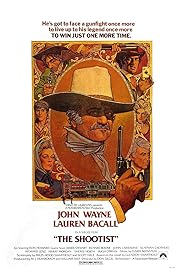
The Shootist – Trailer – YouTube |
Hot Movie Takes – “The Shootist”
©By Leo Adam Biga, Author of “Alexander Payne: His Journey in Film”
Some film artists say that the best pictures invariably result from amiable, feel-good sets. It makes sense. But I’ve read and viewed enough interviews with actors and directors to know that very good, even great work can happen even in the most contentious of working relationships. Too much turmoil is inevitably bound to hurt the work, of course. Some rough patches though might just be what’s needed to get the blood flowing and keep everybody sharp. Though acrimony is not the recommended state of affairs on the making of a film, creativity is often borne of tension and conflict. It sort of comes with the territory when egos, paychecks and budgets are on the line. It’s what you do with the storm that matters. And part of being a professional is rising above the shit to do your job, which is to bring what’s on the page to vivid life. One of my favorite pictures from that great decade of American cinema, the 1970s, happens to be John Wayne’s last film, “The Shootist,” and its making endured a bad relationship between the Duke and director Don Siegel – though you’d never know it from the masterful Western they made together. While they couldn’t fully resolve their differences to make peace on set, they did put their bad feelings for each other aside enough to enable them to do some of the best work of their respective careers.
“The Shootist’ (1976) made a fitting elegy for that great screen icon Wayne. As a John Ford stock player he helped mythologize the West. In his last Western he played an old gunfighter dying of cancer reduced to being a dime novel legend and an unwanted anachronism in the dawning Industrial Age. In real life Wayne had beaten cancer once and there’s speculation that when he made “The Shootist” he knew his cancer had returned. He died of the disease three years later.
That personal resonance with mortality adds a depth to his performance that can’t be acted – only felt. Then there’s the parallel between his character John Bernard Books supposedly being past his prime and out of place in the dying Old West and the arch conservative Wayne being seen as passe and out of touch with the post-Vietnam and post-Watergate era.
“The Shootist” was also made in a period when the Western was being deconstructed and revisionist visions of the West were appearing, all of which seemed at odds with the Ford canon Wayne he was such an integral part of. But Siegel found a story in synch with the times, the man, the mythology and the reassessment. The film is based on a novel by the same name by Glendon Swarthout, whose son, Miles Hood Swarthout, adapted it to the screen with Scott Hale. Siegel was a veteran studio director whose career was mostly spent making B genre movies until the 1960s, when he started getting some A projects. He was known for running a tight ship and not brooking interference. In Wayne he ran up against a living legend who, working outside his comfort zone of cronies Ford, Howard Hawks, Henry Hathaway and Andrew MacLaglen, reportedly made life hell for Siegel by seeing Siegel’s set-ups and saying things like, “That’s not how John Ford would do it.” If true, then that was very disrespectful of Wayne. It may be that the real source of this attempted power play by Wayne had to do with the fact that his conservative leanings clashed with Siegel’s progressive sentiments.
Whatever the source of the problem between the two, they both knew they had a helluva good script on their hands and that Wayne was being given a fitting last hurrah right up there with Spencer Tracy’s last role in “Guess Who’s Coming to Dinner?” Siegel also surrounded Wayne with a strong supporting cast that included James Stewart, Lauren Bacall, Harry Morgan, Ron Howard, Sherrie North, Scatman Cruthers, Richard Boone, John Carradine and Hugh O’Brien.
Aided by good photography, art direction and music, along with authentic sets and locations, the picture has all the requisite elements of a crackerjack Western, and it more than lives up to its promise. Siegel knows how to pace a film and here he finds all the right internal dramatic rhythms to move the story right along but without feeling rushed or shortchanged. It’s a very full picture – very much on par with the best Westerns Wayne made, including those by the great John Ford. The film is a perfect companion piece to Ford’s “The Man Who Shot Liberty Valance” because it shares much in common with that earlier film’s cynical look at printing the legend and the uneasy place that notorious gunmen straddled between fame and infamy. Then there’s the eerie parallel between the way the characters he plays in the two films end up. As Tom Doniphon in “Valance” Wayne sacrifices his own chance at position and acclaim for the greater good by insisting that Tom Stoddard take credit for killing the outlaw Liberty Valance. As John Bernard Books in “The Shootist” he chooses death by gunfight over cancer in order to die on his own terms. Doniphon dies emotionally-spiritually after dispatching Valance and purposefully fading into obscurity. We learn he physically dies alone years later, with his hired hand his only friend. Before Books dies of his wounds in that last gunfight, he does have a fleeting moment with the boy (Ron Howard) who idolizes him. Though each man outlived his usefulness, he remained true to his code to the very end.
_ _ _


Imperial Dreams | Official Trailer [HD] | Netflix – YouTube |
Hot Movie Takes – “Imperial Dreams”
©By Leo Adam Biga, Author of “Alexander Payne: His Journey in Film”
I don’t mean to sound like an advertisement for Netflix, but it is opening me to a world of cinema at my convenience and I am grateful for the enrichment. My latest discovery via the streaming movie service is “Imperial Dreams,” a searing 2014 urban drama by Malik Vitthal that in my estimation at least is every bit the film that this year’s Best Picture Oscar-winner, “Moonlight,” is. The two films tell similar stories in similar settings, namely The Hood. In “Imperial Dreams” it’s Watts in Los Angeles and in “Moonlight” it’s Liberty City in Miami. Each film centers on a sensitive, intelligent young man shaped and scarred by his surroundings. Unlike “Moonlight,” whose protagonist we first get to know as a child, then as a teen and finally as a man, “Imperial Dreams” follows its 20-something year-old main character, Bambi, over the course of just a few days and nights following his release from prison and reunification with his little boy, Day. Because “Imperial Dreams” becomes something of a father-son story, the character of Day is important for representing how Bambi himself grew up: motherless; exposed to violence; living in fear and chaos; being taught to be hard. Bambi’s girlfriend and the mother of his child is doing a stretch in prison herself.
Bambi was raised to be “a soldier” by his ruthless Uncle Shrimp, an Old G who runs drugs and won’t take shit from anyone, not even his nephew. Uncle Shrimp represent the dark pull of that environment that Bambi tries hard to resist. In prison Bambi discovered a love for reading and writing and he’s already had a poem published in a national magazine. Upon his release he wants to escape the turmoil and violence of The Hood and use his gift to educate and inspire young people. Most of all, he wants to protect his son from the mess around him and get him on a different path. His uncle wants him to run drugs, but Bambi adamantly refuses, saying he’s not that way anymore and wants to get a legitimate job that pays wages and doesn’t entail breaking the law and risking his new found freedom.
But, as often happens with ex-cons returning to society, forces beyond Bambi’s control conspire to put him right back into the muck and mire. Even though he’s renounced The Life, he’s surrounded by the same bad influences, temptations and threats that previously led to his incarceration on multiple occasions. On the outside, he soon finds out that despite his best intentions, obstacles prevent him from finding work, from getting a driver’s license, from having secure shelter and from being able to keep his son. Before long he’s on the brink of doing things he vowed he never would again. Worst of all, Bambi gets caught up in events that expose Day to some harsh things that no one, especially not a child, is prepared to handle. As Bambi’s life spirals out of control, the sins of the father are revisited on the son. Bambi is determined to not give up on his dreams no matter how many obstructions are put in his way and come hell or high water he positively will not abandon his boy.
John Boyega is brilliant as Bambi. Pam and I were shocked to learn he’s British because his portrayal of an African-American ex-con is thoroughly authentic. There’s not a single wrong note in this demanding, heartbreaking and ultimately inspiring role. Glenn Plummer is equally brilliant as the nearly sociopathic Uncle Shrimp. Rotimi does a good job as Bambi’s equally ambitious brother Wayne. Keke Palmer is very good as Bambi’s girlfriend and Day’s mother Samaara. And really the whole cast is pretty much spot on, including a small but key performance by Anika Noni Rose as Miss Price, the child welfare officer who empathizes with Bambi and his predicament but follows orders.
The film has a lot to say about the broken criminal justice, penal and social welfare systems in America but it has even more to say about the prisons that ghettos are for many residents. The cycle of despair and dysfunction is too often generational and cyclical. As Uncle Shrimp tells Bambi, “there’s reasons why we are the way we are.”
The film is so well told through words and visuals that it’s hard to believe this was Vitthal’s debut as a feature director. The direction is that assured. He also co-wrote the picture. It has to rank among the best first features ever made. There’s more painful truth and reality in it than you’ll find in much higher profile films dealing with similar subject matter. “Moonlight” deserved all the acclaim it got but “Imperial Dreams” deserves similar recognition. The former was consciously an art film and perhaps a bit more ambitious and original in its storytelling arc and style. But on a pure cinema and narrative storytelling basis, “Imperial Dreams” compares favorably with that film and with the best films I’ve seen in the last half-decade or so. It’s that powerful.
_ _ _
Slums of Beverly Hills Official Trailer! – YouTube |
Hot Movie Takes – “Slums of Beverly Hills”
©By Leo Adam Biga, Author of “Alexander Payne: His Journey in Film”
Re-watched via Netflix one of my favorite comedies from a couple decades ago, “Slums of Beverly Hills,” and found it every bit the caustic comedy of unmannered exuberance I remembered.
Writer-director Tamara Jenkins (“The Savages”) offers her wickedly funny take on a brash, awkward lower middle class Jewish-American family’s bittersweet attempt to use the posh upper crust set zip code for their aspirational pursuits. The roaming Abromowitz clan is led by older single-parent Murray, beautifully played by Alan Arkin, who has charge of his three kids, Vivian, Ben and Rickey, after having split with their mother. Curiously, the movie doesn’t explain why he got the kids and not his ex-wife did but it actually never occurred to me until my partner Pam pointed that plot hole out. I got so caught up in the characters that this seeming lapse didn’t matter to me. Murray has no visible means of support except for the loaner car he and the family use as their personal vehicle, so I guess he’s a car salesman who, as he likes to put it, is just in “a slump.” He gets by on pure bluster and handouts from his prick of an older brother, Mickey, played with great gusto by Carl Reiner. It’s interesting to me that Reiner has proven such a fine actor in his later life because I never liked his acting in the 1950s, 1960s, when he mostly played bland all-American WASPS. The exception to his acting in that era was his turn in as the egomaniacal and neurotic Alan Brady in “The Dick Van Dyke Show,” which of course Reiner created and wrote. Even though by all accounts Reiner’s a lovable mensch in real life, he’s always at his best playing assholes.
Arkin is another mensch in real-life and his best work has largely been playing likable if also neurotic characters, with the exception of his bad guy turn in “Wait Until Dark” and his irascible, politically incorrect grandpa in “Little Miss Sunshine.”
His unapologetic Murray in “Slums” is a one-time restauranteur fallen on hard luck who leads his kids on nomadic quests in the low rent districts of Beverly Hills. In a memorable flashback scene we see that he’s also no one to be trifled with. Now divorced and strapped for income, he wants his kids to have the cachet of a tony address but can only afford shit holes. He’s got pride and so he’s not above skipping out on paying rent when a place proves subpar. He’s clueless how to raise old-soul Vivian, played deftly by Natasha Lyone, who’s budding into womanhood. Aunt Rita joins this traveling family circus after running away from a treatment center. In one of her early turns as a ditzy child-woman, Marisa Tomei hits all the right notes as Rita – crazy, spoiled, heartbroken. Her nonchalant sexuality becomes an education for Vivian and a distraction for Vivian’s oldest brother, Ben, a pot-smoking aspiring musical theater actor. Rita’s presence provokes a despairing Murray to do something he regrets. The baby of the family, Rickey, doesn’t have much to do except fetch his brother’s bong. luxuriate in the shag of the one palatial new digs the family lands in, innocently ask a woman his father’s wooing what a hermaphrodite is and go into a rage when Ben informs him their father is a senior citizen. Rickey doesn’t want anyone to remind him how old his dad is lest it suggest his father may not be around to see him grow up.
For all its dysfunction, this tight family unit works and nothing can break it up. Murray’s indefatigable spirit only flags once, near the very end, and his kids rally him out of his blues to meet the new day head-on with the cocksure confidence of those who have nothing to lose.
Arkin can be dour or manic in films and here he plays the darker, muted tones of an abrasive character who doesn’t know how to show love except to provide for his family, which he barely does. His best moments in the film are when Murray lets his guard down to show his vulnerability. Most poignant is the verbal abuse he takes from his brother with surprising docility,
The real star of the film though is Lyone, who exhibits a great gift for understated satire that meshes very well with Arkin. Lyone brings a worldly wise toughness yet sweet naivety that is just right for her character. She has reason to be disappointed in her dad but in the end she shows how this family rolls when she stands up to Uncle Mickey’s mistreatment of her dad by taking a cue from his past. I also really like David Krumholtz as her older brother Ben. He’s smart and sardonic and his rendition of “Luck Be a Lady Tonight” from “Guys and Dolls,” sung full-throttle to camera while only in his white briefs and white socks, is a min-tour de force.
Rita Moreno has a very brief but effective appearance as Uncle Mickey’s ball-busting wife.
The film’s fixation on breasts and bodily functions and its casual attitudes about sex – from doing it to talking about doing it to exploring it – are in keeping with this family’s let-it-all-hang-out ethos. Vivian and Aunt Rita indulge in a hilarious dance with a vibrator to the tune “Give Up the Funk” and things get pretty funky until someone interrupts the in-jest erotic fun.
If the ironic music sounds familiar it’s because it’s by Rolfe Kent, who scored several of Alexander Payne’s films.
The film’s writer-director Tamara Jenkins went on to make a very different but no less caustic film, “The Savages,” starring Philip Seymour Hoffman and Laura Linney. Jenkins is married to Alexander Payne’s writing partner, Jim Taylor, and Payne helped open doors to get studio financing for “The Savages” and he helped produce the movie as well. She’s in pre-production on her new film “Private Life” starring Kathryn Hahn and Paul Giamatti.
_ _ _
Five Came Back | Official Trailer [HD] | Netflix – YouTube |
Hot Movie Takes – “Five Came Back” II
©By Leo Adam Biga, Author of “Alexander Payne: His Journey in Film”
We finished watching the three-part Netflix documentary series “Five Came Back” about the classic Hollywood filmmakers who served in the military during World War II to make documentaries for the U.S. government. Episodes II and III were even stronger than Episode I, which is really saying something because right from the start this is a thoroughly engaging look at how five men interrupted their very successful careers to do their part in the war effort. Individually and collectively this cadre of artists – John Ford, William Wyler, Frank Capra, George Stevens and John Huston – plus other filmmakers involved in the same wartime work, essentially invented American propaganda filmmaking.
Speaking of invention, three of these five, Ford, Wyler and Capra, went far enough back in the industry that they helped define and refine narrative feature filmmaking in America during the silent era and early sound eras.
As the series progresses it reveals how under the pressures of their war documentary work the filmmakers didn’t always know what they were doing, couldn’t always get what they wanted from military brass and eventually did what they felt they had to do in order to get their films made and seen to their satisfaction.
The real story though is how each of the five featured filmmakers was impacted by what they saw and did in service to their country. Each exited the war a different man than before the conflict and their post-war work often reflected this change, sometimes subtly, sometimes overtly. In the case of Stevens, who was there for DDay, the Allied slog through Europe, the Battle of the Bulge, the liberation of Paris and Berlin and the discovery of death camps, he never again made the light entertainments he was known for prior to the war. Instead, he made heavy, brooding dramas the rest of his career. Wyler lost most of his hearing flying in bombers. He could never have made “The Best Years of Our Lives” as realistic and sensitive as it is about the challenges of returning war veterans had he not been one himself. Ford received a shrapnel would during a Japanese raid. His service in the Navy allowed him to make two of the best and most unconventional war films ever made – “They Were Expendable” and “he Wings of Eagles” – that deal with the high personal cost of duty. After the war Huston’s humanism went to new depths after spending time with troops in remote places and documenting the toll of post-traumatic stress on combat veterans. Capra didn’t witness combat first-hand like the others did but his idealism about the human heart was darkened by the stark, brutal war footage he saw and worked with. His “It’s a Wonderful Life” and “State of the Union” are reactions to the doubt and despair the war induced in him, though his faith in humanity was never completely shaken.
The series smartly pairs a contemporary filmmaker with each of the classic filmmakers. The contemporary filmmakers act as guide and narrator. Steven Spielberg, who executive produced the series with Scott Rudin from the Mark Harris book, is assigned Wyler. Paul Greengrass does Ford. Guillermo del Toro does Capra. Lawrence Kasdan does Stevens. Francis Ford Coppola does Huston. It’s quite evident the current filmmakers have great admiration for their predecessors and they off cogent insights into their personalities and films. Best of all, the series humanizes these iconic Hollywood directors, both the old ones and the new ones, to a degree we haven’t seen before.
Mark Harris adapted his own book for the documentary series and the parallel story he tells alongside the stories of the five classic filmmakers is of the war itself. Purely as a document of the war, “Five Came Back” is worth seeing because of the unique prism it tells that story through, namely through the lenses of these five men whose powers of observation and dramatization produced compelling glimpses of the conflict.
Netflix is also showing some of the documentaries that the “Five Came Back” subjects produced during the war, including Wyler’s “The Memphis Belle,” Ford’s “The Battle of Midway” and segments from Capra’s “Why We Fight” series.
_ _ _
Poodle Springs 1998 – YouTube |
Hot Movie Takes – “Poodle Springs”
©By Leo Adam Biga, Author of “Alexander Payne: His Journey in Film”
Iconic crime writer Raymond Chandler died before he could finish his last detective mystery featuring his signature gumshoe creation Philip Marlowe. That final novel, with the working title “The Poodle Springs Story,” was completed decades after his death by noted contemporary crime writer and Chandler fan Robert B. Parker at the request of Chandler’s estate. Parker then adapted the book to the screen for director Bob Rafelson’s 1998 HBO movie “Poodle Springs” starring James Caan as Marlowe. That movie is available in full and for free on YouTube and I recommend it as a very good and interesting update of the Chandler world, the Marlowe mystique and the film noir genre.
Rafelson knows this territory well. He directed a strong, steamy remake of “The Postman Always Rings Twice” starring Jack Nicholson and Jessica Lange and he cast Nicholson twice more in crime stories, the disastrously reviewed comedy “Man Trouble,” which I’ve never seen, and the well-regarded “Blood and Wine,” which I can vouch for as a good film. Rafelson also directed Nicholson in “Five Easy Pieces,” and while that isn’t a crime film it has a neo-noir feel to it and the lead character of Bobby Dupree shares a lot in common with the anti-hero attitudes of noir protagonists.
In “Poodle Springs” Rafelson and Caan hit all the right laconic, languid and sarcastic notes we’ve come to expect from the Chandler-Marlowe canon. I think Caan is every bit as good as the most famous Marlowe interpreters from the past – Humphrey Bogart, Dick Powell and Robert Mitchum. I haven’t seen Elliot Gould, James Garner, Powers Boothe and Danny Glover’s characterizations of him yet, so I must reserve judgment on their portrayals. Caan’s iteration of Marlowe finds him well into middle-age with a bit of a paunch and newly married to a socialite young enough to be his daughter. Dina Meyer is smart and sultry as his hottie mate, Laura Parker. She has a rich, land-hungry daddy. J.P. Parker, played by Joe Don Baker, who’s thick with the Kennedys and mixed up in shady dealings with cutthroat businessman Clayton Blackstone, played by Brian Cox. The ruthless Blackstone will go to any lengths to protect his deranged daughter. Marlowe gets entangled in a mess that only gets worse with every new twist and turn and by the end the lies and bodies add up.
Some other character-actor notes: David Keith makes a fine scumbag as pornographer Larry Victor; Tom Bower, as Lt. Arnie Burns, does a good variation on the grizzled cop trying to keep Marlowe in line; Nia Peeples is a real fright as Angel; Julia Campbell is a bit too nutty for my tastes as Miriam “Muffy” Blackstone, and Sam Vlahos is outstanding as Eddie, the philosophical enforcer. Par for the course with Chandler, many of the characters lead double lives that Marlowe’s persistent digging uncovers.
Along the way, Marlowe must fend off forces that variously want to pin him to crimes he didn’t commit and buy him off to keep him silent. Negotiating the upper class proves every bit as treacherous as the criminal element he’s used to dealing with. Always looking ill at ease among the monied set, he can’t wait to get back to his own environment. The question is: Will he and Laura make things work between them given they’re from such different worlds? The script, by the way, has both Marlowe and Laura make fun of their age difference.
The setting is early 1960s Los Angeles and Nevada and those facts alone give the story ample room to play with some intriguing social-cultural-political themes of that time period and those places.
Much of the movie stacks up well with another film noir I recently posted about, the great “Chinatown,” and really the only things that keep “Poodle Springs” from rising to that level is a bland music score and rather pedestrian photography. If those two elements had provided more moody atmospherics then I think “Poodle Springs” would resonate more strongly with audiences and critics and be widely considered a new classic in the genre.
I also think Rafelson and Parker might have hedged a bit too far in the direction of snappy repartee and wiseass indifference because, as one critic noted, there’s not the sense that anything really is at stake here. I mean. there clearly is, because people are getting knocked off left and right, but because Marlowe doesn’t seem to care too much we don’t either. Because the tone of the film seems to suggest we ought not to take things too seriously it may somewhat undermine the sense of threat and danger that Marlowe faces. Of course, real jeopardy didn’t face earlier incarnations of Marlowe either. We knew going in that no matter how dark and dicey things got for Bogie or Mitchum, they’d come out of it alive, if a little worse for wear.
In my opinion, James Caan has never quite gotten the respect he deserves as an actor. It didn’t help that he dropped out of circulation for five years and turned down many notable roles that would have changed the trajectory of his career. Still, his body of work is formidable and his range is impressive. Because of his excellent portrayal of Sonny in “The Godfather” he’s always associated with tough guy roles and crime films and he is unusually effective in them. I rank his performances in “The Gambler” and “Thief” among the best of their era and I consider those two of the best films from the 1970s-1980s. Sticking with the crime theme, he also did very good work in “Freebie and the Bean,” “Hide in Plain Sight” and “Alien Nation” among many others in this vein. So playing Marlowe was certainly no stretch for him and I think he put his own inedible stamp on the character.
_ _ _

Hot Movie Takes Wednesday
“The Way”
©By Leo Adam Biga, author of “Alexander Payne: His Journey in Fim”
Netflix is my preferred way to catch up with movies I missed at the theater. Using that subscriber service I finally caught up with the 2010 Emilio Estevez-directed film “The Way.” It portrays a grief-stricken father, Tom, played by Martin Sheen completing the El camino de Santiago walk that his character’s estranged son, Daniel, essayed by Estevez, died on during an earlier attempt. When promos for the movie ran upon its original theatrical release I was immediately drawn to the subject matter and to the real-life father-son combination in the leads but I just never got around to seeing the pic. It was worth the wait. Estevez co-wrote the screenplay with Jack Hitt, the author of the book the movie’s based on. Their writing, Estevez’s direction and Sheen’s performance infuse a depth of feeling in the material that’s never maudlin but rather authentic. When we first meet Tom, we’re introduced to a cynical, well-off dentist who cannot accept his son Daniel’s choice to drop-out of a career to go find himself on adventures. Tom reluctantly sees Daniel off on his pilgrimage to Europe and soon thereafter gets news of his death. The angry, bereaved father goes to France to collect his son’s remains and decides the only way he can ever know him, even in death, is to make the trek his son set off on. Using his son’s gear and seeing visions of him at various points along the way, Tom completes the weeks-long journey by foot in the company of a motley band of fellow travelers from different countries. Each carries his or her own emotional-psychic baggage. While the members of this not-so-merry-band are there for their own personal reasons, they’re all in search of release from the burdens they bear. The Way becomes an act of individual and communal grace as they surrender what troubles them to the higher power of their understanding.
The trek takes Tom through various grieving stages. By the end, his rage and guilt have finally given over to love and gratitude. By almost literally walking in Daniel’s shoes and spreading his ashes along the route, Tom’s made a spiritual connection with his lost son that’s allowed them to complete The Way together. At the finish, having processed a range of emotions, there’s a sense of peace and atonement in Tom. whose humbling experience has renewed something lost in him: joy.
I love that Sheen was given one of his best lead roles by his son. Sheen never became a film superstar in the way many of his contemporaries (Dustin Hoffman, Robert De Niro) did, which I’ve never understood why, but he’s had a great career nevertheless. He gave one of the best performances I’ve ever seen on screen as the title character in the made-for-TV movie “The Execution of Private Slovik.” He’s also the star of two of the best films of the 1970s – “Badlands” and “Apocalypse Now” – that rate as masterpieces of any era.
Sheen hasn’t lost anything as an actor as he’s aged. If anything, he’s only further ripened and refined his work. Similalry, Estevez has matured as a filmmaker. His work seems more assured and modulated and not so desperate to make a point or show off a technique. I like the subtle way he used aspects of magic realism in “The Way.” Daniel appears to his father on the walk not as a ghost or as a divinely sent messenger but as a reassuring presence. Estevez, who’s only seen on screen for a few minutes, is appropriately subdued and serene in those moments. By contrast, the film opens with a tense exchange between Daniel and Tom that informs us how much these two have grown apart. The fact that Sheen and Estevez are father and son in real life gives this scene added weight. Neither overdoes it. They find the right tone that rings true.
The actors who play Tom’s fellow trekkers and seekers are all well-cast and I like how each tests Tom in different ways. With them as companions, the American gets far more than he bargained for on the journey. With his son as his gentle guide, he finds a union and understanding with Daniel he couldn’t in life. In reaching the end, Tom’s not only completed the physical journey but he’s completed something in himself. What was broken is healed.
“The Way” reminds us we sometimes have to shed all we know in order to find ourself.
_ _ _


Hot Movie Takes Monday:
“Deidra & Laney Rob a Train”
©By Leo Adam Biga, Author of “Alexander Payne: His Journey in Film”
This Netflix original movie is one of the most entertaining little nuggets to come across my home TV screen in a while. It’s essentially a screwball comedy for the millennial age. Teenage sisters Deidra and Laney literally live on the wrong side of the tracks of a nowheresville Idaho town that they just might be stuck in for life due to circumstances seemingly beyond their control. They live on the margin with their younger brother and mother, who’s struggling to make ends meet. The pressures are intense and when the mother loses it at her job and causes property damage, she winds up in jail. That leaves Deidra, a bright high school senior anxious to get out of town via a college scholarship, suddenly left in charge of her siblings and trying somehow to keep them fed and sheltered without an income. With child protective services breathing down their necks and threatening to place Laney and her little brother in foster care and utilities getting shut-off, Deidra hatches a plan to rob the freight trains that pass right by their house every day and represent a way out to some idealized better place or future. The kids have more than a passing connection with the trains that roll by because their estranged, ex-felon father works for the railroad. Playing around the tracks and walking the rails, even hopping freighters for joyrides, is part of growing up there.
Romanticizing the outlaw train robber tradition in her head, Deidra enlists Laney in her plot to stage not just a single robbery but a string of them. The girls approach it almost like an extracurricular school project, complete with decorated charts. Their plan is to break into shipping containers carried on flatbeds and steal portable consumer goods they can then sell on the black-market. The proceeds from these ill-gotten gains will pay their mother’s bail, keep the wolves from the door and help Deidra get to college. The plan unfolds pretty much the way they imagined it before unexpected things happen and all hell breaks loose.
I love the anarchic, absurdist, yet plucky and practical spirit of these down-and-out sisters arriving at an expedient if dangerous and illegal means to an end. Nobody’s really hurt by their plundering. It’s all insured after all. That’s one school of thought, anyway. The film actually does stay grounded enough in reality to have several characters push-back at Deidra’s thievery, including a reluctant Laney, a loopy school counselor who becomes a co-conspirator, a sympathetic cop and the girls’ dad, Chet, who volunteers to be their inside man at the railroad. When Chet, a proverbial loser and opportunist, finds out what his girls are doing he doesn’t try stopping them, he actually takes perverse pride in their following their old man’s criminal ways. He also seizes on helping their illicit enterprise as a way to bond with his kids and to rekindle the flame that hasn’t extinguished between him and their mother.
The one part of the movie I could have done away with is the demented railroad detective who goes overboard with his investigation into the robberies. It’s a little too heavy-handed for a comedy that depends so much on striking a delicate balance between reality and fantasy, drama and farce. But it does serve its purpose in the end.
I think it’s important to note that this is a screwball comedy in the vein of “Juno,” “Little Miss Sunshine” “Superbad” “Fast Times at Ridgemont High” and “Election” only its protagonists are African-American, not white. We rarely see blacks in coming-of-age comedies of this quality and in stories that don’t make their blackness an issue. In fact, there’s nothing in the story specific to the characters’ racial identity and that’s proof of how many films could be color-blind cast if producers and directors would only chose to do do. Deidra, Laney and their brother are the bi-racial products of their mother, who’s a woman of color, and their father, who’s white, but it’s all played in a taken-for-granted, this-is-just-how-it-is manner that is actually refreshing and true to life. I mean, most people aren’t bogged down by their racial identity every day, and if the story had made that a plot point or theme it might have worked out just fine but it might have also gotten in the way. Most of the problems the girls face – peer pressure, academics, issues of self-worth, sibling conflicts and family dysfunction – are universal across race, culture and socio-economic status anyway. We’re talking about getting through the day, rites of passage survival here.
The real joy of this movie rests in the performances of its two leads, Ashleigh Murray as Deidra and Rachel Crow as Laney. They are really good young actresses who fully inhabit their roles, bringing loads of intelligence and passion to characters who are a bundle of emotions and contradictions. Each suitably plays vulnerable and tough and unlike many family-based stories I absolutely bought them as sisters even though they look nothing alike. Sasheer Zamata as the counselor also stands out.
This movie has received mostly tepidly positive reviews and I’m at a loss to understand why it’s not more strongly embraced. I think one reason may be that a lot of people don’t understand the screwball comedy genre. This form of film all about letting your defenses down and taking an anything-goes approach. Today’s best screwball comedies are more reality grounded than those of the past but I’m left scratching my head when people take this film to task for depicting poverty in such a frothy manner. What? First of all, it’s a screwball comedy, and even so I don’t see anything frothy about two girls desperate enough about their straits that they start robbing trains. I mean, when is desperate not enough of a measure of human despair? Implicit in the reaction against the film’s light touch is criticism for its lack of depth, as if, say, “What About Mary” or “Dumb and Dumber” or “Bringing Up Baby” or “The Producers” are deep wells of human insight by comparison. No, “Deidra and Laney Rob a Train” is precisely true to what it means to be – a comedy not so much about teen angst but about what people are prepared to do when pushed to the edge. That precipice is where the best comedy usually comes from. Just ask a guy who knows a thing or two about comedy – Oscar-winning filmmaker Alexander Payne (“Election,” “Sideways,” “The Descendants,” Nebraska”).
An interesting side note: The opening half-minute of the film establishes the bleak town the characters live in via a montage of visuals and music that is tonally and rhythmically dead-on in-synch with Payne montages that similarly establish place. I have to believe that director Sydney Freeland and cinematographer Quyen Tran consciously or unconsciously took inspiration from Payne’s treatments of this same filmic territory. And it’s no coincidence there’s resonance between the opening music of “Deidra and Laney Rob a Train” and Payne’s “Nebraska” because composer Mark Orton did the music for both films.
Look for my next Hot Movie Take on the Emilio Estevez film “The Way” starring his father Martin Sheen.
_ _ _


Coming Through the Rye Official Trailer 1 (2016) – Alex … – YouTube |
Hot Movie Takes – “Coming Through the Rye”
©By Leo Adam Biga, Author of “Alexander Payne: His Journey in Film”
Is it heresy to admit I don’t think much of that touchstone coming of age of book “Catcher in the Rye”? I mean, it seems to be so much a part of so many young people’s walkabout through adolescence and young adulthood that I almost feel obligated to fall in line with the majority opinion and stake my own psychic claim to it even though I would be lying. Mind you, I’m basing my personal take about the book on a single reading of it I made years ago. I did not come to the book in my adolescence but rather in the full flower of my adulthood, and so perhaps that accounts for some of my ambivalence about the revered J.D. Salinger work. Maybe I simply came to it too late to fully appreciate it. I just remember feeling let-down by the whole thing and not much connecting with Holden Caulfield even though I identified with some of his traits and attitudes. It seemed to me that while Salinger truthfully expressed through Caulfield what so many young people of any generation feel, there was nothing much revelatory about any of it. Maybe I’ll give it another go some day. My thoughts about the book were triggered by a movie I caught on Netflix the other night – “Coming Through the Rye” (2015), about a New England prep boarding school student with a persecution complex who takes his Caulfield fixation to extremes by penning a play based on the book. The character of Jamie Schwartz doesn’t stop there. He wants to put the play on at school and to portray Caulfield. Trouble is, his advisor tells him he needs to get Salinger’s permission to produce the adaptation of the iconic novel. Jamie’s attempt to reach the author through Salinger’s agent goes nowhere. That’s when Jamie sets out to find the reclusive writer who’s turned down fortunes from leading directors and producers to adapt his book for the screen and stage. Finding Salinger becomes Jamie’s challenge and quest. Jamie is a boy poised to enter manhood who has lost the two loves of his life – his brother and a best friend at school. He’s also infatuated with the idea of Holden Caulfield or what he stands for, even though it’s as elusive as Salinger himself. Thus, Jamie is perpetually love-sick, though he doesn’t know it. Of course, the journey he takes in search of the author becomes a crucible and catharsis as he confronts feelings long buried about the death of his older brother in Vietnam and a betrayal between friends. Alex Wolff is splendid as the conflicted Jamie, Stefania LaVie Owen hits just the right notes as his best gal-pal Deedee and Chris Cooper is spot-on in his interpretation of the wary Salinger – who just wants to protect what he created. Writer-director James Steven Sadwith basically tells his own story in this film. In real life he was a love-sick boy infatuated with Caulfield and “Catcher in the Rye” and made his own cockeyed pilgrimage to find the author. The movie reminded me a bit of two other prep school films I adore – “Rushmore” and “The Chocolate War.” I don’t know why “Coming Through the Rye” doesn’t have a stronger reputation, but I dare say it’s a movie worth your time no matter how you feel about “Catcher” and Salinger.
In case you missed it – Leo’s Hot Movie Takes, March-April 2017
Hot Movie Takes – “Queen of Katwe”
©By Leo Adam Biga, Author of “Alexander Payne: His Journey in Film”

India native and longtime American resident Mira Nair deserves to be mentioned in the same breath with the great English-language filmmakers of the last quarter-century, but I’m afraid that because she’s a woman you’re unlikely to know the name. I have long been an admirer of her work (“Salaam Bombay!,” “Mississippi Masala,” “Monsoon Wedding”) and my esteem just grew after watching her “Queen of Katwe” on Netflix. This true story set in the Katwe slum of Kampala, Uganda follows the journey of a girl who rises to international grandmaster chess champion with the loving support of a coach who recognizes her talent and mentors her to excel despite the severe challenges she faces at home. Living in the kind of poverty Americans don’t know, Phiona is one of four children being raised by a single mother whose strict principles are meant to keep her family together and her kids free from exploitation. The mom doesn’t trust the coach at first but comes to see that chess may indeed be a way out for Phiona, whose prodigy abilities eventually take her far from home. Once Phiona has a glimpse and taste of life outside the slum, it causes her to rebel, for a time, before she realizes that what she wants more than anything is to win enough competitive chess prizes to open up doors that will enable her family to escape the daily threats and struggles for survival that make dreaming a luxury that can’t be afforded by most residents. Phiona must overcome self-doubt and learn some tough learn lessons in order to mature enough to achieve her dream but in the end there’s nothing that can deter her. Against all oddes, she becomes an inspiration to her community and her nation. And as the grace notes at the end reveal, Phiona and the other prinicpal charactrs depicted in the film are no longer surviving but thriving and still inspiring others.
This 2016 co-production of Disney and ESPN films is based on a book by the same title by Tom Crothers, who adapted the story to the screen with William Wheleer. Madina Nalwanga is outstanding as Phiona. David Oyelowo is perfectly cast as her coach Robert Katende, who in real life has gone on to start hundreds of chess clubs throughout Uganda. Lupita Nyong’o is great at Phiona’s mother Nakku Harriet. The cast from top to bottom is very good and Nair found many of the children in the film in the slum of Katwe where most of the picture was shot. Having visited some Kampala’s slums myself, I can tell you she shows you just as it is: an unending sea of disheveled shanties pressed up against each other; rutted dirt roads; gullies for sewers; men, women and children on foot lugging by hand jerry cans full of water or balancing atop their heads provisions for home or goods to sell at market; boda-bodas appearing out of nowhere; markets jammed with people, stalls and vehicles; and rainstorms that create rivers of debris and detritus. And everywhere, the colors of the rainbow in the clothes people wear, in the over-laden market stalls, in the red dirt and the green countryside.
Nair also shows the sharp discrepancy between the lives of the slum children, many of whom do not attend school, and those of the privileged children at private schools. Unfortunately, slum kids there are looked down on and made to feel less than there just as they are here. In my visit to Uganda I met many community organizers just like Robert Katende working to improve the lives of children and their families.

The filmmaker knows Uganda because she lives part of every year there. It’s where her husband Mahmood Mamdani was born and raised until he and his family were expelled during the Ida Amin revolution.
Nair, who comes from a documentary film background, has a knack for realistically portraying ghetto life in her dramatic features. You won’t see stereotypical images or characterizations in her work but rather carefully observed humanity. Her “Salaam Bombay!” won international acclaim for its dramatic story of street children. Most of the kids in the film actually lived on the streets of Bombay. Similarly, her “Queen of Katwe” is filled with people who live and work in the very environment she depicts.
There are a several Nair feature films I’ve never seen that I need to seek out – “The Perez Family,” “Kama Sutra: A Tale of Love,” “Vanity Fair,” “The Namesake” and “The Reluctant Fundamentalist” – because she never disappoints with her humanistic explorations of the human heart.

Queen of Katwe – Official Trailer2:25YouTube · 2,381,000+ views
So, why isn’t she and her work better known?
Hollywood remains a mail-dominated industry and that extends across production (both behind the scenes and in front of the camera), finance, marketing and even to those who write about the movies. Male filmmakers like Steven Spielberg, Martin Scorsese, David O. Russell, Ridley Scott. Quentin Tarantino and Christopher Nolan are lionized by an apparatus that makes superstars and household names of certain directors, almost always male directors. The handful or so of women directors who have achieved some wide notoriety, such as Kathryn Bigelow, Jane Campion, Julie Taymor and Barbra Streisand, get their moment in the sun for a year or two, surrounding a certain project, and then disappear again. Women directors don’t enjoy the same kind of popular branding, mythologizing and following that men get. In the annals of film history, I can only think of two dozen or so women directors of English-language films who have enjoyed anything like a sustainable and highly praised career despite doing very good, even brilliant work:
Dorothy Arzner
Ida Lupino
Shirley Clarke
Barbara Loden
Lee Grant
Joan Micklin Silver
Martha Coolidge
Penelope Spheeris
Amy Heckerling
Gillian Armstrong
Penny Marshall
Mira Nair
Barbra Streisand
Kathryn Bigelow
Jane Campion
Julie Dash
Kasi Lemmons
Nora Ephron
Tamara Jenkins
Betty Thomas
Nancy Meyers
Jodie Foster
Diane Keaton
Julie Taymor
Sofia Coppola
Mary Harron
One of the above is Omaha native Joan Micklin Silver, whose sublime body of work (“Hester Street” “Between the Lines,” “Chilly Scenes of Winter,” “Crossing Delancey,” “Loverboy”) is sadly neglected.
Only one woman, Kathryn Bigelow, has ever won the Oscar for Best Director. Not many more have been nominated in that category. You can bet there have been many deserving women, including women of color, who have been passed over. Mira Nair is one of them.
Mira Nair – IMDb
http://m.imdb.com/name/nm0619762/
_ _ _
Hot Movie Takes – “Southside with You”
©By Leo Adam Biga, Author of “Alexander Payne: His Journey in Film”


Finally saw “Southside with You,” the 2016 dramatic film that lovingly, tenderly, never cloyingly portrays the first date that then-Michelle Robinson had with Barack Obama in 1989. And, oh, what a date it was in forging a bond that would not be broken. I am happy to report that it is a first-rate romantic movie worthy of the future First Lady and the first African-American U.S. president because it depicts them just as they were then – two young, idealistic lawyers still finding themselves and what they wanted to do with their lives. Tika Sumpter and Parker Sawyers are sensational as Michelle and Barack, respectively. They capture the fullness of their humanity, intelligence, wit and grace. They nail the dynamic the couple enjoyed as highly educated, aspirational young professionals looking to make a difference in the world.
They nail, too, a desire to find a soulmate with whom they can share their life. But neither will be easily satisfied. Each has defenses and hurts that must be overcome if they’re to let their guard down enough to let someone else in.
Writer-director Richard Tanne very smartly confines the entire story to everything surrounding that first date. The preparation. The anticipation. The awkward feeling out process. The long walks and talks. Viewing an Afroc-centric exhibition at a museum. Taking in a community meeting. Seeing Spike Lee’s “Do the Right Thing.” The after glow of their day into night first date.
We witness an intimate meeting of minds and hearts. The simple but revealing activities of that first time out on the town encapsulate what formed these two serious people, what drove them and why they were attracted to each other. The film reminds us that when really good writing is provided to well-cast actors under the direction of someone who knows how to stage things, then the mere act of two people talking to each other can carry an entire film. It works so well because the characters are firmly established at the very start and everything that flows from there reveals ever more layers of their personality and chemistry. I wondered during the film if I would care as much about these characters if they weren’t Michelle and Barack and I decided, yes, that these two people are engaging enough that I would still be swept up in their orbit. I would still want them to connect and for their budding relationship to click,
When the events of the film take place, the two of them work at the same law firm. She’s an associate and he’s an intern. She acts as his advisor there as he learns the ropes. It’s Barack who initiates their seeing each other outside of work on the pretext of taking her to a meeting he feels certain she’ll find interesting. She’s adamant about their outing not being a date and he’s just as insistent that it is a date as far as he’s concerned. We learn he’s been pestering her to go out with him for some time. On their various stops that fateful day in their lives, they learn vital things about each other that confirm they share many of the same passions even if they don’t always see eye to eye on everything.
Michelle really makes Barack work to earn entry into her heart and win her over. The clincher, we think, is when he’s asked to speak at the community meeting and he charms the crowd with his genuine, charismatic message of hope. She sees the common touch he has with people. But it’s really when he buys her her favorite ice cream that she finally melts.
I was amazed to discover this was Tanne’s feature film debut. He is a talent to be watched. Sumpter co-produced the film with him and music artist John Legend executive produced the project. The creators made the film on location in a variety of spots that Michelle and Barack actually traversed that first date – from downtown to the South Side to the West Side. It all plays out very naturally and organically, not forced or contrived.
I didn’t know either of the lead actors before this film but they both have impressive credits and I will definitely be looking for them from here on out because each brings an appealing presence to the screen, Together, they have real chemistry.
I like that the story ends with them basking in their individual homes after the date – each filled with his/her high from the heady experience. Their bright futures are before them and they already know they want to be together for wherever their journeys lead. They couldn’t possibly have known what history they would be making barely more than a decade and a half later. We’re left with two young people on the move, newly in love, and eager to make their mark. They certainly would go on to do that. Hell, the Obamas are still only in their early 50s and may have decades ahead of them to make even more impact.
For some reason the film didn’t do much at the box office but I hope it is finding its audience online. It did deservedly receive many away nominations. I found the film on Netflix and I’m sure it’s available on other viewing platforms as well. Check it out, as I’m sure you’ll find it well worth your time.
Hot Movie Takes –
My recap of Julianne Moore in conversation with Alexander Payne
©By Leo Adam Biga, Author of “Alexander Payne: His Journey in Film”

Image source : omaha.com
Alexander Payne owns enough cachet as a preeminent writer-director that he can pretty much get any peer film artist to join him for a cinema conversation at the Film Streams Feature fundraiser in Omaha. His latest get was Oscar-winning actress Julianne Moore. Monday night (April 24) Payne, a two-time Oscar-winner himself, and Moore talked craft and life at the Holland Performing Arts Center before a packed house. This seventh feature event raised a record $350,000 in kicking off the art cinema’s project to renovate and return the Dundee Theater back into service as a historic cultural touchstone and film haven.
Before Payne and Moore came on, Film Streams founder and director Rachel Jacobson thanked the assembled crowd, including many of its top patrons. She described the affair as “a magical” night for Omaha and she referred to the “extraordinary and inspiring support” that not only made the evening event possible but that’s making the growth of Film Streams possible. She called this “a busy and exciting time for Film Streams,” which is coming up on its 10th anniversary and nearing completion on the renovation and return of the Dundee Theater. She signaled the theme of the event in saying that cinema as a medium can help shape our dreams and that cinema as a place can help shape our community. She then introduced a TCM-like short tribute film produced by Tessa Wedberg and Jonathan Tvrdick that heralded the history of Film Streams and of the Dundee Theater. Many familar faces contributed comments in the film, including Payne, who praised Film Streams as a nonprofit cinemateque and echoed remarks by Jacobson and others about the important role it plays in treating film as an art form and thus as a conveyor of ideas and a convener of diverse audiences and issues. Payne brought things full circle by saying about the Dundee Theater, “Before Film Streams it was the only reliable place to see an art film (in Omaha).” He added his delight in soon having the Dundee back because it means art cinema is “now rooted in a place in Omaha of historical significance.”
These Inside the Actors Studio-like Feature events are not exactly thrilling entertainment and the intrigue of seeing and hearing world-class film figures soon wears off, especially sitting in the nose-bleed section, where anything resembling an intimate exchange gets lost in translation. Usually there’s not much new we learn about either Payne or the special guest and their individual processes but just enough nuggets are revealed to make the evening worthwhile beyond merely a financial windfall for Film Streams.
Payne is a capable interviewer and he thoughtfully let Moore do most of the talking. In the buildup to the event it was noted that she has a significant Nebraska connection having lived four years of her childhood here while her military father was stationed in the area and completed law school studies here. Moore attended one year at Dundee Elementary School and her family lived in a Dundee duplex. Payne shared that had he started Dundee Elementary, where he ended up, he and Moore would have been in the same class. That reminded me that filmmaker Joan Micklin Silver and cinematographer Donald E. Thorin were classmates at Omaha Central and that Dick Cavett and Sandy Dennis were only a class or two apart at Lincoln High.
Moore told us how during her visit for the Feature event she toured her old Omaha haunts and remembered various aspects of her family home here, her playing in the paved alley and walking a few blocks to school.
Her family followed her father’s assignments, ending up in Germany, where she found a high school teacher who encouraged her interest in theater. It was the first time someone told her she could make a living at acting and steered her toward drama schools. Not surprisingly her parents were horrified at the prospect of her trying to forge a career as an actor. Family’s important to Moore, who spoke with genuine pride about being a mother and wife in addition to being an actress.
Payne noted to her that many actors share an itinerant growing up background, including the military brat experience, and Moore said she feels that all the moving around teaches one how “to be adaptable” and to be quick, careful studies of “human behavior.” Combined with her natural curiosity and a love of reading, and she had all the requisite attributes for an aspiring actor.
Moore found her calling for the stage at Boston University, where she learned the techniques that would help carry her into the theater. Her lessons there were both a blessing and a curse as she said she felt she was taught to do exterior rather than interior work. She acted at the Guthrie, the Humana Festival, in off-Broadway plays. She broke into television in the mid- 1980s working on a soap and by the early 1990s she’d done her fair share of episodic series work, made for TV movies and mini-series.
For the longest time, she lamented, “I couldn’t book a movie.” But then she started getting small but telling parts in buzz-worthy pictures like “The Hand That Rocks the Cradle,” “The Gun in Betty Lou’s Handbag,” “Body of Evidence,” “Benny & Joon” and “The Fugitive.” All decent movies, but purely popcorn fare.
She explained that her epiphany as an actor came when she learned to not just be prepared for something to happen in an audition or a performance but to freely let it happen. In fact, to invite it to happen. “It” being an emotional response.
Her career took a different turn when she found herself in larger, showier parts in independent films made by serious filmmakers: Robert Altman’s “Short Cuts,” Louis Malle’s “Vanya on 42nd Street” and Todd Haynes’s “Safe.” She got in on the very beginnings of the modern indie movement and embraced it as a home for exploring real, true human behavior.
Then, after a commercial venture or two, she cemented herself as an indie film queen in Paul Thomas Anderson’s “Boogie Nights,” the Coen Brothers’ “The Big Lebowski,” Altman’s “Cookie’s Fortune” and Neil Jordan’s “The End of the Affair.” That just brings us up to the end of the 1990s. In the proceeding 17 years she’s added to her impressive gallery of work performances in such films as:
“Hannibal”
“The Shipping News”
“Far from Heaven”
“The Hours”
“Children of Men”
“I’m Not There”
“Blindness”
“The Kids are Alright”
“Game Change”
“The English Teacher”
“Still Alice”
“The Hunger Games: Mockingjay Part I”
“The Hunger Games: Mockingjay Part II”
By the way, Film Streams is screening a repertory series of Moore’s films through May: Check out the series at–

I personally haven’t seen that much of her work, but what I have seen has impressed me. More importantly, her work impresses her peers. Count Payne among her biggest admirers. In his introduction he even referred to her as “our other Meryl Streep,” and hoped that she would take that loving comparison in the right way. She did. It turns out that Streep has been a major influence and inspiration for her. Payne said her interpretive, expressive skills are so finely honed that when watching one of her performance “we are truly seeing another person and, by extension, us.” Moore always gives whatever her character demands, thus taking on those vocal, physical, emotional traits, but never fails to give us herself as well. And I think Payne was also suggesting that, like Streep, she has that transformative ability to live inside very different skins from role to role without ever losing the humanity of those characters.
Payne and Moore got into an interesting discussion about how an actor’s responsibility is to study the director to know what film he or she is making. She said it’s important that she know what a director is trying to communicate in the frame in any given shot or scene and where the director’s eye is looking. Indeed, she said she believes the director’s main job is to direct the audience’s eye. She said she likes to see dailies to help her guage things but that some directors are overprotective and defensive about letting actors, even ones of her stature, see the work before it’s been refined and edited. Payne said it’s vital that the actors and the director are on the same page so that they know what film they’re making as co-storytellers.
Moore described movies as “an elaborate game of pretend” and she and Payne talked about how actors and directors have to find common ground with each other’s processes. In the end, they agreed, the script must be served, not egos. Payne also referenced something he told me in a recent interview: that because he only makes a movie every three or four years he’s often the least experienced person on the set and so he very much appreciates the experience and expertise that cast and crew bring. Moore seconded what a collaborative process any film is.
Interspersed through the conversation were clips from a handful of Moore’s films and even those brief excerpts demonstrated her intuitive talents and keen observations. She talked about the extensive research she ever more does for her parts in a never ending pursuit for what is present, real, truthful and alive. It is that pursuit that drives her. She said, “I become more and more deeply interested in it – human behavior.” She believes, as Payne believes, that we fundamentally want movies to reflect our experiences back to us. Invariably, the more human the movie, the more indelible it is.
Payne said to her, “I have the deep impression your best work is ahead of you, not behind you.” Interestingly, I feel the same way about Payne’s work. In some ways, his “Downsizing” may mark the end of a certain strain of themes in his work having to do with protagonists in crisis, mostly males, who set off on some journey. and it may also be the bridge to a new Payne cinema of big ideas and diversity.
It’s even possible the two artists may wind up working together in Omaha. Payne intimated as much. That might have just been wishful thinking or something one says in the giddiness of the moment, but it’s the kind of thing that Payne doesn’t usually say or do, especially not in public, unless he means it. His final words were, “She’ll be back.”
The discussion wasn’t entirely confined to career. Moore spoke glowingly of her roles as wife and mother. She tries to work on as many films as she can that shoot where she and her family live – New York City – so that she can have more time with her family. Payne pointed out she’s also the author of children’s books and he had her talk about her love for hand-crafted furniture and for home design and decor. It’s a passionate hobby of hers.
What Hollywood icon will Payne bring next? It’s anybody’s guess. My personal preferences would be for him to sit down and converse with more of the leading actors he’s worked with, including Matthew Broderick and Reese Witherspoon from “Election,” Paul Giamatti ad Thomas Haden Church from “Sideways,” Jack Nicholson from “About Schmidt,” George Clooney from “The Descendants” and Matt Damon from “Downsizing.”
Another preference would be Payne doing a similar program with fellow Nebraska natives in film, such as Joan Micklin Silver. Nick Nolte, John Beasley, Marg Helgenberger, Gabrielle Union and Yolonda Ross.
Then there’s my long-dreamed of event featuring Payne one-on-one with Robert Duvall, who in the late 1960s came to Nebraska to make the Francis Ford Coppola film “The Rain People” and later returned to make the great documentary “We’re Not the Jet Set” about an Ogallala area ranch-rodeo family. Link to some of the story behind the amazing confluence of talent that came to Nebraska for what became three films at–
https://leoadambiga.com/film-connections…ucas-caan-duvall/
_ _ _
Hot Movie Takes – “Chinatown”
©By Leo Adam Biga, Author of “Alexander Payne: His Journey in Film”

Languid has never felt as sexy or as menacing as it does in “Chinatown,” the great 1974 film noir classic that hasn’t been topped since. Not even close. Robert Towne wrote a script that many feel is as perfect a screenplay as has ever been written. Roman Polanski’s interpretation of that script is so fully developed that he creates as evocative a work of expressionistic screen drama as I’ve seen. The photography by John Alonzo, the editing by Sam O’Steen and the music by Jerry Goldsmith are in perfect sync with the redolent rhythms and moods of this hard-boiled period piece set in Depression-era Los Angeles. The locations and sound stage sets all complement the out-of-his-element, bigger-than-he-can-handle mystery that private eye J.J. “Jake” Gittes gets lured into. He’s an urban man used to working the streets yet he finds himself unraveling a mystery over water rights that plays out in city hall offices, courtrooms, desert wastelands, fruit-growing groves and ocean-side docks. He’s out of his comfort zone and his depth but he’s smart and dogged enough to put most of the puzzle pieces together. Faye Dunaway puts her spin on the femme fatale role with a performance as Evelyn Cross Mulwray that is intoxicating and heartbreaking. John Huston as her depraved father is the epitome of corrupt power. Several other character turns are worth noting, including: Perry Lopez as Jake’s cynical old partner on the police force; Diane Ladd as the scared shill who gets Jake involved in the case; Burt Young as the abusive client who owes Jake a favor; Bruce Glover as an associate concernd for Jake’s well-being and Polanski as the hep-cat enforcer who slices Jake’s nose.
Even though they tell very different stories in very different settings, I’ve always thought of “Chinatown” as a companion film to “Casablanca.” Start with the fact that they’re both studio projects made within the conventions of genre filmmaking that rise far above the average production because of a wonderful alchemy of talent and vision that made art of potboiler material. The two films share a number of other things in common as well. They’re both period pieces. The chief anti-hero protagonist of each, Rick in “Casablanca” and Jake in “Chinatown,” is a cynical, embittered man haunted by the past and the woman he lost. That past comes back to plague Rick and Jake. They are are also part of ill-fated love triangles. Rick and Ilsa can never be together because of Victor. Jake and Evelyn can never be together because of Noah. When Ilsa shows up at Rick’s club in Casablanca, he’s catapulted right back into the pain of her abandoning him in Paris. When Jake attempts to make things right with Evelyn and her daughter, he’s brought right back to where things went astray for him years earlier in Chinatown. The multi-layered story-lines are interlaced with themes of loyalty, betrayal, honor and deception. Mystery and danger lurk behind seemingly benign facades. Dark currents of irony, sarcasm and fatalism run through these dramas populated by characters who are desperate or duplicitous or both.
And perhaps most significantly Rick and Jake get caught up in events beyond their control. In “Casablanca” it’s the evil Nazi threat forcing people to flee their homelands and to barter for their freedom. In “Chinatown” it’s greedy monied interests stopping at nothing to steal property from people in order to gain control over land and natural resources and thus line their own pockets. Rick must confront a formidable foe in Major Heinrich Strasser. He’s aided in that risky effort by Captain Louis Renault. Jake must contend with his own considerable nemesis in the person of Noah Cross. In the end, Jake’s one ally, Escobar, isn’t there for him. In each scenario, the anti-hero has an uneasy relationship with authority and challenges the unlawful wielding of power. In the more romantic “Casablanca” Rick succeeds against Strasser and in the less sentimental “Chinatown” Jake fails against Cross. Though the film’s have very different endings, both Rick and Jake are faced with impossible ethical and moral decisions and they each do the right thing. It’s just that in “Casablanca” right prevails and in “Chinatown” it doesn’t. That’s because the earlier picture is at its heart a romance while the later picture is a film noir. It also has to do with the fact Casablanca” director Michael Curtiz was not about to deny us a bittersweet but happy ending as a contract studio hand and dreammaker in 1942 Hollywood while “Chinatown” director Roman Polanski was all about ambiguous, even despairing endings as a New Hollywood auteur and survivor of Nazi atrocities. If Polanski had made “Casablanca” it would have been a bleaker, less linear work, just as if Curtiz had made “Chinatown” it would have been a sunnier, faster-paced film. Each project was best served though by the filmmakers who made them and as audiences we are the beneficiaries.

Finally, I need to comment on a few more things about “Chinatown” and its creators. I think Nicholson gives his best performance in the film. He’s only made a few crime films and he’s excellent in all of them. He’d earlier established himself in the line of great rebel screen personas with his turns in “Easy Rider” and “Five Easy Pieces”. With “Chinatown,” “The Last Detail” and “One Flew Over the Cuckoo’s Nest” he put himself right there with Cagney, Bogart, Garfield, Clift, Brando, Dean, Newman and McQueen. And he followed an equally long tradition of actors who made their marks as hardbitten anti-hero private eyes, cops or low life lifes and he showed he belonged with Mitchum, Powell, O’Keefe and all the rest. He and Dunaway show great chemistry in “Chinatown” and it’s a shame they never worked together again. With “Rosemary’s Baby” and “Chinatown” Polanski went from being a rising international director known for his Eastern Europe art films to being a superstar Hollywood director of artfully done but mass appeal movies,
Former actor Robert Evans was the head of production at Paramount in the late 1960s-early 1970s when that studio made some of the era’s most compelling works:
“Rosemary’s Baby”
“The Godfather”
“Harold and Maude”
“Serpico”
“Save the Tiger”
“The Conversation”
He was also the producer on “Chinatown,” “Marathon Man,” “Black Sunday” and “Urban Cowboy.”
Evans and Polanski both ran afoul of the law, with the former now remaking himself a Player n the game and the latter working in exile the last few decades. Neither Nicholson nor Dunaway worked again with Polanski.
_ _ _
Hot Movie Takes – “Rawhide”
©By Leo Adam Biga, Author of “Alexander Payne: His Journey in Film”
I love a good Western. This quintessential American film form is full of possibilities from a storytelling perspective because of the vast physical and metaphorical landscapes it embodies. The American West was a wide open place in every sense. Everything there was up for grabs. Thus, the Old West frontier became a canvass for great conflicts and struggles involving land, resources, power, control, law, values, ideas, dreams and visions. With so much at stake from a personal, communal and national vantage point, dramatists have a field day using the Western template to explore all manner of psycho-social themes. Add undercurrents of personal ambition, rivalry, deceit and romantic intrigue to the mix not to mention race and ethnicty, and, well, you have the makings for a rich tableaux that, in the right hands, is every bit as full as, say, Shakespeare or Dickens.
All of which is to say that last night I viewed on YouTube a much underrated Western from the Golden Age of Hollywood called “Rawhide” (1951) that represents just how satisfying and complex the form can be, This is an extremely well-crafted work directed by Henry Hathaway, written by Dudley Nichols and photographed by Milton Krasner. Tyrone Powers and Susan Hayward head a very strong cast rounded out by Hugh Marlowe, Jack Elam. Dean Jagger, George Tobias, Edgar Buchanan and Jeff Corey.
“Rawhide” isn’t quite a Western masterpiece but it’s very good and elements of it are among the very best seen in the Western genre. Let’s start with the fact that the script is superb. It’s an intelligent, taut thriller with a wicked sense of humor leavening the near melodramatic bits. Nichols wrote some of John Ford’s best films and so in a pure story sense “Rawhide” plays a lot like a Ford yarn with its sharply observed characters and situations that teeter back and forth between high drama and sardonic relief.
Like most great Westerns, this is a tale about the tension between upstanding community, in this case a very small stagecoach outpost stop, and marauding outlaws. Across the entire genre the classic Western story is one variation or another of some community, usually a town or a wagon train, under siege by some threat or of some individual seeking revenge for wrongs done him/her or of a gunman having to live up to or play down his reputation.


In “Rawhide” escaped outlaws are on the loose and the stagecoach station manager (Buchanan) and his apprentice (Power), along with a woman passenger (Hayward) and her child, are left to fend for themselves by U.S. cavalry troops hot on the bad guys’ trail. When the four desperate men show up they make the station inhabitants their captives. The leader (Marlowe) is an educated man who exhibits restraint but he has trouble keeping in line one of the men (Elam) who escaped prison with him. Sure enough, things get out of hand as tensions among the outlaws and with the surviving hired hand and woman mount. The criminals are intent on stealing a large gold shipment coming through and the captives know their lives will be expendable once the robbery is over, and so they scheme for a way to escape. The trouble is they are locked in a room most of the time and when let outside they’re closely guarded. Their best chance for getting out of the mess seems to be when a nighttime stage arrives but it and its passengers come and go without the man or woman being able to convey the dire situation. But one more opportunity presents itself when the daytime coach with the gold shipment approaches and the pair, aided by the outlaws’ own internal conflicts. use all their courage and ingenuity to face down the final threat.
The dramatic set-up is fairly routine but what Nichols, Hathaway and Krasner do with it is pretty extraordinary in terms of juxtaposing the freedom of the wide open spaces and the confinement of the captives. A great deal of claustrophobic tension and menace is created through the writing, the direction and the black and white photography, with particularly great use of closeups and in-depth focus. Hathaway’s and Krasner’s framing of the images for heightened dramatic impact is brilliantly done.

The acting is very good. Power, who himself was underrated, brings his trademark cocksure grace and sense of irony to his part. Hayward, who is not one of my favorite actresses from that period, parlays her natural toughness and fierceness to give a very effective performance that is almost completely absent of any sentimentality. Marlowe is appropriately smart and enigmatic in his role and he displays a machismo I didn’t before identify with him. Buchanan, Jagger, Tobias and Corey are all at their very best in key supporting roles that showcase their ability to indelibly capture characters in limited screen time. But it’s Elam who nearly steals the picture with his manic portrayal that edges toward over-the-top but stays within the realm of believability.
“Rawhide” doesn’t deal in the mythic West or confront big ideas, which is fine because it knows exactly what it is, It’s a lean, realistic, fast-paced Western with just a touch of poetry to it, and that’s more than enough in my book.
Hathaway made more famous Westerns, such as “The Sons of Katie Elder” and “True Grit,” but this is a better film than those. With his later pics Hathaway seemed to be trying to follow in the footsteps of John Ford with the scope of his Westerns, but he was no John Ford. Hathaway was best served by the spare semi-documentary style he employed earlier in his career in film noirs like “Kiss of Death,” “13 Rue Madeleine” and “Call Northside 777” and Westerns like “Rawhide.” One exception was “Nevada Smith,” which does successfully combine the leanness of his early career with the sprawling approach he favored late in his career.
https://www.youtube.com/watch?v=z03hbI7IZ8g
_ _ _
Hot Movie Takes – Gregory Peck
©By Leo Adam Biga, Author of “Alexander Payne: His Journey in Film”

Gregory Peck was a man and an actor for all seasons. Among his peers, he was cut from the same high-minded cloth as Spencer Tracy and Henry Fonda, only he registered more darkly than the former and more warmly than the latter.
In many ways he was like the male equivalent of the beautiful female stars whose acting chops were obscured by their stunning physical characteristics. Not only was Peck tall, dark and handsome, he possessed a deeply resonant voice that set him apart, sometimes distractingly so, until he learned to master it the way a great singer does. But I really do believe his great matinee idol looks and that unnaturally grave voice got in the way of some viewers, especially critics, appreciating just what a finely tuned actor he really was. Like the best, he could say more with a look or gesture or body movement than most actors can do with a page of dialogue. And when he did speak lines he made them count, imbuing the words with great dramatic conviction, even showing a deftness for irony and comedy, though always playing it straight, of course.
I thought one of the few missteps in his distinguished career was playing the Nazi Doctor of Death in “The Boys from Brazil.” The grand guignol pitch of the movie is a bit much for me at times and I consider his and Laurence Oliver’s performances as more spectacle than thoughtful interpretation. I do admire though that Peck really went for broke with his characterization, even though he was better doing understated roles (“Moby Dick” being the exception). I’m afraid the material was beyond director Franklin Schaffner, a very good filmmaker who didn’t serve the darkly sardonic tone as well as someone like Stanley Kubrick or John Huston would have.


Peck learned his craft on the stage and became an immediate star after his first couple films. He could be a bit stiff at times, especially in his early screen work, but he was remarkably real and human across the best of his performances from the 1940s through the 1990s. I have always been perplexed by complaints that he was miscast as Ahab in “Moby Dick,” what I consider to be a film masterpiece. For my tastes at least his work in it does not detract but rather adds to the richness of that full-bodied interpretation of the Melville classic.
My two favorite Peck performances are in “Roman Holiday” and, yes, “To Kill a Mockingbird.” I greatly admire his work, too, in “The Stalking Moon” and have come to regard his portrayal in “The Big Country” as the linchpin for that very fine film that I value more now than I did before. He also gave strong performances in “The Yearling,” “Yellow Sky,” “The Gunfighter,” “12 O’Clock High,” “The Man in the Grey Flannel Suit,” “Pork Chop Hill,” “On the Beach,” “Cape Fear,” “The Guns of Navarone,” “How the West was Won,” “Captain Newman M.D.” “Mirage” and “Arabesque.” I also loved his work in two made for television movies: “The Scarlet and the Black” and “The Portrait.”
He came to Hollywood in the last ebb of the old contract studio system and within a decade joined such contemporaries as Kirk Douglas and Burt Lancaster in producing some of his own work.

Peck’s peak as a star was from the mid-1940s through the late 1960s, which was about the norm for A-list actors of his generation. Certainly, he packed a lot in to those halcyon years, working alongside great actors and directors and interpreting the work of great writers. He starred in a dozen or more classic films and in the case of “To Kill a Mockingbird” one of the most respected and beloved films of all time. It will endure for as long as there is cinema. As pitch perfect as that film is in every way, I personally think “Roman Holiday” is a better film, it just doesn’t cover the same potent ground – i.e. race – as the other does, although its human values are every bit as moving and profound.
Because of Peck’s looks, stature and voice, he often played bigger-than-life characters. Because of his innate goodness he often gravitated to roles and/or infused his parts with qualities of basic human dignity that were true to his own nature. He was very good in those parts in which he played virtuous men because he had real recesses of virtue to draw on. His Atticus Finch is a case of the right actor in the right role at the right time. Finch is an extraordinary ordinary man. I like Peck best, however, in “Roman Holiday,” where he really is just an ordinary guy. He’s a journeyman reporter who can’t even get to work on time and is in hock to his boss. Down on his luck and in need of a break, a golden opportunity arises for a world-wide exclusive in the form of a runaway princess he’s happened upon. Lying through his teeth, he sets out to do a less than honorable thing for the sake of the story and the big money it will bring. It’s pure exploitation on his part but by the end he’s fallen for the girl and her plight and he can’t go through with his plan to expose her unauthorized spree in Rome. I wish he had done more parts like this.
Here is a link to an excellent and intimate documentary about Peck:
- [VIDEO]
A Conversation with Gregory Peck 6/11 – YouTube
http://www.youtube.com/watch?v=PPjDwN9KY0g
Just last night on YouTube I finally saw an old Western of his, “The Bravados,” I’d been meaning to watch for years. It’s directed by Henry King, with whom he worked a lot (“The Gunfighter,” Twelve O’Clock High,” “Beloved Indidel”), and while it’s neither a great film nor a great Western it is a very good if exasperatingly uneven film. That criticism even extends to Peck’s work in it. He’s a taciturn man hell-bent on revenge but I think he overplays the grimness. I don’t know if some of the casting miscues were because King chose unwisely or if he got stuck with certain actors he didn’t want, but the two main women’s parts are weakly written and performed. Visually, it’s one of the most distinctive looking Westerns ever made. Peck also had fruitful collaborations with William Wyler (“Roman Holiday” and “The Big Country”), Robert Mulligan (“To Kill a Mockingbird” and “The Stalking Moon”) and J.L Thompson (“Cape Fear” and “The Guns of Navarone).
Two Peck pictures I’ve never seen beyond a few minutes of but that I’m eager to watch in their entirety are “Behold a Pale Horse” and “I Walk the Line.”
Peck’s work will endure because he strove to tell the truth in whatever guise he played. His investment in and expression of real, present, in-the-moment emotions and thoughts give life to his characterizations and the stories surrounding them so that they remain forever vital and impactful.
For a pretty comprehensive list of his screen credits, visit:
http://www.imdb.com/name/nm0000060
_ _ _
Hot Movie Takes – “Taxi Driver”
©By Leo Adam Biga, Author of “Alexander Payne: His Journey in Film”

It’s hard to imagine general American moviegoing audiences being prepared for “Taxi Driver” when it hit theaters in 1976. I mean, here was ostensibly a film noir that eschewed standard conventions for a dark fever dream of one man’s mounting paranoia and revulsion in the urban wasteland of New York City.
The character of Travis Bickle didn’t have any direct cinema antecedents but he did emerge from a long line of disturbed screen figures going back to Peter Lorre in “M,” James Cagney as Cody Jarrett in “White Heat,” Richard Basehart as Roy Martin in “He Walked By Nigh,” Robert Walker as Bruno Antony in “Strangers on a Train” and Robert Mitchum as Harry Powell in “Night of the Hunter.”
There are even some hints of Robert Ryan as Montgomery in “Crossfire” and as Earle Slater in “Odds Against Tomorrow” and of Anthony Perkins as Norman Bates in “Psycho” and as Dennis Pitt in “Pretty Poison.”
Bickle also anticiated many screen misfits to follow, including some of the whack jobs in Coen Brothers and Quentin Tarantino films.
As a disenfranchised loner who sees the world around him as a venal place, Bickle obsessively reinvents himself into a self-made avenging angel ridding the streets of scum. His response to the violent, lurid subculture of sex for sale is an explosive bloodletting that is, in his mind, a purification. In the end, after carrying out his self-appointed cleansing mission, are we to believe he is mad or merely misguided? Is he a product or symptom of urban isolation and decay?
Paul Schrader’s brilliant script, Martin Scorsese’s inspired direction and Robert De Niro’s indelible performance took what appeared to be Grade B grindhouse thematic material and elevated it into the realm of art-house mastery. They did this by making the story and character an intense psycho-social study of disturbance. Bickle is not some nut case aberration. Rather he is one of us, which is to say he is an Everyman cut off from any real connections around him. The way he’s wired and the way he views the world make him a ticking time bomb. It’s only a matter of time before he’s set off and goes from talking and fantasizing about doing extreme things to actually enacting them. He lives in his head and his head is filled with disgusting images and thoughts that occupy him as he drives his cab through the streets of what he considers to be a modern-day Gomorrah. He fixates on certain things and persons and he won’t be moved from his convictions, which may or may not be the result of psychosis or sociopathic tendencies.
Schrader’s script and Scorsese’s direction, greatly aided by Michael Chapman’s photography and Bernard Herrmann’s musical score, find wildly expressive ways to indicate Bickle’s conflicted state of mind. Atmospheric lighting captures a surreal landscape of garish neon signs, steam rising from the streets and back street porno theaters, strip clubs and whorehouses. He grows to hate the pimps and pushers, the johns and addicts littering the city. When he tries to intersect with normality, it’s a complete disaster. Languid, dream-like music underscores the moral turpitude bringing Bickle down. Emotionally-charged, driving music accompanies Bickle’s trance-like rituals and final hypnotic outburst that is simultaneously savage and serene.
Travis Bickle is a troubling symbol who straddles the legal, moral and psychological line of impulse and premeditation. Does he know what he’s doing? Is he responsible for his actions? Or is he insane?
De Niro’s transformation from mild-mannered cabbie to scary vigil ante, complete with the famous “Are you talking to me?” break with reality, is where the real power of the film resides. He somehow makes his character believably frightening, revolting, pathetic and sympathetic all at the same time. To me, it will always stand as one of his two or three greatest performances because he completely inhabits this disturbed character without ever going over the top or resorting to cliches. He creates a true original in the annals of cinema that belongs to him and him alone.
There are some fine supporting performances in the film by Peter Boyle, Cybill Shepherd. Albert Brooks, Harvey Keitel and, of course, Jodi Foster as the adolescent prostitute Bickle anoints himself as protector and rescuer of. They and De Niro share some strong moments together. But it’s when De Niro’s character is alone and brooding, stalking and staring, that he most comes alive as a terrible reflection of our dark side run amok.
You can read “Taxi Driver” anyway you want: as exploration or examination, as cautionary tale, as prescient forecast, as potboiler crime pic. But however you read it, it is a vital, compelling and singular work of its time that endures because no matter how bizarre the story and stylized the effects, it’s always grounded in the truth of its single-minded protagonist. The film never stops giving us his point of view, even at the height of his mania.
Like a lot of the best ’70s American movies, this one doesn’t leave you feeling good but you know you’ve had an experience that’s challenged your mind and emotions and perhaps even moved you to some new understanding about the human condition. That’s what the best movies are capable of doing and this one certainly hits the mark.

Hot Movie Takes – “The Bronx Bull”
©By Leo Adam Biga, Author of “Alexander Payne: His Journey in Film”
1980’s “Raging Bull” is a great film that captures the demons of boxing legend Jake LaMotta through stylized filmmaking expressing the state of this complex figure’s tortured soul. Until I found it on Netflix the other night I didn’t know that a new filmic interpretation of LaMotta came out in 2016 – “The Bronx Bull.” While it’s not on the same level as the Martin Scorsese-Robert De Niro classic, it’s a good film that takes a less arty and more traditional look at those demons that made LaMotta such a ferocious fighter and haunted man.
Veteran character actor William Forsythe plays the older adult LaMotta and delivers a stellar performance that in many ways has as much or more depth as De Niro’s famous turn as LaMotta. Don’t get me wrong, De Niro’s work in “Raging Bull” is one of cinema’s great acting tour de forces for its compelling physical and emotional dimensions. but Forsythe gives perhaps a more subtle and reality grounded performance. In this telling of the LaMotta tale, the violence of his character is rooted in a Dickensian growing up that saw him abused and exploited by his own father. We are asked to accept that LaMotta was the way he was both inside and outside the ring because he had basic issues with rejection and abandonment. And he can’t forgive himself for apparently killing a fellow youth in a back alley fistfight for pay. Reality might be more complex than that, but these are as plausible explanations as any for what made LaMotta such a beast and Forsythe draws from that well of hurt to create a very believable flesh and blood man desperate for love and forgiveness.
There’s a lot of really good actors in “The Bronx Bull” and while the writing and directing by Martin Guigui doesn’t always do them justice, it’s great to see all this talent working together: Paul Sorvino, Joe Mantegna, Tom Sizemore, Ray Wise, Robert Davi, Natasja Henstridge, Penelope Ann Miller, Cloris Leachman, Bruce Davison, Harry Hamlin and James Russo.
Mojean Aria is just okay as the very young LaMotta. I think a more dynamic actor would have helped. Then again, the young LaMotta is not given many moments to explain himself or his world. That’s left to his cruel father, well-played by Sorvino. But this is Forsythe’s film and he’s more than up to the task of carrying it. Whenever he’s on screen, he fully inhabits LaMotta as a force of nature to be reckoned with. Forsythe very smartly stays away from a characterization that’s anything like what De Niro did in “Raging Bull.” Forsythe finds his own way into LaMotta and pulls out some very human, very tender things to go along with the legendary rage. The trouble with the film though is that writer-director Guigui sometimes apes “Raging Bull’s” style, either consciously or unconsciously, especially in some of the scenes inside the ring and in the way he handles the Mob characters, and since he’s no Martin Scorsese, those scenes don’t measure up.
Any story about professional boxing set in the 1940s and 1950s, as this one is, must deal with the Mob, which controlled the upper levels of prizefighting in this country in that period. This story doesn’t so much go into what Mob influence looked like during LaMotta’s career as it does what it looked like after he hung up the gloves. That said, the movie begins with a retired LaMotta testifying before a U.S. Senate sub-committee on how the Mafia ordered him to throw a fight and how he did what he had to do to get the title shot he craved. The story then picks up on how what LaMotta always feared – the Mob getting their hooks in and not letting go – catches up with him years later.
Tom Sizemore is pretty good as one Wiseguy but Mike Starr wears out his welcome playing the same kind of bungling Wiseguy he’s played in one too many pictures. In a very brief but telling scene Robert Davi is superb as a character who appears almost as a ghost to LaMotta. Natasja Henstridge is every bit as good as Sally as Cathy Moriarty was as Vickie in “Raging Bull,” and that’s saying something. After a strong opening, Penelope Ann Miller’s character of Debbie is mishandled. Debbie and LaMotta make an unlikely but interesting pairing and then she’s almost dismissed as irrelevant when she begins to tire of his antics and he’s once again threatened by rejection and abandonment. As Debbie’s mother, Cloris Leachman is fine but she’s basically reduced to being a cliche.
Joe Mantegna is a good actor and his character of Rick is compelling at the start but by the end he seems to be there more as a plot-point device than as a real figure and by then he’s frankly irritating.
According to this telling of the LaMotta story, the fighter and those close to him paid a high price for his deep reservoir of insecurity but through all the hell he put himself and others through he did eventually find peace and atonement. In the end, I wanted it and bought it, too.
This is not a great film and not even a great boxing film but you may well find it worth your time. It’s title got me thinking about a much better film with the name Bronx in it – “A Bronx Tale,” the first movie Robert De Niro directed and the project that made its writer and star, Chazz Palminteri, a star. It’s the subject of my next Hot Movie Take.
The Bronx Bull Official Trailer (HD)
_ _ _
Hot Movie Takes – “Across the Universe”
©By Leo Adam Biga, Author of “Alexander Payne: His Journey in Film”
Perhaps the best American dramatic film to deal with the 1960s since “Hair” came out a decade ago to some fanfare but it inextricably faded quickly despite being a distinctive marriage of words, images and music. I am referring to “Across the Universe.” the 2007 Julie Taymor-directed flick that uses the music of the Beatles and the content of their songs as narrative inspiration for its coming of age storylines and musical-dance flights of fancy.
It is a sometimes stunning, sometimes dubious pastiche of Taymor’s own Broadway (“The Lion King”) style, the frenetic Richard Lester Beatles’ movies of the ’60s, Golden Age Hollywood musical fantasy sequences and hopped-up psychedelia. At its best it captures the energy and spirit of the era in a visual and sonic feast that works on many levels. At its weakest, it’s not quite sure what it wants to be and lacks a driving core. In some scenes Taymor goes in for bold visual stylistics, going overboard in places, to boldly open up the story with great big sets or locations or visual effects, sometimes all at once. Other times she constricts scenes to intimate interior spaces. For my tastes anyway I thought sometimes she went big when she should have gone small and went in close when she should have pulled back and opened wide.
The love story at the heart of the film is actually quite good, even if we’ve seen variations of it in countless films. It’s strong enough though that the relationship engages us even apart from using the Beatles’ music variously as backdrop, context and exposition.

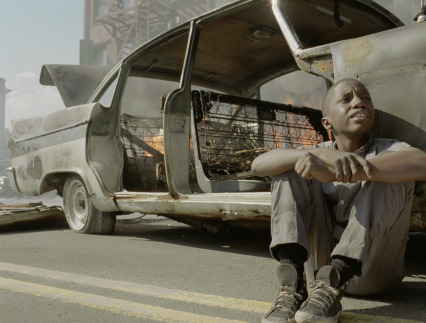

Brit Jim Sturgess is outstanding as Jude, a working stiff Libverpullian who crosses the pond to find the father he’s never met. He forms a best friend bond with Max, well played by Joe Anderson, and a romantic entanglement with Max’s sister, Lucy, portrayed with real depth by Evan Rachel Wood.
Pretty much every one of the principals was an unknown at the time. Dana Fuchs gives the showiest and grittiest performance as the Janis Joplin-like singer Sadie. Martin Luther brings the soul his Jimi Hendrix-like guitarist character demands. T.V. Caprio has just the right vulnerability as Prudence.
They’re all searchers eventually thrown together in the maelstrom of ’60s counterculture life in New York City. They meet or imagine a motley crew variously played by Joe Cocker. Eddie Izard, Bono and Salma Hyek, all of whom represent characters in Beatles songs or fictional versions of certain types found in that time and place.
The film touches on a great many of the currents that made the ’60s the ’60s, including civil rights, feminism, riots, protests, Vietnam, rock music, the drug culture, the sexual revolution and the generation gap.
There are some indelible images throughout. The Let It Be montage is an especially powerful melding of music and dramatic action.
The film plays like a series of related music videos and that gives it both its internal rhythmic strength and a disjointed self-limiting structure. The only thing holding the whole works together is the music and the boy meets girl plot. The songs are a series of set pieces unto their own though many of them are about love and searching. The thinly developed main characters’ moods and motivations get expressed through the music. When it all comes together, its thrilling stuff. When it doesn’t mesh, it seems a bit forced.
That said, I really admire the imagination and heart that went into this film. For the most part Taymor and her creative collaboratives found striking and moving ways to have the music carry a love story that is both singular and universal. The music and the story remind us that peace and love were counter-irritant strains in a decade of violence and hate. It’s also a reminder that love and life can endure no matter the tumult or conflict happening around us. Outside forces don’t have to keep us down or keep us apart.
This movie anticipated what was coming with movies like “La-La Land” and television shows like “Glee” and “The Get Down” and stands alone for capturing the vitality of an era when the whiff of anarchy and anything’s possible was in the air. And not surprisingly the music of the Beatles provided the soundtrack and narrative thread for decade that defined a new America.
Link to the film’s IMDB site at–
_ _ _

Hot Movie Takes Monday – “Mississippi Masala”
©By Leo Adam Biga, Author of “Alexander Payne: His Journey in Film”
Over the weekend I revisited one of my favorite films from the early 1990s – Mira Nair’s “Mississippi Masala.” I remembered it as one of the richest cross cultural dramas of that or any era and upon re-watching it on YouTube my impressions from then have been confirmed.
The story concerns an Indian family exiled from Uganda during Idi Amin’s reign of terror. They were forced to leave everything they owned and loved in terms of home, The patriarch of the family was born and raised in Uganda and lived there his entire life, building a life and career that made him feel at one with a nation his people had been brought to by the British to build railways. Though his ancestral roots are not of that continent, he identifies as African first, Indian second. The family ends up in Mississippi, owning and operating a motel and a liquor store. The patriarch, Jay, and his wife are the parents of an only child, Meena, who was a little girl when her left Uganda as refugees. When we meet her again she is a lovely, single 24 year old woman and still devoted daughter but strains under her parents’ overprotectiveness and their insisting she adhere to strict traditions concerning matrimonial matches and such. Those traditions aren’t such a good fit in America.
Also weighing heavily on Meena is the burden her father carries from being torn from his homeland. He can’t let that severing go. For years he’s petitioned the Ugandan government for a hearing to plead his case for his property and assets to be restored. He is a haunted figure. Part of what haunts him is the way he rebuked his black Ugandan friend from childhood, Okelo, when Amin’s military police rounded up foreigners for arrest, torture, deportation. Okelo is a devoted family friend who is like a brother to Jay and a grandfather to Meena. When Jay is arrested for making anti-Amiin remarks in a broadcast TV interview, Okelo bribes officials to free him. He tries to convince Jay that there is no future for him in Uganda anymore. Okelo tells him, “Africa is for black Africans.” He says it not out of malice but love. Jay is deeply hurt. He can’t accept this new reality but he realizes he and his family have no choice but to flee if they are to remain alive. Jay leaves without saying goodbye to Okelo. Meena sees and feels her father’s bitter anger and her beloved Okelo’s broken heart.

Grown-up Meena, played by Sarita Choudhury, lives with her parents in a diverse Mississippi town where they are the minority. A meet-cute accident brings together Meena and a young African-American man, Demetrius, played by Denzel Washington. He’s a devoted son who owns his own carpet cleaning business. He’s immediately attracted to Meena but at first he pays attention to her to get back at his ex, who’s in town and intent on belittling him. But things progress to the point where he and Meena spark the start of a real relationship. She meets his family and is embraced by them. Then the prejudice her extended family and community feels for blacks gets in the way and things get messy. As it always is with race, there are misunderstandings, assumptions and fears that cause rifts. Meena’s father is reminded of his own close-mindedness – that Indians in Africa wouldn’t allow their children to marry blacks. Demetrius and his circle must confront their own racist thinking.
Everyone in this film has their own wounds and stones of racism to deal with. No one is immune. No one gets off the hook. We’re all complicit. We all have something to learn from each other. It’s what we do with race that matters.
The theme of being strangers in homelands runs rife through the film. Just as African-Americans in Mississippi were enslaved and disenfranchised and often cut off from their African heritage, Indian exiles like Meena’s family are strangers wherever they go and distant from their own ancestral homeland of India.
Meena finally asserts her independence and her father finally gets his hearing. His bittersweet return to Uganda fills him with regret and longing, ironically enough, for America, which he realizes has indeed become his new home. The simple, sublime ending finds Jay in a street market where residents of the new Uganda revel in music and dance that are a mix of African and Western influences. As he watches the joy of a people no longer living in oppression, a black infant held by a man touches his face and Jay ends up holding the boy close to him, feeling the warmth and tenderness of unconditional love and trust.


There’s a great montage sequence near the end where the diverse currents of India, the American Deep South and Africa converge in images that some hot harmonica blues cover. By the end, the movie seems to tell us that home is a matter of the heart and identity is a state of mind and none of it need keep us apart if we don’t let it.
I saw the film when it first came out and though it spoke to me I was still a decade away from being in my first interracial relationship. I was already very curious about the possibilities of such a relationship and I was also acutely attuned to racial stereotypes and prejudices because of where and how I grew up. Seeing the film again today, as a 15 year veteran of mixed race couplings and a 21 year veteran of writing about race, it has even more resonance than before. And having visited Uganda in 2015 I now have a whole new personal connection to the film because of having been to that place so integral to the story.
This was the second movie by Nair I saw. The first, “Salaam Bombay,” was a hit on the festival circuit and that’s where I saw it – an outdoor screening at the Telluride Film Festival. Years later I saw another of her features, “Monsoon Wedding.” I still need to catch up with two of her most acclaimed later films, “The Perez Family” and “The Namesake.”
Watch the “Mississippi Masala” trailer at:
_ _ _
Hot Movie Takes Saturday – FIVE CAME BACK
©by Leo Adam Biga, Author of “Alexander Payne: His Journey in Film”
Five Legendary Filmmakers went to war:
John Ford
William Wyler
Frank Capra
George Stevens
John Huston
Five Contemporary Filmmakers take their measure:
Paul Greengrass
Steven Spielberg
Guillermo del Toro
Lawrence Kasdan
Francis Ford Coppola
When the United States entered World War II these five great Hollywood filmmakers were asked by the government to apply their cinema tools to aid the war effort. They put their lucrative careers on hold to make very different documentaries covering various aspects and theaters of the war. They were all masters of the moving picture medium before their experiences in uniform capturing the war for home-front audiences, but arguably they all came out of this service even better, and certainly more mature, filmmakers than before. Their understanding of the world and of human nature grew as they encountered the best and worst angels of mankind on display.
The story of their individual odysseys making these U.S, government films is told in a new documentary series, “Five Came Back,” now showing on Netflix. The series is adapted from a book by the same title authored by Mark Harris. The documentary is structured so that five contemporary filmmakers tell the stories of the legendary filmmakers’ war work. The five contemporary filmmakers are all great admirers of their subjects. Paul Greengrass kneels at the altar of John Ford; Steven Spielberg expresses his awe of William Wyler; Guillermo del Toro rhapsodizes on Frank Capra; Lawrence Kasdan gushes about George Stevens; and Francis Ford Coppola shares his man crush on John Huston. More than admiration though, the filmmaker narrators educate us so that we can have more context for these late filmmakers and appreciate more fully where they came from, what informed their work and why they were such important artists and storytellers.
The Mission Begins
As World War II begins, five of Hollywood’s top directors leave success and homes behind to join the armed forces and make films for the war effort.

Combat Zones
Now in active service, each director learns his cinematic vision isn’t always attainable within government bureaucracy and the variables of war.

The Price of Victory
At the war’s end, the five come back to Hollywood to re-establish their careers, but what they’ve seen will haunt and change them forever.

Ford was a patriot first and foremost and his “The Battle of Midway” doc fit right into his work portraying the American experience. For Wyler, a European Jew, the Nazi menace was all too personal for his family and he was eager to do his part with propaganda. For Capra, an Italian emigre, the Axis threat was another example of powerful forces repressing the liberty of people. The “Why He Fight” series he produced and directed gave him a forum to sound the alarm. A searcher yearning to break free from the constraints of light entertainment, Stevens used the searing things he documented during the war, including the liberation of death camps, as his evolution into becoming a dramatist. Huston made perhaps the most artful of the documentaries. His “Let There Be Light” captured in stark terms the debilitating effects of PTSD or what was called shell shock then. His “Report from the Aleutians” portrays the harsh conditions and isolation of the troops stationed in Arctic. And his “The Battle of San Pietro” is a visceral, cinema verite masterpiece of ground war.
The most cantankerous of the bunch, John Ford, was a conservative who held dear his dark Irish moods and anti-authoritarian sentiments. Yet, he also loved anything to do with the military and rather fancied being an officer. He could be a real SOB on his sets and famously picked on certain cast and crew members to receive the brunt of his withering sarcasm and pure cussedness. His greatest star John Wayne was not immune from this mean-spiritedness and even got the brunt of it, in part because Wayne didn’t serve during the war when Ford and many of his screen peers did.
Decades before he was enlisted to make films during the Second World War, he made a film, “Four Sons,” about the First World War, in which he did not serve.
Following his WWII stint, Ford made several great films, one of which, “They Were Expendable,” stands as one of the best war films ever made. His deepest, richest Westerns also followed in this post-war era, including “Rio Grande,” “Fort Apache,” “She Wore a Yellow Ribbon,” “The Searchers,” “The Horse Soldiers” and “The Man Who Shot Liberty Valance.” Another war film he made in this period, “The Wings of Eagles,” is another powerful work singular for its focus on a real-life character (played by Wayne) who endures great sacrifices and disappointments to serve his country in war.
Even before the war Ford injected dark stirrings of world events in “The Long Voyage Home.”

William Wyler had already established himself as a great interpreter of literature and stage works prior to the war. His subjects were steeped in high drama. Before the U.S. went to war but was already aiding our ally Great Britain, he made an important film about the conflict, “Mrs. Miniver,” that brought the high stakes involved down to a very intimate level. The drama portrays the war’s effects on one British family in quite personal terms. After WWII, Wyler took this same closely observed human approach to his masterpiece, “The Best Years of Our Lives,” which makes its focus the hard adjustment that returning servicemen faced in resuming civilian life after having seen combat. This same humanism informs Wyler’s subsequent films, including “The Heiress,” “Roman Holiday,” “Carrie,” “The Big Country” and “Ben-Hur.”
Wyler, famous for his many takes and inability to articulate what he wanted (he knew it when he saw it), was revered for extracting great performances. He didn’t much work with Method actors and I think some of his later films would have benefited from the likes of Brando and Dean and all the rest. One of the few times he did work with a Method player resulted in a great supporting performance in a great film – Montgomery Clift in “The Heiress.” Indeed, it’s Clift we remember more than the stars, Olivia de Havilland and Ralph Richardson.

Frank Capra was the great populist director of the Five Who Came Back and while he became most famous for making what are now called dramedies. he took a darker path entering and exiting WWII, first with “Meet John Doe” in 1941 and then with “It’s a Wonderful Life” in 1946 and “State of the Union” in 1948. While serious satire was a big part of his work before these, Capra’s bite was even sharper and his cautionary tales of personal and societal corruption even bleaker than before. Then he seemed to lose his touch with the times in his final handful of films. But for sheer entertainment and impact, his best works rank with anyone’s and for my tastes anyway those three feature films from ’41 through ’48 are unmatched for social-emotional import.
Before the war George Stevens made his name directing romantic and screwball comedies, even an Astaire-Rogers musical, and he came out of the war a socially conscious driven filmmaker. His great post-war films all tackle universal human desires and big ideas: “A Place in the Sun,” “Shane,” “Giant,” “The Diary of Anne Frank.” For my tastes anyway his films mostly lack the really nuanced writing and acting of his Five Came Back peers, and that’s why I don’t see him in the same category as the others. In my opinion Stevens was a very good but not great director. He reminds me a lot of Robert Wise in that way.
That brings us to John Huston. He was the youngest and most unheralded of the five directors who went off to war. After years of being a top screenwriter, he had only just started directing before the U.S. joined the conflict. His one big critical and commercial success before he made his war-effort documentaries was “The Maltese Falcon.” But in my opinion he ended up being the best of the Five Who Came Back directors. Let this list of films he made from the conclusion of WWII through his death sink in to get a grasp of just what a significant body of work he produced:
The Treasure of the Sierra Madre
The Asphalt Jungle
Key Largo
The Red Badge of Courage
Heaven Knows Mr. Allison
Beat the Devil
Moby Dick
The Unforgiven
The Misfits
Freud
The List of Adrian Messenger
The Night of the Iguana
Reflections in a Golden Eye
Fat City
The Man Who Would Be King
Wiseblood
Under the Volcano
Prizzi’s Honor
The Dead
That list includes two war films, “The Red Badge of Courage” and “Heaven Knows Mr. Allison,” that are intensely personal perspectives on the struggle to survive when danger and death are all around you. Many of his other films are dark, sarcastic ruminations on how human frailties and the fates sabotage our desires, schemes and quests.
I believe Huston made the most intelligent, literate and best-acted films of the five directors who went to war. At least in terms of their post-war films. The others may have made films with more feeling, but not with more insight. Huston also took more risks than they did both in terms of subject matter and techniques. Since the other directors’ careers started a full decade or more before his, they only had a couple decades left of work in them while Huston went on making really good films through the 1970s and ’80s.
Clearly, all five directors were changed by what they saw and did during the war and their work reflected it. We are the ultimate beneficiaries of what they put themselves on the line for because those experiences led them to inject their post-war work with greater truth and fidelity about the world we live in. And that’s really all we can ask for from any filmmaker.
_ _ _
Hot Movie Takes
John Huston
By Leo Adam Biga, Author of “Alexander Payne: His Journey in Film”
When I originally posted about the subject of this Hot Movie Take, the late John Huston, I forgot to note that his work, though very different in tone, shares a penchant for unvarnished truth with that of Alexander Payne. Huston was a writer-director just like Payne is and he was extremely well-read and well-versed in many art forms, again just as Payne is. The screenplays for Huston’s films were mostly adaptations of novels, short stories and plays, including some famous ones by iconic writers, and the scripts for Payne’s films are mostly adaptations as well. Huston also collaborated with a lot of famous writers on his films, including Truma Capote and Arthur Miller. The work of both filmmakers shares an affinity for ambiguous endings. I think at his best Huston was more of a classic storyteller than Payne and his films more literate. Where Huston mostly made straight dramas, he showed a real flair for comedy the few times he ventured that way (“The African Queen,” “Beat the Devil,” “The Life and Times of Judge Roy Bean” and “Prizzi’s Honor”). Payne insists that he makes comedies, though most would say he makes dramedies, a terrible descriptor that’s gained currency. More accurately, Payne’s comedy-dramas are satires. I think he’s more than capable of making a straight drama if he chose to, but so far he’s stayed true to himself and his strengths. If Payne is the ultimate cinema satirist of our tme, and I think he is, then Huston stands as the great film ironist of all time. With one using satire and the other using irony to great effect, their films get right to the bone and marrow of characters without a lot of facade. Just as it was for Huston, story and character is everything for Payne. And their allegiance to story and character is always in service to revealing truth.

Of all the great film directors to some out of the old studio system, only one, that craggy, gangly, hard angle of a man, John Huston, continued to thrive in the New Hollywood and well beyond.
It’s important to note Huston was a writer-director who asserted great independence even under contract. He began as a screenwriter at Universal and learned his craft there before going to work at Warner Brothers. But Huston was an accomplished writer long before he ever got to Hollywood. As a young man he found success as a journalist and short story writer, getting published in some of the leading magazines and newspapers of the day. Indeed, he did a lot things before he landed in Tinsel Town. He boxed, he painted, he became a horseman and cavalry officer in the Mexican uprisings, he hunted big gamma he acted and he caroused. His father Walter Huston was an actor in vaudeville before making it on the legitimate stage and then in films.
What he most loved though was reading. His respect for great writing formed early and it never left him. Having grown up the son of a formidable actor, he also respected the acting craft and the power and magic of translating words on a page into dramatic characters and incidents that engage and move us.
He admired his father’s talent and got to study his process up close. Before ever working in Hollywood, John Huston also made it his business to observe how movies were made.
But like most of the great filmmakers of that era, Huston lived a very full life before he ever embarked on a screen career. It’s one of the reasons why I think the movies made by filmmakers like Huston and his contemporaries seem more informed by life than even the best movies today. There’s a well lived-in weight to them that comes from having seen and done some things rather than rehashing things from books or film classes or television viewings.
Because of his diverse passions, Huston films are an interesting mix of the masculinity and fatalistic of, say. a Hemingway, and the ambiguity and darkness of, say, an F. Scott Fitzgerald or Eugene O’Neill. I use literature references because Huston’s work is so steeped in those traditions and influences. In film terms, I suppose the closest artists his work shares some kinship with are Wyler and John Ford, though Huston’s films are freer in form than Wyler’s and devoid of the sentimentality of Ford. As brilliantly composed as Wyler’s films are, they’re rather stiff compared to Huston’s. As poetic as Ford’s films are, they are rather intellectually light compared to Huston’s.
At Warners Huston developed into one of the industry’s top screenwriters with an expressed interest in one day directing his own scripts. Of all the Hollywood writers that transitioned to directing, he arguably emerged as the most complete filmmaker. While he never developed a signature visual style, he brought a keen intelligence to his work that emphasized character development and relationship between character and place. He made his directing invisible so as to better serve the story. When I think of Huston, I think of lean and spare. He perfected the art of cutting in the camera. He was precise in what he wanted in the frame and he got as close to what he had on the page and in his head as perhaps anyone who’s made feature-length narrative films. He did it all very efficiently and professionally but aesthetic choices came before any commercial considerations. He was known to be open to actors and their needs and opinions, but he was not easily persuaded to change course because he was a strong-willed artist who knew exactly what he wanted, which is to say he knew exactly what the script demanded.
His films are among the most literate of their or any era, yet they rarely feel stagy or artificial. From the start, Huston revealed a gift for getting nitty gritty reality on screen. He was also very big on location shooting when that was still more a rarity than not and he sometimes went to extreme lengths to capture the real thing, such as encamping in the Congo for “The African Queen.” Look at his “The Man Who Would Be King” and you’ll find it’s one of the last great epic adventure stories and Huston and Co.really did go to harsh, remote places to get its settings right.
The realism of his work is often balanced by a lyrical romanticism. But there are some notable exceptions to this in films like “Fat City.”
He sometimes pushed technical conventions with color experiments in “Moulin Rouge,” “Moby Dick” and “Reflections in a Golden Eye.”
As a young man learning the ropes, he reportedly was influenced by William Wyler and other masters and clearly Huston was a good student because right out of the gate with his first film as director, “The Maltese Falcon,” his work was fully formed.
In his first two decades as a writer-director, Huston made at least a half dozen classics. His best work from this period includes:
The Maltese Falcon
The Treasure of the Sierra Madre
The Asphalt Jungle
Key Largo
The Red Badge of Courage
Heaven Knows Mr. Allison
Beat the Devil
Moby Dick
The Unforgiven
Huston remained a relevant director through the 1960s with such films as:
The Misfits
Freud
The List of Adrian Messenger
The Night of the Iguana
Reflections in a Golden Eye
But his greatest work was still ahead of him in the 1970s and 1980s when all but a handful of the old studio filmmakers were long since retired or dead or well past their prime. Huston’s later works are his most complex and refined:
Fat City
The Man Who Would Be King
Wiseblood
Under the Volcano
Prizzi’s Honor
The Dead
I have seen all these films, some of them numerous times, so I can personally vouch for them. There are a few others I’ve seen that might belong on his best efforts list, including “The Roots of Heaven.” Even a near miss like “The Life and Times of Judge Roy Bean” is worth your time. And there are a handful of ’70s era Huston films with good to excellent reputations I’ve never gotten around to seeing, notably “The Kremlin Letter” and “The Mackintosh Man,” that I endeavor to see and judge for myself one day.

Three star-crossed iconic actors with Huston, Arthur Miller, Eli Wallach and Co. on the set of “The Misfits”
It would be easy for me to discuss any number of his films but I elect to explore his final and, to my tastes anyway, his very best film, “The Dead” (1987). For me, it is a masterpiece that distills everything Huston learned about literature, film, art, music, life, you name it, into an extraordinary mood piece that is profound in its subtleties and observations. For much of his career, Huston portrayed outward adventures of characters in search of some ill-fated quest. These adventures often played out against distinct, harsh urban or natural landscapes. By the end of his career, he turned more and more to exploring inward adventures. “The Dead” is an intimate examination of grief, love, longing and nostalgia. Based on a James Joyce short story, it takes place almost entirely within a private home during a Christmas gathering that on the surface is filled with merriment but lurking just below is bittersweet melancholia, particularly for a married couple stuck in the loss of their child. It is a tender tone poem whose powerful evocation of time, place and emotion is made all the more potent because it is so closely, carefully observed. Much of the inherent drama and feeling resides in the subtext behind the context. Discovering these hidden meaning sin measured parts is one of the many pleasures of this subdued film that has more feeling in one frame than any blockbuster does in its entirety. “The Dead” is as moving a meditation on the end of things, including human life, that I have ever seen.
Huston made the film while a very sick and physically feeble old man. He was in fact dying. But it might as well be the work of a young stallon because it’s that vital and rigorous. The fact that he was near death though gives his interpretation and expression of the story added depth and poignancy. He knew well the autumnal notes it was playing. The film starts his daughter Angelica Huston. It was their third and final collaboraton.
If you don’t know Huston the writer-director I urge you to seek out his work and even if you do you may discover he made films you didn’t associate with him. Just like we often don’t pay attention to the bylines of writers who author pieces we read and even enjoy, some of us don’t pay strict attention to who the directors of films are, even if we enjoy them. Some of you may even be more familiar with Huston’s acting than his directing. His turn in “Chinatown” is a superb example of character acting. My point is, whatever Huston means or doesn’t meant to you, seek out his work and put the pieces together of the many classics he made that you’ve seen and will make a point to see.
_ _ _
Hot Movie Takes Sunday
When Cinema First Seduced Me – “On the Waterfront”
©by Leo Adam Biga, Author of “Alexander Payne: His Journey in Film”
Borrowing from the title of a famous film book, I share in this hot cinema take how I lost my virginity at the movies. It wasn’t a person who stole my innocence and awakened my senses, it was a film, a very special film: “On the Waterfront.” Though in a manner of speaking you could say I gave it up to the film’s star, Marlon Brando.
It was probably the end of the 1960s or beginning of the 1970s when I first saw that classic 1954 film. I would have been 11 or 12 watching it on the home Zenith television set. The film still has a hold on me all these years later. It moves me to tears and exultation as an adult just as it did as a child. I’m sure that will never change no matter how many times I see it, and I’ve seen it a couple dozen times by now, and no matter how old I am when I revisit it.
Nothing could have prepared me for that first viewing though. I mean, it stirred things in me that I didn’t yet have words or meanings for. I remember lying on the living room’s carpeted floor and variously feeling sad, excited, aroused, afraid, angry, disenchanted, triumphant and, though I didn’t know the word at the time, ambivalent.
The power of that movie is in its extraordinary melding of words, images, ideas, faces, locations, actions and dramatic incidents. Great direction by Elia Kazan. Great photography by Boris Kaufmann. Great music by Leonard Bernstein. Great script by Budd Schulberg, Great ensemble cast from top to bottom. But it was Marlon Brando who undid me. I mean, he’s so magnetic and enigmatic at the same time. There’s a charm and mystery to the man, combined with an intensity and truth, that projects a palpable, visceral energy unlike anything I’ve quite felt since from a film performance. His acting is so real, spontaneous and connected to every moment that it evokes intense emotional immediate responses in me. It happened the first time I saw it and it still happens all these decades later. What I’m describing, of course, is the very intent of The Method Brando brought to Hollywood, thus forever changing screen acting by the new level of naturalism and truth he brought to many of his roles.
His Terry Malloy is an Everyman on the mob-controlled docks of New York. He looks like just any other working stiff or mug except he’s not because he’s an ex-prizefigher and his older brother Charley (Rod Steiger) is in the employ of waterfront boss Johnny Friendly (Lee J. Cobb). The longshoremen can’t form a union and don;t dare to demand anything like decent work conditions or benefits as long as Friendly rules by threat and intimidation. In return for keeping the men in check, he and his crew take a cut of everything that comes in or goes out of those docks. And Terry, who’s part of Friendly’s mob by association, doesn’t have to lift a finger on the job. Not so long as he does what he’s told and keeps his mouth shut. A law enforcement investigation into waterfront racketeering has everyone on edge and the price for squealing is death.
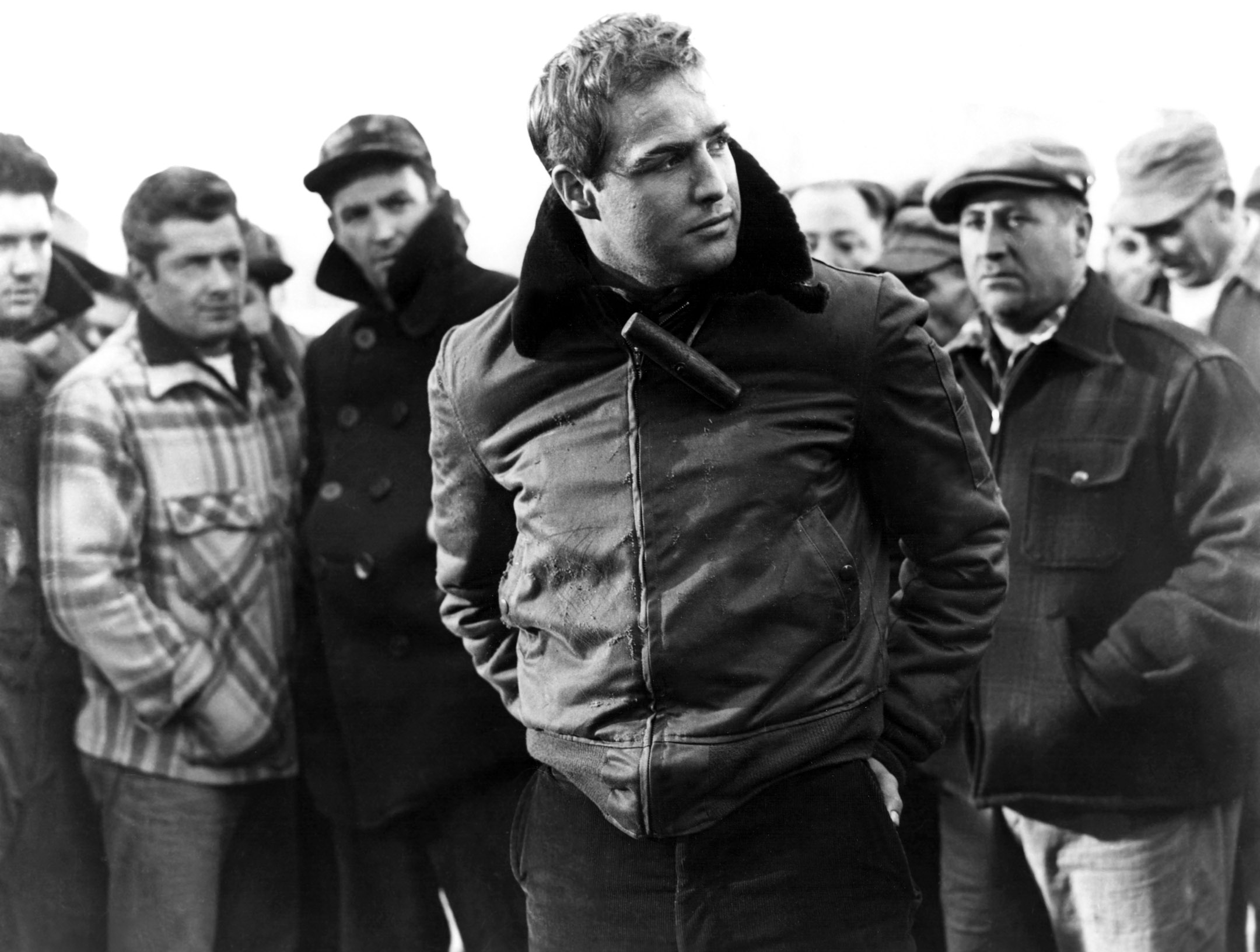
A conflicted Terry arrives at a moral crossroads after being used by Friendly’s bunch to set-up a buddy, Jimmy Dolan, that henchmen throw off the roof of a brownstone. Already racked by guilt for being an accomplice in his friend’s death, Terry then falls for Dolan’s attractive sister, Edie (Eva Marie Saint), who’s intent on finding the men responsible for her brother’s killing. At the same time, the waterfront priest, Father Barry (Karl Malden), urges the longshoremen to stand up and oppose Friendly by organizing themselves and telling what they know to the authorities. Terry is questioned by investigators, one of whom detects his anguish. But he can’t bring himself to tell Father Barry or Edie the truth,
With Friendly feeling the heat, he applies increased pressure and goon tactics. Concerned that Terry may turn stool pigeon under Edie’s and Father Barry’s influence, he orders Charley to get his brother in line – or else. Terry refuses the warning and Charley pays the price. Terry then lays it all on the line and comes clean with Edie, Father Barry and the authorities. All of it leads to Terry being ostracized before a climactic confrontation with Friendly and his stooges.
“On the Waterfront” could have been a melodramatic potboiler in the wrong hands but a superb cast and crew at the peak of their powers made a masterpiece instead. It’s the unadorned humanity of the film that moves us and lingers in the imagination. Then there’s the powerful themes it explores. The film is replete with symbols and metaphors for the human condition, good versus evil and principles of sacrifice, loyalty and redemption. The story also reflects Kazan’s and Schulberg’s view that “ratting” is a sometimes necessary act for a greater good. Like Terry, Kazan became persona non grata to some for naming names before the House Un-american Activities Committee at the height of this nation’s Red Scare hysteria. Some have criticized Kazan for making a self-serving message picture that at the end celebrates the rat as hero.

The film has come under the shadow cast by Kazan’s actions. Some say his cooperating with HUAC directly or indirectly made him complicit in Hollywood colleagues getting blacklisted by the industry. However you feel about what he did or didn’t do and what blame or condemnation can be laid at his feet, the film is a stand the test of time work of social consciousness that works seamlessly within the conventions of the crime or mob film. I think considering everything that goes into a narrative movie, it’s as good a piece of traditional filmmaking to ever come out of America. There have been more visually stunning pictures, more epic ones, better written ones, but none that so compellingly and pleasingly put together all the facets that make a great movie and that so effectively get under our skin and touch our heart.
It would be a decade from the time I first saw “On the Waterfront” before I reacted that strongly to another film, and that film was “It’s a Wonderful Life.”
_ _ _
Hot Movie Takes Friday
Indie Film
UPDATED-EXPANDED
©by Leo Adam Biga, Author of “Alexander Payne: His Journey in Film”
There’s a common misconception that indie films are something that only came into being in the last half-century when in fact indie filmmaking has been around in one form or another since the dawn of movies.
Several Nebraskans have demonstrated the indie spirit at the highest levels of cinema.
The very people who invented the motion picture industry were, by definition, independents. Granted, most of them were not filmmakers, but these maverick entrepreneurs took great personal risk to put their faith and money in a new medium. They were visionaries who saw the future and the artists working for them perfected a moving image film language that proved addictive. The original Hollywood czars and moguls were the greatest pop culture pushers who ever lived. Under their reign, the narrative motion picture was invented and it’s hooked every generation that’s followed. The Hollywood studio system became the model and center of film production. The genres that define the Hollywood movie, then and now, came out of that system and one of the great moguls of the Golden Age, Nebraska native Darryl F. Zanuck, was as responsible as anyone for shaping what the movies became by the projects he greenlighted and the ones he deep-sixed. The tastes and temperaments of these autocrats got reflected in the pictures their studios made but the best of these kingpins made exceptions to their rules and largely left the great filmmakers alone, which is to say they didn’t interfere with their work. If they did, the filmmakers by and large wouldn’t stand for it. After raising hell, the filmmakers usually got their way.

Zanuck made his bones in Hollywood but as the old studio system with its longterm contracts and consolidated power began to wane and a more open system emerged, even Zanuck became an independent producer.
The fat-cat dream-making factories are from the whole Hollywood story. From the time the major studios came into existence to all the shakeups and permutations that have followed right on through today, small independent studios, production companies and indie filmmakers have variously worked alongside, for and in competition with the established studios.
Among the first titans of the fledgling American cinema were independent-minded artists such as D.W. Griffith, Charles Chaplin and Douglas Faribanks, who eventually formed their own studio, United Artists. Within the studio system itself, figures like Griffith, Chaplin, Buster Keaton, Cecil B. De Mille, Frank Capra and John Ford were virtually unassailable figures who fought for and gained as near to total creative control as filmmakers have ever enjoyed. Those and others like Howard Hawks, William Wyler and Alfred Hitchcock pretty much got to do whatever they wanted on their A pictures. Then there were the B movie masters who could often get away with even more creatively and dramatically speaking than their A picture counterparts because of the smaller budgets and loosened controls on their projects. That’s why post-World War II filmmakers like Sam Fuller, Joseph E. Lewis, Nicholas Ray, Budd Boetticher and Phil Carlson could inject their films with all sorts of provocative material amidst the conventions of genre pictures and thereby effectively circumvent the production code.
Maverick indie producers such as David O. Selznick, Sam Spiegel and Joseph E. Levine packaged together projects of distinction that the studios wouldn’t or couldn’t initiate themselves. Several actors teamed with producers and agents to form production companies that made projects outside the strictures of Hollywood. Kirk Douglas and Burt Lancaster were among the biggest name actors to follow this trend. Eventually, it became more and more common for actors to take on producing, even directing chores for select personal projects, to where if not the norm it certainly doesn’t take anyone by surprise anymore.
A Nebraskan by the name of Lynn Stalmaster put aside his acting career to become a casting direct when he saw an opportunity in the changing dynamics of Hollywood. Casting used to be a function within the old studio system. As the studios’ contracted employee rosters began to shrink and as television became a huge new production center, Stalmaster saw the future and an opportunity. He knew just as films needed someone to guide the casting, the explosion of dramatic television shows needed casting expertise as well and so he practically invented the independent casting director. He formed his own agency and pretty much had the new field to himself through the 1950s, when he mostly did TV, on through the ’60s, ’70s’ and even the ’80s, when more of his work was in features. He became the go-to casting director for many of top filmmakers, even for some indie artists. His pioneering role and his work casting countless TV shows, made for TV movies and feature films, including many then unknowns who became stars, earned him a well deserved honorary Oscar at the 2017 Academy Awards – the first Oscar awarded for casting.

Lynn Stalmaster
Photo By Lance Dawes, Courtesy of AMPAS
In the ’50 and ’60s Stanley Kubrick pushed artistic freedom and daring thematic content to new limits as an independent commercial filmmaker tied to a studio. Roger Corman staked out ground as an indie producer-director whose low budget exploitation picks gave many film actors and filmmakers their start in the industry. In the ’70s Woody Allen got an unprecedented lifetime deal from two producers who gave him carte blanche to make his introspective comedies.
John Cassavetes helped usher in the indie filmmaker we identify today with his idiosyncratic takes on relationships that made his movies stand out from Hollywood fare.
Perhaps the purest form of indie filmmaking is the work done by underground and experimental filmmakers who have been around since cinema’s start. Of course, at the very start of motion pictures, all filmmkaers were by definition experimental because the medium was in the process of being invented and codified. Once film got established as a thing and eventually as a commerical industry, people far outside or on the fringes of that industry, many of them artists in other disciplines, boldly pushed cinema in new aesthetic and technical directions. The work of most of these filmmakers then or now doesn’t find a large audience but does make its way into art houses and festivals and is sometimes very influential across a wide spectrum of artists and filmmakers seeking new ways of seeing and doing things. A few of these experimenters do find some relative mass exposure. Andy Warhol was an example. A more recent example is Godfrey Reggio, whose visionary documentary trilogy “Koyaanisqatsi,” “Powaqqatsi” and “Naqoyqatsi” have found receptive audiences the world over. Other filmmakers, like David Lynch and Jim McBride, have crossed over into more mainstream filmmaking without ever quite leaving behind their experimental or underground roots.
Nebraska native Harold “Doc” Edgerton made history for innovations he developed with the high speed camera, the multiflash, the stroboscope, nighttime photography, shadow photography and time lapse photography and other techniques for capturing images in new ways or acquiring images never before captured on film. He was an engineer and educator who combined science with art to create an entire new niche with his work.
Filmmakers like Philip Kaufman, Brian De Palma, Martin Scorsese and many others found their distinctive voices as indie artists. Their early work represented formal and informal atttempts at discovering who they are as
Several filmmakers made breakthroughs into mainstream filmmaking on the success of indie projects, including George Romero, Jonathan Kaplan, Jonathan Demme, Omaha’s own Joan Micklin Silver, Spike Lee and Quentin Taratino.
If you don’t know the name of Joan Micklin Silver, you should. She mentored under veteran studio director Mark Robson on a picture (“Limbo”) he made of her screenplay about the wives of American airmen held in Vietnamese prisoner of war camps. Joan, a Central High graduate whose family owned Micklin Lumber, then wrote an original screenplay about the life of Jewish immigrants on New York’s Lower East Side in the early 20th century. She called it “Hester Street” and she shopped it around to all the studios in Hollywood as a property she would direct herself. They all rejected the project and her stipulation that she direct. Every studio had its reasons. The material was too ethnic, too obscure, it contained no action, it had no sex. Oh, and she insisted on making it in black and white,which is always a handy excuse to pass on a script. What the studios really objected to though was investing in a woman who would be making her feature film directing debut. Too risky. As late as the late 1970s and through much of the 1980s there were only a handful of American women directing feature and made for TV movies. It was a position they were not entrusted with or encouraged to pursue. Women had a long track record as writers, editors, art directors, wardrobe and makeup artists but outside of some late silent and early sound directors and then Ida Lapino in the ’50s. women were essentially shut out of directing. That’s what Joan faced but she wasn’t going to let it stop her.
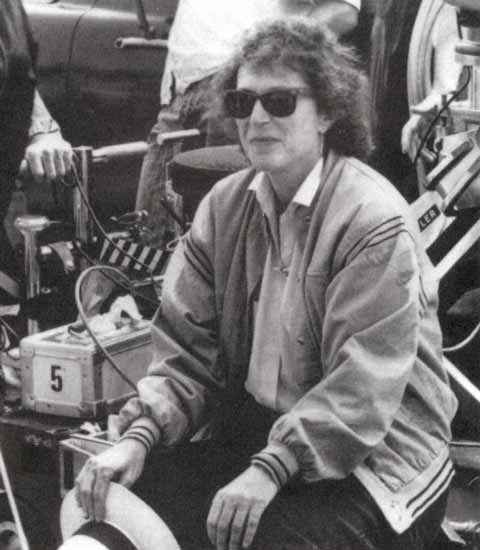
Long story short, Joan and her late husband Raphael financed the film’s production and post themselves and made an evocative period piece that they then tried to get a studio to pick up, but to no avail. That’s when the couple distributed the picture on their own and to their delight and the industry’s surprise the little movie found an audience theater by theater, city by city, until it became one of the big indie hits of that era. The film’s then-unknown lead, Carol Kane, was nominated for an Academy Award as Best Actress. The film’s success helped Joan get her next few projects made (“Between the Lines,” “Chilly Scenes of Winter”) and she went on to make some popular movies, including “Loverboy,” and a companion piece to “Hester Street” called “Crossing Delancey” that updated the story of Jewish life on the Lower East Side to the late 20th century. Joan later went on to direct several made for cable films. But “Hester Street” will always remain her legacy because it helped women break the glass ceiling in Hollywood in directing. Its historic place in the annals of cinema is recognized by its inclusion in the U.S. Library of Congress collection. She’s now penning a book about the making of that landmark film. It’s important she document this herself, as only she knows the real story of what obstacles she had to contend with to get the film made and seen. She and Raphael persisted against all odds and their efforts not only paid off for them but in the doors it opened for women to work behind the camera.
The lines between true independent filmmakers and studio-bound filmmakers have increasingly blurred. Another Omahan, Alexander Payne, is one of the leaders of the Indiewood movement that encompasses most of the best filmmakers in America. Payne and his peers maintain strict creative control in developing, shooting and editing their films but depend on Hollywood financing to get them made and distributed. In this sense, Payne and Co. are really no different than those old Hollywood masters, only filmmakers in the past were studio contracted employees whereas contemporary filmmakers are decidedly not. But don’t assume that just because a filmmaker was under contract he or she had less freedom than today’s filmmakers. Believe me, nobody told Capra, Ford, Hitchcock, Wyler, or for that matter Huston of Kazan, what to do. They called the shots. And if you were a producer or executive who tried to impose things on them, you’d invariably lose the fight. Most of the really good filmmakers then and now stand so fiercely behind their convictions that few even dare to challenge them.
But also don’t assume that just because an indie filmmaker works outside the big studios he or she gets everything they want. The indies ultimately answer to somebody. There’s always a monied interest who can, if push comes to shove, force compromise or even take the picture out of the filmmaker’s hands. Almost by definition indie artists work on low budgets and the persons controlling those budgets can be real cheapskates who favor efficiency over aesthetics.
Payne is the rarest of the rare among contemporary American filmmakers in developing a body of work with a true auteurist sensibility that doesn’t pander to formulaic conventions or pat endings. His comedies play like dramas and they’re resolutely based in intimate human relationships between rather mundane people in very ordinary settings. Payne avoids all the trappings of Hollywood gloss but still makes his movies engaging, entertaining and enduring. Just think of the protagonists and plotlines of his movies and it’s a wonder he’s gotten any of them made:
Citizen Ruth–When a paint sealer inhalant addict with a penchant for having kids she can’t take care of gets pregnant again, she becomes the unlikely and unwilling pivot figure in the abortion debate.
Election–A frustrated high school teacher develops such a hate complex for a scheming student prepared to do anything to get ahead that he rigs a student election against her.
About Schmidt–Hen-pecked Warren Schmidt no sooner retires from the job that defined him than his wife dies and he discovers she cheated on him with his best friend. He hits the road to find himself. Suppressed feelings of anger, regret and loneliness surface in the most unexpected moments.
Sideways–A philandering groom to be and a loser teacher who’s a failed writer go on a wine country spree that turns disaster. Cheating Jack gets the scare of his life. Depressed Miles learns he can find love again.
The Descendants–As Matt King deals with the burden of a historic land trust whose future is in his hands, he learns from his oldest daughter that his comatose wife cheated on him. With his two girls in tow, Matt goes in search of answers and revenge and instead rediscovers his family.
Nebraska–An addled father bound and determined to collect a phantom sweepstakes prize revisits his painful past on a road trip his son David takes him on.
Downsizing–With planet Earth in peril, a means to miniaturize humans is found and Paul takes the leap into this new world only to find it’s no panacea or paradise.
Payne has the cache to make the films he wants to make and he responsibly delivers what he promises. His films are not huge box office hits but they generally recoup their costs and then some and garner prestige for their studios in the way of critical acclaim and award nominations. Payne has yet to stumble through six completed films. Even though “Downsizing” represents new territory for him as a sci-fi visual effects movie set in diverse locales and dealing with global issues, it’s still about relationships and the only question to be answered is how well Payne combines the scale with the intimacy.
Then there are filmmakers given the keys to the kingdom who, through a combination of their own egomania and studio neglect, bring near ruin to their projects and studios. I’m thinking of Orson Welles on “The Magnificent Ambersons,” Francis Ford Coppola on “One from the Heart”, Michael Cimino on “Heaven’s Gate,” Elaine May on “Ishtar” and Kevin Costner on “Thw Postman” and “Waterworld.” For all his maverick genius, Welles left behind several unfinished projects because he was persona non grata in Hollywood, where he was considered too great a risk, and thus he cobbled together financing in a haphazard on the fly manner that also caused him to interrupt the filming and sometimes move the principal location from one site to another, over a period of time, and then try to match the visual and audio components. Ironically, the last studio picture he directed, “Touch of Evil,” came in on budget and on time but Universal didn’t understand or opposed how he wanted it cut and they took it out of his hands. At that point in his career, he was a hired gun only given the job of helming the picture at the insistence of star Charlton Heston and so Welles didn’t enjoy anything like the final cut privileges he held on “Citizen Kane” at the beginning of his career.
Other mavericks had their work compromised and sometimes taken from them. Sam Peckinpah fought a lot of battles. He won some but he ended up losing more and by the end his own demons more than studio interference did him in.
The lesson here is that being an independent isn’t always a bed of roses.
Then again, every now and then a filmmaker comes out of nowhere to do something special. Keeping it local, another Omahan did that very thing when a script he originally wrote as a teenager eventually ended up in the hands of two Oscar-winning actors who both agreed to star in his directorial debut. The filmmaker is Nik Fackler, the actors are Martin Landau and Ellen Burstyn and the film is “Lovely, Still.” It’s a good film. It didn’t do much business however and Fackler’s follow up film,” Sick Birds Die Easy,” though interesting, made even less traction. His film career is pretty much in limbo after he walked away from the medium to pursue his music. The word is he’s back focusing on film again.

Other contemporary Nebraskans making splashes with their independent feature work include actor John Beasley, actress Yolonda Ross and writer-directors Dan Mirvish, Patrick Coyle, Charles Hood and James E. Duff.
These folks do really good work and once in a while magic happens, as with the Robert Duvall film “The Apostle” that Beasley co-starred in. It went on to be an indie hit and received great critical acclaim and major award recognition. Beasley is now producing a well-budgeted indie pic about fellow Omahan Marlin Briscoe. Omahan Timothy Christian is financing and producing indie pics with name stars through his own Night Fox Entertainment company. Most of the films these individuals make don’t achieve the kind of notoriety “The Apostle” did but that doesn’t mean the work isn’t good. For example, Ross co-starred in a film, “Go for Sisters,” by that great indie writer-director John Sayles and I’m sure very few of you reading this have heard of it and even fewer have seen it but it’s a really good film. Hood’s comedy “Night Owls” stands right up there with Payne’s early films. Same for Duff’s “Hank and Asha.”
Indie feature filmmaking on any budget isn’t for the faint of heart or easily dissuaded. It takes guts and smarts and lucky breaks. The financial rewards can be small and the recognition scant. But it’s all about a passion for the work and for telling stories that engage people.
_ _ _
More Hot Movie Takes
Dennis O’Keefe and Film Noir
©by Leo Adam Biga, Author of Alexander Payne: His Journey in Film

Dennis O’Keefe
These riffs are about some very different cinema currents but they’re all inspired by recent screen discoveries I made once I put my movie snobbery in check.
My first riff concerns an actor from Old Hollywood I was almost entirely unfamiliar with and therefore I never thought to seek out his work: Dennis O’Keefe. I discovered O’Keefe only because I finally made an effort to watch some of Anthony Mann’s stellar film noirs from the 1940s. O’Keefe stars in two of them – T-Men” (1947) and “Raw Deal” (1948). Neither is a great film but the former has a very strong script and the latter is like an encyclopedia of noir and they both feature great cinematography by John Alton and good performances across the board. These are riveting films that stand up well against better known noirs, crime and police pics.
Whatever restrictions the filmmakers faced making these movies for small poverty eow studios they more than made up for with their inventiveness and passion.
As wildly atmospheric and evocative as Alton’s use of darkness, light and shadow is in these works, it’s O’Keefe’s ability to carry these films that’s the real revelation for me. I find him to be every bit as charismatic and complex as Humphrey Bogart. James Cagney, Robert Mitchum and other bigger name tough guys of the era were, and I’m certain he would have carried the best noirs they helped make famous. O’Keefe reminds me of a blend between Bogart and Cagney, with a touch of another noir stalwart, William Holden, thrown in. Until seeing him in these two pictures along with another even better pic, “Chicago Syndicate” (1955) directed by the underrated Fred F. Sears, who is yet another of the discoveries I’m opining about here, I had no idea O’Keefe delivered performances on par with the most iconic names from the classic studio system era. It just goes to show you that you don’t know what you don’t know. Before seeing it for myself – if you’d tried to tell me that O’Keefe was in these other actors’ league I would have scoffed at the notion because I would have assumed if this were so he’d have come to my attention by now. Why O’Keefe never broke through from B movies to A movies I’ll never know, but as any film buff will tell you those categories don’t mean much when it comes to quality or staying power. For example, the great noir film by Orson Welles Touch of Evil was a B movie all the way in terms of budget, source material, theme and perception but in reality it was a bold work of art by a master at the top of his game. It even won an international film prize in its time, though it took years for it to get the respect it deserved in America.

Like all good actors, O’Keefe emphatically yet subtly projects on screen what he’s thinking and feeling at any given moment. He embodies that winning combination of intelligence and intuition that makes you feel like he’s the smartest guy in the room, even if he’s in a bad fix.
My admittedly simplistic theory about acting for the screen is that the best film/TV actors convey an uncanny and unwavering confidence and veracity to the camera that we as the audience connect to and invest in with our own intellect and emotion. That doesn’t mean the actor is personally confident or needs to play someone confident in order to hook us, only that within the confines of playing characters they make it seem as though they believe every word they say and every emotion they express. Well, O’Keefe had this in spades.
Now that O’Keefe is squarely on my radar, I will search for of his work. I recommend you do the same.


By the way, another fine noir photographed by John Alton, “He Walks by Night,” starring Richard Basehart, may have been directed, at least in part, by Mann. Alton’s work here may be even more impressive than in the other films. The climactic scene is reminiscent of “The Third Man,” only instead of the post-war Vienna streets and canals, the action takes place in the Los Angeles streets and sewers. I must admit I was not familiar with Alton’s name even though I’d seen movies he photographed before I ever come upon the Mann trilogy. For example, Alton’s last major feature credit is “Elmer Gantry,” a film I’ve seen a few times and always admired. He also did the great noir pic “The Big Combo” directed by Joseph E. Lewis. And he lit the great dream sequence ballet in “”An American in Paris,” for which he won an Oscar. Now I will look at those films even more closely with respect to the photography, though I actually do remember being impressed by the photography in “Big Combo” and, of course, the dream sequence in “Paris.”
Alton was an outlier in going against prevailing studio practices of over-lighting sets. He believed in under-lighting and letting the blacks and greasy help set mood. The films he did are much darker, especially the night scenes, than any Hollywood films of that time. He studied the work of master painters to learn how they controlled light and he applied his lessons to the screen.
It turns out that Alton left Hollywood at the peak of his powers because he got fed up with the long hours and the many fights he had with producers and directors, many of whom insisted on more light and brighter exposures. Alton usually got his way because he knew his stuff, he worked very fast and he produced images that stood out from the pack. Apparently he just walked away from his very fine career sometime in the early 1960s to lead a completely distant but fulfilling life away from the movies.

Alton setting up a shot in “Raw Deal”

With actress Leslie Caron – “An American In Paris
Regarding the aforementioned “Chicago Syndicate,” it’s a surprisingly ambitious and labyrinthian story told with great verve and conviction by Fred Sears. It’s a neat bridge film between the very composed studio bound tradition and the freer practical location tradition. Sears was another in a long line of B movie directors with great skill who worked across genres in the 1930s through 1950s period. I watched a bit of a western he did and it too featured a real flair for framing and storytelling. His work has some of the great energy and dynamic tension of Sam Fuller and Budd Boetticher from that same period. I can’t wait to discover more films by Sears.
Hot Movie Takes – “Across the Universe”
Hot Movie Takes – “Across the Universe”
©By Leo Adam Biga, Author of “Alexander Payne: His Journey in Film”
Perhaps the best American dramatic film to deal with the 1960s since “Hair” came out a decade ago to some fanfare but it inextricably faded quickly despite being a distinctive marriage of words, images and music. I am referring to “Across the Universe.” the 2007 Julie Taymor-directed flick that uses the music of the Beatles and the content of their songs as narrative inspiration for its coming of age storylines and musical-dance flights of fancy.
It is a sometimes stunning, sometimes dubious pastiche of Taymor’s own Broadway (“The Lion King”) style, the frenetic Richard Lester Beatles’ movies of the ’60s, Golden Age Hollywood musical fantasy sequences and hopped-up psychedelia. At its best it captures the energy and spirit of the era in a visual and sonic feast that works on many levels. At its weakest, it’s not quite sure what it wants to be and lacks a driving core. In some scenes Taymor goes in for bold visual stylistics, going overboard in places, to boldly open up the story with great big sets or locations or visual effects, sometimes all at once. Other times she constricts scenes to intimate interior spaces. For my tastes anyway I thought sometimes she went big when she should have gone small and went in close when she should have pulled back and opened wide.
The love story at the heart of the film is actually quite good, even if we’ve seen variations of it in countless films. It’s strong enough though that the relationship engages us even apart from using the Beatles’ music variously as backdrop, context and exposition.
Brit Jim Sturgess is outstanding as Jude, a working stiff Libverpullian who crosses the pond to find the father he’s never met. He forms a best friend bond with Max, well played by Joe Anderson, and a romantic entanglement with Max’s sister, Lucy, portrayed with real depth by Evan Rachel Wood.
Pretty much every one of the principals was an unknown at the time. Dana Fuchs gives the showiest and grittiest performance as the Janis Joplin-like singer Sadie. Martin Luther brings the soul his Jimi Hendrix-like guitarist character demands. T.V. Caprio has just the right vulnerability as Prudence.
They’re all searchers eventually thrown together in the maelstrom of ’60s counterculture life in New York City. They meet or imagine a motley crew variously played by Joe Cocker. Eddie Izard, Bono and Salma Hyek, all of whom represent characters in Beatles songs or fictional versions of certain types found in that time and place.
The film touches on a great many of the currents that made the ’60s the ’60s, including civil rights, feminism, riots, protests, Vietnam, rock music, the drug culture, the sexual revolution and the generation gap.
There are some indelible images throughout. The Let It Be montage is an especially powerful melding of music and dramatic action.
The film plays like a series of related music videos and that gives it both its internal rhythmic strength and a disjointed self-limiting structure. The only thing holding the whole works together is the music and the boy meets girl plot. The songs are a series of set pieces unto their own though many of them are about love and searching. The thinly developed main characters’ moods and motivations get expressed through the music. When it all comes together, its thrilling stuff. When it doesn’t mesh, it seems a bit forced.
That said, I really admire the imagination and heart that went into this film. For the most part Taymor and her creative collaboratives found striking and moving ways to have the music carry a love story that is both singular and universal. The music and the story remind us that peace and love were counter-irritant strains in a decade of violence and hate. It’s also a reminder that love and life can endure no matter the tumult or conflict happening around us. Outside forces don’t have to keep us down or keep us apart.
This movie anticipated what was coming with movies like “La-La Land” and television shows like “Glee” and “The Get Down” and stands alone for capturing the vitality of an era when the whiff of anarchy and anything’s possible was in the air. And not surprisingly the music of the Beatles provided the soundtrack and narrative thread for decade that defined a new America.
Link to the film’s IMDB site at–
Hot Movie Takes: Alexander Payne’s ‘Downsizing’ promises to be a cinema feast
You can order signed copies by emailing me at leo32158@cox,net.
Here are links to some of my other “Downsizing” posts and articles:
https://leoadambiga.com/2017/02/17/the-incredible-s…s-60-years-apart/
https://leoadambiga.com/2016/07/31/stanley-kubrick-…ected-congruence/
https://leoadambiga.com/2016/08/28/downsizing-may-e…-cinema-universe/
https://leoadambiga.com/2016/04/01/lensing-april-1-…ous-film-to-date/
https://leoadambiga.com/2016/02/27/exclusive-on-ale…eese-witherspoon/
Movie buffs buzzing after early glimpse of Alexander Payne’s ‘Downsizing’

Director Alexander Payne, left, talks with Matt Damon before filming a scene for “Downsizing” in Omaha in April last year.


Alexander Payne’s next movie is already building some buzz, nine months ahead of its release.
Tuesday at the theater-owners convention CinemaCon, Paramount screened 10 minutes of footage from “Downsizing,” and audiences were reportedly blown away.
Payne’s sci-fi dramedy, parts of which were shot in Omaha last year, opens nationwide Dec. 22, a prime spot for movies seeking awards consideration.
“Downsizing,” starring Matt Damon, has been in the works for more than a decade. Payne and his writing partner, Jim Taylor, started the earliest version of the script in 2006. The film faced a few false starts along the way.
“It’s a movie that imagines what might happen if, as a solution to overpopulation and climate change, Norwegian scientists discover how to shrink organic material,” Payne said in an interview last spring. “The scientists propose to the world a 200- to 300-year transition from big to small as the only humane and inclusive solution to our biggest problem.”
In the film, Damon and Kristen Wiig play a married couple who decide to shrink themselves as a cost-saving measure.
The scale of the concept is new territory for the Omaha Oscar-winner, as are the bigger budget and heavy use of special effects.
In the clip screened at CinemaCon, Damon and Wiig attend a presentation about living the good life as a tiny person. An already-shrunk character played by Neil Patrick Harris makes the sales pitch. He lives in a dollhouse-sized mansion with his wife (played by Laura Dern). They get to live like kings for almost no money at all.
The convention clip also gave viewers the first look on what the shrinking process will look like. It apparently looks fantastic.
The Wrap reported that “the auditorium erupted in laughter at certain points throughout the clip, especially when the little miniature people came out of the shrinking machine. When the clip concluded, the audience cheered.”
Responses were across-the-board positive:
Variety: “‘Downsizing’ is something different entirely. It’s funny, to be sure, but it’s also Payne’s first foray into science fiction. Think of it as ‘Honey I Shrunk the Kids’ with a deeper social message.”
The Playlist: “Let’s be clear, Alexander Payne’s ‘Downsizing’ … was literally jaw-dropping. In a visual style and dramatic tone that is the most Kubrick-esque of his career, Payne screened what is effectively the first 10 minutes of the film. To say it’s one of the more original pieces of work I’ve seen in years is an understatement.”
Hollywood Elsewhere: “(The) CinemaCon preview of ‘Downsizing’ was awesome, brilliant, hilarious, sad and a tiny bit scary — an obvious Best Picture contender.”
The local reviews are good so far, too. Representatives of Aksarben Cinema got to see the footage. They said it’s amazing.
It’s of course impossible to judge a film on 10 minutes. But given the quality of Payne’s past work, the talent attached here, the warm reception the clip received and the prime holiday release Paramount is giving the film, this is one to maybe mark on your calendar.
Photos: Matt Damon, Kristen Wiig work on set in Omaha for Alexander Payne’s ‘Downsizing’

Director Alexander Payne plans a shot of the iconic La Casa sign at 4432 Leavenworth St, on Tuesday, April 12, 2016. Payne was filming his new movie, “Downsizing.” More photos.


 Leo Adam Biga's My Inside Stories