Archive
Alexander the Great’s Wrestling Dynasty – Champion Wrestler and Coach Curlee Alexander on Winning (from my Omaha Black Sports Legends series, Out to Win: The Roots of Greatness)
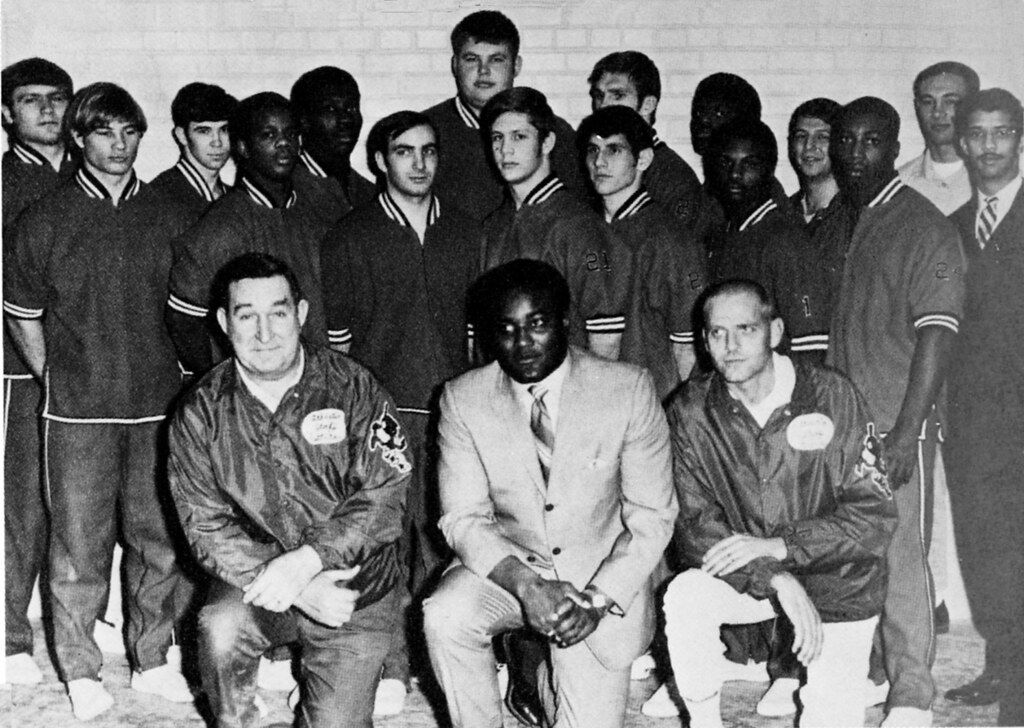
I first met up with Curlee Alexander for the following story, which appeared about eight years ago as part of my series on Omaha Black Sports Legends titled, Out to Win: The Roots of Greatness. Alexander was a top-flight collegiate wrestler for his hometown University of Nebraska at Omaha but he really made his mark as a high school coach, leading his teams to state championships at two different schools – his alma mater Technical (Tech) High School and North High School. He is inducted in multiple athletic hall of fames. Then, about three years ago I caught up with him again in working on a profile of his younger cousin Houston Alexander, a mixed martial arts fighter Curlee trains. You can find on this blog most every installment from the Out to Win series as well as that profile I did on Houston Alexander. More recently yet Curlee came to mind when I did a piece on the 1970 NAIA championship UNO wrestling team he helped coach as a graduate assistant and that he helped lay the foundation for as a wrestler under coach Don Benning. You’ll find that story and a profile of Benning, who is one of Alexander’s chief mentors, on this blog. The UNO wrestling program made a great impact on the sport locally, regionally, and nationally but sadly the program was eliminated a year and a half ago and now the legacy built by Alexander, Benning, and later Mike Denney and Co. can only found in record books and memories and news files. My story about the end of the program is also featured on this blog.
Alexander the Great’s Wrestling Dynasty – Champion Wrestler and Coach Curlee Alexander on Winning (from my Omaha Black Sports Legends series, Out to Win: The Roots of Greatness)
©by Leo Adam Biga
Originally published in The Reader (www.thereader.com)
Short in stature and sleek of build, Curlee Alexander still manages casting a huge shadow in Nebraska wrestling circles even though the largely retired educator is now a co-head coach. Seven times as head coach he led his prep teams to state championships, six at Omaha North and one at Omaha Tech. Twice, his North squads were state runners-up. Four more times his Vikings finished third. Dozens of his athletes won individual state titles, including three by his son Curlee Alexander Jr., and many had successful college careers on and off the mat.
In the wrestling room, Alexander’s word is law because his athletes know this former collegiate national champion wrestler once made the same sacrifice he asked of them. Following an undistinguished high school wrestling career at Omaha Tech, his persistence in the sport paid off when he blossomed into a four-time All-American for then-Omaha University. UNO wrestling’s rise to prominence under coach Don Benning was rewarded when the team won the 1970 NAIA team title and Alexander took the 115-pound individual title in the process.
Like most ex-wrestlers, Alexander’s keeps in tip-top shape and, even pushing 60, he still demonstrates some of his coaching points on the mat with his own wrestlers — going body to body with guys less than a third his age and often outweighing him. In the old days, he pushed guys to the limit and, in wrestling vernacular, “beat up on ‘em,” to see how they responded. It was all about testing their toughness and their heart. It’s the way he came up.
Proving himself has been the theme of Alexander’s life. He grew up in a north Omaha neighborhood, near the old Hilltop Projects, filled with fine athletes. Being a pint-sized after-thought who “was always trying to catch up” to the other guys in the hood, he searched for a sport he could shine in. “I was small and weak and slow. I had to start from scratch to develop my athletic skills,” he said. “Wrestling was about the only thing I could do and I was really not very good.” To begin with.
He learned the sport from Tech coach Milt Hearn. In classic apprentice fashion, he started at the bottom and worked his way up. “When he got me started wrestling, I was used as a doormat,” Alexander said. “All I was required to do was save the team points by not getting pinned. If I could do that, than I did my job. As a junior, I got beat out by two freshmen. I was always fighting an uphill battle. I could never let up. I could never be comfortable. I knew I had to work hard. I knew I had to work harder than most of ‘em just to be successful.” Despite this less than promising debut, Alexander said he “kept getting after it. I started buying a lot of weight training-body building books and started weight lifting. By the time I got to be a senior I didn’t wrestle anybody that was any stronger than me. I finished second in every tournament I entered my senior year. I never won a championship in high school. The first championship I won was when I reached college.”
Sparking his evolution from designated mop-up guy to legitimate contender was the motivation others gave him. “I had a lot of good role models, one of which was my father. He always preached athletics to us.” Where his father encouraged him, his brother dis’d him. “My brother was a much better athlete than I was, so I was always trying to do things, more or less, to impress him. I’d come home after losing and my brother would make comments like, ‘I knew you weren’t going to win,’ and so I picked up the I’m-going-to-show-you attitude. I was never the athlete he was, but I accomplished a lot more in the athletic arena than he ever dreamed of.”
Then there were the studs he grew up with in the hood, guys like Ron Boone, Dick Davis, Joe Orduna and Phil Wise, all of whom went onto college and pro sports careers. If that wasn’t motivation enough to hurry up and make his own mark, there were the reminders he got from friend and Omaha U. classmate Marlin Briscoe, who was making a name for himself in small college football. “I tried out for the wrestling team and there was a returning wrestler who beat me out. I saw Marlin at the student center and he asked, ‘How’d you do?’ I told him I got beat by this guy and he said, ‘Man, that guy’s no good…he got beat all the time last year.’” And that guy never beat me again. All I needed to hear were little things like that.”
Fast forward a few years later to Alexander’s national semi-final match in Superior, Wis. His opponent had him in a good lock and was preparing to turn him when Alexander recalled something former Tech High teammate, Ralph Crawford, told him about the winning edge. “He told me, with emphasis, ‘Give him nothing,’ and because of that little inspiration I knew I had a little extra to do, and it made a difference in my winning that match and going on to be a national champion.”
There was also the example set by his UNO teammates, Roy and Mel Washington, a pair of brothers who won five individual national titles (three by Roy and two by Mel) between them. “Probably the one I learned the most from, as far as determination, was the late Roy Washington,” who later changed his name to Dahfir Muhammad. He was just a great leader. Phenomenal. I watched him. Everything he did I tried to do and it made all the difference in the world. He knew how to work. He knew what it took. He just refused to get beat. He was real mentally tough,” Alexander said. “If you’re weak-minded, you can forget it.”
Finally, there’s Don Benning, whom Alexander credits for giving him the opportunity and direction to make something of himself. “He’s the reason I have a college degree and was able to go on and teach and coach for 30-odd years. He gave me a chance where I had no other chance,” he said. “He made you believe you could achieve. I wouldn’t have been able to achieve nearly as much success if I hadn’t been under his tutelage. As far as coaching, I basically followed his philosophy. Hard work. Refuse to lose. Being the best on your feet. I built on that foundation.”
Surrounded by superb tacticians, Alexander drew on this rich vein of knowledge, as well as his own from-the-bottom-to-the-top experience as a wrestler, to inform his coaching. “I took a little bit from everybody and applied it. In dealing with kids I tell them I know what it’s like to be weak and not have any athletic ability, and yet go to the top. I teach kids what they need to do in order to improve, to stay dedicated, to be successful and to be champions. What I strive to do as a coach is lead by example. I work out with them to show I’m not afraid to work.”
Much like Benning, whom he coached under as a graduate assistant, Alexander doesn’t try fitting athletes into a box. He lets them develop their own style. “If I’ve got a kid who’s got some decent ability I don’t tell him he’s got to wrestle this way or that way. We try to get what he’s got and improve on it and try to impress upon him to keep working until he understands what it takes to be a champion.”
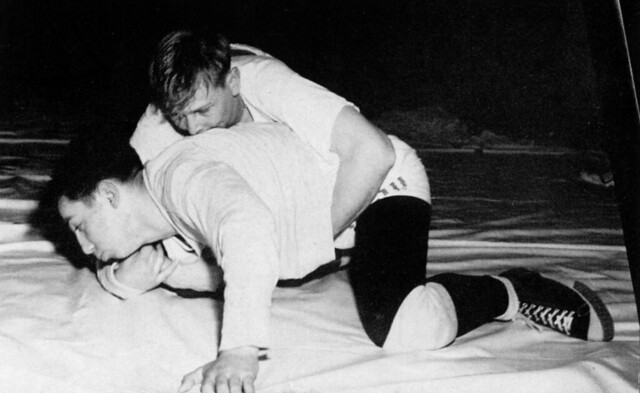

A young Curlee Alexander in his UNO wrestling singlet, ©UNO Criss Library
Champions. He’s coached numerous team and individual titlists. As satisfying as the team wins are, he said, they “don’t compare to the individual ones. The kids put so much effort into it.” He said a coach must be a master motivator to figure out what makes each individual tick. “All the time, I’m looking for angles to get into a kid’s head to get him to believe,” he said. “What separates a lot of coaches is getting those kids to believe your philosophy is correct. It boils down to being able to communicate and to have kids want to succeed for you and themselves.”
He makes clear he expects nothing less than champions. “I’ve got a lot of guys that have placed at state, but if they didn’t win a state championship, their picture does not go up on the wall in my office. That might be kind of harsh, but it’s reality. That’s what we’re trying to get our kids to strive for and win. Championships are what it’s all about.” He said his favorite moments come from kids who aren’t talented, yet get it done anyway and claim a championship that lasts a lifetime. North High heavyweight Brandon Johnson is an example. “He wasn’t really a good athlete. Overweight. He had to cut down to 275. But he was a hard worker and he had a big heart,” Alexander said. “And, boy, when he won state in 2001, I had tears in my eyes for the first time. I didn’t even cry when my son won, because it was understood he was going to win. But with this guy, it really wasn’t expected. It was just a culmination of all the hard work he gave.”
The hardest part of coaching is seeing “kids do all that hard work and then, when they get right there to the doorstep” of a championship, “they don’t win it.”
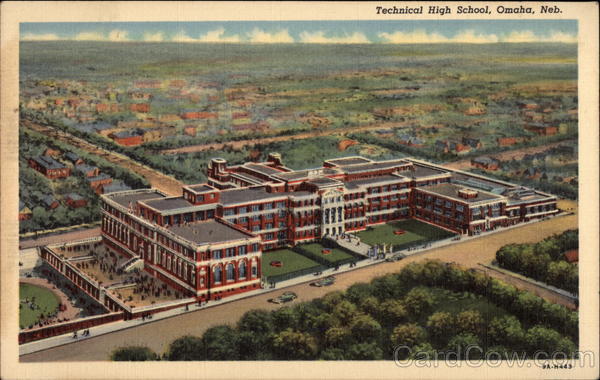
The heralded prep coach began as an assistant at Tech, whose wrestling program he took over in the mid’70s. He remained at Tech until it closed in 1984, when he went to North, where he’s remained until retiring from teaching full-time in 2002. The next year he stepped down as head coach to serve as associate head coach and lately he’s added Dean of Students to his duties. As co-head coach, he’s freed himself from all the red-tape to just work with the wrestlers. When his mentor, Don Benning, recently expressed surprise at how much passion Alexander still has for the sport, the former student replied, “I still enjoy it. I enjoy the strategy. I enjoy the competition. I enjoy working with the kids. They keep you young.” He said matching Xs and Os with coaches during a match never gets old. “I really think I’m very good at it and, boy, when I’m successful at it, it’s exhilarating.”
Alexander’s been a pioneer in much the same way Don Benning was at UNO in the ‘60s and Charles Bryant was at Abraham Lincoln High School (Council Bluffs) in the ‘70s. Each man became the first black head coach at their predominantly white schools, where they established wrestling dynasties. In more than 75 years of competition, Alexander is the only black head coach in Nebraska to lead his team to a state wrestling title (and he’s done it at two different schools). Along the way, he built a dynasty at North, which in all the years previous to his arrival had won but a single state wrestling championship. He had six as head coach. Through it all, he’s defied expectations and overturned stereotypes by doing it his way.

Related articles
- Closing Installment from My Series Out to Win: The Roots of Greatness, An Exploration of Omaha’s Black Sports Legends (leoadambiga.wordpress.com)
- From the series Out to Win: The Roots of Greatness – Black Women Make Their Mark in Athletics (leoadambiga.wordpress.com)
- Making the Case for a Nebraska Black Sports Hall of Fame (leoadambiga.wordpress.com)
- From My Series Out to Win: The Roots of Greatness, An Exploration of Omaha’s Black Sports Legends (leoadambiga.wordpress.com)
- Can Houston Alexander Break Gilbert Yvel? (mmaggregate.wordpress.com)
Closing installment from my series Out to Win: The Roots of Greatness, An appreciation of Omaha’s Black Sports Legends
Here is the closing installment from my 2004-2005 series, Out to Win: The Roots of Greatness, An Exploration of Omaha’s Black Sports Legends. In this and in the recently posted opening installment I try laying out the scope of achievements that distinguishes this group of athletes, the way that sports provided advancement opportunities for these individuals that may otherwise have eluded them, and the close-knit cultural and community bonds that enveloped the neighborhoods they grew up in. It was a pleasure doing the series and getting to meet legends Bob Gibson, Bob Boozer, Gale Sayers, Ron Boone, Marlin Briscoe, Johnny Rodgers, et cetera. I learned a lot working on the project, mostly an appreciation for these athletes’ individual and collective achievements. You’ll find most every installment from the series on this blog, including profiles of the athletes and coaches I interviewed for the project. The remaining installments not posted yet soon will be.
Closing installment from my series Out to Win: The Roots of Greatness,
An Appreciation of Omaha’s Black Sports Legends
©by Leo Adam Biga
Originally published in The Reader (www.thereader.com)
Any consideration of Omaha’s inner city athletic renaissance from the 1950s through the 1970s must address how so many accomplished sports figures, including some genuine legends, sprang from such a small place over so short a span of time and why seemingly fewer premier athletes come out of the hood today. As with African-American urban centers elsewhere, Omaha’s inner city core saw black athletes come to the fore, like other minority groups did before them, in using sports as an outlet for self-expression and as a gateway to more opportunity.
As part of an ongoing OWR series exploring Omaha’s Black Sports Legends, this installment looks at the conditions and attitudes that once gave rise to a singular culture of athletic achievement here that is less prevalent in the current feel-good, anything-goes environment of plenty and World Wide Web connectivity.
The legends and fellow ex-jocks interviewed for this series mostly agree on the reasons why smaller numbers of youths these days possess the right stuff. It’s not so much a lack of athletic ability, observers say, but a matter of fewer kids willing to pay the price in an age when sports is not the only option for advancement. The contention is that, on average, kids are neither prepared nor inclined to make the commitment and sacrifice necessary to realize, much less pursue, their athletic potential when less demanding avenues to success abound.
“Kids today are changed — their attitudes about authority and everything else,” says Major League Baseball Hall of Fame pitcher Bob Gibson, an Omaha Tech High grad who grew up in the late’40s-early ‘50s under the stern but steady hand of coaches like his older brother, Josh. “They’re like, I’m not going to let somebody tell me what to do, where we had no problem with that in our day.”

Gibson says coaches like Josh, a bona fide legend on the north side, used to be viewed as an extension of the family, serving, “first of all,” as “a father figure,” or as Clarence Mercer, a top Tech swimmer, puts it, as “a big brother,” providing discipline and direction to that era’s at-risk kids, many from broken homes.
Josh Gibson, along with other strong blacks working as coaches, physical education instructors and youth recreation directors in that era, including Marty Thomas, John Butler, Alice Wilson and Bob Rose, are recalled as superb leaders and builders of young people. All had a hand in shaping Omaha’s sports legends of the hood, but perhaps none more so than Gibson, who, from the 1940s until the 1960s, coached touring baseball-basketball teams out of the North Omaha Y. “Josh was instrumental in training most of these guys. He was into children, and into developing children. He carried a lot of respect. If you cursed or if you didn’t do what he wanted you to do or you didn’t make yourself a better person, than you couldn’t play for him,” says John Nared, a late ‘50s-early ’60s Central High-NU hoops star who played under Gibson on the High Y Monarchs and High Y Travelers. “He didn’t want you running around doing what bad kids did. When you came to the YMCA, you were darn near a model child because Josh knew your mother and father and he kept his finger on the pulse. When you got in trouble at the Y, you got in trouble at home.”
Old-timers note a sea change in the way youths are handled today, especially the lack of discipline that parents and coaches seem unwilling or unable to instill in kids. “You see young girls walking around with their stuff hanging out and boys bagging it with their pants around their ankles. In our time, there were certain things you had to do and it was enforced from your family right on down,” says Milton Moore, a track man at Central in the late ‘50s.
The biggest difference between then and now, says former three-sport Tech star and longtime North Omaha Boys Club coach Lonnie McIntosh, is the disconnected, permissive way youths grow up. Where, in the past, he says, kids could count on a parent or aunt or neighbor always being home, youths today are often on their own, in a latchkey home, isolated in their own little worlds of self-indulgence.
“What’s missing is a sense of family. People living on the same street may not even know each other. Parents may not know who their kids are running with. In our day, we all knew each other. We were a family. We would walk to school together. Although we competed hard against one another, we all pulled for one another. Our parents knew where we were,” McIntosh says.
“There were no discipline problems with young people in those days,” Mercer adds somewhat apocryphally.
Former Central athlete Jim Morrison says there isn’t the cohesion of the past. “The near north side was a community then. The word community means people are of one mind and one accord and they commune together.” “There’s no such thing as a black community anymore,” adds John Nared. “The black community is spread out. Kids are everywhere. Economics plays a part in this. A lot of mothers don’t have husbands and can’t afford to buy their kids the athletic shoes to play hoops or to send their kids to basketball camps. Some of the kids are selling drugs. They don’t want a future. We wanted to make something out of our lives because we didn’t want to disappoint our parents.”

The close communion of days gone by, says Nared, played out in many ways. Young blacks were encouraged to stay on track by an extended, informal support system operating in the hood. “The near north side was a very small community then…so small that everybody knew each other.” In what was the epitome of the it-takes-a-village-to-raise-a-child concept, he says the hood was a community within a community where everybody looked out for everybody else and where, decades before the Million Man March, strong black men took a hand in steering young black males. He fondly recalls a gallery of mentors along North 24th Street.
“Oh, we had a bunch of role models. John Butler, who ran the YMCA. Josh Gibson. Bob Gibson. Bob Boozer. Curtis Evans, who ran the Tuxedo Pool Hall. Hardy “Beans” Meeks, who ran the shoe shine parlor. Mr. (Marcus “Mac”) McGee and Mr. (James) Bailey who ran the Tuxedo Barbershop. All of these guys had influence in my life. All of ‘em. And it wasn’t just about sports. It was about developing me. Mr. Meeks gave a lot of us guys jobs. In the morning, when I’d come around the corner to go to school, these gentlemen would holler out the door, ‘You better go up there and learn something today.’ or ‘When you get done with school, come see me.’
“Let me give you an example. Curtis Evans, who ran the pool hall, would tell me to come by after school. ‘So, I’d…come by, and he’d have a pair of shoes to go to the shoe shine parlor and some shirts to go to the laundry, and he’d give me two dollars. Mr. Bailey used to give me free haircuts…just to talk. ‘How ya doin’ in school? You got some money in your pocket?’ I didn’t realize what they were doing until I got older. They were keeping me out of trouble. Giving me some lunch money so I could go to school and make something of myself. It was about developing young men. They took the time.”
Beyond shopkeepers, wise counsel came from Charles Washington, a reporter-activist with a big heart, and Bobby Fromkin, a flashy lawyer with a taste for the high life. Each sports buff befriended many athletes. Washington opened his humble home, thin wallet and expansive mind to everyone from Ron Boone to Johnny Rodgers, who says he “learned a lot from him about helping the community.” In hanging with Fromkin, Rodgers says he picked-up his sense of “style” and “class.”

Super athletes like Nared got special attention from these wise men who, following the African-American tradition of — “each one, to teach one” — recognized that if these young pups got good grades their athletic talent could take them far — maybe to college. In this way, sports held the promise of rich rewards. “The reason why most blacks in that era played sports is that in school then the counselors talked about what jobs were available for you and they were saying, ‘You’ll be a janitor,’ or something like that. There weren’t too many job opportunities for blacks. And so you started thinking about playing sports as a way to get to college and get a better job,” Nared says.
Growing up at a time when blacks were denied equal rights and afforded few chances, Bob Gibson and his crew saw athletics as a means to an end. “Oh, yeah, because otherwise you didn’t really have a lot to look forward to after you got out of school,” he says. “The only black people you knew of that went anywhere were athletes like Joe Louis and Jackie Robinson or entertainers.” Bob had to look no further than his older brother, Josh, to see how doors were closed to minorities. The holder of a master’s degree in education as well as a sterling reputation as a coach, Josh could still not get on with the Omaha Public Schools as a high school teacher-coach due to prevailing hiring policies then.
“Back in the ‘50s and early ‘60s the racial climate was such we had nothing else to really look forward to except to excel as black athletes,” says Marlin Briscoe, the Omaha South High School grad who made small college All-America at then-Omaha University and went on to be the NFL’s first black quarterback. “We were told, ‘You can’t do anything with your life other than work in the packing house.’ We grew up seeing on TV black people getting hosed down and clubbed and bitten by dogs and not being able to go to school. So, sports became a way to better ourselves and hopefully bypass the packing house and go to college.”


Besides, Nared, says, it wasn’t like there was much else for black youths to do. “Back when we were coming up we didn’t have computers, we didn’t have this, we didn’t have that. The only joy we could have was beating somebody’s ass in sports. One basketball would entertain 10 people. One football would entertain 22 people. It was very competitive, too. In the neighborhood, everybody had talent. We played every day, too. So, you honed in on your talents when you did it every day. That’s why we produced great athletes.”
With the advent of so many more activities and advantages, Gibson says contemporary blacks inhabit a far richer playing ground than he and his buddies ever had, leaving sports only one of many options. “In our time, if you wanted to get ahead and to get away from the ghetto or the projects, you were going to be an athlete, but I don’t know if that’s been the same since then. I think kids’ interests are other places now. There’s all kinds of other stuff to think about and there’s all kinds of other problems they have that we never had. They can do a lot of things that we couldn’t do back then or didn’t even think of doing.”
Milton Moore adds, “It used to be you couldn’t be everything you were, but you could be a baseball player or you could be a football player. Now, you can be anything you want to be. Kids have more opportunities, along with distractions.”
Ron Boone, an Omaha Tech grad who went to become the iron man of pro hoops by playing in all 1,041 games of his combined 13-year ABA-NBA career, finds irony in the fact that with the proliferation of strength training programs and basketball camps “the opportunities to become very good players are better now than they were for us back then,” yet there are fewer guys today who can “flat out play.” He says this seeming contradiction may be explained by less intense competition now than what he experienced back in the day, when everyone with an ounce of game wanted to show their stuff and use it as a steppingstone.
If not for the athletic scholarships they received, many black sports stars of the past would simply not have gone on to college because they were too poor to even try. In the case of Bob Gibson, his talent on the diamond and on the basketball court landed him at Creighton University, where Josh did his graduate work.
By the time Briscoe and company came along in the early ‘60s, they made role models of figures like Gibson and fellow Tech hoops star Bob Boozer, who parlayed their athletic talent into college educations and pro sports careers. “When Boozer went to Kansas State and Gibson to Creighton, that next generation — my generation — started thinking, If I can get good enough…I can get a scholarship to college so I can take care of my mom. That’s the way all of us thought, and it just so happened some of us had the ability to go to the next level.”
Young athletes of the inner city still use sports as an entry to college. The talent pool may or may not be what it was in urban Omaha’s heyday but, if not, than it’s likely because many kids have more than just sports to latch onto now, not because they can’t play. At inner city schools, blacks continue to make up a disproportionately high percentage of the starters in the two major team sports — football and basketball. The one major team sport that’s seen a huge drop-off in participation by blacks is baseball, a near extinct sport in urban America the past few decades due to the high cost of equipment, the lack of playing fields and the perception of the game as a slow, uncool, old-fashioned, tradition-bound bore.
Carl Wright, a football-track athlete at Tech in the ‘50s and a veteran youth coach with the Boys Club and North High, sees good and bad in the kids he still works with today. “There’s a big change in these kids now. I’ll tell a kid, ‘Take a lap,’ and he’ll go, ‘I don’t want to take no lap,’ and he’ll go home and not look back. I’ve seen kids with talent that can never get to practice on time, so I kick them off the team and it doesn’t mean anything to them. They’ve got so much talent, but they don’t exploit it. They don’t use it, and it doesn’t seem to bother them.”
On the other hand, he says, most kids still respond to discipline when it’s applied. “I know one thing, you can tell a kid, no, and he’ll respect you. You just tell him that word, when everybody else is telling him, yes, and they get to feeling, Well, he cares about me, and they start falling into place. There’s really some good kids out there, but they just need guidance. Tough love.”
Tough love. That was the old-school way. A strict training regimen, a heavy dose of fundamentals, a my-way-or-the-highway credo and a close-knit community looking out for kids’ best interests. It worked, too. It still works today, only kids now have more than sports to use as their avenue to success.


Related articles
- Making the Case for a Nebraska Black Sports Hall of Fame (leoadambiga.wordpress.com)
- Omaha Hoops Legend John C. Johnson: Fierce Determination Tested by Repeated Run-Ins with the Law (leoadambiga.wordpress.com)
- From the series Out to Win: The Roots of Greatness – Black Women Make Their Mark in Athletics (leoadambiga.wordpress.com)
- One Peach of a Pitcher: Peaches James Leaves Enduring Legacy in the Circle as a Nebraska Softball Legend (leoadambiga.wordpress.com)
- The Great Migration Comes Home: Deep South Exiles Living in Omaha Participated in the Movement Author Isabel Wilkerson Writes About in Her Book, ‘The Warmth of Other Suns’ (leoadambiga.wordpress.com)
Opening installment from my series Out to Win: The Roots of Greatness, An exploration of Omaha’s Black Sports Legends
Here is the opening installment from my 2004-2005 series, Out to Win: The Roots of Greatness, An Exploration of Omaha’s Black Sports Legends. Look for the closing installment in a separate post. In these two pieces I try laying out the scope of achievements that distinguishes this group of athletes, the way that sports provided advancement opportunities for these individuals that may otherwise have eluded them, and the close-knit cultural and community bonds that enveloped the neighborhoods they grew up in. It was a pleasure doing the series and getting to meet legends Bob Gibson, Bob Boozer, Gale Sayers, Ron Boone, Marlin Briscoe, Johnny Rodgers, et cetera. I learned a lot working on the project, mostly an appreciation for these athletes’ individual and collective achievements. You’ll find most every installment from the series on this blog, including profiles of the athletes and coaches I interviewed for the project. The remaining installments not posted yet soon will be.

Opening installment from my series Out to Win: The Roots of Greatness,
An exploration of Omaha’s Black Sports Legends
©by Leo Adam Biga
Originally published in The Reader (www.thereader.com)
Omaha’s African American community has produced a heritage rich in achievement across many fields, but none more dramatic than in sports, Despite a comparatively small populace, black Omaha rightly claims a legacy of athletic excellence in the form of legends who’ve achieved greatness at many levels, in a variety of sports, over many eras.
These athletes aren’t simply neighborhood or college legends – their legacies loom large. Each is a compelling story in the grand tale of Omaha’s inner city, both north and south. The list includes: Bob Gibson, a major league baseball Hall of Famer. Bob Boozer, a member of Olympic gold medal and NBA championship teams. NFL Hall of Famer Gale Sayers. Marlin Briscoe, the NFL’s first black quarterback. Heisman Trophy winner Johnny Rodgers. Pro hoops “iron man” Ron Boone. Champion wrestling coach Don Benning
“Some phenomenal athletic accomplishments have come out of here, and no one’s ever really tied it all together. It’s a huge story. Not only did these athletes come out of here and play, they lasted a long time and they made significant contributions to a diversity of college and professional sports,” said Briscoe, a Southside product. “I mean, per capita, there’s probably never been this many quality athletes to come out of one neighborhood.”
An astounding concentration of athletic prowess emerged in a few square miles roughly bounded north to south, from Ames Avenue to Lake Street, and east to west from about 16th to 36th. Across town, in south Omaha, a smaller but no less distinguished group came of age.
“You just had a wealth of talent then,” said Lonnie McIntosh, a teammate of Gibson and Boozer at Tech High.
Many inner city athletes resided in public housing projects. Before school desegregation dispersed students citywide, blacks attended one of four public high schools – North, Tech, Central or South. It was a small world.
During a Golden Era from the end of World War II to the mid-1970s, all manner of brilliant talents, including future all-time greats, butted heads and rubbed shoulders on the same playing fields and courts of their youth, pushing each other to new heights. It was a time when youths competed in several sports instead of specializing in one.
“In those days, everybody did everything,” said McIntosh, who participated in football, basketball and track.

Many were friends, schoolmates and neighbors, often living within a few doors or blocks of each other. It was an insular, intense, tight-knit athletic community that formed a year-round training camp, proving ground and mutual admiration society all rolled into one.
“In the inner city, we basically marveled at each other’s abilities. There were a lot of great ballplayers. All the inner city athletes were always playing ball, all day long and all night long,” said Boozer, the best player not in the college hoops hall of fame. “Man, that was a breeding ground. We encouraged each other and rooted for each other. Some of the older athletes worked with young guys like me and showed us different techniques. It was all about making us better ballplayers.”
NFL legend Gale Sayers said, “No doubt about it, we fed off one another. We saw other people doing well and we wanted to do just as well.”
The older legends inspired legends-to-be like Briscoe.
“We’d hear great stories about these guys and their athletic abilities and as young players we wanted to step up to that level,” he said “They were older and successful, and as little kids we looked up to those guys and wanted to emulate them and be a part of the tradition and the reputation that goes with it.”
The impact of the older athletes on the youngsters was considerable.
“When Boozer went to Kansas State and Gibson to Creighton, that next generation – my generation – started thinking, ‘If I can get good enough, I can get a scholarship to college so I can take care of my mom‚’” Briscoe said. “That’s the way all of us thought, and it just so happened some of us had the ability to go to the next level.”

With that next level came a new sense of possibility for younger athletes.
“It got to the point where we didn’t think anything was impossible,” Johnny Rodgers said. “It was all possible. It was almost supposed to happen. We were like, If they did it, we can do it, too. We were all in this thing together.”
In the ’50s and ’60s, two storied tackle football games in the hood, the annual Turkey and Cold Bowls, were contested at Burdette Field over the Thanksgiving and Christmas holidays. Drawing players of all ages, they were no-pads, take-no-prisoners rumbles where adolescent prodigies like Gale Sayers and Johnny Rodgers competed against grown men in an athletic milieu rich with past, present and future stars.
“They let us play ball with them because we were good enough to play,” Rodgers said. “None of us were known nationally then. It really was gratifying as the years went on to see how guys went on and did something.”
When Rodgers gained national prominence, he sensed kids “got the same experience seeing me as I got seeing those legends.”

Among the early legends that Rodgers idolized was Bob Gibson. Gibson gives Omaha a special sports cachét. He’s the real thing — a major league baseball Hall of Famer, World Series hero and Cy Young Award winner. The former St. Louis Cardinal pitcher was among the most dominant hurlers, intense competitors and big game performers who ever played. Jim Morrison, a teammate on the High Y Monarchs coached by Bob’s brother, Josh, recalled how strong Gibson was.
“He threw so hard, we called it a radio ball. You couldn’t see it coming. You just heard it.”
Morrison said Gibson exhibited his famous ferocity early on.
“On the sideline, Bob could be sweet as honey, but when he got on the mound you were in big trouble. I don’t care who you were, you were in big trouble,” he said.
Gibson was also a gifted basketball player, as Boozer, a teammate for a short time at Tech and with the Travelers, attested.
“He was a finer basketball player than baseball player. He could play. He could get up and hang,” Boozer said.
Gibson starred on the court for the hometown Creighton University Bluejays, then played with the Harlem Globetrotters for a year, but it was only after being denied a chance with the NBA that he made baseball his life. Gibson’s all-around athleticism and fierce game face was aided and abetted by his older brother, Josh, a formidable man and coach who groomed many of Omaha’s top athletes from the inner city.
Bob Gibson may be The Man, but Josh was a legend in his own time as a coach of touring youth teams (the Monarchs and Travelers) out of North Omaha’s YMCA.
“He was a terrific coach. If you were anything in athletics, you played for those teams under Josh Gibson,” Boozer said.
Others agreed.
“Josh was the one that guys like myself looked up to,” said Ron Boone. Jim Morrison said Josh had “the ability to elicit the best out of young potential stars. He started with the head down, not the body up. He taught you how to compete by teaching the fundamentals. It’s obvious it worked because his brother went on to be a great, great athlete.”
Josh Gibson is part of a long line of mentors, black and white, who strongly affected inner city athletes. Others included Logan Fontenelle rec center director Marty Thomas, the North O Y’s John Butler, Woodson Center director Alice Wilson, Bryant Center director John Nared and coaches Bob Rose of Howard Kennedy School, Neal Mosser of Tech, Frank Smagacz of Central, Cornie Collin of South, Carl Wright and Lonnie McIntosh of the North O Boys Club, Richard Nared and Co. with the Midwest Striders track program, Forest Roper with the Hawkettes hoops program, Petie Allen with the Omaha Softball Association, and Joe Edmonson of the Exploradories Wrestling Club. Each commanded respect, instilled discipline and taught basics.
Mosser, Tech’s fiery head hoops coach for much of the ‘50s and ‘60s, coached Boozer and Gibson along with such notables as Fred Hare, whom Boone calls “one of the finest high school basketball players you’d ever want to see,” Bill King and Joe Williams. A hard but fair man, Mosser defied bigoted fans and biased officials to play black athletes ahead of whites.
“Neal Mosser fought a tremendous battle for a lot of us minority kids,” McIntosh said. “He and Cornie Collin. At that time, you never had five black kids on the basketball court at the same time.”
But they did, including a famous 1954 Tech-South game when all 10 kids on the court were black.
“Their jobs were on the line, too,” McIntosh said of the two coaches.
Wherever they live, athletes will always hear about a real comer to the local scene. Like when Josh Gibson’s little brother, Bob, began making a name for himself in hoops.
The buzz was, “This kid can really jump, man,” Lonnie McIntosh recalled. “He had to duck his head to dunk.” But nobody could hang like Marion Hudson, an almost mythic-like figure from The Hood who excelled in soccer, baseball, football, basketball and track and field. Former Central High athlete Richard Nared said, “Marion was only 6’0, but he’d jump center, and go up and get it every time. The ref would say, ‘You’re jumping too quick,’ and Marion would respond, ‘No, you need to throw the ball higher.'”
Admirers and challengers go to look over or call out the young studs. Back in the day, the proving grounds for such showcases and showdowns included Kountze Park, Burdette Field, the North O YMCA, the Logan Fontenelle rec center, the Kellom Center and the Woodson Center. Later, the Bryant Center on North 24th became the place to play for anyone with game, Boone said.
“I mean, the who’s-who was there. We had teams from out west come down there to play. There was a lot of competition.”
Black Omaha flourished as a hot bed of talent in football, basketball, baseball and track and field. At a time when blacks had few options other than a high school degree and a minimum-wage job, and even fewer leisure opportunities, athletics provided an escape, an activity, a gateway. In this highly charged arena, youths proved themselves not by gang violence but through athletic competition. Blacks gravitated to sports as a way out and step up. Athletics were even as a mode of rebellion against a system that shackled them. Athletic success allowed minority athletes to say, oh, yes, I can.
“Back in the ‘50s and early ‘60s the racial climate was such we had nothing else to really look forward to except to excel as black athletes,” said Briscoe. “In that era, we didn’t get into sports with that pipe dream of being a professional athlete. Mainly, it was a rite of passage to respect and manhood. We were told, ‘You can’t do anything with your life other than work in the packing house.’ We grew up seeing on TV black people getting hosed down and clubbed and bitten by dogs and not being able to go to school. So sports became a way to better ourselves and hopefully bypass the packing house and go to college.”

Richard Nared, a former track standout at Central, said speed was the main barometer by which athletic ability was gauged.
“Mostly, all the guys had speed. You were chosen that way to play. The guys that were the best and fastest were picked first,” he said.
Toughness counted for something, too, but speed was always the separating factor.
“You had to be able to fight a little bit, too. But, yeah, you had to be fast. You were a second class citizen if you couldn’t run,” Bob Gibson said.
And second class wasn’t good in such a highly competitive community.
“The competition was so strong Bob Boozer did not make the starting five on the freshman basketball team I played on at Tech,” Jim Morrison said.
It was so strong that Gale Sayers was neither the fastest athlete at Central nor at home, owing to older brother Roger, an elite American sprinter who once beat The Human Bullet, Bob Hayes. Their brother, Ron, who played for the NFL’s San Diego Chargers, may also have been faster than Gale.
The competition was so strong that Ron Boone, who went on to a storied college and pro hoops career could not crack Tech’s starting lineup until a senior.
Bob Boozer, remembered today as a sweet-shooting, high-scoring, big-rebounding All-America power forward at Kansas State and a solid journeyman in the NBA, did not start out a polished player. But he holds the rare distinction of winning both Olympic gold as a member of the U.S. squad at the 1960 Rome Games, and an NBA championship ring as 6th man for the 1971 Milwaukee Bucks.
Boozer showed little promise early on. After a prodigious growth spurt of some six inches between his sophomore and junior years in high school, Boozer was an ungainly, timid giant.
“I couldn’t walk, chew gum and cross the street at the same time without tripping,” he said.
Hoping to take advantage of his new height, Boozer enlisted John Nared, a friend and star at arch-rival Central, and Lonnie McIntosh, a teammate at Tech, to help his coordination, conditioning, skills and toughness catch up to his height.
“Lonnie was always a physical fitness buff. He would work me out as far as strength and agility drills,” Boozer recalled. “And John was probably one of the finest athletes to ever come out of Omaha. He was a pure basketball player. John and I would go one-on-one. He was 6’3. Strong as a bull. I couldn’t take him in the paint. I had to do everything from a forward position. And, man, we used to have some battles.”
Boozer dominated Nebraska prep ball the next two years and, in college, led the KSU Wildcats to national glory. When Boozer prepared to enter the NBA with the Cincinnati Royals, he again called-on Nared’s help and credits their one-on-one tussles with teaching him how to play against smaller, quicker foes. The work paid off, too, as Boozer became a 20-point per game scorer and all-star with the Chicago Bulls.
Around the time Boozer made a name for himself in the NBA, Don Benning took over then-Omaha U.’s lowly wrestling program. He was the first black head coach at a predominantly white university. Within a few years, Benning , a North High and UNO grad who competed in football and wrestling, built the program into the perennial power it remains today. He guided his 1969-70 squad to a national NAIA team championship, perhaps the first major team title won by a Nebraska college. His indomitable will led a diverse mix of student-athletes to success while his strong character steered them, in the face of racism, to a higher ground.
After turning down big-time coaching offers, Benning retired from athletics in his early 30s to embark on a career in educational administration with Omaha Public Schools, where he displayed the same leadership and integrity he did as a coach.
The Central High pipeline of prime-time running backs got its start with Roger and Gale Sayers. Of all the Eagle backs that followed, including Joe Orduna, Keith “End Zone” Jones, Leodis Flowers, Calvin Jones, Ahman Green and David Horne, none quite dazzled the way Gale Sayers did. He brandished unparalleled cutting ability as an All-American running back and kick returner at Kansas University and, later, for the Chicago Bears. As a pro, he earned Rookie of the Year, All-Pro and Hall of Fame honors.
Often overlooked was Gale’s older but smaller brother, Roger, perhaps the fastest man ever to come out of the state. For then-Omaha U. he was an explosive halfback-receiver-kick returner, setting several records that still stand, and a scorching sprinter on the track, winning national collegiate and international events. When injuries spoiled his Olympic bid and his size ruled out the NFL, he left athletics for a career in city government and business.

Ron Boone
Ron Boone went from being a short, skinny role player at Tech to a chiseled 6’2 star guard at Idaho State University, where his play brought him to the attention of pro scouts. Picking the brash, upstart ABA over the staid, traditional NBA, Boone established himself as an all-around gamer. He earned the title “iron man” for never missing a single contest in his combined 13-year ABA-NBA career that included a title with the Utah Stars. His endurance was no accident, either, but rather the result of an unprecedented work ethic he still takes great pride in.
Marlin Briscoe was already a pioneer when he made small college All-America as a black quarterback at mostly white Omaha U., but took his trailblazing to a new level as the NFL’s first black QB. Pulled from cornerback duty to assume the signal calling for the Denver Broncos in the last half of his 1968 rookie season, he played big. But the real story is how this consummate athlete responded when, after exhibiting the highly mobile, strong-armed style now standard for today’s black QBs, he never got another chance behind center. Traded to Buffalo, he made himself into a receiver and promptly made All-Pro. After a trade to Miami, he became a key contributor at wideout to the Dolphins two Super Bowl winning teams, including the perfect 17-0 club in 1972. His life after football has been a similar roller-coaster ride, but he’s adapted and survived.
Finally, there is the king of bling-bling, Johnny Rodgers, the flamboyant Nebraska All-American, Heisman Trophy winner and College Football Hall of Fame inductee. Voted Husker Player of the Century and still regarded as one of the most exciting, inventive broken field runners, Rodgers is seemingly all about style, not substance. Yet, in his quiet, private moments, he speaks humbly about the mysteries and burdens of his gift and the disappointment that injuries denied him a chance to strut his best stuff in the NFL.
Other, less famous sports figures had no less great an impact, from old-time football stars like Charles Bryant and Preston Love Jr., to more recent gridiron stars like Junior Bryant and Calvin Jones, right through Ahman Green. In 2003, Green, the former Nebraska All-American and current Green Bay Packers All-Pro, rushed for more yards, 1,883, in a single season, than all but a handful of backs in NFL history, shattering Packers rushing records along the way.
Hoops stars range from John Nared, Bill King, Fred Hare and Joe Williams in the ‘50s and ‘60s to Dennis Forrest, John C. Johnson, Kerry Trotter, Mike McGee, Ron Kellogg, Cedric Hunter, Erick Strickland, Andre Woolridge, Maurtice Ivy and Jessica Haynes in the ‘70s, ‘80s, and ‘90s. After torrid prep careers, King, Nared, Hare and Williams had some college success. The others starred for Division I programs, except for Forrest, who starred at Division II UNO. Ex-NU star Strickland made the NBA, where he’s still active.
The prolific McGee, who set Class A scoring marks at North and topped the University of Michigan’s career scoring chart, played on one of Magic Johnson’s-led Lakers title teams in the ‘80s. Ivy made the WBA. Others, like Woolridge, played in Europe.

Multi-sport greats have included Marion Hudson, Roger Sayers and Mike Green from the ‘60s and Larry Station from the ‘70s, all of whom excelled in football. A Central grad, Hudson attended Dana College in Blair, Neb. where he bloomed into the most honored athlete in school history. He was a hoops star, a record-setting halfback and a premier sprinter, long-jumper and javelin thrower, once outscoring the entire Big Seven at the prestigious Drake Relays.
He was the Lincoln Journal Star’s 1956 State College Athlete of the Year.
Among the best prep track athletes ever are former Central sprinter Terry Williams, Boys Town distance runner Barney Cotton, Holy Name sprinter Mike Thompson, Creighton Prep sprinter/hurdler Randy Brooks and Central’s Ivy.
The elite wrestlers are led by the Olivers. Brothers Archie Ray, Roye and Marshall were state champs at Tech and collegiate All-Americans. Roye was an alternate on the ’84 U.S. Olympic wrestling team. The latest in this family mat dynasty is Archie Ray‚s son Chris, a Creighton Prep senior, who closed out a brilliant career with an unbeaten record and four state individual titles.
Joe Edmonson developed top wrestlers and leaders at his Exploradories Wrestling Club, now the Edmonson Youth Outreach Center. Tech’s Curlee Alexander became a four-time All-American and one-time national champ at UNO and the coach of seven state team championships, including one at Tech, where he coached the Oliver brothers, and the last six at North. And Prep’s Brauman Creighton became a two-time national champ for UNO.
A few black boxers from Omaha made their mark nationally. Lightweight prizefighter Joey Parks once fought a draw with champ Joe Brown. A transplanted Nebraskan via the Air Force, Harley Cooper was a two-time national Golden Gloves champion out of Omaha, first as a heavyweight in 1963 and then as a light heavyweight in 1964. He was slated for the 1964 U.S. Olympic Team as light heavyweight at the Tokyo Games and sparred with the likes of Joe Frazier, when, just before leaving for Japan, a congenital kidney condition got him scratched. Despite offers to turn pro, including an overture from boxing legend Henry Armstrong, Cooper opted to stay in the military. Lamont Kirkland was a hard-hitting terror during a light heavyweight amateur and pro middleweight career in the ’80s.
With the advent of Title IX, girls-women’s athletics took-off in the ‘70s, and top local athletes emerged. Omaha’s black female sports stars have included: Central High and Midland Lutheran College great Cheryl Brooks; Central High and NU basketball legend Maurtice Ivy, a Kodak All-America, WBA MVP and the founder-director of her own 3-on-3 Tournament of Champions; Ivy’s teammate at Central, Jessica Haynes, an impact player at San Diego State and a stint in the WNBA; Maurtice’s little sister, Mallery Ivy Higgs, the most decorated track athlete in Nebraska prep history with 14 gold medals; Northwest High record-setting sprinter Mikaela Perry; Bryan High and University of Arizona hoops star Rashea Bristol, who played pro ball; and NU softball pitching ace Peaches James, a top draftee for a new pro fastpitch league starting play this summer.
The stories of Omaha’s black sports legends contribute to a vital culture and history that demand preservation. This ongoing, 12-part series of profiles is a celebration of an inner city athletic lore that is second to none, and still growing.
Related articles
- Making the Case for a Nebraska Black Sports Hall of Fame (leoadambiga.wordpress.com)
- Omaha Hoops Legend John C. Johnson: Fierce Determination Tested by Repeated Run-Ins with the Law (leoadambiga.wordpress.com)
- From the series Out to Win: The Roots of Greatness – Black Women Make Their Mark in Athletics (leoadambiga.wordpress.com)
- One Peach of a Pitcher: Peaches James Leaves Enduring Legacy in the Circle as a Nebraska Softball Legend (leoadambiga.wordpress.com)
One Peach of a Pitcher: Peaches James Leaves Enduring Legacy in the Circle as a Nebraska Softball Legend
I earlier posted a 2004 story about black women athletes of distinction in Nebraska, and that reminded me of another story I did that year on Peaches James, a hard-throwing softball pitcher whose dominance in the circle helped establish a dynasty at Papillion-La Vista High School and helped lead the University of Nebraska softball program to great success, though short of its ultimate goal of winning the women’s College World Series. James was a good to very good college pitcher her first three years in Lincoln but elevated her game her senior season to become nothing short of great as she earned all sorts of team, conference, and national accolades. My story appeared in The Reader (www.thereader.com) just as her collegiate career came to an end and just as she looked forward to playing professionally. Her pro career didn’t amount to much, but today she’s a fastpitch instructor with an elite sports academy in Illinois.
NOTE: While this story was not officially a part of my extensive 2004-2005 series on Omaha black sports legends, Out to Win: The Roots of Greatness, it appeared just before the start of that series, and so I count it in the mix. You can find most of the installments in that series on this blog, and I’ll soon be adding the remaining installments.
©by Leo Adam Biga
Originally appeared in The Reader (www.thereader.com)
Nebraska softball pitching whiz Peaches James is the epitome of cool on the diamond between her tight braids, sleek shades, silver bling-bling adorned ears and silky smooth delivery of blazing rise balls. She strides the circle with the calm confidence you expect from the ace of the staff. Intense, yet loose, and in complete command out there.
The record-setting James is among the latest African-American athletes from Omaha who’ve made an enduring contribution to the area’s fat sports heritage. But she’s done it in a sport that, at the collegiate level, has had traditionally few black faces.
It’s no coincidence the Top 15 Lady Huskers enjoyed their finest season in a long time in what was their ace’s best year. NU wrapped up the regular season Big 12 title with a pair of one-run wins pitched by James over Texas A & M in early May. Two weekends ago, she got on a roll in the Big 12 tourney. She pitched a 2-1 complete game victory over Texas that saw her strike out 13 Longhorns and then topped that with a perfect game 7-0 win over Oklahoma. On May 15, she was in the circle for a 10-1 win over Baylor and later that same day she threw a 1-0 shutout, with 16 strikeouts, against Missouri to clinch the Huskers’ tourney title. With her four-game performance, she added conference tourney MVP to her Big 12 Pitcher of the Year honors. Then, she led her Huskers to the NCAA Region 5 championship round, posting a 6-0, 12-strikeout win over Leigh and bracketing two wins over Creighton amid a 2-0 loss to top-seed California. NU was eliminated Sunday with another 2-0 loss to the Bears — falling two wins short of the College World Series.
Even with her NU career ended, Peaches has already secured more softball in her future. Last December, she was a second round pick in the inaugural senior draft of the newly formed National Pro Fastpitch league, the latest attempt to market women’s softball. Selected by the Houston Thunder, now known as the Texas Thunder, James will be competing this summer with a who’s-who roster of former college and Olympic stars. NCAA rules prohibited her from negotiating and signing a contract until the season ended. Now that it has, she’s eager to get started. “I’m really excited,” she said. “It will be great competition.”
Then there’s a possible try for the 2008 USA Olympic team. Just like the pros, making the Olympic squad would require taking her game to “a whole different level,” she said. “When you have pitchers like Lisa Fernandez and Jenny Finch, they’re your top, elite athletes. To compete at that level you’ve got to be at the top of your game every game.” Can she? “I’d like to think so.” Cool. Peachy keen.
History repeated itself with James. She was a solid, at times smothering, starting pitcher her first two years of prep ball before going off into the stratosphere her senior season, when she shut down and almost always shut out her foes. Similarly, for NU, she established herself as an outstanding performer her freshman, sophomore and junior seasons, pitching well enough to earn first-team All-Big 12 honors all three years and first-team All-Midwest Region as a junior. Entering the 2004 season, she’d already been on the national Softball Player of the Year watch list and an invitee to the Olympic training center and she ranked among NU’s all-time leaders in wins, shutouts, strikeouts and innings pitched.

But, just like she did before, she ratcheted her game up another notch or two for her swan song, lowering her ERA by nearly half her career average, to 0.70, throwing her second collegiate no-hitter and setting NU single season records for most shutouts (18) and strikeouts (more than 300). Her 37 wins (versus 9 losses) are among the program’s best single season totals. She’s also first in career strikeouts (with more than 900) and second in career wins (98).
“I do see a lot of mirroring from her high school career,” Revelle said. “It seemed like every year in high school she made strides and then she made a leap her senior year. And I feel the same thing in this senior year for her. She’s had a great career for us but this is definitely her signature season.”
James explains her senior success this time around to having been there before. “I think what’s helped me is the experience I’ve gained from my freshman year in college to my senior year now. It’s about building confidence. It’s getting comfortable being out there and playing with your teammates. It’s building trust. It’s all those mental things that make you a better player.”
She first started developing a name for herself at Papillion-La Vista High School, whose dynasty of a softball program she helped maintain. Her prep career came in the middle of the school’s record nine straight state championships, a run of excellence unequaled in Nebraska prep history. But what James did her senior season elevated her and her team’s dominance to new heights. Almost literally unhittable the entire 1999-2000 campaign, she posted a remarkable 0.04 earned run average. In the space of that same season, she pitched 11 no-hitters, including five perfect games. It was the culmination of an unparalled two-year run in which she set about a dozen state records, including marks for most consecutive: wins (31); shut-outs (19); shut-out innings (162 1/3) and no earned runs allowed (257 2/3).
Her brilliance is all the more remarkable given that only six years earlier Mike Govig, her future prep coach, saw her at an indoor clinic where her wild throws soared up to the ceiling while her mother patiently sat on a bucket waiting, in vain, to catch one of those errant tosses. “I did not get it (pitching) right away. Balls would be flying everywhere,” James said. Govig recalls thinking the girl was hopeless.
What he didn’t know then was the size of her heart and strength of her will. With a lot of hard work, James made herself a pitcher the Monarchs rode to titles her sophomore year on. Her progress into a consummate hurler was so advanced that at a summer Topeka, Kansas tournament prior to her senior year she threw seven games in one day, winning six, en route to capping team title-tourney MVP honors.
“The title game got over at two o’clock in the morning, and her last inning was probably her strongest inning of the whole day,” Govig said. “You talk about a workhorse. The legend grew.”
Her dominance and endurance carried through her senior season. As her reputation grew, Govig said frustrated batters often got themselves out. “People were not able to step in the box with a whole lot of confidence. Half the battle was already won. They’d already lost…You could see it their body language.”
James also blossomed into a fine athlete. She competed in volleyball and track. On the diamond, she displayed versatility by playing second base her freshman year and posing the Monarchs best base stealing threat all four years. Govig rates her as one of the best athletes he’s ever coached, while NU head softball coach Rhonda Revelle flat out says, “I’ve not coached a better all-around athlete in this program. She’s physically powerful. She has so many tools.” James holds the best all-sport vertical jump in NU women’s athletics history at 30.5 inches.
The coaches say there’s never been another home-grown softball pitcher who’s carried her dominance from high school into college as James has. “She definitely stands alone,” Govig said. “She’s set the bar very high.”
The work ethic it took to come so far, so quickly, was instilled in James by her parents and coaches, whose preachings about the importance of practice she faithfully followed. “As I got older I had enough discipline to go pitch on my own or go work out on my own,” she said. “It’s like I wanted to do it on my own because I wanted to get better and I wanted to get good.”
Govig, who’s followed James career at NU, said the right-hander has it all. “Some pitchers might just be dominant with a rise ball, but she can throw a drop, a curve, a rise, a change. She can get you out in a bunch of different ways. Her ball movement is very extraordinary.”
Embracing the role of every day starter didn’t come easily for the placid James, whose magnanimous personality made it hard for her to stand out. “It was hard for me at first when we’d play and then I’d find out I was pitching again the next day and the other pitchers were not getting the ball, because I am the type of person that wants everybody to succeed,” she said. Her survival-of-the-fittest showing in Topeka went a long way towards changing her attitude. “Before that I would never have thought I’d be able to pitch and win that many games in one day,” she said. “I guess when you’re put in that situation and you’re put to the test, you really find out what you’re made of and you find out what you can and what you can’t do. It defines who you are and if you’re going to be tough enough to step up to a challenge and succeed at it. I got to where if my coaches said, ‘You’re pitching today,’ then I got in that mindset and that’s the only thing I could worry about if I was going to do my best for the team.”
Despite a solid start to her college career — when she posted 16-7, 22-9 and 23-13 records her first three years — James lacked the fire top pitchers need. “I was like a nice competitor, you know. I would compete, but I wasn’t like gritting my teeth in a I-will-not-lose kind of way. My teammates would always say I was too nice out there. You can be nice off the field, but when you’re on the field that’s the time you need to compete fiercely. And I think I’ve grown more into that to where I’m like: For me to lose, you’re going to have to beat me…I’m not going to beat myself and I’m not going to give into you…you’re going to have to be better than me. Yeah, I think that’s more the demeanor I do have now, and it’s really helped.”
Coach Revelle noticed. “I’ve used the term warrior for Peaches this year,” she said, “as I really think she’s taken on a warrior’s mentality, where she’s virtually unfazed by what goes on around he and just sticks to her game plan.” That nonplussed attitude extended to those times racial slurs were directed her way and to the strange looks she got as one of college softball’s few black pitchers.
Her strong, poised presence in the circle sent a clear message. “Ever since I’ve been a pitcher I’ve known you have to set the tone out there and have that presence,” she said. “You’re like an automatic leader being a pitcher. As I’ve gotten older, I’ve grown more into being a leader out there. I have to set the tone for the rest of my teammates because how I act and how I respond and how I am on the mound is how they’re going to act and respond.”
She also formed a tight relationship with her regular battery mate, catcher Brittney Yolo. “My catcher and our coaches have talked a lot about going two against one. That it’s not just me out there going against the batter, it’s me and my catcher going against that batter. And that, mentally, has helped a lot because I don’t feel like I have to do it myself. I have someone back there that’s going to help me. Especially with her behind the plate, I feel like I do own the batter and I do own part of that batter’s box, and they’re going to have to beat both of us.”
If the Huskers were to go all the way, James would have been the horse her team rode. Prior to the regional, she felt fully capable of carrying the load. “Oh, definitely. I will not be satisfied until the season’s over and we’ve been to the tournament,” she said. “We haven’t been there since my sophomore year, so that’s definitely a goal of mine, and the only way to get there is to keep working and to keep getting better. I can’t be content with anything.” Her coach, too, envisioned Peaches bringing the team all the way home. “She’s been a thoroughbred for us, and we can ride her until the last out of the College World Series, if we make it that far. I think she’s strong enough mentally and physically to endure that,” Revelle said before the start of the regional.
After coming up short, James simply said, “It’s hard.” Although not hit hard by California in the regional losses that ended NU’s season, James, who threw nearly 40 innings in two days, said, “I think physically I wasn’t at my sharpest but…I was giving whatever I had.” Revelle said it’s that kind of gutsy effort that made working with James “a tremendous ride for this coach,” adding: “I’ve never had a pitcher trust me so much. She is a tremendous athlete in her own right, but when you can trust the pitches that are being called and work together like that…Well, if I never have that again, I know I’ve had it once.”
This Peach of a Pitcher is finished at NU, but her legend will long live on there.


Related articles
- In twist of fate, Texas pitcher ties softball’s second-best single game homer mark (sports.yahoo.com)
- USA Softball Says Goodbye To a Legend: Jennie Finch to Retire in August (bleacherreport.com)
Black Women Make Their Mark in Athletics (from my Omaha Black Sports Legends series, Out to Win: The Roots of Greatness)

Black Women Make Their Mark in Athletics (from my Omaha Black Sports Legends series, Out to Win: The Roots of Greatness)
©by Leo Adam Biga
Originally appeared in The Reader (www.thereader.com)
Gender equity got a major boost in 1972 when Congress passed Title IX legislation. Enacted in 1976, the law made it a crime for any educational institution receiving federal money to deny females the same rights as males, including in the field of athletic competition. The effects of Title IX have been far-reaching.
Since Title IX’s passage, female participation in interscholastic-intercollegiate sports has grown from a few hundred thousand annually to millions, U.S. Department of Education figures show. Once rare, female athletic scholarships are now proportionally the same as men’s. The amazing growth in female athletics — from the explosion of girls softball, soccer, swimming, track, volleyball and basketball programs to the birth of professional leagues to the capturing of Olympic gold medals — can be traced to Title IX. The legislation didn’t so much create great female athletes as legitimize them and provide an equal playing ground. It’s in this context Omaha’s black female athletes emerged on a broader stage than before.
Cheryl Brooks-Brown came along when fledgling athletic programs for girls were just evolving in the post-Title IX era. In local hoops circles, she was known for being a bona fide player. She got her game competing with boys on the courts near her home at 25th and Evans and with the Y-based Hawkettes, a select Amateur Athletic Union touring program for school-age girls founded and coached by the late Forrest Roper.
“I guess the ultimate complement for a girl is when you’re told, ‘You play like a guy,’ and I got that quite often,” she said. “I think I was a player that was before my time.” Wider recognition eluded her in an era of scant media exposure and awards for girls athletics. “That’s just the way it was,” she said.
For decades, Nebraska girls hoops was confined to intramural, club or AAU play. In the early ‘70s, the Hawkettes’ Audrey and Kay Boone, sisters of pro legend Ron Boone, were among the first local women to land athletic scholarships — to Federal City College in Washington, D.C. and John F. Kennedy College in Wahoo, Neb., respectively. When, in the mid-’70s, girls hoops was made a prep pilot program, Brooks got to compete her senior year (‘74-’75) for Omaha Central. In a nine-game season, she scored 20-plus points a game for the Eagles. It wasn’t until 1977 the Nebraska School Activities Association sanctioned full girls state championship play.
Brooks got two in-state offers — from UNO and Midland Lutheran College (Fremont, Neb.) She became the first black female to play at Midland, which competed then in the AIAW. Small college town life for a black woman in a sea of white faces presented “growing pains” for her, just as women’s athletics faced its own challenges. For example, she recalls the women’s team having to defer to the men’s team by practicing in the auxiliary gym. “Today, it’s much better, but athletics is still a male-dominated field. The battle’s still on,” she said.
An impact player ranking eighth all-time in scoring at Midland with 1,448 points, Brooks led the Warriors in nine individual categories as a sophomore and earned acclaim as one of the region’s best small college players as a junior. She led the Warriors to a 100-19 record over four years, including a berth in the ‘78 AIAW post-season tourney. She was selected to try out for a U.S. national Olympic qualifying team.
Her coach at Midland, Joanne Bracker, said the 5’9 guard’s “strength was her penetration to the basket. She was very offensive-minded. She had the ability to see the court extremely well. She was probably as good a passer as scorer. She would be competitive in today’s game because of her intense love and appreciation for the game and her understanding of the game. She’s a basketball junkie.”
After college, Brooks coached at Central, but her playing was strictly limited to recreational ball, as women’s pro hoops was still a decade away. The elementary ed grad has taught in the Omaha and Chicago public schools and was an adoption caseworker with the state of Illinois. She’s now back in Omaha, on disability leave, awaiting a kidney transplant. She’s done some recent coaching at the North Omaha Boys and Girls Club and continues working as a personal coach for a promising Omaha Benson player she hopes lands a scholarship, an easier task today than when she played.
“When I coach kids I tell them, ‘You don’t know how good you have it with all the opportunities you have.’ It’s unbelievable.”
By the time Brooks left Midland, a new crop of girl stars arrived, led by Central’s Maurtice Ivy and Jessica Haynes, both of whom were premiere prep and collegiate players. At the head of the class is Ivy, arguably the best female player ever to come out of Nebraska. Her credits include: vying for spots on the U.S. Olympic squad; leading the Nebraska women’s program out of the cellar en route to topping its all-time scoring charts; starring in pro ball in Europe and America; anchoring national title Hoop-It-Up teams; and directing her own 3-on-3 tourney.
For inspiration, Maurtice looked to Cheryl Brooks, whom she followed into the Hawkettes and at Central. A 5’9 swing player, Maurtice combined with Haynes, a 6’0 all-court flash, in leading the Hawkettes to high national age-group rankings and the Eagles to two straight state titles.

From more than 250 college scholarship offers, Ivy selected then-lowly NU. The high-scoring, tough-rebounding playmaker became the first Lady Husker to top 2,000 points while being named first-team all Big 8 her final three years. She closed out a stunning collegiate career with Kodak All-America and Conference Player of the Year honors. As a senior, in 1987-88, she capped NU’s turnaround by leading it to its first NCAA tournament appearance.
Great players are born and made. Ivy earned her chops going head-to-head with boys.
“They were the ones that pushed me. They were the ones that made me,” she said. Her proving grounds were the cement courts at Fontenelle Park, across the street from her childhood home. There, she hooped it up with boys her own age, but didn’t really arrive until the older guys acknowledged her.
“They wouldn’t let me play for years. I had something to prove to them. Then, eventually, as my game improved…I proved it. The fellas were yelling my name to come across the street to the park. Once I got respect from the fellas, I knew I was there.”
Off the playground, her hard court schooling came via two men — the Hawkettes’ Forrest Roper, whom she calls “by far the best coach that ever coached me,” and her father, Tom, a former jock and youth sports coach who coached her in football. “I played middle linebacker for five years with my dad’s Gate City Steelers team,” she said. “He didn’t start me. I had to earn everything I got.” When not on the sidelines, “Pops” was courtside or trackside giving her “pointers and tips.”
Despite also competing in softball and track, basketball was IT. “That’s all I did — from the crack of dawn till the street lights came on,” Maurtice said. “That’s when we had to be inside. That was our clock.” The court was the place she felt most complete. “That’s where I found my peace. I was happy when I was out there. That’s what, as a child, brought me joy,” she added.
Her prowess on the court made her a star but her low-key personality and workmanlike approach tamped down any raging ego or showboat persona.
“I may have expressed myself out there, but I never wanted to tear anybody down,” she said. “I’ve always been pretty grounded. I expressed myself as a fighter…a warrior…a winner…a competitor. I had a blue collar work ethic out there. I did whatever I needed to do to get the W.”
The fire to win that raged inside was stoked by the heat of competition she braved every day. “I grew up around a lot of competitive people and it just challenged me to want to be a complete basketball player. I had people challenging me all the time and, so, either you sink or swim.”
Steeled early-on in the rigors of top-flight competition, Maurtice blossomed into a hoops prodigy. So rapid was her development that, at only 15, she made the U.S. Olympics Festival team and, at 17, she was invited to the 1984 Olympics tryouts in Colorado Springs. She was again invited to the tryouts in ‘88. Although failing in both bids to make the Olympics squad, she regards it as “a wonderful experience.”
“Still hungry for the game” after college, she pursued pro ball, playing two years in Denmark before joining the WBA’s Nebraska Express. In a five-year WBA stint, she twice won league MVP honors and led the Express to the league title in 1996. While her pro career unfolded before the women’s game reached a new level with the WNBA, she’s proud of her career. “I do think I’ve been a pioneer for women’s basketball. I’m always flattered when they compare players coming up now to me.”
Since retiring from the game, Ivy’s remained involved in the community as a mentor, YMCA program director, Head Start administrator and director of her own 3-on-3 Tournament of Champions. She’s also pursuing her master’s degree.
The hoops journey of the former Jessica Haynes (now Jackson) mirrored that of Maurtice Ivy’s before some detours took her away from the game, only to have her make a dramatic comeback. From the time she began playing at age six, she often went to great lengths to play, whether walking through snow drifts to the YMCA or sneaking into the boys club.
“I can honestly say basketball was my first love,” she said. “I’d wake up and I couldn’t wait to get to the gym.”
Another product of the Hawkettes program, she got additional schooling in the game from the boys and men she played with in and out of her own hoops-rich family. Her cousins include former ABA-NBA star Ron Boone and his son Jaron, a former NU and European star.
She recalls her uncles toughening her up in pickup games in which they routinely knocked her down and elbowed her in the ribs, all part of “getting her ready” for the next level. She tagged along with Ivy to the parks, where they found respect from the fellas.
“When they would choose us over some of the other guys to play with them, that was an honor. We were kind of like the pioneers” for women’s hoops,” said Jackson, who dunked by her late teens, although never in a game. LIke Ivy, Jackson was considered among America’s elite women’s players and was selected along with her to compete in the Olympic Sports Festival.
Originally intending to join Ivy at NU, Jackson opted instead for San Diego State University, where she was a first-team all-conference pick in 1986-87. “My strengths were speed and quickness. I was a slasher. I loved to go to the cup,” she said. Haynes, who played at the top of the Aztecs’ 1-3-1 zone, was a ball-hawk defender and fierce rebounder. Despite playing only three seasons, she ranks among the school’s career leaders in points, rebounds, steals and blocks.
Her career was cut short, she said, when harassment allegations she made against a professor were ignored by her coach and, rather than stay in what she felt was an unsupportive atmosphere, she left. She moved with her then-boyfriend to Colorado Springs, where he was stationed in the Air Force.
After the couple married and started a family, any thoughts of using the one year of eligibility she had left faded. But her love for the game didn’t. She played recreational ball and then, in the mid-’90s, earned a late season roster spot with the Portland Power pro franchise of the ABL. That led to a tryout with the L.A. Sparks of the newly formed WNBA. She got cut, but soon landed with the league’s Utah Stars, for whom she wore the same number, 24, as her famous cousin, Ron Boone, who’d played with the Utah Jazz.
To her delight, her game hadn’t eroded in that long layoff from top competition. “It came right back.” When a groin injury sidelined her midseason, she ended up returning to her family. Her last fling with the game found her all set to go play for an Italian pro team. Only she’d have to leave her family behind.
“I was at the airport with my passport and visa. My bags were checked. The reservation agent was searching for a seat for me. And then I looked at my daughter, who had tears streaming down her face, and all of a sudden I said, ‘I can’t go.’ I didn’t. I’m very family-oriented and I really feel in my heart I made the right decision,” she said.
Today, Jackson is the youth sports director at the South Omaha YMCA, where she coaches her daughter’s team, and a voluntary assistant coach at Central High. She hopes to coach at the next level.
In the annals of Nebraska prep track athletes, one name stands alone — Mallery Ivy (Higgs). The younger sister of Maurtice Ivy, Mallery dominated the sprints in the early ‘90s, winning more all-class gold medals — 14 — than anyone else in state track meet history. Her run of success was only slowed when injuries befell her at powerhouse Tennesee. So dominant was Mallery that she never lost an individual high school race she entered. She set numerous invitational and state records. She holds the fastest time in Nebraska history in the 100. She ran on the 400-meter relay team that owns the state’s best mark. The Ivys form an amazing sister act.
“There’s not a lot of siblings that have done what we’ve done,” Mallery said.
“I think there was a mutual respect we had for one another. Mallery is one of the best track athletes to come out of this state,” Maurtice said. “I encouraged her. And the reason I got in track is that Mallery started having some success. I was like, Wow, she’s bringing in way more medals than I am in basketball. And she got in basketball because of me. We didn’t really compete one-on-one. I think we had a couple races, but, to be totally honest, she probably would have beat me, especially in the 100 and 200.”
Three years younger than her sister, Mallery used Maurtice as a measuring stick for her own progress.
“Well, I was the baby, so I always had to follow on behind her footsteps. She was somewhat my drive,” Mallery said, “because if she excelled, I had to excell. If she did it, I had to do it, and do it better. There was not like a rivalry with us. We always wanted each other to do the best we could. We always had each other’s back. But because she held track records, I still had to compete with her times…and I had to beat them.”
For extra incentive, Maurtice made challenge bets with Mallery to best her marks. One year, a steak dinner rode on the outcome. “I was down to my last race, the 400, and she held the record…and I broke that record,” Mallery said. “She still owes me that steak.”
As with Maurtice, Tom Ivy was there for Mallery. He challenged her to races and put her through her paces. She further refined her running with the Midwest Striders, a youth track program that’s turned out many award-winning athletes.
“He was the one who wouldn’t let us let up,” Mallery said of their father. “If he would show up at practice, he would make comments like, ‘You gotta dig down and fight,’ and that made you fight a little bit harder. We couldn’t perform until we heard that voice, and then we were fine. I remember at one of my state meets being in the blocks and thinking, Oh, my God, my daddy’s not here, and then literally hearing his voice, ‘Let’s go ladies,’ just before the start. And I was like, All right, I’m cool.”
Mallery dug the deepest her final two meets when, not long before districts she came down with chicken pox. Badly weakened after sitting out two weeks, she barely qualified for state. A grueling training schedule for state paid off when she gutted out four victories in winning four all-class gold medals.
The Ivy sisters fed off the motivation their family provided. “They always reinforced we could do anything we put our minds to,” Mallery said. “They knew that whatever anybody told us we couldn’t do, we would do it.”
Like her sister, Mallery is community-oriented, only in Atlanta, where she lives with her husband and their two children. She works in an Emory University health care program aimed at preventing HIV, STDS and unplanned pregnancies and contracts with the country to counsel at-risk youths. The owner of her own interior design business, she’s back in school going for an interior design degree.
Many more women athletes of note have made an impact. Just in track and field alone there’s been Juanita Orduna and Kim Sims as well as Angee Henry, the state record holder in the 200-meter dash (24.52 seconds) and Mikaela Perry, the state record holder in the 400-meter dash (55.36 seconds). In hoops, there’s been the Hawkettes’ Deborah Lee and Deborah Bristol and Bryan’s Rita Ramsey, Annie Neal, Marlene Clark and Gail Swanson. More recently, there’s Bryan’s Reshea Bristol and Niokia Toussaint.

Point guard Bristol starred at the University of Arizona. As an All-Pac 10 senior she averaged 15.6 points and 7.5 assists. She led the league in assists and was second in steals. She ranks among UA’s all-time leaders in 12 categories. Drafted by the WNBA’s Charlotte Sting, Bristol later played in Europe.
Now, there’s softball standout Peaches James. The former Papillion-La Vista pitching phenom just concluded her record-setting Husker career and brilliant season-ending senior run by leading NU within two wins of the College World Series. She’s now playing professionally for the Texas Thunder in the newly formed National Pro Fastpitch League.
UPDATE: Since this article appeared more than a decade ago many more black female athletes of distinction have emerged in Nebraska, including Yvonne Turner, Dominique Kelley, Dana Elsasser, Mayme Conroy, Chelsea Mason, Brianna Rollerson. When my article was published the Nebraska Black Sports Hall of Fame didn’t exist and now all of the women featured in the story are inductees there in addition to various school athletic halls of fame.
Related articles
- President Obama Talks Title IX (whitehouse.gov)
- From ESPN’s celebration of Title IX’s 40th: (womenshoopsblog.wordpress.com)
- Making the Case for a Nebraska Black Sports Hall of Fame (leoadambiga.wordpress.com)
- From My Series Out to Win: The Roots of Greatness, An Exploration of Omaha’s Black Sports Legends (leoadambiga.wordpress.com)
- Gender Equity in Sports Has Come a Long Way, Baby; Activists-Advocates Who Fought for Change See Progress and the Need for More (leoadambiga.wordpress.com)
- Lisa Leslie: The First Daughter of Title IX (huffingtonpost.com)
- As Title IX turns 40, legacy goes beyond numbers (cnsnews.com)
Soul on Ice – Man on Fire: The Charles Bryant Story (from my Omaha Black Sports Legends series, Out to Win: The Roots of Greatness)
Never is anyone simply what they appear to be on the surface. Deep rivers run on the inisde of even the most seemingly easy to peg personalties and lives. Many of those well guarded currents cannot be seen unless we take the time to get to know someone and they reveal what’s on the inside. But seeing the complexity of what is there requires that we also put aside our blinders of assumptions and perceptions. That’s when we learn that no one is ever one thing or another. Take the late Charles Bryant. He was indeed as tough as his outward appearance and exploits as a one-time football and wrestling competitor suggested. But as I found he was also a man who carried around with him great wounds, a depth of feelings, and an artist’s sensitivity that by the time I met him, when he was old and only a few years from passing, he openly expressed.
My profile of Bryant was originally written for the New Horizons and then when I was commissioned to write a series on Omaha’s Black Sports Legends entitled, Out to Win: The Roots of Greatness, I incorporated this piece into that collection. You can read several more of my stories from that series on this blog, including profiles of Bob Gibson, Bob Boozer, Gale Sayers, Ron Boone, Marlin Briscoe, and Johnny Rodgers.

Charles Bryant at UNL
Soul on Ice – Man on Fire: The Charles Bryant Story (from my Omaha Black Sports Legends series, Out to Win: The Roots of Greatness)
©by Leo Adam Biga
Originally published in the New Horizons and The Reader (www.thereader.com)
“I am a Lonely Man, without Love…Love seems like a Fire many miles away. I can see the smoke and imagine the Heat. I travel to the Fire and when I arrive the Fire is out and all is Grey ashes…
–– “Lonely Man” by Charles Bryant, from his I’ve Been Along book of poems
Life for Charles Bryant once revolved around athletics. The Omaha native dominated on the gridiron and mat for Omaha South High and the University of Nebraska before entering education and carving out a top prep coaching career. Now a robust 70, the still formidable Bryant has lately reinvented himself as an artist, painting and sculpting with the same passion that once stoked his competitive fire.
Bryant has long been a restless sort searching for a means of self-expression. As a young man he was always doing something with his hands, whether shining shoes or lugging ice or drawing things or crafting woodwork or swinging a bat or throwing a ball. A self-described loner then, his growing up poor and black in white south Omaha only made him feel more apart. Too often, he said, people made him feel unwelcome.
“They considered themselves better than I. The pain and resentment are still there.” Too often his own ornery nature estranged him from others. “I didn’t fit in anywhere. Nobody wanted to be around me because I was so volatile, so disruptive, so feisty. I was independent. Headstrong. I never followed convention. If I would have known that then, I would have been an artist all along,” he said from the north Omaha home he shares with his wife of nearly hald-a-century, Mollie.
Athletics provided a release for all the turbulence inside him and other poor kids. “I think athletics was a relief from the pressures we felt,” he said. He made the south side’s playing fields and gymnasiums his personal proving ground and emotional outlet. His ferocious play at guard and linebacker demanded respect.
“I was tenacious. I was mean. Tough as nails. Pain was nothing. If you hit me I was going to hit you back. When you played across from me you had to play the whole game. It was like war to me every day I went out there. I was just a fierce competitor. I guess it came from the fact that I felt on a football field I was finally equal. You couldn’t hide from me out there.”
Even as a youth he was always a little faster, a little tougher, a little stronger than his schoolmates. He played whatever sport was in season. While only a teen he organized and coached young neighborhood kids. Even then he was made a prisoner of color when, at 14, he was barred from coaching in York, Neb., where the all-white midget-level baseball team he’d led to the playoffs was competing.
Still, he did not let obstacles like racism stand in his way. “Whatever it took for me to do something, I did it. I hung in there. I have never quit anything in my life. I have a force behind me.”
Bryant’s drive to succeed helped him excel in football and wrestling. He also competed in prep baseball and track. Once he came under the tutelage of South High coach Conrad “Corney” Collin, he set his sights on playing for NU. He had followed the stellar career of past South High football star Tom Novak — “The toughest guy I’ve seen on a football field.” — already a Husker legend by the time Bryant came along. But after earning 1950 all-state football honors his senior year, Bryant was disappointed to find no colleges recruiting him. In that pre-Civil Rights era athletic programs at NU, like those at many other schools, were not integrated. Scholarships were reserved for whites. Other than Tom Carodine of Boys Town, who arrived shortly before Bryant but was later kicked off the team, Bryant was the first African-American ballplayer there since 1913.
No matter, Bryant walked-on at the urging of Collin, a dandy of a disciplinarian whom Bryant said “played an important role in my life.” It happened this way: Upon graduating from South two of Bryant’s white teammates were offered scholarships, but not him; then Bryant followed his coach’s advice to “go with those guys down to Lincoln.’” Bryant did. It took guts. Here was a lone black kid walking up to crusty head coach Bill Glassford and his all-white squad and telling them he was going to play, like it or not. He vowed to return and earn his spot on the team. He kept the promise, too.
“I went back home and made enough money to pay my own way. I knew the reason they didn’t want me to play was because I was black, but that didn’t bother me because Corney Collin sent me there to play football and there was nothing in the world that was going to stop me.”
Collin had stood by him before, like the time when the Packers baseball team arrived by bus for a game in Hastings and the locals informed the big city visitors that Bryant, the lone black on the team, was barred from playing. “Coach said, ‘If he can’t play, we won’t be here,’ and we all got on the bus and left. He didn’t say a word to me, but he put himself on the line for me.”
Bryant had few other allies in his corner. But those there were he fondly recalls as “my heroes.” In general though blacks were discouraged, ignored, condescended. They were expected to fail or settle for less. For example, when Bryant told people of his plans to play ball at NU, he was met with cold incredulity or doubt.
“One guy I graduated with said, ‘I’ll see you in six weeks when you flunk out.’ A black guy I knew said, ‘Why don’t you stay here and work in the packing houses?’ All that just made me want to prove myself more to them, and to me. I was really focused. My attitude was, ‘I’m going to make it, so the hell with you.’”
Bryant brought this hard-shell attitude with him to Lincoln and used it as a shield to weather the rough spots, like the death of his mother when he was a senior, and as a buffer against the prejudice he encountered there, like the racial slurs slung his way or the times he had to stay apart from the team on road trips.
As one of only a few blacks on campus, every day posed a challenge. He felt “constantly tested.” On the field he could at least let off steam and “bang somebody” who got out of line. There was another facet to him though. One he rarely shared with anyone but those closest to him. It was a creative, perceptive side that saw him write poetry (he placed in a university poetry contest), “make beautiful, intricate designs in wood” and “earn As in anthropolgy.”
Bryant’s days at NU got a little easier when two black teammates joined him his sophomore year (when he was finally granted the scholarship he’d been denied.). Still, he only made it with the help of his faith and the support of friends, among them teammate Max Kitzelman (“Max saved me. He made sure nobody bothered me.”) professor of anthropology Dr. John Champe (“He took care of me for four years.”) former NU trainers Paul Schneider and George Sullivan (who once sewed 22 stitches in a split lip Bryant suffered when hit in the chops against Minnesota), and sports information director emeritus Don Bryant.
“I always had an angel there to take care of me. I guess they realized the stranger in me.”
Charles Bryant’s perseverance paid off when, as a senior, he was named All-Big Seven and honorable mention All-American in football and all-league in wrestling (He was inducted in the NU Football Hall of Fame in 1987.). He also became the first Bryant (the family is sixth generation Nebraskan) to graduate from college when he earned a bachelor’s degree in education in 1955.
He gave pro football a try with the Green Bay Packers, lasting until the final cut (Years later he gave the game a last hurrah as a lineman with the semi-pro Omaha Mustangs). Back home, he applied for teaching-coaching positions with OPS but was stonewalled. To support he and Mollie — they met at the storied Dreamland Ballroom on North 24th Street and married three months later — he took a job at Brandeis Department Store, becoming its first black male salesperson.
After working as a sub with the Council Bluffs Public Schools he was hired full-time in 1961, spending the bulk of his Iowa career at Thomas Jefferson High School. At T.J. he built a powerhouse wrestling program, with his teams regularly whipping Metro Conference squads.
In the 1970s OPS finally hired him, first as assistant principal at Benson High, then as assistant principal and athletic director at Bryan, and later as a student personnel assistant (“one of the best jobs I’ve ever had”) in the TAC Building. Someone who has long known and admired Bryant is University of Nebraska at Omaha wrestling Head Coach Mike Denney, who coached for and against him at Bryan.
Said Denney, “He’s from the old school. A tough, hard-nosed straight shooter. He also has a very sensitive, caring side. I’ve always respected how he’s developed all aspects of himself. Writing. Reading widely. Making art. Going from coaching and teaching into administration. He’s a man of real class and dignity.”
Bryant found a new mode of expression as a stern but loving father — he and Mollie raised five children — and as a no-nonsense coach and educator. Although officially retired, he still works as an OPS substitute teacher. What excites him about working with youth?
“The ability to, one-on-one, aid and assist a kid in charting his or her own course of action. To give him or her the path to what it takes to be a good man or woman. My great hope is I can make a change in the life of every kid I touch. I try to give kids hope and let them see the greatness in them. It fascinates me what you can to do mold kids. It’s like working in clay.”
Since taking up art 10 years ago, he has found the newest, perhaps the strongest medium for his voice. He works in a variety of media, often rendering compelling faces in bold strokes and vibrant colors, but it is sculpture that has most captured his imagination.
“When I’m working in clay I can feel the blessings of Jesus Christ in my hands. I can sit down in my basement and just get lost in the work.”
Recently, he sold his bronze bust of a buffalo soldier for $5,000. Local artist Les Bruning, whose foundry fired the piece, said of his work, “He has a good eye and a good hand. He has a mature style and a real feel for geometric preciseness in his work. I think he’s doing a great job. I’d like to see more from him.”
Bryant has brought his talent and enthusiasm for art to his work with youths. A few summers ago he assisted a group of kids painting murals at Sacred Heart Catholic Church. He directs a weekly art class at Clair Memorial United Methodist Church, where he worships and teaches Sunday School.
Much of Bryant’s art, including a book of poems he published in the ‘70s, deals with the black experience. He explores the pain and pride of his people, he said, because “black people need black identification. This kind of art is really a foundation for our ego. Every time we go out in the world we have to prove ourselves. Nobody knows what we’ve been through. Few know the contributions we’ve made. I guess I’m trying to make sure our legacy endures. Every time I give one of my pieces of art to kids I work with their eyes just light up.”
These days Bryant is devoting most of his time to his ailing wife, Mollie, the only person who’s really ever understood him. He can’t stand the thought of losing her and being alone again.
“But I shall not give in to loneliness. One day I shall reach my True Love and My fire shall burn with the Feeling of Love.”
–– from his poem “Lonely Man”
Related articles
- A Family Thing, Bryant-Fisher Family Reunion (leoadambiga.wordpress.com)
- Green Bay Packers All-Pro Running Back Ahman Green Channels Comic Book Hero Batman and Gridiron Icons Walter Payton and Bo Jackson on the Field (leoadambiga.wordpress.com)
Johnny Rodgers, Forever Young, Fast, and Running Free (from my Omaha Black Sports Legends series, Out to Win: The Roots of Greatness)
In the constellation of University of Nebraska football legends, Johnny Rodgers is probably still the brightest star, even though it’s been going on 40 years since he last played for the Huskers. So dazzling were his moves and so dominant was his play that this 1972 Heisman Trophy winner , who was the one big play threat on the 1970 and 1971 national championship teams, remains the gold standard for NU playmakers. The fact that he was such a prominent player when NU first reached modern day college football prominence, combined with his being an Omaha product who overcame a tough start in life, puts him in a different category from all the other Husker greats. The style and panache that he brought to the field and off it helps, too. He’s also remained one of the most visible and accessible Husker legends.

Johnny Rodgers, Forever Young, Fast, and Running Free (from my Omaha Black Sports Legends series, Out to Win: The Roots of Greatness)
©by Leo Adam Biga
Originally published in The Reader (www.thereader.com) as part of my Omaha Black Sports Legends series, Out to Win: The Roots of Greatness)
“Man, woman and child…the Jet has put ‘em in the aisles again.”
Viewing again on tape one of Johnny Rodgers’ brilliant juking, jiving broken field runs, one has the impression of a jazz artist going off on an improvisational riff and responding note by note, move by move, instant by instant to whatever he’s feeling on the field.
Indeed, that is how Rodgers, the quicksilver University of Nebraska All-American and Heisman Trophy winner known as The Jet, describes the way his instinctive playmaking skills expressed themselves in action. Original, spontaneous, unplanned, his dance-like punt returns and darting runs after catches unfolded, like riveting dramatic performances, in the moment. Poetry in motion. All of which makes his revelation that he did this in a kind of spellbound state fascinating.
“I remember times when I’d go into a crowd of players and I’d come out the other side and the first time I’d know anything about what really happened was when I watched it on film,” he said. “It was like I was in a trance or guided or something. It was not ever really at a conscious level. I could see it as it’s happening, but I didn’t remember any of it. In any of the runs, I could not sit back and say all the things I’d just done until I saw them on film. Never. Not even once.”
This sense of something larger and more mysterious at work is fitting given Rodgers unlikely life story. In going from ghetto despair and criminal mischief to football stardom and flamboyant high life to wheeler-dealer and ignominious failure to sober businessman and community leader, his life has played out in surreal fashion. For a long time Rodgers seemed to be making his legend up, for better or worse, as he went along.
Once viewed as an incorrigible delinquent, Rodgers grew up poor and fatherless in the Logan Fontenelle projects and, unable to get along with his mother, ran away from home at age 14 to Detroit. He was gone a year.
“You talk about a rude awakening. It was a trip,” he said.
He bears scars from bashings and bullets he took in violent clashes. He received probation in his late teens for his part in a Lincoln filling station robbery that nearly derailed his college football career. He served 30 days in jail for driving on a suspended license. Unimaginable — The Jet confined to a cell. His early run-ins with the law and assundry other troubles made him a romantic outlaw figure to some and a ne’er-do-well receiving special treatment to others.
“People were trying to make me out to be college football’s bad boy,” is how he sums up that tumultuous time.
Embracing his rebel image, the young Rodgers wore shades and black leather and drove fast. Affecting a playboy image, J.R. lived a Player’s lifestyle. By the time he signed a big contract with the Montreal Alouettes of the Canadian Football League, he was indulging in a rich young man’s life to the hilt — fur capes, silk dashikis, fancy cars, recreational drugs, expensive wines and fine babes. Hedonism, baby.
Controversy continued dogging him and generating embarrassing headlines, like the time in 1985 he allegedly pulled a gun on a cable television technician or the two times, once in 1987 and again in 1998, when his Heisman was confiscated in disputes over non-payment of bills. Then there were the crass schemes to cash in on his fame.
Rodgers, whose early life could have gone seriously astray if not for strong male figures around him, said, “I really wish I would have had mentors in mid-life like I had coming up so I could have been prepared for a lot of things I found myself getting into and out of, whether good or bad. I really don’t have any regrets as far as whatever has happened, one way or the other, because I’ve grown on both sides. I’ve learned probably more from my mistakes than from my successes.”
It is only in recent years he has settled down into the kind of calm, considered, conservative life of a reborn man who, in conversation, often refers to his Creator and to giving back.
As he was quoted in a 2001 Omaha World-Herald story, “I’m a little boring now. I make people nervous these days because they have to put their drugs away now.”
Not that this inveterate risk-taker and spotlight lover still isn’t capable of surprises, just that his escapades are less brazen. In the late 1990s he went back to school to finish his degree and added a second degree for good measure. In 1996 he started a sports apparel, bedding and accesories business, JetWear, located in the Business and Technology Center at 24th and Lake, that got him named entrepreneur of the year. He and his wife Jawana own and operate it today. Then, cementing his lofty status as a sports hero, he was inducted into the College Football Hall of Fame and named Husker Player of the Century.
These days, Rodgers, looking fit with his shirt-popping muscular physique and jaunty with the gold bling-bling draping his every appendage, seems comfortable in his role as venerable legend. The media seeks his opinions on the state of the Husker Nation in the aftermath of last season’s debacle.
However much he plays the role of wizened old football warrior, he is forever seen as the dangerous artful dodger whose unique combo of strength, quickness and intuitiveness let him do the unexpected on the gridiron — leaving people grasping thin air with magical now-you-see-him, now-you-don’t moves. In an interview from his office, adorned with images and clippings from his glory days, he spoke like a man still in touch with the electrifying, enigmatic athletic genius that left fans breathless and opponents befuddled. Still every inch the star, he’s finally come to terms with himself.
When viewed in the context of a rather rash fellow who follows his instincts, then his punt returns — the plays where he improvised the most, displayed the most creativity and took the greatest chances — make more sense just as some of his reckless off-the-field antics can be better understood if not excused. For better or worse, his let’s-wing-it, go-for-broke attitude explains his life inside and outside of athletics.
“When you’re a risk taker you do make mistakes because you’re going for it all the time,” he said. “You don’t always make the right move. You can fake yourself right into harm’s way or you can shake yourself right through it. But you have to be willing to take a chance. In a lot of ways I should have been more conservative about things but it’s just not my nature.”
Just like calling a fair catch or lining up behind a wall of blockers was not about to happen when fielding a punt.
“You don’t think, you just react. You don’t know, you just feel,” is how Rodgers describes what it’s like for an impulsive person like himself to feed off whatever is happening around him at any given time, including the chaos swirling about when running back a punt in a preternatural daze. “It’s not like being in what athletes call a zone. You get yourself ready in a zone so you can think about what you need to do and you can get it done. Being in a trance is a whole other level. It’s not a planned thing. You don’t know what’s going to happen. If you make a plan, you’re already wrong because it hasn’t happened yet. The plan is, there is no plan.”
Because of Rodgers’ unusual, innate gifts, then NU head coach Bob Devaney gave him great latitude.
“I had a green light returning punts. I just did whatever came natural,” Rodgers said. “I’d call a punt return right and I’d go left in a heartbeat. When I saw everybody going left, I’d change direction. I never would know. I was never ever told to fair catch the football, even in dangerous situations. There were never any rules for me. I was given that freedom. It got to the point where the only thing I could tell my guys is, ‘Get that first man and meet me down field’ because I didn’t know myself what I was going to do.”
Some of his most famous returns illustrate Rodgers at his extemporaneous best. Take the famous 72-yard touchdown versus Oklahoma in the 1971 Game of the Century.
“It was a right return and I started off right but the whole darn thing happened on the left. On that return my guys didn’t get the first man. I had to shake the first man, who was Greg Pruitt. Joe Blahak broke one way and I went the other way, but still he circled all the way back around the field to pick the last guy off my back and that was because we always agreed to meet down field.
“Where most players would be satisfied getting one block and be jogging the rest of the way my guys, like Blahak and (Rich) Glover, were still fighting until the whistle blew. They knew to meet me down field and that attitude really panned out.”
Call it a sixth sense or a second set of eyes, but Rodgers possessed an uncanny ability to elude defenders he couldn’t possibly see. “I watch myself returning punts on film and I see guys reaching at my head and I’m ducking and you can see clearly that I can’t see them, but I can feel them. At the exact right time I make the move. It’s an instinct. A spiritual thing. Unconscious.”
In a remarkable series of sideline returns against Colorado in 1972, Rodgers executed some fancy arabesques and tightrope maneuvers that defied logic and balance as he repeatedly made sharp cuts, spins and leaps to escape trouble.
On offense, he also enjoyed a degree of freedom. When the Huskers needed a play, he and quarterback Jerry Tagge would collaborate in the huddle. “When push came to shove we called plays ourselves. Tagge would ask, ‘What can you do? What can we get?’ because I was setting up the guy covering me for something. I’d be running down-and-outs all day long just so I could run the post-and-go or whatever we needed. ‘Is he ready yet? Tagge would ask. ‘He’s ready,’ I’d say. I always had the attitude if we were in trouble I want the ball because I could get it done.”
He got things done to the tune of setting numerous single season and career school marks for catches, yards receiving, punt returns and total offense. Amazingly, Rodgers isn’t sure he could be successful today in NU’s highly regimented schemes.
“I was fortunate enough to come along when I did. I don’t know if I could make it now,” he said. “Coaches don’t let you be who you are. They try to coach you to who they are. They’re not letting the great ones be great. You can’t teach this stuff. If you have to think, you’re already too slow. It’s reaction. You have to react. You have to be free and open to sense it and feel it.”
Precociously talented from an early age, Rodgers first made headlines at age 8 by diving over a human pyramid his Lothrop Grade School tumbling teammates formed with their interlaced bodies in tumbling shows. Despite being much younger and smaller than the youths playing at Kountze Park his athleticism gained him entry into sandlot football and baseball contests there that included such future greats as Gale Sayers, Marlin Briscoe and Ron Boone.
“I was ‘too small’ to play but they let me play ball with them because I was good enough.” He honed his repertoire of fakes playing flag football and, later, tackle with teams sponsored by the Boys Club and Roberts Dairy. By the time he starred at Tech High in football, baseball and basketball, Rodgers had a sense of his own destiny. “I noticed I seemed to be special. I saw these older guys go on and do something nationally and I felt if they could, I could, too. It was almost supposed to happen.”
Rodgers wasn’t always comfortable with his own prodigious talents. He said early on his gift, as he calls it, was “definitely a burden because I didn’t know why I was so good and whether I was chosen or something. I didn’t know if I even wanted to have that type of a burden. I was almost upset because I had it. I didn’t know what I was supposed to do. I really wasn’t spiritually grown enough to really appreciate this gift, which it really was.” Then there was the fact his prowess caused grief off the field. “My gift was getting me in fights every single weekend…and for no other reason than I was popular, I had notoriety and people were jealous. Girls were telling their guys we were together or whatever. I had people coming down where I lived trying to beat me up. I remember having to crawl out the gall darn window.”
Things got so bad during junior high school he took extra precautions walking to and from the home of his grandmother, who’d taken him in after his brash runaway stunt. “I’d walk in the middle of 25th Street so that if anybody came after me I could get away,” he said. “And it would never be one on one. It would always be several guys and they could never catch me.” If nothing else, being chased helped him develop his broken field moves. One day, Rodgers wasn’t so sure he’d make it past the gauntlet facing him. He and his pal Leroy had just left a friend’s house when they were surrounded by a gang of boys.
As Rodgers describes it, “I had a dog chain and he had a knife and I said, ‘Leroy, you ready?’ And he said, ‘Yeah, I’m ready.’ So, I’m looking around to check out the situation and when I turn back around Leroy is turning the corner up the street. He ran off and left me. So, I started swinging my chain until I got me a little opening and I broke. In those days, when I broke I was going to be alright because I had it covered. Well, those guys started chasing me, except they sent one guy out while the rest of them stayed back jogging.” That’s when he got a sinking feeling. Not long before the incident he’d watched a Western on television about a lone settler chased by Indians, who sent a series of runners out after the man until they wore him down and caught him.
“I remember thinking, They saw the same movie. I couldn’t believe it. They had me scared to death because I saw what happened to that cowboy. Luckily, I escaped down the street and ducked into an alley and dove in a car. I laid down on the floor in back and they went on by,” he said, laughing and flashing his best Johnny “The Jet” smile.

Growing up in The Hood then didn’t pose quite the same dangers as it does now, but there is no doubt Rodgers narrowly skirted the worst of its ills thanks to the influence of some black men who nurtured and guided him.
“I see how easily I could have went totally in the other direction and what it really took came from my athletic background.”
There was George Barber, his gym coach at Lothrop, who got him started in athletics. There was Josh Gibson, his baseball coach at the Boys Club. The older brother of Hall of Fame pitcher Bob Gibson, Josh was a legendary baseball coach and “a hard disciplinarian.”
Rodgers, a good enough baseball prospect to be drafted out of high school by the Los Angeles Dodgers, credits Gibson with teaching him to switch hit. His basketball coach at Horace Mann Junior High, Bob Rose, taught him to shoot layups with both hands. Perhaps the greatest lesson learned from Gibson and Rose, Rodgers said, was that “we weren’t there just to play the game, we were there to win. Of course, we lost some games but we learned you never quit. You went back and worked harder and got better.”
And at the YMCA there was Don Benning, still years away from coaching UNO to an NAIA wrestling title, a man whom Rodgers said “has been like a father to me.”
By the time Rodgers emerged as the star of NU’s 1970 and 1971 championship teams and as the 1972 Heisman front runner he was befriended by two more key men in his life — the late community activist Charles Washington and high living attorney Robert Fromkin. A friend to many athletes, Washington helped Rodgers out with expenses and other favors.
But, Rodgers said, what he really gleaned from Washington was “a responsibility to help others. I learned a lot from him about helping out the community.” According to Rodgers what he got from Fromkin, who represented him after one of his arrests, were free lessons in style.
“Bobby was responsible for me having maybe just a touch of class. He always had an elaborate place and a brand new El Dorado. He would invite me to the fights and to shows. We’d have the whole front row. Then we’d go out to the French Cafe and he’d pick up the whole tab. That was stuff I looked forward to at an early age. That showed me how to do it. How to live right. It added to my flamboyance. The thing he taught me is the only shame you have is to aim low. You’ve got to aim high. You’ve got to go for the gusto. It only takes a little bit more to go first class.”
When, on the advice of Fromkin, Rodgers surprised the football world by spurning the NFL for the CFL, he found a perfect fit for his garishness in cosmo Montreal and its abundant night life. “I loved Montreal. It was the city of love. There were some great times in Montreal. The French people and I got along great. We were flamboyant together.” The dash he exhibited off the field complemented his flash on the field, where Rodgers again dominated. After four banner years, it was time to meet his next challenge. “The only thing left to do was to go to the NFL and prove myself there.” He signed with the club that originally drafted him — the San Diego Chargers — and worked like he never had before.
“Because I had so much natural ability I never pushed myself as hard as I really could have. When I got to San Diego I was really determined to go to the next level. I wanted to see just how good I could be. I made sure I was in the best condition I could be in.”
He was coming off a monster preseason showing against Kansas City when his dream fell apart. A series of torn muscles and hamstrings severely curtailed his rookie NFL season. He came back ready the next year only to suffer an ugly, career-ending knee injury. “That was it,” said Rodgers, who after surgery spent much of the next year in a wheelchair and crutches. For him, the biggest disappointment was “never really getting a chance to showcase what I could do. It hurt me, but I’m not bitter about it. I mean, I could have gone crazy but instead I grew from it.”
A perpetual optimist and opportunist, Rodgers has bounced around some since his retirement. For several years he made San Diego his home, starting up a cable TV magazine there that had some success. He returned to Nebraska in the late ‘80s to help support his son Terry during an injury-shortened NU career. Over the years he’s announced several business-community projects that have not come to fruition and some that have. In addition to JetWear, which he hopes to expand, he owns a sports memorabilia business and a promotion arm organizing events like his Husker/Heisman Weekend and public speaking engagements.
Rather than slow down in his mid-50s, he’s poised to make a big move.
“I feel like I had a rejuvenation on life at 50 and so I feel I’m just getting started. I think the best is truly still ahead of me. I have only touched on a small part of the potential I have. Because of my history and my visibility I can create a better future for myself, for my family and for my community.”
Eying Omaha’s riverfront redevelopment, he looks forward to being part of a north Omaha rebirth to match his own. “I think north Omaha’s future is so bright you have to wear shades.” Burn, Jet, burn.
Related Articles
- You: Oklahoma-Nebraska: The End of a Historic Rivalry (bleacherreport.com)
- Stewart Mandel: Nebraska ready to make right move at right time (sportsillustrated.cnn.com)
- Stories That Don’t Suck: College Football’s Greatest Game And Its Greatest Story [Stories That Don’t Suck] (deadspin.com)
- Omaha Native Steve Marantz Looks Back at the City’s ’68 Racial Divide Through the Prism of Hoops in His New Book, ‘The Rhythm Boys of Omaha Central’ (leoadambiga.wordpress.com)
Ron Boone, still an Iron Man after all these years (from my Omaha Black Sports Legends series, Out to Win: The Roots of Greatness)

I never saw Ron Boone play ball, but I didn’t need to in order to write this story about his magnificent commitment to the game, one made manifest by his sheer doggedness. His commitment and toughness ran so deep that he earned the nickname “Iron Man” for never missing a single game during a very long and grueling 13-year professional basketball career in the ABA and NBA. More than a body you could count on to suit up and get on the court, Boone was a consummate player who ranked among the best guards of his era. He could do it all: score, handle the ball, pass, rebound, defend, you name it. He was a key cog on a championship team. He played alongside and against many legends, always holding his own. He’s another of the Omaha born and raised figures who went from the ghetto and projects here to become a sports legend. His devotion to the game has remained intact many years after his retirement as a player.

Ron Boone, still an Iron Man after all these years (from my Omaha Black Sports Legends series, Out to Win: The Roots of Greatness)
©by Leo Adam Biga
Originally published in The Reader (www.thereader.com) as part of my Omaha Black Sports Legends series, Out to Win: The Roots of Greatness)
During a 13-year professional basketball career that spanned two leagues and six teams, Omaha native and Tech High grad Ron Boone became an “iron man” of legendary proportions.
A chiseled 6’2” guard known for his toughness, Boone saw action in each and every one of the 1,041 regular season contests his clubs played. His consecutive games-played streak set a record for pro hoops unbroken until years later. In fact, Boone said he doesn’t recall ever missing a game — preseason, regular season, post season — in a playing career that included elementary school, high school, college and the pros.
This feat is important to Boone. Since his 1981 retirement from the Utah Jazz, he has worked as a color commentator on Jazz radio and television broadcasts. Since 1988 Boone has been a full-time resident of Salt Lake City, the site of his greatest triumphs, where he is active in private business and community efforts.
“The longer I’m out of the game, the prouder I am of it,” said Boone, who at age 58 is buff and just over his peak playing weight of 205 pounds. “I know how very difficult it is to get through an entire season without getting hurt, not to mention 13 seasons or 1,041 consecutive games.”
Of course, he sustained the game’s usual bumps and bruises, ankle sprains and worse, but he never sat out a single game because of them. There was the shoulder separation he suffered in a collision with another player during a regular season game. On that occasion, a reluctant Boone followed the team doctor’s advice to undergo acupuncture the next day and by the following night he was able to shoot and play through the pain. The only other injury that set him back, if only momentarily, was the broken nose he suffered in a playoff series. He simply got the broken bone set, taped and protected by a mask he wore the rest of the series.
“Other than those two injuries, there was never a remote chance I was not going to play,” he said.
Fortitude and ferociousness came to be Boone’s signature qualities as an athlete, for which he credits several people. Hailing from a family of athletes — he and his five siblings all won college basketball scholarships — Boone was first schooled by his older brother Don. Two of his early coaches, Josh Gibson and Neal Mosser, are remembered for their old-school emphasis on fundamentals, discipline and, above all else, winning.
The late older brother of Hall of Fame pitcher Bob Gibson, Josh Gibson, was a former jock who shaped many fine athletes as a youth sports coach in northeast Omaha. Boone, whose first love was baseball, played ball under Gibson, whose fiery demeanor — he was known to physically challenge cheating officials and abusive fans — taught him to never back down.
The strict Mosser coached many greats while head basketball coach at Omaha Technical High School. Boone recalls Mosser as being “a very fine coach, but a very tough coach,” whose formidable presence and insistence on perfection ensured “you did what he said.” Quitting on a play or sitting out to pamper a boo-boo were unacceptable.
But the real story is how this late-bloomer became a professional all-star and record holder at all after an unheralded prep career at Tech, where he didn’t start until his final year. As a kid, he had some serious game, but he was small and came up when Tech was a talent-laden powerhouse. As late as his junior year he rode the bench on the fabled 1963 Tech squad led by the great Fred Hare, a phenom Boone and others call “the best basketball player to come out of the state.”
When Boone became a starter, he helped keep Tech a contender, but was thought unlikely to play major college ball due to his height — even on tip-toes, about 5’8” — and his 140-pound frame. Yet he still harbored big-time hoop dreams. He wouldn’t let anything stop him from achieving them either, even if he had to will himself to grow, which perhaps he did. Then there was his secret motivation.
“I remember playing in a league down at the local YMCA and just having a good time — scoring points — and this friend of mine asked one of the officials if he thought I could play major college basketball and the guy said, ‘No way,’ Boone recalled. “That was always in the back of my mind because I thought I could. If there was anything in my life that I can say inspired me, it was those comments.”


The short, scrawny Boone yearned to follow in the footsteps of near north side athletic greats like Bob Gibson, Bob Boozer and Gale Sayers. The youngster showcased his playing abilities at Kountze Park and in the rough-and-tumble leagues at Bryant Center, the mecca of north Omaha hoops, where he went head-to-head with Omaha’s finest players.
Yet his dreams seem stalled. There was, of course, his nagging lack of size, as well as the absence of interest from college recruiters. Boone, who grew up poor in the Logan Fontenelle housing project, knew an athletic scholarship was his only sure ticket to college. Then two things happened to give him a chance.
First, he and a Tech High teammate were offered a package deal to Clarinda Community College. These days, junior college ball in Clarinda, Iowa, a rural town whose white-bread, slow-paced life was “a culture shock,” is as far from major college hoops as you get. But Boone made the most of his only season there by averaging about 26 points a game. In a matchup versus the University of Nebraska junior varsity squad, which included future star Stu Lantz, Boone burned the Huskers. But a hoped-for invitation to join Nebraska never came from then-head coach Joe Cipriano.
Second, a sudden, dramatic growth spurt at season’s end turned Boone into a strapping physical specimen, but with the quickness he had as a smaller player. He finally had the look of a major college prospect.
“As I started to grow, I started to inch up and to get bigger and stronger. I started to get muscles naturally, without lifting weights,” Boone said.
Just as Boone got some feelers from Iowa’s two state universities, Mosser pointed him out to Idaho State University head coach Claude Retherford, a roommate and teammate of Mosser’s at Nebraska. Retherford took Mosser’s word that Boone was a diamond-in-the-rough and signed him unseen. Boone headed to Boise, Idaho, little realizing it would be the start of a long and fruitful association with the Rocky Mountain West that continues to this day.
Playing in a full-court running scheme that complemented his coast-to-coast style, Boone soon developed into a bona fide pro prospect. In addition to being able to run the floor and dog opponents all night long, his strength and fierce competitiveness added intimidating dimensions to his all-around game.
“I was a very strong player. I was a guy who even though I was only 6’2”, could go up and play forward, and I did on a number of occasions because of the strong physical style I had. I didn’t back down. I didn’t take any shit from anyone. I would fight,” Boone said.
|


Far more than an enforcer on the court, he was also a capable scorer, an excellent free-throw shooter, passer and rebounder.
By his senior season he was being courted by both the Dallas Chaparrals of the fledgling ABA and the NBA’s expansion Phoenix Suns. On Retherford’s advice, Boone opted for the ABA, a league renowned then and fondly remembered for its free, open, playground style of fast-breaks and flamboyant dunks. That attitude extended to its innovative rules, including the 3-point shot and the use of a red, white and blue ball. After being traded to the ABA’s Utah Stars, Boone enjoyed his best seasons, leading his Salt Lake City-based club to the 1971 ABA title. Teaming with fellow ABA legends Willie Wise and Zelmo Beaty, Boone sparked the Stars to the championship, a feat he ranks as the “greatest accomplishment” of his career.
“That’s the ultimate thing you can achieve in a team sport, regardless of all the individual accomplishments you had as a player,” he said. “Very few teams get there.”
While he will forever be associated with The Streak, he is quick to point out he was fundamentally sound. Boone, the third leading scorer in ABA history, owns career league averages of 18.4 points, 5.0 rebounds and 3.9 assists a game. His lifetime field goal percentage is 46 percent and his lifetime free throw percentage is 84 percent.
As a starter his first two years in the NBA, Boone continued his dominant play, posting 20 points a game in two seasons with the Kansas City Kings before spending his last three years as a valuable reserve and role player, first with the Los Angeles Lakers and then the Utah Jazz.
While gaining NBA validation was important to Boone, his years in the wild and woolly ABA are the ones he remembers most fondly. After all, it was in the circus-like, street-ball atmosphere of the upstart league where the thing he is best remembered for — The Streak — began.
“It was a fun league. It was a very attractive league and fun to watch because it was so wide open. The league was different from the NBA. The style of play was run and gun. I think that approach right there is the reason we ended up with your Julius Ervings and George Gervins right out of college and why guys like Rick Barry jumped leagues (early in his career, going from the NBA to the ABA),” Boone said. “Even today, if you talk to people who grew up in it, they’ll tell you we had the most popular brand of basketball you’d ever want to see.”
Before the leagues merged in 1976, a red-hot rivalry existed between the ABA and NBA, and debate raged over which featured the better players. As Boone saw it, the ABA had a decided talent advantage except in one category. “We had all the best guards and forwards and the NBA had the big men. I thought the NBA was a little afraid of us.”
Other than the occasional player defection or draft coup, it was a rivalry existing in people’s minds, not on the basketball court. The exceptions were hotly contested inter-league exhibition games staged in the years leading up to the merger. For the ABA, it was a chance to gain respect. For the NBA, an opportunity to put the brash young pretenders in their place.
“We took it as a challenge,” Boone said, “because not only were we looked at as a minor league, guys like Red Auerbach (the Boston Celtics’s famed former coach and general manager) had the attitude that we would just go away. I think we took pride in beating them.”
In the overall interleague rivalry, the ABA edged the NBA 79 wins to 76. In particular, Boone recalls the throttling his Utah Stars dealt the NBA’s Kansas City Kings, a team he joined only a year later after the merger made him the third player selected in the NBA dispersal draft.
In the spirit of fairness, however, Boone acknowledges that in a much-hyped 1972 meeting between the two leagues‚ defending champions — his Utah Stars and the NBA’s Milwaukee Bucks — his Stars got whipped by the Kareem Abdul-Jabbar-led Bucks. Jabbar dropped his trademark shot, the “sky hook,” on them all night.
Early in Boone’s career his consecutive games played streak was something he was largely unaware of. It only assumed bigger-than-life dimensions when the number of games played reached into the hundreds, and club officials and media types brought it to his attention. “The longer it continued the more you started to think about it,” he said.
The streak is a remarkable feat considering Boone’s bruising style of play and the wear and tear anyone accumulates over the course of each 80-game regular season. Basketball is, after all, a running, jumping sport filled with contact on rebounds, picks, screens and post-up moves, and by head-first dives for loose balls on an unforgiving hard court. “It’s a blessing I was able to do that,” he said.
Besides an iron will and gritty attitude, Boone attributes the streak to the care he took in preparing for games and in staying fit.
“I never had a pulled muscle, hamstring, groin or anything like that and I attribute that to my old high school coach, Neal Mosser, who always had us stretch and take care of ourselves like that. Conditioning is something I took a lot of pride in. It was very difficult for me to work out with someone because it just seemed like they didn’t work out as hard as I did, and so it would set me back,” Boone said.
“My workouts were always basketball drills and road running, but more sprints. The key was my weight never fluctuated. Unlike a lot of guys who had to play themselves into shape and were two to three weeks behind, whenever I got to camp I was ready to go.”
Like other old-school warriors, Boone looks at his iron man streak as a badge of honor and derides the trend among modern athletes to coddle themselves and their injuries by “sitting out with everything from a hang-nail to a bad attitude.”

After a storied 13-year ride as a pro, Boone retired at age 35. Like many retired athletes, Boone struggled to find an outlet for his competitiveness.
“Very, very tough, especially if you want to continue playing basketball,” he said of the recreational leagues he participated in. “The NBA is physical and after retiring I found myself having to go back to high school rules. A tough adjustment. I tried it, but stopped because again I was a physical player.”
Boone’s aggressiveness was not appreciated. He wasn’t out to be a bully, he said, it’s just that’s the only way he knew how to play.
“It’s basic. Sports for the most part is muscle-memory. A lot of things just naturally happen out there, especially if you’ve been doing it for a number of years, and it’s awfully difficult to stop it.”
He next tried fast-pitch softball but after competing for several years in local leagues he lost interest when he realized the friends who’d talked him into playing in the first place had all quit. And so at age 41 he came to the sport that’s his new passion — golf.
“The greatest game I found for an ex-athlete who is so competitive and such a perfectionist is golf. It’s an individual sport. If you screw up you kick yourself in the butt. It’s so challenging that you want to beat the game and only Tiger Woods and the other guys on the tour can beat this game.”
He gets in some golf when he returns for the annual Bob Gibson Classic, an event he enjoys because of the opportunity it affords to hang out with other sports legends. He feels camaraderie among his fellow old lions.
“There’s so many stories. We all recognize each other for what we did. Even though there may be a guy you didn’t care for, you have respect for him for what he was able to do on the field or on the court,” he said. “The older you get, there’s more respect and a lot of the things you disliked about a person go away. It’s like a reunion. You wouldn’t believe the ribbing guys take. It’s a lot of fun.”
While Boone still gets back to Omaha, where he has family, Salt Lake City is his home.
“Salt Lake City is where I had my best years and where I have a lot of respect. When I retired I moved back to Omaha for about six years before going back to Salt Lake City. Yes, I’m from Omaha, but even though people talk about me being from here — it wasn‚t like I was ever a star here. I was a star in Salt Lake City. Being who I am there I can get things done. It makes a difference.”
Boone rues the disappearance of the Omaha he once knew.
“I just know the areas I grew up proud of and patronizing on North 24th Street are no longer there.”
Like the in-progress Loves Jazz & Arts Center to pay homage to North Omaha’s rich musical heritage, Boone would like to see something done to commemorate its great athletes. There is talk about plans for a north Omaha athletic museum or hall of fame.
“So many athletes came out of Omaha that were not only great college players but ended up being great professional players,” he said.
Whether or not such a showcase ever is built, Boone plans to add to his newest streak — since starting as the Jazz color commentator 15 years ago, he hasn’t missed a single game. An “iron man” to the end.
Related Articles
- NBA Draft: Top Selections of the Last 40 Years By Pick (bleacherreport.com)
- Chicago Bulls: NBA All-Time Starting Fives (bleacherreport.com)
- Windy City’s Finest: The Top 10 Greatest NBA Players From Chicago (bleacherreport.com)
- Back in the Day, Native Omaha Days is Reunion, Homecoming, Heritage Celebration and Party All in One (leoadambiga.wordpress.com)
- Native Omaha Days: A Black is Beautiful Celebration, Now, and All the Days Gone By (leoadambiga.wordpress.com)
- Big Bad Buddy Miles (leoadambiga.wordpress.com)
- Arno Lucas, Serious Sidekick (leoadambiga.wordpress.com)
- Soul on Ice – Man on Fire: The Charles Bryant Story (from my Omaha Black Sports Legends series, Out to Win: The Roots of Greatness) (leoadambiga.wordpress.com)
- Green Bay Packers All-Pro Running Back Ahman Green Channels Comic Book Hero Batman and Gridiron Icons Walter Payton and Bo Jackson on the Field (leoadambiga.wordpress.com)
Omaha Black Sports Legends Featured in My Series Out to Win: The Roots of Greatness
Omaha Black Sports Legends Featured in My Series Out to Win: The Roots of Greatness
I am now posting installments from a series I wrote for The Reader (www.thereader.com) about Omaha Black Sports Legends entitled, Out to Win: The Roots of Greatness.
The 13-part, 45,000 word series profiles the remarkable gallery of athletes who came out of essentially the same inner city neighborhoods during a brief period in the 1940s, ’50s, and ’60s:
Bob Gibson
Bob Boozer
Gale Sayers
Roger Sayers
Ron Boone
Marlin Briscoe
Johnny Rodgers
In addition to these well-known names, there are many more figures, including Marion Hudson, whose stories and feats deserve more recognition, and my series, originally published in 2004-2005, is an attempt to put all these athletes’ accomplishments in proper perspective. Athletes of more recent vintage are also profiled. I will be adding a few stories that didn’t officially appear as part of the series but that fit thematically within it and help to provide more context.
Some series posts are currently featured on my home page. You can find the series in the categories Omaha Black Sports Legends or Out to Win: The Roots of Greatness. There’s half-a-dozen stories posted right now, but many more soon to come.
Related Articles
- Great Plains Black History Museum Asks for Public Input on its Latest Evolution (leoadambiga.wordpress.com)
- UNO Wrestling Dynasty Built on a Tide of Social Change (leoadambiga.wordpress.com)
The Brothers Sayers: Big legend Gale Sayers and little legend Roger Sayers (from my Omaha Black Sports Legends series, Out to Win: The Roots of Greatness)

Image via Wikipedia
Whether you’re visiting this blog for the first time or you’re returning for a repeat visit, then you should know that among the vast array of articles featured on this site is a series I penned for The Reader (www.thereader.com) in 2004-2005 that explored Omaha’s Black Sports Legends. We called the 13-part, 45,000 word series, Out to Win: The Roots of Greatness. The following story is one installment from that series. It features a pair of brothers, Gale Sayers and Roger Sayers, whose athletic brilliance made each of them famous in their own right, although the fame of Gale far outstripped that of Roger. Gale, of course, became a big-time football star at Kansas before achieving superstardom with the NFL‘s Chicago Bears. An unlikely set of circumstances saw his playing career end prematurely yet make him an even larger-than-life figure. A made-for-TV movie titled Brian’s Song (since remade) that detailed his friendship with cancer stricken teammate Brian Piccolo, cemented his immortal status, as did being elected to the Pro Football Hall of Fame at age 29. Roger’s feats in both football and track were impressive but little seen owing to the fact he competed for a small college (the then-University of Omaha) and never made it to the NFL or Olympics, where many thought he would have excelled, the one knock against him being his diminutive size.
The Sayers brothers are among a distinguished gallery of black sports legends that have come out of Omaha. Others include Bob Gibson, Bob Boozer, Ron Boone, Marlin Briscoe, and Johnny Rodgers. You will find all their stories on this site, along with the stories of other athletic greats whose names may not be familiar to you, but whose accomplishments speak for themselves.
The Brothers Sayers: Big legend Gale Sayers and little legend Roger Sayers (from my Omaha Black Sports Legends series, Out to Win: The Roots of Greatness)
©by Leo Adam Biga
Originally published in The Reader (www.theeader.com) as part of my Omaha Black Sports Legends series, Out the Win: The Roots of Greatness
This is the story of two athletically-gifted brothers named Sayers. The younger of the pair, Gale, became a sports figure for the ages with his zig-zagging runs to daylight on a football field. His name is synonymous with the Chicago Bears. His oft-played highlight-reel runs through enemy lines form the picture of quicksilver grace. His well-documented friendship with the late Brian Piccolo endear him to new generations of fans.
The elder brother, Roger, forged a distinguished athletic career of his own, one of blazing speed on cinder and grass, but one overshadowed by Gale’s success.
From their early impoverished youth on Omaha’s near north side in the 1950s the Brothers Sayers dominated whatever field of athletic competition they entered, shining most brightly on the track and gridiron. As teammates they ran wild for Roberts Dairy’s midget football squad and anchored Central High School’s powerful football-track teams. Back then, Roger, the oldest by a year, led the way and Gale followed. For a long time, little separated the pair, as the brothers took turns grabbing headlines. Each was small and could run like the wind, just like their ex-track man father. But, make no mistake about it, Roger was always the fastest.
Each played halfback, sharing time in the same Central backfield one season. Heading into Gale’s sophomore year nature took over and gave Gale an edge Roger could never match, as the younger brother grew a few inches and packed-on 50 pounds of muscle. He kept growing, too. Soon, Gale was a strapping 6’0, 200-pound prototype halfback with major-college-material written all over him. Roger remained a diminutive 5’9, 150-pound speedster whose own once hotly sought-after status dimmed when, bowing to his parents’ wishes, he skipped his senior year of football rather than risk injury. Ironically, he tore a tendon running track the next spring. His major college prospects gone, he settled for then Omaha University.
Roger went on to a storied career at UNO, where he developed into one of America’s top sprinters and one of the school’s all-time football greats. He won the 100-meters at the 1964 Drake Relays. He captured both the 100-yard and 100-meter dashes at the 1963 Texas Relays. He took the 100 and 200 at the 1963 national NAIA meet. He ran well against Polish and Soviet national teams in AAU meets. The Olympic hopeful even beat the legendary American sprinter Bob Hayes in a race, but it was Hayes, known as “The Human Bullet,” who ended up with Olympic and NFL glory, not Sayers.
As an undersized but explosive cog in UNO’s full backfield, Sayers, dubbed “The Rocket,” averaged nearly eight yards per carry and 19 yards per reception over his four-year career. But it was as a return specialist he really stood out. Using his straight-away burst, he took back to the house three punts and five kickoffs for touchdowns. He holds several school records, including highest rushing average for a season (10.2) and career (7.8) and highest punt return average for a season (29.5) and career (20.6). His 99-yard TD catch in a 1963 game versus Drake is the longest scoring play from scrimmage in UNO history.

Roger Sayers running track for then-Omaha University
In football, size matters. For most of his playing career, however, Roger said his acute lack of size “never was a factor. I didn’t pay much attention to it. I didn’t lack any confidence when I got on the field. I always thought I could do well.”
Even with his impressive track credentials, Sayers, coming off an injury, was unable to find a sponsor for a 1964 Olympic bid. Even though his small stature never held him back in high school or college, it posed a huge obstacle in pro football, which after graduation he did not pursue right away because the studious and ambitious Sayers already had opportunities lined-up outside athletics. Still, in 1966, he gave the NFL a try when, after prodding from “the guys” at the Spencer Street Barbershop and a little help from Gale, he signed a free agent contract with his brother’s team, the Chicago Bears. Roger lasted the entire training camp and exhibition season with the club before bowing to reality and taking an office job.
“That’s when I realized I was too small,” Roger said of his NFL try.
Gale, the family superstar, is inducted in the college and pro football Halls of Fame but his glory came outside Nebraska, where he felt unappreciated. Racism likely prevented him being named Nebraska High School Athlete of the Year after a senior year of jaw-dropping performances. In leading Central to a share of the state football title, he set the Class A single season scoring record and made prep All-American. In pacing Central to the track and field title, he won three gold medals at the state meet, shattering the Nebraska long jump record with a leap of 24 feet, 10 inches, a mark that still stands today. He got revenge in the annual Shrine all-star game, scoring four touchdowns en route to being named outstanding player.
Recruited by Nebraska, then coached by Bill Jennings, Sayers considered the Huskers but felt uncomfortable at the school, which had ridiculously few black students then — in or out of athletics. Spurning the then-moribound NU football program for the University of Kansas, he heard people say he’d never be able to cut it in school. Sayers admits academics were not his strong suit in high school, not for lack of intelligence, but for lack of applying himself.
It took his father, a-$55-a-week car polisher, who’d walked away from his own chance at college, to set him straight. “People said I would fail. They called me dumb. But my dad said to me one time, ‘Gale, you are good enough,’ and just those words gave me the incentive that somebody believed in me. That’s all I needed. And I proved that I could do it.”
Sayers was also motivated by his brother, Roger, the bookish one who preceded him to college. Each went on to get two degrees at their respective schools.
On the field, Gale showed the Huskers what they missed by earning All-Big 8 and All-America honors as a Jayhawk and, in a 1963 game at Memorial Stadium the “Kansas Comet” lived up to his nickname by breaking-off a 99 yard TD run that still stands as the longest scoring play by an NU opponent. He was also a hurdler and long-jumper for the elite KU track program.
Upon entering the NFL with the Bears in 1965, Sayers made the most dramatic debut in league history, setting season records for total offense, 2,272, and touchdowns, 22, and a single game scoring record with 6 TDs. Named Rookie of the Year and All-Pro, he continued his brilliant play the next four seasons before the second of two serious knee injuries cut short his career in 1970. A mark of the impact he made is that despite playing only five full seasons, he’s routinely listed among the best running backs to ever play in the NFL.

Gale Sayers with the Bears
His immortality was ensured by two things: in 1970, the story of his friendship with teammate Brian Piccolo, who died tragically of cancer, was dramatically told in a TV movie-of-the-week, Brian’s Song, (recently remade); and, in 1977, he was inducted into the pro football Hall of Fame at age 29, making him the youngest enshrine of that elite fraternity.
A quadruple threat as a rusher, receiver out of the backfield, kickoff return man and punt returner, Sayers’ unprecedented cuts saw him change directions — with the high-striding, gliding moves of a hurdler — in the blink of an eye while somehow retaining full-speed. In a blurring instant, he’d be in mid-air as he head-faked one way and swiveled his hips the other way before landing again to pivot his feet to race off against the grain. In the introduction to Gale’s autobiography, I Am Third, comic Bill Cosby may have come closest to describing the effect one of Sayers’ dramatic cuts left on him while observing from the sidelines and on the hapless defenders trying to corral him.
“I was standing there and Gale was coming around this left end. And there are about five or six defensive men ready, waiting for him…And I saw Gale Sayers split. I mean, like a paramecium. He just split in two. He threw the right side of his body on one side and the left side of his body kept going down the left side. And the defensive men didn’t know who to catch.”
The way Gale tells it, his talent for cutting resulted from his “peripheral vision,” a gift he had from the get-go. “When I was running I could see the whole field. I knew how fast the other person was running and the angle he was taking, and I knew all I had to do was make a certain move and I’m past him. I knew it — I didn’t have to think about it. I could see where people were and that gave me the ability to make up my mind what I would do before I got to a person,” he said. He reacted, on the fly, in tenths or hundreds of a second, to what he saw. “
All the so-called great moves in football are instinct,” he said. “It’s not planned. I don’t go down the football field saying, ‘Oh, this fella’s to my right, I better cut left,’ or whatever. You don’t plan it. You’re running with the football and you just do what comes natural…There were so many times in high school, college and pro ball when I was going around left end or right end and there was nothing there, and then I went the other way. You can’t teach that. That’s instinctive.”
He said his greatest asset was not speed, but quickness — combined with that innate ability to improvise on the run. “Every running back has speed, but a lot of running backs don’t have the quickness to hit a hole or to change directions, and I always could do that. A lot of times a hole is clogged and then you’ve got to do something else — either change directions or hit another hole or bounce it to the outside and go someplace else.”
Lightning fast moves may have sprung from an unlikely source — flag football, something Heisman Trophy winner Johnny Rodgers also credits with helping develop his dipsy-doodle elusiveness.
“The flags were pretty easy to grab and pull out,” Sayers said, “and so, yes, you had to develop some moves to keep people away from the flags.” The Sayers boys got their first exposure to organized competition playing in the Howard Kennedy Grade School flag football program coached by Bob Rose. An old-school disciplinarian who mentored many of north Omaha’s greatest athletes when they were youths, Rose embodied respect.
“He was a tough coach. I think he had a little attitude that said, in being black, you’ve got to be twice as good, and I think he tried to instill that in us at an early age. He’d say things like, ‘You have to be faster, you have to be tougher, you’ve got to hit harder.’ We all developed that attitude that, ‘Hey, we’ve got to do better because we’re black.’ And I think that stuck with me,” Gale said.
According to Roger, coaches like Rose and the late Josh Gibson (Hall of Fame pitcher Bob Gibson’s oldest brother), whom the brothers came in contact with playing summer softball, “made it possible for people to succeed. They were good coaches because they taught you the fundamentals, they taught you to be respectful of people and they taught you the ethics of the game. These were folks that…made sure you played in an organized, structured event, so you could get the most out of it. They also had an uncanny ability to identify athletes and to motivate athletes to want to play and to achieve. They were part of an environment we had growing up where we had strong support systems around us.”
From the mid-1950s through the late 1960s Omaha’s inner city produced a remarkable group of athletes who achieved greatness in a variety of sports. Many observers have speculated on the whys and hows of that phenomenal run of athletic brilliance. The consensus seems to be that athletes from the past didn’t have to contend with a lot of the pressures and distractions kids face today, thus allowing a greater concentration on and passion for sports.
“Growing up, we didn’t have access to cars or play stations or arcade games,” Roger said. “We didn’t have to deal with the intense peer pressure kids are influenced by today. Because we didn’t have these things, we were able to focus in on our sports.”
For black youths like the Sayers and their buddies, options were even more confining in the ‘50s, when racial minorities were denied access to recreational venues such as the Peony Park pool and were discouraged from so-called country-club activities such as golf, which left more time and energy to devote to traditional inner city sports. “
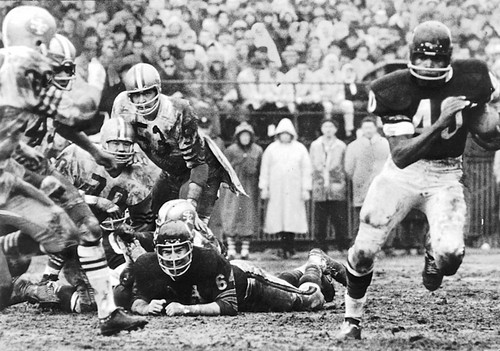
Every day after school we were in Kountze park or some place playing a sport — football, basketball, baseball, whatever it may be. There wasn’t a whole lot else we could do,” Gale said. “So, we were in the park playing sports. Our mamas and daddies had to call us to come eat dinner because we were out there playing.”
Gale said that as youths he and his friends had such a hunger for football that after completing flag football practice, they would then go to the park to knock heads “with the big kids” from local high schools in pick-up games. “It’s a wonder no one ever got seriously injured because we had no pads, no nothing, and we played tackle. It really made us tougher.”
Dennis Fountain, a friend and fellow athlete from The Hood, said the Sayers would often compete for opposing sides in those informal games. “You wouldn’t think those two guys were brothers,” he said. “They would mix it up good.”
Speaking of tough, the brothers tussled in a pair of now mythic neighborhood football games held around the holidays. There was the Turkey Bowl played on Thanksgiving and the Cold Bowl played on Christmas. “We had some knock-down, drag-out athletic contests out there,” said Gale, referring to the annual games that drew athletes of all ages from Omaha’s north and south inner city projects. “We were a little young, but the fellas’ saw the talent we had and let us play.”
Then, there was the rich proving ground he and Roger found themselves competing in — playing with or against such fine athletes as the Nared brothers (Rich and John), Vernon Breakfield, Charlie Gunn, Bruce Hunter, Ron Boone. “No doubt about it, we fed off one another. We saw other people doing well and we wanted to do just as well,” Gale said. As the Sayers began asserting themselves, they pushed each other to excel.
“When he achieved something, I wanted to achieve something, and vice versa,” Roger said. “I mean, you never wanted to be upstaged or outdone, but by the same token we were always proud and overjoyed by each other’s success. We were as competitive as brothers are.”
Roger and Gale had so much ability that the exploits of their baby brother, Ron, are obscured despite the fact he, too, possessed talent, enough in fact for the UNO grad to be a number two draft pick by the San Diego Chargers in 1968.
Each also knew his limitations in comparison with the other. Roger played some mean halfback himself, but he knew on a football field he was only a shadow of Gale, whom nature blessed with size, speed, vision and instinct. Where Gale was a fine hurdler, relay man and long-jumper, he knew he could not beat Roger in a sprint. “I wasn’t going to get into the 100 or 220-yard dash and run against him because he was much, much faster than I was,” Gale said. “He was great in track.”
As much as he downplays his own track ability, Gale held his own in one of the strongest collegiate track programs at Kansas. It was under KU track and field coach Bill Easton he discovered a work ethic and a mantra that have guided his life ever since.
“I thought I worked hard getting ready for football,” he said, “but when I joined his track team I couldn’t believe the amount of work he put me through and I couldn’t believe I could do it. But within months I could do everything he asked me to, and I was in excellent shape. He told me, ‘Gale, you cannot work hard enough in any sport, especially in track.’ The things I did for him on the track team carried on through my pro career in football.
“Every training camp I came in shape, and I mean I came in shape. I was ready to play and put the pads on the first day of camp, where many guys would go to camp to get in shape.”
On the eve of his pro career, Sayers was entertaining some doubts about how he would do when Easton reminded him what made him special. “You go for broke every time you go.” Sayers said it’s a lesson he’s always tried to follow.

A saying printed on a card atop the desk in Easton’s office intrigued Sayers. The enigmatic words said, I Am Third. When he asked his coach their meaning, he was told they came from a kind of proverb that goes, The Lord is First, My Friends are Second, I Am Third. The athlete was so taken with its meaning he went out and had it inscribed on a medallion he wore for years afterwards. His wife Linda now has it.
The saying became the title of his 1970 autobiography. The philosophy bound up in it helped him cope with the abrupt end of his playing days. “All the talent I had, the Lord gave me. And it was the Lord that decided to take it away from me,” Gale said. “That probably helped me accept the fact that, hey, I couldn’t do it anymore. I had a very short career, but a very good career. I was satisfied with that.”
Life after athletic competition has been relatively smooth for Gale and his brother. Roger embarked on a long executive corporate career, interrupted only by a stint as the City of Omaha’s Human Relations Director under Mayor Gene Leahy. He retired from Union Pacific a few years ago. Today, he’s a trustee with Salem Baptist Church. Gale served as athletic director at Southern Illinois University before starting his own sports marketing and public relations firm, Sayers and Sayers Enterprises. Next, he launched Sayers Computer Source, a provider of computer products and technology solutions to commercial customers. Today, SCS has brnaches nationwide and revenues in excess of $150 million. Besides running his companies, Sayers is in high demand as a motivational speaker.
Both men have tried distancing themselves from being defined by their athletic prowess alone.
“I want people to view me as an individual that brings something to the table other than the fact I could run track and play football. That stuff is behind me. There are other things I can do,” said Roger. For Gale, it was a matter of being ready to move on. “I’ve always said, As you prepare to play, you must prepare to quit, and I prepared to quit. I didn’t have to look back and say, What am I going to do now? I did other things.”
Getting on with their lives has been a constant with the brothers since growing up with feuding, alcoholic parents, sparse belongings and little money in “The Toe,” as Gale said residents referred to the north Omaha ghetto. His family moved to Omaha from bigoted small towns in Kansas, where the Sayers lived until Gale was 8, but instead of the fat times they envisioned here they only found despair.
Finding a way out of that cycle became an overriding goal for Gale and his brothers.
“Yes, we had tough times, but everybody in the black neighborhood had a tough time. Our dad always said, ‘Gale, Roger, Ronnie…sorry it didn’t work out for your mother and I, but you need to get your education and make something better for yourselves.’” The fact he and Roger went on to great heights taught Gale that “if you want to make it bad enough, no matter how bad it is, you can make it.”
Related Articles
- Gale Sayers’s Knee, and the Dark Ages of Medicine (fifthdown.blogs.nytimes.com)
- The 32 Greatest NFL Running Backs (sports-central.org)
- The Ties that Bind, One Family’s Celebration of Native Omaha Days (leoadambiga.wordpress.com)
- Sayers: Current players should help pioneers (sports.espn.go.com)
- John Mackey’s death has Gale Sayers ticked off at today’s NFL (profootballtalk.nbcsports.com)


 Leo Adam Biga's My Inside Stories