Archive
Archive for the ‘Playwright’ Category
Noah Diaz: Metro theater’s man for all seasons and stages
July 19, 2016
3 comments
Theater prodigies of the kind portryaed in the Wes Anderson film “Rushmore” have their antecedents in real life and just like in that story, they spring up in the most unexpected places. Omaha’s Noah Diaz is the latest Omaha theater prodigy and he finds himself in some very good company historically speaking. Perhaps the best known American theater prodigy, the late Orson Welles, first emerged as a stage presence to be watched at the Todd School for Boys in Woodstock, Illinois before he brazenly announced himself to the world in Dublin and then New York City. Across the pond, Kenneth Branagh, born in Belfast, first asserted his thespian bent in elementary school in Reading, Berkshire after his family’s move to England, and then he displayed his precicious talents at London’s Royal School of Dramatic Art. Back home, Omaha has had its own share of youth-must-be-served stage lights. The most famous of them all, Henry Fonda, was encouraged to try his hand at theater by Dottie Brando, mother of future stage-film icon Marlon Bramdo, at the Omaha Community Playhouse. A young Henry found his calling three and threw himself into all aspects of the craft – from building, painting and taking down sets to acting on stage. Dorothy McGuire soon followed him in the fold. They appeared together in a 1930 production at the Playhouse. Older than her, he left first to pursue a life in theater. Her family moved from Omaha and she soon left home to pursue her own career in theater. They both made it, of course, and two and a half decades after they shared the stage in Omaha in that 1930 show, they returned, this time as Broadway-Hollywood stars, to perform together in “The Country Girl” as a fundraiser for the new Playhouse. Now comes Noah Diaz, who by his early 20s has racked up more theater credits than most players twice or three times his age. He’s also been nominated for and won a slew of local theater awards for his acting. But he’s also a director and his work behind the stage has received raves as well. But it turns out his real calling in theater may be as a playwright. An original piece he’s written, The Motherhood Almanac, is being workshopped around the country and makes its world premiere here in January at the Shelterbelt, which is his theater home. Not to put pressure on him, but he may just be the latest in a recent line of Omaha-bred theater talent – Andrew Rannells, John Lloyd Young, Stephanie Kurtzuba, Quiana Smith, Kevyn Morrow – to make it to Broadway one day. Remember his name.
Noah Diaz: Metro theater’s man for all seasons and stages
©by Leo Adam Biga
Appeared in El Perico
Noah Diaz has been a force of nature in metro area theater since age eight. Still just 23, he owns 90-plus credits and multiple Omaha Theatre Arts Guild and Omaha Entertainment and Arts Awards nominations and wins.
He’s also a feted writer-director. He’s in good company as a local theater prodigy. A young Henry Fonda and Dorothy McGuire blazed early trails at the Omaha Community Playhouse before Broadway and Hollywood stardom. More recent stage-screen stars Andrew Rannells and John Lloyd Young got their performing starts as kids in Omaha theater.
Diaz, a University of Nebraska at Omaha student, is set on making theater his life but he only recently concluded that writing, not acting, may be his calling. A play he’s written, The Motherhood Almanac, is creating buzz. He served a residency with it at the Seven Devils Playwrights Conference in Idaho. Two New York City theater companies will workshop it in 2017. It premieres at Omaha’s Shelterbelt Theatre on January 27.
He said it was in Idaho he discovered his true “theatrical path,” adding, “I’ve been directing a number of things recently and I’m enjoying directing very much. But I think I might be a playwright. I think that might be what I want to do. That was like a very crystal moment of clarity for me.”
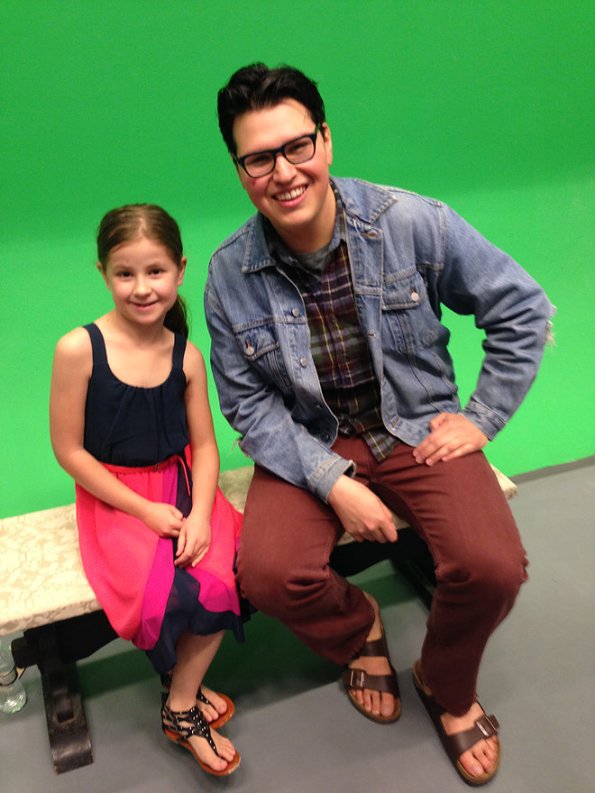
As a kid, Diaz and his cousins put on shows for their parents, but he’s been been writing since childhood, too. Almanac began as a poem he wrote as a youth.
“Over the years it expanded and kept unfolding. That poem turned into a handful of different poems that turned into scenes that turned into stories. It was two years ago I sat down and pieced it all together and understood what I had written. It’s a fragmented, nonlinear story with seven actresses about mothers across time and space. It’s my answer to the question – what does it meant to love somebody other than yourself.
“I’m constantly working on it, developing and workshopping it.
That’s why I’m opening myself up to these opportunities to work with different companies and actresses.”
He’s always had the internal drive and discipline writing requires, just as he’s long known he was meant to do theater.
“It’s always been a thing I’ve just understood about myself since I was young.” His parents encouraged his theater interests. “They recognized where my passions lay and they were about fostering my achieving that.”
His pursuit has landed him on virtually every metro area stage, including the Omaha Community Playhouse and The Rose. “By sheer tenacity I’ve wracked up a number of credits and a lot of experience.” No matter where he does theater, he’s younger than his fellow creatives, “I’ve been very fortunate to have had zero run-ins where age is an issue.. I’ve worked with actors who are so open with their process that they’ve allowed themselves over to me. It’s a profoundly high compliment in my book.”
He added, “The only thing I find tricky to maneuver is simply getting the work – being given opportunities. Directing work is hard to come by. It’s scary for people to put a full production in a 23 year-old’s hands. Luckily, I’ve made an artistic home at the Shelterbelt. They’ve been great to me. They’ve given me a number of opportunities.”
He counts theater veterans as teachers.
“I’ve worked with a staggeringly high number of talented people on stage and off. I’ve learned from them, I’m still learning from them. I have mentors, big and small, everywhere. I think in many ways I was raised by my mentors. I received theatrical and life lessons working in shows.”
He admires writers who sacrifice to get their stories told. “I’m so inspired by local playwrights like Ellen Struve, Beau Berry, Kaitlyn McClincy, Laura Leininger-Campbell, Nick Zadina, Joe Basque.” He’s collaborated with some.
He sees a vibrant local stage scene with “a big surge of people wanting to make theater.” He also sees gaps that need addressing. “I’m a very big advocate for accessible theater,” said Diaz, a special education and communication disorder major. He played a deaf character on stage in SNAP Productions mounting of Tribes. “Opening possibilities and opportunities for inclusivity in theater is important to me. Theaters can do better in terms of offering interpretive performances. I taught a deaf integrated acting class at the Rose (Theater) and I will be training to be an audio describer for the blind.”
Since he’s done so much so early, Diaz often gets asked – why haven’t you moved away yet to try Broadway or Hollywood?
“It’s simply about going when I’m ready. I’m still in school. I’ll be applying to a number of MFA programs this fall for playwriting.
Hopefully I’ll be be accepted to one to begin in the fall of 2017.
“I will move away eventually and work.”
Chicago’s vital theater community is a likely landing spot. He’s well aware of those who’ve left here to find stardom.
“If great success comes my way, that’s cool, but I’m more interested in doing the actual work itself.”
Meanwhile, he’s not giving up acting quite yet. “I will still continue to do it because I enjoy it.”
For details and dates on Almanac’s run at the Shelterbelt, visit http://www.shelterbelt.org/.

Categories: Actor/Acting, Arts-Entertainment-Culture, Noah Diaz, Omaha, Playwright, Theater, Writing
Actor, Noah Diaz, Omaha, Omaha Theater, Playwright, Writing
“The Bystanders” by Kim Louise takes searing, moving look at domestic violence as a public health issue
May 10, 2016
3 comments
Last night I had the privilege of experiencing as searing and moving a piece of live theater that I have seen in a long time. It was a staged reading of a new play, “The Bystanders,” by Kim Louise of Omaha. It tells the story of four friends who hear an incident of domestic abuse in the apartment next door. They are split on what to do next. The play asks – What would you do? The play is touring this week as part of the Metropolitan Community College Theatre Program’s Spring Tour. The program annually features a play written by an MCC student playwright in a staged reading format produced and performed by theater professionals. Kim’s “The Bystanders” is this year’s featured work. She first got inspired to write the piece some years ago and she has more recently developed it under the guidance of MCC theater program instructor Scott Working, who directs the production. The playwright, whom you may know as Kim Whiteside, is a much published author and veteran writing workshop faciliator under the pen name Kim Louise. She has writen a powerful piece whose heavy truth is impossible to ignore and to forget.
Some leading local theater talents comprise the cast:
Victoria – Beaufield Berry
OthaJean – Pamela Jo Berry
Benet – TammyRa’ Jackson
Ashland – Felicia Webster
Carla – Doriette Jordan
Cullen – Developing Crisp
Performances are free and open to the public, but you only have two chances left to see this staged reading:
Wednesday, May 11th at 11:00 am in the Conference Room of the MCC Sarpy Center, 9110 Giles Road.
Thursday, May 12th at 12:30 pm in ITC Building Room120 at MCC’s South Omaha Campus, 27th and Q Streets.
What the play utilmately confronts us with is the fact that domestic violence is a public health issue that none of us can stand by and allow to happen without speaking out against or taking action to prevent it from happening again. Otherwise, we are as complicit in the situation as the person who commits the violence and the person who lives with the violence. This is a community problem we all have a share in. As witness, as advocate, as friend, as advisor, as safe house, as 911 caller, as whatever it takes or whatever we are prepared to do. Just don’t stay silent or do nothing. That’s how battered women end up traumatized or dead.
Categories: African-American, African-American Culture, Crime, Domestic Violence, Kim Louise, Metropolitan Community College, Omaha, Playwright, PTSD (Post Traumatic Stress Disorder), Theater, Writing
Domestic Violence, Kim Louise, Metropolitan Community College, Omaha, Play, Playwright, The Bystanders, Theater
Family of creatives: Rudy Smith, Llana Smith, Q (Quiana) Smith
February 23, 2016
1 comment
Family of creatives: Rudy Smith, Llana Smith, Q (Quiana) Smith
©by Leo Adam Biga
Creativity can certainly run in families and one of the most blessed and beloved Omaha families I know of in this regard is the Rudy and Llana Smith family. He’s a photographer. She’s a playwright. One of their adult children, Q (Quiana) Smith, is an actress. Here is a collection of stories I’ve done about them individually over the years.
Rudy Smith
Rudy Smith’s own life is as compelling as any story he ever covered as a photojournalist. Both as a photographer and as a citizen, he was caught up in momentous societal events in the 1960s. This article for The Reader (www.thereader.com) examines some of the things he trained his eye and applied his intellect and gave his heart to — incidents and movements whose profound effects are still felt today. Rudy’s now retired, which only means he now has more time to work on a multitude of personal projects, including a book collaboration with his daughter Quiana, and to spend with his wife, Llana. This blog contains stories I did on Quiana and Llana. I have a feeling I will be writing about Rudy again before too long.
Hidden in plain view, Rudy Smith’s camera and memory fix on critical time in struggle for equality
©by Leo Adam Biga
Originally published in The Reader (www.thereader.com)
It was another August night in the newsroom when word came of a riot breaking out on Omaha’s near northside. If the report were true, it meant for the second time that summer of 1966 minority discontent was turning violent. Rudy Smith was the young Omaha World-Herald photojournalist who caught the story. His job at the newspaper was paying his way through then-Omaha University, where the Central High grad was an NAACP Youth Council and UNO student senate activist. Only three years before, he became the first black to join the Herald’s editorial staff. As a native north Omahan dedicated to his people’s struggle, Smith brought instant credibility to his assignments in the black community. In line with the paper’s unsympathetic civil rights stance at the time, he was often the only photographer sent to the near northside.
“And in many cases my colleagues didn’t want to go. They were fearful of the minority community, and so as a result I covered it. They would just send me,” said Smith, a mellow man whose soft voice disguises a fierce conviction. “As a result, the minority community that never had access to the World-Herald before began to gain access. More stories began to be written and more of the issues concerning north Omaha began to be reported, and from a more accurate perspective.”
It was all part of his efforts “to break down the barriers and the stereotypes.”
Archie Godfrey led the local NAACP Youth Council then. He said Smith’s media savvy made him “our underground railroad” and “bridge” to the system and the general public. “Without his leadership and guidance, we wouldn’t of had a ghost of an understanding of the ins and outs of how the media responds to struggles like ours,” said Godfrey, adding that Smith helped the group craft messages and organize protests for maximum coverage.
More than that, he said, Smith was sought out by fellow journalists for briefings on the state of black Omaha. “A lot of times, they didn’t understand the issues. And when splinter groups started appearing that had their own agendas and axes to grind, it became confusing. Reporters came to Rudy to sound him out and to get clarification. Rudy was familiar with the players. He informed people as to what was real and what was not. He didn’t play favorites. But he also never hid behind that journalistic neutrality. He was right out front. He had the pictures, too. This city will probably never know the balancing act he played in that.”
As a journalist and community catalyst, Smith has straddled two worlds. In one, he’s the objective observer from the mainstream press. In the other, he’s a black man committed to seeing his community’s needs are served. Somehow, he makes both roles work without being a sell out to either cause.
“My integrity has never been an issue,” he said. “As much as I’d like to be involved in the community, I can’t be, because sometimes there are things I have to report on and I don’t want to compromise my professionalism. My life is kind of hidden in plain view. I monitor what’s going on and I let my camera capture the significant things that go on — for a purpose. Those images are stored so that in the next year or two I can put them in book form. Because there are generations coming after me that will never know what really happened, how things changed and who was involved in changing the landscape of Omaha. I want them to have some kind of document that still lives and that they can point to with pride.”
For the deeply religious Smith, nothing’s more important than using “my God-given talents in service of humanity. I look at my life as one of an artist. An artist with a purpose and a mission. I’m driven. I’m working as a journalist on an unfinished masterpiece. My life is my canvas. And the people and the events I experience are the things that go onto my canvas. There is a lot of unfinished business still to be pursued in terms of diversity and opportunity. To me, my greatest contributions have yet to be made. It’s an ongoing process.”
The night of the riot, Smith didn’t know what awaited him, only that his own community was in trouble. He drove to The Hood, leaving behind the burnt orange hard hat a colleague gave him back at the office.
“I knew the area real well. I parked near 20th and Grace Streets and I walked through the alleys and back yards to 24th Street, and then back to 23rd.”
Most of the fires were concentrated on 24th. A restaurant, shoe shine parlor and clothing store were among the casualties. Then he came upon a church on fire. It was Paradise Baptist, where he attended as a kid.
“I cussed, repeating over and over, ‘My church, my church, my church,’ and I started taking pictures. Then I heard — ‘Hey, what are you doing here?’ — and there were these two national guardsmen pointing their guns at me. ‘I’m with the World-Herald,’ I said. I kept snapping away. Then, totally disregarding what I said, they told me, ‘Come over here.’ This one said to the other, ‘Let’s shoot this nigger,’ and went to me, ‘C’mon,’ and put the nuzzle of his rifle to the back of my head and pushed me around to the back of the building. As we went around there, I heard that same one say, ‘There ain’t nobody back here. Let’s off him, he’s got no business being here anyway.’ I was scared and looking around for help.
That’s when I saw a National Guard officer, the mayor and some others about a half-block away. I called out, ‘Hey! Hey! Hey!’ ‘Who is it?’ ‘Rudy Smith, World-Herald.’ ‘What the hell are you doing here?’ ‘I’m taking pictures and these two guys are going to shoot me.’ The officer said, ‘C’mon over here.’ ‘Well, they aren’t going to let me.’ ‘Come here.’ So, I went…those two guys still behind me. I told the man again who I was and what I was doing, and he goes, ‘Well, you have no damn business being here. You know you could have been killed? You gotta get out of here.’ And I did. But I got a picture of the guardsmen standing in front of that burning church, silhouetted by the fire, their guns on their shoulders. The Herald printed it the next day.”
Seeing his community go up in flames, Smith said, “was devastating.” The riots precipitated the near northside’s decline. Over the years, he’s chronicled the fall of his community. In the riots’ aftermath, many merchants and residents left, with only a shell of the community remaining. Just as damaging was the later North Freeway construction that razed hundreds of homes and uprooted as many families. In on-camera comments for the UNO Television documentary Omaha Since World War II, Smith said, “How do you prepare for an Interstate system to come through and divide a community that for 60-70 years was cohesive? It was kind of like a big rupture or eruption that just destroyed the landscape.” He said in the aftermath of so much destruction, people “didn’t see hope alive in Omaha.”
Today, Smith is a veteran, much-honored photojournalist who does see a bright future for his community. “I’m beginning to see a revival and resurgence in north Omaha, and that’s encouraging. It may not come to fruition in my lifetime, but I’m beginning to see seeds being planted in the form of ideas, directions and new leaders that will eventually lead to the revitalization of north Omaha,” he said.
-
 Rudy Smith, ©photo by Chris Machian, Omaha World-Herald
His optimism is based, in part, on redevelopment along North 24th. There are streetscape improvements underway, the soon-to-open Loves Jazz and Cultural Arts Center, a newly completed jazz park, a family life center under construction and a commercial strip mall going up. Then there’s the evolving riverfront and Creighton University expansion just to the south. Now that there’s momentum building, he said it’s vital north Omaha directly benefit from the progress. Too often, he feels that historically disenfranchised north Omaha is treated as an isolated district whose problems and needs are its own. The reality is that many cross-currents of commerce and interest flow between the near northside and wider (read: whiter) Omaha. Inner city residents work and shop outside the community just as residents from other parts of the city work in North O or own land and businesses there.
“What happens in north Omaha affects the entire city,” Smith said. “When you come down to it, it’s about economics. The north side is a vital player in the vitality and the health of the city, particularly downtown. If downtown is going to be healthy, you’ve got to have a healthy surrounding community. So, everybody has a vested interest in the well-being of north Omaha.”
It’s a community he has deep ties to. His involvement is multi-layered, ranging from the images he makes to the good works he does to the assorted projects he takes on. All of it, he said, is “an extension of my faith.” He and his wife of 37 years, Llana, have three grown children who, like their parents, have been immersed in activities at their place of worship, Salem Baptist Church. Church is just one avenue Smith uses to strengthen and celebrate his community and his people.
With friend Edgar Hicks he co-founded the minority investment club, Mite Multipliers. With Great Plains Black Museum founder Bertha Calloway and Smithsonian Institute historian Alonzo Smith he collaborated on the 1999 book, Visions of Freedom on the Great Plains: An Illustrated History of African Americans in Nebraska. Last summer, he helped bring a Negro Leagues Baseball Museum exhibit to the Western Heritage Museum. Then there’s the book of his own photos and commentary he’s preparing. He’s also planning a book with his New York theater actress daughter, Quiana, that will essay in words and images the stories of the American theater’s black divas. And then there’s the petition drive he’s heading to get Marlin Briscoe inducted into the National Football League Hall of Fame.
Putting others first is a Smith trait. The second oldest of eight siblings, he helped provide for and raise his younger brothers and sisters. His father abandoned the family after he was conceived. Smith was born in Philadelphia and his mother moved the family west to Omaha, where her sister lived. His mother remarried. She was a domestic for well-to-do whites and a teenaged Rudy a servant for black Omaha physician W.W. Solomon. Times were hard. The Smiths lived in such squalor that Rudy called their early residence “a Southern-style shotgun house” whose holes they “stuffed with rags, papers, and socks. That’s what we call caulking today,” he joked. When, at 16, his step-father died in a construction accident, Rudy’s mother came to him and said, “‘You’re going to take over as head of the family.’ And I said, ‘OK.’ To me, it was just something that had to be done.”
Smith’s old friend from the The Movement, Archie Godfrey, recalled Rudy as “mature beyond his years. He had more responsibilities than the rest of us had and still took time to be involved. He’s like a rock. He’s just been consistent like that.”
“I think my hardships growing up prepared me for what I had to endure and for decisions I had to make,” Smith said. “I was always thrust into situations where somebody had to step up to the front…and I’ve never been afraid to do that.”
When issues arise, Smith’s approach is considered, not rash, and reflect an ideology influenced by the passive resistance philosophies and strategies of such diverse figures as Machiavelli, Gandhi and King as well as the more righteous fervor of Malcolm X. Smith said a publication that sprang from the black power movement, The Black Scholar, inspired he and fellow UNO student activists to agitate for change. Smith introduced legislation to create UNO’s black studies department, whose current chair, Robert Chrisman, is the Scholar’s founder and editor. Smith also campaigned for UNO’s merger with the University of Nebraska system. More recently, he advocated for change as a member of the Nebraska Affirmative Action Advisory Committee, which oversees state departmental compliance with federal mandates for enhanced hiring, promotion and retention of minorities and women.
The camera, though, remains his most expressive tool. Whether it’s a downtown demonstration brimming with indignation or the haunted face of an indigent man or an old woman working a field or Robert Kennedy stumping in North O, his images capture poignant truth. “For some reason, I always knew whatever I shot was for historical purposes,” he said. “When it’s history, that moment will never be revisited again. Words can describe it, but images live on forever. Just like freedom marches on.”
__________________________________________________________________
Rudy Smith was a lot of places where breaking news happened. That was his job as an Omaha World-Herald photojournalist. Early in his career he was there when riots broke out on the Near Northside, the largely African-American community he came from and lived in. He was there too when any number of civil rights events and figures came through town. Smith himself was active in social justice causes as a young man and sometimes the very events he covered he had an intimate connection with in his private life. The following story keys off an exhibition of his work from a few years ago that featured his civil rights-social protest photography from the 1960s. You’ll find more stories about Rudy, his wife Llana, and their daughter Quiana on this blog.

Rudy Smith, ©photo by Bill Sitzman, Omaha Magazine
Brief history of Omaha’s civil rights struggle distilled in black and white by photographer Rudy Smith
©by Leo Adam Biga
Originally appeared in The Reader (www.thereader.com)
Coursing down North 24th Street in his car one recent afternoon, Rudy Smith retraced the path of the 1969 summer riots that erupted on Omaha’s near northside. Smith was a young Omaha World-Herald photographer then.
The disturbance he was sent to cover was a reaction to pent up discontent among black residents. Earlier riots, in 1966 and 1968, set the stage. The flash point for the 1969 unrest was the fatal shooting of teenager Vivian Strong by Omaha police officer James Loder in the Logan Fontenelle Housing projects. As word of the incident spread, a crowd gathered and mob violence broke out.
Windows were broken and fires set in dozens of commercial buildings on and off Omaha’s 24th Street strip. The riot leapfrogged east to west, from 23rd to 24th Streets, and south to north, from Clark to Lake. Looting followed. Officials declared a state of martial law. Nebraska National Guardsmen were called in to help restore order. Some structures suffered minor damage but others went up entirely in flames, leaving only gutted shells whose charred remains smoldered for days.
Smith arrived at the scene of the breaking story with more than the usual journalistic curiosity. The politically aware African-American grew up in the black area ablaze around him. As an NAACP Youth and College Chapter leader, he’d toured the devastation of Watts, trained in nonviolent resistance and advocated for the formation of a black studies program at the University of Nebraska at Omaha, where he was a student activist. But this was different. This was home.
On the night of July 1 he found his community under siege by some of its own. The places torched belonged to people he knew. At the corner of 23rd and Clark he came upon a fire consuming the wood frame St. Paul Baptist Church, once the site of Paradise Baptist, where he’d worshiped. As he snapped pics with his Nikon 35 millimeter camera, a pair of white National Guard troops spotted him, rifles drawn. In the unfolding chaos, he said, the troopers discussed offing him and began to escort him at gun point to around the back before others intervened.
Just as he was “transformed” by the wreckage of Watts, his eyes were “opened” by the crucible of witnessing his beloved neighborhood going up in flames and then coming close to his own demise. Aspects of his maturation, disillusionment and spirituality are evident in his work. A photo depicts the illuminated church inferno in the background as firemen and guardsmen stand silhouetted in the foreground.
The stark black and white ultrachrome prints Smith made of this and other burning moments from Omaha’s civil rights struggle are displayed in the exhibition Freedom Journeynow through December 23 at Loves Jazz & Arts Center, 2512 North 24th Street. His photos of the incendiary riots and their bleak aftermath, of large marches and rallies, of vigilant Black Panthers, a fiery Ernie Chambers and a vibrant Robert F. Kennedy depict the city’s bumpy, still unfinished road to equality.
The Smith image promoting the exhibit is of a 1968 march down the center of North 24th. Omaha Star publisher and civil rights champion Mildred Brown is in the well-dressed contingent whose demeanor bears funereal solemnity and proud defiance. A man at the head of the procession holds aloft an American flag. For Smith, an image such as this one “portrays possibilities” in the “great solidarity among young, old, white, black, clergy, lay people, radicals and moderates” who marched as one,” he said. “They all represented Omaha or what potentially could be really good about Omaha. When I look at that I think, Why couldn’t the city of Omaha be like a march? All races, creeds, socioeconomic backgrounds together going in one direction for a common cause. I see all that in the picture.”
Images from the OWH archives and other sources reveal snatches of Omaha’s early civil rights experience, including actions by the Ministerial Alliance, Citizens Coordinating Committee for Civil Liberties, De Porres Club, NAACP and Urban League. Polaroids by Pat Brown capture Rev. Martin Luther King, Jr. on his only visit to Omaha, in 1958, for a conference. He’s seen relaxing at the Omaha home of Ed and Bertha Moore. Already a national figure as organizer of the Birmingham (Ala.) bus boycott and the Southern Christian Leadership Conference, he’s the image of an ambitious young man with much ahead of him. Rev. Ralph David Abernathy, Jr. joined him. Ten years later Smith photographed Robert F. Kennedy stumping for the 1968 Democratic presidential bid amid an adoring crowd at 24th and Erskine. Two weeks later RFK was shot and killed, joining MLK as a martyr for The Cause.
Omaha’s civil rights history is explored side by side with the nation’s in words and images that recreate the panels adorning the MLK Bridge on Omaha’s downtown riverfront. The exhibit is a powerful account of how Omaha was connected to and shaped by this Freedom Journey. How the demonstrations and sit-ins down south had their parallel here. So, too, the riots in places like Watts and Detroit.
Acts of arson and vandalism raged over four nights in Omaha the summer of ‘69. The monetary damage was high. The loss of hope higher. Glimpses of the fall out are seen in Smith’s images of damaged buildings like Ideal Hardware and Carter’s Cafe. On his recent drive-thru the riot’s path, he recited a long list of casualties — cleaners, grocery stores, gas stations, et cetera — on either side of 24th. Among the few unscathed spots was the Omaha Star, where Brown had a trio of Panthers, including David Poindexter, stand guard outside. Smith made a portrait of them in their berets, one, Eddie Bolden, cradling a rifle, a band of ammunition slung across his chest. “They served a valuable community service that night,” he said.
Most owners, black and white, never reopened there. Their handsome brick buildings had been home to businesses for decades. Their destruction left a physical and spiritual void. “It just kind of took the heart out of the community,” Smith said. “Nobody was going to come back here. I heard young people say so many times, ‘I can’t wait to get out of here.’ Many went away to college and never came back. That brain drain hurt. It took a toll on me watching that.”
Boarded-up ruins became a common site for blocks. For years, they stood as sad reminders of what had been lost. Only in the last decade did the city raze the last of these, often leaving only vacant lots and harsh memories in their place. “Some buildings stood like sentinels for years showing the devastation,” Smith said.
His portrait of Ernie Chambers shows an engaged leader who, in the post-riot wake, addresses a crowd begging to know, as Smith said, “Where do we go from here?’
Smith’s photos chart a community still searching for answers four decades later and provide a narrative for its scarred landscape. For him, documenting this history is all about answering questions about “the history of north Omaha and what really happened here. What was on these empty lots? Why are there no buildings there today? Who occupied them?” Minus this context, he said, “it’d be almost as if your history was whitewashed. If we’re left without our history, we perish and we’re doomed to repeat” past ills. “Those images challenge us. That was my whole purpose for shooting them…to challenge people, educate people so their history won’t be forgotten. I want these images to live beyond me to tell their own story, so that some day young people can be proud of what they see good out here because they know from whence it came.”
An in-progress oral history component of the exhibit will include Smith’s personal accounts of the civil rights struggle.
__________________________________________________________________
Llana Smith

About a decade ago I became reacquainted with a former University of Nebraska at Omaha adjunct professor of photography, Rudy Smith, who was an award-winning photojournalist with the Omaha World-Herald. I was an abject failure as a photography student, but I have managed to fare somewhat better as a freelance writer-reporter. When I began covering aspects of Omaha‘s African-American community with some consistency, Rudy was someone I reached out to as a source and guide. We became friends along the way. I still call on him from time to time to offer me perspective and leads. I’ve gotten to know a bit of Rudy’s personal story, which includes coming out of poverty and making a life and career for himself as the first African-American employed in the Omaha World-Herald newsroom and agitating for social change on the UNO campus and in greater Omaha.
I have also come to know some members of his immediate family, including his wife Llana and their musical theater daughter Quiana or Q as she goes by professionally. Llana is a sweet woman who has her own story of survival and strength. She and and Rudy are devout Christians active in their church, Salem Baptist, where Llana continues a family legacy of writing-directing gospel dramas. She’s lately taken her craft outside Omaha as well. I have tried getting this story published in print publications to no avail. With no further adieu then, this is Llana’s story:
Gospel playwright Llana Smith enjoys her Big Mama’s time
©by Leo Adam Biga
When the spirit moves Llana Smith to write one of her gospel plays, she’s convinced she’s an instrument of the Lord in the burst of creative expression that follows. It’s her hand holding the pen and writing the words on a yellow note pad alright, but she believes a Higher Power guides her.
“I look at it as a gift. It’s not something I can just do. I’ve got to pray about it and kind of see where the Lord is leading me and then I can write,” said the former Llana Jones. “I’ll start writing and things just come. Without really praying about it I can write the messiest play you ever want to see.”
She said she can only be a vessel if she opens herself up “to be used.” It’s why she makes a distinction between an inspired gift and an innate talent. Her work, increasingly performed around the nation, is part of a legacy of faith and art that began with her late mother Pauline Beverly Jones Smith and that now extends to her daughter Quiana Smith.
The family’s long been a fixture at Salem Baptist Church in north Omaha. Pauline led the drama ministry program — writing-directing dramatic interpretations — before Llana succeeded her in the 1980s. For a time, their roles overlapped, with mom handling the adult drama programs and Llana the youth programs.
“My mother really was the one who started all this out,” Smith said. “She was gifted to do what she did and some of what she did she passed on to me.”
Married to photojournalist Rudy Smith, Llana and her mate’s three children grew up at Salem and she enlisted each to perform orations, sketches and songs. The youngest, Quiana, blossomed into a star vocalist/actress. She appeared on Broadway in a revival of Les Miserables. In 2004 Llana recruited Quiana, already a New York stage veteran by then, to take a featured role in an Easter production of her The Crucifixion: Through the Eyes of a Cross Maker at Salem.
Three generations of women expressing their faith. From one to the next to the other each has passed this gift on to her successor and grown it a bit more.

Pauline recognized it in Llana, who recalled her mother once remarked, “How do you come up with all this stuff? I could never have done that.” To which Llana replied, ‘Well, Mom, it just comes, it’s just a gift. You got it.” Pauline corrected her with, “No, I don’t have it like that. You really have the gift.”
“Them were some of the most important words she ever said to me,” Smith said.
Miss Pauline saw the calling in her granddaughter, too. “My mother would always say, ‘Quiana’s going to be the one to take this further — to take this higher.’ Well, sure enough, she has,” Smith said. “Quiana can write, she can direct, she can act and she can SING. She’s taken it all the way to New York. From my mother’s foundation all the way to what Quiana’s doing, it has just expanded to where we never could have imagined. It just went right on down the line.”
Whether writing a drama extracted from the gospels or lifted right from the streets, Smith is well-versed in the material and the territory. The conflict and redemption of gospel plays resonate with her own experience — from her chaotic childhood to the recent home invasion her family suffered.
Born in a Milford, Neb. home for young unwed mothers, Smith knew all about instability and poverty growing up in North O with her largely absentee, unemployed, single mom. Smith said years later Pauline admitted she wasn’t ready to be a mother then. For a long time Smith carried “a real resentment” about her childhood being stolen away. For example, she cared for her younger siblings while Pauline was off “running the streets.” “I did most of the cooking and cleaning and stuff,” Smith said. With so much on her shoulders she fared poorly in school.
She witnessed and endured physical abuse at the hands of her alcoholic step-father and discovered the man she thought was her daddy wasn’t at all. When her biological father entered her life she found out a school bully was actually her half-sister and a best friend was really her cousin.
It was only when the teenaged Llana married Rudy her mother did a “turnabout” and settled down, marrying a man with children she raised as her own. “She did a good job raising those kids. She became the church clerk. She was very well respected,” said Smith, who forgave her mother despite the abandonment she felt. “She ended up being my best friend. Nobody could have told me that.”

Until then, however, the only security Smith could count on was when her Aunt Annie and Uncle Bill gave her refuge or when she was at church. She’s sure what kept her from dropping out of school or getting hooked on drugs or turning tricks — some of the very things that befell classmates of hers — was her faith.
“Oh, definitely, no question about it, I could have went either way if it hadn’t really been for church.” she said. “It was the one basic foundation we had.”
In Rudy, she found a fellow believer. A few years older, he came from similar straits.
“I was poor and he was poor-poor,” she said. “We both knew we wanted more than what we had. We wanted out of this. We didn’t want it for our kids. To me, it was survival. I had to survive because I was looking at my sister and my brother and if they don’t have me well, then, sometimes they wouldn’t have nobody. I had to make it through. I never had any thought of giving up. I did wonder, Why me? But running away and leaving them, it never crossed my mind. We had to survive.”
Her personal journey gives her a real connection to the hard times and plaintive hopes that permeate black music and drama. She’s lived it. It’s why she feels a deep kinship with the black church and its tradition of using music and drama ministry to guide troubled souls from despair to joy.
Hilltop is a play she wrote about the driveby shootings and illicit drug activities plaguing the Hilltop-Pleasantview public housing project in Omaha. The drama looks at the real-life transformation some gangbangers made to leave it all behind.
Gospel plays use well-worn conventions, characters and situations to enact Biblical stories, to portray moments/figures in history or to examine modern social ills. Themes are interpreted through the prism of the black experience and the black church, lending the dramas an earthy yet moralistic tone. Even the more secular, contemporary allegories carry a scripturally-drawn message.
Not unlike an August Wilson play, you’ll find the hustler, the pimp, the addict, the loan shark, the Gs, the barber, the beauty salon operator, the mortician, the minister, the do-gooder, the gossip, the busy-body, the player, the slut, the gay guy, et cetera. Iconic settings are also popular. Smith’s Big Momma’s Prayer opens at a church, her These Walls Must Come Down switches between a beauty shop and a detail shop and her Against All Odds We Made It jumps back and forth from a nail shop to a hoops court.
The drama, typically infused with healthy doses of comedy, music, singing and dancing, revolves around the poor choices people make out of sheer willfulness. A breakup, an extramarital affair, a bad business investment, a drug habit or a resentment sets events in motion. There’s almost always a prodigal son or daughter that’s drifted away and become alienated from the family.
The wayward characters led astray come back into the fold of family and church only after some crucible. The end is almost always a celebration of their return, their atonement, their rebirth. It is affirmation raised to high praise and worship.
At the center of it all is the ubiquitous Big Mama figure who exists in many black families. This matriarch is the rock holding the entire works together.
“She’s just so real to a lot of us,” Smith said.
Aunt Annie was the Big Mama in Smith’s early life before her mother was finally ready to assume that role. Smith’s inherited the crown now.
If it all sounds familiar then it’s probably due to Tyler Perry, the actor-writer-director responsible for introducing Big Mama or Madea to white America through his popular plays and movies. His big screen successes are really just more sophisticated, secularized versions of the gospel plays that first made him a star. Where his plays originally found huge, albeit mostly black, audiences, his movies have found broad mainstream acceptance.
Madea is Perry’s signature character.
“When Madea talks she be talking stuff everybody can relate to,” Smith said. “Stuff that’s going on. Every day stuff. We can relate to any and everything she be saying. That character’s a trip. It’s the truth. One of my mother’s best friends was just like Madea. She smoked that cigarette, she talked from the corner of her mouth, she could cuss you out at the drop of a hat and she packed her knife in her bosom.”
Smith appreciates Perry’s groundbreaking work. “That is my idol…my icon. At the top of my list is to meet this man and to thank him for what he’s done,” she said. She also likes the fact “he attributes a lot of what he does to the Lord.”
Her own work shows gospel plays’ ever widening reach — with dramas produced at churches and at the Rose and Orpheum Theatres. She first made her mark with Black History Month presentations at Salem with actors portraying such figures as Medgar Evers, Harriet Tubman and Marian Anderson. Her mom once played Jean Pittman. A son played Martin Luther King Jr. She enjoys “bringing history to life.”

Her Easter-Christmas dramas grew ever grander. Much of that time she collaborated with Salem’s then-Minister of Music, Jay Terrell, and dance director, Shirley Terrell-Jordan. Smith’s recently stepped back from Salem to create plays outside Nebraska. That’s something not even her mother did, although Pauline’s Your Arms Are Too Short to Box with God did tour the Midwest and South.
At the urging of Terrell, a Gospel Workshop of America presenter and gospel music composer now at Beulahland Bible Church in Macon, Ga., Smith’s taking her gift “outside the walls of the church.” In 2005 her Big Momma’s Prayer was scored and directed by Terrell for a production at a Macon dinner theater. The drama played to packed houses. A couple years later he provided the music for her These Walls, which Smith directed to overflow audiences at Tabernacle Baptist Church in Wichita, Kansas. In 2008 her Against All Odds was a hit at Oakridge Missionary Baptist Church in Kansas City, Kan., where she, Terrell-Jordan and Jay Terrell worked with some 175 teens in dance-music-drama workshops.
Against All Odds took on new meaning for Smith when she wrote and staged the drama in the aftermath of a home invasion in which an intruder bound and gagged her, Rudy and a foster-daughter. Rudy suffered a concussion. A suspect in the incident was recently arrested and brought up on charges.
Smith’s work with Terrell is another way she continues the path her mother began. Doretha Wade was Salem’s music director when Pauline did her drama thing there. The two women collaborated on Your Arms Are Too Short, There’s a Stranger in Town and many other pieces. Wade brought the Salem Inspirational Choir its greatest triumph when she and gospel music legend Rev. James Cleveland directed the choir in recording the Grammy-nominated album My Arms Feel Noways Tired. Smith, an alto, sang in the choir, is on the album and went to the Grammys in L.A.
Terrell’s been a great encourager of Smith’s work and the two enjoy a collaboration similar to what Doretha and Pauline shared. “To see how Doretha and her worked to bring the music and the drama together was a big influence and, lo and behold, Jay and I have become the same,” she said.
Smith and Terrell have discussed holding gospel play workshops around the country. Meanwhile, she staged an elaborate production at Salem this past Easter. There’s talk of reviving a great big gospel show called Shout! that Llana wrote dramatic skits for and that packed The Rose Theatre. It’s all coming fast and furious for this Big Mama.
“This is like a whole new chapter in my life,” she said.
__________________________________________________________________
Quiana Smith
NOTE: I am reposting the following article because its subject, Quiana Smith, who goes by Q. Smith professionally, is back in our shared hometown of Omaha, Neb. with the national Broadway touring production of Mary Poppins. Quiana, recently promoted to the part of Miss Andrew, will perform as part of a 23-show run at the Orpheum Theater in Omaha, where loads of family and friends will be sure to cheer her on. This isn’t the first time she’s made a splash: she’s made waves off-Broadway (Fame) and on Broadway (Les Miserables) and in many regional theater productions. But this time she’s come home as part of a Broadway show. Sweet.
Quiana is a daughter of my good acquaintances Rudy and Llana Smith. She’s inherited their talent and drive and gone them one further by pursuing and realizing her dream of a musical theater career in New York. This profile of Quiana for The Reader (www.thereader.com) expresses this dynamic young woman’s heart and passion. It’s been a few years since I’ve spoken with her, and I’m eager to find out what she’s been up to lately, and how she and her father are coming along on a book project about African-American stage divas. Quiana is to write it and Rudy, a professional photographer, is to shoot it. Her mother, Llana, is a theater person, too — writing and directing gospel plays. My story on Llana Smith is posted on this site and I will soon be adding a story I did on Rudy Smith. They are a remarkable family.

Q. Smith played Miss Andrew in the touring production of “Mary Poppins.” (Courtesy photo)
Quiana Smith’s dream time takes her to regional, off-Broadway and Great White Way theater success
©by Leo Adam Biga
Originally published in The Reader (www.thereader.com)
Once the dream took hold, Quiana Smith never let go. Coming up on Omaha’s north side she discovered a flair for dramatics and a talent for singing she hoped would lead to a musical theater career. On Broadway. After a steady climb up the ladder her dream comes true tomorrow when a revival of Les Miserables open at the Broadhurst Theatre in New York. Q. Smith, as her stage name reads, is listed right there in the program, as a swing covering five parts, a testament to her versatility.
Before Les Miz is over Smith will no doubt get a chance to display her big, bold, brassy, bodacious self, complete with her shaved head, soaring voice, infectious laugh and broad smile. Her Broadway debut follows featured roles in the off-Broadway Fame On 42nd Street at NY‘s Little Shubert Theater in 2004 and Abyssinia at the North Shore Theater (Connecticut) in 2005. Those shows followed years on the road touring with musical theater companies or doing regional theater.
Fame’s story about young performers’ big dreams resonated for Smith and her own Broadway-bound aspirations. As Mabel, an oversized dancer seeking name-in-lights glory, she inhabited a part close to her ample self, projecting a passion akin to her own bright spirit and radiating a faith not unlike her deep spirituality. In an Act II scene she belted out a gospel-inspired tune, Mabel’s Prayer, that highlighted her multi-octave voice, impassioned vibrato and sweet, sassy, soulful personality. In the throes of a sacred song like this, Smith retreats to a place inside herself she calls “my secret little box,” where she sings only “to God and to myself. It’s very, very personal.” Whether or not she gets on stage this weekend in Les Miz you can be sure the 28-year-old will be offering praise and thanksgiving to her higher power.
It all began for her at Salem Baptist Church, where her grandmother and mother, have written and directed gospel plays for the dramatic ministry program. At her mother Llana’s urging, Smith and her brothers sang and acted as children. “My brothers got really tired of it, but I loved the attention, so I stuck with it,” said Smith, who began making a name for herself singing gospel hymns, performing skits and reciting poetry at Salem and other venues. She got attention at home, too, where she’d crack open the bathroom window and wail away so loud and finethat neighborhood kids would gather outside and proclaim, “You sure can sing, Quiana” “We were just a real creative house,” said Quiana’s mother.
Quiana further honed her craft in classes at the then-Emmy Gifford Children’s Theatre and, later, at North High School, where music/drama teacher Patrick Ribar recalls the impression Smith made on her. “The first thing I noticed about Quiana was her spark and flair for the stage. She was so creative…so diverse. She would do little things to make a part her own. I was amazed. She could hold an audience right away. She has such a warmth and she’s so fun that it’s hard not to like her.”
Still, performing was more a recreational activity than anything else. “Back then, I never knew I wanted to do this as a career,” Smith said. “I just liked doing it and I liked the great response I seemed to get from the audience. But as far as a career, I thought I was going to be an archaeologist.”
She was 15, and a junior at North, when her first brush with stardom came at the old Center Stage Theatre. She saw an audition notice and showed up, only to find no part for a black girl. She auditioned anyway, impressing executive directorLinda Runice enough to be invited back to tryout for a production of Dreamgirls. The pony-tailed hopeful arrived, in jeans and sweatshirt, sans any prepared music, yet director Michael Runice (Linda’s husband) cast her as an ensemble member.
Then, in classic a-star-is-born fashion, the leading lady phoned-in just before rehearsal the night before opening night to say she was bowing out due to a death-in-the-family. That’s when Mike Runice followed his instinct and plucked Smith from the obscurity of the chorus into a lead role she had less than 24 hours to master.
“It was like in a movie,” Smith said. “The director turned around and said to me, ‘It’s up to you, kid.’ I don’t know why he gave it to me to this day. You should have seen the cast. It was full of talented women. I was the youngest.” And greenest. Linda Runice said Smith got it because “she was so talented. She had been strongly considered for the role anyway, but she was so young and it’s such a demanding role. But she was one of those rare packages who could do it all. You saw the potential when she hit the stage, and she just blew them out of the theater.”
What began as a lark and segued into a misadventure, turned into a pressure-packed, once-in-a-lifetime opportunity. Not only did an already excited and scared Smith have precious little time to steel herself for the rigorous part and for the burden of carrying a show on her young shoulders, there was still school to think about, including finals, not to mention her turning sweet 16.
“The director wrote me a note to let me out of school early and he came to pick me up and take me to the theater. From 12 to 8, I was getting fitted for all the costumes, I was learning all the choreography, I was going over all the line readings, I was singing all the songs, and it was just crazy. A crash course.”
Smith pushed so hard, so fast to nail the demanding music in time for the show that she, just as the Runices feared, strained her untrained voice, forcing her to speak many of the songs on stage. That opening night is one she both savors and abhors. “That was the best and the worst thing that ever happened to me,” she said. “It was the best thing because if it wasn’t for that experience I’d probably be digging up fossils somewhere, which isn’t bad, but I wouldn’t be fulfilled. And it was the worst because I was so embarrassed.”
In true trouper tradition, Smith and the show went on. “What a responsiblity she carried for someone so young, and she carried it off with all the dignity and aplomb anyone could ever want,” Linda Runice said. Smith even kept the role the entire run. The confidence she gained via this baptism-by-fire fueled her ambition. “I told myself, If I can do this, I can do anything,” Smith said. Runice remembers her “as this bubbly, fresh teenager who was going to set the world on fire, and she has.”

Quiana Smith
To make her Broadway debut in Les Miz is poetic justice, as that show first inspired Smith’s stage aspirations. She heard songs from it in a North High music class and was really bit after seeing a Broadway touring production of it at the Orpheum.
“It was my introduction to musical theater. I fell in love with it,” she said. “I already had a double cassette of the cast album and I would listen to this song called ‘I Dreamed a Dream’ over and over. It was sung by Patti Lapone. I tried to teach myself to sing like that. When I finally met her last year I told her the story. That song is still in my audition book.”
Smith dreamed of doing Lez Miz in New York. Ribar recalls her telling him soon after they met, “‘One day I’m going to be on Broadway…’ She was bound and determined. Nothing was going to stop her. So, she goes there, and the next thing you know…she’s on Broadway. With her determination and talent, you just knew she was right on the edge of really brilliant things in her life. I brag about her to the kids as someone who’s pursued her dream,” he said. Stardom, he’s sure, isn’t far off. “Once the right role shows up, it’s a done deal.”
A scholarship led her to UNO, where she studied drama two years. All the while, she applied to prestigious theater arts programs back east to be closer to New York. Her plans nearly took a major detour when, after an audition in Chicago, she was accepted, on the spot, by the Mountview Conservatory in London to study opera. Possessing a fine mezzo soprano voice, her rendition of an Italian aria knocked school officials out. She visited the staid old institution, fell in love with London, but ultimately decided against it. “The opera world, to me, isn’t as exciting and as free as the musical theater world is,” she said. “Besides, it was a two or three-year conservatory program, and I really wanted the whole college experience to make me a whole person.”
 |
©photo by David Wells
Her musical theater track resumed with a scholarship to Ithaca (NY) College, where she and a classmate became the first black female grads of the school’s small theater arts program. She also took private voice and speech training. At Ithaca, she ran into racial stereotyping. “When I first got there everybody expected you to sing gospel or things from black musicals,” she said. “Everything was black or white. And I was like, It doesn’t have to be like that. I can do more than gospel. I can do more than R&B. I can do legit. I really had to work hard to prove myself.”
Her experience inspired an idea for a book she and her father, Omaha World-Herald photographer Rudy Smith, are collaborating on. She interviews black female musical theater actresses to reveal how these women overturn biases, break down barriers and open doors. “We’re rare,” she said of this sisterhood. “These women are an inspiration to me. They don’t take anything from anybody. They’re divas, honey. Back in the day, you would take any part that came to you because it was a job, but this is a new age and we are allowed to say, No. In college, I would have loved to have been able to read about what contemporary black females are doing in musical theater.” Her father photographs the profile subjects.
She’s had few doubts about performing being her destiny. One time her certainty did falter was when she kept applying for and getting rejected by college theater arts programs. She sought her dad’s counsel. “I said, ‘Dad…how do I know this is for me?’ He was like, ‘Sweetheart, it’s what you breath, right?’ It’s what you go to bed and wake up in the morning thinking about, right?’ I was like, ‘Yeah…’ ‘OK, then, that’s what you should be doing.’ And, so, I never gave up. I kept on auditioning and I finally got accepted to Ithaca.”
Smith has worked steadily since moving to the Big Apple. Her credits include speaking-singing parts in productions of Hair at the Zachary Scott Theatre and The Who’s Tommy at the Greenwich St. Theatre and performing gigs in five touring road shows. Those road trips taught her a lot about her profession and about herself. On a months-long winter tour through Germany with the Black Gospel Singers, which often found her and her robed choir mates performing in magnificent but unheated cathedrals, she got in touch with her musical-cultural heritage. “Gospel is my roots and being part of the gospel singers just brought my roots back,” she said.

New York is clearly where Smith belongs. “I just feel like I’ve always known New York. I always dreamed about it. It was so easy and comfortable when I first came here,” she said. “Walking the streets alone at 1 a.m., I felt at home, like it was meant to be. It’s in my blood or something.”
Until Fame and now Les Miz, New York was where she lived between tours. Her first of two cross-country stints in Smokey Joe’s Cafe proved personally and professionally rewarding. She understudied roles that called for her to play up in age, not a stretch for “an old soul” like Smith. She also learned lessons from the show’s star, Gladys Knight. “She was definitely someone who gave it 100 percent every night, no matter if she was hoarse or sick, and she demanded that from us as well,” Smith said, “and I appreciated that. The nights I didn’t go on, I would go out into the audience and watch her numbers and she just blew the house down every single night. And I was like, I want to be just like that. I learned…about perseverance and about dedication to the gift God has given you.”
For a second Smokey stint, starring Rita Coolidge, Q. was a regular cast member. Then, she twice ventured to Central America with the revues Music of Andrew Lloyd Weber andBlues in the Night. “That’s an experience I’ll never forget,” she said. “We went to a lot of poor areas in Guatemala and El Salvador. People walk around barefoot. Cows are in the road. Guns are all around. We performed in ruins from the civil wars. And there we were, singing our hearts out for people who are hungry, and they just loved it. It was a life-changing experience.”
She loves travel but loves performing more in New York, where she thinks she’s on the cusp of something big. “It’s a dream come true and I truly believe this is just the beginning,” said Smith, who believes a higher power is at work. “I know it’s not me that’s doing all this stuff and opening all these doors so quickly, because it’s taken some people years and years to get to this point. It’s nothing but the Lord. I have so much faith. That’s what keeps me in New York pursuing this dream.”

Connecting with long time friend Jia Taylor
While not a headliner with her name emblazoned on marquees just yet, she’s sure she has what it takes to be a leading lady, something she feels is intrinsic in her, just waiting for the chance to bust on out. “I’m a leading lady now. I’m a leading lady every day. Yes, I say that with confidence, and not because I’m so talented,” she said. “It’s not about having a great voice. It’s not about being a star. It’s about how you carry yourself and connect with people. It’s about having a great aura and spirit and outlook on life… and I think I’ve got that”
Her busy career gives Smith few chances to get back home, where she said she enjoys “chilling with my family and eating all the good food,” but she makes a point of it when she can. She was back in September, doing a workshop for aspiring young performers at the Hope Center, an inner city non-profit close to her heart. She also sang for a cousin’s wedding at Salem. On some breaks, she finds time to perform here, as when featured in her mother’s Easter passion play at Salem in 2004. She’d like one day to start a school for performing arts on the north side, giving children of color a chance to follow their own dreams.
Occasionally, a regional theater commitment will bring her close to home, as when she appeared in a summer 2005 production of Joseph and the Amazing Technicolor Dream Coatin Wichita. Despite lean times between acting-singing gigs, when she works with aspiring youth performers for the Camp Broadway company, Smith keeps auditioning and hoping for the break that lands her a lead or featured part on Broadway, in film or on television. She’s not shy about putting herself out there, either. She went up for a role opposite Beyonce in the film adaptation of Dreamgirls, the other show she dreams of doing on Broadway. She can see it now. “Q. Smith starring in…” She wants it all, a Tony, an Oscar, an Emmy. A career acting, singing, writing, directing, teaching and yes, even performing opera.
Smith’s contracted for the six-month run of Les Miz. Should it be extended, she may face a choice: stay with it or join the national touring company of The Color Purple, which she may be in line for after nearly being cast in the Broadway show.
That said, Smith is pursuing film/TV work in L.A. after the positive experience of her first screen work, a co-starring role in the Black Entertainment Network’s BETJ mini-series, A Royal Birthday. The Kim Fields-directed project, also being packaged as a film, has aired recently on BET and its Jazz off-shoot. A kind of romantic comedy infomercial for Royal Caribbean Cruise Lines, the project also features Gary Dourdan from CSI and gospel artist David Hollister.
The Royal Birthday shoot, unfolding on two separate Caribbean cruises, whet her appetite for more screen work and revealed she has much to learn. “It was absolutely beautiful. We went horseback riding, para-sailing, jet-skiing. I had never done any of those things,” she said. “I learned a lot about acting for the camera, too. I’m very theatrical, very animated in it. It doesn’t need to be that big.”
Should fame allude her on screen or on stage, she’s fine with that, too, she said, because “I’m doing something I truly love.” Besides, she can always find solace in that “little secret box” inside her, where it’s just her and God listening to the power of her voice lifted on high. Sing in exaltation.
Categories: African-American, African-American Culture, Family, Llana Smith, Music, Omaha, Omaha World-Herald, Photography, Playwright, Q (Quiana) Smith, Rudy Smith, Salem Baptist Church, Theater, Uncategorized
African American, African-American Culture, Broadway theatre, Gospel Plays, Llana Smith, Omaha, Photography, Playwright, Q (Quiana) Smith, Rudy Smith
South Omaha stories on tap for free PlayFest show; Great Plains Theatre Conference’s Neighborhood Tapestries returns to south side
May 6, 2015
2 comments
Omaha’s various geographic segments feature distinct charecteristics all their own. South Omaha has a stockyards-packing plant heritage that lives on to this day and it continues its legacy as home to new arrivals, whether immigrants or refugees. The free May 27 Great Plains Theatre Conference PlayFest show South Omaha Stories at the Livestock Exchange Building is a collaboration between playwrights and residents that shares stories reflective of that district and the people who comprise it. What follows are two articles I did about the event. The first and most recent article is for The Reader (www.thereader.com) and it looks at South O through the prism of two young people interviewed by playwrights for the project. The second article looks at South O through the lens of three older people interviewed by playwrights for the same project. Together, my articles and participants’ stores provide a fair approximation of what makes South O, well, South O. Or in the vernacular (think South Side Chicago), Sou’d O.
South Omaha stories on tap for free PlayFest show
Great Plains Theatre Conference’s Neighborhood Tapestries returns to south side
©by Leo Adam Biga
Appearing in the May 2015 issue of The Reader (www.thereader.com)
Perhaps more than any geographic quadrant of the city, South Omaha owns the richest legacy as a livestock-meatpacking industry hub and historic home to new arrivals fixated on the American Dream.
Everyone with South O ties has a story. When some playwrights sat down to interview four such folks, tales flowed. Using the subjects’ own words and drawing from research, the playwrights, together with New York director Josh Hecht, have crafted a night of theater for this year’s Great Plains Theatre Conference’s Neighborhood Tapestries.
Omaha’s M. Michele Phillips directs this collaborative patchwork of South Omaha Stories. The 7:30 p.m. show May 27 at the Livestock Exchange Building ballroom is part of GPTC’s free PlayFest slate celebrating different facets of Neb. history and culture. In the case of South O, each generation has distinct experiences but recurring themes of diversity and aspiration appear across eras.
Lucy Aguilar and Batula Hilowle are part of recent migration waves to bring immigrants and refugees here. Aguilar came as a child from Mexico with her undocumented mother and siblings in pursuit of a better life. Hilowle and her siblings were born and raised in a Kenya refugee camp. They relocated here with their Somali mother via humanitarian sponsors. In America, Batula and her family enjoy new found safety and stability.
Aguilar, 20, is a South High graduate attending the University of Nebraska at Omaha. GPTC associate artistic director and veteran Omaha playwright Scott Working interviewed her. Hilowle, 19, is a senior at South weighing her college options. Harlem playwright Kia Corthron interviewed her.
A Deferred Action for Childhood Arrivals (DACA) work permit recipient, Aguilar is tired of living with a conditional status hanging over head. She feels she and fellow Dreamers should be treated as full citizens. State law has made it illegal for Dreamers to obtain drivers licenses.
“I’m here just like everybody else trying to make something out of my life, trying to accomplish goals, in my case trying to open a business,” and be successful in that,” Aguilar says.
She’s active in Young Nebraskans for Action that advocates restrictions be lifted for Dreamers. She follows her heart in social justice matters.
“Community service is something I’m really passionate about.”
She embraces South O as a landing spot for many peoples.
“There’s so much diversity and nobody has a problem with it.”
Hilowle appreciates the diversity, too.
“You see Africans like me, you see African Americans,, Asians, Latinos, whites all together. It’s something you don’t see when you go west.”
Both young women find it a friendly environment.
“It’s a very open, helpful community,” Aguilar says. “There are so many organizations that advocate to help people. If I’m having difficulties at home or school or work, I know I’ll have backup. I like that.”
“It’s definitely warm and welcoming,” Hilowle says. “It feels like we’re family. There’s no room for hate.”
Hilowle says playwright Kia Corthon was particularly curious about the transition from living in a refuge camp to living in America.
“She wanted to know what was different and what was familiar. I can tell you there was plenty of differences.”
Hilowle has found most people receptive to her story of struggle in Africa and somewhat surprised by her gratitude for the experience.
“Rather than try to make fun of me I think they want to get to know me. I’m not ashamed to say I grew up in a refugee camp or that we didn’t have our own place. It made me better, it made me who I am today. Being in America won’t change who I am. My kids are going to be just like me because I am just like my mom.”
She says the same fierce determination that drove her mother to save the family from war in Somalia is in her.
About the vast differences between life there and here, she says, “Sometimes different isn’t so bad.” She welcomes opportunities “to share something about where I come from or about my religion (Muslim) and why I cover my body with so many clothes.”
Aguilar, a business major seeking to open a South O juice shop, likes that her and Hilowle’s stories will be featured in the same program.
“We have very different backgrounds but I’m pretty sure our future goals are the same. We’re very motivated about what we want to do.”
Similar to Lucy, Batula likes helping people. She’s planning a pre-med track in college.
The young women think it’s important their stories will be presented alongside those of much older residents with a longer perspective.
Virgil Armendariz, 68, who wrote his own story, can attest South O has long been a melting pot. He recalls as a youth the international flavors and aromas coming from homes of different ethnicities he delivered papers to and his learning to say “collect” in several languages.
“You could travel the world by walking down 36th street on Sunday afternoon. From Q Street to just past Harrison you could smell those dinners cooking. The Irish lived up around Q Street, Czechs, Poles, and Lithuanians were mixed along the way. Then Bohemians’ with a scattering of Mexicans.”
He remembers the stockyards and Big Four packing plants and all the ancillary businesses that dominated a square mile right in the heart of the community. The stink of animal refuse permeating the Magic City was called the Smell of Money. Rough trade bars and whorehouses served a sea of men. The sheer volume of livestock meant cows and pigs occasionally broke loose to cause havoc. He recalls unionized packers striking for better wages and safer conditions.
Joseph Ramirez, 89, worked at Armour and Co. 15 years. He became a local union leader there and that work led him into a human services career. New York playwright Michael Garces interviewed Ramirez.
Ramirez and Armendariz both faced discrimination. They dealt with bias by either confronting it or shrugging it off. Both men found pathways to better themselves – Ramirez as a company man and Armendariz as an entrepreneur.
While their parents came from Mexico, South Omaha Stories participant, Dorothy Patach, 91, traces her ancestry to the former Czechoslovakia region. Like her contemporaries of a certain age, she recalls South O as a once booming place, then declining with the closure of the Big Four plants, before its redevelopment and immigrant-led business revival the last few decades.
Patach says people of varied backgrounds generally found ways to co-exist though she acknowledges illegal aliens were not always welcome.
New York playwright Ruth Margraff interviewed her.
She and the men agree what united people was a shared desire to get ahead. How families and individuals went about it differed, but hard work was the common denominator.
Scott Working says the details in the South O stories are where universal truths lay.
“It is in the specifics we recognize ourselves, our parents, our grandparents,” he says, “and we see they have similar dreams that we share. It’s a great experience.”
He says the district’s tradition of diversity “has kept it such a vibrant place.” He suspects the show will be “a reaffirmation for the people that live there and maybe an introduction to people from West Omaha or North Omaha.” He adds, “My hope is it will make people curious about where they’re from, too. It’s kind of what theater does – it gives us a connection to humanity and tells us stories we find value in and maybe we learn something and feel something.”
The Livestock Exchange Building is at 4920 South 30th Street.
Next year’s Neighborhood Tapestries event returns to North Omaha.
For PlayFest and conference details, visit http://www.mccneb.edu/gptc.

South Omaha stories to be basis for new theater piece at Great Plains Theatre Conference
©by Leo Adam Biga
Originally appeared in El Perico
Historically, South Omaha is a melting pot where newcomers settle to claim a stake of the American Dream.
This hurly burly area’s blue-collar labor force was once largely Eastern European. The rich commerce of packing plants and stockyards filled brothels, bars and boardinghouses. The local economy flourished until the plants closed and the yards dwindled. Old-line residents and businesses moved out or died off. New arrivals from Mexico, Central America, South America and Africa have spurred a new boon. Repurposed industrial sites serve today’s community needs.
As a microcosm of the urban American experience it’s a ready-made tableaux for dramatists to explore. That’s what a stage director and playwrights will do in a Metropolitan Community College-Great Plains Theatre Conference project. The artists will interview residents to cultivate anecdotes. That material will inform short plays the artists develop for performance at the GPTC PlayFest’s community-based South Omaha Neighborhood Tapestries event in May.
Director Josh Hecht and two playwrights, Kia Corthron and Ruth Margraff, will discuss their process and preview what audiences can expect at a free Writing Workshop on Saturday, January 24 at 3 p.m. in MCC’s South Campus (24th and Q) Connector Building.
Participants Virgil Armendariz and Joseph Ramirez hail from Mexican immigrant clans that settled here when Hispanics were so few Armendariz says practically everybody knew each other. Their presence grew thanks to a few large families. Similarly, the Emma Early Bryant family grew a small but strong African-American enclave.
Each ethnic group “built their own little communities,” says Armendariz, who left school to join the Navy before working construction. “There were communities of Polish, Mexicans, Bohemians, Lithuanians, Italians, Irish. Those neighborhoods were like family and became kind of territorial. But it was interesting to see how they blended together because they all shared one thing – how hard they worked to make life better for themselves and their families. I still see that even now. A lot of people in South Omaha have inherited that entrepreneurial energy and inner strength. I feel like the blood, sweat and tears of generations of immigrants is in the soil of South Omaha.”
Armendariz, whose grandmother escaped the Mexican revolution and opened a popular pool hall here, became an entrepreneur himself. He says biases toward minorities and newcomers can’t be denied “but again there’s a common denominator everybody understands and that is people come here to build a future for their families, and that we can’t escape, no matter how invasive it might seem.”

Dancers from Xiotal Omaha’s Día de Muertos perform at Metro Community College’s Fort Omaha Campus on Nov. 1.
![Mexican pride making strides [JUMP]“I’m not just teaching them dance, I’m teaching them how rich our culture is.” Hector Marino, founder of Omaha’s Xiotal Ballet Folklorico Mexican dance company](https://i0.wp.com/bloximages.newyork1.vip.townnews.com/omaha.com/content/tncms/assets/v3/editorial/4/96/4967bd2a-2be2-5fb9-8104-d897d4a9ce8f/5474eef0a80d4.image.jpg)
Hector Marino talks with the performers of Xiotal Omaha before their Día de Muertos performance at Metro Community College’s Fort Omaha Campus on Saturday, Nov. 1.
He says recent immigrants and refugees practice more cultural traditions than he knew growing up. He and his wife, long active in the South Omaha Business Association, enjoy connecting to their own heritage through the Xiotal Ballet Folklorico troupe they support.
“These talented people present beautiful, colorful dance and music. When you put that face on the immigrant you see they are a rich part of our American past and a big contributor to our American future.”
Ramirez, whose parents fled the Cristero Revolt in Mexico, says he and his wife faced discrimination as a young working-class couple integrating an all-white neighborhood. But overall they found much opportunity. He became a bilingual notary public and union official while working at Armour and Co. He later served roles with the Urban League of Nebraska and the City of Omaha and directed the Chicano Awareness Center (now Latino Center of the Midlands). His activist-advocacy work included getting more construction contracts for minorities and summer jobs for youths. The devout Catholic lobbied the Omaha Archdiocese to offer its first Spanish-speaking Mass.
He’s still bullish about South Omaha, saying, “It’s a good place to live.”
Dorothy Patach came up in a white-collar middle-class Bohemian family, graduated South High, then college, and went on to a long career as a nursing care professional and educator. Later, she became Spring Lake Neighborhood Association president and activist, helping raise funds for Omaha’s first graffiti abatement wagon and filling in ravines used as dumping grounds. She says the South O neighborhood she lived in for seven decades was a mix of ethnicities and religions that found ways to coexist.
“Basically we lived by the Golden Rule – do unto others as you want them to do unto you – and we had no problems.”
She, too, is proud of her South O legacy and eager to share its rich history with artists and audiences.
MCC Theatre Program Coordinator Scott Working says, “The specifics of people’s lives can be universal and resonate with a wide audience. The South Omaha stories I’ve heard so far have been wonderful, and I can’t wait to help share them.”
Josh Hecht finds it fascinating South O’s “weathered the rise and fall of various industries” and absorbed “waves of different demographic populations.” “In both of these ways” he says, “the neighborhood seems archetypally American.” Hecht and Co. are working with local historian Gary Kastrick to mine more tidbits.
Hecht conceived the project when local residents put on “a kind of variety show ” for he and other visiting artists at South High in 2013.
“They performed everything from spoken word to dance to storytelling. They told stories about their lives and it was very clear how important it was for the community to share these stories with us.”
Hecht says he began “thinking of an interactive way where they share their lives and stories with us and we transform them into pieces of theater that we then reflect back to them.”
Working says, “This project will be a deeper exploration and more intimate exchange between members of the community and dramatic artists” than previous Tapestries.
The production is aptly slated for the Stockyards Exchange Building, the last existing remnant of South O’s vast packing-livestock empire.
Categories: Entertainment, Great Plains Theatre Conference, Latino/Hispanic, Neighborhoods, Omaha, PlayFest, Playwright, South Omaha, Theater, Writing
Great Plains Theatre Conference, Latino/Hispanic, Neighborhoods, Omaha, PlayFest, Playwriting, South Omaha, South Omaha Neighborhood Tapestries, Theater
Playwright turned history detective Max Sparber turns identity search inward
February 7, 2015
5 comments
Max Sparber channeling his inner Buffalo Bill, ©photos by Debra S. Kaplan
Playwright-journalist-blogger-historian Max Sparber has a knack for reinventing himself borne from a lifelong search for identiity, though he’s recently found more clarity where his family roots are concerned. He’s always known he was an adoptee but it’s only in the last year or so he’s discovered specifics about his biological parents. Long before he began searching out his biological mother’s and father’s stories, he was intrigued by history and heritage and much of his writing for publications and for the stage has dealt with matters of cultural inheritance or perception. It’s no wonder he find himself in the day job he works today as research specialist with the Douglas County (Neb.) Historical Society. The very tools he uses there to help people search their family history are the ones he utilizes in his own personal family search. Sparber is Irish and English but he was raised Jewish and he is steeped in that culture. He has written about Africa-Americans and race in his plays “Minstrel Show” and “Walking Behind to Freedom” and he’s the author of a blog, “The Happy Hooligan,” devoted to what it means to be Irish-American. In truth, he’s written about a wide range of people and subjects and always with same incisive and sensitive eye of the outsider. His new play, Buffalo Bill’s Cowboy Band, deals with a historical figure, William Cody, who simiarly dealt with issues of identity and reinvention. My profile of Max for The Reader (www.thereader.com) follows below.
As a side note, Max has been a longtime contributor to The Reader as I have. At one point he became the arts editor there and for a brief time served as managing editor. Another superb Omaha writer I’ve written about, Timothy Schaffert, had a similar experience at The Reader.
Oh, and by the way, I wish I had thought of it when I wrote the story, because I would have included it in the piece, but it occurs to me that Max bears an uncanny resemblance to silent film comedian Harold Lloyd.
Playwright turned history detective Max Sparber turns identity search inward
New play about Buffalo Bill explores similar reinvention issues as his own
©by Leo Adam Biga
Appeared in The Reader (www.thereader.com)
As an adoptee whose identity quest has shaped his life and as a research specialist investigating people’s family trees, Max Sparber perfectly embodies his “history detective” tagline.
His Douglas Country Historical Society fact-finding duties feed his work as journalist-blogger-playwright of wide-ranging interests, from Irish-American culture-history to early Omaha infamy to social justice. Then there’s his thing for singing cowboys, the Old West and everything theatrical. All of which makes him the ideal dramatist for Buffalo Bill.
Sparber’s whimsical new play Buffalo Bill’s Cowboy Band, showing through February 8 at the Rose Theater, is a Victorian era-inspired musical revue-meets-chautauqua whose identity themes resonate with his own Who-am-I-this-time? life story.
“I definitely think this has a lot to do with my own search for my identity and how identities are often a sort of collective invention.”
William Cody was a scout and buffalo hunter turned entertainer. His Wild West show, first mounted in North Platte, Neb., forever changed perceptions and portrayals of the frontier.
“I think he is in some ways the basis for all contemporary cowboy stories,” says Sparber, who just as Cody cultivated a look with fancy regalia, is seldom without a vintage fedora and tinted glasses
He says the story “is really about how William Cody invented a character called Buffalo Bill as a way of telling tall tales about the West inspired by the actual history of the West.” The play, which uses Cody’s daughter Irma as fan and foil, depicts his conflict over being authentic whole taking dramatic license.
When the Rose commissioned Sparber they didn’t know about his identity search or fixation with Gene Autry and Roy Rogers. They didn’t know he’d done a children’s play, The Ukulele King’s Sunday Family Roundup, featuring his peculiar talents for twirling guns, yodeling and playing the ukulele.
That’s folderol though compared to how the skills of his trade, along with DNA testing, recently aided him, at age 46, in discovering his late birth mother’s identity.
“When I found out who my biological family was, I had exactly the tools needed to churn through that information. It would have been completely overwhelming otherwise.”
The woman who gave him life, Patricia Monaghan, followed pursuits strikingly aligned with his own. She was a journalist and author who often wrote about her large Irish-Catholic family and Celtic mythology. She wrote about and studied theater, just as Max has. He once owned one of her books.
Knowing they were kindred spirits seemed an “astonishing coincidence” he now ascribes to genetic inheritance.
“I do regret not meeting her. I’m just very glad she left behind the wealth of writing and information about herself she did. There’s a lot of people for whom there’s no record of them. Yet she’s unknowable in the sense I’ll never be able to meet her.”
He knows less about his biological father, except he studied art, as Max did.
As best Max can tell he was the unintended result of a fling.
“It turned out the circumstances of my birth were not tragic as I feared. Probably mostly I was just terribly inconvenient and I’d rather be inconvenient than the product of tragedy.”
Now that he’s gleaned things about his mother’s family from her widower and a first cousin, it’s allayed his worst-case-scenario thinking.
“There was a real concern I’d find my biological family and they’d all have tattoos of tears on their cheeks and swastikas on their arms.
Thank goodness it’s nothing like that. They’re very lovely people.”
Most of his Irish clan lives in Alaska and the Pacific Northwest, though some reside in Ireland. His birth mother gained Irish citizenship and even though he’s never been there, he may be entitled to citizenship, too. He intends visiting his ancestral homeland of County Mayo.

Above three images from Max’s “The Happy Hooligan,” http://happy-hooligan.blogspot.com/
He always knew he was not Jewish like his adoptive parents but likely Irish and English. He especially steeped himself in all things Irish, from devouring its literature to learning to play the penny-whistle. His The Happy Hooligan blog explores what it means to be Irish-American.
What he did with his heritage is not unlike what Cody did with his past.
“Being Irish is something I had to invent because I wasn’t raised with that. It was so weird for me for a long time because it felt fabricated and then I realized it’s all fabricated, We all just make up culture. We’re Irish-American because we say we are. We do Irish-American things because we’ve decided that’s what Irish-Americans do.”
He calls a year in Bath, England for a sabbatical his adoptive father made “the defining year of my childhood.”
“It was all very fascinating to me. England is a very old country with a lot of very strange old traditions. One of the things they do is ritualize and reenact history through these pageants. At school I played a Moor battling King George.”
That experience and summers in New York introduced him to the idea of history behind every door or corner.
“I realized the whole world is these little pockets of often undiscovered history. All of a sudden these places around you aren’t just houses people live in but have these entire stories behind them that you can mentally pop into. I really like that.”
Then there’s the Jewish experience he absorbed. “I’m not religious but I do feel I am culturally Jewish, I was raised in that milieu. Jews have a very complex diaspora identity, so they have all these tools for understanding what it means to be Jewish when you’re not in Israel. Irish-Americans have almost none of that.”
-
 Carl Brooks and Kelcey Watson in Minstrel Show
As a sign of things to come, the very first play he wrote was inspired by historical events – the Salem witch trials.
Ever since first coming to Omaha from his native Minneapolis, where he wrote about forgotten Minn. history, he’s drawn on Omaha’s past in his writing. His play Minstrel Show examines the infamous 1919 courthouse riot and the lynching of William Brown.
“As a dramatist I’m not interested in when people behaved well in the past, I’m interested in when they misbehaved, and this may be the greatest town in America for that.”
His blogs unearth colorful stories of Omaha’s disreputable past, including Ramcat Alley’s rough trade denizens, the Burnt District’s madams and striptease joints passing as theaters.
He similarly immersed himself in the history of Hollywood and New Orleans when he lived in those places.
He acknowledges his job with DCHS is “a perfect match.”
“I never expected I would wind-up being a professional historian and it’s so hard for me to think of myself that way but that is at the moment the road I’m on. It’s not a surprise to be here but it wasn’t planned.”
His historical writing is a treasure trove for the organization.
“I’m like this steady machine providing content they can make use of.”
He often makes DCHS presentations related to his findings and he teaches a genealogy class for folks searching their family histories.
Now that he can finally wrap his arms around his patchwork identity, he can look back, as Buffalo Bill did, and see where myth ends and reality begins. His journey’s not unlike Omaha’s own self-image problem.
“There’s a sociological concept called a sense of place – knowing where you come from and what it means to come from there – and this is what I’ve been wrestling with my entire life.”
Omaha’s bland present obscures a debauched legacy as wild frontier town and corrupt machine politics city.
“When people find out about it it’s exciting and interesting. It gives you something to connect to. It’s a very different narrative from the one Omahans are taught in schools, and it’s a shame because towns that embrace their own wild history often do very well with it.”
Follow his ever expanding family via social media, including http://happy-hooligan.blogspot.com. For play details, visit http://www.roseheater.org.
Omahans put spin on Stephen King’s “The Shining’ – Jason Levering leads stage adaptation of horror classic to benefit Benson Theatre Project
March 17, 2014
2 comments
Jason Levering and a group of fellow Omahans has proven just cheeky enough to adapt Stephen King’s The Shining to the stage. The world premiere of their efforts is March 21 and 22 at the Sokol Auditorium in three performances to benefit the Benson Theatre Project, a nonprofit is primed to purchase and restore a vintage vaudeville and movie house in Omaha’s Benson business district. Business Theatre Project executive director Amy Ryan says, “My confidence in Jason Levering and his ability to put on a quality production influenced my decision to sign off, along with the other project leaders.” I asked her if she has any trepidation in hanging a fundraiser on a premiere, never-before-staged work, even if it is adapted from a mega popular novel whose title everyone knows and whose author is a brand unto himself. “It’s a tall order, no doubt. Certainly there were many factors and risks to be considered, but in the end we decided that it was a unique and viable way to raise funds and showcase Omaha’s local talent.” Levering is also artistic director of the Benson Theatre Project. What follows is my upcoming story in The Reader (www.thereader.com) about the adaptation, which st least based on the legendary status of the source material and its author has given this production a very high curiosity factor. For my article I interviewed Levering about various aspects of the project.
Omahans put spin on Stephen King’s “The Shining”
Jason Levering leads stage adaptation of horror classic to benefit Benson Theatre Project
©by Leo Adam Biga
Appeared in The Reader (www.thereader.com)
Credit Omaha writer-director Jason Levering for possessing the temerity to not only consider adapting Stephen King’s meta horror novel The Shining to the stage but to follow through and actually get the master’s approval. Now he’s only hours away from seeing the adaptation he and Aaron Sailors wrote make its world premiere.
The Shining, A Play, has a three-show run March 21 and 22 at Sokol Auditorium, 2234 South 13th St., the old-line South Omaha space known for live music concerts, not full-blown dramatic theatricals. Make no mistake, this will be a big, effects-laden production commensurate with the sprawling, supernatural-laced source material.
The show’s a fundraiser for the Benson Theatre Project. Levering is artistic director of the nonprofit, which needs $250,000 to purchase the former Benson vaudeville and movie house at 6054 Maple St. before renovation work can begin. It’s adjacent to the Pizza Shoppe and PS Collective, whose owner, Amy Ryan, is the project’s executive director. Ryan, a community advocate and arts supporter, goes way back with Levering, who’s also co-founder of the Omaha Film Festival.
An Aurora, Neb., native, Levering’s worked on short films. He and Sailors are collaborating on a feature film adaptation of short stories from author Dan Chaon’s Stay Awake collection. That project’s on hold while Chaon works on the Starz series Most Wanted. Levering’s s stage credits include acting in the Blue Barn Theatre’s Round Midnight series and adapting Oscar Wilde fairy tales at The Rose theater.
What made him think of reworking what many consider a horror masterpiece? It starts with him being “a huge Stephen King fan.” Then there’s the fact the claustrophobic story largely unfolds in one location, the Overlook Hotel, which lends itself well to stage presentation. Finally, there’s The Shining franchise of the popular novel as well as successful film and television treatments, not to mention the built-in brand that the title and King’s own name bring to any adaptation.
“The genesis started during the 2013 Omaha Gives campaign that raised some money for the theater,” Levering says. “Afterwards we talked about doing our own production as a fundraiser and how while we don’t have our own theater troupe we know enough people that we could try and put something together.
“We didn’t want it to be something that had already been done here. We wanted it to be something special, that is our own. But we also wanted it to be something recognizable. I suggested doing a stage adaptation of a popular book that hasn’t been adapted yet. I naturally fixed on The Shining. We all thought it was a great idea.”
That left the not so small matter of getting the famous author to bestow his blessing on the endeavor.
“You have to get permission from Mr. King for something like that,” says Levering, who made the overture to the agency, Paradigm, that represents the legend.
The go-ahead came easier and quicker than Levering imagined.
“Mr. King read our proposal and he was very interested in what we were doing with the Benson Theatre project and he gave us a limited option to adapt The Shining to stage.”
King also retained the right of approval over the script, the director (Levering) and the cast.

Jason Levering
Levering next dived deep into the book and into the lore surrounding its inception and he discovered a reason why his instinct to adapt it as a play may have resonated with King.
“In my research I found out Mr. King originally conceived it as a five-act play and then he eventually turned it into a novel.”
Levering’s careful study of the book reintroduced him to the story’s great set-up. Jack and Wendy Torrance and their boy Danny become stranded in a haunted mountain hotel in a winter storm. Danny’s extrasensory gift makes him the target of evil spirits who prey on him through his weak father, intent on forever imprisoning the family there.
“It kind of has everything. The other thing it has going for it is these fantastic characters, Jack especially. He’s written as a good man, a recovered alcoholic with some anger issues but doing his damnedest to pull his family back together. To go from that point where there’s all this hope when they first move into the Overlook to the end where he’s literally trying to kill his family it’s such an incredible journey.”
Distilling the heart of the story took Levering and Sailors some time.
“We went through the book together. Aaron broke it down into an outline so we could figure out the main beats of each scene – what we really needed to capture that was essential. We worked from that outline as we were writing the script. He took Act III, I took Act I, and we started working forward.”
They finished the remaining acts together.
“As we wrote we sent pages back and forth, editing and polishing each other’s work. We sent pages to another writer friend, Krissy Hamm, an associate producer on the show, and she gave us notes. It really helped to have that third person looking at it.”
Levering says he and Sailors abided by one operating principle.
“We both wanted to be very faithful to the book. A lot of the dialogue is pulled straight from the book. There’s only a few points where the dialogue was changed or something was added so that the scene would play well on stage. For the most part though the dialogue is pretty much Mr. King’s words.”
Other things are being done to make certain story elements live on stage. For example, newspaper accounts Jack reads silently to himself in the novel are projected on a screen. Flashbacks play out on the side while the main action occurs stage center. Creative ways were found to bring the Overlook’s topiary animals to life. Levering is intent on making the physical experience as visceral as possible for the audience and thus, William Castle-style, action and sound will happen throughout the auditorium, including the balcony.
Lighting and sound effects will cast a dark, malevolent mood.

Levering consulted Omaha theater veteran Kevin Lawler and brought in veteran scenic designer Kit Gough to help realize the horror.
“I want it to be immersive. I want to give the audience the feeling they really may not go home. I want them to feel they’re sitting in the middle of the Overlook Hotel as it comes to life. From the time you walk in the door it’ll be like you’ve entered the Overlook.”
Levering had his own scary encounter with the work.
“My hardest challenge was the moment the hotel takes over Jack. I was excited to write it but I was also terrified of it because that scene is where his character shifts and becomes the monster. He’s in the Colorado Room and basically the hotel has come to life. Lloyd the bartender manifests and pours him a martini. That scene was difficult for me to write because it’s at that point he turns on his family and I honest to God had nightmares of wanting to hurt my wife and kids, even though I never would.
“The idea someone could turn like that is frightening. It was actually the last scene I wrote. It was the worst for me. I’m also an actor and so method-style I poured myself a martini and drank it while writing. I wanted to feel what he was going through.”
Levering feels “honored” and “thankful” King approved “the direction we’re taking.” The cast is headed by Marc Erickson as Jack, Levering’s son Christopher as Danny and Christina Rohling as Wendy.
An invitation’s been extended King, so don’t be surprised if you spot the king of horror among the throng.
Performances are 7 p.m. Friday and 2 and 7 p.m. on Saturday.
For tickets, visit theshiningomaha.com. For more about the restoration project, visit bensontheatre.org.
Kevin Lawler guides ever evolving theater conference to put more focus on fewer plays and playwrights and to connect deeper with community
April 27, 2013
2 comments
I’ve been writing about the Great Plains Theatre Conference since its start eight years ago and while I don’t get the chance to write at length about it and its guest artists the way I used to, I still manage an assignment like this one, which is an interview with producing artistic director Kevin Lawler. He’s been moving the event in some different directions that put more focus on fewer plays and playwrights and that connect the conference more deeply with the community. My story appears in Omaha Magazine.
The 2013 Great Plains conference is May 25 through June 1. It’s a wide mix of readings, productions, and special events, all of it geared to celebrating plays and playwrights and the theater.
On this blog you can find the many other stories I’ve filed over the years about the conference and some of its guest artists, including interviews with Edward Albee, Arthur Kopit, John Guare, and Patricia Neal. In fact, you’ll find here many other theater pieces I’ve written over time. Enjoy.

Kevin Lawler
Kevin Lawler guides ever evolving theater conference to put more focus on fewer plays and playwrights and to connect deeper with community
©by Leo Adam Biga
Now appearing in Omaha Magazine
Plays and playwrights remain “the heart” of the May 25-June 1 Great Plains Theatre Conference, which is now in its eighth year, says producing artistic director Kevin Lawler. But since assuming leadership over this Metropolitan Community College-hosted stagecraft confab four years ago he’s brought more focus to a smaller selection of plays and playwrights and deepened the conference’s community connections.
The conference revolves around readings or performances of new plays by emerging playwrights from around the nation and master theater artists responding to the work in group and one-one-one feedback sessions.
“We used to bring somewhere around 70 plays out and we didn’t have time to read the full play, which was unfair to the playwright,” says Lawler, who writes and directs plays himself. “And 70 plays meant 70 directors and 70 casts, which our local theater community wasn’t quite able to properly support, so there was always kind of a heightened energy of struggle trying to fulfill all those roles and spots.
“We’ve reduced that number to about 30 plays, so now were able to really find great directors, great casts, and we’re able to have a performance of the full script.”
Playwrights find a nurturing environment during the event.
“They’re getting a lot of great attention. It can be a very transformative experience for playwrights who come here. The feedback they give us is that it’s moving them forward as theater artists.”
Omaha playwright Ellen Struve says, “It’s been phenomenal. Going to the Great Plains reaffirmed this was something I was capable of and finding a playwriting community was very important.” She and others who participate there formed the Omaha Playwrights Group and two of her own plays read at the conference have been produced, including Recommended Reading for Girls at the Omaha Community Playhouse this spring. As interim artistic director of the Shelterbelt Theatre Struve regularly draws on conference scripts for productions.
“Ellen’s a shining example of somebody who was really able to find their feet at the Great Plains and really go from there and grow and take off.” says Lawler.
He adds that other local theaters also source plays and contacts at the conference.
“There’s an aspect of community building that occurs here,” Lawler says. “We try to foster that. There are many folks who leave here who stay in very close contact with others they meet here, supporting each other, sharing work, working on each other’s projects, helping get their work made. A national network is starting now.
“Theres a great exchange that happens.”
Featured plays are selected from 500-plus submissions. Guest artists who serve as responders also teach workshops. These artists are nationally known playwrights and educators who lead “various new movements in theater expanding what theater might be, widening the horizons a bit,” says Lawler.
Works by featured guests are performed, including a water rights drama by 2013 honored playwright Constance Congdon slated for the edge of the Missouri River.
The conference’s PlayFest is a free festival that happens citywide. This year “neighborhood tapestries” in North and South Omaha will celebrate the stories, music, dance, art and food of those communities.
“We’re trying to be more rooted in the community,” Lawler says. “It’s kind of a lifelong quest I have to keep looking at the art form and saying, ‘What are we doing that’s not working very well?’ That’s part of the reason the whole PlayFest is free. Theater is just priced out of society’s ability to go. That doesn’t work.”
StageWrite is a conference initiative to nurture women playwrights and their work in response to the disproportionally small percentage of plays by women that get produced in America. A writing retreat for women playwrights is offered and funding’s being sought for year-round women’s programs.
Another way the Great Plains supports playwrights is by publishing an anthology of select scripts to get those works more widely read and hopefully produced.
Lawler says Omaha’s embrace of the conference has “allowed it to grow.” Actors, directors and technicians from the theater community help put in on. Donors like Todd and Betiana Simon and Paul and Annette Smith help bring in guest artists.
For the conference schedule, visit http://www.mccneb.edu/gptc.
Related articles
- Omaha Playwright Beaufield Berry Comes into Her Own: Her Original Comedy ‘Psycho Ex Girlfriend’ Now Playing (leoadambiga.wordpress.com)
- A playwright? (dramatwist.com)
- Brand new works by Washington state playwrights in festival at Burien Little Theatre (highlinetimes.com)
- Region sets scene for local playwrights (triblive.com)
- Chicago Writers’ Bloc to Showcase 13 New Plays at Next Theatre Co. in Evanston (chicagostagestandard.com)
- Playwrights-In-Residence and The Meaning Of Homegrown Theatre (undermainblog.wordpress.com)
- New works by Washington playwrights in festival at Burien Little Theatre (b-townblog.com)
- Local Playwright Gears Up for Big Theatre Event in Washington, DC (oldschool1053.com)
Omaha playwright Beaufield Berry comes into her own with original comedy “Psycho Ex Girlfriend”
April 20, 2013
6 comments
Writers come in all packages. Few are packaged as colorfully as Beaufield Berry, a young, talented Omaha playwright who’s just coming into her own as a force to be reckoned with. Her new original comedy, Psycho Ex Girlfriend, is now playing at the Shelterbelt Theatre in town. My profile of Berry is soon to appear in The Reader (www.thereader.com). It won’t surprise me if her work eventually gets produced in theaters regionally and nationally.

Beaufield Berry, ©femmesfollesnebraska.tumblr.com
Omaha playwright Beaufield Berry comes into her own with original comedy “Psycho Ex Girlfriend”
©by Leo Adam Biga
Appeared in The Reader (www.thereader.com)
Everything about one of Omaha’s bright new playwrights bespeaks exotica, starting with her name, Beaufield Berry. This biracial, bicoastal creative with model good looks has worked as an actor, a singer, a VIP dancer, a burlesque performer, a mud wrestler and a horse ranch entertainment director.
She’s into body-building. She’s fallen in and out of love. She’s suffered broken hearts and broken a few herself. She’s written several plays, a novel, a television pilot and many poems. She’s had works read at the Great Plains Theatre Conference. One ended up staged in New York. Another in Philadelphia.
Her self-described original full-length “dark comedy,Psycho Ex Girlfriend, is in the midst of a month-long run at the Shelterbelt Theatre, 3225 California St., where it continues through May 12. Playwright and former Shelterbelt artistic director Ellen Struve is a champion of Berry’s work. So is new artistic director, ElizaBeth Thompson, who directs the show.
Fans of Omaha native author and playwright Rachel Shukert will find a similar satiric voice in Berry.
Berry calls her play’s title character, Britte, a “crazy, kooky, quirky girl,” adding, “Parts of the show I wouldn’t say are autobiographical but I wouldn’t say they’re extremely foreign to me either. When I was writing the show I had myself kind of in mind. It was a really cathartic writing experience from beginning to end. I was sharing my writing as I usually do with my close, intimate friends, my best friend Katie Beacom-Hurst being one of them. So when it was done at the Shelterbelt Reading Series (in 2012) we had the luxury of hand-picking the cast and there was no one else I wanted to play Britte but Katie, someone who knows me inside out and has watched me take this journey.”
Beacom-Hurst landed the same role in the current Shelterbelt production. Britte’s best friends, KB and Didi, played by Katlynn Yost and Kaitlyn McClincy, morph into several more characters to create a Greek chorus. The boyfriend, Matt, is played by Nick LeMay, who also plays other male roles.
Berry started Psycho in 2010. By 2011 it lagged as she found herself stuck in a bad case of writer’s block.
“It wasn’t until I went to Central America by myself for two months on this soul journey to Guatemala, Nicaragua and El Salvador that I really had a breakthrough.
Once I got out of my surroundings and got alone and foreign the show became really close to the play that’s being performed.”
Berry has another full-length play, He’s Here, being considered for a month-long workshop by the Raven Theatre in Chicago.
It’s a full resume for anyone, especially for the just-turned 29 artist who after years of flitting around has finally settled down. She has a real job at Rebel Interactive, an Omaha branding agency.
“I’ve always had a sense of independence, I’ve always been a do-what-I-want kind of person,” she says.
Upon returning from Central America she says she felt “transformed.” She’s more purposeful than ever about doing her work and getting it produced. But like most writers she’s beset by insecurities about the very thing she cares so much about.
“When it comes to writing it’s the only thing I feel like I’m here for this reason, so it’s very close, it’s very personal. So it just scares me shitless whenever anybody even says anything good. I can’t believe it.”
Her play The Waiting Line about a cross-section of people awaiting organ transplants received an unusually strong response at its Great Plains reading
“It was overwhelming. I walked in there with my mom and my best friend holding their hands, I was so scared. It was very emotional. It’s nerve wracking for me to hear my words in actors’ mouths.
“But that was by far the best response I’ve had to any of my pieces and I’ve had a lot of positive feedback on other shows. One of my panelists called the show ‘raw and visceral, poetic and lyrical.’ Whoa! What?
“I didn’t set out to be any of those things, it just mused through me…
Words tend to automatically flow through her. Like the poems she puts on Redbubble.
“I don’t edit any of that, it all comes straight-out however it comes. Very organically. I feel like if I work it too much or think about it too much I’m going to take all the life out of it.”

Berry
The feedback she gets from readings and workshops helps her hone her plays.
She’s long had a writing gift though claiming it as her own has been another thing.
“It’s hard for me to even say gift. I really don’t know where it’s coming from. I am a good writer but I can’t think too highly no matter what somebody else says, no matter what I think because not everything is going to be accepted. I’m going to get rejection letter after rejection letter and that hurts. So I just take everything casually. I’m on pins and needles, every single goddam time.”
Growing up she was steeped in creativity by her artist mother, Pamela Berry, who got Beau started in theater at 14. The home-schooled Berry got her experience at churches where her mom organized theater productions and through the Omaha scouting theater troupe, Explorer Post 619. She says working with the troupe “was a great experience,” adding, “You got to write and direct your own shows. We did some awesome stuff and some really bad stuff, too I happen to know a lot of people in the theater community from the Post – people I met there.”
Her involvement with the Post ended around age 19, when the intrigue of dating took hold. She eloped at 20 and divorced soon after. Then in quick succession she put together a burlesque troupe, the Sparkling Diamonds, that opened for some bands before falling apart. She went off to Vegas, where she went by Carmen Rose. There, she formed a hip-hop dance group and relaunched a new version of Diamonds. She was doing off-strip VIP table dancing when she wound up a paid mud wrestler at a club. She did a stint as a Miller Lite Girl.
What possessed her to lead this Reality TV life.
“Oh, it was Vegas, I was 21, I have no idea. I get bored extremely easily and I have to always be looking for the next big thing or something fun to do. I just want to try everything. Like there’s no reason not to.”
Love took her to New Jersey. Philadelphia became a regular haunt. She did some spoken word there. She appeared in a production of Cabaret. Through it all, she kept writing. Eventually her plays got readings in Philly and one, Ugly Birds, was performed at Spark Fest.
When her East Coast love affair went bad she went to Telluride, Colo., where she wrote The Waiting Line.
There was also a music sojourn in Calif. and various forays to Europe, Canada, Mexico. Her “traveling self” is so engrained that even though she’s seemingly found in Omaha what she’s been searching for she’ll always be footloose and fancy free.
“I think the majority of my soul will never quite be settled anywhere and that’s why I want to give myself the luxury of traveling to places and staying there for a few months spurt, so I can keep my foot in the world.
“What I really love about Omaha that I didn’t find on either coast is there really is an opportunity to create your own world of whatever your art is. There’s a lot of open doors here and if you’re of an entrepreneurial spirit there’s a lot of doors you can open yourself.”
She’s currently looking at forming her own theater production company.
For tickets to Psycho call 402-341-2757 or visit http://www.shelterbelt.org.
Related articles
- Matched Set: Susan Baer Collins and Carl Beck Share a Life and Career Based in Theater at the Omaha Community Playhouse (leoadambiga.wordpress.com)
- Playwrights-In-Residence and The Meaning Of Homegrown Theatre (undermainblog.wordpress.com)
- Region sets scene for local playwrights (triblive.com)
- Bailiwick Chicago Theater Presents the World Premiere of MAHAL By Resident Playwright Danny Bernardo (chicagostagestandard.com)
- Playwrights-In-Residence and The Meaning Of Homegrown Theatre (nepaplaywrights.wordpress.com)
- when the playwright is owned (nepaplaywrights.wordpress.com)
Beaty’s one-man dramatization of the diaspora considers what freedom looks like for African Americans
February 8, 2013
1 comment
In the theater few artists have what it takes to pull off a one-man or one-woman show that requires creating multiple characters of all different ages and persuasions and that are both believable and compelling. Daniel Beaty is such a rare artist. He’s performing his one-man show Emergency Feb. 15 at the Holland Performing Arts Center in Omaha and it’s a must-see for its thought-provoking and entertaining take on what freedom means to African Americans in the context of the specter of slavery amidst the land of liberty. My story will soon be appearing in The Reader (www.thereader.com).

Beaty’s one-man dramatization of the diaspora considers what freedom looks like for African Americans
©by Leo Adam Biga
Soon to appear in The Reader (www.thereader.com)
When writer-actor-composer Daniel Beaty conjures the 25-plus characters he portrays in his provocative one-man show, Emergency, it’s well to remember his riffs on the African-American experience are informed by his own life.
His award-winning play, which he performs Friday at 7:30 p.m. at the Holland Performing Arts Center, is a bold meditation on freedom. It imagines a slave ship rising out of the Hudson River in front of the Statue of Liberty in present-day New York City. When this worst symbol of slavery rears its ugly head before our greatest symbol of freedom it throws into relief the inconvenient truth that liberty still eludes many African Americans.
“This is a metaphor for what stands in front of our freedom,” Beaty says. “Emergency is an exploration of what it means to be free – free to love, free to have hope, free to find one’s purpose and to live a life that’s bold and fully expressed.”
He says the ideas behind the show come from his own growing up as well as observations he made as a former New York City public schools arts educator, where every day reality contradicted America’s promise of equal opportunity.
“Because of my own personal upbringing and life story I really saw myself reflected in the lives of so many of these young people dealing with similar issues of parents battling incarceration or addiction or poverty,” he says. “It really clarified my purpose as a writer and performer to ask the questions, Why are we here? How can things be better? What world are we leaving for our children? It became clear to me the unhealed legacy of slavery is still impacting the hearts and minds of so many people. It goes back to the breakdown of the family that happened during slavery and our children not being told the story of our history in this country and not understanding the roots of economic disparity.”
For Beaty, the cyclical, generational problems that hold many blacks back have their origins in the psychic shackles of slavery.
“Why do you think there are more black people who are poor and in prison than any other group? Because we’re inferior? No. The ghetto is a modern-day plantation. And don’t get it twisted, I’m not just talking about poor people. You can have a six-figure income, a Ph.D., and still be a slave in your mind.
“I don’t believe in telling the story as excuse-making. People overcome and do the extraordinary every day. But I do believe in telling the story for the sake of context and saying, ‘You may have been born in the ghetto and your mom and your grandmother may have been in the ghetto and there’s a root for this economic disparity. But the same way there’s a root for that disparity there is a story of tremendous overcoming and possibility that can also inspire you to be greater than your circumstances may cause you to believe you can be.”
Beaty’s a case in point. The Dayton, Ohio native’s father became a career criminal and heroin addict. With his father in and out of prison Beaty and his older brother were raised by their social worker mother, Shirley Magee.
“My mother is a phenomenal woman. She grew up very poor in a small North Carolina town. She and her family participated in boycotts and sit-ins. She saw the becoming and the challenges of that period in our history. She’s just a fighter by nature, so in the midst of my father’s incarceration and addiction she made sure we were provided for at the expense of her own rest. She worked long hours and took care of her children.”

Daniel’s prodigious writing and speaking skills set him on a path to higher education. The Yale University and American Conservatory Theater graduate has written a string of solo (Through the Night) and ensemble (Resurrection) plays that have garnered acclaim.
Dedicated to being an “artist activist,” he says his activism is “rooted in everything I write anyway but I’m more and more being asked to participate in causes, in conversations around social issues. I personally believe that with a platform of fame or celebrity comes the responsibility to be a participant in the social discourse. With the privilege of people saying we listen to you, we want to hear from you comes a responsibility to give voice to those who don’t have that voice. That’s a big lesson I was taught by some of my mentors like Ruby Dee and Ossie Davis and Bill Cosby, who used the platform of their celebrity or performance to talk about important issues.”
He feels there’s also a healing and bridging his work offers audiences.

“One of the main reasons I choose to perform and write solo plays is because I believe inherent in seeing one person portray dozens of characters in a truthful, three-dimensional manner is the message that we are all connected. I sincerely believe our greatest problems as a world are rooted in the illusion we are separate from one another and different from one another. Certainly there are points of difference but I sincerely believe we are more alike than we are unalike,” he says.
“I think it’s in the space of understanding our shared humanity that we have the best possibility of healing the social economic disparities and ending the violence that plague societies. We are responsible to each other and for each other.”
He says his work falls in line with the African-American oral tradition and its contemporary spoken word off-shoots.
“One of the framing devices of the play is a nationally televised competition of slam poets called ‘America’s Next Top Poet,’ It’s a riff on the reality TV talent competitions we have today and a platform for various characters in the show who are thematically responding to the various things happening in the play.
“I look at slam poetry as having its roots in the black arts movement of the 1960s and while I certainly have respect for certain hip hop artists and particularly the roots of hip hop the slam poetry I endeavor to write is poetry about uplift, and investigating a social-political human scene in need of urgent, passionate exploration. I don’t write about things I would consider every day, mundane or not in support of us becoming our best selves as human beings. I write about things I feel are very urgent, like the state of our young people, the state of our families.”
Outside the New York theater scene he’s perhaps best known for having been a Def Poetry Jam regular. His performance there of the poem “Knock, Knock,” taken from his own Emergency, became a YouTube sensation. He uses slam poetry and spoken word as testimonies that comment on the incendiary events of his plays. He likes what can be expressed through the slam style.

“I actually call the moments of heightened poetic expression in my shows soul arias. They’re moments of direct address that are these passionate two to three minute explosions of poetic expression that crystalize not only an idea or theme but an emotional feeling in a powerful, poignant way that can parallel the aria in opera or the soliloquy in Shakespeare.
“‘Knock, Knock’ is a perfect example.”
The searing poem affirms that parents’ bad decisions need not define their children’s lives.
Knock knock for me.
For as long as you are free,
These prison gates cannot contain my spirit.
The best of me still lives in you.
Knock knock with the knowledge that you are my son,
But you are not my choices.
Yes, we are our fathers’ sons and daughters,
But we are not their choices.
For despite their absences,
We are still here,
Still alive,
Still breathing,
With the power to change this world
One little boy and girl at a time.
Knock knock,
Who’s there?
We are.

“Ultimately what I discovered is that no matter where we come from or where we are in terms of challenges or difficulties we have the power to create our lives,” Beaty says. “My deepest pain was the path to my highest purpose. By really dealing with the challenges of my past and looking at them straight in the face I discovered I have a story to tell. I’m able to create the kind of life I want out of clarity of who I’m choosing to be, not out of fear of who I could be based on my past.”
It’s a message he’ll share with youths during his Sherwood Foundation-sponsored Omaha visit in workshops at North, South and Central high schools and with the Young, Gifted & Black teen troupe at The Rose Theater.
For updates about the artist visit http://www.danielbeaty.com.
For tickets to Emergency, visit TicketOmaha.com.
Related articles
- Kelly: Yale grad bringing show – a ‘powerful’ statement on race – to Omaha (omaha.com)
- Def Jam Poetry: Daniel Beaty’s “Knock Knock”…Oldie, but a goodie! (komplexkulture.wordpress.com)
Playwright Carlos Murillo’s work explores personal mythmaking
July 26, 2012
1 comment
When interviewing an artist there’s always the point where you ask the obvious question, Where do your ideas come from? or What influences does your work draw on? And, of course, the answers are at once right in front of us, because ideas spring from life, and concealed, because ideas also germinate in the imagination and subconscious. And since every artist’s life is individual there are as many variations to those inspirational sources as there are artists. Playwright Carlos Murillo is someone I interviewed many months ago in anticipation of one of his plays being performed at the University of Nebraska at Omaha. Our conversation veered into some of the touchstone experiences that help shape who he is and what he writes about.
Playwright Carlos Murillo’s work explores personal mythmaking
©by Leo Adam Biga
Originally appeared in El Perico
Playwright and DePaul University theater professor Carlos Murillo has established a national reputation with such works as Dark Play or Stories for Boys, which UNO Theatre is staging Feb. 23-26 and March 2-5.
The theater world is small. For example, a University of Nebraska at Omaha grad student met Murillo at a Kennedy Center theater festival in Washington, D.C. Aware Murillo’s Dark Play was slated for production by UNO, the student set the wheels in motion for the playwright’s campus visit in January. At UNO Murillo guest taught a class, observed a rehearsal and attended a reading and a discussion of his work.
“It was a really fun experience,” says Murillo, who spoke to El Perico by phone from Chicago.
He enjoys interacting with students and teachers over his work.
“It’s a really cool thing when a group of people you don’t know are engaging with something you’ve created. Making theater is like solving a very complex problem,” he says, adding he likes contributing to the process of unlocking a play’s mysteries. His participation, he says, is “sort of honoring that people are committing to something that’s meaningful to them and that hopefully will have some impact in their training or in their thinking about the world.”
Catching up to productions of his plays “is sort of like visiting your kid after they graduate from college,” he says. “They’re trucking along doing their own thing and you meet up with them every now and then and check in.”
The concepts or issues his work explores become talking points in the classes he teaches. “It keeps the mind in shape and it serves as a great laboratory of ideas,” he says. While he didn’t set out to be an educator, he’s come to embrace the role.
“I do love it.”
There’s also a more practical side to teaching.
“Making a living as a playwright is next to impossible,” he says, “Most of the writers I know either have teaching gigs or write for TV or do other stuff because it’s very difficult to make a living just off of ones playwriting.”
His path has been both traditional and nonconventional.
Born in the U.S to immigrant parents — his mother’s Puerto Rican and his father Colombian — Murillo mostly grew up in Long Island, NY. As a boy he spent three years in South America, where his father was transferred by his employer, Bank of America. Wherever Murillo lived, he was drawn to creative expression.
“As far as writing’s concerned it was something I was always interested in from the time I was a kid. I was always writing poems and short stories and stuff like that. I also had a real passion for theater early on. I acted in a lot of plays in junior high and high school, and those twin passions kind of merged and I became a playwright.”
During a long theater apprenticeship his family encouraged him and still does.
“My parents are remarkably supportive. I’m grateful for that.”
Murillo attended Syracuse University to study acting but dropped out and traveled for a time before returning to New York to work at various theaters. All the while, he continued writing. He learned under several master practitioners, including acclaimed director Robert Woodruff. “He was a huge influence,” says Murillo.
As the Public Theater’s associate literary manager Murillo came into contact with “a parade of extraordinary artists,” adding, “It’s an amazing institution and it was kind of like the best grad school you can imagine.”
A writers group led him to “two hugely influential teachers” — Eduardo Machado and Maria Irene Fornes.
Murillo went from self-produced plays in small Manhattan venues to being invited to developmental residencies and his work being widely read and produced.
A consistent theme in his work, he says, is “the idea of personal mythmaking — the stories we tell ourselves or tell to other people about ourselves and the relationship of those stories to the actual reality of who we are.” Dark Play examines what happens when a character spins fictions that have real life consequences.
As a playwright Murillo straddles different worlds and must be a quick study in each, skills he’s well practiced in because of the way he grew up. “While my parents spoke Spanish and English at home my cultural references were rock music, TV and all the pop culture things most Americans have,” he says. “I had the experience of living in South America as well. It’s like having one foot in two different identities.”
He writes about Latino identity in oblique and direct ways. Never Whistle While You’re Pissing is autobiographical about what it means to be Latino in America. A fictional playwright, Javier C., is a recurring character in his plays.
Related articles
- Video: Latino playwright Nilo Cruz sees each of his plays as a “miracle” (latinalista.com)


 Leo Adam Biga's My Inside Stories