Archive
Coloring History: A long, hard road for UNO Black Studies

Image by jen-the-librarian via Flickr
If you’re surprised that Omaha, Neb. boasts a sizable African-American community with a rich legacy of achievement, then you will no doubt be surprised to learn the University of Nebraska at Omaha formed one of the nation’s first Black Studies departments. The UNO Department of Black Studies has operated continuously for more than 40 years. The following story I did for The Reader (www.thereader.com) charts the long, hard path that led to the department‘s founding and that’s provided many twists and turns on the road to institutional acceptance and stability. At the time I wrote this piece and that it appeared in print, the UNO Department of Black Studies was in an uneasy transition period. Since then, things have stabilized under new leadership at the university and within the department.
Coloring History: A long, hard road for UNO Black Studies
©by Leo Adam Biga
Originally appeared in The Reader (www.thereader.com)
When 54 black students staged a sit-in on Monday, Nov. 10, 1969 at the office of University of Nebraska at Omaha’s then-president Kirk Naylor, they meant their actions to spur change at a school where blacks had little voice. Change came with the start of the UNO department of black studies in 1971-72. A 35th anniversary celebration in April 2007 featured a dramatic re-enactment of the ’69 events that set the eventual development of UNO’s black studies department in motion.
Led by Black Liberators for Action on Campus (BLAC), the protesters occupied Naylor’s administration building suite when he refused to act on their demands. The group focused on black identity, pride and awareness. When they were escorted out by police, the demonstrators showed their defiant solidarity by raising their fists overhead and singing “We Shall Overcome,” which was then echoed by white and black student sympathizers alike.
The group’s demands included a black studies program. UNO, like many universities at the time, offered only one black history course. Amid the free speech and antiwar protests on campuses were calls for equal rights and inclusion for blacks.

Ron Estes, who was one of the sit-in participants in 1969, said, “We knew of the marches and sit-ins where people stood up for their rights, and we decided to make the same stand.” Joining Estes on that Monday almost 40 years ago was Michael Maroney who agreed, “We finally woke up and realized there was something wrong with this university and if we didn’t take action it wasn’t going to change.”
Well-known Omaha photojournalist Rudy Smith, who was then a student senator said, “We approached it from different perspectives, but the black students at the time were unified on a goal. We knew what the struggle was like, and we were prepared to struggle.”
The same unrest that was disrupting schools on the coasts, including clashes between students and authorities, never turned violent at UNO. The sit-in, and a march three days earlier, unfolded peacefully. Even the arrests went smoothly. Also proceeding without incident was a 1967 “teach-in”; Ernie Chambers, who was not yet a state senator but who was becoming a prominent leader in the community, and a group of students demonstrated by trying to teach the importance of black history to the administration, specifically the head of the history department.
The sit-in’s apparent failure turned victory when the jailed students were dubbed “the Omaha 54” and the community rallied to their cause. Media coverage put the issues addressed by their demands in the news. Black community leaders like Chambers, Charles Washington, Rodney Wead and Bertha Calloway continued to put pressure on the administration to act. Officials at the school, which had recently joined the University of Nebraska system, felt compelled to consider adding a formal black studies component. From UNO’s point-of-view, a black studies program only made sense in an urban community with tens of thousands African-Americans.

Rudy Smith
Within weeks of the sit-in and throughout the next couple of years, student-faculty committees were convened, studies were conducted, and proposals and resolutions were advanced. Despite resistance from entrenched old white quarters, support was widespread on campus in 1969-70. Once a consensus was reached, discussion centered on whether to form a program or a department.
The student-faculty senates came out in favor of it, as did the College of Arts and Sciences Dean Vic Blackwell, a key sympathizer. Even Naylor; he actually initiated the Black Studies Action Committee chaired by political science professor Orville Menard that approved creating the department. Much community input went into the deliberations. The University of Nebraska board of regents sealed the deal.
No one is sure of the impact that the Omaha 54 made, but they did spur change. UNO soon got new leadership at the top, a black studies department and more minority faculty. Its athletic teams dropped the “Indians” mascot/name. A women’s studies program, multicultural office and strategic diversity mission also came to pass.
“I think we helped the university change,” Maroney said. “I think we gave it that impetus to move this agenda forward.”
Before 1971, federally funded schools were not requireed to report ethnicity enrollment numbers. In 1972, 595 students, or about 4.7 percent of UNO’s 12,762 total students, were black. In 2006, 758, or about 5.2 percent of the school’s 14,693 total students were black.
Omaha 54 member and current UNO associate professor in the Department of Educational Administration and Supervision Karen Hayes said, “We were the pebble that went in the pond, and the ripples continued through the years for hopefully positive growth.”
During that formative process, the husband-wife team of Melvin and Margaret Wade were recruited to UNO in 1970 from the University of California at Santa Barbara’s black studies department. Wade came as acting director of what was still only an “on-paper black studies program.” His role was to help UNO gauge where interest and support lay and formulate a plan for what a department should look like. He said he and Margaret, now his ex-wife, did some 200 interviews with faculty, staff and students.
Speaking by phone from Rhode Island, Wade said the administration favored a program over a department, but advocacy fact-finding efforts turned the tide. That debate resurfaced in the 1980s in the wake of proposed budget cuts targeting black studies. In en era of tightened higher education budgets, according to then-department chair Julien Lafontant and retiring department associate professor Daniel Boamah-Wiafe, black studies seemed always singled out for cutbacks.
“Every year, the same problem,” Lafontant said. That’s when Lafontant did the unthinkable — he proposed his own department be downgraded to a program . Called a Judas and worse, he defended his position, saying a program would be insulated from future cuts whereas a department would remain exposed and, thus, vulnerable. A native of Haiti, Lafontant found himself in a losing battle with the politics of ethnicity that dictate “a black foreigner” cannot have the same appreciation of the black experience here as an African-American who is born in the United States.
Turmoil was not new to the department. Its first two leaders, Melvin Wade and Milton White, had brief tenures ending in disputes with administrators.
In times of crisis, the black community’s had the department’s back. Ex-Omahan A. B. “Buddy” Hogan, who rallied grassroots support in the ’80s, said from his home in California that rescues would be unnecessary if UNO had more than “paternalistic tolerance” of black studies.
“I don’t think the university ever really embraced the black studies department as a viable part,” Maroney said. “It was more a nuisance to them. But when they tried to get rid of it, the black community rose up and so it was just easier to keep it. I don’t think it’s ever had the kind of funding it really needs to be all it could be.”
UNO black studies Interim Chair Richard Breaux said given the historically tenuous hold of the department, perhaps it’s time to consider a School of Ethnic Studies at the university that includes black studies, Latino studies, etc.
Still Fighting
In recent interviews with persons close to the department, past and present, The Reader found: general distrust of the university’s commitment to black studies, despite administration proclamations that the school is fully invested in it; the perception that black studies is no more secure now than at its start; and the belief that its growth is hampered by being in a constant mode of survival.
After 35 years, the department should be, in the words of Boamah-Wiafe, “much stronger, much more consolidated than it is now.”
Years of constant struggle is debilitating. Lafontant, who still teaches a black studies course, said, “Being in a constant struggle to survive can eliminate so many things. You don’t have time to sit down and see what you need to do. Even now it’s the same thing. It’s still fighting. They have to put a stop to that and find a way to help the black studies department to not be so on guard all the time.”
Is there cause to celebrate a department that’s survived more than thrived?
“I think the fact it has endured for 35 years is itself a triumph of the teachers, the students, certainly the black community and to a certain extent elements of the university,” former UNO black studies Chair Robert Chrisman said by phone from Oakland, Calif. However he questions UNO’s commitment to black studies in an era when the school’s historic urban mission seems more suburban-focused, looking to populations and communities west of Omaha, and less focused on the urban community and its needs closer to home. It wasn’t until 1990 that UNO made black studies a core education requirement. College of Arts and Sciences Dean Shelton Hendricks has reiterated UNO’s commitment to black studies, but to critics it sounds like lip service.
Chrisman’s call for black studies in his prestigious Black Scholar journal in the late ’60s inspired UNO student activists, such as Rudy Smith, to mobilize for it. Smith said the department’s mere presence is “a living symbol of progress and hope.”
For Chrisman the endurance of black studies is tempered by “the fact the United States is governed by two major ideological forces. One is corporate capitalism and the other is racism, and that’s run through all of the nation’s institutions … . Now we tend to think colleges and universities are somehow exempt from these two forces, but they’re not … Colleges and universities are a manifestation of racism and corporatism and in some cases they’re training grounds for it.”

Robert Chrisman
He said the uncomfortable truth is that the “primary mission of black studies is to rectify the dominant corporate and racist values of the society in the university itself. You see a contradiction don’t you? And I think that’s one of the reasons why the resistance is so reflexive and so deeply ingrained.”
Smith said the movement for the discipline played out during “a time frame when if blacks were going to achieve anything they had to take the initiative and force the issue. Black studies is an outgrowth of the civil rights movement.”
Along these lines, Chrisman said, small college departments centered around western European thought, such as the classics, “are protected and maintained” in contrast with black studies. He said one must never forget black studies programs/departments arose out of agitation. “Almost all of them were instituted by one form of coercion or another. There was the strike at San Francisco State, the UNO demonstration, the siege at Cornell University, on and on. In the first four years of the black studies movement, something like 200 student strikes or incidents occurred on campuses, so the black studies movement was not welcomed with open arms … . It came in, in most instances, against resistance.”
In this light, Hogan said, “there’s a natural human tendency to oppose things imposed upon you. It’s understandable there’s been this opposition, but at some point you would have thought there would have been enough intellectual enlightenment for the administration to figure out this is a positive resource for this university, for this community and it should be supported.”
Organizing Studies
The program versus department argument is important given the racial-social-political dynamic from which black studies sprang. Boamah-Wiafe said opponents look upon the discipline “as something that doesn’t belong to academia.” Thus any attempt to restrict or reduce black studies is an ugly reminder of the onerous second-class status blacks have historically endured in America.
As Wade explained, “A program really means you have a kind of second-class status, and a department means you have the prerogative to propose the hire of faculty who are experts in black studies. In a department, theoretically, you have the power to award tenure. With a program, you generally have to have faculty housed in other departments, so faculty’s principal allegiances would be to those departments. So if you have a program, you are in many respects a step-child — always in subservience to those departments … ”
Then there’s the prestige that attends a department. That’s why any hint of messing with the department, whose 2006/2007 budget totaled $389,730, smacks some as racism and draws the ire of community watchdogs. When in 1984 Lafontant and then-UNO Chancellor Del Weber pushed the program option, Breaux said, “There was tremendous outcry from people like Charlie Washington [the late Omaha activist] and Buddy Hogan [who headed the local NAACP chapter]. They really came to bat for the department of black studies. A lot of people, like Michael Maroney — who were part of that Omaha 54 group that got arrested — said, ‘Now wait a minute, we didn’t do this for nothing.’” The issue went all the way to the board of regents, who by one vote preserved the department.
As recently as 2002, then-NAACP local chapter president Rev. Everett Reynolds sensed the university was retreating from its stated commitment to black studies. He took his concerns to then-chancellor Nancy Belck. In a joint press conference, she proclaimed UNO’s support for the department and he expressed satisfaction with her guarantees to keep it on solid footing. She promised UNO would maintain five full-time faculty members in black studies. Breaux said only three of those lines are filled. A fourth is filled by a special faculty development person. Breaux said black studies has fewer full-time faculty today than 30 years ago.
“So you ask me about progress and my answer is … not much. We’re talking 30 years, and there’s not really been an increase in faculty or faculty lines,” Breaux said.
Hendricks said he’s working on filling all five full-time faculty lines.
Sources say the department’s chronically small enrollment and few majors contribute to difficulty hiring/retaining faculty in a highly competitive marketplace and to the close scrutiny the department receives whenever talk of cutting funds surfaces.
Wade said black studies at UNO is hardly alone in its plight. He said the move to reduce the status of black studies on other campuses has led to cuts. “It has happened in enough cases to be noted,” Wade said. “I was affiliated with the black studies program at Vassar College, and that’s one whose status has been diminished over the years … . In other words, the struggle for black studies is being waged as we speak. It’s still not on the secure foundations it should be in the United States.”
Some observers say black studies must navigate a corporate-modeled university culture predisposed to oppose it. “That means at every level there’s always bargaining, conniving, chiseling, pressuring to get your goals. Every year the money is deposited in a pot to colleges, and it’s at the dean’s discretion … where and how the money’s distributed,” Chrisman said. Robbing-Peter-to-pay-Paul machinations are endemic to academia, and critics will tell you black studies is on the short end of funding shell games that take from it to give to other units.
Chrisman feels an over-reliance on part-time, adjunct faculty impedes developing “a core to your department.” At UNO he questions why the College of Arts and Sciences has not devoted resources to secure more full-time faculty as a way to solidify and advance the program. It’s this kind of ad hoc approach that makes him feel “the administration really doesn’t quite respect the black experience totally.” He said it strikes him as a type of “getting-it-as-cheap-as-possible” shortcut. Hendricks said he believes the ratio of part-time to full-time faculty in the department is comparable to that in other departments in UNO’s College of Arts and Sciences. He also said part-time, adjunct faculty drawn from the community help fulfill the strong black studies mission to be anchored there.
Breaux’s successor as Interim UNO black studies chair, Peggy Jones, is a tenured track associate professor. Her specialty is not black studies but fine arts.
Boamah-Wiafe feels with the departures of Breaux and himself the department “will be the weakest, in terms of faculty” it has been in his 30 years there.

The Struggle Continues
Critics say UNO’s black studies can be a strong academic unit with the right support. The night of the Omaha 54 reenactment Michael Maroney, president/CEO of the Omaha Economic Development Corporation, made a plea for “greater collaboration and communication” between Omaha’s black community and the black studies department. “It’s a two-way street,” he said. Omaha photojournalist Rudy Smith said the incoming chair must work “proactively” with the community.
Chrisman, too, sees a need for partnering. He noted while the black community may lack large corporate players, “you can have an organized community board which helps make the same kind of influence. With that board, the black studies chair and teachers can work to really project plans and curriculum and articulate the needs of black people in that community. It’s one thing for a single teacher or a chair to pound on the dean’s door and say, ‘I need this,’ but if an entire community says to the chancellor, ‘This is what we perceive we need as a people,’ I think you have more pressure.
“That would be an important thing to institute as one of the continuing missions of black studies is direct community service because there’s so much need in the community. And I think black studies chairs can take the initiative on that.”
He said recent media reports about the extreme poverty levels among Omaha’s African-American populace “should have been a black studies project.”
Breaux said little if any serious scholarship has come out of the department on the state of black Omaha, not even on the city’s much-debated school-funding issue. Maroney sees the department as a source of “tremendous intellectual capital” the community can draw on. Smith said, “I’m not disappointed with the track record because they are still in existence. There’s still opportunity, there’s still hope to grow and to expand, to have an impact. It just needs more community and campus support.”
What happens with UNO black studies is an open question considering its highly charged past and the widely held perception the university merely tolerates it. That wary situation is likely to continue until the department, the community and the university truly communicate.
“The difference between potential and reality is sometimes a wide chasm,” Hogan said. “The University of Nebraska system is seemingly oblivious to the opportunities and potential for the black studies department at UNO. They don’t seem to have a clue. They’ve got this little jewel there and rather than polish it and mount it and promote it, they seem to want to return it to the state of coal. I don’t get it.”

Related Articles
- Black Studies Programs Lack Support At HBCUs (huffingtonpost.com)
- Faculty Senate approves new honors degree in neuroscience – the University of Delaware (udel.edu)
- Black Studies Scholar Manning Marable Dead at 60 (theroot.com)
- UNO Wrestling Dynasty Built on a Tide of Social Change (leoadambiga.wordpress.com)
- Letting 1,000 Flowers Bloom, The Black Scholar’s Robert Chrisman Looks Back at a Life in the Maelstrom (leoadambiga.wordpress.com)
- What Happens to a Dream Deferred? Beasley Theater Revisits Lorraine Hansberry’s ‘A Raisin in the Sun’ (leoadambiga.wordpress.com)
- Omaha Theater as Insurrection, Social Commentary and Corporate Training Tool (leoadambiga.wordpress.com)
- A Change is Gonna Come, the GBT Academy in Omaha Undergoes Revival in the Wake of Fire (leoadambiga.wordpress.com)
The Brothers Sayers: Big legend Gale Sayers and little legend Roger Sayers (from my Omaha Black Sports Legends series, Out to Win: The Roots of Greatness)

Image via Wikipedia
Whether you’re visiting this blog for the first time or you’re returning for a repeat visit, then you should know that among the vast array of articles featured on this site is a series I penned for The Reader (www.thereader.com) in 2004-2005 that explored Omaha’s Black Sports Legends. We called the 13-part, 45,000 word series, Out to Win: The Roots of Greatness. The following story is one installment from that series. It features a pair of brothers, Gale Sayers and Roger Sayers, whose athletic brilliance made each of them famous in their own right, although the fame of Gale far outstripped that of Roger. Gale, of course, became a big-time football star at Kansas before achieving superstardom with the NFL‘s Chicago Bears. An unlikely set of circumstances saw his playing career end prematurely yet make him an even larger-than-life figure. A made-for-TV movie titled Brian’s Song (since remade) that detailed his friendship with cancer stricken teammate Brian Piccolo, cemented his immortal status, as did being elected to the Pro Football Hall of Fame at age 29. Roger’s feats in both football and track were impressive but little seen owing to the fact he competed for a small college (the then-University of Omaha) and never made it to the NFL or Olympics, where many thought he would have excelled, the one knock against him being his diminutive size.
The Sayers brothers are among a distinguished gallery of black sports legends that have come out of Omaha. Others include Bob Gibson, Bob Boozer, Ron Boone, Marlin Briscoe, and Johnny Rodgers. You will find all their stories on this site, along with the stories of other athletic greats whose names may not be familiar to you, but whose accomplishments speak for themselves.
The Brothers Sayers: Big legend Gale Sayers and little legend Roger Sayers (from my Omaha Black Sports Legends series, Out to Win: The Roots of Greatness)
©by Leo Adam Biga
Originally published in The Reader (www.theeader.com) as part of my Omaha Black Sports Legends series, Out the Win: The Roots of Greatness
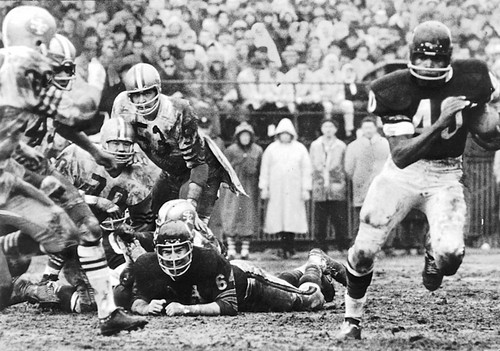
This is the story of two athletically-gifted brothers named Sayers. The younger of the pair, Gale, became a sports figure for the ages with his zig-zagging runs to daylight on a football field. His name is synonymous with the Chicago Bears. His oft-played highlight-reel runs through enemy lines form the picture of quicksilver grace. His well-documented friendship with the late Brian Piccolo endear him to new generations of fans.
The elder brother, Roger, forged a distinguished athletic career of his own, one of blazing speed on cinder and grass, but one overshadowed by Gale’s success.
From their early impoverished youth on Omaha’s near north side in the 1950s the Brothers Sayers dominated whatever field of athletic competition they entered, shining most brightly on the track and gridiron. As teammates they ran wild for Roberts Dairy’s midget football squad and anchored Central High School’s powerful football-track teams. Back then, Roger, the oldest by a year, led the way and Gale followed. For a long time, little separated the pair, as the brothers took turns grabbing headlines. Each was small and could run like the wind, just like their ex-track man father. But, make no mistake about it, Roger was always the fastest.
Each played halfback, sharing time in the same Central backfield one season. Heading into Gale’s sophomore year nature took over and gave Gale an edge Roger could never match, as the younger brother grew a few inches and packed-on 50 pounds of muscle. He kept growing, too. Soon, Gale was a strapping 6’0, 200-pound prototype halfback with major-college-material written all over him. Roger remained a diminutive 5’9, 150-pound speedster whose own once hotly sought-after status dimmed when, bowing to his parents’ wishes, he skipped his senior year of football rather than risk injury. Ironically, he tore a tendon running track the next spring. His major college prospects gone, he settled for then Omaha University.
Roger went on to a storied career at UNO, where he developed into one of America’s top sprinters and one of the school’s all-time football greats. He won the 100-meters at the 1964 Drake Relays. He captured both the 100-yard and 100-meter dashes at the 1963 Texas Relays. He took the 100 and 200 at the 1963 national NAIA meet. He ran well against Polish and Soviet national teams in AAU meets. The Olympic hopeful even beat the legendary American sprinter Bob Hayes in a race, but it was Hayes, known as “The Human Bullet,” who ended up with Olympic and NFL glory, not Sayers.
As an undersized but explosive cog in UNO’s full backfield, Sayers, dubbed “The Rocket,” averaged nearly eight yards per carry and 19 yards per reception over his four-year career. But it was as a return specialist he really stood out. Using his straight-away burst, he took back to the house three punts and five kickoffs for touchdowns. He holds several school records, including highest rushing average for a season (10.2) and career (7.8) and highest punt return average for a season (29.5) and career (20.6). His 99-yard TD catch in a 1963 game versus Drake is the longest scoring play from scrimmage in UNO history.

Roger Sayers running track for then-Omaha University
In football, size matters. For most of his playing career, however, Roger said his acute lack of size “never was a factor. I didn’t pay much attention to it. I didn’t lack any confidence when I got on the field. I always thought I could do well.”
Even with his impressive track credentials, Sayers, coming off an injury, was unable to find a sponsor for a 1964 Olympic bid. Even though his small stature never held him back in high school or college, it posed a huge obstacle in pro football, which after graduation he did not pursue right away because the studious and ambitious Sayers already had opportunities lined-up outside athletics. Still, in 1966, he gave the NFL a try when, after prodding from “the guys” at the Spencer Street Barbershop and a little help from Gale, he signed a free agent contract with his brother’s team, the Chicago Bears. Roger lasted the entire training camp and exhibition season with the club before bowing to reality and taking an office job.
“That’s when I realized I was too small,” Roger said of his NFL try.
Gale, the family superstar, is inducted in the college and pro football Halls of Fame but his glory came outside Nebraska, where he felt unappreciated. Racism likely prevented him being named Nebraska High School Athlete of the Year after a senior year of jaw-dropping performances. In leading Central to a share of the state football title, he set the Class A single season scoring record and made prep All-American. In pacing Central to the track and field title, he won three gold medals at the state meet, shattering the Nebraska long jump record with a leap of 24 feet, 10 inches, a mark that still stands today. He got revenge in the annual Shrine all-star game, scoring four touchdowns en route to being named outstanding player.
Recruited by Nebraska, then coached by Bill Jennings, Sayers considered the Huskers but felt uncomfortable at the school, which had ridiculously few black students then — in or out of athletics. Spurning the then-moribound NU football program for the University of Kansas, he heard people say he’d never be able to cut it in school. Sayers admits academics were not his strong suit in high school, not for lack of intelligence, but for lack of applying himself.
It took his father, a-$55-a-week car polisher, who’d walked away from his own chance at college, to set him straight. “People said I would fail. They called me dumb. But my dad said to me one time, ‘Gale, you are good enough,’ and just those words gave me the incentive that somebody believed in me. That’s all I needed. And I proved that I could do it.”
Sayers was also motivated by his brother, Roger, the bookish one who preceded him to college. Each went on to get two degrees at their respective schools.
On the field, Gale showed the Huskers what they missed by earning All-Big 8 and All-America honors as a Jayhawk and, in a 1963 game at Memorial Stadium the “Kansas Comet” lived up to his nickname by breaking-off a 99 yard TD run that still stands as the longest scoring play by an NU opponent. He was also a hurdler and long-jumper for the elite KU track program.
Upon entering the NFL with the Bears in 1965, Sayers made the most dramatic debut in league history, setting season records for total offense, 2,272, and touchdowns, 22, and a single game scoring record with 6 TDs. Named Rookie of the Year and All-Pro, he continued his brilliant play the next four seasons before the second of two serious knee injuries cut short his career in 1970. A mark of the impact he made is that despite playing only five full seasons, he’s routinely listed among the best running backs to ever play in the NFL.

Gale Sayers with the Bears
His immortality was ensured by two things: in 1970, the story of his friendship with teammate Brian Piccolo, who died tragically of cancer, was dramatically told in a TV movie-of-the-week, Brian’s Song, (recently remade); and, in 1977, he was inducted into the pro football Hall of Fame at age 29, making him the youngest enshrine of that elite fraternity.
A quadruple threat as a rusher, receiver out of the backfield, kickoff return man and punt returner, Sayers’ unprecedented cuts saw him change directions — with the high-striding, gliding moves of a hurdler — in the blink of an eye while somehow retaining full-speed. In a blurring instant, he’d be in mid-air as he head-faked one way and swiveled his hips the other way before landing again to pivot his feet to race off against the grain. In the introduction to Gale’s autobiography, I Am Third, comic Bill Cosby may have come closest to describing the effect one of Sayers’ dramatic cuts left on him while observing from the sidelines and on the hapless defenders trying to corral him.
“I was standing there and Gale was coming around this left end. And there are about five or six defensive men ready, waiting for him…And I saw Gale Sayers split. I mean, like a paramecium. He just split in two. He threw the right side of his body on one side and the left side of his body kept going down the left side. And the defensive men didn’t know who to catch.”
The way Gale tells it, his talent for cutting resulted from his “peripheral vision,” a gift he had from the get-go. “When I was running I could see the whole field. I knew how fast the other person was running and the angle he was taking, and I knew all I had to do was make a certain move and I’m past him. I knew it — I didn’t have to think about it. I could see where people were and that gave me the ability to make up my mind what I would do before I got to a person,” he said. He reacted, on the fly, in tenths or hundreds of a second, to what he saw. “
All the so-called great moves in football are instinct,” he said. “It’s not planned. I don’t go down the football field saying, ‘Oh, this fella’s to my right, I better cut left,’ or whatever. You don’t plan it. You’re running with the football and you just do what comes natural…There were so many times in high school, college and pro ball when I was going around left end or right end and there was nothing there, and then I went the other way. You can’t teach that. That’s instinctive.”
He said his greatest asset was not speed, but quickness — combined with that innate ability to improvise on the run. “Every running back has speed, but a lot of running backs don’t have the quickness to hit a hole or to change directions, and I always could do that. A lot of times a hole is clogged and then you’ve got to do something else — either change directions or hit another hole or bounce it to the outside and go someplace else.”
Lightning fast moves may have sprung from an unlikely source — flag football, something Heisman Trophy winner Johnny Rodgers also credits with helping develop his dipsy-doodle elusiveness.
“The flags were pretty easy to grab and pull out,” Sayers said, “and so, yes, you had to develop some moves to keep people away from the flags.” The Sayers boys got their first exposure to organized competition playing in the Howard Kennedy Grade School flag football program coached by Bob Rose. An old-school disciplinarian who mentored many of north Omaha’s greatest athletes when they were youths, Rose embodied respect.
“He was a tough coach. I think he had a little attitude that said, in being black, you’ve got to be twice as good, and I think he tried to instill that in us at an early age. He’d say things like, ‘You have to be faster, you have to be tougher, you’ve got to hit harder.’ We all developed that attitude that, ‘Hey, we’ve got to do better because we’re black.’ And I think that stuck with me,” Gale said.
According to Roger, coaches like Rose and the late Josh Gibson (Hall of Fame pitcher Bob Gibson’s oldest brother), whom the brothers came in contact with playing summer softball, “made it possible for people to succeed. They were good coaches because they taught you the fundamentals, they taught you to be respectful of people and they taught you the ethics of the game. These were folks that…made sure you played in an organized, structured event, so you could get the most out of it. They also had an uncanny ability to identify athletes and to motivate athletes to want to play and to achieve. They were part of an environment we had growing up where we had strong support systems around us.”
From the mid-1950s through the late 1960s Omaha’s inner city produced a remarkable group of athletes who achieved greatness in a variety of sports. Many observers have speculated on the whys and hows of that phenomenal run of athletic brilliance. The consensus seems to be that athletes from the past didn’t have to contend with a lot of the pressures and distractions kids face today, thus allowing a greater concentration on and passion for sports.
“Growing up, we didn’t have access to cars or play stations or arcade games,” Roger said. “We didn’t have to deal with the intense peer pressure kids are influenced by today. Because we didn’t have these things, we were able to focus in on our sports.”
For black youths like the Sayers and their buddies, options were even more confining in the ‘50s, when racial minorities were denied access to recreational venues such as the Peony Park pool and were discouraged from so-called country-club activities such as golf, which left more time and energy to devote to traditional inner city sports. “
Every day after school we were in Kountze park or some place playing a sport — football, basketball, baseball, whatever it may be. There wasn’t a whole lot else we could do,” Gale said. “So, we were in the park playing sports. Our mamas and daddies had to call us to come eat dinner because we were out there playing.”
Gale said that as youths he and his friends had such a hunger for football that after completing flag football practice, they would then go to the park to knock heads “with the big kids” from local high schools in pick-up games. “It’s a wonder no one ever got seriously injured because we had no pads, no nothing, and we played tackle. It really made us tougher.”
Dennis Fountain, a friend and fellow athlete from The Hood, said the Sayers would often compete for opposing sides in those informal games. “You wouldn’t think those two guys were brothers,” he said. “They would mix it up good.”
Speaking of tough, the brothers tussled in a pair of now mythic neighborhood football games held around the holidays. There was the Turkey Bowl played on Thanksgiving and the Cold Bowl played on Christmas. “We had some knock-down, drag-out athletic contests out there,” said Gale, referring to the annual games that drew athletes of all ages from Omaha’s north and south inner city projects. “We were a little young, but the fellas’ saw the talent we had and let us play.”
Then, there was the rich proving ground he and Roger found themselves competing in — playing with or against such fine athletes as the Nared brothers (Rich and John), Vernon Breakfield, Charlie Gunn, Bruce Hunter, Ron Boone. “No doubt about it, we fed off one another. We saw other people doing well and we wanted to do just as well,” Gale said. As the Sayers began asserting themselves, they pushed each other to excel.
“When he achieved something, I wanted to achieve something, and vice versa,” Roger said. “I mean, you never wanted to be upstaged or outdone, but by the same token we were always proud and overjoyed by each other’s success. We were as competitive as brothers are.”
Roger and Gale had so much ability that the exploits of their baby brother, Ron, are obscured despite the fact he, too, possessed talent, enough in fact for the UNO grad to be a number two draft pick by the San Diego Chargers in 1968.
Each also knew his limitations in comparison with the other. Roger played some mean halfback himself, but he knew on a football field he was only a shadow of Gale, whom nature blessed with size, speed, vision and instinct. Where Gale was a fine hurdler, relay man and long-jumper, he knew he could not beat Roger in a sprint. “I wasn’t going to get into the 100 or 220-yard dash and run against him because he was much, much faster than I was,” Gale said. “He was great in track.”
As much as he downplays his own track ability, Gale held his own in one of the strongest collegiate track programs at Kansas. It was under KU track and field coach Bill Easton he discovered a work ethic and a mantra that have guided his life ever since.
“I thought I worked hard getting ready for football,” he said, “but when I joined his track team I couldn’t believe the amount of work he put me through and I couldn’t believe I could do it. But within months I could do everything he asked me to, and I was in excellent shape. He told me, ‘Gale, you cannot work hard enough in any sport, especially in track.’ The things I did for him on the track team carried on through my pro career in football.
“Every training camp I came in shape, and I mean I came in shape. I was ready to play and put the pads on the first day of camp, where many guys would go to camp to get in shape.”
On the eve of his pro career, Sayers was entertaining some doubts about how he would do when Easton reminded him what made him special. “You go for broke every time you go.” Sayers said it’s a lesson he’s always tried to follow.

A saying printed on a card atop the desk in Easton’s office intrigued Sayers. The enigmatic words said, I Am Third. When he asked his coach their meaning, he was told they came from a kind of proverb that goes, The Lord is First, My Friends are Second, I Am Third. The athlete was so taken with its meaning he went out and had it inscribed on a medallion he wore for years afterwards. His wife Linda now has it.
The saying became the title of his 1970 autobiography. The philosophy bound up in it helped him cope with the abrupt end of his playing days. “All the talent I had, the Lord gave me. And it was the Lord that decided to take it away from me,” Gale said. “That probably helped me accept the fact that, hey, I couldn’t do it anymore. I had a very short career, but a very good career. I was satisfied with that.”
Life after athletic competition has been relatively smooth for Gale and his brother. Roger embarked on a long executive corporate career, interrupted only by a stint as the City of Omaha’s Human Relations Director under Mayor Gene Leahy. He retired from Union Pacific a few years ago. Today, he’s a trustee with Salem Baptist Church. Gale served as athletic director at Southern Illinois University before starting his own sports marketing and public relations firm, Sayers and Sayers Enterprises. Next, he launched Sayers Computer Source, a provider of computer products and technology solutions to commercial customers. Today, SCS has brnaches nationwide and revenues in excess of $150 million. Besides running his companies, Sayers is in high demand as a motivational speaker.
Both men have tried distancing themselves from being defined by their athletic prowess alone.
“I want people to view me as an individual that brings something to the table other than the fact I could run track and play football. That stuff is behind me. There are other things I can do,” said Roger. For Gale, it was a matter of being ready to move on. “I’ve always said, As you prepare to play, you must prepare to quit, and I prepared to quit. I didn’t have to look back and say, What am I going to do now? I did other things.”
Getting on with their lives has been a constant with the brothers since growing up with feuding, alcoholic parents, sparse belongings and little money in “The Toe,” as Gale said residents referred to the north Omaha ghetto. His family moved to Omaha from bigoted small towns in Kansas, where the Sayers lived until Gale was 8, but instead of the fat times they envisioned here they only found despair.
Finding a way out of that cycle became an overriding goal for Gale and his brothers.
“Yes, we had tough times, but everybody in the black neighborhood had a tough time. Our dad always said, ‘Gale, Roger, Ronnie…sorry it didn’t work out for your mother and I, but you need to get your education and make something better for yourselves.’” The fact he and Roger went on to great heights taught Gale that “if you want to make it bad enough, no matter how bad it is, you can make it.”
Related Articles
- Gale Sayers’s Knee, and the Dark Ages of Medicine (fifthdown.blogs.nytimes.com)
- The 32 Greatest NFL Running Backs (sports-central.org)
- The Ties that Bind, One Family’s Celebration of Native Omaha Days (leoadambiga.wordpress.com)
- Sayers: Current players should help pioneers (sports.espn.go.com)
- John Mackey’s death has Gale Sayers ticked off at today’s NFL (profootballtalk.nbcsports.com)
Prodigal Son: Marlin Briscoe takes long road home (from my Omaha Black Sports Legends series, Out to Win: The Roots of Greatness)

I never saw Marlin Briscoe play college football, but as I came of age people who had see The Magician perform regaled me with stories of his improvisational playmaking skills on the gridiron, and so whenever I heard or read the name, I tried imagining what his elusive, dramatic, highlight reel runs or passes looked like. Mention Briscoe’s name to knowledgable sports fans and they immediately think of a couple things: that he was the first black starting quarterback in the National Football League; and that he won two Super Bowl rings as a wide receiver with the Miami Dolphins. But as obvious as it seems, I believe that both during his career and after most folks don’t appreciate (1) how historic the first accomplishment was and (2) don’t recognize how amazing it was for him to go from being a very good quarterback in the league, in the one year he was allowed to play the position, to being an All-Pro wideout for Buffalo. Miami thought enough of him to trade for him and thereby provide a complement to and take some heat off of legend Paul Warfield.
The following story I did on Briscoe appeared not long after his autobiography came out. I made arrangements to inteview him in our shared hometown of Omaha, and he was every bit as honest in person as he was in the pages of his book, which chronicles his rise to stardom, the terrible fall he took, and coming back from oblivion to redeem himself. The story appeared in a series I did on Omaha’s Black Sports Legends, Out to Win: The Roots of Greatness, for The Reader (www.thereader.com) in 2004-2005. Since then, there’s been a campaign to have the NFL’s veterans committee vote Briscoe into the Hall of Fame and there are plans for a feature film telling his life story.

Prodigal Son:
Marlin Briscoe takes long road home (from my Omaha Black Sports Legends series, Out to Win: The Roots of Greatness)
©by Leo Adam Biga
Originally published in The Reader (www.thereader.com) as part of my Omaha Black Sports Legends series, Out to Win: The Roots of Greatness
Imagine this is your life: Your name is Marlin Briscoe. A stellar football-basketball player at Omaha South High School in the early 1960s, you are snubbed by the University of Nebraska but prove the Huskers wrong when you become a sensation as quarterback for then Omaha University, where from 1963 to 1967, you set more than 20 school records for single game, season and career offensive production.
Because you are black the NFL does not deem you capable of playing quarterback and, instead, you’re a late round draft choice, of the old AFL, at defensive back. Injured to start your 1968 rookie season, the offense sputters until, out of desperation, the coach gives you a chance at quarterback. After sparking the offense as a reserve, you hold down the game’s glamour job the rest of the season, thus making history as the league’s first black starting quarterback. When racism prevents you from getting another shot as a signal caller, you’re traded and excel at wide receiver. After another trade, you reach the height of success as a member of a two-time Super Bowl-winning team. You earn the respect of teammates as a selfless clutch performer, players’ rights advocate and solid citizen.
Then, after retiring from the game, you drift into a fast life fueled by drugs. In 12 years of oblivion you lose everything, even your Super Bowl rings. Just as all seems lost, you climb out of the abyss and resurrect your old self. As part of your recovery you write a brutally honest book about a life of achievement nearly undone by the addiction you finally beat.
You are Marlin Oliver Briscoe, hometown Omaha hero, prodigal son and the man now widely recognized as the trailblazer who laid the path for the eventual black quarterback stampede in the NFL. Now, 14 years removed from hitting rock bottom, you return home to bask in the glow of family and friends who knew you as a fleet athlete on the south side and, later, as “Marlin the Magician” at UNO, where some of the records you set still stand.
Now residing in the Belmont Heights section of Long Beach, Calif. with your partner, Karen, and working as an executive with the Roy W. Roberts Watts/Willowbrook Boys and Girls Club in Los Angeles, your Omaha visits these days for UNO alumni functions, state athletic events and book signings contrast sharply with the times you turned-up here a strung-out junkie. Today, you are once again the strong, smart, proud warrior of your youth.
Looking back on what he calls his “lost years,” Briscoe, age 59, can hardly believe “the severe downward spiral” his life took. “Anybody that knows me, especially myself, would never think I would succumb to drug addiction,” he said during one of his swings through town. “
All my life I had been making adjustments and overcoming obstacles and drugs took away all my strength and resolve. When I think about it and all the time I lost with my family and friends, it’s a nightmare. I wake up in a cold sweat sometimes thinking about those dark years…not only what I put myself through but a lot of people who loved me. It’s horrifying.
“Now that my life is full of joy and happiness, it just seems like an aberration. Like it never happened. And it could never ever happen again. I mean, somebody would have to kill me to get me to do drugs. I’m a dead man walking anyway if I ever did. But it’s not even a consideration. And that’s why it makes me so furious with myself to think why I did it in the first place. Why couldn’t I have been like I am now?”
Or, like he was back in the day, when this straight arrow learned bedrock values from his single mother, Geneva Moore, a packing house laborer, and from his older cousin Bob Rose, a youth coach who schooled him and other future greats in the parks and playing fields of schools and recreation centers in north and south Omaha.
For Briscoe, the pain of those years when, as he says, “I lost myself,” is magnified by how he feels he let down the rich, proud athletic legacy he is part of in Omaha. It is a special brotherhood. One in which he and his fellow members share not only the same hometown, but a common cultural heritage in their African–American roots, a comparable experience in facing racial inequality and a similar track record of achieving enduring athletic greatness.

Marlin Briscoe, a South High alum, is honored with a street named in his honor on Oct. 22, 2014.
Briscoe came up at a time when the local black community produced, in a golden 25-year period from roughly 1950 to 1975, an amazing gallery of athletes that distinguished themselves in a variety of sports. He idolized the legends that came before him like Bob Boozer, a rare member of both Olympic Gold Medal (at the 1960 Rome Games) and NBA championship (with the 1971 Milwaukee Bucks) teams, and MLB Hall of Famer and Cy Young Award winner Bob Gibson. He honed his skills alongside greats Roger Sayers, one of the world’s fastest humans in the early 1960s, NFL Hall of Famer Gale Sayers and pro basketball “Iron Man” Ron Boone. He inspired legends that came after him like Heisman Trophy winner Johnny Rodgers.
Each legend’s individual story is compelling. There are the taciturn heroics and outspoken diatribes of Gibson. There are the knee injuries that denied Gale Sayers his full potential by cutting short his brilliant playing career and the movies that dramatically portrayed his bond with doomed roommate Brian Piccolo. There are the ups and downs of Rodgers’ checkered life and career. But Briscoe’s own personal odyssey may be the most dramatic of all.
Born in Oakland, Calif. in 1945, Briscoe and his sister Beverly were raised by their mother after their parents split up. When he was 3, his mother moved the family to Omaha, where relatives worked in the packing houses that soon employed her as well. After a year living on the north side, the family moved to the south Omaha projects. Between Kountze Park in North O and the Woodson Center in South O, Briscoe came of age as a young man and athlete. In an era when options for blacks were few, young men like Briscoe knew that athletic prowess was both a proving ground and a way out of the ghetto, all the motivation he needed to work hard.
“Back in the ‘50s and early ‘60s we had nothing else to really look forward to except to excel as black athletes,” Briscoe said. “Sports was a rite-of-passage to respect and manhood and, hopefully, a way to bypass the packing houses and better ourselves and go to college. When Boozer (Bob) went to Kansas State and Gibson (Bob) went to Creighton, that next generation — my generation — started thinking, If I can get good enough in sports, I can get a scholarship to college so I can take care of my mom. That’s how all of us thought.”
Like many of his friends, Briscoe grew up without a father, which combined with his mother working full-time meant ample opportunity to find mischief. Except that in an era when a community really did raise a child, Briscoe fell under the stern but caring guidance of the men and women, including Alice Wilson and Bob Rose, that ran the rec centers and school programs catering to largely poor kids. By the time Briscoe entered South High, he was a promising football-basketball player.
On the gridiron, he’d established himself as a quarterback in youth leagues, but once at South shared time at QB his first couple years and was switched to halfback as a senior, making all-city. More than just a jock, Briscoe was elected student council president.
Scholarship offers were few in coming for the relatively small — 5’10, 170-pound — Briscoe upon graduating in 1962. The reality is that in the early ‘60s major colleges still used quotas in recruiting black student-athletes and Briscoe upset the balance when he had the temerity to want to play quarterback, a position that up until the 1980s was widely considered too advanced for blacks.
But UNO Head Football Coach Al Caniglia, one of the winningest coaches in school history, had no reservations taking him as a QB. Seeing limited duty as a freshman backup to incumbent Carl Meyers, Briscoe improved his numbers each year as a starter. After a feeling-out process as a sophomore, when he went 73 of 143 for 939 yards in the air and rushed for another 370 yards on the ground, his junior year he completed 116 of 206 passes for 1,668 yards and ran 120 times for 513 yards to set a school total offense record of 2,181 yards in leading UNO to a 6-5 mark.
What was to originally have been his senior year, 1966, got waylaid, as did nearly his entire future athletic career, when in an indoor summer pickup hoops game he got undercut and took a hard, headfirst spill to the floor. Numb for a few minutes, he regained feeling and was checked out at a local hospital, which gave him a clean bill of health.
Even with a lingering stiff neck, he started the ‘66 season where he left off, posting a huge game in the opener, before feeling a pop in his throbbing neck that sent him “wobbling” to the sidelines. A post-game x-ray revealed a fractured vertebra, perhaps the result of his preseason injury, meaning he’d risked permanent paralysis with every hit he absorbed. Given no hope of playing again, he sat out the rest of the year and threw himself into academics and school politics. After receiving his military draft notice, he anxiously awaited word of a medical deferment, which he got. Without him at the helm, UNO crashed to a 1-9 mark.
Then, a curious thing happened. On a follow-up medical visit, he was told his broken vertebra was recalcifying enough to allow him to play again. He resumed practicing in the spring of ‘67 and by that fall was playing without any ill effects. Indeed, he went on to have a spectacular final season, attracting national attention with his dominating play in a 7-3 campaign, compiling season marks with his 25 TD throws and 2,639 yards of total offense, including a dazzling 401-yard performance versus tough North Dakota State at Rosenblatt Stadium.
Projected by pro scouts at cornerback, a position he played sparingly in college, Briscoe still wanted a go at QB, so, on the advice of Al Caniglia he negotiated with the Denver Broncos, who selected him in the 14th round, to give him a look there, knowing the club held a three-day trial open to the public and media.
“I had a lot of confidence in my ability,” Briscoe said, “and I felt given that three-days at least I would have a showcase to show what I could do. I wanted that forum. When I got it, that set the tone for history to be made.”
At the trial Briscoe turned heads with the strength and accuracy of his throws but once fall camp began found himself banished to the defensive backfield, his QB dreams seemingly dashed. He earned a starting cornerback spot but injured a hamstring before the ‘68 season opener.
After an 0-2 start in which the Denver offense struggled mightily out of the gate, as one QB after another either got hurt or fell flat on his face, Head Coach Lou Saban finally called on Briscoe in the wake of fans and reporters lobbying for the summer trial standout to get a chance. Briscoe ran with the chance, too, despite the fact Saban, whose later actions confirmed he didn’t trust a black QB, only gave him a limited playbook to run. In 11 games, the last 7 as starter, Briscoe completed 93 of 224 passes for 1,589 yards with 14 TDs and 13 INTs and he ran 41 times for 308 yards and 3 TDs in helping Denver to a 5-6 record in his 11 appearances, 5-2 as a starter.
Briscoe proved an effective improviser, using his athleticism to avoid the rush, buy time and either find the open receiver or move the chains via scrambling. “Sure, my percentage was low, because initially they didn’t give me many plays, and so I was out there played street ball…like I was down at Kountze Park again…until I learned the cerebral part of the game and then I was able to improve my so-called efficiency,” is how Briscoe describes his progression as an NFL signal caller.
By being branded “a running” — read: undisciplined — quarterback in an era of strictly drop back pocket passers, with the exception of Fran Tarkenton, who was white, Briscoe said blacks aspiring to play the position faced “a stigma” it took decades to overcome.
Ironically, he said, “I never, ever considered myself a black quarterback. I was just a quarterback. It’s like I never thought about size either. When I went out there on the football field, hey, I was a player.”
All these years later, he still bristles at the once widely-held notions blacks didn’t possess the mechanics to throw at the pro level or the smarts to grasp the subtleties of the game or the leadership skills to command whites. “How do you run in 14 touchdown passes? I could run, sure. I could buy more time, yeah. But if you look at most of my touchdown passes, they were drop back passes. I led the team to five wins in seven starts. We played an exciting brand of football. Attendance boomed. If I left any legacy, it’s that I proved the naysayers wrong about a black man manning that position…even if I never played (QB) again.”

Despite his solid performance — he finished second in Rookie of the Year voting — he was not invited to QB meetings Saban held in Denver the next summer and was traded only weeks before the ‘69 regular season to the Buffalo Bills, who wanted him as a wide receiver.
His reaction to having the quarterback door slammed in his face? “I realized that’s the way it was. It was reality. So, it wasn’t surprising. Disappointing? Yes. All I wanted and deserved was to compete for the job. Was I bitter? No. If I was bitter I would have quit and that would have been the end of it. As a matter of fact, it spurred me to prove them wrong. I knew I belonged in the NFL. I just had to make the adjustment, just like I’ve been doing all my life.”
The adversity Briscoe has faced in and out of football is something he uses as life lessons with the at-risk youth he counsels in his Boys and Girls Club role. “I try to tell them that sometimes life’s not fair and you have to deal with it. That if you carry a bitter pill it’s going to work against you. That you just have to roll up your sleeves and figure out a way to get it done.”
While Briscoe never lined up behind center again, soon after he left Denver other black QBs followed — Joe Gilliam, Vince Evans, Doug Williams and, as a teammate in Buffalo, James Harris, whom he tutored. All the new faces confronted the same pressures and frustrations Briscoe did earlier. It wasn’t until the late 1980s, when Williams won a Super Bowl with the Redskins and Warren Moon put up prolific numbers with the Houston Oilers, that the black QB stigma died.
Briscoe was not entirely aware of the deep imprint he made until attending a 2001 ceremony in Nashville remembering the late Gilliam. “All the black quarterbacks, both past and present, were there,” said Briscoe, naming everyone from Aaron Brooks (New Orleans Saints) to Dante Culpepper (Minnesota Vikings) to Michael Vick (Atlanta Falcons).
“The young kids came up to me and embraced me and told me, ‘Thank you for setting the tone.’ Now, there’s like 20 black quarterbacks on NFL rosters, and for them to give me kudos for paving the way and going through what I went through hit me. That was probably the first time I realized it was a history-making event. The young kids today know about the problems we faced and absorbed in order for them to get a fair shot and be in the position they are.”
Making the Buffalo roster at a spot he’d never played before proved one of Briscoe’s greatest athletic challenges and accomplishments. He not only became a starter but soon mastered the new position, earning 1970 All-Pro honors in only his second year, catching 57 passes for 1,036 yards and 8 TDs. Then, in an example of bittersweet irony, Saban was named head coach of the moribund Bills in 1972 and promptly traded Briscoe to the powerful Miami Dolphins. The move, unpopular with Bills’ fans, once again allowed Briscoe to intersect with history as he became an integral member of the Dolphins’ perfect 17-0 1972 Super Bowl championship team and the 1973 team that repeated as champs.
Following an injury-plagued ‘74 season, Briscoe became a vagabond — traded four times in the space of one year — something he attributes to his involvement in the 1971 lawsuit he and five other players filed against then-NFL commissioner Pete Rozelle, an autocrat protecting owners’ interests, in seeking the kind of free agency and fair market value that defines the game today. Briscoe and his co-complainants won the suit against the so-called Rozelle Rule but within a few years they were all out of the game, labeled troublemakers and malcontents.
His post-football life began promisingly enough. A single broker, he lived the L.A. high life. Slipping into a kind of malaise, he hung with “an unsavory crowd” — partying and doing drugs. His gradual descent into addiction made him a transient, frequenting crack houses in L.A.’s notorious Ho-Stroll district and holding down jobs only long enough to feed his habit. The once strapping man withered away to 135 pounds. His first marriage ended, leaving him estranged from his kids. Ex-teammates like James Harris and Paul Warfield, tried helping, but he was unreachable.
“I strayed away from the person I was and the people that were truly my friends. When I came back here I was trying to run away from my problems,” he said, referring to the mid-’80s, when he lived in Omaha, “and it got worse…and in front of my friends and family. At least back in L.A. I could hide. I saw the pity they had in their eyes but I had no pride left.”
Perhaps his lowest point came when a local bank foreclosed on his Super Bowl rings after he defaulted on a loan, leading the bank to sell them over e-bay. He’s been unable to recover them.
He feels his supreme confidence bordering on arrogance contributed to his addiction. “I never thought drugs could get me,” he said. “I didn’t realize how diabolical and treacherous drug use is. In the end, I overcame it just like I overcame everything else. It took 12 years…but there’s some people that never do.” In the end, he said, he licked drugs after serving a jail term for illegal drug possession and drawing on that iron will of his to overcome and to start anew. He’s made amends with his ex-wife and with his now adult children.
Clean and sober since 1991, Briscoe now shares his odyssey with others as both a cautionary and inspirational tale. Chronicling his story in his book, The First Black Quarterback, was “therapeutic.” An ESPN documentary retraced the dead end streets his addict’s existence led him to, ending with a blow-up of his fingers, bare any rings. Briscoe, who dislikes his life being characterized by an addiction he’s long put behind him, has, after years of trying, gotten clearance from the Dolphins to get duplicate Super Bowl rings made to replace the ones he squandered.
For him, the greatest satisfaction in reclaiming his life comes from seeing how glad friends and family are that the old Marlin is back. “Now, they don’t even have to ask me, ‘Are you OK?’ They know that part of my life is history. They trust me again. That’s the best word I can use to define where I am with my life now. Trust. People trust me and I trust myself.”
Related Articles
- Black like me (cbc.ca)
- Black like me: CFL QB legacy (cbc.ca)
- UNO Wrestling Dynasty Built on a Tide of Social Change (leoadambiga.wordpress.com)
- Today’s Exploration: Omaha’s History of Racial Tension (theprideofnebraska.blogspot.com)
- Omaha Native Steve Marantz Looks Back at the City’s ’68 Racial Divide Through the Prism of Hoops in His New Book, ‘The Rhythm Boys of Omaha Central’ (leoadambiga.wordpress.com)
- Back in the Day, Native Omaha Days is Reunion, Homecoming, Heritage Celebration and Party All in One (leoadambiga.wordpress.com)
- Eric Crouch To Play For UFL’s Omaha Nighthawks, Fulfill Destiny (sbnation.com)
Lela Knox Shanks: Woman of conscience, advocate for change, civil rights and social justice champion

Image via Wikipedia
UPDATE: As the world turns these days I know when the subject of one of my stories on this blog is in the news by the corresponding uptick in views. When I noted dozens of viewers landing on my profile about Lela Knox Shanks I hoped for the best but suspected the worst, and sadly as some of you reading this right now already know she has passed away after a long illness. She is a woman worth remembering and if you haven’t read the story below yet I trust you’ll take the time to. If you don’t know nothing about her, then by all means familiarize yourself with some of her work and experiences in the civil rights and social justice struggle. If you knew her or her story, you still might find oout something new about her you didn’t know before. In either case, you’ll be honoring her memory by reading about her good works. Rest in peace, Lela.
New Horizons editor Jeff Reinhardt told me about the subject of this profile, Lela Knox Shanks, and I’m glad he did. I’d never heard of her, but she’s someone who deserves to be more widely known because she’s spent the better part of her 80-plus years doing the right thing in the struggle for freedom, justice, and equal rights. Jeff and I drove to meet with her at her home in Lincoln, Neb., and we were both captivated by her unwavering commitment to equality. She’s taken many brave stances in her life and she’s paid some dear prices, but she’s never backed down, never given up. She’s a model and an inspiration for us all. I think you’ll find as memorable and impressive as Jeff and I did.

JILL PEITZMEIER / Lincoln Journal Star
Lela Shanks, pictured in her home in 2008. (LJS file)
Lela Knox Shanks: Woman of conscience, advocate for change, civil rights and social justice champion
©by Leo Adam Biga
Originally published in the New Horizons
Activist, humanitarian, scholar, speaker, feminist and author Lela Knox Shanks could be excused for getting weary after a lifetime of agitating for equal rights. As an 81-year-old African American who came of age in the Jim Crow South and fought many civil rights battles in the Midwest, she’s stood up against injustice. She’s picketed, protested, demonstrated. She’s written countless letters to elected officials.
Driving up to the cozy home in Lincoln, Neb. she’s resided in 43 years, expressions of her activism are visible in sloganed signs on her porch: “War is not the answer,” “Every human being is born legal,” “The State should be about life, not death.” She’s butted heads with the-powers-that-be. She’s advocated for the oppressed. At various times her activities have made her the object of harassment and surveillance. She’s been arrested but never convicted for her civil disobedience.
Her partner in life and in social justice causes was her husband of 50 years, the late Hughes Hannibal Shanks, who developed Alzheimer’s Disease in the mid-1980s.
A fellow product of the South, he fought his own battles on the job and in the community. Together, the couple proved an immovable force, never backing down from a perceived wrong, always striving to do the right thing. They saw much social progress flower in America, including gains by minorities in education, employment, housing. Their children, now grown with families of their own, are all professionals. The prospects for their grandchildren, bright, too.
AD marked the progressive loss of her best friend. She was Hughes’s primary caregiver when little information about the illness or how to care for loved ones afflicted with it existed. She did what she always does when confronted with an obstacle, she educated herself and threw herself into finding solutions.
Hughes had been the family radical. He presided over lively discussions at the dinner table. Everyone was expected to join in. He and Lela were kindred spirits with their keen social consciousness. As dementia stole more and more of him, she said, “the thing I missed most about my husband was that I didn’t have anybody that I could share that kind of intimacy of conversation with.”
Her odyssey caring for him was a profound experience. It led her to write a book, Your Name is Hughes Hannibal Shanks: A Caregiver’s Guide to Alzheimer’s, that received praise upon its initial 1996 publication and 1999 reprint. It was a fitting project for a woman who earned a college journalism degree and worked for the famous black newspaper, The Chicago Defender, but who abandoned a dreamed-of career as a writer in deference to Hughes’s wish she not work but raise the kids.
Reception to the book was so strong she became a much-in-demand public speaker, thus ushering in a new phase in her life as a lecturer and independent scholar. For years she’s shared her insights on caregiving with audiences around the country. She’s also given many talks about women’s empowerment, once serving on a United Nations panel addressing the subject.
She’s made many African American history presentations, too. Just as she became an expert on caregiving for AD by reading everything she could find on it, she researched black history so she could share this rich heritage with others.
“When I became a speaker on African American history for the Nebraska Humanities Council,” she said, “I made a comprehensive study of it.”
That’s the way Lela does things. No half measures. It’s all or nothing with her.
Her interest in history was stoked by the legacy of her great-grandmother, Hannah Mason McCrutcheon, who was born a slave. Lela knew her well and said this matriarch’s proudest moment was having seen Abraham Lincoln speak. This is why Lela’s so passionate to have history disseminated.
“I went to segregated schools (in Oklahoma) and in my school I took Negro history,” Lela said. “So I grew up learning it. Plus, I heard famous African Americans speak at my high school. Mary McLeod Bethune for one.”
Slavery was a taboo topic, however, in her family. Whenever Lela tried bringing it up with her elders, she said, “It was always, ‘Baby, we don’t talk about that.’ It was too awful.” It’s a painful enough history that generations later some descendants of slaves would rather not be reminded of it. “I have relatives today that don’t want me to ever say anything about that. I guess its’ so degrading.”
Linked as she is to that past Lela testified before the Nebraska Judiciary Committee last April in support of a resolution (LR284) that the state apologize for slavery.
“Words cannot really express the emotion I feel, living long enough to testify at such an historic hearing,” she told members. “An acknowledgement by this official body of the historical facts of injustices perpetrated on African Americans due to race, dating back to the Nebraska Territory, clears the air and provides an atmosphere in which honest racial healing and reconciliation can finally begin to take place in Nebraska.
“Passage of this official document can hopefully provide school administrators and teachers with the courage and the information and the permission to teach, finally, an inclusive American history not yet included in American history textbooks, thus preparing all Nebraska children with a better understanding of themselves and their prejudices…and to live in the larger, multicultural world…”
After Hughes died in 1998 there was a hole in her that could not be filled. No one could have blamed her if she’d retreated from her public life. But she’s gone right on fighting the good fight. That’s because adversity is her old friend. “We were born into it,” is how she puts it. Life in the South was a constant reminder to blacks of their second-class citizen status. “It was something I was constantly plagued by growing up,” she added. “One of the hardest things for me to accept was why I have to be treated this way. Why can’t I do something about this?” The experience toughened her for the hard times.
“My husband and I didn’t set out to be activists. We really just wanted to have whatever a so-called normal life was and raise our family, go to church and do the things that were acceptable, support the government where we could.”

Lela Knox Shanks has enjoyed pressing flowers almost all her life. Her husband made the frames and she said she gave at least 500 as gifts.
Racism made that difficult. Said Lela, “From time to time as African Americans you get so tired of it all. You would like for it to just go away. You’d kind of like to not have to think about it. But we could not ignore it, there was just no way.”
She and Hughes, a World War II vet 10 years her elder, met at Lincoln University outside St. Louis. She graduated with a journalism degree and he with a law degree. He worked for the Social Security Administration. They started their family in segregated St. Louis. When denied the opportunity to apply for jobs he was qualified for he moved the family to Denver, Colo. in the early-’50s.
“Denver was like heaven,” she said, “because we could go to the swimming pools, we could go to the museums, we could go to restaurants. It was wonderful.”
But when the couple’s oldest child, Nena, was denied equal access to the education they wanted for her, Lela drew the line.
“I went to the Urban League, the NAACP, all the civil rights organizations, to see if there was anything they could do about the problem,” she said. “There wasn’t any help coming from anybody, and I just threw myself across the bed and cried, and then it just came to me — You’re the one who’s going to have to do something.”
Questioning authority is something Lela inherited from her Okie upbringing.
“I’m not sure my parents would have even known civil rights, it was just that my mother was given intuitively the ability to speak up for herself. She was not afraid to be her own advocate, and I always say I learned that at my mothers breast because I never had that problem. It’s a great feeling to feel like you always have the inner strength to speak for yourself. It was just given to me — that’s the only way I can explain it.”
Growing up under such “a powerful person” as her mother, who “defied whatever” was in her way, Lela knew she, too, could stand up for her rights.
This same sense of independence is something Lela and Hughes instilled in their own children. As a token of their admiration and appreciation for that lesson they presented her with a card that simply reads, “Question Everything.” It’s displayed on the mantel above her fireplace, next to some of her many awards.
“That’s what my children gave me because that’s what we had taught them — question us, because if you don’t question us and state yourself and stand up for yourself as a human being with us, you won’t stand up to other authority figures. And that’s what you have to do in life — you’ve got to be your own advocate. You can’t depend on somebody else being there for you.”
When the time came for Lela and Hughes to stand together, they never wavered.
“We were different in many ways but we were essentially the same when it came to what was important to us. When we were courting we talked about what was important to us in life. We wanted to help our people but what, of course, I came to realize was that I was helping myself.”
Faced with an unfeeling educational system and Hughes once running into a glass ceiling at work, the family left Denver for Kansas City, Kan. at the height of the civil rights movement. There, they butted heads with the public school board. She said boards then used such tactics as gerrymandered school boundaries, selective pupil transfers and feeder schools “to keep the schools separate and unequal.”
Upset by this bias the couple joined others in lodging complaints and finally withdrew their children from school to enroll them in a “protest school” they opened at home. Others joined the protest by removing their kids from the public schools and having them attend what students lovingly called Shanks University.
Ten children in all attended Shanks U that 1962-63 school year. Lela was their primary educator. The ruling class though took a dim view of this renegade school operating in defiance of the established order.
“We were going against the power structure so they weren’t about to certify us and that’s why we were arrested for truancy,” Lela said. “We didn’t trust any of the attorneys there and so we went to Topeka to retain Elijah Scott, the attorney who filed the original brief for the Brown vs. Board of Education case.”
The arraignment proved traumatic. Lela remembers: “Our attorney went to post the bond and while he was gone a couple deputies came over. One pulled on me from one side and the other pulled on me from another side, with my husband and children standing there. My husband knew not to move, not to say a word. The children though were yelling and screaming, ‘Mama, Mama,’ and hanging onto my legs, because it was obvious they were trying to take me away. That was the most terrifying thing about that experience.”
Scott returned just in time, her bond posted, and she was released. Lela and her family left the courthouse breathing a sigh of relief.
In retrospect Lela said, “I can’t even begin to imagine what would have happened to me if I had actually been jailed, because African Americans were telling us it was stupid what we were doing — that we were going to get killed. A lot of the parents wouldn’t let their children play with our children. They were afraid because they just knew whatever we were doing we weren’t going to win and something terrible was probably going to happen to us. In those days African Americans could be killed and nobody gave a second thought to it.”
Lela ran afoul of authorities again when she and others were arrested for picketing outside a federal building. By this time she was active in CORE or Congress for Racial Equality. She was ordered to appear before a federal grand jury. Hughes couldn’t be with her — he was in the nation’s capitol for Martin Luther King Jr.’s historic march and speech on the mall.
She stood up to that inquisition with uncommon grace and eloquence.
“The first question a juror asked me was, ‘What were you doing picketing the federal building?, and I said, ‘I was doing what my husband is doing right now, and that’s marching for my freedom.’”
Lela was acquitted but intrusions into her and her family’s private life continued.
She said their home phone was tapped and that on one occasion three FBI agents showed up unannounced when she was home alone with her youngest child, Eric, demanding she answer questions, “trying I’m sure to intimidate us.”
“They (the FBI) went on my husband’s job and they went on the jobs of several other people who had been picketing,” she said. “We received some death threats, just like all the rest of the people who spoke out.”
Despite the risks, the Shankses stood firm. “We would not have done what we did if we had let fear take us over,” Lela said.
Meanwhile, an integrated lay Catholic social action committee took up the fight to get black children an equal education. Lela welcomed the support.
“We decided it would not be wise to put our children back in public school. We were really afraid of reprisals. We had already had an incident with our oldest child,” she said. “The black teachers were afraid for their jobs. They knew that in integration the black teachers lost out initially. They were the first to be let go. A lot of these principals and teachers we’d gone to college with. They were my sorority sisters, his fraternity brothers. And those people didn’t want to have anything to do with us. We were pariahs, we were troublemakers.”
As Lela can attest, being an activist can be lonely.
“It was always a struggle. I’m a human being and I wanted a fine house and a fine this and a fine that, like anybody would want, but I just found I had to forego that to do what I knew deep within was the right thing to do. We had both agreed that trying to do away with segregation was more important than making money.”
After much wrangling the social action committee arranged for the Shankses and other parents to enroll their children in a Kansas City parochial school.
Hughes was transferred to Lincoln in 1965. The family found a home in an all-white district. He and Lela knew little about Nebraska besides it being the birthplace of Malcolm X and the home to a militant young barber, Ernie Chambers, “who dared to speak the truth to power.” Forty-three years later she praised the outgoing state senator at a dedication naming the capitol’s judiciary review room in his honor.
Before Hughes moved his family up north he went on ahead alone, unsure what reception awaited a black man in the Woods Park neighborhood. As a precaution, Lela said, he slept on a board in their home’s bathtub. When a week passed without incident, he had Lela and the kids join him. One neighbor, who later became a close friend, asked Lela if they wouldn’t feel more comfortable in the Malone area, a black section. Another neighbor circulated a petition “to get us out,” said Lela. Nothing happened. The family wasn’t going anywhere anyway.
Lincoln became home. The kids went to public schools — often the only blacks in their classes. Hughes still brooked no inequity at work. Once the nest was empty he finally relented and let Lela work — as a field supervisor for CETA with the Nebraska Department of Labor. She’s immersed herself in Nebraskans for Peace.
The journey that is her life is “an evolutionary process” to “break through the boundaries of tribes, ethnic groups, religions, nationalities” that, she said, separate us. Her search is to “find that common thread…that lives in all of us and links us one to the other.” She said this “unseen force pushes the human race forward to do new things, such as discover cures, invent the computer and to elect a Barack Obama. The change we need is already here. We just have to catch up with it.”
Like most folks Lela’s age the idea of a black president seemed remote and yet Obama’s attained the highest office. Did she think she’d see it happen in her lifetime? “No, I did not, but without a doubt I knew it was possible,” she said.
“Hughes would have celebrated Obama’s election. We would have hugged each other and cried together.” The way she sees it, Obama seized a moment in time when America was ready for historic change.
“Obama is a man for his time,” she said, “and this is his time right now. I think the time is more important than the person. I don’t think you can stop a thing when its time has come. You just can’t stop it. And he’s the man at this particular time.”
No matter what happens during his administration, she said, things will never be the same because his presidency has broken barriers once thought unbreakable.
“Even if he’s the worst president…it still will have changed this world, not just this country,” she said. “It’s inevitable that there will be psychological effects on peoples around the world, and that’s just for starters.”
The fact the White House is occupied by a strong black family presents an image that not all the marches during the entire civil rights movement could project. Obama’s victory is a culmination of what that movement and a lot of other efforts to combat discrimination and racism fought so hard to bring about.
Lela recalls how not so very long ago even the suggestion that blacks be portrayed in the popular media like anyone else amused or appalled producers, whose views, she said, reflected the demeaning way blacks were held.
“I remember when I would hear advertisers on television laughing when asked, ‘Why don’t you use African Americans in commercials?,’ and, ‘Why don’t African Americans ever kiss on television?’ These were big Madison Avenue advertisers and they thought it was funny to even ask the question,” said Lela. “Their reply was, ‘White people wouldn’t be interested in seeing African Americans kiss or caress. They don’t want to look at them on TV.’”
The Cosby Show disproved that notion. That was a situation comedy though. Oprah’s immense popularity has given lie to that thinking as well. But she’s a talk show host. The Obama presidency is on a whole different scale.
“Every day now there’s going to be a black face on TV for the world to see.” Lela said. “I mean, they’ll see his two little children and his wife, and him with his family, and see these people acting like what they are — human beings. That’s part of that psychological effect that it will have.”
Looking at things from a broad perspective, Lela believes the Obamas will do much to supplant the dehumanizing stereotypes that for so long have been used to denigrate African Americans. The First Family’s example won’t eradicate racism, she knows, but it will expose the fallacies of long ingrained beliefs that blacks are somehow inferior or different.
“The people who say that are people who have not yet discovered their common humanity,” she said. “That’s ignorance, sheer ignorance. That’s the way I would describe it, because when you discover that common humanity then you know at least intellectually that you have to accept everybody as they are. It’s the same with any of the differences (between people). When you get right down to it we’re all just people. All wanting the same thing pretty much, and all doing the same things pretty much every day. Why can’t we get this through our head?
“That doesn’t mean I’m going to agree with everything you say. I certainly don’t agree with some of the things Obama says. But you see when you discover that common humanity and you know that that DNA is virtually the same in all of us, you don’t think like that anymore.”

If nothing else, she hopes the Obama factor opens the door to multiculturalism.
“You know the great tragedy of the bigotry that we have so made a tradition in this country is that it denies us the enriching life we could have if we opened ourselves up to three fourths of the rest of the world’s population, because three fourths of the world’s population are people of color.”
Her extensive travels to speak across Nebraska convince her the state is a microcosm for a parochial outlook on the world.
“Nebraskans have not permitted themselves to really learn enough about the rest of the world,” she said, “and I think many Nebraskans still envision that the world is just like Nebraska — mostly all white.”
Along with a broader world view, she’s hopeful “a more inclusive history” — one that includes the whole of the African American experience — will be adopted and taught in schools, where there’s a paucity of materials from a black perspective. “You can graduate from college with a Ph.D. having never read a book written by an African American,” she said. It’s something dear enough to her she’s gone out of her way to promote it at teachers conferences.
“I made up a bibliography of books for children about black Americans in l986 to give to teachers. I took about 25 books with me to show to them. These were primarily children’s books about every aspect of African American history, culture and life. Some of the schools where I spoke in during the ‘80’s and ‘90’s either had no books or very few about African Americans, so for awhile I bought books and donated at least one to their school libraries in honor of Hughes.
“When I talk on African American history I say, ‘The important thing for you to know about the slaves first of all is that they laid the foundation for this country to be the number one economic power in the world through those 200 years of free labor.’ Nobody ever talks about that. Let’s talk about what African Americans were doing besides being slaves — they were inventors, they were artists, they were explorers, they were in every discipline of American life. There were always some free blacks, even in the midst of the darned slavery.”
At times she’s rankled by mainstream America boxing black history into one month, February. She said, “We ought to be talking about African American history in every month of the school year.”
In an even larger sense, she feels Obama’s presidency represents a return to the common origin of our species. “There’s always deeper meaning of things than just the obvious and I think symbolically he represents taking America and the world back to where we began. History’s been rewritten so much that people forget this is where it all started — in Africa — and symbolically he represents the possibilities of the uniting.”
One thing Lela won’t do is give Obama a free pass just because he’s black. “I know that being African American is just one part of who I am and so my judgments don’t go through that prism before they go through just common humanity.” She realizes Obama must tread carefully. “I understand what he’s going through. I know that as an African American he’s going to bend over backwards trying to make sure he doesn’t come across as a militant or these things that don’t put you in good standing with the public in general.”
Similarly, she doesn’t view Obama as some kind of savior figure. “I don’t feel that way about people. You have to be your own savior. And I’m not inferring I don’t believe in a higher power.” She does, explaining, while “I am not a member of an organized group, my faith is my anchor, my life. That is where I draw my strength from. My faith is what I hang on to. That is what keeps me going. Outer labels have different meanings for different people, so I avoid them. Ultimately, I believe it is our energy that tells people who we are.”
To Lela’s way of thinking, we’re each responsible for making our own path. “I think everybody can be a leader and certainly should be their own leader,” she said.
She’ll judge what kind of president Obama is on his own merits and it’s much too early yet to form an opinion. Lela will closely eye his decisions.
“Now whether he will be this person of peace, that’s to be seen, we don’t know that. Only time will tell,” she said. “He’s already calling for more troops in Afghanistan. He believes in the death penalty. Rev. (Jeremiah) Wright said he would be watching Obama just like he would anybody’s administration, and that’s exactly what I will be doing. And when I think he’s wrong…well, I already wrote him two or three letters during the campaign about things where I thought he was wrong. I have a file. One thing I may write him a letter about is — if Rev. Rick Warren is acceptable why is not Rev. Wright? That is something I would really like to ask him.”
If Lela’s learned anything it’s that the change we seek is within us. “With what I did in the civil rights movement, really the most important thing was that I changed myself. You’ve got to free itself. I learned I can’t free other people, but I can share my experience if people ask for it and maybe something will have some meaning for them. But ultimately something has to be triggered on the inside for each of us.”
In her book she writes about “finding the strength to face each new obstacle and a solution for each new problem. Difficulties can be transcended. There is always a new way. The choice is ours.” Through her trials Lela has learned the art of surrender. That’s why as trying as Hughes’s condition was, she said, “I knew it was a gift, I knew it had happened for a purpose, never dreaming that I would go all over the country speaking to people that they have a choice in life. That they don’t have to be a victim. That’s really what I try to do.”
For all her contentment, would Lela still be willing to go to jail for her convictions? “If my medical needs could be met, yes,” she said. If she could relive her life, would she be an activist again knowing the sacrifices it exacts? “Yes, I would, because it gives purpose, meaning and value to my life.”
Lela says one’s words or actions tell only so much. “The doing is the being. I think it’s what we transfer to each other in an unseen way that tells about you.” In that case then Lela Shanks Knox is a warm light in the cold darkness.
Related Articles
- In the Spirit of Juneteenth, Sixties Activist Timothy Fitzgerald Commemorates the Pillars of the Civil Rights Movement (prweb.com)
- Clarence Lusane: Racism, Shirley Sherrod and the Obama White House (huffingtonpost.com)
- NAACP takes on Tea Party’s ‘racist element’ (thegrio.com)
- Letting go of the past lifts a weight from caregivers (mayoclinic.com)
Part II: After Decades of Walking Behind to Freedom, Omaha’s African-American Community Tries Picking Up the Pace Through Self-Empowered Networking

Image via Wikipedia
The Empowerment Network in Omaha is a catalytic force for positive change in North Omaha not seen before in terms of the scale and scope of its vision and reach. This is Part II of a two-part Reader cover story series I did several years ago about the Network.. This long version shared here was not published. The shorter published version is also available on my blog if you care to see it.

Part II: After Decades of Walking Behind to Freedom, Omaha’s African-American Community Tries Picking Up the Pace Through Self-Empowered Networking
©by Leo Adam Biga
All along, African-American Empowerment Network leaders have known that in order to transform north Omaha, the nonprofit must partner.
A measure of just how wide the Network’s cast its reach since forming three-and-a-half years ago is its established ties with: philanthropists, CEOs, social service agency executive directors, pastors, neighborhood association leaders, current or ex-gang members, school administrators, law enforcement officials, city planning professionals, local, county and state elected officials.
From the start, the Network’s taken a systematic approach to build community-wide consensus around sustainable solutions. North Omaha Contractors Alliance president Preston Love Jr. began as a critic but now champions the Network’s methodical style in gaining broad-based input and support:
“My compliment to them is even bigger than most because they stayed by their guns. I highly commend them because they did it the right way in spite of people like myself. They’ve gained my respect for their process because they have done it the hard way. They developed a process which has involved every level, from leadership on down to grassroots, for people to participate. That is the key to me.
“What looks like the easy road now was the hard road. It’s harder to work a game plan than it is to just go ahead and shoot from the hip. They had some real strategic things they felt they needed to do before they sought press or went public. All of that made sense but for those of us who are activists there’s stress in that because we wanted things to happen right away. As this thing has evolved there has been tremendous credibility built within and outside the organization and the results are now beginning to show themselves.”
For Empowerment Network facilitator Willie Barney, it’s all about making connections.
“When we started there were not enough forums and venues for people to come together and share ideas and solutions in an an environment where you felt comfortable no matter who you were,” he said. “If we take it down to our core, we’re about connecting people, connecting organizations, then identifying where the strengths are and where the gaps are, and then building on the strengths and filling in the gaps.
“It’s encouraging we have so many more partnerships now, almost to the point where it’s overwhelming. We get calls, e-mails, people stop in quite often just saying they want to help, they want to be a part of something. We’ve launched a lot of activities, helped launch organizations, started initiatives. Now we’re to a point where we’re working with residents at planning meetings, trying to get as many people as we can involved to tell us what is their vision for the targeted areas — what does it look like in north Omaha, what does it look like for African-Americans in the city, what would they like to see. ”
He refers to North Omaha Village Zone meetings at North High that invite community members to weigh in on developing plans for the: 24th and Lake, 16th and Cuming, 30th and Parker/Lake and Adams Park, Malcolm X and Miami Heights neighborhoods. At the May 27 meeting some 100 residents turned out to be heard.
A homeowner who lives in the Adams Park area said she’s interested in how development will affect her home’s resale value and improve quality of life.
“I’m very concerned about my investment, so anything that’s going on we want to know because it will eventually impact us,” said Thalia McElroy, who was there with her husband Greg. “It’s totally positive,” she said of the Network’s community-building focus. “They’re trying to make an effort to level the playing field. You know, when your community doesn’t even have a movie theater, that’s ridiculous. I’m hoping the redevelopment will get more more diversity as far as recreation activities and shopping.”
Greg McElroy said he appreciates how the development process is allowing residents to have a say in helping shape plans at the front end rather than the back end.
Wallace Stokes, who just moved here from Waterloo, Iowa with his small construction business, likes what’s he’s seen and heard thus far. “They’re trying to get the best ideas to redevelop north Omaha. They’re trying to empower the neighborhood and create jobs and also make it better for everybody else. All of that’s what I believe in,” said Stokes.
Bankers Trust vice president Kraig Williams has lived and worked all over America. He said he’s impressed with how the Network coalesces community participation:
“I can honestly say I’ve never seen this happen before. I think there is a sincere invitation for people to experience this and to be a part of it, and the invitation is actually coming from the Empowerment Network. This appears to be something that’s got the appropriate amount of focus. City government’s there, a lot of the commercial companies are involved as well.”
While confident the Network “will continue to push forward for change,” Williams said “the real key” to sustainability “is going to be the other parties at the table” and how the economy affects their budgets and bottom lines.
Gannie Clark adds a cautionary note by saying. “The plight we have as black people is bigger than the Empowerment Network. It’s not about any one entity, it’s about people coming together so that the city can move forward, it’s about what is the city going to do to revitalize this part of town, it’s about us as people getting representation.”
“People are passionate about it, they want to see things done,” Barney said. “As this whole thing transitions, more and more individuals in the neighborhoods are getting engaged in what is it going to take to rebuild north Omaha, and that’s really encouraging. I think people need to see their ideas being respected, they want to be a part of what’s going on, they want to be at the table when decisions are made, they want to be active, they don’t want to just go along for the ride.”


Barney’s aware the community’s trust has been hard won. “I think at one point people were kind of like, What is it? Is this going to be a top down deal? I think people who have actually sat down at the table have realized their ideas count as much as anybody else.” He’s aware, too, of perceptions the Network is elitist, composed of middle-aged, highly-educated, high-earning managers, directors, owners, but insists there’s participation by a broad range of ages, education levels and socio-economic groups.
A segment missing from the leadership is age 30-and-unders. That’s why Dennis Anderson and others created the Emerging Leaders Empowerment Network. “We want to be heard at the table as well,” said Anderson, who has his own real estate business. “We have our own ideas and our own solutions we want to bring forward.” He said ideas generated by Emerging Leaders are presented to the larger Network. “Now we are being heard. They have been extremely supportive of us,” he said.
The larger Network revolves around a self-empowerment covenant that challenges people to do their part to improve themselves and their community. There are targeted areas for improvement, each with its own strategy.
So what makes the Network different beyond its covenant calling for African-Americans to harness change through self-empowerment? What do residents and neighborhoods stand to gain and how does the organization interact with them? Who’s holding the Network accountable? Where could this feel-good train get derailed?
These are important questions for a community that’s heard much talk these past 40 years but seen meager action. Stakeholders want to know why this time around should be any different and what mechanisms the Network has in place to ensure it will outlast what were previously mercy missions?
For one, it appears this initiative is an unprecedented collective of black leaders working and speaking as one to address comprehensive change.
“I don’t see any other kind of a way and I don’t see any other time that this has happened,” said Family Housing Advisory Services director Teresa Hunter, co-chair of the Network’s housing development covenant..
“There has not been the kind of movement like this in our community in a very long time. There have been attempts at it, and I have been a part of those attempts to bring community together, but the structure currently in place is a structure that has not been there before,” said Omaha City Councilman Ben Gray, chair of the violence intervention-prevention strategy.
Davis Companies CEO Dick Davis, who heads the economics covenant and a newly formed Economic Strategy Taskforce, said the Network represents a departure from past initiatives programmatically and philosophically in its approach to economic development. “The principles we set up are a market-driven merit-based economic model as opposed to the social justice, social equity models Omaha has been doing.” This new business-like approach he said requires experienced business people like himself out front and behind the scenes to analyze, guide, refer, partner, support.
Proposed development projects up for review before the Taskforce or its eight sub-taskforces, he said, are held to a rigorous set of “expectations and outcomes” to select sustainable initiatives. He said the economics have to be there for a project to work, whether it’s a grocery store, a radio station or anything else.
The goal isn’t just to vet and endorse projects or programs, he said, but to improve the landscape for African-American commerce and progress.
He said Taskforce members, who include elected and appointed public officials, are working to change public policies to “open up more contract, procurement opportunities” for African-Americans. He added that members are also woking with institutions of higher learning to enroll more black students and with lending institutions and venture capitalists to create more accessible lines of credit and capital.
Buttressing the Taskforce’s and the Network’s economic models, said Davis, “are substantial amounts of dollars I’m committing.” He’s living the “do my part” mantra of the Empowerment covenant by, among other things, constructing a new headquarters building for the Davis Cos. in NoDo, investing $10,000 in seed money in each of 10 small black-owned businesses over a decade’s time. He’s on his third one now. His Chambers-Davis Scholarship Program and Foundation for Human Development are some of his other philanthropic efforts.
Davis uses his own generosity as calling card and challenge.
“I go to white folks and black folks and say, OK, here’s how I’m stepping up, tell me how you’re going to step up? How you going to do your part? That doesn’t mean necessarily just by money, it’s by expertise, it’s by commitment, it’s by whatever the case may be. But once you step up I want you to be accountable for it, I don’t want you to say it’s somebody else’s fault.”

Dick Davis
The idea is that as others put up personal stakes, assume vested interests and make commitments, African-Americans gain leverage in the marketplace.
The economic initiatives add up to a new construct for building financial capacity in north Omaha. The empowerment aspect posits blacks having primary input in economic decision-making. Owing to exclusionary practices, Davis said, blacks “have always had more of a secondary input, meaning we could be part of the decision but the authority and the money were outside our input. What we’re saying is, let’s figure out what we can do within our resources. We have less than a handful of folks that are significant business people with a million dollars or more that could be invested. That’s horrible. The good news is we have at least 24 African-Americans that hold 28 positions of authority either as a public appointed or elected official or senior executive…There’s enough (critical) mass there…related to time, influence, authority and money.”
Urban League of Nebraska president and Network education-youth development co-chair Thomas Warren said a primary reason “why this initiative is different than past efforts” is the number of “individuals involved who are in decision-making roles within their respective organizations, agencies and institutions. They have influence over viable programs and ideas generated through the network and our discussions in getting these initiatives implemented.”
For Davis, the promise of the Network is its transformational potential. “If I’m going to dedicate the rest of my life to see if we can develop benefits for African-Americans in Omaha what I want to see is not another project, not another job, not another business. But what I want to see is a cultural change, a value change, a behavioral change of African-Americans’ psyche toward economics.”
He said a Network-sponsored 2009 economic summit brought segments together who normally do not cross paths, much less collaborate: “…at the last summit we did something that never happened in terms of black folks interacting with white folks. We have black leaders heading black banks and we have white leaders heading white banks. When will be able to have a black leader heading that one thing, whatever that thing is, for all the people? What I would like to see for keeping me motivated and inspired is an African-American heading the corporate community just because he’s the most qualified, capable, competent person.”
He will at least keep people talking. “One of my gifts is I can bring a group of people together that in most cases don’t talk to each other. The social justice advocates don’t talk to the pro business advocates, Republicans don’t talk to Democrats, white folks don’t talk to black folks, and we don’t get anything done.” If the Network’s done nothing else, he said, it’s brought diverse people together. “It’s called shared responsibility, shared accountability — that’s what makes it feel different.”
 Warren said, “Everyone realizes that in order to build capacity with limited resources you have to collaborate. There are very strong-willed individuals who speak candidly with one another.” Despite disagreements, in the end I believe there’s true consensus in terms of the strategy and the approach we take. This is not an ivory tower operation, this is a front line grassroots mobilization. The individuals involved are reputable, they’re credible, they have the highest level of integrity and they recognize the need for things to change. It’s a mindset more-so than anything else that in my opinion has led to this initiative being so far successful.”
Apostle Vanessa Ward, whose gang intervention, community gardening and block party activities through her Afresh Anointing Church mesh with the Network, said, “This is the first time I’ve seen Omaha reach a place with this kind of solidarity.”
It may also be the most cohesive united front Black Omaha’s presented in a long time.
“A strength of the Network is that disagreements unfold in private, behind closed doors, not for public display,” said Rev. Jeremiah McGhee, co-chair of the faith covenant. “We’re only human, we’re going to disagree but we work hard at not airing our differences in public. If it happens it’s a fluke. The Network only speaks after a consensus is reached, so that it’s message is delivered with one voice.”
He said where past coalitions have been reactive to violent crime or allegations of police brutality, the Network takes a more considered, strategic approach to a multitude of persistent issues. Where the confrontational outcry of passionate citizens tends to “fizzle out,” he said the Network’s moderate, conciliatory approach is built for “the long haul. We’re not just a flash in the pan. We’re being very deliberate about this.”
That echoes the observations of Warren, who said, “We’ve been very methodical and incremental in terms of how these issues are identified and how strategies are developed to address these issues. It’s a very comprehensive strategy. I think we have a level of commitment from individuals who will stay the course.”
McGhee noted that past overarching responses like the Network’s have tended to be church-led and therefore limited by the skill sets of its pastors. “The difference is we’ve got our best and brightest, the experts, the professionals,” leading the Network, he said.
Salem Baptist Church Pastor Selwyn Bachus, the faith covenant co-chair, said, “I would say one of the identifiable, unique elements of the Empowerment Network is it brings to the forefront leaders who have expertise, exposure and experience in our covenants…and those leaders are willing to work together. It’s unique. I’ve lived in four different cities for fairly significant periods of time and have never seen the community unified in such a way. It’s a collaborative effort that allows us to do what we do even more effectively.”
As McGhee said, “We’ve got a lot of people who’ve come together. It’s a large group that’s pretty deep in its reach.”
Innovations By Design president and chief consultant Tawanna Black, the advocacy-social justice co-chair, said the organization’s careful to be inclusive, That includes collaborating with agencies who’ve been there doing the work. The overriding message, she said, “Is that we’re not here to replace you, we’re here to help you, we’re here to build your capacity, we’re here to inform the community about what you do so that you’re able to truly serve those you exist to serve. When you do that then there’s no need to have a tug of war.”
Warren said “the key is to connect services to clients” and a big part of what the Network does is communicating what services are available and linking people to them.
Then there’s what Warren and others describe as a new African-American leadership class that’s emerged on the political, financial, community, corporate scene who either lead the Network directly or are positioned to indirectly further its aims. Warren, Black, Davis and Gray are among this influential cadre. Network members say this confluence of new leadership seemed to make the time right for a concerted effort to improve the state of African-American Omaha.
“It was a formation, kind of a like a call to the troops to come together,” said Empowerment operations director Vicki Quaites-Ferris, who came from the Mayor’s Office. “Kind of an uprising of new leadership and new voices and younger voices, and that really was something that was near and dear to my heart.”
Adding a certain momentum and basis was a 2007 Omaha World-Herald series that delineated the stark realities for thousands of African-American residents whose impoverished living conditions rank among the most severe in America. Black Omaha has an almost nonexistent entrepreneurial base. With historically little visible or string-pulling presence in political and corporate circles, the community’s languished in a malaise that began more then four decades ago and has only become more engrained.
In 2009 a Pew Partnership for Civic Change assessment both confirmed the morass and recommended remedies that coalesced with Network strategic plans. Taken together, it was an indictment of a shameful status quo and a call to action.
“We don’t want to be known for having one of the highest rates of black poverty, we don’t want to have one of the highest gaps between black poverty and white affluence, we don’t want to be known as the worst place for STDs, we don’t want to have those things at the same time we’re in the Wall St. journal for having one of the best economic trends in the country,” said Black. “I think all those things put together make it a prime time for this to work and maybe the only time for it to work.”
Pastor Bachus believes “the dose of reality” these failings represent “awakened something in us.” With the context of this new sense of urgency, he said, “many of us have realized we’re at a crisis point, we’re at a crossroads, and if not now, never. There’s extreme possibilities for greatness in our community, but we have to do it now.”
McGhee said there’s a symbiosis between what the Network does and the work black churches do. After all, many church ministries and programs address the same issues as the Network, making churches natural partners for implementing strategies and engaging the community in shared covenant goals. He said the Network’s broad focus and many collaborations can help church projects build capacity but also relieve some of the burden. “We don’t have to be everything to everybody anymore,” he said. At the same time, he said the Network’s a unifying and stimulating force for getting churches to work together on things like safe night outs for youths.
McGhee said it helps that Network leaders Willie Barney and John Ewing are “people of faith” who set their egos aside. “Personality has a a lot to do with building coalitions and acceptance in the community and they’ve got a good reputation, they don’t offend people, they know how to facilitate.”
The Network’s been cautious to put itself in the media spotlight because it prefers a behind-the-scenes role and because it’s sensitive to past disappointments.
“There’s always been a hesitation,” said Willie Barney. “We see so many groups come before the camera and make grand announcements about what they’re going to do and how they’re going to do it and for whatever reason we don’t see them again, and the community gets really tired of that.”
A skeptical public must be convinced this time is different. “They’ve heard the great ideas before, they’ve heard the talk before, and they see things in the community as a whole remain the same if not worse than what they were before,” said Highlander Neighborhood Association president Kristina Carter. “I’ve talked to neighbors trying to get them involved and I’ve been told to my face, ‘It’s not going to do any good.’ Everybody thinks it’s a great thing but we’ve had great things before and people are waiting to see if this is not just more of the same.”
Getting neighborhoods and residents on board has taken time. At the start, Barney said, “We didn’t do as good of a job as reaching out as we could have.”
Quaites-Ferris said it’s been a challenge getting past the point of people asking, “Are you really here to stay?” Her answer: “We’ve been around three years and we’re just beginning, so we are around and we’re going to stay around.”
Barney said, “They’re seeing there’s consistency to it, that we’re not going away.” He also senses people are impatient to see visible progress.
Carter speaks for many when she says, “As a resident I should be able to see with my eyes physical change taking place. That’s what people I’ve spoken to are waiting to see.”
Preston Love Jr. said any commercial development that occurs should “involve north Omaha in the process from top to bottom or we’re missing the point of what development really is.” He wants African-Americans involved from planning to financing, bonding and insurance on through construction, ownership, management and staffing.
Community activist Leo Louis takes issue with something else. “If the idea is to empower the community then the community should be growing,” he said, “not the Network. What I’m seeing happening is the Network growing and the community falling further and further down with rising drop out, STD, homicide rates. Yes, there’s more people getting involved, more marketing, more funds going towards the Network and organizations affiliated with the Network, but the community’s not getting any better.”
 Leo Louis
Tangible change is envisioned in Network designated neighborhood-village strategy areas. The plan is to apply the strategic covenants within defined boundaries and chart the results for potential replication elsewhere. One strategic target area includes Carter’s Highlander Association, the Urban League, Salem Baptist Church and the Charles Drew Health Center. The strategy there started small, with prayer walks, block parties, neighborhood cleanups. It’s continued through discussions with neighborhood associations. Brick-and-mortar projects are on tap.
“We’ve received some financial support to take the strategy to the next level,” said Barney. “We’re really focused on housing development, working with residents to look at housing needs. We’re partnering with Habitat for Humanity, NCDC, OEDC, Holy Name, Family Housing Advisory Services. Our goal is that you’ll be able to drive through this 15-block area and begin to see physical transformation. That’s where we’re headed.”
The Network also works with Alliance Building Communities and the Nebraska Investment Finance Authority. Some major housing developments are ready to launch.
Teresa Hunter said enabling a new wave of homeowners is about creating “a community that people are moving to instead of away from.”
The goal, Barney said, is to “remove obstacles and create more pathways” for African-Americans to not only achieve home ownership but to start and grow businesses, become employable, continue in school. It’s about people reaching their potential. Some key stakeholders, such as Salem, have big projects in the works.
Another target area includes 24th and Lake. The Network’s plans for redevelopment there jive closely with those of a key partner, the North Omaha Development Project.
As the Network matures, its profile increases. Barney doesn’t care if people recognize the Network as a change agent so long as they participate. “They may not know what to call it but they know there’s something positive going on,” he said. “They know we get things done. The message is spreading. We’ve had a lot of opportunities to go and present. There’s definitely more interest. We can tell by the volume of calls we get and the number of visitors to our web site (www.empoweromaha.com).”
Quaites-Ferris said public feedback suggests the Network is winning hearts and minds by doing more “than just talking and strategizing, but by putting plans together and implementing those plans.”
In terms of accountability, Barney said, “the leaders hold the leaders accountable and we invite the community in every second Saturday to an open meeting. They can come in, look at what’s going on. There’s nothing hidden, it’s up on the (video) screen. They have the chance to redirect, ask questions. It’s an open environment.” McGhee said the leadership “is really holding our feet to the fire” for transparency and responsibility.
Where could it go wrong?
Preston Love cautions if the Network becomes “the gatekeeper” for major funds “that gives them power that, if wrongly used,” he said, “could work against the community.”
Carter said letting politics get in the way could sabotage efforts. McGhee said public “bickering” could turn people off. He said the leadership has talked about what-if scenarios, such as a scandal, and he said “there’s no question” anyone embroiled in “something counter-productive like that would need to step down.”
Former Omaha minister Rev. Larry Menyweather-Woods worries about history repeating itself and a community’s hopes being dashed should the effort fade away. “You’d go back to square one,” he said. He wonders what might happen if things go off course and the majority power base “turns against you.” “When all hell breaks loose,” he said, “who from the Network will go to the very powers they’ve made relationships with and say, ‘Hey, wait a minute, this isn’t right?’” He suggests only a pastor has “nerve enough to do that.”
And that may be the Network’s saving grace — that pastors and churches and congregations are part of this communal mission.
“The history of African-Americans has been founded on faith and the church, so it’s the primary thing and everything else kind of grows out of that,” said Pastor Bachus. “Faith is that hub and the covenants and the efforts really are spokes out of that hub, and that’s the thing that holds it together.”
Related Articles
- Economic Setbacks, Empowerment Challenges, and a Still-Evolving Multicultural Nation Result in Deferred Dreams Among African-American and Hispanic Consumers, New Yankelovich Multicultural Study Finds (prnewswire.com)
- From Motown to Growtown: The greening of Detroit (grist.org)
- New Orleans: The Real City That Never Sleeps (theroot.com)
- Today’s Exploration: Omaha’s History of Racial Tension (theprideofnebraska.blogspot.com)
- Omaha Native Steve Marantz Looks Back at the City’s ’68 Racial Divide Through the Prism of Hoops in His New Book, ‘The Rhythm Boys of Omaha Central’ (leoadambiga.wordpress.com)
Part I: After Decades of Walking Behind to Freedom, Omaha’s African-American Community Tries Picking Up the Pace Through Self-Empowered Networking

Image via Wikipedia
The Empowerment Network in Omaha is a catalytic force for positive change in North Omaha not seen before in terms of the scale and scope of its vision and reach. This is Part I of a two-part Reader cover story series I did several years ago about the Network.. This long version shared here was not published. The shorter published version is also available on my blog if you care to see it.
Part I: After Decades of Walking Behind to Freedom, Omaha’s African-American Community Tries Picking Up the Pace Through Self-Empowered Networking
©by Leo Adam Biga
Mark it down. 2007 may be when northeast Omaha’s depressed African-American community reached its limit. A demographic bound by race, history, circumstance and geography seemingly exhaled a collective sigh of exasperation to exclaim, Enough already. Longstanding discontent over inequities in income, housing, education, economic development and opportunity solidified into resolve by a people to take matters into their own hands.
Going on four years ago, a coalition of local blacks reached consensus to intentionally rebuild the community from within. As catalyst for this call to action, they formed the African-American Empowerment Network. The nonprofit community leadership organization uses advocacy, mobilization, engagement, collaboration and coordination as tools for enacting change.
The effort is inspired by a national movement of black empowerment laid-out by author and television/radio talk show host Tavis Smiley in his best selling 2006 book, The Covenant with Black America,. Borrowing from Smiley and other sources, Omaha’s Empowerment Network targeted 13 strategic covenant areas for improvement.
The disparities dogging segments of Omaha’s black community are long in the making. Efforts by the Network and partners to address these woes are the latest attempted remedies. In the 1940s and ‘50‘s the De Porres Club pressed the cause for civil rights. In the ‘60s the Citizens Coordinating Committee for Civil Liberties or 4CL, took up the banner. Well into the ‘70s federally funded programs and agencies spurred by the Great Society and its War on Poverty operated here. At various times the Urban League of Nebraska and the Omaha Chapter of the NAACP have led on social justice and community betterment issues. Other well-meaning efforts and groups have sprung up.
When the last in a series of major civil disturbances in the late ‘60s badly damaged the old North 24th St. business-entertainment hub, many business owners abandoned the area for good. Relatively few new businesses have opened since.
Northeast Omaha’s chronic gun violence has contributed to the perception of an unsafe environment in which to do business or raise families, exacerbating deeply entrenched negative attitudes about the area. While the rest of the city has thrived, North O has lagged behind. Stagnation has further isolated it and inhibited new development there.
This once self-sufficient area is regarded as a mission district dependent on government assistance, social services and philanthropy. Even as African-Americans try empowering themselves, limited capital, combined with enormous needs gone unmet or underserved, makes outside investment necessary. The difference this time is that the black community is taking the lead, in collaboration with the larger community, to transform northeast Omaha. Blacks are doing much of the visioning, crafting and implementing of plans. Rather than change imposed from without, it’s organically generated from within, a model not seen before here.
Innovations By Design president and chief consultant Tawanna Black, co-chair of the Network’s advocacy and justice strategy, said where some cities improved conditions for African-Americans via a black political or corporate base, Omaha did not. “In the absence of African-Americans in powerful political or economic positions to drive this,’ she said, “small changes have occurred but nothing major. The network really flips that theory on its head and says, Why are we waiting for the power to be given, let’s own the power that’s within. It’s an empowerment thing. It means more than just a name on a piece of paper. It’s really what it’s all about — empowering people to take control of themselves. A process committed to that is completely new in this community.”
For some, it’s a manifesto for long overdue self-determination.
“There’s been a lot of psychological damage done to us as a people. Historically we just allow things to happen to us and what we have to do is starting taking control of our own destiny and that means also having skin in the game,” said Omaha City Councilman and Network violence intervention-prevention chair Ben Gray.
-
 Willie Barney
 -
 Vicki Quaites-Ferris


-
 Jami Anders-Kemp

Empower Omaha drafted a rising-tide-lifts-all-ships community covenant identifying quality of life indicators needing attention. Copies of the covenant went to north side businesses and churches. It can be glimpsed inside beauty and barber shops, stores, offices. Pastors distribute it to congregations, sometimes preaching on it.
Through monthly community meetings, periodic summits and activities like prayer walks, neighborhood cleanups, block parties and surveys the Network interfaces with residents, inviting them to share concerns and ideas. The organization works closely with neighborhood associations in forming a North Omaha Neighborhood Alliance.
“We keep the community engaged, we listen to the community, we write down what they say. I think that’s how we get the buy-in from the community,” said director of operations Vicki Quaites-Ferris. “Most things implemented actually come as a result of listening to the community. That’s why it’s so important to keep the community engaged because at some point the community may say, We’ve got to turn it around and now focus on this.”
Highlander Neighborhood Association president Kristina Carter said the Network’s “an integral part” of neighborhood cleanups. “There are a lot of (neighborhood) associations but alone they don’t have the capacity to have an impact and I think that’s what this Alliance is poised to do. It gives the area a single voice, it puts some teeth to it.
Network strategies encompass neighborhoods, housing, employment, education, family, faith, crime, et cetera. The strategies come from community leaders, residents and best practices in other cities. Not a direct service provider, the Network partners with others to support or facilitate programs and to link efforts in order to build synergy and capacity.
The backdrop for all this empowerment is profound want. The Network was already in place before a 2007 Omaha World-Herald series revealed black Omaha poverty rates as among the nation’s worst. What was already known is that many youths underachieve in school. Only half graduate. On top of that is an epidemic of sexually transmitted diseases, a preponderance of single parent homes and little economic development or opportunity.
Newly detailed were the area’s high joblessness rates and low household income levels. Northeast Omaha also suffers from a distressed infrastructure, Vacant lots, condemned structures and unkempt rental properties abound. There’s a paucity of black-owned businesses. The area’s endured a net population loss. Freeway construction disrupted, some say severed, a tight community. As restrictive housing practices waned, upwardly mobile blacks moved west. Others left the state for better prospects and larger, more progressive African-American communities elsewhere.
Network leaders say the series shone a light on conditions heretofore ignored. The result? Broad-based engagement from initiatives like the Chamber’s North Omaha Development Project and the privately funded Building Bright Futures. Many feel the city needs to make an It-stops-here pledge. “Omaha has yet to really stand up the way we do to other things and say we will not accept having the highest black poverty again,” said Black. “We haven’t done that. We’ve done some projects, we’ve announced some nice things, but we have not said we will not be here again.” Rev. Jeremiah McGhee doubts the larger community yet appreciates a revitalized north Omaha is good for all of Omaha, saying, “I don’t think they’re quite getting it.”
Combatting gun violence is one issue Omaha’s managed a united front on. The Network has endorsements from Mayor Jim Suttle, Omaha Police Chief Alex Hayes and some 100 public-private partners for the Omaha 360 anti-violence coalition. Asking hard questions about the violence problem spurred the development of the Empowerment Network in the first place. Why is this happening when Omaha as a whole prospers and some black communities thrive by comparison? Connecting the dots, it became clear the despair is rooted in certain realities: an entrenched gang and drug culture; fractured family units; a lack of positive role models for young people; barriers to educational, job, home ownership and business opportunities; a sense that nobody cares.
Douglas County Treasurer and Network chair John Ewing knows it from his former career as an Omaha cop and the Empowerment prayer walks and community meetings he joins. He said residents openly “complain about the violence, the lack of economic opportunities, the fact they feel abandoned, neglected, overlooked, forgotten. All this leads to a sense of hopelessness. That’s when people become demoralized, when they feel like they don’t matter to anybody else, when they see all the nice things Omaha’s doing but don’t feel they can participate in those things.”
Illegal gun and drug activity, violence, high drop-out and jobless rates, unskilled workers making minimum wages with no real future are all symptomatic of systemic, cyclical problems having gone unchecked or received piecemeal attention.
Making matters worse, northeast Omaha’s lost some 11,000 households over time. A diminished tax, voter, consumer base has deluded what little clout it had to hold the public and private sectors accountable for the economic and social ills.
“There’s been a lot of benign neglect thats gone on in north Omaha by the majority community and I don’t hesitate in saying that because it’s a fact,” said Gray. “But what we’ve got to do now is rather than point fingers and place blame put together the necessary mechanism to fix it. We’ve got so much work to do and we’ve got so many areas that we’re operating in.”
“Oh, mercy,” Black said in response to the task. One way or another, she said, “economics feed into all this. If you have money you have health insurance and you get screened, if you have money you can afford education to get a better job. It all ties back to that, and so we’re aiming to see measurable changes. Getting unemployment rates down and household income up to what it is in the rest of the city. Moving more folks off public assistance and public housing into being able to sustain their own families and afford market rate housing. Getting more people out of GED classrooms into college classrooms. Getting people into workforce development programs.”
She acknowledges the goals describe “a long-term process.”
Davis Companies CEO Dick Davis spearheads the economic covenant and the recently formed Economic Strategy Taskforce, an offshoot whose targeted outcomes speak to economic viability. He said the taskforce’s and covenant’s ambitious goals include preparing every African-American for a sustainable living wage job; moving persons from unemployment or underemployment to full employment and from jobs to careers; encouraging entrepreneurship by increasing access to credit and capital.
The Network endorses a from-birth-to-career strategy similar to Bright Futures.
Davis has been doing his part for years, from starting-up black businesses to providing college scholarships to black students. Entities like the African-American Academic Achievement Council, 100 Black Men, 100 Black Women, the Omaha Economic Development Corporation, the Urban League of Nebraska, along with black churches, have done their part, too. Pockets of progress have appeared in some new home construction, a few business parks, a refurbished section of North 24th St. and new quarters for anchors Salem Baptist Church, the Urban League and Charles Drew Health Center. But nothing of real scale has been attempted.
Overall, northeast Omaha appears stuck in the same quagmire of decline and disenfranchisement that befell it in the late 1960s, A recent Pew Partnership for Civic Change report found that of 33,000 metro businesses, only 200 are black-owned — most single owner-operator endeavors.
It was in this bleak context the Network formed. Family Housing Advisory Services director Teresa Hunter, co-chair of the Network’s housing development covenant, said underpinning the effort was the shared “thought that we need to make a change, we need to do something.” From the start, she said, it’s been about avoiding duplication and instead building capacity for existing programs and services and filling gaps.

“We work within the framework of what’s already going on, trying to make it cooperative. We identify issues and who’s already addressing them and what’s missing. Why are people still falling through the cracks — what else do we need to do?” No one entity, she said, holds the whole answer. “We take who does this well and who does that well and we put them all together.”
Where most Network players are native Omahans like Hunter, the driving force is a transplant, Willie Barney, who until recently made his living as a strategic consultant. The Iowa native worked in media marketing for Lee Enterprises and moved here for an Omaha World-Herald post. He worked on Salem Baptist Church’s administrative team when he galvanized efforts to create the Network. He served as the Network’s unpaid president and facilitator, then as a consultant, and is now its second paid staff member.
What began as a loose association testing the waters is now an established, structured player in broad, multi-faceted initiatives that have gotten buy-ins from public and private stakeholders both within and outside the African-American community.
“In evolving over time we’ve stayed true to our mission,” said Barney. “We said we want to be positive and pro-active and to build partnerships…with the entire city. Those are some core values we have. Our goal is to bring individuals and organizations together to help facilitate positive, measurable change…It has to be bottom-up and top-down for it to be anywhere close to being successful — individuals, families, leaders at all levels working together collaboratively.
“We were asked early on, How are you going to look at jobs, violence, housing, education all at the same time? And our answer is, How can we not when only 50 percent of our kids graduate high school, certain census tracts have 30 to 50 percent unemployment and 38 percent home ownership and a majority of homicides occur in the same concentrated area. If anybody thinks you can only focus on one of those areas and get anything done…” he said incredulously. “It has to be comprehensive. There’s not one organization or segment that’s going to solve what we’re in right now.”
Recently, however, the Network’s consolidated things. Barney said, “The more we went forward we realized we would spread ourselves too thin trying to have initiatives and groups in every one of the 13 covenant areas, so we really started focusing on seven core areas: faith and community engagement; education and youth development; violence intervention and prevention; housing and neighborhood development; jobs, jobs training and business development; health and healthy families; arts, culture and media.”
Evidence of the Network’s wide reach was seen during its annual Harmony Week (May 21-29), when dozens of organizations and thousands of people across the Metro participated in expressions of unity and community engagement.
Black said turf wars “have been removed by a higher agenda. Everyone at the table realizes this agenda can’t happen through just one of the organizations or churches, it can’t happen with folks who want just one neighborhood or one part of the community or one business discipline. And yet everyone realizes there are opportunities for each of our organizations to play a significant role in this. It really takes all of us being at the table, title-less, organization-less, to make this happen. That’s huge.”
Barney officed the first two-plus years wherever he and his laptop were, although the Network’s regularly convened at three main sites: the Family Housing Advisory Services building.; North High School; and the former In Play, now Tip Top Ballroom. In 2009 the organization opened an office in the historic Jewell Building, right in the heart of North O, across from the Omaha Star.

John Ewing

Ben Gray
After a low key start that shunned media attention the Network’s boosted its presence via an expanded web site, a Facebook page and Revive! Omaha Magazine, which Barney’s SMB Enterprises LLC publishes. A TV spot features Network leaders reciting, like a creed, the Empowerment credo:
“We can change Omaha. It’s time to rebuild the village. Family by family, block by block, school by school, church by church, business by business. Each person doing their part. Working together, let’s transform Omaha. Do your part. Live the covenant…”
After a slow start, an Adopt-a-Block initiative for pastors to lead their houses of worship in nurturing neighborhoods has taken off, with some 70-plus pastors attending training compared to 15 last year.
Barney said in line with moving from “a grassroots movement into a formal organization,” the Network hired its first full-time staffer in Quaites-Ferris. The former deputy assistant under former Mayor Mike Fahey said, “My role is to make sure all operations and covenants are remaining as active as can be.” She said some covenants are more active and self-sufficient then others.” In terms of collaboration, she said, “it’s not always about partners coming to us but sometimes it’s about us going to them and seeing how can we partner together.”
Three-and-a-half years in now, the Network has a track record.
Said Barney, “There’s a lot of powerful signals. I think people are beginning to see there’s more strength and we can get more done if we just simply sit down and talk. We may not agree on everything but we can talk through those differences and keep a common goal in mind of trying to help our kids and employ parents in sustainable jobs. That’s really what we’re all trying to do. We may have different ways of getting there but if we can sit down and talk we’ll have a better chance.”
He said whatever course the Network adopts, it relies on others to carry it out.
“At the end of the day it’s ENCAP, the Urban League, Omaha Economic Development Corporation that are doing the work. But I think because we’re here we’ve helped facilitate potentially more partnerships than would have happened before.”
Malcolm X Memorial Foundation president Sharif Liwaru said he feels the Network’s facilitator rather than direct service provider role “is still hard for people to grasp.” Barney acknowledges as much. While Liwaru and community activist Leo Louis feel the Network effectively engages established organizations and leaders, they advocate more outreach be done to new, more loosely organized groups as well as to youths.
“We’re doing more to really make sure it is an inclusive process,” said Barney. “If they don’t come, we’ll go to them, and we’re not perfect, we make mistakes, but we keep pushing forward.”
The Network doesn’t pretend to work with every organization. It puts time and money where it can make the most difference. Barney said many early initiatives were pilots that explored what works and what doesn’t. “Now,” he said, “we have a better feel for what truly makes a difference and for what organizations are committed and actually have the resources and infrastructure to implement programs.”
He can list many Network accomplishments, but the work being done with young people is closest to his heart.
Mid-2008 the Network noted workforce development gaps for at-risk young persons and launched a life skills and jobs program. No one wanted a summer like 2007, when there were 31 reported shootings in 31 days during one stretch. Program participants included kids failing in school and drop outs , ex and active gang members among their ranks. Barney and Ben Gray contacted employers to secure 150 paid internships. The program was repeated last summer, with enrollees split between returning and new participants. Barney said many “transitioned back into school, some went on to get GEDs and others got offers for full time work.” 2009 saw hundreds more jobs created by federal stimulus funds and private donors. The Urban League facilitated.
Minus any federal funds in 2010, the number of summer jobs provided at-risk youth this year will be closer to 500, rather than the 800 created last year.
“In a lot of instances we basically have to start from scratch — we have to teach people how to fill out an application, how to successfully interview, how to do some things we take for granted,” said Gray. “This is a big job because you’ve got to change attitudes as well as change behavior. Neither is easy, but you’ve got to get it done because the only other choice is to build more jails and at the end of the day that’s costing us three to four times as much money as to provide jobs and job training and proper schooling.”

Barney said feedback from community forums identified unemployment as an underlining cause of violence. The program’s one of several Network initiatives aimed at curbing violence, with Omaha 360 and Enough is Enough being the latest and largest.
“We launched a formal violence prevention collaboration where we have community groups, faith groups, law enforcement, the Urban League, employment agencies, health organizations, housing organizations meeting every week to focus on youth violence and how we can reduce it,” said Barney. “It’s not just telling folks, Don’t do this, now we’re providing options.”
Impact One Community Connection, formerly New World Youth Development, was formed to do gang intervention-prevention. The Network also collaborates with ENCAP, the Eastern Nebraska Community Action Partnership (formerly GOACA).
Barney said a Stop the Violence summit that tapped young people’s input included former and current gang members. Those sessions morphed into regular youth forums. “People have been sitting down with gang members and not just telling them stuff but listening to what’s on their mind. Why didn’t you stay in school? What are the supports you need? What do you think of attempts to rebuild the community and what issues do you see going on from your perspective?”
Teresa Hunter said she, Barney and others were impressed “a group of youths wanted to continue meeting and talking about the issues and the remedies. They wanted to keep coming back and to make a change.”
In turn, said Barney, participants “were amazed somebody cared enough to spend all that time one-on-one with them and to help them get a job. They will flat out tell you no one has ever given them these opportunities before. Even some of the kids on the street that everybody totally discounts and that people said there’s no way you’re going to reach, well, we reached them.”
Building trust with this population, said Barney, is key. “They’ve been hurt so many times, people have given up on them, people have ruined their trust.” Recruiting them, he said, was largely the work of the late Roy Davenport and of Gray. Both brought long gang intervention experience. “That’s kind of the bridge that was built,” said Barney. “The Network has been able to tap into those who’ve been doing the work of trying to get people to leave gangs, giving us a link to that segment, and giving the intervention workers the support, resources and organization they lacked before.”

The Network’s aligned itself with the Omaha Police Department, particularly the Northeast Precinct, and North Omaha Weed & Seed to do Safe Night Outs and other efforts for improving police-community relations. Ben Gray and the police report progress in residents providing information and tips that lead to arrests.
Gray, who leads an emergency response team, said street work is where it’s at in reaching past or present gangbangers.
“You got to meet them where they are. If you are not willing to get out in those blocks, in those neighborhoods, in those houses where they live, you are not going to reach those young people. You gotta be at the hospitals, you gotta be at the funerals, you gotta be constantly talking about not retaliating…about going in a different direction. That’s very time consuming, painstaking, difficult work and there are no set hours. We have ex-gang members employed through Impact One. They monitor the streets on a regular basis.”
Gray lauds the Network for “putting it’s neck on the line” to even do this outreach, saying it’s a microcosm for how a wounded community can heal. “We have people that have been disappointed so much they’re not willing to necessarily buy-in until they have seen some stability in you going down the road getting a few things accomplished, and then you’ll hopefully get that groundswell of people that will come on board with you.”
“That’s how it clicks there, it’s grassroots, it’s organization, it’s strategic planning, it’s building relationships,” said Barney. “The summer program crystalized for many of us what’s possible.”
Barney said the Network “has the opportunity to really make a tremendous difference. Some of it will be over time, some of it will be dramatic,” such as the 36 percent reduction in gun violence in July-August 2008. “Now we can’t take direct credit for that but police will tell you that has never happened before at that level. Some folks went from being on the street to being in the life skills program to having a stipend to do voter registration work to being fully employed. So the possibilities are there for reaching the kids. Now it’s having all the support services lined up so we can link them together.”
For Kristina Carter, the Network is a vehicle for change and a conduit for action.
“I love what they’re doing with getting the-powers-that-be to listen to the community and for voices to be heard and not just patronized. The Empowerment Network can be that central point, strategic center of command where you can branch out to all the different organizations that service this community. That’s what it represents to me.”
Leo Louis and Sharif Liwaru say there are grassroots segments of the community that fall outside the Network’s structure that need to be engaged more.
“We’re doing as much as we can pushing it in that direction,” said Barney. “But I’m sure there are people in the community who still feel it’s not open enough or they feel they don’t have a voice. I would ask anyone who feels that way to contact me directly. We’ll sit down and we’ll meet and we’ll listen and try the best we can to make adjustments.”
Barney said it’s important to remember rebuilding north Omaha will be a process. Embedded problems will not suddenly vanish.
“We are building a long-term foundation. We’re getting more and more people engaged, more people are stepping forward. That doesn’t meant the violence is going to stop today or next week. I keep saying to folks, ‘It did not happen overnight and it will not be solved overnight’. That message rarely gets printed or becomes a sound bite. We’re not getting our minds around how big this is — the depth of this, and how long it’s been going. It’s painful just to say this is going to be a long term situation. To be successful this has to be a citywide effort.
“At the end of the day what’s kept everybody together is that it’s bigger than us individually and bigger than us as an organization or a church or a business. It’s about young people that need to graduate, it’s about mothers and fathers taking care of their kids, it’s about people being able to start a business, it’s about economic redevelopment. And it’s not about waiting on someone else to do it for us…”
Guardedly optimistic, he said, “We’ve seen some things slowly move in the right direction.” He’s encouraged by the positive alliances and community spirit built but he knows residents are eager to touch brick-and-mortar change.
Geraldine Wesley with Long School Neighborhood Association embraces the Network “getting people’s hopes up to empower” North O, adding, “If they carry out all the things they intend to do, it would be good.” She’s cautiously expectant. “Well, right now it’s just ideas, there’s nothing concrete as far as I know. I am waiting for the results. It’s going to be a long process, I know that. I hope I’ll live to see it.”
Related Articles
- Tavis Smiley to host Farm Aid 25 concert in Milwaukee, WI (10/2/2010) (stillisstillmoving.com)
- Struggling Consumers in Cincinnati Say Recession Changed How They Handle Their Finances. But is It Enough? (eon.businesswire.com)
- Black church: Place of empowerment (cnn.com)
- The Changing Face of Political Power in New Orleans (theroot.com)
- Today’s Exploration: Omaha’s History of Racial Tension (theprideofnebraska.blogspot.com)
- Omaha Native Steve Marantz Looks Back at the City’s ’68 Racial Divide Through the Prism of Hoops in His New Book, ‘The Rhythm Boys of Omaha Central’ (leoadambiga.wordpress.com)
Marguerita Washington: The woman behind the Star that never sets
My interest in Omaha‘s African-American newspaper of record, the Omaha Star, goes back a ways. The woman who founded it and rose to national prominence with it, the late Mildred Brown, I never had the pleasure of meeting. By the time I began writing and reporting on the black community here she was gone and her niece, Marguerita Washington, was in charge. I didn’t meet Washington though until a few years later. First, I got to know the Star’s longtime advertising director, the late Preston Love Sr., who was a jazz and blues musician and band leader. Preston is someone I wrote about quite a lot and he served as a valuable source for me about historic black Omaha. Visiting the Star’s offices to meet with Preston only increased my interest in the Star and I eventually had several stories of mine reprinted in its pages., and it was during that time that I wrote this short piece about Marguerita and her aunt Mildred for the New Horizons.
The Omaha Star is less than generous when it comes to contributing writers like myself, as they seem to view a contributed story as a community service rather than a professional service like any other that requires compensation. Because my sole living depends on my writing, I usually managed to work out some form of compensation for my work, although not in monetary terms. For example, I received a complementary subscription to the paper for a couple years and once I was paid in the form of a homemade sweet potato pie.

Marguerita Washington: The woman behind the Star that never sets
©by Leo Adam Biga
Originally appeared in the New Horizons
When Mildred Brown, the loquacious, living-out-loud founder/publisher/editor of the Omaha Star, died in 1989, the city’s only black newspaper was left to niece Marguerita Washington, a woman as circumspect as her aunt was flamboyant. Even with their differences, the women enjoyed a close relationship. The matriarchal Brown mentored her niece, who was like a daughter to her.
A Kansas City, Mo. native, Washington lived with Brown for a time. Long before passing at age 76, Brown laid out how her niece would succeed her at the Star to carry on the cause of civil rights in its pages. There was even talk of them being partners. Washington loved the paper and its mission, but had other plans, namely to be an educator. When she achieved her dream as a special education teacher and, later, an administrator with the Omaha Public Schools, Brown was “disappointed at first, but she adjusted,” her niece recalled.
But, as usual, Brown got the final say when her will bequeathed ownership of the paper to her niece. For a time, Washington tried doing dual careers, but “it got to be pretty rough, so I took early retirement” from OPS.
All along, Washington said, she’d been groomed to take over the Star.
“When I lived with her, not a day went by she didn’t talk to me about the paper and what happened, how it happened, why it happened. And I don’t care how late I came in on Friday nights, I had to be out there in the front office to take care of the newsboys and girls. She wanted me to study journalism. That wasn’t my thing. But she made me take some journalism classes. In fact, we took some together (at UNO). That was interesting. I remember one time she was giving a presentation and the instructor cut her off because she was too long-winded.”
Washington said her aunt went to school “for the fun of it and also to try and make a point with me. The point being I should be interested in journalism. She wanted me to be prepared because, she said, ‘you never know what might happen.’ She was a very wise lady. She did what she felt she had to do.” Once the Star fell into her hands, the once reluctant Washington embraced the responsibility of taking over a weekly that has continuously published since 1938.
“Journalism is something you get attached to. It gets in your blood. On a newspaper you never know from one minute to the next what story’s going to break. Sometimes, nothing happens for awhile. Other times, you’re almost tripping over yourself trying to keep up with everything,” she said. “It’s a learning process.”
She knew the burden she accepted after assuming the reigns as publisher/editor.
“It was a challenge. It’s still a challenge. My goal was to keep the paper basically the same, but to to add to it as the times or the issues dictated. In doing so, this will keep Millie’s legacy alive and the paper will continue for as long as possible.”
Through the crusading Star, Brown made herself a national figure in an era when it was rare for any woman, white or black, to own a paper. The strong stands she took against racism in the Star and on the many community-civic organization boards she served on, brought her and her views to the attention of civil rights leaders and presidents. Wherever she went and whomever she met, Brown worked on behalf of freedom and justice for her people.
The famous declaration of principles in the Star’s mast head — “Dedicated to the service of the people that no good cause shall lack a champion and that evil shall not go unopposed” — was a motto identified with Brown. She, like the paper she used as her mouthpiece, was seen as a champion of the underdog.
As a teen Washington got to see that advocacy in action when she tagged along with her aunt at protests and demonstrations aimed at overturning discrimination in the schools, at workplaces and in public places. “I was right there.” Brown and her paper ardently supported the work of the Urban League, the NAACP, black churches and social action groups such as the DePorres Club and the 4CL.
Advocacy journalism is still at the core of the Star’s mandate under Washington. While she may lack her aunt’s flair, she’s maintained the Star as a mirror for black concerns and, in her own quiet way, made it “a sounding board” for ordinary folks.
“I’m interested in the heartbeat of the community. What’s on the citizens’ minds? What do they feel? What are they interested in? What do they plan to do about it? The main thing I’m proud of is this paper has really become the people’s paper. We have many guest local columnists. Those in the community who have something to say and who can write — mind you I say who can write — they have space to express themselves. Because a paper is not just one person’s idea of what should be. It should be a total thing. It should be a community thing. I think a paper can function a lot better if you have a lot of different opinions…a diversity of voices.”
The Star’s regular columnists include Nebraska State Sen. Ernie Chambers, corporate VP Mike Jones and community activist Matthew Stelly.
While Brown’s garish style made her a public figure that sometimes overwhelmed the paper’s feats, Washington’s demure manner has kept her in the shadows to let the Star shine on its own merits. Two distinct approaches for two distinct women. But there’s no doubt Mildred Brown is a hard act to follow.
Known for wearing gaudy dresses and corsages, making the rounds of business meetings in a chauffeur-driven limousine and talking the ear off anyone if it meant a prospective ad sale, Brown was a force of nature. Her charm was such that despite being perpetually late for everything and reportedly overstating some claims, like the paper’s circulation, she was forgiven all. Selling was her gift. Selling herself was a large part of making the paper a success and outlasting every single competing black newspaper that went head-to-head with it.
Whether it was to close you on buying an ad or to shame you into doing the right thing, Brown was persistent in having her way.
“She was one of those people, whatever she wanted, she eventually got it, one way or the other,” said Washington, who as a teen accompanied her aunt on sales calls. “She loved to talk. And I think sometimes people would go ahead and buy just to get rid of her. But she didn’t care. And she would work on these people to be repeat customers, and usually got ‘em. She could sell the San Francisco bridge”
Even all these years later, the legacy of Brown looms large over the offices of the Star, 2216 North 24th Street, where an entire room is dedicated to her, including dozens of plaques on the walls that represent just a fraction of the 150 or so honors she received in her lifetime. The apartment she resided in in the rear of the circa-1923 brick building is much like it was at the time of Brown’s death. Washington uses the apartment as her personal office, where she and her Lhasa Apso dog, Carman, greet visitors.
Something else that hasn’t changed is the struggle for equality. While Washington sees progress, she’s alarmed by the education-achievement gaps between whites and blacks and decries how slow the redevelopment of north Omaha is proceeding.
“We understand the struggle is far from over. We’ve changed our techniques in writing about it or talking about it, but we’re still working toward the motto we have that if one person is down, then we’re all down,” she said.
That lesson is among many principles Brown taught her.
“She truly believed we should give each other a helping hand in any way we can. Somebody might be down, but you can help to pull them up. And if you don’t, then you’re a part of the problem. Another value I got from her is we all have to work together. We can’t pull apart. Once the link is broken, you can’t accomplish anything. She was also very strong on education. She believed there’s no limit to learning. I believe that also. And there’s always a better way to do something.”
“Education,” she said, “and journalism are really very similar. The only thing is, in education, you’ve got the classroom. In journalism, you’ve got the world.”
Related Articles
- The Once and Future Black Press (theroot.com)
- Books About Survival in the Post-Katrina Gulf (theroot.com)
- Veteran Times reporter Charles E. Brown dies (seattletimes.nwsource.com)
- Today’s Exploration: Omaha’s History of Racial Tension (theprideofnebraska.blogspot.com)
- Omaha Native Steve Marantz Looks Back at the City’s ’68 Racial Divide Through the Prism of Hoops in His New Book, ‘The Rhythm Boys of Omaha Central’ (leoadambiga.wordpress.com)
- UNO Wrestling Dynasty Built on a Tide of Social Change (leoadambiga.wordpress.com)
- Back in the Day, Native Omaha Days is Reunion, Homecoming, Heritage Celebration and Party All in One (leoadambiga.wordpress.com)
- The Ties that Bind, One Family’s Celebration of Native Omaha Days (leoadambiga.wordpress.com)
- Big Bad Buddy Miles (leoadambiga.wordpress.com)
- Enchantress “LadyMac” Gets Down (leoadambiga.wordpress.com)
- Arno Lucas, Serious Sidekick (leoadambiga.wordpress.com)
- A Brief History of Omaha’s Civil Rights Struggle Distilled in Black and White By Photographer Rudy Smith (leoadambiga.wordpress.com)
- Making the Case for a Nebraska Black Sports Hall of Fame (leoadambiga.wordpress.com)
- Blacks of Distinction II (leoadambiga.wordpress.com)
- From the series Out to Win: The Roots of Greatness – Black Women Make Their Mark in Athletics (leoadambiga.wordpress.com)
Power Players, Vicki Quaites-Ferris and Other Omaha African-American Community Leaders Try Improvement Through Self-Empowered Networking
| Here is part two of “my” two-part cover story for The Reader (www.thereader.com) on the African-American Empowerment Network. I qualify the ownership of the story in quotation marks because this installment was cut even more severely than the first. again without my having any input into the editing process. It’s all part for the course for how editors and publishers treat the work of freelancers in the Omaha market, some being more sensitive and inclusive to the writer having a part in the editing phase than others. I do not read my published work, and so I cannot say with any certainty that the piece was damaged or mistakes were made in the winnowing, but I am comfortable saying that what was submitted as a 4,000 word story and then having ended up in print at 2,000 words was a compromised piece of work. When the writer has not made that kind of cut himself or herself, than the work is essentially no longer theirs but is the handiwork of the editors. I will soon post my submitted versions of both installments and let you the reader decide which covered the subject more thoroughly. I use the word thorough for a reason, and that’s because my assignment was to research and write a comprehensive story on the Network, and that’s exactly what I did and submitted. Now mind you, like with any project, I only submitted the story (broken into two parts) after much self-editing. But when 7,500 or 8,000 words are then reduced by others down to 4,500 words, well, I can only say that the printed work must bear only a slight resemblance to the original.
Power Players, Vicki Quaites-Ferris and Other Omaha African-American Community Leaders Try Improvement Through Self-Empowered Networking © by Leo Adam Biga As published in The Reader (www.thereader.com) African-American Empowerment Network leaders know the nonprofit must have partners to transform North Omaha. It has reached out to philanthropists, CEOs, social service agency executive directors, pastors, neighborhood association leaders, current or ex-gang members, school administrators, law enforcement officials, city planning professionals, local, county and state elected officials. The Network’s taken a systematic approach to build community consensus around sustainable solutions. North Omaha Contractors Alliance president Preston Love Jr. began as a critic but now champions the Network’s methodical style in gaining broad-based input and support. “My compliment to them is even bigger than most because they stayed by their guns. I highly commend them because they did it the right way in spite of people like myself … They developed a process which has involved every level, from leadership on down to grassroots, for people to participate. That is the key to me.” For Empowerment Network facilitator Willie Barney, it’s all about making connections. “When we started there were not enough forums and venues for people to come together and share ideas and solutions in an environment where you felt comfortable no matter who you were,” he said. “ …. Now we’re to a point where we’re working with residents at planning meetings, trying to get as many people as we can involved to tell us what is their vision for the targeted areas — what does it look like in north Omaha, what does it look like for African-Americans in the city, what would they like to see. ” He refers to North Omaha Village Zone meetings at North High that invite community members to weigh in on developing plans for the: 24th and Lake, 16th and Cuming, 30th and Parker/Lake and Adams Park, Malcolm X and Miami Heights neighborhoods. Some 100 residents attended a May 27th meeting. A homeowner who lives in the Adams Park area said she’s interested in how development will affect her home’s resale value and improve quality of life. “I’m very concerned about my investment, so anything that’s going on we want to know because it will eventually impact us,” said Thalia McElroy, who was there with her husband Greg. Greg McElroy said he appreciates residents having a say in plans at the front end rather than the back end. Wallace Stokes, who just moved here from Waterloo, Iowa with his small construction business, likes what’s he’s seen and heard. “They’re trying to empower the neighborhood and create jobs and also make it better for everybody else. All of that’s what I believe in.” Bankers Trust vice president Kraig Williams has lived and worked all over America. “I can honestly say I’ve never seen this happen before. I think there is a sincere invitation for people to experience this and to be a part of it, and the invitation is actually coming from the Empowerment Network. This appears to be something that’s got the appropriate amount of focus. City government’s there, a lot of the commercial companies are involved as well.” While confident the Network “will continue to push forward for change,” Williams said sustainability depends on the “other parties at the table” and how the economy affects their budgets and bottom lines. A segment missing from the leadership is age 30-and-unders. That’s why Dennis Anderson and others created the Emerging Leaders Empowerment Network. “We want to be heard at the table as well,” said Anderson, who has his own real estate business. “We have our own ideas and our own solutions we want to bring forward.” He said ideas generated by Emerging Leaders are presented to the larger Network. “Now we are being heard. They have been extremely supportive of us,” he said. What makes the Network different beyond its covenant calling for African-Americans to harness change through self-empowerment? “I don’t see any other kind of a way and I don’t see any other time that this has happened,” said Family Housing Advisory Services director Teresa Hunter, co-chair of the Network’s housing development covenant. “There has not been the kind of movement like this in our community in a very long time. There have been attempts at it, and I have been a part of those attempts to bring community together, but the structure currently in place is a structure that has not been there before,” said Omaha City Councilman Ben Gray, chair of the violence intervention-prevention strategy. Davis Companies CEO Dick Davis, who heads the economics covenant and a newly formed Economic Strategy Taskforce, said the Network represents a fresh approach to economic development. “The principles we set up are a market-driven merit-based economic model as opposed to the social justice, social equity models Omaha has been doing.” Proposed development projects up for review before the Taskforce or its eight sub-taskforces, he said, are held to a rigorous set of “expectations and outcomes” to select sustainable initiatives. He said Taskforce members, who include elected and appointed public officials, are working to change public policies to “open up more contract, procurement opportunities” for African-Americans. Buttressing the Taskforce’s and the Network’s economic models, said Davis, “are substantial amounts of dollars I’m committing.” He’s living the “do my part” mantra of the Empowerment covenant by, among other things, constructing a new headquarters building for the Davis Cos. in NoDo, investing $10,000 in seed money in each of 10 small black-owned businesses over a decade’s time. He’s on his third one. His Chambers-Davis Scholarship Program and Foundation for Human Development are some of his other philanthropic efforts. Davis uses his own generosity as calling card and challenge. “I go to white folks and black folks and say, ‘OK, here’s how I’m stepping up, tell me how you’re going to step up? How you going to do your part?’ That doesn’t mean necessarily just by money, it’s by expertise, it’s by commitment, it’s by whatever the case may be. But once you step up I want you to be accountable for it, I don’t want you to say it’s somebody else’s fault.” The idea is that as others put up personal stakes, assume vested interests and make commitments, African-Americans gain leverage in the marketplace. For Davis, the promise of the Network is its transformational potential. “If I’m going to dedicate the rest of my life to see if we can develop benefits for African-Americans in Omaha …. what I want to see is a cultural change, a value change, a behavioral change of African-Americans’ psyche toward economics.” He will at least keep people talking. “One of my gifts is I can bring a group of people together that in most cases don’t talk to each other. The social justice advocates don’t talk to the pro business advocates, Republicans don’t talk to Democrats, white folks don’t talk to black folks, and we don’t get anything done.” If the Network’s done nothing else, he said, it’s brought diverse people together. “It’s called shared responsibility, shared accountability — that’s what makes it feel different.” “A strength of the Network is that disagreements unfold in private, behind closed doors, not for public display,” said Rev. Jeremiah McGhee, co-chair of the faith covenant. Where the confrontational outcry of passionate citizens tends to “fizzle out,” he said the Network’s moderate, conciliatory approach is built for “the long haul. We’re not just a flash in the pan. We’re being very deliberate about this.” Network members say a confluence of new leadership, including Gray, Davis and Black, seemed to make the time right for a concerted effort to improve the African-American Omaha. “It was a formation, kind of a like a call to the troops to come together,” said Empowerment operations director Vicki Quaites-Ferris, who came from the Mayor’s Office The Network’s been slow to put itself in the media spotlight because it prefers a behind-the-scenes role and because it’s sensitive to past disappointments. “There’s always been a hesitation,” said Willie Barney. “We see so many groups come before the camera and make grand announcements about what they’re going to do and how they’re going to do it and for whatever reason we don’t see them again, and the community gets really tired of that.” Preston Love Jr. wants African-Americans involved from planning to financing, bonding and insurance, through construction, ownership, management and staffing. Leo Louis takes issue with something else. “If the idea is to empower the community then the community should be growing,” he said, “not the Network. What I’m seeing happening is the Network growing and the community falling further and further down with rising drop out, STD, homicide rates. Yes, there’s more people getting involved, more marketing, more funds going towards the Network and organizations affiliated with the Network, but the community’s not getting any better.” Tangible change is envisioned in Network designated neighborhood-village strategy areas. The plan is to apply the strategic covenants within defined boundaries and chart the results for potential replication elsewhere. One strategic target area includes Carter’s Highlander Association, the Urban League, Salem Baptist Church and the Charles Drew Health Center. The strategy there started small, with prayer walks, block parties, neighborhood cleanups. It’s continued through discussions with neighborhood associations. Brick-and-mortar projects are on tap. “We’ve received some financial support to take the strategy to the next level,” said Barney. “We’re really focused on housing development, working with residents to look at housing needs. We’re partnering with Habitat for Humanity, NCDC, OEDC, Holy Name, Family Housing Advisory Services. Our goal is that you’ll be able to drive through this 15-block area and begin to see physical transformation. That’s where we’re headed.” The Network also works with Alliance Building Communities and the Nebraska Investment Finance Authority. Some major housing developments are ready to launch. Another target area includes 24th and Lake. The Network’s plans for redevelopment there jive closely with those of a key partner, the North Omaha Development Project. As the Network matures, its profile increases. Barney doesn’t care if people recognize the Network as a change agent so long as they participate. “They may not know what to call it but they know there’s something positive going on,” he said. “They know we get things done. The message is spreading. We’ve had a lot of opportunities to go and present. There’s definitely more interest. We can tell by the volume of calls we get and the number of visitors to our web site (empoweromaha.com).” In terms of accountability, Barney said, “the leaders hold the leaders accountable and we invite the community in every second Saturday to an open meeting. They can come in, look at what’s going on. There’s nothing hidden, it’s up on the (video) screen. They have the chance to redirect, ask questions. It’s an open environment.” McGhee said the leadership “is really holding our feet to the fire” for transparency and responsibility. Where could it go wrong? Preston Love cautions if the Network becomes “the gatekeeper” for major funds “that gives them power that, if wrongly used,” he said, “could work against the community.” Carter said letting politics get in the way could sabotage efforts. McGhee said public “bickering” could turn people off. He said the leadership has talked about what-if scenarios, such as a scandal, and he said “there’s no question” anyone embroiled in “something counter-productive like that would need to step down.” Former Omaha minister Rev. Larry Menyweather-Woods worries about history repeating itself and a community’s hopes being dashed should the effort fade away. “You’d go back to square one,” he said. He wonders what might happen if things go off course and the majority power base “turns against you.” “When all hell breaks loose,” he said, “who from the Network will go to the very powers they’ve made relationships with and say, ‘Hey, wait a minute, this isn’t right?’” He suggests only a pastor has “nerve enough to do that.” And that may be the Network’s saving grace — that pastors and churches and congregations are part of this communal mission. “The history of African-Americans has been founded on faith and the church, so it’s the primary thing and everything else kind of grows out of that,” said Pastor Bachus. “Faith is that hub and the covenants and the efforts really are spokes out of that hub, and that’s the thing that holds it together.” |
Related Articles
- Economic Setbacks, Empowerment Challenges, and a Still-Evolving Multicultural Nation Result in Deferred Dreams Among African-American and Hispanic Consumers, New Yankelovich Multicultural Study Finds (prnewswire.com)
- From Motown to Growtown: The greening of Detroit (grist.org)
- Black church: Place of empowerment (cnn.com)
- Omaha Native Steve Marantz Looks Back at the City’s ’68 Racial Divide Through the Prism of Hoops in His New Book, ‘The Rhythm Boys of Omaha Central’ (leoadambiga.wordpress.com)
- Keeping the Dream Alive: President Obama’s Work with the African American Community (whitehouse.gov)
- Today’s Exploration: Omaha’s History of Racial Tension (theprideofnebraska.blogspot.com)
‘To Kill a Mockingbird,’ Movie for the Ages from Book for All Time

Screenshot of To Kill a Mockingbird(an American movie issued in 1962) (Photo credit: Wikipedia)
Like a lot of people, To Kill a Mockingbird is one one of my favorite books and movies. Has there ever been a more truthful evocation of childhood and the South? When Bruce Crawford organized a revival screening of the film a couple years ago I leapt at the chance to write about it and the following article is the result. It was originally published in the City Weekly. This year marks the 50th anniversary of the first printing of the masterpiece novel by Harper Lee. The film is fast creeping up on its own 50th anniversary. The book to film adaptation is arguably the best screen treatment of a great novel in cinema history. That transition from one medium to another is often not a happy or satisfying one. Owing to my quite foggy memory of childhood things, I must admit that I cannot be entirely certain I have read Lee’s novel, but then again it was already standard fare in schools and so my unreliable recollection that I did read it in high school is probably accurate. I really should get a copy of the book, sit down with it, and indulge in that precisely drawn world of Lee’s. I am sure I will be as carried away by it now as I still I am by the film, which I have seen in its entirety a few dozen times, never tiring of it, always moved by it, and whenever I find it playing on TV I cannot help but watch awhile. It is that mesmerizing to me. And I know I am hardly alone in its effect.
For the article I got the chance to interview Mary Badham, who plays Scout in the film. At the end of my article’s posting, you’ll find a Q & A I did with her. Around this same time I also had the opportunity to interview Robert Duvall, who so memorably plays Boo Radley. However, I spoke to Duvall for an entirely different project, and I never brought up Mockingbird with him, although I wish I did.
‘To Kill a Mockingbird,’ Movie for the Ages from Book for All Time
©by Leo Adam Biga
Originally published in the City Weekly
Great movies are rarely made from great books. If you buy that conventional wisdom than an exception is the 1962 movie masterpiece To Kill a Mockingbird. Harper Lee’s best-selling, Pulitzer Prize-winning novel became an award-winning film acclaimed for how faithfully and lovingly it brought her work to the screen. Lee publicly praised the adaptation.
Gregory Peck, with whom Lee maintained a friendship. won the Academy Award as Best Actor for his starring turn as idealistic small town Southern lawyer Atticus Finch. Atticus is a widower with two precocious children — Scout and Jem. Atticus was based in part on Lee’s own father, an attorney and newspaper editor. Peck’s understated performance forever fixed the Mount Rushmoresque actor as the epitome of high character and strong conviction in movie fans’ minds.
Omaha impresario and film historian Bruce Crawford will celebrate Mockingbird on Friday, Nov. 14 at the Joslyn Art Museum with a 7 p.m. screening and an appearance by Mary Badham, the then-child actress who played Scout. She’s the rambunctious young tomboy through whose eyes and words the story unfolds. Actress Kim Stanley provided the voice of the adult Scout, who narrates the tale with ironic, bemused detachment.
Badham earned a Best Supporting Actress Oscar nomination in her film debut yet largely retired from screen acting after only two more roles. She remained close to Peck until his death a few years ago. The Richmond, Vir. area resident often travels to Mockingbird revivals. There’s always a big crowd. The universal appeal, Crawford said, lies in the pic tapping childhood feelings we all identify with.
“The crossover appeal of this film is unlike that of but a very few pictures,” he said. That pull can be attributed in part to the book, which, Crawford said, “has an absolutely enormous following in literary circles. It’s like required reading in public schools across the United States. Then, on top of that, the film was an instant classic when it came out and has done nothing but even grow larger in status the last 46 years. It’s become one of the most beloved films of all time.”
American Film Institute pollsconsistently rank Mockingbird as a stand-the-test-of- time classic. Crawford said seldom does an enormously popular book turn into an equally popular film. “It’s like Gone with the Wind in that,” he added.
Lee’s elegiac narrative, set in the 1930s Alabama she grew up in, has a kind of nostalgic, fairy tale quality the film enhances at every turn. It starts with the memorable opening credit sequence. An overhead camera peers with warm curiosity at a young girl sorting through an assortment of trinkets spilled from a cigar box, each an artifact of childhood discovery and reverie. As she hums, she draws with a crayon on paper. Soon, the film’s title is revealed.
The camera, now in closeup, pans from one small object to another, all in harmony with the wistful, lyrical music score. It makes an idyllic scene of childhood bliss. The girl then draws a crude mockingbird on paper and without warning rips it apart, presaging the abrupt, ugly turn of events to envelop the children in the story. It’s a warning that tranquil beauty can be stolen, violated, interrupted.
Dream-like imagery and music emphasize this is the remembered past of a woman seeing these events through the prism of impressionable, preadolescent memories. The film captures the sense of wonder and danger children’s imaginations find in the most ordinary things — the creak and clang of an old clapboard house in the wind, shadows lurking in the twilight, a tree mysteriously adorned with gifts.
Like another great movie from that era, The Night of the Hunter, Mockingbird gives heightened, elemental expression to the world of children in peril. The by-turns chiaroscuro, melancholy, sublime, ethereal landscape reflects Scout’s deepest feelings-longings. It is naturalism and expressionism raised to high art.
The film tenderly, authentically presents the relationship between Scout and her older brother Jem, her champion, and the bond they share with their father. The motherless children are raised by Atticus the best he knows how, with help from housekeeper Calpurnia and nearby matron Miss Maudie. A sense of loss and loneliness but moreover, love, infuses the household.

A mythic, largely unseen presence is Boo Radley, a recluse the kids fear, yet feel connected to. He leaves tokens for them in the knot of a tree and performs other small kindnesses they misinterpret as menace. In the naivete and cruelty of youth, Scout and Jem make him the embodiment of the bogeyman.
The figure looming largest in the children’s lives is Atticus, a seemingly meek, ineffectual man whose gentle, principled virtues Scout and Jem begin to admire. His unpopular stand against injustice and bigotry quells, at least for a time, violence. His strength and resolve impress even his boy and girl.
Trouble brews when Atticus defends Tom Robinson, a black man falsely accused of raping a white woman in an era of lynchings. The case makes the family targets. The children witness Atticus’s noble if futile defense and come to appreciate his goodness and the esteem in which he’s held. In their/our eyes he’s a hero.
In his summation Atticus appeals to the all-male, all-white jury: “Now gentlemen, in this country our courts are the great levelers, and in our courts all men are created equal. I’m no idealist to believe firmly in the integrity of our courts and of our jury system. That’s no ideal to me. That is a living, working reality. Now I am confident that you gentlemen will review without passion the evidence that you have heard, come to a decision, and restore this man to his family. In the name of God, do your duty. In the name of God, believe Tom Robinson.”
The film’s theme of compassion is expressed in some moving moments. Atticus says to Scout, “You never really understand a person until you consider things from his point of view… ’till you climb inside of his skin and walk around in it.”
When a school chum Scout’s invited for dinner drenches his meal in syrup, her mocking comments embarrass him, prompting Calpurnia to scold her for being rude. The lesson: respect people’s differences.
Before Atticus will even consider getting a rifle for Jem he relates a story his own father told him about never killing a mockingbird. It’s a father instructing his son to never harm or injure a living thing, especially those that are innocent and give beauty. In the context of the plot, the children, Boo Radley and Tom Robinson are the symbolic mockingbirds. Atticus delivers this lesson to his son:
“I remember when my daddy gave me that gun…He said that sooner or later he supposed the temptation to go after birds would be too much, and that I could shoot all the blue jays I wanted, if I could hit ’em, but to remember it was a sin to kill a mockingbird. Well, I reckon because mockingbirds don’t do anything but make music for us to enjoy. They don’t eat people’s gardens, don’t nest in the corncrib, they don’t do one thing but just sing their hearts out for us.”
Among many famous scenes, Scout’s innocence and decency shame grown men bent on malice to heed their better natures. In another, Atticus tells Jem he can’t protect him from every ugly thing. When evil does catch up to the children their savior is an unlikely friend, someone who’s been watching over them all along, like a guardian angel. Once safely returned to the bosom of home and family, they find refuge again in their quiet, unassuming hero, who comforts and reassures them.

Only the most sensitive treatment could capture the rich, delicate rhythms and potent themes of Lee’s novel and this film succeeds by striking a well-modulated balance between bittersweet sentimentality and searing psychological drama.
Although the book was a smash, it took courage byUniversal to greenlight the project developed by producer Alan J. Pakula and director Robert Mulligan. Creative partners in the late ‘50s and early ‘60s, Pakula and Mulligan had made Fear Strikes Out but the young filmmakers were still far from being a power duo. After Fear Mulligan helmed a few more studio hits without Pakula but nothing that suggested the depth Mockingbird would demand. His less than inspiring work might have given any studio pause in taking on the book, whose powerful indictment of prejudice and impassioned call for tolerance came at a time of racial tension. Yes, the civil rights movement was in full flower but so was resistance to it in many quarters.
Efforts to ban the book from schools — on the grounds its portrayal of racism and rape are harmful — have cropped up periodically during its lifetime.
The socially conscious filmmakers helped their cause by signing Peck, who was made to play Atticus Finch, and by enlisting Horton Foote, a playwright from the Tennesse Williams school of Southern Gothic drama, who was made to adapt Lee’s book. Foote’s Oscar-winning script is not only true to Lee’s work but elevates it to cinematic poetry with the aid of Mulligan’s insightful direction, Pakula’s sensitive input, Russell Harlan’s moody photography, Elmer Bernstein’s poignant score and Henry Bumstead and Alexander Golitzen’s evocative, Oscar-winning art direction.
Pakula-Mulligan went on to make four more pictures together, including Love with the Proper Stranger and Baby, the Rain Must Fall with Steve McQueen and The Stalking Moon with Peck. The two split when Pakula left to pursue his own career as a director. Pakula soon established himself with Klute and All the President’s Men. Mulligan’s career continued in fine form, including his direction of two more coming-of-age classics — Summer of ‘42 and The Man in the Moon.
Mockingbird was Lee’s first and only novel. Not long after completing the book she accompanied childhood chum Truman Capote (the character of Dill in Mockingbird is based on him) to Holcomb, Kan. for his initial research on what would become his nonfiction novel masterwork, In Cold Blood. Lee, mostly retired from public life these days, is said to divide her time between New York and Alabama.
The part of Atticus Finch came to Peck at the height of his middle-aged superstardom. He’d proven himself in every major genre. And while he acted on screen another 30-plus years, the film/role represented the peak of his career. It was the kind of unqualified success that could hardly be repeated, certainly not topped. He didn’t seem to mind, either. He gracefully aged on screen, playing a wide variety of parts. But his definitive interpretation of Atticus Finch would always define him as a man of conscience. It became his signature role.
Peck was among the last of a breed of personalities whose ability to project noble character traits infused their performances. Like Spencer Tracy, Henry Fonda, John Wayne and Charlton Heston, Peck embodied the stalwart man of integrity.
“Those types of characterizations just don’t really exist anymore. That’s what draws people to these characters and to the performances of these men because their like will never be seen again, and we know it” said Crawford.

Mary Badham then
A Q & A with Mary Badham, the Actress Who Played Scout in To Kill a Mockingbird
©by Leo Adam Biga
Actress Mary Badham recently spoke by phone with City Weekly correspondent Leo Adam Biga about her role of a lifetime as Scout in the 1982 film classic To Kill a Mockingbird. She grew up in Birmingham, Ala., near the hometown of Harper Lee, upon whose noted novel the film is based. Badham spoke with Biga from her home near Richmond, Virginia.
LAB: “To Kill a Mockingbird is such a touchstone film for so many folks.”
MB: “Mockingbird is one of the great films I think because it talks about so many things that are still pertinent today. So many of life’s lessons are included in the story of Mockingbird, whether you want to talk about family matters or social issues or racial issues or legal issues, it’s all there. There’s many topics of discussion.”
LAB: “Had you read the book prior to getting cast in the film?”
MB: “No, had not read the book.
LAB: “So was reading it a mandatory part of your preparation?”
MB: “No, not at all. I don’t even know that I got a full script.”
LAB: “When did you first read the book then?”
MB: “Ah, that was not till much later I’m embarrassed to say. Not until after I had my daughter. And how it all started was professor Inge from our local college asked me to come speak to his English lit class. We met for lunch and almost the first words out of his mouth were, ‘So what was your favorite chapter in the book?’ He knew by the look on my face that I hadn’t read the book. He said, ‘Young lady, your first assignment is you go home and read the book before you come to my class.’ In defense of myself, I didn’t want to read the book. Because I had everything I wanted out of the story up there on the screen. You know how sometimes you see a film and then you read the book and it messes up that whole warm and fuzzy feeling you may have had about something? But it was really great for me because it filled in a lot of these gaps I had with the story. It just gave me a much fuller love and appreciation for it. And it’s so beautifully written. It’s just so perfect.
“It’s a little book. It’s a quick one-night read, and a lot of people want to put it down for that, because it’s simple…but to me its one of the greatest pieces of literature ever written, and it’s borne out by the way it’s read. It’s the second most-read book next to the Bible. That’s saying something.”
LAB: “I know that you and Peck, whom you always called Atticus, enjoyed a warm relationship that lasted until death. On the shoot did he do things to foster your father-daughter relationship on screen?”
MB: “Oh, absolutely. I’d go over there and play with his kids on the weekends. We would have meals together and do things together. So, yeah, they encouraged that bonding. I had such a strong relationship with my own father, and I missed him dreadfully because Daddy had to stay at home to take care of things… My mom came out. But I missed that male link of family and so Atticus really filled the bill. He was just amazing. What a great father. I mean, he was one of the best I think. Not that he was perfect. But he was so well read and so patient, I think you would have to say. And just full of laughter…
“He and PhillipAlford (Jem) used to play chess together. They had such a beautiful relationship, and that stayed till the very end. They just got along so well together and Phillip would always know how to make him laugh. Phillip’s such an entertainer. He’s got a brilliant, quick sense of humor and Atticus really appreciated that. He just adored Phillip. So we really became a family.
“It was nothing for me to pick up the phone and he’d be on the other end, ‘What ya doin’ kiddo?,’ which was marvelous because I lost my parents so early. My mom died three weeks after I graduated from high school and my died died two years after I got married. And I didn’t have grandparents — they died before I was born. I felt totally cut off. So, you know. Atticus really came through psychologically. He really was my male role model. He and Brock Peters (Tom Robinson).
“It was marvelous because those guys were so intelligent and loving and outgoing, and supportive of anything I wanted to do. And sometimes life was not easy growing up and when you’re worried about what’s going to happen next in life, sometimes just hearing those voices on the other end of the line calling to check on me was
just so uplifting. That was just amazingly supportive”

Mary Badham today
LAB: “I understand you two would visit each other as circumstances allowed.”
MB: “Whenever he’d be nearby or if I was out there or whatever, then we would see other. And usually when you make a film, you know, it’s like, ‘Oh, we gotta get together afterwards’ and stuff, and it never happens. But with this cast and crew we did keep up with each other through the years. Paul Fix (the judge), I stayed really tight with right up until he passed. Collin Wilcox (Mayella Ewell) — we stayed in touch up until recently. I would see William (Windom), who played the prosecuting attorney, at various events and things. He’s gone now. So is Alan Pakula, our producer. Absolutely one of the most loving, dear, intelligent human beings I’ve ever met.”
LAB: “Most everyone’s gone except for you, Phillip, Robert Duvall. Bob Mulligan…”
MB: “To lose these guys so early has just about killed me because I feel like my support pillars are gone. I really relied on them – just knowing they were there and that I could pick up the phone and talk to them or they could call me and check on me. That’s a real shot in the arm in your day.”
LAB: Pakula became a great director in his own right. I’m curious about his and Mulligan’s collaboration. They were quite a team. I assume Pakula was a very hands-on, creative producer who worked in close tandem with Mulligan on the set?”
MB: “I think so.”
LAB: “So how did you come to play Scout in the first place?”
MB: “It happened because my mom had been an actress with the local Town and Gown Theatre (in Birmingham, Ala.) She had done some acting in England. That’s where my mom was from. She was the leading lady for a lot of years in the Town and Gown. So when the movie talent scout issued this cattle call our little theater was on the list. They were looking for children. Jimmy Hatcher, who ran the theater, naturally called my mom and said, ‘Bring her down.’ Then mom had to go to Daddy and get permission and he said, ‘No.’ And she said, ‘Now, Henry, what are the chances the child’s going to get the part anyway?’ Oh, well…”
EDITOR’S NOTE: Mary Badham’s late brother, John Badham, acted at the Town and Gown. He became a successful film director. Phillip Alford acted in three shows there before cast as Jem. The theater’s where Patricia Neal got her acting start.
LAB: “Lo and behold you did get the part.”
MB: “Daddy was horrified and it was everything Alan Pakula and Buddy Boatwright, the talent scout, could do to try and convince him that they were not going to ruin his daughter.”
LAB: “Everything you’ve said suggests Mockingbird being a very warm set.”
MB: “It was. I remember a lot of laughter, a lot of joking around. I remember five months of having a blast. I didn’t want it to end. I had not had any trouble with my lines until like the last day, and then it was just like, ‘Oh, God, I’m going to say goodbye to all these people.’ I was so upset I could not spit my lines out for anything. My mother finally said, ‘Do you know what the freeway is like at 5 o’clock? These people have got to go home.’ I was like, ‘OK, OK.’ So I got out there and did it. But it broke my heart. I thought I’d never see these people again.”
LAB: You and Phillip were newcomers. Did the crew take a kids-gloves approach?”
MB: “Yes, we had time to get used to the cameras and the crew and the lights and getting set up. They started off very slowly with us. The camera and crew would be across the street and then they’d move up a little closer, and then a little closer still, and then they were right there. Everything was kind of good that way.”
LAB: “How did director Bob Mulligan work with you two?”
MB: “Very gentle, very tender. Instead of standing there and looking down on us he would squat and talk to us…right down on our level. He didn’t tell us really how to do the scenes. It was more, ‘OK, you’re going to start from here and we need you to move here…’ He let us do the scene and then he would tweak it, so that he would get the most natural response possible, and I think that’s brilliant. We were never allowed to talk to an actor out of costume (on set). They were just there the day we had to work with them and then they were that person they were playing. Bob did these things to get the most out of us nonactors.”
LAB: “You and Phillip were thrust into this strange world of lights-cameras.”
MB: “Now, I was used to having a camera stuck in my face from the time I was born because I was my father’s first little girl. He’d had all these ratty boys and then he finally got his dream with me when he was 60 years old. That was back in the days when flash cameras had the light bulbs that would pop and the home movie cameras needed a bank of lights. So, yeah, I grew up with all of that. Phillip and I grew up four blocks from one another. But we would never have met
because I was in private school — he was in public school. He was 13. I was only 9.”
LAB: “There’s such truth in all the performances.”
MB: “I think our backgrounds helped in that a lot, because Atticus (Peck) was from a small town in Calif. (La Jolla) that looked very much like that little village (in Mockingbird). He knew that period well. And for Phillip and I nothing much had changed in Birmingham, Ala. from the 1930s to the 1960s. All the same social rules were in place. Women did not go out of the house unless their hair was done and they had their hats and gloves on. Servants and children were to be seen and not heart. Black people still rode on the back of the bus. And there were lynchings on certain roads you knew you couldn’t go down. There were still colored and white drinking fountains when I was growing up. So all of that was just totally normal for us. There’s no way you could have explained that to a child from Los Angeles. They wouldn’t have known how to react to all that stuff. My next door neighbor (during the shoot in Calif.) was this black man with a beautiful blond bombshell wife and two gorgeous kids, and down the road was an Oriental family, and we visited — went to dinner at their house. We could never do that in Alabama. It just would not happen.”
Related Articles
- To Kill a Mockingbird Turns 50 (austinist.com)
- ‘To Kill A Mockingbird’ Anniversary: Anna Quindlen On The Greatness Of Scout (huffingtonpost.com)
- 51 reviews of To Kill a Mockingbird (rateitall.com)
- Great Characters: Atticus Finch (“To Kill a Mockingbird”) (gointothestory.com)
- Films For Father’s Day (npr.org)
- Harper Lee – We Hardly Know Ye (pspostscript.wordpress.com)
Don Benning: Man of Steel (from my Omaha Black Sports Legends series, Out to Win: The Roots of Greatness)
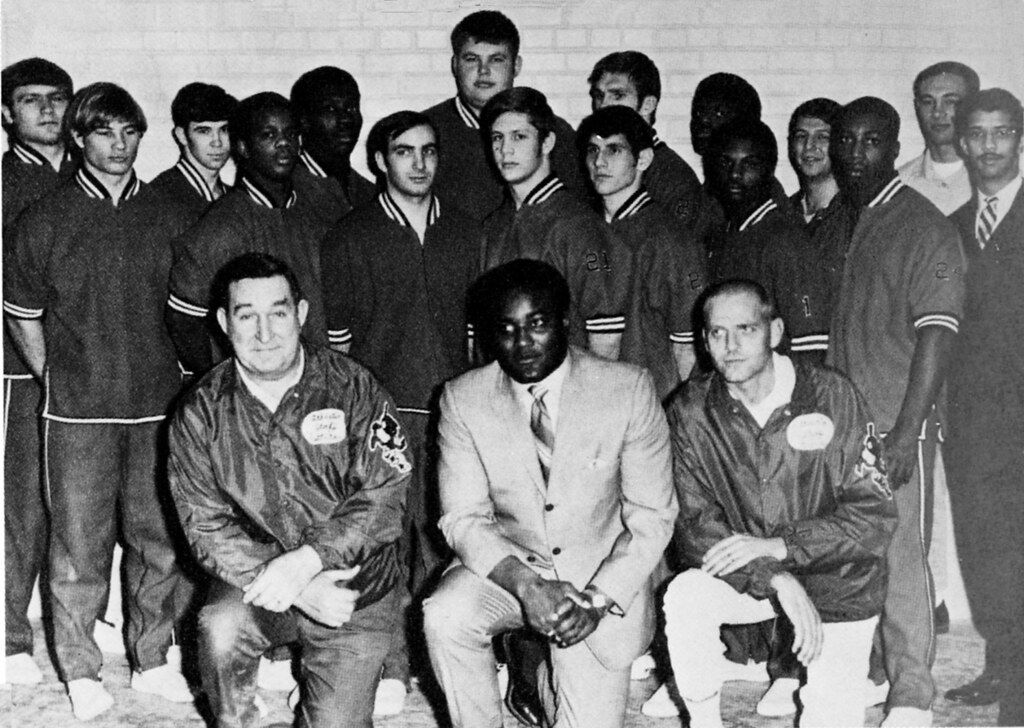
Don Benning: Man of Steel (from my Omaha Black Sports Legends series, Out to Win: The Roots of Greatness)
©by Leo Adam Biga
Originally published in The Reader (www.thereader.com) as part of my Omaha Black Sports Legends series, Out to Win: The Roots of Greatness)
Wrestling is a proving ground. In an ultimate test of will and endurance, the wrestler first battles himself and then his opponent until one is left standing with arms raised overhead in victory. In a life filled with mettle-testing experiences both inside and outside athletics, Don Benning has made the sport he became identified with a personal metaphor for grappling with the challenges a proud, strong black man like himself faces in a racially intolerant society.
A multi-sport athlete at North High School and then-Omaha University (now UNO), the inscrutable Benning brought the same confidence and discipline he displayed as a competitor on the mat and the field to his short but legendary coaching tenure at UNO and he’s applied those same qualities to his 42-year education career, most of it spent with the Omaha Public Schools. Along the way, this man of iron and integrity, who at 68 is as solid as his bedrock principles, made history.
At UNO, he forged new ground as America’s first black head coach of a major team sport at a mostly white university. He guided his 1969-70 squad to a national NAIA team championship, perhaps the first major team title won by a Nebraska college or university. His indomitable will led a diverse mix of student-athletes to success while his strong character steered them, in the face of racism, to a higher ground.
When, in 1963, UNO president Milo Bail gave the 26-year-old Benning, then a graduate fellow, the chance to he took the reins over the school’s fledgling wrestling program, the rookie coach knew full well he would be closely watched.
“Because of the uniqueness of the situation and the circumstances,” he said, “I knew if I failed I was not going to be judged by being Don Benning, it was going to be because I was African-American.”
Besides serving as head wrestling coach and as an assistant football staffer, he was hired as the school’s first full-time black faculty member, which in itself was enough to shake the rafters at the staid institution.
“Those old stereotypes were out there — Why give African-Americans a chance when they don’t really have the ability to achieve in higher education? I was very aware those pressures were on me,” he said, “and given those challenges I could not perform in an average manner — I had to perform at the highest level to pass all the scrutiny I would be having in a very visible situation.”
Benning’s life prepared him for proving himself and dealing with adversity.
“The fact of the matter is,” he said, “minorities have more difficult roads to travel to achieve the American Dream than the majority in our society. We’ve never experienced a level playing field. It’s always been crooked, up hill, down hill. To progress forward and to reach one’s best you have to know what the barriers or pitfalls are and how to navigate them. That adds to the difficulty of reaping the full benefits of our society but the absolute key is recognizing that and saying, ‘I’m not going to allow that to deter me from getting where I want to get.’ That was already a motivating factor for me from the day I got the job. I knew good enough wasn’t good enough — that I had to be better.”
Shortly after assuming his UNO posts his Pullman Porter father and domestic worker mother died only weeks apart. He dealt with those losses with his usual stoicism. As he likes to say, “Adversity makes you stronger.”
Toughing it out and never giving an inch has been a way of life for Benning since growing up the youngest of five siblings in the poor, working-class 16th and Fort Street area. He said, “Being the only black family in a predominantly white northeast Omaha neighborhood — where kids said nigger this or that or the other — it translated into a lot of fights, and I used to do that daily. In most cases we were friends…but if you said THAT word, well, that just meant we gotta fight.”

Despite their scant formal education, he said his parents taught him “some valuable lessons scholars aren’t able to teach.” Times were hard. Money and possessions, scarce. Then, as Benning began to shine in the classroom and on the field (he starred in football, wrestling and baseball), he saw a way out of the ghetto. Between his work at Kellom Community Center, where he later coached, and his growing academic-athletic success, Benning blossomed.
“It got me more involved, it expanded my horizons and it made me realize there were other things I wanted,” he said.
But even after earning high grades and all-city athletic honors, he still found doors closed to him. In grade school, a teacher informed him the color of his skin was enough to deny him a service club award for academic achievement. Despite his athletic prowess Nebraska and other major colleges spurned him.
At UNO, where he was an oft-injured football player and unbeaten senior wrestler, he languished on the scrubs until “knocking the snot” out of a star gridder in practice, prompting a belated promotion to the varsity. For a road game versus New Mexico A&M he and two black mates had to stay in a blighted area of El Paso, Texas — due to segregation laws in host Las Cruces, NM — while the rest of the squad stayed in plush El Paso quarters. Terming the incident “dehumanizing,” an irate Benning said his coaches “didn’t seem to fight on our behalf while we were asked to give everything for the team and the university.”
Upon earning his secondary education degree from UNO in 1958 he was dismayed to find OPS refusing blacks. He was set to leave for Chicago when Bail surprised him with a graduate fellowship (1959 to 1961). After working at the North Branch YMCA from ‘61 to ‘63, he rejoined UNO full-time. Still, he met racism when whites automatically assumed he was a student or manager, rather than a coach, even though his suit-and-tie and no-nonsense manner should have been dead giveaways. It was all part of being black in America.
To those who know the sanguine, seemingly unflappable Benning, it may be hard to believe he ever wrestled with doubts, but he did.
“I really had to have, and I didn’t know if I had it at that particular time, a maturity level to deal with these issues that belied my chronological age.”
Before being named UNO’s head coach, he’d only been a youth coach and grad assistant. Plus, he felt the enormous symbolic weight attending the historic spot he found himself in.
“You have to understand in the early 1960s, when I was first in these positions, there wasn’t a push nationally for diversity or participation in society,” he said. “The push for change came in 1964 with the Civil Rights Act, when organizations were forced to look at things differently. As conservative a community as Omaha was and still is it made my hiring more unusual. I was on the fast track…
“On the academic side or the athletic side, the bottom line was I had to get the job done. I was walking in water that hadn’t been walked in before. I could not afford not to be successful. Being black and young, there was tremendous pressure…not to mention the fact I needed to win.”
Win his teams did. In eight seasons at the helm Benning’s UNO wrestling teams compiled an 87-24-4 dual mark, including a dominating 55-3-2 record his last four years. Competing at the NAIA level, UNO won one national team title and finished second twice and third once, crowning several individual national champions. But what really set UNO apart is that it more than held its own with bigger schools, once even routing the University of Iowa in its own tournament. Soon, the Indians, as UNO was nicknamed, became known as such a tough draw that big-name programs avoided matching them, less they get embarrassed by the small school.
The real story behind the wrestling dynasty Benning built is that he did it amid the 1960s social revolution and despite meager resources on campus and hostile receptions away from home. Benning used the bad training facilities at UNO and the booing his teams got on the road as motivational points.
His diverse teams reflected the times in that they were comprised, like the ranks of Vietnam War draftees, of poor white, black and Hispanic kids. Most of the white athletes, like Bernie Hospodka, had little or no contact with blacks before joining the squad. The African-American athletes, empowered by the Black Power movement, educated their white teammates to inequality. Along the way, things happened — such as slights and slurs directed at Benning and his black athletes, including a dummy of UNO wrestler Mel Washington hung in effigy in North Carolina — that forged a common bond among this disparate group of men committed to making diversity work in the pressure-cooker arena of competition.
“We went through a lot of difficult times and into a lot of hostile environments together and Don was the perfect guy for the situation,” said Hospodka, the 1970 NAIA titlist at 190 pounds. “He was always controlled, always dignified, always right, but he always got his point across. He’s the most mentally tough person you’d ever want to meet. He’s one of a kind. We’re all grateful we got to wrestle for Don. He pushed us very hard. He made us all better. We would go to war with him anytime.”
Brothers Roy and Mel Washington, winners of five individual national titles, said Benning was a demanding “disciplinarian” whom, Mel said, “made champions not only on the mat but out there in the public eye, too. He was more than a coach, he was a role model, a brother, a father figure.” Curlee Alexander, 115-pound NAIA titlist in 1969 and a wildly successful Omaha prep wrestling coach, said the more naysayers “expected Don to fail, the more determined he was to excel. By his look, you could just tell he meant business. He had that kind of presence about him.”
Away from the mat, the white and black athletes may have gone their separate ways but where wrestling was concerned they were brothers rallying around their perceived identity as outcasts from the poor little school with the black coach.
“It’s tough enough to develop a team to such a high skill level that they win a national championship if you have no other factors in the equation,” Benning said, “but if you have in the equation prejudice and discrimination that you and the team have to face then that makes it even more difficult. But those things turned into a rallying point for the team.
“The white and black athletes came to understand they had more commonalities than differences. It was a sociological lesson for everyone. The key was how to get the athletes to share a common vision and goal. We were able to do that. The athletes that wrestled for me are still friends today. They learned about relationships and what the real important values are in life.”
His wrestlers still have the highest regard for him and what they shared.
“I don’t think I could have done what I did with anyone else,” Hospodka said. “Because of the things we went through together I’m convinced I’m a better human being. There’s a bond there I will never forget.” Mel Washington said, “I can’t tell you how much this man has done for me. I call him the legend.” The late Roy Washington, who changed his name to Dhafir Muhammad, said, “I still call coach for advice.” Alexander credits Benning with keeping him in school and inspiring his own coaching/teaching path.
After establishing himself as a leader Benning was courted by big-time schools to head their wrestling and football programs. Instead, he left the profession in 1971, at age 34, to pursue an educational administration career. Why leave coaching so young? Family and service. At the time he and wife Marcidene had begun a family — today they are parents to five grown children and two grandkids — and when coaching duties caused him to miss a daughter’s birthday, he began having second thoughts about the 24/7 grind athletics demands.
Besides, he said, he was driven to address “the inequities that existed in the school system. I thought I could make a difference in changing policies and perhaps making things better for all students, specifically minority students. My ultimate goal was to be superintendent.”

Working to affect change from within, Benning feels he “changed attitudes” by showing how “excellence could be achieved through diversity.” During his OPS tenure, he operated, just like at Omaha University, “in a fish bowl.” Making his situation precarious was the fact he straddled two worlds — the majority culture that viewed him variously as a token or a threat and the minority culture that saw him as a beacon of hope.
But even among the black community, Benning said, there was a militant segment that distrusted one of their own working for The Man.
“You really weren’t looked upon too kindly if you were viewed as part of the system,” he said. “On the other side of it, working in an overwhelmingly majority white situation presented its own particular set of challenges.”
What got him through it all was his own core faith in himself. “Evidently, some people would say I’m a confident individual. A few might say I’m arrogant. I would say I’m highly confident. I can’t overemphasize the fact you have to have a strong belief in self and you also have to realize that a lot of times a leader has to stand alone. There are issues and problems that set him or her apart from the crowd and you can’t hide from it. You either handle it or you fail and you’re out.”
Benning handled it with such aplomb that he: brought UNO to national prominence, laying the foundation for its four-decade run of excellence on the mat; became a distinguished assistant professor; and built an impressive resume as an OPS administrator, first as assistant principal at Central High School, then as director of the Department of Human-Community Relations and finally as assistant superintendent.
During his 26-year OPS career he spearheaded Omaha’s smooth desegregation plan, formed the nationally recognized Adopt-a-School business partnership and advocated for greater racial equity within the schools through such initiatives as the Minority Intern Program and the Pacesetter Academy, an after school program for at-risk kids. Driving him was the responsibility he felt to himself, and by extension, fellow blacks, to maximize his and others’ abilities.

“I had a vision and a mission for myself and I set about developing a plan so I could reach my goal, and that was basically to be the best I could be. As a coach and educator what I have really enjoyed is helping people grow and reach their potential to be the best they can be. That’s my goal, that’s my mission, and I try to hold to it.”
His OPS career ended prematurely when, in 1997, he retired after being snubbed for the district’s superintendency and being asked by current schools CEO John Mackiel to reapply for the assistant superintendent’s post he’d held since 1979. Benning called it “an affront” to his exemplary record and longtime service.
About his decision to leave OPS, he said, “I could have continued as assistant superintendent, but I chose not to because who I am and what I am is not negotiable.” A critic of neighborhood schools, he did not bend on a practice he deems detrimental to the quality of education for minorities. “I compromised on a lot of things but not on those issues. The thing I’ve tried not to do, and I don’t think I have, is negotiate away my integrity, my beliefs, my values.”
Sticking to his guns has exacted a toll. “I’ve battled against the odds all my life to achieve the successes I have and there’s been some huge prices to pay for those successes.”

Curlee Alexander
His unwavering stances have sometimes made him an unpopular figure. His staunch loyalty to his hometown has meant turning down offers to coach and run school districts elsewhere. His refusal to undermine his principles has found him traveling a hard, bitter, lonely road, but it’s a path whose direction is true to his heart.
“I found out long ago there were things I would do that didn’t please every one and in those types of experiences I had to kind of stand alone or submit. I developed a strong inner being where I somewhat turned inward for strength. I kind of said to myself, I just want to do what I know to be right and if people don’t like it, well, that’s the way it is. I was ready to deal with the consequences. That’s the personality I developed from a very young age.”
Those who’ve worked with Benning see a man of character and conviction. Former OPS superintendent Norbert Schuerman described him as “proud, determined, disciplined, opinionated, committed, confident, political,” adding, “Don kept himself very well informed on major issues and because he was not bashful in expressing his views, he was very helpful in sensitizing others to race relations. His integrity and his standing in the community helped minimize possible major conflicts.”
OPS Program Director Kenneth Butts said, “He’s a very principled man. He’s very demanding. He’s very much about doing what is right rather than what is politically expedient. He cares. He’s all about equity and folks being treated fairly.”
After the flap with OPS Benning left the job on his own terms rather than play the stooge, saying, “The Omaha Public Schools situation was a major disappointment to me…To use a boxing analogy, it staggered me, but it didn’t knock me down and it didn’t knock me out. Having been an athlete and a coach and won and lost a whole lot in my life I would be hypocritical if I let disappointment in life defeat me and to change who I am. I quickly moved on.”
Indeed, the same year he left OPS he joined the faculty at the University of Nebraska-Lincoln, where he is coordinator of urban education and senior lecturer in educational administration in its Teachers College. In his current position he helps prepare a new generation of educators to deal with the needs of an ever more diverse school and community population.
Even with the progress he’s seen blacks make, he’s acutely aware of how far America has to go in healing its racial divide.
“This still isn’t a color-blind society. I don’t say that bitterly — that’s just a fact of life. But until we resolve the race issue, it will not allow us to be the best we can be as individuals and as a country,” he said.
As his own trailblazing cross-cultural path has proven, the American ideal of epluribus unum — “out of many, one” — can be realized. He’s shown the way.
“As far as being a pioneer, I never set out to be a part of history. I feel very privileged and honored having accomplished things no one else had accomplished. So, I can’t help but feel that maybe I’ve made a difference in some people’s lives and helped foster inclusiveness in our society rather than exclusiveness. Hopefully, I haven’t given up the notion I still can be a positive force in trying to make things better.”
Related Articles
- Coaching diversity slowly rising at FBS schools (thegrio.com)
- University regents approve Nebraska-Omaha’s D-I move (sports.espn.go.com)
- UNO Wrestling Dynasty Built on a Tide of Social Change (leoadambiga.wordpress.com)


 Leo Adam Biga's My Inside Stories