
Dick Holland remembered for generous giving and warm friendship that improved organizations and lives
Free-spirited entrepreneur gave with his heart and mind
Philanthropist’s gifts raised Omaha arts, culture, education health and public policy sectors
©by Leo Adam Biga
Originally appeared in the 2017 Metro Magazine Giving Guide & Event Book (https://issuu.com/metmago/docs/thegivingguideandeventbook2017)
Entrepreneur and philanthropist Richard D. Holland lived life large. Not in an ostentatious sense. He was too Midwest modest for that. Rather he lived out loud in a make-the-most-of-every-moment way that endeared him to many.
The Omaha native fit loads of living into his 95 years. A Unitarian and a liberal, he wore his beliefs on his sleeve and was unapologetic about it.
This benevolent, bellowing, love-to-laugh and make-you-laugh mover and shaker got much done in his hometown. He was considered a builder who contributed to Omaha’s physical and cultural landscape through the public structures and quality of life enhancements his giving helped build.
The University of Nebraska at Omaha graduate first gained traction as an advertising whiz handling elite accounts through his own agency. He later entered the public sphere as a funder of major health, education and arts projects, public policy initiatives and political campaigns through his Holland Foundation. The art of persuasion he learned as a Mad Man era ad exec helped him coalesce support for things he put his heart and money behind.
The making of the man
As a young entrepreneur he sowed his adventurous oats by trying bookmaking, ice house hawking, door-to-door selling and riding the rails. He served in the U.S. Army chemical corps during World War II. He pitched for the University of Omaha baseball team. The world was his oyster and learning about it became a lifetime passion. The voracious reader accumulated a home library thick with biographies. He subscribed to and absorbed dozens of magazines ranging from science to sports to the arts. He read at least four newspapers daily.
He found an inquisitive soulmate in his wife Mary, with whom he helped raise four children: Dean, Barbara, Nancy and Mary Ann or “Andy” Holland, who said her playful father enjoyed a strong relationship with her mother that stood the test of time.
“Marriages are full of all kinds of things happening,” she said,
“and my parents were very committed to the marriage and very loyal to each other. It was a good marriage.”
The couple were together six decades before Mary preceded Dick in death in 2006. Perhaps their greatest trial came when their son Dean was killed in an auto accident.
“It was horrible,” Andy said. “I think that’s the first time I ever saw my dad cry. It was a terrible loss for my parents. It hit them very hard. It was a very difficult time.”
While no one ever really gets over losing a son or wife, nothing kept Holland down for long. He was too irrepressible for that. Despite tragedies and setbacks, he always rallied. He rarely met a day he didn’t welcome.
“He was always very forward thinking,” Andy said. “He never dwelt on the past. He would have wanted to go on living forever. I don’t know many people that feel that way. He never got tired of living because he was just interested in everything. It wasn’t really until the very end he decided, well, I’ve got to go.”

Soulmate
He and Mary were a matched set but, Andy said, “they were pretty different.” “My mother was much more outgoing. My dad appeared outgoing but where you’d have to drag my mom out of a party, my dad would have his little social fix and then be ready to go. I think my dad was more the intellectual. My mother went more with her feelings. But they did complement each other in a lot of ways. They made decisions together.”
Former University of Nebraska Medical Center chancellor Harold Maurer feels a portrait of the couple on display at the Holland Performing Arts Center captures their bond. The painting “Opening Night 2005” by Debra Joy Groesser shows the pair seated intimately together at the center’s grand opening.
“The painting depicts the strong interdependence between Mary and Dick,” Maurer said. “She has her head on his shoulder. It’s such a warm, wonderful feeling – which is what they personified in life. They were marvelous together. They seemed to agree on everything they undertook. They completed each other’s sentences they were so close.”
Holland Children’s Movement and Holland Children’s Center director John Cavanaugh said of the couple, “Mary was protective of him. He was so open, you know. Anybody could call him up and ask him for money (his number was publicly listed). Mary was a little more skeptical of the world out there and protected him from his own vulnerabilities. They were a perfect team together and the Holland Center is a perfect memorial to both of them.”
Andy Holland said her mom’s death “was very devastating” for her father. “They were married 58 years and they had a wonderful time together, especially the last 20 years. He missed her very much and he was very sad about it. Somebody told me after my mom’s death he would probably follow her shortly, but he didn’t. My dad was an extremely resilient man. He picked himself up and moved on because that’s just how he lived. He was just always looking forward, acquiring new ideas, doing new things and finding new friends. It wasn’t that he didn’t love her but he wanted to live life – he didn’t want to just exist.”
A thirst for knowledge and getting things done
Nothing engaged him more than good conversation. He hosted a regular confab known as the Saturday Morning Gang. A faithful participant, author-essayist Rick Dooling, described it as “a cross between a literary salon and five old guys in a booth at the local diner,” adding, “Always fascinating banter with Dick as the maestro.” UNMC physician Dan Schaefer, retired film editor Mike Hill and photographer Pat Drickey completed the group.
Drickey said, “We would discuss the week’s events, including politics, art openings, movies, books we were reading and interesting stories from the New Yorker or the New York Times. Others made an appearance, like John Cavanaugh. Dick was very engaging and had a contagious laugh. Occasionally, he’d break out with his call of the loon. Thinking about it still brings a smile to my face. I think what Dick enjoyed about our company was the fact we were pretty much all down-to-earth native Omahans who’d reached the top of our professions.”
The Gang continues meeting. The group has an urn containing Holland’s ashes as a way of keeping his presence near.
His last few years Holland found a new companion in Marian Leary who gave him added reason to live.
He stayed connected to the people dearest to him, including Cavanaugh, an old friend who worked closely with Holland.
“I really miss the daily conversations I had with him,” Cavanaugh said. “He was just every day an inspiration in terms of things that needed to be done to mainly improve the lives of poor people in our community and across the country. We continue that work of improving early childhood care – a passion of his. Expanding access to quality care is a big part of our commitment. He was just a delight to have as a friend. He was a regular for Sunday dinner at our house. That was something he greatly enjoyed and we miss him tremendously.”
Following Holland’s August death a flood of tributes appeared. Recurring themes referred to his boundless generosity, caring, curiosity, intelligence, sense of humor and penchant for taking stands and speaking his mind.
Telling it like it is
His many admirers included daughter Andy Holland.
“He was courageous about speaking his mind and speaking out against things he thought wrong – no matter what it might have cost him. He was just never afraid to stick his neck out even when there could have been negative consequences to him. I know that’s relatively easy to do when you’ve got millions, but back in the 1950s he began an organization – Omahans for Common Sense – to counter McCarthyism. At the time he was a young man trying to build a business and had a wife and small children, so I think that was a very brave thing to do.”
Early Buffett Childhood Institute executive director Sam Meisels remembers Holland as “utterly unafraid,” adding, “He was such a strong and staunch defender of those things he felt right. He wanted to understand and he had an opinion. Anyone who knew him knew he wanted to share that opinion, and he always did. The critical thing was to hear him out because he did have a lot to say and there was a lot to be learned from him.”
Harold Maurer worked with Holland on several UNMC projects the philanthropist supported. Maurer recalled a particularly controversial area of research that he needed someone to champion and Holland jumped right into the fray.
“We were engaged in embryonic stem cell research early on
and we were getting killed by the press,” Maurer said. “I went to (then-Omaha World-Herald publisher) John Gottschalk and said, ‘John, I’m getting killed in the newspaper, what should I do?’ and he said, ‘Hal, you’ll hemorrhage for awhile but you’ll be okay.’ I spoke with (philanthropist) Mike Yanney and said, ‘I’ve got to know if the community supports what I’m doing or not,’ and he organized a breakfast I’ll never forget in his office with all the community leaders there, including Dick Holland.
“I asked them, ‘What do you think we should do?’ and someone said, ‘I think you should continue because we do not want to be last in Nebraska.’ I said, ‘Great, that’s the point. Now I’d like to ask one of you to head the development of an initiative to advocate this. They asked, ‘Who do you want?’ and I said, ‘Dick Holland.’ And Dick didn’t say not me or this or that, he said, ‘Sure, I’d be glad to take it on.’ That’s typical Dick Holland – willing to go to battle for the right things. He even came up with the name Nebraskans for Life Saving Cures.”
Holland didn’t stop there.
“He showed up at a very tense (University of Nebraska) Board of Regents meeting when that subject came up,” Maurer said. “Those opposed and those for the research were there. Dick came and spoke before the board on behalf of the research and I think that had a major impact on their decision.
“I miss his willingness to speak up about taboo subjects in Nebraska. I miss his advocacy for things that were right.”
Maurer recalled a time when he and John Niemann, senior vice president of the University of Nebraska Foundation, visited Holland at his home.
“We went to ask him for a gift for the cancer center. He knew why we were there, and he got up and said, ‘Excuse me, I’ve got to go to the bathroom.’ He left for the bathroom, came back and without a word from us he said, ‘Okay, I’m going to give you’ his amount of money.’ And that was it – without any kind of instigation from us at all. John Niemann and I looked at each other disbelievingly. He was that kind of person.”
As recipients of Holland’s gifts attest, “he took a personal interest in things and it was important for him to trust you – that was a big factor in his giving,” Maurer said.
Then there was his brazenness. A favorite hangout was the Happy Hollow Club, where Holland delighted enlivening the staid place. Maurer recalled, “Once, the leaders of an effort to recall the mayor were sitting at a table and he went over to them and said in a loud voice, ‘Oh, here’s a table full of fools.’ and walked on. Often, Warren Buffett would be in the corner by himself or with some dignitary. This one time, everybody’s quiet, they don’t want to bother him, so Dick gets up in the middle of the room and hollers, ‘Hey, Warren, how you doing?’ and that got the whole place stirred up.”
“Yeah, that’s the kind of thing he would do – he had a lot of chutzpah,” Andy Holland said of her father.
Not much surprised Andy about her old man but she said the general public probably didn’t know “he loved to cuss.” “He always swore a lot,” she said. “I mean, we all grew up with it, so it was no big deal. The grandkids were all a little shocked by it.
They were like, ‘Hey, Mom, you know what poppa said?'”
A caring heart for the less fortunate
He could be profane or profound but was above all compassionate. His passing left a gap in the local giving community. Those who benefited from that generosity appreciated how he targeted his wealth to support things he felt would make the greatest impact. He was renowned for getting others to give, too.
“He was so admired in the community that he just had to ask people to participate and they did, at whatever level he wanted them to,” Maurer said.
“He inspired a lot of other people to become more involved in creating a great community,” Andy said.
“He was a great man who was unique in every way. Just an unequaled kind of guy with a marvelous mind and such clarity of purpose,” said Maurer. “He did a lot for the Medical Center in terms of supporting the cancer center, stem cell research and a number of other activities as well. He was a founder of the Nebraska Coalition for Life Saving Cures and its president until he passed away.”
Holland exemplified the work ethic and resilience of the Greatest Generation by becoming a self-made man. Leavened by the Great Depression, he knew the value of a dollar and the gulf between haves and have-nots. Thus, he established the Holland Children’s Movement and Holland Children’s Center to study avenues for alleviating poverty and giving all children a good start in life. For him, the need for universal early childhood education was a social justice issue of utmost importance.
He found a noted ally and kindred spirit in Buffett Early Childhood Institute leader Sam Meisels.
“We talked about children and services to children and what the state and federal government could do to help children and families,” Meisels said. “We were certainly on the same wavelength there. He found it very hard to tolerate that any child’s potential was ignored or lost or not fulfilled. He always wanted to give everybody the best chance possible, and that’s how I feel, too. So we had a lot to talk about on that.”
Meisels recalled an event that highlighted Holland at his best.
“We had a symposium on the UNO campus with the Aspen Institute. On the stage I had three or four billionaires sitting next to me and the former governor of the state of Massachusetts. The moderator was the CEO of the Aspen Institute, who’s the former CEO of Time Magazine. There were questions from the audience and Dick raised his hand and he basically castigated everyone on that stage for not thinking hard enough about the fact children growing up in poverty need more than what we offered and considered. He made it very clear he thought we had missed the boat. He let us all have it. Well, that was a very Dick thing to do. He just never would hide his thoughts or pull his punches – and that was very foreign to people there.”
Holland backed his bluster with facts and action. Meisels admired him for doing his homework.
“He was absolutely very informed and when he didn’t know something he wanted me to send him articles to read. He wanted to know who to talk to in order to get the best information. He recognized when he didn’t understand and needed to know more and he wanted to do something about it.”
Omaha Performing Arts executive director Joan Squires said Holland was generous not only with his money but with his time and expertise.
“Dick was a great resource to go through a plan. He not only wanted to know artistically what we were doing but he knew the financials inside and out and he had a great in-depth working knowledge of how the organization operated. He actively participated in our board meetings, offered really great advice and was committed the entire time I had the opportunity to know him, which was 15 years.
“To be that vibrant and engaged and active was really a gift to all of us.”
Similarly, Meisels believes the totality of Holland’s contributions are what set him apart.
“He made a huge difference,” Meisels said. “You see it all around the city. Then there’s places you don’t know where to look even and if you know what he was committed to, there he is, too. He made a difference to everybody who came in contact with him personally. Not everyone loved him. Not everyone even liked him, I suspect. But those of us who were lucky enough to have a friendship with him, will never forget him.”
A social justice advocate
Just as he fought for children’s rights, Holland worked to repeal the death penalty in Nebraska and to raise the state’s minimum wage. He also backed many Democratic Party candidates.
John Cavanaugh knew his heart and mind as well as anyone.
“In the last 10-12 years we basically talked two or three times a day almost every day,” he said. “We worked very closely on public policy initiatives he was very passionate about. He was a terrific communicator and an inspirational voice and he would just go all out. A real goer and doer. He was still writing op-ed and letters to the editor at over 90 years old and still engaging in the political process, supporting candidates and causes.
“He was very strong in supporting the repeal of the death penalty in Nebraska. Up until his own death that was something he was proud the Nebraska Legislature had done and was supportive of the ballot effort to retain the repeal.”
Nothing though stirred Holland as much as early childhood and Cavanaugh said his friend play a key role in a major victory.
“Four years ago Nebraska reversed its position on providing prenatal care for undocumented pregnant women. Dick took up that cause and I worked with him in the Legislature to get that reinstated. It took the Legislature to pass legislation and then to override Governor Heineman’s veto. Dick was a driving force behind that effort and just felt passionately every child needed a chance to have a healthy start in life that begins with prenatal care. So we’re now one of six states in the country who provide publicly funded prenatal care for every expectant mother.”
Leveling the playing field for jobs and earnings also found Holland leading Nebraska to take progressive action.
“He spearheaded the effort to raise the minimum wage in Nebraska from $7.25 to $9. He did that as the primary funder for a ballot initiative that passed by over 60 percent – projecting Nebraska into one of the highest paying minimum wage states in the country, adding probably more than $250 million to the income of low income Nebraskans ” Cavanaugh said.
“After that passage a number of major national chains raised their own internal wage, so it had a huge ripple effect. He felt very strongly income inequality and the fact people work full-time and aren’t able to support their families was a critical issue of our time. He was very personally committed to addressing that, so we now have in Nebraska the lowest unemployment in the country and among the highest minimum wage.”

Making a difference
Andy Holland said her father “was very proud of some of the impact he was able to be a part of in education and in helping families and children in poverty.” “He really wanted to make this a better place because he loved Omaha,” she said. “He lived here his whole life and wanted to make a difference here.”
Even after he found professional success and substantial wealth, Holland never forgot the values of his solid middle class upbringing. He also never lost the common touch with every day folks of whom he considered himself a most fortunate son.
Far from an all work and no play bore, Holland appreciated the finer things, especially the arts, and his giving reflected that. In making the lead gift for the Holland Performing Arts Center and contributing to the Orpheum Theatrer refurbishing he helped expand and enhance Omaha’s live arts scene.
OPA’s Joan Squires said the Holland Center actually fulfilled a long-held dream of the philanthropist’s to gift the city with a special venue.
“He had been committed to helping develop a performing arts center years before and the process never really got started until he and Mary were introduced by John Gottschalk to Sue Morris from Heritage Services. With their lead gift and John’s leadership all of this happened. Dick remained engaged, involved and passionate about our institution and the community from the time I first met him to the end of his life.
“One of the most meaningful things he said was that the Holland Center so far surpassed his expectations, He knew it would be beneficial for Omaha and the region but I think he did not understand the breadth and scope of what we would be able to accomplish. It really transformed the arts community here. He said, ‘I will always love it forever and it can only get better.’ It exemplified who he was – he just wanted to make this place a better community for everybody. And I know he took great pride in that and in how his and Mary’s philanthropic support and leadership encouraged others to join them and all of it came to fruition.”
Squires said both Dick and Mary were “very involved” in the design and construction process and she was “grateful” Mary had a year to enjoy the finished facility before she passed.
Despite their accomplishments, the Hollands remained humble.
“They were low profile, they were not looking for the spotlight, they just felt they were so fortune to have these gifts to share with others,” Squires said. “It really was never about recognition – it was about having a world-class performing arts center for Omaha.”
Andy Holland said her father enjoyed raising the city’s cultural profile.
“He was very proud of the impact he had on the arts in our community because of the tremendous difference it made,”

Holland is gifted a hockey jersey with his name on it during a parade outside his home, held in appreciation for his donation toward Baxter Arena.

Durango greets Holland at the parade.

Holland is recognized during Baxter Arena’s dedication ceremony.

Holland and Chancellor John Christensen share a moment during an early childhood education event held by the Aspen Institute and the Buffett Early Childhood Institute.
Enriching lives
Squires appreciated Holland the man, not just the philanthropist. “From the day I met Dick Holland I knew he was an extraordinary person,” she said of her dear friend.
She and her late husband Tom were struck, as others were, by his voracious reading habits.
“Tom and I would get him a book for his birthday or the holidays because what else could you get for him. We had to scramble to find something he hadn’t read that might be of interest, and it could be wide-ranging, on so many topics. We would comb the New York Times Best Sellers List to find just the right book. It was usually nonfiction, current events or historical and things he was engaged in. One of the books I gave him was about the Wright brothers and he read it cover to cover and loved it, because he just had to know how things worked.”
Heritage Services president Sue Morris worked with Holland on several brick and mortar projects he contributed to.
“Dick knew that facilities inspire excellence,” Morris said.
Even though he was a UNO alum she was “blown away” when he made the lead gift for the Baxter Arena – a sports facility. “Honestly, I think he got a kick out of doing something “different” and he was especially pleased the community ice rink was named Holland Ice. We didn’t know how to thank Dick for his generosity and he was beginning to be restricted in his trips, so we brought a parade to his home with the UNO marching band, the hockey players, convertibles with pretty ladies. He laughed and laughed and laughed. No plaque or crystal bowl or sign could have meant more to Dick than his very own parade.”
Just as Squires got close to Holland, so did Morris, and like everyone else who knew him, they miss his friendship.
“My life has been enriched in so many ways by Dick Holland. I miss him,” said Morris.
She and Squires said they will remember Holland always looking expectantly to the next step, the next phase, the next project and getting impatient if things didn’t move fast enough.
Following the old lion’s death a private memorial celebrating his life was held at the venue that meant more to him than any other bearing his name, the Holland Performing Arts Center.
Andy Holland said, “The final thing that closed out the memorial service was an opera duet with two sopranos called “The Flower Song” from the opera Lakme. It’s a beautiful song.”
That night she and some close friends of her father’s remembered the man they all loved.
“I was very touched by how many people really loved him. We had an awful lot of grown men crying. There were a few people we asked to say a few words and they just couldn’t.”
Rather than feel she had to share her father with others, Holland said, “I always thought my father enjoyed his life so much that I felt there was plenty of him to go around.”
Of that night, she said, “It was a wonderful tribute to him – I just thought it was perfect. My dad would have loved it.”
Read more of Leo Adam Biga’s work at leoadambiga.com.
_________________________________________________
“He was always very forward thinking. He never dwelt on the past.. He would have wanted to go on living forever. I don’t know many people that feel that way. He never got tired of living because he was just interested in everything. It wasn’t really until the very end he decided, well, I’ve got to go.”
“He was courageous about speaking his mind and speaking out against things he thought wrong – no matter what it might have cost him. He was just never afraid to stick his neck out even when there could have been negative consequences to him.”
“He really wanted to make this a better place because he loved Omaha, He lived here his whole life and wanted to make a difference here.”
“I was very touched by how many people really loved him.”
(Quotes by Andy Holland)
_ _ _
“He was just every day an inspiration in terms of things that needed to be done to mainly improve the lives of poor people in our community and across the country.”
He was a terrific communicator and an inspirational voice and he would just go all out. A real goer and doer. He was still writing op-ed and letters to the editor at over 90 years old and still engaging in the political process, supporting candidates and causes.”
(Quotes by John Cavanaugh)
_ _ _
“He made a huge difference. You see it all around the city. Then there’s places you don’t know where to look even and if you know what he was committed to, there he is, too. He made a difference to everybody who came in contact with him personally. Not everyone loved him. Not everyone even liked him, I suspect. But those of us who were lucky enough to have a friendship with him, will never forget him.”
(Quote by Sam Meisels)
_ _ _
“I miss his willingness to speak up about taboo subjects in Nebraska. I miss his advocacy for things that were right.”
(Quote by Harold Maurer)
” … he just wanted to make this place a better community for everybody. And I know he took great pride in that and in how his and Mary’s philanthropic support and leadership encouraged others to join them and all of it came to fruition.”
(Quote by Joan Squires)
_ _ _
“Dick knew that facilities inspire excellence.”
“We didn’t know how to thank Dick for his generosity (for making the lead gift for the University of Nebraska at Omaha’s Baxter Arena) and he was beginning to be restricted in his trips, so we brought a parade to his home with the UNO marching band, the hockey players, convertibles with pretty ladies. He laughed and laughed and laughed. No plaque or crystal bowl or sign could have meant more to Dick than his very own parade.”
(Quotes by Sue Morris)
 |
Hot Movie Takes – Atticus Finch-Barack Obama give way to Bob Ewell-Donald Trump in this post-“To Kill a Mockingbird” world
©by Leo Adam Biga
Author of “Alexander Payne: His Journey in Film”
In this 57th anniversary year of the debut of Harper Lee’s 1960 novel “To Kill a Mockingbird” and the 55th anniversary of the 1962 film adaptation’s release, I reflect on some sobering truths taken from that classic, much beloved story. Truths reflective of today’s American civil-societal-political landscape.
The irony is that the story’s revered figure of Atticus Finch, a fictional white Southern lawyer who represents so many universally admired qualities, found his most direct expression in this nation’s first black president, Barack Obama. The comparison was obvious and Obama’s admiration for what Atticus embodies was made evident when in his farewell address he quoted something that fictional character utters in the book and film. Obama said, “If our democracy is to work in this increasingly diverse nation, each one of us needs to try to heed the advice of a great character in American fiction, Atticus Finch: ‘You never really understand a person until you consider things from his point of view. Until you climb into his skin and walk around in it.'”

Yes, Atticus turns out to have racist leanings in the long-delayed sequel “Go Set a Watchman” but that’s hardly surprising given the time and place he came from. None of us are free of sin or fault. Good principles and actions don’t require perfection. The revelation that Atticus attended KKK meetings and opposed integration while still defending a black man accused of a rape he didn’t commit is simply acknowledgement of how complex race is and how far as a nation we have to go in addressing it. In his farewell speech Obama told blacks to learn the struggles of other minority groups and he admonished whites to acknowledge the stain of this country’s earlier generations are not gone. When minority groups “voice discontent,” he said. “they’re not just engaging in reverse racism or practicing political correctness; that when they wage peaceful protest, they’re not demanding special treatment, but the equal treatment our Founders promised.”

During his two terms the diplomatic, gentlemanly Obama championed social justice and opposed infringements on freedom and equality. Like Atticus, he walked the walk of virtue and idealism, of fair play and public service, and he extended his hand to the equivalents of Boo Radley and Tom Robinson in our midst. Though Obama had considerable support within the Democratic party and even more broadly throughout the nation and world, he was repeatedly criticized and stonewalled by the Republican controlled Congress. Many of us surmised this was due to the gridlock of entrenched, unwieldy party politics grinding the tried and true American system of across-the-aisles idealogical compromise to a halt. Racism may have been the bigger issue in play. The recent election revealed how reviled Obama is by a sizable segment of the American populace whose elected representatives are some combination of Republican, conservative and fundamentalist. Not every Obama detractor and Trump supporter is an out and out racist but it’s true about enough of them to show a clear pattern.
Trump’s angry man campaign was filled with bigoted, misogynistic, nationalistic rhetoric that put big business and capitalism ahead of human rights, civil rights, women’s rights, social safety nets and environmental protections. He referred to harsh law and order crack downs on those deemed to be disloyal dissidents and enemies of the state. He threatened closing borders and deporting undocumented millions. He connoted militarism with nationalism, patriotism and Christian values. In his first few days in office he seems hell-bent on following through on his alarming agenda.
All of this has gave permission to white supremacists and other hate mongers to react violently against people of color and different origins, to disrespectfully treat women, to ignore clear and present danger realities such as global warming and to override the will of the people by renewing projects that history tells us will deface and pollute precious lands and waters.
 Donald Trump.getty
It is as if Barry Goldwater, George Wallace, Ross Perot and Rudy Giuliani have somehow been melded together in the amoral heart of Trump. Just when America needs an Atticus Finch in its top leadership position, we now have someone who seemingly speaks more to the Bob Ewells of the world than to those of us who believe in the better angels of a more perfect union.
Instead of a voice of calm reason, considered compassion, resolute peace and sincere unity, we have a strident, histrionic voice of acrimony and division who speaks for the supposed moral majority and special interests of privileged white males. In movie-movie terms, I am reminded of the Franklin Schaffner adaptation of Gore Vida’s “The Best Man.” where the choice for a presidential nominee came down to a reactionary opportunist played by Cliff Robertson and a thoughtful, progressive essayed by Henry Fonda. It is unfortunate that Trump did not face anyone like the statesmen Fonda portrayed in “Young Mr. Lincoln,” “Advise and Consent,” “The Best Man” and “Fail Safe” or the socially conscious Everymen he played in “The Grapes of Wrath,” “The Oxbow Incident” and “12 Angry Men.” Hillary Clinton embodied some of these same ideals, but America just wasn’t ready for her or for a woman like her as President.
How unfortunate, too, that there isn’t someone like the noble Atticus Finch or other figures of high character that Gregory Peck played (“Twelve O’Clock High,” “The Big Country,” “Captan Newman M.D.”) to lead us.

Then again, we had our Atticus Finch situated in the most powerful post in the world and a chunk of this nation rejected him and what he espoused. Obama even sounded a lot like Atticus when he called on people who want a more perfect union to not merely be bystanders but to be participants: “Show up, dive in, stay at it…Presuming a reservoir of goodness in others can be a risk, and there will be times when the process disappoints you. But for those of us fortunate enough to have been a part of this work, to see it up close, let me tell you, it can energize and inspire. And more often than not, your faith in America — and in Americans — will be confirmed.”
For all its enduring popularity, “To Kill a Mockingbird” still only speaks to those willing to learn its lessons. Too many Americans, I’m afraid, are still unprepared to accept The Other represented by Boo Radley and Tom Robinson. Even in 2017 the notion of embracing all people, regardless of color, ethnicity, religion, socioeconomic status, physical-mental capability, is still too radical for a whole lot of folks to follow. These are the very same things Christians are called to do by 2,000 year-old teachings. Yet many bristle at the core idea of loving their fellow man even though this is the basis and essence for the very organized religions they’re baptized in and purport to believe.

All of which tells us we are one hot mess of a nation. There’s nothing new about that, it’s just that events of the past few years make it easier to see things for how they really are. The cloak of civility and cooperation has been lifted. Maybe it’s a good thing the hate is there for the viewing and not all concealed or dressed up as something else. Now that it’s out in the open, at least we know who and what we’re dealing with moving forward.
We need all the Atticus Finch’s and Harper Lees amongst us to stand up and be counted lest the Boo Radleys and Tom Robinsons continue to be oppressed. The conspiracy of hearts who love what “To Kill a Mockingbird” and works like it teach about tolerance and love need to raise their voices against injustice. If this book and film that have touched so many can lead to social action, then their collective impact will be far greater than all the sales, box-office receipts and rentals they’ve earned over these last six decades.
1950s Cinema: An under-appreciated decade of film and ferment
©by Leo Adam Biga
Author of Alexander Payne: His Journey in Film
I am amused by the persistent myth that 1950s America was somehow this sterile time capsule when the mass consumer population became lulled into a kind of stupor that made them numb or oblivious to reality. Or that it’s a decade when nothing much happened compared, say, to the 1960s. Nothing could be further from the truth.
To portray the ’50s as a big bore or big nothing is as inaccurate as purporting that everyone in the ’60s was active in the counterculture movement, protesting in the streets, experimenting with drugs, et cetera, when in reality relatively very few people did those things. When it comes to social phenomena, most people are observers, not participants. But that’s not to say they’re unaffected by those same forces. They very much are.
The movies of any decade offer a somewhat reliable reflection of whatever is on the minds and in the hearts of artists and audiences during that time frame. The caveat to this is that you will inevitably find what you’re looking for if you examine any decade with a certain predisposition or agenda.
Sure, there was a lot of purely escapist fare released in the ’50s courtesy the glorified soap operas, big studio musicals, sword and sandal epics and romantic comedies that filled screens. But there were also many pictures dredging up the fears, anxieties, neuroses and complexes over any number of social-political topics. Groundbreaking troubled youth pics, film noir classics, anti-war movies, socially conscious westerns and psychological science fiction flicks were among the genre films to take on sensitive subjects.
The ’50s was full of conflicting social, cultural, political, upheaval and the best film artists mirrored those currents in their work, if not overtly than metaphorically.
The canvas was even richer and deeper when considering the Hollywood films of auteurs like Ford, Kazan, Mann, Zinnemann, Boetticher, Hitchcock in combination with the best foreign films of that decade. The neo-Realists of italy, Bergman in Sweden, Kurosawa in Japan, Wajda in Poland, Ray in India, Bunuel in Mexico and Spain and the French New Wave vanguard of Godard and Truffaut took cinema to new heights of form and meaning.
Here is only a partial sampling of the very real issues that either became full-out movie fodder or that informed dramatic plot-points and throughlines in ’50s-era films:
Rock ‘n’ roll’s advent
The Cold War
McCarthyism
The Black List
Civil rights
The Korean War
The Military Industrial Complex
The Iron Curtain
The Space Race
Suburbia
Television
The Baby Boom
The Mob
The Beat Movement
Folk music
Films as disparate as “”The Blackboard Jungle” (Richard Brooks) “Rebel Without a Cause” (Nicholas Ray) and “East of Eden” (Elia Kazan) capture the youth angst Zeitgeist wave.
“Pickup on South Street” (Samuel Fuller) “High Noon” (Fred Zinnemann) “Stalag 17” (Billy Wilder) “On the Waterfront” (Elia Kazan), “Touch of Evil” (Orson Welles) pand “12 Angry Men” pose the ethical dilemma of choosing to remain silent in the face of corruption or risking everything to stand up for the greater good.
Alexander MacKendrick’s adaptation of Clifford Odets’ “Sweet Smell of Success” presents the moral quagmire that comes with be willing to do anything to get ahead.
Everything from the films of Douglas Sirk (“Imitation of Life,” “The Tarnished Angels,” “Written on the Wind,” “All That Heaven Allows,” “Magnificent Obsession,” “There’s Always Tomorrow”) to Fred Zinnemann’s “From Here to Eternity,” Robert Wise’s “The Day the Earth Stood Still,” Don Siegel’s “Invasion of the Body Snatchers,” Joshua Logan’s “Picnic” and Mark Robson’s “Peyton Place” juxtapose the dull, cold routine of conformity with the hot desires of the human heart.
Elia Kazan’s “A Face in the Crowd” offers a prescient view of the mass media and general public raising a figure to a position of influence out of all proportion to their gifts and then bringing him down to a terrible fall.
“The Steel Helmet” (Sam Fuller) “Attack” (Robert Aldrich), “Paths of Glory” (Stanley Kubrick) “Men in War” (Anthony Mann) and “The Bridge on the River Kwai” (David Lean) show the cruel futility of war.
“No Way Out” (Joe Mankiewicz) “The Searchers” (John Ford), “Giant,” “The Big Country” (William Wyler) and “Odds Against Tomorrow” (Robert Wise) depict the poisonous evil of bigotry.
“South Pacific” and “Sayonara” (Joshua Logan), “The King and I” (Walter Lang), “House of Bamboo” (Sam Fuller) and “The World of Suzie Wong” (Richard Quine) examine race within the arc of interracial relationships that play out in larger contexts.
“Baby Doll” (Elia Kazan), “Anatomy of a Murder” (Otto Preminger), “Some Like it Hot” and “The Apartment” deal maturely with sexual subject matter.
George Cukor’s “Born Yesterday,” Robert Wise’s “Executive Suite” and Nunnally Johnson’s “The Man in the Gray Flannel Suit” critiqued American consumerism.
Billy Wilder’s “Sunset Boulevsrd,” Joseph Lewis’ “Gun Crazy,” Anthony Mann’s “Winchester 73,””Elia Kazan’s A Streetcar Named Desire,” Mann’s “The Furies,” Fritz Lang’s “Clash by Night,” MGM’s “Forbidden Planet,” Budd Boetticher’s “The Man from Laramie,”Alfred Hitchcock’s “Rear Window” “Vertigo” and “Psycho” Budd Boeticher’s “Ride Lonesome” and “Comanche Station,” Sam Fuller’s “Forty Guns”are among a great number of films from that decade that delve into Freudian themes.
The ’50s even produced an unapologetic and uncompromising art film, Charles Laughton’s “The Night of the Hunter,” that broaches all kinds of sensitive subjects through audacious use of symbolism and allegory. This masterfully crafted black and white film plays as a fairy tale with its dark themes, evil villain, innocent children in peril and episodes of magic realism. The whole film operates on the level of a fevered dream-state or trance that’s triggered and ended by trauma.
So, don’t ever fall for the notion the ’50s represented a blank slate, cinematically or otherwise. Its screen stirrings are replete with potent content, context and subtext that will make your head spin or at least make you think twice about this supposedly banal, complacent and complicit decade. Yes, there was conformity and consumerism, but when hasn’t there been since the 1920s? But the masses were far from moving in lockstep and thinking alike. Diversity, division and rebellion were present. So were the nascent civil rights, black power and feminist movements. It just took the 1960s for it to more fully come to the surface.
3,339 users · 74,821 views
|
Avg. score: 29 of 100 (29%)
Required scores: 1, 10, 18, 31, 47
|
|
16
|

|
28
|

|
33
|

|
34
|

Next Page
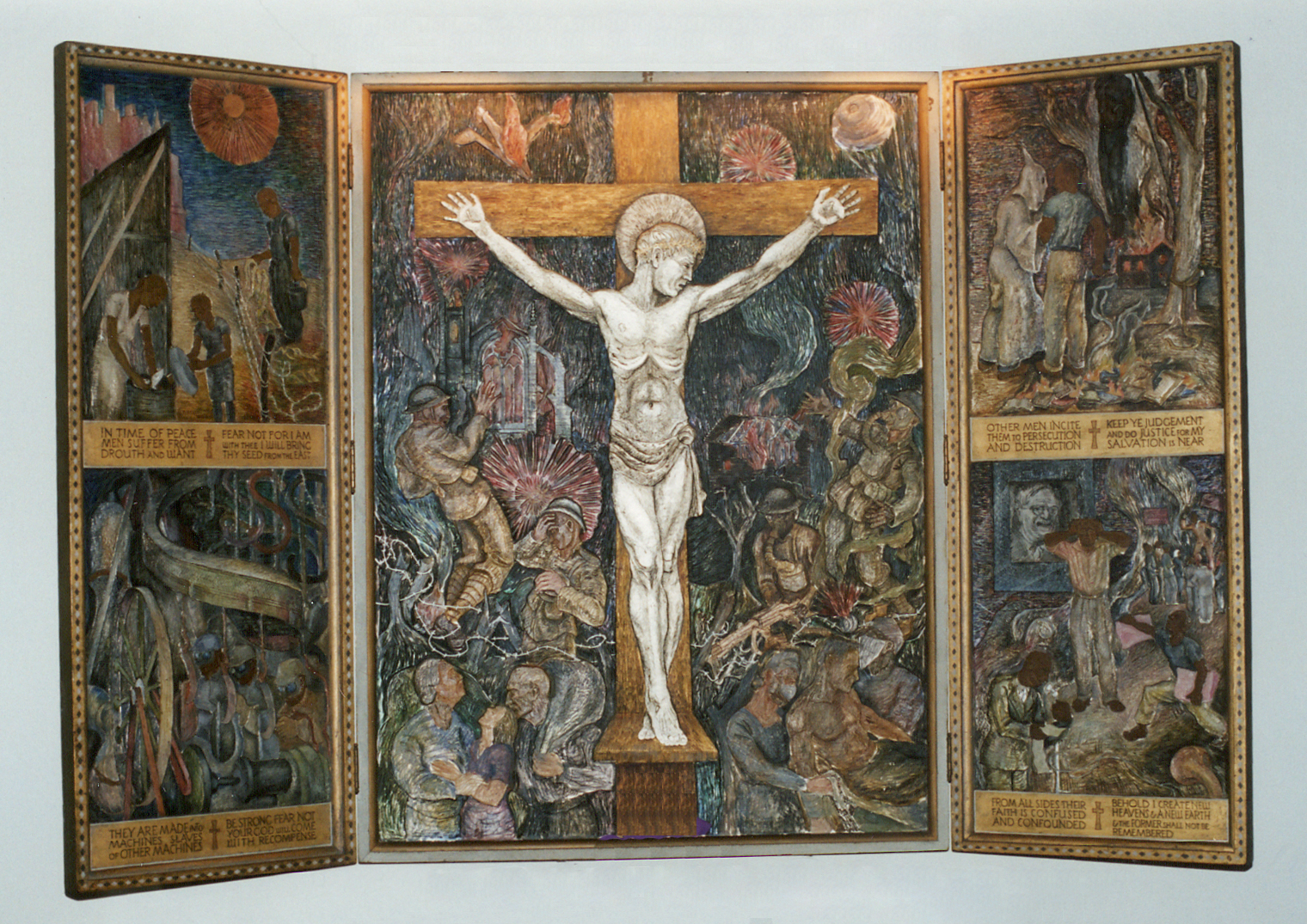
There is a compelling social justice triptych by the late great Nebraska artist Leonard Thiessen that should be more widely seen. Every year around Black History Month I encourage folks to visit the worship space that houses the piece for the express purpose of taking in the powerful images and ideas expressed in the work. The piece is called “Crucifixion” and it can be found affixed to a wall just inside the sanctuary at Church of the Resurrection, a small but mighty Episcopal faith community at 3004 Belvedere Boulevard directly across the street from Miller Park and just northwest of 30th and Kansas. The blended congregation is a mix of African-Americans, Caucasians and Africans.
The Thiessen work is not like anything you’d expect to find there or in any worhsip place for that matter. “Crucifixon” juxtaposes jarring, disturbing scenes of lynching, gas attacks, warmaking, want, industrialization and propoganda with the crucified Christ. Passages drawn from scripture proffer warnings about sins against our fellow man and being led astray by false prophets. These abnomitions are leavened by promises of recknoning and salvation. Thiessen created the triptych many decades ago but it is still relevant today in its rumination on things that instill fear and conflict in the hearts and minds of human beings and that cause us to look to a redemptive Higher Power for mercy and justice.
The words that appear at the bottom of the panels read:
“In time of peace, men suffer from drouth and want. Fear not, for I am with thee. I will bring they seed from the Earth.”
“They are made with machines, slaves of other machines. Be strong, fear not, your God will come with recompense.”
“Other men incite them to persecution and destruction. Keep ye judgment and do justice for my salvation is near.”
“From all sides their faith is confused and confounded. Behold, I create new heavens and a new Earth and the former shall not be remembered.”
The artist created “Crucifixion” in memory of his aunt, Wilhemina Berg, who was a member of the former St. John’s Church before it merged with St. Philip”s to create Church of the Resurrection, The work is an example of Thiessen’s ability to employ and transform classical forms into modern interpretations. The piece is regarded as one of Thiessen’s most important.
In an interview shortly after his retirement, Thiessen said he had worked to “break down the idea that the arts were the prerogative of the elite. Nowadays the arts, like boating, skiing, tennis and wines, are all for the person in the street.”
Thiessen spoke four languages and was particularly known for his wit, often trying to slip puns past his editors at the Omaha World-Herald, for whom he was an art critic. Over the years, he taught at many area institutions, including Creighton, UNL and UNO.
He is classified as belonging to the period as the First Nebraskans, an era in Nebraska’s art history from 1901 to 1950 when the various forms of modernism were flourishing.
His vision and passion for the arts in Nebraska laid an influential foundation.
A good way to see the triptych and get a sense for the church where it’s displayed is to attend a service there. The 10 a.m. Sunday service is an intimate experience animated by the choir most Sundays and the guest band ReLeaseT the third Sunday of the month. On Feb. 26 come to Soul Food Sunday for some great eats. But whenever you come, make sure you see the triptych.
Link to the Church of the Resurrection website here:
http://coromaha.episcopal-ne.org/
Link here to a Museum of Nebraska Art page devoted to Thiessen:
https://mona.unk.edu/collection/thiessen.shtml
Here is an extended bio of the artist copied from the MONA page:
Leonard Thiessen was born and raised in Omaha, Nebraska. His family was small and his paternal ancestry had roots to the Swedish and German pioneer settlers of Grand Island, Nebraska. For a very short time, the family lived in Grand Island where, as a boy, Thiessen was employed in the mail department of The Grand Island Independent newspaper. His parents, Charles Leonard Thiessen and Jean Louise Berg Thiessen, together with his mother’s favorite sister Wilhemina, were all involved in various creative endeavors and had a profound influence on Leonard’s development. His father worked in the printing industry and introduced the young Leonard to the trade. Jean was a talented self-taught artist in her own right who produced on-edge felt mosaics that are fine examples of early 20th century fiber art. (MONA has seven pieces of her work in its collection.) The Thiessens were involved in Omaha’s music, dance, and theater groups and deeply connected to the neighborhood Episcopal Church. They were not wealthy but had many friends in the community and had an impressive social calendar.
Thiessen attended Omaha’s Miller Park Public School and St. John’s Protestant School and graduated from Central High School in 1919. His school years were privileged with experiences that helped to foster his development as an artist. While in high school, he decided to follow formal study in the visual arts and began to draw cartoons and illustrations for the school newspaper. During his teen years, he worked as an office assistant for an architectural firm in downtown Omaha, a job that offered a perk that proved helpful to his future employment. During his free time, Leonard would sit and read the collection of architectural books found in the office. After graduation he worked for the Omaha Bureau of Advertising and Engineering editing illustrations and photographs for an agricultural livestock catalog.
He attended the University of Omaha (now University of Nebraska at Omaha) for three semesters in 1921 and 1922 studying journalism and fine arts and producing illustrations and graphic layouts for the University newspaper The Gateway. During this time, he worked as a gallery assistant for the Art Institute of Omaha which was located on the top floor of the old public library building designed by Thomas Kimball. Thiessen became disillusioned with the University’s conservative art courses and left Omaha to continue his studies in the School of Fine Arts at the University of Nebraska in Lincoln from 1925 to 1926. He was not interested in “serious painting” and majored primarily in design and architecture. His professors were the artists Dwight Kirsch, Louise Mundy, Francis Martin (a contemporary of the portraitist J. Laurie Wallace), and Emily Burchard Moore. In the 1920s, Lincoln, Nebraska was an incredibly fervent environment. Some of Thiessen’s circle of friends and classmates included artists as well as writers and intellectuals among them Katherine “Kady” Faulkner, Louise Austin (who had studied in Munich with Hans Hoffman), Mari Sandoz, Weldon Kees, Loren Eiseley, and Dorothy Thomas. In the late 1920s, Thiessen pursued a highly successful commercial career as an interior designer and decorator with several design and architectural firms in Lincoln and Omaha. Additionally, he did freelance work and began to receive commissions as a mural painter. Later he studied at the museums of New York City, Boston, and Miami with his Aunt Wilhemina.
In 1929, while on a trip to Paris, Thiessen learned of the stock market crash in the United States and decided to stay in Europe. He enrolled at the Académie de la Grande Chaumière in Paris where he studied drawing and painting for one summer and later moved to London to study at the Heatherly School of Art. While in London, Thiessen studied wood engraving and graphics. In 1932, he applied and was accepted at the Swedish Royal Academy of Fine Arts in Stockholm and studied with Otto Skold who later became the director of the National Museum at Stockholm. At the Academy, Thiessen studied the classical manner, graphic arts, and the traditional forms of fresco and mural painting. He described himself as a “designer of interiors and mural painter in the Middle West, U.S.” Taking several short breaks in between his studies to return to the United States, he finally received his diploma in 1938. While in Sweden, Thiessen made a trip to Tallin, Estonia, to sketch the local architecture.
After returning to the United States in the late 1930s, he found that demand for interior decorators had fallen with the depression. He used his charm and talent to persuade the editors of the Omaha World-Herald and the Lincoln Journal Star to allow him to write an arts review column. He became the Omaha World-Herald’s first art critic and his now legendary column first appeared in 1939 and continued on and off for the next 30 years.
He had exhibitions at Morrill Hall, University of Nebraska, Lincoln, in 1938 and Omaha’s Joslyn Art Museum in 1940. He also resumed his friendships with artist Milton Wolsky and Alysen Flynn. Later he accepted a position in Des Moines as Iowa’s State Director of the Federal Artists and Writers Program of the Works Projects Administration in 1941. The program employed 300 people and Leonard supervised over 100 individuals in eight departments. Thiessen left Iowa in 1942 to join the Army and was officially promoted to the Office of Intelligence in 1944. Because of his training in architectural design and graphic arts, Thiessen was particularly suited for the position of draftsman in the intelligence department. He studied and made reports of pertinent visual data, maps, and serial photos during the war. He was stationed in Kettering, England, the place that would become the subject of many of his works on paper.
In the 1950s, Thiessen made another trip to London, returning to the United States to serve two years as director of the Herbert Memorial Institute of Art in Augusta, Georgia. In the 1960s, Thiessen took several other trips to Europe and returned to Nebraska where he immediately continued his involvement with the Omaha World-Herald, the Joslyn Art Museum and the Sheldon Museum of Art on the campus of the University of Nebraska-Lincoln. By this time he was recognized as the authority on Nebraska’s developing art history and served as editor of the catalogue, Nebraska Art Today, by Mildred Goosman, curator at the Joslyn Art Museum published in 1967. He was instrumental in the establishment of the Nebraska Arts Council becoming its first Executive Secretary (a position now known as Executive Director) from 1966 to 1975. In addition, he taught classes at Isabella Threlkeld’s studio in Omaha for eight years. He became a close friend and professional colleague of the professors at Kearney State College (now University of Nebraska Kearney) and encouraged the establishment of the Nebraska Art Collection in the 1970s. He served on the board of the Museum of Nebraska Art for over ten years and was one of its founding members. In 1972 Thiessen received an honorary Doctor of Fine Arts from Creighton University and was honored with the first Governor’s Arts Award in 1978. His work can be found at Joslyn Art Museum, Omaha; Sheldon Museum of Art, Lincoln; Kansas Wesleyan University, Salina; the Alfred East Gallery, Kettering, England; the Herbert Memorial Institute of Art, Augusta, Georgia; and in many private collections
Thiessen lived in Omaha, Nebraska, for most of his adult life. He eventually converted two upstairs rooms of the now famous house on Stone Avenue for his studio. Artwork dominated both floors, much of it his own. Thiessen remained a bachelor his entire life, and had an amazing number of friends and colleagues from the various Nebraska arts communities. He was respected by many prominent Nebraska artists who honored him by making him the subject of their work including Kent Bellows, Bill Farmer, Larry Ferguson, Frances Kraft, Paul Otero, John Pusey, and John Thein.
Leonard Thiessen died March 27, 1989.
The Museum of Nebraska Arts holds 109 works by Leonard Thiessen in addition to archival material.
Researched and written by Josephine Martins, 2002
NOTE: Biographical information was derived from a variety of sources, including unpublished biographical notes by William Wallis, 2001, a recorded interview with Thiessen by Gary Zaruba, 1983 and compilations by COR member Keith Winton.
Breaking the cycle of poverty in Omaha
The December 2016 issue of the Reader featured a cover package on Poverty in Omaha, The High Cost of Being Poor. There are three stories on poverty and I have two of them, including this lead piece titled Vicious Circle, Breaking the Cycle of Poverty in Omaha. My other piece is headlined The High Cost of Being Poor, Aggressive Creditors Exploit Nebraska Law. My blog, leoadambiga.com, features many other social justice stories I have written over the years.

In 2007 local media reported the stark dimensions of concentrated poverty for many African-American families in North Omaha. It was, sadly, old news to impoverished residents long beset by low income, high debt, unstable, substandard housing and food deserts. It confirmed, too, what human service professionals like Voices for Children in Nebraska executive director Aubrey Mancuso already knew.
“Unfortunately,” she said, “things haven’t gotten much better. I think we’re largely in the same place. When we think about poverty in Omaha and Nebraska there are two main stories. One, poverty continues to be highly racialized. Children of color, particularly black and Hispanic children, have much higher poverty rates. So poverty’s gone up in general and the groups disproportionately affected by it continue to be. We haven’t made progress addressing those disparities.
“Secondly, there’s poverty despite work.”
Experts say want isn’t exclusive to the unemployed but extends to the underemployed working poor.
Mancuso said, “We often think just finding a job is the solution, and it is about jobs, but it’s about quality jobs that allow you to afford all your expenses, save for a better future, own a home, have a retirement cushion and something to hand down to your children and have a buffer against unexpected health-related expenses, job losses and all those things. It’s about the opportunity to stabilize your income by building assets.”
She said “the reality is more complicated” than pulling yourself up by your bootstraps. “People are doing the best they can with the situation they’ve been given. As a children’s advocacy group our position is we have a collective responsibility to all our kids. Kids are vulnerable and we need to think about how we can help them.”
She noted the recent presidential election revealed how the disenfranchised “sense somehow the deck is stacked against them, and when we’re talking about families in poverty, that’s really true.” She said generational poverty means “families and kids start off behind and face barriers that pile on top of each other.”
“We know poverty is very damaging for children and I think that starts even before birth. Prenatal care, early healthcare visits and early learning experiences are crucial. If parents don’t provide those things, you see consequences later in life.”
Chronic poverty can lead to hopelessness, said Jim Clements, executive director of the Heart Ministry Center.
“As a society I don’t think we appreciate the choices people in poverty have to make on a daily basis. Maybe your car breaks down and you don’t have another way to get to work. so you take out a payday loan to get it fixed, but the exorbitant interest rates get you caught in this cycle of debt you can’t escape. It’s day-to-day survival. It’s not through any lack of trying, it’s just super complex and really hard. But I’ve seen enough people who have turned it around with help and by working hard to know it can be done.”
Clements said even many middle-class Americans are a few big life bumps away from tough times.
“You don’t always know how close to the other side you are. All it takes is a bad series of events.”
Geo LaPole invested everything in his own flea market, where he also lived. Things went well until business dried up. Unable to make the rent, he lost his business and home. He struggled keeping a roof over his head. Then he lost a job. He went through Heart Ministry Center’s Fresh Start program and now works there.
“You’re given the basic things you need to start fresh. It helped me immensely. It gave me access to the pantry, mental health counseling, somebody to listen and to point me in the right direction.”
LaPole said pride prevents some from asking for help.
“I almost didn’t accept the help. I finally said, ‘I deserve help just like everyone else does, why not make myself normal so I can help somebody else.’ Until someone grabs you and helps you, there’s no helping yourself because you don’t know how to help yourself.”
Trust can be an issue, Clements said, “If you’re poor, you’re probably taken advantage of.” Together executive director Mike Hornacek said the poor struggle finding quality affordable housing, often settling for run-down properties owned by unresponsive landlords.
Poverty is not just confined to inner city neighborhoods either. Experts say there are pockets of suburban poor who also utilize helping services.
Everyone coming to Together or Heart Ministry Center has a story.
Clements said, “We were able to help a woman who fell on hard times pay her mortgage. I’m glad we were there to help her avoid sliding further down the poverty scale. We were able to get a woman living on the streets on general assistance and into the Literacy Center. Now she’s reading at a seventh grade level. Maybe she’ll get her GED.”
Big Lou Parker battled addiction, then buried his wife, leaving him to raise five children. He found sobriety and opened a soul food eatery only to suffer a massive heart attack. Medical bills forced him into bankruptcy. The center helped him get back on his feet and he now owns a successful lawn care business.
Homeless veterans and LGBT youth comprise subgroups of the poor seen at Together, 812 S. 24th Street. After making clients safe, any addictions or mental health issues get treated, and then pathways to education, employment and housing are found. Together refers clients to partner agencies for services as needed.
It works the same at Heart Ministry. “It takes a lot of different touches to get somebody through it,” Clements said. “That takes time. It’s baby steps. People can work on specific goals here. We try to find ways to connect them to mentors. The more people we can put in their life to build that personal infrastructure and to have in their corner, the better.
‘”Just by being involved in their lives, things tend to improve. It’s part of this puzzle. When they know somebody cares, they feel better about themselves.”
Clements said Heart’s Fresh Start job readiness program uses a holistic approach that includes mental health counseling. “Living in property causes trauma. If we connect people to jobs without addressing their mental health, they’re not going to keep those jobs.”
Most poverty services address urgent basic needs or crises, such as eviction, utility shutoff, hunger and clothing. The immediate goal is stability.
“Through our pantry we give out between 1.2 and 1.5 million pounds of food and feed 20,000 people a year,” Clements said. “You don’t want to feel you’re just a stop gap – you want to see change. When you see the tide of need, it makes you wonder … Is this going to end, is this going to get better for people?”
Longer-term goals get addressed with case management support, much of it dealing with financial counseling.
Unresolved debt can further trap people in poverty and expose everything they own to collectors (see related story in this issue). If someone’s already low wages get garnished, they may fall behind on rent or car payments and find themselves without a permanent place to live or a vehicle to drive.
Negotiating poverty’s cascade of effects and harsh decisions, such as forgoing regular healthcare or letting one bill ride to pay another, is reality at Minne Lusa Elementary School, where 94 percent of the students receive free or reduced lunch. Principal Kim Jones admires the fortitude of parents and kids who confront it daily.
“I’ve learned so much about resilience and about how much we’re needed.”
Lisa Utterback, an Omaha Public Schools administrator who turned around nearby Miller Park Elementary as its principal, said contrary to perceptions, “a child from these circumstances can be molded and influenced and can achieve – you can change their lives and give them a sense of hope that things will be okay.” She said too often society imposes artificial limits. “There’s just a lack of believing in potential. Sometimes adults don’t know how to fathom the obstacles kids face. If you can’t even wrap your mind around it, you can’t help problem-solve.”

Utterback said OPS provides additional supports to low performing schools, including a social worker and a school support liaison, literacy coaches, math and science coaches and more technology. Mental health support is also offered through Project Harmony.
Voices for Children’s Aubrey Mancuso said, “If we want to set youth on a course that leads them to higher education, we have to start with very young children. Early childhood education opportunities are part of it. We need to think about giving kindergarten students college savings accounts that grow over time and give them a resource to put towards higher education. That would help offset some of the disparities in being able to build wealth and access higher education. It’s important we get to kids much younger on the spectrum and really build that aspiration to take that next step after high school.”
She said more can be done for poor families.
“There are things that work to help build wealth that aren’t reaching lower income families that we can better leverage. One is the earned income tax credit for working families that puts more money back in their pockets and gives them an opportunity to save or pay off bills or whatever. Our state earned income tax credit is too low. We also have a state child and dependent care tax credit whose income eligibility levels haven’t increased since the 1990s, so we need to revisit that.”
Mancuso and her team worked with outgoing state Sen. Tanya Cook to write and pass LB 81 that allows families two years of transitional assistance at a much higher income level before they have to bear the full cost of child care.
Mancuso also advocates a public pay-in program that does for poor kids what Social Security does for seniors.
“We haven’t collectively made those same investments in our kids, and I think that’s what we really need to do next. We need to have the will to carry it forward.”
She said the widening division between haves and have-nots compel us “to work harder, be kinder, be more thoughtful and be more inclusive.”
Heart Ministry’s Jim Clements said in lieu of neighbors directly helping neighbors, centers like his as well as churches and shelters are the front-lines “to give people a lifeline and help pull them out. It takes some resources, some time, some patience,” he said, “but helping turn people’s lives around strengthens the entire community.”
Together’s Mike Hornacek said real strides addressing poverty will happen when people stop making judgments, assigning blame or viewing it as someone else’s problem and “come around to saying, ‘That could be my neighbor or friend, that’s something that can happen to me.'”
Humanizing poverty and having compassion is a start.
Experts advocate more avenues for the poor to acquire skill sets that net living wage jobs and to access capital for startups, asset-building and home ownership. Paths to self-determination should lessen the need for safety nets from crises and protections from predatory forces.
Predatory creditors stop at nothing to collect from impoversihed minority communities

Whether born or thrust into it, poverty takes a toll. Just getting by is a struggle but things really get tough when creditors hound you for a debt you can’t pay, target whatever little income or assets you have and even threaten taking away your home and freedom.
Janet and her pastor husband thought they were comfortably set, looking ahead to retirement in a few years, when he lost his job in a major downsizing at a local medical center and with it the couple’s only earned income. Janet. who can’t work due to a disability, said things soon went from bad to worse when they had trouble paying off a major purchase they made on credit with a local retailer. The couple paid down a previous credit card debt with the same store, though they still owed some $1,500. Then the creditor upped the pressure by putting a lien on their home.
Unable to pay their mortgage, the couple lost their home in a foreclosure. The foreclosure occurred despite working with the lender on a loan modification. One day a sheriff arrived to inform the dumbfounded couple they had 24 hours to vacate. They moved into an apartment.
“Forty years of stuff in there,” Janet said of giving up their home.
Meanwhile, the store pursuing the debt collection refused the couple’s entreaties to work out a partial payment plan. Then, to the couple’s dismay, legal action resulted in a warrant being issued for Janet’s arrest.
Janet said, “I was like, How in the world? I think it’s a disgrace to society. We’ve never had anything like this happen to us before and people shouldn’t have to live in fear for not being able to pay a bill because of losing a job or getting sick or being incapacitated. They intimidate people to the point where you’re afraid to answer the phone or the door or to ever apply for credit again.”
She contacted Legal Aid of Nebraska for advice and an attorney represented her at a court hearing.
“Like I told the judge, I don’t even know why I’m here, because I offered to pay it and they wouldn’t let me. After they put through all of that, the store’s attorney didn’t come to court. The judge just said, ‘Don’t worry about, it’s over.’ But I have to carry a letter with me in my car should I get pulled over that says the warrant was rescinded.”
The store’s never contacted her again.
Janet’s appalled how far the store pushed things. As she learned from LAN attorneys, her experience is not uncommon.
“If the public knew what these creditors are doing, there would be an outcry,” she said. “This is working people they’re preying on who’ve had outstanding credit and then something’s happened to them. When you ask them to help you work with them and they won’t, there should be laws protecting you from that, especially from being threatened to be put in jail.
“There’s always another way.”
LAN attorney Jen Gaughan, who helped advise Janet during her legal travails, said some clients face arrest when they fail to appear at a court-ordered debtors exam to review income and assets.
“Not all creditors ask for it in all situations but it’s something that happens.”
Often, LAN attorney Kate Owen said, clients don’t even know they’ve been ordered to attend a debtors exam or served with an arrest warrant as the law doesn’t require personal or actual notice, but only an attempt to serve at someone’s last known residence or place of employment. She cited the case of a single mom who missed a debtors exam when notice was left with a colleague at her employer and it never reached her.
“The police came to her home and arrested her in front of her kids. She didn’t have the $100 for bail to get out of jail, so her dad had to come into town to bail her out.”
Gaughan said creditors sometimes agree to set aside a debtors exam or arrest warrant. When they don’t, she said, “then we have go to court with the client.” She said Legal Aid invariably gets exams and warrants set aside or quashed. That’s what happened in Janet’s case. But that doesn’t wipe away the stress it puts people under.
Owen said Legal Aid is challenging the constitutionality of a state statute that allows a bench warrant be granted if someone misses a debtors exam.
“In theory it’s not for owing money, it’s for missing a court hearing. Our point is in no other civil or criminal proceeding can you be held in contempt of court without first being offered a reasonable opportunity to explain why you weren’t there.”
Owen said creditors have overly broad leeway in Nebraska to collect.
“There’s no limit on how many different ways a creditor can target your assets. A bank account can be wiped out while your wages are being garnished. Often the last resort is bankruptcy. To say it’s stressful would be an understatement. It’s not uncommon for people who come see us to be in tears.”
She said creditors often overstep their bounds and even violate the law. She recalled a case in which a creditor unlawfully garnished a client’s Social Security savings.
“I claimed an exemption. She was a little old lady on oxygen and she only owed $10 but it was of money to her.”
Owen said the judge dismissed the action and cancelled the debt.
“Another case we’ve filed opposes garnishment of a student loan from a bank account, which is exempt.”
Exemptions are handy, Owen said, “but they only help when you assert them – they are not automatically applied. You have to make that argument.”
“In another case we’re challenging what methods a sheriff used to collect on an execution. We’re arguing he
created an impression in a reasonable person’s mind that the sheriffs department was the agent of a debt collector.”
Owen said a recent ProPublic study documented “the poorer you are, the more likely you are to be sued multiple times because you lack the funds to pay.” She said client debt is “not for frivolous purchases” – it’s for medical bills, child care, rent, transportation.
Predatory practices clearly target minorities.
She said “there is vast, cumulative debt in the most impoverished African-American and Latino areas, adding, “Many individual debts are well under $1,000. But even $100 is a lot to these clients.”
“We’re litigating a lot of cases where a year or two after moving out of a rental unit somebody gets sued for alleged damages. We’ve been trying some of those cases and I can’t say we get down to zero – every once in a while we do – but creditors will offset the security deposit and everybody just walks away.”
She said the aggressive tactics of creditors send even small accounts out for collection and exploit the situation by bundling accounts.
“For a lot of our clients, whether they owe $50 or $500, it’s equally unpayable. The more accounts that get bundled together, even though these are distinct debts, it becomes even more overwhelming. It’s death by a thousand paper cuts. Most states do not allow such bundling of debt.”
She said among Legal Aid’s “wish list of changes” to current state law is limiting collection filings to a single debt rather than bundling debts together.
“That would make it less economically advantageous for creditors to file for some of these really small debts.”
She said it would also help discourage predatory and nuisance cases if the state imposed higher filing fees.
Voices for Children in Nebraska executive director Aubrey Mancuso said there is “an entire industry of financial services – things like Payday lenders, small debt lawsuits, check cashers, pawn shops – that make it even harder for families who are trying to gain any type of financial stability. These companies are profiting off of families in difficult financial situations.”
Mancuso said, “It’s a huge problem. Payday lenders are a good example. Nebraska has one of the highest allowable interest rates in the nation for those types of loans. Small debt lawsuits is another way creditors are making money off of people’s poverty. It’s big business.”
Experts advise educating yourself about credit practices before making a purchase or getting a loan. Never borrow, even small amounts, against your paycheck and thus be trapped paying high interest rates. If you feel financially abused or harassed by a creditor, seek legal aid as soon as possible.
South Omaha has been home to machine politics and to legacy families serving in elected office and other avenues of public leadership. Trying to break the mold is Omaha transplant Tony Vargas. The brash New York City native and son of Peruvian immigrants has made quite a splash on the scene since moving here in 2012 with his wife, attorney and South Omaha native Lauren Micek Vargas. He was soon appointed to the Omaha Public Schools board. He co-founded New Leaders Council Omaha. Now he’s running for the Nebraska Legislative District 7 seat. The bi-lingual candidate has been pressing lots of flesh and knocking on lots of doors to better know the constituents and issues he’s vying to represent. The majority of residents in that district are Latino. The demographics roughly parallel those of the Subdistrict 9 OPS Board of Education seat he holds until his term ends this year. Should he win his state senate bid, this outlier would be the first Latino from Omaha to serve in the Nebraska Legislature and only the second Latino ever to serve in the Unicameral.
Tony Vargas beats the bushes for votes in pursuit of history
©by Leo Adam Biga
Originally appeared in El Perico

Nebraska Legislative District 7 candidate Tony Vargas canvasses homes wearing shoes with soles worn to the nub. Even though his feet get wet on rainy days, he intentionally sticks with that same beat-up footwear.
“It is a reminder that if I’m not knocking on doors, I’m not doing enough,” said Vargas, 32. “There is no substitute for hard work. People in our community are working their tails off trying to provide for themselves and their families and so I should be doing the same thing, which means meeting people where they’re at. There’s no substitute for that type of engagement.”
This bilingual son of Peruvian immigrants is nearing the end of his Omaha Public Schools Board of Education term representing Subdistrict 9.,which encompasses the same heavily Latino South Omaha area as Legislature District 7.
The former New York City public school teacher knows what it took for his family to make it in America. His father is a machinist shop steward and leader in his local union. His mother worked on assembly lines.
“It wasn’t until later in life my family had some success. I’m fully aware of all the struggles and sacrifices my parents made and I carry that with me in everything I do. My parents emphasized it was great our getting closer to the middle class but it didn’t mean anything unless we were helping others do the same.”
A life of public service has followed for Vargas.
“My parents instilled you can’t sit idly by and watch. I worked with Habitat for Humanity all throughout high school doing builds in my community and across the nation. In college I did service work. I became a public school teacher in a lower income community because I wanted to be where it reminded me of places I grew up and where I felt my skills would be most impactful.”
He was a Teach for America adviser and Leadership for Educational Equity’s director of policy and advocacy.
His wife, attorney Lauren Micek Vargas, is a South Omaha native who was a pubic school special education teacher, She worked for Legal Aid Nebraska before joining the Douglas County Public Defender Office. The couple moved here in 2012 so Lauren could finish law school at Creighton University. They have a home in Little Italy and attend St. Frances Cabrini Church. In 2013 Vargas felt called to apply for the vacant OPS Subdistrict 9 board seat. He was appointed over three others to complete the position’s remaining term.
Vargas is now vying for incumbent Nicole Fox’s District 7 state senate seat that she won by appointment when Jeremy Nordquist’s vacated the office. Vargas decisively won the spring primary – taking 10 of 12 precincts – over Fox and runner up John Synowiecki, who is a past District 7 representative. Vargas and Synowiecki both registered Democrats, are facing off in the nonpartisan Nov. 8 general election.
If elected Vargas would be the first Latino state senator from Omaha and only the second ever in the Unicameral. The potential history is not lost on Vargas.
“To me it does mean something and since my district is one of the state’s largest Latino populations, the topic does come up. But what really comes up is how I’m working to earn people’s votes and respect. My wife and I have been knocking on doors for a year. People are excited we are working to understand what their lives look and feel like. Still, some people do remark, ‘And you’ll be the first Latino elected from Omaha to this office.’ and that makes it a little more exciting for them.
“As much as I want to be a voice for the Latino community, I’m serving all people-all populations in my district.”
Vargas said his melting pot experience dovetails with the “very diverse district” he seeks to serve.
“I have many different identities that matter to me: my Latino identity; my immigrant identity; my working-class labor family identity; my public service-public school teaching identity. All those things keep me grounded. One thing my background really taught me is that in our current system there are haves and have nots and it tends to be much harsher on communities in poverty and of color. If we don’t find pathways to support them, we’re not improving our entire city.
“The same real problems I saw affecting people in New York I see in my community now. There are pockets seeing some growth, strength and development. But I see the majority of people still struggling in similar ways to how my family did.”
He said people are voicing “concerns around barriers to accessing quality health care, housing and not making high enough wages or getting enough hours from employers. I am hearing about underemployment and unemployment and the impact it has on kids and families.” Education inequities at inner city schools is another pressing issue. He’s proud of the track record he and his school board mates achieved.
“I think what we’ve done on the school board is really a step in the right direction in terms of improving infrastructure and the safety of our schools, closing the achievement gap in our neighborhoods, improving community engagement, holding the district accountable to what we do well and what we don’t do well and passing a strategic plan.”
His campaign stresses voter education.
As a founding board member of New Leaders Council Omaha, he trains millennials to be Next Gen leaders like himself.
Social movements are part of the American fabric. Black Lives Matter (BLM) began in response to violent deaths of African-Americans. It now addresses all systemic inequities and disparities affecting blacks. Some Omaha BLM activists believe the disfrachisement that holds back many blacks in the U.S. is a root cause of blue on black, black on blue and black on black violence. BLM is a platform for activists to engage such issues. But these activists don’t want all the energy behind BLM to be expended only on protests and dialogue sessions. They want BLM efforts to spur change that improves social conditions, police-community relations, law enforcement practices and policies. so that as concerned citizens they won’t have to still be holding rallies a decade or two from now but can count on elected officials and lawmakers to do the right thing.


Black Lives Matter: Omaha activists view social movement as platform for advocating-making change
©by Leo Adam Biga
Appearing in the September 2016 issue of The Reader (www.thereader.com)
Borne from outrage over violent African-American deaths, the grassroots Black Lives Matter movement espouses a social action platform to end systemic violence against and mass incarceration of a people. BLM’s loose-knit activists advocate diverting funds from militarized to community policing and to supporting quality of life indicators.
All this resonates across the nation, In Omaha, tensions exist between the African-American community and police and gaps persist in black health, education, housing and employment. BLM activists here and elsewhere have inserted themselves into the political process through protests aimed at disrupting the status quo and campaigns raising awareness about social injustice. This movement without a leader or structure is a catalyst for citizens getting involved to address issues.
The Reader spoke with local BLM activists whose voices are engaged in various public forums.

Michelle Troxclair, ©photo by Bill Sitzmann
Nebraska Writers Collective deputy director Michelle Troxclair has long railed against perceived wrongs, including wrongful killings. She’s seen initiatives come and go..”In all this protesting we have to have a unified message of what we want – that we are not disposable people. Throughout our history we have been considered everything from chattel to cattle, and based on studies I’ve seen not much has changed. So Black Lives Matter represents our voice that we deserve respect and basic human rights guaranteed in the constitution – life, liberty and the pursuit of happiness.
“The movement’s about self-love and self-empowerment as well as making systemic changes. I’ve seen it in the way black men and women wear their hair, dress and walk. I look at our young people and they are not apologetic for their blackness.”
She likes BLM’s strong language.
“There’s a war on terror, a war on drugs and to that extent, yes, there’s a war on black people. To maintain power and notions of superiority you have to eliminate the competition through education, dehumanization, emasculation and economic means. This is how you completely decimate a community.”
Poet Allen Stevenson said, “I definitely support the movement expressing frustration over the brutality.” He and others have their say on heavy topics at open mic nights.
Musician Dominique Morgan, co-administrator of the Omaha BLM page, said despite differences “our blackness is what unites us. We cant allow division. That’s what will hinder us in the long run – folks trying to appropriate a whole movement.”
Troxclair’s organized and attended rallies, held signs, spoken her mind. She’s drafted and circulated a petition of demands. Now she wants others to assume the mantle.
“When I look back at how long i’ve been doing this and nothing’s changed, I’m ready to pass the baton to others on the front-lines. I feel like my calling is as a poet with a microphone – that’s where I think I can make the most difference.”

Dominique Morgan, ©photo by Bill Sitzmann
Until BLM, Morgan’s activism was confined to LGBT rights but he said, “This the first time I’ve seen a movement where my sectionalities as a gay black man meet. These identities that so strongly represent who I am made it doubly important for me to be aware and also to have a voice in what’s happening, especially in a place I call home. I realized I have a stake in this. It made me go harder in advocating for black folks.
“This movement is waking people up.”
Art educator Gabrielle Gaines Liwaru awakened years ago and uses BLM to reach disaffected youth.
“When I work with kids I try to teach them to question things and not to accept everything they’re told – to keep searching for the whole truth and story and needing to move with purpose.”
Gabrielle Gaines Liwaru
She said BLM provides a vehicle to discuss “absent narratives about black life and history,” adding, “There are certain systemic racist powers that prefer it to look like our contributions don’t matter and that hyper showcase negative aspects and issues to deconstruct or denigrate black lives.”
BLM’s emboldened her to speak out. At a recent public hearing she advocated the city budget fund mandatory anti-bias, diversity and mental health training for police.
Gaines Liwaru said BLM must not be just media fodder or a stage for a few. “The movement continues whether televised or not because we have solidarity for a cause. But I see it fizzling out if people don’t do behind-the-scenes rallying to demand the reform within policies. We can’t assume someone else will carry the torch for justice … at hearings or in elections. Rallies won’t mean change or justice – unless we show up to have a say.”
Stevenson said, “I applaud what the movement is doing because people are standing up and making life uncomfortable. The racism discussion is being had. When you have a group feeling suppressed for an extremely long time, something has to give. That frustration and rage needs to go somewhere and that’s where it’s happening.”
Minister Tony Sanders said, “If this emotion is not channeled in the right direction, you will have continued civil unrest or rogue individuals taking the opportunity to further divide us instead of unite us.”
Stevenson said it’s hard remaining calm after a new blue on black incident claims another victim. “Even if there’s an investigation, the determination is there’s no crime and we’re left with nothing except to stew on that frustration,” he said. “Then the next thing happens and the cycle continues. How much of that can you really stand?”
He gets that BLM is a platform for people to vent or debate, but, he said, “once you create this discussion, what do you next? I would like to see something different. It can’t be just like the same old.”
“My hope is our collective voices speaking about the injustices of our people will migrate into calls for action and overdue change,” said Voice Advocacy founder-director Clarice Jackson. “I believe we are seeing that happen now and will see more of this in the future.”
Dominique Morgan said, “There are fires going. We have to fan it to make it grow stronger.”
Some are not waiting for change. Thirty-something social entrepreneur Ean Mikale is running for mayor with the slogan, “Be the change.”
Seventeen-year-old Maurice Jones, vice chair of the Nebraska Democratic Party Black Caucus, is running for the Omaha City Council.
“I hope my candidacy will inspire others my age to enter public life,” said Jones, adding that he wants to amplify the voices of people who go unheard by the political system.
On the streets, Stevenson said blacks face real fears of being profiled. “If you get pulled over by the police, you tell yourself, ‘Survive through this – cooperate.’ But there are people who cooperated and still faced horrible fates. For us to have to teach this extra element is stressful because you have to confront some of your worst fears over something that shouldn’t even be. I think of my sons and I’m like, I need you to live.”

Allen Stevenson
Rev. Sanders confronts fear head-on in town halls he hosts called S.O.S. (Saving Our Sons).
“The first installment, ‘The Talk,” taught African-American males how to interact with law enforcement should they encounter them,” he said. “No one ever had that conversation with me. I had to learn it the hard way. That’s more common than not.”
Michelle Troxclair bemoans the lengths she must go to to instruct her son on what to say and do should he be detained.
“I’m resentful white mothers don’t have to have these conversations. It’s not a question of cops doing their jobs or good cops versus bad cops, – it is the innate belief some officers have when they enter into an encounter with African-Americans.”
She asserts some officers are prone to overreact because they assume blacks are threats. She acknowledges that’s not the whole story. “All officers are not bad people. I learned that when I coordinated the Michael Brown protest. I had bail money in the glove compartment of my car. Instead, I was met with kindness and great cooperation.”
Tony Sanders
Sanders calls for unity from the pulpit and the street. He’s part of coalitions working with police to remedy alleged discrimination.
“We’re standing, working and moving forward together for there to be a change in policing,” Sanders said. “There has to be more transparency and accountability. We’re working on specific things to make that action and change a measurable, tangible reality. We’re sitting down saying, OK, what can we do to resolve this issue? How do we learn to coexist?
“There will never be equality if there’s a segment of the population not viewed as equal. How do I change that in you? I can’t legislate that. No policy can make you see me as equal. We have a tendency to be afraid of and treat differently about which we don’t understand. It requires we get together so we learn about each other. Then our fears dissipate and we look at each other from a humane perspective.”
He’s planning table talks to discuss elephants in the room like black on black crime.
Clarice Jackson said, “For some, BLM is solely about the wrongful deaths of blacks at the hands of law enforcement but as a mother who lost her daughter, Latecia Fox, to gun violence this applies to black on black violence as well. Black on black crime is a huge issue of concern and I feel just as passionately about the injustice of it and the families it hurts as I do when some police officers feel they have the right to be judge, jury and executioners of black people.”
Until action-based change results, expect BLM’s social critique that freedom still hasn’t been fully won to continue.
To commemorate the recent 95th birthday celebrated by one of Omaha’s favorite sons and most popular philanthropists, Dick Holland, I have compiled this set of stories I’ve done either profiling him or some of his passions. He is the proverbial fat cat with a heart of gold. The avuncular Omaha native has been a major player on the local philanthropic scene for a few decades now. He was already a highly successful advertising executive when he heeded Warren Buffett’s advice and invested in Berkshire Hathaway. Holland and his late wife Mary became part of that circle of local investors who could trace their incredible wealth to that fateful decision to ride the Buffett-Berkshire snowball that made millionaires out of dozens of ordinary investors. Unlike some donors who prefer to remain silent, Holland is not shy about expressing his opinions about most anything. This classic liberal makes no bones about where he stands on social issues, and you have to give him credit – he really does put his money where his mouth is. The causes that he and Mary put their energies and dollars behind have helped shape the social, cultural, aesthetic landscape in Omaha.
Omaha’s old lion of philanthropy Dick Holland slowing down but still roaring and challenging the status quo
©by Leo Adam Biga
Appearing in the December 2015 issue of The Reader (www.thereader.com)

Omaha’s philanthropic heavyweights are generally male, old-monied Great White Fathers whose wealth and influence support health, human services, education and the arts.
A veteran of this deep-pocketed fraternity is Richard D. Holland. The Omaha native came from an upper middle class family that produced high achievers. Holland took over his father’s small advertising firm and built it into the metro’s second largest agency but his real fortune came from investing with Warren Buffett.
An entrepreneur from the jump, he ran an ice house that fronted for a bookie operation, he probed rail grain shipments, he sold Fuller brushes door to door, he cut lawns and he did janitorial work.
“I found out kind of early I didn’t want to work for somebody – I wanted to be my own boss,” he says.
He also served a stint in the Chemical Corps during World War II.
“It’s obvious I learned a lot as I went along.”
“There were disappointments in all the things I did,” he says, but it taught him the resilience he finds lacking in many today. He advises young people that “by trying out things regardless of what they are you begin to gain confidence.”
According to the occupational assessment inventory developed by his late star psychologist brother John “Jack” Holland, he’s an investigative, artistic, entrepreneurial type. Those traits, along with some luck, helped him amass wealth.
The Holland Foundation he and his late wife Mary Holland established reported assists of $150 million in 2014.
Like his first generation philanthropic cronies, Holland’s a Great Depression and Second World War product. While they largely operate behind the scenes on capital and building campaigns. Holland’s an outlier who speaks bluntly and publicly about things he’s passionate about. That’s in stark contrast to his peers, who parse words in carefully prepared press releases and sound bites devoid of personality and controversy.
Where others prefer uniformity, Holland, a science geek, favors chaos theory. He’s the rogue who says what’s on his mind not only behind closed doors but in interviews and letters to the editor and lets the chips fall where they may. He’s equally capable being a team player or going his own way. For example, when an organization he helped found and fund, Building Bright Futures, balked at doing lobbying and research he favored, he cut ties with it to form two organizations of his own – Holland Children’s Movement and Holland Children’s Institute – charged with those two priorities, respectively.
This Europhile’s opinionated critiques of what he deems American lapses can come off as the bluster of a crusty, crotchety old man. Like what he says or not, he puts his money where his mouth is.
The ultra progressive Holland is a robust Democratic Party political contributor. He proudly proclaims his liberal leanings and Unitarian beliefs by supporting humanistic public policies and rigorously questioning things. Unlike some fellow travelers, he favors giving the undeserved tools or means for success rather than hand-outs.
This blend of pragmatist and creative studied art at what’s now the University of Nebraska at Omaha and spent his salad days wooing ad clients. His agency devised campaigns for industrial clients, including Valmont, and political candidates.
His philosophy on giving is getting “results,” and “making ideas a reality.” “It’s always great to have ideas but somehow or other somebody has to pay, and pay big in order to get something done.” He does his homework before committing funds. “I’m not throwing money at it.” He says he makes his donations public because “I’ve learned I actually influence a few people. I’m sure if somebody hears I’m into anything big they say, ‘Well, he’s not just playing around.’ I hope it’s true.” He uses the same art of persuasion he practiced as a Mad Man trying to win others over to his way of thinking.
“Some of the great lessons I learned in advertising, like how to talk to people to try and convince them of an idea, have served me well.”
He adamantly endorses America providing free prenatal care and early childhood education for all at-risk families. He says the presence or absence of that care and education is often the difference between success and failure in school and later in life.
“Brain research indicates what happens to a child between 0 and 3 is far more important than anything else that happens to him in his life in terms of growing up and becoming a productive citizen. It’s a truth I’m trying to get across to the rest of society. Hell, yes, I’m trying to influence public opinion. ”
He considers his advocacy for early childhood ed the most important thing he’s ever supported. “Oh, absolutely.”
He envisions a large, central funding apparatus to support another passion, the arts, but rues it iall take someone younger to launch it.
“I see the future not being so much private but much more public,” says the man for whom the Holland Performing Arts Center is named. “I don’t see the enormous private fortunes coming along in Omaha where they can make $100 million gifts.”
Holland points out that some of the biggest local fortunes were made by early Warren Buffett investors like himself and by the heads of dynastic companies. Both groups are dying out and there isn’t necessarily new rich blood replacing them.

He says the more cosmopolitan Omaha that’s emerged was a long time coming as the city’s economic base transitioned from blue collar industrial to white collar professional and things like the arts became more valued quality of life measures
“We had a helluva time getting over the fact we were a cow town. That was Omaha’s original wealth. We had all the great packing plants. That whole thing just disappeared and a new system or class replaced it.”
Like his peers, Holland’s giving includes many education initiatives. He funded the Robert T. Reilly Professorship of Communications at UNO named in honor of his old advertising partner. Holland monies established the Cardiovascular Research Laboratories at the University of Nebraska Medical Center. He helped found the Nebraska Coalition for Lifesaving Cures. He backed the purchase of a supercomputer at the Peter Kiewit Institute in the Holland Computing Center.
He’s equally bullish in his arts philanthropy. “I suppose it really began in the mid-’80s and really got going in the late ’90s.” His lead donations enabled construction of the Holland Performing Arts Center and renovation of the Orpheum Theatre.
“I was on a symphony committee about building a new home and every time we had a meeting we had great ideas and no money. I got to talking to Sue Morris of Heritage Services because I knew about its work with the Joslyn and so on. That was Bob Dougherty and Walter Scott getting together the fat cats. Bob was after me on it and then it was the SAC museum. Coming home from some meeting he and Walter were talking and they said we ought to set up a permanent organization to take on some of these things important to the city,”
That something became Omaha Performing Arts and Holland says his two giving buddies “are greatly to be complimented because few cities have this.” He recalls a backstage inspection at the Orpheum revealed an antiquated theater ill-equipped to accommodate large touring shows. “It was just dismal. I think that viewing of the Orpheum opened some eyes to the need and things began to move after that.”
The Hollands made the biggest gift and later gave more but he credits others for actually making the Orpheum project happen.
“Without Heritage I don’t think we would have got it done then. Sue (Morris) is a wonderful gatherer. She also understands construction.”
Adapting the Orpheum from a vaudeville and movie house into “a full-blown theater” hosting Broadway shows before record crowds paid off.
“Hell, we have tours coming that take two weeks to load-in with eight over-the-road trailers. Elaborate damn things. That wouldn’t have been possible without that work. We reseated it, too. Cut out one aisle to make a better line-of-sight. We brightened it up. It’s a lovely place. If you had to duplicate it today you better start with $150 to $200 million.
Besides being home to the symphony, the Holland Center hosts dozens of shows a year across the live arts spectrum.
He’s proud of how generously Omaha supports its arts, as most recently evidenced by community giving that made the new Blue Barn Theatre possible. But he bemoans the way funding’s done.
“Our support of the arts leaves everybody gasping at the end of every year over a lack of funds. This to me we don’t see the arts is an economic engine for the whole damn society. Major donors tend to be heads of companies, corporations and generally they’re not artistics in the sense of having great artistic interests. The net is they dismiss the arts – there’s a lack of understanding of value.
“Nobody’s ever nailed down that value but I always think about European cities where they think nothing of putting up millions for operas and symphonies and privately and publicly support them because they recognize a major industry for Vienna or Berlin or Paris is the arts. And it’s not just the performing arts – it’s museums, galleries.”

Dick Holland is pictured in his Omaha home on Oct. 2, 2012.
He feels America must move away from its haphazard support to something more consistent and equitable but he concedes that sea change requires a new mindset.
“At the present time most of the arts struggle. Funding is dispersed, it’s spread around, there’s no leadership of it. That’s one of the reasons why I think a great coalition is needed.”
He says if the city can invest $150 million to build TD Ameritrade Park for the two-week College World Series there’s no reason it can’t invest similarly in arts that serve audiences year-round. It galls him that the public sector leaves the bulk of arts funding to the private sector.
He feels Omaha could capitalize more on its existing amenities and perhaps expand offerings to become a regional destination.
“It almost defies anybody saying the arts don’t amount to much because of all these things going on and the audiences that go there. In the 10 years since the opening of the Holland and the refurbishing of the Orpheum we’ve had millions of people pass through. Those people came from not just Omaha or the outlying districts. We’ve done studies which indicate that maybe 20 or 25 percent and once in a while as high as 40 percent come from beyond. It’s a support for the restaurants, hotels, parking garages-lots, shops and so on.
“I think there’s an enormous amount to be gained by making Omaha a Middle Western city that is well known for its arts.”
For him, it’s part of the calculus that makes a city livable and attractive.
“I think what’s greatly underestimated is why people come to Omaha and want to live here. One of the economic engines is the Med Center. I’ve talked to them about the arts and its effects and one of the things they point out is that when they want to bring in someone to head up a new initiative or an existing section they tell me the key is the wife. The first question she asks is, ‘What are the arts like?’ She’s the key because if she says no it’s no and it doesn’t make much difference how good the offer is. These decisions are made like that.
“The whole cultural scene is a big, big part of a community.”
He’s dismayed America forces presenting organizations to be perpetually on the beg and cuts arts ed in public schools.
“They cut out the arts in the schools at a time when they’re needed most,” he says about a nationwide patern. “They cut out the arts in a town when they have to balance budgets. This is nearsightedness.”
An area he feels Omaha has fallen much shorter in yet is handling its growing poverty population.
“It’s neglected its poor people badly. Omaha’s doing OK economically
but it is has great difficulty educating poor kids. To me that’s the worst thing Omaha does.”
While he applauds the metro’s “highly developed educational system” he says too many children enter school unprepared to learn and too few programs address preparing them. Reading difficulties, for example, get magnified when kids become adults and don’t have the education or skills to get living wage or salaried jobs.
“‘i don’t see this so much as an intellectual problem as a community problem. We have all kinds of government programs designed to grab these people as they fall off the cliff. The failure is to raise them so they can climb cliffs. There’s no question in my mind it’s going to be a major government project. It has to be.”
He insists universal early childhood education is the key to reversing the situation but claims legislators ignore the evidence.
“We are terribly ignorant in this country about early childhood. We just plain are dumb. We don’t understand how kids get educated even though it stares us in the face and we are not willing in many cases to turn around and fix this. The proof is all over the place, all you have to do is look at it. There’s no point sitting around speculating about it. If we do it, it will end the problem. It’s very clear. Hell, we can look at all kind of European education systems – you’ll see the same thing.”
He feels America may have missed an opportunity with Head Start. “If we had continued to develop Head Start we might have got there.”
New models have emerged that show promise. “We have something going on in Neb. headed by Susie Buffett, Educare, that’s a helluva good idea. It’s also expensive. But it is a proven thing now.”
“The Susan Thompson Buffett Foundation is one of the largest in the United States. What they’re attempting to do in education and the schools through Building Bright Futures is just monumental.”
He’s also encouraged by the Buffett Early Childhood Institute and the impact it’s making in raising awareness and standards.
The goal is creating holistic after school and daycare programs that are educational and developmentally based, not just caretakers.

Holland Performing Arts Center
Holland, whose support of the Child Saving Institute is legendary, says, “I just decided to focus on this problem. It’s difficult because it’s costly. Trying to get the kind of money from the state and the nation to really look after these children is just plain expensive.”
He says even as Building Bright Futures, Partnership4Kids and other education efforts have scaled up their impact “is tiny in terms of the need,” “Five thousand-plus kids enter the Omaha Public Schools each year and half of them are probably not ready to learn, which indicates a serious problem,” he says. “Multiply that over some years and these kids are more likely to have problems becoming productive citizens. That describes in Omaha the size of the problem. It’s enormous.”
Mentoring is another thing he supports.
“It’s been shown that even after this bad beginning if we get a hold of a child and mentor him properly we can get him higher up in the education scale.”
Holland wants America do something overarching, like the New Deal or the Marshall Plan or the Great Society, to once again assert leadership that’s inspirational at home and abroad.
“We’re beginning to see we have to make some changes but the changes I’ve seen so far are not nearly as drastic as I think they should be. I’m more and more positive it’s going to take a revolution.”
The old ad man in him tells him “we haven’t really been able to sell the benefits of doing something like this even though it would be far better than the cost of not doing it.”
“We have more than two million people in prison in the United States, leading the world, and not realizing this is our own fault. We think they’re just bad people. They weren’t bad when they were born, I’ll guarantee you.”
He’s concerned the American Empire he came of age in is eroding.
“I’m worried about it terribly. I think our national government and even our state governments are not using their ability to think about the good of the country and to work together to improve it. Hell, everybody and his brother knows about it that pays any attention.”
Compounding the problem, he says, is America’s own policies.
“We have not reformed our immigration policy. We’re getting fewer immigrants as we make stupid requirements to get a person into this country anymore. That’s backwards because immigrants are highly motivated people who work hard to succeed..
“We don’t tax the wealthy or anything like that. We don’t seem to have any ability to take a look at a good country in Europe and realize that those people pay much higher taxes than in the United States but they’re better educated, they’re happier, they have decent transportation systems, they have universal health care.”
He’s not sure the country has the will to do what’s right.
“I used to think of the United States as affinity. In the post-World War II era we dominated the world. One of my great disappointments is that we’re not leading the world, we’re responding to problems.”
Better sooner than later for him that America take action.
“I want it to happen now. What the hell, I’m 94.”
_ _ _


Holland Performing Arts Center
Dick Holland Responds to Far Reaching Needs in Omaha
©by Leo Adam Biga
Originally published in the New Horizons
When it comes to big time philanthropy in Omaha, a few individuals and organizations stand out. Richard Holland has become synonymous with king-sized generosity through the Holland Foundation he and his late wife Mary started.
If the 88 year-old retired advertising executive is not making some large financial gift he’s being feted for his achievements or contributions. In April he was honored in Washington, D.C. with the Horatio Alger Award “for his personal and professional success despite humble and challenging beginnings.” While his success is indisputable, how much adversity he faced is debatable. Closer to home Holland was presented the Grace Abbott Award by the Nebraska Children and Families Foundation “for his work in creating positive change for children through community.” No one questions his devotion to helping children and families, causes that legendary social worker Grace Abbott of Nebraska championed.
Several area buildings bear the Holland name in recognition of gifts the couple made, including the Holland Performing Arts Center in downtown Omaha and the Child Saving Institute in midtown. Mary was a CSI volunteer and benefactor. Her passion for its mission of improving the lives of at-risk children was shared by Dick once he saw for himself the pains that staff and volunteers go to in “restoring” broken children.
The couple made sharing their wealth, specifically giving back to their hometown, a major priority through the establishment of their foundation in 1997. Since Mary’s death in 2006 Dick, as he goes by, has continued using the foundation’s sizable assets, $60 million today and expected to be much more when he’s gone, to support a wide range of educational, art, health, human service and community projects.
True to his social justice leanings, Holland is a mover and shaker in Building Bright Futures. The birth-through-college education initiative provides an infrastructure of tutoring, mentoring, career advice and scholarship support for disadvantaged youth.
Like many mega donors he prefers deflecting publicity from himself to the organizations he supports. He makes some notable exceptions to that rule, however. For one thing, he vociferously advocates people of means like himself give for the greater good. For another, he believes in speaking his mind about issues he cares about and isn’t afraid to ruffle feathers along the way, even if those feathers belong to a political kingpin.
Just last March Holland took the occasion of accepting the NEBRASKAlander Award from Gov. Dave Heineman to criticize a stance by the conservative Republican leader. Heineman publicly opposes renewal of government-funded prenatal services for low income immigrant women in America illegally. Holland, who supports the care, used the evening’s platform to editorialize.
“No one should be denied prenatal care in Nebraska,” he bluntly told the black tie audience and the governor. His comments were viewed as ungracious or inappropriate by some and as a strategic use of the bully pulpit by others.
Consistent with his Depression-era roots, Holland is not rigidly bound by the constraints of political correctness and so he doesn’t mince words or tip-toe around controversy when he talks. Neither does he hide his political allegiance.
“I’m a liberal Democrat and I underline that,” said Holland, a Unitarian who also prides himself on his free-thinking ethos.

Dick Holland
He recently sat down for an interview at his home, where he readily shared his frank, colorful, unparsed, unapologetic impressions on the state of America in this prolonged recession. Critics may say someone as rich as Holland can afford to be opinionated because he’s already made his fortune and therefore nothing short of a mismanaged investment portfolio can hurt his standing. Besides, dozens of organizations and institutions rely on his goodwill and they’re not about to object to his pronouncements.
Those who know him understand that Holland’s just being himself when he says it like it is, or at least the way he sees it. Most would concede he’s earned the right to say his piece because unlike some fat cats, he worked for a living. His proverbial ship came in only after he’d launched a highly successful business. It was after that he followed his gut and his head and became an early Berkshire Hathaway investor. The millions he accrued made him a Player, but he first made a name for himself as a partner in one of Omaha’s premier advertising agencies, Holland, Dreves and Reilly, which later merged with a Lincoln agency to become Swanson, Rollheiser, Holland, Inc.
All along the way, from young-man-in-a-hurry to middle-aged entrepreneur to mature tycoon, he’s been speaking his mind, only when you carry the clout and bankroll he does, and make the kind of donations he makes, people are more apt to listen.
The Omaha Central High graduate came from an enterprising family. His father Lewis Holland emigrated to the States from London, by way of Canada, where a summer working the wheat fields convinced him his hands were better suited for illustration than harvesting. Lewis settled in Omaha and rose to advertising director for Orchard and Wilhelm Furniture. He later opened his own ad agency, where Dick eventually joined him and succeeded him.
Before Dick became a bona fide Mad Man in the ad game, he began studies at Omaha University. Then the Second World War intervened and after seeing service in the chemical corps he returned home to finish school, with no plans other than to make it in business and study art. Indeed, he was all set to go to New York when he met Mary. Their courtship kept him here, where he found the ad world fed his creative, intellectual, entrepreneurial instincts. He built Holland, Dreves, Reilly into the second biggest agency in the state, behind only Bozell and Jacobs.
He was certainly a well-connected, self-made man, but by no means rich. That is until he started investing with fellow Central High grad Warren Buffett, who is 10 years his junior. Much like Buffett, he’s careful about where he invests and donates his money. When Holland sees a problem or a need he can help with, he does his homework before committing any funds.
“I’m not throwing money at it,” he said, adding that the best thing about giving is getting “results.” He said, “It’s always great to have ideas but somehow or other somebody has to pay, and pay big, in order to get something done.”
The socially-conscious Holland is keenly aware that in these financially unstable times the gap between the haves and have-nots has only widened, something he finds unforgivable in what is held out to be a land of plenty for all
“What has happened in the United States over the past 40 years has been to make a helluva lot of people poor and less wealthy and to make a few people much richer, and we’ve done that by taxation, by trade policies, by not controlling health insurance costs,” he said. “We increased poverty during this period by at least 35 or 40 percent, but the worst thing that’s happened is the middle class itself, which was coming along after World War II very well, suddenly starting making no gain, particularly when inflation’s taken into account.”
He said the great promise of the middle class, that repository of the American Dream, has actually lost ground. The prospects of poor folks attaining middle class status and the-home-with-a-white-picket-fence dream that goes along with it seems unreachable for many given the gulf between minimum wage earnings and home mortgage rates
“It’s almost ridiculous,” he said. “We might as well say we’ve screwed ’em. I mean, it’s a really sad thing because this country is supposed to be a liberal democracy. The general idea is to provide an equal opportunity and life for almost everyone you possibly can. It sure as hell isn’t having huge groups of impoverished people going to prison and posing all kinds of social problems. All these things should be brought under control by education. It is not supposed to be a South American republic with wealth at the top and a whole vast lower class at the bottom, and we’re headed in that direction unless we make some serious changes in the way we approach this subject.”
When Holland considers the deregulated environment that led to unchecked corporate greed, the Wall Street bust, the home mortgage collapse and the shrinking safety net for the disadvantaged, he sees a recipe for disaster.
“We began to deregulate everything, thinking that regulations made things worse and deregulation would make everything better, and the truth is there are a lot of things that need to be regulated, including human behavior in the marketplace,” he said. “We just ignored that. In fact, it’s almost like saying our social system is every man for himself, and that’s crazy. It’s not every man for himself, we’re interdependent on one another on everything we do. This whole thing is wrong. We’re beginning to see we have to make some changes, but the changes I’ve seen so far are not nearly as drastic as I think they should be.
“I guess I sound like a doomsday guy, but I really believe unless we correct some of these things the United States risks its future.”
The health care reform debate brought into stark relief for Holland how far apart Americans are on basic remedies to cure social ills.
“Why can’t we get together more on this?” he asked rhetorically. “I have a hunch that part of it is misunderstanding, a growing ignorance among a large body of the populace, not recognizing just exactly what has happened. Talking about health care reform, poor people or middle class people objecting to it don’t seem to understand all the benefits they’re going to gain from it, they’re worried their health care won’t be as good as it was when it’ll be just as good,”
He said health care reform will help the self-employed and small business employees get the coverage they need but couldn’t afford before and will allow persons with preexisting conditions to qualify without being denied. Someone who will benefit from reform is right under his own roof.
“I have a helper who looks after the house. She has a preexisting condition. I pay her insurance, and it’s just over $1,300 a month,” an amount the woman couldn’t possibly afford on her own. “It’s absolutely wrong,” he said.He said the ever rising cost of health care under a present system of excess and waste drains the nation of vital resources that could be applied elsewhere.
“There’s no question in my mind that a nation as wealthy as the United States having to pay 17 percent of its gross national product for health care versus every other advanced country in the world sticking around 10 or 11 is just leaving several hundred billion dollars on the table that should be available for education, which at the primary level is in terrible shape.”Education has become the main focus of Holland’s philanthropy. Years ago he began seeing the adverse effects of inadequate education. He and Mary became involved in two local programs, Winners Circle and All Our Kids, that assist underachieving schools and students in at-risk neighborhoods. The couple saw the difference that extra resources make in getting kids to do better academically.
Dick and Mary Holland portrait by Debra Joy Groesser
He views education as the key to addressing many of the endemic problems impacting America’s inner cities, including Omaha’s. He wasn’t surprised by what a 2007 Omaha World-Herald series revealed in terms of African-American disparity. Blacks here experience some of the worst poverty in the nation and lag far behind the majority population in employment and education. He said he and other local philanthropists, such as Susan Buffett, were already looking into the issue and formulating Building Bright Futures as a means to close ever widening achievement gaps.
“I think one of the things we don’t really understand really well about cause is the effect of abject poverty,” said Holland. “Most people who have a decent life don’t understand that having no money, no transportation, not having an adequate diet or health care or stimulating opportunities for children in a very poor family is a straight line to prison and social problems. Those children, more than half of them, enter kindergarten not ready at all, with limited vocabularies of 400 words when they should have 1,200 to 1,500, and you can just go from there and it just all goes down hill.”
He said those critical of the job teachers do miss the point that too many kids enter school not ready to learn.
“That’s not because a bunch of teachers are dumb, that’s because there’s a bunch of kids that have not been looked after properly from the beginning. You can blame teachers until the cows come home, but I just say to you, How is a teacher going to teach a child who is that far behind? It’s almost impossible, and that’s the first great neglect. If we had been doing that differently, we would avoid an awful lot of this. In fact, we’d avoid most of it.”
When students enter school unprepared to learn, he said, there’s little that can be done.
“After they get into the grades, there again, there’s no family, no money, no reading, no looking after, no stimulation, no going places, and the net result is the child goes from 1st through 4th grade not catching up and instead starting to diminish. By the 7th and 8th grades they find out they can’t hack it and they get awfully damn tired of being regarded as dumb, and the net effect of that is dropping out.
“It’s as plain as the nose on your face this is what goes on and this is what we don’t do anything about. It’s a tragedy and one of the great national disasters.”
Things get more complicated for children who enter the foster care or juvenile justice systems. Teen pregnancy and truancy add more challenges. The entrenched gang activity and gun violence in Omaha, he said, has at its source poverty, broken homes, school drop outs, lack of job skills and few sustainable employment options.
He said the fact the majority of Omaha Public Schools students come from households whose income is so low they qualify for the free/reduced lunch program indicates how widespread the problem is. “When a child has to have a free lunch all you can say is something is terribly wrong,” he said.
To those who would indict an entire school district he points out OPS students attending schools in middle and upper middle class neighborhoods do as well or better than students in the Westside and Millard districts. He said the real disparity exists between students from affluent environments and those from impoverished environments.
“The way I sometimes put it to people is, ‘The kids make the school.’ It’s a funny thing how we don’t understand this. It’s very obvious to me,” he said, that on average children from “reasonable affluence” do better than children from poverty. He said Winners Circle and All Our Kids, two programs under the Building Bright Futures umbrella, are full of success stories, as is another effort he and Bright Futures endorses, Educare. Through these and other programs Bright Futures is very intentional in putting in place the support students need from early childhood on.
“We’re going to have a thousand kids this year in early childhood programs. We have organizations that are working in something like 12 or 14 schools. We’ve got five hundred volunteers of all kinds. And we actually have cases. From the very beginning it’s been shown that if we get a hold of a child, even after this bad beginning, and mentor him properly we can get him higher up in the education scale. In All Our Kids we have 40 kids in college, 50 that have graduated, several with master’s degrees, and every one of those kids was a kid at risk. So we know what to do if we work hard enough on it. What we have to overcome is the kid who doesn’t think he’s so hot. At home an impoverished child often gets put down, diminishing his ego. We have to overcome that, and that’s one of the things we really try to do.”
Mary Holland recognized there must be a continuum of support in place all through a student’s development. Dick said that’s why she encouraged the merger between Winners Circle, whose focus is on elementary school students, and All Our Kids, whose focus is on junior high and high school students.
“We’re trying to take those kids all the way through the 11th grade, taking them every where and teaching them what college requires, what businesses are like, exposing them to the world,” he said. “Bright Futures is not a five or six year program, it’s a 15-year program. It’s gotta be done like that.”
The idea is to get kids on the right track and keep them there. Getting kids to believe in themselves is a big part of it. “If you don’t have a lot of self-confidence you don’t try things, and we try to overcome that. With some kids it works. Some find out, I’m better than I thought, I can do that.”
The goal is qualifying students for college and their attaining a higher education degree. Towards that end, Bright Futures works with students from 12th grade through college.
“We follow you there,” said Holland. “We’ve set up things in universities to help people. We’re still trying to bring it all together. It’s an effort to refresh, restore, make them understand what they have to achieve in order to do anything in life.”
Enough funding is in place that cost is not an issue for Bright Futures students.
“We have adequate scholarship money for thousands, we don’t even have to worry about that, and yet we don’t have enough people to take them that qualify. Just because you graduate from high school doesn’t mean you’re ready for college. Sometimes I think they (schools) get ‘em out of high school just to get ‘em out of high school.”
Holland has a better appreciation than most for the barriers that make all this difficult in practice. He and Mary mentored some young people through All Our Kids and they experienced first-hand how things that most of us take for granted can be stumbling blocks for others. He recounted the time he and Mary mentored a young single mother. Things started out promisingly enough but then a familiar pattern set in that unraveled the whole scenario. He said the young woman got a job, her employer liked her and her performance, but she stopped coming to work and she got fired. The same thing happened at another job. And then another. Each time, he said, the challenge of affording child care, getting health problems addressed and finding reliable transportation sabotaged both the young mother’s and the Hollands’ best efforts.
“She couldn’t hold a job, and we gave up,” he said. It’s not something he’s proud of, but he’s honest about the frustration these situations can produce. Other mentoring experiences ended more positively but still highlighted the challenges people face.
“You find out an awful lot about how tough this is because they don’t have the same kind of get up and go confidence like my daughters, who think that nothing is beyond them. You try to instill that, and when you see a little bit of it happening it’s worth the price of admission.”
He acknowledges that despite government cutbacks there’s still plenty of public aid to help catch people who fall through the cracks. But he feels strongly that a different emphasis is required — one that helps people become self-sufficient contributors.
“We have all kinds of government programs designed to grab these people as they fall off the cliff. The failure is to raise them so they can climb cliffs. There’s no question in my mind sooner or later it’s going to be a major government project. It has to be.”
Policies also need to change in terms of guaranteeing people a living wage, he said.
“Let me give you an idea of how we look at things,” said Holland. “We had a $2 (hourly) minimum wage in 1975 and that was adequate to get people out of poverty, it really was. But since the ‘80s the minimum wage has not kept pace with the cost of living and inflation. It’s kept people in poverty. The Congress of the United States, Republicans and Democrats alike, failed to really go after that. They failed to understand it.”
He said despite the minimum wage having increased to $7.25 in Nebraska and higher in other states, “it ought to be $10 or $11” to give families a chance of not just getting by but getting ahead. “We’re not looking at this problem the right way, we’re just creating it. There’s a dismissal of the problem by people that don’t have it.”
Similarly, he said early childhood programs must be learning centers not babysitting or recreational centers, that address the entire needs of children.
“We have a fractional help system. Somebody helps them after school, somebody sets up a club, somebody sets up something else over here. Some of those after school things make you feel better, they’re fun to go to, they’ve got cookies, but that doesn’t focus on their actual intellectual needs. There’s a lot of that that goes on.”
Holland calls for systemic change that comprehensively affects lives.
“I’m more and more positive it’s going to take a revolution. We’re going to have to stop what we’re doing and start doing something along the lines I’ve talked about. At various times there’s been various suggestions about poverty, but one thing that will help alleviate poverty a helluva lot is money, there’s no getting around it. If it takes 5 or 10 percent of the gross national product it will be a benefit over time because once you have a little money you begin to be able to do a few things, and then you begin to learn a few things, and your children do the same.”
A model approach in his eyes is Educare’s holistic early childhood education. “We’re (surrogate) parents there, that’s what we are,” he said, “and the people that bring their children there know what’s happening, they know that suddenly the whole world is opening for that child. When those kids enter kindergarten they’re ready, they’ve got these big vocabularies. We know it can be done, but we also know the price.”
To those who might balk at the $12,000-$13,000 annual cost of caring for a child in a state-of-the-art center, he said it’s but a fraction of what it costs to incarcerate someone or to navigate someone through the justice system or the foster care system.
Agree or disagree with him, you can be sure Dick Holland will continue putting his money where his mouth is and where his heart is.
– – –
Omaha is known as an unusually philanthropic community and the following story for Metro Magazine (www.spiritofomaha.com) charts how a venerable childcare institution found support for a badly needed new building from a circle of dedicated divers and why these well-heeled individuals contributed to the project. The result is that the drab, old and cramped institutional-looking structure was remade into a gleaming, new and expansive showcase. What a difference a few million dollars can make
The Joy of Giving Sets Omaha‘s Child Saving Institute on Solid Ground for the Future
©by Leo Adam Biga
Originally published in Metro Magazine (www.spiritofomaha.com)
The Child Saving Institute has a brand spanking new home for its mission of “responding to the cry of a child.” CSI dedicated the new digs at 4545 Dodge St. in March, turning the next chapter in the organization’s 106-year history. The social service agency addresses the needs of at-risk children, youth and families.
The project was made possible by donors who saw the need for a larger, more dynamic, more kidscentric space that better reflected the organization’s expanded services and more comfortably accommodated staff and clients. A $10.7 million campaign secured funds for a complete makeover of the old building, which was stripped to its steel beams, redesigned and enlarged. An endowment was created.
The goal was soon surpassed and by the time the three-year campaign concluded, $12.2 million was raised.
Upon inheriting the former Safeway offices site in 1982 CSI officials knew it was a poor fit for the child care, emergency shelter and adoption programs then constituting the nonprofit’s services. The mostly windowless building was a drab, dreary bunker, its utilitarian interiors devoid of color, light, whimsy, fun.
The two-story structure was sound but lacked such basic amenities as an elevator. The day care and early childhood education classrooms lacked their own restrooms. Limited space forced staff to share offices. Inadequate conference rooms made it difficult for the board of directors and the guild to meet.

The drab, old Child Saving Institute
There were not enough dedicated facilities for counseling/therapeutic sessions. As CSI’s services have broadened to address youth, parenting and family issues, with an emphasis on preventive and early interventive help, more clients come through the doors.
Additionally, the organization’s outdoor playground was cramped and outmoded. Limited parking inconvenienced staff and clients alike.
“We were dissatisfied with the building,” CEO Judy Kay said. “It had at least been 10 years prior even to the decision to build that we knew we needed a different space.” She said CSI once explored new building options but “gave up, because, honestly, we all became so frustrated and we didn’t have the funds to do it.”
Enter philanthropists Dick and Mary Holland. The late Mary Holland was a CSI board member with a passion for the agency and its mission. At his wife’s urging Dick Holland toured the place Mary spoke so glowingly about. Two things happened. His big heart ached when he saw the children craving affection and his bad knees screamed from all the stairs he had to climb.
Holland pestered CSI to install an elevator. One day he and Mary summoned then-CEO Donna Tubach Davis and development director Wanda Gottschalk to a special meeting. “And at that meeting he said, ‘Ladies, it’s time to have an elevator. We’re going to get started on this project,’ and he handed us a very large check. It was for just under $3 million,” Gottschalk recalled.
He wasn’t done giving. After Mary passed CSI remembered her at a board luncheon. Upon accepting a plaque in her memory daughter Amy surprised CSI with a million dollar check from her father.
“I don’t think anybody in the city could hear anything more meaningful to them then to have Dick Holland say I will help you,” said Gottschalk.
Mary and Dick Holland, ©By Debra Joy Groesser
The CSI campus is named after Mary Holland. Dick didn’t want his name anywhere but conceded to the elevator being dubbed, “Dick’s Lift.” RDG Schutte Wilscam Birge’s redesign more than doubled the square footage, opened up the interior to create bright, spacious work areas, added multiple meeting rooms and provided vibrant colors and active play centers. The large lobby is awash in art and light.
CSI can now serve twice the number of children in its day care.
The Hollands’ generous donations launched the building-endowment campaign. A committee of past board presidents set about raising the remaining funds.
“We were very blessed with their help.” Gottschalk said. “These past board presidents obviously also had invested a lot in CSI and cared very deeply about it.”
She said donors become “total advocates” and ambassadors for CSI. As a result, she said, “we were able to raise the $12.2 million with about 30 people.” None of it may have happened, she said, had Holland not taken the trouble to see for himself why his wife was so moved.
“Mary had become an important participant and she got me interested in it,” he said. “Together we began to do whatever we could for the Child Saving Institute. It just became one of the loves of our life. It was a pleasure to work with them and we got all kinds of things done. We saw opportunities to do more things, bigger things, and in a decent environment.”
“He was truly then invested in child saving and what we do here,” Gottschalk said. “The passion that he has for kids just keeps coming through.”
The Hollands’ enthusiasm won over others.
“We got some of our friends interested in it,” he said.
Such links can pay big dividends.
“I think it’s always about the relationships,” Gottschalk said. “It’s a one-on-one relationship. It can be with any one of us on staff. A lot of times those relationships are through board members.”
CSI was delighted when Holland offered to loosen some well-heeled friends’ purse strings. Gottschalk accompanied him. “He’s very powerful. It’s very hard to say no to Dick,” she said. Sometimes the Hollands worked on their own.
“One of the donors asked to meet with just Dick and Mary,” she said. “They walked out of this gentleman’s house with a million dollar check.”
One friend the Hollands turned onto CSI was the late Tom Keogh. The retired architect volunteered there nurturing babies.
“He rocked, he cuddled, he wiped noses. He’d eat with the kids. He was phenomenal,” said CSI Developmental Child Care Director Kathleen Feller.
“It made Tom’s retirement very meaningful,” his wife Rae said.
When a weak immune system dictated Tom avoid the child care area he helped in other ways — filing, stuffing envelopes and serving on the board of directors.
“He also brought with him his architect’s mind,” said Kay, noting that Keogh shared with staff a book he read that urged connecting children to the outdoors. His enthusiasm set in motion a nature playground.
“Tom was very instrumental in helping develop that,” Kay said. “He worked with a young man he had mentored who helped design it.”
The playground became his sweet challenge.
“He solicited in-kind donations from nurseries, irrigation companies sod companies, stone companies,” Rae said.
He didn’t stop there. “Tom went out and raised a lot of money and contributed himself,” Gottschalk said.
Rae said her husband rarely approached others to support his causes but in the case of CSI he did. “It had to be something that he was truly interested in before he would ask anybody else to contribute,” she said.
That same passion got Rae involved, too. Since Tom’s death she’s continued the family’s support.
She said before donating to an organization it’s vital “you get to know what their beliefs are and how they handle things. There’s no replacement for that personal contact.” CSI won the Keoghs over. “We got to know the staff and the operation,” she said. “We were very impressed by how they treated the children. They’re very careful with the care they give. It’s a very warm environment.”
For her, as it was for Tom, giving’s return on investment is priceless: “It’s very simple,” she said, “I think you gain more than you give. The personal joy I receive in giving is important to me.”
Former CSI board member Charles Heider, who contributed to the building-endowment, was long ago sold on the agency. “I saw the mission and how they were carrying out their good work,” he said. “I was impressed by their good management. It’s a very good organization.” When the building campaign got underway he didn’t hesitate.
“I was quick to respond when they asked if I wanted to be involved financially.”
It’s gratifying for him to see CSI realize its building and endowment goals.
“The satisfaction is that they are obviously moving forward. If they weren’t they wouldn’t have the new building,” he said. “The enthusiasm they have with this new facility is very evident. They built a very attractive building.”
Heider said behind the gleaming facade is a track record of substance and service.
“Buildings by themselves don’t satisfy the mission,” he said. “CSI has a marvelous record of assisting young people. My wife and I have enjoyed giving to it.”
The Paul and Oscar Giger Foundation that Janet Acker and her two siblings administer has long supported CSI.
“We’re just a little foundation,” Acker said. “We can’t support everything. We have to pick and choose and do little projects. We fund a lot of programs that affect kids and music. We’ve given pianos away all over Omaha.”
For CSI’s nature playground the foundation donated an outdoor xylophone in memory of Acker’s late aunt, Ruth Musil Giger. The instrument belonged to Giger, who was a piano/organ instructor. “This was a real match with Aunt Ruth’s interests in music,” Acker said.
Previously the foundation supported CSI’s emergency respite center and adoption program. While the foundation’s support can’t compare to the mega gifts of others, Acker said, “You need a lot of little donors to pull off a big project.”
Gottschalk said CSI depends on contributions from “our bread and butter donors” to help fund daily operations. Donors who give a few hundred dollars or even at the $25 or $10 levels are vital, she said, as major funds are often restricted for certain uses. If CSI’s to remain sustainable, she said, a safety net must secure donations of all sizes, from diverse funding streams, year-round.
Everyone has their own reason for giving. What’s the joy of giving for Dick Holland? “Results,” he said. In CSI he sees an organization helping undo the damage some children suffer and an agency needing a new space to further its mission. “We were in a position to put up enough funds to make some of the ideas a reality,” he said. “It’s always great to have ideas but somehow or other somebody has to pay, and pay big, in order to get something done.”
He said he makes his donations public because “I’ve learned I actually influence a few people. I’m sure if somebody hears I’m into a thing big they say, ‘Well, he’s not just playing around.’ I hope it’s true.”
_ _ _
Like any city of any size Omaha’s had all manner of presenting arts organizations, some small, some large, some financially well-endowed, some financially-strapped. There have been organizations with sizable staff and there have been one-man bands. Some have cast a wide net across the performing arts spectrum and others have been more narrowly focused on a particular niche or segment. Most presenters have come and gone, never to be seen or heard from again, and a few disappear for a time, only to resurface again. The following story for Metro Magazine (http://www.spiritofomaha.com/Metro-Magazine/The-Magazine/) is about today’s major Omaha Player in this arena, Omaha Performing Arts, the organization that both books and maintains the two principal performing arts venues in the city, the Holland Performing Arts Center and the Orpheum Theatre. Befitting its well-heeled status, the organization is celebrating 10 years in a big way this fall with an October 16 gala and an October 17 Holland Stages festival. These will be boffo, bring-the-house-down blow-outs that are as much a recognition of the rich programming that enhances the cultural fabric here as they are opportunities for OPA to say thank you to its patrons for the community to return the gratitude for all the great shows that come here on a year-round basis.
Omaha Performing Arts at 10: Rhapsody
Presenting organization serves as steward of major halls and brings Broadway and other world-class shows to town
©by Leo Adam Biga
Appearing in the August-September-October 2015 issue of Metro Magazine (http://www.spiritofomaha.com/Metro-Magazine/The-Magazine/)
What a difference a decade makes.
In that relatively short period the Omaha arts and entertainment scene has blown up thanks to a critical mass of new organizations, venues and events. Together with the treasures already here, this cultural synergy’s transformed Omaha from sleepy flyover spot into dynamic destination place.
Leading the new arrivals is Omaha Performing Arts. The organization books world-class artists at the venerable Orpheum Theater and its state-of-the-art companion, the Holland Performing Arts Center. As the steward of these spaces, OPA’s charged with caring for them and filling their halls with high quality events that appeal to all demographics.
Growing the performing arts scene
Great halls are only truly alive when people inhabit them. OPA schedules year-round offerings that keep its spaces hopping to the tune of 3 million-plus patrons since 2005. All those folks, many from out of town, pump $40 million into the local economy each year.
By bringing the best of performing arts to town, OPA adds to the rich stew of the Blue Barn Theatre, the Rose, the Omaha Community Playhouse, the Great Plains Theatre Conference, the Omaha Symphony, Opera Omaha – all of which are thriving.
OPA president Joan Squires says, “Across the board the arts community has elevated attention and we’re seeing a lot of our colleagues doing well at the same time. So there’s been renewed energy downtown and in our community for people wanting to come to performances and there’s more options to select from than ever before. I do believe we contributed to had a lot to do with that sea change.”
Dick Holland, who with his late wife Mary made the lead gift for the Holland, has no doubt of OPA’s impact. “It’s added enormously to the luster that this is a great city through new events, new opportunities, new shows that bring in a pile of people from out of town.”
That’s on top of popular attractions such as the Old Market, College World Series, Omaha Storm Chasers, Joslyn Art Museum, Durham Museum, Lauritzen Gardens and Henry Doorly Zoo and Aquarium.
Celebrating a decade but looking ahead
OPA board chairman John Gottschalk says the public’s reception to the programming has “vastly” exceeded expectations and quelled any doubts Omaha could sustain two major performing arts centers.
This organization that never rests is pausing long enough this fall to commemorate its boffo first decade run. The October 16 Celebrate 10 Gala will feature Broadway star Kristin Chenoweth in a Holland spectacular. The October 17 Holland Stages will be a free daylong festival highlighted by diverse performing artists at the Holland.
“We’ve had a lot of milestones in a short period of time,” Squires says, “and we really want to use our anniversary to celebrate what everybody has done for the institution and to start looking forward to the next decade. I think it’s something Omaha as a community should really celebrate. It’s an extraordinary story and opportunity for us.”
“For a very young center we’re really advanced in terms of audience, finances, facilities and other ways,” Gottschalk says. “We’re a very healthy arts organization.”
OPA grew out of an initiative Gottschalk, Dick Holland, Walter Scott and others led to renovate the Orpheum and build the Holland. Gottschalk says much effort was made recruiting Squires from the Phoenix Symphony to oversee the Omaha facilities and “she’s done a wonderful job,'” Holland says, “I don’t think we’d have the same success without her. Joan is a perpetual motion machine looking after every single detail you can think of. She’s just plain marvelous.”
Investing in the community
Squires deflects accolades to others.
“The generosity of the donors here has made this possible. We can have all the vision and passion we want but without that support none of this would have happened. Their continued commitment and philanthropy behind all this has been absolutely key.
“The people involved in this organization are highly committed and passionate and that starts with our board of directors. John Gottschalk, who’s been our chairman since inception, certainly Dick Holland, and the entire board have been tremendously committed, generous and great stewards. Their leadership has been everything.”
The public’s done its share, too.
“The response by the Omaha community buying tickets and showing up at performances has been incredible. We can continue to get better and better shows because producers look at our ticket sales and results. Broadway shows come in here and report this is one of the best opening night audiences they have.”
She says the fall anniversary events are “our way to say thank you to everybody who’s a part of this,” adding, “The folks that started this institution made an extraordinary investment and you just have to stand back for a moment and say, ‘Bravo.'”
Getting to this point required a remarkable growth spurt for an organization that began with Squires, an assistant production manager, a desk and a computer in 2002. The Orpheum renovation was underway. The Holland was still in the planning stages. Heritage Services raised more than $100 million in private giving to complete the two projects and to help get OPA up and running.
That level of community buy-in is what attracted Squires to take the job and she continues to be impressed by the ongoing support that feeds her organization and to make enhancements at its venues.
“Omaha is known for the deep roots of its philanthropic community. The leadership behind this project was extraordinary. They were invested in its success.”
Then there’s the fact OPA filled a void left by arts impresarios and presenting organizations no longer around.
“There were no other major presenters in town, so I felt there was an opportunity to bring to the community some of these great art forms and artists that didn’t have a place to perform or anybody to take charge of that. It felt like the puzzle pieces were all here to really make this organization a success. Everybody wanted this to succeed and I felt if we could put this together the right way we really could give Omaha something pretty special.”
She says the support that coalesced around all this “is really about
a commitment to quality of life and making Omaha better for current and future generations.” She adds, “We couldn’t have done this without the partnership of Heritage Services raising the money to get the Holland up and open at the same time we were getting things started here. It’s another key why we were successful from the beginning. That partnership gave us an advantage coming out of the chute.”
Gottschalk says donors made substantial gifts “because they thought it would be good for Omaha and it was, and that’s really been the legacy of the community – we’ve been able to sustain that view – if it’s good for our community, let’s do it.”
The Orpheum renovations have allowed the theater to host the biggest Broadway touring shows (The Lion King, Wicked, Once) whose wildly popular runs make the venue one of America’s best draws. The Holland is home to the Omaha Symphony Orchestra and to a diverse slate of jazz, dance and specials that range from the Omaha Louder Than a Bomb poetry slam to the Hear Nebraska indie music showcase to the Salem Baptist Church holiday concert to Film Streams’ annual Feature event.
The buildings are rich in patron and guest amenities, the latest being the addition of Zinc restaurant just off the Holland courtyard.
Squires spent her first three years putting in place OPA’s infrastructure and branding, including the Ticket Omaha service it operates. She now has a full-time staff of 50 with another 50 part-time staff, plus a volunteer corps of more than 500.
“I’m really delighted with the administrative team here. They are passionate, committed, and talented. They drive so much of this business. We’re lucky to have our volunteer Ambassadors and Presenters. There are hundreds of people involved who are passionate and committed about Omaha Performing Arts.”
With its $18 million operating budget OPA is the state’s largest arts organization. It’s growth, even programmatically, has been gradual.
“You can’t be everything to everybody the day you open the doors,
so you phase it in in stages,” Squires says. “Also by the nature of presenting we’re continuously experimenting in what works or what doesn’t. One of the challenges our very first year is that the Orpheum schedule didn’t allow for much touring Broadway productions. When the symphony moved to the Holland the schedule opened up to allow us to build that Broadway market. That took time and now we’re having tremendous success. This next year is probably going to be our most successful yet. We’re having a wonderful response with subscriptions.”
The mixing and matching OPA does to serve different tastes is always a work in progress but Squires says, “We really have hit our stride in the series we offer. Broadway is one of the biggest draws but we get great responses to our jazz, dance, family and showcase series. New last year was the National Geographic Live Series. The 1200 Club has a following.
“Our mission is to bring in breadth, so we want to really provide a good cross-section to reach lots of segments and to grow audiences.”
The search for new headliners never ends.
“We always have opportunities to bring new shows in but sometimes when they’re touring we may not have availability, so we’re always juggling the schedule. It’s a complex and complicated process to book every year. It’s one of the biggest jigsaw puzzles you can imagine. It takes a lot of coordination to get it all put together.”
More than numbers
She says while OPA depends on earned revenue for 75 percent of its budget, ticket sales are not the only barometer for success.
“For some types of performances, a thousand people is just great because that’s what we expected and budgeted.”
The experience people have is more important than anything.
“My favorite thing is to stand in the back of the theater and to watch a performance both for the quality of what’s happening on the stage and for the response of the audience,” she says. “You do all this work behind the scenes, booking the shows, selling the tickets and raising the money to make that happen and then you get the satisfaction of seeing those performances touch people.
“The arts have that capacity to move people in ways I think nothing else does.”
In addition to the performances it books OPA has a growing education and community engagement mission piece that brings school-age students together with visiting artists and recognizes area youth arts.
“It’s a real important initiative for us,” Squires says. “It’s a chance to reach the community in new ways and have them connect to the arts in ways they may not have a chance to otherwise.”
OPA’s implemented anti-bullying and social justice programs around certain shows and organized master classes with top artists. Its Nebraska High School Theater Awards program is going statewide.
She appreciates how OPA is increasingly seen as an arts leader.
“We’re becoming more and more respected nationally because of the success we’ve had, the quality of the programs and the quality of the buildings. Omaha’s on the map for the kind of work we’re doing.
Artist management companies recognize this is an important tour stop. We’ve been asked to be on some national symposiums and organizations, where we didn’t have that seat at the table in the past.”
Mario Garcia Durham, president and CEO of the Association of Performing Arts Presenters (APAP), says, “Running a large arts program and arts center is extremely challenging. The best nationally recognized arts organizations have the equally daunting tasks of presenting the very best artists available and truly engaging with their respective communities. These endeavors take years of dedicated commitment and experience. Kudos to Omaha Performing Arts and the Holland Performing Arts Center for their well-deserved success.”

A solid foundation and a bright future
Squires says OPA will continue building on what it’s done.
“There’s always more to do and more money to raise. That never stops. We never rest on our laurels. There’s always new opportunities for people to make a difference by giving to our institution. The philanthropic side, we’re always working. Nothing is ever a given.
“For the future we have set up the planned giving Marquee Society. Those gifts will go into a permanent endowment.”
She feels OPA’s proven itself a worthy recipient of planned gifts.
“We had to attract people in large numbers and financially we had to show we’re responsible by meeting our budget numbers every year, which we have done. If people have confidence in the organization then you can start to talk about the future so they can leave legacies that will continue to sustain these programs and facilities. These legacy gifts will ensure the longer term future of this institution.”
“We’ve started down that road and I think it’s going to be well-supported,” Gottschalk says of the endowment.
With a decade under its belt, Squires says OPA is squarely focused now on “where do we go from here, how do we build on our success and how do we continue to evolve and grow to continue to touch the community.”
Gottschalk says, “I think there’s more growth ahead for us in terms of amenities and facilities and programming.”
For event or ticket info, visit http://www.omahaperformingarts.org or http://www.ticketomaha.com.
“The generosity of the donors here has made this possible. We can have all the vision and passion we want but without that support none of this would have happened. Their continued commitment and philanthropy behind all this has been absolutely key.”
“…I felt there was an opportunity to bring to the community some of these great art forms and artists that didn’t have a place to perform or anybody to take charge of that. It felt like the puzzle pieces were all here to really make this organization a success. Everybody wanted this to succeed and I felt if we could put this together the right way we really could give Omaha something pretty special.”
“My favorite thing is to stand in the back of the theater and to watch a performance both for the quality of what’s happening on the stage and for the response of the audience. You do all this work behind the scenes, booking the shows, selling the tickets and raising the money to make that happen and then you get the satisfaction of seeing those performances touch people.”
-Joan Squires
“For a very young center we’re really advanced in terms of audience, finances, facilities and other ways. We’re a very healthy arts organization.“
-John Gottschalk
“It’s added enormously to the luster that this is a great city through new events, new opportunities, new shows that bring in a pile of people from out of town.”
-Dick Holland
©by Leo Adam Biga
When Muhammad Ali burst onto the scene as a provocateur and poet among athletes, he was a revelation. He freely drew from bigger than life sports personas who preceded him to create an image that was one part schtick and one part deeply held personal conviction. Because of his boxing brilliance, his charming demeanor, his bold attitudes, his outspokenness and his genius for using the mass media times he intersected with, he gained an unprecedented platform and emerged as an original among citizen-athletes. Before his arrival there were athletic figures who transcended their sports, such as Jim Thorpe, Babe Ruth, Bobby Jones, Jesse Owens, Bill Tilden, Joe Louis, Babe Didrikson and Jackie Robinson, but none even came close to the impact Ali eventually made. That’s because he was a black man who openly defied the system in support of his own beliefs. His braggadocio and conversion to Islam did not endear him to many at the time. Indeed, his words and actions were viewed as a threat by most outside the black community. His refusal to enter the Army during wartime on conscientious objector grounds earned him support and respect in some quarters but made him a pariah most everywhere else. At the height of the Civil Rights and Black Power movements he became a powerful symbol of defiance and a powerful advocate for social justice. For many African-Americans, he embodied what it meant to be a strong, self-determined black person. He represented Black Pride and he unabashedly pronounced that Black is Beautiful. His message affirmed self-love as well as love of one’s heritage and people. At the very peak of his boxing greatness, he was stripped of his world heavyweight title and denied the opportunity to make his livelihood in the ring. Instead of wallowing in bitterness, he fought for his rights and he celebrated his blackness at the very moment when the struggle for equality and true emancipation reached its zenith. Having risen to the top and taken a fall, he then came back bigger than before to reclaim his former title and glory. That’s when he transformed from star to living legend and icon. Then, when Parkinson’s ravaged his body, he didn’t let that setback define him as some tragic figure who retreated into the shadows, rather he used his fame as a tool for humanitarianism. Has there ever been anyone who once antagonized and alienated so many and then went on to become such a universally beloved figure? No athlete since him has come close to being the worldwide icone he became, not even Michael Jordan. Indeed, no popular enterrtainer or public figure of any kind has come close to his impact. Ali did nothing less than inspire billions of people by appealing to our shared humanity and challenging us to live up to our better ideals and to realize our potential. His legacy is all about breaking down barriers and building bridges. It’s all about dreaming and walking into Greatness. When he boasted that he could “float like a butterfly and sting like a bee” he was really instructiing us to follow his example and to move through life and through whatever it is that we do with grace and purpose. He touched our hearts and expanded our minds by speaking the truth and having the courage of his convictions. Rest in Peace. Forever the Greatest.


Here are my reflections on his post:
Adam Fletcher Sasse, your Forgotten Omaha posts tonight about the way things used to be in North Omaha, using the example of Conestoga Place Neighborhood as an illustration, touches a nerve with residents, past and present. The segregation and confinement of African-Americans in North Omaha had mixed results for blacks and the community as a whole. There is no doubt that at every level of public and private leadership, North O was systematically drained of its resources or denied the resources that other districts enjoyed. With everything working against it, North O, by which I mean northeast Omaha for the purposes of this opinion piece, the neighborhood devolved. Using a living organism analogy, once businesses left en masse, once the packinghouse and railroad jobs disappeared, once the riots left physical and psychological scars, once aspirational and disenchanted blacks fled for greener pastures, once the North Freeway and other urban renewal projects ruptured the community and displaced hundreds, if not thousands more residents, once the gang culture took root, well, you see, North O got sicker and weaker and no longer had enough of an immune system (infrastructure, amenities, jobs, professional class middle class) to heal itself and fend off the poison. There is no doubt the powers that be, including the Great White Fathers who controlled the city then and still control it now, implicity and explicity allowed it to happen and in some cases instigated or directed the very forces that infected and spread this disease of despair and ruin. The wasteland that became sections and swaths of North O did not have to happen and even if there was no stopping it there is no rationale or justiiable reason why redevelopment waited, stalled or occurred in feeble fits and starts and in pockets that only made the contrast between ghetto and renewal more glaring and disturbing. North O’s woes were and are a public health problem and the strong intervening treatments needed have been sorely lacking. As many of us believe, the revitalization underway there today is badly, sadly long overdue. It is appreciated for sure but it is still far too conservative and slow and small compared to the outsized needs. And it may not have happened at all if not for the Great White Fathers being embarrased by Omaha’s shockingly high poverty rates and all the attendant problems associated with poor living conditions, limited opportunities and hopeless attitudes. If not for North Downtown’s emergence, the connecting corridors of North 30th, North 24th and North 16th Streets would likely still be languishing in neglect. Seeing images of what was once a thriving Conestoga neighborhood gone to seed says more than my words could ever say and the sad truth of the matter is is that Adam could post dozens more images of other North O neighborhoods or blocks that suffered the same fate. So much commerce and potential has been lost there. What about reparations for North O? The couple hundred million dollars of recent and in progress construction and the infusion of some new businesses is a drop in the bucket compared to what was lost, stolen, sucked dry, displaced, denied, diverted, misspent, wasted. I know hundreds more millions of dollars are slated to be invested there, but it’s still not getting the job done. It’s like a slow drip IV managing the pain rather than healing the patient. I know that the infusion of money and development are not the only fixes, but it is absolutely necessary and the patient can’t get well and prosper unless there’s enough of it and unless it’s delivered on time. I just hope it’s not too little too late. And like many North Omahans, I’d feel better if residents had more of a say in how their/our community gets redeveloped. I’d feel better if we controlled the pursestrings. We are the stakeholders. Beware of the carpetbaggers.


 100%
100%


 100%
100%


 Leo Adam Biga's My Inside Stories