Archive
Born again ex-gangbanger and pugilist, now minister, Servando Perales makes Victory Boxing Club his mission church for saving youth from the streets
It’s doubtful that another amateur boxing club has received as much ink and video coverage in the short time Victory Boxing has since starting about a decade ago. The magnet for the attraction is founder Servando Perales, whose personal story of transformation and redemption and unbridled passion for helping at-risk youth are the driving forces behind his boxing gym. The gym is really his mission church and sanctuary for getting kids out of the gang life that consumed him and landed him in prison. That’s where his own turnaround began. If you’re a boxing fan, then check out the boxing category on the right — I have many stories there about pro and amateur fighting, past and present.

Born again ex-gangbanger and pugilist, now minister, Servando Perales, makes Victory Boxing Club his mission church for saving youth from the streets
©by Leo Adam Biga
Originally appeared in The Reader (www.thereader.com)
Rev. Servando Perales and his faith-based Victory Boxing Club at 3009 R Streets is a story of redemption laced with irony. He’s eager to share the story at its April 25 grand opening, when from 1 to 3 p.m. the public’s invited to experience the program USA Boxing magazine recently named national club of the month.
In terms of redemption, consider how this one-time boxer and gang-banger from south Omaha survived The Life of a drug dealer-abuser only to undergo a profound transformation in prison. Behind bars Perales found God with the help of fellow con Frankie Granados, an old friend he’d run with on the outside. Granados already had his own born again experience in the pen and he worked on Servando to take the plunge, too. It took time but Perales finally “surrendered.”
On the curious side, consider that Victory head coach John Determan is both a former corrections officer and cop. He donated Victory’s first ring. He appreciates the oddity of a gringo badge and a Latino fist teaming up.
“I knew him as a bad guy when I was a cop,” said Determan, a former Mills County (Iowa) deputy. “That’s what’s cool, you know — bad guy-cop coming together to do something like this,” said Determan, whose son Johnny, a nationally-rated 119-pound amateur, and daughter Jessica, a former amateur world champ, train there.
Beyond their lawman-outlaw roles, Determan and Perales knew one another from boxing circles. They even traded blows in the ring when the older Determan was a journeyman pro fighter and Perales a feisty young amateur. They dispute who got the better of each other in those long ago sparring sessions.

Victory Boxing partnered with Jimmy John’s to purchase their gym at 3009 S. R. Street
Fighting’s not all they share in common. Both are devout Christians. Determan ran a faith-based boxing club in Glenwood, Iowa. The evangelists boldly fly their Christian colors at Victory, whose “t” is an oversized cross with a pair of boxing gloves hanging from it. A wooden cross adorns a wall inside, where Perales ends pep talks with, ‘You guys ready for the risen Lord? Alright, amen.’” The pair hold weekly Bible studies on Thursdays. All part of the signs and wonders that distinguish Victory from other gyms, where Christ is more apt to be an expletive than a prayer.
“The thing that separates us from all the other ones is that we’re Christ-centered,” said Perales. “We do not waver our faith, our values, and we stand firm on who can change a person’s life, and it’s Jesus Christ. That’s my strong belief and that’s what sets us apart. That’s why you see 30 kids in here. It’s not because we’re the best coaches or because we have the best fighters, it’s because they sense a presence of God in this place. I actually believe that.
“We acknowledge that God is the only one that can change circumstances and change people. If He did it for me he can do it for anybody.”
“It’s great when we have our Bible studies,” Determan said. “They’re really hot topics where we talk to the kids about things they might struggle with and they’re hearing it from two perspectives — the gang member and the cop. And that’s one of our testimonies to our kids — that it doesn’t matter who anybody is, skin color, background or any of that, you can come together.”
Perales, a father of five, said the fact he and Determan can speak with first-hand authority about both sides of the law, gives them an edge in dealing with kids who may have problems at home or school and be veering off track.
“They can’t pull a fast one over on either one of us,” said Perales, whose gym serves members ages 10 and up. The coaches field calls from kids at all hours.
The cop connection doesn’t end there. Retired Omaha deputy police chief Mark Martinez believes enough in what Perales does that he volunteers at the gym.
“Servando knows the challenges some young people face, having traveled that road himself, so he has an incredible ability to relate. His story is real and he has much credibility with youngsters. Consequently, he’s very effective, especially in helping troubled youth be positive and productive citizens,” said Martinez.
When storm damage made Victory’s previous site uninhabitable last summer, the gym was homeless. Martinez told a friend about it. Perales and the benefactor met and Victory soon had a spacious new home in the former Woodson Center.

“Actually, we wouldn’t be in this building had it not been for (ex) deputy chief Martinez. He’s the one who helped us get in this building by introducing us to a gentleman that actually put $65,000 up for this building,” said Perales.
A Weed and Seed grant purchased a new ring. The minister sees Victory as a partner with law enforcement to provide safe havens and activities. The gym hosts all-night lock-ins, takes kids camping and has them participate in community events, from parades to Easter egg hunts. Cops are frequent visitors. Some come to train, others just to kick it with kids. “We have a lot of cops that are friends,” Perales said. “Law enforcement is really deep out here. They’re strong. The gang unit, I know those guys personally. I grew up with them. We’re working, we’re doing everything in our power to keep the streets of south Omaha safe.”
It’s only logical the local Latino Peace Officers Association (LPOA) is a major backer of the gym, given its makeup and location in Hispanic-rich south Omaha and the club’s predominantly Hispanic members. But what you wouldn’t expect is that past LPOA president Virgil Patlan, the man who arrested Perales in ‘96 in a bust that sent Perales away for 18-months, ardently champions Victory. Once on opposite sides of the law, Patlan and Perales are friends and admirers today.
Perales attributes this turn of events to divine whimsy. “Yeah, God has a sense of humor, man — He put an ex-gangster and a cop together, and all for the glory of God,” said Perales, whose tats are remnants of the old life he left behind.

Patlan admits being dubious of Servando’s change of heart until hearing him preach and talking with him. “I was real skeptical at first because you hear this all the time about cons,” said Patlan. “It took a lot of ice-breaking but we became good friends. I knew he had a heart to help young people. I knew he didn’t want them to go through what he went through. I know if someone’s trying to pull the wool over my eyes — he’s not. He’s authentic, he’s genuine.”
An Omaha Police Department retiree, Patlan is an active community advocate and neighborhood association volunteer. He and Perales collaborate on projects.
“I think that’s where the trust and the respect came for each other,” said Patlan, “and we’ve just kept doing programs for the neighborhood.”
A program they formed called This is Your Neighborhood makes presentations to school-age kids about the evils of gang affiliation-activity and the importance of staying in school. By his late teens Perales was incorrigible and got expelled from South High. His troubles escalated after that. It’s why Victory requires members abide by a strict code of conduct that includes maintaining good grades and refraining from swearing, gang signs and any disrespectful behavior.
Since Victory’s inception Patlan’s helped with donations. He and his wife are planning a “fun run” to raise funds for the program’s operating expenses. Patlan and Perales share so many values they don’t dwell on the divergent paths that led them to the close bond they enjoy today.
“Now I don’t even think of it. It’s natural. We call each other brother,” said Patlan.

Something more than fate led Perales back to his roots. Before he got mixed up in a gang, he trained under Kenny Wingo at the Downtown Boxing Club. The promising amateur soon wasted his potential, using his skills to protect turf and wreak havoc. After his conversion and ‘97 prison release Perales turned pro. “The Messenger” once fought on the undercard of a world heavyweight bout. He hung up the gloves with a 9-5 record. His heart wasn’t in it anymore.
Between matches he’d already begun missionary work with at-risk kids in his old South O stomping grounds — steering youths away from bad influences he’d succumbed to and bad choices he’d made. His regular job as a YMCA membership coordinator reflects the Christian outreach he’s felt drawn to. Unable to ignore the call to serve, he was ordained a minister in the Assemblies of God Church in 2005. He launched Victory in his garage that same year, using “the gift of boxing” to coach/mentor/minister kids from the same streets he ran wild on.
“This is my church,” he said of Victory. “God called me to do this. It wasn’t by accident I boxed for 20 years. But with that comes responsibility, man.”
It’s no accident the Downtown club let an alum — Perales — train his kids there after the storm left Victory homeless. No accident he reunited with Determan, who took over Downtown after Wingo died. They’re family. It’s all come full circle for Perales. He sees in kids today the same hunger for love he craved at their age.
“Hopefully, God-willing, they learn and they feel valued here, because that’s the thing man — they’re all searching really for a sense of belonging,” said Perales, whose alcoholic father ditched the family. “For the most part they embrace our values and they love it here. 90 percent come to the Bible studies, and it’s optional. They want to be there. We tell ‘em, ‘You don’t have to join gangs to belong to something bigger than yourself. You don’t have to be a follower, man, you can be a leader.’ And that’s why were here — to provide that outlet.”
He said kids find escape at Victory from lives on the edge. “There’s maybe a couple I keep a close eye on and talk to one-on-one,” he said. Impressive prospect Luis Rodriguez, a gang member before Perales turned him onto Christ and boxing, “is one I think about a lot,” Perales said, “He’s been with me for about three years. I keep him very close to him. He and his little brother Ezekiel. They really respect our values.” Success stories include three Victory alums now in the military.
Peer pressure though is a constant worry. “I’m not going to lie, some kids have come and gone,” said Perales. “They didn’t embrace our values. They didn’t like the fact they couldn’t cuss, they couldn’t bag and sag, they couldn’t fight out on the streets. We’re not teaching them how to box so they can go out and hurt people. That’s what I did and I regret every minute of it.”
Victory’s road from humble beginnings to its envied new 10,000 square foot facility is the start of “a dream” Perales has to create a full-service “hope center.” A rec room’s set-up but computers are needed. The kitchen needs a new stove and fridge. The training area holds two rings and assorted bags and free weights but boxing equipment wears out fast. Hundreds of spectators can fit on the main level and balcony for boxing shows, which provide revenue for the nonprofit gym. But Victory struggles making the $2,000 monthly rent. Overdue repairs await fixes.
Meanwhile, he said, grant monies have run out. More donations would secure Victory’s future as a community center. “It’s got so much potential, there’s so much room to grow. But one day at a time. It’s only been five months since we moved in,” he said. He’s counting on the grand opening adding new members and support. “I’ve personally invited all the organizations in this community and hopefully they’ll make it out.”
He worries but then he remembers to trust in his Higher Power. “We’ve been walking in faith the whole time. He hasn’t left us yet. He didn’t bring us here to leave us hanging. He opened this door for us. I know He’ll take care of us.” Amen.
Related articles
- Gangs Are an Epidemic in Indian Country – But They Can Be Stopped (indiancountrytodaymedianetwork.com)
- Head Boxing Coach for Mixed Martial Arts Conditioning Association Alan Kemp Inducted Into Buffalo Boxing Hall of Fame (pr.com)
Green Bay Packers All-Pro Running Back Ahman Green Channels Comic Book Hero Batman and Gridiron Icons Walter Payton and Bo Jackson on the Field
Green Bay Packers All-Pro Running Back Ahman Green Channels Comic Book Hero Batman and Gridiron Icons Walter Payton and Bo Jackson on the Field
©by Leo Adam Biga
Originally appeared in The Reader (www.thereader.com)
Green Bay Packers All-Pro running back Ahman Green has a well-publicized fascination with Batman. It makes sense considering the player applies the same old-school, no-frills style to his game as the comic book caped-crusader does to crime fighting. Instead of super powers, Batman gets by with well-hewn brain and brawn. Just like his favorite action figure, the former Omaha Central High School and University of Nebraska All-American, is all about the work. Gifted with size, strength and speed, Green’s worked hard honing himself into a chiseled, fluid dynamo. He is that rare combination of plower who won’t be stopped in short-yardage situations and burner who’s a threat to go the distance on every carry.
The same way Batman disdains trendy martial arts in favor of more basic ass whuppings, Green eschews any fancy moves on the field and, instead, sheds tacklers with brute force, cat quickness, superb balance and unerring instinct.
While his foes on the field may not be as maniacal as the Green Goblin, the NFL’s second leading rusher from a year ago confronts his own terrors in the form of bull rushing linemen, heat-seeking backers and hard-hitting corners. Green’s slashing style may deflect the full brunt of hits, but he still absorbs the force of a car crash every time he gets thrown down, blown up or taken out like a ten-pin. He just keeps on coming though, with a bring-it-on durability that’s his trademark.
And much like his alter ego has a dark side, Green does, too. He was charged with fourth-degree domestic assault against his first wife, who filed for divorce soon after the couple were cited for disturbing the peace in 2002. “I had a lot of stuff going on,” he told the Milwaukee Journal-Sentinel. “Outside of football I had to juggle a lot of things.” Besides dealing with problems at home, he struggled healing from a series of nagging injuries and finding time to complete his college studies at UNL. Then, last year he got his degree and found a new bride. There’s a sense that by dealing with his personal issues and getting well again, emotionally and physically, he set the stage for his record-setting, busting-loose 2003 performance.
Records are meaningful to Green in-so-far as they are a benchmark for his own progress. “That’s important to me because if a person doesn’t set goals, where are they going? I keep setting goals. After I knock ‘em out, I put another one in and I just keep going. That’s it.” Coming from the tradition-rich Nebraska program made his adjustment to the storied Packers franchise a little easier. “It was kind of old-hat by the time I got here,” he said. “I know what’s happened here in the past and I’m like, Let’s make some new history and let’s roll.”
After a slow start in the NFL with Seattle, where he was never given a chance to be an every down back, he’s evolved into the league’s prototype workhorse. An average game now finds him lugging the ball from scrimmage 20 or more times and catching three or four passes out of the backfield, not to mention all the times he’s called on to block. With a maturity that belies his age, Green is putting the team on his back and taking a pounding, while dealing out some serious hurting, too. It’s just the way he did it as a junior at NU, when he had more than 2,200 combined yards on 300-plus touches (counting bowl stats). With his luxury package design of power and explosiveness, he’s dominating the field again, only against the best players in the world. Taking on such a big role doesn’t faze him. “I don’t even look at it as that. I don’t worry about what’s on my shoulders or what’s not. I just go out there and play football. Whatever happens, it happens. That’s it,” he said.
Erased now is the tag of fumbler that dogged him from Seattle and that surfaced last year when he had trouble holding onto the ball. “Oh, yeah, it’ll probably never be forgotten, but it’s behind me. It’s definitely behind me. But some people never let stuff go,” he said. “I just go out there and play every game knowing that stuff can happen. That’s just part of football. You’re competing. It’s a back and forth battle. You’re not going to have a perfect game. Well, I don’t want to say never.”
That he remains productive and healthy carrying such a heavy load defies the odds and speaks not only to his good fortune but to his great work ethic. His penchant for paying the price with grueling workouts in the off-season is something he took from his real-life idol, Walter Payton, a righteous back Batman would have loved. The late-great Chicago Bear was renowned for his toughness on the field and his extreme conditioning drills off it that culminated in running, full out, a hell hill few dared testing and fewer yet conquered.
“What I do when I am working out, whether lifting weights or running, is I push myself to the end, to where I ain’t got nothing left,” Green said. “That’s what Walter Payton did when he worked out during the off-season. The intensity of his off-season workouts was higher than any training camp or game. He pushed himself harder than anybody else did, so that when the season came along he was in top shape and he didn’t worry about being tired or getting hurt.”
To give himself that same edge, Green religiously pumps iron and runs stairs until his muscles and lungs burn. “If I’m going to be in the right kind of shape, I’ve got to make sure I have my butt in the weight room lifting weights — getting stronger, bigger, faster — because if I don’t I’m going to start getting hurt” and wearing down, he said. “I’m trying to find a hill to run the way Walter Payton did.”
Payton also embodied the warrior figure Green sees himself as. Growing up in L.A., where he lived before returning to his native Omaha for high school, Green adopted a style Sweetness made famous. “He was the kind of runner I was. I was scrappy. I never went down easy. I was just tough. That was something I learned out in L.A. because, you know, you have to be tough to get along in this sport, especially there, where the competition’s real high. And that was the way my idol ran. He ran tough. He didn’t die easy. He was just the type of running back I Iike.” For his pre-game inspirational ritual, Green watches the Pure Payton highlight tape.
Bo Jackson was another back he patterned himself after. “He was blessed with the ability. He was fast and he was big and he took that and he ran very hard with it.”
The legendary feats of Payton-Jackson and the mythic heroics of Batman aside, Green’s work ethic springs from a more prosaic source, his parents, Edward and Glenda Scott. “My parents were older, and with that I developed that work ethic that if I want something I’m going to have to work for it — it’s not going to be given to me,” he said. “And some days it’s going to hurt, but if you really want it, you’ve got to fight through the hurt, fight through the pain, fight through the sweat, the blood and the tears to get where you want to be. And that’s how I think.”
If he could, Green said he would incorporate into his regimen a drill that simulates the hits he takes during a game. “I wish I could, because that would be my workout every single day of the week, but you can’t. You can’t imitate a football game.”
Getting himself ready to weather the hits and the upsets of a pro football career is all about focus, he said. “My philosophy on life is, just attend to the things you can control like your body. I control my body. I control what goes into my body. With my job, I’ve got to make sure I’m eating the right foods and that I’m in the right kind of shape. Anything on the outside — the stuff that you don’t hold in your hand and that you can’t control — don’t worry about it.”

Consistent with this no-nonsense approach is Green’s grounding in the fundamentals of the game. “I was fortunate to have a line of good coaches that taught me the basics. That’s the biggest thing,” he said. “Once you get taught that at an early age, everything else will come easier and you’ll be able to excel faster just by knowing the fundamentals of your sport.”
Green got his football start playing in Los Angeles midget leagues. He said the talent pool there steeled him for his return to Nebraska. “I played pretty well and I knew if I could survive out there, which I did, I could come out pretty good in high school ball here.” Once back in Omaha, where he lived with his grandma, he made his first splash on the local gridiron starring for the North Omaha Bears, which he helped lead to the 1991 national youth football (ages 13-14) title in Daytona, Florida. He began his prep career at North High, playing little as a freshman before starting on the varsity as a sophomore, when he ran for more than 1,000 yards. Two decades earlier his uncle, Michael Green, ran roughshod for North.
Ahman then heeded the wishes of his mother to attend her alma mater, Central, where he transferred prior to his junior year. He said switching schools was more about honoring his mom than any dissatisfaction with North or any desire to join Central’s fabled roster of running backs. “My mom wanted me to graduate from the high school she graduated from as a keep-it-in-the-family type thing.”
As far as Central’s rich tailback legacy, he said, “I wasn’t really into it. I just knew from the year before they had a guy — Damion Morrow — running the ball real good. I knew he was there, but I didn’t know all the other running backs that came out of there, like Calvin Jones, Leodis Flowers and Keith Jones. There’s been a long line of running backs there that I didn’t know about till I got there.” One name he did hear growing up was Gale Sayers, who set an exceedingly high bar for the Eagles’ running back tradition by earning All-America honors at the University of Kansas and NFL Hall of Fame status with the Chicago Bears.
Since then, Central’s become a prime feeder of college football talent. Its pipeline of talented backs dates back to at least the late ‘50s with Roger Sayers, the older brother of Gale. The Brothers Sayers even played one season together (1960) in the same backfield. Long overshadowed by Gale, Roger was a top American top sprinter and a spectacular small college back-kick returner for then-Omaha University.
Distinguished Central backs of more recent vintage include ex-NU stars Joe Orduna (Giants, Colts), Keith Jones (Browns, Cowboys), Leodis Flowers and Calvin Jones (Raiders, Packers) and current Husker David Horne. There was also Jamaine Billups, who switched to defense at Iowa State. And there were guys with brilliant prep resumes who, for one reason or another, never duplicated that success in college. Terry Evans was one. Damion Morrow, another. After an unprecedented sophomore year in which he ran for more than 1,700 yards, Morrow shared the ball with Ahman Green his last two years at Central, when each topped 1,000 yards. The pair are on a short list of backs in Nebraska 11-man prep football history to ever rush for 1,000 or more yards in three seasons.

According to Green, Morrow was “an awesome back” and just one of many “great athletes” he was around while coming up in Omaha. “Just pure athletes. Some of them didn’t get the opportunities that I got. Damion Morrow, Ronnie Doss. Zanie Adams. Stevie Gordon. The list goes on and on.” Green is well aware of his hometown’s considerable athletic tradition and brags on it whenever he can. “I’m always defending Omaha here in Green Bay,” he said. “They’re like, ‘Who else is from Omaha?’ I tell ‘em. ‘Ya’ll just don’t know that we’ve got a great line of athletes. Not just from football, but from all other sports.’”
Knowing he’s now considered in the same company as Omaha’s athletic elite — with legends Bob Gibson, Bob Boozer, Gale Sayers, Ron Boone, Marlin Briscoe, Johnny Rodgers — makes him “proud,” he said, “because those are names I heard about and how great they were. I’m just proud, because it goes to show that my hard work has paid off for me and is continuing to pay off for me and my family.”
With most of his family still in Omaha, Green gets back often and stays active in the community. “I do a lot of stuff with the North Omaha Boys and Girls Club,” he said. “Just recently, we had our third annual high school all-star basketball night, where we had men’s and women’s games, a three-point shootout and a dunk contest.” And in that way things have of coming full circle, he will soon be teaching football basics. “This summer I’m having my first Ahman Green Youth Football Camp, for kids 8 to 14. It’s a non-contact camp for boys and girls where I teach the fundamentals.” The June 28 and 29 camp is at North High School.
After his break-out 2003 season, Green’s fame is on the rise but his ego is not. “I haven’t changed. I’m still that little kid that grew up in Los Angeles and that was born in Omaha. If you talk to my family members, they’ll tell you — I’m still Ahman.”
Coming off his monster year, when the 10-6 Packers added a wild card win before being knocked out of the playoffs by Philadelphia, Green feels the club is ready for a title run. “We’ve got the tools in line to do big things,” he said.
Heading into his seventh NFL campaign, he knows he’s in the prime of a career that also has its limits. The end isn’t in sight yet, but he knows it’s only a matter of time. “I think about it,” he said, “but it’s something where I just play it by ear, like I always do. My body will let me know if I’ve had enough. I’ll listen to that. I’ve been listening to it for awhile now. When my body says it’s enough, it’s enough.”
Any talk of walking away from football is premature as long as he stays healthy and keeps producing. Then there’s the elusive perfect game he feels may not be so impossible, after all. “I just go into every game knowing I’m going to give it my best that day for my team. Who knows? It might happen. I might have a perfect game.” KAPOW. BAM. ZOOM. No. 30 saves the day again for Gotham City, er Green Bay.
Related articles
- Ahman Green officially retires (profootballtalk.nbcsports.com)
- Green Bay Packers: Does 19-0 Season Make Them the Best Team in NFL History? (bleacherreport.com)
- 2011 Green Bay Packers and the 10 Best Teams in NFL History (bleacherreport.com)
- Lettermen In The News: Ahman Green Joins Big Ten Network (lostlettermen.com)
Going to Extremes: Professional Cyclist Todd Herriott
George Herriott, a writer friend of mine who was once a client, pitched me the idea of doing a story on his pro bike racing son, Todd Herriott, and the following profile is the result. I like when stories come out of left field like this because it’s unlikely I would have ever come to telling Todd’s story otherwise. Todd has since retired from the pro circuit to own and operate his own cyclist training and fitness gym, but he was full in it when I interviewed and profiled him. The story of how he came to the sport, then left it, only to take it up again at a rather advanced age, whereupon he enjoyed his greatest success, is a compelling one.
Going to Extremes: Professional Cyclist Todd Herriott
©by Leo Adam Biga
Originally published in The Reader (www.thereader.com)
“I have an all or nothing personality.”
The telling self-assessment belongs to Omaha native Todd Herriott, a pro bicycle racer who made a dramatic return to the sport three years ago after a long hiatus to sate his insatiable curiosity. An uptown New York City resident with the cocksure attitude of a Big Apple denizen, Herriott competed as a premier amateur racer from the late 1980s until 1995, when his sense of wanderlust got the better of him and he opted out, at only 26, to try other things.
Changing gears is nothing new for Herriott, a 1987 Elkhorn Mount Michael graduate. About the same time he got into bike racing as an Omaha teen, he latched onto a dream of being a professional dancer, even studying the art form at Emerson College in Boston, where he supported himself as a bike messenger, before his “hyper-competitive” drive made racing his focus again. When he left the sport, he worked, in quick succession, as a Hollywood film production assistant, a Boston bike messenger again and a Manhattan personal fitness guru. Wherever adventure called, this searcher went, once driving cross-country on a motorcycle because “it sounded like a really bad idea, so it must be good.” Reinventing himself is a habit.
Even when racing “back in the day,” his eclectic interests kept him from ever giving himself fully over to the single-minded dedication and discipline demanded by cycling. It’s why he didn’t graduate then past the elite amateur level. “I wasn’t ready to be a professional bike racer when I quit the sport,” says Herriott, who radiates the high-energy vibe and rebel cool of the extreme athlete. “There were too many other things I wanted to try and, it’s like, there weren’t enough minutes in the day. Unless you’re really committed to doing the sport, you can’t make it. It’s too much. It’s too hard. It takes too much time and too much energy.”
Infatuated with an actress-model during this transitional period of his life, he acted impulsively and married the woman, he says. “for all the wrong reasons.” After sampling the west coast’s “sex, drugs and rock ‘n’ roll” scene, his obsession with salvaging his failed marriage sent him on a downward spiral back east, where he bummed lodging from friends between infrequent paying gigs. “The problem is, you take all the problems you had on one coast to the other coast,” he says. “I’m one of those people who sort of lives for drama. If I don’t have drama in my life, it’s very hard for me to get motivated, so I’m very good at creating drama for myself. Life would have been a little easier if I had done some things a little bit differently.”
Salvation for Herriott finally came in the form of a light, sleek, carbon-fiber racing bike, something he swore off ever riding again.
“I was in a down period of my life and I needed something to distract me and I thought, Well, cycling has always been a good diversion. It’s challenging, it’s difficult, it’s fast, it’s free-flowing, it’s a little dangerous,” says the hard-bodied Herriott, who since reentering the sport in a Central Park club race a few years ago has found his love for competitive cycling intact. “I’m still very much in awe of the sport. I still get excited to get up and go ride. I get real giddy about it. It’s almost embarrassing to talk about. It’s very much the way it was when I was 17 in that respect. I’m still overwhelmed by the guys I race against..,I’m like, Wow, they’re really good. Am, I that good?”
He made his amateur racing comeback at 32, an age when most top-flight athletes are slowing up or breaking down, by promptly winning two of the sport’s biggest international events, the 2002 Univest Grand Prix in Souderton, Pa. and the 2003 Tour of Cuba. Despite competing as an amateur for only part of the season, he was named the best amateur male road racer for North America in 2003 by Velo-News Magazine, the top cycling magazine in the world. Things clicked just right. He was in top form. In the zone. In sync.
“You don’t have those days very often, but, boy, it sure is nice when you feel it. You’re like Superman. I felt like that in Cuba. I felt that way in the Univest Grand Prix. I didn’t think anybody could beat me. At the end of the race, with like two laps to go on the circuit, I just rode away. I didn’t attack, I didn’t make some big move…nothing. I just put my head down and thought, ‘I’m out of here.’ I looked over my shoulder and saw ‘em hesitate and I said, ‘I just won the race.’ You just know. That was a really extraordinary feeling. It’s like the heavens opened up and someone shot a beam of light down and said, You are on! I think those moments are few and far between and I think that’s what everybody’s trying to capture.”

“I knew people would have problems with it,” he says, referring to his “old man” status. “I got a lot of, ‘Oh, you’re pretty old to be doing that.’ My mother was definitely not excited about me riding my bike. She was like, ‘You’re going to do it again? Nothing happened last time. You’re not driving a flashy sports car and you don’t own a home. There must be something wrong with you.’ But there just comes a time when you have to decide what you’re going to do and do it, whether or not anybody agrees with you.”
Herriott never second-guessed himself. “That’s the thing. I didn’t have any doubts,” he says. “That’s probably why I was able to pull it off. It probably would have been more of an issue if I sat down and really thought about it.”
He was recovering from an illness contracted in Chile, where he’d traveled for a big event, when he accepted an offer to join the elite pro team, Health Net, with whom he rode the second half of the 2003 U.S. Pro Road Race season. As a Team Health Net member, he rode with one of his idol’s and one of the sport’s icons, Gord Fraser, whom he trained with at the living legend’s Tucson, Arizona home.
Now with Team Colavilta Bolla, Herriott sees this as his moment to shine. That he’s defied time by not only recapturing but improving upon his performances as a youth, Herriott’s validated his own passion for cycling and his decision to rededicate his life to it. All the while he was out of the sport, living that fast, freaky lifestyle, he says his long-suppressed desire to ride “ate at me.” When he finally heeded the hunger, he felt the timing was right.
“The way I thought of it was, it’s such a brutal sport, that by taking years off from riding at the intense level it’s made me years fresher than I would have been. Early 30s is when you really hit it hard. Your body’s really matured. You really know what you’re doing. So, I have no question my best rides are ahead of me. My training gets better every year. I pay more attention to detail. I continue to get stronger and lighter at the same time. Strength to weight ratio is a big thing in cycling. So, I’m smarter and stronger and more motivated than ever. I really believe I’m going to uncork something pretty big,” he says.
He wouldn’t be where he is today if he weren’t so passionate about cycling. “It’s just too hard of a sport to do to not really enjoy it at that level,” he says. Being good helps make it fun. Defining good from mediocre is a mix of endurance, discipline, strategy, gamesmanship and technique. It all starts with conditioning. Herriott, who still trains clients in fitness programs of his own design, follows a rigorous workout regimen. “I’m something of a psycho when it comes to training. Training is fun for me. I’m training all the time. I love it.” In what can be “a selfish sport,” he’s often off alone doing his thing. An understanding girlfriend helps.
He works on different things on different days, sometimes emphasizing aerobic-cardiovascular training and other times resistance-strength exercises. For example, Tuesdays, one of his resistance days, finds him tackling a wide-ranging cross-training schedule that is equal parts pleasure and pain and an expression of both his attention to business and his personal cycling mantra.
“I’ll get up at 6. I’ll train a client at 7. Make a little money. Then, I’ll do like a two-hour ride, usually indoors, where I can monitor the intensity more easily. I’ll be doing base intensity, but on the higher end of my aerobic capacity. I’ll ride a special crank set that forces me to use one leg at a time. You have to coordinate the strokes, which forces you to use your hip flexors and your hamstrings. I do that indoors so I don’t have any distractions.
“Then, I’ll take the train downtown. I’ll change my gear around. I’ll run in the gym. I’ll do 30-40 minutes on a climbing machine or some weird different exercises I’ve created on the gym floor. Medicine balls, stair climbers, jumping rope, hitting the heavy bag. Then, I’ll teach a spinning class for an hour. Then, I’ll go back out on the gym floor for 30-40 minutes. I’ll run back to the apartment and do another 90 minutes or two hours on the bike. Usually, I have another client or two late in the afternoon. I’ll come home and eat. I have five floors to walk-up to my apartment to drop off my bike every night. It’s that last, little extra push at the end of my workout. After dinner I take a hot soak before stretching.
“So, some of those days can be working out for four or five hours.”
 Other days, riding takes precedence. “Wednesdays, I do a long ride, anywhere from five to six hours. Sometimes, I do a double session…riding indoors, working form on the pedal stroke.” Gearing up in the winter for the spring-summer racing season, he progressively ratchets up his outdoor mileage until he’s riding 30 to 35 hours a week. During a December swing through his hometown to visit family, he noted, “I’ve already started doing six-and-a-half hour rides in 40-degree weather. You have to do it. It’s all about preparation.”
In preparaing for the rigors of the season, when he travels from event to event, competing in races ranging over a few days to a few weeks and covering anywhere from 100 to 155 miles over widely varying terrain, altitudes and weather conditions, Herriott goes to extremes. In December, he put in a grueling 30-hour week up and down the 11-mile El Diablo Climb outside San Francisco. As he often does, he wore a power meter that gave “a real time wattage output of how much power” he generated, one of many measures he uses in gauging his finely calibrated fitness. Besides giving him a steep vertical challenge to hone his climbing skills on, the El Diablo offers a chance to work on the equally vital art of descent.
“Descending is a serious technique. Going down a mountain and taking turns at mach 10, if you don’t practice that…CRASH.”
An edge. Every competitor seeks one. It can be a steely attitude or a superior bike or a high pain tolerance. Some resort to performance enhancing drugs. Herriott, who says he doesn’t “take anything funny,” feels his advantage resides in something basic. “Yeah, I’m always looking for an edge and I think my big edge this year is stretching a lot more. I hate stretching. It’s painful. But I still sit down and do it for 45 minutes to an hour a day because I know it’s going to help my recovery.” He’s also careful to rest and eat right. Seemingly little things separate winning from losing. Aside from physical aspects, a competition turns on wills and tactics. “Yeah, there’s a lot of races within the race,” he says, referring to the jostling and sizing-up that go on. It’s all about knowing your and your opponents’ capabilities and, when opportunity arises, seizing the moment. “When it’s on, it’s on,” he adds.
“If you’re being lazy sitting on the back during a breakaway move, people are going to think you’re useless. Well, that’s great because that’s what you want ‘em to think. It doesn’t matter how strong or hard you ride in the first 105 miles of a 110-mile road race. What matters is that last kilometer or last 500 meters,” he explains. “Will you be able to respond to the attacks that will certainly come? If you’re not a sprinter and you know there’s three sprinters in this group of 10 guys…you’ve got to jump off now and play your card. If you don’t play your card, you’ll never know. If you wait for the sprint, and you’re not a sprinter, you’re going to lose.”
From aching muscles to burning lungs, a cyclist’s physical threshold gets tested. “When you’re hurting, it’s safe to assume everybody’s hurting,” he says. “Some people can suffer more than other people. Period. That can be the difference.” The real race begins once the field’s trimmed. “The race is now a different race altogether,” he explains. “Your odds have already greatly improved. Your chances of crashing have decreased. So, you have to take some inventory. ‘Who’s fresh? Who’s not.? Over here’s a guy who won two weeks ago. He’s got good form. I don’t know this other guy in from Argentina. He’s supposed to be a good sprinter, but he looks like he’s suffering. Is he gonna be worth a crap after a couple of attacks?’”
In service of his team’s star racer, he often plays the rabbit by strategically drawing out the competition to “get my guy to the finish line. If I hear in my radio ear piece a teammate is coming up, I might attack off the front like a lunatic, and get a couple guys to come with me. And maybe when I take off, I am the strongest guy, and I’m gone. For any major race there’s probably 10 guys who could possibly win. And I’ll have days where I might be one of those 10 guys.”
Whatever comes of his cycling career, Herriott feels it’s steeled him for the future. “If I can do this, there isn’t anything I can’t do,” he says. For now, he’s “full on” for this cycling season, having completed his first Redlands Classic in Redlands, Calif. and earlier this year and now gearing up for the Wachovia USPRO Championship on June 6 in Philadelphia. The Phillie event is the longest running and richest single day cycling race in the U.S. A 35-year old champion?
“Who knows? Stranger things have happened in my life.”
Related articles
- Cycling blogs I read, or Happy Links-giving! (rollthetriangle.wordpress.com)
- Tour of California bike race provides a wild and crazy ride (denverpost.com)
- How a bike crash set paralysed cyclist on the road to a miraculous recovery (independent.co.uk)
Buck O’Neil and the Negro Leagues Baseball Museum in Kansas City Offer a Living History Lesson about the National Pastime from a Black Perspective
What follows is one of two cover stories I did on the late Negro Leagues Baseball legend Buck O’Neil. I earlier posted an O’Neil article I did for The Reader (www.thereader.com), and the story I’m posting here appeared in the New Horizons. Both pieces appeared in these Omaha publications mere months before O’Neil passed and were largely based on an interview I did with him in Kansas City at the Negro Leagues Baseball Museum he was instrumental in founding. I found the gregarious O’Neil every bit as charming and enthusiastic in person as I saw him on television.

Buck O’Neil and the Negro Leagues Baseball Museum in Kansas City Offer a Living History Lesson aboutthe National Pastime from a Black Perspective
©by Leo Adam Biga
Originally published in the New Horizons
Monuments of both the human and brick-and-mortar kind abound at the Negro Leagues Baseball Museum (NLBM) in Kansas City, Mo., where the story of a vital but long neglected chapter in the national pastime’s history is told. The NLBM preserves a rich heritage alongside the American Jazz Museum it shares space with in a sleek modern facility of bold colors and designs. It’s only right the NLBM calls Kansas City home, as that city gave birth to the Negro leagues and for decades hosted one of the great black ball clubs — the Kansas City Monarchs.
KC is also the adopted home of Buck O’Neil, widely considered the elder statesman of the Negro leagues. An all-star player and manager with the Monarchs of the Negro National League, the 94-year-old O’Neil co-founded the museum, which opened in a much smaller facility in 1991. The present structure opened in 1997. The NLBM is located smack dab in the middle of the historic cultural hub of KC’s black community, the 18th and Vine District, a gentrified neighborhood of brick, circa-1900s buildings, that in its day featured a 24/7 promenade of people taking in the area’s many clubs, eateries and stores.
A short jaunt off the Paseo exit finds you on John Buck O’Neil Way, which traverses a mixed commercial-residential area of brownstone walk ups — the Jazz Hill Homes — and places of worship — St. Stephen Baptist Church, Paseo Baptist, Bethel AME Church — whose names signify black culture. You arrive at 18th and Vine, to find an Old Market-style environs surrounded by the Blue Room, the Historic Lincoln Building, the Gem Theatre and the Swing Shop. Like a shrine stands the combined baseball-jazz museum and its homage to the game and the music that served to unite and thrill the black community.
The last Negro leagues team folded more than 40 years ago. The color barrier that precipitated the formation of the Negro leagues fell just after World War II ended. Yet African American pioneers in baseball are very much on people’s minds these days due to the July 30 National Baseball Hall of Fame induction of 17 Negro leagues and pre-Negro leagues figures. It’s the largest group from early black baseball to be elected to the Hall at one time.
A name conspicuous by its absence from this new crop of inductees is Buck O’Neil’s. In addition to his feats as a player-manager, he’s devoted himself to ensure the history of the Negro leagues not be lost. He’s perhaps best known for his narration in Ken Burns’ acclaimed Baseball documentary. His vivid descriptions of Negro leagues lore and the rousing place players-teams enjoyed in black communities, put a face on this story as never before. Long before the film, however, he lobbied for recognition of the Negro leagues as a singular slice of history and led the drive for its stars to be inducted in Cooperstown.
“I always thought the story should have been told and I’ve been telling it for the last 50 years,” O’Neil said. “But nobody listened to me until the Ken Burns documentary. Now everybody wants to talk to Buck about it.”
NLBM Marketing Director Bob Kendrick said O’Neil knows well his place in baseball history. “He’s a very proud man. He understands the fact he’s a trailblazer. He understands what this story represents to the core and he’s doing everything in his power to make sure others will have an opportunity to know about those who made great sacrifices and were trailblazers like himself. Education has been at the forefront of his life, and we’re talking about someone who’s the grandson of a slave, who was denied the opportunity to attend public high school in Sarasota, Fla., even though his parents were tax payers, who rose above that to become this elder statesman and icon for everything that is good in this country. He has been everything to this museum. If you had to point to a single individual for the building of this institution and keeping alive the legacy of the Negro leagues, it would be Buck O’Neil.”
“And that’s why we felt so disheartened by the fact the doors to the Hall of Fame were shut on him,” Kendrick said. “It’s difficult to assess his 70-plus-year baseball career and say he wasn’t worthy of inclusion as a contributor. You know, it leaves you to wonder what their criteria were, but certainly all of us understand the remarkable contributions this man has made to the game of baseball, across the board. Fans across the country were not just disappointed but outraged because he is the face of the Negro leagues now. Just as Satchel (Paige) was during his heyday, Buck has become the face of the Negro leagues. He is the reason people care about the Negro leagues. There’s no question about it.”

Bob Kendrick at the Negro Leagues Baseball Museum
Ever the diplomat, O’Neil downplays the Hall’s snub. “I had an idea I had a chance” to be elected, “but having been on the Veterans Hall of Fame Committee for 20 years I knew what could happen.” He prefers to take the high road. “We’re fixing to put 17 more in there at the end of July. Isn’t that wonderful?” Kendrick doesn’t rule out O’Neil might one day still get in, but he only hopes it’s not too late. “We hope Buck will get this coronation at some point in time, but the thing is we hope that it comes in his lifetime.”
Hall or no Hall his name’s soon to grace the planned Buck O’Neil Education and Research Center that will mark the NLBM’s largest expansion project in a decade. The center will be housed in the nearby Paseo YMCA, a National Historic Landmark regarded as the birthplace of the Negro leagues. A $15 million rehab will provide state-of-the-art facilities for the museum’s oral history and archival work.
The museum O’Neil’s dedicated the past 16 years of his life to charts, in words and images, the rise and fall of the Negro leagues. A “Field of Legends,” complete with life-sized bronze statues of Negro league greats arrayed on a mock diamond, puts you right there in the action. If there’s a recurring theme, it’s that these teams and players made it possible for future generations of blacks to enter major league baseball (MLB). Without the Negro leagues, equal rights for blacks in baseball and other aspects of society might well have waited another generation.
“As Buck so eloquently puts it,” Kendrick said, “it’s nice sometimes we celebrate those who built the bridge as opposed to those who crossed over the bridge. That’s what we’re doing here — we’re celebrating the bridge builders.”
Kendrick said major league players who visit the museum come away awe-struck.
What most captivates people are the stories, told in interactive exhibits, that make this living history come alive. That’s especially true if you’re lucky enough to be there when O’Neil happens by to regale anyone within ear shot with tales of those halcyon times. The much-beloved O’Neil is a familiar figure there. An ebullient man, whose bright attire reflects his sunny disposition, he chats up visitors and staff, charming everyone he greets.
For a recent Legends Luncheon held at the Madrid Theatre in KC, a program that raises funds for the NLBM, O’Neil made the rounds at each table to welcome attendees — “Good to see you guys” — to sign autographs and to pose for pics. During an auction of baseball memorabilia, he worked the crowd, imploring and cajoling them to up their bids. “We’re going to start this off at $40. Forty, who’s going to say 40 for Buck? Fifty? Who’s going to give me 55? C’mon, bro. Thank you, brother. Who’s going to give me $60? What do you say, sugar? There you go, love. Going once, going twice…I’ve got to let her have it,” and with that he saunters to the woman, embraces her and plants a kiss on her cheek.
“The man has never met a stranger in his life,” said Kendrick, who often travels with O’Neil to spread the gospel of the museum’s mission. “I’ll tell you what, he’s the most charismatic individual I’ve ever encountered. The energy he exerts at 94, it’s just amazing to me how he does it. Just his sheer love of humanity, his love of life. When you meet Buck O’Neil, you’ve just got to be on his team.”

O’Neil loved being a Negro leaguer. The way of life it afforded him. The people it allowed him to meet. The game he loved it enabled him to play.
“The only experience I would have traded it for would have been to have done it in the major leagues,” said O’Neil, the prime of whose playing career came before the color barrier fell. “Yeah, that’s the only thing.”
Until the color barrier was broken in 1947, the Negro leagues offered black ballplayers, coaches and managers the next best thing. It was their major leagues.
The warm embrace blacks once extended to the game is in sharp contrast to their low participation in it today. Where blacks used to identify with baseball, it’s now largely seen as a white or Latino or even Asian sport. But not so long ago black-is-beautiful and baseball went hand in hand. The Negro leagues constituted a cultural institution that fostered black pride and generated black commerce.
“The painful images of blacks are pretty much out there — the images of slavery, the struggle of the civil rights movement — but very rarely are our success stories celebrated, and this is a success story” Kendrick said. “Blacks succeeded at the highest level you can succeed playing this game and went on to spark social change in this country. I think it’s an inspirational illustration of what blacks were able to accomplish in the face of tremendous adversity.
“It was an economic stimulus for black businesses. It created a sense of pride in the African American community because while this was shared by others, it still was intrinsically ours. It had been born, anchored and become successful” in the black community, He said. “Negro leagues baseball brought tremendous joy to African Americans during a time that was very difficult for blacks in this country.”
“I always share with our visitors that the story of the Negro leagues embodies the American spirit unlike any other,” Kendrick said, “because in it is everything we pride ourselves in being Americans. It’s a story of courage. It’s a story of men who flat out refused to accept the notion they were unfit to play America’s co-called national pastime. They created leagues of their own that actually rose to rival, and in many cities across this country, surpass the major leagues in popularity and attendance. They were determined, they persevered, they did whatever they had to do to prove to the world they could play this game as well as anyone. That is the prevailing American spirit.”
During an era when a “gentlemen’s agreement” among major league owners and commissioners kept blacks off the field, African Americans created their own baseball universe. In 1920, Andrew “Rube” Foster — “the father of black baseball” — held a meeting with other black team owners at KC’s Paseo YMCA and the result was the Negro National League, the first organized black pro league. Other leagues followed. The hope was the big leagues would eventually take-in one team from each main Negro league. It never happened.
Instead, it took another 27 years before the majors let in blacks. In the meantime, the Negro leagues continued to prosper. The first Colored World Series was held in 1924. New leagues followed. The boom was from 1933 to 1947, with teams in KC, St. Louis, Indianapolis, Chicago, Detroit, Cleveland, Pittsburgh, Philadelphia, Birmingham, Memphis, Baltimore, New York, et cetera.
The Negro leagues featured comparable talent as the majors and, as the museum highlights, offered innovations, such as night baseball, years ahead of the bigs. A period poster on display called the attraction “the greatest drawing card outside the major leagues.” Also documented, in box scores and anecdotes, is the fact Negro league teams fared well against major league teams in exhibitions. One only imagines how the record books would be rewritten had greats “Cool Papa” Bell, Judy Johnson, Buck Leonard or Josh Gibson played in the majors. Or if pitcher Satchel Paige made it there in his prime rather than at the tail end of his career.
The museum provides a glimpse into what’s called a “parallel” baseball experience, but one relegated to the back pages of white newspapers and to the shadows of mainstream history. Yet this other world of professional baseball enjoyed every bit the cache and support among black fans the major leagues did among white fans.
Black baseball also attracted white fans, particularly when Negro league teams like the Monarchs barnstormed to play exhibitions versus local town teams or major league clubs. Fans flocked to see the Monarchs at Western League Park and Rosenblatt Stadium in Omaha and American Legion Baseball Park in Council Bluffs.
The high times of being part of this unique experience is what O’Neil recalls.

“All you needed was a bus and I’ll tell you what, we traveled in some of the best money could buy during that period. And actually we stayed in some of the best hotels in the country — they just happened to be black owned and operated. We ate in some of the best restaurants in the country. Of course, during that time, the best cooks in the world were black,” said O’Neil his sing-song patios swelled with the solemnity of a preacher and the jive of a hipster. “In that bus you’d have 20 of the best athletes that ever lived. To be able to play, to participate, to compete with these type of athletes, oh, it was outstanding. As a young man from Florida, yeah, up north here in Kansas City playing baseball, outstanding really.”
Black athletes and musicians were THE celebrities in black communities and they socialized together. In KC, they stayed at the Streets Hotel, right down from where the museum stands today.
“At the Streets Hotel I might come down for breakfast and Duke Ellington and them might be there and say, ‘Come over and have breakfast with us this morning.” Or Sarah Vaughn. You’re talking about jazz and baseball. That was here, that was Kansas City,” said O’Neil, whose plaintive voice rises and falls like a soft riff.
When the Monarchs were in town, it was news. “Yeah, we were very well respected,” he said. “I’ll tell you how much — I courted a preacher’s daughter.”
Churches heeded their presence. “Sunday, 11 o’clock service, but when the Monarchs were in town, service started at 10 o’clock so that they (churchgoers) could get to the ball park. And then they would come looking good — dressed to kill. It was actually not only a ball game, it was a social event. The Monarchs, this was the thing. You saw everybody that was somebody there at the ball park. People would hobnob with their friends. Yeah, mmmm…hmmm.” Or as Henry “Pistol” Mason, a Monarchs pitcher O’Neil signed and managed, said, “We had a different brand of baseball. People wanted to see our brand of baseball, with its action and enthusiasm, running and bunting. It was more festive when we played. Going to the ballpark was just like going to a picnic. We had something to prove too — that we were good enough to play in the major leagues.”
Amen, said O’Neil, who feels this extra motivation explains why Negro leagues teams often beat major league teams in exhibitions. “We wanted to prove to the world they weren’t superior because they were major leaguers and we weren’t inferiors because we were Negro leaguers,” he said. Besides, he said, major leaguers “couldn’t afford to twist an ankle or break a finger in an exhibition ball game.”
Home or away, O’Neil said he and his fellow Negro leaguers felt the passion of fans.
“Oh, man, listen, the Rev. Adam Clayton Powell, Jr. at his Abyssinian Baptist Church in Harlem, New York, preached a baseball sermon for the New York Cubans, the New York Black Yankees, the Kansas City Monarchs and the Memphis Red Sox before a four-team doubleheader at Yankee Stadium,” he said. “He preached that sermon, and man, the church was full. They followed us to the ball park. We had 40,000 at Yankee Stadium. We played over at Branch Rickey’s place” — Ebbets Field, home to general manager Rickey’s Brooklyn Dodgers — “and we had 20,000 there.”
It was Rickey who signed Jackie Robinson away from the Monarchs in 1945 and brought him to the majors in 1947. Robinson was one of five blacks called up to the majors that year. O’Neil said Rickey’s enlightened move to buck the system made sound business sense. “Branch Rickey, the astute businessman that he was, saw this as a brand new clientele” to be mined, O’Neil said.
O’Neil emphasizes the men who broke baseball’s color barrier helped to spark a social revolution. “When Branch Rickey signed Jackie (Robinson) to that contract that was the beginning of the civil rights movement,” he said. “That was before Brown versus Board of Education. That was before sister Rosa Parks said, ‘I won’t go to the back of the bus today.’ Martin Luther King, Jr. was just a sophomore at Morehouse (College). Jackie started the ball rolling right there in baseball.”
In O’Neil’s opinion, “What kept us out of the major leagues was in fact not the fans, but the owners. See, the baseball fans, all they ever asked — Could you play?”
Robinson’s success and the success of players like Larry Doby proved, once and for all, blacks belonged on the same field, paving the way for others to follow. With integration underway, MLB increasingly tapped the Negro leagues’ deep talent pool. Sadly, many greats were deemed too old to invest in and thus never played in the bigs. Even Negro leagues teams began to prefer young prospects, whose contracts they could sell, over old veterans. Devoid of their stars, Negro leagues teams folded and then entire leagues disbanded. The last survived into the early 1960s. By then, blacks were regarded as essential cogs to any successful MLB franchise with the exception of a few hold outs (most notably the Boston Red Sox),
The impact black players had on the majors is undeniable. From the inception of the Rookie of the Year Award in 1949, seven of the first 10 winners were black. From 1949 to 1959, nine of 11 National League MVPs were former Negro leaguers. Future legends and Hall of Famers Robinson, Doby, Monte Irvin, Roy Campanella, Don Newcombe, Willie Mays and Hank Aaron, among others, all came out of the Negro leagues. Besides their talent, they brought a livelier style of play — the hit-and-run, stretching a single into a double or a double into a triple, stealing home.
As a teen, Omaha’s own baseball icon, Bob Gibson, turned down a Monarchs offer to sign with the St. Louis Cardinals. By then, blacks were established in the majors while the Negro leagues were on their way out.
In a 33-year Chicago Cubs scouting career, O’Neil brought great black talent to the bigs, signing, among others, future Hall of Famers Ernie Banks and Lou Brock. He became MLB’s first black coach with the Cubs. He later scouted for the Royals.

Buck O’Neil Legacy seat at Kaufman Stadium
He doesn’t think much about his own place in history. He’s too busy “running all over the country raising money” for the museum. “But, you see, I’m 94 and I ain’t going to live but 20 more years,” he said, smiling. “After I’m gone I want this to be here forever. That’s why we need an endowment.” To garner that support he meets with everyone from MLB superstars to commissioner Bud Selig to billionaires Warren Buffett and Bill Gates to Hollywood celebs to ordinary fans.
What makes him a great ambassador for the Negro leagues and for the game itself is his ability to engage folks from every walk of life. He said he’d like to be remembered as “a spokesman for the Negro leagues — to keep this memory alive.”
To close the Legends Luncheon he did what he usually does at his public appearances — he invited people to join hands and sing along with him a melody from an old song that best expresses the way he feels about baseball and its fans.
“The greatest thing, in all my life, is loving you. Thank you, folks.” Thank you, Buck.
The Negro Leagues Baseball Museum is open Tuesdays through Saturdays, from 9 a.m. to 6 p.m., and Sundays from noon to 6 p.m. For details about the museum, its permanent and traveling exhibits and its many educational programs, check out the web site www.nlbm.com or call toll-free at (888) 221-NLBM.
Related articles
- Forgotten Negro league players finally get recognition (thegrio.com)
- FOX Sports show to feature Buck O’Neil this Sunday after the Royals-Cardinals game (royals.mlblogs.com)
- Video: Paying tribute to the Negro Leagues (msnbc.msn.com)
- Good-guy Hemond worthy of O’Neil Award (mlb.mlb.com)
UNO Wrestling Retrospective – Way of the Warrior, House of Pain, Day of Reckoning
This blog recently featured my story “Requiem for a Dynasty” about the UNO wrestling program being eliminated. The story allowed longtime head coach Mike Denney to reflect on the proud legacy of brilliant achievement he helped build. That legacy ended ignominously, not because of anything he or his athletes or coaches did, but because of decisions made by University of Nebraska at Omaha officials and University of Nebraska regents to unilaterally cut a program that did everything right in pursuit of higher revenue Division I athletics. The action sent a disturbing message to anyone in the university system: namely, that dollars trump integrity and standards. The following three-part series on UNO wrestling was originally published in 1999 by The Reader (www.thereader.com), when I followed the program for an entire season. This experience put me in close proximiity to Denney, his coaches, and his athletes, thus giving me an inside perspective on how he conducts himself and his program, and I walked away from the experience with great admiration for the man and his methods, as virtually everyone does when they get to know him. Now as he starts a new chapter in his athletic coaching life at Maryville University in St. Louis, where he is leading a start-up program with a band of brothers he’s brought with him from UNO, I know that he will have the same impact there he had here.
A Three-Part UNO Wrestling Retrospective-
Part I: Way of the Warrior
©by Leo Adam Biga
Originally published in The Reader (www.thereader.com)
Near dusk on a Saturday in southwest Minnesota, ten samurai-like warriors lick their wounds after valiantly waging battle an hour before. Officially, they comprise the starting lineup for NCAA Division II’s No. 2-ranked University of Nebraska at Omaha wrestling team. But, in truth, they ply the ancient grappling arts in service of a master-teacher, Coach Mike Denney, whose honor they must uphold in extreme tests of skill, will, endurance.
Move over Magnificent Seven. Make room for The Terrific Ten.
Only they’re not feeling so terrific after losing a dual 23-16 to St. Cloud State, a North Central Conference rival UNO usually pummels. Having lost face in this Jan. 16 rumble up north, the Mavericks are bowed and beaten warriors whose dreams of a national championship lay temporarily dashed. Huddled in the close confines of the 28-foot Ford Chateau motor home the team travels in, the men sit in cold stony silence, awaiting their master’s arrival, and with it, hoped for redemption.
Losing hurts enough, but how they lost really grates. The St. Cloud debacle comes 18 hours after UNO defeats Augustana 25-11 in Sioux Falls, S.D. in what is a solid if unspectacular showing for a season-opening dual. Versus St. Cloud the Mavs build a 16-11 lead entering the next to last match, in which UNO’s stalwart 125-pounder Mack LaRock, a returning All-American, holds a 12-4 edge near the very end. But then, all at once, LaRock loses control, gets himself turned on his back, his shoulders driven into the mat and pinned with four seconds left, sending the crowd in cavernous old Halenbeck Hall into a frenzy and putting SCSU up 17-16 with one match to go.
Shellshocked, LaRock lingers on the mat, alone on an island of pain. Wrestling leaves no time for wallowing in defeat, however. Even when humiliated like this you must pick yourself up and shake hands with your victorious opponent, whose arm the referee raises overhead, not yours. As you skulk off in defeat, the next match begins.
Unfortunately, the Mavs’ entry in this Last Man Standing contest is 133-pounder T.J. Brummels, a weak link who quickly folds under the pressure and is pinned too, capping a stunning series of events that leaves Coach Denney staring out at the mat long after the final whistle.
A half-hour later the still brooding Denney tries absorbing what transpired and how to use it as a lesson for his team. He tells a visitor, “Wow. I don’t think I ever had one turn that quickly. I really don’t. We were in complete control. Mack’s just killing his guy…on his way to a major decision that would put it out of reach. Then it kind of just happened. It was like a knockout punch. I think I’ll tell my guys that back in 1991, the year we won the national championship, Augustana beat us with a team that wasn’t as good as this one. But from that point on our team said, ‘We’re not going to be denied.’ We’ll see what this team does.”
Later, in the motor home, LaRock, propped atop a cooler, head buried in his hands, sobs in front of his teammates, saying, “I’m sorry I let you guys down.” Albert Harrold (174) tenderly rubs his back, telling him, “Hey, when you lose, we all lose with you. We’ve all been there.” Others comfort him too.
As time drags on and the sting of losing burns deeper, the guys grow anxious over what Coach will say when he appears. Not because he’ll go off on some expletive-filled tirade. That’s not his nature. No, because they love him and feel they’ve let him down.
R.J. Nebe, former UNO wrestling great and assistant under Denney and now co-head wrestling coach at Skutt High School, says, “He’s a great motivational coach. The eternal optimist. He’s always upbeat, always supportive, no matter what happens. As much as you want to win for yourself, you want to go out and win for him. Anybody you talk to will say he’s kind of like a father figure. I know that’s a cliche but he truly is an amazing individual and you really do want to make him proud of you.”
Senior Mav Jerry Corner, the nation’s No. 1-rated heavyweight, says he appreciates the strong brotherhood Denney engenders. “Coach Denney impresses upon us to care about the guys we wrestle with. We’re not afraid to say, ‘I love you,’ and openly show some emotion when things don’t go right or when they do go right. That says a lot about the character and nature of the team. Coach Denney is the most positive coach I’ve ever been in contact with. He’s a coach, and then he’s a friend.”
For Denney, in his 20th season at the UNO helm, the role of friend and mentor is not one he feels obligated playing. It is genuinely how he sees himself in relation to these young men. He and his wife Bonnie are parents to three grown children — sons Rocky and Luke and daughter Michealene — and surrogate parents to 30 wrestlers. Serving youths is his fervent calling.
“I have a passion to work with young men and to help them along their journey. To guide them. To get them to get the best out of themselves. To gently nudge them and maybe not so gently sometimes. What I can bring to them is only experience and encouragement. They don’t have to listen to me. Some don’t. They learn the hard way. I don’t have great wisdom to share, but I do have great desire and I do care about them. It’s all teaching,” says Denney, who holds a master’s degree in education from UNO.
His desire to be a positive force in young people’s lives is partly a response to not having had a stable male role model while growing up on his family’s 160-acre farm in the shadows of the Sand Hills near Clearwater, Neb. His late father, Duke, was an alcoholic who abandoned Denney and his younger brother Dave and was abusive to their mother Grace. Filling the void were several key men in his life, among them his high school and college coaches. “They were all great role models. They had a big influence on me. They saw some good in me and kept encouraging me,” he notes.
He tries being this same nurturing figure to the athletes he coaches by creating “a family away from home” for them, especially those from single-parent backgrounds like his own. The “We Are Family” theme is one he and his wrestlers often reference. This sense of sharing a special bond is something he’s borrowed from his old high school coach, Roger Barry.
When Denney finally does climb aboard the motor home in St. Cloud, his big solid body filling the door frame, he speaks with the quiet authority and gentle compassion of a father consoling and fortifying his hurt sons.
“We didn’t give Coach Higdon a very good birthday present did we?” he says sardonically, referring to top assistant Ron Higdon, who stews behind the steering wheel, having turned 32 but feeling 72 . “What happened today I’ve seen happen to us before.” He goes on to tell about the ‘91 team rebounding from an unexpected loss. “And as we look back at that year, it was the best thing that could have happened. If it hadn’t happened, we probably wouldn’t have taken it up to another level.”
His dejected young charges listen carefully, fighting back tears.
Weeks earlier Denney confided he thrives on moments like these: “I honestly think I do the most good when they are at their lowest, most vulnerable. It’s when I can really make a difference with my guys. I actually like to see it happen because I think it’s then you can do so much building and can make a lasting impression. I try to be real sensitive to that.”
Back on the motor home Denney places a hand on LaRock’s shoulder, saying, “Nobody feels worse than this guy. Raise your hand if you’ve been there before.” The rest raise their hands in a show of solidarity. “It wasn’t like we performed terribly, but it’s going to take each one of us to get a level higher in conditioning. I see that. We have to do it. We’re going to do it. It can be just what is necessary for us to take the next step.”
Denney speaks in a deep voice whose easy cadence is soothing, almost mesmerizing. Then, like the taskmaster he must sometimes be, he promises he’ll push them in practice into the region he calls “Thin Air,” where they will train beyond exhaustion, beyond self-imposed limits, to reach the next highest rung. They will gladly endure it too.
“Be prepared men. We’re going to get after it. I’m going to take you until I see some of you over the trash can. I’m not doing it to be an a-hole. I’m just trying to take you to another level. I gotta do it. I just gotta do it. We have to push. We’ve got to get to Thin Air, when you don’t think you can make another step, but you can. And you will. So that when you get in the 3rd period or that overtime you’ve got something left.”
With his guys still smarting, he ends on a motivational note.
“You’re only one performance away from feeling good. We can’t really spend a lot of time feeling sorry for ourselves. Now let’s pull together and feel thankful. There were no injuries. This wasn’t the end. We’re not sitting here feeling like this after the national tournament. Be thankful for that. Be thankful there’s two months left. Be assured, all is well.”
Then, en masse, they kneel in prayer, holding hands. After being braced by their coach’s words and sated by a meal the sullen team loosens up on the drive back home, playing rounds of Spades, laughing, joking, being care-free kids again. They’re young, resilient. Yes, all will be well.
True to his word, Denney takes his team into Thin Air at practice the following week and, as predicted, a couple guys hurl from sheer burn-out. “It was one of the hardest practices I’ve ever had,” he says. “They were hurtin’, but they just wouldn’t let themselves break. Nobody hit the trash can until it was all done. They want to do well and know they can prevent what happened up there by being in better physical condition than anyone they go against. It gives each of them confidence that if it gets down to sudden victory, ‘I’ve been there. I’ve been in Thin Air.’ It can only help.”
The benefits of all that work show up in the Mavs next competition, Jan. 22-23, at the National Showdown Duals in Edmond, Okla., where UNO squares-off with four elite teams, finishing 3-1, advancing to and losing in the championship round to top-ranked Pitt-Johnstown 21-16. Bolstering the attack is junior Boyce Voorhees, a returning All-American, who goes 4-0 at 149 pounds in his first action since an early season injury. Voorhees is an intense wrestler capable of lifting an entire team with his dynamic style. The Mavs gain confidence coming so close to the No. 1 club without senior stud Braumon Creighton, the nation’s top-rated 141-pounder and a returning national champ, who injures a knee and forces UNO to forfeit his match.
Following another Thin Air day, the Mavs maintain their momentum Jan. 29 with a 21-18 win over No. 5 Central Oklahoma that is not as close as the score indicates since LaRock, nursing torn rib cartilage, forfeits. He also misses the next evening’s dual against the University of Nebraska-Kearney, which UNO runs away with 30-10. But Creighton returns triumphantly and he and his mates exude confidence that comes with Thin Air days being a weekly fixture. It’s all about keeping an edge.
The Mavs, with seven of their starting ten rated nationally, are back. Their aim on a national title still true. Denney feels good: “In some real close matches we’ve stayed confident, stayed strong, stayed focused. I like that. We now seem to have the reserve at the end to be able to do what we need to do. This team is on a mission.”
When the Mavs butt-kicking ways end abruptly in a Feb. 19 home dual loss to long-time nemesis North Dakota State, Denney isn’t so sure anymore. “As a team we have to hit on more cylinders. We have to perform better. It’s in us…but, I don’t know, maybe our expectations are just too high.”
After the less-than-inspired showing versus NDSU Denney issues an uncharacteristic in-your-face challenge to his slackers. “I wanted to shock them a little bit. They don’t see that side of me, but I needed to challenege them, and they responded — they really stepped up.” The Mavs respond with a 24-17 win over Div. I Northern Iowa to end the dual season 10-3.
The days leading up to the NCC tourney include intense practices that leave Denney feeling secure once again: “Honestly, that’s the hardest I’ve ever worked a team — but they took it. I’m really confident we’ll perform better. On paper North Dakota State’s the favorite, but we have no fear.”
Steeled by grueling workouts and bolstered by LaRock’s return the Mavs outlast the Bison 78-77 and win the NCC. In the process they regain face and inch closer to wrestling nirvana.With nationals a week away Denney likes how his team refuses to let injuries, forfeits or losses become distractions. “Those things are going to happen but I’m pleased with how our guys aren’t worrying about it. Each guy is staying focused,” he says.
Focused best describes Denney during a match. He never sits. Instead he prowls the sidelines, intently watching his men in action. He raises his voice to offer instructions (“Finish strong,” “Break him down,” “Let it flow”). His expressive face says it all, ranging from a pinched death mask to an open Irish mug. He’s the first one to congratulate his guys after victory
and to offer solace after defeat. After a rough outing he takes a wrestler aside to whisper encouragement– to put things in perspective.
“I tell our guys when they lose to not get that tied in with their self-worth. It’s got nothing to do with it. It’s completely separate.”
After home duals he works the crowd like a seasoned politico, pressing the flesh with boosters, fans, alums and other members of his extended wrestling family. His charismatic side shines through then. When greeting you he makes you feel you are the only one in his orbit. It’s the way he sidles right up to you with a sloppy grin splayed on his face, the way his big warm paw grasps your arm, the way his kind eyes meet yours, the way his “Aw Shucks” manner strikes instant rapport. But like any driven man his extreme focus sometimes catches up with him, putting him in a black mood.
His magnetic presence dominates team practices, which unfold in a sleek retro-style room brimming with banners, posters, plaques charting the program’s storied history. The room reflects different facets of the man, serving for him as training center, tabernacle and sanctuary all in one. With almost ministerial zeal he demands, prods, preaches adherence to the sport’s strict regimen. Indeed, Denney, active in the Fellowship of Christian Athletes and in ecumenical outreach activities, regards the room as “the Lord’s House” and himself as its “watchman” (his church’s pastor blessed it). He even lays hands on his wrestlers with a healer’s touch.
In a space dedicated to mastering the rigors of the mind and body, he is a high priest in this Temple of Fitness. A Master in the Way of the Mat training young ascetics to develop the gift of serenity and the art of physical combat. He is, in fact, a longtime martial arts practitioner, owning high black belt ranks in judo and jujitsu, and incorporates aspects of these Eastern disciplines in the wrestling program, such as greeting visitors by bowing and saying, “Welcome to the dojo,” or his disciples adopting as their mantra, “Ooosss.”
His men are models of cool, calm, collected poise. They accept cutting weight, the bane and burden of all amateur wrestlers, with stoicism.
Finally, Denney is a sentinel keenly attuned to all around him. A most honorable sensei seeking to embolden and enlighten each of his warriors.
“I make it my goal every day at practice to touch every one of my guys physically, with a pat on the shoulder, and to do the same with a positive statement. I like to circulate through the whole group so I can sense when somebody needs a little extra help. I try to catch them doing something right and reinforce that. As a coach you have to focus on doing that because you can get caught up in the other side of it — the negative side. Very seldom to people react well to negativity. I never did,” says Denney, an ex-college and semi-pro athlete and a still accomplished sportsman today. “My philosophy is that so much of the stuff outside of this room is negative that I try to have a positive atmosphere and environment, and it starts with me.”
When he spots one of his guys is down he has him home for dinner or takes him to church. To build togetherness he holds retreats and gets feedback from a team unity council. To help his wrestlers keep a mental edge and handle the pressures of being student-athletes he has two sports psychologists work extensively with the team. To make them better ciitzens he has wrestlers make goodwill visits to hospitals, nursing homes and prisons and assist with youth wrestling clinics.
“I believe in the whole person approach to coaching,” he says.
His wife Bonnie, who is quite close to the program, says he has the tools necessary for this empathic approach: “I think he’s a great communicator and is very wise about what a person is all about. He can listen and read a person and see where they need to be directed. He can motivate them. And he cares. It’s not fake either. He really cares.”
But don’t confuse caring for softness. His practices are pictures of hard work. He’s always pushing for more. More effort, more desire, more, focus, more tenacity, more commitment. He demands nothing more than he does of himself. At 51 he still works out religiously every day, stretching, hitting the treadmill, pumping iron. He refines his judo and jujitsu skills by training with the U.S. National Team at the Olympic Training Center in Boulder, Col., and still mixes it up in martial arts competitions. In 1982 he won the national masters judo championship at 209 pounds. He teaches judo at UNO and self-defense for area law enforcement agencies.
During the season he regularly works 12 to 15-hour days. Hard work and long hours are old hat for Denney, who from the time he was a boy did most of the farming on his family’s spread, where they grew corn, alfalfa, rye and vetch and raised livestock.
“I worked the fields. I helped cattle and sheep deliver their calves. My brother and I milked cows every morning before we went to school. We broke horses. When I began driving a truck and tractor I had to sit on a crate to see over the steering wheel.”
Minus a TV, he and Dave made their own entertainment. “Looking back, I suppose it was a meager existence, but we never thought so.” He variously rode a horse or drove a tractor to the one-room schoolhouse he attended. The school doubled as the community church. His mother taught Sunday School there. He and Dave didn’t dare miss.
Denney concedes his mother, who still lives on the farm at 84, has been the greatest influence in his life. “My real hero is my mother. She’s a rock. She had it real tough raising us on her own and just scratching out a living, but we never wanted for anything. She’s a woman of strong faith and positive attitude. She’s an inspiration to me. She’s amazing.”
Bonnie feels her husband owes much of his iron will and true grit to Grace. “His mother’s a marvelous, strong individual. He got from her a strong character and work ethic that you can’t believe. Nobody will outwork him. He just covers every base. He puts his entire self into it.”
He admits it’s easy losing one’s bearings amid coaching’s endless demands. “In this profession you can get your priorities mixed up pretty easily. It can really consume you. There’s always somebody else you can recruit. Always something else you can do. You really have to work at keeping a balance in your life. My wife has really helped me a lot on that.”
His Never-Say-Die credo served him well during UNO Athletics’ lean times. In the late ‘80s state funding was cut, resulting in severely trimmed budgets, some men’s programs relegated to club status and pickle card sales begun as a last ditch revenue-making source. And until last year’s long overdue fieldhouse renovation Denney got by with second-rate facilities. The old wrestling room, charitably remembered as “a hole in the wall,” was so bad he steered recruits away from it.
“When UNO athletics went through that down period it had a negative effect on all the men’s sports, except wrestling. One of Mike’s supreme accomplishments was to keep right on winning championships. He had no facilities but the man never came to me with anything even resembling a complaint. The truly amazing thing was him getting quality athletes under those conditions. He’s a terrific salesman and has the insight to find the right young men who fit our program. Plus, he’s a great motivator,” says former UNO Athletic Director Don Leahy, now Assistant A.D. at the school.
Assistant Ron Higdon says the new facilities bring higher expectations and added “pressure” for Denney. “He doesn’t look at it like, ‘We’ve got it made, but more like, ‘We don’t have any excuses any more. Let’s not leave any rock unturned. We don’t want any regrets.’” He’s tightened the screws.
Bonnie Denney says her husband thrives on adversity. “He likes it tough. His whole life philosophy is: ‘Get out of the comfort zone in whatever you’re doing. That’s when you will grow.’” He simply says: “I like challenges.”
It’s the same resolve he showed farming and as a football-wrestling standout at both Neligh High School and Dakota Wesleyan, the NAIA college (in Mitchell, S.D.) he attended and whose Athletic Hall of Fame he’s inducted in. As a college lineman he played both ways, often never leaving the field. When the gridiron season ended he went right into wrestling. “One day off was enough. It was a year-round deal,” Denney recalls.
After graduating with a teaching degree his goal was making it in the National Football League. It was 1969. The Vietnam War was hot. The military draft in effect. His kid brother, then an Army grunt in ‘Nam, wrote home warning to “stay out of this mess.” Luckily, Denney got a deferral upon landing a contract with the Omaha Public Schools. When the NFL did not beckon he signed with the Omaha Mustangs, a semi-pro football club popular with area fans in the ‘60s and ‘70s. Even after moving to Omaha with Bonnie, whom he married that summer, he kept alive his NFL hopes.
“I spent a number of years on that mission.”
Life in the ‘70s revolved around teaching (math) and coaching (wrestling, football, track) — first at South High and later at Bryan — and playing ball. He paid a steep personal price for the grueling schedule.
“I’d go early in the morning to lift weights, then teach all day, then coach and then practice with the Mustangs all night. I’d travel on the weekends. There were times when I never saw our first son awake. I really neglected my family. I don’t know why my wife stayed.”
Despite the costs, he would not be deterred from his dream. “Playing with the Mustangs filled the need I had to still compete and play. It was my NFL. I loved it.” He played seven years and concedes only the club’s folding prevented him from continuing. Judo then became his competitive outlet.
What is the appeal of athletic competition? “Unlike the corporate world, you have instant feedback with it. It tells you right away how you did. You can look at wins or losses. Or, like I do, you can base it on performance. The real opponent is yourself — trying to get the best out of yourself.”
He could have coached football in college but chose wrestling. Why?
“You look for vehicles to teach and build and what a great vehicle wrestling is because it’s so demanding. It takes so much discipline, dedication and commitment. You’re going to get beat right out in front of everybody. You can be humbled at any time and very quickly. It brings out the best and the worst in you. And you get so much closer to your athletes in wrestling.”
He finally did get his shot at the big-time via a free-agent try-out with the Chicago Bears in the mid-70s. He was among the final players cut.
“I worked so hard at it and spent so many years pursuing that mission, but in the end I was a marginal player. I faced that fact. And I realized the NFL was not the ultimate answer to my needs. The Lord had other plans for me…much better plans than I could ever have imagined.”
Those plans brought him to UNO in 1979 when Leahy, who saw his work ethic up close as a Mustangs coach, hired Denney, despite no prior college coaching experience, to lead an already respected program.
“Mr. Leahy took a chance on me,” he says, “and I’m forever thankful for that. It was a tremendous opportunity.”
Denney’s made the most of the opportunity by taking UNO wrestling to new heights, annually contending for the title. The year UNO won it all, ‘91, posed a severe trial for him and his family. First, a former Mav wrestler he was close to, Ryan Kaufman, died in a car accident. Denney calls him “our guardian angel.” Then Bonnie, who has multiple sclerosis, fell gravely ill, enduring a lengthy hospital stay. She fully recovered and is healthy today. She says the experience deepened the family’s bond and faith.
Also deepened is her husband’s outlook on athletics. “He used to have a terrible time dealing with losing,” she says. “But now the process has become as important as the result. He’s discovered the joy is in the journey.” Indeed, he preaches to his troops, “Respect the journey, but don’t sell your soul for it.” It’s why he emphasizes the values and lessons to be gained from competition over records and wins. It’s about helping young men “feel somebody cares about them. That there’s an investment in them. That they have some worth. Basically that’s what we’re all looking for,” he says.
It’s a message he delivers in public motivational talks. It’s why he calls his job “a privilege” and twice turned down the head coaching post at Division I Wyoming. Why he is at home with his wrestling family. “I honestly think I’ve been put here as the watchman. I’ve been assigned this. It’s meant to be.”
Part II: House of Pain
Destiny seems on the side of the No. 2-ranked University of Nebraska at Omaha wrestling team entering the NCAA Divison II national championships Friday and Saturday in Omaha: UNO’s nine individual qualifiers match the most of any team; the school is hosting the finals in it own Sapp Fieldhouse on the UNO campus; and the tourney will coincide with Head Coach Mike Denney’s induction into the Div. II Wrestling Hall of Fame.
It is, as Denney’s fond of saying, a time “to shoot for the stars.” The source of UNO’s tempered-steel toughness is forged not in the stars, but in the inferno of practice and in the heat of battle. In a journey through pain.
A UNO practice resembles a “Guernica-like” scene with its entangled heaps of twisted, wreathing bodies and flushed, grimacing faces belonging to a sect of athletes who endure punishment as a badge of honor. Some lay sprawled on the mat, limbs clenched in a contortionist’s nightmare. Others crouch in a gruesome dance, pushing and pulling like territorial bulls.
More than any other sport, wrestling is a survival contest. Technique, fitness, power are all vital qualities but when these things are relatively equal, as they often are, it ultimately comes down to a test of wills. A confrontation to see who can withstand more, who can outlast the other.
Wrestling is a sport of resistance, using the body as a pinion and vice to gain leverage and control. It’s countering your opponent’s moves with ones of your own. It’s long stalemates followed by lightning quick reversals, take-downs, pins. One tiny slip in concentration can prove your undoing.
In the heat of action bodies become locked in vicious embrace. One torso tightly wound around another. A leg wrapped around a neck. Arms ratcheted back from the socket with enough torque to tear ligament and snap bone. Tongues hang out from sheer exhaustion. Sweat runs off in sheets. The thud of bodies on the mat mixes with anguished cries and grunts. As if this agony isn’t enough, there’s the bane of all wrestlers — cutting weight. Truly, it’s as much penance as sport.
Welcome to the House of Pain. Every wrestling club or program has one. It’s often only a ratty old mat in a cold dark gym. Until this season UNO made do with a pit too small to accommodate a full practice. For years its teams trained around the school’s other sports, carting and rolling out mats onto the fieldhouse floor and rolling them up and carting them back off when done. With the completion of a multi-million dollar fieldhouse renovation last year, the Mavs finally have a training facility all their own and one commensurate with the program’s powerhouse status.
Located in the northeast corner of the fieldhouse’s top floor, the UNO wrestling room, a.k.a. the dojo, is a 5,000-plus square-foot facility where all 30 wrestlers can work out in at once. It includes a kick-ass mat, a video station, a digital scale and a sound system. It’s clean, well-lit, ventilated. It’s also where guys shed sweat, blood and tears and gasp for air.
On “Thin Air Days” UNO coaches push their athletes past fatigue, past the breaking point — all in an effort to build mental-physical endurance. A trash can stands nearby for those who get sick. On those days practice begins at 3 and goes full bore past 5. One drill immediately follows another, pairing wrestlers off on the mat as coaches hover above goading them on.
“Your body can do it,” assistant Cory Royal shouts at a prone wrestler one recent practice. “It’s mind over matter.” With that, the spent lad drags himself to his feet and gets after it again. There’s always more to give.
To cap off practice the team runs stairs. The late afternoon session is in addition to a morning workout and individual running and lifting drills. On competition days the demands only increase. In tournaments, such as the nationals, entrants may wrestle multiple matches on day one and still run that same night to ensure making weight for day two’s action.
“In no other sport do athletes have to put themselves through what wrestlers put themselves through,” says top UNO assistant coach Ron Higdon. “As coaches it’s what we love about this sport.” Denney says, “You look for vehicles to teach and build and what a great vehicle wrestling is because it’s so demanding. It takes so much discipline, dedication and commitment. You’re going to get beat right out in front of everybody. You can be humbled at any time and very quickly. It brings out the best and the worst in you. I like these challenges.”
Why do athletes do it?
“I don’t know, maybe I’m a masochist, but I love it. Wrestling is a sport that’s so demanding. It takes the mind, body and soul. It takes everything that you can possibly muster and I guess that’s the challenge I really enjoy,” says senior Jeff Nielsen, (133 pounds), who went 0-3 in the NCC tourney.

There’s more to it than that. It’s being cast alone on an island of pain and using every ounce of courage and skill to try and best your opponent.
Senior Mav Braumon Creighton, a national champion at 134 pounds last year and top-seeded at 141-pounds this year, is a fluid methodical performer who appreciates wrestling’s intricacies.
“I like the science of the sport. The leverage, the speed, the techniques and the type of physical attributes you need to be a good wrestler. I like the mental preparation that goes into it. I like the battle. I like the nervousness. I like how it’s a chess match out there and you’ve got to make the right moves. I love everything about it except the cutting weight part,” Creighton says. “And when the lights go on it’s my opportunity to put on a show. To say, ‘Look at me. Look at how good I am. Look what I can do.”
For two-time All-American Boyce Voorhees, a junior contending for the 149-pound crown this weekend, it’s “the competition.” He adds, “The best part about it is it’s just one guy against another. It’s you against him. Nobody else has anything else to say about it. You have no excuses.”
“It’s a great challenge every time I wrestle,” says junior Chris Blair, a two-time All-American competing at 165 pounds in the NCAA finals, “It’s a test of all my training methods and everything I believe in. When I win, everything about me wins. When I lose, I lose all that stuff. In order to be a champion you’ve really got to work hard at it every single day.”
For motivation UNO ‘s athletes need only look at the wrestling room’s walls adorned with banners and plaques honoring the program’s many All-Americans, national titlists, Hall of Famers and championship teams.
The swank new room has made a deep impression on the team, serving as inspiration, validation and challenge. For senior Jose Medina, a returning All-American and a national qualifier this year at 197 pounds, the space is a source of good vibes. “The room has so much character and Coach Denney’s put all that character in there with the All-American plaques and the banners listing the national champs and the records. It’s awesome to be around all that.”
Sophomore Scott Antoniak, a national qualifier at 184 pounds, says, “We walk around with a bit of added confidence. We have our own room. We have something to be proud of. It gives us something to brag about.”
Blair feels the room sets a serious, no-nonsense tone: “Having something like this makes you feel like you’re in an elite program. It really helps mentally coming into a place everyday that’s this businesslike and professional. It gives us added confidence and strength.”
“I can’t even tell you all the things it does for us,” says sophomore Mack LaRock, a national qualifier at 125 pounds. “It gives us a home, for one. I think it also raises the expectation level of ourselves. We feel we’ve got to rise to the occasion and perform, almost as if we’ve got to earn what we’ve been given.”
Ron Higdon
Indeed, Higdon says the new facilities have added “pressure” on the coaching staff. “Coach Denney doesn’t look at it like, ‘Ah, we’ve got it made, but more like, ‘We don’t have any excuses anymore. Let’s not leave any rock unturned. We don’t want any regrets.’”
Reminders of UNO’s high expectations are everywhere. Banners displaying each wrestler’s personal symbol of commitment hang from the ceiling. Ringing the mat are nine plastic cones spelling out the team’s keys to achieving its mission. Far from arbitrary words, these mottoes grew out of a preseason November retreat with a decidedly martial theme at which the team set team objectives, ideals, rules, et cetera. Blair says the messages represent “what UNO wrestling is all about. We can see it every day. We can be a part of it every day. I look up and see all these different symbols and it’s who we are. It’s the heart and soul of every single guy on this team.”
That the retreat resembled boot camp is no accident. Military themes are commonly applied to competitive athletics. After all, a solid platoon and an effective team both require discipline, loyalty, unity, commitment, physical fitness, mental rigor, honor, duty. Both require a warrior’s mentality. Even the way teams practice is patterned after the army or marines, with coaches putting their warriors through training “drills” like any DI bastards.
Thus, UNO turned the Old Country Buffet on Dodge Street into a war room one fine November morning. Setting the tone was Denney, who fittingly wore camouflaged fatigues and a painted war face. Several troops followed suit. Together, they plotted strategy for the upcoming campaign. Later, they went to a camp grounds near Plattsmouth to play paint ball.
The idea, Denney told his warriors that day, “is establishing our destination — where we’re trying to get to — and our compass for getting there. It’s kind of what we’re all about and what is necessary for our team to accomplish its mission. We’ll organize and execute practices around that.”
The annual retreat is among many traditions he’s added to the program. He’s found such activities effective ways of building a solid group identity and bond. He uses these sessions as teaching opportunities. At one team meeting he did a “Home Improvement” routine — complete with tool belt, framing hammer, nails and two-by-fours — to make the point that in order to be “straight and strong every practice and every match” his team must “hammer” and “push” themselves through the whole season. After hammering home some penny nails he brought out some rusty ones and said, ‘If you guys are coming in rusty…you’re going to bend.’”
For Denney the demonstration was fun but its message dead serious. “I challenged our guys to be straight and strong because for us to effectively perform we’ve got to challenge ourselves. This is athletics. You can’t be in the comfort zone too long. I need to challenge myself, too, to be more of a hammer as a coach. Sometimes I’m almost a little bit too understanding.”
Mastering the mental game is something Denney constantly emphasizes. “I tell our guys we’ve got be strong in three areas. Physically, mentally, spiritually. As you get closer to competition the importance of the mental part increases. Those people that can stay confident, stay calm, stay relaxed, stay focused — all those things — have an advantage. We try to get our guys to look forward to competition and not dread it. Sometimes though you get anxious about failing. We try to instill the attitude, ‘I can’t wait to get out there. I practiced for it, prepared myself physically for it and now I want to do it.’ You’ve got to be confident you can perform well and perform well against good competition. It’s actually not directed at the opponent. It’s trying to get yourself to perform well. It’s a battle with yourself.”
To help instill such poise Denney has two prominent area sports psychologists, Dr. Jack Stark and Dr. Todd Hendrickson, work with the team. As Denney sees it, it’s all about helping athletes find avenues that best reduce anxiety and maximize effort.
“The whole thing is not on winning, it’s on performance,” he says.

- Courtesy of Nebraska-Omaha Media Relations
Consider the scene in the visiting locker room at Augustana College shortly after UNO’s 25-11 dual victory over the Vikings on Jan. 15. Denney singled out Antoniak for praise despite his having lost in overtime: “It shows here,” Denney said, holding up the scoring sheet in his hand, “he lost 3-1, but I don’t even look at that. I look at performance. He performed. Hewrestled with heart.” Later, Antoniak said how much his coach’s words meant: “What means more to me than a win or a loss is knowing I didn’t disappoint Coach Denney. I know he’s still proud of the way I performed.”
Higdon, who wrestled for Denney and has coached under him for seven years, says, “One of the reasons he’s so good at getting guys to perform well is that they’re not only performing for themselves but they honestly want to do well for him too. When you disappoint him, oh, the guilt is unbelievable.”
R.J. Nebe, former UNO wrestling great and one-time assistant under Denney and now co-head wrestling coach at Skutt High School, says, “He’s a great motivational coach. The eternal optimist. He’s always upbeat, always supportive, no matter what happens. Anybody you talk to says he’s kind of like a father figure. I know that’s a cliche but he truly is an amazing individual and you really do want to make him proud of you.”
Massaging hurt egos, boosting flagging spirits, instilling guilt. It’s what coaches do in their role as amateur psychologists. What often separates a mediocre wrestler from a superb one is the mental factor. Higdon says some wrestlers shine in practice but wilt in competition: “Some guys are great practice room wrestlers — they’re unscored on and can’t be taken down. But when they have the pressure of being in the starting lineup or in a tournament they don’t wrestle near as well. That gets down to mental toughness. The sports psychologists we work with are really good at making our guys believe in themselves. One guy may need this. Another guy may need something totally different. As a coaching staff we try to
provide all those different atmospheres. Sometimes it’s frustrating, but once you figure it out, it’s half the battle.”
As Denney says, “We try to get each athlete to develop a ritual at practice. It’s finding ways of preparing mentally and physically that help you perform well at every practice and then carrying that over into competition. It’s a trial and error thing finding what works for you. It takes lots of repetitions. Part of it may be your diet or isolating what things are producing anxiety. The way one guy prepares may not work for another.”
Virtually all UNO wrestlers use visualization, along with deep breathing and other relaxation techniques to get ready for matches. Sometimes, all the preparation in the world doesn’t prevent a poor showing.
“You’re going to have times when you just don’t perform well. I’ve been coaching 30 years and every individual, every team has hit one real low every season,” Denney notes. “I’ve found if you have work ethic and perseverance you’re going to endure through those ups and downs. You can’t replace it. Our work ethic is good. We have good leadership too.”
Denney’s a master at sensing the psyche of his team. How he handles his wrestlers, especially how he prepares and motivates them for competition, reveals much about him, his athletes and his program. He circulates through the wrestling room to drop a positive word here, a does of constructive criticism there. He lays hands on his men like a healer. His door is always open for consultation. His charismatic presence and caring demeanor create a powerful Brotherhood of the Mat.
“Coach impresses upon us to care about the guys we wrestle with. We’re not afraid to say, ‘I love you,’ and openly show some emotion when things don’t go right or when they do go right. That says a lot about the character and nature of the team,” says senior heavyweight Jerry Corner.
While wrestling is a series of one-on-one competitions, a single stunning win or loss can spark or deflate an entire team. The chemistry of a squad and the support of teammates are crucial performance factors. Denney’s teams are known for their togetherness. “It’s a family. It’s a real close-knit group. Coach Denney promotes that. He’s like a second father. And all those guys in the locker room are like my brothers,” Nielsen says.
Denney says camaraderie is vital given wrestling’s severe demands.
“It’s a long season made even longer because we beat on each other so much. It’s such a physically and mentally demanding sport. And at the end they’re going to raise just one hand. Even when our guys have been working hard and doing the right things there’s still going to be adversity. They get injured. They don’t perform the way they want. Something bad happens back home or their girlfriend leaves them. They need the support of their teammates when they’re down. They need positive reinforcement.”
He likes the way his current squad senses when a teammate is low and tries picking him up. He says his guys have done a great job of helping pull Medina, Voorhees and LaRock out of deep funks this season.
“I see our team helping each other out by sitting and talking with guys who’ve hit a low point. I like that. We’re totally a family here.”
He likes the way Voorhees and LaRock, two mainstays sidelined by injuries earlier this year, responded to their tough luck. “They stayed positive. They were up at the fieldhouse every day doing everything they could even though they couldn’t wrestle. They ran every day. They went to every meeting. They’ve been great examples of how to handle adversity.”
Denney, a Power of Positive Thinking disciple, says maintaining an upbeat attitude is not just mental window dressing but a prerequisite for reaching peak performance. “Losing doesn’t mean we’re failures. We don’t even talk about that. We talk about making adjustments to do better next time. In the scheme of things a disappointing performance is not that big a deal, except we’ve been blessed with some abilities and we want to make the most out of them. Performing well shouldn’t be an option. Not with this team and the way we work our butts off. It should be a responsibility.”
He has approached this season as a journey and each segment as a various leg on the trek. UNO’s journey began with five early open meets pitting Maverick wrestlers against top competitors from Div. I and II. Unlike many programs UNO waits to wrestle duals — when teams must settle on 10 starters — until the second semester, preferring instead to throw everyone into the mix in open competition.
“What it does is offer everybody an opportunity to compete and make the varsity,” Denney explains, “and that kind of determines who filters to the top and who redshirts. It takes wrestlers about 20 matches before they really start refining things, so I tell them to be patient.”
He sees the open part of the season as a time for experimenting too. “We actually tell our guys to open up and try some things. To make adjustments and find what works for you.”
In the Nov. 15 season opening Central Missouri State meet UNO recorded the most place finishers (18) and most finalists (six) it’s ever had in the annual competition. Three Mavs won their weight classes. Although UNO had no individual champions the Mavs held their own at home in the Nov. 21 Kaufman-Brand Open, the largest open meet in the nation, as Creighton and LaRock went a combined 9-2 against top-flight competition.
UNO followed with a disappointing showing in the Dec. 9 Northern Iowa Open but, as has been characteristic of this year’s team, rebounded strongly in the Nebraska-Kearney Open and in its own Brand Open. Once the Mavs started their “big push” the second semester, Denney returned again and again to such key themes as “No regrets” and “Start strong, stay strong, finish strong.” The dual season found UNO on the road most of the time. Following a devastating loss at St. Cloud State, Denney assured his team “all is well” but promised to take them “into Thin Air” as a way of deepening their conditioning and will. He did, too — working them until some hurled from sheer burn-out.
The benefits of all that work showed up in the Mavs next competition, Jan. 22-23, at the National Showdown Duals in Edmond, Okla., where UNO squared-off with four elite teams, finishing 3-1, advancing to and losing in the championship round to top-ranked Pittsburgh-Johnstown 21-16. Bolstering the attack was Voorhees, who went 4-0 at 149 pounds in his first action since an early season injury. The Mavs gained confidence coming so close to the No. 1 club without their stud, Creighton, who injured a knee and forced UNO to forfeit his match.
With Thin Air days a weekly fixture, the Mavs won a Jan. 29 home dual, 21-18, over No. 5 Central Oklahoma that was not as close as the score indicated since LaRock, nursing torn rib cartilage, forfeited. It marked the first of five straight dual wins the Mavs reeled off, prompting Denney to say: “In some real close matches we’ve stayed confident, stayed strong, stayed focused. I like that. We now seem to have the reserve at the end to be able to do what we need to do. This team is on a mission.”
Yet when the Mavs butt-kicking ways ended abruptly in a Feb. 19 home dual loss to long-time nemesis North Dakota State, he wasn’t so sure anymore. “As a team we have to hit on more cylinders. We have to perform better. It’s in us…but, I don’t know, maybe our expectations are just too high.”
After the less-than-inspired showing versus NDSU Denney issued an uncharacteristic in-your-face challenge to his slackers. “I wanted to shock them a little bit. They don’t see that side of me, but I needed to challenge them, and they responded — they really stepped up.” The Mavs responded with a 24-17 win over Div. I Northern Iowa to end the dual season 10-3 overall and 4-2 in the North Central Conference.
The days leading up to the NCC tourney included intense practices that left Denney feeling secure once again: “Honestly, that’s the hardest I’ve ever worked a team, but they took it. I’m really confident we’ll perform better. On paper North Dakota State’s the favorite, but we have no fear.”
In the postseason the starters become the sole focus. They get all the reps, all the performance enhancement goodies. Denney assigns each “a commission” that lets them know what’s expected at crunch time. He makes-up T-shirts with the wrestlers’ nicknames and slogans on them.
During the Feb. 28 NCC tourney in Brookings S.D. the Mavs, almost to a man, fulfilled their commissions. LaRock “fueled the fire” as team igniter at the top of the lineup, decisively winning his opening round match en route to earning a wild card entry at nationals. Creighton modeled “consistency” in going 3-0 to win his third individual NCC title. Voorhees lived up to his “cool, calm, confident” assignment in nailing down a runner-up finish.
Blair, UNO’s Iron Man award winner his first two years, took “the ultimate warrior” tag to heart by claiming third place. Albert Harrold, earned his “mentally strong” stripes with a runner-up finish at 174. Antoniak epitomized “showtime” by advancing to the finals, only losing the title on criteria. Medina showed “no fear” after a disqualification (for slamming)
forced him into the consolation bracket, where he came back to win a crucial third place match. Corner displayed “amazing power” in capturing his first NCC title in the final and deciding match, giving UNO a one-point winning margin (78-77) over NDSU in the team title race.
“I’m so proud of our guys,” a drained and emotion-choked Denney said afterwards. “They wrestled so hard. They gave everything they had. It was just a war. It went back and forth. One team would get ahead and the other would bounce right back. We were behind and had to win the last two matches. I’d never seen it come down to the end like that.”
With the NCC title secured, one last destination awaits the Mavs on their most excellent journey. In team meetings Denney’s comparing UNO’s quest for the pinnacle of collegiate wrestling to a Mount Everest ascent, saying, “When the oxygen gets really thin it then becomes a mental thing. Totally mental. Your body can endure anything you want it to. It’s mind over matter. You have to push through the pain. The key is working together and pushing each other to reach a common goal. You’re lost without that.”
Mack LaRock is reminding his mates to lay it on the line, as the summit may not be this close again. “We may never have a chance to be part of a team like this that has a chance to win nationals at home. Let’s not let this one get by. It’s all laid out for us. Let’s seize it. Let’s seize the day.”
Denney wants his charges to keep their edge during the climb and ensure they make the most of their opportunity: “Respect the journey. If you don’t respect the journey, you don’t prepare for it. When you step on the mat, be prepared. When you look back, you want to be sure there’s no regrets.This is something you will not be able to play over again.”
His team embarks on its “final assault” — the national championship — Friday and Saturday at UNO. Opening-round matches start at noon on Friday, followed by an evening session at 7 p.m. Semifinal and consolation matches being at noon on Saturday, followed by the Parade of All-Americans at 7 and the finals at 7:30 p.m. Tickets are available at the UNO Athletic Office and through Ticketmaster outlets. For more tourney information, call 554-MAVS.

Part III: Day of Reckoning
The University of Nebraska at Omaha wrestling team’s day of reckoning finally arrived last weekend when UNO hosted the NCAA Division II wrestling tournament. In the ultimate setting for this on-the-edge sport, the team title race fittingly came down to a pair of head-to-head matches between No. 1 Pittsburgh-Johnstown and No. 2 UNO, the two squads that led the pack all season long and dominated the March 12-13 tourney.
Holding a four-and a-half-point lead entering the championship round, UNO needed to at least split the two finals pitting Maverick wrestlers against their Mountain Cat counterparts. In the first meeting, UNO’s Mack LaRock, a sophomore from Lawton, Okla., was pinned by Johnstown’s No. 1-seeded Jody Strittmatter in the 125-pound title match. The fall, worth five points, dropped UNO into second place, half-a-point behind the Cats.
That put added pressure on UNO’s third championship qualifier Braumon Creighton, a senior from Millard North High School, who responded, becoming the lone Mav finalist to prevail, by decisioning Paul Konechne of South Dakota State 12-6 at 141 pounds. That victory earned Creighton his second consecutive national championship (He was the 134-pound champ last year.) and canceled out a Johnstown win at 133 pounds, keeping UNO within easy striking distance.
Creighton’s win made the 165-pound championship, the last head-to-head dual between the two title contending teams, the swing match. And it was here that UNO’s dogged, year-long quest to scale the wrestling heights fell just short when Mav junior Chris Blair dropped an 8-4 decision to Johnstown’s Troy Barbush. In the short seven-minute span it took to complete the match UNO went from the sweet anticipation of celebrating a title before family, friends and hometown fans to a feeling of bitter regret.
Blair, an Omaha Gross High grad who sat out last year to rehabilitate a surgically-repaired knee, fought hard, fell behind midway through the 2nd period and could not rally at the end. The loss secured the Cats’ team championship over UNO. In one of the tightest competitions in recent tourney history, Johnstown finished with 110 points to UNO’s 105.5.
Before the finals, Johnstown Coach Pat Pecora called the two-horse title chase “a classic,” adding, “In any other given year either one of us would have had the title clinched by now but this year we have a great team race. The way the fans have packed each session, they deserve a down-to-the-wire battle.”
The margin of victory at this level of competition is often decided by intangibles that coaches are fond of repeating like incantations. Following the tourney’s opening day sessions, UNO Coach Mike Denney described the intangibles that carried his wrestlers to a first place standing: “A lot of times it just comes down to heart. It’s not technique. It’s not coaching. It’s not anything. It’s just heart. It’s reaching deep inside for more They just fought so hard. They just stayed strong. They wouldn’t break.”
The next night, after seeing his team come agonizingly close to grasping the crown before fumbling it in front of the hometown fans, Denney retreated to a corridor of the fieldhouse and, feeling the weight of disappointment in letting it all slip by, slumped against a wall, where his oldest son, Rocky, consoled him. Later, a still reeling Denney said his team showed the heart of a champion despite losing the national championship:
“When we bid on hosting the nationals two years ago it was our dream to wrestle before this kind of crowd with an opportunity to win the national championship. We put so much work into it. Our guys came to wrestle. They fought. They wrestled with heart. We went for it and we didn’t get it, but I don’t look at it like we failed. It was a great battle, but we just came in second. You’ve got to give credit to Pitt-Johnstown.”

Destiny seemed on the side of tourney host UNO entering the finals. The home fans turned out in droves and lent their vocal support to the cause. Local dignitaries — led by Mayor Hal Daub and his wife and UNO Chancellor Nancy Belck — showed up to confer an official seal of approval on the event. Tying the past to the present was a parade of greats from UNO’s 30-year tradition of mat excellence, including the man who put the school’s wrestling program on the map, Don Benning.
Finally, the UNO team answered the challenge again and again, performing well enough to put themselves in position to win. They ended day one with a four-point edge on Johnstown (41.5 to 37.5), rebounding from a mid-round slump to advance all nine wrestlers to the second day semifinal and consolation rounds, ensuring each All-American status. UNO’s school-record nine All-Americans led the 36-team field.
Then, on day two, the Mavs maintained their advantage by going a combined 11-7 in semifinal and consolation matches. While Johnstown sent four men to that evening’s finals compared to UNO’s three, the Mavs still held a four and-a-half-point lead (101.5 to 97). In the end, the difference was Johnstown winning the pair of meetings with UNO in the finals.
The NCAA wrestling tournament, the fourth hosted by UNO over the years, proved a showcase for a sport little appreciated or understood outside the wrestling community and one often relegated to “Extreme Games” status. Consider wrestling for a moment and you soon see why its harsh aesthetic and strange dichotomy make it a sport apart. Consider the monastic discipline required to master its calm mind set, stiff work ethic and strict weight control, but the fierce warrior’s heart needed to compete in such physical one-on-one competition. Consider how a wrestler is a lone wolf on the mat yet a teammate on the sideline. How so brutal a sport is still couched in fine technique. How it rewards control yet penalizes passivity, encourages aggressiveness but frowns on violence.
Collegiate wrestling, with its sober blue-collar mystique, is an entirely different breed from the WWF sideshow. The amateur version is authentic regulated competition. The real thing. The pro game is a bastard, no-holds-barred knock-off. A fraud. The bleachers at any collegiate meet are filled with fans who know the sport inside and out — including past and present wrestlers, coaches and officials. They know the price these athletes pay in dedicating themselves to the grueling training process wrestling demands.
The crowd at the recent national tourney was educated enough to cheer a good move or deride a bad call when they saw it and to recognize which matches meant the most in the team race.
The tournament’s many upsets, comebacks, pins, thrills and spills were witnessed by an SRO crowd of wrestling buffs who found UNO’s Sapp Fieldhouse given an Olympic-style makeover for the event. NCAA regalia hung everywhere. Bunting-draped awards platforms stood tall at one end. A two-tiered scoring table at the other end accommodated event staff and media. A big Daktronics message board flashed the latest standings.
The first day of competition saw simultaneous action on six mats, making for a blur of interlocking bodies. A miked announcer hyped the goings-on with a running commentary that jumped from one match to the next. There was often a pin in progress on one mat, a stalemate on another, an injury time out on a third, and so on.
After his team’s solid opening day showing Coach Denney gathered his warriors in a circle in their fieldhouse sanctuary — the UNO wrestling room — to tell them: “I want you to relax like a bunch of puppy dogs tonight. Get a good night’s sleep. But then come out tomorrow like a pack of wolverines. You guys have got to love this. You have the opportunity with every match to make a difference. So savor it.”
Living up to UNO’s “There’s A Fire Burning” motto and his role as team igniter, Mack LaRock got the Mavs off to a fire-breathing start in the Mar. 13 afternoon semifinals by pinning his man. Moments later, after running into the stands to embrace family members who drove up from Oklahoma, a still delirious LaRock tried describing what happened: “I was in on a deep single. The opportunity was there and I just got it (the pin). Oh, man, it’s a rush. I never thought it would feel this way. The way my year’s been going, with so many ups and downs, I think it’s all going to work out.” Although LaRock lost in the finals that night, his mere presence there as a sixth seed was a victory of sorts itself.
Creighton, operating from his customary low crouch, looked sluggish until winning his semi’s scuffle 7-4 and securing a spot in the finals. Later, he said, “At the beginning I wasn’t focused at all. I just had to regain my focus. It’s a matter of being in those scramble positions and coming out on top.”
By warding off his foe off at the end — refusing to be taken down — Chris Blair earned a berth in the finals with a 7-4 decision. After a short celebration he described how watching his mates’ earlier matches motivated him to nail his opponent too: “I saw Mack and Braumon win and that got me going. I dug deep and put the guy on his back.”
Meanwhile, the Mavs fared well in the consolation bracket: junior Boyce Voorhees advanced to the third 3rd place match, where he lost a tough 2-1 decision to finish 4th at 149 pounds; sophomore Alan Cartwright captured 7th with a 12-5 decision at 157 pounds; senior Albert Harrold pounced on his opponent in the waning moments to clinch a 7-5 win that gave him 5th place at 174; and sophomore Scott Antoniak claimed 7th at 184 when his opponent forfeited.
After being on the wrong end of a pin in his 197 pound semifinals match, Jose Medina recovered from that devastating loss to perform well in the wrestlebacks, winning the crucial 3rd place match to help UNO stay in the title hunt. Medina, a senior from Chicago, said the winning difference was “knowing that I had to beat him to keep the team race close.”

Denney’s team finished second in 1999, but he led UNO to multiple national titles in the ensuing years
A costly defeat came at heavyweight when No. 1 seed senior Jerry Corner suffered a sudden-death overtime (2-1) loss in the semifinals to long-time arch nemesis Ryan Resel of South Dakota State. Corner, who twice beat the two-time defending national champion Resel during the regular season, explained afterwards how “hard” it is “to beat a quality competitor over and over again.” With his right eye red and puffy from the fray, Corner, from Wichita, Kan., spent little time sulking over losing his last title shot. Instead, he came back strong — practically crucifying his first consolation opponent to the mat, then advancing to and winning the 3rd place match with a 5-0 decision.
Corner wasn’t the only bruised and battered Maverick. Voorhees hurt a shoulder. Cartwright sported a bloody nose. Harrold threw up. Antoniak took stitches above an eye. Medina got scratched on the hand. “Yeah, but you should have seen the other guy,” goes the sport’s macho creed. Wrestlers like it tough. They thrive on their high pain threshold.
For the finals the fieldhouse became, for one night anyway, a coliseum reveling in the ancient grappling art and its warrior tradition. With the lights dimmed over the stands, the spotlight literally shone on the young men in singlets comprising this Samurai Brotherhood. Like gladiators of old they engaged in hand-to-hand combat that, while not mortal, tested their resolve and preparation through a primal meeting on the mat.
The Mavericks came away from this nearly 400-match wrestlerama with one individual champion, nine All-Americans and a team runner-up trophy, UNO’s 12th Top 3 finish under Denney. UNO’s undisputed star was its lone champ, Creighton, who stalked his finals’ opponent with predator-like cunning, shooting low single leg attacks he turned into points.
Soon after winning his title Creighton, whose mother is KMTV-Channel 3’s Trina Creighton, said, “It’s the best feeling in the world to do it here in front of all your family and friends. I’m proud to be part of UNO history and to be considered one of the greats among those who wrestled here.” Denney, who dubbed him “Mr. Consistency,” said, “He’s an ultimate competitor. He dominated the field. He’s a great ambassador for our wrestling program. I’m proud of him.”
Graceful and grateful even in defeat, Denney summed up the tourney and season-long journey with: “The thing I feel really good about is we were able to provide nine All-Americans and a national champion in our own gym, in front of an electric crowd, in an exciting atmosphere. It was great for our guys. I’m proud of the commitment they made. I’m proud of their work ethic. I’m proud of the kind of people they are. I can’t fault our effort. We performed. We we were just four-and-half-points short. And it’s not like the cupboard’s bare. We return five All-Americans. We’ll be all right.”
Now it’s on to recruiting for Denney. His talent search marks the start of the next journey for him and his band of warriors. Let the quest begin.
Related articles
Lifetime Friends, Native Sons, Entrepreneurs Michael Green and Dick Davis Lead Efforts to Revive North Omaha and to Empower its Black Citizenry
Two well-connected players on the Omaha entrepreneurial scene and two stalwart figures in efforts to revitalize predominantly African-American North Omaha are Michael Green and Dick Davis. The Omaha natives go way back together and they share a deep understanding of what it will take to turn around a community that lags far behind the rest of the city in terms of income, commerce, jobs, education, housing starts, et cetera.
Lifetime Friends, Native Sons, Entrepreneurs Michael Green and Dick Davis Lead Efforts to Revive North Omaha and to Empower its Black Citizenry
©by Leo Adam Biga
Originally appeared in the New Horizons
Growing up in the late 1940s-early 1950s, Michael Green and Dick Davis knew The Smell of Money from the pungent odors of the bustling packing plants and stockyards near the Southside Terrace apartments they lived in. Buddies from age 4, these now middle aged men began life in similar disadvantaged straits, yet each has gone on to make his fortune.
Instead of the old blue collar model they were exposed to as kids, they’ve achieved the Sweet Smell of Success associated with the fresh, squeaky clean halls of corporate office suites. Education got them there. Each man holds at least one post-graduate degree.
Along the way, there have been some detours. As kids they moved with their families to North O, where they became star athletes. They were teammates at Horace Mann Junior High before becoming opponents at rival high schools — Green at Tech and Davis at North. Both earned accolades for their gridiron exploits as running backs. Green, a sprint star in track, was a speed merchant, yet still rugged enough to play tackle, fullback and linebacker. Davis, a two-time unbeaten state wrestling champ, was a bruiser, yet still swift enough to outrun defenders.
The Division I football recruits reunited as teammates at Nebraska in the mid-’60s — excelling in the offensive backfield under head coach Bob Devaney and position coach Mike Corgan. They never saw action at the same time. Green, a halfback his first two years, co-captained the Huskers’ 1969 Sun Bowl championship team at fullback. Davis was in the mold of the classic blocking, short yardage fullback but he could also catch passes out of the backfield. Drafted a year apart by the NFL, they each pursued pro football careers, but not before getting their degrees — Green in economics and marketing and Davis in education. It wasn’t long before each opted to take a different route to success — one that involved brain, not brawn and three-piece-suits, not uniforms or helmets.
They ended up as executives with major Omaha companies. Today each is the owner of his own company. Green is founder, president and chief investment officer of Evergreen Capital Management, Nebraska’s only minority-owned registered investment advisor. Davis is CEO of Davis Cos., a holding company for firms providing insurance brokerage, financial consulting and contractor development services. Green handles hundreds of millions of dollars in managed assets for institutional clients. Davis Cos., with offices in multiple states, generates millions in revenues and is one of Omaha’s fastest growing firms.
The two men’s stories of entrepreneurial success are remarkable given that in the era they came up in there were few African American role models in business. Back in the day, blacks’ best hopes for good paying jobs were with the packing plants, the railroad or in construction. Few blacks made it past high school. One gateway out of the ghetto and into higher education was through athletics, and both Green and Davis were talented enough to earn scholarships to Nebraska. The opportunities and lessons NU afforded them — both in the classroom and on the field — opened up possibilities that otherwise may have eluded them.
Having come so far from such humble beginnings, neither man has lost sight of his people’s struggle. Both are immersed in efforts to address the problems and needs facing inner city African Americans. Green and Davis are leaders in a growing Omaha movement of educated and concerned blacks working together with broad private-public coalitions to make a difference in key quality of life categories. These initiatives are putting in place covenants, strategies, plans, programs and opportunities to help spur economic development, create jobs, provide scholarships and do whatever else is needed to help blacks help themselves.
Some efforts are community-driven, with Green and Davis serving as committee members/chairs. Others are spearheaded by the men themselves. For example, Davis is the driving force behind the North Omaha Foundation for Human Development, the Davis-Chambers Scholarship Endowment and Omaha 20/20, efforts aimed at community betterment, educational opportunities and economic development, respectively. Green has led a minority internship program that guides young black men and women into the financial services field. He helps direct the Ahman Green Foundation for Youth Development, which awards grants to youth organizations and holds a week-long football/academic camp. The foundation’s namesake, Husker legend Ahman Green, is his nephew.
Individually and collectively Green and Davis represent some high aspirations and achievements. They’re trying to give fellow blacks the tools to dream and reach those things for themselves. The two defied the long odds and low expectations society set for them and now actively work to improve the chances and raise the bar for others. The paths forged by these men offer a road to success. They’re putting in place guideposts for new generations to follow in their footsteps.
Recently, Green and Davis sat down with the New Horizons. In separate interviews they discussed their own journey and the road map for setting more blacks on the path to the American Dream.
Michael Green
Responsibility and leadership came early for Michael Green. As the oldest of five kids whose single mother worked outside the house, he was often charged with the task of looking after his younger siblings. His mom, Katherine Green, worked in the Douglas County Hospital kitchens before getting on with the U.S. Postal Service, where she retired after 30-plus years. Sundays meant getting dressed for services and bible school at Salem Baptist Church. He remains in awe of what his mom did to take care of the family.
“My mother raised us kids as a single working mom,” he said. “A very stable person. We didn’t know what poor was. I mean, she provided for us. We didn’t have the best of everything but we always had a place to live and food on the table. She was always home when she wasn’t working. On Saturday mornings she’d always get up and cook us a big breakfast with eggs and pancakes and everything and it conditioned me so much there’s hardly a Saturday morning I don’t crave eggs.”
 |
Michael Green
It was an era of segregation and limited horizons for blacks but families and neighborhoods were tighter and in many ways, Green said, “it was really better times back then. Our parents worked. They provided for us. We didn’t even have the equivalent of cell phones or iPods and stuff like that, but we played, we improvised, we made our own skateboards and soap box derby carts and sling shots. If you were doing something you weren’t supposed to be doing bad news, as we’d say, would probably beat you home because neighbors knew who you were and knew who your parents were. They’d call and say, ‘Michael’s down the street doing this’ and by the time you got home you’d hear about it.”
His mother, he said, “had one mantra — get an education. I can remember in my childhood saying I wanted to play pro baseball. She said, ‘That’s fine, but make sure you know how to do something else.’ I had no clue what she was talking about. ‘What do you mean? I won’t have to. I’m going to play pro baseball. What else is there?’” Years passed before he knew how firmly her advice sunk in.
“It’s just funny how God works,” he said, “because it wasn’t until I walked across the stage to accept my (college) diploma that conversation popped into the front of my head. It just kind of stuck back there in my subconscious. I had made up my mind I was going to get my degree, so I knew I could do something else.”
Green didn’t get involved in organized athletics until junior high. Pickup games were common at Kountze Park, the YMCA and area schools. He and his kid brother David first flashed their speed at Horace Mann, where gym teacher/athletic coach Bob Rose saw their ability.
“He was a father on the field for many of us,” Green said of Rose. Green’s parents never married and his father was mostly out of the picture.
The Green brothers were not alone making their mark athletically on the north side. The area was then and is now a fertile ground for athletic excellence. A relatively small geographic area produced such standouts as Bob Gibson, Bob Boozer and Fred Hare. Before the Green brothers there were the Sayers brothers (Gale, Roger and Ron), the Nared boys (Rich and John) and the Boones (Ron and Co.). The same time the Greens were turning heads Dick Davis and his older brother Ricky Davis were doing the same. Leslie Webster starred. Joe Orduna, Phil Wise, Johnny Rodgers, John C. Johnson, Mike McGee and a host of others followed.
Green and his brother David ended up at Tech, rather than at North like his childhood friend Dick Davis, because it was where mom went to school.
“Tech, like a lot of the inner city schools, has a history where a lot of family generations went through that school,” he said. “My family’s a prime example. My mom graduated from Tech. My brother and I did. Cousins. It has a lot of emotional legacy for us Tech grads, primarily because Tech is closed now.”
The feeling runs so deep that Green chairs the Tech High Auditorium Restoration Project that’s raising funds for refurbishing the building’s 2,000-plus seat venue — one that hosted world class performing artists and public figures in its heyday.
“Professionals who have come and looked at it — from acoustics experts to engineers of various kinds — have said it’s in tremendous condition and just needs to be updated and restored,” he said.
Coming out of Tech to play for the “jovial” Devaney was not a hard sell.
“He and I hit it off right away. Very down to earth. He wasn’t like the Lombardi caricature of a coach. More of a father figure,” Green said.

Bob Devaney with 1969 co-captains Dana Stephenson and Mike Green, No. 34
Something Green didn’t appreciate until years later is how Devaney showed unusual sensitivity for the time by taking into account that except for a few athletes NU had markedly few black students. He said the Old Irishman even expressed interest in enrolling more blacks at Lincoln — athletes or not — in order to create a more comfortable environment for blacks.
Green said admiringly, “He was very concerned about the black experience we would have off the field.” It would be some years yet, he said, before the black population on campus increased appreciably.
When Green played, team captain honors always went to seniors. As a senior in ‘69 he was expecting the quarterback to get the offensive captain’s nod but halfway through fall scrimmage no vote had been taken yet to name anyone. He recalled being upset after “a particularly sloppy scrimmage” in preparation for the season opener against perennial power Southern Cal. “I started yelling at everybody on the sideline. I just went off on ‘em. Then we had a team meeting to elect the captains and somebody nominated me. They all voted and it was overwhelming they wanted me to be captain. I was just shocked.”
The experience taught him something he’s carried with him through life.
“I guess what I learned is that if you’re proactive about the way you go about things you don’t wait for something to happen, you don’t wait for somebody else to do something. You see something you want to do and you figure out how you want to get it done,” he said. Even if that means saying some hard things.
That motivated approach led him to get his degree before he left school for the NFL and to have a Plan B in place in case things didn’t work out with football.
The San Diego Chargers drafted him in the later rounds. He made the cut but this was a time before free agency. Players were property that could be bought, sold, traded with impunity. Seeing veterans traded overnight, their life and the lives of their loved ones disrupted, was a wake up call.
“What was sobering for me was the business end of pro ball where if you weren’t starting you could be living in San Diego today be shipped off to Cleveland tomorrow. That happened to a guy in training camp. You were strictly at the mercy of the team…There was no contract negotiation. You had to be a real star to have some leverage. Your only alternative was to hold out.”
If the NFL didn’t pan out he was going to have other options. He said athletics taught him not only how to compete but “how to grow from defeat,” he said. “It’s not some big epiphany but every single week after a game, win or lose, we’d go into film sessions and get critiqued on what we did right and wrong. Well, that kind of process conditions you to learn from mistakes automatically. It also conditions you to not be afraid to fail. You take a real, unemotional, objective look at what happened.” That same calculated analysis has served him well in life.
When he left the Chargers, his Plan B was already in motion due to some good fortune and foresight. He’d graduated from NU in the spring of ‘70 and was preparing for his shot at the NFL when he and Husker teammate Guy Ingles were invited to participate in a promotion at Omaha National Bank (now US Bank). At the gig Green said he met bank big wig Michael Yanney and “we took a liking to each other.” The next thing Green knew, he was offered a job.
When he saw the writing on the wall after that one season in San Diego, Green came back to Omaha knowing he had a job waiting for him.
“Talk about things happening for a reason,” Green said, still struck by the sequence of events that launched his financial services career.
By the time he worked his way up to the commercial lending area, Green knew banking was a good fit. The work introduced him to small local business owners, whose entrepreneurial spirit planted the seed of a dream in him.
“I was really impressed with these people — that they had their own destinies in their own hands. They weren’t like fabulously wealthy but they were doing quite well. And the thing that attracted me was they were their own boss. That experience made me say, I want to work for myself. It was more of a dream than a plan at that point.”
Harsh reality pushed his dream into action when he realized there was a glass ceiling at the bank for women and people of color.
“I learned after awhile there was a snowball’s chance in hell of a minority becoming a senior officer at the bank,” he said. “The irony is that this same institution paid for me to get my MBA (taking night classes at UNO). They paid for the whole thing and yet they allowed me to walk out the door two years later,” he said, referring to his taking a better offer from Northern Natural Gas Co. (part of Enron).
What convinced him to leave the bank was seeing less qualified individuals promoted or hired ahead of him.
“I was there eight years, working my way up through the organization and I saw people brought into the bank that didn’t have degrees. But they had worked in the agricultural divisions of small banks. Omaha National at that time did a lot of agricultural lending. These guys would be brought in and given titles and positions of authority much higher than mine.”
In some cases, he said, the new hires got the job only because they were the sons of rich cattle ranch owners. They were all white, of course.
“That was the first real dose of corporate racism,” said Green, adding, “I would have stayed had they just treated me like they treated everybody else — because I liked banking.”
Sadly, he said the experience of blacks being passed over for upper management is still common in corporate Omaha, a red flag for a city whose black population has one of the nation’s highest poverty rates and smallest middle classes.
“Even today…you don’t have a lot of blacks, women or other minorities reporting to CEOs or to the second in command. And Omaha’s different than a lot of other cities in that,” he said. “For some reason, the practice of inclusion and diversity has not completely permeated the corporate fabric. We haven’t gotten there yet — even after all these years.
“In a perfect world, if you threw out all the opportunities on the table and everybody had an equal chance to grab at those…and do with them what they would, then Omaha would look very much the same as far as the buildings on the outside. But the makeup of people on the inside would look very different.”
Reversing the dearth of black executives and entrepreneurs and the small black middle class can’t be mandated, he said. “There’s no government legislation that’s going to change that. That’s a social and cultural phenomenon that has to be rectified in the corporate suites.”
In his opinion there’s a disconnect in Omaha between supporting affirmative action with words and implementing it with deeds.
“And regardless of what the corporate leaders in this town say they only need to look at their organizations,” he said.
He said no matter how much lip service is paid to diversity firms will struggle recruiting and retaining people of color as long as they only have white faces at the top. “You tell me you want to welcome me into an inclusive organization,” he said, “but the picture you’re showing me is totally opposite…”
He said racial division lines in Omaha extend to select neighborhoods, country clubs, social groups and high society events that are mostly if not exclusively white.
“When we go into a different or new environment the normal human response is to look for folks who are like us and have had similar experiences to start bonding and getting immersed…” he said. Absent that, you feel uncomfortable and unwelcome.
Omaha pays a heavy price for exclusion. Companies that practice diversity are less likely to locate here, he said, because they don’t see diversity in Omaha’s own executive ranks. And countless black Omahans have left here for more inclusive, more tolerant, more integrated communities that offer more opportunities.
In considering why Omaha’s not on board with diversity he said there “is one phenomenon it might be attributed to. With the exception of Union Pacific, most of the large corporations here — the Mutuals, the First Nationals. ConAgra — grew up here in this environment where there wasn’t that kind of diversity among their corporate brethren.”
After nine years in financial management at Enron Green found the corporate ladder once again only went up so high for minorities. Then the company moved to Houston. Offered a transfer, he instead opted for a buy out. This time, he didn’t have so much a Plan B in mind as he did a dream. To be his own boss. To reach it he struck a deal with Omaha investment banking firm Kirkpatrick Pettis, Smith, Polian Inc., which provided in-kind start-up help in the form of office space, clerical support and computer systems in exchange for half his revenues.
“It worked out pretty good and after three years I went out on my own,” he said.
He formed EverGreen Capital Management in 1989. Dream realized. As his business took off Green’s stature as a community leader grew with his stints on the Douglas County Board and, later, the Metropolitan Entertainment & Convention Authority, where he oversaw construction of the $300 million Qwest Center. He’s on the board of the Omaha Sports Commission, which under his watch successfully bid for such major amateur sports events, as the U.S. Olympic Swim Trials.
The value-investing strategy he uses to select stocks is consistent with his credo for life. “You don’t get involved with anything that is outside your sphere of intelligence or comprehension. If I don’t understand it, I don’t invest in it. In investing, you just keep it simple.”
That same philosophy applies to his community service, particularly the north Omaha revitalization efforts he’s involved in.
The grassroots African American Empowerment Network he’s a part of has held a series of meetings to craft covenants and strategies that give blacks the means to improve their economic well being and overall quality of life.
“The Empowerment Network has done a good job of bringing together concerned citizens from all over the community to identify issues that if addressed would have a positive impact on the community,” he said. “Instead of complaining about what’s wrong we’re trying to see what we can do to make things better.”
Fundamental to the network is blacks being empowered to take action themselves.
“It’s self-determination,” Green said.
So is the public-private North Omaha Development Project he’s active in. It has major corporate players working in concert with black community leaders on committees that identify needs — from employment to enterprise zones to housing — and formulate action plans for meeting those needs. Unlike previous North O studies-plans, this Chamber-backed initiative has delegated responsibilities, timelines, deadlines and goals. “We have very powerful, committed people leading these committees who have the freedom to explore whatever solutions or make whatever recommendations they deem appropriate,” Green said. “The thing that’s different is that it not only has the support but the involvement of people from the north Omaha community who will be affected by it.”
Why is this concerted, comprehensive effort happening now? “It happens when it happens,” he said. “There are now more educated African Americans than I’ve ever known in this community and that alone equips this community to really find some positive solutions.” It appears a critical mass has been reached to foster change.
Green said finding ways to spur economic development on the north side is crucial and long overdue but will take time: “This whole process will be evolutionary and not revolutionary. This could be a generational endeavor. Do I have hope? Hell, yes.” Macro and micro approaches are needed.
“What we want to do, just like the city and state do, is provide economic incentives for businesses to locate and do business and bring employment to that area of town,” he said.
He said commercial-residential development has flourished everywhere except in Noth O. “It’s the hole in the donut,” he said” He blames negative perceptions that the area is dangerous and its residents unemployable for slowing progress.
“The challenge is to overcome that pervasive fear. It’s nothing more than rooted in racism,” said Green, who doesn’t deny that problems with crime, violence, truancy and unskilled labor exist. “The condition is simply this — poverty, unemployment, undereducation all lead to the kind of social conditions that exist in north Omaha and to stop the wheel from spinning in that direction you’re going to have to put a stake in somewhere. My frustration is that what’s not being explored is the very economic vitality that alleviates those social conditions.”
He challenges corporations to locate plants or offices there to “start creating jobs.” He said, “If you want to deal with crime start giving people the means and reasons not to go out and commit crime. You will give people the means to be consumers and investors.” He points to the rebirth of south Omaha, which not long ago was a depressed area and is now a vibrant commercial-residential-industrial district. He said the longer Omaha waits to act, North O’s ills will only spread.
Community service runs in the family, as his wife Carolyn Green is director of operations at Girls Inc. The couple’s only child, Angela Green, worked at Girls Inc. and is now a stay-at-home mom raising her two children.
Dick Davis
Hard times in pre-Civil Rights era Omaha did not get the late Mary Davis down and her keep-on-keeping-on attitude served her and her four children well. The single black working mom raised her kids — Ricky, Dicky, Vicky and Micky — to be confident, do-for-yourself individuals who always put family first. Her second oldest, Dick Davis, has taken this approach to unimagined heights — first as an athlete, than as an educator and more recently as a corporate and community leader. Family has played a large part in his success.
His mom worked at packing plants and all kinds of jobs to support the family while dad went AWOL. “My dad was out of the home for the vast majority of our childhood and came back into our lives when I was 34,” he said.
Growing up in south Omaha and then north Omaha Davis moved several times with his family. In some cases the moves were to keep one step ahead of creditors. In other cases, mom was sick and out of work and the kids had to stay with grandma. It was all about “survival,” he said. “You try to find a home where you can.” He and Ricky both worked to help make ends meet. “Friday night was put your money on the table to see how we survive that week,” he said. All that moving around meant he attended four different elementary schools. As he learned first as a student and then as an educator in the inner city this high mobility pattern among disadvantaged kids puts them at risk for underachievement in the classroom.
As a youth he had “his challenges.” He was placed in the “slow” track in school. That affected his self-esteem, especially comparing himself to his big brother, Ricky, who excelled at everything. “I always thought I was a bit thick,” he said.
But his late brother, who died prematurely of pancreatic cancer at age 44, and his mother would not let him get down on himself. “He was unselfish in his commitment to make me as good as I could be,” he said of Ricky. “When you talk about sibling rivalry, there was none. He wanted the best for me.” Davis said he not only admired Ricky but had “strong love and affection” for him.
He recalled how a teacher once criticized in the presence of his mom, listing how he failed to measure up to Ricky. “Unmotivated, lazy, uninspired, dull. Every time he’d say something,” Davis said, “I shrunk in my seat a little bit more. When my mother and I left she said, ‘How do you feel?’ I said, ‘He was pretty tough.’ ‘Well, what do you think about yourself?’ I said, ‘I think I’m better than that.’ ‘Well, I think you are, too, son, so don’t worry about what other folks be thinking you gotta be doing. Worry about what you think you gotta be doing.’”
Davis was given the gift of unconditional love by his mother, who told him to not get caught up in comparisons. “She said, ‘I think every kid of mine has their unique talents and gifts, and Dick you just keep doing what you’re doing because your momma still loves you.’ And she had some very good, strong, capable kids.”
By the time he was 16, he said, “we had a stable family living situation.” He began doing better in school. Like his pal Mike Green, Davis’ athletic ability was spotted early onby Bob Rose at Horace Mann. Also by Don Benning, who coached at the north Y before coaching the wrestling team at then-Omaha U., where he developed champions. Benning saw Davis’ potential and worked with him to hone his raw talent. Once at North High Davis was dominant on the mat. For a good work out he’d go to UNO, where Benning had stiff competition for him in All-American George Crenshaw. Dick’s brother, Ricky, wrestled for Benning in college. Ricky also played football on the same teams Marlin Briscoe starred on and ran track at UNO.
Davis said his success in wrestling was the first time he got positive feedback from something he did. It told him, he said, “I am somebody. I’m a winner.” Those positive strokes prompted him “to try and get a little bit better” each day. He said the fact he was surrounded by so many great athletes in The Hood pushed him and others “to want to be better and better.” That ultra competitive environment, he said, may explain why North O owns such a rich history of sports legends.
But it was his attitude that made the difference in going from an average back to an All-American his senior year at North, when he rumbled for more than 10 yards a carry, and in going from a below par student to a high performer. Success, he’s learned, is a function of rigorous self-appraisal and self-motivation. It’s how he managed to make assistant principal at age 24 and principal before he was 30. It’s how he’s gone from one field of endeavor to another.
“It’s mindset, it’s expectations, it’s trying to figure out who you are and trying to do the best you can for who you are and not trying to be somebody else,” he said.
“There are some defining moments in your life. You need to assess who you are, what your abilities are and try to match those up the best you can to the opportunities out there.”
He said it’s vital to “recognize that where you come from doesn’t mean that’s where you’re going to end up.” He’s living proof, having come a long way from the projects and his early struggles in school to all his success. He’s done it by looking inward and applying what he’s learned to new situations.
“Knowledge and life experience is highly transferable,” he said. “Just think: I was an art guy, then a pro athlete, then an educator, then an administrator, then a corporate manager, and now an owner. The issue is there still are basic principles no matter what you do in life, so you just live by them.”
Academics and athletics became means to an end but, he said, if it hadn’t been for Nebraska giving him a football scholarship, he wouldn’t have been able to afford college. He’s sure he would have found a way to go anyway.
Always an independent thinker, Davis also has a creative side, so much so that he studied art in college, where he added a more practical major in education, which became his career once he was finished with pro football. He said he was “very analytical” in choosing education as something he could be successful at later. To ensure he graduated on time he loaded up on credits each summer.
“I was hugely focused,” he said. “I’ve always been an old soul in a young body. Now I’m finally caught up to myself.”
While at NU he supplied caricatures of Husker coaches for the 1968 football brochure. He was an All Big 8 performer on the field in ‘67, when he was also named to the all-conference and national scholastic squads. He graduated in ‘69.
Drafted by the NFL’s Cleveland Browns, he also spent time with the Denver Broncos and New Orleans Saints. His pro career was no great shakes but he did satisfy himself he was “good enough to play at that level.” Like Mike Green, Davis was turned off by the cold, hard reality of seeint veterans who were “gifted athletes,” like ex-Huskers Wayne Meylan and Walt Barnes, ruthlessly cut. He began plotting his post-football life after doing some research and finding that, statistically, he was unlikely to last the minimum five years in the league to qualify for a pension. Even if he did, an NFL vet’s life expectancy then was 55 — the age the pension kicked in.
“The numbers didn’t add up,” he said.
Once he left the game he never looked back. Back home, he began his 10-year career with the Omaha Public Schools, first as an art teacher, than as assistant principal at his alma mater, North, and finally as principal at McMillan Junior High, where he and his mentor, Don Benning, would wrestle on their lunch break to saty in shape. At the time, McMillan was the largest junior high in Nebraska, with some 1,400 kids crammed into a building meant for 1,000. Adding to the tension that comes with overcrowding and the angst that attends adolescence was the school’s transition from a largely white student base to a predominantly black student base. Somehow Davis and his staff made it work.
“We were basically making a difference and you could see the difference. We affected change in terms of student achievement, the school culture, parental involvement. True results,” he said. “It absolutely turned me on to know we were impacting people’s lives.”
He said his success got him thinking, “If I can do this here, why can’t I do it district-wide?” He prepared by earning his master’s from UNO and his doctorate from NU. But when he made known his desire to one day be OPS superintendent he was paternalistically told he was best suited to stay at McMillan. Davis said institutions like OPS historically profile black employees as having “great people skills,” which usually confines them to teaching, principal, human resources, public relations, disciplinary positions but denies them access to the more technical finance-administrative posts required for the superintendent track.
Not seeing an opportunity to go that direction, he left to join Northern Plains Natural Gas Co. (Enron). He held out the possibility of returning but found his niche in business. “Well, life moves forward. I never went back,” he said. Still, he said, “education was the most challenging and rewarding of all the things I’ve done in my life. I’m still a teacher, just by nature, so I approach things in that way. If you look at my business-entrepreneurial career, you will see strong educational components to everything I do, because that’s my thing. Education is my thing.”
At Enron he did risk management and strategic planning but found the proverbial glass ceiling. “No question about that,” he said. But his not rising to the top, he said, had as much to do with his skills set not being the right fit for a company that was basically “nothing but accountants and engineers.” That was especially true when Enron decided “to just do piping,” which in their eyes made expendable several auxiliary companies that began as spinoffs from Northern Plains. Where Enron saw excess, Davis saw “a fabulous opportunity that could be grown.”
He went to the higher-ups to ask if he could take those auxiliary companies off their hands — scott free. To his surprise, he said, he was told yes. Davis got the suits to put it in writing and those businesses now form the core of his Davis Cos.
“Don’t you love America?” said Davis, letting loose his big booming laugh.
The Davis family has been integral to his company’s success. Wife Sharon served as president of Davis Insurance Co., which his brother Ricky founded and his mother and brother Micky joined. His daughter-in-law Lisa Davis is the Davis Cos. controller and soon-to-be CEO. Davis hopes his and his family’s success demonstrates how much is possible when we don’t place limits on ourselves.
“I believe I am an ordinary person doing extraordinary things,” he said.
The Davis story exemplifies a pay-it-forward philosophy that can work on a larger scal. He said the investment he and his wife have made in their children, Dick II and Shaynel, and in other loved ones is helping this next generation realize their dreams and control their destinies. He wants to see more black families move into financial independence and entrepreneurship so they too can invest in their future and in the future of their community.
He feels if he and other successful African Americans can get people to buy into that model than the resulting assets can accrue to the entire black community and pay dividends for generations.
“If by sharing my experiences I can inspire folks who do not believe to believe than I think that’s a good thing. That’s what we should be all about. If you can change the expectations of folks and allow them to dream, you’ve affected life very personally and that makes me feel good. If we can spread the spirit of don’t despair, I think we can move mountains.”
The slogan of the North Omaha Foundation for Human Development he founded in 1980 is, We believe in people. But Davis is about more than slogans. He’s about action. That’s why the foundation — a partnership with OPS — awards grants to youth programs and services. The Davis-Chambers Scholarship, named for Davis family members and for state Sen. Ernie Chambers, has been awarding minority students scholarships since 1989. To date, the public-private fund has given out more than $3 million for students’ higher education. He’s working on plans to grow the fund and the number of scholarships it offers.

New North Downtown headquarters for Davis Cos.
His Omaha 20/20 initiative is an economic development catalyst aimed at helping blacks achieve full employment in jobs that lead to careers that, in turn, create entrepreneurs and investors. The alliance partners with many of the same players in the African American Empowerment Network, whose economic and education committees he chairs, and shares the same self-empowering goals. He’s also participating in the North Omaha Development Project and Building Bright Futures. All these initiatives share a common goal of impacting the whole community.
“A rising tide raises all ships — that’s the approach we’re taking.”
Davis said everyone has a role in helping bring about needed change. “My gift is that I can bring people together that in most cases don’t talk to each other. I can also give some money, raise some funds, provide some scholarships and spur some economic development. I go to white folks and black folks and say, ‘Here’s how I’m stepping up. Tell me how you’re going to step up.’ That doesn’t mean necessarily just by money. But once you step up I want you to be accountable for it.” People are providing expertise and much more.
He said the fact that people from across the entire socioeconomic-racial-religious-political spectrum are stepping up to assume “shared responsibility and accountability is what makes it feel different” than past efforts.
Davis, who mentors youth, said that “in my first conversation with every young person I always say, ‘Do you truly understand that before you take your first step, you need to know what your 10th step is? Because if you don’t know…you’re going to have a problem getting there and you’re going to get there longer and your goal might not be there when you get there.’”
That same deliberate, forward-thinking vision is required, he said, if north Omaha and the black community are to seize this moment and this opportunity in history.
Dick Davis, like his good friend, Mike Green, said he intends to visualize and follow through those steps for success in order “to make a difference.”
Related articles
- Overarching Plan for North Omaha Development Now in Place, Disinvested Community Hopeful Long Promised Change Follows (leoadambiga.wordpress.com)
- Native Omahans Take Stock of the African-American Experience in Their Hometown (leoadambiga.wordpress.com)
- Native Omaha Days: A Black is Beautiful Celebration, Now, and All the Days Gone By (leoadambiga.wordpress.com)
- Back in the Day, Native Omaha Days is Reunion, Homecoming, Heritage Celebration and Party All in One (leoadambiga.wordpress.com)
- The Ties that Bind, One Family’s Celebration of Native Omaha Days (leoadambiga.wordpress.com)
- Dick Holland Responds to Far Reaching Needs in Omaha (leoadambiga.wordpress.com)
- Omowale Akintunde’s In-Your-Face Race Film for the New Millennium, ‘Wigger,’ Introduces America to a New Cinema Voice (leoadambiga.wordpress.com)
Requiem for a Dynasty: UNO Wrestling
This will likely be my last word on the demise of the University of Nebraska at Omaha wrestling program in 2011. As some of you may know from reading this blog or from following other media reports on the story, the program did nothing to contribute to its demise. Quite the contrary, it did everything right and then some. UNO wrestling reached the pinnacle of NCAA Division II competition and maintained its unparalleled excellence year after year. Yet university officials disregarded all that and eliminated the program. The action caused quite an uproar but the decision stood, leaving head coach Mike Denney, his assistants, and the student-athletes adrift. In a stunning turn, Denney is more or less taking what’s left of the orphaned program, including a couple assistants and 10 or so wrestlers, and moving the program to Maryville University in St. Louis, Mo. The following story for the New Horizons is my take on what transpired and an appreciation for the remarkable legacy that Denney, his predecessor Don Benning, and all their assitants and wrestlers established at a university that then turned its back on their contributions. It’s a bittersweet story as Denney closes one chapter in his career and opens a new one. It is UNO’s loss and Maryville’s gain.
UPDATE: By 2014, Denney had already made Maryville a national title contender. His team is ranked No. 1 in 2015-2016 and is the favorite to win this year’s D-II championship.

Mike Denney exhorting his troops to keep the faith
Requiem for a Dynasty:
Mike Denney Reflects on the Long Dominant, Now Defunct UNO Maverick Wrestling Program He Coached, Its Legacy, His Pain, and Starting Anew with Wife Bonnie at Maryville University
©by Leo Adam Biga
As published in the New Horizons
The For Sale sign spoke volumes.
Planted in the front yard of the home Mike and Bonnie Denney called their own for decades, it served as graphic reminder an Omaha icon was leaving town. The longtime University of Nebraska at Omaha wrestling coach and his wife of 42 years never expected to be moving. But that’s what happened in the wake of shocking events the past few months. Forced out at the school he devoted half his life to when UNO surprised everyone by dropping wrestling, he’s now taken a new opportunity far from home — as head coach at Maryville University in St. Louis, Mo.
The sign outside his home, Denney said, reinforced “the finality of it.” That, along with cleaning out his office and seeing the mats he and his coaches and wrestlers sweated on and achieved greatness on, sold via e-Bay.
On his last few visits to the Sapp Field House and the wrestling room, he said he couldn’t help but feel how “empty” they felt. “There’s an energy that’s gone.”
It wasn’t supposed to end this way. Not for the golden wrestling program and its decorated coach.
But this past spring the winningest program in UNO athletic history, fresh off capturing its third straight national championship and sixth in eight years, was unceremoniously disbanded.
Denney’s teams won two-thirds of their duals, claimed seven national team championships, produced more than 100 All-Americans and dozens of individual national champions in his 32 years at the helm. At age 64, he was at the top of his game, and his program poised to continue its dominant run.
“Let me tell you, we had a chance to make some real history here,” he said. “Our team coming back, I think we had an edge on people for awhile. We had some good young talent.”

UNO celebrates its 2010-2011 national championship
A measure of how highly thought of Denney is in his profession is that InterMat named him Coach of the Year for 2011 over coaches from top Division I programs. In 2006 Amateur Wrestling News made him its Man of the Year. That same year Win Magazine tabbed him as Dan Gable Coach of the Year.
Three times he’s been voted Division II Coach of the Year. He’s an inductee in both the Division II and UNO Athletic Halls of Fame. UNO awarded him its Chancellor’s Medal for his significant contributions to the university.
“I suppose you’re bound to have a little anger and bitterness, but it’s more sadness”
Yet, when all was said and done, Denney and his program were deemed expendable. Suddenly, quite literally without warning, wrestling was shut down, the student-athletes left adrift and Denney’s coaching job terminated. All in the name of UNO’s it’s-just-business move to Division I and the Summit League. The story made national news.
Response to the decision ranged from incredulity to disappointment to fury. To his credit, Denney never played the blame game, never went negative. But as print and television coverage documented in teary-eyed moments with his wrestlers, coaches and wife, it hurt, it hurt badly.
“I suppose you’re bound to have a little anger and bitterness, but it’s more sadness,” he said.
The closest he comes to criticism is to ask accusingly, “Was it worth it? Was the shiny penny worth it? Or are people worth it? What are you giving up for that? Your self? Your soul?”
Referring to UNO officials, Bonnie Denney said, “They’re standing behind a system that treats people very disrespectfully. You just don’t treat people like that, — you just don’t. We’ve got to put it in God’s hands and move on. We’re not going to let it pull us down. We’re going to keep our core and take it someplace else.”
Nobody saw it coming. How could they? Wrestling, with its consistent excellence and stability, was the one constant in a topsy-turvy athletic department. The decision by Chancellor John Christensen and Athletic Director Trev Alberts to end wrestling, and along with it, football, was inconceivable in the context of such unprecedented success.
Unprecedented, too, was a university jettisoning the nation’s leading program and coach without a hint of scandal or mismanagement. No NCAA rules violations. No financial woes. It would have been as if University of Nebraska-Lincoln higher-ups pulled the plug on Husker football at the height of Tom Osborne’s reign of glory.
An apples to oranges comparison? Perhaps, except the only difference between NU football and UNO wrestling is dollars and viewers. The Huskers generate millions in revenue by drawing immense stadium crowds and television audiences. The Mavericks broke even at best and drew only a tiny fraction of followers. Judging the programs solely by winning and losing over the last half-century, however, and UNO comes out on top, with eight national titles to NU’s five. Where UNO won minus sanctions, NU won amid numerous player run-ins with the law.
Noted sports psychologist Jack Stark has said Denney’s high character makes him the best coach in any sport in Nebraska.
USA Wrestling Magazine’s Craig Sesker, who covered Denney for the Omaha World-Herald, said, “He is a man of the highest integrity, values and principles. He’s an unbelievably selfless and generous man who always puts his athletes first.”
“He has a unique way of treating everybody like they’re somebody,” said Ron Higdon, who wrestled and coached for Denney. “He physically found a way to touch every guy every day at practice — touch them on the shoulder, touch them on the head. I learned so much from him. I have such incredible respect for him.

“One of the reasons I never left is I felt it was a special place. I felt such a connection that I felt this was the place for me. I feel so fortunate to have been a part of it.”
The influence Denney has on young men is reflected in the 60-plus former wrestlers of his who have entered the coaching profession.
“They not only kept going what we started, they did it even better than we did”
Denney created a dynasty the right way, but what’s sometimes forgotten is that its seeds were planted a decade earlier, by another rock-ribbed man of character, Don Benning. In 1963 Benning became the first African-American head coach at a predominantly white university when he took over the then-Omaha University Indian wrestling program. Having already made history with its coach, the program — competing then at the NAIA level — reached the peak of small college success by winning the 1970 national title.
Once a UNO wrestler or wrestling coach, always one. So it was that Benning and some of the guys who wrestled for him attended the We Are One farewell to the program last spring. The UNO grappling family turned out in force for this requiem. In a show of solidarity and homage to a shared legacy lost. wrestlers from past and present took off their letter jackets, vowing never to wear them again.
“Wrestling is kind of a brotherhood. It was my life, and so I had every reason to be there,” said Benning. “There was a lot of hurt in seeing what happened. It was devastating. We felt their pain.”
Benning said the event also gave him and his old wrestlers the opportunity to pay homage to what Denney and his wrestlers accomplished.
“It was a chance for us to say how much we appreciated them and to take our hats off to them. They not only kept going what we started, they did it even better than we did.”
Benning left after the 1971 season and the program, while still highly competitive, slipped into mediocrity until Denney arrived in 1979.
For Denney, Benning set a benchmark he strove to reach.
“When we came one of the first things I said was we want to reestablish the tradition that Don Benning started.”
A farm-raised, Antelope County, Neb. native, Denney was a multi-sport star athlete in high school and at Dakota Wesleyan college. He played semi-pro football with the Omaha Mustangs. He became a black belt in judo and jujitsu, incorporating martial arts rituals and mantras into his coaching. For example, he called the UNO wrestling room the “dojo.” He has the calm, cool, command of the sensei master.
He taught and coached at Omaha South and Omaha Bryan before joining the staff at UNO, where in addition to coaching he taught.
With his John Wayne-esque swagger, wide open smile, genial temperament, yet steely resolve, Denney was the face of an often faceless UNO athletic department. In a revolving door of coaches and ADs, Duke, as friends call him, was always there, plodding away, the loyal subject faithfully attending to his duties. You could always count on him. He modeled his strong Christian beliefs.
Under Denney UNO perennially contended for the national title and became THE elite program at the Division II level. He led UNO in organizing and hosting the nation’s largest single-day college wrestling tournament, the Kaufman-Brand Open, and a handful of national championship tournaments.
He was particularly fond of the Kaufman-Brand.
“I loved that tournament. It was a happening. Wrestlers came from all over for that. It was a who’s-who of wrestling. I mean, you saw world, Olympic and national champions. Multiple mats. Fourteen hundred matches.”
“We were a positive force…”
With everything that’s happened, he hasn’t had much time to look back at his UNO career. Ask him what he’s proudest of and he doesn’t immediately talk about all the winning. Instead, it’s the people he impacted and the difference his teams made. His guys visiting hospitals or serving meals at homeless shelters. The youth tournament UNO held. The high school wrestling league it organized. The clinics he and his coaches gave.
“We were a positive force in the wrestling community. I think its going to hurt wrestling in the area. We provided opportunities.”
Then there was the annual retreat-boot camp where his wrestlers bonded. The extra mile he and his coaches and athletes went to help on campus or in the community. The Academic All-Americans UNO produced. All the coaches the program produced.
Then, Denney gets around to the winning or more specifically to winning year in and year out.
“I think one of the most difficult things to do in anything is be consistent. If it was easy, everybody would be doing it. I think that consistency, year in and out, in everything you do is the biggest test.”
In its last season UNO wrestling went wire to wire No. 1. “Staying up there is the toughest thing,” said Denney.
“People don’t realize how difficult what they did really is,” said Benning, who knows a thing or two about winning.
Benning thinks it’s unfortunate that local media coverage of UNO wrestling declined at the very time the program enjoyed its greatest success. “They kind of got cheated in regards to their value and what they accomplished.”
“Whether it was on our terms or not, we went out on top. No one can ever take away what we accomplished,” said Ron Higdon.
Highs and lows come with the territory in athletics. Win or lose, Mike and Bonnie Denney were surrogate parents to their “boys,” cultivating family bonds that went beyond the usual coach-player relationship. Parents to three children of their own, the couple form an unbreakable team.
“When you do anything that takes this amount of time, you gotta have a partnership,” said Denney, who said he often asks Bonnie to accompany him on recruiting trips and invites her to get to know student-athletes.. “She’s a recruiting asset. She’s kind of a second mother to them. They get to know her.”
Bonnie said she learned long ago that “if I wasn’t going to join him in this I was going to lose him — wouldn’t have a husband.” Therefore, she said, “it’s a shared mission.”
There’s been hard times. She survived a multiple sclerosis scare. They endured the deaths of UNO wrestlers Ryan Kaufman, R.J. Nebe and Jesse Greise.
Next to all that, losing a program pales in comparison.
“We kept this in perspective because we’ve been there when the parents of former wrestlers had to pull life support,” said Denney. “To be in a hospital room and to see a former wrestler take his last breath, to be there with the parents and the wives, this (wrestling getting cut) is not in that same category.”
That didn’t make it hurt any less. The coach and his boys didn’t go down without a fight, either. Denney, his assistants, his wrestlers and his boosters held rallies and lobbied university officials to reconsider, but they could not sway NU regents to reverse their decision.
Denney keeping things positive
What cut deepest for Denney is that no one in a position of power took wrestling’s side. No decision-maker spoke up for the program.
“There wasn’t anybody that thought we were valuable enough to fight for us,” he said. “There wasn’t anybody that cared. At Maryville, they care, they value us.”
Two men Denney counted as friends, Christensen and Don Leahy, who hired Denney at UNO and whom Denney regarded as a father figure, were not in his corner when he needed them. It stings, but Denney’s refrained from name-calling or recrimination.
Following the lead of their coach, UNO wrestlers took the high road, too.
“One of the things that made us really proud of our group is how they handled all this,” he said. “They really, I thought, did a nice job of showing dignity and class and poise.”
Just like he taught them.
“We always talk about teaching and building …that we’re teachers and builders. Immediately when this went down, I thought, How can we use this? Well, it starts with the family-the team pulling together, supporting each other, picking each other up, and then modeling and displaying character under adversity. It’s easy to do it when everything’s going good. But things are going to happen in life.
“Obviously, we got hit. we got blindsided. We had no idea this was going to happen, no indication. It was a cheap shot.”
On the mat or in life, he demanded his guys show grit when tested.
“I created a family with high expectations for how you acted. You demonstrated character under adversity. You had to be tough. You had to demonstrate moxie. You had to bounce back. If you got knocked down, you had to get up.”
“I kept saying… to expect a miracle”
His boys didn’t let him down. But as hard as they were hit with their team and dream taken away, they were crushed. Naturally, in the aftermath, they looked to their coach for answers. Denney said, “They gave me this look like, ‘Fix this coach.'” Starting the very night the team got the heartbreaking news, right on through the regents sealing its fate, Denney kept his troops together.
“We tried to meet every day and just talk about things,” he said. “It was a significant kind of thing, really.”
In the process, he tried to give his guys some hope.
“I kept saying — and I don’t have any idea why, except I was just trying to keep them up I think — to expect a miracle. First of all, I said, it’s a miracle that we’ve been able to do this for all these years.”
Denney admittedly walked a fine line between keeping things positive and offering false hope, but he wasn’t going to rest without exhausting every opportunity to maintain his program — whether it be at UNO or somewhere else.
“Our whole thing when this first happened, our prayer was, let there be some way that we could somehow continue this thing,” he said. “So, I kept telling them, ‘Expect a miracle.’ They’d kind of look at me like, What are you saying that for? I was kind of having fun with it, keeping things light. You know, we’ve hit some adversity, but we can still laugh, we can enjoy each other, we’re going to make the best out of this deal.”
But it wasn’t only about staying upbeat. Even before the regents made it official and unanimously endorsed UNO’s decision to cut wrestling and football, Denney sent out feelers to other universities to try and find a new home for his program.
Creighton University, it turned out, might have been able to add the program if the timing had been different, but as it was CU was in a budget cutting mode. There were also tentative discussions with Bellevue University and Benedictine (Kansas) College.
Just when it appeared all might be lost, Maryville University approached Denney. After much soul-searching and many exploratory visits, now he, Bonnie, a couple assistant coaches and 10 former Maverick student-athletes, plus some new recruits, are taking what’s left of the UNO wrestling brand to inaugurate that small private school’s first entree into varsity wrestling. It’s the only time in NCAA history one university has essentially adopted another university’s athletic program.
“This is a miraculous kind of story really,” said Denney. “That’s why we have to go there. Because of all the things that have happened to set this up, it’s almost like we’re divinely guided to go there. So, I guess, be careful what you ask for.”
Thus, at a time when most couples their age prepare for retirement, the Denneys find themselves starting all over again, at a new school, in an unfamiliar city. Except, they have been made to feel so welcome and wanted there that they expect the transition to calling Maryville and St. Louis home will be easier than they ever imagined.
Recently, the Denneys shared how the Maryville option came into focus and what it’s like to be moving onto this new, unexpected chapter in their lives.
It all began with a phone call, which is ironic because once the news broke about UNO wrestling being cut, Denney’s office phone was so deluged with calls neither he nor the message system could keep up. He hardly ever caught a call.
One day, he’d just finished meeting with his team, he said, “when I walked into my office and the phone was ringing and I thought, Well, at least i can get this one. So I picked it up and it was someone saying, ‘I”m Jeff Miller from Maryville University in St. Louis. I’m representing Maryville president Mark Lombardi.'” Miller told Denney that as part of Maryville moving from Division III to Division II it sought to add wrestling and saw UNO’s orphaned program as a ready-made fit.
Denney was skeptical at first. “I said, ‘If this is one of my friends, this is a cruel joke.’ About four times during the conversation, I said, ‘Who really is this?'”
The more Miller, a Maryville vice president, laid out his university’s interest, the more convinced Denney became this was no joke. Miller came right out and said Maryville wanted not only Denney but as many of his coaches and student-athletes as he could bring to come there and start a wrestling program.
“I was like, ‘Really?'”
The clincher, said Denney, was when Miller told him he was flying “up there” — to Omaha — to talk things over.
“So he flew up and we spent time talking at Anthony’s (the venerable southwest Omaha steakhouse that’s long been a UNO hangout). He said this opportunity has presented itself.”
“From the beginning, they came after us, they recruited us”
The more Miller talked, the more Denney was convinced this was a one in a million chance come true to salvage a bad situation with something clear out of the blue.
It soon became clear to Denney Maryville had done its due diligence.
“This Jeff Miller studied our program,” he said. “They actually looked at some other things but they just didn’t feel like they fit. They felt like this fit for them somehow. From the beginning, they came after us, they recruited us.”
After the rejection at UNO, it felt nice to be appreciated again.
“Since the new AD (Alberts) came, these last couple years we really felt we weren’t being embraced, let’s just put it that way. We just kind of pulled back into our own area,” said Denney. “But they (Maryville) did embrace us. It was kind of a great feeling. It felt really good, actually.”
In terms of facilities, Maryville can’t match UNO, at least right now. When the deal was struck with Denney, Maryville didn’t even have a wrestling room. A meeting room is being converted into one. By contrast, UNO had a state-of-the-art wrestling room built to Denney’s specifications and that he was justifiably proud of.
Bonnie said what Maryville lacks in tangibles it makes up for with intangibles.
“It is a change to go from UNO to that environment, but there’s something about that spirit and environment that makes you feel valued.”
Besides, it’s not so different from when Mike started at UNO. The facilities were so bad his first several years there he purposely avoided showing them to recruits. Over time, things improved. Bonnie sees the same thing happening at Maryville.
“I think it will be kind of fun to see it grow and change,” she said.
For a UNO wrestler or recruit to buy in to a start-up program in a new locale, “it took some imagination,” said Mike, to visualize what things will look like in the future.
Committing to wrestling is a big thing for Maryville. First, the school already had a full complement of sports. Next, as a D-III school it offered no athletic scholarships and its coaches were part time. Now, in D-II, it’s granting partial scholarships to student-athletes and its coaches are closer to full-time.
“They’re making a real step and you can feel the energy on campus,” said Denney, who’s been impressed on multiple visits there by the buildings going up and the programs being added. “They’ve got a little money and they’re looking for every way they can to build their university. It adds to their campus, it adds exposure for their university.”
Besides, he said, an athletic program can be a revenue producer simply via the out-of-state tuition it generates.
“It actually can be a profitable thing for them. They’re figuring out this is a good business venture. If you look at it business-wise, if you bring in 30 scholarship student-athletes, with an annual out of state tuition of $31,000 each…”

Denney’s miracle was delivered in a most unexpected way
Still, Denney said he wasn’t prepared to accept Maryville’s offer unless Bonnie wholeheartedly agreed to the move.
“First of all, I had to recruit her,” he said. “She’s the one who’s going to give up everything. She’s gotta leave everything — all of her friends, our church, our house of 35 years.”
Bonnie knew Mike wanted it, but everything was happening so fast she wanted to make sure it was the right thing to do.
“I didn’t want him to rush into anything,” she said. “We were still in shock, and they (Maryville) were coming on so strong. It’s like it had a life of its own. He took me down there and you get to this campus and the people down there are warm and nice, and I thought, You know, this is possible — I know it’s going to be difficult, but I feel it.”
And so she consented to the move with a philosophical attitude: “You have to say farewell to have that new beginning.”
“‘We want to start another fire, but we need some logs.'”
Denney liked the idea of playing the Pied Piper, but first he needed assurance enough of his guys were willing to follow him there to make it worthwhile.
“I kept telling Jeff (Miller), ‘We’re willing to go, we’re willing to do this thing, we feel like we’re called to do that. But I’m not going to do it if it’s just my wife and I. I’m not doing it just for us.’ I mean, really, we could just ride off into the sunset. We could make it. There’s a lot of things I could do, and we got offered some things to do, but none that I felt called to do.
“It’s not like I was looking to build up my resume.”
His passion to teach and build good people still burns bright, however.
“He’s no where ready to retire,” said Bonnie, adding he outworks assistants half or a third his age.
The Pied Piper next had to re-recruit his own wrestlers and their parents, or as many as he could, to make this leap of faith with him.
“We kind of sold them on it,” he said. “I kept saying, ‘We want to start another fire, but we need some logs.’ I had to sense our guys wanted to help start the fire. I don’t know if you call it an obligation, but I want us to do well. They’ve been so good to us. I want us to make an impact on campus.
“We always said, ‘Let’s be a positive force.’ We’re going to do the same thing down there.”

After 32 years at UNO, Denney now heads a strong Maryville Saints wrestling program
Denney led several UNO contingents to visit Maryville, whose officials always took time to express how much they wanted them there.
Many factors went into determining whether it made sense or not for a UNO student-athlete to take the plunge. For example, geography. St. Louis would put some athletes an even longer distance from home and family. Too far in some cases. Then the academics had to mesh. One of UNO’s best returning wrestlers, Esai Dominguez, decided to bypass his final year of eligibility in order to remain at UNO and finish his engineering degree. And then there was cost. Maryville tuition is higher than UNO’s.
Transplanting the program is historic and given how stringent NCAA rules are, Denney said, “we’re starting to figure out why” it hadn’t been done before. UNO officials worked closely with their Maryville counterparts to make it work.
“Now get this, Maryville sent a whole team of admissions/financial aid people to Omaha,” said Denney. “We met at Anthony’s, and all day long our guys came in with their transcripts, and we tried to get all this to match up.”
“If you lose your history and tradition, I think you lose something that’s so vital to your organization”
While Denney tried retaining as much of his wrestling family as possible, “the vultures” — recruiters from other programs — circled about, pouncing on UNO strays who were uncommitted or undecided. He finally had to release his wrestlers to talk to other schools and to make visits. Some of his best returnees left for other programs.
Most of his assistant coaches couldn’t justify the move either between career and family considerations.
In the end, Denney’s brought fewer with him than he would have liked, having to say goodbye to about two-thirds of his former team.
“Oh, my gosh, it’s hard, but you’ve just got to let them go,” said Denney. “Here’s what we feel good about though — we offered everyone of them an opportunity to go.”
Still, he’s brought with him a a stable of wrestlers and coaches who have competed at and won at the highest levels. It’s a transformational infusion of talent, attitude, standard and expectation at a school whose teams have mostly endured losing seasons.
Denney expects to win right away but is enough of a realist to say, “We’re back into a building process here.” It took years to build UNO into D-II’s preeminent program and it won’t be done overnight at Maryville.
He leaves no doubt though he’s committed to making the Maryville Saints wrestling program an elite one. And he seems to be giving himself eight years to do it, saying he’s always envisioned coaching and teaching 100 semesters or 50 years (high school and college combined), a figure he would reach at age 72. Beyond that, nothing’s for sure.
“As long as we can handle it,” said Bonnie. “As long as we don’t fall over at some tournament.”
Ron Higdon can hardly believe what his close friend and old boss is doing. “I have a whole new respect for what he’s taking on and the way he’s handled it and the energy he’s putting into it, because it’s unbelievable.”
Make no mistake about it, Denney’s heart still aches over how UNO did him and his program in, but he has moved on. He does, however, offer a cautionary note for those who so cavalierly discarded the legacy of UNO wrestling.
“If you lose your history and tradition, I think you lose something that’s so vital to your organization,” he said. “You must keep it, you must do everything you can to keep it. You’re going to see the long term effects of this later on. That culture won’t last.
“What happens when you lose your tradition, your history, and you forget about it — then you don’t recognize it. You lose something, and sometimes you’ll never get it back.”
Related articles
- Former UNI wrestler has Olympic goals after prison (thegazette.com)
- Two high school wrestlers post bond, released in sex assault (ajc.com)
- World medalist wrestler dies at age 36 (seattletimes.nwsource.com)
- Wrestling Futures (deegeesbb.wordpress.com)
- Soul on Ice – Man on Fire: The Charles Bryant Story (from my Omaha Black Sports Legends series, Out to Win: The Roots of Greatness) (leoadambiga.wordpress.com)
Long Live Roberto Clemente: New exhibit looks at this late king of Latino ballplayers and human rights hero
I am a moderate baseball fan at best, but I am drawn to the stories behind the game and to the figures who animate it. One of the all-time great players, Roberto Clemente, made millions take notice of his baseball skills, which earned him a well-deserved spot in Cooperstown, but what he did off the field may be what he’s ultimately best remembered for. This little story for El Perico newspaper in Omaha takes a cursory look at the impact the late Roberto Clemente still has on people nearly 40 years after he tragically died at age 38 while attempting to carry out a humanitarian mission. The occasion for the story was a touring exhibition of his life that landed at El Museo Latino, and I simply asked a few folks in the local Latin community what Clemente’s legacy means to them. The exhibition continues through July 17.
Long Live Roberto Clemente:
New exhibit looks at this late king of Latino ballplayers and human rights hero
©by Leo Adam Biga
Originally published in El Perico
With baseball season in full swing, El Museo Latino hosts a touring exhibition from Puerto Rico celebrating National Baseball Hall of Fame legend Roberto Clemente.
Beyond Baseball: The Life of Roberto Clemente continues through July 17 as part of a 20-city tour.
It’s curated by Museo de Arte de Puerto Rico with the Carimar Design and Research studio and organized for touring by the Smithsonian Institution Traveling Exhibition Service. The Smithsonian Latino Center is a sponsor.
When Pittsburgh Pirates great and Latin symbol Roberto Clemente died December 31, 1972, his native Puerto Rico wept. He was only 38. The grief extended throughout the Americas.
The first great Latino star in the big leagues, Clemente was a trailblazer who opened pathways for other Latin players to follow. He’s remembered as more than a magnificent athlete, but as a man of the people, devoted to his countrymen and Spanish-speakers worldwide.
He died when a plane he was aboard delivering relief supplies to Nicaraguan earthquake victims went down in the ocean. His body was never recovered. It was not the first time he acted as a humanitarian — he helped needy people in the United States and Central America and held free baseball clinics for children in Puerto Rico. After his death his wife and children have continued his work.
In recognition of his brilliant play in the outfield, at the plate and on the base paths, the usual five year waiting period for Hall of Fame consideration was waived and he was elected by an overwhelming majority into Cooperstown. The Roberto Clemente Award was established to salute Major League Baseball players who combine outstanding play and community service. The award, given annually since 1973, made Clemente the inaugural honoree.
His homeland is replete with stadiums and streets named after him. As a national hero, his image adorns homes of Puerto Ricans there and everywhere.
With Clemente’s legacy so strong, El Perico asked members of Omaha’s Puerto Rican community and others for lasting impressions.
Antonia Correa vividly recalls the news of his tragic death on the island, where Clemente’s aid mission to stricken Nicaraguans was well known. His sudden loss cast a pale over holiday celebrations.
“It was a major emotional thing,” she says. “It was sad twice because we lost him, someone everybody was passionate about, and because of his trip to help victims.”

Correa’s memory of Clemente is forever fixed in context of what he died doing. “I remember him as this face of humanity. I keep in my mind the face of this humble man eager to help others.”
Maria Valentin remembers “days of mourning Roberto” after his death. In life he was beloved because he never forgot his roots. “He was very proud of being a Puerto Rican,” says Valentin.
Beyond baseball success, his charitable work endeared him even more.
“He was young and he wanted to help, and he did it and we loved him in the process,” says Valentin. She notes that he’s revered as “a champion for human rights” and “a role model for kids, adding “He was ours. He created a legacy not only for him but for all of us Puerto Ricans, carrying the country along. His talent, his energy, his commitment to help people still remains within us.”
She says his example of overcoming discrimination to excel when he and other Latin and black players were treated as “second class” citizens is inspiring. “He broke barriers for the younger generation. The language, the color, the strange territory should not stop you once you have a dream, once you have a talent.”
Hector Santiago says Clemente is a rare figure who transcends eras to still inspire.
Acclaimed jazz artist Miguel Zenon, who played Omaha May 21, says Clemente’s place in history “really surpasses anything that has to do with sports or fame. He just took it to another level in terms of what he achieved as a human being.”
University of Nebraska at Omaha professor Jonathan Benjamin-Alvarado says Clemente “presented for us the archetype of what we wish all humans do when given the immense gifts and skills he possessed…His dignified presence was equivalent to that of the icons of his age and his too-soon passing only served to remind us of what had been taken from us. He would have been the penultimate ambassador for sport and humanity to the Latin world.”
Special programs in conjunction with the exhibition include a lecture series, a baseball clinic and a celebration of Puerto Rican culture.
El Museo Latino is located at 4701 South 25th St. For details, call 402-731-1137 or visit http://www.elmuseolatino.org.
Related articles
- El Museo Latino in Omaha Opened as the First Latino Art and History Museum and Cultural Center in the Midwest (leoadambiga.wordpress.com)
- Review: “21”: The Story of Roberto Clemente (repeatingislands.com)
- Graphic biography of Puerto Rican Baseball great Roberto Clemente (repeatingislands.com)
Omaha native Steve Marantz looks back at city’s ’68 racial divide through prism of hoops in new book, “The Rhythm Boys of Omaha Central”
Omaha native Steve Marantz looks back at city’s ’68 racial divide through prism of hoops in new book, “The Rhythm Boys of Omaha Central”
©by Leo Adam Biga
Originally appeared in The Reader (www.thereader.com)
America’s social fabric came asunder in 1968. Vietnam. Civil rights. Rock ‘n’ roll. Free love. Illegal drugs. Black power. Campus protests. Urban riots.
Omaha was a pressure cooker of racial tension. African-Americans demanded redress from poverty, discrimination, segregation, police misconduct.
Then, like now, Central High School was a cultural bridge by virtue of its downtown location — within a couple miles radius of ethnic enclaves: the Near Northside (black), Bagel (Jewish), Little Italy, Little Bohemia. A diverse student population has enriched the school’s high academic offerings.
Steve Marantz was a 16-year-old Central sophomore that pivotal year when a confluence of social-cultural-racial-political streams converged and a flood of emotions spilled out, forever changing those involved.
Marantz became a reporter for Kansas City and Boston papers. Busy with life and career, the ’68 events receded into memory. Then on a golf outing with classmates the conversation turned to that watershed and he knew he had to write about it.
“It just became so obvious there’s a story there and it needs to be told,” he says.
The result is his new book The Rhythm Boys of Omaha Central: High School Basketball and the ’68 Racial Divide (University of Nebraska Press).
Speaking by phone from his home near Boston, Marantz says, “It appealed to me because of the elements in it that I think make for a good story — it had a compact time frame, there was a climatic event, and it had strong characters.” Besides, he says sports is a prime “vehicle for examining social issues.”
Conflict, baby. Caught up in the maelstrom was the fabulous ’68 Central basketball team, whose all-black starting five earned the sobriquet, The Rhythm Boys. Their enigmatic star, Dwaine Dillard, was a 6-7 big-time college hoops recruit. As if the stress of such expectations wasn’t enough, he lived on the edge.
At a time when it was taboo, he and some fellow blacks dated white girls at the school. Vikki Dollis was involved with Dillard’s teammate, Willie Frazier. In his book Marantz includes excerpts from a diary she kept. Marantz says her “genuine,” “honest,” angst-filled entries “opened a very personal window” that “changed the whole perspective” of events for him. “I just knew the vague outlines of it. The details didn’t really begin to emerge until I did the reporting.”
Functionally illiterate, Dillard barely got by in class. A product of a broken home, he had little adult supervision. Running the streets. he was an enigma easily swayed.
Things came to a head when the polarizing Alabama segregationist George Wallace came to speak at Omaha’s Civic Auditorium. Disturbances broke out, with fires set and windows broken along the Deuce Four (North 24th Street.) A young man caught looting was shot and killed by police.
Dillard became a lightning rod symbol for discontent when he was among a group of young men arrested for possession of rocks and incendiary materials. This was only days before the state tournament. Though quickly released and the charges dropped, he was branded a malcontent and worse.
White-black relations at Central grew strained, erupting into fights. Black students staged protests. Marantz says then-emerging community leader Ernie Chambers made his “loud…powerful…influential” voice heard.
The school’s aristocratic principal, J. Arthur Nelson, was befuddled by the generation gap that rejected authority. “I think change overtook him,” says Marantz. “He was of an earlier era, his moment had come and gone.”
Dillard was among the troublemakers and his coach, Warren Marquiss, suspended him for the first round tourney game. Security was extra tight in Lincoln, where predominantly black Omaha teams often got the shaft from white officials. In Marantz’s view the basketball court became a microcosm of what went on outside athletics, where “negative stereotypes” prevailed.
Central advanced to the semis without Dillard. With him back in the lineup the Eagles made it to the finals but lost to Lincoln Northeast. Another bitter disappointment. There was no violence, however.
The star-crossed Dillard went to play ball at Eastern Michigan but dropped out. He later made the Harlem Globetrotters and, briefly, the ABA. Marantz interviewed Dillard three weeks before his death. “I didn’t know he was that sick,” he says.
Marantz says he’s satisfied the book’s “touched a chord” with classmates by examining “one of those coming of age moments” that mark, even scar, lives.
An independent consultant for ESPN’s E: 60, he’s rhe author of the 2008 book Sorcery at Caesars about Sugar Ray Leonard‘s upset win over Marvin Hagler and is working on new a book about Fenway High School.
Marantz was recently back in Omaha to catch up with old Central classmates and to sign copies of Rhythm Boys at The Bookworm.
 |
 |
 |
Related articles
- Walking Behind to Freedom, A Musical Theater Examination of Race (leoadambiga.wordpress.com)
- Back in the Day, Native Omaha Days is Reunion, Homecoming, Heritage Celebration and Party All in One (leoadambiga.wordpress.com)
- Big Bad Buddy Miles (leoadambiga.wordpress.com)
- Arno Lucas, Serious Sidekick (leoadambiga.wordpress.com)
- Omowale Akintunde’s In-Your-Face Race Film for the New Millennium, ‘Wigger,’ Introduces America to a New Cinema Voice (leoadambiga.wordpress.com)
- Native Omaha Days: A Black is Beautiful Celebration, Now, and All the Days Gone By (leoadambiga.wordpress.com)
- Native Omahans Take Stock of the African-American Experience in Their Hometown (leoadambiga.wordpress.com)
UNO wrestling dynasty built on tide of social change
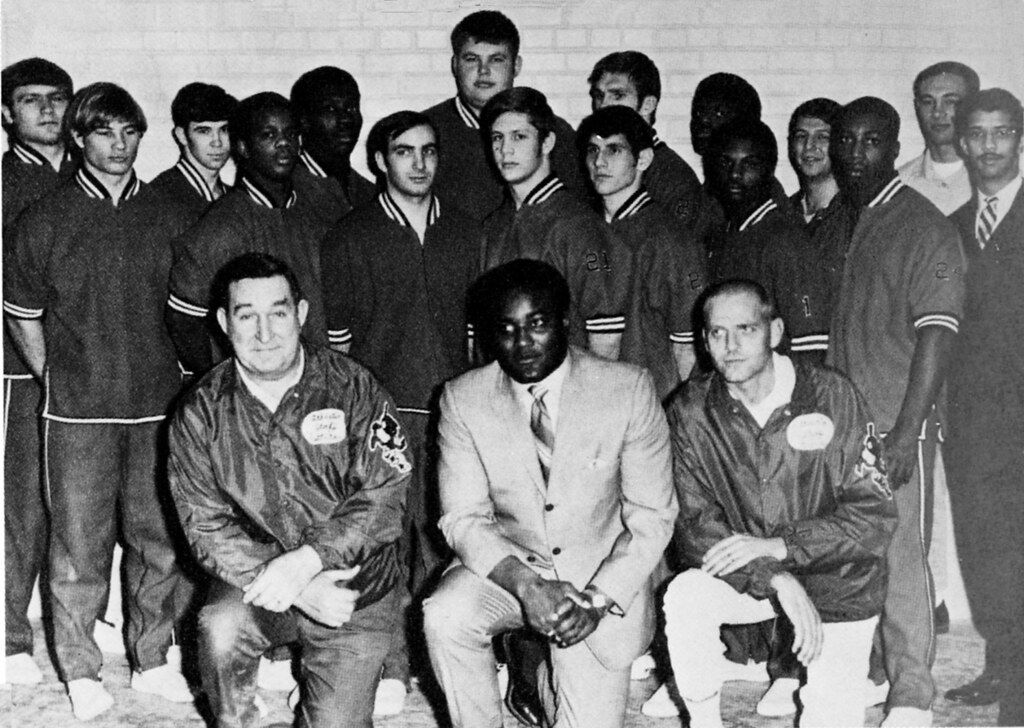
In my view, one of the most underreported stories coming out of Omaha the last 50 years was what Don Benning achieved as a young black man at the University of Nebraska at Omaha. At a time and in a place when blacks were denied opportunity, he was given a chance as an educator and a coach and he made the most of the situation. The following story, a version of which appeared in a March 2010 issue of The Reader (www.thereader.com), charted his accomplishments on the 40th anniversary of making some history that has not gotten the attention it deserves. He made history at then-Omaha University as the nation’s first black coach of a major team sport at a predominantly white institution of higher education. I believe he was also the first black coach to lead a team at a predominantly white high education institution to a national championship. He laid the groundwork for the UNO wrestling dynasty that followed some years later under the leadership of Mike Denney, who always credited Don with getting the whole thing started.
In leading his team to the 1970 NAIA national title, when they roundly beat teams from from larger schools, he gathered around him a diverse group of student-athletes at a time when this was not the norm. A team coached by a young black man and comprised of whites, blacks and Latinos traveled to some inhospitable places where race baiting occured but he and his student-athletes never lost their cool. They let their actions speak for them.
One of the pleasures in doing this story was getting to know Don Benning, a man of high character who took me into his confidence. I shall always be grateful.
As the March 12-13 Division II national wrestling championships get underway at the University of Nebraska at Omaha, it’s good to remember wrestling, not hockey, is the school’s true marquee sport
Host UNO has been a dominant fixture on the D-II wrestling scene for decades. Its No. 1-ranked team is the defending national champs and is expected to finish on top again under Mike Denney, the coach for five of UNO’s six national wrestling titles. The first came 40 years ago amid currents of change.
Every dynasty has a beginning and a narrative. UNO’s is rooted in historic firsts that intersect racial-social-political happenings. The events helped give a school with little going for it much-needed cachet and established a tradition of excellence unbroken now since the mid-1960s.
It all began with then-Omaha University president Milo Bail hiring the school’s first African-American associate professor, Don Benning. The UNO grad had competed in football and wrestling for the OU Indians and was an assistant football coach there when Bail selected him to lead the fledgling wrestling program in 1963. The hire made Benning the first black head coach of a varsity sport (in the modern era) at a predominantly white college or university in America. It was a bold move for a nondescript, white-bread, then-municipal university in a racially divided city not known for progressive stances. It was especially audacious given that Benning was but 26 and had never held a head coaching position before.
Ebony Magazine celebrated the achievement in a March 1964 spread headlined, “Coach Cracks Color Barrier.” Benning had been on the job only a year. By 1970 he led UNO to its first wrestling national title. He developed a powerful program in part by recruiting top black wrestlers. None ever had a black coach before.
Omaha photographer Rudy Smith was a black activist at UNO then. He said what Benning and his wrestlers did “was an extension of the civil rights activity of the ’60s. Don’s team addressed inequality, racism, injustice on the college campus. He recruited people accustomed to challenges and obstacles. They were fearless. Their success was a source of pride because it proved blacks could achieve. It opened the door for other advancements at UNO by blacks. It was a monumental step and milestone in the history of UNO.”
Indeed, a few years after Benning’s arrival, UNO became the site of more black inroads. The first of these sawMarlin Briscoe star at quarterback there, which overturned the myth blacks could not master the cerebral position. Briscoe went on to be the first black starting QB in the NFL. Benning said he played a hand in persuading UNO football coach Al Caniglia to start Briscoe. Benning publicly supported efforts to create a black studies program at UNO at a time when black history and culture were marginalized. The campaign succeeded. UNO established one of the nation’s first departments of Black Studies. It continues today.
Once given his opportunity, Benning capitalized on it. From 1966 to 1971 his racially and ethnically diverse teams went 65-6-4 in duals, developing a reputation for taking on all comers and holding their own. Five of his wrestlers won a combined eight individual national championships. A dozen earned All-America status.
That championship season one of Benning’s two graduate assistant coaches was fellow African-American Curlee Alexander. The Omaha native was a four-time All-American and one-time national champ under Benning. He went on to be one of the winningest wrestling coaches in Nebraska prep history at Tech and North.
Benning’s best wrestlers were working-class kids like he and Alexander had been:
Wendell Hakanson, Omaha Home for Boys graduateRoy and
Mel Washington, black brothers from New York by way of cracker GeorgiaBruce “Mouse” Strauss, a “character” and mensch from back East
Paul and Tony Martinez, Latino south Omaha brothers who saw combat in Vietnam
Louie Rotella Jr., son of a prep wrestling legend and popular Italian bakery family
Gary Kipfmiller, a gentle giant who died young
Bernie Hospokda, Dennis Cozad, Rich Emsick, products of south Omaha’s Eastern European enclaves.
Jordan Smith and Landy Waller, prized black recruits from Iowa
|
Half the starters were recent high school grads and half nontraditional students in their 20s; some, married with kids. Everyone worked a job.
|
The team’s multicultural makeup was “pretty unique” then, said Benning. In most cases he said his wrestlers had “never had any meaningful relationships” with people of other races before and yet “they bonded tight as family.” He feels the way his diverse team came together in a time of racial tension deserves analysis. “It’s tough enough to develop to such a high skill level that you win a national championship with no other factors in the equation. But if you have in the equation prejudice and discrimination that you and the team have to face then that makes it even more difficult. But those things turned into a rallying point for the team. The kids came to understand they had more commonalities than differences. It was a social laboratory for life.”
“We were a mixed bag, and from the outside you would think we would have a lot of issues because of cultural differences, but we really didn’t,” said Hospodka, a Czech- American who never knew a black until UNO. “We were a real, real tight group. We had a lot of fun, we played hard, we teased each other. Probably some of it today would be considered inappropriate. But we were so close that we treated each other like brothers. We pushed buttons nobody else better push.”
“We didn’t have no problems. It was a big family,” said Mel Washington, who with his late brother Roy, a black Muslim who changed his name to Dhafir Muhammad, became the most decorated wrestlers in UNO history up to then. “You looked around the wrestling room and you had your Italian, your whites, your blacks, Chicanos, Jew, we all got together. If everybody would have looked at our wrestling team and seen this one big family the world would have been a better place.”
If there was one thing beyond wrestling they shared in common, said Hospodka, it was coming from hardscrabble backgrounds.
“Some of the kids came from situations where you had to be pretty tough to survive,” said Benning, who came up that way himself in a North O neighborhood where his was the only black family.
The Washington brothers were among 11 siblings in a sharecropping tribe that moved to Rochester, N.Y. The pair toughened themselves working the fields, doing odd-jobs and “street wrestling.”
Dhafir was the team’s acknowledged leader. Mel also a standout football lineman, wasn’t far behind. Benning said Dhafir’s teammates would “follow him to the end of the Earth.” “If he said we’re all running a mile, we all ran a mile,” said Hospodka.
Having a strong black man as coach meant the world to Mel and Dhafir. “Something I always wanted to do was wrestle for a black coach. It was about time for me to wrestle for my own race,” said Mel. The brothers had seen the Ebony profile on Benning, whom they regarded as “a living legend” before they ever got to UNO. Hospodka said Benning’s race was never an issue with him or other whites on the team.
Mel and Dhafir set the unrelenting pace in the tiny, cramped wrestling room that Benning sealed to create sauna-like conditions. Practicing in rubber suits disallowed today Hospodka said a thermostat once recorded the temperature inside at 110 degrees and climbing. Guys struggled for air. The intense workouts tested physical and mental toughness. Endurance. Nobody gave an inch. Tempers flared.
Gary Kipfmiller staked out a corner no one dared invade. Except for Benning, then a rock solid 205 pounds, who made the passive Kipfmiller, tipping the scales at 350-plus, a special project. “I rode him unmercifully,” said Benning. “He’d whine like a baby and I’d go, ‘Then do something about i!.” Benning said he sometimes feared that in a fit of anger Kipfmiller would drop all his weight on him and crush him.
Washington and Hospodka went at it with ferocity. Any bad blood was left in the room.
“As we were a team on the mat, off the mat we watched out for each other. Even though we were at each other’s throats on the wrestling mat, whatever happened on the outside, we were there. If somebody needed something, we were there,” said Paul Martinez, who grew up with his brother Tony, the team’s student trainer-manager, in the South O projects. The competition and camaraderie helped heal psychological wounds Paul carried from Vietnam, where he was an Army infantry platoon leader.
An emotional Martinez told Benning at a mini-reunion in January, “You were like a platoon leader for us — you guided us and protected us. Coming from a broken family, I not only looked at you as a coach but as a father.” Benning’s eyes moistened.
Joining them there were other integral members of UNO’s 1970 NAIA championship team, including Washington and Hospodka. The squad capped a perfect 14-0 dual season by winning the tough Rocky Mountain Athletic Conference tournament in Gunnison, Colo. and the nationals in Superior, Wis. It was the first national championship won by a scholarship team at the school and the first in any major sport by a Nebraska college or university.
Another milestone was that Benning became the first black coach to win an integrated national championship in wrestling and one of the first to do so in any sport at any level. He earned NAIA national coach of the year honors in 1969.
University of Washington scholar John C. Walter devotes a chapter to Benning’s historymaker legacy in a soon-to-be-published book, Better Than the Best. Walter said Benning’s “career and situation was a unique one” The mere fact Benning got the opportunity he did, said Walter, “was extraordinary,” not to mention that the mostly white student-athletes he taught and coached accepted him without incident. Somewhere else, he said, things might have been different.
“He was working in a state not known for civil rights, that’s for sure,” said Walter. “But Don was fortunate he was at a place that had a president who acted as a catalyst. It was a most unusual confluence. I think the reason why it happened is the president realized here’s a man with great abilities regardless of the color of his skin, and for me that is profound. UNO was willing to recognize and assist a young black man trying hard to distinguish himself and make a name for his university. That’s very important.”
Walter said it was the coach’s discipline and determination to achieve against all odds that prepared him to succeed.
Benning’s legacy can only be fully appreciated in the context of the time and place in which he and his student-athletes competed. For example, he was set to leave his hometown after being denied a teaching post with the Omaha Public Schools, part of endemic exclusionary practices here that restricted blacks from obtaining certain jobs and living in many neighborhoods. He only stayed when Bail chose him to break the color line, though they never talked about it in those terms.
“It always puzzled me why he did that knowing the climate at the university and in K-12 education and in the community pointed in a different direction. Segregation was a way of life here in Omaha. It took a tremendous amount of intestinal fortitude of doing what’s right, of being ready to step out on that limb when no other schools or institutions would touch African-Americans,” said Benning. He can only surmise Bail “thought that was the right thing to do and that I was the right person to do it.”
In assuming the burden of being the first, Benning took the flak that came with it.
“I flat out couldn’t fail because I would be failing my people. African-American history would show that had I failed it would have set things back. I was very aware of Jackie Robinson and what he endured. That was in my mind a lot. He had to take a lot and not say anything about it. It was no different for me. I had tremendous pressure on me because of being African-American. A lot of things I held to myself.”
Washington said though Benning hid what he had to contend with, some of it was blatant, such as snubs or slights on and off the mat. His white wrestlers recall many instances on the road when they or the team’s white trainer or equipment manager would be addressed as “coach” or be given the bill at a restaurant when it should have been obvious the well-dressed, no-nonsense Benning was in charge.
Hospodka said at restaurants “they just assumed the black guy couldn’t pay. They hesitated to serve us or they ignored us or they hoped we would go away.”
Washington could relate, saying, “I had a feeling what he was going through — the prejudice. They looked down on him. That’s why I put out even more for him because I wanted to see him on top. A lot of people would have said the heck with this, but he’s a man who stood there and took the heat and took it in stride.”
“He did it in a quiet way. He always thought his character and actions would speak for him. He went about his business in a dignified way,” said Hospodka.
UNO wrestlers didn’t escape ugliness. At the 1971 nationals in Boone, N.C., Washington was the object of a hate crime — an effigy hung in the stands. Its intended effect backfired. Said Washington, “That didn’t bother me. You know why? I was used to it. That just made me want to go out there more and really show ’em up.” He did, too.
“We were booed a lot when we were on the road,” Hospodka said. “Don always said that was the highest form of flattery. We thrived on it, it didn’t bother us, we never took it personal, we just went out and did our thing. You might say it (the booing) was because we were beating the snot out of them. I couldn’t help think having a black coach and four or five black wrestlers had something to do with it.”
Hospodka said wherever UNO went the team was a walking social statement. “When you went into a lot of small towns in the ’60s with four or five black wrestlers and a black coach you stuck out. It’s like, Why are these people together?” “There were some places that were awfully uncomfortable, like in the Carolinas,” said Benning. “You know there were places where they’d never seen an African-American.”
At least not a black authority figure with a group of white men answering to him.
The worst scene came at the Naval Academy, where the cold reception UNO got while holed up three days there was nothing compared to the boos, hisses, catcalls and pennies hurled at them during the dual. In a wild display of unsportsmanlike conduct Benning said thousands of Midshipmen left the stands to surround the mat for the crucial final match, which Kipfmiller won by decision to give UNO a tie.
The white wrestling infrastructure also went out of its way to make Benning and his team unwelcome.
“I think there were times when they seeded other wrestlers ahead of our wrestlers, one, because we were good and, two, because they didn’t look at it strictly from a wrestling standpoint, I think there was a little of the good old boy network there to try and make our road as tough as possible,” said Hospodka. “I think race played into that. It was a lot of subtle things. Maybe it wasn’t so subtle. Don probably saw it more because of the bureaucracy he had to deal with.”
“Some individuals weren’t too happy with me being an African-American,” said Benning. “I served on a selection committee that looked at different places to host the national tournament,. UNO hosted it in ’69, which was really very unusual, it broke a barrier, they’d never had a national championship where the host school had an African-American coach. That was pretty strange for them.”
He said the committee chairman exhibited outright disdain for him. Benning believes the ’71 championship site was awarded to Boone rather than Omaha, where the nationals were a big success, as a way to put him in his place. “The committee came up with Appalachian State, which just started wrestling. I swear to this day the only reason that happened was because of me and my team,” he said.
He and his wrestlers believe officials had it in for them. “There was one national tournament where there’s no question we just flat out got cheated,” said Benning. “It was criminal. I’m talking about the difference between winning the whole thing and second.” Refs’ judgements at the ’69 tourney in Omaha cost UNO vital points. “It was really hard to take,” said Benning. UNO had three individual champs to zero for Adams State, but came up short, 98-84. One or two disputed calls swung the balance.
Despite all the obstacles, Benning and his “kids” succeeded in putting UNO on the map. The small, white institution best known for its Bootstrapper program went from obscurity to prominence by making athletics the vehicle for social action. In a decade defined by what Benning termed “a social revolution,” the placid campus was the last place to expect a historic color line being broken.
The UNO program came of age with its dynamic black coach and mixed team when African-American unrest flared into riots across the country, including Omaha. A north side riot occurred that championship season. UNO’s black wrestlers, who could not find accommodations near the UNO campus, lived in the epicenter of the storm. Black Panthers were neighbors. Mel Washington, his brother Dhafir and other teammates watched North 24th St. burn. Though sympathetic to the outrage, they navigated a delicate line to steer clear of trouble but still prove their blackness.
A uniformed police cadet then, Washington said he was threatened once by the Panthers, who called him “a pig” and set off a cherry bomb outside the apartment he shared with his wife and daughter.
“I found those guys and said, ‘Anybody ever do that to my family again, and you or I won’t be living,’ and from then on I didn’t have no more problems. See, not only was I getting it from whites, but from blacks, too.”
Benning, too, found himself walking a tightrope of “too black or not black enough.” After black U.S. Olympians raised gloved fists in protest of the national anthem, UNO’s black wrestlers wanted to follow suit. Benning considered it, but balked. In ’69 Roy Washington converted to Islam. He told Benning his allegiance to Black Muslim leader Honorable Elijah Muhammad superseded any team allegiance. Benning released him from the squad. Roy’s brother Mel earlier rejected the separatist dogma the Black Muslims preached. Their differences caused no riff.
Dhafir (Roy) rejoined the team in December after agreeing to abide by the rules. He won the 150-pound title en route to UNO capturing the team title over Adams, 86-58. Hospodka said Dharfir still expressed his beliefs, but with “no animosity, just pride that black-is-beautiful. Dharfir’s finals opponent, James Tannehill, was a black man married to a white woman. Hospodka said it was all the reason Dharfir needed to tell Tannehill, “God told me to punish you.” He delivered good on his vow.
It was also an era when UNO carried the “West Dodge High” label. Its academic and athletic facilities left much to be desired. “The university didn’t have that many things to feel proud of,” said Benning. Wrestling’s success lifted a campus suffering an inferiority complex to the University of Nebraska-Lincoln. Wrestling was one area where UNO could best NU, whose NCAA wrestling program paled by comparison.
“Coach Benning and his wrestling teams elevated UNO right to the top, shoulder-to-shoulder with its big brother’s football team down the road,” said UNO grad Mary Jochim, part of a wrestling spirit club in 69-’70. “They gave everyone at the school a big boost of pride. The rafters would shake at those matches.”
“You’d have to say it was the coming-together of several factors that brought about a genuine excitement about wrestling at UNO in the late 1960s,” said former UNO Sports Information Director Gary Anderson. He was sports editor of the school paper, The Gateway, that championship season. “There were some outstanding athletes who were enthusiastic and colorful to watch, a very good coach, and UNO won a lot of matches. UNO had the market cornered. Creighton had no team and Nebraska’s team wasn’t as dominant as UNO. It created a perfect storm.”
Benning said, “It was more important we had the best wrestling team in the state than winning the national championship. Everybody took pride in being No. 1.” Anderson said small schools like UNO “could compete more evenly” then with big schools in non-revenue producing sports like wrestling, which weren’t fully funded. He said as UNO “wrestled and defeated ‘name’ schools it added luster to the team’s mystique.
NU was among the NCAA schools UNO beat during Benning’s tenure, along with Wyoming, Arizona, Wisconsin, Kansas and Cornell. UNO tied a strong Navy team at the Naval Academy in what Hospodka called “the most hostile environment I ever wrestled in.” UNO crowned the most champions at the Iowa Invitational, where if team points had been kept UNO would have outdistanced the big school field.
“We didn’t care who you were — if you were Division I or NAIA or NCAA, it just didn’t matter to us,” said Hospodka, who pinned his way to the 190-pound title in 1970. The confidence to go head-to-head with anybody was something Benning looked for in his wrestlers and constantly reinforced.
Said Hospodka,”Don always felt like we could compete against anybody. He knew he had talent in the room. He didn’t think we had to take a back seat to anybody when it came to our abilities. He had a confidence about him that was contagious.”
The sport’s bible, Amateur Wrestling News, proclaimed UNO one of the best teams in the nation, regardless of division. UNO’s five-years of dominance, resulting in one national championship, two runner-up finishes, a third-place finish and an eighth place showing, regularly made the front page of the Omaha World-Herald sports section.
The grapplers also wrestled with an aggression and a flair that made for crowd-pleasing action. Benning said his guys were “exceptional on their feet and exceptional pinners.” It wasn’t unusual for UNO to record four or five falls per dual. Washington said it was UNO’s version of “showtime.” He and his teammates competed against each other for the most stylish or quickest pin.
Hospodka said “the bitter disappointment” of the team title being snatched away in ’69 fueled UNO’s championship run the next season, when UNO won its 14 duals by an average score of 32-6. It works out to taking 8 of every 10 matches. UNO posted three shut outs and allowed single digits in seven other duals. No one scored more than 14 points on them all year. The team won every tournament it competed in.

Everything fell into place. “Nobody at our level came even close to competing with us,” said Hospodka. “The only close match we had was Athletes in Action, and those were all ex-Big 8 wrestlers training for the World Games or the Olympics. They were loaded and we still managed to pull out a victory (19-14).” At nationals, he said, “we never had a doubt. We had a very solid lineup the whole way, everybody was at the top of their game. We wrapped up the title before the finals even started.” Afterwards, Benning told the Gateway, “It was the greatest team effort I have ever been acquainted with and certainly the greatest I’ve ever seen.”
Muhammad won his third individual national title and Hospodka his only one. Five Mavs earned All-America status.
The foundation for it all, Hospodka said, was laid in a wrestling room a fraction the size of today’s UNO practice facility. “I’ve been in bigger living rooms,” he said. But it was the work the team put in there that made the difference. “It was a tough room, and if you could handle the room then matches were a breeze. The easy part of your week was when you got to wrestle somebody else. There were very few people I wrestled that I felt would survive our wrestling room.”
“It was great competition,” said Jordan Smith. “One thing I learned after my first practice was that I was no longer the toughest guy in the room. There were some recruits who came into that room and practiced with us for a few days and we never saw them again. I was part of something that really was special. It was a phenomenal feeling.”
This band of brothers is well represented in the Maverick Wrestling and UNO Halls of Fame. The championship team was inducted by UNO and by the Rocky Mountain Athletic Conference. Benning, Mel Washington, Dhafir Muhammad and Curlee Alexander are in the Nebraska Black Sports Hall of Fame. But when UNO went from NAIA to NCAA Division II in ’73 it seemed the athletic department didn’t value the past. Tony Martinez said he rescued the team’s numerous plaques and trophies from a campus dumpster. Years later he reluctantly returned them to the school, where some can be viewed in the Sapp Fieldhouse lobby.
UNO’s current Hall of Fame coach, Mike Denney, knows the program owes much to what Benning and his wrestlers did. The two go way back.
Benning left coaching in ’71 for an educational administration career with OPS. Mike Palmisano inherited the program for eight years, but it regressed.
When Denney took over in ’79 he said “my thing was to try to find a way to get back to the level Don had them at and carry on the tradition he built.” Denney plans having Benning back as grand marshall for the March of All-Americans at this weekend’s finals. “I have great respect for him.” Benning admires what Denney’s done with the program, which has risen to even greater heights. “He’s done an outstanding job”
As for the old coach, he feels the real testament to what he achieved is how close his diverse team remains. They don’t get together like they once did. When they do, the bonds forged in sweat and blood reduce them to tears. Their ranks are thinned due to death and relocation. They’re fathers and grandfathers now, yet they still have each other’s backs. Benning’s boys still follow his lead. Hospokda said he often asks himself, “What would Don want me to do?”
At a recent reunion Washington told Benning, “I’m telling you now in front of everyone — thank you for bringing the family together.”
Related Articles
- U. of Neb.-Omaha plans to move to Division I (seattletimes.nwsource.com)
- Nebraska at Omaha to join D-I’s Summit League (sports.espn.go.com)
- UNC Greensboro cuts wrestling program (seattletimes.nwsource.com)
- Dean Blais Has UNO Hockey Dreaming Big (leoadambiga.wordpress.com)
- UNO Wrestling Dynasty Built on a Tide of Social Change (leoadambiga.wordpress.com)


 Leo Adam Biga's My Inside Stories