 A KVNO Radio studio in the early days at the Storz mansion, ©photo UNO Criss Library
I am not normally crazy about covering events because I think of myself more as a writer than a reporter. While spending several hours at an academic and community confab I was assigned to report on is not my idea of a good time I did mostly enjoy covering the 2010 Cumbre conference put on by the Office of Latino and Latin American Studies at the University of Nebraska at Omaha. The big topic under discussion was human mobility or migration and the political, social, economic, and personal fallout of populations in flux. It’s interesting how things work because a year or so after the event I became aware of a great book about one of the most important and underdoumented migration experiences in U.S. history – the great migration of African-Americans from the South to all points North and West. The book by Isabel Wilkerson, The Warmth of Other Suns: The Epic Story of America’s Great Migration, is one I eventually read and wrote about, interviewing Wilkerson at some length, then meeting her before a talk she gave in Omaha. And that sparked my beginning to do research for a story or series of stories on African-Americans who migrated from the South to Nebraska. I’ll write that story next year in conjunction with the big black heritage celebration here known as Native Omaha Days. And I was to have undertaken a rather epic project all about human migration for a Catholic community of missionaries but it has been put on hold. Finally, I may be making an individual and temporary migration this fall reporting on set of Alexander Payne’s upcoming feature production Nebraska, which would find me embedding myself among the crew as they traverse from eastern Montana across much of Nebraska for the making of this road movie. So, you see, in the midst of overcoming my reluctance to cover a migration conference I found myself open to a pattern of migration subjects and opportunities that came my way. Would they have otherwise? Who knows? I’m just glad they did.
Cumbre:
Hundreds attend OLLAS conference
©by Leo Adam Biga
Originally published in El Perico
A wide spectrum of Latino concerns, including the need for federal immigration reform, swirled around the May 14-15 Cumbre conference held at Omaha‘s Embassy Suites in the Old Market. The theme was Human Mobility, the Promise of Development and Political Engagement.
The every-few-years summit hosted by UNO’s Office of Latino and Latin American Studies is part I’ll-show-you-mine, if-you-show-me-yours research exchange, part old-fashioned networking event and part open mic forum.
More than 400 registrants from near and far came to share ideas. The perspectives ranged from star academics allied with major institutions to local grassroots organizers.
Adding urgency was the divisive new Arizona law targeting illegal immigrants. OLLAS director Lourdes Gouveia said when planning for this year’s summit began four years ago immigration was a hot topic. It was expected to remain so once Barack Obama won the White House, but the health care debate put it on the back burner.
“We began to think well maybe this was not the year when the national context about immigration was really going to provide the impetus,” she said, “and then along comes Arizona. All at once we had people like Jason Marczak (policy director with Americas Society/Council of the Americas) call and say, ‘I’d like to come, is it too late?’ We had vans of people coming from Colorado and Iowa. We had people showing up from all kinds of communities in the Great Plains, besides all the international scholars from Africa, India, Latin America, Europe.”
Omaha Mayor Jim Suttle and State Sen. Brenda Council kicked off the event. State Sen. Brad Ashford was a panelist and Omaha City Councilman Ben Gray served as a moderator.
Beyond facilitating dialogue, Cumbre introduces new scholarship. Coordinators for the Woodrow Wilson Center Mexico Institute’s Latino Immigrant Civic Engagement Project chose Cumbre to unveil their report’s findings of Latino civic involvement in nine U.S. cities, including Omaha. The authors tied engagement levels to several factors. Generally, the more engaged immigrants are with their country of origin, the more engaged they are in their adopted homeland. High participation in church activities correlates with high participation in civic activities. Coalitions, whether community, church or work-based, such as the Heartland Workers Center in Omaha, act as gateways for increased engagement.
But each Latino immigrant community has its own dynamics that influence participation, thus authors titled their report “Context Matters.” Co-author Xochitl Bada, a University of Illinois at Chicago assistant professor, presented the findings.
OLLAS issued its own site report, “Migrant Civil Society Under Construction.” Investigators conducted roundtable discussions with local Latino immigrants, who said that fear, inadequate education and lack of information are barriers to engagement.
Bada said Omaha is rather unique in being both a new and old destination for Latino migration, a mix that may partly account for the moderate levels of civic-political participation by the emerging Latino immigrant community here.
Respondents in all nine cities regarded the 2006 immigration mobilization marches as a turning point in Latino engagement but expressed disappointment the movement did not sustain itself.
Among other panels: UNO economist Christopher Decker outlined Latino immigrants’ substantial economic impact in state; and UNO languages professor Claudia Garcia detailed a project delivering education programs and restoring family connections to local Spanish-speaking immigrant prison detainees.
Cumbre’s hallmark is gathering under one roof different players. Speeches, panels, workshops, town hall meetings, Q & As and breakout sessions provide opportunities for these wonks, worker bees, policymakers and service providers to interact.
Princeton University scholar and Center for Migration and Development director Alejandro Portes has attended all four Cumbres. The Cuba native said he made his 2010 keynote address on Latino immigrant transnationalism accessible to Cumbre’s diverse audience. The Creighton University graduate said, “I think bringing the community and the scholars in the same room is one of the things I like about it. The organizers have great talent in bringing these different constituencies together.”
Another featured speaker, journalist, author and University of Southern California communication professor Roberto Suro, said what distinguishes Cumbre is “it attracts really A-list, blue-ribbon people from the academic world and at the same time a very broad swath of people who work on the ground. It’s the only conference I know of that does that. There’s a reason the room’s full.”
In his address Suro spoke about “reimagining” Latino migration policies in both the sending Central and Latin American countries and in the receiving United States.
“Through gatherings like this,” Suro said, “what you see is people broadening the horizons of policy discussion and starting to think about reformulating issues, adding to the agenda and starting to develop the kind of understandings and intellectual framework that might permit better policy in the future.”
Suro told the audience that researchers and activists like them are well ahead of policymakers and politicians on the issue and give him reason for optimism.
OLLAS assistant director Jonathan Benjamin-Alvarado said some of what happens at Cumbre “is bound to be carried” to global forums,” adding, “and that to me is probably the highest compliment for what we try to do in bringing all these people together.”
Xochitl Bada, co-principal investigator of the Latino immigration Civic Engagement Project, said Cumbre “has a very important public aspect. Unlike most academic conferences, it’s conceived “as a report back to the community.” She said the fact the summit is free makes it inclusive. “That’s very unusual.” She said another mark of Cumbre’s open door approach is the simultaneous translation, from Spanish to English and from English to Spanish, it provides to ensure that “language is not a barrier.” She called Cumbre an important vehicle for “public discourse” and “public dissemination.”
Rev. Ernesto Medina, pastor of St. Martha Episcopal Church in Omaha, moderated a panel discussion on human rights, work and community membership. He said he appreciates the opportunity Cumbre presents “to see things holistically” and to put “different communities and different passions” in the same room to find common ground.
Though many differing views were voiced, some consensus emerged: immigration reform must happen but the current partisan climate makes it unlikely soon; criminalization of migrants is punitive, narrow-minded, counterproductive and damaging to families; today’s nativist anti-immigration arguments echo those of the past; lawmakers need good data about immigration to make good policy; Latino immigrants can be fully engaged in both their country of origin and American society; remittances made by Latino migrants to their native countries are crucial to those economies.
Roberto Suro said the full contributions of the recent Latino migrant wave can only be weighed when second generation children reach adulthood. He advocates Latino immigrants be viewed as more than merely a subsistence labor force.
National Alliance of Latin American and Caribbean Countries executive director Oscar Chacon called for more “robust” organizations like his that represent Latino immigrant interests and celebrate their cultural differences while working toward “common cause.”
Alejandro Portes warned if the rhetoric and actions of anti-migrant forces continue “it could usher in ethnic unrest, and there’s absolutely no reason for that. I don’t think it will get that bad because of Obama in the White House and the federal government at some point is going to enter the situation and bring some kind of immigration reform.”
For a long time and even today the University of Nebraska at Omaha was best known for its large Bootstrapper program for military personnel. The school is vastly different than it was when the program launched during the Cold War but it’s impact remains. The following story from a half-dozen years ago or more is about an original play written by the Omaha husband and wife team of Mark Manhart and Bonnie Gill that takes a nostalgic look at the program’s beginnings, and those beginnings involved two strong leaders, then-Omaha University president Milo Bail and Strategic Air Command head and hawk of hawks Gen. Curtis LeMay, who some suggest was the inspiration for the character of Gen. Buck Turgidson that George C. Scott plays in Dr. Strangelove. A Midwest academic and a military reactionary may seem to have made strange bedfellows but then again it’s not hard to imagine that two powerful middle-aged white men should come together in right wing solidarity “for the boys.”

Homage to the bootstrappers by the Grande Olde Players
©by Leo Adam Biga
Originally appeared in The Reader (www.thereader.com)
The Grande Olde Players Theatre pays homage to Omaha’s deep military ties with the new play Bootstrappers Christmas, now through December 17. Written by the theater’s Mark Manhart and Bonnie Gill, the nostalgic 1954-set piece tells a fictional story amid the trappings of history. The relationship between then-Omaha University and the former Strategic Air Command in Bellevue, Neb. is at the center of this holiday-themed dramadie.
Early in his stint as commander of the newly formed SAC, Gen. Curtis LeMay, architect of U.S. bombing campaigns in Europe and the Pacific and overseer of the Berlin Airlift, identified the need for a more professional corps of college-educated personnel. After World War II the U.S. Air Force had a glut of officers. Many had some college prior to the service and once “on the line” accrued credits at schools near where they were based, but few ever got their degrees.
LeMay, an American hero whose reactionary, right-wing views later tarnished his reputation, broached Operation Bootstrap with his egg-head friend, the late Milo Bail, then-president of what’s now the University of Nebraska at Omaha. By helping commissioned officers finish their degrees, the program would aid their climb up the ladder as well as better prepare them for post-military life. The idea of men and women “lifting themselves by their bootstraps” gave the program its name.
Bail and fellow UNO officials recognized the school was well-poised to serve military folks by virtue of a large adult education unit and Bachelor of General Studies (BGS) program that allowed nontraditional students to individualized studies in subjects of interest or deficiency. “Omaha University was really the first school in the country to offer” the BGS, said William Utley, former UNO College of Continuing Studies dean. More appealing still, he said, were the “earned life credits” granted officers for experience gained in the field, which cut by a semester their degree track.


The school’s extensive night courses offered yet more flexibility. Besides the cache of this partnership, school officials craved the extra money derived from the higher non-resident tuition bootstrappers paid. Between Offutt’s close proximity and Omaha’s central location, the military could feed students there not just from Offutt but from bases all over the U.S. and the world.
That’s what happened, too, as an influx of mostly Air Force but also Army soldiers and Marines made UNO the nation’s largest on-campus education provider for bootstrappers. Officers rotated in on active duty or TDY. Utley, director of the UNO program, said at its 1960s peak 1,200 to 1,500 “boots” attended school there at any one time. “There were any number of commencement exercises when over half of the graduating class was bootstrappers,” he said.
Alumni officials estimate 13,000-plus active duty military personnel attended UNO from the early ‘50s to the ‘80s.
Utley said UNO prided itself on being responsive to officers’ needs and interests by “developing” a system to stay in “constant communication” with them, no matter where their assignments took them. He said both active and prospective students received “counseling and advising” services to facilitate their education.
The presence of so many boots changed the dynamic of the school, especially in those early years, when it was a small, financially strapped municipal university, not yet a part of the University of Nebraska system.
“The Bootstrap Program was a major factor for several years in keeping the university afloat with the revenue” it generated, Utley said. “It was a very important element in the survival of the university during that period, when the university was really hard up.”
UNO Alumni Association President Emeritus Jim Leslie said bootstrappers were “a tremendous boon” to UNO’s finances. For a while, he said, UNO enjoyed a near monopoly in serving the bootstrap population. “It was a big deal,” he said. “For a while we claimed we were second only to West Point in the number of general officers that had graduated from our institution.” Some were stars like Johnnie Wilson, a four-star general. Other schools eventually cut in on the action.
Utley said the infusion of so many “highly motivated” students changed the academic culture at UNO. “They were a very serious group. Very good students,” said Leslie, who had boots as classmates there in the early ‘60s. “They were here to gain an education and most of them were older and more mature. Professors loved those guys because they asked the best questions.”

“A lot of students viewed them as ‘curve busters’ who made it harder to compete in the classroom or set a higher standard in the classroom. And no faculty member is going to complain about that,” said retired UNO professor Warren Francke, who had his share of boots. “And its true in general they were solid students because they were all business. They were there to do well in the classes.
“I thought they were certainly an asset. There were times when probably the undergraduates had a legitimate complaint that maybe they dominated things so much. But mostly,” Francke said, the boots “added a dimension to what” otherwise “was a commuter campus without a lot of people who had been all over the world…I thought their addition was sort of a valuable thing to have.”
While Bootstrappers Christmas is a slight, sentimental romp filled with a mix of ‘50s-era rock and traditional Christmas music, writer-director Mark Manhart does anchor the story in the real symbiosis between UNO and Offutt. The flamboyant Curtis LeMay and the non-nonsense Milo Bail are characters. The plot revolves around a boot who befriends a Cold War widow coed and other students in remodeling the campus Snack Shack in time for putting on a holiday show. The fun is tinged with the sadness of separation and loss, but hope prevails.
The play’s also about making new starts, something the bootstrap program epitomized. Ex-Air Force pilot Jim Hughes spoke for many boots when he said, “The university was the first milestone in my growth with the Air Force and I attribute any success and all successes I’ve had to that little development. I owe a debt of gratitude to the university…It introduced me to education oriented to my needs.”
The Iowa native and current Magnolia, Ark. resident said his general education degree catapulted him “up the ladder.” In 1973 he retired from active duty as a decorated colonel. He earned the Bronze Star, four distinguished Flying Crosses and five Airmedals. He received two Purple Hearts for injuries suffered as a POW.
NOTE: Operation Bootstrap supplanted Operation Midnight Oil. In 2002 the Air Force replaced the Bootstrap Program with the Educational Leave of Absence Program (ELA), although many in the service still refer to it by its old name.
Title IX. This often contentious 1972 federal education act is getting more attention then usual these days because the media is taking a reflective look back on the impact it’s had over its 40 year lifespan. I’m doing the same with this article, which will soon appear in The Reader (www.thereader.com). Because I reside in Omaha, Neb. and The Reader is an Omaha news weekly my story looks at the implications of Title IX and the context that brought it into being from a local perspective, though I certainly address the nationwide effect the legislation’s had. The real interest for me in doing this story was to try and impress upong readers of a certain age that what is easily taken for granted today in terms of the ubiquitious presence of girls and women’s athletics obscures the fact that things were quite different not so very long ago. Younger readers may be surprised to learn that schools, colleges, and universities had to be compelled to cease discrimination on the basis of sex and to give females the same opportunties as males. What seems natural and common sense today wasn’t viewed in that light just a few decades ago. I end my story with a rhetorical question asked by one of my sources, former coach and athletic director Don Leahy, who said, “Why was it ever different?” My story attempts in a small way to explain why and to describe what the journey for women trying to gain equal opportunity in sports looked like.

Gender equity in sports has come a long way, baby;
Title IX activists-advocates who fought for change see much Progress and the need for more
©by Leo Adam Biga
Originally appeared in The Reader (www.thereader.com)
Participants in girls and women’s sports today should be forgiven if they take for granted the bounty of athletic scholarships, competitive opportunities, training facilities and playing venues afforded them.
After all, they’ve never known anything else.
Their predecessors from two generations ago or more, however, faced a much leaner landscape. One where athletic scholarships were unheard of or totaled hundreds, not thousands of dollars. A handful of games once comprised a season. Facilities-venues were shared, borrowed or makeshift.
Until 1972 federal Title IX legislation banned discrimination on the basis of sex, educational institutions offered nothing resembling today’s well-funded athletic programs for females. Schools devoted a fraction of the resources, if anything at all, to girls and women’s sports that they earmarked for boys and men’s sports.
Second class citizen treatment prevailed.
Nebraska women’s basketball coach Connie Yori made her mark at Creighton University, where she played and coached at some 11 different “home” sites because the program didn’t have its own dedicated facility.
“We were gypsies in some ways. We just had to figure out places to play,” she says, adding, “That wasn’t that long ago either.”

The gulf between then and are now is vast.
“I mean everything was different,” she says. “The way we traveled – the coaches and student athletes were driving the vans to the games. We as coaches had to regularly clean the facilities we practiced in. That was the norm, there wasn’t anyone else to do it. There’s countless examples. Opportunities to play, scholarship money, modes of travel, recruiting budgets, operations budgets, staff salaries, you name it, it’s escalated. But college men’s athletics has escalated too, so it’s not just the women.
“When I played college basketball there would maybe be 50 to 100 fans in the stands and now I’m coaching games where there’s sell-outs and ticket scalping is going on, and who would have thought that?”
Creighton, Nebraska and UNO have their own women’s hoops and volleyball facilities.
“That’s just kind of what’s happened across the board in women’s athletics in that institutions are more committed to equity, and as well they should be,” says Yori.
Gaps remain. Salaries for women coaches lag behind those for men. And where men routinely coach female athletes, it’s rare that women coach male athletes.
Still, things are far advanced from when women’s athletics got dismissed or marginalized and the very notion of female student-athletes was anathema to all but a few enlightened administrators and athletics officials.
In that proto-feminist era the so-called “weaker sex” was discouraged from athletics. Girls and women were considered too delicate to play certain, read: male, sports. Besides, it wasn’t feminine or ladylike to compete. Schools routinely said they could not justify women’s programs because they’d never pay for themselves. Consequently, the idea of giving females the same chances as males was met with paternalistic, patronizing objections. This despite the fact virtually all men’s programs lose money and only survive thanks to donations and to subsidies from student fees and revenue producing major sports.
Former Creighton softball coach Mary Higgins bought the rationale until realizing the contradiction
“I just remember thinking, ‘Well of course we don’t have women’s athletics, we can’t make any money, no one will come.’ And then it was like the light went on – ‘Well, wait a minute, the baseball team doesn’t make any money, they don’t have any people in the stands, then how come they have it and we don’t?'”

When people like Higgins began questioning tired old assumptions and asking for their fair share of amenities there was push back, including from men’s coaches protecting their turf.
“Well, you start with the fact that people don’t like change, period,” says former University of Nebraska at Omaha chancellor Del Weber.
With institutional support virtually nonexistent at the collegiate level, the Association for Intercollegiate Athletics for Women evolved into the main national governing-sanctioning body. Meanwhile, the NCAA actively ignored, then opposed inroads made by women. When school presidents and NCAA officials saw the hand writing on the wall and, some argue, the profits to be made from championship events, women’s athletics fell under the NCAA’s aegis in the early 1980s.
The real impetus for change may simply have been demographic. As women became the majority population, more entered college. Today, women account for the majority enrollment at Creighton and UNO.
Where the benefits of athletic competition (improved self-esteem, leadership skills development, higher graduation rates, et cetera) were once anecdotal, they eventually became measurable.
As far as defining moments, says Higgins, “the linchpin for our programs to grow was getting scholarships. Once we had scholarships we could go get the players.” That’s when the real gains occurred.
“The AIAW got things launched and then I think we got more sophisticated with the NCAA and a lot more money became available. It was a positive thing for growth but that was a painful transition.”
UNO associate athletic director Connie Claussen began women’s athletics there in 1969 as volunteer softball coach. She soon added volleyball and basketball. “I didn’t ask anyone, I just did it,” she recalls. All three sports shared the same set of uniforms. The teams practiced and played in a quonset hut. The equipment room was the trunk of her car. There was no budget, only donations scrounged from sympathetic boosters. Similar limitations applied at Creighton. Nebraska enjoyed a decided facilities advantage. For a time small schools could hang with big schools as everyone started from scratch and had no scholarships available.
Even after Title IX passed, says Claussen “it took several years for it really to have an effect on most athletic programs,” and then only with some prodding. In the case of UNO the Chancellor’s and Mayor’s Commissions on the Status of Women brought pressure. Even the U.S. Office of Civil Rights got involved at the behest of parents Mary Ellen Drickey and Howard Rudloff.
“What sticks out in my mind is that in our old gym they had hours set aside for when the women could come in,” says Higgins. “You think about that now and it just sounds ludicrous but that’s just what it was. The women could come in I believe Sunday and Wednesday nights because God forbid they sweat or show any effort.”
Peru State College basketball coach Maurtice Ivy excelled at the high school, collegiate and pro levels but when she was learning the game as a youth in the 1970s there was no exposure to girls or women’s hoops.
“I didn’t really see women playing, and so the person I watched play and I kind of emulated my game after was Dr. J.”

As an Omaha youth Ivy and other inner city girls developed their skills as Hawkettes, the state’s first select basketball team run by the late Forrest Roper. Richard Nared’s Midwest Striders track program impacted generations of girls, including Ivy and her younger sister Mallery, who set several state records. The sisters’ father was among the first local coaches to offer girls the opportunity to play football.
Fastpitch whiz Ron Osborn organized a statewide club softball association as a forum for girls to play in and as a showcase to convince schools they should start their own softball teams.
Today, girls club teams are everywhere.
Grassroots pioneers worked independently of Title IX to bring about change. Ivy thinks of them and graduates like herself as “soldiers” in the women’s athletics movement.
But there’s no mistaking Title IX, whose enforcement has been upheld in countless legal findings, is the bedrock equal opportunity protection upon which girls and women’s athletics rests. By compelling schools receiving federal assistance to uphold gender equity it’s propelled the explosion of women going to college and the exponential growth of girls and women’s athletics. It’s meant a dramatic increase in the infrastructures supporting female student-athletes and a proportionate increase in the number of participants.
“You went from nothing to everything,” is how former UNO and Creighton athletic director and now UNO associate athletic director Don Leahy describes its impact.

“To me, it standardized and normalized athletics,” says Higgins. “Now it’s just expected.”
Institutions found not complying with Title IX are forced to take corrective action under penalty of court-ordered monetary damages.
Nebraska’s been a battleground for some notable Title IX actions, including a 1995 lawsuit brought by Naomi Friston against the Minden Public School District for scheduling girls games at off times compared to boys’ games. Creighton University graduate Kristen Galles, who successfully represented the Friston case, is now one of the nation’s leading Title IX and gender equity attorneys.
Some school districts, colleges, universities and states were more progressive than others early on. For example, where Iowa embraced girls high school athletics decades before Title IX neighboring Nebraska dragged its feet.
Yori, an Iowa girls athletics legend, says, “I feel like I grew up in almost the perfect place during my era to be a female athlete because Iowa was ahead of its time in regards to the support of girls athletics.” She says the late Iowa Girls Athletics Association president, E. Wayne Cooley, “found ways to place girl athletes on a pedestal.”
Not so much in Nebraska.
“When I crossed the river from Iowa to Nebraska during the early 1980s,” Yori says, “I saw a really different climate for girls athletics here. There was definitely a difference in the commitment level. I mean, there just weren’t opportunities. It’s been great to see how much progress we’ve made in Nebraska and now the two states are on level playing fields in my mind.”
At the collegiate level some Nebraska institutions did take the lead, including John F. Kennedy College in Wahoo and Midland University in Fremont, both of which built dominant women’s athletic programs in the ’70s. Recently retired Midland basketball coach Joanne Bracker was an inaugural member of the Women’s Basketball Hall of Fame.
Under Claussen UNO won the 1975 AIAW Women’s College World Series, one of several national titles won by UNO women’s teams. Claussen and CU’s Higgins helped grow college softball, serving on AIAW and NCAA committees and leading their respective schools in hosting more than a dozen CWS championships, which Higgins says was “huge” in legitimizing women’s sports here and beyond.
The late Omaha Softball Association guru Carl Kelly and College World Series Inc. chairman Jack Diesing Sr., along with corporate donors, helped sponsor the women’s tournament.
The start of the 1980s saw NU women’s sports emerge. The volleyball program began its run of excellence under Terry Pettit. Gary Pepin’s track program shined with superstar Merlene Ottey. Angela Beck’s basketball program reached new heights with Maurtice Ivy. NU softball began making noise.

By the early ’90s, a full complement of women’s sports was in place wherever you looked, whether big public schools like NU, smaller private schools like CU or then-Division II UNO.
None of it would have happened without activists pressing the cause of female student athletes. Along the way Title IX and its supporters met resistance, including court challenges.
“I think there’s a lot of women and men who made a huge difference for the young women of this generation,” says Yori. “Connie Claussen and Mary Higgins were very much advocates for change. There were a lot of battles fought – in offices, in meeting rooms, and even legally in courtrooms. There were people that got fired for voicing their opinions and became the sacrificial lambs because of that. There were a lot of people who didn’t want change and didn’t want to give women the opportunity they are now being given.
“You know, we still need to fight for it, but there’s not such a gap as there was.”
Higgins says the trailblazers of modern women’s athletics were “people who just had a burning passion to make this happen. It consumed me, I know it consumed my colleagues. It’s like, ‘We’ll do whatever it takes. We’ll figure it out, we’ll find a way.”
Parents played roles, too, as coaches, administrators, boosters.
“I do think dads and their concern for their daughters had a major impact, and that was absolutely the case at Creighton,” says Higgins. “It wasn’t Title IX telling Creighton they had to do it. Title IX was happening at the same time but our then-assistant athletic director, the late Dan Offenburger, kind of led the charge. He coached our very first softball team. He didn’t have time to do it, we didn’t have any money, we didn’t even have a shoestring. But he got it going because it was the right thing to do. Plus, he had three daughters and he was motivated to create opportunities for them.
“I’m sure there are stories like that all over.”
As near as UNO, where Don Leahy says he supported women’s athletics not only because “I thought it had to be done” but because “I had a daughter who played sports.” There were also a wife and mother to answer to at home.
Leahy says the coaches he worked with at UNO and Creighton “fought diligently for their programs but at the same time they maintained a common sense that made it possible for this thing to develop. We talked and we gradually worked through these things and I think that made a big difference.”
“This stuff did not come easy,” says Del Weber, who approved the early road map for women’s athletics at UNO laid out by Leahy and Claussen and the gender equity program that they and former athletic director Bob Danenhauer devised.
Ramping up meant serious dollars. Leahy says when it became clear accommodating women’s athletics was a new reality “the first thing that came up was – how are we going to pay for this?”

Current Creighton athletic director Bruce Rasmussen, who coached CU’s women’s basketball team, recalls, “We didn’t have enough resources to properly compete just with our mens’ programs and now we had the burden of essentially doubling our athletic department. It was, ‘How do we balance what we can do with what we should do?’ And there was a lot of stress across the country. Women’s athletics completely changed the dynamics of universities and how were they going to support a full athletic department. So there was a lot of tension and trauma going on.”
“And funding it is not just a matter of we’re going to give them x number of dollars,” says Rasmussen, “but it’s facilities, it’s staffing, it’s scholarships, recruiting, traveling, equipment…”
At Creighton as anywhere, says Rasmussen, “we’re asked to provide not only an athletic program but also to be fiscally responsible as a department and as a program. So when it comes to asking for more money, especially when you’re running at a deficit, there’s certainly friction. I think factions of the faculty felt every dollar that went to athletics was a dollar out of their pocket.”
By the ’90s, girls and women’s sports were a given. By the 2000s, they’re as much a part of the culture as boys and men’s sports. Some professional women’s sports leagues flourish. Icons have even emerged: Pat Summit, Lisa Leslie, Florence Griffith-Joyner, the Williams sisters, Jackie Joyner-Kersee, Brittney Griner.
“To turn that around was a seismic shift,” says Higgins.
“In a short time things really have come a long way,” says Claussen, who hastens to add, “But it took a long time to get” the opportunity.
Once spare media coverage has increased to the point that it’s commonplace if still a trickle of what males get.
“Hopefully we’ll continue getting more and more and that’s where the NCAA plays a big part in getting those television contracts,” says Claussen. “All that’s going to help increase the interest.”
The sustainability of athletic programs is an increasingly difficult proposition for schools struggling to keep pace with peers in a competitive arena of ever rising costs.
“At some point women’s athletics has to generate enough money to pay for itself because until it does we’re not going to get where we need to be,” says Rasmussen. “In men’s basketball we wouldn’t have the budget or spend the money on salaries we do if weren’t generating that, and we’ve got to move to the point where on the women’s side we’re generating realistic revenues. And the key to that is having generations of females who played sports, understand the value of sports and are willing to make a commitment to those sports.
“We don’t exist as an athletic department without people making a commitment to us.”
Creighton’s state-of-the-art athletic center and arena for volleyball and women’s basketball resulted from multi-million dollar gifts by donors Wayne and Eileen Ryan and David Sokol. Rasmussen says having coached women’s sports helps him effectively make the case for them when he asks for support.
In 1986 Claussen inaugurated the UNO Women’s Walk, now the Claussen-Leahy Run/Walk, which has raised $4 million-plus for women’s athletics.
NU’s men’s and women programs have some of the best facilities in the U.S. thanks to mega donations.
The strong sisterhood of girls and women’s sports that exists today is built on decades of sacrifice and perseverance. Ivy wants her athletes to know the history. It’s why she says she tells them about “who paved some of the way and the different struggles people had to endure so that we can have.” Yori does the same with her players because she wants them to know “where we come from as a sport.”
“There were groundbreakers and pioneers before us who made a huge impact on the opportunities young people have today,” Yori says. “Women of previous generations were not given opportunities and so it’s neat to see when they are given opportunities how much they can take advantage of that.”
“Why was it ever different?” asked Leahy. Why indeed.
When I studied journalism at the University of Nebraska at Omaha there were three professors in my major area of concentration who stood out: the late Bob Reilly for his warm personality and engaging storytelling; the late Todd Simon for his brilliant analytical mind; and Warren Francke for his passion in teaching us about the rich history of the Fourth Estate. I was an odd bird of a student because my rampant insecurities kept me from really ever getting to know any of my fellow J students. The only prof I got somewhat close to was Reilly, which was no great feat because he was welcoming to all. Simon probably most stimulated my sensibilities, though his intellect intimidated me. Francke is someone I wanted to know better and sought more affirmation from, but I don’t think I gave him much to work with. After graduating college and pursuing my career I remained friendly with Reilly, who became a mentor of mine. I doubt if I would have stuck it out as a freelancer those early years without his encouragement. After college I never had any contact again with Simon, who just passed away in early 2012. Francke is someone I likely would not have encountered again if not for the fact that he and I both became contributing writers to the same alternative news weekly, The Reader. He’s a fine writer and human being and I am proud to call him a colleague. Like his good departed friend and colleague Bob Reilly, he too has had encouraging words for him that I greatly appreciate. When I did the following New Horizons profile on Francke about a dozen years ago he was just as I remembered him from UNO – a vital presence excited by his craft as teacher and journalist. I can happily report that he is still that vital presence today. I hope to have his energy and engagement 20 years from now.

From the Archives: Warren Francke – A passion for journalism, teaching and life
©by Leo Adam Biga
Originally published in the New Horizons
When University of Nebraska at Omaha communications professor Warren Francke gets a certain misty, far-off gaze in his eyes, chances are he’s lost in another Rocky Mountain reverie. As a veteran Colorado summer dweller, he can’t help but daydream about hiking where the wild flowers bloom or waking to the warm golden glow of the morning sun glinting off snowy peaks or filling his lungs with the cool crisp ether of pure mountain air or sitting under a canopy of stars from atop a tall ridge at night.
Perhaps he even conjures his long-awaited rendezvous with a bear on some remote mountain trail.
He’s been hooked on Colorado’s high country life since the early 1970s, when summers first found him hauling his family out west, into the Estes Park region of the Rockies, where they grew enchanted by the languid pace and natural beauty of those rarefied heights and eventually extended their two-week vacations there into months-long visits.
Francke and his late wife of 31 years, Sue, adored life in those far upper reaches. When she died of a heart attack in 1991 he, son Chris, and daughter Cara scattered her ashes in a place she loved. Now, he shares the towering landscapes with his second wife, Carol, who suffered the loss of a longtime spouse. After meeting and surviving what Francke calls “the human comedy that is dating after 30 years,” he and Carol married in 1994. After years renting in the Estes Park area the Francke family finally have a cabin of their own — in the Tahosa Valley, a half-mile north of the town of Allenspark. Situated at 8,500 feet elevation, on a lot dotted with tall ponderosa pines and small aspens, the cabin looks out on Mt. Meeker to the west and the lush valley below. The couple drive their jeep to secluded spots and make cross-country jaunts on foot to favorite hideaways.
When not sampling the great outdoors he reads books (preferring mystery novels), writes features for the Estes Park Trail-Gazette and pens articles for various professional journals and reference volumes.
Since joining the UNO faculty in 1966, he’s always remained a working journalist. You may remember him best as a a reporter-columnist with the Omaha Sun Newspapers in the 1960s and 1970s and as that curmudgeon media critic Watching the Watchdogs on WOWT-TV in the 1980s. These days you can find Francke-penned theater reviews in the Council Bluffs Nonpareil. At UNO he teaches Literary Journalism and History of Mass Communication courses as well as a graduate seminar. He feels writing and teaching give him the best of both worlds.
“I love to write. It helps my teaching and it helps fill some creative need I have. For my entire 34 years of teaching I’ve had the good fortune to also do the kind of journalism I enjoy most. I haven’t had to do the routine, mundane, grinding work of daily journalism. I do stories I like to do and I teach classes I enjoy teaching,” he said from his modest Fairacres home, his two faithful old dogs (“the ancient ones”) lolling nearby on the floor.
“As I approach retirement it’s a source of great enjoyment to me to find that I enjoy writing as much or more than ever. If I had had to give up writing to be a teacher I don’t know that I would have, but I didn’t have to. There’s an enormous variety to teaching, especially if you mix it with journalism, and when you get good results it’s wonderful.”
A past Excellence in Teaching Award winner at UNO, he’s seen many former students achieve high success, including Omaha World-Herald executive editor Larry King and Merrill Lynch executive vice president for communications Paul Critchlow. Among his most memorable years as an instructor came in 1975, when, as part of UNO’s Overseas Program, he taught seven months at Ramstein Air Force Base in West Germany. His wife and children were there for the duration and together they toured the festive wine country and traveled to prime European getaways. “We had a great time. We bought a Volkswagon and ran all over Europe,” he said.

Last fall Francke, 62, took a sabbatical from UNO to hole up in his cabin and begin writing the centennial history of Omaha’s Dundee Presbyterian Church, where he worships. He will take a leave of absence next fall and head for his cabin to complete the project, one he’s excited about because it combines his thirst for history with his love for a good yarn. It also means returning to his mountain retreat in time to hear the trumpeting echo of mating elk.
His research into old newspaper clippings, church bulletins and meeting notes is uncovering a rich tapestry of church history that coincides with Dundee’s growth and the founding of nearby Omaha University as well as early links with the Buffett and Fonda families.
“You’re talking about a church being formed at the turn-of-the-century in a little village called Dundee, fifteen years before it was annexed by Omaha. You read what you think might be dry records of meetings of church elders, trustees and ladies aid members, but as you learn to know these people you can’t help but have an enormous admiration for them,” he said. “You become so immersed in the life of this church and of these people that when you turn a page and you find someone — who’s been a real pillar and force for good — has died, you feel a personal loss.
“You really come to share the experience of building a church with them. These people become great heroes and heroines to you. It’s very rewarding to bring the lives of these people back to life, so the people in the church now can know who came before them and what they did. It provides a wonderful way to understand the story of a church and a neighborhood.”
Serving the greater good has been a sort of family inheritance. His late father, Ted, hailed from a German Lutheran family that produced an unbroken line of ministers dating back to the 1600s. His father studied for the ministry but was never ordained. If his father hadn’t broken tradition, Francke himself might have been a preacher. He thought about it. As things turned out he’s followed a similar calling as a writer — giving voice to
people and their stories — and as a teacher — helping young people find their way. “Sure, teaching is a form of ministry to me. There’s a real common ground there,” he said.
His zeal for a finely-crafted story or well-turned phrase shines through whenever he reads aloud his students’ work. Then, his eyes grow wide and voice gains inflection as if the Holy Spirit itself has moved him. “My students turn in stories from life experiences that are so powerful.”

In that way things have of coming full circle, Francke led a church-centered life as a youth, then, in the contrary ‘60s, drifted away from organized religion — exploring Zen Buddhism — before eventually returning to the fold and even being ordained an elder. Ancestral currents run deep.
Born and raised in Council Bluffs, Francke and his sister Rhoda grew up in a hilltop home above the Missouri River. Their father was a study in contrasts. The former top athlete was a physically-imposing man who worked as a manual laborer, even doing custodial work at the church the family attended, yet delighted in displaying his classical education by reciting Shakespeare. A bound set of the Bard’s works (which the son inherited) was kept in the family’s home, along with antique ancestral bibles dating back to the 17th century. During some hard times his parents sold the bibles to raise much-needed cash.
While Francke’s late mother Lydia, who hailed from hearty Iowa farm stock, never got past the 8th grade she was an avid reader who encouraged her children’s education.
“She was remarkably good at always taking us to the library and to Joslyn Art Museum,” Francke said. “I had a library card as early as you could get one. I read all the Paul Bunyan books. I read every book by John R. Tunis, who wrote a wonderful series about sports.”
His introduction to journalism came by way of a neighboring family, the Zimmermans, whose father, Reid, and oldest son, Earl, worked as aWorld-Herald editor and reporter, respectively. Francke often joined his boyhood chum, Ken Zimmerman, on weekend visits with the boy’s father to the Herald offices in downtown Omaha.
“While Ken’s dad was reading galley proofs or doing something else in his office, we’d run around the World-Herald, sliding down the brass pole in the press room or visiting different parts of that plant. Having newspaper people as neighbors did have great significance in my life. I got the idea a newspaper was an interesting place to work.”
He succumbed to the reporting bug at Abraham Lincoln High School, parlaying his interest in athletics (He collected autographs of sports idols, including Iowa’s own fireball pitching phenom Bob Feller.) as sports editor for the school paper, Echoes. Even as a novice newsman he got a kick out of being thrust into the action and reporting about it.
“I loved it. That experience epitomized the enjoyment of journalism, which is being in the middle of things people are interested in and then writing about them and participating in them. It’s the fact that you have the opportunity to experience a rich array of life and then get to make use of that experience by articulating it.”
With his reporting appetite whetted, he applied and was hired as a copy boy (copy messenger) at the World-Herald in the spring of 1954.
“It was an easy step from being sports editor in high school to going to work for the World-Herald within a couple weeks after I graduated. By that next fall I was doing something I had already done — covering prep sports. All it really boiled down to at age 17 or 18 is somebody paying you to go to the games you went to all the time anyway.”

The paper’s many strong personalities made an impression on him. Quiet but firm Don Lee, the venerable sports editor, was “always after you to ‘trim it down, trim it down.’” He recalls Fred Ware, “the fire-breathing managing editor,” was always “railing against somebody like Lou Gerdes, the distinguished city editor, shouting, ‘That damn Gerdes,’ and as a copy boy I’d just say, ‘Yes, Mr. Ware,’ and stand there. I can remember one morning it was pretty quiet in the newsroom when suddenly there was a horrendous clap of thunder outside and without even looking up Ralph Smith, who worked on the rewrite desk, said, ‘Good morning, Mr. Ware.’”
Despite his boss’s intimidating presence, Francke said, “There isn’t any question who the main influence on my writing was — it was Fred Ware. He talked about making a story sing. He wrote a style-book for the World-Herald and along with Strunk’s Elements of Style with the introduction by E.B. White and its emphasis on strong verbs and all that kind of thing, Ware’s emphasis on making a story sing had a profound influence on me. I took it seriously. Some of the best things I’ve written are influenced by a real strong sense of the flow and rhythm of language. If I could make a story a work of poetry I did. I think Ware started that in me.”
A gentler influence was the late, beloved sports writer Wally Provost.
“The writer at the World-Herald who was my hero was Wally Provost. Wally did everything I think a writer should do. He was a wonderful, graceful writer, but he also had a conscience and a sense of justice. Wally was the first person at the paper, as far as I know, to write seriously about racial injustice. His was a very effective, quiet voice on issues that mattered.”
In 1958 Francke left the paper to be a full-time staffer at his hometown daily, the Nonpareil. As a roving, Tom Allan-like reporter he covered all aspects of Southwest Iowa life. By the time he joined the staff of Omaha’s weekly Sun Newspapers in 1964, he was dabbling in the freer, livelier New Journalism, whose open literary narrative approach was a bold departure from the rigid, classic journalistic form. Provost, a devotee of the old-school, ribbed him about the new style’s descriptive excesses.
“I can remember running into Wally and him teasing me by saying, ‘Well, are you going to write about what kind of tie I’m wearing?’”
But for Francke, whose work grew out of his deep love for and intensive study of literature and drama (he has a master’s degree in English from UNO), the new wave of writing was no laughing matter.
“There’s no question I tried to change journalism. When Tom Wolfe and the New Journalists came along I was already doing the things they were talking about and I was enjoying doing that. I had the freedom at the Sun to do it. That’s why working there was such a terrific experience. I couldn’t have done that at the World-Herald, which traditionally has not been a place where a writer could work with creative freedom. The Sun was a place where I could experiment. My students every week write things better than I have written, but I attempted at least to be out on the edge.”
Even today he tries not settling for humdrum work. “I’m very unsatisfied when I write what I consider a routine review.”

He credits a friend, noted Omaha author and former UNO colleague Robert T. Reilly, for pushing him. “There’s no question working alongside Bob Reilly was important to me.” Another key figure for him was the late Ralph Wardle, former UNO English chairman. “A great writer and teacher.”
Francke’s 1968 Sun profile on his celebrated Omaha U. classmate, Peter Fonda, displays how he pushed the envelope then. Fonda, who’d been banished to his famous father’s hometown by older sister Jane to get his head straight, had become a youth movie icon via his starring role in the Roger Corman exploitation biker flick, The Wild Angels (Easy Rider was yet to come). Francke’s piece reflects on the unrebel-like Fonda he knew. A
sweet awkward guy haunted by a messy childhood and distant father. Smitten by first love (with Carol Robinson). Desperate to find acceptance.
Francke cleverly frames Fonda’s college life in dramatic, playwright terms, an apt approach for describing someone whose life was an open book and who hailed from one of America’s preeminent acting families: “Act I, Scene I — Freshman girl hears the son of Henry Fonda is a classmate. She asks a circle of respected elders, fraternity men all…‘What’s Peter Fonda really like? ‘A real phony.’
“Scene II — A girl named Judy dates Peter and writes an English 112 composition about a boy who will always walk alone.
“Scene III — Peter and Carol walk together down Administration Building halls. They’re going to class…they’re not holding hands.
“Act II, Scene I — Christmas 1958. Peter takes Carol to New York. Lauren Bacall throws a cocktail party. Carol meets Jane and Henry.
“Scene II — Sorority leaders call Carol aside. They’ve heard bad reports about her and Peter.
“Scene III — It’s spring…on the campus. Peter’s there…Sad, grieving. What’s wrong? Carol did him wrong. ‘Oh, well,’ he sighed. ‘I guess it can’t be April forever.’”
“We didn’t really cut it as bona fide beatniks. We were both full-time students. I held a night reporting job at the Nonpareil. But we’d both read Jack Kerouac. We could talk the talk. We ended up on the 10 p.m. news.”
Once Fonda left Omaha for eventual success on Broadway and in Hollywood, Francke lost touch with him. He’s always had it in the back of his mind to “drive up to his ranch in Montana someday” to kick over old times.
Speaking of old times, Francke misses the vital alternative forum for ideas the Sun offered under publisher Stan Lipsey, managing editor Paul Williams and owner Warren Buffett. With the paper’s folding in 1983, he said Omaha lost “a second voice” it has yet to replace.
“Our constitution is based on the idea of letting truth and falsehood fight it out in the free marketplace of ideas. The marketplace is not so free when you just have one major voice. The Sun took on the important, controversial issues that were being ignored and did a first-class, quality job that won them many national awards, including the Pulitzer Prize for investigative reporting on Boys Town’s finances. None of the alternative publications that followed have had quite the strength of the Sun.”
The paper stopped publishing when, as Francke puts it, “it could no longer compete with certain advertising and business practices of the World-Herald,” which led to a lawsuit settled out of court.
Francke’s fervent but well-reasoned opinions on media and culture are the culmination of his many years as a journalism professional, student, teacher and observer. He holds a Ph.D. in mass communication from the University of Minnesota. His scholarly work on various facets of the media have earned him a national reputation. He recently contributed a biographical overview on James Gordon Bennett, a key early journalist, to Oxford University Press for a mammoth reference work it is publishing.
Watchdogs was Francke’s last major public forum for wading in on media topics. He credits then WOWT news director Steve Murphy with allowing him free reign. “There was no one else in the country doing media coverage and media criticism on television like I was, where I was not only free to criticize the station I was reporting on but to praise people on the other stations. I criticized the World-Herald more than any other entity, but I often said how much better it covered something than television.”
He fears his Herald bashing caused a backlash in terms of lost opportunities for him and his students: “Their top management deeply resented my criticism. It created a lot of tension. There’s a certain price to pay for…taking on the biggest power in town.” While Watchdogs ended its run in 1990, it was not due to any chilling effect. Instead, he simply felt he’d said enough after more than 300 commentaries.
The ever feisty Francke has hardly kept silent. He bemoans what he perceives to be the World-Herald editorial page’s move from “a moderate conservative position” to “The Right,” and categorizes its treatment of the President as “malice.” He is still asked to comment on current media events, as when KFAB sought his appraisal of Barbara Walters’ Monica interview, which he said regrettably only “satisfied our low curiosity.” He looked with dismay at “the sanctifying” of Joe DiMaggio upon his passing, noting the hype still paled next to how Princess Di’s legend grew “beyond all reasonable bounds.”
But where he used to crave always being “in the mix” of news events — putting his wry spin on things, he no longer minds “being away from the battle for months at a time” in that “other world” that is his mountain sanctuary. Yes, it’s a sure sign his Colorado conversion is complete.
“We lead such a simple life out there. When we go back in the summer for the first church service and the choir begins to sing, ‘There’s Something By the Mountain,’ I have a very hard time not getting teary-eyed because these things come to combine in a tapestry of meaning about the experiences you’ve had there and the way in the mountains you feel closer to the grandeur of creation.”
Despite the strong pull Colorado exerts, he has no intention of taking up year-round residence there. “No. I like life in Omaha. I don’t like missing the opening of the theater season in the fall. I would miss not being here for UNO and Nebraska football. I would miss my friends.”
Darcy Stracke was one of those small town wonders in the world of sports. By the end of her freshman year in high school she was already a legend in her hometown of Stuart, Neb. for her prodigous talent in volleyball, basketball, and track and she only added to the legend her last three years in high school in Chambers. Neb. By the time she graduated she held a batch of state scoring records in basketball. A playmaking and scoring guard in one, she spurned offers from big schools to play hoops at Division II University of Nebraska-Kearney, where she dominated once again. Then, in a move that upset her fan base, she transfered to the University of Nebraska at Omaha, and promptly made her mark in her only year there. In a strange twist she set the UNK single game scoring record of 43 points against her future teammates at UNO and then when playing for UNO she broke that school’s single game scroring mark with a matching 43 points against, you guessed it, her former teammates at UNK. She was a multiple all-state performer in high school and a three-time All-American in college. She’s in the athletic hall of fame of every school she competed for. I wrote this piece during her final college season in 2000.

The Last Hurrah for Hoops Wizard Darcy Stracke
©by Leo Adam Biga
Originally appeared in the Omaha Weekly
Scene One: Penetration is her game.
Wherever she is with the ball, her first instinct is to take it to the house. Using a crossover dribble, she first measures her opponent. Then, feinting with the ball, her head or both, she jump-stops inside, double-pumps and either banks a shot in off the glass, draws a foul or else dishes off to an open teammate for an assist. What sticks with you is her fearlessness inside and her uncanny knack for weaving through a tangle of bodies to make something happen.
Before some recent struggles, it seemed UNO’s fabulous hoops star, Darcy Stracke, could do no wrong. Time after time, she took over games, racking up points at will and disrupting opposing teams’ offenses. A case in point came in the Mavs’ mid-season 68-50 home win over NCC rival South Dakota. She scored 29 points on 12-of-16 shooting from the field and flashed a variety of take-your-breath-away passes, now-you-see-it-now you-don’t dribbles, pickpocket steals and whirling-dervish drives to the bucket. And all this in only 26 minutes of play.
Afterwards, she stopped by the north bleachers to chat with her star struck fans. There is a definite star quality about Stracke, a 5-foot-7 senior guard whose game intensity belies a quiet off-court demeanor and whose grace-under-pressure endures despite sweaty palms. Among her regular admirers (some sporting her jersey No. 34) are a group from her hometown of Stuart, Neb., including her parents, Marilyn and Del, who have made it to every game but one since her freshman year in high school. She is their small-town-girl-makes-good hoops diva.
That night, Stracke, still dressed in her damp uniform, lingered a long while with the crowd. She seems to savor these moments. Not because she enjoys the attention or adulation (In truth, she’d rather not have all this fuss made about her.), but because she knows the wondrous run she’s been on is finally drawing to a close. For this north-central Nebraska native has enjoyed a legendary athletic career matched by few other Nebraska female athletes. But soon her glory days will be over. The scoring feats, the fancy moves, the late-game heroics relegated to hazy memories or grainy video highlights.
For Stracke, steeped in athletics from an early age (she learned to walk with a basketball) and hooked on competition the way others are on drugs, the thought of not playing (notwithstanding a possible pro stint overseas) is daunting. How could it not be for someone who sleeps with a ball to get “in tune with it”?
“When I step on that court it’s like I’m in another world,” she said. “I get a feeling I can’t get anywhere else. I love that feeling. I don’t feel any aches or pains. It’s just like I’m in a zone. Basketball is probably in my head most of every 24 hours. I watch game films all the time. If basketball’s on TV, I’m going to watch it. If I can get a pick-up game, I’m going to play it. Basketball has always been an outlet for me, so if I’m having a bad day, I always look to basketball to get me out of that funk, even if it means going up to the gym at 10 o’clock at night and shooting. Once I start shooting, everything else is erased.”
More than anything, she’ll miss the competition when she walks away from the game. “I just love to compete.” Then there are the fans who have been there for her all this time. “I have my own little fan section. They expect me to come over and talk. I love the interaction with people after games. It’s those little things I’m going to remember.” Wherever she went the past eight years, her legion of fans followed. They were there at the start, when she led Stuart Public High to the Class D-2 state title as a 14-year-old freshman. Then, after transferring to nearby Chambers Public School, where she played for brother-in-law, John Miller, they saw her spark a 77-game winning streak en route to three more state titles and, in the process, she set the state’s all-time scoring record (boys or girls) with 2,752 points. Along the way she displayed a court savvy beyond her years, anticipating picks, screens and passing lanes for steals and assists and driving the lane for layups.
When she chose nearby Division II powerhouse University of Nebraska-Kearney over several Division I schools, fans kept right on trucking to see how she matched-up at the next level. Just fine, thank you. She broke the school’s single season scoring record (679 points), topped its career steals mark (292), twice led the Lopers’ into the post-season (three times if you count her injury-shortened junior year) and capped off 1998-99 by earning 1st Team All-America honors.
Then the soft-spoken Stracke, 21, surprised everyone last off-season by transferring from UNK (she politely declines discussing why) to UNO for her final year. While rehabbing an injured knee in Kearney over the summer Stracke was deluged with calls, letters and visits from boosters pressuring her to reconsider. The “trauma” all got to be too much. “A lot of people were disappointed I left. I kind of avoided people there for a while, but I stayed because that’s where my friends and family are,” she said. “It was just a better fit here (UNO) for me. I think people who care about me understand it’s something I did for my own happiness.”
Once this season began and the buzz around “the Darcy situation,” as it’s known in Kearney, died down, all was forgiven, and the Stracke bandwagon kept rolling down I-80 as before, only a little farther east, to cheer her on in Omaha, where all she’s done is lead the nation in scoring for much of the year (she is second now with an averages just under 23 points per game) and rejuvenate a program (UNO is 15-10) that had scuffled recently (11-16 last year and 10-17 the year before). Stracke paced the Mavs to a fast start (7-2) and the team held its own in the middle part of the year before slumping down the stretch. Last Saturday’s 74-58 road loss to Northern Colorado dropped the Mavs to 1-4 in their last five games and squashed any remaining hopes of an NCAA regional post-season berth. Stracke, who struggled some herself lately, enjoyed a strong outing with 23 points, 5 boards and 4 steals, although she did have 6 turnovers.
She and her Mavs will try to play spoiler in season-ending road games this weekend versus ranked league foes North Dakota and North Dakota State.
It is a shame her career will end without one last hurrah in the playoffs, especially after her banner junior year ended prematurely when she suffered a complete ACL tear in her right knee during the Rocky Mountain Athletic Conference tourney. And, yes, it seems unfair Omaha hoops fans have had her such a short time. Seeing her go will be tough. Just ask UNO Head Coach Paula Buscher, who took a chance signing her to play for a single year. It was strictly a one-shot deal. No encore season. No promise things might not fizzle for the scoring phenom (they haven’t). No assurance she would recover from her injury (she has). No guarantee her addition might not upset team chemistry (it hasn’t).
“That was the risk that was out there for herself as well as the people recruiting her when she was transferring with one year left,” Buscher said. “We obviously felt and still feel it was a great decision on our part. There was a risk involved, but we felt like with a player of her caliber and her stature, and with the work ethic she brings, that that was a risk we needed to take. Would I love to have her for another two or three years? Oh, heavens, yes. Unfortunately, that’s not the way it works. We knew that going in. A great player’s career always ends too short. I just feel fortunate to have had the opportunity to coach her for one year. I mean, let’s face it, the kid can play. She brings it every night. I think she’s helped develop a different mind-set (winning) and raise expectations with our program, and that’s something we’re looking to carry on.”

Buscher, like UNK Head Coach Amy Stephens before her, knew what she was getting in Stracke all right. She closely followed Stracke’s brilliant prep career and then, while coaching against her in college, saw her her light-up UNO twice, including a 43-point explosion last year. Still, once Buscher got a chance to watch Stracke at work, up close, every day in practice, she realized UNO had gained even more in the bargain than what first met the eye.
“Everyone was aware of her athletic ability and what she could do in games, but the bonus with Darcy was seeing how she trains. From the first day of preseason, all the way throughout every single practice, she’s the first one out there for every sprint, every drill, pushing all the time. Bottom line, she’s a competitor who wants to win. That, more than anything, is what makes her a great player,” Buscher said.
Scene II: Whatever it takes.
A perpetual motion machine on the floor, she never stops competing — regardless of the score. On defense, she creates havoc by hounding ball handlers into errant passes or by swiping lazy dribbles. On offense, she sets the tone by hustling down court, chasing after loose balls and constantly working to get open.
Not a great perimeter shooter, Stracke gets most of her points in or near the paint. Because defenses focus on her, she must often create shots where there are none. Her she-got-game greatness was never more evident than in three early season tests. First, she shook off jitters in a much-anticipated Dec. 1 contest against UNK, when, in a bit of perfect symmetry, she led UNO to an 86-71 victory and, in the process, burned her old mates for a school-record 43 points, the exact total she posted against UNO last year (UNK is having the last laugh, however, as the Lopers are rolling along with a 21-4 mark and high national ranking.).
“Actually, that’s probably the one game I didn’t want to play this year just because I still have a lot of friends on the team there,” Stracke said. “I did want to have a good game, though, because it was against the school I’d been at for three years. And I was a bit more nervous for that game than for others.”
Then, on consecutive nights in mid January, she did something she’s made a habit of during her playing career: hitting buzzer-beaters to defeat Minnesota State-Mankato and St. Cloud State amid a five-game stretch in which she averaged more than 30 points. Ask her what it’s like to have the ball in her hands when the game’s on the line, and how she’s able to deliver the goods, and she answers:
“When it comes down to making free throws at the end or making that game-winning shot, I think, ‘Darcy, you’ve done this tons of times before in the backyard. You can do it again.’ It’s not like I haven’t taken those last-minute shots before. So, I just shoot it with a lot of confidence and play with a lot of confidence. Plus, when I get in those situations I want to do well because I care about my teammates and I know I’d let them down if didn’t make that shot. The feeling after you make it is indescribable. It’s so exciting.”
She fees her success as a clutch performer and multi-faceted player (she leads UNO in scoring and steals and is second in assists) is largely due to all the hard work she’s put in honing her skills, including keeping the neighbors up while shooting past midnight in her backyard. “I may not have as much athletic talent as some players, but what’s been to my advantage is I do put a lot of hours in at the gym, and I think that’s what makes me a better basketball player and what gives me more confidence. I expect the best out of myself.”
In The World According to Darcy Stracke, effort breeds confidence which, in turn, breeds success. “Everything I’ve competed in (she was also a top volleyball, track and softball competitor) I always believed I could win. And, if I didn’t win, I’d go back and make adjustments or try to work on something that was my weakness, and the next time I was going into that competition I wasn’t going to lose.”
She further developed her game by routinely playing against the opposite sex and by challenging older, more experienced, players to one-on-one contests.
“I think it really helps playing against men and boys. It makes you adjust your game because if you don’t you’re going to get your shot blocked or get your pass stolen. Now, when I go against girls in college, I remember to use that extra fake.”
Since entering college she has experienced more losing than she ever did before, and even though it irks her, she long ago came to terms with that and the fact she can’t dominate every game like she did in high school.
“I just hate to lose. Even if its a card game or playing whiffle ball in the backyard. Then, after my teams went 77-0 my last three years in high school, I lost my very first college game. It was really hard because I wasn’t used to losing. But if I’ve learned anything it’s that you’re going to struggle sometimes at the college level. There are lots of ups and downs. The competition is so much better.”
Like many top athletes, she is somewhat obsessive-compulsive preparing for competition. She has game-day rituals she dares not break for fear of throwing her whole rhythm off.
“I have a routine for everything and, if I get out of synch, it just bothers the heck out of me. It ranges all the way from what I eat to when I step on the court to how long I drill in pregame warmups. I mean, it’s to the point where my routine is the same every single second, every single time.”
It’s that kind of attention to detail that’s made her settle for nothing less than being an all-around player. “If I don’t show up in every statistical area, from steals to assists to rebounding to even shooting percentage, I don’t feel like I had a good game. A lot of people look for me as a scorer, but I want to be a complete player because the only way our team is going to get better is if I can be consistent in every category.”
Despite the fact her new team has fallen far short of what her UNK clubs achieved (Kearney went 80-11 her three years there), she has no regrets about leaving such success behind for the mediocrity she found at Omaha. “I knew what I was coming into. I knew they’d (UNO) struggled. But I wanted to come to a program where I could make a difference. I think it’s worked out really well. My teammates have accepted me with open arms. I’m glad I’m here.”
All too aware the clock is fast running out on her playing career, Stracke acknowledges she has been pressing a bit, going a combined 22-of-79 from the field in a five-game stretch before regaining her touch last week (7-of-14 from the field and 8-of-8 from the line) against UNC. Heading into her final collegiate competition, she is poised to earn All-America honors again and owns combined career totals of 2,211 points, 422 rebounds, nearly 400 steals and 373 assists in 114 games.
Sadly, her last hurrah will come far from home. Local hoops fans who missed her in action are the real losers since the next time she (a K-12 physical education major) takes the court again in front of a crowd, will likely be as a coach.
“I love new challenges, If I don’t go over overseas to play ball I’m going to try and be a grad assistant somewhere to get my foot in the door in college coaching. I’m actually pretty excited to see basketball from a coaching standpoint.”
Still, coaching can never replace the thrill playing has given her.
“Basketball’s always been my first love. I’ve always played with a lot of passion. I’ve been struggling a little bit with the fact that I have less than a handful of games left, and then I’m done. I’ve been counting down the games. I’m just going to go out and play like every game is my last because pretty soon it will be.”
Scene III: In synch.
If there is any lasting image of her, it is her streaking down court in transition — her raised arms extended high overhead, her expectant hands just aching to touch the ball once more. You want to yell, ‘Give her the damn ball.’ Give it to her, indeed. The two were made for each other.
The real difference makers in a society and culture are those who actively engage themselves in the swirl of things that shape lives, such as education, and Evangelina “Gigi” Brignoni is a good example of someone plugged into a variety of educational channels to help promote learning among students and teachers, detainees, immigrants, and other groups, all with the goal in mind of personal development and community betterment. Here’s a shory profile I did on her a year ago or so.

Evangelina “Gigi” Brignoni immerses herself in community affairs
©by Leo Adam Biga
Originally appeared in El Perico
Growing up in the Bronx, New York as the eldest of seven children, Omaha educator Evangelina “Gigi” Brignoni wanted “to speak the secret code” of her Puerto Rican parents’ native tongue. Only her folks decided they would only converse in English at home to give Gigi and her siblings “all the advantages in the United States.”
Being denied this expressive part of her familia made her “a wannabe Spanish speaker.” When the school she attended offered Latin, not Spanish, she was frustrated. It was only after moving with her family to Calif. she formally studied Spanish.
“It was something I felt in my inner being that was right, and now here was something my dad could help me with. I showed him some of my work and he helped me, so it was a connection back with family, the way it’s supposed to be,” she says. “It was a very powerful experience.”
So powerful that she became a bilingual teacher in the Los Angeles United School District. She says “bilingual education really works.” She became an advocate of Hispanic families keeping Spanish alive at home.
“I told parents they need to maintain their home language, plus learn English, because it just helps so much. And then you’re bicultural, you’re bilingual, and you can step out of two worlds and go back into that world. It’s OK to co-switch.”
She taught multicultural education, English as Second Language methodology and Spanish language courses in the California State University system.
In 2006 she joined the University of Nebraska at Omaha‘s Teacher Education Department, where she teaches methodology courses for the new Bilingual Education Supplemental Endorsement. She’s active in the Office of Latino/Latin American Studies (OLLAS), whose 2010 Cumbre conference she helped organize. She facilitated a CUMBRE education workshop. She works with OLLAS on Project Improve, which provides Spanish-speaking Latino detainees creative avenues for self-expression.
Her active community engagement led the Barrientos Scholarship Foundation to name her 2010 Latina of the Year. Among other things: she collaborates with Paco Fuentes on youth empowerment programs at the South Omaha Boys and Girls Club of the Midlands; she’s a mentor at the College’s Saint Mary’s annual Latina Summer Academy; she serves on the Latino Achievement Council (Omaha Public Schools); she leads South Omaha Culture Walks; she’s a Nebraska Humanities Council Prime Team reading program bilingual scholar.
“I enjoy working with the Latino community,” she says, “because I am working with ‘mi gente’ (my people) and sometimes we converse using my parents’ secret code of Spanish.”
She also co-heads the Oxbow Writing Project, a National Writing Project for teachers who teach writing.

Her main educational focus is preparing the next generation of teachers.
“I love the notion that exponentially I’m helping so many more people and that my love of literature, my love of language and writing, gets translated into other beings because I am teaching teachers-to-be. We rehearse how it would be like in the classroom, then they go into the classrooms and I see them do what I’m teaching or some application of what I helped them learn, and then they see it transposed into the students.
“I’m still learning, I’m still researching, I’m still finding new activities I can share with my students so they can also teach their students, and that’s paying it forward. I like that. Last year I worked in one of my former student’s classrooms doing writing lessons. We collaborated so well. I got to see how she treated her 3rd graders as thinkers, and it was a joy to work with her. It’s wonderful to see my students teach. I still give them ideas. This is why we’re in the profession.”
She never envisioned living in the Midwest, but she says “what sealed the deal” in coming to UNO “was they took me to schools, and I saw that good teaching was happening.” She says she doesn’t see the disillusionment among educators here she witnessed on the west coast.
Easing her transition here has been OLLAS and its “support system” for new Latino students, faculty and staff: “I needed the grounding. I feel like I’m at home. It’s a great place to be received.” She says she also likes the “unity, patience and acceptance” she finds in Omaha’s Hispanic community, adding, “Even though they celebrate their origins, it’s really about their commonality.”

Omaha’s KVNO Classical 90.7 FM turns 40:
Commercial-free public radio station serves the community all classical music and local news
While the commercial radio menu leans to blow-hard hosts and pop heavy rotations, public radio’s soothing sounds and erudite musings cut through the clutter. KVNO 90.7 FM further stands out for its all-classical play lists and original local newscasts.
Music, public affairs, news mix by KVNO for Omaha
The UNO-based independent celebrates 40 years on-air in 2012, an impressive feat considering its niche appeal as a commercial-free operation dependent on donor support for survival. The professionally-staffed station maintains high quality. The news division particularly serves as a real-world training ground for students.
KVNO long ago opted to be the master of its own content.
“KVNO’s programming is indeed unique among independent classical stations across the country,” says general manager and mid-day-midnight host Dana Buckingham. “KVNO has developed our own blend of classical music programming format that works well for us and the market we serve.
“Many traditional classical stations stick to a rigid programming formula that rarely deviates from the standard playbook of the ‘tried and true’ classics. This homogenized classical programming format almost never crosses over into more contemporary classical, vocal or film music. At KVNO we cross that line almost every hour and our listeners love it.”

Michael Hilt, who as UNO Associate Dean for the College of Communication, Fine Arts and Media oversees KVNO, sees value in personally crafting the program day.
“I think more and more you’re seeing stations going to services that provide the music. They may program part of their broadcast day but not all of it. We have a music director who works with the general manager on programming the music 24/7.”
Audience feedback is considered in programming decisions, officials note.
Buckingham says a “renewed commitment” to news and public affairs has netted award-winning results. “I am very proud of the achievements our talented news team has made. News director Robyn Wisch is a true professional and a great resource and mentor for our students.”
He says where KVNO once “sought to distance itself” from the university, “no more,” adding, “We are the broadcasting voice of the University of Nebraska Omaha and proud of it.” Hilt says the station maintains autonomy though. “The university lets us do what we do. Sometimes there are things we do they love and then there are other times when they say,’ Gee, we wish you hadn’t done that.’ Is there any censorship or editorial control? No.”
A new partnership, strengthening local arts ties, staying relevant
In January KVNO embarked on a programming partnership with NET Radio that enables each to serve a larger statewide audience and to introduce listeners to new voices. Expanding KVNO’s reach, says Hilt, “is very important to us.” Buckingham terms it “a win-win.”
Public radio and the arts make a natural fit, thus KVNO, which once branded itself “fine arts public radio” and served as “the voice of the Summer Arts Festival,” is a dedicated arts advocate and programming outlet.
“Our affiliation with the local arts scene is very strong and we are always seeking ways to make these relationships even stronger,” says Buckingham. “We’re exploring the possibility of producing an expanded weekly broadcast series of the Omaha Symphony.” He sees possibilities for the series beyond Omaha. “It is my hope we may eventually offer this expanded series for nationwide distribution. We are also in the process of integrating more classical music selections featuring the Omaha Symphony into our regular daily playlist and rotation.”
KVNO broadcasts the UNO Music Department series “Sounds from Strauss” and Omaha Symphonic Chorus and Tuesday Musical Concert performances. The station recognizes youth musicians through its Classical Kids program. Aside from the performing arts, KVNO does its share of live UNO sports broadcasts.
To remain relevant in this new media age of cable, satellite and the Internet, Buckingham says, “we cannot afford to be just another classical music service provider, we must be connected to our community and involved in promoting and providing a forum for the talented musicians and artists in our community.”
Popular on-air hosts help the station build listener loyalty, an essential facet in such an intimate medium.
“I have been an on-air classical music host on KVNO for over a decade,” he says. “In fact, most of our on-air classical announcers have been here a long-time. Over that time, we have established a connection with our listeners that has helped us through the good times and the not so good times. Many regular listeners have established a ‘relationship’ with our local hosts. We are always that familiar and friendly voice in the morning, afternoon, evening or late at night.”
Doing more with less and reinventing itself
University budget cuts and pinched donor dollars have forced a frugal station to further stretch already thin resources.
“Believe me, we know how to do more with less,” he says. “We do it every day. We furnished our newsroom entirely with computers handed down from other departments on campus and office equipment from university surplus..”
That austerity harkens back to the station’s modest roots. When KVNO first went on the air in 1972 general manager Fritz Leigh was the lone full-time employee. At the start KVNO stayed on-air only a few hours a day, gradually expanding the schedule until reaching a 24-hour broadcast day in 1985. For its first 15 years the station called the Storz mansion home before moving to the Engineering Building in 1987.
A KVNO Radio studio in the early days at the Storz mansion, ©photo UNO Criss Library
When Omaha DJ Otis Twelve became the morning drive host in 2006 it was not the first time a media personality joined KVNO. Local TV-radio personalities Frank Bramhall and Dale Munson did so in the 1970s and 1990s, respectively.
It may surprise listeners KVNO once played an eclectic mix of classical, jazz, rock, big band and folk before going all classical in the ’90s. A show it once produced and distributed, Tom May’s “River City Folk,” went national. KVNO is no longer associated with the show. Ironically, the show now airs on KVNO’s local public radio competitor, KIOS.
With a little help from its friends
One thing that’s never changed is the importance of financial support. Corporation for Public Broadcasting funding only covers so much. The rest must come from donors, memberships and sponsors. The station has thousands of loyal fans and some very generous funders, but Buckingham says, “less than 10 percent of those who listen to KVNO on a regular basis actually take the initiative to pony-up and contribute financially. We are obviously not getting the message out effectively.”
Volunteering for pledge drives is another way to help.
He’s actively seeking prospective business sponsors with this pitch. “Underwriting on KVNO is a cost effective way to promote your business and raise your organization’s profile and image. We reach a very desirable demographic-audience.” It’s a more diverse audience than one might expect. “Our listeners are not just scholars, musicians, business leaders, writers, students, intellectuals and teachers. Our devoted listeners are also butchers, bakers and candlestick makers.”
Bottom line, he says KVNO adds to the city’s cultural fabric. It follows then that becoming a sponsor or member helps KVNO improve the quality of life, in turn making Omaha a more attractive place to live. The 2012 membership drive unfolds in March. To join or give, call 402-554-5866 or visit www.kvno.org.

As unlikely as it may seem, the University of Nebraska at Omaha of all places is home to a major archival and training resource having to do with Afghanistan. UNO’s Center for Afghanistan Studies has been actively engaged in Afghan matters in educational, expert and consulting capacities, alone or as part of U.S. and United Nations efforts, that have gone on before, during, and after the Soviet invasion and the more recent U.S. war on terror waged there. Many Afghan leaders have participated in UNO programs. Even though UNO was unable to operate in Afghanistan itself during the Soviet occupation and during the Taliban’s rule, the university’s Afghan support programs continued in Pakistan and in Nebraska, where Afghan exiles and refugees accessed various services. Since the Taliban’s overthrow the Center has ramped up its programs. The following story for The Reader (www.thereader.com) is one of a series of pieces I did on the Center’s work in the late 1990s and early 2000s. You can find the other stories I did about the Center under the Afghanistan heading in the category roll on the right, including a profile of Thomas Gouttierre, who directs the Center and whose deep ties to that country go back to the 1960s. You will also find a more recent story about an exchange between UNO School of Communication faculty and students and peer communucation faculty and students from Kabul, a subject I will be revisiting in 2012.
UNO Center for Afghanistan Studies plays role in multi-national efforts to restore Afghan educational system
©by Leo Adam Biga
Originally published in The Reader (www.thereader.com)
It seems as soon as one plague leaves Afghanistan, a new scourge surfaces in its place. In a constant state of upheaval since the early 1970s this ill-fated central Asian nation has variously fended off foreign invaders, waged civil war, chafed at restrictive measures imposed by harsh rulers, suffered under international boycotts and dug-out from the rubble of both man-made and natural disasters.
Now, in the aftermath of decades-long warfare that wreaked such widespread havoc that not a single school was left unscathed, the country’s fragile interim government is struggling to find its way out of the abyss with the aid of an Omaha institution with deep ties to Afghanistan. Just as it has been involved in past revival efforts there, the University of Nebraska at Omaha’s Center for Afghanistan Studies is right in the thick of United States-led rebuilding efforts aimed at shoring-up that nation’s gutted infrastructure, including restoring a ravaged educational base.
The new Afghan ruling class UNO is working with includes many American-educated, including UNO-trained, leaders from the Northern Alliance that helped depose the repressive Taliban regime and assisted U.S. forces in the war on terrorism. Before the Taliban instituted stifling cultural decrees that all but snuffed-out formal education in the country, the UNO center operated a program in the 1980s and early ‘90s that focused on developing leadership and nation-building skills among Afghans, whose training took place in Nebraska, Afghanistan and Pakistan.
With the Taliban now relegated to the fringes of power in the wake of the recent U.S. military operation in Afghanistan, the UNO center is implementing a new education program funded by a $6.5 million grant from the U.S. Agency for International Development (USAID). Called America’s Rapid Response to Education Needs in Afghanistan, the program is helping jump start the nation’s dormant education system by, most visibly, printing and distributing millions of textbooks for students of all ages now attending school in makeshift sites across the country. Throughout the Afghan civil war and the more recent U.S. campaign to root out Taliban and al-Qaida elements, UNO maintained long-held offices and printing presses in Peshawar, Pakistan, where it also stored textbooks and other educational resources in warehouses. UNO kept more than a symbolic presence in Peshawar, where Afghan refugee camps are located and where UNO education programs train teachers. When the interim government’s Ministry of Education announced plans to reopen schools in March, UNO emptied warehouses and geared-up presses for an unprecedented run of textbooks and materials that continues today. UNO also stepped-up its ongoing training of teachers, many of whom lack any rigorous secondary education.
Thomas Gouttierre, director of the UNO center, recently returned from a weeks-long visit to the war-torn nation. Gouttierre, who’s served as a senior political affairs officer with the United Nations Special Mission to Afghanistan, oversaw the Rapid Response program’s startup phase and met with Afghan leaders to assess educational needs and how UNO may play a lasting role in helping meet some of those needs. “The task is somewhat monumental. We’ve lost three generations of students who have not had the chance to go to school in many parts of the country. There may have been some parts of the country where there was some sporadic education but, for the most part, there was very little and, for women, almost nothing. And because there’s been no census, we don’t really know how many students there are. We’re probably going to find out by taking a count of the books we’ve distributed and subtracting that number from the total we publish,” Gouttierre said from his office on the UNO campus.

In addition to elementary and secondary education, he said, “there is a real need in vocational-technical education and in trying to wean people away from the culture of the gun, where they get paid to bear weapons, to some other kind of work where they get paid” to weld a joint or repair a car engine or drive a nail or fix a leaky faucet. “Also, there was a lot of literacy lost during these last three decades and so each of the major urban centers in Afghanistan needs to have literacy programs for adults in those regions. Afghanistan’s literacy level has dropped to the level it was at when Afghanistan was emerging right after the Second World War. After that, education went through boom lets — developing rapidly enough at times to reach a significant part of the non-educated population. In the last three decades, however, that underserved segment has been missing out on any educational opportunities.”
According to Gouttierre, the rebuilding process must encompass both soft and hard infrastructure features. “In terms of teaching and administration, there are many, many people assuming roles today both in teaching and management of education whose primary qualification for those tasks has been experience and not actual higher education or, if they do have some higher education, it is one of not any real substance. So, there has to be training of what I describe as ‘the barefoot teachers’ — the people who are essentially teaching the ninth grade because they’ve had an 11th grade education or are teaching the third grade because they’ve had a seventh grade education. It’s not realistic for them to go back to school and start the whole process over at age 50 or whatever. So, in-service education is the thing for them. It has to focus on making these teachers better teachers. We’re doing that right now, and that’ll go on for a long time.”
“In terms of schools, I did not see one that isn’t in need of major rehabilitation. I saw schools in the neighborhoods in which I used to live in the capital city of Kabul where there were three walls or two walls up and no roofs,” said Gouttierre, whose own experience in Afghanistan extends back some 40 years as a former Peace Corps volunteer, Fulbright scholar and Fulbright administrator. He has appeared before the U.S. Congress, the British Parliament and the French National Assembly to discuss Afghan matters. Despite the many challenges there, by the end of April UNO was expecting to have printed and, hopefully, distributed 10 million textbooks in a little more than two months time. But even getting textbooks into the hands of children is equal parts adventure, faith and improvisation.

“The actual distribution of books and materials is a problem. The roads are bad. The Ministry of Education doesn’t have the money for trucks to take books from, say, Kabul to some outlying area, where they then need to be distributed by smaller trucks to villages and schools and from there to even more remote sites.” To facilitate the books’ delivery, UNO has formed a “cooperative” network enlisting facilities, vehicles and workers of many agencies.
There are also constant security concerns in a country rife with tribal animosity and terrorist-extremist threats. “We were told while we were there that there had been a threat uncovered from al-Qaida against our education program,” he said. “We increased our security, but nothing came of that” threat.
Even with all the problems, he added, there “are some upsides. First of all, there is this curriculum created by Afghans that students have in-hand in the books” UNO is making available. He said the curriculum is one that has been “developing over the last several decades through the help of USAID, Columbia University and UNO. That curriculum is a resource for them and one they can decide to do with as they wish.” Regarding criticism leveled against the curriculum by officials with UNICEF and other agencies who allege it relies heavily on rote learning and contains inappropriate militaristic and religious references, Gouttierre said the content in question was long ago removed or revised. Besides, he said, critics fail to take into account that symbols of, for example, dead Russian soldiers used in math problems came in the context of the nation’s bloody war with the Soviet Union.
When Gouttierre considers Afghanistan’s plight, he sees a country desperate for normalcy but unsure how to get there. He said the road ahead will need to be an entirely new one for a country reeling from more than a generation of violence — a period that saw it fracture along fault lines of both internal and external origin. A succession of disruptions destabilized Afghanistan to the point where war became an every day reality. The chaos began with the ouster of former King Mohammad Zaher Shah in 1973, quickly followed by the Soviet Union’s installation of a puppet communist government. When civil unrest threatened Soviet interests, the Red Army invaded in 1979. A bloody 10-year war ensued. By the time the Afghan rebels — the mujahideen — defeated and drove out the Soviets, most of the country lay in ruins and millions of Afghans were dead, wounded, politically exiled, dispossessed as refugees or long-since fled to the safety of other countries. Then, in this still largely feudal land where ethnic and religious rivalries viciously compete for the hearts and minds of its beleaguered people, civil war erupted between factions loyal to opposing tribal warlords and to opposing forms of Islam. In the midst of this power struggle, the extremist Islamic movement known as the Taliban allied itself with the Pashtun minority in the southern part of the country and engaged in civil war against the more moderate Tashik majority in the north, whose forces came to be known as the Northern Alliance.
Today, even with the Taliban and al-Qaida removed from power, outbreaks of violence continue, countless thousands of civilians remain homeless and millions of mines litter the landscape. It is an embittered populace with virtually no family left untouched by the carnage. In a society bereft of much of its pre-war leadership and still divided along ethnic-religious lines, the pervasive culture of the gun looms over the scene, with the threat of coups, insurgences and feuds never far away.
As Gouttierre sees it, Afghan leaders and their international partners must look beyond cultural-political differences and focus instead on forging a common vision for public programs like education that operate at the national level. Because he estimates about “80 percent of the real brain trust of Afghanistan has been drained,” the country is starving for human and material resources and is being flooded by NGOs (non-government organizations) trying to corner the market in relief or aid programs, including education programs. He said the country is so desperate for help that it feels obliged to accept any aid, regardless of whether it conforms to or helps further national education aims.


“What’s needed but what is lacking is an emphasis on the national nature of the educational mission. Programs are needed that have a cohesive nation-building content. I think that’s going to be the biggest challenge now. That’s one of the reasons why Afghans’ new leadership chose the curriculum we were safeguarding. It was their curriculum. It was comprehensive. It was cohesive. And it was, more than anything, theirs.”
He said the U.S. has a major part to play in any process that makes Afghan education a source of unification rather than division. “We have to do whatever we can to increase the capacity of the Ministry of Education. The infrastructure of the ministry is somewhat skeletal right now. There are people filling a lot of positions who are now faced for the first time with a national mandate. All the mandates up till now have been somewhat regional or else lacking totally. But education in Afghanistan is now a national program. It’s not divided up into regional school districts or local school districts or anything like that. It’s national. So, we have to increase the capacity of the ministry to call the shots for what should be done in that country.”
What is being done now, he said, is “an immense” reclamation project that seeks to not only revive but reinvent an education process interrupted and largely destroyed by the hostilities of the past 23 years. He said as more Afghans migrate to urban centers from rural provinces, where the traditional practice of agriculture has been rendered next to impossible by the presence of land mines, adult vocational education will become paramount. He added that education for women will need to be a primary focus in a country where “female empowerment” is a new but crucial concept. “Women have been unable to work for so long but there are so many of them who are eligible for the workforce, age wise and need wise, if not skill wise.”
Even as conditions remain difficult and dangerous throughout the country, the wish of the Afghan people to resume education is so strong that weeks before the official start date for schools to reopen on March 23 students began gathering in all manner of impromptu settings to attend class. School was to begin in two phases over a several month period, but citizens’ interest in seeing school start NOW was overwhelming enough that the government opted to open all schools at once. “People had been deprived of education for so long they all started at the same time,” Gouttierre said. “They are just so eager. They’re really embracing this concept, especially the girls.”

The deluge of students has been such that no real attempt is being made now to place individuals according to ability or age. “Nobody’s making a challenge,” he said. “I think everybody feels that if someone says he should be in the fourth grade then let’s put him there and let’s work with him because, bottom line, we’ve got to get this thing going rather than wading through endless challenges. Besides, there’s not the means to find out for sure where people should be placed.”
While attending the launching day ceremonies for the new education initiatives at a ramshackle school in Kabul on March 23, Gouttierre said it was apparent to him and the Afghan nationals present that a historical milestone was being witnessed. “Everybody understood they were marking time,” he said. “That they were marking a major departure from the way life had been for the last decades in Afghanistan and that they were trying to relaunch modernization, development and progressive movement.”
The festive ceremonies included not only Interim Prime Minister Hamid Karzai and other high-ranking Afghan officials, but a parade of peasant families, including parents accompanying young children who had never attended school before. The scene left Gouttierre with some lasting impressions. “I have two very vivid images in my mind from that. One is of all the mothers and fathers coming to register their children for school. And to see the excitement and enthusiasm and hope and desire on their faces was just very, very meaningful. The other thing was seeing this parade of boys and girls in uniforms and of teachers and administrators in suits and dresses enter the school. Watching that, one recognized something happening there that hadn’t been going on for nearly three decades. People were crying, as was I and as was Hamid Karzai. We were thinking about the sacrifices and losses and the new opportunities.”
Securing a stable education system in Afghanistan, Gouttierre said, demands two things. “One is establishing universal security. The second is making sure the international communities really do provide what they’re promising to provide and haven’t yet — namely, the kinds of money and in the right forms” Afghanistan requires. “There’s a lot of money being spent on putting the elements into place and that’s mostly in management and administration. The actual programming money, I think, is still to come. Whether or not there’s going to be that delivery of funds is the important thing.”
He said the symbolic return in mid-Aprilc of long-exiled King Mohammad Zaher Shah may bolster the rebuilding efforts underway. “It could mean a lot. It might mean more credibility to the current process if he’s supportive of all this and I think he should be and will be. He is highly popular and, again, if he is part of all this it will give it a historical-traditional foundation that would help. Now, he’s 87-years-old, so he’s not going to be dynamic. He’s going to be symbolic. He’s going to be presiding. He’s going to be a great-grandfather kind of figure. But that’s an important thing for Afghanistan, which has lost out on so much of its traditions and history.”
If nothing else, Gouttierre said, the rebirth of education in Afghanistan expresses the will of the people and represents the first national program sponsored by the interim government. “This action is the first comprehensive program initiated and sustained by this government that has national reach in Afghanistan. Everything else may not reach beyond the confines of Kabul. I think there is a consensus behind it. The only place there would be a lack of consensus would be among the remnants of the Taliban and al-Qaida and those of like-mind.”
Whether the present leadership remains in office to carry out its educational mission will be determined by a congress of Afghan elders convening in June. The loya jirga or grand assembly will decide if Karzai and his ministers retain power or are replaced in a new transitional government until democratic general elections are held in two years.
UNO’s efforts in rebuilding the educational system in Afghanistan were honored by President and Mrs. Bush during a March 20 event in Alexandria. Va. The university’s current grant through USAID ends at the end of 2002. In the meantime, Gouttierre said, “we’ll look at what other areas we might be able to do and do well for Afghanistan. We think the one that might be most down our line would be something like vocational education.”
The role the U.S. has played in Afghanistan and with visiting Afghans in this country is fraught with controversy. The same holds true for what the University of Nebraska at Omaha’s Center for Afghanistan Studies has done and continues doing in terms of training and immersion opportunities offered to Afghan students and professionals who come here to participate in various programs. The controversy stems from the complex problems facing Afghanistan, economically, politically, culturally, and the strategic motivations by Americans to aid, occupy, and control that country. Whether you see controversy or not depends on your point of view. Leaving politics and motivations aside, UNO’s programs have provided a link or bridge unlike few others in giving Afghans some of the tools they need to rebuild and restore their embattled and ravaged nation. This story from several years ago profiles a project that saw scores of Afghan women educators come here to further their professional development. The story appeared in truncated form in The Reader (www.thereader.com) and here I’m able to present it in its entirety. This blog contains other stories I’ve written about UNO’s deep ties to Afghanistan.
©by Leo Adam Biga
Originally appeared in The Reader (www.thereader.com)
The latest cadre of teachers in the University of Nebraska at Omaha’s Afghanistan Teacher Education Project return home this weekend after a month of training and cultural exchange Nebraska. This is the third group from Afghanistan to come here in the last year-and-a-half. A new group is scheduled to arrive in the fall. The program, supported by a grant from the U.S. State Department’s Bureau of Cultural and Educational Affairs, is part of the UNO Center for Afghanistan Studies’ longtime efforts at repairing the war-ravaged Asian nation’s fractured education system.
Participants, all women, attend computer and intensive English language classes on the UNO campus and observe master teachers at two Omaha elementary schools. The women also visit schools and various attractions statewide, including the program’s satellite communities-schools in Oakland and Scottsbluff, Neb.
Once back in their homeland, the teachers share the skills and methodologies they acquired in the program with their peers. Each graduate is charged with training 10 colleagues from their school. That means the 37 graduates to date will soon have impacted some 370 teachers. Even more are reached via workshops and seminars the graduates present in conjunction with Ministry of Education officials. The women who completed the most training here were prepped for their American trip by their predecessors in the program. This trickle-down approach broadens the program’s reach, thus making a dent in the nation’s extreme teacher shortage.
The first group to come, in 2002, was an older, more tradition-bound bunch. The second, in 2003, were younger and more Westernized as would be expected from ESL teachers. This last cohort — all elementary school teachers — was further yet removed from the Taliban’s reach. Women are the focus of the program because their education was interrupted by prolonged fighting and then banned outright by the now deposed-Taliban. The radical fundamentalists made it a crime, punishable by beatings or reprisals, for females to teach and attend school. Some visiting teachers defied the ban and taught secretly under the repressive regime.
Aabidah, a teacher at Nazo Anaa Middle School in Kabul, is one of 12 women who attended the UNO program in April and May. She risked everything to practice her profession against Taliban edicts. “Yes, it was dangerous. I had six girls in my home. Daughters of friends and neighbors. It was done very secretly,” she said. Under the guise of teaching sewing, she instructed girls in Dari, Pashto and other subjects.
The teachers, ranging in age, experience and sophistication, have made an enduring impression on everyone they’ve met, including their host families and instructors. Robin Martens, who along with her husband, Gene, hosted Aabidah and another Afghan teacher, Lailumaa Popal, at their northwest Omaha home, is impressed with Aabidah’s fearlessness. “She seems to be a brave person. She has a strong personality and she kind of forges ahead even when she’s not sure about things. I like that about her,” Martens said. Regarding the quieter Lailumaa, a teacher at Lycee Zarghoonah in Qandahar, Martens observed, “She’s very caring and I think she must be a very good teacher because whenever I mispronounce a word in Dari, I laugh it off, but she insists I say it correctly.”
Barbara Davis, an Omaha Public Schools reading specialist, has hosted Afghan women in her Benson home. For Davis, they define what it is to be “courageous” under crisis. “If I were in the same situation I don’t know if I could have taught school in my home with the threat of my life. I really don’t know.”
In the capital city of Kabul, where most early training participants came from, women enjoy relative freedom to work and teach and go out on the streets sans chadri (or burqa), the traditional full-body veil. But even Kabul was a harsh place in the grip of the Taliban. “The Taliban was very bad. Very dangerous,” Aabidah said. “When they were in Kabul we don’t have jobs. We stay at home. We wear chadri. No, I don’t like chadri. It was very hot. I like the freedom. Now, we are free and happy. I like all of this in my country.” Things haven’t changed much in more provincial areas, where many recent participants reside and work. Women there must proceed with greater caution. “In Kabul, it’s OK. Outside Kabul, it’s bad,” Aabidah said referring to the current climate for women in Afghanistan.

Lailumaa fled with members of her family to Pakistan during the struggle for power in Afghanistan that erupted in civil war in the 1990s. Coming from a family of educators that regards teaching as a higher calling, Lailumaa said she greatly missed her students and her craft. After combined U.S.-Afghan forces ousted the Taliban in 2001, she returned to her homeland to resume teaching.
In the wake of the Taliban’s fall, Lailumaa, Aabidah and other women educators teach openly again. It’s the one thing they can do to restore their country. Aabidah said she teaches because “I love my children, my students, my people. I want a good future for them.” Baiza, a 2002 program grad who taught geography-history in a Mazar Sharif school, said then, “Students are part of my life.”
Sandra Squires, a UNO professor of speech-language-communication disorders, feels a kinship with her Afghan counterparts: “I realize that except for all the trappings, we’re all teachers,” she said. “We’re all very much alike. We love kids and we want to be doing something that can better the world, and that’s universal.” Aabidah feels the same. “Yes, I feel the teachers here are like my sisters,” she said.
In 2002, Baiza described the responsibility she and her fellow teachers feel to transform education at home with the “new concepts and skills” they learn here.
The Afghans have been motivated to be change agents, according to Anne Ludwig, assistant director of the ILUNA, the intensive language program at UNO. “What I see is women who are prepared, enthusiastic and eager to go home and make a difference in their lives and in the lives of other women,” Ludwig said. “I think they learn what they come to learn. One of them said what she would take back more than anything else was the idea that in the American classroom we want the students to feel good and positive, whereas back home the teacher is the autocrat and students are made to feel inferior. She liked the idea of opening up the classroom to where students feel safe, free to communicate and achieve.”
Practicums presented by Howard Faber, an Omaha Dodge Elementary 6th grade teacher fluent in Farsi, demonstrate good teaching practices the Afghans can implement in their own classrooms. He introduced the most recent group to Teacher Expectation Student Achievement or TESA, a set of methods promoting fairness and equality in learning, an issue of great import in Afghanistan, where ethnic-religious differences run deep. As former refugees resettle the country, he said, classrooms are filling with students of widely varying backgrounds and ages.
Faber feels the women symbolize their country’s hoped-for healing. “They’re from different places and different ethnic groups, and I think it’s very positive you have these people of varied cultural backgrounds working together on this common project. I think it bodes well for what might happen in Afghanistan, which now is a little bit like the United States was after the Civil War. You have deep feelings that are going to die slowly. Part of the healing there has to be that these cultural groups that fought so long work together.”
He said TESA alerts teachers to biases they harbor and offers strategies for giving “all children an equal opportunity to participate and to learn and to feel valued and welcomed. I show them what I do in my own classroom. They’re very practical things you don’t need a computer to do.” Later, he and the women discuss what transpired. “They ask me things…they really immerse themselves in the classroom. They even teach children a bit of their language. The kids are especially curious about them writing from right to left. It’s connected well with our studies.”
UNO’s Sandra Squires said the women’s devotion to teaching in the absence of basics makes her feel “very humbled. They’re doing things with absolutely nothing. I mean, they have to solve problems in ways I never had to dream about.” For their return trip, UNO gives each visiting teacher a laptop computer and a backpack filled with school supplies. But as UNO professor of education Carol Lloyd noted, “It still is barely a ripple in this ocean of need.”
Education is a mixed bag in Afghanistan. When schools reopened to great fanfare in 2002, far more students than expected flooded classrooms, which then, like now, were makeshift spaces amid rubble or cramped quarters. That surge has never let up as more refugees return home from camps in Iran and Pakistan. Overcrowded conditions and high student-teacher ratios continue to be a problem. Damaged schools are being rebuilt and new ones going up, but demand for classrooms far exceeds supply. For example, Aabidah’s school has 16 classrooms for its 3,000-plus students. Already scarce resources are siphoned off or entangled in red-tape.
“The schools are running by the enthusiasm of the parents and the commitment of the teachers, but there isn’t much government or international support for education,” said Raheem Yaseer, assistant director of UNO’s Center for Afghanistan Studies. “Schools don’t get enough funds and when they do get funds, a project that is started then stops because the funds dry up or are misused.”
Tom Gouttierre, director of UNO’s Center for Afghanistan Studies, said education is hindered by the “piecemeal application” the U.S. is taking to that nation’s recovery. “We’re trying to do Afghanistan on the cheap, because we’re focusing so many of our dollars on Iraq. So, we wind up bringing in a lot of other participants in a kind of donor conference approach to reconstruction and development. It leaves Kabul overrun by all kinds of different aid organizations, but with no coordination and no real firm Marshall Plan approach. It’s very hard for the Ministry of Education to coordinate it into one central educational plan for the country. It’s frustrating.”
“There is a great need for women teachers in the provinces and the women want to go, but they cannot. First, their families will not let them go and, second, the families themselves will not go because warlords and local commandos control the areas. People are scared. Also, parents are hesitant to let their girls go to school because the extremism and fanaticism in these regions is threatening,” Yaseer said.
Such fears are part of larger safety issues that find land mines littering roads and fields and Taliban loyalists and rebels waging violence. “There are some obstacles on the way to progress and security is number one,” Yaseer said. Aabidah agrees, saying that even above resources, “We want security. That’s our big problem.”
The challenge, too, is training enough teachers to educate a rising student enrollment. “The paradox is there hasn’t been any real formal education for teacher trainers for a long time and yet there are more kids in school now than ever before, and so that means the gap between the training needed and the numbers of students in classes is great,” Gouttierre said. “Among Afghans there’s a realization of something having been lost for generations and a determination not to let it get away from them again.”
Gouttierre said the fact this most recent crop of visiting Afghan teachers came from underrepresented areas, reflects UNO’s attempts to extend teacher training “in places where we haven’t been.” Part of that training is being undertaken by past graduates of UNO’s Afghan Teacher Training Project in concert with the center’s on-site master teacher trainers. The project is just the most visible branch of a much larger UNO effort. For years, its center has been: holding workshops and conferences for Afghan professionals and leaders involved in its various reconstruction efforts; training more than 3,000 Afghan teachers in workshops staffed by teacher trainers in Kabul and Peshawar, Pakistan; and writing textbooks and printing and distributing them by the millions.
These far away efforts are personified by the visiting Afghan teachers, who represent the face and future of education in their country. The diverse women all share a passion for their people and for teaching. Although their stays here are relatively brief, their impact is great. After hosting two older Afghan women who called her “our daughter,” Charity Stahl said, “I will never be the same.” Stahl, assistant director of the Afghan Teacher Education Project, later visited the women in their homeland while volunteering for an NGO. Of their emotional reunion, she said, “I still can’t believe it.”
For Barbara Davis, hosting is a cultural awakening in which her guests call her “mother,” teach her to make Afghan meals or get her to perform native folk dances. Despite a language barrier, she felt the women revealed their true selves behind the veil. “We really got to know each other,” she said. “We talked just like sisters. These are some of the warmest, dearest women I’ve ever met.”
The experience is equally meaningful to the Afghans. Aabidah called the training program “very interesting and very good” and described America as “not like in the movies. The people are very kind and hospitable. When I go back to Afghanistan, I’ll miss our dear host family and our American friends. They’re like my family in Afghanistan.” Coming to America, she said, “is like a dream for me.”
Her hosts, the Martens, will cherish many things. The pleasure Aabidah and Lailumaa took in cooking native dishes for them or in wiling away nights sitting around and talking, Or, what sharp bargain shoppers the women proved to be. Or, how thrilled they were to drive, for the first time, as the couple watched nervously on. “They’re people just like us. They want the same things we do. For themselves. For their families. We have so much to share with each other,” said Gene Martens.
Dance educator-choreographer Josie Metal-Corbin has retired after 48 years of teaching. I’m posting here a profile I wrote about her several years ago for The Reader (www.thereader.com). I’ll soon be writing a new article about not just her but her and her husband and favorite dance partner, David E. Corbin, a retired health and physical edication educator. The new piece will be for the New Horizons. I invite anyone who’s been inspired by one or both of them to please share with me and our readers your experiences with them. Whether they’ve impacted you through their work as educators, performers, advocates and activists, please share your thoughts, your memories, your anecdotes. You can inbox me with your responses or email them to me at leo32158@cox.net. Thank you.
Energy. That’s what I think of when I consider the subject of this profile, dancer, choreographer, educator Josie Metal-Corbin. She advocates dance as a natural way of affirming life that is available to nearly all of us if we only choose to take advantage of it. Her life and work in dance have covered much territory and she isn’t slowing down after six decades dedicated to the art form that she also touts as a superb fitness regimen and social engagement tool. She’s done much work, and been widely recognized for it, in intergenerational dance. This story for The Reader (www.thereader.com) is from some years ago, and so she’s done much more work since the piece appeared. If I’m not mistaken I first met her when she called me to suggest a story. She’d become fast friends with a Bosnian family who had suffered through some of the horrors of the siege on Sarajevo and had resettled in Omaha. Josie was enamored with the spirit of these people and of the beauty of their culture, particularly their music and dance. She was working with a group of Bosnian refugees to stage a concert in music and dance that expressed forgiveness, mourning, and thanksgiving. I ended up doing a cover story about the Bosnian family and the celebratory program, and you can find that story here on this blog. It’s called, “War and Peace, Bosnian Refugees Purge War’s Horrors in Sing and Dance that Make Plea for Peace.” Josie’s quoted in the story.

Josie’s Dance of Life: Dancer/Choreographer/Educator Josie Metal-Corbin Affirms Life Through Dance
©by Leo Adam Biga
Originally appeared in The Reader (www.thereader.com)
“Dance is the affirmation of life through movement.”
— Martha Graham
For the longest time, University of Pittsburgh grad Josie Metal-Corbin could not concede the obvious: that she is a dancer. This, despite already being a noted performer, choreographer and teacher of modern dance at the University of Nebraska at Omaha, where she is a professor in the School of Health, Physical Education and Recreation and director of the college’s resident dance troupe, The Moving Company. In 2000 the 61-year-old artist and educator was honored by the state of Nebraska with one of its prestigious Governor’s Arts Awards for her wide-ranging contributions as an advocate, instructor, performer and choreographer of dance.
It was not until well into her career, while first doing pioneering work integrating elders in modern dance performance, that she fully acknowledged dance as her passion and, not coincidentally, evolved an inclusive dance philosophy unbound by tradition or form or stereotype. A philosophy embracing all ages and abilities.
“It wasn’t until I was in my 40s that I could say the words, ‘I am a dancer.’ Before then, saying that always meant in my head that I’m not good enough, I haven’t had enough formal studies, I haven’t studied with the right people, I’m not a fabulous technical dancer. For years, I bought into that,” she said. “But now that I’m mature and have been through a lot of life experiences, I know I am a dancer, and I can never separate that out of myself. So, whether I’m teaching or performing or choreographing or going out on an errand, it’s all kind of a dance. It’s about the rhythm of what I’m doing. It’s who I am. It’s the heartbeat of my passion.”
When she began introducing modern dance to older adults in the ballroom of Omaha’s Paxton Manor in the early ‘80s she was already sold on the physical, emotional and social benefits of dance for seniors, but doubted how much that age group could contribute to the realm of performance. A defining moment came at a rehearsal for one of her first intergenerational works.
She was agonizing how to get an 83-year-old woman she’d recruited for the piece, Marie Waite, to move from one corner of the stage to the other, short of carrying her when, before her very eyes, “there was Marie quickly running across the stage beside two young dancers, and I said, ‘Ah, so that’s what can be done?’” The more she worked with older dancers, most of whom came from ballet or tap or folk roots, the more she discovered their potential as viable interpretive performers of much grace and nuance.
“I saw very touching, poignant, beautiful, exciting expression in people I never thought of as being expressive dancers,” she said. “I realized then I had to stop putting my biases and stereotypes of what people can and cannot do on others.”


Josie demonstrating a move
For someone who became an activist railing against ageism and an advocate celebrating older adults’ gifts, Metal-Corbin was, strangely enough, afraid to work with seniors at the start. Why? “I never knew my grandparents, so I never really had much contact with elders,” she said. “When my husband David, whom I met at a dance workshop, first suggested I do dance with elders, I said, ‘Well, I could never do dance with THEM. I don’t know what THEY do.’ He encouraged me…but I wasn’t confident enough yet to do it alone, so I took my students along to the Paxton Manor. It became an intergenerational experience. And, I came to see this beautiful expression in their movement, on their faces and in the interaction that took place between the generations.” The benefits, she saw, were many.
“Beyond the physical benefits, there are the social benefits. The real magic is in the interaction. Being able to tell your story to another person. To move with another person. To express yourself in a non-verbal way. The psychological benefits include increasing your self-worth because you’re doing something meaningful. It becomes a real sharing,” she said.
As she saw the “wonderful movement” of older bodies unfurling in space before her, she began recruiting seniors and integrating them into her work. Along the way, she earned a graduate certificate in gerontology from UNO.
Typical of her high-energy crusading style, she made the medium a forum for overturning aging myths. She worked with videographers to create a series of dance videos demonstrating the capabilities of seniors. Excerpts were presented as evidence before a U.S. Senate Special Committee On Aging that opened up funding for elder dance programs. She co-authored with hubby David, a fellow UNO professor, a well-reviewed handbook, Reach for It (now in its 3rd edition) on exercise and dance activities for seniors. She presented tapes, papers and workshops on elder dancing at national and international conferences. She went into the schools as a Nebraska Arts Council Artist in Residence, bringing along older adults to dance with children. She made dozens of intergenerational dance works.
The more she has delved into dance and all its permutations, the more she has come to believe it is a deep, natural expression of life for any of us who can and do choose to heed its rhythmic call.
She said, “Dance is not this special subject in life. Dance is a part of life. It is what we are, and we are the instruments of our dance of life.”
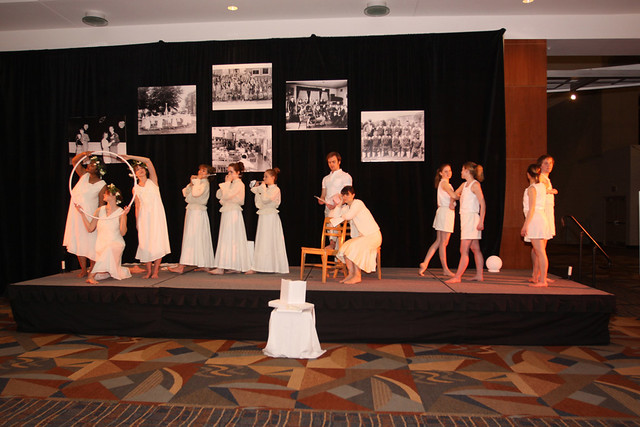
The reticence the normally vivacious Metal-Corbin once felt about her own dance pedigree may have stemmed from the blue-collar work ethic instilled in her as a youth. Growing up in Pittsburgh she toed the line at home and school. Crazy about dance from age 3, her lower middle-class parents — her father was a watchmaker, her mother a homemaker — paid for ballet lessons she attended every weekend. She was serious about dance all right, even forming her own dance studio in the unfinished basement of her family’s home, but a life in the arts seemed unlikely given her background.
“I really didn’t know much about the art world because my family didn’t go to museums or concerts. My dad hunted and fished. We went camping together.”
Then, at about age 12, she was selected to participate in a free youth arts program at the Carnegie Institute of Pittsburgh (now known as the Carnegie Museums), an experience she describes as “life-changing.”
“I got this fabulous opportunity there in the Tam O’Shanters (after the Robert Burns poem) program. I attended drawing classes every Saturday through my senior year in high school. This was part of a life I had never seen before. I had no other link to this world. It was wonderful,” she said. “I would walk through the Greek columns of the Institute’s architectural hall and go past the dinosaur hall and then into the auditorium where we had our art lesson. I remember seeing my first Henry Moore (sculpture). I was really enriched by the whole atmosphere. It’s what really linked me to art.”
Years later, she choreographed several dances based on Moore sculptures.
After graduating high school in 1963, she attended Slippery Rock, earning a bachelor’s degree in health and physical education in 1967. She was so immersed in her studies the decade’s counterculture movement largely passed her by. “
This is almost a joke in my family, but in the ‘60s, when all the disturbances were going on, I was oblivious to it,” she said. “I was in a small rural town getting my teaching degree and dancing. I was doing my thing and not caught up in the times. I am an obsessive-compulsive person and am extremely focused on whatever I am involved in. So, I was not politically active, I never smoked, I never drank, I was not a feminist. I did what I thought I was supposed to do. Besides, my parents would have killed me. I’ve changed since then.”

Her mind expanded in other ways. College was the first time she was exposed to dance “other than through studio dance teachers,” and it was while at Slippery Rock and later while pursuing her master’s degree in choreography at the University of Pittsburgh, that she first saw world-class dancers.
“Slippery Rock was only an hour-an-a-half away from downtown Pittsburgh and our whole modern dance club would drive down to concerts there,” she said. “We were exposed to artists like Merce Cunningham and Alvin Ailey. I saw Martha Graham at the Pitt studio. Alvin Ailey’s company was the most influential on me because I loved the kind of music he used. I loved the earthiness of the dance. That was such a profound experience that when I first started teaching dance his was the first company I took my classes to see.”
She attended evening master classes at Pitt after teaching P.E. and dance all day in the schools, studying with artists from New York and Wales, choreographing musical productions at the Pittsburgh Playhouse and learning modern, jazz, tap and theater dance. Summers found her serving as a dance counselor at a camp in the Blue Ridge Mountains. “I had a very eclectic background,” she said.
Of all the dance forms, modern most moved her. “When I found modern dance I knew this was really the idiom in which I would focus my choreography,” she said. “Why? I loved the expression of it. Barefooted and of the earth. There was something that just touched me deeply. It was a departure from the classical ballet I had had, which was a good foundation. But I loved that in modern dance you could move to poetry or move to people’s voices. You can do that in ballet now, but this was when the dance forms were somewhat isolated.”
After earning her master’s, she channeled her passion into education. Burned out after teaching three years in the public schools, she moved on to Robert Morris College in 1970, a small private business school, where she taught P.E., coached basketball and founded a dance company. “I really blossomed there and made dance more of a priority,” she said.
In 1980 she came to UNO, where modern dance had a rich history under the direction of Vera Lundahl. With UNO as her base the past 27 years, Metal-Corbin has reached out into the community to work with diverse groups, including Bosnian refugees and black gospel singers. She often works with the Omaha Modern Dance Collective and recently organized a collaborative of area dancers and choreographers to perform works by modern dance pioneer Isadora Duncan.
“I love working with groups in the community that give me and the dancers in the Moving Company new knowledge and new experiences. I love the process. That’s why I enjoy teaching so much. It energizes me.”

Her multimedia works — often combining stills or video — accomodate a diversity of dancers, from kids to elders, in venues ranging from concert halls to such unconventional spaces as the zoo. “I try to make dances appropriate to the people and spaces I am working with. My joy is in seeing people discover dance.”
As ever, she is moving in “new directions” again by performing her own solo work and researching what she calls “vernacular dance.” Always pushing the envelope, she made her New York and international dance debuts — both after age 50 — just in the past decade. She finds choreographing for herself liberating. “I have found a new, natural movement vocabulary for myself. I don’t have to worry about framing the dance on other bodies. It’s been very freeing, because I’m making the dance just for me. When I’m dancing, I feed off the energy of the music and the movement. There’s no pain. It’s a definite natural high.” She said mature modern dancers like herself are finding more acceptance and opportunity as performers: “Those of us in our 50s and 60s still have something to say. We’re making a place for ourselves. We’re putting a different face on what it is to be older.”
One of her recent projects, Kitchen Dancing, is a video dance work capturing dance wherever it may be — in homes, in offices, in stores or on street corners. She views the project as the natural culmination of her efforts the past three decades and considers this “found” dance the new emphasis in her work.
“It is meant to capture the dance of life people do rhythmically, spontaneously in their every day living activities,” she said. “It’s in every dimension of life. Just look around, and you’ll see people dancing. It might just be someone swaying or just moving some body part. People want to move. It’s the joy of expression through dance.”


 Leo Adam Biga's My Inside Stories