
Archive
Archive for the ‘Wrestling’ Category
Houston Alexander, “The Assassin”
August 22, 2010
1 comment
Fighters have always had a certain appeal, whether doing their fighting in the street or in the ring or, since the advent of mixed martial arts events, in the octagon. Houston Alexander of Omaha has pretty much done it all and he’s turned his talent for fisticuffs, combined with his good looks and charisma, into a bit of a run in the Ultimate Fighting Championship, although he ended up losing more than he won. He’s also a radio DJ, graffiti artist, self-styled hip-hop educator, and man-about-town, making him more than the sum of his parts. The following story I did on him for The Reader (www.thereader.com) hit just as he was on his way up, and even though his star has since dimmed, he’s a survivor who knows how to work his image. He and his family didn’t like some of the things in my story, but he also knows that comes with the territory.

DJ Doc Beat Box and Houston on a school Culture Shock Tour
Houston Alexander, “The Assassin“
©by Leo Adam Biga
Originally published in The Reader (www.thereader.com)
Ultimate fighter Houston “The Assassin” Alexander of Omaha is being a good soldier for the photo shoot. Stripping down to his trunks, he poses in the middle of a south downtown street one late summer afternoon. He’s asked to look menacing, hardly a stretch for the chiseled, tattooed, head-shaved graffiti artist-street thug turned Ultimate Fighting Championship contender. He remarks about “those guys looking out those windows” at his half-naked ass, meaning inmates at the Douglas County Correctional Center peering out the razor-wired windows of the facility just down the block. He once peered out those same windows upon this very street.
“I was inside the cage in ‘97. I just got through beating up a cop and they took me down,” he says matter-of-factly. “The cop tried to grab me and I swung back and hit the guy. It was illegal what he was trying to do to me in the first place. He was trying to beat me up. I didn’t get charged for hitting a cop. I got charged for something else. I did like six months.”
It’s not his only run-in with the law. He alludes to “a whole bunch of domestic,” referring to disturbances with a woman that police responded to.
The fact he has a record only seems to add to his street cred as one tough M.F.. His fans don’t seem to mind his indiscretions. Passersby shout out props. “What’s up, Houston Alexander?” a guy calls out from his sedan. Another, on foot, invites him to a suburban sports bar where, the homey says, “they all love you out there.”
Now that Alexander is a certified UFC warrior, he’s handling all the hoopla that goes with it like a man. He seems unfazed by the endorsement deals, sponsorships, personal appearance requests, interviews, blog appraisals and fan frenzy demands coming his way these days.
Increasingly recognized wherever he goes, he eagerly acknowledges the attention with his trademark greeting, “What’s up, brother?” and firm handshake, giving love to grown men and boys whose star-struck expressions gleam with admiration for his fighting prowess. The African-American community particularly embraces him as a home boy made good. A strong, hard-working single father of six who came up an urban legend for his scribbing and street fighting. He’s one of their own and it’s them he’ll most be representing come next fight night.
Barely three months have passed since his furious UFC debut on May 26, when the light heavyweight put an octagon whupping on contender Keith Jardine at UFC 71 in Las Vegas. After getting knocked down in the first 10 seconds, Alexander quickly regrouped. His relentless pressing style backed Jardine against the fence, where he unleashed a flurry of knees, elbows, uppercuts and hooks to score a technical knockout. Now Alexander’s primed for his next step up the sport’s elite ladder.
He and his local coaching-training team led by Mick Doyle and Curlee Alexander, the same men who got him ready for his dismantling of “The Dean of Mean“ Jardine, left for Great Britain on Monday to make final preparations for a September 8 clash with Italian Alessio Sakara on the UFC 75 card at London’s O2 Arena.
Doyle, a native of Ireland, is a former world champion martial arts fighter. His Mick Doyle Mixed Martial Arts Center at 108th and Blondo is the baddest gym around. He’s trained and worked the corner of several world champs. Curlee Alexander, a cousin of Houston’s, is a former NAIA All-America wrestler at UNO and the longtime head wrestling coach at North High School, where he’s produced numerous individual and team state champions.
Houston Alexander when to North, but other than brief forays in wrestling and football, he didn’t really compete in organized sports, unless you count weight lifting and body shaping. He was a two-time Mr. North. There was never enough money or time, he explains. By high school he was already a burgeoning entrepreneur with his art and music. Besides, he said, “I always had responsibilities at home.” But everyone knew he was gifted athletically.
The way Doyle puts it, Alexander’s “a freak” of nature for his rare combo of power and speed. The 205-pounder can bench press more than twice his body weight, yet he’s not muscle bound. He’s remarkably agile and flexible. Alexander came to him a “raw” specimen, but with abundant natural talent and instincts. Alexander knows he has a tendency to resort to street fighting, but Doyle recently reassured him by saying, “Everything we’re showing you sticks because it’s brand new. It’s not really replacing anything that anyone else taught you.” A blank slate.
“He wants to learn,” Doyle said. “He’s very confident, but he’s grounded. It’s a joy to coach someone like him.”
Curlee Alexander, a lifelong boxing devotee, has rarely seen the likes of his cousin, who’s made this old-school grappler a UFC convert. He, too, tells Houston not to change what’s worked, street fighting and all, but to harness it with technique. When Houston came to him eight months ago asking that he condition him, Curlee was dubious. Houston’s work ethic won him over. “He’s certainly determined.” His dismantling of Jardine convinced him he was in the corner of a special athlete.
“It was the most amazing night as far as being a coach I’ve ever had. All the things we had worked on were coming to fruition. He was doing it. He put all this stuff together at that moment. Incredible.”

For his part, The Assassin credits his coaches with getting him to the next level.
“Without Mick and Curlee, there’s no me. I had the raw skills, but they’re fine tuning what I have to turn me into this champ I need to be,” he said. “I love those guys. They’re the real deal. No joke. They know what they’re talking about. I do whatever they tell me to do. There’s no getting away with anything, brother, believe me. But I wouldn’t want to cheat myself anyway.”
With their help, he said, “I’m more technical and all the power and strength I have is programmed a whole different way. More controlled. But don’t get it twisted. If I need to turn it up and go hard in the paint, it can easily change.”
A win Saturday night should put the fighter in the Top 10 and that much closer to what some anticipate will be a world title challenge within a year. Doyle told Alexander as much after an August meeting to breakdown the tape of the Jardine fight. “I told you this would be a two-year process. We’re only three months into this deal and look how much better you’ve gotten. Just think in another year where you’re going to be. You’ll be able to get in the ring with Wanderlei Silva (the legendary Brazilian world champ, late of the PRIDE series, now a UFC star).”
“We understand the window of opportunity on this thing is short,” Doyle said. “We want to get it there.” Asked if Alexander’s age, 35, is part of the urgency, he said, “Maybe some of it. If he gets an injury he’s not going to heal like a 25-year-old. He’s got some years left, but let’s get him the money. He’s got six kids.”
The Sakara-Alexander tussle is key for both fighters. Doyle calls Sakara “a stepping stone” for his fighter, whom he said must “prove the Jardine thing wasn’t a fluke.” He describes it as “a make or break fight” for Sakara, who’s coming off two straight losses at 185 pounds. “He’s gotta win to stay in the UFC. Sakara’s in the way of bigger and better things, so he’s gotta go.”
Cool, suave, laidback, playful. Quick to crack on someone. Alexander’s extreme physicality manifests in the way he grabs your hand or brushes against you or delivers none too gentle love taps or engages in horse play. When he needs to, he can turn off the imp and attend to business. He’s all, ‘Yes, coach…‘Yes, sir,’ with his trainers, putting in hour after hour of roadwork, skipping rope, weight lifting, calisthenics, stretching, grappling, sparring and shadow boxing under their watch.
For months he’s trained three times a day, up to six to eight hours per day, six days a week, devoting full-time to what not long ago was just “a hobby.” He’s disciplined and motivated enough to have transformed his physique and refined his fight style. After years of itinerant club fighting, all without a manager or trainer, only himself to count on, he began formal, supervised training less than a year ago. He worked with Doyle a few weeks before the Jardine clash, which also marked the first time he prepped for a specific foe and followed a nutritional supplement regimen. By all accounts he followed the strategy laid out for him to a tee.
“I have no problem working,” he said. “I’ve been working all my life.”
Doing what needs to be done is how he’s handled himself as an artist, DJ, father, blue collar worker and pro fighter. Whatever’s come down, he’s been man enough to take it, from completing large mural projects to getting custody of his kids to donating a kidney to daughter Elan to breaking a hand in a bout yet toughing the injury out to win. “Most people don’t know I’m fighting with one kidney,” he said. He’s paid the price when he’s screwed up, too, serving time behind bars.
The UFC is all happening fast for Alexander, which is fine for this dynamo. But the thing is, he’s come to this breakthrough at an age when most folks settle into a comfortable rut. No playing it safe or easy for him though. The truth is this opportunity’s been a long time in the making for Alexander, who enjoyed local celebrity status way before the UFC entered his life.
The veteran Omaha hip hop culture scion, variously known as Scrib, FAS/ONE and The Strong Arm, has always rolled with the assurance of a self-made man and standup brother. All the way back to the day when he protected the honor of his siblings and cousins with his heavy fists, first on the mean streets of East St. Louis, Ill., then in north O, where his mother moved he and his two younger siblings after she left their father. Alexander was all of 8 when he became the man of the family.
“I’m the oldest, so I was always expected to be the leader of the whole bunch. See, I’ve fought all my life, and that’s no exaggeration. It was always a situation where I couldn’t walk away, like somebody putting their hands on my girl cousins. I got into a lot of fights because of my brother,” he said. “I don’t interfere with no one’s business, but if you put your hands on my family, then it becomes my business. A lot of people got beat up because of that.”
Respect is more than an Aretha Franklin anthem for him.
“I don’t go around disrespecting people unless they disrespect me. There’s always a line you can’t cross.”
Growing up in a single-parent home, he started hustling early on to help support the family. What began as childhood diversions — fighting and music — became careers. When he wasn’t busting heads on the street, he was rhyming, break dancing, producing and graffiti tagging as a local hip hop “pioneer.” His Midwest Alliance and B-Boys have opened for national acts. He had his own small record label for a time, His scrib work adorns buildings, bridges and railroad box cars in the area. He mostly does murals on commission these days but still goes out on occasion with his crew to scrib structures that just beg to be tagged.
It wasn’t until 2001 he began getting paid to fight, earning $500-$600 a bout. He estimates having more than 200 fights since then, of which he’s only been credited with seven by the UFC, sometimes getting in the ring multiple times per night, on small mixed martial arts cards in Omaha, Lincoln, Sioux City, Des Moines. These take-on-all-comers type of events, held at bars (Bourbon Street), concert venues (Royal Grove), outdoor volleyball courts, casinos, matched him against traditional boxers as well as kickboxers, wrestlers and practitioners of jujitsu and muay thai.
“I fought everybody, man. I fought every type of fighter there is,” he said. “Fat, short, tall. I fought a guy 400 pounds in Des Moines. Picked him up from behind and slammed him on his neck and beat him senseless. I’m a street fighter, man. When you street fight you don’t care what size and what style. It don’t matter.”
There were times he’d MC a rap concert and fight on the same venue. “Dude, it was funny, man, because first people would see me on stage saying, ‘Hey, get your hands in the air,’ and then five hours later I’m kicking somebody’s ass in the ring.”
MMA promoter Chad Mason, who promoted many of Alexander’s pre-UFC matches, confirmed the fighter saw an inordinate amount of action in a short time.
“Sometimes he was doing two-three fights in a night. He’d do ‘em in Des Moines and then turn around two days later and go to Sioux City and fight a couple more times there. So there were times he probably had six fights in a week,” Mason said. “Of course everybody he fought wasn’t top of the line competition, but he was beating Division I college wrestlers, pro boxers, pro kick boxers, guys that had years of experience. They could come out of the woodwork to just try against Houston, and he’d beat ‘em. I mean, he’d knock ‘em out.”
By Alexander’s own reckoning his personal record was fighting and winning five times in one night in Sioux City.
“I was feeling it that night. It was just crazy, man.”
He began fathering kids 15 years ago and now has custody of his three boys and three girls, by three different mothers. Four of the kids are from his ex-wife of 10 years. He, his kids and his hottie of a new girl friend, Elana, share a three-room northwest Omaha apartment until he finds the right house to buy. He has the perfect crib in mind — a three-bedroom brick house with wood floors.
As a single daddy he has a new appreciation for raising kids. He makes it work amid his training and other commitments with some old-fashioned parenting.

“My kids have structure. It’s all military style. We have to do everything together. We all have breakfast together. We all sit down at the table together for dinner. It can’t work any other way,” he said.
Between school and extracurricular activities, he said, “I try to keep them as active as I can.” He helps coach his boys club football team, the Gladiators. One girl’s in ballet, another in basketball. “I’m always moving, so they’re always moving.”
He vows his children, ranging in age from 15 to 4, are his prime motivation for making this fight thing pay off.
“I want to win to secure a financial future for my kids’ college education. Again it always goes back to the kids.”
To makes ends meet he worked on highway construction crews for nearly 10 years. Until the UFC discovered him, he was perhaps best known locally for his radio career, first at Hot 94.1 and now at Power 106.9, where he does everything from sales to promotions to engineering to hosting his own independent music show on Sunday nights.
He’s also an educator of sorts by virtue of his long-running School Culture Shock Tour that finds him presenting the history of hip hop to students.
Whatever it takes to put food on the table, he does. “I’m a hustler, man. This is true. That’s why I have Corn Hustler on my forearms,” he said, brandishing his massive, graffiti-inked limbs. “That’s a street term. I stay busy. I have always kept busy.”
He strives to be “well-rounded” and therefore “I’m always in that mode to where I’m doing something to better myself.”
Always looking for fresh angles, a pro sports career is right up his alley with its marketing possibilities and mix of athletics and entertainment. Besides catching on like wildfire, the sport is a crowd-pleasing showcase for men wishing to turn their cut bodies, mixed martial arts skills, macho facades, charismatic personalities and catchy names into national, even international, brands. Having built to this moment for years, he leaves little doubt he’s ready to take advantage of it, confident he will neither lose himself if he succeeds nor crash should he fail.
“I give myself five or six years, maybe more than that if I keep training and don’t get hurt. (Randy) Couture is 43 and he fought a younger guy and whupped his ass. If it doesn’t work out with the UFC, who cares? I was never a UFC fan anyway.”
Would he ever return to those $500 paydays in Sioux City? “Yeah, in a hearbeat. Why not? I love fighting, man. That’s the whole thing — I love fighting.”
What is it ultimately about fighting that’s such a turn on?
“I think it’s the rush,” he said. “I know have the ability to beat the guy, but it’s still the rush of not knowing. You’re out there to prove to this guy that you know how to whip his ass. You think Jardine had remotely in his mind he was going to get done like that? I don’t think so. But I knew. Because I know deep down in my heart what type of abilities I have.”
As he says, the UFC was never really his goal until promoter and friend Chad Mason hooked him up with fight manager Monty Cox. What little Alexander’s seen of the competition out there doesn’t impress him. No high octane attacks like his.
“I never really watched the UFC. When I started watching it all I saw was this assembly line of guys. I really haven’t seen anyone come with it or bring it. Maybe the guys they bring in are not as passionate about it as I am. I really love fighting. When I get in the ring I love doing it, so I’m going to bring it to the guy 110 percent. If a guy’s trying to slack off on me and he wants to me wear me down, nu-uh, we’re going to pick up the pace a little bit and we’re going to go at it.
“If you want to try to wrestle and do all that, OK, that’s fine, but you’re going to get kneed and you’re going to get elbowed and you’re going to get disrupted.”
Disruption could be his alter ego name inside the octagon. It’s a mantra for what he tries to do to opponents. “Always disrupt, man, always disrupt,” he said. “To where they can’t think, because if you can’t think, you can’t react. That’s been my concept through the years,”
He said a quick review of the Jardine fight will reveal “I had hands in his face all the time. I was so close to him to where he couldn’t use those long arms, and I kept applying the pressure. Like my coaches said, ‘Always apply the pressure,’ and that’s what I did with that guy. I kept him disrupted.”
Alexander puts much stock in his “explosiveness.” “Once a guy tries to attack me,” he said, “my counter moves are so swift and fast and powerful, that definitely we’ll take the guy out. They’re all in short bursts.”
Doyle doesn’t even want Alexander thinking about leaving his feet. He wants him to dispatch Sakara on Saturday night the same way he did Jardine — standing straight up, his trunk and feet forming a triangle base, throwing blunt force trauma blows with knees, elbows and fists. Back in July Doyle told his fighter, “Just like in the Jardine fight, you don’t need to go to the ground. We’re going to knock the guy out or make the referee stop it. That will get you a title quicker. He’s gotta go.”
“That’s our motto for 2007 — he’s gotta go. He’s in the way. The Italian guy has got to go. Chow, baby,” Alexander said of Sakara. “I really want to go in and knock this guy out or really do something bad to him. I want people to be scared when they look at the footage. I want to show them what I’ve got.”
In his soft Irish brogue Doyle explained to his fighter how keeping an element of mystery is a good thing.
“Dude, if you go out there and knock this guy out, people are still going to wonder, What else can Alexander do? You know what, let them try to find out. If we can finish this guy on our feet, let’s do it. You don’t need to show people any more of your game than what is necessary to get the job done — until you come up with an opponent who makes you show more,” he said. “Keep it simple.”
Doyle, a Dublin native who came to America in ‘86, has tried to prepare Alexander for any technical tricks opponents might try to spring on him. He’s had him go toe-to-toe with athletes skilled in boxing, wrestling, kicking, you name it, bringing in top sparring partners from places like Chicago and sending him to Minneapolis to work with world-class submission artists good enough to make him tap out.
The fighter will have seen everything that can be thrown at him by fight night.
“They’ll get that move on you one time, and that’ll be the last time,” Doyle told Alexander. “That way when you step in the ring, and a guy goes to make his moves, you’ll feel ‘em coming, you’ll see ‘em coming, you’ll know what to do.”
Doyle and his team have spent much time honing Alexander’s footwork and stance, making sure his weight is balanced. It’s all done to harness his natural power, which becomes “more dangerous” when leveraged from below. The uppercuts that devastated Jardine were practiced repeatedly. The force behind those vicious shots, Doyle reminded him, comes from “using your legs,” which is why he harps on Alexander to maintain the foundation of a solid base.
To improve his quickness, Alexander often spars with lighter, faster guys and wears heavy gloves, so that when fight time arrives his hands and feet move like lightning.
The gameplan with Sakara is to pepper him with double jabs, then push off or slide step in to follow up with an arsenal of kill shots. For all his bravado and bull-rush style, Alexander is all about “protecting myself,” which is why a point of emphasis for the Sakara fight has been to keep his hands up against this classical boxer.
“As long as you keep your hands up you’re not going to get hurt,” Doyle said after an August sparring session. “None of the guys out there are just like that much better than you. But if you give them a mistake, they are more experienced and more technical to capitalize on it than you are right now. In a year, it’s all going to be different. Just like this guy Sakara, we’re going to make him give us a mistake.”
Sakara’s habit of keeping his hands low is one Alexander expects to exploit.

One thing Alexander said he’ll never be is intimidated.
“It’s important to inject fear. Everyone gets scared of the way a guy looks. I truly believe that half these people get scared by looking at the guy in the ring. I think Jardine beat a lot of people by the way he looked,” he said. Not that it was ever a possibility in his own mind, but Alexander said Jardine lost whatever edge he might have had when he heard him give an interview and out came a voice that didn’t match the Mr. Mean persona. “There’s no way I’m going to get my butt kicked by a guy that sounds like Michael Jackson,” he said.
Jardine’s comments leading up to the fight led Alexander and his camp to believe the veteran UFC fighter took the newcomer lightly. Alexander warns future foes not to make the same mistake.
“If anybody approaches me the same way to where they’re not taking me serious, that’s what’s going to happen. Every time. I’m going to be passionate about it. I’m going to be right or die with it. That means I’ll die in the ring before I actually lose. That’s how I feel about winning. Winning is everything, I don’t care what nobody says. If I hadn’t of won…you wouldn’t be talking to me,” he told a reporter.
It’s not hard to imagine Alexander gets an edge, both by the ripped, powerful figure he projects, and the calm demeanor he exudes. His serenity is no act.
“I’m mentally prepared for this thing,” he said. “I’ve always been mentally strong…tough. Make no mistake about it, the mental game I have down. No one’s going to out-mental me. No one’s going to deter me left or right, forward or back, because I have it down. Guys ask me, ‘Are you going to be nervous going out in front of 50,000 people?’ No, because I’ve done it before. I’ve done it with concerts. I’ve hosted concerts with 10,000 people. I do the school thing every week with 700-800 kids. Kids are the worst critics ever. If you can’t get kids’ attention, you’re garbage, and every week I get those kids’ attention. My working in radio, having 30,000 people listening every time I crack that mike, that’s pressure. So for me being in front of a crowd is nothing.”
Like all supreme athletes, Alexander exudes a Zen-like tranquility. His senseis — Mick and Curlee and company — have brought out the samaurai in him. It’s why he’s such “a calm fighter” entering the octagon.
“What it comes down to, you just have to play it out all the way and see where the chips fall,” Alexander said. “Everything happens for a reason. It is what it is.”
Related Articles
- UFC cuts The Dean of Mean (theglobeandmail.com)
- The Ten Greatest Upsets in MMA History (bleacherreport.com)
- Five Fighters Who Failed to Live Up to the Hype (bleacherreport.com)
- Inside The Undercard! UFC on Versus Live – Jones vs. Matyushenko (fighters.com)
- Alexander-Irvin Rematch Ticketed for Shark Fights 14 (evilmasterreport.com)
Categories: African-American Culture, Athletics, Boxing, Houston Alexander, North Omaha, Pop culture, Sports, Wrestling, Writing
African-American Culture, Athletics, Houston Alexander, Mick Doyle, Mixed Martial Arts, North Omaha Nebraska, Pop Culture, Sports, Ultimate Fighting, Ultimate Fighting Championship
Don Benning: Man of Steel (from my Omaha Black Sports Legends series, Out to Win: The Roots of Greatness)
July 17, 2010
5 comments
This is another installment from the series I wrote about Omaha’s Black Sports Legends. That series, Out to Win: The Roots of Greatness, appeared in The Reader (www.thereader.com) in 2004-2005. The subject of this article is Don Benning, who like Marion Hudson, broke barriers left and right. Most of his groundbreaking accomplishments came at Omaha University, now known as the University of Nebraska at Omaha, where he was head wrestling coach, an assistant football coach, and a professor. To find out more about Benning’s time as UNO wrestling coach read my story, UNO Wrestling Dynasty Built on a Tide of Social Change, on this same blog site. You can also find the complete Out to Win series on this blog.
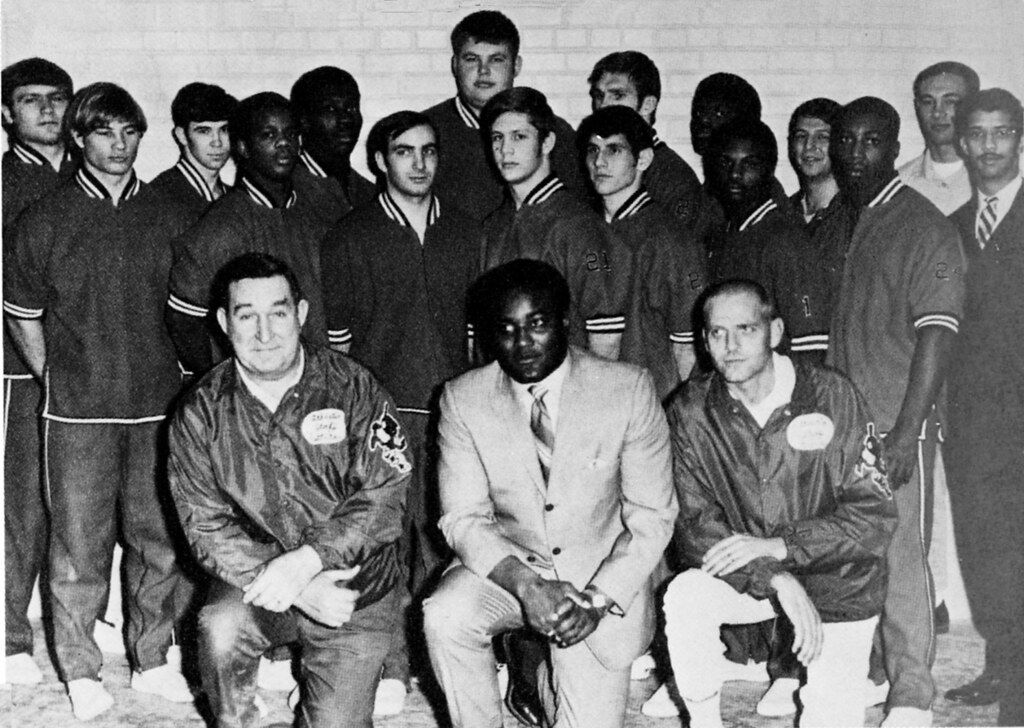
Don Benning: Man of Steel (from my Omaha Black Sports Legends series, Out to Win: The Roots of Greatness)
©by Leo Adam Biga
Originally published in The Reader (www.thereader.com) as part of my Omaha Black Sports Legends series, Out to Win: The Roots of Greatness)
Wrestling is a proving ground. In an ultimate test of will and endurance, the wrestler first battles himself and then his opponent until one is left standing with arms raised overhead in victory. In a life filled with mettle-testing experiences both inside and outside athletics, Don Benning has made the sport he became identified with a personal metaphor for grappling with the challenges a proud, strong black man like himself faces in a racially intolerant society.
A multi-sport athlete at North High School and then-Omaha University (now UNO), the inscrutable Benning brought the same confidence and discipline he displayed as a competitor on the mat and the field to his short but legendary coaching tenure at UNO and he’s applied those same qualities to his 42-year education career, most of it spent with the Omaha Public Schools. Along the way, this man of iron and integrity, who at 68 is as solid as his bedrock principles, made history.
At UNO, he forged new ground as America’s first black head coach of a major team sport at a mostly white university. He guided his 1969-70 squad to a national NAIA team championship, perhaps the first major team title won by a Nebraska college or university. His indomitable will led a diverse mix of student-athletes to success while his strong character steered them, in the face of racism, to a higher ground.
When, in 1963, UNO president Milo Bail gave the 26-year-old Benning, then a graduate fellow, the chance to he took the reins over the school’s fledgling wrestling program, the rookie coach knew full well he would be closely watched.
“Because of the uniqueness of the situation and the circumstances,” he said, “I knew if I failed I was not going to be judged by being Don Benning, it was going to be because I was African-American.”
Besides serving as head wrestling coach and as an assistant football staffer, he was hired as the school’s first full-time black faculty member, which in itself was enough to shake the rafters at the staid institution.
“Those old stereotypes were out there — Why give African-Americans a chance when they don’t really have the ability to achieve in higher education? I was very aware those pressures were on me,” he said, “and given those challenges I could not perform in an average manner — I had to perform at the highest level to pass all the scrutiny I would be having in a very visible situation.”
Benning’s life prepared him for proving himself and dealing with adversity.
“The fact of the matter is,” he said, “minorities have more difficult roads to travel to achieve the American Dream than the majority in our society. We’ve never experienced a level playing field. It’s always been crooked, up hill, down hill. To progress forward and to reach one’s best you have to know what the barriers or pitfalls are and how to navigate them. That adds to the difficulty of reaping the full benefits of our society but the absolute key is recognizing that and saying, ‘I’m not going to allow that to deter me from getting where I want to get.’ That was already a motivating factor for me from the day I got the job. I knew good enough wasn’t good enough — that I had to be better.”
Shortly after assuming his UNO posts his Pullman Porter father and domestic worker mother died only weeks apart. He dealt with those losses with his usual stoicism. As he likes to say, “Adversity makes you stronger.”
Toughing it out and never giving an inch has been a way of life for Benning since growing up the youngest of five siblings in the poor, working-class 16th and Fort Street area. He said, “Being the only black family in a predominantly white northeast Omaha neighborhood — where kids said nigger this or that or the other — it translated into a lot of fights, and I used to do that daily. In most cases we were friends…but if you said THAT word, well, that just meant we gotta fight.”
Don Benning

Despite their scant formal education, he said his parents taught him “some valuable lessons scholars aren’t able to teach.” Times were hard. Money and possessions, scarce. Then, as Benning began to shine in the classroom and on the field (he starred in football, wrestling and baseball), he saw a way out of the ghetto. Between his work at Kellom Community Center, where he later coached, and his growing academic-athletic success, Benning blossomed.
“It got me more involved, it expanded my horizons and it made me realize there were other things I wanted,” he said.
But even after earning high grades and all-city athletic honors, he still found doors closed to him. In grade school, a teacher informed him the color of his skin was enough to deny him a service club award for academic achievement. Despite his athletic prowess Nebraska and other major colleges spurned him.
At UNO, where he was an oft-injured football player and unbeaten senior wrestler, he languished on the scrubs until “knocking the snot” out of a star gridder in practice, prompting a belated promotion to the varsity. For a road game versus New Mexico A&M he and two black mates had to stay in a blighted area of El Paso, Texas — due to segregation laws in host Las Cruces, NM — while the rest of the squad stayed in plush El Paso quarters. Terming the incident “dehumanizing,” an irate Benning said his coaches “didn’t seem to fight on our behalf while we were asked to give everything for the team and the university.”
Upon earning his secondary education degree from UNO in 1958 he was dismayed to find OPS refusing blacks. He was set to leave for Chicago when Bail surprised him with a graduate fellowship (1959 to 1961). After working at the North Branch YMCA from ‘61 to ‘63, he rejoined UNO full-time. Still, he met racism when whites automatically assumed he was a student or manager, rather than a coach, even though his suit-and-tie and no-nonsense manner should have been dead giveaways. It was all part of being black in America.
To those who know the sanguine, seemingly unflappable Benning, it may be hard to believe he ever wrestled with doubts, but he did.
“I really had to have, and I didn’t know if I had it at that particular time, a maturity level to deal with these issues that belied my chronological age.”
Before being named UNO’s head coach, he’d only been a youth coach and grad assistant. Plus, he felt the enormous symbolic weight attending the historic spot he found himself in.
“You have to understand in the early 1960s, when I was first in these positions, there wasn’t a push nationally for diversity or participation in society,” he said. “The push for change came in 1964 with the Civil Rights Act, when organizations were forced to look at things differently. As conservative a community as Omaha was and still is it made my hiring more unusual. I was on the fast track…
“On the academic side or the athletic side, the bottom line was I had to get the job done. I was walking in water that hadn’t been walked in before. I could not afford not to be successful. Being black and young, there was tremendous pressure…not to mention the fact I needed to win.”
Win his teams did. In eight seasons at the helm Benning’s UNO wrestling teams compiled an 87-24-4 dual mark, including a dominating 55-3-2 record his last four years. Competing at the NAIA level, UNO won one national team title and finished second twice and third once, crowning several individual national champions. But what really set UNO apart is that it more than held its own with bigger schools, once even routing the University of Iowa in its own tournament. Soon, the Indians, as UNO was nicknamed, became known as such a tough draw that big-name programs avoided matching them, less they get embarrassed by the small school.
The real story behind the wrestling dynasty Benning built is that he did it amid the 1960s social revolution and despite meager resources on campus and hostile receptions away from home. Benning used the bad training facilities at UNO and the booing his teams got on the road as motivational points.
His diverse teams reflected the times in that they were comprised, like the ranks of Vietnam War draftees, of poor white, black and Hispanic kids. Most of the white athletes, like Bernie Hospodka, had little or no contact with blacks before joining the squad. The African-American athletes, empowered by the Black Power movement, educated their white teammates to inequality. Along the way, things happened — such as slights and slurs directed at Benning and his black athletes, including a dummy of UNO wrestler Mel Washington hung in effigy in North Carolina — that forged a common bond among this disparate group of men committed to making diversity work in the pressure-cooker arena of competition.
“We went through a lot of difficult times and into a lot of hostile environments together and Don was the perfect guy for the situation,” said Hospodka, the 1970 NAIA titlist at 190 pounds. “He was always controlled, always dignified, always right, but he always got his point across. He’s the most mentally tough person you’d ever want to meet. He’s one of a kind. We’re all grateful we got to wrestle for Don. He pushed us very hard. He made us all better. We would go to war with him anytime.”
Brothers Roy and Mel Washington, winners of five individual national titles, said Benning was a demanding “disciplinarian” whom, Mel said, “made champions not only on the mat but out there in the public eye, too. He was more than a coach, he was a role model, a brother, a father figure.” Curlee Alexander, 115-pound NAIA titlist in 1969 and a wildly successful Omaha prep wrestling coach, said the more naysayers “expected Don to fail, the more determined he was to excel. By his look, you could just tell he meant business. He had that kind of presence about him.”
Away from the mat, the white and black athletes may have gone their separate ways but where wrestling was concerned they were brothers rallying around their perceived identity as outcasts from the poor little school with the black coach.
“It’s tough enough to develop a team to such a high skill level that they win a national championship if you have no other factors in the equation,” Benning said, “but if you have in the equation prejudice and discrimination that you and the team have to face then that makes it even more difficult. But those things turned into a rallying point for the team.
“The white and black athletes came to understand they had more commonalities than differences. It was a sociological lesson for everyone. The key was how to get the athletes to share a common vision and goal. We were able to do that. The athletes that wrestled for me are still friends today. They learned about relationships and what the real important values are in life.”
His wrestlers still have the highest regard for him and what they shared.
“I don’t think I could have done what I did with anyone else,” Hospodka said. “Because of the things we went through together I’m convinced I’m a better human being. There’s a bond there I will never forget.” Mel Washington said, “I can’t tell you how much this man has done for me. I call him the legend.” The late Roy Washington, who changed his name to Dhafir Muhammad, said, “I still call coach for advice.” Alexander credits Benning with keeping him in school and inspiring his own coaching/teaching path.
After establishing himself as a leader Benning was courted by big-time schools to head their wrestling and football programs. Instead, he left the profession in 1971, at age 34, to pursue an educational administration career. Why leave coaching so young? Family and service. At the time he and wife Marcidene had begun a family — today they are parents to five grown children and two grandkids — and when coaching duties caused him to miss a daughter’s birthday, he began having second thoughts about the 24/7 grind athletics demands.
Besides, he said, he was driven to address “the inequities that existed in the school system. I thought I could make a difference in changing policies and perhaps making things better for all students, specifically minority students. My ultimate goal was to be superintendent.”

Working to affect change from within, Benning feels he “changed attitudes” by showing how “excellence could be achieved through diversity.” During his OPS tenure, he operated, just like at Omaha University, “in a fish bowl.” Making his situation precarious was the fact he straddled two worlds — the majority culture that viewed him variously as a token or a threat and the minority culture that saw him as a beacon of hope.
But even among the black community, Benning said, there was a militant segment that distrusted one of their own working for The Man.
“You really weren’t looked upon too kindly if you were viewed as part of the system,” he said. “On the other side of it, working in an overwhelmingly majority white situation presented its own particular set of challenges.”
What got him through it all was his own core faith in himself. “Evidently, some people would say I’m a confident individual. A few might say I’m arrogant. I would say I’m highly confident. I can’t overemphasize the fact you have to have a strong belief in self and you also have to realize that a lot of times a leader has to stand alone. There are issues and problems that set him or her apart from the crowd and you can’t hide from it. You either handle it or you fail and you’re out.”
Benning handled it with such aplomb that he: brought UNO to national prominence, laying the foundation for its four-decade run of excellence on the mat; became a distinguished assistant professor; and built an impressive resume as an OPS administrator, first as assistant principal at Central High School, then as director of the Department of Human-Community Relations and finally as assistant superintendent.
During his 26-year OPS career he spearheaded Omaha’s smooth desegregation plan, formed the nationally recognized Adopt-a-School business partnership and advocated for greater racial equity within the schools through such initiatives as the Minority Intern Program and the Pacesetter Academy, an after school program for at-risk kids. Driving him was the responsibility he felt to himself, and by extension, fellow blacks, to maximize his and others’ abilities.

“I had a vision and a mission for myself and I set about developing a plan so I could reach my goal, and that was basically to be the best I could be. As a coach and educator what I have really enjoyed is helping people grow and reach their potential to be the best they can be. That’s my goal, that’s my mission, and I try to hold to it.”
His OPS career ended prematurely when, in 1997, he retired after being snubbed for the district’s superintendency and being asked by current schools CEO John Mackiel to reapply for the assistant superintendent’s post he’d held since 1979. Benning called it “an affront” to his exemplary record and longtime service.
About his decision to leave OPS, he said, “I could have continued as assistant superintendent, but I chose not to because who I am and what I am is not negotiable.” A critic of neighborhood schools, he did not bend on a practice he deems detrimental to the quality of education for minorities. “I compromised on a lot of things but not on those issues. The thing I’ve tried not to do, and I don’t think I have, is negotiate away my integrity, my beliefs, my values.”
Sticking to his guns has exacted a toll. “I’ve battled against the odds all my life to achieve the successes I have and there’s been some huge prices to pay for those successes.”

Curlee Alexander
His unwavering stances have sometimes made him an unpopular figure. His staunch loyalty to his hometown has meant turning down offers to coach and run school districts elsewhere. His refusal to undermine his principles has found him traveling a hard, bitter, lonely road, but it’s a path whose direction is true to his heart.
“I found out long ago there were things I would do that didn’t please every one and in those types of experiences I had to kind of stand alone or submit. I developed a strong inner being where I somewhat turned inward for strength. I kind of said to myself, I just want to do what I know to be right and if people don’t like it, well, that’s the way it is. I was ready to deal with the consequences. That’s the personality I developed from a very young age.”
Those who’ve worked with Benning see a man of character and conviction. Former OPS superintendent Norbert Schuerman described him as “proud, determined, disciplined, opinionated, committed, confident, political,” adding, “Don kept himself very well informed on major issues and because he was not bashful in expressing his views, he was very helpful in sensitizing others to race relations. His integrity and his standing in the community helped minimize possible major conflicts.”
OPS Program Director Kenneth Butts said, “He’s a very principled man. He’s very demanding. He’s very much about doing what is right rather than what is politically expedient. He cares. He’s all about equity and folks being treated fairly.”
After the flap with OPS Benning left the job on his own terms rather than play the stooge, saying, “The Omaha Public Schools situation was a major disappointment to me…To use a boxing analogy, it staggered me, but it didn’t knock me down and it didn’t knock me out. Having been an athlete and a coach and won and lost a whole lot in my life I would be hypocritical if I let disappointment in life defeat me and to change who I am. I quickly moved on.”
Indeed, the same year he left OPS he joined the faculty at the University of Nebraska-Lincoln, where he is coordinator of urban education and senior lecturer in educational administration in its Teachers College. In his current position he helps prepare a new generation of educators to deal with the needs of an ever more diverse school and community population.
Even with the progress he’s seen blacks make, he’s acutely aware of how far America has to go in healing its racial divide.
“This still isn’t a color-blind society. I don’t say that bitterly — that’s just a fact of life. But until we resolve the race issue, it will not allow us to be the best we can be as individuals and as a country,” he said.
As his own trailblazing cross-cultural path has proven, the American ideal of epluribus unum — “out of many, one” — can be realized. He’s shown the way.
“As far as being a pioneer, I never set out to be a part of history. I feel very privileged and honored having accomplished things no one else had accomplished. So, I can’t help but feel that maybe I’ve made a difference in some people’s lives and helped foster inclusiveness in our society rather than exclusiveness. Hopefully, I haven’t given up the notion I still can be a positive force in trying to make things better.”
Related Articles
- Coaching diversity slowly rising at FBS schools (thegrio.com)
- University regents approve Nebraska-Omaha’s D-I move (sports.espn.go.com)
- UNO Wrestling Dynasty Built on a Tide of Social Change (leoadambiga.wordpress.com)
Categories: African-American Culture, Athletics, Don Benning, Education, History, Omaha, Omaha Black Sports Legends, Out to Win: The Roots of Greatness (a series), Race, Social Justice, Sports, Wrestling, Writing
African-American Culture, Athletics, Black Sports Legends, Don Benning, Education, Nebraska Black Sports Hall of Fame, Omaha, Race, Social Justice, University of Nebraska at Omaha, UNO wrestling, Wrestling
Redemption, A Boys Town Grad Tyrice Ellebb Finds His Way
July 6, 2010
5 comments

Image via Wikipedia
When I met Tyrice Ellebb about a decade ago he was a young man who had turned his life around in a dramatic way through the aid of many caring individuals and institutions, including Boys Town, but he was also reeling from leaving the powerhouse University of Nebraska at Omaha wrestling program, where he achieved much. He had personal matters to attend to that in his mind at least took precedence over collegiate athletics, even though he was a key cog for a team poised to win a national title. He was also a very good football player. He felt bad about the way things worked out but as my story makes clear the people you may have thought he most disappointed were still in his corner. I lost contact with Tryice after the story but I understand he did get things together in his life and I know he’s excelled at indoor professional football. This story originally appeared in the Omaha Weekly, a paper that is no more, and I offer it here as another example of the kind of sports writing I like to do.
Redemption, A Boys Town Grad Finds His Way
©by Leo Adam Biga
Originally appeared in the Omaha Weekly
As the No.1-ranked UNO wrestling team enters the stretch-run in its national championship hunt, the man who should be holding down the heavyweight spot for the Mavericks is no where to be seen. Senior Tyrice Ellebb, projected as a strong title contender, left the team this winter after the latest in a series of personal crises sent him reeling. A sweet, soft-spoken goliath who loves to dance, Ellebb was at his best when he bounced around the mat to the beat of whatever song was in his head. Sadly, he has had his last dance in a UNO uniform.
At only 23, the massive Ellebb (he stands 6’3 and his weight hovers around 300 pounds) has weathered a topsy-turvy life that’s found him both on the side of the angels and the devils. Growing up on Chicago’s south side, he ran with the notorious Gangster Disciples. Looking to escape his hometown’s mean streets, he followed four uncles to the former Boys Town, where he won election as mayor. While he flourished in the nurturing Boys Town setting and, later, in the family-like UNO wrestling program, he also made some bad choices along the way, including fathering three children — all out of wedlock. Still, he applied himself in high school and developed into a standout football player and wrestler — winning two state heavyweight championships (pinning all his opponents as a senior).
Possessing great size, agility and quickness, he was courted by Nebraska and Kansas State as a walk-on gridiron prospect. When he did not qualify academically he signed with Iowa Central Community College, where he twice garnered junior college All-America honors and earned an associate’s degree. At UNO he fought homesickness, endured the death of a dear aunt and worked with teammates and coaches in managing his complicated life. Although an acknowledged leader on and off the mat, Ellebb’s frequent missed practices and late arrivals were distractions. Allowances were made, but it never seemed enough. “We demand a lot here in our program and it was hard for him to get all that together. We tried to be flexible and to give him some leeway, but you can only do so much,” UNO Head Coach Mike Denney said.

Mike Denney
Despite the distractions, Ellebb proved a force to be reckoned with by winning the North Central Conference heavyweight crown and finishing a solid fourth at last year’s NCAA Division II tournament. Heading into this season he was seen as the linchpin of a dominant UNO squad tabbed as odds-on favorites for the team title. After working so hard and overcoming so much, this was going to be his year. Then, last December, it all came crashing down around him and his dreams of glory vanished. His story can be seen as both an object lesson in overcoming the odds and a cautionary tale of taking on too much-too soon.
To understand just how far he came, one must understand that for the longest time this product of a broken home appeared headed for prison or a violent death — the fate of several friends he hung out with as a youth. Even though his mother, Sharon, was a security officer, she almost found out too late his gangbanging was threatening to destroy him the way it already had one of her brothers. There were street fights, drug dealings, gunshots, threats and reprisals. Through it all, Ellebb avoided incarceration, completed school and remained close to his family.
“I was letting the streets get to me. You always had to worry about looking behind your back. Somebody always wanted to take you out because they wanted your name. It’s just crazy. It got to the point where in my head I felt I needed to kill somebody if people bothered me,” he said.
It took the senseless death of a family friend who was like a favorite uncle for him to rethink the gangster life. “Two rival gangs were involved in something stupid and a gun went off and it instantly killed him. That kind of tore me up real bad. That made me understand I didn’t need to be involved in gangs anymore. I needed to get away before they beat me or before I wouldn’t see my next birthday.”
When his mother found out she was losing him to the streets she promptly saw him off on the next train to Boys Town, where other wayward men in the family had found refuge. “I listened to her and I’m glad I made that choice to come here. I accomplished a lot at Boys Town,” he said. There, he came under the influence of teacher-coach Don Bader, who said, “Tyrice had a lot of issues. He needed a lot of work. But he got on the right track. He’s a great kid.” These days, when Ellebb visits his old stomping grounds in Chicago, he finds little changed. “My friends are still doing the same thing. The only thing different is everyone is older. When I go back there I’m like, ‘God, I’m glad I left there.’ I couldn’t picture myself being that way now. When I tell people, ‘I used to be a thug,’ they say, ‘I couldn’t see you that way.’ And I go, ‘Yeah, I know, I changed. I made myself change.’” UNO’s Denney said despite the baggage Ellebb carries, “he has a lot of good in him.”
Prior to his latest troubles Ellebb’s commitment to wrestling waned at various times, but he always rededicated himself. With the birth of his third child last year, however, his passion lagged. Soon, he fell behind in his classes and was declared academically ineligible the first semester. The only action he saw offered a vivid display of his inner turmoil when, for the only time in his wrestling career, he was disqualified after throwing a punch at an opponent who earlier elbowed him.
According to Ellebb, “When that happened, I said to myself, ‘I can’t do this right now. I need to get my head together.’ Coach Denney told me to work through it. He chose for me not to wrestle the following weekend, but sitting out didn’t help. A lot of stuff was going wrong then. It just started piling up so fast.” The final straw was when his beloved grandmother, Anne, who helped raise him, was stricken with cancer. “She’s the backbone of our family. She keeps us together. She’s the only person I can talk to. She’s the one who makes me keep striving to do right. When I found out about my grandmother being sick, it was more than I could handle.”
Overwhelmed, he retreated into a cocoon. “I was struggling with myself. I just stayed away from everyone. I wasn’t talking to anyone. I felt I was going to have a nervous breakdown.” Finally, on December 15, he left Omaha for Chicago to be with his family. His departure caused him to miss some final exams, resulting in two incompletes. By re-enrolling this semester as a full-time student, he unwittingly used up any remaining eligibility. No matter, Ellebb had already decided he could not continue wrestling. “I felt (quitting) this was probably the best thing for me and for the team because I couldn’t wrestle to my potential if my head and heart wasn’t in it,” he said. His decision has caused him anguish. “I hate that I’m not part of the team now and not out there trying to help them win the national championship. If things didn’t fall out like they did and if I didn’t make my load as heavy it was, I’d probably still be part of it.” Perhaps his biggest regret is abandoning the team without formally giving his coaches or teammates an explanation. “They deserve to hear something,” he acknowledges.
During Ellebb’s tailspin Coach Denney said he tried contacting him but could not reach him. “I made attempts to find out what was happening. I even tried to contact some of the people he hangs with, but I could tell he was drifting away from us. I could sense as early as last summer he was struggling again and I tried to be really positive with him. But we just didn’t seem to be able to create enough positive power to hold him. The negative forces just kind of overwhelmed him.”
In gauging how much Ellebb’s absence hurts, Denney said, “Certainly, we miss him. We miss what he could have contributed. We were counting on him. The Lord blessed him with a lot of talent. We went from a senior who, in my mind, was the frontrunner to win a national championship to a redshirt freshman, (Lance Tolstedt). Losing all the experience Tyrice had and all the work and time we put into him is a huge impact on our team.”
To a man, Ellebb’s former teammates say they feel no bitterness. Instead, there is frustration and empathy. For 125-pounder Mack LaRock, Ellebb’s departure “was a big disappointment because we know how much stronger he made our team, but we also realize all the different problems and situations he has in life. He did let us down, but I can’t say I wouldn’t have done the same thing if I was in his shoes. There’s no really hard feelings. Tyrice made his bed and he has to lie in it now.”
Perhaps the most disappointing thing to those who care about Ellebb is that so much effort went into his athletic success that stopping short now seems a waste. Then there is the fact wrestling provided a sometimes uncertain young man a structure and stability he often could not find elsewhere. “Being part of our team gave him a positive force that could really help him, but when he’s away from that he gets into these other forces that aren’t so positive,” Denney said.
As for himself, Ellebb looks forward to making amends with his former UNO comrades and taking care of business with his family. “I have all my priorities in order now and the main ones are being a part of my children’s lives and finishing school. People tell me I’m a good person. I’m just trying to find that person in me and to do what I’m supposed to be doing in life.”
Related Articles
- Revoked scholarships surprise college athletes (thegrio.com)
- Sherwood Ross: Big-Time College Football Depriving Athletes of an Education (grantlawrence.blogspot.com)
- UNO Wrestling Dynasty Built on a Tide of Social Change (leoadambiga.wordpress.com)
When We Were Kings, A Vintage Pro Wrestling Story
June 4, 2010
9 comments

Image by The Library of Congress via Flickr
All right, enough with the boxing stories for now. Keeping with the martial arts theme, however, try this pro wrestling story on for size. Growing up, my brothers and I religiously watched the televised pro wrestling matches from our living room’s ringside seats in front of the old Zenith. Omaha pro wrestling cards had the usual lineup of villains and heroes and their cheap theatrics. We loved the bravado and silliness of it all, right down to the animated pitch man hawking elixirs between matches. About 10 years ago I finally caught up with a few of the wrestling stars I used to gawk at on TV, including villain extraordinaire Maurice “Mad Dog” Vachon, for the following story I did for the now defunct Omaha Weekly. I had great fun working on this piece, which I think comes out in the writing.

Maurice “Mad Dog” Vachon giving an opponent the business
When We Were Kings, A Vintage Pro Wrestling Story
©by Leo Adam Biga
Originally published in the Omaha Weekly
“Like with any performer, we fed off the crowd and they fed off us. There’s nothing more difficult than wrestling in front of empty bleachers. But if it’s packed, it’s easy. The people do the work for you. They either love you or hate you,” said former profesional wrestling king Maurice Vachon, better known by his stage name — Mad Dog.
There was a time when Mad Dog and his old cohorts inside the ring lorded over the pro wrestling world.
For decades Omaha was a wrestling hotbed where matchmakers Max Clayton and Joe Dusek annually staged dozens of live cards featuring stars with monikers like Butcher, Bruiser, Crusher, Killer. Omaha produced wrestling greats of its own in The Baron, Dr. X, The Dirty Duseks, Iron Mike DiBiase and Jumpin’ Joe Scarpello. Rabid fans came out in droves. Locally televised All-Star Wrestling matches further stoked the fire of fans for upcoming arena bouts. It was a simple, grassroots thing. Then it all changed, and a way of wrestling passed with it.
Combining the comic mayhem of Jackie Chan, the pop flamboyance of Little Richard and the dynamic derring-do of the Flying Wallendas, pro wrestling today rules as the new Greatest Show on Earth. Long an over-the-top attraction, it has in recent years assumed a whole new theatricality courtesy of the World Wrestling Federation and its flashy costumes, inflated muscles, martial arts moves, elaborate sets, suggestive routines and intricate storylines. Depending on who you talk to, it is either a vulgar spectacle or a colorful romp. However you feel, there is no denying it is plugged into this era’s in-excess culture. “Sports and entertainment have become more extreme products. Like it or not, that’s the way it is. And the WWF has embraced and perfected that,” said lifelong wrestling fan Ray Whebbe, Jr. of Minneapolis, MN, where he is a veteran wrestling promoter, manager and agent.
Extreme has not always been part of the scene, however. Before the WWF became The Bomb, pro wrestling operated via regional promoters whose old school product, while wilder and woollier than its amateur counterpart, remained far tamer than today’s heavily scripted showpieces. Wrestlers of yesteryear were showmen too, just not cartoon action figures. Bouts were calculated for dramatic effect, just not off the charts crazy. In short, it was a lot of corn, just not borderline porn. It was a grittier, less-adorned brand of action in which the primal physical challenge of the ring, pitting heroes and villains in classic good versus evil duels, took center stage. Strip away the pay-per-view hype and that is still the essence of this popular sport-entertainment hybrid.
Whebbe, who admires the contributions made by wrestlers from the past, agrees the sport used to be “a lot less contrived and a lot more reality-based,” but adds, “it was also a lot more boring. There were fewer charismatic performers.” For fans like him, the Golden Age of pro wrestling is passe. Old time wrestlers, meanwhile, consider today’s new age product a travesty and dismiss it as coarse, brazen, rude, artificial. They rue the decline of their halcyon days, when they commanded huge, enthusiastic crowds with a mix of good old fashioned hand-to-hand combat and theater. These legends remind us they too were once wrestling kings.
Maurice “Mad Dog” Vachon was the prince of villains in the old American Wrestling Association (AWA), a Midwest federation run by Vachon’s main ring rival — clean cut Mr. Good Guy Verne Gagne. The man who made the sleeper hold famous, Gagne was among the few wrestlers of his era to cash-in as both a performer and an entrepreneur. After a stellar amateur career in his native Canada, including competing on the Canadian national team as a 174-pound freestyle wrestler in the 1948 Olympics, Vachon wrestled pro from 1951 to 1986. His early years in the business were a struggle. Before becoming Mad Dog, he had no real niche, no catchy nickname, no signature hold to establish himself. He was just another rough guy leading a gypsy-like existence from one bout to the next.
His breakthrough came during a stint on the Pacific Northwest circuit when a Portland, Ore. promoter suggested the short but stocky Vachon do a makeover emphasizing his fierce, dark looks. The plan was for him to act the bit of “a wild man from Algeria.” The promoter added, “And you better do something loud, otherwise you’re going to be hard to put over.” Vachon took the advice to heart.
“I knew I had to do something different, so five minutes before my first match I got the idea of attacking my opponent before the bell sounded. I was supposed to be this wild Algerian and I wanted to show the image I was trying to project. As soon as my opponent showed up I jumped on him and gave him a couple of body slams and then threw him out of the ring. The referee came over and I did the same to him. Then I dropped down out of the ring and gave them both a body slam on the floor. A police officer showed up and I threw him in the third row. Everybody thought I was crazy. The referee disqualified me and I got fined and suspended for two weeks,” said Vachon, a gentle, cultured man away from the mat.
“When I got back to the dressing room the promoter said, ‘You look just like a mad dog.’ And I said, ‘You know what? That sounds good.’ There’d never been a wrestler with the name Mad Dog and I took advantage of it. I would have been crazy not to. Plus, it fit my image. I had quite a few teeth missing, complements of my opponents, which made me look like I had fangs. My (guttural) voice was courtesy of injuries to my vocal chords and larynx. And I was born with hair on my chest. So, I looked like the Mad Dog, and when I was in the ring I acted like one.”
As part of his transformation Vachon perfected the snarling bad guy routine, complete with mean catch phrases (“It’s a dog eat dog world”) and dastardly maneuvers (like the pile driver). His publicity photos captured him straining to break free of chains wrapped round his hairy torso. One thing Vachon did not have to act was being tough. He grew up fighting in a Montreal ghetto. Before going pro he worked as a nightclub bouncer and punched-out more than his share of challengers. He said during his pro career he often had to prove himself off the mat, as his rep followed him wherever he went — like a gunslinger.
“I had to live it inside the ring and outside the ring. It was hard, but I was prepared for it. I could really wrestle. I had a lot of dog in me. Believe me. I had to do it. I had to do it for real. I had to be the Mad Dog to survive.”
For Omaha native Jim Raschke, a former collegiate wrestler and school teacher, the conversion from his normally mild-mannered self into the fearsome Baron Von Raschke, applicator of the dreaded Claw hold, was life-changing. “I started out life as a very shy, introverted person and when I became the Baron it kind of opened up doors for me. I could be what I wanted to be. Even if it was obnoxious, it was better than what I was. I enjoyed that part of it — letting my alter ego go,” said Raschke, who typically ended interviews with his enigmatic “That’s all the people need to know” declaration. His career floundered until he teamed up with Mad Dog, who convinced the imposing Raschke to discard his vanilla persona for the imperious Baron.

Baron Von Raschke
The tag team pair first made a splash in Quebec, where fans had never seen anything like them before. According to Raschke the two did not set out to be bad guys — it just worked out that way. “We walked out to the ring and the crowd started hissing and booing. It was just because of our physical appearance — a big ugly guy and a little ugly guy. It wasn’t anything we’d done. Neither of us had appeared in that area for awhile. Well, when they reacted that way we just reacted back and by the end of that first night we were made as villains. Our reputation spread throughout the province. We just went with it.”
Raschke said what helped keep the grind of wrestling fresh for him was the excitement generated by the fans and, in turn, playing to them. “The more excited they got, the more excited you got. That’s where a lot of the energy came from. It was the crowd’s response that determined what we did. It was always changing. That was part of the fun of it. You were always improvising.”
Raucous crowds worked into a frenzy are a hallmark of pro wrestling. Vachon recalls being spat on, punched and hit by beer bottles from overzealous fans. George Murphy, a former broadcaster who worked as ring announcer and timekeeper at Omaha Civic Auditorium matches, said of the fans, “They were passionate. They would throw things, they would stomp their feet, they would shout profanities, they would choose sides. Fans came there to get involved. I think that’s part of it. We had regulars, too. There was an older lady who sat in the same spot every week. She cursed and banged a beat-up umbrella on the floor. She wanted a piece of those wrestlers for some reason.” Verne Gagne recalls Omaha fans as generally knowledgeable — “they appreciated the wrestling side of it, not just the hammering” — which is not to say the town didn’t have its nuts too. Once, a crazed fan scaled the chain-link fence around the ring to enter the fray: “Jerry Blackwell, a mountain of a man, was waiting for his match to start one night when a little fella from the audience jumped over the fence and came after him,” Murphy said. “Wrong thing to do. Blackwell just grabbed him by the hair and punched him in the face. The police tried grabbing the guy by the legs to pull him out and Blackwell just kept hitting him. It took six police to put the guy out.”
The mayhem was not always confined to fans and performers. Murphy said he sometimes became an unwitting part of the act. “I never worked from a script. Whatever happened, happened. Once we had a Battle Royal where Mad Dog threw his opponent over the top rope and, as the ring announcer, I said, ‘Mad Dog Vachon is out of the match,’ and he hauled off and hit me right in the jaw. He was the only wrestler who ever hit him, and he was a friend. I didn’t know it was going to happen. If I did, I would have nixed it right away. Another time, The Crazy Polock carried one of his mother’s homemade sausages in the ring and shoved it in my mouth. I could either choke on it or eat it, so I ate it.” Then there was the time Murphy was prepping for a TV interview with wrestler Chris Markoff. “I said to him, ‘I’m going to say the way you won that match was terrible, Then I want you to get upset with me.’ He said, ‘Okay, George, I do that.’ So, we’re doing the interview and I begin, ‘Chris, the way you won that match was terrible…’ and he gave me a shove and I sailed about 15 feet. The director said, ‘Cut, we’re going to do it again,’ and I said, ‘No, we’re not.’”
Gimmicks, Vachon said, have always been part of pro wrestling, which traces its roots back to when carnivals still featured “freaks.” One tent invariably housed a ring inside which a burly, well-trained grappler took on locals sufficiently goaded by a barker to test their manhood. When this sideshow curiosity turned legitimate arena attraction it pitted genuine combatants in competitive matches long on technique but short on action. A few wrestlers, like Ed “Strangler” Lewis, became celebrities with their colorful nicknames, mysterious holds and exotic alter egos. Wrestling, once sanctioned by state sports authorities, began operating without restraints when it dropped all pretense of being real. Midgets, females, tag teams, cage matches and tantrums were added to the mix. The arrival of TV only loosened the reins more on wrestling, which embraced the medium with an over-the-top style that made instant stars of some performers. As Vachon said, “If you wanted to make it, you had to know how to talk when the mike was turned on.”
Among the most image-conscious performers then was Gorgeous George, who rose to stardom on the strength of his pretty boy image, complete with coiffured hair, flowing robe, vanity mirror and valet. “He was 40 years ahead of his time,” Vachon said. Indeed, many wrestlers in the ‘50s and ‘60s anticipated the personalities seen today. “It’s all been done before,” Whebbe said. “It’s just done differently now — a little more dramatically and with a little more depth of character.”
The men calling the shots behind the scenes then were a disparate band of independent promoters whose territories formed a loose circuit nationwide. Ruling their territories like czars, the promoters directed everything — from marketing campaigns to payouts to schedules. There were no standards for things like performance fees, although the general rule was each wrestler got paid based on the size of the gate. “Everybody had a reputation,” Vachon said. “Some were good, honest pay off men and some were crooks. The promoters paid you what they wanted. If they didn’t pay you right, you didn’t wrestle for them again. It was to their advantage that you were an attraction and that they treated you right.”
Still, wrestlers had little recourse or protection. They had no labor agreement, no arbitration board, no insurance. They still don’t. Vachon said he and his brother Paul (who wrestled as The Butcher) once led a bid to organize the ranks, but got no where due to fear of reprisals. “We called a meeting in Chicago and maybe only a dozen wrestlers showed up. The others were scared to death. They were afraid for their jobs. The promoters told them if they came they would never wrestle for them again. They wanted nothing to do with it. We tried, but it didn’t work out.”
Nebraska was considered “a hot territory” and its main promoter from 1957 until the late ‘70s-early ‘80s, the late Joe Dusek, enjoyed stature as one of the best payoff men in the business. Joanne Dusek, who kept books for her father, said, “People didn’t have to have a contract with him. If he told you something, you’d shake on it and that’s the way it was going to be.” Verne Gagne said, “Joe Dusek was one of the most honest guys I ever met. It was a delight always to work with him.” Jim Raschke said Dusek brought “the top stars of the time” here: “They would make more money in one night here than they would the rest of the week.”
During wrestling’s peak in Omaha, Joanne Dusek said her father held as many as 30 shows a year at the auditorium. Most, she said, were near sell-outs. “For those Saturday night shows we averaged 8,000 to 9,000 people, which for a town the size of Omaha was great. I think we had as many as 11,000 there once.” Crowds filled even bigger arenas in other cities, with overflow fans watching matches on closed circuit TV. In the summers before the Omaha auditorium was air conditioned, outdoor shows commenced at Rosenblatt Stadium. In two of the most famous matches wrestled there Verne Gagne won the AWA heavyweight title from Edouard Carpentier and beat the mysterious masked Dr. X, whose mask was removed to reveal he was none other than Dr. Bill Miller of Omaha. Then there was the stadium show that a heavy rainstorm halted only to see the entire program moved to the auditorium thanks to the foresight of its late manager, Charlie Mancuso, who had rigged the arena for wrestling in the event of just such an occurrence. “Everybody marched from the stadium down to the auditorium. We held up the show until they got there. And, by golly, they all went. It was really something,” Joanne said.

Verne Gagne
Besides Nebraska, Joe Dusek also handled parts of Iowa, Kansas and South Dakota. Before turning promoter he wrestled professionally with three of his brothers (Rudy, Ernie, Emil). Billed as the Dirty Duseks for their unruly demeanor in the ring, they often performed together — forming a wrestling dynasty. Joanne said the Duseks first hit it big on the east coast, where all four were often on the same card, and later “drew big crowds in Omaha” too.
The Duseks, said Vachon, “were legends.” As a boy, he saw two of his idols perform during their prime. “Ernie and Emil were the first tag team ever to come to the Montreal Forum. They came with their brush cuts and big cauliflower ears and stubby hands. They looked like the dirty, rowdy Duseks. When things went wrong in the ring they started fighting each other. It was no act, believe me.” The ornery brothers grew up on the banks of the Missouri River south of downtown Omaha. Their father was a commercial fisherman and employed his boys in hauling huge catches of catfish and carp. The oldest brother, Rudy, was the first and probably the best wrestler of the bunch. A former YMCA champ, he came under the tutelage of the renowned wrestler Farmer Burns. “Rudy built a ring on the river bank and Farmer Burns would bring his pupils down there. He’d lecture and Rudy would demonstrate the holds,” Joanne said.
Rudy turned pro in 1922, Joe followed him in 1932. Ernie and Emil came later. The Duseks long association with pro wrestling spanned most of its evolution in America. Rudy was the epitome of “scientific wrestling,” which emphasized technique over showmanship. “Back in those days everything was very scientific,” Joanne said. “They didn’t move around and have all the action like they did later. They might get a hold and lay on the mat for several minutes. I’m told one of Rudy’s matches lasted five hours.” As wrestling morphed into more of a no-holds-barred show, the brothers adapted with it and played their feisty, roughhouse roles to a tee.
Veteran Omaha sportscaster Joe Patrick, who worked with Joe Dusek on local wrestling telecasts and promotions, said, “You know, Joe swore there was nothing fake about it. He would always say, ‘This is all legit.’” As if to prove the point, Patrick said, Dusek once “invited anyone from the crowd to come up in the ring and wrestle one of the guys. A big kid who’d been a pretty tough college wrestler came up one night and the pro he wrestled almost crippled him. Afterwards, Joe said, ‘Well, the guy wanted to show the audience he could handle some of these pros but it didn’t turn out that way.’ Dusek was a throwback to the original tough guy. He used to say, ‘I’m one tough Bohonk,’ and, boy, he was.” But there was a kind side to the man, too. Patrick has fond memories of fishing with him. Jim Raschke recalls how Dusek “would pamper wrestlers. He’d sometimes drive us in his car to the next match. He’d feed us on the way up and on the way back. He was a big rugged guy but he was a real teddy bear of a man. A real sweetheart.”
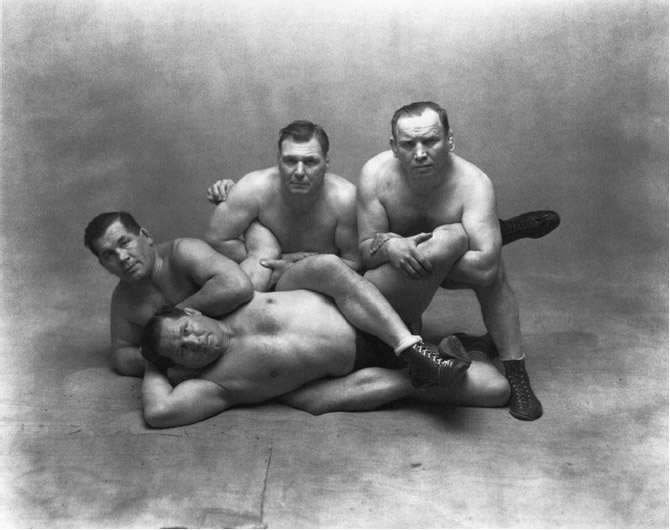
The Duseks
Long after wrestling became a TV staple, the industry remained defensive whenever someone questioned its authenticity. In an infamous incident, ABC reporter John Stossel got rudely cuffed on the ear when he challenged wrestler David Schults with, “It’s all fake, isn’t it?” According to Whebbe, “At the time, David Schults did the right thing. He protected the business. It was pounded in people’s heads — you’ve got to protect the business.” Then, a funny thing happened. The old promoters were pushed aside in the mid to late 1980s by aggressive upstarts like Vince McMahon, Jr., who ignored the territorial fiefdoms to raid talent pools, buy TV time and exploit wrestling for all its dramatic worth. As the industry became a franchise, it started “letting people in on the joke.” Whebbe explained, “It’s an unusual business practice when you’re trying to trick the fans into believing you’re something you’re not. Everybody knows it’s fake — to a certain extent. It’s a pre-rehearsed match. In the end, the business bloomed a lot more when nobody worried about protecting the business and instead just sold the damn show.”
Asked what Joe Dusek would make of today’s product, Whebbe said, “He would be repulsed by it.” Joanne confirmed as much. Vachon and Raschke dislike what they see too. Vachon said, “It’s garbage. Indecent.” In Raschke’s view, “It’s gotten to be one of the lower forms of entertainment. It’s not wholesome. They should expurgate the name wrestling from what they do now because they do very little of what even looks like wrestling in those productions. I don’t have much respect for the business anymore.” In Gagne’s opinion, “There are hardly any real wrestlers in wrestling anymore. It’s just showbiz. Glitz.” However they feel now, Vachon and Raschke have participated in WWF events honoring their legends status.
More than the presentation of wrestling has changed, though. The whole way the business operates today is bigger, louder, more extreme than before. As Joe Patrick said, “It was a whole different atmosphere then.” Indeed, where today’s top wrestlers travel first class as part of huge entourages, the old time stars usually drove themselves by car. Vachon said, “We were on our own. We provided our own transportation. Always by car. For over 20 years I probably traveled 100,000 miles a year by car. People talk about how tough professional wrestling is. Never mind that. The traveling alone would kill the average human.” As Raschke said, “It was grueling all the time. We traveled every day.” Both men averaged 250 to 300 matches a year, forcing extended separations from their families. Vachon, who is married to his third wife, saw his first two marriages end in divorce. And where star wrestlers today may have agents, managers, handlers and personal trainers, old timers did it all themselves. “Everybody was a free agent,” Vachon said, adding the difficulties of that life had him “close to quitting” many times.
TV made celebrities of some wrestlers, but most languished in obscurity. “Mad Dog and I were among the lucky ones,” Raschke said. “We made a good living, but it wasn’t a fabulous living. We weren’t living the lifestyle of a rock star or anything like that. I’m sure it’s the same way today as it was then. There’s a handful of stars or featured wrestlers making the majority of the money and the rest are hanging on and probably not even making a living at it. In our time, there were a lot of part-timers. They were never going to make it. They just liked being around it.”
Despite hardships, including myriad injuries that still bother them, the old time wrestling kings cherish their glory days. They would not change a thing. “It was a wonderful life. I got to see the world. It was my ticket to freedom,” said Vachon, whose wrestling career took him to many far-off places (Japan, Europe, South America, Alaska) he dreamed of traveling to as a starry-eyed boy collecting stamps. “If I had to do it all over again, I would.” For Raschke, too, “it was a great experience that can never be duplicated. I met a lot of great people from all over the world. It was just fun.” By the end of their careers these two arch-villains became beloved figures, which they remain today. They are recognized wherever they go. Vachon, an icon in Quebec, enjoys the attention. “I’ve met so many nice people all over the world who tell me they grew up watching me wrestle.” For a wrestling king, the adulation never grows old. “We didn’t really do it for the money, you know. We did it for the applause,” said Vachon.
Related Articles
- Pro Wrestling Overload: Are We Being Hit With Too Much Wreslting? (bleacherreport.com)
- Pro Wrestling: How It Has Survived Over 100 Years (bleacherreport.com)
- The Fabulous Freebirds: The Greatest Tag Team In Pro Wrestling History (bleacherreport.com)
- The Diary of a Pro Wrestling Fan (Ch. 1): Getting Interested in Pro Wrestling (bleacherreport.com)
- Event to Honor Pro Wrestling Legend Boris Malenko (your-story.org)
Categories: Athletics, Celebrity, Entertainment, Mad Dog Vachon, Omaha, Personalities-Characters, Pop culture, Sports, Wrestling, Writing
American Wrestling Association, Dusek Brothers, Entertainment, Mad Dog Vachon, Omaha, Pop Culture, Professional wrestling, Verne Gagne, World Wrestling Entertainment, Wrestling
University of Nebraska at Omaha Wrestling dynasty built on tide of social change
April 30, 2010
6 comments
Don Benning, center front row, with his magnificent wrestling team
THE LATEST: Requiem for a Dynasty will be the headline, if I get an assignment to write the story that is, for what transpired as expected with the UNO wrestling program. As anticipated and despite the most heartfelt efforts of the program’s coaches, student-athletes, alums, and supporters the NU Board of Regents approved UNO’s proposed move to the Summit League and NCAA Division I competition and with it the elimination of the wrestling and football programs. It’s a sad day for UNO when its administrators can discard history and tradition so easily for the sake of convenience. In this disposable culture two programs were thrown out as if they were useless refuse. Losing football hurts, but the rationale for excising it ultimately makes sense because it was never going to come close to making money. Dumping wrestling though to purportedly be in better alignment with the Summit League is pure hogwash. It’s really UNO and NU leaders saying that they don’t give a rat’s ass about wrestling, that they don’t really care about all the championships, the scores of All-Americans, the prestige, the community service, the lessons learned, the incredibly strong and tight family bond built up across generations. They don’t care that UNO hosted multiple national championships and the largest single day annual wrestling tournament in the country. Why not give a damn about those things universities are there to provide its student-athletes and constituents? My take is that no matter how much UNO wrestling achieved, and it achieved so very much, it was never accorded the respect or due it deserved. Not by the regents, not by administrators, not by major university donors, not by the media, not by the general public. It was always considered marginal and therefore expendable. When things got tight, UNO wrestling was an easy target despite being a dynasty. That sends a disturbing, dysfunctional message to anyone really paying attention.
Getting rid of wrestling was painless for the regents because it was done in the abstract. By the time the UNO wrestling community appeared before them to plead their case that the program be retained, by the time all the appeals and messages had been made via email and phone, the regents had already made up their minds. The March 25 hearing was perfunctory. It was a show to merely let wrestling vent and have its say in an open forum. If the regents had bothered to actually visit the UNO wrestling room and to see first-hand the sweat and blood and tears and love and joy that went into making the dynasty, then the program might have had a fair day in court, so to speak. If the regents had seen for themselves the championship banners and the roll calls of All-Americans and soaked up the atmosphere of excellence imbued in that room, it might have been a different story. Or not. This was a business decision made by UNO and given the thumbs up by the regents. Cold, calculated business. The administrators and the regents simply didn’t get it or didn’t want to get it. They would not be moved by emotion or history. To the end, the UNO wrestling family fought gallantly, never breaking ranks, always showing class, the bonds that hold them together more powerful than any bureaucratic decree, extending beyond the now ended program. UNO wrestling may be gone, but its spirit lives on. The relationships between the men forged in that room and in those duals and tournaments and in all the time spent on the road and cutting weight and hanging out will endure.
NEW UPDATE: With each passing day any window of opportunity for UNO wrestling to be saved grows smaller. Unless something dramatic should happen between now and March 25th, it appears likely then that the NU Board of Regents will approve the plan advanced by University of Nebraska at Omaha Chancellor John Christensen and Athletic Director Trev Alberts for UNO to move to Division I and to drop football and wrestling in the process. As a graduate of UNO, as a former Athletic Department staffer, as a UNO sports fan, and as a writer I have a perspective to offer many don’t. Football certainly has a longer tradition than wrestling at the school, but when it comes to sustained success there’s no comparison. Don’t get me wrong, I will miss UNO football. I variously kept stats at and cheered at probably a hundred home games over the years. Caniglia Field is a great venue to watch a game at and UNO consistently plays at a high standard . UNO football’s been one of the best entertainment bargains in the city. But the sad truth is the program rarely drew well and even if IUNO football came along for the ride to D-I there’s little reason to expect it would draw any better at that level. UNO football has had its share of winning but it’s never won a national title and generally failed in the post-season, on the biggest of stages. UNO wrestling is a whole different story. It has been an elite program for more than 40 years. It’s won multiple national titles, produced scores of All-Americans, and basically been the best D-II program over the past 20 years. No, it’snot a big draw, although by wrestling standards it does quite well, but in terms of national prestige UNO is one of the best things the university has going for it, period. The crazy thing is that the UNO administration makes clear it’s not finances driving the proposed elimination of wrestling and football, which gets at the heart of it: UNO administrators don’t care about the excellence that UNO football and particularly UNO wrestling represents. It’s inconceivable it is prepared to walk away from something so successful, but that is what is about to happen.
Therefore, it seems like a good idea to look back at the wrestling program’s early years in order to gain an appreciation for where it came from and the significance it had at a tempestuous time in the university’s and in the city’s and in the nation’s history. The story of what Don Benning and his wrestlers did to put UNO on the map and to make UNO wrestling a champion is one of the great legacies of the university, and one it has never really embraced or celebrated to the extent it deserves. Sadly, wrestling at the school has always been viewed as marginal and expendable, and the words and actions of the UNO administration today bear that out. So check out the story below — it’s my take on the tide of social change that UNO’s glorious wrestling program is built on. I wrote it early last year for The Reader, as UNO prepared to defend its national title, which it did, and did again this year. It’s sad to think the story may now be the Requiem for a Dynasty.
UPDATE: Trev Alberts has been putting his stamp on the University of Nebraska at Omaha Athletic Department since his from left-field arrival in the job of athletic director two years ago. Chancellor John Christensen hand-picked Alberts to lead a revitalization of UNO athletics and Alberts has surprised many by just how bold his moves have been — from hiring Dean Blais as head hockey coach to getting major donors whose support had waned to ante up big again for capital improvements. And now as the Omaha World-Herald is reporting Alberts and Christensen are about to shake the foundation of the school and the athletic department by moving UNO into Division I competition across the board — pending University of Nebraska Board of Regents approval — by joining the Summit League. The news of going D-I isn’t that big a surprise in and of itself, as UNO has made clear for more than a decade that is where it wanted to go, but what is is UNO doing it so soon and its decision that in order to make it work long-term it must sacrifice the school’s two winningest sports — football and wrestling. Alberts and Christensen say they and others have worked the numbers and the only way UNO can justify the leap into the big-time is by dropping the heavy financial burden of football, whose weight would only increase with the increased scholarships and improved facilities D-I necessitates. Besides, where football is a revenue generator at many schools it is not at UNO and even the prospect of D-I would likely do little for the program’s mass appeal given the shadow of Big Red. But the real shocker is that UNO is prepared to jettison its shining star, wrestling, whose program just captured its eighth national title over the March 11-12 weekend. UNO could choose to go independent in wrestling but the school is opting not to do that, which is odd because it’s perhaps the least financially onerous men’s program in terms of scholarships, equipment, travel, facilities. But more to the point — how do you just dismiss the incredible success that UNO wrestling has achieved? I would hope that UNO finds a way to preserve the wrestling program. For a look at some of its remarkable history, see my story below about how the UNO wrestling dynasty is built on a tide of social change. You can also find on this blog my stories about Don Benning, the coach who began UNO’s wrestling dynasty, and about Trev Alberts, who may go down as the man who took down that same dynasty.
It may be a moot point in the end, but the UNO wrestling program is not going down without a fight. Coaches, student athletes, alums, fans, and boosters gathered at UNO Sunday, March 13 in the wake of the startling announcement that the wrestling program will be disbanded. Coach Mike Denney was seen calmly addressing the gathering and coalescing support. In an interview he gave a local TV sports reporter he pointed out that some schools in the Summit League that UNO has been invited to join do have wrestling programs. Denney asked the question a lot of people are asking: If they can be in that league and keep wrestling, then why can’t we do it? UNO Chancellor John Christensen and Athletic Director Trev Alberts apparently came to this decision without consulting Denney or the UNO wrestling community or UNO student leaders. The two men are undoubtedly acting out of good intentions and in the long term interests of the school but to spring this decision without warning and without giving Denney and his assistant coaches and student-athletes the opportunity to weigh in and argue against it is cruel and ill-advised. I would not be surprised if Don Benning adds his voice to the chorus of disapproval over Christensen’s and Albert’s decision to throw away the history and tradition that UNO wrestling represents.
________________________________________________________________________________
In my view, one of the most underreported stories coming out of Omaha the last 50 years was what Don Benning achieved as a young black man at the University of Nebraska at Omaha. At a time and in a place when blacks were denied opportunity, he was given a chance as an educator and a coach and he made the most of the situation. The following story, a version of which appeared in a March 2010 issue of The Reader (www.thereader.com), charted his accomplishments on the 40th anniversary of making some history that has not gotten the attention it deserves.
One of the pleasures in doing this story was getting to know Don Benning, a man of high character who took me into his confidence. I shall always be grateful.
University of Nebraska at Omaha Wrestling dynasty built on tide of social change
©by Leo Adam Biga
Version of story published in a March 2010 issue of The Reader (www.thereader.com)
As the March 12-13 Division II national wrestling championships get underway at the University of Nebraska at Omaha, it’s good to remember wrestling, not hockey, is the school’s true marquee sport
Host UNO has been a dominant fixture on the D-II wrestling scene for decades. Its No. 1-ranked team is the defending national champs and is expected to finish on top again under Mike Denney, the coach for five of UNO’s six national wrestling titles. The first came 40 years ago amid currents of change.
Every dynasty has a beginning and a narrative. UNO’s is rooted in historic firsts that intersect racial-social-political happenings. The events helped give a school with little going for it much-needed cachet and established a tradition of excellence unbroken now since the mid-1960s.
It all began with then-Omaha University president Milo Bail hiring the school’s first African-American associate professor, Don Benning. The UNO grad had competed in football and wrestling for the OU Indians and was an assistant football coach there when Bail selected him to lead the fledgling wrestling program in 1963. The hire made Benning the first black head coach of a varsity sport (in the modern era) at a predominantly white college or university in America. It was a bold move for a nondescript, white-bread, then-municipal university in a racially divided city not known for progressive stances. It was especially audacious given that Benning was but 26 and had never held a head coaching position before.
Ebony Magazine celebrated the achievement in a March 1964 spread headlined, “Coach Cracks Color Barrier.” Benning had been on the job only a year. By 1970 he led UNO to its first wrestling national title. He developed a powerful program in part by recruiting top black wrestlers. None ever had a black coach before.
Omaha photographer Rudy Smith was a black activist at UNO then. He said what Benning and his wrestlers did “was an extension of the civil rights activity of the ’60s. Don’s team addressed inequality, racism, injustice on the college campus. He recruited people accustomed to challenges and obstacles. They were fearless. Their success was a source of pride because it proved blacks could achieve. It opened the door for other advancements at UNO by blacks. It was a monumental step and milestone in the history of UNO.”
Indeed, a few years after Benning’s arrival, UNO became the site of more black inroads. The first of these saw Marlin Briscoe star at quarterback there, which overturned the myth blacks could not master the cerebral position. Briscoe went on to be the first black starting QB in the NFL. Benning said he played a hand in persuading UNO football coach Al Caniglia to start Briscoe. Benning publicly supported efforts to create a black studies program at UNO at a time when black history and culture were marginalized. The campaign succeeded. UNO established one of the nation’s first departments of Black Studies. It continues today.
Once given his opportunity, Benning capitalized on it. From 1966 to 1971 his racially and ethnically diverse teams went 65-6-4 in duals, developing a reputation for taking on all comers and holding their own. Five of his wrestlers won a combined eight individual national championships. A dozen earned All-America status.
That championship season one of Benning’s two graduate assistant coaches was fellow African-American Curlee Alexander. The Omaha native was a four-time All-American and one-time national champ under Benning. He went on to be one of the winningest wrestling coaches in Nebraska prep history at Tech and North.
Benning’s best wrestlers were working-class kids like he and Alexander had been:
Wendell Hakanson, Omaha Home for Boys graduateRoy and
Mel Washington, black brothers from New York by way of cracker GeorgiaBruce “Mouse” Strauss, a “character” and mensch from back East
Paul and Tony Martinez, Latino south Omaha brothers who saw combat in Vietnam
Louie Rotella Jr., son of a prep wrestling legend and popular Italian bakery family
Gary Kipfmiller, a gentle giant who died young
Bernie Hospokda, Dennis Cozad, Rich Emsick, products of south Omaha’s Eastern European enclaves.
Jordan Smith and Landy Waller, prized black recruits from Iowa
Half the starters were recent high school grads and half nontraditional students in their 20s; some, married with kids. Everyone worked a job.
The team’s multicultural makeup was “pretty unique” then, said Benning. In most cases he said his wrestlers had “never had any meaningful relationships” with people of other races before and yet “they bonded tight as family.” He feels the way his diverse team came together in a time of racial tension deserves analysis. “It’s tough enough to develop to such a high skill level that you win a national championship with no other factors in the equation. But if you have in the equation prejudice and discrimination that you and the team have to face then that makes it even more difficult. But those things turned into a rallying point for the team. The kids came to understand they had more commonalities than differences. It was a social laboratory for life.”
“We were a mixed bag, and from the outside you would think we would have a lot of issues because of cultural differences, but we really didn’t,” said Hospodka, a Czech- American who never knew a black until UNO. “We were a real, real tight group. We had a lot of fun, we played hard, we teased each other. Probably some of it today would be considered inappropriate. But we were so close that we treated each other like brothers. We pushed buttons nobody else better push.”
“We didn’t have no problems. It was a big family,” said Mel Washington, who with his late brother Roy, a black Muslim who changed his name to Dhafir Muhammad, became the most decorated wrestlers in UNO history up to then. “You looked around the wrestling room and you had your Italian, your whites, your blacks, Chicanos, Jew, we all got together. If everybody would have looked at our wrestling team and seen this one big family the world would have been a better place.”
If there was one thing beyond wrestling they shared in common, said Hospodka, it was coming from hardscrabble backgrounds.
“Some of the kids came from situations where you had to be pretty tough to survive,” said Benning, who came up that way himself in a North O neighborhood where his was the only black family.
The Washington brothers were among 11 siblings in a sharecropping tribe that moved to Rochester, N.Y. The pair toughened themselves working the fields, doing odd-jobs and “street wrestling.”
Dhafir was the team’s acknowledged leader. Mel also a standout football lineman, wasn’t far behind. Benning said Dhafir’s teammates would “follow him to the end of the Earth.” “If he said we’re all running a mile, we all ran a mile,” said Hospodka.
Having a strong black man as coach meant the world to Mel and Dhafir. “Something I always wanted to do was wrestle for a black coach. It was about time for me to wrestle for my own race,” said Mel. The brothers had seen the Ebony profile on Benning, whom they regarded as “a living legend” before they ever got to UNO. Hospodka said Benning’s race was never an issue with him or other whites on the team.
Mel and Dhafir set the unrelenting pace in the tiny, cramped wrestling room that Benning sealed to create sauna-like conditions. Practicing in rubber suits disallowed today Hospodka said a thermostat once recorded the temperature inside at 110 degrees and climbing. Guys struggled for air. The intense workouts tested physical and mental toughness. Endurance. Nobody gave an inch. Tempers flared.
Gary Kipfmiller staked out a corner no one dared invade. Except for Benning, then a rock solid 205 pounds, who made the passive Kipfmiller, tipping the scales at 350-plus, a special project. “I rode him unmercifully,” said Benning. “He’d whine like a baby and I’d go, ‘Then do something about i!.” Benning said he sometimes feared that in a fit of anger Kipfmiller would drop all his weight on him and crush him.
Washington and Hospodka went at it with ferocity. Any bad blood was left in the room.
“As we were a team on the mat, off the mat we watched out for each other. Even though we were at each other’s throats on the wrestling mat, whatever happened on the outside, we were there. If somebody needed something, we were there,” said Paul Martinez, who grew up with his brother Tony, the team’s student trainer-manager, in the South O projects. The competition and camaraderie helped heal psychological wounds Paul carried from Vietnam, where he was an Army infantry platoon leader.
An emotional Martinez told Benning at a mini-reunion in January, “You were like a platoon leader for us — you guided us and protected us. Coming from a broken family, I not only looked at you as a coach but as a father.” Benning’s eyes moistened.
Joining them there were other integral members of UNO’s 1970 NAIA championship team, including Washington and Hospodka. The squad capped a perfect 14-0 dual season by winning the tough Rocky Mountain Athletic Conference tournament in Gunnison, Colo. and the nationals in Superior, Wis. It was the first national championship won by a scholarship team at the school and the first in any major sport by a Nebraska college or university.
Another milestone was that Benning became the first black coach to win an integrated national championship in wrestling and one of the first to do so in any sport at any level. He earned NAIA national coach of the year honors in 1969.
University of Washington scholar John C. Walter devotes a chapter to Benning’s historymaker legacy in a soon-to-be-published book, Better Than the Best. Walter said Benning’s “career and situation was a unique one” The mere fact Benning got the opportunity he did, said Walter, “was extraordinary,” not to mention that the mostly white student-athletes he taught and coached accepted him without incident. Somewhere else, he said, things might have been different.
“He was working in a state not known for civil rights, that’s for sure,” said Walter. “But Don was fortunate he was at a place that had a president who acted as a catalyst. It was a most unusual confluence. I think the reason why it happened is the president realized here’s a man with great abilities regardless of the color of his skin, and for me that is profound. UNO was willing to recognize and assist a young black man trying hard to distinguish himself and make a name for his university. That’s very important.”
Walter said it was the coach’s discipline and determination to achieve against all odds that prepared him to succeed.
Benning’s legacy can only be fully appreciated in the context of the time and place in which he and his student-athletes competed. For example, he was set to leave his hometown after being denied a teaching post with the Omaha Public Schools, part of endemic exclusionary practices here that restricted blacks from obtaining certain jobs and living in many neighborhoods. He only stayed when Bail chose him to break the color line, though they never talked about it in those terms.
“It always puzzled me why he did that knowing the climate at the university and in K-12 education and in the community pointed in a different direction. Segregation was a way of life here in Omaha. It took a tremendous amount of intestinal fortitude of doing what’s right, of being ready to step out on that limb when no other schools or institutions would touch African-Americans,” said Benning. He can only surmise Bail “thought that was the right thing to do and that I was the right person to do it.”
In assuming the burden of being the first, Benning took the flak that came with it.
“I flat out couldn’t fail because I would be failing my people. African-American history would show that had I failed it would have set things back. I was very aware of Jackie Robinson and what he endured. That was in my mind a lot. He had to take a lot and not say anything about it. It was no different for me. I had tremendous pressure on me because of being African-American. A lot of things I held to myself.”
Washington said though Benning hid what he had to contend with, some of it was blatant, such as snubs or slights on and off the mat. His white wrestlers recall many instances on the road when they or the team’s white trainer or equipment manager would be addressed as “coach” or be given the bill at a restaurant when it should have been obvious the well-dressed, no-nonsense Benning was in charge.
Hospodka said at restaurants “they just assumed the black guy couldn’t pay. They hesitated to serve us or they ignored us or they hoped we would go away.”
Washington could relate, saying, “I had a feeling what he was going through — the prejudice. They looked down on him. That’s why I put out even more for him because I wanted to see him on top. A lot of people would have said the heck with this, but he’s a man who stood there and took the heat and took it in stride.”
“He did it in a quiet way. He always thought his character and actions would speak for him. He went about his business in a dignified way,” said Hospodka.
UNO wrestlers didn’t escape ugliness. At the 1971 nationals in Boone, N.C., Washington was the object of a hate crime — an effigy hung in the stands. Its intended effect backfired. Said Washington, “That didn’t bother me. You know why? I was used to it. That just made me want to go out there more and really show ’em up.” He did, too.
“We were booed a lot when we were on the road,” Hospodka said. “Don always said that was the highest form of flattery. We thrived on it, it didn’t bother us, we never took it personal, we just went out and did our thing. You might say it (the booing) was because we were beating the snot out of them. I couldn’t help think having a black coach and four or five black wrestlers had something to do with it.”
Hospodka said wherever UNO went the team was a walking social statement. “When you went into a lot of small towns in the ’60s with four or five black wrestlers and a black coach you stuck out. It’s like, Why are these people together?” “There were some places that were awfully uncomfortable, like in the Carolinas,” said Benning. “You know there were places where they’d never seen an African-American.”
At least not a black authority figure with a group of white men answering to him.
The worst scene came at the Naval Academy, where the cold reception UNO got while holed up three days there was nothing compared to the boos, hisses, catcalls and pennies hurled at them during the dual. In a wild display of unsportsmanlike conduct Benning said thousands of Midshipmen left the stands to surround the mat for the crucial final match, which Kipfmiller won by decision to give UNO a tie.
The white wrestling infrastructure also went out of its way to make Benning and his team unwelcome.
“I think there were times when they seeded other wrestlers ahead of our wrestlers, one, because we were good and, two, because they didn’t look at it strictly from a wrestling standpoint, I think there was a little of the good old boy network there to try and make our road as tough as possible,” said Hospodka. “I think race played into that. It was a lot of subtle things. Maybe it wasn’t so subtle. Don probably saw it more because of the bureaucracy he had to deal with.”
“Some individuals weren’t too happy with me being an African-American,” said Benning. “I served on a selection committee that looked at different places to host the national tournament,. UNO hosted it in ’69, which was really very unusual, it broke a barrier, they’d never had a national championship where the host school had an African-American coach. That was pretty strange for them.”
He said the committee chairman exhibited outright disdain for him. Benning believes the ’71 championship site was awarded to Boone rather than Omaha, where the nationals were a big success, as a way to put him in his place. “The committee came up with Appalachian State, which just started wrestling. I swear to this day the only reason that happened was because of me and my team,” he said.
He and his wrestlers believe officials had it in for them. “There was one national tournament where there’s no question we just flat out got cheated,” said Benning. “It was criminal. I’m talking about the difference between winning the whole thing and second.” Refs’ judgements at the ’69 tourney in Omaha cost UNO vital points. “It was really hard to take,” said Benning. UNO had three individual champs to zero for Adams State, but came up short, 98-84. One or two disputed calls swung the balance.
Despite all the obstacles, Benning and his “kids” succeeded in putting UNO on the map. The small, white institution best known for its Bootstrapper program went from obscurity to prominence by making athletics the vehicle for social action. In a decade defined by what Benning termed “a social revolution,” the placid campus was the last place to expect a historic color line being broken.
The UNO program came of age with its dynamic black coach and mixed team when African-American unrest flared into riots across the country, including Omaha. A north side riot occurred that championship season. UNO’s black wrestlers, who could not find accommodations near the UNO campus, lived in the epicenter of the storm. Black Panthers were neighbors. Mel Washington, his brother Dhafir and other teammates watched North 24th St. burn. Though sympathetic to the outrage, they navigated a delicate line to steer clear of trouble but still prove their blackness.
A uniformed police cadet then, Washington said he was threatened once by the Panthers, who called him “a pig” and set off a cherry bomb outside the apartment he shared with his wife and daughter.
“I found those guys and said, ‘Anybody ever do that to my family again, and you or I won’t be living,’ and from then on I didn’t have no more problems. See, not only was I getting it from whites, but from blacks, too.”
Benning, too, found himself walking a tightrope of “too black or not black enough.” After black U.S. Olympians raised gloved fists in protest of the national anthem, UNO’s black wrestlers wanted to follow suit. Benning considered it, but balked. In ’69 Roy Washington converted to Islam. He told Benning his allegiance to Black Muslim leader Honorable Elijah Muhammad superseded any team allegiance. Benning released him from the squad. Roy’s brother Mel earlier rejected the separatist dogma the Black Muslims preached. Their differences caused no riff.
Dhafir (Roy) rejoined the team in December after agreeing to abide by the rules. He won the 150-pound title en route to UNO capturing the team title over Adams, 86-58. Hospodka said Dharfir still expressed his beliefs, but with “no animosity, just pride that black-is-beautiful. Dharfir’s finals opponent, James Tannehill, was a black man married to a white woman. Hospodka said it was all the reason Dharfir needed to tell Tannehill, “God told me to punish you.” He delivered good on his vow.
It was also an era when UNO carried the “West Dodge High” label. Its academic and athletic facilities left much to be desired. “The university didn’t have that many things to feel proud of,” said Benning. Wrestling’s success lifted a campus suffering an inferiority complex to the University of Nebraska-Lincoln. Wrestling was one area where UNO could best NU, whose NCAA wrestling program paled by comparison.
“Coach Benning and his wrestling teams elevated UNO right to the top, shoulder-to-shoulder with its big brother’s football team down the road,” said UNO grad Mary Jochim, part of a wrestling spirit club in 69-’70. “They gave everyone at the school a big boost of pride. The rafters would shake at those matches.”
“You’d have to say it was the coming-together of several factors that brought about a genuine excitement about wrestling at UNO in the late 1960s,” said former UNO Sports Information Director Gary Anderson. He was sports editor of the school paper, The Gateway, that championship season. “There were some outstanding athletes who were enthusiastic and colorful to watch, a very good coach, and UNO won a lot of matches. UNO had the market cornered. Creighton had no team and Nebraska’s team wasn’t as dominant as UNO. It created a perfect storm.”
Benning said, “It was more important we had the best wrestling team in the state than winning the national championship. Everybody took pride in being No. 1.” Anderson said small schools like UNO “could compete more evenly” then with big schools in non-revenue producing sports like wrestling, which weren’t fully funded. He said as UNO “wrestled and defeated ‘name’ schools it added luster to the team’s mystique.
NU was among the NCAA schools UNO beat during Benning’s tenure, along with Wyoming, Arizona, Wisconsin, Kansas and Cornell. UNO tied a strong Navy team at the Naval Academy in what Hospodka called “the most hostile environment I ever wrestled in.” UNO crowned the most champions at the Iowa Invitational, where if team points had been kept UNO would have outdistanced the big school field.
“We didn’t care who you were — if you were Division I or NAIA or NCAA, it just didn’t matter to us,” said Hospodka, who pinned his way to the 190-pound title in 1970. The confidence to go head-to-head with anybody was something Benning looked for in his wrestlers and constantly reinforced.
Said Hospodka,”Don always felt like we could compete against anybody. He knew he had talent in the room. He didn’t think we had to take a back seat to anybody when it came to our abilities. He had a confidence about him that was contagious.”
The sport’s bible, Amateur Wrestling News, proclaimed UNO one of the best teams in the nation, regardless of division. UNO’s five-years of dominance, resulting in one national championship, two runner-up finishes, a third-place finish and an eighth place showing, regularly made the front page of the Omaha World-Herald sports section.
The grapplers also wrestled with an aggression and a flair that made for crowd-pleasing action. Benning said his guys were “exceptional on their feet and exceptional pinners.” It wasn’t unusual for UNO to record four or five falls per dual. Washington said it was UNO’s version of “showtime.” He and his teammates competed against each other for the most stylish or quickest pin.
Hospodka said “the bitter disappointment” of the team title being snatched away in ’69 fueled UNO’s championship run the next season, when UNO won its 14 duals by an average score of 32-6. It works out to taking 8 of every 10 matches. UNO posted three shut outs and allowed single digits in seven other duals. No one scored more than 14 points on them all year. The team won every tournament it competed in.
Everything fell into place. “Nobody at our level came even close to competing with us,” said Hospodka. “The only close match we had was Athletes in Action, and those were all ex-Big 8 wrestlers training for the World Games or the Olympics. They were loaded and we still managed to pull out a victory (19-14).” At nationals, he said, “we never had a doubt. We had a very solid lineup the whole way, everybody was at the top of their game. We wrapped up the title before the finals even started.” Afterwards, Benning told the Gateway, “It was the greatest team effort I have ever been acquainted with and certainly the greatest I’ve ever seen.”
Muhammad won his third individual national title and Hospodka his only one. Five Mavs earned All-America status.
The foundation for it all, Hospodka said, was laid in a wrestling room a fraction the size of today’s UNO practice facility. “I’ve been in bigger living rooms,” he said. But it was the work the team put in there that made the difference. “It was a tough room, and if you could handle the room then matches were a breeze. The easy part of your week was when you got to wrestle somebody else. There were very few people I wrestled that I felt would survive our wrestling room.”
“It was great competition,” said Jordan Smith. “One thing I learned after my first practice was that I was no longer the toughest guy in the room. There were some recruits who came into that room and practiced with us for a few days and we never saw them again. I was part of something that really was special. It was a phenomenal feeling.”
This band of brothers is well represented in the Maverick Wrestling and UNO Halls of Fame. The championship team was inducted by UNO and by the Rocky Mountain Athletic Conference. Benning, Mel Washington, Dhafir Muhammad and Curlee Alexander are in the Nebraska Black Sports Hall of Fame. But when UNO went from NAIA to NCAA Division II in ’73 it seemed the athletic department didn’t value the past. Tony Martinez said he rescued the team’s numerous plaques and trophies from a campus dumpster. Years later he reluctantly returned them to the school, where some can be viewed in the Sapp Fieldhouse lobby.
UNO’s current Hall of Fame coach, Mike Denney, knows the program owes much to what Benning and his wrestlers did. The two go way back.
Benning left coaching in ’71 for an educational administration career with OPS. Mike Palmisano inherited the program for eight years, but it regressed.
When Denney took over in ’79 he said “my thing was to try to find a way to get back to the level Don had them at and carry on the tradition he built.” Denney plans having Benning back as grand marshall for the March of All-Americans at this weekend’s finals. “I have great respect for him.” Benning admires what Denney’s done with the program, which has risen to even greater heights. “He’s done an outstanding job”
As for the old coach, he feels the real testament to what he achieved is how close his diverse team remains. They don’t get together like they once did. When they do, the bonds forged in sweat and blood reduce them to tears. Their ranks are thinned due to death and relocation. They’re fathers and grandfathers now, yet they still have each other’s backs. Benning’s boys still follow his lead. Hospokda said he often asks himself, “What would Don want me to do?”
At a recent reunion Washington told Benning, “I’m telling you now in front of everyone — thank you for bringing the family together.”
Related Articles
- FBI tracked Alabama Crimson tide, Paul ‘Bear’ Bryant, documents show (sports.espn.go.com)
- University regents approve Nebraska-Omaha’s D-I move (sports.espn.go.com)
- Dean Blais Has UNO Hockey Dreaming Big (leoadambiga.wordpress.com)
Categories: African-American Culture, Athletics, Don Benning, History, Race, Social Justice, Sports, UNO (University of Nebraska at Omaha), Wrestling, Writing
African-American Culture, Athletics, Don Benning, History, Nebraska Black Sports Hall of Fame, Race, Social Justice, Sports, UNO (University of Nebraska at Omaha), Wrestling


 Leo Adam Biga's My Inside Stories