Archive
Omaha Performing Arts at 10: Rhapsody
Like any city of any size Omaha’s had all manner of presenting arts organizations, some small, some large, some financially well-endowed, some financially-strapped. There have been organizations with sizable staff and there have been one-man bands. Some have cast a wide net across the performing arts spectrum and others have been more narrowly focused on a particular niche or segment. Most presenters have come and gone, never to be seen or heard from again, and a few disappear for a time, only to resurface again. The following story for Metro Magazine (http://www.spiritofomaha.com/Metro-Magazine/The-Magazine/) is about today’s major Omaha Player in this arena, Omaha Performing Arts, the organization that both books and maintains the two principal performing arts venues in the city, the Holland Performing Arts Center and the Orpheum Theatre. Befitting its well-heeled status, the organization is celebrating 10 years in a big way this fall with an October 16 gala and an October 17 Holland Stages festival. These will be boffo, bring-the-house-down blow-outs that are as much a recognition of the rich programming that enhances the cultural fabric here as they are opportunities for OPA to say thank you to its patrons for the community to return the gratitude for all the great shows that come here on a year-round basis.

Omaha Performing Arts at 10: Rhapsody
Presenting organization serves as steward of major halls and brings Broadway and other world-class shows to town
©by Leo Adam Biga
Appearing in the August-September-October 2015 issue of Metro Magazine (http://www.spiritofomaha.com/Metro-Magazine/The-Magazine/)
What a difference a decade makes.
In that relatively short period the Omaha arts and entertainment scene has blown up thanks to a critical mass of new organizations, venues and events. Together with the treasures already here, this cultural synergy’s transformed Omaha from sleepy flyover spot into dynamic destination place.
Leading the new arrivals is Omaha Performing Arts. The organization books world-class artists at the venerable Orpheum Theater and its state-of-the-art companion, the Holland Performing Arts Center. As the steward of these spaces, OPA’s charged with caring for them and filling their halls with high quality events that appeal to all demographics.
Growing the performing arts scene
Great halls are only truly alive when people inhabit them. OPA schedules year-round offerings that keep its spaces hopping to the tune of 3 million-plus patrons since 2005. All those folks, many from out of town, pump $40 million into the local economy each year.
By bringing the best of performing arts to town, OPA adds to the rich stew of the Blue Barn Theatre, the Rose, the Omaha Community Playhouse, the Great Plains Theatre Conference, the Omaha Symphony, Opera Omaha – all of which are thriving.
OPA president Joan Squires says, “Across the board the arts community has elevated attention and we’re seeing a lot of our colleagues doing well at the same time. So there’s been renewed energy downtown and in our community for people wanting to come to performances and there’s more options to select from than ever before. I do believe we contributed to had a lot to do with that sea change.”
Dick Holland, who with his late wife Mary made the lead gift for the Holland, has no doubt of OPA’s impact. “It’s added enormously to the luster that this is a great city through new events, new opportunities, new shows that bring in a pile of people from out of town.”
That’s on top of popular attractions such as the Old Market, College World Series, Omaha Storm Chasers, Joslyn Art Museum, Durham Museum, Lauritzen Gardens and Henry Doorly Zoo and Aquarium.

Celebrating a decade but looking ahead
OPA board chairman John Gottschalk says the public’s reception to the programming has “vastly” exceeded expectations and quelled any doubts Omaha could sustain two major performing arts centers.
This organization that never rests is pausing long enough this fall to commemorate its boffo first decade run. The October 16 Celebrate 10 Gala will feature Broadway star Kristin Chenoweth in a Holland spectacular. The October 17 Holland Stages will be a free daylong festival highlighted by diverse performing artists at the Holland.
“We’ve had a lot of milestones in a short period of time,” Squires says, “and we really want to use our anniversary to celebrate what everybody has done for the institution and to start looking forward to the next decade. I think it’s something Omaha as a community should really celebrate. It’s an extraordinary story and opportunity for us.”
“For a very young center we’re really advanced in terms of audience, finances, facilities and other ways,” Gottschalk says. “We’re a very healthy arts organization.”
OPA grew out of an initiative Gottschalk, Dick Holland, Walter Scott and others led to renovate the Orpheum and build the Holland. Gottschalk says much effort was made recruiting Squires from the Phoenix Symphony to oversee the Omaha facilities and “she’s done a wonderful job,'” Holland says, “I don’t think we’d have the same success without her. Joan is a perpetual motion machine looking after every single detail you can think of. She’s just plain marvelous.”
Investing in the community
Squires deflects accolades to others.
“The generosity of the donors here has made this possible. We can have all the vision and passion we want but without that support none of this would have happened. Their continued commitment and philanthropy behind all this has been absolutely key.
“The people involved in this organization are highly committed and passionate and that starts with our board of directors. John Gottschalk, who’s been our chairman since inception, certainly Dick Holland, and the entire board have been tremendously committed, generous and great stewards. Their leadership has been everything.”
The public’s done its share, too.
“The response by the Omaha community buying tickets and showing up at performances has been incredible. We can continue to get better and better shows because producers look at our ticket sales and results. Broadway shows come in here and report this is one of the best opening night audiences they have.”
She says the fall anniversary events are “our way to say thank you to everybody who’s a part of this,” adding, “The folks that started this institution made an extraordinary investment and you just have to stand back for a moment and say, ‘Bravo.'”
Getting to this point required a remarkable growth spurt for an organization that began with Squires, an assistant production manager, a desk and a computer in 2002. The Orpheum renovation was underway. The Holland was still in the planning stages. Heritage Services raised more than $100 million in private giving to complete the two projects and to help get OPA up and running.
That level of community buy-in is what attracted Squires to take the job and she continues to be impressed by the ongoing support that feeds her organization and to make enhancements at its venues.
“Omaha is known for the deep roots of its philanthropic community. The leadership behind this project was extraordinary. They were invested in its success.”
Then there’s the fact OPA filled a void left by arts impresarios and presenting organizations no longer around.
“There were no other major presenters in town, so I felt there was an opportunity to bring to the community some of these great art forms and artists that didn’t have a place to perform or anybody to take charge of that. It felt like the puzzle pieces were all here to really make this organization a success. Everybody wanted this to succeed and I felt if we could put this together the right way we really could give Omaha something pretty special.”
She says the support that coalesced around all this “is really about
a commitment to quality of life and making Omaha better for current and future generations.” She adds, “We couldn’t have done this without the partnership of Heritage Services raising the money to get the Holland up and open at the same time we were getting things started here. It’s another key why we were successful from the beginning. That partnership gave us an advantage coming out of the chute.”
Gottschalk says donors made substantial gifts “because they thought it would be good for Omaha and it was, and that’s really been the legacy of the community – we’ve been able to sustain that view – if it’s good for our community, let’s do it.”

The Orpheum renovations have allowed the theater to host the biggest Broadway touring shows (The Lion King, Wicked, Once) whose wildly popular runs make the venue one of America’s best draws. The Holland is home to the Omaha Symphony Orchestra and to a diverse slate of jazz, dance and specials that range from the Omaha Louder Than a Bomb poetry slam to the Hear Nebraska indie music showcase to the Salem Baptist Church holiday concert to Film Streams’ annual Feature event.
The buildings are rich in patron and guest amenities, the latest being the addition of Zinc restaurant just off the Holland courtyard.
Squires spent her first three years putting in place OPA’s infrastructure and branding, including the Ticket Omaha service it operates. She now has a full-time staff of 50 with another 50 part-time staff, plus a volunteer corps of more than 500.
“I’m really delighted with the administrative team here. They are passionate, committed, and talented. They drive so much of this business. We’re lucky to have our volunteer Ambassadors and Presenters. There are hundreds of people involved who are passionate and committed about Omaha Performing Arts.”
With its $18 million operating budget OPA is the state’s largest arts organization. It’s growth, even programmatically, has been gradual.
“You can’t be everything to everybody the day you open the doors,
so you phase it in in stages,” Squires says. “Also by the nature of presenting we’re continuously experimenting in what works or what doesn’t. One of the challenges our very first year is that the Orpheum schedule didn’t allow for much touring Broadway productions. When the symphony moved to the Holland the schedule opened up to allow us to build that Broadway market. That took time and now we’re having tremendous success. This next year is probably going to be our most successful yet. We’re having a wonderful response with subscriptions.”
The mixing and matching OPA does to serve different tastes is always a work in progress but Squires says, “We really have hit our stride in the series we offer. Broadway is one of the biggest draws but we get great responses to our jazz, dance, family and showcase series. New last year was the National Geographic Live Series. The 1200 Club has a following.
“Our mission is to bring in breadth, so we want to really provide a good cross-section to reach lots of segments and to grow audiences.”
The search for new headliners never ends.
“We always have opportunities to bring new shows in but sometimes when they’re touring we may not have availability, so we’re always juggling the schedule. It’s a complex and complicated process to book every year. It’s one of the biggest jigsaw puzzles you can imagine. It takes a lot of coordination to get it all put together.”
More than numbers
She says while OPA depends on earned revenue for 75 percent of its budget, ticket sales are not the only barometer for success.
“For some types of performances, a thousand people is just great because that’s what we expected and budgeted.”
The experience people have is more important than anything.
“My favorite thing is to stand in the back of the theater and to watch a performance both for the quality of what’s happening on the stage and for the response of the audience,” she says. “You do all this work behind the scenes, booking the shows, selling the tickets and raising the money to make that happen and then you get the satisfaction of seeing those performances touch people.
“The arts have that capacity to move people in ways I think nothing else does.”
In addition to the performances it books OPA has a growing education and community engagement mission piece that brings school-age students together with visiting artists and recognizes area youth arts.
“It’s a real important initiative for us,” Squires says. “It’s a chance to reach the community in new ways and have them connect to the arts in ways they may not have a chance to otherwise.”
OPA’s implemented anti-bullying and social justice programs around certain shows and organized master classes with top artists. Its Nebraska High School Theater Awards program is going statewide.
She appreciates how OPA is increasingly seen as an arts leader.
“We’re becoming more and more respected nationally because of the success we’ve had, the quality of the programs and the quality of the buildings. Omaha’s on the map for the kind of work we’re doing.
Artist management companies recognize this is an important tour stop. We’ve been asked to be on some national symposiums and organizations, where we didn’t have that seat at the table in the past.”
Mario Garcia Durham, president and CEO of the Association of Performing Arts Presenters (APAP), says, “Running a large arts program and arts center is extremely challenging. The best nationally recognized arts organizations have the equally daunting tasks of presenting the very best artists available and truly engaging with their respective communities. These endeavors take years of dedicated commitment and experience. Kudos to Omaha Performing Arts and the Holland Performing Arts Center for their well-deserved success.”

A solid foundation and a bright future
Squires says OPA will continue building on what it’s done.
“There’s always more to do and more money to raise. That never stops. We never rest on our laurels. There’s always new opportunities for people to make a difference by giving to our institution. The philanthropic side, we’re always working. Nothing is ever a given.
“For the future we have set up the planned giving Marquee Society. Those gifts will go into a permanent endowment.”
She feels OPA’s proven itself a worthy recipient of planned gifts.
“We had to attract people in large numbers and financially we had to show we’re responsible by meeting our budget numbers every year, which we have done. If people have confidence in the organization then you can start to talk about the future so they can leave legacies that will continue to sustain these programs and facilities. These legacy gifts will ensure the longer term future of this institution.”
“We’ve started down that road and I think it’s going to be well-supported,” Gottschalk says of the endowment.
With a decade under its belt, Squires says OPA is squarely focused now on “where do we go from here, how do we build on our success and how do we continue to evolve and grow to continue to touch the community.”
Gottschalk says, “I think there’s more growth ahead for us in terms of amenities and facilities and programming.”
For event or ticket info, visit http://www.omahaperformingarts.org or http://www.ticketomaha.com.
“The generosity of the donors here has made this possible. We can have all the vision and passion we want but without that support none of this would have happened. Their continued commitment and philanthropy behind all this has been absolutely key.”
“…I felt there was an opportunity to bring to the community some of these great art forms and artists that didn’t have a place to perform or anybody to take charge of that. It felt like the puzzle pieces were all here to really make this organization a success. Everybody wanted this to succeed and I felt if we could put this together the right way we really could give Omaha something pretty special.”
“My favorite thing is to stand in the back of the theater and to watch a performance both for the quality of what’s happening on the stage and for the response of the audience. You do all this work behind the scenes, booking the shows, selling the tickets and raising the money to make that happen and then you get the satisfaction of seeing those performances touch people.”
-Joan Squires
“For a very young center we’re really advanced in terms of audience, finances, facilities and other ways. We’re a very healthy arts organization.“
-John Gottschalk
“It’s added enormously to the luster that this is a great city through new events, new opportunities, new shows that bring in a pile of people from out of town.”
-Dick Holland
NEW BLUE: Blue Barn Theatre putting down new roots
I do not write about theater a lot, but often enough to keep me in the game and I’m always eager to do it because there is nothing else like good live theater, and Omaha has more than its share of solid stage offerings. The Blue Barn Theater is one I’ve written about only from time to time. It is especially fulfilling to write about this well regarded institution again on the occasion of its soon to open new facility. Here is my new piece about the Blue Barn for Metro Magazine (http://www.spiritofomaha.com/Metro-Magazine/The-Magazine/). It looks backwards and forwards. As fate has it, I will soon be writing more on the Blue Barn.
Ironically, I recently did another theater piece for the same magazine a few months ago, only that time on the Omaha Community Playhouse and its 90th anniversary. My opus on the Omaha Community Playhouse is at:
Celebrating 90 years, the Omaha Community Playhouse takes seriously its community theater mission
NEW BLUE: Blue Barn Theatre putting down new roots
©by Leo Adam Biga
In the August-September-October issue of Metro Magazine (http://www.spiritofomaha.com/Metro-Magazine/The-Magazine/)
Edgy material and intimate work have always defined “the Blue Barn way” and now this once nomadic theater finally gets a home of its own but remains committed to staying true to its rebel image.
When the Blue Barn Theatre celebrated 25 years in 2014, it joined the select ranks of Omaha’s longest-lived playmaking companies.
Now BB is putting down serious roots by moving into a new home at 10th and Pacific. A $7 million capital campaign is underwriting the newly constructed building ($5 million) with the imprint of a renowned theater consultant on it. Unusual for a theater this size, funding is to cover a $1 million operating endowment and a $1 million endowment.
Upon opening the 2015-2016 season there, BB will have in place what’s needed for another enduring run.
Stronger through the struggle
The cutting-edge theater’s founders never imagined this. They were fresh out of college diehards from New York City when they launched BB with little more than enthusiasm. Its first two decades saw consistently high quality theater tinged by crisis. The low points included a fire gutting one space, losing the lease on another, a homeless period, serious debt issues and a revolving door of leaders.
Kevin Lawler, now Great Plains Theatre Conference director, began the migration from the State University of New York in Purchase. He recalls building BB’s former Old Market space “on personal credit cards…then watching from across the street as it was destroyed by a giant fire before the first season there was completed.”
BB artistic director Susan Clement-Toberer, who’s led the theater longer than anyone else, feels it’s stronger for the struggles.
“These times when we were in financial stress and maybe made not such smart business decisions really I think strengthened the drive to create Blue Barn-style theater in this town and became a catalyst for needed growth within us. We wouldn’t be where we are now if we hadn’t gone through those tough times.”
Shared approach and consistent mission
BB’s found a niche doing provocative work. Its small but loyal following has stayed true through all the reversals of fortune.
A theater doesn’t survive on passion alone. Clement-Toberer says the BB’s made it by sticking to principles and finally growing up.
“Our mission statement from the beginning has been to produce theater that provokes thought, emotion, action and change. I think the reason we’re in the position we are now of putting down permanent roots is because we have always stayed true to our mission.”
From the start, BB set itself apart as a tight-knit cohort sharing the same ethos. Soon after Lawler’s arrival, SUNY-Purchase classmates Hughston Walkinshaw and Nils Haaland came. Mary Therese Green of Neb. joined this merry band of founders. Clement-Toberer followed.
“The voice of the Blue Barn was born through our training, individual talents, perspectives and passion for our art form,” Clement-Toberer says. “Our coming to Omaha really couldn’t be stopped whether we had one audience member or a hundred. We were kids and we were fired up, and still are, to tell stories.
“I think the play choices in the beginning were very unique and those voices were not being heard in Omaha at the time.”
“The whole endeavor was born of our deep longing to share exceptionally vibrant and surprising stories and to explore life together that way,” Lawler recalls. “When we began we had nothing more than that dream. That passion, free from any other agendas, is a big part of what makes the work at the Blue Barn so special.”
Omaha theater stalwart Jill Anderson is among several local stage artists who found something new there worth following, first as a fan, then as an actress and jill-of-all-trades. She describes how the “singular magic” of the work and “the unfettered, unconventional creativity” transfixed her and still does. “The things that set the Blue Barn apart are the consistent interest in pushing limits, exploring challenging subject matter, aiming really high in terms of talent and production values but keeping things at an intimate level so the audience feels they are a part of the story.”
For most of its history BB thrived aesthetically but lagged when it came to management.
“Artistically we’ve always been strong and we finally built our business side to kind of keep up with our artistic side,” Clement-Toberer says. “We’ve always run the Blue Barn on a shoestring budget. We’ve gone through a lot of different challenges. We’ve been through the ringer.
“But we’ve built from the very beginning the mentality of you don’t have to spend more to do great art and that’s still how the business is run.”
Resources or not, she says, BB’s always been “artistically driven.”
“It’s very unusual in its structure where the board does have say but the artistic director and the work we do is what drives our growth. It’s a very big gift that we’ve been able to retain the core values we began with 26 years ago.”
Along the way, she says, “our voice has matured in a wonderful way,” adding, “It’s still speaking the same language and feeling, just a little more fluently. Sometimes now we do a show more ‘commercially’-based, like 33 Variations. But our process remains intimate and story-driven.” The same with BB’s Our Town production to close last season.

Seeing things through
Relatively few local theater companies have enjoyed its longevity. There were periods when it wasn’t assured of making it another season, much less reaching the quarter-century mark.
“Hughston (Walkinshaw) and I took it over in 2001. Some programming choices that were big and bold ended up not getting underwritten. Then Hughston ended up leaving. I took over leadership fully.”
Looming debt threatened to dim the lights for good.
“I thought, what the hell, the worst thing I can do is close the doors. But I didn’t want the Blue Barn to close on my watch. I was like, ‘Uh-uh, not going to happen.’ It was a grow or go mentality,” Clement-Toberer says. “I think it was my time to run it. I surrounded myself with people i trusted and knew, like Shannon Walenta, my managing director. From 2008 on we started to build it. A fundraiser got us out of debt. From that point on with Shannon as my right-hand woman and the business aesthetic I learned from my father we have steered the Blue Barn to a great artistic and business balance that is fairly equal for the first time.
“I’ve learned to trust my instincts over what anybody else says. Not that I don’t take input but I’ve learned having my own voice is crucial to succeeding and growing. The same with hiring the right people.”
Production manager Amy Reiner and associate artistic director Randall Stevens are other members of her team.
Philanthropist Nancy Mammel says long before joining the BB board “I saw tremendous potential and ongoing growth for the company.” She champions its “dynamic vision” and “track record of excellence” and she feels its repaid “the generous community” support shown it.
Jill Anderson speaks for many in saluting Clement-Toberer.
“Susan has been a great steward of the theater. I think the power of her positive thinking has brought about great things for the Blue Barn. She keeps a strong and steadfast ‘can do’ attitude about the very difficult task of helming the theater. Her persistence is inspiring to me.”
Right place at the right time
There’s wide agreement, too, the theater should prosper at its new site, where it will neighbor with the Durham Museum, House of Loom, the restored Burlington Station, the booming Little Italy district and the coming Omaha Market.
“It’ll be a destination place. I love the area. It’s the perfect place for our home. I couldn’t see it anywhere else,” Clement-Toberer says.
Board member Ariel Roblin, president-general manager of KETV, which occupies the Burlington catty-corner from the new theater, says, “The Blue Barn is the perfect addition to the revitalization of South 10th Street.” She admires BB for “filling the space with great art born from a process that starts and ends with integrity and heart. This wonderful building is just a reflection of the art you will find going on inside the building.”
With the theater’s west wall opening onto green space, BB has an alfresco presence it’s never had before.
“Our indoor-outdoor convertible space is just outrageous and rife for great parties and great theater,” Clement-Toberer says. “It’s a unique set up that I believe will be limitless for opportunities to create our art.”
She says the expanded new digs and deeper resources will help BB to “stretch our wings and go to Chicago and and New York to bring in professional actors,” adding, “Our goal from the beginning has been to make the Blue Barn a regional theater.” BB also has a residence to house out-of-town actors and other artists.
She says the new theater space will retain the BB mystique.
“We’ve realized we are Blue Barn no matter where we are. Many people thought we should build a 250-seat black box and I said, ‘That’s not who we are, that’s not who we’ve ever been.’ We knew we wanted to keep the intimate quality between our audience and the stage.”
Noted project consultant Joshua Dachas suggested the new auditorium repeat the pillars that wrap around the old site’s seating area to create that same “nest-like feeling.” The pillars at the new site are fashioned from fallen trees. Area artists used reclaimed materials to fabricate various architectural features in the theater.
“All these are handmade and very Blue Barn in that nature,” Clement-Toberer says.
Reflections and appreciations
Kevin Lawler, who admires the “beautiful” new space, says, “I feel immense gratitude for having been able to be a part of the Blue Barn.”
“When we started the Blue Barn we just wanted to do theater that thrilled us. No knowledge of how to attract an audience. Just hoped they would show up,” Walkinshaw recalls. “In one of the early years we did a performance for one person. Now Blue Barn is part of Omaha’s cultural landscape and the new building totally seals that deal. To start a theater with only a dream and know it is set up now to thrive for years to come, well, being part of that legacy is profoundly gratifying.”
Clement-Toberer, too, is grateful to be there for its blooming.
“It’s an amazing adventure and opportunity for us to actually be putting down permanent roots in our own space and to do it really the Blue Barn way. It still sometimes doesn’t feel like it’s really real. But I do see an incredible stage light at the end of the tunnel as we create something that will be here long after we’re gone.”
For season details. visit http://www.bluebarn.org.
North Omaha Summer Arts Crawl – Friday, August 14 from 6 to 9 pm
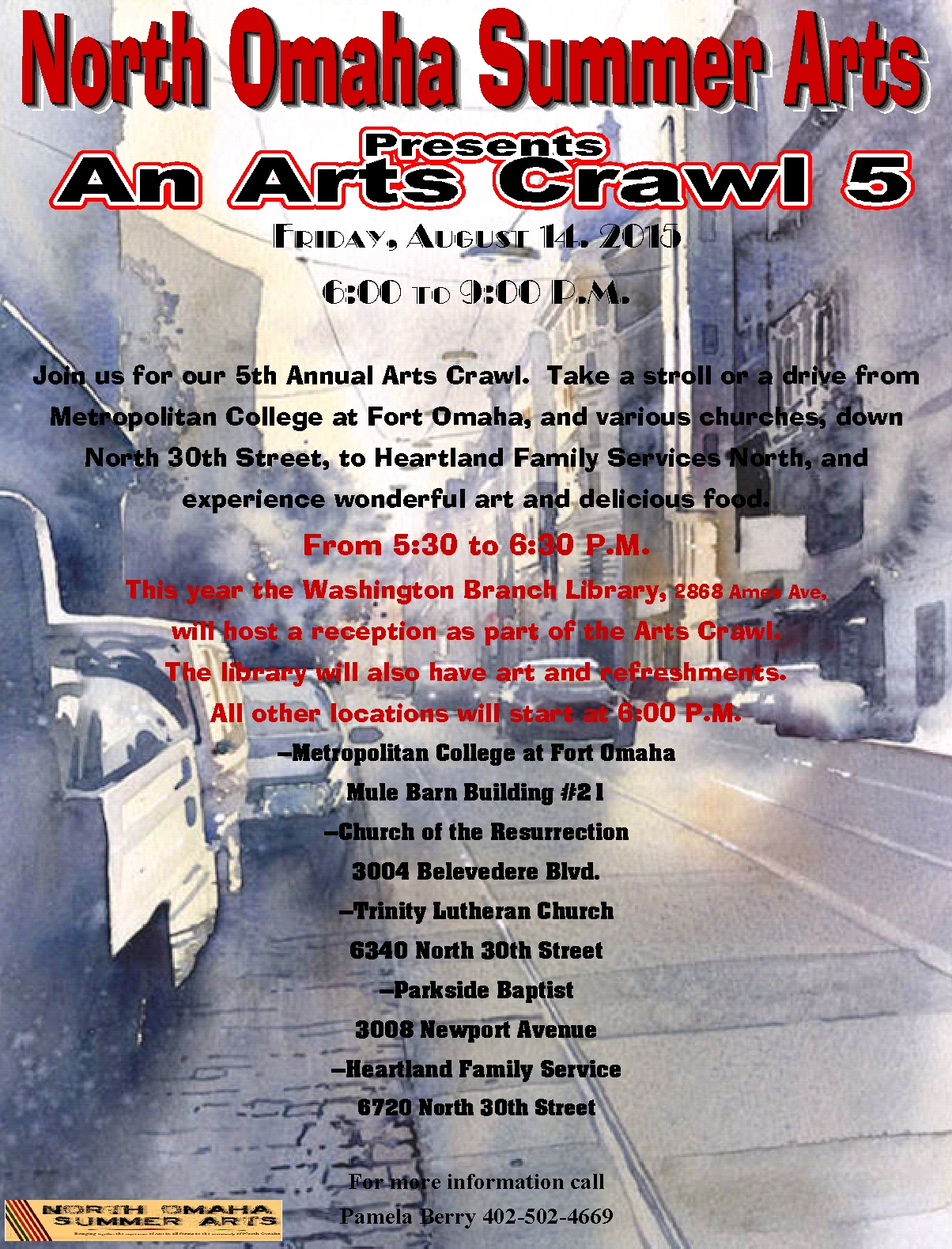
North Omaha native, resident and artist Pamela Jo Berry saw a need for more art to be infused into her community. So she dreamed up something called North Omaha Summer Arts (NOSA) in order to bring art in all its forms into that underserved neighborhood. With the help of partners and collaborators she’s made it a reality.
This free arts festival for the community, by the community wraps up Year 5 with the annual Arts Crawl- Friday, August 14 from 6 to 9 p.m. At venues up and down and around North 30th Street. Take a stroll or drive from Metropolitan College Fort Omaha campus north to various churches to Heartland Family Service/Solomon Girls Center to enjoy inspiring visual art and soothing live music by artists from the community. Sample the work of established and emerging artists in a wide variety of mediums.
Free refreshments and homemade snacks at each stop.
Before, during or after the Crawl, enjoy some of North Omaha’s other resources, including the Loves Jazz & Arts Center, the Carver Bank, the Union for Contemporary Art, the Bryant Center, Miller Park and the Malcolm X Memorial Foundation.
The Arts Crawl lineup:
Metropolitan Community College Fort Omaha campus, Mule Barn Building #21 New this year: Omaha Fashion Week at the Mule Barn
Church of the Resurrection, 3004 Belvedere Blvd. (just northwest of 30th and Kansas Ave.)
Trinity Lutheran Church, 6340 North 30th St. (30th and Redick) Featuring a Community Peace mural made by teens and seniors from the North Omaha Intergenerational Human Services Campus
Parkside Baptist Church, 3008 Newport Ave. (30th and Newport Ave.)
Heartland Family Service/Solomon Girls Center, 6720 North 30th St. (30th and Titus Ave.)
NEW THIS YEAR:
Washington Branch Library, 2868 Ames Ave. is hosting an Arts Crawl reception from 5:30-6:30 p.m. Enjoy art and refreshments at the library.
FREE and open to the public. Family friendly.
Please come participate in this important milestone of 5 years bringing art to North Omaha. Your support is appreciated.
For more info, email pamelajoh100@hotmail.com or call 402-502-4669/402-709-1359.
Thank you,
The North Omaha Summer Arts team
P.S. Please pass the word to friends, family, colleagues. Like and share our Facebook page, https://www.facebook.com/NorthOmahaSummerArts. Visit and share our North Omaha Summer Arts Crawl Facebook Event page.
Nancy Kirk: Arts maven, author, communicator, entrepreneur, interfaith champion
There are people who talk about doing things and people who do things. Nancy Kirk is the latter. That’s not to say she finishes everything she starts. Like those unfinished manuscripts of hers she’d like to get to one day. But lots of us can say that. She’s also a model of reinvention – of following one path in life and then finding a new direction and then another to feed her ever-searching sensibility. In truth, all of her paths have followed a similar humanistic and cultural track. She began her career in the arts, then went entrepreneurial in the antique quilt and fabrics world, and more recently has taken up interfaith work as executive director of an initiative whose ultimate aim is to bring together a synagouge, a church, and a mosque on the same campus in Omaha, Neb. The following profile I wrote about this intriguing woman will be the November cover story in the New Horizons. Read it here first.

Nancy Kirk: Arts maven, author, communicator, entrepreneur, interfaith champion
©by Leo Adam Biga
Originally appeared in the New Horizons

Long before becoming executive director of the Tri-Faith Initiative, the Omaha collaborative that finds Jews, Christians and Muslims building a shared worship campus, Nancy (Timmins) Kirk made a name for herself in the quilting world. Only not as a quilter, she’s quick to point out, but rather as a designer and aficionado.
It’s only natural to assume she’s a quiltmaker since she and her late husband owned The Kirk Collection, an antique fabrics supply, restoration and appraisal business that gained an international reputation and clientele. Nancy still carries on aspects of the business by conducting workshops, making presentations and producing DVDs and CDs on antique quilt restoration.
“I still love the teaching and the writing and the speaking,” she said. But the grind of multi-day conferences takes more of a toll these days on Kirk, who has survived a heart attack and open heart surgery.
Much like her work with the nonprofit Tri-Faith, whose groundbreaking plan for a synagogue, church and mosque on adjoining property is drawing worldwide interest, Kirk came to quilting an inveterate seeker always curious to know more. She’s learned enough to speak with not only passion but authority about quilting as art, craft and healing process and quilts as potent, touchstone objects of utility, aesthetics and humanity.
“Quilting serves many different purposes,” she said. “For some people it’s a craft activity, a stress reliever. Studies have shown the activity of quilting changes the brain’s alpha waves. For other people it’s an art medium, a very expressive way for a designer to work. For others it becomes very therapeutic.”
Quilts evoke intimate feelings tied to memories, rituals and relationships.
“For the viewer or the recipient, quilts exist for people at an emotional level that is really very primitive,” she said. “People respond with a part of their brain that usually has no language. Quilts represent people’s deep emotional connections with home, with comfort, with safety, with love. You see people wrapping up in quilts or touching quilts and being reminded of parents and grandparents and places they used to live. And you start hearing these wonderful stories.”
The way Kirk sees it, every quilt has a story to tell.
“All you have to do is plant yourself near a quilt, particularly an older quilt, at a quilt show and by the end of the day you’ll hear dozens of stories from people because they’re so evocative, especially in this part of the country, where people grew up with quilts. They’re very powerful objects.”
Before The Kirk Collection became a mail order source of antique fabrics for quilters the business made its name as a supplier to Hollywood film and television studio designers and costumers in need of period materials. Nancy and Bill Kirk provided fabrics that ended up in costumes of such major motion pictures as Titanic, Forest Gump and Wyatt Earp and network shows like Brooklyn Bridge and Homefront.
The couple ran the business out of their Bemis Park home before opening a store at 45th and Military Ave. Their customer roster extended to Europe and Asia.
Before she got into quilting, Kirk worked in the arts, where her aesthetic sensibilities were honed to give her a deep appreciation for not only the fine and performing arts but antiques, including textiles and fabrics.
The daughter of university professor parents who divorced when she and her sister were young, Kirk grew up in her native New York City and a variety of other locales.
She absorbed a classic liberal arts education at Antioch (Ohio) college, where she studied social sciences and journalism. She’s put her writing skill set to good use over the years as an arts administrator and public relations professional. Her unplanned fascination with arts management was fired when she spent two years with an Antioch theater project in Baltimore, MD.
“At this funny little free theater we brought in very experimental theater and dance companies from all over the world — The Medicine Show, Pilobolus. It was the out of town try-out place for experimental theater and dance. I became absolutely in love with experimental theater and dance and I was exposed to some of the best in the world. We were always at odds with the state and local arts councils because we were doing and promoting this work that was very outside the mainstream.”
By the time she earned her master’s in arts management from the University of Illinois and moved to Omaha to work a paid internship with the Nebraska Arts Council, she found herself in the midst of a cutting edge arts movement here. She arrived only a week after the devastating 1975 tornado and neither its widespread damage nor the paralyzing blizzard of ’75 that followed that winter could scare her away. Neither did the relative uproar over the Bicentennial I-80 sculpture project, edgy stagework by the Omaha Magic Theatre and the counterculture head shops, avant garde films and art happenings in the then-fledgling Old Market.
Indeed, she was won over by how open-minded Nebraskans were to new ideas.
“In all the time I worked for the state arts council and then 11 more years for the local arts council there was no one who said we shouldn’t have art.”
She recalled an I-80 sculptures forum in some backwater Neb. town where “an old man in coveralls got up and said, ‘I sure don’t understand this stuff, but I want to make sure my grandchildren have a chance to see it,’ and that was the attitude pretty much for anything.” One of her roles with the state arts council was traveling to rural hamlets and educating the local populace about the touring programs coming their way.
She said resistance or suspicion to unfamiliar art disappeared when she framed the needs of artists “in terms that (rural) audiences could understand from their own perspective,” adding, “That was a big part of my job.” Like the time she went to a small town in advance of a touring opera program. She laid to rest concerns singers were divas for requiring humidifiers in their rooms by explaining that the artists needed the devices to keep their throat and voice supple in the same way farm tractors or threshers need routine maintenance to run right. Once she put things in practical terms, she said, humidifiers were readily volunteered.
“I came to have a real appreciation of what arts councils were doing in terms of opening up the doors to the arts in a lot of communities where there had really been nothing outside the high school play. A lot of them shied away from cutting edge kind of work.”
The arts councils that sprung up in the ’60s and ’70s, she said, “were bringing the arts out of the urban areas and into the rest of the country.” For example, she said the Omaha Community Playhouse formed the Nebraska Theatre Caravan “and took theater into towns that had never had professional theater and Opera Omaha organized small touring evenings of opera.”
Visual artists, dancers, authors, poets and others began criss-crossing the state to present before general audiences or to do residencies in schools. Her focus on bringing the arts to underserved populations extended to a visual art program in the state penitentiary, where even death row inmates were provided art supplies for their self-expression. Her work introduced her to the man who became her husband, Bill Kirk, who was a theater actor-director and kindred spirit.
She authored an award-winning book, Lobbying for the Arts, used all over the country.
An advantage Omaha owns when it comes to supporting the arts and other things, she said, is that it’s still small and accommodating enough to provide ready “access to power,” unlike other cities she’s lived where access is limited to few. “Here, all you had to do was pick up the phone and ask for an audience with Willis Strauss or Peter Kiewit or Leo Daly or John Bookout. You could be heard. They might not agree with you, they might not end up supporting your cause, but you could make your case. I think it’s very much the same attitude that created Ak-Sar-Ben. It’s this place of kind of infinite possibility and egalitarianism.”

Nancy Kirk discussing quilt restoration
She said Omaha’s can-do spirit is what sold her on this place and has kept her put.
“This is the kind of city I wanted to live in. I think this same spirit of civic work still exists now. It’s an attitude that makes the most extraordinary things possible.”
“Tri-Faith is another example of it,” she said of the initiative whose partners are Temple Israel, the Episcopal Diocese of Nebraska and the American Institute of Islamic Studies and Culture, “Not only was there no significant opposition to it, there was a kind of, Well, I don’t quite understand it, but what can we do to help? attitude. When it came to raise money for the land four foundations stepped up.”
The intended Tri-Faith campus is on the grounds of the former Highland Country Club, which Jews formed decades ago when denied admittance to goy clubs. The campus plan is part of the Sterling Ridge mixed-use development in southwest Omaha that’s presently undergoing site preparation work. Plans call for three worship centers — one for each participating faith group — and a shared interfaith education center Kirk refers to as “the meeting place.”
Support for the project, which launched in 2006, has come together quickly from large though as yet undisclosed donors.
“Basically the donations have been made because it’s good for the city,” said Kirk. “They see this vision that this makes Omaha a better place to live for everybody.”
Tri-Faith was conceived in response to a seemingly mundane dilemma.
“The genesis is parking lots. This is a project about parking lots — very seriously,” Kirk said.
Temple Israel synagogue has long been in need of a new site, having outgrown its current building and plot just east of 72nd and Cass. With its congregation largely residing now in suburbia, a move west only made sense. When synagogue leaders began contemplating what they’d like in a new site, said Kirk, they were “very intentional about finding good neighbors” like the ones they have today in the Omaha Community Playhouse and First United Methodist Church.
She said when Temple heard that the Institute was planning to build a new mosque in west Omaha synagogue member Bob Freeman, Rabbi Aryeh Azriel and others contacted AISC president and co-founder Dr. Syed Mohiuddin, “to discuss looking for land together to share parking lots.”

Consistent with hospitality being “such a central concept to all the Abrahamic faith traditions,” she said, representatives from each group came bearing mounds of food for the meeting. That first confab led to more. She said, “When they eventually began talking matters of faith rather than concrete it occurred to them they had two of the three major Abrahamic traditions represented.” As a potential Christian partner the parties approached the Catholic archdiocese of Omaha, whose then-archbishop, Rev. Elden Curtiss, declined. They next made overtures to the Episcopal Diocese of Nebraska, whose then-leader, Rev. Joe Burnett, accepted.
In 2006 Tri-Faith was incorporated as a 501c3 and since then the organization has presented several interfaith events to promote understanding, all while working toward a common goal of a shared campus. The endeavor has made headlines around the world at a time when religious and cultural differences continue to be serious dividing points. Building bridges is an appealing idea as the globe grows ever flatter and more interconnected thanks to online social networking and to grassroots movements like those of the Arab Spring and Occupy Wall Street.
“It turns out the parking lots are such a metaphor for what’s going on in the world because the fact is we all have to share this earth. — it’s how do we live together,” said Kirk.
Her Tri-Faith involvement began in 2008, when it might be said her decades-long quest for spiritual fulfillment reached a new plane. In some ways, she acknowledges, she’s a most unlikely director of an interfaith project because for the first 35 years of her life she struggled with matters of faith. Then again, her uneasy journey steeled her for leading an initiative about celebrating differences.
“My father was a fallen-away Catholic, my mother was a fallen-away Unitarian, so I was brought up with no particular religion, in a household that wavered somewhere between agnosticism and atheism. But both parents allowed us to be exposed to some variety of religions. There was no objection if we went to church with friends.”

On some level, Kirk’s faith odyssey echoed that of her divining rod maternal grandmother, Sophia Lyon Fahs, who was ordained a Unitarian minister at 80 and wrote dozens of religious education books. Her last book, The Church Across the Street, was a comparative religions study. The liberal, progressive themes of inclusion and tolerance her grandmother advocated are in line with those of Kirk and the Tri-Faith Initiative.
Kirk comes from a long line of matriarchal figures and accomplished professionals. Her great-grandmother wrote books about her Presbyterian missionary work in China.
So it wasn’t as if Kirk didn’t have ready examples of faith to follow. In fact, she said, “I envied people who had great faith but I didn’t understand the experience and didn’t expect to ever have it. I was never anti-religious, I just was not religious.”
Then, in the midst of building her arts career, what she least expected happened.
“I was one of those bolt of lightening people. Literally in the course of a 24-hour period I came to a very deep belief in the existence of God. I was at home and all of a sudden I felt this incredible sense of certainty. It was so different than the kind of rational approach I’d always had to life. That’s when I started searching and doing a lot of reading. I didn’t talk to anyone about it really for a very long time.”
Before becoming a couple Nancy and Bill Kirk were friends. On a long road trip for an arts program she told him about her spiritual awakening and “how confusing it all felt” because it didn’t necessarily jive with what organized religion prescribed.
“And he said something very helpful — that the personal experience you feel is faith and all the stuff you hear in church and in the bible and other sources is belief, and belief is what happens in your head and faith is what happens in your heart …and that both are OK. The part that is faith is intended to be a questioning process throughout your life. Your responsibility as a human being is to continue to explore and try to understand and to go through periods of disbelief.”
“The deeper you explore that abyss that you’re always afraid you’ll fall into and never come out of,” she said, “the more you discover there are those dark nights of the soul when you feel faith has deserted you. But usually it’s the belief that’s deserted you, and the faith part can lead you back away from the edge of the precipice. And then you rebuild the belief.”

After being stricken with the spirit, Kirk tried on a number of faiths but it was only four years ago she “came to the Episcopal Church.” She’s a member of St. Andrew’s. She was finally swayed to the denomination, which she’d flirted with before, after seeing the church’s presiding bishop in the U.S., Most Rev. Katharine Jefferts Schori on CBS. “I said, ‘I would follow that woman anywhere,’ so when it came to look for a new church I looked for an Episcopal church.”
Coming from where she did to where she is today, Kirk said, has informed and shaped the spiritual life she enjoys today and her work with Tri-Faith.
“So this rather eclectic religious background of growing up outside any one particular faith tradition and not necessarily having a particular belief in any of them for the larger part of my life in some ways really helped prepare me for what I’m doing now. Because I came to the habit of questioning, researching, listening hard and trying to understand other people’s faith journeys as part of my own.”
The discernment she does by opening herself to other beliefs enriches her life and her faith. “I find it fascinating and each of those encounters helps me refine my own faith and without any denial of my own tradition as I have adopted it now.”
Kirk felt drawn to engage in the Tri-Faith experiment after taking an inventory of her life a few years ago and deciding to embark on a new path she felt called to follow.
“When I turned 60 (she’s 64 today ) I made a 44-year life plan. I’ve always made long range plans. Women in my family thankfully tend to be long-lived. My grandmother died at 103. My mother died at 94. Both were active until the end. So it seemed like 104 was a good age to shoot for. I had become really fascinated with the changing role of religion in a pluralistic society. The Kirk Collection was kind of winding down, I’d closed our retail store. I didn’t want to cut another piece of fabric ever again in my life. After about 25 years in the quilt world I was ready for a change. My husband had died. It was time to reinvent myself again.”
She didn’t tell anyone (at first) about her new life plan. Then, she said, she “finally got up the nerve” to tell her business coach and much to her relief “he didn’t laugh.” “Once I said it out loud it was like, ‘Yeah, that’s what I want to do — some kind of ministry.’ Lay or ordained, it didn’t matter, but this is the subject area I wanted to be in.”
She felt compelled to give back.
“Sixty is a great place to start because chances are you’ve done pretty much what you intended to do professionally and getting your kids raised up. It’s not really like a bucket list but there’s still a chance to contribute meaningfully to the world. We want to make sure by the end of our life we know our life had meaning and this is a great age at which to be doing it. We don’t have a lot of the distractions we had before of raising kids and building career. Sixty to 100 there’s a chance to do things that really change the world and getting it done is more important than getting credit.”
The philosophy reminds her of her college’s motto: “Be ashamed to die until you’ve won some victory for humanity.”
Fatefully, a group of Tri-Faith board members made a presentation at St. Andrew one Sunday. Until then, she’d not even heard of the venture but she was immediately and powerfully attracted to its vision of three faiths partnering together.
“This is what I’m supposed to be doing,” is what she said she thought to herself. It wasn’t long before she offered her services to help spread Tri-Faith’s message and dream. When she learned the group was seeking an executive director she made a proposal and was hired. She saw the mission as a perfect fit for many reasons, not the least of which is her considerable PR experience and expertise.
In a world full of noise and mixed messages, she said she aims to keep Tri-Faith on point with its mission of “celebrating the diversity of our religious traditions.” “It’s beyond tolerance and acceptance and respect, it’s really about building relationships among people and celebrating those differences,” she said.
“As one of our board members, Rev. Ernesto Medina said, ‘The reason we know it’s working is we know the names of each others children,’ and that’s what it’s all about. It’s building those relationships.”

A Tri-Faith Initiative event
She said in this increasingly global space we inhabit “I think the world is having to live into a new definition of who is our neighbor. I think we’re called on to be really aware of our neighbors and getting to know them.”
Through events like Abraham’s Tent and the Tri-Faith Picnic, she said Jewish, Christian and Islamic rites are celebrated and people learn what to say or do during worship services and ceremonies. As distinct as each tradition is, Tri-Faith reminds participants “there’s so much the faiths share — we all greet each other with peace, we’re all talking about and praying to the same God.”
She said learning how to offer peace in each faith tradition can be a profound thing, whether saying “peace be with you” or “shabbat shalom” or “as-salamu alaykum.” “Just those few simple words,” she said, “and all of a sudden you feel very comfortable. It’s those little things that take the strangeness out of it.”
Then there is the exploration Tri-Faith inspires.
“A great thing that happens with the Tri-Faith is that as you engage in interfaith work and discussions you feel compelled to learn more about your own faith. You begin to explore your own tradition. You either question or affirm or study why you believe what you do and universally you end up more attached and committed to your own faith.”
She’s impressed by how the Tri-Faith board, composed of both lay and religious, doesn’t stray from its mission.
“I’ve worked with many nonprofit boards over the years and this is truly unlike any other board I have ever worked with. They expect that everything is possible, they have committed themselves to one another to make things possible. There are really no internal politics, there’s no jockeying for position. There’s a spirit that infuses their discussions that they’re really there to do God’s work and that it’s going to happen. There’s such a certainty it’s going to happen. There’s a spirit of peace in the room that is extraordinary.”
She said internal politics don’t surface though she concedes “politics sometimes intrudes from the outside.”
She said the fallout of 9/11 played a part in Tri-Faith’s formation “in the sense that we’re all in this together and we’re the ones that have to find a solution to this, and focusing on the division is not the way.”
It’s not the first time the city’s faith groups have banded together. She said several joined forces to help feed and house Chief Standing Bear’s supporters during the great Indian leader’s Fort Omaha trial. Many were active in the civil rights struggle. A number formed Together Inc. after the ‘75 tornado. More recently, faith groups have united in calling for an end to urban violence. But the Tri-Faith Initiative is something else again. She said Rev. Medina, pastor of St. Martha’s Church in Papillion, may have best summed up the miracle of the initiative with, “This was beyond the imagination of many people but not beyond the imagination of God.”
It hasn’t all been perfect.
“There have been bumps in the road,” Kirk acknowledged, “and people who’ve gotten their noses out of joint over this or that, but for the most part even those who were a little suspicious at first have often ended up as the biggest cheerleaders.”
She’s proud of many things she’s done in her life, from her work in the arts to her entrepreneurial success to her raising two adopted children, but she’s pretty certain Tri-Faith will be her most impactful legacy, at least in terms of sheer magnitude.
She can’t imagine making a greater contribution than bringing people together.
“I think the most meaningful part of the work is when I see people come to the table and sit with people of other faiths with excitement and anticipation instead of fear. If we’ve done our job and created a safe place, a place of trust where people feel they can be authentically themselves and authentically interested in the other, that is a real place of grace.”
If heredity’s any guide, then Kirk has miles to go before she sleeps. Reflecting upon her life, her diverse pursuits have “felt to me as a continuum,” she said, adding, “They all enrich people’s lives in important ways and all involve starting something new, whether new types of arts programs, a new small business or a one-of-a-kind religious development. I like being in on the start of things…”
Related articles
- John Sorensen’s Decades-Long Magnificent Obsession with the Abbott Sisters Bears Fruit in a Slew of New Works, Including ‘The Quilted Conscience’ Documentary at Film Streams (leoadambiga.wordpress.com)
- Soon Come: Neville Murray’s Passion for the Loves Jazz & Arts Center and its Role in Rebirthing North Omaha (leoadambiga.wordpress.com)
- Why Quilts Matter (uofllibraries.wordpress.com)
- Sharing Some Quilt Blogs (devotedtoquilting.wordpress.com)
- Antique Quilt Pieces from Fort at #4 (quilterinmotion.wordpress.com)
- A Stitch in Time Builds A World Class Quilt Collection and Center-Museum (leoadambiga.wordpress.com)
- Omaha Tri-Faith Pioneers Seeing the Fruits of Their Interfaith Collaborative Take Shape (leoadambiga.wordpress.com)
Photographer Larry Ferguson’s work is meditation on the nature of views and viewing
Larry Ferguson is one of the most collected and published fine art photographers in the Midwest. I have long been aware of the artist and his work, yet it was only witinh the last couple years he became a subject for this writer. I suspect I will be writing more about him in the years to come. This article for The Reader (www.thereader.com) appeared in conjunction with an exhibition he had at Creighton University. The black and white works in the show were drawn from various series he has done over the years depictiing the views afforded by rooms he stayed in and various touchstone places he’s visited in his many travels. Like many photographers I’ve met over the years, he maintains a very cool studio space.

Photographer Larry Ferguson’s work is meditation on the nature of views and viewing
©by Leo Adam Biga
Originally published in The Reader (www.thereader.com)
Photographer Larry Ferguson’s lush black and white imagery displays a mastery of technique and composition. But it’s not so much the work’s subject or execution as the evocative subtext bound up in it that is most arresting.
His new exhibition at Creighton University’s Lied Art Gallery, The View From My Room, is drawn from pictures he’s made of scenes outside the many rooms he’s inhabited over 30 years. The rooms, located in Nebraska, other parts of the U.S. and the far corners of the globe, offer a road map of sorts for the Omaha artist’s journey through life and craft. Aside from a few landscape and cityscape images, nothing dramatic or sumptuous is revealed, but rather the prosaic, mundane fixtures and rhythms of life as it proceeds around us. That’s the point.
Ferguson shows the holy ordinary of moments and places, some he has personal ties to and others he merely intersects with, but all of which express deep stirrings in him. It is, he said, “a travelogue through my emotional life.”
This work is the first of several ongoing series he’s photographed since the late ‘70s to be organized into an exhibition. Besides views from his rooms, these series variously focus on “skyscapes, treescapes, grain elevators, nudes, private moments and all the great loves I’ve had in my life,” he said. “All are very long term, special projects that eventually will see the light of day.” Selections for these series are made from his archive of 250,000 negatives at his 17th and Vinton Streets studio.
He hopes the work provokes viewers to contemplate its underlying themes. “Rarely do people ever talk about what’s underneath it and in fact behind it,” he said.
On one level the photographs, all shot in wide angle on tripod — nothing’s hand-held — offer a visual chronicle of his haunts and journeys, near and far. But it as much the interior as the exterior journey and landscape he considers in Room.
“They’re really very internal and very emotional for me,” he said. “They are definitely some sort of record about what I’ve been doing but they’re not really in the aspect…a documentary photographer might work. It’s more introspective than that. They signify and give a physicality actually to the stories I can tell about the places. They are the evidence that what I did actually did happen and does exist. They jog that memory of the experience and what it was all about.”
Therefore, each image “is imbued” with meaning, as in the almost obligatory view from the farmhouse in Maxwell, Neb. he grew up in. It looks out onto a distant wind break of trees. The larger world beyond that horizon is where he dreamed to go, he said. This vision and yearning take on added meaning in the context of the show’s many images from his far flung travels — evidence he’s fulfilled his dream.

Larry Ferguson
He spent many a summer with his feisty, spry grandmother, Frances Lawhead, at her Silvergate, Mont. cabin, which overlooks a snow field. The view from the cabin bedroom he slept in resonates with the warm embrace of hearth and home inside and the wonder of nature outside.
Fragments of a Lincoln, Neb. neighborhood are viewed through lacy curtains his then-girl friend Sally Donovan put up after she inherited the house from his good friend, photographer John Spence. The living room window becomes a nostalgic frame of reference for the observations, conversations and meals shared there.
With few exceptions his work is the antithesis of any deliberate, preconceived, picturesque style.
“I’m not here to make pretty pictures, ever,” he said.
He rejects the notion one must “go somewhere that has this exotic locale or spectacular scenery in order to make pictures. I’m always exactly the opposite,” he said. His credo is that “ordinary common life is extraordinary. That’s why the view right outside your window,” he said, “is so incredibly important. It’s more than the picture, it’s what it’s about that makes it work.”
He admits he only embraced this come-what-may philosophy after some false starts. He’d go somewhere anticipating a spectacular view or vista, only to be disappointed when it wasn’t all that and then he wouldn’t shoot anything.
“Then I would kick myself later for not having made the picture because it wasn’t spectacular, but not being spectacular is what it was about. That’s when I concluded you have to accept what’s there.”

Approaching Rainstorm, Near Crawford, NE, ©photo by Larry Ferguson
Whatever the scene holds it evokes linkages-associations to his life and work. Viewed in this light, something as blase as a dirt hill can be a rich vein of narrative. “It’s nothing, yet it’s everything,” he said.
What compels him to make a picture in any given spot, at any given time is intuitive.
“A lot of times people ask me, ‘How did you make that picture?’ And I go, ‘I don’t know.’ The pictures make themselves,” he said. “Something just says, Make that picture, and I do. People ask me, ‘What were you thinking about when you made it?’ I don’t consciously think about it. I couldn’t possibly tell you because it’s all internal, it’s all emotional. That’s how I respond — I respond viscerally to it. I trust my feelings and my instincts.”
On his many travels, whether to Mexico or Argentina or China, he goes where the spirit moves him, snapping pics as opportunities arise. The resulting images may feed into any of his long term projects. He shoots whatever he “discovers along the way.”
“When I travel I don’t have an itinerary. I have a start date and an end date and usually a destination point somewhere in between,” he said. “And then what happens between those times is plain and simple whim. Wherever I go, you know, it’s always, Well, let’s point the camera and take that image, whatever it happens to be. And that’s kind of how I work.”
It’s how he came to spend so much time in Guanajuato, Mexico, the capital city of the state of Guanajuato. He went there as part of a months-long, 10,000 mile trek he made in 1984 through Mexican jungles and mountains to photograph archaeological digs. Once he stumbled upon that city’s treasures and oddities, he couldn’t tear himself away. Images he made of one of his finds there, the home of artist Diego Rivera, are included in Room.
The happy accidents that result — compelling patterns of light and shadow, pleasing forms, symbolic shapes, complex compositions — are rooted in preparation.
“It’s that thing of preparing yourself to be ready to do it when it happens,” he said. “That’s what it takes. You have to get to where you practice and practice until you no longer think about it. Then it just happens automatically.”
Related articles
- Photographer in the Picture (flickr.net)
- Frida Kahlo & Diego Rivera, at Pallant House, Chichester, Seven magazine review (telegraph.co.uk)
- Jesuit Photojournalist Don Doll of Creighton University Documents the Global Human Condition One Person, One Image at a Time (leoadambiga.wordpress.com)
- The Wall As Photographic Surface (fansinaflashbulb.wordpress.com)
- New York from Day to Night in One Picture [Image Cache] (gizmodo.com)
Omowale Akintunde’s in-your-face race film for the new millennium, “Wigger,” introduces America to new cinema voice
Over the past 20 years I have had the opportunity of stumbling upon some filmmakers from my native Nebraska whose work has inspired me and many others. I first became aware of Alexander Payne back when I was programming art films in the late 1980s-early 1990s. This was before he’d directed his first feature. I read something about him somewhere and I ended up booking his UCLA thesis film, The Passion of Martin, for screenings by the nonprofit New Cinema Cooperative. Hardly anyone came, but his work was unusually mature for someone just out of college. That lead to my interviewing him in the afterglow of his feature debut, Citizen Ruth, and his making Election. I’ve gone on to interview him dozens of times and to write extensively about his work. I even spent a week on the set of Sideways. I almost made it to Hawaii for a couple days on the set of his film, The Descendants. I may be spending weeks on the set of his next film, Nebraska. It’s been an interesting ride to chart the career of someone who has become one of the world’s preeminent filmmakers.
More recently, I was fortunate enough to get in on the evolving young career of Nik Fackler, whose feature debut, Lovely, Still, shows him to be an artist of great promise.
More recently still I discovered Charles Fairbanks, a true original whose short works, including Irma and Wrestling with My Father, defy easy categorization. He is someone who will be heard from in a major way one day.
In between Fackler and Fairbanks I was introduced to Omowale Akintunde, an academic and artist whose short film Wigger became the basis for his feature of the same name. Akintunde and Wigger are the subjects of the following story, which appears in The Reader (www.thereader.com). The small indie film, made entirely in Omaha, is getting some theater exposure around the country.
This blog contains numerous stories about these filmmakers and others I’ve had the pleasure to interview and profile.
Omowale Akintunde’s in-your-face race film for the new millennium, “Wigger,” introduces America to new cinema voice
©by Leo Adam Biga
As published in The Reader (www.thereader.com)
Make no mistake about it, filmmaker Omowale Akintunde intends for his 2010 racially-charged Omaha-made feature, Wigger, to provoke a strong response.
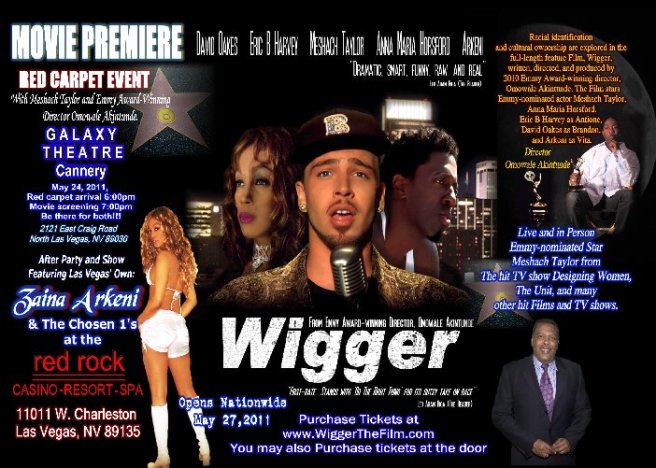
After premiering here last year, and in limited theatrical release around the country, the dynamic looking and sounding film returns for a 7 p.m., July 28 red carpet screening at the Twin Creek Cinema. It’s back just in time for Native Omaha Days (July 27-August 1), the biennial African-American heritage celebration.
The film, definitively set in North Omaha, plays off a young white man, Brandon (David Oakes), so enamored with African-American culture he’s adopted its trappings. He pursues a R & B career amid skeptics, users and haters. His interracial relationships, both platonic and romantic, are tinged with undercurrents.
“He feels he has transcended whiteness,” says Akintunde, chair of the University of Nebraska at Omaha Department of Black Studies. “On the other hand, his father is a very overt racist who calls people nigger, talks about fags and Jews. He’s very open about his biases. So Brandon sees himself as disconnected from his father.”
Brandon’s best friend, Antoine, is black. As pressures build, the two have a falling out, each accusing the other of racism, unintentionally setting in motion a tragedy.
“There’s just some things you learn in a black household you don’t get in a white household, and vice versa,” says Eric Harvey, who plays Antoine and co-produced the film, “so that line between them keeps them from being as close as they really want to be. They’re both in denial of self-conscious racism.
“It’s not a bad thing, it’s a reality. We do things without thinking about it. Seriously, it’s been embedded for so long it’s just the norm.”
This is the prism through which Akintunde, who produced, wrote and directed the film, examines polarizing attitudes. Nearly everyone in the film exhibits some prejudice or engages in some profiling. Race and privilege cards abound.
“I thought this story…was the perfect premise to get into some real deep stuff,” says Akintunde. “It’s about these two characters with this improbable dream. This white boy who loves black culture and wants to be accepted comes from a background that says, why would you want to be like THEM? And then them telling him you’re not one of US. And how does one make that fit?”
The film suggests a post-racial world is a fallacy short of some deep reckoning or ongoing discussion. It’s message is that not confronting or deconstructing our racial hangups has real consequences. Akintunde can spout rhetoric with the best, but his film never devolves into preaching.
He does something else in offering a raw, authentic slice of black inner city life here with glimpses of Native Omaha Days, the club scene, neighborhoods, church. He avoids the misrepresentations of another urban drama set here, Belly (1998).
“This is the first film that really deals with North Omaha and attempts to make icons of the things that have become emblematic of it,” says Akintunde. “I really did want to show this city and that community some big love. It was very intentional I made the location a character in this film.”
Rare for any small independent, even more so for a locally produced one, Wigger is managing theatrical bookings at commercial houses, albeit mostly one-night engagements, coast to coast. In classic roadshow fashion, the filmmaker is brokering screenings through his own Akintunde Productions. He pitches exhibitors and when he sells a theater or chain on the flick he often appears, film in hand, to help promote it. He often does a post-show Q & A.

Meshach Taylor
In May the film got national mention when co-star Meshach Taylor plugged it on The Wendy Williams Show.
The success is the latest affirmation for Akintunde, who has a solid reputation as a serious artist and scholar. His 2009 nonfiction film, An Inaugural Ride to Freedom, which charts the bus trek a group of Omahans made to the Obama presidential inauguration, won a regional Emmy as Best Cultural Documentary.
The Alabama native has heeded his creative and academic sides for as long as he can remember. “I always wanted to be a university professor and I always wanted to make films,” he says. “I wanted to make films because there are so many people who will never attend a university, who will never be involved in a high level ivory tower discussion, and movies reach everybody. What I always wanted to do is to meld those two worlds — to use film to teach academics.”
In a career that’s seen him widely published on issues like white privilege and diversity, he’s penned academic texts, short stories, a novel and a children’s book. He says he always conceives his stories cinematically. Well into his professional career though, the cinephile still hadn’t realized his dream of filmmaking.
“It was one of those things you always wanted to do but everyone discouraged you from because they felt you needed a real job,” he says. “No one ever thought that was a credible goal. I finally reached a point where I realized credibility was determined by me, and if I had a passion for filmmaking I needed to do what…makes me happy. That was one of the missing things in my life.”
During a sabbatical he attended the New York Film Academy‘s Conservatory Filmmaking Program. His thesis project was a short version of Wigger. Another of his shorts, Mama ‘n ‘Em, was selected for the Hollywood Black Film Festival.
An expanded Wigger script became his feature debut. He and producer Michael Murphy financed the film themselves. Akintunde imported principal cast and crew from outside Nebraska, including film-television actors Meshach Taylor (who was in the short) and Anna Maria Horsford, cinematographer Jean-Paul Bonneau and composers Andre Mieux and Chris Julian.
“I didn’t follow any of the traditional methodologies in terms of even making Wigger, much less how I promote it and get it out there.”
David Oakes
Kim de Patri (Kim Patrick), who plays Antoine’s girlfriend Shondra, says the script’s unvarnished truth grabbed her.
“It said every single thing most people think (about race) but would never actually say. It was the way it was said and the voice it was speaking from, these characters. It was so real and so honest and it came from a very genuine place.”
Taylor, a big advocate of Akintunde’s, says he likes how the film “challenges people’s concepts of what racism really is” by dealing with “the reality of institutionalization racism,” adding, “It’s not an overt thing, it’s really built into the system.” He says he and Akiintunde just click. “I like what he’s trying to do. It’s really wonderful to have someone who has an intellectual approach to filmmaking but still has the artistic sensibility to make it fun and interesting to watch.”
To date, Akintunde has arranged limited bookings in mid and major markets, ranging from Minneapolis and Birmingham to Denver, Las Vegas and Los Angeles. It’s one continuous run was at the Edge 12 in Birmingham, the home of Tim Jennings, who has a supporting role. Akintunde says an Edge Theaters official “became a big fan and supporter” of the film and offered a one-week run.
Future screenings are scheduled in Chicago, Atlanta, Washington D.C. and New York City. He’s negotiating with Edge for new, multi-date runs.

Anna Maria Horsford
With Wigger, he’s taken a subject and set of conventions rife with stereotype and exploitation possibilities and dramatized them as an extension of his scholarship. His goal is as much to frame a dialogue as to make a profit.
“My biggest objective here was to really put a story out there that would compel people to talk about institutionalized bias in a way that I don’t think we’ve had. I really wanted to have a national conversation about this.”
In the tradition of Do the Right Thing and A Time for Burning, which was shot in Omaha 45 years ago, Wigger makes a full-frontal assault on our expectations.
“Obviously, I chose a very provocative and incendiary title because I want it to evoke a very strong, visceral response. I want to incite people. I want to grab America by the collar and just shake them,” he says. “The title itself is very problematic for people because we live in a society where we won’t even pronounce the word nigger. It becomes the “n word” in any context in which we use it.
“In many of the (Q & A) discussions we talk about why I gave the film such a provocative title — it’s because I want people to stop and think. Certain words are simple, symbolic representations of a much deeper social problem that we tend to mask by using silly euphemisms, as if we do not know what they mean, instead of looking at why the actual word bothers us.”
The film deftly handles topics usually glossed over or overdone without becoming pedantic or sensationalistic, though it does get melodramatic. As an “ethnic” genre pic, it draws largely black audiences, but enough of a mix that Akintunde is able to gauge how it plays to black and white viewers.
“There has not been a huge disparity in response and I think that’s because Wigger takes on multiple kinds of institutionalized biases. What I find is people see in a sense the mirror being held up to themselves.”
If nothing else, he hopes the film encourages viewers to see past the taboo or race.
“In our society we’re taught the way you demonstrate you’re not racist is to pretend you don’t know race exists. Because of this color blind mentality we’re all supposed to be adopting, we have come to a point where we can’t discuss the 600 pound gorilla in the room, and what Wigger does is give people an opportunity to discuss the 600 pound gorilla.
“But it goes beyond that — to our gender, our class, our sexuality, our religious beliefs. These are so interwoven and so inextricably bound that it is impossible to construct yourself in any of those domains without taking into consideration the others.”

Omowale Akintunde
Wigger shows how racism, sexism and other isms thrive in both white and black culture. Everyone is guilty of some kind of bias.
“I try not to make a compelling argument of black versus white,” says Akintunde, “but about what it means to be either and how we can transcend these boundaries, these ridiculous social constructions, these radicalized expectations that keep us divided. I believe we have the ability to cross these boundaries and truly become a society resolute in its solidarity.
“I think the reason people don’t leave that film feeling as if they’re more divided is because of the way the film is structured. I think you cant help but see how really alike we are. It’s hard to walk away from this movie seeing the world in, no pun intended, black and white.”
Relegating someone to a narrow category or box, he says, diminishes that person and in the process only widens the gulf between individuals and groups.
“I don’t think they are things that exist on their own. I don’t think people are born heterosexist or are racist or Christian. We are taught these positions, we are taught these ideologies, and we reinforce them in our social context in such discreet ways that we’re formed and shaped into opinions and ideas long before we understand that’s what has happened to us.
“Nobody can be plugged comfortably into one of these slots. It ain’t that damn simple. It never has been that simple. It’s a very complex thing.”
The film unabashedly “goes there” by unearthing the fear and anger alternative lifestyles generate, from gay revelations to interracial affairs to wigger mainfestations.
“Society paints a picture of what it wants to see and some people just don’t want to see certain things,” says de Patri (Patrick).
Overcoming these barriers, in Akintunde’s view, starts with recognizing them for what they are and how complicit we are in maintaining them.
“The thing I want to get across to people is that it’s all of our problem. Even if you think you’re just a victim, you’re not, you are a participant. It’s not a white problem, and it’s not a black problem, and it’s not a gay problem. It is a human problem.”
Akintunde enjoys the canvass film provides for expressing multi-layered themes.
“I’m very attracted to film as a way of telling that story because I think it allows you more complexity.”
Wigger marks the beginning for what he hopes is a string of films, but for now, he says, “it’s the fruition of my life’s work.” He’s justifiably proud the film’s getting seen.
“For an independent filmmaker to even get a film to run continuously anywhere for any length of time is an extraordinary achievement, and I got that to happen.”
The exhibition schedule is being revised as new screening opportunities surface.
“I had this carefully laid out plan, man, with absolute linearity, and instead things are happening in the moment.”
He says the film’s well received wherever it plays and is invited back in some cases for additional screenings, including Las Vegas and Birmingham.
“Obviously, I would love to see the movie in an even larger roll out and I think that that is happening,” he says. “I didn’t plan that Edge Theaters was going to pick up the movie. I didn’t plan these people in Vegas and Birmingham would want me to come back. I’m going to go with what happens in that moment and just enjoy it. I’m sort of like riding the wave.”
He says there’s been preliminary talk about Rave Theaters pickiing up Wigger. He’s also following up a lead about potential interest from BET in acquiring the film for network broadcast. Wigger will eventually go to Blu-Ray and DVD.
“I am still seeking a distribution deal.”
Considering its small marketing budget, he’s pleased with the film’s performance.
“We sell out the house wherever we play. I’m not making a killing, but certainly making back the money invested to bring the movie to these theaters. I have a real job, so for me it’s not so pressing my movie makes a lot of money, Of course, I want it to make money if for no other reason then to allow me to make more films.”
His unpublished novel, Waiting for the Sissy Killer, is the basis for a new feature he’s planning. The partly autobiographical story concerns a young black man trying to cope with identity issues in the 1960s South. Akintunde hopes to begin pre-production in the fall. He plans shooting the project in his native Alabama.
Omaha rapper ASO headlines the 6:30 p.m. Wigger pre-show at Twin Creek Cinema. Performing at the Blue Martini after-party is co-composer Andre Mieux.
Tickets are $20 for the screening, pre-show and party and available at http://www.WiggerThe Film.com, Youngblood’s Barber Shop, Loves Jazz & Arts Center and Twin Creek.
Related articles
- Back in the Day, Native Omaha Days is Reunion, Homecoming, Heritage Celebration and Party All in One (leoadambiga.wordpress.com)
- The Ties that Bind, One Family’s Celebration of Native Omaha Days (leoadambiga.wordpress.com)
- Walking Behind to Freedom, A Musical Theater Examination of Race (leoadambiga.wordpress.com)
- A Rich Music History Long Untold is Revealed and Celebrated at the Omaha Black Music Hall of Fame (leoadambiga.wordpress.com)
- Rev. Everett Reynolds Gave Voice to the Voiceless (leoadambiga.wordpress.com)
- Native Omahans Take Stock of the African-American Experience in Their Hometown (leoadambiga.wordpress.com)
- Native Omaha Days: A Black is Beautiful Celebration, Now, and All the Days Gone By (leoadambiga.wordpress.com)
- Luigi’s Legacy, The Late Omaha Jazz Artist Luigi Waites Fondly Remembered (leoadambiga.wordpress.com)
- Enchantress “LadyMac” Gets Down (leoadambiga.wordpress.com)
- Get Crackin’ (leoadambiga.wordpress.com)
- Arno Lucas, Serious Sidekick (leoadambiga.wordpress.com)
- The Film Dude, Nik Fackler, Goes His Own Way Again, this Time to Nepal and Gabon (leoadambiga.wordpress.com)
- Vincent Alston’s Indie Film Debut, ‘For Love of Amy,’ is Black and White and Love All Over (leoadambiga.wordpress.com)

Luigi’s Legacy: Omaha jazz artist Luigi Waites fondly remembered
I wrote the following two pieces in memory of the late, much-beloved Omaha jazz artist Luigi Waites. I only met the man once and I only saw him perform a few times, but I knew a lot of people who knew him and his music well. I had always meant to do a full-blown profile of him but it just never worked out. These short recaps of his career will have to do. I wish now I had pressed forward in doing something with him. It’s a reminder that particularly with older subjects the time to interview them is now, because one never knows when they might be gone. And once gone, the wisdom of that elder goes with them.

©by Leo Adam Biga
Originally appeared in Encounter Magazine
The April 6, 2010 death of Omaha jazz percussionist, vibraphonist, band leader and music educator Luigi Waites brought an outpouring of tributes to this Classic Omaha Hep Cat.
Luigi, whose first name identified him for legions of fans, became an ambassador for jazz in his hometown of Omaha. Unlike the bombast of another local jazz icon, the late Preston Love Sr., Luigi was sedate. Contrasting personalities aside, these “brothers” came out of the same African-American social-cultural milieu to carve out careers.
The humble Luigi made friends wherever he laid down licks. It’s not surprising then his passing prompted memorials befitting a beloved hero. He touched innumerable lives with his timeless music and generous spirit.
Long ago divorced, the 82 year-old was survived by six children.
Wearing his signature floppy hat, Luigi exuded a Zen master’s inscrutable calm. His signature performance spot, Mr. Toad in the Old Market, lasted some 1,700 Sundays. Manager Rick Renn said what he’ll cherish most about Luigi is his “absolutely unique personality, adding: “He was just comfortable with everybody and he made everybody comfortable; he was one of these people who you met for the first time and you loved about a minute later; he was unusual, he was cryptic, he was always making you think.”
Whether playing a bar or festival, doing a school residency or giving private music lessons, Luigi was always teaching. Bandmates say he turned gigs into symposiums, encouraging an open exchange of ideas and approaches.
“You knew he was serious when you watched him play. You knew he was going, as the great ones do, into his element,. You’d sit and watch him on the vibes, the concentration on his face, but at the same time the fun he was having,” said Renn.
For years Luigi traveled the Midwest for the National School Tours program and Nebraska Arts Council. He provided music lessons, often for free, all over Omaha. His touring multicultural drum and drill corps, The Contemporaries, served at-risk kids. Professional side man and session player Arno Lucas credits his stint with the Contemporaries for saving him from the streets. He considered Luigi “a true mentor.”
For years, too, Luigi booked all the entertainment for the Summer Arts Festival downtown. He was also a clinician for Sonar, Trixon and Ludwig drums.
The lifetime learner never stopped being a student himself, whether teaching himself to play drums, later the vibes, or trying new things with his group, Luigi Inc.
He had some formal music training, courtesy a hitch in the U.S. Army and attending the Midwestern Conservatory of Music. Like many musicians of his era though he picked up his chops informally, traveling the country and Europe, but mostly in his hometown, where a vibrant live music scene back in the day saw him haunt the local night spots, sitting in on jam sessions galore and playing in various bands.
Luigi never lost his enthusiasm or curiosity. Late in life the amateur photography buff learned digital techniques from Omaha professional photographer Herb Thompson.
“He was always just very young at heart,” said Thompson, who mentored Luigi for a Nebraska Arts Council project that resulted in an exhibition.
Thompson said the only time he saw Luigi slow down was after the ailing musician underwent chemo treatments. The artist finally lost his battle with cancer, but till the end was making plans — for a new CD, for new photography projects.

A memorial service at Omaha North High School and the funeral at St. Cecilia Cathedral drew hundreds each.
“Neither of those was really a sad occasion, they were more a celebration,” said Thompson. “People just said how much they loved him, how much he meant to them. It was a cross-section of this city who celebrated the life of a man who had contributed so very much to his community. I don’t think there’s anyone in the black community of a certain age who hadn’t been touched by Luigi. Another thing that struck me is that it’s obvious he crossed racial barriers. It came out in almost all of the comments folks made at the tribute but also in the kind of racial mixture you had there.”
Playwright Monica Bauer can attest to Luigi gracefully defying social constraints. She was among many whites who took music lessons from him. In the 1960s he was teaching at Swoboda Music Center at 20th and Q. Few blacks worked in the heavily Czech area and despite some raised eyebrows from neighbors, owner Johnny Swoboda hired and kept Luigi, and the two became friends.
If anybody had objected to Luigi’s presence, Swoboda would have stood by his man. “We were buddies,” said Swoboda. “He made quite an impression on all kinds of people. It’s quite a legacy.” Swoboda’s children became the first white Contemporaries.
Bauer echoed the sentiments of many in describing Luigi as “a terrific music teacher” with a “kind and compassionate” manner. His students say he taught philosophical life lessons as much as music. She said she “learned how to be an artist” and a mensch from him. “Luigi always told me, ‘Be kind to everybody, and they will be kind to you.’ I took those words with me through two Ivy League degrees, three Master’s degrees, and a Ph.D.”
Her play My Occasion of Sin dramatizes Luigi’s social action of taking on white students in the racially tense ‘60s. He didn’t see it as making a statement. He was just being Luigi.

Luigi Gone But Not Forgotten
©by Leo Adam Biga
Originally appeared in The Reader (www.thereader.com)
As much as the music he made. the generous spirit of iconic Omaha drummer and vibraphonist Luigi Waites is likely be remembered even more. Waites died early Tuesday morning at Immanuel Hospital. He was 82.
His 70-year performing career encompassed much of the Omaha live music scene but extended well beyond his hometown borders. He’s perhaps best known for the more than 1,700 Sunday night shows he and his group, Luigi Inc., performed at Mr. Toad in the Old Market. Luigi was also a fixture at the Dundee Dell. As a Summer Arts Festival board member, he booked the event’s entertainment.
As early as age 12 he began playing drums and soon gigged at local nightclubs, where his mother served as his escort. He studied at the Midwestern Conservatory of Music in Chicago and worked as a clinician for drum manufacturers. He influenced many youths through the touring multicultural marching corps he formed in 1960, The Contemporaries. He applied R&B rhythms to the traditional military-style marching band aesthetic. Professional musicians Arno Lucas and Victor Lewis “graduated” from The Contemporaries.
In a 2007 interview Lucas spoke for many when he said “Luigi was the guy who made it possible for me to stay focused and to keep out of trouble.” Lucas recalled Waites as a “mentor, teacher, step-father.”
For decades Waites did artist-in-the-schools presentations.
His many honors included 1996 Nebraska Artist of the Year from the Nebraska Arts Council and 2009 Best Jazz Artist from the Omaha Entertainment and Arts Awards, which previously honored him with a lifetime achievement award. Waites was also inducted into the Omaha Black Music Hall of Fame.
The father of six leaves behind some recordings but mainly a legacy of teaching and sharing. He lives on in YouTube excerpts of his Mr. Toad shows.
Related articles
- Arno Lucas, Serious Sidekick (leoadambiga.wordpress.com)
- Enchantress “LadyMac” Gets Down (leoadambiga.wordpress.com)
- Big Bad Buddy Miles (leoadambiga.wordpress.com)
- A Rich Music History Long Untold is Revealed and Celebrated at the Omaha Black Music Hall of Fame (leoadambiga.wordpress.com)
- Home Girl Karrin Allyson Gets Her Jazz Thing On (leoadambiga.wordpress.com)
- Back in the Day, Native Omaha Days is Reunion, Homecoming, Heritage Celebration and Party All in One (leoadambiga.wordpress.com)
- Once More With Feeling, Loves Jazz & Arts Center Back from Hiatus (leoadambiga.wordpress.com)
- Tiempo Libre Kicks Off Jazz on the Green at Midtown Crossing in Omaha (leoadambiga.wordpress.com)
- A Change is Gonna Come, the GBT Academy in Omaha Undergoes Revival in the Wake of Fire (leoadambiga.wordpress.com)
- Lit Fest Brings Author Carleen Brice Back Home Flush with the Success of Her First Novel, ‘Orange Mint and Honey’ (leoadambiga.wordpress.com)
Related articles
- A Change is Gonna Come, the GBT Academy in Omaha Undergoes Revival in the Wake of Fire (leoadambiga.wordpress.com)
- Lit Fest Brings Author Carleen Brice Back Home Flush with the Success of Her First Novel, ‘Orange Mint and Honey’ (leoadambiga.wordpress.com)
Long Live Roberto Clemente: New exhibit looks at this late king of Latino ballplayers and human rights hero
I am a moderate baseball fan at best, but I am drawn to the stories behind the game and to the figures who animate it. One of the all-time great players, Roberto Clemente, made millions take notice of his baseball skills, which earned him a well-deserved spot in Cooperstown, but what he did off the field may be what he’s ultimately best remembered for. This little story for El Perico newspaper in Omaha takes a cursory look at the impact the late Roberto Clemente still has on people nearly 40 years after he tragically died at age 38 while attempting to carry out a humanitarian mission. The occasion for the story was a touring exhibition of his life that landed at El Museo Latino, and I simply asked a few folks in the local Latin community what Clemente’s legacy means to them. The exhibition continues through July 17.
Long Live Roberto Clemente:
New exhibit looks at this late king of Latino ballplayers and human rights hero
©by Leo Adam Biga
Originally published in El Perico
With baseball season in full swing, El Museo Latino hosts a touring exhibition from Puerto Rico celebrating National Baseball Hall of Fame legend Roberto Clemente.
Beyond Baseball: The Life of Roberto Clemente continues through July 17 as part of a 20-city tour.
It’s curated by Museo de Arte de Puerto Rico with the Carimar Design and Research studio and organized for touring by the Smithsonian Institution Traveling Exhibition Service. The Smithsonian Latino Center is a sponsor.
When Pittsburgh Pirates great and Latin symbol Roberto Clemente died December 31, 1972, his native Puerto Rico wept. He was only 38. The grief extended throughout the Americas.
The first great Latino star in the big leagues, Clemente was a trailblazer who opened pathways for other Latin players to follow. He’s remembered as more than a magnificent athlete, but as a man of the people, devoted to his countrymen and Spanish-speakers worldwide.
He died when a plane he was aboard delivering relief supplies to Nicaraguan earthquake victims went down in the ocean. His body was never recovered. It was not the first time he acted as a humanitarian — he helped needy people in the United States and Central America and held free baseball clinics for children in Puerto Rico. After his death his wife and children have continued his work.
In recognition of his brilliant play in the outfield, at the plate and on the base paths, the usual five year waiting period for Hall of Fame consideration was waived and he was elected by an overwhelming majority into Cooperstown. The Roberto Clemente Award was established to salute Major League Baseball players who combine outstanding play and community service. The award, given annually since 1973, made Clemente the inaugural honoree.
His homeland is replete with stadiums and streets named after him. As a national hero, his image adorns homes of Puerto Ricans there and everywhere.
With Clemente’s legacy so strong, El Perico asked members of Omaha’s Puerto Rican community and others for lasting impressions.
Antonia Correa vividly recalls the news of his tragic death on the island, where Clemente’s aid mission to stricken Nicaraguans was well known. His sudden loss cast a pale over holiday celebrations.
“It was a major emotional thing,” she says. “It was sad twice because we lost him, someone everybody was passionate about, and because of his trip to help victims.”

Correa’s memory of Clemente is forever fixed in context of what he died doing. “I remember him as this face of humanity. I keep in my mind the face of this humble man eager to help others.”
Maria Valentin remembers “days of mourning Roberto” after his death. In life he was beloved because he never forgot his roots. “He was very proud of being a Puerto Rican,” says Valentin.
Beyond baseball success, his charitable work endeared him even more.
“He was young and he wanted to help, and he did it and we loved him in the process,” says Valentin. She notes that he’s revered as “a champion for human rights” and “a role model for kids, adding “He was ours. He created a legacy not only for him but for all of us Puerto Ricans, carrying the country along. His talent, his energy, his commitment to help people still remains within us.”
She says his example of overcoming discrimination to excel when he and other Latin and black players were treated as “second class” citizens is inspiring. “He broke barriers for the younger generation. The language, the color, the strange territory should not stop you once you have a dream, once you have a talent.”
Hector Santiago says Clemente is a rare figure who transcends eras to still inspire.
Acclaimed jazz artist Miguel Zenon, who played Omaha May 21, says Clemente’s place in history “really surpasses anything that has to do with sports or fame. He just took it to another level in terms of what he achieved as a human being.”
University of Nebraska at Omaha professor Jonathan Benjamin-Alvarado says Clemente “presented for us the archetype of what we wish all humans do when given the immense gifts and skills he possessed…His dignified presence was equivalent to that of the icons of his age and his too-soon passing only served to remind us of what had been taken from us. He would have been the penultimate ambassador for sport and humanity to the Latin world.”
Special programs in conjunction with the exhibition include a lecture series, a baseball clinic and a celebration of Puerto Rican culture.
El Museo Latino is located at 4701 South 25th St. For details, call 402-731-1137 or visit http://www.elmuseolatino.org.
Related articles
- El Museo Latino in Omaha Opened as the First Latino Art and History Museum and Cultural Center in the Midwest (leoadambiga.wordpress.com)
- Review: “21”: The Story of Roberto Clemente (repeatingislands.com)
- Graphic biography of Puerto Rican Baseball great Roberto Clemente (repeatingislands.com)
Rich music history long untold revealed and celebrated by Omaha Black Music Hall of Fame
Six years ago an enthusiastic gentleman by the name of Vaughn Chatman introduced me to his missionary zeal for our shared hometown of Omaha and his mission to bring attention to its rich black music heritage. He founded the Omaha Black Music as a public celebration of the large gallery of black music artists who have come from this place. Soon, the event morphed into honored not only blacks who distinguished themselves in music but in other fields of endeavor as well, and thus the event came to be known as the Omaha Black Music and Community Hall of Fame. I have interviewed many of the inductees in the Hall, including:
Preston Love Sr.
Buddy Miles
Arno Lucas
Lois “Lady Mac” McDonald
Cathy Hughes
You’ll find their stories and the stories of other inductees on this blog site. The event took a sabbatical a while back but is returning this year, July 29, at the Slowdown during Native Omaha Days. My story below appeared on the eve of the inaugural Omaha Black Music Hall of Fame . I hope to write about this year’s event.
©by Leo Adam Biga
Originally appeared in The Reader (www.thereader.com)
The fact that jazz and blues greats often played north Omaha’s live music haunts is well known. What’s not is this inner city’s huge roster of high-caliber musical talents. Enough Omaha artists have impacted the industry to rival the legacy of homies from historical music hotbeds like Kansas City. The contributions of these O-bred and born cats may add up to one of black music’s largest untold stories.
Bringing this weighty heritage to light “before it’s lost” motivated native Omahan Vaughn Chatman to create the new Omaha Black Music Hall of Fame, which honors 40 artists in an inaugural awards dinner August 4 at Harrah’s Casino in Council Bluffs. The inductees range from such swing era figures as the late Preston Love, big band leader Lloyd Hunter and rock pioneer Wynonie Harris, right on up to such modern artists as percussionist Luigi Waites, jazz guitarist Calvin Keys, songwriter-singer Gene “Booker” McDaniels, drummer/vocalist Buddy Miles, sideman/songwriter Arno Lucas and drummer/vocalist/keyboardist Lester Abrams.
“When you look at the overall picture, Omaha’s influenced all kinds of music and still does. Half the inductees are still out there playing and influencing the world,” Chatman said. “Buddy Miles came out of Omaha and went on to play with Jimi Hendrix (not to mention Stevie Wonder, David Bowie and a host of other legends). Lalomie Washburn started with Rufus and hooked up with Chaka Khan.”
The “awesome” Keys has played with everybody from Earl “Father” Hines to Ray Charles to Ahmad Jamal. McDaniels has written standards for many top artists, including the mega-hit Feel Like Makin’ Love for Roberta Flack. Lucas has collaborated with Luther Vandross, Al Jarreau, Michael Jackson, et cetera. Abrams headed the Omaha-based grand funk group L.A. Carnival. Lois “Lady Mac” McMorris has shared the stage and earned accolades from the likes of B.B. King.
“If Omaha’s looking for something to be known for, this is what we should be known for. That we’ve turned out a number of artists who’ve achieved recognition everywhere in this country and all over the world. There was an era when this was a great place for musicians. They all influenced each other,” Chatman said.
Miles, co-founder of the legendary Band of Gypsies with Hendrix, said he and his contemporaries earned their chops “doing a lot of jamming.” He and many of the other inductees were peers on the burgeoning music scene here. “Everybody was into music. We all shared ideas and information. Any type of musical adventure or experience that presented itself, we went for it,” Keys said. Mentors abounded, too. Keys recalled how jazz master Ed ‘Cleanhead’ Vinson “lived in Omaha for awhile. He used to come down on the scene, too. He taught everybody. He was the guru. There was another guitar player here named Luther ‘Guitar’ Woodruff. We called him Papa. He was a big influence.”

Alesia Rae
Keys and company were schooled, too, by former Count Basie sideman Preston Love. “He helped a lot of us,” Keys said. Visiting artists infused more inspiration. “Every time Wayne Bennett, who played with Bobby Blue Bland, would come through town, he had stories we would listen to and he had some new chords he had learned. That made us hungry to work. Omaha was a melting pot. We were right in the center of everything and we were a window for a lot of stuff going on.”
Chatman, a musician-turned-attorney living in Fair Oaks, Calif., was among the young bloods learning from the hepcats, including his late older brother Percy, an inductee. Back in the day, music was everywhere. It was in the streets, the projects, the churches, the bars, the barbershops, the theaters and the nightclubs — the Dreamland and Carnation Ballrooms, the Showcase Lounge, the Elks Club, the Off-Beat Supper Club . These spots were proving grounds, launching pads, classrooms and stages where innovative chord changes, oh-so-sweet riffs and hot new licks tickled the night.
While some of Omaha’s brightest talents remained, most, like Keys, left to chart music careers — in jazz, blues, R & B, soul and funk — in a myriad of back rooms, studios, concert halls and stadiums, both here and abroad. Whether on stage or in sessions, on the road or back home, the artists took a piece of Omaha with them.

Calvin Keys
“Contrary to popular belief, Omaha was not just about jazz or Preston Love. A lot of genres thrived here. A lot of music developed here. A lot of remarkable talent trained here. Cats like Buddy Miles and Lester Abrams created a unique Omaha sound, a big bass sound, that they introduced wherever they went,” Chatman said.
The Hall of Fame awards dinner, which costs $35 a plate, is reuniting O-artists separated by years of touring and recording. McDaniels and fellow inductee Richetta Wilson, who perfomed with Sarah Vaughn and Ella Fitzgerald, are to do a duet that night. Coinciding with Native Omaha Days, the biennial African-American homecoming, the banquet promises a nostalgic celebration of the city’s fat music times. Proceeds are to fund music scholarships for minority youths. Chatman, whose event is slated every two years during the Days, is working with local educators in the hope that a curriculum will be designed to teach Omaha’s rich black music history in the public schools.
The local talent pool runs so deep there’s no end of potential future inductees. Among the leading contenders are sax man Buddy Tate and bass fiddle player Alvin “Junior” Raglin, who went on to fame with Count Basie and Duke Ellington, respectively. “The list goes on and on, A whole lot of talent has come out of Omaha,” Keys said. “Yeah, Omaha was a mecca to be reckoned with,” Miles added.
Related articles
- Big Bad Buddy Miles (leoadambiga.wordpress.com)
- Enchantress “LadyMac” Gets Down (leoadambiga.wordpress.com)
- Get Crackin’ (leoadambiga.wordpress.com)
- Arno Lucas, Serious Sidekick (leoadambiga.wordpress.com)
- The Ties that Bind, One Family’s Celebration of Native Omaha Days (leoadambiga.wordpress.com)
- Native Omaha Days: A Black is Beautiful Celebration, Now, and All the Days Gone By (leoadambiga.wordpress.com)
- Native Omahans Take Stock of the African-American Experience in Their Hometown (leoadambiga.wordpress.com)
- Back in the Day, Native Omaha Days is Reunion, Homecoming, Heritage Celebration and Party All in One (leoadambiga.wordpress.com)
- A Change is Gonna Come, the GBT Academy in Omaha Undergoes Revival in the Wake of Fire (leoadambiga.wordpress.com)
- Luigi’s Legacy, The Late Omaha Jazz Artist Luigi Waites Fondly Remembered (leoadambiga.wordpress.com)
Lit Fest brings author Carleen Brice back home flush with success of first novel, “Orange Mint and Honey”
Another Omaha native writer enjoying breakout success is Carleen Brice, whose first two novels have done very well. This is the first of a few articles I’ve written about Carleen and her work. My story for The Reader (www.thereader.com) appeared shortly after her first novel, Orange Mint and Honey, announced her as a major new voice to be reckoned with, and she soon proved that debut novel was no fluke with Children of the Waters. More recently, the superb Lifetime Movies adaptation of Orange Mint, which goes under the title Sins of the Mother, won NAACP Image Awards for Outstanding TV Movie and for Jill Scott in the lead role of Nona. Now. Brice’s sequel to Orange Mint, which she calls It Might As Well Be Spring, is due out this summer, and she’s at work on yet another novel, Calling Every Good Wish Home. I feel a personal investment in Carleen because her late grandfather, Billy Melton, was a vital source and good friend. He always spoke with great pride about her accomplishments. Go to my Billy Melton category to check out some of the stories I wrote about him and his various passions and adventures.
You can find my other Carleen Brice articles, including one about that Lifetime adaptation, by clicking on her name in the category roll to the right. I expect I’ll be adding more pieces about her as her career continues going gangbusters. Billy’s smiling somewhere.

Lit Fest brings author Carleen Brice back home slush with success of first novel, “Orange Mint and Honey”
©by Leo Adam Biga
Originally published in The Reader (www.thereader.com)
Denver author Carleen Brice, an Omaha native who left here after graduating Central High School in the 1980s, is getting raves for her first novel, Orange Mint and Honey (One World Ballantine Books, 2008). It follows three nonfiction books and numerous newspaper-magazine essays-articles that earlier established her as a wry observer of the African American experience and the larger human condition.
Now Brice is returning as an invited author at this weekend’s (downtown) Omaha Lit Fest. That makes it sound like she hasn’t been back in awhile, which isn’t so, but now she’s riding the momentum of her novel being an Essence Magazine Recommended Read and a Target Bookmarked Breakout pick.
She’ll appear on a Saturday noon panel at the Bemis about music as an influence on writing. That’s apt as music’s a family legacy Brice inherited “by osmosis” from her beloved late grandfather, Billy Melton, or “Papa,” whose best friend was the late jazz musician and her surrogate uncle, Preston Love Sr. Her jazz-blues bassist husband, Dirk, jammed with Preston at Papa and grandmama Martha’s 50th wedding anniversary. Papa’s vast music collection led Brice to jazz singer Nina Simone. In Orange Mint Simone’s presence appears to the embittered, traumatized daughter, Shay, as a guide to find healing with her recovering alcoholic mother, Nona.
Shay, portrayed as a fan of classic jazz-blues, gets involved with a younger man she works with at a Denver music store. He schools her on contemporary artists.
Then consider Brice often uses music when writing to evoke moods she wants to convey. There’s plenty of mood swings in Orange Mint. The strained mother-daughter story is infused with pain and humor. Forgiveness walks a rocky road. The messy reconciliation between two strong wills rings true. The relationship is fiction but draws on the dynamic Brice had with her own mom. Just as Nona bore Shay as a teen, Brice’s late mother bore her at 15. Like Nona, her mom was a pistol. Unlike Nona, she was no alcoholic. Brice’s folks divorced when she was young.
“We had kind of the typical mother-daughter, love-hate so-close-that-we-drove-each-other-insane kind of relationship,” Brice said by phone. “We were more like sisters. What it’s like to have a young mom that you sort of sometimes feel like you’re raising her instead of she’s raising you comes out in the book.”
Brice’s novel never devolves into melodrama or soap opera. It satisfies and surprises in ways only a gifted writer and old soul can deliver. The book’s being adapted by a producer for a Lifetime Television movie and one hopes it’s treated with the care and sophistication it deserves. On her blog, The Pajama Gardener, a compendium of Brice’s musings about working in the earth and writing, activities she sees parallels in, the author votes for Angela Bassett to play Nona.
Nona’s passion for gardening reflects the kinds of creative, expressive outlet many black women have sought in lieu of limited opportunities for careers in the arts.

Orange Mint confirms the promise Brice has long exhibited as a storyteller.
Her first book dealt with African Americans and the grieving process and her next offered affirmations for people of color. More recently, she edited Age Ain’t Nothing But a Number (Souvenir Press, 2003), a collection of writings by black female authors, including icons Alice Walker, Terry McMillan, Niki Givoanni and Maya Angelau, that Brice put together on the subject of black women navigating mid-life. Brice contributed two pieces of her own to that well-reviewed compilation. One comments on the unrealistic expectations black women like herself face when young and how, in middle age, she’s attempted to free herself and her expressive soul from the bondage of myth.
Just don’t mistake those projects for advice column fodder. They’re much more than that. Brice writes with an eloquence and depth that put her on the same plane as the literary lionesses she shares the pages with in Age Ain’t Nothing. It’s only fitting that Brice, who grew up reading many of the very authors she’s now immortalized with, should be recognized as a serious new African American voice.
Early on she evidenced a love for the written word. “My mom liked to read,” she said, “so when I was really little I learned the joy of reading and storytelling, and I think that’s what led me to want to be a writer. I used to tell stories to other kids. I’d just make things up. I wrote my grandmother Martha stories. When I was in high school I studied creative writing. In college I studied journalism. Most of my job jobs involved writing. So it’s something I’ve always enjoyed.”
Brice no longer works a day job. She writes every day, a discipline she credits Dirk with inspiring in her. “Kind of like building my chops as a writer,” she said. “When not laying down “the bones” or “the heart” of her stories, she interacts with a literary community via book clubs, readers’ circles, writers’ groups.
She’s in-progress on a new novel, Children of the Waters, due out next July. It explores issues of race, identity and what really makes a family, she said. The story explores what happens when a pair of biracial sisters raised in separate families — one white, the other black — find each other as adults.
The author is musing with the idea of continuing Nona’s story in a future project.
Brice is among that vast exodus of blacks who’ve left this place over the years to realize their dreams elsewhere. But like many of these expatriates she’s never really left. She has lots of family and friends here. A contingent even came to Orange Mint’s release party in Denver. They’re a tight bunch and they’ll be representing at Lit Fest. They’ll have a good time, too, she said, as her “larger-than-life” family knows how to party — another legacy of sweet, ebullient Papa.
His music, she said, speaks through her.
The Sept. 19-20 (downtown) Omaha Lit Fest is its usual eclectic self, with a mish-mash of events that address diverse literary themes, some with more than a wink of the eye. The BIG theme this year is Plagiarism, Fraud & Other Literary Inspiration. Fest events take place at some of Omaha’s coolest venues, including the Bemis Center for Contemporary Arts, the RNG Gallery, Slowdown, Aromas Coffee House and the Omaha Public Library’s W. Dale Clark branch.
Some of Omaha’s and America’s hottest writers converge for readings, panel discussions and other litnik activities. Brice fits the bill to a tee. Think of the fest as a progressive mixer for readers, authors and artists engaging in a literary salon experience — Omaha-style. A scene where laidback meets high brow. For a complete schedule visitwww.omahalitfest.com.
Related articles
- Back in the Day, Native Omaha Days is Reunion, Homecoming, Heritage Celebration and Party All in One (leoadambiga.wordpress.com)
- Native Omahans Take Stock of the African-American Experience in Their Hometown (leoadambiga.wordpress.com)


 Leo Adam Biga's My Inside Stories