

 |
|
|
Archive
Posts Tagged ‘North Omaha Nebraska’
Houston Alexander, “The Assassin”
August 22, 2010
1 comment
Fighters have always had a certain appeal, whether doing their fighting in the street or in the ring or, since the advent of mixed martial arts events, in the octagon. Houston Alexander of Omaha has pretty much done it all and he’s turned his talent for fisticuffs, combined with his good looks and charisma, into a bit of a run in the Ultimate Fighting Championship, although he ended up losing more than he won. He’s also a radio DJ, graffiti artist, self-styled hip-hop educator, and man-about-town, making him more than the sum of his parts. The following story I did on him for The Reader (www.thereader.com) hit just as he was on his way up, and even though his star has since dimmed, he’s a survivor who knows how to work his image. He and his family didn’t like some of the things in my story, but he also knows that comes with the territory.

DJ Doc Beat Box and Houston on a school Culture Shock Tour
Houston Alexander, “The Assassin“
©by Leo Adam Biga
Originally published in The Reader (www.thereader.com)
Ultimate fighter Houston “The Assassin” Alexander of Omaha is being a good soldier for the photo shoot. Stripping down to his trunks, he poses in the middle of a south downtown street one late summer afternoon. He’s asked to look menacing, hardly a stretch for the chiseled, tattooed, head-shaved graffiti artist-street thug turned Ultimate Fighting Championship contender. He remarks about “those guys looking out those windows” at his half-naked ass, meaning inmates at the Douglas County Correctional Center peering out the razor-wired windows of the facility just down the block. He once peered out those same windows upon this very street.
“I was inside the cage in ‘97. I just got through beating up a cop and they took me down,” he says matter-of-factly. “The cop tried to grab me and I swung back and hit the guy. It was illegal what he was trying to do to me in the first place. He was trying to beat me up. I didn’t get charged for hitting a cop. I got charged for something else. I did like six months.”
It’s not his only run-in with the law. He alludes to “a whole bunch of domestic,” referring to disturbances with a woman that police responded to.
The fact he has a record only seems to add to his street cred as one tough M.F.. His fans don’t seem to mind his indiscretions. Passersby shout out props. “What’s up, Houston Alexander?” a guy calls out from his sedan. Another, on foot, invites him to a suburban sports bar where, the homey says, “they all love you out there.”
Now that Alexander is a certified UFC warrior, he’s handling all the hoopla that goes with it like a man. He seems unfazed by the endorsement deals, sponsorships, personal appearance requests, interviews, blog appraisals and fan frenzy demands coming his way these days.
Increasingly recognized wherever he goes, he eagerly acknowledges the attention with his trademark greeting, “What’s up, brother?” and firm handshake, giving love to grown men and boys whose star-struck expressions gleam with admiration for his fighting prowess. The African-American community particularly embraces him as a home boy made good. A strong, hard-working single father of six who came up an urban legend for his scribbing and street fighting. He’s one of their own and it’s them he’ll most be representing come next fight night.
Barely three months have passed since his furious UFC debut on May 26, when the light heavyweight put an octagon whupping on contender Keith Jardine at UFC 71 in Las Vegas. After getting knocked down in the first 10 seconds, Alexander quickly regrouped. His relentless pressing style backed Jardine against the fence, where he unleashed a flurry of knees, elbows, uppercuts and hooks to score a technical knockout. Now Alexander’s primed for his next step up the sport’s elite ladder.
He and his local coaching-training team led by Mick Doyle and Curlee Alexander, the same men who got him ready for his dismantling of “The Dean of Mean“ Jardine, left for Great Britain on Monday to make final preparations for a September 8 clash with Italian Alessio Sakara on the UFC 75 card at London’s O2 Arena.
Doyle, a native of Ireland, is a former world champion martial arts fighter. His Mick Doyle Mixed Martial Arts Center at 108th and Blondo is the baddest gym around. He’s trained and worked the corner of several world champs. Curlee Alexander, a cousin of Houston’s, is a former NAIA All-America wrestler at UNO and the longtime head wrestling coach at North High School, where he’s produced numerous individual and team state champions.
Houston Alexander when to North, but other than brief forays in wrestling and football, he didn’t really compete in organized sports, unless you count weight lifting and body shaping. He was a two-time Mr. North. There was never enough money or time, he explains. By high school he was already a burgeoning entrepreneur with his art and music. Besides, he said, “I always had responsibilities at home.” But everyone knew he was gifted athletically.
The way Doyle puts it, Alexander’s “a freak” of nature for his rare combo of power and speed. The 205-pounder can bench press more than twice his body weight, yet he’s not muscle bound. He’s remarkably agile and flexible. Alexander came to him a “raw” specimen, but with abundant natural talent and instincts. Alexander knows he has a tendency to resort to street fighting, but Doyle recently reassured him by saying, “Everything we’re showing you sticks because it’s brand new. It’s not really replacing anything that anyone else taught you.” A blank slate.
“He wants to learn,” Doyle said. “He’s very confident, but he’s grounded. It’s a joy to coach someone like him.”
Curlee Alexander, a lifelong boxing devotee, has rarely seen the likes of his cousin, who’s made this old-school grappler a UFC convert. He, too, tells Houston not to change what’s worked, street fighting and all, but to harness it with technique. When Houston came to him eight months ago asking that he condition him, Curlee was dubious. Houston’s work ethic won him over. “He’s certainly determined.” His dismantling of Jardine convinced him he was in the corner of a special athlete.
“It was the most amazing night as far as being a coach I’ve ever had. All the things we had worked on were coming to fruition. He was doing it. He put all this stuff together at that moment. Incredible.”

For his part, The Assassin credits his coaches with getting him to the next level.
“Without Mick and Curlee, there’s no me. I had the raw skills, but they’re fine tuning what I have to turn me into this champ I need to be,” he said. “I love those guys. They’re the real deal. No joke. They know what they’re talking about. I do whatever they tell me to do. There’s no getting away with anything, brother, believe me. But I wouldn’t want to cheat myself anyway.”
With their help, he said, “I’m more technical and all the power and strength I have is programmed a whole different way. More controlled. But don’t get it twisted. If I need to turn it up and go hard in the paint, it can easily change.”
A win Saturday night should put the fighter in the Top 10 and that much closer to what some anticipate will be a world title challenge within a year. Doyle told Alexander as much after an August meeting to breakdown the tape of the Jardine fight. “I told you this would be a two-year process. We’re only three months into this deal and look how much better you’ve gotten. Just think in another year where you’re going to be. You’ll be able to get in the ring with Wanderlei Silva (the legendary Brazilian world champ, late of the PRIDE series, now a UFC star).”
“We understand the window of opportunity on this thing is short,” Doyle said. “We want to get it there.” Asked if Alexander’s age, 35, is part of the urgency, he said, “Maybe some of it. If he gets an injury he’s not going to heal like a 25-year-old. He’s got some years left, but let’s get him the money. He’s got six kids.”
The Sakara-Alexander tussle is key for both fighters. Doyle calls Sakara “a stepping stone” for his fighter, whom he said must “prove the Jardine thing wasn’t a fluke.” He describes it as “a make or break fight” for Sakara, who’s coming off two straight losses at 185 pounds. “He’s gotta win to stay in the UFC. Sakara’s in the way of bigger and better things, so he’s gotta go.”
Cool, suave, laidback, playful. Quick to crack on someone. Alexander’s extreme physicality manifests in the way he grabs your hand or brushes against you or delivers none too gentle love taps or engages in horse play. When he needs to, he can turn off the imp and attend to business. He’s all, ‘Yes, coach…‘Yes, sir,’ with his trainers, putting in hour after hour of roadwork, skipping rope, weight lifting, calisthenics, stretching, grappling, sparring and shadow boxing under their watch.
For months he’s trained three times a day, up to six to eight hours per day, six days a week, devoting full-time to what not long ago was just “a hobby.” He’s disciplined and motivated enough to have transformed his physique and refined his fight style. After years of itinerant club fighting, all without a manager or trainer, only himself to count on, he began formal, supervised training less than a year ago. He worked with Doyle a few weeks before the Jardine clash, which also marked the first time he prepped for a specific foe and followed a nutritional supplement regimen. By all accounts he followed the strategy laid out for him to a tee.
“I have no problem working,” he said. “I’ve been working all my life.”
Doing what needs to be done is how he’s handled himself as an artist, DJ, father, blue collar worker and pro fighter. Whatever’s come down, he’s been man enough to take it, from completing large mural projects to getting custody of his kids to donating a kidney to daughter Elan to breaking a hand in a bout yet toughing the injury out to win. “Most people don’t know I’m fighting with one kidney,” he said. He’s paid the price when he’s screwed up, too, serving time behind bars.
The UFC is all happening fast for Alexander, which is fine for this dynamo. But the thing is, he’s come to this breakthrough at an age when most folks settle into a comfortable rut. No playing it safe or easy for him though. The truth is this opportunity’s been a long time in the making for Alexander, who enjoyed local celebrity status way before the UFC entered his life.
The veteran Omaha hip hop culture scion, variously known as Scrib, FAS/ONE and The Strong Arm, has always rolled with the assurance of a self-made man and standup brother. All the way back to the day when he protected the honor of his siblings and cousins with his heavy fists, first on the mean streets of East St. Louis, Ill., then in north O, where his mother moved he and his two younger siblings after she left their father. Alexander was all of 8 when he became the man of the family.
“I’m the oldest, so I was always expected to be the leader of the whole bunch. See, I’ve fought all my life, and that’s no exaggeration. It was always a situation where I couldn’t walk away, like somebody putting their hands on my girl cousins. I got into a lot of fights because of my brother,” he said. “I don’t interfere with no one’s business, but if you put your hands on my family, then it becomes my business. A lot of people got beat up because of that.”
Respect is more than an Aretha Franklin anthem for him.
“I don’t go around disrespecting people unless they disrespect me. There’s always a line you can’t cross.”
Growing up in a single-parent home, he started hustling early on to help support the family. What began as childhood diversions — fighting and music — became careers. When he wasn’t busting heads on the street, he was rhyming, break dancing, producing and graffiti tagging as a local hip hop “pioneer.” His Midwest Alliance and B-Boys have opened for national acts. He had his own small record label for a time, His scrib work adorns buildings, bridges and railroad box cars in the area. He mostly does murals on commission these days but still goes out on occasion with his crew to scrib structures that just beg to be tagged.
It wasn’t until 2001 he began getting paid to fight, earning $500-$600 a bout. He estimates having more than 200 fights since then, of which he’s only been credited with seven by the UFC, sometimes getting in the ring multiple times per night, on small mixed martial arts cards in Omaha, Lincoln, Sioux City, Des Moines. These take-on-all-comers type of events, held at bars (Bourbon Street), concert venues (Royal Grove), outdoor volleyball courts, casinos, matched him against traditional boxers as well as kickboxers, wrestlers and practitioners of jujitsu and muay thai.
“I fought everybody, man. I fought every type of fighter there is,” he said. “Fat, short, tall. I fought a guy 400 pounds in Des Moines. Picked him up from behind and slammed him on his neck and beat him senseless. I’m a street fighter, man. When you street fight you don’t care what size and what style. It don’t matter.”
There were times he’d MC a rap concert and fight on the same venue. “Dude, it was funny, man, because first people would see me on stage saying, ‘Hey, get your hands in the air,’ and then five hours later I’m kicking somebody’s ass in the ring.”
MMA promoter Chad Mason, who promoted many of Alexander’s pre-UFC matches, confirmed the fighter saw an inordinate amount of action in a short time.
“Sometimes he was doing two-three fights in a night. He’d do ‘em in Des Moines and then turn around two days later and go to Sioux City and fight a couple more times there. So there were times he probably had six fights in a week,” Mason said. “Of course everybody he fought wasn’t top of the line competition, but he was beating Division I college wrestlers, pro boxers, pro kick boxers, guys that had years of experience. They could come out of the woodwork to just try against Houston, and he’d beat ‘em. I mean, he’d knock ‘em out.”
By Alexander’s own reckoning his personal record was fighting and winning five times in one night in Sioux City.
“I was feeling it that night. It was just crazy, man.”
He began fathering kids 15 years ago and now has custody of his three boys and three girls, by three different mothers. Four of the kids are from his ex-wife of 10 years. He, his kids and his hottie of a new girl friend, Elana, share a three-room northwest Omaha apartment until he finds the right house to buy. He has the perfect crib in mind — a three-bedroom brick house with wood floors.
As a single daddy he has a new appreciation for raising kids. He makes it work amid his training and other commitments with some old-fashioned parenting.

“My kids have structure. It’s all military style. We have to do everything together. We all have breakfast together. We all sit down at the table together for dinner. It can’t work any other way,” he said.
Between school and extracurricular activities, he said, “I try to keep them as active as I can.” He helps coach his boys club football team, the Gladiators. One girl’s in ballet, another in basketball. “I’m always moving, so they’re always moving.”
He vows his children, ranging in age from 15 to 4, are his prime motivation for making this fight thing pay off.
“I want to win to secure a financial future for my kids’ college education. Again it always goes back to the kids.”
To makes ends meet he worked on highway construction crews for nearly 10 years. Until the UFC discovered him, he was perhaps best known locally for his radio career, first at Hot 94.1 and now at Power 106.9, where he does everything from sales to promotions to engineering to hosting his own independent music show on Sunday nights.
He’s also an educator of sorts by virtue of his long-running School Culture Shock Tour that finds him presenting the history of hip hop to students.
Whatever it takes to put food on the table, he does. “I’m a hustler, man. This is true. That’s why I have Corn Hustler on my forearms,” he said, brandishing his massive, graffiti-inked limbs. “That’s a street term. I stay busy. I have always kept busy.”
He strives to be “well-rounded” and therefore “I’m always in that mode to where I’m doing something to better myself.”
Always looking for fresh angles, a pro sports career is right up his alley with its marketing possibilities and mix of athletics and entertainment. Besides catching on like wildfire, the sport is a crowd-pleasing showcase for men wishing to turn their cut bodies, mixed martial arts skills, macho facades, charismatic personalities and catchy names into national, even international, brands. Having built to this moment for years, he leaves little doubt he’s ready to take advantage of it, confident he will neither lose himself if he succeeds nor crash should he fail.
“I give myself five or six years, maybe more than that if I keep training and don’t get hurt. (Randy) Couture is 43 and he fought a younger guy and whupped his ass. If it doesn’t work out with the UFC, who cares? I was never a UFC fan anyway.”
Would he ever return to those $500 paydays in Sioux City? “Yeah, in a hearbeat. Why not? I love fighting, man. That’s the whole thing — I love fighting.”
What is it ultimately about fighting that’s such a turn on?
“I think it’s the rush,” he said. “I know have the ability to beat the guy, but it’s still the rush of not knowing. You’re out there to prove to this guy that you know how to whip his ass. You think Jardine had remotely in his mind he was going to get done like that? I don’t think so. But I knew. Because I know deep down in my heart what type of abilities I have.”
As he says, the UFC was never really his goal until promoter and friend Chad Mason hooked him up with fight manager Monty Cox. What little Alexander’s seen of the competition out there doesn’t impress him. No high octane attacks like his.
“I never really watched the UFC. When I started watching it all I saw was this assembly line of guys. I really haven’t seen anyone come with it or bring it. Maybe the guys they bring in are not as passionate about it as I am. I really love fighting. When I get in the ring I love doing it, so I’m going to bring it to the guy 110 percent. If a guy’s trying to slack off on me and he wants to me wear me down, nu-uh, we’re going to pick up the pace a little bit and we’re going to go at it.
“If you want to try to wrestle and do all that, OK, that’s fine, but you’re going to get kneed and you’re going to get elbowed and you’re going to get disrupted.”
Disruption could be his alter ego name inside the octagon. It’s a mantra for what he tries to do to opponents. “Always disrupt, man, always disrupt,” he said. “To where they can’t think, because if you can’t think, you can’t react. That’s been my concept through the years,”
He said a quick review of the Jardine fight will reveal “I had hands in his face all the time. I was so close to him to where he couldn’t use those long arms, and I kept applying the pressure. Like my coaches said, ‘Always apply the pressure,’ and that’s what I did with that guy. I kept him disrupted.”
Alexander puts much stock in his “explosiveness.” “Once a guy tries to attack me,” he said, “my counter moves are so swift and fast and powerful, that definitely we’ll take the guy out. They’re all in short bursts.”
Doyle doesn’t even want Alexander thinking about leaving his feet. He wants him to dispatch Sakara on Saturday night the same way he did Jardine — standing straight up, his trunk and feet forming a triangle base, throwing blunt force trauma blows with knees, elbows and fists. Back in July Doyle told his fighter, “Just like in the Jardine fight, you don’t need to go to the ground. We’re going to knock the guy out or make the referee stop it. That will get you a title quicker. He’s gotta go.”
“That’s our motto for 2007 — he’s gotta go. He’s in the way. The Italian guy has got to go. Chow, baby,” Alexander said of Sakara. “I really want to go in and knock this guy out or really do something bad to him. I want people to be scared when they look at the footage. I want to show them what I’ve got.”
In his soft Irish brogue Doyle explained to his fighter how keeping an element of mystery is a good thing.
“Dude, if you go out there and knock this guy out, people are still going to wonder, What else can Alexander do? You know what, let them try to find out. If we can finish this guy on our feet, let’s do it. You don’t need to show people any more of your game than what is necessary to get the job done — until you come up with an opponent who makes you show more,” he said. “Keep it simple.”
Doyle, a Dublin native who came to America in ‘86, has tried to prepare Alexander for any technical tricks opponents might try to spring on him. He’s had him go toe-to-toe with athletes skilled in boxing, wrestling, kicking, you name it, bringing in top sparring partners from places like Chicago and sending him to Minneapolis to work with world-class submission artists good enough to make him tap out.
The fighter will have seen everything that can be thrown at him by fight night.
“They’ll get that move on you one time, and that’ll be the last time,” Doyle told Alexander. “That way when you step in the ring, and a guy goes to make his moves, you’ll feel ‘em coming, you’ll see ‘em coming, you’ll know what to do.”
Doyle and his team have spent much time honing Alexander’s footwork and stance, making sure his weight is balanced. It’s all done to harness his natural power, which becomes “more dangerous” when leveraged from below. The uppercuts that devastated Jardine were practiced repeatedly. The force behind those vicious shots, Doyle reminded him, comes from “using your legs,” which is why he harps on Alexander to maintain the foundation of a solid base.
To improve his quickness, Alexander often spars with lighter, faster guys and wears heavy gloves, so that when fight time arrives his hands and feet move like lightning.
The gameplan with Sakara is to pepper him with double jabs, then push off or slide step in to follow up with an arsenal of kill shots. For all his bravado and bull-rush style, Alexander is all about “protecting myself,” which is why a point of emphasis for the Sakara fight has been to keep his hands up against this classical boxer.
“As long as you keep your hands up you’re not going to get hurt,” Doyle said after an August sparring session. “None of the guys out there are just like that much better than you. But if you give them a mistake, they are more experienced and more technical to capitalize on it than you are right now. In a year, it’s all going to be different. Just like this guy Sakara, we’re going to make him give us a mistake.”
Sakara’s habit of keeping his hands low is one Alexander expects to exploit.

One thing Alexander said he’ll never be is intimidated.
“It’s important to inject fear. Everyone gets scared of the way a guy looks. I truly believe that half these people get scared by looking at the guy in the ring. I think Jardine beat a lot of people by the way he looked,” he said. Not that it was ever a possibility in his own mind, but Alexander said Jardine lost whatever edge he might have had when he heard him give an interview and out came a voice that didn’t match the Mr. Mean persona. “There’s no way I’m going to get my butt kicked by a guy that sounds like Michael Jackson,” he said.
Jardine’s comments leading up to the fight led Alexander and his camp to believe the veteran UFC fighter took the newcomer lightly. Alexander warns future foes not to make the same mistake.
“If anybody approaches me the same way to where they’re not taking me serious, that’s what’s going to happen. Every time. I’m going to be passionate about it. I’m going to be right or die with it. That means I’ll die in the ring before I actually lose. That’s how I feel about winning. Winning is everything, I don’t care what nobody says. If I hadn’t of won…you wouldn’t be talking to me,” he told a reporter.
It’s not hard to imagine Alexander gets an edge, both by the ripped, powerful figure he projects, and the calm demeanor he exudes. His serenity is no act.
“I’m mentally prepared for this thing,” he said. “I’ve always been mentally strong…tough. Make no mistake about it, the mental game I have down. No one’s going to out-mental me. No one’s going to deter me left or right, forward or back, because I have it down. Guys ask me, ‘Are you going to be nervous going out in front of 50,000 people?’ No, because I’ve done it before. I’ve done it with concerts. I’ve hosted concerts with 10,000 people. I do the school thing every week with 700-800 kids. Kids are the worst critics ever. If you can’t get kids’ attention, you’re garbage, and every week I get those kids’ attention. My working in radio, having 30,000 people listening every time I crack that mike, that’s pressure. So for me being in front of a crowd is nothing.”
Like all supreme athletes, Alexander exudes a Zen-like tranquility. His senseis — Mick and Curlee and company — have brought out the samaurai in him. It’s why he’s such “a calm fighter” entering the octagon.
“What it comes down to, you just have to play it out all the way and see where the chips fall,” Alexander said. “Everything happens for a reason. It is what it is.”
Related Articles
- UFC cuts The Dean of Mean (theglobeandmail.com)
- The Ten Greatest Upsets in MMA History (bleacherreport.com)
- Five Fighters Who Failed to Live Up to the Hype (bleacherreport.com)
- Inside The Undercard! UFC on Versus Live – Jones vs. Matyushenko (fighters.com)
- Alexander-Irvin Rematch Ticketed for Shark Fights 14 (evilmasterreport.com)
Categories: African-American Culture, Athletics, Boxing, Houston Alexander, North Omaha, Pop culture, Sports, Wrestling, Writing
African-American Culture, Athletics, Houston Alexander, Mick Doyle, Mixed Martial Arts, North Omaha Nebraska, Pop Culture, Sports, Ultimate Fighting, Ultimate Fighting Championship
Gabrielle Union: A Star is Born
August 21, 2010
2 comments

Cover via Amazon
I have to believe that some folks are surprised to discover that the stunning actress Gabrielle Union is from Omaha, Neb. That’s because a large chunk of America either draws a blank when the city and state are mentioned or else conjure up images of corn fields and small towns devoid of black people. Well, it is true that most of Nebraska is crop and range land. This is a Great Plains agricultural state after all, and agriculture is what drives the state’s economy. It is also true that most of the communities dotting the state’s wide expanse are small towns that generally do have few residents of color, particularly African-Americans, although some have large Latino populations. But Nebraska also has two large cities in Lincoln and especially Omaha, and while the black population in Omaha has never been huge, its always been significant, in the tens of thousands, and African-Americans here own a long and rich heritage of cultural and intellectual achievement. She belongs to a large and prominent extended family whose annual reunion is more than a hundred years old and draws hundreds from all over the region and the nation. Gabrielle is proud of her roots and she usually makes it back for that reunion, particularly when it coincides with the biennial Native Omaha Days, a week-long black heritage celebration.
So, when you know the facts, you realize Gabrielle hails from an urban African-American environment here not so dissimilar from those in cities with major black populations, and through all her success she’s remained fiercely loyal to this place and the old haunts in the inner city. The following is the first of two cover stories I did on her for The Reader (www.thereader.com). This piece appeared just as she was breaking big on the national scene. Just as she’s done with other journalists, she spoke thoughtfully and candidly with me about a whole range of subjects, including her family, her growing up here, her surviving an assault, and her forging a career. Although she’s enjoyed a nice long run in film and television, I’m not sure she’s quite reached the heights that she or others saw ahead. But she’s still young, still fabulous, and still working hard to develop projects that provide positive images of African-Americans and that put her and other African-Americans in control of those images. To that end, she and director Nzingha Stewart have formed their own production company, Stew U. Good luck with it, Gabrielle, you are a face of poise, beauty, and strength for many females who see you as a role model. You also give America and the world a whole other idea of who lives in Omaha.
Look for my followup story about Gabrielle on this same site.

Gabrielle Union: A Star is Born
©by Leo Adam Biga
Originally published in The Reader (www.thereader.com)
The next Halle Berry?
If, as some predict, Gabrielle Union, co-star of the new action sequel Bad Boys II, is poised to be the next ebony screen idol, then don’t expect the rising young actress with the suave sultriness of a classic Hollywood siren to do any cartwheels in anticipation of It happening. Not that the hard-bodied ex-athlete — she competed in track, soccer and basketball while growing up in Omaha and Pleasanton, Calif. — couldn’t do a flip if she wanted. It’s just that this sophisticated lady, who first made an impression playing smart, sassy babes in the teen comedies Bring It On and She’s All That and who more recently revealed a deeper dramatic range as a hard-boiled seductress in Welcome to Collinwoodand as a meddling man-hater tamed by Mr. Right in Deliver Us From Eva, remains firmly grounded. After all, she well recalls the vagaries of her unexpected cinema ascent, which soared despite no formal acting training. Unlike some stars to whom success comes early on, she’s savvy enough to seek advice and hungry enough to hone the craft that first chose her. Sweet.
“I have no problem humbling myself and asking a lot of stupid questions of veteran actors and of people who’ve been there-done that. I’m not into taking myself so seriously that I can’t go, I’m in a little over my head — can you help me out here? Yeah, I think a director would rather have you ask questions than waste takes. Luckily, people have taken me under their wing and helped me along the way. I’ve found really great mentors the last couple of years who’ve helped me sort of deal with my insecurity and say, Obviously you’re doing something right — you’re working, so whatever it is you’re doing don’t stop that, but also don’t stop asking questions,” she explained by phone from the Los Angeles area home she shares with husband Chris Howard, a former University of Michigan and NFL football player.
One reason Union doesn’t think she’s all that is because she views her film career as a kind of fluke. Not so long ago she still held out the possibility of falling back on her sociology degree if this movie thing didn’t work out (Her mother and two aunts have worked as social workers.). You see, the UCLA grad stumbled into acting only when her striking good looks and poised manners got her mistaken for a model at an agency where she interned. Before she knew it she found herself going up for and landing parts in ads and then television shows, debuting on Moesha, doing guest spots on ER and Steve Harvey and nabbing recurring roles on Sister Sister, 7th Heaven and City Of Angels. A year ago she was just another fetching supporting player in a string of moderately successful films, but was still best known as the first African-American love interest on the hit NBC series Friends. It was really the buzz behind her Friends guest shots, combined with her scene-stealing turn as a diva head cheerleader in 2000’s Bring It On and her portrayal of a tough yet tender sista in 2001’s The Brothers that added steam to the career she never intended.
2003 is shaping up as a breakout year for Union between her performances in the already released Abandon, Cradle 2 the Grave and Eva and her featured appearance opposite Will Smith and Martin Lawrence in Bad Boys II. In the expected summer blockbuster she plays the vexing Syd, a woman raising the heat and danger for Miami police detectives Mike Lowrey (Smith), who falls for her, and Marcus Burnett (Lawrence), her half-brother. She may really turn heads with her on-the-limb portrayal of a disturbed mother in the now-under-production Neo Ned, a gritty project by indie director Van Fischer (Blink of An Eye, Urban Jungle). Her persona as a beautiful, brainy, brassy black woman coincides with the growing crossover appeal of women-of-color artists — from Jennifer Lopez to Beyonce Knowles to Halle Berry — whose urban, hip-hop vibe is redefining the image of female sex symbols. Where, only a few years before, Union doubted if she even belonged, she’s paid her dues and now finds herself on the verge of A-list status. Not coincidentally, she’s since fallen in love with acting.

“I have, actually. Certainly after working on Welcome to Collinwood with Joe and Anthony Russo — who are very much actors’ directors — they really made it a different kind of experience. It wasn’t just about coming to work and knowing your lines. It was — How can we elevate this material? How can we make this better? How can we make this completely organic? We’d be doing exercises on set. We’d be doing tons of rehearsals. And through that process there was so much more discovery about the character and about the text that I really became enamored with what they did. It’s definitely experiences like that that make me really enjoy what I do now. It’s not so much a means to an end.”
Challenges are something Union, a fierce competitor at Scrabble or anything she competes in, welcomes. Her never-say-die-attitude, which surfaced when she fought back against a rapist that attacked her at 19, was instilled by her old-school ex-Army and ex-jock father, Sylvester, who pushed her, like a drill instructor, to excel in sports and academics from the time she was a child. She feels this boot-camp rearing gives her an edge in swimming with the sharks. “I’ve learned how to navigate tough waters, whereas a lot of actors are used to being coddled. I have a very thick skin. Screaming directors or difficult actors or whatever…it’s not a big deal. I mean, after you’ve dealt with my father, it’s all easy.”
The mettle that comes from a trial-by-fire background is why Theresa Union is “not surprised” by her daughter’s success. “She’s very disciplined. She’s self-reliant. She’s a natural-born competitor. She takes advantage of things that come her way. Her confidence and ability to pick up things fast give her an edge,” she said.
After playing largely decorative roles early in her career, Union, who can now afford to be choosy, is embracing more ambitious parts. “With certain kinds of things I was doing it wasn’t that hard to figure out and you sort fell into a lull,” she said of the stock best friend and girl friend characters she played. “But as the projects got a little bit more complex and a little bit more challenging it became a lot more fun for me because I had to push myself to see what I could do better than the day before. For me, it’s like when I played up an age group in basketball or in soccer, where the players were bigger, faster, stronger, better and you had to kind of raise your level of ability to meet that challenge. It’s the same with acting. As the projects get a little bit more in-depth and complex you have to raise your game to work with the William H. Macys and the George Clooneys. You can’t just sort of rest on, Well, I did a few sitcoms for UPN. So, I work with a coach (acting) now to make sure I’m sharp and ready to compete.”
Of the tests posed by her latest films, Union said: “For Eva, the challenge was how to make this really difficult woman likable. For Bad Boys, it was how to do action and not make it seem like you’re just a cardboard cutout in this high-concept movie. This movie I’m shooting now — Neo Ned — will probably be my most challenging to date. I play this woman who was molested as a child. She’s a bed-wetter. She’s trying to deal with the shame that comes with these experiences. She keeps checking herself into mental institutions. She’s not necessarily crazy, she’s just very overwhelmed. She develops this character, if you will, of this girl who feels like she’s got the soul of Hitler trapped inside her. She goes as far as to learn German and she ends up falling for this neo-Nazi, Ned. So, it’s incredibly challenging on a lot of different levels.”
Making the role even more demanding for the actress is that it requires her to be more emotionally raw on screen than ever before. “Usually, I’m cast as someone strong — with bolder-type qualities. But with this, she’s damaged and sort of on the path of trying to put herself back together. I kind of wanted to challenge myself in that sense in being able to convey the vulnerability and the trust issues that victims have and some of the things that go along with being violated.”

Union is careful not to take on roles too close to the real-life trauma she endured, saying she accepted Neo Ned because it deals with the aftermath of the attack rather than its depiction. “I’ve turned down other projects where the character was brutally raped on-screen,” she said. “It’s not a problem talking about it or expressing it or conveying the emotions of what it feels like to have all control taken away from you, but to have someone physically simulate raping me, that would be above and beyond what I’m emotionally able to do. So, I know my limitations.” Her fear of having to relive her horror during a City of Angels shoot whose storyline concerned a serial rapist first led Union to divulge her own story. “I had so much anxiety that my character would be next that I was like, ‘Oh, my God, I can’t go through that again. You see, I never talked about it. No one ever knew to not write my character to be raped. That, combined with the very cavalier attitude a lot of people on the set were taking about the storyline, made me come out to a magazine reporter I was doing an interview with in the midst of all this. I just felt it was my duty to come out and use my voice for something worthwhile. Reporters ask you a lot of stupid questions, like who’s cuter — Freddie Prinze. Jr. or Paul Walker? Well, who cares? How about what I’ve experienced and what I’ve overcome. I still finished college and I still got a pretty cool career for myself in spite of all this. Why don’t we talk about that and help people?”
She said it’s only after “years and years of therapy” that she’s able to be “normal again and somewhat sane.” Although once the victim of a brutal crime, Union is no victim for life. Her defiant attitude then and now stems from the way she was brought-up. “My parents always said, Don’t ever start a fight, but you damn well better finish it. You know, it was like — Don’t bring your ass home defeated. I certainly never solicited to have that (rape) happen to me, but when I saw an opening to sort of take back control of the situation I gave it my all. I put up a really valiant fight and have the scars to prove it.” As first related to Vibe Magazine, she wrestled the armed perpetrator to the ground, flailing at him with her fists, and managed to grab his gun and fire. “But in the end I wasn’t successful. He went on to rape another girl and ultimately turned himself in. A part of me was disappointed I didn’t kill him or didn’t at least wing him, so he could be apprehended sooner. I wanted to be the one that put an end to it.” She is proud, however, for having “the tenacity and courage…to make sure he was prosecuted and served his time and got a little dose of good old-fashioned prison justice,” she said. “All of that definitely goes back to how I was raised.”
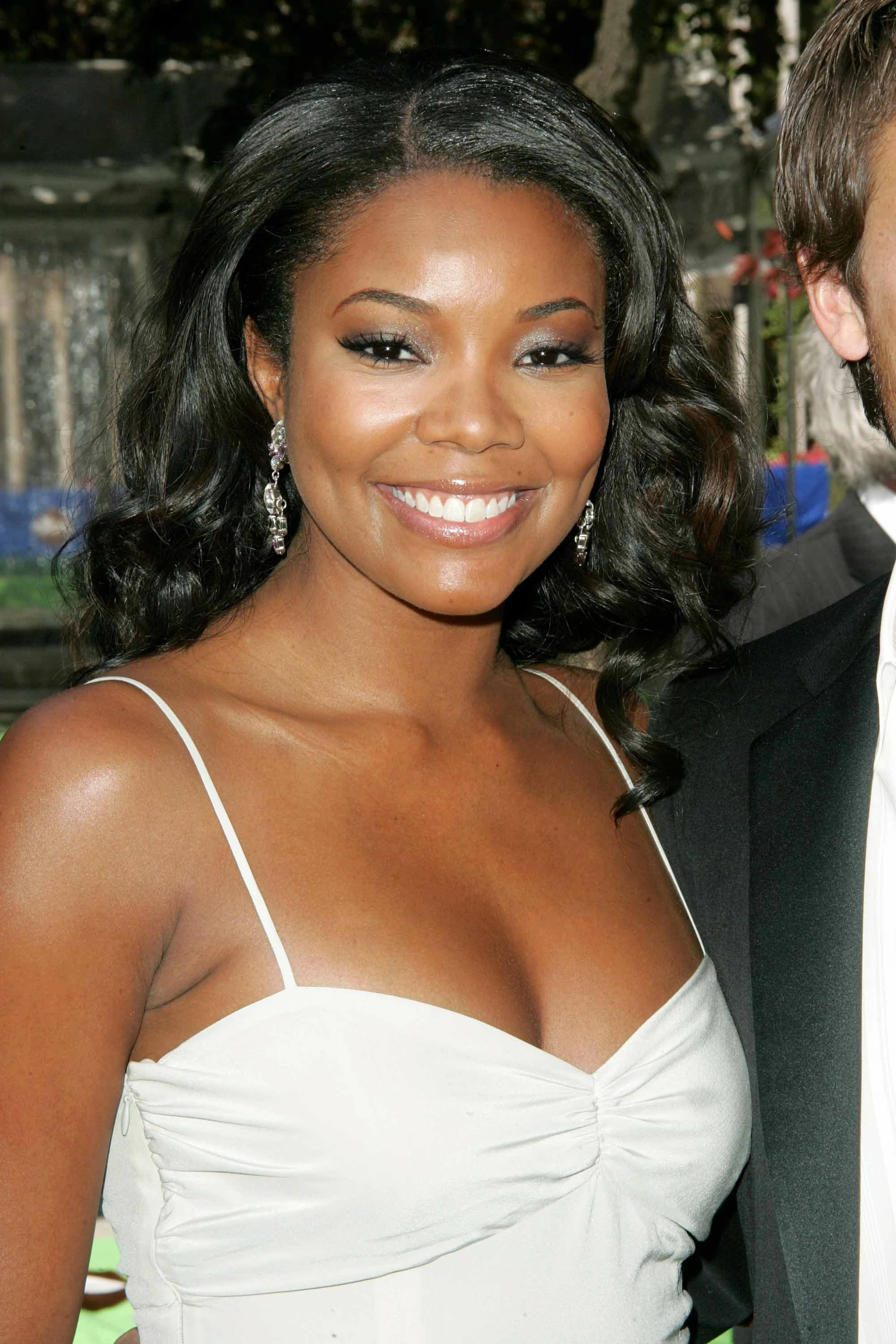
Where her father has been the driving disciplinarian in her life, her mother, Theresa, a former dancer, has been the nurturing, artistic influence. Her mother’s family, the Bryant-Fishers, is one of the oldest and largest black families in Nebraska. So entrenched are they that as part of their annual weekend-long August reunion — 85 years and running — the family stages their own parade down 24th Street. Union recalls that after her family moved from Omaha, where her father was an AT&T manager and her mother a social worker, her mom would take her and her two sisters to such Bay Area cultural events as poetry slams, ethnic festivals and gay pride parades. Union, a tomboy at heart, was 8 when she left Omaha but her ties led her to attend the University of Nebraska-Lincoln, whose women’s soccer team she competed on and whose football team she still madly cheers. Homesickness soon led her back to the coast, where she attended Cuesta College in San Luis Obispo before entering UCLA. After getting her B.A. she considered law school before being “discovered” at the Fontaine Modeling Agency.
Despite lacking a prestigious acting school pedigree, Union said, “I feel confident about what I bring to the table.” In a sense, she’s been in training from the start by being a keen observer. “I’ve always been the kind of person, even as a young kid, who would just sit somewhere and watch people. I’ve always been fascinated by human nature and by what motivates people to do certain things…and that’s kind of a big chunk of acting. That, coupled with the fact I was a sociology major and wrote tons of term papers on inter-group conflict and on what makes people tick…which is a lot of what goes into theater studies.”
Then, she said, there’s the side of the profession no drama school can simulate. “Nothing prepares you for Hollywood. There’s no class on how to deal with a psycho director or a co-star on cocaine or on how to get along with people. Those are just sort of common sense things and a lot of that goes into who works and why. A lot of it is just like manners. Being on time. Working well with others. Literally being one of those people that others like to spend three or four months out of a year with. Part of that is definitely being professional, but part of it too is not taking yourself so seriously that you don’t have a good time. I mean, if I’m going to work in Miami I’m taking a very professional attitude, which means I’m going to be at work on time, I’m going to know my lines, I’m going to hit my marks and you’re not going to have to wait for me. But I’m also going to have a good time while I’m there. No one’s ever going to accuse me of being a fuddy-duddy.”
The vivacious Union is also no shrinking violet. Having grown up in the suburbs, she’s used to being “the black girl” in classes, on teams and, more recently, on sets, which means taking on “the responsibility of sort of educating people, correcting people and letting people know…little different nuances of race and class. It can be a little tiresome. It’s so much different on the set of a predominantly minority cast and crew, when you can free yourself up to just work and not have to worry about somebody saying something offensive or not understanding why I need a black hair stylist or why pink lipstick doesn’t look so great on a black person. It’s nice not to have those little struggles.”
Union is riding a wave that is seeing a more inclusive American cinema than, say, 10 years ago. But, as she can attest, Hollywood is still no where near to being as diverse as the society it purports to mirror. “There’s so much more that needs to be done for minorities, period, just to make films reflective of a multicultural America. Unfortunately, most of the writers employed come from privileged, homogeneous backgrounds not representative of the changing face of America, especially among younger people who, with the infusion of hip-hop, have a completely different mind-set,” she said. “For the younger generation, it’s not a big deal to have a black person kissing a white person or to have a Latino and an Asian as a couple. If those are the dollars Hollywood’s trying to get, then the projects need to be reflective of those attitudes, which are much more open.”


Casting, she said, is still replete with racism. While Berry broke down barriers playing a Bond girl, the buzz behind that “goes away and it’s back to fighting to play certain roles not written race specific. Why does the star’s secretary have to be blond? Why does Tom Cruise’s love interest have to be white? What’s the problem?” More insidious, she said, is the practice of casting light-skinned minorities in positive roles and dark-skinned minorities in negative roles. “When I was auditioning to play the pretty girl friend or the well-educated snob, the other girls in the room were either very fair or biracial and it was like, OK, clearly we have a mind set about what’s attractive, what’s well-to-do and what those faces look like. But a single mother crack-head who just lost her baby’s daddy to a gangland shooting, oh yeah, those girls are going to be dark. It’s just what people feel comfortable with I guess. It’s weird. But hopefully we’re slowly changing that.”
Along with her counterparts, Union hopes to open doors for more actors-of-color. “People in Hollywood always say, It’s not a black thing or a white thing, it’s a green thing, and in a sense that’s true. I’ve been lucky enough that some of my films have made money. Deliver Us From Eva made triple its budget, which you can’t say about many other movies, and that means something to Hollywood, which says, Here’s a movie about four sisters who all have jobs, who all have relationships and it made made money — Hmmm, let’s have more of this.”
Black or white, part of being a starlet in Hollywood is glamming it up, something Union, who can otherwise be found kicking it at home in sweats or shorts, enjoys doing for occasional magazine spreads and industry bashes, when she looks as cool and posh and fabulous as anyone. “It’s an escape from reality and a nice release to be a part of that whole Hollywood glamour machine,” she said. “It’s a lot of fun, but it’s not something I could keep up every day, certainly.”
She still gets back to Omaha, most recently for the January funeral of her great-grandmother, Ora Glass, who was 110. And she keeps tabs on other native Omaha film artists, such as actress Yolonda Ross (Antwone Fisher). An admirer of Alexander Payne, who’s a fan of hers, she said if he ever shoots in town again she’s “willing to be a P.A. or grip to help him around north Omaha,” adding with her typical sauciness, “I love his work, but you don’t see all of Omaha reflected.” Hint, hint.
Related Articles
- Gabrielle Union & Dwyane Wade: Hard Rock Hotties (justjared.buzznet.com)
- Gabrielle Union joins possible “Army Wives” spinoff (reuters.com)
- Gabrielle Union & Jamie Foxx Get Cozy In Vegas [PHOTOS] (hellobeautiful.com)
- The Ties that Bind, One Family’s Celebration of Native Omaha Days (leoadambiga.wordpress.com)
- Native Omahans Take Stock of the African-American Experience in Their Hometown (leoadambiga.wordpress.com)
- Back in the Day, Native Omaha Days is Reunion, Homecoming, Heritage Celebration and Party All in One (leoadambiga.wordpress.com)
- Omowale Akintunde’s In-Your-Face Race Film for the New Millennium, ‘Wigger,’ Introduces America to a New Cinema Voice (leoadambiga.wordpress.com)

Bob Boozer, Basketball Immortal (from my Omaha Black Sports Legends series, Out to Win: The Roots of Greatness)
August 14, 2010
2 comments
Bob Boozer
2012 UPDATE:
It is with a heavy heart I report that the hoops legend subject of this story, Bob Boozer, passed away May 19. As fate had it, I had a recent encounter with Boozer that ended up informing a story I was working on about comedian Bill Cosby. Photographer Marlon Wright and I were in Cosby’s dressing room May 6 when Boozer appeared with a pie in hand for the comedian. As my story explains, the two went way back, as did the tradition of Boozer bringing his friend the pie. You can find that story on this blog and get a glimpse through it of the warm regard the two men had for each other. For younger readers who may not know the Boozer name, he was one of the best college players ever and a very good pro. He had the distinction of playing in the NCAA Tournament, being a gold medal Olympian, and winning an NBA title.
Unless you’re a real student of basketball history, chances are the name Bob Boozer doesn’t exactly resonate for you. But it should. The Omaha native is arguably the best basketball player to ever come out of Nebraska and when he decided to spurn the University of Nebraska for Kansas State, it was most definitely the Huskers’ loss and the Wildcats’ gain. At KSU Boozer became an All-American big man who put up the kind of sick numbers that should make him a household name today. But he starred in college more than 50 years ago, and while KSU was a national power neither the team nor Boozer ever captured the imagination of the country the way, say, Cincinnati and Oscar Robertson did in the same era. But hoop experts knew Boozer was a rare talent, and he proved it by making the U.S. Olympic team, the orignal Dream Team, that he helped capture gold in Rome. And in a solid, if not spectacular NBA career he made All-Pro and capped his time in the league as the 6th man for the Milwaukee Buck’s only title.
Boozer retired relatively young and unlike many athletes he prepared for life after sports by working off-seasons in the corporate world, where he landed back in his hometown after leaving the game. If you look at the body of his work in college, he should be a sure fire college basketball hall of fame inductee, but somehow he’s been kept out of that much deserved and long overdue honor. The fact that he helped the U.S. win Olympic gold and also earned an NBA title ring puts him in rare company and makes a pretty strong case for NBA Hall of Fame consideration. Some measure of validation happened this week when the 1960 Olympic team was enshrined in the Naismith Memorial Basketball Hall of Fame.
2016 UPDATE:
Bob Boozer, Basketball Immortal, to be posthumously inducted into the National Collegiate Basketball Hall of Fame
I posted this four years ago about Bob Boozer, the best basketball player to ever come out of the state of Nebraska, on the occasion of his death at age 75. Because his playing career happened when college and pro hoops did not have anything like the media presence it has today and because he was overshadowed by some of his contemporaries, he never really got the full credit he deserved. After a stellar career at Omaha Tech High, he was a brilliant three year starter at powerhouse Kansas State, where he was a two-time consensus first-team All-American and still considered one of the four or five best players to ever hit the court for the Wildcats. He averaged a double-double in his 77-game career with 21.9 points and 10.7 rebounds. He played on the first Dream Team, the 1960 U.S. Olympic team that won gold in Rome. He enjoyed a solid NBA journeyman career that twice saw him average a double-double in scoring and rebounding for a season. In two other seasons he averaged more than 20 points a game. In his final season he was the 6th man for the Milwaukee Bucks only NBA title team. He received lots of recognition for his feats during his life and he was a member of multiple halls of fame but the most glaring omisson was his inexplicable exclusion from the National Collegiate Basketball Hall of Fame. Well, that neglect is finally being remedied this year when he will be posthumously inducted in November. It is hard to believe that someone who put up the numbers he did on very good KSU teams that won 62 games over three seasons and ended one of those regular seasons ranked No. 1, could have gone this long without inclusion in that hall. But Boozer somehow got lost in the shuffle even though he was clearly one of the greatest collegiate players of all time. Players joining him in this induction class are Mark Aguirre of DePaul, Doug Collins of Illinois State, Lionel Simmons of La Salle, Jamaal Wilkes of UCLA and Dominique Wilkins of Georgia. Good company. For him and them. Too bad Bob didn’t live to see this. If things had worked out they way they should have, he would been inducted years ago and gotten to partake in the ceremony.
|
Boozer with the Los Angeles Lakers
Bob Boozer, Basketball Immortal (from my Omaha Black Sports Legends series, Out to Win: The Roots of Greatness)
©by Leo Adam Biga
Originally published in the New Horizons and later reprinted in The Reader (www.thereader.com) as part of my Omaha Black Sports Legends series, Out to Win: The Roots of Greatness
Omahan Bob Boozer chartered a bus to Manhattan for a February 5 engagement with immortality. By the way, that’s Manhattan, Kansas, where 50 of his closest friends and family members joined him to see his jersey retired at half-time of the Kansas State men’s basketball game.
In case you didn’t know, Boozer is a Wildcat hoops legend. In the late-1950s, he was a dominant big man there. In each of his three years, he was first team all-conference. He was twice a concensus first-team All-American. And that doesn’t even speak to his elite-level AAU play, his winning an Olympic gold medal on the original “Dream Team” and his solid NBA career capped by a championship.
Unless you’re a serious student of the game or of a certain age, the name Bob Boozer may only be familiar as one adorning a road in his hometown. But, in his time, he was the real deal. He had some serious game. He overwhelmed opponents as an all-everything pivot man at Omaha Technical High from 1952-55, earned national accolades as a high-scoring, fierce-rebounding forward at K-State from 1955-59, led an AAU squad to a title, played on the legendary 1960 U.S. Olympic basketball squad and was a member of the 1971 NBA champion Milwaukee Bucks. It’s a resume few can rival.
“There’s very few guys that really had it all every step of the way, like I did. All City. All State. All Conference. All-American. Olympic gold medal. NBA world championship. Those are levels everybody would like to aspire to but very few have the opportunity,” he said.
He is, arguably, the best player not in the college hoops hall of fame. He is, by the way, in the Olympic Hall of Fame. His collegiate credentials are unquestionable. Take this career line with the Wildcats: 22 points and 10 rebounds a game. And this came versus top-flight competition, including a giant named Wilt at arch-rival Kansas, when K-State contended for the national title every year. If anything, the Feb. 5 tribute is long overdue.
Of his alma mater feting him, he said, “It’s quite an honor to have your jersey retired. That means in the history of that school you have reached the pinnacle.”
The pinnacle is where Boozer dreamed of being. His Olympic experience fulfilled a dream from his days at the old North YMCA, mere blocks from his childhood home at 25th and Erskine. Then, he reached the pinnacle of his sport in the NBA. A starter most of his pro career, he was a productive journeyman who could be counted on for double figures in points and rebounds most nights. His career NBA averages are 14.8 points and 8.1 rebounds a game. The 6’8 Boozer played in the ‘68 NBA All-Star game, an honor he just missed other years. He led the Chicago Bulls in scoring over a three-year period. He was the Bucks’ valuable 6th man in their title run.
Still, he was more a role player than a leading man. His game, like his demeanor, was steady, not sensational. He was, in his own words, “a blue-collar worker.” He could shoot like few other men his size, utilizing deadly jumpers and hook shots.
“I was a good player. I would make you pay if you made a mistake. I could move out for the jump shot and the hook shot or make a quick move for a layup,” he said.
While he admires the athleticism of today’s players, he doesn’t think much of their basic skills.
“We could flat-out outshoot these kids today. We worked awfully hard at being able to shoot the jump shot. I used to always say that a 15- to 18-foot jump shot is just like a layup. That was my mind set — that if I got it clear, it was going down.”
He perfected his shot to such a degree that in practice he could find his favorite spots on the court and nail the ball through the hoop with his eyes closed.
“It’s just something that with thousands and thousands of repetitions gets to be automatic. And when I shot I always used to try to finger the ball for the seams and to swish it because if the ball left my hand with a backward rotation and went through the net, it would hit the floor and come right back to you. That way, when you’re shooting by yourself, you don’t have to run after the ball very much,” he said, chortling with his booming bass voice.
Unlike many players who hang around past their peak, once Boozer captured that coveted and elusive ring, he left the game.
“I had made up my mind that once I walked, I walked, and would never look back. Besides, your body tells you when it’s getting near the end. I started hating the training camps a little more. The last few years I knew it was coming to an end,” he said. “The championship season with the Bucks was the culmination of my career. It was great.”
Indeed, he left without seeking a coaching or front office position. The championship was made sweeter as he shared it with an old pal, Oscar Robertson. As players, they were rivals, teammates and friends. Both were college All-Americans for national championship contending teams. As a junior, Boozer and his KSU Wildcats eliminated “The Big O” and his Cincinnati Bearcats from the 1957-58 NCAA quarterfinals. The next year Robertson turned the tables on Boozer by knocking the No. 1-ranked ‘Cats out of the regionals.
The two were teammates on the 1960 US Olympic basketball team, considered by many the best amateur basketball talent ever assembled. Besides Boozer and Robertson, the team featured future NBA stars Jerry West, Jerry Lucas and Walt Bellamy. It destroyed all comers at the Rome games, winning by an average margin of 34-plus. Then Boozer and Robertson were reunited with the Cincinnati Royals. Cincy was the site of some fat times for Boozer, who was popular and productive there. It’s also where he met his wife, Ella. The couple has one grown child and one grandchild.
After a trade to the New York Knicks that he protested, Boozer bounced around the league. He played a few years with the expansion Chicago Bulls, where he enjoyed his biggest scoring seasons — averaging about 20 points a game. He led the Bulls to the playoffs in their inaugural season — the first and last time a first-year expansion team did that.

A card from his time with the Cincinnati Royals
He had one happy season with the Los Angeles Lakers, spelling the great Elgin Baylor, before he joined Robertson in Milwaukee. With the incomparable Kareem Abdul-Jabbar at center, smooth Bob Dandridge at forward, playmaker Robertson at guard and the steady Boozer coming off the bench (he averaged 9 points and 5 boards), the Bucks, in only their second year, blew away opponents en route to a 66-16 regular season mark. They captured the franchise’s first and only championship by sweeping the Baltimore Bullets in four games.
By then, Boozer was 34 and a veteran of 11 NBA seasons with five different teams. He left the league and his then-lofty $100,000 salary to build a successful career off the court with the former Northwestern Bell-US West, now called Qwest.
Now retired from the communications giant, the 67-year-old Boozer enjoys a comfortable life with Ella in their spacious, richly adorned Pacific Heights home in Omaha, a showplace he refers to as “the fruits of my labor.” He moves stiffly from the wear and tear his body endured on the hardcourt those many years. His inflamed knee joints ache. But he recently found some relief after getting a painful hip replaced.
With his sports legacy secured and his private life well-ordered, his life appears to have been one cozy ride. Viewed more closely, his journey included some trying times, not least of which was to be denied the chance to buy a home in some of Omaha’s posher neighborhoods during the late 1960s. The racism he encountered made him angry for a long time, but in the end he made peace with his hometown.
Boozer grew up poor in north Omaha, the only son of transplanted Southerners. His father worked the production line and cleanup crew at Armour’s Packinghouse. His mother toiled as a maid at the old Hill Hotel downtown. Neither got past the 9th grade and these “God-fearing, very strict” folks made sure Bob and his older sister understood school was a priority.
“They knew racial prejudice and they said education was the way out. Their philosophy was, you kids will never have to work as hard as we did if you go get your education. We had to get good grades,” Boozer said. “My junior year in high school my mother and dad set my sister and I down and said, ‘We‚ve got enough money to send your sister to Omaha U. (UNO). You’re on your own, Bob.’ Well, it just so happened I started growing and I started hitting the basket and I figured I was probably going to get a basketball scholarship, and that came to fruition.”
No prodigy, Boozer made himself into a player. That meant long hours at the YMCA, on playgrounds and in school gyms. His development was aided by the stiff competition he found and the fine coaching he received. He came along at a time when north Omaha was a hotbed of physical talent, iron will and burning desire.
“That was a breeding ground,” he said. “All the inner city athletes were always playing ball. All day long. All night long. If you were anything in athletics, you played for the Y Travelers, a basketball team, or the Y Monarchs, a baseball team, under Josh Gibson (Hall of Fame pitcher Bob Gibson’s older brother), who was a fine coach.”

Boozer said he spent so much time at the Y that its executive director, John Butler, “used to let me have the keys to the place. Butler provided the arena where I could work out and become an accomplished player and Josh Gibson provided the opportunity to play with older players.”
He said his dedication was such that while his buddies were out dating, “I was shooting hoops. It was a deep desire to excel. I always wanted to be a basketball player and I always wanted to be one of the best. I realized too at an early age athletics could provide me with an education.”
Athletics then, like now, were not merely a contest but a means of self-expression and self-advancement. Boozer was part of an elite lineage of black athletes who came out of north Omaha to make their mark. Growing up amid this athletic renaissance, he emulated the older athletes he saw in action, eventually placing himself under the tutelage of athletes like Bob Gibson — or “Gibby” as Boozer calls his lifelong friend, who is a year his senior. They were teammates one year each with the Y Travelers and at Tech.
“Some of the older athletes worked with me and showed me different techniques. In the inner city we basically marveled at each other’s abilities. There were a lot of great ballplayers. We rooted for each other. We encouraged each other. We were there for each other. It was like an inner city fraternity,” Boozer said. “I used to sit in the stands at Burdette Field and watch ‘Gibby’ pitch. As good a baseball player as he was, he was a finer basketball player. He could play. He could get up and hang.”
By the time Boozer played for Tech coach Neal Mosser, he was a 6’2” forward with plenty of promise but not yet an impact player. No one could foresee what happened next.
“Between my sophomore and junior years I grew six inches. With that extra six inches I couldn’t walk, chew gum and cross the street at the same time without tripping,” Boozer said. “That’s when I enlisted my friends, Lonnie McIntosh and John Nared, to help me. Lonnie, a teammate of mine at Tech, was a physical fitness buff, and John, who later played at Central, was probably one of the finest athletes to ever come out of Omaha.
“We’d go down to the Y every week. Lonnie would put me through agility drills on some days and then John and I would go one-on-one other days. John was only 6’3” but strong as a bull. I couldn’t take him in the post. I had to do everything from a guard-forward position. And, man, we used to have some battles.”
By his junior season Boozer was an imposing force — a big man with little-man skills. He could not only post-up down low to score, rebound and block shots, he could also shoot from outside, drive the lane and run the floor. With Boozer in the middle and a talented supporting cast around him, Tech was a powerhouse comprised mainly of black starters when that was rare. Then came the state tournament in Lincoln, and the bitterness of racism was brought home to Boozer and his mates.
“We had the state championship taken away from us in 1955. We played Scottsbluff. We figured we were the better team. I was playing center and I literally had guys hanging on me. The referees wouldn’t call a foul. I’d say, ‘Ref, why don‚t you call a foul?‚ and all I heard was, ‘Shut up and play ball,’ he said. “On one play, Lonnie McIntosh stole the ball and was dribbling down the sideline when one of their guys stuck his foot out and tripped him. There was Lonnie sprawled out on the floor and the referee called traveling and gave the ball to Scottsbluff. I will never forget that.
“We were outraged, but what could we do? If we had really got on the refs we’d have got a technical foul. So we had to suck it up and just play the best we could and hope we could beat ‘em by knocking in the most shots.”
Tech lost the game on the scoreboard but Boozer said players from that Scottsbluff team have since come up to him and admitted the injustice done that day. “It’s a little late,” he tells them. According to Boozer, Tech bore the brunt of discrimination in what should have been color-blind competition.
“Tech High always used to get the shaft, particularly in the state tournament.” He said Mosser, whom he regards as one of Nebraska’s finest coaches, helped him deal with “the sting of racism” by instilling a certain steeliness.
“Neal was a real disciplinarian. And he used to always tell us that life was not going to be easy. That you‚ve got to forge ahead.”
That credo was tested when Boozer became a hot recruit his senior year but was rejected by his top choice, the University of Iowa.
“Neal showed me a letter that Iowa coach Bucky O’Connor wrote telling him he had his quota of black players. “Neal said, ‘Bob, these are things you’re going to have to face and you’ve just got to persevere in spite of it.’ It hardens you. It makes you tougher.’”
Kansas was in the running until Wilt Chamberlain signed to play there. Boozer settled on Kansas State, where he made a name for himself and the Wildcats. Under coach Tex Winter, Boozer was the go-to-guy in the triangle post, an offense made famous years later by Michael Jordan and the Chicago Bulls.
“A lot of plays flashed across the middle. We had a double screen where I’d start underneath and come back. The off forward and guard would come down and pinch and I’d brush my guy off into them and pop out for my jump shot.”
During his three-year varsity career, the Cats went 62-15 and won two Big Eight titles. Boozer was unstoppable. His 25.6 scoring average as a senior remains a single-season record. He ranks among KSU’s all-time leaders in points and boards.
In a famous 1958 duel for league, intrastate and national bragging rights, he led a 75-73 double overtime win over Wilt Chamberlain and KU in Manhattan. He outscored Wilt 32 to 25.
“Nobody could go one-on-one with Wilt. He was just too powerful. From his waist up he was almost like a weight lifter. You always had to be aware of where he was because he’d knock the ball in the 13th row. I had one move where I’d face him and fake him and he’d take a step back and I would do a crossover hook shot. He’d be up there with it and always miss it by about like that,” Boozer said, holding his index finger and thumb an inch apart. “I’d say, ‘In your face, big fella.’ And he’d say, ‘I’ll get you next time.’ Wilt and I always enjoyed each other.”
After his banner senior year the NBA came calling, with the Cincinnati Royals making Boozer the No. 1 overall draft pick, but Boozer had other ideas.
“I delayed going pro one year to keep my amateur standing and get a shot at the Olympic Trials.”
To stay sharp he played a year with the Peoria Cats of the now-defunct National Industrial Basketball League, an AAU-sanctioned developmental league not unlike today’s CBA or NBDL. Boozer worked at the Caterpillar Tractor Co. by day and played ball at night. He led his team to the NIBL title, which qualified the team and its players to showcase their talents at the Olympic Trials in Denver. Boozer and a teammate made the grade. The Rome Olympics are still among his personal highlights.
“I was a history buff and just the idea of being on the Appian Way, where the Caesars trod, and all the beauty of Rome — it was magnificent. And winning the gold medal for my country was very, very meaningful.”
Even after entering the NBA, Boozer honed his game in the off-season back home with John Nared in one-on-one duels at the Y. “If he could guard me, as small and quick as I was, he could guard anybody in the NBA,” Nared said.

Boozer found pro ball no longer just a game but a business, too. He weathered unwanted trades and salary disputes. There were compensations, of course. He played the game he loved with the best players in the world. He made good money, if only a fraction of what today’s players make. And he made close friends. Some of his fondest memories are of he and Oscar Robertson winding down after games.
“We used to go out and get dinner, go back to our rooms, light up some cigars, pop open some beers and talk basketball until the wee hours of the morning.”
Boozer prepared for post-hoops life years before he retired by participating in a summer management training program with the phone company. By the time he quit playing ball, he had a job and career waiting.
“You see, I never forgot how my mom and dad stressed getting an education and looking after your family.”
In 1997, he retired after 27 years as a community affairs executive and federal lobbyist with the communications company. Restless in retirement, he accepted an appointment that year from then-Gov. Ben Nelson to the Nebraska Parole Board. Gov. Mike Johanns reappointed him to a new six-year term running through 2006. Boozer enjoys his work.
“It’s almost like being a counselor. I’ll pull an offender aside, especially a young male from the inner city, and have a common sense conversation with him, and most times he’ll listen. I think my athletic name helps me because most young males identify with an athlete.”
Boozer’s not just any ex-athlete. He’s an immortal.
Related Articles
- Collegians Were the Olympic Basketball Show in 1960 (nytimes.com)
- The Dream Team Enters The Basketball Hall Of Fame: Can The Lakers, Bulls, And Celtics Come Too? (sbnation.com)
- Basketball Hall Of Fame Speech: The 1960 U.S. Olympic Team (sbnation.com)
- Making the Case for a Nebraska Black Sports Hall of Fame (leoadambiga.wordpress.com)
- From My Series Out to Win: The Roots of Greatness, An Exploration of Omaha’s Black Sports Legends (leoadambiga.wordpress.com)
- Closing Installment from My Series Out to Win: The Roots of Greatness, An Exploration of Omaha’s Black Sports Legends (leoadambiga.wordpress.com)
- Omaha Hoops Legend John C. Johnson: Fierce Determination Tested by Repeated Run-Ins with the Law (leoadambiga.wordpress.com)
Categories: African-American Culture, Basketball, Bob Boozer, Omaha Black Sports Legends, Out to Win: The Roots of Greatness (a series), Sports, Writing
African-American Culture, Basketball, Black Sports Legends, Bob Boozer, Chicago Bulls, Kansas State, NBA, Nebraska Black Sports Hall of Fame, North Omaha Nebraska, Oscar Robertson
Marguerita Washington: The woman behind the Star that never sets
August 2, 2010
2 comments
My interest in Omaha‘s African-American newspaper of record, the Omaha Star, goes back a ways. The woman who founded it and rose to national prominence with it, the late Mildred Brown, I never had the pleasure of meeting. By the time I began writing and reporting on the black community here she was gone and her niece, Marguerita Washington, was in charge. I didn’t meet Washington though until a few years later. First, I got to know the Star’s longtime advertising director, the late Preston Love Sr., who was a jazz and blues musician and band leader. Preston is someone I wrote about quite a lot and he served as a valuable source for me about historic black Omaha. Visiting the Star’s offices to meet with Preston only increased my interest in the Star and I eventually had several stories of mine reprinted in its pages., and it was during that time that I wrote this short piece about Marguerita and her aunt Mildred for the New Horizons.
The Omaha Star is less than generous when it comes to contributing writers like myself, as they seem to view a contributed story as a community service rather than a professional service like any other that requires compensation. Because my sole living depends on my writing, I usually managed to work out some form of compensation for my work, although not in monetary terms. For example, I received a complementary subscription to the paper for a couple years and once I was paid in the form of a homemade sweet potato pie.

Marguerita Washington: The woman behind the Star that never sets
©by Leo Adam Biga
Originally appeared in the New Horizons
When Mildred Brown, the loquacious, living-out-loud founder/publisher/editor of the Omaha Star, died in 1989, the city’s only black newspaper was left to niece Marguerita Washington, a woman as circumspect as her aunt was flamboyant. Even with their differences, the women enjoyed a close relationship. The matriarchal Brown mentored her niece, who was like a daughter to her.
A Kansas City, Mo. native, Washington lived with Brown for a time. Long before passing at age 76, Brown laid out how her niece would succeed her at the Star to carry on the cause of civil rights in its pages. There was even talk of them being partners. Washington loved the paper and its mission, but had other plans, namely to be an educator. When she achieved her dream as a special education teacher and, later, an administrator with the Omaha Public Schools, Brown was “disappointed at first, but she adjusted,” her niece recalled.
But, as usual, Brown got the final say when her will bequeathed ownership of the paper to her niece. For a time, Washington tried doing dual careers, but “it got to be pretty rough, so I took early retirement” from OPS.
All along, Washington said, she’d been groomed to take over the Star.
“When I lived with her, not a day went by she didn’t talk to me about the paper and what happened, how it happened, why it happened. And I don’t care how late I came in on Friday nights, I had to be out there in the front office to take care of the newsboys and girls. She wanted me to study journalism. That wasn’t my thing. But she made me take some journalism classes. In fact, we took some together (at UNO). That was interesting. I remember one time she was giving a presentation and the instructor cut her off because she was too long-winded.”
Washington said her aunt went to school “for the fun of it and also to try and make a point with me. The point being I should be interested in journalism. She wanted me to be prepared because, she said, ‘you never know what might happen.’ She was a very wise lady. She did what she felt she had to do.” Once the Star fell into her hands, the once reluctant Washington embraced the responsibility of taking over a weekly that has continuously published since 1938.
“Journalism is something you get attached to. It gets in your blood. On a newspaper you never know from one minute to the next what story’s going to break. Sometimes, nothing happens for awhile. Other times, you’re almost tripping over yourself trying to keep up with everything,” she said. “It’s a learning process.”
She knew the burden she accepted after assuming the reigns as publisher/editor.
“It was a challenge. It’s still a challenge. My goal was to keep the paper basically the same, but to to add to it as the times or the issues dictated. In doing so, this will keep Millie’s legacy alive and the paper will continue for as long as possible.”
Through the crusading Star, Brown made herself a national figure in an era when it was rare for any woman, white or black, to own a paper. The strong stands she took against racism in the Star and on the many community-civic organization boards she served on, brought her and her views to the attention of civil rights leaders and presidents. Wherever she went and whomever she met, Brown worked on behalf of freedom and justice for her people.
The famous declaration of principles in the Star’s mast head — “Dedicated to the service of the people that no good cause shall lack a champion and that evil shall not go unopposed” — was a motto identified with Brown. She, like the paper she used as her mouthpiece, was seen as a champion of the underdog.
As a teen Washington got to see that advocacy in action when she tagged along with her aunt at protests and demonstrations aimed at overturning discrimination in the schools, at workplaces and in public places. “I was right there.” Brown and her paper ardently supported the work of the Urban League, the NAACP, black churches and social action groups such as the DePorres Club and the 4CL.
Advocacy journalism is still at the core of the Star’s mandate under Washington. While she may lack her aunt’s flair, she’s maintained the Star as a mirror for black concerns and, in her own quiet way, made it “a sounding board” for ordinary folks.
“I’m interested in the heartbeat of the community. What’s on the citizens’ minds? What do they feel? What are they interested in? What do they plan to do about it? The main thing I’m proud of is this paper has really become the people’s paper. We have many guest local columnists. Those in the community who have something to say and who can write — mind you I say who can write — they have space to express themselves. Because a paper is not just one person’s idea of what should be. It should be a total thing. It should be a community thing. I think a paper can function a lot better if you have a lot of different opinions…a diversity of voices.”
The Star’s regular columnists include Nebraska State Sen. Ernie Chambers, corporate VP Mike Jones and community activist Matthew Stelly.
While Brown’s garish style made her a public figure that sometimes overwhelmed the paper’s feats, Washington’s demure manner has kept her in the shadows to let the Star shine on its own merits. Two distinct approaches for two distinct women. But there’s no doubt Mildred Brown is a hard act to follow.
Known for wearing gaudy dresses and corsages, making the rounds of business meetings in a chauffeur-driven limousine and talking the ear off anyone if it meant a prospective ad sale, Brown was a force of nature. Her charm was such that despite being perpetually late for everything and reportedly overstating some claims, like the paper’s circulation, she was forgiven all. Selling was her gift. Selling herself was a large part of making the paper a success and outlasting every single competing black newspaper that went head-to-head with it.
Whether it was to close you on buying an ad or to shame you into doing the right thing, Brown was persistent in having her way.
“She was one of those people, whatever she wanted, she eventually got it, one way or the other,” said Washington, who as a teen accompanied her aunt on sales calls. “She loved to talk. And I think sometimes people would go ahead and buy just to get rid of her. But she didn’t care. And she would work on these people to be repeat customers, and usually got ‘em. She could sell the San Francisco bridge”
Even all these years later, the legacy of Brown looms large over the offices of the Star, 2216 North 24th Street, where an entire room is dedicated to her, including dozens of plaques on the walls that represent just a fraction of the 150 or so honors she received in her lifetime. The apartment she resided in in the rear of the circa-1923 brick building is much like it was at the time of Brown’s death. Washington uses the apartment as her personal office, where she and her Lhasa Apso dog, Carman, greet visitors.
Something else that hasn’t changed is the struggle for equality. While Washington sees progress, she’s alarmed by the education-achievement gaps between whites and blacks and decries how slow the redevelopment of north Omaha is proceeding.
“We understand the struggle is far from over. We’ve changed our techniques in writing about it or talking about it, but we’re still working toward the motto we have that if one person is down, then we’re all down,” she said.
That lesson is among many principles Brown taught her.
“She truly believed we should give each other a helping hand in any way we can. Somebody might be down, but you can help to pull them up. And if you don’t, then you’re a part of the problem. Another value I got from her is we all have to work together. We can’t pull apart. Once the link is broken, you can’t accomplish anything. She was also very strong on education. She believed there’s no limit to learning. I believe that also. And there’s always a better way to do something.”
“Education,” she said, “and journalism are really very similar. The only thing is, in education, you’ve got the classroom. In journalism, you’ve got the world.”
Related Articles
- The Once and Future Black Press (theroot.com)
- Books About Survival in the Post-Katrina Gulf (theroot.com)
- Veteran Times reporter Charles E. Brown dies (seattletimes.nwsource.com)
- Today’s Exploration: Omaha’s History of Racial Tension (theprideofnebraska.blogspot.com)
- Omaha Native Steve Marantz Looks Back at the City’s ’68 Racial Divide Through the Prism of Hoops in His New Book, ‘The Rhythm Boys of Omaha Central’ (leoadambiga.wordpress.com)
- UNO Wrestling Dynasty Built on a Tide of Social Change (leoadambiga.wordpress.com)
- Back in the Day, Native Omaha Days is Reunion, Homecoming, Heritage Celebration and Party All in One (leoadambiga.wordpress.com)
- The Ties that Bind, One Family’s Celebration of Native Omaha Days (leoadambiga.wordpress.com)
- Big Bad Buddy Miles (leoadambiga.wordpress.com)
- Enchantress “LadyMac” Gets Down (leoadambiga.wordpress.com)
- Arno Lucas, Serious Sidekick (leoadambiga.wordpress.com)
- A Brief History of Omaha’s Civil Rights Struggle Distilled in Black and White By Photographer Rudy Smith (leoadambiga.wordpress.com)
- Making the Case for a Nebraska Black Sports Hall of Fame (leoadambiga.wordpress.com)
- Blacks of Distinction II (leoadambiga.wordpress.com)
- From the series Out to Win: The Roots of Greatness – Black Women Make Their Mark in Athletics (leoadambiga.wordpress.com)
Categories: African-American Culture, Civil Rights, Entrepreneurial, Feminism, Journalism, Marguerita Washington, Media, North Omaha, Race, Writing
African-American Culture, DePorres Club, Journalism, Marguerita Washington, Mildred Brown, North Omaha Nebraska, Omaha Star, Race, Social Justice, Writing
Power Players, Ben Gray and Other Omaha African-American Leaders Try Improvement Through Self-Empowered Networking
July 9, 2010
7 comments
| The following story on the African-American Empowerment Network in Omaha appears here just as it does in print and online in The Reader (www.thereader.com),. It is part one of a two-part cover series on the grassroots community initiative focused on making positive change to address longstanding disparities in key quality of life areas. I will post part two here after it’s published next week. I worked on and off over a period of two years assembling the data, mostly based on interviews, for these stories. As sometimes happens in my line of work, the story I submitted has been severely cut, primarily for space, and as its author I would argue it has lost something in translation — depth, texture, nuance, and perhaps. continuity, although I would be purely guessing at this point, because you see I don’t read my published work anymore, this story included. That is, I stopped reading my freshly published years ago. It just got to be too upsetting to find articles winnowed down by hundreds, even thousands of words in some cases. Too often something went wrong in the process. This is not an overly sensitive writer condemning the very useful and necessary practice of editing. Earlier today I edited, on an editor’s orders, a 3,400 word story down to 1,600 words, and all that tightening didn’t kill the story so much as focus it. Ah, but you see, I did the edit myself. The following story was truncated without my input. Now, it might be perfectly fine in its shortened form. Or it might not. Eventually, I’ll let you the reader decide. In a couple weeks I will post the version I submitted and run it on the same page with this version. You be the judge. For now though, read about an interesting effort to revitalize Omaha’s African-American communityfrom the ground up.
Power Players, Ben Gray and Other Omaha African-American Leaders Try Improvement Through Self-Empowered Networking ©by Leo Adam Biga As seen in the The Reader (www.thereader.com)
It may have been 2007 when northeast Omaha’s depressed African-American community reached its limit. A demographic bound by race, history, circumstance and geography seemingly exhaled a collective sigh of exasperation to exclaim, “Enough already!” Longstanding discontent over inequities in income, housing, education, economic development and opportunity solidified into resolve by a people to take action. Nearly four years ago, a coalition of local blacks decided to rebuild the community from within. They formed the nonprofit African-American Empowerment Network. The effort was inspired by author and television/radio talk show host Tavis Smiley in his best selling 2006 book, The Covenant with Black America. Omaha’s Empowerment Network targeted 13 areas for improvement. Efforts by the Network and partners are the latest attempted remedies. In the 1940s and ’50s the De Porres Club pressed for civil rights. In the ’60s the Citizens Coordinating Committee for Civil Liberties or 4CL, took up the banner. Well into the ’70s federally funded programs and agencies spurred by the Great Society and its War on Poverty operated here. At various times the Urban League of Nebraska and the Omaha Chapter of the NAACP have led on social justice and community betterment issues. When the last in a series of major civil disturbances in the late 60s badly damaged the old North 24th St. business-entertainment hub, many businesses left. Few new businesses have opened. Northeast Omaha’s chronic gun violence contributed to the perception of an unsafe environment. It is regarded as a mission district dependent on government assistance, social services and philanthropy. President and consultant at Innovations By Design, LLC, Tawanna Black, also vice-chair of the board for the Network, and co-chair for the race relations covenant, summed it up. “In the absence of African-Americans in powerful political or economic positions to drive this, small changes have occurred but nothing major. The Network really flips that theory on its head and says,”Why are we waiting for the power to be given? Let’s own the power that’s within.’ It’s an empowerment thing. It means more than just a name on a piece of paper. It’s really what it’s all about empowering people to take control of themselves. A process committed to that is completely new in this community.” “There’s been a lot of psychological damage done to us as a people. Historically we just allow things to happen to us and what we have to do is starting taking control of our own destiny and that means also having skin in the game,” said Omaha City Councilman and Network violence intervention-prevention chair Ben Gray. Empower Omaha drafted a rising-tide-lifts-all-ships community covenant. Through monthly community meetings, periodic summits and prayer walks, neighborhood cleanups, block parties and surveys, the Network interfaces with residents through a North Omaha Neighborhood Alliance. “We keep the community engaged, we listen to the community, we write down what they say. I think that’s how we get the buy-in from the community,” said director of operations Vicki Quaites-Ferris. “Most things implemented actually come as a result of listening to the community.” Highlander Neighborhood Association president Kristina Carter said the Network’s an integral part of neighborhood cleanups. Network strategies encompass neighborhoods, housing, employment, education, family, faith, crime, etc. The strategies come from community leaders, residents and best practices in other cities. Not a direct service provider, the Network partners with others to support or facilitate programs. The Network was in place before a 2007 Omaha World-Herald series revealed black Omaha poverty rates as among the nation’s worst. What was already known is that many youths underachieve in school — only half graduate. There is an epidemic of sexually transmitted diseases, a preponderance of single-parent homes and little economic development or opportunity. Newly detailed were high jobless rates and low household income levels. Freeway construction disrupted, some say severed, a tight community. As restrictive housing practices waned, upwardly mobile blacks moved west. Others left the state. Many feel the city needs to make an “It stops here” pledge. Rev. Jeremiah McGhee doubts the larger community yet appreciates a revitalized north Omaha is good for all of Omaha. The city has managed a united front against gun violence. The Network has endorsements from Mayor Jim Suttle, Omaha Police Chief Alex Hayes and some 100 public-private partners for the Omaha 360 anti-violence coalition. Connecting the dots, it became clear that despair is rooted in certain realities: entrenched gang and drug culture; fractured families; a lack of positive role models; barriers to educational, job, home ownership and business opportunities; a sense that no one cares. Douglas County Treasurer and Network chair John Ewing knows it from his former career as an Omaha cop and Empowerment prayer walks and community meetings. He said residents complain of violence, lack of economic opportunities, that they feel abandoned, neglected, overlooked, forgotten. It leads to a sense of hopelessness. And northeast Omaha’s lost some 11,000 households over time. A diminished tax, voter, consumer base diluted the minimal clout it had to hold public and private sectors accountable the economic and social ills. “There’s been a lot of benign neglect that’s gone on in north Omaha by the majority community and I don’t hesitate in saying that because it’s a fact,” said Gray.”But what we’ve got to do now is rather than point fingers and place blame put together the necessary mechanism to fix it. We’ve got so much work to do and we’ve got so many areas that we’re operating in.” Davis Companies CEO Dick Davis spearheads a formed Economic Strategy Taskforce whose goals address economic viability. Those include preparing every African-American for a sustainable living-wage job; moving persons from unemployment or underemployment to full employment and from jobs to careers; encouraging entrepreneurship by increasing access to credit and capital. The Network endorses a from-birth-to-career strategy. Davis has long been active, starting black businesses and providing college scholarships to black students. Entities like the African-American Academic Achievement Council, 100 Black Men, 100 Black Women, the Omaha Economic Development Corporation, the Urban League of Nebraska, along with black churches, have done their part. Pockets of progress have appeared in some new home construction, a few business parks, a refurbished section of North 24th St. and new quarters for anchors Salem Baptist Church, the Urban League and Charles Drew Health Center. Nothing large-scale has been attempted. A recent Pew Partnership for Civic Change report found that of 33,000 metro businesses, only 200 are black-owned – most are single owner-operator endeavors. Family Housing Advisory Services director Teresa Hunter, co-chair of the Network’s housing development covenant, said “We work within the framework of what’s already going on, trying to make it cooperative … Why are people still falling through the cracks – what else do we need to do?” Where most Network players are native Omahans like Hunter, the driving force is a transplant, Willie Barney, who until recently was a strategic consultant. The Iowa native worked in media marketing for Lee Enterprises and moved here for an Omaha World-Herald post. He worked on Salem Baptist Church’s administrative team when he galvanized efforts to create the Network. He served as the Network’s unpaid president and facilitator, then as a consultant, and is now its second paid staff member. “In evolving over time we’ve stayed true to our mission,”said Barney. “We said we want to be positive and pro-active and to build partnerships … with the entire city. It has to be bottom-up and top-down for it to be anywhere close to being successful — individuals, families, leaders at all levels working together collaboratively.”
The effort started focusing on seven core areas: jobs, business-economic development, education-youth development, voting, violence prevention, housing-neighborhoods-transportation and engagement. Evidence of the Network’s wide reach was seen during its annual Harmony Week (May 21-29), when dozens of organizations and thousands of people across the Metro participated in expressions of unity and community engagement. In 2009 the organization opened an office in the historic Jewell Building in the heart of North O, across from the Omaha Star. The Network boosted its presence via an expanded website, Facebook page and Revive! Omaha Magazine, which Barney’s SMB Enterprises LLC publishes. A TV spot features Network leaders reciting, like a creed, the Empowerment credo: “We can change Omaha. It’s time to rebuild the village. Family by family, block by block, school by school, church by church, business by business. Each person doing their part. Working together, let’s transform Omaha. Do your part. Live the covenant.” The Network’s first full-time staffer was Quaites-Ferris, a former deputy assistant to former Mayor Mike Fahey said. Three-and-a-half years in, the Network has a track record. Barney said whatever course the Network adopts, it relies on others to carry it out. “At the end of the day it’s ENCAP, the Urban League, Omaha Economic Development Corporation that are doing the work. But I think because we’re here we’ve helped facilitate potentially more partnerships than would have happened before.” Malcolm X Memorial Foundation president Sharif Liwaru said he feels the Network’s facilitator rather than direct service provider role “is still hard for people to grasp.”Barney concurred. While Liwaru and community activist Leo Louis feel the Network effectively engages established organizations and leaders, they advocate more outreach be done to new, more loosely organized groups as well as to youths. “We’re doing more to really make sure it is an inclusive process,” said Barney.”If they don’t come, we’ll go to them, and we’re not perfect, we make mistakes, but we keep pushing forward.” In mid-2008 the Network noted workforce development gaps for at-risk youth and launched a life skills and jobs program. No one wanted a summer like 2007, when there were 31 reported shootings in 31 days during one stretch. Program participants included kids failing in school and drop-outs , ex and active gang members. Barney and Gray contacted employers to secure 150 paid internships. The program was repeated last summer, with enrollees split between returning and new participants. Barney said many “transitioned back into school, some went on to get GEDs and others got offers for fulltime work.” 2009 saw hundreds more jobs created by federal stimulus funds and private donors. The Urban League facilitated. Minus any federal funds in 2010, the number of summer jobs provided at-risk youth this year will be closer to 500, rather than last year’s 800. “In a lot of instances we basically have to start from scratch — we have to teach people how to fill out an application, how to successfully interview, how to do some things we take for granted,” said Gray. “This is a big job because you’ve got to change attitudes as well as change behavior. Neither is easy, but you’ve got to get it done because the only other choice is to build more jails and at the end of the day that’s costing us three to four times as much money as to provide jobs and job training and proper schooling.”  Ben Gray Barney said the group launched a multifaceted violence prevention collaboration. “It’s not just telling folks, ‘Don’t do this,’ now we’re providing options.” Impact One Community Connection, formerly New World Youth Development, was formed to do gang intervention-prevention. The Network also collaborates with ENCAP, the Eastern Nebraska Community Action Partnership (formerly GOACA). Teresa Hunter said she, Barney and others were impressed “a group of youths wanted to continue meeting and talking about the issues and the remedies. They wanted to keep coming back and to make a change.” In turn, said Barney, participants “were amazed somebody cared enough to spend all that time one-on-one with them and to help them get a job. They will flat out tell you no one has ever given them these opportunities before. Even some of the kids on the street that everybody totally discounts and that people said there’s no way you’re going to reach, well, we reached them.” Recruiting them, he said, was largely the work of the late Roy Davenport and of Gray. Both brought longtime gang intervention experience. The Network’s aligned itself with the Omaha Police Department, particularly the Northeast Precinct, and North Omaha Weed & Seed to do Safe Night Outs and other efforts for improving police-community relations. Gray, who leads an emergency response team, said street work is where it’s at in reaching past or present gangbangers. “You got to meet them where they are. If you are not willing to get out in those blocks, in those neighborhoods, in those houses where they live, you are not going to reach those young people. You gotta be at the hospitals, you gotta be at the funerals, you gotta be constantly talking about not retaliating … about going in a different direction. That’s very time consuming, painstaking, difficult work and there are no set hours. We have ex-gang members employed through Impact One. They monitor the streets on a regular basis.” Gray lauds the Network for “putting its neck on the line” to even do this outreach, saying it’s a microcosm for how a wounded community can heal. “We have people that have been disappointed so much they’re not willing to necessarily buy-in until they have seen some stability in you going down the road getting a few things accomplished, and then you’ll hopefully get that groundswell of people that will come on board with you.” Barney said the Network “has the opportunity to really make a tremendous difference. Some of it will be over time, some of it will be dramatic,” such as the 36 percent reduction in gun violence in July-August 2008. Barney said he’s sure some people feel the Network effort is not open enough, or that they don’t have a voice. He wants them to contact him. “We’ll sit down and we’ll meet and we’ll listen and try the best we can to make adjustments.” “We are building a long-term foundation. We’re getting more and more people engaged, more people are stepping forward. That doesn’t mean the violence is going to stop today or next week. I keep saying to folks, ‘It did not happen overnight and it will not be solved overnight. ‘We’ve seen some things slowly move in the right direction.” Geraldine Wesley with Long School Neighborhood Association embraces the Network “getting people’s hopes up to empower” North O, adding, “If they carry out all the things they intend to do, it would be good.” “Well, right now its just ideas, there’s nothing concrete as far as I know,” she said. I am waiting for the results. It’s going to be a long process, I know that. I hope I’ll live to see it.” |
Related Articles
- Black church: Place of empowerment (cnn.com)
- Empowerment via the new media (thehill.com)
- Urban League at 100: Pledging to put black America back to work (thegrio.com)
- BLACK ENTERPRISE Announces Plans for 40th Anniversary Celebration (prnewswire.com)
- Omaha Native Steve Marantz Looks Back at the City’s ’68 Racial Divide Through the Prism of Hoops in His New Book, ‘The Rhythm Boys of Omaha Central’ (leoadambiga.wordpress.com)
- A Rich Music History Long Untold is Revealed and Celebrated at the Omaha Black Music Hall of Fame (leoadambiga.wordpress.com)
- Walking Behind to Freedom, A Musical Theater Examination of Race (leoadambiga.wordpress.com)
Categories: African-American Culture, African-American Empowerment Network, Civil Rights, Education, History, Omaha, Race, Social Justice, Writing
African-American Culture, African-American Empowerment Network, Civil Rights, Education, History, North Omaha Nebraska, Race, Social Justice, Tavis Smiley, Willie Barney
Puttin’ On the Ritz, Billy Melton and the crew Rrcall the Ritz Cab Co.
June 18, 2010
3 comments
This is another of the many stories I’ve filed on aspects of Omaha‘s African-American culture, in this case a retrospective piece on a long defunct black owned and operated taxi company, Ritz Cab. An old of age but young in spirit gentleman by the name of Billy Melton, who’s now gone, drove for Ritz, and one evening I interviewed Billy and some of his old Ritz cronies for the story. I enjoyed the way they swapped tales in a mood of sweet nostalgia. The story originally appeared in the New Horizons. Look for a related post in which I write about an Omaha theater company‘s production of August Wilson‘s play Jitney, which refers to the gypsy or illegal cabs that were and still are a presence in many inner cities.
Puttin’ On the Ritz, Billy Melton and the crew recall the Ritz Cab Co.
©by Leo Adam Biga
Originally appeared in the New Horizons
With his snappy uniform cap, neatly pressed shirt, swank leather jacket and polished silver badge, Ritz Cab Company driver Billy O. Melton cut a jaunty figure behind the steering wheel of his gleaming new Chevrolet Bel Air sedan in the 1950s. Gliding down North 24th Street, he either raced to his next call or else coasted along knowing he could have his pick of fares from the throng of people shopping, strolling or spilling out of the district’s many night spots in search of a good time.
In an area teeming with activity, Ritz cabs always seemed to be where the action was and customers could always hail one with a wave, a whistle, a shout or a knock on the cab’s side window. Or, you could always call to order one. In what were heady times then, the North 24th strip jumped from dusk to dawn and Ritz Cab did a hopping business as the largest black owned and operated taxi line in Omaha.
Dedicated to providing speedy, polite service, Ritz cabbies carried themselves with a certain swagger. It had to do with their pride in being part of a brotherhood of black men (although some women and non-blacks were included among their ranks) banding together to forge a successful business on their own terms.
When Ritz Cab shut down in 1969 after 30 years of running hacks, it marked the end of an important but little known African-American enterprise in Nebraska. At the company’s peak in the 1950s, it was reputedly the largest black employer in north Omaha, boasting a crew of several dozen full and part-time drivers for a fleet of 30-plus taxis. Additionally, it employed a full-time mechanic and several operators and dispatchers. At a time when segregation still ruled, the company covered not only the north side but all parts of Omaha and the surrounding metro area as well.
Recently, some Ritz veterans, led by the irrepressible Melton, reunited to recall their days tearing up the streets around town as taxi men. Each spoke of a fierce devotion to his fellow drivers, to the job, to the company and to the brothers who started it all, the late Reuben and Chesley Pierce.
The Pierces, including a third brother named Claude, hailed from Jonesville, Texas. Facing hard times, they followed the great black migration up north around the time the Great Depression began. Reuben and Claude came first, followed by Chesley. It was Chesley who founded the family cab company in 1940 and, after serving in the U.S. Navy during the war, he continued as owner-operator of the business, which was located at 24th and Patrick, with his brothers. In Ritz’s final years, ownership passed to Chesley’s son, the late Chesley Pierce, Jr., under whose aegis it finally closed.
During Ritz’s heyday, Reuben and Chesley managed the business on a day to day basis and, like true entrepeneurs, “they put everything they had into it,” said Elgie Woods, one of Chesley’s daughters. “They were very dedicated to it. When they put their mind to something, they did it,” added Kathleen Pierce Greer, whose father was Reuben.
Those who knew them say the brothers were country folks with a penchant for wearing overalls and for abiding by down home principles. They possessed strong but opposite demeanors, with Reuben the loud, formidable enforcer and Chesley the quiet, mild-mannered appeaser. “Daddy had a rumbling, deep voice. It was a commanding voice,” said Pierce Greer. Freddie Judson, who began driving for Ritz in 1954, said, “Reuben would slap you down with a harsh word and Chesley would pick you up with a soft word.” Or, as longtime Ritz cabby John Butler put it, “Reuben would set you straight and then Chesley would make peace. There was a certain atmosphere set by those two that kept us all in line. Those two personalities made the system.”
Men being men, Ritz drivers needed some disciplining too. Judson tells of the time the cabbies disobeyed orders by breakfasting en mass at a local eatery where the coffee was hot, the food filling and the jukebox played all day long. While the men unwound inside, their cabs were parked around the joint — out of service, costing the Pierce brothers money. When Reuben found out where the men were holed-up, he taught the guys a lesson by going to the diner and driving, one-by-one, each cab back to the Ritz garage, forcing the embarrassed drivers to walk back to the garage to fetch their vehicles. The ringleaders behind the breakfast brigade were suspended for three days. Then, Judson said, there were those occasions when a cabby had celebrated too much the night before and was in no condition to drive, leaving Reuben to lay down the law with a simple but effective edict — “park it” — meaning you were off the streets until you sobered up.
The brothers were also known for being fair.
“They’d give anybody a job,” said Billy Melton, who drove for Ritz from 1948 until its demise. Melton said where Chesley was willing to tolerate the men dipping into the day’s take or collecting fares off the meter– as long as they eventually made good — Reuben was not so inclined. The way it was supposed to work was drivers got 40 cents out of every dollar, with the rest going to the brothers, but cabbies often helped themselves to more. “It was his (Chesley’s) money, but it was yours too because you had first count. Invariably, we’d check in short, but we tried to make it up before payday,” Melton said. But, when it came to Reuben, he added, “You didn’t mess with his money. He was looking for his money every morning. None of the guys would drive for him because they knew they had to turn in all their cash. But those brothers never fired anybody. They just took it out of your salary. A lot of times payday would come and a lot of drivers didn’t have anything coming.”
That’s because “they’d already got theirs,” said Stanley Pierce, whose father was Claude.

The lure of fast and easy bucks is why many of the men kept coming back year after year. “Fresh money every night. That was the bottom line. You came to work broke and you knew you’re going to make some money. On the first drive you’re going to make some money,” Melton said. Because most runs were short, fares usually ranged from as little as 35 to 55 cents. Therefore, men depended on tips to get by. Getting a dollar bill for a 35 cent fare and hearing the words “Keep the change” was music to their ears. “It all added up,” Melton said. “If you ran $20 (in tips) you had a spectacular day.” He and his cabby cohorts said the best tippers included packinghouse workers and railroaders. But there was a downside to handling all that loose change. As fast as it came in, it went out just as fast too. “It’s hard to save money when you’re making money every night,” Melton said.
For many years Ritz enjoyed a steady cash flow by nearly cornering the north Omaha taxi market. The big cab concerns — Yellow, Checker, Safeway — catered primarily to a white clientele. Ritz’s main competition on its home turf was United Cab Co., another black owned and operated firm, and the large number of unlicensed jitney or gypsy cab services then operating. According to Pierce family members and former Ritz drivers, it was the illegal jitneys, which operated off the books and outside state insurance, transportation and tax regulations, that eroded Ritz’s market share and eventually forced it out of business.
When it was still a thriving district, just the North 24th Street corridor alone provided Ritz with all the traffic it needed. “On Friday-Saturday nights we couldn’t handle the business right here in north Omaha. We had to run and hide from people. We were that busy,” Melton said. “Ninety-nine percent of our business was black.” Even Sundays brought a steady flow of customers. “On Sunday mornings, when we took people to church, we were booming,” said Butler, whose wife Juanita is one of Chesley Pierce’s daughters. “We were zip, zap, zip…I mean, we never stopped until church was over. You might carry 50 people.”
But it was Friday-Saturday nights when things really exploded. The district’s sidewalks and streets overflowed with patrons of its many theaters, clubs, bars, restaurants, pool halls, gambling dens, rooming houses and more unmentionable hangouts. The traffic continued all through the night and, unlike today, pedestrians and drivers felt safe. “We’d sit and park with the window down — with a pocketful of money — and go to sleep, and nobody would bother us,” Melton said.
Half the battle for any cabby, he said, is being well-acquainted with the city and its various virtues and vices. “To be a cab driver, you have to know the city. When a guy got in your cab and said, ‘I’m new in town, where can I get a good meal? or Where can I get a drink? or Where can I have some fun?’ — you had to know. As cab drivers you got around. You saw the whole town.” As Butler said, “We knew every place. There was nothing we didn’t know about. If you were a cab driver and they wanted to know where something was going on, we could tell you.”
Evenings brought out a special breed of merrymakers. “Some people just don’t want to go to bed. Those are night people. All they want to do is drink, eat, hang out and have fun. There were a lot of temptations out there,” Melton said. Whether it was wine or women or barbecue these night owls sought, Ritz cabs transported people back and forth to venues that stayed open all night long.
Then there were those occasional lusty passengers who could not resist giving into passion while the meter was still running. “A lot of cab drivers didn’t want that, but those people paid well. Sometimes you were in a position where you didn’t know it was happening. And then, when you did, what were you going to do? You couldn’t put ‘em out. They hadn’t paid yet. So, you pulled into an alley or somewhere to be discreet,” Melton said.
Sometimes, cabbies were put in the indelicate position of ferrying mates who, unbeknownst to the other, were stepping out for a night on the town with someone else.
“You’d be surprised how many times I took a man to a spot and his wife to the same spot, but with someone different. I’d have to rig it so I took one back and picked the other one up without them running into each other,” Freddie Judson recalled. Melton recalled that “the worst scenario you got into was when a good friend of yours would ask, ‘Hey Billy, I notice my wife called a cab — where did you take her?’ Right away I would say, ‘Look, you’re a friend of mine. Now, suppose your wife called me and said, ‘Where did you take my husband?’ You know, what’s good for the gander, is good for the goose.”
Like bartenders and barbers, cabbies are privy to people’s private intrigues. The Ritz drivers heard a litany of heartache tales from folks fighting the blues.
“They told you all their problems,” Judson said. “Sometimes, you’d pick up a man and he wouldn’t be goin’ no particular place. He just wanted to ride and somebody to talk to about his woman troubles. Nine times out of ten he had a bottle back there. ‘C’mon, take a drink with me,” he’d say. And I might take a little sip, just to satisfy him. He just wanted somebody to listen to him.” Melton said he sometimes had no choice but to imbibe if he wanted his money. “I had guys who wouldn’t pay me unless I drank with them. Hey, that was all right.”

Because a cabby is a kind of amateur counselor whom people let their hair down around and pour their souls out to, they are entrusted with secrets they are wise not to reveal.
“A cab driver has got to keep his mouth shut. He knows too much,” Melton said.
Butler credits Melton with taking “me under his wing” and showing “me the ropes” when it came to maintaining confidentiality.
“One of the important things Billy said was, ‘Now, if you want to make money in this business you’ve got to learn how to take care of your customers, and whatever they tell you — don’t repeat it to anyone else.’ I got more customers that way, too, because I would never repeat what I heard. I got customers personally calling for me because I kept my mouth shut. I never forgot that.”
In a business where service was and still is the name of the game, virtually every Ritz driver cultivated their own stable of customers who, when needing a cab ride, specifically requested them. The better service you provided, the more personal calls you got. “I had so much business that when I came to work in the morning I would have 10 personal calls I had to make before I even took a call from the dispatcher,” Butler said. “We’d have customers call back for us every time,” Stanley Pierce added.
Melton said enough trust developed between cabbies and their frequent fares that payment was often deferred until they scraped up enough cash. “We had regular fares we took to work every morning, and sometimes they’d be short of cash until the weekend. They paid us when they got paid,” he said.
Ritz drivers prided themselves on going the extra mile. “We gave good service. We knew how to treat the public,” said Butler. “It was just known we were going to get out of the cab and carry your groceries or your luggage for you. People would tip you when you did that.” Stanley Pierce said, “We’d even carry your groceries in the house and put ‘em on the counter too.”
In what Melton said was an often “thankless job” devoid of health insurance benefits and looked down on as a kind of last resort for undesirables, the men of the Ritz Cab Company never forgot they were, in fact, “public servants.” The dignity they felt for themselves and the job they performed was reflected in the slick appearance they came to be known for.
“The image you projected helped a lot,” Melton said, “and we were always clean and well-dressed. We had uniforms, but not all of us could afford them. You could wear your own clothes, as long as they were neat and clean, but we all wore the cap and our badge. One of our drivers, Bill Smith, would come to work every day with a white shirt and black tie. And I don’t care how many orders were waiting, he would take a rag and wipe his cab off and sweep it out.”
Besides their spiffy appearance and super service, Ritz cabbies were known for one more thing — their fast driving. This was particularly true before two-way radios were installed when, after completing each run, a cabby had to return to Ritz headquarters to get his next order, meaning he was racing the clock and his mates. “We had to drive fast to get back and get another order. We drove fast to make some bucks,” Butler said. Between their careening through town, overturning an occasional cab and causing some accidents, Ritz cabs came to be jokingly called “death wagons,” Butler said. “People got out of the way when we were coming.”

Outside their lead feet and their various high jinks, drivers were expected to follow a rigid code of conduct, which the more experienced hands imparted to newcomers. It was all part of the esprit de corps the men say they felt and this tight bond saw them through many rough spots.
“The cab drivers were together with one another, they helped one another, they taught one another and they looked after one another,” Butler said. “That was the bottom line — the unity we had together.”
For Melton, “it was a family thing…a brotherhood.” Judson described it this way: “If something happened to one of us, it happened to all of us. If one Ritz cab got in a problem, you would have every other Ritz cab there in 10 minutes.”
Butler can attest to that: “I remember one time in about 1956 I ran into a car at 24th and Clark and the other driver…a big guy…jumped on me,” he said. “I’ll bet we weren’t there 10 minutes fighting and fussing before half the cab stand was there. I don’t know how they knew it, because we didn’t have radios then, but they stopped the fight.”
Melton recalls how once two-way radios were installed many altercations were averted by drivers radioing their comrades for aid. “A lot of times people had been drinking and they gave you a bad time. They didn’t want to pay or they wanted to fight. And we’d just get on the horn and say, ‘Hey, we’ve got a problem,’ and they’d all come. We were protective of each other. It was a family affair.”
The predominately black Ritz drivers say they were subjected to name calling and other slights because of the color of their skin. Although by law Ritz was constrained to operate on the north side, the company routinely ignored those boundaries to taxi fares all around town. It was a common practice and usually the authorities looked the other way. But sometimes drivers found themselves unwelcome outside some of Omaha’s posher hotels or restaurants, and police might show up “to bother us,” Butler said.
The Ritz men were also persona non grata with the major cab lines, which for a long time were segregated outfits. Where the Yellow, Checker and Safeway lines had reserved spaces in cab stands outside the train and bus stations and airport terminal, Ritz did not, but the enterprising Ritz men still found a way to snare their share of fares, which upset the competition. Ritz veterans say that as time wore on and attitudes changed, they finally got their due.
“Finally, the other cab companies gained respect for us,” Melton said, “because so many people gave us their business. They didn’t bother us anymore.” For Butler, it meant “the barriers started breaking down.”
Perhaps the biggest drawback to driving for Ritz was the long hours, as the men generally worked 12 hour shifts. “I think the worst part about driving a cab is you’re away from your family a lot,” Melton said. According to Butler, many relationships suffered under the strain, adding that he and Melton and Judson were lucky enough to have understanding wives. “The only reason any of us stayed married is we had a good woman who tolerated us.”
If there is one thing the men miss about their days behind the wheel it is the interaction they had with all kinds of people. As Melton said, “You never knew who was going to get in your cab.” Once, Butler said he found himself carting around Fats Domino. Judson said he gave Dean Martin a tour of Omaha during a stopover the crooner-actor had here. Celebrities aside, Butler said, “I liked the chance it gave me to meet new people all the time.” He used the contacts he made driving hacks to forge a career as an insurance agent. “I enjoyed meeting different people,” echoed Stanley Pierce. “We had fun.” Amen, the others chimed in.
Finally, the men feel it is important their story and the story of the Ritz Cab Co. be remembered. Why?
“Because it’s history,” Billy Melton said. “We laid the groundwork for young people today. We did a good job too. It’s a shame, but a lot of young people don’t even know what came before them.”
To put it in perspective, John Butler recalled a Pierce family reunion three years ago at which family members dressed-up a car to look like a Ritz cab and drove it in the Native Omaha Days parade along the very North 24th Street strip the taxi line served. “You should have seen the response that got. When people learned about there having been a black cab company here, they were amazed.”
Related Articles
- Omaha Native Steve Marantz Looks Back at the City’s ’68 Racial Divide Through the Prism of Hoops in His New Book, ‘The Rhythm Boys of Omaha Central’ (leoadambiga.wordpress.com)
- Once More With Feeling, Loves Jazz & Arts Center Back from Hiatus (leoadambiga.wordpress.com)
- Back in the Day, Native Omaha Days is Reunion, Homecoming, Heritage Celebration and Party All in One (leoadambiga.wordpress.com)
- Leola Keeps the Faith at Her North Side Music Shop (leoadambiga.wordpress.com)
Categories: African-American Culture, Billy Melton, Business, Entrepreneurial, History, Native Omaha Days, North Omaha, Race, Social Justice, Writing
African-American Culture, Billy Melton, Business, Entrepreneurial, North 24th Street, North Omaha Nebraska, Race, Ritz Cab Co., Social Justice, Taxi/Cab Service
Bob Gibson, A Stranger No More (from my Omaha Black Sports Legends series, Out to Win: The Roots of Greatness)
June 16, 2010
1 comment
Omaha‘s produced many black sports legends, and I’ve had the privilege of meeting, interviewing, and profiling most of them. Arguably, the biggest name of this group is Bob Gibson, the Major League Baseball Hall of Fame pitcher. The following story for The Reader (www.thereader.com) introduced me to Gibson, who had agreed to an hour or so interview and thereupon shocked and delighted me when he ended up giving me almost five hours. The occasion for the interview and story was a charitable golf tournament he was starting up. He had no idea who I was and by rights I had no business getting that much of his time, but I believe he indulged me because, one, he was motivated to get the word out about his new event, and two, I had done my homework, which I assume he respected. Also, not long before the interview his second autobiography had come out, and so he was probably also interested in promoting that. He also had me and a photographer over his home for another couple hours. Whatever the reasons, I’m glad he did share himself with me so generously, as it led to this quite extensive piece and a few others. Look for more Gibson posts. There is a second Gibson story already on the site, entitled “My Brother’s Keeper,” which details the story of how his older brother Josh schooled him to become the great competitor he became. Another, titled “Master of the Mound,” goes into the dominance Bob Gibson displayed out on the field.

Bob Gibson, A Stranger No More
From my Omaha Black Sports Legends series, Out to Win: The Roots of Greatness
©by Leo Adam BIga
Originally published in The Reader (www.thereader.com)
Homegrown baseball icon Bob Gibson normally shuns the media spotlight. Even during a Hall of Fame pitching career with the St. Louis Cardinals (1959-1975), this sober, wary, intensely private man barely tolerated reporters’ intrusions.
But the Omaha native is letting his guard down now to promote the Bob Gibson All-Star Classic, a June 14 charitable golf tournament at the Quarry Oaks course near Mahoney State Park. The event will benefit two groups he’s long been involved with – the American Lung Association of Nebraska and the Baseball Assistance Team, an organization helping indigent ex-baseball personnel. He serves on BAT’s board of directors.
He will host an impressive array of sports figures and celebrities at Quarry Oaks, including fellow baseball Hall of Famers Willie Mays, Lou Brock, Sandy Koufax and Stan Musial, basketball Hall of Famer Oscar Robertson, actor Bill Murray and former NBC sportscaster and Today Show host Bryant Gumbel. He’ll also welcome some high-profile Omaha natives, including former NBA players Bob Boozer and Ron Boone, football Hall of Famer Gale Sayers and world-class investor Warren Buffett.
Gibson’s return to the public arena is apropos given this is the 50th anniversary of the late Jackie Robinson’s breaking of major league baseball’s color barrier. Growing up in Omaha’s Logan Fontenelle Housing Projects, Gibson idolized Robinson. “Oh man, he was a hero,” he told The Reader. “When Jackie broke in, I was just a kid. He means even more nowthan he did then, because I understand more about what he did” and endured. When Gibson was at the peak of his career, he met Robinson at a Washington, D.C. fund-raiser, and recalls feeling a deep sense of “respect.”
A baseball-basketball standout at Tech High and Creighton University, Gibson became, in 1957, a two sport pro athlete – playing hardball with the Cardinals’ Triple AAA club in Omaha and hoops with the famed Harlem Globetrotters. After making the St. Louis roster in ’59, he concentrated solely on baseball and within a few years became a premier pitcher.
Gibson was in the forefront of black athletes who, following Robinon’s lead, helped secure African-Americans’ foothold in professional sports. Like Robinson, he’s distinguished himself as a fiercely proud, highly principled man with, as author David Halberstam put it, a “samurai” sense of honor and duty.
“He has certain beliefs and he sticks with those. He doesn’t waver one way or another in his decision-making. I admired him as a young man and teammate, and I admire him as an individual to this day,” said Jerry Parks, a teammate of Gibson’s at Tech, who today is Omaha’s Parks, Recreation and Public Property Director.
“Not only as a baseball player, but as a man, he’s got a lot of dignity,” said Preston Love, Sr., an Omaha musician who’s known Gibson for years. “He’s really an exquisite man. An elegant man. A class act. is private life, during and after his years in baseball, has been just exemplary.”
Friends appreciate the fact that Gibson has never left the area or abandoned his roots. He and his wife, Wendy, and their 12-year-old son, Christopher, live in a spacious home in Bellevue’s Fontenelle Hills.
“He didn’t get big-headed and go away and hide somewhere,” said Parks. “He continues to stay in communication with all of his teammates.”
“What I admire about him most is that he’s very loyal to people he likes, and that’s priceless for me,” said Rodney Wead, a close friend. Wead, who grew up with Gibson and became a noted social services director, is president and CEO of Grace Hill Neighborhood Services in St. Louis.
In a recent interview at a mid-town Omaha eatery, Gibson spoke about Robinson’s legacy, about racism in and out of baseball and about his own pitching prowess. A trim, handsome man of 61, he arrived promptly, sans entourage, dressed in a sweater and slacks. At times he displayed the same no-nonsense, I don’t suffer fools gladly, bluntness of his 1994 autobiography, “Stranger to the Game,” and at other times revealed an engaging, shy congeniality that suits him well.
To Gibson’s dismay, media coverage of the Robinson anniversary has focused on the paucity of blacks filling managerial roles in baseball and not on the larger issue –- that 50 years later blacks continue facing widespread discrimination. He feels it’s hypocritical to make baseball a scapegoat for what’s a systemic problem.
“This is a perfect opportunity for anybody to cleanse their soul through baseball,” he said. “But the problem with racial prejudice goes far beyond baseball. And as soon as this Jackie Robinson thing wears off, everybody’s going right back to where they were before. That’s why when people talk about the lack of black managers and coaches, I just laugh, because we’re talking about a sport where we’re supposedly accepted. But you get into the business world, and we’re not accepted. We’re only able to go so high and then we’re limited to making some lateral movements.”

Gibson’s playing career coincided with the nation’s civil rights struggle, when change in baseball, as everywhere else, came slowly. When he joined the Cardinals the franchise adhered to custom at its spring training complex in St. Petersburg, Fla. by having black and white players stay in separate quarters. By the time Gibson firmly established himself in the early ‘60s, he and his black teammates had begun confronting even the hint of racism head-on, fostering a progressive, tolerant attitude throughout the organization that led the Cardinals to flaunt existing Jim Crow laws.
In his book Gibson describes the camaraderie on the club as “practically revolutionary in the way it cut across racial lines.” Perhaps the best testament to it is his friendship with former Cardinal catcher and present FOX network sportscaster Tim McCarver, a Southern-born and bred white, who credits Gibson with helping him move beyond his bigotry.
Gibson said the brotherhood the Cardinals forged then could be a model for America today, if we only let it: “Just like it happens in sports, it can happen in other aspects of our lives, but people won’t allow it to. They just won’t allow it. A couple of my best friends just happen to be white. Now, I don’t know if I hadn’t been playing baseball if that would be possible. It could be…I don’t know.” He adds the special feeling between him, McCarver and their old teammates “will always be there.”
His St. Louis experience wasn’t always blissful, however. He and his first wife, Charline (with whom he has two grown daughters), were discouraged from moving into predominately white areas during the ‘60s. They met similar resistance in Omaha.
He confronted blatant racism during a brief ‘57 stay with the Cardinal farm team in Columbus, Ga. “I was there for three weeks, but that was a lifetime,” he said. “I’ve tried to erase that, but I remember it like it was yesterday. It opened my eyes a little bit, yeah. You can see movies, you can hear things, but there’s nothing like experiencing it yourself.”
He acknowledges the progress made in and out of baseball, but sees room for improvement: “Some of the problems we faced when Jackie Robinson broke in and when I broke in 10 years later don’t exist, but then a lot of them still do. I think people are a little bit more sophisticated now in their bigotry, but they’re still bigots.”
He cautiously welcomes the recent pledge by acting baseball commissioner Bud Selig to hire more blacks in administrative roles. “I’m always encouraged by some statements like that, yeah. I’d just like to wait and see what happens. Saying it and doing is two different things.”
He’s encouraged too by golfer Tiger Woods’ recent Masters’ triumph. “What’s really great about him being black,” he said, “is that it seems to me white America is always looking for something that black Americans can’t do, and that’s one other thing they can scratch off their list.” Gibson’s All-Star Classic will be breaking down barriers too by bringing a racially mixed field into the exclusive circle of power and influence golf represents.
When the very private Gibson announced he was holding the very public event, it took many people aback. Gibson himself said at a press conference: “I have never done anything like this before.” “I was as surprised as anyone,” said Wead, “but so pleased. He has so much to offer.” Why then is he returning to the limelight? “The golf tournament is not to get back in the public eye,” Gibson elaborated for The Reader. “That’s not what it’s for.” The purpose is “to raise money” for two causes very close to him and do it via an event “unlike any Omaha’s ever seen before.” Efforts to treat and cure lung disease have personal meaning for Gibson, who’s a lifelong asthma sufferer. A past Lung Association board member, he often speaks before groups of young asthma patients.
“I’ve been going around talking to kids with asthma and trying to convince them that you can participate in sports even though you have asthma, as long as you have a doctor who’s on top of everything. The kids listen. They ask questions. They’re interested. A lot of them are frightened when they’re out running around and they get a little short of breath and don’t quite understand what it’s all about…when, a lot of times, all they need is a little TLC. I think it’s helpful to have somebody there that went through the same thing, and being an ex-baseball player, you get their attention.”
His involvement with BAT dates to its 1986 inception. The organization assists former big league and minor league players, mangers, front office professionals, and even umpires, who are in financial distress. “Unfortunately, most people think all ex-players are multimillionaires,” Gibson said. “Most are not. Through BAT we try to do what we can to help people of the baseball family.”
Gibson hopes the All-Star Classic raises half-a-million dollars. The event will feature, arguably, the greatest gathering of sports idols in Nebraska, something Gibson takes obvious pride in, but characteristically doesn’t dwell on. An indication of his standing in the sports world is that no one he contacted to participate turned him down, although some have since bowed out due to scheduling conflicts. It promises to be an event befitting a living legend like Gibson, even if he winces at being called one.
But living legend he is. His career marks support it: 251 wins, including 56 shutouts; 3,117 strikeouts; and a lifetime 2.91 ERA. The two-time Cy Young Award winner and perennial All-Star was also a superb fielding and hitting pitcher. His record-setting feats in three World Series earned the admiration, even the awe, of hard-bitten fans, sportswriters and players. He was named Series MVP in ‘64 and ‘67, each time leading the Cardinals to the title.

Then there’s Gibson’s legend-making 1968 season, when he won the Cy Young and MVP awards, threw 13 shutouts and posted the lowest ERA (1.12) in modern baseball history. Many observers consider it the greatest season ever by a pitcher and rank his performance alongside Joe DiMaggio’s 56-game hitting streak and Roger Maris’ swatting of 61 homers as an all-time standard. In that Year of the Pitcher, no one was more dominant than Gibson, and baseball’s rulesmakers responded by lowering the mound and shrinking the strike zone to level the playing field.
But statistics alone can’t capture his brilliance. What set him apart, beyond great stuff and superb control, was a fearsome burning intensity. He exuded a commanding presence on the field unlike anyone else’s. He simply gave no quarter. His competitiveness was reflected in an inscrutable game-face whose icy glare bore in on batters as ruthlessly as his searing fastballs. He pitched with an attitude. He messed with opponents’ minds.
His book is full of testimonials about the daunting figure he cut on the mound, including this one by Richie Ashburn, the Tilden, Neb.- native and former Philadelphia Phillies great: “…Gibson dominated…with a vengeance that savaged the batters….His fastball was equal to Koufax’s and Ryan’s, and his slider had no equal. And more’s the pity, Gibson was mean on the mound. He had a menacing, glowering intensity that more than occasionally deepened into a sneer. His intimidating demeanor, his lack of concern for the welfare of the hitter, combined with his almost-unhittable pitches, put Gibson in a class by himself.”
Gibson swears his bad-ass persona was not a facade he developed. “No, I didn’t cultivate that. That’s the way people perceived me. It was strictly business with me, and that’s the way it was. They (opponents) saw it some other way, which was fine, and I didn’t do anything to try and defuse it, but just leave it be. If I had known they felt that way, I would have been a lot worse than that. I would have really played the part,” he said, smiling.
His equally sharp, direct manner off the mound, especially with the press, got him saddled with a reputation for being “difficult.” Looking back, he feels he was “respected” by the press, “but not liked,” adding, “I wasn’t concerned whether they liked me or didn’t like me.”
He resents the public’s and media’s expectation that he explain or expose more of himself. It’s why he’s never been interested in managing.
“Well, I don’t think I need to be understood, and that’s the whole thing. Yes, they misunderstood what they saw, not that I was concerned about it. When you’re in the public eye people want to know all about you,…and I’m not so sure it’s their business. But that’s the only time they want to understand you. If you’re not in the public eye, they could care less.”
Wead said Gibson’s occasional aloofness and curtness stems, in part, from an innate reserve: “He’s shy. And therefore he protects himself by being sometimes abrupt…but’s it’s only that he’s always so focused.”
Gibson suspects he’s paid a price for being a black man who’s dared to speak his mind and go his own way. It’s why he chose “Stranger to the Game” as his book’s title. “I’ve found out that people don’t want you to be truthful about most things. People don’t like honesty. It hurts their feelings. But I don’t know any other way. I’ve been basically like that all my life – blunt. Definitely.”
It’s an apt description of the way he pitched too. He epitomized the hard-nosed style of his era, a style dictating whenever a batter cheated –- by leaning too far out over the plate – the pitcher felt obligated to throw inside. In classic brushback tradition, Gibson hummed a 95-plus mile per hour dart toward the batter’s ribs, sending the guy bailing out for cover. The idea then or now wasn’t to hit somebody, although a wild pitch occasionally did, but instead make him feel insecure up there. To plant a seed of doubt for the next swing, the next at-bat, the next game. To gain “an edge” in the confrontation with the batter.
“What you want him to think about is the ball inside,” Gibson said. “He can’t look for a ball inside and away at the same time. That’s why you throw in there…to make him think about it. You can actually see guys thinking. They give it away with their body language and everything.”

Gibson, who admits to having strong opinions “about everything,” dislikes the “kinder-gentler” version of baseball played today, when the brushback is frowned on. e said rulesmakers have essentially taken the purpose pitch away from today’s hurlers. To the point that when pitches sail too far inside, fights often ensue and umpires eject offending pitchers and their managers. He said the reason pitchers get lit up for more runs these days isn’t due to lack of talent, but to changes which penalize pitchers and favor hitters (the near ban on brushbacks, the lowered mound, the reduced strike zone, more tightly wound balls, the Designated Hitter, smaller parks).
“They’ve screwed with the game enough where it’s taken away a lot of the effectiveness of pitchers,” he said.
If it was up to him, he’d raise the mound and do away with the DH. Despite its changes, he still savors the game. He even dreams baseball: “Oh, I dream all the time about it,” he said. “It drives me crazy. I guess I’m going to do that the rest of my life.” After a certain restlessness, he said, he’s grown more “mellow” in retirement –- devoting his energy to hobbies and home improvement projects. He enjoys working with his hands.
Although he’s kept a hand in the game, he’s never found a permanent niche within the baseball establishment. In the ‘80s he served as pitching coach for the New York Mets and Atlanta Braves (each time under current Yankee skipper Joe Torre, a close friend and former teammate) and as an expert commentator for ABC and ESPN. He was a full-time coach with the Cardinals in ‘95, and the past two spring training camps has worked as a special instructor with the club’s pitching staff. During the season he performs PR duties at special club functions –- “schmoozing” with officials and VIP guests at Busch Stadium.
He also conducts baseball clinics, including one last fall at the Strike Zone, an indoor baseball academy in Omaha. Strike Zone general manager Joe Siwa said Gibson was a hit with participants: “He did a fabulous job working with the pitchers. The kids really enjoyed being around a Hall of Famer. He did a big autograph session afterwards.”
Whether working with Little Leaguers or professionals, Gibson stresses fundamentals. What made him such a successful pitcher? His velocity? Control? Intensity? “All of those things,” he said. “Ability doesn’t hurt. But I think it’s concentration, as much as anything. eing able to focus and block out everything else going on around you. I think you’re probably born with it. There’s a lot of guys with great ability –- with more ability than I had –- but they don’t master it because they can’t focus.“

It’s a quality others have noted in him off the field. Countryside Village owner Larry Myers, a partner of Gibson’s in a now closed bar-restaurant, said he often marveled at his “ability to focus on the task at hand and devote all his energy to that task. Mentally, he’s so disciplined.”
Parks recalls even as a youth Gibson demonstrated the qualities he later displayed as a pro. “Bob was very dedicated and conscientious. As far as that drive, he always did have that,” he said. “I know his brother Josh worked him real hard too.”
Gibson credits his late brother Josh, who was 15 years his senior, with instilling in him an indomitable will to win and a strong work ethic. Josh, a beloved YMCA coach in North Omaha, was father figure to his younger brother (their father died months before Bob was born). Josh coached and Bob starred on the Y Monarchs, a youth baseball squad that traveled to all-white Iowa burgs for games. Gibson recalls how whenever Josh felt the team was getting homered, his big brother would “walk out to the middle of the field and challenge to fight everybody there. He was very competitive. And we’d all be sittin’ there thinkin’ we’re going to get killed…You see enough of that, and that gets in back of your mind. You think, ‘Is this the way it’s supposed to be? Maybe you’re supposed to fight like that.’ Well, I had no problem fighting.”
Gibson’s fought “the racist thing” during his remarkable life‘s journey -– from the projects’ poverty to college privilege to minor league limbo to major league stardom. He’s never backed down, never given up. His tenaciousness has seen him through tough times, like his divorce from Charline, and the loss of his mother Victoria, brother Josh and close friend and former Cardinal teammate Curt Flood. It’s helped him endure various slights, like being denied a promised Anheuser-Busch beer distributorship by former Cardinals’ owner, the late August Busch. Or waiting 20 years before being brought back as a coach. Or finding employment-investment opportunities closed to him in his hometown and then seeing various business interests go sour. His book’s dedication sums it up: “To my son… May your life be as rewarding as mine, and, I hope, a little easier.”
If Gibson is sometimes standoffish, Wead said, it’s understandable: “He’s been hurt so many times, man. We’ve had some real, almost teary moments together when he’s reflected on some of the stuff he wished could of happened in Omaha and St. Louis.”
Publicly, Gibson’s borne the snubs and disappointments with characteristic stoicism. Through it all, he’s remained faithful to his hometown. “He’s helped a lot of charitable causes very quietly and without a lot of fanfare,” said Myers. “He likes helping people. He’s certainly given back to Omaha over the years. He’s very sincere.”
Some question Omaha’s commitment to him. The city threw a parade and day in his honor years ago, but there’s no lasting monument. “Omaha has never recognized him the way it should,” said Wead. “For instance, there’s no question the North Expressway should be the Bob Gibson Expressway.“ Efforts by Wead and others to name a park, street or facility after him have come up empty. If it happened, Gibson would undoubtedly be annoyed by all the fuss, but probably secretly cherish the sentiment.
Until then, the June 14 golf classic is Omaha’s chance to embrace one of its best and brightest. To let him know he’s a stranger no more.
Related Articles
- Gibson (joeposnanski.si.com)
- It’s finally the Year of the Pitcher again (denverpost.com)
- National League Treasures: The Best Players in Each Franchise’s History (bleacherreport.com)
- Book Review: Sixty Feet, Six Inches by Bob Gibson & Reggie Jackson (othemts.wordpress.com)
- Back in the Day, Native Omaha Days is Reunion, Homecoming, Heritage Celebration and Party All in One (leoadambiga.wordpress.com)
- The Ties that Bind, One Family’s Celebration of Native Omaha Days (leoadambiga.wordpress.com)
- Long Live Roberto Clemente, A New Exhibit Looks at this Late King of the Latin Ball Players and Human Rights Hero (leoadambiga.wordpress.com)
- Lifetime Friends, Native Sons, Entrepreneurs Michael Green and Dick Davis Lead Efforts to Revive North Omaha and to Empower its Black Citizenry (leoadambiga.wordpress.com)
Categories: African-American Culture, Authors/Literature, Baseball, Bob Gibson, Creighton University, Omaha, Omaha Black Sports Legends, Out to Win: The Roots of Greatness (a series), Social Justice, Writing
1968: Year of the Pitcher, African-American Culture, Baseball, Baseball Assistance Team, Black Sports Legends, Bob Gibson, MLB Hall of Fame, Nebraska Black Sports Hall of Fame, North Omaha Nebraska
A Soul Food Summit
May 31, 2010
4 comments

Image via Wikipedia
The following story reminds me I’m getting older because some of the people quoted in it are gone now and the soul food cafe it’s set in is no more. I wrote the piece a few years into my coverage of Omaha‘s African American community. I had been introduced to the Fair Deal Cafe a few years before and because I loved soul food I decided to convene an informal “Soul Food Summit” there with the joint’s owner and head cook, Charles Hall, and a few of his cronies. Two men who become valuable sources and favorite profile subjects of mine, Preston Love Sr. and Billy Melton, joined us, along with their mutual friend, Mae Williams. All were well-established figures on Omaha’s north side. The idea was to talk about what makes soul food soul food over lunch at the Fair Deal. Nothing earth-shaking came out of the experience, but I really like the piece for trying to get at an authentic slice of culture. Another reminder of the decade that’s passed since this “Soul Food Summit” is that the newspaper the story originally appeared in, the Omaha Weekly, is no longer around.
A Soul Food Summit
©by Leo Adam Biga
Originally published in the Omaha Weekly, a now defunct alternative newspaper
If you want to know the heart and soul of Black Omaha, then head to the Fair Deal Cafe at 2118 No. 24th Street. There, in a nondescript building that is a throwback to the past, the cultural traditions of a proud people are celebrated and the ties of a rich community renewed. And it all revolves around food.
Standing like a-tried-but-true testament to old times, the Fair Deal serves the most authentic soul food in town. Calorie counters beware venturing to this mecca of soul, as no short-cuts are taken in preparing its genuine high fat, comfort food. A typical meal includes a plate of tender greens, beans or black-eyed peas swimming-in savory meat juices. Moist corn bread muffins melt in your mouth. Chops, chitlins and sirloin tips are browned in their own fat and slow-cooked to succulent perfection. Braised ham-hocks, pig’s feet and ox tails fall apart in delectable morsels. Thick gravies ooze pan dripping goodness. Candied sweet potatoes have that light, yet gooey made-from-scratch texture. From stew and chili to eggs and grits, it features well-seasoned food with an accent on big, bold flavor.
Like the decor, the prices seem left over from another era, with most meals costing well under $6. Just don’t expect a menu at lunchtime. You see, the owner and chef the past 47 years, Charles Hall, only opens for lunch and breakfast these days and he caters to so many regulars that he offers a small rotating selection of entrees and sides that old customers know as well as the waitresses. The place, which is virtually unchanged since it opened sometime in the 1940s (nobody is exactly sure when), is one of those hole-in-the-wall eateries steeped in history and character. During the Civil Rights struggle it was commonly referred to as “the Black City Hall” for the melting pot of activists, politicos and dignitaries gathered there to hash-out issues over steaming plates of food. While not quite the bustling crossroads or nerve center it once was, a recent visit found a faithful crowd of blue and white collar diners whose table side and counter top discussions ran the gamut from blues legend Johnny Otis to Omaha police officer Jerad Kruse.
However much times or issues change, the main bill of fare at the Fair Deal remains the same. Indeed, for cafe veterans like Mae Williams, the vittles there remind her of the grub she grew up with on her family’s farm in Muskogee, Oklahoma. “This restaurant right here cooks soul food like I remember it. Identical,” she said. According to regulars like Williams, Preston Love and Billy Melton, all of whom have been eating there for decades, the Fair Deal is the last of the once numerous north Omaha restaurants featuring this food of love. For them, it provides a satisfying connection to a fondly remembered past. “Soul food to me is a warm feeling,” Williams said. “When I smell greens or beans or hocks cooking, it takes me back to my roots. It takes me back to a warm childhood feeling.” Yes, this just may be the original comfort food.
For soul food devotees, it all boils down to flavor. Lots and lots of flavor. It is a Southern-derived flavor that blacks migrating to the north brought with them in the early part of the last century. Hall, whose parents hailed from Arkansas, has strived hard replicating the exact taste he recalls sampling in his mother’s cooking. “My mother was an excellent cook. Down through the years I have tried to get the taste and the flavor that my mother had, and I have found it some,” he said. “I use the stock from smoked meat (ham hocks, etc.) for seasoning greens and beans. I add salt, pepper and garlic powder. I slow cook those greens and beans in that broth, simmering them for hours. That’s one of the primary methods to get that soul food flavor we remember from down south. That’s the essence of it.”
Scholars agree the south is the birthplace of soul food and that its originators were slaves who made discarded hog parts, including organs and entrails, the base of this indigenous style of cooking. Slaves found endlessly creative ways of infusing these fatty but tasty scraps with sharp seasonings and then combining the meat with more nutritious ingredients derived from African culture (rice, beans, yams).
For Mae Williams, soul food is “a survival food” devised by a people desperate to feed their large, hard-working families. She admires the ingenuity of ancestors who, from the refuse of others, concocted a hearty and versatile cuisine that has endured for centuries. She said making delicious meals out of cheap staples is how poor black families got by during hard times. Hall said the low cost food has allowed generations of homemakers to stretch slim budgets. “My mother could take a little and make a big meal out of it.” Ironically, he said, once scorned items like chitlins have acquired delicacy status and now command steep prices. Billy Melton added, “It’s not just for making do with. It’s good food. Why do you think we still eat it?”
Today, the food itself has become a repository for old values and traditions harkening back to when families ate together at the same table. Sitting down to a soul food feast means enjoying a slice of black heritage too quickly passing-by.
“It’s our culture. We are conscious of this,” said Preston Love Sr., an Omaha musician and author (A Thousand Honey Creeks Later). The 79-year-old Love decries the scant interest young blacks pay to birthrights like jazz and soul food. “So many young blacks have been Americanized and Anglicized that they don’t know anything about their roots. They’re missing everything. That’s our heritage.” That’s why, he said, “it’s essential” to have the Fair Deal around to keep these traditions alive.
He said a soul food repast there is like a reunion of “brothers and sisters under the skin.” For Love, soul food is a direct expression of the zestful black experience. “I think the term ‘soul’ was first applied to us as a people to describe the feeling of our expressions and attitudes and language. It means a lot of heart and a depth of feeling. It refers to the pathos in our expression, musically and colloquially. It was probably first applied to black musicians, denoting they had a lot of soul. Later, it became applied to food with lots of flavor and a particular type of flavor identified with blacks. One of the key things in it is pork.” Like so much of southern cuisine, he said, pork fat “rules” here, too.
In keeping with soul food’s peasant roots, the 80-year-old Hall eschews printed recipes and precise measurements in preparing his signature dishes. From day to day he may add a dash more of this and that or try some new variation depending on his whim or a sudden burst of inspiration. That way, his product is constant without ever being exactly the same.
According to Love, that genius for spontaneity is a hallmark of blacks in any number of creative endeavors — from music and dancing to cooking. In the case of soul food, he said, necessity became the mother of invention for blacks forced to make a banquet from the meager stores and resources allotted them. “The limitations we lived under gave birth to these embellishments and improvisations. That’s what we did. We were masters of embellishment. Our cooks improvised by adding a little something — maybe some red pepper here or some garlic there — to get that flavor we craved.”
“You want to know the secret of soul food?” Billy Melton, 78, asked a visitor. “It’s slow cooked,” said the retired railroad man and brother-in-law of Hall. “Don’t rush soul food. This is the most important thing about it.” Indeed, everyone at the Fair Deal concurs it is the combination of piquant ingredients and their slow cooking over low heat that gives the food its deep, distinctive tang. Williams said the deeply imbued flavors arise in part from liberally seasoning dishes with aromatics at the beginning of the cooking process rather than waiting till the end. Further enhancing the flavor is the omnipresent pork fat. Adds Williams, “Anytime there’s fat in food, it’s going to taste good.”
As nutrition advisor supervisor for the Douglas/Sarpy County Extension Cooperative Service’s Expanded Food and Nutrition Education unit, Williams and her staff of nutritionists work with many low income black residents to devise healthier versions of classic soul food dishes. Because many blacks suffer from high cholesterol and hypertension, her focus has been on cutting fat, calories and sodium in staple foods like sweet potato pie and collard greens. In pie fillings, she substitutes skim for whole milk and margarine for butter and in pie crusts replaces lard with vegetable oil. With greens, she uses de-fatted meat broth and limits the number of ham hocks per serving. She said the program has won over many seniors.
“We’ve gotten a lot of people to change eating habits. We don’t try to take these foods away from them, because black Americans want that taste. Instead, we show new ways to cook that cut out the fat. It’s never going to taste as good though.”
Hall has made some health conscious concessions over the years by reducing the fat content in his dishes. Old customers like Preston Love wouldn’t want him to go too far, however. “You’re going to get fat anyway, so why not enjoy it? Get all the flavor you can. Flavor to the end.” Amen.
The Fair Deal Cafe is open for breakfast and lunch Tuesdays through Fridays and for breakfast only on Saturdays. Call 342-9368 for details.
Related Articles
- Dining on a Budget: Mama Lee’s Soul Food (mysanantonio.com)
- Chef Marilyn’s Soul Food Express: 99-cents and Up (laist.com)
- Pure Soul (danjenn.wordpress.com)
- Pop Culture Happy Hour: Comfort Food For Your Weary Soul (npr.org)
- Soul Food – A Continuous Culture (danjenn.wordpress.com)
- Chef Mike Does a Rebirth at the Community Cafe (leoadambiga.wordpress.com)
- Back in the Day, Native Omaha Days is Reunion, Homecoming, Heritage Celebration and Party All in One (leoadambiga.wordpress.com)
- Big Mama’s Keeps It Real, A Soul Food Sanctuary in Omaha: As Seen on ‘Diners, Drive-ins and Dives’ (leoadambiga.wordpress.com)
- The Ties that Bind, One Family’s Celebration of Native Omaha Days (leoadambiga.wordpress.com)
- Soul Food in the House (friendseat.com)
Categories: African-American Culture, Billy Melton, Food, History, North Omaha, Omaha, Pop culture, Preston Love, Social Justice, Writing
African-American Culture, Charles Hall, Comfort food, Cooking, Fair Deal Cafe, Food, History, North 24th Street, North Omaha Nebraska, Pop Culture, Social Justice, Soul Food
Omowale Akintunde film “Wigger” deconstructs what race means in a faux post-racial world
May 21, 2010
3 comments
UPDATE: Omowale Akintunde’s debut feature film, Wigger, is getting a limited national theatrical release in the spring-summmer of 2011, a rare feat for a small indie project. It is well deserved. As I make clear below I am an enthusiastic advocate of the film and the filmmaker. I saw the pic last year, when it premiered in Omaha, where it was shot and where Akintinde loves and works. If it comes to a theater near you, then check out – it will be well worth your time and the nine bucks or whatever your local cinema charges. Check out my new cover-story about Akintunde and Wigger for The Reader (www.thereader.com) on this blog. The new story is entitled, “Omowale Akintunde’s In-Your-Face Race Film for the New Milennium, ‘Wigger,’ Introduces America to a New Cinema Voice.”
A new filmmaker in Omaha that bears watching is Omowale Akintunde. He is that rare combination, at least in the feature film world, of academic and artist. I first got to know him through his role as chair of the Department of Black Studies at the University of Nebraska at Omaha. I was first exposed to his work as a filmmaker on a reporting assignment that embedded me with a group of Omahans who traveled by bus to Barack Obama‘s presidential inauguration (that story is posted on this blog site). Akintunde led the UNO Black Studies sponsored trip and he shot a documentary of the experience. I only recently saw the completed documentary and it is a fine piece of filmmaking that does a good job of capturing the spirit of the trip. NOTE: The documentary recently won a regional Emmy.
Meanwhile, I was aware he had made a short film called Wigger that he was preparing to film as a feature. The following story I did for The Reader (www.thereader.com), is my take on his feature version of Wigger, a film that I highly recommend. He hopes that it gets some kind of release later this year. I suspect I will be writing more about Akintunde and his filmmaking as time goes by.
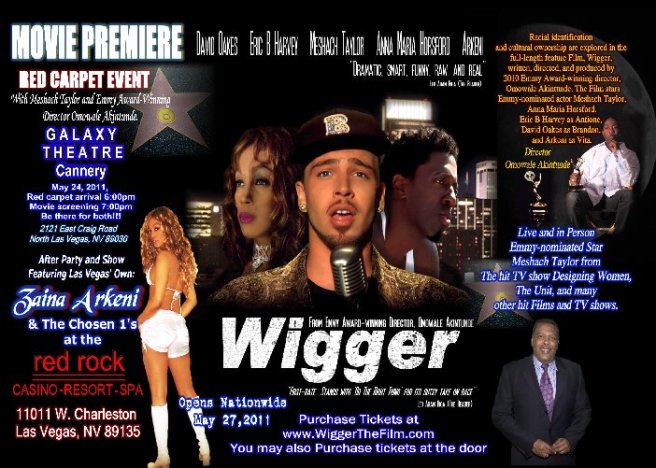
Omowale Akintunde film “Wigger” seconstructa what race means in a faux post-racial world
©by Leo Adam Biga
As published in The Reader (www.thereader.com)
The Omaha indie feature Wigger, which premiered April 19 at the Great Escape Theatres before an overflow crowd, proves a game-changer by giving Omaha’s African-American community and downtown urban night life some big screen love. It’s not always a flattering portrait, but it’s truthful.
Writer-director Omowale Akintiunde, chair of UNO’s Department of Black Studies, delivered on his promise to make Omaha a major character. Co-star Meshach Taylor said Wigger would show Omaha in a new big city light. It does indeed set-off the city’s ghetto-fabulous charms and familiar rituals of barbershop, cafe, house party, funeral and Native Omaha Days. Montages bring North 24th St. to life. NoDo’s Slowdown is a star venue. The rich images brand Omaha the way films do other cities.
Akintunde is the rare filmmaker who’s a serious academic and a passionate artist. His gritty yet poetic debut feature, shot entirely here last summer, explores a young white man’s (Brandon) emulation of black culture — which in the eyes of some makes him a “wigger.” A hopeful R&B star, Brandon is no wannabe. His intense black identification is genuine and a source of bitter conflict between him and his racist father. There’s even tension between Brandon and his best friend and manager, Antoine, who is black. In a Bryant Center confrontation Antoine tells Brandon “there’s always a line between us.”
“Brandon wants to be accepted but he comes from a background that says, ‘Why would you want to be like them?’ And then his black best friend tells him, ‘You’re not one of us.’ Brandon’s dilemma is how does he make that fit,” said Akintunde. “I thought it would be stunning to use a white character who feels he has transcended whiteness and then by sheer power of his individual will cannot be associated with racism. One of the goals we have in Black Studies is to get people to see this is only the tip of the iceberg. We look through the lens of the black experience as a way of understanding, critiquing, deconstructing and reconfiguring what it means to be Other in this context.”
He said he wanted to dramatize the complex fabric of systemic racism in terms we can all relate to. “I want people to look at that movie and say, I see me, I’ve said that, that’s the way I think of myself.”
The many connotations of the “n” word get vetted. Race-class stereotypes get flipped. African-American bigotry towards gays and black Africans is addressed.
Dramatic, smart, funny, raw, real, Wigger sometimes belies its didactic roots. For Akintunde, the film merges his lives as scholar and artist.
“What I always wanted to do is to meld those two worlds, to use film to teach academics but to do it in a format Joe the Plumber will watch. I thought this story of this young white male living in the Midwest who wants to be an R&B singer and has a black best friend was the perfect premise to get into some real deep stuff. It’s a really big thing for me that I was able to make a feature length film and to use it as a mechanism to talk about all the things that have been important to me my entire scholarly life — issues of race, class, gender, white privilege, institutionalized bias.”
Wigger has some heavy-handed moments. The eubonics of Brandon, Antoine, and their diva ebony love interests, LaVita and Shondra, may be overplayed. However, the visuals (Jean-Paul Bonneau) and music (Andre Miieux) are first-rate, the acting strong. The story’s plea for tolerance, powerful. Wigger stands with Do the Right Thing for its gutsy take on race. Ironically, a city with a history of racial strife has now produced two of cinema’s best works on the subject, as joins 1967’s A Time for Burning.
Besides being what he calls “the fruition of my life’s work,” Akintunde said, “it also offered me the opportunity to give back to a city I have really come to love.” The Alabama native came to UNO in 2008 from the University of Southern Indiana. While there he took a sabbatical to pursue a long-held dream of being a filmmaker.
A short version of Wigger was his thesis project at the New York Film Academy. Taylor (“Designing Women”) co-starred in the Los Angeles shoot as the music producer Mr. Pruitt, the role he reprises in the feature. Taylor helped Akintunde meet veteran television/film actress Anna Maria Horsford (Friday), who plays Antoine’s mother.
The rest of the cast are relative unknowns: David Oakes (Brandon), Eric Harvey (reprising Antoine), Kim Patrick (Shondra), Arkeni (LaVita), Braxton Davis (Brandon’s father).
Akintunde plans entering Wigger at select festivals in hopes of a theatrical release. It could easily find a national audience or fade away. Wherever it does play it’s sure to prompt discussion.
As a first feature, it compares favorably with the inaugural works of two Omahans, Alexander Payne’s Citizen Ruth and Nik Fackler’s Lovely, Still. Among “black” films, it’s cinematically on par with Spike Lee’s early work, although tonally more like Tyler Perry. Akintunde bears watching.
Related Articles
- Black Studies Programs Lack Support At HBCUs (huffingtonpost.com)
- “Study: Black males graduating at lower rates” and related posts (itismymind.blogspot.com)
- Ta-Nehisi Coates Deconstructs the National “Conversation on Race” (theroot.com)
- The Five Faces of Barack Obama (time.com)
- Are White MCs Not “Black Enough”? [VIDEO] (hellobeautiful.com)
- Letting 1,000 Flowers Bloom, The Black Scholar’s Robert Chrisman Looks Back at a Life in the Maelstrom (leoadambiga.wordpress.com)
- Today’s Exploration: Omaha’s History of Racial Tension (theprideofnebraska.blogspot.com)
- Henry Louis Gates Jr. on Race, New PBS Series (newsweek.com)
- Walking Behind to Freedom, A Musical Theater Examination of Race (leoadambiga.wordpress.com)
- The Ties that Bind, One Family’s Celebration of Native Omaha Days (leoadambiga.wordpress.com)
Categories: African-American Culture, Cinema, Film, Movies, Nebraskans in Film, North Omaha, Omowale Akintunde, Pop culture, Screenwriting, Writing
African-American Culture, Cinema, Film, Nebraskans in Film, New York Film Academy, North Omaha Nebraska, Omowale Akintunde, Pop Culture, Screenwriting, Wigger
A Contrary Path to Social Justice: The De Porres Club and the fight for equality in Omaha
May 1, 2010
1 comment

Image via Wikipedia
This article is an example of my social justice writing. The publisher of The Reader (www.thereader.com) asked me to do the piece because of his own social justice bent. I am glad I did the story, which was originally published in The Reader. This is an expanded version of that story. It profiles two men, John Markoe and Denny Holland, some followers, and their fight for equal rights in a discriminatory, intolerant time.
A Contrary Path to Social Justice
The De Porres Club and the Fight for Equality in Omaha
©by Leo Adam Biga
Originally appeared in The Reader (www.thereader.com)
For a band of troublemakers, they were an unimposing lot. Yet, in an era when defacto segregation ruled, a small, racially mixed group of well-scrubbed, mostly college-age reformers — many with little experience beyond the classroom — rose up in the late 1940s to challenge the embedded discrimination and division that defined Omaha then. Along the way, they forced Omaha to confront some unpleasant truths and to make some long overdue changes.
Using fairly bold strategies and tactics in the fight against racism, ones duplicated later by more famous civil rights campaigns down south, the activists were viewed as militants. Staging non-violent sit-ins, marches and boycotts, they helped overturn unfair employment practices and opened public places to all. In the process, they took on powerbrokers and exposed inequality. They made enemies. They fell short of goals. They won small victories. More importantly, they broke down barriers and initiated changes whose reverberations are still being felt today.
These unlikely radicals formed the De Porres Club. Its patron namesake was Blessed Martin de Porres, a 16th century black friar who devoted his life to serving the disadvantaged. Led by a stubborn old priest, Fr. John Markoe, and his loyal young acolyte, Denny Holland, the Club worked in large and small ways to assist minorities. It helped some find jobs. It distributed food and clothes. It acted on individual complaints about discrimination. It studied “the race problem” by organizing forums and gathering data. It rallied support for wrongfully accused persons. It kept vigils when blacks moved into hostile white areas. It launched public pressure campaigns against companies that did business in north Omaha and yet refused hiring blacks.
“The problem was to get the damn wall knocked down that was holding and locking people, both physically and mentally, in this terrible system racism had built on Omaha’s near north side,” said the late Denny Holland in Camille Steed’s 1992 Nebraska Educational Television documentary A Street of Dreams. “And so we turned our efforts to what some, I suppose, would term more militant” means.

In one of his most famous denouncements of racism, the late John Markoe said, “Racism is a God Damned thing. And that’s two words — God Damned.” In an article he penned for the Interracial Review, he said, “…the race problem is a moral one.”
The first De Porres boycott targeted a dry cleaners. When that action prompted the firm to integrate its employee rolls, the Club moved on to other employers. Faced with pickets, leaflets, petitions and boycotts, the Coca Cola Bottling plant, Reed’s Ice Cream Co. and the Omaha Street Railway Co. gave-in to De Porres demands and hired blacks. The Club took on its biggest target in the local board of education, which didn’t hire blacks to teach at the secondary level and excluded them from teaching in white schools altogether. The years-long fight finally got the desired remedy. The Club also got such businesses as Dixon’s Restaurant, Crosstown Skating Rink and Peony Park to open their facilities to everyone.
Walking the Talk and Lighting the Torch
In an era when the Catholic Church discouraged blacks from its own congregations, Catholics Markoe and Holland lived their faith. “They walked and talked what they believed in. They were very brazen and unusual” for the time, said Omaha Star publisher and editor Marguerita Washington, a De Porres member in the late ‘50s.
During the Club’s 14-year life, volunteers came and went. When Holland stepped aside, Wilbur Phillips took up the mantle. Most regard the work as a defining moment in their lives. For white De Porres veterans Agnes (Wichita) Stark, Millie (Heifner) Barnet and Virginia (Frederick) Walsh it was an eye-opening experience that sparked a lifelong commitment to social causes. “It was kind of a social awakening,” said Stark, a Creighton student at the time. “I didn’t realize all the problems that existed for blacks. I felt the injustice of it all. That’s how I got interested.” Barnet recalled going to her first De Porres meeting “and just in that one evening, I felt my whole world turned around. It was like suddenly I saw how appalling things were. I was immediately put in touch. It made quite an impact on my life.” For Walsh, “It made college so much more meaningful. I learned we had to change what could be changed. I was just glad to be part of it.” All three women credit the De Porres experience with, as Walsh said, “lighting a torch” for their later involvement in the women’s and peace movements.
Then there’s the effect blacks felt. “We not only formed a family, we got along very wonderfully. We tried our best to bring people together,” said Irv Poindexter, one of the Club’s youngest members. “You know what? It was the best thing that ever happened to Omaha’s black community,” said Helen Jones Woods, a member along with her late husband, Alfred. She said De Porres contributed “to better jobs and better advantages for blacks” — she and her husband included. “Today, I would say because of the De Porres Club a lot of places that didn’t want us, do now, or at least they tolerate us,” Washington said. “A lot of things I am doing today I couldn’t do then. It started changing things. It helped in ending Jim Crow.”
-

-
Helen Jones Woods
A Renegade
Unless one lived then, it’s hard to understand just how separate and unequal Omaha was for racial minorities. “Omaha had a bad reputation among African Americans,” said Washington, who was born and raised in Kansas City, Mo., but often visited Omaha, where she attended UNO. “The segregation here was very bad,” said Woods, who grew up in segregationist Mississippi.
Choose any quality of life index and blacks lagged far behind whites. On average, they made less money, lived in subpar housing and had less formal education. Blacks were frozen out of a wide spectrum of jobs, restricted to living in certain areas and refused service or admittance at many establishments. They were denied basic rights as part of an insidious, institutional Jim Crow culture that made segregation the rule, if not the law. An unspoken state of apartheid existed in all but name.
It was amidst this pervasive oppression the De Porres Club was born. It took an outsider to do it. De Porres founder John Markoe was a strapping, charismatic Jesuit priest regarded as a renegade by peers and superiors at Creighton University. A few years before, he’d been booted out of St. Louis, where he’d agitated for similar changes to the status quo. He’d also made waves in Detroit and Denver. In his life, his ministry and his writings, he attacked “the heresy of racism.”
Running against the current was a way of life with Markoe, who left behind the comforts of privilege for a hardscrabble life. Before ever joining the priesthood, he was a railroad foreman, an athlete, a cavalry officer, a lumberjack and a derelict. Alcoholism plagued him for years. During a checkered military career he rode in campaigns against rebel Yaqui Indians and Mexican revolutionary Pancho Villa. Between his drunken brawls — that saw him break up more than one bar and spend more than one night in jail — and his penchant for standing up for minorities, he was always in hot water. He was nearly expelled from West Point and was leading a 10th cavalry regiment of black troops when court martialled and relieved of both his command and commission.
His rebel ways followed him into the Jesuit order, where he became an unpopular champion of civil rights before the cause had a name. In 1917, he, his priest brother William Markoe and a third priest made a covenant “to give and dedicate our whole lives…for the salvation of the Negroes in the United States.” As he later did here, Markoe heeded this calling by immersing himself in the black districts in and around St. Louis, where he set up community centers, chapels and programs. After helping integrate St. Louis University, he was sent packing to Omaha.
Soon after forming the De Porres Club at Creighton in 1947, the group was kicked off campus. The Club next operated from a storefront on North 24th Street. The Omaha De Porres Center began as a grassroots social service mission before finding a niche as a social action group. Early on, center staff maintained a library, held youth programs and rallies and gathered clothes and food for the needy. As part of its education/advocacy calling, the Club: held public forums on racism; organized a lecture series featuring such nationally renown speakers as NAACP general secretary Walter White and baroness Catherine de Hueck, the founder of havens for the poor known as Friendship House; presented such anti-discrimination plays as Trial By Fire; and pressed city, civic and business leaders, to little avail, for more progressive policies. These efforts did spur the creation of a city human relations committee.
Although too controversial to be sanctioned by any religious body, the Club did draw many members from St. Benedict’s the Moor Catholic Church, then a separate “mission” church reserved for blacks, who were unwelcome anywhere else. Markoe and St. Benedict’s pastor, John Killoren, both sought a change at St. Ben’s from its mission status — which condoned segregation — to standard territorial standing. Their different approaches to the issue left them at odds when solidarity, not friction, was needed. In the end, St. Ben’s was made a regular parish church.
Allies
Markoe’s staunchest ally was Mildred Brown, founder, publisher and editor of the Omaha Star, which she made the group’s crusading mouthpiece. The Star printed summaries of minutes from weekly Club meetings, featured stories charting the progress of De Porres actions and ran Club-penned editorials critical of racial bias. When the Club could no longer afford leasing space in its storefront site, Brown took in the orphaned group, who made the Star’s back rooms their offices.
As the Club became more entrenched, it allied itself with the local chapter of the NAACP, the Omaha Urban League and ministers of area black churches, who helped give the fledgling group credibility and spread word of its actions. A key De Porres supporter and advisor was Whitney Young, who left the directorship of the local Urban League to head the national organization. The Club also aligned itself with CORE, the national Congress for Racial Equality. De Porres chapters sprung up in Kansas City, Mo. and Denver, Co.
If Markoe was the De Porres Club’s conscience, then Denny Holland was its passion. Holland was a quiet Kansas World War II vet in whom Markoe saw a kindred contrariness. It was as a Creighton student Holland became a protege and confidante of Markoe’s and the Club’s original president. His social consciousness was peaked by a stint working at Chicago’s Friendship House. As he did there, he lived among the poor black residents he dedicated himself to, often boarding with families with whom he carried on the fight. Even after stepping away from the Club to work full-time as an insurance salesman and to raise a family of seven, he still kept watch and occasionally made waves.
Acting Against A Torrent of Disapproval
Markoe and Holland are gone now, but De Porres members well recall their guiding the struggle to get a resistant citizenry and leadership to do the right thing. Agnes Stark said Markoe was “a consummate leader” who “pushed us laggards along. Although a gentle man, he could get pretty angry.” Holland, meanwhile, was “very calm, always had the right words and was prepared. They worked very well together” in devising strategies, said Virginia Walsh.
The two men often began anti-discrimination campaigns by first appealing, either in person or by letter, to employers. De Porres delegations would meet with owners, managers or CEOs. If no corrective measure was taken, they organized more direct actions. They might hold a demonstration or distribute handbills. Or, in the case of the street-railway company, the public was urged to not ride streetcars and buses and, if they must, to wage a nuisance protest by paying the fare with 18 pennies.
They did all this in the face of criticism and opposition. Threats were made. Some suspected a snitch in the De Porres ranks. Holland’s suspicions that the phones were tapped, the mail monitored and certain members followed were more or less confirmed years later when his Freedom of Information/Privacy Act request netted a cache of FBI files that had been kept on he and the Club. Marguerita Washington said her aunt, Mildred Brown, was offered a top advertising post by a major Omaha employer on the condition she stop her civil rights advocacy in the Star.
“What we were doing was very much socially disapproved of,” said Walsh. She recalled soliciting signatures for a petition aimed at getting the transit system to hire black drivers. “People would say, emphatically, ‘No.’ They called us N…lovers. There was this confidence people had that God wanted it this way. I didn’t know religion could be used to justify a status quo so pernicious. Fr. Markoe was trying to reform the church at a time when it really didn’t want to be reformed.”
Early De Porres member Tessie Edwards said, “It was very scary, because the climate in Omaha was not ripe for” change. Markoe and Holland soldiered on despite having “doors slammed in their face. They had courage and commitment. And they convinced high-powered people this change was necessary,” she added.
In Street of Dreams, Holland described what it’s like pushing against stiff resistance. “It’s like you’re going up a mountain in a great big semi. All the tires are flat, and you’re the only one pushing and everybody that comes by says, Don’t go too fast. The problem isn’t going too fast, the problem is — can you move the damn thing? You soon see that what’s inferred by don’t go to fast is — don’t change anything.”
Markoe had seen it before elsewhere and anticipated Omaha’s opposition. He even welcomed it, writing it was evidence the Club had “at least done something.” to get people’s attention. He also wrote about his own precarious role: “The leader in the field of interracial relations is pretty much like an acrobat walking the tightrope of justice, supported by charity. His only safe course is a straight line. Let him lean too far towards either side, and he loses his balance and falls.”
The priest encouraged members to carry the fight with them wherever they went. For example, interracial groups would go to eateries and occupy a counter or table. “We would be told to go to the back…and we’d refuse to go,” Millie Barnet said. Sometimes, they were harassed. Once, Barnet said, a member flung a donut in disgust and was arrested on trumped-up assault charges. When his court hearing came up, a throng of De Porres supporters were in attendance. The case was thrown out. More often than not, Agnes Stark said, “we wouldn’t get waited on, but eventually they (eateries) came around” after a bit of discussion. If a proprietor didn’t comply, he was reminded of the law. If he still didn’t, a warrant was sworn out for his arrest. The Club rarely, if ever, lost a case.
Working on the front lines of racial justice often elicited raised eye brows and nasty remarks even among De Porres members’ friends and family. “I felt like an outcast,” Barnet said. “My parents looked askance at my involvement,” Stark said.
The Club’s interracial makeup was not for appearances sake. It was practical. Agitating for change was “fraught with hazards” for blacks, who were considered second class citizens, said Walsh. Besides, it was intimidating for anyone to go up against prevailing social mores and the entities that enforced them. “I was scared spitless when we were doing this work,” said Walsh, who was part of a De Porres delegation rebuffed by officials at old St. Catherine’s Hospital for questioning their segregation and hiring policies. “It was so frightening to buck social customs when the highest level of authority in organizations like the school board and the archdiocese approved of segregation.”

Filling the Void
A challenge made all the more daunting, Walsh said, as the city’s conservative daily newspaper, the Omaha World-Herald, imposed a veritable news “black out” on “all the things that would have contributed to social justice. Reading the Herald, you would have thought the civil rights movement never happened.” When her husband Tom Walsh met with a top Herald editor to discuss inequality, she said he was met with indifference. The same “don’t rock the boat” response came from the archbishop, say De Porres members. Walsh said that when her mother, Mary Frederick, asked Omaha Public Schools superintendent Harry Burke to assign black teachers to white schools, “he told her, ‘Over my dead body.’”
Years later, a federal court found the Omaha Public Schools guilty of a decades-long pattern of segregation and ordered the desegregation of its schools. Much of the evidence in the lawsuit brought against OPS was supplied by the De Porres Club’s own Denny Holland and Wilbur Phillips, who remained ever vigilant watchdogs.
De Porres actions didn’t always didn’t always get the intended results, but at least they tried to affect change when no one else dared or cared to act.
“What they did right was having a mixed group of dedicated, responsible people that followed through on their ideas and were unafraid to tell the truth and speak out, with concrete examples, of injustice,” Tessie Edwards said. Prior to Markoe, Holland and company, she said, “There was no one here to say, Let’s lift these people higher. There was no one asking, Do they all have to work service jobs? Do they all have to live in one segregated area? They educated Omaha on a level Omaha had not been educated on before. They raised the awareness of Omaha to the problems. So many people in Omaha had their head in the sand. They did not think there was a problem here. The De Porres Club really opened the doors.”
Agnes Stark said the De Porres Club was the impetus Omaha needed then. “It was moving things forward that were just at a standstill.”
By the 1960s, Markoe was ill and the Club on its way out. New voices were speaking out for change, including the Citizens Coordinating Committee for Civil Liberties, or 4CL, a religious-secular coalition led by black churches that staged large demonstrations for fair employment and housing policies.
The Men Behind the Mission
The driving force behind the Club was the enigmatic Markoe. He not only preferred working behind the scenes, but had to since he was persona non grata within official Catholic circles. Protest letters from the Club were signed by Holland but often written by Markoe. Even though Markoe kept a low profile, Tessie Edwards said his presence was always felt and his commitment never swayed.
“Father set the example,” Edwards said. “When he finished teaching for the day, he’d take off his Roman color and put on his nice Panama hat and walk North 24th Street. He’d be sitting on the steps of storefronts talking to people. He’d talk to bums and alcoholics. He visited the homes of poor people. He could see the need because he’d hit bottom himself. Part of the Jesuit philosophy is being a man for others. How can you be a man for others if you don’t know them and their hurt? He really did. He loved people. If you asked him a question, he gave you a straight answer. He didn’t just try to proselytize. He was tough. He said things to people at the bottom and at the top that the average person wouldn’t say.”
Virginia Walsh recalled the “very forceful” yet “gentle” and “completely persuasive” Markoe. Helen Jones Woods recalled Markoe as the man who arranged a loan for her to attend nursing school, encouraged her husband to pursue an accounting degree at Creighton and sponsored their daughter Cathy at Duschene Academy. “He did a lot for young people.” Marguerita Washington said Markoe stood tall: “As far as African Americans who were interested in the movement were concerned, he was a hero. As far as I was concerned, he was some type of saint.”
For much of his life, he was a contentious figure. Only later in life were he and his work recognized as righteous. The legacy of Markoe, like De Porres, lives on. Roger Bergman, director of Creighton’s Justice and Peace Studies Program, said that as Markoe’s been “rehabilitated” in Jesuit circles, he’s gained honored status within the order and the wider social justice-peace community. In ‘94, Bergman began the Markoe Lecture Series. “Ever since Fr. Markoe, Creighton has made it a major concern to reach out to the (black) community,” said Edwards. She and others also credit him with helping more widely integrate the campus. Markoe died in 1967.
Denny Holland also casts a long shadow. Before his death in 2003, he was honored with a humanitarian award by the organization formerly known as the National Conference for Christians and Jews. “He was a torch bearer. He was a remarkable gift to the city of Omaha,” Walsh said. In later life, Holland worked on human relations committees, aided a scholarship program for blacks, volunteered at Sacred Heart Parish and found a new crop of troublemakers with whom to stir things up in Omaha Together One Community. He also penned protest articles.
When the De Porres Club disbanded in the early ‘60s, civil rights laws were being shaped and the black power movement formed. De Porres veterans could see the fruit of their labors. Public places were integrated and blacks were employed in jobs and living in areas once off-limits to them. A foundation had been laid. A dialogue begun. The late ‘60s riots that torched black communities like Omaha’s were an expression of a people’s rage over continued oppression. “It kind of had to happen that way,” Holland said of the riots. “Change doesn’t come smoothly. Change only comes, it seems to me, with a threat or with a bit of violence.”
All these years later, the pro-active, interracial coalition that was the De Porres Club remains a model for achieving social justice and economic parity. As one black Omaha leader said, “It’s not so much what ‘they’re’ going to do for us, it’s more about a partnership of what we’re all going to do together — to affect change.”
Related Articles
- Political Memo: Where Dr. King Once Stood, Tea Party Claims His Mantle (nytimes.com)
- America is not post-racial yet (mysanantonio.com)
- Judy Lubin: The Right’s ‘Post-Racial’ War on Civil Rights (huffingtonpost.com)
- Social Justice Forum (uucifsocialjustice.wordpress.com)
- Omaha Native Steve Marantz Looks Back at the City’s ’68 Racial Divide Through the Prism of Hoops in His New Book, ‘The Rhythm Boys of Omaha Central’ (leoadambiga.wordpress.com)
- Letting 1,000 Flowers Bloom, The Black Scholar’s Robert Chrisman Looks Back at a Life in the Maelstrom (leoadambiga.wordpress.com)
- Once More With Feeling, Loves Jazz & Arts Center Back from Hiatus (leoadambiga.wordpress.com)
- Walking Behind to Freedom, A Musical Theater Examination of Race (leoadambiga.wordpress.com)
- Hey, You, Get Off of My Cloud! Doug Paterson – Acolyte of Theatre of the Oppressed Founder Augusto Boal and Advocate of Art as Social Action (leoadambiga.wordpress.com)
- Back in the Day, Native Omaha Days is Reunion, Homecoming, Heritage Celebration and Party All in One (leoadambiga.wordpress.com)
- Dick Holland Responds to Far Reaching Needs in Omaha (leoadambiga.wordpress.com)
- Omaha Schools Spend $130,000 In Stimulus Money To Buy 8,000 ‘Social Justice’ Diversity Manuals (thedaleygator.wordpress.com)
- Native Omaha Days: A Black is Beautiful Celebration, Now, and All the Days Gone By (leoadambiga.wordpress.com)
- Native Omahans Take Stock of the African-American Experience in Their Hometown (leoadambiga.wordpress.com)


 Leo Adam Biga's My Inside Stories