Leo Adam Biga's My Inside Stories

I write stories about people, their passions and their magnificent obsessions
  • Home
  • About Leo Adam Biga
  • Introducing Freelance Writing Academy Seminars with Instructor Leo Adam Biga: Book Biga Today
  • Seeking Sponsors and Collaborators
  • From the Archives…
  • Hire Me
  • Follow My Blog on Facebook, Networked Blogs, LinkedIn
  • Film Connections: How a 1968 convergence of future cinema greats in Ogallala, Neb. resulted in multiple films and enduring relationships
  • My Inside Stories, A Professional Writing Service by Omaha-Based Journalist, Author and Blogger Leo Adam Biga
  • Nebraska Screen Heritage Project
  • Going to Africa with The Champ
  • ‘Crossing Bridges: A Priest’s Uplifting Life Among the Downtrodden”
  • My Amazon Author’s Page
  • OUT TO WIN – THE ROOTS OF GREATNESS: OMAHA’S BLACK SPORTS LEGENDS
  • “Nebraska Methodist College at 125: Scaling New Heights”
  • Passion Project. Introducing the new – “Alexander Payne: His Journey in Film”

Archive

Posts Tagged ‘Social Justice’

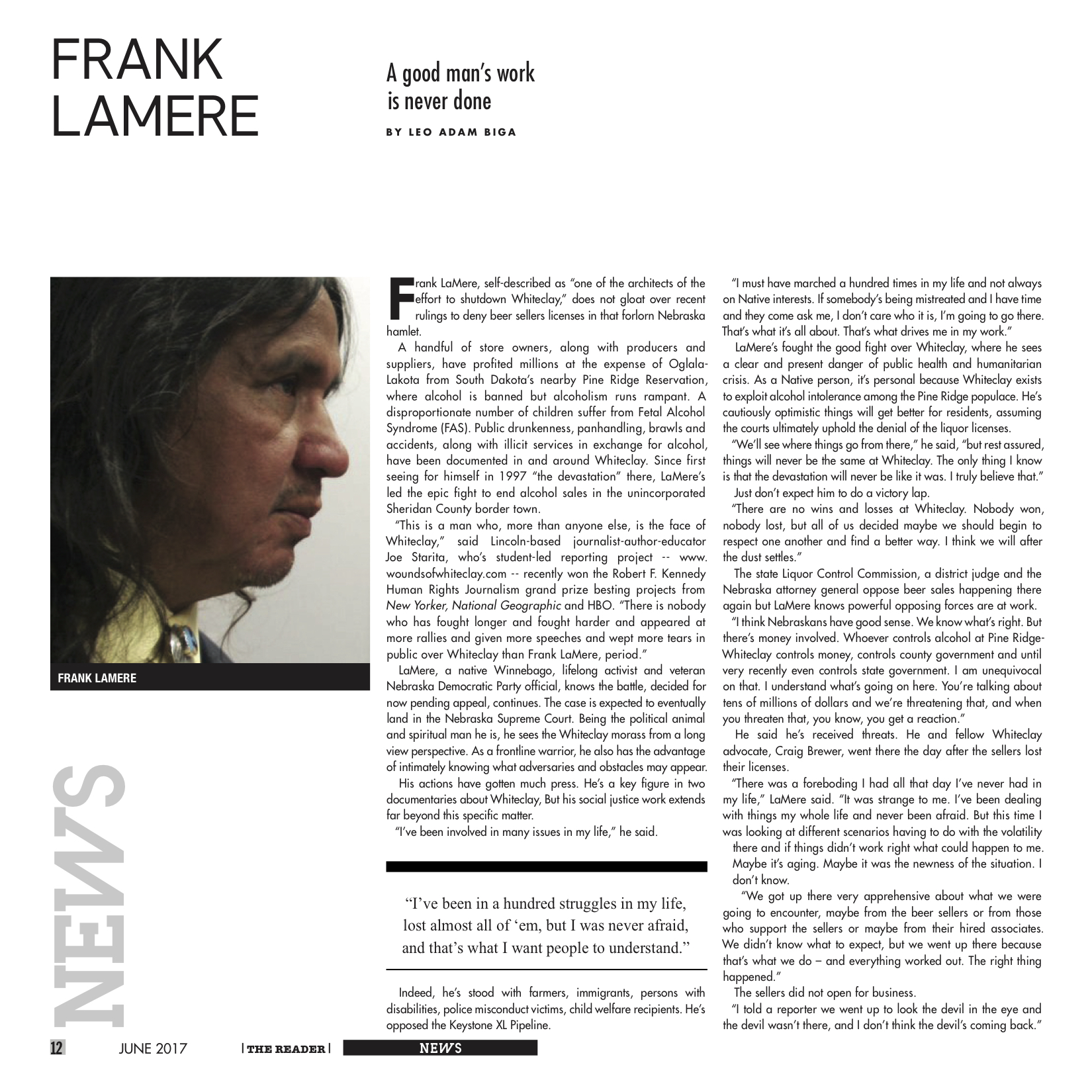
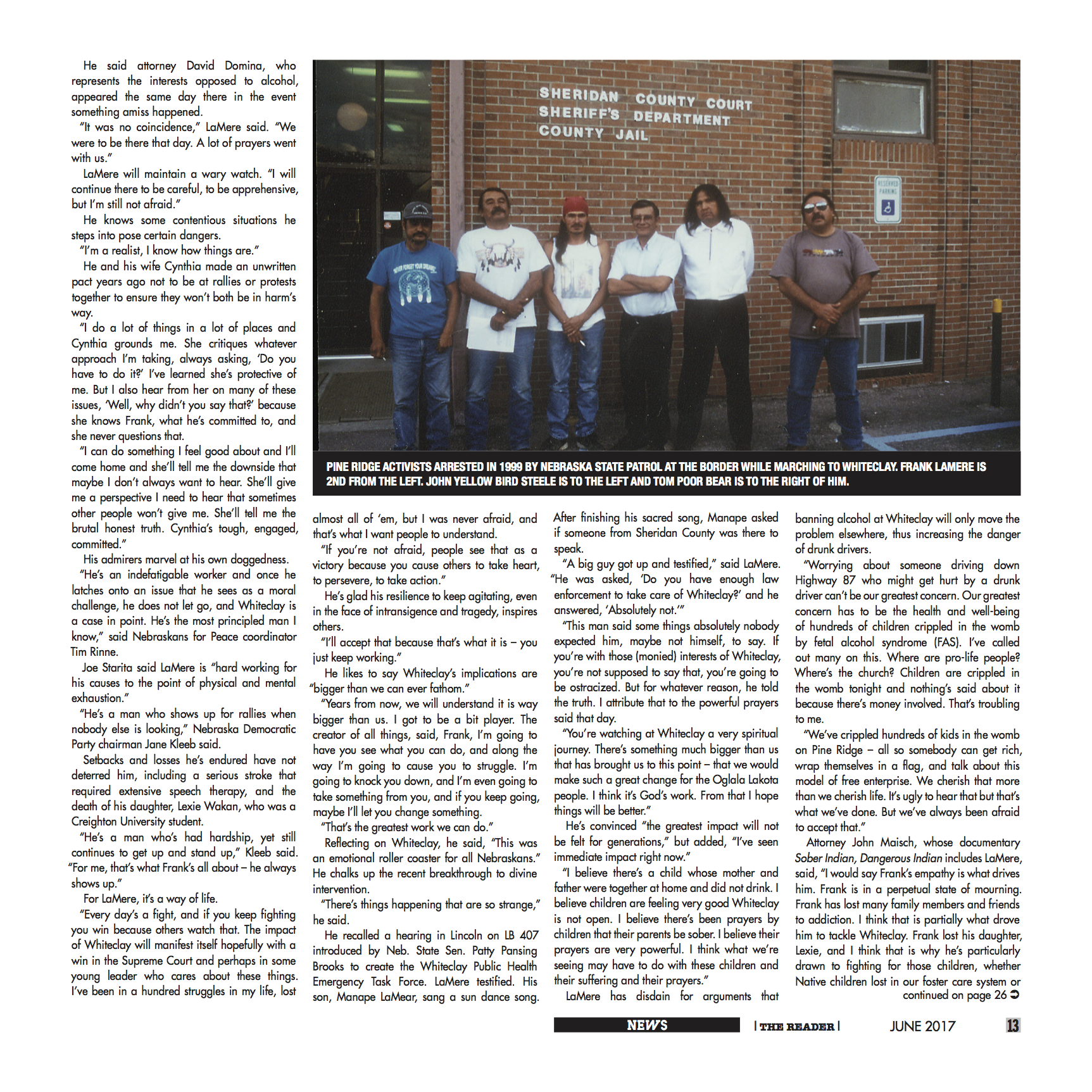
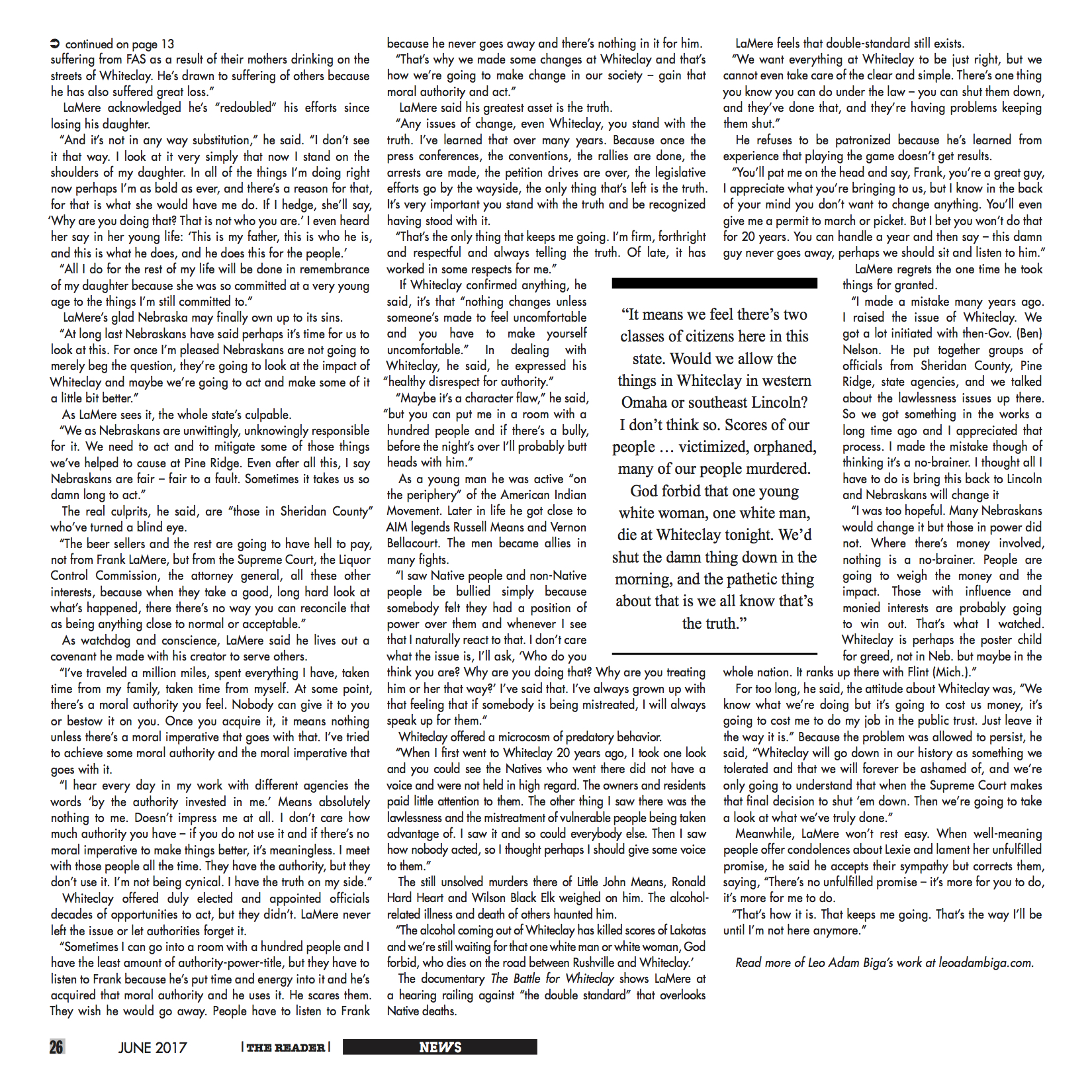
Frank LaMere: A good man’s work is never done

July 11, 2017 leoadambiga 1 comment

Frank LaMere: A good man’s work is never done

©by Leo Adam Biga

Originally appeared in The Reader (www.thereader.com)


Frank LaMere, self-described as “one of the architects of the effort to shutdown Whiteclay,” does not gloat over recent rulings to deny beer sellers licenses in that forlorn Nebraska hamlet.

A handful of store owners, along with producers and suppliers, have profited millions at the expense of Oglala-Lakota from South Dakota’s nearby Pine Ridge Reservation, where alcohol is banned but alcoholism runs rampant. A disproportionate number of children suffer from Fetal Alcohol Syndrome (FAS). Public drunkenness, panhandling, brawls and accidents, along with illicit services in exchange for alcohol, have been documented in and around Whiteclay. Since first seeing for himself in 1997 “the devastation” there, LaMere’s led the epic fight to end alcohol sales in the unincorporated Sheridan County border town.

“This is a man who, more than anyone else, is the face of Whiteclay,” said Lincoln-based journalist-author-educator Joe Starita, who’s student-led reporting project — http://www.woundsofwhiteclay.com — recently won the Robert F. Kennedy Human Rights Journalism grand prize besting projects from New Yorker, National Geographic and HBO. “There is nobody who has fought longer and fought harder and appeared at more rallies and given more speeches and wept more tears in public over Whiteclay than Frank LaMere, period.”

LaMere, a native Winnebago, lifelong activist and veteran Nebraska Democratic Party official, knows the battle, decided for now pending appeal, continues. The case is expected to eventually land in the Nebraska Supreme Court. Being the political animal and spiritual man he is, he sees the Whiteclay morass from a long view perspective. As a frontline warrior, he also has the advantage of intimately knowing what adversaries and obstacles may appear.

His actions have gotten much press. He’s a key figure in two documentaries about Whiteclay, But his social justice work extends far beyond this specific matter.

“I’ve been involved in many issues in my life,” he said.

Indeed, he’s stood with farmers, immigrants, persons with disabilities, police misconduct victims, child welfare recipients. He’s opposed the Keystone XL Pipeline.

“I must have marched a hundred times in my life and not always on Native interests. If somebody’s being mistreated and I have time and they come ask me, I don’t care who it is, I’m going to go there. That’s what it’s all about. That’s what drives me in my work.”

LaMere’s fought the good fight over Whiteclay, where he sees a clear and present danger of public health and humanitarian crisis. As a Native person, it’s personal because Whiteclay exists to exploit alcohol intolerance among the Pine Ridge populace. He’s cautiously optimistic things will get better for residents, assuming the courts ultimately uphold the denial of the liquor licenses.

“We’ll see where things go from there,” he said, “but rest assured, things will never be the same at Whiteclay. The only thing I know is that the devastation will never be like it was. I truly believe that.”

Just don’t expect him to do a victory lap.

“There are no wins and losses at Whiteclay. Nobody won, nobody lost, but all of us decided maybe we should begin to respect one another and find a better way. I think we will after the dust settles.”

The state Liquor Control Commission, a district judge and the Nebraska attorney general oppose beer sales happening there again but LaMere knows powerful opposing forces are at work.

“I think Nebraskans have good sense. We know what’s right. But there’s money involved. Whoever controls alcohol at Pine Ridge-Whiteclay controls money, controls county government and until very recently even controls state government. I am unequivocal on that. I understand what’s going on here. You’re talking about tens of millions of dollars and we’re threatening that, and when you threaten that, you know, you get a reaction.”

He said he’s received threats. He and fellow Whiteclay advocate, Craig Brewer, went there the day after the sellers lost their licenses.

“There was a foreboding I had all that day I’ve never had in my life,” LaMere said. “It was strange to me. I’ve been dealing with things my whole life and never been afraid. But this time I was looking at different scenarios having to do with the volatility there and if things didn’t work right what could happen to me. Maybe it’s aging. Maybe it was the newness of the situation. I don’t know.

“We got up there very apprehensive about what we were going to encounter, maybe from the beer sellers or from those who support the sellers or maybe from their hired associates. We didn’t know what to expect, but we went up there because that’s what we do – and everything worked out. The right thing happened.”

The sellers did not open for business.

“I told a reporter we went up to look the devil in the eye and the devil wasn’t there, and I don’t think the devil’s coming back.”

He said attorney David Domina, who represents the interests opposed to alcohol, appeared the same day there in the event something amiss happened.

“It was no coincidence,” LaMere said. “We were to be there that day. A lot of prayers went with us.”

LaMere will maintain a wary watch. “I will continue there to be careful, to be apprehensive, but I’m still not afraid.”

He knows some contentious situations he steps into pose certain dangers.

“I’m a realist, I know how things are.”

He and his wife Cynthia made an unwritten pact years ago not to be at rallies or protests together to ensure they won’t both be in harm’s way.

“I do a lot of things in a lot of places and Cynthia grounds me. She critiques whatever approach I’m taking, always asking, ‘Do you have to do it?’ I’ve learned she’s protective of me. But I also hear from her on many of these issues, ‘Well, why didn’t you say that?’ because she knows Frank, what he’s committed to, and she never questions that.

“I can do something I feel good about and I’ll come home and she’ll tell me the downside that maybe I don’t always want to hear. She’ll give me a perspective I need to hear that sometimes other people won’t give me. She’ll tell me the brutal honest truth. Cynthia’s tough, engaged, committed.”

His admirers marvel at his own doggedness.

“He’s an indefatigable worker and once he latches onto an issue that he sees as a moral challenge, he does not let go, and Whiteclay is a case in point. He’s the most principled man I know,” said Nebraskans for Peace coordinator Tim Rinne.

Joe Starita said LaMere is “hard working for his causes to the point of physical and mental exhaustion.”

“He’s a man who shows up for allies when nobody else is looking,” Nebraska Democratic Party chairman Jane Kleeb said.

Setbacks and losses he’s endured have not deterred him, including a serious stroke that required extensive speech therapy, and the death of his daughter, Lexie Wakan, who was a Creighton University student.

“He’s a man who’s had hardship, yet still continues to get up and stand up,” Kleeb said. “For me, that’s what Frank’s all about – he always shows up.”

For LaMere, it’s a way of life.

“Every day’s a fight, and if you keep fighting you win because others watch that. The impact of Whiteclay will manifest itself hopefully with a win in the Supreme Court and perhaps in some young leader who cares about these things. I’ve been in a hundred struggles in my life, lost almost all of ’em, but I was never afraid, and that’s what I want people to understand.

“If you’re not afraid, people see that as a victory because you cause others to take heart, to persevere, to take action.”

He’s glad his resilience to keep agitating, even in the face of intransigence and tragedy, inspires others.

“I’ll accept that because that’s what it is – you just keep working.”

He likes to say Whiteclay’s implications are “bigger than we can ever fathom.”

“Years from now, we will understand it is way bigger than us. I got to be a bit player. The creator of all things, said, Frank, I’m going to have you see what you can do, and along the way I’m going to cause you to struggle. I’m going to knock you down, and I’m even going to take something from you, and if you keep going, maybe I’ll let you change something.

“That’s the greatest work we can do.”

Reflecting on Whiteclay, he said, “This was an emotional roller coaster for all Nebraskans.” He chalks up the recent breakthrough to divine intervention.

“There’s things happening that are so strange,” he said.

He recalled a hearing in Lincoln on LB 407 introduced by Neb. State Sen. Patty Pansing Brooks to create the Whiteclay Public Health Emergency Task Force. LaMere testified. His son, Manape LaMear, sang a sun dance song. After finishing his sacred song, Manape asked if someone from Sheridan County was there to speak.

“A big guy got up and testified,” said LaMere. “He was asked, ‘Do you have enough law enforcement to take care of Whiteclay?’ and he answered, ‘Absolutely not.’”

“This man said some things absolutely nobody expected him, maybe not himself. to say. If you’re with those (monied) interests of Whiteclay, you’re not supposed to say that, you’re going to be ostracized. But for whatever reason, he told the truth. I attribute that to the powerful prayers said that day.

“You’re watching at Whiteclay a very spiritual journey. There’s something much bigger than us that has brought us to this point – that we would make such a great change for the Oglala Lakota people. I think it’s God’s work. From that I hope things will be better.”

He’s convinced “the greatest impact will not be felt for generations,” but added, “I’ve seen immediate impact right now.”

“I believe there’s a child whose mother and father were together at home and did not drink. I believe children are feeling very good Whiteclay is not open. I believe there’s been prayers by children that their parents be sober. I believe their prayers are very powerful. I think what we’re seeing may have to do with these children and their suffering and their prayers.”

LaMere has disdain for arguments that banning alcohol at Whiteclay will only move the problem elsewhere, thus increasing the danger of drunk drivers.

“Worrying about someone driving down Highway 87 who might get hurt by a drunk driver can’t be our greatest concern. Our greatest concern has to be the health and well-being of hundreds of children crippled in the womb by fetal alcohol syndrome (FAS). I’ve called out many on this. Where are pro-life people? Where’s the church? Children are crippled in the womb tonight and nothing’s said about it because there’s money involved. That’s troubling to me.

“We’ve crippled hundreds of kids in the womb on Pine Ridge – all so somebody can get rich, wrap themselves in a flag, and talk about this model of free enterprise. We cherish that more than we cherish life. It’s ugly to hear that but that’s what we’ve done. But we’ve always been afraid to accept that.”

Attorney John Maisch, whose documentary Sober Indian, Dangerous Indian includes LaMere, said, “I would say Frank’s empathy is what drives him. Frank is in a perpetual state of mourning. Frank has lost many family members and friends to addiction. I think that is partially what drove him to tackle Whiteclay. Frank lost his daughter, Lexie, and I think that is why he’s particularly drawn to fighting for those children, whether Native children lost in our foster care system or suffering from FAS as a result of their mothers drinking on the streets of Whiteclay. He’s drawn to suffering of others because he has also suffered great loss.”

LaMere acknowledged he’s “redoubled” his efforts since losing his daughter.

“And it’s not in any way substitution,” he said. “I don’t see it that way. I look at it very simply that now I stand on the shoulders of my daughter. In all of the things I’m doing right now perhaps I’m as bold as ever, and there’s a reason for that, for that is what she would have me do. If I hedge, she’ll say, ‘Why are you doing that? That is not who you are.’ I even heard her say in her young life: ‘This is my father, this is who he is, and this is what he does, and he does this for the people.’

“All I do for the rest of my life will be done in remembrance of my daughter because she was so committed at a very young age to the things I’m still committed to.”

LaMere’s glad Nebraska may finally own up to its sins.

“At long last Nebraskans have said perhaps it’s time for us to look at this. For once I’m pleased Nebraskans are not going to merely beg the question, they’re going to look at the impact of Whiteclay and maybe we’re going to act and make some of it a little bit better.”

As LaMere sees it, the whole state’s culpable.

“We as Nebraskans are unwittingly, unknowingly responsible for it. We need to act and to mitigate some of those things we’ve helped to cause at Pine Ridge. Even after all this, I say Nebraskans are fair – fair to a fault. Sometimes it takes us so damn long to act.”

The real culprits, he said, are “those in Sheridan County” who’ve turned a blind eye.

“The beer sellers and the rest are going to have hell to pay, not from Frank LaMere, but from the Supreme Court, the Liquor Control Commission, the attorney general, all these other interests, because when they take a good, long hard look at what’s happened, there there’s no way you can reconcile that as being anything close to normal or acceptable.”

As watchdog and conscience, LaMere said he lives out a covenant he made with his creator to serve others.

“I’ve traveled a million miles, spent everything I have, taken time from my family, taken time from myself. At some point, there’s a moral authority you feel. Nobody can give it to you or bestow it on you. Once you acquire it, it means nothing unless there’s a moral imperative that goes with that. I’ve tried to achieve some moral authority and the moral imperative that goes with it.

“I hear every day in my work with different agencies the words ‘by the authority invested in me.’ Means absolutely nothing to me. Doesn’t impress me at all. I don’t care how much authority you have – if you do not use it and if there’s no moral imperative to make things better, it’s meaningless. I meet with those people all the time. They have the authority, but they don’t use it. I’m not being cynical. I have the truth on my side.”

Whiteclay offered duly elected and appointed officials decades of opportunities to act, but they didn’t. LaMere never left the issue or let authorities forget it.

“Sometimes I can go into a room with a hundred people and I have the least amount of authority-power-title, but they have to listen to Frank because he’s put time and energy into it and he’s acquired that moral authority and he uses it. He scares them. They wish he would go away. People have to listen to Frank because he never goes away and there’s nothing in it for him.

“That’s why we made some changes at Whiteclay and that’s how we’re going to make change in our society – gain that moral authority and act.”

LaMere said his greatest asset is the truth.

“Any issues of change, even Whiteclay, you stand with the truth. I’ve learned that over many years. Because once the press conferences, the conventions, the rallies are done, the arrests are made, the petition drives are over, the legislative efforts go by the wayside, the only thing that’s left is the truth. It’s very important you stand with the truth and be recognized having stood with it.

“That’s the only thing that keeps me going. I’m firm, forthright and respectful and always telling the truth. Of late, it has worked in some respects for me.”

If Whiteclay confirmed anything, he said, it’s that “nothing changes unless someone’s made to feel uncomfortable and you have to make yourself uncomfortable.” In dealing with Whiteclay, he said, he expressed his “healthy disrespect for authority.”

“Maybe it’s a character flaw,” he said, “but you can put me in a room with a hundred people and if there’s a bully, before the night’s over I’ll probably butt heads with him.”

As a young man he was active “on the periphery” of the American Indian Movement. Later in life he got close to AIM legends Russell Means and Vernon Bellacourt. The men became allies in many fights.

“I saw Native people and non-Native people be bullied simply because somebody felt they had a position of power over them and whenever I see that I naturally react to that. I don’t care what the issue is, I’ll ask, ‘Who do you think you are? Why are you doing that? Why are you treating him or her that way?’ I’ve said that. I’ve always grown up with that feeling that if somebody is being mistreated, I will always speak up for them.”

Whiteclay offered a microcosm of predatory behavior.

“When I first went to Whiteclay 20 years ago, I took one look and you could see the Natives who went there did not have a voice and were not held in high regard. The owners and residents paid little attention to them. The other thing I saw there was the lawlessness and the mistreatment of vulnerable people being taken advantage of. I saw it and so could everybody else. Then I saw how nobody acted, so I thought perhaps I should give some voice to them.”

The still unsolved murders there of Little John Means, Ronald Hard Heart and Wilson Black Elk weighed on him. The alcohol-related illness and death of others haunted him.

“The alcohol coming out of Whiteclay has killed scores of Lakotas and we’re still waiting for that one white man or white woman, God forbid, who dies on the road between Rushville and Whiteclay.’

The documentary The Battle for Whiteclay shows LaMere at a hearing railing against “the double standard” that overlooks Native deaths.

“It means we feel there’s two classes of citizens here in this state. Would we allow the things in Whiteclay in western Omaha or southeast Lincoln? I don’t think so. Scores of our people … victimized, orphaned, many of our people murdered. God forbid that one young white woman, one white man, die at Whiteclay tonight. We’d shut the damn thing down in the morning, and the pathetic thing about that is we all know that’s the truth.”

LaMere feels that double-standard still exists.

“We want everything at Whiteclay to be just right, but we cannot even take care of the clear and simple. There’s one thing you know you can do under the law – you can shut them down, and they’ve done that, and they’re having problems keeping them shut.”

He refuses to be patronized because he’s learned from experience that playing the game doesn’t get results.

“You’ll pat me on the head and say, Frank, you’re a great guy, I appreciate what you’re bringing to us, but I know in the back of your mind you don’t want to change anything. You’ll even give me a permit to march or picket. But I bet you won’t do that for 20 years. You can handle a year and then say – this damn guy never goes away, perhaps we should sit and listen to him.”

LaMere regrets the one time he took things for granted.

“I made a mistake many years ago. I raised the issue of Whiteclay. We got a lot initiated with then-Gov. (Ben) Nelson. He put together groups of officials from Sheridan County, Pine Ridge, state agencies, and we talked about the lawlessness issues up there. So we got something in the works a long time ago and I appreciated that process. I made the mistake though of thinking it’s a no-brainer. I thought all I have to do is bring this back to Lincoln and Nebraskans will change it.

“I was too hopeful. Many Nebraskans would change it but those in power did not. Where there’s money involved, nothing is a no-brainer. People are going to weigh the money and the impact. Those with influence and monied interests are probably going to win out. That’s what I watched. Whiteclay is perhaps the poster child for greed, not in Neb. but maybe in the whole nation. It ranks up there with Flint (Mich.).”

For too long, he said, the attitude about Whiteclay was, “We know what we’re doing but it’s going to cost us money, it’s going to cost me to do my job in the public trust. Just leave it the way it is.” Because the problem was allowed to persist, he said, “Whiteclay will go down in our history as something we tolerated and that we will forever be ashamed of, and we’re only going to understand that when the Supreme Court makes that final decision to shut ’em down. Then we’re going to take a look at what we’ve truly done.”

Meanwhile, LaMere won’t rest easy. When well-meaning people offer condolences about Lexie and lament her unfulfilled promise, he said he accepts their sympathy but corrects them, saying, “There’s no unfulfilled promise – it’s more for you to do, it’s more for me to do.

“That’s how it is. That keeps me going. That’s the way I’ll be until I’m not here anymore.”

Read more of Leo Adam Biga’s work at leoadambiga.com.

Share this: Leo Adam Biga's Blog

  • Click to email a link to a friend (Opens in new window) Email
  • Click to share on Facebook (Opens in new window) Facebook
  • Click to share on Pinterest (Opens in new window) Pinterest
  • Click to share on LinkedIn (Opens in new window) LinkedIn
  • Click to share on Reddit (Opens in new window) Reddit
  • Click to print (Opens in new window) Print
  • Click to share on X (Opens in new window) X
  • Click to share on Tumblr (Opens in new window) Tumblr
Like Loading...
Categories: Addiction, Alcohol, Frank LaMere, Health/Wellness, Illness, Native American, Nebraska, Police/Law Enforcement, Politics, Public Health, Social Activism, Social Justice, Whiteclay, Writing Tags: Alcohol, Frank LaMere, Native American, Nebraska, Protests, Public Health, Social Activism, Social Justice, Whteclay

SAFE HARBOR: Activists working to create Omaha Area Sanctuary Network as refuge for undocumented persons in danger of arrest-deportation

June 29, 2017 leoadambiga 2 comments

SAFE HARBOR: Activists working to create Omaha Area Sanctuary Network as refuge for undocumented persons in danger of arrest-deportation

©by Leo Adam Biga
Appeared in El Perico (el-perico.com)


Undocumented immigrants are among the culture war’s invisible victims. Asylum seekers risk everything to escape dangers in their homeland only to come here and face possible arrest, detainment and deportation. Application of illegal alien policies and laws vary by agents and judges. Defendants are at the mercy of capricious political winds.

Against this uncertain backdrop, some concerned citizens have formed the Omaha Area Sanctuary Network as part of a national safe haven movement. Based on refuge models in places like Austin, Texas, churches here would serve as sanctuary spaces for targets of Immigration and Customs Enforcement or other perceived injustice threats. Current custom and policy prevent ICE agents from going into “sensitive locations.” When arrest is eminent, the network would enact sanctuary. The affected person or persons would remain in sanctuary until their limbo status is resolved.

Recently, the Omaha group mobilized in response to a potential sanctuary situation, despite not yet having a church prepared to fill that role, said Lawrence Jensen, who helped launch the network. He said members volunteered their own homes before the case turned out to be a false alarm. The scenario proved a dry run for the group’s willingness to take action.

Jensen, a Union Pacific retiree, is a member of First United Methodist Church in Omaha, which has hosted network meetings. He attended an earlier event there in which two Guatemalan women who were in Austin sanctuary shared their stories.

“It was really moving to hear the things they had to go through and what was done for them because they were in sanctuary,” Jensen said. “Both of them felt they probably wouldn’t have survived if they went back to Guatemala. They needed a way to stay here.”

He said after the presentation he and others “decided we should try and do something similar,” adding, “It’s a faith issue more than anything to get involved where we see injustices and things that need to be acted on.”

Rev. Cyndi Simpson, a minister at Second Unitarian Church of Omaha, said, “This is absolutely a moral issue, a justice issue and a spiritual issue.” She said it’s “great there are other congregations and religious organizations interested in sanctuary because this will work best if we’re all woking together in a coalition.”

Simpson and Jensen know the network treadis on “tenuous” legal ground.

“There is no legal protection for the church,” Jensen said. “It’s just this policy, which so far has been respected. It could change just by an (executive) order.”

Technically, federal immigration law makes it a violation “for any person to conceal, harbor or shield from detection in any place … any alien who is in the United States in violation of law.”

“It’s not definite a church giving sanctuary would fall under that law, but it’s possible,” Jensen said. “It’s indefinite because it’s never been tested in the current climate.”

Though University of Nebraska at Omaha political science professor Jonathan Benjamin- Alvarado feels sanctuary churches are morally right, he cautions against them.

“The wide latitude granted ICE to ferret out ‘illegals’ would … put churches in the line of fire,” he said. “If schools, courts and government offices have already been deemed fair ground for the apprehension of individuals in violation of deportation orders, churches should take note. It has not happened yet, but if faced with the perception of ‘losing the war’ on immigration … churches may no longer be sacrosanct. An immigration raid on a church would be traumatic and potentially devastating for a church community.”

Simpson’s unswayed, saying, “To me, this is the work we’re called to do. So, let the consequences be what the consequences are. This is civil disobedience and that’s how change happens.”

Sanctuary’s been practiced before in America, Simpson is a veteran of the 1980s movement that took in political refugees fleeing Guatemalan civil war persecution.

“It’s very interesting to be here again,” she said.

Hosting someone in sanctuary means a commitment of resources for perhaps a year or more.

“During that time they’ve got to be fed and clothed, you have to see to their health needs, offer moral support. It may mean finding legal representation and accompanying them to court dates,” Jensen said,

Simpson said the Omaha network’s agreed to support family members when the main breadwinner’s imprisoned, deported or in sanctuary.

No one organization can do it alone.

“You can lessen the impact on the individual church by having lots of people sharing the work,” Jensen said.

The snag, thus far, is finding churches with a dedicated, facilities-ready physical space.

Simpson said the network’s expanded its search to include other kinds of religious organizations.

Network members say they’re also committed to conducting call campaigns and holding demonstrations to prod ICE to give up the chase and grant deferred action or freedom. When tipped off a raid will happen, activists plan doing “sanctuary in the streets” by notifying media and engaging in nonviolent disruption.

“ICE doesn’t like the publicity that comes with taking someone while the cameras are rolling,” Jensen said. “They’re liable to back off.”

Earlier this year, Jensen attended a sanctuary network conference in Denver. “There was a lot of discussion about exactly these kinds of things,” he said.

The network’s seeking what Jensen calls “natural allies” among groups like the Nebraska Democratic Party, Omaha Together One Community and Indivisible groups dedicated to resisting the Trump agenda.

Gauging who might step forward to offer sanctuary is difficult. As for his church, Jensen said, “It’s not at all certain the church as a whole would approve it, which is something that would have to happen. Most are progressive religiously and politically and socially, but there are some who would be concerned with the legality issues – so there would be some opposition. How it would play out, I’m not sure.”

Share this: Leo Adam Biga's Blog

  • Click to email a link to a friend (Opens in new window) Email
  • Click to share on Facebook (Opens in new window) Facebook
  • Click to share on Pinterest (Opens in new window) Pinterest
  • Click to share on LinkedIn (Opens in new window) LinkedIn
  • Click to share on Reddit (Opens in new window) Reddit
  • Click to print (Opens in new window) Print
  • Click to share on X (Opens in new window) X
  • Click to share on Tumblr (Opens in new window) Tumblr
Like Loading...
Categories: Immigration, Law, Lawrence Jensen, Omaha, Omaha Area Sanctuary Network, Sanctuary, Social Justice, Writing Tags: Immigration, Law, Omaha, Omaha Area Sanctuary Network, Sanctuary, Sanctuary Churches, Sanctuary Movement, Social Justice

Atticus Finch-Barack Obama give way to Bob Ewell-Donald Trump in this post-“To Kill a Mockingbird” world

January 24, 2017 leoadambiga 2 comments


Hot Movie Takes – Atticus Finch-Barack Obama give way to Bob Ewell-Donald Trump in this post-“To Kill a Mockingbird” world

©by Leo Adam Biga

Author of “Alexander Payne: His Journey in Film”


In this 57th anniversary year of the debut of Harper Lee’s 1960  novel “To Kill a Mockingbird” and the 55th anniversary of the 1962 film adaptation’s release, I reflect on some sobering truths taken from that classic, much beloved story. Truths reflective of today’s American civil-societal-political landscape.

The irony is that the story’s revered figure of Atticus Finch, a fictional white Southern lawyer who represents so many universally admired qualities, found his most direct expression in this nation’s first black president, Barack Obama. The comparison was obvious  and Obama’s admiration for what Atticus embodies was made evident when in his farewell address he quoted something that fictional character utters in the book and film. Obama said, “If our democracy is to work in this increasingly diverse nation,  each one of us needs to try to heed the advice of a great character in American fiction, Atticus Finch: ‘You never really understand a person until you consider things from his point of view. Until you climb into his skin and walk around in it.'”


Barack Obama farewell

Associated Press


Yes, Atticus turns out to have racist leanings in the long-delayed sequel “Go Set a Watchman” but that’s hardly surprising given the time and place he came from. None of us are free of sin or fault. Good principles and actions don’t require perfection. The revelation that Atticus attended KKK meetings and opposed integration while still defending a black man accused of a rape he didn’t commit is simply acknowledgement of how complex race is and how far as a nation we have to go in addressing it. In his farewell speech Obama told blacks to learn the struggles of other minority groups and he admonished whites to acknowledge the stain of this country’s earlier generations are not gone. When minority groups “voice discontent,” he said. “they’re not just engaging in reverse racism or practicing political correctness; that when they wage peaceful protest, they’re not demanding special treatment, but the equal treatment our Founders promised.”

Barack Obama gave Atticus Finch his good name back and naturally, literature fans on Twitter

During his two terms the diplomatic, gentlemanly Obama championed social justice and opposed infringements on freedom and equality. Like Atticus, he walked the walk of virtue and idealism, of fair play and public service, and he extended his hand to the equivalents of Boo Radley and Tom Robinson in our midst. Though Obama had considerable support within the Democratic party and even more broadly throughout the nation and world, he was repeatedly criticized and stonewalled by the Republican controlled Congress. Many of us surmised this was due to the gridlock of entrenched, unwieldy party politics grinding the tried and true American system of across-the-aisles idealogical compromise to a halt. Racism may have been the bigger issue in play. The recent election revealed how reviled Obama is by a sizable segment of the American populace whose elected representatives are some combination of Republican, conservative and fundamentalist. Not every Obama detractor and Trump supporter is an out and out racist but it’s true about enough of them to show a clear pattern.

Trump’s angry man campaign was filled with bigoted, misogynistic, nationalistic rhetoric that put big business and capitalism ahead of human rights, civil rights, women’s rights, social safety nets and environmental protections. He referred to harsh law and order crack downs on those deemed to be disloyal dissidents and enemies of the state. He threatened closing borders and deporting undocumented millions. He connoted militarism with nationalism, patriotism and Christian values. In his first few days in office he seems hell-bent on following through on his alarming agenda.

All of this has gave permission to white supremacists and other hate mongers to react violently against people of color and different origins, to disrespectfully treat women, to ignore clear and present danger realities such as global warming and to override the will of the people by renewing projects that history tells us will deface and pollute precious lands and waters.


Donald TrumpDonald Trump.getty


It is as if Barry Goldwater, George Wallace, Ross Perot and Rudy Giuliani have somehow been melded together in the amoral heart of Trump. Just when America needs an Atticus Finch in its top leadership position, we now have someone who seemingly speaks more to the Bob Ewells of the world than to those of us who believe in the better angels of a more perfect union.

Instead of a voice of calm reason, considered compassion, resolute peace and sincere unity, we have a strident, histrionic voice of acrimony and division who speaks for the supposed moral majority and special interests of privileged white males. In movie-movie terms, I am reminded of the Franklin Schaffner adaptation of Gore Vida’s “The Best Man.” where the choice for a presidential nominee came down to a reactionary opportunist played by Cliff Robertson and a thoughtful, progressive essayed by Henry Fonda. It is unfortunate that Trump did not face anyone like the statesmen Fonda portrayed in “Young Mr. Lincoln,” “Advise and Consent,” “The Best Man” and “Fail Safe” or the socially conscious Everymen he played in “The Grapes of Wrath,” “The Oxbow Incident” and “12 Angry Men.” Hillary Clinton embodied some of these same ideals, but America just wasn’t ready for her or for a woman like her as President.

How unfortunate, too, that there isn’t someone like the noble Atticus Finch or other figures of high character that Gregory Peck played (“Twelve O’Clock High,” “The Big Country,” “Captan Newman M.D.”) to lead us.


Then again, we had our Atticus Finch situated in the most powerful post in the world and a chunk of this nation rejected him and what he espoused. Obama even sounded a lot like Atticus when he called on people who want a more perfect union to not merely be bystanders but to be participants: “Show up, dive in, stay at it…Presuming a reservoir of goodness in others can be a risk, and there will be times when the process disappoints you. But for those of us fortunate enough to have been a part of this work, to see it up close, let me tell you, it can energize and inspire. And more often than not, your faith in America — and in Americans — will be confirmed.”

For all its enduring popularity, “To Kill a Mockingbird” still only speaks to those willing to learn its lessons. Too many Americans, I’m afraid, are still unprepared to accept The Other represented by Boo Radley and Tom Robinson. Even in 2017 the notion of embracing all people, regardless of color, ethnicity, religion, socioeconomic status, physical-mental capability, is still too radical for a whole lot of folks to follow. These are the very same things Christians are called to do by 2,000 year-old teachings. Yet many bristle at the core idea of loving their fellow man even though this is the basis and essence for the very organized religions they’re baptized in and purport to believe.


To Kill a Mockingbird. Atticus Finch, Scout, Boo Radley... Just riveting, these relationships, these people.:


All of which tells us we are one hot mess of a nation. There’s nothing new about that, it’s just that events of the past few years make it easier to see things for how they really are. The cloak of civility and cooperation has been lifted. Maybe it’s a good thing the hate is there for the viewing and not all concealed or dressed up as something else. Now that it’s out in the open, at least we know who and what we’re dealing with moving forward.

We need all the Atticus Finch’s and Harper Lees amongst us to stand up and be counted lest the Boo Radleys and Tom Robinsons continue to be oppressed. The conspiracy of hearts who love what “To Kill a Mockingbird” and works like it teach about tolerance and love need to raise their voices against injustice. If this book and film that have touched so many can lead to social action, then their collective impact will be far greater than all the sales, box-office receipts and rentals they’ve earned over these last six decades.


Share this: Leo Adam Biga's Blog

  • Click to email a link to a friend (Opens in new window) Email
  • Click to share on Facebook (Opens in new window) Facebook
  • Click to share on Pinterest (Opens in new window) Pinterest
  • Click to share on LinkedIn (Opens in new window) LinkedIn
  • Click to share on Reddit (Opens in new window) Reddit
  • Click to print (Opens in new window) Print
  • Click to share on X (Opens in new window) X
  • Click to share on Tumblr (Opens in new window) Tumblr
Like Loading...
Categories: African-American, African-American Culture, Atticus Finch, Barack Obama, Donald Trump, Harper Lee, Hot Movie Takes, Politics, Race, Social Justice, society, To Kill a Mockingbird, Writing Tags: Atticus Finch, Barack Obama, Books, Donald Trump, Film, Harper Lee, Hot Movie Takes, Movies, Politics, Race, Social Justice, society, To Kill a Mockingbird

Leonard Thiessen social justice triptych deserves wider audience

January 21, 2017 leoadambiga 3 comments

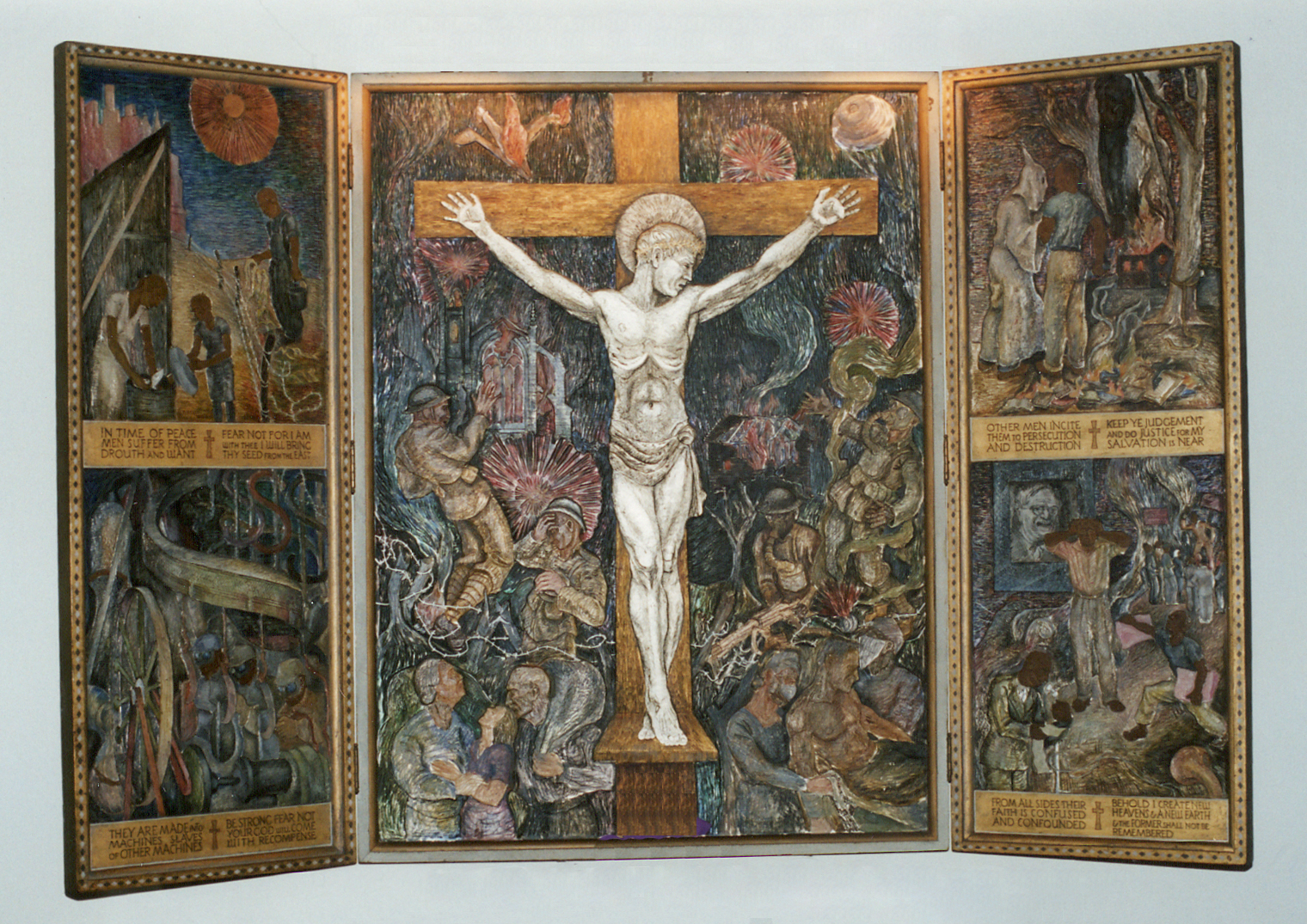
There is a compelling social justice triptych by the late great Nebraska artist Leonard Thiessen that should be more widely seen. Every year around Black History Month I encourage folks to visit the worship space that houses the piece for the express purpose of taking in the powerful images and ideas expressed in the work. The piece is called “Crucifixion” and it can be found affixed to a wall just inside the sanctuary at Church of the Resurrection, a small but mighty Episcopal faith community at 3004 Belvedere Boulevard directly across the street from Miller Park and just northwest of 30th and Kansas. The blended congregation is a mix of African-Americans, Caucasians and Africans.

The Thiessen work is not like anything you’d expect to find there or in any worhsip place for that matter. “Crucifixon” juxtaposes jarring, disturbing scenes of lynching, gas attacks, warmaking, want, industrialization and propoganda with the crucified Christ. Passages drawn from scripture proffer warnings about sins against our fellow man and being led astray by false prophets. These abnomitions are leavened by promises of recknoning and salvation. Thiessen created the triptych many decades ago but it is still relevant today in its rumination on things that instill fear and conflict in the hearts and minds of human beings and that cause us to look to a redemptive Higher Power for mercy and justice.

The words that appear at the bottom of the panels read:

“In time of peace, men suffer from drouth and want. Fear not, for I am with thee. I will bring they seed from the Earth.”

“They are made with machines, slaves of other machines. Be strong, fear not, your God will come with recompense.”

“Other men incite them to persecution and destruction. Keep ye judgment and do justice for my salvation is near.”

“From all sides their faith is confused and confounded. Behold, I create new heavens and a new Earth and the former shall not be remembered.”

The artist created “Crucifixion” in memory of his aunt, Wilhemina Berg, who was a member of the former St. John’s Church before it merged with St. Philip”s to create Church of the Resurrection,  The work is an example of Thiessen’s ability to employ and transform classical forms into modern interpretations. The piece is regarded as one of Thiessen’s most important.

In an interview shortly after his retirement, Thiessen said he had worked to “break down the idea that the arts were the prerogative of the elite. Nowadays the arts, like boating, skiing, tennis and wines, are all for the person in the street.”

Thiessen spoke four languages and was particularly known for his wit, often trying to slip puns past his editors at the Omaha World-Herald, for whom he was an art critic. Over the years, he taught at many area institutions, including Creighton, UNL and UNO.

He is classified as belonging to the period as the First Nebraskans, an era in Nebraska’s art history from 1901 to 1950 when the various forms of modernism were flourishing.

His vision and passion for the arts in Nebraska laid an influential foundation.

A good way to see the triptych and get a sense for the church where it’s displayed is to attend a service there. The 10 a.m. Sunday service is an intimate experience animated by the choir most Sundays and the guest band ReLeaseT the third Sunday of the month. On Feb. 26 come to Soul Food Sunday for some great eats. But whenever you come, make sure you see the triptych.

Link to the Church of the Resurrection website here:

http://coromaha.episcopal-ne.org/


triptych2


Link here to a Museum of Nebraska Art page devoted to Thiessen:

https://mona.unk.edu/collection/thiessen.shtml

Here is an extended bio of the artist copied from the MONA page:

Leonard Thiessen was born and raised in Omaha, Nebraska. His family was small and his paternal ancestry had roots to the Swedish and German pioneer settlers of Grand Island, Nebraska. For a very short time, the family lived in Grand Island where, as a boy, Thiessen was employed in the mail department of The Grand Island Independent newspaper. His parents, Charles Leonard Thiessen and Jean Louise Berg Thiessen, together with his mother’s favorite sister Wilhemina, were all involved in various creative endeavors and had a profound influence on Leonard’s development. His father worked in the printing industry and introduced the young Leonard to the trade. Jean was a talented self-taught artist in her own right who produced on-edge felt mosaics that are fine examples of early 20th century fiber art. (MONA has seven pieces of her work in its collection.) The Thiessens were involved in Omaha’s music, dance, and theater groups and deeply connected to the neighborhood Episcopal Church. They were not wealthy but had many friends in the community and had an impressive social calendar.

Thiessen attended Omaha’s Miller Park Public School and St. John’s Protestant School and graduated from Central High School in 1919. His school years were privileged with experiences that helped to foster his development as an artist. While in high school, he decided to follow formal study in the visual arts and began to draw cartoons and illustrations for the school newspaper. During his teen years, he worked as an office assistant for an architectural firm in downtown Omaha, a job that offered a perk that proved helpful to his future employment. During his free time, Leonard would sit and read the collection of architectural books found in the office. After graduation he worked for the Omaha Bureau of Advertising and Engineering editing illustrations and photographs for an agricultural livestock catalog.

He attended the University of Omaha (now University of Nebraska at Omaha) for three semesters in 1921 and 1922 studying journalism and fine arts and producing illustrations and graphic layouts for the University newspaper The Gateway. During this time, he worked as a gallery assistant for the Art Institute of Omaha which was located on the top floor of the old public library building designed by Thomas Kimball. Thiessen became disillusioned with the University’s conservative art courses and left Omaha to continue his studies in the School of Fine Arts at the University of Nebraska in Lincoln from 1925 to 1926. He was not interested in “serious painting” and majored primarily in design and architecture. His professors were the artists Dwight Kirsch, Louise Mundy, Francis Martin (a contemporary of the portraitist J. Laurie Wallace), and Emily Burchard Moore. In the 1920s, Lincoln, Nebraska was an incredibly fervent environment. Some of Thiessen’s circle of friends and classmates included artists as well as writers and intellectuals among them Katherine “Kady” Faulkner, Louise Austin (who had studied in Munich with Hans Hoffman), Mari Sandoz, Weldon Kees, Loren Eiseley, and Dorothy Thomas. In the late 1920s, Thiessen pursued a highly successful commercial career as an interior designer and decorator with several design and architectural firms in Lincoln and Omaha. Additionally, he did freelance work and began to receive commissions as a mural painter. Later he studied at the museums of New York City, Boston, and Miami with his Aunt Wilhemina.

In 1929, while on a trip to Paris, Thiessen learned of the stock market crash in the United States and decided to stay in Europe. He enrolled at the Académie de la Grande Chaumière in Paris where he studied drawing and painting for one summer and later moved to London to study at the Heatherly School of Art. While in London, Thiessen studied wood engraving and graphics. In 1932, he applied and was accepted at the Swedish Royal Academy of Fine Arts in Stockholm and studied with Otto Skold who later became the director of the National Museum at Stockholm. At the Academy, Thiessen studied the classical manner, graphic arts, and the traditional forms of fresco and mural painting. He described himself as a “designer of interiors and mural painter in the Middle West, U.S.” Taking several short breaks in between his studies to return to the United States, he finally received his diploma in 1938. While in Sweden, Thiessen made a trip to Tallin, Estonia, to sketch the local architecture.

After returning to the United States in the late 1930s, he found that demand for interior decorators had fallen with the depression. He used his charm and talent to persuade the editors of the Omaha World-Herald and the Lincoln Journal Star to allow him to write an arts review column. He became the Omaha World-Herald’s first art critic and his now legendary column first appeared in 1939 and continued on and off for the next 30 years.

He had exhibitions at Morrill Hall, University of Nebraska, Lincoln, in 1938 and Omaha’s Joslyn Art Museum in 1940. He also resumed his friendships with artist Milton Wolsky and Alysen Flynn. Later he accepted a position in Des Moines as Iowa’s State Director of the Federal Artists and Writers Program of the Works Projects Administration in 1941. The program employed 300 people and Leonard supervised over 100 individuals in eight departments. Thiessen left Iowa in 1942 to join the Army and was officially promoted to the Office of Intelligence in 1944. Because of his training in architectural design and graphic arts, Thiessen was particularly suited for the position of draftsman in the intelligence department. He studied and made reports of pertinent visual data, maps, and serial photos during the war. He was stationed in Kettering, England, the place that would become the subject of many of his works on paper.

In the 1950s, Thiessen made another trip to London, returning to the United States to serve two years as director of the Herbert Memorial Institute of Art in Augusta, Georgia. In the 1960s, Thiessen took several other trips to Europe and returned to Nebraska where he immediately continued his involvement with the Omaha World-Herald, the Joslyn Art Museum and the Sheldon Museum of Art on the campus of the University of Nebraska-Lincoln. By this time he was recognized as the authority on Nebraska’s developing art history and served as editor of the catalogue, Nebraska Art Today, by Mildred Goosman, curator at the Joslyn Art Museum published in 1967. He was instrumental in the establishment of the Nebraska Arts Council becoming its first Executive Secretary (a position now known as Executive Director) from 1966 to 1975. In addition, he taught classes at Isabella Threlkeld’s studio in Omaha for eight years. He became a close friend and professional colleague of the professors at Kearney State College (now University of Nebraska Kearney) and encouraged the establishment of the Nebraska Art Collection in the 1970s. He served on the board of the Museum of Nebraska Art for over ten years and was one of its founding members. In 1972 Thiessen received an honorary Doctor of Fine Arts from Creighton University and was honored with the first Governor’s Arts Award in 1978. His work can be found at Joslyn Art Museum, Omaha; Sheldon Museum of Art, Lincoln; Kansas Wesleyan University, Salina; the Alfred East Gallery, Kettering, England; the Herbert Memorial Institute of Art, Augusta, Georgia; and in many private collections

Thiessen lived in Omaha, Nebraska, for most of his adult life. He eventually converted two upstairs rooms of the now famous house on Stone Avenue for his studio. Artwork dominated both floors, much of it his own. Thiessen remained a bachelor his entire life, and had an amazing number of friends and colleagues from the various Nebraska arts communities. He was respected by many prominent Nebraska artists who honored him by making him the subject of their work including Kent Bellows, Bill Farmer, Larry Ferguson, Frances Kraft, Paul Otero, John Pusey, and John Thein.

Leonard Thiessen died March 27, 1989.

The Museum of Nebraska Arts holds 109 works by Leonard Thiessen in addition to archival material.

Researched and written by Josephine Martins, 2002

NOTE: Biographical information was derived from a variety of sources, including unpublished biographical notes by William Wallis, 2001,  a recorded interview with Thiessen by Gary Zaruba, 1983 and compilations by COR member Keith Winton.

Share this: Leo Adam Biga's Blog

  • Click to email a link to a friend (Opens in new window) Email
  • Click to share on Facebook (Opens in new window) Facebook
  • Click to share on Pinterest (Opens in new window) Pinterest
  • Click to share on LinkedIn (Opens in new window) LinkedIn
  • Click to share on Reddit (Opens in new window) Reddit
  • Click to print (Opens in new window) Print
  • Click to share on X (Opens in new window) X
  • Click to share on Tumblr (Opens in new window) Tumblr
Like Loading...
Categories: Art, Artists, Church of the Resurrection, Leonard Thiessen, North Omaha, Omaha, Race, Religion, Social Justice, War, Writing Tags: Art, Artist, Church of the Resurrection, Leonard Thiessen, Museum of Nebraska Art, North Omaha, Omaha, Social Justice

Poverty in Omaha: Breaking the cycle and the high cost of being poor

January 3, 2017 leoadambiga 1 comment

Vicious Circle

Breaking the cycle of poverty in Omaha

The December 2016 issue of the Reader featured a cover package on Poverty in Omaha, The High Cost of Being Poor. There are three stories on poverty and I have two of them, including this lead piece titled Vicious Circle, Breaking the Cycle of Poverty in Omaha. My other piece is headlined The High Cost of Being Poor, Aggressive Creditors Exploit Nebraska Law. My blog, leoadambiga.com, features many other social justice stories I have written over the years.


Aubrey-Mancuso,Voices-for-Children-Executive-Director.jpg

In 2007 local media reported the stark dimensions of concentrated poverty for many African-American families in North Omaha. It was, sadly, old news to impoverished residents long beset by low income, high debt, unstable, substandard housing and food deserts. It  confirmed, too, what human service professionals like Voices for Children in Nebraska executive director Aubrey Mancuso already knew.

“Unfortunately,” she said, “things haven’t gotten much better. I think we’re largely in the same place. When we think about poverty in Omaha and Nebraska there are two main stories. One, poverty continues to be highly racialized. Children of color, particularly black and Hispanic children, have much higher poverty rates. So poverty’s gone up in general and the groups disproportionately affected by it continue to be. We haven’t made progress addressing those disparities.

“Secondly, there’s poverty despite work.”

Experts say want isn’t exclusive to the unemployed but extends to the underemployed working poor.

Mancuso said, “We often think just finding a job is the solution, and it is about jobs, but it’s about quality jobs that allow you to afford all your expenses, save for a better future, own a home, have a retirement cushion and something to hand down to your children and have a buffer against unexpected health-related expenses, job losses and all those things. It’s about the opportunity to stabilize your income by building assets.”

She said “the reality is more complicated” than pulling yourself up by your bootstraps. “People are doing the best they can with the situation they’ve been given. As a children’s advocacy group our position is we have a collective responsibility to all our kids. Kids are vulnerable and we need to think about how we can help them.”

She noted the recent presidential election revealed how the disenfranchised “sense somehow the deck is stacked against them, and when we’re talking about families in poverty, that’s really true.” She said generational poverty means “families and kids start off behind and face barriers that pile on top of each other.”

“We know poverty is very damaging for children and I think that starts even before birth. Prenatal care, early healthcare visits and early learning experiences are crucial. If parents don’t provide those things, you see consequences later in life.”

Chronic poverty can lead to hopelessness, said Jim Clements, executive director of the Heart Ministry Center.

“As a society I don’t think we appreciate the choices people in poverty have to make on a daily basis. Maybe your car breaks down and you don’t have another way to get to work. so you take out a payday loan to get it fixed, but the exorbitant interest rates get you caught in this cycle of debt you can’t escape. It’s day-to-day survival. It’s not through any lack of trying, it’s just super complex and really hard. But I’ve seen enough people who have turned it around with help and by working hard to know it can be done.”

Clements said even many middle-class Americans are a few big life bumps away from tough times.

“You don’t always know how close to the other side you are. All it takes is a bad series of events.”

Geo LaPole invested everything in his own flea market, where he also lived. Things went well until business dried up. Unable to make the rent, he lost his business and home. He struggled keeping a roof over his head. Then he lost a job. He went through Heart Ministry Center’s Fresh Start program and now works there.

“You’re given the basic things you need to start fresh. It helped me immensely. It gave me access to the pantry, mental health counseling, somebody to listen and to point me in the right direction.”

LaPole said pride prevents some from asking for help.

“I almost didn’t accept the help. I finally said, ‘I deserve help just like everyone else does, why not make myself normal so I can help somebody else.’ Until someone grabs you and helps you, there’s no helping yourself because you don’t know how to help yourself.”

Trust can be an issue, Clements said, “If you’re poor, you’re probably taken advantage of.” Together executive director Mike Hornacek said the poor struggle finding quality affordable housing, often settling for run-down properties owned by unresponsive landlords.

Poverty is not just confined to inner city neighborhoods either. Experts say there are pockets of suburban poor who also utilize helping services.

Everyone coming to Together or Heart Ministry Center has a story.

Clements said, “We were able to help a woman who fell on hard times pay her mortgage. I’m glad we were there to help her avoid sliding further down the poverty scale. We were able to get a woman living on the streets on general assistance and into the Literacy Center. Now she’s reading at a seventh grade level. Maybe she’ll get her GED.”

Big Lou Parker battled addiction, then buried his wife, leaving him to raise five children. He found sobriety and opened a soul food eatery only to suffer a massive heart attack. Medical bills forced him into bankruptcy. The center helped him get back on his feet and he now owns a successful lawn care business.

Homeless veterans and LGBT youth comprise subgroups of the poor seen at Together, 812 S. 24th Street. After making clients safe, any addictions or mental health issues get treated, and then pathways to education, employment and housing are found. Together refers clients to partner agencies for services as needed.

It works the same at Heart Ministry. “It takes a lot of different touches to get somebody through it,” Clements said. “That takes time. It’s baby steps. People can work on specific goals here. We try to find ways to connect them to mentors. The more people we can put in their life to build that personal infrastructure and to have in their corner, the better.

‘”Just by being involved in their lives, things tend to improve. It’s part of this puzzle. When they know somebody cares, they feel better about themselves.”

Clements said Heart’s Fresh Start job readiness program uses a holistic approach that includes mental health counseling. “Living in property causes trauma. If we connect people to jobs without addressing their mental health, they’re not going to keep those jobs.”

Most poverty services address urgent basic needs or crises, such as eviction, utility shutoff, hunger and clothing. The immediate goal is stability.

“Through our pantry we give out between 1.2 and 1.5 million pounds of food and feed 20,000 people a year,” Clements said. “You don’t want to feel you’re just a stop gap – you want to see change. When you see the tide of need, it makes you wonder … Is this going to end, is this going to get better for people?”

Longer-term goals get addressed with case management support, much of it dealing with financial counseling.

Unresolved debt can further trap people in poverty and expose everything they own to collectors (see related story in this issue). If someone’s already low wages get garnished, they may fall behind on rent or car payments and find themselves without a permanent place to live or a vehicle to drive.

Negotiating poverty’s cascade of effects and harsh decisions, such as forgoing regular healthcare or letting one bill ride to pay another, is reality at Minne Lusa Elementary School, where 94 percent of the students receive free or reduced lunch. Principal Kim Jones admires the fortitude of parents and kids who confront it daily.

“I’ve learned so much about resilience and about how much we’re needed.”

Lisa Utterback, an Omaha Public Schools administrator who turned around nearby Miller Park Elementary as its principal, said contrary to perceptions, “a child from these circumstances can be molded and influenced and can achieve – you can change their lives and give them a sense of hope that things will be okay.” She said too often society imposes artificial limits. “There’s just a lack of believing in potential. Sometimes adults don’t know how to fathom the obstacles kids face. If you can’t even wrap your mind around it, you can’t help problem-solve.”


Utterback said OPS provides additional supports to low performing schools, including a social worker and a school support liaison, literacy coaches, math and science coaches and more technology. Mental health support is also offered through Project Harmony.

Voices for Children’s Aubrey Mancuso said, “If we want to set youth on a course that leads them to higher education, we have to start with very young children. Early childhood education opportunities are part of it. We need to think about giving kindergarten students college savings accounts that grow over time and give them a resource to put towards higher education. That would help offset some of the disparities in being able to build wealth and access higher education. It’s important we get to kids much younger on the spectrum and really build that aspiration to take that next step after high school.”

She said more can be done for poor families.

“There are things that work to help build wealth that aren’t reaching lower income families that we can better leverage. One is the earned income tax credit for working families that puts more money back in their pockets and gives them an opportunity to save or pay off bills or whatever. Our state earned income tax credit is too low. We also have a state child and dependent care tax credit whose income eligibility levels haven’t increased since the 1990s, so we need to revisit that.”

Mancuso and her team worked with outgoing state Sen. Tanya Cook to write and pass LB 81 that allows families two years of transitional assistance at a much higher income level before they have to bear the full cost of child care.

Mancuso also advocates a public pay-in program that does for poor kids what Social Security does for seniors.

“We haven’t collectively made those same investments in our kids, and I think that’s what we really need to do next. We need to have the will to carry it forward.”

She said the widening division between haves and have-nots compel us “to work harder, be kinder, be more thoughtful and be more inclusive.”

Heart Ministry’s Jim Clements said in lieu of neighbors directly helping neighbors, centers like his as well as churches and shelters are the front-lines “to give people a lifeline and help pull them out. It takes some resources, some time, some patience,” he said, “but helping turn people’s lives around strengthens the entire community.”

Together’s Mike Hornacek said real strides addressing poverty will happen when people stop making judgments, assigning blame or viewing it as someone else’s problem and “come around to saying, ‘That could be my neighbor or friend, that’s something that can happen to me.'”

Humanizing poverty and having compassion is a start.

Experts advocate more avenues for the poor to acquire skill sets that net living wage jobs and to access capital for startups, asset-building and home ownership. Paths to self-determination should lessen the need for safety nets from crises and protections from predatory forces.

Owing money makes the poor a vulnerable target

Predatory creditors stop at nothing to collect from impoversihed minority communities

Economic Justice

  • child_poverty_2.jpg

  • Loosening poverty’s grip takes many touches

    No one chooses being poor. Circumstances may find you born or thrust into poverty. Either way, the only way to move beyond unemployment, underemployment, debt and despair is to follow pathways for sucess.. Helping hands abound to guide and support.

    As if being poor isn’t hard enough, some creditors gouge, hassle, intimidate and threaten people who simply can’t pay their debt or need more time. Folks already stretched to the margins can find their wages and accounts garnished and facing arrest.

Whether born or thrust into it, poverty takes a toll. Just getting by is a struggle but things really get tough when creditors hound you for a debt you can’t pay, target whatever little income or assets you have and even threaten taking away your home and freedom.

Janet and her pastor husband thought they were comfortably set, looking ahead to retirement in a few years, when he lost his job in a major downsizing at a local medical center and with it the couple’s only earned income. Janet. who can’t work due to a disability, said things soon went from bad to worse when they had trouble paying off a major purchase they made on credit with a local retailer. The couple paid down a previous credit card debt with the same store, though they still owed some $1,500. Then the creditor upped the pressure by putting a lien on their home.

Unable to pay their mortgage, the couple lost their home in a foreclosure. The foreclosure occurred despite working with the lender on a loan modification. One day a sheriff arrived to inform the dumbfounded couple they had 24 hours to vacate. They moved into an apartment.

“Forty years of stuff in there,” Janet said of giving up their home.

Meanwhile, the store pursuing the debt collection refused the couple’s entreaties to work out a partial payment plan. Then, to the couple’s dismay, legal action  resulted in a warrant being issued for Janet’s arrest.

Janet said, “I was like, How in the world? I think it’s a disgrace to society. We’ve never had anything like this happen to us before and people shouldn’t have to live in fear for not being able to pay a bill because of losing a job or getting sick or being incapacitated. They intimidate people to the point where you’re afraid to answer the phone or the door or to ever apply for credit again.”

She contacted Legal Aid of Nebraska for advice and an attorney represented her at a court hearing.

“Like I told the judge, I don’t even know why I’m here, because I offered to pay it and they wouldn’t let me. After they put through all of that, the store’s attorney didn’t come to court. The judge just said, ‘Don’t worry about, it’s over.’ But I have to carry a letter with me in my car should I get pulled over that says the warrant was rescinded.”

The store’s never contacted her again.

Janet’s appalled how far the store pushed things. As she learned from LAN attorneys, her experience is not uncommon.

“If the public knew what these creditors are doing, there would be an outcry,” she said. “This is working people they’re preying on who’ve had outstanding credit and then something’s happened to them. When you ask them to help you work with them and they won’t, there should be laws protecting you from that, especially from being threatened to be put in jail.

“There’s always another way.”

LAN attorney Jen Gaughan, who helped  advise Janet during her legal travails, said some clients face arrest when they fail to appear at a court-ordered debtors exam to review income and assets.

“Not all creditors ask for it in all situations but it’s something that happens.”

Often, LAN attorney Kate Owen said, clients don’t even know they’ve been ordered to attend a debtors exam or served with an arrest warrant as the law doesn’t require personal or actual notice, but only an attempt to serve at someone’s last known residence or place of employment. She cited the case of a single mom who missed a debtors exam when notice was left with a colleague at her employer and it never reached her.

“The police came to her home and arrested her in front of her kids. She didn’t have the $100 for bail to get out of jail, so her dad had to come into town to bail her out.”

Gaughan said creditors sometimes agree to set aside a debtors exam or arrest warrant. When they don’t, she said, “then we have go to court with the client.” She said Legal Aid invariably gets exams and warrants set aside or quashed. That’s what happened in Janet’s case. But that doesn’t wipe away the stress it puts people under.

Owen said Legal Aid is challenging the constitutionality of a state statute that allows a bench warrant be granted if   someone misses a debtors exam.

“In theory it’s not for owing money, it’s for missing a court hearing. Our point is in no other civil or criminal proceeding can you be held in contempt of court without first being offered a reasonable opportunity to explain why you weren’t there.”

Owen said creditors have overly broad leeway in Nebraska to collect.

“There’s no limit on how many different ways a creditor can target your assets. A bank account can be wiped out while your wages are being garnished. Often the last resort is bankruptcy. To say it’s stressful would be an understatement. It’s not uncommon for people who come see us to be in tears.”

She said creditors often overstep their bounds and even violate the law. She recalled a case in which a creditor unlawfully garnished a client’s Social Security savings.

“I claimed an exemption. She was a little old lady on oxygen and she only owed $10 but it was of money to her.”

Owen said the judge dismissed the action and cancelled the debt.

“Another case we’ve filed opposes garnishment of a student loan from a bank account, which is exempt.”

Exemptions are handy, Owen said, “but they only help when you assert them – they are not automatically applied. You have to make that argument.”

“In another case we’re challenging what methods a sheriff used to collect on an execution. We’re arguing he

created an impression in a reasonable person’s mind that the sheriffs department was the agent of a debt collector.”

Owen said a recent ProPublic study documented “the poorer you are, the more likely you are to be sued multiple times because you lack the funds to pay.” She said client debt is “not for frivolous purchases” – it’s for medical bills, child care, rent, transportation.

Predatory practices clearly target minorities.

She said “there is vast, cumulative debt in the most impoverished African-American and Latino areas, adding, “Many individual debts are well under $1,000. But even $100 is a lot to these clients.”

“We’re litigating a lot of cases where a year or two after moving out of a rental unit somebody gets sued for alleged damages. We’ve been trying some of those cases and I can’t say we get down to zero – every once in a while we do – but creditors will offset the security deposit and everybody just walks away.”

She said the aggressive tactics of creditors send even small accounts out for collection and exploit the situation by bundling accounts.

“For a lot of our clients, whether they owe $50 or $500, it’s equally unpayable. The more accounts that get bundled together, even though these are distinct debts, it becomes even more overwhelming. It’s death by a thousand paper cuts. Most states do not allow such bundling of debt.”

She said among Legal Aid’s “wish list of changes” to current state law is limiting collection filings to a single debt rather than bundling debts together.

“That would make it less economically advantageous for creditors to file for some of these really small debts.”

She said it would also help discourage predatory and nuisance cases if the state imposed higher filing fees.

Voices for Children in Nebraska executive director Aubrey Mancuso said there is “an entire industry of financial services – things like Payday lenders, small debt lawsuits, check cashers, pawn shops – that make it even harder for families who are trying to gain any type of financial stability. These companies are profiting off of families in difficult financial situations.”

Mancuso said, “It’s a huge problem. Payday lenders are a good example. Nebraska has one of the highest allowable interest rates in the nation for those types of loans. Small debt lawsuits is another way creditors are making money off of people’s poverty. It’s big business.”

Experts advise educating yourself about credit practices before making a purchase or getting a loan. Never borrow, even small amounts, against your paycheck and thus be trapped paying high interest rates. If you feel financially abused or harassed by a creditor, seek legal aid as soon as possible.


Share this: Leo Adam Biga's Blog

  • Click to email a link to a friend (Opens in new window) Email
  • Click to share on Facebook (Opens in new window) Facebook
  • Click to share on Pinterest (Opens in new window) Pinterest
  • Click to share on LinkedIn (Opens in new window) LinkedIn
  • Click to share on Reddit (Opens in new window) Reddit
  • Click to print (Opens in new window) Print
  • Click to share on X (Opens in new window) X
  • Click to share on Tumblr (Opens in new window) Tumblr
Like Loading...
Categories: African-American, Heart Ministry Center, Latino/Hispanic, Legal Aid of Nebraska, Omaha, Poverty, Social Justice, Together, Voices for Children in Nebraska, Writing Tags: Creditors, Debt. Heart Ministry Center, Legal Aid of Nebraska, Omaha, Poverty, Social Justice, Together, Voices for Children in Nebraska

Black Lives Matter: Omaha activists view social movement as platform for advocating-making change

August 26, 2016 leoadambiga 1 comment

Social movements are part of the American fabric. Black Lives Matter (BLM) began in response to violent deaths of African-Americans. It now addresses all systemic inequities and disparities affecting blacks. Some Omaha BLM activists believe the disfrachisement that holds back many blacks in the U.S. is a root cause of blue on black, black on blue and black on black violence. BLM is a platform for activists to engage such issues. But these activists don’t want all the energy behind BLM to be expended only on protests and dialogue sessions. They want BLM efforts to spur change that improves social conditions, police-community relations, law enforcement practices and policies. so that as concerned citizens they won’t have to still be holding rallies a decade or two from now but can count on elected officials and lawmakers to do the right thing.

Black Lives Matter showcase

SARAH HOFFMAN/THE WORLD-HERALD
Black Lives Matter
SARAH HOFFMAN/THE WORLD-HERALD


Black Lives Matter: Omaha activists view social movement as platform for advocating-making change

©by Leo Adam Biga

Appearing in the September 2016 issue of The Reader (www.thereader.com)


Borne from outrage over violent African-American deaths, the grassroots Black Lives Matter movement espouses a social action platform to end systemic violence against and mass incarceration of a people. BLM’s loose-knit activists advocate diverting funds from militarized to community policing and to supporting quality of life indicators.

All this resonates across the nation, In Omaha, tensions exist between the African-American community and police and gaps persist in black health, education, housing and employment. BLM activists here and elsewhere have inserted themselves into the political process through protests aimed at disrupting the status quo and campaigns raising awareness about social injustice. This movement without a leader or structure is a catalyst for citizens getting involved to address issues.

The Reader spoke with local BLM activists whose voices are engaged in various public forums.


MichelleTroxclair

Michelle Troxclair, ©photo by Bill Sitzmann


Nebraska Writers Collective deputy director Michelle Troxclair has long railed against perceived wrongs, including wrongful killings. She’s seen initiatives come and go..”In all this protesting we have to have a unified message of what we want – that we are not disposable people. Throughout our history we have been considered everything from chattel to cattle, and based on studies I’ve seen not much has changed. So Black Lives Matter represents our voice that we deserve respect and basic human rights guaranteed in the constitution – life, liberty and the pursuit of happiness.

“The movement’s about self-love and self-empowerment as well as making systemic changes. I’ve seen it in the way black men and women wear their hair, dress and walk. I look at our young people and they are not apologetic for their blackness.”

She likes BLM’s strong language.

“There’s a war on terror, a war on drugs and to that extent, yes, there’s a war on black people. To maintain power and notions of superiority you have to eliminate the competition through education, dehumanization, emasculation and economic means. This is how you completely decimate a community.”

Poet Allen Stevenson said, “I definitely support the movement expressing frustration over the brutality.” He and others have their say on heavy topics at open mic nights.

Musician Dominique Morgan, co-administrator of the Omaha BLM page, said despite differences “our blackness is what unites us. We cant allow division. That’s what will hinder us in the long run – folks trying to appropriate a whole movement.”

Troxclair’s organized and attended rallies, held signs, spoken her mind. She’s drafted and circulated a petition of demands. Now she wants others to assume the mantle.

“When I look back at how long i’ve been doing this and nothing’s changed, I’m ready to pass the baton to others on the front-lines. I feel like my calling is as a poet with a microphone – that’s where I think I can make the most difference.”


Dom-Morgan2


Dominique Morgan, ©photo by Bill Sitzmann


Until BLM, Morgan’s activism was confined to LGBT rights but he said, “This the first time I’ve seen a movement where my sectionalities as a gay black man meet. These identities that so strongly represent who I am made it doubly important for me to be aware and also to have a voice in what’s happening, especially in a place I call home. I realized I have a stake in this. It made me go harder in advocating for black folks.

“This movement is waking people up.”

Art educator Gabrielle Gaines Liwaru awakened years ago and uses BLM to reach disaffected youth.

“When I work with kids I try to teach them to question things and not to accept everything they’re told – to keep searching for the whole truth and story and needing to move with purpose.”


IMG_4280

Gabrielle Gaines Liwaru


She said BLM provides a vehicle to discuss “absent narratives about black life and history,” adding, “There are certain systemic racist powers that prefer it to look like our contributions don’t matter and that hyper showcase negative aspects and issues to deconstruct or denigrate black lives.”

BLM’s emboldened her to speak out. At a recent public hearing she advocated the city budget fund mandatory anti-bias, diversity and mental health training for police.

Gaines Liwaru said BLM must not be just media fodder or a stage for a few. “The movement continues whether televised or not because we have solidarity for a cause. But I see it fizzling out if people don’t do behind-the-scenes rallying to demand the reform within policies. We can’t assume someone else will carry the torch for justice … at hearings or in elections. Rallies won’t mean change or justice – unless we show up to have a say.”

Stevenson said, “I applaud what the movement is doing because people are standing up and making life uncomfortable. The racism discussion is being had. When you have a group feeling suppressed for an extremely long time, something has to give. That frustration and rage needs to go somewhere and that’s where it’s happening.”

Minister Tony Sanders said, “If this emotion is not channeled in the right direction, you will have continued civil unrest or rogue individuals taking the opportunity to further divide us instead of unite us.”

Stevenson said it’s hard remaining calm after a new blue on black incident claims another victim. “Even if there’s an investigation, the determination is there’s no crime and we’re left with nothing except to stew on that frustration,” he said. “Then the next thing happens and the cycle continues. How much of that can you really stand?”

He gets that BLM is a platform for people to vent or debate, but, he said, “once you create this discussion, what do you next? I would like to see something different. It can’t be just like the same old.”

“My hope is our collective voices speaking about the injustices of our people will migrate into calls for action and overdue change,” said Voice Advocacy founder-director Clarice Jackson. “I believe we are seeing that happen now and will see more of this in the future.”

Dominique Morgan said, “There are fires going. We have to fan it to make it grow stronger.”

Some are not waiting for change. Thirty-something social entrepreneur Ean Mikale is running for mayor with the slogan, “Be the change.”

Seventeen-year-old Maurice Jones, vice chair of the Nebraska Democratic Party Black Caucus, is running for the Omaha City Council.

“I hope my candidacy will inspire others my age to enter public life,” said Jones, adding that he wants to amplify the voices of people who go unheard by the political system.

On the streets, Stevenson said blacks face real fears of being profiled. “If you get pulled over by the police, you tell yourself, ‘Survive through this – cooperate.’ But there are people who cooperated and still faced horrible fates. For us to have to teach this extra element is stressful because you have to confront some of your worst fears over something that shouldn’t even be. I think of my sons and I’m like, I need you to live.”


Allen Stevenson


Rev. Sanders confronts fear head-on in town halls he hosts called S.O.S. (Saving Our Sons).

“The first installment, ‘The Talk,” taught African-American males how to interact with law enforcement should they encounter them,” he said. “No one ever had that conversation with me. I had to learn it the hard way. That’s more common than not.”

Michelle Troxclair bemoans the lengths she must go to to instruct her son on what to say and do should he be detained.

“I’m resentful white mothers don’t have to have these conversations. It’s not a question of cops doing their jobs or good cops versus bad cops, – it is the innate belief some officers have when they enter into an encounter with African-Americans.”

She asserts some officers are prone to overreact because they assume blacks are threats. She acknowledges that’s not the whole story. “All officers are not bad people. I learned that when I coordinated the Michael Brown protest. I had bail money in the glove compartment of my car. Instead, I was met with kindness and great cooperation.”


Image result for rev. tony sanders omaha

Tony Sanders


Sanders calls for unity from the pulpit and the street.  He’s part of coalitions working with police to remedy alleged discrimination.

“We’re standing, working and moving forward together for there to be a change in policing,” Sanders said. “There has to be more transparency and accountability. We’re working on specific things to make that action and change a measurable, tangible reality. We’re sitting down saying, OK, what can we do to resolve this issue? How do we learn to coexist?

“There will never be equality if there’s a segment of the population not viewed as equal. How do I change that in you?  I can’t legislate that. No policy can make you see me as equal. We have a tendency to be afraid of and treat differently about which we don’t understand. It requires we get together so we learn about each other. Then our fears dissipate and we look at each other from a humane perspective.”

He’s planning table talks to discuss elephants in the room like black on black crime.

Clarice Jackson said, “For some, BLM is solely about the wrongful deaths of blacks at the hands of law enforcement but as a mother who lost her daughter, Latecia Fox, to gun violence this applies to black on black violence as well. Black on black crime is a huge issue of concern and I feel just as passionately about the injustice of it and the families it hurts as I do when some police officers feel they have the right to be judge, jury and executioners of black people.”

Until action-based change results, expect BLM’s social critique that freedom still hasn’t been fully won to continue.

Share this: Leo Adam Biga's Blog

  • Click to email a link to a friend (Opens in new window) Email
  • Click to share on Facebook (Opens in new window) Facebook
  • Click to share on Pinterest (Opens in new window) Pinterest
  • Click to share on LinkedIn (Opens in new window) LinkedIn
  • Click to share on Reddit (Opens in new window) Reddit
  • Click to print (Opens in new window) Print
  • Click to share on X (Opens in new window) X
  • Click to share on Tumblr (Opens in new window) Tumblr
Like Loading...
Categories: African-American, Allen Stevenson, Black Lives Matter, Civil Rights, Clarice Jackson, Dominique Morgan, Gabrielle Gaines Liwaru, Michelle Troxclair, Omaha, Social Activism, Social Justice, Tony Sanders, Writing Tags: African American, Black Lives Matter, Civil Rights, Dominique Morgan, Gabrielle Gaines Liwaru, Michelle Troxclair., Social Activism, Social Justice, Social Movement, society

Talking it out: Inclusive Communities makes hard conversations the featured menu item at Omaha Table Talk

May 2, 2016 leoadambiga Leave a comment

My, how Omaha loves to talk about race and then not. Everyone has an opinion on race and the myriad issues bound up in it. Most of us save our opinions on this topic for private, close company encounters with friends and family. Only few dare to expose their beliefs in public or among strangers. Inclusive Communities organizes a forum called Omaha Table Talk for discussiing race and other sensitive subjects in small group settings led by a facililator over a meal. It is a safe meeting ground where folks can say what’s on their mind and hear another point of view over the communal experience of breaking bread. I am not sure what all this talking accomplishes in the final analysis since the people predisposed to participate in such forums are generally of like minds in terms of supporting inclusivity and respecting diversity. But I suppose there’s always a chance of learning something new and receiving a if-you-could-walk-in-my-shoes lesson or two that might expand your thinking and perception. For the voiceless masses, however, I think race remains an individually lived experience that only really gets expressed in our heads and among our small inner circle. But I suspect not much then either, except when we see something that angers us as a racially motivated hate crime or a blatant case of racism and discrimination. Otherwise, most of us keep a lid on it, lest we blow up and say something we regret because it might be misunderstood and taken as an insult or offense. The dichotomy of these times is that we live in an Anything Goes era within a Politically Correct culture. Therefore, we are encouraged to say what is on our mind and not. And thus the silent majority plods, often gitting their teeth, while talking heads let out torrents of vitriol or rhetoric.


Miles Main Event2


Talking it out: Inclusive Communities makes hard conversations the featured menu item at Omaha Table Talk

©by Leo Adam Biga

Originally appeared in the January-February 2016 issue of Omaha Magazine


When Catholic Charities of Omaha looked for somebody to take over its open race and identity forum, Omaha Table Talk, it found the right host in Inclusive Communities.

Formerly a chapter of the National Conference for Christians and Jews, the human relations organization started in 1938 to overcome racial and identity divisions. While the name it goes by today may be unfamiliar, the work Inclusive Communities does building bridges of understanding in order to surmount bigotry remains core to its mission. Many IC programs today are youth focused and happen in schools and residential camp settings. IC also takes programs into workplaces.

Table Talk became one of its community programs in 2012-2013. Where Table Talk used to convene people once a year around dinners in private homes to dialogue about black-white relations, under new leadership it’s evolved into a monthly event in public spaces tackling rotating topics. Participation is by registration only.

The November session dug into law enforcement and community. The annual interfaith dialogue happens Jan. 12. Reproductive rights and sex education is on tap March 22 and human trafficking is on the docket April 22,

The annual Main Event on February 9 is held at 20 metro area locations. As always, race and identity will be on the menu. Omaha North High Spanish teacher Alejandro García, a native of Spain, attended the October 13 Ethnic Potluck Table Talk and came away impressed with the exchanges that occurred.

“I had the opportunity to engage in very open conversations with people that shared amazing life stories,” he says. “I am drawn to things that relate to diversity, integration and tolerance. Even though I think I have a pretty open mind and I consider myself pretty tolerant I know this is an illusion. We all have big prejudices and fears of difference. So I think these opportunities allow us to get rid of preconceptions.”

OTT

New IC executive director Maggie Wood appreciates the platform Table Talk affords people to share their own stories and to learn other people’s stories.

“It’s exciting to be a part of a youth-driven organization that’s really looking to make a difference in the world. It’s about putting the mic in people’s hands and giving them the opportunity to voice what they feel is important.

“What I think Omaha Table Talk does is really give us the opportunity to have conversations we wouldn’t normally have in a structured way that helps us to think about other people’s ideas. Nobody else in town is doing this real conversation about tough topics.”

“These conversations do not happen in day-to-day life, at least not in my environment,” Garcia says. “I see people avoiding these topics. They find it uncomfortable and they are never in the mood to speak up for the things they might consider to be wrong and that need to be fixed. If you don’t talk about the problems in your community, you will never fix them.”

“The really beautiful thing about Omaha Table Talk,” Wood says, “is it really brings about hope for people who see how more alike we are than different.”


Maggie Wood


Operations director Krystal Boose says, “What makes Inclusive Communities special is we are very good at creating a safe space. It’s so interesting to see how quickly people open up about their identities. Part of it is the way we utilize our volunteers to help navigate and guide those conversations.”

Gabriela Martinez, who participated in IC youth programs, now helps coordinate Table Talk. She says no two conversations are alike. “They’re different at every site. You have a different group of people every single place with different facilitators. We have a set of guided questions but the conversation goes where people want to take it.”


Gabriela Martinez


Wood says the whole endeavor is quid pro quo.

“We need the participants as much as the participants need us. We need individuals to be there to help us drive the conversation in Omaha starting around the table. We’re now looking at how do we put the tools in participants’ hands to go out and advocate for the change they want to see.”

She says IC can connect people with organizations “doing work that’s important to them.”

IC staff feel Table Talk dialogues feed social capital.

“We’re planting seeds for future conversations” and “we’re giving a voice to a lot of people who think they don’t have one,” Martinez says.

“It’s not good enough to just empower them and give them voices and then release them into a world that’s not inclusive and shuts them back down,” Boose says. “It’s our responsibility to help create workplaces for them that value inclusivity and diversity.” Martinez, a recent Creighton University graduate, says milllennials like her “want and expect diversity and inclusion in workplaces – it’s not optional.”


Krsytal Boose


Boose says growing participation, including big turnouts for last summer’s North and South Omaha Table Talks and new community partners, “screams that Omaha is hungry for these conversations.”

Organizers say you don’t have to be a social justice warrior either to participate. Just come with an open mind.

Main Event registration closes January 15.

The IC Humanitarian Brunch is March 19 at Ramada Plaza Center. Keynote speaker is Omaha native and Bernie Sanders press secretary Symone Sanders. For details on these events and other programs, visit http://www.inclusive-communities.org/.

Share this: Leo Adam Biga's Blog

  • Click to email a link to a friend (Opens in new window) Email
  • Click to share on Facebook (Opens in new window) Facebook
  • Click to share on Pinterest (Opens in new window) Pinterest
  • Click to share on LinkedIn (Opens in new window) LinkedIn
  • Click to share on Reddit (Opens in new window) Reddit
  • Click to print (Opens in new window) Print
  • Click to share on X (Opens in new window) X
  • Click to share on Tumblr (Opens in new window) Tumblr
Like Loading...
Categories: Community/Neighborhoods, Conversation, Inclusive Communities, North Omaha, Omaha, Omaha Table Talk, Race, Social Justice, South Omaha, Uncategorized, Writing Tags: Community, Conversation/Dialogue, Inclusive Communities, North Omaha, Omaha, Omaha Table Talk, Race, Social Justice

Where Love Resides: Celebrating Ty and Terri Schenzel

February 2, 2016 leoadambiga 1 comment

Where Love Resides: Celebrating Ty and Terri Schenzel
TY AND TERRI SCHENZEL
Laying a Foundation of Hope
Faith. Hope. Love. A Legacy.

I was privileged to write this Metro Magazine (http://www.spiritofomaha.com/Metro-Magazine/The-Magazine/) piece to commemorate the lives and works of the late Ty and Terri Schenzel as part of the pub’s Journeys series. The new issue is themed Loving Legacies: Love that Lingers, Love that Lasts. Anyone that knew the Schenzels know that they embodied love. The unconditional kind.

Laying a Foundation of Hope

©by Leo Adam Biga

Appearing in the February-March-April 2016 issue of Metro Magazine (http://www.spiritofomaha.com/Metro-Magazine/The-Magazine/)


BIGA-JOURNEYS-216
BIGA-JOURNEYS-216 pg 2
BIGA-JOURNEYS-216 pg 3
BIGA-JOURNEYS-216 pg 4
BIGA-JOURNEYS-216 pg 5
BIGA-JOURNEYS-216 pg 6
BIGA-JOURNEYS-216 pg 7
BIGA-JOURNEYS-216 pg 8

Share this: Leo Adam Biga's Blog

  • Click to email a link to a friend (Opens in new window) Email
  • Click to share on Facebook (Opens in new window) Facebook
  • Click to share on Pinterest (Opens in new window) Pinterest
  • Click to share on LinkedIn (Opens in new window) LinkedIn
  • Click to share on Reddit (Opens in new window) Reddit
  • Click to print (Opens in new window) Print
  • Click to share on X (Opens in new window) X
  • Click to share on Tumblr (Opens in new window) Tumblr
Like Loading...
Categories: A Flowering Tree, Hope Center for Kids, Inner City, North Omaha, Omaha, Social Justice, Ty and Terri Schenzel, Uncategorized, Youth Tags: Education, Hope Center for Kids, Inner City, Ministers, North Omaha, Omaha, Social Justice, Ty and Terri Schenzel, Youth

CANCELLED : DUE TO ILLNESS FATHER VAVRINA WILL NOT BE SIGNING HIS BOOK AS PLANNED TODAY

November 6, 2015 leoadambiga 3 comments

CANCELLED 

DUE TO ILLNESS FATHER VAVRINA WILL NOT BE SIGNING HIS BOOK AS PLANNED TODAY

Father Ken Vavrina signs his new memoir “Crossing Bridges” at The Bookworm – Sat. Nov. 7 from 1-4 pm

Support Father Ken Vavrina and his new memoir, “Crossing Bridges: A Priest’s Uplifting Life Among the Downtrodden,” at a book signing he’s doing this Saturday Nov. 7, from 1-4 pm, at The Bookworm. He’ll be there as part of a local author-book expo. I will be there, too, because I helped Father Ken with his memoir. Show love to this veteran social justice champion who has given so much to North Omaha, to the African-American community and to people around the world. His life of service to others is a calling to all of us.

Father Ken and I hope to see you there.

Leo Adam Biga
My Inside Stories
https://leoadambiga.com/


Father Ken Vavrina to sign “Crossing Bridges” at The Bookworm
Hosted by My Inside Stories
  • Tomorrow
    at 1:00pm – 4:00pm
    Tomorrow · 58°F / 36°F Clear
  • Show Map

     The Bookworm Omaha

    2501 S 90th St, Ste 111, Omaha, Nebraska 68124
 

Father Ken has been one of North Omaha’s most dedicated servants, making great contributions at Sacred Heart, Holy Family, St. Richard’s and St. Benedict the Moor and through Omaha Together One Community (OTOC) and the Bryant Center. He has been a good and loyal friend to the African-American community. His book is an inspirational account of his vocation serving others and it is a call for us to do the same.

The much traveled shepherd has pastored flocks far beyond Omaha. He lived five years in a mud hut minus indoor plumbing and electricity tending to lepers in Yemen. He became well acquainted with the slums of Calcutta, India while working there. He spent nights in the African bush escorting supplies. He spent two nights in a trench under fire. The archdiocesan priest served Native Americans on reservations and African-Americans in Omaha’s poorest neighborhoods. He befriended members of the American Indian Movement, Black Panthers and various activists, organizers, elected officials and civic leaders.His work abroad put him on intimate terms with Blessed Mother Teresa, now in line for sainthood. and made him a friend of convenience of deposed Liberia, Africa dictator Charles Taylor, now imprisoned for war crimes. As a Catholic Relief Services program director he served earthquake victims in Italy, the poorest of the poor in India, Bangladesh and Nepal and refugees of civil war in Liberia.

He found himself in some tight spots and compromising positions along the way. He ran supplies to embattled activists during the Siege at Wounded Knee. He was arrested and jailed in Yemen before being expelled from the country. He faced-off with trigger-happy rebels leading supply missions via truck, train and ship in Liberia and dealt with warlords who had no respect for human life.
If his book has a message it’s that anyone can make a difference, whether right at home or half way around the globe, if you’re intentional and humble enough to let go and let God.
Please support Father Ken and his book. He has a story and a message we can all benefit from.
You can read excerpts from the book on my blog, leoadambiga.com. You can also read about Father Ken in my November New Horizons cover story at newstands now. The story can also be found on my blog and on my Facebook page, My Inside Stories.

Other authors in attendance and their books:

– Marilyn Coffey, Mail-Order Kid: An Orphan Train Rider’s Story and Thieves, Rascals & Sore Losers

– John D’Arcy, Magic Letters of the Alphabet

– Claire Flatowicz, Seeing the World Through Rose-Colored Trifocals

– Natalie Guenther and Kim Schenkelberg, It’s Really 10 Months and It’s Really 10 Months Special Delivery

– Marco LeRoc, Cash In With Your Money and Screw College Debt

– Mary Mahoney, The Thissen Tales

– Kirsten Meier, The Reindeer Tree

– Danica Patchen and Diane Murphy, Ribbit, Qualler, Quack

– Rita Rae Roxx, Once Upon a Rock Star

– Frances Ruh, The Schepp Family Chronicles, Risk Everything, and Question Everything

– Katharine Sires, Grandfather Big Elk

– Fred Tichauer, Real Estate Investors: Clients for Life


Share this: Leo Adam Biga's Blog

  • Click to email a link to a friend (Opens in new window) Email
  • Click to share on Facebook (Opens in new window) Facebook
  • Click to share on Pinterest (Opens in new window) Pinterest
  • Click to share on LinkedIn (Opens in new window) LinkedIn
  • Click to share on Reddit (Opens in new window) Reddit
  • Click to print (Opens in new window) Print
  • Click to share on X (Opens in new window) X
  • Click to share on Tumblr (Opens in new window) Tumblr
Like Loading...
Categories: Authors/Literature, Books, Crossing Bridges: A Priest's Uplifting Life Among the Downtrodden, Father Ken Vavrina, Leo Adam Biga, Social Justice Tags: Authors/Books/Literature, Crossing Bridges: A Priest's Uplifting Life Among the Downtrodden, Father Ken Vavrina, Leo Adam Biga, Social Justice

Father Ken Vavrina’s new book “Crossing Bridges” charts his life serving others

October 29, 2015 leoadambiga 5 comments

For a man whose vocation as a priest is a half-century long and counting, it may come as a surprise that Father Ken Vavrina had no notion of entering that life until, at age 18, a voice instructed him to attend seminary school.  It was a classic calling from on high that he didn’t particularly want or appreciate.  He had his life planned out, after all, and it didn’t include the priesthood.  He resisted the very thought of it.  He rationalized why it wasn’t right for him.  He wished the admonition would go away.  But it just wouldn’t.  He couldn’t ignore it.  He couldn’t shake it.  Deep inside he knew the truth and rightness of it even though it seemed like a strange imposition.  In the end, of course, he obeyed and followed the path ordained for him.  His rich life serving others has seen him minister to Native Americans on reservations, African-Americans in Omaha’s inner city, occupying protestors at Wounded Knee, lepers in Yemen. the poor, hungry and homeless in Calcutta, India and war refugees in Liberia.  He worked for Mother Teresa and for Catholic Relief Services.  He’s been active in Omaha Together One Community.  There have been many other stops as well, including Italy, Cuba, New York City and rural Nebraska.  He has crossed many cultural and geographic bridges to engage people where they are at and to respond to their needs for food, water, medicine, shelter, education, counseling.  Everywhere he’s gone he’s gained far more from those he served than he’s given them and as a result he’s grown personally and spiritually.  He has attained great humility and gratitude.  His simple life of service to others has much to teach us and that’s why he commissioned me to help him write the new book, Crossing Bridges: A Priest’s Uplifting Life Among the Downtrodden.  It was a privilege to share his remarkable life and story in book form.  Here is an article I’ve written about him and his many travels.  It is the cover story in the November 2015 issue of the New Horizons.  I hope, as he does, that this story as well as the book we did together that this story is drawn from inspires you to cross your own bridges into different cultures and experiences. Many blessings await.

The book is available at http://www.upliftingpublishing.com/ as well as on Amazon and BarnesandNoble.com and for Kindle. The Bookworm is exclusively carrying “Crossing Bridges” among local bookstores.
Vavrina Teresa cover (for Leo)

Father Ken with Mother Teresa

Father Ken Vavrina’s new book “Crossing Bridges” charts his life serving others

©by Leo Adam Biga

Appeared in the November 2015 issue of the New Horizons
NOTE:
My profile of Father Ken Vavrina contains excerpts and photos from the new book I did with him, Crossing Bridges: A Priest’s Uplifting Life Among the Downtrodden.


A Life of Service
Retired Catholic priest Father Kenneth Vavrina, 80, has never made an enemy in his epic travels serving people and opposing injustice.

“I have never met a stranger. Everyone I meet is my friend,” declares Vavrina, who’s lived and worked in some of the world’s poorest places and most trying circumstances.

It’s no accident he ended up going abroad as a missionary because from childhood he burned with curiosity about what’s on the other side of things – hills, horizons, fences, bridges. His life’s been all about crossing bridges, both the literal and figurative kind. Thus, the title of his new book, Crossing Bridges: A Priest’s Uplifting Life Among the Downtrodden, his personal chronicle of repeatedly venturing across borders ministering to people. His willingness to go where people are in need, whether near or far, and no matter how unfamiliar or forbidding the location, has been his life’s recurring theme.

For most of his 50-plus years as a priest he’s helped underserved populations, some in outstate Neb., some in Omaha, and for a long time in developing nations overseas. Whether pastoring in a parish or doing missionary work in the field, he’s never looked back, only forward, led by his insistent conscience, open heart and boy-like sense of wanderlust. That conscience has put him at odds with his religious superiors in the Omaha Catholic Archdiocese on those occasions when he’s publicly disagreed with Church positions on social issues. His tendency to speak his mind and to criticize the Catholic hierarchy he’s sworn to obey has led to official reprimands and suspensions.

But no one questions his dedication to the priesthood. Always putting his faith in action, he shepherds people wherever he lays his head. He lived five years in a mud hut minus indoor plumbing and electricity tending to lepers in Yemen. He became well acquainted with the slums of Calcutta, India while working there. He spent nights in the African bush escorting supplies. He spent two nights in a trench under fire. The archdiocesan priest served Native Americans on reservations and African-Americans in Omaha’s poorest neighborhoods. He befriended members of the American Indian Movement, Black Panthers and various activists, organizers, elected officials and civic leaders.

His work abroad put him on intimate terms with Blessed Mother Teresa, now in line for sainthood. and made him a friend of convenience of deposed Liberia, Africa dictator Charles Taylor, now imprisoned for war crimes. As a Catholic Relief Services program director he served earthquake victims in Italy, the poorest of the poor in India, Bangladesh and Nepal and refugees of civil war in Liberia.

He found himself in some tight spots and compromising positions along the way. He ran supplies to embattled activists during the Siege at Wounded Knee. He was arrested and jailed in Yemen before being expelled from the country. He faced-off with trigger-happy rebels leading supply missions via truck, train and ship in Liberia and dealt with warlords who had no respect for human life.

If his book has a message it’s that anyone can make a difference, whether right at home or half way around the globe, if you’re intentional and humble enough to let go and let God.

“There is nothing remarkable about me…yet I have been blessed to lead a most fulfilling life…The nature of my work has taken me to some fascinating places around the world and introduced me to the full spectrum of humanity, good and bad.

“Stripping away the encumbrances of things and titles is truly liberating because then it is just you and the person beside you or in front of you. There is nothing more to hide behind. That is when two human hearts truly connect.”

Even though he’s retired and no longer puts himself in harm’s way, he remains quite active. He comforts and anoints the sick, he administers communion, he celebrates Mass and he volunteers at St. Benedict the Moor. Occasional bouts of the malaria he picked up overseas are reminders of his years abroad. So is the frozen shoulder he inherited after a botched surgery in Mexico. His shaved head is also an emblem from extended stays in hot climates, where to keep cool he took to buzz cuts he maintains to this day. Then there’s his simple, vegan diet that mirrors the way he ate in Third World nations.

This tough old goat recently survived a bout with cancer. A malignant tumor in his bladder was surgically removed and after recouping in the hospital he returned home. The cancer’s not reappeared but he has battled a postoperative bladder infection and gout. Ask him how he’s doing and he might volunteer, “I’m not getting around too well these days” but he usually leaves it at, “I’m OK.” He lives at the John Vianney independent living community for retired clergy and lay seniors. He’s more spry than many residents. It’s safe to say he’s visited places they’ve never ventured to.
Father Ken #1 (for Leo)

Father Ken today

Roots
Born in Bruno and raised in Clarkson, Neb., both Czech communities in Neb.’s Bohemian Alps, Vavrina and his older brother Ron were raised by their public school teacher mother after their father died in an accident when they were small. The boys and their mother moved in with their paternal grandparents and an uncle, Joe, who owned a local farm implement business and car dealership. The uncle took the family on road trip vacations. Once, on the way back from Calif. by way of the American southwest, Vavrina engaged in an exchange with his mother that profoundly influenced him.

“I remember my mom telling me, “On the other side of that bridge is Mexico,” and right then and there I vowed, ‘One day I’m going to cross that bridge'”

“I never crossed that particular bridge but I did cross a lot of bridges to a lot of different lifestyles and countries and cultures and it was a great, great, great blessing. You learn so much in working with people who are different.”

One key lesson he learned is that despite our many differences, we’re all the same.

Even though he grew up around very little diversity, he was taught to accept all people, regardless of race or ethnicity. He feels that lesson helped him acclimate to foreign cultures and to living and working with people of color whose ways differed from his.

As a fatherless child of the Great Depression and with rationing on due to the Second World War, Vavrina knew something about hardship but it was mostly a good life. Growing up, he went hunting and fishing with his uncle, whose shop he worked in. He played organized basketball and baseball for an early mentor, coach Milo Blecha.

“All in all, I had a wonderful childhood in Clarkson,” he writes. “It was a simple life. The Church was dominant. There was a Catholic church and a Presbyterian church. Father Kubesh was the pastor at Saints Cyril and Methodius Catholic Church. When he was not saying Mass, Father Kubesh always had a cigar in his mouth. I served Mass as an altar boy. Little did I imagine that he would counsel me when I embarked on studying for the priesthood.”

All through high school Vavrina dated the same girl. His family wasn’t particularly religious and he never even entertained the possibility of the priesthood until he felt the calling at 18. Out of nowhere, he says, the thought, really more like an admonition, formed in his head.


“I was driving a pickup truck on a Saturday morning, about four miles east of Clarkson, when something happened that is still crystal clear to me. I distinctly heard a voice say, ‘Why don’t you go to the seminary?’ Just like that, out of the blue. I thought, This is crazy.

“Was it God’s voice?

“Being a priest is a calling, and I guess maybe it was the call that I felt then and there. If you want to give it a name or try to explain it, then God called me to serve at that moment. He planted the seed of that idea in my head, and He placed the spark of that desire in my heart.”

The very idea threw Vavrina for a loop. After all, he had prospects. He expected to marry his sweetheart and to either go into the family business or study law at Creighton University. The priesthood didn’t jibe with any of that.

He says when he told Father Kubesh about what happened the priest’s first reaction was, “Huh?” For a long time Vavrina didn’t tell anyone else but when it became evident it wasn’t some passing fancy he let his friends and family know. No one, not even himself, could be sure yet how serious his conviction was, which is why he only pledged to give it one year at Conception Seminary College in northwest Missouri.

He told his uncle, I’ll give it a shot.” And so he did. One year turned into two, two years turned into three, and so on, and though his studies were demanding he found he enjoyed academics.

He finished up at St. Paul Seminary at the University of St. Thomas in St. Paul, Minn. and was ordained in 1962.

Blank bookcover with clipping path

Blank bookcover with clipping path

Calling all cultures
His introduction to new cultures began with his very first assignment, as associate pastor for the Winnebago and Macy reservations in far northern Nebraska. Vavrina was struck by the people’s warmth and sincerity and by the disproportionate numbers living in poverty and afflicted with alcoholism. He disapproved of efforts by the Church to try and strip children of their Native American ways, even sending kids off to live with white families in the summer.

His next assignment brought him to Sacred Heart parish in predominantly black northeast Omaha. He arrived at the height of racial tension during the late 1960s civil rights struggle. He served on an inner city ministerial team that tried getting a handle on black issues. When riots erupted he was there on the street trying to calm a volatile situation. The more he learned about the inequalities facing that community, the more sympathetic he became to both the civil rights and Black Power movements, so much so, he says, people took to calling him “the blackest cat in the alley.”

He was an ally of Nebraska state Sen. Ernie Chambers, activist Charlie Washington and Omaha Star publisher Mildred Brown. He befriended Black Panthers David Rice and Ed Poindexter (Mondo we Langa), both convicted in the homemade bomb death of Omaha police officer Larry Minard. The two men have always maintained their innocence..

Vavrina welcomed changes ushered in by Vatican II to make the Church more accessible. He criticized what he saw as ultra-conservative and misguided stands on social issues. For example, he opposed official Catholic positions excluding divorced and gay Catholics and forbidding priests from marrying and barring women being ordained. He began a long tradition of writing letters to the editor to express his views. He’s never stopped advocating for these things.

He next served at north downtown Holy Family parish, where his good friend, kindred spirit and fellow “troublemaker” Jack McCaslin pastored. McCaslin spouted progressive views from the pulpit and became a peace activist protesting the military-industrial complex, which resulted in him being arrested many times. The two liberals were a good fit for Holy Family’s open-minded congregation.

Then, in 1973, Vavrina’s life intersected with history. Lorelei Decora, an enrolled member of the Winnebago tribe, Thunder Bird Clan, called to ask him to deliver medical supplies to her and fellow American Indian Movement activists at Wounded Knee, South Dakota. A group of Indians agitating for change occupied the town. Authorities surrounded them. The siege carried huge symbolic implications given its location was the site of the 1890 Wounded Knee Massacre. Vavrina knew Decora when she was precocious child. Now she was a militant teen prevailing on him to ride into an armed standoff. He never hesitated. He and a friend Joe Yellow Thunder, an Oglala Sioux, rounded up supplies from doctors at St. Joseph Hospital. They drove to the siege and Father Ken talked his way inside past encamped U.S, marshals.

He met with AIM leader and cofounder Dennis Banks, whom he knew from before.


“Then I saw Lorelei and I looked her in the eye and asked, ‘What are you doing here?’ She said with great conviction, ‘I came to die.’ They really thought they would all be killed. They were fully committed…On his walkie-talkie Banks reached the authorities and told them, ‘Let this guy stay here. He’s objective. He’ll let you know what’s going on.’ The authorities went along…that’s how I came to spend two nights at the compound. We bivouacked in a ravine where the Indians had carved out trenches. We used straw and blankets over our coats, plus body heat, to keep warm at night. It was not much below freezing, and there was little snow on the ground, which made the camp bearable.

“At night the shooting would commence…the tracers going overhead, the Indians huddled for cover, and several of the occupiers sick with cold and flu symptoms.

“Once back home, Joe and I attempted to make a second medicine supply run up there. We drove all the way to the rim but were turned back by the marshals because the violence had started up again and had actually escalated. When the siege finally ended that spring, there were many arrests and a whole slew of charges filed against the protesters.”

By the late-’70s Vavrina was serving a northeast Neb. parish and feeling restless. He’d given his all to combatting racism and advocating for equal rights but was disappointed more transformational change didn’t occur. He saw many priests abandon their vows and the Church regress into conservatism after the promise of Vatican II reforms. More than anything though, he felt too removed from the world of want. It bothered him he’d never really put himself on the line by giving up things for a greater good or surrendering his ego to a life of servitude.


“I felt I was out of the mainstream, away from the action. Plus, I knew the civil rights movement was…not going to reach what I thought it could achieve…So I decided I was going overseas. I wanted to be where I could do the greatest good. I always felt drawn to the missions…I just felt a need to experience voluntary poverty and to become nothing in a foreign land.

“…an experience in Thailand changed the whole trajectory of my missions plan. I was walking the streets of Bangkok…on the edge of downtown…Then I made a wrong turn and suddenly found myself in the slums of Bangkok…everywhere I looked was human want and suffering at a scale I was unprepared for.

“I was shocked and appalled by the conditions people lived in. I realized there were slums all over the world and these people needed help. What was I doing about it? The experience really hit me in the face and marked an abrupt change in my thinking. I looked at my relative affluence and comfortable existence, and I suddenly saw the hypocrisy in my life. I resolved then and there, I was going to change, and I was going to move away from the privilege I enjoy, and I would work with the poor.”

A reinforcing influence was Mother Teresa, whom he admired for leaving behind her own privilege and possessions to tend to the poor and sick and dying. He resolved to offer himself in service to her work.
The nun, he writes, “was a great inspiration..” Nothing could shake his conviction to go follow a radically different path and calling.

His going away had nothing to do with escaping the past but everything to do with following a new course and passion. By that time he’s already worked 15 years in the archdiocese and “loved every minute of it.” He was finishing up a master’s degree in counseling at Creighton University. “Everything was good. No nagging doubts. But I just felt compelled to do more,” he writes.

He asked and received permission from the diocese to work overseas for one year and that single year, he describes, turned into 19 “incredible years helping the poorest of the poor.”

Yemen
He no sooner found Mother Teresa in Italy than she asked him to go to Yemen, an Arab country in southwest Asia, to work with residents of the leper village City of Light.

“I simply replied, ‘Sure,’” Vavrina notes in his book.

In Yemen he witnessed the fear and superstition that’s caused lepers to be treated as outcasts everywhere. In that community he worked alongside Missionaries of Charity as well as lepers.


“My primary job was to scrape dead skin off patients using a knife or blade. It was done very crudely. Lepers, whether they are active or negative cases, have a problem of rotting skin. That putrid skin has to be removed for the affected area to heal and to prevent infection…I would then clean the skin.

“I would also keep track of the lepers and where they were with their treatment and the medicines they needed.”
CB Interior Chapter 8 III SMALL SIZE with album and front cover 08_14_15

He embraced the spartan lifestyle and shopping at the local souk. He found time to hike up Mount Kilimanjaro. He also saw harsh things. An alleged rapist was stoned to death and the body displayed at the gate of the market. Girls were compelled to enter arranged marriages, forbidden from getting an education or job, and generally treated as property. Yemen is also where he contracted malaria and endured the first sweats and fevers that accompany it.

Yet, he says, Yemen was the place he found the most contentment. Then, without warning, his world turned upside down when he found himself the target of Yemeni authorities. They took him in for seemingly routine questioning that turned into several nights of pointed interrogation. He was released, but under house arrest, only to be detained again, this time in an overcrowded communal jail cell.

He was incarcerated nearly two weeks before the U.S. embassy arranged his release. No formal charges were brought against him. The police insinuated proselytizing, which he flatly denied, though he sensed they actually suspected him of spying. They couldn’t believe a healthy, middle-aged American male would choose to work with lepers.

His release was conditional on him immediately leaving the country. The expulsion hurt his soul.


“Being kicked out of the country, and for nothing mind you, other than blind suspicion, was not the way I imagined myself departing. I was disappointed. I truly believe that if I had been left to do my work in peace, I would still be there because I enjoyed every minute of working with the lepers. There is so much need in a place like Yemen, and while I could help only a few people, I did help them. It was taxing but fulfilling work.”

India
He traveled to Italy, where Catholic Relief Services hired him to manage a program rebuilding an earthquake ravaged area. Then CRS sent him to supervise aid programs in India. After nine months in Cochin he was transferred to Calcutta. Everywhere he set foot, hunger prevailed, with millions barely getting by on a bare subsistence level and life a daily survival test.

Besides supplying food, the programs taught farmers better agricultural practices and enlisted women in the micro loan program Grameen Bank. In all, he directed $38 million in aid annually.

The generous spirit of people to share what little they have with others impressed him. Seeing so many precariously straddle life and death, with many mothers and children not making it, opened his eyes. So did the sheer scale of want there.


“I will never forget my first night in Calcutta. I said to the driver, ‘What are in these sacks we keep passing by?’ ‘Those are people.’ Hundreds upon thousands of people made their beds and homes alongside the road. It was a scale of homelessness I could not fathom. That was my introduction to Calcutta.

“I was scared of Calcutta. Of the push and pull and crunch of the staggering numbers of people. Of the absurd overcrowding in the neighborhoods and streets. Of the overwhelming, mind-numbing, heartbreaking, soul-hurting poverty. That mass of needy humanity makes for a powerful, sobering, jarring reality that assaults all the senses…

“…only God knows the true size of the population…I often say to religious and lay people alike, ‘Go to Calcutta and walk the streets for six days and it will change your life forever” Walk the streets there for one day and even one hour, and it will change you. I know it did me.”

Vavrina was reunited there with Mother Teresa.

“I spent a lot of time working with Mother, Whenever she had a problem she would come into the office. If there was a natural disaster where her Sisters worked we would always help with food or whatever they needed.”
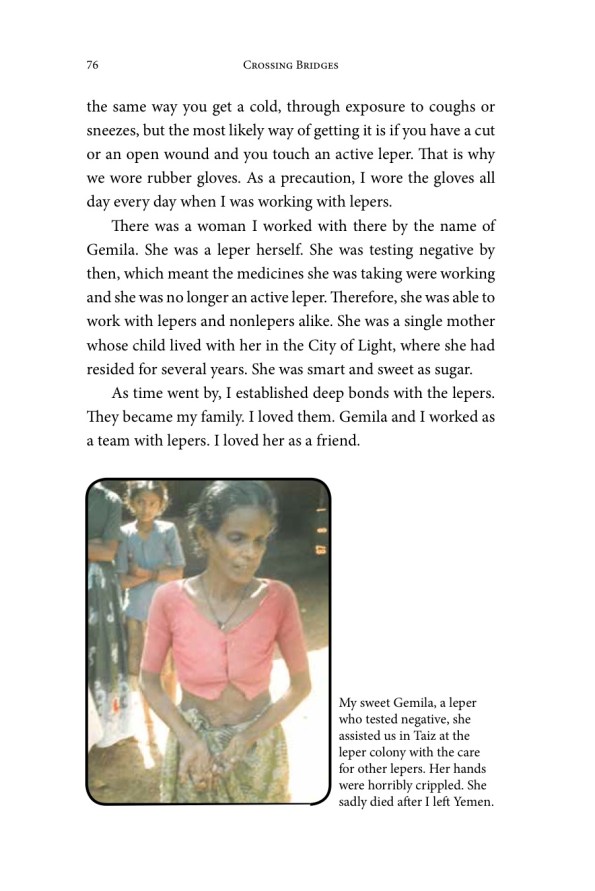
Vavrina Teresa inside (for Leo)

CB Interior Chapter 9 IV SMALL SIZE with album and front cover 08_14_15

He witnessed people’s adoration of Mother Teresa wherever she went. There was enough mutual respect between this American priest and Macedonian nun that they could speak candidly and laugh freely in each other’s company. He criticized her refusal to let her Sisters do the type of development work his programs did. He disapproved of how tough she was with her Sisters, whom she demanded live in poverty and restrict themselves to providing comfort care to the sick and dying.

He writes, “I disagreed with Mother and I told her so. I knew the value of development work. Our CRS programs in India were proof of its effectiveness…she listened to me, not necessarily agreeing with me at all…and then went right ahead and did her own thing anyway…I cried the day I left Calcutta in 1991. I loved Calcutta. Mother Teresa had tears in her eyes as well. We had become very good friends. She was the real deal…hands on…not afraid to get her hands dirty.”

Years later he read with dismay and sadness how she experienced the Dark Night of the Soul – suffering an inconsolable crisis of faith.


“I knew her well and yet I never detected any indication, any sign that she was burdened with this internal struggle. Not once in all the time I spent with her did she betray a hint of this. She seemed in all outward appearances to be quite happy and jovial,” he writes. “However, I did know that she was very intense about her faith and her work. In her mind and heart she was never able to do enough. She never felt she did enough to please God, and so there was this constant, gnawing void she felt that she could never fully fill or reconcile.”

Even all these years later Vavrina says his experience in India is never far from his thoughts.

Liberia
CRS next sent him to Liberia, Africa, where a simmering civil war boiled over. His job was getting supplies to people who’d fled their villages. That meant dealing with the most powerful rebel warlord, Charles Taylor, whose forces controlled key roads and regions.

The program Vavrina operated there dispersed $42 million in aid each year, most of it in food and medicine. As in India, goods arrived by ship in port for storage in warehouses before being trucked to destinations in-country. Vavrina often rode in the front truck of convoys that passed through rebel-occupied territories where boys brandishing automatic weapons manned checkpoints. There were many tense confrontations.

On three occasions Vavrina got Taylor to release a freight train to carry supplies to a large refugee contingent in dire need of food and medicine in the jungle. Taylor provided a general and soldiers for safe passage but Vavrina went along on the first run to ensure the supplies reached their intended recipients.

Everywhere Vavrina ran aid overseas he contended with corruption to one extent or another. Loss through pilfering and paying out bribes to get goods through were part of the price or tax for conducting commerce. Though he hated it, he dealt with the devil in the person of Taylor in order to get done what needed doing. Grim reminders of the carnage that Taylor inflamed and instigated were never lost on Vavrina and on at least once occasion it hit close to home.
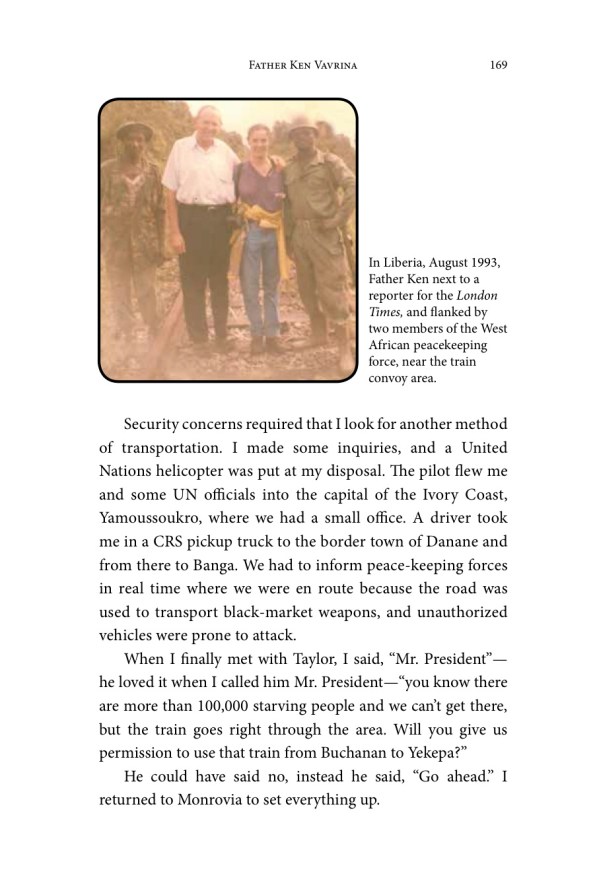
CB Interior Chapter 13 XI SMALL SIZE with album and front cover 08_14_15


“Not for a moment did I ever forget who I was really talking to…I never forgot that he was a ruthless dictator. He was a pathological liar too. He could look you dead in the eye and tell you an out-and-out untruth, and I swear he was convinced he was telling the truth. A real paranoid egomaniac. But in war you cannot always choose your friends.

“Hundreds of thousands of innocent people died in Liberia during those civil wars. There were many atrocities. One in particular touched me personally. On October 20, 1992, five American nuns, all of whom I knew and considered friends, were killed. I had visited them at their convent two days before this tragedy. May they rest in peace.”

The killings were condemned worldwide.

His most treacherous undertaking involved a cargo ship, The Sea Friend, he commissioned to offload supplies in the port at Greenville. Only rebels arrived there first. To make matters worse the ship sprung a leak coming into dock. Thus, it became a test of nerves and a race against time to see if the supplies could be salvaged from falling prey to the sea and/or the clutches of rebels. When all seemed lost and the life of Vavrina and his companions became endangered, a helicopter answered their distress call and rescued them from the ugly situation.

Back home
Hs work in Liberia was left unfinished by the country’s growing instability and by his more frequent malaria attacks, which forced him back home to the States. At the request of CRS he settled in New York City doing speaking and fundraising up and down the East Coast. Then he went to work for the Catholic Medical Mission Board, who sent him to Cuba to safeguard millions of dollars in medical supplies for clinics in an era when America’s Cuba embargo was still officially in effect.

During his visit Vavrina met then-Archbishop of Havana, Jamie Ortega, now a cardinal. Vavrina supported then and applauds now America normalizing relations with Cuba.

He also appreciates the progressive stances Pope Francis has taken in extending a more welcoming hand by the Church to divorced and gay Catholics and in encouraging the Church to be more intentional about serving the poor and disenfranchised. The pope’s call for clergy to be good pastors and shepherds who work directly work with people in need is what Vavrina did and continues doing.

“This is exactly what the Holy Father is saying. They need to get out of the office and stop doing just administration and reach out to people who are being neglected. A shepherd reaches out to the lost sheep. Jesus talks about that all the time,” Vavrina says.

As soon as Vavrina ended his missions work overseas he intended coming back to work in Omaha’s inner city but he kept getting sidetracked. Then he got assigned to serve two rural Neb. parishes. Finally, he got the call to pastor St. Richard’s in North Omaha, where he was sent to heal a congregation traumatized by the pedophile conviction of their former pastor, Father Dan Herek.

Vavrina writes, “Those wounds did not heal overnight. I knew going in I would be inheriting a parish still feeling raw and upset by the scandal. Initially my role was to help people deal with the anger and frustration and confusion they felt. Those strong emotions were shared by adults and youths alike.”

During his time at St. Richard’s he immersed himself in the social action group, Omaha Together One Community.

Facing declining church membership and school enrollment, the archdiocese decided to close St. Richard’s, whereupon Vavrina was assigned the parish he’d long wanted to serve – St. Benedict the Moor. As the metro’s historic African-American Catholic parish, St. Benedict’s has been a refuge to black Catholics for generations. Vavrina led an effort to restore the parish’s adjacent outdoor recreation complex, the Bryant Center, which has become a community anchor for youth sports and educational activities in a high needs neighborhood. He also initiated an adopt a family program to assist single mothers and their children. Several parishes ended up participating.

Poverty and unemployment have long plagued sections of northeast Omaha. Those problems have been compounded by disproportionately high teenage pregnancy, school dropout, incarceration and gun violence rates. Vavrina saw too many young people being lost to the streets through drugs, gangs or prostitution. Many of these ills played out within a block or two of the rectory he lived in and the church he said Mass in. He’s encouraged by new initiatives to support young people and to revitalize the area.

Wherever he pastored he forged close relationships. “One of the benefits of being a pastor is that the parish adopts you as one of their own, and the people there become like a family to you,” he writes.

At St. Ben’s that sense of family was especially strong, so much so that when he announced one Sunday at Mass that the archbishop was compelling him to retired there was a hue and cry from parishioners. He implored his flock not to make too big a fuss and they mostly complied. No, he wasn’t ready to retire, but he obeyed and stepped aside. Retirement gave him time to reflect on his life for the book he ended up publishing through his own Uplifting Publishing and Concierge Marketing Publishing Services in Omaha.
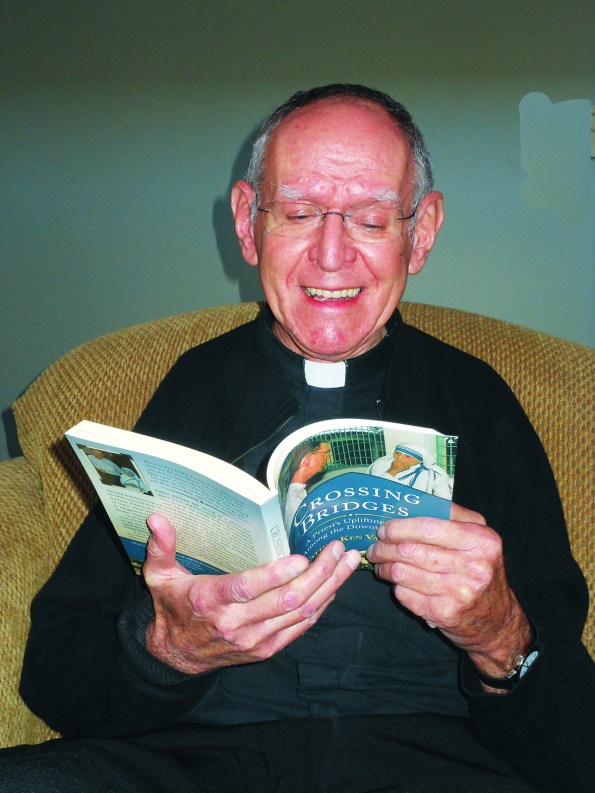
Father Ken #3 (for Leo)

Father Ken enjoying our book

“I’ve had a wonderful life, oh my,” he says.

Now that that wonderful life has been distilled into a book, he hopes his journey is instructive and perhaps inspiring to others.

“I wrote the book hoping it was going to encourage people to cross bridges and to reach out to people who otherwise they would not reach out to. That’s exactly what Pope Francis is talking about.”

Besides, he says, crossing bridges can be the source of much joy. The life story his book lays out is evidence of it.

“That story just says how great a life I have had,” he says.


“It is my prayer that the travels and experiences I describe in these pages serve as guideposts to help you navigate your own wanderings and crossings.

“A bridge of some sort is always before you…never be afraid to open your heart and speak your mind. We are all called to be witnesses. We are all called to testify. To make the crossing, all that is required is a willing and trusting spirit. Go ahead, make your way over to the other side. God is with you every step of the way. Take His hand and follow. Many riches await.”

Order the book at http://www.upliftingpublishing.com.

Share this: Leo Adam Biga's Blog

  • Click to email a link to a friend (Opens in new window) Email
  • Click to share on Facebook (Opens in new window) Facebook
  • Click to share on Pinterest (Opens in new window) Pinterest
  • Click to share on LinkedIn (Opens in new window) LinkedIn
  • Click to share on Reddit (Opens in new window) Reddit
  • Click to print (Opens in new window) Print
  • Click to share on X (Opens in new window) X
  • Click to share on Tumblr (Opens in new window) Tumblr
Like Loading...
Categories: Authors/Literature, Books, Catholic Relief Services, Crossing Bridges: A Priest's Uplifting Life Among the Downtrodden, Father Ken Vavrina, Leo Adam Biga, Mother Teresa, Religion, Social Justice, Writing Tags: Authors, Books, Catholic Relief Services, Crossing Bridges: A Priest's Uplifting Life Among the Downtrodden, Father Ken Vavrina, Leo Adam Biga, Mother Teresa, Religion, Social Justice
Newer Entries Older Entries
RSS feed
  • Google
  • Youdao
  • Xian Guo
  • Zhua Xia
  • My Yahoo!
  • newsgator
  • Bloglines
  • iNezha

Alexander Payne: His Journey in Film

Check out my brand new Facebook page & Like it–
Alexander Payne: His Journey in Film
https://www.facebook.com/AlexanderPayneExpert/

The work-in-progress page is devoted to my acclaimed book about the Oscar-winning filmmaker and his work.

“This is without question the single best study of Alexander Payne’s films, as well as the filmmaker himself and his filmmaking process. In charting the first two decades of Payne’s remarkable career, Leo Adam Biga pieces together an indelible portrait of an independent American artist, and one that’s conveyed largely in the filmmaker’s own words. This is an invaluable contribution to film history and criticism – and a sheer pleasure to read as well.” –Thomas Schatz, Film scholar and author (The Genius of the System)

The book sells for $25.95.

Available through Barnes & Noble, on Amazon, for Kindle and at other bookstores and gift shops nationwide.

Purchase it at–https://www.amazon.com/dp/B01MRORX1U?ref_=k4w_oembed_c1Anr6bJdAagnj&tag=kpembed-20&linkCode=kpd

You can also order signed copies by emailing the author at leo32158@cox.net.

Mini-Profile

leoadambiga

leoadambiga

Author-journalist-blogger Leo Adam Biga resides in his hometown of Omaha, Nebraska. He writes newspaper-magazine stories about people, their passions, and their magnificent obsessions. He's the author of the books "Crossing Bridges: A Priest's Uplifting Life Among the Downtrodden," "Alexander Payne: His Journey in Film" (a compilation of his journalism about the acclaimed filmmaker) "Open Wide" a biography of Mark Manhart. Biga co-edited "Memories of the Jewish Midwest: Mom and Pop Grocery Stores." His popular blog, Leo Adam Biga's My Inside Stories at leoadambiga.com, is an online gallery of his work. The blog feeds into his Facebook page, My Inside Stories, as well as his Twitter, Google, LinkedIn, Tumblr, About.Me and other social media platform pages.

View Full Profile →

Twitter Updates

Tweets by leoadambiga

Like Me on Facebook

Like Me on Facebook

My Favorite Tags

African-American African-American Culture African-American Empowerment Network African Ameican Culture African American Alexander Payne Alexander Payne: His Journey in Film Art Arts Athletics Author Authors Authors/Books/Literature Books Boxing Business Cinema Civil Rights Community Creighton University Education Entertainment Entrepreneur Entrepreneurial Family Film Film Books Film Streams Food Great Plains Theatre Conference History Hollywood Holocaust Hot Movie Takes Jazz Jewish Culture Journalism Latino/Hispanic Leo Adam Biga Media Metropolitan Community College Military Movies Music Nebraska Nebraska Black Sports Hall of Fame Nebraskans in Film North Omaha North Omaha Nebraska North Omaha Summer Arts Omaha Omaha Community Playhouse Omaha Nebraska Omaha Public Schools Pamela Jo Berry Photography Playwright Politics Pop Culture Pot Liquor Love Race Screenwriting Social Justice South Omaha Sports Television Terence "Bud" Crawford Terence Crawford Theater United States University of Nebraska at Omaha UNO (University of Nebraska at Omaha) World War II Writing Youth

My Favorite Categories

African-American African-American Culture Alexander Payne Alexander Payne: His Journey in Film Art Arts-Entertainment-Culture Athletics Authors/Literature Books Boxing Business Cinema Civil Rights Community/Neighborhoods Education Entertainment Entrepreneurial Family Film Food Health/Wellness History Hollywood Jewish Culture Journalism Latino/Hispanic Leo Adam Biga Media Movies Music Nebraska Nebraskans in Film North Omaha Omaha Personalities-Characters Playwright Politics Pop culture Race Screenwriting Social Justice South Omaha Sports Television Theater Uncategorized UNO (University of Nebraska at Omaha) War Writing Youth

Enter your email address to subscribe to this blog and receive notifications of new posts by email.

Join 6,164 other subscribers

Calendar of Blog Posts

January 2026
M T W T F S S
 1234
567891011
12131415161718
19202122232425
262728293031  
« Aug    

Categories from A to Z and # of Posts

Subjects/Themes

My Community

  • Miles's avatar
  • Unknown's avatar
  • webinarstarterblueprint's avatar
  • Unknown's avatar
  • Chaz's avatar
  • Erica's avatar
  • Unknown's avatar
  • Unknown's avatar
  • Unknown's avatar
  • Unknown's avatar
  • Unknown's avatar
  • Unknown's avatar
  • Unknown's avatar
  • Unknown's avatar
  • Unknown's avatar
  • wealth4evey1's avatar
  • Unknown's avatar
  • Unknown's avatar
  • Unknown's avatar
  • Unknown's avatar
  • Unknown's avatar
  • Unknown's avatar
  • Please Travel's avatar
  • Unknown's avatar
  • Unknown's avatar
  • Unknown's avatar
  • Unknown's avatar
  • Unknown's avatar
  • Unknown's avatar
  • joannaleflore's avatar
  • Maya's avatar
  • Unknown's avatar
  • Unknown's avatar
  • Unknown's avatar
  • Mark Arnold's avatar
  • Unknown's avatar
  • Simplified By Me's avatar
  • Unknown's avatar
  • Unknown's avatar
  • Unknown's avatar
  • Shannon's avatar
  • Kajal's avatar
  • jazmynebl's avatar
  • Unknown's avatar
  • nat7x's avatar
  • Unknown's avatar
  • Unknown's avatar
  • Unknown's avatar
  • Unknown's avatar
  • vipeculiar's avatar

RSS Links

  • RSS - Posts
  • RSS - Comments

Top Posts

  • Omaha's Own American Gangster, Clyde Waller
  • About Leo Adam Biga
  • From the Archives: An Ode to the Omaha Stockyards
  • Paul Williams: Alive and well, sober and serene, making memorable music again
  • Requiem for a Dynasty: UNO Wrestling
  • The Last Hurrah for Hoops Wizard Darcy Stracke
  • Wanda Ewing Exhibit: Bougie is as Bougie Does
  • A Long Way from Home: Two Kosovo Albanian families escape hell to start over in America
  • Academy Award-nominated documentary "A Time for Burning" captured church and community struggle with racism
  • Sun reflection: Revisiting the Omaha Sun's Pulitzer Prize-winning expose of Boys Town

Recent Posts

  • Paul Giamatti and Alexander Payne play catch up 15 years after ‘Sideways’
  • Native Omaha Days Story Compilation
  • Kindred spirits Giamatti and Payne to revisit the triumph of ‘Sideways’ and the art of finding truth and profundity in the holy ordinary
  • Women still calling the shots at the Omaha Star after 81 years
  • Street prophets and poets depict ‘A Day in the Life’ of the homeless in new play by Portia Love
  • Duncans turn passion for art into major collection; In their pursuits, the couple master the art of living
  • North Omaha Summer Arts (NOSA) presents An Arts Crawl 8
  • The fringe of it all: Omaha Fringe Festival fulfills founder Tamar Neumann’s dream
  • Orsi’s: Historic Italian bakery-pizzeria reaches 100
  • Jazz to the Future – The Revitalization of a Scene
  • On cusp of stardom, Omaha singer-songwriter Jocelyn follows to thine own self be true path
  • Omaha native Phil Kenny a player among Broadway co-producers and investors 

Blog Stats

  • 1,073,169 hits

Top Clicks

  • s3.amazonaws.com/bncore/w…
  • maps.google.com/maps?ll=4…
  • maps.google.com/maps?ll=4…
  • en.wikipedia.org/wiki/Ima…
  • en.wikipedia.org/wiki/Ced…
  • myspace.com/everything/ar…
  • maps.google.com/maps?ll=4…

Blogroll

  • (downtown) Omaha Lit Fest
  • Abbott Sisters Project
  • Arguably the best African American blog
  • Artist Therman Statom
  • Author and Playwright Rachel Shukert
  • Author and Radio Personality Otis XII
  • Author Joy Castro
  • Author Kurt Andersen
  • Author Richard Dooling
  • Author Timothy Schaffert
  • Bemis Center for Contemporary Arts
  • Best of the Web Blogs
  • Big Mama's Kitchen & Catering
  • Billy McGuigan
  • BLOG HINTS
  • BlogCatalog
  • Bloggapedia
  • Bloggernity
  • BlogTopSites
  • Blue Barn Theatre
  • Boys Town
  • Brigit Saint Brigit Theatre Company
  • David P. Murphy, Author/Songwriter
  • Durham Museum
  • Empower Omaha
  • Expedoodle
  • Facebook
  • Film Streams
  • Filmmaker/photographer Charles Fairbanks
  • Girlfriends Book Club
  • Google
  • Great Plains Theatre Conference
  • Heart Ministry Center
  • How to Party with an Infant
  • I Love Black History
  • Institute for Holocaust Education
  • Jewish Press
  • Joslyn Art Museum
  • KANEKO
  • Kent Bellows Studio & Center for Visual Arts
  • KVNO News
  • Laura Love
  • Lazy-i
  • LinkedIn
  • Loves Jazz & Arts Center
  • MAHA Music Festival
  • Malcolm X Memorial Foundation
  • Metro Magazine
  • Nebraska Black Sports Hall of Fame
  • Nebraska Center for Writers
  • Nebraska Coast Connection
  • Nebraska Independent Film Projects
  • Nebraska On Film
  • Nebraska StatePaper.com
  • New Horizons
  • Nomad Lounge
  • Omaha Community Playhouse
  • Omaha Fashion Week
  • Omaha Film Event
  • Omaha Film Festival
  • Omaha Performing Arts
  • Omaha Public Library
  • Omaha Publications
  • Omaha Symphony
  • Omaha World-Herald
  • Omaha.Net
  • OmahaHype
  • OnToplist.com
  • Opera Omaha
  • Planet USA Search Engine
  • Playwright, Director and Actor Kevin Lawler
  • Playwright, Journalist, Blogger, Digital Filmmaker Max Sparber
  • Postcards from Omaha
  • Princess Lasertron
  • Project Interfaith
  • Radio One
  • Rebel Interactive
  • Sacred Heart Parish
  • SheWrites
  • Silicon Prairie News
  • Spirit of Omaha
  • Stadium Views
  • Stonehouse Publishing
  • The Best Damn Creative Writing Blog
  • The Black Scholar
  • The Lit Coach's Guide to The Writer's Life
  • The Pajama Gardener
  • The Reader
  • ThisCan'tBeHappening.net
  • Topix Local News Omaha, NE
  • Trocadero
  • Turner Classic Movies
  • Underground Omaha
  • University of Nebraska at Omaha
  • UNO Department of Black Studies
  • UNO Magazine
  • UNO Wrestling
  • Waking Past Innocence
  • White Readers Meet Black Authors
  • Winners Circle

My Pages

  • “Nebraska Methodist College at 125: Scaling New Heights”
  • ‘Crossing Bridges: A Priest’s Uplifting Life Among the Downtrodden”
  • About Leo Adam Biga
  • Film Connections: How a 1968 convergence of future cinema greats in Ogallala, Neb. resulted in multiple films and enduring relationships
  • Follow My Blog on Facebook, Networked Blogs, LinkedIn
  • From the Archives…
  • Going to Africa with The Champ
  • Hire Me
  • Introducing Freelance Writing Academy Seminars with Instructor Leo Adam Biga: Book Biga Today
  • My Amazon Author’s Page
  • My Inside Stories, A Professional Writing Service by Omaha-Based Journalist, Author and Blogger Leo Adam Biga
  • Nebraska Screen Heritage Project
  • OUT TO WIN – THE ROOTS OF GREATNESS: OMAHA’S BLACK SPORTS LEGENDS
  • Seeking Sponsors and Collaborators
  • Passion Project. Introducing the new – “Alexander Payne: His Journey in Film”

Goodreads

Upcoming Events

No upcoming events

Top
Blog at WordPress.com.
Leo Adam Biga's My Inside Stories
Create a free website or blog at WordPress.com.
Privacy & Cookies: This site uses cookies. By continuing to use this website, you agree to their use.
To find out more, including how to control cookies, see here: Cookie Policy
  • Subscribe Subscribed
    • Leo Adam Biga's My Inside Stories
    • Join 1,151 other subscribers
    • Already have a WordPress.com account? Log in now.
    • Leo Adam Biga's My Inside Stories
    • Subscribe Subscribed
    • Sign up
    • Log in
    • Report this content
    • View site in Reader
    • Manage subscriptions
    • Collapse this bar
 

Loading Comments...
 

    %d