Archive
Shakespeare on the Green: A summertime staple in Omaha
Before you get the idea that the only thing happening this summer in my hometown is the Omaha Black Music and Community Hall of Fame Awards and Native Omaha Days, here’s a heads-up for this year’s rendition of the annual Shakespeare on the Green festival. The popular event has been packing them in for performances of the Bard’s plays at Elmwood Park for 25 years. The following story for Omaha Magazine gives a brief primer for how the fest started and what to expect at it. This blog is full of stories about and links to Omaha cultural attractions. It used to be people complained there wasn’t enough to do here, but now it’s quite the opposite – there’s so much to do that it’s hard choosing among the bounty.

Shakespeare on the Green
A summertime staple in Omaha
©by Leo Adam Biga
Originally appeared in Omaha Magazine
When the annual Shakespeare on the Green festival returns this June and July, alternating two professional productions of the Bard’s work, it will mark the 25th season for one of Omaha‘s summer entertainment staples.
Over that time the free outdoor event has played to more than a half-million spectators in a tucked-away nook of Elmwood Park adjacent to the UNO campus.
The play’s certainly the thing at these relaxed evenings on the green and under the stars but the lively pre-show has its own attractions:
•food and souvenir booths
•interactive activities for youths
•live musical performances
•educational seminars to brush up your Shakespeare
•Two-Minute Shakespeare quizzes where the audience tries stumping the actors
•assorted jugglers, jesters and merrymakers.
On select nights Camp Shakespeare performances let school-age kids “speak the speech.” On June 26 Will’s Best Friend Contest invites dog owners to show off their pooches in Shakespearean splendor.
Co-founders Cindy Phaneuf and Alan Klem say the festival found a loyal following right from the start. The come-as-you-are ambience, bucolic site and free shows are hard to beat.
“We really woke up the space,” says Phaneuf. a University of Nebraska at Omaha theater professor.. “It’s a gorgeous location — 3.7 acres, naturally slanted, protected by trees, gobs of parking. Once you go down the hill it’s like you’re in a magical little world.”

Cindy Phaneuf
Whether a brooding tragedy or a lilting comedy an average of 2,000-plus folks flock to each performance. This year’s contrasting shows are A Midsummer Night’s Dream and Hamlet.
Phaneuf says some favorite memories are “the hushed silence of the crowd, the laughter that ripples from the front to back row and spontaneous standing ovations.” She likes that families make Shakespeare “part of their summer… part of their growing up.” Many fans return year after year to soak up the language, the outdoors and the communal spirit.
“It was always about the highest quality art we could possibly create but we also wanted an event where everyone felt comfortable,” says Phaneuf. “Shakespeare seems somewhat elitist but then we put it in an open environment, in a park, right in the middle of the city and it’s very inviting.
“The other thing that’s made it so lasting is we wanted everyone to feel they owned it — that it didn’t just belong to the board and to the people making the plays. If you cater only to a small faction it will not continue to grow and thrive, it will start to wither and die, and so that was really important to us.”
She says the festival alleviated a paucity of the Bard’s work performed locally and gave theatergoers a fix for for the usually dormant summer stage season.
“There was such a hunger and need for it,” she says. “There’s lots of theater in town but very little Shakespeare.”
While some theaters’ seasons now extend into summer the fest’s among Omaha’s only professional venues. Equity actors from across the nation headline their.

Alam Klem
Creighton University professor Alan Klem says the event not only presents good theater but supports and grows the local talent pool by hiring professional actors from the community and “bringing in students from Creighton and UNO who are working towards becoming actors.” Phaneuf says for many students it’s their first professional gig. Some, like Jill Anderson, earn Equity cards in the process.
“It just ups the ante and the expectation,” Phaneuf says. “It’s a great training ground.”
The festival’s only one element of the nonprofit Nebraska Shakespeare. Vincent Carlson-Brown and Sarah Carlson-Brown interned as UNO students, then worked through the ranks and today are associate artistic directors.
Besides being a learning lab and career springboard for emerging talent, thousands of high school students attend the Music Alive! collaboration with the Omaha Symphony. Nebraska Shakespeare also tours a fall production to schools throughout the state, complete with post-show discussions and workshops. Klem says these educational efforts are “as important as doing the plays out in the park,” adding that there are plans to expand the tours.

Klem and Phaneuf, who go back to their undergrad days together at Texas Christian University, say they knew they were onto something big when audiences turned out in droves year one. His experience founding Shakespeare in the Park in Fort Worth, Texas gave Shakespeare on the Green a head start. The Omaha fest has always been a collaboration between UNO and Creighton.
The two theater geeks served as co-artistic directors the first six years. Then Klem went onto other things — returning to act roles. Phaneuf continued in charge until resigning after the 2009 festival, when budget cuts resulted in one show rather than the usual two. The festival’s since rebounded. Klem’s back as artistic director and Phaneuf remains close to the organization.
Volunteers are critical to putting the event on. Phaneuf recalls once when high winds blew the set down during the day the stage crew and volunteers rebuilt it in time for that night’s show. She says that show-must-go-on dedication is what she appreciates most: “It’s people pulling together to make this happen. It’s a cooperative venture.” Klem marvels that the same spirit infusing the event 25 years ago still permeates it today.
Schedule-
A Midsummer Night’s Dream: June 23-26, July 6, 8, 10 and Hamlet: June 30, July 1-3, 7, 9
Performances start at 8 p.m. Booths open at 5:30. The pre-show starts at 7.
For more info., visit http://www.nebraskashakespeare.com/home.
Related articles
- Great Plains Theatre Conference Ushers in New Era of Omaha Theater (leoadambiga.wordpress.com)
- In the land of Shakespeare (everythinginflux.wordpress.com)
- Much Ado About Shakespeare (mfcartaya.wordpress.com)
Omaha theater as insurrection, social commentary and corporate training tool
My usually eclectic blog has been theater heavy this week because I decided to celebrate the 2011 Great Plains Theatre Conference, which ends June 4, by sharing some of my theater stories from the recent and not so recent past. I’ll continue posting theater stories well after the conference closes because I discovered I have a nice cache of them, but I’ll also be back to showcasing the diversity of my work that regular followers have come to expect. I did the story below for The Reader (www.thereader.com) and it’s a look at how some Omaha theater professionals variously utilize the art form as insurrection, social commentary and corporate training tool.
Omaha theater as insurrection, social commentary and corporate training tool
©by Leo Adam Biga
Originally published in The Reader (www.thereader.com)
Making Images
Something subversive happened in the Old Market one recent Saturday evening.
From out of the blue, pedestrians converged on sidewalk corners and molded their bodies into dramatic sculpted “images.” One image included a man on his back cringing in terror as an assailant stood over him with a raised boot. Another posed father-and-son partners sealing a deal with a handshake that suddenly, inexplicably broke. A third linked people in a solid human chain until some unseen force rudely disturbed it.
If the symbolic frieze frames did not adequately convey their message of oppression, someone hanging anti-Initiative 416 (Defense of Marriage Amendment) signs around the individuals did, including one placard labeling the assault victim as a “Gay Man.” Just to be sure, another demonstrator handed out anti-416 leaflets.
These human tableauxs, so suggestive of figurative sculptures taking shape in front of your eyes, were in fact street theater pieces being used to focus awareness on the divisive 416 measure. The unfolding scenes were meant to make a statement, draw attention and engage people in dialogue about the issue. As the theater action progressed that night, a few curious passersby did stop to stare and proffer off-handed remarks. Then, when a plant in the crowd posing as an antagonist began spouting Biblical admonitions about same sex marriage and another plant posing as an initiative supporter began refuting his every protestation, some onlookers vigorously joined the debate on either side.
The ensuing discussion was the moment when this unorthodox piece of theater melded with genuine crowd reaction and, in so doing, accomplished exactly what organizers intended.
The Boal Way
So, was this event an example of art or theater or political activism? A little of all three, according to its instigator, University of Nebraska at Omaha Dramatic Arts Professor Doug Paterson. A self-described “insurrectionist” from the ‘60s, Paterson leads the UNO-based Thespis troupe (Theater Helping Everyone Solve Problems in Society), which follows many of the theories of Brazilian director Augusto Boal and his Theater of the Oppressed (T.O.) movement.
Boal, who came to Omaha in 1996 to give workshops, developed T.O. as a political tool to aid oppressed peoples around the world in their struggle for liberation. That night in the Market Paterson led his players in applying Boal’s image and invisible theater techniques (The professor played the antagonist in the crowd.). In keeping with their revolutionary roots, the drama that night was sprung – guerrilla-style – on unsuspecting folks in public spaces for the purpose of eliciting responses to a socially relevant issue. The ultimate aim, then or any time, is to incite action. Paterson organized a second theater event around the 416 measure at an October 31 rally on campus. Previous events have tackled the enduring UNO parking crisis.
Another Boal technique favored by Paterson – forum theater – utilizes workshops in which everyday people address problems at work or in their community through discussion and role playing led by a facilitator. In this interactive, outside-the-box approach to theater, the idea is to break down the Fourth Wall traditionally separating practitioner from audience and to build bridges connecting the two via conversation that works toward some resolution.
“Boal developed a theater that differs from the Western approach of pacifying you in the audience while actors describe a reality that you then take to be true. As an audience, you are powerless to change the story. You’re told, ‘This is the way it is,’ especially if you’re a minority. Boal believes in twisting things in a fun, open, community-based way that gives people a way to change the story. It’s what he calls interrogative theater. Rather than declare reality, it interrogates reality. It challenges the notion that it has to be this way — that it can’t be something else. It suggests new possibilities,” said Paterson, who has studied with Boal in Brazil.
Working It Out
Paterson has conducted forum theater workshops for many organizations, including the Omaha Public Schools, Creighton University and UNO. Workplace diversity issues are most commonly confronted, but not in the we talk-you listen vein.
“In forum theater we first play games to relax people and get them interacting with each other. Then we perform scenarios depicting some oppression, like a secretary given a last minute project by her boss when she needs to be someplace else,” he said. “The secretary tries overcoming her obstacle, but she just can’t. At some point we turn to the audience and say, “Okay, what would you do if you were her?’ Instead of having the audience sit there quietly we encourage them to talk to each other and share ideas to find some new solution.
“We encourage them to show how they would handle the situation differently, and it’s interesting because then it’s really them in the moment feeling sympathy for that character and the words almost become their own. Our attempt is to see if the audience is willing to be so moved and engaged by what’s happening that they really want to do something. Once they see something from their own life represented or dramatized, they think, ‘That’s me up there.’”
He said the response by participants is usually enthusiastic. “Often we can’t get through all the scenarios because there’s so much discussion. People get up and intervene and are very excited. I’ve never seen it fail.”
All the World’s a Stage
This grassroots theater has been a passion of Paterson’s since he discovered how deeply it resonated with his own emerging social consciousness amid the civil unrest in America a generation ago.
“I’ve been engaged in Theater for Living, Theater for Change or what has come to be known as Community-Based Theater since the mid-’70s,” he said. “I actively resisted the war in Vietnam while at Cornell University and it was during that time I formulated all my thinking about how culture works and how it is part of the oppressive process. I was really taken by the idea that if we could stake out new audiences, then we’d find a way to create a new culture in theater.
“Later, I started a small professional company in South Dakota whose purpose was to go into rural areas and engage farmers and ranchers in a kind of cultural salvage work where we found people’s stories and turned those into plays that we performed in these small towns.” He repeated the process when he came to UNO in 1981 – exploring the farm crisis with students in an original play (It Looks Good from the Road).
His students there included Omaha playwright Doug Marr and actress Laura Marr who, along with Paterson and others, formed the proletarian Diner Theater, which took this theater-happens-everywhere philosophy to heart. “
It drew a different group of people who might not have felt comfortable going to a regular theater setting,” Paterson said. “It was more neighborhood. It was more working class. It was site-specific. It was very exciting.”
Dramatic Results
The Marrs, along with fellow UNO theater grad Brent Noel, are adherents of Boal’s work and together operate a venture, Dramatic Results, incorporating the tenets of Boal in forum theater workshops at corporations.
“The trend today in business is to develop creativity and decision-making in employees, and Boal’s exercises are effective in helping build problem-solving skills,” Noel said. “We don’t offer answers or solve problems. We’re more interested in asking the right questions and encouraging people to think about possibilities. We offer a process whereby employees discover solutions. It’s empowering.” Noel said while many businesses are not yet ready to welcome theater techniques into their staid office settings, clients that do are satisfied. “Once they see how it works, most realize the value of it. It works in everything from sales to diversity to critical thinking training.”
Related articles
- A Q & A with Theater Director Marshall Mason, Who Discusses the Process of Creating Life on Stage (leoadambiga.wordpress.com)
- Jo Ann McDowell’s Theater Passion Leads Her on the Adventure of Her Life: Friend, Confidante, Champion of Leading Playwrights, Directors, Actors and Organizer of Major Theater Festivals and Conferences (leoadambiga.wordpress.com)
- Playwright John Guare Talks Shop on Omaha Visit Celebrating His Acclaimed ‘Six Degrees of Separation’ (leoadambiga.wordpress.com)
- A Q & A with Playwright Caridad Svich, a Featured Artist at the Great Plains Theatre Conference (leoadambiga.wordpress.com)
- Great Plains Theatre Conference Ushers in New Era of Omaha Theater (leoadambiga.wordpress.com)
- action, alternatives and responsibility (artsandcraftscollective.wordpress.com)
- Walking Behind to Freedom, A Musical Theater Examination of Race (leoadambiga.wordpress.com)
- A Q & A with Edward Albee: His Thoughts on the Great Plains Theatre Conference, Jo Ann McDowell, Omaha and Preparing a New Generation of Playwrights (leoadambiga.wordpress.com)
- Hey, You, Get Off of My Cloud! Doug Paterson – Acolyte of Theatre of the Oppressed Founder Augusto Boal and Advocate of Art as Social Action (leoadambiga.wordpress.com)
- Anthony Chisholm is in the House at the John Beasley Theater in Omaha (leoadambiga.wordpress.com)
- Great Plains Theatre Conference Grows in New Directions (leoadambiga.wordpress.com)
- Luigi’s Legacy, The Late Omaha Jazz Artist Luigi Waites Fondly Remembered (leoadambiga.wordpress.com)
- What Happens to a Dream Deferred? Beasley Theater Revisits Lorraine Hansberry’s ‘A Raisin in the Sun’ (leoadambiga.wordpress.com)
- Shakespeare on the Green, A Summertime Staple in Omaha (leoadambiga.wordpress.com)
- Kevyn Morrow’s Homecoming (leoadambiga.wordpress.com)
Hey, you, get off of my cloud! Doug Paterson is acolyte of Theatre of the Oppressed founder Augusto Boal and advocate of art as social action
I love University of Nebraska at Omaha theater professor Doug Paterson’s passion. In the following story for The Reader (www.thereader.com) I profile how he’s melded his art and his social activism in a seamless way through Theatre of the Oppressed, a theater form he’s mastered under founder Augusto Boal. My story appeared in advance of the international Theater of the Oppressed Conference that Paterson and UNO hosted a couple years ago. I am posting the story here to highlight different aspects of Omaha theater in the wake of the 2011 Great Plains Theatre Conference, which wraps up June 4.
Hey, you, get off of my cloud!
Doug Paterson is acolyte of Theatre of the Oppressed founder Augusto Boal and advocate of art as social action
©by Leo Adam Biga
Originally appeared in The Reader (www.thereader.com)
Doug Paterson’s always used theater as an instrument of his insurrectionist principles. As a student in the 1960s he actively protested against the Vietnam War and other burning social issues and gravitated to progressive theater that challenged the status quo.
But it wasn’t until he saw Brazilian Augusto Boal’s Theatre of the Oppressed in action that his social activism and his art merged into a philosophy and a way of life. Seventeen years later the University of Nebraska at Omaha professor is a leading adherent, practitioner, facilitator and teacher of T.O., as much a political movement dedicated to social change as a form of theater.
Much of T.O.’s work involves developing scenarios with audiences around the issues of racial, gender and class inequalities. The idea is to spark dialogue among citizens in a living or social theater environment. The end goal is to generate dialogue with decision-makers in the real world as a framework for addressing these matters with concerted action, even legislation.
It is meant to be an empowering process.
“We see something that affects us. Some oppression or injustice or wrong and we identify with it, we understand it and we yell, ‘Stop.’ To Boal the very act of saying we can stop this is by itself important,” Paterson said.
The premise of T.O., he said, is that the oppressed are “dictated to” by a privileged, power-wielding elite. “They’re not in the loop of determining what’s going to be the agenda of their life. They’re told what it’s going to be and often through force of violence.” What T.O. helps people do, he said, is “learn techniques and methods to interrogate the world. It’s developing a critical sensibility so they can talk to power and demand dialogue.”
Why theater as a device to elicit participation in the political process?
“Boal’s phrase is, ‘We’re all theater.’ We can all do this. We’re all doing it all the time because we’re all actors who can change the world,” Paterson said. “In Theatre of the Oppressed we just give it a little bit of shape — to help draw the power out of a person or a community, because it’s already there.”
Theater also provides a well-founded structure for protagonist-antagonist conflicts.
The UNO educator has studied with Boal, a short-list nominee for the Nobel Peace Prize, and “jokered” dozens of workshops with him and his son Julian Boal. Paterson’s led T.O. workshops in about a dozen states as well as in Canada, Israel, Palestine, Iraq and Africa.
T.O.’s organic, democratic system for giving the disenfranchised a voice is the focus of the May 22-25 International Pedagogy & Theatre of the Oppressed Conference in Omaha. Both Augusto and Julian Boal will give workshops using exercises and games that lead into T.O.’s Forum, Image, Invisible, Cop in the Head, Rainbow of Desire and Legislative theater.
The public’s invited to a free demonstration of Legislative Theatre at 7 p.m. on Thursday, May 22 in the Omaha City Council Chambers.
Six area elected officials will convene a mock legislative body to hear a set of scenes developed over three days of Forum workshops. These scenes built around local issues will be enacted and the floor thrown open for anyone to discuss, intervene, offer solutions. By the end of the session “legislation” will be devised and presented to the “council.” Paterson said Boal will then pose a question to the panel: “Would you support this legislation proposed by this temporary community?” That’s when the real dialogue and debate begins.
Paterson said to expect “a room “humming with activity,” lively discussion, laughter. “Nothing is coerced,” he said.

The dynamic interplay needs no formal introduction or explanation.
“If you see it you understand it immediately what it is and you can participate,” Boal said by phone from New York.
For Boal, T.O.’s not about finding solutions to problems but engaging people in exchanges that at least explore ways to combat or relieve oppression.
“I always say we should strive to have peace but the worst enemy of peace is passivity,” Boal said. “We must abolish passivity to try to do things in order to have real peace.”
True believers like Boal and Paterson believe in fighting oppression in whatever form it takes — violence, discrimination — through “the solidarity of the oppressed.” It is a movement of individuals and groups banded together in the belief that change is possible.

Paterson, who’s previously brought Boal to Omaha for this same conference, is a founder of the P.T.O. organization that puts the event on. This makes the seventh time Omaha’s hosted the event. It may also be the last, as Paterson plans to let new leadership take over.
The Omahan’s first direct exposure to T.O. came in Seattle in 1991. He was familiar with the tenets of Boal’s work but merely reading about it didn’t captivate him the way a demonstration did. Although Paterson had engaged in grassroots theater through the Dakota Caravan in the Black Hills and the Diner Theater in Omaha, he was still largely bound to traditional theater and its imposed world view that offer no mediation in or deviation from the end result.
Standing in stark contrast to that approach is T.O., which does not respect any fixed narrative or resolution. It’s all about inviting audiences and participants to intervene in and alter the story as a means for confronting and, if possible, ending oppression. Where traditional theater’s a monologue, T.O.’s a dialogue.
“I never got it,” Paterson said. “It sounded too serious. But then I saw it and it was so much fun and so interactive and so liberating that I said, ‘That’s it — I found where I’ve been heading for all my life.’ It just opened up possibilities. It’s asking through educational theater is it possible to transform the world to an equitable place economically, socially and politically.”
In Paterson’s view T.O. provides a structure for affecting change.
“Dealing with oppressed populations requires real dialogue…negotiation,” he said.
The goal, he said, is creating “a fair, equitable, humane world, a rational world where people have enough food and safe shelter, where crime is not encouraged by the economy, such as it is here, where poverty is not enforced, where violence is not the way of life. That’s what we want and all of us believe it’s possible.”
More than an academic or aesthetic construct, the work’s designed with real life applications in mind. Boal applies its techniques and forms to all kinds of community organizing, including his early-1990s bid for and election to the Rio de Janeiro city council as a member of the left-wing Workers Party. He used T.O. as an on-the-streets forum that gave people a sounding board to tell him what they wanted changed and he introduced legislation to try and bring about that change.
The more Paterson immersed himself in this new theater the more committed to it he became. The better he got to know Boal his conversion only deepened.

Augusto Boal
“I know Augusto as a mentor and quasi-father figure,” Paterson said. “I’ve spent a lot of time with him and we’ve talked far into the night. I really admire his work. I admire the mind that conceived of this and just kept relentlessly developing it. By continuing to work he made a path.”
Boal overturned his own traditional theater background in the ‘60s in response to oppressive military regimes in Brazil. At the time he headed the country’s national Arena theater, whose members began to resist the censorship and other government imposed strictures. Caught up in the struggle, Boal became politicized to a more militant, even radical stand. Branded a troublemaker, he was arrested, interrogated and tortured. Pressure from the West got him released but he soon became a political exile in Argentina and France.
He devised T.O. while in exile, drawing much inspiration from the late educational theorist Paulo Freire, author of Pedagogy of the Oppressed.
Boal was little known in the U.S. outside “a very narrow circle” when Paterson first contacted him and brought him to the states for the 1992 Association for Theatre in Higher Education national conference in Atlanta, Ga.
“Boal came to the conference and just carved a whole new channel for how to make theater and who to make theater for in the United States,” said Paterson. “It was a wonderful experience and we had a wonderful connection.”
T.O. is now practiced around the globe. It operates centers in several countries. Where the movement got scant media notice a decade ago it’s well covered today.
Paterson said there’s some resistance to the movement because “the word oppressed scares people.”
In Boal’s homeland, where he lives once again, the Workers Party-controlled state government has a program called Cultura Viva (Culture Alive) that, Boal said, “helps us spread the Theatre of the Oppressed all over Brazil.” The program enables T.O. to work with schools, mental health facilities, prisons and other entities.
“This is the first time the government has supported the work that we do,” said Boal, an outspoken critic of Brazilian government since the ‘60s.
Just as for Boal the work is not an abstraction, neither is it for Paterson or for conference registrants, who include theater educators and community activists from across the U.S., Europe and other parts of the world.
Locally, Paterson hopes it’s a model groups adopt for presenting grievances to local elected officials that address some of Omaha’s long-standing oppressions. He referred to African Americans’ disproportionate poverty here.
“We’ve really violated their human rights and we need dialogue,” said Paterson, noting Omaha’s high incidence of black on black crime and sexually transmitted diseases and the ongoing segregation that divides blacks and whites. “There’s so much to do.”
Related articles
- Playwright/Director Glyn O’Malley, Measuring the Heartbeat of the American Theater (leoadambiga.wordpress.com)
- Great Plains Theatre Conference Ushers in New Era of Omaha Theater (leoadambiga.wordpress.com)
- Great Plains Theatre Conference Grows in New Directions (leoadambiga.wordpress.com)
- Polishing Gem: Behind the Scenes of the Beasley Theater & Workshop’s Staging of August Wilson’s ‘Gem of the Ocean ‘ (leoadambiga.wordpress.com)
- A Q & A with Theater Director Marshall Mason, Who Discusses the Process of Creating Life on Stage (leoadambiga.wordpress.com)
- action, alternatives and responsibility (artsandcraftscollective.wordpress.com)
- Playwright John Guare Talks Shop on Omaha Visit Celebrating His Acclaimed ‘Six Degrees of Separation’ (leoadambiga.wordpress.com)
- Omaha Theater as Insurrection, Social Commentary and Corporate Training Tool (leoadambiga.wordpress.com)
- What Happens to a Dream Deferred? Beasley Theater Revisits Lorraine Hansberry’s ‘A Raisin in the Sun’ (leoadambiga.wordpress.com)
OLLAS: A melting pot of Latino/Latin American concerns
As Nebraska‘s Hispanic population has grown significantly the past two decades there’s an academic-research-community based organization, OLLAS or Office of Latino and Latin American Studies, at the University of Nebraska at Omaha that’s taken a lead role in engaging policymakers and stakeholders in Latino issues and trends impacting the state. I’ve had a chance the past two years to get to know some of the people who make OLLAS tick and to sample some of their work, and the level of scholarship and dedication on display is quite impressive. The following story for El Perico gives a kind of primer on what OLLAS does. Increasingly, my blog site will contain posts that repurpose articles I’ve written for El Perico, a dual English-Spanish language newspaper in Omaha and a sister publication of The Reader (www.thereader.com). These pieces cover a wide range of subjects, issues, programs, organization, and individuals within the Latino community. It has been my privilege to get to know better Omaha’s and greater Nebraska’s Latino population, though in truth I’ve only barely dipped my feet into those waters. But it’s much the same enriching experience I’ve enjoyed covering Omaha’s African-American and Jewish communities.
OLLAS:
A melting pot of Latino/Latin American concerns
©by Leo Adam Biga
Originally published in El Perico
Despite an ivory tower setting, the Office of Latino/Latin American Studies at the University of Nebraska at Omaha is engaged in community from-the-grassroots-to-the-grasstops through teaching, research and service.
The far reach of OLLAS, established in 2003, is as multifaceted as Latino-Latin American cultures and the entities who traverse them.
“We work very hard to bring to the table the different voices and stakeholders that seldom come together but that must be part of the same conversations. We do that very well,” said director and UNO sociology professor Lourdes Gouveia.
“We’ve been able to construct a program around this very out-of-the-box idea” that academia doesn’t happen in isolation of community engagement and vice-versa. Instead, she said these currents occur together, feeding each other.
“The impetus for creating this center was driven by what informs everything in my life, which is intellectual interest right along with an interest in addressing issues of inequality and social justice and making a difference wherever I am. So, for me, OLLAS was a logical project we needed to undertake.”
At the time of its formation Gouveia was researching immigration’s impact in Lexington, Neb. “It was clear to those of us witnessing all the changes going on we needed a space in the university that addressed those changes with kind of freshened perspectives very different from the old models of ethnic studies.”
Assistant director and UNO political science professor Jonathan Benjamin-Alvarado said, “We very intentionally created something that would have a community base and not talk down to it, but try to make it a part of what we do. We wanted our work to be not only politically but socially relevant and that has been the basis for the outreach projects we’ve undertaken. OLLAS has been central to helping me live out what I do in my community.”
OLLAS produces reports on matters affecting Latino-Latin American segments in Nebraska, including the economic impact of immigrants, voter mobilization results and demographic trends. Gouevia said the office takes pains to distinguish the Guatamalan experience from the Mexican experience and so on. She said it can be daunting for Individuals and organizations to navigate the rapid social-political-cultural streams running through this diverse landscape of highly mobile populations and fluid issues. OLLAS serves as an island of calm in the storm.
“I think people take solace in the fact that when things get too muddled and when things are going too fast ,” she said, “they can turn to us, whether as an organization or as individuals, and say, What do you think of this?”
“We’re a resource for the community. When it needs perhaps more academic analysis of something, they look to OLLAS for that,” said Benjamin-Alvarado. “I think one of the other things people see us as is a real resolute voice — not that we’re going to go out and be the advocates — but when they’re involved and things get crazy, they’ll call us here and say, ‘Are we doing the right thing?’ People look to us for guidance and support as they’re trying to build a foundation.”
Helping build capacity within Latino-Latin American communities is a major thrust of OLLAS. No one at OLLAS pretends to have all the answers.
“We recognize that while we may be able to provide some reflection, we’re not the complete experts about what goes on in this community. We learn an enormous from our community work,” Gouveia said. “We engage on a very egalitarian basis with community organizations and treat them with the respect they deserve as the fonts of knowledge they bring to the realities.”
“We’re actually very intentional about not assuming we know everything and that we have to lead everything,” said Benjamin-Alvarado. “For example, we often don’t lead the community meetings, we sit in the back of the room and let others assume those roles of leadership because they have been leading. I think the fact we treat others as equal and we’re willing to listen to them has engendered genuine partnerships in the community.’
One of those strong partnerships is with the Heartland Workers Center, an Omaha nonprofit that helps immigrant laborers deal with the challenges they face. The center teaches workers their rights and responsibilities.
Benjamin-Alvarado said far from the patriarchal, missionary approach others have traditionally taken with minority communities, OLLAS looks to genuinely engage citizens and organizations in ongoing, reciprocal relationships.
“We don’t go in and bless the community and come back, Oh look how good we have done, because that would be the wrong message. That has been the model that’s been utilized in the past by a lot of academic institutions in response to these types of communities, and they resent it greatly. They’ve been burned so many times in the past. We make sure what we do is interactive and iterative, and so it’s not a one-off. It’s something we continue to go back to all the time. It’s this constant back and forth, give and take.”
He said he and Gouveia recognize “there are other people in the community with immense knowledge who can articulate the issues in a way that resonates with the community more than we as academics could ever do.”
OLLAS also reaches far beyond the local-regional sphere to broader audiences.
“Something I think people are surprised about is how globally connected we are,” said Benjamin-Alvarado. “We are one of the major nodes of a global network on migration development both as scholars and ambassadors of the university. We’re all over the planet. It’s a demonstration of just how deeply connected we are.”
Gouveia said the May 14-15 Cumbre Summit of the Great Plains, which OLLAS organizes and hosts, “fits very well” the transnational focus of OLLAS. The event is expected to draw hundreds of participants to address, in both macro and micro terms, the theme of human mobility and the promise of development and political engagement. Presenters are slated to come from The Philipines, Ecuador, Mexico, Ireland, South Africa and India as well as from the University of Chicago and the Brookings Institution in the U.S.
A community organizations workshop will examine gender, migration and civic engagement. Representatives from social service agencies, the faith community, education, government and other sectors are expected to attend the summit, which is free and open to the public.
“We work with all these publics very carefully so that the community feels really invited as co-participants in these discussions, not simply as spectators or a passive public,” said Gouveia, who added the programs are interactive in nature.
“We put local people with the sacred cows, we mix and match, and the panels take on a life of their own,” said Benjamin-Alvarado. “An academic will be talking about something and a local will say, ‘Thats’ not the way it happens,’ and to me that’s music to my ears.”
Another example of the international scope of OLLAS is the summer service learning program that takes UNO students to Peru. Benjamin-Alvarado said the experience offers participants “an interesting perspective on urban Latin America. All of them come back completely motivated and transformed by what they learn and how they utilize their classroom lessons. These are not summer fun trips. the students work the whole time in a shantytown in Lima.”
This summer he’ll be a International Service Volunteers program faculty adviser/coordinator in either Ecuador or the Dominican Republic. He said the research and engagement he and Gouveia do abroad and at national conferences increases their knowledge and understanding, informing the analysis and teaching they do.
“Our college has said we’re a prime example of what’s now called the leadership of engagement,” said Gouveia. She added that the broad perspective they offer is why everyone from educators to elected officials to the Chamber of Commerce look to them for advice. “I’m very proud of how many people contact us. It’s a great feeling to know that we do fill a major void in this whole region to do this very unique combination of things,” she said.
Opening new spaces for learning is another mission objective of OLLAS. It has sponsored a cinemateca series at Film Streams featuring award-winning movies from Spanish-speaking countries. It’s involved in an outreach program at the Douglas Country Correctional Center, where UNO faculty provide continuing education to immigrant inmates. Gouveia and Benjamin-Alvarado said it’s about bringing compassion and humanity to powerless, voiceless people whose only crime may be being undocumented and using falsified records.
The scholars are satisfied that anyone who spends any time with OLLAS comes away with a deeper appreciation of Latino-Latin American cultures, history, issues. Benjamin-Alvarado said OLLAS grads are today teaching in classrooms, leading social service agencies, working in the public sector, attending law school. He fully expects some to hold key elected offices in the next 10 years. He and Gouevia feel that a more nuanced perspective of the Latino/Latin American experience can only benefit policymakers and citizens.
- Latino Voters Key to 2012 Florida Win (politics.blogs.foxnews.com)
- Latino Voices are Crucial in the Wake of Government Shutdown (prnewswire.com)
- Latinos Have Become The Largest Minority in The U.s (socyberty.com)
- Omaha’s St. Peter Catholic Church Revival Based on Restoring the Sacred (leoadambiga.wordpress.com)
- El Museo Latino in Omaha Opened as the First Latino Art and History Museum and Cultural Center in the Midwest (leoadambiga.wordpress.com)
- Omaha Address by Cuban Archbishop Jaime Ortega Sounds Hopeful Message that Repression in Cuba is Lifting (leoadambiga.wordpress.com)
- Featured Great Plains Theatre Conference Playwright Caridad Svich Explore Bicultural Themes (leoadambiga.wordpress.com)
- Long Live Roberto Clemente, A New Exhibit Looks at this Late King of the Latin Ball Players and Human Rights Hero (leoadambiga.wordpress.com)
Related articles
- El Museo Latino in Omaha Opened as the First Latino Art and History Museum and Cultural Center in the Midwest (leoadambiga.wordpress.com)
- Omaha Address by Cuban Archbishop Jaime Ortega Sounds Hopeful Message that Repression in Cuba is Lifting (leoadambiga.wordpress.com)
- Featured Great Plains Theatre Conference Playwright Caridad Svich Explore Bicultural Themes (leoadambiga.wordpress.com)
- Long Live Roberto Clemente, A New Exhibit Looks at this Late King of the Latin Ball Players and Human Rights Hero (leoadambiga.wordpress.com)
UNO wrestling dynasty built on tide of social change
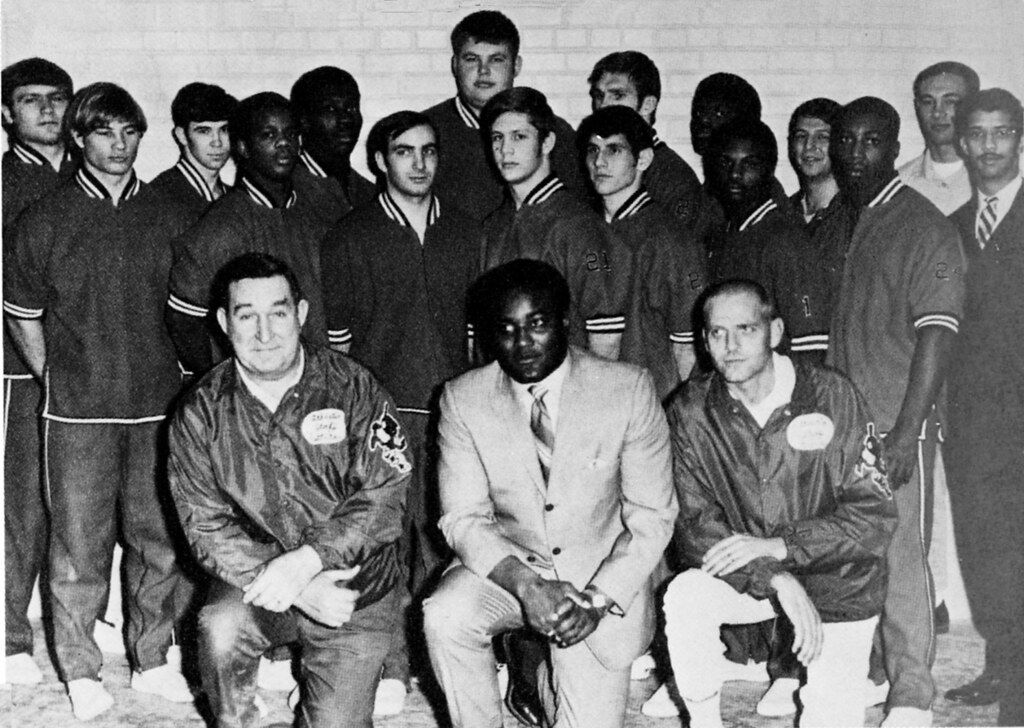
In my view, one of the most underreported stories coming out of Omaha the last 50 years was what Don Benning achieved as a young black man at the University of Nebraska at Omaha. At a time and in a place when blacks were denied opportunity, he was given a chance as an educator and a coach and he made the most of the situation. The following story, a version of which appeared in a March 2010 issue of The Reader (www.thereader.com), charted his accomplishments on the 40th anniversary of making some history that has not gotten the attention it deserves. He made history at then-Omaha University as the nation’s first black coach of a major team sport at a predominantly white institution of higher education. I believe he was also the first black coach to lead a team at a predominantly white high education institution to a national championship. He laid the groundwork for the UNO wrestling dynasty that followed some years later under the leadership of Mike Denney, who always credited Don with getting the whole thing started.
In leading his team to the 1970 NAIA national title, when they roundly beat teams from from larger schools, he gathered around him a diverse group of student-athletes at a time when this was not the norm. A team coached by a young black man and comprised of whites, blacks and Latinos traveled to some inhospitable places where race baiting occured but he and his student-athletes never lost their cool. They let their actions speak for them.
One of the pleasures in doing this story was getting to know Don Benning, a man of high character who took me into his confidence. I shall always be grateful.
As the March 12-13 Division II national wrestling championships get underway at the University of Nebraska at Omaha, it’s good to remember wrestling, not hockey, is the school’s true marquee sport
Host UNO has been a dominant fixture on the D-II wrestling scene for decades. Its No. 1-ranked team is the defending national champs and is expected to finish on top again under Mike Denney, the coach for five of UNO’s six national wrestling titles. The first came 40 years ago amid currents of change.
Every dynasty has a beginning and a narrative. UNO’s is rooted in historic firsts that intersect racial-social-political happenings. The events helped give a school with little going for it much-needed cachet and established a tradition of excellence unbroken now since the mid-1960s.
It all began with then-Omaha University president Milo Bail hiring the school’s first African-American associate professor, Don Benning. The UNO grad had competed in football and wrestling for the OU Indians and was an assistant football coach there when Bail selected him to lead the fledgling wrestling program in 1963. The hire made Benning the first black head coach of a varsity sport (in the modern era) at a predominantly white college or university in America. It was a bold move for a nondescript, white-bread, then-municipal university in a racially divided city not known for progressive stances. It was especially audacious given that Benning was but 26 and had never held a head coaching position before.
Ebony Magazine celebrated the achievement in a March 1964 spread headlined, “Coach Cracks Color Barrier.” Benning had been on the job only a year. By 1970 he led UNO to its first wrestling national title. He developed a powerful program in part by recruiting top black wrestlers. None ever had a black coach before.
Omaha photographer Rudy Smith was a black activist at UNO then. He said what Benning and his wrestlers did “was an extension of the civil rights activity of the ’60s. Don’s team addressed inequality, racism, injustice on the college campus. He recruited people accustomed to challenges and obstacles. They were fearless. Their success was a source of pride because it proved blacks could achieve. It opened the door for other advancements at UNO by blacks. It was a monumental step and milestone in the history of UNO.”
Indeed, a few years after Benning’s arrival, UNO became the site of more black inroads. The first of these sawMarlin Briscoe star at quarterback there, which overturned the myth blacks could not master the cerebral position. Briscoe went on to be the first black starting QB in the NFL. Benning said he played a hand in persuading UNO football coach Al Caniglia to start Briscoe. Benning publicly supported efforts to create a black studies program at UNO at a time when black history and culture were marginalized. The campaign succeeded. UNO established one of the nation’s first departments of Black Studies. It continues today.
Once given his opportunity, Benning capitalized on it. From 1966 to 1971 his racially and ethnically diverse teams went 65-6-4 in duals, developing a reputation for taking on all comers and holding their own. Five of his wrestlers won a combined eight individual national championships. A dozen earned All-America status.
That championship season one of Benning’s two graduate assistant coaches was fellow African-American Curlee Alexander. The Omaha native was a four-time All-American and one-time national champ under Benning. He went on to be one of the winningest wrestling coaches in Nebraska prep history at Tech and North.
Benning’s best wrestlers were working-class kids like he and Alexander had been:
Wendell Hakanson, Omaha Home for Boys graduateRoy and
Mel Washington, black brothers from New York by way of cracker GeorgiaBruce “Mouse” Strauss, a “character” and mensch from back East
Paul and Tony Martinez, Latino south Omaha brothers who saw combat in Vietnam
Louie Rotella Jr., son of a prep wrestling legend and popular Italian bakery family
Gary Kipfmiller, a gentle giant who died young
Bernie Hospokda, Dennis Cozad, Rich Emsick, products of south Omaha’s Eastern European enclaves.
Jordan Smith and Landy Waller, prized black recruits from Iowa
|
Half the starters were recent high school grads and half nontraditional students in their 20s; some, married with kids. Everyone worked a job.
|
The team’s multicultural makeup was “pretty unique” then, said Benning. In most cases he said his wrestlers had “never had any meaningful relationships” with people of other races before and yet “they bonded tight as family.” He feels the way his diverse team came together in a time of racial tension deserves analysis. “It’s tough enough to develop to such a high skill level that you win a national championship with no other factors in the equation. But if you have in the equation prejudice and discrimination that you and the team have to face then that makes it even more difficult. But those things turned into a rallying point for the team. The kids came to understand they had more commonalities than differences. It was a social laboratory for life.”
“We were a mixed bag, and from the outside you would think we would have a lot of issues because of cultural differences, but we really didn’t,” said Hospodka, a Czech- American who never knew a black until UNO. “We were a real, real tight group. We had a lot of fun, we played hard, we teased each other. Probably some of it today would be considered inappropriate. But we were so close that we treated each other like brothers. We pushed buttons nobody else better push.”
“We didn’t have no problems. It was a big family,” said Mel Washington, who with his late brother Roy, a black Muslim who changed his name to Dhafir Muhammad, became the most decorated wrestlers in UNO history up to then. “You looked around the wrestling room and you had your Italian, your whites, your blacks, Chicanos, Jew, we all got together. If everybody would have looked at our wrestling team and seen this one big family the world would have been a better place.”
If there was one thing beyond wrestling they shared in common, said Hospodka, it was coming from hardscrabble backgrounds.
“Some of the kids came from situations where you had to be pretty tough to survive,” said Benning, who came up that way himself in a North O neighborhood where his was the only black family.
The Washington brothers were among 11 siblings in a sharecropping tribe that moved to Rochester, N.Y. The pair toughened themselves working the fields, doing odd-jobs and “street wrestling.”
Dhafir was the team’s acknowledged leader. Mel also a standout football lineman, wasn’t far behind. Benning said Dhafir’s teammates would “follow him to the end of the Earth.” “If he said we’re all running a mile, we all ran a mile,” said Hospodka.
Having a strong black man as coach meant the world to Mel and Dhafir. “Something I always wanted to do was wrestle for a black coach. It was about time for me to wrestle for my own race,” said Mel. The brothers had seen the Ebony profile on Benning, whom they regarded as “a living legend” before they ever got to UNO. Hospodka said Benning’s race was never an issue with him or other whites on the team.
Mel and Dhafir set the unrelenting pace in the tiny, cramped wrestling room that Benning sealed to create sauna-like conditions. Practicing in rubber suits disallowed today Hospodka said a thermostat once recorded the temperature inside at 110 degrees and climbing. Guys struggled for air. The intense workouts tested physical and mental toughness. Endurance. Nobody gave an inch. Tempers flared.
Gary Kipfmiller staked out a corner no one dared invade. Except for Benning, then a rock solid 205 pounds, who made the passive Kipfmiller, tipping the scales at 350-plus, a special project. “I rode him unmercifully,” said Benning. “He’d whine like a baby and I’d go, ‘Then do something about i!.” Benning said he sometimes feared that in a fit of anger Kipfmiller would drop all his weight on him and crush him.
Washington and Hospodka went at it with ferocity. Any bad blood was left in the room.
“As we were a team on the mat, off the mat we watched out for each other. Even though we were at each other’s throats on the wrestling mat, whatever happened on the outside, we were there. If somebody needed something, we were there,” said Paul Martinez, who grew up with his brother Tony, the team’s student trainer-manager, in the South O projects. The competition and camaraderie helped heal psychological wounds Paul carried from Vietnam, where he was an Army infantry platoon leader.
An emotional Martinez told Benning at a mini-reunion in January, “You were like a platoon leader for us — you guided us and protected us. Coming from a broken family, I not only looked at you as a coach but as a father.” Benning’s eyes moistened.
Joining them there were other integral members of UNO’s 1970 NAIA championship team, including Washington and Hospodka. The squad capped a perfect 14-0 dual season by winning the tough Rocky Mountain Athletic Conference tournament in Gunnison, Colo. and the nationals in Superior, Wis. It was the first national championship won by a scholarship team at the school and the first in any major sport by a Nebraska college or university.
Another milestone was that Benning became the first black coach to win an integrated national championship in wrestling and one of the first to do so in any sport at any level. He earned NAIA national coach of the year honors in 1969.
University of Washington scholar John C. Walter devotes a chapter to Benning’s historymaker legacy in a soon-to-be-published book, Better Than the Best. Walter said Benning’s “career and situation was a unique one” The mere fact Benning got the opportunity he did, said Walter, “was extraordinary,” not to mention that the mostly white student-athletes he taught and coached accepted him without incident. Somewhere else, he said, things might have been different.
“He was working in a state not known for civil rights, that’s for sure,” said Walter. “But Don was fortunate he was at a place that had a president who acted as a catalyst. It was a most unusual confluence. I think the reason why it happened is the president realized here’s a man with great abilities regardless of the color of his skin, and for me that is profound. UNO was willing to recognize and assist a young black man trying hard to distinguish himself and make a name for his university. That’s very important.”
Walter said it was the coach’s discipline and determination to achieve against all odds that prepared him to succeed.
Benning’s legacy can only be fully appreciated in the context of the time and place in which he and his student-athletes competed. For example, he was set to leave his hometown after being denied a teaching post with the Omaha Public Schools, part of endemic exclusionary practices here that restricted blacks from obtaining certain jobs and living in many neighborhoods. He only stayed when Bail chose him to break the color line, though they never talked about it in those terms.
“It always puzzled me why he did that knowing the climate at the university and in K-12 education and in the community pointed in a different direction. Segregation was a way of life here in Omaha. It took a tremendous amount of intestinal fortitude of doing what’s right, of being ready to step out on that limb when no other schools or institutions would touch African-Americans,” said Benning. He can only surmise Bail “thought that was the right thing to do and that I was the right person to do it.”
In assuming the burden of being the first, Benning took the flak that came with it.
“I flat out couldn’t fail because I would be failing my people. African-American history would show that had I failed it would have set things back. I was very aware of Jackie Robinson and what he endured. That was in my mind a lot. He had to take a lot and not say anything about it. It was no different for me. I had tremendous pressure on me because of being African-American. A lot of things I held to myself.”
Washington said though Benning hid what he had to contend with, some of it was blatant, such as snubs or slights on and off the mat. His white wrestlers recall many instances on the road when they or the team’s white trainer or equipment manager would be addressed as “coach” or be given the bill at a restaurant when it should have been obvious the well-dressed, no-nonsense Benning was in charge.
Hospodka said at restaurants “they just assumed the black guy couldn’t pay. They hesitated to serve us or they ignored us or they hoped we would go away.”
Washington could relate, saying, “I had a feeling what he was going through — the prejudice. They looked down on him. That’s why I put out even more for him because I wanted to see him on top. A lot of people would have said the heck with this, but he’s a man who stood there and took the heat and took it in stride.”
“He did it in a quiet way. He always thought his character and actions would speak for him. He went about his business in a dignified way,” said Hospodka.
UNO wrestlers didn’t escape ugliness. At the 1971 nationals in Boone, N.C., Washington was the object of a hate crime — an effigy hung in the stands. Its intended effect backfired. Said Washington, “That didn’t bother me. You know why? I was used to it. That just made me want to go out there more and really show ’em up.” He did, too.
“We were booed a lot when we were on the road,” Hospodka said. “Don always said that was the highest form of flattery. We thrived on it, it didn’t bother us, we never took it personal, we just went out and did our thing. You might say it (the booing) was because we were beating the snot out of them. I couldn’t help think having a black coach and four or five black wrestlers had something to do with it.”
Hospodka said wherever UNO went the team was a walking social statement. “When you went into a lot of small towns in the ’60s with four or five black wrestlers and a black coach you stuck out. It’s like, Why are these people together?” “There were some places that were awfully uncomfortable, like in the Carolinas,” said Benning. “You know there were places where they’d never seen an African-American.”
At least not a black authority figure with a group of white men answering to him.
The worst scene came at the Naval Academy, where the cold reception UNO got while holed up three days there was nothing compared to the boos, hisses, catcalls and pennies hurled at them during the dual. In a wild display of unsportsmanlike conduct Benning said thousands of Midshipmen left the stands to surround the mat for the crucial final match, which Kipfmiller won by decision to give UNO a tie.
The white wrestling infrastructure also went out of its way to make Benning and his team unwelcome.
“I think there were times when they seeded other wrestlers ahead of our wrestlers, one, because we were good and, two, because they didn’t look at it strictly from a wrestling standpoint, I think there was a little of the good old boy network there to try and make our road as tough as possible,” said Hospodka. “I think race played into that. It was a lot of subtle things. Maybe it wasn’t so subtle. Don probably saw it more because of the bureaucracy he had to deal with.”
“Some individuals weren’t too happy with me being an African-American,” said Benning. “I served on a selection committee that looked at different places to host the national tournament,. UNO hosted it in ’69, which was really very unusual, it broke a barrier, they’d never had a national championship where the host school had an African-American coach. That was pretty strange for them.”
He said the committee chairman exhibited outright disdain for him. Benning believes the ’71 championship site was awarded to Boone rather than Omaha, where the nationals were a big success, as a way to put him in his place. “The committee came up with Appalachian State, which just started wrestling. I swear to this day the only reason that happened was because of me and my team,” he said.
He and his wrestlers believe officials had it in for them. “There was one national tournament where there’s no question we just flat out got cheated,” said Benning. “It was criminal. I’m talking about the difference between winning the whole thing and second.” Refs’ judgements at the ’69 tourney in Omaha cost UNO vital points. “It was really hard to take,” said Benning. UNO had three individual champs to zero for Adams State, but came up short, 98-84. One or two disputed calls swung the balance.
Despite all the obstacles, Benning and his “kids” succeeded in putting UNO on the map. The small, white institution best known for its Bootstrapper program went from obscurity to prominence by making athletics the vehicle for social action. In a decade defined by what Benning termed “a social revolution,” the placid campus was the last place to expect a historic color line being broken.
The UNO program came of age with its dynamic black coach and mixed team when African-American unrest flared into riots across the country, including Omaha. A north side riot occurred that championship season. UNO’s black wrestlers, who could not find accommodations near the UNO campus, lived in the epicenter of the storm. Black Panthers were neighbors. Mel Washington, his brother Dhafir and other teammates watched North 24th St. burn. Though sympathetic to the outrage, they navigated a delicate line to steer clear of trouble but still prove their blackness.
A uniformed police cadet then, Washington said he was threatened once by the Panthers, who called him “a pig” and set off a cherry bomb outside the apartment he shared with his wife and daughter.
“I found those guys and said, ‘Anybody ever do that to my family again, and you or I won’t be living,’ and from then on I didn’t have no more problems. See, not only was I getting it from whites, but from blacks, too.”
Benning, too, found himself walking a tightrope of “too black or not black enough.” After black U.S. Olympians raised gloved fists in protest of the national anthem, UNO’s black wrestlers wanted to follow suit. Benning considered it, but balked. In ’69 Roy Washington converted to Islam. He told Benning his allegiance to Black Muslim leader Honorable Elijah Muhammad superseded any team allegiance. Benning released him from the squad. Roy’s brother Mel earlier rejected the separatist dogma the Black Muslims preached. Their differences caused no riff.
Dhafir (Roy) rejoined the team in December after agreeing to abide by the rules. He won the 150-pound title en route to UNO capturing the team title over Adams, 86-58. Hospodka said Dharfir still expressed his beliefs, but with “no animosity, just pride that black-is-beautiful. Dharfir’s finals opponent, James Tannehill, was a black man married to a white woman. Hospodka said it was all the reason Dharfir needed to tell Tannehill, “God told me to punish you.” He delivered good on his vow.
It was also an era when UNO carried the “West Dodge High” label. Its academic and athletic facilities left much to be desired. “The university didn’t have that many things to feel proud of,” said Benning. Wrestling’s success lifted a campus suffering an inferiority complex to the University of Nebraska-Lincoln. Wrestling was one area where UNO could best NU, whose NCAA wrestling program paled by comparison.
“Coach Benning and his wrestling teams elevated UNO right to the top, shoulder-to-shoulder with its big brother’s football team down the road,” said UNO grad Mary Jochim, part of a wrestling spirit club in 69-’70. “They gave everyone at the school a big boost of pride. The rafters would shake at those matches.”
“You’d have to say it was the coming-together of several factors that brought about a genuine excitement about wrestling at UNO in the late 1960s,” said former UNO Sports Information Director Gary Anderson. He was sports editor of the school paper, The Gateway, that championship season. “There were some outstanding athletes who were enthusiastic and colorful to watch, a very good coach, and UNO won a lot of matches. UNO had the market cornered. Creighton had no team and Nebraska’s team wasn’t as dominant as UNO. It created a perfect storm.”
Benning said, “It was more important we had the best wrestling team in the state than winning the national championship. Everybody took pride in being No. 1.” Anderson said small schools like UNO “could compete more evenly” then with big schools in non-revenue producing sports like wrestling, which weren’t fully funded. He said as UNO “wrestled and defeated ‘name’ schools it added luster to the team’s mystique.
NU was among the NCAA schools UNO beat during Benning’s tenure, along with Wyoming, Arizona, Wisconsin, Kansas and Cornell. UNO tied a strong Navy team at the Naval Academy in what Hospodka called “the most hostile environment I ever wrestled in.” UNO crowned the most champions at the Iowa Invitational, where if team points had been kept UNO would have outdistanced the big school field.
“We didn’t care who you were — if you were Division I or NAIA or NCAA, it just didn’t matter to us,” said Hospodka, who pinned his way to the 190-pound title in 1970. The confidence to go head-to-head with anybody was something Benning looked for in his wrestlers and constantly reinforced.
Said Hospodka,”Don always felt like we could compete against anybody. He knew he had talent in the room. He didn’t think we had to take a back seat to anybody when it came to our abilities. He had a confidence about him that was contagious.”
The sport’s bible, Amateur Wrestling News, proclaimed UNO one of the best teams in the nation, regardless of division. UNO’s five-years of dominance, resulting in one national championship, two runner-up finishes, a third-place finish and an eighth place showing, regularly made the front page of the Omaha World-Herald sports section.
The grapplers also wrestled with an aggression and a flair that made for crowd-pleasing action. Benning said his guys were “exceptional on their feet and exceptional pinners.” It wasn’t unusual for UNO to record four or five falls per dual. Washington said it was UNO’s version of “showtime.” He and his teammates competed against each other for the most stylish or quickest pin.
Hospodka said “the bitter disappointment” of the team title being snatched away in ’69 fueled UNO’s championship run the next season, when UNO won its 14 duals by an average score of 32-6. It works out to taking 8 of every 10 matches. UNO posted three shut outs and allowed single digits in seven other duals. No one scored more than 14 points on them all year. The team won every tournament it competed in.

Everything fell into place. “Nobody at our level came even close to competing with us,” said Hospodka. “The only close match we had was Athletes in Action, and those were all ex-Big 8 wrestlers training for the World Games or the Olympics. They were loaded and we still managed to pull out a victory (19-14).” At nationals, he said, “we never had a doubt. We had a very solid lineup the whole way, everybody was at the top of their game. We wrapped up the title before the finals even started.” Afterwards, Benning told the Gateway, “It was the greatest team effort I have ever been acquainted with and certainly the greatest I’ve ever seen.”
Muhammad won his third individual national title and Hospodka his only one. Five Mavs earned All-America status.
The foundation for it all, Hospodka said, was laid in a wrestling room a fraction the size of today’s UNO practice facility. “I’ve been in bigger living rooms,” he said. But it was the work the team put in there that made the difference. “It was a tough room, and if you could handle the room then matches were a breeze. The easy part of your week was when you got to wrestle somebody else. There were very few people I wrestled that I felt would survive our wrestling room.”
“It was great competition,” said Jordan Smith. “One thing I learned after my first practice was that I was no longer the toughest guy in the room. There were some recruits who came into that room and practiced with us for a few days and we never saw them again. I was part of something that really was special. It was a phenomenal feeling.”
This band of brothers is well represented in the Maverick Wrestling and UNO Halls of Fame. The championship team was inducted by UNO and by the Rocky Mountain Athletic Conference. Benning, Mel Washington, Dhafir Muhammad and Curlee Alexander are in the Nebraska Black Sports Hall of Fame. But when UNO went from NAIA to NCAA Division II in ’73 it seemed the athletic department didn’t value the past. Tony Martinez said he rescued the team’s numerous plaques and trophies from a campus dumpster. Years later he reluctantly returned them to the school, where some can be viewed in the Sapp Fieldhouse lobby.
UNO’s current Hall of Fame coach, Mike Denney, knows the program owes much to what Benning and his wrestlers did. The two go way back.
Benning left coaching in ’71 for an educational administration career with OPS. Mike Palmisano inherited the program for eight years, but it regressed.
When Denney took over in ’79 he said “my thing was to try to find a way to get back to the level Don had them at and carry on the tradition he built.” Denney plans having Benning back as grand marshall for the March of All-Americans at this weekend’s finals. “I have great respect for him.” Benning admires what Denney’s done with the program, which has risen to even greater heights. “He’s done an outstanding job”
As for the old coach, he feels the real testament to what he achieved is how close his diverse team remains. They don’t get together like they once did. When they do, the bonds forged in sweat and blood reduce them to tears. Their ranks are thinned due to death and relocation. They’re fathers and grandfathers now, yet they still have each other’s backs. Benning’s boys still follow his lead. Hospokda said he often asks himself, “What would Don want me to do?”
At a recent reunion Washington told Benning, “I’m telling you now in front of everyone — thank you for bringing the family together.”
Related Articles
- U. of Neb.-Omaha plans to move to Division I (seattletimes.nwsource.com)
- Nebraska at Omaha to join D-I’s Summit League (sports.espn.go.com)
- UNC Greensboro cuts wrestling program (seattletimes.nwsource.com)
- Dean Blais Has UNO Hockey Dreaming Big (leoadambiga.wordpress.com)
- UNO Wrestling Dynasty Built on a Tide of Social Change (leoadambiga.wordpress.com)
Letting 1,000 Flowers Bloom: The Black Scholar’s Robert Chrisman Looks Back at a Life in the Maelstrom
Six years ago a formidable figure in arts and letters, Robert Chrisman, chaired the Department of Black Studies at the University of Nebraska at Omaha. The mere fact he was heading up this department was symbolic and surprising. Squarely in the vanguard of the modern black intelligentsia scene that has its base on the coasts and in the South, yet here he was staking out ground in the Midwest. The mere fact that black studies took root at UNO, a predominantly white university in a city where outsiders are sometimes amazed to learn there is a sizable black population, is a story in itself. It neither happened overnight, nor without struggle. He came to UNO at a time when the university was on a progressive track but left after only a couple years when it became clear to him his ambitions for the academic unit would not be realized under the then administration. Since his departure the department had a number of interim chairs before new leadership in the chancellor’s office and in the College of Arts and Sciences set the stage for UNO Black Studies to hire perhaps its most dynamic chair yet, Omowale Akintunde (see my stories about Akintunde and his work as a filmmaker on this blog). But back to Chrisman. I happened to meet up with him when he was in a particularly reflective mood. The interview and resulting story happened a few years after 9/11 and a few years before Obama, just as America was going Red and retrenching from some of its liberal leanings. He has the perspective and voice of both a poet and an academic in distilling the meaning of events, trends, and attitudes. My story originally appeared in The Reader (www.thereader.com) and was generously republished by Chrisman in The Black Scholar, the noted journal of black studies for which he serves as editor-in-chief and publisher. It was a privilege to have my story appear in a publication that has published works by Pulitzer winners and major literary figures.

Robert Chrisman
Letting 1,000 Flowers Bloom: The Black Scholar’s Robert Chrisman Looks Back at a Life in the Maelstrom
©by Leo Adam Biga
Originally published in The Reader (www.thereader.com) and republished with permission by The Black Scholar (www.theblackscholar.org)
America was at a crossroads in the late 1960s. Using nonviolent resistance actions, the civil rights movement spurred legal changes that finally made African Americans equal citizens under the law. If not in practice. Meanwhile the rising black power movement used militant tactics and rhetoric to demand equal rights — now.
The conciliatory old guard clashed with the confrontational new order. The assassinations of John F. Kennedy, Malcolm X, Martin Luther King, Jr. and Robert Kennedy seemed to wipe away the progress made. Anger spewed. Voices shouted. People marched. Riots erupted. Activists and intellectuals of all ideologies debated Black America’s course. Would peaceful means ever overcome racism? Or, would it take a by-any-means-necessary doctrine? What did being black in America mean and what did the new “freedom” promise?
Amid this tumult, a politically-tinged journal called The Black Scholar emerged to give expression to the diverse voices of the time. Its young co-founder and editor, Robert Chrisman, was already a leading intellectual, educator and poet. Today he’s the chair of the University of Nebraska at Omaha (UNO) Department of Black Studies. The well-connected Chrisman is on intimate terms with artists and political figures. His work appears in top scholarly-literary publications and he edits anthologies and collections. Now in its 36th year of publication, The Black Scholar is still edited by Chrisman, who contributes an introduction each issue and an occasional essay in others, and it remains a vital meditation on the black experience. Among the literati whose work has appeared in its pages are Maya Angelou and Alice Walker.
From its inception, Chrisman said, the journal’s been about uniting the intellectuals in the street. “We were aware there were a lot of street activists-intellectuals as well as academicians who had different sets of training, information and skills,” he said. “And the idea was to have a journal where they could meet. By combining the information and initiative you might have effective social programs. That was part of the goal.”

Another goal was to take on the core issues and topics impacting African Americans and thereby chart and broker the national dialogue in the black community.
“We were aware there was a tremendous national debate going on within the black community and also within the contra-white community and Third World community on the forward movement not only of black people in the United States but also globally and, for that matter, of white people. And so we felt we wanted to register the ongoing debates of the times with emphasis upon social justice, economic justice, racism and sexism.
“And then, finally, we wanted to create an interdisciplinary approach to look at black culture and European-Western culture. Because one of the traditions of the imperialist university is to create specialization and balkanization in intellectuals, rather than synthesis and synergy. We felt it would be contrary to black interests to be specialists, but instead to be generalists. And so we encouraged and supported the interdisciplinary essay. We also felt critique was important. You know, a long recitation of a batch of facts and a few timid conclusions doesn’t really advance the cause of people much. But if you can take an energetic, sinewy idea and then wrap it and weave it with information and build a persuasive argument, then you have, I think, made a contribution.”
No matter the topic or the era, the Scholar’s writing and discourse remain lively and diverse. In the ’60s, it often reflected a call for radical change. In the 1970s, there were forums on the exigencies of Black Nationalism versus Marxism. In the ’80s, a celebration of new black literary voices. In the ’90s, the Clarence Thomas-Anita Hill imbroglio. The most recent editions offer rumination on the Brown versus Board of Education decision and a discussion on the state of black politics.
“From the start, we believed every contributor should have her own style,” Chrisman said. “We felt the black studies and new black power movement was yet to build its own language, its own terminology, its own style. So, we said, ‘let a thousand flowers bloom. Let’s have a lot of different styles.’”
But Chrisman makes clear not everything’s dialectically up for grabs. “Sometimes, there aren’t two sides to a question. Period. Some things are not right. Waging genocidal war is not a subject of debate.”
The Meaning of Things
In an essay refuting David Horowitz’s treatise against reparations for African Americans, Chrisman and Ernest Allen, Jr. articulate how “the legacy of slavery continues to inform institutional as well as individual behavior in the U.S. to this day.” He said the great open wound of racism won’t be healed until America confronts its shameful part in the Diaspora and the slave trade. Reparations are a start. Until things are made right, blacks are at a social-economic disadvantage that fosters a kind of psychic trauma and crisis of confidence. In the shadow of slavery, there is a struggle for development and empowerment and identity, he said.
“Blacks produce some of the most powerful culture in the U.S. and in the world. We don’t control enough of it. We don’t profit enough from it. We don’t plow back enough to nurture our children,” he said. “Part of that, I think, is an issue of consciousness. The idea that if you’re on your own as a black person, you aren’t going to make it and another black person can’t help you. That’s kind of like going up to bat with two strikes. You choke up. You get afraid. Richard Wright has a folk verse he quotes, ‘Must I shoot the white man dead to kill the nigger in his head?’ And you could turn that around to say, ‘Must I shoot the black man dead to kill the white man in his head?’ The difference is that the white man has more power (at his disposal) to deal with this black demon that’s obsessing him.”
In the eyes of Chrisman, who came of age as an artist and intellectual reading Frederick Douglass, W. E. B. Du Bois, Langston Hughes, Richard Wright, Robert Hayden, James Baldwin, Lorraine Hansberry, Vladimir Lenin, Karl Marx, Che Guevara, Pablo Neruda, Mao Tse-tung and the Beat Generation, the struggle continues.
“The same conditions exist now as existed then, sadly. In 1965 the Voting Rights Act was passed precisely to protect people from the rip off of their votes that occurred in Florida in 2000 and in Ohio in 2004. Furthermore, with full cognizance, not a single U.S. senator had the courage to even support the challenge that the Congressional Black Caucus made [to the 2000 Presidential electoral process].”Raging at the system only does so much and only lasts so long. In looking at these things, one makes a distinction between anger and ideology,” he said.
“There were a number of people in the 1960s who were tremendously angry, and rightfully so. Once the anger was assuaged … then people became much much status quo. A kind of paretic example is Nikki Giovanni, who in the late ’60s was one of those murder mouth poets. ‘Nigguh can you kill. Nigguh can you kill. Nigguh can you kill a honky …’ At the end of the ’70s, she gets an Essence award on television and she sings God Bless America. On the other hand, you take a fellow like Ray Charles, who always maintained a musical resistance, which was blues. And so when Ray Charles decides to sing — ‘Oh beautiful, for spacious skies …’ — all of the irony of black persecution, black endurance, black faith in America runs through that song like a piece of iron. ‘God shed His grace on thee’ speaks then both to God’s blessing of America and to, Please, God — look out for this nation.”
Chrisman said being a minority in America doesn’t have to mean defeat or disenfranchisement. “I think we are the franchise. Black people, people with a just cause and just issues are the franchise. It’s the alienated, confused, hostile Americans that vote against their own interests [that are disenfranchised],” he said. “Frederick Douglass put it another way: ‘The man who is right is a majority.’”
Just as it did then, Chrisman’s own penetrating work coalesces a deep appreciation for African American history, sociology art and culture with a keen understanding of the contemporary black scene to create provocative essays and poems. Back when he and Nathan Hare began The Black Scholar in ’69, Chrisman was based on the west coast. It’s where he grew up, attended school, taught and helped run the nation’s first black studies department at San Francisco State College. “There was a lot of ferment, so it was a good place to be,” he said. He immersed himself in that maelstrom of ideas and causes to form his own philosophy and identity.
“The main voices were my contemporaries. A Stokley Carmichael speech or a Huey Newton rally. A Richard Wright story or a James Baldwin essay. Leaflets. Demonstrations. This was all education on the spot. I mean, they were not always in harmony with each other, but one got a tremendous education just from observing the civil rights and black power movements because, for one thing, many of the activists were very well educated and very bright and very well read,” Chrisman explained. “So you were constantly getting not only the power of their ideas and so on, but reading behind them or, sometimes, reading ahead of them. And not simply black activists, either. There was the hippy movement, the Haight Ashbury scene, the SDS [Students for a Democratic Society]. You name it.”
When he arrived at San Francisco State in 1968, he walked into a firestorm of controversy over students’ demands for a college black studies department.
“The situation was very tense in terms of continued negotiations between students and administrators for a black studies program,” Chrisman said. “Then in November of 1968, everybody went out on strike to get the black studies program. The students called the strike. Black teachers supported the strike. In January of 1969 the AFL-CIO, American Federation of Teachers, Local 1352, went out also. I was active in the strike all that time as one of the vice presidents of the teachers union. And I don’t think the strike was actually settled until March or April. It’s still one of the longest, if not the longest, in the history of American universities.”

The protesters achieved their desired result when a black studies program was added. But at a price. “I was reinstated, but on a non-tenured track — as punishment or discipline for demonstrating against the administration. Nathan (Hare) was fired,” Chrisman said. “Out of all that, Nathan and I developed an idea for The Black Scholar. Volume One, Number One came out November of 1969. So, we were persistent.”
Voicing a Generation
Chrisman didn’t know it then, but the example he set and the ideas he spread inspired UNO student activists in their own fight to get a black studies department. Rudy Smith, now an Omaha World-Herald photojournalist, led the fight as an NAACP Youth Council leader and UNO student senate member.“We knew The Black Scholar. It was written by people in touch with things. We read it. We discussed it,” Smith said. “They sowed the seeds for our focus as a black people in a white society. It kept us sane. He has to take some of the credit for the existence of UNO’s black studies program.” Formed in 1971, it was one of the first such programs.
The poet and academics’ long, distinguished journey in black arts and letters led him to UNO in 2001. Soon after coming, concerns were raised that the program, long a target of cuts, was in danger of being downsized or eliminated. Chrisman and community leaders, including then-Omaha NAACP president Rev. Everett Reynolds, sought and received assurances from Chancellor Nancy Belck about UNO’s commitment to black studies, and the department has been left relatively unscathed.
Chrisman said the opposition black studies still faces in some quarters is an argument for its purpose and need. “A major function of black studies is to provide a critique of Western and American white society — for all kinds of reasons. One is to apprise people of the reality of the society in the hope that constructive ways will be developed to improve it. Some people say racism doesn’t exist anymore. Well, of course it exists,” he said. “What was struck down were the dejure forms of racism, but not defacto racism.” As an example, he points to America’s public schools, where segregation is illegal but still in place as whites flee to the more prosperous suburbs while poor, urban neighborhoods and schools languish.
“If you look at the expansion of Omaha, you have this huge flow of capital heading west and you have this huge sucking sound in the east, which is the black, Hispanic working-class community that gets nothing. This is a form of structural racism and its consequences, and the ruling class refuses to see it.”


He said integration by itself is not the answer.
“People sometimes confuse integration with equality. Equality is always desirable, but it’s not always achieved with integration.” He said a black studies perspective provides a new way of viewing things. “A function of black studies has always been cultural enrichment, not only for blacks, but also for whites, which is why some of our black studies are required. It also gives people practical information about the nature of black people and institutions. It can be almost like a think-tank of information about the characteristics of a black population that can be put to use by policy makers.”
A new black power movement is unlikely in the current climate of fear and apathy. Chrisman said the public is baffled and brainwashed by the conglomerate media and its choreographed reporting of information that promulgates multi-national global capitalist ideologies. Then there’s the Bush administration’s hard line against detractors.
“This is the most intimidated I’ve seen the American people since the ’50s. People are afraid of being called leftist or disloyal in wartime,” Chrisman said. “Hegemony’s been surrendered to the white establishment. If a movement develops, it will have to be a different movement … and on its own terms. What people need to do is organize at the local level on fundamental local issues and, if necessary, have a coalition or interest group or party which can act as issues come up.”
Related Articles
- Clarence B. Jones: Remembering Ten Black Christian Leaders (huffingtonpost.com)
- The Mecca of Black America (online.wsj.com)
- 14 African American Game Changers That Started as Rhodes Scholars (bossip.com)
- What Happens to a Dream Deferred? Beasley Theater Revisits Lorraine Hansberry’s ‘A Raisin in the Sun’ (leoadambiga.wordpress.com)
CSI: UNO/Forensic Services Unit

Image via Wikipedia
Here is a pair of stories I did for the spring 2011 issue of UNO Magazine (http://unoalumni.org/unomag), the official magazine of the University of Nebraska at Omaha, which is my alma mater (class of 1982). The stories fall in line with this particular issue’s focus on UNO alums and faculty working in various aspects of crime, safety, and justice. In the first piece I look at how a UNO faculty member provided expertise and technology to assist a local crime lab technician with valuable measurements in testing evidence from a crime scene. In the second piece I profile a UNO alum working as a crime scene technician back East and her finding a real niche for herself in the field, one that’s become glamorized by television portrayals in recent years.
CSI: UNO
He may not have any super powers, but Dana Richter-Egger does have a super spectrometer. And with a call for help from the Douglas County Sheriff’s Office in 2006, he joined the league of Omaha crime fighters.
©by Leo Adam Biga
Originally published in UNO Magazine (http://unoalumni.org/unomag)
By day, Richter-Egger is more about busting complex math and chemical equations than he is about busting bad guys. He’s an assistant professor of chemistry at UNO and director of its Math-Science Learning Center.
Four years ago, though, Christine Gabig, a forensic scientist in the Douglas County Sheriff’s Office, asked for help that only he could provide. Specifically, Gabig needed assistance determining whether glass fragments found at the scene of a crime matched shards found in a suspect’s car.
The crime occurred on Dec. 5, 2005. An Omaha Police Department undercover officer was in an unmarked vehicle on a north-side street when a car pulled up parallel to his. The driver then pointed a shotgun at the officer through an open window. The officer ducked for cover, firing several rounds through his own open driver-side window at the fleeing car.
A suspect in the case emerged when a man sought medical treatment at a hospital for gunshot and glass wounds. DNA linked him to the car with shattered windows but prosecutors needed evidence that definitively put him at the scene as the driver.
Gabig did initial tests on the glass fragments in her lab, but they were inconclusive.
“I knew I needed more detailed analysis,” she says, “and I immediately thought of Dana and ICP-MS.”
The Inductively Coupled Plasma Mass Spectrometer, that is.
A sophisticated trace element analyzer that enables sensitive measurements in many fields, the ICP-MS is housed in Durham’s Advanced Instrumentation Laboratories. It was purchased in 2004 in part with a $100,000 grant from the National Science Foundation.
UNO’s general chemistry students use it to measure area lead contamination levels and to perform drinking water analysis. Gabig, a UNL graduate, learned of the ICP-MS while taking a quantitative chemical analysis course at UNO taught by Egger.
The complex machine could help her answer a seemingly simple question — whether the glass fragments came from the same source.
Help in the Haystack
“ICP-MS really provides the best detection limits,” Richter-Egger says. “It’s going to find the smallest needle in the haystack relative to other techniques available. That provides the ability to look at and compare a great many more elements. It’s like being able to identify more points on a finger print to look for the match.”
The more data points tested, the stronger the case.
Gabig’s experience studying under Richter-Egger made her comfortable with the prospect of collaborating with the professor.
“I really respected his knowledge and I thought the (math-chemistry) program was fantastic,” she says. “I learned so much that was directly applicable to what I was doing here at the sheriff’s office. Also, I made contact with these great chemists who can help me.”
Further bolstering her confidence, she says, was the knowledge that ICP-MS results are “fully accepted in the courts.” The methods were based on standard procedures provided by the American Society for Testing Materials.
“That went a long ways to helping me feel good about what we were going to do,” Richter-Egger says. “After all, there’s somebody on the other end of this thing that is going to be in court and we’ve got to be sure we do our diligence and do a good job.
“Whatever the data is I want to make sure it is the highest quality possible so that when that evidence is presented it is accurate and that it helps to lead to the right decision in the courtroom. That weighed pretty heavily on my mind as we were considering this.”
In their research, Gabig and Richter-Egger discovered that manufactured glass in vehicles can be pinpointed to within 100 feet of a production line. That information, says Richter-Egger, meant that “if we could find there’s not any difference between these two glasses then that says a lot about the likelihood they actually came from the same window.”
The glass first was dissolved in acid and added to a controlled solution. The ICP-MS then required precise calibration. The instrument evaporated water in an ultra high vacuum and applied electric fields to separate atoms by mass. The device provided a spreadsheet readout of the elemental differentiation.
Richter-Egger says it’s a process whereby “electronics, engineering and chemistry meet.” After crunching the numbers and consulting UNO statisticians, he and Gabig went back and forth over the data, questioning each other and crosschecking information.
In her report, Gabig concluded that glass fragments from the suspect’s car and the scene “likely came from the same source” based on ICP-MS test results and statistical analysis that showed a high probability of a match.
In the end, the suspect took a deal, pleading to one felony assault count and one terroristic threat charge. Since the case did not go to trial, Gabig did not testify.
The forensic scientist and the professor collaborated on a slide presentation for a UNO chemistry department seminar. Gabig has also used the presentation to educate law enforcement agencies about trace evidence analysis.
Might UNO and CSI work together on another case?
“I could envision this happening again,” Gabig says. “Making use of data analysis at the university is a big benefit.”
Learn more about the Inductively Coupled Plasma Mass Spectrometer, including animations, athttp://water.unomaha.edu
Hot on the Trail of Cold Cases
©by Leo Adam Biga
Originally published in UNO Magazine (http://unoalumni.org/unomag)
Forensic Services Unit
It’s not every girl who grows up dreaming of becoming a “bloodstain pattern specialist.”
And while that might not have been Angela (Harbison) Moore’s girlhood fantasy, it became just that while attending classes at UNO, graduating in 2001 with a degree in chemistry.
Today Moore works as a forensic technician for the Newport News (Va.) Police Department conducting crime scene evidence analysis. It’s a career choice the former Goodrich Scholar says was inspired by work she did with UNO chemistry department faculty.
“We were doing a lot of neat stuff in Dr. Richard Lomneth’s bio chemistry lab that was applicable to forensic science,” Moore says. “It really piqued my interest. It was a turning point.”
Dr. Frederic Laquer also was influential. “He taught me how to be a true chemist, how to document things, and to this day I still think of him every time I do all the little things properly,” Moore says. “It’s a great batch of professors at UNO. They’re very rigorous.”
Moore later began forensic science graduate studies at George Washington University, but with her Air Force husband stationed at Offutt Air Force Base she transferred to Nebraska Wesleyan. While in grad school she worked as a chemist at UNO, preparing solutions for use by students in the Durham Science Center labs.
In 2007 Moore joined the CSI team in Newport News, where she’s a bloodstain pattern specialist. The unpredictability of when crime happens means her schedule is forever fluid.
“You can literally be at a scene and be called to another scene,” she says. It’s a job that demands “intense curiosity and attention to detail” and the ability to multitask.
Her work entails doing bloodstain analysis at crime scenes and in the lab, writing reports, assisting with autopsies, and testifying in court. She works the cold case unit. She also teaches college courses and makes presentations.
“I like to get into a lot of things,” she says. “I always try to challenge myself to be the best I can be in life.” Next year she will attend the National Forensic Science Academy in Tennessee. “I’m pretty excited about that.”
Nothing is more satisfying then when her work helps solve a case. She says her bloodstain pattern analysis led to a man being charged with murder years after the incident. In another instance she extracted DNA evidence that helped convict a serial rapist.
Some cases linger with her.
“Once they go to court there’s resolution and I feel better about them,” she says. “The child ones are really hard to deal with sometimes. But at the same time I feel like we’re helping people out.
“When I’m at a scene with a deceased person I feel it’s the shell of a person left over. Their spirit is someplace else. The body is to be utilized as another piece of evidence that can speak for that person.”
Related Articles
- Forensics: popular science? (guardian.co.uk)
- Forensic Science Service: hero or villain? (blogs.nature.com)
- Forensic Science is a Growing Field (socyberty.com)
Dean Blais Has UNO Hockey Dreaming Big

Image via Wikipedia
My alma mater, the University of Nebraska at Omaha, is not known for making waves in college athletics. The school competes at the Division II level in all its athletic programs, except one — ice hockey. UNO’s D-I hockey program is about 15 years young now and while it’s enjoyed a smattering of success it’s been a long way from being a championship threat. Perception and reality changed in 2009 with the hiring of Dean Blais as head coach. He’s a living legend in the game and his team has already done enough a little more than half way through his second year on the job to have fans and alums like me thinking this could be the start of something big that puts UNO on the map. I recently interviewed Blais for the New Horizons story that follows. While UNO may still be a year or two or more away from competing for a WCHA or national title, UNO hockey is increasingly in the conversation as a tough draw and potential contender. If UNO can keep Blais through the run of his contract in 2014-15, then my old school might finally have the breakthrough success in a major team spectator sport that it’s always dreamed of having. Yes, UNO has a powerhouse wrestling program, but it’s a D-II program and decidedly off the general public’s and national media’s radar. Hockey doesn’t have the broad appeal of football, basketball, or baseball, but when UNO can beat the best of the best in college hockey, as it’s already done this season in defeating Minnesota, Michigan, North Dakota, then you’ve done something.
UPDATE: After a mid-season slump the UNO hockey team has rebounded with a late season surge that’s included a second series split with North Dakota, this time in Grand Forks, where Dean Blais coached all those years, and more recently a sweep of Top Ten power Wisconsin in Omaha. Along the way Blais earned his 300th career college victory and UNO, which had risen to a Top Ten ranking early in the year before sliding down the polls, saw its stock boosted back to No. 12 in one poll and No. 13 in another. More and more observers are feeling this UNO team has what it takes to be a significant factor in the postseason.

Dean Blais Has UNO Hockey Dreaming Big
©by Leo Adam Biga
Published in the New Horizons (http://www.enoa.org/)
When UNO Athletic Director Trev Alberts named Dean Blais the school’s new hockey coach in 2009, it marked a rededicated commitment to a still young program with big dreams.
It was the kind of marquee hire one doesn’t expect from the University of Nebraska at Omaha. What makes Blais marquee material? As a coach, he’s achieved success at every level of the sport — from high school to college to the junior national ranks to the Olympics — all the way to the National Hockey League.
His longest D-I stint was at the University of North Dakota, an elite hockey school where he was an assistant for nine years and head coach for 10, twice leading the Fighting Sioux to national titles and twice winning national coach of the year honors.
To put it in perspective, his coming to UNO would be akin to Roy Williams taking over an upstart basketball program or Bobby Bowden being tabbed to lead the South Florida football program.
The move suddenly made UNO, whose program only dates back to 1997, something more than a potential contender on the hockey landscape. UNO must now be taken seriously, if for no other reason than it went out and got a coach who’s proven he can deliver the goods by recruiting and developing talent that produces all-conference, all-American performers and championship trophies. Dozens of his players have gone on to play professionally.
Even though UNO’s yet to even sniff a conference title, it’s not like Blais walked into a shambles. After a rough couple years, UNO acquitted itself well from 2000 to 2005 before plateauing in 2007 and 2008. There was grumbling the program had run out of steam even though attendance remained steady and the team managed being competitive most nights.
Still, an impending change was in the wind. Hockey revenue was down and UNO long ago fixed its financial wagon to its lone D-I program. As hockey goes, so does Maverick athletics. Alberts put it succinctly:
“Success in hockey in non-negotiable. Creating and sustaining profitability in hockey is a mandate we will hold ourselves accountable to.”
Not long after Alberts arrived as AD Mike Kemp, who founded the program and served as its only head coach for 12 years, stepped aside to be associate athletic director. He recommended as his successor Blais, an old friend then coaching the Fargo Force, a United States Hockey League team. Kemp and Blais knew each other as assistant coaches with the University of Wisconsin and the University of North Dakota, respectively.

“His ability, background and history made him an incredible fit for our program,” Kemp said. “He brings championship experience, attitude and focus that will help propel and direct our program to the next level.”
Because they go back a ways, there’s been no feeling-out process necessary.
“We know each other, we respect each other, and we’ll do whatever it takes to help each other work toward the same common goal,” said Kemp. “It’s one thing to get a program up and going, it’s another to make the next step to national prominence. I think every year we inch closer. My job is to help give Dean the resources he needs in order to be successful.”
News of the Blais hire reenergized UNO hockey fans.
“I truly believe the hiring of Dean Blais signaled a dramatic shift in our approach to excellence,” said Alberts. “With Dean Blais on board, I believe we sent a very strong message about our commitment to hockey…”
Blais’ first year on the job was UNO’s last in the Central Collegiate Hockey Association. The team finished in the upper division of a league with perennial powers like Michigan. Under Blais UNO recorded only the third 20-win season in program history at 20-16-6, finishing an impressive 8-3-1 down the stretch.
In the off-season UNO joined the Western Collegiate Hockey Association, D-I’s premier league and one Blais both played and coached in. UNO’s baptism of fire in the WCHA this season saw its young squad, including a highly touted freshmen class, become the talk of college hockey by sweeping an early road series against heavyweight Minnesota and then taking one of two games at Michigan.
Getting that first WCHA victory at his alma mater, Minnesota, Blais said, was “pretty special,” adding, “It was huge to go in there and win.”
He liked that UNO made an impression on Gopher followers.
“They said our team plays like a bunch of piranhas, can you imagine that? Hungry, fast, tenacious, ferocious. We were proud of them.”
It’s his brand of hockey alright.
“We do everything at top speed, but to do the shooting and the passing and the stick handling at top speed takes a long time to get good at. That’s my thing. Anyone can play hockey at a slow down pace. To play at our level of speed takes a lot of work and a lot of time and a lot of conditioning.”
Then he said something that revealed how he expects, no, demands his team play the fast and furious style he coaches:
“When they don’t play that well then I can get a little nasty.”
He said the relentless, fluid approach is a reflection of how he played the game.
“My feeling is the less restrictions you have the more they improve. The best discipline is self discipline. But I want to give them freedom to improve, and the only way you can improve at times is with your decision making. Do I go in and forecheck or do I just play my position? You can have rules and say you can’t go beyond certain spots on the rink, and that’s coaching, but the more freedom you give the more accountable they are.
“It’s totally against some coaches’ philosophies. Some guys will tell you you’ve got to be this, this and this, like in football. We don’t have that much structure in hockey. We have it during practice. Once they play in games we (coaches) could be drinking coffee and eating popcorn on the bench at times because there’s not a lot we can do. Now, if a player isn’t playing you’ve got to recognize that and warn ’em or sit ’em.”
Don’t assume his practices are loose. He and his staff put in many hours preparing and organizing to ensure the team gets the most out of the high energy sessions. From the opening puck drop in November, the Mavs have flown around the ice. An 8-1-1 start this season landed UNO in the Top 5, its highest ranking ever.
‘The guys came in this summer, worked hard, they went to school and they got some of their classes out of the way. They bonded quicker than I thought,” he said.
While the team slowed after that torrid first month, going 4-7-1 in its next 12 games, UNO enters the last third of the season well up in the conference standings and positioned to qualify for the postseason.
The success has only confirmed Blais was no ordinary hire. Indeed, he’s a legend in amateur hockey circles. His pedigree, almost unmatched. From an early age he knew he was destined to play, teach and coach the game he loved.
He grew up with the proverbial stick in his hand in hockey crazy International Falls, Minn. He and his wife frequent a lake cabin there in the summer. He played for top youth coaches and for the iconic Herb Brooks at the University of Minnesota, where Blais was a standout. His seasoning continued in the professional ranks with the Chicago Blackhawks developmental team in Dallas, Texas.
Then came his assorted coaching stops and championships. His latest title actually came during his first year at UNO, when as U.S. Junior National coach he took a mid-season break from his Maverick duties to lead the American team to a gold medal-winning upset over host Team Canada in Saskatoon, Saskatchewan.
That victory was so monumental and Blais is so respected in those hockey-obsessed northern reaches that, he said, “every kid in Canada watched that game when we beat ’em for only the second gold medal in 35 years for the U.S., and when I walked through the Saskatoon airport at 7 in the morning there were a hundred Canadians there that shook my hand.”
That’s right, Blais is a rock star among hockey coaches, When announced as UNO’s coach some wondered why a man pushing 60 who’s been to the game’s pinnacle would want to try and get a mediocre program to that same mountaintop.
“I believe Dean is a man that enjoys challenges and is willing to invest the time and energy to bring our dream to fruition,” said Alberts. “Dean’s legacy in college hockey is secure, I’ve challenged him to create a new legacy of building a championship caliber program on the national level that is sustainable.”
“Trev (Alberts) was a big reason I came here,” Blais said from behind his desk in the UNO athletic offices. “I think he’s just done an outstanding job. He’s given us all the resources we need to be successful. He gives us a lot of support daily. He makes it fun to come to work every day.
“He’s a big time guy. I just hope they can hold him as long as I’m here.”

Even though UNO’s never come close to the Frozen Four (college hockey’s equivalent of basketball’s Final Four), Blais saw a program with essential pieces already in place: a charismatic and supportive boss in Alberts; strong university backing; a rabid fan base; and the presence of Mike Kemp, who provides institutional history and a rich hockey background in addition to having established a solid foundation for Blais to build on.
Blais said he’s benefiting from the hockey culture Kemp put in place.
“Everything was done the right way with Mike. I didn’t have to change the culture. It was a pretty well run machine when we got here. He’s got a good hockey mind and a good common sense mind.”
Having an athletic administrator in Kemp who’s a hockey guy makes Blais sleep better.
“He’s looking out for hockey. All the detail stuff at the Qwest, the politics of some of that, Mike deals with, all the behind the scenes stuff with scheduling that takes time and effort, Mike takes care of, so he’s meant a lot to me in the transition. I haven’t had to slug it out with all of that. This is the kind of stuff I hate right here,” Blais said, slapping his palm down on a desk full of paperwork.
In assistants Mike Guentzel and Mike Hastings he has experienced help with strong Omaha ties. Guentzel coached the Omaha Lancers to back to back Clark Cup titles and later worked as an assistant at Minnesota. Hastings succeeded Guentzel with the Lancers and became the winningest coach in USHL history.
UNO hockey seemingly has everything in place to be a force to be reckoned with. Except a decided home ice advantage. It’s no secret UNO, whose home matches are at Qwest Center Omaha, is beating the bushes to elicit support for construction of a South Campus arena designed specifically for hockey.
“That’s the only thing we need here — we need an arena on campus,” said Blais.
While he concedes UNO draws exceedingly well — “fourth in the country in attendance tells me we have the hockey fans in Omaha” — the Qwest is a multi-purpose facility shared with Creighton and other users. That means scheduling conflicts sometimes compel UNO to practice at the Civic Auditorium or the Motto McLean Ice Arena. UNO must also share revenues with the Metropolitan Entertainment & Convention Authority (MECA), which operates the Qwest.
“You talk about an arena on campus you own and all the marketing and concessions and everything else — people tell you it’s $3 or $4 million a year in revenue. Down at the Qwest we don’t get all that revenue, so it’s hard to treat hockey as number one.”
As nice as the Qwest is, it’s too large for the fan base. Even when the Mavs draw their average turnout of 7,500 or 8,000 the cavernous venue is only half full, thus negating the edge a jam-packed intimate space affords. The goal is to make UNO hockey a hard ticket to get.
Then there’s the fact it’s a 10-15 minute drive from UNO, which requires players travel back and forth.
Blais doesn’t want to come off like sour grapes. He actually appreciates having the Qwest — for the time being anyway.
“Now the Qwest is working, our recruiting is working,” he said.
It’s just that he’s been spoiled by the ultimate hockey palace — the Ralph Engelstad Ice Arena at North Dakota, a luxurious $100 million hockey-only facility. A modest version of it is his dream for UNO.
He feels UNO hockey deserves “its due.” He knows it will always play second or third fiddle to Nebraska football and Creighton hoops. He doesn’t begrudge them their support. But he also sees NU can find donors for a planned $50 million Memorial Stadium expansion without batting an eye. He hopes just as Husker boosters are committed to returning NU to elite football status Mav supporters are prepared to put their resources behind making UNO hockey an elite program.

“If we’re going to have the best hockey program in the country we need the best commitment out of this community of Omaha and the whole university. Now, we don’t have to be the king here. I know Lincoln’s football program is the king, but UNO has to be committed as other WCHA schools, and part of it is an arena.”
So how sure does Blais feel UNO will secure the dollars for its own arena?
“I think it’s going to be pretty much a done deal,” he said. “Timeline, I have no clue, and funding, no clue. When money seems to be no object out of the other bench, they’ve got to find a way, and Trev Alberts will deliver and (UNO chancellor) John Christensen will deliver. But it’s not this year. By the time I leave here hopefully there’s a new arena here on campus.”
Last year Blais signed a contract extension to coach UNO through 2014-15.
Some observers speculate Blais is not long for UNO — that it will be hard-pressed keeping him if a Minnesota or another big-time hockey school offers the moon.
“I certainly hope that Dean concludes his coaching career here in Omaha,” said Alberts. “It’s my job to live up to the promises that I made to him and create and maintain an environment that is comfortable.”
For his part Blais betrays no hint he’s itching to leave. Rather he sounds like a man wanting to take UNO to the summit and feeling he has the goods to get there.
“We’ve got I think the most outstanding recruiting class in NCAA hockey this year,” he said.
He’s confident UNO can compete with Michigan and Minnesota for the best talent.
“We’re getting our kids. Are we there yet? Not yet, but I would say the freshmen this year feel they have a better chance of getting into the NHL right here than anywhere else.”
He likes the character of his kids too, saying that flight attendants, bus drivers, waitresses and event staff remark how well his players conduct themselves.
“Everything is please and thank you. Their average grade point average is over 3.0. These student-athletes are going on to be big-time something. It’s about more than wins and losses. Now believe me, they’ll compete, and we’ll train ’em to win, but they’re being trained for the future.”
More than half his freshmen were captains last year on their high school teams.
“Leadership is huge. Leadership starts at the top. As coaches, we’ve got to conduct ourselves right. You wont hear us swearing.”
Speaking of leadership, there is a bit of every coach he’s worked under in him. He’s grateful to have been influenced by some of the game’s greats.
“Well, I’ve been blessed,” he said.
His first mentor was legendary International Falls High School coach Larry Ross. Then Blais came under the wing of Glenn Sonmor and Herb Brooks at Minnesota. He said Sonmor “taught me to have fun every day coming to the rink.”
Brooks, the enigmatic coach of the 1980 U.S. Olympic Miracle On Ice team was hard to know but he produced unquestioned results.
“He’d love you to death when you moved on, but to play for him he was tough. Herbie did not have any friends in hockey. But as far as a coach there’s none better.”
Blais played for college and pro coaching guru Bob Johnson on the U.S. national team and for the respected Bobby Kromm, a one-time NHL coach of the year.
Then there was UND’s Gino Gasparini, whom he said “taught me how to coach up at North Dakota,” where he was Gasparini’s assistant before succeeding him.
All these coaches are inducted in various halls of fame. Blais is right there with them. Only he’s still coaching. At 60, his players are young enough to be his grandchildren. Does he have trouble relating to this generation?
“They probably think I’m nuts anyway,” he quipped. “I don’t treat my players any different now than I did 20 years ago. The bottom line for them is they want to win. They’ll do anything within reason to win, just like kids 20 years ago. I don’t see a whole lot of difference.”
Blais appears satisfied. But things can change. They did at North Dakota. He seemed content there but when the program’s biggest booster, Ralph Engelstad, passed, “things weren’t the same there,” said Blais. Rather than be unhappy, he moved on.
He left to pursue a long-held dream — the NHL, serving as associate head coach and director of player development with the Columbus Blue Jackets. He’s glad he tried it, but it didn’t fulfill him the way working with high school and college kids does. It’s why he returned to the junior ranks before UNO came calling. It’s why he feels at home at UNO.
“Here practices are for preparing kids to get better and get to the next level. In these kids you can see dramatic improvement, you can see their skills develop. That’s what I like. I like going on the ice every day. They know they’re going to develop. It’s a given.”
When UNO broke out of the gate with its dynamic start this season fans and media wondered if this was the year the program would truly break out and claim its place among the juggernauts. Not so fast, said Blais, who better than anyone else knows just how steep a climb it is to college hockey nirvana. He’s been there and back, but with programs much older and steeped in tradition than UNO. It takes time to build a championship club and UNO is still in the growing pains stage.
Jumping to conclusions that this UNO team is Frozen Four worthy right now, he warns, is premature. He sounds every bit the wizened hockey sage when he lays out just how daunting the task is:
“Well, to say we’re competing for a national title, we’re absolutely not, get real.
Michigan Tech hasn’t won a WCHA or national title in 30 years. St. Cloud’s never won the WCHA. Duluth has never won a national title. Colorado College, it’s been 40-50 years. Alaska has never won a WCHA title. Mankato’s never won the WCHA.
“Right away there’s six teams that have never won a WCHA title. Could Omaha? Yep. Is it this year? We’ll see.”
As far as being an elite program, he said, “we’re not there yet. The other thing is, we’ve got to be patient — we’ve only had hockey for 14 years.”
Then again, he saw something in that great start that told him UNO’s ahead of schedule. He knows people are watching now to see if they’re just a one-month wonder or a team to be reckoned with.
Assistant Mike Guentzel echoes Blais by saying the program is moving in the right direction. They remind observers UNO is competing in the toughest conference in the country and more than holding its own.
Dean Blais won’t accept anything less.
Related Articles
- Former Husker All-American Trev Alberts Tries Making UNO Athletics’ Slogan, ‘Omaha’s Team,’ a Reality (leoadambiga.wordpress.com)
- DU hockey freshman Zucker more than lives up to billing (denverpost.com)
- Cox: Mediocre won’t cut it for Team Canada against U.S. (thestar.com)
- NU regents OK UNO’s move to NCAA Division I (seattletimes.nwsource.com)
- Big 10 ADs propose men’s hockey for 2013-14 season (sfgate.com)
- National Collegiate Hockey Conference is new home for DU, Colorado College (denverpost.com)

Old partnership takes new turn: UNO-Kabul University renew ties with journalism program

Image via Wikipedia
The article below is the latest of several I have written over the last decade or so about the Center for Afghanistan Studies at the University of Nebraska at Omaha. This story concerns a UNO-Kabul University journalism collaborative or partnership being overseen by the center, which received a $1.3 million grant to fund the endeavor. The center is a nearly 40 year-old institution dedicated , just as it name states, to Afghanistan studies and as such it is a unique operation and certainly one you would not expect to find in the Midwest. Its director, Thomas Gouttierre, has been a profile subject of mine (you’ll find my piece on hin on this blog). He and his assistant Raheem Yaseer and their UNO colleague John Shroder are among America’s foremost experts on Afghanistan. The center has been involved in all manner of training and support there and its expertise is often tapped by U.S. government sources. Much of the center’s efforts have been directed at helping train Afghan nationals in order to rebuild that nation’s infrastructure. My new article for The Reader (www.thereader.com) lays out the recently formed journalism partnership program involving faculty exchanges and Afghan journalism educators and students coming here to shadow their American counterparts as well as working journalists. I hope to be one of those journalists they meet with and follow around. Look for more of my work covering this unfolding story in the months ahead.
Old partnership takes new turn: UNO-Kabul University renew Ttes with journalism program
©by Leo Adam Biga
Appeared in The Reader (www.thereader.com)
UNO communication professor Chris Allen recently returned from a two-week needs assessment trip to Afghanistan. His journey was part of a federally-funded journalism faculty-student development program between the University of Nebraska at Omaha and Kabul University.
As Afghanistan attempts normalization in this post-Taliban era, the nation’s indigenous media uneasily co-exist with Islamic law and government ambivalence. Yet, flush with freedom and peace for the first time in decades. Allen says “a surprisingly vigorous and developing media system” exists there.
Consider two vastly different television shows: the incendiary Niqab has masked women detail abuse they’ve suffered; the popular Afghan Star is an American Idol riff.
Training the next generation of Afghan journalists requires access to resources and modern practices. That’s why UNO and Kabul University are connecting aspiring and working journalists in academic, professional and cultural exchanges. Funded by a $1.3 million grant from the U.S. State Department‘s Fulbright program, this three-year partnership renews old ties between the two institutions and is the latest example of UNO’s decades-long work with Afghanistan.
UNO’s School of Communication and its Center for Afghanistan Studies are collaborating on the program. Allen was accompanied by CAS director and dean of International Studies and Programs Tom Gouttierre and CAS assistant director Raheem Yaseer.
The university’s relationship with the nation goes back to 1972, when two campus geography professors began research collaboratives. A donated collection of Afghanistan materials has grown to 12,000-plus items. In 1975 a linkage with Kabul University began.
To date, the center’s received some $60 million in grants and contracts for technical assistance programs, training and educational exchanges. Hundreds of Afghans have come to UNO for training to help rebuild their nation’s infrastructure. Hundreds of Americans come here to train as liaisons in reconstruction efforts.
The center maintains a Kabul field office and Team House, where Allen stayed. It also operates the UNO Education Press, which printed the new Afghan constitution and the ballots for the first democratic elections there in decades.
Even during the Soviet occupation and war, the Taliban reign of terror and the U.S.-led invasion to oust terrorists, Gouttierre says the center remained in contact with various education and government officials in Afghanistan or in exile in Pakistan.
He says a model for this new collaborative is the center’s 2002-2005 teacher education project, which brought Afghan women educators for an immersion experience as part of reopening the nation’s schools. Just as those visitors did, Afghan journalists will stay with Nebraska host families.
Plans call for a group of Afghan professors to arrive in late spring, with additional contingents of faculty and some students arriving later this year. More UNO School of Communication faculty are to visit Afghanistan in the coming months. Program visitors on each side will observe best practices and shadow their peers.

Chris Allen, second from left, with Kabul journalism faculty
Because UNO’s Chris Allen was in Kabul during finals week he didn’t observe classes, but he did speak with faculty.
“I really didn’t know anything about them and they really didn’t know anything about me and to sort of start off on an even footing was a really good thing,” he says. “I didn’t want to go in with preconceived notions that might prejudice the questions I would ask. I could ask really naive questions, and I did that, and I think that served as an ice breaker to say, I need to understand what you guys are doing and what your media are doing as much as you need to understand what we’re doing.
“It enabled me to go in and do a needs assessment from the ground up.”
Allen says the Afghans expressed a need for assistance on both teaching and practical levels. He says many expressed a desire to improve teaching techniques by moving away from lecture-oriented approaches to more hands-on student participation. He says Afghan educators are hampered by limited facilities and resources, such as teaching television without a studio or cameras or editing equipment. However, he says a new media center is in the works.
The most glaring need Allen saw was for more classroom computers. He says the basic reporting class has 10 computers serving 50 students.
“I’m not sure how they’re getting that done.”
He also marvels at how working media, faculty and students brave forbidding conditions, including security and transportation issues.
He’s told that journalism graduates readily find jobs in the Afghan media, which many call “a growth industry.”
Admittedly, he says, his lack of Persian language skills limited him but it didn’t prevent his noting some arcane story structure problems in print and broadcast reports. Despite shortcomings, he and Gouttierre say the media is a vital presence. Dozens of independent print publications have launched. Saad Mohseni, chairman of the largest independent media company there, MOBY Group, is Afghanistan’s first media mogul. The government-run media enterprise RTA is ubiquitous. Radio is the most pervasive medium, says Allen, because it’s accessible and doesn’t require high literacy.
Gouttierre says the UNO-KU project comes at a transformational time.
“Now we have this situation for UNO faculty and students to be engaged right up close with a country’s media that is trying to leap frog in a sense. It kind of reminds me of when I first went to Afghanistan in the early ‘60s as a Peace Corps volunteer and the country was just emerging as a constitutional, parliamentary democratic process. The press was becoming independent at that same time.”
He anticipates each side will learn much from the other, though he suspects Americans may have the most to gain.
“It’s surprising how far Afghans have taken themselves with few resources and how much we can learn from their creativity and initiative in very trying circumstances. its shocking to see how much they’ve accomplished with so many obstacles.”
Related Articles
- You: Kidnapped professors from Kabul University released in Khyber Agency (nation.com.pk)
- Graffiti art brightens war-torn Afghan capital (reuters.com)
- Behind the mask: Afghan TV program exposes the horror of abuse against women (nationalpost.com)
- More Afghan Eagles depart Kabul for America (waronterrornews.typepad.com)
Freedom Riders: A get on the bus inauguration journey diary
My work as a reporter intersected with history when I embedded myself with a group of Omahans traveling by motorcoach to witness the presidential inauguration of Barack Obama in January 2009. The University of Nebraska at Omaha‘s Department of Black Studies organized the trip and kindly invited me along and The Reader (www.thereader.com) newspaper generously picked up my tab. It was a once-in-a-lifetime opportunity that I am glad I had. My diary or journal like story appeared in truncated form in The Reader.
All a journalist like me can hope to do in a situation like the frenzy around the inauguration is to try and get the facts straight and to make sense of a bigger-than-life event. I believe I succeeded.
NOTE: You can see photos from my trip and even spot me (I’m in a light blue-grey ski jacket with a blue stocking cap and I have eyeglasses on) at the following site: http://www.unomaha.edu/blst/
SPECIAL SCREENING: UNO Department of Black Studies chair Omowale Akintunde led the trip. Akintunde, who is also a filmmaker (see my story “Deconstructing What Race Means in a Faux Post-Racial World” about his feature debut, Wigger) directed an Emmy Award-winning documentary about the trip, An Inaugural Ride to Freedom. The doc has shown at festivals and a special screening of the film is scheduled for October 26 at 7 p.m. at Film Streams, 1340 Mike Fahey Street. A post show Q & A with Akintunde will follow.
Because the film has generated some buzz, I am reposting my inauguration journey story here. In this light, my story is a kind of companion piece to the documentary.
Freedom Riders: A get on the bus inauguration journey diary
©by Leo Adam Biga
The story originally appeared in The Reader (www.thereader.com) and El Perico (el-perico.com)
Fifty of us from the metro area signed up to intersect with history. The chance to be at Barack Obama’s inauguration came via a special bus trip organized by the University of Nebraska at Omaha’s Department of Black Studies and sponsored by UNO’s College of Arts and Sciences.
Dubbed An Inaugural Ride to Freedom: The Legacy of a People, a Movement and a Mission, the trip’s mode of transportation, a Navigator charter bus, was both practical and symbolic. Buses figured heavily in marshaling foot soldiers for the civil rights movement and addressing segregation in public schools.
The UNO trip’s “freedom riders” included folks with direct ties to the movement, including older African Americans for whom this journey held deep meaning. Some are retired now and others still engaged in the struggle. Edwardene Armstrong is a UNO Black Studies adjunct faculty member. Her husband Bob Armstrong, former Omaha Housing Authority director, consults with public housing officials across America and the globe. James Freeman directs UNO’s multicultural affairs office.
Leading the university figures along for the ride was charismatic UNO Black Studies Chair Omowale Akintunde. Several UNO students joined us. One high school student was on board as well: Omaha North senior Seth Quartey. Most students were sponsored by UNO.
Community members, such as activist Katrina Adams, Youngblood’s Barber Shop owner Clyde Deshazer and gospel playwright Janette Jones, had no direct ties to UNO but strong convictions about our mission. Friends, couples and families made the trip. The youngest rider, 10-year-old Carter Culvert, traveled with his mother, Jackie Culvert. A few folks went on their own, including this journalist. All but a few made our first D.C. visit on this ride. What a time to go.
Precursor – Get to Know Each Other
A Jan. 7 briefing at UNO’s Milo Bail Student Center ballroom brings participants together for the first time. The group’s diversity is soon evident. Blacks, whites, Hispanics. Young, middle-aged, seniors. Students, working stiffs, professionals.
From the start it’s obvious Akintunde, a tall, lithe man with a brass band voice and a bigger-than-life presence, is in charge. Also a filmmaker, he’s chronicling the trip in a documentary. We all sign releases for our comments and images to be used.
(NOTE: The film premiered at UNO’s Malcolm X Festival in April 2009.)
As things develop the shooting threatens turning the trip into a tail-wags-the-dog scenario with all its set-ups and interviews. Some students serve as crew, holding the boom, operating lights/sound, carrying supplies. DP Andrew Koch flew in from the west coast for the gig. PA Stephanie Hearn did much of the prep work.
I leave the briefing with these thoughts: this will be a once-in-a-lifetime experience that sweeps us along on the tide of history; and we “tourists” constitute a microcosm of the broad-based support that made Obama’s election possible.
What follows are snapshots of our group’s four-day, 100-hour, 3,000-plus mile odyssey to embrace change and to participate in history.
Sunday, Jan. 18
Rolling Out – Get on the Bus
Lot C in UNO’s South Campus is our departure point. I arrive about 7:30 in the cold dim daylight. The bus is there, its engine idling, the lower baggage compartment opened. Some early arrivals have already loaded gear and settled in seats. I choose a mid-section spot befitting my middle-of-the-road nature. Over the next 75 minutes the bus fills out and the rituals of finding a place to sit, stowing away carry-ons in overhead bins and meeting-greeting fellow passengers ensues.
Obamamania appears low key for now. Only a few folks wear anything with Obama images or slogans. One woman climbing aboard is overheard telling another, “He’s not the chosen one.” The mood is a mix of sober expectancy and fan-filled ardor.
There are the usual stragglers and late arrivals. Some of us catch Zs, others chit chat. We’re finally all together and push off on time at 9. A 28-hour grind awaits us before we reach our hotel in Chestertown, MD, about 90 minutes from D.C.
All but a few seats are filled in what are cramped accommodations. For the biggest bodies the bus will mean contortions squeezing into narrow seats and relieving pressure on sore, stiff joints. Leg room is almost nonexistent. Everyone carves out a few inches of sanctuary in the tight quarters.
By the time we cruise I-80 in western Iowa, passing brown-white splotched fields sprouting hundreds of sculptural wind turbines, Akintunde’s filming is in full swing. He captures folks slumbering, reading, cell phoning, text messaging, you name it.
Reminders of this being a Soul Bus trip are the black themed movies that light up the tiny screens suspended overhead. By trip’s end we’ll have seen blockbusters like Ray to little gems like The Secret Life of Bees to old favs like Claudine to a Tyler Perry flick to a fresh bootlegged copy of Seven Pounds.
Some of us begin our own chronicles, snapping pics and journaling. One woman strides down the aisle, clicking away on her camera as she declares, “I’m going to get me some pictures right here.” In the case of this old-school reporter, notes are jotted on a pad and interviews committed to a micro cassette recorder.
We certainly all have our own story for being here. For retirees James and Jackie Hart it’s about bearing witness to the fulfillment of MLK’s vision.
“I can’t even describe how excited I am that we’re going to have a new black president,” Jim says. “I hope I’m around to see his eight years.”
“I Wanted to See It for Myself”
For Denise Howard, a wife, mother and student, it’s about being “part of change. I wanted to see it for myself, I wanted to feel the atmosphere. It was a must.”
For UNO public administration masters student Joe Schaaf it’s about being present at “a wound healing event, not only racially but politically. This is a huge breath of fresh air. There’s a momentum to change Washington. I view it as one of the top five moments in our country’s history.”
For Keisha Holloway the trip’s a homage to her late sister, Deanna Rochelle, who died only a week before. The two shared a passion for Obama. They voted together. “To kind of keep her legacy going I’m going for me and her,” says Keisha.
Bob Armstrong’s reasons are complex.
“My family’s life has been lived trying to fight for civil rights, especially for black people. Many of the civil rights leaders had been to my house to meet during the late ‘50s and early ‘60s, including Dr. King,” says Armstrong, who was in D.C. for King’s ‘63 address. At the time, he said, “we didn’t know it was history. It became historic. It’s a different setting though (with Obama). This time we’re going knowing that history is being made and so here we are 45 years later for the culmination of all those activities with the election of a black president.”
The way Edwardene Armstrong sees it, Obama’s achievement is only possible because of the work done by many others before him. Freeman agrees. He was on the front lines of the civil rights movement at Tuskegee University, and he said Obama stands on the shoulders of countless freedom fighters.
“It means so much to me because we’ve gone through so much getting to this point,” Freeman says. “We’re not where we ought to be but we’ve come a long, long way. It wasn’t only black folks. During that time there was a sense of commitment and frankly I haven’t seen that until this campaign. Back when we used to march there were so many people of all colors, of all nationalities, and then you saw that this (past) year. Just an affirmation that now I see that vision come to pass. It makes you want to cry. I wish my dad and mom could have been here.”
Edwardene can’t help be struck by the fact the new president has a similar biracial background as her great-grandfather, the son of a black slave mother and white slave master. A black president seemed inconceivable to her.
 Linda Walker of Bay Shore, New York lifts her hand in prayer as President Barack Obama is sworn in as 44th president of the United States in Washington on Tuesday Jan. 20, 2009. (AP Photo/ St. Petersburg Times, Martha Rial) ** TAMPA OUT. USA TODAY OUT. HERNANDO TODAY OUT. CITRUS COUNTY CHRONICLE OUT **
 Crowds gather on the National Mall in Washington for the swearing-in ceremony of President-elect Barack Obama on Tuesday, Jan. 20, 2009. (AP Photo/Ron Edmonds)
Bob Armstrong never thought it would happen, period. “It’s such a historic moment I felt we had to be there,” he says. “It doesn’t mean all our problems are solved but it means it certainly gives black people the aspirations that they can do pretty much what they want to do if they’re willing to sacrifice and get themselves educated and do those things necessary to become successful. It’s an emotional time. You’re going to see a lot of tears shed when he takes the oath. Tears of happiness, tears of joy, tears of pride, tears of wonderment of thinking could this really be happening…”
The stories go on all day and into the night. We drive through light snow showers in Illinois and Indiana. We cross the gray-slated, ice-strewn Mississippi River. We skirt south of Chicago and Indianapolis. We pass through Columbus, Ohio. By the time we hit Maryland more snow showers appear.
Sleep is fitful for most. A blessed few sleep through anything: the racket/motion of the bus; the sound from the DVDs; the din from up front, where Akintunde and his self-described “big mouth” holds court, and in the back, where there’s often a conversation or card game going on. Laughter sporadically breaks out.
Call it a lesson in multiculturalism but the “soft music” we’re promised late at night turns out to be hardcore Hot Country, courtesy Rebel 105.9. The driver’s choice. Quite a contrast from Marvin Gaye. Rumblings of a mutiny go up. Most take it in good-humored stride. Thankfully, that driver’s relieved, as previously scheduled, in New Paris, Ohio. The drivers repeat the process on the return trip. The music goes off and order’s restored with an Earth, Wind and Fire concert DVD.
Monday, Jan. 19
The Day Before – Get Off the Bus
We roll across Maryland on I-70, traversing forested ridges. Fog hangs in the depressions. Mills line the riverways. Colonial-style brick homes predominate.
At a Shoney’s I’m treated to a spirited discussion by three UNO students. They embody the youth Obama ignited. Brandon Henderson says Obama’s message of unlimited possibilities “resonated for us. It brought that a lot closer. He’s not just a black candidate. All kind of people are going to be at this thing. It took everybody to get him to where he is right now — to elect him as president. I just want to be part of the atmosphere of Everything Obama.”
Joshua Tolliver-Humpal says Obama “did a great job tapping into that youthful idealism. The youth vote really came out strong. I just have to be there to see the most captivating figure in American politics get inaugurated.”
“Really this is the first significant, world-changing event in my lifetime,” Joseph Lamar says. “Everybody’s going to remember where they were at this particular time and I can say, ‘Hey, I was there.’”
Upon reboarding the bus after bathroom/food breaks Akintunde takes to saying, “Is anybody here that wasn’t here before?,’ or, ‘Is anybody not here that you saw before?’ It’s the ghetto roll check,” he explains.
We never lose anyone, but we do gain two members our second night. They’re Nigel Neary and Tom Manion, whose public housing corporation in Manchester, England Bob Armstrong consults. They “crash” our trip at his invitation. Their addition lends our trip an international perspective.
A sign of the times finds many wired to their cells, Ipods, Blackberries. A few break out lap tops, too. The result is a running commentary or living blog about this trip.
We cross the massive Chesapeake Bay Bridge, the fog shrouded ocean spread out before us and make it into Chestertown by mid-afternoon, where we’ll encamp overnight at a Comfort Suites. There’s a snafu with some room assignments but we manage checking in and freshening up for an evening sightseeing tour of D.C. Signs leading in and out of the capital warn of major delays tomorrow.
“I’m Going to Take My Foot”
In response to a Fox News report that space on the Mall will be constricted to one square foot per person, Clyde Deshazer says, “I’m going to take my foot.” Given the congestion no one’s sure what we’ll actually see tomorrow. “Whatever there is to see,” Deshazer says, “I want to see it. I haven’t seen any part of history.”
Like many elders on the trip Deshazer grew up in the South. He’s struck by how a fractious nation moves toward solidarity at Obama’s lead. “I am so glad all races are coming together and focusing in one direction. The people coming together for one common purpose — that’s what gets me. That’s a soft spot in my life.”
“It’s a beautiful thing,” adds Henderson.
For tonight’s jaunt into D.C. we’re joined by Willistine Harris, a former student of Akintunde’s who lives and works in the area. She’s the trip’s consultant.We spot our first vendors. Once in the thick of the government district we get an on-the-scene sense for the immensity of it all. Streets are choked with vehicles, including buses like ours. Tourists overrun the sidewalks. We sneak peaks of monolithic buildings and famous monuments. But we don’t leave the bus until on the waterfront, where we take in the harbor and an open-air seafood market. Dinner’s an everything-you-can-eat buffet at Phillips, which Akintunde selected “so you will see some flavor” of D.C., where he once taught.
On the bus back to the hotel Sharif and Gabriel Liwaru say what they most look forward to is being amid masses who crave the positive social change Obama advocates. They see his inauguration as a catalyst for themselves and thousands like them to go back home and inaugurate change in their communities. Sharif is president of the Malcolm X Memorial Foundation.
At the hotel it’s soon lights out as we have an ungodly early-to-rise call. We’re slated to leave by 4:30 to beat the rush to the Mall.
Tuesday, Jan. 20
Inauguration Day – Get on the Mall
We’re psyched for the siege ahead. Braced for swarms of people. Schooled on the Metro rail system’s dos and donts. We’re to stay as one group. Harris has secured us Smart Cards to expedite our way through the stations. We pack all the necessities — sandwiches, snacks, drinks, maps. Layered clothing means double pants or thermal underwear for what will be hours in the frigid cold
As we gear up Akintunde tells me our diversity reflects the Obama phenomenon.
“What Barack Obama says is true. That despite our differences what really bonds us as a people is our commonality as Americans. And when we can get beyond the pettiness of racial divisiveness, difference of religious opinion, and start to think of ourselves as a collective unit, we can become a more powerful, more resolute people who can achieve anything we set our minds to.”
He’s pleased how smoothly the trip’s went thus far. “I mean, this could have gone so many different ways,” he says.
On the bus we’re sleep-deprived adventurers eager to grab some rest before the main leg of the journey unfolds. Janette Jones says our tiredness will soon seem trivial once “we see the fruit of our labor,” meaning the inauguration. “We’ve gone through the wilderness and we’re stepping over into the promised land now.”
“It’s worth it,” adds Andrew Gaines.
Nearing D.C. we get stuck in a traffic snarl on the Capital Beltway. Many others headed out early, too. Some folks abandon their vehicles and walk to the New Carrollton station. We inch along and after an hour or so finally make the station exit. Akintunde emphasizes, “Don’t panic…be vigilant…stay together… We’ll be cool.” We’re let out a couple blocks from the station. Parking’s at a premium. We break into small groups, huddling near for warmth. Prayers are offered. My group’s leader, Sharif, looking sharp in his dreds, says:
“Lord, we ask you this day to bless us on our journey, to keep us safe and to keep us warm, that we may enjoy this opportunity and that we may utilize this in our lives and in our communities when we get home, and to take the energy we’ve gathered here and use it to do good. Amen.” Amen.
Moving in formation, we come upon an ever-growing line outside the station that eventually stretches for blocks. Akintunde’s plea, “No gaps,” becomes our tongue-in-cheek clarion call. It’s easier said than done in what Deshazer calls “belly press” tight conditions. Our difficulty closing the gaps prompts Miletsky to crack, “Our civil rights marching is a little rusty — we haven’t had a movement in awhile.”
“Gracious and Great”
Everyone’s in a good mood. The positive energy visceral. You can’t help observe and feel it. A woman behind me sums up the vibe with, “This is how I feel — I’m feeling gracious and great today.” Perfect gratitude.
Zebulon Miletsky, UNO Black Studies’ resident historian, puts the situation in context. “It’s just a beautiful moment to be here, to document it, and that’s what we’re all doing — we’re all documenting this history for ourselves, and to me that’s the highest form of history. That’s our history as African Americans — oral tradition. To pass that oral history along to each generation And this story will be passed down and it will be written about. It’s already being written about. And so many times our history has been written by other people. Here we are as a people witnessing and documenting our own history and serving as the primary source.”
Gaines says he feels “so blessed” to be here with family — daughters Frelima Gaines and Gabriel Liwaru and son-in-law Sharif Liwaru — “and to experience this with so many diverse people. We’ve all come together for this historic moment I think in hope and great expectation for that better part of us that’s being expressed today,” he says. “It’s an excellent feeling. Indescribably great.”
Katrina Adams rode the Obama Express to this place as a grassroots supporter. She prays this is not the end. “This is one of those moments when I stepped up and felt like I could do something — to open the lines of communication, to let people know that regardless of what stance you’re taking you can always do more. You can speak your voice and let that be heard,” she says. “I just hope that feeling we started off with when Obama announced his candidacy replenishes itself and that people are not only touched and inspired but they’re called into action.”
Her fondest wish is that as her son “grows up as a biracial child he’ll understand there’s no limit to himself.”
Speaking of mothers and sons, Jackie Culvert brought 10-year-old Carter “so he will be able to see the change for America and be able to remember this moment.”
Every few minutes cheers go up as trains arrive and depart, moving us nearer the station. Security helicopters hover above. At 8:45 we finally make it inside. There, the crowd packs in even tighter. No shoving though. We’re connected to some living, breathing organism that moves in fits and starts. We’re one.
Akintunde says, “I don’t know why I’m not getting angry, I’m just getting more excited.” “More energized,” a woman says.
Terri Jackson-Miller marvels how “everybody’s in the same spirit…very cooperative. No one’s pushing or throwing attitudes, and I just think that’s all part of what’s out there right now, what’s happening today. Truly a blessed day. This breaks ground. The unknown is now known. It’s going to be a life changing experience.”
Between the magnanimity of the people and the cool-headed actions of cops and Metro workers, who closely monitor traffic flow, thousands safely snake through the station. Only a certain number are allowed on the platform. Once out of the crowd’s grip it’s a release and relief. Amazingly, the entire UNO contingent makes it through intact, amid hoops and hollers, all boarding the same Orange Line train. The empty cars fill in no time. It’s 10:30.
Our prearranged stop: Foggy Bottom. A half-hour ride. From there, a 20-minute walk to the Lincoln Memorial, our target area for watching the big event.
Jackson-Miller says the teeming crowds who’ve come from everywhere “really show the magnitude of this whole thing.” Confirmation is as near as the woman sitting beside me. She’s with the Red Rose Sisters from Miami, Fla. She “just had to be part of history.” Later, a man from Ireland joins me. He says Obama’s election night victory speech inspired him to cross the pond for this moment.
Akintunde announces our Foggy Bottom stop and we’re off, charging into daylight on the George Washington University campus. Vendors galore greet us, hawking Obama caps, buttons, key chains, T-shirts — “My President is Black” reads one. Food trucks do a brisk business. As Akintunde promised, “Everybody and their mamas’ selling things.” The cordoned-off district funnels a constant stream of people into the street, onto the sidewalks. A few on bikes. One atop a skateboard. We move in unison. So much activity, yet so quiet, so still. We’re like a great flock of believers bound for church. Serene. Sharing a sense of purpose and faith in a new era. A placards reads, “We Have Overcome — A New Age of Freedom.”
National Guard troops patrol select intersections.
We reach the base of the Lincoln Memorial at 11:15 and soon find the monument overrun with spectators. We make our way down to a grass field lining the reflecting pool, where thousands gather to watch a jumbo screen. We’re a mile from the Capitol, the whole of the National Mall spread out before us. It’s a grand sight with all the people, the flags, the monuments, the pageantry. Magisterial.
So many families are here. Indeed, it’s like a giant family reunion picnic. You don’t know most of the faces but you’re all linked. It’s our Woodstock.
“This is It, This is It”
Though removed from the pomp, circumstance and fanfare we’re still participants in this ritual and reverie. We angle within 25 yards of the screen, our eyes fixed on the ceremony. The mood, upbeat and solemn. Respectful. Swells of cheers and muffled applause rise as Michelle Obama and Joe Biden are intro’d. Aretha Franklin’s soulful “My Country, Tis of Thee” sets it off again. Biden’s oath of office elicits a big response. Rick Warren’s invocation is well-received. The buzz for Obama’s oath grows. When a classical musical interlude ends the crowd senses what’s next. “This is it, this is it,” a mother tells her girl, holding her tightly. The swearing-in rates a huge response, chants of “O-ba-ma, O-ba-ma, O-ba-ma” lifted up. Many folks hold cameras aloft to steal away what they can for posterity. Others share the moment with friends and loved ones on their cells. Tears well up in Katrina Adams’ eyes. Mine, too. Hugs and kisses.
The love-in’s repeated again upon Obama introduced as the 44th President of the United States. People’s faces betray awe, joy, pride. His address merits rapt attention. He hits all the right notes with his call for resolve, common purpose and a new era of responsibility, moving the crowd to shout out approval.
At “Thank you and God bless you” another crescendo, more words invoked, the Star Spangled Banner, and then it’s over. In the afterglow people don’t quite know what to do. Many, including our troupe, tour the Lincoln Memorial, lingering to soak in the panorama. One more tangible link to this moment. Much picture-taking. We do the same at the Vietnam War Memorial. The procession out of the Mall an orderly exodus. Even two hours after the inauguration the people file by.
Some of us get separated in the human stream. After the long walk back getting inside the Foggy Bottom stop takes an hour due to the logjam of people. We’re exhausted, chilled, overladen with souvenirs but still of good cheer.
Impressions from our members:
Janette Jones: “It was exhilarating. It was not so much the fact of him being black, it’s just the point America has come together for the first time in unity, and that’s what his message was all about — unity. It was very inclusive.”
Daryl Hunt“I feel like I’ve made it to the top of the mountain. It’s an awesome feeling.”James Freeman“It gives everybody hope because the door has been opened and so now we can come in.”
Katrina Adams: “It’s confirmed, it’s done, he’s safe, his family’s safe, and we’re going to be OK. I can’t feel my fingers but I’m happy.”
Andrew Gaines: “I’m ecstatic. I feel very hopeful we’re going to experience a new resolve as a country — to reenergize, refurbish, redevelop, reexplore…to make this American Dream we have more of a reality. I’m excited for the future. I’m engaged now.”
Omowale Akintunde: “Wasn’t it beautiful? We actually have a black president. It means we’ve evolved as a nation. You can literally feel the weight lifted. I’m amazed.”
Seth Quartey: “I feel real proud. I know with this change everything’s going to be alright.”
We all make it back to the Carrollton station and bus. Akintunde leads us in singing the Black National Anthem, “Lift Every Voice and Sing”, and the “Star Spangled Banner.” Linda Briggs offers a prayer thanking God for seeing us through. At dinner that night the event-filled day’s relived over and over. It’s a blur. Sleep comes easy.

Jan. 21-22
The Day After – Get on Home
The enthusiasm’s waned some. We’re still recovering, still digesting. The trip home is long but we have the satisfaction of achieving our mission. James Hart gives thanks for our being delivered back where we started. The bus empties, the cameras record. Goodbyes said.
Postscript
Joining the enormous throng for this slice of Americana gave each of us a personal stake in history, in something far greater than ourselves. Whether riding the human waves on the Mall, milling about the masses on monument row or navigating the gridlock in the Metro, we found ourselves literally and figuratively carried away. No matter how small, we played our parts in this celebration, culmination, commemoration. We made this more perfect union and fervent prayer sing. Hallelujah!
Related Articles
- Dan Beckmann: So Where Did All the Hope and Change Go? (huffingtonpost.com)
- Obama: ‘Much work to be done’ (politico.com)
- Letters: Why Is the Seat Next to Me Empty? (nytimes.com)
- Greenest Inauguration in American History (envtalengg.wordpress.com)
- Obama’s Second Inaugural Address (themoderatevoice.com)
- Letting 1,000 Flowers Bloom, The Black Scholar’s Robert Chrisman Looks Back at a Life in the Maelstrom (leoadambiga.wordpress.com)


 Leo Adam Biga's My Inside Stories