According to Burks, “Saying the words of such a powerful writer as August Wilson is like speaking the words of my own Shakespeare because his work is about my people and what we do and what we are as a community. I can relate with that. Not that I can’t with Shakespeare. But I have more ties with these types of characters that we play. In my neighborhood where I was born and raised in Birmingham, Alabama, I saw these same people. I knew these same people.”
Archive
Archive for June, 2010
Author, humorist, folklorist Roger Welsch tells the stories of the American soul and soil
June 19, 2010
8 comments

Image via Wikipedia
Roger Welsch is a born storyteller and there’s nothing he enjoys more than holding sway with his spoken or written words, drawing the audience or reader in, with each inflection, each permutation, each turn of phrase. He’s a master at tone or nuance. New Horizons editor Jeff Reinhardt and I visited Welsch at his rural abode, and then into town at the local pub/greasy spoon, where we scarfed down great burgers and homemade root beer. All the while, Welsch kept his variously transfixed and in stitches with his tales.
On this blog you’ll find Welsch commenting about his longtime friend and former Lincoln High classmate Dick Cavett in my piece, “Homecoming is Always Sweet for Dick Cavett.” Welsch shares some humorous (naturally) anecdotes about the talk show host’s penchant for showing up unannounced and getting lost in those rural byways that Welsch lovingly describes in his writing.
Author, humorist, folklorist Roger Welsch tells the stories of the American soul and soil
©by Leo Adam Biga
Originally appeared in the New Horizons
It’s been years since Roger Welsch, the author, humorist and folklorist, filed his last Postcard from Nebraska feature for CBS’s Sunday Morning program. Every other week the overalls-clad sage celebrated, in his Will Rogersesque manner, the absurd, quixotic, ironic, sublime and poetic aspects of rural life.
That doesn’t mean this former college prof, who’s still a teacher at heart, hasn’t been staying busy since his Postcard days ended. He’s continued his musings in a stream of books (34 published thus far), articles, essays, talks and public television appearances that mark him as one of the state’s most prolific writers and speakers.
In 2006 alone he has three new books slated to be out. Each displays facets of his eclectic interests and witty observations. Country Livin’ is a “guide to rural life for city pukes.” Weed ‘Em and Reap: A Weed Eater Reader is “a narrative about my interest in wild foods, a kind of introduction to lawn grazing and a generous supply of reasons to avoid lawn care,” he said. My Nebraska is his “very personal” love song to the state. “I believe in Nebraska. I love this place for what it is and not for what people think it ought to be,” he said. “I hate it when the DED (Department of Economic Development) tries to fill people full of bullshit about Nebraska. Nebraska’s great as it is. You don’t have to make up anything. You don’t have to put up an arch across the highway to charm people.”
In the tradition of Mark Twain and William Faulkner, Welsch mines an authentic slice of rural American life, namely the central Nebraska village of Dannebrog that he and artist wife Linda moved to 20 years ago, to inform his fictional Bleaker County. Drawing from his experiences there, he reveals the unique, yet universal character of this rural enclave’s people, dialect, humor, rituals and obsessions.
Roger Welsch on his beloved farm
He’s also stayed true to his own quirky sensibilities, which have seen him: advocate for the benefits of a weed diet; fall in love with a tractor; preserve, by telling whenever he can, the tall tales of settlers; wax nostalgic over sod houses; serve as friend and adopted member of Indian tribes; and obsess over Greenland.
The only child of a working class family in Lincoln, Neb., he followed a career path as a college academician. His folklore research took him around the Midwest to unearth tales from descendants of Eastern European pioneers and Plains Indians. He lived in a series of college towns. By the early ‘70s he held tenure at the University of Nebraska-Lincoln. Then, he turned his back on a “cushy” career and lifestyle to follow his heart. To write from a tree farm on the Middle Loup River outside Dannebrog. To be a pundit and observer. People thought he was nuts.
“I walked away from an awfully good job at the university. People work all their lives to get a full professorship with tenure and…nobody could believe it when I said I’m leaving. ‘Are you crazy? For what?’ And, it’s true, I had nothing out here,” he said from an overstuffed shed that serves as an office on the farm he and Linda share with their menagerie of pets. “I was just going to live on my good looks, as I said, and then everybody laughed. That was before CBS came along.”
Before the late Charles Kuralt, the famed On the Road correspondent, enlisted Welsch to offer his sardonic stories about country life in Nebraska, things were looking bleak down on the farm. “We weren’t making it out here,” Welsch said. “I told Linda, ‘The bad news is, we’re not making it, and the even worse news is I’m still not going back.’ And about that point, Kuralt came along.”
No matter how rough things got, Welsch was prepared to stick it out. Of course, the CBS gig and some well-received books helped. But even without the nice paydays, he was adamant about avoiding city life and the halls of academia at all costs. What was so bad about the urban-institutional scene? In one sense, the nonconformist Welsch saw the counterculture of the ’60s he loved coming to an end. And that bummed him out. He also didn’t like being hemmed in by bureaucratic rules and group-think ideas that said things had to be a certain way.
His chafing at mindless authority extended to the libertarian way he ran his classroom at UNL and the free range front lawn he cultivated in suburbia.
“I was a hippie in the ‘60s and I really got excited teaching hippies because they didn’t give a didly damn what the bottomline was. They just wanted to learn whatever was interesting. You didn’t have to explain anything. I never took attendance. I’d have people coming in to sit in on class who weren’t enrolled, and I loved that. I hated grades. Because I figured, you’re paying your money. I’m collecting the money and I deliver. Now, what you do with that, why should I care? It’s none of my business,” he said. “The guy at the grocery store doesn’t say, Now I’ll sell you this cabbage, but I want to know what you’re going to do with it.”
Welsch said the feedback he got from students made him realize how passionate he was about teaching. On an evaluation a student noted, “‘Being in Welsch’s class isn’t like being in a class at all. It’s like being in an audience.’ I asked a friend, ‘Is that an insult or a compliment?’ ‘Well, Rog, actually being in your class isn’t like being in a class or in an audience. It’s like being in a congregation.’ And I thought, Oh, man, that’s it — I’m a preacher, not a teacher. It really is evangelism for me.”
“By the ‘80s they (university officials) wanted to know how they were going to make money out of the popular classes I taught. I said, ‘I have no idea. It’s not my problem. All I’m doing is telling them (students) what I know.’ So, there was that.”
Then there was the matter of UNL selling out, as he saw it, its academic integrity to feed the ravenous and untouchable football program, which he calls “a cancer.”
“I was and still am extremely disillusioned with the university becoming essentially an athletic department. Everything else is in support of the athletic department. And that breaks my heart, because I love the university. There was that.”
But what really set him off on his rural idyll was the 1974 impulse purchase he made of his 60-acre farm. He bought it even as it lay buried under snow.
“So, I bought it without ever really seeing the ground, but it was exactly what I wanted. I loved the river. I loved the frontage on the river. Then spring came and the more the snow melted…it was better than I thought….There are wetlands and lots of willow islands. The wildlife is just incredible. We’ve had a (mountain) lion down here and wolves just north of here.”

He used the place as a retreat from the city for several years. Each visit to the farm, with its original log cabin house, evoked the romantic in him, stirring thoughts of the people that lived there and worked the land. “That’s what I love about old lumber…the ghosts.” By the mid-’80s, he couldn’t stand just visiting. He wanted to stay. “I told Linda, ‘One of these days you’re going to have to send the highway patrol out, because I won’t come home. I can’t spend the rest of my life wanting to be here and living in Lincoln.’” Their move to the farm “really wasn’t so much getting away from anything as it was wanting to get out here.”
Then, too, it’s easier to be a bohemian in isolation as opposed to civilization.
“My life is a series of stories, so I have to tell you a story,” he said. “In my hippie days, I really got interested in wild plants and wild foods. As part of my close association with Native Americans, I was spending a lot of time with the Omahas up in Macy (Neb.). I was learning a lot of things from the Indians and, well, I was bringing home a lot of plants that I wanted to see grow, mature, go to seed and become edible. Milkweed and arrowhead and calimus. I got more and more into it. I loved the sounds and flowers and foods coming from my yard.
“One day, I come home to find a notice on my door that my lawn’s been condemned and I have six days to remove all ‘worthless vegetation.’ So, I invite the city weed inspector over to show me what’s worthless. He said, ‘OK, what about that white stuff over there?’ He didn’t even know the names of the plants. And I said, ‘Well, we had that for lunch.’ ‘How ‘bout that?’ ‘That’s supper.”
Welsch said, “As I started looking at this, I found out people were nuts. Anything over six inches high in Lincoln was a weed. The county weed board was spraying both sides of all county roads with diesel fuel and 24D. That’s essentially Agent Orange. They were laying waste to everything. Strawberries, arrowhead, cattails. So, I ran for the weed board on a pro-weed ticket. About this same time, Kuralt was coming through Nebraska. He asked somebody if anything going on in Nebraska might make a good story for his On the Road series. And whoever he asked, God bless ‘em, said, ‘Yeah, there’s a crackpot in Lincoln…’ So, Kuralt called me up and came over to the house with his van and his crew, which eventually became my crew. We sat down and had a huge weed salad and walked around and talked about weeds. And he had me on his On the Road. Well, then over the years every time he came through Nebraska he stopped. I kept a file of any stories I thought were interesting that he might use. That was my way of luring him to Lincoln.”

Charles Kuralt
The two men became fast friends and colleagues.
“We always went out to eat and drink. He loved to drink and I do, too. We would just have a good time. He used me for six more On the Road programs, for one thing or another. I tried to then steer him to other things — the jackalope in Wyoming and stuff like that. We got to be really good friends. When he started hosting Sunday Morning, he asked me to watch the show. He called me up and told me he wanted to bring the culture of New York City to towns like Dannebrog.”.
By the time Kuralt next passed through Nebraska to see Welsch, the author was giving a talk before a gathering of the West Point, Neb. chamber of commerce. What Kuralt heard helped him change the course of Sunday Morning and Welsch’s career. “He walked in the back of the room and listened to the program. We drove back to my place and he said, ‘You know, you said about 13 things we could use on Sunday Morning. What we need to do is to take the culture of a little town like Dannebrog and show it to New York City. So, that’s essentially how we got together. He originally thought about doing Postcards from America, where he had somebody (reporting) in every state. It got to be too expensive. I had six or seven years all by myself (with Postcards from Nebraska) before they added Maine. Then, by the time he went off the road, he gave me his old crew. They were like family. It was a great 13 years I was on that show. We had an awful lot of fun.”
Two years into Postcard, Welsch said Kuralt confided, “I thought we’d be lucky to get six stories out of Nebraska.” Ultimately, Welsch said, “we did over 200.”
What Welsch found in the course of, as he describes it, “my rural education,” and what he continues discovering and sharing with others, is a rich vein of human experience tied to the land, to the weather and to community. He’s often written and spoken about his love affair with the people and the place.
When friend and fellow Lincoln High classmate Dick Cavett asked him on national television — Why do you live in a small town? — Welsch replied: “In Lincoln academic circles everybody around me is the same. They’re all professors. In suburbia, everybody pretty much has the same income. But in Dannebrog, I sit down for breakfast and converse with the banker, the town drunk, the most honest man in town, a farmer, a carpenter and my best friend.” What Cavett and viewers didn’t know is Welsch was talking about his best friend Eric, who’s “been all those things. That private joke aside,” Welsch added, “the spirit of what I said is the truth.”
In his book It’s Not the End of the Earth, But You Can See it from Here, Welsch opines: “I like so many writers…have come to appreciate the power of what seems at first blush to be some pretty ordinary folks doing some pretty ordinary things. There is a widespread perception that small town life moves without color, without variety, without interest…but that has certainly not been my experience. My little town is like an extended family. There are my favorite uncles. A mean cousin or two. Some kin I barely see and do not miss. And some I can never get enough of.” It took leaving the city for the small town to find “the variety I love so much. The American small town seethes with ideas and humor, with friendship and contention, with wit and warmth, with silliness and depravity.”
He finds among the people there an inexhaustible store of knowledge to draw from, both individually and collectively, whether in the stories they tell or in the jokes they crack or in the observations they make. “It amazes me how much people out here know,” he said. “I came to love the land and its river so much. I was drawn inexorably to this rural countryside. But the land was the least of it. The real attraction…is the people. As I got to know the people in town, it just really blew me away. I love the people. It’s a cast of characters.”
“When I did It’s Not the End of the Earth I got mail from everywhere, with people saying, ‘I know what town you’re talking about…I live there in Pennsylvania,’ or, ‘I was in that same Texas town you write about.’ It’s the same cast of characters everywhere.” His characters may be fictional, but they’re extracted from real life. “There is no CeCe, no Slick, no Woodrow, no Lunchbox…and yet, I hope you will recognize them because they are not only people I have known, they are people you have known…In fact, if you are at all like me, they are people you have been.”
As he found out long ago in his folklore studies, there is a beauty, a charm and a value in the common or typical, which, as it turns out, is not common or typical at all. Like any storyteller, his joy is in the surprises he finds and gives to others.
“It’s not just me being surprised, but the pleasure I take in surprising other people,” he said. “I like to tell them, ‘Hey, guess what?’ And there are so many surprises. Every week out here when we turn on television to listen to the weather, there’s a new record set — record highs, record lows, record change, record snowfall, record draught. That means we don’t know anything yet. We haven’t the foggiest notion what this place is like. We still don’t know what the parameters are of this place. And as long as it keeps amazing me like that…”
The amazing stories he compiles keep coming. Like the woman who left an elegant life behind in Copenhagen to keep house for two bachelor farmers in their dirt-floor dug-out. Or the American Indian who witnessed the Wounded Knee massacre. Or the children that perished on their way home from school in the Blizzard of ‘88.
By now, Welsch is not quite the oddity he was when he first arrived in Dannebrog, an historical Danish settlement of about 265 today. Ensconced at a table in the Whisky River Bar and Grill, he’s just that loud, funny fella who cultivates stories.
“Up here at the bar, whenever people start to tell stories, I start doing like this,” he said, gesturing for a pen and napkin, “because they know I’m going to jot them down. Eric, who used to run the bar, said, ‘Welsch, everybody hears these stories, but you’re the only one who writes them down, takes them home and sells them.’” Welsch likes to tell the story of the time he and Linda were bellying up at the bar with a couple locals, when they asked, “‘How do you make a living writing?’ And I said, ‘Well, Successful Farmer pays me for the article and Essence pays me $2 a word…’ And one of them said, ‘You mean, each time you say — the — they pay you $2? And Linda said, ‘Well, he can use the same words over and over, but he has to put them in a different order every time.’” That’s when it dawned on Welsch, “Oh, God, that’s all I’m doing. Same damn words — different order.”
He remains a suspect figure all these years later. “To a lot of people in town, I’m still the professor, writer, outsider, eccentric. There’s still people that say, ‘Is that all he does is write?’” He’s used to it by now. This son of a factory worker and grandson of sugar beat farmers long ago set himself apart.

His initiation as country dweller was complete once he fell head over heels for a tractor. A 1937 Allis Chalmers WC to be precise. Many vintage models sit in a shed on his farm. He tinkers, toils and cusses, refurbishing engines and discovering stories. Always, stories. He’s penned several books about his tractor fetish.
“On an Allis, there’s a piece of braided cloth between the framework and gas tank to prevent friction and wear. I was taking apart a tractor and it was obvious somebody soldered the gas tank before and hadn’t put back the cloth. What they had done was take a piece of harness and put it in there. What that meant was a farmer working on it looked on the barn wall and made a decision: ‘I’m not going to use that harness again; horses are done; you’re now in the tractor age.’ To me, it said a world of things, and tractors are that way. I’ve still got the harness.”
Welsch feels he only gained the respect of some townies when he “admitted total ignorance” as a tractor hack. “No longer was I Professor-Smart-Ass. I was the dumb guy who didn’t know shit. I’d bring in my welding. I’d ask how to adjust a magneto. They were showing the professor…the guy from the city. That put me in touch with people here in town I never would have known. There was a connection…”
Perhaps no connections he’s made for his work mean more to him than do his ties with the Omaha, Pawnee and Lakota tribes. He said his experiences with them have “changed my life. What amazes me is that the culture is still alive. They’ve maintained it in the face of unbelievable pressure and deliberate efforts to destroy it, and yet it’s still there and they’re still willing to share it. That, to me, is astonishing. It’s being able to go to another country and another world within striking distance of Omaha that has different ideas about what property is and what time is and what generosity is and what family is.” His adoption by members of the Omaha and Lakota tribes has given him large extended tribal families. He treasures “the brotherhood and the closeness of it. Maybe because I was an only child.”
A trip to Greenland gave him a similar appreciation for the Innuits. He hopes one day to write a book about his “love” for the Arctic country and its people. It used to be he wrote books on contract. Not anymore. “You’re really obligated then to write the book the publisher wants. The books I’m doing now are so idiosyncratic and so personal that I want to write the book I want.” Besides, he said, “everybody loves to hear stories,” and he’s got a million of them.
Welsch knows how rare and lucky he is to be doing “exactly what I want to do. So much of my life is just unbelievable fortune. My daughter Antonia said I belong to The Church of Something’s Going On. I really believe there is. That’s about as close as I come to dogma.”
Related Articles
- Review: The Language of Trees (bookingmama.blogspot.com)
- Do Not Miss Get Low (observer.com)
- Folktexts: A library of folktales, folklore, fairy tales, and mythology, page 1 (pitt.edu)
- Monowi, Nebraska, USA (presurfer.blogspot.com)
After whirlwind tenure as Poet Laureate, Ted Kooser goes gently back to the prairie, to where the wild plums grow
June 19, 2010
2 comments

Image by ShaharEvron via Flickr
This is the second story I wrote about poet Ted Kooser. It followed the first one I did on him by several months. That earlier story is also posted on this site. This second profile appeared in The Reader (www.thereader.com) and nearer the completion of his duties as U.S. Poet Laureate. He’d enjoyed the position and the opportunities it afforded to spread the art of poetry around the nation, but as the article makes clear, he was also relieved he would soon be leaving that very public post and returning to his quiet, secluded life and the sanctuary of home.
After whirlwind tenure as Poet Laureate, Ted Kooser goes gently back to the prairie, to where the wild plums grow
©by Leo Adam Biga
Originally published in The Reader (www.thereader.com)
Late spring in Seward County will find the wild plums Ted Kooser’s so fond of in full bloom again. If he has his way, the county’s most famous resident will be well ensconced in the quiet solitude he enjoys. Once his second term as U.S. Poet Laureate is over at the end of May, he returns to the country home he and his wife share just outside the south-central village of Garland, Neb., tucked away in his beloved “Bohemian Alps.” It’s served him well as a refuge. But as a historical personage now, he’s obscure no more, his hideaway not so isolated. It makes him wonder if he can ever go back again to just being the odd old duck who carefully observes and writes about “the holy ordinary.”
When named the nation’s 13th Poet Laureate, the first from the Great Plains states, his selection took many by surprise. He wasn’t a member of the Eastern literary elite. His accessible poems about every day lives and ordinary things lacked the cache of modern poetry’s trend toward the weird or the unwieldy.
“I knew in advance there would be a lot of discontent on the east coast that this had happened. I mean — Who’s he? — and all that sort of thing,” he said. “If it had been given to me and I had failed it would have really been hard. So I felt not necessarily I have to do it better than anyone else but that I really needed to work on working it. It’s really been seven-days-a-week for 20 months now. And I think I have had a remarkable tenure.”
The fact he pledged to do “a better job than anyone had ever done before” as Laureate, said partly out of a pique of regional pride, set him up for failure. By all accounts, though, he’s been a smashing success, taking The Word with him on an evangelical tour that’s brought him to hundreds of schools, libraries, museums, book clubs, writing conferences and educational conventions.
No less an observer than Librarian of Congress James Billington, Kooser said, told him he’s “probably been in front of more people than any other Laureate, at least during his tenure. So, that counts for something.”

Kooser wanted to connect with a public too long separated from the written word. To reverse the drift of poetry away from the literay elite and return it to The People. Swimming against the tide, he’s managed to do just that with the stoic reserve and grim resolve of a true Midwesterner. No figurehead Laureate, he’s a working man’s Poet, sticking to an itinerary that’s seen him on the road more than at home for nearly two years. “I can’t remember where I’ve been and when,” he said recently.
For a shy man who “really prefers to be at home,” the thought of coming out of his shell to make the rounds as Laureate seized him with panic.
“At first, I didn’t think I could do it. Looking down the line right after it happened I thought, No way are you going to be able to be that public a person. I’ve always been kind of an introvert and it’s always been very difficult for me to get up in front of groups of people,” he said. “But I decided I would throw myself into it and make myself do it. I learned how to do that and I’m much more comfortable now after doing hundreds of things, although I’m still nervous.”
He estimates he’s appeared before some 30,000 people as the Laureate.
Much as a post-Sideways Alexander Payne expressed a desire to immerse himself in the unseen depths of a new film, a process he likens to “scuba diving,” Kooser craves a time when he can once more lose himself on the road less traveled.
“Now of course my impulse is, as of the end of May, to start retreating back into that very comfortable introversion that I’ve always loved,” he said.
His 2004 Laureate appointment and 2005 Pulitzer Prize for Poetry brought the world to his quiet country home, if not literally to the doorstep, then virtually there via requests for interviews, readings and appearances of one kind or another. He still gets them. The fact he’s obliged many of these entreaties says much about the man and his avowed mission to bring poetry to the masses.
“My principal goal is to show as many people as I can who are not now reading poetry that they’re missing out on something,” he’s said.
His honest, pinched, Presbyterian face, set in the detached, bemused gaze of a portrait subject, is familiar as a result of his weekly newspaper column, “My American Poetry.” The column, the primary vehicle he chose to promote poetry, appears in hundreds of papers with a combined readership of some 11 million. Not that the townies in and around Garland didn’t already recognize him. He’s only reminded of his celebrity when he puts on a tie for some fancy event or is spotted in a public place, which happens in Omaha, Lincoln or more distant spots, like Washington, D.C., the home of the Laureate’s seat, the Library of Congress, where a 3rd floor office is reserved for him. Not that he uses it much.
Besides the phone calls, e-mails and letters he wades through, there’s the more mundane perhaps but still necessary chores to be done around his acreage. Fallen branches to pick up. Dead trees to bring down. Repairs to make. Dogs to feed and water. Distractions aplenty. It’s why he must get away to get any writing done. Yes, there’s sweet irony in having to find an escape from his own would-be sanctuary.
“We have a lovely place and all that, but the problem’s always been that when I’m sitting there in my chair at home with my notebook I’m constantly noticing all the things that need to be done” he said. “So getting away from that is going to be nice. I’ve bought an old store building in Dwight (Neb.). It’s about 10 miles from where we live. It’s a thousand square feet. One story. It’s been a grocery store and various things and I’m fixing it up as a sort of office. In the front room I have a desk and bookshelves and in the second room I have a little painting studio set-up.
“Nobody in Dwight’s going to bother me. I’m really going to try and figure out having a work day where I would go up there at eight in the morning and stay till five and see what happens. Paint, write, read books. And then go back.”

The demands of his self-imposed strict Laureate schedule have seriously cut into his writing life. With a few weeks left before he can cut the strings to the office and its duties, he’s resigned to the fact his writing output will suffer “for awhile” yet, but confident his return to productivity “is gradually going to come about.”
He’s already whetting his appetite with the outlines of a new project in his head. “I’ve been thinking about a little prose book I might like to do in which I would go to my building in Dwight and sit there in the middle of that little town of 150 or 200 people and read travel literature and write about armchair travel all over the world from Dwight, Neb. It’d be a book like Local Wonders (his 2000 work of prose), but I’d be sitting there daydreaming about Andalusia, you know. I don’t like to travel, but that might be a sort of fun way of doing it…learning about the world.”
He may also keep busy as general editor of an anthology of poems about American folklore to be published by the Library of Congress. Kooser originally broached the project with the Library soon after being installed as Laureate.
Then there’s his ongoing column, which he’s arranged to have continue even after he’s out of office. The column, offered free to newspapers, supports his strong belief poetry should be inclusive, not exclusive. He hit upon the idea for it along with his wife, Lincoln Journal Star editor Kathleen Rutledge.
“Kathy and I talked for years and years about the fact poetry used to be in newspapers and how do you get it back,” he said.
A column made sense for a poet who describes himself as “an advocate for a kind of poetry newspaper readers could understand.” Making it a free feature got papers to sign on. He said the number of papers carrying “My American Poetry” is “always growing” and one paper that dropped it was pressured to resume it after readers complained. He’s most pleased that so many rural papers run the column and that perhaps schools there and elsewhere use the poems as teaching tools.
 |
|
Karl Shapiro, center, with students in Nebraska nearly a half century ago. Left is Poet Ted Kooser .(Reprinted with permission from Reports of My Death by Karl Shapiro, published by Algonquin Books of Chapel Hill, a division of Workman Publishing.) |
Besides the feedback he gets from readers, the poets whose work he features also get responses. “And, of course, the poets are tremendously excited. They’re in front of more readers than they’ve ever been in front of in their lives,” he said. It’s all part of breaking down barriers around poetry.
“The work that is most celebrated today is that work that needs explaining…that’s challenging. The poetry of the last century, the 20th century, was the first poetry ever that had to be taught. That had to be explained to people,” he said in an April 24 keynote address before the Magnet Schools of America conference at Qwest Center Omaha. It began “when the great Hiroshima and Nagasaki bombs of contemporary poetry fell upon poetry in the persons of Ezra Pound and T.S. Eliot.”
This drift toward a literary poetry of “ever-more difficulty” and “elitism” continues to this day, limiting its appeal to a select circle of poets, academics and intellectuals. “The public gets left out,” he said. He has a different audience in mind. “I’m more interested in reaching a broad, general audience. I’m in the train of those poets (in the tradition of William Carlos Williams) who always believed in wanting to write things that people could understand.” Rather than a focus on form, he said, “I believe in work that has social worth.”
As a missionary for a common poetry that really speaks to people, his newspaper column amounts to The Ted Kooser Primer for Poetry Appreciation. “I have felt like a teacher all through it,” said Kooser, a poetry instructor for select graduate students at the University of Nebraska-Lincoln. “Basically with the column I’m doing what a teacher would do. I’m trying to teach by example…what poetry can offer.”
He realizes his insistence on realism and clarity rankles the established order.
“I try pretty hard to make it understandable,” he’s said of his own work. “That sort of thing runs against the grain in poetry right now. I’m very interested in trying to convince people that poetry isn’t something we have to struggle with.”
Kooser harbors no allusions about making a sea change on the poetry scene.
“I think by the time I’m done at the end of May, when my term as Poet Laureate is over, I will have shifted American poetry about that far,” he said, his clamped hands moving ever so slightly to mimic those of a clock. “And the minute I’m out of office there’ll be a tremendous effort to get back where it was.”
Still, he feels emboldened by the response he gets. “Everywhere I go doing poetry readings throughout this country I run into people who have felt excluded from poetry almost all their adult lives,” he said. “Invariably after one of my readings a man who was drug there by his wife will come shambling up to me and say, ‘I had a pretty good time and I think I’m going to try this poetry stuff a little bit,’ which is wonderful for me. It’s exactly what I want to happen.”
It’s all about making converts. “Yeah, and, you know, they’re only one at a time. but for the one person that comes up there are others in the audience that are feeling the same way,” he said. “I don’t know that it’s my poetry that’s making the difference. This is not something I’m doing intentionally, but in looking at myself from over on the side I think have de-mystified the process. You know, it’s really about working hard and learning to write. There’s no magical thing I have that nobody else has. It’s just the fact I’ve been writing poetry for 50 years and I’ve gotten pretty good at it. And I think people like to hear there’s nothing really mysterious about it.”
Part of the exclusion people feel about poetry, he said, stems from how it’s taught in schools. It’s why soon after getting the Laureate he made a point of speaking at the National Conference of Teachers of English, “an organization on the front line for expanding the audience for poetry,” yet one ignored by his predecessors.
“I wanted to go there because I thought, Here are the people who have all the experience teaching poetry and usually where poetry goes wrong is in the public schools. It’s taught poorly. It discourages people, and so they never know to read it. And so I figured these teachers are really the prime teachers — any teacher who will pay his or her own way to a convention is pretty serious about teaching — and would have the really good ideas about how to teach poetry. And, as a matter of fact, there were a lot of ideas that came out of it. Mostly enthusiasm, really, and encouragement and that sort of thing.”

He never underestimates the power of “a great big dose of encouragement, no matter how bad the students’ work is, because I was one of those students,” he said. Growing up in his native Ames, Iowa, his earliest champion was his mother, the woman who taught him to see and to appreciate the world around him — the local wonders so to speak, and to not take these things for granted. Another early influence was an English teacher named Marian McNally. In college, teachers Will Jumper and Karl Shapiro, the noted poet, inspired him.
As Laureate Kooser’s embraced diversity in poetry. A 2005 program he organized in Kearney, Neb. saw him share the stage with an aspiring poet, a cowboy poet, a romantic poet, a performance poet and a fellow literary poet. Whatever the form or style, he said, poetry provides a framework for “expressing feelings,” for gaining “enlightenment,” for “celebrating life” and for “preserving the past.”
When he battled cancer eight years ago he didn’t much feel like celebrating anything. “And then…I remembered why I was a writer. That you can find some order and make some sense of a very chaotic world by writing a little poem. People need to be reminded there are these things out there that they can enjoy and learn from — and there might be something remarkable in their own backyard — if they would just slow down and look at them. To really look at things you have to shut out the thinking part and look and just see what’s there. It’s reseeing things”
True to his openness to new ideas, he’s agreed to let Opera Omaha commission a staged cantata based on his book The Blizzard Voices, a collection of poems inspired by real-life stories from the 1888 blizzard that killed hundreds of children in Nebraska, Iowa and Kansas. Adapting his work is composer Paul Moravec, winner of the 2005 Pulitzer for Music. The March 2008 production will premiere at the Holland Performing Arts Center and then tour. Recording rights are being sought.
For Kooser, who once adapted his Blizzard poems for a Lincoln Community Playhouse show, the possibilities are exciting. “I met with him (Moravec) and I liked him immensely and so I decided I would trust him to do anything he wanted to do. I think the idea of a blizzard and the kind of noise you could associate with it could be really interesting.”
Music-poetry ties have long fascinated Kooser, who hosted a program with folk musician John Prine. The March 9, 2005 program “A Literary Evening with John Prine and Ted Kooser,” was presented by the Poetry and Literature Center at the Library of Congress in D.C. The program included a lively discussion between the songwriter and the poet as they compared and contrasted the emotional appeal of the lyrics of popular songs with the appeal of contemporary poetry.
“I’ve been following John Prine’s music since his first album came out and have always been struck by his marvelous writing: its originality, its playful inventiveness, its poignancy, its ability to capture our times,” Kooser said. “For example, he did a better job of holding up the mirror of art to the ’60s and ’70s than any of our official literary poets. And none of our poets wrote anything better about Viet Nam than Prine’s ‘Sam Stone.’ If I could write a poem that somebody could sing and make better for being sung, that would be great.”
In anticipation of the Opera Omaha cantata, the University of Nebraska Press has reprinted Kooser’s Blizzard Voices in paperback.
Whoever’s named the next Laureate will get a letter from Kooser. If his successor asks for advice he will say to be sure to avoid talking politics. If Kooser had responded to a national reporter’s question two years ago about who he voted for in the presidential race, he’s sure he’d still be dogged by that admission now. “Instead,” he said, “I’ve gotten to talk about poetry…the job I was hired to do.”
Related Articles
- Author Wins National Poetry Award (nebraskapress.typepad.com)
- Poetry Pairing | August 19, 2010 (learning.blogs.nytimes.com)
- Poet Laureate Announced: William S. Merwin Named 17th U.S. Poet Laureate (huffingtonpost.com)
- Billy Collins: Horoscopes For the Dead (everydayfeatsofcourage.com)
- Off the Shelf: Valentines by Ted Kooser (nebraskapress.typepad.com)
Categories: Authors/Literature, Celebrity, Poet Laureate, Poetry/Spoken Word, Pulitzer Winner, Ted Kooser, Writing
Arts, Authors/Books/Literature, Bohemian Alps, Celebrity, James Billington, Library of Congress, Literature, Poet Laureate, Poetry/Spoken Word, Pulitzer Winner, Reader, Ted Kooser, United States Poet Laureate
Keeper of the Flame: Poet Laureate and Pulitzer Prize winner Ted Kooser
June 19, 2010
2 comments

Ted Kooser was already well into his term as U.S. Poet Laureate and had recently been awarded the Pulitzer Prize when I wrote two stories about him. This is the first. It appeared in the New Horizons, and it ‘s based on an interview I did with him at his home in Garland, Neb. Whenever I interview and profile a writer, particularly one as skilled as Kooser, I feel added pressure to get things right. He helped make me feel comfortable with his amiable, homespun way, although I never once forgot I was speaking to a master. The subsequent piece I did on him is also posted on this site.
Keeper of the Flame: Poet Laureate and Pulitzer Prize winner Ted Kooser
©by Leo Adam Biga
Originally published in the New Horizons
Forget for the moment Ted Kooser is the reigning U.S. Poet Laureate or a 2005 Pulitzer Prize winner. Imagine he’s one of those quixotic Nebraska figures you read about. A bespectacled, bookish fellow living on a spread in the middle of nowhere, dutifully plying his well-honed craft in near obscurity for many years. Only, fame has lately found this venerable artist, who despite his recent celebrity and the rounds of interviews and public appearances it brings, still maintains his long-held schedule of writing each morning at 4:30. Away from the hurly-burly grind, the writer’s life unfolds in quiet, well-measured paces at his acreage home recessed below a dirt road outside Garland, Neb. There, the placid Kooser, an actual rebel at heart, pens acclaimed poetry about the extraordinariness of ordinary things.
Once you get off I-80 onto US 34, it’s all sky and field. Wild flowers, weeds and tall grasses encroach on the shoulders and provide variety to the patches of corn and soy bean sprawled flat to the horizon. The occasional farm house looms up in stark relief, shielded by a wind break of trees. The power lines strung between wooden poles every-so-many-yards are guideposts to what civilization lies out here.
Kooser’s off-the-beaten-track, tucked-away place is just the sort of retreat you’d envision for an intellectual whose finely rendered thoughts and words require the concentration only solitude can provide. More than that, this sanctuary is situated right in the thicket of the every day life he celebrates, which the title of his book, Local Wonders, so aptly captures. In his elegies to nature, to ritual, to work, and to all things taken for granted, his close observations and precise descriptions elevate the seemingly prosaic to high art or a state of grace.
The acreage he shares with his wife Kathy Rutledge includes a modest house, a red barn, a corn crib, a gazebo he built and a series of tin-roofed sheds variously containing a shop for his handyman work, an artist’s studio for his painting and a reading salon for raiding bookcases brimming with volumes of poetry and literature.
The pond at the bottom of the property is stocked with bluegill and bass.
His dogs are the first to greet you. Their insistent barking is what passes for an alarm system in these rural digs. Kooser, 66, comes out of the house to greet his visitors, looking just like his picture. He’s a small, exact man with a large head and an Alfred E. Newman face that is honest, wise and ironic. He has the reserved, amiable, put-on-no-airs manner of a native Midwesterner, which the Ames-Iowa born and raised Kooser most certainly is.
Comfortably and crisply outfitted in blue jeans, white shirt and brown shoes, he leads us to his shed-turned-library and slides into a chair to talk poetry in his cracklebarrel manner. A pot-bellied stove divides the single-room structure. The first thing you note is how he doesn’t play off the lofty honors and titles that have come his way the last two years. He is down to earth. Sitting with him on that June afternoon you almost forget he’s this country’s preeminent poet. That is until he begins talking about the form, his answers revealing the inner workings of a genuine American original and master.
Kooser, who teaches a graduate-level tutorial class in poetry at the University of Nebraska-Lincoln, patiently responds to his visitors’ questions like the generous teacher he is. His well-articulated passion for his medium and for his work, a quality that makes him a superb advocate for his art, are evident throughout a two-hour conversation that ranges from the nature of poetry to his own creative process.

So, what is poetry?
“I like to think it is the record of a discovery. And the discovery can either be something in your environment or something you discover in the process of writing, like in new language. You basically record that discovery and then give it to the reader. And then the reader discovers something from it,” he said. “There’s a kind of kaleidoscope called a taleidoscope. It doesn’t have the glass chips on the end. It has a lens and I turn it on you and however ordinary the thing is it becomes quite magical because of the mirrors. And that’s the device of the poem. The poet turns it on something and makes it special and gives it — the image — to the reader.”
There is a tradition in poetry, he said, of examining even the smallest thing in meticulous detail, thereby ennobling the subject to some aesthetic-philosophical-spiritual height. It’s one of the distinguishing features of his own work.
“The short lyric poem very often addresses one thing and looks at it very carefully. That’s very common. I guess I’m well known for writing poems about very ordinary things. There’s a poem in my latest book about a spiral notebook. Every drug store in the state has a pile of them. Nothing more ordinary than that. I’ve written poems about leaky faucets and about the sound a furnace makes when it comes on and the reflections in a door knob. They’re all celebrations in some sense. Praise” for the beauty and even the divine bound up in the ordinary.
His Henry David Thoreau-like existence, complete with his own Walden’s Pond, feeds his muse and gives him a never-ending gallery to ponder and to convey.
“I like it out here. I like being removed from town. I like it because it’s quiet. For instance, I have a poem in my book Weather Central about sitting here and watching a Great Blue Heron out here on the pond. And there are many poems like that. There’s another one in that same book called A Hatch of Flies about being down in the barn one morning very early in the spring and seeing a whole bunch of flies that had recently hatched behind a window.”
The rhythms of country living complement his unhurried approach to life and work. He waits for inspiration to come in its own good time. When an idea surfaces, he extracts all he can from it by finding purity in the music and meaning of language. Words become notes, chords and lyrics in a kind of song raised on high.
“I never really have an idea for a poem,” he said. “I’ll stumble upon something and it kind of triggers a little something and then I just sort of follow it and see where it goes. I always carry a little notebook. If I see something during the course of the day I want to write about, I make a note of it.”
Another element identifying Kooser’s work is the precision of his language and his exhaustion of every possible metaphor in describing something. The rigor of poetry and of distilling subjects and words down to their truest essence appeals to him.
“I think there’s a kind of polish on my metaphors. I’m extremely careful and precise in the way I use comparisons. I wrote about that in my Poetry Repair Manual. How you really work with a metaphor. You just don’t throw it in a poem and let it go. You develop it and take everything out of it you can. With a poem, once it’s finished or it’s as finished as best as I can finish it, there isn’t anything that can be moved around. You can’t substitute a word for its pseudonym or its synonym. You can’t change a punctuation mark or anything like that without diminishing the effect,” he said. “Whereas, with prose, you can move a word around or change the sentence structure and it really doesn’t have that much of an effect on the overall piece. I like the fact poetry has to be that orderly and that close to perfect. I tend to be a kind of orderly type guy.”
Getting his work as close to perfection as possible takes much time and effort.
“I spend a lot of time revising my poems and trying to get them just right. A short poem will go through as many as 30 or 40 revisions before it’s done. Easily. I’m always trying to make the poems look as if they’re incredibly simple when they’re finished. I want them to look as if I just dashed them off. That takes revision itself. I’m always revising away from difficulty toward clarity and simplicity.”
So, how does he know when a poem is done?
“I think what happens is eventually you sort of abandon the poem. There’s nothing more you can do to make it better. You just give up. Rarely do you get one you think is really perfect. But that blush of success doesn’t usually last very long.”
A serious poet since his late teens, Kooser has refined his style and technique over a half-century of experimentation and dogged work.
“We learn art by imitation — painters, musicians, writers, everybody — by imitating others. So, the more widely you read, the more opportunities there are to imitate different forms and different approaches, and I tried everything I suppose,” he said. “You learn from the bad, unsuccessful poems as much as you learn from the good ones. You see where they fail. You see where they succeed. I’ve written the most formal of forms — sonnets and sestinas and ballads and so on, just trying them out, as you’d try on a suit of clothes.”
“I’ve come to my current style, which feels very natural to me,” through this process of trial and error and searching for a singular voice and meter and tone. “Somebody glancing at it would say, ‘Well, this is free verse.’ But it really is not free verse at all. I take a tremendous amount of care thinking about the number of syllables and accents in the lines. I might not have three accents in every lines, but the only reason I wouldn’t add another accent to a line of two is that it would seem excessive or redundant in a way.
“So, I never let the form dominate the poem. It’s all sort of one thing. And I think poems proceed from someplace and then they find their own form as they’re written. You let them develop. You let them fill their own form.”
Being open to the permutations and rhythms of any given poem is essential and Kooser said his routine of predawn writing, which he got in the habit of while working a regular office job, feeds his creativity and receptivity. “It’s a very good time for me to write. It’s quiet. You mind is refreshed. I’m a poet very much devoted to metaphor and rather complex associations,” he said, “and they tend to rise up at that time of day. I think what happens is as you come out of sleep your mind is trying make connections and sometimes some really marvelous metaphors will arise. By the end of the day, your head is all full of newspaper junk and stuff.”
All that sounds highly romantic, but the reality and discipline of writing every day is far from idyllic. Yet that’s what it takes to become an artist, which reminds Kooser of a story that, not surprisingly, he tells through metaphor.
“A friend of mine had an uncle who was the tri-state horse shoe pitching champion three years running and I asked — ‘How’d he get so good at it? — and my friend said, ‘Son, you’ve got to pitch a hundred shoes a day.’ And that’s really what you have to do to get good at anything. And I tell my students that, too: ‘You’ve got to be in there pitching those hundred shoes every day.’ Often times, in the process of writing, the really good things happen. That’s why you have to write every day. You have to be there, as the hunters say, ‘when the geese come flying in.’”
As most writers do, Kooser came to his art as an eager reader. He grew up in a Cold War-era home where books were abundant. He became a fixture at the local public library in Ames. His mother, who had some college and was a voracious reader, encouraged young Ted. But what really drove him, more than the Robert Louis Stevenson books he devoured, was his sense of being an outsider. He was a puny kid who didn’t mesh with the cliques at school. But in writing he found something of his own. A key book in his early formation as an aspiring writer was Robert McCloskey’s novel Lentil.
“It’s about a boy in a small town who doesn’t fit it very well. He’s not an athlete. He can’t sing. Then he teaches himself to play the harmonica. When a very important person from the town returns home, the band is all assembled at the depot, the banners are all hung out and a parade is planned down main street. But the guest has an enemy who gets up on the depot roof with a lemon, and when the band gets ready to play, he slurps this lemon and the band can’t blow their horns. But Lentil can play his harmonica and by saving the day he gets to ride with the special guest in the parade. The last line of the poem is, ‘So you never know what will happen when you learn to play the harmonica. And that really is a seminal story for me. I identified with that kid. And this poetry business is really like the harmonica. This was my thing to do. And so, for me, the lesson was, You never know what will happen when you learn to write poetry.”
Besides writing, Kooser was “into hot rods.” He built one car himself and built another one with a friend. It was inevitable he would combine both passions.
“I was writing these Robert Service-type ballads about auto races. I wrote a long one about a race and some of my friends sent it to a slick teen magazine called Dig. It was nothing I would have ever done myself. I never was one to really put myself forward in any way. But they sent it in, and it was published, much to my surprise.”

Between the buzz of his first published story, the strokes his teachers gave him and the emerging Beat Poetry scene he embraced, Kooser was sold on the idea of being a poet despite and, indeed, because of the fact it was so far afield from his proletarian roots. Making his mark and defying convention appealed to the non-conformist in Kooser. It was his way of standing apart and being cool.
“I wanted to be a poet right from the time I was 17 or 18. That was really my driving force. It was the idea of being different and interesting. I wanted to be on the outside looking in. It had a lot to do with girls, frankly. I came from an extremely plain, ordinary, middle class background and I wanted to set myself apart from that. Who knows how that works psychologically? My mother was very devoted to me and had very conventional ideas, and it may have been my attempt to separate myself from her. And to this day, when I become sort of reabsorbed into the establishment, as if I had ascended in class to some other level, I feel slightly uncomfortable and rebellious. I think that to be successful as an artist you have to be on the outside of the general order — observing it.”
In his wife, Kathy Rutledge, whom he met in the ‘70s, he’s found a kindred spirit. A child of the ‘60s, she was caught up in the fervor of the times. Now the editor of the Lincoln Journal Star, she shares his love of writing and is his gentle reader.
“She helps me with my writing. She’s a very good reader of my work. She’s a brilliant woman. She knows terms for the English language I don’t understand.”
He finds it ironic a pair of iconoclasts have ended up in such mainstream waters. She as a daily newspaper editor and he as “a celebrated poet” speaking to Kiwanis and Rotary Club meetings and giving college commencement addresses.
Besides his poetry and his insurance job, which he retired from a few years ago, Kooser’s been on the periphery of the academic circle. He’s taught night classes for years at the University of Nebraska-Lincoln, where he earned his master’s.
Growing up in a college town, he gravitated almost as a matter of course to local Iowa State University, where he studied architecture before the math did him in. His literary aspirations led him into an English program that earned him a high school teaching certificate. He taught one year before moving onto UNL for grad studies. He was drawn by the presence of former U.S. Poet Laureate and Pulitzer Prize-winner Karl Shapiro, under whom he studied. When Kooser spent more time hanging out with Shapiro than working on his thesis, he lost his grad assistantship and was forced to take a real job. He entered the insurance game as a stop-gap and ended up making it a second career. It was all a means to an end, however.
“I worked 35 years in the life insurance business, but it was only to support myself to write. It was an OK job and I performed well enough that they kept promoting me. But writing was the important thing to me and I did it every morning, day in and day out. Writing was always with me. I’ve never not been writing.”
While his 9 to 5 job gave him scant satisfaction beyond making ends meet, it proved useful in providing the general, non-academic audience for his work he sought.
“The people I worked with influenced my poetry,” he said. “We all write toward a perceived community, I think, and I was writing for people in that kind of a setting. I had a secretary in the last years I was there, a young woman who’d read poems in high school but had no higher education, and I often showed her my work. I’d say, ‘Did it make any sense to you?’ and she’d say, ‘No, it didn’t.’ And I’d go home and work on it, until it did because I wanted that kind of audience. I would not refer to anything that would drive anybody to stop in the middle of the poem to go look it up in the encyclopedia. The experience of the poem shouldn’t be interrupted like that. I have a very broad general audience. I get mail from readers every day.”
A less obvious benefit of working as a medical underwriter, which saw Kooser reading medical reports filled with people’s illnesses, was gleaning “a keen sense of mortality.” “Poetry, to really work,” he said, “has to have the shadow of mortality carried with it, because that darkness is what makes the affirmation of life flower.”
These days, Kooser is working hard to help poetry bloom in America, where he feels “it’s really thriving” between the literary-academic, cowboy, hip hop and spoken word poets. “It’s so important to do a good job as Poet Laureate, as far as extending the reach of poetry, that I’ve largely set my own writing aside for now.” His post, which he sees as “a public relations job for the sponsoring Library of Congress and for poetry,” has him promoting the art form as a speaker, judge and columnist. His syndicated Everyday Poetry column is perhaps his most visible outreach program. He’s considering doing an anthology of poems about American folklore. He’s also collaborating with educators to distill their ideas for teaching poetry into a public forum, such as a website. “The teachers are really on the front line here. They’re the people who make or break poetry,” he said.
Then, as if reassuring his visitors he’s no elitist, he excuses himself with, “I’ve got to run up to the house — I’ve got a pheasant in the oven.” Yes, even the Poet Laureate must eat.
Related Articles
- Author Wins National Poetry Award (nebraskapress.typepad.com)
- Poetry Pairing | August 19, 2010 (learning.blogs.nytimes.com)
- Poet Laureate Announced: William S. Merwin Named 17th U.S. Poet Laureate (huffingtonpost.com)
- “Librarian of Congress James H. Billington today announced the appointment of WS Merwin as the Library’s 17th Poet Laureate Consultant in Poetry for 2010-2011.” and related posts (resourceshelf.com)
- Off the Shelf: Valentines by Ted Kooser (nebraskapress.typepad.com)
- Poetry Pairing | March 31, 2011 (learning.blogs.nytimes.com)
- After Years, Ted Kooser (objetsdevertu.wordpress.com)
- Billy Collins “Introduction to Poetry” (thenightlypoem.com)
Art Missionaries, Bob and Roberta Rogers and their Gallery 72
June 19, 2010
Leave a comment

Image by Smithsonian Institution via Flickr
If you saw the odd little old couple on the street you would never guess they were serious art connoisseurs. But get them in their element, at a museum or at a gallery opening, and get them talking art, and then there would be no doubt that Bob and Roberta Rogers were much more than some stereotypical representation of narrow minded, buttoned down old fogies. Then you would see them for who they really were — savvy, sophisticated art collectors and dealers whose open minds saw them champion all sorts of edgy art. Together, they owned and operated perhaps the most respected private gallery in Omaha. They made their Gallery 72 a fixture on the local art scene. When Roberta died Bob carried on for a while on his own. Then his son John joined him. By the time Bob died, the gallery was fully in the hands of John, who moved the business to an emerging arts hub on Vinton Street in South Omaha. My story about the couple originally appeared in the New Horizons.
Art Missionaries, Bob and Roberta Rogers and their Gallery 72
©by Leo Adam Biga
Originally published in the New Horizons
For the longest time, Bob and Roberta Rogers of Omaha were models of conventionality. He did the 9 to 5 office routine. She stayed home to raise their two sons. Their lives revolved around work, family, home, church, school. Then, in middle age, a funny thing happened. The 1960s arrived with a bang and they found themselves drawn to the decade’s vital counter-culture movement.
Unlike most of their generation, who resisted the tumult, the Rogers embraced the era’s provocative art, film, music, literature. They were especially taken with the Pop Art scene and the groundbreaking work of artists like Andy Warhol. Their new found passion led to a whole new way of life. She began hanging out at Old Market head shops. He started breaking out of the corporate mold by opening a donut business. And although not artists themselves, they became ardent art admirers and collectors. So much so, they started their own gallery in 1972.
“We learned so much about art by just looking at it. We just got to looking. And we both got interested in doing something creative,” Roberta said in the sweet, meandering accent of her native Mississippi. “In both of our cases we were finally getting around to doing something we should have done when we were younger.”
Better late than never. Twenty-six years later their Gallery 72 at 2709 Leavenworth Street is a respected venue presenting and selling contemporary works by top American and foreign artists. They feel a life in art was somehow meant for them.
“I think this is to a certain extent something you almost get a calling for,” Roberta said. “What we wanted to do was to bring the kind of art people should be looking at and collecting in Omaha — really good contemporary art. That was our mission. I guess we wanted to be art missionaries, and any true missionary doesn’t think too much about the consequences or they wouldn’t become missionaries. It was awful tough getting started, but we survived through various ways and sundry miracles.”

Bob Rogers
Their mission has taken them far beyond their gallery walls. They have long been fixtures at local art shows. She has been a Joslyn Art Museum docent and a presenter of art educational programs at area schools. He has advised galleries, museums, corporations and private collectors. Their undying devotion to art has won them many admirers.
“A lot of people get into gallery work because they know a little bit about art and may have a good eye, but they still look on it as a business,” said Joslyn Art Museum registrar Penelope Smith. “Bob and Roberta look on it as a vocation. They really believe in the art they’re exhibiting and they really care about it.”
The couple has acquired a reputation as astute art appraisers, collectors and exhibitors as well as enthusiastic art lovers. Their contributions to the visual arts in Nebraska were recognized with the 1990 Governor’s Art Award.
“I don’t know of anybody within the state that has more personal passion for and commitment to art and artists,” said George Neubert, director of the Sheldon Memorial Art Gallery in Lincoln. Neubert, a sculptor, has shown at Gallery 72. “It’s a full range of support and nurturing they provide, whether it’s at one of their famous potlucks, where they gather together a wonderful strange mix of people interested in art, or whether it’s selling works to museums for their collections.”
Omaha painter Stephen Roberts notes the “very warm atmosphere” the Rogers extend to artists like himself and the fact “they show things they really love. I think sales are really secondary to them.”
Married 54 years, the Rogers are such stalwart partners in their life and vocation that you can’t think of one without the other. “I think it was fate that I met Bob,” Roberta said. “I’d had several young men that were interested, but they didn’t care for the same things that I liked. We just both liked the same things. We’ve always done nutty things.”
If nothing else, they prove appearances can be deceiving. A casual glance at their storefront gallery, across from St. Peter’s Catholic Church in downtown’s Park East area, suggests a curio shop. But on closer inspection it is a showplace whose spare neutral interior is a perfect backdrop for the paintings, drawings, prints and sculptures displayed there. The unassuming Rogers are Omaha’s mom and pop art missionaries all right, and so much more. These forever youthful codgers are full of surprises. She’s an effusive Southern sprite with a biting wit. He’s a gruff stoic curmudgeon with a stubborn free-spirit. Together, they’re quite a pair.
Their apartment above the gallery is a single-level New York-style loft whose tall windows overlook St. Peter’s. Nearly every available inch of space is covered by art from their extensive, eclectic personal collection. Book shelves bulge with volumes on art. A huge industrial cabinet and table double as a kitchen pantry and dining surface, respectively. Magazines and newspapers are strewn everywhere. Potted plants adorn one corner. It is a home resonating with the energy of lives lived well and fully.
Although slowed by age — he’s 79, she’s 83 — their intense feeling for art remains undiminished. To understand the depth of that feeling, one must return to when their lives were transformed. They credit their sons, John and Robert, with introducing them to the vital art scene emerging in the ‘60s. Robert attended the Kansas City Art Institute at the time.
“He came back and told us about all these exciting things going on,” Roberta said. “Those were the days when the modern old masters were struggling young artists.”
Innovative modern artists like Jasper Johns, Robert Rauschenberg, Claes Oldenburg and Frank Stella “changed the history of art forever,” Bob said in the low, flat rumble he speaks in. Adds Roberta, “When I found out about people like Stella and Oldenburg and great foreign movies by Francois Truffaut and Federico Fellini and music by Pete Seeger, Arlo Guthrie, and the Doors, it was like I was finally coming alive. It almost seemed like we were waiting for something to come along, and when we discovered all these wonderful things, we were ready. It seems like I had been just kind of existing up till then. As I tell people, I think I was really born in the ‘60s.”
Bob was equally inspired by the fervor of the times. “There was a tremendous amount of energy in America that we don’t have now,” he said. What many of their generation viewed as a threat, he and Roberta saw as an exciting new experience full of personal growth opportunities. Instead of rejecting youth, they followed their lead.
“In those days all the parents were screaming about ‘my children won’t talk to me,’ but I never felt we had that problem,” he said. “We never had a void in our relations. We let our sons educate us. They brought us into the 20th century.”
The Rogers, though, were hardly art neophytes. Each was brought up to appreciate the finer things. That mutual interest was a point of attraction when they met during World War II. But even after they married, circumstances left little time or money to pursue their shared passion.
She grew up in a series of Midwestern and Southern towns, moving with her family wherever her father’s civil engineering job with the Illinois Central Railroad took them. Her mother was an arts devotee and Roberta often accompanied her on cultural outings.

“My mother had friends who were artists, so I got a feeling for what they were trying to do. My mother recognized these things were necessary. She loved music. She loved the theater. And when we were in a place where we could go, why we went.”
Roberta’s many travels even brought her, as a teen, to Omaha, where she and her family lived during 1928-29. She attended Saunders School (since closed) and lived in the Austin Apartments near the Joslyn Castle. She recalls seeing Al Jolson in the first motion picture talkie, “The Jazz Singer,” at the Riviera Theater (now The Rose) and taking the streetcar to attend Saturday afternoon matinees as well as repertory plays at the now defunct Brandeis Theater.
Bob, an Iowa native, fed his artistic muse dabbling in theater at Northwestern University, where he majored in business administration to please his father, a sales manager at John Morrell meatpacking company.
“My father had a dream that I was supposed to carry on what he was doing,” he explains. “Well, he overlooked the fact that every human that’s born is different. His idea of what I should do in my life was 180 degrees from what I wanted to do, but you couldn’t tell your father that. If I could have kicked over the traces I would of got a job in the front-office of the Chicago Cubs baseball team. I was a baseball fanatic in those days. If that hadn’t of worked out I probably would have gone in the technical end of the theater in Chicago.”
But like a good son he followed his father’s wishes and obediently punched the clock at Morrell even though he felt stifled there. Then the war came and with it his active duty in the Army Quartermasters and eventually action in Europe. His stint in the service also led him to Roberta. It was while stationed at Camp Shelby in Hattiesburg, Miss. that their lives intersected in 1941.
“We were living in Gulfport at the time. My father had a little house up in the piney woods about 18 miles from the Gulf Coast. There was a place where soldiers with a weekend pass could get away from camp and swim and go to movies” Roberta recalls. “Every Saturday night the ladies in Gulfport had a dance at the community center. A band came over from Biloxi to play.
“They recruited all the young unmarried women in Gulfport to come. It was Labor Day weekend and most of the troops from Camp Shelby were over in Louisiana on maneuvers, and so it was one of the few times there were about as many men as there were women. And that’s how Bob and I got to talkin’ and all. I liked him. He was a nice quiet young man. As we got to know each other and visit more and all, why we just found out we had a lot of common interests.”
The only potential obstacle was their families’ diametrically opposed politics. Her people were staunch Democrats. His, dyed-in-the-wool Republicans. Fortunately, her father was a Northerner by birth and a Republican by nature. The match could go on.
After an 18-month engagement the couple married in 1943 in San Bernardino, Calif., near the training center Bob was assigned. After the war he resumed working for Morrell. It was around this time his father died, and as Bob says, “I really didn’t feel like I had to fulfill his dream anymore.”
He then went from job to job, searching for his niche, but always ending up frustrated. His job with a packaging services firm led the couple to Omaha in 1958. Soon he got fed up again and tried a drastic change.
“Bob was seeking. He felt getting into the donut business was really a creative kind of thing and so we started the Mr. Donut shops here in 1964. It took off pretty well but then after several years we began to have problems with getting good help,” she said. “Then Bob just asked one day, ‘What would you think of opening an art gallery?’ And I said, ‘I guess it would be okay.’ We both knew it was going to be an uphill battle with art in Omaha. But the boys were raised and we decided we could sink or swim or starve in an attic and start our own art gallery.”
Unlike today, galleries were rare then in Omaha. Still, there was no looking back. “Once the bug bites you, you’re bitten. That’s the way it is,” she said. They sacrificed everything for the project, opening in a strip mall on 72nd Street, hence the name.
“We pared our living expenses way down,” she said. “But it didn’t work out too well out there… and so we sold the house we were living in and we looked around for a building.”
They found the building they occupy now, formerly offices of the Association for the Blind, and after renovating it, re-opened the gallery in 1974. She said their mission has remained constant: “It was to show the best of contemporary art, because we live in a contemporary world. Another thing we felt was that the work had to be of museum quality. In all these years we’ve only had one show where everything in it was not of museum quality. And we’ve never gone into making a living off of crafts and jewelry. Just art. We felt like that would be lowering our standards.”
With the advent of area artist cooperatives, the gallery shows fewer local artists than in the past. The art market has also changed drastically since Gallery 72 opened. “Then you could get a good fine art print by the best artist for $150. Now that these artists have become so much better known their prints come out at $3000 or $4000 or $5000 each,” she said.
Three woodcuts the Rogers acquired years ago (by Francesco Clemente, William T. Wiley and Pat Steir) have risen in value many times over. “I sold a little bit of stock I had and with that and a few dollars Bob put in we got the three of them wholesale. They were real bargains. Any one of ‘em is way more valuable than the dividend would have been. And I feel like I’m getting a good dividend just because I look at ‘em all the time.”
Bob said the law of supply and demand accounts for such steep price increases. “There’s a limited amount of these things, and a ton of people who want it. People are always asking me, Do you think this will go up in value? Well, I never sell anybody art for an investment because there’s very little way you can tell for sure.”
Roberta said the true reward of art is not the money it brings, but the satisfaction it affords. “Art is something that when it gets in your blood, your mind, your being, it just adds so much to your life and how you feel about yourself. When you look at a piece of art you’ve got a relationship with this artist’s mind. It’s like a conversation. It says something to you, you say something back, and it becomes a visual dialogue.”
Bob, who makes all decisions concerning which artists to show, said too often people fret over the meaning of a work rather than just respond to it instinctually. “Don’t analyze anything,” he suggests. “If you went to the artist and asked him, he probably wouldn’t be able to tell you, or if he did, it’d be something he made up.”
For him, the best art provokes thoughts and feelings that broaden your mind. One’s likes or dislikes, he said, have “a lot to do with what you’re willing to accept” and what “you’ve been exposed” to. As far as his and Roberta’s preferences, they both like geometric abstraction. He prefers minimalist art more than she does. Although their tastes do diverge, they say they never argue over a piece or artist for the gallery.
To stay abreast of art and cultural trends, he reads art and news publications daily. He finds artists for the gallery in several ways. “
One of the best sources we have is the artists we work with,” he said. Seeing exhibitions is another. In May Bob attended the annual Navy Pier show in Chicago, featuring some 200 galleries from around the world. The couple used to make the rounds in New York, but can’t any longer due to physical/ financial constraints. Now, she said, “We bring the world to us. We’ve brought artists from Spain, Cuba, New York, Chicago, the West Coast. It’s made life very interesting.”
The Rogers know their gallery has limited appeal. That’s why they’ve tried developing their own market, largely through word-of-mouth. “And that’s difficult to do,” Bob said, “because the average run of people will buy a picture of a butterfly, but they would never buy a Claes Oldenburg painting or print of a clothespin sitting in the middle of Philadelphia. So we have to develop the kind of people that will relate to that.”
Many of their best customers are art-savvy residents who’ve moved here from either coast. The Rogers are known for hosting fun, informal potluck dinners, occasions they use to develop potential clients and to give guests a forum for “exchanging ideas.”
“People who don’t know each other, know each other when they leave. And so far we’ve never had a food fight,” Roberta said with a smile.
The couple has no plans to retire. “You don’t retire in art, you die in art,” she said. “It keeps us young.”
Besides, their mission continues.
“There’s so much to learn about art,’ said Roberta. “There’s so many different styles and types. And whether people come in and buy or not, we feel like our role is to educate them.”
Related Articles
- Art Dealers Re-up (observer.com)
- Now Showing | “Dennis Hopper Double Standard” (tmagazine.blogs.nytimes.com)
- A Collector of People Along With Art (nytimes.com)
- Fine Art Collector Magazine (castlegallerieschester.wordpress.com)
- Once More With Feeling, Loves Jazz & Arts Center Back from Hiatus (leoadambiga.wordpress.com)
A Peace Corps Retrospective
June 18, 2010
Leave a comment

Image via Wikipedia
Another anniversary story. It was the 40th anniversary of the Peace Corps and I just happened to know a few veterans of that renowned service program, and so after they agreed to share their stories with me, those experiences formed the backbone of what I wrote. One of the individuals I profiled served in Afghanistan and the other three in India. All of them were deeply affected by what they saw and did and at some level that experience has informed everything they’ve done since then. My story originally appeared in the New Horizons. On this same blog you can find my profile of one of these Peace Corps veterans – Thomas Gouttierre, and his affinity for and work with Afghanistan.
A Peace Corps Retrospective
©by Leo Adam Biga
Originally published in the New Horizons
Forty years ago, the first wave of Peace Corps volunteers landed in Ghana and Tanzania, Africa. The young, bright-eyed Americans were a new kind of emissary. Neither diplomats nor missionaries, they arrived in far-flung destinations with the appointed task of helping Third World peoples learn skills and develop resources for overcoming tyranny, poverty and disease.
Trained in various service assignments, ranging from education to health to agriculture, the volunteers embodied the idealism and vigor of America’s young, energetic President, John F. Kennedy, who had announced his vision for the Peace Corps in an October 14, 1960 campaign speech at the University of Michigan in which he challenged the nation’s youth to aid the developing world. Once elected, Kennedy reiterated the plan for an international volunteer corps during his January 20, 1961 inaugural address, asking a new generation of Americans to join “a grand and global alliance” to aid the dispossessed and pledging “our best efforts to help them help themselves.”
Kennedy’s clarion call was answered by thousands, including several Nebraskans. By September ‘61 Congress approved legislation formally authorizing Peace Corps and by the end of that year the first contingent of volunteers left for their host countries. Within five years, more than 15,000 volunteers from around the U.S. were implementing Peace Corps projects in the field. As of 2001, 163,000 volunteers have served in 135 countries.
Among those heeding the call during that heady first decade were Tom and Marylu Gouttiere, Peter Tomsen, Beth Furlong and Ron Psota, five transplanted Omahans who were then fresh-from-college graduates looking for a way to make a difference and to find an adventure. Peace Corps duty proved a defining experience for each, indelibly changing the pattern, direction and focus of their lives. For each, it was a time of personal growth and broadened perspectives. They would never look at the world or its diverse people the same way again. For proof, each returned Peace Corps volunteer has given his or her life over to working with people and each has become a world citizen with deep, personal ties to the international arena.
Tom Gouttierre was either headed for a career as a master baker just like his father or as a manager with General Motors just like his friends when Kennedy’s call to service got him thinking beyond the parochial borders of his Maumee, Ohio hometown. “He was an inspiring guy. When he spoke I was just kind of taken by his message of going outside what we normally do,” said Gouttierre, who today directs the Center for Afghanistan Studies and heads the International Studies and Programs Department at the University of Nebraska at Omaha.

Tom Gouttierre
From the time he was a child Gouttierre had been curious about the wider world and longed for journeys that would open up its vast horizons to him, only he lacked a way to make it happen. By his early 20s he was studying liberal arts at Bowling Green State University, but remained frustrated in his efforts to break from the mold. That’s when he and his wife, Marylu, decided to throw caution to the wind and enter the Peace Corps. After training in Vermont, the couple was assigned to Afghanistan, a remote, forbidding country that would figure prominently in the rest of their lives. During their 1965-1967 tour, the couple was based in the capital city of Kabul. He worked as an English-as-a-foreign language instructor and basketball coach at Lycee Habibia high school and she as a physical education instructor at Kabul University and a business instructor at all-girls schools.
“We were one of the few married couples,” said Marylu, an Oriental rug retailer. “It was an unknown experience. We had no idea what to expect, whether our language skills would help us or where we would live. There was no telephone. No television. No communication. It was a really exciting experience, a really scary experience, but also a very rewarding experience, and after awhile we just both fell in love with the culture and the people. It’s good to give some of your own services to others, but when you do that you gain so much also.”
Especially in the early 1960s, countries viewed Peace Corps volunteers “as a kind of feather in their cap,” Tom Gouttierre said, and much of that enthusiasm had to do with foreign peoples’ admiration of Americans. “The students I worked with tried to take everything out of me that they could. They were curious as hell. They were always wanting me to do something with them or for them. It was flattering that your skills were that attractive to this group of people. Before Vietnam really got kind of overbearing, Americans, largely because of the impact of Kennedy, had a real appeal for the younger generation. I can’t tell you how many times some Afghan came up to me to express their sorrow at the death of Kennedy. ‘He was a great man,’ they would say. That was a great asset for any Peace Corps volunteer. You had this icon who helped elevate your own position in their eyes. Today, America is viewed a little differently and for that reason it’s probably more difficult to be a Peace Corps volunteer now, even though living conditions are better.”
Tom Gouttierre’s Peace Corps service set the stage for a distinguished professional life with deep ties to Afghanistan. He and Marylu returned there in 1969 when he studied abroad as a Fulbright Scholar and they remained there the next six years as he headed the Fulbright Foundation and coached the national basketball team. The Gouttierre’s oldest child, Adam, was born in Afghanistan. During his UNO tenure he’s built a massive archive on Afghanistan, supervised education programs there, participated in United Nations fact-finding junkets there and appeared before Congress addressing issues relating to Afghanistan.
Since leaving, he’s watched with a heavy heart as the nation crumbled under the strain of successive crises — from a war with the former Soviet Union to civil strife to the oppressive Taliban regime to the current specter of American-Allied retaliation for harboring terrorist Osama Bin Laden. Many of his former students have been lost. “I’ve seen what one my call the end of innocence in Afghanistan,” he said. “To see the destruction and to learn of the deaths and disappearances of so many friends and associates is very, very sad.”
His thoughts of Afghanistan are bittersweet.
“It’s the place where I kind of grew to a mature person. I was a flower waiting for the sun to rise and it just unfolded parts of me that never would have been unfolded if I had not done that. I learned how to live in very challenging circumstances. It opened everything else up for me. I was naive, but the Peace Corps showed me the world. It gave me the opportunity to learn well another language, culture and people. I love Afghanistan. Its people are very hospitable. They have great self-assurance and pride. Today, however, they have such despair about the future of the country. They are fed up with war. They want things to return to the way they were. And I guess what keeps me at this work is that I am ever hopeful that somehow, some way, those admirable qualities of Afghan culture I came to love so much will to some degree be restored. So, I keep pursuing that.”
Peter Tomsen was a student at Wittenberg University in Ohio when Kennedy’s appeal to America’s youth hooked him. “I can remember, even today, him asking us, ‘How many of you would be willing to study Urdu and go to Pakistan and serve?’ There was an explosion of enthusiasm built around the novelty of the idea — of going off to help others — but also the charism of President Kennedy. He moved us. He moved a whole generation,” said Tomsen, ambassador-in-residence in the UNO International Studies and Programs department. “There was a rush to join up. There were many more volunteers then there were slots. We were extremely idealistic. Many of us, including me, had never even left our country much less our state. And that element — of an unseen adventure — was there, too.”
In a case of it truly being a small world, Tomsen and Gouttierre, both the same year, grew up within 35 miles of each other in northwest Ohio, came to a similar epiphany regarding the Peace Corps at nearly the same time and embarked on international careers that eventually led them to being UNO colleagues. Assigned to Nepal, Tomsen first underwent extensive language and culture training in Washington, D.C. and hard physical training in Hawaii (to steel him for the rigors of trekking through the Himalayas). Upon his arrival in Nepal, he taught social sciences at a college constructed of stone, bamboo and thatch, but before his two years were up he was charged with the new mission of opening a vocational school for Tibetan refugee children.

Peter Tomsen
Being transported from the plenty of America’s Breadbasket to the subsistence-level conditions in Nepal exposed Tomsen to a side of the world he could not have imagined. “Outside of the capital, there was no electricity in Nepal,” he said. “There was only one road. It was a very poor area with very little to eat. We ended up just having rice twice a day with vegetables and sometimes with meat. Often, we slept on mats on the ground. We didn’t have newspapers or television. We could only get the BBC on transistor radio. We were really isolated. There was a high illiteracy rate. Peoples’ interests didn’t go much beyond survival. But, faced with a situation like that, you soon realize how little you need, especially when you have friends. We had extremely close friendships with the people and they had it with each other too. The people were proud and led a fulfilling life.”
After his 1963-1965 Peace Corps tour, Tomsen returned to the U.S. to teach at St. Cloud State University before landing a diplomatic post in the U.S. State Department, where he enjoyed a 33-year career that culminated with him serving as ambassador to Armenia. Wherever he’s worked, he’s carried with him core values from the Peace Corps, including “interpersonal and intercultural abilities” and greater “tolerance, patience and sensitivity.” He said. “After living in a village environment in Nepal for two years I was at home and comfortable the rest of my life every time I met a foreigner.”
Beth Furlong had rarely traveled outside the confines of Davenport, Iowa, where she was a hospital nurse, when she opted to stop playing it safe and to push herself beyond her comfort zone by entering the Peace Corps. Following training in New England, her assignment was teaching public health education to adult men and women, including students at an all-women’s teacher training institute in East Mysore, India. It was about as far afield from her rural Midwestern upbringing as she could get and the dichotomy led her to change her outlook on things.
“I led a restricted life before I entered,” said Furlong, an associate professor in the School of Nursing and a faculty associate in the Center for Health Policy and Ethics at Creighton University. “It made me a mobile-international citizen. It helped me look beyond my ethnocentrism. It gave me a new concern about poverty and justice. And, also, it gave me an appreciation for the fact there’s no one right way to do anything. The area I lived in was predominantly Hindu and Muslim and so I learned there are many ways to worship. I learned that washing myself didn’t have to mean bathing, but could mean pouring water over myself. It was a wonderful lived experience of getting outside America and seeing how other people live.”
Back in the U.S., Furlong switched her career track from hospital nursing to community health nursing as a direct result of her Peace Corps service, which opened her eyes to the need for more and better preventive — rather than reactive — public health policy in addressing such things as nutrition, safe drinking water, immunizations, family planning and maternal-child care. At home, she has involved herself in scores of organizations dedicated to the justice, anti-poverty and peace movement, including Omaha Together One Community (OTOC) and Nebraskans for Peace. She has taught ethics at international conferences in Eastern Europe, most recently under the auspices of the Albert Schweitzer Institute and the American International Health Alliance.
Today, she is planning her first trip back to India since she left 33 years ago and is eager to return to the villages she volunteered in to see what progress time has wrought. All these years later, Furlong fondly looks back at her India tour of duty and appreciates how it helped her move beyond the “constricted view” of things she arrived with to develop a greater, more encompassing understanding of other cultures. As Furlong discovered, Peace Corps volunteers do not merely observe the cultures they serve from some ivory tower distance, but rather wade right in to live and work among the people.

Beth Furlong
In her case, that meant eating spare meals, doing without electricity, using an outhouse, bicycling from town to town and being the object of curiosity wherever she traveled. It meant being treated to a level of hospitality that humbled her, as peasants shared meager food supplies with her, a perfect stranger, when such provisions should really have gone to their malnourished children. It also meant finding out, first hand, what peoples’ needs were and devising responses to meet those needs.
When she and her Peace Corps partner, Alice, identified a need for sanitary food preparation and bathroom facilities, they took the initiative and worked with CARE volunteers to build kitchen sheds and latrines in dozens of villages. She’s hoping that when she visits these villages, the sheds and latrines still stand. She said she could not have gotten as intimate with Indian culture as she did without the Peace Corps placing her smack dab in the middle of things. That sentiment is shared by fellow Peace Corps veterans.
“Peace Corps volunteers get closer to the quick of society than do anybody else, whether its foreign service officers or scholars or anyone else,” Gouttierre said. “The Peace Corps is probably the best people-to-people experience ever devised. In that regard, it’s as important as it ever was and I think it’s still the best kind of foreign assistance and foreign exchange of any kind.”
Ron Psota had long ago decided not to be a dairy farmer like his parents, who owned and operated a spread near Ord, Nebraska. No, he wanted to see the world and to explore other possibilities. So, he became a liberal arts major at the University of Nebraska-Lincoln, where he earned an architecture degree he hoped one day to use in the Peace Corps, whose foreign service appealed to his sense of curiosity. Ironically, once in the Peace Corps he did not end up designing low cost housing as imagined but instead found himself on familiar ground by assisting farmers in India with their agricultural needs. Still, the Peace Corps offered him the chance to live out a dream and to carve out a new life.
“I’d always been interested in other cultures. That was a strong pull. That and the fact maybe you could do some good and maybe have a helluva good adventure too,” said Psota, International Students Coordinator at Bellevue University. “I think if I had not done that my life would be quite a bit different. It was sort of a defining moment. It changed my world view. It changed the way I work and what I do and everything else.”

Ron Psota, left, with foreign exchange students
Perhaps the biggest change it made in the lives of Psota and his wife, Eileen Wirth, has been in their serving as hosts for hundreds of foreign students over the years. First, at UNO, and more recently at Bellevue University, Psota has been a liaison for international students, many of whom have lived with the couple at their Bemis Park area home, which is filled with artifacts and photographs from their many travels and exchanges. Psota has maintained contact all these years with the village he served and has returned to India four times.
The couple are adoptive parents to two children, now grown, who are foreign-born nationals. Their son, Raj, came from Mother Theresa’s orphanage in New Delhi and their daughter, Shanti, came from an orphan agency in Thailand. He said his reaching out to international youths is his way of repaying a debt he feels he owes those villagers who welcomed him 30-odd years ago. “A lot of this is sort of pay back. The world needs to be more welcoming to each other.” Psota’s wife, Eileen, said she knew as soon as Ron came back from his Peace Corps stint that “I was going to share him with India for the rest of our lives. And, of course, India then became Vietnam, Cambodia, Thailand…”
Psota was part of a Peace Corps team working to increase village level food production.
“We were sort of county agents charged with introducing new hybrids, fertilization, land leveling and crop protection measures. We were half that and half snake oil salesmen in a lot of ways,” he said. “We were supposed to get farmers to change. At times it was sort of, ‘God, are they ever going to change?’ We were probably bringing on the future and one of the things we were concerned about was ensuring the future had a human face.”
Despite some resistance and skepticism, Psota said farmers soon saw the benefits of improved methods. “The Indians were like farmers anyplace in the world. They may not have been able to read and write, but they all could count. When they counted the number of bags of rice that came off some of our hybrid areas versus what they got off their own plots, they were going to plant them. The yield was that much greater.” Psota and his team also modernized farming practices by starting a tractor cooperative that brought mechanized plowing and harvesting to the area.
A lasting impression for Psota is how much a spectacle he and his Peace Corps mates were. “We were the best show in town in a lot of ways. We were curiosities. I always felt I was on display. The first month or so after my arrival I lived in a school house with windows on all sides, usually complete with little kids looking in at all hours of the day and night. The villagers were just always there. You’d open your door at 6:30 in the morning to go do your duty in the mulu bushes and four people would fall in on you. You soon learned to play to the crowd.” In his travels back to India he’s found the people “much more in tune with what’s going on and a little more in control over their own lives.”
Peace Corps veterans comprise a special fraternity or, as Peter Tomsen, put it, “a family,” built on shared service abroad. Ron Psota often organizes reunions of returned Peace Corps volunteers. To a man and woman, they describe their volunteering as the most seminal experience in their lives.
Gouttierre said, “My whole life is the product of the Peace Corps. I’m more proud of being a Peace Corps volunteer than of anything else I’ve done. When I find out somebody is a returned Peace Corps volunteer it automatically raises their estimation in my eyes. It still is a very profound experience in terms of what it does to crystallize one’s inner dimensions.”
Tomsen, whose daughter followed him into the Peace Corps, said, “It was the most formative experience I ever had. Do I think I made a difference? Yes, but I think I got more back than the villagers.” Furlong, who was planning to attend the Peace Corp’s 40th anniversary celebration in Washington D.C. until it was postponed in the wake of the recent terrorist attack, simply said, “It changed me.” Finally, Psota said, the Peace Corps opened up “the wonder of the world for me. Now, I’ve got friends all over the world to see. Yeah, I got a lot out of it.”
Related Articles
- Dealing with reverse culture shock (cnn.com)
- Erica Burman: Celebrate the Peace Corps 50th Anniversary on YouTube (huffingtonpost.com)
- Reader Story: I Quit My Job and Joined the Peace Corps (getrichslowly.org)
- After 50 years, Peace Corps mission remains the same (nj.com)
Categories: Adventure, History, International Relations, Omaha, Peace Corps, Social Justice, Thomas Gouttierre, UNO (University of Nebraska at Omaha), Writing
Adventure, Afghanistan, India, International Relations, John F. Kennedy, Peace Corps, Peter Tomsen, Social Justice, Thomas Gouttierre, UNO (University of Nebraska at Omaha)
Donovan Ketzler, The Last of the Rough Riders
June 18, 2010
1 comment

Image via Wikipedia
The subject of this profile, Donovan Ketzler, is like one of those romantic adventurer figures from a Jack London or Rudyard Kipling yarn. I believe you will find his adventures as a cavalryman and recreational horseman will enchant you as much as they did me. The Omaha, Neb.-based boot manufacturing company he headed for years, Dehner, earned a national and international reputation for the superior craftsmanship of its fine boots. Its customers have included heads of state and celebrities of all kinds. The story originally appeared in the New Horizons.
Last of the Rough Riders
©by Leo Adam Biga
Originally published in the New Horizons
Sitting astride his pale gelding, Snowdrift, Donovan Ketzler is the very embodiment of the gallant, weatherworn horse soldier of frontiers past. He looks the part too with his leathery skin, cropped mustache, squinting eyes, gnarled hands, erect posture and stern but jaunty deportment. Then there’s the way he uses a nudge of the boot, a tug of the reins and a brush of the riding crop to expertly guide his mount.
The rough rider image he projects is no facade, either. The 74-year-old retired president of the Dehner Co., Omaha’s renowned manufacturer of hand-made custom boots, is, in fact, an ex-cavalryman. During World War II he served in the U.S. Army’s Cavalry Replacement Training Center at Fort Riley, Kansas, instructing troops in the 1st Cavalry Division and participating in combined horse and mechanized maneuvers on the Great Plains. He later mule-packed with Chiang Kai-sheck’s Chinese troops fighting the Japanese in Burma and mainland China.
This consummate horseman and inveterate adventurer is the last of a dying breed of men with any link to the rugged cavalry troopers who roamed the American West. Although his own cavalry days are long behind him, riding is still a large part of his life.

He rides for sport and pleasure today in the hills and river valleys north of Omaha. He boards his horse at a stable just inside Washington County, near Neale Woods. “I know Ponca Hills like the back of my hand,” he says. “We ride from there clear down to the river.” For him, there’s nothing grander than being atop a fine animal with the sun at his back, a jump looming ahead and a fox on the run.
“I tell you, when you’re on horseback and you get behind a pack of hounds that’s in full cry, you’re just hell bent for leather,” he says in his rough-hewn voice. “The old adrenalin’s going, you’re flying fences, going cross-country, down ditches, up hills, and there ain’t nothin’ nicer.”
As much as he likes the thrill of the chase, he enjoys watching animals at work amid nature’s splendor.
“It’s fun working with a horse and seeing success. And I love to watch that pack of hounds circling and trying to pick up a scent. One will pick it up and the rest of ‘em will come over to honor it and when two or three of ‘em honor it, why they’ll take off and follow the scent, then they’ll lose it and have to find it again. To watch those animals working is tremendous,” he says.
Son Jeff Ketzler, who succeeded him as Dehner president in 1991, says his father likes his outdoor recreation wild and woolly. “That’s his favorite thing. He likes to tread where no man has tread before. He always likes it a little bit rougher than I do.”
A frequent riding companion of Ketzler’s is Vicki Krecek, vice president of communications with the Greater Omaha Chamber of Commerce. She admires his desire to make riding a lively group affair.
“One Saturday he went down by the Missouri River and spent all day making this one trail with all these little jumps, so that it became a real fun, challenging course to ride,” she says. “He’d really thought it out and done it beautifully. He got such a kick out of doing that. I thought it was so neat that somebody would take the time just so we could have some more fun.”
Equestrians feel you can tell a lot about a person by how he/she handles a horse. While Ketzler insists he’s nothing special — “I get on the horse, I look like hell, and at the end of the day I get off the horse” — others disagree. Krecek says: “He’s an excellent rider. He rides with a real assurance. And he’s also really compassionate about the horse, even though he’s very much in control. He won’t tolerate bad behavior on the part of the horse, but he has a very gentle hand. He’s very conscientious of the land too. We never set foot on anybody’s planted field.”
Krecek also echoes others in describing his bold, macho side. “He’s definitely a hard charger and he’s definitely very fearless,” she says. “I can’t believe some of the things he’s done. Once, we were in a hunter’s pace and his horse refused a fence and kind of reared around, and Van fell off and hit his head. I said, ‘Are you okay?’ ‘Yes,’ he said. ‘Well, hurry up, get on,’ I said, because we had another half-hour to ride at a pretty fast pace. Later on, he said he thought he was having a heart attack because he couldn’t breathe very well.
“I couldn’t believe he would think he was having a heart attack and wouldn’t tell me to stop. It turned out he had a couple broken ribs, yet he rode that extra half hour. When he says he’s hurting…he’s really hurting.”
In a lifetime with horses Ketzler’s taken his share of spills and suffered a medical dictionary full of sprains, strains, tears and broken bones.
“He gets himself hurt in the most spectacular ways,” Jeff says. “When I was a kid he was brought home in an ambulance after a horse he was trying to shoe kicked him in the head, and to this day he has a horseshoe scar on his forehead. Another time Dad tried to drag my horse Gizmo into a trailer. He had wrapped the lead shank around his hand, and when Gizmo took off, Dad took off with him. He always tells the story how he was in a helluva foot race for about 75 feet, but then that lead shank came undone and he fell behind very quickly. He tore his hamstring and rotator cuff, and busted this and that.”
 Ask what’s the most outlandish thing his father’s done, and Jeff pauses, laughs and says, “He’s done so many spectacular things it’s hard to narrow it down to just one. He’s trained in the cavalry way…you’ve got to be up front, doing it all…and no type of terrain or obstacle will keep you from getting to your objective, and that’s always the way he has been. Always forward, always going, always full blast.”
Then there are the times, entirely apart from horses, Ketzler’s heeded his fanciful, slightly mischievous nature. Like his penchant for dropping everything in the middle of the day to go gallivanting half-way around the world. He’s been known to drag his wife Bette along on military hops out of Offutt — with little or no advance notice — to destinations like Hawaii.
The ever-spontaneous Ketzler once surprised her with the news that in two hours they were leaving that afternoon for Great Britain. “I called her from the office at 2 and said, ‘I’m picking you up at 3 and at 4 we’re going to be gone,” Ketzler recalls. “Pack what you think you need. If it’s too much, we’ll throw it away. If it’s not enough, we’ll buy it. And it was the best trip we ever had.”
Jeff says his mother, who’s gotten used to such unpredictability, sometimes endures more than she bargains for. Like the time his father swept her away to Australia. Sounds romantic and exotic, right? Except they traveled in the tail section of a C-5 Hercules military transport. “Mom, of course, didn’t like it very much, but Dad had an absolute blast. He loved every minute of it.”
Ketzler is a restless sort whose rash sense of adventure and wanderlust causes him to fidget if he’s forced to sit very long. He’s always itching for action. “If there’s something happening, you can be sure he’s always right in it,” Jeff says. “He cannot sit down. He never stands still. He’s always the first one out during a tornado warning, looking around.”
Donovan Ketzler himself likes telling the story of how as a brash teen smitten with Bette, he took her riding in the bluffs overlooking the Missouri River. While already an accomplished rider used to the steep terrain, she was quite green. “We ran these horses to the edge of the cliff and dropped about 40 feet,” he says. “She was just hangin’ on by the horse’s neck. She hasn’t been riding since.”
Her swearing off riding the last 60 years didn’t get in the way of their love for each other, as the couple recently celebrated their 51st wedding anniversary. Neither did she stand in the way of their four children riding.
“She’s as knowledgeable about horses as any woman I know,” Ketzler says, “even if it’s mostly from the ground.”
One thing Bette did disapprove of was her husband’s habit of taking the kids riding on the Sabbath. “We never got to church because we were always out fox hunting on Sunday mornings,” Jeff says. “Dad has always been a spiritual man, but never much of a churchgoing man. He always felt going over a snowy field early on a Sunday morning put him a lot closer to God than he could ever get in any church pew.”
Indeed, whether camping at Custer State Park, riding in Ponca Hills or watching cranes in the Sand Hills, the great outdoors is Donovan Ketzler’s sanctuary and temple. “I tell you, you get out in the woods and it’s like going to church,” he says. “You’re really pretty close to your god out there. You’ve got a good horse under you that you trust and really you just get back down to the basics and forget all about your frustrations.”
Even to this day he searches for new riding epiphanies. Recently returned from a week-long horseback tour of County Sligo on the west coast of Ireland, he was still beaming with childlike glee over the experience. “There were three of us that went. They gave us two saddlebags, a horse and a map apiece and we took off, stopping at bed and breakfasts about 20 kilometers apart. We were in the saddle about 6 1/2 hours a day,” he says. “We started in a little village called Grange on the Atlantic Ocean. Then we rode down the coast along Sligo Bay. Then we went inland and up to the mountainous areas, then into a wooded area and around a lake called Gill. We came out on the other side of Sligo Bay.”
The demanding horseman found the trek up to his rigid standards.
“The horses were good, the equipment was fantastic, and the trails and the maps were just exceptional. We lived out of those saddlebags. I liken it to reliving my youth in the cavalry — going out with the horses in the field. I was in seventh heaven. We had a helluva good time. Absolutely spectacular.”
Upon reaching the last stop, Ketzler and his riding partners were met by their spouses and together they toured, by more conventional means, western Ireland, staying on the Shannon side.
The party took several side trips, including a visit to the site of the Dehner factory Ketzler built and operated briefly in the mid-’70s in the village of Knocklong. The plant now houses a packaging company. During Dehner’s brief foray in Ireland, which was foiled by steep labor costs, Ketzler, wife Bette and their sons Jeff and Jon lived there at various times.
Donovan and Bette were most enchanted by the Irish huntsman’s apartment they resided in, located in the stables of a centuries-old manor house belonging to a local dairy farmer. Ketzler felt at home because the farmer was also the area master of hounds and kept horses on either side of the couple’s apartment. Never one to skip a hunt, Ketzler rode with the hounds over there and has the black thorn shredded boots to prove it.
The failure of the Irish factory is one of the few missteps Ketzler made during his 20 year-reign as Dehner president. The more than 120-year-old company, which bears the name of his maternal grandfather, C.C. Dehner, has always been a family-run concern. Ketzler’s father, Harold, headed the firm until Ketzler, who started working there at age 12, took over in 1971.
 Ketzler streamlined the operation dramatically increasing the output, sales and profits, and consolidating its hold in the English riding, law enforcement and military markets. Dehner’s reach has even extended to NASA, making astronaut boots from Mercury to Apollo to the Shuttle.
Among its prominent customers over the years has been former President Ronald Reagan, a longtime rider who began wearing the Dehner brand in 1946 while still a contract motion picture actor. Dehner boots have been worn by generations of West Point graduates, including Dwight Eisenhower and George Patton. The always image-conscious Patton collaborated with Ketzler’s grandfather in designing a striking strap model that came to be called “the Patton boot.” It was worn by the general’s tank troops, and later by U.S. Air Force personnel, including U-2, Thunderbird and test pilots, who came to know it as “the SAC boot.”
While stepping down from the firm’s day to day operations seven years ago, Ketzler retains chairman of the board status and holds veto power. He keeps an office in the plant, nestled in a quiet residential neighborhood at 3614 Martha Street. Customers trailing horses cross-country often let their animals graze on the Dehner lawn while getting a fitting or a tour of the plant. A peek inside Ketzler’s office reveals his old McClellan cavalry saddle on display, walls laden with photos of him riding, inscribed photos from Reagan and Patton and a plaque thanking Ketzler for his efforts in supporting the Omaha Police Department’s mounted patrol.
Ketzler shows up to work every day because, he says, “I still want to know what’s going on. I still want to get in the swing of it. But by and large I bite my lip a lot and let ‘em run it.”
Jeff Ketzler says his father applied the same organizational skills and disciplined approach learned in the military to running the business, and the ramrod style paid off. “When Dad took over I think our production was about 2,500 pair a year, and by the time he retired it was about 12,000 pair a year. He took a very, very small company and turned into the largest handmade custom boot manufacturer in the world. Everything was very, very organized. Everybody knew what they had to do…and it was always kind of his way or the highway. My dad is definitely a hard act to follow.”
According to Jeff, his father employed a strict hand at home too. “He’s always been a military-type guy. This is his life, and this is the way he’s chosen to live it. He reveres those people and, I mean, he was one of ‘em.”
Living a Jack Armstrong adventure as a boy, Donovan Ketzler became exposed to the cavalry way of life accompanying his grandfather on sales trips to army outposts, where the troops adopted the eager lad. Not long after the firm’s 1930 move from Kansas (where it originated) to Omaha, Ketzler and his late sister Janne learned to ride at Fort Omaha and the 113th Cavalry Stables in Council Bluffs.
“Although my family were not military people, I was practically raised in the military,” he says. “I was thrown in with a group of 7th Service Command officers’ children in a riding class. I became very proficient at it. I pretty much had carte blanche with the use of their horses.”
So proficient that by his mid-teens he was riding with the National Guard cavalry troops in Council Bluffs. “I got in with the officers, and they allowed me to come along on an officers’ ride every Sunday morning. We’d ride off into the bluffs and just do some hellish things. I thoroughly enjoyed it.” By the outbreak of the war the unit was federalized and Ketzler, still a kid, was told to “get lost.”

At 18 he was determined to serve in the cavalry, but after enlisting in 1943 found himself assigned instead to the infantry. That is until he informed the brass he was already cavalry-trained, whereupon he promptly got his wish at Fort Riley. He soon became a cavalry instructor. Although cavalry units in the field had been dismounted, drilling with horses continued, he says, “because it was said a horse-trained soldier was more responsible than straight-legged infantry. With a horse, you have to take care of it and you accept a certain responsibility.”
Later he went overseas, training “rag-tag” Chinese resistance forces in infantry weaponry (mortars and anti-tank devices) as a replacement to the 124th Cavalry. While serving with the Chinese Combat Command he largely remained behind the front-lines, but occasionally got caught “in counter barrages.” He explains, “When I was in Burma the planes would fly over and parachute everything in — all the supplies — because they had no place to land. And of course the Japanese would see these parachutes coming in. Well, we’d wait about 10 minutes before going out there with our mules to pick up the supplies, and the Japanese would throw mortars in on us. I lost a mule to shrapnel.”
His Far East duty spurred an appreciation for the region and its people, who endured appallingly poor living conditions and cruelties enforced by warlords. He says it was a nation ripe for revolution.
Back home Ketzler briefly attended theUniversityof Nebraska-Lincoln before rejoining the family business, marrying Bette and starting his family. He remained in the army reserves until retiring, as a major, in 1967. He’s sure he would have stayed in the military if not for the family business.
In his post-war life he ached to see China again but the political situation made it impossible. He finally got his chance in the ‘70s when the country was opened to foreign visitors. He and Bette have traveled there several times since, trekking across the Silk Road, floating down the Yangtze River and visiting the back country where Ketzler served in the war.
Other favorite destinations have included his ancestral homeland of Germany and a bird watching haven in a remote Mexican coastal village.
His travels often intersect with his interest in frontier soldiering, an interest he cultivates by reading, collecting vintage weapons, visiting such historic sites as the Battle of the Little Big Horn and wearing reproductions of cavalry uniforms (complete with his own leathermade goods) on River City Roundup rides from Ogallala to Omaha. While he does not romanticize the “hard, hard life” endured by the troopers, he does feel a strong kinship with them. “Yeah, I really do. Very much so. They were cavalry too.”
The intrepid spirit of the cavalry is what keeps him active today. “We’re survivors. You gotta have a reason for gettin’ out of bed,” he says. Just as the horse cavalry’s days were numbered, Dehner will likely close whenever Ketzler’s son Jeff retires. “This is the last of the line,” Ketzler confirms. Does that sadden him? “No, we had a helluva run…a good time.” And like an old soldier, he’ll just fade away, riding to the setting sun.
Related Articles
- Hold your horses: Western or English riding for the absolute beginner? (news.nationalpost.com)
- Travel challenge: A horse-riding holiday in the US (independent.co.uk)
- Horseriding Club (discho44.wordpress.com)
- Giddyap! (boston.com)
- Rough Riders Saddle Club (skeeter747.wordpress.com)

Categories: Adventure, Donovan Ketzler, Equestrian, History, Horses, Military, Omaha, Sports, Writing
1st Cavalry Division, Adventure, Dehner Boots, Donovan Ketzler, Equestrian, Equestrianism, History, Horses, Military, Omaha, Rough Riders, Sports
Chuck Powell: A Berlin Airlift Story
June 18, 2010
2 comments

Image via Wikipedia
One of the nice things about a blog like mine is that I can revive or resurrect stories long ago published and forgotten. Here’s a story I did about a man who had a remarkable military service record. His name was Chuck Powell. He passed away recently, and I post his story here as a kind of tribute or memorial. I did the story around an anniversary of the Berlin Airlift, which he participated in as a pilot. He also flew in World War II and in the Korean War. He nearly flew in Vietnam. Powell was a great big old Texican who had a way with words. He was an example to me of never judging a book by its cover. By that I mean he appeared to be one thing from the outside looking in but he was that and so much more. For example, by the time I met him he was pushing 80 and a tenured academic at my alma mater, the University of Nebraska at Omaha, but none of that suggested the many adventures he had experienced far removed from academia, adventures in and out of wartime, that added up to a wild and woolly life.
The profile originally appeared in the New Horizons and I think, like me, you’ll find Powell’s story compelling if for no other reason than all the history his life intersected with.
Chuck Powell: A Berlin Airlift Story
©by Leo Adam Biga
Originally published in the New Horizons
Somehow it’s fitting one-time aviator turned political scientist, gerontology professor, history buff and pundit Chuck Powell holds court from a third-floor office perch on the University of Nebraska at Omaha campus. There, far removed from the din of the crowd, he analyzes trends affecting older Americans, which, at 78, he knows a thing or two about.
On any given week his office, tucked high away in a corner of an old brick mansion, is visited by elected officials from across the political spectrum seeking advice on public policy and legislative matters.
“Most of the so-called issues are perennial. They don’t change. Most of the time people are searching for some magic silver bullet, but there isn’t any. My advice is usually pretty simple,” he says.
Don’t mistake Powell for some ivory tower dweller though. Whether offering sage counsel or merely shooting the bull in his down-home Texas drawl, this high flier and straight shooter draws as much on rich life experience as broad academic study with students and politicos alike.
And, oh, what a life he’s led thus far. During a 30-year military career he saw duty as a Navy combat pilot in the Pacific during World War II, a photo reconnaissance pilot in China and a C-54 jockey in the Berlin Airlift. Later, he flew combat cargo missions in Korea. By the time he retired a Naval officer in 1971 he’d seen action in two wars, plus the largest air transport operation in history, been stationed in nearly every corner of the globe and risen through the ranks from seaman to pilot to commander.
He’s gone on to earn three college degrees, teach in post-secondary education and travel widely for pleasure. Yet, for all his adventures and opinions, he’s rather taciturn talking about himself. Chalk it up to his self-effacing generation and stern east Texas roots. Nothing in his home or office betrays his military career. His wife, Betty Foster, said even friends were surprised to learn he’s a veteran of the 1948-49 airlift, a fact made public last spring when he and fellow veterans were honored in Berlin at a 50th anniversary event. Participating in “Operation Vittles” changed his life.
“There’s a strong feeling of public service among those of us who served in the airlift because it left us with the idea we could do great things without bombing the bejesus out of somebody,” he says.
While he has, until now, been reluctant to discuss his military service, his impressions, especially of the airlift, reveal much about the man and his take on the world and help explain why his advice is so eagerly sought out.
Born along the Texas-Louisiana border, he was reared in Tyler and a series of other small east Texas towns during the Depression. He hardly knew his father and was often separated from his mother. Shuttled back and forth among relatives in a kind of “kid of the month club,” as he jokingly refers to it, he spent much time living with an uncle and aunt — Claiborne Kelsey Powell III, an attorney and Texas political wheel, and his wife Ilsa, a University of Chicago–educated sociologist and Juilliard-trained musician.
One of Powell’s clearest childhood memories is Claiborne taking him to see the inimitable populist Huey Long stumping for a gubernatorial bid in nearby Vernon Parish, La. He recalls it “just like it was yesterday. The guy was so impressive. He was a big man. He had a large head and a full head of hair and wore a white linen suit with a string tie. He’d go, ‘My friends, and I say, you are my friends…’ Yeah, Huey man, he was a hoot.”
Surrounded by Claiborne’s political cronies and exposed to his and Ilsa’s keen wit and elevated tastes in music and books Powell was, without knowing it then, groomed to be a political animal and scholar. He credits his uncle with being “probably the most influential person in my life” and sparking an insatiable inquisitiveness. “I’m a curious person. I’m someone who likes to turn over every rock in sight,” Powell concedes. Betty, a gerontological educator and consultant, adds, “He doesn’t look at the surface of most things. He looks far deeper than most people do. Chuck is always looking at why we do things. He’s very, very bright.”
Searching for some direction early in life, Powell found it in the Navy at the outbreak of World War II. Besides serving his country, the military gave him a proving ground and a passport to new horizons.
“It provided a way out. I could hardly wait to get on the road.”
The sea first took him away. In a series of twists and turns he doesn’t elaborate on, his early wartime Naval service began as a sailor in the Atlantic and ended, improbably, as a fighter pilot in the Pacific. The only thing he shares about his combat flying experience then is: “I heard some gunshots, let’s put it that way, but by the time the war ended the overpowering might of the United States in the Pacific was such that you rarely got an opportunity to even see, let alone shoot at, the enemy.”
With nothing compelling him to leave the Navy, he volunteered as a pilot on photo recon missions across northern China. Exploring the Orient had been a dream of his as a boy. “There was some mystery about it. Before the war about the only Americans that went were missionaries. It was a good experience.”
After a year’s duty in China he returned home and was assigned to the Military Air Transport Service (MATS). “I was in a Navy four-engine transport squadron that flew out of Washington National. We had nightly, non-stop routes that went from Washington to San Francisco.”
Then, in June 1948, the Soviets blockaded all ground and water routes in and out of West Berlin and Powell and his mates were redeployed to Germany to support the, at first, ragtag airlift of vital supplies into the isolated and beleaguered city. The first supplies were flown in June 25.
Powell’s first missions supported the airlift itself: “We started flying equipment and personnel to Rhein-Main,” a major air base and staging area near Frankfurt. Attached to Air Transport Squadron 8, he found himself thrown in with other airmen originally trained for combat duty. Its skipper, “Jumpin” Joe Clifton of Paducah, Ky., was a decorated fighter pilot.

The start of “Operation Vittles” was inauspicious. Men and material were scarce. The few supplies lifted-in fell woefully short of needs. The whole thing ran on a wing and a prayer. Allied commanders and German officials knew Berliners required a daily minimum 3,720 tons, including coal and food, to ensure their survival, yet Powell says,“there was no evidence they could lift this much tonnage daily. The first day they cobbled together a group of old C-47s and lifted 80 tons. That was 3,620 tons short.
The task, as it began, was very high on optimism and low on reality because Berlin’s huge, about 400 square miles, and we’re talking about supplying a city the size of Philadelphia by air.” All sorts of alternate supply schemes — from armored transport convoys to mass parachute drops — were rejected.
Hindering the early operation was a lack of infrastructure supporting so mammoth an effort.
To meet the supply goals hundreds of C-47s and C-54s had to be brought in from around the world and pipelines laid down from Bremerhaven to Frankfurt to carry fuel. All this — plus devising a schedule that could safely and efficiently load and unload planes, maintain them, get them in the air and keep them flying around-the-clock, in all weather — took months ironing out. Yet, even during this learning curve, the airlift went on, growing larger, more proficient each week. Still, it fell far short of targets as winter closed in, leaving the terrible but quite real prospect of women and children starving or freezing to death.
“The first six months of the airlift were nothing to write home about,” Powell recalls. “The stocks in Berlin were drawn down. All the trees were cut to be used for fuel. We watched that tonnage movement day by day and, intuitively, everybody on the line knew how bad things were headed.”
Historians agree the turning point was the appointment of Maj. Gen. William H. Tunner as commander of the combined American-British airlift task force. He arrived with a proven air transport record, having supplied forces over “The Hump” in India and China during the war. He and his staff brought much needed organization, streamlining things from top to bottom.
The number of flights completed and quantity of tons delivered increased, but when Tunner, “a bird dog” who observed operations first-hand, was on a transport during a gridlock that stacked planes up for hours, he insisted staff devise improved air traffic routes and rules that kept planes in a rhythmic flow The result, a loop dubbed “the bicycle chain,” smoothly fed planes through air corridors in strict three-minute intervals.
“Gen. Tunner was a tremendous leader. He knew you couldn’t turn a bunch of cowboys loose with these airplanes and expect precision. Under him, the airlift became a rigidly controlled operation. You had to fly just precisely, otherwise you were gonna be on the guy ahead of you or the guy behind you,” Powell says.
With so little spacing between planes, there was scarce margin for error, especially at night or in the foul weather that often hampered flying.
“With a guy coming in three minutes behind you, if you missed your first approach you didn’t have enough time to take another shot. You either made it the first time or you went home,” says Powell, who after a few weeks ferrying essentials to support the airlift’s launch, began carrying coal into Berlin’s Tempelhof airport from Rhein-Main (the base in the southern corridor reserved for C-54s). “If everything was going right you could do a turnaround (roundtrip) in four hours. If it wasn’t going right it could take you 24 hours. There were any number of things that could go wrong.”
Rules were one thing, says Powell, but they were often ignored in the face of the dire task at hand. “I can’t speak for anybody but myself but I never carried a load of coal back. There were times in the airplane when you set the glide path and the descent and the first you knew you’d landed is when you hit something.” To work, he explains, the airlift depended on men and machines going beyond the norm in “a max effort.”
“We were flying over manufacturers’ specified weights. Engines were a constant problem. We were wearing these things out. The airplane was actually being asked to do things it wasn’t even built to do, and everybody knew that. In wars and crises things are set aside. You take chances because you don’t have time to sit around and procrastinate. The Soviets were trying to starve the people of Berlin into submission. You got swept up in all this and pretty soon you were doing all you could. The only time I know of when it (the airlift) was shut down was one night when there were some violent thunderstorms. I was in the corridor and man, it was grim that night up there. Just before we were ready to take off at Tempelhof to come back home they shut the thing down for six or seven hours until that storm dissipated.”
Considering the scale of operations, blessedly few planes and lives were lost. During the entire 15-month duration, covering some 277,000 sorties, 24 Allied planes were lost and 48 Allied fliers killed. Another 31 people died on the ground. “I think it’s remarkable that with all the things that were required, we lost so few,” Powell says.
All the more remarkable because aside from the dangers presented by night flying, storms, fog, overtaxed planes and fatigued fliers, there were other risks as well. Take the Tempelhof approach for example.
“Tempelhof was the toughest of all the fields,” he notes, “because you were coming in over a nine-story bombed-out apartment building. You had a tremendous angle on your glide slope.”
Then there was the danger of transporting coal. A plane might blow if enough static electricity built-up and ignited the dust that settled over every nook and cranny. To ventilate planes crews flew with emergency exits off.

“It was noisy,” Powell says, “but you couldn’t argue with it because then you’d be arguing you want to get killed.”
Coal dust posed an added problem by fouling planes’ hydraulics and irritating fliers’ eyes. Powell was legally blind six months and grounded for two due to excess coal dust in his eyes. He says even the most benign loads, if not properly lashed down, could shift in mid-air and compromise flight stability.
“You didn’t want anything rockin’ around loose in the airplane.”
He reserves his highest praise for the Army Quartermaster and flight maintenance crews that kept things running like clockwork. German citizens made up part of the brigade of workers loading and unloading supplies and servicing planes.
“The crews were exceptional. They were absolutely incredible in their ability to perform this work and to perform quickly.”
The operation got so precise that a C-54 could be loaded with 22,000 to 25,000 pounds of supplies, refueled and lift-off — all within 20 minutes.
“It wasn’t going to run unless everybody did their job, and if one part broke down the whole thing broke down.”
He says many civil aviation advances taken for granted now were pioneered then, such as strobe lights lining runways and glowing wands used by grounds crew to steer planes to gates. All this happened in a pressure-cooker environment and the menacing presence of nearby Soviet forces. The Soviets used harassment tactics, including sending fighters to buzz transport planes and ordering ground-based anti-aircraft batteries to fire rounds at the corridors’ edges.
Powell says if the tactics were meant as intimidation, they failed.
“C’mon, we’d all been shot at before, give me a break. The ammunition made for a good fireworks display, but it made no impact. Probably the worst thing they did from my point of view was shine some very high-powered searchlights on the aircraft at night and jam the final control or frequency. You just had to keep driving and hope you made it all right.”
Make no mistake, it was a tense time. The blockade and airlift had put the world on the brink. One false move by either side could have triggered WWIII. Despite the threat, U.S. and British resolve held firm and the Cold War didn’t turn hot. By 1949 it was clear the airlift was succeeding beyond anyone’s wildest dreams. Tunner’s bicycle chain was humming along and with the weather improving that spring he chose Easter Sunday to kick the operation into overdrive. In what became known as The Easter Parade, the airlift’s spacing was dropped to one-minute intervals and in a single 24-hour stretch in April a record 1,390 flights delivered 12,940 tons into Berlin.
“A one-minute separation — that’s pretty close for big overloaded airplanes,” Powell says. “I don’t think we could have cut it any closer. But it was a beautiful day. The weather was ideal. You could see everybody. That made it easier. The Soviets of course were betting the next day would be a huge fall-off but we did something like 8,000 tons. By then we’d hit our stride and we were routinely lifting 8,000 to -9,000 tons a day. It sent a message to Joe Stalin. The next month the Soviets lifted the blockade.”
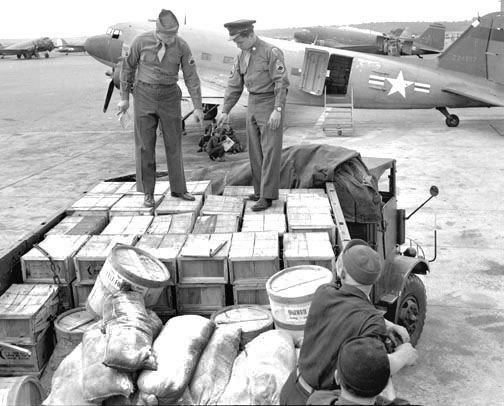
However, the airlift continued months afterward as a buffer against any further Soviet ploy. By operation’s end — September 30, 1949 — more than 2.3 million tons of supplies had been lifted-in and a world crisis averted.
For Powell, its success, along with rebuilding Europe, were America at its best. “We’re an amazing country. Sometimes we have a veritable uncanny propensity to do the right thing. It brought into rather sharp relief just what could be done. In my humble opinion the United States, between 1945 and 1950, could be compared to ancient Greece under Pericles. It as a golden era. We did virtually everything right and you can’t do that without leadership. We were deep in leadership after the war.”
He says the feeling in America then — “that everybody was in this together” — is hard for young people to understand. “Now, we’re so disparate. Everybody’s off doing their own thing. But I still put my faith in the willingness of the American people to do the right thing…given the right leadership.” The airlift’s legacy, he says, is the goodwill it generated. “Civic-minded Germans formed the Berlin Airlift Foundation to take care of the wives and children of the airmen killed in the lift.
When he joined other vets in Berlin last May he spoke with Germans who vividly recalled the airlift. “They all mentioned the omnipresent noise. One lady told us, ‘It didn’t bother us because we knew if the noise continued we would eat.’ He adds the warm outpouring of gratitude got him “a little choked up. We made generations of friends there.” He says if there’s any heroes in all this, it’s “the people of Berlin, because they could have very easily gone to the Soviet sector and been fed and clothed. No question. They were down to 1,200 calories a day but chose to stay and stick it out. These people sought self-determination.”
After the airlift Powell was set to study law when the Korean War erupted. He spent 21 more years in the service, moving from place to place “like a locust.” Posted in France during the ‘60s, he became a certified Francophile — enamored with the nation’s history, culture, people. He’s often returned there.
Along the way he married, raised a family (he has three grown children) and indulged a lifelong search for knowledge by reading and studying. He describes himself then as “a kind of journeyman” scholar. That all changed in 1964 when plans to join an F4 Phantom squadron off the coast of Vietnam were scuttled and he was assigned instead to Offutt Air Force Base.
Here, he finally stayed one place long enough to earn a degree (in business administration from Bellevue University). And here he’s remained. His post-military career saw him remake himself as an authority on public policy and aging issues, earning a master’s in public administration and a Ph.D. in political science. UNO hired him in 1973 to implement training programs under the Older Americans Act.
As a full professor today he teaches courses, advises students and collaborates with colleagues on
articles, surveys and studies. He’s applied the public service mission he took from the airlift to serve political campaigns, advise local and state government and participate in White House conferences on aging. Both his life and work dispel many myths about aging.
“We feel it’s wonderfully appropriate to have a 78-year-old teaching younger people all older people are not alike,” says James Thorson, UNO Department of Gerontology Chairman. “Dr. Powell is an excellent instructor and accomplished researcher. He’s wildly popular with students. He works long hours. He wants to wear out, not rust out, and I respect him for it.”
It was at UNO Powell met Betty. Both were recently divorced. He was teaching, she was doing grad work. They married in 1982. Everyone agrees they make a good match. They travel together and enjoy entertaining at their sprawling Keystone neighborhood home, where he often holes up in a study whose impressive library is stocked with volumes on American history (the presidents, the Civil War) and France. Travel is no idle pursuit for him. He researches destinations and prepares itineraries detailing sites and themes, from architecture to art to vineyards. He got in the habit in the service.
“It permits you to observe how other people do things and to see Americans don’t have a corner on how things are done.”
The couple prove growing older doesn’t necessarily mean slowing down. In typical fashion he and Betty plan ushering in the new millennium under the Eiffel Tower in Paris. “I’m really looking forward to it,” he says. In his office hangs an enlarged photo of the French landmark with an inscription that sums up his ageless sense of wanderlust: “Paris is like a lover. You may leave her, but you will never forget her.” It’s the same way with Chuck Powell: Once you meet him, you never forget him.
Related Articles
- Causes, Reasons and Results of the Berlin Airlift (brighthub.com)
- Trail of the unexpected: Tempelhof Park, Berlin (independent.co.uk)
- James Rodney Ferrell, 90 (kitsapsun.com)
- History: The Berlin Airlift (americanthings.wordpress.com)
- How much supplies did Berlin Airlift receive (wiki.answers.com)
- Candy Bomber: The Story of the Berlin Airlift’s Candy Bomber: The Story of the Berlin Airlift’s “Chocolate Pilot” by Michael O. Tunnell (alleganylibrarycollections.wordpress.com)
Categories: Adventure, Berlin Airlift, Chuck Powell, History, Korean War, Military, UNO (University of Nebraska at Omaha), War, World War II, Writing
Aviation, Berlin, Berlin Airlift, Berlin Blockade, Chuck Powell, History, Korean War, Military, Omaha, UNO (University of Nebraska at Omaha), War, World War II
Bill Ramsey: A Korean War Story
June 18, 2010
Leave a comment

Image via Wikipedia
Journalists look for hooks to hang their stories on, and anniversaries of major events are always convenient pegs to use. On the 50th anniversary of the Korean War I profiled the combat experience of Bill Ramsey, an amiable man who made a rich life for himself after the conflict as a husband, father, PR professional, and community volunteer. He has devoted much of his life to veterans affairs, particularly memorializing fallen veterans. He’s also authored a handful of books. He’s still quite active today at age 80. Anyone who survives combat has a story worth repeating, and it was my privilege telling his story in the New Horizons. Now, in conjunction with the 60th anniversary of the Korean War, I offer the story again as a tribute to Ramsey and his fellow servicemen who fought this often forgotten conflict.
Bill Ramsey: A Korean War Story
©by Leo Adam Biga
Originally published in the New Horizons
Fifty years ago, Americans were piecing their lives back together in the aftermath of World War II when the best and brightest of the nation’s youth were once more sent-off to fight in a distant land. This time the call to arms came in defense of a small Asian nation few Americans were even aware of then — Korea. In June of 1950, Communist North Korean forces (with backing from the Soviet Union and Red China) launched an unprovoked attack on the fledgling democratic republic of South Korea, whose poorly prepared army was soon overrun. With North Korea on the verge of conquering their neighbors to the south, the United States and its Western allies drew a line in the sand against Communist expansionism in the strategically vital Far East and led a United Nations force to check the aggression.
Among those answering the call to service was a tall, strapping 20-year-old Marine reservist from Council Bluffs named Bill Ramsey. His wartime experience there became a crucible that indelibly marked him. “The war will always be the most defining experience in my life,” said Ramsey, 70, whose full postwar years have included careers as a newsman, advertising executive and public relations consultant. He and his wife of 46 years, Pat, raised five children and are grandparents to 14 and great-grandparents to one. This is his Korean War story.
In the fall of 1950, Ramsey was preparing to study journalism at then Omaha University. His plans were put on hold, however, with the outbreak of hostilities overseas. He followed the unfolding drama in newsreel and newspaper accounts, including the U.S. rushing-in army divisions grown soft from occupation duty in defeated Japan. The invaders pushed South Korean and American forces down the Korean peninsula. Ramsey sensed reserves might be recalled to active duty. He was right.
He was assigned a front line unit in the 5th Marine Regiment, 1st Marine Division, Reinforced. He was excited at the prospect of seeing action in a real shooting war, even one misleadingly termed “a police action.” His anticipation was fed not by bravery, but rather heady youthful zeal to be part of the Corps’ glorious tradition. The conflict offered a once-in-a-lifetime opportunity to test himself under fire. After all, he was too young to have fought in his older brother Jack’s war the previous decade. This would be his war. His proving ground. His adventure.
“I wanted to be in the front lines. I didn’t want to go all that way to end up sorting letters in Pusan,” he said. “I was curious to know how I would hold up in action.”
No stirring salute or fanfare saw the Marines off as their Navy attack transport ship, Thomas Jefferson, pulled out of San Diego harbor in March 1951. Ramsey was one of hundreds of young men crammed in the hull. They had been plucked away from factories, offices, schools, homes and families. Ramsey left behind his mother, brother and an aunt (his father died when he was 12). The GIs were going to defend a land they did not know and a people they never met. Their mission lacked the patriotic fervor of WWII. There was no Pearl Harbor to avenge this time. No, this was a freedom fight in a growing global struggle for people’s hearts and minds.
Before ever setting foot on Korean soil, Ramsey smelled it from aboard ship in the Sea of Japan. Nearing Pusan harbor in the far southeastern tip of Korea, the heavy acrid odor of the war-ravaged countryside permeated the air. It was the stink of sulfur (the discharge from spent armaments), excrement (peasant farmers used it as fertilizer in their fields), fire and death. “That all mixed together made for quite a pungent odor,” he said. “It’s a stench that you never forget.”
Ramsey and his Able Company comrades were flown into a staging area near Chunchon in east-central Korea to await transport to the front. The city had sustained heavy damage. “It was pretty well leveled at that point,” he recalls. Standing on a wind-swept tarmac, he saw snaking down a road from the north a convoy of trucks carrying combat-weary GIs being rotated out of the line. These were veterans of the famous Chosin Reservoir Battle who defied all odds, including numerically superior enemy forces, to complete a withdrawal action that featured hand-to-hand combat. Ramsey and his green mates were their replacements.
“I remember when they got off the trucks they looked like zombies. Their faces were covered with a fine white powdery dust and their hands were blackened from the soot of the fires burning everywhere in the country,” Ramsey said. “I thought, ‘God, I’d give anything to have gone through what they’ve gone through and to be going home.” Among the dog-faced vets was a friend, Phil O’Neill, from Council Bluffs. “He tried to tell me what it was like. He didn’t exaggerate or try to make it any scarier than it was. He didn’t fool around or joke. He just gave me some good advice, like keep a low profile and keep your weapon dry.” After seeing and hearing what awaited him, Ramsey felt an overpowering desire to join the departing GIs. “They were going home. That really hurt. I was so envious.”

Ramsey’s unit headed for a position along the central front. Every village and field they passed was scarred and charred. “We drove all night. We could see fires burning. Again, we could smell the countryside,” he said.
Movement was the order of the day in a war of quickly shifting positions along the long and narrow Korean peninsula. “It was a very fluid war. We were moving constantly, sometimes by truck and sometimes marching 20 or 30 miles in a day to the next spot,” he said. Rough mountainous terrain, bad roads and inclement weather — marked by extreme temperatures, torrential rains, floods, snow and ice — made the going tough. “The farther north you go the more mountainous it becomes. You always had to go up a hill or some rocky face. No flat open fields. This was trees and rocks and cliffs. A really difficult place.” While he never had to endure the brutal winter, he described conditions “as miserably cold. And when it rained, which it did a lot, you were soaking wet, cold and knee-deep in mud. You thought you could never get through it, but you kept going.”
When his company first arrived, U.N. forces were striking out in a series of bold counteroffensives. By the summer, the war was bogged down in a stalemate. A single position (invariably a hill) would be taken, lost, and retaken several times. “It was pretty much hill by hill,” Ramsey said. Platoons were like firefighters rushing from one hot zone to another. A hundred yards or less might separate opposing forces. The basic objective was usually capturing or holding a perimeter on one of the endless sharp-edged ridge lines. Upon reaching a position, the Marines set-up machine gun posts and prepared cover by digging fox holes. Not only did the metal shards from incoming mortar and artillery pose threats, but splintered rock made deadly projectiles too. “
You always had to get some protection for yourself from shrapnel,” he said. Sleeping accommodations were standard-issue pup tents or makeshift bunkers (for extended stays). “Most of the time you stayed one night or two nights and then walked to another position, where you’d dig another hole.” The premium was on moving — no matter what. “You have aching feet. A sore back. You’re tired, discouraged. You’re cold, dirty. You’re sick (dysentery, encephalitis, etc.). But you can’t stop. You’re there, you’re on the move and there’s no way out unless a doctor says you just can’t go on and sends you to the rear.”
On rare occasions when his platoon remained in one spot, barbed wire was strung across the perimeter. The men had to be on constant alert for all-out charges or smaller probing raids looking for weaknesses in the line. “A lot of times they were through the position or in the position. They weren’t always stopped at the wire,” Ramsey said. Nightfall was the worst. The enemy preferred attacking then by frontal assault or flanking maneuvers. To keep a sharp defensive perimeter, men took turns sleeping and watching — two hours on and two hours off — through the night. “You never let your guard down. We were always ready,” he said, adding that the last two years of the conflict it got to be “almost like trench warfare.”
His first taste of combat came early in his hitch. His platoon was dug in for the night on some anonymous ridge line, the men extra wary because reconnaissance had spotted enemy massed nearby. “We were told the Chinese were going to be coming in some force. It was pretty hard to sleep anyway, and anticipating my first night under fire made it that much harder. Sure enough, they came that night. I remember a lot of noise. Mortars. Shots. All that firepower. I remember thinking, “I would love to be able to cram myself inside my helmet.” I somehow got through that night. The next morning they brought in some of our killed. They were in ponchos — their feet sticking out. They were carried down the hill.”
Sometimes, a noise from somewhere out in the pitch black warned of encroaching danger. Other times, a fire fight broke loose with no warning at all. “You would hear something or you would sense something. You laid down fire if you heard anything at all out there. Their movements might trigger a flare, which made it easier for you to see them moving but also made it easier for them to see you,” he said. “On occasion, they would purposely make some noise to try and shake you up. They would produce some tinny sound or blare a bugle or just shout out. It was a psychological ploy.” A dreaded eerie sound was the “zzziiippp” made by the infamous Chinese burp gun, an incredibly fast-firing tommy gun-like weapon.
Perhaps the most terrifying action he saw came the night his outfit’s position was nearly overrun. What began as a cold damp day worsened after sunset.
“We got to our positions pretty late that night. It was raining. We dug in as fast as we could. We’d been in quite a few fire fights in the days preceding that. We thought with the weather this might be one of those nights when the enemy didn’t do anything. We were wrong,” he said. “Our machine guns started firing, and when you heard those you knew they were coming. A few of the enemy broke through our position and came right in the camp. I was quite shocked. We’d never had that before. I saw them through flashes of fire. It was very confusing. A real nightmare. We finally pushed them back.”
There were casualties on both sides. Ramsey said the enemy took advantage of the night, the rain and his unit’s complacency. “They knew Americans were not that big on night fighting and that with the bad weather we might be more inclined to worry about staying dry than steeling for attack. I think what happened is somebody in our ranks did let down. That was the only time they got in our camp that way.” He said an enemy breaching the wire could “demoralize” the troops and, if not repelled, result in a much larger breakthrough.
He described “plenty of close calls” on Able Company’s grueling march north across the 38th Parallel to engage the Chinese in the Iron Triangle stronghold. There was the omnipresent threat of mortar and artillery fire. If you stayed in the field long enough, he said, “you could hear the difference in the sound” and distinguish mortars from artillery and what size they were. Where a mortar round or artillery shell whistling high overhead gave men time to find cover, the report of the Chinese mountain gun, which fired shells in a low trajectory, allowed little or no time to hit the dirt. “You heard the report and, BOOM, it was right there. It fired in on like a straight line.” And there was occasionally the danger of friendly fire, especially errant air strikes, raining hell down on you.
Fording the streams that flowed abundantly from the mountains in Korea presented still more hazards. As heavily weighed down as the men were with their poncho, pack, boots, rifle, helmet, and ammunition, one slip in crossing the clear, fast-rushing streams (more like surging rivers) could be fatal. “A few times I felt like I was going under for sure,” Ramsey said. “I wouldn’t have had a chance.” Carrying their rifles overhead to keep them dry, the men were sitting ducks for snipers. “We were exposed,” he said.

Once, he recalls his platoon just making it to the far bank when shots began splaying the shore from the hill above. “We couldn’t see too much because it was fairly steep. We finally did draw fire on this hill.” But when Ramsey got ready to fire his M1 rifle, he got a rude surprise. “I pulled the trigger and nothing happened. That was a terrible feeling. In all that sloshing through the water my weapon must have got wet. I used a wounded buddy’s carbine instead.”
A fire fight Ramsey will never forget erupted when his 1st squad was returning to the lines after completing a mission and saw the point squad ahead of them “get hit” in an ambush of machine gun fire. Several men were cut down in the ensuing action, including 1st’s squad leader and Ramsey’s good friend — Don Hanes. “He was shot in the chest. Another fellow and I went back up this hill to get him. The fire was really intense. I was amazed we weren’t all killed on the spot. We started taking him down and Don looked at us and said, ‘No, no, no, no, no…Just leave me. You’ve got to get out of here. I’m not going to make it.’ He was a brave fellow. He was hurt so badly. Well, we did get him out of there — across an open rice paddy. He was evacuated to a hospital, but it turned out he was mortally wounded. He died later. We had a number of other casualties we carried too. It was a grim day.”
At 20, Ramsey was named temporary squad leader. He already led a four-man fire team. In addition to M1s, the team carried a single Browning Automatic Rifle or BAR. Their mission: flushing out the enemy or scouting enemy lines. Sometimes, they ran sniper patrols. If the enemy was sighted (with the aid of a sniper scope), the team’s job was to “throw some fire in” and try to pick-off or pin down targets. “We wouldn’t necessarily hit them all the time,” he said. Days or weeks might pass without enemy contact. Once, Ramsey came face-to-face with his foe. It happened when taking a hill. He and another Marine surprised a North Korean soldier. “We both fired at him, and he fell dead. We went over to where he was lying on his back. There was a pouch. We opened it and found a photo of a woman and a child. I thought, ‘He’s just like me.’ We had been thinking of the enemy as a bunch of faceless fanatics, and here was a man with a wife and child. It made an impact.”
By November 1951, Ramsey had been in-country eight months. Despite steady combat, he’d escaped unscathed. He hoped his luck held out just a few months more — then his hitch would be up and he’d be back stateside. “You see people dropping everyday. You see friends maimed and killed. You see guys going out of their head. You wonder when your number’s going to come up next. You ask yourself, ‘How can I ever get out of here?’ It’s a sinking feeling,” he said. He feels what keeps men going in such awful conditions “is your intense desire to survive and to see your loved ones again. That kept me driving.”
On the morning of November 17, his fire team “headed out on a routine sniper patrol” down Hill 834. “It was one of our more permanent lines. The hill was a muddy mess. We weren’t out long when one of us tripped a land mine, and a piece of shrapnel caught my right arm.” The impact sent Ramsey skidding face down the hill. “I was in shock, but I knew it was pretty bad because my dungaree jacket was shredded and blood was all over the place.” Metal fragments had severed his ulnar nerve and fractured bones. His mates brought a Navy corpsman to his side. The corpsman applied a bandage and administered a shot of morphine. Ramsey’s buddies then carried him up the hill and down the reverse slope to a small, level clearing. There, a second casualty from down the line was stretchered in — missing a foot. Ramsey recalls an officer giving him a cigarette to drag on and saying, “You got a million dollar wound there, Bill…you’ll probably be going home.” Still, Ramsey worried he might lose his shattered arm, which burned with pain. A helicopter evacuated he and the other casualty to a nearby MASH unit.
Rushed into surgery, Ramsey awoke the next day to the news doctors had saved the arm. Wearing a cast, he was taken (by ambulance) to an Army hospital in the devastated capital of Seoul. “There was nothing standing,” he said. From there, he was flown (on a transport plane stacked with wounded) to an Army hospital in Osaka, Japan, spending days in agony (receiving no treatment as a non-Army patient) before transferred (via train) to a Navy hospital in Yukosuka, where he finally found some relief for the pain and slept for the first time in nine days.
In early December he hopped a four-engine prop bound for the states. He landed at Travis Air Force Base in southern California. His first impulse was to call home. He next reported to Oak Knoll Navy Hospital near Oakland, where he underwent skin grafts and three months of physical therapy. During his rehab, the Purple Heart recipient recalls being torn by two emotions: “I felt sick about leaving and letting my buddies down. But the other side of it was I was really thankful to get out. Eight months there was enough.” His long voyage back ended almost a year to the day his Korean odyssey began. A relieved Ramsey arrived to “the quiet of my wonderful home.” He downed a beer and thanked God the journey was over at last.
Upon his return (he graduated from Creighton University) he was dismayed by the indifference civilians expressed toward the raging conflict. From its start in June 1950 to its conclusion three years later, it never captured the public’s imagination. Many observers feel it came too quickly on the heels of World War II for Americans — then preoccupied with living the good life — to care. Cloaked under the murky misnomer “police action,” it became a shadow war.

President Harry S. Truman summed up the national mood when he called it “that dirty little war.” Its status as “the forgotten war” was sealed when it ended not with victory but an armistice leaving Korea still divided at the 38th Parallel (with a permanent American military presence there to keep the peace.) Lost on many was the fact the true objective — preserving a democratic South Korea — was accomplished. In the larger scheme of things, a free South Korea has emerged as a thriving economic juggernaut while a closed North Korea has withered in poverty. Ramsey saw for himself the economic miracle wrought in South Korea on a 1979 trip there. He met a people grateful for his and his comrades’ sacrifices. Monuments abound in recognition of the U.N. “freedom fighters.”
It is only recently, however, these veterans got their due in America. In 1995 the Korean War Memorial was dedicated in Washington, D.C. (Ramsey was there). In the late ‘70s Ramsey, whose post-war life has been devoted to causes, spearheaded the erection of a joint Korean-Vietnam War monument in Omaha’s Memorial Park. The monument has received a recent refurbishing and the addition of a flower garden. This year, he started a Nebraska chapter of the National Korean War Veterans Association.
For vets who went to hell and back, the war is never far from their thoughts. “I’m proud to have served. We stood fast. We saved the south. I can think of no higher compliment than to be called a freedom fighter,” said Ramsey, who, in 1997, faced a new enemy — prostate cancer. Aggressive treatments have left him cancer free. In August, he attended a reunion of his 1st Marine Division mates. “My admiration continues to grow for the Marines with whom I served,” he said. For their heroic actions there, the division received the rarely bestowed Presidential Unit Citation.
Related Articles
- Korean War veterans reunite to share memories (knoxnews.com)
- Legacy of the Korean War (theworld.org)
- The Korean War 60 years on: Images from the conflict (independent.co.uk)
Omaha’s Tuskegee Airmen
June 18, 2010
4 comments

English: Pilots of the 332nd Fighter Group, “Tuskegee Airmen,” the elite, all-African American 332nd Fighter Group at Ramitelli, Italy., from left to right, Lt. Dempsey W. Morgran, Lt. Carroll S. Woods, Lt. Robert H. Nelron, Jr., Capt. Andrew D. Turner, and Lt. Clarence P. Lester. (U.S. Air Force photo) (Photo credit: Wikipedia)
Meeting real life heroes and historical figures is not an every day occurrence, even in my line of work, and so given the great legacy of the Tuskegee Airmen it was a real honor and treat interviewing a handful of these men living in and around Omaha. Like most individuals of great achievement, they are both quite proud o what they did but also exceedingly humble about it. I did the story for the New Horizons on the tail end of a wave of recognition coming the Tuskegee Airmen’s way. More has followed since. It’s all well-deserved. On personal note, my own father, the late Leo M. Biga, was a ball turret gunner on a B-17 that flew in the 96th Squadron, 2nd Bomber Group, Fifteenth Air Force, and he attested to the fact that the escort fighters flown by Tuskegee Airmen, the famed Red Tails, saved his and his fellow airemen’s bacon on many an occasion during bomb runs over Europe. When I interviewed the Tuskegee veterans I didn’t know enough to give them my father’s whereabouts and assignments and air service dates to see if they might have been flying at the same time, on the same missions. I’d like to think they were.
Omaha’s Tuskegee Airmen
©by Leo Adam Biga
Originally published in the New Horizons
At the start, they were ordinary young black men of varied backgrounds. They came from around the country. Most were college graduates or undergrads. Some were just out of high school. They were drawn to “the experiment” by a desire to serve their country in World War II and, in so doing, help overturn racist attitudes. The experiment was the Army Air Corps black cadet training center at Tuskegee Institute, an historically black institution of higher learning. It was meant by supporters to demonstrate blacks were as capable as anyone and by detractors to reinforce minorities’ supposed inferiority in a then-segregated military and society.
As history now notes, the Tuskegee Airmen decisively proved blacks the equal of their white counterparts. More than 1,000 men graduated from the aviation school, including pilots, navigators and bombardiers. All were pioneers and trailblazers. In combat, flyers with the 332nd Fighter Group, including the 99th Fighter Squadron, became heroes, distinguishing themselves above all other U.S. flying units. Tuskegee fighter pilots never lost a single bomber to enemy fire in 200 escort missions over Europe. An unprecedented achievement.
So impressive a record that once skeptical bomber groups hotly lobbied to be escorted by these “Red Tail Angels,” so named for the red tail markings on their aircraft. The leader of the Tuskegee group, Col. Benjamin Davis, had emblazoned on his aircraft “By Request” — a reference to the many requests bomber groups made for the 332nd to cover them.
As the exploits of the Tuskegee flyers mounted, their reputation preceded them, even to Germany, where they were known as the “Black Bird Men.”
Now, some 60 years since World War II’s end, the ranks of Tuskegee Airmen grow thinner just as their status as national treasures looms ever larger. Their legacy is a testament to perseverance, loyalty, passion, talent and sacrifice. Their barrier-breaking contributions aided the nascent Civil Rights Movement. Their deeds “paved the path” for blacks in the military and other fields, said Air Force veteran Bobby McGlown, founder of Tuskegee Airmen, Inc.’s local Alfonza Davis Chapter.
Robert Rose, an Air Force vet who entered the service long after the Tuskegee men made their mark, feels indebted to them. “I’m the benefactor of their labors and sacrifice. To accomplish what they accomplished with all of the hardships and rigors of segregation, racism and war, is just phenomenal.” Even though his career came in what was — theoretically — a fully-integrated military, Rose still met racism and is amazed how those who went before him endured what they did “without the force of law behind them.” He felt such gratitude that in 2002 he assumed the presidency of the Alfonza Davis chapter in order “to make sure their legacy is perpetuated. They’re my heroes. They’re my friends. And I’m willing to do whatever I can to make this organization something they can be proud of.”
His efforts are culminating this year in the local chapter hosting the 33rd Tuskegee Airmen national convention. It’s only right Omaha plays host to the August 3 through 8 event, as several Tuskegee Airmen call this place home. The city’s most decorated Tuskegee flyer, Alfonza Davis, for whom the local chapter is named, was Tech High valedictorian in the class of 1937 and, later, an Omaha University student. He went missing in action in 1944 and was declared presumed dead in ‘45. In all, at least seven Omahans trained in the Tuskegee military aviation program. All but one of the known native Nebraskan Tuskegee Airmen have passed away. A few other “originals,” as they’re referred to, have made Nebraska home after long military careers. One graduated from UNO. The stories of these men are told here:
Alfonza Davis
Captain Alfonza Davis graduated the top of his flight class at Tuskegee and was the first black military aviator from Omaha to earn his wings. He scored the highest rating in Moving Target Marksmanship in his class and was chosen squadron leader. His first combat assignment was with the 302nd Fighter Squadron in Italy. Later, he was attached to Group Headquarters for the 332nd Fighter Group as its assistant group operations officer. The group, operating with the 15th Air Force, escorted bombers that struck objectives in Italy, France, Germany and many other European nations. His final assignment came as squadron commander of the 99th Pursuit Squadron (later renamed the 99th Fighter Squadron). He led one mission in which his flyers destroyed 83 German aircraft. On what proved to be his last flight, he piloted his P-51 “Mustang” on a reconnaissance sortie to Munich, when he was lost in overcast weather near the Gulf of Trieste and never heard from again.
Among his many awards and decorations are: the Purple Heart and Distinguished Flying Cross. He was credited with one aerial victory in the Mediterranean Theater of Operations. He left behind a wife and brother.

Lt. Col. Charles Lane Jr.
Lt. Col. (Retired) Charles Lane, Jr.
One of 13 children born to Verna and Charles Lane in the black section of St. Louis known as “The Ville,” Charles Lane, Jr. was attending Harriett Beecher Stowe Teachers College when war broke out. He volunteered for the aviation cadet program rather than be drafted. “The draft at that time was not treating blacks very well,” he said. “They normally ended up in service units.” He was inspired to join the corps by a former high school classmate, Wendell Pruitt, who’d already made it through the program and was speaking at a war bond drive. “He gave us all insight into what to study for and how to apply ourselves, and a lot of us did. Out of 12 of us, eight passed the exam” that qualified them for training.
Oddly, the first black military aviators were mustered and trained down south, at places like Keesler Field in Biloxi. Miss., where their presence was least tolerated. “It seemed ironic to us, too, but that was politics in those days,” said Lane.
Out of Lane’s original class of 138 cadet candidates, 78 made it to the Tuskegee Institute in Tuskegee, Ala., where they first learned to fly. The tough training there further weaned the class to 38. He said some very good men washed out, not because they couldn’t fly, but due to an unwritten quota system that passed a bare minimum flyers. Those that made it, like Lane, knew they must meet stringent standards. “We had the same curriculum as white cadets, but we held ourselves to higher standards,” he said, as instructors looked for “any excuse” to axe them.
Early flight training was with black instructors and primary training under the supervision of whites. “Some of them, of course, didn’t like our being there and let you know it. That got your attention,” he said. “But then there were others who were behind you and supportive. My instructor was one of those types. He said, ‘I can teach anybody to fly, and I want you to learn real fast.’ He was friendly.”
Lane joined the 99th Fighter Squadron in Ramitelli, Italy, near Foggia. He was 19 when he piloted a P-51 in combat. The P-51 was lighter and fleeter than the P-47 he trained in. “It was a very fanciful airplane,” he said. “Speedy. Maneuverable. Extensive strike range. All those things a fighter jock needs — it had them.” He was a wing man, meaning he protected “the shooters” whose wing he flew on.
He flew 26 missions escorting B-17s and B-24s on bombing runs. Escort missions took him as deep as Berlin. By the end of fighting in Europe, he said, the Germans’ “max effort” saw them throw up a barrage of fighters and anti-aircraft flak. He saw his flight leader and fellow St. Louis native, Hugh White, shot down in front of him while flying his wing. Another friend, Thurston Gaines, was shot down behind him. Both men bailed out and survived as POWs. White, whom the St. Louis Tuskegee chapter is named, became an attorney and Gaines a physician.
Others weren’t so fortunate. Lane said while he and his fellow flyers were proud of their sterling record of not losing a single bomber to enemy fire, they didn’t forget those lost in action. “We paid a price. Sixty-six of us were killed in action and 38 more ended up as prisoners of war. So, of the 450 pilots who saw combat, more than a hundred — or, in other words, every fifth pilot — was considered lost.”
He said their “by-the-book” commander, Col. Davis, was the reason black pilots were so disciplined in carrying out their bomber cover duty. “He told us, ‘You’re over here boys to protect the bombers.’ If a German fighter got two miles away, we left him alone. We broke off and came back and rejoined the formation. We didn’t stray out there and try to chase him. Our primary mission was to protect the bombers, and that’s the attitude we had.” Lane feels the ramrod straight Davis, who went through hell as a lone black West Pointer, developed the esprit de corps and high standards of the group. “We felt honored to have him around.” Plus, he said, Davis forever gained their allegiance by going up the chain of command to fight rigged reports meant to discredit the Tuskegee track record.
The program only continued, Lane said, due to the intervention of figures like Davis, who got Gen. George C. Marshall to listen to facts. First Lady Eleanor Roosevelt did her part by taking a much-publicized ride with a Tuskegee pilot. But public recognition for the flyers’ accomplishments was long denied. Lane recalls the 99th Fighter Squadron’s win in the 1949 national gunnery meet being unlisted in the record books until black servicemen raised hell. It took a decade to get it corrected. School history books made no mention of Tuskegee Airmen until quite recently. “My thought was we were the best kept secret of World War II,” he said.
After the war, Lane found to his dismay, as did his black comrades, “no change” on the racial front back home. “Well, we thought we were first class citizens in the air, second class citizens on the base and third class citizens outside the fence.” Undaunted, he made the military a 27-year career. He flew fighters, transports and the B-52 in the Korean and Vietnam conflicts. He and his family settled here after assigned to SAC. From 1970 to 1992 he headed Greater Omaha Community Action (GOCA), an Omaha-based poverty program. He’s been active in the Civil Air Patrol.

Lt. Col. (Retired) Harrison “Harry” Tull
Reared by his grandparents on their Woodbury, NJ truck farm, Harrison Tull and his family were the only black folks for miles around. The racial harmony he knew growing up there would be severely tested in the service, when he was subjected to its harsh segregation practices and hostile policies. He’d already graduated from Wilberforce University (Ohio) — the first black college established north of the Mason Dixon Line — when the war erupted. While at college, where he majored in biology, chemistry and history, he’d heard about the black aviation cadet program. Then, when the opportunity presented itself, he volunteered. “I was always interested in flying. I used to make model airplanes out of wood,” he said.
Tull’s first several months in the service saw him bounce around from bombardier to gunnery to pilot training. He received his rated observer wings in 1944 and was commissioned a second lieutenant. His first operational assignment was with the 477th Bombardment Group out of Godman Field, KY to fly in the B-25.
Despite never going overseas in World War II, being in such an elite unit motivated he and his fellow officers to carry themselves with pride and panache. “The pride among Tuskegee Airmen has always been there. We dressed sharp. When we were in our pinks and greens (dress office uniforms) we used to say you could cut your finger on the creases in our pants. And when we marched, we marched without cadence.” Instead, the men kept count in their head.
In 1945 he was reassigned to Selma Army Air Field, La. for navigation training when he and other black officers were unceremoniously released from active duty for attending a restricted white officers club. He said the visit to the club proceeded without incident. “We had no problem with those officers and they had no problem with us. They even gave us chits so we could buy drinks. We had a good time.” The problem was with the bigoted base commander, who called Tull and his fellow officers on the carpet the next day. “He chewed us out.” The men didn’t take it lying down. “We had a fellow in the outfit by the name of Coleman Young, who later became mayor of Detroit. He said, ‘Colonel, may I make a statement?’ The colonel said yes. And Coleman rose and went up one side of him and down the other, and all the colonel could do was pull out his handkerchief and wipe his face because he was perspiring so bad. Well, 10 days later we were out of the service.”
It would not be the last time Tull faced discrimination in the military. In what turned out to be a 27-year Air Force career that saw him distinguish himself as a reconnaissance officer in the Korean War and as an electronic warfare officer in the Cold War, he found promotions slow to come and attitudes slow to change. For example, it took 11 years for this college graduate to make first lieutenant. And in what was supposed to be an integrated force, he ran head on into racism at Ellington Air Force Base, Texas. “They put me on a B-29 and the major who was the head of the crew said, ‘You can’t be on my crew because you’re the wrong color.’ So, they took me off and put another guy on. They put me with another crew, who voted on me. They were all from the north, except one, and they all voted to put me on the crew and that’s where I flew. We had a good crew, too.”
He ended his military service by commanding the 55th Electronic Intelligence Operations Squadron based at SAC. After his 1970 retirement he and his family remained in the area. The Bellevue resident taught biology in the Omaha Public Schools (at Tech and, later, at Northwest) and served as a counselor at Monroe Middle School. He’s a volunteer with several Bellevue organizations.
Lt. Col. (Retired) James Warren
Growing up in the bitter South, James Warren’s family felt the full, awful brunt of Jim Crow segregation and intimidation. At age two, the Gurley, Ala. native’s ailing father was refused a surgeon and operating room reserved for whites and was instead operated on by a general practitioner in a makeshift OR . “It was a botched appendicitis operation and he died on the operating table,” Warren said.
As a boy, Warren was “frightened to death whenever the Ku Klux Klan marched down the road in their white sheets. I’d run under the house and hide.” Racial division, he said, was “absolute, rigid, complete. In those days, segregation was very lethal. There were lynchings going on and things like that. My mother was desperate to protect her son. She was able to acquire a job as a live-in maid in Winnetka, Ill. She saved enough money to buy me a train ticket and sent for me.” He arrived in 1938 to culture shock and a new life. In Winnetka, a wealthy North Shore bedroom community of Chicago, he worked as “a house boy” for a young couple, doing all the cooking and cleaning. It made studying for school a chore, but it was worth it. “I ended up going to New Trier Township High School — one of the best schools in the country,” he said. It had everything. Until then, he’d “never seen a library” nor attended class longer than five months any school year.
He was working as a drugstore cowboy when he read an American Magazine article, I Wanted Wings, by Charles DeBow, one of the first black Tuskegee graduates. “It brought tears to my eyes,” he said. “Never in my wildest dreams did I think I could be anywhere close to flying an airplane. That was my inspiration to go for the top.”

Lt. Col. James Warren
Warren found “every level of the cadet training intense. You knew you had to be the best.” He and his mates were aware of “being very critically scrutinized” as the fate of the Tuskegee experiment rested on their shoulders. “Not only were we aware of it, we were proud of it. We enjoyed the challenge because we knew we could meet the challenge. All we needed was the opportunity and once we got the opportunity, the whole ball game was over.” It was also understood they carried the hopes of others. “There were thousands of young black Americans who wanted to serve their country in an elite group like the air corps. They were qualified, too. They just didn’t get the opportunity. We had to make sure our performance didn’t allow the government to claim blacks could not perform satisfactorily in the job.”
Still, attempts to humiliate black aviators continued. In 1945 Warren was part of an incident he wrote about in a book, The Tuskegee Airmen: Mutiny at Freeman Field. Seymour, Indiana. was home to Freeman Field, where he was among a group of black officers with the 477th Bombardment Group arrested for entering a whites-only officers club. He and 100 fellow officers made “a stand” by refusing to sign a form barring them from the club. The men were moved to Godman Field, KY to await court martials. Even though Gen. George Marshall had the men released before such drastic action took place, a reprimand on their service records remained — blocking any promotion — and was only deleted 50 years later.
While Warren and the others never made it overseas, their civil rights stand did “get the attention” of President Harry S. Truman, who, in 1948, signed executive order 9981 to begin integrating the armed forces. Warren went on to an impressive military career that saw him fly, as a navigator, 173 combat missions in Korea and Vietnam. When he was not on active duty during peacetime, Warren worked as an architect. In 1964, he took advantage of then-Omaha University’s Bootstrap program to complete the college degree he’d never finished. After retiring from a 35-year military career that saw him win numerous honors, he was a personnel specialist for General Dynamics Corporation. He and his wife live in California. His book on the mutiny at Freeman Field is in its fifth edition from Conyers Publishing Co.
Lt. Col. (Retired) Paul Adams and Others
Greenville, SC native Paul Adams realized a long-held dream of flying a plane as a Tuskegee fighter pilot cadet in 1942. In 1943, he shipped overseas with the 332nd Fighter Group in Italy. He was a P-40 “Warthog” jockey and later flew the P-39 Belaire Cobra while patrolling the Naples harbor. After the war his military service continued in various posts. In his 20-year career he served in nine major campaigns and received the Commendation medal with three Oak Leaf Clusters. His final posting was as deputy base commander in Lincoln. After retiring from the service in 1963, he and his family remained in Lincoln, where he embarked on a teaching career with the Lincoln Public Schools, becoming one of its first black instructors.

Lt. Col. Paul Adams
Omahans Ralph Orduna, Edward W. Watkins, Lawrence King Sr., John L. Harrison Jr. and Woodrow F. Morgan and Council Bluffs native Clarence A. Oliphant were among the locals who made it through Tuskegee’s aviation training. All are gone now. A survivor who didn’t make the cut is Robert Holts, a Central High grad who said washing out of the pilot training program left him “very low…very morose. It was a very intense feeling of just wanting to be part of it. I still have that feeling today when I’m around Paul Adams, Chuck Lane and Harrison Tull.” Holts enlisted with five friends from Omaha, one of whom, the late Joe Carter, became an air crew member with the 477th, he said. Even though Holts didn’t make it as an airman, he was, as Lane put it, “behind us and understood us,” and contributed to the war effort in a variety of ways, including serving in the base statistical control squadron at Godman Field, KY. Holts later worked for the IRS and the U.S. Postal Service.
Above all, the legacy of the Tuskegee Airmen is one of service. Service to country and community. For example, the local originals have kept giving back by speaking before school kids and other audiences. “They didn’t stop with their accomplishments in the military and rest on their laurels. They continued to open doors and to bridge that link between their experiences and the experiences of everyone that’s come behind them,” said Emerson Mungin, Jr., an Air Force vet and Omaha chapter historian. Chapter president Robert Rose said, “There are not a lot of heroes around for today’s youths to follow. Youths need to look to these guys as the examples, as opposed to the examples some seem to be following.”
The main site for the Tuskegee Airmen convention is Omaha’s Qwest Center. Many speakers and activities are on tap. A related exhibition, Tuskegee Airmen: African-Americans in World War II, is showing now through January 8, 2005 at the Strategic Air Command & Space Museum near Ashland, Neb. The exhibit includes artifacts from Nebraska’s own Tuskegee veterans. For Tuskegee event details, call 292-8912.
Related Articles
- Church salutes vanishing Tuskegee Airmen heroes (dispatch.com)
- Slideshow: The Tuskegee Airmen’s legacy still soars (thegrio.com)
- Tuskegee Airman Buried at Arlington Cemetery (theroot.com)
- Tuskegee Airman Bill Holloman (seattletimes.nwsource.com)
- Black Faces of War: A Legacy of Honor from the American Revolution to Today by Robert V. Morris (collectedmiscellany.com)
- Jazz legend Terence Blanchard to Score George Lucas’ RED TAILS (geektyrant.com)
Categories: African-American Culture, Civil Rights, History, Military, Race, Social Justice, Tuskegee Airmen, Writing
302nd Fighter Squadron, 99th Flying Training Squadron, African-American Culture, Charles Lane, History, Military, Red Tails, Tuskegee Airmen, United States Army Air Corps, World War II
Get your jitney on: August Wilson play “Jitney” at the John Beasley Theater resonates with cast and crew
June 18, 2010
1 comment

Image by macwagen via Flickr
I am drawn to stories with multiple layers and textures, and the following story I did for The Reader (www.thereader.com) is a good example, as it resonates on social, cultural, historical, and artistic levels, among others. The piece uses the production of the August Wilson play Jitney to look at the gypsy cab phenomenon that is the context for the drama and to look at the theater company that put on this production and its founder-director, John Beasley. When I found out that Beasley himself had driven a jitney in his hometown of Omaha, the symmetrey was complete. Beasley has a distinguished track record acting in Wilson plays in regional theater and he is personally responsible for introducing Wilson’s work to Omaha. His company, the John Beasley Theater & Workshop, has performed virtually the entire cycle of Wilson plays and is considered a fine interpreter of the late playwright’s work. Beasley knew Wilson and for the production of Jitney I wrote about here he brought to Omaha two more veterans of Wilson plays in the actors Anthony Chisolm and Willis Burks.
Get your jitney on: August Wilson play “Jitney” at the John Beasley Theater resonates with cast and crew
©by Leo Adam Biga
Originally published in The Reader (www.thereader.com)
Gypsy cabbies are at the heart of a milestone event in Omaha theatrical history unfolding this month at the John Beasley Theatre & Workshop, located in the South Omaha YMCA at 3010 Q Street.
For its current production of celebrated American playwright August Wilson’s drama Jitney, the JBT’s assembled some of the leading interpreters of the two-time Pulitzer Prize winner’s work. Its director, Claude Purdy, is perhaps the dramatist’s foremost collaborator outside famed director Lloyd Richards. Adding luster and weight to the ensemble cast are award-winning regional theatre and Broadway actors Anthony Chisholm and Willis Burks, members of Wilson’s stock company. The actors are joined on-stage by the theatre’s namesake, John Beasley, a Wilson regular who’s worked with Chisholm. In a first, Beasley appears in Jitney with each of his sons, Tyrone and Michael, both of whom he shares intense scenes with.
Boasting four artists closely associated with his signature plays, there’s even talk Wilson may visit Omaha to catch Jitney during its JBT run. Like his Broadway-produced Seven Guitars, Two Trains Running, The Piano Lesson (Pulitzer-winner for best drama), Joe Turner’s Come and Gone, Fences (Pulitzer and Tony Award-winner for best drama) and Ma Rainey’s Black Bottom, Jitney’s set in Pittsburgh, Pa.’s black Hill District. The Wilson “canon,” as Chisholm calls it, is richly evocative of the monumental struggles and triumphs of the African-American experience, from slavery till today, as filtered through the rise and fall of one neighborhood Wilson knew as a child and rediscovered as an adult. It’s the place that nurtured him as an artist and that he’s chosen as a prism for telling The Black American Story.
Wilson has said his Hill plays are about “the unique particulars of black culture…I wanted to place this culture onstage in all its richness and fullness and to demonstrate its ability to sustain us…through profound moments in our history in which the larger society has thought less of us than we have thought of ourselves.”

August Wilson
Jitney is one chapter in this epic story. The circa-1970s drama takes place in a storefront gypsy cab stand amid a decayed inner city landscape reeling from urban renewal. Off-the-books earnings of jitney drivers figure in an underground economy where numbers running, drug dealing and loan sharking go on. Unlike these more unsavory pursuits, jitneys provide a community service — public transportation — that’s lacking or lagging. When events conspire to threaten the livelihood of Jitney’s men, they are angry, then resigned and, finally, moved to take action.
In telling the story, the JBT’s gathered an unusual confluence of talent that president/artistic director John Beasley sees as a step towards his vision of making the two-year-old facility a regional theatre. It’s his hope the JBT continues being a magnet attracting top talent from around the country as well as a training ground and launching pad for local actors, directors, playwrights in pursuing their craft.
Nothing quite like this has happened on the Omaha theatre scene. Touring troupes from the Royal Shakespeare Company and Guthrie Theatre have done residencies. An occasional New York director or actor has come through. But Omaha hasn’t had this many artists of this caliber work in a locally produced play, unless you count opera, since 1955. That’s when two Hollywood-Broadway icons at the peak of their powers, native Nebraskans Henry Fonda and Dorothy McGuire, returned to perform in an Omaha Community Playhouse benefit production of The Country Girl. Henry’s ingenue daughter, Jane, made her debut in that same show.
Now, half-a-century later, the JBT is stamping itself as an important regional presenter of a living master playwright’s work. The New Yorker’s John Lahr has said of Wilson, “No one except perhaps Eugene O’Neill or Tennessee Williams has aimed so high and achieved so much in the American theater.”
Although set in Wilson’s hometown of Pittsburgh, the action reverberates with the wider black experience. For example, John Beasley drove a jitney out of two Omaha stands — Chappie’s Corner and Speedy Delivery – in the late 1960s. “Yeah, those were the days, man,” he said. “We’d go into the jitney stand in the morning and give the owner something like a $6 fee. It’d say ‘Pickup and Delivery’ on the window of the store, but everybody knew what it was. And then when the calls came in you took ‘em in order. Some of us had regular customers. They’d call in and ask for certain guys. ‘You got a car? Yeah, where you going?’ A dollar would carry you most places. You used your own car. Unmarked. I had a little raggedy Ford at the time. I think the farthest west we went was the Crossroads.”
Unregulated cabs have long been a fixture on Omaha’s Near Northside, where they serve a gap left by city sanctioned and state licensed cab companies reluctant to serve residents there. Since the displacement of homes and businesses by the riots and North Freeway construction of the late ‘60s, north Omaha’s high crime rep has made regular cabbies even more leery of taking calls or cruising for fares there. “There’s still jitneys today. Cabs don’t want to come to the north side. It provides a service to people who maybe don’t have cars or don’t have licenses. And as high as gas is going, a lot of poor people can’t afford to drive,” Beasley said.
Jitneys are officially banned, but authorities look the other way because they do fill a need. As Beasley put it, “What are they going to do? Nobody else is serving the neighborhood.” Anyone in north Omaha can tell you where to find one. Postings for their services adorn public bulletin boards. Former University of Nebraska at Omaha public administration professor Peter Suzuki drove a jitney in Omaha in the early ‘70s to research a series of published papers he wrote on the subject. He said drivers of that era were typically young men — as Beasley was then — or retirees looking to make ends meet. Jitney stands, bookie joints and after-hours spots were vital parts of the black community. “That’s why the story resonates with me so much,” Beasley said. “It’s a black experience. A personal experience.”
Partly based on the denizens of a Pittsburgh jitney operation, the play gives voice to a working-class segment of black American culture. Anthony Chisholm said, “It shows how this cab station contributed to the service of the community. It was a lifeblood of the Hill. It gives you a peak into a certain category of lives there that made up the mosaic of the whole. It shows black men in the throes of survival.”

A building in Pittsburgh’s Hill District
Amid their patter, invective and humor is revealed an authentic, vital vignette of inner city street life rarely glimpsed by non-black audiences. But the real power of the words and ideas is they are culturally specific yet universal. Chisholm suggests that with only minor changes the play would work equally well with “white working class” characters. Their lives are similar. “The soul and humanity in these words are in every human being on this planet,” he said. “There’s a lot of humanity in Jitney.”
Guest director Claude Purdy said that above all, he loves “the language” of Wilson. “He’s a poet.” Purdy’s strong ties with Wilson put him on intimate terms with the icon. Their friendship goes back to when they were emerging artists in their shared hometown of Pittsburgh, whose Hill District is the inspiration for the writer’s projected ten-play cycle chronicling 20th century African-American life. It was Purdy who suggested Wilson turn his Black Bart poems into a play and leave Pittsburgh for St. Paul, Minn.’s lively theater scene. Purdy preceded him there to direct at the Penumbra Theatre Company, a black regional theater. It was, indeed, in St. Paul where the largely self-educated Wilson turned playwright. He only found his voice, however, after returning to Pittsburgh and steeping himself in its culture.
Among the venues where Purdy’s mounted Wilson’s work is the American Conservatory Theatre, the L.A. Theatre Center, the Pittsburgh Public Theatre, the Penumbra and the Milwaukee Repertory Theatre. He’s also directed regional-national tours of various Wilson works. Guest actors Anthony Chisholm (Burr Redding on HBO’s Oz, the film Beloved) and Willis Burks (CBS’ Law & Order, the film Sunday) have worked extensively in Wilson plays. They workshopped Jitney with him. They and castmates of the original 2000 New York production won Drama Desk/Obie Awards for best ensemble performance. Jitney won the Drama Critics Circle Award as best play of the year, one of seven Wilson works so honored. Chisholm appears in Wilson’s new play, Gem of the Ocean, opening on Broadway in the fall. Each man considers it “a privilege” to speak Wilson’s words.
“He’s a philosopher and a poet along with being a great storyteller,” Chisholm said. “He writes really deep stuff. His passages are food for thought for everyone. I always recommend anyone take the time to read his plays. If you read O’Neill or Tennessee Williams or Shakespeare or Chekhov, or you’re just in the habit of reading, then his work is a must.”
John Beasley claims his own Wilson connection. The owner of major props in film (Rudy, The Apostle) and TV (Everwood), the Omahan first came to prominence in Wilson plays on Minneapolis, Chicago and Atlanta regional theatre stages.
Under Beasley’s guidance, the JBT is fast becoming an August Wilson showcase. Housed in the site of the defunct Center Stage Theatre, where Beasley honed his own acting chops, the JBT grew out of a kind of rescue mission. In 2002, he reopened the abandoned Center Stage by mounting Wilson’s Tony Award-winning drama Fences, which he directed and starred in. Its success led the Omaha Housing Authority, which oversees the La Fern Williams Center the theatre is part of, to rename the Center Stage in Beasley’s honor. That’s when he and son Tyrone, himself a regional theatre veteran, began taking ownership of the JBT.
Since Fences, the JBT’s presented Ain’t Misbehavin and the Wilson plays Joe Turner’s and Two Trains and Ntozake Shange’s For Colored Girls Who’ve Considered Suicide When the Rainbow is Enuf. It’s no accident Jitney is the fourth Wilson play among the JBT’s six offerings to date. “August Wilson is arguably America’s greatest living playwright,” Beasley said. “His work is always well-received. But I still don’t see theaters around here taking on his plays. I think it’s essential, especially in Omaha where we really don’t have a minority media voice, to have this arena,”.
In Beasley’s eyes, Wilson reveals a story often withheld or obscured. “Basically, he deals with every decade of the 20th century…with blacks migrating from the south to Pittsburgh and what they faced once they got there,” he said. “His characters talk about what happened back down south and touch on some of the reasons they came north. It’s always their stories. The plays deal with the era of urban renewal, when a lot of black businesses and neighborhoods were being boarded-up and blight set in and how, once redevelopment came in, blacks were being forced out. You can see the same pattern here in Omaha. He’s really telling the black American story, but the thing about August’s work is it’s not just the black experience, it’s the human experience, and that’s why I love August.”
Beasley’s elicited the same strong identification from white audiences playing Troy Maxson in Fences as he has playing Willie Loman in Death of a Salesman. “Both are tragic figures who had a dream dashed,” he said. Each craves recognition, affirmation. As Loman says, “attention must be paid.”
Anthony Chisholm
The men in Jitney share similar regrets and rants. They comprise an independent, disparate breed of urban entrepreneurs threatened by encroaching “progress.” Representing a variety of ages and life experiences, they must all hustle to get by. There’s Becker, the weary cab stand owner whose heart has grown cold over the terrible mistake his son Booster made. In his stage debut, KETV photojournalist and Kaleidoscope host/producer Ben Gray plays Becker. Tyrone Beasley essays the estranged Booster. As Turnbo, the resident gossip always messing in other people’s business, John Beasley assumes a role he’s performed many times before. In the part of Youngblood, the upwardly mobile Vietnam vet desperate to escape The Life, is Michael Beasley. The former pro basketball player made his JBT debut last year in Two Trains under the direction of his brother Tyrone.
As Fielding, a former tailor who drinks too much pining for his ex-wife, Anthony Chisholm recreates one of the roles he’s become identified with. Playing Doub, the sardonic Korean War vet, is Omaha actor Vince Alston. Shealy, the good-natured numbers runner, is recreated by Willis Burks. Familiar Omaha actor Kevin Williams appears as Philmore, a frequent customer and the stand’s drunk comic relief. The only female character, Rena, is the distressed wife of Youngblood. She’s played by Iris Perez, a Hot 107.7 FM on-air personality and just one of many talented local actresses the JBT’s developed in its ongoing acting workshops.

Willis Burks
Tensions and jokes abound among the men of Jitney. Personal baggage weighs them down. Their lively exchanges and monologues ring with the authentic African-American vernacular, idiom, patios and sensibility that Wilson could only get from careful observation and listening, something he did haunting the Hill District’s juke joints, bars, diners, clubs, hotels, whore houses, jitney stands and bookie parlors.
Chisholm and Burks have walked with Wilson through those same streets, going to some of those very places and meeting the colorful figures he’s based characters on. They’ve heard the laughter and despair. Wilson is known to write listening to the strains of Bessie Smith and other great black music stylists and his spoken words do echo the plaintive tone, lyrical jive and lift-up-thy-voice testimony of gospel, soul, jazz and the blues. “All of his work has that really nice rhythm about it,” said Beasley. “It’s jazz. That’s how his plays sound to me. I compare him to Shakespeare. It wasn’t until I learned the music of his writing that it really flowed for me. Every word is well chosen for a certain rhythm…for a certain effect.”
The words are often quite funny, too. Burks said he and Chisholm were part of an early tour of Jitney on “the chitlin circuit,” where they played to audiences in broad comic strokes. “It can go in that direction,” he said. “The laughs are there.” It was later brought back to its dramatic roots. The actors also witnessed Wilson expand the play by more than an hour. “It was a different play then from what it is now,” Burks said, adding that whole characters were dropped and others made over. Burks character Shealy became “less fly” and more “respectable.” Chisholm’s Fielding was “rounded out” and given a “back story” drawn from the actor’s tailor-father. Booster was made less “gangsta” and more “educated.”
When the Jitney men learn the surrounding neighborhood is slated for demolition, their cab stand becomes a kind of metaphorical last stand for all they hold dear. In the end, each stands alone, yet together. “What is it about is a tough question to answer because it’s such an ensemble piece. Every character has his own story,” said JBT associate artistic director Tyrone Beasley. “It’s like a slice of life that comes into focus at this critical moment in their lives.”
“That’s what Jitney is, it’s a slice of life,” John Beasley said. “The interesting thing to me is the relationships between each of these individuals and how they eventually pull together for a common goal. Even Turnbo, who’s a pain in the ass. They’ve got a business to save. Like one of ‘em says, ‘Where else can you make $40 a day?’ That was pretty good money in the black community in those days. It was a decent enough way to make a living. It was a necessary business, too.”
What Beasley’s doing with Jitney is part of a stated mission to move his theatre to the next level. “I want to do things not being done by other theatres in town, which is basically plays by and about minorities. I want this to be a regional theatre where established artists can come and work with local artists. What I’m finding is, it’s taking on a life of its own,” he said.
Jitney’s guest artists say they’re down for return engagements and support the JBT’s aim of joining America’s handful of black regional theatres. “In regional theater it’s all about putting it together and making a good ensemble piece. It’s working with people who respect the writer and respect the process. And from what I’ve seen, it’s the same thing here,” said Burks. Chisholm added, “It’s a great opportunity to work your chops.”
Related Articles
- Stephen McKinley Henderson, an August Wilson Stalwart (nytimes.com)
- A Private Jitney for Jeff Koons’ Balloon Dog? (observer.com)
- Millburn Jitney Stop to Stay (maplewood.blogs.nytimes.com)
- Jitney minibuses offer a cheaper option for N.J. passengers, but ride can be risky (nj.com)
- Award-Winning Playwright Lanford Wilson Dies (foxnews.com)
- Anthony Chisholm is in the House at the John Beasley Theater in Omaha (leoadambiga.wordpress.com)
- What Happens to a Dream Deferred? Beasley Theater Revisits Lorraine Hansberry’s ‘A Raisin in the Sun’ (leoadambiga.wordpress.com)
- Crowns: Black Women and Their Hats (leoadambiga.wordpress.com)


 Leo Adam Biga's My Inside Stories