
Image via Wikipedia
I love writing about film, and several of my new posts will reflect that. The following article for The Reader (www.thereader.com) appeared in 2003 to report on an exhibition of Magnum photos and a screening of the classic film The Misfits at the Joslyn Art Museum in Omaha. The connection between the photo agency and the film is explained in the piece, but suffice to say that my main interest was in writing about a film I always admired, even as a kid, when its adult themes were well beyond my years. But the melancholic work resonated with me even then, perhaps because I so strongly identified with its outsider characters and their vulnerability. Every time I watch the movie I glean new insights from it. Of course as I got older I learned that this was the last film of both Marilyn Monroe and Clark Gable, one of the last that Montgomery Clift made, and that the marriage between Monroe and the film’s screenwriter Arthur Miller was effectively over, all of which lends the performances a tragic certain patina. Kevin McCarthy, who played Monroe’s husband in the opening scene, was the special guest at the revival screening of The Misfits. I did an advance phone interview with him and he was just a delight to speak with. I saw on the news that he passed away the other day.
My friend and fellow Omaha native Gail Levin, a documentary filmmaker, took the measure of the potent forces at work in the film and on the set in her film, Making the Misfits. Find other posts on this blog about Gail and her work, including her documentary about James Dean. One of her latest films profiled Jeff Bridges.

Imagemaking celebrated at Joslyn Art Museum: “The Misfits” and Magnum Cinema
©by Leo Adam Biga
Originally appeared in The Reader (www.thereader.com)
It is only fitting a photographic exhibition at Joslyn Art Museum capturing candid moments of movie legends should kick off with a screening of the legendary film The Misfits, a picture resonating with so much of what makes the movies alluring.
From iconic stars who met tragic deaths to an enormously talented writer and director dealing in potent themes to a majestic Western landscape filmed in moody black and white and riddled with rich metaphors, The Misfits has it all. The film, apropos its title, is an evocative tale, sparely and honestly told, about the disenchantment and yearning of drifters and dreamers hanging on to an endangered way of life in the vanishing wild of the Nevada desert. It is a quintessentially American story about pursuing individual freedom and expression in a conformist world and following dreams, even if deferred, with the aid of a star.
Omaha film impresario Bruce Crawford is presenting, in his usual boffo style, this one-night only tribute to The Misfits on Saturday October 11 in Joslyn’s Witherspoon Concert Hall. The doors open at 6 p.m., the event begins at 7 and the film unreels at 7:30.
Among the Crawfordesque touches planned are searchlights, red carpet fanfare, horse riders, a trick roper and reenactors portraying the film’s two stars, Marilyn Monroe and Clark Gable. Special guests include actor Kevin McCarthy, who plays Monroe’s jilted husband in the film. McCarthy will speak before the picture. Legendary producer and former Paramount Studios exec A.C. Lyles was also to have appeared, but will instead be presiding at the memorial services of two Hollywood greats that recently passed away, Donold O’Connor and Elia Kazan.
As with past film events (including Ben-Hur, Psycho, King Kong, The Searchers, West Side Story), Crawford’s secured a restored print, from United Artists, for the show.
After the film, audience members may enjoy a cash bar, cash hors d’oeuvres and desserts in the museum’s atrium, get autographs or photos of McCarthy and Lyles and see a sneak preview of the traveling exhibition Magnum Cinema: Photographs from 50 Years of Movie Making. The exhibition, which runs through January 4, 2004, includes images that a team of photojournalists from Magnum, a renowned, worldwide cooperative photo agency started in 1947 by famed imagemakers Robert Capa, Henri Cartier-Bresson, David Seymour and George Rodger, took during the making of The Misfits. In all, the exhibit displays 111 works by 39 leading photographers culled together from Magnum’s archive of more than one million photos covering the breadth of human endeavor and experience.
For a long time, The Misfits, that elegiac tone poem to the passing of the American Wild, was regarded more as a morbid curiosity than a successful filmic drama. Besides being a psychologically-complex, symbol-filled, post-modern adult Western where the only “action” comes late in the last reel and where the only “hero” is a broken down cowboy in crisis, the movie has long been overshadowed by the looming, larger-than-life legacies of the three Hollywood idols who starred in the project and died untimely deaths after its completion.
Clark Gable, the one-time King of Hollywood, suffered a massive heart attack only 11 days after shooting wrapped. Gable, who was 59, lost weight in preparation for his part as a lean, laconic horseman. Plus, he did his own rigorous stunts, including wrangling wild mustangs on location in the unforgiving Nevada desert. About a year later, in 1962, Marilyn Monroe, the then and forever reigning sex goddess, died at age 36 of an apparent drug overdose. Montgomery Clift, the romantic screen idol who made male sensitivity sexy, passed away unexpectedly at age 45 in 1966.

Rounding out the supporting cast were dynamic Eli Wallach and Kevin McCarthy, Actor’s Studio veterans with Clift, and powerful character actress Thelma Ritter.
Then there were the on-the-set intrigues that played out amongst the rarefied company of creative titans that wrote and directed The Misfits. The script was authored by Pulitzer Prize-winning playwright Arthur Miller (Death of a Salesman, The Crucible), the towering intellectual icon of American theater, for his then wife Monroe. Directing the picture was Oscar-winning filmmaker John Huston (The Maltese Falcon, The Treasure of the Sierra Madre, The Asphalt Jungle, The African Queen, Moby Dick, The Man Who Would Be King), the great maverick adventurer-artist of American cinema.
By all accounts, the collaboration between Miller, Huston and the other artists involved was relatively congenial. Miller, the insular egghead, wore his pensiveness like a badge of honor. Huston, the unabashed sensualist, presided over the set like a lion on the hunt. Monroe, the bright but brittle star, variously charmed and confounded everyone with her child-like persona and neurotic flights of fancy. Gable, the macho, devil-may-care journeyman, bore all the distractions like the true gentleman and professional he was. Clift, the complex, introspective method actor riddled by insecurities, tried fitting into this dysfunctional family.
Adding to the tension were the personal dramas playing out during the project. Gable felt out-of-step with the times given the studio system he became a star in was dying, the pictures he became identified with were not being made anymore and the kinds of rebel parts he built his persona on were going to younger actors.
Hounded by the press since their headline-making marriage a few years before, the unlikely match of the serious writer Miller and the blond bombshell Monroe was falling apart by the time the movie began shooting. Monroe was at a personal and professional crossroads. Desperate to shed her sexpot image, she was finding studios and audiences less than eager to see her in a “serious” light. Already suffering from the emotional turmoil that defined her last years, she caused much disruption and many delays with her chronic tardiness, absences and blown lines.
In a phone interview from his Sherman Oaks, Calif. home, McCarthy recalled Marilyn’s difficulties in the brief scene they have together in The Misfits. In it, she rushes up the steps of the Reno courthouse where McCarthy, her estranged husband, is hoping she will rethink her decision to divorce him, but instead she brushes him off with the enigmatic line, “You’re just not there.”
What should have been a simple take turned into an ordeal.
“She was having trouble remembering her lines in sequence,” McCarthy said, “and John Huston was getting to the point where he didn’t know what to do. He couldn’t hear her. He’d ask, ‘Did she say all her lines?’ And I’d go, ‘No,’ or the guy running the boom would go, ‘No, she’s missing some of the stuff, Mr. Huston.’ She came running up the steps maybe 16 or 17 times. Well, finally, after a lot of procedures and wrangling, they put a microphone underneath my tie and ran a wire up my pants leg, all the kinds of things you didn’t do then…So, I was pinned to the spot where I was standing, and when Marilyn finally said everything, Huston turned the camera around and did a take with me. And I was through with the picture.”
Ironically, McCarthy said, “it was a film I reluctantly took because I was too vain to be playing a scene where I was gone in 28 seconds or something like that when my buddies Eli Wallach and Monty Clift were playing full-blooded, fully-written parts.”
The palpable strain caused by Marilyn was made worse with Miller always looking over her shoulder on the set. Then there was the script’s lack of any clearly defined narrative driving force or traditional happy ending and the demands on the players to drop all hint of vanity in portraying a motley crew of losers in emotionally raw scenes rare for that era of American cinema.
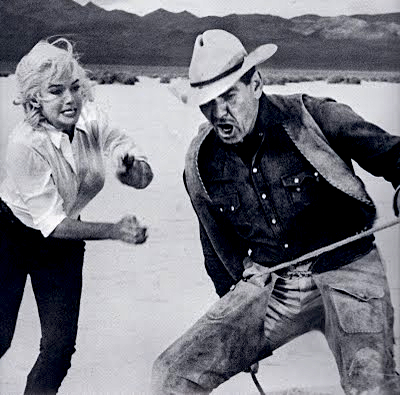
Miller came up with the story, which originally appeared in Esquire Magazine, after an extended stay in Nevada to establish residence in Reno for his divorce from his first wife. Besides the dissolution of his marriage and the bloom of new romance with Monroe, his plays were being dismissed and he was reeling from the House Un-American Activities Committee hearings in Washington, where he’d been called as a witness and refused to name names in the Communist witch hunt proceedings.
It was in Reno where Miller was introduced to similarly displaced persons as himself. Not surprisingly, the three major male figures in the film are cowboys who, as Bruce Crawford puts it, resist “modern civilization encroaching on them and their free-spirited way of life.” Gay (Gable) is an aging, spent, but still gallant horse wrangler, Purse (Clift) a sweet-natured rodeo rider and Guido (Wallach) a cynical war veteran turned bush pilot. The men prefer living a hand-to-mouth existence rather than “work for wages.”
Perhaps projecting himself into the characters, Miller has each stubbornly hold fast to some ideal of freedom and vision of happiness amid this harsh new era reining them in. When Monroe’s nurturing character, Roslyn, comes onto the scene she forms them into a loose family of misfits, each of whom is running away from something or towards something. Perhaps, as Gay says, they’re all trying “to find a way to be alive.” In Roslyn, who awakens promise and desire in the men but ultimately chooses the older Gay, Miller seemed to be imagining a hoped-for reconciliation with Monroe.
Unusual for Huston, The Misfits revolves around a female figure. With the exception of Katharine Hepburn’s turn in The African Queen, no actress so dominates one of his pictures as Monroe does in the part of Roslyn, the human equivalent of the wild mustangs the men try corralling. When, near the end, she expresses disgust at the idea the horses will be sold to the dog food factory, she makes the men question themselves and their methods. In using trucks and a plane to round up the animals for such an inglorious end, the men realize they’ve corrupted the very thing they love.
For Crawford, the denouement is “the end of an era…the end of the West as we once knew it. It’s the last roundup. The cowboys are left knowing they’re going to have to find another way of feeling alive and validating their lives.”
Anyone who knows Huston’s work can see the story echoes the recurrent theme of his pictures — a group of people banded together in search of some prize or goal that proves elusive amid the human conflicts and dramatic fates that arise. And, like much of Miller’s work, the story examines the uneasy gulf between ideals and reality, the challenge of remaining an individual in a corporate era of crushing anonymity and the need for and difficulty of maintaining human-family relationships in a world where people act, by nature, at cross-purposes to each other.
Fateful quests are not only intrinsic to Huston’s work, they operate on more than one level, said Michael Krainak, a professor of film history and appreciation at Metropolitan Community College and the man who headed-up Joslyn’s film series in the 1980s.
“Besides a material quest there’s a spiritual quest. His characters search for meaning in their lives. In many cases not all the characters are aware that is happening. So often, characters like Bogart at the end of Sierra Madre never even benefit from it. They’re oblivious to the changes taking place and to the lessons being learned. Huston equated that to the tenets of the existential philosophers. His films tend to end in material failure because for him the ends are irrelevant.
“What gives the quest meaning is the process itself, and you take something from that or you don’t. The ones who don’t often die physically or spiritually and the ones who do are able to carry on. It’s like Syndey Greenstreet’s great reaction to Peter Lorre when they discover the falcon is immaterial in The Maltese Falcon — ‘Well, what are you going to do?’”

Consistent with Miller’s ideology, The Misfits is replete with references to the impermanence of things.
“Gay speaks a line that’s very Milleresque,” Krainak said. “He says, ‘Well, nothing’s it,’ meaning nothing lasts forever. And Miller seems to be saying, Well, if that’s true, then that’s a guarantee of change. A theme of Miller’s has always been this idea of rebirth and reinventing yourself. The humanistic ideas in Miller’s work that are also evident in Huston’s work is this final goal of self-acceptance. To survive the wreckage of your life by seeking shelter in relationships and, more than anything else, by carving out your own meaning in life. The successful characters in Huston’s movies seem to confront the element of choice, You either choose to live an authentic life or an anonymous life. In this movie, becoming anonymous is to ‘work for wages.’”
In The Misfits Gay finally concedes the passing of his ways, but goes out on his own terms (or sword). He utters a line summing up his defiance and regeneration: “A man who’s afraid to die, is afraid to live.”
At the end, he and Roslyn drive off at night in search of a new path. They look out to see the mare and her colts running free, and they smile. She asks, “How do we get home?” He looks up at the night sky and says, “We’ll follow that star and get there.” As Krainak said, “What they’re left with is the quest — to get back on the trail. Instead of the the sunset, they ride off into the evening star. It’s a very Hustonian ending in that there’s promise for redemption or rediscovery or self-knowledge, but no guarantee.” In Crawford’s mind, “That has to be one of the most beautiful, haunting endings in film history.”
Krainak, a Huston buff, said that for years a running argument among cineastes has centered around the question of whether The Misfits is more a Huston film or a Miller film.
“It’s clearly both, but ultimately I think it’s Huston’s film,” he said. “In typical Huston fashion there’s this physical, larger-than-life task that a bunch of ne’er-do-wells on the edge of society attempt and fate somehow intervenes. In The Misfits it’s not so much tempting fate, as in Greek tragedy, but more of an Anglo-Saxon fatalistic attitude that says, If there’s a worst thing that can possibly happen, it will happen. The Anglo-Saxons had a wonderful word for it — weird. It’s indeterminate. It’s a more modern existential attitude toward fate. The character Guido even says something like, ‘I didn’t know that could happen.’ I think that’s so much what The Misfits is about.”
According to Krainak, the Miller-Huston pairing was more than a philosophical fit, but an artistic one. “One thing Miller’s got in common with Huston is a minimalist approach,” he said. “With Huston it was always a minimalist shooting script, shooting style, choice of film language, use of camera and editing. With Miller it was simple sets, lighting and everything focused on characters. Huston had to work very hard to create a visual dynamic when working so close with the figures of these characters in a setting and landscape that is so specific and very important.”
From his extensive reading about The Misfits, Krainak found Huston, with Miller’s blessing, eschewed color cinematography in order to bring out certain dramatic-symbolic points. “Huston definitely wanted stark black and whites in the background and the setting, with the characters, at least as I interpret it, as the shades of gray. That’s how it plays out in the imagery. It’s really a beautiful black and white film.” The atmospheric photography is by Russell Metty and the neoclassical jazz score is by Alex North.” Krainak added that, unlike most films, The Misfits was shot chronologically in order to capture a sense of “immediacy and spontaneity,” vital qualities in a story about impulsive free spirits.
Krainak said the film came at “a very self-indulgent” point in Huston’s career when, in addition to working with Miller, he was collaborating with such artists as Truman Capote (Beat the Devil), Ray Bradbury (Moby Dick), Jean Paul Sartre (Freud) and Tennessee Williams (The Night of the Iguana). “It was a very psychologically-charged period where he was exploring interior adventures or the landscape of the mind as opposed to exterior adventures or the landscape of nature.”
Why The Misfits was, until recently, dismissed as an interesting failure rather than a singular achievement can be explained by its “dense, cerebral, ‘European’ feel and by its star-crossed history, said Krainak, who puts an intriguing spin on the theory by suggesting “a killing off of a Hollywood era” took place with the deaths of Monroe, Gable and Clift and with the way Huston and Miller “underplayed these icons.”
He explained, “These were aging, wounded icons. Monroe was so vulnerable. Gable completely falls apart in a scene that everybody refers to. Clift takes a bad fall and wears bandages the rest of the film. Their audiences were not used to seeing them that way. What Huston and Miller did with these stars was a precursor of the American cinema renaissance of the late 1960s. The drama, thanks to Miller’s screenplay, and the imagery, thanks to Huston’s direction, made it a film dominated by character as opposed to pure action or star persona.”
Related Articles


Image via Wikipedia
A Writer’s Lament, A Call to Action, or, So You Want to be a Writer, Huh? The Cold Hard Facts and Dismal Prospects for Getting Paid What You’re Worth
These are the best of times and the worst of times to be a writer…
I am going off script with this post to do what many bloggers do, which is to open up with some of deeply held feelings and thoughts, in this case pertaining to my life as a freelance journalist. It is one measure of these unstable, pernicious times that despite being a veteran, award-winning journalist of some 25 years, with literally thousands of published stories to my credit, I am finding it increasingly difficult to ply my trade and still make a living at it.
The problem is not that there is a shortage of work available. Indeed, there are more writing opportunities than ever. Ah, but not every writing gig is worth the trouble or the toil. I write for many reasons, including the satisfaction it gives me, but at the end of the day it is how I make my living. And, increasingly, some of the publishers and editors I have been working with have been slashing the already below market rates they pay contributing writers. Writing for newspapers and magazines has been my stock and trade, but much to my consternation some of these publications are reducing rates to such an extent that I cannot justify the time and energy of doing assignments for them at slave labor wages.
In two instances, I was abruptly informed that the agreed-upon rate I had been receiving would be cut by half or more due to budget constraints. In another instance, a publication I had been counting on as a major client in 2011 simply decided they could no longer afford my services, end of story. At least two other clients pulled the same shit.
In each case I contributed much value to the publication in question, and its editors/publishers consistently expressed great satisfaction with my work, but when push came to shove they showed no loyalty or gratitude and simply pulled the rug out from under me with little or no warning.
The issue is far bigger and more pervasive than a few publications treating writers poorly. By and large, the print and online world grossly underpays contributing writers, offering far less than fair market value and no where near the professional service fees writers deserve. Sure, there is no end of print and online writing opportunities, but the vast majority of them pay next to nothing, which is a slap in the face to all professional writers, particularly to those, like me, who have been at this for some time and have established ourselves in the field.
Writing may be the only professional service field where compensation has not only stagnated but retrenched. No matter how you look at it, writers have lost whatever tenuous ground they held. For example, when I began freelancing 23-plus years ago in Omaha I was making about the same amount per article, perhaps a bit less, then what most publications here are paying today. The crazy thing is that in a few instances I was making far more then than I do now for like projects. This illogical, inconsistent payment structure has everything to do with the fact that there are no standards in place for writing compensation in this arena. Writers are, outside a few special circumstances, not organized, not unionized, and not agitating for their rights with one unified voice. Every freelancer is a lone wolf out for his or her own best interests and free to negotiate whatever he or she can, although in the publications market, negotiation is rarely even possible. Most newspapers and magazines operate from a set pay structure that the writer either accepts or declines. If you decline, you are out of an assignment and likely blacklisted from being considered for hire by that newspaper or magazine.
Outside of publications, such as writing for corporations and institutions, writers can largely set their own prices or at the very least have great latitude in negotiating terms with clients. This is the lucrative realm of freelance writing where the real money is, but those gigs are hard to come by. I’ve had my share and I hope to have more, because in that world clients are used to paying writers professional service fees akin to what they would pay any other service professionals, whether lawyers or advertising agencies or consulants.
Unfortunately, as writers we are often our own worst enemies. That’s because every time a writer accepts less than fair market value, he or she is hurting not just himself or herself but all fellow writers. With so many new writers popping up everywhere, there are far too many who are willing to work for nothing or next to nothing just to get their name and content out there, and unfortunately there are far too many editors and publishers willing to accept substandard work.
It is not that I am looking for special treatment, but when I have put in the time and the effort to deliver the goods, to elevate my craft, to do my due diligence, then I should be justly rewarded. But there are many factors at work here that work against this writer and others like me. Start with the fact that there is a glut of writers today competing for the same shrinking editorial space in print and for the Wild Web writing opportunities that the Internet offers. So many people call themselves writers these days that sometimes it seems that the old joke about every other person in L.A. trying to pitch a screenplay has now become a generalized reality, only in this new age of YouTube, e-books, social media, and blogging there are more and more avenues of writing within people’s grasp and more and more are taking advantage of them.
The new Web media landscape is creating an ever increasing demand for content. Thus, the blogger, the citizen or backpack journalist, along with more traditional journalists, authors, poets, playwrights, and just plain folks, are writing like crazy. There are so many writers out there, whether professionals or amateurs or wannabes, that the truth of the matter is I am eminently expendable in the eyes of editors or publishers, who damn well know that if I balk at accepting a fee as too low they can readily replace me with any number of writers willing to work for a pittance. It leaves me with little or no leverage. The usury rates most publications pay are no where near being commensurate with the amount of time I devote to a project. Doing the math, I end up getting minimum wage or worse for most publication assignments when I factor in the number of hours I put in corresponding, researching, writing, editing, rewriting.
The real problem is that far too few publications reward excellence and long-standing contributions of merit.
I do not expect this situation will ever change unless writers do somehow band together. I cannot realistically see that happening. I for one am increasingly standing my ground and refusing to be taken advantage of, even if it means losing clients. It’s my way of sending a message that I will not be trampled upon. It’s a message not likely to reverberate very far, but at least I can sleep better at night knowing I didn’t devalue myself or my work.

Image by vaXzine via Flickr
I saw in the paper one weekend that someone I profiled a couple years ago passed away. Sam Cooper was a Douglas County Court judge in Nebraska. I believe my late mother, Gemma Pietramale, was a classmate of his at now defunct Mason Elementary School in Omaha. He was Jewish, my mom Italian, and the school a veritable melting pot of European ethnicities. A diminutive man in terms of height, his stature in local judiciary circles ranked high, as much for his fair, gentle manner as for his legal acumen. When I met with he and his wife it was clear to see he was on the fragile side physically, but his mind and spirit were sharp, and his abiding love for America and its freedom was evident in the way he spoke almost reverently about the opportunities this nation provide his immigrant family. My story on Cooper originally appeared in the Jewish Press, and I offer it here as a remembrance of this kind little man with a big heart.
Sam Cooper’s freedom road
©by Leo Adam Biga
Originally published in the Jewish Press
Retired Douglas County Court Judge Samuel V. Cooper’s immigrant parents always told him anything is possible in America. They were living proof. Sam, too. Like them, he came from “the old country,” and like they did he’s taken what America’s offered and made the most of it.
His success as a lawyer, as a Democratic Party operative and as a judge fulfilled the family’s dream of becoming productive American citizens. His life became the embodiment of the Great American Ideal he once wrote a prize-winning essay about. None of it would have happened without his family having the courage of their convictions and leaving totalitarian Europe for freedom in the United States.
He said his father, Martin Cooper, made his way here after escaping the turmoil of war-torn Europe. Martin (Mayer) was a Russian Army conscript in World War I and was taken prisoner by the Austrian-Hungarian Army. Once released, he yearned to follow his brother Harry to America. Harry ended up in Omaha, where he built his own successful construction company. His Cooper Construction Co. built the old Beth Israel and Beth El Synagogue buildings.
But before Martin made the leap he first settled in Chelm, Poland. That fateful move led to him meeting his future wife, Ida (Chaya), who operated a candy store. The couple married and began a family. Their two oldest children, Jack and Sam, were born in Chelm.
Memories of Chelm are still with Cooper. How, for instance, his family lived in an apartment complex with a central courtyard that contained a common well from which residents drew water.
Cooper said his father could no longer ignore the itch to find something better and, so, in 1924 he embarked on a new start for the family by going on ahead of them to America. In classic immigrant tradition he planned to establish himself in some trade and then send for his wife and kids to join him. No one could have imagined how long it would take for the family to be reunited.
Martin worked for a time with his brother in the construction company but found his niche in the grocery business, said Cooper. One of the stores Cooper’s father worked for was Tuchman Brothers. With $500 his father saved, Cooper said, the enterprising man opened his own grocery store at 21st and St. Mary’s Avenue. By 1929, nearly six years after leaving his family in Poland, Cooper’s father finally saved enough to buy passage for his wife and two sons.
The image of saying goodbye to friends and schoolmates at the seder he attended is still fresh in Cooper’s mind. He recalls sailing on the S.S. Leviathan, in steerage, and arriving in New York. After a few days there a train took him, Jack and their mother to Omaha. He recalls nobody was at Union Station to meet them. A taxi took them to the address Martin had sent. The reunited family was the subject of stories and photos in the Omaha World-Herald and the Omaha Bee News.
If they had stayed in Poland just a few more years they might well have become victims of the Holocaust. Family that remained behind were never heard from again.
Sam was 8 when he arrived in Omaha. He and his family lived in back of the store.
His parents had little formal education, he said, but were quite literate and well-informed. He said his “very well read” father “read The Forward religiously. The radio, of course, had news about world events and he was very up on that.” As his father “felt his foreignness,” he said his dad took pains to improve his English and thereby better assimilate. Growing up, Cooper worked in his father’s store.
He said his mother was “a simple woman” who had small aspirations for him — desiring only that he find some stable work, perhaps a store of his own. She spoke of nothing high falutin, such as the law. Besides, where would the money come from to study a profession in college?
Cooper was a good student at Mason Grade School, where he received special help with his English language skills. He got so proficient so fast he became editor of a mimeographed school newspaper. The oratory abilities that would help make him a lawyer and, later, a judge, found him serving as MC during the dedication for a school addition. But it was at Central High School where he really shined. Active in speech and debate, his coach encouraged Cooper to enter a national essay contest conducted by the Ladies Auxiliary of the Veterans of Foreign Wars.
His entry, entitled “The Benefits of Democracy,” swept local, regional and national honors, earning Cooper a $1,000 grand prize that he used to pay his way through Omaha University. He wrote the essay at a pivotal, anxious time in world history. It was 1940. Nazi Germany was on the march. Great Britain was under siege. The entire world would soon be at war. Most agonizingly for Cooper, Jews were being persecuted back in the country of his birth.
In a fervid paean to his adopted homeland, the young patriot expressed his love for America and its democratic ideals, contrasting the freedom he and his family enjoyed here with the tyranny they would have otherwise faced abroad.
“Democracy to me is not something abstract and far off. It is with me at home, on the street, at school…It is like the very air I breathe. We do not have to sit on a special bench, nor wear a certain type of clothing…None of us need fear that somebody will report us to a storm trooper. We can read any book, newspaper or magazine that is published and they are not censored. We can go to sleep at night and be assured that we will not be awakened and be dumped across a border. We can awake in the morning and hear footsteps and know it is the milkman, not the gestapo.”
Clearly, for Cooper, the unfolding tragedy in Europe was not an abstract or remote problem. Although his parents were not political, he said they, too, followed what happened. He said his father “did get involved with some of the newly arrived people. They met like on Saturdays and discussed things — the news especially. He also helped a lot of refugees after the Holocaust to get settled.”
Economics intrigued Cooper while at Omaha U. but the practical side of him ruled the field out when, he said, he discovered “you can’t make a living at it.” His studies were soon disrupted by the war. Drafted in the Army in 1943 he ended up in the Quartermaster Corps, serving in England and Belgium. After Germany’s defeat in early 1945 he and fellow servicemen were on a ship that sailed through the Panama Canal to the Philippines. They were en route to the South Pacific to supply troops for the planned invasion of Japan. When the atomic bombs were detonated over Hiroshima and Nagasaki, the world’s bloodiest war finally came to an end. A few months later Cooper headed home.
Inspired by a friend from his youth who became a lawyer Cooper used the GI Bill of Rights to study law at Creighton University, where he completed an accelerated program that saw him get his degree in two years. This Jew delighted in the Jesuit rigor he found at Creighton.
“I enjoyed the intellectual atmosphere. Most of the professors would stir up something in your mind.”
To this day he feels indebted to the framers of the GI Bill for giving him the opportunity to complete his higher education and enter a profession that became his career. He takes offense to any suggestion that, for example, the Social Security Act was the greatest legislation ever passed. “The GI Bill is a little bit above that,” he’ll tell you.
Upon passing the bar Cooper first practiced law with Joe Friedenberg. As the courts’ Referee in Bankruptcy Friedenberg appointed the young attorney Trustee, which meant Cooper dealt with creditors and collected assets from those filing bankruptcy, netting him $5 for each case he cleared. He applied his fee toward his office rental. Later, attorney Loyal Kaplan tabbed Cooper to join him in a practice dealing with interstate and intrastate commerce applications for truckers’ routes.
Cooper next joined Jack Mayer for “a whopping sum of $50 a month and office space.” He certainly wasn’t getting rich in law. Indeed, he was barely getting by. Things were tight, especially after he married the former Judith Steinhorn of Dallas, Texas and the couple started a family. Things weren’t much more lucrative after he, Norm Denenberg and Ed Mullery formed their own law firm.
Samuel Cooper
“I think we took any type of law business we could get, including divorces, filings for bankruptcy, drunk driving cases,” Cooper said.
He first entered politics in the mid-1950s. His abiding love for the democratic process and current events led him into that rarefied sphere.
“I got interested in politics,” is how he simply puts it.
Helping spur his interest were his struggles making ends meet as a lawyer. “I had time on my hands,” he said. “The law practice wasn’t going that great…” The opportunity was there to give back to America and he chose to take it.
“In the early years I ran for the original City Charter Convention that we’re operating under now in Omaha,” he said. “There must have been about 75 candidates running for 15 positions. The idea was to write up a modern charter. We met several times. We hired an expert that had done it in other places.
“One of the features, by the way, we placed in the charter was a provision requiring the mayor to appoint a review committee at least once every 10 years to assess if any alterations were needed in the charter. And I got appointed to two subsequent Omaha Charter Study Conventions.”
The first time around, in the ‘50s, he said, “I guess I was one of the younger members of the convention.” By his second time around, in the mid-’60s, he was a veteran politico who’d done his share of canvassing and campaigning.
“I worked for the Democratic Party on behalf of Adlai Stevenson, who was sort of a hero of mine. He sounded so well in his oratory.”
Cooper beat the bushes on voter registration drives and getting people out to vote for the Democratic ticket. Twice Stevenson opposed Dwight Eisenhower in the presidential general election and twice he lost. The egg head couldn’t defeat the war hero. Cooper said the dichotomy of the candidates then reminds him of the current presidential race that pits an intellectual dove in Democrat Barack Obama against a war hero hawk in Republican John McCain.
Election nights particularly appealed to Cooper. Whether his candidate won or lost, it was the culmination of the democratic process in action. Besides, he said, he enjoyed the party atmosphere on those electric nights full of anticipation and excitement. The hopes and efforts of weeks of work came to a head.
Omaha lawyer and political boss Bernie Boyle introduced Cooper to then-Nebraska Governor Ralph Brooks, who was responsible for Cooper becoming further entrenched in the political apparatus when he appointed the up-and-comer Douglas County Election Commissioner. “That was a fun job,” Cooper said. Again, he most fondly recalls the election night buzz that prevailed as ballot boxes came in and the results tallied. His wife made things homey by bringing in pans of baked chicken and all the fixings to tide Sam and his staff over as they worked into the wee hours.
Asked what he thinks of the ballot irregularities that have surfaced in recent U.S. general elections. he said, “We didn’t have any of those problems” under his watch at city hall. The controversy attending the disputed Florida results did not happen when Cooper presided over a recount here. When illness forced incumbent John Rosenblatt to retire in ‘61, the mayoral race came down to a dead heat between Jim Green and James Dworak. Green lost by a slim margin — a few hundred votes, Cooper recalled. The law required a recount. Cooper oversaw the process and he said the result “came pretty close to that same number.” End of story.
Cooper’s calm, cool demeanor and professionalism in that potentially volatile situation would become his trademark.
In 1964 Cooper once again took a leadership position within his party by serving as Douglas County Democratic Party Chairman, an experience he termed “great.” He said that year’s state convention “was one of the finest conventions we’ve seen here.” President John F. Kennedy had been assassinated the year before and as a memorial Cooper had printed “a sort of farewell” salute with photos and sayings of the slain leader of the free world.
By the fall of ‘68 the nation was reeling from the assassinations of three more leaders who inspired hope — Malcolm X, Martin Luther King Jr. and Robert Kennedy. Civil unrest plagued many big cities. Anti-war protests mounted. Amid this incendiary backdrop the rancorous Democratic National Convention unfolded in Chicago, where youth demonstrators were brutally dispersed by city boss Mayor Richard Daley’s thug police force outside the convention hall.
Cooper was there as an alternate delegate — not in the melee on the streets but inside the contentious, smoke-filled convention that finally nominated Hubert Humphrey. Chicago wasn’t his first national convention but it was his most memorable. While he didn’t witness any overt violence with his own eyes he said the wire mesh covering the windows of the bus that transported him and fellow delegates from the hotel to the hall was a stark symbol of the discord.
“We didn’t see much of the demonstrations going on,” he said. “We heard about it. Speakers talked about it.”
Reform legislation in the Nebraska Unicameral aimed at modernizing the county court system resulted in Cooper throwing his hat in the ring with other lawyers vying for a spot on the bench. Cooper won election in ’72 and later was retained. He said James Moylan was “very helpful in my election.”
Wearing the judge’s robe seemed a good fit for Cooper.
“When the opportunity came along,” he said, “it looked like steady money coming in and I thought I’d like the position. People said I had the temperament for it, and I think I did. I’d listen to both sides fairly and try to do the right thing in the case.
Did he enjoy the position as much as he thought he might? “Yes, very much so,” he said, adding he liked “the contact with lawyers and the contact with cases themselves.”
The country court’s “high volume” docket kept things humming. “I mean, we didn’t shy away from cases,” he said. “We had multiple jurisdictions. We had to get things done, which we did. We all kept busy. We had to be there at a certain time to start the court and to process the cases. On the other hand, we usually got through by 4:30 or something like that.”
He liked the variety of cases he presided over — from criminal to civil to probate matters. Another judgeship, perhaps in a higher court, never interested him. After 32 years on the bench he retired in 2005.
If his years on the bench taught him anything, he said, it’s that “it’s far more important to be fair than to be tough. It’s important not to lose patience, to listen and to give everybody a fair hearing.”
He still keeps his hand in the law by volunteering as a mediator with the Douglas County Prosecutor’s Office. In a non-binding atmosphere he meets with parties embroiled in legal disputes to discuss their case, putting his skills for communication and deliberation to work, sometimes getting the two sides to settle out of court or to drop the matter all together.
One of his four children, son Justin Cooper, followed him into the profession. “It’s nice to have another lawyer in the family,” the proud papa said.
Some time ago Sam Cooper wrote down reflections about his life. The gratitude he expressed in middle-age is of a man who’s never grown cynical or bitter about the state of the nation that he loves:
“In looking back over those years I consider myself a very lucky person. Lucky to have missed the Holocaust in Poland. Lucky to have come to America, a country of great opportunity, a country that has been very good to me. Lucky to have missed being injured or killed in my Army years. Lucky to have been educated as a lawyer under the GI Bill…Lucky to have become a judge, to have a loving wife, a happy marriage and four children who have grown into exceptional and successful adults and parents, and 11 grandchildren of whom I’m very proud to be my offspring.”
The man he’s become is very much what he imagined as a boy, when he wrote these words as a salute to the democratic ideals that offered him the opportunity to be whatever he wanted to be:
“Democracy is much more than the declaration of independence, the constitution and our laws…It is beyond paper and ink. There is something about the American people that continually seeks freedom. Perhaps it is our heritage and principles. Perhaps it is the ideals that have so long been embedded in our hearts. Perhaps it is the realization that men can live together in peace and happiness. Whatever it is I am glad I might take part in these benefits…I hope I can find my place in this American democracy.”
Sam Cooper found his place all right — as a dedicated public servant and defender of liberty and justice for all. At age 86 he lives the promise of America every day.

Image via Wikipedia
I meant to post the following article immediately after hearing that Hollywood icon Patricia Neal had passed. Better later than never. I had the pleasure of interviewing her a couple times, once by phone and another time in person, and in each instance I felt I was dealing with a member of Hollywood royalty, although she never lorded her status over me. Quite the opposite. She was delightfully informal and humble. My interviews with her, along with seeing her make some public appearances, all happened as a result of several visits she made to Omaha, where I live. The first of these occurred in conjunction with a screening here of The Day the Earth Stood Still. My article below resulted from a phone interview I did with her and the piece appeared in advance of the event. She was the guest of honor at the screening and that was the occasion when I first saw her in person. A few years I later got to meet her when she made two or three appearances at the Great Plains Theatre Conference here. During one of these conference appearances she made her As I Am presentation at the Joslyn Art Museum and afterwards my girlfriend and I were lucky enough to meet her backstage, where I conducted a short interview with her. She was as charming and radiant up close as she was on the phone or on the stage. I was making arrangements with her good friend and fellow actor Joel Vig for me to accompany her to a local bingo parlor – she loved playing bingo – and do a piece about her passion for the game. It never worked out, as her increasingly frail health made travel more difficult.
Her life was filled with great triumphs and tragedies, and I feel privileged to have had my small brushes with her larger than life presence.
Unforgettable Patricia Neal
©by Leo Adam Biga
Originally published in the New Horizons
There is an elusive, indefinable yet unmistakable quality separating certain motion picture actors from the pack and, in a bit of celluloid alchemy, transforming them from mere players into bona fide stars. Whatever It is, then Academy Award-winning actress Patricia Neal has got it. In spades.
With her dreamy eyes, dark hair, fair complexion, musky voice, keen wit and earthy Southern charm she’s cast an indelible presence on the big screen since her 1947 debut. Always at her best playing unadorned, independent women, she still retains an element of mystery about her. She was Alma, the sensuous but no-nonsense housekeeper spurning heartbreaker Paul Newman’s advances in “Hud,” a role which won her the 1963 Oscar for Best Actress. She was Maggie, the tough yet tender nurse romanced by John Wayne in “In Harm’s Way.” And she was the beleaguered but unbowed wife and mother in “The Subject was Roses.”
The spunk this native Kentuckian has displayed as a performer is no act. Her spirited determination in recovering from massive strokes suffered in the mid-1960s has made her a role model for stroke victims and an outspoken champion of physical rehabilitation efforts. Her fight back from the debilitating strokes, which left her partially paralyzed and unable to speak, has been documented in her 1988 autobiography “As I Am” and in a 1981 TV film, “The Patricia Neal Story.” In 1978, her example of courage led Fort Sanders Regional Medical Center in Knoxville, TN, where she grew up, to dedicate the Patricia Neal Rehabilitation Center.

It isn’t often a genuine Hollywood legend passes through these parts, so you can imagine the buzz building in anticipation of Neal’s scheduled appearance this month at the Indian Hills Theater in Omaha. The actress is coming from her home in New York City for a special revival showing here of one of her earliest and best pictures, “The Day the Earth Stood Still” (1951), which she co-starred in with the late Michael Rennie and Hugh Marlowe.
The one-night-only presentation, on Saturday, October 9 at 7:30 p.m., is the latest classic cinema showcase of Omaha film impresario Bruce Crawford. In addition to Neal, actor and former child star Billy Gray, who played her son in the film, will be on hand, along with a replica of the film’s famous robot, Gort.
The sold-out event is a fund raiser for Children’s Square USA.
Although largely absent from the screen the past two decades, the 73-year-old Neal, also a noted stage and television actress with a Tony Award and many Emmy nominations to her credit, recently made a triumphant return to the movies with her critically-acclaimed performance as the eccentric, pipe-smoking title character in the Robert Altman feature “Cookie’s Fortune.” There’s even talk Neal may get an Oscar nomination.
She’s come a long way from Packard, KY, the now defunct coal mining camp she was born in in 1926. Her father worked as traffic manager for the local coal company. After moving with her family to Knoxville, she showed an early interest in acting, reciting monologues at church meetings and social gatherings. As a Christmas present her parents enrolled her in acting lessons when she was only seven. After her high school graduation she attended Northwestern University and its prestigious speech and drama department. Two years later she joined her drama coach for summer theater in Eagles Mere, Pa. and then followed her fancy to New York, where like so many aspiring actresses she supported herself with modeling jobs while studying her craft (as an early member of the Actor’s Studio) and auditioning for parts on Broadway. The theater was her first love.
“I wanted to be a STAGE actress,” she emphasized in her throaty voice during a recent phone conversation.
After debuting on Broadway in 1946 she made her mark the next year when she reprised the role of Regina originated by Tallulah Bankhead in Lillian Hellman’s “Another Part of the Forest.” Her performance wowed critics and audiences alike, earning her the coveted Tony and Drama Critics’ Awards. Soon, Hollywood came courting and she signed with Warner Brothers Studio and headed West.
“Well, I was thrilled to go,” she explained. “The play I was in closed and everybody wanted me in Hollywood and so I thought, ‘Why not?’ So I went under contract with Warner Bros. and I was with them three or four years until we parted and then I did some pictures for Metro Goldwyn Mayer, some for 20th Century Fox and some for Universal.”
Her early years in Tinsel Town were frustrating ones. She found it difficult adjusting to the new medium. And it seemed studio moguls were unsure what to make of this lovely new starlet. Neither a glamour queen nor a femme fatale, she was instead a smart down-to-earth woman whose grit let her hold her own with any man on screen, yet whose aura of deep lament lent her an appealing vulnerability. A character actress at heart, she simply didn’t fit the leading lady mold of the day and found herself assigned to a string of weak parts in mediocre pictures.
She ultimately did cause a stir those early years, but not for her acting. When the single Neal’s romantic involvement with married American screen icon Gary Cooper was made public, a scandal ensued. Cooper and Neal had starred together in “The Fountainhead” and “Bright Leaf” and while news of the affair left his stardom untarnished it unquestionably hurt her fledgling career.
Still reeling from her failed tryst, she started work on “The Day the Earth Stood Still.” Understandably, she held small hope for the project, which appeared another in a long line of forgettable films. After all, it was “just” a science fiction story, which in that era usually meant a low budget, low brow B-picture aimed at the Saturday matinee crowd.
One plus, however, was its director, Robert Wise, whom she’d worked with previously and admired. Even though Wise was then a still up-and-coming filmmaker, his reputation for quality and professionalism preceded him.
Referring to Wise, she said, “He was very good. A fine director. I had done “Three Secrets’ with him and obviously he liked me because he wanted me for his next one.” Still, she said, she found it hard to take “The Day the Earth Stood Still” seriously. “Oh, I thought it was hysterical when I did it. I didn’t buy all that outer space stuff. I could hardly keep a straight face, but boy it turned out to be a good one didn’t it? Oh, I love that movie.”
Her jaundiced reaction then is understandable given the plot. Capitalizing on the UFO scare at the time, the film opens with a flying saucer landing near the Washington monument. Emerging from the craft is an alien emissary, Klaatu (Rennie), and his robot protector-enforcer, Gort. Klaatu announces an ultimatum: If humans cannot mend their violent ways, Planet Earth will be destroyed. Klaatu is shot and imprisoned and, after escaping, hunted. The strange visitor is finally befriended by Neal’s character, an earnest single mother, and her son. Now regarded as a classic, “Day” is a message picture in the guise of sci-fi. It is both an ageless plea for peace and tolerance and a time-capsule glimpse at the paranoia and tension existing under the placid surface of post-war prosperity.

While all quite silly to Neal, it was business as usual for Billy Gray, then 13 and far too young to appreciate the film’s campy elements or its serious intentions.
“It was more business-like than a romp in the park,” he said by phone from his home in Tapango, Ca. “I didn’t realize how brave it’s subject matter was. I didn’t have any understanding of its message. I’ve had a chance to see the film a few times over the last two decades and it’s amazing how well it holds up as a piece of movie making. You buy into it even though it’s a bit stylized. You accept the concept and just go along for the ride.”
After the film Gray went on to his best-remembered role, as Bud, in TV’s popular “Father Knows Best” series. He still acts occasionally on TV and in theater.
Following the film Patricia Neal appeared in a few more pictures before returning to the stage. She met and married author Roald Dahl, now deceased, and started a family with him. The couple eventually raised five children in his native Great Britain. In 1957 she was lured back to Hollywood by the opportunity to appear in “A Face in the Crowd,” a brilliantly-written and acted film under the direction of Elia Kazan, who directed her on stage in “Cat on a Hot Tin Roof.” Despite glowing notices, the film did little for Neal’s career, so she resumed stage work and raised her children.
As the decade of the ‘60s dawned, Neal and her family endured a series of tragedies that ironically coincided with her greatest success as a movie actress. First, her infant son Theo suffered severe injuries when hit by a taxi in his pram. Next, her daughter Olivia contracted measles encephalitis and died at age seven.
“Sad things have happened in our family,” she said.
Then, in 1962, along came “Hud,” and the Oscar. In 1965 she was fresh off co-starring in Otto Preminger’s “In Harm’s Way” when she started work on legendary director John Ford’s last film “Seven Women.” It was while in production on the Ford film that Neal, then three months pregnant, suffered the strokes that altered her life.
Neal credits Dahl with devising an innovative rehabilitation program enlisting the intensive aid of family and friends. Little by little her recovery progressed.
“Roald didn’t like the idea the doctors were going to send a person once a week for 15 minutes, so he had all my friends come in and teach me, and that was so good. They played bridge and croquet with me. It really worked perfectly. Roald did a lot, you know.”
Years later, she and Dahl divorced.
Miraculously, the child Neal was pregnant with at the time of her strokes was born a healthy girl, named Lucy. It turns out Lucy is her lucky charm.
Neal, who made her a heroic film comeback in “The Subject was Roses,” had not done a feature since 1989 when Lucy, now a screenwriter, ran into director Robert Altman at last year’s Cannes Film Festival and discovered he was still looking for someone to fill the title role of Cookie in his new film. Lucy suggested her mom. Altman liked the idea. Later, Lucy arranged for the two to meet at a part she threw at her Hollywood home. Altman hired Neal on the spot.

As Cookie, Neal plays a colorful older woman who talks a blue streak, just the kind of part she likes sinking her teeth into. “Oh, I loved it. I’m a character actress. I’m meant to be 85 in it, but I ain’t that old, so I’m really made up. I have a wig on. It’s fantastic.”
Asked to explain her method of creating characters, she answers: “I sort of have an actor’s feeling for things. That’s all I can tell you. I just do my best.” When it’s suggested she purposely shunned fame, she surprisingly replies, “Oh, I’d like to be a star. I’d like to be a bigger star than I am. But I’ve done all right.”
Finally, asked to venture why so few roles have come her way recently, she quips, “Oh, I don’t know, but I’m getting, shall we say, not a lot younger.”
When not acting she stays busy traveling as an enthusiastic participant in the Theater Guild’s Theater-At-Sea cruise programs, which have taken her from Alaska to Australia. “I love to travel. Oh, it’s gorgeous.” From Omaha she’ll travel to Atlanta to belatedly celebrate the 100th birthday of her mother, Eura Petrie Neal.
She often visits with fellow stroke victims and is a vocal advocate for rehab efforts addressing the whole person. She’s pleased by the progress made in brain injury therapy. “It’s wondrous what they do now for people with strokes.”
Also a frequent public speaker, Neal talks about her life and recovery in the hope she can provide inspiration to other disabled individuals. Her simple message: “Never give up.”
Readers of my film posts will recognize a familiar refrain when I say that my home state of Nebraska has contributed an unusually large number of influential players to the film industry, especially considering the small population of this Great Plains locale. My blog contains articles about many Nebraskans in Film and more are coming. The following story profiles Omaha native Monty Ross. He’s someone you’ve likely never heard of, yet he has enjoyed a major career alongside one of contemporary cinema’s most successful and outspoken filmmakers, Spike Lee. I’d known about the Ross-Lee association going back to the late 1980s, when I was active in Omaha as an alternative film programmer. I even made a half-hearted attempt then and once again in the ’90s to bring Ross back to his hometown for a program. It never happened. Another decade passed before I finally did contact him, this time for an interview and profile for The Reader (www.thereader.com). I loved telling his story because it’s one that was little known even where he grew up. No one’s brought him back here to honor him, and such recognition is long overdue. Whatever part I can play to make that happen I pledge to do. If and when it does happen I will finally be satisfied that Omaha and Nebraska did right by him. It’s a sore point with me that this city and state do not do nearly enough to embrace its remarkable heritage of Nebraskans in Film, and giving Ross his proper due would be a good start.
Omaha’s Monty Ross talks about making history with Spike Lee
©by Leo Adam Biga
Originally appeared in The Reader (www.thereader.com)
Spike Lee’s cinema joints rocked the American cultural landscape in the 1980s and 1990s. Collaborating with him on these explosions was Omaha native Monty Ross, a co-founder of Lee’s 40 Acres and a Mule Filmworks and a longtime producing partner. After an extended leave of absence to make his own projects, including the well-received 2002 Showtime movie Keep the Faith, Baby, a biopic on Civil Rights champion Adam Clayton Powell, Jr., Ross is back in the 40 Acres fold as Special Projects Director for the New York-based production company.
Ross, who spoke to The Reader by phone from his 40 Acres office, has contributed to the emergence of a modern black cinema with broad appeal. With his help Lee took up where Sidney Poitier left off in legitimizing blacks as bankable film artists. Just as the popularity of Poitier’s films opened doors for generations of African-Americans in Hollywood, so too did the success of Lee’s pics. Where Poitier’s directorial work (A Piece of the Action, Stir Crazy) diffuses race, Lee’s embraces relevant themes ideologically and dramatically aligned to the overtly social-political black consciousness of filmmakers Melvin Van Peebles, Gordon Parks and Charles Burnett. While those directors could not break the glass ceiling imposed by the mainstream industry, Lee’s managed to do so by straddling the independent-studio line, thereby affording his movies the kinds of budgets, casts, prestige and buzz his predecessors’ movies never enjoyed.
And Omaha’s own Monty Ross has been there for it all — as actor, production manager, co-producer, vice president of production, adviser, friend and I-got-your-back-Brother. For the acclaim and controversy over Lee’s brazen films, for Nike spots that made Lee a cult figure, for music videos that tapped the hip-hop scene. He’s been about as close to Lee as anyone on this sky-rocket ride, which after sputtering reignited with the 2006 release of Inside Man. Lee’s new HBO documentary on the human rights failing that attended hurricane Katrina, When the Levees Broke, premieres on the cable network August 29, the one year anniversary of the disaster. It’s sure to stir passions the way Lee’s early work did.
Ross is now and always has been part of the cultural-creative pot Lee’s joints get stirred in.
“The blood and sweat he pumped into that company often goes unnoticed,” film producer Lashan Browning has said of Ross, “but he was the heart of it all.” Lee said as much in a Moviemaker Magazine piece. “He was very important. People may have read about Spike Lee, but it wasn’t just me, it was Monty Ross,” Ernest Dickerson (cinematography), Wynn Thomas (production design), Barry Brown (editing), Ruth Carter (costume design) and “my father” — jazz musician Bill Lee (score). “This is a team we have.”
Until now Ross never shared his story with Omaha media of how he came to be part of this small inner circle. It’s a tight, loyal crew together two decades now. Ross goes all the way back to Lee’s thesis project, the student Academy Award-winning short Joe’s Bed-Stuy Barbershop: We Cut Heads. Ross played the lead.
Wearing specs, Ross resembles Lee. They talk alike, too, sans the Brooklyn accent for Ross. Married to still photographer Carol Ross, with whom he has one child, Austin, Ross knows he’s fortunate to be an intimate and colleague of a film pioneer.
“Here’s this kid from Omaha, Neb. who went to college in Atlanta, hung out, met a friend from New York City, came to New York to do a film with him and the next thing you know he becomes a cultural icon. From my vantage point, getting everything prepared and making sure we dot our Is and cross our Ts, and witnessing the reaction of people, I’ve just been amazed all the way, you know, because it happened to me,” Ross said. “I thank my lucky stars every day because it could have gone so many different directions. It’s humbling and I think anybody who’s full of ego and says the opposite is full of shit to be honest with you.
“You don’t know when you write these things or when you film these things what’s going to happen. A lot of the things that happen we don’t have any control over. Sure, you can have control over the film — what you write and shoot and things like that, but one thing you do not have any control over is the reaction of people. And the reaction that Spike has gotten to his work has been phenomenal.”
He offers his own take on the strong responses Lee’s in-your-face films illicit.
“I always tell people, You don’t have to necessarily like the films and you don’t have to like Spike. People are often commenting about the stories and I say, ‘Well, there’s no perfect film, there’s no perfect filmmaker.’ Spike came along and presented his work in a way that had never been seen before from a black filmmaker. His work had a sense of being independent and commercial at the same time. The thing that matters is the reaction to his work. You can’t buy that.”
Like Lee, Ross is a die-hard hoops fan and he likens the way Lee came on the scene with serious craft and something to say and in the process revolutionized the place of black filmmakers in America to the way innovative players express themselves on the court with their ground breaking moves and skills.
“I played a lot of basketball and, you know, people have been dunking the ball since they put the hoop up but when Dr. J. did it, ‘Ohhhh…did you see that?’ People have been doing behind the back fancy passes for years, but when Magic Johnson did it, ‘Ohhhh…the no look pass!’ It’s just weird about that combination (that makes one a genius and another average) and why that happens.”
In the case of Lee’s ability to express an authentic black experience that speaks universally to people, Ross said, “Hey, it’s one in a million. It’s one in two million. Where does that voice come from?” The question may not have an answer. But it’s clear Lee‘s found a way to articulate the spectrum of black life, from its heights to its depths, and the complexities of black-white relations without alienating a large portion of black or white audiences.
The coalescing of Lee’s vision, informed by the Forty Acres team, intersected with the American Zeitgeist in terms of black identity, black pride, black rage and black power. Ross recalled when he felt the Gestalt take shape.
“I think I became aware of it when I saw She’s Gotta Have It for the first time. What I saw was Spike’s goal and Ernest’s goal and Wynn’s goal. ‘My God,’ I said, ‘We’re doing something a lot different than our predecessors. We’re thinking about it a lot different. So, when I saw that I just thought, We’re onto something. It was just a culmination of having that core of people around you who think like you do and they’re able to take your vision and take Spike’s vision and then make it happen in a way that’s visually stimulating and pleasing to the audience. Just like with a winning basketball team, we all thought along the same lines.”
Recognizing a synergy or convergence of ideas, he said, is an empowering thing.
“I think it’s like finding that diamond for your wife or your girlfriend or whatever. It’s that moment when you say, ‘Oh, wow, this is what I’ve been looking for.’ It’s a connection. That’s the way it was for the audience, too. They were like, ‘Yeah, that’s the way I want to be projected. That’s what I’m talking about.’”

Spike Lee and Monty Ross
Ross doesn’t analyze why it is he and Lee click. They just do. “I’ve always been a type of person who realizes when something works, it works, and you don’t disturb it,” he said. “You just ride it out.” The trick is to find your niche and revel in that rather than worry about props. “Once you start getting into that ego gratification and say, ‘Well, his name’s bigger than mine.’ than you’re going to lose,” he said, “because you know somebody’s always going to do something better. Once you have something that works, stick with it. That’s definitely a credo I live by.”
An Omaha North High graduate, Ross is the son of a social worker mother and hardware store owner father who divorced when he was young. Both his parents have passed. His only sibling, an older sister, no longer lives here. Ross, whose favorite haunts were a pair of North 24th Street landmarks in The Ritz Theatre (long defunct) and the Bryant Center (still there), struggled in the classroom before finding a home in school theater productions.
“I started to really feel good about myself and about being in school,” he said.
Harboring a dream to be an actor and to escape the “limited horizons” Omaha offered young blacks in the ‘70s, he went South to attend historically all-black Morehouse College in Atlanta. The contrast was stark. He left behind stagnated, segregated Omaha, where riots and other ruptures left the black community a desolate island with few black professionals to emulate, for Atlanta, a booming, integrated city with a flourishing black culture and black presence in all sectors.
Aside from a few well-known athletes trotted out for kids to idolize, he said growing up black in Omaha “you really didn’t get that college-educated role model you could attach yourself to and get a sense of motivation from.” In Atlanta, he saw up-close black legends like Ossie Davis and Ruby Dee and sampled a “renaissance” of black artists and entrepeneurs. “It just began to blossom as a cultural center.”
He flunked out of Morehouse but was there long enough to act in plays with a then-unknown Samuel Jackson and to be noticed by an aspiring young filmmaker named Spike Lee, a Morehouse grad. After a semester or two getting his grades in order at a Dallas, Texas college, Ross returned to Atlanta to attend Clark College and after graduating he worked as an actor for the Atlanta Street Theatre, a company he’s still associated with, which gives free performances to school-age children. Soon, his path intersected again with Lee’s. It was the late 1970s and Lee was a firebrand talent on the verge of making some noise. The then-New York University film school student often visited Atlanta, where his grandmother Zimmie Shelton lived, and it’s there he and Ross hooked up again. The young director showed Ross and a small coterie of friends his films. Ross was blown away.
“Spike came down every summer he was in (film) school to screen his short films and I remember seeing the first short film, The Answer (a response to D.W. Griffith’s The Birth of a Nation), and after looking at the movie I jumped up and I said, ‘Oh, man, you got it, you got it.’ ‘What do you mean?’ ‘You are about to do something that’s really, really special. You’ve combined everything into this little short film and I can just see it speaks to what you’re always talking about.” “Yeah, man.”
By then, Ross made Super 8 films himself and taught kids the craft in a CITA program. He and Lee were two young men filled with dreams. Not unlike the stoop and street dwellers of Do the Right Thing, they riffed on things-to-come.
“It began pretty much just hanging out at his grandmother’s house and just sitting there talking about how one day we’d like to make a movie together,” Ross said.
By the early ‘80s, Lee itched to make a bold statement. According to Ross, “He said, ‘Man, we’ve got to do something that’s a little more edgy.’ He wrote a screenplay called Joe’s Bed-Stuy Barbershop. I said, ‘Let me read it.’ So I went by his grandmother’s house and we sat down and read the script together along with another friend of ours. I said, ‘Hey, man, I’d love to do the movie.’ So I came to New York the winter of 1981 and in one month we made the film.”
Ross had been to the South Bronx before but not Brooklyn. It was also his first time acting for the camera, and it showed in all the retakes his scenes required.
“It was funny because I wanted to express myself a little differently. I wanted to move around, and film is very restrictive. I remember once I walked around and I said the lines and Spike and Ernest were like, ‘No, no, no, no…You gotta stand still! Film is expensive!’ So I went through that whole spiel, but I learned pretty fast. I still feel every time I watch it I could have delivered a better performance.”
Intent still on being an actor, Ross said, “I wanted to be in front of the camera, but fate would have a whole different direction for me. After Joe’s I went into the (Army) Reserves and after finishing up my Reserve training I came back and hung out with Spike.” Lee planned making his feature debut with The Messenger, with Laurence Fishburne set to star, but weeks before cameras were to roll the main investor pulled the plug when additional funding could not be raised.
Meanwhile, Ross said the production manager on Messenger had a falling out with Lee and quit. Harsh words uttered by the crew member — to the effect “You guys will never be the filmmakers you want” — inspired Ross to put himself on the line. “So I told Spike, ‘Man, you don’t have to go through that. The next time, let me be the production manager.’ He said, ‘Well, what about the acting?’ I said, ‘Duty calls. It’s something that you need and we don’t have to go outside ourselves. We’ll just make it work.’ He said, ‘You bet.’ Spike wrote She’s Gotta Have It, sent the script to me and, as they say, the rest is history.”
Financed in part by maxed-out credit cards, She’s became an indie breakthrough, grossing millions over its couple-hundred thousand dollar budget and putting a gritty, sophisticated spin on black romantic comedy that resonated with folks.
The film made Lee’s career and established Ross as his right-hand man. Getting there was a crucible, but Ross endured and emerged a seasoned pro.
“It was really a hard lesson for me. That’s when I really first got acclimated to New York City. I’d just run around figuring out where post-(production) houses were. I made mistakes and I had to cover my mistakes. I had to learn about dealing with the Teamsters,” Ross said. “It was a time and experience I will never forget because being thrown in the fire like that gave me an opportunity to really learn the business, and that’s what happened.”
Like any low budget pic, She’s required crew to pull double or triple duty. “We didn’t even have a first assistant director,” Ross said. To make their days they had to cut corners and stay several steps ahead. Ross adapted to the hectic schedule, finding he was good at leading other people.
“My working style was to always make sure the next day was covered. I kind of had a camaraderie with the crew. I said, ‘Hey, whatever you guys need, let me know.’”
Caught up in the minutiae that is a film project, Ross didn’t have time to reflect on what 40 Acres had done until the end of the frantic shoot. When he realized it’d come to an end, he didn’t want it to stop. He knew it was historic.
“And lo and behold two weeks later I was like, ‘Hey, we’re out of stuff to shoot.’ This was a Saturday afternoon and I said, ‘Well, let’s just keep shooting. Let’s just make something up while we still have people here. You never know…’ And about six o’clock that evening we called wrap. It was a special moment, you know. We had completed the movie. At least got it in the can.
“I’m not one to get into anything all spiritual and weird and stuff like that, but it was a special moment. I kind of had a feeling, Oh, this could really go somewhere. I think we’ve got really great performances and we’ve got a good look. Wynn Thomas came in with the production designer and he expanded on Spike’s vision. And Ernest came in with the lighting we had and did a wonderful job.”
Bigger budgets followed on the string of much-talked about films that came in She’s wake — School Daze, Do the Right Thing, Jungle Fever, Mo’ Better Blues, Malcolm X, Crooklyn, Clockers — but really all of Lee’s work, much of it with Ross serving as producer, is rooted in those indie, low-budget early years.
True to his bottom line sensibilities Ross finds satisfaction in “the economy of resources” 40 Acres achieved on what proved to be critical-commercial hits. By contrast, he finds hard to swallow the excessive expectations of today’s spoiled young film lions, weaned as they are on techno-digital props and pop-art devices that can interrupt narrative flow and inhibit human values.


Do the Right Thing
“I hear them say, ‘Oh, I’ve got to have this crane or I’ve got to have this lens’ and all these things we couldn’t even think of….I think it really gets down to how well you use your imagination, how well you focus in on what’s important and how well you can tell the story. I think what’s missing with a lot of the young people is that sense of — Let me tell you this story. To get you on the edge of your seat and to make your senses perk up. That’s what we’re looking for. I want a good story, period. Something that’s innate in our nature is our love for a good story and a good storyteller. At the end of the day I think people still want to sit in that dark room and watch a good movie and they want a story that’s well told.”
Far from despairing over the state of motion pictures today, Ross is optimistic the influence of personal filmmakers like Spike Lee has made the term indie synonymous with not just quirky pics, but quality work made by passionate artists.
“I think when you look at what’s happening at the Academy Awards a lot of the movies that have won Best Picture have not been those big studio films, they’ve been small independent movies,” he said.
Ross took time away from 40 Acres to develop a project he felt so strongly about that a one-year leave of absence turned into seven when the project got stalled in development limbo, all of which made the film’s title, Keep the Faith, Baby, ironic.
“I always thought the Adam Clayton Powell story was a story that should be told… that his story was an important part of our history. Powell was a legendary Congressman from New York (Harlem) and I thought he was a missing link in the Civil Rights lineage from Marcus Garvey to A. Philip Randolph to Dr. Martin Luther King, Jr. to Malcolm X. He had demonstrations and sit-ins. He was a lone wolf in Congress, and despite being controversial he got like 50-60 pieces of legislation passed that became the background and foundation for the War on Poverty and for a lot of the social change that Martin and Malcolm and other leaders talked about. He was the man of the hour others sought out. He was making things happen.
“I told Spike I was going to stay committed to getting the film made and he was like, ‘No problem,’ and that’s what happened. I moved out to L.A.”
Waiting for it to get made Ross produced a film (Escaping Jersey) and directed another (Reasons). After moving to Charlottesville, NC so his family could be near his wife’s folks, this prodigal son returned last year to New York and his 40 Acres home.
“I never left,” he said. One of his jobs as special projects director is to head the multi-media company’s internship program. To kids with film ambitions he says, “The sky is the limit, and it all depends on your perspective. The industry is vast with great opportunities. But before you begin your journey ask yourself this question: What is it that you would like to contribute to the industry to make it better?”

Image by Mary P. from Pretty Good Things via Flickr
Anyone who knows me would raise their eyebrow or get a good laugh knowing that I wrote most of the articles for the inaugural issue of Omaha Fashion Magazine. That’s because I am so much like the Anne Hathaway character at the start of The Devil Wears Prada, which is to say I don’t think a lot about fashion and the way I dress and carry myself reflects that. After getting the fashion assignment for the new magazine I didn’t undergo anything like the transformation Hathaway’s character did, but I did gain a new appreciation for fashion as an aesthetic medium and as a pervasive industry. I am glad I got the assignment, as I interviewed a number of designers with real passion and talent, and even if I never write about fashion again, although I would very much like to, I will forever be more attuned to what is behind the garment that drapes the model strutting down the runway. As I found, designers are just like all the other artists and creatives I’ve interviewed and profiled, which is to say they are wonderfully afflicted with a magnificent obsession to create and to turn their visions into reality.
The magazine (www.omahafashionweek.com/magazine) is published by Omaha Fashion Week, the big player on the local fashion scene with its September 13-17 week of shows and events. I am presenting the stories as I submitted them, which is a bit different than the way they appeared in the print and online magazine.
My Omaha Fashion Magazine Work:
Omaha Fashion Week may be showcase for the next big thing out of Omaha
©by Leo Adam Biga
A version of the following was published in the inaugural issue of Omaha Fashion Magazine (www.omahafashionweek.com/magazine)
Staking Out a Scene
Not so long ago the idea Omaha could ever be synonymous with high fashion strained credulity. But like lots of things once considered outside the domain of this Midwestern burg, say a relevant music scene for instance, Omaha continues defying expectations by making a splash in the American cultural stream.
Just as Saddle Creek Records framed the indigenous indie music scene as a much heralded, widely traveled brand of original artists sharing Omaha as their home base, other creative stirrings here are making waves. Whether in film, photography, animation, theatre, music, literature, painting, sculpture, graphic design or software applications, Omaha is producing a veritable flood of creative activity. So much so, this fly-over city long in search of a marketable image is gaining a reputation as a well-spring of imaginative start-ups and endeavors that intersect art and business.
Wherever you look there is a dynamic creative class of individuals, institutions, organizations, businesses and venues pushing the envelope. As more opportunities arise in this social networking age, creatives and entrepreneurs are carving out distinct niches for themselves. These include a diverse community of fashion forward designers whose couture and ready-to-wear work is finding an appreciative audience.
Omaha Freelance writer Lindsey Baker, who covers the fashion beat, said, “the fashion scene has developed right alongside” the city’s other cultural scenes. “I think people’s openness to all of the other things has made an openness to fashion appear. People are receptive.”
“The fashion scene in Omaha today compared to five years ago is definitely more sophisticated. Omaha has its own community of fashionistas, and they aren’t just over-styled, super trendy and accessorized to death. They are knowledgeable and savvy about what is happening right now in the fashion industry,” said Agency 89 booking director Christie Kruger, whose agency provides models for fashion shows and shoots.
The nexus of art and business in Omaha fashion is Omaha Fashion Week, a fall showcase that has become a platform and network for local designers in less than three years. OFW, patterned after those more famous events in larger cites, is evolving to connect designers with patrons, boutique owners and buyers.
It’s a production of Nomad Lounge, which utilizes an urban valley Old Market setting as the meta style site for a runway finale. The evening gala is aglow with lights and alive with energy as killer fashions walk down the 140-foot runway on tricked-out models to pulsating music, oohs and ahhs and popping flashbulbs. Thousands attend this culmination of a week-long focus on fashion, a must-see on Omaha’s ever-expanding cultural to-do list.

“It’s something that’s on people’s calendar and we are very surprised it only took three years to do that,” said event director Rachel Richards.
“Our event has really got this huge following,” said Nomad owner Nick Hudson, who along with Richards and designer Dale Heise of Omaha co-founded OFW. “We are the biggest Midwest fashion event by a sizable margin, which is an amazing achievement. The community should be proud of that because they’re the ones who’ve done it, they’re the ones who’ve attended.”
Hudson said “it’s passion that’s driving this.” That’s true for the designers who make fashion, the models who bring it to life, the stylists and makeup artists who complete the look, the photographers who shoot it, the journalists who cover it and himself.
Tee’z Salon owner Thomas Sena, who directs the Week’s runway finale, said social media sites Facebook, YouTube and MySpace are “very important parts of marketing this and keeping the buzz alive.” With designers, stylists, models and photographers “posting photos and videos all year long,” he said, “the show doesn’t go away.””We’re starting to get noticed,” said Hudson. “The Convention and Visitors Bureau is hearing how wonderful it is. They’re bound to be interested in it because it’s helping put Omaha on the map. The Mayor‘s apparently got it on his radar that it’s a really positive, good event. We’re getting nothing but really good vibes about it.”
What OFW has done is to identify and coalesce a formerly fragmented design landscape into something nearer a cohesive community.
As Omaha fashion photographer Chris Machian puts it, “There was a scene before, but it wasn’t organized. Fashion Week helped organize it a bit by sort of giving it a calendar and a cycle.”
Along the way, a deeper talent pool than anyone imagined has been revealed. This comes on the heels of a once subterranean fashion scene moving above ground, into the light of day.
“At some point there becomes kind of a critical mass with the underground movement where there’s an eventual spilling over into mainstream, and I think we’re right in the middle of that happening now,” said Sena. “And I think it really culminated in Nick Hudson recognizing the raw talent in the design scene. He started putting all these pieces together and recognized it was ready for kind of prime time. I really have to give Nick credit for recognizing that it was valid and it was doable.”
All Dressed Up and Somewhere to Go
Creating fashion is one thing. Having some place to display it and appreciate it is another. As more and more Omaha designers emerge, the need for sufficient area outlets to get these artists’ work noticed, talked about, bought and sold. whether in stores or at shows, becomes paramount.
Omaha Fashion Week is a catalyst for local fashion finding homes.
“Omaha Fashion Week has noticed the growth and interest and created a larger and growing platform for the undiscovered talents in Omaha,” said Bellwether Boutique owner Jesse Latham, whose Old Market shop carries work by locals.

Rachel Richards
The work of many Omaha designers is turning heads and finding buyers. There’s enough now that Latham can afford to be selective. Not everything she sees she likes. “Yes, there are a lot of designers,” she said, “but I see lines or pieces that are totally uninspired and missing the meaning or idea that this IS an art form, not some shifty way to get attention.” Latham said those designers whose work she does embrace “do well” in sales. “They did better when I first opened five years ago but the economic climate wasn’t quite as dire. My customers love to support them and I love to tell newcomers about each designer as if they were my kids.”
What are the upper limits for an Omaha fashion designer?
At least one, Thakoon, has gone national, although he felt compelled to leave Omaha for New York to do that. The hope is that someday someone will go big here and stay here with a locally designed line that’s sold coast-to-coast, even worldwide.
Conor Oberst did it in music. Jun Kaneko in art. Alexander Payne in film. Richard Dooling in literature.
“I don’t see why the same thing couldn’t happen with the design scene. I can see these young designers being picked up. The quirky idea of this coming from Omaha will just give it added buzz. It’s a good story,” said Tee’z Salon’s Thomas Sena. “I think it’s going to take just one successful Omaha designer to get out there in front and be picked up on a national commercial basis — someone who really gets out and kills it.”
Some have caused ripples. Mary Anne Vaccaro makes much-in-demand evening wear gowns. Sabrina Jones has her own lines of bridal and evening wear. Alexia Thiele’s Autopilot Art label reaches a wide audience of 20-somethings. Megan Hunt, aka Princess Lasertron, has nationwide clients for her bridal accessories. She and Joi Mahon of Dress Forms Design are launching a line of bridal and party dresses.
Meanwhile, several high fashion shops have opened in recent years, such as Alice Kim’s Trocadero.
“She’s (Kim) successfully introduced people to things. Some of the places that have opened up downtown have been a really good indicator that people in Omaha are interested in having a more metropolitan attitude towards fashion,” said Omaha fashion writer Lindsey Baker.
Additionally, shops like the Bellwether and Retro Rocket feature local fashion.
“Jesse Latham is a huge proponent of the local designers,” said Omaha designer and fashion photographer Dale Heise.
Even national chains like Urban Outfitter and American Apparel have added a hip new aesthetic. Then there’s the out-of-the-closet factor of television reality shows like Project Runway bringing high fashion into people’s living rooms every day. “That show has done great things for fashion as a whole and Omaha has caught wind of that,” said Latham.
As Omaha designer Buf Reynolds sees it, the more exposure designers like herself have to a big fashion stage, the more realistic a career seems. “Everybody’s starting to understand that it’s something that’s real and it’s attainable at this point.”
Taken together, there’s a synergy around Omaha fashion as never before.

Nick Hudson
“I’ve been asked by the Chamber of Commerce what are the implications of fashion here,” said Nomad owner Nick Hudson. “It’s quite a hard question to answer. In terms of being on a big scale those things take time but certainly there’s the beginnings there of real potential. So what we’re doing is spending some time listening to the people involved about what can we do to help keep improving and nurture that. That’s why we put on an end of March show this year — to keep it a little bit alive, to keep the designers connected with people. It’s a smaller, more personal show where they can actually connect one-on-one with people who are interested in buying the garments.
“The other initiative is this magazine, which is going to live in hair salons and boutique stores and help in bringing this fashion community together.”

No one is pretending Omaha has anything like a sustainable fashion industry. Yet.
But those immersed in the nascent scene see the potential for a breakout phenomenon akin to what happened with indie music here.
“Omaha’s Saddle Creek indie music scene seemingly came out of nowhere,” said Heise. “All these musicians were just doing what they love in their basement and doing occasional shows. It basically took them taking their acts to New York and somebody seeing them, saying, ‘Oh, this is amazing.’ I think the same thing will happen with fashion in Omaha.”
If it does, Fashion Week will almost certainly be involved as a facilitator.
With the Help of Some Perspective
It’s not that there was no fashion scene before Omaha Fashion Week debuted in 2008 to surprisingly big crowds. Prior to OFW the scene amounted to local celebrity shows for charity with off-the-rack, mass-produced garments, or funky guerrilla alley or warehouse shows of original but extreme, avant-garde designs with limited appeal.
Omaha designer Buf Reynolds said, “About six-seven-eight years ago a fashion scene hardly existed. There were a few fashion shows here and there but they were not a whole lot to speak of. It’s come so far so fast. I’m pretty happy to be a part of it.”
“The success of Fashion Week is stimulating a lot of other fashion shows,” said Thomas Sena of Tee’z Salon.
Not that there weren’t interesting shows in the past. A legendary one organized by designer Dan Richters at the Medusa Project presaged the compelling original designer fashions that have since come to the fore.
“Dan is in some ways the grandfather of the modern (Omaha) fashion scene,” according to Omaha designer Dale Heise. “He put on this show of all local designers and all these people came out just to see fashion. It was very underground.”
“Slowly but surely there was kind of an alternative underground movement of originals that grew just like there was in music. Some of these underground parties started doing little showings of original clothing,” noted Sena, whose salon has sponsored its own annual runway show.
By and large though, said Heise, presentations of original local designs were mere interludes or diversions between band sets at live music clubs. Fashion was minimized as side show, add-on, after-thought, frill. It was not main attraction.
Heise, Reynolds and designer Julia Drazic wanted to change that by making fashion, what’s more local fashion, the spotlight, not the music or models or drinks. They began energizing the scene with shows at the Omaha Magic Theatre.
Then Heise met Nomad’s Nick Hudson, a transplanted Brit with a rich background in the fashion and beauty industries and a passion for entrepreneurism. Hudson was already impressed by Omaha’s arts community. Nomad began hosting shows and Hudson said when he saw the work of Heise and other local designers “it really caught my attention. I wasn’t really expecting to find fashion designers of any real note in Omaha.” But he did.
Hudson, Heise and Rachel Richards, who is Nomad’s general manager and marketing/events director, envisioned something grander and more glamourous than these small alternative shows with a handful of designers and 200-300 spectators.
“When I started conjuring the idea of Fashion Week I wanted it to be a larger outdoor show,” said Heise. “I wanted it to be accessible to the public, I wanted it to be seen from far off, I wanted it to be a spectacle.
“What we did at the Magic Theatre was very cool and artistic but anyone from Chicago or New York would have thought, Oh, that’s cute. I wanted something that said we’re really serious about this, we’re not trying to be cute.”
Photographer Chris Machian, who is part of Minor White Studios, finds the spectacle a blast to shoot.
“What I enjoy is seeing a mix of color and light coming down that runway,” he said. “The event uses dramatic stage lighting, and you can do a lot of different things with that. I rarely ever use a flash. I’ll play with it, I’ll go with a slower shutter at first, and then as the show goes along I’ll go in different artistic modes and do all silhouette or all panning shots. Then real detail shots on eyes and shoes and things like that. Crowd reactions. I don’t go in with all those things planned either. Then I’ll go backstage and have the models and designers coming out.”
He said the intimate access afforded by OFW is rare. “New York Fashion Week is all shot from the same spot because they cordon photographers off. There I wouldn’t have the access I have here. Here, they let me do my job, and it’s wonderful,” said Machian. If he wants to, he said, he can spend an all-nighter with a designer crashing to complete a line, just as he’s done with Dale Heise. He can also interpret that same designer’s creative process — from sketch to sewing to fitting to runway walk — as akin to the stages of a butterfly’s life.
Freelance writer Lindsey Baker said aside from minor quibbles she has with aspects of the event, Fashion Week has proven itself a bona fide happening that is building as opposed to plateauing.
“Obviously there’s something going on,” she said.
The 2,000 or so who turned out the first year doubled in 2009. “After last year. we realized it wasn’t a fluke,” said Hudson, who expects 6,000 to attend this year. The artists involved include hundreds of models, stylists, make-up artists. All volunteers.
“I think we were all just a little bitt shocked at quite how good it was and how’d we’d created this possibility,” said Hudson. “We begged and borrowed bits of equipment to make it happen on a budget the best we could, but it looked really impressive.”
Devoting an entire week exclusively to local design broke new ground here.

Thomas Sena
“Going with all original local designers was something completely new to Omaha, On that kind of a scale that had never been done before,” said Sena.
Taking Off
No one anticipated an Omaha fashion week would reel in so many participants. Twelve designers were part of Fashion Week I. Twice as many made lines for Fashion Week II. Heading into Year Three dozens are vying for the coveted main runway slots. As local designer Dale Heise put it, “designers are coming out of the woodwork.” Clearly, organizers tapped into a creative community that never had a dedicated showcase like this until now.
Buf Reynolds, owner of Retro Rocket, has been part of the scene for a decade. She’s stunned by how much growth there is in the number and quality of designers.
“Six years ago we couldn’t find 10 designers to do a show, where now there’s over 30 designers trying to get into a show. It’s pretty amazing,” she said. “The amount of talent out there is astounding. It’s really overwhelming to see all these people. It’s like, ‘Oh my God, is my stuff good enough?’ You have to wonder. And it’s great because it challenges you and pushes you forward. It’s really fun.”
“In total, Omaha has at least 50 designers, all at different stages, of course, but talented people doing original, creative things,” Heise said. “You’ve got such a spectrum of designers and diverse designs — from electric clash punk to formal bridal gowns to evening wear that looks like Armani to razor cut tuxedos with incredible lines.
“Then there’s Buf Reynolds with her modern twists on 1920s, 1930s-inspired dresses. Simple elegance. Very flowing. They’re not the most radical but they’re very interesting, and there’s a sold consistency from Buf. She’s a powerhouse who does several shows a year and designs several pieces for every show.”
Heise’s own work features monochrome panel dress designs that expose skin in a sultry peek-a-boo style.
In an e-mail Bellwether Botique’s Jessie Latham shared her take on other leading Omaha designers:
“Shannon Hopp will bring her work down, and call it ‘dumb,’ while I’m thinking she should make one in every color. She edits her pieces perfectly to make the beauties from the past look modern. Dan Richters is the example I would put in front of people when I tell them fashion is also art. Alexia Thiele is the queen of reconstruction. She makes unique, adorable pieces for the entire family.
“Jennie Mason is sweet as a GAP model only to throw you off with electric colors, spiked shoulders, computer carcasses, pink tutus and robots. She is the only designer who nailed the market on men’s wear. Amazing tailoring. Every time Jane Round brings me something new it blows my mind. She’s constantly growing as a designer, as much and often more than the ‘scene’ is.”
Before OFW, Heise said, few designers knew each other. “It’s been this magnet for, Oh, there’s somebody else doing it here, too — I’m not as crazy as I thought.”
“It’s also cultivating new talent,” said Tee’z Salon owner Thomas Sena, who echoed others in admiring the work of two teenage designers featured at last year’s Fashion Week. One was Jane Round and the other, Claire Landolt, who drew much attention with her playful paper dresses fashioned from newsprint and duct tape.
Before she got plugged into the scene courtesy the Bellwether’s Latham, Landolt said she had “no idea” there were local designers beside herself.
“I think it’s very important to make connection with the other designers,” said Landolt, an Omaha Roncalli junior who accessorizes her drab school uniform with high heels and sprays of fabric and color. “We’re not competitive with each other but it kind of makes us work harder. I know I want to be more creative and think of new ideas, so I’m not too similar to someone else. We all have our own distinct looks, but I think we kind of overlap in some areas — a lot us like the vintage-inspired clothing.”
In Latham, Landolt’s found a mentor who carries her Itchy line at Bellwether. “We’re really good friends. She just kind of nurtures me and supports me,” said Landolt. The teen was a spectator at the first Fashion Week and thanks to Latham got an insider’s look at the goings-on. “She took me backstage, just holding my hand and dragging me everywhere, so I got behind the scenes. It was crazy back stage.”

The environment whet the young designer’s appetite to be part of the next show. She was and she impressed many with ger creative talent. Thanks to Latham and the experience of Fashion Week the sweet, shy Landolt now counts several designers as friends. It’s just one less degree of separation for what otherwise can be an isolated art form. That feeling of being part of a design community has benefits. “It’s really great because you can actually sit down and talk with somebody who has a sympathetic ear and understands all the little daily things we have to go through,” Reynolds said.
Aside from a few exceptions, being an Omaha fashion designer means working solo rather than with a team of assistants. It means doing everything by hand one’s self. It means working a day job to support this passion and then pulling all-nighters to get lines ready for showing. Most designers have little time to actually market their brand.
Heise said, “Now we’ve kind of started this support group for fashion addicts in order to get us all moving in the right direction and thinking about it as a serious thing in terms of — how do you market yourself, how do you show your designs, how do you get in front of clients, how do you sell things?”
Nomad’s Nick Hudson confirmed that OFW is trying to provide more structure for designers. “We’re helping them with just simple things like business cards and Web sites — trying to help designers with some of the business basics.”
Top of the World
According to Omaha fashion professionals and observers taking the scene to the next level requires putting in place a support system that operates year-round, not just around Fashion Week. Said Nomad owner Nick Hudson, “One of the things the designers asked us to help them with is getting in more stores. I’d love there to be a store that stocked all the designers all the time, so that’s something we’re working on, trying to encourage more stores to stock the clothes.”
A more economically sustainable scene is the goal and that means finding ways to link more designers with buyers or investors. Designer and shop owner Buf Reynolds said Omaha lacks an infrastructure for designers. “You don’t have somebody who can take a one-of-a-kind garment and turn it into a pattern, then send it to somebody who can do a small scale production of it. If that happened in Omaha I think that would change everything pretty drastically.”
Lindsey Baker sees a need for Fashion Week to facilitate more interaction between designers and those interested in fashion, whether consumers, store buyers, or journalists like herself.
“I’d love for there to be a greater opportunity to mingle with the designers and say, ‘I really love that dress — how can I get it?’ I think it would be great if afterwards there were a couple additional days where the designers would be available in the location selling their work. I think that sort of thing would help.,” said Baker.
“I really like to see the work up close and to touch it if I can, to provide a better reference, because sometimes when a model is walking by you don’t necessarily see all of the excellent tailoring details. That sort of thing is lost up on the runway. ”
It’s why OFW held its first annual Spring Premier runway event at Nomad on March 31. The private showing of designs by up-and-coming artists is the intimate antithesis of the giant fall runway finale and part of Hudson’s strategy to better connect designers with the fashionista public.
If the fledgling Omaha fashion scene is to become an industry those kinds of relationships need a framework that encompasses all the players.
Designer Dale Heise said, “Part of the ball is now in Omaha’a hands in moving it to something where people are seeking out local designs and finding designers they become fans of and buying local. It’s a rough industry anywhere but in Omaha there’s no support network. We’ve got a design scene that’s far outpacing the market for it in Omaha right now.”
“It takes energy and it takes leadership at lots of different levels,” said Hudson.
Everyone agrees there is a bottom line practicality that needs addressing. “Money is energy and money will support the industry and support the people and make a difference here. It’s important for the community to support these artists and entrepreneurs in this way,” said Hudson, who acknowledges the need to expand beyond grassroots support to formal business models.
The nonprofit Halo Institute he co-founded with Creighton University nurtures entrepreneurial companies. Halo may be an incubator for future designers.
“Nomad is all about artists, Halo is all about entrepreneurs, and Omaha Fashion Week is where those two things come together,” said Hudson. “All artistry is a little bit of entrepreneurship. It just has a different mind set. But fashion in particular is very much a combination of art and entrepreneurship. Angel investing is perfectly possible with some designers in a few years. I think that’s the direction we’re going.
“It’d be great having a big line coming out of Omaha, and I’ve actually got a plan for that using a number of different designers. But I think it’s all about timing and it’s no good I’ve learned to launch things before they’re ready.”
Hudson senses Omaha fashion is near “a tipping point. I think it’s just strange enough and enough rumblings are going on that people are connecting the dots and realizing this great collection of activity going on here is pretty special.” He said fashion writers from national publications are taking notice and may cover this year’s Fashion Week.
Some designers, like Heise and Reynolds, are adamant the scene remain edgy in the face of growing pressures to have more mass appeal.

“It’s very fragile at this point and one wrong move could spoil it for a lot of people,” said Reynolds. “We have to keep doing things that are very independent and very creative. We have to keep pushing the bar, raising it, and not losing the really independent spirit that the fashion scene has right now.”
Tee’z Salon owner Thomas Sena said, “You could end up going too commercial too fast and just watering it down and losing what you had in the beginning. That could be a danger.”
Whatever direction it takes, the consensus is the artists should come first.
“It starts with support for the designers,” said Bellwether Botique owner Jessie Latham. “I see them put their entire lives into their work but they can’t sustain themselves on it. They give their all to a show and then that’s it, they pack up their garments and go home. It’s kind of a ‘way of life’ or political issue. If people could take their money out of the big box stores and put it back into the local economy, it would help all forms of art in Omaha thrive, not just fashion.”
Megan Hunt is bullish enough about fashion’s potential here she’s staking out a debut line of dresses she hopes to premier at Fashion Week. She believes Omaha’s entrepreneurial community will invest in fashion as a growth market. “I think we have the perfect storm here of community support and a culture of risk taking,” she said.
Hunt’s further demonstrated her commitment by moving her studio and office into the Mastercraft building, where creatives are taking up shop. She feels she’s onto the next big thing in NoDo, where Mastercraft, The Hot Shops, Slowdown, Film Streams, the new ballpark, the Qwest Center and the riverfront are shaping Omaha’s new image.
“We’re really lucky — I think we’re having our Roaring ’20s here in the 2000s.”
“All that is going on and happening is why I think Omaha is a really exciting place to be,” said Hudson. Fashion is just the latest expression of the city’s creative capital.
When Hudson goes to L.A., as he did during Oscar week to pitch celebrities his Excelsior Beauty line with the help of celebrities, he still gets skeptical looks when he mentions Omaha and fashion in the same breath. The difference now, he said, is that people know Omaha as a place where good art is coming from.
“Now we can say it with a wry smile,” he said.
Related Articles
A dear friend of mine passed away recently, and as a way of paying homage to him and his legacy I am posting some stories I wrote about him and his mission. Â My late friend, Ben Nachman, dedicated a good part of his adult life to researching aspects of the Holocaust, which claimed most of his extended family in Europe. Â Ben became a self-taught historian who focused on collecting the testimonies of survivors and rescuers. It became such a big part of his life that he accumulate a vast library of materials and a large network of contacts from around the world. Â Ben’s mission was to help develop and disseminate Holocaust history for the purpose of educating the general public, especially youth, and he did this through a variety of means, including videotaped interviews he conducted, sponsoring the development of curriculum for schools, and hosting visiting scholars. Â He also led this journalist to many stories about Holocaust survivors, rescuers, and educational efforts. Because of Ben I have been privileged to tell something like two dozen Holocaust stories, some of which ended up winning recognition from my peers. Â I have met some remarkable individuals thanks to Ben. Several of the stories he led me to and that I ended up writing are posted on this blog site under the Holocaust and History categories.
His interests ranged far beyond the Holocaust and therefore his work to preserve history extended to many oral histories he collected from Jewish individuals from all walks of life and speaking to different aspects of Jewish culture. He got me involved in some of these non-Holocaust projects as well through the Nebraska Jewish Historical Society, including a documentary on the Brandeis family of Nebraska and their J.L. Brandeis & Sons department store empire (see my Brandeis story on this blog site) and an in-progress book on Jewish grocers. Ben’s passion for history and his generous spirit for sharing it will be missed. Rest in peace my friend, you were truly one of the righteous.
NOTE: The following story is not about Ben, per se, but about one of the educational events he arranged to promote greater understanding and knowledge about the Holocaust. The story reports on a gathering that Ben and his wife hosted at their place for a discussion about the trauma of the hidden child.
Ben Nachman: At work in the fields of the righteous
©by Leo Adam Biga
Originally published in the Jewish Press
A gathering unlike any other took place the evening of September 24 at the home of Omaha Holocaust researcher Ben Nachman. Over the course of several hours a diverse group of guests heard three men discuss a shared legacy of survival — one that saw them persevere through the Shoah as hidden children in their native Belgium. Two of the men, Fred Kader and Tom Jaeger, are well known Omaha physicians. The third, Marcel Frydman, is professor emeritus at the University of Mons in Mons, Belgium, where he is a psychologist and the author of a book exploring the long-term traumatic effects of the hidden child experience.
Kader and Jaeger, who already knew each other, were eager to meet Frydman and hear his findings since they shared a common past and homeland. According to Kader, a pediatric neurologist, the hidden experience is one that unites men and women, even of different ages and nationalities, in a special fraternity. “Because of the nature of our experiences, whether in Holland or France or Belgium, you do form this kind of a bond with another hidden child. It’s a thing where we both survived, we both were hidden. The feelings we have just resonate back and forth. It’s a common understanding. It’s communication at a different level.”
Until recently, hidden children rarely spoke about their wartime experiences. For many, the events were simply too painful or too suppressed to tackle. But since a 1991 international hidden children’s conference attended by all three men, more and more long silent survivors have been seeking each other out to talk about their shared heritage in hiding.
Frydman, who came to Omaha at the invitation of Nachman and through the auspices of the Hidden Heroes of the Holocaust Foundation, hopes to have his French-language book published in English. Jaeger, a pediatric psychiatrist, has read the book and feels it offers valuable insights into the whole host of circumstances that determines how individuals cope with the emotional baggage of childhood trauma well into adulthood. He said the book provides a therapeutic framework for treating not only former hidden children but anyone suffering from post traumatic stress, which he added is a timely addition to research on the subject in light of the emotional toll the events of September 11 and after have taken on the damaged American psyche.
On hand that evening at Nachman’s were educators, lawyers and journalists, all of whom came to learn something about the ordeal the three men underwent. As the night unwound, it became clear from what was said that the hidden experience is one marked by profound separation anxiety, where youths taken from homes and families go into hiding among total strangers and try to conceal their Jewish identity in order to save their lives. As each survivor described the story of his survival, he revealed something of the psychological scars borne from these searing events so far outside the normal stream of human conduct. They explained how, even after escaping extermination and building successful adult lives now a half-century removed from their ordeal, they remain haunted by the specter of their hidden odyssey, an odyssey that has both driven them and frustrated them.

Ben Nachman Credit:
Nebraska Jewish Historical Society
There was something nearly sacred in this solemn exchange between the survivors and their rapt audience. The men and women huddled around the Nachman living room listened intently to every word uttered and asked questions that begged for more detail. The evening was also meaningful for the survivors. For Kader and Jaeger, meeting Frydman and learning of his work helped further validate their own hidden histories, which remained shrouded and inarticulated until they began piecing together their own backgrounds at that 1991 conference in New York.
Kader said a book like Frydman’s “gives more credence to the feelings that survivors have. When hidden children get together they end up talking about the same kinds of things and what they talk about has often been well-repressed.” Kader said the more hidden children he gets to know, the more he realizes “all of us, in our own way, have the same sort of common thread of experiences and we all go through the same kind of process of finding a way out of it (the trauma) to make something of ourselves.” He said Frydman’s work helps demonstrate survivors “can cope and manage. Even though you may have these recollections of traumatic experiences in the back of your mind you can get past that point and go on with your life. His research shows all sorts of common denominators. You realize what you’re going through is a natural evolution other survivors go through. It’s reassuring to know we’re all not crazy.”
For Frydman, whose work in this area was sparked by a group of survivors at the who asked him to lead their counseling sessions, the evening was a chance to share his findings with fellow countrymen who endured a similar fate during and after the war. In writing his 1999 book, The Trauma of the Hidden Child: Short and Long Term Repercussions, Frydman found an outlet for his own survivor issues and a forum for examining the consequences of the hidden experience, many of which he found overlap from one survivor to another.
For his book he returned to the very site where he was sheltered after the war — a home for hidden and abandoned children of both Jewish and non-Jewish descent — and to the same group of individuals with whom he shared his early adolescence. To his astonishment he discovered that in spite of their war deprivation many of these individuals have achieved great professional success, with an unusually high percentage ending up in the healing arts, as evidenced by himself, Kader and Jaeger. As he studied this population he identified elements and conditions that explained the apparent anomaly of survivors reaching such heights from such depths.
“In my opinion, two factors were important,” Frydman said. “First, the quality of family life before the war. These children knew there was a possibility of recovering the family unit. They felt forsaken but they knew their parents didn’t abandon them. This was very important when they were confronted with the conditions of an institution where the affective life was very low. The second factor was the quality of the environment in which the child was placed during and after the war. If this environment was good and supportive, he could find again a normal life, mobilize his potentialities and perform very high. It’s no accident that hidden children have chosen social or therapeutic professions. If you have experienced something as hard as we did you may be more skilled to help others.”
Frydman finds survivors exhibit a remarkable resilience as a result of having endured what they did. Jaeger believes he and his peers managed compensating for the trials and deficits of their interrupted childhood because attaining success, coming as it did against all odds, became an act of defiance. “Resiliency is an act of defiance in some ways,” Jaeger said. “It’s a way of saying, ‘You were wrong,’ to those people who said, You can’t do this, or, You won’t ever reach a certain point. As Marcel (Frydman) points out, the thing that contributed to this resilience was the love and nurturance we were inculcated with despite everything going on around us.”
Recently, Jaeger found poignant evidence of the love he was endowed with via two formal family photographs his mother, who escaped the Shoah, commissioned at the time of the roundups and deportations. “I was struck by the fact that she felt it was important to have a memory to sustain our family even in the midst of what was going on. It reinforced what Marcel said about how important the home environment was. It probably provided a buffer that sustained us when we left home and went via this underground railroad into hiding.”
Another impetus for survivors to strive so hard, Jaeger said, was their strong desire “to get on with things and to accomplish anything and everything we could. Most of us wanted to find acceptance — to be included in the mainstream.”
Frydman, Kader and Jaeger were hidden at several sites but their protective custody mainly came in institutions run by various good Samaritans, including Catholic nuns. They are glad to have ended up in such good, caring hands. Frydman said there long was an assumption children placed with foster families were more fortunate than those placed in institutions, “but now I can say that wasn’t true because the child placed in a family was alone in his stress — the family sheltered him but couldn’t share his loneliness and sense of forsakeness — whereas the child in an institution eventually discovered he was not alone and any stress experience is made more bearable when the stress is shared.”
In addition to drawing on his own experiences for the book, Frydman drew on his past work counseling “forsaken children” — orphaned or otherwise abandoned youths — which provided a field of reference from which to extrapolate. What Frydman found in comparing and contrasting hidden children with abandoned children is that “the trauma of the hidden group is more complex and is provoked not by one factor but by a succession of factors,” he said. For example, he points to the roundups of Jews that Nazi authorities began staging in the early part of the war that invariably sent detainees to death camps. The fear engendered by these roundups signaled to children that they, their families, their friends and their neighbors were in peril. He said, “Even if you were not deported you heard about what was happening from other Jews who witnessed these events and the anxiety of the adults was communicated to the children.”

As it became evident the only way to save children was to hide them, an underground network formed to shield them. Because it was easier and less conspicuous to hide a child alone as opposed to a family, children were usually separated from their parents.
“Little children couldn’t understand why they had to be hidden and without their parents,” Frydman said. “It was a safe thing to separate them, but for the children it wasn’t a healthy thing. They were lacking the presence of their parents. They were missing all the affective, emotional ties. And children understood there was a danger of being denounced. We were told not to reveal our real name and not to reveal our Jewish identity. The child understood this, but it increased his anxiety. He understood too that the parents were also in danger. Sometimes he knew one or both of the parents had been arrested and deported, and sometimes he hadn’t any news of there whereabouts. You don’t find these conditions when you study forsaken children.”
Prolonged exposure to such danger and distress left many former hidden children with deep-seated feelings of apprehension and insecurity, said Frydman. “Because they lived for years in an environment perceived as menacing they have some problems associated with anxiety. This has been fixed, at least on the unconscious level, and so they develop some defenses in order to adapt themselves. There’s often a lack of trust and a sense of guardedness toward others. Some of them think they must control every aspect of a relationship because during the war they had no control. For example, some of my subjects told me they resist forming new relationships because it means risking being forsaken another time.”
Even when in the same institution Frydman said hidden children demonstrated fewer issues of desertion than abandoned children because prior to being harbored hidden children presumably enjoyed a stable home life. “They had the chance to be in a normal family before,” he said, “so they were better prepared to confront the separation. They knew there might be a family to try and find after the war whereas the forsaken children knew there was no family to be found.” A striking difference he found in abandoned children versus hidden children is the slowed mental development of the former group compared with the latter group.
The author conducted his research for the book with the aid of one of his students. Interviews were completed with more than 50 adults who found sanctuary in Belgium or surrounding countries during the war. Frydman and his assistant used a non-invasive technique to draw subjects out, some of whom had never before verbalized their hidden past. “The interview was a non-directive one,” he said. “We didn’t ask questions. We just gave the subject the opportunity to evoke his experience and helped him to express what he had to say. For some of the subjects, recalling the past was an ordeal. Some cried. They couldn’t stop. The trauma came back. And, yes, for some it was the first time they’d spoken about it.”

The fact that so many hidden children remained resolutely silent about their past for so long is a phenomenon that Frydman has tried to explain in his book. He said it was a case of hidden children growing up in an atmosphere where the subject was viewed as too painful to revisit or misunderstood as something that could be easily dismissed.
“Just after the war hidden children didn’t feel they had the right to speak because speaking about the trauma implied reliving it,” he said. “They would have spoken if they could have found some help, but in post-war Europe we hadn’t any psychologists. And adults didn’t understand what to say, so if they spoke about the war at all, they said, ‘You were lucky.’ Of course, it’s true, we were lucky not to be deported, but we suffered. If every adult says to you, ‘You were lucky,’ you haven’t even the possibility to express your suffering.” Or, as Jaeger explains, “People were getting on with their lives and moving away from that ordeal and, in effect, really nobody was there who psychologically gave you permission to speak. That listening ear and that permission just weren’t there.”
As the trauma is denied or ignored, Jaeger said, it festers like an untreated wound, only buried out of view, yet never too far away to be reopened. “In psychology there’s a phenomenon where you either dissociate or you compartmentalize things that have been extremely bad. Children exposed to bad events can lose memory of those things. That’s a protective mechanism to enable you to go on, but those feelings are always there at the surface. Certain sounds can evoke fear and anxiety in former hidden children. The sound of a truck is one of the most feared sounds because trucks were used in the roundups. It was the sound of your future. Of being rounded up, deported to camps and confronting almost certain death. Vulnerability is always just below the surface for some of us.”
Jaeger said it was only recently, upon reading Frydman’s book, he recalled suffering panic attacks as a boy after the war. He remembers the episodes occured while riding in cars and presumes his anxiety was triggered by dim memories of deportations. Because Kader and Jaeger were quite young when they went into hiding, their memories are somewhat tenuous. Those who were older when hidden, like Frydman, retain clearer memories of the events and the trauma.
Symbols can also summon the horror of a perilous childhood. For example, Jaeger said some survivors have “a problem trusting authority or trusting the system” because they associate those things with the uniformed soldiers or officials who menaced them and their families.
Jaeger admires Frydman’s book for its clear, thorough assessment of the hidden experience. “It is an exquisite explanation of the dynamics of the experience and of its long term effects. It really has a kind of global description that applies to you no matter what your own hidden experiences were. He helps us understand how we arrived at where we are. Also, it’s really one of the best explanations of Post Traumatic Stress Disorder and its long term ramifications. There’s been lots written about PTSD, but this sampling of a population from a psychological point of view is somewhat unique in that here we have a group of people still living 50-plus years after the fact. It often takes that long for hidden children or camp survivors or other trauma victims to share their experiences because they evoke an emotional vulnerability that is not that easy to deal with. Everybody has to do it in their own way. There are people who to this day still don’t say anything. They haven’t reached that point. This is so applicable to what happened at the World Trade Center because that trauma will be imprinted over generations in some cases.”
Ultimately, only fellow survivors can truly understand what their brothers or sisters of the Holocaust have gone through. Still, every time they share their story with others it gives added meaning to their witness bearing — allowing their testimony to live on in others. The need to testify grows more urgent as the number of survivors dwindles. “Time is of the essence in that we’re the last generation of witnesses left,” Jaeger said, referring to hidden children like himself, Kader and Frydman. In an era when the nation’s moral fortitude is being tested by the threat of terrorism at home, he said, it is more vital than ever to stand up and speak out against evil.
A dear friend of mine passed away recently, and as a way of paying homage to him and his legacy I am posting some stories I wrote about him and his mission. My late friend, Ben Nachman, dedicated a good part of his adult life to researching aspects of the Holocaust, which claimed most of his extended family in Europe. Ben became a self-taught historian who focused on collecting the testimonies of survivors and rescuers. It became such a big part of his life that he accumulate a vast library of materials and a large network of contacts from around the world. Ben’s mission was to help develop and disseminate Holocaust history for the purpose of educating the general public, especially youth, and he did this through a variety of means, including videotaped interviews he conducted, sponsoring the development of curriculum for schools, and hosting visiting scholars. He also led this journalist to many stories about Holocaust survivors, rescuers, and educational efforts. Because of Ben I have been privileged to tell something like two dozen Holocaust stories, some of which ended up winning recognition from my peers. I have met some remarkable individuals thanks to Ben. Several of the stories he led me to and that I ended up writing are posted on this blog site under the Holocaust and History categories.
The Hidden Heroes of the Holocaust Foundation that the following article discusses and that Ben founded was eventually absorbed into the Institute for Holocaust Education in Omaha.
Ben’s interests ranged far beyond the Holocaust and therefore his work to preserve history extended to many oral histories he collected from Jewish individuals from all walks of life and speaking to different aspects of Jewish culture. He got me involved in some of these non-Holocaust projects as well through the Nebraska Jewish Historical Society, including a documentary on the Brandeis family of Nebraska and their J.L. Brandeis & Sons department store empire (see my Brandeis story on this blog site) and an in-progress book on Jewish grocers. Ben’s passion for history and his generous spirit for sharing it will be missed. Rest in peace my friend, you were truly one of the righteous.

Bringing to light hidden heroes of the Holocaust
©by Leo Adam Biga
Originally published in The Reader (www.thereader.com)
A new Omaha foundation is looking to build awareness about an often overlooked chapter of the Holocaust — the rescuers, that small, disparate and courageous band of deliverers whose compassionate actions saved thousands of Jews from genocide. A school-age curriculum crafted by the aptly named Hidden Heroes of the Holocaust Foundation, focusing on the rescue efforts of Swiss diplomat Carl Lutz, is receiving a trial run at Westside High School this spring.
The rescuers came from every station in life. They included civil servants, farmers, shop keepers, nurses, clergy. They hid refugees and exiles wherever they could, often moving their charges from place to place as sanctuaries became unsafe. The mostly Christian rescuers hid Jews in their homes or placed them in convents, monasteries, schools, hospitals or other institutions. As a means of protecting those in their safekeeping, custodians provided new, non-Jewish identities.
While not everyone in hiding survived, many did and behind each story of survival is an accompanying story of rescue. And while not every rescuer acted selflessly — some exacted payment in return for their silence — the heroes that did — and there are more than commonly thought — offer proof that even lone individuals can make a difference against overwhelming odds. These individuals’ noble actions, whether done unilaterally or in concert with organized elements, helped preserve one of Europe’s richest cultural legacies.
Hidden Heroes is the brainchild of Ben Nachman, a retired Omaha dentist who decades ago began an in-depth quest to try and understand the madness that killed 23 members of his Jewish family in the former Ukraine. While his despairing search turned up no satisfactory answers, it did introduce him to Holocaust scholars around the world and to scores of survivors, whose personal stories of survival and rescue he found inspiring.
He said he formed the non-profit foundation “to promote specific Holocaust education efforts and to promote the good deeds of hidden heroes. Most people are aware of only a handful of individuals, like Oscar Schindler or Raoul Wallenberg, who rescued Jews but there were many more who risked their lives to save others. Our mission is to bring to light the stories of these dynamic people and organizations and their little known activities. We hear enough about the bad things that went on. We want to tell the story of the good things and so our focus is on life rather than on death.”
Before he came to celebrate rescuers, Nachman spent years documenting the heroic and defiant stories of survivors. Among the accounts that stirred him most were those of former hidden children residing in Nebraska. Belgian native Dr. Fred Kader avoided deportation through the ultimate sacrifice of his mother, the brave efforts of lay and clergy Christian rescuers and a confluence of fortunate circumstances. Belgian native Dr. Tom Jaeger found refuge through the foresight of his mother and an elaborate network of civilian rescuers, all of whom risked their lives to aid him. Lou Leviticus, a native of Holland, eluded arrest on several occasions through a combination of his own wiles, an active Dutch underground movement and the assistance of Christian families. Nachman interviewed each man for the Survivors of the Shoah Visual History Project (now known as the USC Shoah Foundation Institute for Visual History and Education), a worldwide endeavor filmmaker Steven Spielberg started after completing Schindler’s List.
Nachman’s work introduced him to individuals who, despite immeasurable loss, continued embracing life. “I built-up a tremendous love affair with the survivors,” he said. “They’re a wonderful bunch of people. They’ve endured a great deal. They live with what happened every day of their lives, yet hatred is not there — and they’ve got every reason in the world to hate. They’re the most morally correct people I’ve ever found. They’re my heroes.”
As he heard story after story of how survivors owed their lives to the actions of total strangers, the more curious he became about the men and women who defied the Nazi death machine by harboring and transporting Jews, falsifying documents, bribing officials and doing whatever else was necessary to keep the wolves at bay. “I got very interested in the rescuers of Jews,” he said. “I was interested in knowing what made them do what they did. I think most of them did it because of their own personal convictions rather than out of some government mandate. For them, it was the only thing to do. They were very, very special people.”
One rescuer in particular captured his imagination — the late Carl Lutz, a Swiss diplomat credited with saving 62,000 Jews in Hungary while posted to Budapest as vice consul during the Second World War. At the center of an elaborate conspiracy of hearts, Lutz defied all the odds in devising, implementing and maintaining a mammoth rescue operation in cooperation with members of the Jewish underground, the Chalutzim, and select Swiss and Hungarian officials. He established protective papers and safe houses that helped thousands avoid deportation and almost certain death in the camps.
 |
It is a story of how one seemingly insignificant statesman acted with uncommon courage in the face of enormous evil and personal risk and to do all this despite extreme pressure from Hungarian-German authorities and even his own superiors in Berne to stop. The more he has studied him, the more Nachman has come to admire Lutz, who died in 1975 — long before international acclaim caught up to him, including being named by Israel’s Yad Vashem as a Righteous Among the Nations.
What does he admire most about him? “Probably the fact he acted as a man of conviction rather than as a diplomat. He used the office of Swiss consul to shield a lot of what he was doing, but he did things he didn’t have to do. He was just an obstinate, stubborn man who felt right was the only way to go. Lutz was a very devout man and he felt he wanted to be on the side of God, not man.”
Nachman began searching for a way to make known to a wider audience little known acts of heroism like Lutz’s. In 2000 he and some friends, including former hidden child Lou Leviticus of Lincoln, formed Hidden Heroes. With Nachman as its president and guiding spirit, the foundation is a vehicle for researching, producing and distributing historically-based educational materials that reveal rarely told stories of rescue and resistance. It is the hope of Nachman and his fellow board members that the stories the foundation surfaces cast some light and hope on what is one of the darkest and bleakest chapters in human history.
One of the foundation’s first education projects, a curriculum program focusing on Lutz’s rescue efforts, is being piloted at Westside this spring. The curriculum, entitled Carl Lutz: Dangerous Diplomacy, includes a teacher’s guide, grade appropriate lesson plans, reading assignments, discussion activities and classroom resources, including extensive links to selected Holocaust web sites.
The curriculum was written by Christina Micek, a Holocaust studies graduate student and a third grade teacher at Springlake Elementary School in Omaha. With programs designed for the sixth and eighth grades and another for high school, Micek based the materials on the definitive book about Lutz and his heroic work in Hungary, Dangerous Diplomacy: The Story of Carl Lutz, Rescuer of 62,000 Hungarian Jews (2000, Eerdmans Publishing Co.) by noted Swiss historian Theo Tschuy, a consultant with the foundation. Micek developed the curriculum with the input of Tschuy, who made a foundation-sponsored speaking tour across Nebraska last winter.
Foundation secretary/treasurer Ellen Wright said, “The Holocaust was obviously one of the biggest travesties in history and we feel it is valuable to tell the stories of individuals like Carl Lutz who rose to the occasion and acted righteously.” Wright, who away from the foundation is deputy director of the Watanabe Charitable Trust, said the foundation wants the story of Lutz and other rescuers to serve as models for youths about how individuals can stand up to injustice and intolerance.
“Our youths’ heroes today are athletes and entertainers, which is an interesting commentary on our times. What we want to do is add to that plate of heroes by taking a look at an individual like Carl Lutz and seeing that while his actions were extraordinary he was just like you and I. The difference is, he saw a need and became not only impassioned but obsessed by it. When you consider the 62,000 lives he saved you realize he made it possible for generation after generation of descendants to live and do wonderful things around the world. It’s a remarkable feat and that’s what we want to impart.”
Wright added the foundation seeks to eventually make the Lutz curriculum available, at no cost, to schools in Nebraska, across the nation and around the world. In addition to the current curriculum package, she said, plans call for making an interactive CD-ROM as well as Tschuy’s book available to schools.
The idea of Hidden Heroes’ education mission, members say, is to go beyond facts and figures and to instead spark dialogue about what lies at the heart of bigotry and discrimination and to identify what people can do to combat hate. Curriculum author Christina Micek said she wants students using the materials “to get a personal connection to history” and has therefore created lesson plans that allow for discussion and inquiry. She said when dealing with the Holocaust, students should be encouraged to ask questions, search out answers and apply the lessons of the past to their own lives.
“I don’t see teaching history and social studies as something where a teacher is lecturing and the kids are writing down dates,” she said. “I really want students to feel they’re historians and to feel like they know Carl Lutz by the end of it. I want them to take a personal interest in the subject and to analyze the events and to be able to identify some of the moral issues of the Holocaust and to discuss them in an educated manner.”
The sense of discovery and empathy Micek wants the curriculum to inspire in youths is something quite personal for her. Recently, Micek, a Catholic since birth, discovered she is actually part Jewish. Her mother’s German emigre family, the Feldmans, were practicing Catholics as far back as anyone recalled. But the maternal branches of Micek’s family tree were shaken when relatives searching for records of descendants near Frankfurt, Germany came up empty and were instead directed to a local synagogue, where, to their surprise, they found marriage records of Josef Feldman, her maternal great-great-great grandfather.
Like many Jews in Europe hounded by pogroms, the Feldman family hid their Jewish identity and adopted Catholic traditions around the time they emigrated to America in the late 19th century. Some family members remained behind and perished in the Holocaust. This revelation of a lost heritage has been a life-transforming experience for Micek and one that informs her work with the foundation.
“I felt a great personal loss. My family was kind of cheated out of their culture and their religion,” she said. “And so, for me as educator, I feel it’s important that people realize what hate and not understanding other peoples can do to families and cultures. I was attracted to the Hidden Heroes mission because it shows children that, yes, the Holocaust was a terrible tragedy but that were good people who tried to help. It shows something more than the negative side.”
Micek field tested a revised version of the curriculum with her third grade class and found the compelling subject matter had a profound effect on her students.
“My classroom is 80 percent English-As-A-Second-Language children. Most are new immigrants from Mexico, and so they have a first-hand experience of what it is like to be discriminated against. They could relate to the prejudice Jews endured. It provided my class with a wonderful discussion forum to get into the issues raised by the Holocaust. I thought the kinds of questions my kids came up with were very adult: Why do people hate? How can we keep people from hating other people? It turned out to be really in-depth.
“And my kids have kind of become activists around the school based on this lesson. They’re more caring and they try to help other students when they hear negative messages in the hall. It’s gone a lot further than I ever thought it would.”
She anticipates older students using the lesson plan will also be spurred to look beyond the story of Lutz to examine what they can do when confronted with hate. “I hope that, like my third graders did, they take it beyond the classroom and incorporate it into their own lives To understand what prejudice and hate can do and maybe in their own little corner of the world try and make sure that doesn’t happen again.”
According to Tom Carman, head of the department of social studies in the Westside Community Schools, the Lutz curriculum is, for many reasons, an attractive addition to the district’s standard Holocaust studies.
“The material allows us to look beyond Oscar Schindler and Raoul Wallenberg, whose rescue efforts some people view as an aberration, in showing there were a number of people, granted not enough, who did some positive things at that time. It does take that rather depressing topic and give it some ray of hope. I was always looking for something that added some degree of positive humanity to it.
“And while I thought I was fairly familiar with the subject of the Holocaust, I had never heard of Carl Lutz, which surprised me. That was probably the main draw in our incorporating this curriculum. That and the fact it provides a framework for looking at the moral dilemmas posed by the Holocaust.
“Everybody asks, How could that happen? In the final analysis it happened because people allowed it to happen. It prods us to ask whether the pat answers given by perpetrators and witnesses — ‘I was only following orders’ or ‘I didn’t know’ — are acceptable answers because in figures like Carl Lutz we find there were people who behaved differently. Lutz and others said, This is wrong, and did something about it, unlike most people who took a much safer route and either feigned ignorance or looked the other way. It gives examples of people who acted correctly and that teaches there are options out there.”
Bill Hayes, a Westside social studies instructor applying the curriculum in his class, said, “I think it gives a message to kids that you don’t have to just stand by — there is something you can do. There may be some risk, but there is something you can do.”
Carman said the material provided by the Hidden Heroes Foundation is “done very well” and is “really complete.” He added it is written in such a way as to make it readily “adaptable” and “usable” within existing curriculum. District 66 superintendent Ken Bird said it’s rare for a non-profit to offer “a value-added” educational program that “so nicely augments our curriculum as this one does.”
Lutz became the subject of Hidden Heroes’ first major education project due to Nachman’s own extensive research and contacts.
“In my reading I ran across Lutz,” Nachman said, “and in writing, searching and chasing around the world I found his step-daughter, Agnes Hirschi, a writer in Bern, Switzerland. We started corresponding regularly. She introduced me to the man who is the biographer of Lutz — the Rev. Theo Tschuy — a Methodist minister living outside Geneva. He has done tremendous research into the rescuers and he particularly knows the story of Lutz. He and I have become about as close as two people can be.”

Nachman was instrumental in finding an American publisher (Eerdmans) for Tschuy’s book on Lutz. In addition to his work with the foundation, Nachman is a contributor and catalyst for other Holocaust projects. In conjunction with New Destiny Films, a production company with offices in Omaha and Sarasota, Fla., Nachman did research for two documentaries in development.
One film, which Nebraska Public Television may co-produce, profiles survivors who resettled in Nebraska and forged successful lives here, including Drs. Kader and Jaeger, a pediatric neurologist and psychiatrist, respectively, and Lou Leviticus, a retired UNL agricultural engineering professor. The other film, which American Public Television is to distribute, focuses on the rescue that Lutz engineered. The latter film, Carl Lutz: Dangerous Diplomacy, is intended as the first in a series (Hidden Heroes of the Holocaust) on rescuers.
Nachman and New Destiny’s Mike Moehring of Omaha have traveled to Europe to conduct interviews and pore over archives. The Swiss Consulate in Chicago has taken an interest in the Lutz film, providing financial (defraying airfare expenses) and logistical (cutting red-tape) support for research abroad. Swiss Consul General Eduard Jaun, who is excited about the project, said, “This will be the first comprehensive film about Lutz.”
Hidden Heroes is now working on creating new education programs featuring other rescuers. Micek is gathering data for a curriculum focusing on the late Portuguese diplomat Aristides de Sousa Mendes, who while stationed in France signed thousands of visas that spared the lives of their recipients, including many Jews.
Nachman serves on an international committee working to bring worldwide recognition to the humanitarian work of Mendes. Other subjects the foundation is researching are: Father Bruno Reynders, a Benedictine monk who found refuge for more than 200 Jewish children in Belgium; the individuals and organizations behind Belgium’s extensive rescue network, which successfully hid 4,500 children; and the rescue of children on the French and Swiss borders.
Wright said when she approaches potential donors about supporting the foundation she sometimes encounters cynical attitudes along the lines of — “I don’t want to hear anymore about the Holocaust” — which she views as an opportunity to explain what sets Hidden Heroes apart from other Holocaust education initiatives.
“While it’s true there’s a tremendous amount of information out there about the Holocaust,” she said, “what we’re trying to do is take a different approach. Through the stories of survivors and rescuers we want to talk about life. About how survivors did more than just survive — they went on to thrive, raise families and accomplish remarkable things. About how rescuers risked everything to save lives. We want to tell these stories in order to educate young people around the world. It is our hope that behaviors and attitudes can be changed, if even one person at a time, so that something like this never happens again.”
Among others, the foundation’s message of hope is being bought into by funding sources. The foundation recently gained the support of the National Anti-Defamation League, which has promised a major grant to fund its work. Hidden Heroes is close to securing a matching grant from a local donor. The foundation anticipates working cooperatively with the National Hidden Children’s Foundation, which is housed within the National ADL headquarters in New York. More funding is being sought to underwrite foundation research jaunts in Europe.
Because stories of rescue have as their counterpart stories of survival, Hidden Heroes is also involved in raising awareness about the survival experience. In a series of events ranging from receptions to lectures, the foundation presents occasional forums at which former hidden children speak about survival in terms of the trauma it exacts, the defiance it represents and the ultimate triumph over evil it achieves.
For example, the foundation sponsored a November visit by Belgian psychologist and author Marcel Frydman, a former hidden child who spoke about the lifelong ramifications of the hidden child experience, which he describes in his 1999 French-language book, The Trauma of the Hidden Child: Short and Long Term Repercussions. Nachman, who enjoys the role of facilitator, brought Frydman together with Drs. Kader and Jaeger, two countrymen who share his hidden child legacy, for an emotional meeting last fall.
Foundation members say each is participating in the work of the Hidden Heroes organization for his or her own reasons. For Ellen Wright, “it is the right thing to do.” For Nachman, it is a source of fulfillment unlike any other. “There’s nothing I’ve ever done that’s had more meaning and made more of an impact on me,” he said. He noted that as the aging population of survivors and rescuers dwindles each year, there is real urgency to recording the stories of survivors and rescuers before the participants in these stories are all gone.
With reports of anti-Semitism on the rise in Europe and elsewhere in the wake of the ongoing Israeli-Palestinian crisis, foundation members say there is even added urgency to telling stories of resilience, resolve and rescue during the Holocaust because these accounts demonstrate how, even in the midst of overwhelming evil, good can prevail.

Image via Wikipedia
A dear friend of mine passed away recently, and as a way of paying homage to him and his legacy I am posting some stories I wrote about him and his mission. My late friend, Ben Nachman, dedicated a good part of his adult life to researching aspects of the Holocaust, which claimed most of his extended family in Europe. Ben became a self-taught historian who focused on collecting the testimonies of survivors and rescuers. It became such a big part of his life that he accumulate a vast library of materials and a large network of contacts from around the world. Ben’s mission was to help develop and disseminate Holocaust history for the purpose of educating the general public, especially youth, and he did this through a variety of means, including videotaped interviews he conducted, sponsoring the development of curriculum for schools, and hosting visiting scholars. He also led this journalist to many stories about Holocaust survivors, rescuers, and educational efforts. Because of Ben I have been privileged to tell something like two dozen Holocaust stories, some of which ended up winning recognition from my peers. I have met some remarkable individuals thanks to Ben. Several of the stories he led me to and that I ended up writing are posted on this blog site under the Holocaust and History categories.
His interests ranged far beyond the Holocaust and therefore his work to preserve history extended to many oral histories he collected from Jewish individuals from all walks of life and speaking to different aspects of Jewish culture. He got me involved in some of these non-Holocaust projects as well through the Nebraska Jewish Historical Society, including a documentary on the Brandeis family of Nebraska and their J.L. Brandeis & Sons department store empire (see my Brandeis story on this blog site) and an in-progress book on Jewish grocers. Ben’s passion for history and his generous spirit for sharing it will be missed. Rest in peace my friend, you were truly one of the righteous.
Ben Nachman remembered heroes of the Holocaust
©by Leo Adam Biga
Originally appeared in New Horizons
What began as a hobby for retired Omaha dentist Ben Nachman has become his life’s work. For 30-plus years now Nachman, 70, has dedicated himself to researching the Holocaust. It is a subject this second generation Jewish American has personal ties to, as 23 members of his extended family perished at the hands of the Nazis in the former Ukraine.
For the past seven years this Creighton University graduate has documented the never-before-told stories of Holocaust survivors, including several transplanted Nebraskans, as well as the heroic efforts of European diplomats in rescuing Jews. As he has dug deeper into the Shoah, his work has brought him on close terms with survivors, rescuers and scholars and made him an authority on the subject, one he began probing in a quest to understand how his grandparents, uncles, aunts and cousins became victims of genocide.
His inquiries in this area have led him to establish an international network of contacts in Holocaust research circles and to participate in and serve as a catalyst for various projects seeking to shed light on the subject.
“It really is a tremendous network and it just came about over the years through exchanging letters, e-mails and faxes and visiting people and it just kind of opened up the floodgates,” he said.
He reads voraciously on the Holocaust, having accumulated a home library of thousands of books, and corresponds with some of the authors of those books. Only last September he and his wife Elaine hosted Belgian psychologist Marcel Frydman, the author of a book on the lifelong trauma faced by hidden children.
The first large-scale research undertaking he took part in was in conjunction with the Survivors of the Shoah Visual History Foundation (now called the USC Shoah Foundation Institute for Visual History and Education) and its five-year endeavor videotaping survivor testimonies. From 1995 to 1998 he was an official interviewer for the Los Angeles-based Foundation, which filmmaker Steven Spielberg started after completing Schindler’s List, the Oscar-winning film credited with sparking a revival of interest in the Holocaust.

For the Shoah project Nachman conducted exhaustive interviews with 70 survivors residing in the Midwest. Videographers captured the sessions on tape. His work introduced him to individuals who, despite immeasurable loss, have continued embracing life. He feels privileged to have been in the presence of men and women who have borne the burden of a lost generation with such grace.
“I built-up a tremendous love affair with the survivors,” Nachman said. “They’re a wonderful bunch of people. They’ve endured a great deal. They live with what happened every day of their lives, yet hatred is not there — and they’ve got every reason in the world to hate. They’re the most morally correct people I’ve ever found. They’re my heroes.”
Among the survivors Nachman interviewed is Lou Leviticus, a Lincoln, Neb. resident who as a hidden child in The Netherlands escaped the Nazis but lost virtually his entire family. Before the interview Leviticus, a former agricultural engineering professor at the University of Nebraska-Lincoln, had never before spoken of his ordeal.
Remaining silent about one’s own Holocaust history is a common refrain among survivors, especially hidden children, because the events are too painful to relive and the opportunity to speak too rarely afforded. Nachman also interviewed Omaha pediatric physicians Fred Kader and Tom Jaeger, whose survival as hidden children in their native Belgium was only made possible by the remarkable sacrifices and hazards undergone by their own families and by total strangers. Leviticus, Kader and Jaeger were among 50,000 or so people worldwide interviewed for the Shoah project, whose data is available to educators, historians and authors. In getting survivors to recount their stories in intimate detail, Nachman was unprepared for the impact the experience would have on him or his subjects.
“It was a very exacting interview we did with each survivor. We went into every little detail of exactly what happened to them during the war — whether they were in a concentration camp or a ghetto or in hiding. All the interviews lasted in excess of two hours. Many survivors were reluctant to talk about their lives, but we managed to get them to really open up. We had times when some startling things were said.
“A lady in Chicago told me about being raped. That’s a really shattering thing to sit and listen to. The trauma was still fresh in her mind. At times like that the survivor would break down. When we finished an interview the survivor and I were spent. It was an emotionally draining experience.”
A new project that has arisen from Nachman’s extensive contacts is the Hidden Heroes of the Holocaust Foundation, an Omaha-based organization whose aims are “to promote specific Holocaust education efforts and to promote the good deeds of hidden heroes,” Nachman said. “
Most people are aware of only a handful of individuals, like Oscar Schindler or Raoul Wallenburg, who rescued Jews but there were many more rescuers who risked their lives to save others. Our mission is to bring to light the stories of these dynamic people and organizations and their little known activities. We hear enough about the bad things that went on. We want to tell the story of the good things and so our focus is on life rather than on death.”
As an example of its educational mission, the foundation sponsored Marcel Frydman’s recent visit to Nebraska, where the author discussed what it means to have been separated from family as a hidden child, where survival depended on the good graces of ordinary citizens doing extraordinary things, and to deal with the lasting repercussions of that experience.
For his book, Frydman interviewed and studied dozens of former hidden children. Nachman said Frydman’s work is “the first to reveal that hidden children face trauma throughout their lives. It is an experience they are traumatized by forever. Their whole life is kind of governed by what happened to them.” In his role as a facilitator, Nachman arranged a meeting between Frydman, a former hidden child in Belgium, and Drs. Kader and Jaeger — who like Frydman were also hidden during the war in Belgium. The ensuing discussion at Nachman’s home proved emotional. “I knew if any of them opened up it was really going to be quite a dramatic evening and it did become that.”

Meanwhile, the foundation is underwriting research into rescue campaigns that went on in several European nations, with Nachman investigating Belgium and Hungary and collaborators examining Holland, France and Switzerland. Their results will inform articles, books, exhibits, films and other educational projects sponsored by the foundation.
Among these projects is an international committee Nachman serves on working to bring worldwide recognition to the humanitarian work of the late Portuguese diplomat, Aristides de Souza Mendes, and two documentary films — one profiling survivors who resettled in Nebraska to forge successful lives here and the other charting Swiss diplomat Carl Lutz’s defiant rescue of Hungarian Jews.
It is ironic Nachman has come to know the stories of hundreds of Holocaust heroes because his initial search was purely personal, as he followed what few leads there were of his ill-fated family in Europe.
His parents, who came to the U.S. in the early part of the last century, were from the former Ukrainian town of Kolomyja, which prior to the German invasion was part of Poland. Except for two uncles who survived in camps, all his relatives abroad perished. According to Nachman, Kolomyja was once home to 40,000 citizens, including 20,000 Jews. At the time of the Nazi occupation Jews from outlying areas were rounded-up and forced to live in two overcrowded ghettos within the town. He said some 55,000 Jews were interred there and “as best we can find there are only 200 survivors” today.
Nachman has ascertained few details about what happened. The skimpy facts he does know came from an uncle who survived a Siberian labor camp. “
I know only my grandfather was murdered in a forest outside of that town (Kolomyja) and my grandmother was murdered in her bed. I spent about a year trying to find some of the 200 survivors and I finally did. I phoned them. I wrote them letters. I did everything I could to try and piece together a story. But I’ve never really pieced together much of one. In all my contacts I’ve only had one occasion when someone remembered a member of my family. It was a man in Chicago, and when I showed him a picture of my grandfather he said, ‘Joseph Nachman, The Parquetnik,’ which referred to the fact my grandfather laid parquet floors” in the Old Country.
Determined to visit Kolomyja in the hope of unearthing more clues, Nachman pestered the Cultural Attache at the then-Soviet Embassy in Washington, D.C. to seek entry into what was a Soviet-controlled and, therefore, restricted region. In 1988 he and his wife were granted permission to visit, but only allowed a few hours on-site.
“We got to the Jewish cemetery there. It was in the most disastrous condition. Some graves were open clear down to the caskets. Some caskets were decayed to the point you could see bones within them. There was a huge mound in the middle of this cemetery, and that’s where several hundred people had been killed on the spot and put into a mass grave. I looked up, and there was a lady with a few goats feeding in the cemetery. She put her hand on the side of her face and shook her head as if she realized how terrible this must have been to me,” he said.
Dissatisfied by the brief visit he was accorded, he vowed to return one day. After the Soviet Union fell, he did return in 1992, accompanied by his daughter, and enjoyed freer access.

“We found the cemetery had been totally dug up. Any Jewish records in this town had been destroyed. At our escort’s suggestion we went to the local Catholic church, where she thought there might be duplicate records. We were able to find the birth certificate of a cousin born in November 1940 and murdered late in ‘41 or early in ‘42. I got a copy of the certificate and had it translated. That’s the only remnant I’ve ever been able to find of my family.”
His attempts at tracing the tragedy brought him face to face with the bleak reality of a terrible past now largely buried or forgotten. “My daughter and I walked into the forest where my grandfather was forced to dig his own grave and we saw several mounds of earth that I’m sure represented thousands of people. There were no markers. The survivors and their families were finally given permission to put up a memorial in 1993. I was asked to go back, but I didn’t. I didn’t want to.
“An uncle once told me, ‘You should never go back. There is nothing to see.’ And after having been back twice, I agree. The memorial erected there was originally inscribed with the words: ‘Here in this spot, several thousand Jews were murdered by the Nazis.’ After several months the Ukrainians took that inscription down and changed it to read: ‘Several thousand Ukrainians were killed here.’ So, you see, they really managed to erase any traces of what happened.”
His trip did yield one bonus when he and Sen. Jim Exon (D-Neb.) aided 10 Russian-Jews in obtaining long-refused exit visas that let them emigrate to America.
More recently, Nachman has turned his attention to a segment of survivors whose lives were spared only by the intervention of individuals who, at great risk, helped them evade capture, deportation and almost certain death in the camps.
“I got very interested in the rescuers of Jews. I was interested in knowing what made these rescuers do what they did,” he noted. “I think most of them did it because of their own personal convictions rather than out of some government mandate. For them, it was the only thing to do. They were very, very special people.”
One rescuer in particular captured his imagination — the late Carl Lutz. “In my reading I ran across Lutz. And in writing, searching and chasing around the world I found his step-daughter, Agnes Hirschi, a writer in Bern, Switzerland. We started corresponding regularly. She introduced me to the man who is the biographer of Lutz — the Rev. Theo Tschuy — a Methodist minister living outside Geneva. He has done tremendous research into the rescuers and he particularly knows the story of Lutz. He and I have become about as close as two people can be.”
Nachman has completed interviews with Hirschi and Tschuy for a documentary film now in development focusing on the massive rescue of Jews Lutz accomplished amid the Nazi regime in Budapest. The film, Carl Lutz: Dangerous Diplomacy, is intended as the first in a series on rescuers. The film, which the Hidden Heroes of the Holocaust Foundation is helping fund, is being made by New Destiny Films, a production company with offices in Omaha and Sarasota, Fla.

Carl Lutz
Nachman and New Destiny’s Mike Moehring have traveled to Europe to conduct interviews and pore over archives. The Swiss Consulate in Chicago has taken an interest in the film, providing financial (defraying airfare expenses) and logistical (cutting red-tape) support. Upon the film’s completion, American Public Television is set to distribute it. In her filmed interview, Hirschi describes her step-father as “almost obsessed by the idea of having to save these people.”
A full accounting of what Lutz did has been largely ignored. By the late spring of 1944, the Nazi occupation of Hungary was complete, the borders closed, emigration halted and the mass deportation of Jews under way. The situation was desperate. That is when a man of rare courage and insight — Lutz — then Swiss vice consul to Hungary, began a campaign to thwart the Final Solution.
By all accounts, Lutz embodied the fiercely independent nature of his homeland — specifically, the Appenzell region of Switzerland. A fervent Methodist, Lutz was American-educated. An early diplomatic tour in Palestine well-acquainted him with the Jews’ displaced status. In Hungary, he had already assisted the Budapest-based Jewish Agency of Palestine (JAP) in finding safe passage for 10,000 orphaned children. By April 1944 there were still 8,000 children under his protection waiting to leave for Palestine, but their passage was blocked.
Lutz negotiated with German and Hungarian officials to keep the group under his protection. When refused more exit permits, he took matters into his own hands. Overceding his authority and defying the wishes of his timid government, he made Swiss neutrality and the power of diplomatic immunity his weapons in taking assertive steps to safeguard Jews.
First, he granted hundreds of asylum seekers sanctuary in the American legation building. Next, he transformed the Budapest JAP into the Emigration Department of the Swiss Legation, thus securing a measure of protection for its workers and its aims. Then he began issuing Swiss Schutzbriefe or safety passes (which declared their holders to be under the protection of the Swiss) to thousands of Jews (men, women and children) beyond the original quota of 8,000. Thousands more Schutzbriefe were forged and distributed by Zionists.
Next, he established 76 Schutzhauser or safe houses where thousands of Jews took refuge. And, finally, he worked closely with the Hechalutz/Chalutzim (Jewish pioneers) to provide security for the safe houses and communication with the Jewish populace and he cultivated sympathetic members of the Hungarian police and parliament to alert him to any Nazi movements directed at the people in his charge.
Nachman said the protective measures Lutz instituted became models for other diplomatic rescuers, including Wallenburg, who came to Budapest months after these measures were implemented. He said scholars estimate Lutz’s actions saved as many as 62,000 Jews, a number far outstripping that attributed to higher-profile rescuers. Nachman and filmmaker Mike Moehring have interviewed recipients of the Schutzbriefe and visited safe houses, many of which survive.

According to Nachman, Lutz persisted in his rescue efforts in spite of repeated orders by authorities to stop, constant threats to his life and continued resistance from his superiors in Switzerland. His defiance even extended to Adolf Eichmann, whom he confronted on many occasions.
At one point, as a way of pressuring Lutz, the Nazis made him identify authentic Schutzbriefe from forgeries held by a group of Jews — thus forcing him to condemn some of the safe passage holders to death. Despite such pressure, he persevered. “He was just an obstinate, stubborn man who felt right was the only way to go. Lutz was a very devout man and he felt he wanted to be on the side of God, not man,” Nachman said.
The more he has studied him, the more Nachman has come to admire Lutz, who died in 1975 — long before international acclaim caught up to him. What does he admire most about him? “Probably the fact he acted as a man of conviction rather than as a diplomat. He used the office of Swiss consul to shield a lot of what he was doing, but he did things he didn’t have to do. This is one of the most wonderful men I’ve ever known of.”
Before his death, Lutz was honored by Yad Vashem in Israel as “a righteous among the nations.” He was posthumously nominated for the Nobel Peace Prize. Switzerland issued a stamp with his likeness on it. A touring exhibition, Visas for Life: The Righteous and Honorable Diplomats, includes a Lutz display.
Last year, Nachman was an invited guest at a United Nations program honoring the diplomatic rescuers and their families. An English language edition of Theo Tschuy’s biography on Lutz (Dangerous Diplomacy: The Story of Carl Lutz) came out last fall from Eerdmans Publishing Co. in Grand Rapids, Michigan. Early next year, Nachman will host a visit by Tschuy and will appear at public speaking engagements with him.
For Nachman, a modest man who dislikes publicity about his work, the investigation into the past goes on. There are more interviews, more archives, more stories to cultivate. “It has been the most exciting time of my life,” he said. “There’s nothing I’ve ever done that’s had more meaning and made more of an impact on me.”
A dear friend of mine passed away recently, and as a way of paying homage to him and his legacy I am posting some stories I wrote about him and his mission. My late friend, Ben Nachman, dedicated a good part of his adult life to researching aspects of the Holocaust, which claimed most of his extended family in Europe. Ben became a self-taught historian who focused on collecting the testimonies of survivors and rescuers. It became such a big part of his life that he accumulate a vast library of materials and a large network of contacts from around the world. Ben’s mission was to help develop and disseminate Holocaust history for the purpose of educating the general public, especially youth, and he did this through a variety of means, including videotaped interviews he conducted, sponsoring the development of curriculum for schools, and hosting visiting scholars. He also led this journalist to many stories about Holocaust survivors, rescuers, and educational efforts. Because of Ben I have been privileged to tell something like two dozen Holocaust stories, some of which ended up winning recognition from my peers. I have met some remarkable individuals thanks to Ben. Several of the stories he led me to and that I ended up writing are posted on this blog site under the Holocaust and History categories.
His interests ranged far beyond the Holocaust and therefore his work to preserve history extended to many oral histories he collected from Jewish individuals from all walks of life and speaking to different aspects of Jewish culture. He got me involved in some of these non-Holocaust projects as well through the Nebraska Jewish Historical Society, including a documentary on the Brandeis family of Nebraska and their J.L. Brandeis & Sons department store empire (see my Brandeis story on this blog site) and an in-progress book on Jewish grocers. Ben’s passion for history and his generous spirit for sharing it will be missed. Rest in peace my friend, you were truly one of the righteous.
Ben Nachman’s mission
©by Leo Adam Biga
Originally published in the Jewish Press
Ben Nachman is on a mission.
For the past six years the Omaha native has documented the never-before-told stories of Holocaust survivors, including several Nebraska residents, as well as the heroic efforts of European diplomats in rescuing thousands of Jews during World War II. To date, he has applied his self-taught historical research skills to a pair of international projects — the Survivors of the Shoah Visual History Foundation (now known as the USC Shoah Foundation Institute for Visual History and Education) and an international committee working to bring worldwide recognition to the humanitarian work of the late Portuguese diplomat, Aristides de Souza Mendes.
More recently, New Destiny Films, a production company with offices in Omaha and Sarasota, Fla., has engaged Nachman to research survivors and rescuers for two documentaries now in development.
One film, which Nebraska Public Television may co-produce, profiles survivors who resettled in Nebraska and forged successful lives here. The other, which American Public Television is to distribute, focuses on the massive rescue of Jews that the late Swiss diplomat to Hungary, Carl Lutz, accomplished amid the Nazi regime in Budapest. The latter film, called Carl Lutz: Dangerous Diplomacy, is intended as the first in a series (Hidden Heroes of the Holocaust) on rescuers.
Nachman and New Destiny’s Mike Moehring of Omaha have traveled to Europe to conduct interviews and pore over archives. The Swiss Consulate in Chicago has taken an interest in the film, providing financial (defraying airfare expenses) and logistical (cutting red-tape) support for Nachman’s and Moehring’s work abroad. Swiss Consul General Eduard Jaun, who is excited about the project, said, “This will be the first comprehensive film about Lutz.”
As Nachman, 69, has dug deeper and deeper into the Holocaust, his work has brought him on close terms with survivors and scholars and made him an authority on the subject. While not a survivor himself, Nachman shares a common Jewish heritage and legacy of loss.
A retired Omaha dentist, the Creighton University graduate began probing the Holocaust 30-plus years ago in a quest to understand what led 23 members of his family (grandparents, uncles, aunts, cousins) to become victims of Nazi genocide. He read voraciously, eventually amassing a personal library of thousands of books. He began corresponding with some of the authors of those books. The more he found out about those dark events of the Second World War, the more drawn he was to the personal stories of survivors and rescuers.
His initial search was personal, following what few leads there were of his ill-fated family in Europe. His parents, who immigrated here in the early part of the last century, were from the former Ukrainian town of Kolomyja, which prior to the German invasion was part of Poland. Except for two uncles who survived in camps, all his relatives abroad perished.
According to Nachman, Kolomyja was once home to 40,000 citizens, including 20,000 Jews. At the time of the Nazi occupation Jews from outlying areas were rounded-up and forced to live in two overcrowded ghettos within the town. He said some 55,000 Jews were interred there and “as best we can find there are only 200 survivors” today.
Nachman has unearthed few details about what happened. The skimpy facts he does know came from an uncle who survived a Siberian labor camp.
“I know only my grandfather was murdered in a forest outside of that town (Kolomyja) and my grandmother was murdered in her bed. I spent about a year trying to find some of the 200 survivors and I finally did. I phoned them. I wrote them letters. I did everything I could to try and piece together a story. But I’ve never really pieced together much of one.
“In all my contacts I’ve only had one occasion when someone remembered a member of my family. It was a man in Chicago, and when I showed him a picture of my grandfather he said, ‘Joseph Nachman, The Parquetnik,’ which referred to the fact my grandfather laid parquet floors” in the Old Country.
Determined to visit Kolomyja in the hope of uncovering more clues, Nachman pestered the Cultural Attache at the then-Soviet Embassy in Washington, D.C. to seek entry into what was a Soviet-controlled and, therefore, restricted region. In 1988 he and his wife were granted permission to visit, but only allowed a few hours on-site.
“We got to the Jewish cemetery there. It was in the most disastrous condition. Some graves were open clear down to the caskets. Some caskets were decayed to the point you could see bones within them. There was a huge mound in the middle of this cemetery, and that’s where several hundred people had been killed on the spot and put into a mass grave. I looked up, and there was a lady with a few goats feeding in the cemetery. She put her hand on the side of her face and shook her head as if she realized how terrible this must have been to me,” he said.
Dissatisfied by the brief visit he was accorded, he vowed to return one day. After the Soviet Union fell, he did return in 1992, accompanied by his daughter, and enjoyed freer access. “We found the cemetery had been totally dug up. Any Jewish records in this town had been destroyed. At our escort’s suggestion we went to the local Catholic church, where she thought there might be duplicate records. We were able to find the birth certificate of a cousin born in November 1940 and murdered late in ‘41 or early in ‘42. I got a copy of the certificate and had it translated. That’s the only remnant I’ve ever been able to find of my family.”
His attempts at tracing the tragedy brought him face to face with the bleak reality of a terrible past now largely buried or forgotten.
“My daughter and I walked into the forest where my grandfather was forced to dig his own grave and we saw several mounds of earth that I’m sure represented thousands of people. There were no markers. The survivors and their families were finally given permission to put up a memorial in 1993. I was asked to go back, but I didn’t. I didn’t want to.
“An uncle once told me, ‘You should never go back. There is nothing to see.’ And after having been back twice, I agree. The memorial erected there was originally inscribed with the words: ‘Here in this spot, several thousand Jews were murdered by the Nazis.’ After several months the Ukrainians took that inscription down and changed it to read: ‘Several thousand Ukrainians were killed here.’ So, you see, they really managed to erase any traces of what happened.”
His trip did yield one bonus when he and Sen. Jim Exon (D-Nebr.) aided 10 Russians in obtaining long-refused exit visas. The Russians immigrated to the United States.
The opportunity of helping collect a permanent record of Holocaust stories convinced Nachman to participate in the Shoah Foundation’s five-year project videotaping survivor testimonies. From 1995 to 1998 he was an official interviewer for the Los Angeles-based Foundation, which filmmaker Steven Spielberg started shortly after completing Schindler’s List, the Oscar-winning film credited with sparking a revival of interest in the Holocaust.
For the Shoah project Nachman conducted exhaustive interviews with 70 survivors in the Midwest. Videographers captured the sessions on tape. His work introduced him to individuals who, despite immeasurable losses, have continued embracing life. He feels privileged to have been in the presence of men and women who have borne the burden of a lost generation with such grace.
“I built-up a tremendous love affair with the survivors,” Nachman said. “They’re a wonderful bunch of people. They’ve endured a great deal. They live with what happened every day of their lives, yet hatred is not there — and they’ve got every reason in the world to hate. They’re the most morally correct people I’ve ever found. They’re my heroes.”
Filmmaker Mike Moehring, who taped many of Nachman’s Shoah interviews, has also been affected by his work with survivors: “The thing I come away with from these people is their tremendous resiliency. I feel very fortunate and honored they share part of their experience with me. I know I’m a different person for it,” he said.
Among the survivors Nachman interviewed is Lou Leviticus of Lincoln, who as a hidden child in The Netherlands escaped the Nazis. He lost virtually his entire family. After the war Leviticus lived in Israel, working as an engineer, and later immigrated to America, where he was an agricultural engineering professor at the University of Nebraska-Lincoln. Before his Shoah interview, he had never spoken of his ordeal. He was one of 50,000 survivors worldwide interviewed for the Shoah project, whose data is available to educators, historians and authors.
Until his involvement, Nachman had rarely sat across from survivors to hear, first-hand, their personal trials of lives interrupted, of innocence stolen, of everything held dear ripped asunder. In getting them to recount their stories in intimate detail, he was not prepared for the impact the experience would have on him or his subjects.
“It was a very exacting interview we did with each survivor. We went into every little detail of exactly what happened to them during the war — whether they were in a concentration camp or a ghetto or in hiding. All the interviews lasted in excess of two hours. Many survivors were reluctant to talk about their lives, but we managed to get them to really open up. We had times when some startling things were said.
“A lady in Chicago told me about being raped. That’s a really shattering thing to sit and listen to. The trauma was still fresh in her mind. At times like that the survivor would break down. When we finished an interview the survivor and I were spent. It was an emotionally draining experience.”
More recently, Nachman has turned his attention to a segment of survivors whose lives were spared only by the intervention of individuals who, at great risk, helped them evade capture, deportation and almost certain death in the camps.
“I got very interested in the rescuers of Jews. I was interested in knowing what made these rescuers do what they did,” he noted. “I think most of them did it because of their own personal convictions rather than out of some government mandate. For them, it was the only thing to do. They were very, very special people.”

One rescuer in particular captured his imagination — Carl Lutz. “In my reading I ran across Lutz. And in writing, searching and chasing around the world I found his step-daughter, Agnes Hirschi, a writer in Bern, Switzerland. We started corresponding regularly. She introduced me to the man who is the biographer of Lutz — the Rev. Theo Tschuy — a Methodist minister living outside Geneva. He has done tremendous research into the rescuers and he particularly knows the story of Lutz. He and I have become about as close as two people can be.”
Nachman has completed interviews with Hirschi and Tschuy for the Lutz film. In her filmed interview, Hirschi describes her step-father as “almost obsessed by the idea of having to save these people. It was really like an obsession.”
While the deeds of some rescuers, like Oscar Schindler and Raoul Wallenberg, have been widely told, a full accounting of what Lutz did has been largely ignored. By the late spring of 1944, the Nazi occupation of Hungary was complete, the borders closed, emigration halted and the mass deportation of Jews under way. The situation was desperate. That is when a man of rare courage and insight — Lutz — then Swiss vice consul to Hungary, began a campaign to thwart the Final Solution.
By all accounts, Lutz embodied the fiercely independent nature of his homeland — specifically, the Appenzell region of Switzerland. A fervent Methodist, Lutz was American-educated. An early diplomatic tour in Palestine well-acquainted him with the Jews’ displaced status. In Hungary, he had already assisted the Budapest-based Jewish Agency of Palestine (JAP) in finding safe passage for 10,000 orphaned children. By April 1944 there were still 8,000 children under his protection waiting to leave for Palestine, but their passage was blocked.

One of the safe houses Carl Lutz kept
Lutz negotiated with German and Hungarian officials to keep the group under his protection. When refused more exit permits, he took matters into his own hands. Overceding his authority and defying the wishes of his timid government, he made Swiss neutrality and the power of diplomatic immunity his weapons in taking assertive steps to safeguard Jews.
First, he granted hundreds of asylum seekers sanctuary in the American legation building. Next, he transformed the Budapest JAP into the Emigration Department of the Swiss Legation, thus securing a measure of protection for its workers and its aims. Then he began issuing Swiss Schutzbriefe or safety passes (which declared their holders to be under the protection of the Swiss) to thousands of Jews (men, women and children) beyond the original quota of 8,000.
Thousands more Schutzbriefe were forged and distributed by Zionists. Next, he established 76 Schutzhauser or safe houses where thousands of Jews took refuge. And, finally, he worked closely with the Hechalutz/Chalutzim (Jewish pioneers) to provide security for the safe houses and communication with the Jewish populace and he cultivated sympathetic members of the Hungarian police and parliament to alert him to any Nazi movements directed at the people in his charge.
Nachman said the Schutzbriefe and Schutzhauser Lutz instituted became models for other diplomatic rescuers, including Wallenberg, who came to Budapest months after these measures were implemented. He said scholars estimate Lutz’s actions saved as many as 62,000 Jews, a number far outstripping that attributed to higher-profile rescuers. Nachman and filmmaker Mike Moehring have interviewed recipients of the Schutzbriefe and visited safe houses, many of which survive.
According to Nachman, Lutz persisted in his rescue efforts in spite of repeated orders by authorities to stop, constant threats to his life and continued resistance from his superiors in Switzerland. His defiance even extended to Adolf Eichmann, whom he confronted on many occasions.
At one point, as a way of pressuring Lutz, the Nazis made him identify authentic Schutzbriefe from forgeries held by a group of Jews — thus forcing him to condemn some of the safe passage holders to death. Despite such pressure, he persevered.
“He was just an obstinate, stubborn man who felt right was the only way to go. Lutz was a very devout man and he felt he wanted to be on the side of God, not man,” Nachman said.
The more he has studied him, the more Nachman has come to admire Lutz, who died in 1975 — long before international acclaim caught up to him. What does he admire most about him? “Probably the fact he acted as a man of conviction rather than as a diplomat. He used the office of Swiss consul to shield a lot of what he was doing, but he did things he didn’t have to do. This is one of the most wonderful men I’ve ever known of.”
Before his death, Lutz was honored by Yad Vashem in Israel as “a righteous among the nations.” He was posthumously nominated for the Nobel Peace Prize. Switzerland issued a stamp with his likeness on it. A touring exhibition, Visas for Life: The Righteous and Honorable Diplomats, includes a Lutz display.
In April, Nachman was an invited guest at a United Nations program honoring the diplomatic rescuers and their families. An English language edition of Theo Tschuy’s biography on Lutz (Dangerous Diplomacy: The Story of Carl Lutz) is due out this fall from Eerdmans Publishing Co. in Grand Rapids, Michigan.
For Nachman, who has begun speaking publicly about his work, the investigation into the past goes on. There are more interviews, more archives, more stories to cultivate. “It has been the most exciting time of my life,” he said. “There’s nothing I’ve ever done that’s had more meaning and made more of an impact on me.”
Related Articles


 Leo Adam Biga's My Inside Stories