


David Kaufmann
It’s doubtful that another amateur boxing club has received as much ink and video coverage in the short time Victory Boxing has since starting about a decade ago. The magnet for the attraction is founder Servando Perales, whose personal story of transformation and redemption and unbridled passion for helping at-risk youth are the driving forces behind his boxing gym. The gym is really his mission church and sanctuary for getting kids out of the gang life that consumed him and landed him in prison. That’s where his own turnaround began. If you’re a boxing fan, then check out the boxing category on the right — I have many stories there about pro and amateur fighting, past and present.

Born again ex-gangbanger and pugilist, now minister, Servando Perales, makes Victory Boxing Club his mission church for saving youth from the streets
©by Leo Adam Biga
Originally appeared in The Reader (www.thereader.com)
Rev. Servando Perales and his faith-based Victory Boxing Club at 3009 R Streets is a story of redemption laced with irony. He’s eager to share the story at its April 25 grand opening, when from 1 to 3 p.m. the public’s invited to experience the program USA Boxing magazine recently named national club of the month.
In terms of redemption, consider how this one-time boxer and gang-banger from south Omaha survived The Life of a drug dealer-abuser only to undergo a profound transformation in prison. Behind bars Perales found God with the help of fellow con Frankie Granados, an old friend he’d run with on the outside. Granados already had his own born again experience in the pen and he worked on Servando to take the plunge, too. It took time but Perales finally “surrendered.”
On the curious side, consider that Victory head coach John Determan is both a former corrections officer and cop. He donated Victory’s first ring. He appreciates the oddity of a gringo badge and a Latino fist teaming up.
“I knew him as a bad guy when I was a cop,” said Determan, a former Mills County (Iowa) deputy. “That’s what’s cool, you know — bad guy-cop coming together to do something like this,” said Determan, whose son Johnny, a nationally-rated 119-pound amateur, and daughter Jessica, a former amateur world champ, train there.
Beyond their lawman-outlaw roles, Determan and Perales knew one another from boxing circles. They even traded blows in the ring when the older Determan was a journeyman pro fighter and Perales a feisty young amateur. They dispute who got the better of each other in those long ago sparring sessions.

Victory Boxing partnered with Jimmy John’s to purchase their gym at 3009 S. R. Street
Fighting’s not all they share in common. Both are devout Christians. Determan ran a faith-based boxing club in Glenwood, Iowa. The evangelists boldly fly their Christian colors at Victory, whose “t” is an oversized cross with a pair of boxing gloves hanging from it. A wooden cross adorns a wall inside, where Perales ends pep talks with, ‘You guys ready for the risen Lord? Alright, amen.’” The pair hold weekly Bible studies on Thursdays. All part of the signs and wonders that distinguish Victory from other gyms, where Christ is more apt to be an expletive than a prayer.
“The thing that separates us from all the other ones is that we’re Christ-centered,” said Perales. “We do not waver our faith, our values, and we stand firm on who can change a person’s life, and it’s Jesus Christ. That’s my strong belief and that’s what sets us apart. That’s why you see 30 kids in here. It’s not because we’re the best coaches or because we have the best fighters, it’s because they sense a presence of God in this place. I actually believe that.
“We acknowledge that God is the only one that can change circumstances and change people. If He did it for me he can do it for anybody.”
“It’s great when we have our Bible studies,” Determan said. “They’re really hot topics where we talk to the kids about things they might struggle with and they’re hearing it from two perspectives — the gang member and the cop. And that’s one of our testimonies to our kids — that it doesn’t matter who anybody is, skin color, background or any of that, you can come together.”
Perales, a father of five, said the fact he and Determan can speak with first-hand authority about both sides of the law, gives them an edge in dealing with kids who may have problems at home or school and be veering off track.
“They can’t pull a fast one over on either one of us,” said Perales, whose gym serves members ages 10 and up. The coaches field calls from kids at all hours.
The cop connection doesn’t end there. Retired Omaha deputy police chief Mark Martinez believes enough in what Perales does that he volunteers at the gym.
“Servando knows the challenges some young people face, having traveled that road himself, so he has an incredible ability to relate. His story is real and he has much credibility with youngsters. Consequently, he’s very effective, especially in helping troubled youth be positive and productive citizens,” said Martinez.
When storm damage made Victory’s previous site uninhabitable last summer, the gym was homeless. Martinez told a friend about it. Perales and the benefactor met and Victory soon had a spacious new home in the former Woodson Center.

“Actually, we wouldn’t be in this building had it not been for (ex) deputy chief Martinez. He’s the one who helped us get in this building by introducing us to a gentleman that actually put $65,000 up for this building,” said Perales.
A Weed and Seed grant purchased a new ring. The minister sees Victory as a partner with law enforcement to provide safe havens and activities. The gym hosts all-night lock-ins, takes kids camping and has them participate in community events, from parades to Easter egg hunts. Cops are frequent visitors. Some come to train, others just to kick it with kids. “We have a lot of cops that are friends,” Perales said. “Law enforcement is really deep out here. They’re strong. The gang unit, I know those guys personally. I grew up with them. We’re working, we’re doing everything in our power to keep the streets of south Omaha safe.”
It’s only logical the local Latino Peace Officers Association (LPOA) is a major backer of the gym, given its makeup and location in Hispanic-rich south Omaha and the club’s predominantly Hispanic members. But what you wouldn’t expect is that past LPOA president Virgil Patlan, the man who arrested Perales in ‘96 in a bust that sent Perales away for 18-months, ardently champions Victory. Once on opposite sides of the law, Patlan and Perales are friends and admirers today.
Perales attributes this turn of events to divine whimsy. “Yeah, God has a sense of humor, man — He put an ex-gangster and a cop together, and all for the glory of God,” said Perales, whose tats are remnants of the old life he left behind.

Patlan admits being dubious of Servando’s change of heart until hearing him preach and talking with him. “I was real skeptical at first because you hear this all the time about cons,” said Patlan. “It took a lot of ice-breaking but we became good friends. I knew he had a heart to help young people. I knew he didn’t want them to go through what he went through. I know if someone’s trying to pull the wool over my eyes — he’s not. He’s authentic, he’s genuine.”
An Omaha Police Department retiree, Patlan is an active community advocate and neighborhood association volunteer. He and Perales collaborate on projects.
“I think that’s where the trust and the respect came for each other,” said Patlan, “and we’ve just kept doing programs for the neighborhood.”
A program they formed called This is Your Neighborhood makes presentations to school-age kids about the evils of gang affiliation-activity and the importance of staying in school. By his late teens Perales was incorrigible and got expelled from South High. His troubles escalated after that. It’s why Victory requires members abide by a strict code of conduct that includes maintaining good grades and refraining from swearing, gang signs and any disrespectful behavior.
Since Victory’s inception Patlan’s helped with donations. He and his wife are planning a “fun run” to raise funds for the program’s operating expenses. Patlan and Perales share so many values they don’t dwell on the divergent paths that led them to the close bond they enjoy today.
“Now I don’t even think of it. It’s natural. We call each other brother,” said Patlan.

Something more than fate led Perales back to his roots. Before he got mixed up in a gang, he trained under Kenny Wingo at the Downtown Boxing Club. The promising amateur soon wasted his potential, using his skills to protect turf and wreak havoc. After his conversion and ‘97 prison release Perales turned pro. “The Messenger” once fought on the undercard of a world heavyweight bout. He hung up the gloves with a 9-5 record. His heart wasn’t in it anymore.
Between matches he’d already begun missionary work with at-risk kids in his old South O stomping grounds — steering youths away from bad influences he’d succumbed to and bad choices he’d made. His regular job as a YMCA membership coordinator reflects the Christian outreach he’s felt drawn to. Unable to ignore the call to serve, he was ordained a minister in the Assemblies of God Church in 2005. He launched Victory in his garage that same year, using “the gift of boxing” to coach/mentor/minister kids from the same streets he ran wild on.
“This is my church,” he said of Victory. “God called me to do this. It wasn’t by accident I boxed for 20 years. But with that comes responsibility, man.”
It’s no accident the Downtown club let an alum — Perales — train his kids there after the storm left Victory homeless. No accident he reunited with Determan, who took over Downtown after Wingo died. They’re family. It’s all come full circle for Perales. He sees in kids today the same hunger for love he craved at their age.
“Hopefully, God-willing, they learn and they feel valued here, because that’s the thing man — they’re all searching really for a sense of belonging,” said Perales, whose alcoholic father ditched the family. “For the most part they embrace our values and they love it here. 90 percent come to the Bible studies, and it’s optional. They want to be there. We tell ‘em, ‘You don’t have to join gangs to belong to something bigger than yourself. You don’t have to be a follower, man, you can be a leader.’ And that’s why were here — to provide that outlet.”
He said kids find escape at Victory from lives on the edge. “There’s maybe a couple I keep a close eye on and talk to one-on-one,” he said. Impressive prospect Luis Rodriguez, a gang member before Perales turned him onto Christ and boxing, “is one I think about a lot,” Perales said, “He’s been with me for about three years. I keep him very close to him. He and his little brother Ezekiel. They really respect our values.” Success stories include three Victory alums now in the military.
Peer pressure though is a constant worry. “I’m not going to lie, some kids have come and gone,” said Perales. “They didn’t embrace our values. They didn’t like the fact they couldn’t cuss, they couldn’t bag and sag, they couldn’t fight out on the streets. We’re not teaching them how to box so they can go out and hurt people. That’s what I did and I regret every minute of it.”
Victory’s road from humble beginnings to its envied new 10,000 square foot facility is the start of “a dream” Perales has to create a full-service “hope center.” A rec room’s set-up but computers are needed. The kitchen needs a new stove and fridge. The training area holds two rings and assorted bags and free weights but boxing equipment wears out fast. Hundreds of spectators can fit on the main level and balcony for boxing shows, which provide revenue for the nonprofit gym. But Victory struggles making the $2,000 monthly rent. Overdue repairs await fixes.
Meanwhile, he said, grant monies have run out. More donations would secure Victory’s future as a community center. “It’s got so much potential, there’s so much room to grow. But one day at a time. It’s only been five months since we moved in,” he said. He’s counting on the grand opening adding new members and support. “I’ve personally invited all the organizations in this community and hopefully they’ll make it out.”
He worries but then he remembers to trust in his Higher Power. “We’ve been walking in faith the whole time. He hasn’t left us yet. He didn’t bring us here to leave us hanging. He opened this door for us. I know He’ll take care of us.” Amen.
Dance educator-choreographer Josie Metal-Corbin has retired after 48 years of teaching. I’m posting here a profile I wrote about her several years ago for The Reader (www.thereader.com). I’ll soon be writing a new article about not just her but her and her husband and favorite dance partner, David E. Corbin, a retired health and physical edication educator. The new piece will be for the New Horizons. I invite anyone who’s been inspired by one or both of them to please share with me and our readers your experiences with them. Whether they’ve impacted you through their work as educators, performers, advocates and activists, please share your thoughts, your memories, your anecdotes. You can inbox me with your responses or email them to me at leo32158@cox.net. Thank you.
Energy. That’s what I think of when I consider the subject of this profile, dancer, choreographer, educator Josie Metal-Corbin. She advocates dance as a natural way of affirming life that is available to nearly all of us if we only choose to take advantage of it. Her life and work in dance have covered much territory and she isn’t slowing down after six decades dedicated to the art form that she also touts as a superb fitness regimen and social engagement tool. She’s done much work, and been widely recognized for it, in intergenerational dance. This story for The Reader (www.thereader.com) is from some years ago, and so she’s done much more work since the piece appeared. If I’m not mistaken I first met her when she called me to suggest a story. She’d become fast friends with a Bosnian family who had suffered through some of the horrors of the siege on Sarajevo and had resettled in Omaha. Josie was enamored with the spirit of these people and of the beauty of their culture, particularly their music and dance. She was working with a group of Bosnian refugees to stage a concert in music and dance that expressed forgiveness, mourning, and thanksgiving. I ended up doing a cover story about the Bosnian family and the celebratory program, and you can find that story here on this blog. It’s called, “War and Peace, Bosnian Refugees Purge War’s Horrors in Sing and Dance that Make Plea for Peace.” Josie’s quoted in the story.

Josie’s Dance of Life: Dancer/Choreographer/Educator Josie Metal-Corbin Affirms Life Through Dance
©by Leo Adam Biga
Originally appeared in The Reader (www.thereader.com)
“Dance is the affirmation of life through movement.”
— Martha Graham
For the longest time, University of Pittsburgh grad Josie Metal-Corbin could not concede the obvious: that she is a dancer. This, despite already being a noted performer, choreographer and teacher of modern dance at the University of Nebraska at Omaha, where she is a professor in the School of Health, Physical Education and Recreation and director of the college’s resident dance troupe, The Moving Company. In 2000 the 61-year-old artist and educator was honored by the state of Nebraska with one of its prestigious Governor’s Arts Awards for her wide-ranging contributions as an advocate, instructor, performer and choreographer of dance.
It was not until well into her career, while first doing pioneering work integrating elders in modern dance performance, that she fully acknowledged dance as her passion and, not coincidentally, evolved an inclusive dance philosophy unbound by tradition or form or stereotype. A philosophy embracing all ages and abilities.
“It wasn’t until I was in my 40s that I could say the words, ‘I am a dancer.’ Before then, saying that always meant in my head that I’m not good enough, I haven’t had enough formal studies, I haven’t studied with the right people, I’m not a fabulous technical dancer. For years, I bought into that,” she said. “But now that I’m mature and have been through a lot of life experiences, I know I am a dancer, and I can never separate that out of myself. So, whether I’m teaching or performing or choreographing or going out on an errand, it’s all kind of a dance. It’s about the rhythm of what I’m doing. It’s who I am. It’s the heartbeat of my passion.”
When she began introducing modern dance to older adults in the ballroom of Omaha’s Paxton Manor in the early ‘80s she was already sold on the physical, emotional and social benefits of dance for seniors, but doubted how much that age group could contribute to the realm of performance. A defining moment came at a rehearsal for one of her first intergenerational works.
She was agonizing how to get an 83-year-old woman she’d recruited for the piece, Marie Waite, to move from one corner of the stage to the other, short of carrying her when, before her very eyes, “there was Marie quickly running across the stage beside two young dancers, and I said, ‘Ah, so that’s what can be done?’” The more she worked with older dancers, most of whom came from ballet or tap or folk roots, the more she discovered their potential as viable interpretive performers of much grace and nuance.
“I saw very touching, poignant, beautiful, exciting expression in people I never thought of as being expressive dancers,” she said. “I realized then I had to stop putting my biases and stereotypes of what people can and cannot do on others.”


Josie demonstrating a move
For someone who became an activist railing against ageism and an advocate celebrating older adults’ gifts, Metal-Corbin was, strangely enough, afraid to work with seniors at the start. Why? “I never knew my grandparents, so I never really had much contact with elders,” she said. “When my husband David, whom I met at a dance workshop, first suggested I do dance with elders, I said, ‘Well, I could never do dance with THEM. I don’t know what THEY do.’ He encouraged me…but I wasn’t confident enough yet to do it alone, so I took my students along to the Paxton Manor. It became an intergenerational experience. And, I came to see this beautiful expression in their movement, on their faces and in the interaction that took place between the generations.” The benefits, she saw, were many.
“Beyond the physical benefits, there are the social benefits. The real magic is in the interaction. Being able to tell your story to another person. To move with another person. To express yourself in a non-verbal way. The psychological benefits include increasing your self-worth because you’re doing something meaningful. It becomes a real sharing,” she said.
As she saw the “wonderful movement” of older bodies unfurling in space before her, she began recruiting seniors and integrating them into her work. Along the way, she earned a graduate certificate in gerontology from UNO.
Typical of her high-energy crusading style, she made the medium a forum for overturning aging myths. She worked with videographers to create a series of dance videos demonstrating the capabilities of seniors. Excerpts were presented as evidence before a U.S. Senate Special Committee On Aging that opened up funding for elder dance programs. She co-authored with hubby David, a fellow UNO professor, a well-reviewed handbook, Reach for It (now in its 3rd edition) on exercise and dance activities for seniors. She presented tapes, papers and workshops on elder dancing at national and international conferences. She went into the schools as a Nebraska Arts Council Artist in Residence, bringing along older adults to dance with children. She made dozens of intergenerational dance works.
The more she has delved into dance and all its permutations, the more she has come to believe it is a deep, natural expression of life for any of us who can and do choose to heed its rhythmic call.
She said, “Dance is not this special subject in life. Dance is a part of life. It is what we are, and we are the instruments of our dance of life.”
The reticence the normally vivacious Metal-Corbin once felt about her own dance pedigree may have stemmed from the blue-collar work ethic instilled in her as a youth. Growing up in Pittsburgh she toed the line at home and school. Crazy about dance from age 3, her lower middle-class parents — her father was a watchmaker, her mother a homemaker — paid for ballet lessons she attended every weekend. She was serious about dance all right, even forming her own dance studio in the unfinished basement of her family’s home, but a life in the arts seemed unlikely given her background.
“I really didn’t know much about the art world because my family didn’t go to museums or concerts. My dad hunted and fished. We went camping together.”
Then, at about age 12, she was selected to participate in a free youth arts program at the Carnegie Institute of Pittsburgh (now known as the Carnegie Museums), an experience she describes as “life-changing.”
“I got this fabulous opportunity there in the Tam O’Shanters (after the Robert Burns poem) program. I attended drawing classes every Saturday through my senior year in high school. This was part of a life I had never seen before. I had no other link to this world. It was wonderful,” she said. “I would walk through the Greek columns of the Institute’s architectural hall and go past the dinosaur hall and then into the auditorium where we had our art lesson. I remember seeing my first Henry Moore (sculpture). I was really enriched by the whole atmosphere. It’s what really linked me to art.”
Years later, she choreographed several dances based on Moore sculptures.
After graduating high school in 1963, she attended Slippery Rock, earning a bachelor’s degree in health and physical education in 1967. She was so immersed in her studies the decade’s counterculture movement largely passed her by. “
This is almost a joke in my family, but in the ‘60s, when all the disturbances were going on, I was oblivious to it,” she said. “I was in a small rural town getting my teaching degree and dancing. I was doing my thing and not caught up in the times. I am an obsessive-compulsive person and am extremely focused on whatever I am involved in. So, I was not politically active, I never smoked, I never drank, I was not a feminist. I did what I thought I was supposed to do. Besides, my parents would have killed me. I’ve changed since then.”

Her mind expanded in other ways. College was the first time she was exposed to dance “other than through studio dance teachers,” and it was while at Slippery Rock and later while pursuing her master’s degree in choreography at the University of Pittsburgh, that she first saw world-class dancers.
“Slippery Rock was only an hour-an-a-half away from downtown Pittsburgh and our whole modern dance club would drive down to concerts there,” she said. “We were exposed to artists like Merce Cunningham and Alvin Ailey. I saw Martha Graham at the Pitt studio. Alvin Ailey’s company was the most influential on me because I loved the kind of music he used. I loved the earthiness of the dance. That was such a profound experience that when I first started teaching dance his was the first company I took my classes to see.”
She attended evening master classes at Pitt after teaching P.E. and dance all day in the schools, studying with artists from New York and Wales, choreographing musical productions at the Pittsburgh Playhouse and learning modern, jazz, tap and theater dance. Summers found her serving as a dance counselor at a camp in the Blue Ridge Mountains. “I had a very eclectic background,” she said.
Of all the dance forms, modern most moved her. “When I found modern dance I knew this was really the idiom in which I would focus my choreography,” she said. “Why? I loved the expression of it. Barefooted and of the earth. There was something that just touched me deeply. It was a departure from the classical ballet I had had, which was a good foundation. But I loved that in modern dance you could move to poetry or move to people’s voices. You can do that in ballet now, but this was when the dance forms were somewhat isolated.”
After earning her master’s, she channeled her passion into education. Burned out after teaching three years in the public schools, she moved on to Robert Morris College in 1970, a small private business school, where she taught P.E., coached basketball and founded a dance company. “I really blossomed there and made dance more of a priority,” she said.
In 1980 she came to UNO, where modern dance had a rich history under the direction of Vera Lundahl. With UNO as her base the past 27 years, Metal-Corbin has reached out into the community to work with diverse groups, including Bosnian refugees and black gospel singers. She often works with the Omaha Modern Dance Collective and recently organized a collaborative of area dancers and choreographers to perform works by modern dance pioneer Isadora Duncan.
“I love working with groups in the community that give me and the dancers in the Moving Company new knowledge and new experiences. I love the process. That’s why I enjoy teaching so much. It energizes me.”

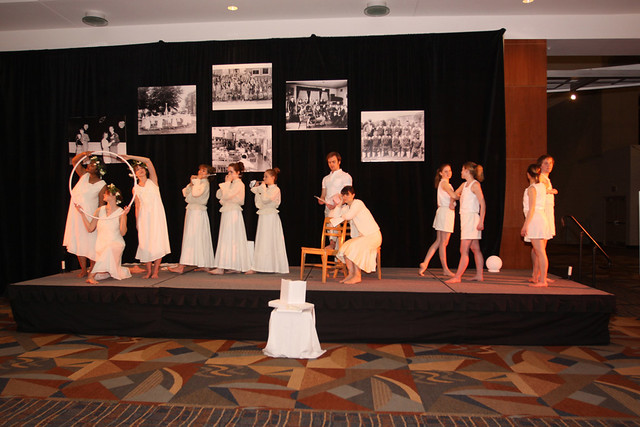
Her multimedia works — often combining stills or video — accomodate a diversity of dancers, from kids to elders, in venues ranging from concert halls to such unconventional spaces as the zoo. “I try to make dances appropriate to the people and spaces I am working with. My joy is in seeing people discover dance.”
As ever, she is moving in “new directions” again by performing her own solo work and researching what she calls “vernacular dance.” Always pushing the envelope, she made her New York and international dance debuts — both after age 50 — just in the past decade. She finds choreographing for herself liberating. “I have found a new, natural movement vocabulary for myself. I don’t have to worry about framing the dance on other bodies. It’s been very freeing, because I’m making the dance just for me. When I’m dancing, I feed off the energy of the music and the movement. There’s no pain. It’s a definite natural high.” She said mature modern dancers like herself are finding more acceptance and opportunity as performers: “Those of us in our 50s and 60s still have something to say. We’re making a place for ourselves. We’re putting a different face on what it is to be older.”
One of her recent projects, Kitchen Dancing, is a video dance work capturing dance wherever it may be — in homes, in offices, in stores or on street corners. She views the project as the natural culmination of her efforts the past three decades and considers this “found” dance the new emphasis in her work.
“It is meant to capture the dance of life people do rhythmically, spontaneously in their every day living activities,” she said. “It’s in every dimension of life. Just look around, and you’ll see people dancing. It might just be someone swaying or just moving some body part. People want to move. It’s the joy of expression through dance.”
The number of Nebraskans working in or on the fringes of the film industry is in the hundreds. I know there’s nothing remarkable about that in and of itself, other than that this is a small population state far removed from either coast. Then again, the vast majority of Hollywood film professionals originated somewhere else besides Calif., including lots of places just like Nebraska. But what is unusual is the high number of folks from here who have made significant contributions to the film industry either by the imprint or quality or volume of their work .
Try this cursory list on for size:
Darryl Zanuck, Harold Lloyd, Hoot Gibson, Fred Astaire, Robert Taylor, Ward Bond, Ann Ronell, Henry Fonda, Dorothy McGuire, Montgomery Clift, Marlon Brando, Lynn Stalmaster, Donald Thorin, James Coburn, David Janssen, Inga Swenson, Sandy Dennis, David Doyle, Lew Hunter, Irene Worth, Joan Micklin Silver, Nick Nolte, Swoosy Kurtz, Paul Williams, Marg Helgenberger, Lori Petty, Sandy Veneziano, Alexander Payne, John Jackson, Jon Bokenkamp, Jaime King, Dan Mirvish, Dana Altman, John Beasley, Kevin Kennedy, Patrick Coyle, Gabrielle Union, Yolonda Ross, Nicholas D’Agosto, Chris Klein, Nik Fackler, Tom Elkins.
Add in Johnny Carson and Dick Cavett for good measure.
The list includes mega-moguls, directors, producers, screenwriters, songwriters, actors, actresses, you name it, and their influence extends from the silent era through the Golden Age of Hollywood to the indie movement and right on up to today. There are Oscar winners both behind and in front of the camera, industry stalwarts and mavericks, household names and lesser known but no less significant figures.
And then there’s the subject of this story, Mike Hill, an Oscar-winning editor who’s been attached to Ron Howard for decades and shared in the director’s many successes. Hill is an Omaha native and resident known for his generosity with young, aspiring filmmakers and editors. I did the following profile on him in 2002 and what most interested me about him then and still does now is the story of how he came to work in Hollywood in the first place and the classic journey he took as an apprentice learning his craft. During that process he worked with some genuine legends and those experiences obviously added his professional development.
The Cut Man: Oscar-winning film editor Mike Hill
©by Leo Adam Biga
Originally appeared in The Reader (www.thereader.com)
Success for Mike Hill, Academy Award-winning film editor from Omaha, did not come overnight. His local-boy-made-good-in-Hollywood story ranges from lean years learning the craft to being mentored by old pros to turning lucky breaks to his advantage to reaching the pinnacle of his profession.
He and fellow editor Dan Hanley, who together cut all of Ron Howard’s films, shared the 1995 Oscar for Best Film Editing on Apollo 13 and are nominated again this year for the critically-praised A Beautiful Mind, which is up for a total of eight Oscars, including Best Picture. During an interview at the Pacific Street Spirit World, Hill, who lives in Omaha with his wife and their daughter, discussed his career and collaboration in cinema.
After graduating from Omaha Burke in the late 1960s Hill attended UNO, where he studied a little of everything before earning a criminal justice degree. To pay his way through school he worked nights as an assistant film editor at Channel 6 television, splicing 16 millimeter commercials together, a seemingly forgettable job that, however, would soon be his entree into movies.
He headed out to California in the early 1970s with the idea of working in penology. But after a few months as a Chino State Prison guard he realized he was in the wrong field and promptly quit. He took odd jobs to pay the rent and almost on a whim applied for work with the film editors guild.
“I wasn’t really counting on anything,” he said. “Then luckily one day I was home when a phone call came from the guild saying Paramount was hiring. I ended up getting hired as an apprentice, which consisted of working in film shipping and driving a golf cart delivering film to editing rooms and screening rooms and doing whatever they told you to do.”

As unglamorous as his work was, Hill landed in the movies at a propitious time and a prestigious place. It was 1973 and Paramount ruled Hollywood after scoring big the previous year with The Godfather. The studio was producing a whole new slate of soon-to-be classics.
“It was an amazing time,” he said. “The movie business was very busy. Paramount was making Godfather II and Chinatown at the time I was there. I would just marvel every day at who I saw on the lot — Jack Nicholson, Al Pacino, Robert De Niro. So, it was pretty heady stuff for a kid from Omaha.”
Once Hill understood the way out of the shipping room meant learning how to be an assistant film editor, he announced his ambition to do just that.
“I was fortunate to have a couple assistant editors I met who were willing to teach me how to synch-up dailies. When film comes from the previous day’s shoot you synch it up with picture and track (soundtrack) so it can run in a screening room. I learned how to do that and I slowly learned editing room tasks.” His first screening room duties were for then hit TV shows like The Brady Bunch. Learning the ropes the same time as Hill was Dan Hanley, with whom he would later team.
Among the old-line editors Hill and Hanley apprenticed under was Bob Kern. “Both Dan and I learned quite a bit from him. He would give us scenes to edit — to work on — and that’s the best way to learn. He and other editors encouraged us to pursue it and to move up.”
The ‘70s saw Hill work on many made-for-TV movie and film projects. Two master filmmakers he assisted around 1976 spurred his development: on The Last Tycoon he worked with Elia Kazan (On the Waterfront) whose elegant if rather lifeless feature adaptation of F. Scott Fitzgerald’s unfinished last novel ended up being the director’s final film; and on Bound for Glory he worked with Hal Ashby (Coming Home), whose exquisite vision of folk singer Woody Guthrie’s life story secured critical plaudits but saw scant box office returns.
Hill said he went to the Tycoon set every day observing Kazan at work and ran dailies for him the entire shoot. Kazan may have noted his young charge’s intense interest in the process as, Hill said, “He took me under his wing and let me cut some scenes. One scene he was going to reshoot anyway, so he said. ‘Go ahead and cut this together and see what you can do with it.’ I was there all night messing around with it. It was a simple scene of two people talking. On every line I cut back and forth until it was like a ping pong match. I really didn’t know what I was doing. He looked at it with me in the screening room and told me, ‘You don’t need to cut so much. Pick your spots and sometimes let a scene play out awhile.’ I learned stuff like that from him that was invaluable. The same way with Hal Ashby.”
It was while working in a second editor’s position on TV movies that Hill “really started to learn how to edit.” He was prepared, therefore, when his big break came in 1982. He was set to join his old mentor, Kern, and his former shipping room mate, Hanley, as an assistant on Ron Howard’s first mid-major studio feature, Nightshift, when Kern suffered a stroke.
Instead of bringing in a veteran replacement Howard entrusted the lead editing to the green assistants.
“We had a lot of responsibility on our shoulders,” Hill said, “but we were too young and too stupid to be really that aware of it, and so we just did it. Bob was there to lend moral support and answer questions. The movie turned out to be a modest comedy hit, enough of a hit to get Ron Splash.”
Then came Cocoon. As Howard’s directorial career reached ever greater heights, Hill and Hanley went along for the ride every step of the way. Their nearly exclusive relationship with him is one of the closest collaborations between a director and an editor, or editors, in Hollywood. So, what makes it work?
“I think personality-wise we kind of meld,” Hill said. “We have the same interests. Our senses of humor mesh. There’s really no ego problems…and Ron is just the nicest guy in the world. We’re all really good friends. Plus, he likes our work and he likes having two film editors.”
During production Hill-Hanley cut on location and during post-production they work at a permanent editing suite Howard maintains in New York. The men work in separate rooms on separate scenes before assembling a first cut. In shaping the raw footage coming-in during the shoot, the pair enjoy great latitude.
“We have total freedom. Ron just lets us go. He’ll give us cryptic notes like, ‘I like that take’ or ‘Try to use this moment’ and that’s it. The structure and everything is up to us. He relies on us to come up with things he doesn’t expect to see. He likes to be surprised.”
Once shooting is complete Howard joins his editors and the three slowly prune the film-in-progress into a workable length.
“Ron’s kind of impatient about editing. He doesn’t like to sit around. He likes going back and forth from room to room,” Hill said, “so he’s always got something to look at. We’ll look at the movie reel by reel with him and get extensive notes from him about each scene and then we’ll go to work on them. We’ll do an entire pass and see how much time we’ve taken out and how it plays and then we’ll start again. We try to make every scene shorter without hurting it. Some of the toughest decisions are which scenes to drop. But some scenes have got to go, including some that would be very good and that I’ve grown attached to personally because I’ve worked so hard on them. It’s a slow process of whittling it down, sculpting it, refining it, honing it. We’ve got a good system worked out over 20 years now.”
The art in what Hill does comes in selecting from the myriad takes at his disposal to create a seamless film that appears to have sprung to life, organically, as “one piece,” he said, adding, “That’s what I admire about good editing.” Working for Howard means sifting through “a lot of angles and a lot of takes. He shoots a lot of film. He likes to have options. We’ve always found, especially when you need to trim a scene down, that the more coverage you have the more success you have in shortening a scene. You’re stuck if you just have one or two takes or one or two shots. Then, you have nothing to cut to. There’s no way to get out of the scene.”
Making Hill’s job easier is the fact Howard commands final cut. “Ron’s in a position where he has complete power. There’s nobody messing with him, which is great for us because there’s nothing worse than working on a film where the director loses control and the studio steps in.”
Hill lived that nightmare on one of the few Howard-less films he edited, Problem Child. He said each project has it’s own “unique problems.”
Of Howard’s films, he lists Willow and Apollo 13 as the toughest assignments because the former entailed so many special effects shots and the latter required flawlessly blending weightlessness footage shot in a plane with matching footage shot on a sound stage. The Grinch posed a new challenge when Howard broke precedent and allowed an actor, star Jim Carrey no less, free reign in the editing room to select his own takes. Hill said while the character-based A Beautiful Mind involved a lower degree of difficulty than those technically-oriented films it demanded greater finesse in shaping a cohesive performance from star Russell Crowe, whose takes ranged wildly from subdued to over-the-top, and in preserving the integrity of the narrative while shortening the piece.

Hill has been in the business long enough now that he has hands-on experience working with the full historical range of film editing equipment — from the old Movieola (“a horrible machine…a dinosaur”) through which film noisly clattered through a gate to the streamlined Kem (“much more civilized”) to today’s digital Avid system (“a huge leap forward”) that eliminates the need to ever handle film again and allows instant access to every shot.
“Now, we can finish a scene that used to take days in an hour.” The Movieola days were such drudgery, he said, “that I have to admit there were times I got so tired of editing a scene, I’d say, ‘That’s it — I don’t care anymore. Take it or leave it.’” It’s no coincidence his new confidence in his work has coincided with the labor-free new technology. “It gives us freedom to experiment” with pure editing because “you don’t have to worry about splicing, putting frames back, loading or unloading film. You can approach a scene totally without fear..do whatever you want and there’s no consequences.”
As for his and Hanley’s Oscar bid, he said, “I don’t really believe we’re going to win. Our picture isn’t showy or flashy enough. But I didn’t think so last time either.” Should he win, the statuette will likely join his Apollo 13 Oscar on a bookcase at home.
Meanwhile, he’s anxiously awaiting word on Howard’s next project and is getting antsy enough that he’s having his agent look for a temporary assignment he can fill until the call comes.
During lull periods he sometimes lends his expertise to small independent films, including the Omaha-made Shakespeare’s Coffee and The Full Ride. Even though he and Hanley have no formal agreement with Howard stipulating they will work on his films, neither has missed one in 20 years and Hill doesn’t intend missing one now that Howard is such a prominent Player in Hollywood.
Designing Woman: Connie Spellman Helps Shape a New Omaha Through Omaha By Design
©by Leo Adam Biga
Originally published in the New Horizons
Connie Spellman’s imprint on Omaha grows every day. As director of Omaha By Design, the Omaha Community Foundation (OCF) initiative attempting to do nothing less than change the face of the city, she has her hands all over the metro.
When she joined what was then called Lively Omaha in 2001 Spellman was already a passionate advocate of the city from her prior Greater Omaha Chamber of Commerce career. Her Chamber experience gave her a keen understanding of how the private and public sectors work in Omaha.
“I’d had a wonderful career at the Chamber and couldn’t imagine having another position that was as fun and meaningful and rewarding as that,” she said. “I’d had a year of retirement and other opportunities that sounded like jobs. And I wasn’t ready. And this one came along…”
“This one” refers to her Omaha By Design position, which is that of facilitator and visionary. She brings diverse people together to brainstorm ideas, design guidelines, write zoning-construction codes and develop projects that embody aesthetically pleasing, eco-friendly, cohesive urban planning. The aim is to improve Omaha’s appearance and the way people interact with their lived environment. She works closely with the city, neighborhood groups and the private sector to do that.
She took the newly formed post, she said, because “I love Omaha. I enjoy challenges. I thought the timing was right because sometimes timing is everything. The city was really ready for looking beyond its historic attributes to look at its environment in a bigger picture.”

When then-OCF chairman Del Weber recruited her to the job Omaha was in the throes of an identity crisis. The city embodied stolid Midwestern values predicated on friendliness and work ethic but could claim few signature public spaces. The adverse effects of suburban sprawl, inner city neglect and scattershot development were everywhere.
“We’re a great city of individual projects that were developed without consideration of how they’re connected to each other,” she said.
Studies confirmed Omaha lacked a positive image and that residents, especially younger ones, found the city dull and drab. Spellman said a Gallup survey found only a small percentage of Omahans thought the city attractive.
“I was appalled,” she said. “I thought, What a shame. It means we really haven’t paid attention to it and we didn’t have much pride in it. How can we be competitive and expect our kids to stay here if we think our city is unattractive?”
Foundation supporters, who include some of Omaha’s movers and shakers, hired Minnesota consultant Ronnie Brooks to assess the city’s Wow! factor. He suggested Omaha needed to be more” connected, smart, significant, sparkling and fun.” The foundation created Lively Omaha in 2001 to do just that, but it floundered trying to put into action what sounded so abstract or, as Spellman put it, “nebulous.” Meanwhile, Omaha’s doldrums and inferiority complex festered.
Still, she said, those words by Brooks “in one way or another kept coming back to everything we do — to how we look and how we act…”
Then something happened that brought the organization’s mission into focus. When the downtown-riverfront construction boom began — one that ultimately resulted in $2 billion in new development — Lively Omaha saw the potential for an Omaha makeover on a citywide scale.
The Omaha World-Herald’s Freedom Park, Union Pacific’s and First National Bank’s new headquarters, the Holland Performing Arts Center, the Qwest Center, the Gallup campus, the National Parks Services building, Creighton University’s soccer stadium and new dorms and a beautified Abbott Drive created a dynamic new downtown-riverfront corridor. What had been unsightly was now a picture postcard destination district. These projects signaled a major turnaround in not only Omaha’s appearance but in the way Omahans felt about their city.
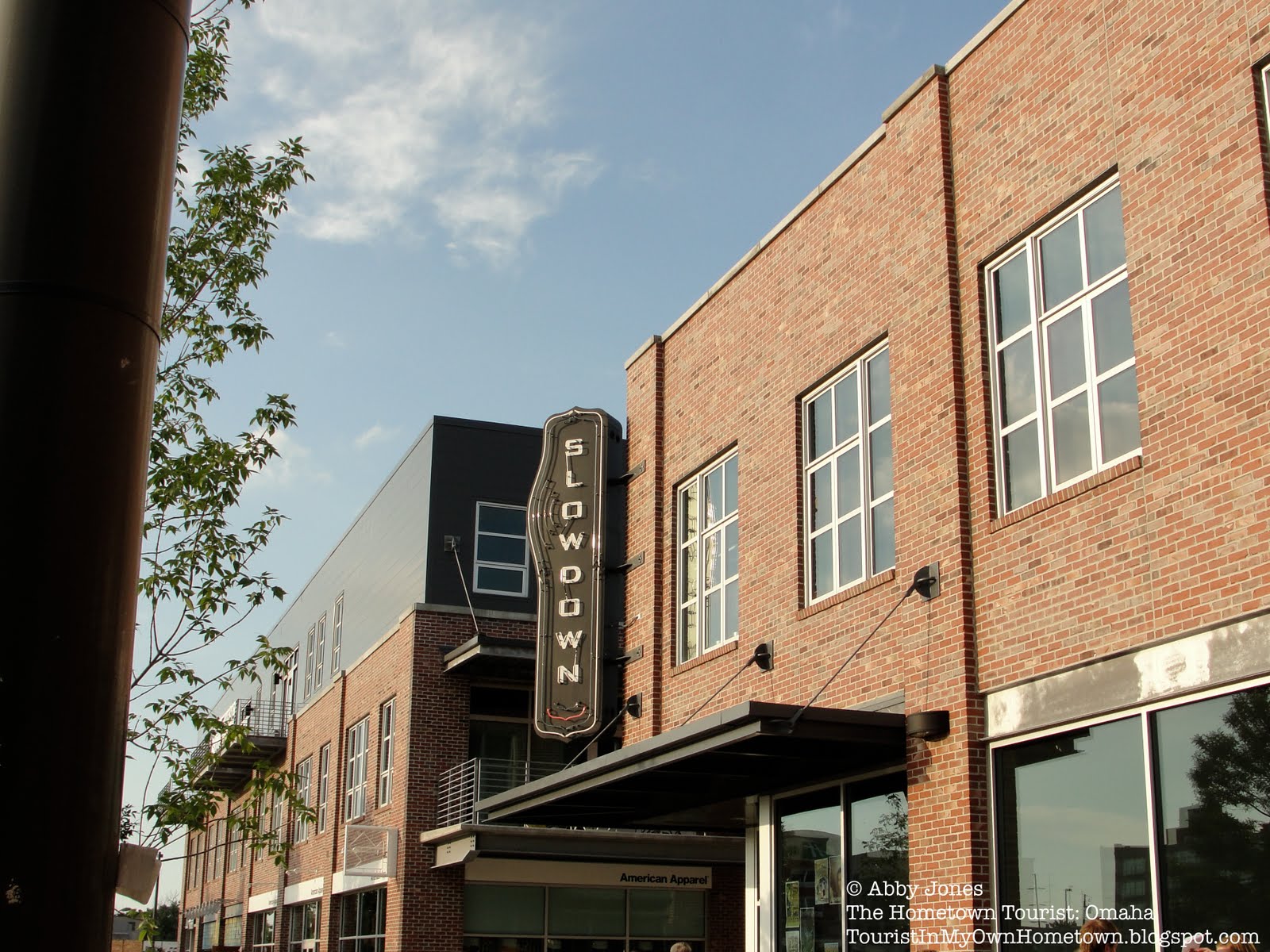
More energizing projects followed, including the Saddle Creek Records build-out with Slowdown and Film Streams and nearby hotels in NoDo. More is on the drawing boards, notably the $140 million downtown baseball stadium slated to open in 2011.
The cityscape is changing far beyond downtown as well. Improvements around 24th and Lake Streets and along the South 24th Street business strip, the transformation of the former stockyards site and the mixed use developments going up on the Mutual of Omaha and Ak-Sar-Ben campuses are examples of the New Omaha.
Spellman said such projects are changing residents’ and visitors’ appreciation for a town that’s long battled an image problem.
“That translates into so many things,” she said. “You can’t help but feel good when you’re downtown today or driving into our city. There’s an energy here that’s coming back because people have a vision that is being realized. And I think that attitude can accelerate the implementation of the vision because once you get a taste of it you want more, faster.”
She’s certain if a survey were done today sampling the city’s “It” quotient there would be a very different result than a decade ago.
“I think people would feel better about their community. I think there is a contagion that is going on because of the continued development that’s happening downtown and the revitalization of suburban areas like Village Pointe.
“I see it everywhere — in what people do with their own homes and what they do with their businesses and what they want to see happen with development in general and how they view their city.”
It’s ironic the woman who has Omaha reinventing itself through sustainable, livable design strategies had to immerse herself in the subject when she got the job.
“I knew nothing about urban design or public space,” she said from her office in the historic Blackstone building. She’s about a stone’s throw away from Mutual of Omaha’s Midtown Crossing at Turner Park project under construction — an example of the kind of transformation she advocates. “I have always had an appreciation of art and architecture but I never really put them in the context of public spaces or design. And so the first thing I had to do was educate myself.”
That posed no problem for this former teacher who’s devoted much of her public service to education. She read, she sounded out experts, she attended trainings.
“Perhaps the basis for most of my education came from Project for Public Spaces (PPS), a national advocacy group,” she said. “It grew out of the work of New York planner William Whyte, whose book The Social Life of Small Urban Spaces is fascinating. I learned enough to allow me to ask questions. And then I was fortunate enough to meet people like Doug Bisson, a planner at HDR, who recommended more books.”
After PPS training in New York she returned to Omaha to organize Place Making sessions, which she describes “as a way to engage citizens in helping them decide what their own spaces should look like and discover their own neighborhoods’ potential.” Place Games and Place Definitions workshops were held with neighborhood associations. Program Manager Teresa Gleason leads these sessions today. Ideas get broached, goals set and actions taken to make improvements — from lighting to green spaces to facades.
Through these experiences Spellman and others gained a new sense for how Omaha could be flipped.
“I had to have that ‘Ah-ha’ moment in looking at Omaha because I’ve seen it as I’ve always seen it — family-oriented, hard working, conservative. I loved it but I didn’t see it in terms of its potential,” she said. “Then I saw it in terms of what it could look like — a lively, more interesting Omaha that is cutting edge, exciting and fun.
“You can never see the city the same way again once you see it as what it could be. That’s probably the greatest gift to me — opening my eyes to see what the potential is for this city.”
Spellman is unabashedly devoted to Omaha, where she and her husband, attorney Rick Spellman, moved in the ‘70s. It’s where they raised their three kids. Some of Omaha’s greatest ambassadors didn’t start out here and she’s among them. The former Connie Hoy grew up in Wahoo, Neb. Her family moved there from a farm they had near Lincoln. She enjoyed small town life.
“I probably had the most idyllic childhood. I lived a block away from school. The thing about small towns is you’re forced to do everything because there aren’t enough people. I love the opportunity to sample everything. I think that’s useful.”
Her role of helping Omaha see itself in a new light is in keeping with her background.
“I am first and foremost an educator because that’s what I went to school to be,” the 1965 University of Nebraska-Lincoln graduate said.
She taught high school in Ashland, Neb. for two years while her husband Rick was in law school. Even then she showed a knack for getting broad coalitions of people involved as she started a speech and theater program. Under her direction community productions of South Pacific and Our Town were staged.
“We got the whole town engaged in these productions,” she said.
Sound familiar? She built coalitions as a volunteer with the Junior League, a women’s group that promotes community involvement and leadership development. Her work there led to her involvement with the Chamber, where she spearheaded corporate leadership and public school education initiatives.
In a sense, what this designing woman does today is direct an epic scale version of Our Town where the props and the players are real and the stakes are for keeps.
The more she steeped herself in what constitutes good design the more she saw Omaha for the first time. The striking new face that began emerging downtown and on the riverfront offered a preview of what could be. It increased expectations.
“With the downtown redevelopment we were beginning to see that transformation is possible and energizing and positive. It was a wonderful catalyst to begin to say, Boy, if we can do it downtown, why can’t we translate this throughout our entire city? We can still be hard working and family-oriented but we can also be cutting edge and exciting and fun. We can be competitive in a regional market which we really hadn’t been. All of that, I think, gives a sense of pride, a sense of energy.”
What became known as Omaha By Design evolved from studies, surveys and discussions prompted by Foundation donors. This led to public meetings where citizens weighed in. The work continues today.
“It’s all citizen-led,” she said. “One of the terms we use is, ‘The citizen is the expert — the community is the expert.’ They know best what they want for their community. We just help them see it differently.”
All the feedback called for a citywide approach focusing on key neighborhoods, districts, corridors, sectors that took a more considered approach to development — from signage to setbacks to lighting to landscaping to public art.
The idea’s to create organic, splendid, interconnected, pedestrian-friendly spaces that make Omaha a more pleasant place to live and therefore a more competitive market for attracting and retaining companies and individuals.
“Besides the feel-good aspect there’s an economic component to this as well,” Spellman said. “If you design a building well, if you have a shopping center that’s easily accessible for pedestrians and exciting and attractive, that’s going to be a return on investment.”
The real work began in response to a pair of new Wal-Mart stores slated for Omaha. Objections arose over the plans for the big box projects and their ugly concrete footprints, which all but ignored elements like greenery or enhanced lighting. Spellman, local elected officials, Omaha Planning Department staff and other concerned citizens concluded if the city wanted projects with more curb appeal than design standards must be adopted that compel developers-builders to conform. Rules and regulations with oversight-enforcement teeth were needed.
“In order to create the vision there had to be a change,” she said. “Otherwise, you would have continued to perpetuate the development that’s gone on before.”

Wal-Mart was Omaha’s line-in-the-sand.
“We weren’t content to take the bottom drawer of a Wal-Mart or any box store,” she said. “We were confident enough to say we won’t accept that anymore. We deserve more.”
That’s when her organization decided to undertake a comprehensive plan, called the Urban Design Element, which meant identifying and articulating areas of the city in need of revitalization and redesign. This required the collaboration of a cross-section of city departments, design firms, real estate developers, lawyers, utilities providers, neighborhood associations and others.
Philadelphia planner Jonathan Barnett helped devise Omaha’s plan. He divided it into three focus areas — Green, Civic and Neighborhoods. “That was one of the best organizational tools we could have come up with,” Spellman said, “because it helps you so much describe it, define it, categorize it, implement it. This way you break it down into very visual, concrete segments that anybody can see. There’s something for everybody.”
A list of goals for each segment is now in place and projects have been targeted within each goal.
The Urban Design Element was not the end game, however.
“It was written not as a plan but as a specific element that once adopted went right into the (city’s) master plan,” she said, “which I think was a brilliant thing. We didn’t want it to be a report that sat on the shelf. Just because it’s part of the master plan doesn’t mean it has the force of law or automatically gets done. It doesn’t unless attention is given to it.
“The highest priority was the implementation of those recommendations that required codification in order to be effective. That became our next major effort.”
In August of 2007 the Omaha City Council unanimously adopted the Urban Design Element into the city’s official master plan. Ideas and goals had been turned into tangible, enforceable codes. As a result, Omaha no longer has to settle for what a developer or builder decides is a sufficient design but the city now has specific standards in place that, by law, must be met.
She said the effort needed both the private and public sectors involved “to make this work and we did have that from the very beginning. It was a wonderful blend that was strategically thought about to make sure that every sector had a voice.”
Spellman got diverse players to sit at the same table and work out the details. Her talent for “bringing people together to get things done” is one of the skills she learned in her 20 years at the Commerce. She managed its Leadership Omaha and Omaha Executive Institute programs and led its education and workforce development initiatives, Omaha 2000 and the Omaha Job Clearinghouse, respectively. Her successes made her a player.
Typical of Spellman, she prefers deflecting attention away from herself and onto others. For example, she credits the Omaha Planning Department with helping make the Urban Design Element a reality.
“I can’t say enough about the role of the Planning Department in making this happen,” she said. “Steve Jensen, Lynn Meyer and Co. are trusted and respected by the development community and they’ve been a real factor in working this through. They were totally professional and patient.”

Her work, however, has been much recognized, including being named The World-Herald’s 2007 Midlander of the Year. She’s previously been the recipient of the Ike Friedman Community Leadership Award and other awards noting her community focus and consensus building.
She said as arduous as creating the Urban Design Element was, “codifying these design standards” was a classic “the-devil’s-in-the-details process” that required innumerable meetings. An expert committee addressed the codification, which among other things put the standards into language that was clear and binding. There was much discussion, argument and compromise.
“It was more technical. It was a smaller, tighter group having to deal with the codes,” she said. “We added more developer-real estate-leasing agent-finance people that really understood the implications of what was going to be asked of them and coupled it with the design community — architects, landscape planners, city department heads — all at the table.
“We thought it was going to be a year’s process. It turned out to be two years. It was the best thing that we did take the two years because nobody had ever done this before. We’re really trying to address so many things from so many different perspectives.”
Spellman said no U.S. city has ever tackled such a sweeping, all encompassing design plan to code.
“Where others had done major sections of code it was usually in a city like Santa Fe, where everything is the same, uniform Southwest look, or a Santa Barbara, where there’s very strict requirements. Well, we didn’t want Omaha to look all the same, so that meant our code doesn’t fit all. Therefore, we really needed to make sure there were no unintended consequences.
“We had to test and reevaluate and retest. There was a several month period where we studied (design) surettes of (mock) urban settings and suburban settings to see how the codes would affect those. Then we learned how topography affects those. It was a true education in how important it is to do it right the first time. It takes time.”

Developers, builders and others who will be working within these codes on future projects expressed various concerns.
“There’s a fear factor,” she said. “What if it doesn’t work? What if it’s going to cost more? What if it’s going to prohibit development? Those are legitimate issues. That’s why it took so long — to be sure that all of us were comfortable with the outcome. The last thing any of us want to do is to hamper economic development. We’re all in this for economic development and quality of life.”
Consequently, nothing’s set in stone. By its nature, urban design is evolutionary.
“It’s not hard and fast,” she said. “Something this big and this broad can’t be perceived as perfect the first time out. That’s why the Technical Advisory Committee decided to stay together to be that sounding board. If the language doesn’t meet the intent then let’s by all means change it. We’re already working on some issues that we discovered need to be changed.”
The committee also serves on the city’s Design Review Board, which is charged with interpreting the codes.
Redesigning Omaha carries the responsibility of being true to all those who’ve participated in the process.
“In a way we’re protecting the interests of all the people that attended meetings and voiced their opinions,” she said. “So we really felt this was a mandate from the community. We went through this process not just as an exercise but as something we want to see because we love our city and we want to make it better. I take that as a responsibility and I don’t want to stop until we’re done.”
Omaha By Design recently released its Streetscape Handbook. This primer for project managers, developers and design professionals offers guidelines for creating enhanced streetscape environments that give careful attention to street fixtures rather than treat them as afterthoughts.
“It deals with all of the street furnishings in the public right of way,” she said. “Signage, street lights, wires, bike racks…If you think about the placement of this stuff you have to have anyway, if you think about maintenance and sustainability and how it relates to each other and how it looks on the street, it makes a whole different visual impression.”
The committee that generated the handbook was made up of architects, landscape designers, city planners, public works professionals, roads experts and “anyone that had something to do with the placement of street furnishings or the streetscape,” she said. “We worked together for 27 months, once a month, to figure out what we needed to do and how we could do it. I think we’re proud of what we’re presenting. It’s an example of people working together because there’s a vision of what we want out city to be some day.”
None of this could happen, she said, without broad support and participation. “We rely heavily on volunteers and community leadership to make these things happen,” she said.
Where is Omaha By Design’s work taking shape?
Projects have now been identified in each of the Urban Design Element’s goals, “which I think is very exciting,” Spellman said. Keep Omaha Beautiful is undertaking one of the first projects — a landscaped highway’s edge at I-680 and Center.
Other efforts are in progress or soon to start. Omaha By Design acts as project manager for some, including the Benson-Ames Alliance, a comprehensive plan for integrating the design of commercial centers with their neighborhoods. The goal is mixed-use centers that blend retail, residential and office in a balanced manner. The plan also addresses transportation, housing and public space issues.
The Alliance has two projects underway — the Cole Creek Project and the Maple Street Corridor Project. The first entails various stormwater construction to help cleanse runoff and moderate the amount of water flowing into Cole Creek; the second designs functional-decorative streetscapes along the Maple corridor and builds on the entrepreneurial growth under way in downtown Benson with a goal of spurring development in neighboring sectors.
All this activity requires Spellman attend many meetings.
“My to-do lists are pages long,” she said.
But she’s doing exactly what she wants to do.
“I’m very fortunate. It’s just a gift. I am totally content and most days very excited about the potential of what we’re doing.”

“Memories of the Jewish Midwest: Mom and Pop Grocery Stores Omaha, Lincoln, Greater Nebraska and Southwest Iowa”
I contributed to a new book out by the Nebraska Jewish Historical Society that is an appreciation of the Jewish Mom and Pop grocery stores that once dominated the landscape in Omaha. From time to time I am posting an excerpt from the book to give provide a sample of the robust story it tells. For this post I chose a front section essay I wrote about the long defunct wholesale market that operated just southeast of downtown and that today is home to the popular historic cultural district known as the Old Market. While the market didn’t contain grocery stores, its many wholsalers serviced grocers. It was a bustling center of commerce abd characters that is no more.
For additional information or to order a copy of the book, contact Renee Ratner-Corcoran by e-mail at rcorcoran@jewishomaha.org or by phone at 402.334.6442.


Excerpt from the book-
The Old Market: Then and Now
©by Leo Adam Biga
Omaha’s Old Market is a National Register of Historic Places district abuzz with activity. Bounded by 10th Street on the east, 13th Street on the west, and extending from Leavenworth Street on the south end to Howard Street on the north end, the character-rich area is an arts and entertainment hub. Restaurants. Speciality shops. Art galleries. Performance spaces. Many venues housed in late 19th and early 20th century warehouse buildings.
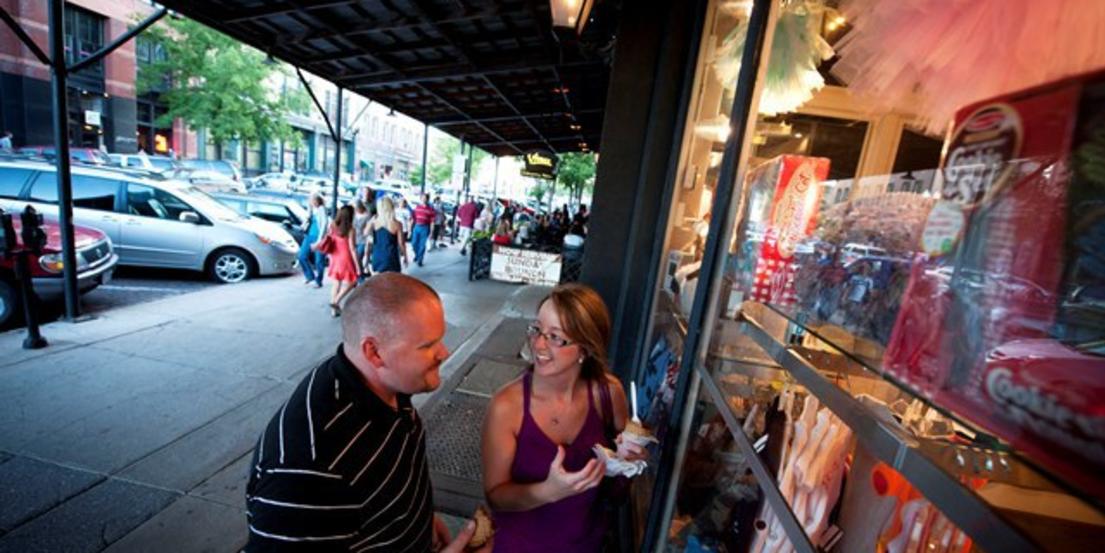
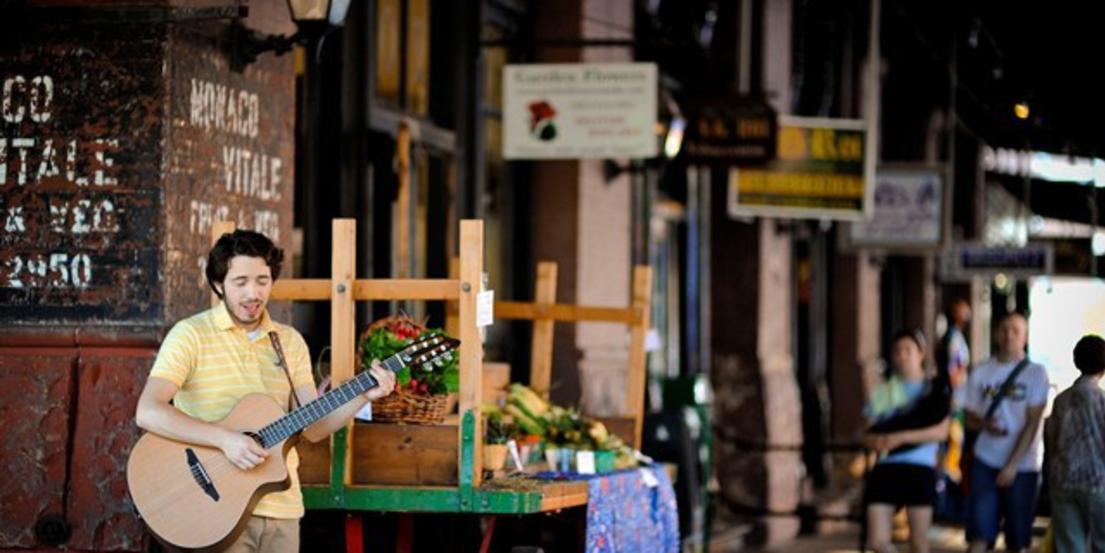
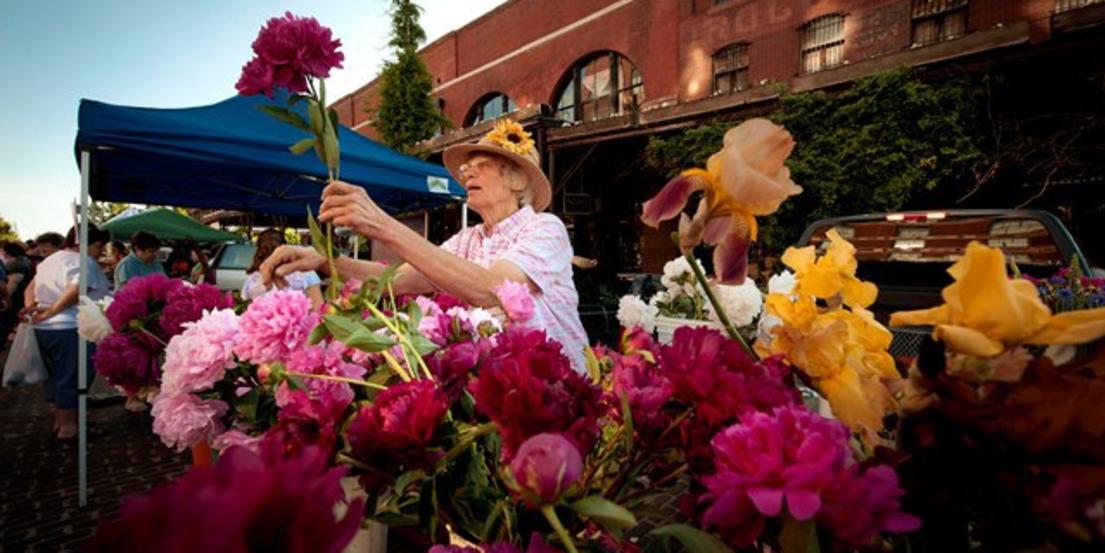
Street performers and vendors “set up shop” there. Horse-drawn carriages transport fares over cobblestone streets. Streams of shoppers, diners, bar patrons, art lovers, theatergoers, sightseers, and residents file in and out, back and forth, all day long, through the wee hours of night. Summertime finds folks relaxing at restaurant and bar patios. Fresh flowers adorn planters arranged all about the Market.
Fifty years ago and for a half-century or more before that these same streets and warehouses were equally busy, the commerce transacted there just as brisk. Only instead of trendy eateries, boutiques, galleries, and studios, the urban environs contained Omaha’s wholesale center for fresh fruit and vegetables. Whatever was in season and sellers could lay their mitts on, the market carried it. Now and then, owing to untimely droughts or freezes in prime growing areas, certain items were in short supply. During wartime, rationing made much produce scarce. But most of the time the Market offered a great variety of fresh produce at reasonable prices.
In an earlier era, the Market, along with the Jobbers Canyon complex of wholesale and mercantile warehouses, meat packers, and outfitters a bit further to the east, supplied surveyors, land agents, speculators, railroad workers, steamboat crews, military personnel, trappers, and pioneers with the stores needed for settling the West. Jobbers Canyon, however, went the way of the wrecking ball, a fate that could have easily befallen the Market if not for a few interventionists.
The Way It Was
The Omaha Wholesale Produce Market House Company was an officially incorporated consortium of wholesalers and the Omaha City Market the city designated marketplace where the local produce industry concentrated. This American equivalent of the Middle Eastern bazaar or Old World farmer’s market consisted of two fundamental parts.
Multi-story brick buildings housing warehouses, mercantiles, and offices were where the major produce wholesalers and brokers did high volume, bulk business with major buyers. A single wholesale deal might have moved 40,000 pounds of watermelons, for example. At street level, the warehouses featured a system of docks and bays where trucks carting loads of produce parked, their contents emptied out onto sidewalk pallets for immediate resell to buyers or into storage for later resell.
Perhaps the biggest Jewish wholesaler in terms of volume handled was Gilinsky Fruit Company, whose two-story warehouse and offices became home to the French Cafe. When Sam Gilinsky’s business closed in 1941 several former employees, many of them Jews, opened their own wholesale businesses and wrote their own chapters as successful Market entrepreneurs. One of Omaha’s most recognizable and nationally branded businesses, Omaha Steaks, owned by another Jewish family, the Simons, did business in the Market when still known as Table Supply Meat Company.
An open air market located in a paved lot at 11th and Jackson Street saw vendors and peddlers doing business with neighborhood grocers and retail consumers. The merchants selling there rented stalls, where they displayed their wares in bushel baskets, barrels, crates, boxes, and bags arranged on benches. The hawkers benefited from a sheet metal canopy overhead. Tarps were stretched out for additional protection. Old-timers who worked there will tell you the conditions made for long days during the heat of summer, when the canopy and tarp would get burning hot to the touch and make it like a sauna underneath. Standing on the hard cement was tough on shoes and feet.
Across from these vendors were local truck gardeners and farmers, who turned an alleyway into a market of their own, selling bed loads of produce.
These were small family businesses. Men made up the vast majority of Market workers, but some women and children worked there, too. For most, it was a humble living, but more than a few sons of immigrant vendors and peddlers went on to become doctors, lawyers, educators, and to enter many other professions. In this way, the Market was an avenue to the American Dream for first and second generation families here.
The marketplace attracted a small army of workers and customers. Suppliers included farmers, gardeners, and greenhouse owners. Wholesale produce dealers ranged from giant operators buying and selling in train car lots or truckloads to smaller operators. The middle men included brokers, jobbers, and distributors.
Most of the vendors and peddlers were immigrants, including Jews from Russia, Poland, and Germany, along with Syrians and Italians. Yiddish was among the many languages heard wafting through the Market. The foreign-born merchants’ raised, heavily-accented voices mixed with various American accents to create a music all their own. Then there was the sonorous strain of the district’s very own Italian tenor, “Celery John” (Distefano), who would serenade the marketplace when the mood struck.
Veteran produce marketer Sam Epstein said Celery John “had a voice like you’d hear in an opera house,” adding, “It was absolutely marvelous to hear him.” Epstein said he would stand outside Celery John’s place and kibbitz as the erstwhile Caruso made up “soup bunches” and “plant boxes.” “His personality and his demeanor were just the same as his voice,” said Epstein “Just a wonderful human being.”
Don Greenberg, whose family’s wholesale Greenberg Fruit Company had a decades-long run in the Market, recalled Celery John once leading a group of workers in a rendition of the “Happy Birthday” song. The occasion celebrated the birthday of a veteran, well-liked merchant. The guys even got up enough dough to go in on purchasing a rather extravagant gift then — a television set.
It was a place where men in smocks, aprons, overalls, or dungarees and with nicknames like Dago Pete, Crowbar Mike, Montana, Shoes, Red Wolfson, and Popeye rubbed shoulders with men in suits. Brothers George and Hymie Eisenberg became known as the Potato and Onion Kings for the considerable nationwide market share they held supplying spuds and onions to large food processors.
The Eisenbergs had a much humbler beginning though as a family of produce peddlers. Many immigrants had established routes in neighborhoods around Omaha and on back country roads, where in the early days they traveled by horse and wagon before modernizing to trucks. Peddlers often operated stalls in the Market, too. Some peddlers and vendors, like the Eisenbergs, eventually became wholesalers.
The primary buyers at the Market were grocers, restaurants, hotels, institutions, and major food processors. Just like today’s Omaha Farmers Market, the general public went to get their pick of fresh produce during the summer from the open air market that operated there. Day in, day out, the Market saw a flow of people, trucks, and goods. George Eisenberg can attest to “a lot of hustle and bustle, a lot of competition” that went on.
Changing Times
The Market thrived as a produce center from at least the first decade of the 20th century, when it was incorporated and a city appointed superintendent of markets or market master put in place to collect rent, enforce rules, and settle disputes, through the late 1950s. By the early ‘60s the Market declined as wholesalers either disbanded or moved west, the peddler trade disappeared, and many neighborhood and country grocers went belly up. The emergence of supermarket chains had a ripple effect that drove the small independents out of business, thereby eating into the Market’s trade.
But the real death knell came when large grocers pooled their resources together to form their own wholesale cooperatives. The combined purchasing power of coops let them buy in huge quantities at bargain rates that smaller wholesalers and coops could not match. Grocers or supermarkets naturally bought from their own coop because they owned shares in it and any profits were returned as dividends.
The same few blocks comprising that wild and woolly marketplace then and that make up the more cultivated Old Market today were, by comparison, virtually barren of people by the mid-1960s, the huge warehouse structures largely abandoned and fallen into disrepair. The open air City Market was closed by the City of Omaha in 1964.
The overall Market district was saved from the wreckage heap by the vision and action of a family with longstanding business and property interests in the area, the Mercers, and by other enterprising sorts who despaired losing this vital swath of Omaha history.
During the late ‘60s-early ‘70s what was once the produce center of Omaha began undergoing a transformation, building by building, block by block. The renovations continued to take hold over the better part of a decade. The labor intensive, working man’s market that revolved around fruit and vegetable sales gave way to head shops, galleries, theaters, and restaurants that appealed to the counter culture and sophisticated set. What is known now as the Old Market emerged and the area gained landmark preservation and historic status designations in 1979.
By the late ‘70s, people began moving into loft-style living spaces above storefronts, an update on an old tradition that increasingly gained new traction. So many Old Market buildings have since been converted into mixed uses, with apartments and condos on the upper floors and businesses on the ground floor, that today the district is more than just a commercial center and tourist destination, but a urban residential neighborhood as well.
Not every remnant of the early Market disappeared. At least one old-line vendor, Joe Vitale, hung on through the 1990s.
Character and Characters
Old-time sellers were usually loud, animated, sometimes gruff, and by any measure assertive in trying to reel buyers in for themselves and thus steer sales away from competitors. If a vendor thought a rival was out of line or infringing on his turf or undercutting prices or, God forbid, stealing sales, there might be heated words, even fisticuffs. Customers did not always get off easy either. Some old-time vendors took exception if someone fussily handled the merchandise without purchasing or questioned the quality or price of the goods.
Sam Epstein recalled the time that Independent Fruit Company partners Sam “Red” Wolfson and Louie Siporin had just unloaded a batch of tomatoes when Tony Rotollo walked up to pick over the goods.
“Old Man Rotollo apparently asked Sam the price of tomatoes and he told Sam it was too high. Sam, who was loud and had a temper, started raving. He had a voice you could hear from miles away. Sam yelled, ‘Too high, you SOB I’m treating you right. You get out of here and don’t ever come back.’ And Louie, the refined guy of the business, came running out and said, ‘For God’s sakes, Sam, don’t talk like that out here. You gotta call him an SOB, take him in the back room.’ And Sam said, ‘He’s an SOB out here, he’s an SOB in the back room.’ Well, Old Man Rotollo went on his way and about a half hour later was back buying tomatoes from Sam, the two of them getting along just fine.”
Another hot head Epstein treaded lightly around was a banana house operator known to chase out persons he disliked with a sharp, curved banana knife.
Vendors had to be more brazen then because: (1) for most of them this was their single livelihood and so every sale mattered; and (2) most merchants followed the tradition practiced back in the Old Country, where markets were more expressive, the competition more cut throat, where decorum was put aside and survival meant outshining and outshouting the vendor next to you or across from you. You had to have some chutzpah and some get-and-up-and-go initiative in order to make it.
The give-and-take haggling, bartering, and bickering, good-natured or not, that was part and parcel of the classic marketplace is largely a thing of the past these days. For the most part, people today pay whatever price is set for goods without making a fuss. It’s all very polite, all very pleasant, all very banal.
George Eisenberg and his brother Hymie worked with their father Ben in the Omaha City Market in the years before, during, and after World War II. The brothers’ father went into the wholesale business with Harry Roitstein and the Eisenberg and Roitstein Fruit Company survived into the 1950s and beyond.
One of the few other Jewish wholesalers to last that long was Greenberg Fruit Company. Don Greenberg joined his father Elmer in the family business in 1959. He said when he got involved most of the company’s buyers were small independent grocers, many of them Jewish and Italian. Even as late as ’59, Greenberg recalled, “parking places were at a premium” in the Market. Over time, the traffic trailed off, so much so that Greenberg Fruit left to build a new warehouse, in tandem with another Jewish wholesaler, Nogg Fruit Company, in southwest Omaha.
“When we moved out of the Market,” said Greenberg, “parking spaces were no longer at a premium and there were very few independent grocers left.”
The Eisenberg family’s produce dealings nearly spanned the arc of the Market, as the patriarch, Ben, went from peddler to vendor to wholesaler. Son George then took the business into an entirely new realm by specializing in the wholesale potato and onion field. He found a lucrative niche selling directly to food processors. But it all began with Ben and his horse and wagon, later his truck, and then the stalls on 11th and Jackson Street.
“My dad didn’t speak really sharp English because he came from the Ukraine. He didn’t speak any English when he got here, but he learned to speak survival English. Either you spoke the language or you starved to death. You had to make a living,” said George. “My dad was a really good salesman. He was very polite, businesslike, very fair. His word was his bond. He used to tell us when we were kids, ‘Don’t lie, cheat or steal.’ It pays off — people are happy to do business with you.”
Legacy, Heritage, History, Memories
As the proud son of a successful immigrant, Eisenberg is glad to see his old stomping grounds active again, filled with people jabbering, jostling, buying, and selling. But you cannot blame him for being a little wistful at the loss of the colorful, boisterous characters and antics that populated the Market back in the old days.
With sellers noisily touting their goods like carnival barkers, all packed tightly together in a kind of vendors row, each vying for the same finite customer base, there was an every-man-for-himself urgency to the proceedings. There was no place Eisenberg would have rather been.
“I felt that’s where all the action in Omaha was — in the Market,” he said. “I mean, people were shouting like, ‘Watermelon, watermelon, get your red, ripe and sweet watermelon.’ ‘Strawberries, strawberries, get your strawberries.’ ‘We’ve got Idaho potatoes here, 25 cents a basket.’ It was fun. They were all shouting to people walking in the Market to bring attention to their location. That was our advertisement — our voice.”
Occasionally, things would get a little too rambunctious for some tastes.
“The city had a market inspector, and he’d come down and tell us, ‘You guys are going to have it to hold it down. People are complaining that you’re making too much noise hawking the merchandise.’ Some people used to say that was the charm of the Market, yet some complained.
“So we’d tell him, ‘Well, we can’t sell the stuff unless they hear what we got to sell.’ And he’d say, ‘I know, but just keep it down.’”
Eisenberg said he and his mates would then talk in muted tones, at least while the inspector was still around, but once he went on his way they would go right back to shouting. It was the only way to be heard above the din.

A typical day on the Market was not your average 9-to-5 proposition. Most vendors arrived by 4 or 5 a.m. to sell to commercial buyers seeking the best, freshest picks of the day. “If we thought we were going to be busy we might open the doors at 3 a.m.,” said Don Greenberg. “It was not unusual to work until 5 or 6 in the evening.” Some wholesalers and vendors stayed even later if business was good or if they had an excess of product they wanted to turn over before the next business day.
Greenberg remembers card and dice games as popular distractions among some Market workers, who had their favorite hangouts in surrounding cafes and other creature comfort joints. Sam Epstein, whose family bought Nogg Fruit Company from Leo Nogg, recalled that the owner of Louie’s Market often sat in on a standing card game, leaving instructions that anyone who called the Market inquiring after him be told he had not been seen. Epstein recounted how a broker known to have dalliances with women at work worked out a system whereby a friend would “pound like hell” on a metal pole downstairs as a signal someone was coming to interrupt his latest conquest.
Epstein’s business dealings in the Market began as a supermarket buyer. He made the rounds down there selecting and buying quantities of produce from truck gardeners or farmers, including a Jewish man named Herman Millman. Epstein worked for Nogg for a time and later became a part owner, eventually buying him out. Epstein said he and his family kept the Nogg Fruit Company name intact because “it had 60 years of name recognition.”
He said in a market the size of Omaha’s word got around fast about who you could and could not trust in business dealings. “There’s no secrets around the Market,” Epstein said.
Everything was done on a handshake and verbal basis then. All the transactions figured in ledger books or in people’s heads.
As the independent grocers were dying off, Nogg Fruit got into the food service and frozen food business and flourished in this new niche.
The Market’s band of brothers hung on as long as they could before the business faded away. As the big operators and small entrepreneurs left, one by one, and then all together, soon only photographs, articles, and memories remained.
The brawny Industrial Era buildings that survive in new guises today are physical testament to what once went on there. But aside from a few signs on building walls, some produce scales, and maybe some hooks for hanging bunches of bananas, tangible evidence is hard to see.
If you just close your eyes, though, perhaps you can imagine it all: the dance and ritual of shipments coming and going out; displays of produce being loaded, unloaded, handled, and haggled over; the jabbering commerce playing out from pre-dawn to past dusk between men in jaunty hats, their cigarettes, cigars or pipes ablaze. It was a colorful, lively place to work in and to shop at.
And maybe, just maybe, if you happen by the Omaha Farmers Market some Saturday, in your mind’s eye you can picture an earlier scene that unfolded there, and know that all of it, past and present, is part of an unbroken line. Just like it has always been, it remains a place where people come together to buy and sell, bargain, and trade. The memory of what once was and what still is brings a smile to George Eisenberg’s face.

Life is what you make of it, the saying goes. Attitude is everything, goes another. Aisha Okudi is living proof that when these aphroisms are put into action life can take on a whole new meaning and direction. By being intentional about how she apprehends the world, Okudi is no longer living the self-centered life that led to ruinous consequences. Her life today is focused on positive self-empowerment through service to others. That doesn’t mean hard things don’t still happen to her. But she’s much better equipped to handle what the world deals her in healthy ways rather than the destructive ways she used before. Her inspirational story of transformation and recovery is beginning to get her noticed. That has a lot to do with her charming personality, high-energy, and humanitarian vision. She has very little in the way of monetary means or material goods, yet she’s embarked on an international mission that she seems destined to fulfill. She’s not likely to let anything stand in her way either. You go, girl!
A Story of Inspiration and Transformation: Though Living on the Margins, Aisha Okudi Gives Back, and She Nurtures Big Dreams for Her Esha Jewelfire Mission Serving Africa
©by Leo Adam Biga
When buoyant, self-made social entrepreneur, visionary and humanitarianAisha Chemmine Mure Okudi reviews how far she’s come in only a few years she can hardly believe it herself. It’s not so much that her three-year old Shea Luminous by Esha Jewelfire line of organic shea butter bodycare products is such a thriving success. It’s more to do with her business being an expression of her ongoing recovery from unfortunate life choices and setbacks as well as a conduit for her African missionary work.
At the base of her products is butter extracted from the shea nut, a natural plant indigenous to the very rural West African provinces she serves.
After years helping poor African children from long-distance by sending supplies and donations, she visited Niger, West Africa for the first time last spring through the auspices of the international NGO, Children in Christ. She engaged children in arts and crafts and games and she enlisted the support of tribal leaders, church-based volunteers, Nigerian government representatives and American embassy officials. She purchased a missionary house to accommodate more evangelists.
She says she’s tried getting local churches on board with her missionary work but has been rebuked. She suspects being a woman of little means and not having a church or a title explains it. Undaunted, she works closely with CIC Niger national director, Festus Haba, who calls her work “a blessing.”
She intends returning to Africa in May. Her long-range plan is to move to Niger. She envisions growing her business enough to employ Africans and to open holistic herbal health clinics. She’s studying to be a holistic health practitioner.
Contrast this with the desperate young woman she was in 2004. The dissolute life she led then found her crying in an Iowa jail cell after her second Operating While Intoxicated offense. Her arrest came after she left the strip club where she performed, bombed out of her head.
“I had to get drunk so I could let these men touch me all night,” says Okudi, who ended up driving her car atop a railroad embankment, straddling the tracks and poised to head for a drop-off that led straight into a river.
The Des Moines native had been heading for a fall a long time. Growing up, her family often moved. Finances were always tight. She was a head-strong girl who didn’t listen to her restless mother and alcoholic father.
“There were issues at home. I was always told no coming up and I got sick of hearing that. I felt I was a burden, so I was like, ‘I’m going to get out and get my own stuff.'”
At 15 she left home and began stripping. A year later she got pregnant. She gave birth to the first of her four children at 17.
“I found myself moving around a lot. I really didn’t know what stability was. I never had stability, whether having a stable home or just being stable, period, in life. I was young and doing my thing. My dad walked in the club where I was stripping. My sister told on me.”
The confrontation that ensued only drew her and her parents farther apart.
“I was trying to live that life. I wanted to have whatever I wanted to have. My mom and dad struggled and we didn’t get everything I thought we needed, so I did my own thing. I danced, I sold my body and I made lots of money from it. I did it for about 12 years. I wanted to have it all, but it was not the right way.”
She got caught up in the alcohol and drug abuse that accompany this sordid life. Stealing, too.
“I was in and out of prison a lot. I used to steal to make money. I was in and out of trouble and the streets.”

She served a one year sentence for theft by receiving stolen property.
That night in jail seven years ago is when it all came to a head. “I just sat there and I thought about my kids and what I just did,” she says.
She felt sure she’d messed up one too many times and was going to lose her children and any chance of salvaging her life, “I was crying out and begging to God. I had begged before but this time it was a beg of mercy. I was at my bottom. I surrendered fully.”
To her great surprise and relief the judge didn’t give her jail time. “I told the judge, ‘I will never do this.’ He said, ‘If I ever see you in my courtroom again it will be the last time.’ I burnt my strip clothes when I got out, and I didn’t turn back. I got myself into treatment.” She’d been in treatment before but “this time,” she says, “it was serious. It wasn’t a game because it used to be a game to me. I enrolled in school.”
Seven years later she has her own business and a higher calling and, she says, “I ain’t doin’ no jail time, I’ve paid all my fines, I never looked back, I kept going. I’m so proud that I write the judge and tell him how I’m doing.” She’s learned how to live a healthy lifestyle and not surround herself with negative influences and enablers.
Her life has turned many more times yet since getting straight and sober.
In 2006 she seemingly found her soulmate in George Okudi, an ordained Ugandan minister and award winning gospel artist. They began a new life in Washington DC and had two children together. Then she discovered he was still married to another woman in Africa. The couple is separated, awaiting a divorce.
“He didn’t treat me right — the way he should have,” she says. “Facing that really hurts. God, I wasted these years with this man. But my kids are a blessing. I love them. They’ve really kept me focused. I try not to be bitter, I’ve forgiven him. I’m friends with him. We do have kids”

If there’s one thing she’s learned in her own recovery journey, she says, “You’ve really got to forgive, forget and let God, and He will move you in ways you can’t even believe.”
But she’s only human, therefore doubt and self-pity still creep in when she considers her sundry “trials and tribulations.” Even though she’s forgiven her husband, the betrayal still stings. “I’m going through that, too,” she says.
“Even though I’ve grown,” she says, “sometimes it feels like, When is it going to end?’ But to much is given, much is required. You’ve just gotta consistently stay on track. No matter what it is, stay focused.”
The last three years have been equal measures triumphs and tests. The difference this time around is that when good times happen or adversity strikes she doesn’t get too high or too low, she doesn’t feel entitled to act out.
She claims she experienced an epiphany in which God spoke to her and set her on her Esha Jewelfire mission.
“When I had that vision and dream I was pregnant with my youngest son. I was living with my grandmother (in Des Moines). I was newly separated from my husband. I said to my grandmother, ‘I don’t know if I’m going crazy or what, but the Lord said I will build like King Solomon and go and help my people in Africa.'”

Since childhood Okudi’s cultivated a fascination with all things African, including a desire to help alleviate poverty and hunger there. Her visit to Niger last spring and the overwhelming reception she received confirmed she’s meant to serve there.
“It was immediate. I was able to blend in wherever I went. I’m a true African and I know that’s where my calling is. It’s natural. I cook African, my children are African, my friends are African. It’s just a natural thing for me.”
She even speaks some of the native dialects.
She’s long made a habit of sending clothes and other needed items to Africa. But a call to build was something else again.
“Where am I going to get the money from to help these people in Africa?” she asked her grandma. “I didn’t know.”
Then by accident or fate or divine providence a friend introduced her to shea butter, an oil extracted from the shea nut that grows in West Africa and is used in countless bath and beauty products. “And that’s how the idea for my business came up,” Okudi says.

In its gritty, foul-smelling natural state, sheer butter held no interest for her. But, she says, “I researched it and found that it moisturizes, it cleanses, it refreshens, it brightens, it just makes you shine. So figured out what I needed to do with it.”
She experimented with the substance and developed organically sweet shea butter products and began marketing them under the name, Esha Jewelfire, which means to empower, serve and honor the almighty.
She gets the raw shea in big blocks she breaks down by chopping and melting. She incorporates into her handmade products natural oats and grains as well as fruit and herb oils to lend pleasing textures and scents. She presses the fresh fruit and herbs herself. Nothing’s processed. “All this stuff comes from God’s green earth — oils and spices and herbs, organic cane sugar,” she says. Nothing’s written down either. “I have it all in my head. I know every ingredient in everything I make. Everything is made fresh to order and customized. I hand-package everything, too.”

Selling at networking events, trade shows, house parties, off the Internet, the small business “started really growing and taking off for me,” she says. “It was prophesied to me I will have a warehouse and be a millionaire one day and I believe that. Getting prepared is all I’ve been doing.”
Her business has been based at various sites, including the Omaha Small Business Network. Production unfolds in her mother’s kitchen, in a friend’s attic or wherever she can find usable space. She’s placed her products in several small stores but having a store of her own is attractive, too. Earlier this year “an angel” came into her life in the form of Robert Wolsmann, who within short order of meeting Okudi wrote her a check for $10,000 — as a loan — to help her open her own shop.
Wolsmann of Omaha is not in the habit of lending such amounts to near total strangers but something in Okudi struck him. Besides, he says, “I could see she needed help. She showed me what she made and I was so impressed that I presented her with that money. I couldn’t resist investing.”
“He’s an awesome person,” Aisha says of Wolsmann. “We’ve become great friends.”
She says her dynamic personality has always attracted people to her. She feels what Wolsmann did is evidence that “things work in mysterious ways — you don’t know what’s going to happen, you’ve just got to be prepared.”
Her Organically Sweet Shea Butter Body Butter Store at 3019 Pinkney St. opened last spring after she returned from Africa. It was a labor of love but it proved a star-crossed venture when after two months her landlord evicted her.
Her reaction was to ask, “What is going on God and why does this keep happening to me? I didn’t have nowhere to go. I was seeing myself back living from place to place like I’ve always been, still trying to take care of my kids and do my business.”
Stripping’s fast money tempted her before she rejected the idea. Then she found a haven at Restored Hope, a downtown transitional housing program for women and kids.
“Restored Hope has been stability for me. It’s a year program. It keeps me focused on my mission. I’ve been called to be that missionary, so I’m not so upset anymore about why I’ve been bounced around or why things have happened the way they have. There’s a way bigger purpose. If you just be really humble and wait and be patient to see what God’s doing, He’ll turn things around.”

It’s why she doesn’t dwell on the past or worry about what she doesn’t have right now.
“Nothing matters when it comes to material things. The only thing that matters to me is my health and just doing what I know is right in my heart to do. Even though I live the way I live, basically homeless, I realize I am very blessed. And I’m grateful.”
She’s aware her ability to stay positive and keep moving forward amid myriad struggles inspires others. She says some of her fellow Restored Hope residents tell her as much,
“It reminds me who I am and that when I don’t think people are watching me they are. I’ve always been a happy person. Even when I’m going through something, I pick myself up. I’ve always been a giving, loving person. Even my father said, ‘Because of you my life’s changed. I’ve seen where God has taken you through and you still hang on. If you can be changed from where you came from, I know there’s a God.’ Now he’s stopped drinking. He’s reborn.”
Her own rebirth would be hard for some to believe. “People who knew me in my past might say, ‘Oh no, not Aisha, with what she used to do?'” She doesn’t let skepticism or criticism get her down.
“I just get up knowing I gotta do what I gotta do, and I live one day at a time. I don’t let my financial and emotional path haunt me. I’m not in control, God’s in control. There’s nothing you can do but do what you need to do every day and be a part of hope.
“Too many people are hopeless. You can see it in their facial expressions and the way they do things. There’s no light in them. I’m not about that, I’m about life and living to the fullest and being happy with what I have and where I’m at because I know greatness will come some day for me. I’m a very favored woman in all things I do.”
She suspects she’s always had it in her to be the “apostolic entrepreneur” she brands herself today. “Sometimes you don’t discover it until things happen to you. I think I had it but I didn’t embrace it then. I heard so much negative in my life coming up that it turned me away…I said, ‘I’ll show you,’ and I made wrong decisions. What the devil meant for bad, God turned it for good.
“I’m a natural born hustler but I hustle in the right way now.”
View Aisha’s entire product line and read about how you can help her African mission at eshajewelfirellc.homestead.com.


When I learned months after the fact that some Omaha journalist colleagues of mine had picked up and left this provincial Midwestern burg to pursue a magazine opportunity in Doha, Qatar of all places, well, it peaked my interest to say the least. It would be a year or more before I caught up with Bryce Bridges and Tessa Jeffers to find out what, besides sheer curiosity and wanderlust, propelled them to make such a dramatic move. Here is their story, along with that of another Omahan who joined them, Kathleen Flood, complete with the good, the bad, and the surreal of their desert sojourn. A fourth Omahan, Danae Mercer, also joined the crew for a time.

To Doha and back with love: Local journalists reflect on their fear, loathing and everything surreal adventure in the Gulf
©by Leo Adam Biga
Imagine your field of vision as a print journalist being confined to Nebraska your whole career. Then, suddenly, an offer to practice your craft in Doha, Qatar arises.
Qatar? After a Google search locating it you discover Qatar is an oil-rich nation striving to be cosmopolitan like its United Arab Emirate neighbors. Qatar though is a far less refined and developed cousin of, say, fabulous Dubai.
In a Muslim Arab world poised somewhere between feudal paternalism and capitalism run amok, the press must first submit stories to the state before publication or broadcast. Reportedly much of the domestic media has ties to the royal family.
A visiting journalist working for a Qatari employer with monarchy influence is a very different thing than working for an independent Western media outlet. The sponsor-employer who brings you to Qatar expects you to be beholden to him and his interests, not the public’s. You are more subject or serf, than autonomous journalist.
Given all this, you either balk at taking the plunge or else you embrace this once-in-a-lifetime adventure. In late 2008 photographer Bryce Bridges and editor Tessa Jeffers of Omaha found themselves in that very quandary.
Their Qatar connection was Rami Shinnawie and Kataryna Dmoch Shinnawie, an Omaha couple who were fans of the short-lived but much buzzed about Medium magazine Bridges co-founded with Eric Stoakes in 2000. Medium plugged into the creative class culture here in an unprecedented way
Shinnawie, a Lebanese-American dentist, and Dmoch, a Warsaw, Poland-native designer, owned and operated an Old Market dental spa and gallery. The pair met at Creighton University. In 2008 they decided to move their various ventures to Doha, where they’re friends and partners with Qatari luxury real estate magnate Ahmed Hassan Bilal, the power-wielding sheik in this story.
Bilal’s many holdings include Qatar Happening, a monthly events guide.
With the unlikely partners wanting to launch a new magazine capturing the pulse of the booming Doha social scene, Shinnawie and Dmoch approached Bridges, who liked the sound of it.
“I thought, This is exactly what I need, I need to be inspired by different points of view and different cultures,” recalls Bridges.
He in turn sounded out Stoakes, whose career has included stints with Omaha Magazine and more recently as promotions-creative services director at The Reader. When Stoakes backed out, Bridges asked another colleague, Jeffers, then Reader arts editor, to come on board. Jeffers welcomed the adventure but wasn’t about to take a job in a misogynist land sight unseen. At her request the owners flew her to Qatar, where she found the set-up safe and enticing as long as she covered herself appropriately and kept her place.
“I was wined and dined,” says Jeffers. “That place is crazy. There’s people from all over the world. I met people from everywhere and they had such interesting stories. There’s a lot of beautiful things about that culture.”
So she and Bridges threw caution to the wind to make the leap, going all in on an experience that challenged them on many levels. Jeffers arrived first in 2009. Bridges shortly after that. A few months later Kathleen Flood and Danae Mercer of Omaha joined them as interns.
“It was wild and I don’t know if it would have been as amazing if it didn’t happen the way it did,” says Jeffers. “Some crazy things happened.”
For starters, there were red carpet interviews and photo shoots with Josh Hartnett, who partied with Jeffers and Flood at a club, an exclusive with Ben Kingsley, profiles of internationally renowned artists, entree to elite Qatari society. There were also harsh restrictions and troubling incongruities.

Tessa doing a red carpet interview with Josh Hartnett
Then there was the growing rift between the owners. The disputes started as a distraction and annoyance but eventually impacted the publication. Jeffers says everything had to be run through Bilal and Dmoch and each seemed to have a competing agenda. “He would say something and she would say another, never agreeing, with us as the ping pong ball, constantly back and forth,” recalls Jeffers.
Toward the end, she says, Bilal and the Shinnawies “were constantly fighting about money.” The spillover resulted in fewer magazines being printed, from a normal run of 5,000 to a fraction of that. She says the in-fighting made for “many headaches.”
It turned out to be a mix of the routine, the exceptional, the surreal and the absurd, all framed by unrelenting desert heat and sand, stunning Gulf-front properties, conspicuous consumption and stark disparities. In the end, disputes between the owners and the editors, marked by Bilal’s heavy-handed interference, caused Bridges and Jeffers to cut and run, he in late 2009 and she in mid-2010.
Bridges oversaw nine issues. Jeffers, 15.
With the advantage of time, red flags aplenty appeared from the start signaling this would be a compromised endeavor. The way things were described, if not promised contractually, was “so far from what it really was,” says Jeffers wistfully.

Doha skyline in the distance
Despite the owners’ stated desire to put out a quality 84 to 100-page magazine, the editors found their hands tied by a lack of resources and by a fundamental misunderstanding of paid advertising versus free editorial content. She says the owners often confused the two, making it difficult to plan issues.
Jeffers says she and Bridges were prevented from accepting invitations to cover major cultural events outside Doha. “The daily fight though,” she says, “was about how these journalistic assignments and stories were generating money. For every page in the magazine they wanted it bought and paid for. They did not understand how a publication with integrity could operate based on writing interesting stories and interviewing dynamic people.”
Cultural divides got in the way, too. Bridges recalls what should have been the magazine’s greatest coup and his shining moment — scoring a Ben Kingsley spread — being ruined when Dmoch demanded to know “Who is this ugly old bald man on the cover of my magazine?’ “It was utterly ridiculous,” he says. Incredulity aside, Bridges was upset ownership didn’t seem to appreciate “it took me awhile to cultivate the kinds of connections that would allow me to get Ben Kingsley on the cover.”

Ben Kingsley, ©photo by Bryce Bridges
Then there was an ad for a major Middle East fashion store featuring Scarlett Johannson that Bilal nixed. “He told me her skirt was too short and that she was looking very naughty and too sexy for this region,” says Jeffers. Even when Jeffers pointed out it was a top dollar ad competing magazines would die to get he refused it.
Promise and reality diverged, too, when it came to living-office accommodations, staffing and other things. Then there was the fact Jeffers ended up going over there in the capacity of Bilal’s personal assistant before assuming editor duties.
Originally, say Bridges and Jeffers, they were to create a brand new magazine from scratch. Instead, he as editor in chief (creative director) and she as managing editor took over an existing one, ABODE, the owners purchased.
The American editors say they couldn’t be sure of anything, but they believe ABODE has been published since 2000, going through many incarnations before they arrived. It’s mainly distributed to hotels and partner companies and at events. It sold for 12 Riyals or about $3.30 per issue.
Bridges and Jeffers kept the name but reinvented the slick publication from a celebrity-centric women’s mag filled with reprinted and, he says, pilfered photos-stories to a sophisticated city lifestyle pub driven by original local content.
“My very first edict was, ‘We will not steal any content anymore,'” Bridges says.
An ongoing battle ensued, he says, between his desire for compelling original content and the PR fodder the owners preferred. “I just wasn’t down for that,” he says. “I wasn’t willing to compromise like that.”

A pair of Qatar filmmakers, ©photo by Bryce Bridges
Culture shock greeted the visitors at nearly every turn. Take the lavish lifestyles the ruling class live. “There’s a lot of money there,” says Jeffers. The opulence contrasts with the humble living conditions of average Qataris and non-Western guest workers. The labor class, she says, is largely comprised of Indians, Pakistanis and other ethnic minorities, who she says are roundly mistreated. She says these workers walk on egg shells, afraid of doing or saying anything that might lose them their jobs and get them deported.
“They can just be fired like that and treated like crap. There were times when distinguished Qatari people would slap them if they got in a traffic accident. Abuse.”
A salary of $300 a month is typical, she says, for “so-called lower class workers.” She says the racism-classism she witnessed extended to unfair housing. “One situation involved about 10 to 12 adult men forced to share a three-bedroom apartment provided by the sponsor-employer.”
Flood won’t soon forget the yin and yang of the place, saying, “I saw opulence and poverty, skill and stupidity, beauty and utter repugnance… juxtaposed on a daily basis. That’s what made it magical. I would literally wake up expectant with the reality that I had no idea what would happen that day, every day.”
Jeffers says a weekly day is set aside for families at local shopping centers. Single shoppers are officially banned. But as family day falls on the designated holy day (Friday) most expatriates use to get out and shop she often went to the mall by herself. She says while she and other Westerners “were treated with unabashed high regard” non-Western migrant workers were turned away.
Free, open travel of the kind we know doesn’t exist. The grip of an oppressive regime is felt. “There aren’t many open public spaces you can go,” says Jeffers.
“Living there turned my world completely upside down,” says Flood. “Everything I thought I knew about how the the world worked was proved incorrect, or at best was exceptionally skewed. Our main struggle was trying to run a magazine owned by people who did not have a publishing background, and in a region whose system is strictly censored. Let’s just say our ideals clashed on a daily basis.”
Jeffers still can’t quite decipher her sponsor-employer, the enigmatic and autocratic Ahmed Hassan Bilal.
“Mr. Bilal is so interesting. It’s really hard to explain Mr. Bilal. He can be really funny and open, but then once you challenge him or you have some kind of conflict he gets very angry. ‘This is my way, blah, blah, blah…’ At the very beginning Bryce and I had a lot of clashes with him. We were the two pesky Americans making trouble in his company. I got in trouble a lot. He’s a 75-year old man who comes from a totally different background than me. Very powerful, very rich. He does try to take care of his workers and everything but he also always gets what he wants.
“Still, I came to have a pretty good relationship with him.”

Breaking old habits, Bridges found, is easier said than done. For example, his tendency to want to get down to brass tacks as soon as possible runs counter to how Arabs conduct business, as did his and Jeffers’ tendency to question a man who’s only used to sycophants.
“There’s a certain amount of ritual welcoming — ‘You’re my friend. How are you?’ — that you have to go through before you actually get down to business,” says Bridges. “That was a tough one. It took me a long time to get used to do that. I dealt a lot with Mr. Bilal. He’s a Qatari billionaire and he’s very well known and respected, and I was a brusque American. He would not necessarily tell me how to act but I learned a lot from him about the cultural differences.
“It was a long process.”
Bridges says Bilal “counseled” him on how rude it was to rush things. The behavior modification lectures must have had some effect because, he says, “I have developed a much healthier respect for those small moments of conversation that can happen by breathing instead of speaking. I realize that if I slow down and allow for the ritual then it may give birth to genuine moments.”
The large expatriate community also became a sounding board for dos and donts and a nurturing place where the Americans felt free to be themselves.

Tessa Jeffers and Danae Mercer hanging out, @photo by Jeffrey Reloban Navarro
Bridges says, “There’s just something wonderful about being an expat. The expats come together, they’re all very far away from home and because of that they bond in a very serious way, so there’s an instant kinship. You jump right past the getting to know you phase.
“There’s this sort of implied idea that perhaps one day you may need a couch to sleep on and so the couch is always open or the extra bedroom is always open. The hospitality is pretty phenomenal.”
Tensions with ownership aside, the experience provided personal and professional growth opportunities.
Flood says, “I had the opportunity to really bury myself in my work, and I got to write a ton and at the same time meet people of all nationalities and from all walks of life. That in itself is completely and utterly priceless, and has informed my professional career to the nth degree.”
The opportunity for all four Americans came at the right time. Each was single. And it’s not like they had better offers waiting. The job did mean Bridges ended up apart from his teenage daughter for the better part of a year. But among his motivations in going, he says, was “I wanted my daughter to know that crazy things are possible — there are dreams you can follow or chase.” He says it also afforded a vehicle for him to “selfishly” go “and do something great.”
As things unfolded, Bridges, Jeffers and Co. pressed to get a revamped ABODE out every month, improvising to do more with less in a totally foreign culture and without the full support of ownership.
Inheriting only two full-time office staffers, it was left to Bridges and Jeffers at the outset to handle every editorial function.
“We’re talking 14 hour days. We worked our asses off,” says Bridges. “Tessa bore the brunt because she had to organize the editorial content, find writers, cultivate stories, edit…I ended up doing most of the principal photography (unable to find suitable editorial portraiture shooters) and I contributed a few stories. Writing is a lot harder for me, although I think I can pull it off fairly well. But writing is not my forte.
“We kind of went crazy. Tessa and I obviously bonded. We were the only ones that understood what we were going through. It’s one of the reasons we brought on Kathleen and Danae from Creighton University.”
Danae Mercer later left the team to continue her studies at Cambridge. Kathleen Flood stayed on after her internship was over to become associate editor.
The few staffers who came with the acquisition proved invaluable as well.
“What I’m most proud of is the team and how we came together. We inherited an incredible graphic designer from India in Fauzid Hassan and a helluva salesperson in Deliah Amira Furcoi,” says Bridges.
“The thing about Qatar is you have to have somebody who knows how to get from place to place because there’s no addresses and so basically his job was to distribute and to run things that needed to be run around town and Naseeb Khan (a Pakistani) did a great job.”
The blend of nationalities and backgrounds somehow all meshed.
“The way we worked together was pretty incredible,” says Bridges. “I mean, we had our fights and our disagreements and everything, but I think the publication really looked smart and the way it all came together was pretty incredible.”
Flood says, “As much as this is a story of conflict, it most definitely is a story of friendship. Outside of my family, I’ve never known such support, love and camaraderie before I lived, worked and got to know Tessa, Bryce and Danae. I was schooled.”
Despite not getting many things they wanted, Bridges says, “I think we produced a pretty outstanding publication. We also showed other publishers in Qatar that local content was important. Most of the publications there had little bits of local content but most of it came from other places. When we started getting a little bit of notoriety we noticed those publications began creating more local content.”
“There were a lot of people that respected what we did,” says Jeffers, who notes with pride BODE became a regionally recognized magazine under her and Bridges’ watch.


Dichotomy: Two views of Doha, Qatar
Standing up for what she believed in in a closed society where women are barely seen and rarely heard was a kind of empowering thing. “Living there is like an endurance test,” Jeffers says. “It’s so uncertain living so far away from home. You always have like this weird fear on your shoulder. That’s just the way the culture is.
“The fear was a strong combination of many factors. It was a paralyzing and helpless feeling to be simultaneously beholden somewhere AND to someone, to truly feel trapped in situations out of your control. Even though you’re not in a literal prison at times it felt like a social prison.”
She says more than irritating her social justice sensibilities, the experience toughened her up in a way.
“You just learn to think on your feet all the time. By the end I felt like i could take on anything. It was also magical just being in such a strange melting pot where nothing is certain and where it felt as if there was no accountability. Yes, that’s scary, but it brought people together. People that speak different languages have to find a universal language.”
Says Flood, “I learned how to respect myself in a world where women struggle to be able to do so.”
By late 2009 Bridges was on the outs with ownership.
“It was a lot of butting heads. They became more aggravated tussles,” he says.
Bridges was finally fired. He stayed in Qatar awhile and even after leaving returned to continue a relationship he was in with a woman living there.
Looking back, he feels he may have been naive about certain business considerations but maintains ownership was out of its depth on editorial matters.
“As a whole I absolutely look at it as a positive. It was an unbelievable experience. It was the kind of experience most people are not given. I’m glad I did it.”
With Bridges gone, Jeffers and Flood tarried on for six more months before feeling as though what editorial freedom they’d established was being undercut.
“We did some good work still but finally we wanted to go home.” Jeffers says. “The reason we really wanted to leave is because ownership wanted the magazine to push their properties and self-interests. I’ll never forget the day Mr. Bilal called me up to his office and told me — he didn’t ask — that I was to write an article about his Swiss doctor’s new ‘brain hospital.'”
Leaving wasn’t as simple as she imagined. “I tried to resign, but the sponsorship thing…they prevent you from leaving the country without permission,” she says. Bilal didn’t want her to go. “I would have had to get the embassy involved and everything.” Desperate for a way out, she recruited two rival editors in Doha to assume her and Flood’s positions. She says Bilal and the Shinnawies signed off on the deal when “they realized these new editors were a little more business-like and a little less passionate creatively, and they could kind of manipulate them more.”
Jeffers, too, would like to return one day, only on her terms. She says Qatar has a lot of progress to make if its hosting of the 2022 World Cup is to be well-reviewed. “They aren’t ready for that. Journalists are going to have a field day.”
Apart from the ongoing employer-sponsor machinations that wore on her and the blatant inequality that bothered her, she says much of what she saw inspired her.
“Ramadan was amazing to see. Muslims are so devoted to this time of great fasting.”
The generosity and hospitality of the people, she says, took her aback. “Often complete strangers or people I had just met wanted to give me a gift or to help me.”
Then there are the aesthetics. She admires the “mystical” and “gorgeous” design, adding, “The buildings, the ornamental robes, the heavy makeup and jewelry, all combine to give it an incredible identity unlike anything I have ever experienced.”
As for Flood, she says, “I miss the rawness of Qatar, the freshness of the scene, the dusty sun, the country’s fragrance, the persecuted and exploited beauty, but I am so happy not to have The Fear anymore.
“I want to go back, I need to go back, but it’s going to take some time. I wish for a world that can respect and accept all people regardless of gender or nationality, and I pray for the reality that it may be someday. It will take longer there.”
It took Flood and the others months to decompress from the intense Otherness they were immersed in. Flood’s an editor and a blogger with The Creators Project in New York City. Jeffers left journalism for a period to help run her family’s A&W restaurant in North Platte and today is editor of Premier Guitar magazine.
Bridges continues his freelance photography career and is trying to get yet another magazine, Flyover, off the ground. If he’s learned anything after Medium and ABODE, he says, it’s that he needs to have sufficient capital and control “to protect the integrity of the mission.”

Seventy-five years ago a fetching Florence Emelia Young (then Taminosian), took the stage in the Omaha Community Playhouse’s first production, “The Enchanted Cottage.” For the romantic fantasy the trained dancer landed the minor, non-speaking role of a sprite-like figure, but with her shapely legs, graceful movements, dark bangs and cute dimples she no doubt caught the eye of male admirers in the audience that night in 1924.
The glowing high school student, all of 17, had been urged to try out for the fledgling theater’s inaugural play by her neighbor, Henry Fonda, a quiet young man two years her senior. Fonda, who practically “lived at the Playhouse,” would later leave Omaha to find stardom. The star-struck girl appeared in a few more plays there. She made her mark though not as a performer, but as a devoted theater volunteer and supporter these past 75 years. Today, she is the benevolent grand dame of the Playhouse.

“I always thought she was a treasure,” said the theater’s former executive director Charles Jones, “because she was really willing to put herself out for the Playhouse. She was proud of selling season memberships and helping us move forward. She has this bulldog tenacity, but the most wonderful heart. She’s a glorious, caring person.”
Another bedrock Omaha institution in Florence’s life has been Dundee Presbyterian Church. Founded in 1901, she attended Sunday School there beginning in 1910 and was confirmed in 1918. She has been an integral part of the church’s life and it of hers. Dundee is where she wed, where her children were baptized, confirmed and married, where her mate of 61 years, Kenny, was eulogized, where she served as choir member, deacon, elder and Sunday School teacher. In 1991 she was ordained a Stephen Minister. Young-endowed scholarships are granted each year.
Florence has seen a century of change unfold. She’s outlived many who have been dear to her. In 1979 she buried her only son, Bob, after he died of cancer. Yet, her bright, buoyant spirit remains undimmed. Whatever has come next, she “took it in stride,” forging a life of infinite variety and enviable richness, one based in family, church and community. Her passions range from travel to cooking to the arts. Then, there’s her entrepreneurial side. She had her own public stenographic business and real estate broker’s license at a time when career women were scarce. Also a noted restorer of Oriental rugs, she continues plying the craft today.
Even now, this vivacious lady of 92 still works, volunteers and travels. Additionally, she spends time with her six grandchildren and eight great-grandchildren. She is clearly centered on the here and now, not the past.
“I have such a fascinating life,” she says.
She’s still very much the same charming girl who moved with the greatest of ease that night so long ago. She was recently back at the Playhouse visiting the set of “The Little Foxes,” the current offering in the Fonda-McGuire Series. Looking radiant in a flowing black gown topped by an aqua blue sequined blouse, her white hair set-off like a pearl, she was every bit a teenager again, primping and preening for a captive audience — in this case a photographer. A graduate of the Misner School of the Spoken Word and Fine Arts, she glided effortlessly through the set, posing on a staircase and reclining on a chaise lounge. Ever the trouper, she responded to the photographer’s every request, obviously enjoying the attention, her energy and enthusiasm belying her years. A picture of health — she takes no medicine and drives a 1986 Cadillac kept “in perfect running shape” — she believes age is just a number anyway.
“It is. It really is. I think attitude makes a lot of difference, no matter what your age is,” she says in a ripened voice full of eager anticipation.
Ask her what’s the best thing about being 92, she unhesitatingly quips, “Everybody is so nice to you.” The worst part, she adds, is “knowing you maybe only have about ten more years left, if that many, and so much to do. Every year goes so fast.”
Her long life is filled by so many telling incidents that in recounting it the tendency is to telescope events, but that would not do her justice. Her story, like the intricate rugs she restores, is a tapestry of interwoven threads that form the pattern of a life lived well and fully. The only way to get a true picture of her is to go back to the beginning.

Born at home in Omaha in 1907, Florence was the first child of John Isaiah Taminosian and the former Ellen Maria Andersson. A sister and brother completed the family the next few years. Florence and her siblings grew up in a house (still standing) on Chicago Street in Dundee.
Florence’s parents each emigrated to America. He from the former Asia Minor Republic of Armenia. She from Sweden. By all accounts, her father was a charismatic fellow with a history straight out of Ripley’s Believe It or Not. “He has such a fantastic story,” Florence says.
Buoyed by a published interview he granted to a Mankato, Minn. newspaper in 1910, the dramatic circumstances of his coming over are known. As he told it then, he was ostracized by his family when he rejected Christianity (his father was a Congregational Church deacon) for Islam and became a dervish or kind of Muslim evangelist.
He escaped to Cairo, Egypt with the aid of a local prince. While living under the prince’s protection he was ordained an Islamic priest, but after time grew disillusioned with his new calling and yearned for his old life and faith. But, rebuking Islam invited certain death. Returning home was out since Armenians were a persecuted minority. So, he enlisted the aid of Western missionaries, who secreted him out of the region.

He arrived on U.S. shores in 1893, not knowing English or a single soul. After a year of struggle he landed the part of “the howling and whirling dervish” in the Barnum & Bailey Circus, traveling to 29 states in two years. His talent for proselytizing and performing, as well as his knowledge of Oriental rugs, would later be passed on to his daughter Florence. His circus days ended when, struck by a second religious conversion, he became a street corner preacher with the Volunteers of America, a Christian evangelical organization ala the Salvation Army. With his dark exotic good looks, wild gestures, musky voice and turban-topped uniform he cut quite a figure. So much so he was invited to appear at the 1898 Trans-Mississippi International Exposition in Omaha. Here he stayed, finding more mainstream work with Woodmen of the World Life Insurance Co. and meeting his future wife Ellen. Later, he began selling Oriental rugs.

The arrival of Florence’s mother is devoid of storybook intrigue but no less compelling. Purportedly descended from Swedish royalty, Ellen Maria grew up in privileged surroundings on a country estate, Borstad, near Vadsteima, Sweden. One of ten children, she attended finishing school and became expert in household maintenance, particularly sewing, a skill Florence would learn under her watch years later.
In 1903 Ellen Maria ventured alone to America, by ocean liner, and made her way to Mead, Neb., where an uncle lived. She learned English and moved to Deadwood, S.D., where she worked as a seamstress. Restless in the small town, Ellen Maria moved to Omaha and soon secured a position in the home of Herman Kountze, one of the city’s leading citizens.
“She was in charge of their upstairs maids and when the family entertained she helped with the serving,” Florence writes in a family history she’s compiling. “She was treated just like one of the family.”
It was at a Kountze soiree, Florence believes, her mother and father met. Although from vastly differing backgrounds, she guesses the attraction was mutual. “My father was a very handsome man. He spoke seven different languages. He was selling Oriental rugs and I imagine, even at that time, they were highly esteemed. And he was probably doing well by then. My mother was a very beautiful, talented lady. She was always very beautifully dressed. Everybody loved her.”
Even after becoming a family man and attending to business (he eventually acquired the Dundee Cleaning Co.), Florence’s father still preached on the side. She saw him speak once to some long forgotten congregation. By then he was no longer the flamboyant Great Dervish, but rather a sober, chastened man of God.
“He gave a very good sermon. I think he was a very good speaker. I was so proud of him as a preacher.”
In her mind, she can still see the occasion when her normally stoic father broke down after bitter news arrived from the Old Country. “The only time I saw my father cry is when he received notice his mother and father had been dragged to death by the Turks” in another round of atrocities.
The Taminosian home, a two-story wood-frame house, was always open to visitors and a melting of Armenian, Swedish and American culture.
“My mother had a regal quality, and yet our friends were always welcome in our house. There was always something to eat for them. On Sundays my mother would cook a big beautiful dinner and she and my father would invite their friends. I grew up with many different languages being spoken around me. The men would be in the living room after dinner and my mother and her friends would be in the kitchen.”
Leisure time then was less hurried, more social. Cheap too.
“It didn’t cost a lot of money to have fun in those days. As little girls we played jacks, hopscotch, hide and seek, things like that. When I was older a whole group of us might go dancing to Peony Park. I’ve always enjoyed dancing. It was just a lot of good wholesome fun. It was a lovely time.”
She loved silent pictures, especially romances. She enjoyed riding with her family in their horse-and-buggy en route to picnics at Carter Lake. Autos then were still few in number. The first car she rode in was a Model-T Ford. Of all the inventions and advances she saw, the most impressive were electrical power coming into her home and the advent of radio.
Summer nights meant sleeping on the second-story porch just outside her bedroom. Doors were never locked. She always felt safe.
She received her elementary education at Dundee School, which was not yet built when she started. Therefore, she attended kindergarten in Dundee Hall and first grade in the Dundee Fire Barn, where, in the middle of class, “the bell would go off and the firemen would slide down the pole.” She attended Central High School before heeding her mother’s advice (‘every girl ought to be able to earn her own living if she needed to’) and transferring to Technical High School, where she learned typing and shorthand, two skills she would put to good use.
But the familiar red brick Tech edifice on Cuming Street was still under construction, so Florence and her mates attended classes in converted storefronts along Leavenworth Street for one year before moving to the big new Tech High building. “It was wonderful. It was the only school in the city with a swimming pool.” She swam well too. Her other extracurricular activities included editing the school paper, dramatics, debate, chorus. A play she wrote, “The Stovepipe Hole,” was performed on the Tech stage.
Although long closed, Florence keeps her ties to the school alive as coordinator of the annual Tech High Reunion. She’s helped preserve and display school memorabilia and raise funds for a planned renovation of the building’s massive auditorium. Her 75th class reunion is next year.
As a young woman she helped out in her family’s cleaning business. Besides cleaning rugs, her family repaired them. Her father taught her mother all about Oriental rugs and it was under the tutelage of her mother, a master needleworker who did restoration work for individuals and museums, that Florence and her sister Eleanor became skilled.
“I apprenticed for over 30 years under my mother and I learned to be an Oriental rug expert,” Florence says. “She wouldn’t even let us touch a rug belonging to a customer. We had to practice on old ones.”
Along with her expertise, Florence gained a deep appreciation for the rugs, which are traditionally handwoven using the choicest materials.
“They’re the finest you can get. I have one rug that is 168 knots to a quare inch. All put in by hand. It has silk outlining in it. To me, rugs are like pictures on a wall, only they’re on the floor.”
She continues Oriental rug restoration today, refringing ends, reweaving holes and edging sides frayed from wear, pets or accidents.
“Even now, the Nebraska Furniture Mart sends customers to me who need a rug repair done. My sister has a big business doing it in Kansas City too. Neither of us ever advertise. Work just comes to us.”
Over the years Florence has had clients seek her services out from as far away as New York and California. She does most of the work at home, which these days is an apartment at Skyline Manor. For a large piece, she works at the owner’s home. One local couple had such an enormous rug, she says, “they built a room just for it and set-up a table for me to work on. Their cat had really injured this rug. I was there for weeks.”
According to Florence, the best Oriental rugs are made in Iran and before trading with that nation was restricted some years ago she laid in a supply of native yarn that she isn’t sure “anybody else has” in the U.S.
She says the quality of a fine Oriental rug is partly dependent on the area of the country it’s made. “The quality of the yarn produced is determined by the water the goats drink and the vegetation they eat.”
Her travels over the years took her to the Mideast, where she and Kenny bought many rugs. Native weavers working at their looms often remarked on how knowledgeable she was about their craft.
“When I was in Iran I put some stitches in a rug they were making and one of the men came way across the room and kissed me on the cheek, saying, ‘You’re an American, and you know how.’ He couldn’t believe it.”
Travel was one of her and Kenny’s greatest shared pleasures. Everyone who knew them say they were a perfect match.
“He was behind me in everything I did and I was behind him in everything he did. We admired each other so very much. He was a caring, intelligent man and it was just a privilege for us to live together.”
The two met in the late 1920s and married in a formal ceremony at her church. A civil engineer by trade, he had his own firm and worked for Metropolitan Utilities District. He was later properties manager for the Great Plains Girl Scouts. Knowing her abilities, he encouraged her to find work and, when the opportunity arose, they bought a public stenographic business for her to run. Under her leadership, it flourished during the Great Depression.
“I built that business up to where I had three offices with a manager in each one. I also did printing and mimeographing.”
She closed the company to raise her family. Once the children were grown she re-entered the business world as a real estate broker. She was a top seller. She and Kenny also built, sold and rented several homes. “We never lost a cent either.” She’s justifiably proud of her professional career.
“I liked business so much. I felt I had to be absolutely correct in everything I did because I was paving the way for other women.”

It pleases her her granddaughters have followed her path and become business professionals in their own right. Her daughter, Helen Margaret Bucher, is a school teacher in Iowa.
Motivated by a mutual curiosity about the world, the Youngs began their travels by seeing the U.S. They eventually made it to all 50 states. From the time they started going abroad in 1954 until his death 37 years later, they visited every continent but Antarctica and a total of 125 countries. She’s since added three Caribbean countries. About their travels, she says:
“Each one was so different, so precious. It’s been very interesting. We both enjoyed people so much. Other people’s customs, ways of living and treasures. You learn so many things. When we went to different countries we tried to learn a few of their words, and it made so much difference. The people knew we wanted to know them better. What was nice is Kenny and I traveled before everything became so Americanized.”
When their children were small the Youngs took them along. “It would be so exciting to see them excited about something and learning about something,” she says.
The highlights of her overseas journeys range from “the wonderful museums in Russia” to India’s Taj Mahal, which “was as perfect as advertised. We were allowed to go down in the tomb and see its exquisite workmanship.” Then there were the geysers Down Under, “the wonderful art and food” of Italy. In Sweden they stayed at the estate her mother grew up in. In the Mideast they visited a mosque her father sought refuge in.
“You kind of pinched yourself you were actually there sometimes. “
As an engineer, Kenny liked “climbing to the top of most everything — from the Leaning Tower of Pisa to the Great Wall of China.”
“It was a propeller plane and I think I stayed up all night long just to see that propeller kept going.”
Wanting mementos of her adventures, she began collecting rings and dolls from every country she visited. Her large collection of dolls, each outfitted with authentic native dress and made of indigenous materials, is proudly displayed in her apartment. The Youngs documented their tours via slides and presented public travelogues. She’s also lectured extensively on dolls and Oriental rugs, many of which she’s given to family members.
Sharing with others is something she’s always done. It’s why, even now, she counsels those in need as a Stephen Minister. “I really truly like people, and if I can help in any way to relieve their problems, I like to.”
Her ministerial work extends to her retirement community. She calls on a woman at Skyline every Sunday and often finds other residents opening up to her. “People often tell me their thoughts and problems.” Ask if she finds the work satisfying, she replies, “Well, you would get a great deal of satisfaction if you helped somebody, wouldn’t you?”
“Florence Young is a devoted, joyful servant of Jesus Christ. She’s an example to members of all ages of this congregation that one never retires from service to the Lord,” says Rev. William L. Blowers, pastor of Dundee Presbyterian Church. “She is a remarkable woman. An inspiration.”
Just as the church is the fabric of her faith, the Playhouse is the link to her love of make-believe. The continuity of her life will find her celebrating the church’s centennial in 2001 and the theater’s 75th anniversary in the 1999-2000 season. She’s been there for every step in the theater’s history.
“It’s a real part of my life. It’s wonderful to know I have been a part of something like this and to have done a few things to help it grow. It’s really almost a miracle the way it has grown.”
The Medallion Award for outstanding promotional service is named after her and Kenny. A top seller too for the symphony and opera, she still sells hundreds of Playhouse memberships yearly. She attends every play.
“I always feel I’m not so much selling, but offering a chance for a wonderful evening. Some plays produce messages. Others are just for amusement. Others bring back memories. It is a world of imagination, isn’t it? It’s such fun.”
 |
I don’t dance. I mean, I’ve tried, and let’s just say it hasn’t taken with me. At least not in public. I sometimes do my own version of dancing, either alone or with my partner, in the privacy of our home. More for the exercise, I must admit, than anything else, though I do enjoy the intimacy of slow dancing when we’re by ourselves. I appreciate those who can move gracefully and unselfconsciously on the dance floor. And so it was that I observed with admiration and some envy a group of seniors doing their ballroom dancing thing for the following story I did eight or nine years ago. Who knows, maybe my dancing years are still ahead of me?
 |
 |
Gotta Dance, Seniors Make Ballroom Dancing an Integral Part of Staying Young
©by Leo Adam Biga
Originally appeared in the New Horizons
By 9:30 on a fine October night, a downtown dance hall is abuzz with the revelry of senior couples bobbing to the sweet notes of a swinging big band. It is dim inside save for lights strung overhead to cast a warm golden glow over the scene.
Everything — from the bouncy tunes to the jitterbug moves to the elegant couples dressed-to-the-nines — hearkens back to the 1940s, when juke joints like these ruled. The only difference now is these dancers move a tad slower than they did then. No matter, this is one hideaway where numerical age means little as long as you are still young at heart. Here, where time stands still, romantic asides and whispered sweet nothings continue to be shared by gray-haired partners for whom holding hands and sneaking smooches never grows old. In the rich ambience of this jumping night spot, nostalgia reigns supreme.
Elaine McMullin, 84, and Bernie McKernan, 76, are two regulars here. As usual, their dance card is filled. These smartly turned-out partners will sweep the rest of the night away to the melodious strains of the Ron Nadherny Band at the North Omaha Eagles Club, 24th & Douglas, where every Thursday evening ballroom dancing takes center stage courtesy of Joe Mimmick’s 40s Dance Club. A different band plays every week. More than a mere dance venue, this ballroom — along with others like it in the area catering to the senior population — offers a veritable fountain of youth for participants, many of whom arrive lame yet somehow turn spry once the music starts. Yes, some magic is at work in these In-the-Mood places where age is merely a state of mind.
“No matter how you feel, music will bolster your spirit and will really make you feel young again,” said 40s Dance Clubber Gloria Gordon of Omaha. “Sometimes you can hardly walk, but when you get on the dance floor it seems like for some reason you have no problem at all dancing. It is a real tonic. It’s give you kind of a high.”
Retired local school teacher Elaine McMullin, who dances with Bernie McKernan three nights a week, could not agree more. “You forget how old you are,” she said. “You forget how many aches and pains you might have. A lot of nights I’m kind of tired and I think, ‘Oh, I should stay home,’ and then I realize I’d just be alone feeling sorry for myself and I figure I’m a whole lot better off going out, and so I go. It’s certainly an enjoyable way to spend the evening. Plus, it’s good exercise.”
Bill Yambor, 76, can attest to the health benefits of dance. The Omaha resident said he has lost weight, stabilized his blood pressure and increased his energy level through a steady diet of hoofing. “It’s good aerobics and it’s good for the legs too. I’m in good shape,” said the slim Yambor. He goes ballrooming every Wednesday and Thursday afternoon at Bluffs Run Casino and every Thursday night at the Eagles Club. He works in an occasional Tuesday night at the Millard Legion Post 374. He puts in as many as nine hours of dancing a day — rarely sitting out a turn. “If there are 15 dances, I dance every one of them. I don’t miss one. I like them all.” The only concession to age he makes is not dipping his partners anymore.
A typical ballroom program offers a wide variety of musical numbers and dance styles — from swing to the foxtrot to the polka to the rumba to the waltz. “I like to do them all, but personally the waltz is my favorite dance, especially the Viennese Waltz,” said Elaine. “It’s the smooth, even, gliding, free flowing movement I like. And when I dance I like to close my eyes and block out everything except to listen to the beat and to the shuffle of the feet on the floor. You hear the music, you feel the movement and you glide around. It’s like your floating. It’s a wonderful feeling.”

Swept away by the thrill of it all, ballroom dancing enthusiast Jerrie Kraniewski of Omaha said she sometimes feels transported on the dance floor — as if she is “almost in another world.” Bob McEniry, who has been Gloria Gordon’s steady dance mate the past 10 years, said getting caught up in the moment — with the soothing music and the seductive movement — induces a kind of meditative state that triggers memories of old times. “You’ll hear a song and it brings it all back. That’s part of the reverie. It is a form of trance — you’re way off there by yourself. It’s trance dancing.”
For Shirley Sailors, dancing is “the nearest thing to heaven there is.” Shirley and her husband Ken come all the way from their Dunlap, Iowa home to kick up their heels in Omaha. Appropriately, the pair met at a dance. The circumstances of their meeting echo that of many senior ballroom dancing couples. Both had lost a longtime spouse and in the process of getting back into the social swing of things, they found each other. Dancing had been a shared love of Shirley’s and her first husband’s but she was unsure if it “could ever be the same again with someone else.” To her joy, she discovered she “enjoyed it tremendously” with Ken too.
When Omahan Bob McEniry retired a decade ago, the widower didn’t know what to do with himself — until he rediscovered a passion for dancing grown dormant during years spent working and raising a family. “I saw an ad in the paper that said, ‘Dancing,’ with a phone number. I dialed it right away. The fella answering said, ‘We’ve got free dancing every Wednesday afternoon. Why don’t you come over?’ I went over and I’ve been at it ever since. It’s been a fabulous find. It’s just been delightful. It’s brought it all back for me. It’s a great way of staying young.”
That desire to recapture a glint of youthful vitality crops up time and again in conversations with the senior dance crowd. Gloria Gordon loved to dance as a young woman but fell out of practice while married to a man without an ounce of Fred Astaire in him. After being widowed, she struck up a friendship with McEniry and was delighted to find that, like him, “it just came right back to me.”
In the case of Elaine McMullin, she and her husband Jim shared a passion for dance they often entertained until he suffered such severe heart problems that it curtailed his physical activities and effectively ended their arabesques together at night spots like Peony Park, the Music Box and the Charemont. “We both missed it a lot.” After Jim died, she waited a year before she went back dancing. Now, she might as well be a blushing bride of 18 again when circling the ballroom in the arms of Bernie McKernan, her friend and partner these last several years.
Vivacious Elaine is lovely to look at on the dance floor. She sashays with the gentle, effortless ease of a twirling leaf in the wind. Her body is relaxed. Her feet step lively yet gracefully to the beat. There is nothing out of place — from her high wavy set hair to her fabulous dress (she makes her own fancy dance dresses) slit just so to show off her still shapely legs. Where she grabs attention, Bernie, a retired building inspector, complements her with efficient if not flashy leading. Together, they make a pretty picture on the hard wood, their limbs entwined in close embrace one moment and swaying apart the next. They are made for each other.

Like many older people who suffer the loss of a spouse, Elaine and Bernie sought solace when tragedy struck and they found it in a support group for widows and widowers. Soon after meeting they learned of their mutual fondness for tripping the light fantastic and began making the local ballroom circuit together (Omaha, Millard, Lincoln, Blair and across the border in Minden, Iowa). They have been an exclusive dance floor couple ever since. Besides cutting a rug, they enjoy going out to dinner. Bernie also helps Elaine maintain her large house and yard. For them, though, dancing is the cat’s meow. They plan their weeks around it.
Elaine, who studied dance from age 8 through her teens, said, “I’ve always loved to dance. Now, more than ever, I look forward to it. It is an occasion. It is a dress-up occasion. I plan the next night out what I’m going to wear and the fun I’m going to have and the music I’ll enjoy dancing to. And there’s a lot of camaraderie in places like this. I’ve met so many friends over the years just because of dancing.”
To a man and woman, ballroom fanciers cite companionship and interaction as among the main attractions offered. The 40s Dance Club is rare in actively seeking senior singles. More than a few romances have blossomed in its ballroom. Take Ed and Gratia Setlak, for example, comparative youngsters at ages 55 and 65, respectively. He was divorced and she widowed when they met at a club function a few years ago. Sparks flew on the dance floor. “Right off the bat I sensed an honest openness in Gratia, and that said a lot to me,” Ed recalls. “We danced twice that night. It was about three weeks before we got back together. We started dating and eventually we married.” Dancing defies age in inspiring such interludes. After all, it is an intimate, seductive and sensuous mating ritual. “I love the rhythm. I love being held held by somebody,’ Gratia Setlak said. Beyond the physical closeness it provides, her husband added, “It brings you together emotionally.”

Image via Wikipedia
Ballroom dancer Ken Sailors said displays of endearment are only natural on the dance floor. “You’ll see dance partners kiss each other on the cheek. It’s a loving you don’t see other places. There’s nothing wrong with showing affection for the lady I love out on the dance floor.” Romance aside, social dancing offers a relaxed and festive setting whose banter and gaiety are infectious. “One of the biggest joys I get at this dance club is seeing the pleasure these people are getting,” Shirley Sailors said during an intermission at a recent 40s Dance Club program.
Bill Yambor and his late wife were crazy about dancing. After her death, he found a steady ballroom partner but she died too. Today, he is an unattached bachelor and equal opportunity dancer. “I don’t want to get hooked up with one partner all the time, so I try to dance with all the ladies. Once in a while I’ll take one out on a date.” He said as long as his “body holds out,” he expects to keep right on punching his dance card. “I’d probably be bored with my life if I didn’t have dancing to do. It’s one thing I really enjoy. It’s a really good pastime. I meet a lot of nice people and make a lot of friends. I’d recommend it to anyone.” Jerrie Kraniewski and her partner Irl C. Andis say they would miss dancing more than life itself. “I’d hate to have to ever give it up,” Jerrie said. “No, we’re not going to give it up as long as we can move,” Irl added.
More than a few ballroom devotees carry on despite artificial knees and hips. Then there is Bernie McKernan who, after an unexplained cardiac event last June in which he collapsed unconscious on a Millard dance floor, now cha chas with a pacemaker in his chest. Bernie recalls little about the incident, but Elaine does. “It sure was scary. I didn’t know what to do. Luckily, a nurse was there and she administered CPR. He was rushed to Methodist Hospital and I spent the evening with him in the emergency room,” she said. All Bernie knows is that he “keeled over on the dance floor and woke up four days later with a pacemaker.” Then, as if to prove his ballroom devotion, he added, “When I came to, I asked the doctor, ‘How soon can we go dancing?’ and he said, ‘In a few days,’ and so we did.”
Asked what could possibly inspire such fierce ardor for this recreation activity, Elaine searched for words and said, “There’s just something about dancing. It really makes you feel good. We both love it.” Or, as Bernie simply puts it, “Well, it’s fun.”
What makes someone a hero? Does it require exposing oneself to physical danger? Or is it taking an action, any action, that no else is willing or able to take in order to save a life or at least remove someone from harm’s way? If you agree, as I do, that doing the right thing, whether there’s the threat of bodily harm attached or not, constitutes heroism, then the late Grand Island, Neb. businessman David Kaufmann qualifies. He repeatedly signed letters of affidavit that allowed family members to leave Nazi Germany for America and freedom. By acting as their sponsor, he not only helped give them new lives here, he essentially saved their lives by getting them away from the clutch of Nazis bent on The Final Solution. When Omaha authors Bill Ramsey and Betty Shrier collaborated on a book about Kaufmann titled Doorway to Freedom I ended up writing several stories about Kaufmann and his actions. Two of those stories follow. These are among some two dozen Holocaust-related articles I’ve written over the years, several of which, including profiles of survivors, can be found on this blog.
Holocaust rescue mission undertaken by immigrant Nebraskan comes to light:
How David Kaufmann saved hundreds of family members from Nazi Germany
©by Leo Adam Biga
Originally published in Nebraska Life Magazine
Grand Island, Neb. Jewish German emigre David Kaufmann is recalled as a Holocaust hero today despite the fact he never fired a shot, never hid anyone, never bribed officials, never forged documents. What he did do was sign letters of affidavit from 1936 to the start of World War II that enabled scores of famly members to escape genocide in Nazi Germany. With strokes of a pen this private citizen did more than some entire states in responding to the Nazis’ systematic eradication of Jews.
As the Holocaust unfolded an ocean away, he extended a lifeline from the middle of America to endangered family in his homeland. His sponsorship booked them safe passage, thus sparing them from near certain death. What makes this rescue effort unlike others from that grim time is that this merchant-entrepeneur managed it all from the small Midwest town he adopted as his own and made his fortune in.
“Yeah, Nebraska’s one of the last places one would think of to find a guy like that,” said retired Omaha Rabbi Myer Kripke, who presided over Kaufmann’s 1969 funeral in Grand Island. After years of ill health, Kaufmann did at age 93, his rescue work little known outside his extended family.
Kaufmann undertook this humanitarian mission at the height of his success as a business-civic leader with retail, banking and movie theater interests. Known as “Mr. Grand Island,” he’s best remembered for Kaufmann’s Variety Store there, the anchor for a south-central Nebraska chain of five-and-dimes.
But he did not act alone. The first family he got out of harm’s way were cousins Isi and Feo Kahn in 1936. With his help the young couple fled Germany for America. They headed straight for Grand Island, where their daughter Dorothy Kahn Resnick was born and raised. Resnick, who lived and worked in Omaha for a time, now resides in Greeley, Col. Her father worked in Kaufmann’s store until opening a used car dealership. Her mother was a “key” confidant of Kaufmann’s in the conspiracy of hearts that evolved. She kept in touch with family abroad and fed Kaufmann new names needing affidavits of support. Feo even brought Kaufmann the forms to sign.
Anti-Semitism made life ever more restrictive for Europe’s Jews, targets of discrimination, violence, imprisonment and death. People were desperate. Official, legal channels for visas dwindled. You needed a sponsor to get out. Dorothy said her mother went back repeatedly to Uncle David, as he’s referred to out of respect, saying, “‘Here’s someone else.’ Some were very distant relations. But she told me he never questioned her. He never wanted to know who they were and how they were related. He relied on her. He trusted her. He put his faith in her that if she said it was OK, he signed it. Uncle David and my mom just did the right thing. Maybe the simplicity of it is what’s so beautiful.”
“While Mr. Kaufmann had the wherewithal to do what he did, God bless him, it never would have happened without Feo,” said family survivor Guinter Kahn. “It was Feo’s doing — her persuasion — that got his agreement to get the others over.”
Kaufmann’s aid even extended after the war to those displaced by the carnage.
No one’s sure of the exact number he rescued. How he delivered people to freedom and therefore a new lease on life is better known. Escaping the Holocaust meant somehow securing the proper paperwork, making the right connections and scraping together enough money. No easy task. Even family living abroad was no assurance of a way out. It was the rare family that had someone who could take on the legal-financial burden of sponsorship. Then there were the shameful restraints imposed by governments, including the U.S., that made obtaining visas difficult. Nationalism, isolationism and anti-Semitism ruled. Apathy, timidity, fear and appeasement closed borders, sealing the fate of millions.
Few stepped forward to offer safe harbor in this crisis. One who dared was Kaufmann. On regular visits and correspondence home this self-made man kept abreast of the worsening conditions and made a standing offer to help family leave. When Isi and Feo took him up on his offer, they became liaisons between him and asylum seekers. Not all chose to leave. Most who didn’t perished.
Kaufmann didn’t need the risk of assuming responsibility for the welfare of distant relations during the Great Depression, when riches were easily lost. Not wanting publicity for his actions, which went against the tide of official and popular sentiment to keep “foreigners” out, he carried on his campaign in near secrecy. Despite all the reasons not to get involved, he did. This unflinching sense of duty makes him a laudable figure, say Omahans Bill Ramsey and Betty Dineen Shrier, authors of a forthcoming book on Kaufmann called Out of Darkness.
In their research the pair found a handful of signed affidavits of the many they determined Kaufmann signed. The affidavits represent perhaps dozens, if not hundreds of lives Kaufmann saved. He apparently left no record of how many he aided nor any explanation of why he did it. His legacy as a rescuer went largely untold outside family circles until a couple years ago. Kaufmann rarely, if ever, spoke of it. There are no press accounts. No mention in books. No journal-diary entries. Other than a letter he wrote a family he helped flee Germany, scant documentation exists.
Related by blood or marriage, the refugees included the Kahns, the Levys and other families. Most settled outside Nebraska. The few that began their new lives in Grand Island or Omaha eventually left to live elsewhere. The only ones to stay in-state were Isi and Feo Kahn, who in later life moved from Grand Island to Omaha, and Marcel and Ilse Kahn, whose two sons were born and raised in Omaha. The two Kahn couples saw more of Uncle David than their relatives and came to know a man who loved to entertain at his comfortable stone home, which sat on well-landscaped grounds. At sit-down dinners and backyard picnics he and his second wife Madeline gave, the couple regaled visitors with tales from their world travels.
Family, for this benevolent patriarch, was everything. Wherever family settled, he kept tabs on them. Upon their arrival in America, each received a $50 check from him. His support was far from perfunctory, just as the affidavits he endorsed were far from idle strokes of the pen. As their sponsor, he was responsible for every man, woman and child listed on the documents and liable for any and all debts they incurred. As the story goes, no one abused his trust.
As if to please him, Kaufmann’s charges distinguished themselves. “We’ve not met or talked to anyone yet that wasn’t very successful. There are doctors, lawyers, researchers. I mean, they were driven by this legacy. He gave them a chance to do something with their dreams and they made the most of it,” Ramsey said.
Underscoring this rich legacy of accomplishment is the fact none of it would have been possible without Kaufmann’s intervention. “The common thread is, If it wasn’t for him. we wouldn’t be here — our lives would have been lost. And they’re eternally grateful. That’s the message that goes through the whole story. They love this man. It just comes through,” Ramsey said.
“You needed someone to sponsor you and it took someone who had the resources, and Kaufmann was a king among kings in Grand Island,” Marcel Kahn said.
Kaufmann leveraged his wealth against his faith the refugees would succeed despite limited education and few job prospects. He vouched for them. If they failed, he was obliged to bail them out. “Keep in mind, it was the 1930s, a time of dust storms and depression,” Kahn said. “And for him to take the initiative that he did to sponsor as many as he did, it was just unreal.”
In February 1938 Marcel Kahn came over at age 6 with his brother Guinter and their parents on the maiden voyage of the New Amsterdam ocean liner. Months later the former Ilse Hessel made the crossing with her parents on the same ship.
The Kahns settled in Omaha. The Hessels in Astoria, New York, where she first recalls meeting The Great Man. “There was such excitement that Uncle David was coming,” she said, adding “if the President himself” came there wouldn’t have been more anticipation. “Whenever he would come we would put on the highest level of adoration you could imagine.” The best china was laid out. A lavish meal prepared. Everyone dressed in their go-to-synagogue finest. While always gracious, Kaufmann carried an “executive” air, Marcel said, that made others defer to him in all things.
On the eve of Uncle David’s 80th birthday, in 1956, Ilse and her aunt Frieda Levy discussed how the family might express their thanks to him.
“We knew we wanted to do something to honor this man because of what he had done for us,” Ilse said. “He gave us our lives. We talked about it for a while and we came up with a Tree of Life. I found an artist who painted it.” The painting included the names of families Kaufmann rescued. Trees were planted in Israel to symbolize the gift of life they’d been given. In return, Kaufmann planted two trees in Israel for every one his family did.
To Grand Islanders, Kaufmann was a businessman-philanthropist. To his family, he was a savior. Few knew he was both.
Before he was a hero, he was a dreamer. In Germany, his rural Orthodox family was in the cattle and meat business in Munsterifel, near Cologne. He left home for the city and found success as a retailer. He came to America in 1903, at age 27, with no prospects and unable to speak English. As an immigrant in New York he mastered the language and entered the retail trade. Then his path crossed with a man who changed his life — S.N. Wolbach. A native New Yorker, Wolbach followed Horatio Alger’s “Go west, young man” advice and found his pot of gold in Grand Island, where he owned a department store and bank. On a 1904 buying trip back east he visited the Abrams and Strauss store in Brooklyn, where the industriousness of a young clerk named David Kaufmann caught his eye. Wolbach convinced him his fortune lay 1,500 miles away working for him at Wolbach and Sons. Flattered, Kaufmann accepted an offer as floorwalker and window trimmer.

No sooner did he get there, than he wanted out. Ramsey and Shrier have come upon letters he exchanged with his brother in Germany in which David bemoans “the lack of pavement, the all-too frequent dust storms and the unimposing buildings.” Shrier said Kaufmann even asked his brother to find him a retail opening back in their homeland. By the time his brother wrote back saying he’d found a position for David, things had changed. “There was something about the old town that made me like it,” Kaufmann reflected years later in print. “There were no big buildings, but that doesn’t make a town. It’s the people who live in a place that make you love it. There was something about those old-timers and the ones who came after me that made me like Grand Island. There was something about the businessmen and the people…their willingness to cooperate in all worthwhile undertakings, that makes it a pleasure to work with them.”
Only a few years after his arrival, he went in business for himself, opening his store in 1906. He was a young man on the move and he’d let nothing stop him. “Some people would make a success at anything. All they need is an opportunity,” Marcel Kahn said. “I’m sure he would have been a success at just about any endeavor.”
Ramsey sees S.N. as “The Great Man model” Kaufmann aspired to. “Kaufmann was a doer and Wolbach was a doer as well,” Ramsey said. “He did a lot of charitable work. He was a well-to-do, respected person. And you get the feeling Kaufmann looked up to this man and figured maybe this is how you become a success.”
There is a perfect symmetry to the story. Just as Wolbach helped Kaufmann realize the classic immigrant-made-good success story and American Dream, Kaufmann helped his family achieve the same. The fact he brought them over at a time of peril makes it all the more poignant.
It may be, as survivor Joseph Khan surmises, “doing this good deed might not have been a big deal” to Kaufmann. “I’m not suggesting or implying it wasn’t. It was. Perhaps he was motivated to bring people over here so they could enjoy the same fruits of their labor as he did. That might have been as much a reason as anything.”
“The man came over with nothing and succeeded and he shared his success with his brothers, his cousins, his neighbors, his friends,” said Erwin Levy, of Palm Desert, Cal., who along with his brother Ernie survived the death camps before coming to America under the auspices of the Jewish aid agency Hais. The brothers were offered help by Kaufmann, though distantly related to him by marriage.
Survivors fully recognize what Kaufmann did was extraordinary.
“Mr. Kaufmann had the money…was in the United States…had the possibilities. Mr. Kaufmann used those possibilities and didn’t hold back at all. For this, he must be given credit. A rare person. An uncommon man. In the early 1930s he saw what was happening” in Germany and “he got us over. He really saved these families, including mine, and there’s no way we can express that thanks,” said Guinter Kahn.
No one asked Uncle David why he did it. For a man of such “humility,” it seemed an imposition. Ilse and Marcel Kahn have many questions today. She asks, “What did he know about the world war and Hitler? What thoughts did he have on the situation in Europe?” Marcel wonders, “Do you suppose he knew more than us?” He also wonders, “What made him do it, realizing there would be a lot of dollars involved if we were to default? And what did we display to make him confident to do such a thing?” He suspects Uncle David knew the family’s attitude of — “Just give us the opportunity” — mirrored his own enterprising spirit. They only needed a chance like the one S.N. gave him. “That’s all we were asking at the time,” he said.
As “he never talked about it,” Dorothy Kahn Resnick said, we’re left to guess. A great-nephew, Mayo Clinic researcher Scott Kaufmann, speculates Uncle David’s actions may have had something to do with “the upbringing” his great-uncle had in Germany. “His parents may have raised him with the idea that this is what you do for family.” He said the patriarchal role Uncle David filled was ironic given he had no children of his own, but the nephew recalls him as “always gracious and happy to see family members,” especially children.
Remarks from an acceptance speech Uncle David made may reveal a clue into what made him reach out to others. “Most of us have more good thoughts than we have bad ones,” he said, “and all we have to do is follow the good thoughts. The handicap is, the good thoughts are often not followed by required action.”
What makes his actions historic is that they may constitute the largest Holocaust rescue operation staged by a lone American. Omahan Ben Nachman has researched the Holocaust for decades and he’s sure what Kaufmann did is unique. He learned of Kaufmann’s deeds as an interviewer for the Survivors of the Shoah Visual History Project filmmaker Steven Spielberg launched after Schindler’s List.
“After having learned of the rescue of a family by David Kaufmann I began a search in an attempt to learn if any other American had done anything near what Kaufmann had done,” Nachman said. “In this search I was unable to find anyone who had” brought “as many families out of Germany, to this country…Additionally, I could not find anyone who had brought this many people out and assumed total responsibility for them. All of this done quietly with no publicity for his actions. If only there had been more David Kaufmanns.”
“The story is important, for Kaufmann was one of the ‘silent heroes’ who made it possible for over 100,000 Jews to be saved immediately before and after the Shoah,” said Jonathan Sarna, the Joseph H. and Belle R. Braum professor of American history at Brandeis University. “These heroes provided guarantees, jobs and funds — often for people they had never met, and usually with no thought that they would be reimbursed. We know all too little about these people. Most of the literature concerning America and the Holocaust describes what was not done. Happily, the Kaufmann story reminds us of what was done.”
Survivors were motivated to do well as repayment of the debt owed Uncle David. There’s no doubt of “the gratitude” survivors like Marcel Kahn say they feel for being what his wife Ilse calls “the recipients of his goodness.”
Marcel’s brother, Guinter Kahn, a Florida physician and the inventor of Rogaine, said, “Had he not done what he did, we probably all would have been gassed. It’s incredible. What luck. Talk about hanging from fine threads…Everybody has their saints, and he’s ours.” Guinter said there’s no way to repay such a gift but to make good on it. “I’ve always thought, I’ll do as well as I can, because I’ve been given a chance.” “No one went on the public dole. He never had to support any of the people he sponsored,” said Joseph Kahn of Pennsylvania. Joseph was 8 when he came with his twin brother Hugo, sister Therese, parents and grandfather. The Khans settled in Omaha, where Joseph and Hugo attended school.
“I realize he signed an affidavit of support for me and was responsible for me. But in no way did I want him to be that,” said Fred Levy, who immigrated from Israel, where he and his family fled before the worst of the Holocaust. “I felt an obligation when I came to this country to meet him and thank him in person.” It was Levy’s way of telling him he would carry his own weight.
Ilse Kahn said the family “was too proud” to ever ask for “charity.” This, despite “the tough time” they faced getting along, Marcel Kahn said. “Most of us, fortunately, became successes. Certainly, the second generation really did well in terms of financial success. But without that opportunity, my goodness, we’d be nothing more than a pile of bones or ashes,” he said. “One would assume our successes made him that much happier.”
Success was indeed enough, said Ilse Levy Weiner, an Illinois resident who came with her folks on the S.S. Washington courtesy of Uncle David. “He told my father once that as many as he brought to the United States nobody ever bothered him for one nickel,” she said. “I never forgot that. He was so proud of everybody he brought to this country because they all worked really hard and nobody ever asked him for anything.” “He just wanted them to find their way, get settled and become good citizens,” said Kansas City resident Joe Levy, who was a boy when he, his brother and their parents arrived here. The Levys lived in Omaha for a time.
The kindness Uncle David showed his family was consistent with his giving nature.
“At the center of the book is the generosity and the goodness of this man,” said author Bill Ramsey. Uncle David’s good will extended to caring for a sister struck down by polio, arranging for Grand Island restaurants to feed the homeless on holidays and setting up a Self-Help-Society that supplied hard-on-their-luck folks food and clothing in exchange for work. Long before it was common, he paid sales staff commissions and offered employee sick benefits.
 He led drives and made donations to build and improve the community. “He was involved with the Salvation Army, the American Red Cross, St. Francis Hospital…and every board he served on he rose to be the chairman,” Ramsey said. Even in death he keeps giving via the Kaufmann-Cummings Foundation begun by his second wife, Madeline. It awards scholarships to Grand Island area students and recently made a donation to help with the restoration of the Grand Theatre the couple owned.
For Ramsey, the book project is “a labor of love.” The manuscript has made the rounds with editors and publishers, attracting much interest, but so far no deal has been struck. Ramsey and co-author Betty Shrier are in search of funds to underwrite the cost of printing enough books to provide one in every school and library in Nebraska. Nebraska Educational Television is weighing a possible documentary based on the book.
Family members who owe their lives to Kaufmann appreciate the fact this chapter in history will be preserved. “Because of this book I’ve learned a lot more details about Uncle David and his involvement in the community, civic responsibilities, duties, charitable causes and so on,” Marcel Kahn said, “and just how great of an individual he really was. It’s probably a story that should be told for generations.”
A Man Apart: David Kaufmann’s Little Known Rescue of Hundreds of Jews
©by Leo Adam Biga
Originally appeared in The Reader (www.thereader.com)
As the shadow of the coming Holocaust darkened Europe, those sensing the dangers ahead looked for any means of escape. But getting away meant somehow securing the proper paperwork, making the right connections and scraping together enough money. No easy task. Even family living abroad was no assurance of a way out. It was the rare family that had someone who could take on the legal-financial burden of sponsorship. Then there were the shameful restraints imposed by governments, including the U.S., that made obtaining visas and entering another country difficult. Nationalism, isolationism and anti-Semitism ruled the day. Apathy, timidity, fear and appeasement closed borders, sealing the fate of millions.
Few stepped forward to offer safe harbor in the looming humanitarian crisis. One who dared was the late Jewish-German emigre David Kaufmann, a prominent business-civic leader in Grand Island, Neb. When others looked on or averted their eyes, he reached out and offered a lifeline to those facing persecution and peril. Recalled fondly as a philanthropist, he used the wealth and position acquired from his variety stores to spearhead community betterment projects. But he was far more than a good citizen. He was a hero unafraid to act upon his convictions.

David Kaufmann is pictured behind the lunch counter of Kaufmann’s Variety Store in Grand Island with one of his employees and a customer reading the menu. For more information on this photograph or other Hall County history, contact the Curatorial Department of Stuhr Museum of the Prairie Pioneer, 3133 W. Highway 34, Grand Island, NE 68801; 385-5316; research@stuhrmuseum.org; orwww.stuhrmuseum.org.
Courtesy photo
From 1936 until America’s engagement in World War II, Kaufmann responded to the growing threat overseas by endorsing affidavits of support for perhaps 250 or more people. The documents provided safe passage here under his patronage and his guarantee the refugees were sound risks. Affidavits were issued individuals, couples, siblings and entire families. His help extended to the post-war years as well, when he sponsored war victims displaced by the hostilities.
Kaufmann’s rescue of oppressed people from near certain imprisonment and probable death went untold outside his own family until last year. He rarely, if ever, publicly spoke of it. There were no press accounts. No mention in books. No radio-television interviews to shed light on it. Other than a letter he wrote a family he helped flee Germany, scant documentation exists, except for the few surviving affidavits of support he signed. More powerfully, there is the testimony of the men and women, now in their 70s, 80s and 90s, who found sanctuary here thanks to Kaufmann’s efforts to remove them from harm’s way.
These survivors came as children or young adults. Those that came during the Nazi reign of terror were fully aware of the terrible fate they avoided through his good graces. Some didn’t make it to the U.S. during the war. They escaped on their own or with the aid of family to havens like Palestine, where Kaufmann sent for them. Those that didn’t get out endured years of physical and emotional torture as prisoners, then more privation in refugee camps, before Kaufmann’s helping hands caught up with them and secured their travel to America.
Once here, the refugees received money and counsel from Kaufmann.
Some ended up in Grand Island and worked at his store. Others settled in Omaha. Most opted for big cities — New York, New Orleans, Chicago, et cetera. Wherever they went, Kaufmann kept tabs on how them. Over time, the family tree grew. Their American ranks must now number in the high hundreds. They own a rich legacy in America, too, where many members have distinguished themselves.
David Kaufmann’s gift of life only grows larger with each new birth and each new generation. Yet his name and good works remain obscure outside the clan and his adopted home. That’s about to change, however. The righteous actions of Kaufmann are the subject of a book-in-progress by Omaha authors William Ramsey and Betty Dineen Shrier that details all he did to ensure his family’s survival in the Shoah. Nebraska Educational Television producers are considering a documentary film on the subject. There is urgency in having the story recorded soon, as with each passing year fewer and fewer of the original Kaufmann wards survive.
 Collaborators on two previous books, Ramsey and Shrier were approached with the idea for the Kaufmann book by Ben Nachman, a retired Omaha dentist who’s devoted the past 30 years to Holocaust research. In the course of Nachman serving as an interviewer for Steven Spielberg’s Shoah Visual History Project in the early 1990s, he came upon survivors aided by Kaufmann. He knew it was a story that must be shared. Ramsey and Shrier agreed, accepting the assignment. They began work on it last year and have since interviewed dozens of figures touched by Kaufmann.
“This sounded like a big story. A national or international story. And I thought it was a story that had gone untold too long. That’s what really drove me,” said Ramsey, a well-known public relations man. “People of all backgrounds are moved by what happened in the Holocaust. And with it being the 60th anniversary of the end of World War II and the liberation of the death camps, the timing was perfect.”
For co-author Shrier, the sheer humanity of it all hooked her. “I think that I have never come across anyone who was so generous across the board to so many different people as David Kaufmann was,” she said. “And he didn’t discriminate with race or creed or philosophy. It made no difference to him. He was good to everybody. And I’ve never met anybody or heard of anybody with that kind of openness. The thing about it is, he was a great businessman. He was stern when it came to business principles, but he still knew how to give.”
Good works defined Kaufmann’s life. The entrepreneur was among a handful of Jewish residents in the south central Nebraska town, yet he assisted all kinds of people in need. His largess extended to everyone from relatives and friends to complete strangers. His contributions to various building committees helped transform Grand Island into a modern city.
Kaufmann kept his most personal good works quiet. Until the Grand Island Independent began reporting last winter on the book project, which has led the authors on repeated research trips there, few residents knew Kaufmann’s name and fewer still his legacy as a Holocaust rescuer. Before he became a hero, he was a man on a mission — hell-bent on improving himself and the lot of his family.
Uncle David, as he’s called in family circles, epitomized the great American success story. He came to this country in 1903 not knowing the language, but through his industriousness he mastered English, he worked his way up the retail trade, first in New York and then in Grand Island, and he soon went into business for himself. Only a few years after arriving here, he’d built a thriving chain of five-and-dimes and put his imprint on all aspects of community life. As Grand Island’s leading citizen, he didn’t need the hassle of vouching and assuming responsibility for the welfare of a sizable number of distant relations. He especially didn’t need the risk to his riches and reputation in the Great Depression, when fortunes and good names were easily lost. Not wanting publicity for his actions, which went against the tide of official and popular sentiment to keep “foreigners” outside the nation’s borders, he carried on his rescue campaign in near secrecy. Despite all the reasons not to get involved, he did. This unflinching sense of duty makes Kaufmann a compelling and laudable figure and is the focus of Ramsey and Shrier’s book.
“At the center of the book is the generosity and the goodness of this man,” said Ramsey. Kaufmann’s good will towards his family, including caring for a sister struck down by polio, was part of a pattern of kindnesses he exhibited in his lifetime. For example, he arranged for Grand Island restaurants to feed the homeless on holidays, reimbursing the eateries himself. He set up a Self-Help-Society that supplied hard-on-their-luck folks food and clothing in exchange for work. He sprung for free sundaes — preparing them himself — when employees did inventory on weekends. Long before it was common, he paid sales staff commissions and offered employee sick benefits. He hosted backyard picnics that fed small armies of friends, neighbors and workers. He led drives and made donations to build and improve the communities he lived in and did business in. “He was called Mr. Grand Island by many. He was involved with the Salvation Army, the American Red Cross, St. Francis Hospital…and every board he served on he rose to be the chairman,” Ramsey said.
Kaufmann died in 1969, but even in death he keeps on giving via the Kaufmann-Cummings Foundation started by his second wife, Madeline.
Then there’s the ripple effect his good works have had. Ramsey, Shrier and Nachman say that almost without exception the people he sponsored, as well as their descendants, have been high achievers, motivated to do well as repayment of the debt owed Uncle David for affording them America’s opportunities.
“We’ve not met or talked to anyone yet that wasn’t very successful. There’s doctors, lawyers, researchers. I mean, they were driven by this legacy. I think they felt their lives were saved, and they probably were. He gave them a chance to do something with their dreams and they made the most of it,” Ramsey said. “I think they were trying hard to please him because he sponsored them and they didn’t want to be a burden on him or on the United States. That was part of each affidavit he signed. It said he was responsible for these people if they don’t make it here. He was putting his name and fortune and everything else on the line.”

The only recompense Kaufmann wanted for his assistance was the assurance his wards were not a drag on society. That alone was reward enough for him said Bourbonnais, Ill. resident Ilse Weiner, who was 17 when she and her parents, Ludwig and Frieda Levy, came on the S.S. Washington courtesy their affidavit of support from Kaufmann. “He told my father once that as many as he brought to the United States nobody ever bothered him for one nickel,” she said. “I never forgot that. He was so proud of everybody he brought to this country because they all worked really hard and nobody ever asked him for anything.”
The gratitude felt by Kaufmann’s charges made them strive to please him. “I realize he signed an affidavit of support for me and was responsible for me. But in no way did I want him to be that,” said Fred Levy, whose affidavit from Kaufmann enabled him to immigrate from Israel, where he and his family fled before the Final Solution.
“I felt an obligation when I came to this country to meet him and thank him in person.” It was Levy’s way of telling him he would carry his own weight.
Even after her family established themselves here, Weiner said, he would visit them on buying trips to Chicago, always bearing gifts and making sure they were getting on OK, offering help with anything they needed. She said once when her father had trouble finding work, Kaufmann put in a good word for him. She said Kaufmann even aided a friend of the family, no blood relation at all, in relocating to America.
Survivors hold Kaufmann in the highest esteem. “They love this man. It just comes through,” Ramsey said. Weiner said, “He was a warm man. Thoughtful. He gave good advice. When we arrived in The States, he sent gifts and a check for $50. He was very generous. He was fantastic to us. He was such a good person. How should I say? We looked up to him like if he was God, because he saved our lives. What more can I say? He saved our lives.” The most famous family survivor, Rogaine inventor and medical doctor Guinter Kahn, has said, “Everybody has their saints, and he’s ours.”

On his 80th birthday, Kaufmann was presented “a family tree” that relatives commissioned an artist to paint. It includes the names of those he rescued and refers to trees planted in Israel to commemorate his life saving legacy.
If Kaufmann was inspired in his good deeds by anyone, it may have been S.N. Wolbach, the figure responsible for bringing him to Grand Island. A native New Yorker, Wolbach went west himself as a young man and found his pot of gold on the prairie, where he opened a department store and held banking interests. On a 1904 buying trip back east he visited the Abrams and Strauss store in Brooklyn, where he was impressed by the salesmanship and work ethic of a young clerk named David Kaufmann. Wolbach convinced Kaufmann his fortune lay 1,500 miles away working for him at Wolbach and Sons. Flattered, Kaufmann accepted an offer as floorwalker and window trimmer. Only nine months after his arrival in America, the enterprising emigre headed west to meet his destiny.
No sooner did he get there, than he wanted out. Authors Ramsey and Shrier have come upon letters Kaufmann exchanged with his brother in Germany in which David bemoans “the lack of pavement, the all-too frequent dust storms and the unimposing buildings.” Shrier said Kaufmann even asked his brother to find him a retail opening back in their homeland. By the time his brother wrote back saying he’d found a position for David, things had changed. “There was something about the old town that made me like it,” Kaufmann reflected years later in print. “There were no big buildings, but that doesn’t make a town. It’s the people who live in a place that make you love it. There was something about those old-timers and the ones who came after me that made me like Grand Island. There was something about the businessmen and the people…their willingness to cooperate in all worthwhile undertakings, that makes it a pleasure to work with them.”
Ramsey speculates Kaufmann’s mentor, Wolbach, “was The Great Man model” he aspired to. “Wolbach was a doer as well. He did a lot of charitable work. He was a well-to-do, respected person. And you get the feeling Kaufmann looked up to this man and figured maybe this is how you become a success,” Ramsey said.
As the Nazis came to power in Germany, Kaufmann was already a self-made man. In his occasional visits and regular correspondence home he kept abreast of the worsening conditions for Jews there and made a standing offer to help family leave. His first affidavit got Isi and Feo Kahn out in 1936. The young couple moved to Grand Island, where their daughter Dorothy Kahn Resnick was born and raised.
Dorothy said her mother was a “key” conduit and emissary in the conspiracy of hearts that evolved, staying in touch with family abroad and feeding Kaufmann new names needing affidavits of support. She even brought him the forms to sign.
As the Nazis clamped down ever more, “people were desperate,” Ramsey said. “They could see what was happening.” Official, legal channels for visas dwindled. Affidavits of support, forged documents or bribes were the only routes out. Dorothy said her mother went back repeatedly to Uncle David with new names, saying, “‘Here’s someone else.’ Some were very distant relations. But she told me he never questioned her. He never wanted to know who they were and how they were related. He relied on her. He trusted her. He put his faith in her that if she said it was OK, he signed it. Uncle David and my mom just did the right thing. They just did it. Maybe the simplicity of it is what’s so beautiful.”
As “he never talked about it,” Dorothy said, we’re left guessing why he acted. Remarks from an acceptance speech he gave may be as close as we’ll ever get to knowing what made him do it. “Most of us have more good thoughts than we have bad ones,” he said, “and all we have to do is follow the good thoughts. The handicap is, the good thoughts are often not followed by required action.” Hundreds lived because Kaufmann heeded his better self to take action.


 Leo Adam Biga's My Inside Stories