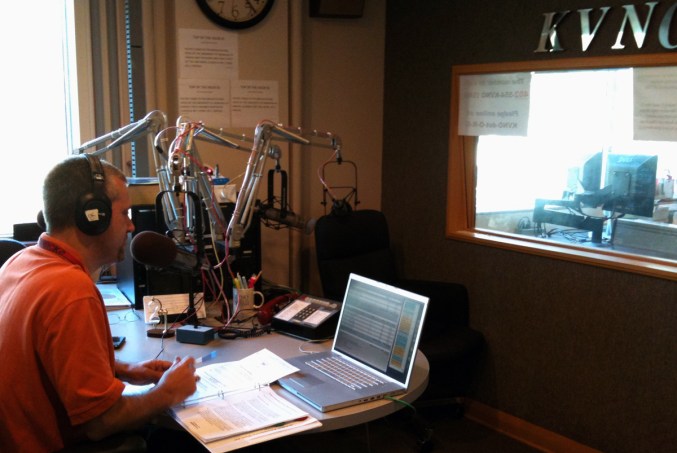
 A KVNO Radio studio in the early days at the Storz mansion, ©photo UNO Criss Library

Omaha’s KVNO Classical 90.7 FM turns 40:
Commercial-free public radio station serves the community all classical music and local news
While the commercial radio menu leans to blow-hard hosts and pop heavy rotations, public radio’s soothing sounds and erudite musings cut through the clutter. KVNO 90.7 FM further stands out for its all-classical play lists and original local newscasts.
Music, public affairs, news mix by KVNO for Omaha
The UNO-based independent celebrates 40 years on-air in 2012, an impressive feat considering its niche appeal as a commercial-free operation dependent on donor support for survival. The professionally-staffed station maintains high quality. The news division particularly serves as a real-world training ground for students.
KVNO long ago opted to be the master of its own content.
“KVNO’s programming is indeed unique among independent classical stations across the country,” says general manager and mid-day-midnight host Dana Buckingham. “KVNO has developed our own blend of classical music programming format that works well for us and the market we serve.
“Many traditional classical stations stick to a rigid programming formula that rarely deviates from the standard playbook of the ‘tried and true’ classics. This homogenized classical programming format almost never crosses over into more contemporary classical, vocal or film music. At KVNO we cross that line almost every hour and our listeners love it.”
Michael Hilt, who as UNO Associate Dean for the College of Communication, Fine Arts and Media oversees KVNO, sees value in personally crafting the program day.
“I think more and more you’re seeing stations going to services that provide the music. They may program part of their broadcast day but not all of it. We have a music director who works with the general manager on programming the music 24/7.”
Audience feedback is considered in programming decisions, officials note.
Buckingham says a “renewed commitment” to news and public affairs has netted award-winning results. “I am very proud of the achievements our talented news team has made. News director Robyn Wisch is a true professional and a great resource and mentor for our students.”
He says where KVNO once “sought to distance itself” from the university, “no more,” adding, “We are the broadcasting voice of the University of Nebraska Omaha and proud of it.” Hilt says the station maintains autonomy though. “The university lets us do what we do. Sometimes there are things we do they love and then there are other times when they say,’ Gee, we wish you hadn’t done that.’ Is there any censorship or editorial control? No.”
A new partnership, strengthening local arts ties, staying relevant
In January KVNO embarked on a programming partnership with NET Radio that enables each to serve a larger statewide audience and to introduce listeners to new voices. Expanding KVNO’s reach, says Hilt, “is very important to us.” Buckingham terms it “a win-win.”
Public radio and the arts make a natural fit, thus KVNO, which once branded itself “fine arts public radio” and served as “the voice of the Summer Arts Festival,” is a dedicated arts advocate and programming outlet.
“Our affiliation with the local arts scene is very strong and we are always seeking ways to make these relationships even stronger,” says Buckingham. “We’re exploring the possibility of producing an expanded weekly broadcast series of the Omaha Symphony.” He sees possibilities for the series beyond Omaha. “It is my hope we may eventually offer this expanded series for nationwide distribution. We are also in the process of integrating more classical music selections featuring the Omaha Symphony into our regular daily playlist and rotation.”
KVNO broadcasts the UNO Music Department series “Sounds from Strauss” and Omaha Symphonic Chorus and Tuesday Musical Concert performances. The station recognizes youth musicians through its Classical Kids program. Aside from the performing arts, KVNO does its share of live UNO sports broadcasts.
To remain relevant in this new media age of cable, satellite and the Internet, Buckingham says, “we cannot afford to be just another classical music service provider, we must be connected to our community and involved in promoting and providing a forum for the talented musicians and artists in our community.”
Popular on-air hosts help the station build listener loyalty, an essential facet in such an intimate medium.
“I have been an on-air classical music host on KVNO for over a decade,” he says. “In fact, most of our on-air classical announcers have been here a long-time. Over that time, we have established a connection with our listeners that has helped us through the good times and the not so good times. Many regular listeners have established a ‘relationship’ with our local hosts. We are always that familiar and friendly voice in the morning, afternoon, evening or late at night.”
Doing more with less and reinventing itself
University budget cuts and pinched donor dollars have forced a frugal station to further stretch already thin resources.
“Believe me, we know how to do more with less,” he says. “We do it every day. We furnished our newsroom entirely with computers handed down from other departments on campus and office equipment from university surplus..”
That austerity harkens back to the station’s modest roots. When KVNO first went on the air in 1972 general manager Fritz Leigh was the lone full-time employee. At the start KVNO stayed on-air only a few hours a day, gradually expanding the schedule until reaching a 24-hour broadcast day in 1985. For its first 15 years the station called the Storz mansion home before moving to the Engineering Building in 1987.
A KVNO Radio studio in the early days at the Storz mansion, ©photo UNO Criss Library
When Omaha DJ Otis Twelve became the morning drive host in 2006 it was not the first time a media personality joined KVNO. Local TV-radio personalities Frank Bramhall and Dale Munson did so in the 1970s and 1990s, respectively.
It may surprise listeners KVNO once played an eclectic mix of classical, jazz, rock, big band and folk before going all classical in the ’90s. A show it once produced and distributed, Tom May’s “River City Folk,” went national. KVNO is no longer associated with the show. Ironically, the show now airs on KVNO’s local public radio competitor, KIOS.
With a little help from its friends
One thing that’s never changed is the importance of financial support. Corporation for Public Broadcasting funding only covers so much. The rest must come from donors, memberships and sponsors. The station has thousands of loyal fans and some very generous funders, but Buckingham says, “less than 10 percent of those who listen to KVNO on a regular basis actually take the initiative to pony-up and contribute financially. We are obviously not getting the message out effectively.”
Volunteering for pledge drives is another way to help.
He’s actively seeking prospective business sponsors with this pitch. “Underwriting on KVNO is a cost effective way to promote your business and raise your organization’s profile and image. We reach a very desirable demographic-audience.” It’s a more diverse audience than one might expect. “Our listeners are not just scholars, musicians, business leaders, writers, students, intellectuals and teachers. Our devoted listeners are also butchers, bakers and candlestick makers.”
Bottom line, he says KVNO adds to the city’s cultural fabric. It follows then that becoming a sponsor or member helps KVNO improve the quality of life, in turn making Omaha a more attractive place to live. The 2012 membership drive unfolds in March. To join or give, call 402-554-5866 or visit www.kvno.org.
A South Omaha best-kept secret: American GI Forum Mexican Restaurant
©by Leo Adam Biga
The unpretentious, homey American GI Forum restaurant at 2002 N Street is a Tex-Mex bargain whose popular specials make this a busy joint.
But unless you’re a South Omahan or get tipped off to the place by someone, this best-kept-secret is likely to remain unknown outside its loyal following. After all, it has no website or Facebook page. You won’t find ads for it anywhere. It’s low profile is a shame, not because it starves for business – quite the opposite is true. But proceeds from this non-profit help support the activities of the veterans club under whose auspices and roof it operates.
The Omaha chapter of the American GI Forum, a national Hispanic veterans organization founded in 1948, provides scholarships to area students and assists down-on-their-luck folks who need help paying utility bills.
The veterans clubhouse is located upstairs in the sprawling, two-story building and the restaurant is downstairs. Reminders of the military connection are visible on the eatery’s walls, where plaques, photographs and photocopied stories extoll the exploits of area Hispanic veterans. The financial sacrifices and sweat equity that went into obtaining the facility are also detailed.
You’ll also find living history among the patrons, including charter member and Korean War vet Ricardo “Rick” Arellano, 85, who’s justifiably proud of the Forum.
This GI Forum chapter formed in 1957 and the membership acquired the then-condemned building in 1962, doing most of the extensive repairs and renovations themselves. One couple even mortgaged their home to help finance the project. Members also funded the work through, what else?, tamale sales. The structure underwent a major renovation and expansion in 2006.
The restaurant’s always been part of the set-up. It’s not unusual for a service club to have a commercial kitchen that puts out occasional meals for public consumption. Think VFWs or Sons of Italy. What distinguishes the Forum is that it operates a full-service restaurant and bar open to the public six days a week. The mostly Spanish-speaking cook staff churns out breakfast, lunch and dinner. The sizable menu is comparable to that of a traditional Mexican dining spot. So is the quality of food.
Manager Luis Valencia, whose father Leandro, is a club charter members, says many of the recipes used today were created by the late Nettie Escamilla Vela, the namesake of Bellevu’se beloved hole-in-the-wall, Nettie’s Fine Mexican Food.
If you’re not hung up on gourmet preparations or a stickler for strictly authentic dishes, and if you can do without fancy schmancy digs, then this is a must get-to. The space has a church basement social hall look with its tile floor, but the memorabilia, dartboard alley and flat screen TVs lend some warmth and charm .
The tacos, enchiladas, tamales, tortas and red chili stand up to some of the best around these parts. There are several chili dinners to choose from. The menudo has its fans. Hot wings are a concession to this ubiquitous finger food staple. Breakfast specials, including chorizo and eggs, and combo platters with eggs, potatoes, bacon, beans and rice, are legendary.
Lines form Thursdays for the dollar taco and buck seventy-five margarita specials. Similar specials pack ’em in on Fridays. Between its big lot and the surrounding streets, there’s ample parking to handle the crowds.
The regular prices are easy on the wallet, too, with most dinners priced $6 to $8 and ala carte items from $1.75 to $3.
This laid-back neighborhood landmark is a casual, family-friendly place where the grub and spirits and ready smiles make you feel at home.
George Selders has been a regular for a decade and says he keeps coming back for “the good food and the friendly atmosphere,” adding, “I’ve met a lot of friends here. It’s very pleasant.”
Linda and Bob Adkins often bring their grandkids or meet other couples there. “I’ve never had bad food here, ever,” Linda says. “I like it all. The people are nice. A lot of people don’t know about it. They don’t advertise and they don’t need to.”
Valencia confirms that almost all of the restaurant’s new business is by word of mouth. The fixtures and newbies account for a diverse clientele.
“What I like about coming over here is that it is really a very mixed group of people,” says Bob Adkins. “Every size, shape and color imaginable comes in here and it’s just fun watching people and to be a part of it.”
A recent visit found a cross-section of patrons variously chowing down or throwing back a few at tables or at the curved bar. A dart game was in progress in a corner. Music spilled out over speakers. The wait staff was attentive. The barkeep, pretty.
Regulars include a heavy dose of South O denizens and natives.
“If you’re originally from South Omaha you’ll run into somebody you know,” vows Valencia.
Hours: 11 a.m. to 9 p.m. Tuesday, Wednesday, Friday; 10:30-9 Thursday; Saturday 10-9; Sunday 8:30-7:30. Closed Mondays. For more info, call 402-733-9740.
UPDATE: Alexander Payne has added to his growing legendaric status by picking up his second Oscar for Best Adapted Screenplay. He, Nat Faxon, and Jim Rash shared the Academy Award for their work on The Descendants. Payne shared the same award with Jim Taylor for their Sideways script. It seems only a matter of time before Payne is recognized with a Best Director Oscar.
Here’s a capsule take on Alexander Payne and The Descendants, the latest in the filmmaker’s seriocomic forays into the existential angst, folly, fragility, and yearning of the human condition. If you’re a fan of Payne, the film, or of cinema in general, then check out the batch of stories on this blog about about him, this picture, his other movies, and a slew of other films and filmmakers from cinema’s past and present.

Two-yime Oscar-winner Alexander Payne delivers another screen gem with “The Descendants” and further enhances his cinema standing
©by Leo Adam Biga
Appeared in Omaha Magazine
Until The Descendants opened to golden reviews last fall, seven years elapsed between feature films for its celebrated writer-director Alexander Payne.
The Omaha native and Creighton Prep grad came of age as a film buff here. He made his first three features (Citizen Ruth, Election, About Schmidt) in his hometown, each moving him up the ranks of elite moviemakers. His surprise 2004 hit, Sideways, took him to Southern California’s wine country. The combination road-buddy picture and unconventional love story confirmed Payne as a film industry leading light, earning him a Best Adapted Screenplay Oscar.
He then busied himself writing-producing films for other directors. When he couldn’t find financing for his own pet project, Downsizing, he made The Descendants. Before shooting it in late 2010 the only directing he did in this period was a segment of Paris, I Love You and the pilot for HBO’s Hung.
The Golden Globes won by Descendants star George Clooney for best dramatic actor and by Payne and producing partners Jim Burke and Jim Taylor for best drama harbors well heading into the Oscars, where the film will be well-represented with five nominations (for Best Picture, Best Director, Best Adapted Screenplay, Best Editing and Best Actor). The three friends share their own production company, Ad Hominem Enterprises, which produced the picture for Fox Searchlight, with whom Ad Hominem has a first-look deal. The pic’s strong showing with critics and award shows is reminiscent of Sideways. Like that film, this one took Payne far from the Midwest – to Hawaii. A decade after working with iconic Jack Nicholson on About Schmidt, Payne teamed with another icon, Clooney.
As land baron attorney Matt King, Clooney is a man in crisis. His wife Liz lies in a coma after a boating accident. After years of indifferent parenting he’s suddenly in charge of his two girls. He’s burdened, too, by the valuable land entrusted to his care by ancestors. When his older daughter Alexandra (Shailene Woodley) reveals her mother’s infidelity, Matt sets off on a journey that begins in retribution but ends in forgiveness. Payne says “two acts of love” are what drew him to adapt the Kaui Hart Hemmings novel.
The story shares in common with Schmidt and Sideways and Payne’s forthcoming Nebraska a beleaguered protagonist trying to mend an unraveling life.
“It’s just the comic archetype Jim Taylor (his producing partner and former co-writer) and I came up with and I’m continuing of the middle-aged guy who’s really unconscious and has a bunch of anguish and frustration in life,” says Payne. “It’s a guy with good intentions but who’s bought the wrong package. I think it’s funny.”
Extracting equal amounts pathos and humor from human folly is what Payne does.
“I’m just always drawn to material that remains human. You don’t need guns and spaceships and great contrivance to have a movie and a meaningful one. I don’t think those elements are necessarily bad – I like movies of every genre, but what I’m drawn to is trying to somehow explore and express and mock the human heart.”
Descendants is being called Payne’s most fully realized work. “I hope so,” he says, adding that any new maturity reflects his more accrued life experience at age 50 and his evolving film craft. Some observers note he seems more comfortable letting tender emotions play out on screen.”Well, that’s what this story called for,” he says. “I mean, it could be a new vein of filmmaking in me or could just be I was serving this particular story as a professional, workman-like director. I have no idea.”
Staying true to his Omaha roots, he attended the movie’s local premiere at Film Streams, where Descendants smashed box office records. Payne enjoys sharing his work at the art cinema whose board he serves on. Before an appreciative crowd of friends and supporters he announced the film was among the highest grossers nationally its first week. By early February its domestic take stands at $66 million-plus, makeing it the top indie flick released in 2011.
Exuding grace and humility, Payne personally greeted audience members before and after the opening night screenings here. In accepting his Golden Globe, Payne deflected praise to cast and crew, to the people of Hawaii and to Hemmings, whose “beautiful gift” of a novel he made his own.
He’s conquered Cannes, Toronto, New York, Hollywood, but he proves he can come home again. Payne, who keeps a condo here, plans shooting the father-son road pic Nebraska in various Panhandle locales come spring. Home is where the heart is and he’s always happy to return where his cinema dreams were first fired.
Omaha’s young creatives community is the subject of much press and buzz, as this blog is in part a testament to, and SkyVu Entertainment is one of the more interesting stories on this burgeoning scene. The self-desccribed transmedia company that does animation and designs mobile games is led by a visionary named Ben Vu who is completely serious when he says he views SkyVu as the Pixar of mobile games and as a mini-Disney. The following profile of Ben and his company will be appearing in an upcoming issue of B2B Magazine. I am sure to be revisiting his story and his company’s story again in the near future.
SkyVu Entertainment pushes “Battle Bears” brand to sky’s-the-limit sision of mobile games, TV, film, toys …
©by Leo Adam Biga
Originally appeared in B2B Magazine
With Battle Bears reaching 14 million downloads and counting, maker SkyVu Entertainment is a Player in the mobile games world.
“We created an entertainment distribution platform through not something like Facebook or Twitter but something like a brand. We like to see ourselves as the Pixar of mobile games. A mini-Disney,” says Ben Vu, co-founder of SkyVu with his brother Hoa.
The transmedia company, which launched here rather than Asia thanks to Nebraska Angels support, has designs on making a feature-length Battle Bears film and is negotiating a television series and toy line. SkyVu began as an animation shop before entering the games field.
A graduate of Disney-founded Cal Arts, Ben worked on the stop-motion feature Coraline and has made a study of the Walt Disney Company. He notes parallels between the Brothers Vu and Midwesterners Walt and Roy Disney.
“I see a lot of how myself and my brother are in how Walt and Roy Disney played off of each other,” says Ben. “Roy was the money guy and Walt more the creative visionary, and a lot of times the creative visionary wanted all the resources he needed to fulfill that vision while the other one watched out for the road ahead.”
Ben’s the creative mastermind. Hoa, who heads up the Singapore office, is the tight-fisted numbers wonk. This yin-yang finds them often butting heads. Their conflicting personalities are the models for two Bears characters, Oliver (Ben) and Riggs (Hoa). “They’re always at odds but somehow every episode of every game they find a way to work together to accomplish the mission,” says Vu. “This is how Ben and Hoa work.”
The only children of Vietmanese refugee parents, the Vus grew up in Norfolk, Neb. and graduated from Omaha Creighton Prep. Both were fascinated with movies, games and drawing. Their skill sets meshed with the new digital age.
“We’re an entertainment company and we use technology to entertain, but boy do we love technology,” says Ben, “because it allows us to compete at a high level, reaching millions of people within a short amount of time at a fraction of what it used to cost. With the advent of the iPhone followed by the iPad and the growth of Android we could not be in a better place right now.”
He says their signature game “combines cute with a bit of violence in a compelling story about a family of robotic bears trying to save the world but learning from each other in the process.” Its put SkyVu in elite company with EA, THQ, Sony, Nintendo, even Microsoft. “They all want a piece of the mobile pie.”
He says big companies have more resources but SkyVu has its own advantages.
“Because of our careful attention to character and story, first and foremost, we build engaging games. Something we’ve learned in a short amount of time and that we’re good at is providing a snack bite size quality experience coupled with a very appealing character and story. The magic is those two things coming together.
“We’re one of the unique studios in the world that has an animation and a games studio all under the same roof driven by the same creative force.”
Fans keep coming back for more at the App Store.
“We don’t talk about users or players, we deal in building loyal fans and taking care of them.”
Bigger audiences await.
“The (film) studios and networks are now looking at mobile games as a rich source of content,” says Vu, who feels SkyVuis well-poised to seize the day. “As the mobile game experience becomes more rich, as these phones get faster, as tablets start to invade the living room more, the production quality rises and SkyVu needs to scale itself up appropriately to be ahead of the curve.”
Getting there requires more capital, perhaps a partner, and he says SkyVu is attracting serious offers. The team’s multi-skilled animators and coders allow flexibility.
“We’re in mobile right now but there’s no doubt in my mind you’ll be experiencing our brands in the living room, possibly in the airplane and the car, certainly in theaters.”
He keeps a shoebox full of story-character concepts in his office, which doubles as the war room. White boards display a calligraphy of brainstorms. “There’s no shortage of ideas.”
SkyVu’s 14-person team is all local and Vu’s confident Nebraska will continue filling its needs. In January he strategically relocated SkyVu to Ak-Sar-Ben Village to be near the Scott Technology Center, Peter Kiewit Institute and UNO College of Business.
He says SkyVu offers a rare Midwest opportunity for “talented young people to create stuff seen and experienced by millions of people.” He’s committed to staying put. “The team we built here got us to where we are, so why would we abandon that? We can be competitive with any region in the country, with any country, as long as we maintain our innovation and creation.”
“It’s really daring what we’re trying to do here, but we’re actually doing good, we’re making traction. If the TV series becomes a reality things are going to go crazy. We’re just breaking even now and profitability is our number one priority because we have to grow.” ”
He anticipates adding 60-plus employees in two years to accommodate new ventures.
The next big thing may only be a shoebox away.

Women feature filmmakers were fairly abundant at the start of motion pictures but by the time the sound era took off in the early 1930s they were pushed out of the male-centric industry’s directing ranks, save for Dorothy Arzner and Ida Lupino, and really didn’t return again, except for underground or art house filmmakers like Shirley Clark and Barbara Loden, until well into the 1970s. Elaine May made a big dent in the boys only network with her early 1970s films The Heartbreak Kid and A New Leaf. Joan Micklin Silver followed with her own breakthrough, courtesy her 1975 feature debut, Hester Street, whose unexpected success helped open doors to more women filmmakers the remainder of that decade and especially in the 1980s. Silver and Hester Street are of particular interest to me because she is a fellow Omaha native and her film stands as a landmark screen portrayal of the immigrant experience in early 20th century America alongside Elia Kazan‘s America, America and Francis Ford Coppola’s The Godfather II. As the following story details, the film overcame all odds in just getting made and released and then defied all expectations by becoming a darling of critics and audiences, earning a then-astounding box office take for a small indie film – $5 million, plus a Best Actress Oscar nomination for star Carol Kane.
I have been following Silver for many years – you’ll find some of my other stories about her on this blog – and I recently had the pleasure of interviewing her again in the aftermath of Hester Street being included in the National Film Registry. I also interviewed Hester Street star Carol Kane, though I won’t have a chance to post anything from my conversation with her until a later date. Silver, by the way, is one of the most underrrated filmmakers of her or any time. Her body of work in the 1970s and ’80s, though quite small, can stand with nearly any director’s. I highly recommend Hester Street, the rarely screened Between the Lines and Chilly Scenes of Winter (also known as Head Over Heels), Loverboy, and Crossing Delancey, which for my tastes is one of the best romantic comedies ever made.
The grapevine tells me Silver may be coming back to Omaha (a rare occurrence) for a Film Streams program that Alexander Payne is arranging. After years of interviewing her by phone and writing about her, I hope to finally meet her. Stay tuned.

Joan Micklin Silver’s Classic “Hester Street” Included in National Film Registry
©by Leo Adam Biga
Soon to be published in the Jewish Press
Long before Kathryn Bigelow struck a blow for women filmmakers by capturing the Best Director Oscar, Omaha native Joan Micklin Silver made her own Hollywood inroads as a feminist cinema pioneer.
With her 1975 directorial debut Hester Street she joined a mere handful of women directors then. Just completing the film and getting it released was a major feat. The low budget, black-and-white independent told a period Jewish immigrant story partly in Yiddish with English subtitles.
“With great effort we made the film,” says Silver.
Her script adapted the Abraham Cahan novel Yekl: A Tale of the New York Ghetto. As the eldest daughter of Russian Jewish immigrant parents, the story held deep reverberations for Silver, who says she gloried in her father’s tales “of what it was like in Russia and what it was like coming over and his first banana.” Hester Street allowed her to commemorate on screen the immigrant experience she sprang from. “I cared a lot about the ties I had to that world,” she once told a reporter.
That the film became a sensation was a small miracle.
“One thing I thought as I was making the movie, ‘Well, who knows if I’ll ever get to make another film,’ and I say that because things were pretty dire for women directors and I really wanted to make one that would count for my family. The immigrant experience was a very big part of my family’s experience.”
Silver feels the film strikes a chord with viewers because “it tells an immigrant story in an interesting, believable and honest way.”
Last November Hester Street’s impact was confirmed when the National Film Preservation Board included it among 25 new selections in the National Film Registry, a U.S. Library of Congress-curated archive of significant American movies. Its citation notes the film’s been “praised for its accuracy of detail and sensitivity to the challenges immigrants faced during their acculturation process.”
The honor took Silver by surprise.
“I was really pleased, I had no expectation, and I was delighted to be on the same list with a John Ford movie (The Iron Horse) and a Charlie Chaplain movie (The Kid). It’s pretty exciting,” the longtime Manhattan resident says.

The recognition is doubly satisfying given the difficulty of getting the movie made and released. She recalls one Hollywood executive who rejected the project suggested she change the story to Italians. When no studio would finance the story of early 20th century Eastern Jewish immigrants, her husband Ray Silver, who worked in real estate, raised the $350,000 to do it. He also produced the picture and made sure it got seen.
“Certainly he’s the hero of my story,” she says.
Much of the film was shot where the film is set on New York’s Lower East Side. The tight production schedule meant added pressure. “It was really scary” says Silver. “I remember one day when I went to shoot a scene and the location had not been secured and it took two hours to secure it, so I was two hours behind, and the whole time I was directing the scene I was thinking, How do I make up the two hours? It isn’t what you should be thinking about when you’re directing a scene.”
She’s forever grateful to her collaborators.
“I had a chance to work with such good people. I had a wonderful cameraman and production designing team and costumer, and that makes all the difference in the world to somebody just starting out. And I had such a good cast (Steven Keats, Paul Freedman, Doris Roberts, Mel Howard, Dorrie Kavanaugh) and I’m still really close and friendly with Carol (Kane).”
Silver first saw Kane in the Canadian drama Wedding in White and thought her perfect for Gitl, a naive new immigrant wife-mother whose painful assimilation leads to her emancipation. As Silver assumed Kane lived across the border she despaired her meager budget could not afford putting her up for the shoot until learning the actress resided in NYC.
The two felt a connection as Kane came from a Jewish immigrant family not unlike Silver’s and grew up in Cleveland, where Silver once lived. The filmmaker recalls Kane as “a very conscientious, serious, careful, lovely young woman” who went home to rehearse in the sheitel and period jewelry provided for the part.
After all the hard work to finance the film, meticulous research to ensure authenticity and stress to complete the project on time, no studio wanted to distribute it. Silver was heartbroken.
“I went through a bad period thinking, I’ve made this film nobody will distribute, what am I going to do? how are we going to pay the money back?”
On the advice of maverick filmmaker John Cassavetes, the couple distributed it themselves through their own Midwest Films company. And then a remarkable thing happened. Ray entered the film in the Cannes Film Festival and it was accepted. More prestigious festival showings followed. As the film proved a critical and popular darling more theaters screened it. Hester Street became a surprise hit, earning $5 million at the box office and gaining enough industry notice for Kane to be Oscar-nominated, both unheard of accomplishments for an indie pic then.
Silver had the thrill of informing the actress she’d been nominated.
The project established Silver’s reputation as a bankable director. Her subsequent theatrical films include Between the Lines and Chilly Scenes of Winter. Perhaps her crowning achievement was Crossing Delancey, when she revisited Lower East Side Jewish culture in a modern love story poised between Old and New World values. She later directed many made-for-television movies (Hunger Point).
The Central High graduate left Omaha in the early 1950s to pursue a love for writing, theater and film nurtured here. After graduating from Sarah Lawrence College she settled in Cleveland, where plays she wrote were performed. In New York she wrote and directed educational films
Her dream of a Hollywood breakthrough was partly realized when her story about the wives of American POWs, Limbo, was optioned and she worked under veteran studio director Mark Robson adapting it to the screen.
“In the end I was replaced as the writer (sharing screenplay credit with James Bridges) on the film. Not knowing very much, I disagreed with the director in meetings and he said, ‘Thank you very much,’ and replaced me, which is the privilege of the director.
“But he then invited me – because he knew what I really wanted to do was direct as well as write – to come to the shoot and stay as long as I wanted to avail myself of anything I wanted to learn about. Of course, I felt very upset I had been let go but I got past it and I said, ‘OK, I’m coming,’ and that was a tremendous learning experience for me.”
Robson’s largess was rare in the misogynist, male-dominated movie field. Besides, Silver notes, “Who wants a disgruntled screenwriter around? So that was very generous of him. He let me look through the camera, he let me review the film’s budget, he let me talk with any of the actors, and I did. It was marvelous. I gained a real understanding of how one sets up a budget for a feature film.”
For Silver, who never formally studied filmmaking, it was her film school. Confident in her abilities, she vowed her work would never be compromised again.
“I think almost everybody who gets along in film seems to have experiences like that because it’s a pretty tough field and you need guidance and you need friendship and generosity, and I was very lucky to have it myself.”
In a sense Silver prepped all her life to make Hester Street. The stories she absorbed from her father previously led her to make The Immigrant Experience for the Learning Corporation of America. For her first feature she again fixed on subject matter close to her heart.
“My father was ill during my teenage years and he was home a great deal, so I spent a lot of time with him. He was looking for somebody to talk to and believe me I was there and I was really happy to talk to him. I’ve always thought immigrants fall into two experiences: those who don’t want to talk about it at all and those who want to talk about it all the time and that was my father – he loved reminiscing about it. As a very bright, questioning man, he was also interested in the world, politics, current events and books. I was so lucky to have talk after talk with such a wonderful father at a time when it was unusual for fathers to talk to their daughters.”
He father died before she became a filmmaker, but her mother lived to revel in her Hester Street triumph. “One of the first things she did when Hester Street came out was make the cover of what would be a scrapbook. Yeah, she loved it and she was thrilled for my success.”
Silver’s interest in immigrant tales continues with her in-progress documentary The Bagel: An Immigrant’s Story. She has a feature script in development. Meanwhile, she’s struck up a friendship with fellow Omaha native filmmaker Alexander Payne. The two are discussing a possible Film Streams program with her and her work.
Every city has its dynamic young professionals who help shape or in some cases help reset the creative-cultural-style bar, and that is most definitely the case with Nick and Brook Hudson of Omaha. They are a much-admired couple who embody the having-it-all ethos in their personal and professional lives. Their contributions to Omaha’s emerging aesthetic covers fashion, beauty, social entrepreneurship, education, and night life. Nick’s Nomad Lounge became THE high-end night spot in the Old Market. The Halo Institute he co-founded with Creighton University has now been absorbed into that school’s College of Business, where Brook was the marketing director. He co-founded Omaha Fashion Week and now he and Brook together are taking it to new heights. The same holds true for Omaha Fashion Magazine. And now the couple is coalescing OFW’s support for the burgeoning Omaha fashion scene with the new Omaha Fashion Institute, which you’ll be reading more about here in the coming months. Nick also has his beauty (Masstige Beauty) and social networking (Xuba) businesses and Brook has her mentoring program/finishing school, La Fleur Academy. There are a lot of moving parts in their life and work and all their activity touches a wide range of people and organizations here and beyond. You’ll find other stories on this blog about some of the things they’re involved in, including Omaha Fashion Week, an event growing so fast that it’s gaining some regional and national attention. There’s also a profile here about Nick. I am sure to be revisiting their story again down the road as they engage in new endeavors and adventures.

Nick and Brook Hudson, Their YP Match Made in Heaven Yields a Bevy of Creative-Cultural Results – from Omaha Fashion Week to La Fleur Academy to Masstige Beauty and Beyond
©by Leo Adam Biga
A version of this article was published in Metro Magazine
As fabulous Omaha young professional couples go, Brook and Nick Hudson are stars.
The former Brook Matthews won the 2004 Miss Nebraska crown. The Blair native and University of Arkansas graduate completed her MBA in 2010 at Creighton University, where she’s marketing director in the College of Business. She was honored as the school’s graduate woman of the year and the Omaha Jaycees have named her an Outstanding Young Omahan.
She volunteers with the American Heart Association, the Omaha YMCA and Junior League of Omaha. Her passion for etiquette and self-improvement led her to launch La Fleur Academy, a mentoring program for empowering girls and young women to tap their inner beauty and potential through the social graces.
“I love to see the difference I can make when I work one-on-one with girls.” she said.” It’s one of my favorite things to do.”
Advising her on La Fleur is hubby Nick, a business development and strategic marketing veteran of international beauty brand companies. He owns Nomad Lounge in the Old Market and founded Omaha Fashion Week. OFW grew out of Nomad, which doubles as cool entertainment venue and creatives hang out. Nomad showcases talent through meet-and-greets, exhibitions and performances.
The native Brit’s entrepreneurial instincts led him, in partnership with Creighton, to form the Halo Institute, a nonprofit incubator for nurturing start-up companies with a social entrepreneurship spirit. He’s now pursuing a new for-profit venture, Xuba, that seeks to leverage social networking sites with commercial opportunities.

Just as Nick consults La Fleur, Brook lends her marketing expertise to OFW and its goal to be a sustainable support system for the local design community.
Teamwork is a defining characteristic of this couple’s relationship.
“Our encouragement of each other in our endeavors really is what drives a lot of success,” said Brook. “We rely on each other, and we spend a lot of time talking and brainstorming and coming up with ideas.”
“We have really good complementary skill sets,” Nick said.
Their openness to being inspired by one another helped bring them together.
“We realized we are more than the sum of our parts, and I think that’s where we have an opportunity to make an even bigger impact in the community than we did as individuals,” said Brook. “We both feel confident we’re capable and intelligent and able to make a difference. It energizes us to be able to employ all of those talents for the betterment of our community. I think that’s what keeps us going.”
Said Nick, “Most people have different kinds of hobbies, but I think for me my hobby, my passion is I just love helping people create things and achieve things, and I think Brook and I are similar in that.” As Brook puts it, “The whole idea is building other people up and helping them achieve their dreams.”
“I’m not the best at doing certain things myself, but I’m quite good at encouraging other people to do things, and that’s just really satisfying,” said Nick.

Paying it forward is “a great reward,” said Brook, adding, “People have limitless opportunities — the only limits in life are the ones we place on ourselves — and I think Nick and I are all about helping people see past those self-imposed limits.” It’s no different than how they push each other. It’s why she calls Nick her “chief go-to mind” when she needs to run an idea by someone. He does the same with her.
“I’m learning so much from my best friend and from my soulmate because Brook is probably the best person at telling me where I need to improve and what I need to work and what I need to think about better or what can we do better,” said Nick.
“I appreciate him so much for encouraging me and my dreams — I don’t think I could do it all without him,” said Brook. “Nick’s the dreamer and I’m the realist. When I need to think bigger I call Nick and when Nick needs to be brought down to reality he calls me. It’s a beautiful thing. We’re good at giving each other tough love and encouragement when it’s needed. Not a lot of couples can communicate as openly as we do.”
A shared interest in social entrepreneurship helps.
“I think it’s just integral to the spirit of the young professional and what’s important to us. We want to be connected to something greater than ourselves and we want to collaborate to solve problems,” she said. “Omaha’s in an interesting place in its evolution because there will very soon be a big shift in power and wealth in the community and we’re all sitting back wondering, Well, who’s going to be the next Warren Buffet or next big corporate titan in Omaha? Looking around, it could be any one of us. It’s a great time to be a young professional in Omaha.”
“It’s pretty amazing what groups of young professionals are doing around Omaha — I’m really impressed,” said Nick. “I think there’s still so much more to do. I’m still just learning what the potential is and how we can do things.”
With Nomad, Halo, Fashion Week and La Fleur, the couple are actively engaged in helping people achieve their dreams.
Imagine my surprise when I searched for images of the late Nancy Bounds, the subject of this story, and could not find a single one. My surprise stems from the fact that Bounds was a much photographed stylish woman whose entire career was built on image enhancement work with aspiring models and actors. She was a personality and celebrity whose all about town comings and goings were grist for the Omaha society mill pages. She frequently appeared on television, too. So, instead of pictures of Nancy I bring you pictures of one of the talents who came out of her modeling school, indeed the most famous graduate of all –model-actress Jaime King, an Omaha native like me. My search for Nancy Bounds images continues and I expect before long to have her lovely, smiling face and well-outfitted figure gracing this post. For now though, Jaime King is not a bad compromise. If you’re into all things fashion and style, you’ll find other articles of interest on this blog.
NOTE: Special thanks to fashion photographer Michael Dar, who got his start under Nancy Bounds in Omaha, for his photo of her.

Nancy Bounds, Timeless Arbiter of Fashion Beauty, Glamour, Poise
©by Leo Adam Biga
Originally appeared in the New Horizons
For 40 years, Nancy Bounds was Omaha’s saucy arbiter and symbol for good looks and social graces. The owner of a string of modeling/finishing schools bearing her name, she applied her tastemaker’s role as television host, magazine columnist, pageant director and self-improvement guru. This former model, singer, dancer and actress best embodied her own beauty ethos. Whatever the gala, she was always the stylish, well-turned-out fashion plate looking like she was poured into her haute-couture designer clothes, which her closets overbrimmed with.
Bounds shared her story with the New Horizons a few years before her passing. Her repuation preceded her and she proved to be everything and then some that was said about here.
An expert in the rules of attraction and feminine wiles, Bounds is just what you’d expect from a Southern-born and reared beauty queen. She exudes a soulful, sassy, sweet, sad quality that almost makes you think that at any moment she’ll utter Blanche du Bois’s famous line from A Streetcar Named Desire. You know the one: “I’ve always depended upon the kindness of strangers.”
A coquettish charmer with milky skin and sun-dappled hair, Bounds greets visitors to her resplendent Dundee home in the warm honey glow of her broad smile, sparkling eyes and sultry voice. Wearing an antique blue silk ensemble and a pair of high-heeled silver sandals, she’s still every inch the fashion maven and beauty diva who’s made men weak-kneed at the sight of her since her ingenue days.
It took all of her cheeky guile to get where she is today, which is a long way from her rural Arkansas roots. It may surprise some that this sophisticated lady, who’s the epitome of chic, owns a background closer to Dogpatch than Fifth Avenue.
Growing up the youngest and brightest of six children, the former Nancy Southard was born, on an undisclosed date, in the Ozarks, where her gentrified father owned land, saw mills and other interests. Despite such backwoods environs, she comes from good stock. She said her mother’s family, the Tayloes, are descendants of George Washington and her father’s family is related to the Astors of old New York high society. Still, there wasn’t much in the way of culture where she lived.
And her precocious bordering-on incorrigible personality didn’t sit well in her “very strict Christian” home that her father ruled with an iron fist. “I was an obstinate, self-confident tigress. I don’t know how anyone stood me,” she said.
Her rearing came in a series of small towns — Rodney, Norfolk, Mountain Home — she felt confined in and pined to escape. The rote learning of a small school was torture for a girl bursting with starry-eyed dreams and ideas inspired by the books and magazines she devoured. In class, which she found “boring,” she’d either fall asleep or break out in hives or draw the ire of a teacher, and be sent to the principal’s office, where she played duplicate bridge and chess with the headmaster. As a young schoolgirl she exhibited an extrovert’s expressiveness and a knack for makeup and performing, but had no real outlet for her gifts.
If not for her astute godmother, Maude Washington Arthur, Bounds may not have broken away from the shackles of that constraining life. A kind of down home grand dowager duchess holding court in a cabin atop a mountain, Maude was an educated, well-traveled woman who saw the potential in Nancy and held out the possibility she could live out her dreams. Nancy lived for a time with Maude, who became her personal finishing school mistress.
“She somehow picked on me and wanted me to have the sophistication she thought I was lacking at school,” Bounds said. “She helped me to choose the good books to read. That lady — she knew I was going to be something in the world. She believed in me. She was my mentor.”
Making a mark is what Bounds wanted more than anything.“I didn’t have so much a dream. I just knew I wanted to be somebody. I wanted to be well-known. I wanted to be a star. It never crossed my mind I was going to fail,” she said. “I had more guts than good sense, in some cases, but for some reason there’s always been a little star following me around all of my life, and it’s always sort of taken care of me.” Consumed by a sense of “ambition, wanderlust and loneliness…a lot of loneliness,” Bounds just wanted to be free and Maude encouraged her to try her wings. “She kept saying, ‘You can do it.’ And I knew I could do it.”

So convinced was Bounds that her future lay in the wider world that the first book she bought was “a book on manners,” she said. “I wanted to be able to move in whatever kind of society I was ever going to be in.” Her intuition served her well, too, as she’s lived a storybook life that’s found her mixing with everyone from world famous designers, models and entertainers to politicians to royalty.
Emboldened by Maude and by a grandfather who also recognized her destiny, Nancy one day just packed up and left. She was only 14, but her exasperated parents let her go, knowing she had to try. “That’s how much I wanted to get out of Arkansas and to get out where it was happening in the world,” she said. Her destination? Springfield, Mo. It was as close to cosmopolitan as she could get. Why Springfield? “I had enough money to get there –$35. I got on a bus. It stopped every 20 minutes and I’ve never ridden a bus since. That was not going to be my style,” said Bounds, who nowadays tools around in a chauffeur-driven limo.
Without knowing a soul in Springfield, she put on a brave face and made herself up to look older than she was, quickly landing jobs as a waitress and cosmetics clerk. Then, she really showed her brass when she auditioned for a singing slot on a local radio station. She got the gig and sang a few times a week on live broadcasts.
Then she met a man who looked good in an Air Force uniform. She was 15. They got hitched. Before she knew it, he was off flying Goonie Birds in the Berlin Airlift. “I didn’t see him for a year,” she said, “and by then I’d forgotten what he looked like.” While he was away, she found she was pregnant. She moved back home, where she’d kept the news of her marriage a secret from her father, who’d warned her to stay away from those “hound dogs.” After “having it out,” she went to Wichita, where family lived nearby.
On her own again, Bounds made do. A couple of sailors, Ronnie and Jean, befriended her in the weeks leading up to her giving birth. “They both fell in love with me, but they were always like brothers to me. Better than brothers,” she said. They were with her when the labor pains began and flagged down a taxi to take her to a military hospital. She was still so young and naive she thought doctors “cut you open to get out your child.” To show her undying appreciation to her friends, she named her daughter Ronnie Jean after them.
When her long-absent husband returned from overseas, she greeted him with, “I’ll take you to meet your daughter.” The couple’s ill-advised union fell apart when he took her to live with his family in Minnesota. After three months, she said, “I had to get out of there. So, I got up and packed at three o’clock in the morning and snuck out with about equal amount the money I had when I left home.”
She fled to the Ozarks. He found his child-bride, but she would not have him back. She filed for divorce and went to Minnesota to get it. “I didn’t want anything except the right to my daughter for the rest of my life and that he was never to come near me or her.” To her dismay, she learned the state only granted divorces then on the grounds of adultery. “Well, I wasn’t about to do that,” she said. “So, we picked one of his good friends and he and I sat up all night long and played gin rummy. We came down the next day and he went to court and swore he spent the night with me. Totally staged. But I got my daughter back, which is all I wanted.”
Living back in Wichita with her baby girl, Bounds screwed up her courage and reinvented herself again. “I learned a group was looking for a singer. I auditioned, but I didn’t like the group. It gave me an idea, though. Why don’t I get my own group? Of course I had no money, but I had the audacity to start doing interviews.” Soon, she assembled a pianist, bass player, drummer and saxophonist. She fronted with her vocals. After some Wichita area gigs, her group moved west, landing jobs in Colorado. When band members began bowing to pressures from home, she disbanded the group and went solo. “I had to support my daughter,” she said.
She headlined at a nightclub in Denver and a hotel in Estes Park. What her voice lacked, her sex appeal made up for. “I sang love songs and lots of blues. I had a soulful, smoky sound. There’s something about a saxophone that could really turn my voice on. But I was never a fabulous singer. I was a much better performer than I was a singer. I could sell a song. And I had a great bod,” she said.
Her hunger next took her to Chicago, where she variously modeled, sang and danced for a living. She also acted in TV spots. Her growing interest in acting led her to join a repertory summer stock company in Boston, where she appeared in several plays over three seasons. Theater, for her, fed a desire to improve her mind and broaden her knowledge. “I wanted to improve my ability to articulate my feelings,” she said. “I learned a lot about the language by doing different parts.”
Back in Chicago, the ever-enterprising Bounds continued her education by hiring a Northwestern University professor as her private tutor. “He was a wonderful guy who wanted to teach me what I wanted to know — everything. He was interested in my life and in my mind and I was incredibly interested in all that he knew. I always called him Webster.” With the prof’s help, she lost her Southern accent and further refined herself. He was her Dr. Higgins and she his Eliza Doolittle.
She eventually found romance with a man, Carmen, who became her husband and dance partner. She, her new hubby and her daughter moved to Kansas after her little girl was diagnosed with asthma and doctors advised the child live in a dry climate. Nancy and Carmen were performing as a dance team in Wichita when an agent saw them and recommended her to band leader Xavier Cugat. The Latin maestro signed her up and she happily performed with his band in the Dallas area. “Oh, play me some Latin music and watch this body and hear this voice work it. I’ve always loved Latin music,” she said. Cuggie or Papa, as he was called, became her newest Svengali. “Oh, he was such a puppy dog…the sweetest guy.” She recalls him painting surrealistic images in his spare time as she “sat at his feet and watched him” work. “His courage with color was amazing. He said I was a muse for him because I was so enthusiastic about his art. He said, ‘When I see you, I see golden…yellows…rainbows.’ He painted my personality. I adored him.”

Meanwhile, her marriage to the dancer fizzled. Her life turned again when she bought some Fred Astaire Dance studios in Kansas and fell in love with and married an Air Force colonel, Robert S. Bounds, who gave her her professional name. She wound up in Omaha when he was transferred to Offutt. At first, Nancy thought she “would be happy playing golf, playing bridge and just being an officer’s wife. Well, that lasted about three months.” Restless, she looked into working for a local modeling school. Instead, she ended up running it. When the owners of another school noticed her business savvy and offered her a 50 percent piece of their place, she held firm for a controlling share. She soon made over the business as her own, moving it into the suave penthouse quarters of the old Fontenelle Hotel.
Marriage number three ended when the colonel got reassigned and she balked at moving. Besides, she said, he’d run her burgeoning modeling business into the ground after she sold it to him. “It’s then I decided it was I who had the brains,” she said, “when he had me believing all the time it was him.”
Every time she’s started over, Bounds has gritted her teeth and feigned her famous moxie, but it was all a facade. “I felt frightened, but I never let anyone know it. I was scared to death about half the time, but I kept saying, I can do this.”
Do it, she has. A breakthrough for Bounds occurred in the 1970s. Tired of her models being snatched up and under-used, she made elite agents, such as Ricardo Guy in Milan, take note of Omaha as a rich talent pool and launching pad for serious careers in modeling, films and television. As soon as agents learned her models got magazine covers and film-TV roles, her annual graduation show at the Orpheum Theater drew talent scouts from New York, L.A., Milan, Paris and Tokyo. Several of her graduates have gone on to major careers, most notably model-actress Jaime King.
She feels Nebraska’s gold mine of talent springs from something in the water or gene pool here that creates “The Look” everyone’s after. Then, too, she adds, “I think I was blessed with good eyes. I start watching them when they’re 9 or 10.” She said the model standard hasn’t changed much in 35 years. “It’s just gorgeous, gorgeous and more gorgeous. It’s the beauty of the face and the personality. The naturalness.” She said one difference is more women of color are now top models.
As her Nancy Bounds International Modeling Agency and Nancy Bounds Studios thrived, she opened schools in other cities. Helping her grow the company was her fourth husband and business partner, Mark Sconce. “He just believed in me 100 percent,” she said.
Eager to improve the image of the modeling school field, which is plagued with disreputable operators, she formed the International Talent and Model School Association. It was an attempt to create industry-wide standards and practices and, via ITMSA conventions, provide showcases where models from many schools could strut their stuff before top agents. After a rough start, when she “chewed out” school directors, the association proved a success. Then, she said, it all fell apart and the “rip-off” artists took over. It’s a long-standing problem, even in Omaha.
“People enroll and pay some thousands of dollars, and they’re taken to these conventions and they’re lucky to get five seconds on the runway,” she said. “There isn’t regulation. Before I got here, you didn’t even need a license. There’ve been 17 schools open and close here since I’ve been in business.”
She got an improbable ally in her efforts to clean-up the industry when state Sen. Ernie Chambers came to her bristling over modeling schools reneging on promises made to constituents of his. When he asked Bounds — What can we do about this? she said, “We can write some laws.” They collaborated on a bill the legislature passed that requires operators be licensed. “She was extremely helpful and professional in guiding me through what was very strange territory for me,” he said.
Bounds is the first to admit that while models are the “X-factor,” most of her clients neither expect nor seek a modeling/acting career. Instead, she said, they come in search of personal image development.
“It’s the most exciting thing I do,” she said. “The real purpose for me beginning this school is that I had seen so many young people that didn’t stand a chance in this world of being successful because they were insecure. You gotta love yourself. And in my opinion the only way you can get self-esteem is to be proud of what you do. It’s a total growth process. We start with the facade and then we go deeper and find out who this person really is. We try to give them the best of who they are and, more importantly, we give them things to go out and accomplish.”
She said the training is really about life skills. “We teach kids how to communicate. We teach them manners. We teach them how to order food and what clothes to wear to an interview. We talk about romance and relationships. We have them sing and dance and do anything to pull out their personalities and to get them out of their boxes.” Nothing excites her more than seeing kids blossom before her eyes. “It just turns me on,” said Bounds, who regards herself a teacher.
She’s honed the image of everyone from aspiring models to corporate execs to politicos. Modeling career or not, grads come away with “great confidence.”
These days, Bounds oversees a modeling empire she’s franchised out, but still very much “involved in.” She has franchises in Omaha, Norfolk and Kansas City and is now looking to franchise Japan. “I train the teachers and the franchisees, because then I know things are going to be done right under my name,” she said. Her decision to franchise came in the wake of a dark period a few years ago when her 29-year marriage to Mark Sconce ended. She took a bad fall at home and suffered pain and depression. “I didn’t want to work every day. I became reclusive.”
Single for the first time in awhile, she’s not ruling out marriage. “I’m not finished with romance. Romance makes the world go round. Someday I’ll run into somebody I care about. I could never become somebody’s mistress. That’s not the way I do things.” As for the men in her life — “There’s been so many men in this world that have taken care of me, and I married most of ‘em,” she said with a laugh. “But I’ve never had one penny of alimony. Never wanted it.”
All in all, she said, “It’s been a fun ride, and I’m not finished yet.”
The words Omaha and fashion may seem incongruous, certainly not synonomous, and no one, including this writer, would argue the fact that as a Midwest city far removed from the fashion centers of America this place is in a perpetual state of catching up with and therefore always behind trends in clothing and accessories and other aspects of style. Of course there’s always been a fashion scene and community of its own here, just as there is in any city of a certain size, and no matter how small or insignificant that fashion conscious segment may be by national industry standards it has still produced its share of highlights and notables, even if on a scaled down size. There was a time when high fashion in Omaha was catered to by a whole range of stores, shows, and figures. Then owing to several factors high fashion activity here faded away. Recently though there’s been a resurgence of interest and activity, much of it coalescing around the wildy popular Omaha Fashion Week, and the fact that this article is for an upcoming issue of Omaha Fashion Magazine is an indicator of just how far things have come around. Omaha never had a fashion week or fashion magazine before. And the same people who’ve made those things happen, Nick and Brook Hudson, now have the Omaha Fashion Institute in the works. In their own way this power couple has done for fashion in Omaha what individuals and institutions like Elaine Jabenis, Nancy Bounds, J.L. Brandeis & Sons Department Store, and the Clarkson Fashion Show did in an earlier era. There’s more to come in future issues on the fashion institute. In the meantime, think of this story as a guide to what Omaha’s Fashion Past looked like and check out my other fashion stories on the blog: a profile of fashion illustrator Mary Mitchell, who has a new book and exhibition out featuring her work; a look at Omaha Fashion Week; and profiles of past and present style mavens – Nancy Bounds and Nick and Brook Hudson.

Elaine Jabenis, center, hosting telecast of Omaha Community Playhouse opening
Omaha Fashion Past
©by Leo Adam Biga
Soon to appear in Omaha Fashion Magazine
Fashion Divas
Just as fashion is of the times, so is the infrastructure supporting it, which is why the Omaha fashion scene once looked quite different.
It used to be fashionistas frequented multi-story fine department or apparel stores. Attentive customer service ruled the day. The same way boutiques do, box stores employed a fashion arbiter to select the latest seasonal looks in men’s and women’s clothing and accessories from the major American and European fashion centers.
The area’s penultimate arbiter was Elaine Jabenis, “Omaha’s First Lady of Fashion.” The radio-television personality and theater actress was fashion director for the pinnacle of department stores – J.L. Brandeis & Sons. She later served the same role for the Crossroads and OakView malls. Twice a year she visited New York, Los Angeles, London, Paris and Milan to view top designer collections.
“There was a whole way of educating the customer about what the trend was and why, and Elaine was in the forefront of that,” says designer Mary Anne Vaccaro. “She was always checking on what was in fashion.”
“We never let our customers down. People understood what we stood for and what was important,” says Jabenis, who found a happy medium between West Coast daring and East Coast sophistication to fit the Omaha market.

Always an innovator, she integrated theatrical elements into her runway shows.
“I felt all the shows I had seen were very boring. Models just walked down and somebody talked forever. It was kind of nothing. I thought there must be a better way to do this. I wanted music, dance, interesting staging. I decided to break it up into scenes and do a color story, a trend story, transition from day to night and night to day. Brandeis really loved that and the audiences loved it too.”
“Elaine’s shows were great,” says stylist David Scott, who with Rick Carey designed hair and makeup for Jabenis shows.
She went over-the-top with sets, actors, singers, musicians, celebrity guests.
“That kind of show could never be done today. You could never afford it,” she says.
As corporate fashion merchandiser she implemented themes throughout the entire Brandeis chain, extending to window displays. Models strolled through the stores. In-store fashion illustrators and copywriters carried the themes into print ads, articulating the look and feel of garments in a few strokes and well-chosen words.
The work of fashion illustrator Mary Mitchell is now showcased at Durham Museum.
Always attuned to trends, Jabenis was a pioneer in focusing on plus-sized women. “I was really a maverick,” she says. Mademoiselle and Seventeen magazines recognized Jabenis, who’s authored fashion merchandising books.
“Elaine is the crowning diva queen of all fashion ever in Omaha,” says Scott.
Other fashion forward figures made their own marks. The late modeling agency maven Nancy Bounds put on a smashing graduation show that launched international modeling careers, including Jaime King‘s.
“Nancy Bounds had a huge impact for not only opening up doors for young models but also creating a great sense of style in Omaha,” says retail consultant Wendy Chapman.
Fashion Culture, Then and Now
Upscale retailers abounded (Nebraska Clothing Co., Topps, Zoob’s, The Avenue). Stores, large and small, strutted their wares at the Clarkson Fashion Show – “THE huge fashion happening here,” says Scott. Trunk shows featured major designer lines and sometimes the designers themselves. Vaccaro met Oscar de La Renta at Brandeis. Scott recalls Michael Kors, Bill Blass, Geoffrey Beene and Halston all coming here.

Local designers like Vaccaro turned heads too with their custom couture works.
Though the Ak-Sar-Ben Coronation and Ball is not a fashion show per se, socialites used it as a stage to out-dazzle each other in their designer gowns.
“Everybody would wait to see who was going to wear what by these famous designers,” says Scott. “Everybody held their breath for Rosemary Daly to come from Paris. As she swept in she would have on Yves Saint Laurent and the crowd would ooh and ahh.”
The fabulous traveling Ebony Fashion Fair often stopped here, giving locals a chance to ogle the latest European and American lines.
When the Clarkson show ended after 1999, the era of big Omaha shows, with the exception of bridal wear events, ended too.
“The audiences became less and less. Fashion sort of became passe,” says Scott. “It wasn’t as prominent in people’s lives because then things were coming off the racks and fashion wasn’t just a one-of-a-kind thing for a woman. Anybody could go buy it.“
Chapman says where the emphasis was on building wardrobes of enduring high style, “I think today some of that is lost because things are more geared to disposable fashion. It’s all about getting the look and if the customer knows she’s only going to wear it four times, she doesn’t care if it’s going to fall apart.”
Many exclusive department stores, Brandeis included, disappeared. No longer, Jabenis says, did someone tailor selections to the Omaha market. The big chains, she says, “don’t buy on a personal level” but rather via “a central buying office.” The intimate connection between store and customer faded. “The human touch is gone, service is gone. It’s not at all the kind of thing it used to be, consequently the department store is losing its foothold and the specialty shop is doing much better.” Nouvelle Eve, Tilly’s and Trocadero are among Omaha’s high-end boutiques today.

Chapman says department stores “need to continue to reinvent themselves to be relevant with customers.”
Malls and national chains (Ann Taylor) featuring ready-to-wear designer brands became the new norm. The changing times made it tough on specialty shops too.
“People started going to Target and buying online what they bought in designer stores,” says Vaccaro. “In the fashion business if you go sour or you cannot sell one seasons’s collection, you’re in trouble. That’s the way it is. To outlast all the challenges coming at you you’ve got to have the strength of God practically.”
Changing Times, New Directions
“This industry has just changed so dramatically, I wouldn’t say either better or worse but just that fashion is moving much faster,”says Chapman. “Things are instantly knocked off and on the streets.”
“Today, fashion is about celebrity and it’s quick and it’s highly competitive,” says Vaccaro. “There’s not a few big name designers, there’s one celebrity designer and stylist after another.”
Vaccaro has changed with the times. She still has a design studio, but she’s mainly an image consultant these days. She says, “If you’re not willing to change then you are not a person of fashion anymore. You have to be what it is.”
Scott pines for what once was. “I miss it in the fact it was such a fantasy era,” he says.
To the delight of Scott and Co. fashion matters again in Omaha, where magazines, events and organizations support the emerging local design community.
“It’s an exciting look back and an exciting look forward with the evolution Omaha’s gone through and what’s happening now with Omaha Fashion Week,” says Chapman.

There was a time not so distant in Omaha’s past when the city held a less than enlightened view of old buildings. Many a grand and historic structure was lost due to apathy or outright shortsightedness, with the greatest travesty being the razing of a huge swath of late 19th and early 20th century warehouses in a great urban valley called Jobbers Canyon. A new appreciation and vision for preserving, restoring, and giving new life to historic buildings is evidenced throughout much of the inner city. One such reclamation project is The Mastercraft building in North Downtown. My story that follows is not so much about owner Bob Grinnell’s acquisition of the abandoned former furniture manufacturing plant and his making needed repairs and improvements to it, but about the creatives who have inhabited the immense space and made it a collective or communnity of like-minded independent entrepreneurs.
A Creative Class Den: Mastercraft Building Finds New Life as a Creatives Community
©by Leo Adam Biga
Soon to appear in Omaha Magazine
Mastercraft has joined Saddle Creek Records, Slowdown, Film Streams, Hot Shops and Creighton University as North Downtown anchors turning a once forlorn urban terrain into a vital creative class corridor.
Since its flex-spaces opened two years ago the renovated Mastercraft Building, 1111 North 13th Street, has become home to 20 mostly creative-based small businesses. For decades the three-block long, circa 1941 structure housed the Mastercraft Furniture manufacturing company. The loft-style modular layout boasts high ceilings, skylights, exposed rough sawn lumber joists and concrete floors reminiscent of the Old Market’s industrial-warehouse spaces. The cool, classic, retro aesthetic appeals to artists and entrepreneurs. The ample free parking, easy Interstate-airport access and reasonable lease rates, plus a perch right in the heart of trendy North Downtown, are magnets, too.
John Henry Muller’s website design firm, What Cheer, was already in NoDo when in need of larger digs his biz became the first Mastercraft tenant in 2010.
“We loved the building. The raw industrial feel piqued our interest, but it wasn’t until hearing owner Bob Grinnell’s vision and passion for refurbishing this old beast of a building that it became a serious consideration for us,” says Muller.
Ben Drickey, who just relocated his Torchwerks motion image studio there, says besides being “a stylin’ hip place…it’s a rare and exciting opportunity for people to be a part of revitalizing their city, and I’m very happy and proud to be a part of it.”
It’s also a residential neighborhood with Creighton student housing, Kellom Heights, the TipTop, Omaha Riverfront condos and Saddle Creek live-work spaces.
The Mastercraft adds to this mix a burgeoning creative collective under one roof.
“It’s a very engaged community and you can’t stay an outsider for very long,” says Megan Hunt, owner of CAMP Coworking, a venture she opened there after “immediately falling in love” with the site. “I knew that coming into the North Downtown community on the ground floor would be a wise business move, and working in this neighborhood during such high growth has been really beneficial.
“It’s grown into a really creative and nurturing place to work,” says Hunt, who also operates her Princess Lasertron custom bridal design business from there.
A common corridor and shared entry connect the various businesses, whose doors are almost always open to walk-in traffic and impromptu interaction.
“The building is wide open and it just sort of exudes this creative energy,” says Grain and Mortar graphic design owner Eric Downs. “There’s a great collaborative atmosphere that happens. We can walk out into the hallway and ask anyone, ‘Are you guys dealing with this? Do you ever have this problem?’ You don’t get that anywhere else. We go to lunch all the time as groups. If things slow down we go out and play in the hallway, literally, bringing out skateboards and scooters.”
Frisbee, too.

“There’s always people popping in and out of each other’s studios to say hello or ask questions,” says Dave Nelson, owner of youth branding agency Secret Penguin. He says he most enjoys “being around like-minded people and friends.”
“Everyone here kind of understands each other,” Downs says.
Don’t get Downs wrong, it’s not all about playtime. “We work really hard,” he says, “but it’s fun to know that a break from work is right out the door or right down the street. That definitely goes a long way to keep you creatively charged.”
Nelson says, “We’ve created areas within our own studio to draw, to skateboard, to swing on swings, to read books and any other thing you need to do to get your creative mind going in a productive way.”
The camaraderie extends to serious business to business commerce. Hunt says when she needs photography or graphic design, she calls on neighboring businesses specializing in those services.
Cross-referrals happen all the time.
“As creatives our world revolves around referrals,” says Downs. “We’re very sensitive to that fact. The ultimate compliment you can give someone is to refer business to them, and that’s definitely the case here. It’s just an unspoken understanding that that’s what we do for each other.”
“When you work so closely with people, you really appreciate and respect their businesses,” says Hunt.
“There is an eclectic mix of professionals around and the building is becoming quickly populated with talented entrepreneurs. We jive well with those individuals and we all have benefited from having each other’s business around,” says Bill Sitzmann, a partner in Minorwhite Studios photography.
“The vibe of the building reflects how we like to work,” says Muller, who likes its “vibrant, inviting atmosphere.”
Building owner Bob Grinnell doesn’t take credit for this creatives haven but he welcomes it and sees ever growing interest in the site. With 140,000 square feet to lease, he can accommodate dozens more businesses.
Downs considers Grinnell an ideal landlord. “What is extremely attractive is that he’s here every day. We like the way he runs the building and engages with the businesses here,” says Downs. “We feel like he has our best interests at heart.”
Mastercraft tenants hold occasional public events. Each second Friday CAMP hosts an open creative work time from 6 p.m. to midnight.
For the complete tenant directory and tour-leasing info, visit http://www.themastercraft.com.

Urban hot spots come and go. A rocking new one in Omaha that’s all the rage is House of Loom. What it’s staying power is no one knows, but it’s almost beside the point as far as co-founder Brent Crampton is concerned. He’s more about using the venue as a launching pad for socially and culturally progressive ideas and connections that assume a life of their own than he is in making the place a runaway commercial success. So far, he and his partners seem to be doing both. Crampton is another in a long and growing line of creatives making an impact here and his House of Loom is another tangible expression of the more sophisticated and diverse cultural menu emerging in this once sleepy Midwest burg that has awakened. Omaha has actually come into its own as a hopping place where there’s always something compelling going on no matter what you’re into. This blog is full of profiles about the persons and places transforming the city into a cosmo receiving center and exporter of new, different, engaging stuff. Much more to come. Keep reading and checking back.
©by Leo Adam Biga
Originally appeared in Encounter Magazine
For a startup bar, House of Loom at 1012 South 10th St. is generating mucho buzz. The reasons for its popularity are as eclectic as the place and the young creatives behind it.
Start with the name. It’s both a brand and a social theory that co-owner and music director Brent Crampton, a DJ by trade, conceived with business partner Jay Kline. Five years ago they launched loom, with a small l, as a roaming multicultural dance party aimed at getting people who normally don’t mix to meet, experience new cultures, form social networks and have fun.
“I have a passion for bringing people together,” says Crampton.
It never sat right with him that despite the Afro-beats he played, his DJing gigs drew mostly white crowds. Under the loom name he began inviting diverse audiences to intersect over music or art or causes at theme nights. “Cultural ambassadors” spread the word.
“These are people who are naturally connectors who have a social network within a certain cultural demographic,” says Crampton. “Through networking we have a lot of people who are into what we’re doing and support us.”
For Crampton and Kline, loom describes their intent to weave the social fabric through music, dance and other art forms, thereby broadening the cultural experience and moving forward social progress. With his Russell Brand looks and persona, Crampton’s a new-school hipster at ease talking about groove as an instrument of change.

He, Kline (the former owner of Fluxiron Gallery) and a third partner, entrepreneur Ethan Bondelid, made loom hot ticket events. The turnouts and cachet kept growing but loom lacked a home of its own. By the partners leasing and renovating the former site of Bones, the Stork Club and the Neon Goose, they now have a distinctly urban space with more flexibility to entertain patrons and promote social agenda issues.
“It opens up possibilities to a lot of great things,” says Crampton.
Bondelid says it’s all about “getting people to try new things,” adding, “We invite people to go on an experience with us.”
Regulars have followed Crampton and Co. to the House of Loom’s near-Old Market location. First-timers are quickly becoming devotees. With a decor equal parts classic Old World bar, nouveau club, chic salon and kitsch bordello it has a warm, funky ambience that, combined with an intimate scale, encourages staying awhile and interacting.
“The idea is for it to look really nice but we don’t want any form of pretentiousness. We just want a nice, unique, comfortable place that does look elegant in its own way,” says Bondelid.
Curtains can be drawn and furniture rearranged to create more private or open spaces.
A custom-built booth is where Crampton and guest MCs ignite the music. LED lights frame the electric mood. When weather permits, an outdoor patio and garden offer an open-air hang-out.
House of Loom has hosted everything from an Omaha Table Talk dinner to an Opera Omaha night to a Project Interfaith speed dialogue to a celebration of India’s Festival of Lights to a Tango Night to private parties, tastings and spoken word events. It’s an in meet-up spot for arts patrons before and after shows. Featured bands have played Cuban, hip-hop, jazz and a myriad of other music.
Catered international cuisine accompanies some events.
The cultural mix happens in a blend of music, food, ideas, personalities and walks-of-life. Bondelid says House of Loom is a haven for creative class urban adventurers seeking to sample “all different kinds” of experiences and expressions.
For events, bookings and hours, visit http://www.houseofloom.com or call 402-505-5494.


 Leo Adam Biga's My Inside Stories