
Archive
Archive for the ‘Crime’ Category
Project Improve aims to make best of bad situation with illegal immigrant detainees
July 24, 2012
2 comments
No matter how you feel about the issue of illegal immigration in the U.S. you have to sympathize with parents whose only crime is living here without proper documentation who have the misfortune of being arrested and then detained in jail, all while awaiting deportation, and in the meantime finding themselves separated from family, including children. We’re not talking about identity theives. We’re talking about people holding down jobs and raising families and abiding by laws except for that murky no-man’s land called a border they breeched. For years the nation looked the other way at what was essentially an open border but now it’s intent on closing that border and throwing back over it anyone who’s managed to cross it illegally, even those who’ve made productive lives for themselves and their families in America. It’s cruel and unusual punishment that only adds to social disruption and incurs extra costs without really solving anything. It’s purely a power play by the haves against the have-nots. This is a story about a small program through the Office of Latino and Latin American Studies at the University of Nebraska at Omaha that offers Spanish-speaking detainees some educational support services during their incarceration and that tries to provide a platform for parents to connect with their children.
Project Improve aims to make best of bad situation with illegal immigrant detainees
©by Leo Adam Biga
Originally appeared in El Perico
With immigration enforcement a national priority, jails are filled with individuals whose only crime is being in the U.S. illegally.
Out of sight, out of mind behind bars these civil offenders risk being lumped in with the habitually criminalized. Advocates say it’s all too easy to forget many detainees have been law-abiding, gainfully-employed residents. Many are parents. Once arrested and jailed they face separation from loved ones and home.
Being severed from family while the legal process drags on poses challenges the criminal justice and penal system are not necessarily well prepared to address without expert intervention.
With no programs serving its growing population of Spanish-speaking detainees, Douglas County Department of Correction officials asked the Office of Latino and Latin American Studies at the University of Nebraska at Omaha for help in early 2009. OLLAS met with staff and detainees as a first step in creating a detainee-centered program.
Claudia Garcia, a UNO assistant professor of foreign languages, says she and university colleagues attended jail orientation and conducted two focus-groups with detainees in spring 2009 in order to assess concerns and needs.
“The situation of women, many terribly depressed because of being separated from their young children, was especially pressing for some jail authorities, who were sympathetic to these detainees’ situation,” says Garcia.
Beginning in the summer of 2009 OLLAS faculty launched Project Improve as a community service initiative at the Douglas County Correctional Center, 710 South 17th Street. The effort is focused on helping detainees discuss their predicament, connect with family and become empowered through education. The intent is to provide clients a non-punitive advocacy and support outlet.
Faculty engage detainees in writing, reading and discussion activities designed to promote introspection and self-expression. Garcia says on average 16 men and 11 women participate per session.
“Personally, what strikes me the most about the Latino detainees, especially the women, is their strength and good attitude, and also their ability to give each other support,” Garcia says. “I think we provide a space that allows them to reflect, process and articulate their personal journeys.”
OLLAS director Lourdes Gouevia says, “The inmates express their stories through various media and record messages and stories for their children.” UNO assistant professor of education Evangelina “Gigi” Brignoni says participants appreciate the opportunity to respectfully own their own experience: “This is a time for them to have an avenue to be themselves. They’ve told us we treat them with dignity, we treat them like human beings, we don’t look at them like they’re incarcerated.”
The experience has made an impression on the academics.
“It’s been a very intense and enriching learning process,” says Garcia, adding that it’s “one thing is to have an intellectual knowledge” of these issues “but it’s very different to talk, interact and become emotionally affected by the individuals going through these hard times. For me, the big eye-opener is the definition of criminal. Many detainees we work with have violated immigration law, but they are certainly not dangerous criminals. Most are just mothers and fathers who have tried their best to give their families a better life, and have been working without proper documentation.
“Most who come to our sessions are really engaged in a process of self-growth, using this time in jail to re-visit their own lives. They appreciate the opportunity to learn and be better people when they get out. It’s really a very moving experience.”
Brignoni says “it saddens us” that most of the detainees are presumably awaiting deportation. “We get a new group all the time because they don’t stay there.”
After a prolonged break, the project is presuming monthly sessions in December,
Garcia is impressed by DCDC’s embrace of Project Improve.
“It’s been a very welcoming institution. DCDC understands the importance of educational and support programs for their detainee population, and are very proud to have a diversity of volunteers go there and share time and knowledge with the detainees. The officers in charge of educational programs are very helpful and very clear.”
Related articles
- Hundreds Attend OLLAS Conference Cumbre to Give and Get Diverse Perspectives on Migration Issues (leoadambiga.wordpress.com)
- UNO/OLLAS Resident Expert on Cuban and Latino Matters Jonathan Benjamin-Alvarado (leoadambiga.wordpress.com)
- New Sentencing Project report highlights for-profit detention in the federal system (sentencing.typepad.com)
- A Spiteful New Policy at Guantánamo Bay (nytimes.com)
- ACLU Sues ICE for Shackling Immigrants in Court (newamericamedia.org)
- Federal Government Increases Use of Private Detention Centers, Group Finds (acslaw.org)
Categories: Crime, Education, Immigration, Latino/Hispanic, OLLAS (Office of Latino and Latin American Studies), Social Justice, UNO (University of Nebraska at Omaha), Writing
Claudia Garcia, Douglas County Correctional Center, Douglas County Department of Corrections, Lourdes Gouveia, OLLAS (Office of Latino and Latin American Studies, OLLAS Project Improve, UNO (University of Nebraska at Omaha)
Community trumps gang in Fr. Greg Boyle’s Homeboy model
July 21, 2012
3 comments
Gang prevention-intervention efforts run the gamut. One that’s drawn lots of attention is Homeboy Industries, an East L.A. program founded and directed by Rev. Greg Boyle, a Jesuit priest who has serious cred on the mean streets there for helping gangbangers find pathways to employability. I wrote this article in advance of a talk Boyle gave in Omaha a couple years ago. His experiences working with gang members and getting many to give up that life are told in his book, Tattoos on the Heart: The Power of Boundless Compassion.
-
 Fr. Greg Boyle with some of the Homeboys
Community trumps gang in Fr. Greg Boyle’s Homeboy model
©by Leo Adam Biga
Originally appeared in El Perico
The gang intervention efforts of a Jesuit priest in East Los Angeles have grown into Homeboy Industries, which provides mostly Latino participants work and life skills training, counseling and, most importantly, opportunity for hope.
The much profiled program has many communities, including Omaha, looking to its founder, Rev. Greg Boyle, for guidance in dealing with their own gang issues. Boyle, an acknowledged expert in the field, will be in Omaha Feb. 24 to discuss the successful therapeutic and employability approach his nonprofit takes and how it may be a model for Omaha.
From 1 to 4 p.m. at Creighton University‘s Harper Center Boyle will consult with community leaders engaged in gang intervention, prevention and workforce development efforts. At 5 p.m. he meets with Mayor Jim Suttle and Omaha City Council members. At 7 Boyle will deliver a public lecture and sign copies of his book, Tattoos on the Heart: The Power of Boundless Compassion, at Metropolitan Community College‘s South Omaha campus, in Room 120 of the Industrial Training Center, 27th and Q Streets.
Rev. Howard Dotson, pastor of Westminster Presbyterian Church in Omaha, invited Boyle after hearing him speak last year in L.A., where Dotson also did gang intervention work. One thing Boyle says he’s learned from 20-plus years dealing with gang bangers is that “just like recovery in alcohol and drugs,” where “it takes what it takes to finally stop getting high,” it’s the same for gang members leaving The Life. “It can be the death of a friend, the birth of a son, a long stretch in prison. Like in recovery you don’t have to hit bottom, but maybe it will take that.”
He says gangs are not a crime issue but a community health issue like other social dilemmas (homelessness, addictions, prostitution).To address the complex problems gang members present he says Homeboy offers mental health services, along with employment opportunities, life coaching, “plus every imaginable curricular thing, from anger management to parenting — you name it, we have it.”
The program operates businesses that employ gang members, including a bakery, a cafe, a silkscreen shop, a merchandise store and a maintenance service. More than a job Boyle says Homeboy provides an avenue for “healing to take place.” Enemy gang members work side by side to break down barriers.
“Once they have a real palpable experience of community then it will shine light on the dark corners of gang life,” he says. “They realize how empty and hollow all that had been in the past. The community trumps gang.”
He says suspicion and animosity dwindle amid shared goals and cooperation.
“Their common interest is that they want to work. Before too long they become fast, wonderful friends. It’s one of those things you can actually take to the bank — it’s going to happen. They’re going to bond in a way they’ve never known in their family and they’ve never known in their gang certainly.”
Boyle says the comprehensiveness and effectiveness of Homeboy is why cities like Seattle and Wichita adopt some of its methods. Some observers credit Homeboy and community policing with helping dramatically reduce L.A.’s homicide rate.
“No nonprofit in L.A. County has a greater impact on the public safety than this place because we engage so many gang members,” says Boyle, who estimates “all 1,100 known gangs in the county have had somebody walk in here at some time or another.”
“I would say what makes us unique is this therapeutic model — attachment repair and a secure base is what we call it. We try to help people engage in their own healing so they can re-identify who they are in the world. Then they can go out in the world and the world will throw at them what it will but it won’t topple them because they’ve had this palpable experience of community and the chance to figure out who they are. It works.”
Dotson’s convinced Boyle and Homeboy have something to offer Omaha.
“To get jobs and to get rehabilitation for kids coming out of correction is the best way to stop the bullet.,” says Dotson. “You need to invest in these kids. If you give them a sense of hope and a sense of agency and some of that unconditional love many of them never got, then you reduce the gang problem.
“As church and community we have to meet people where they’re at and Fr. Greg and the people who support Homeboy understand that.”
South Omaha Boys and Girls Clubs gang prevention specialist Alberto Gonzales says the need for a Homeboy model here is greater than ever in light of recent cuts. Funding for anti-gang work he did in local schools has been eliminated. The Latino Center of the Midlands has disbanded its substance abuse counseling program.
“Where’s the Latino community going to turn to?” says Gonzales. “People need a place they can go to where they can cry out, ‘This is who I am, this is what I’ve done, I need help.’ These programs are definitely a must.”
Related articles
- Turning Kids Away from Gangs and Toward Teams in South Omaha (leoadambiga.wordpress.com)
- Ex-gang members work to stop gang violence in L.A. (cbsnews.com)
- Tomas Mournian: HOMEBOYS: Cholos, BiLatinMen, & Gay Gang Bangers @ OUTFest 2012 (huffingtonpost.com)
- Boundless Compassion (ehflaw.typepad.com)
- Gang members give warning signs, solutions to keep kids out (wcnc.com)
Dream Police
June 20, 2012
Leave a comment
Like a lot of folks I have a wary attitude when it comes to the police and I’d rather only see them when I need them but I must say that the few encounters I’ve had with them have been positive. They obviously do an important and often thankless job and it’s certainly one I wouldn’t want to do myself. The following Omaha Magazine feature from the mid-2000s profiles some distinguished Omaha Police Department officers at the time. Some of them have since moved onto new positions. I recall being impressed by these law enforcement professionals as individuals and as a group.

Dream Police
©by Leo Adam Biga
Originally appeared in Omaha Magazine
Devotion. Desire. Duty. The men and women in uniform with the Omaha Police Department share these qualities in performing their public service mission. Each has his or her own story of what led them into law enforcement and what keeps them there. Some followed family legacies, others became the first in their family to carry the shield. Some worked different careers before coming to OPD, others joined right out of high school or college.
However they arrived at taking the oath to protect and to serve, they all regard their work in blue as a calling they can’t imagine their lives without.
Five OPD officers who’ve distinguished themselves on the job recently shared their stories. At a time when the department is still responding to last year’s sudden, massive wave of retired veterans, these five represent the current and future leadership of OPD. They are Omaha’s Dream Police.
 Sgt. Anna Sewell
Dayton, Ohio native Sgt. Anna Sewell grew up an only child to a single mother who served as a volunteer neighborhood assistant officer with the Dayton police. Sewell cherished the close bonds of her small, cohesive family, whose ties she found the equivalent of in law enforcement.
“It was just something I was raised around and always knew,” she said. “Were there other options? I’m sure there were. Did I ever consider them? No.”
After high school she signed up for the law enforcement end of the Air Force. “I figured I would join the military and go see the world, and boy did I ever,” said Sewell, whose service career continues as a reservist.
The globe-trotter finally settled at Offutt Air Force Base. After giving the business world a whirl she applied with OPD, she said, “as a challenge to myself.” She passed with flying colors and joined the force in 1999. Being a cop felt right.
“We are in so many ways just like the military,” she said. “We have that brotherhood, that sense of family — territory I’m familiar with.”
About the time she entered the Omaha Police Training Academy she began accelerated studies at Bellevue University, where she made the Dean’s list and Who’s Who among college students. She graduated in 2000 with a bachelor’s in human resource management. Already the first in her family with a high school diploma she became the first with a college degree. She’s since earned a master’s in management and is now working on a second master’s in business.
The single Sewell is also an entrepreneur with her own security company.
“I’m basically breaking a whole lot of new ground in my family. In my mom’s eyes I am the example for my cousins to follow, which is fine.”
The Internal Affairs investigator reached the rank of sergeant in only six years. She learned of her promotion while in Iraq as a volunteer reserve medic.
The biracial Sewell said while her ethnicity has never been a barrier she feels she must work harder to stay competitive.
“As a minority I have to put my ethnicity and gender aside so that when you line me up I’m standing toe-to-toe right alongside everyone else,” she said. “You always have to prove yourself as a female in a predominantly male work field. It’s up to me to make sure I’m at the top of my game, that I’m not perceived as weak.”
She’s sampled many aspects of the department to prepare for her dream job. “Somewhere in my future there’s an office up on this floor that has lots of windows,” she said from the administrative suite. “It may not be top dog but it might not be too far. I’m thinking deputy chief.”
Officer Dawn Chizek
It’s easy for 24-year veteran Dawn Chizek to relate to the troubled kids she encounters as Millard South High School’s School Resource Officer (SRO). She grew up in a “pretty dysfunctional family.”
“I think the best police officers are people who’ve been a little on both sides. Empathy is probably one of the necessary requirements as a police officer. You’ve got to be able to put yourself in that situation and help effectively deal with that person and their need at that moment,” she said.
“I tell kids all the time, whatever that situation is they’re in, no matter how shitty it is, they can use it as an excuse to fail or as a reason to succeed. That’s my mantra, it truly is. It’s definitely about personal choice.”
Chizek’s hard times influenced her interest in being a cop. Why? “I think I saw a lot of injustice and unfairness in what I was dealt,” she said. Being a cop meant she could “go out and kick butt, take names and save the world.”
The Bellevue East High School grad attended the University of Nebraska at Omaha and applied with OPD. She made the grade and joined the force at 19.
“All the studies say I should been a high school drop out, but I wanted more. I wanted better than the surroundings and the situation I was thrust into,” she said.
Proving herself was another thing.
“It was not easy,” she said. “You talk about three strikes against you, try being a blond, female 19-year-old recruit in 1984. But they didn’t know my story. I was much older than my years. I had a lot of real life experience.”
She jumped at the chance to be Millard South’s SRO, a job she calls “the most rewarding and fulfilling” of her career.
“This is where I live, this is where my kids go to school. I want to work in my community, where I have a stake in what happens. I want to have an impact where it means the most,” said Chizek, who’s married with two children.
Officially there to dismantle barriers between youth and police, she said she can be kids’ best buddy, but “if they cross the line they know dang well I’m going to hold them accountable. I do make arrests. Just like in the real world we spend 90 percent of our time dealing with 10 percent of the population.”
“I take very seriously my role here. I am very much in tune with what’s going on out in the community because the kids talk to me and tell me what goes on on the weekends, and what happens on the weekends carries over to school.”

Capt. Mark Martinez
Police work is a family inheritance for Mark Martinez. His father Al retired after 33 years with OPD. An uncle was a cop. His brothers Al and John are cops. Four cousins as well. Yet he said it was not a foregone conclusion he would be, too.
“I really didn’t know until I went to UNO and decided to study criminal justice,” he said.
He acknowledges this lineage in blue gave him a valuable perspective.
“My father was always community-oriented, civic-minded, always a contributor. So I think I had an idea I wanted to be a public servant, which is much more than arresting bad guys,” he said. “That attracted me.”
The South High grad only entered law enforcement after getting his degree at UNO. He was a Douglas County Sheriff’s Office crime lab technician before joining OPD in 1984. That same year he and wife Cindy got married. They have four children. “She’s the rock,” he said.
He terms his present duty as Southeast Precinct Captain “a dream job. I grew up in this precinct. I have family and friends here.” He said his “passion and ownership for the area” allows him to “get more done. I know the importance of building a relationship between the police and the community. It’s critical.”
Being a Latino in a predominantly Latino district helps.
“I think it goes a long way when the captain has a Spanish surname. I think it’s good for the people of our community. It’s good for our youth. I think I have the advantage of being able to reach out and do some things to build that bridge. I think we’re doing that.”
Martinez is proud of being a trailblazer.
“When I first came on I think the highest ranking Latino was a sergeant. I really felt the need to set some goals and to try to achieve those goals and one of them was to get promoted,” he said.
As the department’s first Latino captain consider that mission accomplished. Along the way he earned a master’s degreee. The Omaha Public School board member emphasizes school-police cooperation.
Retirement was an option last year but he stayed on for a reason.
“There’s at least one other goal I want to achieve here,” he said. “I applied to be chief and I didn’t make the final cut but I’m still in line for promotion to deputy chief. We’ll see what happens.”

Officer Jonathan Gorden
Following the footsteps of a father (Michael Gorden) who logged 30 years with OPD, Jonathan Gorden felt the pull of police duty.
“Needless to say I grew up around the badge,” he said. “It was in my blood and it never left me.”
The 24-year-old just passed his first anniversary on the job.
“If you’re signing up for the gunfights, chases and wild and crazy things, this isn’t that,” he said. “I found out real quick you’re going to make a reputation for yourself more with a pen and paper than you are anything else. No investigation, no arrest is worth anything unless you know how to write a good report. It’s absolutely crucial to every part of the judicial system.”
The Creighton Prep-Creighton University grad draws on his education every day.
He tested the waters in the business world but a cop’s life called to him. “I just knew in my heart it was something I had to try. Until I did try it I would never be satisfied.”
His dad’s experiences told him “it’s not a normal 9-to-5. It’s a lifestyle. You’re a cop 24 hours a day and you’re held to a higher standard by your employer, by your city, and because of that you have to hold yourself to a higher standard. It takes a complete commitment from your family” he said.
Every day on the job he learns something.
“The biggest thing as a young officer is learning to be patient,” he said. “I’ve picked up from the veteran officers you have to let people vent a little bit. Emotions are usually pretty high and by just listening it does wonders.”
He can attest that rookies are scrutinized.
“You’re not immediately accepted into your crew and the job,” he said. “You’re definitely watched. Little by little, day by day, your skin gets a little bit thicker, you get a little more comfortable. It is a powerful bond being with ordinary men and women doing an extraordinary job. We’re trusting each other with our lives and that’s something you hold very dearly.”
Commendations are nice, he said, but the real rewards come from proving one’s self in the line of duty.
“Having your crew believe you’re capable really builds confidence,” he said.
Gorden has designs on one day teaching at the academy like his dad. He’s also “intrigued by” the detective bureau.
Lt. Tim Carmody
Going from a broken home to successful husband, father and commander of OPD’s Emergency Response Unit, Tim Carmody is proof one can overcome challenges.
“Even those negative environments can have a positive effect if you focus in the right direction,” he said.
He feels his background gives him insights into people and their issues. Said Carmody, “It helps me understand things.”
His path to law enforcement came via retail loss prevention work, which saw him identify and apprehend shoplifters for discount chain stores.
“I’ve always felt like serving people. I don’t like people being victimized.”
He studied criminal justice at UNO and Bellevue University. He first wore the badge at 22 as a deputy sheriff with the Sarpy County Sheriff’s Office. He joined OPD in 1988. It’s where he feels he’s meant to serve.
“I know the city, I’m a home grown kid. I love serving this community. I believe in this place. It’s a passion for me.”
His OPD career has been everything and more he thought it could be.
“I’ve been blessed with some of the best jobs this department has to offer.”
Today, as Emergency Response Unit commander, he oversees the SWAT, bomb response, canine explosives detection and Homeland Security teams. Much of his work involves collaborating with other agencies and disciplines. Cooperation is key. That goes for police-community relations as well.
“We can’t do this alone as a department,” he said. “Neighborhood associations, precinct committees — they are the key role players that help us understand what’s going on and what needs to be done.”
In the wake of so many OPD senior officers retiring he’s preparing young officers for future leadership roles. “I’m trying to mentor and lead people more,” he said, “and to share that knowledge to help them grow faster.” He enjoys teaching, which he’s also done away from work as a Boy Scouts Master and lay leader at his church. Faith and family are the anchors of his life.
“Spending time with my family and friends has a tremendous value in renergizing my batteries,” he said, “and in just staying grounded. It makes a huge difference.”
He needed that support after the Von Maur shooting last year. His command post was called to the scene and in the melee, he said, “everything’s on auto-pilot — you’re just functioning. Then, when I finally took a breath it all hit me, the reality of it all, and the people that died that day.”
“Those are the things that you’ll never forget.”
He calls the special fraternity he’s a part of “very fulfilling and rewarding. There’s nothing that compares to it.”
Related articles
- Omaha cops speed gun stolen (omaha.com)
- REPORT: Florida State Player Arrested at CWS in Omaha (5newsonline.com)
- 2 shootings minutes apart injure teens (omaha.com)
- Fatal fire Sunday morning (omaha.com)
- Arbitrator rules to reinstate Omaha police officer (redoutaroundtheworld.com)
- Police zapped man, 79, with Taser (omaha.com)
- Standoff ends in officer-involved shooting (omaha.com)
Doing time on death row: Creighton University theater gives life to “Dead Man Walking”
January 10, 2012
1 comment
I don’t go to a lot of theater, but I go to enough to have a good sense for what good theater looks and sounds like, and one of the better amateur productions I’ve ever seen was the Creighton University staging of the Tim Robbins play, Dead Man Walking, from some years ago. It’s hard to go wrong with this gripping material, but then again I’ve seen enough strong source material mishandled that I know anything can be done badly. This was a case of fully realizing a play’s potential. The play, like the movie Robbin wrote and directed, is based on the book by Sister Helen Prejean about her transformative experience counseling a death row inmate that basically began what’s turned into her nationwide crusade against capital punishment. I see now that Dead Man Walking has been adapted into an opera as well, which doesn’t surprise me because the dramatic moments and thematic concerns and emotional upheavals in the story certainly lend themselves to such expressive treatment. I hope the opera is staged one day where I live, Omaha, which is also the home to Creighton University, a Jesuit school with a fine reputation for its professional colleges. Its liberal arts offerings, including theater, ethics, social entrepreneurship, and journalism, are quite strong, too.
Doing time on death row: Creighton University theater gives life to “Dead Man Walking”
©by Leo Adam Biga
Originally published in The Reader (www.thereader.com)
To kill or not to kill? That question hovers over every moment of Dead Man Walking, the new Tim Robbins play that covers similar ground as the actor-filmmaker’s acclaimed 1996 film of the same name. In this meditation on the death penalty, the ramifications of taking one life for another is considered. Do we have the right to? Is it justice or revenge? Can execution ever be meted out fairly?
The play, making its Omaha premiere in a Creighton University main stage production opening this weekend, forces viewers to confront a subject most would rather not contemplate. And the humanistic way it presents this struggle ensures that it goes beyond being mere polemics or abstraction. It is high drama truthfully distilled in the very real conflict of a convicted murderer’s life hanging in the balance. Will ending his life compensate for the lives he took? Does he deserve to die? Did his victims? The dilemma only grows deeper when the killer shows remorse. Too late it turns out. No matter what side you’re on before the play, you won’t come out of it unaffected after witnessing a night of theater in which an execution by lethal injection is enacted before your very eyes.
“It’s very riveting. I mean, we’re going to execute somebody on stage,” said the show’s director Alan Klem, CU assistant professor of theater. “I hope to leave the audience with the same feeling I had after reading the play, and that is — I can’t ignore this. I think what the playwright is trying to get across is that we can’t take a passive view point on this issue. It’s better to take a strong stance, one way or the other, than to say, ‘It doesn’t concern me.’ It does concern us. Basically, we’re shedding light on executions, which are carried out at midnight when people are asleep. Why do do it then? Because the state doesn’t want you to know what it’s like. Death row is a terrible, terrible place. We’re trying to recreate that feeling the best we can that this is a terrible, terrible place.”
After the final curtain on opening night, a panel discussion on the death penalty follows. The panel includes Creighton law professor Christine Wiseman, a vocal death penalty opponent who, in 1995, exhausted the appeals process on behalf of Texas death row inmate Billy Conn Gardner. Serious questions were raised about his arrest, trial and murder conviction, but not enough to stop his execution.
What better forum for this discussion than a Jesuit institution with its historical social justice mission? At Robbins’ behest, a draft of the unpublished play has been offered to select, mostly Jesuit, colleges and universities to be performed during the 2004-2005 academic year. It’s part of his Dead Man Walking School Theatre Project, whose intent is to elicit dialogue on capital punishment, an ugly reality usually shrouded in the dark of night, far away from public scrutiny.
Creighton is among only a few school’s mounting a production of Dead Man this year. The school’s Department of Fine and Performing arts is staging its version over seven nights in February and March. Show dates and times are: Thursday through Saturday, February 24 through 26, at 7:30 p.m.; Sunday, February 27 at 2 p.m.; and Thursday through Saturday, March 3 through 6, at 7:30 p.m. The show’s on-campus venue is the Lied Education Center for the Arts at 24th and Cass.
Both the play and movie are based on the best-selling book by Sister Helen Prejean, whose real life story recounts her 1980s experience as spiritual advisor to Angola State Prison (La.) death row inmate Patrick Sonnier. He was ultimately put to death. In her book and in Robbins’ adaptations, the one constant is a convicted killer awaits his reckoning via a lethal injection date. Alone, with no prayer of his sentence being commuted, he makes a desperate plea for help, A naive but caring nun answers the call — setting in motion events neither seems prepared to handle.
Just as there’s no doubt where the protagonist, Prejean, stands on the issue, it’s clear Robbins vehemently opposes the death penalty, but to his credit, he doesn’t allow his drama to turn political diatribe. “It tries to give both sides of the issue,” Klem said. “It’s important it not come off as a sermon.” Indeed, a reading of the play reveals a balanced work delineating how people find moral, Biblical mandates for or against execution. While the troubling and divisive themes are ever-present, the core conflict is the tug-of-war between Prejean and her soon-to-be-put-to-death charge, Matthew Poncelot. It is a struggle between her unconditional love and his unrepentant heart. Between her search for the truth and his denial of it.
The conflict is also an internal one, within the mind of Prejean, whose self-reflective stream of consciousness drives and defines the action. She becomes our witness, our guide and our narrator to the events that unfold. She even “preaches to the audience, trying to open their eyes,” said the actress playing her, CU senior Jeanne Tiehen. “But she doesn’t come down on them. It’s more like, ‘Listen to this story.’ It’s all about awakening the discussion about capital punishment.”
At times, we’re privileged to hear Prejean’s innermost misgivings. She’s plagued too by the harsh but righteous anger of the victims’ parents and the cynical disapproval of the victims’ themselves, who remind us of promising young lives violently cut short. The insistent voices and haunting figures receive expressionistic treatment by Klem, who with CU theater coordinator and technical director Bill Van Deest, has come up with a striking set dominated by a depressive death row cell block below, where the condemned fret and wait, and a surrealistic catwalk above, from where the dead look down. All is black save for the rust-toned bars and handrails. Adding context are stark, projected images on an overhead screen. Together with the disturbing, fated presence of Poncelot, a sneering, conniving hate-monger bursting with pent-up anger, fear and regret, it becomes an existential space.
At first, Poncelot tries playing Prejean the way he has everyone else. After all, she comes to the prison and criminal justice system as an innocent. When he sees she has, as Klem calls it, “backbone,” he begins to respect her. Before she knows it, she finds herself in the uncomfortable position of being an advocate and confessor for a monster. Along the way, she makes enemies. But she cannot turn back.
In the eyes of Tiehen, a CU senior theater arts major whose experience researching, rehearsing and performing the role is her thesis project, Prejean is like Alice in the rabbit hole. “Once she falls, she just keeps going and going, and what I like about this script is that as soon as she gets a grasp of one thing, all of a sudden she’s dealt a whole new layer of challenges, and it’s overwhelming. There’s plenty of points in the play when she goes, ‘What am I doing here?’ It’s kind of like she’s propelled along by events. It gives you a real sense for how this thing steamrolled. There’s not a moment’s rest. And there is no getting off for her.”
So, why does Prejean stay the course? “She sees this person who needs help and when he turns to her for it, she can’t turn away from that,” Tiehen said. “She feels a responsibility for this guy’s soul. For his well-being. For his life.” Klem said, “She becomes not only a tower of strength for him, but also the conscience for him.”
Poncelot is played by CU senior Rusty Perry, a regular at the Millennium Theater, He feels the condemned man finally opens up to Prejean out of “his trust” in her. “She sort of pulls it out of him. When he first meets with her, he blows smoke in her face. He doesn’t feel she deserves any more consideration than anyone else. Yet she still cares for him,” he said. “He’s like one of the strays she took in as a child. It’s his first experience of love — of someone caring for his life.”
For Tiehen, a veteran of such CU productions as Tom Stoppard’s The Real Inspector Hound and Beth Henley’s Crimes of the Heart, Prejean is a woman to admire and a character to covet. “She’s an amazing person. Her involvement in the movement just happened, and rather than running away from it — she embraced it. You don’t find many female characters like her that are intelligent and strong, and still warm and compassionate.” She said playing a public figure in Prejean, now an icon in the fight to abolish the death penalty, is “daunting. Here is this woman who’s become such a strong face and force in the movement…and how do I still make her somebody that’s approachable and not just a figurehead?” The key, she said, is expressing her “compassion and her faith something good will come out of this.”
Then there’s the fact that at the time of these events, Prejean was an unknown navigating her way through a crazy system that, once its wheels were set in motion to put someone to death, it could not be stopped. “She’s kind of the Everyman in the situation,” Tiehen said. “She’s scared. She’s frustrated. She gets angry. She’s not someone who’s just pious, tempered and passive all the time.” She’s real.
Tackling a part and a piece as heavy as this, Tiehen said, is taxing. “It’s extremely challenging. It’s demanding a lot of me, and all of us. But it’s been very educational to chronicle the journey of this process. It’s a huge opportunity.”
Klem said cast and crew have tried keeping things light in rehearsal. “It’s not an easy play to do. But even as heavy as it is, you’ve still got to have fun doing it.” Aside from the potent themes, he said its cinematic structure — with short, impressionist scenes and quick transitions — makes it “difficult to stage.”
In a play filled with “religious connotations” that pose Old Testament eye-for-an-eye arguments versus New Testament turn-the-other-cheek admonitions, “there is a communion going on,” Klem said. “It’s almost like a liturgy in a sense.” Amen.
Related articles
- Man on death row for 21 years has murder conviction overturned (thegrio.com)
- Delaware to hear final mercy appeal for death row inmate abused as child (guardian.co.uk)
- Neb. Supreme Ct. rules against death row inmate (mysanantonio.com)
- Death row American’s lawyer calls for compassion from Iran (cnn.com)
- Execution date sought for Oklahoma death row inmate who killed his wife (newsok.com)
A degenerate’s work is never done: New film examines mob informant Henry Hill, whose story informed the book “Wiseguy” and the film “Goodfellas”
December 22, 2011
1 comment
When I read that former mobster Henry Hill, whose life informed the novel Wiseguy and the film Goodfellas, had left the witness protection program and was living an open life under his real name in North Platte. Neb., well let’s just say I was interested. When I learned a documentary had been made about him by some local filmmakers, it didn’t take me long to get an assignment for a story. I contacted the filmmakers, I obtained a screener of the film, but I never got to interview Hill. He had skipped town for the west coast and was purportedly living as a derelict in Venice Beach. So I was left with the portrait of Hill that the film and the filmmakers offered. It’s not a pretty picture. The film and its makers portray Hill as an unreformed degenerate lost in the haze of alcohol and drugs. That may be true, up to a point. The confounding thing though is that Hill always seems to come out the other side of whatever mess he gets himself into and he obviously has the wherewithall and presence of mind to surface in all kinds of situations and places, rubbing shoulders with the rich and famous, ingratiating or buying his way into people’s affections. And he always sucks in media types for yet another telling of his mob rise and fall and his life in and out of hiding. He clearly loves the attention.
Hill is, if nothing else, a survivor and an egoist playing off his infamy. Once a snitch and con, always one. It just may be he’s every bit the actor that Ray Liotta, Robert De Niro, and Joe Pesci are and he’s just doing what he’s always done – putting it over on The Man or The System or anyone and anything else he can scheme or dodge or manipulate to his advantage. That said, I would have loved to have met and interviewed the guy. As it turned out, a couple years later I met someone very much like Hill in the figure of Clyde Waller, whose story I tell in the piece “Omaha’s Own American Gangster” on this blog.

A degenerate’s work is never done: New film examines mob informant Henry Hill, whose story informed the nook “Wiseguy” and the film “Goodfellas”
©by Leo Adam Biga
Originally published in The Reader (www.thereader.com)
When Lincoln, Neb.-based film producer Ron Silver learned mob informant Henry Hill left the U.S, Marshal’s witness protection program to live in North Platte, he went there hoping for the kind of inside mafia stories Hill furnished author Nicholas Pileggi for the book Wiseguy; Martin Scorsese adapted t into the film Goodfellas. Instead, Silver and director Luke Heppner found an unreformed derelict as the portrait for their new documentary Shooting Henry Hill. The film premieres tomorrow at 7 p.m. at the Mary Riepma Ross Media Arts Center in Lincoln.
Facing serious jail time for illicit drug trafficking and organized crime activities, Hill turned state’s evidence on the Lucchese crime family, of which he was an associate. In exchange for testimony that put away major bad guys, he and his family lived in various locales under assumed names. Kicked out of the program for drug-alcohol incidents, some violent, he was always reinstated. His screw ups finally led he and the feds to part ways. He took back his real name. When Kelly, a woman he was involved with, moved from L.A. to be near family in North Platte, he followed in 2004. Divorced from his wife Karen, with whom he has two children, he married Kelly. He soon got in trouble again for possession of cocaine and meth.
The broken man Silver found working as a cook at The Firefly restaurant in 2005 was ready to spill his guts, just not about the mafia. Silver said Hill, 63, agreed to be the subject of the film on one condition — it focus on his addiction, not his gangster past. Ray Liotta’s portrayal of a strung-out druggie gave a glimpse into Hill’s addict lifestyle. Still, Silver wasn’t prepared for the “wreck” of a man he met.
“I was surprised…disappointed…shocked a man his age was still faced with these addictions and was still acting out in this immature, reactionary way,” said Silver, a veteran theater actor-director-producer originally from L.A. “We imagine these guys as tough and fearless and powerful and dapper and he wasn’t those things and I’m not sure he was ever any of those things.”
Ironically, he said, it wasn’t so much the mafia life that hurt Hill and his family as it was his own degenerate behaviors.
The film introduces us to Hill drunk, his usual state of being. As the film progresses, he’s seen more and more sober.
“We made the decision to show Henry Hill in the order of how we experienced him,” said Heppner, an Omaha resident with local music videos and television credits to his name. “He was drunk basically the first few times we taped him. He was at the bottom of the barrel. When we very first see him in the film he’s fragile. As the film goes on you begin to see more of a stronger person. He looks completely different at the end than at the beginning. It’s the story Henry wanted to tell. It shows his life as a struggle. After all these years, this is who he is.”
The Many Faces of Henry Hill


On the first day of shooting “the star” was wasted, but Silver said when he suggested postponing things so Hill could dry out, Hill “kept saying over and over, ‘This is who I am.’ I think Henry felt by not hiding it, he would help people. And I thought by showing it we were just being honest.”
As filming proceeded last spring Heppner said the small crew got “sucked in” to the chaos and dysfunction of Hill’s life. “While we shot the movie, his wife (Kelly) left him, his friends betrayed him, he was assaulted, he was evicted, he was arrested. All these things happened,” he said. “We talked about how shooting Henry Hill is almost like making a wildlife documentary. We went out filming this (wild) creature going about his business” in a habitat full of intrigue and conflict. Silver said Hill’s wild mood swings, binges and nervous agitation make him difficult to capture.
The further they were drawn into his user ways, the crew found themselves part of the drama. “We went to be observers and ended up getting pulled into the story,” Heppner said. As a result, the filmmakers decided to insert themselves in the film in a fairly obtrusive manner. Silver, his wife Heather and Heppner comment at various points in the film on Hill, the unfolding madness and their reactions to it.
“It was a tough decision,” Silver said. “We realized we had crossed over into the ultimate intimate of his life. We experienced this together with Henry. We had part of the story to tell. We could fill in the blanks. We knew the audience would be reacting as we did. It made us uncomfortable, too. We felt we could let the audience off the hook by letting them know we felt very much as they do.”
A melodramatic framing device at the open and close of the film shows Silver seated on the porch of his house at night, speaking in hushed, weary tones. In these black and white scenes Silver intimates events have dragged he and the crew down. The closing scene, which ends the doc, has Silver holding an absurdly large hand gun as he informs us he’s been threatened by one of Hill’s enemies.

Ray Liotta as Henry Hill
“Honestly, we were in a very dark place when we wrapped filming. I think the black and white is how we felt. Someone threatened to toss a grenade into my home. It’s one thing to know somebody wants to kill you and it’s another thing to know they can,” said Silver, referring to Dale, a felon now serving a stretch in Leavenworth.
As Silver found, getting involved in Hill’s life means dealing with the detritus that attends him. “It kind of takes over for awhile,” he said. Silver said Hill, released in 2005 from the Lincoln County (Neb.) jail to do an interview for Warner Brothers’ DVD reissue of Goodfellas, somehow gets people to overlook his misdeeds. Some celebs, notably Howard Stern, court him. It’s unclear who’s exploiting whom.
“People tolerate things from Henry they wouldn’t tolerate from their neighbor or a friend. I don’t know why,” he said. “I never felt that way. I never adopted Henry. I wasn’t going to be his baby sitter, and he kind of needs one, and when he doesn’t, he kind of spirals out of control. I would never be that guy. So, when he asked for money, I didn’t give him any. I gave him good advice.”
Silver still keeps in contact with Hill, whose problems persist. Some months back Silver said Hill was arrested in California for chugging booze he didn’t pay for in a grocery store, a crime that due to his priors brought a felony sentence of 10 to 15 years. A judge ordered Hill into rehab, which “he walked out of,” Silver said. Ordered back, Hill no sooner checked in than bailed out. Silver’s tracked him down to Venice Beach, where he said Hill’s in sharp decline.
“He’s in horrible condition. He’s just a fragment of even the guy you see in the film,” Silver said. “Barefoot, bearded, dishelved, sleeping on park benches. Henry’s on edge. I’m afraid he’ll get picked up soon and do his 10 to 15 years. But prison would be a good place for him right now. I think it might save his life. I am going to find him and hopefully he’ll clean up. I won’t abandon him as a friend.”
Silver’s considered the possibility Hill has “a death wish.” Why else would a man the mob wants whacked put himself out there in such a visible way? “I don’t think doing the film was his death wish,” Silver said. “I asked him about it. He said, ‘It (a hit) can still happen. But, look, if I live as Henry Hill and show people I’m not afraid and I become a public person, they wouldn’t dare.’ But he does have a death wish and I really do believe he’s killing himself slowly” with “his self-destructive behavior.”
There’s also a chance this is just an old con’s dodge, as Hill capitalizes on his mob persona via books, TV appearances and product lines. “I thought about that,” Silver said. “He is a con man…they function on…manipulation. But he’s not faking being a drunk and he’s not faking the pain he feels about his life. It’s a sad story. What’s hard for Henry is he has a conscience. He’s haunted.”
While he doesn’t feel it excuses Hill’s criminal past, Silver regards him “a hero” for ratting out the mob. “Henry always wanted out. Yeah, he did it to save his skin, but I believe people are alive today because of what Henry did,” he said. Besides, Silver said, the only thing Hill gained as a snitch, other than fame, was “a life in hiding.” One good thing, Silver said, is he did protect his family. His relationship with Karen is strained, but he’s on good terms with his grown kids, Gregg and Gina Hill, whose book about growing up underground, On the Run, Silver calls a “great read.”
Shooting Henry Hill will screen at the New York International Independent Film and Video Festival in September. Now weighing distribution offers, Silver’s at work on an Omaha screening.
Related articles
- Goodfellas & badfellas: Scorsese and morality (blogs.suntimes.com)
- For One ‘Wiseguy,’ A Permanent Place In Mobster Lore (npr.org)
Categories: Crime, Documentaries, Film, Writing
Henry Hill, Joe Pesci, Luke Heppner, Martin Scorsese, Nicholas Pileggi, Ray Liotta, Ron Silver, Shooting Henry Hill
Born again ex-gangbanger and pugilist, now minister, Servando Perales makes Victory Boxing Club his mission church for saving youth from the streets
December 19, 2011
8 comments
It’s doubtful that another amateur boxing club has received as much ink and video coverage in the short time Victory Boxing has since starting about a decade ago. The magnet for the attraction is founder Servando Perales, whose personal story of transformation and redemption and unbridled passion for helping at-risk youth are the driving forces behind his boxing gym. The gym is really his mission church and sanctuary for getting kids out of the gang life that consumed him and landed him in prison. That’s where his own turnaround began. If you’re a boxing fan, then check out the boxing category on the right — I have many stories there about pro and amateur fighting, past and present.

Servando Perales
Born again ex-gangbanger and pugilist, now minister, Servando Perales, makes Victory Boxing Club his mission church for saving youth from the streets
©by Leo Adam Biga
Originally appeared in The Reader (www.thereader.com)
Rev. Servando Perales and his faith-based Victory Boxing Club at 3009 R Streets is a story of redemption laced with irony. He’s eager to share the story at its April 25 grand opening, when from 1 to 3 p.m. the public’s invited to experience the program USA Boxing magazine recently named national club of the month.
In terms of redemption, consider how this one-time boxer and gang-banger from south Omaha survived The Life of a drug dealer-abuser only to undergo a profound transformation in prison. Behind bars Perales found God with the help of fellow con Frankie Granados, an old friend he’d run with on the outside. Granados already had his own born again experience in the pen and he worked on Servando to take the plunge, too. It took time but Perales finally “surrendered.”
On the curious side, consider that Victory head coach John Determan is both a former corrections officer and cop. He donated Victory’s first ring. He appreciates the oddity of a gringo badge and a Latino fist teaming up.
“I knew him as a bad guy when I was a cop,” said Determan, a former Mills County (Iowa) deputy. “That’s what’s cool, you know — bad guy-cop coming together to do something like this,” said Determan, whose son Johnny, a nationally-rated 119-pound amateur, and daughter Jessica, a former amateur world champ, train there.
Beyond their lawman-outlaw roles, Determan and Perales knew one another from boxing circles. They even traded blows in the ring when the older Determan was a journeyman pro fighter and Perales a feisty young amateur. They dispute who got the better of each other in those long ago sparring sessions.

Victory Boxing partnered with Jimmy John’s to purchase their gym at 3009 S. R. Street
Fighting’s not all they share in common. Both are devout Christians. Determan ran a faith-based boxing club in Glenwood, Iowa. The evangelists boldly fly their Christian colors at Victory, whose “t” is an oversized cross with a pair of boxing gloves hanging from it. A wooden cross adorns a wall inside, where Perales ends pep talks with, ‘You guys ready for the risen Lord? Alright, amen.’” The pair hold weekly Bible studies on Thursdays. All part of the signs and wonders that distinguish Victory from other gyms, where Christ is more apt to be an expletive than a prayer.
“The thing that separates us from all the other ones is that we’re Christ-centered,” said Perales. “We do not waver our faith, our values, and we stand firm on who can change a person’s life, and it’s Jesus Christ. That’s my strong belief and that’s what sets us apart. That’s why you see 30 kids in here. It’s not because we’re the best coaches or because we have the best fighters, it’s because they sense a presence of God in this place. I actually believe that.
“We acknowledge that God is the only one that can change circumstances and change people. If He did it for me he can do it for anybody.”
“It’s great when we have our Bible studies,” Determan said. “They’re really hot topics where we talk to the kids about things they might struggle with and they’re hearing it from two perspectives — the gang member and the cop. And that’s one of our testimonies to our kids — that it doesn’t matter who anybody is, skin color, background or any of that, you can come together.”
Perales, a father of five, said the fact he and Determan can speak with first-hand authority about both sides of the law, gives them an edge in dealing with kids who may have problems at home or school and be veering off track.
“They can’t pull a fast one over on either one of us,” said Perales, whose gym serves members ages 10 and up. The coaches field calls from kids at all hours.
The cop connection doesn’t end there. Retired Omaha deputy police chief Mark Martinez believes enough in what Perales does that he volunteers at the gym.
“Servando knows the challenges some young people face, having traveled that road himself, so he has an incredible ability to relate. His story is real and he has much credibility with youngsters. Consequently, he’s very effective, especially in helping troubled youth be positive and productive citizens,” said Martinez.
When storm damage made Victory’s previous site uninhabitable last summer, the gym was homeless. Martinez told a friend about it. Perales and the benefactor met and Victory soon had a spacious new home in the former Woodson Center.

“Actually, we wouldn’t be in this building had it not been for (ex) deputy chief Martinez. He’s the one who helped us get in this building by introducing us to a gentleman that actually put $65,000 up for this building,” said Perales.
A Weed and Seed grant purchased a new ring. The minister sees Victory as a partner with law enforcement to provide safe havens and activities. The gym hosts all-night lock-ins, takes kids camping and has them participate in community events, from parades to Easter egg hunts. Cops are frequent visitors. Some come to train, others just to kick it with kids. “We have a lot of cops that are friends,” Perales said. “Law enforcement is really deep out here. They’re strong. The gang unit, I know those guys personally. I grew up with them. We’re working, we’re doing everything in our power to keep the streets of south Omaha safe.”
It’s only logical the local Latino Peace Officers Association (LPOA) is a major backer of the gym, given its makeup and location in Hispanic-rich south Omaha and the club’s predominantly Hispanic members. But what you wouldn’t expect is that past LPOA president Virgil Patlan, the man who arrested Perales in ‘96 in a bust that sent Perales away for 18-months, ardently champions Victory. Once on opposite sides of the law, Patlan and Perales are friends and admirers today.
Perales attributes this turn of events to divine whimsy. “Yeah, God has a sense of humor, man — He put an ex-gangster and a cop together, and all for the glory of God,” said Perales, whose tats are remnants of the old life he left behind.

Patlan admits being dubious of Servando’s change of heart until hearing him preach and talking with him. “I was real skeptical at first because you hear this all the time about cons,” said Patlan. “It took a lot of ice-breaking but we became good friends. I knew he had a heart to help young people. I knew he didn’t want them to go through what he went through. I know if someone’s trying to pull the wool over my eyes — he’s not. He’s authentic, he’s genuine.”
An Omaha Police Department retiree, Patlan is an active community advocate and neighborhood association volunteer. He and Perales collaborate on projects.
“I think that’s where the trust and the respect came for each other,” said Patlan, “and we’ve just kept doing programs for the neighborhood.”
A program they formed called This is Your Neighborhood makes presentations to school-age kids about the evils of gang affiliation-activity and the importance of staying in school. By his late teens Perales was incorrigible and got expelled from South High. His troubles escalated after that. It’s why Victory requires members abide by a strict code of conduct that includes maintaining good grades and refraining from swearing, gang signs and any disrespectful behavior.
Since Victory’s inception Patlan’s helped with donations. He and his wife are planning a “fun run” to raise funds for the program’s operating expenses. Patlan and Perales share so many values they don’t dwell on the divergent paths that led them to the close bond they enjoy today.
“Now I don’t even think of it. It’s natural. We call each other brother,” said Patlan.

Something more than fate led Perales back to his roots. Before he got mixed up in a gang, he trained under Kenny Wingo at the Downtown Boxing Club. The promising amateur soon wasted his potential, using his skills to protect turf and wreak havoc. After his conversion and ‘97 prison release Perales turned pro. “The Messenger” once fought on the undercard of a world heavyweight bout. He hung up the gloves with a 9-5 record. His heart wasn’t in it anymore.
Between matches he’d already begun missionary work with at-risk kids in his old South O stomping grounds — steering youths away from bad influences he’d succumbed to and bad choices he’d made. His regular job as a YMCA membership coordinator reflects the Christian outreach he’s felt drawn to. Unable to ignore the call to serve, he was ordained a minister in the Assemblies of God Church in 2005. He launched Victory in his garage that same year, using “the gift of boxing” to coach/mentor/minister kids from the same streets he ran wild on.
“This is my church,” he said of Victory. “God called me to do this. It wasn’t by accident I boxed for 20 years. But with that comes responsibility, man.”
It’s no accident the Downtown club let an alum — Perales — train his kids there after the storm left Victory homeless. No accident he reunited with Determan, who took over Downtown after Wingo died. They’re family. It’s all come full circle for Perales. He sees in kids today the same hunger for love he craved at their age.
“Hopefully, God-willing, they learn and they feel valued here, because that’s the thing man — they’re all searching really for a sense of belonging,” said Perales, whose alcoholic father ditched the family. “For the most part they embrace our values and they love it here. 90 percent come to the Bible studies, and it’s optional. They want to be there. We tell ‘em, ‘You don’t have to join gangs to belong to something bigger than yourself. You don’t have to be a follower, man, you can be a leader.’ And that’s why were here — to provide that outlet.”
He said kids find escape at Victory from lives on the edge. “There’s maybe a couple I keep a close eye on and talk to one-on-one,” he said. Impressive prospect Luis Rodriguez, a gang member before Perales turned him onto Christ and boxing, “is one I think about a lot,” Perales said, “He’s been with me for about three years. I keep him very close to him. He and his little brother Ezekiel. They really respect our values.” Success stories include three Victory alums now in the military.
Peer pressure though is a constant worry. “I’m not going to lie, some kids have come and gone,” said Perales. “They didn’t embrace our values. They didn’t like the fact they couldn’t cuss, they couldn’t bag and sag, they couldn’t fight out on the streets. We’re not teaching them how to box so they can go out and hurt people. That’s what I did and I regret every minute of it.”
Victory’s road from humble beginnings to its envied new 10,000 square foot facility is the start of “a dream” Perales has to create a full-service “hope center.” A rec room’s set-up but computers are needed. The kitchen needs a new stove and fridge. The training area holds two rings and assorted bags and free weights but boxing equipment wears out fast. Hundreds of spectators can fit on the main level and balcony for boxing shows, which provide revenue for the nonprofit gym. But Victory struggles making the $2,000 monthly rent. Overdue repairs await fixes.
Meanwhile, he said, grant monies have run out. More donations would secure Victory’s future as a community center. “It’s got so much potential, there’s so much room to grow. But one day at a time. It’s only been five months since we moved in,” he said. He’s counting on the grand opening adding new members and support. “I’ve personally invited all the organizations in this community and hopefully they’ll make it out.”
He worries but then he remembers to trust in his Higher Power. “We’ve been walking in faith the whole time. He hasn’t left us yet. He didn’t bring us here to leave us hanging. He opened this door for us. I know He’ll take care of us.” Amen.
Related articles
- Gangs Are an Epidemic in Indian Country – But They Can Be Stopped (indiancountrytodaymedianetwork.com)
- Head Boxing Coach for Mixed Martial Arts Conditioning Association Alan Kemp Inducted Into Buffalo Boxing Hall of Fame (pr.com)
Murder He Wrote: Reporter-author David Krajicek finds niche as true crime storyteller
October 28, 2011
1 comment
A subject I’ve longed writing about is David Krajicek, a reporter and author whose niche telling true crime stories has made him a very nice career. My mini-profile that follows, which by the way is soon to appear in The Reader (www.thereader.com), doesn’t allow nearly the space I need to do true justice to his story, but I figure it’s a good start because I’m confident I’ll be revisiting his life and work again down the road. Among his new best-sellers on Kindle are True Crime: Missouri and Death by Rock ‘n’ Roll. I have yet to read those, but I have read his Murder, American Style and I can vouch for it. The Omaha native got his start in journalism in his hometown but made his mark in New York City, with the Daily News. He’s freelance now but he still has a prominent slot with the News as author if its long-running Justice Story feature. Krajicek still makes it back to his old Omaha haunts and I look forward to catching up with at one of these this fall.

David Krajicek
Murder He Wrote: Reporter-author David Krajicek finds niche as true crime storyteller
©by Leo Adam Biga
Originally published in The Reader (www.thereader.com)
South Omaha native son David Krajicek’s crime writing has branded him Mr. Murder, so it’s only apt he looks the heavy with his bearded mug, bouncer glare and imposing size. This tabloid poet and rebel, who hails from a long line of barkeeps and meatpackers, gets his rabble-rouse on playing old-school R&B.
The ex-New York Daily News crime reporter and bureau chief still writes the rag’s Justice Story feature but mainly authors Kindle best seller true crime books. The Catskills resident is back touting True Crime: Missouri and Death by Rock ‘n’ Roll. He did a signing at his folks’ Lodge Bar & Cafe in LaPlatte, Neb. “My literary home base,” he calls it. He’s done his share of bartending and elbow bending there.
Fittingly, it was at a bar he and a buddy fixed on taking a UNO class together, Introduction to Mass Communications, only because it seemed easy. Krajicek, then studying business, changed majors and the course of his life when instructor Warren Francke “absolutely turned me on to the possibilities of journalism.”
At Ryan High Krajicek got an inkling he might be writer-material. “I was in Sr. Rita’s writing class when she looked across the table at me and said, ‘You know, you could do this for a living.’ That was kind of the first clue I had some knack.”
Observing things and spinning tales came naturally. “I definitely was a watcher and a collector of stories from the time I was a little kid.” The bars he grew up in served local color alongside beers and shots. “Bars to me were like theaters. They really captivated me. To this day I love to go into a bar, almost any bar, and sit at the far corner, where I get a view of everything.”
After finding journalism he toiled at The Gateway and Council Bluffs Nonpareil before Omaha World-Herald editor Carl Keith lured him away. Krajicek began on the night copy desk.
“It was an invaluable experience working with a lot of really smart people,” he says. “One night the police reporter called in sick and Carl (Keith) looked over at me and said, ‘Do you know where the police station is?’ ‘I can find it,’ I said. I had three bylines in the next morning’s paper.”
He says he learned the beat from mentors Jim Fogarty, “a legendary courts reporter,” and Keith, “who showed me journalism is both a craft and an art.”
In 1984 Krajicek decided to prove his mettle in a larger market. First, though he applied at the prestigious Columbia University Graduate School of Journalism and was accepted. Thus began his ongoing affair with New York. He credits Columbia with “opening my eyes to the possibilities of the business” and “taking journalism from black and white to technicolor.” Among the profs who “inspired” him was Dick Blood, an old Daily News editor who told Krajicek he had what it took to make it in the “rough and tumble” tabloids world. Sure enough, Krajicek flourished there.
“There were things I would have gotten fired for at the World-Herald I probably would have gotten a bonus for at the Daily News. They encouraged you to cross lines and trespass and things like that. I guess I was bold. I was no shrinking violet. I hope I’m sensitive, but I’m big. I think I proved that even though I was from the hinterlands I felt comfortable moving around New York City talking to anybody about anything.”
Krajicek covered all manner of mayhem, from crack deals gone bad to mafia last stands. He co-wrote the first major profile of John Gotti and received threats. He gained a rep as a standout writer of terse, staccato prose and vivid details.
“I don’t like frou-frou language, I don’t like extraneous stuff, I don’t like over-describing,” says this Raymond Chandler and Raymond Carver devotee. “I love telling stories and stories from the police and criminal justice blotter are the greatest stories to be told in journalism.”
Six years of it though took its toll.
“It was just one horrible inhumane story after another, and it wore on me. Over time I lost my belief in the basic goodness of human kind.”
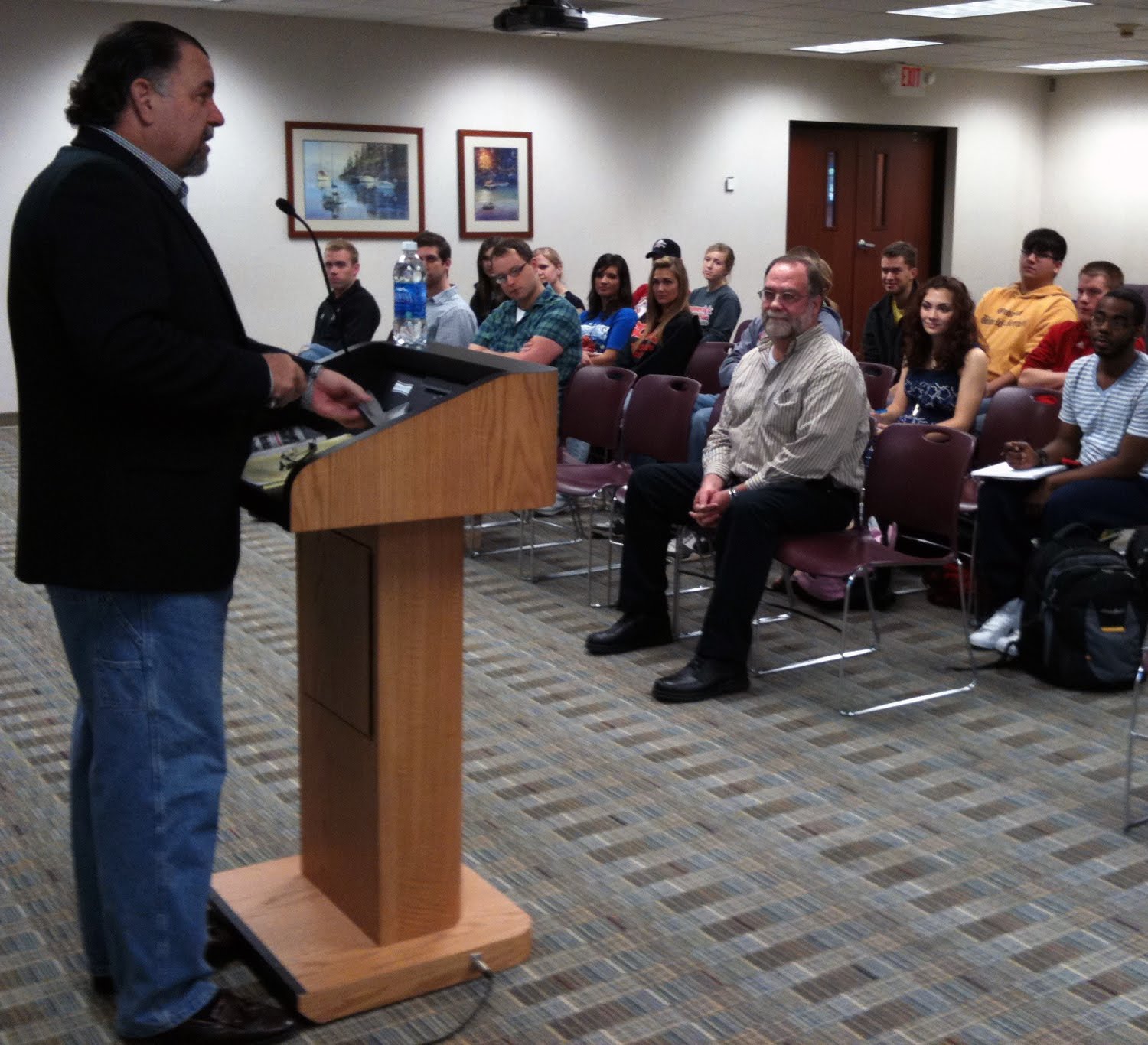
Krajicek addressing (UNO) University of Nebraska at Omaha students, ©photo by Jeremy Lipschultz
He switched gears to teach full-time at Columbia, where he’d been an adjunct. Eight years into his scholarly role he authored Scooped!, an acclaimed memoir-critical analysis of criminal justice reporting, and then left, abandoning almost sure tenure, to return to crime writing. Only on his terms.
“I relish telling these old true crime stories. I love the historical connection that I’m one of the last living remnants of True Detective magazine. These stories used to appear everywhere but print’s given over the true crime franchise to television.”
He makes occasional TV appearances as a true crime expert but mainly mines old cases for his stories. His next local book event is Nov. 9 at noon at the Jewish Community Center. Visit Krajicek’s Author’s Page at Amazon.com.
Related articles
- Crime and Justice News: 8-11-2011 (alaskacure.wordpress.com)
Categories: Authors/Literature, Books, Crime, David Krajicek, Journalism, Media, Omaha World-Herald, South Omaha, Writing
Columbia University, David Krajicek, Death by Rick 'n' Roll, Justice Story, Murder American Style, New York Daily News, Scooped!, True Crime Author, True Crime Reporter, True Crime: Missouri
After Night of Violence, Downtown Coffee Shop Owner Ponders Venue’s Future
September 5, 2011
1 comment
David Hall is a born entrepreneur, and if savvy instincts and good intentions mean anything then his newT-shirt design and screen printing business SweeTees should flourish. But the cold reality of business doesn’t much care about whether one’s heart is in the right place or not. The following short piece I did about Hall for The Reader (www.thereader.com) appeared not long after a senseless act of gun play disrupted his previous venture, Terri Lynn’s Coffee Shop, injuring several and scaring many more, and not long before business fell off so badly that he was forced to close. Terri Lynn was his late sister, who herself fell victim to gun violence. The T in his new SweeTees is for her. In addition to his sisters, Hall’s lost others close to him as well to reckless gun violence. He’s trying to do what he can to succeed while paying homage to Terry and giving young black men in the community a positive role model to follow. I am not alone in wishing him well.

David Hall
After Night of Violence, Downtown Coffee Shop Owner Ponders Venue’s Future
©by Leo Adam Biga
Originally published in The Reader (www.thereader.com)
Terri Lynn’s Coffee Shop attracted a corps of regulars to its inviting 1618 Harney Street digs before an act of violence changed things. Now, business has slowed to a crawl and owner David Hall is left wondering if the venue, named for his late sister and meant as a safe haven for inner city teens and young adults, can last.
It all went down the evening of Friday, May 13, when a private graduation party turned real life fright night. About 60 people were there when a fight erupted inside. Hall, security staff and chaperones removed the troublemakers and the party resumed. Later, gun shots fired from outside riddled the place. In the ensuing chaos, eight people were injured. One was shot. Some $2,000 in damage was done to the shop, whose register was looted. A week later, an arrest was made and the incident became another statistic in Omaha’s black-on-black crime wave.
Despite taking precautions, Hall feels he was “naive” not requiring a “mandatory guest list. The kids that caused the trouble just slid in,” he said.
The events shook Hall to his core. He couldn’t sleep that night. He couldn’t bring himself to visit the shop that weekend. He contemplated closing for good.
“I felt like a ton of rocks got dropped on me, man. I was so discouraged,” he said. “Then I prayed on it and went to church and it felt like a weight was lifted off my shoulders. Everybody came up and they hugged me. I thought they were going to blame me more than anything. But my pastor and my community told me, ‘Don’t quit.’ That’s what made me not give up. They wouldn’t let me quit if I wanted to.”
Besides, he said, “Something is telling me, Why penalize all the good kids that come in here for the acts of a few?” Terri Lynn’s had become a live music and dancing hot spot. Hall said there’d been no serious problems until the shooting. He sees what happened as part of a larger, city-wide problem with youth violence.
He has reacted strongly to the shooting because it struck so close to home. His only sibling, Terri Lynn Hall, was fatally shot with her boyfriend in 1994. That same year alone, Hall said, he lost five friends to gun violence. This most recent event was a slap in the face to a man trying to “be part of my community.” The negative pub hurts a fragile business that’s been at its present location just since last fall. He said he faces enough hurdles already as a black small business owner in a white district. Add the fact he’s one part of an interracial couple — his wife Carol is white — and he feels things are stacked against him in a town obsessed with race.
Although an aberration at what’s been a calm spot, he’s afraid the incident brands his place a hazard in the public’s mind.
“I’m a young black dude, man, and it’s hard to beat some of the stereotypes thrown my way. I’m already one of the few minority owners downtown. I didn’t know if people were going to see through all of that — a black on black crime — and be open-minded to what I’m trying to do here,” said Hall, an Omaha native and nephew of Charles Hall, proprietor of North O’s now defunct Fair Deal Cafe.
In an effort to make sense of the violence and to dispel perceptions about Terri Lynn’s as a dangerous place, Hall held “an old fashioned town meeting” there on May 28. The event offered an open forum to discuss the violence and sought donations to help Hall recoup his losses and to pay medical bills of those injured in the melee. Less than two dozen people attended — most of them family and friends. He was discouraged, but he’s not ready to give up on his dream yet.
“I talked to the police and city, and they don’t want me to quit. They want a place for young people to go. They don’t want them to run the streets. That’s what I wish I would of had. That’s what I wish my sister would of had,” said Hall, who plans hiring uniformed officers at parties and installing more surveillance cameras.
“Since Terri passed, I’ve always tried to have a way for her to live on through my life. This is my passion. This is what I want. But as much as I want to be here and to make this work, it’s about dollars and cents now. We were already just getting along, but since reopening May 18 it’s been slow. I’ve refunded six parties we booked. If we don’t have the public coming here supporting the cause, we can’t make it. We’ll remain open as long as we can afford to. I’ve got my rent paid for June, so we’re good for 30 more days. Check back with me then.”
Related articles
- Native Omaha Days: A Black is Beautiful Celebration, Now, and All the Days Gone By (leoadambiga.wordpress.com)
- Native Omahans Take Stock of the African-American Experience in Their Hometown (leoadambiga.wordpress.com)
- Miss Leola Says Goodbye (leoadambiga.wordpress.com)
- Chef Mike Does a Rebirth at the Community Cafe (leoadambiga.wordpress.com)
- Big Bad Buddy Miles (leoadambiga.wordpress.com)
- Luigi’s Legacy, The Late Omaha Jazz Artist Luigi Waites Fondly Remembered (leoadambiga.wordpress.com)
- Arno Lucas, Serious Sidekick (leoadambiga.wordpress.com)
When Safe Isn’t Safe at All, Author Sean Doolittle Spins a Home Security Cautionary Tale
August 19, 2011
2 comments
I realize there are bigger name authors in the crime fiction genre, but I find it hard to believe there’s a better writer in the bunch than Omaha’s own Sean Doolittle, who has mastered the form in a string of books that catapult you along without sacrificing depth. The following story for The Reader (www.thereader.com) is about Doolittle’s novel Safer and this blog contains an earlier story I did about his novel The Cleanup. I heartily recommend these and anything by the author. It’s been a couple years since I’ve read anything by or written anything about Doolittle, and so I have a feeling there’s a new Doolittle story I need to catch up to as a reader and a writer, which means you should expect a new Doolittle post sometime this year.

When Safe Isn’t Safe at All, Author Sean Doolittle Spins a Home Security Cautionary Tale
©by Leo Adam Biga
Originally appeared in The Reader (www.thereader.com
Sean Doolittle lives a life of crime. In his head. The Omaha crime novelist (Rain Dogs, The Cleanup) commits imaginary transgressions to the page that explore the consequences of deceit, greed and other deadly sins of omission and commission.
His new work, Safer, is billed by publisher Delacorte Press as “a novel of suspense.” Like the best crime fiction it transcends genre, in this case studying social patterns gone awry and primal emotions under duress.
Paul, the smart alleck English Lit prof protagonist, is suspected of an offense he didn’t commit. While no saint — his judgment’s not always sound — he’s no killer either. The suspense hinges on his desperate attempts to clear his name. The closer he nears the truth, the more leading citizens are implicated in a conspiracy. He may not survive the telling.
After a brief set-up Doolittle starts the book with Paul being jailed. The author then alternates past-present passages with Paul describing what led to the charges being filed and his frantic, against-all-odds search for justice. The approach grabs and holds us but only came to Doolittle much struggle.
“This is a book where the narrative structure is what really ended up opening the book up for me,” he said. “I started writing it as sort of a very linear start-at-point-A and go-to-point-Z narrative and I just could not find any traction that way…I couldn’t see ahead. I’d been stuck at like the same spot for a long time.”
Then it came to him. Finding his way into the story meant plunking Paul into the soup earlier than envisioned. It works, serving as the knot whose unraveling reveals the underlying mystery.
“That’s the first time that’s happened that way,” he said. “Usually the structure is not quite so important to the way the story plays out, but the structure is the essence of that undoing sort of quality.”

Sean Doolittle, ©photograph by Scott Dobry
As Doolittle exposes layer after layer we see the seemingly idyllic setting Paul and wife Sarah occupy in their new Midwest home has a dark side. Despite a break-in, the couple’s suburban cul-de-sac residence appears safe due to the ever vigilant neighborhood patrols and monitoring done by an ex-cop neighbor, Roger.
Only Paul discovers Roger’s benevolent facade and keen interest in keeping the block a closely-watched, hyper-guarded, tight-knit community masks something more than the tragedies that took his son and wife there. Something sinister. As the outsider, nonjoiner Paul questions Roger’s manipulation of his neighbors. Roger sees himself as their protector. He plays on their sympathies and weaknesses to maintain control. Paul sees it as creepy, intrusive.
Doolittle said the structure “underscores” the theme of people distorting information and perceptions to their own ends. As readers we learn, along with Paul, what’s behind Roger’s avuncular front, why he’s so security-conscious and how far he’s prepared to go to prevent anyone from outing him.
Roger’s a microcosm for those who use extreme measures in the name of security. Draw what analogies you will with certain geopolitical events.
“It wasn’t my intention to write an allegory for Iraq or something like that,” said Doolittle. “Whatever parallels are there are there, but it was reducing that giant global complicated issue to a neighborhood that interested me.”
Roger’s warped POV justifies his actions. “That’s what ultimately it always comes down to — it’s within your own mind what you think is appropriate to protect yourself or your family or your neighborhood,” said Doolittle.
The introduction of a wild card like Paul upsets Roger’s carefully arranged order. As Paul notices things are awry, the utopia’s threatened. In Roger’s eyes Paul’s a problem needing removal.
A dark obsession acted out requires elaborate subterfuge to conceal the misdeed. Doolittle said he’s fascinated by how “your actions stay with you the rest of your life. What is Faulkner’s line? — ‘The past isn’t dead, it isn’t even past.’ Something I’ve sort of inadvertently come back to in more than one book,” said Doolittle, “is the idea of lying and what it takes to maintain a lie. It’s that mounting desperation of Roger trying to keep a grasp on things that eventually undoes it all.
“The thing that’s so fascinating to me is you hear about some outlandish thing somebody’s done, and you think, ‘How do you get to that point?’ That’s always the question. It’s not a new concept but it remains compelling. Each step you take, each time you do something you didn’t think you’d do, it makes it easier to take the next one, and easier to take the next one…”
Crossing boundaries.
Safer represents new territory for Doolittle. It’s his first hard-cover book. Delacorte’s pushing it hard. Odds are a novel by Doolittle, who’s earned praise from crime lit superstars, will eventually be a best seller. One’s sure to end up on the big screen, too. A major Hollywood agent who’s a huge fan shops his work around the studios. The author isn’t quitting his day job just yet but with each project, including the revenge novel he’s working on now, he’s closer to cleaning up. For the time being though he plays it safe.
Related articles
- The Worth of Things Explored by Sean Doolittle in his New Crime Novel ‘The Cleanup’ (leoadambiga.wordpress.com)
- Lit Fest Brings Author Carleen Brice Back Home Flush with the Success of Her First Novel, ‘Orange Mint and Honey’ (leoadambiga.wordpress.com)
- The Many Worlds of Science Fiction Author Robert Reed (leoadambiga.wordpress.com)
Categories: Authors/Literature, Books, Crime, Omaha, Sean Doolittle, Writing
Crime fiction, Dell Publishing, Hollywood, Iraq, Omaha Nebraska, Rain Dogs, Safer, Sean Doolittle, The Cleanup
A Long Way from Home: Two Kosovo Albanian families escape hell to start over in America
August 18, 2011
6 comments
This story from a decade ago or so is one of two I have done that try to paint a human, intimate portrait of the late 20th century European wars that erupted in the aftermath of the end of Communist rule, when generations of long-simmering ethnic hatred spilled over in the power grabs that ensued. The following story for The Reader (www.thereader.com) portrays the journey of two Kosovo Albanian families escaping the chaos and horror of war in their homeland to starting new lives in America. The second story along these lines, which I will be posting soon, tells a similar journey, only of a Bosnian family. There were numerous atrocities to go around in these wars, and on both sides, but the sad truth of the matter is that every day men, women, and children like the people I write about got caught up in the carnage. The result: untold hundreds of thousands dead and injured; broken societies and families; hatred that perpetuates from one generation to the next; retaliation attacks; refugee cultures; and the recipe for ongoing tensions that will only continue flaring until there is true reconciliation. The related articles below indicate the region is still a cauldron of unrest.

A Long Way from Home: Two Kosovo Albanian families escape hell to start over in America
©by Leo Adam Biga
Originally appeared in The Reader (www.thereader.com)
Uprooted
Among the mass exodus of ethnic Albanians fleeing their embattled native Kosovo last year were two young couples who met in a refugee camp and ended up starting new lives together in Omaha. Gazmend and Fortesa Ademi and Basri and Valbona Jashari left Kosovo during the March-May 1999 NATO bombing campaign targeting Serbian military strongholds.
With Serb troops ousted and NATO peacekeepers in their place, many refugees returned to the ravaged province. The couples, however, opted for asylum in America. After arriving here July 1 under the auspices of a humanitarian agency, they lived five weeks with their Bellevue sponsors, the Theresa and Richard Guinan family, whose parish — St. Bernadette Catholic Church — lent aid. The Kosovars, who today share a unit in the Applewood Pointe Apartments near 96th & Q Streets, are now first-time parents: the Ademis of a 5-month-old boy, Eduard, and the Jasharis of a 3-month-old girl, Elita.
Last August, Basri Jashari’s sister, Elfeti, her husband and their five children moved to Omaha (sponsored by Kountze Memorial Church). Another 59 Kosovars settled in Lincoln. The U.S. State Department reports some 14,000 Kosovars found asylum in America. Of the more than 800,000 refugees who fled the province, most have gone home, including some who came to Nebraska.
War may have been the catalyst for Kosovo Albanians’ leaving their homeland, but the events prompting their expulsion are rooted in long-standing ethnic conflict. During a recent interview at their apartment, Gazmend Ademi and Basri Jashari told, in broken English, their personal odyssey into exile. As the men spoke, sometimes animatedly, their wives listened while tending to their babies.
Only in their early 20s, the Kosovars exhibit a heavy, world-weary demeanor beyond their years. They carry the burden of any refugee: being apart from the people and culture they love. With a patriotic Albanian song playing in the background (“the music, it gives us power to live…to go on,” Ademi said) and defiance burning in their eyes, the men lamented all they have lost and left behind and expressed enmity for Serb aggressors who threw their lives into turmoil.
“We never wanted what happened. We never wanted this. THEY wanted the war. It’s like old Albanian men used to say, ‘Don’t ever trust the Serbs. They don’t keep their word,’” Ademi said. Do the refugees hate the Serbs? “No, I just don’t like them,” Jashari said, adding, “I know not every Serbian was guilty. But I still hate the cops.”

Aside from bitterness, sadness consumes them. Ademi said, “Sometimes I stop and think, Why do I have to go through all these things? It’s just too much. I miss my family. I miss my friends. I miss everything in Kosovo. That’s why I’ll go back. But, for now, things are still bad there. Many people have no work, no homes. What the Serbs couldn’t take they destroyed. When I speak to my friends by phone they all tell me to stay where I am.” Or, as Jashari simply put it, “It’s better here.”
Watch Out for the Dark
Conflicts between ethnic Albanians and Serbs were part of the uneasy landscape Ademi and Jashari grew up in. Born and raised in southeastern Kosovo cities 40 kilometers apart, the two came of age in the late 1980s and early 1990s, when the ugly rhetoric of Slobodan Milosevic’s Serb nationalism turned openly hostile. Serb aggression in Bosnia erupted into full-scale war that United Nations forces helped quell. Although ethnic Albanians comprised the vast majority of Kosovo, Serbs controlled key institutions, most tellingly the police and military, which became oppressive occupying forces.
Ademi and Jashari say police routinely interrogated and arrested people without cause, extorting payment in return for safe passage or release. The harassment didn’t always end there. “For just a little thing they could arrest you or beat you or kill you. If they stopped you and demanded money, and you didn’t pay, your car was gone or you were gone,” Jashari said. “You had to pay,” Ademi said.
As Milosevic pressed for a Greater Serbia, life became more restrictive for ethnic Albanians (schools were closed and the display and teaching of Albanian heritage banned), whose Muslim culture contrasted with Serb Orthodox Christianity. The Ademis and Jasharis received much of their education in makeshift schools housed in basements and cellars. When young ethnic Albanians began fleeing Kosovo to avoid military service in the raging Balkans War, a moratorium on passports was enacted. Freedom could be bought, with a bribe, but most Kosovars could not afford it. Ademi, a bartender, and Jashari, a university student, faced bleak prospects. Jobs were scarce and those available paid low wages, yet prices for goods and services remained high. Bartering and blackmarket trading prevailed.
The start of the Kosovo War is generally agreed upon as March 23, 1998, when a Serb police action ended in the massacre of some 50 civilians and ignited the Kosovo Liberation Army (KLA) to escalate its armed resistance. However, for rank and file ethnic Albanians “the war started much earlier,” Jashari said. As early as 1989 the Serb political-military machine tightened its noose around Kosovo. Ademi and Jashari say they witnessed friends beaten by cops. Ademi said a cousin was held and tortured for days in a police station without legal counsel.
At mass demonstrations he recalls police firing tear-gas, even bullets, into crowds. Once, he said, a cop guarding a train load of tanks drew his weapon on he and some friends taking a short cut through a rail yard. In such a climate, once carefree days spent playing soccer or shopping in open air markets were replaced by caution. Nights were most ominous, with the Black Hand, a secret police/paramilitary force, roaming the streets. “After the dark would come, people who were out on the streets were taken away. Many were killed. Everybody was afraid from here,” Ademi said, clutching his chest. “Walking home every night I was afraid what might happen. I didn’t know if I was going to make it back. If you saw a car coming you turned back into the road and stayed until it passed. When they passed, you were like, ‘Whew, I made it okay.’”
Amid brutal police tactics and outright terrorist acts, the KLA began striking back with savage retaliatory attacks of its own, which led to Serb reprisals. When entreaties and threats by the U.N., the European Union and the West failed to get Milosevic to back down, a controversial U.S.-led NATO military response followed.
A Taste of Freedom
The night of the first air strikes prompted celebrations.
“We were very happy. We were waiting for this day,” Jashari said. “Some people started to shout, “NATO, NATO” and “Clinton, Clinton.” Everybody was cheering and shaking hands.” Any sign of air power brought hope, even though the concussion from bombs and missiles shook and even shattered windows. “Every time I saw the planes in the air I could feel myself a little bit more…free,” Ademi said. “I prayed for the noise of those planes.”
The revelry soon gave way to dread.
“The Serbs were really mad. They didn’t know what else to do, so they started to burn out everything,” said Ademi, referring to the systematic ethnic cleansing that ensued.
The Ademis and Jasharis joined a flood of refugees streaming into villages, where they presumed it was safe. They were wrong. The villages, some housing KLA bases, were burned or pillaged. Houses that once served as quarters for OSCE (Organization for Security and Cooperation in Europe) monitors were torched or trashed. Pundits criticized the fact that, for a time, the air strikes only intensified the Serb raids and further destabilized the region. While Ademi and Jashari confirm “that’s how it was,” they contend what happened “was not NATO’s fault,” As Jashari said, “We didn’t flee because of NATO bombs. We fled because the Serbs started to attack us.”
With no where to hide, ethnic Albanians became a displaced people, moving from village to village and house to house in a desperate bid to stay ahead of marauding Serb troops. The Jasharis managed to remain at home until Serb forces closed in. Once a house was vacated, a next wave of refugees moved in and consumed whatever stores were left. “
People didn’t know where to go,” Ademi said. “They would stay a couple days and move again, helping themselves to food. People would take from all over just to stay alive.”
Ademi’s family found long-term shelter at the home of an uncle in a nearby village. Soon, they were joined by a caravan of refugees from a ransacked village, their dead and injured carted on tractors and trucks. “I carried in a young woman who was wounded in the leg. An old woman who’d been shot died later,” said Ademi, whose family took in dozens of new arrivals, swelling the house’s occupants to 50.
When, weeks into the bombing, there seemed no end in sight to the war, the Albanian Kosovars decided to cross the border into Macedonia. “Everything was going bad. Supplies were low. We thought it better to move because maybe later we could not get out. If Milosevic won, we could not live in Kosovo,” Jashari said.
While there was little choice but to flee, leaving was hard. The refugees brought only bread and the clothes on their back, “My family cried. They knew that maybe we were not coming back,” said Jashari, who left with Valbona and his family in May and made it across the border in a motorized convoy. Weeks earlier, the Ademis set-off, in two groups, for the border. Gazmend and a younger brother went ahead first, traveling on foot with a band of young men along a mountain road. A guide helped them skirt Serb patrols and checkpoints.

Durres is a popular holiday spot, but is implicated in a dark chapter of history
The men crossed the border after a 15-hour hike. Two days later Fortesa got out with Ademi’s family, enduring rain and snow on a trek along the same path. Upon reaching northern Macedonia the refugees were housed and fed by ethnic Albanians who led them to a camp, Stenkovec #2. It was there the Ademis and Jasharis, who were still single, married as insurance against being separated later. The couples befriended each other and after six weeks sleeping 10 to 20 to a tent, their applications for asylum were granted. Their shared destination: Omaha. Neither couple had American relatives.
Starting Over
Meanwhile, half-a-world away in Bellevue, Theresa and Richard Guinan followed the unfolding refugee odyssey via media reports. Moved by what they saw, the couple contacted Sen. Chuck Hagel’s office and were put in touch with Heartland Refugee Resettlement, an affiliate of the ecumenical Church World Service. The Guinans volunteered as a host family and the Ademis and Jasharis were matched with them.
Why agree to take in a four refugees? “We wanted to do more than just send money. That’s too easy. We have so much to offer here (in America) and this was our way to help,” Theresa Guinan said. After an 18-hour journey (by plane from Macedonia to Greece to New York to St. Louis to Omaha), the refugees arrived here exhausted. Fortesa Ademi, then pregnant, was sick for much of the trip. They were overwhelmed by the greeting party awaiting them at the Eppley Airfield terminal, including the Guinans, members of their church and reporters.
|
Many Kosovan refugees ended up in a refugee camp in Kukes, Albania
|

Within a week Richard Guinan found jobs for the men, as cold storage construction laborers, and they’ve been employed ever since. “They’re hard workers and their employers love them,” Theresa Guinan said. Living under one roof, the Americans and Kosovars forged deep bonds that remain strong a year later. “We love them like our own. We call them ‘our kids,’” Theresa Guinan said.
Ademi said, “Our sponsors helped us a lot. They made us feel like we were in our own home. Everything was just perfect. We call Theresa and Dick our American parents.” Still, adjusting to American life has posed many challenges, not the least of which is Omaha’s nearly non-existent Albanian community, which Ademi said has left he and the others feeling isolated. “We really haven’t had a chance to make any friends. We don’t go out too much. When we came here we meant to stay five or six years, but now I don’t how we’re going to make it. It’s really hard.” He and the others would like to meet members of the ethnic Albanian refugee colony in Lincoln.
Should the Ademis and Jasharis return to Kosovo any time soon, they know what awaits them: few prospects, a devastated infrastructure and a region littered with land mines and ethnic tensions. As efforts to form a new democracy proceed under NATO’s Joint Interim Administration, the men dream of an independent Kosovo. “That’s the best way to be. That’s what we deserve,” Ademi said.
In the wake of human rights investigations confirming Serb atrocities and of international tribunals naming Serb war criminals, the split between ethnic Albanians and their adversaries is greater than ever. Ironically and tragically, some ethnic Albanians have been engaging in ethnic cleansing reprisals against average Serb citizens. As the cycle of bigotry and violence winds on, the possibility of peaceful co-existence seems remote. Jashari described the gulf this way, “Albanian and Serbian culture is very different. That’s why the conflict is so deep.” Ademi said blood will continue to be shed “until the Serbs are out of Kosovo.” After all that has happened, he said, an ethnic Albanian like himself cannot abide living, drinking or working beside a Serb: “He’s going to be in my way. I’m going to be in his way. There’s no escaping that.”
Like the lyrics of the song playing that night at the apartment, Ademi said one thing is clear. “If you are Albanian, you are my friend. We want the same thing. If you are Serbian, then living together is too hard.” And the jingoistic beat goes on.
Related articles
- New trial for Kosovo ex-premier (bbc.co.uk)
- Kosovo: Nato sends in reinforcements (independent.co.uk)
- New Violence in Kosovo Could Pose a Quandary for an Overstretched NATO (globalspin.blogs.time.com)
- Unlikely matchup: Albanian women wed Serbs (seattletimes.nwsource.com)
- Kosovo launches Serbia border crossings take over (seattletimes.nwsource.com)
- Violence in north Kosovo draws EU warning – Reuters (news.google.com)
- NATO Takes Control at Kosovo Borders (nytimes.com)
- Fear and exodus: ethnic Serbs squeezed out of Kosovo (rt.com)
- War and Peace (leoadambiga.wordpress.com)
Categories: Crime, Family, International Relations, Omaha, Politics, Refugees, War, Writing
Albanians, Kosovo, Kosovo Liberation Army, Kosovo War, NATO, Refugees, Serb, Serbia, Slobodan Milošević


 Leo Adam Biga's My Inside Stories