Archive
Model-turned-actress Jaime King comes home for screening of film she wrote and directed, “Latch Key,” atOmaha Film Festival
When Jaime King made the move from modeling to acting I tried getting an interview with her in early-mid 2000s but I never got a response from her handlers. I guess I always figured I would catch up with one way or the other, and as fate would have it she’s coming to me in the sense that she’s coming back to our shared hometown of Omaha with a film she wrote and directed, Latch Key, which means she’s predisposed to promoting it. Thus, I finally got my interview with her. It was worth the wait. She has a great story and it turns out she’s very serious about the writing-directing track she’s on. It also turns out she gets back to Omaha, where all her family lives, with great frequency, which means she’s been closer than I thought all these years. I should note by the way that the Omaha Film Festival is an ever-growing event that increasingly lands major industry figures. In addition to King’s appearance, the fest is rightfully touting appearances by screenwriter Hawk Ostby (Children of Men, Iron Man), actress Famke Janssen, who’s apeparing with her directorial debut Bringing Up Bobby, and actor Chad Michael Murray (One Tree Hill). This blog is full of my stories on film. Look for my Q&A with Ostby in an upcoming post.

©by Leo Adam Biga
Soon to be published in The Reader (www.thereader.com)
In the 1990s Omaha native Jaime King‘s fresh face and lithe body graced the runway fantastic for the likes of Gucci and Alexander McQueen in New York and around the globe. She did provocative shoots for Vogue, Mademoiselle, Glamour, Cosmopolitan and other trendy mags. She appeared in music videos. She was a Revlon girl in the same media campaign as Halle Berry and Eva Mendes.
Heady stuff for a girl in her mid-teens who left Westside High School to pursue The Dream. She actually began modeling at Nancy Bounds Studios here. A New York agent discovered her at a fashion graduation show.
But when King comes for the Omaha Film Festival this weekend she’s arriving not as a model or actress – the career she’s known for today – but as a filmmaker. She’s appearing with a “deeply personal” dramatic short she wrote and directed titled Latch Key. She shot the movie in and around Omaha last winter, using local youth actors alongside industry veterans, including her husband, director Kyle Newman (Fanboys, The Crazies), who’s also one of the film’s producers.
Latch Key shows as part of a short film block on March 9 that starts at 6:15 p.m.
This writer-director thing is no passing fancy. The directing bug bit her in her teens and she angled for years to make her own films, debuting with the short The Break-In (2011). She now has several film projects in development, including a feature she co-wrote, Polar Seasons, that her good friend Selma Blair (who appears in Break-In) may co-star in. King’s interest in writing – she pens a style column for the Huffington Post – goes even further back, to her childhood in Omaha.
“Before I went to Westside it wasn’t that easy for me. I felt like I didn’t fit in. I wasn’t like a jock or a cheerleader or your typical type of kid in that way. I went through a lot of bullying in school. So I wrote a lot and that really helped me to get my feelings and emotions out. All I did was read and write, that was all I really cared about. I so immersed myself in all of these creative things.
“Writing for me has always been the most freeing part of my life.”
At 14 she turned to the pen when her boyfriend at the time died. That experience informs Latch Key, whose young protagonist, Emma, deals with a sudden loss.
“It comes from me having this experience of being young and losing someone very suddenly, and waking up not understanding how the world can continue when your whole world feels like its been shattered.”


Having to grow up fast the way she did informs another script she’s looking to develop, Life Guard.
“I write a lot about coming-of-age and what it’s like to grow up very quickly and how to handle that type of thing. I guess I’m inspired by what we have to go through to become adults or to make our way in this world, but I guess all good stories are about figuring out who you really are.”
Once considered an infant terrible and party girl, she’s many years sober after battling a substance abuse problem. She long ago made the successful transition from modeling to screen acting (Happy Campers, Blow, Pearl Harbor, Slackers, Two for the Money, Sin City). She has major roles in a pair of films due for a 2012 release: Pardon and Mother’s Day. She also stars in the CW comedy Hart of Dixie.
Does she harbor regrets about having gotten swept up in the high-pressure model subculture, with its ultra-thin obsession, stealing away as it did part of her youth?
“Not at all. I feel very blessed, I feel everything that’s happened in my life has been perfectly on track for me, through the ups and the downs, through everything, and I feel so incredibly lucky that I was discovered and that my parents stuck with me and made a difficult decision to let their young daughter go off into a big world.
“Through modeling I got to travel all over the world and I got to meet some of the most amazing people, and I was smart, I saved my money and I knew I wanted to go into filmmaking.”
Besides, being a model was her idea from the start. Always interested in fashion, style, photography and film, she set out to get noticed, make it to New York and use this platform as a springboard to a film career.
“I wanted to live a very creative life and not necessarily taking the traditional route of going straight through high school and onto college. I just didn’t feel that was right for me. I needed to be doing something creative. It may seem odd for someone that age but I just knew that was my direction.
“As an adult now looking back I feel a lot compassion and gratitude towards my parents for letting me foliow my dreams.”

King’s made it all happen, too, though walking away from lucrative modeling gigs didn’t set well with her entourage.
“When I told them I was quitting modeling at the height of my career people weren’t happy about that because they were making a lot of money off of me, but I was lucky to have some people who were supportive.”
She still does fashion spreads.
Of the high profile film roles she landed right out of the gate, she says, “It was just one thing after another and I think it happened because I never doubted myself, I went into it thinking that’s what I was meant to do.”
Acting’s worked out better for her than it has for many former top models. And as much as she finds that career satisfying she needs more to feed her creativity.
“I don’t feel completely whole just doing that. I feel whole when I’m writing and directing and acting, when I’m creating material and stories that I feel should be told and will move and entertain people,” she says. “As a creative person you just want to create.”
She could have made Latch Key anywhere but she felt pulled to do it in her hometown, where her entire family still lives and where she gets back to visit a few times a year.
“I have a really romantic view of where I was born and raised,” she says. “I have these very distinctive memories of every single season in Omaha and what it felt like to grow up there and to have a space of your own where you could run along the train tracks and be out in a park or farm by yourself or yet be in the Old Market and go find a great record or comic book or see a great show or concert.
“So much of my creativity started there, and I feel like there’s a great creative community there. I just really want to honor that.”

Her sister, Sandi King Larson, put up Jaime, her husband and two fellow producers and let her home stand-in as Emma’s dwelling.
King says she received excellent cooperation from Young Filmmakers In Nebraska in filling out the crew and from Ralston Public Schools officials in letting her use Ralston High School as a location. King had an inside woman there in her sister, who works at the school. The head of Ralston’s drama department, Todd Uhrmacher, helped King cast via Skype auditions-interviews. Alexis Jegeris, who plays Emma, is among several Ralston students in the film.
King says she was impressed by how her young cast “were really willing to go there for a film that’s very honest and raw and real,” adding, “I cant’ wait to come back for the film festival to show the kids what a beautiful job they did.”
Related articles
- Omaha Film Festival Celebrates Seven Years of Growing the Local Film Culture (leoadambiga.wordpress.com)
- Joan Micklin Silver’s Classic ‘Hester Street’ Included in National Film Registry (leoadambiga.wordpress.com)
- Vincent Alston’s Indie Film Debut, ‘For Love of Amy,’ is Black and White and Love All Over (leoadambiga.wordpress.com)
- From the Archives: Conquering Cannes, Alexander Payne’s Triumphant Cannes Film Festival Debut with ‘About Schmidt’ (leoadambiga.wordpress.com)
- Nancy Bounds, A Timeless Arbiter of Fashion Beauty, Glamour, Poise (leoadambiga.wordpress.com)
Nancy Bounds, Timeless Arbiter of Fashion Beauty, Glamour, Poise
Imagine my surprise when I searched for images of the late Nancy Bounds, the subject of this story, and could not find a single one. My surprise stems from the fact that Bounds was a much photographed stylish woman whose entire career was built on image enhancement work with aspiring models and actors. She was a personality and celebrity whose all about town comings and goings were grist for the Omaha society mill pages. She frequently appeared on television, too. So, instead of pictures of Nancy I bring you pictures of one of the talents who came out of her modeling school, indeed the most famous graduate of all –model-actress Jaime King, an Omaha native like me. My search for Nancy Bounds images continues and I expect before long to have her lovely, smiling face and well-outfitted figure gracing this post. For now though, Jaime King is not a bad compromise. If you’re into all things fashion and style, you’ll find other articles of interest on this blog.
NOTE: Special thanks to fashion photographer Michael Dar, who got his start under Nancy Bounds in Omaha, for his photo of her.

Nancy Bounds, Timeless Arbiter of Fashion Beauty, Glamour, Poise
©by Leo Adam Biga
Originally appeared in the New Horizons
For 40 years, Nancy Bounds was Omaha’s saucy arbiter and symbol for good looks and social graces. The owner of a string of modeling/finishing schools bearing her name, she applied her tastemaker’s role as television host, magazine columnist, pageant director and self-improvement guru. This former model, singer, dancer and actress best embodied her own beauty ethos. Whatever the gala, she was always the stylish, well-turned-out fashion plate looking like she was poured into her haute-couture designer clothes, which her closets overbrimmed with.
Bounds shared her story with the New Horizons a few years before her passing. Her repuation preceded her and she proved to be everything and then some that was said about here.
An expert in the rules of attraction and feminine wiles, Bounds is just what you’d expect from a Southern-born and reared beauty queen. She exudes a soulful, sassy, sweet, sad quality that almost makes you think that at any moment she’ll utter Blanche du Bois’s famous line from A Streetcar Named Desire. You know the one: “I’ve always depended upon the kindness of strangers.”
A coquettish charmer with milky skin and sun-dappled hair, Bounds greets visitors to her resplendent Dundee home in the warm honey glow of her broad smile, sparkling eyes and sultry voice. Wearing an antique blue silk ensemble and a pair of high-heeled silver sandals, she’s still every inch the fashion maven and beauty diva who’s made men weak-kneed at the sight of her since her ingenue days.
It took all of her cheeky guile to get where she is today, which is a long way from her rural Arkansas roots. It may surprise some that this sophisticated lady, who’s the epitome of chic, owns a background closer to Dogpatch than Fifth Avenue.
Growing up the youngest and brightest of six children, the former Nancy Southard was born, on an undisclosed date, in the Ozarks, where her gentrified father owned land, saw mills and other interests. Despite such backwoods environs, she comes from good stock. She said her mother’s family, the Tayloes, are descendants of George Washington and her father’s family is related to the Astors of old New York high society. Still, there wasn’t much in the way of culture where she lived.
And her precocious bordering-on incorrigible personality didn’t sit well in her “very strict Christian” home that her father ruled with an iron fist. “I was an obstinate, self-confident tigress. I don’t know how anyone stood me,” she said.
Her rearing came in a series of small towns — Rodney, Norfolk, Mountain Home — she felt confined in and pined to escape. The rote learning of a small school was torture for a girl bursting with starry-eyed dreams and ideas inspired by the books and magazines she devoured. In class, which she found “boring,” she’d either fall asleep or break out in hives or draw the ire of a teacher, and be sent to the principal’s office, where she played duplicate bridge and chess with the headmaster. As a young schoolgirl she exhibited an extrovert’s expressiveness and a knack for makeup and performing, but had no real outlet for her gifts.
If not for her astute godmother, Maude Washington Arthur, Bounds may not have broken away from the shackles of that constraining life. A kind of down home grand dowager duchess holding court in a cabin atop a mountain, Maude was an educated, well-traveled woman who saw the potential in Nancy and held out the possibility she could live out her dreams. Nancy lived for a time with Maude, who became her personal finishing school mistress.
“She somehow picked on me and wanted me to have the sophistication she thought I was lacking at school,” Bounds said. “She helped me to choose the good books to read. That lady — she knew I was going to be something in the world. She believed in me. She was my mentor.”
Making a mark is what Bounds wanted more than anything.“I didn’t have so much a dream. I just knew I wanted to be somebody. I wanted to be well-known. I wanted to be a star. It never crossed my mind I was going to fail,” she said. “I had more guts than good sense, in some cases, but for some reason there’s always been a little star following me around all of my life, and it’s always sort of taken care of me.” Consumed by a sense of “ambition, wanderlust and loneliness…a lot of loneliness,” Bounds just wanted to be free and Maude encouraged her to try her wings. “She kept saying, ‘You can do it.’ And I knew I could do it.”

So convinced was Bounds that her future lay in the wider world that the first book she bought was “a book on manners,” she said. “I wanted to be able to move in whatever kind of society I was ever going to be in.” Her intuition served her well, too, as she’s lived a storybook life that’s found her mixing with everyone from world famous designers, models and entertainers to politicians to royalty.
Emboldened by Maude and by a grandfather who also recognized her destiny, Nancy one day just packed up and left. She was only 14, but her exasperated parents let her go, knowing she had to try. “That’s how much I wanted to get out of Arkansas and to get out where it was happening in the world,” she said. Her destination? Springfield, Mo. It was as close to cosmopolitan as she could get. Why Springfield? “I had enough money to get there –$35. I got on a bus. It stopped every 20 minutes and I’ve never ridden a bus since. That was not going to be my style,” said Bounds, who nowadays tools around in a chauffeur-driven limo.
Without knowing a soul in Springfield, she put on a brave face and made herself up to look older than she was, quickly landing jobs as a waitress and cosmetics clerk. Then, she really showed her brass when she auditioned for a singing slot on a local radio station. She got the gig and sang a few times a week on live broadcasts.
Then she met a man who looked good in an Air Force uniform. She was 15. They got hitched. Before she knew it, he was off flying Goonie Birds in the Berlin Airlift. “I didn’t see him for a year,” she said, “and by then I’d forgotten what he looked like.” While he was away, she found she was pregnant. She moved back home, where she’d kept the news of her marriage a secret from her father, who’d warned her to stay away from those “hound dogs.” After “having it out,” she went to Wichita, where family lived nearby.
On her own again, Bounds made do. A couple of sailors, Ronnie and Jean, befriended her in the weeks leading up to her giving birth. “They both fell in love with me, but they were always like brothers to me. Better than brothers,” she said. They were with her when the labor pains began and flagged down a taxi to take her to a military hospital. She was still so young and naive she thought doctors “cut you open to get out your child.” To show her undying appreciation to her friends, she named her daughter Ronnie Jean after them.
When her long-absent husband returned from overseas, she greeted him with, “I’ll take you to meet your daughter.” The couple’s ill-advised union fell apart when he took her to live with his family in Minnesota. After three months, she said, “I had to get out of there. So, I got up and packed at three o’clock in the morning and snuck out with about equal amount the money I had when I left home.”
She fled to the Ozarks. He found his child-bride, but she would not have him back. She filed for divorce and went to Minnesota to get it. “I didn’t want anything except the right to my daughter for the rest of my life and that he was never to come near me or her.” To her dismay, she learned the state only granted divorces then on the grounds of adultery. “Well, I wasn’t about to do that,” she said. “So, we picked one of his good friends and he and I sat up all night long and played gin rummy. We came down the next day and he went to court and swore he spent the night with me. Totally staged. But I got my daughter back, which is all I wanted.”
Living back in Wichita with her baby girl, Bounds screwed up her courage and reinvented herself again. “I learned a group was looking for a singer. I auditioned, but I didn’t like the group. It gave me an idea, though. Why don’t I get my own group? Of course I had no money, but I had the audacity to start doing interviews.” Soon, she assembled a pianist, bass player, drummer and saxophonist. She fronted with her vocals. After some Wichita area gigs, her group moved west, landing jobs in Colorado. When band members began bowing to pressures from home, she disbanded the group and went solo. “I had to support my daughter,” she said.
She headlined at a nightclub in Denver and a hotel in Estes Park. What her voice lacked, her sex appeal made up for. “I sang love songs and lots of blues. I had a soulful, smoky sound. There’s something about a saxophone that could really turn my voice on. But I was never a fabulous singer. I was a much better performer than I was a singer. I could sell a song. And I had a great bod,” she said.
Her hunger next took her to Chicago, where she variously modeled, sang and danced for a living. She also acted in TV spots. Her growing interest in acting led her to join a repertory summer stock company in Boston, where she appeared in several plays over three seasons. Theater, for her, fed a desire to improve her mind and broaden her knowledge. “I wanted to improve my ability to articulate my feelings,” she said. “I learned a lot about the language by doing different parts.”
Back in Chicago, the ever-enterprising Bounds continued her education by hiring a Northwestern University professor as her private tutor. “He was a wonderful guy who wanted to teach me what I wanted to know — everything. He was interested in my life and in my mind and I was incredibly interested in all that he knew. I always called him Webster.” With the prof’s help, she lost her Southern accent and further refined herself. He was her Dr. Higgins and she his Eliza Doolittle.
She eventually found romance with a man, Carmen, who became her husband and dance partner. She, her new hubby and her daughter moved to Kansas after her little girl was diagnosed with asthma and doctors advised the child live in a dry climate. Nancy and Carmen were performing as a dance team in Wichita when an agent saw them and recommended her to band leader Xavier Cugat. The Latin maestro signed her up and she happily performed with his band in the Dallas area. “Oh, play me some Latin music and watch this body and hear this voice work it. I’ve always loved Latin music,” she said. Cuggie or Papa, as he was called, became her newest Svengali. “Oh, he was such a puppy dog…the sweetest guy.” She recalls him painting surrealistic images in his spare time as she “sat at his feet and watched him” work. “His courage with color was amazing. He said I was a muse for him because I was so enthusiastic about his art. He said, ‘When I see you, I see golden…yellows…rainbows.’ He painted my personality. I adored him.”

Meanwhile, her marriage to the dancer fizzled. Her life turned again when she bought some Fred Astaire Dance studios in Kansas and fell in love with and married an Air Force colonel, Robert S. Bounds, who gave her her professional name. She wound up in Omaha when he was transferred to Offutt. At first, Nancy thought she “would be happy playing golf, playing bridge and just being an officer’s wife. Well, that lasted about three months.” Restless, she looked into working for a local modeling school. Instead, she ended up running it. When the owners of another school noticed her business savvy and offered her a 50 percent piece of their place, she held firm for a controlling share. She soon made over the business as her own, moving it into the suave penthouse quarters of the old Fontenelle Hotel.
Marriage number three ended when the colonel got reassigned and she balked at moving. Besides, she said, he’d run her burgeoning modeling business into the ground after she sold it to him. “It’s then I decided it was I who had the brains,” she said, “when he had me believing all the time it was him.”
Every time she’s started over, Bounds has gritted her teeth and feigned her famous moxie, but it was all a facade. “I felt frightened, but I never let anyone know it. I was scared to death about half the time, but I kept saying, I can do this.”
Do it, she has. A breakthrough for Bounds occurred in the 1970s. Tired of her models being snatched up and under-used, she made elite agents, such as Ricardo Guy in Milan, take note of Omaha as a rich talent pool and launching pad for serious careers in modeling, films and television. As soon as agents learned her models got magazine covers and film-TV roles, her annual graduation show at the Orpheum Theater drew talent scouts from New York, L.A., Milan, Paris and Tokyo. Several of her graduates have gone on to major careers, most notably model-actress Jaime King.
She feels Nebraska’s gold mine of talent springs from something in the water or gene pool here that creates “The Look” everyone’s after. Then, too, she adds, “I think I was blessed with good eyes. I start watching them when they’re 9 or 10.” She said the model standard hasn’t changed much in 35 years. “It’s just gorgeous, gorgeous and more gorgeous. It’s the beauty of the face and the personality. The naturalness.” She said one difference is more women of color are now top models.
As her Nancy Bounds International Modeling Agency and Nancy Bounds Studios thrived, she opened schools in other cities. Helping her grow the company was her fourth husband and business partner, Mark Sconce. “He just believed in me 100 percent,” she said.
Eager to improve the image of the modeling school field, which is plagued with disreputable operators, she formed the International Talent and Model School Association. It was an attempt to create industry-wide standards and practices and, via ITMSA conventions, provide showcases where models from many schools could strut their stuff before top agents. After a rough start, when she “chewed out” school directors, the association proved a success. Then, she said, it all fell apart and the “rip-off” artists took over. It’s a long-standing problem, even in Omaha.
“People enroll and pay some thousands of dollars, and they’re taken to these conventions and they’re lucky to get five seconds on the runway,” she said. “There isn’t regulation. Before I got here, you didn’t even need a license. There’ve been 17 schools open and close here since I’ve been in business.”
She got an improbable ally in her efforts to clean-up the industry when state Sen. Ernie Chambers came to her bristling over modeling schools reneging on promises made to constituents of his. When he asked Bounds — What can we do about this? she said, “We can write some laws.” They collaborated on a bill the legislature passed that requires operators be licensed. “She was extremely helpful and professional in guiding me through what was very strange territory for me,” he said.
Bounds is the first to admit that while models are the “X-factor,” most of her clients neither expect nor seek a modeling/acting career. Instead, she said, they come in search of personal image development.
“It’s the most exciting thing I do,” she said. “The real purpose for me beginning this school is that I had seen so many young people that didn’t stand a chance in this world of being successful because they were insecure. You gotta love yourself. And in my opinion the only way you can get self-esteem is to be proud of what you do. It’s a total growth process. We start with the facade and then we go deeper and find out who this person really is. We try to give them the best of who they are and, more importantly, we give them things to go out and accomplish.”
She said the training is really about life skills. “We teach kids how to communicate. We teach them manners. We teach them how to order food and what clothes to wear to an interview. We talk about romance and relationships. We have them sing and dance and do anything to pull out their personalities and to get them out of their boxes.” Nothing excites her more than seeing kids blossom before her eyes. “It just turns me on,” said Bounds, who regards herself a teacher.
She’s honed the image of everyone from aspiring models to corporate execs to politicos. Modeling career or not, grads come away with “great confidence.”
These days, Bounds oversees a modeling empire she’s franchised out, but still very much “involved in.” She has franchises in Omaha, Norfolk and Kansas City and is now looking to franchise Japan. “I train the teachers and the franchisees, because then I know things are going to be done right under my name,” she said. Her decision to franchise came in the wake of a dark period a few years ago when her 29-year marriage to Mark Sconce ended. She took a bad fall at home and suffered pain and depression. “I didn’t want to work every day. I became reclusive.”
Single for the first time in awhile, she’s not ruling out marriage. “I’m not finished with romance. Romance makes the world go round. Someday I’ll run into somebody I care about. I could never become somebody’s mistress. That’s not the way I do things.” As for the men in her life — “There’s been so many men in this world that have taken care of me, and I married most of ‘em,” she said with a laugh. “But I’ve never had one penny of alimony. Never wanted it.”
All in all, she said, “It’s been a fun ride, and I’m not finished yet.”
Related articles
- Front Row: Fashion Changes, and So Do the Magazines (nytimes.com)
- Opening Ceremony x Glamour: Get Our Cute Cat Sweater For Under $100! (glamour.com)
- Timeless Fashion Illustrator Mary Mitchell: Her Work Illustrating Three Decades of Style Now the Subject of a New Book and Exhibition (leoadambiga.wordpress.com)
Omaha Fashion Past
The words Omaha and fashion may seem incongruous, certainly not synonomous, and no one, including this writer, would argue the fact that as a Midwest city far removed from the fashion centers of America this place is in a perpetual state of catching up with and therefore always behind trends in clothing and accessories and other aspects of style. Of course there’s always been a fashion scene and community of its own here, just as there is in any city of a certain size, and no matter how small or insignificant that fashion conscious segment may be by national industry standards it has still produced its share of highlights and notables, even if on a scaled down size. There was a time when high fashion in Omaha was catered to by a whole range of stores, shows, and figures. Then owing to several factors high fashion activity here faded away. Recently though there’s been a resurgence of interest and activity, much of it coalescing around the wildy popular Omaha Fashion Week, and the fact that this article is for an upcoming issue of Omaha Fashion Magazine is an indicator of just how far things have come around. Omaha never had a fashion week or fashion magazine before. And the same people who’ve made those things happen, Nick and Brook Hudson, now have the Omaha Fashion Institute in the works. In their own way this power couple has done for fashion in Omaha what individuals and institutions like Elaine Jabenis, Nancy Bounds, J.L. Brandeis & Sons Department Store, and the Clarkson Fashion Show did in an earlier era. There’s more to come in future issues on the fashion institute. In the meantime, think of this story as a guide to what Omaha’s Fashion Past looked like and check out my other fashion stories on the blog: a profile of fashion illustrator Mary Mitchell, who has a new book and exhibition out featuring her work; a look at Omaha Fashion Week; and profiles of past and present style mavens – Nancy Bounds and Nick and Brook Hudson.

Elaine Jabenis, center, hosting telecast of Omaha Community Playhouse opening
Omaha Fashion Past
©by Leo Adam Biga
Soon to appear in Omaha Fashion Magazine
Fashion Divas
Just as fashion is of the times, so is the infrastructure supporting it, which is why the Omaha fashion scene once looked quite different.
It used to be fashionistas frequented multi-story fine department or apparel stores. Attentive customer service ruled the day. The same way boutiques do, box stores employed a fashion arbiter to select the latest seasonal looks in men’s and women’s clothing and accessories from the major American and European fashion centers.
The area’s penultimate arbiter was Elaine Jabenis, “Omaha’s First Lady of Fashion.” The radio-television personality and theater actress was fashion director for the pinnacle of department stores – J.L. Brandeis & Sons. She later served the same role for the Crossroads and OakView malls. Twice a year she visited New York, Los Angeles, London, Paris and Milan to view top designer collections.
“There was a whole way of educating the customer about what the trend was and why, and Elaine was in the forefront of that,” says designer Mary Anne Vaccaro. “She was always checking on what was in fashion.”
“We never let our customers down. People understood what we stood for and what was important,” says Jabenis, who found a happy medium between West Coast daring and East Coast sophistication to fit the Omaha market.

Always an innovator, she integrated theatrical elements into her runway shows.
“I felt all the shows I had seen were very boring. Models just walked down and somebody talked forever. It was kind of nothing. I thought there must be a better way to do this. I wanted music, dance, interesting staging. I decided to break it up into scenes and do a color story, a trend story, transition from day to night and night to day. Brandeis really loved that and the audiences loved it too.”
“Elaine’s shows were great,” says stylist David Scott, who with Rick Carey designed hair and makeup for Jabenis shows.
She went over-the-top with sets, actors, singers, musicians, celebrity guests.
“That kind of show could never be done today. You could never afford it,” she says.
As corporate fashion merchandiser she implemented themes throughout the entire Brandeis chain, extending to window displays. Models strolled through the stores. In-store fashion illustrators and copywriters carried the themes into print ads, articulating the look and feel of garments in a few strokes and well-chosen words.
The work of fashion illustrator Mary Mitchell is now showcased at Durham Museum.
Always attuned to trends, Jabenis was a pioneer in focusing on plus-sized women. “I was really a maverick,” she says. Mademoiselle and Seventeen magazines recognized Jabenis, who’s authored fashion merchandising books.
“Elaine is the crowning diva queen of all fashion ever in Omaha,” says Scott.
Other fashion forward figures made their own marks. The late modeling agency maven Nancy Bounds put on a smashing graduation show that launched international modeling careers, including Jaime King‘s.
“Nancy Bounds had a huge impact for not only opening up doors for young models but also creating a great sense of style in Omaha,” says retail consultant Wendy Chapman.
Fashion Culture, Then and Now
Upscale retailers abounded (Nebraska Clothing Co., Topps, Zoob’s, The Avenue). Stores, large and small, strutted their wares at the Clarkson Fashion Show – “THE huge fashion happening here,” says Scott. Trunk shows featured major designer lines and sometimes the designers themselves. Vaccaro met Oscar de La Renta at Brandeis. Scott recalls Michael Kors, Bill Blass, Geoffrey Beene and Halston all coming here.

Local designers like Vaccaro turned heads too with their custom couture works.
Though the Ak-Sar-Ben Coronation and Ball is not a fashion show per se, socialites used it as a stage to out-dazzle each other in their designer gowns.
“Everybody would wait to see who was going to wear what by these famous designers,” says Scott. “Everybody held their breath for Rosemary Daly to come from Paris. As she swept in she would have on Yves Saint Laurent and the crowd would ooh and ahh.”
The fabulous traveling Ebony Fashion Fair often stopped here, giving locals a chance to ogle the latest European and American lines.
When the Clarkson show ended after 1999, the era of big Omaha shows, with the exception of bridal wear events, ended too.
“The audiences became less and less. Fashion sort of became passe,” says Scott. “It wasn’t as prominent in people’s lives because then things were coming off the racks and fashion wasn’t just a one-of-a-kind thing for a woman. Anybody could go buy it.“
Chapman says where the emphasis was on building wardrobes of enduring high style, “I think today some of that is lost because things are more geared to disposable fashion. It’s all about getting the look and if the customer knows she’s only going to wear it four times, she doesn’t care if it’s going to fall apart.”
Many exclusive department stores, Brandeis included, disappeared. No longer, Jabenis says, did someone tailor selections to the Omaha market. The big chains, she says, “don’t buy on a personal level” but rather via “a central buying office.” The intimate connection between store and customer faded. “The human touch is gone, service is gone. It’s not at all the kind of thing it used to be, consequently the department store is losing its foothold and the specialty shop is doing much better.” Nouvelle Eve, Tilly’s and Trocadero are among Omaha’s high-end boutiques today.

Chapman says department stores “need to continue to reinvent themselves to be relevant with customers.”
Malls and national chains (Ann Taylor) featuring ready-to-wear designer brands became the new norm. The changing times made it tough on specialty shops too.
“People started going to Target and buying online what they bought in designer stores,” says Vaccaro. “In the fashion business if you go sour or you cannot sell one seasons’s collection, you’re in trouble. That’s the way it is. To outlast all the challenges coming at you you’ve got to have the strength of God practically.”
Changing Times, New Directions
“This industry has just changed so dramatically, I wouldn’t say either better or worse but just that fashion is moving much faster,”says Chapman. “Things are instantly knocked off and on the streets.”
“Today, fashion is about celebrity and it’s quick and it’s highly competitive,” says Vaccaro. “There’s not a few big name designers, there’s one celebrity designer and stylist after another.”
Vaccaro has changed with the times. She still has a design studio, but she’s mainly an image consultant these days. She says, “If you’re not willing to change then you are not a person of fashion anymore. You have to be what it is.”
Scott pines for what once was. “I miss it in the fact it was such a fantasy era,” he says.
To the delight of Scott and Co. fashion matters again in Omaha, where magazines, events and organizations support the emerging local design community.
“It’s an exciting look back and an exciting look forward with the evolution Omaha’s gone through and what’s happening now with Omaha Fashion Week,” says Chapman.

Related articles
- Timeless Fashion Illustrator Mary Mitchell: Her Work Illustrating Three Decades of Style Now the Subject of a New Book and Exhibition (leoadambiga.wordpress.com)
- Fashion Week Front Row Roll Call (stylecaster.com)
Timeless Fashion Illustrator Mary Mitchell: Her Work Illustrating Three Decades of Style Now Subject of New Book and Exhibition
Fashion illustrator Mary Mitchell of Omaha is about to enjoy the kind of rediscovery few artists rarely experience in their own lifetime. Selections from Mitchell’s 1,000-plus fashion illustrations, an archive that sublimely represents decades of style, are the subject of a forthcoming book and exhibition that will expose her work to a vast new audience. No less a fashion icon than famed designer Oscar de la Renta has high praise for her work in the foreword to the book, Drawn to Fashion: Illustrating Three Decades of Style by Mary Mitchell. The soon to be published book explores her work in words and images and is a complement to the same titled exhibition opening the end of January and continuing through the spring at the Durham Museum in Omaha. My story below, which will appear in the February edition of the New Horizons newspaper, charts her rich life and career. The story also reveals how her illustrations may have never been rediscovered if not for the discerning eye and persistent follow through of her friends Anne Marie Kenny and Mary Joichm. You can see more of Mitchell’s work and order the book at http://www.drawntofashion.com. A short video about Mitchell on the Drawn to Fashion website is narrated by Oscar-winner Alexander Payne, a family friend from the Greek-American community they share in common in Omaha. Clearly, Mary and her husband John Mitchell have made many good friends and it’s only fitting that her work of a lifetime is finally getting its just due on a stage large enough to encompass her immense talent.
NOTE: My profile of the aforementioned Anne Marie Kenny, a cabaret singer and entrepreneur, can be found on this blog, where you can also find my extensive work covering Alexander Payne. Mary Mitchell’s reemergence as a fashion illustrator comes as the Omaha fashion scene is enjoying its own renaissance, and my stories about that burgeoning scene and its all-the-rage Omaha Fashion Week can also be found here.
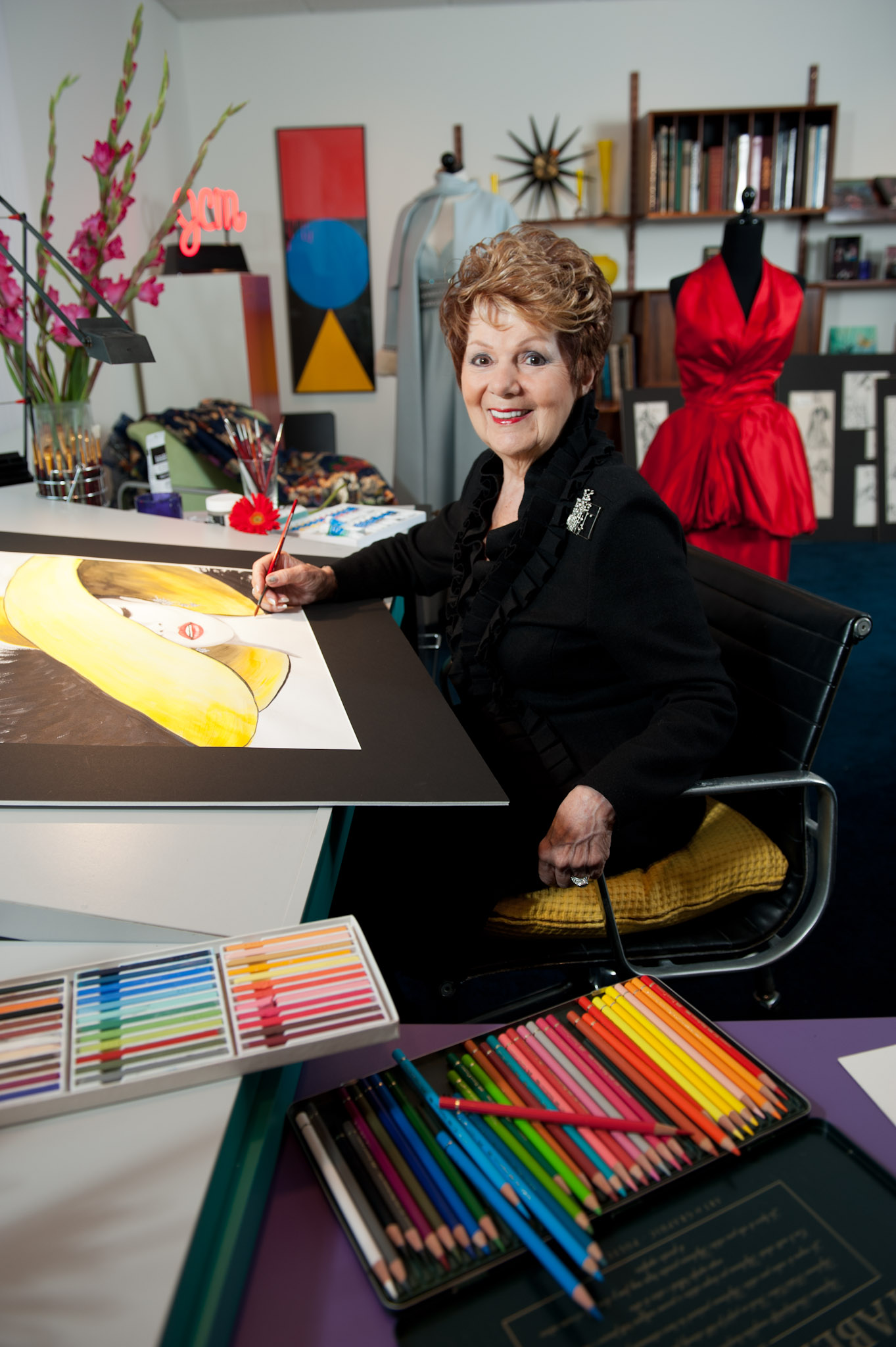
Mary Mitchell in her studio, @photo Jim Scholz
Timeless Fashion Illustrator Mary Mitchell: Her Work Illustrating Three Decades of Style Now Subject of New Book and Exhibition
©by Leo Adam Biga
Soon to be published in the New Horizons
Fashion illustration revived
Just as good art is timeless, so are the artists who make it.
Born in Buffalo, New York, fashion illustrator Mary Mitchell has seen art movements come and go through the years, but quality work, no matter what it is called or when it is en vogue, endures.
Much to her surprise, finely articulated fashion illustrations she made in the late 1960s, 1970s and 1980s are finding new admirers inside and outside the world of design. Friends and experts alike appreciate how Mitchell’s work stands the test of time while offering revealing glimpses into the lost art of fashion illustration she practiced.
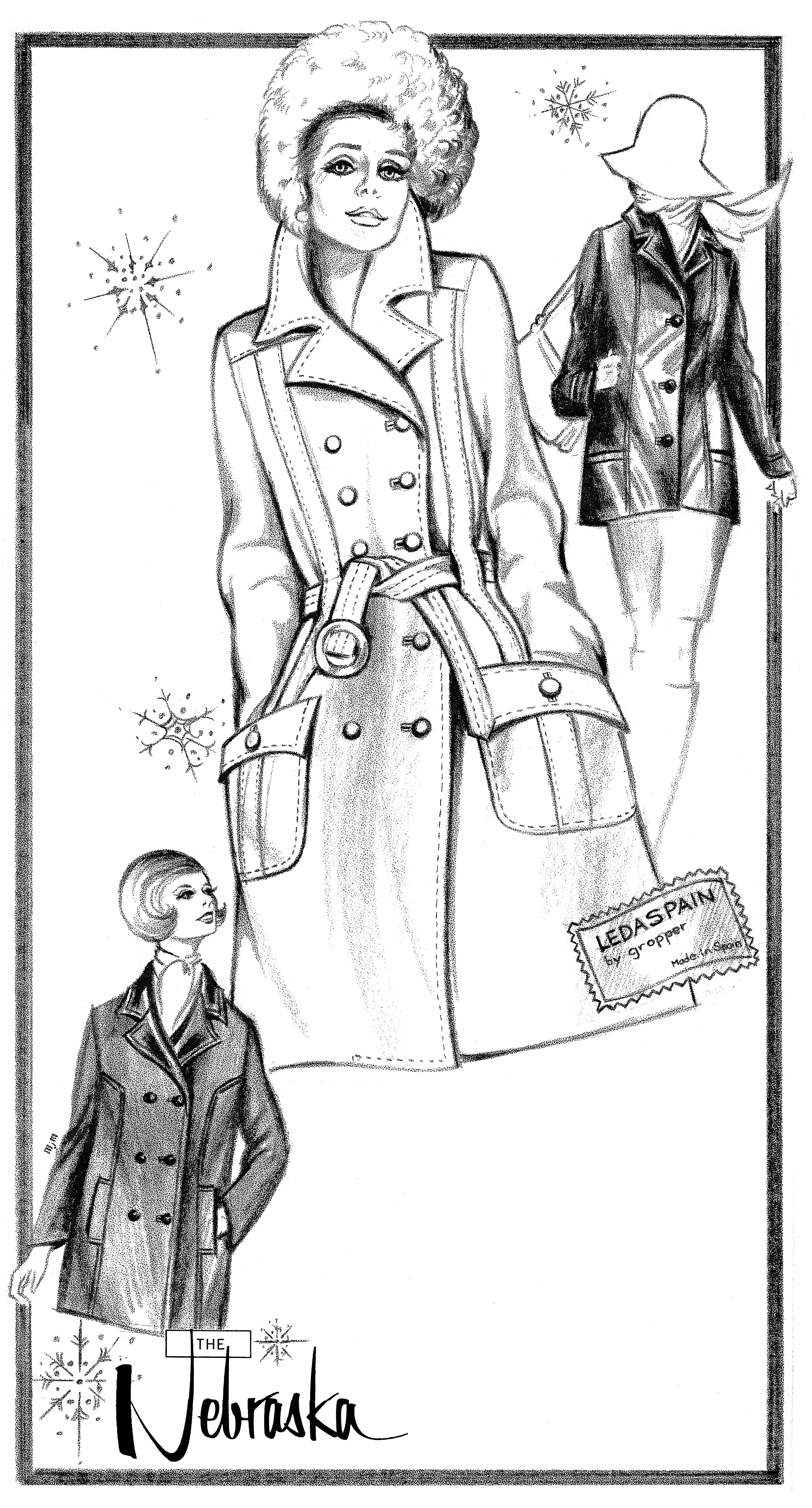
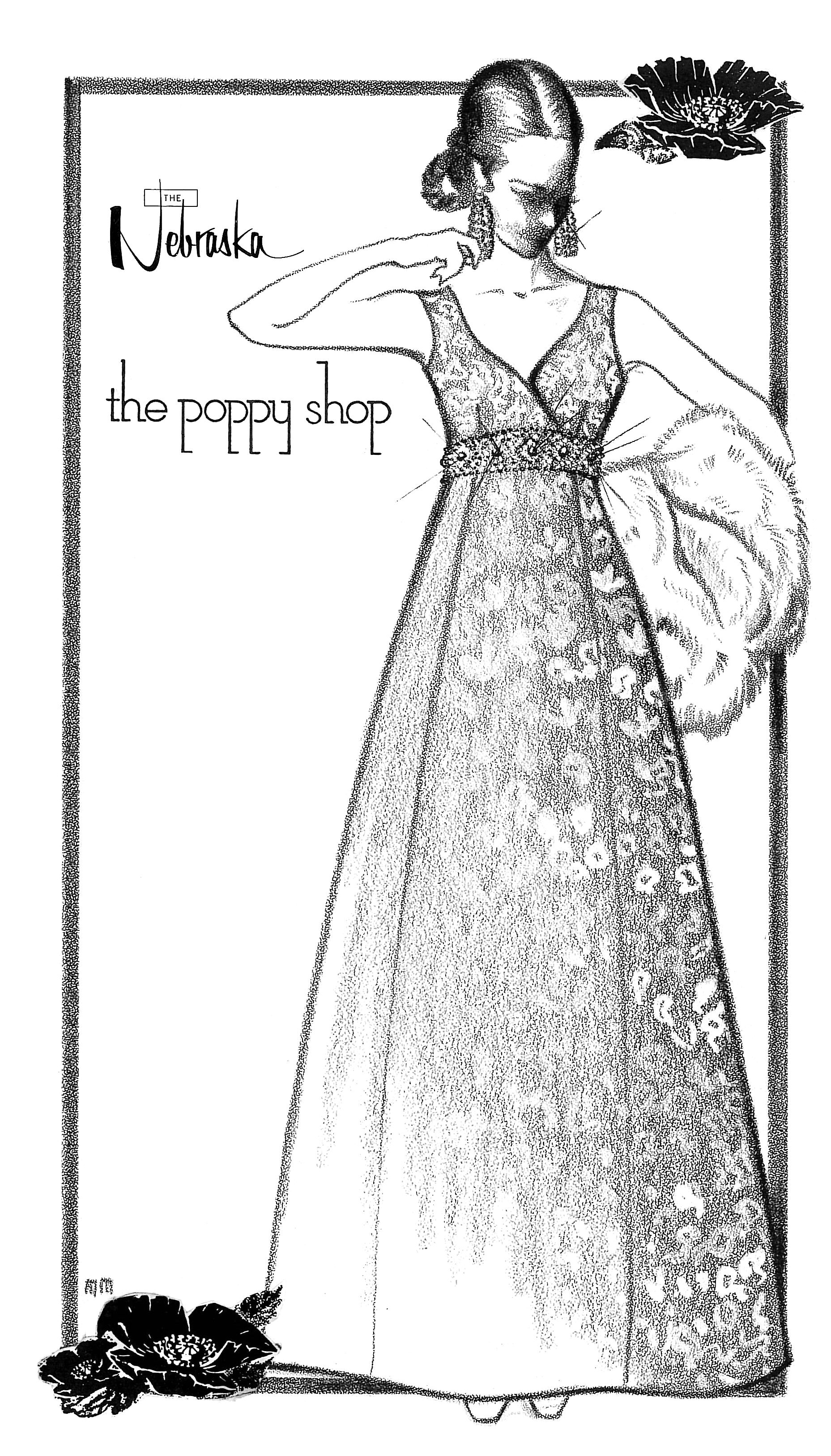
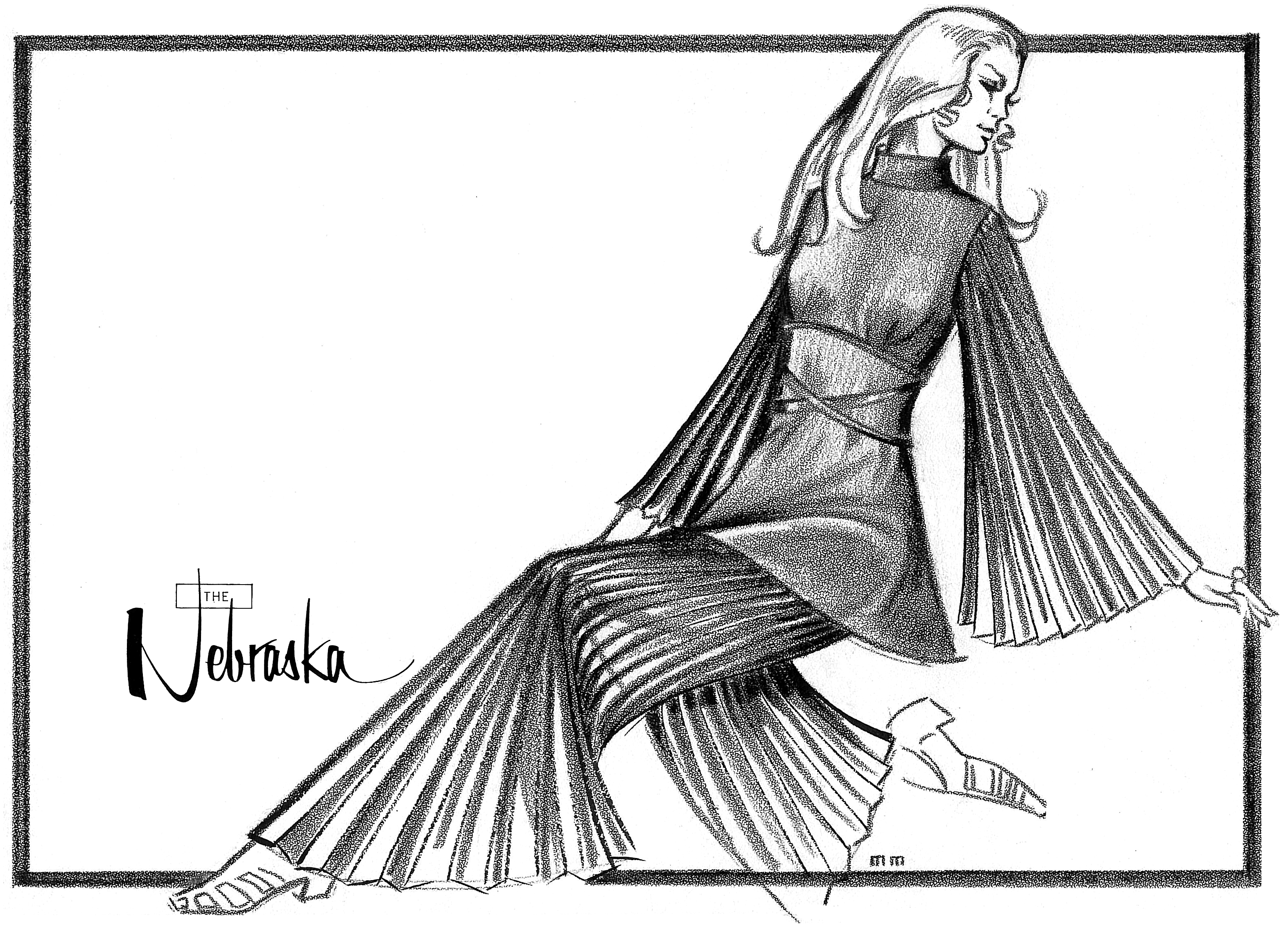
She worked as an in-house illustrator for an elite Omaha clothing store, “The Nebraska,” for four years. She then decided to become a freelance illustrator, which found her illustrating men’s, women’s, and children’s fashions for several leading Omaha stores. Her illustrations appeared in the Omaha World-Herald, the Sun Newspapers, the Lincoln Journal-Star and various suburban papers and local magazines.
When there was no longer a demand for fashion illustration, she moved onto other things. Her originals – meticulously rendered, carefully preserved black and white fashion illustrations – no longer had a use and so she put them away in her studio at home. Untouched. Unseen. Forgotten.
That all changed in 2010 when, suddenly, Mary found her work from that period the subject of renewed interest. It happened this way:
Two good friends visited Mary and her husband, John Mitchell, in Longboat Key, Florida, where the couple reside half the year. When guests Anne Marie Kenny and Mary Jochim asked Mary what she used to do for a living the artist showed a portfolio of her work. Kenny and Jochim were instantly captivated by Mitchell’s handiwork. The guests were so impressed that en route home they conceived the idea for an exhibition. The women formed an organizing committee and after many meetings and much planning, the right venue for the exhibition was found at the Durham Museum.
The resulting exhibition and book, Drawn to Fashion: Illustrating Three Decades of Style by Mary Mitchell, marks the first time and most certainly not the last that the artist’s work will be exhibited. The show opens January 28 and runs through May 27. Omaha-based Standard Printing Company designed and printed the book. The University of Nebraska Press is distributing it.
What so captured her friends’ fancy?
For starters, Kenny appreciates “the intricate detail and attitude, crafted in a superb drawing technique,” “the graceful lines” and “the exquisite flair” that run through Mary’s work. She adds, “The exhibit and new book devoted exclusively to her fashion illustration demonstrate her unique expression of a genre that is awesome to behold, highly collectable, and more relevant today than ever.”
Jochim, too, is struck by “the intricate strokes, down to the individual hairs in a fur coat, a herringbone weave, or the sparkle in a glittering evening jacket.” She said Mitchell “breathes life into the illustrations. The models in her drawings seem to all have a story to tell which makes you curious.”
Fashion designer icon Oscar de la Renta writes in his foreword to Drawn to Fashion: “Mary is a true artist, elegant and masterful. Her illustrations have enriched the experience of fashion in our time, and brought joy to the mind’s eye.”
Academics sing her praises as well.
Dr. Barbara Trout, a professorat the University of Nebraska Lincoln’s Department of Textiles, Clothing and Design, which is contributing original garments for the exhibition, said Mitchell’s work “marked technical excellence through the fine articulation of garment details. Her ability to mimic the hand of the fabric, its distinct structure, and the projected movement allowed the consumer to envision themselves in those garments…Mary’s fine examples of illustration are truly a benchmark of their time.”
“Mary Mitchell’s fashion drawings reveal the confident hand of the experienced illustrator, one who brings to her work an editor’s ability to subtract and to refine, and an artist’s to enhance and to glamorize,” said Michael James, chair and Ardis James professor in the UNL Department of Textiles, Clothing and Design.
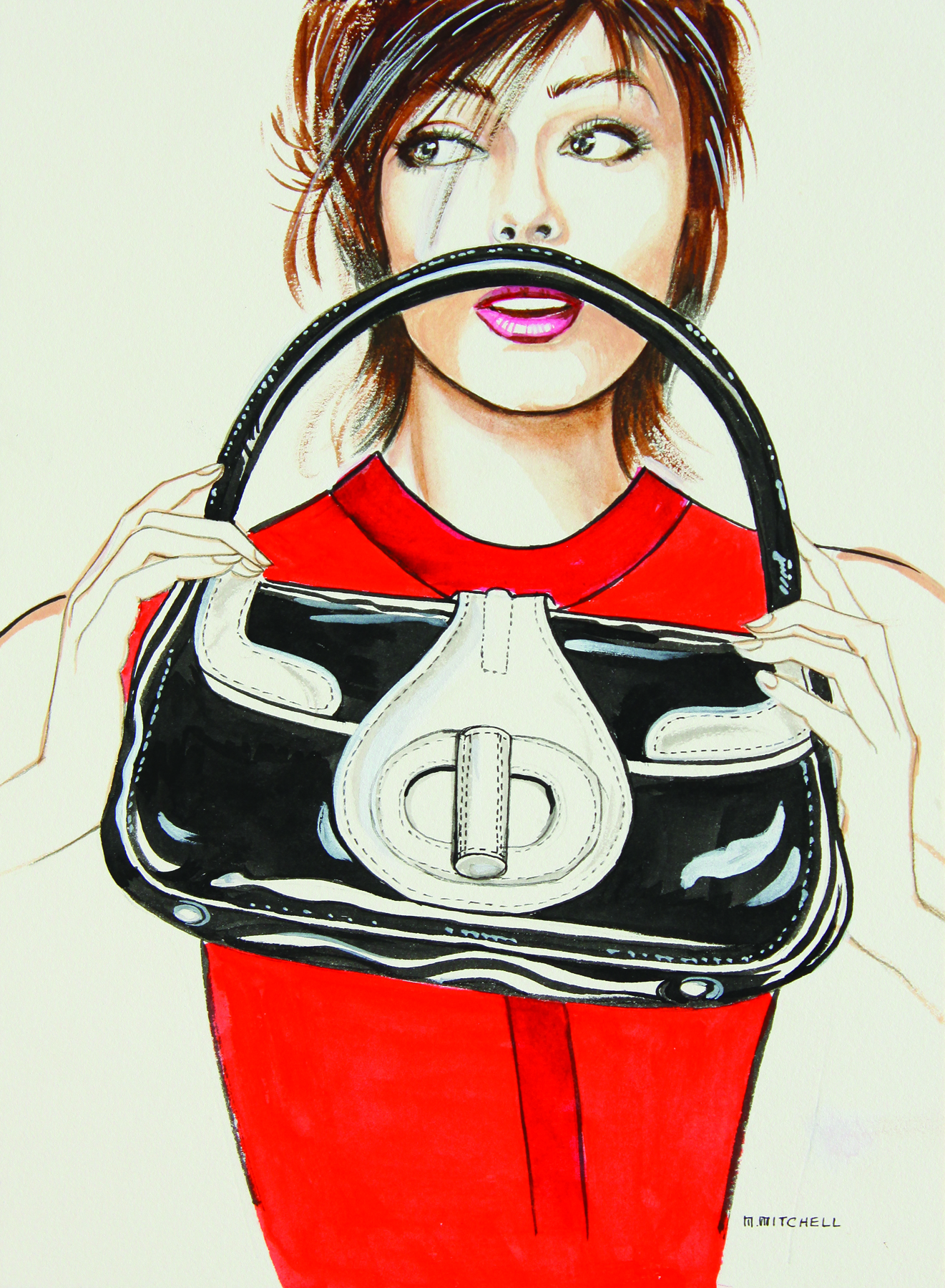
©Mary Mitchell
The rediscovery of Mitchell’s stunning cache of some 1,000 illustrations not only prompted the book and accompanying exhibition, it inspired the artist herself to create new fashion illustrations for the first time in years.
“I thought I probably would never have done any more fashion illustrations if it were not for Anne Marie Kenny and Mary Jochim. They showed so much interest in my work, it inspired me to start drawing in color, since all my work previously was in black and white to be printed in local papers,” said Mitchell.
Her new work now graces the book and the exhibit displays alongside her older work. She makes the new illustrations not for any client or acclaim, but purely for her own enjoyment and pleasure.
She throws herself into the work, creating without the burden of client restrictions or project deadlines.
“I get so excited about this that now I go down to my studio and work for hours to create another piece of art.”
She’s experimenting with other mediums, such as acrylic paints and watercolors, to draw fashions. Perhaps most pleasing of all, she feels she hasn’t lost her artistic touch. Her eye for detail, sharp as ever.
One should not assume Mitchell halted her creative life after the fashion illustration market dried up in the 1980s when clients and publishers abandoned hand-drawn illustrations for photographs.
No, her artistic sensibility and creativity infuse everything she does. It always has. It is revealed in the tasteful way she decorates her contemporary home, in how her hair is styled just so, in the stylish clothes she wears.
She is, as Jochim puts it, “a natural beauty” whose “graciousness and glamour” seem effortless.
Kenny said, “Mary lives and breathes art in every aspect of her life – her beautiful home, her elegant manner, her exquisite fashion illustrations, her glamorous style. Mary brings beauty to all that she touches.”
When fashion illustration was no longer a career option, Mitchell found other avenues of expression to feed her creativity, She became vice president of an advertising agency called Young & Mitchell, where she continued her graphic art. During this time she designed billboards, posters, and stationery logos, she called on clients, she made presentations, created television story boards and camera cards, wrote copy, and created advertising campaigns.
Her husband had bought several radio stations in Omaha and throughout Nebraska. The station general managers began asking Mary to create logos and to handle advertising for them. She then became a hands-on vice president with Mitchell Broadcasting Company. She created logos, designed all magazine and newspaper layouts, and bus signs for the stations, and handled creative projects for station promotions and concerts.
She seamlessly went from the intimacy of fashion illustration to the, by comparison, epic scale of signs and billboards.
“It was a different style of art needed for commercial advertising. I used to draw intricate, delicate drawings and now I was doing big, bold designs. Of course, that’s not fashion, it’s advertising, but it’s all a matter of design.
“It was a lot of fun. The people that worked in that environment each had their own personality – the DJs, the sales people, the managers.”
The passion of this accomplished woman would not be denied , certainly not suppressed. It is a trait she displayed early on growing up in Buffalo, New York as the only child of Greek immigrant parents, John and Irene Kafasis.
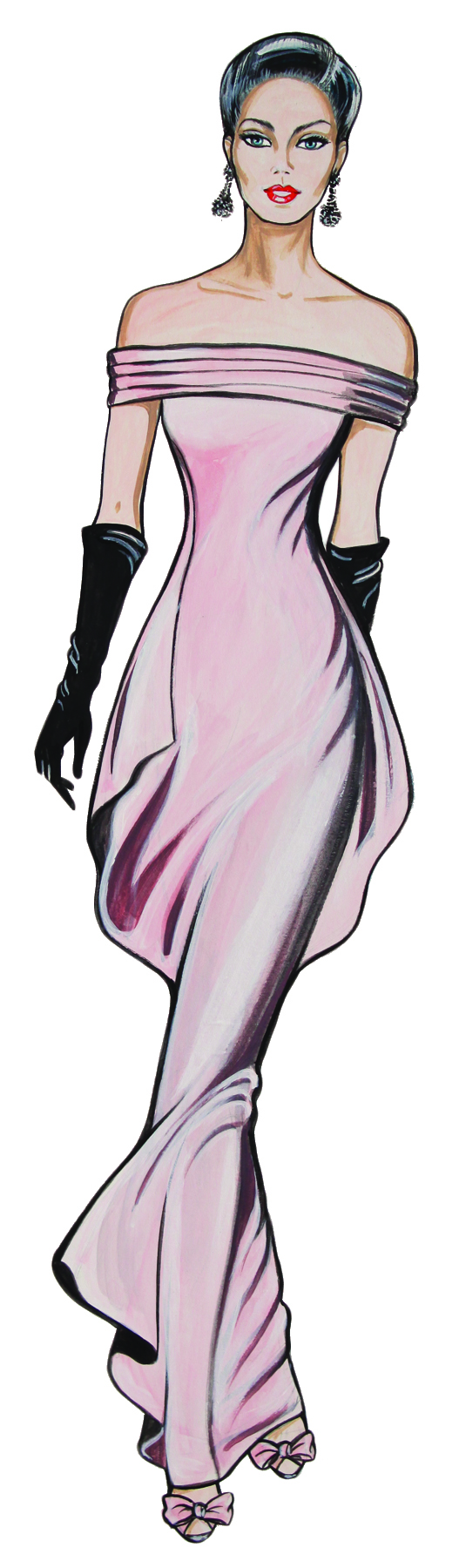
©Mary Mitchell
Where it all began
Born Mary Kafasis, she inherited determination from her folks, who ventured to America from Siatista in northern Greece. Her father arrived in the States at age 16 with $11 in his pocket. After a succession of menial jobs he worked on the railroad as part of a track maintenance crew. The work paid well enough but was miserable, backbreaking labor.
Her father and a buddy of his saved up enough to buy a candy shop. Greek-Americans up and down the East Coast and all around the U.S. used confectionaries and restaurants as their entree to the American Dream. She said her father was pushing 30 and still single when he wrote his parents asking that they find a suitable bride for him in the Old Country.
“My mom was from the same village in Greece as my dad. They married and he brought her back to the States, and she worked very hard with him in their candy store,” said Mary.
When Mary was about age 8 she spent an idyllic three months in Greece with her mother, visiting the village in which her mother was born and raised.
“It’s a beautiful little village surrounded by mountains. We stayed with my grandmother and I met all my aunts and uncles and I had fun playing with all my cousins. It was a lovely time.”
The small family carved out a nice middle class life for themselves. “My parents did well, but they worked long hours and very hard.”
Everything revolved around the family business located in South Buffalo. The family lived upstairs of the shop.
“My mom would hand dip chocolate candies, such as nut and fruit clusters. Dad would make homemade ice cream and sponge taffy. For Easter and Valentine’s Day they would make candy bunnies, baskets, and hearts and fill them with delicious chocolates and decorate them with colorful flowers and ribbons. My job was to fill the baskets and Valentine’s hearts with the chocolates.”
Summers and after school found her working in the shop. She began as a dishwasher before she was entrusted to wait on customers. Her penchant for drawing surfaced early on.
“I remember when I was little I would get a pad, colored pencils or crayons or paints and start drawing figures and designing dresses. That’s when I decided I wanted to be an artist. My mom was so encouraging. She also had me take piano and dancing lessons.”
Mary went to great lengths to pursue her art passion. “I was required to attend South Park High School. It didn’t have an art program, so after my freshman year I wanted to transfer to another school outside my district, clear on the other side of town – Bennett High School. It was renowned for its excellent art program. My girlfriend Shirley Fritz and I went to City Hall and obtained special permission to attend Bennett High. We really felt strong about it.”
Going to that far-off school meant waking up earlier and coming home much later. The extra time and effort were worth it, she said. “My art teacher at Bennett was phenomenal. She had a great gift of teaching and got me involved in several national contests. I won national awards in poster design and an award from Hallmark cards for my design of a greeting card. I also designed the covers of two school year books.”
Then tragedy struck. Just two months before Mary’s high school graduation her mother died. “She had been ill for a long time and in the hospital. She was only 39.” Losing her mother at 17 was a terrible blow for the only child.
“I was scheduled to go to Syracuse University, but my dad would not let me go. He insisted I go to secretarial school instead of art school. He said, ‘You’re a woman, you’re going to get married, what do you need to go to art school for?’ It was an (Old World) Greek mentality. I know if my mother were there, she would have insisted I go to college and art school.
“He also said he would not pay for my tuition to college or art school. Luckily, my mother left a savings account in my name, so I used that for my tuition, and of course lived at home with my dad.”
She decided to attend the University of Buffalo in conjunction with the Albright Art School and graduated as a fashion illustrator. Her original intent was to be a magazine illustrator, but she was advised against that male-dominated field and steered into fashion illustration.
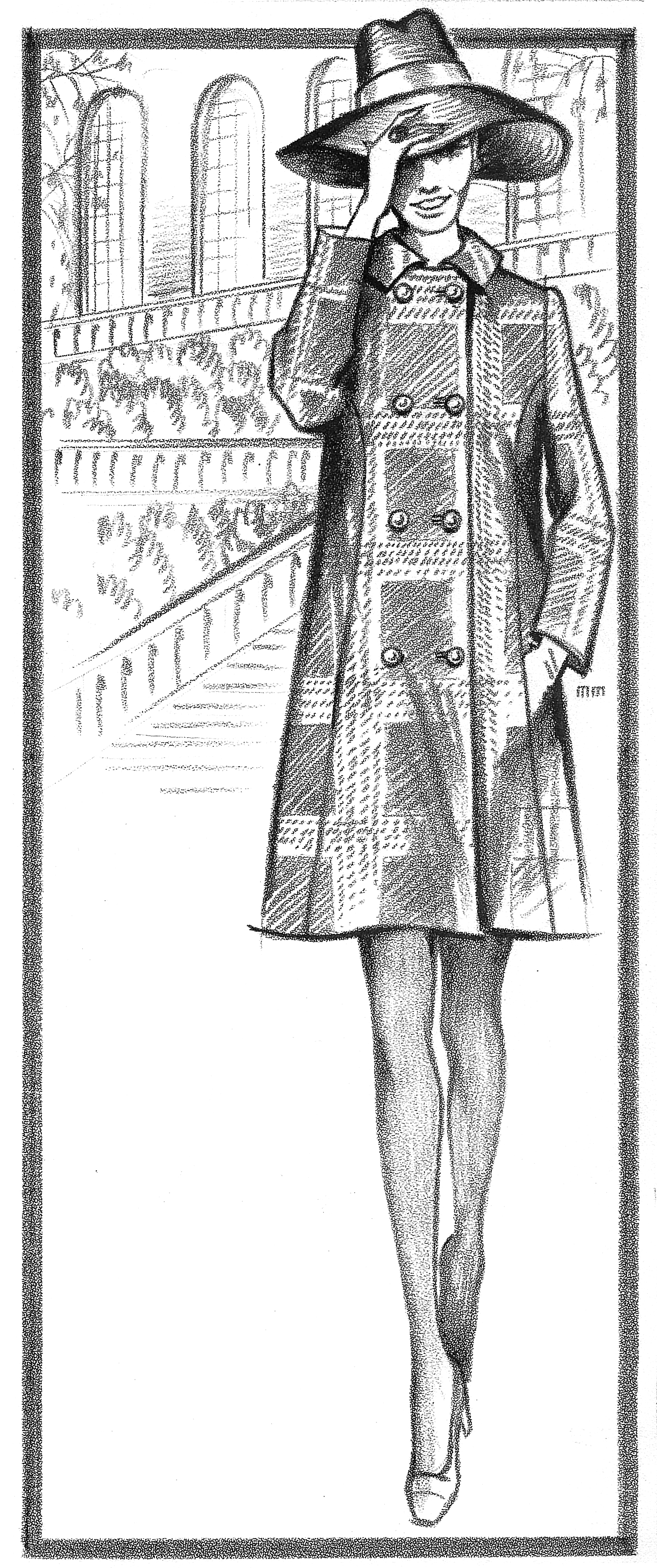
©Mary Mitchell
“One of the courses I took was life drawing, which teaches you the structure of the body’s bones and muscles. It’s very important to have that if you’re going to do fashion figures, to get the proportions and movements right, and to know how clothing is draped on the body.”
She learned, too, how elements like light and shadow “make a big difference” when sketching different fabrics and textures.
“After graduating I took my portfolio to all the department stores in Buffalo, where I kept running into resistance: ‘Do you have experience?’ ‘No, I just graduated.’ ‘Well, call me when you get experience.’
“So after several months of job hunting I took a job as a sign painter for the display department at a Flint & Kent department store, knowing that the fashion illustrator was pregnant and would be leaving in a few months. Lo and behold, they called me when she left and I got my first job as a fashion illustrator. I was in Seventh Heaven.”
©Mary Mitchell
New directions
Then John came into her life. They met as delegates at a Cleveland, Ohio convention of the American Hellenic Educational Progressive Association, a service organization closely allied with the Greek Orthodox Church. Like her parents, John’s mother and father were from Greece, only from Athens. His family’s name, Mitsopoulos, was Americanized by his dad to Mitchell. His folks settled first in Kansas City before moving to the south central Nebraska town of Kearney.
John was a recent Georgetown University law graduate with an eye on practicing law in Kearney and plans for pursuing a political career. He wooed Mary from afar, the two got engaged, and in 1951 they married in Buffalo before starting a new life together in Kearney. Leaving home was bittersweet for Mary.
“Kearney in those days was a town of only 13,000, with no opportunities for me to work as an artist. With no family or friends, it was very difficult. So I decided to go back to school (at then-Kearney State Teachers College). I took two years of French, English literature, and psychology and during that time I would venture into the art department and talk to the art teachers. They said they needed more teachers and asked if I would join the faculty. I finally said yes and started teaching Art 101 and Art Appreciation.
“I was asked to design brochures for the college and I was also commissioned to redesign the interior of the student union.”
More interior design jobs followed in later years. Finally getting to apply her craft made her feel “a little better” about the move West.
While in Kearney Mary gave birth to her and John’s only child, John Charles Mitchell II, who is now a gastrointestinal physician in Omaha and married to M. Kathleen Mitchell of Red Cloud, Neb. They have two grown children, John Bernard Mitchell and Emily Suzanne Mitchell.
Meanwhile, her husband’s law practice flourished and his political career took off. He became state Democratic party chairman in the 1960s. It was a heady time.
“We got involved in local, state, and national politics. We got to meet Lyndon Johnson and John F. Kennedy. When JFK came to Kearney for a political event we met him with our young son and he held Johnny. We met both Teddy and Bobby Kennedy. John was very close to Hubert Humphrey. It was a very busy and exciting time.”
©Mary Mitchell
©Mary Mitchell
©Mary Mitchell
Mary Mitchell’s halcyon fashion illustration days
Mary pined to work full-time and to have her own professional identity. John, by the way, “supported anything I wanted to do,” she said. The opportunity to fulfill her creative hunger finally came when the family moved to Omaha in 1968. Scouring the classifieds she saw an ad that read, “Fashion illustrator wanted, Nebraska Clothing.” A venerable clothing store then, “The Nebraska” was renowned for its quality brand name selections. She called, made an appointment to interview for the job, and got hired on the spot.
She enjoyed her four years with “The Nebraska” very much, but she reached a point where becoming a freelance artist made sense. She resigned from Nebraska Clothing in December 1971 and went into business for herself, calling her boutique design firm Mary Mitchell Studio. “Freelancing,” she said, “was the best career thing I did. It was a little scary at first, but people started calling me to design their ads and illustrate their garments. It was so wonderful to be independent and to work at my own pace. Each year kept getting better.”
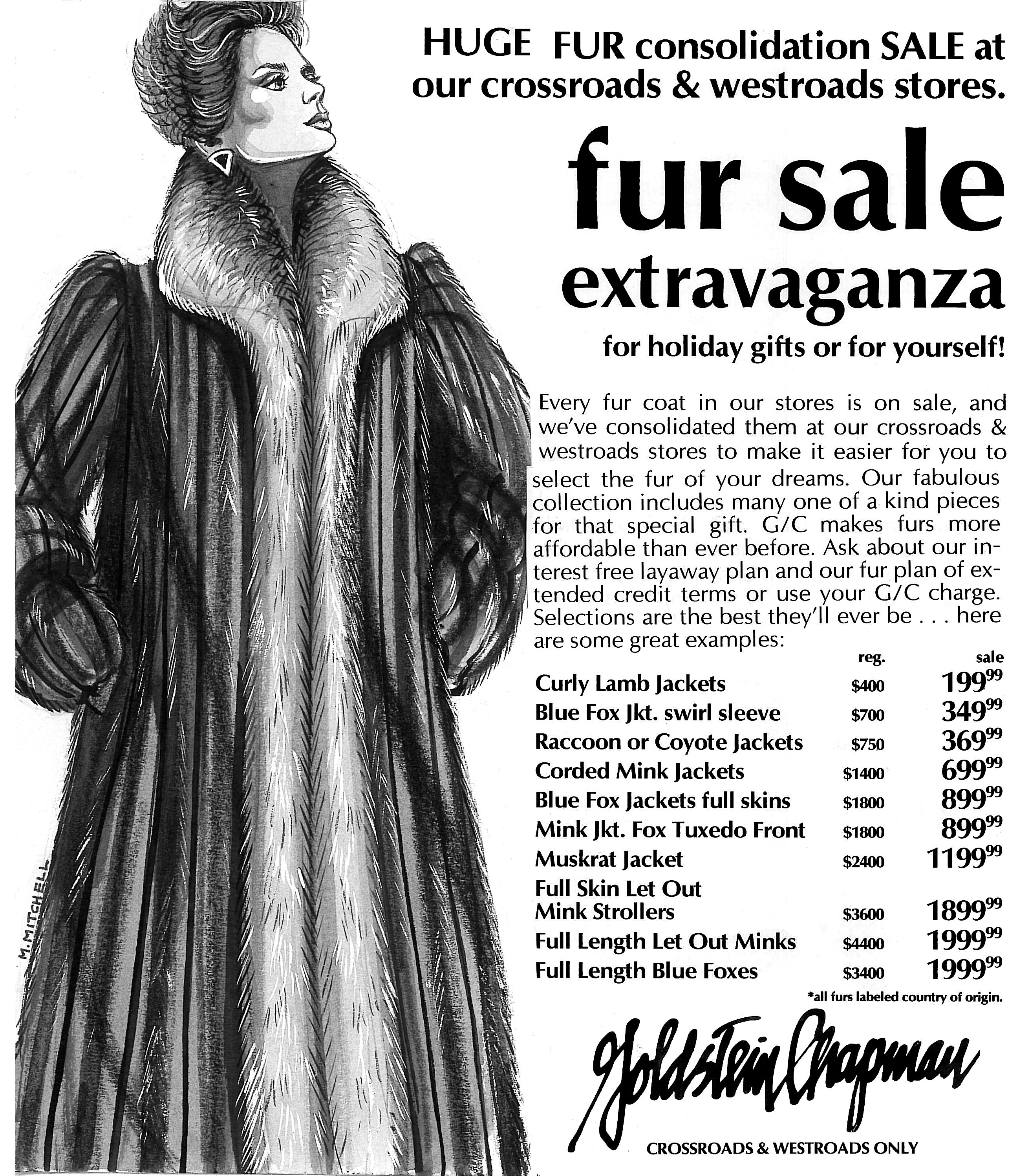
Her client roster grew to include: TOPPs of Omaha; Goldstein Chapman; Herzbergs; Zoobs; Natelson’s; Parsow’s; Wolf Bros.; I. Eugene’s Shoes; Hitching Post; Crandell’s; The Wardrobe for Men, Backstage, Ltd.
“My general attitude is, whenever I sit down to create an ad or drawing I will try my best to achieve the attributes of the client’s business. I want it done as perfectly as possible.”
Creating a finished advertisement for a newspaper or magazine is a several step process. It begins with the client deciding the size of the ad, which determines its cost. Then the layout is made, the drawing of the garment is executed, and the ad copy written. Whether a suit, a dress, or a pair of shoes, there are usually instructions that go along with it. For instance, a client might want an 18 year-old look for one item and a 30 year-old look for another. A Girl-Next-Door vibe here, a sophisticated image there. A relaxed stance in one ad, a formal posture in another.
“The article was given to me to sketch and I created the look of the individual it would appeal to,” she said.
When doing fashion illustration ads, there is always a space limitation to work within, based on column inches. And, of course, there are always deadlines.
Once the parameters of the job were known, Mitchell arrayed the tools of her trade: pencils, pens, brushes, inks, paints, drawing paper. Her job then became animating the apparel and the figure wearing it to accentuate the fashion.
She started with a rough layout.
“There were two methods of drawing for reproduction at that time,” she said. “One used a fluorographic solution mixed with India ink to obtain various shades of gray and painting with a fine brush or drawing with a pen. The other used a No. 935 pencil to draw on textured paper to obtain various shades of gray to black. Different techniques produced different effects.
“If you have a dress with lace on it, you used a very fine quill pen, with a fine point. The way you handle the light and shade for materials and patterns depends on the amount of wash you use with your brush, dark to light.”
By mixing more water with a wash and by adjusting her brush stroke she approximated velvet, taffeta, fur or leather.
It’s all in the details, particularly in black and white. “The more you show the detail the better the garment looks. You try to approximate the article as close as possible.”
Depicting the essence of a garment requires great skill.
“The skilled fashion illustrator must be able to reduce the architecture of a garment to its essentials while amplifying its hedonic appeal. This is no small task when the means she has to do this are a few marks of pencil or pen or brush on paper. She must interpret the designer’s stylistic signature, but to be convincing she must render with her own authoritative style,” said UNL’s Michael James.
The dynamic sense of flow or movement in Mitchell’s work, then and now, is intentional. “I don’t want it just to be a static figure, I want it to be active.” Besides, to show off the clothes in their best light, she said, “you’re not going to draw the body straight forward, you’re going to give it movement.”
A file of fashion magazines offer her ideas to extrapolate from. Perhaps a certain facial type or expression that catches her attention. Or the way a model’s hair blows in the wind. Or the way a hand is gestured.
“Fashion illustration figures are always elongated,” she said. “We were taught that the human figure is eight heads high but illustrative figures should be nine heads high or tall because that gives a more dramatic and elegant look.”
When she did fashion illustration for her livelihood she made a habit of studying fashion ads. “I certainly admired the Sunday New York Times fashion ads and those in the Chicago and L.A. papers as well.” Staying abreast of the latest trends meant she frequented local fashion shows. “I modeled, too, for some of the stores that I did ads for when I was thinner and younger,” said the still petite Mitchell.
As a freelancer she not only completed the artwork but the entire layout and the copy as well. All of it a very tactile, labor, and time intensive process.
“I would do the layout, then draw the article, type the copy, give it to a typesetter, and order certain fonts, and when I got it back I would cut it out with an X-acto knife and paste it up with rubber cement. It was the only way it was done then – no computers.”
From there, it went to the printer, and the next time Mitchell saw it, it was in print.
Then the industry changed and the services of commercial fashion illustrators like herself became expendable.
“Instead of retailers hiring a graphic artist to draw their clothes or their shoes or whatever, they began taking photographs. It was less expensive. And so they no longer used fashion illustrations. Not even in big cities like Chicago and New York.
“I would say it became a lost art.”
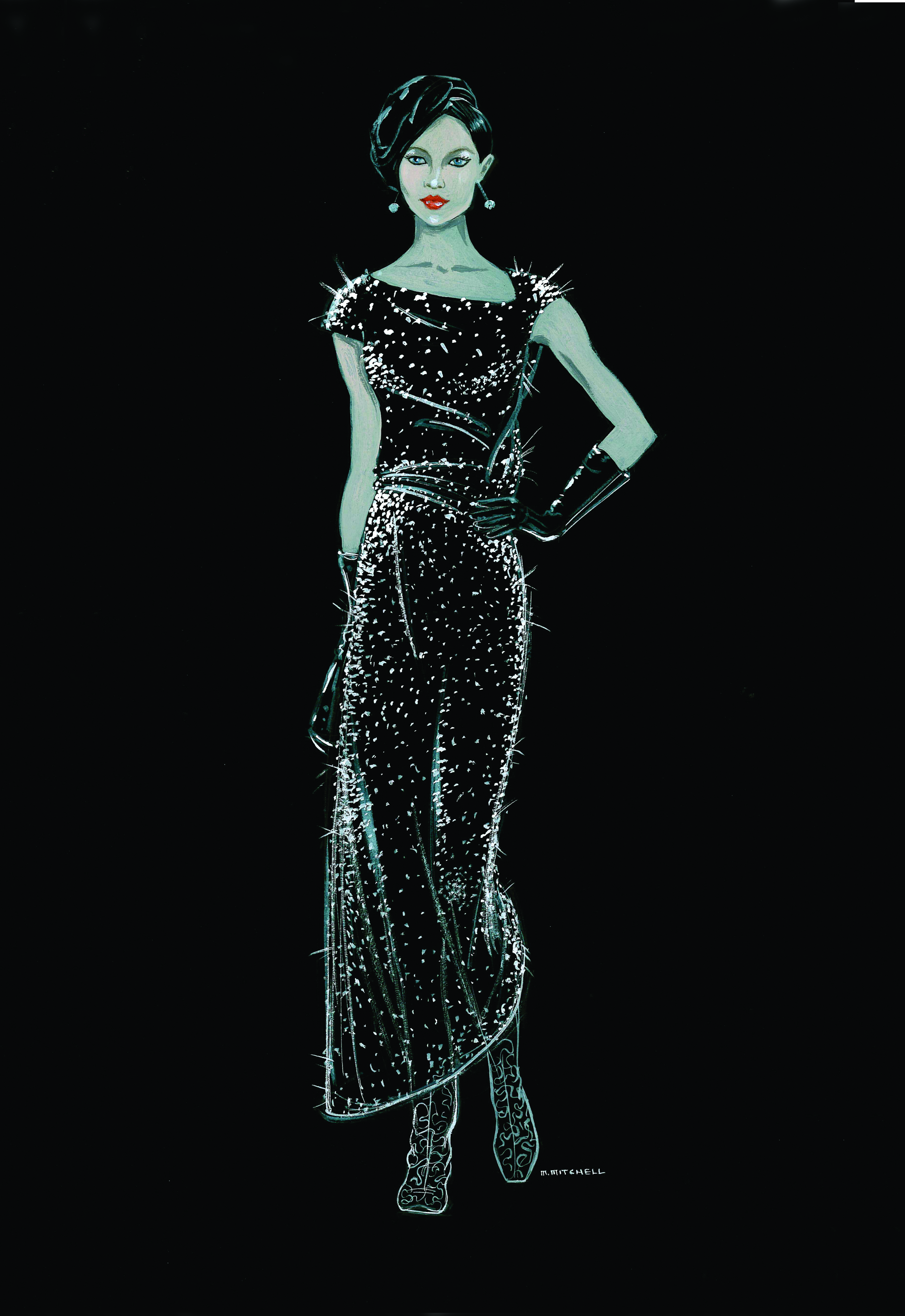
©Mary Mitchell
Reinventing herself
The timeless beauty and the scarcity of commercial fashion illustrations explain why they are collectible artworks today and featured in fashion books and on fashion blogs. The Fashion Illustration Gallery in London is devoted entirely to the work of master fashion illustrators .
Denied her fashion illustration outlet, she continued designing in a new guise as vice president and art director of Young & Mitchell Advertising and as vice president of Mitchell Broadcasting.
Mary said she and John sold their Nebraska stations, which included Sweet 98 and KKAR,, just “as the big boys started coming in, like Clear Channel,” adding, “We sold them at the right time.”
Another whole segment of her design work is interior design. John and Mary became part owners of Le Versaille restaurant and ran that for several years. They decided to change the decor and Mary redesigned it from a red velvet and mirrored interior to a black, green, silver, and white decor with large photographs of French vineyards. She also designed the Blue Fox restaurant. She executed the concept and theme for the Golden Apple of Love Restaurant.
“It was incredible,” she said of these all-encompassing projects and the large canvas they gave her to work on.
Her home is another epic canvas she has poured her passion into.
“It’s indeed a pleasure to create your own space,” she said, referring to her chic residence that reflects her “contemporary” design palette. “I like clean lines and not a lot of frills. Basically black and white with some beautiful colors.”
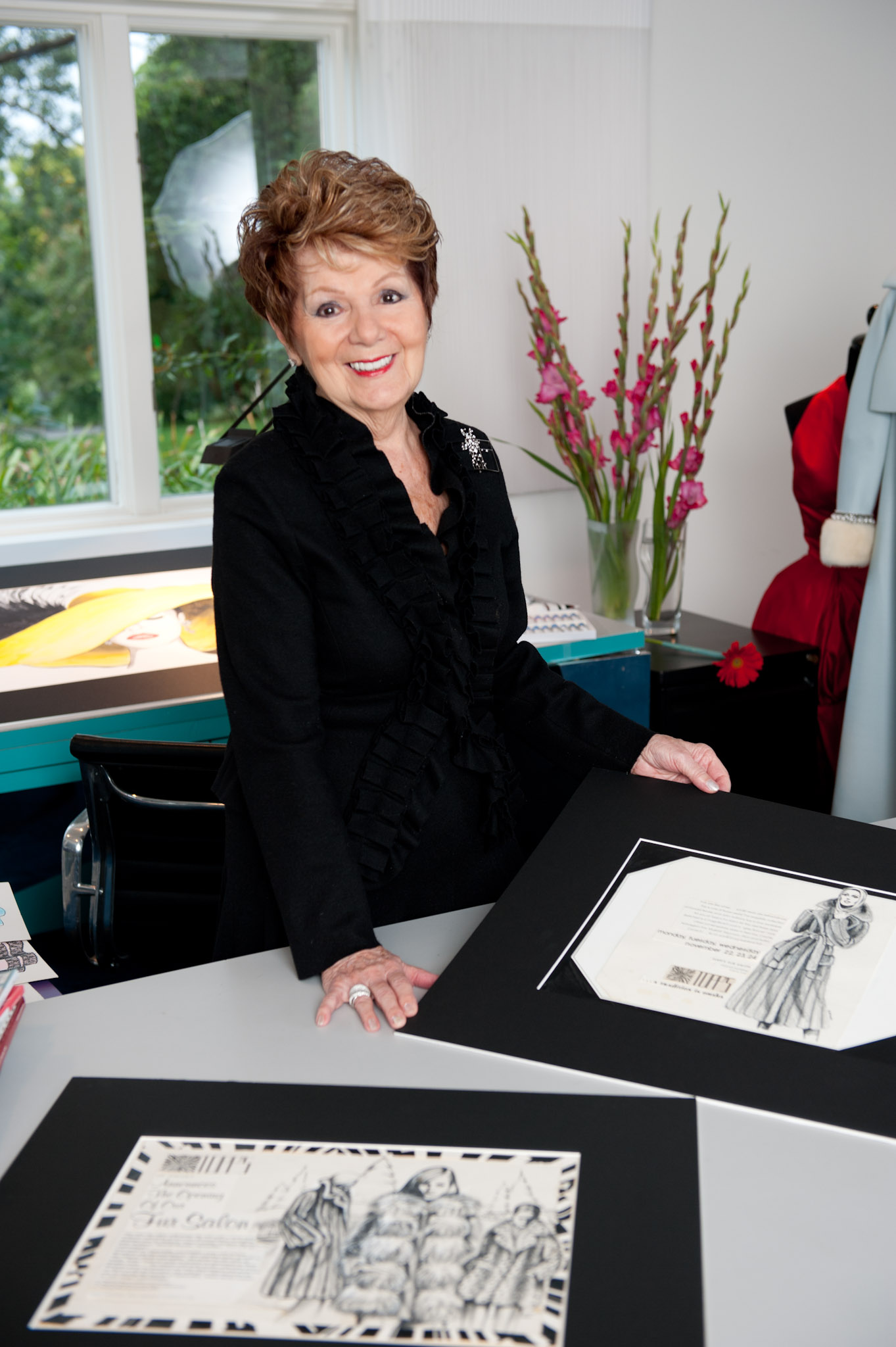
©photo Jim Scholz
A well-designed life comes full circle
She and John have traveled to Greece several times. They took their son there when he was 11. The couple have remained close to their Greek heritage in other ways, too. They are longtime members of Omaha’s Greek Orthodox Church.
“I do speak Greek on occasion, and with my Greek friends, and so does my husband. We cook Greek foods for special occasions, as does my son and his family.”
After the sale of the radio stations in 2000, her life proceeded like that of many retirees, as she divided her days between travel, shopping, decorating, and spending time with John and Kathleen and their two grandchildren, John B. and Emily. She never expected the work she did way back when to be the focus of an exhibition and a book.
When still active as a fashion illustrator, it never crossed her mind to exhibit her work, she said, because commercial art was generally not considered museum or gallery worthy. That attitude has turned around in recent years. She is very much aware that the graphic art form she specialized in is making “a comeback” with young and old alike.
She has a collection of fashion illustration books and has her heart set on one day visiting London’s Fashion Illustration Gallery.
“I’d love to see it.”
Her illustrations might never have seen the light of day again if Anne Marie Kenny and Mary Jochim had not persevered and shown so much interest to exhibit them. Mary Mitchell is flattered by all the interest in this art form from so long ago.
There would be no exhibition or book if she had not preserved the original illustrations. She held onto enough that her personal collection numbers about 1,000 illustrations. It adds up to a life’s work.
The way she had carefully mounted the illustrations on framed and covered poster board panels and in portfolio books indicates the importance they have always held for her. Just as there was nothing haphazard in the way she created the works, she took great pains in preserving them for posterity.
Still, the illustrations would likely have remained tucked away in her home studio if not for the unexpected series of events that led to the book and exhibition.
Now, these valuable artworks and artifacts have a second life and Mary Mitchell suddenly finds herself the subject of renewed interest.
Harper’s Bazaar editor Glenda Bailey writes, “I love that Mary Mitchell brought such a high caliber of artistry to the local level. I was in fashion school in London in the 1980s, but when I look at the work of Mary drew for the women of Omaha at that time, her level of detail puts me right into the moment. To the casual viewer, Mary’s work appears effortless. But when you look more closely you see the precision and intention behind each brushstroke. She elevates each drawing to a tactile experience. A picture may be worth a thousand words, but a Mary Mitchell illustration is worth a thousand rustles of silk and crisp snaps of tweed.”
Mary never expected such a fuss, but she welcomes it. The timelessness of Mary Mitchell and her art now resonate with old and new audiences. The rediscovery of her work should ensure it lasts for generations to come.
To view more of Mary’s art and to buy her book, visit www.drawntofashion.com. For details on the Durham exhibition, visit www.durhammuseum.org.
Related articles
- Fashion Illustration (evawilsonart.wordpress.com)
- Iconic Fashion Illustrations – The Epherma Friends Watercolors are Stunning (TrendHunter.com) (trendhunter.com)
- Illustrated Elizabeth Taylor (fashionising.com)
- 100 Years of Fashion Illustration Reviews (fclothes.com)
- Fashion Illustrated: Kareem Iliya (thelookbookphilosophy.com)
- feeling bookish (thecolorkaleidoscope.com)
- The Art Of The Fashion Illustration (justbeestylish.wordpress.com)
- Go Figure: New Fashion Illustration @ the Fashion Space Gallery (irenebrination.typepad.com)
Crowns: Black women and their hats
Actress and playwright Regina Taylor’s fine play, Crowns, celebrates the tradition that finds many African-American women wearing hats at church. The following story for The Reader (www.thereader.com) is largely based on interviews I did with cast members in a John Beasley Theater production of the Taylor play. The women comment on what’s behind the whole hat thing and it turns out these crowns represent and express all manner of things. I think you’ll find the story insightful and entertaining, and if you get a chance to see the play by all means do, because it says more than I could ever hope to say about the subject.

Crowns: Black women and their hats
©by Leo Adam Biga
Originally published in The Reader (www.thereader.com)
Regina Taylor’s musical drama Crowns celebrates the ties that bind African American women in the black church. Faith and fellowship rule, but the hats proudly worn by these grandmothers, mothers, daughters and sisters soulfully express their solidarity and individuality.
The female cast of Crowns, in performance February 23-March 18 at the John Beasley Theater, well relate to the hat queens they portray. Millicent Crawford, who plays Mother Shaw, said the parts “just fit.” After all, she and her fellow players come from a long line of church-going, “hat wearing divas,” said Brandi Smith (Yolanda). If there’s one thing “we all learned growing up,” said Janet Ashley (Velma), “it’s that you don’t go to church without something on your head.”
From wraps, rags, scarves and caps to turbans to berets to formal head attire, hats are legacies that unite women over generations of sacrifice, ceremony, joy and sorrow. “That’s just a traditional thing in our culture,” said Smith, who plays the central character Yolanda, “and it goes all the way back to Africa, when women would wrap their heads with the gelees. So, we are still covering our heads today.”
A woman’s head should be adorned, the Bible says, and in black culture that means some serious crowns come Sundays. Bare heads do not belong in the Lord’s House. It’s traditional, historical, scriptural, familial. In this largely hat-less era, not every black woman wears one to church anymore, but chances are her mother or grandmother does. When women of a certain age meet, as Mother Shaw, Velma, Mabel, Wanda and Jeanette do in the play, their hats represent a lifetime of experiences. When the wounded Yolanda arrives in their midst, their circle envelops her to share proverb-like stories and songs. In a rite of passage that resounds with spirit, the defiant girl becomes a woman and willingly joins in, learning to find the joy that lives beside her pain. Hats become a metaphor for the unbroken circle of life and the passing down of lessons.

Regina Taylor
The rich material busts out with the exuberance and ritual of a black Baptist church’s praise-and-worship, call-and-response service. It is funny, revelatory, sad and buoyant. Voices, spoken and sung, are raised on high to consider hats in all their gospel-inspired glory and the various ways women use them to shine.
“You must have the right attitude to put certain hats on. It’s hatitude,” Ashley said in the flamboyant style of Velma.
“There’s some hats you can wear and some hats you can’t. You have to have the right hat,” said Crawford, whose Mother Shaw is a willful preacher’s wife and the group’s wise matriarch. “You put on a wide-brimmed hat that’s got some feathers, you better be able to pull that off because you’re making a bold statement and people can see it. It takes confidence to wear certain hats. You’ve got to be able to work it.”
“You know from the second you put a hat on whether it’s you or not,” said Phyllis Mitchell Butler, who plays Mabel, the Hat Queen with a litany of hat etiquette rules. “You know either that’s your hat or it’s not.”
“I think one of the women in the play says, ‘You can tell a lot by the hat a woman wears. About who she is,” said Crawford, adding a woman can say things with a hat. “A hat can be very flirtatious or not.”
Ashley said Velma reminds us a hat can reveal or conceal.” “It’s like a mask,” Crawford said. A pastor’s wife off stage, Ashley dips the brim of her hat on Sundays, she said, so the congregation “can’t see anything on my face.” Conceal or not, a big hat is just right for some women. “You see, I wear big hats because little hats don’t look good on my head,” Ashley said. “I’d rather do a big hat” Crawford said, “because you walk in the room and it’s like, Wow! That hat is bad!”

Some women are so defined by their hats, that without one, Crawford said, it’s like “something’s missing — she needs a hat on.” “It wouldn’t be right,” said Ashley, adding the anticipation of what a hat queen will wear is a spectator sport for “hat watchers. There are certain women that you know when they come through that door they’re going to have on a hat and you want to see what hat is she wearing.”
Hats are style-status symbols. A poor woman may take a plain hat but adorn it splendidly or she may spend all she has for a lavish one. The play refers to Mabel’s mom fussing over a simple hat so that it “changed the whole look,” Ashley said. “We look at how the hat is made. We look at those details. The details are important.”
Crawford said some women, like Mother Shaw, will not buy a hat they love if “they don’t think it’s worth paying a lot of money for. But there are women that will pay an arm and a leg as long as they know no one else is going to wear that hat.”
“That’s right,” Ashley said. “Not just in the play either…My sister shops where she knows no other woman in Omaha will shop because she’s going to make sure she’s not going to see her hat on anybody else.” “We really do that — we don’t want to see our hats” on another woman, Crawford said. Call it being a hat cat.
As a fine hat costs dearly, it’s to be treasured. “You’re going to be taking care of those things you worked hard for,” Crawford said. That’s why an unspoken but well understood hat rule states — “nobody messes with my hat” — which Crawford said hat queens like her mother make emphatically clear. “You don’t go near her hat. Don’t knock the hat, don’t touch the hat. My mom, she will lay down the law.”
Showing off a hat is half the fun. Women really step it up for special occasions. Then, a “hi-ya” or “hit-ya” hat isn’t enough. Coordinating a whole outfit, plus accessories, is required. “You go to one of the church conventions or gospel workshops or whatever and these women are going to be decked out, as they said back in the day, from head to toe,” Crawford said. “Hat, purse, shoes, dress, jewelry. Everything matched. They’re going to be dressed to the nines.”
“It’s like the lamp with the shade,” Ashley said. “You have to have that right top and that bottom to go with it.”
The play suggests a hat queen’s collection of crowns can number in the hundreds. “No exaggeration,” Crawford said. The lone male voice in the play, provided by John Beasley, observes to his hat crazy wife, “You ain’t got but one head.” Ah, but a heavenly crown awaits to adorn that sweet head.

Related articles
- Which hat do you wear most? (miriamgomberg.wordpress.com)
- A Summer Hat (webnerhouse.com)
- The Way You Wear Your Hat, Part 1 (moviemorlocks.com)
- Bring Back The Trend: Boater Hats (thegloss.com)
- Hansberry Project honors Regina Taylor (seattletimes.nwsource.com)
Alice’s wonderland: Former InStyle accessories editor Alice Kim brings NYC style sense to Omaha’s Trocadero
Alice Kim’s story reads like a pitch line for a new reality television series. Growing up back east she began cultivating an intense interest in Omaha of all places, and her fascination grew more acute with each encounter she would have with someone from this Midwest city. She never visited here, mind you, she just read about it and kept running into Omahans, and every encounter and exposure reinforced in her mind this idealized version of Omaha as the embodiment of the All-American city. The thing is, her magnificent obsession didn’t wane after she carved out a career in New York City’s fashion and style industry, primarily as an editor with InStyle magazine. In fact, she kept cultivating this fixation and then one day she left her life and career in the Big Apple behind in order to transform her life in the middle of the country, far from the tastemaking and trendsetting scene of New York. The following story and sidebar for The Reader (www.thereader.com) describe how Kim has transferred her fashionista sensibilities to my hometown of Omaha and reinvented herself at the same time as a first-time mom and soon to be bride. Her fairytale life change is the subject of her delightful blog, Postcards from Omaha, and of a book she hopes to complete by year’s end.
There’s a nice symmetry to her story as well: Now that this accessories maven is well ensconced in Omaha with her lifestyle boutique, Trocadero, she’s helping prepare young Nebraska women with designs on having career sin fashion and style in New York City realize their dreams.
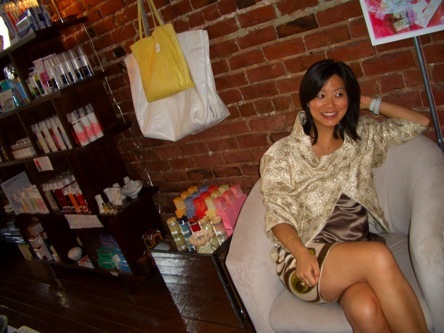
Alice’s wonderland:
Former InStyle accessories editor Alice Kim brings NYC style sense to Omaha’s Trocadero
©by Leo Adam Biga
As appeared in The Reader (www.thereader.com)
Alice Kim’s story of leaving New York City for Omaha has gotten much play.
In 2007, the then-InStyle magazine accessories editor acted on her admittedly “weird,” long-held preoccupation with Omaha by moving here and opening the Old Market lifestyles boutique, Trocadero.
“My store is in some ways InStyle come to life,” she says.
Her experience recommending the best of this or that gives Trocadero customers the benefit of her branded, expert, insider’s advice.
“I have that kind of finger on the pulse of what people want.”
Still, her store has struggled amid the recession and conservative Midwest buying habits that don’t mesh with her somewhat frivolous merchandise.
Cognoscenti, however, regard this Big Apple sophisticate as a style maven and tastemaker. Her exclusive, discriminating suggestions for just the right hand bag, pair of shoes or home decor item is heeded.
She cops to not being a salesperson but says, “I can always convince somebody that this is a great something or other.” Her spin, she says, goes something like: “’It’s a total New York brand, it’s not sold everywhere, it’s at a great price point.’ And all of a sudden there’s a story and they’re like, Really? And they buy it.
“It’s like sharing industry secrets,” she says. “I feel I have a unique angle, which is really telling people about the stuff that we as editors love.”
Everything she sells or endorses, she says, “I stand by.”
If her style sensibility were a tag line she says it would be “practically perfect,” adding, “It’s always going to be practical and it’s going to close to darn perfect.”
She has the professional chops and personal élan to articulate her discerning aesthetic without sounding smug, whether selecting things to sell in her shop or for her own wardrobe or excising the dull dross from a client’s closet.
“I feel very confident in my skills,” she says over sushi at Hiro 88 West. “I’ve always known how to style. I think a lot of it is innate. It’s just having the eye. It’s like being a good editor. But, of course, I’ve been trained. When I arrived in New York, from Pittsburgh, in 1992, I certainly was not a fashion diva then and I certainly didn’t look the part. I was doughty.”
She’s a long way from doughty today, though she felt that way while pregnant last year with her first child. Since the birth of her daughter Annabel she’s pined to retire her formless maternity clothes and return to some chic wear, such as the classic black dress she wore at lunch, accented by pearls.
“I don’t want to look messy anymore,” she says.
Kim is marrying Annabel’s father, entrepreneur Adrian Blake, this summer. She’s also step-mom to his two children as the two households recently merged.
Even before her pregnancy, Kim says she’d gotten lazy about her look and gained weight thanks to Omaha’s more sedentary lifestyle. Actually, she says her casual phase began near the burned-out close of her frenetic New York career.
“There were times when towards the end of my working days I just didn’t care anymore. I was just so busy. I’d wear flip flops because I was hoofing it all the time, walking from the garment district back to the office with bags of accessories. I wasn’t going to teeter in high heels.
“I was on the New York fashionista diet [champagne and finger food[. I was definitely much thinner when I lived in New York.”

Then there were those times, she says, “when I wanted to get dressed up, so then I’d wear a beautiful jacket with a dress and heels. It really depended on my day. If I knew I was going to be in the office all day then I would wear something nicer because I wouldn’t have to be schlepping around town for shoots and samples.
“When I first started the store [Trocadero],” she says, “I wanted to look nice — to be representative of fashion in New York in Omaha. I probably worked harder (at it) and then gradually just became more casual.”
For a year she bought her clothes at Target as a concession to mommy practicalities. Besides, she says, good style “doesn’t have to be super expensive.” Balancing being a new mom and fashionista at 41 means remaking herself, so she’s back to shopping at Von Maur to outfit herself more appropriately.
“I’m in my 40s — I really can’t keep dressing like a teenager. It’s just having to embrace that I’m an adult. I feel better now because I have grown-up clothes. I can look equally fine walking to the kids’ school or coming to lunch here or going to the supermarket.
“My thing is cardigans.”
Her lifetime hunt for the perfect black leather motorcycle jacket continues.
Making one’s self or home polished, she says, is all about investing in a few high quality things and making them pop with the right accessories.
“I think my house reflects my store, which is always about the accessories, the details, the accent pieces. Like I have this plain, white, Danish-modern couch. What makes it interesting is the hand-painted, embroidered pillows on it.”
When it comes to clothes, she says as clichéd as it sounds, “you start with a little black dress and the way you accessorize it is what gives it its style.”
It’s about transformation. Like opting to live out her version of the American Dream in Omaha. After a whirlwind start, she began doubting her life makeover, but now that she’s found her man and become a mother, she says, “I feel content.”
Her magnificent obsession is the subject of her blog,” Postcards from Omaha,” and a book she hopes to finish soon.
Trocadero is located at 1208 1/2 Howard St. in the Old Market. For more information call 402.934.8389 or visit shoptrocadero.com.
Living the NYC Fashion Dream
©by Leo Adam Biga
As appears in The Reader (www.thereader.com)
With all the fabulous things Alice Kim ‘s done in New York City and now her entrepreneurial foray in Omaha, she says what she’s proudest of is helping people.
At InStyle she says she found great satisfaction “helping small designers get nationwide recognition.”
The fashion business is all about networking, and Kim worked hard cultivating and nurturing relationships with designers, photographers and publicists.
At Trocadero she’s parlayed old contacts and made new ones. She’s also availed herself as a go-to resource for young people with designs on their own NYC fashion careers. Several area women who came to her with their aspirations ended up as Trocadero interns. Each is now pursuing life in the Big Apple.
They credit “Alice’s Fashion Finishing School” with preparing them.
“It was a great experience to learn from someone that had actually been in the industry and really knew what it was about. She’s been a great mentor and a kind of guardian angel,” says Hannah Rood, an account executive with LaForce-Stevens. “We learned so much about things like sense of urgency and attention to detail that have carried over into what I’m doing now.”
“Alice’s influence continues to impact my life,” says Kathleen Flood, an associate editor and blogger with The Creators Project. “When I was working for her, she was not only a boss and mentor, but a friend, and even an older sister figure at times.
“Now that I have my own interns, I’m starting to teach them little tricks she taught me.”
“She definitely expanded my vision of success … and has truly guided me to where I am today,” says Ellie Ashford, a freelance public relations assistant at Polo Ralph Lauren.
They all refer to doors Kim helped open for them. The Omaha transplants say they’re keeping a pact to stay connected.
As for Trocadero as a launching pad, Kim says, “I feel like I’ve created a special space that people really consider to be a home away from home. I offer myself as much I can.” Before she’ll recommend an intern to a New York contact, she says, “you have to prove to me you’re ready for the big time.”
Kim enjoys following her former interns’ progress. “They’re all leading their own lives and having their own adventures. They’re doing it — they’re doing what I did 20 years ago. They’re living the dream.”
Related articles
- 5 Easy Steps to Flawless Style with InStyle (beso.com)
- Home Girl Karrin Allyson Gets Her Jazz Thing On (leoadambiga.wordpress.com)
Omaha arts-culture scene all grown up and looking fabulous
Omaha arts-culture scene all grown up and looking fabulous
©by Leo Adam Biga
Originally published in Metro Magazine (www.spiritofomaha.com)
Twenty years ago Omahans grumbled about there not being enough to do here. For a city searching for an image in a flyover state straining to retain its best and brightest and attract new talent, it sounded an alarm.
Seemingly, Omaha arts-culture plateaued. Major players retrenched while smaller, newer ones tried finding their way. It appeared Omaha collectively lacked the vision or confidence to enhance its horizons. The status quo went stale.
Then, whether by design or coincidence, Omaha enjoyed a renaissance in the space of a single generation. This flowering shows no signs of slowing down.
“Over the last 20 years Omaha has grown up a lot and the arts have grown up with it,” said Todd Simon, an Omaha Steaks International executive and a major arts funder. “There’s certainly a lot more variety and a lot more choices for our community. Any night of the week you can open up the newspaper or go on the Web and you can find something of interest to you. Whether it’s music, art, film, live theater, there is something for everyone every night of the week in Omaha now.
“If you’re bored here it’s because you’re not breathing. If you can’t find something to do in Omaha right now, shame on you.”
Saddle Creek Records executive Jason Kulbel was among those bemoaning the lack of options. No more.
“Simply put, there’s more to do now,” he said. “There’s so many different things to pick and choose from. Whatever interests you, whatever your thing is, it’s here now. It’s really cool.”
He champions the live indie music scene now having more venues and he embraces the festivals that have cropped up, from MAHA to Playing with Fire to the newly announced Red Sky Music Festival.
Kulbel and SCR colleague Robb Nansel have added to the mix with their block-long North Downtown complex. It includes their company headquarters, the Slowdown bar-live music showplace and the Film Streams art cinema. Together with the new TD Ameritrade ballpark, Qwest Center Omaha, the Hot Shops Art Center and the Mastercraft art studios, anchors are in place for a dynamic arts-culture magnet akin to the Old Market.
From the opening of the downtown riverfront as a scenic cultural public space to the addition of major new venues like the Qwest and the Holland Performing Arts Center to the launching of new music, film and lit feasts to the opening of new presenting organizations, Omaha’s experienced a boon. Major concerts, athletic events and exhibits that bypassed Omaha now come here.
Artists like world-renowned Jun Kaneko put Omaha on the map as never before. The indie music scene broke big thanks to artists recording on the Saddle Creek label. Alexander Payne immortalized his hometown by filming three critically acclaimed feature films here. The Great Plains Theatre Conference brought Broadway luminaries in force.
The Old Market solidified itself as a destination thanks to an array of restaurants, shops, galleries, theaters and creative spaces. The Bemis Center for Contemporary Arts, the Blue Barn Theatre and the Omaha Farmers Market became anchors there. Omaha Fashion Week and the Kaneko added new depth.

Omaha Performing Arts president Joan Squires said she’s seen “a huge change” since arriving eight-plus years ago from Phoenix to head the organization, which programs the Holland and the Orpheum Theater.
“The first time I drove in from the airport the Qwest Center didn’t exist, the Holland wasn’t here, a lot of the small groups weren’t around. If you were looking for things to do and it wasn’t the Orpheum or a few other places, it was limited. Now on any given night the breadth of what you can do is exciting. There’s a synergy about it that’s reaching all segments of the audience.”
Omaha native Rachel Jacobson left New York to launch Film Streams, one of several attractions that’s taken things to a new level.
Growing up here, she said, “there was a lot of good stuff to do but nothing really bringing people to town or being talked about in the national and international press, other than Chip Davis. Today, the Omaha arts community is strong, it’s alive, it’s visceral, it’s something we’re known for worldwide. Musicians continue to move here from other cities to make their home here because of Saddle Creek Records. Visual artists move here because of the Bemis and Jun and Ree Kaneko. New galleries are opening up all the time.
“It has really blown up in the best way.”
Established organizations have shown new life. Joslyn Art Museum built a huge addition designed by noted architect Sir Norman Foster. It’s since added a pair of sculpture gardens. The Durham Museum underwent a refurbishment and gained Smithsonian affiliation. The Omaha Children’s Museum found a new home and completed extensive renovations. The Omaha Community Playhouse redid its theater and lobby spaces. The Henry Doorly Zoo built the Lied Jungle, the Desert Dome, the Lozier IMAX Theater and other new attractions.
The Bemis expanded its gallery exhibition schedule and educational programming as well as added the Underground and the Okada. Now it’s poised for new growth.
Existing organizations found new digs.The Omaha Symphony made the Holland its home. The Emmy Gifford Children’s Theater moved into the old Astro (Paramount) movie house, renamed The Rose, and became the Omaha Theater Company.
Popular events drew ever larger crowds, such as Jazz on the Green, the Cathedral Flower Festival, the Summer Arts Festival and the CWS.

Photos Courtesy of Omaha Performing Arts
Even with all the new options, it didn’t appear as if Omaha reached a saturation point. Using the Holland and Orpheum as examples, Joan Squires said the presence of these two venues has only increased patronage.
“When you open a major facility and you bring in new arts offerings the community continues to lift up,” she said. “It broadens and really makes more things possible. In the last five years we’ve reached 1.7 million people. We’ve seen nights where both buildings sold out and there’s a lot of arts going on at other facilities all at the same time, and there’s an audience for everybody.
“We’ve got a growing and thriving arts community. I think it’s very encouraging.”
Funder Dick Holland describes the arts as “an economic engine” and “a big part of the community.”
Great Plains Theatre Conference artistic director Kevin Lawler, a Blue Barn founder, has seen a more adventurous scene develop.
“There are several new generations of artists making work in all genres and receiving support and interest from their peers and others,” he said. “This heralds the beginning of a new, vibrant era for arts and culture here. That small group of philanthropic leaders who have been supporting the arts in Omaha for years have enabled enough fertilization for this new blossoming to begin.
“When we began the Blue Barn there were almost no theaters willing to take on new, challenging work as a regular part of their seasons. Now, there are a number of groups that follow this path.”
Lawler notes there “is a new generation of artists staying in Omaha to make work because they feel there is enough energy in the community to support and respond to their work. I feel this trend reflected not only in theater, but all the arts.
“There are stages to the cultural life of a city. Omaha is in a blossoming stage. It is a rare and exciting time to be here.”
The linchpin behind this growth is private support. “Omaha has an exceptionally generous philanthropic community that understands the value of investing in its cultural institutions,” said Bemis director Mark Masuoka, adding that funders here appreciate the fact the arts “improve quality of life.”
He said the Bemis is close to reaching its $2.5 million capital building campaign goal “thanks to several generous gifts from local foundations and individuals.”
What losses there were sparked new opportunities. After years of struggle the Great Plains Black History Museum rebounded. When Ballet Omaha folded Omaha Performing Arts brought in top dance troupes and Ballet Nebraska soon formed. The Omaha Magic Theatre closed only to birth new ventures. The Indian Hills Theater was razed but Omaha movie houses multiplied. The Kent Bellows Studio and Center for Visual Arts arose after its namesake’s tragic death.
The recession impacted large and small organizations alike.
Todd Simon said, “Many not-for-profits have struggled and I think they’ll continue to struggle in these economic times, but I also think there is a dedicated group of supporters in our community who will step up to fill the gaps.” These lean times, he said, encouraged “many organizations to get smarter in how they use resources and how they collaborate with each other, where they leverage the talent and the resources they have. I think that trend will continue.”
Dick Holland said few cities can boast Omaha’s philanthropic might. He favors a public-private coalition to undergird and concentrate arts funding.
By any measure, it’s been an era of net growth for the creative community and leaders see more progress ahead thanks to a spirit of innovation and support.
“A strong legacy of investing in the arts here has been established and I believe it will continue to proliferate,” said Rachel Jacobson. “We’ll see new initiatives develop, especially arts in education and social-community development arts projects. There are a lot of high-energy, incredibly innovative people who have a huge heart for this city and will make a strong commitment.
“Just in the last month I’ve heard about wonderful projects in the works. I’m excited for the next 20 years.”
Related Articles
- Omaha Making Plans For Red Sky Music Festival (beatcrave.com)
- North Downtown Development, New Year Resolutions, 2011 YP Summit (theweeklygrindradio.com)
- Tyler Owen – Man of MAHA (leoadambiga.wordpress.com)
- A Magazine and a Mission Founded on a Spirit of Giving: Metro Magazine Publisher Andy Hoig Celebrates Philanthropy (leoadambiga.wordpress.com)
- Filmmaker Steven Soderbergh to Talk Shop at Film Streams Feature Event (leoadambiga.wordpress.com)
- Great Plains Theatre Conference Ushers in New Era of Omaha Theater (leoadambiga.wordpress.com)
- Great Plains Theatre Conference Grows in New Directions (leoadambiga.wordpress.com)
- The Indie-Rock Club Behind Omaha’s $100 Million Creative Boom (npr.org)
A Passion for Fashion: Omaha Fashion Week emerges as major cultural happening

Image via Wikipedia
Omaha‘s emerging fashion scene just concluded its annual coming out party, Omaha Fashion Week. This story was a preview that appeared in Metro Magazine (www.spiritofomaha.com). Ironically, I’ve written extensively about Omaha Fashion Week without ever having attended it. I’ve interviewed most of the key players behind it, many of the designers featured in it, and I’ve viewed video excerpts from it, but I’ve never actually been there. Not because I haven’t wanted to, but circumstances just haven’t afforded me the opportunity. Besides, I’ve never been invited by organizers, this despite helping build a brand for it through my work. This year, I had expected to do some reporting on scene, but an assignment never materialized. Maybe next year. Everything I’ve learned about the event tells me that fashion is the next big thing to come out of the Omaha cultural stew pot that’s already nourished strong literary, theater, film, and music scenes. To see more of my writing about Omaha fashion, check out my post titled, My Omaha Fashion Magazine Work.” It features the articles I did for the new Omaha Fashion Magazine (www.omahafashionweek.com).
A Passion for Fashion: Omaha Fashion Week emerges as major cultural happening
©by Leo Adam Biga
Originally published in Metro Magazine (www.spiritofomaha.com)
More than an event, the September 13-18 Omaha Fashion Week is a networking asset for the local design community. In only three years, OFW has become a cultural mainstay and hot ticket on the city’s burgeoning creative scene.
British transplant Nick Hudson‘s passion for Omaha’s entrepreneurial and creative class led him to co-found OFW and the Halo Institute, both of which grew out of his Nomad Lounge in the Old Market. As chic Nomad evolved into a performance art, exhibition, fashion forum and social networking site, Hudson realized the creative-entrepreneurial set needed support. He, along with Nomad marketing and events director Rachel Richards and photographer/designer Dale Heise, launched OFW to coalesce Omaha’s energetic but then unfocused fashion design culture.

Nick Hudson
Similarly, Hudson and Creighton University College of Business officials formed Halo to connect entrepreneurs with targeted resources, strategies and counsel.
Halo and Nomad, located in adjoining early 20th century buildings, are each incubators for young, entrepreneurial talent.
Fashion Week links designers with stylists, make-up artists, models, photographers and boutiques, parties who previously lacked a formal hook-up. OFW and its week-long September event bring this fashion forward community together in a nurturing environment that serves as a springboard for collaboration and opportunity.
“There has been such a need for these designers, stylists, makeup artists, models to have a forum and I think Omaha Fashion Week provides that stage, that platform, that opportunity. It’s really filled a void,” said operations director Caroline Moore.
OFW’s small, indoor runway shows culminate in the grand, outdoor finale held in the urban canyon right outside Nomad.
Things began rather humbly. Hudson admits it was a struggle to find enough designers and models in year one. “We didn’t really get the word out very well. We sort of scraped it together. We couldn’t really get many sponsors. I just sort of wrote a check for the whole thing. We begged and borrowed equipment to make it happen on a budget the best we could.” Makeshift or not, he said the final product “looked really impressive. It was one of those magical things when you tap into something and it’s better than what you ever imagined.”
Last year saw everything double, in terms of budget, designers, models, volunteers and attendees. The scale has increased again in year three, with 37 designers slated to show collections, hundreds of models signed up to sashay down catwalks and upwards of 6,000 to 7,000 viewers expected to turn out the entire week. The weeknight runway shows are expanded and the weekend runway finale is primed to be bigger and glitzier than ever.
”We have been blessed with an overwhelming amount of talent this year,” said Richards, OFW event director. “From designers to models to sponsors to hairstylists to spectators, all of Omaha wants to be a part of this premiere event.”
“It’s definitely grown in scale, and the opportunities have been broadened for those who are participating,” said Moore. “There’s a lot of people excited about this momentum happening and wanting to get on board, even as volunteers, and that is just wonderful. We need all of those people on board to grow the event.” Moore said the breadth and depth of designer lines has increased: “There’s everything from extreme and unique couture-type pieces to marketable off-the-rack items.”
Richards broke fashion week down by the numbers: “Each night fashionistas and their friends can view between three to five designers Monday through Friday with a fundraiser for the Women’s Fund of Greater Omaha on Thursday. Local artists will be donating their time and talent to our Jane Doe project. Eight life size mannequins will be painted, sculpted, et cetera, and be on display throughout the entire week in Fifth Avenue-inspired windows designed by interior designer and vintage expert Melanie Gillis.”

Rachel Richards
Weeknight runway showsstart at 8pm. A cocktail reception precedes each show. Following the September 16th show, a DJ-hosted dance party is set for 10 p.m. at Nomad. Tickets are $5 at the door.
All of it is prelude to the September 18th bash.
“The runway finalewill be taking place between 9th and 11th and Jones Street on Saturday night,” said Richards. “The runway will grow from 130 to 260 feet with 75 VIP tables surrounding the catwalk. Over 150 models will walk the 260-foot runway as an expected audience of 5,000-plus watch the 15 designers’ designs pass before them.”
VIP ticket holdersare invited to an exclusive pre-party inside Nomad from 6 to 7:45 p.m. The big show kicks off outdoors at 8. A VIP ticket also nets red carpet access, front row seating, valet parking and a swag bag. VIP tickets start at $100. Reserved tickets are $40 and general admission $20. “We wanted to make it even more VIP and glam for these guests,” said Richards.
Moore said a local vendor area will be new this year. Organizing it all is a year-long process. But OFW is about more than a single week. It’s an ongoing initiative to support and highlight the design scene.
“What I see happening is Omaha Fashion Week becoming a voice and an expert in the Omaha community for fashion and a facilitator for fashion design and creative conversation in Omaha,” said Moore. “It’s also a way for designers to have a very low risk, high return opportunity to showcase their collections. Most fashion weeks charge designers to participate, but this is an open, no-cost opportunity.”
“There’s a lot of social media buzz, certainly,” said Moore. “People follow us on Facebook and Twitter. We get e-mails. Lately, people moving to Omaha have been contacting us saying they want to get involved.”
Designer Eliana Smith is a fresh new face in Omaha, by way of Salt Lake City, Utah and Argentina, who will show her fall collection during the September 16th runway show. She’s impressed with the support OFW provides.
“What an amazing programthis is that a designer can get so much help,” Smith said. “That is so rare. It’s like having a best friend holding your hand and helping you out. It really gives opportunity to new and upcoming talent, so what a great place to start out as a designer. They’re there for you, helping every step of the way. If you need photographers or models, they’re like, ‘We’re on it.’ What a treasure it is to have that.”
Native Omahan Emma Erickson is coming back to show her line for the runway finale. The Academy of Art University in San Francisco graduate will present her work mere days after showing her school’s textile collaboration at New York Fashion Week. Until now, Erickson said, Omaha hasn’t had much of a fashion scene, but OFW “is a really big opportunity for young designers who need some nourishment or feedback. It’s a huge thing, and it’s free.”
New this year are workshops leading up to Fashion Week. Presenters include experienced designers and entrepreneurs sharing tips with emerging designers on how to develop and market their brand and grow their business. Another new segue to Fashion Week is Vogue’s September 10 Fashions Night Out, a celebration of local-national design trends at select boutiques. The night culminates at Nomad with the unveiling of Metro Magazine’s Faces Model competition winner and the new SpiritofOmaha.com website.
The winner of OFW’s new Idol with Style competition will perform at intermission of the runway finale. Moore anticipates there will ultimately be an annual spring and fall fashion week. OFW held its first spring (preview) in March.
As a new vehicle to promote local fashion, OFW debuted Omaha Fashion Magazine over the summer. The free publication is distributed to metro salons, boutiques, specialty stores. The next issue is due out in March.
It’s all added momentum for what Hudson calls “the biggest Midwest fashion event by a sizable margin. The community should be proud of that. We’re really committed to keep growing Fashion Week, keep making it more professional, keep making it a better event.”
Related Articles
- Watching the Catwalk, and Clicking ‘Add to Cart’ (nytimes.com)
- Sukhinder Singh Cassidy: The Democratization of the Runway (huffingtonpost.com)
- Vivienne Westwood Red Label Spring 2011 – Runway Review (stylelist.com)
- It Runway: Alexandre Herchcovitch Spring 2011. (myitthings.com)
- Omaha Fashion Show: VIP Spring Runway Show (thebrunetteone.com)
- Boston Fashion Week (houseofbyson.wordpress.com)
- How Social Media is Changing the Face of Toronto’s Fashion Week (fashionjrn.wordpress.com)
My Omaha Fashion Magazine Work: Omaha Fashion Week may be showcase for the next big thing out of Omaha

Image by Mary P. from Pretty Good Things via Flickr
Anyone who knows me would raise their eyebrow or get a good laugh knowing that I wrote most of the articles for the inaugural issue of Omaha Fashion Magazine. That’s because I am so much like the Anne Hathaway character at the start of The Devil Wears Prada, which is to say I don’t think a lot about fashion and the way I dress and carry myself reflects that. After getting the fashion assignment for the new magazine I didn’t undergo anything like the transformation Hathaway’s character did, but I did gain a new appreciation for fashion as an aesthetic medium and as a pervasive industry. I am glad I got the assignment, as I interviewed a number of designers with real passion and talent, and even if I never write about fashion again, although I would very much like to, I will forever be more attuned to what is behind the garment that drapes the model strutting down the runway. As I found, designers are just like all the other artists and creatives I’ve interviewed and profiled, which is to say they are wonderfully afflicted with a magnificent obsession to create and to turn their visions into reality.
The magazine (www.omahafashionweek.com/magazine) is published by Omaha Fashion Week, the big player on the local fashion scene with its September 13-17 week of shows and events. I am presenting the stories as I submitted them, which is a bit different than the way they appeared in the print and online magazine.
My Omaha Fashion Magazine Work:
Omaha Fashion Week may be showcase for the next big thing out of Omaha
©by Leo Adam Biga
A version of the following was published in the inaugural issue of Omaha Fashion Magazine (www.omahafashionweek.com/magazine)
Staking Out a Scene
Not so long ago the idea Omaha could ever be synonymous with high fashion strained credulity. But like lots of things once considered outside the domain of this Midwestern burg, say a relevant music scene for instance, Omaha continues defying expectations by making a splash in the American cultural stream.
Just as Saddle Creek Records framed the indigenous indie music scene as a much heralded, widely traveled brand of original artists sharing Omaha as their home base, other creative stirrings here are making waves. Whether in film, photography, animation, theatre, music, literature, painting, sculpture, graphic design or software applications, Omaha is producing a veritable flood of creative activity. So much so, this fly-over city long in search of a marketable image is gaining a reputation as a well-spring of imaginative start-ups and endeavors that intersect art and business.
Wherever you look there is a dynamic creative class of individuals, institutions, organizations, businesses and venues pushing the envelope. As more opportunities arise in this social networking age, creatives and entrepreneurs are carving out distinct niches for themselves. These include a diverse community of fashion forward designers whose couture and ready-to-wear work is finding an appreciative audience.
Omaha Freelance writer Lindsey Baker, who covers the fashion beat, said, “the fashion scene has developed right alongside” the city’s other cultural scenes. “I think people’s openness to all of the other things has made an openness to fashion appear. People are receptive.”
“The fashion scene in Omaha today compared to five years ago is definitely more sophisticated. Omaha has its own community of fashionistas, and they aren’t just over-styled, super trendy and accessorized to death. They are knowledgeable and savvy about what is happening right now in the fashion industry,” said Agency 89 booking director Christie Kruger, whose agency provides models for fashion shows and shoots.
The nexus of art and business in Omaha fashion is Omaha Fashion Week, a fall showcase that has become a platform and network for local designers in less than three years. OFW, patterned after those more famous events in larger cites, is evolving to connect designers with patrons, boutique owners and buyers.
It’s a production of Nomad Lounge, which utilizes an urban valley Old Market setting as the meta style site for a runway finale. The evening gala is aglow with lights and alive with energy as killer fashions walk down the 140-foot runway on tricked-out models to pulsating music, oohs and ahhs and popping flashbulbs. Thousands attend this culmination of a week-long focus on fashion, a must-see on Omaha’s ever-expanding cultural to-do list.

“It’s something that’s on people’s calendar and we are very surprised it only took three years to do that,” said event director Rachel Richards.
“Our event has really got this huge following,” said Nomad owner Nick Hudson, who along with Richards and designer Dale Heise of Omaha co-founded OFW. “We are the biggest Midwest fashion event by a sizable margin, which is an amazing achievement. The community should be proud of that because they’re the ones who’ve done it, they’re the ones who’ve attended.”
Hudson said “it’s passion that’s driving this.” That’s true for the designers who make fashion, the models who bring it to life, the stylists and makeup artists who complete the look, the photographers who shoot it, the journalists who cover it and himself.
Tee’z Salon owner Thomas Sena, who directs the Week’s runway finale, said social media sites Facebook, YouTube and MySpace are “very important parts of marketing this and keeping the buzz alive.” With designers, stylists, models and photographers “posting photos and videos all year long,” he said, “the show doesn’t go away.””We’re starting to get noticed,” said Hudson. “The Convention and Visitors Bureau is hearing how wonderful it is. They’re bound to be interested in it because it’s helping put Omaha on the map. The Mayor‘s apparently got it on his radar that it’s a really positive, good event. We’re getting nothing but really good vibes about it.”
What OFW has done is to identify and coalesce a formerly fragmented design landscape into something nearer a cohesive community.
As Omaha fashion photographer Chris Machian puts it, “There was a scene before, but it wasn’t organized. Fashion Week helped organize it a bit by sort of giving it a calendar and a cycle.”
Along the way, a deeper talent pool than anyone imagined has been revealed. This comes on the heels of a once subterranean fashion scene moving above ground, into the light of day.
“At some point there becomes kind of a critical mass with the underground movement where there’s an eventual spilling over into mainstream, and I think we’re right in the middle of that happening now,” said Sena. “And I think it really culminated in Nick Hudson recognizing the raw talent in the design scene. He started putting all these pieces together and recognized it was ready for kind of prime time. I really have to give Nick credit for recognizing that it was valid and it was doable.”
All Dressed Up and Somewhere to Go
Creating fashion is one thing. Having some place to display it and appreciate it is another. As more and more Omaha designers emerge, the need for sufficient area outlets to get these artists’ work noticed, talked about, bought and sold. whether in stores or at shows, becomes paramount.
Omaha Fashion Week is a catalyst for local fashion finding homes.
“Omaha Fashion Week has noticed the growth and interest and created a larger and growing platform for the undiscovered talents in Omaha,” said Bellwether Boutique owner Jesse Latham, whose Old Market shop carries work by locals.
Rachel Richards
The work of many Omaha designers is turning heads and finding buyers. There’s enough now that Latham can afford to be selective. Not everything she sees she likes. “Yes, there are a lot of designers,” she said, “but I see lines or pieces that are totally uninspired and missing the meaning or idea that this IS an art form, not some shifty way to get attention.” Latham said those designers whose work she does embrace “do well” in sales. “They did better when I first opened five years ago but the economic climate wasn’t quite as dire. My customers love to support them and I love to tell newcomers about each designer as if they were my kids.”
What are the upper limits for an Omaha fashion designer?
At least one, Thakoon, has gone national, although he felt compelled to leave Omaha for New York to do that. The hope is that someday someone will go big here and stay here with a locally designed line that’s sold coast-to-coast, even worldwide.
Conor Oberst did it in music. Jun Kaneko in art. Alexander Payne in film. Richard Dooling in literature.
“I don’t see why the same thing couldn’t happen with the design scene. I can see these young designers being picked up. The quirky idea of this coming from Omaha will just give it added buzz. It’s a good story,” said Tee’z Salon’s Thomas Sena. “I think it’s going to take just one successful Omaha designer to get out there in front and be picked up on a national commercial basis — someone who really gets out and kills it.”
Some have caused ripples. Mary Anne Vaccaro makes much-in-demand evening wear gowns. Sabrina Jones has her own lines of bridal and evening wear. Alexia Thiele’s Autopilot Art label reaches a wide audience of 20-somethings. Megan Hunt, aka Princess Lasertron, has nationwide clients for her bridal accessories. She and Joi Mahon of Dress Forms Design are launching a line of bridal and party dresses.
Meanwhile, several high fashion shops have opened in recent years, such as Alice Kim’s Trocadero.
“She’s (Kim) successfully introduced people to things. Some of the places that have opened up downtown have been a really good indicator that people in Omaha are interested in having a more metropolitan attitude towards fashion,” said Omaha fashion writer Lindsey Baker.
Additionally, shops like the Bellwether and Retro Rocket feature local fashion.
“Jesse Latham is a huge proponent of the local designers,” said Omaha designer and fashion photographer Dale Heise.
Even national chains like Urban Outfitter and American Apparel have added a hip new aesthetic. Then there’s the out-of-the-closet factor of television reality shows like Project Runway bringing high fashion into people’s living rooms every day. “That show has done great things for fashion as a whole and Omaha has caught wind of that,” said Latham.
As Omaha designer Buf Reynolds sees it, the more exposure designers like herself have to a big fashion stage, the more realistic a career seems. “Everybody’s starting to understand that it’s something that’s real and it’s attainable at this point.”
Taken together, there’s a synergy around Omaha fashion as never before.
Nick Hudson
“I’ve been asked by the Chamber of Commerce what are the implications of fashion here,” said Nomad owner Nick Hudson. “It’s quite a hard question to answer. In terms of being on a big scale those things take time but certainly there’s the beginnings there of real potential. So what we’re doing is spending some time listening to the people involved about what can we do to help keep improving and nurture that. That’s why we put on an end of March show this year — to keep it a little bit alive, to keep the designers connected with people. It’s a smaller, more personal show where they can actually connect one-on-one with people who are interested in buying the garments.
“The other initiative is this magazine, which is going to live in hair salons and boutique stores and help in bringing this fashion community together.”

No one is pretending Omaha has anything like a sustainable fashion industry. Yet.
But those immersed in the nascent scene see the potential for a breakout phenomenon akin to what happened with indie music here.
“Omaha’s Saddle Creek indie music scene seemingly came out of nowhere,” said Heise. “All these musicians were just doing what they love in their basement and doing occasional shows. It basically took them taking their acts to New York and somebody seeing them, saying, ‘Oh, this is amazing.’ I think the same thing will happen with fashion in Omaha.”
If it does, Fashion Week will almost certainly be involved as a facilitator.
With the Help of Some Perspective
It’s not that there was no fashion scene before Omaha Fashion Week debuted in 2008 to surprisingly big crowds. Prior to OFW the scene amounted to local celebrity shows for charity with off-the-rack, mass-produced garments, or funky guerrilla alley or warehouse shows of original but extreme, avant-garde designs with limited appeal.
Omaha designer Buf Reynolds said, “About six-seven-eight years ago a fashion scene hardly existed. There were a few fashion shows here and there but they were not a whole lot to speak of. It’s come so far so fast. I’m pretty happy to be a part of it.”
“The success of Fashion Week is stimulating a lot of other fashion shows,” said Thomas Sena of Tee’z Salon.
Not that there weren’t interesting shows in the past. A legendary one organized by designer Dan Richters at the Medusa Project presaged the compelling original designer fashions that have since come to the fore.
“Dan is in some ways the grandfather of the modern (Omaha) fashion scene,” according to Omaha designer Dale Heise. “He put on this show of all local designers and all these people came out just to see fashion. It was very underground.”
“Slowly but surely there was kind of an alternative underground movement of originals that grew just like there was in music. Some of these underground parties started doing little showings of original clothing,” noted Sena, whose salon has sponsored its own annual runway show.
By and large though, said Heise, presentations of original local designs were mere interludes or diversions between band sets at live music clubs. Fashion was minimized as side show, add-on, after-thought, frill. It was not main attraction.
Heise, Reynolds and designer Julia Drazic wanted to change that by making fashion, what’s more local fashion, the spotlight, not the music or models or drinks. They began energizing the scene with shows at the Omaha Magic Theatre.
Then Heise met Nomad’s Nick Hudson, a transplanted Brit with a rich background in the fashion and beauty industries and a passion for entrepreneurism. Hudson was already impressed by Omaha’s arts community. Nomad began hosting shows and Hudson said when he saw the work of Heise and other local designers “it really caught my attention. I wasn’t really expecting to find fashion designers of any real note in Omaha.” But he did.
Hudson, Heise and Rachel Richards, who is Nomad’s general manager and marketing/events director, envisioned something grander and more glamourous than these small alternative shows with a handful of designers and 200-300 spectators.
“When I started conjuring the idea of Fashion Week I wanted it to be a larger outdoor show,” said Heise. “I wanted it to be accessible to the public, I wanted it to be seen from far off, I wanted it to be a spectacle.
“What we did at the Magic Theatre was very cool and artistic but anyone from Chicago or New York would have thought, Oh, that’s cute. I wanted something that said we’re really serious about this, we’re not trying to be cute.”
Photographer Chris Machian, who is part of Minor White Studios, finds the spectacle a blast to shoot.
“What I enjoy is seeing a mix of color and light coming down that runway,” he said. “The event uses dramatic stage lighting, and you can do a lot of different things with that. I rarely ever use a flash. I’ll play with it, I’ll go with a slower shutter at first, and then as the show goes along I’ll go in different artistic modes and do all silhouette or all panning shots. Then real detail shots on eyes and shoes and things like that. Crowd reactions. I don’t go in with all those things planned either. Then I’ll go backstage and have the models and designers coming out.”
He said the intimate access afforded by OFW is rare. “New York Fashion Week is all shot from the same spot because they cordon photographers off. There I wouldn’t have the access I have here. Here, they let me do my job, and it’s wonderful,” said Machian. If he wants to, he said, he can spend an all-nighter with a designer crashing to complete a line, just as he’s done with Dale Heise. He can also interpret that same designer’s creative process — from sketch to sewing to fitting to runway walk — as akin to the stages of a butterfly’s life.
Freelance writer Lindsey Baker said aside from minor quibbles she has with aspects of the event, Fashion Week has proven itself a bona fide happening that is building as opposed to plateauing.
“Obviously there’s something going on,” she said.
The 2,000 or so who turned out the first year doubled in 2009. “After last year. we realized it wasn’t a fluke,” said Hudson, who expects 6,000 to attend this year. The artists involved include hundreds of models, stylists, make-up artists. All volunteers.
“I think we were all just a little bitt shocked at quite how good it was and how’d we’d created this possibility,” said Hudson. “We begged and borrowed bits of equipment to make it happen on a budget the best we could, but it looked really impressive.”
Devoting an entire week exclusively to local design broke new ground here.

Thomas Sena
“Going with all original local designers was something completely new to Omaha, On that kind of a scale that had never been done before,” said Sena.
Taking Off
No one anticipated an Omaha fashion week would reel in so many participants. Twelve designers were part of Fashion Week I. Twice as many made lines for Fashion Week II. Heading into Year Three dozens are vying for the coveted main runway slots. As local designer Dale Heise put it, “designers are coming out of the woodwork.” Clearly, organizers tapped into a creative community that never had a dedicated showcase like this until now.
Buf Reynolds, owner of Retro Rocket, has been part of the scene for a decade. She’s stunned by how much growth there is in the number and quality of designers.
“Six years ago we couldn’t find 10 designers to do a show, where now there’s over 30 designers trying to get into a show. It’s pretty amazing,” she said. “The amount of talent out there is astounding. It’s really overwhelming to see all these people. It’s like, ‘Oh my God, is my stuff good enough?’ You have to wonder. And it’s great because it challenges you and pushes you forward. It’s really fun.”
“In total, Omaha has at least 50 designers, all at different stages, of course, but talented people doing original, creative things,” Heise said. “You’ve got such a spectrum of designers and diverse designs — from electric clash punk to formal bridal gowns to evening wear that looks like Armani to razor cut tuxedos with incredible lines.
“Then there’s Buf Reynolds with her modern twists on 1920s, 1930s-inspired dresses. Simple elegance. Very flowing. They’re not the most radical but they’re very interesting, and there’s a sold consistency from Buf. She’s a powerhouse who does several shows a year and designs several pieces for every show.”
Heise’s own work features monochrome panel dress designs that expose skin in a sultry peek-a-boo style.
In an e-mail Bellwether Botique’s Jessie Latham shared her take on other leading Omaha designers:
“Shannon Hopp will bring her work down, and call it ‘dumb,’ while I’m thinking she should make one in every color. She edits her pieces perfectly to make the beauties from the past look modern. Dan Richters is the example I would put in front of people when I tell them fashion is also art. Alexia Thiele is the queen of reconstruction. She makes unique, adorable pieces for the entire family.
“Jennie Mason is sweet as a GAP model only to throw you off with electric colors, spiked shoulders, computer carcasses, pink tutus and robots. She is the only designer who nailed the market on men’s wear. Amazing tailoring. Every time Jane Round brings me something new it blows my mind. She’s constantly growing as a designer, as much and often more than the ‘scene’ is.”
Before OFW, Heise said, few designers knew each other. “It’s been this magnet for, Oh, there’s somebody else doing it here, too — I’m not as crazy as I thought.”
“It’s also cultivating new talent,” said Tee’z Salon owner Thomas Sena, who echoed others in admiring the work of two teenage designers featured at last year’s Fashion Week. One was Jane Round and the other, Claire Landolt, who drew much attention with her playful paper dresses fashioned from newsprint and duct tape.
Before she got plugged into the scene courtesy the Bellwether’s Latham, Landolt said she had “no idea” there were local designers beside herself.
“I think it’s very important to make connection with the other designers,” said Landolt, an Omaha Roncalli junior who accessorizes her drab school uniform with high heels and sprays of fabric and color. “We’re not competitive with each other but it kind of makes us work harder. I know I want to be more creative and think of new ideas, so I’m not too similar to someone else. We all have our own distinct looks, but I think we kind of overlap in some areas — a lot us like the vintage-inspired clothing.”
In Latham, Landolt’s found a mentor who carries her Itchy line at Bellwether. “We’re really good friends. She just kind of nurtures me and supports me,” said Landolt. The teen was a spectator at the first Fashion Week and thanks to Latham got an insider’s look at the goings-on. “She took me backstage, just holding my hand and dragging me everywhere, so I got behind the scenes. It was crazy back stage.”

The environment whet the young designer’s appetite to be part of the next show. She was and she impressed many with ger creative talent. Thanks to Latham and the experience of Fashion Week the sweet, shy Landolt now counts several designers as friends. It’s just one less degree of separation for what otherwise can be an isolated art form. That feeling of being part of a design community has benefits. “It’s really great because you can actually sit down and talk with somebody who has a sympathetic ear and understands all the little daily things we have to go through,” Reynolds said.
Aside from a few exceptions, being an Omaha fashion designer means working solo rather than with a team of assistants. It means doing everything by hand one’s self. It means working a day job to support this passion and then pulling all-nighters to get lines ready for showing. Most designers have little time to actually market their brand.
Heise said, “Now we’ve kind of started this support group for fashion addicts in order to get us all moving in the right direction and thinking about it as a serious thing in terms of — how do you market yourself, how do you show your designs, how do you get in front of clients, how do you sell things?”
Nomad’s Nick Hudson confirmed that OFW is trying to provide more structure for designers. “We’re helping them with just simple things like business cards and Web sites — trying to help designers with some of the business basics.”
Top of the World
According to Omaha fashion professionals and observers taking the scene to the next level requires putting in place a support system that operates year-round, not just around Fashion Week. Said Nomad owner Nick Hudson, “One of the things the designers asked us to help them with is getting in more stores. I’d love there to be a store that stocked all the designers all the time, so that’s something we’re working on, trying to encourage more stores to stock the clothes.”
A more economically sustainable scene is the goal and that means finding ways to link more designers with buyers or investors. Designer and shop owner Buf Reynolds said Omaha lacks an infrastructure for designers. “You don’t have somebody who can take a one-of-a-kind garment and turn it into a pattern, then send it to somebody who can do a small scale production of it. If that happened in Omaha I think that would change everything pretty drastically.”
Lindsey Baker sees a need for Fashion Week to facilitate more interaction between designers and those interested in fashion, whether consumers, store buyers, or journalists like herself.
“I’d love for there to be a greater opportunity to mingle with the designers and say, ‘I really love that dress — how can I get it?’ I think it would be great if afterwards there were a couple additional days where the designers would be available in the location selling their work. I think that sort of thing would help.,” said Baker.
“I really like to see the work up close and to touch it if I can, to provide a better reference, because sometimes when a model is walking by you don’t necessarily see all of the excellent tailoring details. That sort of thing is lost up on the runway. ”
It’s why OFW held its first annual Spring Premier runway event at Nomad on March 31. The private showing of designs by up-and-coming artists is the intimate antithesis of the giant fall runway finale and part of Hudson’s strategy to better connect designers with the fashionista public.
If the fledgling Omaha fashion scene is to become an industry those kinds of relationships need a framework that encompasses all the players.
Designer Dale Heise said, “Part of the ball is now in Omaha’a hands in moving it to something where people are seeking out local designs and finding designers they become fans of and buying local. It’s a rough industry anywhere but in Omaha there’s no support network. We’ve got a design scene that’s far outpacing the market for it in Omaha right now.”
“It takes energy and it takes leadership at lots of different levels,” said Hudson.
Everyone agrees there is a bottom line practicality that needs addressing. “Money is energy and money will support the industry and support the people and make a difference here. It’s important for the community to support these artists and entrepreneurs in this way,” said Hudson, who acknowledges the need to expand beyond grassroots support to formal business models.
The nonprofit Halo Institute he co-founded with Creighton University nurtures entrepreneurial companies. Halo may be an incubator for future designers.
“Nomad is all about artists, Halo is all about entrepreneurs, and Omaha Fashion Week is where those two things come together,” said Hudson. “All artistry is a little bit of entrepreneurship. It just has a different mind set. But fashion in particular is very much a combination of art and entrepreneurship. Angel investing is perfectly possible with some designers in a few years. I think that’s the direction we’re going.
“It’d be great having a big line coming out of Omaha, and I’ve actually got a plan for that using a number of different designers. But I think it’s all about timing and it’s no good I’ve learned to launch things before they’re ready.”
Hudson senses Omaha fashion is near “a tipping point. I think it’s just strange enough and enough rumblings are going on that people are connecting the dots and realizing this great collection of activity going on here is pretty special.” He said fashion writers from national publications are taking notice and may cover this year’s Fashion Week.
Some designers, like Heise and Reynolds, are adamant the scene remain edgy in the face of growing pressures to have more mass appeal.

“It’s very fragile at this point and one wrong move could spoil it for a lot of people,” said Reynolds. “We have to keep doing things that are very independent and very creative. We have to keep pushing the bar, raising it, and not losing the really independent spirit that the fashion scene has right now.”
Tee’z Salon owner Thomas Sena said, “You could end up going too commercial too fast and just watering it down and losing what you had in the beginning. That could be a danger.”
Whatever direction it takes, the consensus is the artists should come first.
“It starts with support for the designers,” said Bellwether Botique owner Jessie Latham. “I see them put their entire lives into their work but they can’t sustain themselves on it. They give their all to a show and then that’s it, they pack up their garments and go home. It’s kind of a ‘way of life’ or political issue. If people could take their money out of the big box stores and put it back into the local economy, it would help all forms of art in Omaha thrive, not just fashion.”
Megan Hunt is bullish enough about fashion’s potential here she’s staking out a debut line of dresses she hopes to premier at Fashion Week. She believes Omaha’s entrepreneurial community will invest in fashion as a growth market. “I think we have the perfect storm here of community support and a culture of risk taking,” she said.
Hunt’s further demonstrated her commitment by moving her studio and office into the Mastercraft building, where creatives are taking up shop. She feels she’s onto the next big thing in NoDo, where Mastercraft, The Hot Shops, Slowdown, Film Streams, the new ballpark, the Qwest Center and the riverfront are shaping Omaha’s new image.
“We’re really lucky — I think we’re having our Roaring ’20s here in the 2000s.”
“All that is going on and happening is why I think Omaha is a really exciting place to be,” said Hudson. Fashion is just the latest expression of the city’s creative capital.
When Hudson goes to L.A., as he did during Oscar week to pitch celebrities his Excelsior Beauty line with the help of celebrities, he still gets skeptical looks when he mentions Omaha and fashion in the same breath. The difference now, he said, is that people know Omaha as a place where good art is coming from.
“Now we can say it with a wry smile,” he said.
Related Articles
- Asian-Americans Climb Fashion Ladder (nytimes.com)
- Getting IN: Life as a Fashion PR Intern at 5sPR (prcouture.com)
- Gritty glamour (guardian.co.uk)
- Fashion Week Can Be Yours – For a Price (blogs.forbes.com)
- Omaha Fashion Show: VIP Spring Runway Show (thebrunetteone.com)
- Boston Fashion Week (houseofbyson.wordpress.com)
- New York Fashion Week! (lorrinelle.wordpress.com)
- Omaha Arts-Culture Scene All Grown Up and Looking Fabulous (leoadambiga.wordpress.com)
- Nomad Lounge, An Oasis for Creative Class Nomads (leoadambiga.wordpress.com)
- Alice’s Wonderland, Former InStyle Accessories Editor Alice Kim Brings NYC Style Sense to Omaha’s Trocadero (leoadambiga.wordpress.com)
- Great Plains Theatre Conference Grows in New Directions (leoadambiga.wordpress.com)
- Native Omaha Days: A Black is Beautiful Celebration, Now, and All the Days Gone By (leoadambiga.wordpress.com)
- Shakespeare on the Green, A Summertime Staple in Omaha (leoadambiga.wordpress.com)
Related Articles
- Omaha Arts-Culture Scene All Grown Up and Looking Fabulous (leoadambiga.wordpress.com)
- Nomad Lounge, An Oasis for Creative Class Nomads (leoadambiga.wordpress.com)
- Alice’s Wonderland, Former InStyle Accessories Editor Alice Kim Brings NYC Style Sense to Omaha’s Trocadero (leoadambiga.wordpress.com)
- Great Plains Theatre Conference Grows in New Directions (leoadambiga.wordpress.com)
- Native Omaha Days: A Black is Beautiful Celebration, Now, and All the Days Gone By (leoadambiga.wordpress.com)
- Shakespeare on the Green, A Summertime Staple in Omaha (leoadambiga.wordpress.com)


 Leo Adam Biga's My Inside Stories