

Come to Alexander Payne expert Leo Adam Biga’s Sept. 21 book talk-signing: “Alexander Payne: His Journey in Film” at KANEKO-UNO Creativity Library
Come to this relaxed book talk and signing by your friendly neighborhood Alexander Payne expert, Leo Adam Biga, the author of “Alexander Payne: His Journey in Film.” My passion project and labor of love is a must-read for movie buffs and fans. I will be selling and signing copies of the new edition before and after my 7 p.m. talk at the KANEKO-UNO Creativity Library, 12th and Jones Streets, in the Old Market, on Wednesday, September 21.
The book sells for $25.95, plus tax. Available via Amazon, Barnes and Noble, Kindle and at select book stores and gift shops.
My informal presentation will offer insights into the Oscar-winning writer-director’s creative process gleaned from 20 years of interviewing and covering the filmmaker. The book is a collection of my extensive journalism about Payne and his work. I will also take questions from the audience.
Strong praise for “Alexander Payne: His Journey in Film”–
“This is without question the single best study of Alexander Payne’s films, as well as the filmmaker himself and his filmmaking process. In charting the first two decades of Payne’s remarkable career, Leo Adam Biga pieces together an indelible portrait of an independent American artist, and one that’s conveyed largely in the filmmaker’s own words. This is an invaluable contribution to film history and criticism – and a sheer pleasure to read as well.” – Thomas Schatz, Film scholar and author (“The Genius of the System”)
As many of you know, I am an Omaha author-journalist-blogger who often writes about film. In 2012 I turned my in-depth reporting about the celebrated filmmaker from Omaha into “His Journey in Film.”It is the most comprehensive study of Payne’s cinema career and work anywhere. Its collection of articles and essays is based on interviews I conducted with Payne and with many of his key collaborators. The new edition is releasing this fall through River Junction Press in Omaha and features expanded and enhanced content, including a Discussion Guide with Index. It makes a great resource for film buffs, critics, filmmakers, educators and students as well as more casual film fans who want a handy Payne primer and trivia goldmine.

The book is updated and current through Payne’s “Nebraska” and “Downsizing” projects.
“Downsizing’s” (2017) epic, tragicomic tale tackles big ideas having to do with pressing world crises and universal human conflicts. The story’s imagined solution to ever depleted world resources is downsizing human beings to a fraction of normal size, thus decreasing mankind’s footprint on planet Earth. Only the reduction experience doesn’t quite go the way that Paul, the Everyman hero played by Matt Damon, envisioned. We go down the rabbit hole of this dark wonderland with Matt into a mind-blowing, soul-stirring, heart-breaking and ultimately inspiring odyssey that traverses everything from geo-political intrigue to classism and racism to human trafficking to love.
The adventure immerses us into new worlds that may represent the new dawn of man. Payne and his collaborators have traveled the globe to make an ambitious film shooting in multiple countries and starring an international cast. It promises to be a cinematic experience filled with spectacle, pathos and satire, yet never losing touch with human intimacy. Every Payne film is about a physical, emotional, intellectual journey. The stakes for the journey Paul takes in “Downsizing” are high because, unbeknownst to Paul, humanity’s future rests on his actions.
Payne and his film should get lots of attention when it releases next year.
“His Journey in Film” takes you deep inside the creative process of this world cinema artist and follows the arc of his filmmaking journey over a 20-year span, when he went from brash indie newcomer to mature, consummate veteran. Along the way, he’s made a handful of the best reviewed American films of the past two decades and his movies have garnered many top honors at festivals and at the Independent Spirit Awards, the Golden Globes and the Academy Awards.
This is a must-get book for Nebraskans who want to know how this native son has arrived at rarefied heights and in the company of legends. Nebraskans love the fact that through all of Payne’s remarkable success, he has remained rooted to this place. There is much more to come from him and much more to be said about his work. But for now “Alexander Payne: His Journey in Film” is the definitive word on his journey and output.
Look for announcements about future Biga book talks-signings at:
Hot Movie Takes:
“Downsizing” may elevate filmmaker to new heights
“Alexander Payne: His Journey in Film” your guide to his cinema universe
©by Leo Adam Biga
Author of “Alexander Payne: His Journey in Film”
The epic tragicomic tale told in Alexander Payne’s “Downsizing” (2017) tackles big ideas having to do with pressing world crises and universal, age-old human conflicts. The story’s imagined solution to ever depleted world resources is downsizing human beings to a fraction of normal size, thus decreasing mankind’s footprint on planet Earth. Only the reduction experience doesn’t quite go the way that Paul, the Everyman hero played by Matt Damon, envisioned. We go down the rabbit hole of this dark wonderland with Matt into a mind-blowing, soul-stirring, heart-breaking and ultimately inspiring odyssey that traverses everything from geo-political intrigue to classism and racism to human trafficking to love. The adventure takes us into new worlds that may or may not be the salvation of civilization but that just may be, for better or worse, the new dawn of man. Payne and his collaborators have traveled the globe to make an ambitious film shooting in multiple countries and starring an international cast. It promises to be a cinematic experience filled with spectacle, pathos and satire, yet never losing touch with human intimacy. As we know by now, every Payne film is about a physical, emotional, intellectual journey that tests its protagonists with some crucible they must endure in order to reach a new place, literally or metaphorically speaking. The stakes for the journey Paul takes in “Downsizing” are higher than for any journey in Payne’s other films because, unbeknownst to Paul, humanity’s future rests on his actions.
Payne and his film will get lots of attention when it releases mid-t0-late 2017. I think it will be the most talked about American film of the year. If it does resonate strongly enough with audiences it could very well catapult the filmmaker into a new category alongside such names as Tarantino, Scorsese, Cameron, Soderbergh and Nolan. Like their critically acclaimed movies that also become box office hits, Payne’s “Downsizing” may be his first film to not only reach the $100 million gross mark but to pull in well in excess of that number. It may also mark the film that finally wins him a Best Director Oscar. For someone like me who has closely covered Payne for a generation, there is much to anticipate and to report on in the coming year. After writing about the film last winter-spring and not much at all the last few months, I will be ramping up my coverage the remainder of this year through all of next year.

If you admire Payne’s films and want to know what goes into making them, then you will want to follow my reporting. You will also want to get a copy of my book”Alexander Payne: His Journey in Film.” It is updated and current through Payne’s “Nebraska” and “Downsizing” projects. This passion project and labor of love is a must-read for movie buffs and fans. It is your companion guide to understanding his cinema universe. As an author-journalist-blogger, I often write about film and in 2012 I turned my in-depth reporting about Payne into this book. It is the most comprehensive study of his cinema career and work to be found anywhere. Its collection of articles and essays is based on interviews I conducted with Payne and with many of his key collaborators. My new edition is releasing this fall through River Junction Press in Omaha and features expanded and enhanced content, including a Discussion Guide with Index. It makes a great resource for film buffs, critics, filmmakers, educators and students as well as more casual film fans who want a handy Payne primer and trivia goldmine.
“Alexander Payne: His Journey in Film” takes you deep inside the creative process of one of the world’s leading cinema artists and follows the arc of his filmmaking journey over a 20-year span, when he went from brash indie newcomer to mature, consummate veteran. Along the way, he’s made a handful of the best reviewed American films of the past two decades and his movies have garnered many top honors at festivals and at the Independent Spirit Awards, the Golden Globes and the Academy Awards.
Available via Amazon, Barnes and Noble, Kindle and at select book stores and gift shops.
I will be selling and signing copies of my new edition before and after my 7 p.m. book talk at the KANEKO-UNO Creativity Library, 1111 Jones Street, in the Old Market on Wednesday, September 21.
The book sells for $25.95, plus tax.
My informal presentation will offer insights into the Oscar-winning writer-director’s creative process gleaned from 20 years of interviewing and covering the filmmaker. I will also take questions from the audience.
Strong praise for “Alexander Payne: His Journey in Film”–
“This is without question the single best study of Alexander Payne’s films, as well as the filmmaker himself and his filmmaking process. In charting the first two decades of Payne’s remarkable career, Leo Adam Biga pieces together an indelible portrait of an independent American artist, and one that’s conveyed largely in the filmmaker’s own words. This is an invaluable contribution to film history and criticism – and a sheer pleasure to read as well.” – Thomas Schatz, Film scholar and author (“The Genius of the System”)
I hope to see you at the KANEKO-UNO Creativity Library. You can let us know you’re coming by linking to the Facebook event page and clicking GOING–
https://www.facebook.com/events/192453694506333/
If you can’t make this event, you’ll have more chances to get a copy signed by me during the fall. Look for announcements about future book talks-signings on my social media platforms:
https://www.facebook.com/LeoAdamBiga/
https://www.facebook.com/AlexanderPayneExpert/?fref=ts
Please remember that “Alexander Payne: His Journey in Film” makes a great gift for the film and book lover in your life.
It’s a must-get book for Nebraskans who want to know how this celebrated native son has arrived at rarefied heights and in the company of legends. Nebraskans love the fact that through all of Payne’s remarkable success, he has remained rooted to this place. His story will only get larger from here on out and this book is the foundation for appreciating how he has grown and what he has achieved in his first 20 years as a feature filmmaker.
There is much more to come from him and much more to be said about his work. But for now “Alexander Payne: His Journey in Film” is the definitive word on his creative ourney and output.
NEWS FLASH: “Alexander Payne: His Journey in Film”
Now available through Barnes & Noble. $25.95.
Passion Project. Introducing the new – “Alexander Payne: His Journey in Film”
https://www.facebook.com/AlexanderPayneExpert/?fref=ts
The book’s a must-read for film buffs, critics, filmmakers, educators and students as well as more casual film fans who want a handy Payne primer and trivia goldmine.
“This is without question the single best study of Alexander Payne’s films, as well as the filmmaker himself and his filmmaking process. In charting the first two decades of Payne’s remarkable career, Leo Adam Biga pieces together an indelible portrait of an independent American artist, and one that’s conveyed largely in the filmmaker’s own words. This is an invaluable contribution to film history and criticism – and a sheer pleasure to read as well.” – Thomas Schatz, Film scholar and author (“The Genius of the System”)
FROM YOUR ALEXANDER PAYNE EXPERT
Leo Adam Biga–
I am an Omaha-based author-journalist-blogger who often writes about film and in 2012 I turned my in-depth reporting about Oscar-winning writer-director Alexander Payne into a book entitled “Alexander Payne: His Journey in Film”. It is the most comprehensive study of his cinema career and work to be found anywhere. My collection of articles and essays is based on interviews I conducted with Payne and with many of his key collaborators. I have a new edition of the book releasing September 1 through a boutique press here called River Junction Press. This new edition features expanded and enhanced content, including a Discussion Guide with Index.
The book is updated and current through his “Nebraska” and “Downsizing” projects. I am quite proud of it. It’s received a wonderful endorsement from film scholar and author Thomas Schatz (see above).
“Alexander Payne: His Journey in Film” takes you deep inside the creative process of one of the world’s leading cinema artists and follows the arc of his filmmaking journey over a 20-year span, when he went from brash indie newcomer to mature, consummate veteran. Along the way, he’s made a handful of the best reviewed American films of the past two decades and his movies have garnered many top honors at festivals and at the Independent Spirit Awards, the Golden Globes and the Academy Awards.
The book has a staged release this fall, beginning September 1, 2016 through year’s end and well beyond, from River Junction Press in Omaha and sells for $25.95.
Available soon on Amazon, for Kindle and at select bookstores and gift shops. You can also order copies through my blogleoadambiga.com or via http://www.facebook.com/LeoAdamBiga or by emailing me at leo32158@cox.net.
More strong praise for”Alexander Payne: His Journey in Film”–
“Alexander is a master. Many say the art of filmmaking comes from experience and grows with age and wisdom but, in truth, he was a master on day one of his first feature. Leo Biga has beautifully captured Alexander’s incredible journey in film for us all to savor.” – Laura Dern, actress, star of “Citizen Ruth”
“Last night I finished your wonderful new book and I enjoyed it so much! Alexander Payne is such a terrific director and I loved reading about his films in detail. Congratulations.” – Joan Micklin Silver, filmmaker (“Hester Street” and “Crossing Delancey”)
“Alexander Payne is one of American cinema’s leading lights. How fortunate we are that Leo Biga has chronicled his rise to success so thoroughly.” – Leonard Maltin, film critic and best-selling author
“I’d be an Alexander Payne fan even if we didn’t share a Nebraska upbringing: he is a masterly, menschy, singular storyteller whose movies are both serious and unpretentious, delightfully funny and deeply moving. And he’s fortunate indeed to have such a thoughtful and insightful chronicler as Leo Biga.” – Kurt Andersen, novelist (“True Believers”) and Studio 360 host
“Alexander Payne richly deserves this astute book about his work by Leo Biga. I say this as a fan of both of theirs; and would be one even if I weren’t from Nebraska.” – Dick Cavett, TV legend
“Leo Biga brings us a fascinating, comprehensive, insightful portrait of the work and artistry of Alexander Payne. Mr. Biga’s collection of essays document the evolution and growth of this significant American filmmaker and he includes relevant historical context of the old Hollywood and the new. His keen reporter’s eye gives the reader an exciting journey into the art of telling stories on film.” – Ron Hull, Nebraska Educational Television legend, University of Nebraska emeritus professor of broadcasting, author of “Backstage”
“Perhaps the most intriguing feature of the book is Biga’s success at getting Payne to speak candidly about every step in the filmmaking process. These detailed insights include the challenges of developing material from conception to script, finding financing, moderating the mayhem of shooting a movie, and undertaking the slow, monk-like work of editing.” – Brent Spencer, educator and author (“The Lost Son”)
“This book became a primer for me, and introduced me to filmmaking in a way that I had never experienced in my years at film school. The intimacy and honesty in Biga’s writing, reporting and interviewing– and Payne’s unparalleled knowledge of cinema introduced me to filmmaking and film history from someone I quickly came to respect: Mr. Payne.” – Bryan Reisberg, filmmaker (“Big Significant Things”)
Very pleased to announce the new edition of my book “Alexander Payne: His Journey in Film” releases September 1. The book is a passion project of mine that I am happy to share with the world. If you are a cinema lover and a Payne fan, then this is a must-read.
“Alexander Payne: His Journey in Film” charts the Oscar-winning filmmaker’s rise to the elite ranks of world cinema. Articles and essays take you deep inside the artist’s creative process. It is the most comprehensive look at Payne and his work to be found anywhere. This new edition features significant new content related to “Nebraska” and “Downsizing.” We have also added a Discussion Guide with Index for you film buffs, critics, filmmakers, educators and students. The book is also a great resource for more casual film fans who want a handy Payne primer and trivia goldmine.
The book releases September 1 from River Junction Press and sells for $25.95.
For inquiries and pre-orders, contact: leo32158@cox.net.
As an author-journalist-blogger, I write about people, their passions and their magnificent obsessions, and no one more epitomizes that profile than Alexander Payne. I mean, he waited 10 years to finally make his in-progress new feature “Downsizing.” That’s passion, that’s commitment, that’s holding onto a magnificent obsession until realized.
Payne is one of the most passionate people I know. Besides talent, his driving, all-consuming passion explains why he’s been able to make the uncompromising films he’s made in spite of the myriad pitfalls and challenges that confront any motion picture project. I have covered his filmmaking journey almost from the start. In 2012 I turned my in-depth reporting about him into “Alexander Payne: His Journey in Film.” It is a passion project for me.
Follow my work at–
http://www.leaoadambiga.com and http://www.facebook.com/LeoAdamBiga.
Though I am a generalist who writes about anything and everything, there are a few subjects I keep returning to again and again. Some of these are societal and cultural in nature, others historical. But there is one particular individual who occupies special emphasis among all my writing and reporting: Alexander Payne. The filmmaker, who has given us such works as “Election,” “About Schmidt,” “Sideways,” “The Descendants” and “Nebraska,” is actually part of a larger interest in film I have cultivated for decades. I got hooked on movies as a teen. I did film programming for a decade-and-a-half. Since the mid-1990s I have written hundreds of stories as a film journalist. Many of my film interviews and profiles focus on Nebraskans in film. I am developing the Nebraska Film Heritage Project as a print, online, lecture and curriculum vehicle for documenting and celebrating the achievements of Nebraskans in film, past and present, both in front of the camera and behind the camera.
Payne is the epitome of the passionate creatives I interview and profile. His magnificent obsession with film ranges from an encyclopedic knowledge of world cinema to support of film preservation and education efforts to pursuit of great film projects. From his very first feature, “Citizen Ruth,” on through his last completed film, “Nebraska,” he has satirically, thoughtfully explored a wide expanse of the human heart and soul. He’s paid particular attention to relationships, but he’s also touched on abortion, politics, mid-life crisis, loneliness, identity issues, addiction, depression, love, romance, infidelity, death, family, alienation, old age. The film he’s making now, “Downsizing,” which releases in late 2017, will offer up his most expansive take yet on the world with the satire this time revolving around themes of depleted world resources, sustainability, technology, geo-political tensions, terrorism, corruption, exploitation, discrimination and civilization. He and co-writer Jim Taylor are exploring the very nature of what it means to be human and how we create society. Where his previous films have been more intimate in scale, he is working on an epic canvas here, though the ideas are distilled into the closely observed personal story of one character, Paul (played by Matt Damon), whose life is the prism through which all these intersecting storylines and themes are played out. In terms of ideas, it may be the most ambitious American film since “Apocalypse Now” or “The Deer Hunter” or at least since Avatar.
My extensive coverage of the acclaimed writer-director has resulted in a deep body of work about him and his films that I have put into book form. The new edition of tha book now available this summer features expanded and enhanced content that brings you right up to date with his latest project.
If you are in Nebraska, you have an early bird opportunity to buy the book at KANEKO, 1111 Jones Street, in Omaha’s Old Market. It will be available for purchase during the remainder of the Storytelling Series run (through August 27) at this venue that is “an open space for open minds…”
The book will be available at other venues, including bookstores and gift shops, during the course of the summer and fall. It will also be available on Amazon and for Kindle.
Strong praise for”Alexander Payne: His Journey in Film”–
“This is without question the single best study of Alexander Payne’s films, as well as the filmmaker himself and his filmmaking process. In charting the first two decades of Payne’s remarkable career, Leo Adam Biga pieces together an indelible portrait of an independent American artist, and one that’s conveyed largely in the filmmaker’s own words. This is an invaluable contribution to film history and criticism – and a sheer pleasure to read as well.” –Thomas Schatz, Film scholar and author (“The Genius of the System”)
“Alexander is a master. Many say the art of filmmaking comes from experience and grows with age and wisdom but, in truth, he was a master on day one of his first feature. Leo Biga has beautifully captured Alexander’s incredible journey in film for us all to savor.” – Laura Dern, actress, star of “Citizen Ruth”
“Last night I finished your wonderful new book and I enjoyed it so much! Alexander Payne is such a terrific director and I loved reading about his films in detail. Congratulations.” – Joan Micklin Silver, filmmaker (“Hester Street,” “Crossing Delancey”)
“Alexander Payne is one of American cinema’s leading lights. How fortunate we are that Leo Biga has chronicled his rise to success so thoroughly.” – Leonard Maltin, film critic and best-selling author
“I’d be an Alexander Payne fan even if we didn’t share a Nebraska upbringing: he is a masterly, menschy, singular storyteller whose movies are both serious and unpretentious, delightfully funny and deeply moving. And he’s fortunate indeed to have such a thoughtful and insightful chronicler as Leo Biga.” – Kurt Andersen, novelist (“True Believers”) and Studio 360 host
“Alexander Payne richly deserves this astute book about his work by Leo Biga. I say this as a fan of both of theirs; and would be one even if I weren’t from Nebraska.” – Dick Cavett, TV legend
“Leo Biga brings us a fascinating, comprehensive, insightful portrait of the work and artistry of Alexander Payne. Mr. Biga’s collection of essays document the evolution and growth of this significant American filmmaker and he includes relevant historical context of the old Hollywood and the new. His keen reporter’s eye gives the reader an exciting journey into the art of telling stories on film.” – Ron Hull, Nebraska Educational Television legend, University of Nebraska emeritus professor of broadcasting, author of “Backstage”
“Perhaps the most intriguing feature of the book is Biga’s success at getting Payne to speak candidly about every step in the filmmaking process. These detailed insights include the challenges of developing material from conception to script, finding financing, moderating the mayhem of shooting a movie, and undertaking the slow, monk-like work of editing.” – Brent Spencer, educator and author (“The Lost Son”)
“This book became a primer for me, and introduced me to filmmaking in a way that I had never experienced in my years at film school. The intimacy and honesty in Biga’s writing, reporting and interviewing– and Payne’s unparalleled knowledge of cinema introduced me to filmmaking and film history from someone I quickly came to respect: Mr. Payne.” – Bryan Reisberg, filmmaker (“Big Significant Things”)
My life’s work is writing stories about people, their passions and their magnificent obsessions. I do this as an author-journalist-blogger. The gallery of people and pursuits I write about is quite diverse.
See for yourself by reading and following my work at–
http://www.leaoadambiga.com and http://www.facebook.com/LeoAdamBiga.
Though I am a generalist who writes about anything and everything, there are a few subjects I keep returning to again and again. Some of these are societal and cultural in nature, others historical. But there is one particular individual who occupies special emphasis among all my writing and reporting: Alexander Payne. The Oscar-winning filmmaker, who has given us such works as Election, About Schmidt, Sideways, The Descendants and Nebraska, is actually part of a larger interest in film I have cultivated for decades. I got hooked on movies as a teen. I did film programming for a decade-and-a-half. Since the mid-1990s I have written hundreds of stories as a film journalist. Many of my film interviews and profiles focus on Nebraskans in film. I am developing the Nebraska Film Heritage Project as a print, online, lecture and curriculum vehicle for documenting and celebrating the achievements of Nebraskans in film, past and present, both in front of the camera and behind the camera.
Payne is the epitome of the passionate creatives I interview and profile. His magnificent obsession with film ranges from an encyclopedic knowledge of world cinema to support of film preservation and education efforts to pursuit of great film projects. From his very first feature, Citizen Ruth, on through his last completed film, Nebraska, he has satirically, thoughtfully explored a wide expanse of the human heart and soul. He’s paid particular attention to relationships, but he’s also touched on abortion, politics, mid-life crisis, loneliness, identity issues, addiction, depression, love, romance, infidelity, death, family, alienation, old age. The film he’s making now, Downsizing, which releases in late 2017, will offer up his most expansive take yet on the world with the satire this time revolving around themes of depleted world resources, sustainability, technology, geo-political tensions, terrorism, corruption, exploitation, discrimination and civilization. He and co-writer Jim Taylor are exploring the very nature of what it means to be human and how we create society. Where his previous films have been more intimate in scale, he is working on an epic canvas here, though the ideas are distilled into the closely observed personal story of one character, Paul (played by Matt Damon), whose life is the prism through which all these intersecting storylines and themes are played out. In terms of ideas, it may be the most ambitious American film since Apocalypse Now or The Deer Hunter or at least since Avatar.
My extensive coverage of the acclaimed writer-director has resulted in a deep body of work about him and his films that I have collected into a book first published in 2012. I have a new edition out this summer featuring expanded and enhanced content that brings you right up to date with his latest project.
Introducing the new “Alexander Payne: His Journey in Film”
I am very pleased to announce the new edition Alexander Payne: His Journey in Film releases September 1. You have an early bird opportunity to buy the book at KANEKO, 1111 Jones Street, in Omaha’s Old Market. It will be available for purchase during the remainder of the Storytelling Series run (through August 27) at this venue that is “an open space for open minds…”
The book will be available at other venues, including bookstores and gift shops, during the course of the summer and fall. The book will also be available on Amazon and for Kindle.
Alexander Payne: His Journey in Film charts the filmmaker’s rise to the elite ranks of world cinema. Articles and essays take you deep inside the artist’s creative process. It is the most comprehensive look at Payne and his work to be found anywhere. This new edition features significant new content related to Nebraska and Downsizing. We have also added a Discussion Guide with Index for you film buffs and students. The book is also a great resource for more casual film fans who want a handy Payne primer and trivia goldmine. The book releases September 1 from River Junction Press and sales for $25.95.
For inquiries and pre-orders, contact: leo32158@cox.net.

Strong praise for”Alexander Payne: His Journey in Film”–
“This is without question the single best study of Alexander Payne’s films, as well as the filmmaker himself and his filmmaking process. In charting the first two decades of Payne’s remarkable career, Leo Adam Biga pieces together an indelible portrait of an independent American artist, and one that’s conveyed largely in the filmmaker’s own words. This is an invaluable contribution to film history and criticism – and a sheer pleasure to read as well.” –Thomas Schatz, Film scholar and author (The Genius of the System)
“Alexander is a master. Many say the art of filmmaking comes from experience and grows with age and wisdom but, in truth, he was a master on day one of his first feature. Leo Biga has beautifully captured Alexander’s incredible journey in film for us all to savor.” – Laura Dern, actress, star of Citizen Ruth
“Last night I finished your wonderful new book and I enjoyed it so much! Alexander Payne is such a terrific director and I loved reading about his films in detail. Congratulations.” – Joan Micklin Silver, filmmaker (Hester Street, Crossing Delancey)
“Alexander Payne is one of American cinema’s leading lights. How fortunate we are that Leo Biga has chronicled his rise to success so thoroughly.” – Leonard Maltin, film critic and best-selling author
“I’d be an Alexander Payne fan even if we didn’t share a Nebraska upbringing: he is a masterly, menschy, singular storyteller whose movies are both serious and unpretentious, delightfully funny and deeply moving. And he’s fortunate indeed to have such a thoughtful and insightful chronicler as Leo Biga.” – Kurt Andersen, novelist (True Believers) and Studio 360 host
“Alexander Payne richly deserves this astute book about his work by Leo Biga. I say this as a fan of both of theirs; and would be one even if I weren’t from Nebraska.” – Dick Cavett, TV legend
“Leo Biga brings us a fascinating, comprehensive, insightful portrait of the work and artistry of Alexander Payne. Mr. Biga’s collection of essays document the evolution and growth of this significant American filmmaker and he includes relevant historical context of the old Hollywood and the new. His keen reporter’s eye gives the reader an exciting journey into the art of telling stories on film.” – Ron Hull, Nebraska Educational Television legend, University of Nebraska emeritus professor of broadcasting, author ofBackstage
“Perhaps the most intriguing feature of the book is Biga’s success at getting Payne to speak candidly about every step in the filmmaking process. These detailed insights include the challenges of developing material from conception to script, finding financing, moderating the mayhem of shooting a movie, and undertaking the slow, monk-like work of editing.” – Brent Spencer, educator and author (The Lost Son)
“This book became a primer for me, and introduced me to filmmaking in a way that I had never experienced in my years at film school. The intimacy and honesty in Biga’s writing, reporting and interviewing– and Payne’s unparalleled knowledge of cinema introduced me to filmmaking and film history from someone I quickly came to respect: Mr. Payne.” – Bryan Reisberg, filmmaker (Big Significant Things)
Watch for announcements about book signings and how you can get your copy for yourself, a friend, a loved one. Alexander Payne: His Journey in Film makes a perfect gift for the film lover in your life.
Introducing the new “Alexander Payne: His Journey in Film”
Very pleased to announce the new edition of my book “Alexander Payne: His Journey in Film” releases September 1. You have an early bird opportunity to buy the book and get it signed by me at a film program I am moderating that features Oscar-winning cinematographer Mauro Fiore on Thursday, July 21 at 7 p.m. at KANEKO, 1111 Jones Street.
Link to details at–
or
“Alexander Payne: His Journey in Film” charts the Oscar-winning filmmaker’s rise to the elite ranks of world cinema. Articles and essays take you deep inside the artist’s creative process. It is the most comprehensive look at Payne and his work to be found anywhere. This new edition features significant new content related to “Nebraska” and “Downsizing.” We have also added a Discussion Guide with Index for you film buffs and students. The book is also a great resource for more casual film fans who want a handy Payne primer and trivia goldmine. The book releases September 1 from River Junction Press.
The book lists for $25.95.
For inquiries and pre-orders, contact: leo32158@cox.net.
Follow my work at–
http://www.leaoadambiga.com and http://www.facebook.com/LeoAdamBiga.
Strong praise for”Alexander Payne: His Journey in Film”–
“This is without question the single best study of Alexander Payne’s films, as well as the filmmaker himself and his filmmaking process. In charting the first two decades of Payne’s remarkable career, Leo Adam Biga pieces together an indelible portrait of an independent American artist, and one that’s conveyed largely in the filmmaker’s own words. This is an invaluable contribution to film history and criticism – and a sheer pleasure to read as well.” –Thomas Schatz, Film scholar and author (“The Genius of the System”)
“Alexander is a master. Many say the art of filmmaking comes from experience and grows with age and wisdom but, in truth, he was a master on day one of his first feature. Leo Biga has beautifully captured Alexander’s incredible journey in film for us all to savor.” – Laura Dern, actress, star of “Citizen Ruth”
“Last night I finished your wonderful new book and I enjoyed it so much! Alexander Payne is such a terrific director and I loved reading about his films in detail. Congratulations.” – Joan Micklin Silver, filmmaker (“Hester Street,” “Crossing Delancey”)
“Alexander Payne is one of American cinema’s leading lights. How fortunate we are that Leo Biga has chronicled his rise to success so thoroughly.” – Leonard Maltin, film critic and best-selling author
“I’d be an Alexander Payne fan even if we didn’t share a Nebraska upbringing: he is a masterly, menschy, singular storyteller whose movies are both serious and unpretentious, delightfully funny and deeply moving. And he’s fortunate indeed to have such a thoughtful and insightful chronicler as Leo Biga.” – Kurt Andersen, novelist (“True Believers”) and Studio 360 host
“Alexander Payne richly deserves this astute book about his work by Leo Biga. I say this as a fan of both of theirs; and would be one even if I weren’t from Nebraska.” – Dick Cavett, TV legend
“Leo Biga brings us a fascinating, comprehensive, insightful portrait of the work and artistry of Alexander Payne. Mr. Biga’s collection of essays document the evolution and growth of this significant American filmmaker and he includes relevant historical context of the old Hollywood and the new. His keen reporter’s eye gives the reader an exciting journey into the art of telling stories on film.” – Ron Hull, Nebraska Educational Television legend, University of Nebraska emeritus professor of broadcasting, author of “Backstage”
“Perhaps the most intriguing feature of the book is Biga’s success at getting Payne to speak candidly about every step in the filmmaking process. These detailed insights include the challenges of developing material from conception to script, finding financing, moderating the mayhem of shooting a movie, and undertaking the slow, monk-like work of editing.” – Brent Spencer, educator and author (“The Lost Son”)
“This book became a primer for me, and introduced me to filmmaking in a way that I had never experienced in my years at film school. The intimacy and honesty in Biga’s writing, reporting and interviewing– and Payne’s unparalleled knowledge of cinema introduced me to filmmaking and film history from someone I quickly came to respect: Mr. Payne.” – Bryan Reisberg, filmmaker (“Big Significant Things”)

Hope to see you at the July 21 event at KANEKO.
Watch for announcements about book signings and how you can get your copy for yourself, a friend, a loved one. Makes a perfect gift for the film lover in your life.
Get your copy of the new “Alexander Payne: His Journey in Film” @ July 21 event
Very pleased to announce the new edition of my book “Alexander Payne: His Journey in Film” releases September 1. You have an early bird opportunity to buy the book and get it signed by me at a film program I am moderating that features Oscar-winning cinematographer Mauro Fiore on Thursday, July 21 at 7 p.m. at KANEKO.
See details below or link to more info, at–
Strong praise for”Alexander Payne: His Journey in Film”–
“This is without question the single best study of Alexander Payne’s films, as well as the filmmaker himself and his filmmaking process. In charting the first two decades of Payne’s remarkable career, Leo Adam Biga pieces together an indelible portrait of an independent American artist, and one that’s conveyed largely in the filmmaker’s own words. This is an invaluable contribution to film history and criticism – and a sheer pleasure to read as well.” –Thomas Schatz, Film scholar and author (“The Genius of the System”)
“Alexander Payne: His Journey in Film” charts the Oscar-winning filmmaker’s rise to the elite ranks of world cinema. Articles and essays take you deep inside the artist’s creative process. It is the most comprehensive look at Payne and his work to be found anywhere. This new edition features significant new content related to “Nebraska” and “Downsizing.” We have also added a Discussion Guide with Index for you film buffs and students. The book is also a great resource for more casual film fans who want a handy Payne primer and trivia goldmine. The book releases September 1 from River Junction Press.
The book sales for $25.95.
For inquiries and pre-orders, contact: leo32158@cox.net.
Follow my work at–
leaoadambiga.com and www.facebook.com/LeoAdamBiga.
_ _ _
Mauro Fiore: Writing with Light
Thursday, July 21 @ 7 p.m.
KANEKO, 1111 Jones St.
Tickets $10 General Admission. FREE for KANEKO Members
KANEKO hosts Academy Award winning director of photography Mauro Fiore for an audio-visual presentation exploring his career. Fiore’s filmography as a DP includes “Training Day,” “The A-Team,””Avatar” – for which he won the Oscar for Best Cinematography – and more recently “Real Steel,” “The Equalizer,””The Kingdom” and “Southpaw.” The Hollywood veteran is recognized for his skill with stylized light and realism. He’s collaborated with such major directors as Joe Carnahan, Michael Bay, James Cameron, Peter Berg and Antoine Fuqua. He and Fuqua have teamed on five features, the latest of which is the soon to release remake of “The Magnificent Seven.”
Fiore very much sees himself as a storyteller working in light and image to fulfill the vision of the writer and director.
The July 21 discussion will be moderated by yours truly. As an author-journalist-blogger I bring years of experience writing and reporting about film to the moderator’s chair.
Mauro Fiore: Writing with Light is a part of the Storytelling season at KANEKO June 3 – August 27. Learn more about the Storytelling exhibitions and programs at–
http://thekaneko.org/kaneko-programs/storytelling/
Hope to see you there.
From the world’s foremost expert on the Oscar-winning Payne
Releasing September 1 from River Junction Press
Coming Attraction for 2016…
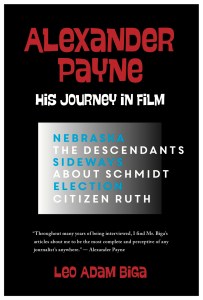
The new edition of my Alexander Payne book featuring a major redesign, more images and substantial new content that looks back at “Nebraska’ and that looks ahead to “Downsizing.”
Considering Alexander Payne’s ‘Nebraska’
Excerpt from an essay to appear in an upcoming new edition of my book Alexander Payne: His Journey in Film
Even though Alexander Payne demonstrates time and again that commercial considerations mean very little to him, following the breakaway success of The Descendants (2011) there was every reasonable expectation he might lean a bit more again in the direction of mainstream with his next film. I say again because I count The Descendants as a conventional, even mainstream work even though its protagonist rails against his comatose wife and sets out to wreck the life of the man she was cheating with, all the while trying not to lose it with his two grieving daughters in tow.
Payne soon quashed any notion of playing it safe when he announced the small, insular back roads comedy-drama Nebraska (2013) as his new feature project. It did not help its bottom line chances that the film is set in rural Nebraska, which for most filmgoers may as well be the dark side of the moon for its unfamiliarity, remoteness, and perceived barrenness. Indeed, if Nebraska conjures any image at all it is of endless cornfields, cows, and monotonously flat, uninspired scenery. When the story laid over such a setting features a confused, depressed old cuss alienated from family and friends and wandering around in a bleak wasteland made even bleaker by black and white photography and desolate late fall, post-harvest locations, it does not exactly engender excitement. The prospect of a dour, feel-bad experience devoid of life and color does not get tongues a-wagging to generate the all important buzz that sells tickets.
Of course, anyone who has seen Nebraska knows the film is not the downer it may appear to be from glimpsing a thirty-second trailer or hearing a fifteen-second sound bite, but that it is ultimately a sweet, deeply affecting film filled with familiar truths amid its very Nebraskaesque yet also quite universal archetypes.
Payne’s insistence on shooting in black and white was a completely legitimate aesthetic choice given the storyline and tone of this stark, autumnal mood piece about an old man having his last hurrah. But it also meant a definite disadvantage in appealing to average or general movie fans, many of whom automatically pass on any non-color film. Compounding the aversion that many moviegoers have with black and white is the fact that most studio executives, distributors, and theater bookers share this aversion, not on aesthetic grounds, but based on the long-held. much repeated argument that black and white films fare poorly at the box office. Of course, there is a self-fulfilling prophecy at work here that starts with studio resistance and reluctance to greenlight black and white features and even when a studio does approve the rare black and white entry executives seem to half-heartedly market and release these pics. It is almost as if the bean counters are out to perversely prove a point, even at the risk of injuring the chances of one of their own pictures at finding a sizable audience. Then when the picture lags, it gives the powerbrokers the platform to say, I told you so. No wonder then – and this is assuming the argument is true – most black and white flicks don’t perform well compared with their color counterparts. Except, how does one arrive at anything like a fair comparison of films based on color versus black and white? Even if the films under review are of the same genre and released in the same period, each is individually, intrinsically its own experience and any comparison inevitably ends up being a futile apples and oranges debate. Besides, there are exceptions to the supposed rule that all black and white films struggle. From the 1970s on The Last Picture Show, Paper Moon, Young Frankenstein,Manhattan, Raging Bull, Schindler’s List, Ed Wood and The Artist are among the black and white films to have found wide success. It is admittedly a short list but it does prove black and white need not be a death sentence.
To no one’s surprise Paramount did what practically any studio would have done in the same situation, which was to fight Payne on the black and white decision. In no uncertain terms Payne wanted to make Nebraska in black and white and just as adamantly the studio wanted no part of it. He pushed and they pushed back. He would not compromise his vision because from the moment he first read Bob Nelson’s screenplay he clearly saw in his mind’s eye the world of this story play out in in shades of black and white. It just fit. It fit the characters and the settings and the emotions and as far as he was concerned that was that. No questions asked. No concessions made.
I do not claim to know all the details of this protracted dispute or should I say discussion but I do know from what Payne and cinematographer Phedon Papamichael have told me that the issue became a point of some contention. I do not know if it ever reached an impasse where Payne more or less indicated by word or action he was prepared to walk and take the project with him (his own Ad Hominem production company brought the property to Paramount). It certainly wouldn’t surprise me that he let it be known, subtly or not, that he was willing to make the project with another studio if it came to that. It is a moot point now since Paramount eventually acceded to his wishes, though not insignificantly the studio did cut some of the picture’s already small budget as a kind of hedge I suppose against the small business they expected the film to do. The smaller the budget, and in this case it was $12 million, the smaller the risk of not recouping its cost.
Given Payne’s even temperament and gentility, I doubt if things reached the level of shouting or angry exchanges, though he undoubtedly expressed displeasure with their interference and pettiness. I have to think he wore the execs down with his patience and persistence to win the black and white battle but at the end of the day he was willing to give up a couple million dollars in exchange for realizing his vision. I know he says that losing a million dollars is a huge loss when it comes to small-budgeted films like this one and I understand that in order to get the film made within those constraints he and others worked for scale in return for some points on the back end, but I have to believe those “sacrifices” were completely worth it in the long run. I would even argue that having to work on a bare bones budget and a tight schedule worked in favor of getting this simple story right. It required cast and crew to live frugally like the characters and the frugal shoot placed a premium on efficiency, ingenuity, and everyone pulling together to make the most of what they had to work with. In truth this esprit de corps is evident on all of Payne’s projects anyway because of the tight, loyal stock company he works with from film to film to film. They are a family and a team dedicated to one purpose: getting the film made to his specifications.
I asked Payne if it ever seems like a studio plays this game in order to gauge just how strongly the filmmaker is invested in a choice or preference as well as to what extent the filmmaker can be manipulated. He seems to believe there is some truth in that. Perhaps it really is the studio’s way of testing how firm the filmmaker’s convictions are and how much the filmmaker is willing to give up or to stand fast in terms of creative control. As Paramount surely knew going in and if they somehow didn’t know they surely soon discovered in the process of setting up the film, Payne is no push over and he brooks no fools. That is true at every juncture in the process, from making the deal to pre-production to the shoot and on through post-production. It is his film and he will not be budged from any creative choices he feels are necessary, which is to say he will not be pressured into doing something for the sake of added commercial appeal.
Because Payne is not about burning bridges, except for his public displeasure over the way his first two films (Citizen Ruth and Election) were handled by the studios and releasing companies behind them, he is not saying on the record what he thinks about the way Paramount handled Nebraska. I have to think he is not pleased with the extremely limited release they gave it. At no time during its release did the film ever play more than 968 theaters according to the website Boxoffice Mojo. That is anywhere from two-thirds to a half to a third the number of theaters its main awards competitors played at during their runs. It is hard to understand why the film was not given more opportunities to find a wider audience given the outstanding reception it received from critics (making most Top Ten lists), the foreign press (five Golden Globe nominations) and the Academy (six nominations).
Hampered as it was by the limited release, Nebraska still pulled in more than $18 million domestically by this edition’s summer 2014 printing and I am sure when all the figures are added up from North America and overseas, where I predict the film will fare well, especially in Europe, its total gross will be in excess of $20 million. By the time all the home viewing rentals and purchases are taken into account a year from now, I wager the film will have done some $25 million in business, which would approximately double its production costs. That is quite a return on a small film that did not get much studio support beyond the bare basics.
Payne could have made things easier for himself and the studio by filming in color and securing a superstar. Nebraska marked quite a departure from the lush, color-filled canvas of Hawaii he captured in The Descendants and the equally verdant California wine country he committed to celluloid in Sideways. Never mind the fact the stories of those earlier films, despite the radical differences of their physical locations, actually share much in common tonally and thematically withNebraska. The dark comic tone and theme of Payne’s films can threaten to be overshadowed when a star the magnitude of Jack Nicholson (About Schmidt) or George Clooney (The Descendants) attaches himself to one of his projects. But as anyone who is familiar with the subdued star turns of those two actors in those particular films will tell you, Nicholson departed far from his trademark insouciance and braggadocio to totally inhabit his repressed, depressive title character in Schmidtjust as Clooney left behind much of his breezy, cocksure charm to essay his neurotic somewhat desperate character in Descendants. Each star was eager to shed his well-practiced, bigger-than-life persona in service of scripts and parts that called for them to play against type. Instead of their usual live-out-loud, testosterone-high roles, they play quiet, wounded, vulnerable men in trouble. For that matter, the men-children Paul Giamatti and Thomas Haden Church play in Sideways are seemingly complete opposites but in actuality are emotionally-stunted, damaged souls using oblivion, alcohol, and sex to medicate their pain and avoid reality. The beauty of the California and Hawaii locales work as contrast and counterpoint to the chaotic lives of these lost figures careening toward catharsis. In Schmidt Omaha is the perfect washed-out backdrop for a man undergoing a full-scale identity and spiritual crisis once he retires and his domineering wife dies.
That brings us to Woody Grant, the crotchety so-and-so at the center of Nebraska. When we meet him he is near the end of a largely misspent life. Facing his inevitable and nearing mortality he doesn’t much like what he sees when he reviews his life and where he has landed. He is dealing with many deficits in his old age. His body is falling apart. He walks stiffly, haltingly. His alcoholism has been unaddressed and it contributes to his foggy mind, mood swings, propensity to fall and hurt himself, and to utter hurtful things. He seems to derive no joy or satisfaction from his wife of many years and his two adult sons. He almost regards them as inconvenient reminders of his own failings as a husband and father. On top of all this, he is poor and in no position to leave his family anything like a tangible legacy.
This miserable wretch has seized upon what he believes to be his last chance at assuaging a deep well of shame, guilt, bitterness, and resentment. His mistaken belief there is a sweepstakes prize for him to redeem becomes a search for his own personal redemption or salvation. He desperately wants something, namely a truck, to leave his boys. The true meaning of the road trip he embarks on with his son David is only revealed to us and to his boy along the way and that gradual discovery adds layers of poignancy to the story.
When Woody arrives back in his hometown of Hawthorne, Nebraska word spreads he is on his way to collect a $i million sweepstakes prize. For a few moments he becomes a person of substance in the eyes of his extended family and the town’s other residents. Some family members and one old friend turn vultures and demand they get a share of his windfall as compensation for favors they did or loans they made that were never returned. But there is another side to that story. We find out Woody has a kind heart beneath his gruff exterior, so much so that he’s been known to do favors and to give money away without ever expecting repayment. That has led him to be taken advantage of over the years. Then when the truth gets out Woody has not won anything but has misinterpreted a marketing piece for a confirmation letter of his supposed million in winnings, he is publicly humiliated and made out to be a fool.
For Nebraska I Payne went one step further in distancing himself from commercial considerations by casting as his two leads Bruce Dern and Will Forte, who at first glance form an unlikely combination but in fact play wonderfully off each other. Dern’s acclaimed performance as Woody Grant earned him a Best Actor prize at Cannes and nominations from the Golden Globes and the Academy of Motion Picture Arts and Sciences. Saturday Night Live alumnus Forte is triumphant in his first dramatic role as the sympathetic son David. The next largest part belongs to June Squibb, who until this film was a somewhat familiar face if not a household name (she played Nicholson’s wife in Schmidt). Her stellar work in a colorful role as Woody’s piss-and-vinegar wife Kate has brought her the most attention she’s received in a very long and productive career. Arguably, the biggest name in the picture belongs to Stacy Keach, a veteran of film, television, and stage who has little screen time in the picture but makes the most of it in a powerfully indelible turn as the story’s heavy, Ed Pegram. As strong as these performances are Payne did not do his film any box office favors by choosing actors so far off the radar of moviegoers. That is not a criticism, it is simply a fact. At least a dozen more speaking parts are filled by no-name actors, nonprofessional actors, and nonactors, all of whom add great authenticity to the film but whose obscurity hurts rather than helps the marketing cause.
As you will read in the articles that follow Payne is most proud of the casting and locations inNebraska. These are elements he always takes great care with in any of his films but with this particular film he went the extra mile yet in order to realize the very specific world of the story. Many of the small speaking parts are filled by regular folks – retired farmers and such – who populate the very towns or ones just like them where he shot. He and casting director John Jackson searched long and hard for just the right faces and voices. Similarly, the weatherbeaten, seen-better-times found locations look and feel so right as the homes and pit-stops of the characters that these real locations rather than constructed sets add another layer of verisimilitude.
The choice to populate the film with zero star power ultimately is not the reason the film failed to pull in more of an audience because there are plenty of films that do well with little known, non A-list names, and nonactor finds. No, the real problem with how Nebraska fared had more to do with the perception the marketing campaign for the film imposed on it. The film’s trailers did not communicate the heart and soul of the picture. None of the warmth or depth or populist appeal at its core registered in those clips. Instead, the film was represented as a cold, mean, depressive, rather flimsy sketch concept blown up to fill two hours. Anyone who has seen and appreciatedNebraska will tell you it is far more than that. It is a work replete with deep currents of regret, disappointment, melancholia, rage, nostalgia. and love. Alongside that run streams of humor, sweetness, irony, and slapstick. Then there is the sheer poetic evocation of hauntingly beautiful visuals that turn the wide open flyover terrain, roadside stops, and played-out small towns of Montana, Wyoming, South Dakota, and Nebraska into haunting fields of dreams and symbols of neglect. Not to mention centers of quirky, silly, sometimes surreal goings-on.
Plenty of small indie films about similarly unglamorous subject matter have struck a responsive chord with the masses. So what kept Nebraska from resonating the way, say, Juno did or Little Miss Sunshine? No one really knows. If the creatives who make the films and the suits who finance and sell them did, if there was some sure-fire magic formula at their disposal, then every film would be packaged into a box office winner. The truth is some films catch the wave and most don’t and there doesn’t seem to be any reliable rhyme or reason for why some hit and others miss that elusive, always moving wave everyone is after.
It may take a while, but I am quite confident Nebraska will eventually find the large audience it deserves. In my opinion it will be a much viewed and discussed stand-the-test of-time film for its many cinema art merits. As good as Payne’s earlier films have been I believe this to be his finest work to date because it is in my view the fullest expression of his filmmaking talents. Visually, it is a tone poem of the first order and on that basis alone it is a film to be reckoned with. Payne and cinematographer Phedon Papamichael have achieved an expressive black and white palette whose hues perfectly articulate the heavy heart of the story. But Payne also found unobtrusive ways to position the camera and, with editor Kevin Tent, to cut scenes so as to amplify its many moments of humor without ever detracting from its elegiac, soulful mood. Mark Orton’s original music, plus the incidental music used here and there, add more nuances of mood. Payne artfully composed images for the wide screen format he shot in to glean added depth and meaning from the action. Within the same frame he intentionally juxtaposed characters with the stark landscapes, townscapes, and homes they inhabit. Many of these scenes emphasize sadness, stillness and desolation. Irony infuses it all. The result is an ongoing dialogue between people and their environments. Each informs the other and by consequence us.
The filmmaker’s economy of style has never been more evident. He has reached the point of communicating so much with simple brush strokes. Take for instance the way Woody’s harsh childhood experience is encapsulated when the old man and his family visit the abandoned farm house he grew up in. Payne has the camera fluidly glide over the detritus of this once proud home turned wreck and to peak into rooms that carry so much psychic-emotional pain for Woody, who was beaten as a boy. Payne clearly indicates this is a private, anguished, cathartic return for Woody, who has avoided this place and its memories for years.
Or consider that gathering of taciturn men in Woody’s family at his brother’s home in town. Payne arranges the uncles, brothers, sons, nephews, cousins in an American Gothic pose around the TV set, where the men engage in the almost wordless ritualistic viewing of a football game. It is at once a funny and powerful expression of their tribal, tight-lipped bond. A bond more about association by blood than affinity.
Then there are the almost incidental shots of boarded up buildings in town that symbolize and speak to the economic hard times to have befallen so many small towns like the fictional Hawthorne. In a short scene Payne conveys an important way in which the times have changed there and in towns like it when he has Woody visit the auto service station he used to own and he finds the new owners are Spanish-speaking Hispanics. Woody thus personally encounters a demographic shift that has altered the face of his hometown and much of rural Nebraska. No more is made of it then that simple reality and the brief exchange between Woody and the “newcomers,” but it is enough to say that times have moved on and the Hawthorne he knew has evolved in some ways and remained unchanged in others.

Perhaps the best example of Payne distilling things down to their simplest, purest, most elemental form is the end sequence when David and Woody are in the truck David has purchased and registered in his father’s name. David, who is at the wheel with Woody beside him, stops the truck on the edge of town and invites Woody to take the wheel and drive down main street in his new rig. What follows is one of the most moving denouements in contemporary American cinema. Woody is granted a rare gift when he accepts the invitation to take a celebratory ride down main street. As the truck slowly passes through town he wins more than any prize money could provide when four people from his past catch sight of him and look at him with a combination of awe, admiration, and surprise. It is a perfect moment in the sun vindication for a beleaguered, bedraggled man who suddenly brims with a sense of confidence and purpose. Woody leaves town on his own terms, his dignity and pride intact, at least for this short interval of time.
What makes that valedictory ride so special is that his sympathetic son David is there to grant him it and to bask in it with him. These two who began the road trip not really knowing each other and often at odds with each other have traveled a journey together that has brought them a measure of acceptance, healing, and peace. David has finally come to understand why his father is the way he is. His fondest desire is realized when he gives Woody that movie-movie opportunity to prove he is not the loser or fool this day. As Woody sits high in the cab of the truck, with David lovingly looking on from the floor, and drives past the artifacts of his past and the denizens of that town, he may as well be a cowboy sitting tall in the saddle of his horse riding into the sunset. He graciously accepts the congratulations of town chatterbox Bernie Bowen. He stares down his former friend Ed Pegram, who now looks the shamed fool. Woody’s heart stirs again for old flame Peg Nagy, whose wistful expression wonders might have been. As he heads out of town Woody says a fond goodbye to Albert, the Grant brother whose favorite pastime is siting beside the road waving at the occupants of passing cars.
Outside of town the truck stops at the bottom of a hill and Woody and David once again exchange places. Doing this out of the view of onlookers preserves Woody’s glorious farewell and signals Woody now accepts his limitations and David’s love for him. With David back behind the wheel and Woody beside him father and son drive off to meet an uncertain future together. Consistent with the way Payne ends all his films, Woody’s last ride reverie does not promise any great turnaround in his life. His problems are still his problems. The fact that that sequence plays out wordlessly and still conveys so much meaning is a testament to the work of Payne and his collaborators in extracting the essence of these scenes through beautifully executed shots that give full weight to glances gestures, postures, and backdrops.
NOTE: To read the rest you’ll have to wait for my new edition to come out.

Here’s what makes it all worthwhile…
And here, dear friends, is ultimately why I do what I do in spite of the sparse pay and the insecurity that comes with being a writer. It is a mashup of two heartfelt emails sent me by a young, then-aspiring filmmaker named Bryan Reisberg who shared how impactful my Alexander Payne book has been for him. As you will read below, since first writing me he found financing to direct his screenplay Big Signficant Things. More recently yet he’s informed me that the film premiered well at the South by Southwest Film Festival and that he found a theatrical distributor for it. His pic is now showing in select theaters this summer. He may even come to Omaha with it before the year’s out. Reading how my accounts of a world-class filmmaker inspired this talented young man to recalibrate his own approach to film and to get his vision from page to screen is perhaps the greatest compliment I’ve ever received. Credit must also go to Alexander Payne, for his insights that I shared with the world.
File this one under you never know how your words or work or actions affect someone. Thank you, Bryan, and I look forward to meeting you one day.
Dear Mr. Biga,
I’m writing to thank you for your wonderful book.
You don’t know me but I’m a young filmmaker in NYC and I purchased your book on Alexander Payne I think back in November of 2012. I was always a fan of Alexander Payne’s work, and was simply searching for anything I could find on him. I wanted to write and tell you that your book has helped me immeasurably as a filmmaker.
I read your book a few months ago when I was finishing a screenplay, with the hopes of turning that into my directorial debut. I immersed myself into your articles, and then further into Payne, his inspirations, references, and then dove headfirst into classic American and Italian Cinema from the 40s, 50s, 60s, and 70s. The started the most focused and intensely rigorous academic study of film I’ve done, and it was nearly 4 years after graduating from college. Probably because I was working towards a physical film.
I graduated from NYU’s Tisch School of the Arts in 2009 and work with my friend and production partner, Andrew D Corkin, whose last feature film he produced was 2011’s Martha Marcy May Marlene.
I imagine now, being a bit older than I was while in film school I have much more of an interest in the academia of filmmaking.
Your articles and interviews became a critical (and previously absent) entry point to discover and dig deeper into learning more about directors, films, and film history. I came to not only respect and admire Payne as a filmmaker, but also as one of the best teachers I’ve ever had. And I can say that to date, starting with your book, what I’ve learned about the craft and history of cinema has been unparalleled and invaluable.
Well, since reading your book, I’ve completely changed how I watch films, what I watch, and it has given me such a wonderful tool and jumping off point to film that I don’t feel I’ve ever had before. And since reading your book, and working on developing this first film, as of 2 weeks ago, we’re fortunate to have gotten this project, my first feature, fully financed. We head down to Mississippi in 2 weeks to prep, and then shoot in the month of May. It’s pretty surreal, since I’m sure you know that indie film financing is very difficult…
…I was fortunate enough to have my screenplay financed so that I could direct my first feature, BIG SIGNIFICANT THINGS, which I completed back in May of 2013.
And it was just announced that my film will have it’s World Premiere at the 2014 SXSW Film Festival. Mark Orton, who I’m sure you know did the score for NEBRASKA, is composing the score for my film.
I wouldn’t be here without Alexander Payne and your book. Well, maybe I’d be here, but I wouldn’t be nearly as (hopefully) knowledgeable and skilled as a filmmaker.
So I just wanted to extend my gratitude, and thank you from the bottom of my heart.
Best,


 Leo Adam Biga's My Inside Stories