
David Kaufmann
About nine years ago I was given the opportunity to meet and profile Walter Reed, whose story of escaping the Final Solution as a Hidden Child in his native Belgium and then going on to fight the Nazis as an American GI a few years later would make a good book or movie. Here is a sampling of his remarkable story now, more or less as it appeared in The Reader (www.thereader.com). You’ll find many more of my Holocaust survival and rescue stories on this blog.
Walter Reed: From out of the past – Former hidden child survives Holocaust to fight Nazis as American GI
©by Leo Adam Biga
Originally published in The Reader (www.thereader.com)
Imagine this: The time is May 1945. The place, Germany. The crushing Allied offensive has broken the Nazi war machine. You’re 21, a naturalized American GI from Bavaria. You’re a Jew fighting “the goddamned Krauts” that drove you from your own homeland. Five years before, amid anti-Jewish fervor erupting into ethnic cleansing, you were sent away by your parents to a boys’ refugee home in Brussels, Belgium. Eventually, you were harbored with 100 other Jewish boys and girls in a series of safe houses. You are among 90 from the group to survive the Holocaust.
Relatives who emigrated to America finagle you a visa and, in 1941, you go live with them in New York. You abandon your heritage and change your name. Within two years you’re drafted into the U.S. Army. At first, you’re a grunt in the field, but then your fluency in German gets you reassigned to military intelligence, attached to Patton’s 95th Division, interrogating German POWs. If this were a movie, you’d be the avenging Jewish angel meeting out justice, but you don’t. “The whole mental attitude was not, Hey, I’m a Jew, I’m going to get you Nazi bastard,” said Walter Reed, whose story this is. “I had no idea of revenging my parents. We were really more concerned about our survival and getting the information we needed.”
By war’s end, you’re in a 7th Army unit rooting out hardcore Nazis from German institutions. You don’t know it yet, but your parents and two younger brothers have not made it out alive. You borrow a jeep to go to your village. Your family and all the other Jews are gone. You demand answers from the cowed Gentiles, some you know to be Nazi sympathizers. You intend no harm, but you want them scared.
“I wasn’t the little Jewish boy anymore,” said Reed. “Now, they saw this American staff sergeant with a steel helmet on and with a carbine over his shoulder. At that point, we were the conquerors and those bastards better knuckle under or else. I asked, What happened to my family and to the other Jewish people? They told me they were sent to the east into a labor camp. That’s about all I could find out.”
It is only later you learn they were rounded-up, hauled away in wagons, and sent to Izbica, a holding camp for the Sobidor and Belzec death camps, one or the other of which your family was killed in, along with scores of friends and neighbors.
Walter Reed, now 79, is among a group of survivors known as the Children of La Hille, a French chateau that gave sanctuary to he and his fellow wartime refugees. A resident of Wilmette, Il., Reed and his story have an Omaha tie. After the war, he graduated from the prestigious University of Missouri School of Journalism and it was as a fund raising-public relations professional he first came to Omaha in the mid-1950s when he led successful capital drives at Creighton University for a new student center and library. “Part of me is in those buildings,” he said.
More recently, he began corresponding with Omahan Ben Nachman, who brings Shoah stories to light as a board member with the local Hidden Heroes of the Holocaust Foundation. A friend of Nachman’s — Swiss scholar and author Theo Tschuy — led him to accounts of La Hille and those contacts led him to Reed. In Reed, Nachman found a man who, after years of burying his past, now embraces his survivor heritage. With Reed’s help, Tschuy, the author of Dangerous Diplomacy: The Story of Carl Lutz and His Rescue of 62,000 Jews, is researching what will be the first full English language hardcover telling of the children’s odyssey.
On an April 30 through May 2 Hidden Heroes-sponsored visit to Nebraska, Reed shared the story of he and his comrades, about half of whom are still alive, in presentations at Dana College in Blair, Neb. and at Omaha’s Beth El Synagogue and Field Club, where Reed, a Rotary Club member, addressed fellow Rotarians. A dapper man, Reed regales listeners in the dulcet tones of a newsman, which is how he approaches the subject.
“I’m a journalist by training. All I want is the facts,” he said, adding he’s accumulated deportation and arrest records of his family, along with anecdotal accounts of his family’s exile. “I’m simply overwhelmed by the wealth of information that exists and that’s still coming out. In the last 10 years I’ve found out an awful lot of what happened. I don’t have any great details, but I have vignettes. So, my feeling when I find out new things is, Hey, that’s terrific, and not, Oh, I can’t handle it. None of that. Long, long ago I got over all the trauma many survivors feel to their death. I vowed this stuff would never disadvantage me.”
As he’s pieced things together, a compelling story has emerged of how a network of adults did right amid wrong. It’s a story Nachman and Reed are eager for a wider public to know. “It shows how a dedicated group of people, most of whom were not Jewish, coordinated their actions to prevent the Nazis from getting at these Jewish children,” said Nachman, who paved the way for the upcoming publication of a book by a La Hille survivor. “They chose to do so without promise of any reward but out of sheer humanitarian concern. It’s a story tinged in tragedy because the children did lose their families, but one filled with hope because most of the children survived to lead productive lives.”
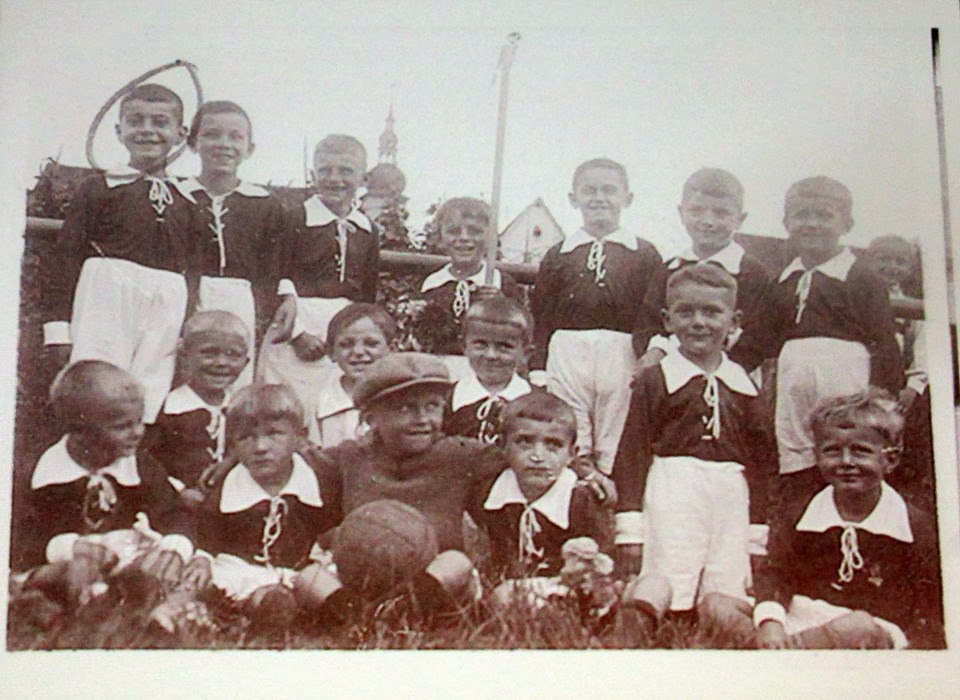 |
| Walter Reed as a child in Germany, circled at top left |
It was 1939 when Reed made the fateful journey that forever separated him from his parents and brothers. Born Werner Rindsberg in the rural Bavarian village of Mainstockheim, Reed was the oldest son of a second-generation winemaker-wine merchant father and hausfrau mother. His was among a few dozen Jewish families in the village, long a haven for Jews who paid local land barons a special tax in return for protection from the anti-Semitic populace. Reed said Jews enjoyed unbothered lives there until 1931-1932, when Nazism began taking hold.
“I was aware of the growing menace and danger when I was about 8 or 9 years old. I recall constant conversations between my parents and their Jewish peers about Hitler. The Nazis marched up and down our main street with their swastika flags and their torches at night, singing their songs. This was a very close-knit community of about 1,000 inhabitants and you knew which kid had joined the Hitler Youth and whose dad was a son-of-a-bitch Nazi. Pretty soon, the kids began to chase us in the street and throw stones at us and call us dirty names. Then, the first (anti-Jewish) decrees came out about 1934 and increasingly got stricter.”
Pogroms of intimidation began in earnest in the mid-1930s. Reed remembers his next door neighbor, a prominent Jewish entrepreneur, taken away to Dachau by authorities “to scare the hell out of him. It saved his life, too,” he said, “because that hastened his decision to get the hell out of Germany. This stuff was going on in other towns and villages where I had relatives. In those places, including where my mother’s brothers and sisters lived, the local Nazis were more rabid and…they hassled the Jews so much they left, and it saved their lives.”
Things intensified in November 1938 when, in retaliation for the assassination of a German diplomat by an expatriate Polish Jew outraged by the mistreatment of his people, the Nazis unleashed a terror campaign now known as Kristallnacht (Night of Broken Glass). Roving gangs of brown-shirted thugs attacked and detained Jewish males, vandalizing, looting, burning property in their wake. Reed, then 14, and his father were dragged from their home and thrown into a truck with other captives. As the truck rumbled off, Reed recalls “thinking they were going to take us down to the river and shoot us or beat the hell out of us.” The boys among the prisoners were confined in the jail of a nearby town while the men were taken to Dachau. Reed was freed after three nights and his father after several weeks.
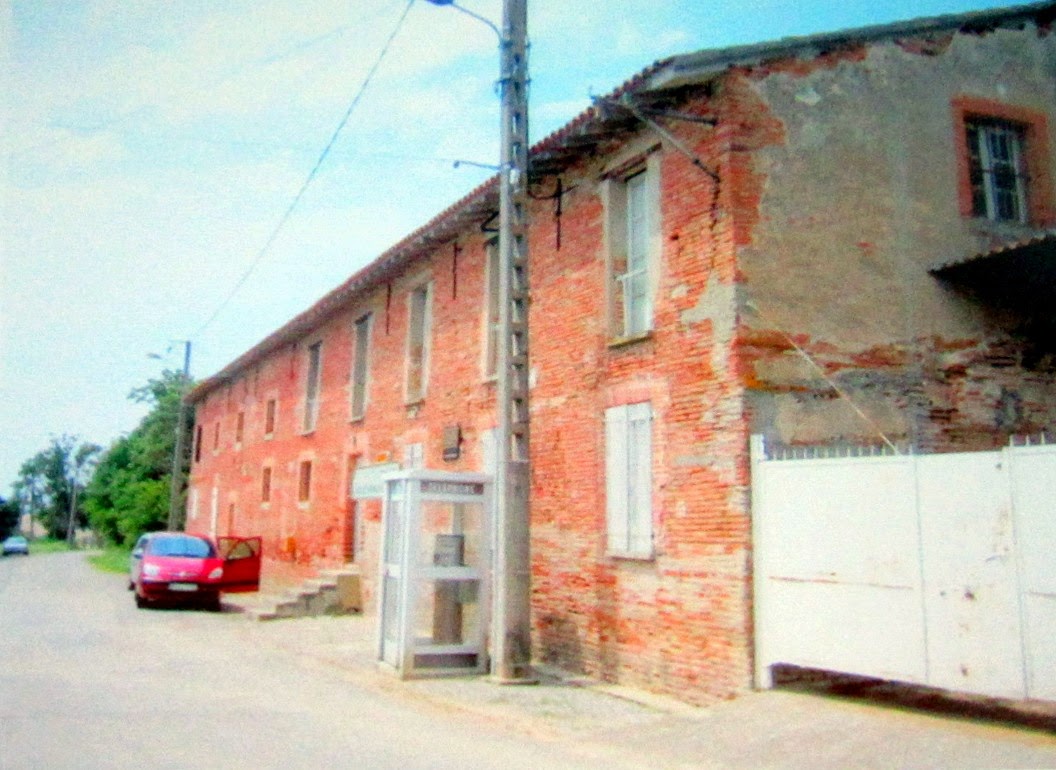 |
| The barn near Toulouse, France, where Walter Reed stayed as part of a children’s rescue colony |
In that way time has of bridging differences, Reed’s recent search for answers led him to a group of school kids in Gunzenhausen, a Bavarian town whose Jewish inhabitants met the same fate as those in his birthplace. The kids, whose grandparents presumably sanctioned the genocide as perpetrators or condoned it as silent witnesses, have studied the war and its atrocities. Reed began corresponding with them and then last year he and his wife Jean visited them. He spoke to the class, and to two others in another Bavarian town, and found the students a receptive audience.
“Frankly,” he said, “I find these encounters very worthwhile and uplifting. I was told by the teachers and principals it was quite a moving experience for the students to come face-to-face with history. My visit is now on the web site created by one class. On it, the students say they were especially moved by my stated conviction that the most important lesson of these events is to hold oneself responsible for preventing a repetition anywhere in the world and that each of us must bear that responsibility.”
When his father returned from Dachau, Reed recalls, “He looked awful. Emaciated. He wasn’t the same man. When we asked him what it was like he just said he’s not going to talk about it.” It was in this climate Reed’s parents decided to send him away. He does not recollect discussions about leaving but added, “I recently found a letter my father wrote to somebody saying, ‘I finally persuaded Werner to leave,’ so I must have been reluctant to go.”
A question that’s dogged Reed is why his parents didn’t get out or why they didn’t send his brothers off. It’s only lately he’s discovered, via family letters he inherited, his folks tried.
“Those letters tell a story,” he said. “They tell about their efforts to try and get a visa to America. My dad traveled to the American consulate in Stuttgart and waited with all the other people trying to get out. They gave my parents a very high number on the waiting list, meaning they were way down on the queue. There are anguished letters from my father to relatives referencing their attempts to get my brothers out, but that was long after it was too late. In no way am I castigating my parents for making the wrong decision, but they could have sent my brothers (then 11 and 13) because in that home in Brussels we had boys as young as 5 and 6 whose parents sent them.”
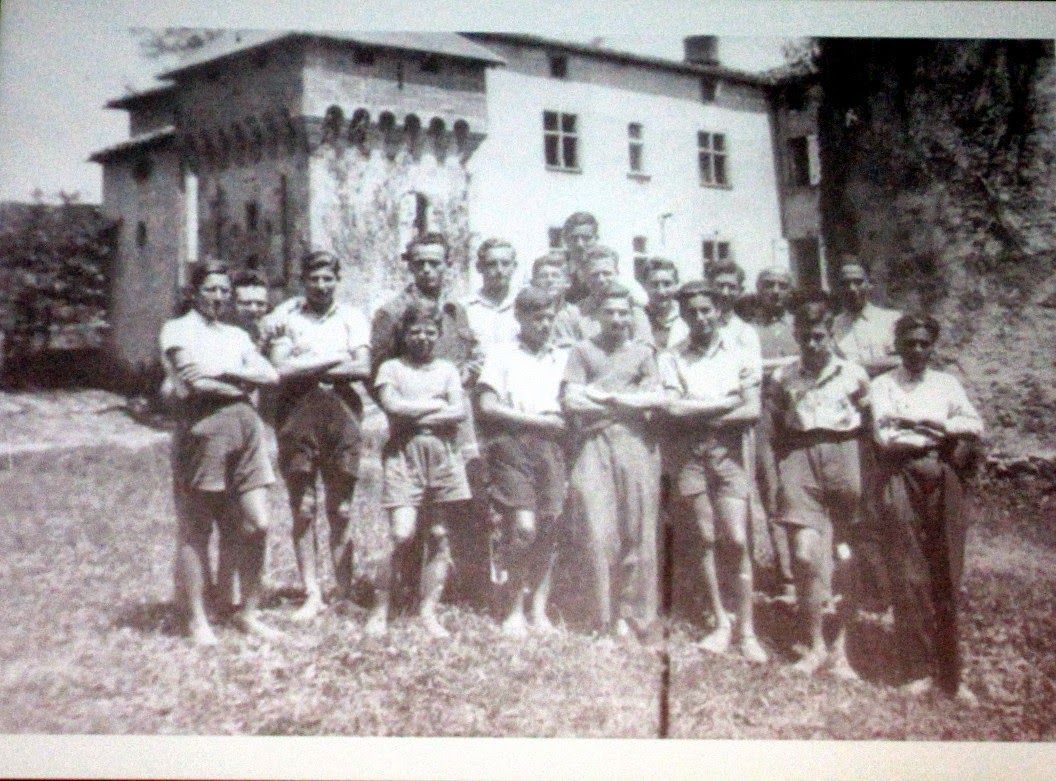 |
| Walter Reed, third from right in the front row, at the chateau in La Hille, France, where a smaller group of children were transferred from the barn near |
Home Speyer, in the Brussels suburb of Anderlecht, is where Reed’s journey to freedom began in June 1939. Sponsored by the city and afforded assistance by a Jewish women’s aid society, the home was a designated refugee site in the Kinder transport program that set aside safe havens in England, The Netherlands and Belgium for a quota of displaced German-Austrian children. Where the transport had international backing and like rescue efforts had the tacit approval of German-occupied host countries, others were illegal and operated underground. Reed said the only precautions demanded of the La Hille kids were a ban on speaking German, lest their origins betray them as non-French, and a rule they always be accompanied outside camp grounds by adult staff. Despite living relatively in the open, the children and their rescuers faced constant danger of denouncement.
The boys at Home Speyer, like the girls at a mirror institution whose fates would soon be mingled with theirs, arrived at different times and from different spots but all shared a similar plight: they were homeless orphans-to-be awaiting an uncertain future. Reed doesn’t recall traveling there, except for changing trains in Cologne, but does recall life there. “For a young boy from a small Bavarian farm village,” he said, “Brussels was an exciting city with its large buildings, department stores, parks and museums. We made excursions into the beautiful Belgian countryside. And there was no more anti-Semitic persecution.”
This idyll ended in May 1940 when German forces invaded Belgium. Reed said the director of the girls home informed the boys’ home director she’d secured space on a southbound freight train for both contingents of children.
“We packed what we could carry and took the streetcar to the train station,” he notes. “Late that night two of the freight cars were filled by the 100 boys and girls as the train began its journey to France.”
Adult counselors from the homes came with them. The escape was timely, as the German army reached Brussels two days later. En route to their unknown destination, Reed said the roads were choked with refugees fleeing the German advance. Unloaded at a station near Toulouse, the children were trucked to the village of Seyre, where a two-story stone barn belonging to the de Capele family quartered them the next several months. It appears, Reed said, the de Capeles had ties to the Red Cross, as the children’s homes did, which may explain why that barn was chosen to house refugees.
“It lacked everything as a place to live or sleep,” he said. “No beds, no mattresses, no running water, no sanitary facilities, no cooking equipment. Food was scarce, Pretty soon we ran out of clothes and shoes. Everything was rationed. A lot of us had boils, sores and lice.”
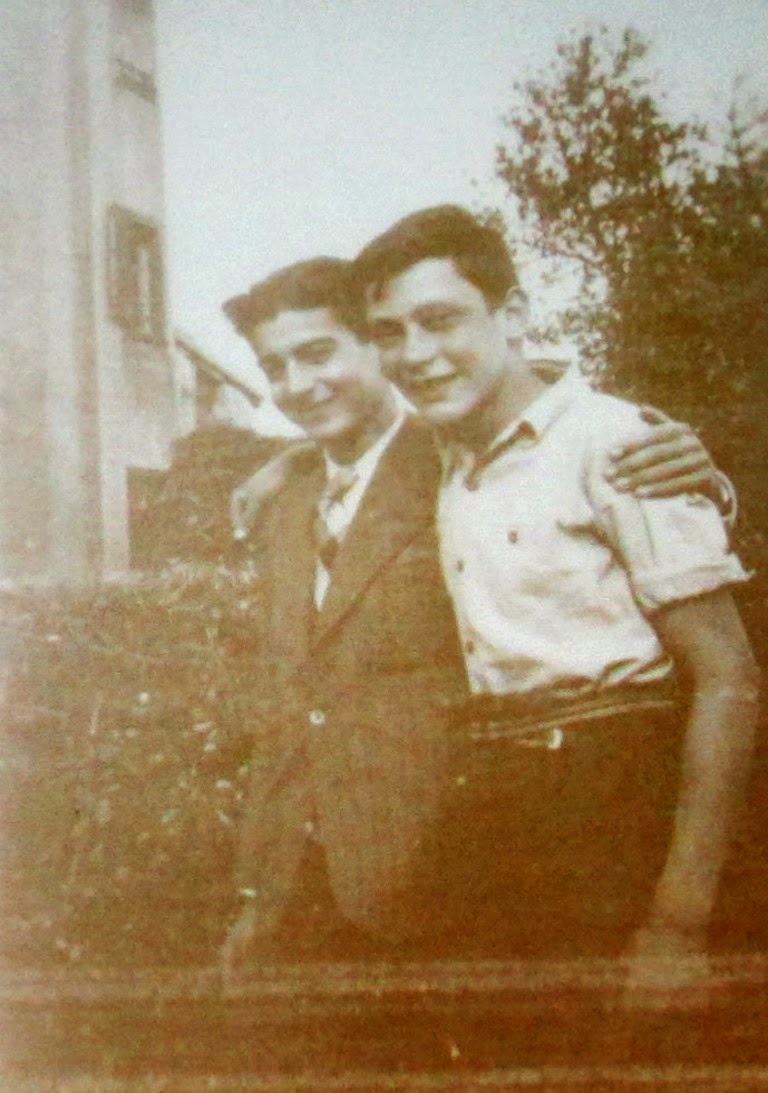 |
| Walter Reed with a close friend who would perish not long thereafter |
With 100 kids under tow in primitive, cramped conditions, the small staff struggled. “They were trying to manage this rambunctious group of kids, who played and fought and caused mischief. The older kids, myself included, were deputized to sort of manage things. We taught classes out in the open. We worked on nearby farms in the hilly, rolling countryside, cutting brush…digging potatoes. For compensation we got food to bring back. It was like summer camp, except it was no picnic,” he said. “We all grew up fast. We learned about survival, self-reliance and cooperation for the common good.”
It was not all bad. First amours bloomed and fast friendships formed. Reed struck up a romance with Ruth Schuetz Usrad, whose younger sister Betty was also in camp. He also found a best friend in Walter Strauss.
The barn’s occupants were pushed to their limits by “the harsh winter of 1940,” Reed said. They got some relief when the group’s Belgian director, Alex Frank, got the Swiss Children’s Aid Society, then aligned with the Swiss Red Cross, to put Maurice and Elinor Dubois in charge of the Seyre camp, which they soon supplied with bedding, furniture and Swiss powdered milk and cheese.
With the Nazi noose tightening in the spring of 1941 the Dubois relocated the children to an even more remote site — the abandoned 15th century Chateau La Hille, near Foix in the Ariege Province — where, Reed said, “they were less likely to be detected.” It was here the children remained until either, like Reed, they got papers to leave or, like others, they dispersed and either hid or fled across the border. Some 20 children came to the states with the aid of a Quaker society.
As chronicled in various published stories, Reed said that in 1942, a year after he left, 40 of the children, including his girlfriend Ruth, were arrested by French militia and imprisoned at nearby Le Vernet. Inmates there were routinely transported to the death camps and this would have been the children’s fate if not for the intervention of Roseli Naef, a Swiss Red Cross worker and the then La Hille director, who bicycled to Le Vernet to plead with the commandant for their release. When her entreaties fell on deaf ears, she alerted Maurice Dubois, who bluffed Vichy authorities by threatening the withdrawal of all Swiss aid to French children if the group was not freed.
The officials gave in and the children spared. Reed said he has copies of records documenting Naef’s termination by the Swiss Red Cross for her role as a rescuer of Jews, the kind of punitive disapproval the Swiss were known to employ with other rescuers, such as diplomat Carl Lutz.
In getting out when he did, Reed realizes he “was one of the lucky ones,” adding, “Others had to use more extraordinary means to escape, like my friend Walter Strauss. He tried escaping across the Swiss border with four others. They were caught. He was sent back and was later arrested and killed in Auschwitz.” Ruth left La Hille and led a hidden life in southern France, joining the French Underground. She reportedly had many narrow escapes before fleeing across the Pyrenees into Spain and then Israel, where she helped found a kibbutz and worked as a nurse.
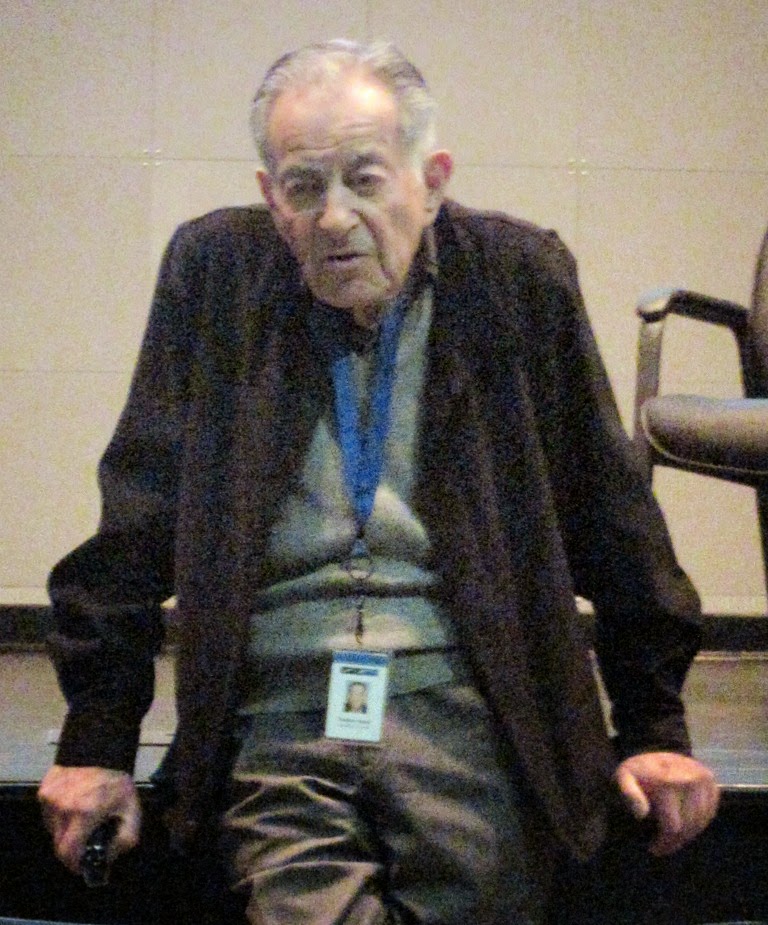
It was at a 1997 reunion of Seyre-La Hille children in France that Reed saw Ruth and his former companions for the first time in 50-plus years. Keen on not being a “captive” of his past, he’d dropped all links to his childhood, including his Jewish identity and name. Other than his wife, no one in his immediate family or among his friends knew his survivor’s tale, not even his three sons.
For Reed, the reunion came soon after he first revealed his “camouflaged” past for the Survivors of the Shoah Visual History project. Then, when his turn came to tell his biography before a Rotary Club audience, he asked himself — “Do I step out of my closet or do I keep hiding from my past?” Opting to “go through with it,” he shared his story and “everything flowed from there.” After attending the ‘97 La Hille reunion, Reed and his wife hosted a gathering for survivors in Chicago and another in France in 2000.
On the whole, the survivors fared well after the war. Two Seyre-La Hille couples married. A pair enjoyed music careers in Europe — one as a teacher and the other as a performer. Nine of the adult camp directors-counselors have been honored for their rescue efforts as Righteous Among the Nations by Yad Vashem in Israel. Reed has visited many of the sites and principals involved in this conspiracy of hearts. The Chateau La Hill is still a haven, only now instead of harboring refugees as a rustic hideout it shelters tourists as a trendy bed-and-breakfast.
For Reed, taking ownership of his past has brought him full circle.
“Even though our lives have taken many different paths all over the globe, nearly all my surviving companions feel a strong bond with each other. Many have strong ties to the places and persons that gave us refuge during those dangerous and turbulent years of our youth. I think a lot of things happened then that shaped me as a whole. It inculcated in me certain attributes I still have — of taking responsibility and running things.”
Above all, he said, the experience taught him “to resist oppression and discrimination,” something he and his wife do as parents of a child with cerebral palsy. “For me, recrimination and anger are not a suitable response. It’s important we strive for reconciliation and understanding. Then we live the legacy.”
In 2009 I wrote this story about an Opera Omaha production of the children’s opera Brundibar, whose back story and very existence is remarkable given the fact the original piece was written and performed amid the throes of the Holocuast. The engaging work is all the more remarkable for being a serious social-political critique of Nazi and Hitler in the guise of a metaphorical children’s story. The aching humanism of the fable is palpable.
Art trumps hate: “Brundinar” children’s opera survives as defiant testament from the Holocaust
©by Leo Adam Biga
Originally published in The Reader (www.thereader.com)
Omaha area youths performing the children’s opera Brundibar this week find themselves linked to some potent history and to a spirit of defiance transcending even the most horrific circumstances.
Czech composer Hans Krasa scored the operatic fable in 1938. With a libretto by Adolph Hoffmeister, it was first staged at a Prague Jewish orphanage. Germany’s 1939 invasion brought anti-Jewish decrees. By late ‘41 the Nazis’ forced Jews into ghettos, dispossessing them of their homes, belongings, livelihoods and freedom.
Amid the chaos, Krasa’s score went missing. He and other artists ended up in Terezin, a fortified garrison town. Homes and barracks meant for 4,000 housed 60,000 men, women, children. The unsanitary conditions, scarcity of food and harsh treatment made a perilous, hopeless life for inhabitants targeted for death camps.
One respite was the music, theater and dance prisoners were allowed to perform. Art flourished in this dead zone. When Krasa’s found score was smuggled in, Brundibar became a show piece for the Nazis, who cruelly used Terezin’s creative culture as “proof” its inmates were well-treated. Infamously, the Nazis paraded Brundibar for an International Red Cross team and a propaganda film.
But for Jews Brundibar took on symbolic meaning in direct opposition to such distortions. The fable’s Pepicek and Aninku try buying milk for their sick mother. They’re foiled by Brundibar, a loud, evil, buffoon-like bully patterned after Hitler. The allegorical community unites to defeat the hateful tyrant. Just as the themes of oppression and resistance took on added import then, the opera’s tragic context and fate give it deeper meaning today. Krasa, the musicians and much of the cast went to their deaths at Auschwitz.
Brundibar’s past and present are joined in the current Opera Omaha and Institute for Holocaust Education (IHE) co-production at the Rose Theater. Bass-baritone David Ward portrays Brundibar. Area students comprise the rest of the cast. Tying things together is guest Ela Weissberger, the original Cat in all 55 Terezin productions. She’s speaking before each performance this week.
More than 9,000 Omaha school kids are expected to see the opera by week’s end. The lone public performance is this Saturday at 6:30 p.m.
Ela, now one of only two Terezin cast members still alive, said by phone, “After the last performance my friends were taken to their deaths to the gas chambers. It feels sometimes to me a very long time ago, but sometimes I feel like it happened yesterday. I always thought this little opera went with them but if it’s performed here it will never be forgotten. I think Brundibar has became a memorial for those children and with every performance people are reminded that something like that happened, that they are not here, and I feel a duty to speak for them.”
“You need to know about what was actually happening and why this show was put on before you can actually put it on. That’s very important,” said Elizabeth Lieberman,. 17, who plays Cat. As helpful as that education was, Liebermann said, “I don’t think we can possibly imagine like it really was.” Scott Goldberg, who plays Pepicek, said, “We can think, we can try, but it’s so much different.”To inform the student cast of Brundibar’s heavy back story, IHE director Beth Seldin Dotan gave them a power point presentation.
Seldin Dotan, whose Institute is celebrating its 10th year, said, “These kids get it. They understand that even under the most dire situation there were people who presented a show like this within the ghetto. When they sing the victory song on stage the hope is they feel they can make a difference as an individual and as a group, and hopefully they present that to the audience. One of the most important things we do at the Institute is educate people about what happened and how we can make a difference to change that.”
Some Brundibar principals have personal stakes in the story. Sarah Kutler, 12, is the grand-daughter of Holocaust survivor Bea Karp of Omaha. Stage director Helen Binder lost many elders in the Shoah. Binder said, “The one thing I felt I couldn’t do as a director is direct the history. I can’t direct the piece with the history looming over it. If the audience knows the history it makes it that much more poignant but I can’t direct it as somber, sad, they’re-all-going-to-their-deaths. I have to direct it the way Krasa wrote it and intended it, so I’ve tried infusing it with things that make kids laugh and really go for the joy in it.”

“It’s very much a children’s piece. I think the music is very original and very appropriate. It’s sophisticated, but it’s just right for a young cast and for its audience,” said conductor Hal France, “and I think that in a way is what makes it powerful, because it is quite bright.”
For Seldin Dotan, this collaboration is “very meaningful” because it realizes a long-held dream of putting on Brundibar. It’s also a coming out for the Institute. “I feel after 10 years we’ve grown up. The response of 69 schools bringing their students and 70 volunteers and tons of sponsors is just magic. What we’ve found is that people wanted to get to close to this.” An Institute-devised guide was provided schools in preparation for students seeing the opera.

What makes someone a hero? Does it require exposing oneself to physical danger? Or is it taking an action, any action, that no else is willing or able to take in order to save a life or at least remove someone from harm’s way? If you agree, as I do, that doing the right thing, whether there’s the threat of bodily harm attached or not, constitutes heroism, then the late Grand Island, Neb. businessman David Kaufmann qualifies. He repeatedly signed letters of affidavit that allowed family members to leave Nazi Germany for America and freedom. By acting as their sponsor, he not only helped give them new lives here, he essentially saved their lives by getting them away from the clutch of Nazis bent on The Final Solution. When Omaha authors Bill Ramsey and Betty Shrier collaborated on a book about Kaufmann titled Doorway to Freedom I ended up writing several stories about Kaufmann and his actions. Two of those stories follow. These are among some two dozen Holocaust-related articles I’ve written over the years, several of which, including profiles of survivors, can be found on this blog.
Holocaust rescue mission undertaken by immigrant Nebraskan comes to light:
How David Kaufmann saved hundreds of family members from Nazi Germany
©by Leo Adam Biga
Originally published in Nebraska Life Magazine
Grand Island, Neb. Jewish German emigre David Kaufmann is recalled as a Holocaust hero today despite the fact he never fired a shot, never hid anyone, never bribed officials, never forged documents. What he did do was sign letters of affidavit from 1936 to the start of World War II that enabled scores of famly members to escape genocide in Nazi Germany. With strokes of a pen this private citizen did more than some entire states in responding to the Nazis’ systematic eradication of Jews.
As the Holocaust unfolded an ocean away, he extended a lifeline from the middle of America to endangered family in his homeland. His sponsorship booked them safe passage, thus sparing them from near certain death. What makes this rescue effort unlike others from that grim time is that this merchant-entrepeneur managed it all from the small Midwest town he adopted as his own and made his fortune in.
“Yeah, Nebraska’s one of the last places one would think of to find a guy like that,” said retired Omaha Rabbi Myer Kripke, who presided over Kaufmann’s 1969 funeral in Grand Island. After years of ill health, Kaufmann did at age 93, his rescue work little known outside his extended family.
Kaufmann undertook this humanitarian mission at the height of his success as a business-civic leader with retail, banking and movie theater interests. Known as “Mr. Grand Island,” he’s best remembered for Kaufmann’s Variety Store there, the anchor for a south-central Nebraska chain of five-and-dimes.
But he did not act alone. The first family he got out of harm’s way were cousins Isi and Feo Kahn in 1936. With his help the young couple fled Germany for America. They headed straight for Grand Island, where their daughter Dorothy Kahn Resnick was born and raised. Resnick, who lived and worked in Omaha for a time, now resides in Greeley, Col. Her father worked in Kaufmann’s store until opening a used car dealership. Her mother was a “key” confidant of Kaufmann’s in the conspiracy of hearts that evolved. She kept in touch with family abroad and fed Kaufmann new names needing affidavits of support. Feo even brought Kaufmann the forms to sign.
Anti-Semitism made life ever more restrictive for Europe’s Jews, targets of discrimination, violence, imprisonment and death. People were desperate. Official, legal channels for visas dwindled. You needed a sponsor to get out. Dorothy said her mother went back repeatedly to Uncle David, as he’s referred to out of respect, saying, “‘Here’s someone else.’ Some were very distant relations. But she told me he never questioned her. He never wanted to know who they were and how they were related. He relied on her. He trusted her. He put his faith in her that if she said it was OK, he signed it. Uncle David and my mom just did the right thing. Maybe the simplicity of it is what’s so beautiful.”
“While Mr. Kaufmann had the wherewithal to do what he did, God bless him, it never would have happened without Feo,” said family survivor Guinter Kahn. “It was Feo’s doing — her persuasion — that got his agreement to get the others over.”
Kaufmann’s aid even extended after the war to those displaced by the carnage.
No one’s sure of the exact number he rescued. How he delivered people to freedom and therefore a new lease on life is better known. Escaping the Holocaust meant somehow securing the proper paperwork, making the right connections and scraping together enough money. No easy task. Even family living abroad was no assurance of a way out. It was the rare family that had someone who could take on the legal-financial burden of sponsorship. Then there were the shameful restraints imposed by governments, including the U.S., that made obtaining visas difficult. Nationalism, isolationism and anti-Semitism ruled. Apathy, timidity, fear and appeasement closed borders, sealing the fate of millions.
Few stepped forward to offer safe harbor in this crisis. One who dared was Kaufmann. On regular visits and correspondence home this self-made man kept abreast of the worsening conditions and made a standing offer to help family leave. When Isi and Feo took him up on his offer, they became liaisons between him and asylum seekers. Not all chose to leave. Most who didn’t perished.
Kaufmann didn’t need the risk of assuming responsibility for the welfare of distant relations during the Great Depression, when riches were easily lost. Not wanting publicity for his actions, which went against the tide of official and popular sentiment to keep “foreigners” out, he carried on his campaign in near secrecy. Despite all the reasons not to get involved, he did. This unflinching sense of duty makes him a laudable figure, say Omahans Bill Ramsey and Betty Dineen Shrier, authors of a forthcoming book on Kaufmann called Out of Darkness.
In their research the pair found a handful of signed affidavits of the many they determined Kaufmann signed. The affidavits represent perhaps dozens, if not hundreds of lives Kaufmann saved. He apparently left no record of how many he aided nor any explanation of why he did it. His legacy as a rescuer went largely untold outside family circles until a couple years ago. Kaufmann rarely, if ever, spoke of it. There are no press accounts. No mention in books. No journal-diary entries. Other than a letter he wrote a family he helped flee Germany, scant documentation exists.
Related by blood or marriage, the refugees included the Kahns, the Levys and other families. Most settled outside Nebraska. The few that began their new lives in Grand Island or Omaha eventually left to live elsewhere. The only ones to stay in-state were Isi and Feo Kahn, who in later life moved from Grand Island to Omaha, and Marcel and Ilse Kahn, whose two sons were born and raised in Omaha. The two Kahn couples saw more of Uncle David than their relatives and came to know a man who loved to entertain at his comfortable stone home, which sat on well-landscaped grounds. At sit-down dinners and backyard picnics he and his second wife Madeline gave, the couple regaled visitors with tales from their world travels.
Family, for this benevolent patriarch, was everything. Wherever family settled, he kept tabs on them. Upon their arrival in America, each received a $50 check from him. His support was far from perfunctory, just as the affidavits he endorsed were far from idle strokes of the pen. As their sponsor, he was responsible for every man, woman and child listed on the documents and liable for any and all debts they incurred. As the story goes, no one abused his trust.
As if to please him, Kaufmann’s charges distinguished themselves. “We’ve not met or talked to anyone yet that wasn’t very successful. There are doctors, lawyers, researchers. I mean, they were driven by this legacy. He gave them a chance to do something with their dreams and they made the most of it,” Ramsey said.
Underscoring this rich legacy of accomplishment is the fact none of it would have been possible without Kaufmann’s intervention. “The common thread is, If it wasn’t for him. we wouldn’t be here — our lives would have been lost. And they’re eternally grateful. That’s the message that goes through the whole story. They love this man. It just comes through,” Ramsey said.
“You needed someone to sponsor you and it took someone who had the resources, and Kaufmann was a king among kings in Grand Island,” Marcel Kahn said.
Kaufmann leveraged his wealth against his faith the refugees would succeed despite limited education and few job prospects. He vouched for them. If they failed, he was obliged to bail them out. “Keep in mind, it was the 1930s, a time of dust storms and depression,” Kahn said. “And for him to take the initiative that he did to sponsor as many as he did, it was just unreal.”
In February 1938 Marcel Kahn came over at age 6 with his brother Guinter and their parents on the maiden voyage of the New Amsterdam ocean liner. Months later the former Ilse Hessel made the crossing with her parents on the same ship.
The Kahns settled in Omaha. The Hessels in Astoria, New York, where she first recalls meeting The Great Man. “There was such excitement that Uncle David was coming,” she said, adding “if the President himself” came there wouldn’t have been more anticipation. “Whenever he would come we would put on the highest level of adoration you could imagine.” The best china was laid out. A lavish meal prepared. Everyone dressed in their go-to-synagogue finest. While always gracious, Kaufmann carried an “executive” air, Marcel said, that made others defer to him in all things.
On the eve of Uncle David’s 80th birthday, in 1956, Ilse and her aunt Frieda Levy discussed how the family might express their thanks to him.
“We knew we wanted to do something to honor this man because of what he had done for us,” Ilse said. “He gave us our lives. We talked about it for a while and we came up with a Tree of Life. I found an artist who painted it.” The painting included the names of families Kaufmann rescued. Trees were planted in Israel to symbolize the gift of life they’d been given. In return, Kaufmann planted two trees in Israel for every one his family did.
To Grand Islanders, Kaufmann was a businessman-philanthropist. To his family, he was a savior. Few knew he was both.
Before he was a hero, he was a dreamer. In Germany, his rural Orthodox family was in the cattle and meat business in Munsterifel, near Cologne. He left home for the city and found success as a retailer. He came to America in 1903, at age 27, with no prospects and unable to speak English. As an immigrant in New York he mastered the language and entered the retail trade. Then his path crossed with a man who changed his life — S.N. Wolbach. A native New Yorker, Wolbach followed Horatio Alger’s “Go west, young man” advice and found his pot of gold in Grand Island, where he owned a department store and bank. On a 1904 buying trip back east he visited the Abrams and Strauss store in Brooklyn, where the industriousness of a young clerk named David Kaufmann caught his eye. Wolbach convinced him his fortune lay 1,500 miles away working for him at Wolbach and Sons. Flattered, Kaufmann accepted an offer as floorwalker and window trimmer.

No sooner did he get there, than he wanted out. Ramsey and Shrier have come upon letters he exchanged with his brother in Germany in which David bemoans “the lack of pavement, the all-too frequent dust storms and the unimposing buildings.” Shrier said Kaufmann even asked his brother to find him a retail opening back in their homeland. By the time his brother wrote back saying he’d found a position for David, things had changed. “There was something about the old town that made me like it,” Kaufmann reflected years later in print. “There were no big buildings, but that doesn’t make a town. It’s the people who live in a place that make you love it. There was something about those old-timers and the ones who came after me that made me like Grand Island. There was something about the businessmen and the people…their willingness to cooperate in all worthwhile undertakings, that makes it a pleasure to work with them.”
Only a few years after his arrival, he went in business for himself, opening his store in 1906. He was a young man on the move and he’d let nothing stop him. “Some people would make a success at anything. All they need is an opportunity,” Marcel Kahn said. “I’m sure he would have been a success at just about any endeavor.”
Ramsey sees S.N. as “The Great Man model” Kaufmann aspired to. “Kaufmann was a doer and Wolbach was a doer as well,” Ramsey said. “He did a lot of charitable work. He was a well-to-do, respected person. And you get the feeling Kaufmann looked up to this man and figured maybe this is how you become a success.”
There is a perfect symmetry to the story. Just as Wolbach helped Kaufmann realize the classic immigrant-made-good success story and American Dream, Kaufmann helped his family achieve the same. The fact he brought them over at a time of peril makes it all the more poignant.
It may be, as survivor Joseph Khan surmises, “doing this good deed might not have been a big deal” to Kaufmann. “I’m not suggesting or implying it wasn’t. It was. Perhaps he was motivated to bring people over here so they could enjoy the same fruits of their labor as he did. That might have been as much a reason as anything.”
“The man came over with nothing and succeeded and he shared his success with his brothers, his cousins, his neighbors, his friends,” said Erwin Levy, of Palm Desert, Cal., who along with his brother Ernie survived the death camps before coming to America under the auspices of the Jewish aid agency Hais. The brothers were offered help by Kaufmann, though distantly related to him by marriage.
Survivors fully recognize what Kaufmann did was extraordinary.
“Mr. Kaufmann had the money…was in the United States…had the possibilities. Mr. Kaufmann used those possibilities and didn’t hold back at all. For this, he must be given credit. A rare person. An uncommon man. In the early 1930s he saw what was happening” in Germany and “he got us over. He really saved these families, including mine, and there’s no way we can express that thanks,” said Guinter Kahn.
No one asked Uncle David why he did it. For a man of such “humility,” it seemed an imposition. Ilse and Marcel Kahn have many questions today. She asks, “What did he know about the world war and Hitler? What thoughts did he have on the situation in Europe?” Marcel wonders, “Do you suppose he knew more than us?” He also wonders, “What made him do it, realizing there would be a lot of dollars involved if we were to default? And what did we display to make him confident to do such a thing?” He suspects Uncle David knew the family’s attitude of — “Just give us the opportunity” — mirrored his own enterprising spirit. They only needed a chance like the one S.N. gave him. “That’s all we were asking at the time,” he said.
As “he never talked about it,” Dorothy Kahn Resnick said, we’re left to guess. A great-nephew, Mayo Clinic researcher Scott Kaufmann, speculates Uncle David’s actions may have had something to do with “the upbringing” his great-uncle had in Germany. “His parents may have raised him with the idea that this is what you do for family.” He said the patriarchal role Uncle David filled was ironic given he had no children of his own, but the nephew recalls him as “always gracious and happy to see family members,” especially children.
Remarks from an acceptance speech Uncle David made may reveal a clue into what made him reach out to others. “Most of us have more good thoughts than we have bad ones,” he said, “and all we have to do is follow the good thoughts. The handicap is, the good thoughts are often not followed by required action.”
What makes his actions historic is that they may constitute the largest Holocaust rescue operation staged by a lone American. Omahan Ben Nachman has researched the Holocaust for decades and he’s sure what Kaufmann did is unique. He learned of Kaufmann’s deeds as an interviewer for the Survivors of the Shoah Visual History Project filmmaker Steven Spielberg launched after Schindler’s List.
“After having learned of the rescue of a family by David Kaufmann I began a search in an attempt to learn if any other American had done anything near what Kaufmann had done,” Nachman said. “In this search I was unable to find anyone who had” brought “as many families out of Germany, to this country…Additionally, I could not find anyone who had brought this many people out and assumed total responsibility for them. All of this done quietly with no publicity for his actions. If only there had been more David Kaufmanns.”
“The story is important, for Kaufmann was one of the ‘silent heroes’ who made it possible for over 100,000 Jews to be saved immediately before and after the Shoah,” said Jonathan Sarna, the Joseph H. and Belle R. Braum professor of American history at Brandeis University. “These heroes provided guarantees, jobs and funds — often for people they had never met, and usually with no thought that they would be reimbursed. We know all too little about these people. Most of the literature concerning America and the Holocaust describes what was not done. Happily, the Kaufmann story reminds us of what was done.”
Survivors were motivated to do well as repayment of the debt owed Uncle David. There’s no doubt of “the gratitude” survivors like Marcel Kahn say they feel for being what his wife Ilse calls “the recipients of his goodness.”
Marcel’s brother, Guinter Kahn, a Florida physician and the inventor of Rogaine, said, “Had he not done what he did, we probably all would have been gassed. It’s incredible. What luck. Talk about hanging from fine threads…Everybody has their saints, and he’s ours.” Guinter said there’s no way to repay such a gift but to make good on it. “I’ve always thought, I’ll do as well as I can, because I’ve been given a chance.” “No one went on the public dole. He never had to support any of the people he sponsored,” said Joseph Kahn of Pennsylvania. Joseph was 8 when he came with his twin brother Hugo, sister Therese, parents and grandfather. The Khans settled in Omaha, where Joseph and Hugo attended school.
“I realize he signed an affidavit of support for me and was responsible for me. But in no way did I want him to be that,” said Fred Levy, who immigrated from Israel, where he and his family fled before the worst of the Holocaust. “I felt an obligation when I came to this country to meet him and thank him in person.” It was Levy’s way of telling him he would carry his own weight.
Ilse Kahn said the family “was too proud” to ever ask for “charity.” This, despite “the tough time” they faced getting along, Marcel Kahn said. “Most of us, fortunately, became successes. Certainly, the second generation really did well in terms of financial success. But without that opportunity, my goodness, we’d be nothing more than a pile of bones or ashes,” he said. “One would assume our successes made him that much happier.”
Success was indeed enough, said Ilse Levy Weiner, an Illinois resident who came with her folks on the S.S. Washington courtesy of Uncle David. “He told my father once that as many as he brought to the United States nobody ever bothered him for one nickel,” she said. “I never forgot that. He was so proud of everybody he brought to this country because they all worked really hard and nobody ever asked him for anything.” “He just wanted them to find their way, get settled and become good citizens,” said Kansas City resident Joe Levy, who was a boy when he, his brother and their parents arrived here. The Levys lived in Omaha for a time.
The kindness Uncle David showed his family was consistent with his giving nature.
“At the center of the book is the generosity and the goodness of this man,” said author Bill Ramsey. Uncle David’s good will extended to caring for a sister struck down by polio, arranging for Grand Island restaurants to feed the homeless on holidays and setting up a Self-Help-Society that supplied hard-on-their-luck folks food and clothing in exchange for work. Long before it was common, he paid sales staff commissions and offered employee sick benefits.
 He led drives and made donations to build and improve the community. “He was involved with the Salvation Army, the American Red Cross, St. Francis Hospital…and every board he served on he rose to be the chairman,” Ramsey said. Even in death he keeps giving via the Kaufmann-Cummings Foundation begun by his second wife, Madeline. It awards scholarships to Grand Island area students and recently made a donation to help with the restoration of the Grand Theatre the couple owned.
For Ramsey, the book project is “a labor of love.” The manuscript has made the rounds with editors and publishers, attracting much interest, but so far no deal has been struck. Ramsey and co-author Betty Shrier are in search of funds to underwrite the cost of printing enough books to provide one in every school and library in Nebraska. Nebraska Educational Television is weighing a possible documentary based on the book.
Family members who owe their lives to Kaufmann appreciate the fact this chapter in history will be preserved. “Because of this book I’ve learned a lot more details about Uncle David and his involvement in the community, civic responsibilities, duties, charitable causes and so on,” Marcel Kahn said, “and just how great of an individual he really was. It’s probably a story that should be told for generations.”
A Man Apart: David Kaufmann’s Little Known Rescue of Hundreds of Jews
©by Leo Adam Biga
Originally appeared in The Reader (www.thereader.com)
As the shadow of the coming Holocaust darkened Europe, those sensing the dangers ahead looked for any means of escape. But getting away meant somehow securing the proper paperwork, making the right connections and scraping together enough money. No easy task. Even family living abroad was no assurance of a way out. It was the rare family that had someone who could take on the legal-financial burden of sponsorship. Then there were the shameful restraints imposed by governments, including the U.S., that made obtaining visas and entering another country difficult. Nationalism, isolationism and anti-Semitism ruled the day. Apathy, timidity, fear and appeasement closed borders, sealing the fate of millions.
Few stepped forward to offer safe harbor in the looming humanitarian crisis. One who dared was the late Jewish-German emigre David Kaufmann, a prominent business-civic leader in Grand Island, Neb. When others looked on or averted their eyes, he reached out and offered a lifeline to those facing persecution and peril. Recalled fondly as a philanthropist, he used the wealth and position acquired from his variety stores to spearhead community betterment projects. But he was far more than a good citizen. He was a hero unafraid to act upon his convictions.

David Kaufmann is pictured behind the lunch counter of Kaufmann’s Variety Store in Grand Island with one of his employees and a customer reading the menu. For more information on this photograph or other Hall County history, contact the Curatorial Department of Stuhr Museum of the Prairie Pioneer, 3133 W. Highway 34, Grand Island, NE 68801; 385-5316; research@stuhrmuseum.org; orwww.stuhrmuseum.org.
Courtesy photo
From 1936 until America’s engagement in World War II, Kaufmann responded to the growing threat overseas by endorsing affidavits of support for perhaps 250 or more people. The documents provided safe passage here under his patronage and his guarantee the refugees were sound risks. Affidavits were issued individuals, couples, siblings and entire families. His help extended to the post-war years as well, when he sponsored war victims displaced by the hostilities.
Kaufmann’s rescue of oppressed people from near certain imprisonment and probable death went untold outside his own family until last year. He rarely, if ever, publicly spoke of it. There were no press accounts. No mention in books. No radio-television interviews to shed light on it. Other than a letter he wrote a family he helped flee Germany, scant documentation exists, except for the few surviving affidavits of support he signed. More powerfully, there is the testimony of the men and women, now in their 70s, 80s and 90s, who found sanctuary here thanks to Kaufmann’s efforts to remove them from harm’s way.
These survivors came as children or young adults. Those that came during the Nazi reign of terror were fully aware of the terrible fate they avoided through his good graces. Some didn’t make it to the U.S. during the war. They escaped on their own or with the aid of family to havens like Palestine, where Kaufmann sent for them. Those that didn’t get out endured years of physical and emotional torture as prisoners, then more privation in refugee camps, before Kaufmann’s helping hands caught up with them and secured their travel to America.
Once here, the refugees received money and counsel from Kaufmann.
Some ended up in Grand Island and worked at his store. Others settled in Omaha. Most opted for big cities — New York, New Orleans, Chicago, et cetera. Wherever they went, Kaufmann kept tabs on how them. Over time, the family tree grew. Their American ranks must now number in the high hundreds. They own a rich legacy in America, too, where many members have distinguished themselves.
David Kaufmann’s gift of life only grows larger with each new birth and each new generation. Yet his name and good works remain obscure outside the clan and his adopted home. That’s about to change, however. The righteous actions of Kaufmann are the subject of a book-in-progress by Omaha authors William Ramsey and Betty Dineen Shrier that details all he did to ensure his family’s survival in the Shoah. Nebraska Educational Television producers are considering a documentary film on the subject. There is urgency in having the story recorded soon, as with each passing year fewer and fewer of the original Kaufmann wards survive.
 Collaborators on two previous books, Ramsey and Shrier were approached with the idea for the Kaufmann book by Ben Nachman, a retired Omaha dentist who’s devoted the past 30 years to Holocaust research. In the course of Nachman serving as an interviewer for Steven Spielberg’s Shoah Visual History Project in the early 1990s, he came upon survivors aided by Kaufmann. He knew it was a story that must be shared. Ramsey and Shrier agreed, accepting the assignment. They began work on it last year and have since interviewed dozens of figures touched by Kaufmann.
“This sounded like a big story. A national or international story. And I thought it was a story that had gone untold too long. That’s what really drove me,” said Ramsey, a well-known public relations man. “People of all backgrounds are moved by what happened in the Holocaust. And with it being the 60th anniversary of the end of World War II and the liberation of the death camps, the timing was perfect.”
For co-author Shrier, the sheer humanity of it all hooked her. “I think that I have never come across anyone who was so generous across the board to so many different people as David Kaufmann was,” she said. “And he didn’t discriminate with race or creed or philosophy. It made no difference to him. He was good to everybody. And I’ve never met anybody or heard of anybody with that kind of openness. The thing about it is, he was a great businessman. He was stern when it came to business principles, but he still knew how to give.”
Good works defined Kaufmann’s life. The entrepreneur was among a handful of Jewish residents in the south central Nebraska town, yet he assisted all kinds of people in need. His largess extended to everyone from relatives and friends to complete strangers. His contributions to various building committees helped transform Grand Island into a modern city.
Kaufmann kept his most personal good works quiet. Until the Grand Island Independent began reporting last winter on the book project, which has led the authors on repeated research trips there, few residents knew Kaufmann’s name and fewer still his legacy as a Holocaust rescuer. Before he became a hero, he was a man on a mission — hell-bent on improving himself and the lot of his family.
Uncle David, as he’s called in family circles, epitomized the great American success story. He came to this country in 1903 not knowing the language, but through his industriousness he mastered English, he worked his way up the retail trade, first in New York and then in Grand Island, and he soon went into business for himself. Only a few years after arriving here, he’d built a thriving chain of five-and-dimes and put his imprint on all aspects of community life. As Grand Island’s leading citizen, he didn’t need the hassle of vouching and assuming responsibility for the welfare of a sizable number of distant relations. He especially didn’t need the risk to his riches and reputation in the Great Depression, when fortunes and good names were easily lost. Not wanting publicity for his actions, which went against the tide of official and popular sentiment to keep “foreigners” outside the nation’s borders, he carried on his rescue campaign in near secrecy. Despite all the reasons not to get involved, he did. This unflinching sense of duty makes Kaufmann a compelling and laudable figure and is the focus of Ramsey and Shrier’s book.
“At the center of the book is the generosity and the goodness of this man,” said Ramsey. Kaufmann’s good will towards his family, including caring for a sister struck down by polio, was part of a pattern of kindnesses he exhibited in his lifetime. For example, he arranged for Grand Island restaurants to feed the homeless on holidays, reimbursing the eateries himself. He set up a Self-Help-Society that supplied hard-on-their-luck folks food and clothing in exchange for work. He sprung for free sundaes — preparing them himself — when employees did inventory on weekends. Long before it was common, he paid sales staff commissions and offered employee sick benefits. He hosted backyard picnics that fed small armies of friends, neighbors and workers. He led drives and made donations to build and improve the communities he lived in and did business in. “He was called Mr. Grand Island by many. He was involved with the Salvation Army, the American Red Cross, St. Francis Hospital…and every board he served on he rose to be the chairman,” Ramsey said.
Kaufmann died in 1969, but even in death he keeps on giving via the Kaufmann-Cummings Foundation started by his second wife, Madeline.
Then there’s the ripple effect his good works have had. Ramsey, Shrier and Nachman say that almost without exception the people he sponsored, as well as their descendants, have been high achievers, motivated to do well as repayment of the debt owed Uncle David for affording them America’s opportunities.
“We’ve not met or talked to anyone yet that wasn’t very successful. There’s doctors, lawyers, researchers. I mean, they were driven by this legacy. I think they felt their lives were saved, and they probably were. He gave them a chance to do something with their dreams and they made the most of it,” Ramsey said. “I think they were trying hard to please him because he sponsored them and they didn’t want to be a burden on him or on the United States. That was part of each affidavit he signed. It said he was responsible for these people if they don’t make it here. He was putting his name and fortune and everything else on the line.”

The only recompense Kaufmann wanted for his assistance was the assurance his wards were not a drag on society. That alone was reward enough for him said Bourbonnais, Ill. resident Ilse Weiner, who was 17 when she and her parents, Ludwig and Frieda Levy, came on the S.S. Washington courtesy their affidavit of support from Kaufmann. “He told my father once that as many as he brought to the United States nobody ever bothered him for one nickel,” she said. “I never forgot that. He was so proud of everybody he brought to this country because they all worked really hard and nobody ever asked him for anything.”
The gratitude felt by Kaufmann’s charges made them strive to please him. “I realize he signed an affidavit of support for me and was responsible for me. But in no way did I want him to be that,” said Fred Levy, whose affidavit from Kaufmann enabled him to immigrate from Israel, where he and his family fled before the Final Solution.
“I felt an obligation when I came to this country to meet him and thank him in person.” It was Levy’s way of telling him he would carry his own weight.
Even after her family established themselves here, Weiner said, he would visit them on buying trips to Chicago, always bearing gifts and making sure they were getting on OK, offering help with anything they needed. She said once when her father had trouble finding work, Kaufmann put in a good word for him. She said Kaufmann even aided a friend of the family, no blood relation at all, in relocating to America.
Survivors hold Kaufmann in the highest esteem. “They love this man. It just comes through,” Ramsey said. Weiner said, “He was a warm man. Thoughtful. He gave good advice. When we arrived in The States, he sent gifts and a check for $50. He was very generous. He was fantastic to us. He was such a good person. How should I say? We looked up to him like if he was God, because he saved our lives. What more can I say? He saved our lives.” The most famous family survivor, Rogaine inventor and medical doctor Guinter Kahn, has said, “Everybody has their saints, and he’s ours.”

On his 80th birthday, Kaufmann was presented “a family tree” that relatives commissioned an artist to paint. It includes the names of those he rescued and refers to trees planted in Israel to commemorate his life saving legacy.
If Kaufmann was inspired in his good deeds by anyone, it may have been S.N. Wolbach, the figure responsible for bringing him to Grand Island. A native New Yorker, Wolbach went west himself as a young man and found his pot of gold on the prairie, where he opened a department store and held banking interests. On a 1904 buying trip back east he visited the Abrams and Strauss store in Brooklyn, where he was impressed by the salesmanship and work ethic of a young clerk named David Kaufmann. Wolbach convinced Kaufmann his fortune lay 1,500 miles away working for him at Wolbach and Sons. Flattered, Kaufmann accepted an offer as floorwalker and window trimmer. Only nine months after his arrival in America, the enterprising emigre headed west to meet his destiny.
No sooner did he get there, than he wanted out. Authors Ramsey and Shrier have come upon letters Kaufmann exchanged with his brother in Germany in which David bemoans “the lack of pavement, the all-too frequent dust storms and the unimposing buildings.” Shrier said Kaufmann even asked his brother to find him a retail opening back in their homeland. By the time his brother wrote back saying he’d found a position for David, things had changed. “There was something about the old town that made me like it,” Kaufmann reflected years later in print. “There were no big buildings, but that doesn’t make a town. It’s the people who live in a place that make you love it. There was something about those old-timers and the ones who came after me that made me like Grand Island. There was something about the businessmen and the people…their willingness to cooperate in all worthwhile undertakings, that makes it a pleasure to work with them.”
Ramsey speculates Kaufmann’s mentor, Wolbach, “was The Great Man model” he aspired to. “Wolbach was a doer as well. He did a lot of charitable work. He was a well-to-do, respected person. And you get the feeling Kaufmann looked up to this man and figured maybe this is how you become a success,” Ramsey said.
As the Nazis came to power in Germany, Kaufmann was already a self-made man. In his occasional visits and regular correspondence home he kept abreast of the worsening conditions for Jews there and made a standing offer to help family leave. His first affidavit got Isi and Feo Kahn out in 1936. The young couple moved to Grand Island, where their daughter Dorothy Kahn Resnick was born and raised.
Dorothy said her mother was a “key” conduit and emissary in the conspiracy of hearts that evolved, staying in touch with family abroad and feeding Kaufmann new names needing affidavits of support. She even brought him the forms to sign.
As the Nazis clamped down ever more, “people were desperate,” Ramsey said. “They could see what was happening.” Official, legal channels for visas dwindled. Affidavits of support, forged documents or bribes were the only routes out. Dorothy said her mother went back repeatedly to Uncle David with new names, saying, “‘Here’s someone else.’ Some were very distant relations. But she told me he never questioned her. He never wanted to know who they were and how they were related. He relied on her. He trusted her. He put his faith in her that if she said it was OK, he signed it. Uncle David and my mom just did the right thing. They just did it. Maybe the simplicity of it is what’s so beautiful.”
As “he never talked about it,” Dorothy said, we’re left guessing why he acted. Remarks from an acceptance speech he gave may be as close as we’ll ever get to knowing what made him do it. “Most of us have more good thoughts than we have bad ones,” he said, “and all we have to do is follow the good thoughts. The handicap is, the good thoughts are often not followed by required action.” Hundreds lived because Kaufmann heeded his better self to take action.
Another of my Holocaust stories is featured here. Joe Boin tells his story of defiance and survival.
A not-so-average Joe tells his Holocaust story of survival
©by Leo Adam Biga
Originally published in the Jewish Press
It’s not as if Joe Boin hadn’t spoken about his Holocaust survivor tale before. He shared his story for the Shoah Visual History Project. He’s told it to school groups. He helped form Nebraska Survivors of the Holocaust to raise awareness and to commission public memorials as reminders of what happened.
But until now the Berlin, Germany native never laid out his story for publication. The time seemed right. The 87-year-old widower resides at the Rose Blumkin Home, where he scoots around in his motorized wheelchair with aplomb, American and Go Big Red flags affixed to the back. The amiable man makes friends easily and lives a credo of looking ahead, not back, but the searing memories never dim. Alone with his thoughts, his odyssey is always near.
His wife Lilly, a fellow survivor he met and married after the war, passed away 14 years ago. A Vienna, Austria native, she told her survivor tale in her 1989 book, My Story. Everyone close to her died in the Shoah.
Remarkably, Joe’s entire immediate family made it out alive. His parents are long gone and his only two siblings live in Israel. Palestine is where Joe, Lilly, his sisters and eventually his folks migrated after the war. Joe and Lilly’s two children, Heni Alice and Gustav Daniel, were born and raised in Israel. Joe suffered wounds in the fight for Israel’s independence. The couple’s children preceded them to America and Joe and Lilly followed in 1966.
After hopskotching the country to be near their children, Joe and Lilly made it to Nebraska in the late-1970s, residing first in Lincoln before settling in Omaha.
Today, Joe lives for his children, grandchildren and great-grandchildren. He sees them when he can but they all live out of state. He’s spending Hanukkah and New Year in Phoenix with his daughter and her family.
Joe insists his story is nothing special. “I’m not too interesting,” he says through his thick accent. “I’m not important.” But Joe knows better. He knows that while every survivor story shares certain commonalities, each is its own wonder, even miracle, of fortitude and fate. He knows, too, it’s his obligation to bear witness.
Born Joachim Boin, he was the only son of Arthur and Bianca Boin, an educated Orthodox Jewish couple whose roots were in Germany and Poland, respectively. Joe’s father was a World War I veteran who fought in the German Army. He had his own accounting firm. Joe’s younger sisters, Ruth and Gisela, soon followed.
The family lived in a mixed district of Berlin where Jews and Christians lived and did business together. Next door was a Christian family, the Kruegers, who were old friends. They took an active hand in helping the Boins once the Nazi’s anti-Jewish laws took effect. They even ended up hiding Gisela during the war.
Before the rein of terror, Joe’s early childhood was idyllic. “It didn’t last long but it gave me a taste of what life could be or can be,” he said. “I had dreams but it became impossible for me to even follow them after Hitler came — that all went.”
Growing up in Berlin, Joe witnessed the fascist fervor in its huge rallies and parades that kindled the worst kind of nationalism. The mass public displays included virulent anti-Semetic screeds, all meant to sway the Aryan citizenry, to inflame hatred, to intimidate Jews and other supposed enemies of the state. The Nazi regime tapped the fears of a shaken people by offering security and scapegoats.
“Like everywhere in the world Germany was in a very deep depression, people were out of work and they had big families,” noted Joe, “and so Hitler came and said, ‘Well, if you elect me as your leader I will put bread on your table and I will make sure you have enough money to pay your bills and rent.’ Of course, everybody went for it.”
To the Christian majority Hitler appealed to widespread prejudice in blaming the Jews for Germany’s decline since World War I. For most Jews, the rhetoric and restrictions aimed at them seemed nothing they hadn’t seen or heard before.
“In the very beginning when he was elected he organized the political police and then when people found out what really was going to happen it was too late, they couldn’t do much about it,” said Joe.
A strapping, athletic young man, Joe competed as an elite Maccabi club tennis player, boxer and gymnast, yet Jews like him were ostracized from German national teams and games by the Nazi regime’s racial policies. This exclusion was a bitter pill to swallow for Jewish athletes when Berlin hosted the 1936 Olympics.
“It was pretty painful, I’ll tell you that.”
Amid unprecedented propaganda and pageantry the Nazis attempted to gloss over their campaign of hate against Jews and while some observers saw through the facade most of the world did not. As far back as the Berlin Olympics, Joe’s family was warned of the impending danger facing them.
“In 1936 my mother’s brother, who lived in Berlin, too, came to my dad and said, ‘Arthur, now is the time to leave this country.’ My dad looked at him and said, ‘I was in World War I, I pay my taxes, I have a legitimate business, why should I leave?’ If anybody had any idea what was going to happen, they would have left,” said Joe, but the Boins like most people could not conceive that what seemed another pogrom would become the systematic genocide known as The Final Solution.
Until the fall of 1938 things were tolerable. Jews couldn’t go where and when they pleased as easily as they once could, owing to growing restrictions on their movements and activities, but they didn’t fear for their safety. Clearly, though, life was far from normal and things were getting more tense. Roving gangs of Nazi Brown Shirts were becoming a menace and the mere fact of being a Jew, identified by a Yellow Star, made you a target of these thugs.
The Kruegers, the Christian family who lived next door to the Boins, became a lifeline. “Our neighbors were very nice people and they supplied us with some food and so on, sometimes without taking payment, so that we could live a little,” said Joe.
When he was 15 he and his family moved to a town, Cottbus, where Joe’s father felt they would be more insulated from the Nazi grip. They did find there some kind Christians who lent aid just as the Kruegers had.
“Like everywhere else there were wonderful people that were kind to Jews, that tried to help,” said Joe.
But there ultimately was no escaping the threat. Things took a turn for the worse on Kristallnacht, Nov. 9, 1938. Nazi goons came to the Boin home to take Joe and his father away to the town square where other Jewish residents had been rounded up and their homes and businesses vandalized.
“They took us to a marketplace where they had us surrounded by Nazis and by private citizens and they put dogs on one side and they gave us a spoon and we had to pick up the crap. We got beaten pretty bad. A lot of people got killed there, too. They put bodies in the synagogue and afterwards they burned it.”
For Joe, the nightmarish incident marked the end of his boyhood innocence and the start of a cruel new reality based on instinct, chance and survival.
“My life as a child (ended). I had two years of high school before Hitler kicked us out.” From then on out, life was a harrowing affair. “We were treated like animals, not as human beings, we had to walk on the street, we couldn’t walk on the sidewalks, we couldn’t go into certain stores.”
More and more, Jews found themselves targeted, isolated, marginalized. Then, in 1939, the year Germany invaded Poland and Czechoslovakia and instigated World War II, the family was forcibly split up. A band of Nazis came to the Boin home, this time demanding only Joe come with them. He described what happened:
“At midnight they knocked on our door, shouting, ‘We want your boy Joachim.’ I came to the door and asked, ‘What do you want?’ ‘We have come for you,’ they said, and they grabbed me and hit me and put me on a truck. ‘Where are we going; do I have to take something?’ ‘No, where we’re going you don’t need nothing.’”
The ominous reply presaged the unfolding horror of the next six years, a black time when he and his family were separated from everything they knew, including each other, as each endured his or her own survival odyssey. Joe, his father, his mother and his sister Ruth all ended up in either labor or death camps.
Only his baby sister Gisela was spared. She was hidden by the Kruegers in the Christian family’s Berlin home, where for three-and-a-half years she passed a secreted-away life that if discovered would have meant certain death for her and her benefactors.
“My dad always said to them (the Kruegers), ‘You know, if the authorities find out they’re going to kill you too,’ and they said, ‘We are responsible to God, not to him (Hitler), and we feel if there’s any way to help somebody and to do something that prevents anybody from getting killed, we do it.’”
This courageous attitude struck a chord in Joe, who has tried living up to the kindnesses people bestowed on him and his family.
“It’s amazing in a situation like this that you find people that have a different way of thinking and they feel it’s immoral for others to be killed or whatever just because they’re Jewish. People helped even though they knew if they got caught they would get shot. Despite the risk, they said, ‘No, we have a responsibility to God, but not to Mr. Hitler, and whatever happens, happens,’ and that’s why quite a few Jewish people had a chance to live.”
From the time Joe was taken away in the middle of the night to the war’s end, six years passed before he was reunited with his family. He would survive six camps in four countries, counting the displaced persons and refugee camps he ended up in after the war, before the ordeal was over.
“The first camp I was in was Sachsenhausen — it was a concentration camp close to Berlin where all kinds of political prisoners, religious people were together, gypsies too. Just a very, very interesting group of people, and then from there they distributed them to the other camps.”
He didn’t know anyone at Sachsenhausen.
“I didn’t want to know anybody because in a situation like this it’s very difficult to trust people you don’t know. Sometimes you had to, but unfortunately you had a lot of Jewish people who tried to inform the Nazis of what was going on, hoping they might have a better life, which didn’t happen.”
Upon his arrival, Joe was consumed with anger over the injustice of it all.
“I was 17-years-old and the only crime I’d committed was I was born to a Jewish mother. That’s why I could never understand why I had to go through all this. I wasn’t thinking about anything else but why I’m here. I didn’t steal anything, I didn’t murder anyone — why am I here, what’s the reason? Why couldn’t I get my education so I could become somebody and get further on in life later? Why? — because I was Jewish. I could not get over that.”
Then some things happened those first 24 hours in camp to change his outlook.
“I was so mad that when we came in the barracks in the evening I said, ‘I think if I ever by any chance come out of this place I will kill every German that comes in my way.’ Somebody tapped me on my shoulder and said, ‘No my son, if you do this you’re not any better than the Nazis.’” It started him thinking.
“The next morning we had to stand in a roll call and an elderly man fell down and, of course, I bent down trying to help him and one soldier came and shoved this rifle in my back and so I fell down, too. We were carried into the barracks and the older prisoners told me, ‘If you want to stay alive you don’t see anything around you.’ Well I was a person that wanted to see what life was all about and I was trying to live a little longer if I could, and so I followed this advice.”
Joe was also befriended by an elderly Catholic priest whose selfless example made a big impact on him. When the meager bread ration was given out, Joe said, the old priest gave away his portion to Joe and other young people. “He told us, ‘You need it more than I do, I have nothing to look forward to, it’s God’s will.’ It taught me there are people who really care for other people.”
After two years at Sachsenhausen Joe was transported to Buchenwald in 1941.
“Buchenwald was horrible for me because I was delegated to be on the railroad platform as trains came in from Holland and Belgium. I would pick up the suitcases and possessions people carried. The hardest thing for me was seeing women come with little children in their arms and the children, some not even a year old, were taken away and thrown on the platform. Some guards did much more worse — they used them as target practice. I still have nightmares about this.”
It took all of Joe’s self-discipline to not respond, not intervene, not retaliate.
“I was strong enough I could probably have killed some guards but that wouldn’t do me any good because two minutes later people would be shot on the spot. It doesn’t help me or nobody else either. It was a hard decision to make but unfortunately that’s the way it worked.”
Living conditions were abysmal in every concentration camp, but he said the treatment by the Buchenwald guards was particularly harsh.
“The guys that watched us were much more brutal in Buchenwald than they were in Sachsenhausen. They got a bottle of whiskey in the morning to drink to get them in the mood of tormenting us. They were specially trained, they had only one thing in mind, make sure the people don’t get out of here alive.”
As part of the Nazi program of humiliating prisoners, he said, inmates were given absurd tasks meant to break their mind and spirit.
“We had to do idiotic things, like they had a room that needed to be cleaned and they give us a toothbrush to clean the walls. It made you feel degraded. This is the evil of the world — to not treat us like human beings. They didn’t want you to feel as a human being anymore — well, they didn’t have any luck with me.”
Death, hunger, toil and beatings became every day occurrences.
“In our barracks we had bunk beds, with maybe four or five people laying there in a clump, and very often when you woke up in the morning somebody was dead. It took me a long time to get over those deaths,” he said.
Hardening himself to his reality became a necessary thing.
“I always thought a little bit different — that I’m in a situation where I have to do certain things and I’m looking for a loophole maybe somewhere to improve my situation. Sometimes it worked and sometimes it didn’t. I was able to be pretty open with the people that were surrounding me in trying to explain how important it was for our little group here to hold together and not go to the Nazis, that we had to stick together and try to improve our lives — that was the only way to make it happen. Some of them did and some of them didn’t.
“Some didn’t have the will (to live) anymore. One guy told me, ‘What difference does it make?’ Some people had a little bit of sense left. I had the will to live. I prayed to God, ‘I know if you want you will give me the strength to fight back in a way to keep my mouth shut when I should,’ instead of saying something that would give them the opportunity to beat me or to restrict food from me.”
That resolve and restraint, he said, “was not very easy because when you work hard 10-12 hours a day with nothing to eat your mind is mush. I tried to get rest as much as I could because I knew that’s what I needed. Somehow I still kept on going.”
He kept alert for work details that might provide a scrap more food or be out of harm’s way. “If somebody was really weak I jumped in and told them, ‘I’ll do it.’” That may have saved his life when he got to Auschwitz-Birkenau in late ’44.
“I ended up in Auschwitz,” whose dark reputation, he said, preceded it — “somehow it went from camp to camp what happened there. I knew if I would stay there that would be it. My strength was down, we were beaten every day, we had no good food, we had to work. I wasn’t Superman, I just was a simple human being who can take only so much. I was lucky to get out of there.”
It just so happened a work detail was formed and Joe was in the right place at the right time to be assigned it. “I was there three weeks and then some officer came and he saw me and put me to work in the stone quarries on the Polish-German border, near Hindenburg. There was a big forest around us. We slept in tents.”
In early 1945 the quarry camp came under bombardment from advancing Russian forces and Joe and some fellow prisoners used the cover of chaos to flee.
“There were about 10 of us and we said, ‘Let’s go, no matter what.’ We escaped in the big forest there. Some of us were pretty weak. We were afraid the guards might set their dogs on us, so we tried to put as much distance between us and them, but most of the guards had fled — they didn’t want to get in the Russians’ hands.”
After foraging on the road for six or seven days Joe and his mates were liberated by Russian Army troops. “We were lucky,” he said, “there was a Jewish major in their ranks who spoke Yiddish and he warned us not to eat the uncooked bacon the Russians spread out to feed us. He said after what we’d been through it would kill us.”
The major didn’t warn about the bottled drinks the Russians offered.
“It looked like water to me, I was so thirsty, so I drank and I almost died — it was 100 percent vodka,” said Joe, who can smile about it now.
Joe weighed 82 pounds when rescued. He spent two months in a Russian military hospital. Once he regained his strength, he made his way to Holland, mostly by hitching rides with G.I. transports. His family had agreed to meet there if they were ever separated during the war. His mother’s brother had fled there. He hoped his family had survived but he had no real expectation of seeing them again.
Amazingly, he said, “we all came out of it. We were lucky. Slowly but surely everybody made their way to Holland.” His mother had survived as a laundress for the German military, his father escaped a camp before being pressed into duty making military roads, Ruth worked in a labor munitions camp and Gisela remained hidden.
The Boins spent the next year in a D.P. camp, where Joe met the woman who became his wife, the former Lilly Engelmann Margulies. She was a survivor of Theresienstadt (Terezin). Having lost her husband, parents and siblings, Lilly was all alone and the Boins became her protectors and friends. There was a considerable age difference between Joe and Lilly but the attraction was mutual.
“We liked each other. Then, of course, I asked her one day ‘will you marry me?’ and she looked at me and said, ‘no,’ and I didn’t take no for an answer, I wanted an explanation. So she told me, ‘Well, I’m 14 years older than you,’ and I said, ‘So what?’ So we got married in Amsterdam and we were married 50 years.”
With no prospects or permits for starting a new life in war-ravaged Europe, the couple, along with Ruth and Gisela, embarked on an epic journey to reach the promised land of Palestine. Traveling with no visas, they made their way to France and Belgium.
Out on the Mediterranean Sea they risked being turned back by authorities or being turned in by mercenaries, but enough angels helped their cause. Making the trip more hazardous was Lilly’s pregnancy. They arrived in Haifa on a Turkish coal boat in 1946. Among the early Holocaust survivors in Palestine, their testimony of the genocide they witnessed fell on deaf ears at first.
“When we first went to Israel, our own people didn’t believe us. They said, ‘Oh you just want sympathy,’ until some of their relatives came and told them. It’s something people couldn’t imagine, that human beings can do this to other human beings, and to children.”
Like many survivors Joe was angry the world largely turned a blind eye to the plight of millions. He said while some lost their faith, he did not.
“Many people said, ‘Where was God? I don’t believe in God anymore.’ That’s your privilege, but let me tell you something, it had nothing to do with God — people are the ones who did it, you can’t blame everything on God. What happened, happened, I cannot repair it, I have to go with what I have now. You have to live with it and you have to make the best you can to keep on living.”
He joined the Israeli Army and was shot in the stomach during a rescue mission. A doctor told Lilly he wouldn’t make it.
“Here I am,” said Joe, the perpetual survivor. He worked odd jobs overseas. In the U.S. he was a botanical gardens curator before going into business as a locksmith. His picks can open anything but safes.
His wife Lilly died in 1995 after a long illness that saw him care for her at home. “I thought my life came to an end,” he said, “but there’s a reason for everything. I never want anybody to feel sorry for me. I’m grateful for what I have.”
He’s dismayed atrocities still go on around the world. “People killing in the name of I don’t know what. How is that possible? Why didn’t people learn and see what comes out of this? You have to sit down with people and talk to them — there always is a way if you have the will to do it.”
A supporter of Omaha’s TriFaith Initiative, Joe counts Christians and Muslims among his friends and he believes the more interfaith, multicultural dialogue there is, the less likely it is genocide will occur. He does not allow his survivor past to define him but instead uses the experience to practice and preach tolerance.
“You know, the memories are fading away, but this is something that’s inside you. I will never forget what happened, but I am a person that looks forward, I don’t want to look back. I learned not to hate anymore. It gives me more of a reason to try to see that other people are treated like human beings,” he said.
“Try to help whoever you can because you never know – someday you might need help and they will help you. I love life, I love people. I believe in live-and-let-live. Enjoy life as much as you can and do good as much as you can. If you’re a good person and trying to live in the world you have to respect other people’s beliefs, and I try to do that.”
The Kripke Library’s copy of Lilly’s book contains an inscription Joe could have written hmself: “Experience is a hard teacher because she gives the test first, the lesson afterwards.”
He’s written his own Holocaust reflections, including a prayer:
“I am thankful that I could see life from every angle. I learned how to be rich and how to be poor, how to give orders and how to take orders, how to live in a big family with a lot of friends and how it is to be completely alone. I learned to appreciate health, so I could endure pain. I met the ugly, so I was able to enjoy the beauty. I know how to live in a mansion, but be content to live in a bathroom … to own a Mercedes and to walk barefoot the dusty, stony road. When I was in prison I realized the value of freedom …
“I have met people who found consolation. In helping those who could not help themselves they had put their own life in danger…I saw goodness at its best and bestiality at its worst … I got the taste of almost unbearable disaster and I was blessed to have again a wonderful family, who brought so much happiness into my life … Thank you God … for all the experiences I had in two ways of life.”

Image via Wikipedia
It has been a humbling experience for me to meet and profile a number of Holocaust survivors. The following story I did for the Jewish Press tells the remarkable tale of three sisters who all managed, after much misery and loss, to get out of the hell of the Holocaust alive. The story is one of a series I have done for that newspaper, with assorted others for other publications, that personalize the horror and the hope that survivors have to share with the rest of us. Rachel, Mania, and Bluma are three women I am not likely to forget. I dare say after reading their tale you will not forget them either. After the war they all ended up in Omaha, where they still reside today as witnesses whose testimony must be read and heard. On this blog you will find several other Holocaust stories I’ve written, and I will be adding more over time. The ranks of the survivors are fast dwindling, making it ever more imperative their stories be told.. The article won, in a second-place tie, the David Frank Award for Excellence in Personality Profiles at the June 3, 2004 American Press Association’s Simon Rockower Awards. This article and several other survivor articles I wrote can be found on the Institute for Holocaust Education website, http://ihene.org/. And this Sisters of the Shoah piece is also featured on The Jewish Magazine website- http://www.jewishmag.com/90mag/shoahsisters/shoahsisters.htm.
Sisters of the Shoah: Three survivor tales, three golden fates, three iron wills
©by Leo Adam Biga
Originally published in the Jewish Press
This is not just another Holocaust story. It is the chronicle of how three sisters survived, alone and together, a series of Nazi concentration camps during World War II to tell their story of human endurance. That not one or two but all three made it out alive is, as the eldest puts it today, “Impossible. I don’t know how we lived. We survived with nothing…not even our hair.”
Only girls at the time, the sisters, all of whom resettled in Omaha, displayed a remarkable resolve that belied their years and that still defines them today. Their individual stories have been told, but never their combined saga. Sisters of the Shoah in name and in blood, the former Bojman girls are old women now but their spirit burns with the rigor of youth. Known by their married names — Mania Friedman, Rachel Rosenberg, Bluma Polonski — they remain defiant witnesses to the Nazi genocide that killed millions, including their parents and brothers, and that would have claimed them, too, but for their three golden fates and three iron wills.
“It is sad and it is deep,” is how a teary-eyed Rachel, the middle sister, describes her and her siblings’ odyssey. It’s a legacy that’s had a profound effect on their families, too. For example, Rachel’s three children witnessed her frequent crying jags and their father Carl’s obsession with the Holocaust. Rachel said in recent years she promised herself, “You’re not going to be miserable…live as happy as you can…see the light instead of the dark.’ I’ve tried to help myself to live normal and to be like everybody else, which I’m not. But I try.” A son, Stuart Rosenberg, said despite the nightmare his mother and maternal aunts experienced “they are truly remarkable people with an incredible appreciation for life.” The significance of their story, he added, is in the resilience and resistance their survival represents.

Not all survivors have fared as well. A cousin of the sisters never got over losing her family, including two sons, to the Holocaust. She committed suicide. “My cousin didn’t want to live. I do. I like life,” said Rachel. “In my eyes, I have everything I want. I’m the richest person in the world.”
The women today enjoy the comfortable lifestyle they made for themselves here, but the horrid memories of what brought them to America are never far away. This past Mother’s Day, the oldest sister, Mania, encapsulated the dichotomy of their lives in her heavily accented voice, “Our life is beautiful and miserable, you understand? After the war we had no family. We had nothing. How many times I said, God, take me away not to suffer too much.’ We went through more than hell. But this is our life. We have to take everything. At least I have pleasure from my children. All over I have pictures of my children,” she said, gesturing at the dozens of photos adorning her refrigerator, walls, hutches and tables. “As long as I’m alive I want to see them, not hidden away in a drawer, because we have family again.”
The phone rings and it’s Rose, the mother of Mania’s only granddaughter, Jennifer, whom she adores. “Oh, thank you, Rose. Happy Mother’s Day to you, too. You give me joy in my life,” Mania says. “You give me the biggest diamond that can be — Jennifer.” When Mania mentions she’s telling her Holocaust story to a visitor, the conversation abruptly ends. She explains that her daughter cannot deal with the subject: “She said, Mom, I don’t want to hear it.'”
For Bluma, the youngest sister, the specter of the Holocaust is not as immediate as it is for her older siblings but it is still ever present. Three years ago she made a pilgrimage with her children and several of her grandchildren to the Polish death camps. “This was my wish. To make this journey before I go away, because I’m a survivor and when we go away nobody’s going to be left anymore,” she said. “It was a sad wish. My husband didn’t want to go because it broke his heart. I said, If you’re not going to go, I will. I have to.’ I wanted to say goodbye to the ashes.”
Bluma and her family visited Treblinka, where her mother and youngest brother were killed, as well as Auschwitz, where she and Mania were imprisoned together and where Rachel and another brother were confined in a separate compound. “In Treblinka I kneeled down, I cried and I talked to my mom and my little brother. I said, I’m here. I’ve just come to see you and say goodbye.’ I said a kadish and after the prayers it started thundering and lightning…like she heard me. It was very emotional.” At Auschwitz, she went inside the very barracks, No. 25, where she and Mania were interned. “I thought I would have a nervous breakdown,” she recalls. Finally, she went to her hometown, which she found stripped bare of its Jewish heritage. “There’s nothing left,” she said. “It’s like we never existed.” Back home, she counts her blessings. “I’m thankful to God for every single day.”
Born into the Polish-Jewish family of Rose and Morris Bojman, Mania, Rachel and Bluma grew up alongside their three younger bothers in a stately home in the largely Jewish rural village of Wolanow, Poland. The orthodox family was well off, with their father working as a cattle buyer and running his own butcher shop and their mother earning money as a seamstress. The three sisters were leading typical schoolgirl lives, with Rachel learning the seamstress trade, when Poland was invaded by German forces in 1939 and the first anti-Jewish decrees were enacted soon thereafter. The mounting menace turned violent when German bombers attacked the village and an explosion destroyed a house across the street from the Bojman residence, killing and maiming several inhabitants. “I remember the bedding was wet with blood. People were cut up in little pieces,” Rachel said.
With their movements and actions curtailed, the Jewish populace was restricted to one small section of town where the Bojmans resided. Some of Wolanow’s Jewish residents were thrown out of their own homes and herded with refugees from neighboring hamlets into the small Jewish ghetto, which more and more resembled a prison. The Bojmans’ home was soon overcrowded with dozens of displaced people. Occupying German forces increasingly isolated their captives by driving Jews into concentration camps, dividing families in the process, throughout the countryside. It was at this time the Bojman family was irretrievably split-up. The sisters’ mother fled with their youngest brother, Motel, to the nearby village of her brother and his family, where she felt they’d be safe. The rest of the family was taken to Szalkow, a holding site on an area farm where conditions were far better than anything the sisters would know again until after the war ended six years later. Then, in the cold calculations of the Holocaust, Mania, Bluma, a brother, Aaron, their father and a cousin, Carl Rosenberg, were inexplicably sent to Camp Wolanow while Rachel and her brother Jacob stayed at Szalkow.
To this day, Rachel cannot fathom why she and her brother were separated from her family at Wolanow. “That’s such a puzzle in my mind,” she said. As to why her mother went off alone with her baby brother, she speculates she acted out of fear and denial. “My mother preached, The Germans will not hurt us — they are a cultured people.'” Before leaving, Rachel’s mother gave her a diamond ring. Rachel bribed a German guard with that ring and found someone to drive her to the village where her mother and brother were staying. “I went to get them,” Rachel recalls, but her mother resisted. “No, give me two more days,’ she said. She cooked for me my favorite meal and made a package for me to take back to my camp.” By the time Rachel came back, the village had been ethnically cleansed and, as she later learned, her loved ones taken to Treblinka, where they perished.
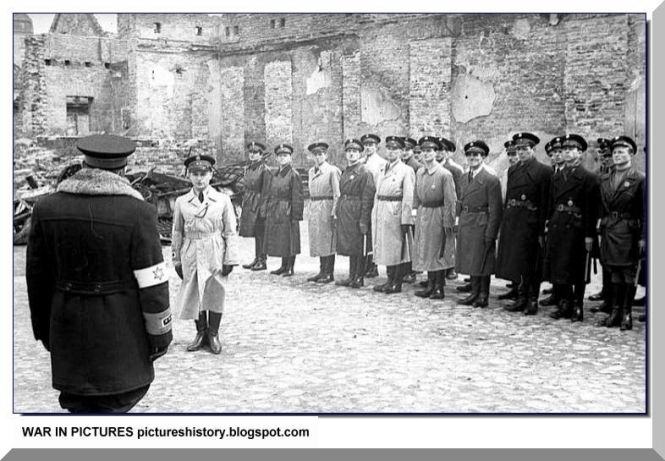
Camp Wolanow. This was the first of the camps Mania and Bluma weathered. As in other camps, males and females were segregated in overcrowded living barracks and on grueling work details. The sisters’ father and their brother Aaron were there, too. Operated by the Germans, the holding camp was manned by many Polish guards and terrorized by roving Ukrainian execution squads. The close quarters, unsanitary conditions, poor food and inadequate shelter became a breeding ground for disease. Typhus swept through the camp that winter, felling the sisters’ father, who grew too weak to work, excuse enough to be killed. Bluma, then only 10, snuck into her father’s barracks to comfort him and to hide him from the guards, but she was spotted and thrown into a crude shack known as “the death house.” There, “cold, barefoot and crying,” she cowered among the other prisoners awaiting almost certain death. When word of her capture reached her cousin Carl, already a young man who’d earned special privileges inside the camp because of his tailoring skills, he came to her rescue. Half-delirious with typhus himself, Carl pleaded with the guards for her release. As Bluma recalls, “He said, Please, let her live a little more. She’s my cousin.’ And they let me out.”
Survival at Wolanow was determined in part by luck, the guards’ whims and inmates’ own wits, wile and will. To survive, Bluma and Mania became hustlers and scavengers. Bluma, the smaller of the two, was adept at sneaking in and out of tight spaces to steal boots or brooms, which they made, or other valuable items the girls came across in camp and traded for scraps of food. “I was the provider,” Bluma said. “I was very aggressive.” In their foraging for supplies, the sisters said they got brazen enough to dig a shallow tunnel — with their bare hands — in the snow and ice. The tunnel, beginning under a section of barbed wire on the camp’s perimeter fence, ran into the surrounding woods and led to a clearing a few yards away. There, Bluma said, she and Mania came above ground and headed straight for a house occupied by a friendly Gentile family. The woman of the house knew the Bojmans from before the roundups and gave food and shelter to the two brave little girls, who scurried to her place via the tunnel whenever they got hungry.
On what proved to be the last run the girls made to their secret sanctuary, Bluma said the woman informed them it was getting too dangerous to aid them any longer and she forbid them from returning. That night, Bluma said she and Mania hid in the woods when they heard machine gunfire coming from the camp. Returning to camp at daybreak, she said they came upon a scene of surreal carnage, with hundreds of frozen corpses, riddled by bullets, laying on the ground as mourning relatives weeped over them. Among the bereaved was their father, crying over the death of his son and their brother, Aaron, a victim of the mass execution.
As related to the sisters by their father, Aaron was selected for a contingent of prisoners earmarked for another camp but, instead, he hid in a barrel, hoping to elude his captors. When a guard overturned the barrel Aaron was killed with the others on site. The bodies, according to Mania, were buried in a mass grave.
From Wolanow, Mania, Bluma, their father and Carl were transported to a Polish transit camp, Starahowice, where they were detained before being shipped, by train, to dreaded Auschwitz. Degradation and violation ruled their lives at Auschwitz. Like many others, Mania and Bluma endured torture. “The women guards went with their bare hands inside us and tore things,” Mania said. “We were screaming. We were bleeding. Oh, God. I don’t know how we got children. This was a miracle.” The sisters’ father was transported from Auschwitz and eventually gassed in Buchenwald.
Meanwhile, Rachel, along with Jacob and assorted cousins and aunts, were deported from Szalkow, where they enjoyed relative comfort, to Blizyn, a harsh labor camp where they were “cold, hungry and dirty.” She and other women were forced to carry heavy cement blocks for buildings under construction. Jacob tended animals. Eventually, Rachel was spared the hardship and indignity of being a human pack mule when the guards called a group of inmates together one day and asked who could sew. She raised her hand and was reassigned to a giant sweatshop where she joined hundreds of other prisoners making uniforms.
The drudgery of work-filled days and the anxiety of uncertain fates left inmates drained by night, when they “sat around for hours and talked,” Rachel recalls, “about why they are doing this to us, what’s going to be tomorrow, who’s going to live through this, who’s going to tell? We dreamed. We looked outside and saw there’s still a world. We saw people working in the fields. The sky was blue. The birds still flew. I thought, God, if I could only be a bird. We were 16-17 years old. We never dated. We never knew boys. We were afraid but there was nothing we could do. The hurt was so deep. The ocean wasn’t as deep as our hurt.”
The pain only got worse at Auschwitz. “Well, I knew this was going to be our end,” Rachel recalls thinking upon arriving at that foul place. It was by pure chance she became aware of her sisters’ presence there. One day while walking in a line of prisoners at the edge of the compound that bordered another enclosure she saw Nathan, the brother of her cousin Carl, working on a railroad gang. They made eye contact and “he threw me a chunk of bread.” Further down the line she spotted her sisters laboring on the tracks the transport trains ran on. “I went closer to the gate, up to the barbed wire, and I screamed, Mania…Bluma,’ and they saw me and they waved to me. I threw them pieces of that bread.” It was the last time she saw her sisters until months after their liberation.

“The living was very bad there,” Rachel said. “Every morning we had to stand in line to be counted. We had to be naked for Mengela (the Nazi war criminal, Joseph Mengela, who experimented on inmates). We were afraid. He chose — this girl to the left, this girl to the right…you go to work, you go to die.” As Bluma puts it, “If you had bones, you were not good. If you still had a little meat, you could still work. One day he made a selection and I was on the wrong side and they took me away. I was scared, but I couldn’t cry anymore — our tears were dried up. We were numb already. We were like cattle led to the slaughter.” Bluma said she escaped the ovens when, in a roll call, she gave the wrong number tattooed on her arm and rejoined Mania in the fit-to-work group.
At Auschwitz Rachel once again lugged cement blocks. On their way to work Rachel and fellow inmates passed by a crematorium. “We saw the flames and the black smoke,” she recalls. “We said, Well, next time it will be us.’ We knew there was no tomorrow for us.” In a building piled high with victims’ discarded apparel she salvaged fabric to clothes for her, relatives and barracks-mates.
It was at Auschwitz the sisters’ brother Jacob met his end. Rachel, who’d been his protector during their life in detention, took his death especially hard. “One day we were standing in the wrong place at the wrong time when the SS, who targeted the young, took him away from me,” she said. “I didn’t want to let him go. I cried and begged them to let me go with him or to take me instead, but they just grabbed him, threw me down and led him away to a truck. I couldn’t do anything but put a sweater around him so he’d be warm. I followed the truck as far as I could.” Having him wrenched away from her to be gassed is, she said, “my biggest hurt.” It is why, she feels, she’s been an “overprotective” mother.
Although the sisters had no inkling of it at the time, by early 1945 the Nazis were in disarray and inmates like themselves still able enough to work, albeit malnourished, were in a position to stay alive and be liberated by advancing Allied troops. As if surviving Auschwitz were not enough, the sisters defied fate once more when commandeered to work as human slaves in munitions factories on the Czech-German border — Mania and Bluma in Darezenstrat and Rachel and some cousins at another site, where they toiled in a series of cellars or tunnels variously sorting potatoes and splicing electric wires. By late spring, the prisoners could see their captors were anxious. Some guards fled. Then, on May 8 1945, Mania, Bluma and the others were marched into the woods by the remaining guards. When a limousine approached, the sisters feared the worst. “We thought it was the SS,” Bluma said, “but it was the Red Cross. They said to the Germans, Stay here. You lost the war. It’s over. The people are free.’ This was our liberation.” On the same day, Rachel and her group were liberated by the Russians.
The sisters, mere skeletons by then, were cared for by a combination of international aid workers and Czech nationals.
Against all odds, the sisters persevered the worst that, as Bluma puts it, “human done to human,” and have gone on to see many tomorrows. While their post-war life has been heaven-sent in comparison with the hell they survived, there have been many struggles. Soon after their liberation, Mania and Bluma went to Wolanow to salvage what they could from the family home, where they were rudely rebuffed by the Polish family occupying it. The sisters only retrieved a photo of their father before being driven off with threats and invectives. Mania and Bluma were reunited with Rachel, Carl and other relatives at a pair of displaced persons centers in Germany, namely, the city of Lanzburg and the former concentration camp Bergen-Belsen, which the British liberated. At these sites the extended family eked out a meager existence the next few years. “We didn’t have money or anything, but we were still happy. We were together…and we were free,” Rachel said.
During their limbo of a refugee existence, Carl, the oldest and most resourceful, “was like a father to us,” Rachel said. “We were very naive. We didn’t know from life. He took care of us. He protected us.” Carl, who long fancied Rachel, married his cousin in Germany, where their first child, Morris, was born. Mania and Bluma also met their mates in the DP camps. By 1949 the sisters secured papers to start anew — with Rachel, Carl, Bluma and Joe going to America and Mania and Zalman resettling in Israel. Their cousins scattered to the four winds. In 1958, Mania and her family rejoined her sisters in America.
Rachel credits then-Jewish Federation of Omaha executive director, Paul Veret, with helping her family get established in the community and Jewish social maven Sadie Newman with making them feel welcome here.
All three sisters feel blessed they overcame their shared tragedy and trauma to find a foothold in America, where they started from scratch to build bountiful lives for their families. Along with their husbands, fellow survivors like them, the women found business success, reared healthy children and became doting grandparents. For years, Rachel assisted her husband, Carl, who now suffers from dementia, in their own tailoring business. She still does fittings and alterations in their basement workshop. Mania and her late husband Zalman owned and operated the popular Friedman’s Bakery in Countryside Village. Bluma’s husband Joe, now retired, was the longtime owner of Ak-Sar-Ben TV before selling it in 2000.
The sisters are proud to have come so far from so little. “We had no language, no money, nothing, and look at what we accomplished,” Rachel said, motioning to her big, beautiful house. Toiling long hours beside their husbands to earn extra money, the women made sure their children had “everything they wanted,” Mania said. Working hard also helped ease the women’s heartache. “Being busy is a healing,” Rachel said. Even so, harsh memories linger — the bitter past a constant reminder of what they witnessed. “I hold it in my heart. I remember everything,” Mania said.
Forgotten and abandoned during the war, the sisters carried on when all hope seemed lost and realized what once seemed impossible — a life free of fear and want. “I didn’t have anything but a dream and my dream came true,” Bluma said. “Well, God had to give us something, too.”


Image via Wikipedia
Leo Adam Biga’s survivor-rescuer stories featured on Institute for Holocaust Education website
A couple years ago I approached Beth Seldin Dotan at the Institute for Holocaust Education in Omaha, Neb. with a proposal: providing my stories about Holocaust survivors and rescuers for display on the organization’s website, http://ihene.org/. She was already familiar with my work in this subject area and we quickly struck a deal. None of the stories would have happened without the help of the late Ben Nachman, a man who made it his quiet crusade to shed light on the enduring spirit of survivors and rescuers. Ben introduced me to the local survivor community and he also led me to various scholars he’d corresponded with over the years regarding various aspects of the Holocaust and the heroic actions of individuals.
I feel privileged that these stories are finding a new home and audience there. Ben was instrumental in my getting each of these stories. There’s more than a little bit of him in them. By the way, you can see my stories about Ben and the work he did on this blog. Here’s how Beth describes the story queue on the website:
Nebraska Holocaust Stories
Several years ago, freelance journalist Leo Biga conducted extensive interviews with several of Nebraska’s Holocaust Survivors. Biga went on to write detailed articles that chronicle the Holocaust testimonies of the Survivors and the lives they made for themselves in Nebraska. The articles were originally featured in Omaha’s Jewish Press. You can now find them here on the Institute for Holocaust Education website. Some of the stories that you will see have won distinguished recognition: The Fred Kader story won First Place in the Single Feature Story category at the 2002 Nebraska Press Association competition and the article “Sisters of the Shoah” about Rachel Rosenberg, Mania Friedman, and Bluma Polonski won a Second Place tie for the 2004 David Frank Award for Excellence in Personality Profiles in the annual Simon Rockower Awards of the American Jewish Press Association.
The Institute for Holocaust Education sincerely hopes that these articles, now available to the entire world on our website, will honor the lives of our Survivors and keep their stories alive.
•••
The website features only a portion of my Holocaust writing. Some of the same stories featured there can also be found on this blog, and I am in process of adding more.
Here’s how Beth previews the stories (you can go right to the page where the stories are listed by linking to http://ihene.org/nebraska-survivor-stories/):
•••
On a January morning students at Omaha’s Lewis and Clark Middle School file in an auditorium to hear a tale of survival by Bea Karp, a petite Jewish woman of 66 who as a child in her native Germany, and later in France, endured the Holocaust. She and her younger sister, Susie, are among their extended family’s few survivors. As Bea’s harrowing tale unfolds, the students listen with the stilled respect due the haunted figure standing before them. Not all survivors can speak about their experiences. Some want only to forget, Bur for Bea, and thousands like her, there is a need to speak out. To bear witness. Why?
“I’ve been an escape artist all my life.” The apt words belong to Lincoln, Neb. resident Lou Leviticus, a square-headed terrier of a man who as a youth in his native Holland survived the Holocaust partly due to his talents as an artful dodger. He escaped the Nazis more than once, even when those closest to him were caught and put to death. As an orphan on the run he became one of scores of hidden children in The Netherlands, his survival dependent on a cadre of strangers that cared for him as one of their own.
For My Mother: Helena Tichauer Tells Her Story
Helena Tichauer was tempted to give up more than once. If she had, no one would have blamed her. For persecuted Jews like her and her family, reasons for despair were everywhere in Nazi-occupied Poland. Her family’s pleasant, comfortable life in Krakow had been wrenched away in the looming darkness of the Holocaust.
Kitty Williams Finally Tells Her Survivor Story
For the longest time, Holocaust survivor Kitty Williams of Council Bluffs didn’t think her story warranted telling. She considered her suffering insignificant amid the weight of Nazi atrocities. Other tragedies far surpassed her own. Nobody could find hers interesting or edifying. It’d all been said before.
“I feel I was destined to live.” That’s as close to an explanation as Lola Reinglas can offer in making sense of her Holocaust survival. An Omaha resident since 1949, Reinglas and her sister, Helena Tichauer, survived a series of internments, some together-some apart, that defied reason except for the intervention of fate and their own indefatigable will.
For the first 52 years of his life Fred Kader lived everyday in the shadow of a lost past. An orphaned child of the Holocaust, Kader’s early years remained an unfathomable mystery that he hoped one day to solve so that he might finally come to know how he survived the Shoah as a small boy in his native Belgium.
Sisters of the Shoah: Three Survivor Tales, Golden Fates and Iron Wills
This is not just another Holocaust story. It is the chronicle of how three sisters survived, alone and together, a series of Nazi concentration camps during World War II to tell their story of human endurance. That not one or two but all three made it out alive is, as the eldest puts it today, “Impossible. I don’t know how we lived. We survived with nothing…not even our hair.”
The Trauma of the Hidden Child Revealed: Marcel Frydman, Fred Kader, and Tom Jaeger
A gathering unlike any other took place the evening of September 24 at the home of Omaha Holocaust researcher Ben Nachman. Over the course of several hours a diverse group of guests heard three men discuss a shared legacy of survival — one that saw them persevere through the Shoah as hidden children in their native Belgium.
A dear friend of mine passed away recently, and as a way of paying homage to him and his legacy I am posting some stories I wrote about him and his mission. Â My late friend, Ben Nachman, dedicated a good part of his adult life to researching aspects of the Holocaust, which claimed most of his extended family in Europe. Â Ben became a self-taught historian who focused on collecting the testimonies of survivors and rescuers. It became such a big part of his life that he accumulate a vast library of materials and a large network of contacts from around the world. Â Ben’s mission was to help develop and disseminate Holocaust history for the purpose of educating the general public, especially youth, and he did this through a variety of means, including videotaped interviews he conducted, sponsoring the development of curriculum for schools, and hosting visiting scholars. Â He also led this journalist to many stories about Holocaust survivors, rescuers, and educational efforts. Because of Ben I have been privileged to tell something like two dozen Holocaust stories, some of which ended up winning recognition from my peers. Â I have met some remarkable individuals thanks to Ben. Several of the stories he led me to and that I ended up writing are posted on this blog site under the Holocaust and History categories.
His interests ranged far beyond the Holocaust and therefore his work to preserve history extended to many oral histories he collected from Jewish individuals from all walks of life and speaking to different aspects of Jewish culture. He got me involved in some of these non-Holocaust projects as well through the Nebraska Jewish Historical Society, including a documentary on the Brandeis family of Nebraska and their J.L. Brandeis & Sons department store empire (see my Brandeis story on this blog site) and an in-progress book on Jewish grocers. Ben’s passion for history and his generous spirit for sharing it will be missed. Rest in peace my friend, you were truly one of the righteous.
NOTE: The following story is not about Ben, per se, but about one of the educational events he arranged to promote greater understanding and knowledge about the Holocaust. The story reports on a gathering that Ben and his wife hosted at their place for a discussion about the trauma of the hidden child.
Ben Nachman: At work in the fields of the righteous
©by Leo Adam Biga
Originally published in the Jewish Press
A gathering unlike any other took place the evening of September 24 at the home of Omaha Holocaust researcher Ben Nachman. Over the course of several hours a diverse group of guests heard three men discuss a shared legacy of survival — one that saw them persevere through the Shoah as hidden children in their native Belgium. Two of the men, Fred Kader and Tom Jaeger, are well known Omaha physicians. The third, Marcel Frydman, is professor emeritus at the University of Mons in Mons, Belgium, where he is a psychologist and the author of a book exploring the long-term traumatic effects of the hidden child experience.
Kader and Jaeger, who already knew each other, were eager to meet Frydman and hear his findings since they shared a common past and homeland. According to Kader, a pediatric neurologist, the hidden experience is one that unites men and women, even of different ages and nationalities, in a special fraternity. “Because of the nature of our experiences, whether in Holland or France or Belgium, you do form this kind of a bond with another hidden child. It’s a thing where we both survived, we both were hidden. The feelings we have just resonate back and forth. It’s a common understanding. It’s communication at a different level.”
Until recently, hidden children rarely spoke about their wartime experiences. For many, the events were simply too painful or too suppressed to tackle. But since a 1991 international hidden children’s conference attended by all three men, more and more long silent survivors have been seeking each other out to talk about their shared heritage in hiding.
Frydman, who came to Omaha at the invitation of Nachman and through the auspices of the Hidden Heroes of the Holocaust Foundation, hopes to have his French-language book published in English. Jaeger, a pediatric psychiatrist, has read the book and feels it offers valuable insights into the whole host of circumstances that determines how individuals cope with the emotional baggage of childhood trauma well into adulthood. He said the book provides a therapeutic framework for treating not only former hidden children but anyone suffering from post traumatic stress, which he added is a timely addition to research on the subject in light of the emotional toll the events of September 11 and after have taken on the damaged American psyche.
On hand that evening at Nachman’s were educators, lawyers and journalists, all of whom came to learn something about the ordeal the three men underwent. As the night unwound, it became clear from what was said that the hidden experience is one marked by profound separation anxiety, where youths taken from homes and families go into hiding among total strangers and try to conceal their Jewish identity in order to save their lives. As each survivor described the story of his survival, he revealed something of the psychological scars borne from these searing events so far outside the normal stream of human conduct. They explained how, even after escaping extermination and building successful adult lives now a half-century removed from their ordeal, they remain haunted by the specter of their hidden odyssey, an odyssey that has both driven them and frustrated them.

Ben Nachman Credit:
Nebraska Jewish Historical Society
There was something nearly sacred in this solemn exchange between the survivors and their rapt audience. The men and women huddled around the Nachman living room listened intently to every word uttered and asked questions that begged for more detail. The evening was also meaningful for the survivors. For Kader and Jaeger, meeting Frydman and learning of his work helped further validate their own hidden histories, which remained shrouded and inarticulated until they began piecing together their own backgrounds at that 1991 conference in New York.
Kader said a book like Frydman’s “gives more credence to the feelings that survivors have. When hidden children get together they end up talking about the same kinds of things and what they talk about has often been well-repressed.” Kader said the more hidden children he gets to know, the more he realizes “all of us, in our own way, have the same sort of common thread of experiences and we all go through the same kind of process of finding a way out of it (the trauma) to make something of ourselves.” He said Frydman’s work helps demonstrate survivors “can cope and manage. Even though you may have these recollections of traumatic experiences in the back of your mind you can get past that point and go on with your life. His research shows all sorts of common denominators. You realize what you’re going through is a natural evolution other survivors go through. It’s reassuring to know we’re all not crazy.”
For Frydman, whose work in this area was sparked by a group of survivors at the who asked him to lead their counseling sessions, the evening was a chance to share his findings with fellow countrymen who endured a similar fate during and after the war. In writing his 1999 book, The Trauma of the Hidden Child: Short and Long Term Repercussions, Frydman found an outlet for his own survivor issues and a forum for examining the consequences of the hidden experience, many of which he found overlap from one survivor to another.
For his book he returned to the very site where he was sheltered after the war — a home for hidden and abandoned children of both Jewish and non-Jewish descent — and to the same group of individuals with whom he shared his early adolescence. To his astonishment he discovered that in spite of their war deprivation many of these individuals have achieved great professional success, with an unusually high percentage ending up in the healing arts, as evidenced by himself, Kader and Jaeger. As he studied this population he identified elements and conditions that explained the apparent anomaly of survivors reaching such heights from such depths.
“In my opinion, two factors were important,” Frydman said. “First, the quality of family life before the war. These children knew there was a possibility of recovering the family unit. They felt forsaken but they knew their parents didn’t abandon them. This was very important when they were confronted with the conditions of an institution where the affective life was very low. The second factor was the quality of the environment in which the child was placed during and after the war. If this environment was good and supportive, he could find again a normal life, mobilize his potentialities and perform very high. It’s no accident that hidden children have chosen social or therapeutic professions. If you have experienced something as hard as we did you may be more skilled to help others.”
Frydman finds survivors exhibit a remarkable resilience as a result of having endured what they did. Jaeger believes he and his peers managed compensating for the trials and deficits of their interrupted childhood because attaining success, coming as it did against all odds, became an act of defiance. “Resiliency is an act of defiance in some ways,” Jaeger said. “It’s a way of saying, ‘You were wrong,’ to those people who said, You can’t do this, or, You won’t ever reach a certain point. As Marcel (Frydman) points out, the thing that contributed to this resilience was the love and nurturance we were inculcated with despite everything going on around us.”
Recently, Jaeger found poignant evidence of the love he was endowed with via two formal family photographs his mother, who escaped the Shoah, commissioned at the time of the roundups and deportations. “I was struck by the fact that she felt it was important to have a memory to sustain our family even in the midst of what was going on. It reinforced what Marcel said about how important the home environment was. It probably provided a buffer that sustained us when we left home and went via this underground railroad into hiding.”
Another impetus for survivors to strive so hard, Jaeger said, was their strong desire “to get on with things and to accomplish anything and everything we could. Most of us wanted to find acceptance — to be included in the mainstream.”
Frydman, Kader and Jaeger were hidden at several sites but their protective custody mainly came in institutions run by various good Samaritans, including Catholic nuns. They are glad to have ended up in such good, caring hands. Frydman said there long was an assumption children placed with foster families were more fortunate than those placed in institutions, “but now I can say that wasn’t true because the child placed in a family was alone in his stress — the family sheltered him but couldn’t share his loneliness and sense of forsakeness — whereas the child in an institution eventually discovered he was not alone and any stress experience is made more bearable when the stress is shared.”
In addition to drawing on his own experiences for the book, Frydman drew on his past work counseling “forsaken children” — orphaned or otherwise abandoned youths — which provided a field of reference from which to extrapolate. What Frydman found in comparing and contrasting hidden children with abandoned children is that “the trauma of the hidden group is more complex and is provoked not by one factor but by a succession of factors,” he said. For example, he points to the roundups of Jews that Nazi authorities began staging in the early part of the war that invariably sent detainees to death camps. The fear engendered by these roundups signaled to children that they, their families, their friends and their neighbors were in peril. He said, “Even if you were not deported you heard about what was happening from other Jews who witnessed these events and the anxiety of the adults was communicated to the children.”

As it became evident the only way to save children was to hide them, an underground network formed to shield them. Because it was easier and less conspicuous to hide a child alone as opposed to a family, children were usually separated from their parents.
“Little children couldn’t understand why they had to be hidden and without their parents,” Frydman said. “It was a safe thing to separate them, but for the children it wasn’t a healthy thing. They were lacking the presence of their parents. They were missing all the affective, emotional ties. And children understood there was a danger of being denounced. We were told not to reveal our real name and not to reveal our Jewish identity. The child understood this, but it increased his anxiety. He understood too that the parents were also in danger. Sometimes he knew one or both of the parents had been arrested and deported, and sometimes he hadn’t any news of there whereabouts. You don’t find these conditions when you study forsaken children.”
Prolonged exposure to such danger and distress left many former hidden children with deep-seated feelings of apprehension and insecurity, said Frydman. “Because they lived for years in an environment perceived as menacing they have some problems associated with anxiety. This has been fixed, at least on the unconscious level, and so they develop some defenses in order to adapt themselves. There’s often a lack of trust and a sense of guardedness toward others. Some of them think they must control every aspect of a relationship because during the war they had no control. For example, some of my subjects told me they resist forming new relationships because it means risking being forsaken another time.”
Even when in the same institution Frydman said hidden children demonstrated fewer issues of desertion than abandoned children because prior to being harbored hidden children presumably enjoyed a stable home life. “They had the chance to be in a normal family before,” he said, “so they were better prepared to confront the separation. They knew there might be a family to try and find after the war whereas the forsaken children knew there was no family to be found.” A striking difference he found in abandoned children versus hidden children is the slowed mental development of the former group compared with the latter group.
The author conducted his research for the book with the aid of one of his students. Interviews were completed with more than 50 adults who found sanctuary in Belgium or surrounding countries during the war. Frydman and his assistant used a non-invasive technique to draw subjects out, some of whom had never before verbalized their hidden past. “The interview was a non-directive one,” he said. “We didn’t ask questions. We just gave the subject the opportunity to evoke his experience and helped him to express what he had to say. For some of the subjects, recalling the past was an ordeal. Some cried. They couldn’t stop. The trauma came back. And, yes, for some it was the first time they’d spoken about it.”

The fact that so many hidden children remained resolutely silent about their past for so long is a phenomenon that Frydman has tried to explain in his book. He said it was a case of hidden children growing up in an atmosphere where the subject was viewed as too painful to revisit or misunderstood as something that could be easily dismissed.
“Just after the war hidden children didn’t feel they had the right to speak because speaking about the trauma implied reliving it,” he said. “They would have spoken if they could have found some help, but in post-war Europe we hadn’t any psychologists. And adults didn’t understand what to say, so if they spoke about the war at all, they said, ‘You were lucky.’ Of course, it’s true, we were lucky not to be deported, but we suffered. If every adult says to you, ‘You were lucky,’ you haven’t even the possibility to express your suffering.” Or, as Jaeger explains, “People were getting on with their lives and moving away from that ordeal and, in effect, really nobody was there who psychologically gave you permission to speak. That listening ear and that permission just weren’t there.”
As the trauma is denied or ignored, Jaeger said, it festers like an untreated wound, only buried out of view, yet never too far away to be reopened. “In psychology there’s a phenomenon where you either dissociate or you compartmentalize things that have been extremely bad. Children exposed to bad events can lose memory of those things. That’s a protective mechanism to enable you to go on, but those feelings are always there at the surface. Certain sounds can evoke fear and anxiety in former hidden children. The sound of a truck is one of the most feared sounds because trucks were used in the roundups. It was the sound of your future. Of being rounded up, deported to camps and confronting almost certain death. Vulnerability is always just below the surface for some of us.”
Jaeger said it was only recently, upon reading Frydman’s book, he recalled suffering panic attacks as a boy after the war. He remembers the episodes occured while riding in cars and presumes his anxiety was triggered by dim memories of deportations. Because Kader and Jaeger were quite young when they went into hiding, their memories are somewhat tenuous. Those who were older when hidden, like Frydman, retain clearer memories of the events and the trauma.
Symbols can also summon the horror of a perilous childhood. For example, Jaeger said some survivors have “a problem trusting authority or trusting the system” because they associate those things with the uniformed soldiers or officials who menaced them and their families.
Jaeger admires Frydman’s book for its clear, thorough assessment of the hidden experience. “It is an exquisite explanation of the dynamics of the experience and of its long term effects. It really has a kind of global description that applies to you no matter what your own hidden experiences were. He helps us understand how we arrived at where we are. Also, it’s really one of the best explanations of Post Traumatic Stress Disorder and its long term ramifications. There’s been lots written about PTSD, but this sampling of a population from a psychological point of view is somewhat unique in that here we have a group of people still living 50-plus years after the fact. It often takes that long for hidden children or camp survivors or other trauma victims to share their experiences because they evoke an emotional vulnerability that is not that easy to deal with. Everybody has to do it in their own way. There are people who to this day still don’t say anything. They haven’t reached that point. This is so applicable to what happened at the World Trade Center because that trauma will be imprinted over generations in some cases.”
Ultimately, only fellow survivors can truly understand what their brothers or sisters of the Holocaust have gone through. Still, every time they share their story with others it gives added meaning to their witness bearing — allowing their testimony to live on in others. The need to testify grows more urgent as the number of survivors dwindles. “Time is of the essence in that we’re the last generation of witnesses left,” Jaeger said, referring to hidden children like himself, Kader and Frydman. In an era when the nation’s moral fortitude is being tested by the threat of terrorism at home, he said, it is more vital than ever to stand up and speak out against evil.
A dear friend of mine passed away recently, and as a way of paying homage to him and his legacy I am posting some stories I wrote about him and his mission. My late friend, Ben Nachman, dedicated a good part of his adult life to researching aspects of the Holocaust, which claimed most of his extended family in Europe. Ben became a self-taught historian who focused on collecting the testimonies of survivors and rescuers. It became such a big part of his life that he accumulate a vast library of materials and a large network of contacts from around the world. Ben’s mission was to help develop and disseminate Holocaust history for the purpose of educating the general public, especially youth, and he did this through a variety of means, including videotaped interviews he conducted, sponsoring the development of curriculum for schools, and hosting visiting scholars. He also led this journalist to many stories about Holocaust survivors, rescuers, and educational efforts. Because of Ben I have been privileged to tell something like two dozen Holocaust stories, some of which ended up winning recognition from my peers. I have met some remarkable individuals thanks to Ben. Several of the stories he led me to and that I ended up writing are posted on this blog site under the Holocaust and History categories.
The Hidden Heroes of the Holocaust Foundation that the following article discusses and that Ben founded was eventually absorbed into the Institute for Holocaust Education in Omaha.
Ben’s interests ranged far beyond the Holocaust and therefore his work to preserve history extended to many oral histories he collected from Jewish individuals from all walks of life and speaking to different aspects of Jewish culture. He got me involved in some of these non-Holocaust projects as well through the Nebraska Jewish Historical Society, including a documentary on the Brandeis family of Nebraska and their J.L. Brandeis & Sons department store empire (see my Brandeis story on this blog site) and an in-progress book on Jewish grocers. Ben’s passion for history and his generous spirit for sharing it will be missed. Rest in peace my friend, you were truly one of the righteous.

Bringing to light hidden heroes of the Holocaust
©by Leo Adam Biga
Originally published in The Reader (www.thereader.com)
A new Omaha foundation is looking to build awareness about an often overlooked chapter of the Holocaust — the rescuers, that small, disparate and courageous band of deliverers whose compassionate actions saved thousands of Jews from genocide. A school-age curriculum crafted by the aptly named Hidden Heroes of the Holocaust Foundation, focusing on the rescue efforts of Swiss diplomat Carl Lutz, is receiving a trial run at Westside High School this spring.
The rescuers came from every station in life. They included civil servants, farmers, shop keepers, nurses, clergy. They hid refugees and exiles wherever they could, often moving their charges from place to place as sanctuaries became unsafe. The mostly Christian rescuers hid Jews in their homes or placed them in convents, monasteries, schools, hospitals or other institutions. As a means of protecting those in their safekeeping, custodians provided new, non-Jewish identities.
While not everyone in hiding survived, many did and behind each story of survival is an accompanying story of rescue. And while not every rescuer acted selflessly — some exacted payment in return for their silence — the heroes that did — and there are more than commonly thought — offer proof that even lone individuals can make a difference against overwhelming odds. These individuals’ noble actions, whether done unilaterally or in concert with organized elements, helped preserve one of Europe’s richest cultural legacies.
Hidden Heroes is the brainchild of Ben Nachman, a retired Omaha dentist who decades ago began an in-depth quest to try and understand the madness that killed 23 members of his Jewish family in the former Ukraine. While his despairing search turned up no satisfactory answers, it did introduce him to Holocaust scholars around the world and to scores of survivors, whose personal stories of survival and rescue he found inspiring.
He said he formed the non-profit foundation “to promote specific Holocaust education efforts and to promote the good deeds of hidden heroes. Most people are aware of only a handful of individuals, like Oscar Schindler or Raoul Wallenberg, who rescued Jews but there were many more who risked their lives to save others. Our mission is to bring to light the stories of these dynamic people and organizations and their little known activities. We hear enough about the bad things that went on. We want to tell the story of the good things and so our focus is on life rather than on death.”
Before he came to celebrate rescuers, Nachman spent years documenting the heroic and defiant stories of survivors. Among the accounts that stirred him most were those of former hidden children residing in Nebraska. Belgian native Dr. Fred Kader avoided deportation through the ultimate sacrifice of his mother, the brave efforts of lay and clergy Christian rescuers and a confluence of fortunate circumstances. Belgian native Dr. Tom Jaeger found refuge through the foresight of his mother and an elaborate network of civilian rescuers, all of whom risked their lives to aid him. Lou Leviticus, a native of Holland, eluded arrest on several occasions through a combination of his own wiles, an active Dutch underground movement and the assistance of Christian families. Nachman interviewed each man for the Survivors of the Shoah Visual History Project (now known as the USC Shoah Foundation Institute for Visual History and Education), a worldwide endeavor filmmaker Steven Spielberg started after completing Schindler’s List.
Nachman’s work introduced him to individuals who, despite immeasurable loss, continued embracing life. “I built-up a tremendous love affair with the survivors,” he said. “They’re a wonderful bunch of people. They’ve endured a great deal. They live with what happened every day of their lives, yet hatred is not there — and they’ve got every reason in the world to hate. They’re the most morally correct people I’ve ever found. They’re my heroes.”
As he heard story after story of how survivors owed their lives to the actions of total strangers, the more curious he became about the men and women who defied the Nazi death machine by harboring and transporting Jews, falsifying documents, bribing officials and doing whatever else was necessary to keep the wolves at bay. “I got very interested in the rescuers of Jews,” he said. “I was interested in knowing what made them do what they did. I think most of them did it because of their own personal convictions rather than out of some government mandate. For them, it was the only thing to do. They were very, very special people.”
One rescuer in particular captured his imagination — the late Carl Lutz, a Swiss diplomat credited with saving 62,000 Jews in Hungary while posted to Budapest as vice consul during the Second World War. At the center of an elaborate conspiracy of hearts, Lutz defied all the odds in devising, implementing and maintaining a mammoth rescue operation in cooperation with members of the Jewish underground, the Chalutzim, and select Swiss and Hungarian officials. He established protective papers and safe houses that helped thousands avoid deportation and almost certain death in the camps.
 |
It is a story of how one seemingly insignificant statesman acted with uncommon courage in the face of enormous evil and personal risk and to do all this despite extreme pressure from Hungarian-German authorities and even his own superiors in Berne to stop. The more he has studied him, the more Nachman has come to admire Lutz, who died in 1975 — long before international acclaim caught up to him, including being named by Israel’s Yad Vashem as a Righteous Among the Nations.
What does he admire most about him? “Probably the fact he acted as a man of conviction rather than as a diplomat. He used the office of Swiss consul to shield a lot of what he was doing, but he did things he didn’t have to do. He was just an obstinate, stubborn man who felt right was the only way to go. Lutz was a very devout man and he felt he wanted to be on the side of God, not man.”
Nachman began searching for a way to make known to a wider audience little known acts of heroism like Lutz’s. In 2000 he and some friends, including former hidden child Lou Leviticus of Lincoln, formed Hidden Heroes. With Nachman as its president and guiding spirit, the foundation is a vehicle for researching, producing and distributing historically-based educational materials that reveal rarely told stories of rescue and resistance. It is the hope of Nachman and his fellow board members that the stories the foundation surfaces cast some light and hope on what is one of the darkest and bleakest chapters in human history.
One of the foundation’s first education projects, a curriculum program focusing on Lutz’s rescue efforts, is being piloted at Westside this spring. The curriculum, entitled Carl Lutz: Dangerous Diplomacy, includes a teacher’s guide, grade appropriate lesson plans, reading assignments, discussion activities and classroom resources, including extensive links to selected Holocaust web sites.
The curriculum was written by Christina Micek, a Holocaust studies graduate student and a third grade teacher at Springlake Elementary School in Omaha. With programs designed for the sixth and eighth grades and another for high school, Micek based the materials on the definitive book about Lutz and his heroic work in Hungary, Dangerous Diplomacy: The Story of Carl Lutz, Rescuer of 62,000 Hungarian Jews (2000, Eerdmans Publishing Co.) by noted Swiss historian Theo Tschuy, a consultant with the foundation. Micek developed the curriculum with the input of Tschuy, who made a foundation-sponsored speaking tour across Nebraska last winter.
Foundation secretary/treasurer Ellen Wright said, “The Holocaust was obviously one of the biggest travesties in history and we feel it is valuable to tell the stories of individuals like Carl Lutz who rose to the occasion and acted righteously.” Wright, who away from the foundation is deputy director of the Watanabe Charitable Trust, said the foundation wants the story of Lutz and other rescuers to serve as models for youths about how individuals can stand up to injustice and intolerance.
“Our youths’ heroes today are athletes and entertainers, which is an interesting commentary on our times. What we want to do is add to that plate of heroes by taking a look at an individual like Carl Lutz and seeing that while his actions were extraordinary he was just like you and I. The difference is, he saw a need and became not only impassioned but obsessed by it. When you consider the 62,000 lives he saved you realize he made it possible for generation after generation of descendants to live and do wonderful things around the world. It’s a remarkable feat and that’s what we want to impart.”
Wright added the foundation seeks to eventually make the Lutz curriculum available, at no cost, to schools in Nebraska, across the nation and around the world. In addition to the current curriculum package, she said, plans call for making an interactive CD-ROM as well as Tschuy’s book available to schools.
The idea of Hidden Heroes’ education mission, members say, is to go beyond facts and figures and to instead spark dialogue about what lies at the heart of bigotry and discrimination and to identify what people can do to combat hate. Curriculum author Christina Micek said she wants students using the materials “to get a personal connection to history” and has therefore created lesson plans that allow for discussion and inquiry. She said when dealing with the Holocaust, students should be encouraged to ask questions, search out answers and apply the lessons of the past to their own lives.
“I don’t see teaching history and social studies as something where a teacher is lecturing and the kids are writing down dates,” she said. “I really want students to feel they’re historians and to feel like they know Carl Lutz by the end of it. I want them to take a personal interest in the subject and to analyze the events and to be able to identify some of the moral issues of the Holocaust and to discuss them in an educated manner.”
The sense of discovery and empathy Micek wants the curriculum to inspire in youths is something quite personal for her. Recently, Micek, a Catholic since birth, discovered she is actually part Jewish. Her mother’s German emigre family, the Feldmans, were practicing Catholics as far back as anyone recalled. But the maternal branches of Micek’s family tree were shaken when relatives searching for records of descendants near Frankfurt, Germany came up empty and were instead directed to a local synagogue, where, to their surprise, they found marriage records of Josef Feldman, her maternal great-great-great grandfather.
Like many Jews in Europe hounded by pogroms, the Feldman family hid their Jewish identity and adopted Catholic traditions around the time they emigrated to America in the late 19th century. Some family members remained behind and perished in the Holocaust. This revelation of a lost heritage has been a life-transforming experience for Micek and one that informs her work with the foundation.
“I felt a great personal loss. My family was kind of cheated out of their culture and their religion,” she said. “And so, for me as educator, I feel it’s important that people realize what hate and not understanding other peoples can do to families and cultures. I was attracted to the Hidden Heroes mission because it shows children that, yes, the Holocaust was a terrible tragedy but that were good people who tried to help. It shows something more than the negative side.”
Micek field tested a revised version of the curriculum with her third grade class and found the compelling subject matter had a profound effect on her students.
“My classroom is 80 percent English-As-A-Second-Language children. Most are new immigrants from Mexico, and so they have a first-hand experience of what it is like to be discriminated against. They could relate to the prejudice Jews endured. It provided my class with a wonderful discussion forum to get into the issues raised by the Holocaust. I thought the kinds of questions my kids came up with were very adult: Why do people hate? How can we keep people from hating other people? It turned out to be really in-depth.
“And my kids have kind of become activists around the school based on this lesson. They’re more caring and they try to help other students when they hear negative messages in the hall. It’s gone a lot further than I ever thought it would.”
She anticipates older students using the lesson plan will also be spurred to look beyond the story of Lutz to examine what they can do when confronted with hate. “I hope that, like my third graders did, they take it beyond the classroom and incorporate it into their own lives To understand what prejudice and hate can do and maybe in their own little corner of the world try and make sure that doesn’t happen again.”
According to Tom Carman, head of the department of social studies in the Westside Community Schools, the Lutz curriculum is, for many reasons, an attractive addition to the district’s standard Holocaust studies.
“The material allows us to look beyond Oscar Schindler and Raoul Wallenberg, whose rescue efforts some people view as an aberration, in showing there were a number of people, granted not enough, who did some positive things at that time. It does take that rather depressing topic and give it some ray of hope. I was always looking for something that added some degree of positive humanity to it.
“And while I thought I was fairly familiar with the subject of the Holocaust, I had never heard of Carl Lutz, which surprised me. That was probably the main draw in our incorporating this curriculum. That and the fact it provides a framework for looking at the moral dilemmas posed by the Holocaust.
“Everybody asks, How could that happen? In the final analysis it happened because people allowed it to happen. It prods us to ask whether the pat answers given by perpetrators and witnesses — ‘I was only following orders’ or ‘I didn’t know’ — are acceptable answers because in figures like Carl Lutz we find there were people who behaved differently. Lutz and others said, This is wrong, and did something about it, unlike most people who took a much safer route and either feigned ignorance or looked the other way. It gives examples of people who acted correctly and that teaches there are options out there.”
Bill Hayes, a Westside social studies instructor applying the curriculum in his class, said, “I think it gives a message to kids that you don’t have to just stand by — there is something you can do. There may be some risk, but there is something you can do.”
Carman said the material provided by the Hidden Heroes Foundation is “done very well” and is “really complete.” He added it is written in such a way as to make it readily “adaptable” and “usable” within existing curriculum. District 66 superintendent Ken Bird said it’s rare for a non-profit to offer “a value-added” educational program that “so nicely augments our curriculum as this one does.”
Lutz became the subject of Hidden Heroes’ first major education project due to Nachman’s own extensive research and contacts.
“In my reading I ran across Lutz,” Nachman said, “and in writing, searching and chasing around the world I found his step-daughter, Agnes Hirschi, a writer in Bern, Switzerland. We started corresponding regularly. She introduced me to the man who is the biographer of Lutz — the Rev. Theo Tschuy — a Methodist minister living outside Geneva. He has done tremendous research into the rescuers and he particularly knows the story of Lutz. He and I have become about as close as two people can be.”

Nachman was instrumental in finding an American publisher (Eerdmans) for Tschuy’s book on Lutz. In addition to his work with the foundation, Nachman is a contributor and catalyst for other Holocaust projects. In conjunction with New Destiny Films, a production company with offices in Omaha and Sarasota, Fla., Nachman did research for two documentaries in development.
One film, which Nebraska Public Television may co-produce, profiles survivors who resettled in Nebraska and forged successful lives here, including Drs. Kader and Jaeger, a pediatric neurologist and psychiatrist, respectively, and Lou Leviticus, a retired UNL agricultural engineering professor. The other film, which American Public Television is to distribute, focuses on the rescue that Lutz engineered. The latter film, Carl Lutz: Dangerous Diplomacy, is intended as the first in a series (Hidden Heroes of the Holocaust) on rescuers.
Nachman and New Destiny’s Mike Moehring of Omaha have traveled to Europe to conduct interviews and pore over archives. The Swiss Consulate in Chicago has taken an interest in the Lutz film, providing financial (defraying airfare expenses) and logistical (cutting red-tape) support for research abroad. Swiss Consul General Eduard Jaun, who is excited about the project, said, “This will be the first comprehensive film about Lutz.”
Hidden Heroes is now working on creating new education programs featuring other rescuers. Micek is gathering data for a curriculum focusing on the late Portuguese diplomat Aristides de Sousa Mendes, who while stationed in France signed thousands of visas that spared the lives of their recipients, including many Jews.
Nachman serves on an international committee working to bring worldwide recognition to the humanitarian work of Mendes. Other subjects the foundation is researching are: Father Bruno Reynders, a Benedictine monk who found refuge for more than 200 Jewish children in Belgium; the individuals and organizations behind Belgium’s extensive rescue network, which successfully hid 4,500 children; and the rescue of children on the French and Swiss borders.
Wright said when she approaches potential donors about supporting the foundation she sometimes encounters cynical attitudes along the lines of — “I don’t want to hear anymore about the Holocaust” — which she views as an opportunity to explain what sets Hidden Heroes apart from other Holocaust education initiatives.
“While it’s true there’s a tremendous amount of information out there about the Holocaust,” she said, “what we’re trying to do is take a different approach. Through the stories of survivors and rescuers we want to talk about life. About how survivors did more than just survive — they went on to thrive, raise families and accomplish remarkable things. About how rescuers risked everything to save lives. We want to tell these stories in order to educate young people around the world. It is our hope that behaviors and attitudes can be changed, if even one person at a time, so that something like this never happens again.”
Among others, the foundation’s message of hope is being bought into by funding sources. The foundation recently gained the support of the National Anti-Defamation League, which has promised a major grant to fund its work. Hidden Heroes is close to securing a matching grant from a local donor. The foundation anticipates working cooperatively with the National Hidden Children’s Foundation, which is housed within the National ADL headquarters in New York. More funding is being sought to underwrite foundation research jaunts in Europe.
Because stories of rescue have as their counterpart stories of survival, Hidden Heroes is also involved in raising awareness about the survival experience. In a series of events ranging from receptions to lectures, the foundation presents occasional forums at which former hidden children speak about survival in terms of the trauma it exacts, the defiance it represents and the ultimate triumph over evil it achieves.
For example, the foundation sponsored a November visit by Belgian psychologist and author Marcel Frydman, a former hidden child who spoke about the lifelong ramifications of the hidden child experience, which he describes in his 1999 French-language book, The Trauma of the Hidden Child: Short and Long Term Repercussions. Nachman, who enjoys the role of facilitator, brought Frydman together with Drs. Kader and Jaeger, two countrymen who share his hidden child legacy, for an emotional meeting last fall.
Foundation members say each is participating in the work of the Hidden Heroes organization for his or her own reasons. For Ellen Wright, “it is the right thing to do.” For Nachman, it is a source of fulfillment unlike any other. “There’s nothing I’ve ever done that’s had more meaning and made more of an impact on me,” he said. He noted that as the aging population of survivors and rescuers dwindles each year, there is real urgency to recording the stories of survivors and rescuers before the participants in these stories are all gone.
With reports of anti-Semitism on the rise in Europe and elsewhere in the wake of the ongoing Israeli-Palestinian crisis, foundation members say there is even added urgency to telling stories of resilience, resolve and rescue during the Holocaust because these accounts demonstrate how, even in the midst of overwhelming evil, good can prevail.

Image via Wikipedia
A dear friend of mine passed away recently, and as a way of paying homage to him and his legacy I am posting some stories I wrote about him and his mission. My late friend, Ben Nachman, dedicated a good part of his adult life to researching aspects of the Holocaust, which claimed most of his extended family in Europe. Ben became a self-taught historian who focused on collecting the testimonies of survivors and rescuers. It became such a big part of his life that he accumulate a vast library of materials and a large network of contacts from around the world. Ben’s mission was to help develop and disseminate Holocaust history for the purpose of educating the general public, especially youth, and he did this through a variety of means, including videotaped interviews he conducted, sponsoring the development of curriculum for schools, and hosting visiting scholars. He also led this journalist to many stories about Holocaust survivors, rescuers, and educational efforts. Because of Ben I have been privileged to tell something like two dozen Holocaust stories, some of which ended up winning recognition from my peers. I have met some remarkable individuals thanks to Ben. Several of the stories he led me to and that I ended up writing are posted on this blog site under the Holocaust and History categories.
His interests ranged far beyond the Holocaust and therefore his work to preserve history extended to many oral histories he collected from Jewish individuals from all walks of life and speaking to different aspects of Jewish culture. He got me involved in some of these non-Holocaust projects as well through the Nebraska Jewish Historical Society, including a documentary on the Brandeis family of Nebraska and their J.L. Brandeis & Sons department store empire (see my Brandeis story on this blog site) and an in-progress book on Jewish grocers. Ben’s passion for history and his generous spirit for sharing it will be missed. Rest in peace my friend, you were truly one of the righteous.
Ben Nachman remembered heroes of the Holocaust
©by Leo Adam Biga
Originally appeared in New Horizons
What began as a hobby for retired Omaha dentist Ben Nachman has become his life’s work. For 30-plus years now Nachman, 70, has dedicated himself to researching the Holocaust. It is a subject this second generation Jewish American has personal ties to, as 23 members of his extended family perished at the hands of the Nazis in the former Ukraine.
For the past seven years this Creighton University graduate has documented the never-before-told stories of Holocaust survivors, including several transplanted Nebraskans, as well as the heroic efforts of European diplomats in rescuing Jews. As he has dug deeper into the Shoah, his work has brought him on close terms with survivors, rescuers and scholars and made him an authority on the subject, one he began probing in a quest to understand how his grandparents, uncles, aunts and cousins became victims of genocide.
His inquiries in this area have led him to establish an international network of contacts in Holocaust research circles and to participate in and serve as a catalyst for various projects seeking to shed light on the subject.
“It really is a tremendous network and it just came about over the years through exchanging letters, e-mails and faxes and visiting people and it just kind of opened up the floodgates,” he said.
He reads voraciously on the Holocaust, having accumulated a home library of thousands of books, and corresponds with some of the authors of those books. Only last September he and his wife Elaine hosted Belgian psychologist Marcel Frydman, the author of a book on the lifelong trauma faced by hidden children.
The first large-scale research undertaking he took part in was in conjunction with the Survivors of the Shoah Visual History Foundation (now called the USC Shoah Foundation Institute for Visual History and Education) and its five-year endeavor videotaping survivor testimonies. From 1995 to 1998 he was an official interviewer for the Los Angeles-based Foundation, which filmmaker Steven Spielberg started after completing Schindler’s List, the Oscar-winning film credited with sparking a revival of interest in the Holocaust.

For the Shoah project Nachman conducted exhaustive interviews with 70 survivors residing in the Midwest. Videographers captured the sessions on tape. His work introduced him to individuals who, despite immeasurable loss, have continued embracing life. He feels privileged to have been in the presence of men and women who have borne the burden of a lost generation with such grace.
“I built-up a tremendous love affair with the survivors,” Nachman said. “They’re a wonderful bunch of people. They’ve endured a great deal. They live with what happened every day of their lives, yet hatred is not there — and they’ve got every reason in the world to hate. They’re the most morally correct people I’ve ever found. They’re my heroes.”
Among the survivors Nachman interviewed is Lou Leviticus, a Lincoln, Neb. resident who as a hidden child in The Netherlands escaped the Nazis but lost virtually his entire family. Before the interview Leviticus, a former agricultural engineering professor at the University of Nebraska-Lincoln, had never before spoken of his ordeal.
Remaining silent about one’s own Holocaust history is a common refrain among survivors, especially hidden children, because the events are too painful to relive and the opportunity to speak too rarely afforded. Nachman also interviewed Omaha pediatric physicians Fred Kader and Tom Jaeger, whose survival as hidden children in their native Belgium was only made possible by the remarkable sacrifices and hazards undergone by their own families and by total strangers. Leviticus, Kader and Jaeger were among 50,000 or so people worldwide interviewed for the Shoah project, whose data is available to educators, historians and authors. In getting survivors to recount their stories in intimate detail, Nachman was unprepared for the impact the experience would have on him or his subjects.
“It was a very exacting interview we did with each survivor. We went into every little detail of exactly what happened to them during the war — whether they were in a concentration camp or a ghetto or in hiding. All the interviews lasted in excess of two hours. Many survivors were reluctant to talk about their lives, but we managed to get them to really open up. We had times when some startling things were said.
“A lady in Chicago told me about being raped. That’s a really shattering thing to sit and listen to. The trauma was still fresh in her mind. At times like that the survivor would break down. When we finished an interview the survivor and I were spent. It was an emotionally draining experience.”
A new project that has arisen from Nachman’s extensive contacts is the Hidden Heroes of the Holocaust Foundation, an Omaha-based organization whose aims are “to promote specific Holocaust education efforts and to promote the good deeds of hidden heroes,” Nachman said. “
Most people are aware of only a handful of individuals, like Oscar Schindler or Raoul Wallenburg, who rescued Jews but there were many more rescuers who risked their lives to save others. Our mission is to bring to light the stories of these dynamic people and organizations and their little known activities. We hear enough about the bad things that went on. We want to tell the story of the good things and so our focus is on life rather than on death.”
As an example of its educational mission, the foundation sponsored Marcel Frydman’s recent visit to Nebraska, where the author discussed what it means to have been separated from family as a hidden child, where survival depended on the good graces of ordinary citizens doing extraordinary things, and to deal with the lasting repercussions of that experience.
For his book, Frydman interviewed and studied dozens of former hidden children. Nachman said Frydman’s work is “the first to reveal that hidden children face trauma throughout their lives. It is an experience they are traumatized by forever. Their whole life is kind of governed by what happened to them.” In his role as a facilitator, Nachman arranged a meeting between Frydman, a former hidden child in Belgium, and Drs. Kader and Jaeger — who like Frydman were also hidden during the war in Belgium. The ensuing discussion at Nachman’s home proved emotional. “I knew if any of them opened up it was really going to be quite a dramatic evening and it did become that.”

Meanwhile, the foundation is underwriting research into rescue campaigns that went on in several European nations, with Nachman investigating Belgium and Hungary and collaborators examining Holland, France and Switzerland. Their results will inform articles, books, exhibits, films and other educational projects sponsored by the foundation.
Among these projects is an international committee Nachman serves on working to bring worldwide recognition to the humanitarian work of the late Portuguese diplomat, Aristides de Souza Mendes, and two documentary films — one profiling survivors who resettled in Nebraska to forge successful lives here and the other charting Swiss diplomat Carl Lutz’s defiant rescue of Hungarian Jews.
It is ironic Nachman has come to know the stories of hundreds of Holocaust heroes because his initial search was purely personal, as he followed what few leads there were of his ill-fated family in Europe.
His parents, who came to the U.S. in the early part of the last century, were from the former Ukrainian town of Kolomyja, which prior to the German invasion was part of Poland. Except for two uncles who survived in camps, all his relatives abroad perished. According to Nachman, Kolomyja was once home to 40,000 citizens, including 20,000 Jews. At the time of the Nazi occupation Jews from outlying areas were rounded-up and forced to live in two overcrowded ghettos within the town. He said some 55,000 Jews were interred there and “as best we can find there are only 200 survivors” today.
Nachman has ascertained few details about what happened. The skimpy facts he does know came from an uncle who survived a Siberian labor camp. “
I know only my grandfather was murdered in a forest outside of that town (Kolomyja) and my grandmother was murdered in her bed. I spent about a year trying to find some of the 200 survivors and I finally did. I phoned them. I wrote them letters. I did everything I could to try and piece together a story. But I’ve never really pieced together much of one. In all my contacts I’ve only had one occasion when someone remembered a member of my family. It was a man in Chicago, and when I showed him a picture of my grandfather he said, ‘Joseph Nachman, The Parquetnik,’ which referred to the fact my grandfather laid parquet floors” in the Old Country.
Determined to visit Kolomyja in the hope of unearthing more clues, Nachman pestered the Cultural Attache at the then-Soviet Embassy in Washington, D.C. to seek entry into what was a Soviet-controlled and, therefore, restricted region. In 1988 he and his wife were granted permission to visit, but only allowed a few hours on-site.
“We got to the Jewish cemetery there. It was in the most disastrous condition. Some graves were open clear down to the caskets. Some caskets were decayed to the point you could see bones within them. There was a huge mound in the middle of this cemetery, and that’s where several hundred people had been killed on the spot and put into a mass grave. I looked up, and there was a lady with a few goats feeding in the cemetery. She put her hand on the side of her face and shook her head as if she realized how terrible this must have been to me,” he said.
Dissatisfied by the brief visit he was accorded, he vowed to return one day. After the Soviet Union fell, he did return in 1992, accompanied by his daughter, and enjoyed freer access.

“We found the cemetery had been totally dug up. Any Jewish records in this town had been destroyed. At our escort’s suggestion we went to the local Catholic church, where she thought there might be duplicate records. We were able to find the birth certificate of a cousin born in November 1940 and murdered late in ‘41 or early in ‘42. I got a copy of the certificate and had it translated. That’s the only remnant I’ve ever been able to find of my family.”
His attempts at tracing the tragedy brought him face to face with the bleak reality of a terrible past now largely buried or forgotten. “My daughter and I walked into the forest where my grandfather was forced to dig his own grave and we saw several mounds of earth that I’m sure represented thousands of people. There were no markers. The survivors and their families were finally given permission to put up a memorial in 1993. I was asked to go back, but I didn’t. I didn’t want to.
“An uncle once told me, ‘You should never go back. There is nothing to see.’ And after having been back twice, I agree. The memorial erected there was originally inscribed with the words: ‘Here in this spot, several thousand Jews were murdered by the Nazis.’ After several months the Ukrainians took that inscription down and changed it to read: ‘Several thousand Ukrainians were killed here.’ So, you see, they really managed to erase any traces of what happened.”
His trip did yield one bonus when he and Sen. Jim Exon (D-Neb.) aided 10 Russian-Jews in obtaining long-refused exit visas that let them emigrate to America.
More recently, Nachman has turned his attention to a segment of survivors whose lives were spared only by the intervention of individuals who, at great risk, helped them evade capture, deportation and almost certain death in the camps.
“I got very interested in the rescuers of Jews. I was interested in knowing what made these rescuers do what they did,” he noted. “I think most of them did it because of their own personal convictions rather than out of some government mandate. For them, it was the only thing to do. They were very, very special people.”
One rescuer in particular captured his imagination — the late Carl Lutz. “In my reading I ran across Lutz. And in writing, searching and chasing around the world I found his step-daughter, Agnes Hirschi, a writer in Bern, Switzerland. We started corresponding regularly. She introduced me to the man who is the biographer of Lutz — the Rev. Theo Tschuy — a Methodist minister living outside Geneva. He has done tremendous research into the rescuers and he particularly knows the story of Lutz. He and I have become about as close as two people can be.”
Nachman has completed interviews with Hirschi and Tschuy for a documentary film now in development focusing on the massive rescue of Jews Lutz accomplished amid the Nazi regime in Budapest. The film, Carl Lutz: Dangerous Diplomacy, is intended as the first in a series on rescuers. The film, which the Hidden Heroes of the Holocaust Foundation is helping fund, is being made by New Destiny Films, a production company with offices in Omaha and Sarasota, Fla.

Carl Lutz
Nachman and New Destiny’s Mike Moehring have traveled to Europe to conduct interviews and pore over archives. The Swiss Consulate in Chicago has taken an interest in the film, providing financial (defraying airfare expenses) and logistical (cutting red-tape) support. Upon the film’s completion, American Public Television is set to distribute it. In her filmed interview, Hirschi describes her step-father as “almost obsessed by the idea of having to save these people.”
A full accounting of what Lutz did has been largely ignored. By the late spring of 1944, the Nazi occupation of Hungary was complete, the borders closed, emigration halted and the mass deportation of Jews under way. The situation was desperate. That is when a man of rare courage and insight — Lutz — then Swiss vice consul to Hungary, began a campaign to thwart the Final Solution.
By all accounts, Lutz embodied the fiercely independent nature of his homeland — specifically, the Appenzell region of Switzerland. A fervent Methodist, Lutz was American-educated. An early diplomatic tour in Palestine well-acquainted him with the Jews’ displaced status. In Hungary, he had already assisted the Budapest-based Jewish Agency of Palestine (JAP) in finding safe passage for 10,000 orphaned children. By April 1944 there were still 8,000 children under his protection waiting to leave for Palestine, but their passage was blocked.
Lutz negotiated with German and Hungarian officials to keep the group under his protection. When refused more exit permits, he took matters into his own hands. Overceding his authority and defying the wishes of his timid government, he made Swiss neutrality and the power of diplomatic immunity his weapons in taking assertive steps to safeguard Jews.
First, he granted hundreds of asylum seekers sanctuary in the American legation building. Next, he transformed the Budapest JAP into the Emigration Department of the Swiss Legation, thus securing a measure of protection for its workers and its aims. Then he began issuing Swiss Schutzbriefe or safety passes (which declared their holders to be under the protection of the Swiss) to thousands of Jews (men, women and children) beyond the original quota of 8,000. Thousands more Schutzbriefe were forged and distributed by Zionists.
Next, he established 76 Schutzhauser or safe houses where thousands of Jews took refuge. And, finally, he worked closely with the Hechalutz/Chalutzim (Jewish pioneers) to provide security for the safe houses and communication with the Jewish populace and he cultivated sympathetic members of the Hungarian police and parliament to alert him to any Nazi movements directed at the people in his charge.
Nachman said the protective measures Lutz instituted became models for other diplomatic rescuers, including Wallenburg, who came to Budapest months after these measures were implemented. He said scholars estimate Lutz’s actions saved as many as 62,000 Jews, a number far outstripping that attributed to higher-profile rescuers. Nachman and filmmaker Mike Moehring have interviewed recipients of the Schutzbriefe and visited safe houses, many of which survive.

According to Nachman, Lutz persisted in his rescue efforts in spite of repeated orders by authorities to stop, constant threats to his life and continued resistance from his superiors in Switzerland. His defiance even extended to Adolf Eichmann, whom he confronted on many occasions.
At one point, as a way of pressuring Lutz, the Nazis made him identify authentic Schutzbriefe from forgeries held by a group of Jews — thus forcing him to condemn some of the safe passage holders to death. Despite such pressure, he persevered. “He was just an obstinate, stubborn man who felt right was the only way to go. Lutz was a very devout man and he felt he wanted to be on the side of God, not man,” Nachman said.
The more he has studied him, the more Nachman has come to admire Lutz, who died in 1975 — long before international acclaim caught up to him. What does he admire most about him? “Probably the fact he acted as a man of conviction rather than as a diplomat. He used the office of Swiss consul to shield a lot of what he was doing, but he did things he didn’t have to do. This is one of the most wonderful men I’ve ever known of.”
Before his death, Lutz was honored by Yad Vashem in Israel as “a righteous among the nations.” He was posthumously nominated for the Nobel Peace Prize. Switzerland issued a stamp with his likeness on it. A touring exhibition, Visas for Life: The Righteous and Honorable Diplomats, includes a Lutz display.
Last year, Nachman was an invited guest at a United Nations program honoring the diplomatic rescuers and their families. An English language edition of Theo Tschuy’s biography on Lutz (Dangerous Diplomacy: The Story of Carl Lutz) came out last fall from Eerdmans Publishing Co. in Grand Rapids, Michigan. Early next year, Nachman will host a visit by Tschuy and will appear at public speaking engagements with him.
For Nachman, a modest man who dislikes publicity about his work, the investigation into the past goes on. There are more interviews, more archives, more stories to cultivate. “It has been the most exciting time of my life,” he said. “There’s nothing I’ve ever done that’s had more meaning and made more of an impact on me.”
A dear friend of mine passed away recently, and as a way of paying homage to him and his legacy I am posting some stories I wrote about him and his mission. My late friend, Ben Nachman, dedicated a good part of his adult life to researching aspects of the Holocaust, which claimed most of his extended family in Europe. Ben became a self-taught historian who focused on collecting the testimonies of survivors and rescuers. It became such a big part of his life that he accumulate a vast library of materials and a large network of contacts from around the world. Ben’s mission was to help develop and disseminate Holocaust history for the purpose of educating the general public, especially youth, and he did this through a variety of means, including videotaped interviews he conducted, sponsoring the development of curriculum for schools, and hosting visiting scholars. He also led this journalist to many stories about Holocaust survivors, rescuers, and educational efforts. Because of Ben I have been privileged to tell something like two dozen Holocaust stories, some of which ended up winning recognition from my peers. I have met some remarkable individuals thanks to Ben. Several of the stories he led me to and that I ended up writing are posted on this blog site under the Holocaust and History categories.
His interests ranged far beyond the Holocaust and therefore his work to preserve history extended to many oral histories he collected from Jewish individuals from all walks of life and speaking to different aspects of Jewish culture. He got me involved in some of these non-Holocaust projects as well through the Nebraska Jewish Historical Society, including a documentary on the Brandeis family of Nebraska and their J.L. Brandeis & Sons department store empire (see my Brandeis story on this blog site) and an in-progress book on Jewish grocers. Ben’s passion for history and his generous spirit for sharing it will be missed. Rest in peace my friend, you were truly one of the righteous.
Ben Nachman’s mission
©by Leo Adam Biga
Originally published in the Jewish Press
Ben Nachman is on a mission.
For the past six years the Omaha native has documented the never-before-told stories of Holocaust survivors, including several Nebraska residents, as well as the heroic efforts of European diplomats in rescuing thousands of Jews during World War II. To date, he has applied his self-taught historical research skills to a pair of international projects — the Survivors of the Shoah Visual History Foundation (now known as the USC Shoah Foundation Institute for Visual History and Education) and an international committee working to bring worldwide recognition to the humanitarian work of the late Portuguese diplomat, Aristides de Souza Mendes.
More recently, New Destiny Films, a production company with offices in Omaha and Sarasota, Fla., has engaged Nachman to research survivors and rescuers for two documentaries now in development.
One film, which Nebraska Public Television may co-produce, profiles survivors who resettled in Nebraska and forged successful lives here. The other, which American Public Television is to distribute, focuses on the massive rescue of Jews that the late Swiss diplomat to Hungary, Carl Lutz, accomplished amid the Nazi regime in Budapest. The latter film, called Carl Lutz: Dangerous Diplomacy, is intended as the first in a series (Hidden Heroes of the Holocaust) on rescuers.
Nachman and New Destiny’s Mike Moehring of Omaha have traveled to Europe to conduct interviews and pore over archives. The Swiss Consulate in Chicago has taken an interest in the film, providing financial (defraying airfare expenses) and logistical (cutting red-tape) support for Nachman’s and Moehring’s work abroad. Swiss Consul General Eduard Jaun, who is excited about the project, said, “This will be the first comprehensive film about Lutz.”
As Nachman, 69, has dug deeper and deeper into the Holocaust, his work has brought him on close terms with survivors and scholars and made him an authority on the subject. While not a survivor himself, Nachman shares a common Jewish heritage and legacy of loss.
A retired Omaha dentist, the Creighton University graduate began probing the Holocaust 30-plus years ago in a quest to understand what led 23 members of his family (grandparents, uncles, aunts, cousins) to become victims of Nazi genocide. He read voraciously, eventually amassing a personal library of thousands of books. He began corresponding with some of the authors of those books. The more he found out about those dark events of the Second World War, the more drawn he was to the personal stories of survivors and rescuers.
His initial search was personal, following what few leads there were of his ill-fated family in Europe. His parents, who immigrated here in the early part of the last century, were from the former Ukrainian town of Kolomyja, which prior to the German invasion was part of Poland. Except for two uncles who survived in camps, all his relatives abroad perished.
According to Nachman, Kolomyja was once home to 40,000 citizens, including 20,000 Jews. At the time of the Nazi occupation Jews from outlying areas were rounded-up and forced to live in two overcrowded ghettos within the town. He said some 55,000 Jews were interred there and “as best we can find there are only 200 survivors” today.
Nachman has unearthed few details about what happened. The skimpy facts he does know came from an uncle who survived a Siberian labor camp.
“I know only my grandfather was murdered in a forest outside of that town (Kolomyja) and my grandmother was murdered in her bed. I spent about a year trying to find some of the 200 survivors and I finally did. I phoned them. I wrote them letters. I did everything I could to try and piece together a story. But I’ve never really pieced together much of one.
“In all my contacts I’ve only had one occasion when someone remembered a member of my family. It was a man in Chicago, and when I showed him a picture of my grandfather he said, ‘Joseph Nachman, The Parquetnik,’ which referred to the fact my grandfather laid parquet floors” in the Old Country.
Determined to visit Kolomyja in the hope of uncovering more clues, Nachman pestered the Cultural Attache at the then-Soviet Embassy in Washington, D.C. to seek entry into what was a Soviet-controlled and, therefore, restricted region. In 1988 he and his wife were granted permission to visit, but only allowed a few hours on-site.
“We got to the Jewish cemetery there. It was in the most disastrous condition. Some graves were open clear down to the caskets. Some caskets were decayed to the point you could see bones within them. There was a huge mound in the middle of this cemetery, and that’s where several hundred people had been killed on the spot and put into a mass grave. I looked up, and there was a lady with a few goats feeding in the cemetery. She put her hand on the side of her face and shook her head as if she realized how terrible this must have been to me,” he said.
Dissatisfied by the brief visit he was accorded, he vowed to return one day. After the Soviet Union fell, he did return in 1992, accompanied by his daughter, and enjoyed freer access. “We found the cemetery had been totally dug up. Any Jewish records in this town had been destroyed. At our escort’s suggestion we went to the local Catholic church, where she thought there might be duplicate records. We were able to find the birth certificate of a cousin born in November 1940 and murdered late in ‘41 or early in ‘42. I got a copy of the certificate and had it translated. That’s the only remnant I’ve ever been able to find of my family.”
His attempts at tracing the tragedy brought him face to face with the bleak reality of a terrible past now largely buried or forgotten.
“My daughter and I walked into the forest where my grandfather was forced to dig his own grave and we saw several mounds of earth that I’m sure represented thousands of people. There were no markers. The survivors and their families were finally given permission to put up a memorial in 1993. I was asked to go back, but I didn’t. I didn’t want to.
“An uncle once told me, ‘You should never go back. There is nothing to see.’ And after having been back twice, I agree. The memorial erected there was originally inscribed with the words: ‘Here in this spot, several thousand Jews were murdered by the Nazis.’ After several months the Ukrainians took that inscription down and changed it to read: ‘Several thousand Ukrainians were killed here.’ So, you see, they really managed to erase any traces of what happened.”
His trip did yield one bonus when he and Sen. Jim Exon (D-Nebr.) aided 10 Russians in obtaining long-refused exit visas. The Russians immigrated to the United States.
The opportunity of helping collect a permanent record of Holocaust stories convinced Nachman to participate in the Shoah Foundation’s five-year project videotaping survivor testimonies. From 1995 to 1998 he was an official interviewer for the Los Angeles-based Foundation, which filmmaker Steven Spielberg started shortly after completing Schindler’s List, the Oscar-winning film credited with sparking a revival of interest in the Holocaust.
For the Shoah project Nachman conducted exhaustive interviews with 70 survivors in the Midwest. Videographers captured the sessions on tape. His work introduced him to individuals who, despite immeasurable losses, have continued embracing life. He feels privileged to have been in the presence of men and women who have borne the burden of a lost generation with such grace.
“I built-up a tremendous love affair with the survivors,” Nachman said. “They’re a wonderful bunch of people. They’ve endured a great deal. They live with what happened every day of their lives, yet hatred is not there — and they’ve got every reason in the world to hate. They’re the most morally correct people I’ve ever found. They’re my heroes.”
Filmmaker Mike Moehring, who taped many of Nachman’s Shoah interviews, has also been affected by his work with survivors: “The thing I come away with from these people is their tremendous resiliency. I feel very fortunate and honored they share part of their experience with me. I know I’m a different person for it,” he said.
Among the survivors Nachman interviewed is Lou Leviticus of Lincoln, who as a hidden child in The Netherlands escaped the Nazis. He lost virtually his entire family. After the war Leviticus lived in Israel, working as an engineer, and later immigrated to America, where he was an agricultural engineering professor at the University of Nebraska-Lincoln. Before his Shoah interview, he had never spoken of his ordeal. He was one of 50,000 survivors worldwide interviewed for the Shoah project, whose data is available to educators, historians and authors.
Until his involvement, Nachman had rarely sat across from survivors to hear, first-hand, their personal trials of lives interrupted, of innocence stolen, of everything held dear ripped asunder. In getting them to recount their stories in intimate detail, he was not prepared for the impact the experience would have on him or his subjects.
“It was a very exacting interview we did with each survivor. We went into every little detail of exactly what happened to them during the war — whether they were in a concentration camp or a ghetto or in hiding. All the interviews lasted in excess of two hours. Many survivors were reluctant to talk about their lives, but we managed to get them to really open up. We had times when some startling things were said.
“A lady in Chicago told me about being raped. That’s a really shattering thing to sit and listen to. The trauma was still fresh in her mind. At times like that the survivor would break down. When we finished an interview the survivor and I were spent. It was an emotionally draining experience.”
More recently, Nachman has turned his attention to a segment of survivors whose lives were spared only by the intervention of individuals who, at great risk, helped them evade capture, deportation and almost certain death in the camps.
“I got very interested in the rescuers of Jews. I was interested in knowing what made these rescuers do what they did,” he noted. “I think most of them did it because of their own personal convictions rather than out of some government mandate. For them, it was the only thing to do. They were very, very special people.”

One rescuer in particular captured his imagination — Carl Lutz. “In my reading I ran across Lutz. And in writing, searching and chasing around the world I found his step-daughter, Agnes Hirschi, a writer in Bern, Switzerland. We started corresponding regularly. She introduced me to the man who is the biographer of Lutz — the Rev. Theo Tschuy — a Methodist minister living outside Geneva. He has done tremendous research into the rescuers and he particularly knows the story of Lutz. He and I have become about as close as two people can be.”
Nachman has completed interviews with Hirschi and Tschuy for the Lutz film. In her filmed interview, Hirschi describes her step-father as “almost obsessed by the idea of having to save these people. It was really like an obsession.”
While the deeds of some rescuers, like Oscar Schindler and Raoul Wallenberg, have been widely told, a full accounting of what Lutz did has been largely ignored. By the late spring of 1944, the Nazi occupation of Hungary was complete, the borders closed, emigration halted and the mass deportation of Jews under way. The situation was desperate. That is when a man of rare courage and insight — Lutz — then Swiss vice consul to Hungary, began a campaign to thwart the Final Solution.
By all accounts, Lutz embodied the fiercely independent nature of his homeland — specifically, the Appenzell region of Switzerland. A fervent Methodist, Lutz was American-educated. An early diplomatic tour in Palestine well-acquainted him with the Jews’ displaced status. In Hungary, he had already assisted the Budapest-based Jewish Agency of Palestine (JAP) in finding safe passage for 10,000 orphaned children. By April 1944 there were still 8,000 children under his protection waiting to leave for Palestine, but their passage was blocked.

One of the safe houses Carl Lutz kept
Lutz negotiated with German and Hungarian officials to keep the group under his protection. When refused more exit permits, he took matters into his own hands. Overceding his authority and defying the wishes of his timid government, he made Swiss neutrality and the power of diplomatic immunity his weapons in taking assertive steps to safeguard Jews.
First, he granted hundreds of asylum seekers sanctuary in the American legation building. Next, he transformed the Budapest JAP into the Emigration Department of the Swiss Legation, thus securing a measure of protection for its workers and its aims. Then he began issuing Swiss Schutzbriefe or safety passes (which declared their holders to be under the protection of the Swiss) to thousands of Jews (men, women and children) beyond the original quota of 8,000.
Thousands more Schutzbriefe were forged and distributed by Zionists. Next, he established 76 Schutzhauser or safe houses where thousands of Jews took refuge. And, finally, he worked closely with the Hechalutz/Chalutzim (Jewish pioneers) to provide security for the safe houses and communication with the Jewish populace and he cultivated sympathetic members of the Hungarian police and parliament to alert him to any Nazi movements directed at the people in his charge.
Nachman said the Schutzbriefe and Schutzhauser Lutz instituted became models for other diplomatic rescuers, including Wallenberg, who came to Budapest months after these measures were implemented. He said scholars estimate Lutz’s actions saved as many as 62,000 Jews, a number far outstripping that attributed to higher-profile rescuers. Nachman and filmmaker Mike Moehring have interviewed recipients of the Schutzbriefe and visited safe houses, many of which survive.
According to Nachman, Lutz persisted in his rescue efforts in spite of repeated orders by authorities to stop, constant threats to his life and continued resistance from his superiors in Switzerland. His defiance even extended to Adolf Eichmann, whom he confronted on many occasions.
At one point, as a way of pressuring Lutz, the Nazis made him identify authentic Schutzbriefe from forgeries held by a group of Jews — thus forcing him to condemn some of the safe passage holders to death. Despite such pressure, he persevered.
“He was just an obstinate, stubborn man who felt right was the only way to go. Lutz was a very devout man and he felt he wanted to be on the side of God, not man,” Nachman said.
The more he has studied him, the more Nachman has come to admire Lutz, who died in 1975 — long before international acclaim caught up to him. What does he admire most about him? “Probably the fact he acted as a man of conviction rather than as a diplomat. He used the office of Swiss consul to shield a lot of what he was doing, but he did things he didn’t have to do. This is one of the most wonderful men I’ve ever known of.”
Before his death, Lutz was honored by Yad Vashem in Israel as “a righteous among the nations.” He was posthumously nominated for the Nobel Peace Prize. Switzerland issued a stamp with his likeness on it. A touring exhibition, Visas for Life: The Righteous and Honorable Diplomats, includes a Lutz display.
In April, Nachman was an invited guest at a United Nations program honoring the diplomatic rescuers and their families. An English language edition of Theo Tschuy’s biography on Lutz (Dangerous Diplomacy: The Story of Carl Lutz) is due out this fall from Eerdmans Publishing Co. in Grand Rapids, Michigan.
For Nachman, who has begun speaking publicly about his work, the investigation into the past goes on. There are more interviews, more archives, more stories to cultivate. “It has been the most exciting time of my life,” he said. “There’s nothing I’ve ever done that’s had more meaning and made more of an impact on me.”
Related Articles


 Leo Adam Biga's My Inside Stories