Archive
North’s Star: Gene Haynes builds legacy as education leader with Omaha Public Schools and North High School
In the 1960s the Omaha Public Schools was in need of African-American educators and not finding enough suitable college-educated candidates here the district looked to historically black colleges in the South. The irony of this is that many candidates from Omaha were denied teaching, coaching and administrative positions by a district that practiced blatant racism for much of its history. For decades OPS only hired a small number of black educators and then restricted them to predominantly black schools in the inner city. For years black public educators in Omaha were also restricted to elementary schools. It took a long time for OPS to dismantle those barriers and open the gates of fair employment and placement. One of the many educators recruited here from the South under those conditions was Gene Haynes, a native Mississipian who had actually followed his older brothers to Omaha and lived and worked here for a time before going back to Miss. to attend Rust College, a private historically black college. After he graduated from Rust he applied with and accepted an offer from OPS to teach and in 1967 he began what is now going on a 50-year career in the district. His first 18 years were at Omaha Technical High School and the last 31 have been at Omaha North High School, where he’s been principal since 2001. He’s helped lead a major turnaround at North, whose academic and athletic programs are doing great things. My New Horizons cover profile of Haynes follows.
North’s Star: Gene Haynes builds legacy as education leader with Omaha Public Schools and North High School
©by Leo Adam Biga
Originally appeared in the New Horixons
It is a marvel Omaha North High Magnet School pxrincipal Gene Haynes relates so well to students given how far removed his life experience is from theirs.
The 70 year-old Mississippi native came of age in a time and place unlike anything his students know. Haynes grew up in the grip of poverty and segregation in the post-World War II South. Yet he’s current and cool enough to accept either a handshake or a fist bump from students. He either calls them by name or by “brother man” or “sister girl” as he makes his presence known in the hallways, cafeteria and other common areas every school day.
“When you say their name they know you’re paying attention to them,” he says. “I take a lot of pride in going to the activities and seeing what the young people are doing and encouraging them to do their best.”
He’s such a fixture at North and in the community that he knows most students’ extended families. Omaha Public Schools superintendent Mark Evans says, “It makes a huge difference when the person telling you which direction to go knows not only your mom and dad but your aunt and uncle, your grandma and grandpa. I think it makes kids so responsive to Gene – much more so than most administrators.”
A message Haynes conveys to students is, “Do your best when no one is around.” When he’s around and sees students applying themselves, he says he knows “they want to be highlighted” and thus he singles them out. North students increasingly shine academically and athletically in the transformation he’s leading there.
“When you treat people right, good things happen,” he says. “I make it a point every day I come to this building to be outside greeting kids as they come in. They see this crusty old man. I’m not an office person. I have to do my paperwork on Saturdays or after school. When the kids are moving to and from class I’m out there to see what the kids are doing. You can’t stay in one place, you have to be able to move, and I do, which prompts kids to ask, ‘Are there two of you?’ I show up when they least expect it, not looking to catch them in anything but to give them that extra encouragement they need.
“We have a staff at North High School that cares about every student. The kids know that. I think that’s the key. You have to go in with a positive attitude. Every student is worth something. The young people you’re working with on a daily basis are going to be your future.”
For Haynes, there’s no conflict about his mission.
“The bottom line has been and always will be what’s best for young people, not personally for me. It’s to make a difference in the lives of young people that you come across in your path.”
It’s all about setting expectations.
“If you don’t expect anything from them they’re not going to give you anything but if you have those high expectations and you communicate that there’s no wiggle room. You need to know how to do that. I’ve kind of mellowed in my latter years. I was very aggressive (before). It goes back to my father who said, ‘You’ll catch more bees with honey than you will with a stick.'”
When he sees students acting out he handles it differently today than in the past, though he still bellows “Hit the bricks” to stragglers.
“If you reprimand or put them down in front of their peers you’re not going to get anywhere. The best thing to do is to approach them and treat them with all due respect.”
|
|||||


A credo he likes imparting is, “If you tell the truth you don’t have to worry about repeating it – it’s always going to be there.”
Haynes realizes students confront a lot these days between the pressure to have sex at an early age, the lure of drugs, the threat of bullying and the high incidence of teen depression and suicide. He’s aware many inner city students come from broken families and live in active gang areas where instability and fear rule.
“I think the biggest challenge we face is we don’t have enough time for the magnitude of issues students bring to school. It’s not about books, it’s about time and effort to convince these young people there’s a better way of dealing with issues.”
Rather than an extended school day or extended school year, he advocates schools and communities “provide the best opportunities” for students to develop.
He says parents are vital cogs in their children’s education and he actively solicits their participation.
“I pick up the phone and call them. If I need to go make a home visit I do that. We make them a part of the equation.”
He says “the trust level has improved” among North’s parent base. He
suspects some had bad experiences in school, making it incumbent on himself and his staff “to ease any apprehensions they feel,” adding, “There’s a support system in place to eliminate some of those concerns. We have a very strong PTSO (Parent Teacher Student Organization).”
Coming out of Miss. in an era when blacks were denied basic human and civil rights, he knows about hard times and perseverance. You don’t forge a 47-year career without overcoming odds.
Haynes grew up the youngest of four sons to a sharecropping father and homemaking mother in a country hamlet between Gholson and Preston, Miss. During the off-season his father drove a truck. Like his brothers and cousins he was delivered by his midwife grandmother.
“We came in with the blessings of my grandmother,” is how he puts it.
In that tight-knit community he says, “We kind of looked out after for each other.”
In the fully segregated South he attended all black schools that got “hand-me-down” textbooks from the white schools. As a child he walked miles to a one-room schoolhouse. At 9 he started taking a bus to school. By high school the routine found one bus picking up a white neighbor girl and another bus picking him up, the vehicles taking the youths to “separate and unequal schools.”
Blacks were treated as second-class citizens in every way.
“That was the way of life back in that time. Growing up in the Jim Crow South toughened your skin up.”
His parents never got as far as high school but they stressed education’s importance. The black teachers who taught at the choolhouse boarded with the Haynes family during the week. That close proximity to educators made “a big impact on me,” he says.
An influential figure in his life was a landed white man, Vardaman Vendevender, who took an interest in young Gene.
“This gentleman was very dear to my family. On the weekends I worked for him. I did things around his house. I had access to his tractor, truck, jeep. If he needed things from the store I was able to go into town and get them. He called me Gene Robert after my grandfather. He once said to me, ‘If you ever want to be successful you have to leave the state of Miss.’ Here was a white guy sharing that with me. That was a relationship I treasured for years. Up until he passed every time I would go back to Miss. I would visit him.”
Vendevender’s son, Jake, visited him at North a few years ago. “He said, ‘When I pulled up I couldn’t believe a young skinny kid from Miss. is the principal of this big high school. My father must have made an impression on you.’ That’s something that sticks with me even right now.” Haynes returned the favor, visiting Jake below the Mason-Dixon Line. “We talked about the olden days.”
Haynes was in high school, where he excelled in sports, when the civil rights movement came to Miss. and all hell broke loose. Native son James Meredith integrated “Ole Miss” in 1962 but only with the full force of the nation’s highest court and National Guard troops behind him.
“The most frightening thing in my life was riding the bus to school and having federal marshals on every corner. Tension ran very high.”
-
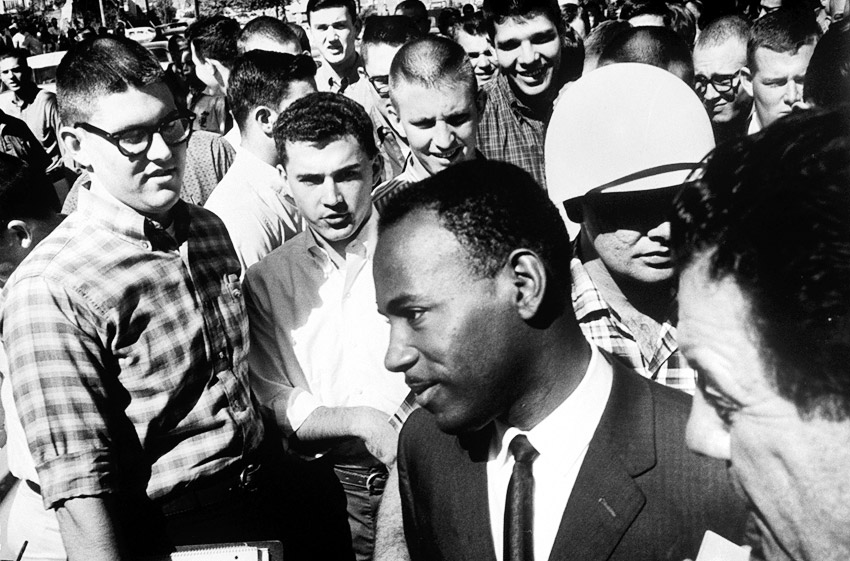 James Meredith integrates the University of Mississippi under armed guard
Every time activists or lawmakers threatened dismantling segregation, racist stakeholders in that apartheid system reacted violently. In 1964, his freshman year in college. a trio of Freedom Riders were killed. The deaths of the Mississippi Three further heightened fear.
Haynes says despite the obstacles and dangers he never despaired things wouldn’t improve. He believed in the power of education and in letting the truth shine through ignorance.
“I could see that because of my training and my teachers, who were always discussing how important it was to get an education. They embedded that into us – that education is a key for success.”
Blacks were also resourceful to find some kind of way through barriers to pursue their goals and dreams.
“We managed in spite of the opportunities denied us.”
Haynes says that as a college-bound African-American then his higher ed choices in the South were severely limited. In much of the region at that time blacks could not attend anything but historically black colleges. “When I was coming out of high school if you were black and you didn’t go to Jackson State, Alcorn, Mississippi Valley State, Rust College or one of the other private black schools, you couldn’t go.”
During the ’60s some challenged this exclusion but not without the federal government enforcing it. Even then there were serious, often ugly consequences. It would be some time before blacks were able to attend schools of their choice without incident.
Haynes was fortunate to have as a mentor a male high school biology teacher who also coached him in football.
“He was very instrumental in working with me from grade 10 on, preparing me for college. He had gone to Rust College in Holly Springs, Miss, and he was very instrumental in my attending Rust. I felt that was the opportunity for me to do the things I need to do.”
Before attending Rust, however, Haynes followed his brothers to Omaha, where the extended family put down roots during the Great Migration blacks made from the South to the North in search of a better life. Omaha’s booming meat packing plants and railroad operations drew many unskilled blacks and other minorities here.
“We had relatives here and they hooked my oldest brother, who came here in ’59. with a job. iI was a kind of networking that went on. He came here on a weekend and he went to work at the packinghouse on Monday. That started a chain of events,” says Haynes, whose other brothers followed. In 1963, Gene did, too. His brothers went to Miss. for his high school graduation and no sooner did the ceremony end then they took him back to Omaha with them.
“I left to the chagrin of my mom and dad. I was the baby and now the nest was empty. In 1964 my mother and father pulled up stakes and moved to Omaha. Mom couldn’t stand not being around her boys.”

Unlike his brothers, Gene didn’t work in the packinghouses. Instead, a relative got him on at the fancy Blackstone Hotel, with its distinctive exterior, ornate interior and popular Golden Spur and Orleans Room.
He returned to Miss. to attend Rust, majoring in social studies and economics.
“They provided me with a great education,” he says of his alma mater. The school also served as his introduction to his life partner. “I met a great lady whom I ended up marrying – my wife Annie. We graduated from Rust in 1967 and we got married in 1968.”
Haynes and his wife are the parents of one son, Jerel, and the grandparents of Caleb and Jacob.
Work-study and a scholarship put Haynes through college. He toiled in the dorms and athletic offices to pay his way in becoming his family’s first college graduate. Given the sway educators had in his life, he naturally looked at teaching as a career. Places like Omaha had a dearth of black college grads then, so OPS looked to historically black colleges for candidates. He joined other newly minted educators from the South as OPS hires, including Sam Crawford, Jim Freeman and Tom Harvey, all of whom enjoyed long careers like him.
“A large group of us that went to predominantly black schools came to Omaha to teach,” he says. “We’ve been very blessed because we have carved out a legacy that’s been great. We stuck together.”
Haynes didn’t intend staying in Omaha. When he started at OPS in 1967, at Omaha Technical High School. he came alone while Annie pursued teaching opportunities in Alabama and then Cleveland, Ohio.
“My plan was to teach here one year and go to Miami, where I also applied. I lived with my parents to save money. Forty-seven years later I’m still here and I haven’t saved any money yet,” he says, laughing.
-

Haynes with one of his Omaha Tech High basketball squads
After that first year in Omaha he went to Cleveland to court Annie.
“I convinced her Omaha was the place she needed to be.”
She got a job teaching 3rd grade at Lothrop Elementary. Annie ended up teaching 37-plus years in the district.
Haynes, who earned a master’s degree in education, administration supervision from the University of Nebraska at Omaha in 1974, taught and coached at Tech until the school closed in 1984. The massive Tech building is now the OPS headquarters, He was an assistant football coach when future University of Nebraska All-American and Heisman Trophy-winner Johnny Rodgers played for the school. During his tenure at Tech Haynes became the state’s first black head basketball coach. Breaking that new ground meant dealing with some racist coaches, officials and fans.
“With a predominantly black team we had some skewed eyes looking at us. I had to tell the kids, ‘You have to play above that because let’s face it if it’s close, you can forget it,'” says Haynes, referring to blatantly bad calls that went against his team and other minority-laden teams then at Omaha Central and Omaha South.
“I told the kids, ‘You have to be twice as good as your competition.’ And so we tried to prepare them for that.”
He says he instilled in his players the philosophy – “You give it your best. Winning is not everything, but a sincere effort is.” He says he still believes that today. “It’s not about wins and losses it’s about the success of the young people at the end of their high school term.”
He has fond memories of his time at Tech.
“I can think about so many young people I was fortunate enough to work with.”
One of those is Thomas Warren Sr., who became Omaha Police chief and is now president-CEO of the Urban League of Nebraska. Warren played basketball for Haynes and remembers his old coach as “a strict disciplinarian who had the respect of his players” because he went the extra mile for them. He sees Haynes doing the same thing today.
“For many of his players he was responsible for facilitating scholarship opportunities. For me individually, he drove me to Sioux City, Iowa in his personal vehicle for my recruitment visit to Morningside College, where I eventually attended. I have watched him spend countless hours serving the students of Omaha North High School and our community. He has been an advocate for at-risk students and I have never seen him give up on a kid. I consider Gene Haynes a friend, mentor and role model and I will always refer to him as ‘Coach.'”
Other students Haynes molded became entrepreneurs, lawyers and professionals in one field or another. He finds it ironic many of them are now retired while he’s still working.
“Doesn’t seem right,” he says, smiling.
He says “the passion the staff developed caring about individual students made all the difference in the world” at Tech “and that’s what I’ve attempted to do and incorporate here at North.” He and his staff work to create an environment where students “feel they can come and talk to us about their concerns and we’ll address the situation.”
When Tech closed Haynes became assistant principal and athletic director at McMillan Magnet School for a year before joining the North High staff in 1987. At North he served as assistant principal and athletic director for 14 years until assuming the principal post in 2001.
Since taking over at North, whose 4410 North 36th Street campus borders some of Omaha’s highest crime areas, he’s credited with leading a turnaround there. But he says the transformation began under predecessor Tom Harvey, who changed the school’s image. Starting in the 1980s North’s once proud reputation suffered under the strain of urban pressures that saw school dropouts and disruptive behaviors rise, along with test scores decline. Haynes says Harvey began the process of turning this wasteland into an oasis of success.
“Tom Harvey was a driving force behind the resurrection of North.”
|
|||||


The impoverished neighborhoods around North had fallen into a mire of drugs, gangs, violence, vacant homes and hopelessness but have rebounded with help from community building organizations like Abide.
North’s leaders, Haynes says, made a conscious effort to make the school an anchor and resource in a community hungering for something it could be proud of and call its own.
“Tom Harvey invited the alums and the Vikings of Distinction to turn North High School around. They talked about what would it take to change the perception. There used to be a fence around the place.
When you saw that fence you thought about the prison mentality and we had to change that. The fence came down and there was a trust factor then within the community that North is the place to be.”
Haynes has continued to enhance North’s community engagement.
“North High School is a key component of this community. We have opened up North for community events and activities. We found that when people in the community feel they are part of something your vandalism goes down. They feel they have ownership in this. The second Saturday of the month the Empowerment Network uses our facility. Every Sunday Bridge Church holds services here.”
He says if northeast Omaha is to realize its hoped-for revival then North High and its companion schools must be actors in it.
“If it’s going to change North High School and the Omaha Public Schools are going to be key players in turning things around. Right now I see we’re moving in the right direction.”
Haynes welcomes community partners.
John Backus, pastor of Trinity Lutheran Church in North Omaha, says, “When we approached him about ways to be helpful in his school he was ready with ideas, answers and the sort of willing spirit that accomplishes things. Gene Haynes is a capable leader and intensely interested in the well-being of his students.”
Perhaps the biggest sea change for North came when it was made a magnet center for STEM – science, technology, engineering and math.
“Haynes says, “We wanted the best and the brightest people to be a part of North High School – students and staff. We went out and brought in the best and the brightest and we will continue to do so.”

-
 North High is a blend of old and new but its STEM education is state of the art
To accommodate this influx of students and new curriculum Haynes invited the entire North community of staff, students, alums and neighbors to weigh-in on a vision for a new addition. A group of students took the initiative and drew up the initial design for what became the 34,000 square foot, multi-million dollar Haddix Center.
“When the students are active I think it’s important you allow them to have input,” says Haynes. “It took 11 years from the time we started to plan until we were able to build. That was huge. We cherish the fact the alumni association and one gentleman, George Haddix, gave up $5 million. The district bought the project and supported it. We dedicated it in 2010. This is our fifth year in that facility.”
As a magnet center North draws students from around the metro. Haynes says one third of its students come from outside its attendance area. The school’s test scores have soared and the number of academic college scholarship awarded graduates has exploded. OPS superintendent Mark Evans says, “It’s a great success story and his leadership has made a difference there not only in the classrooms but in the extracurriculars. The principal sets the tone and is the leader of that culture and Gene Haynes is one of the best examples of that. When you say North High, you think Gene Haynes – that’s how much identification there is with him there.”
Evans adds that North’s success has a ripple effect on its student body and the surrounding community. “I think it’s huge. I think it sends a message of hope that we can and will succeed. We’ve got some young people who haven’t always thought they were going to be successful but because of North High and Gene Haynes they all believe they can be successful now and they are being successful.”
Haynes feels the STEM experience students receive there is preparing them for working living wage 21st century jobs that demand tech savvy employees. He’s confident as technology becomes ever more important that North’s on the cutting edge of utilizing it in the classroom. For example, some algebra classes are entirely taught on iPads. A new Samsung Smart School Solutions pilot program invites students to use a 75-inch touch interactive display and tablets to make stock market purchases, deliver tech-driven business presentations and get hands-on learning experiences with real life business partners.
“We have the best technology persons in Rich Molettiere and Tracy Sage,” Haynes says of North’s technology coordinators. “We really appreciate what they’ve been able to do. If someone tried to take them out of North High School, it’s on.”
North’s academic progress is matched by the success of its athletic programs. Until recently the school was known for its wrestling dominance, including multiple team and individual champions and at least one Olympic hopeful, Vikings grad RaVaughn Perkins. But more recently North’s football team has been the dominant force, winning back to back Class A state titles behind superstar running back Calvin Strong, a South Dakota commit. and Husker lineman recruit Michael Decker. The 2014 Vikings finished 13-0 and are widely considered one of the top teams in Nebraska prep football history.
|
||||


-

An artist’s rendering of the proposed Omaha North stadium.
North has done all this without having a true home field to play on. Its football team plays at Northwest High’s Kinnick Stadium some four miles away. A proposal for North High to build a stadium of its own, right in the neighborhood, is being looked at. As with the earlier Haddix Center, North students did an initial design. Haynes and the school’s foundation are assessing if there’s enough support in the community for what would be a privately funded project costing millions of dollars.
“We want it be state of the art,” Haynes says.
He believes the stadium would be another “bright light for this community” and he says the facility would be available for use by nearby Skinner Magnet School and the Butler Gast YMCA.
Haynes keeps long hours at North, whose doors hardly ever seem to close for all the activity there. He says he goes home satisfied when “I see the kids leaving school with a smile on their face and a pat on the back from the principal and they acknowledge it.” He adds, “I have a post I go to at dismissal that borders the neighborhood. From my perch I can see kids coming and going and if anything’s going to happen from the outside that’s where it’s going to come from. The kids know that and I know that. That’s why I choose to go out there. As the kids walk by I acknowledge them and give them encouragement. That’s what I consider a most gratifying day.
“I try not take anything from school home, and vice versa.”
As for how much longer he’ll be doing this, he’s promised the class of 2017 he’ll walk with them at their graduation.
“That’s the plan – if my health stays good.”
That would make 50 years at OPS.
He won’t have any say in his successor but he and others will be keeping a close eye to make sure this sweet ride continues.
“I feel whoever comes in is going to do the right thing, and if not it’ll be a short tenure.”
Whoever follows him will have big shoes to fill. A measure of the high esteem he’s held in is the street named after him right outside the school. At the dedication for it last summer and on social media people offered tributes, calling him “humble, genuine, dedicated, a role model – commands true respect.” A grateful Haynes takes it all in stride, saying, “The Omaha community has been very gracious to me and my family and now I have to live up to it.”
Change Agent: Mark Evans leads OPS on bold new course full of changes in his first year as Omaha Public Schools’ superintendent
The Omaha Public Schools District deals with the diversity, needs, and challenges that any large urban school distrect does but it has had more than its share of infighting, controversy, and push back in recent years, much of it revolving around an administration deemed distant and unresponsive. As the following profile of new OPS Superintendnet Mark Evans indicates, there’s a new approach at the top, starting with him, as he has ushered in sweeping changes, much of them having to do with the district being more transparent and inclusive. This change agent has led the development of a new strategic plan among many other transformative actions. My piece is now appearing in The Reader (www.thereader.com).

Mark Evans, ©ketv.com
Change Agent: Mark Evans leads OPS on bold new course full of changes in his first year as Omaha Public Schools’ superintendent
©by Leo Adam Biga
Now appearing in The Reader (www.thereader.com)
When Mark Evans accepted the job of Omaha Public Schools superintendent in December 2012, he knew the mission would be immense in this sprawling urban district facing myriad challenges.
With 51,000 students spread out over 86 schools located in divergent environments ranging from inner city poverty to suburban affluence, the district responds to a wide spectrum of needs and issues. In his due diligence before starting the job he found the district’s good work often overshadowed by controversy and conflict due to an embattled school board and an aloof administration and no clear, unified vision.
Besides struggling to close the achievement gap of its majority minority student population, many of whom attend overcrowded, poorly resourced schools, the district reeled from internal rancor and scandal. Longtime district head John Mackiel exited with a $1 million retirement payout many viewed as excessive. His replacement, Nancy Sebring, quit when it came to light she’d exchanged sexually explicit emails with her lover during office hours at her previous employer. The often divisive OPS Board of Education and its handling of the matter drew sharp criticism that resulted in its president’s resignation. The perception was of deep rifts among OPS leaders who spent more time putting out fires than making systemic changes,
District elections turned over an almost entirely new board when Evans, who came to OPS from Kan,, officially started in 2013. The board has navigated a flood of changes that Evans has introduced in fulfilling a promise to shake things up and to address identified weaknesses in Neb.’s largest school district.
One of his first orders of business was conducting a needs assessment that sought broad community input. Feedback from parents, teachers, administrators and stakeholders shaped a new strategic plan for the district. The plan outlines strategies for better communication, more transparency and accountability, closer alignment of goals and greater classroom rigor. He reorganized district staff and created new positions in response to an expressed need for better support of schools. He’s overseen a new student assignment plan, a new hiring policy and a facilities wish-list for $630 million in upgrades.

Evans wants to stem the tide of students OPS loses to other districts, saying that’s difficult “if you don’t have room for them and many of our schools are just packed to the gills.” He adds, “You can’t compete with other districts unless you have facilities of similar caliber and we’re a real inequitable district today. About half our schools are beautiful facilities. The other half there’s a whole list of things that need to be worked on.” The facilities plan may go before voters as a bond issue.
He compares the task of changing the district’s direction to turning around an aircraft carrier at sea. As captain, he plots the course but he relies on a vast team to implement the necessary maneuvers. Evans began the turnaround even before he started.
“I didn’t start officially until July 1 but once I accepted the job I started visiting, collecting information, studying, so that when I did walk in the door I didn’t walk in cold. I walked in running because I’d already met staff and community. I’d purposely reached out. I had a very clearly laid out entry plan that described the things we were going to do.
“You have to have a real clear plan of how you’re going to implement this kind of stuff or you’re going to get lost and lose the prioritization. You’ve still got to do what you’ve been doing but do it better while doing these major lifts. So a lot of it has to do with prioritization and focus. A lot of it has to do with 60-plus hour work weeks.”

©omaha.com
Evans likes what he sees on the horizon now that OPS has aligned goals at every level.
“We’ve not had a clearly defined destination until today. What you had was some schools saying, ‘This is my destination, this is what I think is most urgent,’ and they just kind of did it on their own. The difference today is we’ve got clear alignment and we’re creating a system that creates support and accountability throughout. Everyone’s success is contingent upon someone else’s success.
“Accountability is now built in because it’s on paper, it’s in writing:
Here’s your goal for graduation rate, here’s your goal for NESA scores, here’s your goal for the achievement gap…”
He says strategies are being honed “to create that same level of accountability” at all 86 schools and in every classroom.
“That’s the whole restructure piece we created. Principals told us, ‘We want more help in our schools,’ so we shut down a department in the district office and put 30 people out in schools. Then we created four executive directors of school support positions. Each is directly responsible for 21 schools. We spent all summer training them. They’re former star principals who serve at the cabinet level with me and top level staff. They look at the alignment of the big picture goals to the school improvement plan and help principals improve that. Everyone is working towards the same goals.”
He says until the strategic plan there wasn’t a coherent, clearly expressed vision “of where we’re at, where we’re going and how we’re trying to get there,” adding, “I think what I feel best about is we’ve created more transparency and communication from the get go because we asked people what are the strengths and needs of our district. We did forums, we did surveys, we used different tools on our website. That was the start of our saying, ‘We’re going to ask you first and then we’re going to use what you tell us to help us see our critical needs.’ To be honest, I already knew we had critical needs but it can’t be my plan, it’s gotta be our plan, it can’t be my thoughts, it has to be our thoughts, and the truth is most of where we ended up at I would have ended up at, too.”
Engaging people in the process, he says, “is much more powerful” and staff take more ownership for “achieving specific targets.” The changes have been welcomed by some and met with push-back by others. He jokingly says response is “somewhere between embrace and fisticuffs.”
He’s well aware steering this unwieldy district in a new direction will take time given its sheer size.
“You just have to know it’s a big journey.”
He left a good thing at the Andover (Kan.) school district to make this journey.
“I had a great job, we were making progress and nationally recognized. I’d been there eight years and I could have finished my career there fairly easily.”

He declined OPS overtures before throwing his hat in the ring.
“I knew what it was going to take to do something like this, so I said no twice. The third time they asked me to call some people I knew up here and I did and I heard positive things from them. They said to look beyond the headlines because the headlines had been pretty devastating. In my initial research I saw a mess beyond repair but the further I looked, and I still feel this way a year later, the mess has been at the 10,000 foot level – with the superintendent and the board. It’s about getting rid of the noise and distraction and chaos there.
“It wasn’t easy moving but at the end of the day I thought I could make a difference here. I know how to systemically build schools. Everywhere I’ve gone we’ve been able to have progress with kids because I understand how to bring a system together and to build teams and create collaborative decision makers.”
Making it easier for him to take the plunge was the community support he found here he didn’t find in Wichita, Kan., where he spent 20 years working in that city’s largest public school district.
“I’d spent most of my career in Wichita in a very similar setting – from the size of the schools to the number of employees to the demographics of the kids. But there is one significant difference and this is part of the reason I said yes – the community here is more supportive than Wichita is. This community still cares. People want OPS to be successful. There’s philanthropic support. There’s several foundations and individuals that care about OPS.”
Along with the deep pockets of the Sherwood and Lozier Foundations, OPS has relationships with mentoring initiatives like Building Bright Futures, Partnership 4 Kids and Teammates. Recognizing that many of its students live in poverty and test below grade level, the district partners with organizations on pre-K programs in an effort to get more at-risk children ready for school. New early childhood centers modeled after Educare are in the works with the Buffett Early Childhood Fund and the Buffett Early Childhood Institute.
Evans champions community-driven endeavors aimed at improving student achievement and supporting schools because no district can do it alone, especially one as large and diverse as OPS.
“Not only is it a big district, which creates some challenges, we have more and more free and reduced (lunch) students who qualify for the federal poverty line and we know that brings with it some extra challenges which is why we need community support. We have an increasing number of English as Second Language learners because we have a growing number of refugee families. These young people not only have language barriers but huge cultural barriers.
“We also have more young people coming to us with life challenges and neighborhood issues. Partnering with community groups makes a big difference with those extra challenges. What we’re trying to do in many situations is fill in gaps. Organizations are critical because we’re filling in more gaps than we have before.”

©omaha.com
Those gaps extend to resources, such as high speed Internet access. Some kids have it at home and school, others don’t because their parents and schools can’t afford it.
He says the efficiencies possible in a corporate, cookie-cutter world don’t fit public schools because no two suppliers, i.e. parents, and no two products, i.e. students, present the same specs.
“We take whoever walks in the door and wherever they’re at is where we take them, whether they have special needs, language arts deficiencies or advanced skill sets. So school A and school B might look different, in fact they’ll inherently look different even though the summative assessments are still going to look the same with standardized testing and those kinds of things. We do have these summative tools that tell us something about whether a school is progressing or not.
“On the other hand, school A may be quite a bit different than school B because school A has 20 percent refugees with some very specific skill gaps and so how we support them and the grade level assessments tied to that curriculum are going to be a little different than school B which has no refugees, no ELA-ELL (English Language Acquisition-English Language Learner) students. Students in school B are prepared and ready for something much different than what students at school A are prepared and ready for. And so we demand that each school and each staff differentiates based on the needs of the young people. You do formative tests to get those early indicators of where are the skill gaps and how are we going to bridge those skill gaps.”
Differences aside, the same overarching goal apply to all schools.
“No matter where they’re at, what you’re looking for is progress in both groups. It’s gotta be about growth and progress, wherever they came from, whether from a refugee camp or a single-parent family or a household where both parents are college graduates. The day they walk out they’ve gotta be better than the day they walked in.”
Closing the achievement gap, he says, “is not just resources,” adding, “There’s a lot of things we can do with existing resources – that’s what we’re trying to do with alignment. For example, if we know of a specific strategy to improve math or language arts skills for kids below level why wouldn’t we train all our staff in that methodology for all our schools? We’d never done that. Instead, school A and school B would pick out whatever strategy they wanted. Some would buy a compute-based piece and some would do a tutorial piece at the Teacher Administration Center.
“There was no collaborative where educators said, ‘Which one has the highest return on impacting those skills?’ That just doesn’t make any sense. So now we’re attempting to scale those things. Part of it is getting out of our silos and scaling the quality and part of it is helping people develop the skill sets to know how to implement that, because not everybody knows.”
Pam Cohn (Secondary) 

Melissa Comine (Elementary)
Dwayne Chism (Elementary) Lisa Utterback, Elementary


His executive directors of school support, including Lisa Uttterback, were principals at high performing schools. Evans has charged them with helping principals adopt best practices at their own schools.
“Lisa had great success in a high needs school (Miller Park). The test scores look good, there’s community partnerships and parent involvement. Kids are walking out the door with pride, ready for middle school. I took grief for taking her out of there but my thinking is she can have more impact by scaling her capacities to 21 schools. I need her to develop her skill sets to these principals she supports and I need the other EDs to do that with the leaders they support.
“The whole concept is to find where it’s working and make decisions collaboratively on best practices and then support the implementation. It doesn’t happen overnight. It didn’t happen overnight at Miller Park, but it did happen. So what happened? Well, you had good leadership. She (Utterback) figured out strategies that work.”
Other principals have done the same thing.
“We’ve got islands of excellence, we’ve got schools doing wonderful things, but then you’ve got other schools that for whatever reasons need more supports and until now there really wasn’t a methodology to try to recognize it and to provide that support.”
To achieve the greater classroom rigor district-wide the strategic plan calls for he says OPS is enhancing efforts started before he came to “retrain teachers on baseline skill sets for instructional practice.” He acknowledges “these are things they should have probably had in college but for whatever reason didn’t.”
In addition to raising performance, there’s a push to keep kids in school.
“In our district right now were at 77.8 percent graduation rate, which by the way is pretty high for an urban setting. But the truth is we’ve got to be higher than that, we’ve got to be over 80 and be moving toward 90, because if they don’t have a high school diploma today the research abundantly shows the opportunities in life are slim.
“Were trying to move 13 percentage points over the next five years,
which doesn’t sound like a big deal but it kind of is a big deal.”
Moving forward, he feels good about the school board he answers to.
“I would say our relationship’s good. They’ve had an enormous learning curve. I think their hearts are really good. I think they’re still struggling with the learning curve – heck, I am. They’re trying to wrap their arms around big stuff, I mean, we’re talking big numbers here – a $600 million facilities plan. We’re talking big information – a strategic plan, a student assignment plan, a new hiring policy. I think they’ve done amazing for the amount of time they’ve had to try to capture this.”

He says minus drama and acrimony at the top, OPS can thrive.
“We have great schools doing really good things. I thought and I still think if we could get rid of that noise and distraction and have an aligned, coherent system we may have one of the only opportunities in America where a community still values urban education, and they do here. There are very few communities like this.”
He feels good, too, about he and the board having come in together to provide a restart for the district.
“I think this community wanted and desired a feeling of a fresh start. I think people feel like they are seeing something different today than what they saw the last five years. I know we are doing things different because OPS hadn’t done a strategic plan in 10 years, they hadn’t done a bond issue in 15 years, they haven’t done a student assignment plan in many years, they hadn’t done a reorganization with a focus of supporting schools.”
Evans likes where his ship of a district is headed.
“We’ve got the pieces in place to get it lined up. We’re already doing partnerships, we’re developing better classroom practices, we’re developing leadership for the schools and aligning them to very specific, collaboratively agreed upon goals. If we can pass this facilities plan we can give kids high speed internet access and safer, more secure environments.
“Without those kinds of pieces the ship’s going to go on the wrong course.”
Partnership 4 Kids – Building Bridges and Breaking Barriers
Omaha Metro Magazine asked me to write a special multi-page insert for its June 2014 issue all about a local nonprofit. Parternship 4 Kids, and its mission to give at-risk youth a pathway to educational success from Kindergarten through college. Here are the stories.

BREAKING BARRIERS AND BUILDING BRIDGES
Transforming Communities…Fostering Life Beyond Limits
©by Leo Adam Biga
Now appearing in Metro Magazine
Giving at-risk youth hope and a pathway to success is the core mission of the goal-setting and mentoring collaborative known as Partnership 4 Kids. Serving more than 4,700 K-9 students in 22 schools with the help of 400-plus volunteers, P4K sprang out of two small adopt-a-school programs initiated by Omaha entrepreneurs.
In 1989, local busInessman and philanthropIst Michael Yanney launched All Our Kids at then-McMIllan JunIor High School as away to capture and support the lost youth he saw beIng left behInd In North Omaha. He formed a contract with 20 at-risk youth that had high potential but displayed low achievement and he promised them a post-secondary education if they met a set of expectations. Volunteer mentors were assigned to each student to guide their progress. Mike and his wife Gail became personal mentors to several students. Over the next two decades the program expanded into more schools and touched the lives of more young people, many of whom have realized the dream of a college education and a career.
Business owners Jerry and Cookie Hoberman wanted to give back to the North Omaha community that patronized their firm and in 1996 they put in place an idea called Winners Circle at then-Belvedere Elementary School. At the time North Omaha public schools were lagging far behind in student achievement. Borrowing from the incentives-based program for employees used at the couple’s business, Winners Circle introduced motivational tools to help students set and achieve academic and citizenship goals. Adult volunteers called Goal Buddies encouraged students to succeed. Quarterly celebrations recognized student success. As student achievement rose, the program moved into additional schools.
Joining forces for greater collective impact, in 2007 All Our Kids and Winners Circle merged to create Partnership 4 Kids. By combining resources to provide support from early childhood through college, these efforts can now make a greater impact on participants.
“If you can make the difference in those kids where they start to believe they can succeed, you’re starting to make a huge indentation in the problems we have here in Omaha,”says P4K President Deb Denbeck. “That’s why we’re so passionate about what we do and that’s why we’re looking for more help. We have the groundwork set at the very time kids enter school and then it’s a continuum from Kindergarten through careers that we work with them.”
It’s about breaking generational poverty, which tends to persist with a lack of education.
“Education is at the core of everything we do with youth, but it is the relationship building and providing positive role models in their lives that makes the real difference,” Denbeck says.
Caring adult volunteers remain central to the P4K approach, whether as Goal Buddies, Group Mentors or Navigators.
“Sometimes parents need help. We have parents working three jobs just to keep food on the table and a roof over their heads. Over 90 percent of our kids qualify for free and reduced lunch – the indicator of living at or below the federal poverty level. We have kids come through our program who are the first ones in their family to graduate high school, let alone college. That’s pretty startling.”
Gail Yanney says, “Today, young people have so much more to contend with. That’s where the mentor comes in. They have to have an adult that’s been there, that has common sense, that can perhaps guide them through these perilous waters. Youth are subject to all kinds of bad influences and we’d like to instill some good influences and give them an opportunity to see themselves as successes. Studies show that one meaningful person in a child’s life is the difference.”
Omaha Public Schools Superintendent Mark Evans says a mentor can be the difference between a child being hopeless and hopeful.
“If you start to believe you’re not going to get opportunities then you’re more apt to skip school, to have disciplinary problems, maybe even dropout,” he says, “but if you believe there’s hope and that light at the end of tunnel is close enough, you say, ‘I can do this, I can get through this and have opportunities.’ Partnership 4 Kids brings that positive adult in to bring that light at the end of the tunnel a little closer to students, where there’s a belief or hope that they can succeed.”
My son’s an honor roll student and he’s already looking at colleges around the country. I love the fact I have taught him the power of education. ~ MONIQUE CRIBBS

Monique Cribbs
Success story
P4K Alum Monique Cribbs enjoying education-career success
P4K has many alums whose educational achievements and success illustrate the value of having mentors in their lives.
Monique Cribbs was a senior at Omaha North High with a strong desire to fulfill her and her parents’ dreams of going onto college but she didn’t see a way she could afford school, at least not right away. Then a classmate in All Our Kids introduced her to Mike Yanney and that meeting led to him telling her he saw great potential in her and promising he would pay for her college education. When her life took some unexpected turns in college and presented her with some hard challenges, such as becoming a young single mom, her grades suffered and she strongly considered leaving school. But enough caring people in her life encouraged her to carry on. One of those caring people was Mike Yanney.
“I view Mike as a father figure, a very caring, wise person,” Cribbs says. “I remember going to his house and just crying. I told him I thought I would be dropped from the program. He said, ‘No matter what you do, we support you. Monique, the scholarship will never leave you, we’re here for you.’ and that meant so much to me. I had my son in 1999 and went right back to school.”
She followed her bachelor’s degree in interpersonal communication from UNO with a master’s in human relations from Bellevue University and is now pursuing a doctorate in educational leadership and higher education from the University of Nebraska-Lincoln. After stints at the Omaha Home for Boys and Bellevue University she served as Trio Coordinator at Creighton University. Today, she’s Career Services Coordinator at Metropolitan Community College, where she’s also an adjunct instructor.
“There are days when it’s really hard for me, where I’m really overwhelmed and stressed out,” Cribbs says, “but I know when I walk across the stage this next time it will have all been worth it. Now the sky is the limit, there is nothing I cannot do and one day I would like to be a vice president or a president of a college.”
Today she’s doing for current students what was done for her.
“It’s always good to have that advocate in your life to be able to talk about all sorts of things. I always want to have the ability to have contact with students but have the power to make change in institutions. I feel I’m in my training ground right now.”
She’s grateful for what P4K and the mentors she met provided her and continue to provide her 20 years later.
“I’m so appreciative of the opportunities I’ve been given. These people truly are in your life, they truly care for you, and they’re also honest with you as well. It’s important to have someone to tell you, ‘You’re messing up right now,’ or, ‘You’re not making wise decisions but I know you have to live your life.’ As a mentee it’s critical you listen and also realize you do have to go through life making your own decisions while at the same time finding that balance between what your mentors are saying to you and what you want to do. That takes time.
“I think it’s amazing I met Mike (Yanney) when I was 17 and I turn 37 in May, and he’s still there and we still talk. I also still stay in contact with former All Our Kids President Julie Hefflinger. I think that means a lot because it went from being a mentoring relationship to being a friendship. I want them in my life. I appreciate them.”
Denbeck says the journey Cribbs has taken is one of “many compelling stories of people who have been in our program, graduated and are now very successful.” She says Cribbs epitomizes what happens when mentors enter a young person’s life and help pull them forward.
Denbeck says Cribbs does everything she can to give back to the program she credits with giving her so much.
“Monique spoke at last year’s Senior Banquet. Her message was,‘ It’s going to be hard, life isn’t always fair or easy, but don’t ever give up.’”
Indeed, Cribbs, who “was very honored to be the keynote speaker,” says, “I spoke from my heart about the power of education and my experiences in the program and in my life. I told the truth, saying not everyone in this room will make it through college but at the same time you all have people who are here to support you and you have to align yourself with those who want to see you do well.”
Her son Cayden participated in P4K as a 7th and 8th grader, one of several youth following in the footsteps of their parents in the program, and he’s preparing to enter Elkhorn Mount Michael in the fall.
“My son’s an honor roll student and he’s already looking at colleges around the country. I love the fact I have taught him the power of education and that his job is to go to school and do well and my job is to support him and be the role model of continuing my education so he can’t say to me, ‘Mom, I can’t do it,’ because I can say, ‘Baby, you can, because I did. There’s nothing you can’t do because I’m doing it.’“

Mike and Gail Yanney
A helping hand
When it comes to mentors, the biggest thing is showing up.
“Being a good mentor is about being there,” Denbeck says. “When you’re there consistently kids begin to get the sense that you care about them. That consistency is huge because some of these kids have had adults come and go in their lives all the time. The best thing a mentor can do is to care and to be consistent. Kids just want to know that you’ve got their back.
“When that happens as our Program Coordinators can tell you, you see better behavior and better grades because their mentors help them create hope that there’s a brighter future.”
At each participating school a paid P4K Program Coordinator serves as liaison, facilitator and resource for the school staff and volunteers.
“Our Program Coordinators are embedded more and more in the schools,” Denbeck notes. “That means they’re also doing some intensive case management with kids who need it the most. Our kids see our Program Coordinators at school every day. If we’re going to build relationships the more people see you the more they trust you.”
In some ways mentoring is as simple as giving students guideposts to follow and work towards.
“People growing up in poverty and facing very difficult situations really need a lot of help and it isn’t money they need, they need opportunities, they need people to put their arm around them and encourage them and motivate them,” Mike Yanney says. “It’s about instilling hope and there’s every reason to have hope because in this great nation there are all kinds of jobs available, even today, but young people have to be educated to do those jobs.”
All of P4K’s work is done in step with its biggest partner, the Omaha Public Schools, whose students the program exclusively serves. Therefore P4K’s goals mirror OPS goals.
“As a school-based mentoring program we reinforce what the schools are doing,” Denbeck says. “We work in partnership with Omaha Public Schools and we’re a support group that’s giving these kids in-school and after-school support. We work with every kid in 12 elementary schools through our goal setting program and from there students are selected to go into our after-school group mentoring program in middle and high school. The carrot at the end is that we provide a college scholarship.
“We do whatever we can to be a good partner with the schools helping these young people and schools be successful. They have to believe in what we do and we have to bring something of value to the table. Having volunteers in your school is very healthy. It’s that co-connection of community and school.”
OPS head Mark Evans likes that P4K is in sync with his district.
“They are aligning student goals to school goals and district goals, which is really what we’re about right now with our whole strategic planning process,” he says.“We see Partnership 4 Kids aligning to what we’re trying to achieve, whether it’s NESA goals, attendance goals, graduation goals. This is just a great resource to help us see that alignment and keep that focus and to have a community member there helping our young people create those goals.”
Miller Park Elementary School Principal Lisa Utterback, whose school has seen academic achievement dramatically rise during her tenure and P4K’s immersion there, also likes that “the P4K program aligns strategically to what we’re doing,” adding,“We receive support from the Goal Buddies, the Program Coordinator and the P4K program by their presence in the building and their having positive communication with our students and encouraging them to stay the course.”
Similarly, Field Club Elementary School Principal Barb Wild has seen increased student achievement at her school. She says P4K “is a part of that because it’s part of our school culture,” adding,“ It’s integrated into what we’re doing with the acuity data and the state testing. It all connects. It’s not some vague just be good or just do better, it’s a very specific, laid-out thing students can attach to and take ownership of.”
Denbeck says,“We start early focusing on goal setting in math, reading and life skills. Those are real indicators of educational success and life success. The skill of goal setting directly correlates to education. It’s really important kids learn how to do this and the teachers are the ones developing those goals with the kids.”

Deb Debeck
P4K makes a big deal of students meeting goals at quarterly celebrations in the schools.
“The celebration each quarter is a culmination of their success,” Denbeck says. “They get to come up to the stage to get a medal and shake hands with the Goal Buddies. They’re recognized in front of the entire school. It’s really a school- wide celebration of the achievement of students. It’s directly related to creating that hope that there’s a brighter future.”
Evans applauds P4K for recognizing student achievement.
“I think the power of that is not that students are just getting an ‘attaboy’ or ‘attagirl’ but that it’s related to an accomplishment,” he says.“Giving support to young people, letting them know we care and celebrating their success is fine but the research says you need something worth celebrating – meeting a goal of some kind – and that’s where the core piece is. They’re tying it into recognition of an accomplishment. That’s when I think it really has value. The things you value most are the things you work hard for.”
The amount of people we touch and the lives we change and the results we have seen are pretty phenomenal. ~ DEB DENBECK, P4K PRESIDENT
Building blocks
P4K starts early getting kids to think about careers and college.
“In 5th grade we conduct career tours as part of career exploration,” says Denbeck. “We want kids to see all the different career options available. These trips are made possible through our partner corporations and sponsors. Our middle school program prepares kids for strengths-based leadership. Every one of our kids goes through the Strengths Quest program at Gallup to find out what their strengths are. Kids learn moral courage – how to stand up to bullying. They learn all those things that help build character and help in making good decisions. They learn financial vitality, they learn how to write a business plan and to sell a product. They learn both business skills and personal skills. We also begin taking our middle school students on several college visits. We want them to see college as a reality.”
Denbeck says one of the biggest indicators of whether a student will drop out of school is their experience in middle school.
“It’s a very changing and defining time in a young person’s life – physically, mentally, emotionally, socially. It’s that whole adolescent change. In our program we address specific issues and lessons in various areas that will help these kids have the skills to succeed and transition to high school. Then, when they get to 9th grade we really talk about what they need to do to graduate. We put a plan together of how they can succeed through high school. As our kids go into their freshman year we call our volunteer mentors, Navigators. They work with groups on those skills students need to succeed in high school. Students look more seriously at career exploration and shadow mentors at their workplaces. We’re always putting careers and college in front of them.”
Navigators meet with the same large group of 9th graders twice a month after school in a classroom setting and at least once per month outside of school.
“It takes some skill to get kids to trust and operate in a group setting,” Denbeck says.“ There’s always time set aside for mentor-mentee relationship building and conversation, which is combined in tandem with a structured curriculum. Outings are reflective of what’s taught in the classroom. We also have a lot of fun group activities. We try to broaden their cultural experience because some don’t get those opportunities very often.”
Although P4K programming strives to provide a comprehensive pathway to success for students room is also made for community collaboration.
“We use these other resources to help students get up that ladder,” Denbeck explains. “As a nonprofit you cannot be everything to every single person, so a year ago our board of directors asked two specific questions: ‘Who needs us the most?’ and‘ Where can we make the biggest impact?’ So we redesigned our program to be a K-9 program. Why K-9? That gets you through the two biggest hurdles a young person goes through – from elementary to middle school and from middle school to high school. Those big transition years are so key.”
P4K’s added formal partnerships with College Possible Avenue Scholars and Teammates to aid in preparing students’ individual plans for life beyond high school and completing the continuum of care.
Even as students move on into college P4K remains in their lives because of the scholarships they receive from the organization. P4K continues to be an ongoing resource to help keep students on track.
“We’re now working on establishing college campus groups to provide peer-to-peer mentoring,” Denbeck says.
P4K also has informal partnerships with many other youth serving organizations, such as the Trio programs, Upward Bound and Urban League of Nebraska to give students more options for finding the right niche for where they’re at and what they need.
High school students are given college access support via act preparation, admissions application ins and outs, financial aid resources and scholarship opportunities.Sstudents are offered workshops in various professions, job readiness seminars and summer internship opportunities.

A proven model
Every student’s path to success includes someone who helped them along the way and Denbeck says she’s proud to lead a program with a 25-year history of helping kids follow their dreams.
“The amount of people we touch, the lives we change and the results we have are pretty phenomenal. Knowing that we graduate 100 percent of kids with 90 percent going on to college and seven of our schools exceeding standards in reading and math tells us we’re doing a lot of things right.
“We’ve grown and we want to continue to grow.”
More donors and volunteers are needed to implement that growth. Denbeck hopes that as more people volunteer with P4K and as more organizations partner with it the added support will follow.
Volunteer coordinator Tracy Wells says the majority of P4K Goal Buddies and Group Mentors come from the corporate community and many return year after year.
“I think the glue that keeps people coming back is that they feel like they’re making a difference and they are connecting to the relationships they build with youth.”
Earl Redrick, a Group Mentor for four youth at Norris Middle School, says, “It is about relationships and having impact on the lives of young folks. Having a mentor, whether both parents are in the home or not, is proven to have some remarkable and positive results on the development of kids.” He knows from personal experience the difference mentoring makes because of the direction he received as a youth at youth serving organizations in his native San Antonio, Texas.
An employee with the Omaha office of the U.S. Department of Housing and Urban Development, Redrick says he goes the extra mile with his mentees, including regular Saturday outings, “because I know the rewards these guys get will go a long ways in life.”
Wells says P4K could always use more volunteers from the professional ranks like Redrick. She’d also like to recruit more retirees like Patti Quinn-McGovern, who began as a Goal Buddy at Field C lub Elementary School while employed at Omaha Public Power District and she and two fellow OPPD retirees have kept right on volunteering.
“Being a mentor is very fulfilling and rewarding,” says Quinn-McGovern. “I can just be standing here and children will come up and give me some hugs. Who can turn that away?”
It was important having her in my life because my school wasn’t the best environment all the time and I kind of needed an extra push. ~ BRITTANY GOSSETT
Brittany Gossett
While a 7th grade student at McMIllan MIddle School BrIttany Gossett couldn’t escape a school counselor who wanted her to apply to one of the two forerunner programs that merged to form PartnershIp 4 KIds. Seemingly every time the counselor saw Gossett she was championing the mentoring and scholarship resources of All Our Kids (AOK) as a not-to-be-missed opportunity. Gossett didn’t know what to make of it all, little knowing the program would propel her on a path of success.
“She kept pestering me, ‘Did you fill out the application?’ Finally, I filled it out and the program’s been one of the best experiences I’ve had,” says Gossett, now 24. She learned a valuable lesson about seizing opportunities when they’re presented.
Today, Gossett, who with the guidance of a personal mentor went on to graduate from Omaha Central High School and the University of Nebraska-Lincoln, is employed by one of Partnership 4 Kids’ newest collaborators, College Possible. The mission of College Possible is to get students to college by helping them navigate admission, financial aid and scholarship applications. Once students make it there the organization assigns them a coach to support them through the post-secondary experience, on through graduation and into their career. Gossett conducts workshops for middle and high school students to encourage them to start thinking about and preparing for college. She sees her work as a way of giving back for what others did for her.
“I had a mentor in Marsha Marron. She met me when I was in 8th grade at Monroe Middle School and she stuck with me all through high school and college. She did a lot of things with me. We went out to eat. Every year she would let me go school shopping for supplies. She brought me gifts at Christmas. Most of all, she encouraged me. We would talk most every Monday. We do stay in touch even now. It was important having her in my life because my school wasn’t the best environment all the time and I kind of needed an extra push. When people around you are behaving badly you can get sucked into it and I needed somebody to give me guidance and structure and that’s what she provided. I always had my own mind but she was that extra push to say, ‘You need to stay on this path so that you can get to college and be successful in life.’ She was that extra help to give me a reason to be successful.”
In her current work Gossett plays a similar role for students starving for the same kind of encouragement and guidance she needed.
“The thing that keeps me motivated to help students is that I can relate to them. I want to help students because I know they have potential and sometimes they just need the extra push like I did. These students are very hard working but sometimes they get beat up by life. A lot of the students we work with come from homes where the parents are not supportive, where they’re talked down to. Some kids can’t even walk outside their house safely.
“You just have to give them a chance and look beyond what the situation around them is and see their heart and who they are as a person. We get to know them personally. These students sometimes just need somebody to be supportive of them and try to understand where they’re coming from. They just may need somebody to pat them on the back and say, ‘Great job.’”

When you have people in your corner who support you and encourage you even when you go through those different highs and lows they help to keep you motivated. ~ MONIQUE CRIBBS
Monique Cribbs
More than a decade earlIer, Monique Cribbs started her journey wIth the program near the end of her senIor year at North HIgh School. The only reason she came to it at all was that a classmate in the program suggested that she speak to its founder, Michael Yanney. Cribbs did and it changed her life.
“At the end of the conversation Mike said, ‘Monique, I see great potential in you and I want to help you and I will give you a full-ride scholarship to college,” Cribbs recalls. “So I became a part of the program. It was unorthodox because they were starting with kids in 5th or 6th grade and I came in at 12th grade. I had a mentor and I started doing all the same type of activities the other students were doing.
“We graduated that May and two weeks later my friend and I went to Bridge, a summer institute at UNL for promising scholars from across the state.”
The start of her college experience that fall was far from a smooth ride. She didn’t get along with her first mentor. She didn’t much like taking other people’s advice. Her grades slipped. Then after transferring from UNL to UNO, she got pregnant.
“There were a few bumps in the road. It was just a rocky time. I was young and I thought I knew everything.”
She feared she’d blown her chance. But even after those false starts and detours her education was paid for as promised. She’s gone onto great academic achievement and career success with AOK founder Mike Yanney and former director Julie Hefflinger as her mentors.
“When you have people in your corner who support you and encourage you even when you go through those different highs and lows they help to keep you motivated,” says Cribbs.
She says the power of P4K is that it puts people in your life who affirm that anything is possible.
“Having other like-minded people around you is very important because it’s very easy to say I can’t and so I won’t,” she says.
In a higher education career that has her helping students find their path in school and in life, she makes a point of using her own achievements to illustrate what perseverance and mentoring can do.
“Every time you pass a milestone it’s worth it to tell someone else about the process. It’s worth it to share your story with someone and to encourage someone to carry on as well.”
Today, Cribbs is a role model for her son Cayden, a P4K participant himself. She wants her example of being a high achieving woman of color from the inner city to inspire urban youth like her son to not be limited by stereotypes. Her desire is squarely in line with P4K’s premise that circumstances may make one’s road more challenging but they don’t have to define you or to curtail your expectations. She discovered what P4K professes is true – there are human and capital resources available to help you succeed no matter what your story.
“My son is another motivation for me,” she says. “I am a first generation college student from North Omaha and there are so many stereotypes about kids who grew up there and I always said. ‘I don’t want to be that stereotype.’ When I was pregnant I thought, I am that stereotype now, but I wanted to break out of that box and that’s why I continued to push. Yes, I am a product of North Omaha, I am a first generation college student, I have two degrees under my belt, I’m in graduate school, I have a son who’s an honor roll student who enjoys school and talks about going onto college.
“So you can break through people’s perceptions, you can do whatever it is you would like to do and there are people here to support you. You just have to continue to push.”
The guidance from these individuals is priceless. Although I am not exactly where I planned to be I have gone far in my goals and have not given up. ~ JEFF RUSSELL
Jeff Russell
Twenty-fIve years ago Jeff Russell was a student at then-McMIllan JunIor High when school counselors and staff recommended hIm as a prospect for All Our KIds. Mike Yanney launched the program there because at the time his niece served as principal at the school. The idea was to give underachieving young people the mentoring support needed to get them through school and to pay their way to college.
The way the program worked at the beginning, Russell and his fellow mentees all met one-on-one with Yanney before he matched them with employees of his company, Burlington Capital Group. At a certain point Mike and his wife Gail began mentoring select participants in what came to be informally known as Yanney’s Kids.
“I was originally paired with Gary Thompson, then Dave Vana, but ultimately I had many more throughout as everyone in the program seemed to have a helping hand,” Russell recalls.
Having a mentor, Russell says, meant having “someone we could talk to, seek homework help from, establish goals with. They helped us along our journey through school. Staying with the program meant support all the way through college. I soon started a summer job at Mr. Yanney’s house working for my next informal mentor, Ned Kaup, who showed me the ropes and prepared me to manage the place while he moved on in his life.
“I would have to say though that in the years I was with the Yanneys they were mentoring me the most to become who I am today. They promoted me as a manager of their place, which showed me the leadership skills I didn’t know I possessed. We developed a strong relationship and I was able to see they are two of the most giving people I have ever met and genuinely love and care for the people they help and surround themselves with.”
He says P4K “showed me I have options – I can achieve what I put my mind to.” The combination of a strong home life and the program he says, mitigated against the “bad influences”around him growing up. Until he came to the program he says, “I did not think I had a chance for college.” He pursued but did not finish a horticulture degree.
Russell is married with two boys and works as a nuclear security officer at the Fort Calhoun (Neb.) Nuclear Generating Station. He’s pursuing an industrial electronics degree that he plans to use in becoming an electrician with OPPD.
The Yanneys, who still regard the people they mentored as “our kids,” take great satisfaction in seeing them succeed.
“Jeff had every opportunity to fall into a crack,” says Gail Yanney, “but he was willing to listen and he tried and he essentially has now a piece of the American Dream. He has a wonderful partner, he has a good job that he can advance in, he has wonderful children.
“Monique (Cribbs) has not only a fabulous education and career but she has raised a really beautiful young man who will go on to be a productive citizen.”
Cribbs, Russell and Brittany Gossett are the P4K promise fulfilled.
“They’ve got hope and they’re going where they want to go and they’re getting themselves there,” says Gail Yanney. “I guess that’s the stuff that makes you proud. Some of them still have hills to climb but they’re climbing them.”
“We’re very proud of them,” Mike Yanney says. “They’ve really done some great work. They had some adverse situations but they’ve really risen to the top.”
Perhaps Jeff Russell sums up best what it means to have mentors in your life with, “The guidance from these individuals is priceless. Although I am not exactly where I planned to be I have gone far in my goals and have not given up.”

Miller Park Elementary
P4K volunteers help students to set goals and local schools to thrive
There’s something oddly perfect about a scene unfoldIng each quarter in the hallways at FIeld Club and MIller Park Elementary Schools. Outside the classrooms they’re assigned volunteer Goal Buddies squirm their way into school desks far too small for their adults bodies and hunch over to meet the eyes of the children they serve. One by one the students file outside the classroom into the hall to sit down and meet with their Goal Buddy. Not surprisingly, some children must be coaxed to speak while others must be urged to quiet down. A team of three Goal Buddies are assigned to each classroom. They work in tandem with teachers in encouraging students to set and meet school and district goals for reading, math and life skills. Each of these informal mentors provides another attentive, sympathetic set of eyes and ears and gives comforting hugs and words to students in need of some extra love and inspiration.
So it goes in this hallmark early education piece of Partnership 4 Kids, the Omaha nonprofit that sends the volunteers into the schools on visits designed to help kids achieve. The model’s working, too, because the schools, one in South Omaha and the other in North Omaha, are both seeing major gains in student achievement on standardized tests. The schools are among seven buildings P4K operates in that report rising student performance and the goal is to duplicate those results in the other schools where P4K’s active.
Patti Quinn-McGovern has been a Goal Buddy at Field Club for several years. She started when still employed at OPPD and she’s continued volunteering there since her retirement. OPPD is one of 29 organizations and companies that feed volunteers to the program. Where some schools have P4K volunteers from several sources, Field Club has a designated corporate sponsor in OPPD, which has more than 50 employees volunteering at the school for its 600-plus students.
“We are really fortunate to have OPPD as a partner in this collaboration with Partnership 4 Kids here,” says Field Club Principal Barb Wild. “They do an awesome job.”
Support system
Each P4K school has a Program Coordinator to serve as a bridge between the program, the volunteers and the school. At Field Club it’s Neris France. At Miller Park it’s Kris Morgan.
Wild is a fan of how P4K emphasizes the same goals as the school.
“Every student makes a reading, math and life skills goal for each quarter. We have them connect those short-term goals to lifetime goals. Achieving those short-term goals gets them steps closer to long-term goals and success beyond middle school and high school.”
At Miller Park principal Lisa Utterback says P4K “has been very consistent and on point with supporting our school’s mission of success. We’ve taken their program and aligned it to what we’re doing and it’s an added support system and incentive program for our students.” She says, “We are all about goal setting and the importance of students understanding this is what I want to attain and this is the plan to get there. We have empowered our students to own their goals and to accept responsibility for their actions. We firmly believe one of our most important goals is creating a sense of hope and empowerment in our children – that if they set their goals and work hard to accomplish their goals great things can happen. We know it’s our duty to make sure kids understand that even though we’re faced with adversity and we have obstacles in our life we can overcome anything if we set goals, work hard and stay the course. Hope is the essential ingredient in everything we do.”
Wild says each Goal Buddy plays a valuable role because they’re “one more person that that child knows cares about them and is invested in their success. There’s a little bit of accountability to the Goal Buddies, too. That student knows they’re going to meet with and talk to that Goal Buddy about the progress they’re making or not making in that goal and the Goal Buddy is going to talk in a very loving, nurturing, caring way about being accountable to making your goals. It’s giving that consistent message from several different perspectives.”
Quinn-Mcgovern says she volunteers because “I believe strongly in the idea of goal setting and teaching kids this is what you can do and here’s the reward.” Academic goals aside, she says, “I think the life skills goal is really important. It’s common sense, it’s practical. We talk about setting various goals in life. It’s a way to talk about real life in a school situation that I think can be really effective over time. It’s personal, too, it’s not just let’s get down to business. We talk about them individually. We learn about their family situation. We’re just another person to listen to them and to support them.”
Partnering up
The 17 Goal Buddies serving Miller Park’s nearly 400 students come from Lozier Corporation and Metropolitan Community College. Lisa Utterback joins with other educators in feeling fortunate to have dedicated volunteers at her school.
“Our Goal Buddies are consistent. Some have been working with our school for years and they’re invested in the success of this school. The kids know who they are and call them by name. I’m telling you it makes a difference in the life of a child especially when there is consistency. Some even come in outside their scheduled time to just to see how they’re doing . They come on field trips with the classes they’re assigned. They come and celebrate our goal achievements.”
Neris France says P4K is most effective where it’s most warmly embraced by principals and staff, such as at Miller Park and Field Club. Once a school is on board, she says, then it’s all about the volunteers.
“The volunteers are critical. They love what they do. They love that we give students hope and get to be role models who inspire them. I get inspired by the students every day. They inspire me and our volunteers to do our job because we want them to do good, we want them to succeed. We share a passion to get the kids to experience the opportunities we’ve been given in life.”
Earl Redrick sIgned up to be a PartnershIp 4 KIds group mentor last summer and after a full school year workIng wIth a quartet of males at NorrIs Middle School he’s eager to worK with them agaIn come the fall.
Group Mentors like Redrick make a two- year commitment to the program, pledging to mentor the same group of three or four students as they progress through 7th and 8th grade.
One of his mentees is Angel, a 12-year-old who learned about P4K from some schoolmates. He’s found the program’s emphasis on goal setting helpful.
“I’ve learned how to set goals and why achieving them will help me. When you meet your goals you get more confidence in yourself that you’ll do other things.”
The power of mentoring is well known to Redrick, a U.S. Department of Housing and Urban Development employee who has experience being a mentor with Big Brothers Big Sisters in his native San Antonio, Texas and with other organizations in the Dallas-Fort Worth area. Growing up, Redrick benefited from being mentored himself.
“My dad worked a lot so my uncle was probably my first mentor but I was always involved in the Boys and Girls Club and the YMCA. There were always mentors there. Then when I got into sports the coaches were always there to serve as role models and mentors.”
Redrick, who’s relatively new to Omaha, says a presentation he attended about P4K peaked his interest to become involved.
“What caught my attention was the data they’re recording and reporting back on. Some of the outcomes are pretty phenomenal.”

Earl Redrick
P4K is an outcomes-based program that utilizes research in designing its structured curriculum that parallels what the schools are teaching. Like every P4K volunteer Redrick filled out an application and a background check was done on him. Then he went through the two-hour training P4K conducts. He’s since attended some P4K workshops, including one on how poverty affects youth. Since August he’s been meeting regularly with Angel and his classmates after school and getting together for Saturday outings he leads them on to broaden and enrich their experiences.
“We’ve had some great times,” Redrick says. “These guys bring a lot of energy to the meetings. It’s really interactive. We talk about very useful topics around what’s important to kids at their age going forward. The Partnership does a great job of laying that out for us. The Program Coordinator sends us materials in advance so we can prepare ourselves. It’s a very structured program which really has a defined set of goals and objectives they want to get to with the kids by a certain point. That’s really impressive. It’s led by the mentors but these guys really drive the conversation.
“Some days they are really, really good and some days I have to twist and grind a little bit harder to get what we need out of them, but it’s good.”
As for the Saturday outings, he says, “they’re part educational, part recreational,” adding, “there’s a lot of fun incorporated but there’s other stuff we do that are teachable moments. For example, we went to an event in South Omaha celebrating various cultures. Probably the biggest teaching moment we did for these guys was go to the homeless shelter, where they served lunch. That was a big deal. Seeing those folks has an affect on the soul. We had some serious dialogue after that. It was really good.”
Redrick also accompanied the boys to a career fair. He makes the boys’participation in Saturday trips, whether going to the movies or exploring the Old Market, contingent on them doing what they’re supposed to be doing in school.
“These guys are really smart and any grade under ‘C’ to me is unacceptable. I told them at the start. ‘If you do your part I’ll do my part in showing you whatever you want to do.’ So they have to be accountable and get their grades. One of the kids didn’t go with us one weekend because his grades were not what they were supposed to be.”
Angel says he appreciates all that Earl does for him and his buddies, especially “helping us to meet our goals, pass our classes and keep ourselves together when bad things happen in school and things are going to be stressful, like when we take tests.” He adds ,“I consider him a teacher. When he comes to the school he teaches us things we didn’t know before and he encourages us. He’s helped me talk to my parents more. Instead of just saying yes or no, I’m being honest and trusting to tell them whenever I feel bad.” Angel, who has two older brothers, is being raised by his mother, who’s separated from his father. She works long hours at a greenhouse to support the family. Although Angel’s always liked school and gotten good grades, he says going to college has become a definite goal with affirming adults like Earl in his life helping to keep him focused and motivated. For someone who hopes one day to design and build things for a living, he’s getting the help he needs to build a successful life.
Weighing in
Society’s shIftIng cultural compact wIth schools and school dIstrIcts asks them to provIde ever more services for an increasIng number of youth presentIng greater educatIonal and lIfe skIlls needs. The delivery of expanded services to districts like the Omaha Public Schools can only be realized with the help of community partners such as Partnership 4 Kids, says OPS Superintendent Mark Evans.
“With an enrollment of 51,000-plus and growing, not only is ours a big district, which creates some challenges, we have more and more free and reduced (lunch) students who qualify for the federal poverty line, and we know that brings with it some extra challenges,” Evans says. “We have an increasing number of English-as-Second Language learners. We have a growing number of refugee families. Four years ago there were 800 refugees in OPS from Somalia, Sudan, Burma, (Myanmar now), and today that number is 2,000. That’s 2,000 young people not only with language barriers but huge cultural barriers because a refugee camp in Sudan is nothing like Omaha, Neb.
“We also have more young people coming to us with neighborhood issues we need community input with. Partnering with community groups makes a big difference with those extra challenges a young person has. Increasing needs create extra challenges that task the school district and the community to respond to because we’re trying to fill in gaps in many situations. Community organizations like P4K are just critical because we’re filling in more gaps than we have before.”
Evans says schools are tasked to do more in this no-child-left-behind era when there’s no longer the economic safety net of plentiful jobs that don’t require a high school diploma, much less a college degree. “Back in the 1960s and ‘70s when kids had gaps like language skills they dropped out and no one worried about it. The dropout rate before then was 50 percent and greater but it wasn’t a problem because there was plenty of jobs for a high school dropout. You could go right to work at factories with good living wage jobs with health benefits, a pension program. But about the time of the ‘80s it changed. Ever since then you’re not getting a factory job without a high school diploma. In fact, now we expect a little college or a post-secondary certificate. Those manufacturing jobs of the past don’t exist anymore.”
At the same time, he says, youth in need of special language training either “didn’t go to school or dropped out because we didn’t have any services for them,” adding, “In today’s world we can’t do that – there’s no throwaway young people and they have to have an education. In our district right now we’re at a 77.8 percent graduation rate, and I credit P4K and other programs like it in helping us achieve that.”
Schools welcome community support
Educating all youth to be prepared for today’s environment is a job bigger than any school district can handle alone. While Evans says the OPS graduation rate “is pretty high for an urban setting, the truth is we’ve got to be higher than that – we’ve got to be over 80 and be moving toward 90 because if they don’t have a high school diploma today the research abundantly shows the opportunities in life are so slim. It’s difficult.”
He says P4K’s continuum of care model that follows students from Kindergarten through college “is what you’re looking for,” though he adds, “I always say it doesn’t have to be college. I want them to have post-secondary training in something, because I don’t think there’s anything wrong with being a certified electrician, for example.” That continuum of care is strengthened, he says, when community partners work in step with schools and school districts, just as P4K does with OPS, in delivering consistent expectations for youth educational attainment.
“If we’re all aligned, that’s where we get the power,” Evans says.
There’s nothing new about community resources flowing into schools but as student needs become more urgent and complex the informal adopt-a-school relationships of the past are evolving into more formalized, intensive collaborations.
Omaha Public Power District Vice President for Customer Service and Public Affairs Tim Burke is a strong advocate for P4K’s work in the schools and for other community partners like OPPD doing their part in the mosaic of educating and inspiring youth to succeed. Burke knows first-hand the need for pairing caring adults with at-risk students from serving as a P4K Goal Buddy himself.
“In some of these young kids’situations this can be the only positive reinforcement they get about continuing school, about continuing education, continuing that pursuit of growth and development,” he says. “It could be the only positive reinforcer to continue down that path. Partnership 4 Kids gives these kids hope that they can pursue whatever they want to pursue.
I think we truly are making a difference. We are that light, that hope, that opportunity for that student.”
Tim Burke
Mentors make a difference
Burke, who serves on the P4K board and chairs its development committee, says the Partnership fills an ever growing need, which is why he encourages adults to volunteer as mentors.
“We could always use more volunteers doing this. It’s not a shortage of kids needing assistance but there is a shortage of volunteers willing to make that commitment. The community went on a mentoring campaign last fall and it may be doing that again this year to grow these kinds of volunteers to do this work. There’s always an opportunity to serve more kids. Now’s the time to have this conversation around it in the community.”
Burke echoes Evans of OPS along with P4K President Deb Denbeck in championing the greater collective impact being made now that organizations like the Partnership and other community players are “aligning and doing more things together,” adding, “I think that’s great for the community.” Burke says P4K has been embraced at OPPD for a full decade and his colleagues tell him it’s because they believe in the difference they’re making.
“It has been one of those corporate initiatives that people get really excited about. You never really know what impact you make with these kids but every time there’s an opportunity to show it these kids will come up, give you a hug and show appreciation for what you’re trying to do to help them do the things they want to do. It’s incredibly rewarding to see their growth and development or the way somebody comes out of their shell to look you in the eye or shake your hand at the end of the school year where they didn’t do that before.
“It’s that kind of feedback that really engages our employees in the work of the Partnership in helping these kids move through the most critical time in their life. Our organization has a strong commitment to it. Our participation rates are very high in people coming back time after time after time.”
P4K Volunteer Coordinator Tracy Wells says the nonprofit has up to 70 percent retention of its overall volunteer base, “which is really good and something we don’t take for granted and always need to work on.”
OPS Superintendent Mark Evans says in those buildings where everything comes together in terms of administrative leadership, classroom teaching, youth serving organizations like P4K, volunteers from the community and parental involvement, student achievement soars. Two of several schools where P4K and its volunteers are contributing to verifiable student success are Miller Park and Field Club Elementary Schools.
P4K and growing needs
Evans says, “They’re high performing schools, both of them, with high quality leaders who lead schools showing significant gains in student achievement and success. Kids leave their doors ready for middle school and the next steps.” He says those schools are doing it despite having to respond to extra needs expressed by students and they’re making it happen by getting the community involved.
“We do need to reach out to our community because we’ve got increasing needs. The young people didn’t ask to be at the poverty level or to be a refugee, it’s just where they are.”
Being responsive to these needs requires a multifaceted approach.
“It’s not just us – it’s programmatic support, it’s us reaching out to our parents and families, but it’s also community members supporting our young people. We know the more parents are involved, the deeper investment they have, the program works even better,” says P4K President Deb Denbeck. “We invite parents to all our celebrations and special events. We want families to be even more involved.”
P4K mentoring model co-founder Gail Yanney, who has mentored many young people alongside her husband Mike Yanney, says, “When you consider the number of children who need a meaningful adult in their lives there are way too many of them for us not to be all working together. There’s plenty of this to go around. Everybody approaches it from kind of their own way of doing things but the ultimate thing is you’re giving a kid the opportunity to see the value in themselves and the value in becoming a useful citizen.”
Mike Yanney is grateful things have evolved from when he started the precursor of P4K, All Our Kids, 25 years ago, when it was nearly alone in its formal mentoring model. “One of the great things today is that there are a number of organizations really working aggressively to help these kids turn their lives around and they’re starting to collaborate with each other,” he says. “I think Omaha has a really good chance of making serious progress with a fairly large number of kids and frankly that’s part of our being a very good, caring community. You can look at all the work the Sherwood Foundation and Susie Buffett are doing and that the Loziers and the Weitz’s and the Scotts are doing. There are organizations very heavily involved in it – Girls Inc., Teammates, the Boys and Girls Club. It’s really incredible. All of this collaborating together is coalescing into a fine beautiful program and sooner or later we’ll start seeing some extensive changes in our community and I’m very hopeful for it.”
The origins of Partnership 4 Kids extends back to the late 1980s, a perIod when a societal sea change began posIng added challenges to inner cIty schools and communities. As social and educational disparities have grown over time, Omaha has become a microcosm for a nationwide phenomena that poses increasing challenges for young people and their families attempting to craft meaningful lives. Educators, elected representatives and community leaders have worked long and hard to offer programs and services that attempt to address these issues and needs. P4K has been at the forefront of efforts to provide mentoring and scholarship support to young people at risk of being left behind. Much progress has been made in closing gaps and affording opportunities.
By the numbers
Since 2012, 100 percent of P4K students have graduated high school. P4K leaders say that more than 90 percent of its graduates from 2012 and 2013 report being enrolled in college or post-secondary training for the 2014- 2015 school year. Of the 36 active seniors graduating in 2014, 33 will be attending a two-year or four-year college, with the other three graduates enlisting in the U.S. Army Reserves.
A pair of 2014 graduating seniors epitomize the continuum care model P4K delivers.
Serena Moore, who’s graduating from Omaha Central High School, has been involved in P4K since elementary school, when she was in the Winner’s Circle goal setting program. She’s been a group mentoring participant since 8th grade. She’s also been involved in the Upward Bound math and science program, Delta G.E.M.S and the UNMC High School Alliance. She’s volunteered for the American Red Cross, Open Door Mission, House of Hope and Project Seed. She plans to attend the University of Nebraska at Omaha and major in bioinformatics. She’s awaiting word on various scholarships.
Daisy Robeldo, who’s graduating from Omaha South High School, has been involved in P4K programming since middle school and has not missed a P4K meeting in two years, She’s also been active in various community service projects and volunteers at the Latino Center of the Midlands. The oldest of six children from a single mother, she will be a first generation college student when she attends UNO in the fall to pursue her intended major of computer engineering. Moore and Robledo will follow the trend of P4K students, the vast majority of whom go on to attend in-state colleges.
Over its 25-year history 83 recipients of P4K’s All Our Kids Foundation Scholarship have graduated college. Some have gone on to earn advanced degrees. Many other P4K students have also graduated college with the help of different funding and scholarship sources.
Doing and seeking more
What was once an arena of agencies, players and programs all doing their own thing has become a more collaborative sharing ground. P4K is the direct result of two programs, All Our Kids and Winners Circle, coming together to make a greater collective impact and now with its newest partners, College Possible, Avenue Scholars and Teammates, plus other informal partners, P4K is poised to impact more and more students along that continuum from Kindergarten through careers.
P4K President Deb Denbeck says with more volunteers and donors, “I know we could expand this program to greater heights” and into more schools, especially more middle schools.
She adds, “There will always be families and youth needing an extra boost or helping hand. Before we look at expansion we’re going to do a two-year review process to make sure our programs are the very best they can be and we’re going to learn where we need to go next. Growth in a mentoring organization means dollars and it means volunteers. Volunteers are the heart of our organization. They are like precious gems here. We’re not a mentoring organization unless we have them.they’re so needed. They’re the real difference-makers.”
I know we could expand this program to greater heights…. There will always be families and youth needing an extra boost or helping hand. ~ DEB DENBECK, P4K PRESIDENT
Leo Adam Biga authors civil rights IBooks on the Great Migration and Peony Park
I was honored to recently author two iBooks for the Omaha Public Schools‘ Making Invisible Histories Visible project. Both have to do with civil rights. One is on the Great Migration as seen through the eyes of some Omaha women who migrated here from the Deep South. The other is about discrimination as seen through the eyes of Omahans who integrated Peony Park. Omaha artists made wonderful illustrations for the books and OPS teachers devised curriculum around the books’ themes for use in classrooms.
You can download these and other iBooks as part of the project at-
http://www.education.ne.gov/nebooks/ebook_library.html
You can link to a PDF of the Great Migration iBook at-
Click to access great_migration.pdf
You can link to a PDF of the Peony Park iBook at-
Click to access peony_park.pdf
Related articles
- ‘Alexander Payne: His Journey in Film’ author Leo Adam Biga doing book events Nov. 19, Nov. 23, Nov. 26, Dec. 3 and Dec. 11 (leoadambiga.wordpress.com)
- Omaha Lit Fest Offers a Written Word Feast (leoadambiga.wordpress.com)
Great Migration Stories: For African Americans who left the South for Omaha, the specter of down home is never far away
No matter where African Americans live today there’s a very high probability that someone in their family tree and maybe even several someone got up and out of the South before the major Civil Rights protections took effect. Making the move north or west of east was all about pursuing a better life. The following story for The Reader (www.thereader.com) offers a small window into a few migration stories.
And you can download these and other iBooks as part of the project at-
©by Leo Adam Biga
Originally appeared in The Reader (www.thereader.com)
The July 31-August 5 Native Omaha Days will feature metro-wide black heritage celebrations that on the surface don’t seem to have much to do with the American South. But when local African American families gather for the biennial Days most can point to someone in their family tree who migrated from the South.
The same holds true for almost any black family gathering of any size here. Whatever the occasion, there’s likely a Southern strain rich in history, tradition and nostalgia.
The Great Migration saw millions of African Americans leave the oppressive pre-civil rights South for parts all over the nation from the 1920s through the 1960s. Everyone who participated in the movement has a story. That’s certainly the case with two Omaha women who made the migration during its waning years, Luriese Moore and Lorraine Jackson.
Moore, 72, came from Boligee, Ala. in 1959 in her late teens. Her family had been sharecroppers but eventually become land owners.
“My grandparents lived and worked on the white man’s land,” she says. “Most everything went to the white man. They didn’t have a chance to show anything for their labors. That’s why my daddy was so inspired to get something of his own. He made it reality, too, when he saved up enough to buy 98 acres of land. He farmed it on weekends when home from his steel mill job in Tuscaloosa.
“My brothers and I grew up working the land. You got up when the sun rose and you almost worked until the sun set.”
The family still retains the property today.
Lorraine Jackson, 66, migrated from Brookhaven, Miss. in 1964 at age 17. Her grandparents were sharecroppers but eventually bought the cotton-rich land they toiled on and handed the 53 acres down to Jackson’s parents. Picking cotton was a back-breaking, finger-cutting chore. Adding insult to injury, you got cheated at the end of the day.
“You were supposed to get $3 for picking a hundred pounds but it seemed like you could never get a hundred pounds because the scales were loaded. But if you wanted to make money you picked cotton. I saved my money,” says Jackson.
The land she sweated on is still in the family’s hands.
Jackson says by the time she graduated high school she couldn’t stand being a second-class citizen anymore. She and her friends wanted out.
“That was the thing to do, you got out, you left.”

When Mississipians who’d already made the migration wrote or called or came back with news of plentiful jobs and things to do, it acted as a recruitment pitch.
“They would tell you about all the bright lights in the big cities and all the places you could go. They told you can have a better life. It made an impression that I needed to get away. I thought it was right for me. Besides, I was kind of rambunctious. I wasn’t the type to just sit there and say nothing or do nothing.
“I remember about a month before I left threatening my mom that I was going to sit at the Woolworth’s counter in town and she about had a heart attack. I said, ‘Mama, all they’re going to do is ask me to leave.’ It was time for me and I said, ‘I’m outta here.'”
Jackson came by train eager to start her new life.
Moore came by Greyhound bus and she says on the way here she was filled with mixed emotions of excitement and fear.
Each woman was among the movement”s last generation.
Another Omaha woman, Emma Hart, 87, was born in rural Ark. in 1926 but raised here, making her a child of the Great Migration.
Many other Omahans are variously fathers and mothers, sons and daughters of the migration. Few first generation migrants survive. A large extended family in Omaha made their exodus here from Evergreen, Ala. over a generation’s time. A group of Christians from Brewton, Ala. migrated here in 1917 to found Pilgrim Baptist Church. Practically every black family, church, club or organization has its own migration connection and story.
The precise circumstances and motivations for leaving the South varied but the common denominator was a desire for “a better way of life,” says Hart. That’s what drove her parents to come in 1921. The Big Four packinghouses were booming then. The promise of steady work there was still a powerful lure decades later when Moore and Jackson’s generation made the move north.
Migrants may not have thought of it in these terms, but implicit in their pursuit of a better life was the search for self-determination. Only by leaving the South, they felt, could they fully engage with and benefit from all that America offered.
Moore’s parents could not exercise their right to vote in the South without courting danger. She says her father risked his anyway by driving black protestors to voting rights marches. He left her a legacy and bequest she couldn’t ignore.
“My dad sacrificed his life. He could’ve got killed doing what he was doing, just to get the vote. My mother was concerned about Daddy getting killed because if you had a lot of people in your car during that time when the protests were happening the Klan would think you were freedom riders coming from the North.
“Daddy always preached to us, ‘Hey, when y’all get the chance to vote you vote,’ and I’ve never missed voting. The people before us gave their lives so we could vote.”
Moore married in Ala. Her husband moved to Omaha ahead of her to find work and a place to live. After she joined him they started a family. She worked for a time in a packinghouse, then she got on at J.L. Brandeis & Sons Department Store downtown. Her three brothers all moved here for a time and worked packings jobs. Those jobs were vital for many black families getting a foothold here.
“That’s where we really got our start, my husband and I,” she says. “We ended up buying two homes. It was good paying money at the time compared to other jobs we could get.”
Always looking to better herself Moore attended a local beauty college and she eventually opened her own salon – something she likely would not have been able to do then down South. Her clientele here included white customers, which would have never happened there.
Jackson, who married and raised a family in Omaha, worked in he Blackstone Hotel kitchen before going to beauty school and opening her own shop. She catered to customers of all races. An older brother preceded her to Omaha and drove a city bus for 35 years.
Both women continue doing hair today.
Emma Hart married and raised a family in Omaha, where she was almost never without work. She and many of her relatives worked in the packinghouses. Her first job came in a military laundry during World War II. Then she got on at Cudahy and when it closed she performed an undisclosed job in a sensitive area at Strategic Air Command. Two first cousins, brothers William and Monroe Coleman, enjoyed long, distinguished careers as Omaha Police Department officers. They could not have managed equivalent careers in the South then and even if they could it’s doubtful Monroe could have reached the post of acting deputy director he achieved here.
Isabel Wilkerson, author of The Warmth of Other Suns: The Story of America’s Great Migration, says, “The only way blacks could be recognized (as citizens) was to leave one part of their own country for another part. That’s why they’re like immigrants but they’re not immigrants. To me, it makes the story even more poignant because they had to do what immigrants had to to do just to become (full) citizens.”
“It wasn’t a political movement in the formal sense of the word but it had the impact of seeking political asylum or defection, almost in comparison to the Cold War when people tried to get on the other side of the Iron Curtain and had to go to great lengths to do so. This is a similar kind of defection that occurred within the borders of our own country and yet the people who were part of it didn’t see themselves as part of any demographic wave, they saw themselves as making a decision for themselves and their families. Ultimately this was about a search for freedom.”

Life outside the South was hardly paradise. Blacks still encountered segregation and discrimination in employment, housing, education, recreation. The De Porres Club and the 4CL staged marches and demonstrations against inequities here. Late 1960s civil disturbances in northeast Omaha expressed rage over police misconduct. Moore and Jackson experienced first hand blacks’ confinement to a small swath of North Omaha by housing covenants and red lining. Public places were not always accommodating. Many local businesses and organizations used exclusionary practices to deny or discourage black employment and patronage.
“To a certain point there were no restrictions,” says Jackson, “but there were some undertones. You could go anywhere. There were no signs that said you couldn’t. But because I lived it I could feel it but nobody really could do anything about it. You know subtle things when you see them.”
She recalls being made to feel invisible by the way people ignored her or talked past her.
In terms of housing barriers, she says, “My goal was to move past 30th Street because I couldn’t for so long, and I did. Some goals you just had to accomplish.”
Still, restrictions here were nothing like what they were in places like Mississippi, where state-sanctioned apartheid was brutally enforced.
“MIssissippi didn’t play, It was like a foreign country,” says Jackson.
When a member of her own family got into a dispute with a white person he had to skip town in the dead of night and stay way for years before it was safe to return.
Many blacks saw no option but to pack up everything they owned and leave everything they knew to start all over in some strange new city.
“I think the fact they would go to such great lengths is an indication of the desire and desperation and hopefulness they had that this next place will be a good place for me,” says Wilkerson.
This epic internal movement of a people wasn’t an organized thing but an organic response to harsh social-economic conditions. Punitive Jim Crow laws severely curtailed the rights of blacks. Widespread drought and blight forced many blacks off the land they worked as sharecroppers or farmers. The prospect of better paying industrial jobs in places like Omaha and Chicago, where packinghouses and railroads hired minorities, was all the reason people needed to move.
“Ultimately a migration is about determining for one’s self how one’s life is going to be and merely by living they are fulfilling the destiny and imperatives of their migration,” says Wilkerson. “For those who decided they could no longer live with the repression, they opted to plot out a course of their own choosing, and that is what a migration truly is. By just leaving they are doing the very thing they’re seeking to achieve. The leaving itself is the act of self-determination and courage.”

Isabel Wilkerson
Those who made the trek to forge new lives elsewhere encouraged others to follow. Thus, an uninterrupted stream of migrants flowed from the South to forever change the makeup and dynamic of cities in the East, the North and the West.
Some streams fed into receiving cities located on direct rail lines from the South. Where black enclaves from certain states got established up North, they became magnets that drew ever more blacks. While Omaha received migrants from all parts of the South it primarily drew transplants from Arkansas, Alabama, Louisiana and Mississippi. Ironlcally, where Omaha once offered more opportunity than the South, the situation has reversed and countless Omaha blacks, many of them children and grandchildren of the Great Migration, have made a reverse migration.
But when Luriese Moore came in the late ’50s there was no doubt the Midwest was an improvement over the South. “I found it much better,” she says. For starters, there was nothing like the overt segregation she knew growing up.
“Everything was black and white just all over (there). It was just a way of life. We didn’t like it but it’s what was happening. They had one side of the street for colored and the other side for white. They had one water fountain for the black people and one for the white people. When you went into a store you just didn’t get in on the white side because you knew where you were supposed to be. We couldn’t go in some exclusive stores in my hometown that sold very fine clothes. They didn’t want us to try on hats and things.
“Up here the integration and everything was all new to me. It was just totally different from where we were. I didn’t see the signs we saw in Ala. for blacks only or whites only. You could just go to anywhere you wanted to here. You could go to any store you wanted to.”
Lorraine Jackson says while she never laid eyes on the Ku Klux Klan during the time she lived in Miss., their presence was felt in incidents like cross burnings.
“They were there. They were killing people. We saw a lot of cross burnings in front of people’s houses. We knew those people, we went to church together. That was scary. You never get that fear out of your mind. It was a fear that you had because really you hadn’t done anything, you were just black and that’s all you had to be.”
She says blacks perceived to be too aspirational or ambitious by the white ruling class could be targets. A cross burning was a message to stay in you place.
“I mean, you really had to walk careful,” says Jackson. “You were expected to work in the fields and things like that.”
Moore recalls similar menace in Alabama.
“There was one town right out from Birmingham that was known to be very dangerous and to hang black people, You could not be on the highway too much at night either because they would end up shooting you or running you off the road. Oh, I don’t even want to think about it. I had kind of pushed it out of my mind.
“My parents were wonderful parents because we were sheltered from a lot of things going on down there, Those were very crucial times. Where I came from if you didn’t do what they told you to then then they would start going around your house and everything. If they wanted your property they made it awfully painful for you to keep it. They’d start doing things to your family, pestering you, messing with you, like running you off the road. People would say, so and so had an accident, well they wouldn’t have an accident, they would be run off the road. It was mean. It was not a pleasant thing. We saw a lot of that down there.”
Moore appreciates how far African Americans have come in her lifetime.
“We’ve come to a place where things are much better and I thank God for it. We have come a long ways. When we sing ‘we shall overcome,’ well, we have overcome. I’m glad we’ve moved past that. During the time it was happening it was a bitter feeling. I felt angry. i was looking at race as the human race and they were looking at color. I just couldn’t see how a person could treat another person like that .Sin causes people to lose sight of life and to do terrible things to each other.”
Jackson says the root of racism people’s “fear of what they don’t know.”
Emma Hart doesn’t recall her parents mentioning any specific fear they fled. The poor sharecroppers just went where the jobs were and when two relatives came and made a go of it here, Emma’s parents followed.
Where Emma’s relatives in the South attended all black country schools she attended integrated Omaha grade and high schools and where her relatives lived strictly segregated lives she lived in an integrated South Omaha neighborhood.
“Everything was mixed in South Omaha,” she says.
On one of only two visits she made to the South she experienced the hand of Jim Crow when the passenger train she was on left St. Louis for Ark. and blacks were forced to change cars for the segregated leg of the trip. That same racial protocol applied when Jackson took the train and Moore rode the bus in Jim Crow land.
Even when Moore made auto trips to the South she was reminded of what she’d left behind. “There were certain places they wouldn’t even sell us gas,” she says. “We couldn’t even get any food to eat, we had to pack up our own food to take south and to come back until we hit the St. Louis line.”
Hart may not have grown up in the South but she’s retained many Southern traditions she was brought up in, from fish fries to soul food feasts featuring recipes handed down over generations.
Lorraine Jackson keeps her Southern heritage close to her. “I brought my traditions – like Sunday dinners with the family. I raised my kids with the same culture and the same core values. There isn’t much I changed. I remained who I was – a daughter of the South. I’m very proud of it.”
Every now and then, she says, she just has to prepare “some fried chicken and biscuits from scratch” for that taste of home.
She’s sure the way she and her siblings were raised helps explain why they’ve all done well.
“All of us graduated from high school. Some of us went to college. A sister has a master’s degree. It’s amazing we’re successful. I think it was the upbringing. In that time we lived in we had to be strong, we had to be respectful. We had a work ethic – that was another good thing. Faith was a big factor, too.”
Jackson and Moore have made regular pilgrimages to the South since moving to Omaha. They marvel at its transformation.
Moore says she never dreamed her hometown of Boligee would have a black mayor, but it does. She’s also pleasantly surprised by all the open interracial relationships, blended church congregations and mixed gatherings she sees.
Jackson says, “When I go back to Mississippi it almost shocks me to see the change. Sometimes it catches me by surprise and I think, Where am I? It’s almost better than it is here.”
Both women say that when they gather with family or friends who share their past it’s the good times they recall, not the bad times. And whether their kids and grandkids know it or not, the family’s Southern roots get expressed in the food they eat and in the church they attend and in various other ways. These Daughters of the South may have left but their hearts still reside down home.
Related articles
- The Jungle and The Great Migration (piperhuguley.com)
- 2013 Stroll Down Memory Lane: Native Omaha Days Celebration (yperspective.wordpress.com)
- To Remember the Great Northern Migration (local.answers.com)
- Following My Father’s Footsteps In A 2011 Cadillac CTS-V Coupe (automobilemag.com)
Freddie Gray Stands Fast on Her Handling of Sebring Scandal, OPS School Board President Survives Vote to Continue Her Mission
By definition, news happens without warning, which can make it tough for media periodicals that only come out once a month or once week. I recently wrote a dual profile of an Omaha power couple – Omaha School Board President Freddie Gray and Omaha City Councilman Ben Gray – for the August issue of the New Horizons, a monthly newspaper I regularly contribute to. That issue was put to bed when all hell broke loose concerning Freddie’s handling of the already controversial Nancy Sebring incident that saw Sebring resign shortly after being hired as Omaha Public Schools superintendent when sexually charged emails she exchanged with her lover came to light. Newspaper reports revealed that Gray and school board counsel didn’t share some information they had about the emails with the rest of the board. Gray suddenly found herself the target of allegations that she’d breached the public trust and some even called for her to resign or to be removed. Her side of the story is that she didn’t know the full extent of Sebring’s communications and, besides, this was a personnel issue that there’s a whole set of protocols for handling. Also, Gray didn’t want to prejudice the board should they have had to convene a termination hearing over Sebring’s employment. Sebring’s resignation saved herself and the district futther embarassment. The timing of this brouhaha meant there was no chance to update or revise my story. So be it. But I did get the opportunity to do a new interview with Freddie after she was retained by the board in a special vote. The result is this story for The Reader that tries to lay out what it was like for her to be on the receiving end of vitriol and rancor. Through it all, she kept her composure and never engaged in the kind of name calling and reputation bashing that others subjected her to. You can find my earlier, dual profile on Freddie and Ben Gray on this blog, under the title Gray Matters or in the Omaha Public Schools or Education categories.
Freddie Gray Stands Fast on Her Handling of Sebring Scandal, OPS School Board President Survives Vote to Continue Her Mission
©by Leo Adam Biga
Originally appeared in The Reader (www.thereader.com)
Freddie Gray knows being second-guessed and scrutinized comes with the job of Omaha Public School Board President. But when she came under fire over her handling of the Nancy Sebring scandal she got more than she bargained for, including allegations she’d violated the public trust and calls for her resignation or removal.
Sebring is the former Des Moines Public Schools superintendent OPS hired in the spring only to resign after sexually charged emails she exchanged with her lover became public.
The controversy about what Gray did and didn’t do in response to the scandal culminated at an August 6 school board meeting where a special vote retained her by an 8 to 4 count.
Until the blow up Gray slipped under the radar as a veteran but low profile public servant. She certainly never found herself on the hot seat quite like this. Often overshadowed by her husband, Omaha city councilman and former television journalist Ben Gray, she endured a public referendum on her character despite a seven month record as board president even her detractors don’t fault.
Gray was appointed to the board in February 2008 to replace Karen Shepard and ran unopposed that fall to retain the seat. She serves on local, state and national education initiative boards. Her Omaha school board peers thought enough of her to name her president at the start of 2012. Amidst the recent storm that led to Gray facing removal she refused to say she erred and balked at apologizing.
“Whatever the pleasure of the board was going to be that night it was something I needed to live with,” she says, “but I was not going to compromise my integrity and myself and say I was wrong when that’s not true.
“You can’t buy me that way. I did the right thing, I know I did the right thing.”

Gray asserts she and OPS board counsel Elizabeth Eynon-Korkda acted properly based on what they knew at the time about the nature of Sebring’s emails. Gray says she and Eynon-Korkda treated the matter as a personnel issue and therefore outside the board’s purview because Sebring was already a district employee when the emails surfaced as an issue.
“The personnel issue was the context of what was done and why it was done the way it was done,” says Gray, adding she “didn’t want to poison the well” and risk biasing the board should Sebring come before a termination hearing
When the full extent of the sexually charged emails came to light, Sebring stepped aside.
Gray can live with the “differing views” critics voice but she describes as “troubling” and “disturbing” the anonymous, expletive-filled postal letters and phone messages she says she’s received at home.
“There are people who took advantage of the situation. They didn’t talk about what the issue was, it was just name calling, ugliness. I have grandchildren that were exposed to language totally inappropriate for them to hear.
“I just find those people to be real cowards. You know, if you’ve got something to say to me then man up or woman up and say it to me.”
The negativity was counterbalanced by expressions of support, including her mate’s presence at the July 30 and August 6 school board meetings.
“I have a fabulous husband. He was very supportive. My family of course, not just my children but my sisters, my nieces and nephews. my extended family in Cleveland. The prayer chains people had going on. I had so many emails, phone messages, Facebook posts from people saying they had my back.”
She says her “trust and belief in a Supreme Being was never shaken” though “there was that question of why me and why now.”
Encouraging words too came, she says, from other school district leaders and from peers at the state and national levels. The morning that decided her school board presidency fate she spoke before an assembly of district principals who gave her a standing ovation upon her introduction.
“That blew my mind. I had no clue what to expect when I walked in that room. It was quite moving and a great way to start the day.”
She says perhaps the most hurtful thing in this episode was that her “very long line of public service,” including the Douglas County Board of Health, the African-American Achievement Council and years of mentoring, became obscured.
‘”In a very long history of being actively engaged with the community my detractors tried to define me by one thing. It was heartbreaking that people would do that. It was like everything else I had done in my life was valueless.”
She says she regrets the imbrogolio distracted from the “great progress the board’s been making” and to the “gains” the district’s made in graduation and truancy rates. Her overriding concern now, she says, is moving the district forward, something she expects to still be doing after this fall’s district elections. She’s running against fellow Democrat James M. English, a former OPS teacher and administrator .
Gray says no one can legitimately question her devotion to the district.
“My reason to be there is nothing more than pure academic success for all students . If you look at what I’ve done, the places I’ve been, the people I’ve met, the messages I’ve carried through the community, statewide and nationally you’ll see I’m working very hard for the children of Nebraska and specifically for children in my district.”
Gray oversaw the board’s recent hiring of interim superintendent Virginia Moon and will oversee its search to find a permanent replacement for the retiring John Mackiel. Though she concedes repair needs to be made to a divided board, particularly among members who wanted her out, she foresees no problem getting the work of the district done.

Related articles
- Gray Matters: Ben and Freddie Gray Fight the Good Fight Helping Young Men and Women Find Pathways to Success (leoadambiga.wordpress.com)
- Omaha school board votes to retain president (sfgate.com)
Gray Matters: Ben and Freddie Gray fight the good fight helping young men and women find pathways to success
Omaha’s African-American community has some power couples in John and Viv Ewing; Willie and Yolanda Barney; Dick and Sharon Davis, among others, but the couple with the broadest reach may be Ben and Freddie Gray. He serves on the Omaha City Council. She’s president of the Omaha Public Schools Board of Education. That’s really having your fingers on the pulse of Omaha. Ben is someone I use as a source from time to time for stories I write about North Omaha and he is the subject of an extensive profile you’ll find on this blog. Freddie is someone I’ve just begun to know and I expect I’ll be interviewing and profiling her again before too long. They both have compelling stories and individually and collectively they are dynamic people making a difference wherever they serve and it just so happens their passions allign in boosting urban, inner city North Omaha through a variety of community, youth, and education initiatives.

Gray Matters: Ben and Freddie Gray Fight the Good Fight Helping Young Men and Women Find Pathways to Success
©by Leo Adam Biga
To appear in the August edition of the New Horizons
If you follow local news then you can’t help know the names Ben Gray and Freddie Gray. What you may not know is that they are married.
He’s instantly recognizable as a vocal Omaha City Councilman (District 2). He’s also a prominent player in the Empowerment Network, One Hundred Black Men and other community initiatives. He was a public figure long before that as a KETV photojournalist and the activist-advocate executive producer and host of the public affairs program Kaleidoscope, which weekly found him reeling against injustice.
Until recently his wife wasn’t nearly as well known, though in certain circles she was tabbed a rising star. She actually preceded Ben in public service when appointed to the Douglas County Board of Health. At the time she was office manager at NOVA, a mental health treatment facility. Along with Ben she co-chaired the African-American Achievement Council. She was also a paid administrator with the organization, which works closely with the Omaha Public Schools. It’s not the first time the couple worked in tandem. They have a video production business together, Project Impact. He produces-directs. She’s in charge of continuity.
She’s also worked as a strategic planning and management consultant.
Her longstanding interest in education led her to volunteer with the Omaha Schools Foundation and serve as a member of the student assignment plan accountability committee. The Grays were vocal proponents of the “one city, one school district” plan. Her public stature began to rise when she replaced Karen Shepard on the Omaha Public Schools Board of Education in 2008. She’s since become board president. The demands of the position leave little time for consulting work, which she misses, but she may have found her calling as a public servant leader.
“I like governance, I really do,” she says. “I have a strong feel for it.”
The size of responsibility she carries can be daunting.
“Sometimes I think about what a big job it is. The Omaha Public Schools district is one of the largest employers in the state and I’m the president of the board that’s in control of this entity. That’s kind of scary. I am not as confident as it comes across but I have a voice and I believe in using it for all these kids.”
Since assuming the presidency her public profile’s increased. In truth her private life was compromised as soon as she became Ben Gray’s wife in 1991. “It put me in the spotlight. There’s so many things that marrying somebody in the public eye does, and you don’t have a choice, you’re going to be public at that point.”
She suspects that sharing his notoriety has worked to her advantage. “There’s a lot of stuff Ben has afforded me the opportunity to do. Without him people wouldn’t know me from a can of paint and that’s probably how I would have lived my life and I would have been comfortable and OK with that.”
That each half of this pair holds a highly visible public service office makes them an Omaha power couple both inside and outside the African-American community.
Each represents hundreds of thousands of constituents and each deals with public scrutiny and pressure that gets turned up when controversy arises. That was the case last spring when he led the fight for the nondiscrimination ordinance the council eventually passed and Mayor Jim Suttle signed into law. In June Freddie found herself squarely in the media glare in the fallout of the scandal that erupted when sexually explicit emails OPS superintendent hire Nancy Sebring made came to light and she resigned under fire.
The couple makes sure to show their solidarity and support in crisis. Just as she turned out for city council hearings on the ordinance he attended the first school board meeting after the Sebring flap.
They act as sounding boards for each other when they feel they need to. “Sometimes we do,” he says, “but most of the time we don’t.” “If I want to bounce something off of him I can do that but I have my board members to do that with and he has his council members,” she says.
“If you’re married and you’re connected you know when it’s time to intervene and say let’s have a discussion about this,” he says. “Sometimes you just want to come home and veg out. The last thing you want is to talk about it. I don’t bring it home unless there’s a strategy, like when the Sebring thing happened we needed my expertise as a journalist, we needed legal counsel, we needed all of that, so that week was all about that.”
He’s proud of “how well she handled that situation, adding, “That was her defining moment.”
“A lot of times the conversation is after the fact,” she says, “because I can’t wait to talk to him to respond to the media when they’re in my face. I know if i need to I can reach out and he’s going to respond. The other thing is, we don’t always agree with each other. There’s been times when we’ve been able to change each other’s opinion or stand but not real often. But we don’t fight about it.”
The Grays have been making a difference in their individual and shared pursuits for some time now. The seeds planted during their respective journeys have borne fruit in the public-community service work they do, much of it centered around youth and education.
“We believe in children, I can tell you that, we believe strongly in children,” says Ben. Freddie calls it “a passion.”
Their work has earned them many awards.
They have seven adult children from previous marriages. They mentor more. By all accounts, they’ve made their blended family work.
“One of the things we did was we started having family dinners, and we started that before we got married,” says Freddie, “I still had one daughter at home with me. My older daughter was away from home. His children were still at home with their mom. Both of us were smart enough to figure out that with this new young person, let alone me, in the picture spending time with him that could be difficult. So we started having family dinner on Sunday and all seven of the kids would come. And we still do family dinner today.
“It was a wonderful way to bring our families together. And when people talk about a blended family, if you’ve ever done something like that and made it a tradition of your house for everyone to come together, it really and truly does blend them.”
Two of their kids live out-of-state now, as does one of their 11 grandchildren (they also have a great grandchild), but that still leaves a houseful.
“So generally on Sunday it’s a zoo time,” she says. “He loves it. He’s like they could all move back tomorrow. I’m the one that says no they cannot move back here and they have to go home now. They’re so close.”
Though born and reared in Cleveland, Ben’s made Omaha his home ever since the U.S. Air Force brought him here in the early 1970s. He’s built a life and career for himself and raised a family in his adopted hometown.
She’s an Omaha native but her father’s own Air Force career uprooted her and her six sisters for a time so that she did part of her growing up in Bermuda and in Calif. She returned in the early 1960s. The Omaha Central High School graduate raised a family here while working.
Whether in vote deliberations or media interviews each seems so poised and at home in this milieu of politics. As accomplished as they are today each comes from hard times far removed from these circumstances.
For example, the man Omahans know as Ben Gray is called by his street name “Butch” in his old stomping grounds of East Cleveland, where after suffering the loss of his working class parents at age 13 he fell into a life of organized crime. Numbers running, pimping, drug dealing. His extended family was well-entrenched in the black criminal underworld there. Its pull was something he avoided as long as his parents were alive but once gone he succumbed to a life that he’s sure would have ended badly.
Ben’s older sister Mary Thompson, whom he calls “my guardian angel,” and her husband took Ben and his younger brother Doug in and raised the boys right, modeling a fierce work ethic. But the call of the streets won out.
“The guys that I was dealing with, the guys that I knew, were real life gangsters. They do stories about these guys. Shondor Birns. Don King.
Before he was a fight promoter Don King used to run Cleveland. He ran all the drugs. And then he stomped a guy to death and when he went to prison his territory was split up, primarily between three different individuals and one of them was my uncle.”
Gray was arrested and sentenced to a youth incarceration center. After graduating a year late and near the bottom of his class he entered the military. His life’s never been the same since. “The Air Force changed who I was,” he says. “The military was my way out. Had I not joined I don’t think I would be alive. I was headed down a pretty dark path.” He graduated from aerial photography with honors. “People ask, ‘What was different?’ My response is always the same – discipline and expectations.”
That training is so ingrained, he says, “I’m disciplined about everything,” whether the self-pressed clothes he wears, the tidy home he keeps, the legislation he advances or the youth outreach he does.
“The intention of the military is to complete the mission and I complete the mission. When it came to the equal employment ordinance I had to complete the mission. When it came to the budget I had to complete the mission.”
He says leaving his old environment behind was the best thing he could have done.
“My sister readily tells folks all the time that while she hated to see me go she was in a lot of ways glad to see me go because she didn’t think I was going to make it if I stayed there.”
“That’s what she told me once,” says Freddie. “She said, ‘We’d thought he’d be dead or in jail.’ But they’re so proud of who he is today.”
When he goes back to visit relatives and friends, as he did with Freddie in July, he’s clearly a different person than the one who ran the streets as a youth but to them he’s still Butch. Oh, they see he’s transformed alright, but he’s Butch just the same.
“When we’re in Cleveland I immediately go back to referring to him as Butch,” says Freddie. “That’s what everybody knows him as. I don’t think anybody knows him as Ben.”
“It’s interesting when you leave a place and you come back to it,” he says, “because when I visited the corners I used to be at – even though a lot of the same people were still there – it wasn’t the same for me. They knew it and I knew it. A friend of mine told me, ‘This is not your place anymore,’ and he was right, it wasn’t. I didn’t fit.
“When I was doing the things I was doing I fit right in, as a matter of fact I ran the show for the most part.”
On a plane ride the couple made 20 years ago to spend Thanksgiving with his family in Cleveland Ben revealed his past for the first time to Freddie.
“I said, ‘Babe, when we get to Cleveland you’re going to hear some stories about me.'”
Then he asked her to marry him.
“Yeah, that plane ride was interesting,” she says, “and I still said yes.”
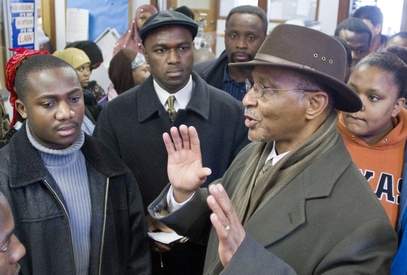

She has her own past.
Living in the South Omaha public housing projects called the Southside Terrace Garden Apartments, near the packinghouse kill floors her father worked after his military service ended, the future Mrs. Ben Gray grew up as Freddie Jean Stearns.
Life’s not always been a garden party for her. She got pregnant at age 17 and missed graduating with her senior class. She struggled as a young single mother before mentors helped her get her life together.
“It was not all a fairy tale life. The personal feeling of disappointment, not just letting my parents down but all those sisters behind me. That humbled me for a really long time.”
Long before marrying a celebrity and entering the public eye or serving on the school board, she quietly made young people her focus as a mother and mentor. She calls the young people under her wing “my babies.” Just as women helped guide her she does the same today.
She can identify with young single moms “who think their lives are over,” telling them, “I thought that was going to be it, that I was going to be on welfare for the rest of my life. I looked around at where I was, the projects, and I saw a lot of it around me. Mothers who had never been married. I was on public assistance for awhile and didn’t like that at all. I didn’t like the fact welfare workers could just come over my place and go through my stuff.”
She shares her experience of learning to listen to the right advice and to make better choices.
“I talk to these young women now, and I’m very open about it. I don’t preach.”
But she tries to do for them what women did for her. “I was blessed to have those women in my life. A number of them became my mentors. One of them was LaFern Williams. I’ll never forget her and Miss Alyce Wilson, the director of the Woodson Center in South Omaha. I spent so much time there. My big sister Lola Averett was another. There was a time when anything and everything she did I would do. She still models everything I could ever hope to do and to be.”
She says women like her sister, who worked at GOCA (Greater Omaha Community Action), along with Carolyn Green, Juanita James, Phyllis Evans, Sharon Davis and Beverly Wead Blackburn, among others, encouraged and inspired her. When Gray attended GOCA meetings she says she was at first too shy to speak up at but Lola and Co. helped her find her voice and confidence.
“They honestly would make me stand up and ask my question.”
“I’ve been very blessed in my life to have great female role models,” she says. “They took special care of me and others. They took care of the community, too. They made it safe. They protected and loved. These women touched a lot of lives.”
Those that survive continue fighting the good fight into their 70s and 80s. “They haven’t stopped. I wouldn’t even say they’ve slowed down.” She says when she sees them “you can bet your bottom dollar I’m in their ear saying, ‘I’m making you proud, I’m doing the right thing.'” It’s what Freddie’s babies do when they’re around her. All of it in the each-one-to-teach-one tradition.
“I’ve always had the passion for those who are behind me, young people. I just collect them, I don’t know what else to say. Anyone who really knows me knows that I talk about my babies. And they know who they are and they know what I expect from them. I can’t tell you how they’re selected, I don’t know how. But there is that group and they are my babies and I love them with all my heart.
‘I’ve told them, ‘My expectations are you’ve got to take care of Miss Freddie when she’s old.’ They laugh at that. But I need them to take care of me. They’re going to be my doctor, my mechanic, my attorney. And then they get it, they understand what I’m telling them. That they’re going to take care of me because I can’t do it forever. So they’re going to have to do these things, they’re going to need to be on the board of health, on the school board, work at NOVA. They need to take care of the world. They know that’s my expectation.”
She is a wise elder and revered Big Mama figure in their lives.
“When they see me they call me Mama Freddie or say, ‘How you doin’ Mama Freddie?'”
She recently lost one of her “babies.” When she got the news, she says, “it knocked me to my knees and I’m not talking figuratively. I was walking down the hall looking at Facebook on my phone when I saw it. I was very thankful Ben was here because I dropped to the floor. And then the phone started ringing and it was some of the other babies calling to check on me and me needing to check on them.”
Just as Freddie’s been a force in the lives of young people for a long time, so has Ben, who’s made at-risk youth his mission. As part of his long-time gang prevention and intervention work he even founded an organization, Impact One, that supports young people in continuing their education and becoming employable.
Because he’s been where they are, he feels he can reach young men and women whose lives are teetering on the edge of oblivion.
“It’s amazing how quickly you can spiral down into some really deep stuff if you let yourself, so I understand,” he says.”When people ask me why I do i deal with gang members it’s because I know ’em. I know how they think, I know what they think, I know most of ’em don’t want to do what they’re doing because I didn’t.
“But you get to a point after awhile where it becomes a lifestyle that makes it very difficult for you to get out of and the only choice you have sometimes, and the only choice I see for a lot of these young men, I hate to say this, is to leave here. I don’t like the brain drain. A lot of these people are really smart. But they’ve cast such a bad shadow that I don’t know how you stay here. I mean, I think there has to be some time between they’re leaving and coming back.”
He says something missing from today’s street dynamic is a kind of mentoring that used to unfold on the corner.
“At that time we had older guys that were able to talk to the younger guys.”
Kind of like what Ben does today.
“Someone might say, ‘Stop, don’t do that, that’s crazy.’ Or, ‘If this is what you’re going to do, here’s how you do it.’ Those kinds of things.
These young men don’t have that. A lot of them don’t. I’m talking about across the country. There’s nobody on that corner anymore who’s older who can tell them…”
“It used to be the young guys on the corner and the wise guys that went back to the corner gave people words of wisdom, and that’s gone,” says Freddie, who’s known her share of hard corners.
“That’s lost,” says Ben.
He says what’s missing from too many of today’s homes and schools in the inner city and elsewhere is the kind of discipline he got from his parents and sister and the military.
“I think most of us want it, we just don’t know we want it. Discipline is a method of working with people and molding people into what they should be as adults. That’s what it is. And that’s what my father tried to do for me in the brief time he was on this Earth.”
Gray sees a disconnect between some of today’s African-American youth and schools.
“I think what’s missing from majority minority schools is a pathway to get young people to know who they are. Our African-American students don’t know why they are. They don’t know the background. In the classroom they get a real strong dose of European history but they don’t get much about who they are.
“When there’s little or no discussion about you then how do you sit there and maintain an interest in being there?”
OPS has struggled closing the achievement gap between African-American students and nonblack students. Gray says before any real progress can be made “you’ve got to get them to stay there and keep them interested,” an allusion to the high truancy and drop-out rates among African-American students.
The problem has thus far defied attempted remedies.
He says, “In spite of efforts by the Empowerment Network, Building Bright Futures and others to address core problems like truancy and drop-outs in the (North Omaha) Village Zone we’re losing kids, they’re not staying in school. And they’re not staying in school because the influence of the street is such a strong influence. I know it. Those streets call you, man, and you can be in that classroom six hours a day but damnit you’ve got to go home and when you dog home you go to an environment that’s primarily unhealthy.
“So in spite of all we’ve done in that Village Zone we’re not winning.”
He doesn’t pretend to have the answers. He knows the problem is complex and requires multiple responses. But he does offer an illustration of one approach he thinks works.
“Teachers are constantly amazed I can address a school assembly and keep kids’ attention. Staff don’t get it. Freddie gets it. I talk about where the kids came from, I talk about who they are, I talk about what their history has been. They listen because they don’t (usually) hear that. That’s part of the missing piece of why they don’t stay. They don’t feel there’s anything there for them.”
He doesn’t claim miraculous results either.
“Any of us who are involved in this effort who talk to these kids know they’re not going to hear everything we say right away. They’re waiting to hear if we’re genuine. I tell them, ‘I’m not here to get all of you, I’m not here to convince any of you of anything. One of you is going to hear what I say, respond and react to what I say by becoming a leading citizen in this community. So I’m just here to get my one.’
“That’s when they start listening. They want to be the one.”

Flanked by Freddie Gray and Ben Gray, grieving parent Tabatha Manning at a press conference in the aftermatth of losing her 5-year-old child to gun violence.
Freddie appreciates better than most the challenge of educating children when so many factors bear on the results.
“We don’t produce widgets, we produce the citizens that are going to run this country. That’s exactly what we’re doing every single day. Every single one of these kids is an individual who deserves to have an individual touch them. It’s about that one-on-one relationship if we’re going to get kids to succeed, and if we don’t get this right then I think that says something about what the state of this country will be.
“Poverty is going to be the thing that kills us if we don’t take care of it and the only way I know to do that is to provide our children with the necessary skills to become employable.”
She’s keenly aware of criticism that the school board has ceded too much power to the superintendent.
“I understand people say that thing about the board being a rubber stamp but they don’t come and listen to the committee meetings and hear the board in dialogue. By the time theres a news sound bite we’ve already talked about it or figured it out or tabled it. Those things happen during the day (when the cameras aren’t on).
“But trust me we’ve got this. My job is to provide the superintendent with guidance in saying, ‘This is what you will do.’ There has to be parameters. We’ve got statutes to follow.”
In seeking solutions to bridge the achievement gap, she say, “I’m talking to other districts’ board presidents and members, not just when I’m on the Learning Community, but other times, too. That hasn’t happened much before.”
She says more collaboration is necessary because studies show that wherever kids live, whatever their race, if they live in poverty they underachieve.
“Poverty is a problem. If we’re not addressing poverty now than 20 years from now we’ll be having the same conversation.”
Breaking the cycle is a district goal.
“At the board level it’s looking at careers. We do kids a disservice when we say everybody’s going to college because that’s a lie and we all know it. But we do need to supply them with the necessary skill sets so they can be productive citizens.
“We’ve got to get these young people to the place where they can get jobs, where they can get out of poverty.”
She says OPS is finding success getting businesses to offer students internships that provide real life work experiences. He’s been active in the Empowerment Network’s Step-Up Omaha program to provide young people summer training and employment towards careers.
As both of them see it, everyone has a stake in this and a part to play, including schools, parents, business.
“There’s room at the table for everybody and everybody has to have a foot in this and has to step up. The focus has to be on what can we do together,” she says.
Now that she’s solidly in the public eye in such a prominent job she hopes African-American women follow her.
“I have to say this for other women who find themselves feeling like they’re voiceless: If you can see it, you can be it. There’s a lot of young African-American females who are just sharper than sharp, that could run rings around me all day doing this, but they don’t feel like they have a voice.
“And so I really hope they are paying attention because again Miss Freddie is not going to be doing this for the rest of her life and some of them are going to need to be sitting on this board.”
Ben Gray feels the same way about the young men and women of color he wants to see follow him into television or politics or wherever their passion lies.
Both with his own children and those he’s “adopted,” he’s taken great pains exposing them to African-American history and culture and encouraging them to engage in critical thinking and discussion.
“I wanted them to be more aware, I wanted all of our children to be aware of what’s around them and what it takes to survive. And to know who they are and what their history is, and some of them can tell you a lot better than I can tell you now.
“We have two that are like our own who are former gang members. Both of these guys are brilliant young men, and given a different set of circumstances would be someplace else.”
Ben and Freddie Gray are living proof what a difference new circumstances and second chances can make.
Related articles
- Masterful: Omaha Liberty Elementary School’s Luisa Palomo Displays a Talent for Teaching and Connecting (leoadambiga.wordpress.com)
- Fast Times at Omaha’s Liberty Elementary: The Evolution of a School (leoadambiga.wordpress.com)
- Negro Leagues Baseball Museum Exhibits on Display for the College World Series; In Bringing the Shows to Omaha the Great Plains Black History Museum Announces it’s Back (leoadambiga.wordpress.com)
- Kelly: It’s not about the ‘sex story,’ Freddie Gray says of Sebring (omaha.com)
- Brown v. Board of Education: Educate with an Even Hand and Carry a Big Stick (leoadambiga.wordpress.com)
- Omaha’s Malcolm X Memorial Foundation Comes into its Own, As the Nonprofit Eyes Grand Plans it Weighs How Much Support Exists to Realize Them (leoadambiga.wordpress.com)
Masterful: Omaha Liberty Elementary School’s Luisa Palomo displays talent for teaching and connecting
You don’t think of a master teacher as someone in her 30s but that’s exactly what Luisa Palomo of Omaha is. The kindergarten instructor at Liberty Elementary School has mastered the art and craft that is teaching and she is deservedly being recognized for it. The following two stories I did on her, in 2010 and 2012, appeared in El Percio newspaper shortly after she earned major education prizes in those respective years. The school she teaches at, Liberty Elementary, is one I am quite fond of. You’ll find several more articles by me about Liberty on this blog.
©by Leo Adam Biga
Originally appeared in El Perico (el-perico.com)
Liberty Elementary School kindergarten instructor Luisa Maldonado Palomo has reached the top of her field as a 2010 Alice Buffet Outstanding Teacher Award-winner.
The Gering, Neb. native is the grade leader at her Omaha school. She heads outreach efforts to parents, many of them undocumented, through the Liberty Community Council. She’s a liaison with partners assisting Liberty kids and families. The school engages community through parenting and computer classes, food and clothes pantries, and, starting in the fall, a health clinic.
Colleagues admire her dedication working with the school’s many constituents.
“She truly reaches the whole child — behaviorally, academically, socially, emotionally — and then steps beyond that and reaches the family too,” said Liberty Principal Carri Hutcherson. “We can count on her to do a lot of the family components we have at Liberty because she gets it, she has a heart for it, the passion, the drive, the focus, all those great things it takes. She’s an expert practitioner on so many levels.”
But there was a time when Palomo questioned whether she wanted to be a classroom teacher. While a Creighton University education major she participated in Encuentro Dominicano, a semester-long study abroad in the impoverished Dominican Republic. She described this immersion as a “huge, life-changing experience” for reawakening a call to service inherited from her father, Matt Palomo.
“My dad has spent his whole life doing for others,” she said. “He comes from a migrant worker family. He gave up a college scholarship to work so he could help support his nine brothers and sisters. From the age of 15 he’s been involved with the Boy Scouts as a scout leader. He just celebrated his 45th year with the Boy Scouts of America.
“He’s always worked with underprivileged youth, Hispanic or Caucasian, in our small town. He’s such a role model for so many young boys who’ve gone through that program. He has such a sense of what’s right and wrong and he’s instilled that in my brother and sister and I.”
In the Dominican Republic Luisa felt connected to people, their lives and their needs.
“You work, take classes and live with families,” she said. “You learn the philosophy and the why of what’s going on. You really learn to form relationships with people, which isn’t something that always comes naturally to Americans. Here, it’s always more individualistic and what do I need to do for myself, whereas in a lot of other countries people think about what do I need to do for my community and my family.”
The communal culture was akin to what she knew back in Gering. When she returned to the States she sought to replicate the bonds she’d forged. “I came back wanting that,” she said. Unable to find it in her first teaching practicums, she became disillusioned.
“I was ready to quit education and my advisor was like, ‘Nope, there’s this new school in a warehouse and Nancy Oberst is the principal and you’ll meet her and love her, give it a shot before you quit.’ So I went there and loved it and stayed there. Nancy and I just clicked and she hired me to teach kindergarten.”
Liberty opened in 2002 in a former bus warehouse at 20th and Leavenworth. In 2004 it moved into a newly constructed building at 2021 St. Mary’s Avenue. Oberst was someone Palomo aspired to be like.
“She’s so dynamic and such a good model,” said Palomo. “She has such a vision for how a school should be — it shouldn’t be an 8:30 to 4 o’clock building. Instead it should be a community space where it’s open all the time and families come for all kinds of different services, and that really is the center of the community.”
Oberst and many of Liberty’s original teachers have moved on. Palomo’s stayed. “We have a core group of parents who have been with us from the old building and they know I’m one of the few teachers who have been here all eight years,” she said. “They’ve seen what I do. They know Miss Palomo is the one who spent the night in the ER when Jose broke his arm and started a fund raiser when Emiliano’s house burned down. They know me and they trust me and they let me into their homes.
“They know I’m coming from a good place.”
She said one Liberty family’s “adopted” her and her fiance. The family’s four children will be in the couple’s fall wedding.
Hutcherson said Liberty is “the hub” for its downtown neighborhood and educators like Palomo empower parents “to feel they’re not just visitors but participants.” Whether helping a family get their home’s utilities turned back on or translating for them, she said Palomo and other staff “step out of the walls of this building to get it done.” For two-plus years Palomo mentored a girl separated from her parents.
“It’s that whole reaching out and meeting our families where they’re at,” said Palomo.
Liberty’s holistic, family-centered, “do what’s best for the child” approach is just what she was looking for and now she can’t imagine being anywhere else.
“I really love it here. We’re not just a teacher in the classroom. We do so much to really bring our community into our school so our families can come to us for all these different activities and for help with different needs. It’s one of those things where we let them into our lives and they let us into theirs, and we’re both better for it.”
She’s proud to be “a strong Hispanic” for kids who may not know another college graduate that looks like them.
Palomo recently earned her master’s in educational administration from UNO. Sooner or later, she’ll be a principal. Hutcherson said when that day comes “it’ll be a great loss to Liberty but a great gain for the district.”

_ _ _
Liberty’s Luisa Palomo Named Nebraska Teacher of the Year
©by Leo Adam Biga
Originally appeared in El Perico
In only two years Liberty Elementary School kindergarten instructor Luisa Palomo, 30, has won Nebraska’s top teacher recognition honors. In 2010 she was named an Alice Buffett Outstanding Teacher, an award given top Omaha Public Schools educators, and last November she was selected Nebraska Teacher of the Year.
The Gering, Neb. native applied for the state honor at the prodding of OPS colleagues. She completed the required essays and interviews but held out little hope of winning.
“I felt there’s no way they’re going to choose me because to be quite honest I am young and I’ve only taught for a short amount of time compared to a lot of other teachers of the year. And while I’m passionate about early childhood education I know it’s not on the forefront of everybody’s brain when they think about education.”
She was motivated to put her name in the running because the winner gains a stage and she wanted a platform on education.
“By getting this award you get so much more of an audience,” she says. “By having this title behind my name now finally people will listen to me. I kind of applied for the award thinking this – that I would have a title that would give me a foot in the door.”
As expected, she’s in high demand as a speaker and she says she’s eager to present on “topics I feel really passionate about.”
“What I want the media and the public to know is that there’s so many good things happening in education. The media’s focus on bad news stories is really not an accurate reflection of what’s happening in schools, so I kind of want to put that message out there.
“What I’ll be talking to teachers about is a shift in how we run our schools. Instead of it having to be a traditional 9-to-3, nine months out of the year model, we really need to shift that mentality to what is best for kids. For some kids the traditional school year works beautifully, but for other kids, like the ones I work with in my downtown school, it’s so much more beneficial to them to have an extended day where they’re able to come in early and stay late and have educational opportunities, and to attend summer school through the first week of July.”

She advocates that schools adjust to meet students where they are.
“There doesn’t need to be a one size fits all model for education. Instead it’s what works for the kids you’re serving. It may mean doing what Liberty does, which is coordinate with all these community services to offer Our Completely Kids program. It opens our building at 7 in the morning and closes it at 6 at night.
“Liberty employs this full service community school model where it says if families trust the school, bring in the services. Why send families across town? Why not have a doctor in your school? Liberty allows any of us as teachers to accompany our families through so much of their lives, and we’re better for it and our families are better for it and the children are better for it. Our kids are better adjusted and they’re more connected to school.
“There’s so many different ways to meet the needs of our kids, we just have to be open to accepting it.”
She bristles at the notion a teacher’s duties stop when the last school bell rings.
“I hear some teachers say, ‘But my job is not to be a social worker,’ but really it is because your job is to look out for what’s best for children.”
For Palomo, teaching is about making lives better.
“All kids have a path and the teachers they have in the classroom determine where that path is. There’s so much literature that talks about the effectiveness of quality teachers. If I’m able to reach these kids and get them to love learning I’m changing the outcome of their path. To be a transformational leader is understanding your job is so much more than teaching phonics or number recognition.”
She approaches the school day as a “very purposeful” adventure in which she “guides and encourages” the learning process. “I never talk at our children but with our children and kind of explore with our kids as they learn. It’s a balance of what’s developmentally appropriate and what’s engaging for our kids.”
During 2012 she’ll be meeting fellow teachers of the year at national education events. The first was in Dallas, Texas in late Jan. Upcoming events are in Washington D.C., Huntsville, Ala. and New York-New Jersey. She says she enjoys the prospect of making “connections with people all around the country that I’ll be able call on when I have questions or when I need support.”
She’s already getting to know past Nebraska Teachers of the Year, who work as a cohort on education initiatives. “It’s expected as a teacher of the year you’re continually giving back to the education community,” she says. That’s fine with Palomo since she sees her calling as a service mission. The recognition only confirms that. “This award really makes me think that not only did I choose the right career but I must be doing things right.” She also sees it as validation that quality education happens in inner city schools.
She intends on being an administrator one day but for now is content where she is.
“I want to be in the classroom for a chunk of my career before I move on. I feel like I learn so much every year by being in the foxholes. I work with parents, students, teachers on a daily basis, and it’s very real. I’m not tied up in administrative duties or policy, I’m working with who I want to have the most effect on.”
Related articles
- Fast Times at Omaha’s Liberty Elementary: The Evolution of a School (leoadambiga.wordpress.com)
- Alice Buffett Outstanding Teacher Awards (omaha.com)
- Teachers from Iowa, Neb., to be celebrated in DC (thegazette.com)


 Leo Adam Biga's My Inside Stories