Archive
Home is where the heart Is for activist attorney Rita Melgares

Home is where the heart Is for activist attorney Rita Melgares
Activist attorney Rita Melgares was a divorced single mother of four from the Southwest when moved here to attend Creighton University Law School. She didn’t intend staying. But 35 years later she’s still here, still helping her people, doing legal work for newcomer families, handling juvenile justice cases and some criminal law.
This mother and grandmother is still raising kids. She shares a home in Benson with a son who is a single father. She helps rear his three youngest, whom she refers to as “my boys.” It’s the latest path on a journey that’s kept family at the center of things.
Mexico is where her ancestral lines extend. New Mexico is where both her parents came from. She can trace her genealogy back three centuries there. Southern Colorado’s San Luis Valley is where the former Lourdes Rita Martinez was born and raised. But Omaha is where her interest in law and social justice coalesced. Her parents Esquipula and Jose Martinez modeled service for Rita and her seven siblings.
She said her parents did not join groups or pull boycotts, but expressed a sense of grassroots social justice by helping people in need. She recalls her folks feeding the less fortunate and working with the police to make sure the neighborhood was safe.
The Martinez children fulfilled an expectation of achievement and service. “All eight of us have an undergraduate degree and several of us went on to advanced degrees,” she said. “Three of us are attorneys. My sister is a retired schools administrator.”
Growing up Latino meant dealing with racism. The experience of oppression provides context for her work in protecting people’s rights. “The racism against Latinos had its own flavor in the area i grew up in. You felt it, you knew it, and it continues,” she said.
Another vital experience was the social ferment of the 1960s.
“I’m a product of the ’60s. I was fascinated with the civil rights struggles and I wanted to march with the people, I wanted to be an active participant in those struggles. Two of my brothers were very active in the anti-war movement and the Chicano movement in the Southwest. When we came of age there was a movement of people you could join. It was both noble and exciting. I matured into that. It’s an interesting part of my life and I don’t think I’ve ever left it behind.”
Thrusting herself into the fray had to wait because she married right after high school and became a mom. Her invovlement came while earning a secondary education degree at Adams State College and then teaching English there.
“I challenged every course I could and I graduated with honors from college in three years and I became an activist. The Chicano movement was working very hard to democratize the campuses of the Southwest and so I was active in the student movement. César Chavez and the farm workers union was very strong in Colorado. I also had the background of northern New Mexico and the land grant issue. Those were the pressing issues in that environment.”
Feeling she could make more impact outside the classroom, she followed two of her brothers in the study of law. She was accepted by several schools but chose Creighton. Her experience there was bittersweet.
“Creighton prepared me very well as an attorney but it was one of the loneliest experiences in my life. I was far from home, the only Latino in the College of Law and there was no social activism. The dean pulled me aside very early in my freshman year and gave me the name of the director of the Chicano Awareness Center (now the Latino Center of the Midlands) and said, ‘I think you should go and meet those people.’ I think he had a sense that with the social activism I came from I wouldn’t last at Creighton if I didn’t have something that would anchor me in the community.”
Melgares said she “became a great friend” of the center. She took a leave from school to work with youth there, along the way reconnecting with her cultural and social activist roots. “A lot of the same issues we found everywhere existed in Omaha. I could participate in the people’s movement here and it was doing that when I really fell in love with South Omaha. I realized this was where the struggle was, this was where i could find the nexus to Omaha and to my soul and spirit, and so I’ve just always been close to south Omaha since then.” Her office is a converted duplex at 3927 So. 24th St.
She served on the center’s board, one of many south Omaha boards she’s served on.
Upon graduating from Creighton in 1979 she won a fellowship that placed her with the Omaha Legal Aid Society, where she worked nine years with the disenfranchised.
Following a stint with a downtown law firm she made the break and went on her own in 1994. Family law became her focus. “That’s where I saw you could make a difference in helping people pull their lives together. It’s been my privilege to work for the undocumented. It is not a popular community to work for. Immigration issues have a huge impact on family. Unfortunately it can be a very negative influence, a very sad outcome when you have families separated, when you have parents always looking over their shoulder because deportation is on their back, people afraid to move right or left because they have no documentation.”
The disruption is made worse by the recession. She said it’s hard enough for U.S. born or visa holding citizens to find a job in this climate, but even harder for those with no social security number, little schooling and limited English. She bristles at critics of immigrants, saying south Omaha’s rejuvenation is due to the newcomer population.
“They breathed life back into south Omaha. Nobody’s getting rich on South 24th St. but my gosh the economic wheel is being moved and it’s being moved on the backs of the immigrant community. It’s exciting. I think the watering of the cultural roots helps the entire community. Everything Latinos bring with them, from whatever their country of origin, they share with each other and with the larger community. I think they help Omaha and Nebraska in every which way. I understand the numbers overwhelm schools and health care, but the numbers also bring spirit and economic life.”
Her passion for her people has seen her throw herself into the life of the Latino community. “You don’t gain a community’s trust just because you want to or you’re a good person or you have a good heart. I think you have to work at the vineyard first, and I did that,” she said.
Battling to gain Latinos an equal place at the table “wasn’t easy,” she said, but she “kept knocking at the door, sometimes gently, sometimes pushing” herself in. “I think long after I’m gone we will still be trying to dialogue meaningfully about race.”
Being twice recognized with lifetime achievement awards for her work in the Latino community, she said, only “underscores” the fact that despite not being from Omaha “I have really matured here and worked hard here. Wow, lifetime achievement, I guess I have spent a lifetime in Omaha. And it’s been a very good life.”
Related articles
- Turning Kids Away from Gangs and Toward Teams in South Omaha (leoadambiga.wordpress.com)
- Where Community, Neighborhood and Representative Democracy Meet (leoadambiga.wordpress.com)
- UNO/OLLAS Resident Expert on Cuban and Latino Matters Jonathan Benjamin-Alvarado (leoadambiga.wordpress.com)
- Hundreds Attend OLLAS Conference Cumbre to Give and Get Diverse Perspectives on Migration Issues (leoadambiga.wordpress.com)
- Episcopal Priest Rev. Ernesto Medina Never Forgets His Latino Hertitage (leoadambiga.wordpress.com)
- A South Omaha Renaissance (leoadambiga.wordpress.com)
- Institute for Latin American Concern at Creighton has Dominican Focus (leoadambiga.wordpress.com)
- Gray Matters: Ben and Freddie Gray Fight the Good Fight Helping Young Men and Women Find Pathways to Success (leoadambiga.wordpress.com)
UNO/OLLAS resident expert on Cuban and Latino matters Jonathan Benjamin-Alvarado
Sometimes it’s easy to assume that academics are cloistered away in their ivy towers, isolated from the real world. That’s certainly not the case with Jonathan Benjamin-Alvarado. The University of Nebraska at Omaha political science professor does his share of research but much of it takes him out of his office, off campus, and out into mainstream of life, whether to the barrios of South Omaha or Cuba, where he’s traveled many times for his research. I was reminded to post this profile of him I wrote a couple years ago after reading a piece in the local daily about his latest trip to Cuba, this time leading a group of UNO students to help restore a theater there that he hopes becomes a conduit for future arts-cultural exhanges. In his work he’s just as likely to meet with folks just trying to get by as he is with U.S. and Cuban diplomats and leaders. He’s even met Castro.

Jonathan Benjamin-Alvarado
UNO/OLLAS resident expert on Cuban and Latino matters Jonathan Benjamin-Alvarado
©by Leo Adam Biga
Originally appeared in El Perico
For author, researcher, activist and University of Nebraska at Omaha associate professor of political science Jonathan Benjamin-Alvarado, political engagement is a birthright.
His mother Romelia marched with Cesar Chavez in the California migrant labor movement. Both his parents know first hand the migrant worker struggle. They also know the empowering change hard work and opportunity can bring.
Benjamin-Alvarado still marvels how his folks made “a hyper speed transition” from their vagabond life hand-picking crops wherever the next harvest was to achieving the American Dream within 20 years. “The day I was born my dad was picking lettuce and the day I graduated from high school he owned his own business and we lived in a really nice house in the suburbs.”
From his mother, who worked on behalf of women’s and Latino rights and as a political campaign volunteer, he learned activism. From his father he learned ambition and determination. As someone who grew up in The Burbs, never having to toil in the fields, Benjamin-Alvarado fully realizes how charmed he’s been to have role models like these.
“To this very day I’m reminded of the lessons and examples presented before me. These were people who prided themselves on what they did. They were people with an incredible sense of dignity and self respect,” he said. “I think what makes things like Cesar Chavez (or his mother) happen is they’re not willing to cede that one iota. They made it very clear that your abuse and subjugation of me will not define me.
“I shutter to think what my forbearers could have done had they had the opportunities I’ve been extended, especially given the incredible work ethic they had. They had no choice but to work hard. It’s only as I’ve gotten older I’ve realized what an incredible legacy and, in turn, responsibility I have to pay it forward. I’m very fortunate to have been able to live and travel all over the world and to be educated in incredible places. My whole thing now is what can I do to make sure others have these opportunities. I really do cherish what I have been granted and I feel an overriding sense of obligation.”
Despite comforts, life at home for he and his brother was unpleasant. Their father was an abusive partner to their mother. The siblings were also misfits in mostly Anglo schools and neighborhoods. To escape, the boys read voraciously. “That was our refuge from all the craziness in our lives. We were really just sponges,” said Jonathan. He did well in school and was enrolled in college when he abruptly left to join the U.S. Navy.
“I think everybody in my family was aghast but i really did it more for purposes of self-preservation and to establish some independence for myself. I needed to leave.”
His 1976-1980 Naval tour fit the bill.
“For me it was just four years of incredible discovery,” he said. “I met for the first time blacks from the northeast and Chicago, kids from the South and the Midwest, other Latinos. All of that was very interesting to me. I came to appreciate them and their cultures in ways I couldn’t possibly have done so had I stayed sequestered in California, where it’s very insular and you think the world revolves around you.”
Back home he used the G.I. bill to attend ucla, where he said he went from doubting whether he belonged to believing “I’m competitive with the cream of the crop. That realization stunned me. There was no limit at that point. I was in a different world.”
Then an incident he doesn’t like discussing occurred. It took five years to recover from physical and emotional wounds. He eventually earned his bachelor’s degree and did stints at Stanford and Harvard. He earned his master’s at the Monterey Institute of International Studies. While working at its think tank, the Center for Nonproliferation Studies, he began intensive research on Cuba. He’s traveled there 25 times, often spending months per visit. Cuba remains a major focus of his professional activity.
Recruited by the Central Intelligence Agency, he seriously entertained doing clandestine work before deciding he didn’t want to give up his academic freedom. Besides, he said, “I don’t and won’t keep secrets because it gets you into trouble.” Already married and with a child, he opted to complete his doctoral studies at the University of Georgia. He landed major grants for his Cuban research. Along the way he’s become a recognized expert on Cuban energy and foreign policy, authoring one book and editing another on that nation’s energy profile and what it bodes for future cooperation with the West.
A temporary teaching post at Georgia then set him on a new track.
“I had not given the idea of being a classroom instructor much thought prior to that,” he said. “I thought I was going to spend my life as a senior researcher — a wonk. But I got this bug (to teach). I realized almost immediately I like doing this, they like me, this is a good gig. It didn’t feel like I had to work real hard to do it, a lot of it just came naturally, and I had this reservoir to draw on.”
When grant funding dried up he sought a full-time teaching job and picked UNO over several offers, in part for it’s dynamic growth and emerging Latino community. He’s been at UNO 10 years. His Cuba work has continued but in a different way.
 “The purposes of my visits have changed dramatically. Initially they were all for conducting basic research, doing lots of interviews on the ground. In the late 1990s I was involved in making some film documentaries for a PBS series. Then I spent five-six years taking students and faculty and people from the community to Cuba.”
Then the U.S. banned academic trips there. His last few visits he’s “been part of high level delegations with former Pentagon and State Department staff. This last one (in November) was with former U.N. Ambassador Thomas Pickering.” In 2006 he met with senior government officials, including Fidel Castro, Raoul Castro, the president of the national assembly and ministers of other government bureaucracies. On these visits he’s there as “technical advisor-resident expert” for debriefings, analysis and reading beyond the rhetoric to decipher what’s really being said through interpreters.
He believes normalized relations only make sense for two nations with such an affinity for each other. Once restrictions are lifted he envisions a Cuban trip with area public and private sector leaders. He and a colleague plan to convene an international conference in Havana, of university presidents from North and South America “to discuss the trajectory of higher education in the 21st century for the Americas.”
His connections helped broker a deal for Nebraska selling ag products to Cuba. Closer to home, he advises government on Latino matters and is active in the Democratic Party. He’d like to see more Latinos active in local politics. A recipient of UNO’s Outstanding Teacher Award, he said the Office of Latino/Latin American Studies at UNO “has been a godsend for me. OLLAS has been central to helping me live out what I do in my community. There’s an element of it that is very personal. When we founded OLLAS we intentionally created something that would have a community base and make the community a part of what we do. We want our work to be not only politically but socially relevant. That’s been the basis for the outreach projects we’ve undertaken.”
Recent projects include reports on immigration and Latino voter mobilization.
Related articles
- A huge leap forward for Cuban-American community (miamiherald.com)
- Economists Question Cuba’s Commitment to Privatizing Businesses (nytimes.com)
- Hundreds Attend OLLAS Conference Cumbre to Give and Get Diverse Perspectives on Migration Issues (leoadambiga.wordpress.com)
- New import fees to hammer Cuba’s small businesses (miamiherald.com)
Episcopal Priest Rev. Ernesto Medina never forgets his Latino hertitage
As a cradle Catholic I knew little or nothing about the Episcopal Church until a dozen years ago when I began attending services at Church of the Ressurection in North Omaha. That particular church formed in the 1980s when the all white congregation and the all black congregation of two small, failing churches merged or blended together. While my knowledge remains fairly sketchy today I’ve come to feel warmly about the Episcopal faith and its great tolerance and acceptance of diversity. In the following piece I profile an Episcopal priest here, Rev. Ernesto Medina, who has made quite a splash since arriving from Los Angeles in 2007. His life and work embody much of what the Episcopal Church stands for.

Episcopal Priest Rev. Ernesto Medina never forgets his Latino hertitage
©by Leo Adam Biga
Originally appeared in El Perico
As a person of color and priest in the Episcopal Church, Rev. Ernesto Medina is a minority in a moderately diverse denomination.
The California native practices inclusion as a matter of conscience and as a consequence of being Latino in a white world. This self-described “edgy liturgist” is also a confirmed social justice activist.
The new rector at St. Martha‘s Episcopal Church in Papillion, Medina came to Omaha with his wife Susan in 2007 to serve as Dean for Urban Mission at Trinity Cathedral in downtown Omaha. That position entailed outreach with Hispanics and Latinos in south Omaha. He remains connected to that community as a Latino Center of the Midlands board member. Those ties help keep him grounded.
“I need that home base. I really feel good about it,” he said.
Though he shepherds a predominantly white congregation at St. Martha, Medina implements his heritage into services. He recently presided over a Day of the Dead ceremony in which he had members bring photos of deceased loved ones and place them around the altar. He led worshipers in prayer for the departed. He is happy his congregation’s welcomed an extended Latino family at the church.
Like many mainline Christian churches, the Episcopal Church has struggled with racial diversity, though there are pockets of Spanish-speaking members. “The challenge is they don’t have a voice,” he said. “There’s significant more voice than there used to be. My generation stepped up about 10 years ago. For the first time we produced liturgical material written in Spanish for translation into English.”
Clear back to growing up in San Diego Medina’s balanced being true to his ethnic roots while navigating white America. He was the first in his family to attend college. To his own people, he’s not Latino enough. To whites, he’s too ethnic.
“People don’t get me. I grew up as a Mexican in this culture, yet I’m excluded from both realities. The reality of being in both worlds is normal to me, that’s just who I am,” he said. “I preach in English, I dream in Spanish. I’m American educated, my blood is Mexican. American culture sees me as brown. Latino culture sees me as different because I don’t speak with an accent.
“There’s some real pain in it, but it’s OK, because there’s more joy. There’s certain things I do because of it — I will always seek inclusion for everyone.”
He’s on the board of the Tri-Faith Initiative. It promotes interfaith dialogue among Christian, Jewish and Islamic followers, with the goal of a shared campus.
He’s made waves for his candor. About the Episcopal Church, he said, “structurally it’s the most racist institution I know — at the same time it’s the most inclusive of any denomination I know.” He’s broken barriers, too. “In 2000 I became the first Latino in charge of a cathedral in the church’s history,” he said, when named Provost of the Cathedral Center of Saint Paul in Los Angeles. It put him on the front page of the L.A. Times Metro section.
“I understood what I became a steward of. I know as a priest and by virtue of who I am that I have a responsibility for people. My largest congregation was Spanish speaking and 90 percent of them were undocumented.”

Long before L.A. he became sensitized to the undocumented when as a seminarian he worked in a pear orchard with migrant workers.
“That summer we got them all legal and documented,” he recalled with glee.
At a reunion he was pleased to find the men and their families leading successful lives.
Fast forward to L.A. in the mid-2000s, when he found himself immersed in the immigration reform movement. “I got caught up in the fervor of it,” he said. Part of the machinery of “making it happen,” he was at meetings that organized the mass marches in L.A. He was also among a contingent of religious leaders who went to the nation’s capital to lobby elected leaders.
“We kicked butt in D.C.,” he said.
Medina earlier announced himself a maverick figure when, in 1995, he was named Missioner for Christian Education for the Diocese of Los Angeles.
“It’s what put me on the national map. I was part of that small group that married the two schools together in the Episcopal Church — the liturgists and the educators. It was very exciting.”
It was in that role he co-developed Authority of Generations, a widely adopted guide for church decision-making and program development that emphasizes inclusion of all ages, particularly the elderly and the very young.
Medina, whose love of travel has taken him all over the world, got to know a group of elders in remote Kivalina, Alaska, located above the Arctic Circle. They inspired him to embrace the doctrine that “elders are the gift of wisdom.” It’s a lesson that was also impressed upon him by his family elders and by a mentor priest.
Early in his own priesthood he served in a parish with a school, and it’s then, he said, he came to appreciate “religion in a pluralistic community and the gifts that children bring to community that go beyond innocence.” That experience led him to advocate for the leadership role children can play in various aspects of church life.
His impassioned interest in building bridges and inviting everyone to the table, he said, “is a continuation of a promise” he made his mother. He said she and her mother once went to a priest for help but were ignored in favor of a wealthy parishioner. After Medina announced his intention to be a priest, he said his mom made him swear he would never forget where he came from or snub anyone.
“That was the condition she placed on it,” he said, “which has been what I hope is a constant in what I do. I have a responsibility to give voice to the voiceless.”
He and Susan, parents to two adult children, have traveled far and wide but they feel they’re right where they need to be now.
“When we came to Omaha it felt like we moved home,” he said. “It’s very consistent with our values set.”

Related articles
- The Episcopal Church ‘Takes a Flying Leap’ into Controversies Old and New (religiondispatches.org)
- Hundreds Attend OLLAS Conference Cumbre to Give and Get Diverse Perspectives on Migration Issues (leoadambiga.wordpress.com)
Cumbre: Hundreds attend OLLAS conference
I am not normally crazy about covering events because I think of myself more as a writer than a reporter. While spending several hours at an academic and community confab I was assigned to report on is not my idea of a good time I did mostly enjoy covering the 2010 Cumbre conference put on by the Office of Latino and Latin American Studies at the University of Nebraska at Omaha. The big topic under discussion was human mobility or migration and the political, social, economic, and personal fallout of populations in flux. It’s interesting how things work because a year or so after the event I became aware of a great book about one of the most important and underdoumented migration experiences in U.S. history – the great migration of African-Americans from the South to all points North and West. The book by Isabel Wilkerson, The Warmth of Other Suns: The Epic Story of America’s Great Migration, is one I eventually read and wrote about, interviewing Wilkerson at some length, then meeting her before a talk she gave in Omaha. And that sparked my beginning to do research for a story or series of stories on African-Americans who migrated from the South to Nebraska. I’ll write that story next year in conjunction with the big black heritage celebration here known as Native Omaha Days. And I was to have undertaken a rather epic project all about human migration for a Catholic community of missionaries but it has been put on hold. Finally, I may be making an individual and temporary migration this fall reporting on set of Alexander Payne’s upcoming feature production Nebraska, which would find me embedding myself among the crew as they traverse from eastern Montana across much of Nebraska for the making of this road movie. So, you see, in the midst of overcoming my reluctance to cover a migration conference I found myself open to a pattern of migration subjects and opportunities that came my way. Would they have otherwise? Who knows? I’m just glad they did.
Cumbre:
Hundreds attend OLLAS conference
©by Leo Adam Biga
Originally published in El Perico
A wide spectrum of Latino concerns, including the need for federal immigration reform, swirled around the May 14-15 Cumbre conference held at Omaha‘s Embassy Suites in the Old Market. The theme was Human Mobility, the Promise of Development and Political Engagement.
The every-few-years summit hosted by UNO’s Office of Latino and Latin American Studies is part I’ll-show-you-mine, if-you-show-me-yours research exchange, part old-fashioned networking event and part open mic forum.
More than 400 registrants from near and far came to share ideas. The perspectives ranged from star academics allied with major institutions to local grassroots organizers.
Adding urgency was the divisive new Arizona law targeting illegal immigrants. OLLAS director Lourdes Gouveia said when planning for this year’s summit began four years ago immigration was a hot topic. It was expected to remain so once Barack Obama won the White House, but the health care debate put it on the back burner.
“We began to think well maybe this was not the year when the national context about immigration was really going to provide the impetus,” she said, “and then along comes Arizona. All at once we had people like Jason Marczak (policy director with Americas Society/Council of the Americas) call and say, ‘I’d like to come, is it too late?’ We had vans of people coming from Colorado and Iowa. We had people showing up from all kinds of communities in the Great Plains, besides all the international scholars from Africa, India, Latin America, Europe.”
Omaha Mayor Jim Suttle and State Sen. Brenda Council kicked off the event. State Sen. Brad Ashford was a panelist and Omaha City Councilman Ben Gray served as a moderator.
Beyond facilitating dialogue, Cumbre introduces new scholarship. Coordinators for the Woodrow Wilson Center Mexico Institute’s Latino Immigrant Civic Engagement Project chose Cumbre to unveil their report’s findings of Latino civic involvement in nine U.S. cities, including Omaha. The authors tied engagement levels to several factors. Generally, the more engaged immigrants are with their country of origin, the more engaged they are in their adopted homeland. High participation in church activities correlates with high participation in civic activities. Coalitions, whether community, church or work-based, such as the Heartland Workers Center in Omaha, act as gateways for increased engagement.
But each Latino immigrant community has its own dynamics that influence participation, thus authors titled their report “Context Matters.” Co-author Xochitl Bada, a University of Illinois at Chicago assistant professor, presented the findings.
OLLAS issued its own site report, “Migrant Civil Society Under Construction.” Investigators conducted roundtable discussions with local Latino immigrants, who said that fear, inadequate education and lack of information are barriers to engagement.
Bada said Omaha is rather unique in being both a new and old destination for Latino migration, a mix that may partly account for the moderate levels of civic-political participation by the emerging Latino immigrant community here.
Respondents in all nine cities regarded the 2006 immigration mobilization marches as a turning point in Latino engagement but expressed disappointment the movement did not sustain itself.
Among other panels: UNO economist Christopher Decker outlined Latino immigrants’ substantial economic impact in state; and UNO languages professor Claudia Garcia detailed a project delivering education programs and restoring family connections to local Spanish-speaking immigrant prison detainees.
Cumbre’s hallmark is gathering under one roof different players. Speeches, panels, workshops, town hall meetings, Q & As and breakout sessions provide opportunities for these wonks, worker bees, policymakers and service providers to interact.
Princeton University scholar and Center for Migration and Development director Alejandro Portes has attended all four Cumbres. The Cuba native said he made his 2010 keynote address on Latino immigrant transnationalism accessible to Cumbre’s diverse audience. The Creighton University graduate said, “I think bringing the community and the scholars in the same room is one of the things I like about it. The organizers have great talent in bringing these different constituencies together.”
Another featured speaker, journalist, author and University of Southern California communication professor Roberto Suro, said what distinguishes Cumbre is “it attracts really A-list, blue-ribbon people from the academic world and at the same time a very broad swath of people who work on the ground. It’s the only conference I know of that does that. There’s a reason the room’s full.”
In his address Suro spoke about “reimagining” Latino migration policies in both the sending Central and Latin American countries and in the receiving United States.
“Through gatherings like this,” Suro said, “what you see is people broadening the horizons of policy discussion and starting to think about reformulating issues, adding to the agenda and starting to develop the kind of understandings and intellectual framework that might permit better policy in the future.”
Suro told the audience that researchers and activists like them are well ahead of policymakers and politicians on the issue and give him reason for optimism.
OLLAS assistant director Jonathan Benjamin-Alvarado said some of what happens at Cumbre “is bound to be carried” to global forums,” adding, “and that to me is probably the highest compliment for what we try to do in bringing all these people together.”
Xochitl Bada, co-principal investigator of the Latino immigration Civic Engagement Project, said Cumbre “has a very important public aspect. Unlike most academic conferences, it’s conceived “as a report back to the community.” She said the fact the summit is free makes it inclusive. “That’s very unusual.” She said another mark of Cumbre’s open door approach is the simultaneous translation, from Spanish to English and from English to Spanish, it provides to ensure that “language is not a barrier.” She called Cumbre an important vehicle for “public discourse” and “public dissemination.”
Rev. Ernesto Medina, pastor of St. Martha Episcopal Church in Omaha, moderated a panel discussion on human rights, work and community membership. He said he appreciates the opportunity Cumbre presents “to see things holistically” and to put “different communities and different passions” in the same room to find common ground.
Though many differing views were voiced, some consensus emerged: immigration reform must happen but the current partisan climate makes it unlikely soon; criminalization of migrants is punitive, narrow-minded, counterproductive and damaging to families; today’s nativist anti-immigration arguments echo those of the past; lawmakers need good data about immigration to make good policy; Latino immigrants can be fully engaged in both their country of origin and American society; remittances made by Latino migrants to their native countries are crucial to those economies.
Roberto Suro said the full contributions of the recent Latino migrant wave can only be weighed when second generation children reach adulthood. He advocates Latino immigrants be viewed as more than merely a subsistence labor force.
National Alliance of Latin American and Caribbean Countries executive director Oscar Chacon called for more “robust” organizations like his that represent Latino immigrant interests and celebrate their cultural differences while working toward “common cause.”
Alejandro Portes warned if the rhetoric and actions of anti-migrant forces continue “it could usher in ethnic unrest, and there’s absolutely no reason for that. I don’t think it will get that bad because of Obama in the White House and the federal government at some point is going to enter the situation and bring some kind of immigration reform.”
Related articles
- Institute for Latin American Concern at Creighton has Dominican Focus (leoadambiga.wordpress.com)
- Where Community, Neighborhood and Representative Democracy Meet (leoadambiga.wordpress.com)
- Latino voters do care about immigration (salon.com)
- You: Commentary: Immigration debate harbors plenty of misconceptions (star-telegram.com)
Institute for Latin American Concern at Creighton has Dominican focus

In the mid-1970s a pair of Cuban exiles who became Jesuit priests assigned to Creighton University saw a need to increase North American awareness of developing nations in the region. Revs. Ernesto Fernandez-Travieso and Narciso Sanchez-Medio formed the Institute for Latin American Concern.
The program originally focused on raising consciousness through immersion experiences in the Dominican Republic, a nation of physical beauty and abject poverty. As ILAC’s evolved, its mission has, too. Creighton students and professionals venture there to provide medical-health services and to engage in cross-cultural exchanges.
Creighton annually sends 500 volunteers. Teams of medical surgeons, dentists, specialists, ophthalmologists, nurses, pharmacists, physical and occupational therapists and students visit different times of the year. A water quality control team and a law team also go. Area high school students visit, too. The groups vary in size.
Creighton physical therapy program director Julie Ekstrum said the trips offer “a profound experience. Personally, I can’t help but be impacted by the amazingly generous and warm people. Professionally, it challenges me to think more creatively about how I do physical therapy and care for people by making do with fewer resources.”
Ekstrum has been to the D.R. eight times.
Holly Fuller, ILAC director at Creighton, first went to the D.R. as an undergrad.
“I just absolutely fell in love with the experience, the sense of community, and the friendliness and willingness of the people to be open and to take you into their family,” said Fuller, who now spends three months a year there. “It’s very rarely I feel lonely — there’s too much going on.”
Fuller said she applied for her present job in response to “a calling” she felt to address the needs of people beset by unemployment, chronic disease and subsistence living. “I just can’t imagine sitting around hoping that somebody else is going to fix it.”

Over time, ILAC’s presence in that poor Caribbean island nation that shares the same land mass as Haiti has increased. The ILAC center, La Mision, near Santiago in the northern reaches, has been built-up into a complex housing clinics that serve rural campos residents. ILAC clinics also operate in remote mountainous territories.
A major thrust is educating Dominicans about preventative care. Village leaders are trained to conduct basic screenings.
“Without the cooperadores and promodores we would not be able to do any of the programs that we do in a legitimate fashion,” said Fuller. “They are one hundred percent our liaison to the different communities. The Dominicans are the experts in their own culture and in their communities, so we really do rely on them. That’s really the only way you can make a successful, sustainable long term program. There’s also mutual collaboration — they share their gifts and talents with us and we share ours with them.”
Dominican native Radalme Pena directs ILAC activities in the D.R., where he heads the nonprofit NGO Centro de Education Para La Salud Integral or CESI that CU’s affiliated with. In an e-mail, Pena, said Creighton visitors “are openly accepted” by Dominicans because of the school’s long-term commitment there. “Creighton students and professionals contribute to the lives of Dominican rural families in a number of ways,” he said. “First, many groups that come to the country help change the infrastructure of rural villages by building schools, homes, aqueducts and bridges” and by serving medical missions at the ILAC Center and in outlying communities in the Cibao Valley.
“Finally,” he added, “these groups contribute to the spiritual development of Dominican communities” through “an intercultural exchange rooted in basic Gospel values and Christian faith.The cross cultural exchange…breaks down stereotypes, builds bridges and creates a world less fragmented and more unified.”
“What ILAC does is kind of two-fold,” said Fuller. “We provide quality health care to people who don’t normally have access to it, but what we really do is help transform Creighton students’ lives. Part of that transformative process is exposing students to the reality of living conditions that most of the world experiences and developing in students a responsibility for being be a part of the solution rather than sitting on the sideline.”
Creighton Public Health major Leah Latenser has made two trips to the D.R. and is prepping for a third this summer. In an e-mail she described how she’s been impacted: “I gained significant perspective on my responsibility as a citizen of the world to stand up for the justice of all people.”
During her visits she worked on a clean water project and an aqueduct, supervised a rural health clinic and assisted women’s groups. For Latenser, Third World poverty is no longer abstract. “Each one of these stories now has a face, a name, and they are a member of my family,” she said. “It makes these issues much more real and urgent.”
When the Haiti earthquake struck in January, ILAC’s Holly Fuller went to the D.R. two days later and helped assist a series of Creighton medical teams that cared for injured refugees over the next month in the southern border region. She’ll be back in June to facilitate CU’s summer program, when 75 students and 20-some professionals go. Three thousand Dominicans are expected to be served.
Pena said as the D. R. has exported the materials and technical knowledge necessary to rebuild the Haitian infrastructure, “bilateral cooperation and relations have improved greatly.” Creighton relief efforts have played a role in the recovery and healing.
For more information about ILAC programs, visit www.creighton.edu/ministry/ilac/ or call 280-3179.
- Masterful: Omaha Liberty Elementary School’s Luisa Palomo Displays a Talent for Teaching and Connecting (leoadambiga.wordpress.com)
- Dominican journalist gets death threat, armed escort after report (miamiherald.com)
- Aurora Arias on Dominican Literature (repeatingislands.com)
- President-elect seen as continuation for Dominican Republic (edition.cnn.com)
- Latin American growth expected to slow in 2012 (miamiherald.com)
Gray Matters: Ben and Freddie Gray fight the good fight helping young men and women find pathways to success
Omaha’s African-American community has some power couples in John and Viv Ewing; Willie and Yolanda Barney; Dick and Sharon Davis, among others, but the couple with the broadest reach may be Ben and Freddie Gray. He serves on the Omaha City Council. She’s president of the Omaha Public Schools Board of Education. That’s really having your fingers on the pulse of Omaha. Ben is someone I use as a source from time to time for stories I write about North Omaha and he is the subject of an extensive profile you’ll find on this blog. Freddie is someone I’ve just begun to know and I expect I’ll be interviewing and profiling her again before too long. They both have compelling stories and individually and collectively they are dynamic people making a difference wherever they serve and it just so happens their passions allign in boosting urban, inner city North Omaha through a variety of community, youth, and education initiatives.

Gray Matters: Ben and Freddie Gray Fight the Good Fight Helping Young Men and Women Find Pathways to Success
©by Leo Adam Biga
To appear in the August edition of the New Horizons
If you follow local news then you can’t help know the names Ben Gray and Freddie Gray. What you may not know is that they are married.
He’s instantly recognizable as a vocal Omaha City Councilman (District 2). He’s also a prominent player in the Empowerment Network, One Hundred Black Men and other community initiatives. He was a public figure long before that as a KETV photojournalist and the activist-advocate executive producer and host of the public affairs program Kaleidoscope, which weekly found him reeling against injustice.
Until recently his wife wasn’t nearly as well known, though in certain circles she was tabbed a rising star. She actually preceded Ben in public service when appointed to the Douglas County Board of Health. At the time she was office manager at NOVA, a mental health treatment facility. Along with Ben she co-chaired the African-American Achievement Council. She was also a paid administrator with the organization, which works closely with the Omaha Public Schools. It’s not the first time the couple worked in tandem. They have a video production business together, Project Impact. He produces-directs. She’s in charge of continuity.
She’s also worked as a strategic planning and management consultant.
Her longstanding interest in education led her to volunteer with the Omaha Schools Foundation and serve as a member of the student assignment plan accountability committee. The Grays were vocal proponents of the “one city, one school district” plan. Her public stature began to rise when she replaced Karen Shepard on the Omaha Public Schools Board of Education in 2008. She’s since become board president. The demands of the position leave little time for consulting work, which she misses, but she may have found her calling as a public servant leader.
“I like governance, I really do,” she says. “I have a strong feel for it.”
The size of responsibility she carries can be daunting.
“Sometimes I think about what a big job it is. The Omaha Public Schools district is one of the largest employers in the state and I’m the president of the board that’s in control of this entity. That’s kind of scary. I am not as confident as it comes across but I have a voice and I believe in using it for all these kids.”
Since assuming the presidency her public profile’s increased. In truth her private life was compromised as soon as she became Ben Gray’s wife in 1991. “It put me in the spotlight. There’s so many things that marrying somebody in the public eye does, and you don’t have a choice, you’re going to be public at that point.”
She suspects that sharing his notoriety has worked to her advantage. “There’s a lot of stuff Ben has afforded me the opportunity to do. Without him people wouldn’t know me from a can of paint and that’s probably how I would have lived my life and I would have been comfortable and OK with that.”
That each half of this pair holds a highly visible public service office makes them an Omaha power couple both inside and outside the African-American community.
Each represents hundreds of thousands of constituents and each deals with public scrutiny and pressure that gets turned up when controversy arises. That was the case last spring when he led the fight for the nondiscrimination ordinance the council eventually passed and Mayor Jim Suttle signed into law. In June Freddie found herself squarely in the media glare in the fallout of the scandal that erupted when sexually explicit emails OPS superintendent hire Nancy Sebring made came to light and she resigned under fire.
The couple makes sure to show their solidarity and support in crisis. Just as she turned out for city council hearings on the ordinance he attended the first school board meeting after the Sebring flap.
They act as sounding boards for each other when they feel they need to. “Sometimes we do,” he says, “but most of the time we don’t.” “If I want to bounce something off of him I can do that but I have my board members to do that with and he has his council members,” she says.
“If you’re married and you’re connected you know when it’s time to intervene and say let’s have a discussion about this,” he says. “Sometimes you just want to come home and veg out. The last thing you want is to talk about it. I don’t bring it home unless there’s a strategy, like when the Sebring thing happened we needed my expertise as a journalist, we needed legal counsel, we needed all of that, so that week was all about that.”
He’s proud of “how well she handled that situation, adding, “That was her defining moment.”
“A lot of times the conversation is after the fact,” she says, “because I can’t wait to talk to him to respond to the media when they’re in my face. I know if i need to I can reach out and he’s going to respond. The other thing is, we don’t always agree with each other. There’s been times when we’ve been able to change each other’s opinion or stand but not real often. But we don’t fight about it.”
The Grays have been making a difference in their individual and shared pursuits for some time now. The seeds planted during their respective journeys have borne fruit in the public-community service work they do, much of it centered around youth and education.
“We believe in children, I can tell you that, we believe strongly in children,” says Ben. Freddie calls it “a passion.”
Their work has earned them many awards.
They have seven adult children from previous marriages. They mentor more. By all accounts, they’ve made their blended family work.
“One of the things we did was we started having family dinners, and we started that before we got married,” says Freddie, “I still had one daughter at home with me. My older daughter was away from home. His children were still at home with their mom. Both of us were smart enough to figure out that with this new young person, let alone me, in the picture spending time with him that could be difficult. So we started having family dinner on Sunday and all seven of the kids would come. And we still do family dinner today.
“It was a wonderful way to bring our families together. And when people talk about a blended family, if you’ve ever done something like that and made it a tradition of your house for everyone to come together, it really and truly does blend them.”
Two of their kids live out-of-state now, as does one of their 11 grandchildren (they also have a great grandchild), but that still leaves a houseful.
“So generally on Sunday it’s a zoo time,” she says. “He loves it. He’s like they could all move back tomorrow. I’m the one that says no they cannot move back here and they have to go home now. They’re so close.”
Though born and reared in Cleveland, Ben’s made Omaha his home ever since the U.S. Air Force brought him here in the early 1970s. He’s built a life and career for himself and raised a family in his adopted hometown.
She’s an Omaha native but her father’s own Air Force career uprooted her and her six sisters for a time so that she did part of her growing up in Bermuda and in Calif. She returned in the early 1960s. The Omaha Central High School graduate raised a family here while working.
Whether in vote deliberations or media interviews each seems so poised and at home in this milieu of politics. As accomplished as they are today each comes from hard times far removed from these circumstances.
For example, the man Omahans know as Ben Gray is called by his street name “Butch” in his old stomping grounds of East Cleveland, where after suffering the loss of his working class parents at age 13 he fell into a life of organized crime. Numbers running, pimping, drug dealing. His extended family was well-entrenched in the black criminal underworld there. Its pull was something he avoided as long as his parents were alive but once gone he succumbed to a life that he’s sure would have ended badly.
Ben’s older sister Mary Thompson, whom he calls “my guardian angel,” and her husband took Ben and his younger brother Doug in and raised the boys right, modeling a fierce work ethic. But the call of the streets won out.
“The guys that I was dealing with, the guys that I knew, were real life gangsters. They do stories about these guys. Shondor Birns. Don King.
Before he was a fight promoter Don King used to run Cleveland. He ran all the drugs. And then he stomped a guy to death and when he went to prison his territory was split up, primarily between three different individuals and one of them was my uncle.”
Gray was arrested and sentenced to a youth incarceration center. After graduating a year late and near the bottom of his class he entered the military. His life’s never been the same since. “The Air Force changed who I was,” he says. “The military was my way out. Had I not joined I don’t think I would be alive. I was headed down a pretty dark path.” He graduated from aerial photography with honors. “People ask, ‘What was different?’ My response is always the same – discipline and expectations.”
That training is so ingrained, he says, “I’m disciplined about everything,” whether the self-pressed clothes he wears, the tidy home he keeps, the legislation he advances or the youth outreach he does.
“The intention of the military is to complete the mission and I complete the mission. When it came to the equal employment ordinance I had to complete the mission. When it came to the budget I had to complete the mission.”
He says leaving his old environment behind was the best thing he could have done.
“My sister readily tells folks all the time that while she hated to see me go she was in a lot of ways glad to see me go because she didn’t think I was going to make it if I stayed there.”
“That’s what she told me once,” says Freddie. “She said, ‘We’d thought he’d be dead or in jail.’ But they’re so proud of who he is today.”
When he goes back to visit relatives and friends, as he did with Freddie in July, he’s clearly a different person than the one who ran the streets as a youth but to them he’s still Butch. Oh, they see he’s transformed alright, but he’s Butch just the same.
“When we’re in Cleveland I immediately go back to referring to him as Butch,” says Freddie. “That’s what everybody knows him as. I don’t think anybody knows him as Ben.”
“It’s interesting when you leave a place and you come back to it,” he says, “because when I visited the corners I used to be at – even though a lot of the same people were still there – it wasn’t the same for me. They knew it and I knew it. A friend of mine told me, ‘This is not your place anymore,’ and he was right, it wasn’t. I didn’t fit.
“When I was doing the things I was doing I fit right in, as a matter of fact I ran the show for the most part.”
On a plane ride the couple made 20 years ago to spend Thanksgiving with his family in Cleveland Ben revealed his past for the first time to Freddie.
“I said, ‘Babe, when we get to Cleveland you’re going to hear some stories about me.'”
Then he asked her to marry him.
“Yeah, that plane ride was interesting,” she says, “and I still said yes.”

She has her own past.
Living in the South Omaha public housing projects called the Southside Terrace Garden Apartments, near the packinghouse kill floors her father worked after his military service ended, the future Mrs. Ben Gray grew up as Freddie Jean Stearns.
Life’s not always been a garden party for her. She got pregnant at age 17 and missed graduating with her senior class. She struggled as a young single mother before mentors helped her get her life together.
“It was not all a fairy tale life. The personal feeling of disappointment, not just letting my parents down but all those sisters behind me. That humbled me for a really long time.”
Long before marrying a celebrity and entering the public eye or serving on the school board, she quietly made young people her focus as a mother and mentor. She calls the young people under her wing “my babies.” Just as women helped guide her she does the same today.
She can identify with young single moms “who think their lives are over,” telling them, “I thought that was going to be it, that I was going to be on welfare for the rest of my life. I looked around at where I was, the projects, and I saw a lot of it around me. Mothers who had never been married. I was on public assistance for awhile and didn’t like that at all. I didn’t like the fact welfare workers could just come over my place and go through my stuff.”
She shares her experience of learning to listen to the right advice and to make better choices.
“I talk to these young women now, and I’m very open about it. I don’t preach.”
But she tries to do for them what women did for her. “I was blessed to have those women in my life. A number of them became my mentors. One of them was LaFern Williams. I’ll never forget her and Miss Alyce Wilson, the director of the Woodson Center in South Omaha. I spent so much time there. My big sister Lola Averett was another. There was a time when anything and everything she did I would do. She still models everything I could ever hope to do and to be.”
She says women like her sister, who worked at GOCA (Greater Omaha Community Action), along with Carolyn Green, Juanita James, Phyllis Evans, Sharon Davis and Beverly Wead Blackburn, among others, encouraged and inspired her. When Gray attended GOCA meetings she says she was at first too shy to speak up at but Lola and Co. helped her find her voice and confidence.
“They honestly would make me stand up and ask my question.”
“I’ve been very blessed in my life to have great female role models,” she says. “They took special care of me and others. They took care of the community, too. They made it safe. They protected and loved. These women touched a lot of lives.”
Those that survive continue fighting the good fight into their 70s and 80s. “They haven’t stopped. I wouldn’t even say they’ve slowed down.” She says when she sees them “you can bet your bottom dollar I’m in their ear saying, ‘I’m making you proud, I’m doing the right thing.'” It’s what Freddie’s babies do when they’re around her. All of it in the each-one-to-teach-one tradition.
“I’ve always had the passion for those who are behind me, young people. I just collect them, I don’t know what else to say. Anyone who really knows me knows that I talk about my babies. And they know who they are and they know what I expect from them. I can’t tell you how they’re selected, I don’t know how. But there is that group and they are my babies and I love them with all my heart.
‘I’ve told them, ‘My expectations are you’ve got to take care of Miss Freddie when she’s old.’ They laugh at that. But I need them to take care of me. They’re going to be my doctor, my mechanic, my attorney. And then they get it, they understand what I’m telling them. That they’re going to take care of me because I can’t do it forever. So they’re going to have to do these things, they’re going to need to be on the board of health, on the school board, work at NOVA. They need to take care of the world. They know that’s my expectation.”
She is a wise elder and revered Big Mama figure in their lives.
“When they see me they call me Mama Freddie or say, ‘How you doin’ Mama Freddie?'”
She recently lost one of her “babies.” When she got the news, she says, “it knocked me to my knees and I’m not talking figuratively. I was walking down the hall looking at Facebook on my phone when I saw it. I was very thankful Ben was here because I dropped to the floor. And then the phone started ringing and it was some of the other babies calling to check on me and me needing to check on them.”
Just as Freddie’s been a force in the lives of young people for a long time, so has Ben, who’s made at-risk youth his mission. As part of his long-time gang prevention and intervention work he even founded an organization, Impact One, that supports young people in continuing their education and becoming employable.
Because he’s been where they are, he feels he can reach young men and women whose lives are teetering on the edge of oblivion.
“It’s amazing how quickly you can spiral down into some really deep stuff if you let yourself, so I understand,” he says.”When people ask me why I do i deal with gang members it’s because I know ’em. I know how they think, I know what they think, I know most of ’em don’t want to do what they’re doing because I didn’t.
“But you get to a point after awhile where it becomes a lifestyle that makes it very difficult for you to get out of and the only choice you have sometimes, and the only choice I see for a lot of these young men, I hate to say this, is to leave here. I don’t like the brain drain. A lot of these people are really smart. But they’ve cast such a bad shadow that I don’t know how you stay here. I mean, I think there has to be some time between they’re leaving and coming back.”
He says something missing from today’s street dynamic is a kind of mentoring that used to unfold on the corner.
“At that time we had older guys that were able to talk to the younger guys.”
Kind of like what Ben does today.
“Someone might say, ‘Stop, don’t do that, that’s crazy.’ Or, ‘If this is what you’re going to do, here’s how you do it.’ Those kinds of things.
These young men don’t have that. A lot of them don’t. I’m talking about across the country. There’s nobody on that corner anymore who’s older who can tell them…”
“It used to be the young guys on the corner and the wise guys that went back to the corner gave people words of wisdom, and that’s gone,” says Freddie, who’s known her share of hard corners.
“That’s lost,” says Ben.
He says what’s missing from too many of today’s homes and schools in the inner city and elsewhere is the kind of discipline he got from his parents and sister and the military.
“I think most of us want it, we just don’t know we want it. Discipline is a method of working with people and molding people into what they should be as adults. That’s what it is. And that’s what my father tried to do for me in the brief time he was on this Earth.”
Gray sees a disconnect between some of today’s African-American youth and schools.
“I think what’s missing from majority minority schools is a pathway to get young people to know who they are. Our African-American students don’t know why they are. They don’t know the background. In the classroom they get a real strong dose of European history but they don’t get much about who they are.
“When there’s little or no discussion about you then how do you sit there and maintain an interest in being there?”
OPS has struggled closing the achievement gap between African-American students and nonblack students. Gray says before any real progress can be made “you’ve got to get them to stay there and keep them interested,” an allusion to the high truancy and drop-out rates among African-American students.
The problem has thus far defied attempted remedies.
He says, “In spite of efforts by the Empowerment Network, Building Bright Futures and others to address core problems like truancy and drop-outs in the (North Omaha) Village Zone we’re losing kids, they’re not staying in school. And they’re not staying in school because the influence of the street is such a strong influence. I know it. Those streets call you, man, and you can be in that classroom six hours a day but damnit you’ve got to go home and when you dog home you go to an environment that’s primarily unhealthy.
“So in spite of all we’ve done in that Village Zone we’re not winning.”
He doesn’t pretend to have the answers. He knows the problem is complex and requires multiple responses. But he does offer an illustration of one approach he thinks works.
“Teachers are constantly amazed I can address a school assembly and keep kids’ attention. Staff don’t get it. Freddie gets it. I talk about where the kids came from, I talk about who they are, I talk about what their history has been. They listen because they don’t (usually) hear that. That’s part of the missing piece of why they don’t stay. They don’t feel there’s anything there for them.”
He doesn’t claim miraculous results either.
“Any of us who are involved in this effort who talk to these kids know they’re not going to hear everything we say right away. They’re waiting to hear if we’re genuine. I tell them, ‘I’m not here to get all of you, I’m not here to convince any of you of anything. One of you is going to hear what I say, respond and react to what I say by becoming a leading citizen in this community. So I’m just here to get my one.’
“That’s when they start listening. They want to be the one.”

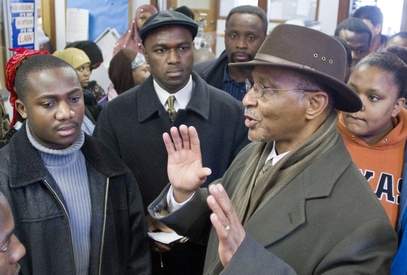
Flanked by Freddie Gray and Ben Gray, grieving parent Tabatha Manning at a press conference in the aftermatth of losing her 5-year-old child to gun violence.
Freddie appreciates better than most the challenge of educating children when so many factors bear on the results.
“We don’t produce widgets, we produce the citizens that are going to run this country. That’s exactly what we’re doing every single day. Every single one of these kids is an individual who deserves to have an individual touch them. It’s about that one-on-one relationship if we’re going to get kids to succeed, and if we don’t get this right then I think that says something about what the state of this country will be.
“Poverty is going to be the thing that kills us if we don’t take care of it and the only way I know to do that is to provide our children with the necessary skills to become employable.”
She’s keenly aware of criticism that the school board has ceded too much power to the superintendent.
“I understand people say that thing about the board being a rubber stamp but they don’t come and listen to the committee meetings and hear the board in dialogue. By the time theres a news sound bite we’ve already talked about it or figured it out or tabled it. Those things happen during the day (when the cameras aren’t on).
“But trust me we’ve got this. My job is to provide the superintendent with guidance in saying, ‘This is what you will do.’ There has to be parameters. We’ve got statutes to follow.”
In seeking solutions to bridge the achievement gap, she say, “I’m talking to other districts’ board presidents and members, not just when I’m on the Learning Community, but other times, too. That hasn’t happened much before.”
She says more collaboration is necessary because studies show that wherever kids live, whatever their race, if they live in poverty they underachieve.
“Poverty is a problem. If we’re not addressing poverty now than 20 years from now we’ll be having the same conversation.”
Breaking the cycle is a district goal.
“At the board level it’s looking at careers. We do kids a disservice when we say everybody’s going to college because that’s a lie and we all know it. But we do need to supply them with the necessary skill sets so they can be productive citizens.
“We’ve got to get these young people to the place where they can get jobs, where they can get out of poverty.”
She says OPS is finding success getting businesses to offer students internships that provide real life work experiences. He’s been active in the Empowerment Network’s Step-Up Omaha program to provide young people summer training and employment towards careers.
As both of them see it, everyone has a stake in this and a part to play, including schools, parents, business.
“There’s room at the table for everybody and everybody has to have a foot in this and has to step up. The focus has to be on what can we do together,” she says.
Now that she’s solidly in the public eye in such a prominent job she hopes African-American women follow her.
“I have to say this for other women who find themselves feeling like they’re voiceless: If you can see it, you can be it. There’s a lot of young African-American females who are just sharper than sharp, that could run rings around me all day doing this, but they don’t feel like they have a voice.
“And so I really hope they are paying attention because again Miss Freddie is not going to be doing this for the rest of her life and some of them are going to need to be sitting on this board.”
Ben Gray feels the same way about the young men and women of color he wants to see follow him into television or politics or wherever their passion lies.
Both with his own children and those he’s “adopted,” he’s taken great pains exposing them to African-American history and culture and encouraging them to engage in critical thinking and discussion.
“I wanted them to be more aware, I wanted all of our children to be aware of what’s around them and what it takes to survive. And to know who they are and what their history is, and some of them can tell you a lot better than I can tell you now.
“We have two that are like our own who are former gang members. Both of these guys are brilliant young men, and given a different set of circumstances would be someplace else.”
Ben and Freddie Gray are living proof what a difference new circumstances and second chances can make.
Related articles
- Masterful: Omaha Liberty Elementary School’s Luisa Palomo Displays a Talent for Teaching and Connecting (leoadambiga.wordpress.com)
- Fast Times at Omaha’s Liberty Elementary: The Evolution of a School (leoadambiga.wordpress.com)
- Negro Leagues Baseball Museum Exhibits on Display for the College World Series; In Bringing the Shows to Omaha the Great Plains Black History Museum Announces it’s Back (leoadambiga.wordpress.com)
- Kelly: It’s not about the ‘sex story,’ Freddie Gray says of Sebring (omaha.com)
- Brown v. Board of Education: Educate with an Even Hand and Carry a Big Stick (leoadambiga.wordpress.com)
- Omaha’s Malcolm X Memorial Foundation Comes into its Own, As the Nonprofit Eyes Grand Plans it Weighs How Much Support Exists to Realize Them (leoadambiga.wordpress.com)
Brown v. Board of Education: Educate with an Even Hand and Carry a Big Stick
I filed this story for a traveling Library of Congress exhibition commemorating the 50th anniversary of the historic 2004 Brown v. Board of Education Supreme Court decision that changed the face of education in America by law if not always practice.

Brown v. Board of Education: Educate with an Even Hand and Carry a Big Stick
©by Leo Adam Biga
Originally appeared in The Reader (www.thereader.com)
The U.S. Supreme Court’s historic 1954 Brown v. Board ruling and its aftermath reveal how far America’s come on the issue of race and how far it still must go. Lauded as a landmark decision against segregated public schools and as a precursor to opening all public institutions, the decree bolstered the nascent civil rights struggle.
Brown was the end game in the NAACP Legal Defense and Educational Fund‘s challenge to the Plessy v. Ferguson separate-but-equal doctrine that sanctioned segregation. The NAACP legal team framed the argument for overturning Plessy in legal, social and moral terms.
The court’s unanimous decision held that school segregation violated the Equal Protection and Due Process clauses of the 14th Amendment. But the integration and equity mandated by Brown has proven elusive.
One only has to look at Omaha for how insufficient the remedies to implement that finding have been. Before and even long after the ruling, black public school students here were largely confined to a few buildings on the north side. Black faculty were assigned to all black schools. It took a federal lawsuit filed by concerned Omaha parents and a resulting 1975 court-ordered busing program before the Omaha Public School district opened all its doors to students of color.
Thirty years later Omaha, like other urban centers, “is close to the point we were when Brown was decided, which is an educational system that is divided, if not solely on the basis of race, then clearly on the basis of class,” said Omaha attorney and former mayoral candidate Brenda Council. She said the problem will not be fixed until “we openly discuss it and take steps to ameliorate it.”
The OPS One City, One School District plan is the latest remedy offered by proponents of educational equity.
Suburban districts oppose the initiative and counter with options promising incentives and quotas to increase minority student placements.
Anyone interested in what led to Brown and to efforts at undoing or resisting its mandate can get a good primer on the topic by viewing With an Even Hand: Brown v. Board at Fifty at the Durham Western Heritage Museum.
The 100-plus items on display from the Library of Congress include intimate glimpses inside the precedents and processes behind Brown. There are photos, original legal briefs, even handwritten notes from Supreme Court justices and NAACP lawyers, that delineate history in the making. Some Omahans have personal connections to this history. Brenda Council’s late aunt, Geraldine Gilliam, was the first black teacher to integrate the schools in Topeka, Kansas. “I’m proud of that fact,” Council said.


Topeka native Norman Stanley, who now lives in Omaha, attended pre-Brown Topeka’s Monroe Elementary School. He was the product of a schizoid system whose elementary schools were segregated, but junior highs were integrated.
“It made no sense. You segregate a kid for the first six years and then integrate for the rest? Nobody could ever explain that to me,” Stanley said.
Although proud of the education he received under segregation, he embraced change. He was in the Air Force overseas when the Brown decision came down. “‘Thank God it’s over,’ I said. ‘By the time my grandkids are in high school, everything will be solved.’ How wrong I was.”
A Nov. 8 Durham panel discussion made clear Brown’s legacy is still a potent touchstone for equal rights advocates. Council was joined on the panel by KETV Ch. 7 “Kaleidoscope” host/producer Ben Gray, Creighton University law professor Mike Fenner and Glenwood (Iowa) Community Schools superintendent Stan Sibley.
Council pointed out the sad irony that 50 years after Brown, debate continues on how to fulfill its charge. She spoke of the need for “an enlightened citizenry to engage in open, honest discussion of the issues.”
Gray said equal education remains unrealized as “race, class and white privilege” have “disenfranchised” blacks, who are relegated to schools that have fewer resources. He said equality “ought not just be the law, it ought to be the moral imperative.” A vocal advocate of the OPS plan, he said segregation is back because “we’ve never, ever had a meaningful dialogue about” the issues behind it. “People of goodwill are just going to have to get out of their comfort zone and address this seriously.”
Sibley, a former OPS administrator, said, “It is true that not all of the people in the city of Omaha have a vested interest in the education of all the children in Omaha, and they really ought to. The dialogue has to happen, and if the dialogue focuses on what’s good for kids, then I think it will work out.”
Council said given the debate sparked by the OPS proposal, “It’s almost serendipitous this exhibit has come here at this time in Omaha.”
Social trends like white flight have created entrenched suburban enclaves whose tax-rich districts serve predominantly white student bodies, resulting in the kind of defacto segregation that existed before. As whites have fled older, poorer inner city districts populated mainly by minorities, inner city schools have come to primarily serve students of color. The demarcation that exists along racial and social economic lines in schools reflects the same segregation patterns in housing.
A less than comprehensive response to the conditions that cause segregation has left loopholes for circumventing the spirit of the law. Beyond stifling diversity in schools, segregation critics contend the practice creates an unequal distribution of educational resources, thereby compromising the education of students lacking basics like books, computers, pencils, et cetera.
Mandatory busing forced the hand of school districts like OPS to integrate schools. Since the end of court-ordered busing in Omaha in 1999, OPS has lost most of its upper and middle-class student-tax base. As more students opt out of OPS for the Millard, Ralston, Elkhorn or Westside districts, OPS loses revenues and any semblance of a racially and socioeconomically balanced educational system.
The Brown exhibit includes a ’50s-era political cartoon by Bill Mauldin that sums up the struggle for equality in America. Three black children push mightily against an oversized door with the words “School Segregation” on it. Despite their best efforts, the door is only opened a crack. The caption reads: “Inch by Inch.” Brown opened the door, but forces continue to try and push it shut.
“It was a decision the majority of the country wasn’t really ready for,” Norman Stanley said. “I’m not sure even today we’re ready to do what the court told us to do.”
Related articles
- Is Segregation Back in U.S. Public Schools? (nytimes.com)
- Brown v. Board site to mark ruling’s anniversary (kansas.com)
- Dept. of Education: School districts can use race-based policies to avoid segregation (wbez.org)
- Masterful: Omaha Liberty Elementary School’s Luisa Palomo Displays a Talent for Teaching and Connecting (leoadambiga.wordpress.com)
- Where Jim Crow survives: Alabama (salon.com)
Psychiatrist-Public Health Educator Mindy Thompson Fullilove Maps the Root Causes of America’s Inner City Decline and Paths to Restoration
America’s inner cities are sick. Have been for a long time. They’re long overdue for a sweeping public health approach that gets to some of the root causes of their decliine over the past 40-some years. North Omaha (really northeast Omaha) is a case in point. It’s long been in need of a transformation and one finally is underway after years of neglect, half-starts, spotty redevelopment, counterproductive urban renewal efforts, and rampant disinvestment. Psychiatrist and public health educator Mindy Thompson Fullilove has done much research, writing, and speaking about what’s happened to drag down inner cities and what’s needed to bring them back and I wrote the following piece on the eve of a presentation she gave in Omaha. I interviewed her in advance of her talk. I did attend her program, and though I didn’t do a followup story to report what she said I can tell you she covered many of the same points she made with me in our session.

Psychiatrist-Public Health Educator Mindy Thompson Fullilove Maps the Root Causes of America’s Inner City Decline and Paths to Restoration
©by Leo Adam Biga
Originally appeared iin The Reader (www.thereader.com)
The low standard of living found in segments of Omaha’s inner city mirrors adverse urban conditions across America. Poverty, low test scores, unemployment, gang violence, teen pregnancy, HIV/AIDS and STDs, distressed/devalued properties all occur at disproportionately high rates in these sectors.
Psychiatrist Dr. Mindy Thompson Fullilove, a public health educator at Columbia ((N.Y.) University, studies the causes and consequences of marginalized communities. A pair of talks she’s giving in Omaha next week, one for the public and one for health professionals, will echo local efforts addressing economic-educational-health disparities, infectious diseases and inner city redevelopment.
By training and disposition Fullilove looks for the connections in things. Much of her research focuses on linkages between the collapse of America’s urban core and the corollary decline in health — physical, psychological, emotional, environmental, economic — endemic there. She blames much of the blight on fallout from late ‘40s through mid-‘70s urban renewal projects.
Many longtime Omaha residents rue the North Freeway for driving a stake through the heart of a once cohesive, stable community. Hundreds of homes and dozens of businesses were razed to build it. Critics say this physical-symbolic barrier divided and damaged an area already reeling from late ‘60s riots that destroyed the North 24th St. business district, which only hastened white flight.
These interrelated phenomena, Thompson Fullilove believes, caused widespread carnage in cities like Omaha — displacing families, disrupting lives, rupturing communities, dragging down quality of life, property values, self-esteem and hope. In her view urban renewal was part of policies that “destroyed neighborhoods” — as many as 2,500 nationwide by her calculation — in the guise of progress.

“Many of the ways in which we built at that time involved demolishment of a neighborhood,” she said by phone. “There were these very large projects put in so that the old grid of the city was fused into sort of super blocks and huge things built on them like cultural centers or universities that made a fundamental change in the flow of the city. A lot of these projects were really not very thoughtful and didn’t work. So we’re living with the aftermath of very bad urban development, much of which is now coming down and being replaced.”The kind of severing of neighborhoods that occurred when freeway projects cut through the heart inner cities
Witness the sprawling Logan Fontenelle public housing project that came down a few years ago in northeast Omaha. In the early ‘70s, large tracts of land dotted with homes and businesses in far east Omaha were cleared for airport expansion. Anytime people are forced to move from their home it’s a major stress that can dislocate them from family, friends, jobs, neighborhood, community.
“Displacement is always accompanied by violence,” said Thompson Fullilove. “When people are displaced they need help to get back on their feet but if there’s never any help then things can get worse and worse. You get anger, hostility, and then people, instead of being able to solve problems, are just trying to survive.”
She said when people live outside social networks-support systems, epidemics like AIDS, STDs or gun violence emerge and grow entrenched. Often she said, people displaced from their homes also get displaced from blue-collar jobs. “People have no way to make a living and no social network to fall back on, so it’s really a double whammy,” she said. The results? “Terrible crime as people try to do work in the underground economy.” Thus, the drug trade thrives, gangs go unchecked. Some observers say Omaha’s African American community is still hurting from the packinghouse/manufacturing/railroad jobs lost in the ‘60s-‘70s.
She said today’s info service-high tech economy leaves many workers behind. “You have to get people to learn skills, you have to get people more education and you have to be inventing what they’re going to work at, and all these require a stable, engaged city as a center of exchange not a city of haves against have-nots,” she said. “Until cities are places of development, we’re in bad trouble as a nation.”
A term she uses to describe displacement’s trauma, “root shock,” is also the title of a book she authored examining how the ripple effects of urban renewal impact whole swaths of cities and persist long after the bulldozers leave.
“It has a ripple both in time and in space,” she said. “So tearing up a neighborhood has ripples for a whole metropolitan area and it also has ripples over time for generations of people who live in that area. Also, when you demolish a big area it creates a ripple of destruction on the other side of the area you demolish — you also decrease the value and the stability of the properties. And as those properties decline in value and really fall apart the properties next to them fall apart, and then the properties next to them fall apart. So you can actually take a drive in a place where there was urban renewal and find the leading edge of the destruction, typically a couple of neighborhoods over from where the urban renewal was done and, sometimes, even further.”

She said the decline extended to downtowns.
“Many neighborhoods demolished for urban renewal were near downtown or part of the downtown,” she said, “so demolishing a lively neighborhood which added to the strength of a downtown shopping center contributed to the collapse of many American downtowns, which are only slowly coming back.”
Like a disease introduced into a larger host, she said as urban decline spread it compromised the health of entire cities.
“It installed something that was dysfunctional in a critical part of the landscape of the city,” she said, “Although we think of all the terrible things that happened to the African Americans who actually lived in many affected neighborhoods, the worst consequence is that we made our cities weaker, so the whole nation lives with that grievous error. Cities are important for our nation because they really are the economic engine. So undermining the cities the way we did weakened our whole economic prosperity. You might say one of the seeds of this current economic crisis is in the destruction of our cities.”
From her perspective, America hasn’t corrected these problems — “what we’re doing instead is continuing to use versions of the same process.” She said even where a city center may enjoy a renaissance “it’s being rebuilt with the goal of attracting people from the suburbs to come back to the city.” That’s gentrification. “So the goal is not to make the city a welcoming place for all people that might like to live there. As opposed to figuring out how do you make a city which is a place of exchange, you’re making a city a place of exclusion,” she said, “and that’s just as destructive as urban renewal.”
She notes there‘s not yet widespread understanding among policymakers, developers and stakeholders of processes that diminish-threaten public health. She’s hopeful conferences like one she was at earlier this month in NYC, Housing, Health and Serial Displacement, “really open up this conversation, because I think if we’re going to have exciting cities in the United States it requires really a new approach to how you build cities, not just pushing people out.” She and her husband, community organizer and sociomedical sciences expert Robert Fullilove, work with urbanists on strategies for sustainable, inclusive, built environments.
Through the couple’s think tank, Community Research Group, they study and advocate holistic, public health approaches to urban living dynamics that view cities as ecosystems with interdependent neighborhoods-communities. What happens in one district, affects the rest. If one area suffers, the whole’s infected.
“You can’t undermine stable living conditions in a neighborhood or a community without bringing down the quality of life of everybody in the area, and it’s a very large area that then gets affected,” Thompson Fullilove said. “The foundation of health is good living conditions. Health is sort of our ability to enjoy our lives.”
Related articles
- A Synergy in North Omaha Harkens a New Arts-Culture District for the City (leoadambiga.wordpress.com)
- A Brief History of Omaha’s Civil Rights Struggle Distilled in Black and White By Photographer Rudy Smith (leoadambiga.wordpress.com)
- Omaha’s Northwest Radial Highway’s Small Box Businesses Fight the Good Fight By Being Themselves (leoadambiga.wordpress.com)
- Demolition is Not Enough: Design After Decline Author Brent Ryan on Redevelopment in Philadelphia (pennpress.typepad.com)
- Bill Cosby Speaks His Mind on Education (leoadambiga.wordpress.com)
Nurturing One Lost Soul at a Time, Teela Mickles Returns Citizens Back to Society
Returning citizens. It’s a term used to describe men and women exiting the prison system to restart their lives on the outside. America’s propensity to incarcerate large numbers of offenders results in a huge prison population and this means a constant turnover of individuals going into and coming out of confinement. Many are repeat offenders. Keeping folks from going back inside is a major focus theses days of national, state, and local programs because the expense of imprisonment is so high and penal facilities are so overcrowded and then there’s the social cost of people who leave prison and are unable to function as productive citizens in the free world. The fallout of incarceration and the criminalized underclass has far reaching effects. It impacts families and jobs. There are emotional, psychological, physical, and economic consequences that can last generations. The emphasis today is on preparing folks getting ready to leave prision to cope with the real world and providing them programs and services once they’re out to help them find their way in that world. A place to live. A job. Counseling. A support network. Some of these efforts are by large organizations and others are by small ones like Compassion in Action in Omaha, whose founder-director Teela Mickles is the subject of this profile. She’s one dedicated lady fighting the good fight. You’ll also find on this blog a story I wrote about a larger returning citizen effort, the Transformation Project, and profiles of individuals who’ve come out of prison to lead transformed lives, including Morris Jackson, Servando Perales, and Aisha Okudi.
Teela Mickles
Nurturing One Lost Soul at a Time, Teela Mickles Returns Citizens Back to Society
©by Leo Adam Biga
Originally appeared in the New Horizons
Teela Mickles is a self-described “goodie two-shoes” who’s never so much as gotten a jaywalking ticket, yet much of her life is devoted to assisting current and former prison inmates. Her work with our throwaway society‘s discarded is done as a certified Assemblies of God minister and as founder/director of her own community nonprofit, Compassion in Action, which offers pre-release and reentry services/programs.
This one-woman band prepares individuals transitioning from prison back into society. CIA operates two transitional homes in northeast Omaha, one for women and one for men. Volunteers interface with clients and their families, some as pen pals, others “adopting” inmates’ kids while mom or dad is away in prison. She works with an array of professionals in carrying out her missionary work.
She also does a program, Sister to Sister, that steers at-risk girls away from bad choices by exposing them to positive life skills and education/career opportunities. Additionally, she hosts a public access television show, Living the Life, and writes a column in Go-Ahead Entertainment Magazine.
Her work with offenders extends from pre-sentencing to sentencing to incarceration to pre-release to reentry to reestablishment. She attends court hearings, writes letters of support and advocates for inmates who “consistently work” her program. She lets the parole board know she has a place for parolees once they’re out. Once an individual is released, she works with parole and probation officers to ensure her program supports their mandates and that participants comply. Along the way, she hooks up participants with clothing, housing, transportation, jobs, et cetera.
Above all, she remembers she’s dealing with human beings, not statistics. It’s why she and others in the field now call clients “returning citizens” rather than ex-cons.
“We became weary of tagging them with the life-long stigma of ex-felons or ex-offenders,” she said. “That just drags out their sentence, which they have completed during their incarceration. ‘Returning citizens’ puts things into perspective with regard to the importance of community support and acceptance.”
Just getting the public to think about people with records and mug shots as parents with kids who need care, she said, is hard to do. So is finding volunteers to get involved in the lives of kids whose parents are locked up or piecing their lives together on the outside. Too often, she said, society is judgmental about people who’ve run afoul of the law, discounting or dehumanizing them.
Teela’s holistic approach is all about “embracing the person, rebuilding the family and breaking the cycle.”
Although never in trouble with the law, she knows something about overcoming hard times. Personal trials she endured led to a conversion that brought the healing and insight necessary to do the prison ministry she’s followed ever since.
Spend any time with her and you fall under the spell of her serene demeanor, her colorful turns-of-phrase, her devotion, her deep knowledge and her abundant compassion, which is more than a title but a genuine expression of her heart.
Little in her early years suggested the path she’d follow, except she always exhibited energy and empathy to serve others. She developed a strong sense of self in the 1950s and ’60s amongst her close, proud, large extended African-American family, the Bryant-Fishers, whose annual reunion in Omaha is attended by hundreds of relatives from around the nation. A famous “cuz” who comes in for the gathering is actress Gabrielle Union, whom Teela’s had interact with Sister to Sister participants.
Growing up in South Omaha, North Omaha, and the hills outside Council Bluffs, Teela was raised Catholic. She was a good student often showing off her fine singing voice in school and church. As a young woman she sang in nightclubs. She still occasionally sings at special events. She married early and became a mother of five children, all, like her, musically inclined. She was busy in church, school, community — serving as a Girl Scout, Cub Scout, Brownie leader, room mother, liturgical director. She seemed a contented stay-at-home-mom in a stable, happy relationship.
Behind closed doors though she suffered in “a turbulent marriage” marked by “a lot of violence and abuse.” Despite the dysfunction, she said, “I was determined to stay, to stick with it, because that’s all I knew how to do.” Co-dependency prevents domestic violence victims from fleeing. She finally summoned the courage to leave when her oldest daughter revealed her father, Teela’s husband, violated her.
“I took my five kids and never went back to that house, and was homeless for almost three months behind that.”
That wrenching break with the safe and familiar came in 1982. Her children then were ages 12 and under. Adrift, with five hungry mouths to support, her marriage over, Teela didn’t know where to turn for help.
“Because of that situation I didn’t trust anyone — mother, father, sister, brother. I trusted no one with my children. I didn’t trust me because I hadn’t a clue what had been going on, so that was on me. I felt empty and pointless. I felt like such a failure. I figured I failed my husband, I failed my children. I became a topic of gossip among my close family, so I felt like I was a bad daughter, bad sister, bad everything. I had these little kids, they’re looking at me going, What are we supposed to do? I had no clue. I was a single parent, I had never worked outside the home except for six months prior to my leaving. This whole thing was brand new.”
Scary, too. Faith became the pathway for rebuilding her tattered self.
“Even though I was a very religious person, I did not have a personal connection with God to where I felt like I could really live a life free of all this pain. I had this burn inside of me to find this God. It was a quest and the Lord did surround me with a lot of different individuals who would become significant in leading me down that path.”
She found solace and direction at Trinity Hope Four Square Gospel Church, where she attended a Pentecostal revival service and felt the call.
“I did become born again after nine months. That changed everything. The experience was a total transformation mentally, spiritually, physically, and God really impressed upon me I did count, my life did matter.”
That epiphany is the core of the empowering, faith-based message and curriculum she delivers to those coming out of prison. Not unlike a 12-step recovery program, she tends to broken people by giving them the tools and principles for rebuilding themselves and their lives in healthy ways,
Her own crucible came in 1983, when her life went from chaos to clarity. “My born again experience gave me such a peace. I had an understanding and an awareness I was not alone.” Doors began opening her to new opportunities. She got a job with a realty company, managing rental properties, including Section 8 housing. When a five-bedroom unit became available she and her kids moved in. Then, as if by providence, she landed a better job at a company seeking a black Christian woman.
The church she belonged to at the time sponsored a small choir that visited prisons to proclaim the Good News. As Teela always did, no matter what congregation her family attended, she enlisted her kids to perform.
“I have very gifted, talented children. My kids sang, they danced, they were the bomb.”
And so she took lead of the choir and of a youth group she formed to bring scripturally-based music to inmates at the Nebraska Correctional Center for Women near York, Neb, and the Youth Rehabilitation & Treatment Center in Geneva, Neb. More visits to more venues followed.
“We went to different substance abuse rehabilitation centers, we went to different churches, we just kind of toured and shared the songs, shared the testimony. That’s how that door opened,” she said.
At the invitation of corrections authorities she began conducting monthly chapel services for the captive audiences in York and Geneva. These are hardened characters. She didn’t pretend she knew their life but she was sure she had something to offer because of the hell she’d been through and the healing she’d found.
“I had enough pain and enough gain that they complemented one another. I was raw enough that I didn’t make any assumptions of what I was stepping into. I knew that God was able to heal and that He’s open for everybody, and I knew that most people didn’t know that. I didn’t and I was a goodie-two-shoes, so how could someone that had a rough life know that?
“I’ve never done drugs or alcohol, I don’t even have a traffic citation, I just had a bad marriage but I’m acquainted with pain and the kind of pain you can’t get relief for from a person. I was still in a process of healing myself and it was amazing how the Lord knitted us together. They (clients) think I bless them but they’ll never know what a blessing they are to me. And that’s how ministry works.”
Embracing the person, rebuilding the family and breaking the cycle.
Teela feels her ability to relate to ex-offenders lies in her “sensitivity to the value of each person and helping them understand they are valuable in spite of what took place to have them go there. Their issues started before they got in prison.”
Nebraska Department of Corrections Deputy Director of Programs and Community Services Larry Wayne was warden at the York facility when he first met Teela. He’s impressed by how she helps inmates improve decision-making, problem-solving, conflict-management skills from a faith-based approach. “What drives her is her faith,” he said. “You can’t really know Teela unless you know that aspect of her and how she’s motivated.”
Though she mainly works with women she also assists men. She’s visited the Douglas County Corrections center, the Nebraska State Penitentiary, the Lincoln Correctional Center and the Tecumseh Correctional Institution. She said in all the countless visits she’s made to prisons and jails she’s never been afraid, even when the lone female among a large group of male inmates and guards. Her fearlessness, she said, is a direct result of her faith and of the compassion she has about this population.
“I believe when God calls you He prepares you. I didn’t have any preconceived ideas. Once I saw the people they were just people. In fact, my heart just broke because it was almost like, there’s another side to this story. The person that would act the worst, all hateful and mean and I-dare-you-to-touch-me or I-dare-you-to-get-over or I-dare-you-to-make-me-feel-anything, is the one I would hurt the most for because it’s obvious they hurt the most and had built up all these walls. What he or she was attempting to portray was not who they really were.”
The dignity she shows inmates is returned.
‘The men have always offered me the upmost respect. I have felt more respect and more protection walking across the (prison) yard then walking in some churches. When a man looks at me a certain way another man will check them, ‘No, you don’t look at her that way and you don’t think whatever it is you’re thinking.’ There’s just this aura of respect I’ve always received. I’ve never had any fear.” Besides, she said, “I present myself as untouchable in terms of any game playing. I say, ‘I’m here because I care and my care is for real, so don’t play with it,’ they haven’t.”
Invariably, she said, individuals caught up in the penal system carry a hurt they’ve buried deep inside. Behind bars or on the outside survival dictates they show no weakness. Part of her job though is breaking that wall down so clients can feel again.” That healing, she said, has “gotta be personal, it’s gotta be on their terms.”
“We’re constantly after validation — validate to motivate to educate. Most people want to educate first — but what’s your motivation to be educated? Well, if you see yourself as a valuable person, your goals and behavior and objectives might be totally different. That’s always the goal we’re going after.
“I don’t tell anybody what they have to do, I just present options and I turn a light on, and if they’re open to explore that light they will. If they’re scared and it’s just way too much truth for them to digest they’ll back off, but always with respect.”
She said “once a person begins grasping the root causes” of why they act out in harmful ways, “they can create their own options.”

She used to spend more time in prisons before she inadvertently crossed the line.
“Aa woman I visited in prison gave me a mother’s prayer card for her son, who was in another prison, and I mailed it to him. I didn’t know it was wrong. You would have thought I busted the system. They shut me down, I couldn’t go in any correctional facility. My heart was so hurt because the last thing I would do is break any rules.”
This happened before Teela formed CIA. The inspiration for it came after her banishment, when she received a flood of cards and letters from inmates saying how much they missed her. “All of a sudden I’d been taken away from them,” she said. The correspondence had a similar refrain — individuals got out of prison only to reoffend and wind up back inside. The recidivism alarmed and saddened her.
One woman’s letter particularly touched Teela. “I had already walked her out of prison and helped her get some clothes and connect with her kids, I thought she was doing OK, only to find out she’s back in prison for the fourth time. She wrote, ‘I’m sick of this and this and this, I believe I’m institutionalized.’ That’s when I broke at my job and started crying. I thought, I can’t help these ladies, I’m not doing enough.”
It was obvious something more was needed to sustain people on the outside. Right then in her cubicle the concept and name for Compassion in Action came to her. On a yellow legal pad she outlined CIA’s mission based on the woman’s laments.
“It dawned on me that we have to work with them before they get out — there’s too much pressure, not enough time. We have to connect with their kids. We have to get volunteer families to work with the children while mom’s incarcerated, let the kids know they are being brought into an environment of safety and education and help build some bridges prior to mom getting out. The women need practical things, like maybe job skills, education, a place to live, transportation. They need all these things in place before they get out.”
Her new ministry got its start via a U.S. Department of Education Urban Community Service grant administered by the University of Nebraska at Omaha’s family support program to provide parent education to women in prison. She conducted six to eight-week classes that met twice a week, with some 20-30 women per class.
“We had some really good results,” said Teela, who designed the curriculum.
Around this time she got downsized at her job and she used her severance pay and an education grant to continue working in prisons and to better inform herself about the population she served. “I had to learn and understand more than I did,” she said. “I got a chemical dependency counseling associate’s degree from Metro (Community College). I was 47 and it was my first time in college. I had a fun time and I graduated with honors. It’s easy to do when you know what you want to be when you grow up.”
Practicums at the Santa Monica and New Creations transitional living programs gave her “a glimpse” of what CIA would evolve to.

When the parent education grant funding ended she continued teaching classes with support from churches. But shorter inmate stays and tighter prison security meant less access, rendering the program impractical. Her curtailed prison privileges didn’t help.
But “a bigger vision” awaited. It began to be realized in 2000 when she obtained a former Uta Halee residence on Florence Blvd. to serve as CIA’s All the Way Transitional Home for Women. She recruited volunteers and matched them with clients according to volunteers’ interests and the women’s needs.
Last year she obtained a house for CIA’s first men’s transitional living program. In 2005 her work with men expanded when CIA became a partner with the Nebraska Department of Corrections providing services for the federally-mandated Serious and Violent Offender Reentry Initiative.
She insists CIA homes are not half-way houses but “places for transition for residents to get themselves prepared for independent living.” That includes making residents employable. “I network with ENCAP (Eastern Nebraska Community Action Partnership). They have a program for former felons to prepare them for employment,” said Teela.
She said CIA’s sterling reputation has traditionally gotten clients “right in the door” for jobs “but in this horrible economy,” when folks with degrees compete for the same entry level jobs as people with records, “it’s not working now.” She said the ladies currently in residence at All the Way “are frustrated they can’t find work. They’re way behind on their resident fees. It’s a financial strain on us as well.”
Much groundwork is laid with clients before they ever get out of prison.
“We work with them three to six to nine months prior to their release,” said Teela. “We’re able to determine how best to serve them, to connect with family members they want us to connect with, and to prepare a support team tailored to their development and interests. For example, if they’re in for a drug-related crime then we know we have to get a team together to address that piece.”
She said renewing family ties can be a sensitive thing because of abuse that occurred. That’s why reconciliation can take time and the focus must first be on recovery.
Education is another emphasis. “The GED program is offered in prison but most people don’t take advantage of it,” she said.
It’s a mixed bag in terms of how CIA participants do once they’re out of prison.
“For the most part I’ve learned not to have expectations,” said Teela. “There have been times when I thought, OK, we did this this and this and therefore this result should happen, and it didn’t happen. and it made me feel like I failed and it made me try to figure out what was missing, as if it depended upon me.” Now, she’s come to realize her job “is to plant seeds and treat everyone with respect and unconditional love, but it’s not up to me to fix them.”
That changed expectation, she said, “has helped.” It’s more realistic because in the end people do what they want to do. “You can present the same opportunities to people and some individuals will not only misuse and abuse that but they will end up back in prison,” she said. “No matter what we do, no matter what we provide, it depends on their willingness to make it happen.”
She does have her success stories and she said they all share something in common.
“Everyone that’s succeeded has a real, genuine, personal relationship with God,” noted Teela. “Their gifts and their plans had to be spiritually connected, because they tried everything else and it didn’t work. Once they recognize this is the part that makes it happen and they stick with it, they succeed.”
That was the case with All the Way’s first resident, Andrea. “We worked with her prior to her sentence, during her sentence, then when her sentence was complete she was here,” said Teela. “She had a plan, she stuck with her plan. She got a job at Creighton Medical Center. Now she’s living and working in Kansas City, and having a house built.” In another case, Teela recruited and trained a family to adopt Tracie and her three sons. While Tracie was incarcerated the family took her boys to visit her and the family did various activities with the youths. The family remained engaged with her and the boys until she was free and reunited with her sons. “In that match,” said Teela, “we crossed everything — racial, cultural, religious, socioeconomic barriers.” As Teela likes to say the adoptive family got to see the other side of the story — that “Tracie’s a great mom, she was just in the wrong place at the wrong time.” Tracie’s earned a college degree while working as CIA’s program manager. She’s now pursuing a master’s in health and human services.
Lataunya is another shining example. “She had such little belief in herself and she accomplished so much. She got a great job, she got her own car and a three-bedroom apartment, then her own home. She was pardoned by the mayor, and now she’s trying to work as a professional in the field. An amazing woman,” said Teela.
Two men recently helped by CIA are doing well on their own. Allen manages a store at the Westroads Mall and Pierre is working and raising his three sons, who stayed with him at the men’s transitional home. It’s not often residents have their children with them in transitional homes but exceptions are made if circumstances warrant it.
The impact her work makes isn’t always readily apparent. Like the revelation a female physician made to her.
“Twenty years ago this woman was a 14-year-old troubled youth in Geneva who had been in and out of foster care. She remembered me coming there and the ministry I shared. She stated her ‘relationship with God and sports’ turned her life around. So here she was 20 years later, my doctor! You can’t imagine how I felt at that moment.”
For a long time Teela felt she was doing her work in isolation but recent developments have encouraged her she’s not alone. “One of the exciting things happening now is the community finally is becoming more involved in the reentry piece,” she said. A driving force, as she sees it, is the federal reentry initiative. “It opened the door to invite the community in so that law enforcement and corrections were introduced to the other side of the story.”
In line with her own work, she said the new emphasis is on “trying to keep people out of prison by trying to accommodate their reentry needs.” It only makes sense, she said, because “it’s too expensive to keep people housed in prison when you can spend less money preparing them to become a taxpayer and a contributing member of the community. Agencies are being forced to consider this population as individuals rather than as a number or a label and so there’s a lot of community awareness. The community’s connecting to the fact these are people. Prior to that it was cuff ‘em and stuff ‘em. Now they’re being asked to hug-a-thug.”
The shift took some doing. “It went from one dynamic to the other and it was an education for everyone. Now everybody’s on the same page. There’s better communication between the state, county and city agencies, plus the different community groups.” Now, entities and organizations that had little to do with each other before are working together and CIA is playing its part.
She and others are working on putting more “faces in places” — having more community members visit prisons to educate inmates on things they can do to better prepare themselves for life on the outside, whether getting a GED or working a recovery program. She said in lieu of specific options many inmates cop the attitude, “I don’t see the point, I’m just going to do my time and get out of here.”
Teela trains others to serve this population. “I avail myself as a resource person or consultant in the area of pre-release, reentry and transition. We’re on the front lines with the background we have. We’ve been doing this for so long.” Society’s focus on these issues, she said, can’t come soon enough given “the prison population is growing and getting younger and the situations are becoming more difficult.”
Metro College community liaison Tommy Wilson is leading community Table Talks on reentry services and she said Mickles is one of the first persons she called to participate. “I’m very impressed with what Teela does and she does so much with so little. Teela knows where the gaps are, she’s been there, she knows what needs to be done with this reentry piece. She brings a lot of valuable resources to the community,” said Wilson, who’s accompanied Teela behind bars, where she said her reputation precedes her. “Everybody knows Miss Teela does this or Miss Teela does that — she can tell them how to get some housing or some transportation.”
Larry Wayne said Teela’s “integrity” earns her credibility inside the walls and on the street, because she’s earned the trust of people who’ve been let down before. “She’s walked a mile in their shoes, not in prison necessarily, but she’s faced up to challenges that look a lot like what they’re struggling with.” He said ex-offenders respond to her “unconditional love” and her “being there for them. They know she will follow through with them. She has a proven track record and that carries a lot.”
Networking is vital to what she does and that means attending many meetings. She also makes several presentations a year. Then there’s this Church Lady’s weekly bible study, worshiping at Sunday services — she’s an equal opportunity church-goer who explores different places and styles of worship — and monthly Christian Business Women’s Association luncheons. She estimates she works 60 hours a week. No two days are alike. Her son Mark helps her run CIA’s behind-the-scenes operations. Her other children have helped, too. But beyond a part-time office staffer and a small corps of volunteers it’s Teela’s baby. Volunteers and funds are harder to come by these days, she said. The needs are many. But Teela just keeps on trucking along.
“Somehow we make it,” she said.
She looks forward to a day when there’s more community awareness of the population she serves and their needs. She’s sure if basic values of self-worth and respect for others were more widely taught at an early age her caseload would be cut to a fraction because fewer would end up imprisoned. That’d be just fine with Miss Teela.
Rescuer curriculum gives students new perspective on the Holocaust
When it comes to history we can never get complacent or assume there’s nothing more we need to know about a subject. When that subject is the Holocaust and the setting is a high school the importance of educating students about this chapter of human history should compel teachers to do all they can to make what happened real and relevant to their own lives. By whatever means possible students should be thrust into what-if scenarios that encourage them to think critically about what they would have done if they found themselves in the very circumstances that gave rise to the horror. Because, as history has shown, genocide happened before and after the Holocaust. It could happen again. Trying to understand what it means to be stripped of all human rights and marked for death is one step to ensuring atrocities don’t recur. Exercises that put yourself in the position of the persecuted or the onlooker take it from the abstract to the concrete. If you had been in Nazi Europe to witness the unfolding terror that threatened co-workers, neighbors, friends or strangers, what would you have done? That’s what teachers and students at Omaha Westside High School considered as part of a Holocaust curriculum new at the time I reported on it in 2002. This blog contains many more Holocaust-related stories I’ve written over the years, including profiles of survivors and rescuers.
Rescuer curriculum gives students new perspective on the Holocaust
©by Leo Adam Biga
Originally appeared in the Jewish Press
This past spring, about 45 Westside High School seniors in two Advanced Placement European History classes participated in a new Holocaust studies unit. The program got its first trial run anywhere at the District 66 school.
The curriculum program was developed by the local Hidden Heroes of the Holocaust Foundation. Using the materials, Westside instructors Bill Hayes and Gina Gangel first had students immerse themselves in the events that gave rise to Hitler, Nazism and the persecution of Jews.
Then, in a new twist to the school’s traditional approach to the Holocaust, the instructors followed the lead of the foundation’s adjunct curriculum and broke their classes into small groups to research documented rescue efforts from the Shoah. This was in preparation for each group devising and discussing a hypothetical rescue plan of their own. Students based their plans on accounts in books and on the Internet.
The idea behind placing students in the context of witnesses was to offer a deeper understanding of the peril faced by Jews. As Jews and other minorities desperately sought safe harbor there were moral choices involved for onlookers, risks incurred by those who interceded as rescuers and obstacles to doing good in a culture of hate or indifference.
A visitor to Hayes’ classroom in April found his students demonstrating a keen interest in the Holocaust materials and a facile grasp of the situation and its moral implications. The students were smart, attentive and engaged as they grappled with some of the more troubling questions raised by events far removed from their own experience. In the end, students confronted both the nobler and baser aspects of humankind and came away with conclusions to some questions and a sense that answers may never be found to some others.
An early session featured small group discussions in which students explored the ramifications of being a rescuer and the nuts-and-bolts of actual rescue operations, and a later session found students presenting their plans for the assembled class. Through it all, Hayes acted as monitor, catalyst, advisor, provocateur — providing context at various points and challenging some assumptions at other junctures.
The students’ plans ranged widely in scope, methodology and feasibility: one, closely modeled after successful operations in Hungary, featured the use of safe passes and safe houses and back room negotiations with government-military officials in an effort to keep refugees unharmed; another proposed a multi-national military strike force to lead raids on trains and camps to free Jews; a third plan imagined a group of sympathizers warning Jews of the Nazis’ intentions and providing the means for their escape; a fourth scheme depended on a vast international monetary network to undermine German interests and to fund Jewish resistance and escape efforts. As far-fetched as some plans were, they revealed students had done their homework and understood some of the difficulties posed by any rescue effort and some of the measures actually employed in rescuing Jews.
Hayes reminded the class of the harsh realities at work during the Holocaust, including the fact that governments washed their collective hands of the Jews’ predicament and took no extraordinary means to aid them. He also drew a parallel to the moral imperatives at work then to the dilemmas posed by the current Israeli-Palestinian conflict.
He asked: “Is it realistic to think we can do something to help people who are suffering? Are we being realistic, historically? Could we adapt rescue efforts of the past to modern times? Will it work? Is there a risk? Is it worth the risk?” To which a boy responded, “There’s always an inherent risk in any plan.” Then, an earnest girl spoke up and said, “I think we should never limit our possibilities to try to save people. There’s always room for compromise.”
Westside senior Carrie Jenkins, a well-spoken, fresh-faced young woman with eyes full of curiosity, felt the process of projecting one’s self into the treacherous waters tread by Holocaust rescuers and their charges, helped shed light on some of the problems and hazards faced by these heroes.
“It makes you realize the absolute risks that were involved. When you’re trying to devise a plan you realize it’s not easy to find money, to find other resources and to figure out how you’re going to get refugees out, where they’re going to go and who’s going to help them. It’s extremely challenging,” she said. “It’s given me a new insight into how difficult it must have been for those few who did accept the challenge.”
Chris Gerdes, a studious-looking young man, said, “It took a lot of guts and a lot of heart for any of these rescuers to attempt what they did. They realized the risks and they realized what was on the line — even their lives — when they tried to help Jews. The rescuers usually had a strong religious background or a strong belief in humanity and, so, in the end they thought it was all worth it.”
Given the threats rescuers faced, Jenkins said, “I think it’s amazing there were so many people willing to risk their lives and their families’ lives.”

Westside High School
But, as students discovered in their research, relatively few individuals, and even fewer governments and organizations, actually did anything to try and halt the Final Solution, much less aid individual Jews and other persecuted individuals.
“When you take it as a percentage of the population, not many helped,” said sober Ian Peterson. “It just makes you wonder. There were probably people who were afraid of resisting and others who didn’t think there was anything to resist and others who didn’t really care. If you were selfish in the least bit you wouldn’t do anything because if you started to act as a Jewish sympathizer you’d get brandished in society and the Gestapo would come to your house. It was just incredible pressure. It would be like in this country if you went around burning the flag. It’d be really hard.”
The price of being a nonconformist and outcast is something that resonates strongly with teenagers, whose lives revolve around fitting-in. Simply put, said Pat Gaule, being a subject of the Nazi regime meant “you had peer pressure.” Jenkins added that anyone daring to express pro-Jewish or anti-Nazi sentiments meant “you got basically black-marked” or worse. The tall, thoughtful Gaule said the small numbers of rescuers and resistance fighters can be explained, if not excused, by human nature.
“I think there’s initially a natural want to deny that anything bad is going on or an assumption that it’s not as bad as some say it is. When I was doing research on the rescuers I found it took them witnessing a Nazi raid on a Jewish ghetto or a roundup of Jews onto trains en route to the concentration camps — or something equally horrific or violent — to make them want to get involved. I think, naturally, there’s that hesitation to not do anything and sometimes it just took something to push them over the edge.”
Doug Sherrets, the bright-eyed editor of the school paper, feels the impulse for self-preservation prevailed.
“Well, you’re going to take care of yourself, first, and I think that shows up most with Switzerland and all the ill-gotten money from Germany it squirreled away in bank accounts,” he said. “They saw this huge powerhouse in Nazi Germany that seemed like it was going to take over a large part of Europe and be there for a very long time. The Swiss said, Fine, we’re going to do whatever it takes for you not to invade us. They looked after themselves and not at where the money being diverted to Swiss bank accounts was coming from, which was right off the backs and teeth and hard work of the Jewish people.”
When a student suggested rank-and-file Europeans may not have known what ultimate dark fate lay behind the oppression and deportation of their Jewish neighbors, a visibly upset Jenkins used an analogy to point out the absurdity of that rationalization.
“Okay, say if every black person in Omaha suddenly disappeared…wouldn’t you think something was going on? I mean, if all of the Jewish or black people in your town are gone, wouldn’t you think the worst? How could you not know?”
Before her antagonist could reply, instructor Bill Hayes poked his head in the group to suggest students review a section of the book Hitler’s Willing Executioners for some added perspective on just how prevalent looking-the-other-way was among the countless millions who witnessed the atrocities unfolding around them and yet did nothing about it.
For Jenkins, who is part German, it was a harsh discovery to find that few Germans interceded on behalf of their victimized countrymen and in fact most implicitly or complicity condoned the horror. “I have a German background and learning about this is just very hard,” she said. In response, a sympathetic classmate told her, “It doesn’t mean your people are bad. This kind of thing happens all over the world.”
A new perspective on the Holocaust, a close identification with rescuers and victims and a jumping-off point for historical-political-moral discussions is just what designers of the curriculum had in mind.
Curriculum author Christina Micek said she wants students using the materials “to get a personal connection to history” and has therefore created lesson plans allowing for discussion and inquiry. She said when dealing with the Holocaust, students should be encouraged to ask questions, search out answers and apply the lessons of the past to their own lives.
“I really want students to feel they’re historians…I want them to take a personal interest in the subject and to analyze the events and to be able to identify some of the moral issues of the Holocaust and to discuss them in an educated manner.”
Westside’s Hayes feels Micek’s goals were largely met.
“I thought it was real useful. I think for the final project the kids had to think a lot and read a lot and study a lot in order to get where they did with their rescue plans. Every kid had a chance to look at several different examples of rescuers. Traditionally, in our two-week unit on the Holocaust we’ve looked at what the Nazis did and at the Jews who were killed and that was the extent of it.
“We never looked at it from the rescuers’ standpoint and we never dealt with the idea that the average person could really do something. And I think that’s the real value in this unit. I think it gives a message to kids that you don’t have to just stand by — there is something you can do. There may be some risk, but there is something you can do.” He said it is likely the rescuer curriculum will remain a part of Westside’s history units.
Micek, a 3rd grade teacher at Springlake Academy in Omaha and a Holocaust Studies graduate student with the Spertus Institute, wrote the curriculum program with the input of Swiss historian Theo Tschuy, author of the definitive book about Lutz and his heroic work in Hungary, Dangerous Diplomacy: The Story of Carl Lutz, Rescuer of 62,000 Hungarian Jews (2000, Eerdmans Publishing Co.).
The program includes a teacher’s guide, grade appropriate lesson plans, reading assignments, discussion activities and classroom resources, including extensive links to selected Holocaust web sites. The foundation eventually wants to make the Lutz curriculum available, at no cost, to schools in Nebraska and across the nation. The program is designed for three levels — the sixth grade, the eighth grade and high school. The foundation hopes to pilot the 6th and 8th grade curriculum programs next school year. In addition to the current curriculum package, plans call for making an interactive CD-ROM, as well as Tschuy’s book, available to schools. Hidden Heroes has contracted Redstone Communications in Omaha to develop the materials.
The materials field tested at Westside are the first in a proposed series of school-age programs from the Foundation, whose mission is building awareness about an often overlooked chapter of the Holocaust — the rescuers, that small, disparate, courageous band of deliverers whose actions saved thousands from genocide.
The mostly Christian rescuers came from every station in life. They hid refugees and exiles wherever they could, often moving their charges from place to place as sanctuaries became unsafe. As a means of protecting those in their safekeeping, custodians provided new, non-Jewish identities. While not everyone in hiding survived, many did and behind each story of survival is a story of rescue. And while not every rescuer acted selflessly, the heroes that did — and there are more than commonly thought — offer proof that even lone individuals can make a difference against overwhelming odds. The Foundation’s mission is telling these heroic stories for the lessons they impart.
“Educating young people is our number one concern,” said Foundation board member Ellen Wright. “Our youths’ heroes today are athletes and entertainers, which is an interesting commentary on our times. What we want to do is add to that plate of heroes by taking a look at rescuers” whose good works can serve as models for how ordinary people can stand up to injustice and intolerance.
“If we can get even a few children interested enough that they will feel committed to ensuring the Holocaust doesn’t happen again, then we have taught a new generation,” said fellow board member Deenie Meyerson. Hidden Heroes’ next curriculum projects are to focus on: the late Portuguese diplomat Aristides de Sousa Mendes, who while stationed in France during WWII signed thousands of visas that spared the lives of recipients; and the extensive humanitarian network in Belgium that successfully hid more than 4,000 children.
According to Tom Carman, head of the department of social studies in the Westside Community Schools, the rescue curriculum is an attractive addition to the district’s standard Holocaust studies.
“The material allows us to look beyond Oscar Schindler and Raoul Wallenberg, whose rescue efforts some people view as an aberration, in showing there were a number of people, granted not enough, who did some positive things at that time. Lutz and others said, This is wrong, and did something about it, unlike most people who took a much safer route and either feigned ignorance or looked the other way. It gives examples of people who acted correctly and that teaches there are options out there.”
Carman said the lesson plans prepared by Micek, who collaborated with Westside educators in refining the materials for the district, are “done very well” and are “really complete.” District 66 superintendent Ken Bird said it’s rare for a non-profit to offer “a value-added” educational program that “so nicely augments our curriculum as this one does.”
While students agree they can never fully apprehend what it means to be a rescuer, they say being assigned the task of imagining themselves in their shoes and working-out solutions to life or death dilemmas afforded them a new perspective on what these roles meant. Where, in the past, students said they examined the Holocaust from a dry, abstract distance, this new exercise put them right in the mix of things and, so, made it more intimate and direct and lent it more flesh-and-blood immediacy.
“It’s always been from a textbook perspective,” said Carrie Jenkins, “where you’re reading historians’ views and everybody has different statistics and reasons and explanations. With this class, we started there by gathering data, but then we moved past that into trying to create something out of that. It’s definitely a different perspective.”
Gaule said, “In a textbook, it’s going to say this percentage of people died and this percentage of people were saved, but in this way we get to quantify the morality. Like, it may seem that a few thousand people saved here and there was not very much, but in reality, as we found out, it took a tremendous amount of work and determination and moral values to stand-up for Jews who were being subjected to tyranny.”
For Ian Peterson, the curriculum “sort of completes the perspective I’ve gained. Now, we’ve seen it from a lot of different angles and it sort of comes together as a more complete whole. It makes a little more sense.” Doug Sherrets said, “It’s always good to observe history from a bunch of different angles. Personally, I really hadn’t heard a lot about the rescuers prior to taking this unit. Outside of Schindler’s List, I really didn’t know much at all.
“It’s been said that you should always learn from the past and from the Holocaust we should learn not to make those mistakes again. It should make governments think more about getting involved. I now understand if more governments would have got involved there would have been a greater chance of stopping the damage from being so great.”
In the end, students concluded that putting one’s self on the line for another expresses the best in humanity.
“I think that represents like the highest point of human willingness to give everything you have,” said Peterson. “I mean, that’s like the ultimate good you could do in your life.” That sentiment prompted Carrie Jenkins to posit, “Compared to that, what value does anything else have?” Peterson added, “I know. It makes charity seem pointless when there are people that did so much and risked so much.”
Related articles
- Arno Lustiger, historian and Holocaust survivor, dies at 88 (jta.org)
- Gad Beck, one of the last gay Jewish survivors of the Holocaust, dies at 88 (bangordailynews.com)
- State of Israel awards three Greeks who helped Jews during WWII (ekathimerini.com)
- As Holocaust Survivors Dwindle, a Gathering to Ensure Their Lessons Live On (njspotlight.com)
- Wilson Students Thank Holocaust Project Sponsors (wytv.com)
- Israeli students remember Shoah through Euro 2012 (timesofisrael.com)


 Leo Adam Biga's My Inside Stories