Archive

Archive for the ‘Theater’ Category

South Omaha stories on tap for free PlayFest show; Great Plains Theatre Conference’s Neighborhood Tapestries returns to south side

May 6, 2015 2 comments

Omaha’s various geographic segments feature distinct charecteristics all their own. South Omaha has a stockyards-packing plant heritage that lives on to this day and it continues its legacy as home to new arrivals, whether immigrants or refugees. The free May 27 Great Plains Theatre Conference PlayFest show South Omaha Stories at the Livestock Exchange Building is a collaboration between playwrights and residents that shares stories reflective of that district and the people who comprise it. What follows are two articles I did about the event. The first and most recent article is for The Reader (www.thereader.com) and it looks at South O through the prism of two young people interviewed by playwrights for the project. The second article looks at South O through the lens of three older people interviewed by playwrights for the same project. Together, my articles and participants’ stores provide a fair approximation of what makes South O, well, South O. Or in the vernacular (think South Side Chicago), Sou’d O.


South Omaha stories on tap for free PlayFest show

Great Plains Theatre Conference’s Neighborhood Tapestries returns to south side

©by Leo Adam Biga

Appearing in the May 2015 issue of The Reader (www.thereader.com)


Perhaps more than any geographic quadrant of the city, South Omaha owns the richest legacy as a livestock-meatpacking industry hub and historic home to new arrivals fixated on the American Dream.

Everyone with South O ties has a story. When some playwrights sat down to interview four such folks, tales flowed. Using the subjects’ own words and drawing from research, the playwrights, together with New York director Josh Hecht, have crafted a night of theater for this year’s Great Plains Theatre Conference’s Neighborhood Tapestries.

Omaha’s M. Michele Phillips directs this collaborative patchwork of South Omaha Stories. The 7:30 p.m. show May 27 at the Livestock Exchange Building ballroom is part of GPTC’s free PlayFest slate celebrating different facets of Neb. history and culture. In the case of South O, each generation has distinct experiences but recurring themes of diversity and aspiration appear across eras.

Lucy Aguilar and Batula Hilowle are part of recent migration waves to bring immigrants and refugees here. Aguilar came as a child from Mexico with her undocumented mother and siblings in pursuit of a better life. Hilowle and her siblings were born and raised in a Kenya refugee camp. They relocated here with their Somali mother via humanitarian sponsors. In America, Batula and her family enjoy new found safety and stability.

Aguilar, 20, is a South High graduate attending the University of Nebraska at Omaha. GPTC associate artistic director and veteran Omaha playwright Scott Working interviewed her. Hilowle, 19, is a senior at South weighing her college options. Harlem playwright Kia Corthron interviewed her.

A Deferred Action for Childhood Arrivals (DACA) work permit recipient, Aguilar is tired of living with a conditional status hanging over head. She feels she and fellow Dreamers should be treated as full citizens. State law has made it illegal for Dreamers to obtain drivers licenses.

“I’m here just like everybody else trying to make something out of my life, trying to accomplish goals, in my case trying to open a business,” and be successful in that,” Aguilar says.

She’s active in Young Nebraskans for Action that advocates restrictions be lifted for Dreamers. She follows her heart in social justice matters.

“Community service is something I’m really passionate about.”

She embraces South O as a landing spot for many peoples.

“There’s so much diversity and nobody has a problem with it.”

Hilowle appreciates the diversity, too.

“You see Africans like me, you see African Americans,, Asians, Latinos, whites all together. It’s something you don’t see when you go west.”

Both young women find it a friendly environment.

“It’s a very open, helpful community,” Aguilar says. “There are so many organizations that advocate to help people. If I’m having difficulties at home or school or work, I know I’ll have backup. I like that.”

“It’s definitely warm and welcoming,” Hilowle says. “It feels like we’re family. There’s no room for hate.”

Hilowle says playwright Kia Corthon was particularly curious about the transition from living in a refuge camp to living in America.

“She wanted to know what was different and what was familiar. I can tell you there was plenty of differences.”

Hilowle has found most people receptive to her story of struggle in Africa and somewhat surprised by her gratitude for the experience.

“Rather than try to make fun of me I think they want to get to know me. I’m not ashamed to say I grew up in a refugee camp or that we didn’t have our own place. It made me better, it made me who I am today. Being in America won’t change who I am. My kids are going to be just like me because I am just like my mom.”

She says the same fierce determination that drove her mother to save the family from war in Somalia is in her.

About the vast differences between life there and here, she says, “Sometimes different isn’t so bad.” She welcomes opportunities “to share something about where I come from or about my religion (Muslim) and why I cover my body with so many clothes.”

Aguilar, a business major seeking to open a South O juice shop, likes that her and Hilowle’s stories will be featured in the same program.

“We have very different backgrounds but I’m pretty sure our future goals are the same. We’re very motivated about what we want to do.”

Similar to Lucy, Batula likes helping people. She’s planning a pre-med track in college.

The young women think it’s important their stories will be presented alongside those of much older residents with a longer perspective.

Virgil Armendariz, 68, who wrote his own story, can attest South O has long been a melting pot. He recalls as a youth the international flavors and aromas coming from homes of different ethnicities he delivered papers to and his learning to say “collect” in several languages.

“You could travel the world by walking down 36th street on Sunday afternoon. From Q Street to just past Harrison you could smell those dinners cooking. The Irish lived up around Q Street, Czechs, Poles, and Lithuanians were mixed along the way. Then Bohemians’ with a scattering of Mexicans.”

He remembers the stockyards and Big Four packing plants and all the ancillary businesses that dominated a square mile right in the heart of the community. The stink of animal refuse permeating the Magic City was called the Smell of Money. Rough trade bars and whorehouses served a sea of men. The sheer volume of livestock meant cows and pigs occasionally broke loose to cause havoc. He recalls unionized packers striking for better wages and safer conditions.

Joseph Ramirez, 89, worked at Armour and Co. 15 years. He became a local union leader there and that work led him into a human services career. New York playwright Michael Garces interviewed Ramirez.

Ramirez and Armendariz both faced discrimination. They dealt with bias by either confronting it or shrugging it off. Both men found pathways to better themselves – Ramirez as a company man and Armendariz as an entrepreneur.

While their parents came from Mexico, South Omaha Stories participant, Dorothy Patach, 91, traces her ancestry to the former Czechoslovakia region. Like her contemporaries of a certain age, she recalls South O as a once booming place, then declining with the closure of the Big Four plants, before its redevelopment and immigrant-led business revival the last few decades.

Patach says people of varied backgrounds generally found ways to co-exist though she acknowledges illegal aliens were not always welcome.

New York playwright Ruth Margraff interviewed her.

She and the men agree what united people was a shared desire to get ahead. How families and individuals went about it differed, but hard work was the common denominator.

Scott Working says the details in the South O stories are where universal truths lay.
“It is in the specifics we recognize ourselves, our parents, our grandparents,” he says, “and we see they have similar dreams that we share. It’s a great experience.”

He says the district’s tradition of diversity “has kept it such a vibrant place.” He suspects the show will be “a reaffirmation for the people that live there and maybe an introduction to people from West Omaha or North Omaha.” He adds, “My hope is it will make people curious about where they’re from, too. It’s kind of what theater does – it gives us a connection to humanity and tells us stories we find value in and maybe we learn something and feel something.”

The Livestock Exchange Building is at 4920 South 30th Street.

Next year’s Neighborhood Tapestries event returns to North Omaha.

For PlayFest and conference details, visit http://www.mccneb.edu/gptc.


South Omaha stories to be basis for new theater piece at Great Plains Theatre Conference

©by Leo Adam Biga

Originally appeared in El Perico


Historically, South Omaha is a melting pot where newcomers settle to claim a stake of the American Dream.

This hurly burly area’s blue-collar labor force was once largely Eastern European. The rich commerce of packing plants and stockyards filled brothels, bars and boardinghouses. The local economy flourished until the plants closed and the yards dwindled. Old-line residents and businesses moved out or died off. New arrivals from Mexico, Central America, South America and Africa have spurred a new boon. Repurposed industrial sites serve today’s community needs.

As a microcosm of the urban American experience it’s a ready-made tableaux for dramatists to explore. That’s what a stage director and playwrights will do in a Metropolitan Community College-Great Plains Theatre Conference project. The artists will interview residents to cultivate anecdotes. That material will inform short plays the artists develop for performance at the GPTC PlayFest’s community-based South Omaha Neighborhood Tapestries event in May.

Director Josh Hecht and two playwrights, Kia Corthron and Ruth Margraff, will discuss their process and preview what audiences can expect at a free Writing Workshop on Saturday, January 24 at 3 p.m. in MCC’s South Campus (24th and Q) Connector Building.

Participants Virgil Armendariz and Joseph Ramirez hail from Mexican immigrant clans that settled here when Hispanics were so few Armendariz says practically everybody knew each other. Their presence grew thanks to a few large families. Similarly, the Emma Early Bryant family grew a small but strong African-American enclave.

Each ethnic group “built their own little communities,” says Armendariz, who left school to join the Navy before working construction. “There were communities of Polish, Mexicans, Bohemians, Lithuanians, Italians, Irish. Those neighborhoods were like family and became kind of territorial. But it was interesting to see how they blended together because they all shared one thing – how hard they worked to make life better for themselves and their families. I still see that even now. A lot of people in South Omaha have inherited that entrepreneurial energy and inner strength. I feel like the blood, sweat and tears of generations of immigrants is in the soil of South Omaha.”

Armendariz, whose grandmother escaped the Mexican revolution and opened a popular pool hall here, became an entrepreneur himself. He says biases toward minorities and newcomers can’t be denied “but again there’s a common denominator everybody understands and that is people come here to build a future for their families, and that we can’t escape, no matter how invasive it might seem.”


He says recent immigrants and refugees practice more cultural traditions than he knew growing up. He and his wife, long active in the South Omaha Business Association, enjoy connecting to their own heritage through the Xiotal Ballet Folklorico troupe they support.

“These talented people present beautiful, colorful dance and music. When you put that face on the immigrant you see they are a rich part of our American past and a big contributor to our American future.”

Ramirez, whose parents fled the Cristero Revolt in Mexico, says he and his wife faced discrimination as a young working-class couple integrating an all-white neighborhood. But overall they found much opportunity. He became a bilingual notary public and union official while working at Armour and Co. He later served roles with the Urban League of Nebraska and the City of Omaha and directed the Chicano Awareness Center (now Latino Center of the Midlands). His activist-advocacy work included getting more construction contracts for minorities and summer jobs for youths. The devout Catholic lobbied the Omaha Archdiocese to offer its first Spanish-speaking Mass.

He’s still bullish about South Omaha, saying, “It’s a good place to live.”

Dorothy Patach came up in a white-collar middle-class Bohemian family, graduated South High, then college, and went on to a long career as a nursing care professional and educator. Later, she became Spring Lake Neighborhood Association president and activist, helping raise funds for Omaha’s first graffiti abatement wagon and filling in ravines used as dumping grounds. She says the South O neighborhood she lived in for seven decades was a mix of ethnicities and religions that found ways to coexist.

“Basically we lived by the Golden Rule – do unto others as you want them to do unto you – and we had no problems.”

She, too, is proud of her South O legacy and eager to share its rich history with artists and audiences.

MCC Theatre Program Coordinator Scott Working says, “The specifics of people’s lives can be universal and resonate with a wide audience. The South Omaha stories I’ve heard so far have been wonderful, and I can’t wait to help share them.”

Josh Hecht finds it fascinating South O’s “weathered the rise and fall of various industries” and absorbed “waves of different demographic populations.” “In both of these ways” he says, “the neighborhood seems archetypally American.” Hecht and Co. are working with local historian Gary Kastrick to mine more tidbits.

Hecht conceived the project when local residents put on “a kind of variety show ” for he and other visiting artists at South High in 2013.

“They performed everything from spoken word to dance to storytelling. They told stories about their lives and it was very clear how important it was for the community to share these stories with us.”

Hecht says he began “thinking of an interactive way where they share their lives and stories with us and we transform them into pieces of theater that we then reflect back to them.”

Working says, “This project will be a deeper exploration and more intimate exchange between members of the community and dramatic artists” than previous Tapestries.

The production is aptly slated for the Stockyards Exchange Building, the last existing remnant of South O’s vast packing-livestock empire.

Celebrating 90 years, the Omaha Community Playhouse takes seriously its community theater mission

May 3, 2015 3 comments

When it comes to the arts in Omaha there are maybe a dozen artists and arts organizations with national reputations (Jun Kaneko, Thomas Wilkins, Therman Statom, Alexander Payne, Mauro Fiore, John Beasley, Timothy Schaffert, Opera Omaha, Omaha Theater Company, Film Streams, et cetera) and the Omaha Community Playhouse is the longest lived of these.  Its celebration of 90 years concludes in 2015 and what a nine decade ride its been for this theater from the community, for the community.  Two of the biggest acting names to ever come out of the city, Henry Fonda and Dorothy McGuire, both got their start there.  But the theater’s legacy is far richer and expansive than these two.  Read my Omaha Metro Magazine (http://www.spiritofomaha.com/) retrospective about this pillar of community theater still going strong today and find out what makes it one of the city’s cultural gems whose reputation extends far beyond the confines of Nebraska.


Image result for omaha community playhouse


Omaha Community Playhouse takes seriously its community theater mission

Theater from the community, for the community celebrates 90 years

©by Leo Adam Biga

Appearing in the May-June-July issue of Omaha Metro Magazine (http://www.spiritofomaha.com/)

Omaha’s love affair with its Playhouse nears a century

During its 2014-2015 season the Omaha Community Playhouse has celebrated nine decades of stage productions and theater arts education. On June 27 the venerable theater is throwing itself a grand Birthday Bash on its east lawn. The free 11 a.m. to 3 p.m. event, organized by the theater’s support group, Act II, will feature live entertainment, headlined by Playhouse favorite Billy McGuigan, a convoy of food trucks and Broadway bingo. All of Omaha is invited to party like it’s 1925.

When the Playhouse put on its first season 90 years ago the theater brought some much needed culture to a wild and woolly city still shaking the dust off its frontier origins. From a humble start motivated by a desire to just put on plays, it became an Omaha institution. Along the way it changed locations, survived a natural disaster, added a professional touring company, expanded facilities and welcomed many unforgettable characters. Hundreds of productions have been performed before millions of patrons.

Bound up in the Playhouse story is an aspiration to bring people together for a common goal of producing entertainment that engages and fosters community. Civic pride has made it Omaha’s theater. Ambition, determination and generosity has taken it to undreamed of heights as America’s largest community theater.


 Charles Jones, center

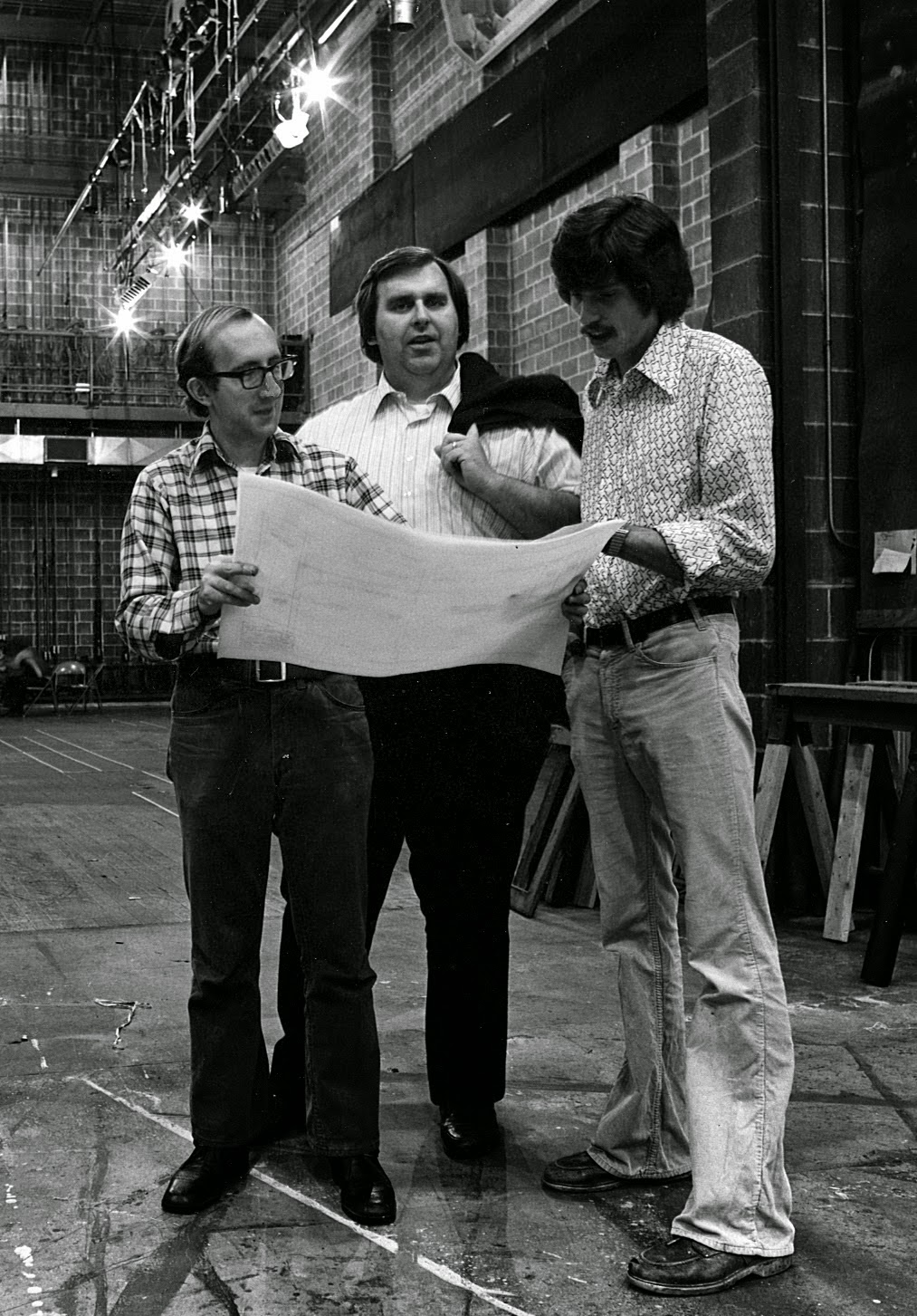
“The key figure in the rise of the Playhouse to the top, Charles Jones, arrived in 1974,” says Warren Francke, author of the new book, The Omaha Community Playhouse Story: A Theatre’s Historic Triumph. “The simplest reasons the Playhouse became number one were the things Charles Jones accomplished.” Jones penned a wildly popular adaptation of A Christmas Carol and created the professional touring wing, the Nebraska Theatre Caravan. Under his leadership the Playhouse’s audience, budget and staff eventually exceeded any community theater in the nation. “His adaptation of A Christmas Carol became, pardon the expression, the cash cow for decades.” That show’s a tradition 39 years and counting now.

Francke says the Caravan brought talent to the Playhouse and carried the theater’s brand nationwide. Several standouts came to Omaha via the troupe. Jerry Longe succeeded Dick Boyd as Scrooge in Carol. Bill Hutson headed the Creighton University drama department and won multiple Fonda-McGuire acting awards.

Jones was also adept at getting donors on board. “Everyone describes him as the most charming Southern gentleman they ever met and he charmed people, not just performers, but the business community and Knights of Ak-Sar-Ben leaders,” says Francke. He says Jones’ ability to get people like Marge Durham, Barbara Ford, Ed Owen and Howard Drew to see philanthropy as crucial to the future of the Playhouse was critical for the ascendancy that took place from 1975 through the mid-1990s.

He says the Playhouse’s stable of memorable personalities is led by the charismatic Jones and the flamboyant director, Bernard Szold, “an ex-football All-American opera cape-wearing character.” Dodie Brando, actor Marlon Brando’s mother, was a passionate if troubled enthusiast.

Early players and echoes of the past

Long woven into the community fabric, the Playhouse developed as the city did. Omaha was a wide open cow town when the Playhouse gave it its only legitimate theater. As Omaha grew, so did the arts. The Playhouse mirrored that evolution. In the span of a decade that saw the Jazz Age give way to the Great Depression, the Playhouse joined two other significant arts organizations in maturing the cultural landscape: the Omaha Symphony Orchestra and the Joslyn Art Museum. All made their mark and remain strong presences today. Of the three, the Playhouse has perhaps been the least stuffy.

Founded as part of a movement to democratize the arts, the Playhouse formed from the community for the community. Even with a professional staff, its grassroots volunteers have always filled out the casts and crews and supported the theater in myriad other ways. Among those figuring prominently in its early success were two families who, against all odds, produced stage and screen icons. Dodie Brando played the lead in the first play, The Enchanted Cottage. Her husband, Marlon Brando Sr., was theater manager. Their son Marlon, who changed the face of acting in New York and Hollywood, was 5 when he and his family moved away, otherwise he would likely have been pulled into the Playhouse orbit the way another future star was, Henry Fonda. Dodie recruited young Hank into the Playhouse fold. He served as a jack-of-all-trades assistant director and as an actor. His sisters Jayne and Harriet were regular players on the fledging theater’s stage.

Not long after Henry went East to pursue an acting career he returned to star opposite a promising ingenue, Dorothy McGuire, in A Kiss for Cinderella (1930). McGuire herself went onto stage and screen stardom. In 1955 she and Fonda, long established names above the title by then, came back to play opposite each other in a benefit production of The Country Girl. Henry’s then 17-year-old daughter, Jane, the future two-time Oscar-winner, made her stage debut. Jane’s brother, Peter, who also became a screen star, continued the Fonda family’s Playhouse legacy – acting there while a University of Omaha student. A cousin, Matt Fonda, later acted there.

The Fondas and McGuire are not the only Playhouse “graduates” who moved onto Broadway, film, television success. Current Playhouse president Tim Schmad’s uncle Howard Fischer used the venue as a stepping-stone to a career as a Broadway stage manager and actor.

The Fonda-McGuire heritage lives on at the Playhouse. Artistic director Hilary Adams says, “Having a pedigree is very beneficial for us. I think anything founded and initiated by people of that caliber and passion – it really is the passion in their work – has a continuing legacy here.”

Adams heard of the Playhouse while working in New York City as a much-in-demand freelance director, but she only learned about its distinguished past once she started researching it. She appreciates being part of an organization so intertwined with its community and one that boasts such a long, colorful history. “Ninety years, I mean, that’s astonishing for a theater. That’s huge. Theaters fight for their survival and the fact it could survive for that long not only speaks volumes about the work the theater is doing but also about the community support and engagement of the community in the arts . That immediately stood out for me – its history and the way it was founded as part of a desire for a community-based organization to bring culture to Omaha as part of the Little Theater Movement.”

“Ninety years, I mean, that’s astonishing for a theater…Theaters fight for their survival and the fact it could survive for that long not only speaks volumes about the work the theater is doing but also about the community support and engagement of the community in the arts… –Hilary Adams

 Dodie Brando

The only show in town

Ex-associate artistic director Susie Baer Collins says the Playhouse parlayed that pedigree into a reputation as “the premiere place for local theatrical entertainment.” She says it’s remained a considerable force even as other theatre companies have put down roots and professional touring productions now regularly come to town. “It was a little scary for all of us the first time The Lion King came to the Orpheum Theater and stayed for more than a month. I wasn’t sure if the Playhouse could survive that kind of stellar competition and still find its audience, but somehow we did. We tried to remain relevant.”

She says the theater’s knack for putting on stellar shows, particularly musicals. grew “in the heyday of Charles Jones,” adding, “He was extremely committed to strong production values and the Playhouse gained a reputation for wonderful scenery, lighting and costumes that enhanced every production.”

Doing a Playhouse show meant you’d arrived. “It was like if you got on at the Playhouse then that meant you were doing something theatrically in the city,” says Playhouse veteran Camille Metoyer Moten. “I mean, even now it’s still a big deal.” “It’s definitely a big deal,” says fellow stage veteran Elaine Jabenis. “It opened up a whole new world for me. I met people I ordinarily would not have met,” including Henry Fonda, Jane Fonda and Dorothy McGuire when Jabenis worked backstage for The Country Girl. “There’s a lot of people I met and worked with who helped pull me up because of their talent.”

Jabenis says it’s no accident the Playhouse has held the community enthralled for going on a century. “Audiences just keep coming back for that magic, for that moment to escape their own life and to see what happens in other lives. It is absolutely magic.” The Playhouse annually nets more local Theatre Arts Guild awards than all its competition combined.

All for one, one for all

Year after year, generation after generation, the Playhouse, no matter the need or challenge, has always found the necessary community backing because it’s a vital, touchstone place for people. “You know, it’s a funny thing about feeling vital,” says Jabenis, whose first Playhouse role in a 1952 production of Father of the Bride was in the old 40th and Davenport site. “When they announced plans to build the present theater I was on the committee to help raise money. I went house to house. I was never that bold a person. I was really pretty shy. But I believed in it, I really did. I was so anxious for it to happen.”

Jabenis says her eagerness to pitch-in reflects a communal desire “to make Omaha the best in everything we do,” adding, “It’s kind of a hunger and it’s something we’ve pushed for.” She also starred in the first production, Say Darling, at the current site in 1959, taking the stage mere minutes after hosting a live remote for local television.

“It’s like the perfect storm or something,” says Metoyer Moten, whose first role there was as the title character in Evita (1986). “You had the people who started it off that had this dream and these high expectations. Somehow they were able to impart that to the next generation, who had that same passion. I don’t know how that happens. Maybe it’s because we’re in the middle of nowhere and people are hungry for culture. We don’t have mountains or the ocean, so we turn to ourselves to give that thing we can bring, which is artistic. “It’s a good common cause.”

This sense of getting behind something is not so different than Omaha’s embrace of the College World Series. It’s what happens when something springs from the community and is nurtured by it. The community theater model, dependent as it is on amateurs or volunteers, leads to misconceptions the Playhouse fights against.

“There’s been times over the years where there’s been debate whether community should be in our name,” says president Tim Schmad. “We hear that newcomers to town see community in our name and they immediately think of a renovated 70-seat church space with productions not the quality we think ours are.”

But Schamd points out community is part of the theater’s DNA and its volunteers work side by side with professionals to create work that he and artistic director Hilary Adams, a veteran of New York City theater, say compares favorably with Broadway. “We feel community definitely needs to be in our name because of the status we have in Omaha and the fact we rely on Omahans to put on our product for the most part,” Schmad says. “Our job then is to get those newcomers here just once. If we can’t get them back that’s our fault but we think if we expose them to our product they’ll understand why community definitely is a part of who we are.”

“As a community theatre, education is at the core of everything we do.”–Hilary Adams

Community engagement

Before Adams ever started working at the Playhouse she was impressed by what she found on visits there during the search process to replace longtime artistic director Carl Beck.

“It was really about community engagement – that’s what I immediately saw. And then I discovered not only do they support the Playhouse in Omaha but they support the arts in Omaha.”

Since joining the staff in mid-2014 Adams, a Drama Desk nominee for Outstanding Director of a Play, has been bowled over by the Playhouse’s singular approach to community theater.

“The quality of work is astonishing. I think it’s a real hybrid situation that’s unique to community theaters in that we have a paid staff and everything we do supports our volunteer actors, with the exception of the Caravan. What we do have here is really high quality and high support for volunteer actors, and the staff here is incredibly talented and experienced. We treat the people who walk in our doors the same or better as Equity actors or people who do this for a living get treated.

“Volunteers are at the heart of the Playhouse. We have more than 1,000 in a season. They’re involved onstage, backstage, in the box office, as ushers, answering phones, on the board, in Act II. The public is everywhere in this building.”

Her first exposure to the Playhouse in action was at a performance of Les Miserables. The seamless blending of community she witnessed that night is what she’s come to expect. “I saw all that in operation backstage, And in the front of the house at intermission for Les Mis the entire audience stood up and cheered and I still get like goose bumps thinking about this because almost the entire cast was fellow community members.” The outpouring of love happened again at curtain call and once again at the meet-and-greet in the lobby, as community members in the audience, the cast and crew expressed appreciation for each other. This mutual admiration happens nearly every show.

Schmad grew up with this sense of community. His aunt Margaret Fischer saw every production from the theater’s start until her death. Many of her friends acted on stage there and she and the rest of the family were always in the audience to encourage them. Schmad says many Omaha families claim similar Playhouse legacies. Whether attending shows and classes or volunteering onstage or backstage, the Playhouse becomes a multi-generational tradition. He says it’s not uncommon for someone to start there as a child and to either continue or resume ties in adulthood, often getting their own children involved. “That’s really symbolic of what the Playhouse is,” he says. It goes back to community being the basis for everything there.

“That is very unique. It’s all part of this cycle of “bringing theater with and for communities,” says Adams. It jives with her own theater interests, which is why she left New York for here. “I was looking for a place where I could combine the professional theater experience I had with the skills and focus of my master’s program, which is in applied theater – using theater for social change, transformation and education. I really wanted to merge those two parts of theater. I also came from a community theater background as a young person. From the time I was really small I was also going to New York and seeing shows. So I’ve always sort of been in that hybrid.”

“We learned that this place is bigger than all of us.” –Tim Schmad


Image result for camille metoyer moten

  • Camille Metoyer Moten

Training ground and professional environment

Baer Collins says “The performers may be volunteers, but they’re surrounded by professionalism. A great number of the designers and directors, along with the music director, choreographer, technicians, carpenters, costumers, et cetera. are employees of the Playhouse and all are committed to making each show the very best it can be.” That expertise and care shows up on stage.”The Playhouse’s professionalism continues to have a reputation among the theatre community,” she says.

“Actors who may have significant experience or training are often interested in performing at the Playhouse as a volunteer because it strives for such high-quality and its shows have such a professional look. “It was always a thrill when an audience member would say they thought the actors were professional.”

Metoyer Moten, who starred in last spring’s production of the musical Little Women, says it’s a regular occurrence, “You hear it all the time at the (post-show) meet-and-greets where people say, ‘I saw the same show on Broadway and this is way better.’ Ot they ask, ‘Where are you people from?’ It’s such a professional performance they don’t think it could be local. They think it’s a cast that’s been brought in from someplace else, when the truth is I may live around the corner from them.”

Metoyer Moten says the professionals employed in key positions at the Playhouse “guide mentor” volunteers to do professional-level work. “They have high expectations. It’s all about expectations. I’ve worked in quite a few theaters and I still feel like when I’m there I have the most professional treatment.”

“You feel more secure because you know they’re really pulling out the very best in you and you’re making it the very best you can,” Jabenis says.

Amid the bright lights and standing ovations, its easy to forget the Playhouse is a training ground for people of any age and experience level to get a top-notch theater immersion and education.

“As a community theatre, education is at the core of everything we do,” Adams says. “We have a very strong education and outreach program that includes adult and youth classes, youth summer camp intensives, in-school workshops and residencies, after-school programs, a Theatre Technology Apprenticeship Program, an alternative programming series and go-beyond the show programming.”

She’s proud of the two-year apprenticeship program in partnership with Metropolitan Community College and registered with the U.S. Department of Labor. “Our apprentices run a lot of the shows backstage. They are supervised, supported and mentored by our paid staff every step of the way. So here you have a professional house that looks like what you’d have on Broadway or high off-Broadway or high regional theater, with all the accoutrements, bells and whistles, and the people working that are this really unique combination, from teens on up, of people really new at it and people really experienced. “It’s an incredible program. It’s the only one like it in the country.”

Apprentice grads have gone on to work for big-time theatrical troupes, theater festivals and network television. The Playhouse is also where young talent gets its start.

Baer Collins says, “We worked very hard to bring young people into our shows, in particular A Christmas Carol. That yearly production became an amazing training ground for children to learn about the discipline and art of performing onstage. I worked with some amazing young people who grew into outstanding performers. They start with learning to smile onstage and to hang up their costumes and end up playing amazing roles like Annie in Annie or Wendy in Peter Pan.” John Lloyd Young made it all the way to Broadway, where he headlined the cast of Jersey Boys, winning a Tony for his efforts. Others who’ve gone onto stardom include Terry Kiser and two-time Tony winner Norbert Leo Butz.

Two Caravan alums who found fame returned in triumphant roles: Kevyn Morrow, a veteran of the Broadway and London stage, headlined the cast of Ragtime in 2006; and opera star Greg Ryerson anchored South Pacific in 2008. Some Omaha natives who made it big before acting at the Playhouse have returned to play there, including Equity performer John Beasley, who starred opposite Elaine Jabenis in 1996’s Driving Miss Daisy. Former Omaha mayor and congressman Glenn Cunningham and film-TV producer William Dozier are among the notables who acted there.


Image result for omaha community playhouse


The show must go on

Hilary Adams is impressed the Playhouse has consistently dared to do provocative work. “They really came out of the gate very strong with innovative productions even in the ’20s. They were doing wonderful work here.”

Historian Warren Francke says, “Almost from the start the Playhouse was willing to tackle Eugene O’Neill’s Anna Christie about a prostitute. When they did controversial plays then they were defended by two board members who were clergymen, one a rabbi and the other a Unitarian minister.” Francke discovered a “wonderful story nearly lost to history” that illustrates the pressure the Playhouse sometimes felt. “A man wrote a play about Brigham Young and Bernard Szold, the then-Playhouse director, knew him and together they conspired to pick up the play. Szold went to his artist friend Grant Wood, who’d just done “American Gothic,” to do the scenic design. That’s overshadowed by the fact the night before opening the Mormon Church got the president of Union Pacific Railroad and their general counsel to convince the Playhouse board to drop 14 of Young’s 17 wives in the cast.”

Adams says community theater serves so many tastes that devising a slate of plays “is about finding the right balance and challenging people but not so far that they get upset with us. For 2015-2016 we’ve created a diverse season of offerings from new American playwrights rising in prominence as well as better known pieces. The season mixes genres and styles and includes two experimentations in form.”

Controversy over content still happens. In the 2003-2004 season profane language in the main stage production of The Tale of the Allergist’s Wife elicited such negative feedback that Schmad says “it showed us how we shouldn’t mess with their Playhouse.” “We learned a lesson from that,” he says, namely that the main stage Hawks Theatre is better suited to tamer shows. “We did lose a lot of memberships because of it. Hopefully. we got some back. They sent a message. It was kind of ironic that our first show in the Hawks the next year was Hair,” the nudie musical about free love. “It did fine.”

Playhouse leadership has come under fire, too. ‘When we had some public issues in the past I learned just how important the Playhouse is to the community,” Schmad says. In 2009 friction between the administrative and artistic sides made news. “It was something at that time that needed to be discussed and it was and we came out much better because of that. We learned that this place is bigger than all of us. We all came to that conclusion.” Schmad says the upshot of that has been better communication and a clearer division of responsibilities. “The way we’ve structured it now, which is different than a lot of community theaters, is that I’m here to do the administrative things. though I do also oversee the artistic side. But I leave the management of the artistic up to them. I have confidence and trust in what they do.”

“When it comes to the Playhouse, a lot of people have worked here and given a lot of their life to this place.” –Tim Schmad


Tim Schmad


Omaha’s theater

Schmad views himself as the steward of a valued community resource. “When I first came here I said i want to be the caretaker of this place but I also want to move it forward. I feel responsible for this place. I know how important it is to people. In my decision-making I certainly have to take care of my staff and the people who come to the shows, the donors, the board members. There are many nights where I’m awake at three in the morning, but that comes with the territory.”

As for what’s next, he says, “We’re looking at the future, we’re looking at strategic planning, and that’s very important to us. It’s a combination of what we need to do administratively and artistically. There’s no question that selling tickets, donor support and remaining relevant to the community is extremely important. “Right now I think we’re in good hands. Our board is good, our foundation is strong. I’m really proud of our staff. We’ve got some real go-getters that know what they’re doing and are very talented and that love theater and love the Playhouse. “It’s not all roses but I’m kind of proud of where we are.”

A clear indication of the theater’s continued popularity is that some hit shows in the last decade broke all box-office records. Through all the Playhouse’s needs – realizing a new home in 1959, repairing structural damage from a 1975 tornado, supporting a major addition in 1986, building the endowment – Omaha’s responded. “We’ve been very fortunate the community’s come forward to support any special needs,” he says. “We are always trying to improve ourselves. Our facility looks nice but we’ve got 50-some years in this building and so we definitely have some improvements that need to be made, especially in staging and equipment that’s pretty old. So we’re in that mode right now in trying to really improve what we have.”

He expects, not takes for granted, the community will respond again. “They’ve always been there.” Everyone from philanthropists like Howard and Rhonda Hawks to season subscribers and casual theatergoers. “That’s what makes Omaha what it is. The community is proud of the arts and culture in Omaha. When it comes to the Playhouse, a lot of people have worked here and given a lot of their life to this place.” They’ve given their time, talent and treasure, too. “There’s a real sense of ownership that comes with that.” That’s why it’s called the Omaha Community Playhouse.

Visit http://www.omahaplayhouse.com.


Paul Williams: Alive and well, sober and serene, making memorable music again

May 1, 2015 5 comments

I didn’t expect to write a nearly 5,000-word story about Paul Williams, the songwriter who seemingly scored a good chunk of the 1970s.  But his story resonated with me.  First of all, there’s the fact he’s another in the long line of native Nebraskans I’ve targeted for my Nebraska Film Heritage Project.  It took awhile to get an interview with him, but it finally happened this past winter and it was worth the wait.  Then there’s the whole angle of him finding fame and fortune and throwing it all away during the depths of addiction and how he’s found sobriety and become an advocate for recovery.  As a fellow 12-stepper, that journey particularly hits home with me.  And then there’s the remarkable career renaissance he’s enjoying to go along with his reconstituted personal life.  My profile of Williams is the cover story in the May issue of the New Horizons.


Paul Williams: Alive and well, sober and serene, making memorable music again

©by Leo Adam Biga

Appearing in the May 2015 New Horizons


Shame behind the fame, recovery after misery
Songwriter Paul Williams reached Hollywood’s apex by age 39 before losing everything to booze and pills and powder. As the Omaha native tried picking up the pieces of his shattered life and career, he virtually disappeared from public view. The title of a 2011 documentary about him, Paul Williams Still Alive, refers to the understandable assumption that somewhere along the line he suffered an untimely death, when in reality nothing could be further from the truth.

At 74 Williams is not only alive and well but riding a new wave of success that has people who don’t know his story wondering whatever became of him. His rise to stardom was so strong and fast and his descent into obscurity so severe and swift that even he excuses anyone for thinking he checked out. In a way, he did. He lost himself to addiction and in the process all the material success he’d built. But in recovery he’s gained things more important than money can buy. A book he co-wrote offers affirmations for daily living he follows.

“We don’t really control our lives as much as we think we do,” says Williams, who employs spiritual disciplines to stay centered. “My book Gratitude and Trust (Recovery is Not Just for Addicts) I wrote with Tracey Jackson is exactly about that process – staying grateful, trusting in the future, choosing faith over fear and watching your life get better. Tracy and I met when I was a mess. She then saw me in a very different light when I was 11 years sober. She has always claimed to have recovery envy. The concept of our book is that recovery is not just for addicts. It’s been wonderfully received. I’m happy to say the recovery community has embraced it.”

In the 1970s and 1980s Williams was seemingly everywhere at once in the entertainment world. One of that era’s top pop lyricists and composers, his music permeated radio, movies and television. His hit love songs or as he jokingly refers to them “co-dependent anthems” included “We’ve Only Just Begun,” “You and Me Against the World” and “Evergreen.” He was nominated for Oscars and Grammys. He scored the films Bugsy Malone, A Star is Born (1976) and The Muppet Movie. He wrote the theme music to the top-rated TV show The Love Boat. He was a popular concert performer and recording artist.

Also an actor, he turned up in films and episodic TV series, ranging from dramatic to comedic roles, sometimes even playing himself. His celebrity was such that he made countless guest appearances on talk, variety, game and awards shows, where he shined with his quick wit. At only 5-foot-2 his small stature made him stand out even more. Famously, upon accepting the Oscar for Best Original Song he shared with Barbra Streisand for “Evergreen” he quipped, “I was going to thank all the little people, and then I remembered I am the little people.”

Beneath the cocksure smile and glib repartee lurked a desperate man trying and failing by sheer willpower alone to battle inner demons. Then, the facade crumbled. As suddenly as he’d burst onto the scene, he vanished, his once ubiquitous presence no where to be seen. A half-dozen years ago or so a longtime fan, filmmaker Stephen Kessler, became intrigued with whatever happened to Williams. As the resulting film Kessler made shows, at the peak of his stardom Williams was an addict consumed by fame and ego, driven to get his next fix There are old clips of Williams doing TV guest spots while high, vainly, cavalierly bragging about his excesses. On national TV he openly joked about his infidelities. We see in the doc how uncomfortable it is for Williams today to view how recklessly he behaved back then.

His problems contributed to the breakup of his first marriage and derailed his career. Calls from producers and agents dried up.

But as the film also shows, Williams long ago kicked his addiction habit and along the way he remarried and rededicated himself to his family.

Journey of healing captured in song and on film
For the film Williams wrote an original song, “Still Alive,” that distills what it’s like to look at his addicted self from the lens of his sober eyes.

I don’t know you in those clothes
I don’t know you with that hair
Two dimensional reflection
Unforgiving unaware

Part time dreamer
Would be player
You thought fame could outrun fear

“That’s probably as accurate a line as I’ve ever written about anything and certainly about myself,” Williams says about fear. “One of the greatest challenges of my life was to look at a film about myself and then write a song kind of to myself.”

He still cringes at some of his boorish behavior caught on film.

“There are parts of it that are hard for me to watch. Like the Merv Griffin Show, when I was so arrogant and just a shallow little ass with this smirk on my face. What was most difficult about it is that I had no idea that’s who I’d become.”

The lyrics to his song “Still Alive” continue by asking “where did you disappear,” but as the film makes clear he’s never stopped writing and touring, he just plays to smaller crowds, in smaller venues, away from the spotlight. Williams is happier though than before because he no longer measures joy in terms of dollars, record sales and media spots but in the 12-step recovery work he does to maintain his sobriety and to be of service to others. All of which is why in addition to legendary songwriter, you can now add grateful survivor when describing Williams, who celebrated 25 years in recovery in March.

Kessler set out to make a documentary charting the artist’s rise and fall. It covers that journey but also reveals the most important things to Williams now are his recovery and family. A father of two grown children, Williams lives with his wife Mariana right on the ocean in Long Beach, California. Williams was a reluctant subject for the film’s unvarnished portrait of his failings and he only did the project on the condition that it share a message of hope and healing and that it highlight the changed man he is today.

In a phone interview he confirmed his new spiritual basis for living.

“My life has been changed drastically. The way I perceived my life changed drastically when I got sober and I began to see a little less through the distorted image of my own ego and began to see it as the absolute gift it was. I get up in the morning and I say a three-word prayer, ‘Surprise me, God.’ It implies complete trust. And then my second prayer is, ‘Lead me where you need me.’ If I’m relevant and useful I’m not in the way. If I’m not in the way, I’m not scared. If I’m not scared, I have a tendency to listen, and when I listen I sometimes actually learn something.”

Where Williams once saw himself as the center of the universe and responsible for all his success, he now sees things differently.

“The drugs and alcohol I consumed totally clouded how I perceived life. Then add the distortion of a growingly unhealthy ego. The fact is I never wrote a hit song because of the drugs, I wrote successful songs in spite of the drugs. The longer I’m sober the less I claim the success – the more I attribute it to a real gift. I’m not talking about my gift or the talent, I’m talking about the gift of the universe. If you tap into a sort of non-competitive thought process where you’re not worried about what the other guy’s doing but you’re just expressing what you feel, you connect.”

He says in the throes of addiction thoughts of grandiosity ran amok.

“You know, when I was drunk I was just brilliant, and the more I drank and the more I got into ego and the more I tried to write from my head and be clever and all…” the worse the music got. “One of the key elements of successful communicating is what we have in common, not the differences. So when I was authentic, when I would reach down into my chest and write about whatever I was feeling, whether it was loneliness or the longing for real love or how it felt to be falling in love, no matter how Hallmarky or sentimental the lyrics may have been, other people related because we have so much in common as far as the emotional scale we travel as human beings.”

He says he has drawers full of songs written under the influence of ego that will never see the light of day because no one can relate to them.

Williams shared the message of getting out of your head and getting in touch with your heart at a Neb. recovery convention he spoke at last year. He travels widely delivering recovery talks. The film shows him in action at one such event. About sharing his recovery message, he says, “It’s a chance to share the amazing gift I’ve been given and it feels like my most important work.”

A new life and a rejuvenated career
Instead of the movie Kessler imagined making about a man in despair over a fall from grace, he portrays a man content with his life. During production Williams was elected chairman and president of ASCAP, the American Society of Composers, Authors and Publishers, which protects the rights of music artists. The post, which he continues in today, gives him a higher profile than he’s had in decades.

Since the film’s release, Williams’ profile has expanded even more, mainly due to a career resurgence he’s enjoying as a creative artist. In 2014 he shared the Grammy Award for Best Album of the Year with Daft Punk, with whom he collaborated on their platinum release, Random Access Memories. Williams was asked to write songs for the smash animated film The Book of Life (2014). And he’s been tabbed to co-write the stage adaptation of the acclaimed film Pan’s Labyrnith.

Not surprisingly, he views this professional comeback from the prism of humility and gratitude he sees the world in today.

“I haven’t chased any of the things coming to me. I’ve really just been concentrating on one thing – my recovery – and living by those principles. I have found in that everything I needed and everything I wanted. I think the misplaced years of my addiction are probably the most important years of my life in the sense that they set me up for the life I have today.”

Where before fame consumed him, now it’s all relative.

“The perspective is so different. When I won the Grammy with Daft Punk almost my first thought was: I will once again be awakened by the cat that treats me like staff to feed her, and I’ll be on the bay where I live with a wonderful view and Mariana will be next to me and in a year it’ll be somebody else’s turn to have this.

“It was a nice moment but almost what was a better moment was realizing there was no sense of that being a target or something to sail towards. Whereas in the ’70s I was nominated for the Academy Award six times and was counting the nominations and looking for that second win, and I don’t do that anymore. The valuation of the recognition is very different and I think a big part of that is because I was so addicted to the attention. I was almost as addicted to the attention I was getting – plopping myself down on any couch in front of any camera – as I was to the cocaine and the vodka. Eventually the addiction to the cocaine and the vodka outran the other addiction and took me off the map and put me in hiding for a decade.”

The start of it all
The seeds of his addiction may lie in an insecure childhood that saw his family move wherever his Peter Kiewit and Sons engineer father’s work took them. Paul was born in Omaha and later lived in Bennington, Neb. for his father’s work on a major expansion project at Boys Town. “I was a construction brat. I went to nine schools by the time I was in the ninth grade. I went from living in Rapid City, S.D. to living in Lucasville, Ohio and from Albuquerque, N.M. to Omaha and Bennington to wherever next. I was always the new kid in school. I was the littlest guy in the class.” When Paul was 13 his father died.

He sees the roots of his collaborative nature – he’s teamed with Roger Nichols, Kenneth Ascher, Barbra Streisand and more recently with Gustavo Santaolalla – in all the moving around he did.

“I think I learned to adapt to the language wherever I was. People have said to me, ‘You have an unusual accent.’ Well, God knows what my accent is today because I’m a bit of a chameleon. It’s like there’s a little bit of bullshit in my DNA where just to survive I kind of learned to adapt as a kid to what was going on around me and I tried to sound a part of it. I think that social adaptability that was part of my growing up eventually morphed into the kind of collaborator I am. The opportunity to open up and be aware of what’s going on around me is part of the process that made the things I’ve done successful.

“The other thing is that now in sobriety I’m trying to be a better listener today with everybody.”

In the documentary Williams explains why he’s so short when the rest of his family is normal height for their age and sex. His parents became alarmed he wasn’t growing normally and they made the decision to give him male hormone shots.

“Actually what they did wasn’t the right thing to do because it closes off the bones and they stop growing.”

He displayed a knack for music as a child and while his body didn’t keep pace with his peers, his voice got deeper, faster than theirs. Further setting him apart was his fascination with swing music.

“I think it’s interesting the music I cared for in high school, when everybody was listening to rock n roll, was the Great American Songbook. I was listening to Sinatra and Mel Torme and Ella Fitzgerald, but specifically Sinatra.”

It all contributed to Williams feeling awkward because of how different he was, which began a lifetime pursuit of wanting to feel special. As he often says, “To be different is difficult – to be special is addicting,”

His parents entered him in talent shows. His father, who had a drinking problem, would wake him in the middle of the night to sing “Danny Boy.” His old man, who once drove drunk with Paul in the car, died in an alcohol-related one-car wreck in Ohio. Years later, when Paul was a parent and drinking heavily, he drove drunk with his own kids in the car, “something I swore I’d never do,” he confesses in the film.

Paul went to live with an aunt in California. What was supposed to be a short stay ended up years. In the film Williams relates that his aunt laid a heavy guilt trip on him by saying, “If you go back and live with your mom every bite of food you take will be a bite out of your little brother’s mouth because she cant afford you both, so you need to stay here.'”

“In a way,” Williams adds, “it was like I lost both parents.”

Music no longer held an appeal.

“When my dad was killed I kind of turned away from music. I quit singing, I didn’t want to sing, i didn’t want to be a part of music. It’s interesting because that’s about the point I wanted to be an actor and a good therapist would say, ‘Ah, you’re dad died, you turned away from music and you wanted to be somebody else,’ because that’s what acting is – a chance to be somebody else.”

His first foray at showbiz
He made his own way as a young actor.

“It was kind of learn by doing. I started doing plays and I worked in commercials.”

He also did improvisational comedy on a Los Angeles TV show hosted by political comic Mort Sahl.

His big break came with speaking parts in two mid-1960s Hollywood movies, The Loved One starring Robert Morse, Jonathan Winters, Rod Steiger and John Gielgud, and The Chase starring Marlon Brando, Angie Dickinson, Robert Redford and Jane Fonda. In the former. a surreal social satire, he was a whiz kid obsessed with rocketry. In the latter, an overripe Southern soap opera, he was a rebel teen. In each, he played several years younger than his real age.

“There was nothing close to a logical element of the decision to be an actor,” he says. “I mean, I always joke I felt like Montgomery Clift but I looked like Haley Mills. Into my 20s I played kids. I looked like a kid until you put me next to a real kid and then I looked like a kid with a hangover.”

Though neither film fared well and his part in The Chase was radically reduced in the cutting room, he got to work with A-list talent, including directors Tony Richardson (Loved One) and Arthur Penn (The Chase).

“When you’re a kid from Omaha there’s nothing more completely romantic and exciting than to walk on the set of a large motion picture production, to see the lights, the camera. All of a sudden you turn and there to your left is Sir John Gielgud and there to your right is Jonathan Winters. It’s a spectacular, life-changing even. Culturally it’s like going to Europe the first time. It’s like, Oh my God, look at all this.”

Williams was awed by Winters, whom he considered a comic genius. “I followed him around like a puppy. When I started recording one of the first appearances on television I made was on his show. He was always so kind to me.”

On the set of The Chase Williams began fooling around with a guitar and writing songs. In one of his scenes that survived the final cut he sings a tune he penned.

Two decades later, for Elaine May’s Ishtar, he had the tricky task of writing “believably bad songs – songs which sounded like they just missed” for the comedy about hackneyed songwriters played by Warren Beatty and Dustin Hoffman. “I’m really proud of the songs. They’re almost good…almost.”

Other notable directors he worked with in front of or behind the camera include Melvin Van Peebles, J. Lee Thompson, Brian De Palma, Alan Parker, Garry Marshall, Oliver Stone and Luis Puenzo.

From acting to songwriting
Then, when his acting career stalled, music went from being a source of solace to his livelihood.

“Having no money to go out and wine and dine or go to the movies and being essentially broke, I turned to songwriting. It became my therapy and then the great surprise was that as soon as I started writing I knew this was what I was here to do. It was an amazing sense of comfort putting everything in the center of my chest into the songs.

“There was an element of craft in the very first song I wrote. I don’t know if you’re a believer in past lives but I am and it’s almost as if I had done it before. I had a sense of form, I had a sense of rhyme scheme, I had a sense for a story progressing. As I look back on it now I think you put your name on it but it’s almost as if you have unseen help writing these songs, and I still feel that way about the craft today. I think that inspiration is very difficult to truly identify.”

He and Biff Rose wrote a tune that took Paul to A & M records as a staff songwriter. Producer Richard Perry took a liking to his work.

“The very first songs I wrote began getting recorded. I recorded an album with Richard called The Holy Mackerel. I don’t think even my family bought the album but it was the beginning of my recording career. The song Biff and I wrote, “Fill Your Heart,” was later recorded by David Bowie on his Hunky Dory album. It was the first song he ever recorded he didn’t write and I am eternally grateful for that.”

X

Williams was eventually paired with composer Roger Nichols.

“I would write during the day with Roger and he would go home to his girlfriend, and I would stay in the office and write with anybody that came by or write alone. None of my early songs were hits until I went to Europe in 1970 to work on a project called Wings with Herb Albert and Michel Colombier and when I came back I had two songs in the Top 10 at the same time – “Out in the Country” by Three Dog Night and “We’ve Only Just Begun” by The Carpenters. That garnered a lot of attention and we were off and running.”

Having his music find a large, receptive audience was even more than he imagined possible.

“I had no idea I would have an opportunity to make the kind of living I did off of that music.”

An early concert gig brought him back to Omaha for a warm greeting.

“One of my great memories when I was first performing was on the road with The Fifth Dimension as their opening act. I was having some success as a songwriter but I wasn’t the most well-known person trotting onto a stage anywhere. When we got to Omaha it was as if they brought the Pope to Mexico City because the news had got out I was from Omaha and the audience gave me an amazing response. I’ll never forget that reception.”

Collaborations past and present
He says his experiences writing with Nichols and later Kenneth Ascher “were the longest lasting and most constructive and successful of the collaborations. Kenny had been a piano player for me and we started writing songs together. We wrote most of the songs for A Star is Born together. We wrote the songs for The Muppet Movie together. We wrote “You and Me Against the World” for Helen Reddy.

“Working with both Kenny and Roger I would describe as my music school. In the area of music discipline I learned a lot from both. To this very day there is nothing more interesting or exciting than to sit down with a total stranger in their kitchen or in an office and start sharing what’s going on in our lives and out of that conversation and kind of mini-therapy session comes a song all of a sudden.”

Of his recent collaboration with Gustavo Santaolalla – they wrote songs for Book of Life and they’re adapting Pan’s Labyrinth for Guillermo del Toro – Williams says, “I don’t think I’ve had a collaborative experience more emotional for me. Gustavo is a spectacular artist and composer. He writes incredible, heart-wrenching melodies.”

He enjoyed a warm working relationship with the late puppeteer Jim Henson on The Muppet Movie. Williams says Henson was so “easy-going and completely trusting” that he deferred hearing the songs Wiillams and Ascher wrote for the film until they were recorded. “Remarkable amount of trust and freedom for a major Hollywood film.” One of the songs, “The Rainbow Connection,” became a hit.

As his celebrity increased Williams became a rarity among songwriters – a household name and face. He also joined a long line of native Nebraskans to find Hollywood success. He made nearly 50 appearances on the Tonight Show, whose host, Johnny Carson, was a fellow Nebraskan. Paul’s notoriety benefited from his lilliputian size and shoulder-length locks. He simply looked like no one else.

The success of his music career led to new acting opportunities, including his role as Virgil in Battle for the Planet of the Apes and the part of Little Enos in the Smokey and the Bandit franchise.

A film Williams scored and acted in, Brian De Palma’s Phantom of the Paradise (1974) owns a small but devoted following but he never expected it would lead to a career boost four decades later.

“We assumed Phantom of the Paradise was a failure when it came out because it had so little attention, especially in the United States, but in France (and in Winnepeg) it was a revered odd little cult film. Two young Frenchmen went to the theater where it was showing and saw it 20 times and they formed a group called Daft Punk. They sought me out to come and work for them on their album Random Access Memories. I wrote a couple of the songs and sung on the album with them and last year we won the album of the year.”

Another devotee of the film turned out to be Guillermo del Toro, the Mexican-born producer-director.

“I was approached by Guillermo del Toro because evidently I performed back in Mexico City when he was in his late teens and he apparently came to me with a vinyl of the soundtrack album of Phantom of the Paradise. He was a huge fan then and his affection for the film did not wane and years later he’s on the phone with me asking if I would do this adaptation of his Pan’s Labrynith.

“So I’m having all these amazing opportunities walk up to me because of something I could have written off as a failure, and I think there’s a great life lesson in that for me and for all of us.”

Seeing and living life differently

Not only does he see things in a new light in recovery, he approaches work from a new vantage point, too.

“My whole creative process is so different now. It’s back to a very unconscious effort. I would say the most important time of my writing is the time between when I look at the project, know what I’m supposed to do, and then sit down to do it. I always leave a little space now – a couple days where I’m not thinking about it. But I know my unconscious is because when I sit down to work on it so much of it’s done and I know it came out of me but I wasn’t there when it was worked on.”

Though he lived in the Heartland only through adolescence, he says, “I think there is an element of Midwestern values that may have been an undercurrent to my success. My simple background and upbringing made its way into songs that were not clever but were honest about what I was feeling. I think there’s a lot of Neb. in that.”

In a lifetime of achievements, he says “probably the highest, greatest honor is the great work I get to do for ASCAP,” adding, “We have 526,000 members and to be able to make sure that they’re properly compensated for their work is key. I mean, I have a daughter who’s a social worker and I was able to acquire the education for her, put food on the table and gas in the car because of ASCAP. Other people deserve to have the same.”

Success the second time around is a different experience for Williams because he’s a new man. The misery that led him to act out and to repeat his father’s sins, has given way to appreciation.

“As I get older I’m recognizing I’ve had magnificent opportunities that were absolute gifts.”

He lives life now trusting new blessings will arrive and new dreams will be fulfilled. One day at a time.

Once reality’s your roommate
And the truth stands at your door
All your records may be broken
Trophies won’t shine anymore
New beginnings are the challenge
But you’re not sure where to start
Unimagined gifts are waiting
Love will find your grateful heart

Then again
Once again
You will come to know the simple man you’ve always been.

And someone asked me once
Where do we go when we arrive
If you’re lucky, when it’s over
The dreamer’s still alive.

Visit http://www.paulwilliamsofficial.com.

Arts Patron and Philanthropist Anne Thorne Weaver Gives Where Her Heart is


This is the second time I’ve profiled Omaha arts patron and philanthropist Anne Thorne Weaver, who makes a habit of giving to things she enjoys.  This piece for Omaha Magazine (omahamagazine.com) tries to convey in very few words her lifetime of giving back to what feeds her heart and soul. After my first profile of her appeared she sent me a beautiful card with a hand-written note expressing her appreciation for what I had written. I certainly don’t expect another card, though I would love one, but I mention what she did as an example of how caring and generous she is.


20141119_bs_8943

Anne Thorne Weaver

Arts Patron and Philanthropist Anne Thorne Weaver Gives Where Her Heart is

©Photography by Bill Sitzmann
Originally appeared in the January/February issue of Omaha Magazine


National Society of Colonial Dames diva Anne Thorne Weaver is at an age when she says and does what she wants. Fortunately for Omaha, this patron puts her MONEY where her mouth is in supporting the arts.

When the new Blue Barn Theater opens this spring, the box office will be named in her honor for a major gift she made to the company. She admires the Blue Barn’s edgy work.

“I’m just very impressed with what they do,” says Weaver. “There’s something about the intimacy of the smaller theater. I think they’ve done some wonderful productions. I think their new facility will be wonderful, and there won’t be any bats,” she adds in referring to a past production when an winged intruder darted overhead.

“I thought, that’s an interesting prop,” she quips, “and then realized it was a bat.Suddenly there was this thundering of shoes coming down in a mass exodus.”

Weaver likes that the theater’s new site on South 10th Street will be more visible than its Old Market digs. “I think it’s an exciting move and one of the things that’s really going to add to the Omaha scene.”

Her gift to Omaha Performing Arts made possible the Orpheum Theater’s Anne Thorne Weaver Lounge. The dedicated private space is a chic oasis for post-show receptions.

“I think it really puts a little wow into Omaha,” says its namesake, “and really adds a lot to any attraction you’re doing in the Orpheum.”

Outside the metro, her generosity’s recognized in the gift shop named after her at the Museum of Nebraska Art (MONA) in Kearney and the lobby gallery named for her at the Lake Art Center in Okoboji, Iowa. She also donated the center’s stained glass ceiling created by Bogenrief Studios.

She not only gives money but time to venues she believes in, serving on boards for Opera Omaha, the Omaha Symphony, the Omaha Community Playhouse, and MONA. She served on the Western Heritage Museum (now Durham Museum) board and was active in the Joslyn Women’s Association.

Weaver, whose civic volunteering includes the Nebraska Humane Society and the Junior League of Omaha, only gives to things she enjoys. “Life is too short, so why fuss around with something I don’t enjoy or work with people I don’t like. When you give, everything is given back.”

She traces her aesthetic appreciation to her late artist grandmother, Narcissa Niblack Thorne, renowned for her miniature rooms, dioramas, and shadow boxes. Some of her grandmother’s handiwork is displayed in framed cases hanging on the walls of Weaver’s exquisitely designed home, whose expansive sun room features two Bogenrief WINDOWS.

Surrounding herself with beauty comes naturally to Weaver, who grew up in the historic Terrace Hill home in Des Moines. The restored structure is now the Iowa governor’s mansion.

The well-traveled Weaver considers the vibrant arts scene here a cultural and economic asset that makes the city a more attractive place to live and visit. She takes pleasure helping the arts thrive and sampling all the region’s offerings.

“We all need music and art in our lives,” Weaver says.

20141119_bs_8943


Playwright turned history detective Max Sparber turns identity search inward

February 7, 2015 5 comments


The Reader  The Reader

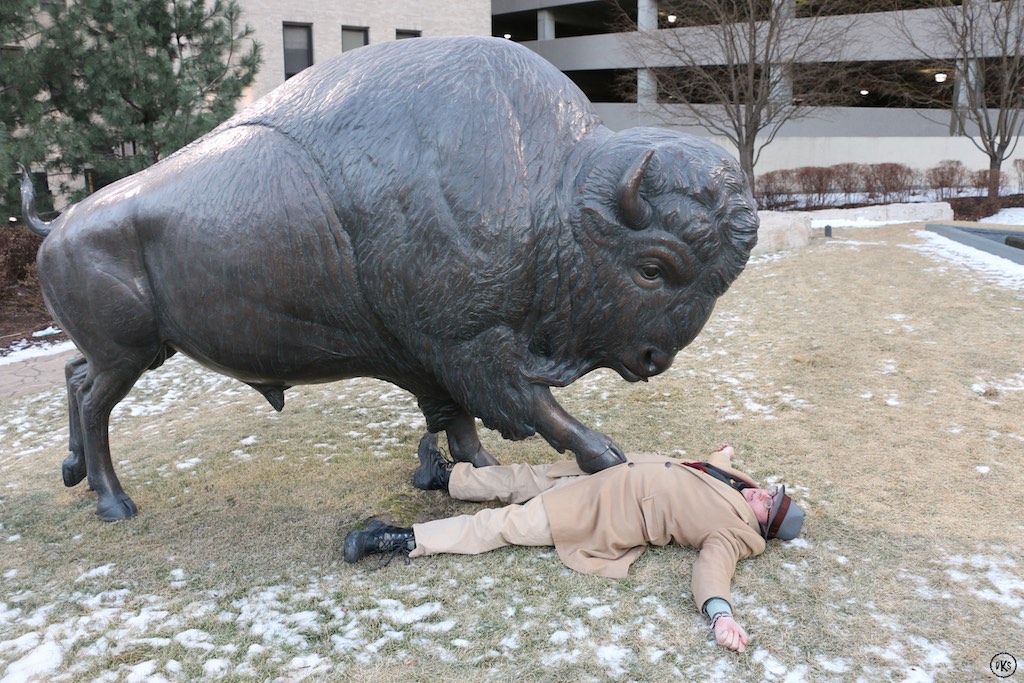
Max Sparber channeling his inner Buffalo Bill, ©photos by Debra S. Kaplan


Playwright-journalist-blogger-historian Max Sparber has a knack for reinventing himself borne from a lifelong search for identiity, though he’s recently found more clarity where his family roots are concerned. He’s always known he was an adoptee but it’s only in the last year or so he’s discovered specifics about his biological parents. Long before he began searching out his biological mother’s and father’s stories, he was intrigued by history and heritage and much of his writing for publications and for the stage has dealt with matters of cultural inheritance or perception. It’s no wonder he find himself in the day job he works today as research specialist with the Douglas County (Neb.) Historical Society. The very tools he uses there to help people search their family history are the ones he utilizes in his own personal family search. Sparber is Irish and English but he was raised Jewish and he is steeped in that culture. He has written about Africa-Americans and race in his plays “Minstrel Show” and “Walking Behind to Freedom” and he’s the author of a blog, “The Happy Hooligan,” devoted to what it means to be Irish-American. In truth, he’s written about a wide range of people and subjects and always with same incisive and sensitive eye of the outsider. His new play, Buffalo Bill’s Cowboy Band, deals with a historical figure, William Cody, who simiarly dealt with issues of identity and reinvention. My profile of Max for The Reader (www.thereader.com) follows below.

As a side note, Max has been a longtime contributor to The Reader as I have. At one point he became the arts editor there and for a brief time served as managing editor. Another superb Omaha writer I’ve written about, Timothy Schaffert, had a similar experience at The Reader.

Oh, and by the way, I wish I had thought of it when I wrote the story, because I would have included it in the piece, but it occurs to me that Max bears an uncanny resemblance to silent film comedian Harold Lloyd.


Playwright turned history detective Max Sparber turns identity search inward

New play about Buffalo Bill explores similar reinvention issues as his own

©by Leo Adam Biga

Appeared in The Reader (www.thereader.com)


As an adoptee whose identity quest has shaped his life and as a research specialist investigating people’s family trees, Max Sparber perfectly embodies his “history detective” tagline.

His Douglas Country Historical Society fact-finding duties feed his work as journalist-blogger-playwright of wide-ranging interests, from Irish-American culture-history to early Omaha infamy to social justice. Then there’s his thing for singing cowboys, the Old West and everything theatrical. All of which makes him the ideal dramatist for Buffalo Bill.

Sparber’s whimsical new play Buffalo Bill’s Cowboy Band, showing through February 8 at the Rose Theater, is a Victorian era-inspired  musical revue-meets-chautauqua whose identity themes resonate with his own Who-am-I-this-time? life story.

“I definitely think this has a lot to do with my own search for my identity and how identities are often a sort of collective invention.”
William Cody was a scout and buffalo hunter turned entertainer. His Wild West show, first mounted in North Platte, Neb., forever changed perceptions and portrayals of the frontier.

“I think he is in some ways the basis for all contemporary cowboy stories,” says Sparber, who just as Cody cultivated a look with fancy regalia, is seldom without a vintage fedora and tinted glasses

He says the story “is really about how William Cody invented a character called Buffalo Bill as a way of telling tall tales about the West inspired by the actual history of the West.” The play, which uses Cody’s daughter Irma as fan and foil, depicts his conflict over being authentic whole taking dramatic license.

When the Rose commissioned Sparber they didn’t know about his identity search or fixation with Gene Autry and Roy Rogers. They didn’t know he’d done a children’s play, The Ukulele King’s Sunday Family Roundup, featuring his peculiar talents for twirling guns, yodeling and playing the ukulele.

That’s folderol though compared to how the skills of his trade, along with DNA testing, recently aided him, at age 46, in discovering his late birth mother’s identity.

“When I found out who my biological family was, I had exactly the tools needed to churn through that information. It would have been completely overwhelming otherwise.”

The woman who gave him life, Patricia Monaghan, followed pursuits strikingly aligned with his own. She was a journalist and author who often wrote about her large Irish-Catholic family and Celtic mythology. She wrote about and studied theater, just as Max has. He once owned one of her books.

Knowing they were kindred spirits seemed an “astonishing coincidence” he now ascribes to genetic inheritance.

“I do regret not meeting her. I’m just very glad she left behind the wealth of writing and information about herself she did. There’s a lot of people for whom there’s no record of them. Yet she’s unknowable in the sense I’ll never be able to meet her.”

He knows less about his biological father, except he studied art, as Max did.

As best Max can tell he was the unintended result of a fling.

“It turned out the circumstances of my birth were not tragic as I feared. Probably mostly I was just terribly inconvenient and I’d rather be inconvenient than the product of tragedy.”

Now that he’s gleaned things about his mother’s family from her widower and a first cousin, it’s allayed his worst-case-scenario thinking.

“There was a real concern I’d find my biological family and they’d all have tattoos of tears on their cheeks and swastikas on their arms.

Thank goodness it’s nothing like that. They’re very lovely people.”

Most of his Irish clan lives in Alaska and the Pacific Northwest, though some reside in Ireland. His birth mother gained Irish citizenship and even though he’s never been there, he may be entitled to citizenship, too. He intends visiting his ancestral homeland of County Mayo.


Above three images from Max’s “The Happy Hooligan,” http://happy-hooligan.blogspot.com/


He always knew he was not Jewish like his adoptive parents but likely Irish and English. He especially steeped himself in all things Irish, from devouring its literature to learning to play the penny-whistle. His The Happy Hooligan blog explores what it means to be Irish-American.

What he did with his heritage is not unlike what Cody did with his past.

“Being Irish is something I had to invent because I wasn’t raised with that. It was so weird for me for a long time because it felt fabricated and then I realized it’s all fabricated, We all just make up culture. We’re Irish-American because we say we are. We do Irish-American things because we’ve decided that’s what Irish-Americans do.”

He calls a year in Bath, England for a sabbatical his adoptive father made “the defining year of my childhood.”

“It was all very fascinating to me. England is a very old country with a lot of very strange old traditions. One of the things they do is ritualize and reenact history through these pageants. At school I played a Moor battling King George.”

That experience and summers in New York introduced him to the idea of history behind every door or corner.

“I realized the whole world is these little pockets of often undiscovered history. All of a sudden these places around you aren’t just houses people live in but have these entire stories behind them that you can mentally pop into. I really like that.”

Then there’s the Jewish experience he absorbed. “I’m not religious but I do feel I am culturally Jewish, I was raised in that milieu. Jews have a very complex diaspora identity, so they have all these tools for understanding what it means to be Jewish when you’re not in Israel. Irish-Americans have almost none of that.”


As a sign of things to come, the very first play he wrote was inspired by historical events – the Salem witch trials.

Ever since first coming to Omaha from his native Minneapolis, where he wrote about forgotten Minn. history, he’s drawn on Omaha’s past in his writing. His play Minstrel Show examines the infamous 1919 courthouse riot and the lynching of William Brown.

“As a dramatist I’m not interested in when people behaved well in the past, I’m interested in when they misbehaved, and this may be the greatest town in America for that.”

His blogs unearth colorful stories of Omaha’s disreputable past, including Ramcat Alley’s rough trade denizens, the Burnt District’s madams and striptease joints passing as theaters.

He similarly immersed himself in the history of Hollywood and New Orleans when he lived in those places.

He acknowledges his job with DCHS is “a perfect match.”

“I never expected I would wind-up being a professional historian and it’s so hard for me to think of myself that way but that is at the moment the road I’m on. It’s not a surprise to be here but it wasn’t planned.”

His historical writing is a treasure trove for the organization.

“I’m like this steady machine providing content they can make use of.”

He often makes DCHS presentations related to his findings and he teaches a genealogy class for folks searching their family histories.

Now that he can finally wrap his arms around his patchwork identity, he can look back, as Buffalo Bill did, and see where myth ends and reality begins. His journey’s not unlike Omaha’s own self-image problem.

“There’s a sociological concept called a sense of place – knowing where you come from and what it means to come from there – and this is what I’ve been wrestling with my entire life.”

Omaha’s bland present obscures a debauched legacy as wild frontier town and corrupt machine politics city.

“When people find out about it it’s exciting and interesting. It gives you something to connect to. It’s a very different narrative from the one Omahans are taught in schools, and it’s a shame because towns that embrace their own wild history often do very well with it.”

Follow his ever expanding family via social media, including http://happy-hooligan.blogspot.com. For play details, visit http://www.roseheater.org.

Faith, Friends and Facebook: The Healing Journey of Camille Metoyer Moten

December 13, 2014 2 comments

Here’s my Omaha Magazine (http://omahamagazine.com/) piece about how beloved Omaha performing artist Camille Metoyer Moten used social media as a communnication and connection point to share her odyssey with cancer and her reliance on faith for getting through the illness. On my blog you can find other stories I’ve done on Camille, who is an inspiration through her work and her life.

Untitled-1

Faith, Friends and Facebook

The Healing Journey of Camille Metoyer Moten

When cancer struck beloved Omaha performer Camille Metoyer Moten, she shared her odyssey and faith on Facebook

January 7, 2015
©Photography by Bill Sitzmann                                                                                                                                                                                                                      Now appearing in Omaha Magazine (http://omahamagazine.com/)

Popular singer-actress Camille Metoyer Moten is a fun-loving, free-spirited soldier of faith.

That faith got tested starting with an April 2012 breast cancer diagnosis. After treatments and surgeries over two years she gratefully proclaims, “I am healed.” Anyone unfamiliar with her spiritual side before discovered it once she began posting positive, faith-filled Facebook messages about her odyssey and ultimate healing, which she attributes to a Higher Power.

Her frequent “Fabulous Cancer-Free Babe” posts gained a loyal following. Many “Facebook Prayer Warriors” commented on her at-once intimate, inspirational, and humorous musings. One follower quipped, “Your posts are like going to church at the Funny Bone.”

Metoyer Moten decided cancer was an experience she couldn’t deny.

“When you perform, your whole thing is pulling people into this artistic moment with you,” she says. “When I got the cancer and started posting about it I thought, ‘Well, this is my song, this is the song I have right now and I want people to feel everything I’m feeling, the good parts and the bad parts.’ And at the end I want them to see the glory of God in it.”

The humor, too. She described the asymmetry of her reconstructed breasts. While losing and regaining hair she called her bald head “Nicki MiNoggin.” Once patches of growth came back it was “Chia Rivera.” She’s since dubbed her swept-back scraggle, “Frederick Douglass.”

“I wrote it as I saw it, Metoyer Moten adds. “If it struck me funny, that’s what it was. I will talk about anything, I just will. I’m just like this open book.”

That extended to shares about weight gain and radiation burns.

Mainly, she was a vehicle for loving affirmations in a communal space.

What support most touched her?

“Probably just the amount of prayer,” says Metoyer Moten, whose husband, Michael Moten, heads One Way Ministry. “Every time I said, ‘Please pray,’ there were people right there, and sometimes they would put their prayer right on the post, which was awesome. Some of the encouraging things they would say were really special. The Facebook people really did help to keep me lifted and encouraged and they said I did the same for them.

“It almost never failed that there were things I read I needed to hear. We had this beautiful circle going of building each other up.”

The sharing didn’t stop at social media exchanges.

“The thing I loved were the personal notes I got from people asking me to write to loved ones going through something, and I wrote to them just to encourage them because that was the whole purpose—to tell people who you go to in time of trouble.”

She’s now writing a book from her Facebook posts.

“My goal is to encourage people and to glorify God and to talk about how social media can be a meaningful thing.”

Camille, being Camille, went beyond virtual sharing to invite Facebook friends, all 2,000-plus of them, to “chemo parties” at Methodist Estabrook Cancer Center. “I usually had about 12 to 15 people. The nurses were very sweet because sometimes we’d get too loud. Other patients sometimes joined the party, which was kind of my point, to liven it up. We just had a ball.”

It wasn’t all frivolity.

“We would pray on the chemo machine that the chemo would affect only the cancer cells and leave the good cells alone. Once, a woman rolled her machine over for us to lay hands on hers as well. It was just a beautiful testimony.”

Cancer didn’t stop Metoyer Moten from cabaret singing or acting

“Even though I had a little harder time every now and again,” she says, “it didn’t stop me from doing anything.”

She even believes she came out of it a better performer.

“I’m not a very emotional person,” she CONTINUES, “but sometimes to connect spiritually you have to have a little more emotion involved. I think now the stuff I’m doing on stage is better because I think I’ve connected to myself better emotionally. I think I had stuffed things down a long time ago. This made me realize it’s okay to have some emotions.”

Fellow performers David Murphy and Jill Anderson walked with her on her journey. Now that they’re battling their own health crises (Murphy’s vision problems and Anderson’s MS), Metoyer Moten is there for them.

She’s glad her saga helps others but doesn’t want cancer to define her.

“A long time ago I decided there’s no one thing that’s the sum total of your entire life,” she says. “I’m happy to talk about what God did for me during this experience, but I’m not going to dwell on the cancer bit forever. I don’t want people to look at me and say, ‘Cancer.’ I want them to look at me and say, ‘Healthy…healed.’”

Charles Ahovissi brings West African culture to the Heartland: African Culture Connection uses dance, music to tell indigenous yet universal stories

December 12, 2014 1 comment

Here’s the story I wrote for The Reader (http://www.thereader.com/) about the African Culture Connection and its founder-artistic director Charles Ahovissi in advance of their Dec. 8 production at the Omaha Community Playhouse. Pam and I went to that show expecting we would be thoroughly entertained having seen the company perform before and if anything our expectations were surpassed. There may be more positive energy and life-affirming love in a single ACC show than there is in a season’s worth of shows by other troupes. Combine that with the fact that there just isn’t anything else like what the ACC does in these parts and you have the makings for a singular experience that as my story tries to communicate is a rich cultural immersion not to be missed. It was a packed auditorium and those of us in the audience returned the energy and love received with our own warm, good vibes. By the way, the ACC show on the 8th was part of an alternative programming series the OCP offers. The programs are free and a welcome change of pace from the usual.


Charles Ahovissi

Charles Ahovissi brings West African culture to the Heartland

African Culture Connection uses dance, music to tell indigenous yet universal stories

©by Leo Adam Biga

Originally appeared in The Reader (http://www.thereader.com/)


Art often expresses culturally-specific stories but until the Omaha-based African Culture Connection surfaced in 2006 West African tales were rarely if ever explored here.

Led by Benin, West Africa native and veteran dancer-choreographer Charles Ahovissi, ACC’s dedicated to presenting the vibrant rhythms, movements, colors and costumes of African tribal tradition and culture.

In upcoming appearances he and his troupe will enact lively interpretations of African proverbs through song, music and dance. On Friday they perform during the Ethnic Holiday Festival at the Durham Museum. On Saturday they offer dance instruction at the South Omaha Library. On Monday they present the story of the Iroko tree in the Omaha Community Playhouse’s Alternative Programming Series.

Alternative well fits ACC, whose programming nearly stands it alone among area arts groups. As a Nebraska Arts Council (NAC) touring artist, Ahovissi brings his cultural showcase to schools and youth serving organizations, where African studies are negligible.

“It is a very unique program,” he says. “You don’t see it in this state. You cannot get what we teach kids in a library. In schools kids barely get the cultural activities we provide them. That’s why it’s very unique, very special and engaging.”

Omaha Girls Inc. executive director Roberta Wilhelm says, “Charles has helped our girls learn about Africa in ways they simply never would in a classroom or from a textbook. The girls connect to the lessons in a very visceral way. He and his team help the girls ‘feel’ Africa when they drum and dance. They prepare and taste African food, create printed fabric to wear while they dance and hear African stories. They also learn lessons about creativity, collaborative work, self-expression, delayed gratification, responsibility and pride of accomplishment.”

At the free 7:30 p.m. Playhouse show the featured Iroko dance imparts a lesson through a cautionary parable about the dangers of putting self before community and not respecting nature. In West Africa the Iroko tree is held sacred for supposed mystical powers and medicinal properties. In the dance a young woman ignores a prohibition to cut the tree and goes mad as a result. After being saved by the village’s purification ceremony she vows never to violate the Iroko again.

Ahovissi says, “”There’s a reason why we do any traditional dance and drumming. Every life aspect in Africa has a specific dance, rhythm, music, so at the same time I’m teaching a dance I’m also teaching the culture, the tradition, the story behind that dance and music. For example, when it comes to farming in Africa there is preparation and celebration. How we pick the fruit, why we pick that fruit is dance movement that has a story.

“Another example is the special music and dances we do for the initiation of youth in a village. When I’m teaching kids here the initiation dance I’m also teaching this story, this culture, this way we do things.”

Between the beating drums and the whirling dancers the energy rises to a fever pitch at ACC performances. The nonprofit’s on quite a roll, too. In late 2012 it became one of only a dozen organizations in the U.S. that year and the first ever in Neb. to receive the National Arts & Humanities Youth Arts Award. It’s a major honor for any group but particularly one as new as ACC.


Slide


Ahovissi, ACC’s ebullient founder, president and artistic director, accepted the award from First Lady Michelle Obama at the White House. Additionally, ACC received a $10.000 grant to support and expand its programming. This came on top of winning the Nebraska Governor’s Arts Heritage Award.

Even Ahovissi finds it hard to believe his organization did what none of the state’s larger, more established arts programs managed doing.

“I just don’t know how we got here,” he says. “It was surprising.”

NAC director of programs Marty Skomal says, “No other arts group in Neb. has succeeded in demonstrating ACC’s masterful combination of high artistic quality with genuine and significant community engagement. Each time I see the troupe perform, I am impressed by the level of dedication, attention to detail and commitment. It becomes contagious. Kids can sense this authenticity, and respond to it instantly. ACC is able to do what its name implies – make a connection.”

Ahovissi appreciates the positive feedback he gets from teachers, administrators and program directors about the immersion experience he provides. He says the glowing evaluations “confirm that after we work with kids they learn how to respect and how to behave and some kids who were shy become engaged in the classroom,” adding, “All the teachers tell us thank you for making a big impact on kids’ lives.”

He says the rituals and lessons taught have deep, universal meaning.

“We say it takes a whole village to raise a child. From generation to generation we pass on the culture. In Africa everything kind of ties together.”

In a real sense he’s carrying on traditions handed down to him in Benin, where dance and drumming were part of his growing up..

“My mom took me from village to village to the ceremonies,. I just picked it up from that.”

In his early teens he joined a local arts group. “They taught me how to be more professional,” he says. He then won a competition that enabled him to perform with the National Ballet of Benin beginning in 1984 at age 16. “That allowed me the opportunity to travel and perform with that company. I was very honored to be selected.”

Later he joined the Super Anges dance troupe. He was touring the U.S. with that company when he met his wife. The former Karen McCormick, an Omaha native, did a Peace Corps stint in Africa, including service in Ahovissi’s native country, Benin. In Omaha she volunteered with the La Belle Afrique presenting group that brought Ahovissi’s dance company to Omaha in 1999. The two met, fell in love and married. They have two children together. Ahovissi moved to Omaha in 2000 and became an NAC touring artist in 2001.


teaching African dance


He conducts NAC residencies around the state.

“I know all the cities and towns in Neb. I just pack my car with my costume and drum and travel one week, two weeks at a time. I cannot count how many places I’ve been to. I’m grateful for that because I do love teaching, performing and sharing my culture.”

He trains teaching and performing artists to join him at some venues.
His multicultural troupe present African music and dance and the stories behind these traditions. He feels American children need to expand their knowledge of diverse cultures in this ever shrinking world.

“It is so important for them to learn about other cultures. They have to open their minds, they have to allow themselves to appreciate other cultures, they have to accept their friends who are not like them. Since Omaha is becoming more diverse we need to be more diverse, too. We all need to be together and move forward.”

He says as Omaha’s welcomes migrant populations from around the world “there is a need for global understanding in our community. It’s not just African culture – we need to be learning about all these different cultures. You teach me about your culture, I teach you about mine, and we share it. That’s how we become open-minded and free and live in a peaceful way.”

Ahovissi’s still deeply tied to Benin, so far spared from the raging Ebola epidemic. He sends money back every month to his large family living there. “I’m they’re hope,” he says. They’re his roots and inspiration.

Visit africancultureconnection.org.

Breaking the mold: Opera Omaha re-imagines the gala

December 11, 2014 2 comments

Depending on the crowd or circle you travel in, bring up opera in conversation and expect a glassy-eyed look on some people’s faces because they can’t or won’t get past some cliched notions they have about this form being tired, overstuffed, and irrelevant. Opera is in fact a living, breathing performing art every bit as vital and universal as any other, drawing as it does on the most urgent human emotions, inspirations, and themes for its bigger-than-life brand of music theater. Opera is not just one thing or the other either, it is alternately grand and spare, traditional and experimental, contemporary and classic. In the spirit of celebrating opera’s qualities, Opera Omaha, a company with a national reputation for its bold approach, has re-imagined its annual fundraising gala to give audiences an immersive experience inside the power and drama of ioera’s music, acting, and design. My story below for Metro Quarterly Magazine (www.spiritofomaha.com/Metro-Magazine/The-Magazine/) describes the new take Opera Omaha took with its Agrippina gala a year ago. An upcoming story in the next issue of the mag will discuss Opera Omaha’s plans to further these push the boundaries at the 2015 A Flowering Tree gala event.


Breaking the mold: Opera Omaha re-imagines the gala

©by Leo Adam Biga

A version of this story now appearing in Metro Quarterly Magazine (http://www.spiritofomaha.com/)


Hidebound event transformed to mirror opera’s dramatic, theatrical world

If being adventurous counts for anything, then Opera Omaha’s doing what it can to be the pertinent music theater company that general director Roger Weitz envisions. From commissioning designs by world-renowned artist Jun Kaneko to teaming with elite opera companies to presenting a full range of works, it’s making waves here and beyond.

“At the National Opera Conference in San Francisco this summer there was a bit of a buzz about what’s happening here,” Weitz says. “I think the word on the street in Omaha is also positive.”Part of the excitement was generated by last year’s gala that teased a production of Handel’s Agrippina. Everything from the nontraditional Omar Baking Building site to the outside-the-box immersive-interactive approach marked a stark departure from the norm.”The standard format of a gala is you go to a hotel ballroom, you have cocktails and dinner, there’s some speeches and maybe a performance,” Weitz says. “That’s a gala that could fit for anybody. But we’re an opera company that produces music theater, so I thought why not have our gala be like an opera? That’s how we can have it reflect the work we do. We shouldn’t have a gala that could be replicated by a hospital. It needs to be theatrical, it needs to be special.”

An opera sampler
With Los Angeles director James Darrah and his production team already in tow to mount the little-known baroque opera Agrippina, Weitz decided to have them produce the gala as well. Thus, lighting designer Cameron Jaye Mock, set designer Emily Anne McDonald, costume designer Sarah Schuessler and projections designer Adam Larsen brought Agrippina to life both for the site specific gala performance and for the main-stage Orpheum production.”I wanted to give guests a preview of what Agrippina was going to feel and look like from the team designing the production. What James and his team bring is innovation. He has both total fidelity to the music, to the composer’s intentions, and to the librettist’s intentions. What he brings to that is storytelling that can make even an opera hundreds of years old feel modern and relevant. At the end of the day that’s what I want this company to be – relevant.

“To me, opera is not a dusty museum piece, it’s a living, breathing, growing dynamic art form that a lot of young composers and artists are excited about and interested in creating. My vision for Opera Omaha’s mission is to make sure this community receives a balanced program that represents the repertoire. That means we’re going to do the classic greatest hits of opera – we’ll always have one of those every year – but we’re also going to do early, contemporary and new opera.”

With programming open to that full spectrum, he says, “it enables the company to take artistic risks and also to do things that are exciting possibilities with the potential to grow and build audiences.” For Weitz, there’s no gain without taking risk and to his delight he’s finding audiences are right there with him.”We’re taking a bold step that is not cautious. Every year I think we go a little bit further and every year the response has been all the more positive and enthusiastic.”

Opera Omaha supporters Paul and Annette Smith, who chaired the gala, appreciate Weitz’s daring.

“He’s taking a very fresh and exciting perspective to opera. He knew we needed to break some boundaries and to try some things that hadn’t already been done,” Paul Smith says.

Up close and personal
Though an 18th century work, Agrippina has enough sex, violence and politics to resemble a modern soap or news scandal. It’s why Weitz opted to hold the gala previewing it at a restored former bakery in the inner city. Darrah’s team crafted a surreal and intimate environment inspired by the retro industrial digs and the historical opera. A banquet table served as the “set” centerpiece. Screens acted as visual markers and breaks.

“We created a combination of live performance with installation art visuals amid dinner, drinks and conversation to immerse people,” Darrah says. “We had shot video portraits of the entire cast in slow motion closeup against a black background, which Adam Larsen then edited into video projected on transparent screens throughout the space. So you had characters from the opera walking on screens that would disappear and reappear on the other side of the room.

“It was all about illusion.”

Playing off the opera’s story of the emperor Nero and his mother Agrippina fiddling away in circles of deceit while Rome burns, Darrah and Co. created a neoclassical setting in which non-costumed actor-singers suddenly broke into dramatic song during dinner. These live pop-up scenes plunged audience members into the thick of performers enacting lusty, blood-thirsty, full-throated action.

“The vision for the evening was always very exciting and unconventional,” Smith says. “But at its core, James wanted every person at the event to taste a bit of the Agrippina experience and to want to be at the opera when it opened. He worked to create an engaging, exciting space where we all felt like we were intimately close to the opera. Ultimately we were so close that the characters seemed very real to each of us.

“It was very exhilarating to have the performers from Agrippina perform a piece from the opera on the middle of our table with such amazing vigor, as if they were literally on stage, ripping flowers from the vases and angrily throwing them with no regard to the ‘audience’ seated only a foot or two away. It truly felt as if you were experiencing the anger and malice of Agrippina directly.”

Smith says the experience had the desired effect Darrah sought.

“It helped us understand how incredibly exciting opera can be and it made us want more. Others we talked with told us that after the gala they wanted to experience more opera.”

It’s all part of Opera Omaha’s aim to shake up people’s ideas about what the art form is or can be. Darrah says that effort begins with Weitz giving artists like himself the freedom to interpret a shared vision.

“He lets the creative people he hires do their job, He puts a lot of trust in the team, which is an incredibly great thing to feel as artists.”

He also likes that Weitz brings the company and the community together through accessible events.

“He brings you to the community to do work and introduces you to people in the community and supports you as part of the community.”

Once more with feeling
Fresh off the success Darrah and his team enjoyed last year Weitz has brought them back to design the January 16, 2015 gala to be held at another unexpected site, the Crossroads Mall. It will be a tantalizing sampler of an original production of the John Adams opera A Flowering Tree at the Orpheum in February. For the gala the team is transforming the mall’s atrium into the opera’s mythological, nature-filled landscape. A world-class soprano, two leading pianists and top dancers will join featured cast members in fleshing out this romantic fairy-tale.

That gala and production are sure to attract attention the same way the Agrippina gala and production did. The opera world’s taken notice for some time. San Francisco Opera admired Jun Kaneko’s Madame Butterfly so much they put together a team of five companies, including Opera Omaha, to build his The Magic Flute. That led to this season’s new co-production of Rigoletto, a collaboration between Boston Lyric Opera, the Atlanta Opera and Opera Omaha,

“Weitz says, “When you have opera companies of that magnitude wanting to collaborate creatively with Opera Omaha that’s a really good indicator we’re a presence making our mark on the opera field.”

Opera Omaha plans to keep folks wanting more.

“We have to keep surprising and delighting people and keep raising the bar,” Weitz says. “I think James and his team set a pretty high bar last year and I told them this year we must raise the bar again.'”

Supporters Cindy and Mogens Bay, who chair the 2015 gala, are taking the cue, “Opera Omaha’s gala last January was unique and truly special. It exceeded our expectations,” Cindy Bay says. “We’re delighted the same innovative artists are coming back this year to take on a new event with even more ambitious plans.”

A music and dance filled after-party for a younger crowd will follow the gala.

For tickets, visit http://www.operaomaha.org.

Artist facing life-altering disease makes “Dracula” subject of literary festival: Jill Anderson and friends explore Bram Stoker’s dark vision

October 17, 2014 2 comments

A not-so-funny-thing-happened-on-the-way-to Jill Anderson organizing the Joslyn Castle Literary Festival this year: strange, unsettling, and often debilitating symptoms began appearing out of nowhere and after many tests, a mis-diagnosis and many more tests she found out the culprit: multiple sclerosis. In true trouper fashion she has carried on and “the show” is indeed going on in her capable hands. It is ironic perhaps that her life-altering disease should come in the year the festival explores the permutations of Bram Stoker’s classic transmutation novel Dracula.  Her festival, Shadows at the Castle: Bram Stoker’s Dark Vision, runs Oct. 17 through Nov. 1 and uses art, music, drama, film, literature, and more to explore the themes bound up in the Stoker work and the superstitions and cultural traditions that influenced his creation.  Read about Jill, her perseverance, and her festival in this story for The Reader (http://www.thereader.com/).


Cover Story


Artist facing life-altering disease makes “Dracula” subject of literary festival

Jill Anderson and friends explore Bram Stoker’s dark vision
©BY LEO ADAM BIGA

Originally appeared in The Reader (http://www.thereader.com/)


When Jill Anderson made Bram Stoker’s dark transmutation novel Dracula the theme for the 2014 Joslyn Castle Literary Festival she never imagined her own life would be marked by fear-inducing, life-altering transformation.

In February the founder-artistic director of the annual festival, now in its fourth year, suffered the sudden onset of debilitating ailments initially attributed to a stroke. After rounds of invasive testing the stroke idea was laid to rest. Instead, she was diagnosed with multiple sclerosis, an inflammatory disease affecting the nerve cells of the brain and spinal chord. As the Omaha singer-actress has shared via Facebook posts, she’s dealt with endless doctor visits and frequent bouts of fatigue yet maintained a busy professional schedule. Even during the worst of it, plagued by nausea, double vision and vertigo, she fulfilled many performing obligations. She even made an out-state tour – with the help of friends and family.

“My mom literally went on tour with me, stayed in the hotels, made sure I got fed, It’s weird at age 47 to be like the invalid and having your mom as your caretaker,” she says.

Her indefatigable spirit’s hardly wavered, at least not on social media sites, where her humor shines through. In one post she compared her tour experience to Weekend at Bernie’s because she was nearly dragged from place to place like the corpse of that film comedy, only to be propped up at the mic to perform.

The emergence of her disease is still so new that she’s far from knowing yet what her long-term prognosis is.

“It hits everybody differently, there’s no way to predict how it’s going to affect you. One person might end up in a wheelchair and somebody else – no issues, no problems, or very little. So you have to figure out how quickly and aggressively your case is progressing and there’s no way to know that other than through observation over a number of years.

“I’ve heard stories from a handful of people about someone in their family who has MS and is in dire condition. Those have been the days that have been the hardest for me – hearing about the MS stories that are not triumphant and hopeful. You can’t have a chronic degenerative disease and not have the thought occur to you – What if I get hit really hard at some point in my life and there’s no one around to help me? I’ve had blue days with those kind of thoughts.”

Despite personal challenges, this trouper made sure the literary festival, whose proceeds benefit the Joslyn Castle Trust, was never in doubt. Much like her treatment of past subjects the Bronte sisters, Oscar Wilde and F. Scott Fitzgerald, Shadows at the Castle: Bram Stoker’s Dark Vision is a multifaceted event informed by her curiosity and wit. With the Durham Museum, the University of Nebraska at Omaha and other collaborators, the fest explores its theme through cinema, lecture, drama, dance and music.

“Every new project I do is a whole new world of discovery, especially the literary festival because it requires a lot of research,” she says. “I love to have an excuse to research my butt off. One of the neatest things about what the festival has become is this sort of melting pot of artists and scholars. Visual art is always involved. Drama is always a centerpiece.”

“There’s really no group in town doing exactly this,” she says. Indeed, the downtown Omaha Lit Fest has a contemporary focus. In theater circles she says “Brigit St. Brigit certainly does a great job with the classics, but they’re doing the drama aspect without exploding that out into all these other facets.” What distinguishes her event, she says, is its examination of “what inspired these much loved classic stories that still fire people’s imaginations.” That niche, she adds, has found “a passionate audience and we want to find more people who get it and dig it and are looking for a thought-provoking, intellectually-stimulating, interactive, exploratory approach to this literature.”

Then there’s the singular setting of the Scottish Baronial castle at 3902 Davenport Street. Built in 1903, the imposing four-story structure is the closest thing to a Count Dracula lair as you’ll find in the metro.

“The castle is gorgeous. An incredible, historic venue. It has a built-in ambience. So it’s really like a perfect marriage between this great literature from past periods and that evocative building.”

Anderson says as she filled out the Stoker festival with programming everything she needed fell into place but one element: authentic Transylvanian folk art from the 19th century.

“It’s been the festival of ultimate syncronicity because when I most need something it magically materializes. One thing I wanted for sure was an exhibit of Transylvanian folk art and lore because it informs a lot of things in Dracula. Stoker was a great consumer and enthusiast of folk lore, he was constantly studying it and speaking to people who knew about it and taking it facts and information. I also wanted to get some actual artifacts – a traditional Transylvanian costume from a hundred years ago.


Cover Photo


Searches on eBay only turned up things she couldn’t afford.

“I was beginning to despair and then a friend and I were walking around in the Brass Armadillo antiques store, where I interacted intermittently with a shop clerk with a strange and unidentifiable accent.

My friend and I found this kitsch cross but I said, ‘It will never work for Dracula,’ and the clerk said, ‘I am related to him.’ My friend said, ‘Van Helsing?’ ‘No.’ With a real live relation to Dracula or more accurately to the inspiration for the vampire legend, Vlad the Imapler, standing next to her, she did what any red-blooded girl would do.

“I leaped on him,” she says. The object of her enthusiasm, George Mihai, is not only a Transylvania native but a Romanian cultural studies expert with a personal collection of period artifacts from his home country, including many from his family.

“What are the chances?” asks Anderson, whose own powers of seduction or persuasion has Mihai loaning artifacts for display and delivering a lecture.

Where does a popular entertainer like Anderson fit into all of this?

“I would never be pretentious enough to say I bring any level of academia to this programming. I like to think I bring the juice to it.”

For 2014 she sought “something classic, completely indelible, that everyone knows and is irresistibly popular and sexy to the American public.” With fellow creatives she’s concocted an eclectic look at Dracula. The schedule:

•October 17

Movie Night, 7 p.m.

Nosferatu on the Green

F.W. Murnau’s silent film classic Nosferatu gets projected outdoors against the castle’s north facade. Audience members can throw down blankets on the lawn. Tiki torches and fire pits add to the mood. A UNO scholar comments on Dracula’s rich screen and stage history. An American Red Cross blood drive precedes the event with a bloodmobile taking donors from 2 to 7 p.m.. “Isn’t that fun?” Anderson says.

•October 23 through November 1

Exhibit, 10 a.m. to 3 p.m. daily

Durham Museum at the Castle: Vampires and Victorians

Victorian ways and Romanian folk art take center stage in this exhibition drawn from the Durham’s permanent collection and from the personal collection of Tranyslvania native George Mihai, respectively. Victorian funerary customs and the rise of female emancipation are sub-themes in Dracula. Mihai’s family artifacts go back many generations.

•October 23-26 and 29-30

Drama Duet, 7 p.m.

Kirk Koczanowkski delivers a one-man performance of Dracula: The Journal of Jonathan Harker. Anderson, who’s directing, says, “This brilliant actor played our Oscar Wilde two years ago and just was dazzling. He’s young but sort of timeless and ageless. He’s transmutable, He can shape shift into anything you want him to be.”

Paired with that show is a staged reading of The Jewel of Seven Stars, a Stoker story about an attempt to reanimate an Egyptian mummy. Omaha theater artist Laura Leininger wrote the adaptation.

The two shows take place in the castle’s atmospheric attic full of turrets, nooks and crannies.

•October 27-28

Double Lecture, 6 p.m.

The Man Behind the Monster

and

Life and Afterlife in Romanian Mythology

Stoker expert BJ Buchelt (UNO) speaks about the author’s life before the iconic novel. Stoker was bedridden as a child. He managed the Lyceum Theatre in London, where he was also personal assistant to England’s preeminent theater personality, Henry Irving. His wide travels in Eastern Europe and his studies of its folk tales prepared him to write Dracula.

Transylvania native and Romanian cultural studies expert George Mihai of Omaha shares what Anderson describes as “absolutely fascinating stories” about Vlad the Impaler, a historical figure whose reign of terror helped inspire vampire mythology, and about that area’s deeply rooted and peristent native superstitions.

•October 31

Vampyre Ball, 7 p.m.

This “big blowout party on Halloween night will feature tarot readers, palm readers, fire spinner dancers, performers enacting vampiress bride scenes live readings by actors and a costume contest. Plus, lots of food, drink, music and revelry.

•November 1

Music of the Unknown, 7 p.m.

Hal France conducts a chamber ensemble of vocalists Anderson, Sam Swerczek and Terry Hodgesand and cellist David Downing performing period folk, operatic and popular stage music that deals with the supernatural.

Anderson, a much beloved and versatile artist equally adept at performing cabaret, Irish music, Shakespeare, Sondheim, high drama and broad comedy, makes sure music is always a part of the festival. The power of music has taken on new import for her.

“My ability to perform music, to use music to soothe and help other people is an incredible thing for me. I’ve gone to care facilities and sung from bedside to bedside for people and it does have an immediate affect on people. I’ve gotten thank you letters from people who’ve seen me in a cabaret show or some musical production saying they brought their father to the show and they hadn’t seen him smile since his wife died. That’s the letter you save for a lifetime. Music did that. Live performance did that.”

Then there are the unexpected, unscripted moments when music’s transformative power takes hold. In a September 9 post she wrote about one such moment at the Mayo Clinic in Minneapolis, where she spend a couple weeks undergoing tests.

“On the lowest level of the big open atrium there is a grand piano. It is open to anyone who feels inclined to tickle the ivories. Most days from 10 to Noon a seasoned old pro of a piano player, a woman who can play pretty much any request, sits at the piano and accompanies anyone who wants to stand up and sing…Yesterday, a barrel-chested surgeon in full scrubs walked up to me with his big baritone booming and, taking me by both hands, sang ‘Climb Every Mountain’ straight to my face.”

“It was totally surprising and wonderful,” Anderson says now in reflection. Never too shy to to break into song herself, at various times she did Mayo solos of “Stardust,” “Amazing Grace,” “Softly” and Tenderly” and “How Great Thou Art,” no doubt moving onlookers with her performances. Having the shoe on the other foot was an eye-opener for her.

She posted:

“Music is and always has been the great healer. I’ve usually been on the providing side of that equation. It’s interesting to be on the receiving end as well.”

The solace of music is always available to her. Her health problems surfaced in the middle of planning the literary festival, which complicated things but also allowed her to lose herself and her woes in the work. She says organizing the event is an “all-consuming feat” she values now more than ever.

“It’s easy to feel like your identity is becoming the disease and I don’t want that to be the case. It’s great to have something like the literary festival to pour my creative passion and energy into. It’s something that pumps me up and keeps me moving forward.”

She’s having fun, too, going goth, fangs and all, in promos.

The public knows her best as a performer but she also directs and she’s looking forward to helming Dracula: The Journal of Jonathan Harker at the fest.

“This Dracula I’m directing is really going to be outside-the-box. It’s a one-man Dracula with a single actor who morphs from one character to another, so that requires tremendous theatrical invention to come up with how do we make that happen, how do we make it clear when you go from one character to another.”

Directing is something she expects to do more of.

“I’ve done more performing than directing but I’ve been directing for years and now I’m feeling I really want to steer my ship in the direction of directing more,” says Anderson, who concedes dealing with stamina and fatigue issues is part of that deliberation going forward.

She owns long associations with the Blue Barn Theatre, the Omaha Community Playhouse and the Nebraska Shakespeare Festival. She and Tim Siragusa had Bad Rep Productions together. She’s left Omaha to make a living doing cabaret and regional theater in places like New York City and Los Angeles, but she’s always returned home.

She’s grateful for the outpouring of care she’s received here in the wake of her diagnosis from extended family and friends. She says the “incredible love and loyalty” she’s received has meant a lot to her as she’s navigated this “scary stuff.”

She’s grateful to for the generosity others have shown. Fellow performers staged a May benefit that paid her way to the Mayo Clinic.

“This big beautiful event went off without a hitch. There was so much heart in all of it – it was overwhelming. It’s almost impossible to describe what it feels like when your friends step in and just support you.”


 Jill Anderson, right, with fellow beloved Omaha entertainer, Camille Metoyer Moten, who survived breast cancer (my story on Camille is on this blog)


She was also gifted with a long dreamed of trip to her ancestral homeland of Ireland.

These experiences, she says, have given her “new insight” into her many blessings and a new appreciation for life.

“I think people are never brought closer to the essence of who they are than when they’re facing scary illness. When you’re sick, the bullshit goes away, you see things very clearly for what they are and in a way you’re hypersensitized. It brings you face-to-face with a lot of truths.

As an actress, Anderson’s called to be in the moment but she says she has just as much trouble achieving that state as most of us do.

“Oh God it’s hard to do. I think people’s ambition and drive put their head down the line instead of right here, right now.”

There’s nothing like a devastating health scare to get you to slow down, be still and surrender to the here and now

“All the weird stuff that’s happened medically has really snapped me into the moment, to being able to be fully and deeply touched by experience. To have sensual and delicious moments I’m actually enjoying and am involved in. I wasn’t able to do that before, not really. My head was always somewhere else. It was very hard to slow down and focus in before.”

In an April 5 post she shared, “Here are the things I noticed today: Spring is here. The magnolia tree outside my parents’ house is in glorious blushing bloom. Sprinklers were sending glistening droplets into the air. Lilac buds were packed and purple on the bush in my south garden. The air had a balmy feel. My sweet potato tasted incredible…I sang my guts out at a rehearsal for a gig and loved the feeling of making musical sounds.”

That ability to be in the moment, she says, “is the best thing that’s come out of it (her health crisis).” It’s why when people ask how she’s doing she can honestly say, “I’m taking it one day at a time.”

For prices and tickets, call 402-595-2199 or visit http://www.joslyncastle.com.


Alone or together, Omaha power couple Vic Gutman and Roberta Wilhelm give back to the community

September 29, 2014 4 comments

Vic Gutman and Roberta Wilhelm have individually and collectively made a positive impact on Omaha and together they form one of the most influential power couples in Omaha. Read about them in my New Horizons cover story.

Alone or together, Omaha power couple Vic Gutman and Roberta Wilhelm give back to the community

©by Leo Adam Biga

Originally appeared in the New Horizons


Two of a Kind

Vic Gutman and Roberta Wilhelm each own such strong public identities for their individual professional pursuits that not everyone may know they comprise one of Omaha’s most dynamic couples.

Married since 1998, they were colleagues before tying the knot. After both went through a divorce they became friends, then began dating and now they’re entrenched as a metro power duo for their high profile work with organizations and events that command respect. Between them they have five children and one grandchild.

He’s founder-manager of the Omaha Summer Arts Festival, which celebrates 40 years in 2015, and of the popular Old Market and Ak-Sar-Ben Village farmer’s markets. He has deep event planning roots here. He also heads his own nonprofit management and consulting firm, Vic Gutman and Associates.

She’s past executive director of The Rose Theater and the longtime executive director of Girls Inc. of Omaha.

Their work usually happens separately but when they collaborate they have a greater collective impact.

Even though they’re from different backgrounds – he’s Jewish and she’s Christian, he trained as an attorney and she trained as an actress – they share a passion for serving youth, fostering community and welcoming diversity.

He’s involved in the Tri-Faith Initiative that seeks to build an interfaith campus in Omaha. She’s always worked for nonprofits. “Neither of us has been particularly motivated by money,” Gutman says.

Their paths originally crossed through consulting he did for the theater.

For transplants, they’ve heavily invested themselves in Omaha. He moved here in 1974 from Oak Park, Mich., a suburb of Detroit. She came in the early ’80s after graduating from the University of Kansas. Kansas was the end of a long line of places she grew up as the daughter of a career Army father.


Vic Gutman


Idealist, Go-getter

Like many young men in the early ’60s Gutman heeded the call to serve issued by President John F. Kennedy. JFK signed into existence the Peace Corps as a program for Americans to perform international service. Kennedy’s envisioned domestic equivalent formed after his death as VISTA (Volunteers in Service to America). Gutman was an idealistic University of Michigan undergrad when he signed up to be a VISTA volunteer. A year passed before he got assigned to Boys Town, whose first off-campus programs – three group homes – he managed.

“I really only planned on staying one year and 40 years later I’m still here,” he says.

He gained valuable experience as student organizations director on the massive Ann Arbor campus and as an arts festival organizer. He flourished in college, where he found free expression for his entrepreneurial and social progressive interests.

“I was at the university from ’69 to ’74. Ann Arbor was a hotbed for anti-war protests. SDS (Students for a Democratic Society) started there. Its founder, activist Tom Hayden, went to school there. I would go to these demonstrations,” recalls Gutman,

At 19, he’d impressed university officials enough that they asked him to organize a campus arts festival. Little did he know it was the beginning of a four-decade run, and counting, of being Mr. Festival.

“We called it the Free Fair. We charged next to nothing to get in. It was very idealistic. We ended up having 400 artists from all over. Then we expanded from the campus to the main street downtown six blocks away. We had 700 artists my last year and 1,500 people belonging to the guild we started. The fair and guild are still going strong today.”

He started other arts festivals, including one in Detroit, as well as a crafts fair in Ann Arbor. The success of that first arts festival so impressed him that it changed his life.

“Before my eyes a community of 400 artists in a period of several hours just blossomed in front of me, and then all these people came over a four-day period to enjoy the art. It was like, Wow, this is really cool, I have to do this the rest of my life. It just touched something in me that I could create a community that would bring people together. That’s what really interested me.”

Only a year after moving here he launched the Summer Arts Festival because he saw a void for events like it going unfilled. However, he found local power-brokers skeptical about his plans even though the city was starving for new entertainment options.

“All there really was was the Old Market, at least from a young person’s perspective. There wasn’t much here. At that time this community did not embrace creativity and young people doing things. There was no young professionals association.”

The then-22-year-old was treated like a brash upstart. Nearly everywhere he went he got a cold shoulder. “It was like, ‘Who are you? What right do you have to do this?’ That was the mindset.”

Complicating matters, he says, “the city didn’t really have an ordinance to allow these events to go on downtown.” He had to get permits.

He moved the event to where the Gene Leahy Mall was being developed and the public came out in “huge numbers.” He saw the potential for Omaha adding similar events and branding itself the City of Festivals. The Chamber of Commerce rejected the notion.

In 1978 the fest moved to what’s been its home ever since – alongside the Civic Center and Douglas County Courthouse. He says Mayor Al Veys and City Attorney Herb Fitle threatened closing it after it’d already started. That’s when Gutman suggested he’d go to the media with a story putting Omaha’s elected leadership in a bad light.

“I said, ‘How would it look that we have artists from all over the country and tens of thousands of festival-goers having to go home because the mayor shut us down?’ Ultimately they let us stay open.”

Visionary, Dreamer
If Gutman were less sure or headstrong there might not be the tradition of Omaha festivals and markets there is today. He also originated the Winter Art Fair and was asked to do the Holiday Lights Festival, Omaha 150, the Greek Festival and many more. He’s retained close ties to his native Detroit, where in 2001 he organized that city’s tricentennial celebration, Detroit 300. Two-years in the making, with a $4 million production budget, the grand event took place on the riverfront, in Hart Plaza, with a cast of thousands.

“We brought in for one free, outdoor concert all these Detroit performers – Stevie Wonder, The Temptations, Take Six, The Spinners. Stevie Wonder did two hours. Unbelievable. People did The Hustle in the streets. A 900-member gospel choir performed with the Detroit Symphony Orchestra on a stage 30-feet off the ground. We had historic sailboats on the river. Fireworks. Food. It was incredible. ”

Planning it, he wondered if he’d taken on more than he could handle.

“It was so hard to put that together I told Roberta, ‘I’m going to regret this, it’s not going to work, it’s not going to come together,’ and it ended up coming together and it was so great.”

She jokes that Vic neurotically worries his events will fall flat, even though they always turn out.

In the ’90s Omaha stakeholders listened after surveys and media reports revealed young folks couldn’t wait to leave a city they viewed as boring, hidebound and unsupportive of fresh, new ideas.

About_1


“What started the change in the city is when the Omaha Community Foundation’s Del Weber hired this consultant. She did a report that talked about Omaha needing sparkle and the creative spark and that it should accentuate fun. That’s what Omaha by Design came out of. That’s when the city started embracing young professionals.”

Gutman, whose youthful enthusiasm belies his age, 62, likes the vibrant creative class and entertainment scene that’s emerged. This new Omaha’s made the timing right for a long-held dream of his: a year-round indoor public market. He’s secured the site, an abandoned postal annex building on South 10th Street, that will take $10 million to create. He’s raised part of the money.

The market will feature local food businesses and the building will house other activities to help make it “a destination” and “anchor.” He’s banking it will catch-on the way his farmer’s markets have.

“The farmer’s markets have been hugely successful and they’ve been a huge boon for local growers. We hope this becomes the same thing – a place people want to come to in order to socialize, support local businesses and add to the vitality of the community.”

“The thing about Vic is he always has multiple dreams on the horizon and he gets them done and they’re all things that make the community better and stronger,” says Roberta.

Serving Youth
Creating-managing events is not the only way he engages community. There’s the work he does with nonprofits. Then there’s the work he does with youth. Following his Boys Town stint he earned a law degree at Creighton University. After passing the bar he was a public defender in the juvenile court system, where he represented troubled teens.

“It’s not supposed to be but it’s a bit of social work and a bit of law. I think it has to be almost.”

He despaired at what he found in that arena.

“Everything wrong with the juvenile justice system now was wrong then. It’s been broken forever. We were putting kids in 30-day psychiatric evaluations because it was better than having them sit in the youth center, which was even a worse place than it is now. Kids who committed no crime – status offenders – would be in the youth center longer because there were even fewer places to put them. I had one kid who committed no crime in the youth center for almost a year.

“They were placing kids in boys ranches out west where they were being abused.”

He encountered countless youth from broken families where alcohol and drugs, physical-sexual abuse and parental neglect were present.

“Some of their stories broke my heart.”

The gang problem was just emerging when he left in 1986.

“My biggest regret is I was so aware of how dysfunctional the juvenile court system was and no one was advocating for change, If I thought law was going to be my career – and I never thought it would – that’s what I would have done. I would have put my energy into advocacy. I made a lot of noise but I was never working to change the system.”

Gutman’s also done mentoring, as Roberta has, and now they’re doing it together.

“I have mentored Arturo, age 14, for four years, first through Teammates and then through Big Brothers/BigSisters. I have mentored Elijah, age 12, for two years through Teammates. Roberta and I have become legal guardians of Arturo and his two brothers and they have lived with us since June 2nd.”

All the while Gutman’s served youth he’s continued doing festivals and consulting nonprofits. As his business and roster of clients have grown, so has his company, which employs 12 people.

He says early on he concluded “I never want to work for a corporation,” adding, “I wanted what I do in the community with projects and with my own company to be a reflection of what I feel the world should be.”

Finding a Home in the Theater and Omaha

His vision of a just world is similar to Roberta’s, whose work at The Rose and Girls Inc. has been community-based. Her many dislocations as an Army brat made settling down in one place an attractive notion.

“I moved almost every year of my life – I lived in Kentucky, Virginia, New Jersey (when her father was in Vietnam), New York – until high school, when I was in Iran three years. I went to the American School in Tehran.”

This was before the Shah’s fall and the Aaytollah Khamenei’s rise .

“When I was there it was relatively tame and calm. There were occasional incidents and American kids were told to keep a low profile,
but for the most part we went everywhere we wanted in the city, in the country with no problems. It was a really great experience. I loved being there.”

At the American School she did plays at the urging of her mother, a drama teacher who took Roberta to Broadway shows back home.

After her father was posted to Fort Leavenworth (Kansas), Wilhelm finished high school and majored in theater at KU in Lawrence. It’s where she met her first husband, playwright-director James Larson. When Larson came to Omaha to research his Ph.D. dissertation on the Omaha Magic Theatre’s Megan Terry, Wilhelm followed, working there a few months. She was not a happy camper.

“I told James, “We’re going to get the hell out of here.’ That was the plan. But then I ended up working at the children’s theater under Nancy Duncan and Bill Kirk and that really changed everything. I loved it. I changed my tune – I really liked Omaha, I wanted to stay.”

She enjoyed a classic rise through the ranks at the theater.

“I was hired as the assistant to the receptionist and the assistant to the bookkeeper. They fired the receptionist, so then I was the receptionist and the assistant to the bookkeeper. I was a very bad receptionist.”

She wasn’t much better at bookkeeping.

Wilhelm proved a quick read though. “I learned a lot. I loved being in the theater, even when I was the receptionist. I had a degree in theater but it was all very academic, so to be in a place actually producing theater was great. When I started, I didn’t know what a nonprofit was. I remember asking Nancy (Duncan), ‘Can I sit in on a board meeting?’ I wanted to know who were these people and what was it they do, I learned a lot about marketing, computers, mailing lists,”

Transformation
From the start, she acted in plays there, too. She soon joined the artistic staff as a teacher and actor. “Being on the artistic staff was really great,” she says. “That was a lot of fun.”

Larson wound up being the artistic director. When Nancy Duncan left Mark Hoeger came in as executive director. In that transition, Wilhelm says, “Mark asked me to be the managing director and I said, ‘No, I really don’t want to do that.’ He said, ‘Well, just give me two years because I need you to help me through this transition.’ I accepted. It ended up a lot longer than two years. That took us into the renovation of the old Astro-Paramount into The Rose and our moving there.”

The former Emmy Gifford Children’s Theater had long outgrown its space at 35th and Center. When the Astro, a former movie house, was floated as an option, the theater’s leadership expressed interest. But Wilhelm and Co. needed the OK of Nebraska Furniture Mart founder Rose Blumkin, who owned it. Decades earlier her daughter Frances Batt won a talent show there singing “Am I Blue?” and so, Wilhelm says, “the building held a special place in her heart.”

Mark Hoeger and Susie Buffett, a good friend of Wilhelm’s, sought Mrs. B’s approval. She granted it and her family donated a million dollars.

“Mrs. B put her blessing on the project,” Wilhelm says.

Susie Buffett’s investor legend father, Warren Buffett, who by then owned the Mart, matched the gift.

Wilhelm will never forget moving to the new digs in 1995. The night before the theater held a rally at the new space to enlist volunteers for the pre-dawn move.

“One of our resident actors, Kevin Erhrhart, leapt up on a mantel at The Rose and recited the “St. Crispin’s Day” speech from Henry V,” she recalls. “He whipped everybody into a frenzy with, ‘You’re going to be there and you’re going to be glad you were there to do it.'”

The requisite 100 or so volunteers were there the next morning.

Wilhelm says Frances Batt had promised that if the theater “got this done” then she’d sing “Am I Blue?” at the opening gala. Hearing this, Warren Buffett promised to accompany her on the ukulele.

“So at the gala he strummed and she sang and it was like a Fellini movie,” Wilhelm says. “It was so other-worldly. Just an odd little moment. But very cool. That was one of those peak nights. It was a stunning transformation (the restoration). We worked so hard for this.”

“It was great,” says Vic, who was there because he’d already been advising the theater.

Colleagues
Roberta admits she was less than thrilled when Vic began working with the theater. She says she actually tried talking Mark Hoeger out of hiring him even though she’d never met him at that point.

“I said, ‘I’ve seen his name on things around town. I have a bad feeling about him, I think he’s a slimy, not-to-be trusted guy. You can hire him but I’m just telling you I’m going to tell you I told you so.'”

She and Vic smile about it now. He says he was oblivious to her suspicions then. Her perception changed when she saw how good his ideas were and how much he cared. There was an event he tried talking the theater out of doing but they went ahead and it was a bust.

“He was so pained by it. He was more pained than I was, and I was pained. He takes things so personally. He was a consultant but he didn’t have that distance. It was his event, his failure.”

Another time, Gutman, who’s known to be intense on the job, was doing a work performance review with a female staff member when she broke down crying. Wilhelm chastised him for upsetting her.

“I remember he felt really bad. He didn’t mean to make her cry and he sent her flowers.”

“She now works for me,” Gutman says of that former theater staffer.

Roberta says he was so intense she couldn’t imagine being romantically involved with him at the time. That changed as she got to know him and as he mellowed. He still has high expectations and standards he holds people accountable for. Roberta acknowledges the theater lacked a certain professionalism he instilled.

“We were ragtag,” she says.

“It had transitioned from almost all volunteer. They didn’t have an experienced marketing and development staff and they were just resource poor,” he says. “They worked on a very small budget.”

“Mark Hoeger used to say we were like a bumble bee that scientifically shouldn’t be able to fly, but flew,” she says.

As his changes took root, Vic became part of the theater family, though staff were not above teasing him as “our highly paid consultant.”

“They trusted me, they were extremely supportive. I never felt like I was a consultant and I don’t feel that way with most of the clients now,
but especially the theater,” says Gutman, whose association has continued long after Roberta’s leaving.

When they were together at the theater, the couple made a formidable team, along with James Larson.

“When Mark left I really wasn’t that hot to be the executive director but I also wasn’t really that hot to be the right-hand person to someone new. I enjoyed working with Mark very much and really was sad to see him go. I wasn’t sure I wanted to do this for someone else, I had to think about moving up or moving on. I finally put my hat in the ring for the position and I got the job,” she says.

By then, she was divorced from Larson. The two continued working together without problems, she says. The situation mirrored that of Carl Beck and Susan Baer Collins at the Omaha Community Playhouse, who were married, then divorced, but successfully worked as co-artistic directors. When Roberta and Vic married and Larson stayed on, the trio made what could have been an awkward situation comfortable. Vic says, “We still got along just fine.”

Realizing its potential
The little-theater-that-could became a major arts organization locally and a big deal among children’s theaters nationally. Its budget and membership expanded with its reputation.

“It grew so fast. It was sort of explosive,” Wilhelm says. “There were a lot of planets that aligned. Mark was really good for the theater. He networked really well. James had a lot of educational vision for the organization and was very good packaging programs for schools.”

The theater attracted big name guest playwrights (James Still, Mark Medoff, Joe Sutton, Robert Bly) and produced world-premiere shows (Mufaro’s Beautiful Daughters, Where the Red Fern Grows). It developed a national touring program and cultivated a diverse pool of youth participants. The theater was recognized with a national achievement award from its peer professional alliance.

Not to be forgotten, Wilhelm says, was the “really great ensemble of performers there” who formed a tight-knit cadre. “It was kind of a cult,” she adds. “You don’t need sleep, you don’t need money, you don’t need worldly goods – you live off the passion. It was very fun, intense, A lot of hard work. The people were dramatic, melodramatic, storming in-and-out of offices, spilling their guts out.”

Vic got swept up in it, too, even relaxing his buttoned-down demeanor.

“The theater’s just an amazing place and honestly it’s the people who make it. The people were so interesting and passionate. I just loved being there. To this day I love the theater.”

He even found himself on stage, in costume and makeup, in a singing and dancing pirate role in Peter Pan. He was in some good company. His director, Tim Carroll, is now a Broadway director. His then-child co-stars included Andrew Rannells, who’s gone on to be a Tony nominee and Grammy winner, and Conor Oberst, now an indie music star.

Both Vic and Roberta say it was exciting being part of the theater’s transformation.

Moving on, Serving girls
Roberta wasn’t necessarily looking to exit the theater when an opportunity she decided she couldn’t pass up suddenly came open.

“A good friend suggested the position at Girls Inc. She said she thought I would be good at it and that I should give it strong consideration. She then told me they were closing the application process ‘tomorrow at noon,’ so I didn’t have very long to think about it. I think I was ready for a life change.

“One of the things I enjoyed most about the theater was the accessibility of the programming to children regardless of their ability to pay and partnering with community agencies to help make that happen. Through that work, I grew to know about Girls Inc. I had been directing the all-girl production Broken Mirror at The Rose for several years. I liked working with girls. It seemed like a logical progression.”

When she left the theater and her replacement didn’t work out, Vic assumed the E.D. role himself. He stepped down after three years having built its community outreach and membership-donor base. He’s continued consulting ever since. He says it’s a different organization today “but the most important thing about The Rose is the continued emphasis to make the theater accessible to everyone, whether you can afford to pay or not. That started under James, Mark and Roberta. Not all children’s theaters are. But that is in the DNA of this theater.”

Leaving The Rose wasn’t easy for Wilhelm.

“I do miss the camaraderie of theater and the family that is created through the production process. I made great friends there and I had amazing experiences. I feel very lucky to have had the chance to do what I did at the theater.”

She’s found a new family at Girls Inc., where she’s been since 2003. Some of the girls come from situations like the ones Vic experienced as a public defender.

“We have girls who have a lot of serious challenges, who have behaviors that might get them expelled from school. Twenty-two percent are in the foster care system. Some are involved in the juvenile justice system. We also have girls who don’t have any of that – they’re honors students. But its a place where all girls can go and find support.

“There are a lot of heartbreaking stories, but there’s also a lot of success stories and good things that happen.”

When Roberta started only three alumnae were in college. Today, there are dozens as well as several college graduates.

Girls Inc. Omaha won the outstanding affiliate award from its national parent body and thanks to Roberta’s connections, she’s brought in a who’s-who of guest speakers for its Lunch with the Girls gala: Barack Obama, First Lady Michelle Obama, Madeleine Albright, Archbishop Desmond Tutu, Warren Buffett, President Clinton, Secretary of State Hilary Clinton and Chelsea Clinton. This year’s event, on October 29th, features sisters Barbara Bush and Jenna Bush Hager.


Dreams
Just as her hubby has a dream project in the works with his public market. Wilhelm’s overseeing construction of a $15 million addition to the Girls Inc. north center. It will feature a wellness focus with a gym, clinic, yoga-palates fitness room, elevated track and kitchens for health cooking-culinary arts training. She says it fits the organization’s holistic approach to produce girls who are, as its motto reads – “strong, smart and bold” – or as she puts it, “healthy educated and independent.”

Her husband led the fund drive for the addition. “It was an easy sell because the funders in this community have such high regard for Girls Inc. and what they do and for what Roberta does,” he says.

Another dream project of Gutman’s, the Tri-Faith campus, is one he’s been reticent about until recently he says because “I absolutely can feel for the first time it will be a reality.”

“It’s one of the more complex things I’ve ever been involved with because we have three faiths – Jewish, Muslin, Christian – and very idealistic people. The odds of it succeeding are hard. The politics are hard. You have to build relationships and trust. You really want every one moving together along the same path. It’s never happened before where there’s been an intentional co-locating. We’re building a campus together and we have to overcome prejudices and cultural differences.”

Gutman, a self-described “practical, by-the-numbers guy,” says the project’s “actually a spiritual thing for me – it comes from the heart or else I wouldn’t put this much effort in. For me, idealism is not passe.”

Temple Israel Synagogue, which he belongs to, has already built its new home at the proposed campus in the Sterling Ridge Development. The American Institute for Islamic Studies and Culture is next in line. Gutman, a Jew, heads up fund-raising for the mosque.

“We have $6 million raised and of that $5.2 million came from Christians in this community,” he says. “What other city in the country could say that? That’s special about this community.”

Roberta agrees Omaha’s “very generous” and gives to things it believes in.

Countryside Community Church is weighing being the Christian partner in the interfaith troika.

“I do believe it will be built but the story is yet to be told because it’s what happens afterwards. That’s going to be the interesting thing,” Gutman says.

“It will be like a blended family,” Wilhelm observes. “We’ve been there – it’s hard.”

The couple’s tackled many hard things in realizing legacy projects that have their imprint all over them. Their ratio of success to failure is high.
How are they able to get things done?

“Passion, persistence and some luck,” Gutman says. “We’re very fortunate. In the years we’ve been here we’ve developed a lot of relationships. If we weren’t committed to what we were doing and we didn’t have the skills to do it then there are certain people who would never have believed in us and it would never have been possible. If you take some people out of our lives we couldn’t do everything we want to do, that’s just the truth.”