Archive
The life and times of scientist, soldier and Zionist Sol Bloom
I love proving the enduring truth that everyone has a story, especially when it comes to older individuals. It’s all too easy to dismiss an old man like Sol Bloom if you only choose to look at his wrinkled features and his stooped posture and don’t take the time or interest to learn something about the life he’s lived. Sol’s lived an unusually full blooded life that, among other things, saw him work as a scientist, soldier, and Zionist in the independence of Palestine. He’s a wonderful racanteur and writer who related his story to me in a series of interviews he gave me at his home and through several written reminiscences he shared. My profile of Sol, who was still going strong when I wrote the piece about three years ago, appeared in the Jewish Press.

The life and times of scientist, soldier and Zionist Sol Bloom
©by Leo Adam Biga
Originally appeared in the Jewish Press
The Omaha resident is equally sure a higher power saved him from almost certain death on at least three occasions; once, when scratched from an armed patrol whose entire ranks were decimated by an Arab ambush in the Judean Valley.Sol Bloom doesn’t believe in accidents. It’s why he’s sure he was destined to make his way to Palestine as a young, idealistic Zionist 62 years ago. Inflamed with passion to help secure a Jewish state, he left America for service in the Haganah militia.
He’s convinced something beyond mere circumstance has guided his five-decade career as a dairy nutritionist, leading him to work with fellow Jews in a field where Jews are a rarity. He’ll tell you his parents’ brave immigrant journey from Romania and a cousin’s pioneer efforts settling Palestine inspired him to beat his own adventurous path — to Israel, Puerto Rico, Nigeria, Zambia and the Philippines.
For Bloom, rhyme and reason attend everything.
The scientist in him methodically studies things to identify patterns and processes. The believer in him finds the hand of fate or God behind incidents he can’t ascribe to mere chance. He’s always been curious about the grand design at work. An ever inquisitive hunger drives his lifelong search for order, meaning and variation. He appreciates life’s richness. It’s no coincidence then he’s sought out foreign posts and immersed himself in indigenous cultures.
At age 84 he still savors life’s simple wonders, whether a Brahms symphony, a good book, a bountiful crop, a cow producing milk from rough silage, his family, his daily prayers, his research, his travels, his memories. A good batch of fu-fu.
Far from an unexamined life, Bloom’s charted his times in voluminous journals. Both the good and bad. He writes-talks with pride about his parents making a comfortable life for the family in America. He grew up in West New York and Palisade, N.J., a pair of bedroom communities outside New York City.
His reminiscences refer to a “dominant” and “disciplinarian” father pushing him and his two brothers. Despite little formal education Sam Bloom kept a complete set of Harvard classics and a Webster’s unabridged dictionary at home. On Sundays Papa Bloom held court in bed, where he regaled the boys with the florid prose of advertisements. He instilled a love of learning in Sol, Norman and Jack.
The patriarch also made sure his sons were exposed to, as Sol puts it, “the finer things.” He made them take music lessons — Sol plays the fiddle — and attend Jewish school. He took the family to Central Park for band concerts, Second Avenue for vaudeville shows and Yiddish theater productions, Coney Island for the amusement park rides and the Catskills for Borscht Belt retreats.
It was at Esther Manor near Monticello, N.Y., where the family vacationed summers, that Sol, the city boy, got his first exposure to farming. The hotel owner kept dairy cows out back to supply guests with fresh milk and Bloom made it a habit to help bring the herd in from pasture. He didn’t know it then but fattening calves and boosting milk cows’ production would take up a large part of his adult life.

Sol sees divine intervention in the Bloom boys coming from such humble roots to achieve professional heights. Besides his own exploits as an animal nutritionist, Norman became a biochemist and Jack a rabbi and psychologist.
He candidly describes a history of mental illness in his family. His late older brother Norman descended into schizophrenia, believing he was the second coming of Christ. Bloom said his younger brother Jack sought psychiatric help for a time. Their mother received electric shock treatments. Bloom himself has had problems. Jesse now struggles with his own brainstorms.The stories of old times roll off Bloom’s tongue. The words precise and poetic. The recall uncanny. He expresses disappointment, not regret, about his failed first marriage, ended when his oldest children were already grown. He acknowledges a weakness for the flesh led him to take a mistress in Nigeria and that the romantic in him led to a love affair in Manila with a woman who became his second wife, Erlinda. He and Elinda share a home together in Millard with their son Jesse.
Then there’s Bloom’s once sturdy body, now severely stooped, wracked by various maladies. It doesn’t stop the former competitive swimmer from taking daily laps in the Jewish Community Center pool.
No hint of judgment or bitterness in Bloom. He accepts what life gives, both the sweet and the sour. He awakes each morning eager to meet the day, ready to make some new connection or association or insight. Whether it’s a laboratory with four walls or the larger lab of living, he approaches life as a much anticipated experiment. Discovery always just around the corner.
His brother Norman would get in manic, obsessive moods trying to prove God’s existence in numerical coincidences. He caught the attention of the late astronomer and popular science writer, Carl Sagan, whose book Broca’s Brain devotes an entire section to Norman’s belief that he was a messenger of God.
Sol isn’t his brother but when considering certain matters, such as the proposition Jews are God’s chosen people, he assumes a slightly messianic manner himself.
Speaking as a scientist, he told a guest at his home: “I don’t know if God actually exists.” However, Bloom suggests Jews’ disproportionate impact on everything from world religion to art to politics to moral tenets is a testament to some divine plan.
“So when I go back to the fact that a good part of the western world goes by Isaac’s basis” for righteous living, “and what the Jews presented to humanity, maybe even though I’m a scientist there’s something in there that is not just completely random,” he said. “The eternal thread of Jewish survival over 3,000 years is a strong thread. That thread’s metaphorically wrapped itself around historical periods and around the throats of Egyptian, Persian, Asyrian, Greek and Roman empires and left them all lifeless — as the Jews moved on small but strong to the present day. It’s a very thin fiber, but it’s so.
“If little people like we have been able to maintain these basic moral foundations to the whole world and still exist when all these empires have gone down, then even though I’m a scientist and I have to go by hypotheses, I don’t think it’s just random. I’ll leave it at that.”
Sol Bloom just leave it at that? Impossible. Invariably, one theory begets another.
“When I lived in the Philippines (1970-’81) Manilla already was a city of 7-8 million. In Israel maybe you had at that time 2 1/2 million. And how many times did you read about that big city of Manilla in the newspaper? Maybe when there’s a typhoon or maybe when they found all those shoes in Imelda’s closet. But how many times was there something to do with that tiny fragment of humanity in Israel?
“Today, you have 6 to 7 billion people on the face of the earth while the whole population of Jews in the world is about 16 million. It works out to be about .018 percent of the total population. And yet there’s always something going on about them. Mexico City alone has 16 million. How often do you hear about Mexico City? But you will hear about the Jews being in this, doing that — out of all proportion to their numbers. That tiny fleck of humanity in six billion.
“Why for such a long time are we always hearing something about them? Isn’t that interesting?”
He’s confident the weight of evidence demonstrates Jews hold a special, even anointed place in the scheme of things. “That’s one of the things that sort of helps me maintain my faith,” he said.
All this musing leads Bloom to his own variation on the law of attraction.
For Sol, it’s more than coincidence he and Silver found each other. “Random, or as we say in my Yiddish, betokhn (faith)? Isn’t that interesting?”“The first (formal) agricultural experience in my life was with a Jew. I started at 21 with my father’s cousin, Ephraim Katz, in Palestine. And now at this point, 60 years later, I’m working with a fellow by the name of Steven Silver, who owns International Nutrition in Omaha. He’s from the same tribe as I am. Now, imagine this, OK? How many Jews are in American agriculture? Not many. How many are in the professional feed milling business? Even fewer. How many Jews do you find in the feed business in the north central area — Minnesota, Wisconsin, the Dakotas, Nebraska, Kansas, Missouri? One. Do you follow me?”
Like Bloom’s parents, Katz, the pioneer in the family, was a Romanian emigre. Unlike them Katz felt the call to Palestine strongly enough that he became a settler there, raising a family and farming. Katz, an academic by training but a man of the soil by inclination, appealed to Bloom’s sense of wanderlust and earthiness. Tales of Katz’s contributions to the aspiring nation state fed Bloom’s imagination.
“My cousin in Palestine is growing wheat and has oranges and pears and apples. He’s growing oil seed crops for the factories in Haifa,” is what Bloom recalls thinking about this man he admired. “I mean, at that time Ephraim Katz was the leading light of our entire family. He was the one doing it.
“When he was in Bucharest, Romania he was a professor of English. Because he was a Jew he was still considered an alien and he couldn’t have citizenship, so he left and farmed in Israel, in the northern part of Haifa, near the port. He planted crops. He had wheat, sorghum, citrus.”
There were hardships and tragedies, too.
“In 1929 there were bad riots by the Arabs and they burnt his wheat and cut down all his citrus. His first wife, Sabena, died from typhus. He went into depression.”
The neighborhood where Katz’s place was located was named for Sabena. But Katz and his farm and the settlement that grew up around it survived. He remarried and raised a second family there.
Letters from Katz to Bloom’s father “about all of these adventures in Palestine” were much anticipated. When his father read the letters aloud it sparked in the “impressionable” Sol a burning desire to emulate Cousin Katz and thereby break from the prescribed roles many Jews filled then. Sol’s aptitude for science already had him thinking about medicine. Katz’s example gave him a new motivation.
“Since I was already a socialist — I was going to a Jewish socialist school — I thought, I’m going to break this Jewish commitment to being a merchant. I am going into agriculture. I am going to bring right out from the earth. So that was my raison detre.”
The promise of helping forge a new nation enthralled Bloom. “I was struck by the idealism of these people in Palestine struggling building a new frontier.”
However, at the urging of his parents, who feared for his safety in conflict-strewn Palestine, Bloom enrolled at Franklin and Marshall College in Lancaster, Pa. He was still a premed major. America was at war by then and in ‘43 his draft number came up. He wound up in the 99th Infantry Division but when the unit began preparations to join the fight in Europe his poor eyesight and flat feet got him transferred to guard duty at a stateside disciplinary barracks. As it turned out, the 99th’s ranks were decimated in the Battle of the Bulge.
Providential? Sol believes so. “Perhaps something else was meant for me,” he said.
After the war he worked as a counselor at a summer camp, where he met Helen, a nice Jewish girl from the East Bronx. He once again set his sights on Palestine when he learned he could study agriculture at the Hebrew University in Jerusalem under the GI Bill of Rights. He went first in 1946 and Helen followed six months later.
Cousin Katz greeted Bloom in Haifa. For Sol, it meant finally meeting the hero whose spirited example led him to make the long voyage. Katz took Sol to the rural compound of houses he’d built and to the fields he’d planted.
“He brought in new ways, new machinery, new breeds from America and he built this pioneer-type house of rough-hewn blocks and iron bars on the windows,” said Bloom, “and that’s where Helen and I were married in 1947.”
The kibbutz Sol and Helen were assigned, Gvat, “was a completely communal settlement. You never saw any money,” he said. “It had begun in 1925 with Jews from Poland and Russia. There were about 400 members and about 300 ‘illegals’ from displaced persons camps (in war-ravaged Europe). Bloom began training at the kibbutz ahead of Helen’s arrival. He worked the corn and wheat fields and the vegetable gardens. He helped harvest the fruit crops. Mucking out the poultry house and cattle pens convinced him cows were preferable to hens.
“The first silage I made was on the kibbutz — a combination of cow pee and citrus rinds-peels. It was a pit silo, layered with silage we packed down with a tractor. If you want it to ferment properly you have to extrude all the oxygen,” he said. “I fed it out (to cattle) and I’m telling you it was nice stuff, but the flies…” Oi vay!
The fertile country impressed Bloom.
“I remember the secretariat showing me the place. They were in a valley with the richest soil in all of Israel,” akin to Iowa’s rich black earth, Bloom said. “When they got there in ‘25 there were some swamps, a few cows. The settlers erected tents. If you ever want to know what Palestine looked like before the Jews started coming back in, get Mark Twain’s Innocents Abroad, and you’ll understand the transformation that came about. It’s completely described there. Dismal, desolate.

“By the time I got there they’d built concrete barracks with manicured lawns. It was a mixed farm of dairy, poultry, a vegetable garden, a fruit orchard, a vineyard, forage crops for cattle and sheep, eucalyptus and field crops — sorghum, wheat, corn. They’d done all that in 20 years. It was a lovely place.”
Even then, he said, the region “produced beautiful oranges exported to Europe.”
Bloom reveled in the daily routine of kibbutz life.
“You got up about 5:30. You got your coffee and milk. I would go to work in the vegetable garden. Then about 8 o’clock you’d come into the communal dining hall, with its big bowls of porridge, and there’d be sour cream, yogurt, cottage cheese, vegetables, thick baked bread. You had a choice of a hard egg or a soft egg.
“After breakfast I’d go back and work. I was called in Hebrew a bakbok — cork. In other words, you’re used wherever you’re needed. I’d come back for lunch — a cold fruit soup made from harvested plums, apples, grapes. It’s hot in the summertime, so we would rest until about 1:30. When the heat would break we’d go back and finish our work. About 4:30 you’d shower and change your clothes. You had a set of khakis to work in and a set of khakis for the evening.
“We stopped working about noon on Friday for the Sabbath, whose observance lasted till Sunday morning. You had two weeks vacation.”
The enterprise of reclaiming an ancestral homeland moved Sol, who witnessed the settlement’s first high school graduation ceremony. He liked being part of a glorious historic tide. He couldn’t help but get caught up in what he called “that sense of purpose of destiny — of recreating something that had been hibernating for 1,800 years.”
“There was something completely mystical about it,” he said. “The land I was working on, the plums I was harvesting, they were planted by Jews, tended by Jews, plucked by Jews. The Jews had been persecuted, separated, driven from place to place for 1,900 years and here they’d gone back to the same place from which they were driven. Here they were graduating their first set of kids back on the lands where ancient Israelis had plowed and enjoyed the fruits of that land. Back in the land of Joshua and the prophets and all the greats of Israel,
“These pilgrims’ kids were training to begin life there again. You have to have a pretty strong memory in order to do that. To have lived a year in that type of community among these people who had settled, built the place, who knew why they were there, what they were doing and where they were going” was everything Bloom had hoped for and more.
He left before Israel’s formation in mid-‘48 but was there when the United Nations declared Palestine would be partitioned to allow a Jewish state amid Arab neighbors. “This was the first time in history a group made the decision that Jews, after being dispersed all over the world in ghettos, would have a place of their own,” he said. Photos he snapped then picture jubilant crowds in Jerusalem. He and Helen joined the celebration. “We danced, we sang, we drank. It was something very uplifting, something quite marvelous.”
Israel’s independence was not won without a fight and Bloom volunteered to do his share there, too. He and other Americans studying abroad joined the Haganah. Unlike most of the green recruits, who lacked any military experience, Bloom was a U.S. Army veteran familiar with weapons. But he’d never seen combat. Outside Jerusalem he went through training with fellow enlisters under the command of Haganah officers. They made simulated night patrols in the hilly terrain.

His training complete, he went on recon missions to gauge the location-strength of guerrilla Arab units. Assigned to a unit guarding the perimeter of a Jewish enclave, he wrote, “we kept guard during cold nights and moved weapons secretly by taxi cab.” He and his mates quartered in residents’ homes, staying out of sight of British peacekeepers and hostile Arab forces by day and manning rooftops at night.
He was selected for a strike force of 35 soldiers tasked with engaging the Arab Legion laying siege to the Jewish settlement of Ramat Rachel. At the last minute, he said, an officer scratched him from the operation due to his marital status. A bachelor friend and fellow American, Moshe Pearlstein, replaced him. Moshe and his comrades were cut down in an ambush. There were no survivors. Bloom’s journal commented:
“I will always remember how formidable — yes, how heroic — the ‘35’ appeared in all their battle gear as they assembled on the edge of Beit Hakarem. They were the Yishuv’s best…” Their loss, he wrote, “was a terrible blow to the Haganah…The sweet soul Moshe became, as far as I know, one of the first Americans to fall in the war of independence for Israel. His sacrifice has given me a long and eventful life.”
His life was spared another time there when a bus he and Helen were on took sniper fire. Only the vehicle’s side armor plating shielded him from the rounds.
With the couple’s parents pressing for their return they came back to the U.S. While studying at Iowa State University Bloom met Israeli emissaries who were visiting American ag colleges “to talk enthusiastic ideas to young Jewish fellows like me” he said. It was a recruitment tour designed to attract Zionists in serving the newly formed Jewish nation. Bloom was ripe for the picking. “I knew one thing — I wanted to study a profession that I could go back to use in Israel.”
He asked the visitors, “What should l study to help the State? Should I become a veterinarian?” “We need nutritionists,” he was told. That’s all he needed to hear. Besides, he said, “I liked very much working with cattle when I was on the kibbutz.” From ‘50 to ‘55 he earned his bachelor’s degree from Iowa State, his master’s from Penn State and his Ph.D. from ISU. All in dairy applications.
His scientific inquiries in that period proved fruitful. At PSU, he said, “the first feed grade antibiotics were in use. I worked with oromycin — I got beautiful gains. I got the sense of how powerful biological (compounds) are.” Of how 20 grams “of this yellow powder in a ton of feed” could increase milk production. Magic dust. He went back to ISU, he said, “where this line of study was more advanced. I worked with very good people. The work I did gave off papers in three different fields. I was elected to Sigma Xi, a scientific honorary society. I won the Borden Award.”
Longing to apply his expertise in Israel he was frustrated when no position was immediately available. Thus, in ‘56 he followed his nose for adventure to Puerto Rico, where he worked on dairy cattle feeding trials and introduced high molasses rations for swine. When a post finally opened in Israel the next year to conduct a Ford Foundation study at a research station, the Suez Canal crisis erupted. The U.S. government issued stiff warnings to Americans to avoid travel there but a little war wasn’t going to stop Bloom “I went anyway,” he said. “They (the American consulate) called me in and slapped my wrists.”
These were heady times for Bloom.
“It was exciting. In the Suez campaign all the agronomists had gone into the Sinai Peninsula and had just come back, so the first seminars I heard were all about their findings in that area. When I did my research the agronomists there wanted us to use more pasture. We didn’t have that much. Security was a problem.”
The study compared cows feeding in pastures to those feeding off silage in enclosures. The herds “were then hit by foot and mouth disease,” he said, “which cut off some of the work I did over there.”
He was just happy to be back in a flourishing, independent Israel. He was, in many ways, home again.
“There’s a deep Jewish cultural connection,” he said. Not to mention “the beauty of living as part of the majority. There’s a certain sweetness, a certain pleasure in that that even today with our liberal (tolerant) attitudes you don’t quite have here (in the U.S.).”
He and Erlinda traveled to Israel in 2003. He hadn’t been there since 1962 and he marveled at how a once dreary stretch of road outside Tel Aviv “was green all the way to Jerusalem. That is my road. It’s built by Jews.” The whole country’s transformation from dusty outpost to verdant oasis satisfied him. “Israel’s a beautiful place, and it means so much,” he said. “There’s a personal connection.”

His much-traveled life-career has taken intriguing turns outside Israel. For example, in 1964 he was hired by the Albert Einstein Medical Center in Philadelphia. He said it marked “the only time in my life I worked in the medical profession. I worked with many oncologists and cardiologists in helping them design their studies. In the building there were about 30 prima donna medical and biological researchers and I learned how to get things done” in terms of landing research grants.
Nigeria was in the throes of a civil war, making difficult living conditions even harder. Bloom was largely untouched by the conflict. “The only way USAID people felt this war was in the many checkpoints on the roads, the frequent searches of our vehicles and the presence of troops in training,” he wrote.
A memorable experience was leading a convoy of trucks loaded with 15 tons of seed corn across Nigeria to impoverished Biafran farmers. Despite bad roads, devastated villages, chaotic assundry delays, the delivery was made.
Bloom spent four conflicted years there. The affair he carried on with his housekeeper, Rose, came in the wake of “the powerful loneliness” he felt so many miles from home. “Combined with my own mental anxieties,” he wrote, “it endangered my ability to function, and so it was to the journal I turned to record daily activities to maintain sanity and stability.” To numb the pain there was plenty of Star Beer and dancing under the starlight to the sound of talking drums.
In 1970 the USAID sent him to Zambia to advise/study the local swine industry. He wrote, “Mind you, you find Jews almost anywhere in the world, but I didn’t expect to find any in Zambia.” But he did in the Shapiro family, who adopted him. “I have found Jews in the most exotic places,” he wrote in his African memoirs.He took an extended R & R in Spain, where the bull fights both intrigued and repulsed him. Like most in the crowd he rooted for “the majestic creature.”

That same year he began his longest overseas idyll, in the Philippines, where he stayed through 1981. He went in the employ of the USAID but eventually became a free agent. He was a nutrition consultant for swine operations and feed mills, he created and marketed his own Rose-N-Bloom brand livestock feeds with another American expatriate and worked for the American Soybean Association and corporate giants Cynamid and Monsanto.
He became close with an American ranch family, the Murrays. Bloom loved riding out on their high grass tropical range. Pastures gave way to jungle. The ranch was accessible only by boat or plane. Getting the steers to market was a big operation.
The Philippines is also where Bloom met and married Erlinda, “my Oriental package.” They started a family together there.
“I came back from the Philippines in ‘81 — to Richmond, Ind. Erlinda had a cousin living-working there. God took me to a place, the Midwest, with corn, soy, cattle, pigs, where I could begin my work again,” he said,

Over the next dozen years his work necessitated more moves. Vigortone Ag Products in Marion, Ohio. Dawes Laboratories in Chicago. At Dawes he developed vitamin-mineral fortifiers for animal industry species. Omaha-based I.M.S. Inc. brought him to Omaha in 1989 as its senior nutritionist.
He stayed here after hooking up with Steve Silver’s Omaha-based International Nutrition in 1990. Meeting up with another Jew in the goy ag field only confirmed Bloom’s belief that far from “purely chance” it was “supposed to happen.” At least he chooses to believe so. The very thought, he said, “is a comfort to me.”
Silver said Bloom brought “a wealth of experience. He worked in helping develop products for use in our overseas markets.” Though mostly retired now, Bloom said, “I’m still working a little bit. “I’m doing something on the co-product or residue from ethanol production and how to make it more amenable for pigs and poultry and so forth and so on. It’s interesting”
Away from work Bloom enjoys “the little pleasures of the day.” Listening to his beloved Brahms. Praying/socializing at the synagogue. Doing mind exercises.
When reviewing his life, he said, “Sometimes I think, Did I do all these things? It’s hard to imagine.”
Related articles
- Why and when was the nation of Israel created (wiki.answers.com)
- The Zionist Story (alhittin.wordpress.com)
From wars to Olympics, world-class photojournalist Kenneth Jarecke shoots it all, and now his discerning eye is trained on Husker football

Huskers Versus Missouri, ©photo by Kenneth Jarecke
Photojournalist Kenneth Jarecke is as intrepid as they come in his globe-trotting work. He covers everything, from wars to Olympic Games, in all corners of the world, always seeing deeper, beyond the obvious, to capture revelatory gestures or behaviors or attitudes the rest of us miss. With his new book, Farewell Big 12, he examines the University of Nebraska Cornhusker football program’s last go-round in the Big 12 Conference through his unique prism for making images of moments only the most discerning eye can recognize and document. He sets off in relief the truth of individuals and events and actions, drawing us in to bask in their beauty or mystery.
Two photographer mentors of Jarecke’s, Don Doll and Larry Ferguson, are also profiled on this blog.
A gallery of Jarecke’s images can be seen at http://www.eyepress.com. His book can be purchased at http://www.huskermax.com.

New York City Boardwalk, ©photo by Kenneth Jarecke
From wars to Olympics, world-class photojournalist Kenneth Jarecke shoots it all, and now his discerning eye is trained on Husker football
©by Leo Adam Biga
In his 26 years as a Contact Press Images photojournalist, award-winning Kenneth Jarecke has documented the world. Assignments for leading magazines and newspapers have taken him to upwards of 80 countries, some of them repeatedly.
His resulting images of iconic events have graced the pages of TIME, LIFE, Newsweek, U.S. News & World Report, National Geographic, Sports Illustrated and hundreds of other publications. His work has been reproduced in dozens of books.
He has captured the spectrum of life through coverage of multiple wars, Olympic Games and presidential campaigns. He has documented the ruling class and the poorest of the poor. He has photographed the grandest public spectacles and the most intimate, private human moments.
Wherever the assignment takes him, whatever the subject matter he shoots, Jarecke brings his keen sensitivity to bear.
“I know how to capture the human condition,” he said.
His well-attenuated intuition and highly trained eye followed the University of Nebraska football team on its last go-round through the Big 12 during the 2010 season. The result is a new coffee-table book, Farewell Big 12, that reproduces 300 Jarecke photographs, in both black and white and color, made over the course of 10 games.
He is planning a companion book, Welcome to the Big 10, that will document the Huskers throughout their inaugural 2011 season in the fabled Big 10 conference.
The projects represent his first solo books since 1992, when he published a collector’s volume of his searing Persian Gulf War I photos entitled, Just Another War.
His work has shown at the Sheldon Memorial Art Gallery in Lincoln, at Nomad Lounge in Omaha, at the Houston Fine Arts Museum and at other galleries around the nation.

Hama, Syria, ©photo by Kenneth Jarecke
Coming Full Circle
The Husker photo books have special meaning for Jarecke, a native Nebraskan and one-time college football nose guard, who wanted to give Husker fans and photo aficionados alike a never-before-seen glimpse inside the game.
“It’s something I always wanted to do. I wanted to do an in-depth season in my own style, capturing the kind of images I like to see and make. I don’t cover football or sports as a news event, I cover it as an experience.
“I don’t care about the winning touchdown, I don’t care about really anything except what I can capture that’s interesting. So, it might be a touchdown or it might be a fumble or it might be concentrating on something completely different (away from the action).
“You don’t really see those type of pictures too much.”
His instinct for what is arresting and indelible guides him.
“It could be the light was right in this area. It could be something I see on somebody’s helmet or hand. It could be something I’ve seen somebody do two or three times and I follow this guy around to see if that happens again. My goal is to not record the game as it happens, my goal is to try to give an idea of what it’s like inside that thing.”
As a University of Nebraska at Omaha nose guard, he lived in the trenches of football’s tangled bodies, where violent collisions, head slaps, eye gouges and other brutal measures test courage. As a world-class photographer with an appreciation for both the nuanced gestures and the blunt force trauma of athletics, he sees what others don’t.
“I understand the game of college football from an inside perspective and I know how to shoot sports.”
“He’s a person who has this gift of seeing. He’s a 360-degree seer,” said noted photography editor and media consultant and former TIME magazine director of photography MaryAnne Golon. “What you’re going to get is Ken’s take, and Ken’s take is always interesting. Plus, he has a very strong journalistic instinct, and not every photographer has that.”
He is well versed in the hold the Huskers exert on fans. Indeed, his first national assignment, for Sports Illustrated, was a Husker football shoot.
“I’m basically circling back with this project,” he said. “In a lot of ways this Husker book is a dream project. As a native, I understand what this program means to the people of the state. and I wanted to capture it. That’s basically the bottom line.”
What appears on the surface to simply be a football photo book hones in on behavior – subtle or overt, gentle or harsh – as the mis en scene for his considered gaze.
“That’s the same approach I take to anything,” he said.
“Ken possesses an uncanny artistic exuberance and a deliberateness that belie his quiet personality,” said Jeffrey D. Smith, Jarecke’s Contact agent.
“Like a hunter methodically stalking his prey, Ken quickly and silently sizes up his surrounds, and determines position, shying away from the obvious. He assesses the light, watching how it changes, then he waits. He waits till the moment’s right, till the crowds thin, till the explosion of action provides an awkward off-moment or someone pauses to catch their breath, and then BAM, Ken catches the subject floating and off-guard.”

Bejing Rose, ©photo by Kenneth Jarecke
Camera as Passport
This sense of capturing privileged, revelatory moments is the same Jarecke had when he first discovered photography at age 15 in his hometown of Omaha.
“I realized that with a camera in your hand you basically had an excuse to invite yourself into anybody’s life. I figured out real quick it’s like a passport.”
A camera, when wielded by a professional like himself, breaks down barriers.
“As a photographer you’re completely at the mercy of kindness from strangers wherever you go in the world. Whether you speak the language or not, you’re with strangers, and it never ceases to amaze me how kind people are and how open they are. And if not helpful, how they just leave you alone to go about your business, and it’s been that way everywhere.
“Yeah, I’ve had nasty experiences, but even then you see where there’s like a silver lining, and somebody helps you out somehow.”
He remembers well when photography first overtook him and, with it, the purpose-driven liberation it gave him.
“It was the end of my sophomore year at Omaha Bryan High School when I met a couple guys photographing football-wrestling-track. I was in all that. A guy named Jim Guilizia (whom Jarecke is still friends with today) invited me to see the school darkroom and how it works. And the first time I saw that I was like, ‘I’ve found something to do with my life.’ It was just that quick, just that easy. It was a done deal. Like magic.
“My dad had a 35 mm camera, so I started messing with that.”
Reflecting back, Jarecke said, “I didn’t know exactly what a photographer was. I mean, I thought it was this thing where you go and shoot a war and you come back to New York City and do a fashion shoot. I knew that’s what I wanted to do.” He wanted it so badly he quit football over the objections of his coach, arguing it left no time for photography.
“I felt like I was already missing out on things. I had to get to making pictures.”
His actual career has not been so unlike the idyll he imagined it to be, though as an independent contractor it has been a struggle at times. The challenges he may endure are outweighed by the freedom of operating on his own terms.
“I’ve always been a freelance photographer,” he said.
He has worked with every conceivable budget and circumstance – from all expenses paid, full-access, months-long sojourns to zero budget, uncredentialed gambits funded himself. He doesn’t let obstacles get in the way of doing his work.
“It seems strange, I know, but I’ve gone to countries without visas.”
His mantra is: “Somehow, I’m going to find a way.”
His skills at improvising and making-do in difficult situations and in a highly competitive field have steeled him for the lean times. Like today, when the market for editorial photography has shrunk as print media struggle to survive in the digital age.
“Basically I was forced to keep getting better, keep getting smarter, keep working. I’m a better photographer today then I’ve ever been,” he said. “I’ve been hungry with this profession for 30 years. That’s the difference. If you’re making a living with a camera today, you’re already in the 96th-97th percentile. How do you get to that 99th percentile?
“The whole struggling thing has made me stronger, has given me an edge. I think it’s more of a blessing than a curse.”
Magnum photographer Gilles Peress admiringly calls Jarecke “one of the few free men still in existence,” adding, “I think he’s great.”

New York City Bathers, ©photo by Kenneth Jarecke
School of Hard Knocks
Jarecke broke into the ranks of working photographers with a by-any-means-necessary ethic.
At 18 he got his first picture published – of an escaped Omaha Stockyards bull subdued on a highway. He became a pest to Omaha World-Herald editors, ”borrowing” its darkrooms to process his images. Sometimes he even sold one or two.
He became a stringer for the AP and the UPI.
“I was doing whatever I could do,” he said. “I never had a press pass. It was always, Which door can I sneak through? Literally.”
Jarecke often refers to the uneasy balance of chutzpah and humility top photographers possess, qualities he displayed when, still only a teen and with minimal experience, he flew to New York City to be discovered.
Against all odds he talked his way in to see Sports Illustrated editor Barbara Hinkle, who reviewed his meager black and white portfolio and offered advice: Start shooting in color and filling the frame. He heeded her words back home and built up a color portfolio.
His first big break came courtesy SI via an early-1980s Husker football shoot. He itched for more. Local assignments just weren’t cutting it for him financially or creatively.
“I was pretty frustrated. I was already at the point where I could make their pictures, but now I wanted to make my pictures.”
It was time to move on, so he headed back to NYC, where he “pieced together a living.” “I always had a camera in hock,” he said. “I was kind of stumbling along, living out of a suitcase for two or three years. I was broke.”
Among the best decisions he made was attending back to back Main Photographic Workshops: one taught by Giles Peress and another by David Burnett and Robert Pledge of newly formed Contact Press Images.
It was not the first time Jarecke studied photography. He counts among his mentors two Omaha-based image-makers with national reputations, Don Doll and Larry Ferguson, who took him under their wing at various points.
During one of his forays at college, editor MaryAnne Golon was judging a photography show in Lincoln, Neb. when she saw the early potential that eventually led him to working for her at TIME and U.S. News.
“I met Ken when he was an emerging photographer and I remember the work standing out then, and he was like 19, so it was interesting to watch the progression of his career,” she said. “I think he has a very lyrical eye. He’s a classic case of a photographer who comes out with some little magic moment.”
Bobbi Baker Burrows, director of photographer at LIFE Magazine Books, has also seen Jarecke grow from a wunderkind to a mature craftsman. “He just never ceased to amaze me in his growth and his artistry and his strong journalistic integrity,” she said. “As an adoptive mother to Ken I was so proud to see him blossom into a fine person as well as an extraordinary photographer.”

Ethiopia Road, ©photo by Kenneth Jarecke
Breaking Through
Jarecke said he got noticed as much for his talent as for his attitude. “I was obnoxious, I was arrogant.” Chafing at what he considered “too much naval gazing and thinking” by fellow students, he advocated “going with your gut.”
“It was very clear right off the bat he was quite a special, unusual character on the one hand and photographer on the other. Quite daring also,” said Pledge.
Pledge became a champion. With both Pledge and Burnett in his corner, Jarecke became an early Contact Press Images member. Pledge assigned Jarecke his breakthrough job: getting candid shots of Oliver North at the start of the Iran-Contra affair.
“I actually got his (North) home address through a Sygma photographer. Back then there were a lot of photo agencies. We were all competitors, but we all kind of worked together, too.”
From his car parked along a public street, Jarecke staked out North’s home. “I hung out from sunrise to sunset, waiting for him to mow the lawn or something. I was down to two rolls of film when this LIFE magazine photographer showed up. He had some type of agreement with Ollie that he’d get exclusive pictures. But he wasn’t allowed to go into Ollie’s place. It was like a wink and nod deal.
“This photographer had a small window to get his pictures and my being there was screwing up his whole deal.”
Frantic phone calls ensued between the LIFE photographer and his editor and Jarecke’s agent, Robert Pledge. LIFE insisted Pledge get his bulldog to back off, but Jarecke recalls Pledge giving him emphatic orders: Whatever you do, don’t leave.
“I explained to Bob I didn’t have any film. He said, ‘I don’t care, just pretend like you’re making pictures.’ It was a bluff with very high stakes.”
Jarecke did make pictures though, “shooting a frame here and a frame there,” shadowing the LIFE photographer.
“I just had to cover everything he covered.”
Jarecke’s persistence paid off. His work effectively spoiled LIFE’s exclusive, forcing the magazine to negotiate with Contact. “LIFE had to buy all my pictures that were similar to the ones in the magazine, basically to embargo them.” Jarecke found eager bidders for his remaining North images in Newsweek and People.
“I went from being broke to making a huge sell over like one week. That allowed me to keep working.”
Recognizing a good thing when they saw it, LIFE hired Jarecke to shoot some stories. Offers from other national mags followed. In 1987-1988 he traveled constantly, covering all manner of news events, including the elections in Haiti, an IRA funeral in Belfast that turned violent and the Seoul Summer Olympics. He was the most published photographer of the ‘88 presidential election campaign. His in-depth coverage of Jesse Jackson earned him his first World Press Photo Award.
In 1989, he became a contract photographer for TIME, whose editors nominated him for the International Center of Photography’s Emerging Photographer Award. Jarecke fulfilled his promise by producing cover stories on New York City, Orlando and America’s emergency medical care crisis. The 1990 “The Rotting of the Big Apple” spread attracted worldwide attention. His nine pages of black and white photographs dramatically illustrated the deterioration of America’s greatest metropolis. The piece’s signature picture, “Two Bathers,” won him another World Press Photo Award.
He didn’t know it then, but these were the halcyon times of modern photojournalism.
“Back then we used to spend a month on a story, not three or four days like we do now.”
it was nothing for a major magazine to send a dozen or more photographers and a handful of editors to a mega event like the Olympics.
When not on assignment, the TIME-LIFE building became something of a tutorial for Jarecke. In his 20s he got to know master photographers Carl Mydans, Alfred Eisenstaedt and other originators of the still very young profession.
“If you’re Yo-Yo Ma today, that’s like hanging out with Mozart,” said Jarecke. “You’re standing on the shoulders of these giants that paved the way and you have their careers to build off of.”

Bejing Opera, ©photo by Kenneth Jarecke
Photographing and Surviving a War Zone
Then came his coverage of Desert Storm and a controversy he didn’t bargain on.
The U.S. military instituted tight control of media access.
“I was a TIME magazine photographer at that point. I didn’t want to be in the (U.S.) Department of Defense pool, but I was forced to be in this pool. AP set up all the rules of engagement, down to the type of film you shot.”
Near the conclusion of fighting Jarecke was with a CBS news crew and a writer. Escorting the journalists were an Army public affairs officer and his sergeant. All were geared up with helmets and flak jackets.
It was still early in the day when the group came upon a grotesque frieze frame of the burned out remains of fleeing Iraqi forces attacked by coalition air strikes. Jarecke took pictures, including one of an incinerated Iraqi soldier. Jarecke’s images of the carnage offered unvarnished, on-the-ground glimpses at war’s brutality. The photos’ hard truth stood in stark contrast to the antiseptic view of the war leaders preferred.
At a certain point, Jarecke recalls, “we broke off from our pool” to avoid the Republican Guard. “We had this stupid, stupid plan to drive cross country into Kuwait. We started with two vehicles – a military Bronco and a Range Rover. We headed out across the desert with no compass, no map. We had a general idea of the direction we needed to go, but we immediately got lost.”
At one point Jarecke and Co. ran smack dab into the very forces they tried to avoid, and got shelled for their trouble, but escaped unharmed. Technically there was a cease fire, but in the haze of war not everyone played by the rules.
Skirting the combatants, the journalists and their escorts went off-road, ending up farther afield than before. The journalists waited until twilight to try and circle around the Republican Guard. The normally 45-minute drive was hours in progress with no end in sight.
“We’re seriously lost.”
Unable to make their way back onto the highway, the situation grew ever more precarious.
“The Bronco kept getting flat tires. We finally abandoned it and we all piled into the Range Rover.”
Around midnight, Jarecke’s group found themselves amid a caravan of non-coalition vehicles in the middle of a desert no-man’s land. “We’re playing cat and mouse throughout the night through the minefields, through the burning oil fields, through Iraqi fortified positions. We got our wheels tangled up once in their communication wires.”
Adding to the worries, he said, “we were almost out of fuel.” Nerves were already frayed as he and his fellow reporters had been up five days straight. Relief came when they stumbled upon a fuel truck and a small Desert Rat (British) unit. A new convoy was formed in hopes of regaining the highway. Then an idle American tank came into view.
“At 2 a.m. you don’t drive up to a tank and knock on the door,” said Jarecke. “You’ve got serious concerns with friendly fire and protocol and passwords of the day. It was dicy, but they recognized us.”
It turned out they were atop the highway, only the drifting sand obscured it.
“We’re still like 40 miles outside Kuwait City, but we’re on our way. We’ve got these Desert Rats behind us and we’re tooling along. At that point we’re kind of relaxed. I drifted off and when I awoke we’re in what looks like a parking lot with all these stopped vehicles. The Desert Rats are gone. We’ve lost them.
“I get out of the car and see a Russian machine gun set up on a truck, the silhouette visible in the light from the distant fires. Then I realize I hear a radio and that some of these vehicles are still running. It’s a mystery. Where are we? How’d we get here?”
Leaving the surreal scene, he said, “It was obvious trucks were running and eyeballs were on you. And then at some point we drove out of it and we were back on the highway, and we made it into Kuwait City as the sun was rising.”

Controversy, New Directions, Satisfaction
A couple days later Jarecke said he was trading war stories with a CBS news producer, who commented, “You won’t believe what we just saw – we’re calling it the Highway of Death,’ blah, blah, blah…”’ Looking and sounding eerily familiar to what Jarecke had driven through earlier, he said, “We were there.”
Back home, his incinerated soldier image was the object of a brouhaha. Deeming it too intense, the AP pulled the photo from the U.S. wire. The photo was distributed widely in Europe via Reuters and on a more limited basis in the U.S. through UPI. Jarecke and others were dismayed censorship kept it from most American print media.
“I thought I had done my job. I’d shown what I’d seen, and let the chips fall where they may. I thought being a journalist was supposed to be trying to tell the truth.”
He said so in interviews with BBC, NPR and other major media outlets. Eventually, that picture and others he made of the war were published in America. The iconic photo earned him the Leica Medal of Excellence and a Pulitzer Prize nomination.
Meanwhile, in the flood of Gulf War books, many utilizing his work, he tried to interest publishers in his own book, Just Another War, picturing the carnage. Admittedly an experiment that juxtaposes his visceral black and white images with art and poetry by Exene Cervenka, publishers declined. He self-published.
Jarecke’s imagery from the Gulf, said Contact’s Robert Pledge, is “really outstanding and unexpected and very personal. It’s some of the best documentation of that war.”
In 1996 Jarecke left TIME to be a contract photographer at U.S. News & World Report, where he made his mark in a decade of high-end, globe-trotting work.
“He’s the kind of photographer that when you send him out you know you’re going to be surprised when he comes back and surprised in a joyful way,” said MaryAnne Golon. “I’ve worked with him off and on for over 20 years and I’ve never been disappointed in an assignment he’s done.”
“He’s very determined. He really spends the time looking for things to give a shape and a meaning. He’s someone who’s very thoughtful with his eye. He looks at a situation and tries to dig in deep and look with greater detail,” said Pledge. “He’s able to seize upon things.”
Contact co-founder and photographer David Burnett has worked on assignment with Jarecke at major venues like the Olympics, where he can attest to his colleague’s intensity.
“It’s quite something to be able to see Ken about the fourth or fifth day at the Olympic Games, when we’re just starting to get really into it, really tired, and really frustrated. He’s walking down a hallway with this killer look on his face, holding two monopods, one with a 400 and one with a 600. He looks like he’s got the thousand yard stare, but he knows exactly where he’s going
“And it’s a treat to watch, because when he gets wound up like that, the pictures are amazing.”
Today, Jarecke, his wife, and the couple’s three daughters and one son live far from the madding crowd on a small spread in Joliet, Montana. His hunger to make pictures still burns.
“Working without a net keeps me going for that next mountain, and the truth is you never reach it.”
Elusive, too, is the perfect picture.
“There’s no such thing, because if it is perfect it’s no good. There has to be something messy around the edges. That’s part of the mystery of creating these pictures. They almost get their power from the imperfections.”
Imperfect or not, his indelible observations endure.
With his iconoclastic take on Husker football, he’s sure he’s published a collection of pictures “no one else is making.” He’s pleased, too, this quintessential Nebraska project is designed by Webster Design and printed by Barnhart Press, two venerable Nebraska companies.
“No small feat,” he said.
With traditional media in flux, Jarecke looks to increasingly bring his work to new audiences via e-readers and tablets. His art prints are in high demand.
Golon said the present downturn is like a Darwinian cleansing where only the strongest survive and that Jarecke “is definitely one of the fittest, and so I’m sure he’ll survive” and thrive.
War and Peace: Bosnian refugees purge war’s horrors in song and dance that make plea for harmony
Here is a story I did in 1996 in the flood of refugees coming to America from war-ravaged Bosnia and Serbia. I tell the story of two families from Saravejo whose lives were turned upside down when the city fell under siege. Rusmir and Hari stayed behind to fight, as their wives and children narrowly escaped, eventually to the West. The men were eventually reunited with their families and ended up starting new lives in America. In my hometown of Omaha no less. I came across this story when I learned about a music and dance performance that a local choreographer organized as a way of commemorating the experience of these Bosnian refugees. The cathartic performance served as a bridge between the war that changed everything and the peace they had to flee their homeland to find.
 |
Bosnian refugees purge war’s horror’s in song and dance that make plea for harmony
©by Leo Adam Biga
Originally published in The Reader (www.thereader.com)
Even with United States peacekeeping troops stationed in Bosnia-Hercegovina, the war-ravaged nation and troubled Balkan region remain a shrouded mystery to many Americans.
But on two successive nights in October, audiences packing a Creighton University theater came face-to-face with the tragic, ultimately triumphant odyssey of Omaha’s Bosnian war refugees.
The forum for this unusual intersection of cultures was the finale of an October 25-26 Omaha Modern Dance Collective concert. The closing piece, “Day of Forgiveness,” featured a melting pot of dancers and musicians, but most poignantly, local Bosnian refugees performing as a five-piece band
The work incorporated vigorous Bosnian folk dances and songs symbolizing the relative harmony in Bosnia before the war and the healing so sorely needed there now. Ironically, a dance whose context was an ethnic war, joined Croats, Muslims and Serbs in a unifying celebration.
The refugees are among a growing, diverse Bosnian colony that has sprung up in Omaha since 1993. They say the Bosnia they knew was free of ethnic and religious strife until Serb nationalism began rearing its ugly head. Many are natives of Sarajevo, where they enjoyed an upscale, Western European lifestyle. Since escaping the carnage to start over in America, they’ve forged a tranquil Little Sarajevo in Omaha.
“Bosnia was like a small United States, where many different cultures, many different religions lived together,” says the band’s lead vocalist and guitarist, Rusmir Hadzisulejmanovic, 41, formerly a marketing manager with a Sarajevo publishing firm. Today, he works as a handy man and attends Metropolitan Community College. “We prepared a good life in our country. We had nice jobs. We made good money. But somebody from outside tried to destroy that. And we lost everything in one day.”
Fellow refugee and musician Muharem “Hari” Sakic, 39, a friend of Rusmir’s from before the war, was an import-export executive and now works odd jobs while attending Metro. Hari says, “In Sarajevo we never cared what religion you were. And none of us care about that now. It doesn’t matter. We only care what kind of person you are.”
Both men are Muslim. Rusmir’s wife is Serb; Hari’s, Croation-Catholic. They say mixed marriages such as theirs were typical.
The two men fought side-by-side defending their beloved Sarajevo, the besieged Bosnian capital devastated by Serb aggressors. Talking with Rusmir and Hari today, surrounded by loved ones in their safe, comfortable southwest Omaha apartments, it’s hard to imagine them as fierce soldiers engaged in a life and death struggle with forces who outnumbered and outgunned them. But then Rusmir passes around snapshots of he and Hari in camouflage fatigues, armed to the teeth, outside the burned-out shell of a train station. A later photo shows Rusmir, usually a burly 240 pounds, looking pale, drawn and shrunken from the near-starvation war diet.
War Hits Home
Although Serbia invaded Croatia by late 1990, beginning the pattern of pogroms and atrocities it repeated elsewhere in the former Yugoslav Republic, most Bosnians never suspected the conflict would affect them. But it did, beginning, shockingly and viciously at noon, April 4, 1992, when Serb artillery units dug in atop the hills overlooking Saravejo launched an unprovoked, indiscriminate attack on the city’s homes, streets and businesses.
Rusmir was eating lunch in a cafeteria when the first explosions rocked the city. He was trapped there until morning. “I saw many, many damaged houses and cars and dead people in the streets. It was the first time in my life I saw something like that,” he recalls. It was the start of a three-year siege that killed thousands of civilians and soldiers.

At the family’s apartment he found his wife Zorana, 39, and their children Ida and Igor, then ages 8 and 2, respectively, unharmed, but “very scared.” He immediately set about finding a safe way out for them. Escape was essential, since Ida suffers from a serious kidney disease requiring frequent medical treatment, and his family’s Muslim surname made them targets for invading Serbs. As for himself, he had no choice but to stay – and fight.
The roads and fields leading out of town were killing zones, manned by roaming Serb militia. Air service was disrupted. With the help of Jewish friends he finally got his family approved for a flight to Belgrade, Serbia several days later. On the day of departure Zorana and the kids boarded a bus for the tense ride to the Serbian-held airport. As it was too dangerous to be seen together, Rusmir followed behind in a car.
The scene at the airport was chaotic. Hundreds of people milled about the tarmac, frantic not to be left behind. When a mad dash for the plane began, Zorana, carrying Igor in one arm, felt Ida being pulled away by the surging crowd. She grabbed hold of her daughter and hung on until they were aboard.
From a distance Rusmir watched the plane lift off safely, carrying his family to an uncertain fate. It was the last flight out for many months. Three-and-a-half years passed before he saw his family again.
While in Belgrade, Zorana and the kids stayed at a hotel. Zorana made Ida promise (Igor was too young) never to say their Muslim name aloud, but only her Serb maiden name, Vojnovic. Zorana says she felt “shame” at denying her true identity and “guilty” for what some Serbs were doing to Muslims. “It was very hard.”
“You had to say some Serb name to save your life,” notes Hari, whose family took similar precautions. Like Rusmir and Zorana, Hari and his wife Marina were desperate to get their daughter Lana out, as she has a kidney condition similar to Ida’s. Marina and Sakic’s kids eventually fled to Croatia.
In Belgrade Zorana often confronted Serb enmity, such as when a hospital denied Ida treatment fate learning her real name. From Belgrade, they fled to norther Croatia, staying with relatives and friends.
Life in Croatia had a semblance of normality until Croat-Muslim hostilities erupted. Then Zorana was denied work and Ida expelled from school and refused care. A human rights organization did fly Zorana and the kids to London, where her brother lived, but they were denied residency and returned to Croatia. Growing more desperate, she pleaded her family’s case at every embassy, to no avail.
With few resources and options left she heard about the International Organization for Migration (IOM), a humanitarian agency offering visas based on medical need. After her first entreaties were rejected she went to IOM’s offices “every morning for three months,” before finally getting the visa that eventually brought them to Omaha in October, 1993. Zorana was among the first group of Bosnian and Croatian refugees to arrive here.
Omaha – A New Home, A New Life
Why Omaha? Dr. Linda Ford, a local physician affiliated with IOM, was matched with the family as a medical caseworker and mentor. Zorana says Ford was her “main moral support” when she first arrived. “She showed me how to live on my own. She was a great help.”
Ford arranged for the family to live at the home of Dr. Dan Halm and at her urging Zorana, an attorney in Saravejo, earned a para-legal degree at UNO while working part-time jobs. Zorana now works full-time at Mutual of Omaha. Ford says the contacts Zorana made here as a result of her own refugee experience have aided other Bosnians in settling here, including Rusmir’s sister and brother-in-law. Since moving her family to the Woodcreek Apartments, Zorana has guided 12 other refugee families there.
Barbarism, Heroism and Sacrifice
Meanwhile, Rusmir, who as a young man served in the Yugoslav equivalent of the CIA, had joined Hari and others in mobilizing the local Bosnian Army, It was a civilian army comprised of Muslims, Croats and Serbs, They lacked even the most basic supplies. Uniforms were improvised from sleeping bags. Many soldiers fought in athletic shoes. Shelling and sniper fire continued day and night. The streets and outlying areas were a grim no-man’s land. The only respite was an occasional cease-fire or relief convoy.

As the siege progressed conditions worsened. Rusmir’s and Hari’s homes were destroyed. But life went on. “In war it’s not possible to keep a normal life, but we tried,” says Rusmir. For example, school-age kids who remained behind still attended classes, and Hari’s wife Marina gave birth to their son, Adi, on May 22, 1992.
“At that time the situation was terrible, especially for babies. No food, no water, no electricity , no nothing,” Hari recalls.
Somehow, they hung on. Marina and their two children got out as part of a Red Cross convoy that fall.
Hari and Rusmir fought in a special unit that took them behind enemy lines to wreak havoc, do reconnaissance, collect intelligence and capture prisoners. Miraculously, neither was wounded.
“I was many times in a very dangerous position,” says Rusmir. “I know how to use a gun and a knife. That helped me to survive. I’m lucky, you know? I survived.”
Two of his best friends did not – Dragan Postic and Zelicko Filipovic.
Rusmir witnessed acts of barbarism, heroism and sacrifice, An artillery shell landed amidst a group of school kids during recess, killing and maiming dozens. “That was very awful.” In the heat of battle, a comrade jumped on an enemy tank and dropped hand grenades inside the open turret, killing himself and the tank’s crew. Despite overwhelming odds and losses the city held. “We stopped them…we survived,” Rusmir says.
By the time a United States-brokered and NATO-enforced peace halted the war in 1995, Rusmir, who’d stayed gallantly (“Stubbornly,”says Zorana) on to protect his homeland and care for his ill father, felt very alone. Except for his father, there was nothing left – no home, no job, no family, no future. Hari was gone, too, escaping on 1994 on foot via a tunnel dug under the Saravejo airport, and then over the mountains into Croatia, where after a long search he was reunited with his family.
The Sakics emigrated here in January, 1995.
Music – Celebration and Mourning
Every refugee has a story. The Bosnians’ story is of suddenly being cast as warriors and wanderers in an ethnically-cleansed netherworld where borders and names suddenly meant the difference between freedom or imprisonment, between living or dying.

It all happened before – to their parents and grandparents in World War II. It’s a story burned in their memories and hearts and told in stirring words, music and dance.
Their music inspired choreographer Josie Metal-Corbin to create “Day of Forgiveness.” The professor of dance at the University of Nebraska at Omaha first heard the music when a former student and Bosnian emigre brought the band to her class. They played about 10 minutes and right away I knew I had to do something with this music,” Metal-Corbin recalls. “I was very taken by it, I’m part Italian and part Slovak, and this music really spoke to me. It’s very passionate.”
After months of working with the musicians and UNO’s resident dance troupe she directs, the Moving Company, Metal-Corbin grew close to the refugees and their families, particularly Rusmir, Zorana and their children, now ages 12 and 6. Zorana acted as the project’s interpreter and cultural guide.
During the Creighton concert, which marked the dance’s premiere, Rusmir and the other, all-male musicians exuberantly accompanied the rousing dance from a rear corner of the stage.
Rusmir, who grew up singing and playing the romantic tunes that accompanied the dance, says, “I feel the songs in my heart, in my soul, in my blood.” Song and dance are a big part of Bosnian celebrations, which can last from evening through dawn.
A Gypsy song – “Djurdjevdan” (“Day of the Flowers”) – was chosen by Metal-Corbin to give the dance its thematic design. The song, like the dance she adapted from it, tells of a holiday when people go to a river to cleanse themselves with water and flowers as an act of atonement and plea for forgiveness. According to Rusmir, the song and dance reflect Bosnians’ forgiving nature.
 The executive council building burns after being hit by artillery fire in Sarajevo May 1992; Ratko Mladić with Army of Republika Srpska officers; a Norwegian UN soldier in Sarajevo. |
“What is very hard about the war is that we lost so many friends. We lost neighbors. We lost family members. And for what? Really for nothing. We tried to keep Bosnia in Bosnian borders. But I can forgive,” Rusmir says, “because my wife and kids are alive. My father is alive. It’s time for forgiveness, for one reason – the war must stop, always, I cannot live with hate. My people are not like that. You can kick me, you can beat me…I will always find a reason to forgive you. That is the Bosnian soul.”
Hari, though, cannot so easily let go of the memory of Marina and their two children barely escaping a direct artillery hit on their Sarajevo apartment. “Forgive, yes, but forget, no,” he says. “I must try never to forget.” Even now, the whine of a siren and the clap of thunder are nervous reminders of incoming artillery rounds. “That is the kind of sound you can never forget,” Hari says.
He still wakes up in a cold sweat at the thought of the three-finger sign used by Chetnik Serbs in carrying out their terror campaigns. “When they started to use that sign,” he says, “the poison came. It meant. ‘You are not with us.’ Then the killing started.”
As a haunting reminder of what the dance was about, an enlarged news photo in the background pictured the tearful reunion of a Bosnian refugee family. The image had special meaning for Rusmir and Hari, who had only recently reunited with their own families. For them, the dance was their own personal commemoration of loss, celebration of survival, offering of thanks and granting of forgiveness.
Adding further resonance, virtually the entire local Bosnian refugee colony attended out of a deep communal sense of pride in their rich culture, one they’re eager to share with the wider Omaha community they’ve felt so welcomed by.
©photo by Quinn M. Corbin
Josie Metal-Corbin and her husband David Corbin
Zorana was there. “I was real proud, but at the same time I was kind of sad,” she says. “It was the music of our country – but in a different country. I was real touched when I saw Americans feel the same we do. I wanted to cry.”
Zorana, whose journey with her children across the war-torn region took a year before she found safe passage to America, adds that forgiveness must never come at the price of wisdom. “I would not let anybody to that to us again. Yo can trick us one time, but just one time.”
Yes, these Bosnians, are remarkably free of bitterness, but they do feel betrayed by the European community’s delayed, timid intervention. Zorana says, “You cannot wait so long and be so passive. You cannot say, ‘Oh, this is not my war. I don’t want to be bothered – they’re not killing me.’ Because tomorrow they may come to your house and try to kill you.” Hari says, “All the time we waited for a miracle.”
Rusmir decries the Serbs’ targeting of civilians. Hari hopes “world justice catches the war criminals, so that they will never sleep good again.”
New Pioneers
With the aid of Neb.Republican U.S. House of Representatives member John Christensen, Rusmir finally got permission to immigrate and was reunited with his family last November. Once here there were many adjustments to make. Igor didn’t remember him. Ida was slow to warm to a father she hadn’t seen for so long. Rusmir spoke no English. The family barely got by. But in classic immigrant tradition they’ve adapted and now call Omaha – a city they’d never heard of before – their home.
“It is hard. But step by step, day by day, we make connections, we make new friends we make a good life, too. We feel like Bosnian pioneers in Omaha and Nebraska,” says Rusmir, who hopes to start a construction business with Hari.

The Bosnians like America and feel sure they’ll thrive here. Their children already have, with many earning top grades in school. Ida and Lana are both healthy and doing fine. The Bosnians are deeply grateful to America, which Hari calls “a dream country” for its warm reception.
Hari says, “In America I can once again live like a normal person. There’s no fear that somebody will knock on my door and ask, ‘Who are you?’ and say, ‘You’re guilty.’ We are safe here. Many Americans have helped to give us a chance. Thanks America. We are sure that we will be a success.”
Zorana downplays their heroic struggle, saying, “You need to go on if you think ou have some tomorrow. You need to believe in yourself. Then nothing is impossible.”
America is, after all, the land of opportunity.
“You give me a chance to be equal,” she says. “To work. To be a citizen. I wanted my children to be Bosnian, but now I want them to be American. Here, you can be proud of your last name. You don’t have to feel ashamed.”
Related articles
- A Long Way from Home (leoadambiga.wordpress.com)
- Mladic could face two trials for alleged Bosnian war crimes (cnn.com)
- Serbia alert over Mladic protests (bbc.co.uk)
- Bosnia tensions live on despite Mladic capture (seattletimes.nwsource.com)
- Key dates and events in the Bosnia war (zokstersomething.wordpress.com)
- No closure (bbc.co.uk)
A Long Way from Home: Two Kosovo Albanian families escape hell to start over in America
This story from a decade ago or so is one of two I have done that try to paint a human, intimate portrait of the late 20th century European wars that erupted in the aftermath of the end of Communist rule, when generations of long-simmering ethnic hatred spilled over in the power grabs that ensued. The following story for The Reader (www.thereader.com) portrays the journey of two Kosovo Albanian families escaping the chaos and horror of war in their homeland to starting new lives in America. The second story along these lines, which I will be posting soon, tells a similar journey, only of a Bosnian family. There were numerous atrocities to go around in these wars, and on both sides, but the sad truth of the matter is that every day men, women, and children like the people I write about got caught up in the carnage. The result: untold hundreds of thousands dead and injured; broken societies and families; hatred that perpetuates from one generation to the next; retaliation attacks; refugee cultures; and the recipe for ongoing tensions that will only continue flaring until there is true reconciliation. The related articles below indicate the region is still a cauldron of unrest.

A Long Way from Home: Two Kosovo Albanian families escape hell to start over in America
©by Leo Adam Biga
Originally appeared in The Reader (www.thereader.com)
Uprooted
Among the mass exodus of ethnic Albanians fleeing their embattled native Kosovo last year were two young couples who met in a refugee camp and ended up starting new lives together in Omaha. Gazmend and Fortesa Ademi and Basri and Valbona Jashari left Kosovo during the March-May 1999 NATO bombing campaign targeting Serbian military strongholds.
With Serb troops ousted and NATO peacekeepers in their place, many refugees returned to the ravaged province. The couples, however, opted for asylum in America. After arriving here July 1 under the auspices of a humanitarian agency, they lived five weeks with their Bellevue sponsors, the Theresa and Richard Guinan family, whose parish — St. Bernadette Catholic Church — lent aid. The Kosovars, who today share a unit in the Applewood Pointe Apartments near 96th & Q Streets, are now first-time parents: the Ademis of a 5-month-old boy, Eduard, and the Jasharis of a 3-month-old girl, Elita.
Last August, Basri Jashari’s sister, Elfeti, her husband and their five children moved to Omaha (sponsored by Kountze Memorial Church). Another 59 Kosovars settled in Lincoln. The U.S. State Department reports some 14,000 Kosovars found asylum in America. Of the more than 800,000 refugees who fled the province, most have gone home, including some who came to Nebraska.
War may have been the catalyst for Kosovo Albanians’ leaving their homeland, but the events prompting their expulsion are rooted in long-standing ethnic conflict. During a recent interview at their apartment, Gazmend Ademi and Basri Jashari told, in broken English, their personal odyssey into exile. As the men spoke, sometimes animatedly, their wives listened while tending to their babies.
Only in their early 20s, the Kosovars exhibit a heavy, world-weary demeanor beyond their years. They carry the burden of any refugee: being apart from the people and culture they love. With a patriotic Albanian song playing in the background (“the music, it gives us power to live…to go on,” Ademi said) and defiance burning in their eyes, the men lamented all they have lost and left behind and expressed enmity for Serb aggressors who threw their lives into turmoil.
“We never wanted what happened. We never wanted this. THEY wanted the war. It’s like old Albanian men used to say, ‘Don’t ever trust the Serbs. They don’t keep their word,’” Ademi said. Do the refugees hate the Serbs? “No, I just don’t like them,” Jashari said, adding, “I know not every Serbian was guilty. But I still hate the cops.”

Aside from bitterness, sadness consumes them. Ademi said, “Sometimes I stop and think, Why do I have to go through all these things? It’s just too much. I miss my family. I miss my friends. I miss everything in Kosovo. That’s why I’ll go back. But, for now, things are still bad there. Many people have no work, no homes. What the Serbs couldn’t take they destroyed. When I speak to my friends by phone they all tell me to stay where I am.” Or, as Jashari simply put it, “It’s better here.”
Watch Out for the Dark
Conflicts between ethnic Albanians and Serbs were part of the uneasy landscape Ademi and Jashari grew up in. Born and raised in southeastern Kosovo cities 40 kilometers apart, the two came of age in the late 1980s and early 1990s, when the ugly rhetoric of Slobodan Milosevic’s Serb nationalism turned openly hostile. Serb aggression in Bosnia erupted into full-scale war that United Nations forces helped quell. Although ethnic Albanians comprised the vast majority of Kosovo, Serbs controlled key institutions, most tellingly the police and military, which became oppressive occupying forces.
Ademi and Jashari say police routinely interrogated and arrested people without cause, extorting payment in return for safe passage or release. The harassment didn’t always end there. “For just a little thing they could arrest you or beat you or kill you. If they stopped you and demanded money, and you didn’t pay, your car was gone or you were gone,” Jashari said. “You had to pay,” Ademi said.
As Milosevic pressed for a Greater Serbia, life became more restrictive for ethnic Albanians (schools were closed and the display and teaching of Albanian heritage banned), whose Muslim culture contrasted with Serb Orthodox Christianity. The Ademis and Jasharis received much of their education in makeshift schools housed in basements and cellars. When young ethnic Albanians began fleeing Kosovo to avoid military service in the raging Balkans War, a moratorium on passports was enacted. Freedom could be bought, with a bribe, but most Kosovars could not afford it. Ademi, a bartender, and Jashari, a university student, faced bleak prospects. Jobs were scarce and those available paid low wages, yet prices for goods and services remained high. Bartering and blackmarket trading prevailed.
The start of the Kosovo War is generally agreed upon as March 23, 1998, when a Serb police action ended in the massacre of some 50 civilians and ignited the Kosovo Liberation Army (KLA) to escalate its armed resistance. However, for rank and file ethnic Albanians “the war started much earlier,” Jashari said. As early as 1989 the Serb political-military machine tightened its noose around Kosovo. Ademi and Jashari say they witnessed friends beaten by cops. Ademi said a cousin was held and tortured for days in a police station without legal counsel.
At mass demonstrations he recalls police firing tear-gas, even bullets, into crowds. Once, he said, a cop guarding a train load of tanks drew his weapon on he and some friends taking a short cut through a rail yard. In such a climate, once carefree days spent playing soccer or shopping in open air markets were replaced by caution. Nights were most ominous, with the Black Hand, a secret police/paramilitary force, roaming the streets. “After the dark would come, people who were out on the streets were taken away. Many were killed. Everybody was afraid from here,” Ademi said, clutching his chest. “Walking home every night I was afraid what might happen. I didn’t know if I was going to make it back. If you saw a car coming you turned back into the road and stayed until it passed. When they passed, you were like, ‘Whew, I made it okay.’”
Amid brutal police tactics and outright terrorist acts, the KLA began striking back with savage retaliatory attacks of its own, which led to Serb reprisals. When entreaties and threats by the U.N., the European Union and the West failed to get Milosevic to back down, a controversial U.S.-led NATO military response followed.
A Taste of Freedom
The night of the first air strikes prompted celebrations.
“We were very happy. We were waiting for this day,” Jashari said. “Some people started to shout, “NATO, NATO” and “Clinton, Clinton.” Everybody was cheering and shaking hands.” Any sign of air power brought hope, even though the concussion from bombs and missiles shook and even shattered windows. “Every time I saw the planes in the air I could feel myself a little bit more…free,” Ademi said. “I prayed for the noise of those planes.”
The revelry soon gave way to dread.
“The Serbs were really mad. They didn’t know what else to do, so they started to burn out everything,” said Ademi, referring to the systematic ethnic cleansing that ensued.
The Ademis and Jasharis joined a flood of refugees streaming into villages, where they presumed it was safe. They were wrong. The villages, some housing KLA bases, were burned or pillaged. Houses that once served as quarters for OSCE (Organization for Security and Cooperation in Europe) monitors were torched or trashed. Pundits criticized the fact that, for a time, the air strikes only intensified the Serb raids and further destabilized the region. While Ademi and Jashari confirm “that’s how it was,” they contend what happened “was not NATO’s fault,” As Jashari said, “We didn’t flee because of NATO bombs. We fled because the Serbs started to attack us.”
With no where to hide, ethnic Albanians became a displaced people, moving from village to village and house to house in a desperate bid to stay ahead of marauding Serb troops. The Jasharis managed to remain at home until Serb forces closed in. Once a house was vacated, a next wave of refugees moved in and consumed whatever stores were left. “
People didn’t know where to go,” Ademi said. “They would stay a couple days and move again, helping themselves to food. People would take from all over just to stay alive.”
Ademi’s family found long-term shelter at the home of an uncle in a nearby village. Soon, they were joined by a caravan of refugees from a ransacked village, their dead and injured carted on tractors and trucks. “I carried in a young woman who was wounded in the leg. An old woman who’d been shot died later,” said Ademi, whose family took in dozens of new arrivals, swelling the house’s occupants to 50.
When, weeks into the bombing, there seemed no end in sight to the war, the Albanian Kosovars decided to cross the border into Macedonia. “Everything was going bad. Supplies were low. We thought it better to move because maybe later we could not get out. If Milosevic won, we could not live in Kosovo,” Jashari said.
While there was little choice but to flee, leaving was hard. The refugees brought only bread and the clothes on their back, “My family cried. They knew that maybe we were not coming back,” said Jashari, who left with Valbona and his family in May and made it across the border in a motorized convoy. Weeks earlier, the Ademis set-off, in two groups, for the border. Gazmend and a younger brother went ahead first, traveling on foot with a band of young men along a mountain road. A guide helped them skirt Serb patrols and checkpoints.

The men crossed the border after a 15-hour hike. Two days later Fortesa got out with Ademi’s family, enduring rain and snow on a trek along the same path. Upon reaching northern Macedonia the refugees were housed and fed by ethnic Albanians who led them to a camp, Stenkovec #2. It was there the Ademis and Jasharis, who were still single, married as insurance against being separated later. The couples befriended each other and after six weeks sleeping 10 to 20 to a tent, their applications for asylum were granted. Their shared destination: Omaha. Neither couple had American relatives.
Starting Over
Meanwhile, half-a-world away in Bellevue, Theresa and Richard Guinan followed the unfolding refugee odyssey via media reports. Moved by what they saw, the couple contacted Sen. Chuck Hagel’s office and were put in touch with Heartland Refugee Resettlement, an affiliate of the ecumenical Church World Service. The Guinans volunteered as a host family and the Ademis and Jasharis were matched with them.
Why agree to take in a four refugees? “We wanted to do more than just send money. That’s too easy. We have so much to offer here (in America) and this was our way to help,” Theresa Guinan said. After an 18-hour journey (by plane from Macedonia to Greece to New York to St. Louis to Omaha), the refugees arrived here exhausted. Fortesa Ademi, then pregnant, was sick for much of the trip. They were overwhelmed by the greeting party awaiting them at the Eppley Airfield terminal, including the Guinans, members of their church and reporters.
|
Many Kosovan refugees ended up in a refugee camp in Kukes, Albania
|

Within a week Richard Guinan found jobs for the men, as cold storage construction laborers, and they’ve been employed ever since. “They’re hard workers and their employers love them,” Theresa Guinan said. Living under one roof, the Americans and Kosovars forged deep bonds that remain strong a year later. “We love them like our own. We call them ‘our kids,’” Theresa Guinan said.
Ademi said, “Our sponsors helped us a lot. They made us feel like we were in our own home. Everything was just perfect. We call Theresa and Dick our American parents.” Still, adjusting to American life has posed many challenges, not the least of which is Omaha’s nearly non-existent Albanian community, which Ademi said has left he and the others feeling isolated. “We really haven’t had a chance to make any friends. We don’t go out too much. When we came here we meant to stay five or six years, but now I don’t how we’re going to make it. It’s really hard.” He and the others would like to meet members of the ethnic Albanian refugee colony in Lincoln.
Should the Ademis and Jasharis return to Kosovo any time soon, they know what awaits them: few prospects, a devastated infrastructure and a region littered with land mines and ethnic tensions. As efforts to form a new democracy proceed under NATO’s Joint Interim Administration, the men dream of an independent Kosovo. “That’s the best way to be. That’s what we deserve,” Ademi said.
In the wake of human rights investigations confirming Serb atrocities and of international tribunals naming Serb war criminals, the split between ethnic Albanians and their adversaries is greater than ever. Ironically and tragically, some ethnic Albanians have been engaging in ethnic cleansing reprisals against average Serb citizens. As the cycle of bigotry and violence winds on, the possibility of peaceful co-existence seems remote. Jashari described the gulf this way, “Albanian and Serbian culture is very different. That’s why the conflict is so deep.” Ademi said blood will continue to be shed “until the Serbs are out of Kosovo.” After all that has happened, he said, an ethnic Albanian like himself cannot abide living, drinking or working beside a Serb: “He’s going to be in my way. I’m going to be in his way. There’s no escaping that.”
Like the lyrics of the song playing that night at the apartment, Ademi said one thing is clear. “If you are Albanian, you are my friend. We want the same thing. If you are Serbian, then living together is too hard.” And the jingoistic beat goes on.
Related articles
- New trial for Kosovo ex-premier (bbc.co.uk)
- Kosovo: Nato sends in reinforcements (independent.co.uk)
- New Violence in Kosovo Could Pose a Quandary for an Overstretched NATO (globalspin.blogs.time.com)
- Unlikely matchup: Albanian women wed Serbs (seattletimes.nwsource.com)
- Kosovo launches Serbia border crossings take over (seattletimes.nwsource.com)
- Violence in north Kosovo draws EU warning – Reuters (news.google.com)
- NATO Takes Control at Kosovo Borders (nytimes.com)
- Fear and exodus: ethnic Serbs squeezed out of Kosovo (rt.com)
- War and Peace (leoadambiga.wordpress.com)
By land, by sea, by air, Omaha Jewish veterans performed far-flung wartime duties
By land, by sea, by air, Omaha Jewish veterans performed far-flung wartime duties
©by Leo Adam Biga
Originally published in the Jewish Press
As a group, Omaha’s Jewish World War II veterans performed duties spanning the spectrum of that immense struggle. They served in virtually every military branch and theater of war. They fought in historic battles. They supplied troops with vital war materials. They earned commendations, ribbons, medals.
The men featured here are only a small sampling of Omaha Jews who saw action. Some have siblings that distinguished themselves in wartime. For example, Stuart Muskin is profiled here but his brother, Leonard Muskin, could just have easily been. Leonard, who resides in Calif., received a Navy Cross and a Gold Star for extraordinary heroism as the pilot of a carrier-based torpedo plane during the Battle for Leyte Gulf in the Philippine Islands.
Lloyd Krasne’s younger brother Bud was a weather observer and his older brother Milton was in the supply division that kept Gen. George Patton‘s 3rd Army fueled.
Every veteran has a trunk-full of stories. In the case of Lloyd Friedman, he was in the presence of three historic figures from WWII: Gen. Patton; Gen. Dwight D. Eisenhower; and President and Commander in Chief Harry S. Truman. Friedman, Muskin and Marvin Taxman fought in the Battle of the Bulge.
Milt Saylan was present at the formal surrender of Japan in Tokyo Bay.
Lloyd Krasne ended up in war-ravaged Tokyo as part of the army of occupation.
Kevee Kirshenbaum served on minesweepers in both WWII and Korea, along the way interacting with Soviets, Filipinos, Chinese and Koreans.
It turns out anti-Semitism was not an issue for most of Omaha’s Jewish war vets.
Some saw loads of combat and others saw none at all. Some were married with children, others were single. All put their lives on hold, however, to answer the call of duty. To a man, they’re grateful to have simply survived.
By Land: The European Theater
Howard Silber, An Infantryman’s Perspective
Howard Silber experienced anti-Semitism growing up in New York City. Early on he learned to stand up for himself with words and fists.
A fair high school athlete and student, he was denied admission to Columbia University when the school met its quota of Jews. He played football and studied journalism at the University of Alabama, where his freshman coach was legend-to-be Paul “Bear” Bryant and the head coach was legend-in-the-making Frank Thomas. A roommate was future Alabama governor and presidential candidate George Wallace.
Silber was a semester shy of graduating when he enlisted in the U.S. Army in 1942 at 21. After training with coastal artillery and parachute glider units he ended up a grunt in the 411th Infantry Regiment, 103rd Division, 7th Army.
He encountered bias at bases and camps in the States, but once in southern France his faith didn’t matter in a fox hole. His company’s first action resulted in eight members of his platoon being killed. “A baptism by fire,” he soberly recalled. Years after the war he and comrades paid for a monument to the eight and Sibler and his wife Sissy Katelman visited it.
The push through France went over the Vosges Mountains in the midst of the region’s worst recorded winter The Americans were not properly geared for the conditions and German resistance proved fierce in spots. In early engagements enemy ranks consisted of conscripts — an indication of Germany’s desperation.
“I saw German soldiers who couldn’t have been more than 12 or 13,” he said. “I also saw men in their 40s and 50s.”
His company later ran up against a hardened SS outfit. “But we managed to fight our way through,” he said. “I saw some hand-to-hand combat….”
After breaking out of the mountains onto the Rhine Plain, Sibler’s company proceeded around Strasbourg. “Integrated into our army corps,” he said, “was the French 1st Army — made up mostly of North Africans. They had come across the Mediterranean with (Charles) de Gaulle. They were good fighters.”

Heading north, Sibler and Co. approached the Maginot Line, with orders to break through, but the Germans were dug-in behind well-fortified positions.
“We woke up one morning to the sound of artillery high above us, exploding in the trees,” Sibler said. He’ll never forget the bravery of an African American anti-tank unit: “When I think of it I become emotional because they were shot up to hell and kept fighting.” The artillery barrage slowed but then a German tank advanced and with the platoon’s bazooka team knocked out, Sibler took action. “I picked up the bazooka, knelt and loaded it, fired once and missed. The last thing I can remember is that tank lowering its beastly 88 millimeter cannon in my direction. I woke up the next day in an Army field hospital. Apparently the shell was a dud but it half buried me in my fox hole. Our platoon medic got me out of there. Both my arms were broken and my left rib cage was pretty well beat up.”
The Battle of the Bulge erupted the next day. His “million dollar wound” spared him from further fighting. He recovered at a hotel turned hospital in the resort town of Vittel. There, bigotry reappeared in the form of a chaplain who said something ugly to Sibler. After complaints were lodged the chaplain did not return.
Back home, Sibler was a reporter for New York newspapers before joining the Omaha World-Herald. In his 34-year Herald career he covered the Starkweather murder spree, he went to the South Pole, he reported from Vietnam and he became the first journalist to fly in a B-52 bomber. He interviewed Joint Chiefs of Staff commanders and senators, but may be proudest of his Band of Brothers legacy.
Louie Blumkin, The Long, Slow Slog
It sounds like a legend now, but when Louie Blumkin was away in the U.S. Army his mother Rose, worried by slumping sales at the furniture store she’d opened a few years before, wrote her son she was thinking of selling it. He persuaded her to stick it out until his return, and the rest is history. Under his management the Nebraska Furniture Mart became a phenomenon of folklorish proportions.
But there was no guarantee Mrs. B’s boy would make it home. A state diving champion at Omaha Technical High School, Blumkin was considered an Olympic-caliber athlete. That dream faded as America drew closer to entering the war against the Axis powers. Blumkin enlisted in 1941. After field artillery training and serving as a gunner on a 155 millimeter howitzer he was promoted to corporal and battalion company clerk. The work suited his inquisitive mind.
His battalion was en route to the Pacific Theater, with a planned stopover in Hawaii, when Pearl Harbor was attacked. His ship was turned around to return to the west coast, where he received orders to go to Fort Lewis, Wash. There, he became junior warrant officer of his battalion. He transferred to the 974th Field Artillery and went overseas with his unit in 1942. After training in Belfast, Ireland and in England, he awaited orders for the invasion of Europe.
To help ease the tedium and tension until D-Day, he put on diving exhibitions at Chaltham, England for his fellow GIs.
His group landed on Omaha Beach a few days after the invasion and in the teeth of still stiff German defenses moved inland, first east and then south. In a 1984 interview he gave his niece, Jane Kasner, he described the slow, bitter slog.


“Many times we met with very tough resistance, but we overcame all of our obstacles…For several months, although our progress was slow, we liberated several French cities” and “received a very warm welcome from the French people.”
In one action a fragment from an explosive injured his hand.
By year’s end the weather turned and for a time so did the campaign’s fortunes. By then his unit was assigned to Patton’s 3rd Armored Division.
“Winter set in while we were in Southern France” and to the north “the Germans were making their counterattack, known as the Battle of the Bulge, in a maneuver which was supposed to drive our forces to the English Channel. Our organization was called to help relieve the Americans in their plight against the Germans…”
When the weather finally cleared enough for Allied planes to attack enemy positions the German offensive was stopped and its last gasp effort to reverse the tide turned back. Blumkin saw first hand the enormous concentration of Allied war materials flooding into the region and recalled thinking, “There is no way the Germans are going to win this war.” He was part of the contingent that crossed the Remagen Bridge, a key link between France and Germany. His unit went toward Austria while others went to spearhead the push into Berlin.
Along the way, Blumkin and his mates came across Dachau concentration camp survivors.
“It was an extremely emotional experience for me, one which I will never forget because of the conditions of both the camp and the individuals,” he said.
His wartime experience ended with Displaced Persons duty — transferring Italian refugees or DPs from Innsbruck, Austria to Riva, Italy. He returned home in time for Christmas in 1945 and after reuniting with his “street smart” mother at the Mart, he became president and CEO during a period of remarkable growth.
Marvin Taxman, D-Day
As a U.S. Army Reserve Corps member, Marvin Taxman was allowed to remain in school at Creighton University until called to active duty in early 1943. He was 22.
He wound up in a glider company, 327th infantry 101st Airborne Division — the Screaming Eagles — and by September sailed to England. In April 1944 his unit was part of a secret D-Day landing rehearsal on English shores. The maneuvers turned lethal when German torpedo boats attacked, killing hundreds of American soldiers and sailors. The incident was not made public for years.
On D-Day itself his company hit Utah Beach aboard landing crafts — with the objective of moving inland to relieve paratroopers who jumped overnight and to secure bridges across the Douve River. Mission accomplished. Things turned hairy the next morning when, he recalled, “on a patrol my platoon attempted to cross the river on rafts and were repulsed by machine gun fire.” That’s when Taxman got in the water and swam back to shore. He and another American directed mortar fire on the German position as cover for their comrades — saving lives.
His exploits made Yank, the Army news magazine, and Omaha newspapers.
Fighting ensued amid the awful, impenetrable hedgerows.
“The Germans would be dug in behind those hundred year old hedgerows and until you knocked out their machine guns they could move to the next…It wasn’t easy,” he said.
The 101st’s next major action came during Operation Market Garden in September. Taxman recalled “serious foreboding” at this airborne invasion of Holland happening between Rosh Hashanah and Yom Kippur. The operation failed.
He was among a fraction of men in his glider company to ground safely amid heavy fire. Surrounded by German units, the GIs were in a tight fix until British tanks arrived. His platoon advanced on a target bridge when shrapnel from a mortar round cut him down. The officer who assisted him to safety was killed. Taxman was taken to an Antwerp field hospital and then onto a regular hospital in England.
By late December he rejoined his decimated company in Bastogne just as the Allies broke through at the Battle of the Bulge. In April he attended a seder prepared by French Jews. “They proudly announced the plates we ate from were fashioned from the wings of a downed German aircraft,” he recalled.
In liberated Paris he ran into several Omaha chums, including Warner Frohman, Lazer Singer and future brother-in-law Nick Ricks.
“Together we toured the Louvre, the opera and the Folies Bergere. Those were not to be forgotten days.”

Across the Rhine into Germany Taxman’s outfit was moving toward Munich when they encountered Dachau survivors.
“It was gruesome, but we had no idea of the enormity of it,” said Taxman, who was detailed to help sift out German soldiers among the flood of refugees on the roads.
By mid-May the war in Europe was over but more adventures awaited Taxman. He visited Berchtesgaden and Hitler’s mountain retreat, the Eagle’s Nest. He filed reports for a division newspaper. He was put in charge of a troupe of Hungarian singers and dancers. Redeployed to France, he took a class at the University of Grenoble in the French Alps, where he was befriended by French Jews who escaped the Nazis by hiding in the mountains. He listened to their tales of woe and attended Yom Kippur services with them at a theater.
He married and raised a family after the war and he continues to enjoy a career in the wholesale optical business.
Stuart Muskin, In Patton’s 3rd
When America entered World War II Stuart Muskin enlisted in the U.S. Army while still a University of Nebraska senior. He was able to complete his degree before reporting for basic training.
He got the cushy job of regimental clerk and saw what looked like a good deal: volunteering for overseas duty earned 30 days leave. He got his leave alright but still owed Uncle Sam So, with the war at its peak, he shipped out in late spring 1944 as part of a light machine gun squad in Company C, 3rd Infantry Division.
En route to England the D-Day invasion had commenced. Upon landing in Liverpool the wounded from Normandy were being brought in from across the Channel, the dull booms and thuds of artillery barrages thundering in the distance.
After one day on the island the Yanks headed for France. Aboard the landing craft Omaha he arrived on already secured though badly scarred Omaha Beach.
“It was still torn up from just a week ago when the Allies invaded,” he said.
Before he knew it his squad squared off in the Battle of Saint Lo, fighting Germans hedgerow to hedgerow. The combat was costly to both sides.
“I wrote a letter to my mom telling her, ‘Goodbye, you’re never going to see me again,’ but then I thought to myself, That’s dumb to say that, so I tore it up and wrote another letter back to her telling her everything is fine.”
The brave front didn’t change the fact he feared for his life. “I was by myself, I didn’t know anybody, a Jewish kid, and I was scared as hell.”
He ended up in a Nebraska unit of Gen. George Patton’s 3d Army.
“You’d think a guy like Patton you’d never see him — we saw him all the time, he was always around,” said Muskin, “and people would yell out and call him every name in the world and he would smile because he liked a soldier that was mad.”
Patton kept his troops on the go.
“One day we walked 28 miles with packs on because we were moving and we were not getting any resistance, and that went on for maybe two or three weeks,,” said Muskin. “Finally we got to Nancy, France, the trucks rolled in and the French girls jumped all over us and all of a sudden snipers up in the buildings were shooting at us, and it emptied out just as fast.
“The next day we crossed the Meurthe River and the Germans flew over us like they did a lot of times broadcasting that our wives and girls are getting screwed back home and we ought go home. That was the first time we knew there was a big resistance by the Germans.”
Taking the high ground was crucial to breaking through, but the enemy wasn’t giving up anything without a fight.
“They started throwing mortars down,” said Muskin.
While he could tell by the sound where an artillery shell would land, a mortar round was too unreliable to predict. In late September a mortar-fired projectile exploded near him, fragments and splinters hitting him “in a lot of different places — my arm was the worst, and my leg.” “Fortunately,” he said, “I got picked up and brought to a big tent hospital.” It was there he had a fleeting but surreal encounter.
“There was a guy walking around with fatigues on tapping guys on the shoulder and asking, ‘How you doin’ soldier?’ and I look around and it’s Bing Crosby. He was visiting the troops.”
Once Muskin registered the unmistakable face and voice he remarked what an unusual circumstance this was, whereupon the crooner-actor replied, “It’s no big deal — what you guys are doing is.”
From there Muskin was slated to be flown to a hospital in England but Operation Market Garden tied up all available air transport. Instead, he went by train to a Paris hospital. After three months recouping he rejoined his unit on the front lines, still in France, teasing them, “Can’t you guys move without me?”.
His last major action came in the Battle of the Bulge, when a last ditch German offensive cut off thousands of Allied forces amid the harsh winter in the Ardennes Forest. His squad got pinned down by German machine gun and tank fire. As Muskin and his men pulled back a tank shell exploded near him and metal shredded his bandolier and bloodied him but only slightly wounding him.
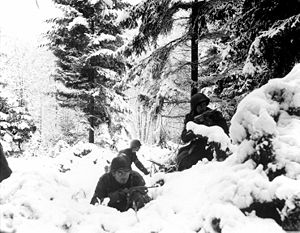
Muskin, a staff sergeant, announced to the squad, “Boys, I’m going to get home alive if I can get through that.” His unit advanced as far as the Elbe River, where aside from a skirmish they waited out the end of the war in relative calm. Hordes of captured German soldiers marched past them.
Back home, Muskin was a traveling salesman before he bought into a children’s wares business that took off as Baby Town, later renamed Youngtown. He married, raised a family and feels grateful to have lived the good life at the ripe age of 88.
Lloyd Friedman, In the Presence of Ike, Old Blood and Guts and Give ‘Em Hell Harry
Lloyd Friedman’s five-year military odyssey began in late 1940. The University of Nebraska-Lincoln ROTC graduate helped oversee a black regiment in the 25th Infantry at Fort Huachuca, Arizona. He returned to Omaha ready to resume civilian life when Pearl Harbor put him right back on active duty.
The next three years he was assigned units tasked with patrolling and defending the west coast. He went from the 134th National Guard Regiment of the 35th Infantry Division to the 137th Infantry Regiment.
As D-Day neared in June 1944 Friedman, by then a captain, became regimental adjutant under Col. Grant Layng, which entailed being “his gofer or shadow.”
Friedman was one of two Jewish officers in his regiment. While in England his unit was inspected by Allied Supreme Commander Gen. Dwight Eisenhower.
His outfit hit Omaha Beach in the aftermath of the Normandy invasion but they discovered an area still hot with enemy activity.
“The Germans had the cliffs fortified,” he said. “That was pretty rough, We fought a little bit there but we got out of that. Normandy, above Saint Lo, was made up a lot of hedgerows. You couldn’t see what you were shooting at.”
In an account for the Nebraska Jewish Historical Society, Friedman wrote:
“On the first day of combat we lost the colonel to machine gun fire. I was not with him. It was tough to see friends wounded and die. The lines did not move very fast.”
Then, he wrote, “I saw in the air the most bombers ever. They practically leveled Saint Lo, and even a few stray bombs landed on our troops.”
Every time the regiment got orders to move, Friedman went with the advance party.
“My worst job,” he wrote, “was reconnoitering for the new headquarters as the lines moved forward. There were times I got ahead of the front lines. On one occasion my jeep driver and I were going up a road, dodging brush and debris. After passing, we looked back and saw that they covered mines…We breathed a sigh of relief.”
More relief came with the break out across France. His company was attached to Patton’s 3rd Army. He got to see the irascible, flamboyant commander up close.

“He was a buddy of our new colonel and visited us for so-called ‘lunch’ one day. I will never forget his two pearl handled pistols.”
At times Patton’s forces moved so fast they outstripped their supply lines.
“As we neared Germany things slowed down,” Friedman wrote. “We had some fierce fights across the border (Mosel River). By Christmas…we were sent to Metz for what we thought would be a well-earned rest. We were so wrong. Immediately we were moved north to outside Bastogne (Battle of the Bulge). Those were horrible days. Between the cold and driving the Germans back, it was miserable.”
“We were near Berlin when VE Day came in May (1945). Our regiment was sent to Boppard on the Rhine for occupation duty. On July 11 we assembled near Brussels and were picked for the honor guard for President Truman who was en route to the Potsdam Conference.”
Friedman, who was never wounded, won five battle stars, including the Bronze Star.
During an R &R stint on the French Riviera he ran into Omahan Stanley Slosburg and upon returning to the States he met another Omahan — Stuart Muskin, who served in the same division but in a separate regiment.
After the war Friedman married and became a buyer and merchandise manager for Herzberg’s before making his career in insurance.
By Sea: The Pacific Theater or Bust
Milt Saylan, On the Battleship USS South Dakota
When Milt Saylan entered the U.S. Navy in 1944 he was 24, married, a father and the owner of his own grocery store in Charter Oak, Iowa. The Omaha native developed a taste for the food business working summers at an uncle’s store.
Compared to many he served with in the Navy, he said, he was “an old man. I was a little different than some of the young punks that went in. We called ’em kids — they were young, single, with no responsibility.”
Saylan had his own store four years by the time he became a seaman apprentice and, he said, that experience naturally “put me in the galley” — first at Shoemaker Camp in Calif. and then aboard the battleship USS South Dakota.
As a meat cutter he readied enough chops, steaks and roasts every day to ensure there was enough for the next day’s chow.
The South Dakota became part of Naval lore through a stunning series of engagements against Japanese forces — sinking several vessels and bringing down multiple planes in major sea and air battles. It was the most decorated ship in WWII. So as not to make it a special target, the U.S. military withheld its name from the press — its exploits chalked up to Battleship X or Old Nameless.
“We were the flagship of the 13th fleet,” said Saylan.
_at_Scapa_Flow,_1943.jpg)
The South Dakota earned battle stars at Guadalcanal and in action in the Coral Sea, Okinawa, Iwo Jima and Midway, before eventually sailing into Tokyo Bay. From the deck of the South Dakota Saylan and his fellow 2,200 crewmen witnessed Japan’s formal surrender on the USS Missouri tied up alongside it.
There were times he wasn’t sure he’d make it through the war. One of those was when kamikaze attacks wrecked havoc on the ship at Okinawa.
“We got hit and we lost 37 men,” he said, the memory still making his voice quiver.
During combat he manned a battle station. His job: help corpsmen tend wounded and get them into sick bay. During the Okinawa attack he went to the forward part of the ship, where the kamikazes struck, and amid the carnage helped carry the wounded away on stretchers.
He wasn’t close to any of the sailors who lost their lives that day but burying that many comrades at sea left its mark.
The South Dakota, which supported carrier strikes against Tokyo, made its way ever nearer Japan in anticipation of the planned Allied invasion. When the atom bombs ended the war the battleship made its way into Tokyo Bay for the formal surrender. As a precaution against a Japanese ambush, said Saylan, the crew was in full battle gear. Nothing untoward happened.

He said the “very somber” ceremony on September 2, 1945 proceeded aboard the Missouri with the assembled crews of the Missouri, the South Dakota and other ships topside to observe the historic moment. Fleet Admiral Chester Nimitz, Admiral William Halsey and Southwest Pacific Area supreme commander Douglas MacArthur led the U.S. contingent in accepting the surrender of their Japanese counterparts. It all went off without a hitch. Saylan and his shipmates followed orders by not expressing any emotions that might dishonor the Japanese.
Saylan was discharged as a first class petty officer.
After the war he remained in the grocery business and by the mid-1950s he retired. Bored after a few months, he took over a window wares company that became a big success. His son now has the business.
Saylan’s visited the USS South Dakota Battleship Memorial in Sioux Falls SD.
Kevee Kirshenbaum, C.O. of Minesweepers in WWII and Korea
Kevee Kirshenbaum had the distinction of being assigned six different minesweepers in two separate wars during his U.S, Navy service.
He was a University of Nebraska sophomore when he joined up in 1942. His first assignment came as an ensign aboard a sweeper sent to the Aleutian Islands. At Cold Bay, Alaska he helped train Soviet naval personnel in minesweeping techniques as part of the top secret Project Hula, which was to ready the Soviets to invade Japan from the north.
Once while traversing an igloo-like tunnel on base he ran into an old chum from Omaha — Lee Bernstein. When they see each other today they’re still amused at meeting each other in such a desolate spot.
Kirshenbaum went from one extreme to the other in the Philippines, where he said, “we swept mines all the way along the coast down close to Borneo.” He said sweepers lived by the motto: “where the fleet goes, we’ve been.”
His worst WWII experience came while anchored in Subic Bay during a typhoon. Ordered to get under way, the ship’s fluke caught on the open hatch of a sunken boat. That left the ship riding out the storm like a top on a string.
“We stayed there for 48 hours, just going around in circles. You never saw so many sick people.”
His group made preparations for Okinawa and the planned invasion of Japan when the atomic bombs were dropped. It was then he took command of his first ship, the YMS-49, in Shanghai, China.
“My best experience of the war really was when I had command of a ship. The war was already over — what we did was sweep the mines in the Huangpu River. We didn’t find any mines there but we found an awful lot of bodies. You would see Chinese boats going by with a hook picking the bodies up.”
Becoming a C.O. at only 22, he said proudly, “was an accomplishment.”
Some fears he harbored were soon quelled.
“When I went aboard ship I didn’t know what the reaction would be to my being Jewish. The Navy had as a whole very few Jewish personnel. Then there was my age. I knew some of these guys knew more than I did. Half the crew was much older than I was and more experienced. But luckily enough I didn’t have any problems. The crew was very good and respectful.”
Back home he finished school, joined the Navy Reserve, went to work and got married. Then the Korean conflict broke out and he was assigned minesweeping duty again. In Sasebo, Japan he served on a ship and transferred to train the South Korean Navy, which helped shake off the rust of four years away from active service. Later, he went to Korea to command the USS Redhead, which swept mines in hostile waters, even past the 38th parallel. The mine fields were thick with danger and his ship and others came under fire by shore artillery batteries.
Mines, especially the magnetic kind, were the main threat. A replacement ship venturing where the Redhead would have been was sunk by one. His most harrowing duty came sweeping Wonsan Harbor at night when the Redhead set off a magnetic device whose blast destroyed the vessel’s mine cutting gear. Luckily, the hull was intact and the ill-conceived operation cancelled.
The small, wooden minesweepers were the runts of the fleet but being small had the advantage of being resupplied every few days, which meant fresh eats.
Looking back on all the responsibility he assumed at such a young age, he said, “I felt good about it.” He’s most grateful for coming out alive. The retired entrepreneur feels fortunate to have had the chance to lead “a successful life.”
Stan Silverman, A Dry Dock Navy Tour
Homefront contributions to World War II often get lost in the haze of history. But the men and women who worked the factories, fields, docks, warehouses and countless other jobs vital to the war effort made it possible for America to execute its battle plans and achieve final victory.
Long before Stan Silverman ever entered the service he worked on a ditch digging crew opening the earth with shovels to accommodate water mains at then Offutt Field on the old Fort Crook base. The site is where the Martin Bomber Plant would be built and where Offutt Air Force Base would house the Strategic Air Command.
His family ran a grocery store on Vinton Street and he and his folks lived above it.
The Central High graduate earned a chemical engineering degree from Iowa State University at a time when quotas limited the number of Jews accepted into higher education and certain career paths. “That irritated me,” Silverman said.
While at Iowa State he said the school’s physical chemistry department secretly played a significant role in the Manhattan Project by purifying the uranium for the atomic bombs ultimately dropped on Japan.
After college he went to work as a chemical engineer for Phillip’s Petroleum Company in Kaw City, Ok., where he fell in with a mix of engineers, Native Americans and roughnecks. He learned to play a mean game of poker there. Oklahoma was a dry state then and Silverman said when he’d come home to visit he’d stock up on liquor to bring back to his parched buddies.
He enlisted in the U.S. Navy in 1944 and though he looked forward going to sea it never happened. His wartime service consisted of training school assignments from Indiana to Mississippi to Chicago to California. As an electronics technician third class he worked on radar, sonar and radio equipment that was big and bulky in the days before transistors and microchips.
He got married while in the service and his wife Norma, who did clerical work for the 5th Army Corps in Omaha, joined him at various stops.
His arrival on the west coast coincided with VJ Day and the memory of the jubilation over Japan’s surrender is still vivid.
“I was in San Francisco, where they had a helluva celebration. People went wild.”

The war was officially over but he was still Uncle Sam’s property and the wait for his discharge made the time drag by.
“I was sitting there not doing a helluva lot.”
The one time he was assigned a ship the orders were cancelled before he got aboard. He was a statistician on Treasure Island, where a military unit was set-up. The closest he came to shipping out was riding a Navy launch across the bay.
All in all, he said his time in the service was agreeable. He never ran into any any-Semitism and he was able to practice his faith and attend High Holiday services.
After his discharge in early 1946 he worked a variety of jobs the next several years, including men’s furnishings at J .L. Brandeis. Helpjng him get by was a $25 a week stipend from the Servicemen’s Readjustment Allowance fund.
He was with the Container Corporation of America in Chicago before moving back to Omaha to work for the City’s smoke abatement division. He was later at Quaker Oats. He eventually joined his father-in-law Ben Seldin and brother-in-law Ted Seldin in the Seldin Company, a commercial real estate, multi-family management and development organization. At 88 he still goes to the office every day.
By Air – The Philippines, New Guinea, and Stateside
Bernie Altsuler, A Love of Flying
Bernie Altsuler was only 20 when he enlisted in the U.S. Army Air Corps in 1942, but he was already a married working man. The Omahan was inducted in the service in Calif. because at 19 he’d gone to Los Angeles with a brother in search of new horizons. His fiance joined him there and the two were married.
As he had some college — he attended Creighton University — he was put in base operations logging flight records. When assigned a training command unit at Kirtland Field in Albuquerque, NM, his wife came with him. Rookie pilots trained in twin-engine Beechcrafts.
He said his only encounter with anti-Semitism occurred there.
“I was working on the line — that’s where they brought planes in — and there was a master sergeant, and boy he laid into me. He gave me all the problems you could imagine, but I was only there six months before I got transferred. I loved Albuquerque but I was sure glad to get away from that guy.”
Altsuler then ended up in Fort Sumner, NM as part of a command training navigators. He was there 15 months and once again his wife accompanied him.
“My wife was a shorthand expert and she became the base commander’s secretary. That’s probably why I stayed there 15 months,” he said.
After another training stop stateside he shipped overseas in 1945 to the Philippines, where fighting had ceased. All the zig zagging his ship did to throw off enemy subs slowed the voyage to a crawl and he remembers “one of the longest craps games there ever was” played out over 39 days.
He said troops from Europe began filtering in as the Allied Pacific force geared up for the anticipated invasion of Japan. The atom bombs dropped on Hiroshima and Nagasaki cancelled the invasion to everyone’s relief.
By now a sergeant, he went from Tacloban, Leyte to Zamboanga and the 18th Fighter Group, which consisted of a P-38 squadron that only months earlier had escorted B-24 bombers in live missions over Japan.

“Our squadron commander was an ace — he had shot down five Japanese planes.”
As part of his duties Altsuler had frequent contact with pilots, whom he admired.
“They were all cocky young kids,” he said. “We got to know them very well.”
Despite no combat, there were still risks. Accidents happened. He remembers a couple planes cartwheeling down the runway and bursting into flames.
He developed a lifelong love of flying in the service, his appetite whetted by junket flights he hopped.
“We had a C-47 in our operation overseas that we’d fly all over the Pacific to many different islands picking up supplies, and I went along.”
Within a few years of his return from the war he earned his pilot’s license and instrument rating in a Piper Comanche along with his friend, Harold Abrahamson.
Ironically, he said during his nearly four years in the service he never bumped into anyone he knew from back home until the day of his discharge. He stayed in L.A. a few years before returning to Omaha, where he opened his own wholesale plumbing, heating and air-conditioning business. He later sold it and retired.
Jack Epstein, A Long Way from Home
The son of an immigrant fruit peddler, Jack Epstein was married and attending then-Omaha University when drafted into the service in 1943, ending up in the U.S. Army Air Corps. As a company clerk in remote outposts, he never saw any action but was a part of the huge logistics apparatus that fed the Allied war machine.
Military life didn’t exactly agree with Epstein, yet he persevered.
“I didn’t take to the Army very good, but I managed to do OK with it because of the fact I knew I wasn’t in danger and I had something to do all the time. I was busy. Time went pretty fast,” he said.
His wartime odyssey overseas began with a voyage aboard a merchant ship from southern Calif. to Brisbane, Australia. From there he went to Milne, New Guinea, where he remained the next 27 months. The only time he laid sight of the enemy was when Japanese surveillance planes flew high overhead.

New Guinea natives were rarely glimpsed.
He never came under fire but he did contract malaria. The rainy season there soaked everything for weeks on end. Mosquitoes had a field day. The oppressive heat rarely let up.
Epstein was part of a unit comprised of two officers and 28 enlisted men. “We took charge of all the 100 octane gasoline on that base for airplanes,” he said. The gasoline came in 150 gallon barrels unloaded from supply ships and then stored and secured on base. Thousands of barrels were stacked on site. The fuel serviced fighter planes as well as troop and cargo planes.
“We serviced all of them,” he said.
Planes came and went all day, every day. “From the Philippines they came, from Okinawa they came, from all over. They were in and out — they didn’t stay,” he said. The roaring engines were a constant companion. “Maybe that’s the reason I can’t hear so good (today), I don’t know,” he ventured.
He was tasked with inventory control.
“I was the company clerk you might say. I kept track of the ins and outs of the barrels that came in and the barrels that went out .”
As staff sergeant, he said, he became “very close to the two officers. We played bridge most of the time we were there.” Finding diversions on an island in the middle of nowhere, he said, was vital for maintaining one’s sanity. Besides playing bridge there was fishing, but reading and writing letters was his main relief.
“I wrote my wife every single day and she wrote me most every single day and it was really great as far as the camaraderie we had with each other.”
He still marvels at how their letters arrived without interruption, as did the air field unit’s supplies of everything from canned foods to typewriter ribbons.
“One reason we won the war was our supply lines,” he said. “No matter what you wanted we had it — about anything you could imagine. Our supply was unbelievable.”
By war’s end he was sent to Okinawa, where he endured two typhoons, and then back to the Philippines. En route home by ship he suffered chills and fever from his malaria. It took two years before he was over the symptoms.
After three years of separation he and his wife reunited and raised a family. Epstein ended up in the distillery business. At age 88 he still goes to work every day.
Lloyd Krasne, From Audubon to Tokyo By Way of Leyte
Lloyd Krasne clearly recalls hearing over the radio the news of Japan’s attack on Pearl Harbor. He was driving a truck into Omaha to get supplies for his Ukrainian immigrant father’s grocery story in Audubon, Iowa. Krasne soon joined the war effort as a U.S. Army Air Corpsman.
“They needed people very badly, so it was rush rush, rush,” he recalled.
Initially pegged to study cryptography he wound up learning power-operated gun turrets. Seizing an opportunity to apply for Officers Candidate School he put in and made the grade and after completing the course in Aberdeen, MD he was commissioned an officer. He did more schooling in aviation ordinance before assigned a unit in Calif. charged with training B-29 crews on operating the bomber’s state-of-the-art gun systems.
He said as the conflict progressed and America’s production of war materials advanced, the Army Air Corps found itself in a constant state of flux as new planes came on line that required different support.
With his unit scattered to the far corners, Krasne was transferred close to home, first to a base in McCook, Neb. and then to one in Harvard, Neb.

He made second lieutenant. In early 1945 he got overseas orders, prompting he and his fiance to get hitched before his departure. The couple went to Salk Lake City, Utah and then to Calif. before he shipped out to Manilla and then to Hollandia, New Guinea. No sooner did he arrive then new orders sent him right back to Manilla, where he was reunited with a commander in Tacloban, Leyte.
“Across from the house we quartered in was a little hut on stilts. There was a plank from the front door going down to the ground and in the morning here’d come a couple chickens, a pig, a couple kids — that’s the kind of economy it was.”
On Leyte he attended a memorable Yom Kippur service in a cockfighting arena. He learned years later a fellow Jew from back home — Nate Katelman — was there too.
Krasne said anti-Semitism faded in wartime, when differences seemed mute in the face of life-and-death stakes: “You were in this together. You wondered what would come next.” However, he did witness racism toward blacks that disturbed him.
He said his C.O. showed him the plans for the invasion of Japan — kept in a locked safe — that thankfully never had to be executed. After Japan’s surrender he went to Tokyo to serve in the army of occupation.
“We saw a country that was torn up,” Krasne recalled. “The main buildings were made of stone and they were alright but the areas constructed of bamboo and paper the fire bombs had reduced to nothing. Whole blocks were empty.”
After initial distrust, the Japanese warmed to their American occupiers, but persisted in their blind obedience to authority. “It was quite an observation because the people were still oriented that the emperor is god and can do no wrong and whatever he says goes,” said Krasne, who saw citizenry dutifully bow to policemen.
“It brought home the fact these people were oriented differently than anybody we’d ever met. It was quite an experience.”
Though he meant to quit the grocery business when he returned home he found it the only sure thing and remained in the field the rest of his working life.
Old Warriors Never Die, They Just Fade Away
Like veterans everywhere, Omaha’s Jewish vets run the gamut when it comes to how much or how little they’ve invested themselves in things like post-war reunions and commemorations.
Some, like Lloyd Krasne, Stuart Muskin and Kevee Kirshenbaum, have been to numerous reunions. Muskin, Kirshenbaum and Bill Cohen of Omaha traveled on a Heartland Honor Flight to Washington, D.C. Some of these same men attended a tribute two years ago honoring Omaha area veterans and Holocaust survivors. Some concentration camp prisoners met their liberators.
Other vets want little to do with any fanfare over those times.
Some have scrapbooks and mementos, others — nothing.
For most veterans, Omaha’s Jewish ranks included, wartime service was something they spoke little of after returning home and getting on with their lives. It’s only in the last two decades, as major anniversaries of the war were observed, they began openly telling their stories.
All lost something along the way. Buddies. Time. Innocence. Their humble attitude about going to war, which Lloyd Friedman summed up with, “somebody had to do it,” helps explain why they are the Greatest Generation.
Several vets get together Mondays at the Bagel Bin. They may be gray and fragile now, but there was a time when they cut dashing figures and did heroic things. As their numbers grow ever fewer, they represent a trove of history not to be forgotten
Related articles
- What dose the Battle of the bulge and The battle of Britian have in common (wiki.answers.com)
- The Battle of the Bulge (theroadtovictory.wordpress.com)
- Leo Adam Biga’s Survivor-Rescuer Stories Featured on Institute for Holocaust Education Website (leoadambiga.wordpress.com)
- Sisters of the Shoah: Three Survivor Tales, Three Golden Fates, Three Iron Wills (leoadambiga.wordpress.com)
Sisters of the Shoah: Three survivor tales, three golden fates, three iron wills

Image via Wikipedia
It has been a humbling experience for me to meet and profile a number of Holocaust survivors. The following story I did for the Jewish Press tells the remarkable tale of three sisters who all managed, after much misery and loss, to get out of the hell of the Holocaust alive. The story is one of a series I have done for that newspaper, with assorted others for other publications, that personalize the horror and the hope that survivors have to share with the rest of us. Rachel, Mania, and Bluma are three women I am not likely to forget. I dare say after reading their tale you will not forget them either. After the war they all ended up in Omaha, where they still reside today as witnesses whose testimony must be read and heard. On this blog you will find several other Holocaust stories I’ve written, and I will be adding more over time. The ranks of the survivors are fast dwindling, making it ever more imperative their stories be told.. The article won, in a second-place tie, the David Frank Award for Excellence in Personality Profiles at the June 3, 2004 American Press Association’s Simon Rockower Awards. This article and several other survivor articles I wrote can be found on the Institute for Holocaust Education website, http://ihene.org/. And this Sisters of the Shoah piece is also featured on The Jewish Magazine website- http://www.jewishmag.com/90mag/shoahsisters/shoahsisters.htm.
Sisters of the Shoah: Three survivor tales, three golden fates, three iron wills
©by Leo Adam Biga
Originally published in the Jewish Press
This is not just another Holocaust story. It is the chronicle of how three sisters survived, alone and together, a series of Nazi concentration camps during World War II to tell their story of human endurance. That not one or two but all three made it out alive is, as the eldest puts it today, “Impossible. I don’t know how we lived. We survived with nothing…not even our hair.”
Only girls at the time, the sisters, all of whom resettled in Omaha, displayed a remarkable resolve that belied their years and that still defines them today. Their individual stories have been told, but never their combined saga. Sisters of the Shoah in name and in blood, the former Bojman girls are old women now but their spirit burns with the rigor of youth. Known by their married names — Mania Friedman, Rachel Rosenberg, Bluma Polonski — they remain defiant witnesses to the Nazi genocide that killed millions, including their parents and brothers, and that would have claimed them, too, but for their three golden fates and three iron wills.
“It is sad and it is deep,” is how a teary-eyed Rachel, the middle sister, describes her and her siblings’ odyssey. It’s a legacy that’s had a profound effect on their families, too. For example, Rachel’s three children witnessed her frequent crying jags and their father Carl’s obsession with the Holocaust. Rachel said in recent years she promised herself, “You’re not going to be miserable…live as happy as you can…see the light instead of the dark.’ I’ve tried to help myself to live normal and to be like everybody else, which I’m not. But I try.” A son, Stuart Rosenberg, said despite the nightmare his mother and maternal aunts experienced “they are truly remarkable people with an incredible appreciation for life.” The significance of their story, he added, is in the resilience and resistance their survival represents.

Not all survivors have fared as well. A cousin of the sisters never got over losing her family, including two sons, to the Holocaust. She committed suicide. “My cousin didn’t want to live. I do. I like life,” said Rachel. “In my eyes, I have everything I want. I’m the richest person in the world.”
The women today enjoy the comfortable lifestyle they made for themselves here, but the horrid memories of what brought them to America are never far away. This past Mother’s Day, the oldest sister, Mania, encapsulated the dichotomy of their lives in her heavily accented voice, “Our life is beautiful and miserable, you understand? After the war we had no family. We had nothing. How many times I said, God, take me away not to suffer too much.’ We went through more than hell. But this is our life. We have to take everything. At least I have pleasure from my children. All over I have pictures of my children,” she said, gesturing at the dozens of photos adorning her refrigerator, walls, hutches and tables. “As long as I’m alive I want to see them, not hidden away in a drawer, because we have family again.”
The phone rings and it’s Rose, the mother of Mania’s only granddaughter, Jennifer, whom she adores. “Oh, thank you, Rose. Happy Mother’s Day to you, too. You give me joy in my life,” Mania says. “You give me the biggest diamond that can be — Jennifer.” When Mania mentions she’s telling her Holocaust story to a visitor, the conversation abruptly ends. She explains that her daughter cannot deal with the subject: “She said, Mom, I don’t want to hear it.'”
For Bluma, the youngest sister, the specter of the Holocaust is not as immediate as it is for her older siblings but it is still ever present. Three years ago she made a pilgrimage with her children and several of her grandchildren to the Polish death camps. “This was my wish. To make this journey before I go away, because I’m a survivor and when we go away nobody’s going to be left anymore,” she said. “It was a sad wish. My husband didn’t want to go because it broke his heart. I said, If you’re not going to go, I will. I have to.’ I wanted to say goodbye to the ashes.”
Bluma and her family visited Treblinka, where her mother and youngest brother were killed, as well as Auschwitz, where she and Mania were imprisoned together and where Rachel and another brother were confined in a separate compound. “In Treblinka I kneeled down, I cried and I talked to my mom and my little brother. I said, I’m here. I’ve just come to see you and say goodbye.’ I said a kadish and after the prayers it started thundering and lightning…like she heard me. It was very emotional.” At Auschwitz, she went inside the very barracks, No. 25, where she and Mania were interned. “I thought I would have a nervous breakdown,” she recalls. Finally, she went to her hometown, which she found stripped bare of its Jewish heritage. “There’s nothing left,” she said. “It’s like we never existed.” Back home, she counts her blessings. “I’m thankful to God for every single day.”
Born into the Polish-Jewish family of Rose and Morris Bojman, Mania, Rachel and Bluma grew up alongside their three younger bothers in a stately home in the largely Jewish rural village of Wolanow, Poland. The orthodox family was well off, with their father working as a cattle buyer and running his own butcher shop and their mother earning money as a seamstress. The three sisters were leading typical schoolgirl lives, with Rachel learning the seamstress trade, when Poland was invaded by German forces in 1939 and the first anti-Jewish decrees were enacted soon thereafter. The mounting menace turned violent when German bombers attacked the village and an explosion destroyed a house across the street from the Bojman residence, killing and maiming several inhabitants. “I remember the bedding was wet with blood. People were cut up in little pieces,” Rachel said.
With their movements and actions curtailed, the Jewish populace was restricted to one small section of town where the Bojmans resided. Some of Wolanow’s Jewish residents were thrown out of their own homes and herded with refugees from neighboring hamlets into the small Jewish ghetto, which more and more resembled a prison. The Bojmans’ home was soon overcrowded with dozens of displaced people. Occupying German forces increasingly isolated their captives by driving Jews into concentration camps, dividing families in the process, throughout the countryside. It was at this time the Bojman family was irretrievably split-up. The sisters’ mother fled with their youngest brother, Motel, to the nearby village of her brother and his family, where she felt they’d be safe. The rest of the family was taken to Szalkow, a holding site on an area farm where conditions were far better than anything the sisters would know again until after the war ended six years later. Then, in the cold calculations of the Holocaust, Mania, Bluma, a brother, Aaron, their father and a cousin, Carl Rosenberg, were inexplicably sent to Camp Wolanow while Rachel and her brother Jacob stayed at Szalkow.
To this day, Rachel cannot fathom why she and her brother were separated from her family at Wolanow. “That’s such a puzzle in my mind,” she said. As to why her mother went off alone with her baby brother, she speculates she acted out of fear and denial. “My mother preached, The Germans will not hurt us — they are a cultured people.'” Before leaving, Rachel’s mother gave her a diamond ring. Rachel bribed a German guard with that ring and found someone to drive her to the village where her mother and brother were staying. “I went to get them,” Rachel recalls, but her mother resisted. “No, give me two more days,’ she said. She cooked for me my favorite meal and made a package for me to take back to my camp.” By the time Rachel came back, the village had been ethnically cleansed and, as she later learned, her loved ones taken to Treblinka, where they perished.
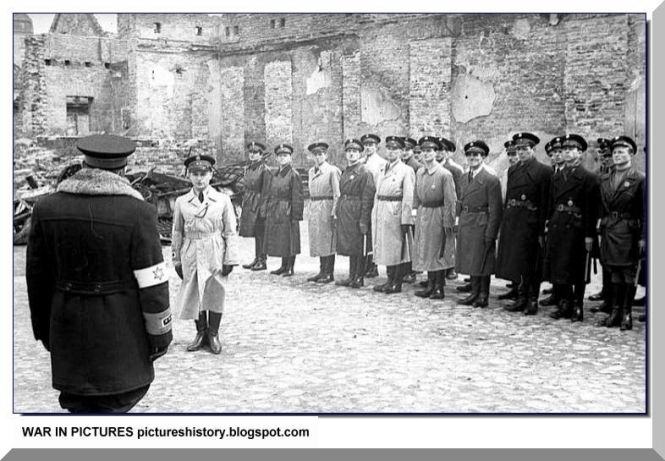
Camp Wolanow. This was the first of the camps Mania and Bluma weathered. As in other camps, males and females were segregated in overcrowded living barracks and on grueling work details. The sisters’ father and their brother Aaron were there, too. Operated by the Germans, the holding camp was manned by many Polish guards and terrorized by roving Ukrainian execution squads. The close quarters, unsanitary conditions, poor food and inadequate shelter became a breeding ground for disease. Typhus swept through the camp that winter, felling the sisters’ father, who grew too weak to work, excuse enough to be killed. Bluma, then only 10, snuck into her father’s barracks to comfort him and to hide him from the guards, but she was spotted and thrown into a crude shack known as “the death house.” There, “cold, barefoot and crying,” she cowered among the other prisoners awaiting almost certain death. When word of her capture reached her cousin Carl, already a young man who’d earned special privileges inside the camp because of his tailoring skills, he came to her rescue. Half-delirious with typhus himself, Carl pleaded with the guards for her release. As Bluma recalls, “He said, Please, let her live a little more. She’s my cousin.’ And they let me out.”
Survival at Wolanow was determined in part by luck, the guards’ whims and inmates’ own wits, wile and will. To survive, Bluma and Mania became hustlers and scavengers. Bluma, the smaller of the two, was adept at sneaking in and out of tight spaces to steal boots or brooms, which they made, or other valuable items the girls came across in camp and traded for scraps of food. “I was the provider,” Bluma said. “I was very aggressive.” In their foraging for supplies, the sisters said they got brazen enough to dig a shallow tunnel — with their bare hands — in the snow and ice. The tunnel, beginning under a section of barbed wire on the camp’s perimeter fence, ran into the surrounding woods and led to a clearing a few yards away. There, Bluma said, she and Mania came above ground and headed straight for a house occupied by a friendly Gentile family. The woman of the house knew the Bojmans from before the roundups and gave food and shelter to the two brave little girls, who scurried to her place via the tunnel whenever they got hungry.
On what proved to be the last run the girls made to their secret sanctuary, Bluma said the woman informed them it was getting too dangerous to aid them any longer and she forbid them from returning. That night, Bluma said she and Mania hid in the woods when they heard machine gunfire coming from the camp. Returning to camp at daybreak, she said they came upon a scene of surreal carnage, with hundreds of frozen corpses, riddled by bullets, laying on the ground as mourning relatives weeped over them. Among the bereaved was their father, crying over the death of his son and their brother, Aaron, a victim of the mass execution.
As related to the sisters by their father, Aaron was selected for a contingent of prisoners earmarked for another camp but, instead, he hid in a barrel, hoping to elude his captors. When a guard overturned the barrel Aaron was killed with the others on site. The bodies, according to Mania, were buried in a mass grave.
From Wolanow, Mania, Bluma, their father and Carl were transported to a Polish transit camp, Starahowice, where they were detained before being shipped, by train, to dreaded Auschwitz. Degradation and violation ruled their lives at Auschwitz. Like many others, Mania and Bluma endured torture. “The women guards went with their bare hands inside us and tore things,” Mania said. “We were screaming. We were bleeding. Oh, God. I don’t know how we got children. This was a miracle.” The sisters’ father was transported from Auschwitz and eventually gassed in Buchenwald.
Meanwhile, Rachel, along with Jacob and assorted cousins and aunts, were deported from Szalkow, where they enjoyed relative comfort, to Blizyn, a harsh labor camp where they were “cold, hungry and dirty.” She and other women were forced to carry heavy cement blocks for buildings under construction. Jacob tended animals. Eventually, Rachel was spared the hardship and indignity of being a human pack mule when the guards called a group of inmates together one day and asked who could sew. She raised her hand and was reassigned to a giant sweatshop where she joined hundreds of other prisoners making uniforms.
The drudgery of work-filled days and the anxiety of uncertain fates left inmates drained by night, when they “sat around for hours and talked,” Rachel recalls, “about why they are doing this to us, what’s going to be tomorrow, who’s going to live through this, who’s going to tell? We dreamed. We looked outside and saw there’s still a world. We saw people working in the fields. The sky was blue. The birds still flew. I thought, God, if I could only be a bird. We were 16-17 years old. We never dated. We never knew boys. We were afraid but there was nothing we could do. The hurt was so deep. The ocean wasn’t as deep as our hurt.”
The pain only got worse at Auschwitz. “Well, I knew this was going to be our end,” Rachel recalls thinking upon arriving at that foul place. It was by pure chance she became aware of her sisters’ presence there. One day while walking in a line of prisoners at the edge of the compound that bordered another enclosure she saw Nathan, the brother of her cousin Carl, working on a railroad gang. They made eye contact and “he threw me a chunk of bread.” Further down the line she spotted her sisters laboring on the tracks the transport trains ran on. “I went closer to the gate, up to the barbed wire, and I screamed, Mania…Bluma,’ and they saw me and they waved to me. I threw them pieces of that bread.” It was the last time she saw her sisters until months after their liberation.

“The living was very bad there,” Rachel said. “Every morning we had to stand in line to be counted. We had to be naked for Mengela (the Nazi war criminal, Joseph Mengela, who experimented on inmates). We were afraid. He chose — this girl to the left, this girl to the right…you go to work, you go to die.” As Bluma puts it, “If you had bones, you were not good. If you still had a little meat, you could still work. One day he made a selection and I was on the wrong side and they took me away. I was scared, but I couldn’t cry anymore — our tears were dried up. We were numb already. We were like cattle led to the slaughter.” Bluma said she escaped the ovens when, in a roll call, she gave the wrong number tattooed on her arm and rejoined Mania in the fit-to-work group.
At Auschwitz Rachel once again lugged cement blocks. On their way to work Rachel and fellow inmates passed by a crematorium. “We saw the flames and the black smoke,” she recalls. “We said, Well, next time it will be us.’ We knew there was no tomorrow for us.” In a building piled high with victims’ discarded apparel she salvaged fabric to clothes for her, relatives and barracks-mates.
It was at Auschwitz the sisters’ brother Jacob met his end. Rachel, who’d been his protector during their life in detention, took his death especially hard. “One day we were standing in the wrong place at the wrong time when the SS, who targeted the young, took him away from me,” she said. “I didn’t want to let him go. I cried and begged them to let me go with him or to take me instead, but they just grabbed him, threw me down and led him away to a truck. I couldn’t do anything but put a sweater around him so he’d be warm. I followed the truck as far as I could.” Having him wrenched away from her to be gassed is, she said, “my biggest hurt.” It is why, she feels, she’s been an “overprotective” mother.
Although the sisters had no inkling of it at the time, by early 1945 the Nazis were in disarray and inmates like themselves still able enough to work, albeit malnourished, were in a position to stay alive and be liberated by advancing Allied troops. As if surviving Auschwitz were not enough, the sisters defied fate once more when commandeered to work as human slaves in munitions factories on the Czech-German border — Mania and Bluma in Darezenstrat and Rachel and some cousins at another site, where they toiled in a series of cellars or tunnels variously sorting potatoes and splicing electric wires. By late spring, the prisoners could see their captors were anxious. Some guards fled. Then, on May 8 1945, Mania, Bluma and the others were marched into the woods by the remaining guards. When a limousine approached, the sisters feared the worst. “We thought it was the SS,” Bluma said, “but it was the Red Cross. They said to the Germans, Stay here. You lost the war. It’s over. The people are free.’ This was our liberation.” On the same day, Rachel and her group were liberated by the Russians.
The sisters, mere skeletons by then, were cared for by a combination of international aid workers and Czech nationals.
Against all odds, the sisters persevered the worst that, as Bluma puts it, “human done to human,” and have gone on to see many tomorrows. While their post-war life has been heaven-sent in comparison with the hell they survived, there have been many struggles. Soon after their liberation, Mania and Bluma went to Wolanow to salvage what they could from the family home, where they were rudely rebuffed by the Polish family occupying it. The sisters only retrieved a photo of their father before being driven off with threats and invectives. Mania and Bluma were reunited with Rachel, Carl and other relatives at a pair of displaced persons centers in Germany, namely, the city of Lanzburg and the former concentration camp Bergen-Belsen, which the British liberated. At these sites the extended family eked out a meager existence the next few years. “We didn’t have money or anything, but we were still happy. We were together…and we were free,” Rachel said.
During their limbo of a refugee existence, Carl, the oldest and most resourceful, “was like a father to us,” Rachel said. “We were very naive. We didn’t know from life. He took care of us. He protected us.” Carl, who long fancied Rachel, married his cousin in Germany, where their first child, Morris, was born. Mania and Bluma also met their mates in the DP camps. By 1949 the sisters secured papers to start anew — with Rachel, Carl, Bluma and Joe going to America and Mania and Zalman resettling in Israel. Their cousins scattered to the four winds. In 1958, Mania and her family rejoined her sisters in America.
Rachel credits then-Jewish Federation of Omaha executive director, Paul Veret, with helping her family get established in the community and Jewish social maven Sadie Newman with making them feel welcome here.
All three sisters feel blessed they overcame their shared tragedy and trauma to find a foothold in America, where they started from scratch to build bountiful lives for their families. Along with their husbands, fellow survivors like them, the women found business success, reared healthy children and became doting grandparents. For years, Rachel assisted her husband, Carl, who now suffers from dementia, in their own tailoring business. She still does fittings and alterations in their basement workshop. Mania and her late husband Zalman owned and operated the popular Friedman’s Bakery in Countryside Village. Bluma’s husband Joe, now retired, was the longtime owner of Ak-Sar-Ben TV before selling it in 2000.
The sisters are proud to have come so far from so little. “We had no language, no money, nothing, and look at what we accomplished,” Rachel said, motioning to her big, beautiful house. Toiling long hours beside their husbands to earn extra money, the women made sure their children had “everything they wanted,” Mania said. Working hard also helped ease the women’s heartache. “Being busy is a healing,” Rachel said. Even so, harsh memories linger — the bitter past a constant reminder of what they witnessed. “I hold it in my heart. I remember everything,” Mania said.
Forgotten and abandoned during the war, the sisters carried on when all hope seemed lost and realized what once seemed impossible — a life free of fear and want. “I didn’t have anything but a dream and my dream came true,” Bluma said. “Well, God had to give us something, too.”
Related Articles
- Leo Adam Biga’s Survivor-Rescuer Stories Featured on Institute for Holocaust Education Website (leoadambiga.wordpress.com)
- Holocaust survivors resurrect Passover recipes (nj.com)
- Why Shoah still matters (guardian.co.uk)

Leo Adam Biga’s survivor-rescuer stories featured on Institute for Holocaust Education website

Image via Wikipedia
Leo Adam Biga’s survivor-rescuer stories featured on Institute for Holocaust Education website
A couple years ago I approached Beth Seldin Dotan at the Institute for Holocaust Education in Omaha, Neb. with a proposal: providing my stories about Holocaust survivors and rescuers for display on the organization’s website, http://ihene.org/. She was already familiar with my work in this subject area and we quickly struck a deal. None of the stories would have happened without the help of the late Ben Nachman, a man who made it his quiet crusade to shed light on the enduring spirit of survivors and rescuers. Ben introduced me to the local survivor community and he also led me to various scholars he’d corresponded with over the years regarding various aspects of the Holocaust and the heroic actions of individuals.
I feel privileged that these stories are finding a new home and audience there. Ben was instrumental in my getting each of these stories. There’s more than a little bit of him in them. By the way, you can see my stories about Ben and the work he did on this blog. Here’s how Beth describes the story queue on the website:
Nebraska Holocaust Stories
Several years ago, freelance journalist Leo Biga conducted extensive interviews with several of Nebraska’s Holocaust Survivors. Biga went on to write detailed articles that chronicle the Holocaust testimonies of the Survivors and the lives they made for themselves in Nebraska. The articles were originally featured in Omaha’s Jewish Press. You can now find them here on the Institute for Holocaust Education website. Some of the stories that you will see have won distinguished recognition: The Fred Kader story won First Place in the Single Feature Story category at the 2002 Nebraska Press Association competition and the article “Sisters of the Shoah” about Rachel Rosenberg, Mania Friedman, and Bluma Polonski won a Second Place tie for the 2004 David Frank Award for Excellence in Personality Profiles in the annual Simon Rockower Awards of the American Jewish Press Association.
The Institute for Holocaust Education sincerely hopes that these articles, now available to the entire world on our website, will honor the lives of our Survivors and keep their stories alive.
•••
The website features only a portion of my Holocaust writing. Some of the same stories featured there can also be found on this blog, and I am in process of adding more.
Here’s how Beth previews the stories (you can go right to the page where the stories are listed by linking to http://ihene.org/nebraska-survivor-stories/):
•••

On a January morning students at Omaha’s Lewis and Clark Middle School file in an auditorium to hear a tale of survival by Bea Karp, a petite Jewish woman of 66 who as a child in her native Germany, and later in France, endured the Holocaust. She and her younger sister, Susie, are among their extended family’s few survivors. As Bea’s harrowing tale unfolds, the students listen with the stilled respect due the haunted figure standing before them. Not all survivors can speak about their experiences. Some want only to forget, Bur for Bea, and thousands like her, there is a need to speak out. To bear witness. Why?
“I’ve been an escape artist all my life.” The apt words belong to Lincoln, Neb. resident Lou Leviticus, a square-headed terrier of a man who as a youth in his native Holland survived the Holocaust partly due to his talents as an artful dodger. He escaped the Nazis more than once, even when those closest to him were caught and put to death. As an orphan on the run he became one of scores of hidden children in The Netherlands, his survival dependent on a cadre of strangers that cared for him as one of their own.
For My Mother: Helena Tichauer Tells Her Story
Helena Tichauer was tempted to give up more than once. If she had, no one would have blamed her. For persecuted Jews like her and her family, reasons for despair were everywhere in Nazi-occupied Poland. Her family’s pleasant, comfortable life in Krakow had been wrenched away in the looming darkness of the Holocaust.
Kitty Williams Finally Tells Her Survivor Story
For the longest time, Holocaust survivor Kitty Williams of Council Bluffs didn’t think her story warranted telling. She considered her suffering insignificant amid the weight of Nazi atrocities. Other tragedies far surpassed her own. Nobody could find hers interesting or edifying. It’d all been said before.

“I feel I was destined to live.” That’s as close to an explanation as Lola Reinglas can offer in making sense of her Holocaust survival. An Omaha resident since 1949, Reinglas and her sister, Helena Tichauer, survived a series of internments, some together-some apart, that defied reason except for the intervention of fate and their own indefatigable will.
For the first 52 years of his life Fred Kader lived everyday in the shadow of a lost past. An orphaned child of the Holocaust, Kader’s early years remained an unfathomable mystery that he hoped one day to solve so that he might finally come to know how he survived the Shoah as a small boy in his native Belgium.
Sisters of the Shoah: Three Survivor Tales, Golden Fates and Iron Wills
This is not just another Holocaust story. It is the chronicle of how three sisters survived, alone and together, a series of Nazi concentration camps during World War II to tell their story of human endurance. That not one or two but all three made it out alive is, as the eldest puts it today, “Impossible. I don’t know how we lived. We survived with nothing…not even our hair.”
The Trauma of the Hidden Child Revealed: Marcel Frydman, Fred Kader, and Tom Jaeger
A gathering unlike any other took place the evening of September 24 at the home of Omaha Holocaust researcher Ben Nachman. Over the course of several hours a diverse group of guests heard three men discuss a shared legacy of survival — one that saw them persevere through the Shoah as hidden children in their native Belgium.
Related Articles
- FYI – Holocaust survivors to receive $ 564 million in reparations. (jwitness.wordpress.com)
- Holocaust Photo Archive (innovationslab.wordpress.com)
- Oldest male holocaust survivor is 105. Video & Pictures (jwitness.wordpress.com)
- Rescuer Curriculum Gives Students New Perspective on the Holocaust (leoadambiga.wordpress.com)
Bob Kerrey weighs in on PTSD, old wars, new wars, endings and new beginnings
For many Nebraskans, myself included, Bob Kerrey has always been a fascinating figure. Unusual for a politician from this state, he exuded a charisma, some of it no doubt innate and genuine, and some of it I suspect the reflected after glow of our idealized projections. As a combat war veteran who overcame the loss of a leg in service to his country, he was a valiant survivor . As a brash political upstart and liberal Democrat in solidly conservative and old-boy-network Republican Nebraska his was a new voice. His good-looks and suave ways gave him a certain It appeal. When he landed in the governor’s office and struck up a romance with actress Debra Winger, who was in state to shoot scenes for the film Terms of Endearment, it only confirmed Kerrey as a rising star and player in his own right. His long career in the U.S. Senate is probably most memorable for the number of times he was mentioned as a possible candidate for the Democratic presidential nominee race. He did end up running but it soon became clear his magic did not resonate with the masses. More recently, he dealt with the unpleasant truth of hard things his unit did during the Vietnam War. He left the political arena for a university presidency only to find himself at odds with faculty and student groups who eventually called for his ouster. As he prepares to leave the world of academics for some as yet unnamed new venture, he seems like a lot of us who come to a point in life where it’s time for reinvention and renewal. The following story for The Reader (www.thereader.com) is obstensibly a sampler of his views on Post Traumatic Stress Disorder as it relates to active duty military and war veterans, but it also serves as a look into how he approaches and articulates issues. I also have him weigh in on the Tucson shooting. At the end of the piece I address some of the currents in his professional life that find him, if not adrift exactly, then searching for a new normal.

Bob Kerrey weighs in on PTSD, old wars, new wars, Eedings and new beginnings
©by Leo Adam Biga
Published in The Reader (www.thereader.com)
Vietnam war veteran and former Nebraska governor and U.S. Senator Bob Kerrey will be in Omaha Jan. 31 to salute At Ease, an Omaha program providing confidential behavioral health services to active duty military personnel and family members.
Founded by Omaha advertising executive Scott Anderson, At Ease is administered by Lutheran Family Services of Nebraska. Kerrey, whose embattled New School (New York) presidency ended January 1, is the featured speaker for the At Ease benefit luncheon at Qwest Center Omaha.
Reports estimate up to one in five Iraq and Afghanistan war veterans — some 300,000 individuals — suffer from Post Traumatic Stress Disorder (PTSD) or major depression. Controversy over strict U.S. Veterans Administration guidelines for PTSD claims has led to new rules that lessen diagnostic requirements and streamline benefits processing.
Last summer Kerrey, a board member with the Iraq and Afghan Veterans of America (IAVA), publicly criticized a VA policy banning its physicians from recommending medical marijuana to patients.
“There are doctors who are strongly of the view that marijuana prescribed and monitored can be beneficial for a number of physical and mental conditions,” he says. “And in those states where medical marijuana is legal I think the VA should allow it.
“If a doctor can prescribe medical marijuana for somebody who’s not a veteran, it doesn’t seem to me to be right for that doctor not to be able to prescribe it for a veteran.”
Kerrey, speaking by phone, says he keeps fairly close tabs on veterans’ affairs.
“I would say I stay more current on veterans health and veterans issues than I do on other issues. I’ve made a few calls on the Veterans Bill of Rights that (Sen.) Jim Webb pushed. I get called from time to time to help people that are having problems. It’s much harder to help somebody when you’re not holding the power of a senate office or a governor’s office.”
Kerrey strongly advocates the work of IAVA, founded in 2004 by Paul Rieckhoff, a former Army First Lieutenant and infantry rifle platoon leader in Iraq.
“It’s a very good organization for any Iraq or Afghan veteran that’s looking for somebody they can talk to,” says Kerrey. “They’re very careful not to duplicate what the VFW (Veterans of Foreign Wars) and the DAV (Disabled American Veterans) and the (American) Legion are doing.
“They don’t have buildings, they just have basically networks of Iraq and Afghan veterans who are trying to help each other.”
He suggests the number of veterans needing help for PTSD is so vast that only a combined public-private initiatives can adequately address the problem.
“You start off with an estimate of 300,000 PTSD sufferers from Iraq and Afghanistan and multiply by it two or three, depending on how many family members are going to be affected, and you’re talking about maybe a million people,” he says.
“This is a difficult thing for the Veterans Administration or other government entities to handle all by themselves. Non-governmental efforts are typically supplemental — all by themselves they’re not going to get the job done (either).”
He views At Ease as a non-governmental response that can help address problems at the local level.
“It’s hard to figure out what to do for a million, but if you’re talking about 50 or 60 or a hundred or just one, there’s something you can do, and that’s what At Ease is doing through Lutheran Family Services. It’s a great example of how when you say, I’d like to do something to help, there are venues, there are ways to help. It’s a terrific story.”
His remarks at the fund raiser will make that very point.
“My focus will be on how possible it is for a single individual, in this case Scott Anderson, a nonmilitary citizen with no direct contact with PTSD, to do something. And his program’ saved lives, it’s made lives better.”
In this belt-tightening era, Kerrey says nonprofit-volunteer efforts can make an especially vital impact.
“We hear so much about things unique to America that there’s a tendency at times to be skeptical. But our nation’s volunteer, not-for-profit efforts are unique in the world. The financial and volunteer time giving that occurs is a real source of strength that doesn’t show up on economic analyses,” he says, adding that veterans’ problems are “not going to be made easier if in a moment of budget cuts we cut back on mental health services.”
Attitudes about mental health disorders are much different now than when he returned from combat in Vietnam, where he led a Navy SEAL team. Kerrey was awarded the Medal of Honor. Thankfully, he says, the stigma of PTSD is not what it used to be.
“First of all, I think mental illness is seen much differently today — much more mainstream, much more comparable to physical illness. I think you’d probably have a hard time finding somebody in Nebraska that doesn’t have somebody who’s experienced a trauma producing some kind of disability.
“I would say the mental trauma is in a demonstrable way more disabling than the physical trauma. And the two can be connected. I think generally today people accept that. I’m sure there’s still a lot of people who think of PTSD as connected to Vietnam but I think that’s the exception rather than the rule. The rule is it’s seen more broadly as a condition that can affect anybody, both in and out of combat.”
Repeated deployments in Iraq and Afghan, he says, have added new stressors for “guys rotating in and out multiple times. It’s one thing to go over your first time and wonder whether or not an IED is going to take you out, but to have to go over a second, a third, a fourth (time) — at some point it has to harden you when you get home. It has to have a terrible impact on you.”
He believes whatever care veterans receive must be personal and consistent.
“The most important thing is sustained support because what you need is somebody you can call when you’re having trouble,” he says.
Although he never suffered PTSD, he dealt with losing a limb and adjusting to a prosthesis. He endured physical pain and memory-induced night sweats. He says while recovering from his injuries “some of the most important things given to me were by volunteers who would just come in and say, ‘It’s going to be all right.’ It’s extremely important for another human being to be there and demonstrate they care enough about you to spend time with you.”
On other topics, Kerrey says the recent Tucson shooting may hold cautionary lessons. Alleged gunman Jared Lee Loughner made threats against his target, Congresswoman Gabrielle Giffords, a Democrat sharply criticized by the Right. Kerrey says while rhetoric is part of this society’s free exchange of ideas, labeling an elected official a danger may trigger an unstable person to act violently.
Meanwhile, Kerrey, who was to have remained New School president through July, has given way to David Van Zandt. Kerrey remains affiliated with the school. His fate as president was sealed when senior faculty returned a 2009 no-confidence vote. Until last summer Kerrey had been in negotiations with the Motion Picture Association of America to become the trade group’s president.
About his New School experience, he says, “I’m grateful for the chance to have done it. I learned a lot. I got a lot done. I made a lot of friends.” He also ran afoul of vocal student-faculty blocs. His well-known political skills failed him in the end.
“I certainly didn’t expect my term as university president was going to be free of situations where something was going to be upsetting. I was not an altogether cooperative student when I went to the University of Nebraska. I’ve seen university presidents hounded, harassed, criticized before I became one, so it didn’t really surprise me.”
With the MPAA no longer courting him, Kerrey says he’s looking to do “something in public service — something I think is not going to get done unless I do it,” adding, “It’s much more likely I’m going to be spending more time back there (Nebraska).”
Related articles
- PTSD Programs for Families (vabenefitblog.com)
- What are the signs of PTSD? (zocdoc.com)
- PTSD Affects Entire Families – Caring for the Caregivers (offthebase.wordpress.com)
- Advice for Parents of PTSD Soldiers (brighthub.com)
- Former SEAL Team Six Member Releases An Incredibly Well-Timed Memoir (mediaite.com)
- Bob Kerrey: Why Washington Isn’t Working for the American People (huffingtonpost.com)
The Two Wars of Ben Kuroki: New book out about Nebraskan who defied prejudice to become a war hero

Image via Wikipedia
I am reposting this article because the person profiled in it is the subject of a new young reader’s book, Lucky Ears: The True Story of Ben Kuroki, World War II Hero. Author Jean Lukesh’s biography tells the inspirational story of how Kuroki, a Nebraska-born, Japanese-American, fought two wars — one against prejudice and one against the Axis Powers. I told the same story in a series of articles I wrote about Kuroki a few years ago, when he was receiving various honors for his wartime and lifetime contributions to his country and when a documentary about him was premiering on PBS.
Ben Kuroki, who grew up in Hershey, Neb., was one of 10 children and did not experience discrimination until he and his brother tried to join the Army right after the Japanese raid on Pearl Harbor. Ben was Nisei – an American born of Japanese parents. Kuroki had to fight like hell for the right to fight for his own country.
Finally allowed to become a gunner on a B-24 and flew his first mission in December of 1942. Life expectancy for a bomb crew member was ten missions. Kuroki flew 58 missions — and became the only American during WWII to fly for four separate Air Forces — and the only Japanese American to fly over Japan in combat in WWII.
As Kuroki friend Scott Stewart reported to me and other friends, on Nov. 10 in Washington D.C. Kuroki received the prestigious Audie Murphy Award — named after the most decorated American veteran in WWII. The American Veterans Center’s will present the award to Ben Kuroki at their annual conference gala.
Kuroki received little official recognition for his war efforts during his time in the service, but since 2005 the flood gates opened and the honors started flowing.
*Distinguished Service Medal — the Army’s third highest award in 2005 at a ceremony in Lincoln followed by the Nebraska Press Association’s highest honor, the President’s Award and the University of Nebraska honorary Doctorate of Humane Letters.
*Black Tie State Dinner at the White House with Japanese Prime Minister Junichiro Koizumi in 2006
*2007, Lincoln hosted the world premier showing of the PBS documentary on the Kuroki war story Most Honorable Son.
*Presidential Citation from President George W. Bush in May 2008
*Smithsonian dedicated a permanent display on Ben war record, May 2008
At his acceptance speech on Saturday Kuroki will say “words are inadequate to thank my friends who went to bat for me and bestowed incredible honors decades later. Without their support, my war record would not have amounted to a hill of beans. Their dedication is the real story of Americanism and democracy at its very best. I now feel fully vindicated in my fight against surreal odds and ugly discrimination.
As I mentioned above, this article is one of several I wrote about Kuroki around the time the documentary about him, Most Honorable Son, was premiering on PBS. I am glad to share the article with first time or repeat visitors to this site.

The Two Wars of Ben Kuroki:
New book out about Nebraskan who defied prejudice to become a war hero
Honors keep rolling in for much decorated veteran
After Pearl Harbor, Ben Kuroki wanted to fight for his country. But as a Japanese-American, he first had to fight against the prejudice and fear of his fellow Americans. The young sergeant from Hershey, Neb., proved equal to the task.
©by Leo Adam Biga
Originally published in Nebraska Life Magazine.
“I had to fight like hell just for the right to fight for my own country,” said Hershey, Neb., native Ben Kuroki. During World War II, he became one of only a handful of Japanese-Americans to see air combat, and was America’s only Nisei (child of Japanese immigrant parents) to see duty over mainland Japan.
For Kuroki, just being in the U.S. Army Air Corps was an anomaly. At the outset of war, Japanese-American servicemen were kicked out. Young men wanting to enlist encountered roadblocks. Those who enlisted later were mustered out or denied combat assignments. But Kuroki was desperate to prove his loyalty to America, and persisted in the face of racism and red tape. As an aerial gunner, he logged 58 combined missions, 30 on B-24s over Europe (including the legendary Ploesti raid) and 28 more on B-29s over the Pacific.
Between his European and Pacific tours, the war department put Kuroki on a speaking tour. He visited internment campswhere many of his fellow Japanese-Americans were being held. He spoke to civic groups, and one of his speeches is said to have turned the tide of West Coast opinion about Japanese-Americans.
Few have faced as much to risk their life for an ungrateful nation. Even now, the 90-year-old retired newspaper editor asks, “Why the hell did I do it? I mean, why did I go to that extent? I was just young. I had no family – no children or wife or anything like that. I was all gung-ho to prove my loyalty.”
A new documentary film about Kuroki, “Most Honorable Son,” premiered in Lincoln in August and will be broadcast on PBS in September. For filmmaker Bill Kubota, who grew up hearing his father tell of Kuroki’s visit to the camp at which he was interned, Kuroki’s story is unique.
“It’s very rare you find one person that can carry a lot of different themes of the war with their own personal experience,” Kubota said. “He saw so many different things… It’s a remarkable story no matter who it is, but throw in the fact he’s basically the first Japanese-American war hero and you have even more of a story. He’s more than a footnote in Japanese-American history. One that needs to be better understood and more heard from. It’s a unique, different story that not only Asian Americans can relate to, but all Americans. That’s why I like this story.”

For years after the war he kept silent about his exploits. The humble Kuroki, like most of his generation, did not want a fuss made about events long past. He married, raised a family and worked as a newspaper publisher-editor, first with the York (Neb.) Republican and then the Williamston (Mich.) Enterprise. He later moved to Calif. where he worked as an editor with the Ventura Star-Free Press.
His story resurfaced with WWII 50th anniversary observances in the 1990s. At the invitation of the Nebraska State Historical Society he cut the ribbon for a new war exhibit. On the anniversary of Pearl Harbor he was the subject of a glowing New York Times editorial. More recently, he’s been feted with honors by the Nebraska Press Association and his alma mater, the University of Nebraska-Lincoln. As a result of all the new-found attention Kuroki and Shige have been invited guests to the White House on several occasions, most recently in May.
One key to what Kuroki calls his “all guts no brains” loyalty is his upbringing. His parents “pounded it into their children to never bring shame to yourself or your family,” he says in the film. “I hated the fact I was born Japanese. I wanted to try and avenge what they (Japan) had done for causing what we considered shame.”
From his home in Camarillo, Calif., where he lives with his wife, Shige, Kuroki added, “But I think in the long run I have to thank my Nebraska upbringing, my Nebraska roots for playing a real credible role in giving me a solid foundation for patriotism. It really was a way of life. Freedom was always something really I had the best of.”
Kuroki came from a poor family of 10 children. His parents emigrated from Japan with scant schooling and speaking no English. His father, Sam, arrived in San Francisco and worked his way west on Union Pacific section crews. The sight of fertile Nebraska land was enough to make the former sash salesman stay and become a farmer.
A small Japanese enclave formed in western Nebraska. Times were hard during the Great Depression and the years of drought, but Ben enjoyed a bucolic American youth, playing sports, hunting with friends and trucking potatoes down south and returning with fresh citrus.
Though accepted by the white majority, the newcomers were always aware they were different. “But at the same time,” Kuroki said, “I never encountered racial prejudice until after Pearl Harbor.”
On December 7, 1941, he was in a North Platte church basement for a meeting of the Japanese American Citizens League, a patriotic group fighting for equality at a time of heightened tensions with Japan. Mike Masaoka from the JACL national office was chairing the meeting when two men entered the hall and, without explanation, said something to Masaoka and led him out.
“Just like that, he was gone. We were just baffled,” Kuroki said, “so we just sort of scattered and by the time we got outside the church someone had a radio and said, ‘My God, Pearl Harbor has been bombed by the Japanese.’ That was a helluva experience for us the way we found out… It really was a traumatic day.”
They soon learned that Masaoka had been arrested by the FBI and jailed in North Platte. “I guess all suspects, so to speak, were taken into custody,” Kuroki said. Masaoka was soon released, but his arrest presaged the restrictive measures soon imposed on all Japanese-Americans. As part of the crackdown, their assets – including bank accounts – were frozen. As hysteria built on the West Coast, Executive Order 9066 forced the evacuation and relocation of individuals and entire families. Homes and jobs were lost, lives disrupted. As the Kurokis lived in the Midwest, they were spared internment.
Soon after Pearl Harbor, Kuroki and his younger brother Fred were surprised when their father urged them to volunteer for the armed services. As Kuroki recalls in the film, their father said, “This is your country, go ahead and fight for it.”
They went to the induction center in North Platte. They passed all the tests but kept waiting for their names to be called. “We knew we were getting the runaround then because all our friends in Hershey were going in right and left,” Kuroki said. The brothers left in frustration. “It was about two weeks later I heard this radio broadcast that the Air Corps was taking enlistments in Grand Island and so I immediately got on the phone and asked the recruiting sergeant if our nationality was any problem, and he said, ‘Hell, no, I get two bucks for everybody I sign up. C’mon down.’ So we drove 150 miles and gave our pledge of allegiance.”
The Omaha World-Herald ran a picture of the two brothers taking their loyalty oaths.
While on the train to Sheppard Field, Texas, for recruit training, the brothers got a taste of things to come. Kuroki recalled how “some smart aleck said, ‘What the hell are those damn Japs doing in the Army?’ That was the first shocker.”
Things were tense in the barracks as well. “I’ll never forget this one loudmouth yelled out, ‘I’m going to kill myself some goddamned Japs.’ I didn’t know whether he was talking about me or the enemy and I just felt like I wanted to crawl in a damn hole and hide.”
But at least the brothers had each other’s back. Then, without warning, Fred was transferred to a ditch-digging engineers outfit.
“My God, I feared for my life then,” Kuroki said.
As Kuroki learned, it was the rare Japanese-American who got in or stuck with the Air Corps – almost all served in the segregated 442nd Infantry Regiment that earned distinction. The brothers corresponded a few times during the war. Fred ended up seeing action in the Battle of the Bulge.
From Sheppard Field, Kuroki went to a clerical school in Fort Logan, Colo., and then to Barksdale Field (La.) where the 93rd Bomber Group, made up of B-24s, was being formed. As a clerk, he got stuck on KP several days and nights.
“I knew damn well they were giving me the shaft,” he said. “But I wasn’t about to complain because I was afraid if I did, the same thing would happen to me that happened to my brother – that I’d get kicked out of the Air Corps in a hurry.”
He took extra precautions. “I wouldn’t dare go near one (a B-24 bomber) because I was afraid somebody would think I’m going to do sabotage. That’s the way it was for me for a whole year. I walked on egg shells worried if I made one wrong move, if I was right or wrong, that would be the end of my career,” he said.
Then his worst fear came to pass. Orders were cut for him to transfer out, which would ground him before he ever got over enemy skies. That’s when he made the first of his pleas for a chance to serve his country in combat. He got a reprieve and went with his unit down to Fort Myers, Fla. – the last stop before England. But after three months training, he once again faced a transfer.
“I figured if I didn’t go with them then I’d be doing KP for the rest of my Army life,” he said. “And so I went in and begged with tears in my eyes to my squadron adjutant, Lt. Charles Brannan, and he said, ‘Kuroki, you’re going with us, and that’s that.’ All these decades later I’m forever grateful… because if it wasn’t for him I probably would never have gotten overseas.”
He made it to England – the great Allied staging area for the war in Europe – but he was still a long ways from getting to fly. He was still a clerk. But after the first bombing missions suffered heavy losses, there were many openings on bomber crews for gunners. Not leaving it to chance, he took his cause directly to his officers.
“I begged them for a chance to become an aerial gunner and they sent me to a two-week English gunnery school. I didn’t even fire a round of ammunition.”
In late ’42, Kuroki got word his outfit was headed to North Africa… and he was going with it. It took beseeching the 93rd’s commander, Ted Timberlake, whose unit came to be called The Flying Circus, before Kuroki got the final go-ahead. He was delighted, even though he had “practically no training.” As he would later tell an audience, “I really learned to shoot the hard way – in combat.”
Training or not, he finally felt the embrace of brother airmen around him.
“Once I got into flying missions with a regular crew and I was with my own guys, the whole world changed,” he said. “On my first mission I was just terrified by the enemy gunfire but I suddenly found peace. I mean, for the first time I felt like I belonged. And by God we flew together as a family after that. It was just unbelievable, the rapport. Of course we all knew we’re risking our lives together and fighting to save each others’ lives.”
One of his crewmates dubbed Kuroki “The Most Honorable Son.” It became the nickname of their B-24.
At the same time, Kuroki was reading accounts of extremists calling for all Japanese-Americans to be confined to concentration camps. Some nativists even suggested Japanese-Americans should be deported to Japan after the war.
But by then, Kuroki’s own battles were more with the enemy than with the military apparatus. His first action came on missions targeting the shipping lines of the “Desert Fox,” Erwin Rommel, whose Panzer tank divisions had caused havoc in North Africa. Kuroki was on missions that hit multiple locations in North Africa and Italy.
Kuroki and his crewmates made it through more than a dozen missions without incident. Then, on a return flight in ’43, their plane ran out of fuel and made an emergency landing in Spanish Morocco. Armed Arab horsemen converged on them. They feared for their lives, but Spanish cavalry rode to their rescue. The Spanish held the crew more as reluctant guests than as prisoners. But Kuroki tried to escape.
“I just had to prove my loyalty,” he says in the film. He was caught.
What ensued next was a limbo of bureaucratic haggling over what to do with the captured airmen. They were taken to Spain, where they were told they might sit out the rest of the war. For a time, it was welcome news for the crew, who stayed in luxurious quarters. But soon they felt they were missing out on the most momentous events of their lifetime.
Finally, the way was cleared for them to rejoin the 93rd, which soon moved to England for missions over Europe. Of all those bombing runs, the August 1, 1943 raid on Ploesti, Rumania, is forever burned in Kuroki’s memory. In a daylight mission, 177 B-24s came in at treetop level against heavily-fortified oil refineries deep in enemy territory. Nearly a third of the bombers failed to return. Hundreds of American lives were lost.
The legend of Kuroki grew when he reached the 25-mission rotation limit and volunteered to fly five more. His closest call came on his 30th trip, over Munster, when flak shattered the top of his plexiglass turret just as he ducked.
On an official leave home in early 1944, Kuroki was put to work winning hearts and minds. At a Santa Monica, Calif., rest/rehab center, he gave interviews and met celebrities. Stories about him appeared in Time magazine and the New York Times.

Then he was invited to speak at San Francisco’s Commonwealth Club. In preparation for the talk, Sgt. Bob Evans asked him to outline his experiences on paper, which Evans translated into the moving speech Kuroki gave. “He did a terrific job,” Kuroki said.
But before making the speech, Kuroki tried getting out of it. He was intimidated by the prospect of speaking before white dignitaries, and feared a hostile reception. A newspaper headline announced his appearance as “Jap to Address S.F. Club,” and the story ran next to others condemning Japanese atrocities during the Bataan Death March. Even the officer escorting Kuroki worried how the audience would react. Kuroki was the first Japanese-American to return to the West Coast since the mass evacuation.
“I realized I had a helluva responsibility,” Kuroki said.
Kuroki’s speech was broadcast on radio throughout California, and received wide news coverage.
“I learned more about democracy, for one thing, than you’ll find in all the books, because I saw it in action,” Kuroki told the audience. “When you live with men under combat conditions for 15 months you begin to understand what brotherhood, equality, tolerance and unselfishness really mean. They’re no longer just words…”
He went on to recount how a crewmate caught a piece of flak in his head on a mission. The co-pilot came back to give him a morphine injection, but Kuroki waved him off, remembering training that taught morphine could be fatal to head injuries at high altitude. The wounded airman recovered.
“What difference did it make” what a man’s ancestry was? “We had a job to do and we did it with a kind of comradeship that was the finest thing…”
He described his “nearly continuous struggle” to be assigned a flight crew. How he “wanted to get into combat more than anything in the world, so I kept after it.” How he was “waging two battles – one against the Axis and one against intolerance of my fellow Americans.” The prejudice he felt in basic training was so bad, he said, “I would rather go through my bombing missions again than face” it.
Reports refer to men crying and to a standing ovation that lasted 10 minutes. Kuroki confirmed this. Even his escort was in tears.
The reaction stunned Kuroki. He didn’t realize what it all meant until a letter from Club doyen Monroe Deutsch, University of California at Berkeley vice president, reached him overseas and reported what a difference the address made in tempering anti-Japanese sentiment.
Filmmaker Bill Kubota’s research convinces him that the address brought the matter “back to the forefront around the time it needed to be.” It helped people realize that “this is an issue they should think about and deal with.” Kubota said the speech is little known to most Japanese-American scholars because the JA community was prevented from hearing the talk; vital evidence for its profound effect is in Kuroki’s own files, not in public archives.
Before Kuroki went back overseas he appeared at internment camps in Idaho, where his visits drew mixed responses – enthusiasm from idealistic young Nisei wanting his autograph, but hostility from bitter older factions.
Kuroki’s ardent American patriotism and virulent anti-Japan rhetoric elicited “hissing and booing from some of those dissidents,” he said. “Some started calling me dirty names. This one leader called me a bullshitter. It got pretty bad. I didn’t take it too well. I figured I’d risked my life for the good of Japanese-Americans.”
Among the young Nisei who idolized Kuroki was Kubota’s father, a teenager who was impressed with the dashing, highly-decorated aerial gunner.
“My dad regards him as a hero, which is how pre-draft age Japanese-Americans saw him,” Kubota said. Because of the personal tie, the film “means more to me because it means more to my father than I had earlier realized.”
Liked or not, Kuroki said of his public relations work that he “felt very much used and I wasn’t cut out for that sort of thing. I got my belly full of it. I wanted to quit.”
Once back overseas, his bid for Pacific air duty was soon stalled. When Monroe Deutsch learned that a regulation stood in Kuroki’s way, he and others pressured top military brass to make an exception. Secretary of War Henry Stimson wrote a letter granting permission.
“They certainly were unusual people to go to bat for me at that time when war hysteria was so bad,” Kuroki said.
Even with his clearance, Kuroki still encountered resistance. Twice federal agents tried to keep him from going on flights – once at Kearney (Neb.) Air Base, and then again at Murtha Field (Calif.), where the agents carried sidearms. Each time he had to dig in his barracks bag to produce the Stimson letter.
“My pilot and bombardier were so damn mad because by this time they figured we were just getting harassed for nothing,” he said.
His B-29 crew flew out of Tinian Island, where their bomber was parked next to Enola Gay, the B-29 that would soon drop the first atomic bomb. Meanwhile, the fire bombings of Japanese cities left a horrible imprint.
While on Tinian, Kuroki could move safely about only in daylight, and then only flanked by crewmates, as “trigger-happy” sentries were liable to shoot anyone resembling the enemy. And after completing 58 missions unscathed, Kuroki was nearly murdered by a fellow American. When a drunken G.I. called Kuroki “a dirty Jap,” Kuroki started for him, but was waylaid by a knife to the head. The severe cut landed him in the hospital for the war’s duration.
“Just a fraction of an inch deeper and I wouldn’t be here talking today,” he said. “And it probably would never have happened if he hadn’t called me a Jap.”
As he says in the film, “That’s what my whole war was about – I didn’t want to be called a Jap.” Not “after all I had been through… the insults and all the things that hurt all the way back even in recruiting days.”
The irony that a fellow American, not the enemy, came closest to killing him was a bitter pill. Yet Kuroki has no regrets about serving his country. As Kubota said, “I think he knows what he did is the right thing and he’s proud he did it.”
“My parents were very proud, especially my father,” said Kuroki, who earned two Distinguished Flying Crosses during the war. “I know my dad was always bragging about me.” Kuroki presented his parents with a portrait of himself by Joseph Cummings Chase, whom the Smithsonian commissioned to do a separate portrait. When he was awarded the Distinguished Service Medal in 2005, Kuroki accepted it in his father’s honor.
Outside of Audie Murphy, Kuroki may have ended the war as the best known enlisted man to have served. Newspapers-magazine told his story during the war and a 1946 book, Boy From Nebraska, by Ralph Martin, told his story in-depth. When the war ended, Kuroki’s battles were finally over. He shipped home.
“For three or four months I did what I considered my ‘59th mission’ – I spoke to various groups under the auspices of the East and West Association, which was financed by (Nobel Prize-winning author) Pearl Buck. I spoke to high schools and Rotary clubs and that sort of thing and I got my fill of that. So I came home to relax and to forget about things.”
Kuroki didn’t know what he was going to do next, only that “I didn’t want to go back to farming. I was just kind of kicking around. Then I got inspired to go see Cal (former O’Neill, Neb., newspaperman Carroll Stewart) and that was the beginning of a new chapter in my life.”
Stewart, who as an Army PR man met Kuroki during the war, inspired Kuroki to study journalism at the University of Nebraska at Lincoln. After a brief stint with a newspaper, Kuroki bought the York Republican, a legal newspaper with a loyal following but hindered by ancient equipment.
He was held in such high esteem that Stewart joined veteran Nebraska newspapermen Emil Reutzel and Jim Cornwell to help Kuroki produce a 48-page first edition called “Operation Democracy.” The man from whom Kuroki purchased the newspaper said he’d never seen competitors band together to aid a rival like that.
“Considering Ben’s triumphs over wartime odds,” Stewart said, the newspapermen put competition aside and “gathered round to aid him.” What also drew people to Kuroki and still does, Stewart said, was “his humility, eagerness and commitment. Kuroki was sincere and modestly consistent to a fault. He placed everyone’s interests above his own.”
Years later, those same men, led by Stewart, spearheaded the push to get Kuroki the Distinguished Service Medal. Stewart also published a booklet, The Most Honorable Son. Kuroki nixed efforts to nominate him for the Medal of Honor, saying, “I didn’t deserve it.”
“That’s the miracle of the thing,” Kuroki said. “Those same people are still going to bat for me and pulling off all these things. It’s really heartwarming. That’s what makes this country so great. Where in the world would that sort of thing happen?”
Related Articles
- Frank Emi, Defiant World War II Internee, Dies at 94 (nytimes.com)
- Ansel Adams’ Japanese American Internment Camp Photos At MoMA. Shhh! (greg.org)
- A search for truth for Japanese-American internees (seattletimes.nwsource.com)
James Martin Davis – A Self-Styled Gladiator in the Halls of Justice

Every city of any size has its flamboyant attorney who lives and practices law out loud, making bombastic statements, courting the media so as to influence public opinion, and generally raising his voice to be heard above the din. Omaha‘s attention-getting criminal defense and personal injury star lawyer is James Martin Davis, who is very good at what he does, which is grabbing headlines, winning cases or making deals, and indulging his appetite for the finer things. He has a rich back story that includes combat action in Vietnam, a stint in the Secret Service, the tragic death of his only son, and his own close brushes with death. Those extreme, vulnerable moments contrast with his public person and it is that dichotomy that attracted me to telling his story. I did this profile a few years ago for The Reader (www.thereader.com), and I am happy to report that Davis is still busily playing the self-styled gladiator role he casts himself in and still living life to the fullest.
James Martin Davis – A Self-Styled Gladiator in the Halls of Justice
©by Leo Adam Biga
Originally appeared in The Reader (www.thereader.com)
When Omaha defense attorney James Martin Davis calls himself “a gladiator” doing pitched battle in the arena of the courtroom, you’re inclined to chalk it up as just so much bombast. His penchant for taking on high profile cases and playing the media with his voluble, quotable, hyperbolic comments, has led him to be dubbed “the prince of the one-liners and the king of the sound bite.” He even enjoys repeating the dig, his jowly, bulldog mug breaking easily into a smile or scowl from behind the big oak desk in his uber office across from the Douglas County courthouse, where he engages in legal warfare almost daily.
He loves to speak about himself. And why not? He knows he’s good copy and knows he can spins stories for maximum effect from his rich life. Whether it’s tales from the courtroom, the battlefield, the White House, the deep blue sea or the mean streets of organized crime, he’s seen a few things in his time.
Not even death can shut Davis up. On June 17 his wife Polo rushed him to Methodist Hospital after he awoke with chest pains. In the ER his heart stopped — twice. Not until the eighth jolt from a cardiac paddle did his ticker restart for good. Classic heart attack. As he likes to recount now, “When I came to I asked a nurse, ‘What happened?, and she said, ‘You died and we brought you back to life.'” Hours after an angioplasty cleared a severe arterial blockage he was already angling with docs to leave the sick house and plea-bargaining to preserve some portion of his now banned nightly cognac-cigar ritual.
Despite the close call he was in the office less than a week later and exactly one week after the incident he was on the road for a case.
He went through something like this back in 1995, when he ended up having a quintuple bypass. His bum heart doesn’t worry him, just as the prospect of death doesn’t scare him. When it’s his time to go, he’ll go. He just wasn’t ready yet. He said as he regained consciousness in the ER and saw all the white coats rushing around, he realized “this was serious.” Even though death was near, he said, “I wasn’t afraid. I wasn’t in pain. I was just totally serene. I basically decided I want to live.” Whether he cheated death or not, he knows his number will be up again. He’s just not making any dietary concessions. His vices are too ingrained.
“It’s not going to get me down. Life is to be enjoyed,” he said.
The 61-year-old Omaha native doesn’t mind being called a headline-grabber. His hunger for publicity got a good going over during his Omaha Press Club’s Face on the Barroom Floor induction/roast in 2004. He can afford a sense of humor about himself given his success. Attired in one of his sharp suits, he comfortably wears the image of his own high living figure. With his round ruddy face and gourmand pot belly, he’s the picture of self-satisfaction as he lights up an Arturo Fuente cigar, leans back in his plush chair to draw on it and tells war stories drawn from his experiences in the courtroom and the jungle. The trial lawyer is also a Vietnam combat vet. A great raconteur, he punctuates his mix of flowery and profane speech with emotional inflections and dramatic pauses.
He is one well-cured ham.

“This is not a facade,” he said. “That’s what it is, that’s what I am, that’s what I believe. This is a real, old time lawyer’s office.”
He sees himself in the mold of the Clarence Darrows and F.Lee Baileys of his profession.
The prints depict vintage dockside scenes of his beloved Bahamas, where he vacations fours weeks a year. Scuba diving caves, blue holes, James Bond dive sites, shark waters and Spanish Main treasure wrecks is one of his many indulgences. Hunting quail, pheasants and wild turkeys is another. Besides the Caribbean, he enjoys traveling to Europe, Florida and an annual Las Vegas pilgrimage.
Always one for the action, he said, “there’s never been a period of total calmness in my life. I’m not an adrenalin junkie, but by the same token I like doing things that are interesting and exciting. God gives you a cup when you’re born and it’s up to you to fill it…”
“He does like to be in the middle of the action,” said U.S. (D-Neb.) Sen. Ben Nelson, a frequent hunting companion of Davis’. “He does have a high energy level.” Nelson’s known Davis for 40 years. They were in the same law school class at the University of Nebraska-Lincoln. “He is still the same Jim Davis I met the first day in law school back in 1967,” Nelson said. “Still a go-getter, a character, with a great sense of humor. Very outgoing. Can be the life of the party. But a very, very sincere, good friend as well.”
As for his large appetites, Davis said, “I suppose a lot of it is maybe never growing up. You know, playing war or playing cops and robbers, only doing it for real.”
Davis ends his days with a nightly repast of cognac and Graycliff cigars, which he smokes at $25 a pop. “My monthly cigar and cognac bills are more than most people’s house payments,” he said with a mite too much of a smile.
All around him are artifacts from his “full life.” There’s a faded Polaroid of his Army combat brothers in Vietnam. At the end of the ‘60s he did a year in-country, leading a Long Range Reconnaissance Patrol (LRRP)-trained team that infiltrated enemy lines to insert sensors on trails frequented by the Viet Cong. Then, from a safe post, his team monitored the devices. Once the sensors were “tripped” and VC movements confirmed, his team called in artillery fire on the positions. It was part of a classified Army intelligence project whose “black bag” jobs gave him top secret clearance and the autonomy to work outside the normal chain of command.
There are signed pics of him guarding heads of state as a Secret Service agent in the early ‘70s, when he was assigned the Nixon White House and had run-ins with chief of staff H.R. Haldeman, whom he recalls as a “flaming ass hole.” At various times Davis protected the President, the First Lady, Secretary of State Henry Kissinger and a plethora of ambassadors. He was in Washington when Watergate broke. Other images show him with some of his mover-and-shaker friends.
Prominently on view is a portrait of his and his wife Polo’s late son Jimmy, who was killed in an auto accident at 16. Recounting the loss brings Davis to tears in the course of a long conversation.
A framed front page of a newspaper is emblazoned with the results of an organized crime strike force Davis led in Indianapolis. Finds from the scuba diving trips he makes, including cannon balls, a pistol and coins, lay inside a glass case and atop a credenza. A pedestal displays a copy of a book he authored on conducting raids.
A reminder of what makes possible his living so well is a plaque that reads, “Show Me the Money.” This tough opponent and loyal advocate is a pricey defender of right. “I charge a lot. I’m expensive,” he acknowledges. Although he represents folks of lesser means and does some pro bono work, he has just as many well-to-do clients — doctors, lawyers — that he bills full-rate. If someone has trouble affording his fees, he said he tells them, “I suggest you go to your family or friends or Mastercard or Visa or your bank to borrow that.”
He also moves in circles of power that seem at odds with his persona as a “champion” for the underdog, although he sees no contradiction in railing against the system in one breath and buddying up to establishment figures in the next.
A failed Democratic candidate for Congress in 1996, Davis is on the party’s short list of prized race horses each election cycle, but publicly says he’s sworn off making another political bid. Still, with good friends like Nelson bending his ear, it wouldn’t be a surprise if Davis did run again given his high visibility and gift for gab.
Davis is known for the unabashed way he speaks his mind, whether addressing juries, judges, prosecutors, witnesses, clients or reporters. He doesn’t mince or parse his words. Instead, he tells you exactly where he stands and usually has the facts to back it up. That quality is what made former Girls and Boys Town executive director Rev. Val Peter retain him to defend GBT from sexual abuse allegations.
Peter said he found Davis to be “very bright, very thorough. He knows what he’s looking for, finds it, will report it accurately…unvarnished. And I like all of that. I like frankness. I like real honesty. He’s just got a way for getting at the facts.”
Davis’ live-out-loud style can rub some the wrong way. No one, however, questions his Legal Eagle status. He’s known for doing his homework. The few times his cases do go to a jury trial, he puts up a fierce defense and his cross examinations are legendary, as his withering assaults can break witnesses in the box.
“It’s entertaining to watch but it would not be pleasant to be on the receiving end of that,” said Patricia Bramhall, a former prosecutor turned-defense-attorney who was co-counsel with him in the GBT cases. Bramhall said he’s also quite effective in front of juries. “He’s got a natural ability to just say what he wants to say and you-can-take-it-or-leave-it. He’s articulate.”
Last year, Davis said, he went 6-0 in trials.
“The knock is that he is flamboyant and outrageous, but when he gets in the courtroom he’s very well prepared and very professional,” said Douglas County prosecutor Leigh Ann Retelsdorf, who’s opposed him in numerous cases over two decades. “He does a good job for his clients.”
Bramhall, who squared off with him in the past, said, “You have to bring your A-game” against him. “He keeps you on your toes. It’s a challenge.”
Still, Retelsdorf said, “as an opponent he can sometimes drive you crazy because he’s pretty flamboyant.” Some might even call what Davis does grandstanding. “Some might,” Retelsdorf said, “but, you know, I don’t think he stands alone in that. That’s become more the trend the last 10 years for defense attorneys. You see them more on television…using the media. Of course from my perspective I don’t like it. As a prosecutor I’d rather try the case in the courtroom.”
When you listen to Davis’ first-hand accounts of war or front-line law enforcement work or hear his tirades against miscarriages of justice you realize he really believes he’s a do-gooder. The irony, Retelsdorf said, is that its prosecutors like herself, working on behalf of victims, who typically think of themselves as champions of the people, not attorneys representing criminal defendants.
Clearly, though, his credo of being a gladiator for the people is not an abstraction or pose. First as a soldier running special ops, then as a Secret Service and undercover agent, once passing himself off as Wise Guy “Jimmy D,” and then as a young Indianapolis prosecutor heading organized crime and police corruption task forces targeting “stone cold bad guys,” he put his life on the line for his God, his country, his commander-in-chief and the leaders of the free world.
For him, his work today as an Omaha defense attorney is an extension of that public service and a continuation of the good fight. It provides the action he craves, although the only real danger he faces now is being cited for contempt.
“When I joined the Army I took an oath to protect and defend the constitution of the United States,” he said. “Well, there wasn’t any ending date on that oath. I took the same oath as a lawyer. While the money is collateral, I’d be doing this if I was making one-tenth of the money because what I do and what a jury does is important. We the People have to have a champion because the whole history of the world is that governments treat rights like privileges. They think they give them and they can take them away. Well, we don’t receive rights, we have them, they are ours, they are inalienable.
“The price of liberty is eternal vigilance and that’s why you have to have lawyers. We’re the buffer between the government and the people. It’s no different then when I was out in the jungle placing those sensors. I’m a sentinel, a listening post out there on the perimeter guarding against improper government encroachment.
“So when I step in the courtroom or talk to the press, I’m not just defending my client, I’m protecting all of us. That’s my job. That’s how I see myself — as a gladiator protecting We the People. I like being that gladiator. I like going into the courtroom. That’s the Roman Arena. That’s where you walk in with your sword held high to protect the people from the lions. That’s what I do…liberty’s last champion…”
Vietnam gave this warrior survival skills for life.
“I was shot at in the air and on the ground. I was blown off an armored personnel carrier twice. I was motored, machine gunned, rocketed and gassed. I had a lot of close calls,” he said. “And I made it out, you know? I’ve never been afraid of anything since. As we combat veterans say, ‘I’ve been to the jungle and seen the elephant.’”
“I never thought I was going to make it back…so I feel every day I have is a gift. I always wanted to do something with my life before Vietnam, but after something like that it just kind of energizes you and it makes you different than other people and it makes you know you’re different. Not better, just different.”
He isn’t so much defined by Nam as he uses its experiences as a gauge and guide. “Part of who I am and what I’m about is what I learned in Vietnam,” he said. “I learned some major lessons over there.”
Drafted upon completing his bachelor’s degree at UNL, Davis and his fellow law school classmates had no interest in joining the military.
“I had been a snob before…an elitist. I looked down on them” (the grunts) “from the Ivory Tower of college. I will never do that again because I discovered in Vietnam the measure of a man is not governed by how much education he has or his status in life. It’s governed by a simple equation, When it comes down to those fundamental situations involving life or death, will you be able to trust your life with this man? Does he have his shit together?
“If he had it wire tight, man, you wanted to be with him. If he didn’t…you didn’t care how educated he was, how rich he was, you didn’t want to be around him. And that is as much a rule I follow in my life now as I did then.”
He sizes up people. Clients, witnesses, juries, opponents, prospective staffers. If you can, as a sergeant in Nam put it, “keep your ass in the grass and do your job,” you’ve got his respect. The stress of combat laid it all out on the line.
“It tests people’s character,” he said. “You know, the Japanese have a saying — You only live twice: once when you’re born and once when you’ve looked in the face of death.”
Having been to the jungle and seen the elephant, he said, gives him advantages.
“A big part of it is instincts. I knew in Vietnam if and when I was going to get hurt. I knew when to go down a trail and when not to. And that’s something you’re born with. One of my strong points is cross examination. I know when to stop asking questions. I know you never ask the question you don’t know the answer to. I know when I’m going to be hurt and when I’m not.
“I know where I’m going to score pay dirt as I’m going. Whether it’s reading that person’s aura or body language or it’s being intellectually incisive, I don’t know. I don’t understand that gift. But I can plug into those things. I like to say it’s radar. You pick up blips and you’ve got to subliminally be able to interpret those blips.”
It’s the same knowing which cases to take to trial and which to cut a plea bargain deal for with prosecutors. “Again that’s instincts. I take the one I think I can win.”
“He’s smart about that,” Retelsdorf said. “He knows what battles to fight and what battles to concede.”
Davis’ feel for the terrain and taste for battle are two of his selling points with potential clients. “I found the way to keep clients happy is if they have confidence in you and they know you’re going to fight for ‘em.” he said. “That’s what they need and that’s what they want, and they sense that.”
“I don’t care what they’ve done,” he said, “my job is to see if I can have them found not guilty. If I can’t, then I have to do what’s in their best interests — either get some of the charges dropped or try to reduce their sentence or try to get them probation, file a motion to suppress evidence or maybe get the evidence thrown out at a preliminary hearing or get the case dismissed.

Louis Venditte’s defense attorney, James Martin Davis, answers questions for the media.
“There are times when people are falsely charged or over charged. There’s a lot of misjustice in this system. The people I represent are presumed to be innocent until proven guilty and I’ve got lots and lots of not guilty verdicts. The two sweetest words in the English language are ‘not guilty.’”
He feels Matt Robinson is an example of a criminal dependent being railroaded by an overzealous county attorney. The 17-year-old Gretna youth drove a car with two friends in it the night of December 28 when the vehicle spun out of control and crashed near 180th and Platteview Road, leaving the two passengers dead.
Robinson is charged with two counts of felony motor vehicle homicide. Sarpy County attorney Lee Polikov says speed and alcohol contributed to the fatal crash. Davis asserts that while alcohol was in the vehicle, Robinson was not impaired at the time of the incident. Moreover, he says Robinson and his friends were fleeing a threat made by other youths. Davis has released a cell phone voice mail recording of an alleged threat made to Robinson in the hours before the crash. According to Davis, Robinson and his friends were being chased at the time the crash occurred.
Robinson has publicly apologized for his role in the tragedy but contends he should not face jail time. Davis says the circumstances in the case dictate the charges should not exceed misdemeanor motor vehicle homicide, adding Polikov “has made a crusade of this” as part of a crack down against reckless driving. “He’s out there arguing this political battle using my client as a tool for zero tolerance.”
Folks come to Davis when they feel wronged by The System and need a guardian for their rights. Allegations of misconduct often find him at odds with the Omaha Police Department. “I get two or three calls a week at least where people allege to have been beaten up by the cops,” he said. “I like the cops, they’re my very good friends, but there are people on there that overstep their power.”
In April of ’05 a political refugee from Togo named Koko Sessou was shot multiple times by Omaha police officer David Brumagen for allegedly driving his vehicle towards Brumagen, a second officer and others. Soon after Davis took the case he called a press conference to claim he’d produced physical evidence and witnesses that contradict the version of events tendered by police and other witnesses.
As the Sessou and Robinson cases illustrate, Davis is not averse to using the media to make points and air client grievances. Prosecutors may not like it, but as attorney Patricia Bramhall said, “he has a knack for it.”

WHNS – Darren Bates, right, answers questions from his attorney James Martin Davis during the trial for Darren Bates, the Council Bluffs City Councilman and former Omaha fire captain accused of soliciting a sex act, at the Pottawattamie County Courthouse in Council Bluffs Thursday.
Take the recent case of Monte Williams. On the night of November 26 the Omaha man was being arrested when Omaha Police officers noted he was hiding crack cocaine in his mouth. When he wouldn’t expel the drugs, he was allegedly shocked 10 times from a Taser gun operated by officer David Erickson. Soon after the event, Davis went on the offensive, suggesting to reporters the Williams case was part of a pattern. “The question is, is the Omaha Police Department Taser-happy?” he said. “People are getting Tasered all the time when they don’t need to be,” Davis told The Reader. “When I said OPD is Taser-happy, that’s on the heels of a whole lot of complaints of people being Tasered.”
He said since rouge cops “don’t seem to be prosecuted, the only way you can” expect the OPD to clean its own house “is to file claims or suits against the city.”
Erickson, the officer accused of abuse in the Williams case, has since resigned from the force, but OPD offered no explanation whether his leaving had anything to do with the accusations against him. While Davis is glad to have Erickson removed, he said the police’s handling of the incident and the officer’s sudden departure leave too many questions unanswered, something he says happens too often.
“Accountability and disclosure are two of the most important concepts there are to have a free government, but the way the police operate is just horrible in terms of investigating complaints,” he said. “Somebody files a complaint against a police officer and they never know what happens. They’ll get a note saying it was unsustained or unfounded or that it was sustained. So what? You don’t know whether the guy was punished, unless he was fired or suspended. Why? The police will say it’s illegal for us to discuss it. Bull fucking shit.
“The only reason they don’t discuss it is because this Goddamned police union is so strong that they negotiated a contract that says it’s going to be confidential. They’re not the CIA. They’re not Homeland Security.”
He terms “a mistake” the elimination last year of the city’s Independent Auditor post by Omaha Mayor Mike Fahey after auditor Tristan Bond issued a report critical of police conduct. “It’s a power play the police want” to avoid an independent, transparent review process, he said. The idea the police can honestly monitor themselves, he said, is specious: “They can’t self-regulate themselves.”
Courting the media to call out injustice, he said, “is part of the role I play. So many people are afraid of the media. I’m not. They’re not going to screw me if I don’t screw them.” It’s kind of a symbiotic relationship” — in the quid pro quo sense. “I do have that rapport with the media. I try to help them if it’s not going to hurt my client. I bird dog stories for the World-Herald and all the TV reporters. They know they can trust me. I’m not running for office and I don’t have any ulterior motives.”
However, Davis does represent now or has represented before some of Omaha’s leading media figures, ranging from KETV news anchor Julie Cornell to former KFAB announcer Kent Pavelka to Z-92 radio on-air personalities Todd ‘n’ Tyler. In these instances he acts as a kind of quasi agent, reviewing contracts and advising talent what they’re worth in hard market terms.

Then there’s the fact Davis is a sometime journalist himself. For years he’s written a Veteran’s Day op-ed piece for the Omaha World-Herald. He also had military and diving articles published in the Herald’s now defunct Magazine of the Midlands and in such publications as Soldier of Fortune.
His writing has extended to two books, Raids: A Guide to Planning, Coordinating and Executing Searches and Arrests and Top Secret: The Details of the Planned World War II Invasion of Japan and How the Japanese Would Have Met It. He said he’s half-way through penning a new book on treasure wrecks of the Spanish Main.
Given his cozy relationship with the media, it’s no wonder then he finds it a cop out when his colleagues clam up around reporters.
“Lawyers will say, ‘Well, I can’t talk about this because it’s in litigation.’ That’s bull shit. There’s all sorts of things a lawyer can talk about and should talk about with respect to his cases and there’s things he can’t talk about. Most people don’t have the knowledge or instincts to know where to draw the line and so they don’t say anything at all and that just aggravates the press because they know differently.”
He dismisses the notion he’s in love with fame.
“I know that’s been projected out there,” he said, “but I don’t take myself seriously. You can’t. I’m not that important.”
He said the vast majority of his media presence is due to “my clients, not me.”
By the same token he does put himself out there an awful lot and does seem to track stories filed on him, including a profile KM3’s Mary Williams did on him last fall that pleased him. The piece portrayed him as “Omaha’s Shark” in a sweeps tie-in with the NBC dramatic series Shark about a high profile attorney.
Todd Murphy of Universal Information Services, an Omaha media tracking agency, said Davis was mentioned 232 times in a 2006 sampling of area television/radio news casts. That’s a “high” figure by any measure, said Murphy, but pales in comparison to the “broadcast hits” Mayor Fahey and State Sen. Ernie Chambers netted — 1,165 and 583, respectively — in the same period. Davis’ print hits are also high.
Media exposure, including appearances on “Todd ‘n’ Tyler in the Morning,” can only help Davis drum up new business. “I’m recognized everywhere. What people say to me a lot is, ‘If I ever get in trouble, you’re going to be the man to see.’ It’s gratifying,” he said.
The recognition is hollow compared to what he would prefer in its place.
“When my son Jimmy died it was the worst thing that ever happened in my life,” he said. Jimmy, his only son, was killed when the car he was driving hit a patch of black ice and spun out of control and crashed. “I’ll never be the same again, ever,” Davis said. “I mean, you gotta go on, but there’s a hole in my heart that will never be filled. I would give up everything I have — everything I’ve told you about, doubled or tripled, just to have him back. I would trade all of it — the money, the fame, the success…”
Davis has moved on to fight another day. It’s what a warrior does.
“I’ve been to the jungle and seen the elephant.”
Related Articles
- Justice still eludes freed man (seattletimes.nwsource.com)
- Andrea Lyon: Close Enough Isn’t Good Enough (huffingtonpost.com)
- Walking Behind to Freedom, A Musical Theater Examination of Race (leoadambiga.wordpress.com)
- Rev. Everett Reynolds Gave Voice to the Voiceless (leoadambiga.wordpress.com)


 Leo Adam Biga's My Inside Stories