Archive

Archive for the ‘World War II’ Category

Hot Movie Takes Saturday – FIVE CAME BACK


Hot Movie Takes Saturday – FIVE CAME BACK

©by Leo Adam Biga, Author of “Alexander Payne: His Journey in Film”


Five Legendary Filmmakers went to war:

John Ford

William Wyler

Frank Capra

George Stevens

John Huston

Five Contemporary Filmmakers take their measure:

Paul Greengrass

Steven Spielberg

Guillermo del Toro

Lawrence Kasdan

Francis Ford Coppola


When the United States entered World War II these five great Hollywood filmmakers were asked by the government to apply their cinema tools to aid the war effort. They put their lucrative careers on hold to make very different documentaries covering various aspects and theaters of the war. They were all masters of the moving picture medium before their experiences in uniform capturing the war for home-front audiences, but arguably they all came out of this service even better, and certainly more mature, filmmakers than before. Their understanding of the world and of human nature grew as they encountered the best and worst angels of mankind on display.

The story of their individual odysseys making these U.S, government films is told in a new documentary series, “Five Came Back,” now showing on Netflix. The series is adapted from a book by the same title authored by Mark Harris. The documentary is structured so that five contemporary filmmakers tell the stories of the legendary filmmakers’ war work. The five contemporary filmmakers are all great admirers of their subjects. Paul Greengrass kneels at the altar of John Ford; Steven Spielberg expresses his awe of William Wyler; Guillermo del Toro rhapsodizes on Frank Capra; Lawrence Kasdan gushes about George Stevens; and Francis Ford Coppola shares his man crush on John Huston. More than admiration though, the filmmaker narrators educate us so that we can have more context for these late filmmakers and appreciate more fully where they came from, what informed their work and why they were such important artists and storytellers.


The Mission Begins

As World War II begins, five of Hollywood’s top directors leave success and homes behind to join the armed forces and make films for the war effort.

Watch The Mission Begins. Episode 1 of Season 1.
 

Combat Zones

Now in active service, each director learns his cinematic vision isn’t always attainable within government bureaucracy and the variables of war.

Watch Combat Zones. Episode 2 of Season 1.
 

The Price of Victory

At the war’s end, the five come back to Hollywood to re-establish their careers, but what they’ve seen will haunt and change them forever.

Watch The Price of Victory. Episode 3 of Season 1.


Ford was a patriot first and foremost  and his “The Battle of Midway” doc fit right into his work portraying the American experience. For Wyler, a European Jew, the Nazi menace was all too personal for his family and he was eager to do his part with propaganda. For Capra, an Italian emigre, the Axis threat was another example of powerful forces repressing the liberty of people. The “Why He Fight” series he produced and directed gave him a forum to sound the alarm. A searcher yearning to break free from the constraints of light entertainment, Stevens used the searing things he documented during the war, including the liberation of death camps, as his evolution into becoming a dramatist. Huston made perhaps the most artful of the documentaries. His “Let There Be Light” captured in stark terms the debilitating effects of PTSD or what was called shell shock then. His “Report from the Aleutians” portrays the harsh conditions and isolation of the troops stationed in Arctic. And his “The Battle of San Pietro” is a visceral, cinema verite masterpiece of ground war.

The most cantankerous of the bunch, John Ford, was a conservative who held dear his dark Irish moods and anti-authoritarian sentiments. Yet, he also loved anything to do with the military and rather fancied being an officer. He could be a real SOB on his sets and famously picked on certain cast and crew members to receive the brunt of his withering sarcasm and pure cussedness. His greatest star John Wayne was not immune from this mean-spiritedness and even got the brunt of it, in part because Wayne didn’t serve during the war when Ford and many of his screen peers did.

Decades before he was enlisted to make films during the Second World War, he made a film, “Four Sons,” about the First World War, in which he did not serve.

Following his WWII stint, Ford made several great films, one of which, “They Were Expendable,” stands as one of the best war films ever made. His deepest, richest Westerns also followed in this post-war era, including “Rio Grande,” “Fort Apache,” “She Wore a Yellow Ribbon,” “The Searchers,” “The Horse Soldiers” and “The Man Who Shot Liberty Valance.” Another war film he made in this period, “The Wings of Eagles,” is another powerful work singular for its focus on a real-life character (played by Wayne) who endures great sacrifices and disappointments to serve his country in war.

Even before the war Ford injected dark stirrings of world events in “The Long Voyage Home.”


Five-Came-Back-Netflix-Capra-Spielberg-Coppola-Guillermo-del-Toro-Patheos-Netflix


William Wyler had already established himself as a great interpreter of literature and stage works prior to the war. His subjects were steeped in high drama. Before the U.S. went to war but was already aiding our ally Great Britain, he made an important film about the conflict, “Mrs. Miniver,” that brought the high stakes involved down to a very intimate level. The drama portrays the war’s effects on one British family in quite personal terms. After WWII, Wyler took this same closely observed human approach to his masterpiece, “The Best Years of Our Lives,” which makes its focus the hard adjustment that returning servicemen faced in resuming civilian life after having seen combat. This same humanism informs Wyler’s subsequent films, including “The Heiress,” “Roman Holiday,” “Carrie,” “The Big Country” and “Ben-Hur.”

Wyler, famous for his many takes and inability to articulate what he wanted (he knew it when he saw it), was revered for extracting great performances. He didn’t much work with Method actors and I think some of his later films would have benefited from the likes of Brando and Dean and all the rest. One of the few times he did work with a Method player resulted in a great supporting performance in a great film – Montgomery Clift in “The Heiress.” Indeed, it’s Clift we remember more than the stars, Olivia de Havilland and Ralph Richardson.


netflix-five-came-back-bg-1-1


Frank Capra was the great populist director of the Five Who Came Back and while he became most famous for making what are now called dramedies. he took a darker path entering and exiting WWII, first with “Meet John Doe” in 1941 and then with “It’s a Wonderful Life” in 1946 and “State of the Union” in 1948. While serious satire was a big part of his work before these, Capra’s bite was even sharper and his cautionary tales of personal and societal corruption even bleaker than before. Then he seemed to lose his touch with the times in his final handful of films. But for sheer entertainment and impact, his best works rank with anyone’s and for my tastes anyway those three feature films from ’41 through ’48 are unmatched for social-emotional import.

Before the war George Stevens made his name directing romantic and screwball comedies, even an Astaire-Rogers musical, and he came out of the war a socially conscious driven filmmaker. His great post-war films all tackle universal human desires and big ideas: “A Place in the Sun,” “Shane,” “Giant,” “The Diary of Anne Frank.” For my tastes anyway his films mostly lack the really nuanced writing and acting of his Five Came Back peers, and that’s why I don’t see him in the same category as the others. In my opinion Stevens was a very good but not great director. He reminds me a lot of Robert Wise in that way.

That brings us to John Huston. He was the youngest and most unheralded of the five directors who went off to war. After years of being a top screenwriter, he had only just started directing before the U.S. joined the conflict. His one big critical and commercial success before he made his war-effort documentaries was “The Maltese Falcon.” But in my opinion he ended up being the best of the Five Who Came Back directors. Let this list of films he made from the conclusion of WWII through his death sink in to get a grasp of just what a significant body of work he produced:

The Treasure of the Sierra Madre

The Asphalt Jungle

Key Largo

The Red Badge of Courage

Heaven Knows Mr. Allison

Beat the Devil

Moby Dick

The Unforgiven

The Misfits

Freud

The List of Adrian Messenger

The Night of the Iguana

Reflections in a Golden Eye

Fat City

The Man Who Would Be King

Wiseblood

Under the Volcano

Prizzi’s Honor

The Dead

That list includes two war films, “The Red Badge of Courage” and “Heaven Knows Mr. Allison,” that are intensely personal perspectives on the struggle to survive when danger and death are all around you. Many of his other films are dark, sarcastic ruminations on how human frailties and the fates sabotage our desires, schemes and quests.

I believe Huston made the most intelligent, literate and best-acted films of the five directors who went to war. At least in terms of their post-war films. The others may have made films with more feeling, but not with more insight. Huston also took more risks than they did both in terms of subject matter and techniques. Since the other directors’ careers started a full decade or more before his, they only had a couple decades left of work in them while Huston went on making really good films through the 1970s and ’80s.

Clearly, all five directors were changed by what they saw and did during the war and their work reflected it. We are the ultimate beneficiaries of what they put themselves on the line for because those experiences led them to inject their post-war work with greater truth and fidelity about the world we live in. And that’s really all we can ask for from any filmmaker.


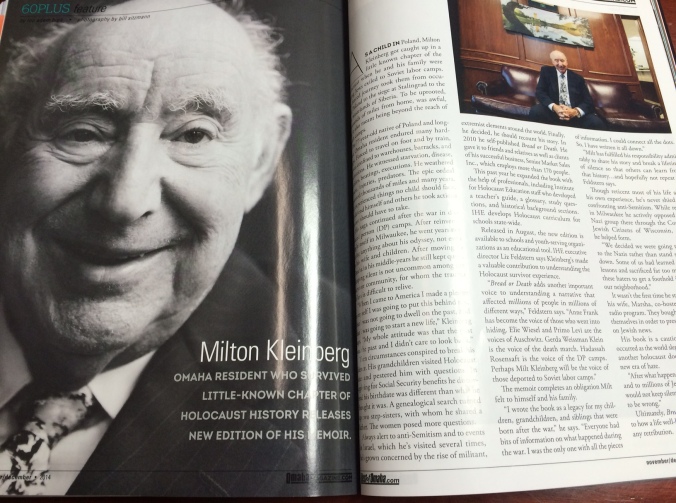
Milton Kleinberg: Omaha resident who survived little-known chapter of Holocaust history releases new edition of memoir

November 7, 2014 2 comments

Holocaust survivor stories come in every conceivable variety, just like the people and lives behind them.  I’ve had the privilege of telling many such stories in the course of profiling survivors who settled in Nebraska after World War II or later.  Each story, each survuvor, is distinguished by elements that make them singular.  I thought I had heard and read it all when it comes to these sagas but then along came Milton Kleinberg’s story.  There may be more dramatic or traumatic tales but I can’t imagine one that covers as much time and distance as his tale.  It is epic in terms of sheer scale yet it’s also achingly intimate.  I don’t pretend to capture more than just the surface of his story in the following Omaha Magazine (http://omahamagazine.com/) article, but it should give you a sense for the aamazing rc of his surivival experience.  For a full appreciation of what he endured, you must read his book Bread or Death.


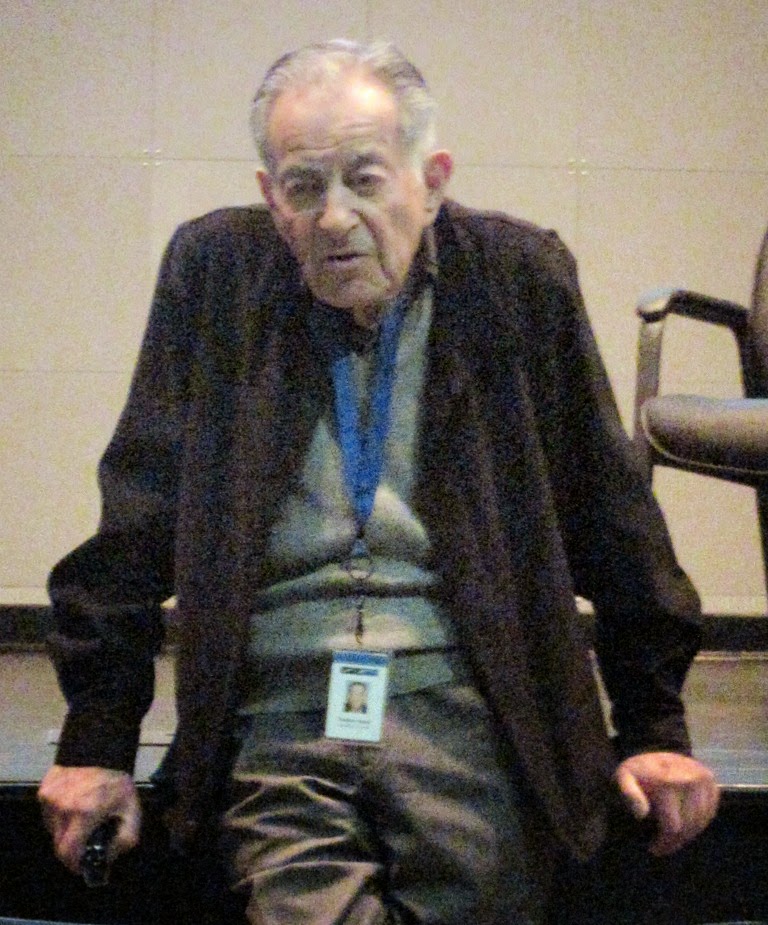
20141001_bs_4865Milton Kleinberg

Milton Kleinberg

Omaha resident who survived little-known chapter of Holocaust history releases new edition of memoir

Now appearing in Omaha Magazine (http://omahamagazine.com/)
November 5, 2014
©Photography by Bill Sitzmann

As a child in Poland, Milton Kleinberg got caught up in a little known chapter of the Holocaust when he and his family were among Jews exiled to Soviet labor camps. The forced journey took them from occupied Poland to the siege at Stalingrad to the vast wastelands of Siberia. To be uprooted, thousands of miles from home, was awful, but it also meant being beyond the reach of death camps.

The 77-year-old native of Poland and longtime Omaha resident endured many hardships. Forced to travel on foot and by train, he was confined to warehouses, barracks, and institutions. He witnessed starvation, disease, suicides, beatings, executions. He weathered illness, injuries, predators. The epic ordeal spanned thousands of miles and many years. He experienced things no child should face. To defend himself and others he took actions no one should have to take.

His saga continued after the war in displaced person (DP) camps. After reinventing himself in Milwaukee, he went years not saying anything about his odyssey, not even to his wife and children. After moving to Omaha in his middle-years he still kept quiet. Keeping silent is not uncommon among the survivor community, for whom the trauma of loss is difficult to relive.

“When I came to America I made a pledge to myself I was going to put this behind me, that I was not going to dwell on the past, and that I was going to start a new life,” Kleinberg says. “My whole attitude was that the past was the past and I didn’t care to look back.”

Then circumstances conspired to break his silence. His grandchildren visited Holocaust sites and pestered him with questions. In applying for Social Security benefits he discovered his birthdate was different than what he thought it was. A genealogical search turned up two step-sisters, with whom he shared a father. The women posed more questions.

Always alert to anti-Semitism and to events in Israel, which he’s visited several times, he’s grown concerned by the rise of militant, extremist elements around the world. Finally, he decided, he should recount his story. In 2010 he self-published Bread or Death. He gave it to friends and relatives as well as clients of his successful business, Senior Market Sales Inc., which employs more than 170 people.

This past year he expanded the book with the help of professionals, including Institute for Holocaust Education staff who developed a teacher’s guide, a glossary, study questions, and historical background sections. IHE develops Holocaust curriculum for schools state-wide.

Released in August, the new edition is available to schools and youth-serving organizations as an educational tool. IHE executive director Liz Feldstern says Kleinberg’s made a valuable contribution to understanding the Holocaust survivor experience.

Bread or Death adds another important voice to understanding a narrative that affected millions of people in millions of different ways,” Feldstern says. “Anne Frank has become the voice of those who went into hiding. Elie Wiesel and Primo Levi are the voices of Auschwitz. Gerda Weissman Klein is the voice of the death march. Hadassah Rosensaft is the voice of the DP camps. Perhaps Milt Kleinberg will be the voice of those deported to Soviet labor camps.”

The memoir completes an obligation Milt felt to himself and his family.

“I wrote the book as a legacy for my children, grandchildren, and siblings that were born after the war,” he says. “Everyone had bits of information on what happened during the war. I was the only one with all the pieces of information. I could connect all the dots. So, I have written it all down.”

“Milt has fulfilled his responsibility admirably to share his story and break a lifetime of silence so that others can learn from that history…and hopefully not repeat it,” Feldstern says.

Milton M. Kleinberg shortly after arriving in America

Though reticent most of his life about his own experience, he’s never shied from confronting anti-Semitism. While residing in Milwaukee he actively opposed a neo-Nazi group there through the Concerned Jewish Citizens of Wisconsin, a group he helped form.

“We decided we were going to respond to the Nazis rather than stand silent or lay down. Some of us had learned hard, tragic lessons and sacrificed far too much to allow these haters to get a foothold in our city, in our neighborhood.”

It wasn’t the first time he stood up. He and his wife, Marsha, co-hosted a Milwaukee radio program. They bought the air-time for themselves in order to present and comment on Jewish news.

His book is a cautionary tale of what occurred as the world slept. It may help ensure another holocaust doesn’t happen in this new era of hate.

“After what happened to me and my family and to millions of Jews in the war, I simply would not keep silent about things I perceived to be wrong.”

Ultimately, Bread or Death is a testament to how a life well-lived is more powerful than any retribution.


Milton Kleinberg Omaha Magazine Cover Story


In his corner: Midge Minor is trainer, friend, father figure to pro boxing contender Terence “Bud” Crawford

July 30, 2013 6 comments

As I’ve said before on this blog nearly every writer gets around to writing about boxing at one time or another.  I did my first boxing story in the late 1990s and every now and then I get the craving to do a new one.  I’ve built up quite a collection of boxing pieces this way and you can access them all on the blog.   The following story for the New Horizons in Omaha profiles an up and coming pro lightweight contender, Terence “Bud” Crawford, and the older man in his corner who is trainer, friend, father figure and more to him, Midge Minor.  They are as tight as two people nearly 50 years apart in age can be.  Crawford has been under the wing of Minor from the time he was a little boy and he still relies on his sage advice today as he prepares for an expected world title fight.  The loyal Crawford is an Omaha native and resident who’s never left his hometown or the gym he grew up in, the CW, and he’s not about to leave the man who’s guided him this far.


In his corner: Midge Minor is trainer, friend, father figure to pro boxing contender Terence “Bud” Crawford 

©by Leo Adam Biga

Originally appeared in the New Horizons


Nebraska‘s best ever hope for a world professional boxing champion works out of the CW Boxing Gym in north downtown Omaha.

As 25-year-old lightweight contender Terence “Bud” Crawford goes through his paces, he’s watched intently by an older man in a sweatsuit, Midge Minor. Though separated in age by four-plus decades, the two men enjoy a warm, easy relationship marked by teasing banter.

Crawford: “I’ll beat this dude up right now.”

Minor: “You’re scared of me, you know that.”

Crawford: “You be dreaming about me.”

Minor: “You stick that long chin out to the wrong man.”

They’ve been going back and forth like this for decades. At age 7 Crawford got his boxing start under Minor at the CW, 1510 Davenport St., and he still trains there under Minor’s scrutiny all these years later.

The facility is part of the CW Youth Resource Center, whose founder and director, Carl Washington, spotted Crawford when he was a kid and brought him to the gym.

Crawford, an Omaha native and resident, owns a 21-0 pro record and a reputation among some experts as the best fighter in the 135-pound division. The smart money says it’s only a matter of time before he wins a title. That time may come in January when the Top Rank-promoted boxer is expected to get his title shot and the opportunity to earn his first six-figure payday.


Midge Minor

Midge Minor


Since showing well in two recent HBO-telecast fights, he’s riding a wave of fame. He’s the pride of the CW, where the number of fighters is up because he learned to box there, made it big and never left.

“He’s one of the causes of our gym being full now,” says Minor. “They all look up to him. It’s kind of like he put us on the map.”

Crawford doesn’t act the star though.

“I’m the same person, I’m regular, I just want to be able to make it and provide for my family,” he says earnestly.

He engages everyone at the gym and offers instruction to fighters.

“I’m always going to have CW somewhere inside of me because this is where I started from. Never forget where you came from. I’m always going to be a CW fighter. I just feel comfortable here. It does feel like home when I walk through them doors because it’s the only gym I knew when I was coming up. I’ve been coming here and going to the donut shop (the adjacent Pettit’s Pastry) ever since I was 7.”

For a long time he was pressured to leave Omaha, where quality sparring partners are rare and pro boxing cards even rarer. But he’s remained true to his team and his home.

“A lot of people came at me with deals wanting to get me to fight for them, sign with them and move out of town. They kept telling me I can’t make it from Omaha and  need new cornermen – that they took me as far as they could. But I’m loyal and a lot of people respect me for it. My coaches have faith in me and trust me that I’m not going to do nothing to jeopardize our relationship, and I trust them and have faith in them.

“I’ve just stayed with it and continued to have confidence in my team. I just keep pushing forward.”

He keeps a tight circle of confidantes around him and all share his same CW and Omaha lineage.

“We all family,” he says..”Every person I turn to in my corner that’s giving me instructions came up under Midge.”


CW Boxing Club is located in the CW Youth Resource Center


For his last fight Crawford, who always sports Big Red gear to show his Nebraska pride, wore trunks emblazoned with “Omaha” on them.

As Crawford shadow boxes inside the ring, looking at his reflected image in a bank of mirrors against the near wall, the 73 year-old Minor takes it all in from his spot in the corner, just outside the ropes. Minor has been in Crawford’s corner, both literally and figuratively, since the fighter first got serious about the sport at age 12. They initially met five years before that, when Crawford became argumentative with the trainer. Minor demands obedience. He barks orders in his growl of a voice. He’s known to curse, even with kids. He doesn’t take guff from anyone, especially a brash, back-talking little boy. When Crawford wouldn’t mind him, Minor banned him from the CW.

The trainer hated letting Crawford go, too, because he recognized the kid as something special.

“I saw that he had a lot of heart and that goes a long way in boxing. He never wanted to quit on me.”

The boy’s heart reminded Minor of his own. Back in the day, Minor was a top amateur flyweight, twice winning the Midwest Golden Gloves. But prospect or no prospect, Minor wasn’t going to stand for disrespect. The two eventually reconnected.

“I kicked him out of the gym for five years,” says Minor, a father many times over, “and then I brought him back when he got a little more mature and then we went from there.”

Crawford acquired some rough edges growing up in The Hood. Being physically tested was a rite of passage in his family and neighborhood. It toughened him up. He needed to be tough too because he was small and always getting into scuffles and playing against bigger, older guys in football, basketball, whatever sport was in season. He learned to always stand his ground. The more he held his own, the more courage and confidence he gained.

“I was taught to never be scared…to never back down. That was instilled in me at a young age,” Crawford says. “My big cousins pushing me, punching me, slamming me, roughing me up. My dad wrestling me. After going against them it wasn’t nothing to me going against somebody my size, my age.

“I’d fall and get jacked up or get bitten by dogs or get scratched. I’d need stitches here and there, and my mom would be like, ‘You’re all right.’ There was no going home and crying to your parents or nothing like that. No babying me. I don’t know what it feels like to be babied.”

There was something about Crawford, even as a child, that pegged him for greatness.

“Before I even started boxing my dad used to make me punch on his hands, teach me wrestling moves, throw the ball with me. He always said, ‘You’re going to be a million dollar baby.’ Ever since I was little he was like, ‘You can be whatever you want to be, just go out there and do it, don’t let nobody hold you down or hold you back.'”

His father, grandfather and an uncle all boxed and wrestled in their youth. His dad and uncle trained at the CW. His grandfather boxed with Minor. They all had talent.

“It was just in me, it was in the blood line for me. I just took after them. My dad always gave me pointers.”

By the time Crawford came back to the gym, he was less belligerent and more ready to learn. The non-nonsense Minor and the hot-tempered youth bonded. Like father and son.

“When I came back to the gym Midge and I were like instantly close.

Midge was like my dad,” says Crawford.

What was the difference the second time around?

“I don’t know. maybe it’s because I accepted Midge ain’t going to change for nobody. I didn’t really know him like that at the start. so for him to be talking to me crazy I took that as disrespect. I was offended by it. But when i came back I realized that’s just Midge being Midge. Some people get intimidated by him but one thing about Midge is if he likes you he’s going to roll with you. If he don’t like you, he don’t like you and there’s nothing nobody can do to make him like you. And if he’s with you he’s with you to the end.

“When I got to know him more I realized Midge will have my back till the day he dies and I’ll have his back to the day I die, and that’s just how close we are. Midge put a real big hold on me.”

When you ask Crawford if he could have gotten this far without him he says, “Probably not because Midge kept me out of the streets. He taught me a lot. Without Midge, I don’t think so, He taught me a lot of responsibility.”

Crawford came to know he could depend on Minor for anything, which only made him trust him more and made him want to please him more.

“I used to ride my bike to the gym with a big old bag on my back, that’s how dedicated I was. Then Midge started taking me to the gym. Over holidays he’d come to my house to take me to the gym. On school days he’d come get me at school and take me to his house. We’d just sit there together and watch boxing tapes. I would watch any kind of fighter just for the simple fact that you never know when you might see that style. He’d tell me what they’re doing wrong and what I could do to beat ’em.”

Minor also became Crawford’s mentor.

“Anytime I needed anything or needed someone to talk to he was always there,” says Crawford. “He’s a great father figure in my life.

Just an all around good guy. He loves kids.”

All of Minor’s work with Crawford inside and outside the ring had the full support of Bud’s mother.

“It was a little like school to me. Sometimes I’d try to duck him and tell my mom to tell him I wasn’t there and she wasn’t having it. Sometimes my mom would call him and say, ‘Come and get him Midge’ and I’d spend the night at his house, watch tapes, work out. It was like that.”

When he got in trouble at school his mother informed Minor because she knew he’d hold him accountable. When Minor got his hands on him he worked him extra hard. it was all about getting the young man to learn lessons and to pay his dues. Instead of resisting it, Crawford took it all in stride. He says, “It was instilled in me early that what don’t kill you will make you stronger.I looked at it that it was helping me.”

“He appreciated it. He respected me,” says Minor. “We got along real well.”

The troubled boy no one could reach found a friend and ally to push him and inspire him.

“Midge always instilled in me, ‘Nobody can beat you, especially if you work hard and put your heart into your training.’ He drilled that in my head. He believed in me so much. There were times I kind of doubted myself in my mind and he was just like, ‘Nobody can beat you.’ The fight’s the easy part. Preparing for it, that’s the hard part. I’ve been fighting all my life so to get in there and fight, that’s easy. That’s 30 minutes. Sometimes only three minutes or 30 seconds if I get an early knockout. That’s compared to training for hours and hours a day.”

Minor routinely put him in the ring with much more experienced guys.

“That’s how much confidence he had in me. Seeing him have that much confidence in me made me even more confident,” says Crawford.

“It didn’t make no difference who I fought him with because he was going to fight ’em. I’ve had a lot fighters but they didn’t have the heart that he has.”

The legend of Terence “Bud” Crawford began to grow when as a teen amateur he sparred pros and outfought them. Even today he likes to spar bigger guys.

“I like to try myself.”

Crawford is now on the cusp of boxing royalty and Minor is still the one Bud puts his complete faith in.

“He’s still there for me taking good care of me,” Crawford says. “I’m always going to have his back. You know he looked out for me when I was little and I’m going to look out for him now that he’s older.”

Having Minor in his camp as he preps for the biggest fight of his life is exactly where Crawford wants him. Having him in his corner on fight night is where he needs him.

“It means a lot to have Midge there. Midge is the brain. Everything goes through Midge before it’s all said and done for me to go in there and fight. Without the brain we can’t do nothing, so it’s very important that Midge is there.

“Before every fight I bring him a disc of who I’m fighting and I ask him what he thinks about the guy and he tells me what I should do and we go from there.”

The strategy for any fight, he says, is “a team effort” between his co-managers Brian McIntyre and Cameron Dunkin, trainer Esau Diegez, Minor and himself.

“We all work together and dissect our opponent but Midge is always the one that’s like, ‘Alright, this is what you’re going to do to beat this guy. This is how you’re going to fight ’em.’ And we all go by what Midge sats. He’s great for seeing things I don’t see and making me see it.

“He gives me the instructions to beat ’em, and all I have to do is follow ’em. He’s got the wisdom.”

Minor says Crawford is a great student who picks things up quickly, including a knack for altering his style to counter his opponent’s style.

“He can observe different fighters and he can adapt to their styles. He doesn’t have no problem adjusting to them,” says Minor. “He listens to me and he produces for me.”

“Oh yeah. I see it one time and I do it,” Crawford says. “You gotta practice it to though, you can’t just think you’re going to perfect it by doing it one time. You gotta keep on trying it in the gym. You might not get it the first time, you might not get it the second time, but you gotta keep trying until you get it right.”

Still, when all is said and done, it’s Crawford who’s alone in the ring come fight night.

“You can tell me this, you can tell me that, at the end of the day I’m the one that’s gotta take those punches and get hit upside my head. The difference between me and other people is that I’m willing to go through the fire to see the light.”


Midge Minor, left, fighting as an amateur


Crawford’s aware of the strides he’s made in recent years.

“I feel like I’m more relaxed in the ring. I know more about the game.

I know what to do, when to do it, and I’m not just throwing punches just to be throwing them. I’m pinpointing my shots more. Yeah, all around my whole arsenal is just way better.”

“Early in his career he used to just throw punches,” says Minor. “He learned to settle down and adjust.”

Crawford says his overall skill set has developed to the point that he doesn’t have an obvious weakness.

“I can adapt to any style. I’m a boxer, a puncher, I’m elusive, I’m whatever I need to be. I’m always confident and I just come to win.

I’ve got it all – hand speed, power, movement, smarts. I can take a punch.”

He’s always in shape and lives a clean lifestyle, Minor says admiringly. The trainer never has to worry his fighter’s not working hard enough.

Minor’s trained several successful pros, including Grover Wiley and Dickie Ryan, but he says he’s never had anyone as accomplished as Crawford this early in their career.

Neither feels he’s reached his full potential.

“I’ve got a lot of things to work on,” says Crawford. “So I figure once I get those bad habits out of the way then I’ll be better than I am now. Little things like not keeping my hands up, not moving my head.  Sometimes I’ll get in there and I’ll feel like he can’t hurt me, and I just want to walk through him without coming with the jab.”

Minor’s always watching to make sure Crawford doesn’t abandon his fundamentals. The veteran trainer guided Crawford through a highly successful amateur career that saw the fighter compete on the U.S,  Pan American Games team and advance all the way to the national Golden Gloves semi-finals in his hometown of Omaha. Crawford dropped a controversial decision in the semis that left him disillusioned by the politics of amateur scoring and Minor “broken-hearted.”

Minor continues to be the guru Crawford turns to for advice. Perhaps a turning point in their relationship and in the fighter’s development was getting past the anger that seemed to fuel Crawford early on and that threatened to derail his career.

When his temper got the better of him Crawford was suspended from the U.S, national team. He says American amateur boxing officials “put a bad rep out for my name,” adding, “They called me hot-headed and a thug.” He feels the stigma hurt him in his bid to make the U.S. Olympic team.

The fighter acknowledges he had issues. He got expelled from several schools for fighting and arguing. He grew up playing sports and fighting in the streets, parks and playgrounds of northeast Omaha, where his mother mostly raised him and his two older sisters. His father, Terence Sr., served in the U.S, Navy and was separated from his mother, only periodically reappearing in Bud’s life.

No one seemed able to get to the root of Crawford’s rage. Not even himself.

“I really can’t say about my temper. It was just something that was in me. Everybody asked me, ‘Why do you be so mad?’ and I never could pinpoint it or tell them why. I’d be like, ‘I’m not angry.’ But deep down inside I really was. I was ready to fight at any given time and that’s how mainly I got kicked out of all the schools.

“I was in counseling, anger management, all that stuff. None of it ever worked…”

His favorite way of coping with the turmoil was to go fishing at the Fontenelle Park pond.

He knows he could have easily fallen prey to the lures and risks of the inner city. Friends he ran with included gang members. On the eve of his first big nationally televised pro fight he got shot in the head after leaving a heated dice game he had no business being in in the first place. He was told by doctors that if the bullet hadn’t been slowed by the window it passed through in his car it would have likely killed him.

“I was lucky, I was blessed. That just opened my eyes more. I took it as a sign, as a wakeup call.”

Becoming a father – he and his girlfriend Alindra are raising their son and her daughter – also helped him mature.

Through it all Minor was that steadying voice telling him to do the right thing.

Crawford’s temper cooled and his life got more settled.

“It took him a while,” says Minor. “He was hard-headed. I used to make him come over to my house and I’d sit em down to watch boxing tapes and the more he observed other fighters he learned that his temperament had to change to be where he’s at now.”

Crawford also credits two men who took him under their wing at Omaha Bryan High School, then principal Dave Collins and assistant principal Todd Martin.

“They would always talk to me if I got in trouble. They put it in terms like I was in the gym training. They’d say, ‘You cant talk back to the teachers when they’re trying to tell you something you need to know. You don’t talk back to your coach when he’s teaching you how to throw a punch.’ I began to look at it like that and I said, ‘You’re right, i messed up.’ That really got me through my high school years doing what I had to do.”

Now that Crawford’s come so far he’s looking “to give back” to the community through his own boxing gym in the same community he grew up in. He wants his North O-based B & B Boxing Academy, which he recently opened with Brian McIntyre, to be a place that keeps kids off the street and gives them something structured to do.

Bringing a world title belt back to Omaha is his main focus though.

“Oh, it would be great. A lot of people look up to me so for me to bring that belt home to Omaha it would mean a lot, not only to me but to Omaha. Boxing is not real big in Omaha. I used to be and I’m trying to bring it back and I feel I can do that. I could inspire some little guy that later on could be the champion of the world. Who knows?”

He’s not leaving anything to chance in his bid for glory.

“I’ve got my mind made up, I’ve got my goals set, and I’m going to get it. I’m not going to let nothing or nobody keep me from conquering my dreams.”

“That’s that confidence.” Minor says. “I’m so proud of him.”

Crawford knows he wouldn’t be where he is today without Minor. “He’s played a big factor in my life.” He values all that Minor’s meant to him.

“You got to. Nothing lasts forever, so cherish it while it’s here.”


Nebraska Medal of Honor winners: Above and beyond the call of duty

August 11, 2012 1 comment

I generally don’t hold with designating individuals as heroes in any field of endeavor, much less honoring the efforts of combat participants, but I have no trouble understanding people’s need to acknowledge, recognize, and commemorate the deeds of the valiant.  This is a short story about some Nebraska Medal of Honor recipients whose lives and valor were the subject of an exhibition a few years ago at El Museo Latino in Omaha.  The institution was a good home for the exhibit because two of the state’s Medal of Honor winners were young Latino men: Edward “Babe” Gomez and Keith Miguel.  A legend is also among their ranks in the person of William F. Cody, better known to some as Buffalo Bill.  A once prominent politician now looking to reenter the political arena, former U.S. Senator Bob Kerrey, is also among the state’s Medal of Honor men.


Nebraska Medal of Honor winners: Above and beyond the call of duty

©by Leo Adam Biga

Originally appeared in El Perico


A new historical exhibition at El Museo Latino pays tribute to Nebraska’s Medal of Honor recipients. Among the honorees are Edward “Babe” Gomez and Miguel Keith and former Nebraska governor and U.S. senator Bob Kerrey.

The Congressional Medal of Honor is the highest U.S. military decoration. It is bestowed by Congress to armed forces members who distinguish themselves “conspicuously by gallantry and intrepidity,” risking life “above and beyond the call of duty” in action.

Nebraska’s accredited with 18 Medal of Honor recipients in conflicts as far back as the Civil War and on through two world wars, the Korean War and the Vietnam War.

William F. Cody, aka Buffalo Bill, received the Medal for his work as a civilian scout with the 3rd Cavalry during Indian campaigns along the Platte River in the early years of Nebraska’s statehood.

Otto Diller Schmidt of Blair received the Medal during peacetime when, while serving on board the U.S.S. Bennington, he displayed “extraordinary heroism” following a 1905 boiler explosion.

Gomez, an Omaha native, attended South High School and enlisted in the U.S. Marine Corps reserves at 17. He was called to active duty with the 1st Marine Division in Korea. During a fateful 1951 battle he repeatedly exposed himself to enemy fire as an Easy Company ammunition bearer. When a hostile grenade landed amidst his squad, he sacrificed himself by absorbing the explosion.

Keith, a San Antonio, Texas native, moved to Omaha, where he attended North High. He fought as a Marine Corps machine gunner in Vietnam. During a 1971 attack he was hit multiple times but kept fighting to protect his unit’s command post until mortally wounded.

Kerrey, a Lincoln native, led a Navy SEAL team in Vietnam. During a 1969 mission to capture intelligence assets his team came under fire. Despite massive wounds he directed a successful counterattack. He lost part of a leg as a result of the engagement.

Eight recipients born in Nebraska have their Medal accredited to other states where they resided or enlisted. Among their ranks is the most recent recipient with Nebraska ties, Randall Shughart, a Lincoln native who entered the service in Newell, Pa., where he and his family moved. Shughart fought in the 1993 Battle of Mogadishu in Somalia as part of a Special Ops Army team inserted to rescue the crew of a downed U.S. helicopter. While under siege he applied fire that allowed the crew’s rescue. He sustained fatal wounds.

El Museo Latino director Magdalena Garcia says the exhibit highlights how America honor its military heroes and how Nebraskans contribute to defending freedom. The images and text, including Medal of Honor citations, help provide a timeline and context for the various wars and conflicts America’s fought, she says.

Outside of Bob Kerrey, perhaps the best known native Nebraska recipient is Gomez. One of 13 children, Gomez is recalled as “happy-go-lucky,” an “extrovert” and “a go-getter” by younger brother Modesto Gomez. He says Babe, a scrappy 5-foot-1 former Golden Gloves boxer served a year at the former Kearney reform school before turning his life around. He wore their father down insisting he be allowed to join the Marines.


William F. Cody, aka Buffalo Bill

 Image result for edward babe gomez

Edward “Babe” Gomez


Miguel Keith


Bob Kerrey


A letter from Babe before his final, fateful mission seemed to signal his own foreboding. Eva Sandoval says, “He wrote, ‘Remind the kids of me once in awhile,’” referring to young siblings who had indistinct memories of him before he left for Korea.

Eva and her mother Matiana were at home when a Western Union messenger delivered the telegram announcing his death.

“My mother said I went into hysterics,” says Eva. “It was really a shock to me. He was just a year older than I. He was so young when he died. I couldn’t believe it. In my mind I’d say, Oh, he’s coming back — it was a big mistake. I didn’t want to accept he’s gone for good.”

Babe’s selfless actions reflected his upbringing, says Modesto. “He was prepared to do what he had to do because that’s just the way we were raised. ‘Get in there and get it’ my dad used to say. You just do the right thing.”

The Medal was presented to Babe’s family at an Our Lady of Guadalupe ceremony.

Gomez’s legacy lives on in a mural at the Nebraska State Capitol and in Nebraska Medal of Honor displays at the American GI Forum, Omaha-Douglas Civic Center and Durham Museum. A local school and avenue bear his name.

“All of these things they’ve done in his name have been a tremendous honor,” says Modesto.

Gomez is buried at St. Mary Cemetery in South Omaha.

Hoops legend Abdul-Jabbar talks history

August 9, 2012 1 comment

A few years ago I got the opportunity to interview college and pro basketball legend Kareem Abdul-Jabbar in advance of his giving a talk in Omaha.  He was every bit the thoughtful man he projects to be.  Before doing this short piece for The Reader (www.thereader.com) I vaguely knew he had turned author and amateur historian with an eye towards highlighting African American achievements but I learned that he’s done much more in this area than I ever imagined and I got the sense he’s at least as proud of his work in this arena as he is of what he did on the hardwood.


Hoops legend Abdul-Jabbar talks history

©by Leo Adam Biga

Originally appeared in The Reader (www.thereader.com)


Kareem Abdul-Jabbar, the man who made the sky hook and goggles signature parts of hoopsiconography, headlines the May 12 B’nai B’rith Charity Sports Banquet at the Qwest Center Omaha. Now an author, he is the rare ex-sports superstar who’s applied a social conscience after balling.

The Naismith and NBA Hall of Famer was a legend before playing his first collegiate basketball game in 1967. His schoolboy dominance at Powers Memorial in New York City made him the most prized recruit since Wilt Chamberlain. He was so unstoppable at UCLA, when still known as Lew Alcindor, that dunking was outlawed after his sophomore season. He led the Bruins to three national championships.

In only his second NBA season his expansion Milwaukee Bucks won the 1971 title. Omaha native Bob Boozer was the team’s 6th man. Abdul-Jabbar competed several times against the Kansas City-Omaha Kings at the Civic Auditorium.

The inscrutable big man added five more titles with the Los Angeles Lakers. Six times he earned the league’s MVP award. Upon retirement he was the NBA’s all-time points scorer and arguably the greatest player ever. He continues as a Lakers special assistant today.

Like the late tennis star Arthur Ashe, he’s transcended athletics to write and talk about black history. The two were student-athletes together for a year at UCLA. In a phone interview Abdul-Jabbar said Ashe asked for his help researching the book, A Hard Road to Glory. Each came out of the civil rights struggle and endured criticism for being aloof. Abdul-Jabbar’s conversion to Islam alienated some. He said his passion for chronicling the stories of African-American achievers can be traced to a high school program he took that cultivated an interest in writing and history and introduced him to unknown facets of his childhood neighborhood, Harlem.

“Very loud echoes of the Harlem Renaissance were still there to be heard. I was just instilled with a lot of pride when I read about what Harlem had meant to Black America. It was just totally inspiring,” he said. “It made me want to share that as a very natural extension for how I felt about what was going on in America and what I wanted to do about it.”

His 2007 book On the Shoulders of Giants: My Journey Through the Harlem Renaissance describes Harlem’s legacy as “the capital of Black America and a place where a lot of things happened that made black Americans proud,” he said.

A story from those halcyon days is the subject of a documentary he’s producing, On the Shoulders of Giants: The Story of the Greatest Basketball Team You Never Heard Of. Featuring on-camera comments by such hoop and pop culture stars as Charles Barkley and Spike Lee, it profiles the New York Renaissance or Harlem Rens, America’s first all-black pro basketball team. Owner Bob Douglas, often called the Father of Black Basketball, created the team in the early 1920s when segregation still ruled sports and society-at-large. The Rens delivered a powerful message by routinely trouncing all comers, including white squads before white audiences, over the next three decades.

Abdul-Jabbar is delighted to have several connections to the Rens. A well-known New York high school hoops official who called some of his games, Dolly King, played for the Rens. Abdul-Jabbar’s legendary UCLA coach John Wooden played a 1930s exhibition against the Rens as a Purdue All-American.

For the 7’2 basketball great, the Rens represent the struggle “for equality that consumed black Americans in all phases of life.” He hopes the film, scheduled for a 2011 release, educates young people that today’s opportunities have been hard-earned and nothing good comes easily.

Meanwhile, he’s coping with a rare form of leukemia that an oral medication treats. He’s not had to curtail his activities.

In Omaha he’ll speak about the World War II all-black 761st tank battalion, the subject of his 2004 book, Brothers in Arms. Some dispute battalion veterans’ claims they helped liberate Dachau concentration camp. There’s no disputing their heroic, unheralded role in the Battle of the Bulge and in the Allies’ final push across France and Germany.


Walter Reed: Former hidden child survives Holocaust to fight Nazis as American GI

February 19, 2012 2 comments

About nine years ago I was given the opportunity to meet and profile Walter Reed, whose story of escaping the Final Solution as a Hidden Child in his native Belgium and then going on to fight the Nazis as an American GI a few years later would make a good book or movie.  Here is a sampling of his remarkable story now, more or less as it appeared in The Reader (www.thereader.com).  You’ll find many more of my Holocaust survival and rescue stories on this blog.


Walter Reed: From out of the past – Former hidden child survives Holocaust to fight Nazis as American GI

©by Leo Adam Biga

Originally published in The Reader (www.thereader.com)


Imagine this: The time is May 1945. The place, Germany. The crushing Allied offensive has broken the Nazi war machine. You’re 21, a naturalized American GI from Bavaria. You’re a Jew fighting “the goddamned Krauts” that drove you from your own homeland. Five years before, amid anti-Jewish fervor erupting into ethnic cleansing, you were sent away by your parents to a boys’ refugee home in Brussels, Belgium. Eventually, you were harbored with 100 other Jewish boys and girls in a series of safe houses. You are among 90 from the group to survive the Holocaust.

Relatives who emigrated to America finagle you a visa and, in 1941, you go live with them in New York. You abandon your heritage and change your name. Within two years you’re drafted into the U.S. Army. At first, you’re a grunt in the field, but then your fluency in German gets you reassigned to military intelligence, attached to Patton’s 95th Division, interrogating German POWs. If this were a movie, you’d be the avenging Jewish angel meeting out justice, but you don’t. “The whole mental attitude was not, Hey, I’m a Jew, I’m going to get you Nazi bastard,” said Walter Reed, whose story this is. “I had no idea of revenging my parents. We were really more concerned about our survival and getting the information we needed.”

By war’s end, you’re in a 7th Army unit rooting out hardcore Nazis from German institutions. You don’t know it yet, but your parents and two younger brothers have not made it out alive. You borrow a jeep to go to your village. Your family and all the other Jews are gone. You demand answers from the cowed Gentiles, some you know to be Nazi sympathizers. You intend no harm, but you want them scared.

“I wasn’t the little Jewish boy anymore,” said Reed. “Now, they saw this American staff sergeant with a steel helmet on and with a carbine over his shoulder. At that point, we were the conquerors and those bastards better knuckle under or else. I asked, What happened to my family and to the other Jewish people? They told me they were sent to the east into a labor camp. That’s about all I could find out.”

It is only later you learn they were rounded-up, hauled away in wagons, and sent to Izbica, a holding camp for the Sobidor and Belzec death camps, one or the other of which your family was killed in, along with scores of friends and neighbors.

Walter Reed, now 79, is among a group of survivors known as the Children of La Hille, a French chateau that gave sanctuary to he and his fellow wartime refugees. A resident of Wilmette, Il., Reed and his story have an Omaha tie. After the war, he graduated from the prestigious University of Missouri School of Journalism and it was as a fund raising-public relations professional he first came to Omaha in the mid-1950s when he led successful capital drives at Creighton University for a new student center and library. “Part of me is in those buildings,” he said.

More recently, he began corresponding with Omahan Ben Nachman, who brings Shoah stories to light as a board member with the local Hidden Heroes of the Holocaust Foundation. A friend of Nachman’s — Swiss scholar and author Theo Tschuy — led him to accounts of La Hille and those contacts led him to Reed. In Reed, Nachman found a man who, after years of burying his past, now embraces his survivor heritage. With Reed’s help, Tschuy, the author of Dangerous Diplomacy: The Story of Carl Lutz and His Rescue of 62,000 Jews, is researching what will be the first full English language hardcover telling of the children’s odyssey.

On an April 30 through May 2 Hidden Heroes-sponsored visit to Nebraska, Reed shared the story of he and his comrades, about half of whom are still alive, in presentations at Dana College in Blair, Neb. and at Omaha’s Beth El Synagogue and Field Club, where Reed, a Rotary Club member, addressed fellow Rotarians. A dapper man, Reed regales listeners in the dulcet tones of a newsman, which is how he approaches the subject.

“I’m a journalist by training. All I want is the facts,” he said, adding he’s accumulated deportation and arrest records of his family, along with anecdotal accounts of his family’s exile. “I’m simply overwhelmed by the wealth of information that exists and that’s still coming out. In the last 10 years I’ve found out an awful lot of what happened. I don’t have any great details, but I have vignettes. So, my feeling when I find out new things is, Hey, that’s terrific, and not, Oh, I can’t handle it. None of that. Long, long ago I got over all the trauma many survivors feel to their death. I vowed this stuff would never disadvantage me.”

As he’s pieced things together, a compelling story has emerged of how a network of adults did right amid wrong. It’s a story Nachman and Reed are eager for a wider public to know. “It shows how a dedicated group of people, most of whom were not Jewish, coordinated their actions to prevent the Nazis from getting at these Jewish children,” said Nachman, who paved the way for the upcoming publication of a book by a La Hille survivor. “They chose to do so without promise of any reward but out of sheer humanitarian concern. It’s a story tinged in tragedy because the children did lose their families, but one filled with hope because most of the children survived to lead productive lives.”

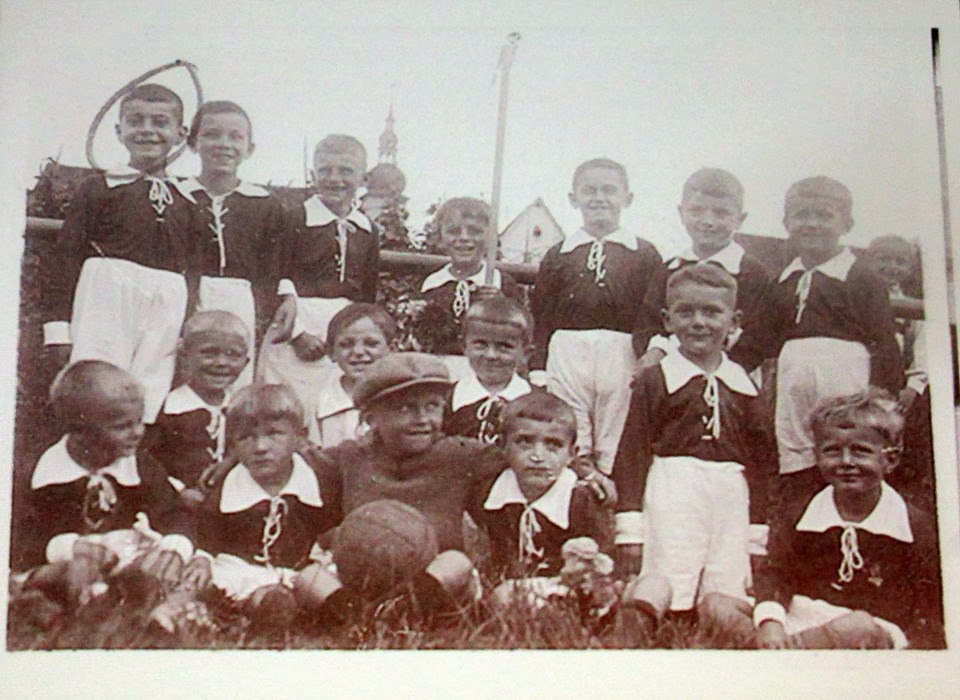
Walter Reed as a child in Germany, circled at top left


It was 1939 when Reed made the fateful journey that forever separated him from his parents and brothers. Born Werner Rindsberg in the rural Bavarian village of Mainstockheim, Reed was the oldest son of a second-generation winemaker-wine merchant father and hausfrau mother. His was among a few dozen Jewish families in the village, long a haven for Jews who paid local land barons a special tax in return for protection from the anti-Semitic populace. Reed said Jews enjoyed unbothered lives there until 1931-1932, when Nazism began taking hold.

“I was aware of the growing menace and danger when I was about 8 or 9 years old. I recall constant conversations between my parents and their Jewish peers about Hitler. The Nazis marched up and down our main street with their swastika flags and their torches at night, singing their songs. This was a very close-knit community of about 1,000 inhabitants and you knew which kid had joined the Hitler Youth and whose dad was a son-of-a-bitch Nazi. Pretty soon, the kids began to chase us in the street and throw stones at us and call us dirty names. Then, the first (anti-Jewish) decrees came out about 1934 and increasingly got stricter.”

Pogroms of intimidation began in earnest in the mid-1930s. Reed remembers his next door neighbor, a prominent Jewish entrepreneur, taken away to Dachau by authorities “to scare the hell out of him. It saved his life, too,” he said, “because that hastened his decision to get the hell out of Germany. This stuff was going on in other towns and villages where I had relatives. In those places, including where my mother’s brothers and sisters lived, the local Nazis were more rabid and…they hassled the Jews so much they left, and it saved their lives.”

Things intensified in November 1938 when, in retaliation for the assassination of a German diplomat by an expatriate Polish Jew outraged by the mistreatment of his people, the Nazis unleashed a terror campaign now known as Kristallnacht (Night of Broken Glass). Roving gangs of brown-shirted thugs attacked and detained Jewish males, vandalizing, looting, burning property in their wake. Reed, then 14, and his father were dragged from their home and thrown into a truck with other captives. As the truck rumbled off, Reed recalls “thinking they were going to take us down to the river and shoot us or beat the hell out of us.” The boys among the prisoners were confined in the jail of a nearby town while the men were taken to Dachau. Reed was freed after three nights and his father after several weeks.


The barn near Toulouse, France, where Walter Reed
stayed as part of a children’s rescue colony


In that way time has of bridging differences, Reed’s recent search for answers led him to a group of school kids in Gunzenhausen, a Bavarian town whose Jewish inhabitants met the same fate as those in his birthplace. The kids, whose grandparents presumably sanctioned the genocide as perpetrators or condoned it as silent witnesses, have studied the war and its atrocities. Reed began corresponding with them and then last year he and his wife Jean visited them. He spoke to the class, and to two others in another Bavarian town, and found the students a receptive audience.

“Frankly,” he said, “I find these encounters very worthwhile and uplifting. I was told by the teachers and principals it was quite a moving experience for the students to come face-to-face with history. My visit is now on the web site created by one class. On it, the students say they were especially moved by my stated conviction that the most important lesson of these events is to hold oneself responsible for preventing a repetition anywhere in the world and that each of us must bear that responsibility.”

When his father returned from Dachau, Reed recalls, “He looked awful. Emaciated. He wasn’t the same man. When we asked him what it was like he just said he’s not going to talk about it.” It was in this climate Reed’s parents decided to send him away. He does not recollect discussions about leaving but added, “I recently found a letter my father wrote to somebody saying, ‘I finally persuaded Werner to leave,’ so I must have been reluctant to go.”

A question that’s dogged Reed is why his parents didn’t get out or why they didn’t send his brothers off. It’s only lately he’s discovered, via family letters he inherited, his folks tried.

“Those letters tell a story,” he said. “They tell about their efforts to try and get a visa to America. My dad traveled to the American consulate in Stuttgart and waited with all the other people trying to get out. They gave my parents a very high number on the waiting list, meaning they were way down on the queue. There are anguished letters from my father to relatives referencing their attempts to get my brothers out, but that was long after it was too late. In no way am I castigating my parents for making the wrong decision, but they could have sent my brothers (then 11 and 13) because in that home in Brussels we had boys as young as 5 and 6 whose parents sent them.”


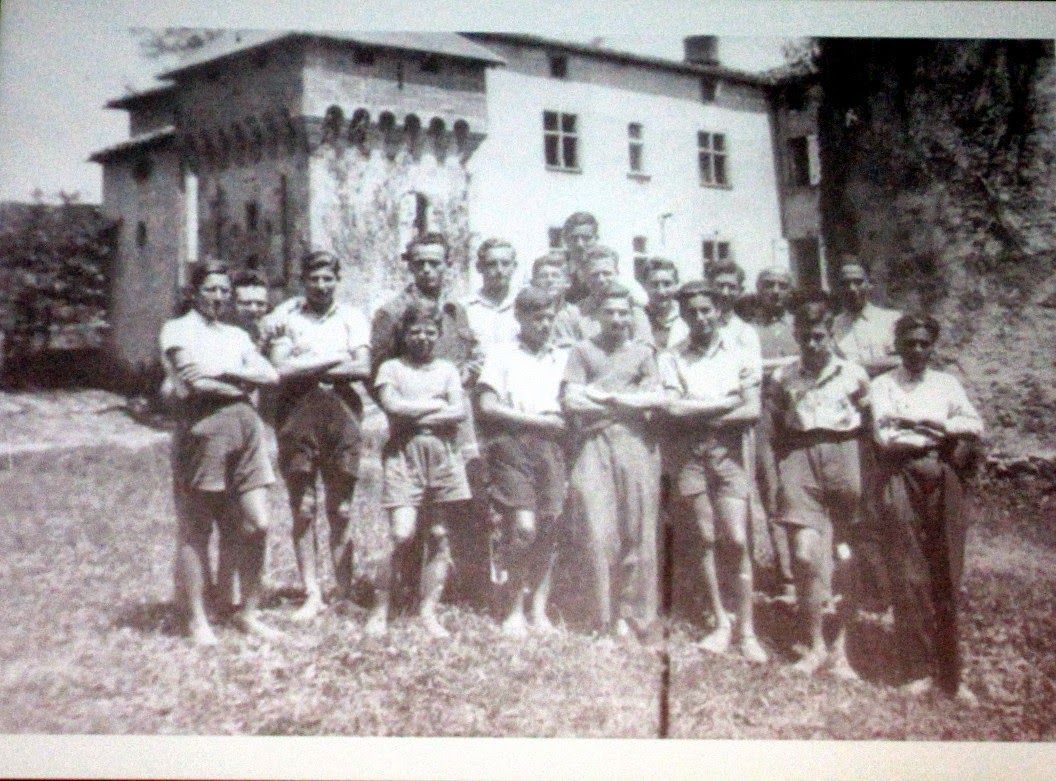
Walter Reed, third from right in the front row, at the chateau in La Hille, France,
where a smaller group of children were transferred from the barn near


Home Speyer, in the Brussels suburb of Anderlecht, is where Reed’s journey to freedom began in June 1939. Sponsored by the city and afforded assistance by a Jewish women’s aid society, the home was a designated refugee site in the Kinder transport program that set aside safe havens in England, The Netherlands and Belgium for a quota of displaced German-Austrian children. Where the transport had international backing and like rescue efforts had the tacit approval of German-occupied host countries, others were illegal and operated underground. Reed said the only precautions demanded of the La Hille kids were a ban on speaking German, lest their origins betray them as non-French, and a rule they always be accompanied outside camp grounds by adult staff. Despite living relatively in the open, the children and their rescuers faced constant danger of denouncement.

The boys at Home Speyer, like the girls at a mirror institution whose fates would soon be mingled with theirs, arrived at different times and from different spots but all shared a similar plight: they were homeless orphans-to-be awaiting an uncertain future. Reed doesn’t recall traveling there, except for changing trains in Cologne, but does recall life there. “For a young boy from a small Bavarian farm village,” he said, “Brussels was an exciting city with its large buildings, department stores, parks and museums. We made excursions into the beautiful Belgian countryside. And there was no more anti-Semitic persecution.”

This idyll ended in May 1940 when German forces invaded Belgium. Reed said the director of the girls home informed the boys’ home director she’d secured space on a southbound freight train for both contingents of children.

“We packed what we could carry and took the streetcar to the train station,” he notes. “Late that night two of the freight cars were filled by the 100 boys and girls as the train began its journey to France.”

Adult counselors from the homes came with them. The escape was timely, as the German army reached Brussels two days later. En route to their unknown destination, Reed said the roads were choked with refugees fleeing the German advance. Unloaded at a station near Toulouse, the children were trucked to the village of Seyre, where a two-story stone barn belonging to the de Capele family quartered them the next several months. It appears, Reed said, the de Capeles had ties to the Red Cross, as the children’s homes did, which may explain why that barn was chosen to house refugees.

“It lacked everything as a place to live or sleep,” he said. “No beds, no mattresses, no running water, no sanitary facilities, no cooking equipment. Food was scarce, Pretty soon we ran out of clothes and shoes. Everything was rationed. A lot of us had boils, sores and lice.”


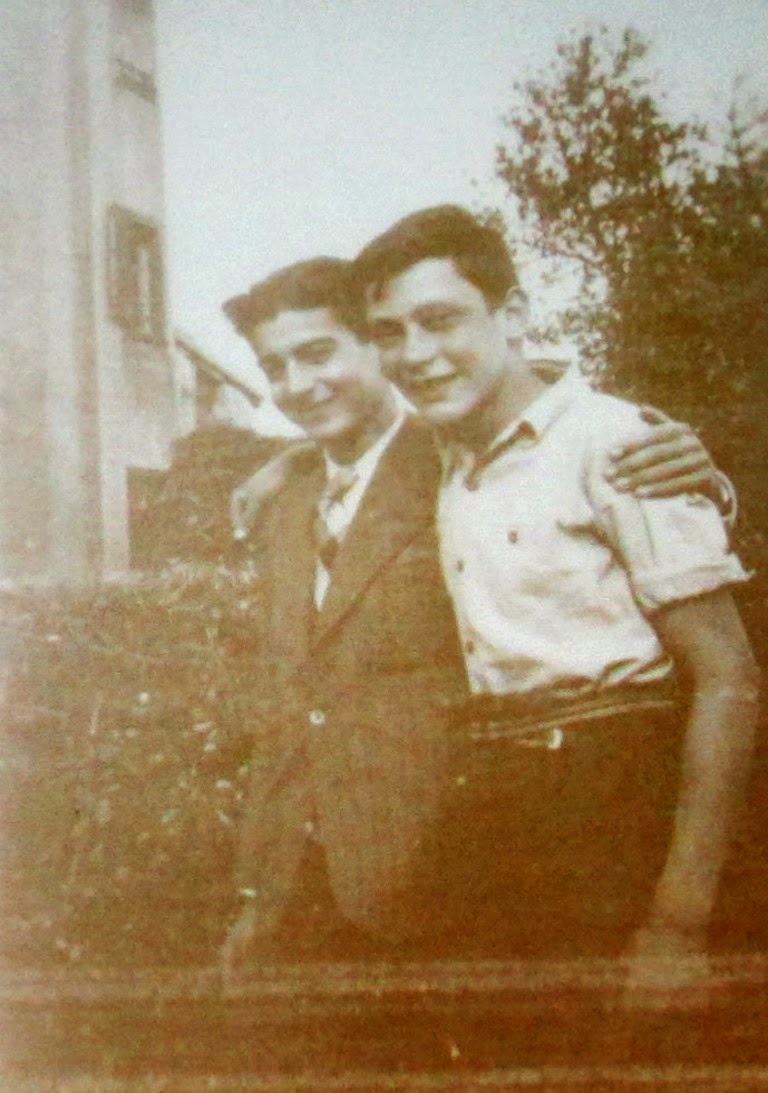
Walter Reed with a close friend who would
perish not long thereafter


With 100 kids under tow in primitive, cramped conditions, the small staff struggled. “They were trying to manage this rambunctious group of kids, who played and fought and caused mischief. The older kids, myself included, were deputized to sort of manage things. We taught classes out in the open. We worked on nearby farms in the hilly, rolling countryside, cutting brush…digging potatoes. For compensation we got food to bring back. It was like summer camp, except it was no picnic,” he said. “We all grew up fast. We learned about survival, self-reliance and cooperation for the common good.”

It was not all bad. First amours bloomed and fast friendships formed. Reed struck up a romance with Ruth Schuetz Usrad, whose younger sister Betty was also in camp. He also found a best friend in Walter Strauss.

The barn’s occupants were pushed to their limits by “the harsh winter of 1940,” Reed said. They got some relief when the group’s Belgian director, Alex Frank, got the Swiss Children’s Aid Society, then aligned with the Swiss Red Cross, to put Maurice and Elinor Dubois in charge of the Seyre camp, which they soon supplied with bedding, furniture and Swiss powdered milk and cheese.

With the Nazi noose tightening in the spring of 1941 the Dubois relocated the children to an even more remote site — the abandoned 15th century Chateau La Hille, near Foix in the Ariege Province — where, Reed said, “they were less likely to be detected.” It was here the children remained until either, like Reed, they got papers to leave or, like others, they dispersed and either hid or fled across the border. Some 20 children came to the states with the aid of a Quaker society.

As chronicled in various published stories, Reed said that in 1942, a year after he left, 40 of the children, including his girlfriend Ruth, were arrested by French militia and imprisoned at nearby Le Vernet. Inmates there were routinely transported to the death camps and this would have been the children’s fate if not for the intervention of Roseli Naef, a Swiss Red Cross worker and the then La Hille director, who bicycled to Le Vernet to plead with the commandant for their release. When her entreaties fell on deaf ears, she alerted Maurice Dubois, who bluffed Vichy authorities by threatening the withdrawal of all Swiss aid to French children if the group was not freed.

The officials gave in and the children spared. Reed said he has copies of records documenting Naef’s termination by the Swiss Red Cross for her role as a rescuer of Jews, the kind of punitive disapproval the Swiss were known to employ with other rescuers, such as diplomat Carl Lutz.

In getting out when he did, Reed realizes he “was one of the lucky ones,” adding, “Others had to use more extraordinary means to escape, like my friend Walter Strauss. He tried escaping across the Swiss border with four others. They were caught. He was sent back and was later arrested and killed in Auschwitz.” Ruth left La Hille and led a hidden life in southern France, joining the French Underground. She reportedly had many narrow escapes before fleeing across the Pyrenees into Spain and then Israel, where she helped found a kibbutz and worked as a nurse.


Walter Reed during one of his many public speaking apperances


It was at a 1997 reunion of Seyre-La Hille children in France that Reed saw Ruth and his former companions for the first time in 50-plus years. Keen on not being a “captive” of his past, he’d dropped all links to his childhood, including his Jewish identity and name. Other than his wife, no one in his immediate family or among his friends knew his survivor’s tale, not even his three sons.

For Reed, the reunion came soon after he first revealed his “camouflaged” past for the Survivors of the Shoah Visual History project. Then, when his turn came to tell his biography before a Rotary Club audience, he asked himself — “Do I step out of my closet or do I keep hiding from my past?” Opting to “go through with it,” he shared his story and “everything flowed from there.” After attending the ‘97 La Hille reunion, Reed and his wife hosted a gathering for survivors in Chicago and another in France in 2000.

On the whole, the survivors fared well after the war. Two Seyre-La Hille couples married. A pair enjoyed music careers in Europe — one as a teacher and the other as a performer. Nine of the adult camp directors-counselors have been honored for their rescue efforts as Righteous Among the Nations by Yad Vashem in Israel. Reed has visited many of the sites and principals involved in this conspiracy of hearts. The Chateau La Hill is still a haven, only now instead of harboring refugees as a rustic hideout it shelters tourists as a trendy bed-and-breakfast.

For Reed, taking ownership of his past has brought him full circle.

“Even though our lives have taken many different paths all over the globe, nearly all my surviving companions feel a strong bond with each other. Many have strong ties to the places and persons that gave us refuge during those dangerous and turbulent years of our youth. I think a lot of things happened then that shaped me as a whole. It inculcated in me certain attributes I still have — of taking responsibility and running things.”

Above all, he said, the experience taught him “to resist oppression and discrimination,” something he and his wife do as parents of a child with cerebral palsy. “For me, recrimination and anger are not a suitable response. It’s important we strive for reconciliation and understanding. Then we live the legacy.”

Retired Omaha World-Herald military affairs newsman Howard Silber: War veteran, reporter, raconteur, bon vi vant, globetrotter

October 6, 2011 6 comments

I have done my fair share of stories about journalists by now, and my favorites are generally those profiling venerable figures like the subject of this story, Howard Silber, who epitomized the intrepid spirit of the profession. Howard, though long retired, still has the heart and the head of a newsman. It’s an instinct that never fully leaves one.  His rich career intersected with major events and figures of teh 20th century, as did his life before becoming a reporter. I think you’ll respond as I did to his story in the following profile I wrote about Howard for the New Horizons.

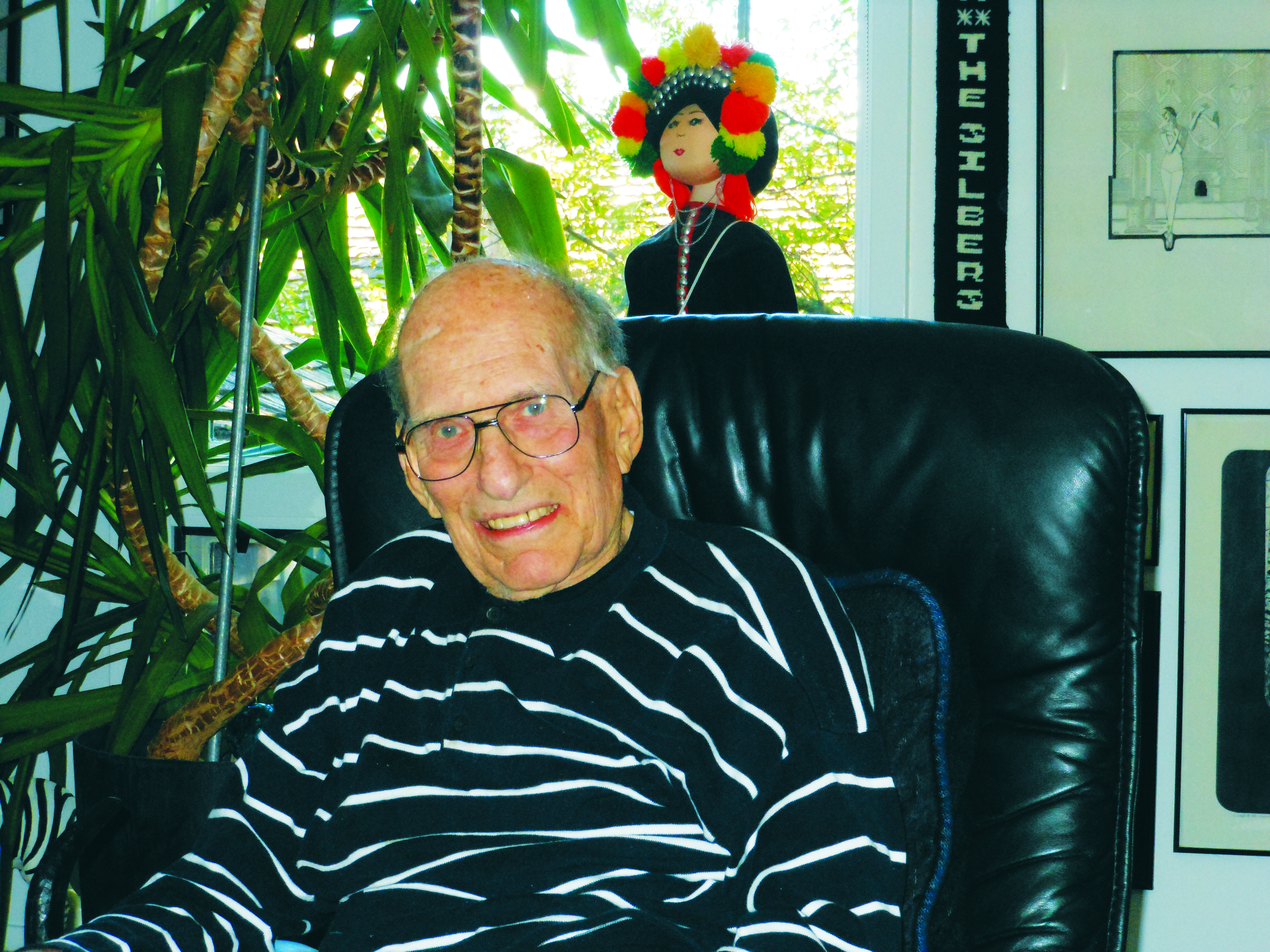
Howard Silber


Retired Omaha World-Herald military affairs newsman Howard Silber:

War veteran, reporter, raconteur, bon vi vant, globetrotter

©by Leo Adam Biga

Oriignally published in the New Horizons


It’s hard not viewing retired Omaha World-Herald military affairs editor Howard Silber’s life in romantic terms. Like a dashing fictional adventurer he’s spent the better part of his 90 years gallivanting about the world to feed his wanderlust.

A Band of Brothers World War II U.S. Army veteran, Silber was wounded in combat preceding the Battle of the Bulge. Soon after his convalescence he embarked on a distinguished journalism career.

As a reporter, the Omaha Press Club Hall of Fame inductee covered most everything. He ventured to the South Pole. He went to Vietnam multiple times to report on the war. He interviewed four sitting U.S. Presidents, even more Secretary of States and countless military brass.

He counted as sources Pentagon wonks and Beltway politicos.

Perhaps the biggest scoop of his career was obtaining an interview with Caril Ann Fugate shortly after she and Charles Starkweather were taken into custody following the couple’s 1958 killing spree.

A decade later Silber caught the first wave of Go Big Red fever when he co-wrote a pair of Husker football books.

As Veteran of Foreign Wars publicity chairman he went to China with an American contingent of retired servicemen.

Even when he stopped chasing stories following his 1988 retirement, he kept right on going, taking cruises with his wife Sissy to ports of call around the globe. More than 60 by now they reckon. They’ve even gone on safaris in Kenya and South Africa. Their Fontenelle Hills home is adorned with artifacts from their travels.

In truth, Silber’s been on the move since he was a young man, when this New York City native left the fast-paced, rough and tumble North for the slower rhythms and time-worn traditions of the South. His itch to get out and see new places may have been inherited from his Austro-Hungarian Jewish immigrant parents.

Growing up on the Upper West Side of Manhattan, Silber learned many survival lessons. HIs earliest years were spent in a well-to-do Jewish enclave. But when the Depression hit and his fur manufacturer father lost his business, the small family — it was just Howard, his younger sister and parents — were forced to move to “a less attractive neighborhood” and one where Jews were scarce.

As the new kid on the block Silber soon found himself tested.

“Fighting became a way of life. It was a case of fighting or running and I decided to fight,” he said. “I had to fight my way to school a few times and had to protect my sister, but after three or four of those fracases why they left me alone.”

Sports became another proving ground for Silber. He excelled in football at Stuyvesant High School, a noted public school whose team captured the city championship during his playing days. An equally good student, he set his sights high when he attempted to enroll at hallowed Columbia University.

“I wanted to go to Columbia as a student, not as an athlete,” he said. “They turned me down. I had all the grades but in those days most of the Ivy League and other prestigious schools had a quota on so many Jews they would admit per year.”

Columbia head football coach Lou Cannon offered Silber a partial football scholarship. The proud young student-athlete “turned it down.” The way Silber saw it, “If they wouldn’t take me as a student I didn’t want to go there as an athlete.'”

He said when the University of Alabama in Tuscaloosa recruited several teammates he opted to join them. The school’s gridiron program under then head coach Frank Thomas was already a national power. Silber enrolled there in 1939.

At Alabama his path intersected that of two unknowns who became iconic figures — one famously, the other infamously.

Paul “Bear” Bryant was my freshman football coach. I thought he was a great guy. He did a lot for me,” Silber said of the gravely voiced future coaching legend.


Paul Bear Bryant


Paul “Bear” Bryant


The Bear left UA after Silber’s freshman year for Vanderbilt. It was several coaching stops later before Bryant returned to his alma mater to lead the Crimson Tide as head coach, overseeing a dynasty that faced off with Nebraska in three New Year’s bowl games. Bryant’s Alabama teams won six national titles and he earned a place in the College Football Hall of Fame.

Silber makes no bones about his own insignificant place in ‘Bama football annals.

“I was almost a full-time bench warmer,” he said. “The talent level was higher than mine.” He played pulling guard at 170 pounds sopping wet.

His mother wanted him to be a doctor and like a good son he began pre-med studies. He wasn’t far along on that track when the medical school dean redirected Silber elsewhere owing to color blindness. Medicine’s loss was journalism’s gain.

Why did he fix on being a newspaperman?

“I always had an interest in it. My environment had been New York and jobs were hard to get in those days and it just never occurred to me I would try for one. I was more interested in radio as a career. Actually, my degree is partly radio arts. I interned at WAPI in Birmingham and after three weeks I quit and went to work as a summer intern for the old Birmingham Post, a Scripps Howard paper, because it paid four bucks a week more. That’s how I got into print journalism.”

Silber became well acquainted with someone who became the face of the Jim Crow South — George Wallace. When he first met him though Wallace was just another enterprising Alabama native son looking to make his mark.

“George Wallace and I shared an apartment over a garage one summer school session,” recalled Silber. “I had known him a little bit before then. We became pretty good friends. There was no sign of bigotry at that time, and in fact I’m convinced to this day that his bigotry was put on for political purposes.

“He (Wallace) ran at one point for the (Alabama state) judiciary and his opponent was Jim Folsom, who later became governor, and he lost, and he made the comment, ‘I’m never going to be out-niggered again.'”

George Wallace

Years before Wallace uttered that comment Silber witnessed another side of him.

“We had our laundry done by black women in town. Their sons would come around the campus, even the athletic dorms, to pick up laundry. Tony, a big lineman from West Virginia, was always hazing them and finally George, who was on the boxing team, wouldn’t take it anymore and he went up to Tony ready to fight him, saying, ‘We don’t treat our people down here that way.’ I wouldn’t have wanted to get into a fight with him. He was a tough little baby.”

In 1968 the one-time roommates’ paths crossed again. By then Silber was a veteran Herald reporter and Wallace a lightening rod Alabama governor and divisive American Independent Party presidential candidate on a campaign speaking tour stop in Omaha. Wallace’s abrasive style and segregationist stands made him a polarizing figure.

“Wallace’s advance man Bill Jones was a mutual friend and because of Bill I was invited into Wallace’s plane as it was sitting on the ground and George answered some local questions. He seemed familiar with local politics and the local situation and he was interested in agriculture. We talked for a good 15 or 20 minutes.”

That evening at the Omaha Civic Auditorium Wallace’s inflammatory speech excited supporters and agitated opponents. A melee inside the arena spilled out onto the streets and in the ensuing confrontations between police and citizens a young woman, Vivian Strong, was shot and killed by an officer, setting off a civil disturbance that caused serious property damage and looting in Northeast Omaha.

In some ways Northeast Omaha has never recovered from those and other disturbances that burned out or drove away business. It’s just the kind of story Silber liked to sink his teeth into. Before ever working as a professional journalist Silber found himself, likes millions of others, caught up in momentous events that forever altered the course of things.

He was an undergraduate when Japan attacked Pearl Harbor on December 7th, 1941. The call to arms meant a call to duty for Silber and so many of the Greatest Generation. Boys and men interrupted their lives, leaving behind home-family-career for uncertain fates in a worldwide conflict with no guarantee of Allied victory.

“The day after Pearl Harbor hundreds of students went to the recruiting offices in Tuscaloosa, the university town. The lines were terrible and finally several days later I got in. I wanted to become a Navy pilot but I was rejected because I was partly color blind. So I just entered the Army.”

He was 21. He went off to war in 1942, his studies delayed button forgotten.

“The university had a program where if you finished the spring semester and had so many hours you could enter the armed services and finish your degree by correspondence,” said Silber, who did just that.

His military odyssey began at Fortress Monroe, Va. with the Sea Coast Artillery. “We had big guns to intercept (enemy) ships,” he explained. “Because I had some college I was put in the master gunner section where with slide rules we calculated the azimuth and range of the cannon to zero in on the enemy ships that might approach. The Sea Coast Artillery was deemed obsolete by the emergence of the U.S. Air Force as a reliable deterrent force.

“I was transferred to Fort Bliss in El Paso, Texas, an anti-aircraft training center (and a part of the country’s coastal defense network). “I loved it down in El Paso. It was a good post.”

From there, he said, “I went into a glider unit and once in action we were supposed to glide in behind enemy lines to set up for anti-aircraft. Well, the glider unit was broken up. So I had some choices and I just transferred to the infantry. I went to Camp Howze (Texas), a temporary Army post, and became a member of company A, 411th Infantry Regiment, 103rd division. We did some pretty heavy training there,” said Silber.

“We went by train to Camp Shanks, New York — a port of embarkation. One morning with very little notice we were put aboard trains and transferred to a ferry stop in New Jersey and ferried across New York harbor to the Brooklyn Army Base,” he recounted. “There we boarded a ship that, believe it or not, was called the Santa Maria. We sailed to Southern France. It took about two weeks in a convoy strung out for quite a distance.”

Silber, whose descriptions of his wartime experiences retain the precision and color of his journalistic training, continued:

“We landed in Southern France (post-D-Day, 1944). We were equipped to go into combat but we were diverted to the Port of Marseilles. The French stevedores, who were supposed to be unloading ships of ammunition and such, went on strike. So we spent about two weeks unloading ammunition from ships to go up to the front.

“We were encamped on a plateau above Marseille. It was a happy situation. We’d be able to go in the city and enjoy ourselves.”

The idyll of Marseille was welcome but, as Silber said, “it ended soon enough. Part of the division went by truck and my regiment went by freight train with straw on the floor to a town called Epinal in Eastern France. From there we went into combat. The first day of combat eight members of my platoon were killed. A baptism by fire.”

That initial action, he said, “was in, oddly enough, a churchyard in which most of the graves were occupied by World War I German soldiers. I didn’t learn that until later.” Many years after the war Silber and his old comrades paid for a monument to be erected to the eight GIs lost there. He and Sissy have visited the site of that deadly encounter to pay their respects.

“It’s become kind of a shrine to guys from my old outfit,” he said.

The next phases of his combat duty exposed him to even more harrowing action.

Although wars historically shut down in winter or prove the undoing of armies ill-equipped to deal with the conditions, the record winter of ’44 in Europe ultimately did little to slow down either side. In the case of the advancing American and Allied forces, the treacherous mix of snow and cold only added to the miseries. When Silber and his fellow soldiers were ordered to cross a mountain range, the dangers of altitude, deadly passes and avalanches were added to the challenge.

“We fought our way through the Vosges Mountains in Alsace,” he said, adding cryptically, “We had a couple of situations…

“We were the first sizable military unit to cross the Vosges in winter. We had snow for which we were not equipped really. It turned out to be the worst in the history of that part of Europe. We didn’t have any white camouflage gear or anything like that that the Germans had. We met some pretty heavy combat in the mountains for a time. It was an SS outfit, but we managed to fight our way through.”

If any soldier is honest he admits he fears engaging in hand-to-hand combat because he doesn’t know how he’ll perform in that life or death struggle. In the Vosges campaign Silber confronted the ultimate test in battle when he came face to face with a German.

“I’ll tell you what happened,” is how Silber begins relating the incident. “We went out on patrol at night trying to contact the enemy and pick up a couple prisoners for intelligence purposes. By that time I had become a second lieutenant, courtesy a battlefield commission. I didn’t really want to become too attractive a target for the Germans, so I pretended I was still an enlisted man in dress and in emblem, and I carried around an M-1 rifle instead of a carbine.

“What often happened was the Germans might send out a patrol at the same time just by coincidence and we would kind of startle each other at the same moment and ignore each other purposely. That happened a lot and we thought it was going to happen this time, but they opened fire on us.”

In the close quarters chaos of the fire fight, he said, “I jumped into a roadside ditch with my M-1 and it was knocked out of my hand by the guy I killed. Had to. I had a trench knife in my boot and I attacked him with that and fortunately I beat him, or he would have beaten me.” Only one man was coming out alive and Silber lived to tell the tale. He does so without boast or pleasure but a it-was-him-or-me soberness.

A desperate Germany was sending almost anyone it could find to the front, including boys. The SS troop Silber dispatched was an adult, therefore, he said, “I didn’t have that to worry about on my conscience.”

“After that most of the units we encountered were made up either of young conscripts, and I mean below the age of 18, or middle aged men, as almost a last gasp. I saw German soldiers who couldn’t have been more than 12 or 13 years old. I also saw men in their 40s and 50s.”

This last gasp “was a hopeful sign” Germany was through, but he added, “We didn’t feel very comfortable fighting against 14 year olds. I mean, if we had to do it, we did it because they were trying to kill us. We lived with it, that’s all.”

Finally breaking out of the mountains onto the Rhine Plain was a great relief. For the first time since the start of the campaign, he said, “we got to sleep in an intact house. We proceeded around Strausberg. We were in the U.S. 7th Army and integrated into our army corps was the French 1st Army and they were made up mostly of North Africans. Most of them were Moroccans, Algerians and Tunisians, I guess. They had come across the Mediterranean with de Gaulle. We saw them from time to time. They had a reputation of being good fighters.

“We headed north paralleling the Rhine River and we were approaching the Maginot Line (the elaborate French fortification system Germany outflanked during its blitz into France). On December 14, 1944 we had orders to break through it. The Germans had artillery, some troops and some tanks zeroed in and ready to go.”

All hell then broke loose.

“We woke up one morning to the sound of artillery high above us, exploding in the trees,” recalled Silber. “We were on the side of a ravine through which a road had been cut and on that road was a tank destroyer outfit — using World War I leftover anti-tank guns. They were a platoon of African-Americans. The bravery those guys exhibited was unbelievable. When I think of it I become emotional because they were shot up to hell and kept fighting.”

His second close brush with death then occurred.

“The artillery action slowed down and we began to advance into the Maginot Line,” he said. “The Germans had some tanks positioned between fixed fortresses. We encountered off in the distance a tank — 400 or 500 yards away. It was very slowly approaching us. The tank destroyer outfit had been so decimated they were pretty much out of action, so we had bazookas. Our bazooka team in my platoon was knocked out. By that time I was the platoon leader. I picked up the bazooka, knelt and loaded it, fired once and missed. It was quite a distance still.

“The last thing I can remember is that tank lowering its beastly 88 millimeter cannon in my direction…I woke up the next day in an Army field hospital. Apparently the shell was a dud but its impact half buried me in my foxhole. Our platoon medic dug me out of the collapsed foxhole and got me out of the way. I was unconscious. Both my arms were broken and my left rib cage was pretty well beat up. I woke up December 16 and that was the day the Battle of the Bulge erupted about a hundred kilometers north of us.”

Silber spent the remainder of the war healing.

“The next day the field hospital was emptied out of patients and it moved north to take care of casualties from the Bulge,” he said. “I was shipped along with other patients by ambulance to the U.S. 23rd General Hospital at Vittel, France, a spa town. It had been a resort. It had a racetrack and a casino. We wound up in the grand hotel.

“Even though my arms were in casts by then I enjoyed being there, believe me.”

Ending up sidelined from the action, banged up but without any life threatening injury, reminded him of something he and his buddies often joked about to help pass the time.

“Especially when I was an enlisted man we used to sit and talk in our foxholes, usually at night when things were quiet, smoking a cigarette under a tarpaulin or something, about the ‘million dollar wound.’ We’d speculate on what it would take to get us back to the States without getting really hurt.

“Well, maybe I should be ashamed of this, but that was one of the things I thought of in the hospital — that I had kind of one of those (wounds). Except I was hurt a little more than I would have chosen.”

Back home, he continued mending at Rhodes General Hospital in Utica, New York. A restless Silber completed his college studies by correspondence and volunteered in the public relations office. He penned the script for a weekly radio show written, produced and acted by patients, mostly on war experiences, that the hospital sponsored. Silber shared in a George Foster Peabody Award for public service a show segment won. “It wasn’t my brilliant writing or anything,” he said, “but I was part of the process.”

He was still hospitalized when VJ Day sparked celebrations over the war’s end.

One of his PR tasks was delivering copy to the local Utica Daily Press, where he secured a job upon his discharge. “I took my swearing out ceremony as we called it at 10 o’clock in the morning and by two o’clock I was down there working for a salary, not much of a salary — $38 a week. I still have a soft spot in my heart for Utica. I actually was stationed in a bureau in Rome, New York 15 miles away.”

From there he returned to his old stomping grounds in the Big Apple, where he worked for the New York Sun. A plum early assignment put him in the company of Harry Truman, “the VIP who really impressed me most,” said Silber. “I rode his (1948) campaign train. I was pretty raw material then, a real cub reporter, but I got the assignment and I ran with it. I even got to kibbutz his (Truman’s) poker game.”

Silber recalls Truman as “very kind, although he’d pick on guys for fun,” adding, “He was just a pretty decent man but he had shall we say a frothy tongue.”

When the Sun folded in 1950 Silber got on with “a blue ribbon” PR firm, but as he once put it, “I just had the romance of daily journalism in my blood.” Thus he began searching for a newspaper job. His choice came down to a Kansas City paper and the Omaha World-Herald, and $5 more a week brought him here in 1955.

He started out on the rewrite desk.

The Herald had a team of reporters out covering the Charles Starkweather story but Silber was familiar with the mounting murders and resulting manhunt around the upper Midwest from rewriting field reports. Then, as things often happen in a newsroom, Silber found himself enlisted to cover a major development.

“When the Starkweather case broke, our chief photographer Larry Robinson, who was versed in aviation and friendly to some of the operators out at the air base, chartered a good airplane on standby. So when we got the word in the newsroom about Starkweather being captured in Douglas, Wyo., city editor Lou Gerdes pointed to me and said, ‘Go!,’ and I went with Robby and John Savage.”

“We got there ahead of anybody else outside the immediate area and because of that we were able to have a lot of informality that wouldn’t exist today. We got friendly with the sheriff, Earl Heflin, and his wife, the jail matron. We got some good stories.”

Charles Starkweather in custody

Minus a wire to transmit photos, Robinson flew back with the negatives, while Silber and Savage stayed behind to cultivate more stories.

That night, a keyed up Silber, unable to sleep, walked from the hotel to the courthouse where the captured fugitives were held.

“The sheriff was answering telephone calls from all over the world with his wife’s help, and he was dead tired, so I said, ‘Why don’t you get some sleep while I sit in for you?’ He took advantage of that, and I took advantage of it, too.”

The story was a sensation everywhere it headlined.

“There weren’t that many serial murders in those days for one thing,” said Silber, “and it seemed to have all the elements — a teen with his girlfriend going around shooting people, not at random but for one reason or another, and it just caught on. Besides that, we were feeding a lot of stuff to the Associated Press and United Press. I was a stringer for Reuters and they were getting plenty of it. I was also stringing for the New York Daily News and at that time it was the largest circulation newspaper in the country.

“It just captured the imagination of readers.”

Caril Ann Fugate

So Silber wasn’t going to miss an opportunity to further play the story when one presented itself. Having relieved the sheriff, Silber then convinced Heflin’s wife to let him interview Caril Ann Fugate when Mrs. Heflin went to check on her. He ended up doing interviews with Fugate and Starkweather, separately, while Savage snapped photos — getting exclusive stories and pictures in the process.

Regarding Fugate, Silber said, “I had mixed feelings about her at the time, and then over a period of several weeks when more and more reports were coming in about her I became convinced she was not innocent. She was goading him to shoot people.” He said Starkweather struck him as “the upper end of juvenile delinquency, because he was 17 when he was captured. He was inarticulate. He couldn’t give a straight answer.”

Silber’s most far-flung assignment took him to the South Pole in 1962 as part of the press pool on a military junket with dignitaries Gen. Jimmy Doolittle, radio-newsreel commentator Lowell Thomas and Notre Dame president Fr. Theodore Hesburgh. “We staged out of Christchurch, New Zealand,” he said. “It’s a long ride down there in a prop plane.” En route, everyone geared up with layers of thermal clothing.

U.S. South Pole station

“We landed at (Amundsen-Scott) Pole Station — the actual landing strip they carved out of the ice about a mile or so from the pole. When we got there the temperature was 60 something below zero. They made heated track vehicles available, but Gen. Doolittle, Lowell Thomas and Fr. Hesburgh said no, They walked. So as a result we in the press pool had to walk, too (much to their curse-laden dismay).

“The actual stay on the ice as we called it was 2 1/2 weeks. We took day trips to scientific-research stations and historical places where early explorers had froze or starved to death.”

Flying to the pole station in a C-130 a tired Silber clambered atop crates lashed in the aisle and when he awoke a fellow member of the Fifth Estate said, “You know where you’ve been sleeping?” A clueless Silber shrugged, no. “On cases of dynamite,” his colleague gleefully informed him.

Among the most unforgettable characters Silber knew was bombastic Gen. Curtis LeMay, the first commander of the Strategic Air Command. “He was tough but he was a patriot through and through,” he said. “I admired him but it was tough to get along with him.” An enduring LeMay anecdote Silber attests is true found the general lighting a cigar near a refueling plane. When an aide mentioned the danger of the plane blowing up, LeMay blustered, “It wouldn’t dare to.”


lemay

Gen. Curtis LeMay

Silber and Sissy attended many a lavish black-tie officers’ party at Offutt.

There wasn’t much posh about reporting in Vietnam, where Silber covered the war as early as 1964. On a later visit there he ran into Omaha television reporter John Hlavacek, a former print foreign correspondent for whom Silber has high regard.

In 1970 Silber and other press accompanied Ross Perot on a chartered trip the billionaire organized ostensibly to deliver supplies to U.S airmen held as prisoners of war in North Vietnam. The hopskotch trip, which Henry Kissinger was behind, failed to deliver any supplies but did raise awareness of the POWs’ plight.

Upon reflection, Silber said his military reporting, which earned him numerous awards, “was satisfying — very much so. It was a high point.”

Back home, Silber claims credit for thinking of the Husker football books he and colleagues Jim Denney and Hollis Limprecht collaborated on, the second of which was a biography of Bob Devaney. Silber thought highly of Devaney.

“I loved the man. He was just a hell-raiser. A down-to-earth guy. A man’s-man.”

Over the years Silber wrote pieces for Readers Digest, Esquire and other national publications. He was a Reuters stringer for 20 years.

“I could never be satisfied with just working 8 hours a day. I had to be doing other things, too. I had a little office set up at home and I would do what I could.”

He means to resume his memoirs — for his grandkids — now that he’s cancer free for the first time in years. Long ago divorced from his first wife and the mother of his two daughters, Silber and Sissy have been partners 36 years now. Her warm, bigger-than-life personality complements his own hail-fellow-well-met charm.

Each retired comfortably from divergent careers. While he never became rich as a reporter he did well as a World-Herald stock holder. When Sissy’s father left behind his Katelman’s hardware supply store she and her mother took it over and ran it till 1981, when the Kanesville Highway went in.

Howard and Sissy met as a result of, what else?, a story Silber was working on. They’ve been inseparable since marrying in 1975.

Summing up his eventful life and career, Silber said, “There’s not too many things I’d change.”

From the Archives: Cowboy-turned Scholar Discovers Kinship with 19th Century Expedition Explorer

September 17, 2011 3 comments


NOTE: My apologies to those who read this post when I first put it up, as it was filled with typos. I failed to proof the copy and it made for a very rough read. It won’t happen again.

With this post I am starting a periodic series featuring favorite stories of mine from deep in my archives. The story below is from 1990 and profiles a charming man, Paul Schach, who has since passed. I got to know Schach just a bit when I worked as public relations director at the Joslyn Art Museum in Omaha. My friend, then Joslyn western history curator Joseph Porter introduced me to Schach, who was engrossed in a multi-year translation project of a vast set of journals or diaries that German explorer Prince Maximilian of Wied kept of a historic expedition he made of North America. The 1832-34 expedition also had a fine artist along, Karl Bodmer, who made sketches and watercolor paintings of the vanishing West. The Maximilain diary and the Bodmer artworks are in the Joslyn’s permanent collections and I was struck both by how uniquely suited Schach was for the project and by how deeply connected he felt to Maximilian.

Also on this blog is a story I did a few years later about an artist who drew inspiration from the life and work of Karl Bodmer. That piece is titled, “Naturalist-Artist John Lokke – In Pursuit of the Timber Rattlesnake and in the Footsteps of Karl Bodmer.”


From the Archives: Cowboy-turned Scholar Discovers Kinship with 19th Century Expedition Explorer

©by Leo Adam Biga

Orignally published in Omaha Metro Update (now Metro Magazine)

In his 52 years as a language scholar retired University of Nebraska-Lincoln professor Paul Schach has seldom strayed far from his German heritage and rough-and-tumble roots. It’s only fitting that Schach, who loves a good yarn, has lived a storybook life – from cowboying along the Arkansas River to doing top-secret intelligence work during World War II to forging a distinguished academic career.

Until his 1986 returement Schach held the Charles J. Mach professorship of Germanic languages at UNL, where he taught 35 years. The noted philogist has traveled widely to record and study ethnic languages and literary traditions native to Northern Europe. He’s published his work in scores of articles and eight books.

Schach’s work has taken hiim to Denmark, Sweden, Iceland and Germany. A companion on some of his overseas trips was his late wife, Ruth, who was also a colleague. She typed and proofed all his work during their 48-year marriage. In 1956-57 the couple and their three daughters lived in Germany, where the children attended public school while Schach taught and worked on a book.

“Ruth typed the manuscript of the first book I ever published, during the winter of 1956 in Germany,” Schach said. “That was a cold winter and buildings were only heated two hours out of 24 because of fuel shortages. I would come back home at noon for lunch and she’d be at a little red Remington portable typewriter.

“She had a sweater, overcoat, woolen cap and scarf on. She’d type for awhile, stop, blow on her hands, put on gloves, blow on her hands a bit and then type a few more sentences. And that’s how that first book came to be typed. I’m just beginning to realize now she did about half my work for me. I got the credit for it – she did the work.”

Today, the 74-year-old is still busy writing and researching, only now his daughter Joan is his proofreader. Schach hopes to finish three books yet. But one project in particular has occupied much of his attention the past three years. It’s the translation of the diary kept by German explorer-naturalist-ethnologist, Maximilian Furst zu Wied of his 1832-34 expedition to North America with Swiss artist Karl Bodmer.

Maximilian’s chronicles, along with Bodmer’s paintings and sketches, document their historic journey along the Missouri River. The diary, artwork and related articles are housed at Joslyn Art Museum‘s Center for Western Studies, where Schach commutes from his Lincoln, Neb. home to work with the original manuscript. Scholars regard the collection as an unparalleled record of the early American West.


Prince Maximilian


Translating the epic, 4,000 -page diary is painstaking work which Schach is uniquely qualified to do. He grew up speaking and reading a dialect very similar to Maximilian’s – one few are fluent in today. As a boy Schach reveled in stories told in German by his extended immigrant family.

Schach’s work is made more difficult by Maximilian’s tiny script, which can be read only with the aid of a magnifying glass. The diary will be published in four volumes by Joslyn and the University of Nebraska Press. Schach has only a final reading to do before volume one is published within a year. Work on volume two is nearing completion and by July Schach said the translation project should reach its halfway point.

His careful reading and meticulous translation of Maximilian’s observations have put him on intimate terms with the man, whom he feels a close kinship with by virtue of their shared dialect, heritage and interests. Strengthening the bond is the fact Maximilian spent a summer in Pennsylvania, where Schach was born and raised.

“I’m seeing parts of that state much more clearly now through his descriptions. So many of the things he describes are things I have experiencd in my life,” said Schach.

Just as Maximilian spemnt a lifetime as both a rugged outdoorsman and rigorous scholar, so too has Schach. During his long career Schach has remaimed true to bedrock values learned as a boy gorwing up “mainly in mining camps and cow towns” during the Great Depression.

Despite harships, he enjoyed an arcadian youth in the fertile back country of eastern Pennsylvania’s anthracite coal mining region, where he developed a lifelong love for the great outdoors.

“Until I was about 20 I lived outdoors whenever I could – hunting, fishing and trapping. My father was a coal miner. Some days he’d strike it rich, and then for weeks he wouldn’t have any money at all. We spent quite a bit of our free time fishing and hunting for food. Yes, times were hard, but people in those times were hard, always shared things. Everybody helped everybody else. I was always being farmed out to work on different farms when someone got hurt or sick.”

Schach learned a healthy respect for nature and the land from his maternal grandfather, nicknamed the “Old Black Hessian” for both his dark features and horse-trading skills.

“When people came and wanted to buy soome wood on his farm, he refused to sell. They said, ‘We’ll pay you more money for those trees than you’ll get for the rest of your farm.’ ‘It belongs to the farm,’ he replied. ‘Well, the farm belongs to you, doesn’t it?’ He wasn’t quite sure,” Schach said, “because it would go to his son or daughter. It was his farm, but it was there for people to use and the idea was to make it a better farm then when he got it from his father.”

Schach laments, “There’s not so much of that (philosophy) “left anymore – people are mining the soil and destorying the forests.”


A Karl Bodmer watercolor from the expedition


He said Maximilian espoused the same Old World wisdom and was “shocked, even at that time, at the way Americans were destrorying their forests and their soil. In Europe, if you cut down a tree you have to plant two to replace that one.”

According to Schach, Maximilian’s enlightened environmental concerns were typical of a man who was ahead of his time. “There were so many ways in which he was so very modern, such as the idea of conserving the soil and forests. There’s so much to learn from a man like this.”

Far from a rural idyll, however, life for the Schachs was full of severe trials, just as Maximilan weathered blizzards, epidemics and other miseries on his trek.

Then there were the man-made problems the Schachs and their neighbors confronted.

“There was a lot of trouble in the coal mines,” Schach said. “The owners would shut down the mines so the miners wouldn’t ask for more wages. You couldn’t even buy coal in the coal regions – you had to go out to slag dumps at night, where we were shot at frequently. My father wanted to get out…there was just no future there because he didn’t own any land.”

The family pulled up stakes and headed west. They settled in Colorado, where Schach’s father hoped to dig for gold but was disillusioned to find “the gold mines had petered out just as coal had in Pennsylvania.” He opted for running a grocery store instead.

Schach helped support the family of eight by working as a hired hand on a cattle ranch along the Arkansas River, riding horseback in the shadow of Pike’s Peak. The full-fledged cowboy broke wild horses, drove cattle and lived a Western life most young men only dreamed about.

“I enjoyed working on the farm and especially on that ranch. Coming from the East to the West, I suppose, made it more romantic.

“We used to move the cattle up in the spring to a higher pasture in the mountains and then, in the fall, bring them down. When you brought them down they were just as wild as buffalo. you could handle them on horseback, but on foot they’d either run away from you or they’d come right at you,  in which case you ran for the closest fence,” he recalled, laughing heartily.

“I liked working with horses, but I guess I was never too good at it because I’ve been banged up pretty badly several times.”

The last time he tried taming a horse was just 10 years ago. The result: three broken ribs. Years later he still feels the effects and carries the scars of his horse spills. He joked that it’s open to question whether he broke horses or they broke him. “But I still love them,” he said.

Schach passed on what little horse sense had to two of his daughters, who are “very good with horses.” He sometimes goes riding with them at a local stable. But to his daughters’ amusement a bronco buster’s old habits die hard. He’s been bucked, bitten and kicked enough times that he mounts any horse, even a tame one, as warily as if it were a time bomb.

“I set up close to the shoulder, facing the back, so he can’t get me with his foreleg. I pull his head away from me so he can’t bite me. And I watch his hind leg and am conscious to get my left foot in the stirrup and to swing into the saddle. Then I wait to see what’s going to happen. Of course, with these horses around here, nothing happens. He just sits there,” said Schach, who delights in telling the story.


A Karl Bodmer watercolor from the expedition


He exchanged a saddle for a school desk in the mid-’30s, when he enrolled at Albright College in Reading, Pa. Although he was a roughrider, Schach always found time for books and writing. He had as his models two older sisters who taught school.

“I always read a lot. I read German and English from the time I was 5. I used to keep notebooks with lists of all the words I could find in German and English of colors, for example. Or synonyms of all kinds.”

He was immersed in his people’s rich reservoir of culture and language. “The Old Black Hessian was a marvelous storyteller. I remember one story had two different endings. When I was about 10 I got up enough courage to ask him which of the two stories was the true one. He looked me straight in the eye and said, ‘Paulos, the one is as true as the other,’ which was a marvelous answer.”

Schach, who’s recorded German immigrant dialects from Canada to Texas, has collected Russian-German folktales handed down through generations. He cherishes both the grassroots education he got at home and his formal training in high school. He feels today’s students are shortchanged.

“If you intended to go to college you had to have a thorough knowledge of French, German and Latin. You took science and math courses straight through, including trigonmetry and geometry. I would say graduates of my high school in 1935 or so had a much more solid education than the average college graduate today.

“We’ve lost touch. I read European newspapers all the time…people all over the world are talking about what’s happened to the United States, how we’ve fallen behind in science and can’t make anything that meet their standards. The neglect of languages has been a terrible handicap to our country and we have suffered greatly from it, too.”

He believes language studies are vital “not only for what they tell us about language” but for what they reveal about culture, history and ourselves. As an ethnologist, Maximilian studied the cultures and languages of Native Americans from a humanist perspective rare for expolorers of the period. His progressive learnings helped him empathize with the Indians while his scientific training lent his descriptions great objectivity. He approached the study of Indians not as something strange, not as the savages we’re used to reading about in cowboy and Indian stories, but as human beings. He didn’t idealize them. He didn’t denigrate them. They were people – good, bad, indifferent – and he just portrayed them as they were,” Schach explained, adding that Maximilian’s accounts are treasured for their wealth of detail and accuracy.


Statue of Karl Bodmer and Prince Maximilian at the Castle of Neuweid in Germany


Maximilian, whom Schach described as “a very well-educated man,” had both a priviliged and liberal upbringing. A nobleman by birth, Maximilian’s inherited title was Prince of Wied. His grandfather had established the city of Newied, on the banks of the Rhine, as a refuge for victims of religious persecution. The family castle was located there.

“Early on, Maximilian was in contact with peoples of all nationalities, religions and so on,” said Schach. “I think this was a big help to him when he studied the Indians.”

Schach’s own educational pursuits have been diverse. After graduatiing from Albright in 1938 he began work on his master’s degree at the University of Pennyslvania. Before finishing his thesis, World War II erupted and Schach soon found himself putting his language skills to use in the U.S. Navy. He was the only U.S.-born member of a translation project team assigned the top-secret duty of translatiing captured documents on Germany’s jet propulsion and rocketry programs.

“As soon as they developed something, we knew about it,” said Schach. “The material was easy to read and understand, but we had no (compatible) terminology in English. We hadn’t done anything  in those areas yet. We literally had no words to translate into English. That was a strange and a frightening situation.”

It was all the more frightening, he said, because “we knew the V-2 was designed for an atomic warhead. We also knew there were German engineers who could construct an atomic bomb.”

The stateside team based in Philadelphia did hands-on work as well – once reconstructing a Messerschmitt 262 from parts of three of the German jet planes that had crashed. It flew, too. “I guess that the first jet plane to every fly on this country,” he said.

After the war Schach taught at Penn, where he also earned a doctorate. He taught several years at Albright and at North Central Collge in Chicago. He joined the UNL staff in 1951, lured by the opportunity to study the area’s many varieties of German, Czech and Scandinavian dialects. Another factor was Lincoln’s close proximity to Colorado, where the Schachs often vacationed summers, roughing it in the outback.

“We never had much money. The salaries were miserable then. One summer we had $75 – I took the tent, a gun and my fishing pole and we all headed west in the car.” En route to Colorado their meager funds were cut by a third when a flat tire needed replacing. To conserve money that summer the family ate whatever Schach hooked or shot. “We ended up eating mostly fish that summer. At one point the children just sort of sat and looked down their noses at the fish, and Ruth said, ‘You better go to town and buy some hamburgers.'”

Until recently Schach still hunted regulalry, favoring the Nebraska Sand Hills for ducks and the Pine Ridge area for deer. He ventured as far north as Ontario, Canada for bigger game, including a bear he bagged with one shot.

Translating Maximilian’s diary leaves precious little time for the outdoors these days. “I’ve become perhaps too much interested in the man. This is one of only several major projects I’ve been working on. But it’s like reading a good book – you read it four times and you see things you didn’t see the first time. Maximilian was a very remarkable person.

Some would say Schach is no slouch himself.

A not-so-average Joe tells his Holocaust story of survival

September 8, 2011 9 comments

Another of my Holocaust stories is featured here. Joe Boin tells his story of defiance and survival.

A not-so-average Joe tells his Holocaust story of survival

©by Leo Adam Biga

Originally published in the Jewish Press


It’s not as if Joe Boin hadn’t spoken about his Holocaust survivor tale before. He shared his story for the Shoah Visual History Project. He’s told it to school groups. He helped form Nebraska Survivors of the Holocaust to raise awareness and to commission public memorials as reminders of what happened.

But until now the Berlin, Germany native never laid out his story for publication. The time seemed right. The 87-year-old widower resides at the Rose Blumkin Home, where he scoots around in his motorized wheelchair with aplomb, American and Go Big Red flags affixed to the back. The amiable man makes friends easily and lives a credo of looking ahead, not back, but the searing memories never dim. Alone with his thoughts, his odyssey is always near.

His wife Lilly, a fellow survivor he met and married after the war, passed away 14 years ago. A Vienna, Austria native, she told her survivor tale in her 1989 book, My Story. Everyone close to her died in the Shoah.

Remarkably, Joe’s entire immediate family made it out alive. His parents are long gone and his only two siblings live in Israel. Palestine is where Joe, Lilly, his sisters and eventually his folks migrated after the war. Joe and Lilly’s two children, Heni Alice and Gustav Daniel, were born and raised in Israel. Joe suffered wounds in the fight for Israel’s independence. The couple’s children preceded them to America and Joe and Lilly followed in 1966.

After hopskotching the country to be near their children, Joe and Lilly made it to Nebraska in the late-1970s, residing first in Lincoln before settling in Omaha.

Today, Joe lives for his children, grandchildren and great-grandchildren. He sees them when he can but they all live out of state. He’s spending Hanukkah and New Year in Phoenix with his daughter and her family.

Joe insists his story is nothing special. “I’m not too interesting,” he says through his thick accent. “I’m not important.” But Joe knows better. He knows that while every survivor story shares certain commonalities, each is its own wonder, even miracle, of fortitude and fate. He knows, too, it’s his obligation to bear witness.

Born Joachim Boin, he was the only son of Arthur and Bianca Boin, an educated Orthodox Jewish couple whose roots were in Germany and Poland, respectively. Joe’s father was a World War I veteran who fought in the German Army. He had his own accounting firm. Joe’s younger sisters, Ruth and Gisela, soon followed.

The family lived in a mixed district of Berlin where Jews and Christians lived and did business together. Next door was a Christian family, the Kruegers, who were old friends. They took an active hand in helping the Boins once the Nazi’s anti-Jewish laws took effect. They even ended up hiding Gisela during the war.

Before the rein of terror, Joe’s early childhood was idyllic. “It didn’t last long but it gave me a taste of what life could be or can be,” he said. “I had dreams but it became impossible for me to even follow them after Hitler came — that all went.”

Growing up in Berlin, Joe witnessed the fascist fervor in its huge rallies and parades that kindled the worst kind of nationalism. The mass public displays included virulent anti-Semetic screeds, all meant to sway the Aryan citizenry, to inflame hatred, to intimidate Jews and other supposed enemies of the state. The Nazi regime tapped the fears of a shaken people by offering security and scapegoats.

“Like everywhere in the world Germany was in a very deep depression, people were out of work and they had big families,” noted Joe, “and so Hitler came and said, ‘Well, if you elect me as your leader I will put bread on your table and I will make sure you have enough money to pay your bills and rent.’ Of course, everybody went for it.”

To the Christian majority Hitler appealed to widespread prejudice in blaming the Jews for Germany’s decline since World War I. For most Jews, the rhetoric and restrictions aimed at them seemed nothing they hadn’t seen or heard before.

“In the very beginning when he was elected he organized the political police and then when people found out what really was going to happen it was too late, they couldn’t do much about it,” said Joe.

A strapping, athletic young man, Joe competed as an elite Maccabi club tennis player, boxer and gymnast, yet Jews like him were ostracized from German national teams and games by the Nazi regime’s racial policies. This exclusion was a bitter pill to swallow for Jewish athletes when Berlin hosted the 1936 Olympics.

“It was pretty painful, I’ll tell you that.”

Amid unprecedented propaganda and pageantry the Nazis attempted to gloss over their campaign of hate against Jews and while some observers saw through the facade most of the world did not. As far back as the Berlin Olympics, Joe’s family was warned of the impending danger facing them.

“In 1936 my mother’s brother, who lived in Berlin, too, came to my dad and said, ‘Arthur, now is the time to leave this country.’ My dad looked at him and said, ‘I was in World War I, I pay my taxes, I have a legitimate business, why should I leave?’ If anybody had any idea what was going to happen, they would have left,” said Joe, but the Boins like most people could not conceive that what seemed another pogrom would become the systematic genocide known as The Final Solution.

Until the fall of 1938 things were tolerable. Jews couldn’t go where and when they pleased as easily as they once could, owing to growing restrictions on their movements and activities, but they didn’t fear for their safety. Clearly, though, life was far from normal and things were getting more tense. Roving gangs of Nazi Brown Shirts were becoming a menace and the mere fact of being a Jew, identified by a Yellow Star, made you a target of these thugs.

The Kruegers, the Christian family who lived next door to the Boins, became a lifeline. “Our neighbors were very nice people and they supplied us with some food and so on, sometimes without taking payment, so that we could live a little,” said Joe.

When he was 15 he and his family moved to a town, Cottbus, where Joe’s father felt they would be more insulated from the Nazi grip. They did find there some kind Christians who lent aid just as the Kruegers had.

“Like everywhere else there were wonderful people that were kind to Jews, that tried to help,” said Joe.

But there ultimately was no escaping the threat. Things took a turn for the worse on Kristallnacht, Nov. 9, 1938. Nazi goons came to the Boin home to take Joe and his father away to the town square where other Jewish residents had been rounded up and their homes and businesses vandalized.

“They took us to a marketplace where they had us surrounded by Nazis and by private citizens and they put dogs on one side and they gave us a spoon and we had to pick up the crap. We got beaten pretty bad. A lot of people got killed there, too. They put bodies in the synagogue and afterwards they burned it.”

For Joe, the nightmarish incident marked the end of his boyhood innocence and the start of a cruel new reality based on instinct, chance and survival.

“My life as a child (ended). I had two years of high school before Hitler kicked us out.” From then on out, life was a harrowing affair. “We were treated like animals, not as human beings, we had to walk on the street, we couldn’t walk on the sidewalks, we couldn’t go into certain stores.”

More and more, Jews found themselves targeted, isolated, marginalized. Then, in 1939, the year Germany invaded Poland and Czechoslovakia and instigated World War II, the family was forcibly split up. A band of Nazis came to the Boin home, this time demanding only Joe come with them. He described what happened:

“At midnight they knocked on our door, shouting, ‘We want your boy Joachim.’ I came to the door and asked, ‘What do you want?’ ‘We have come for you,’ they said, and they grabbed me and hit me and put me on a truck. ‘Where are we going; do I have to take something?’ ‘No, where we’re going you don’t need nothing.’”

The ominous reply presaged the unfolding horror of the next six years, a black time when he and his family were separated from everything they knew, including each other, as each endured his or her own survival odyssey. Joe, his father, his mother and his sister Ruth all ended up in either labor or death camps.

Only his baby sister Gisela was spared. She was hidden by the Kruegers in the Christian family’s Berlin home, where for three-and-a-half years she passed a secreted-away life that if discovered would have meant certain death for her and her benefactors.

“My dad always said to them (the Kruegers), ‘You know, if the authorities find out they’re going to kill you too,’ and they said, ‘We are responsible to God, not to him (Hitler), and we feel if there’s any way to help somebody and to do something that prevents anybody from getting killed, we do it.’”

This courageous attitude struck a chord in Joe, who has tried living up to the kindnesses people bestowed on him and his family.

“It’s amazing in a situation like this that you find people that have a different way of thinking and they feel it’s immoral for others to be killed or whatever just because they’re Jewish. People helped even though they knew if they got caught they would get shot. Despite the risk, they said, ‘No, we have a responsibility to God, but not to Mr. Hitler, and whatever happens, happens,’ and that’s why quite a few Jewish people had a chance to live.”

From the time Joe was taken away in the middle of the night to the war’s end, six years passed before he was reunited with his family. He would survive six camps in four countries, counting the displaced persons and refugee camps he ended up in after the war, before the ordeal was over.

“The first camp I was in was Sachsenhausen — it was a concentration camp close to Berlin where all kinds of political prisoners, religious people were together, gypsies too. Just a very, very interesting group of people, and then from there they distributed them to the other camps.”

He didn’t know anyone at Sachsenhausen.

“I didn’t want to know anybody because in a situation like this it’s very difficult to trust people you don’t know. Sometimes you had to, but unfortunately you had a lot of Jewish people who tried to inform the Nazis of what was going on, hoping they might have a better life, which didn’t happen.”

Upon his arrival, Joe was consumed with anger over the injustice of it all.

“I was 17-years-old and the only crime I’d committed was I was born to a Jewish mother. That’s why I could never understand why I had to go through all this. I wasn’t thinking about anything else but why I’m here. I didn’t steal anything, I didn’t murder anyone — why am I here, what’s the reason? Why couldn’t I get my education so I could become somebody and get further on in life later? Why? — because I was Jewish. I could not get over that.”

Then some things happened those first 24 hours in camp to change his outlook.

“I was so mad that when we came in the barracks in the evening I said, ‘I think if I ever by any chance come out of this place I will kill every German that comes in my way.’ Somebody tapped me on my shoulder and said, ‘No my son, if you do this you’re not any better than the Nazis.’” It started him thinking.

“The next morning we had to stand in a roll call and an elderly man fell down and, of course, I bent down trying to help him and one soldier came and shoved this rifle in my back and so I fell down, too. We were carried into the barracks and the older prisoners told me, ‘If you want to stay alive you don’t see anything around you.’ Well I was a person that wanted to see what life was all about and I was trying to live a little longer if I could, and so I followed this advice.”

Joe was also befriended by an elderly Catholic priest whose selfless example made a big impact on him. When the meager bread ration was given out, Joe said, the old priest gave away his portion to Joe and other young people. “He told us, ‘You need it more than I do, I have nothing to look forward to, it’s God’s will.’ It taught me there are people who really care for other people.”

After two years at Sachsenhausen Joe was transported to Buchenwald in 1941.

“Buchenwald was horrible for me because I was delegated to be on the railroad platform as trains came in from Holland and Belgium. I would pick up the suitcases and possessions people carried. The hardest thing for me was seeing women come with little children in their arms and the children, some not even a year old, were taken away and thrown on the platform. Some guards did much more worse — they used them as target practice. I still have nightmares about this.”

It took all of Joe’s self-discipline to not respond, not intervene, not retaliate.

“I was strong enough I could probably have killed some guards but that wouldn’t do me any good because two minutes later people would be shot on the spot. It doesn’t help me or nobody else either. It was a hard decision to make but unfortunately that’s the way it worked.”

Living conditions were abysmal in every concentration camp, but he said the treatment by the Buchenwald guards was particularly harsh.

“The guys that watched us were much more brutal in Buchenwald than they were in Sachsenhausen. They got a bottle of whiskey in the morning to drink to get them in the mood of tormenting us. They were specially trained, they had only one thing in mind, make sure the people don’t get out of here alive.”

As part of the Nazi program of humiliating prisoners, he said, inmates were given absurd tasks meant to break their mind and spirit.

“We had to do idiotic things, like they had a room that needed to be cleaned and they give us a toothbrush to clean the walls. It made you feel degraded. This is the evil of the world — to not treat us like human beings. They didn’t want you to feel as a human being anymore — well, they didn’t have any luck with me.”

Death, hunger, toil and beatings became every day occurrences.

“In our barracks we had bunk beds, with maybe four or five people laying there in a clump, and very often when you woke up in the morning somebody was dead. It took me a long time to get over those deaths,” he said.

Hardening himself to his reality became a necessary thing.

“I always thought a little bit different — that I’m in a situation where I have to do certain things and I’m looking for a loophole maybe somewhere to improve my situation. Sometimes it worked and sometimes it didn’t. I was able to be pretty open with the people that were surrounding me in trying to explain how important it was for our little group here to hold together and not go to the Nazis, that we had to stick together and try to improve our lives — that was the only way to make it happen. Some of them did and some of them didn’t.

“Some didn’t have the will (to live) anymore. One guy told me, ‘What difference does it make?’ Some people had a little bit of sense left. I had the will to live. I prayed to God, ‘I know if you want you will give me the strength to fight back in a way to keep my mouth shut when I should,’ instead of saying something that would give them the opportunity to beat me or to restrict food from me.”

That resolve and restraint, he said, “was not very easy because when you work hard 10-12 hours a day with nothing to eat your mind is mush. I tried to get rest as much as I could because I knew that’s what I needed. Somehow I still kept on going.”

He kept alert for work details that might provide a scrap more food or be out of harm’s way. “If somebody was really weak I jumped in and told them, ‘I’ll do it.’” That may have saved his life when he got to Auschwitz-Birkenau in late ’44.

“I ended up in Auschwitz,” whose dark reputation, he said, preceded it — “somehow it went from camp to camp what happened there. I knew if I would stay there that would be it. My strength was down, we were beaten every day, we had no good food, we had to work. I wasn’t Superman, I just was a simple human being who can take only so much. I was lucky to get out of there.”

It just so happened a work detail was formed and Joe was in the right place at the right time to be assigned it. “I was there three weeks and then some officer came and he saw me and put me to work in the stone quarries on the Polish-German border, near Hindenburg. There was a big forest around us. We slept in tents.”

In early 1945 the quarry camp came under bombardment from advancing Russian forces and Joe and some fellow prisoners used the cover of chaos to flee.

“There were about 10 of us and we said, ‘Let’s go, no matter what.’ We escaped in the big forest there. Some of us were pretty weak. We were afraid the guards might set their dogs on us, so we tried to put as much distance between us and them, but most of the guards had fled    — they didn’t want to get in the Russians’ hands.”

After foraging on the road for six or seven days Joe and his mates were liberated by Russian Army troops. “We were lucky,” he said, “there was a Jewish major in their ranks who spoke Yiddish and he warned us not to eat the uncooked bacon the Russians spread out to feed us. He said after what we’d been through it would kill us.”

The major didn’t warn about the bottled drinks the Russians offered.

“It looked like water to me, I was so thirsty, so I drank and I almost died — it was 100 percent vodka,” said Joe, who can smile about it now.

Joe weighed 82 pounds when rescued. He spent two months in a Russian military hospital. Once he regained his strength, he made his way to Holland, mostly by hitching rides with G.I. transports. His family had agreed to meet there if they were ever separated during the war. His mother’s brother had fled there. He hoped his family had survived but he had no real expectation of seeing them again.

Amazingly, he said, “we all came out of it. We were lucky. Slowly but surely everybody made their way to Holland.” His mother had survived as a laundress for the German military, his father escaped a camp before being pressed into duty making military roads, Ruth worked in a labor munitions camp and Gisela remained hidden.

The Boins spent the next year in a D.P. camp, where Joe met the woman who became his wife, the former Lilly Engelmann Margulies. She was a survivor of Theresienstadt (Terezin). Having lost her husband, parents and siblings, Lilly was all alone and the Boins became her protectors and friends. There was a considerable age difference between Joe and Lilly but the attraction was mutual.

“We liked each other. Then, of course, I asked her one day ‘will you marry me?’ and she looked at me and said, ‘no,’ and I didn’t take no for an answer, I wanted an explanation. So she told me, ‘Well, I’m 14 years older than you,’ and I said, ‘So what?’ So we got married in Amsterdam and we were married 50 years.”

With no prospects or permits for starting a new life in war-ravaged Europe, the couple, along with Ruth and Gisela, embarked on an epic journey to reach the promised land of Palestine. Traveling with no visas, they made their way to France and Belgium.

Out on the Mediterranean Sea they risked being turned back by authorities or being turned in by mercenaries, but enough angels helped their cause. Making the trip more hazardous was Lilly’s pregnancy. They arrived in Haifa on a Turkish coal boat in 1946. Among the early Holocaust survivors in Palestine, their testimony of the genocide they witnessed fell on deaf ears at first.

“When we first went to Israel, our own people didn’t believe us. They said, ‘Oh you just want sympathy,’ until some of their relatives came and told them. It’s something people couldn’t imagine, that human beings can do this to other human beings, and to children.”

Like many survivors Joe was angry the world largely turned a blind eye to the plight of millions. He said while some lost their faith, he did not.

“Many people said, ‘Where was God? I don’t believe in God anymore.’ That’s your privilege, but let me tell you something, it had nothing to do with God — people are the ones who did it, you can’t blame everything on God. What happened, happened, I cannot repair it, I have to go with what I have now. You have to live with it and you have to make the best you can to keep on living.”

He joined the Israeli Army and was shot in the stomach during a rescue mission. A doctor told Lilly he wouldn’t make it.

“Here I am,” said Joe, the perpetual survivor. He worked odd jobs overseas. In the U.S. he was a botanical gardens curator before going into business as a locksmith. His picks can open anything but safes.

His wife Lilly died in 1995 after a long illness that saw him care for her at home. “I thought my life came to an end,” he said, “but there’s a reason for everything. I never want anybody to feel sorry for me. I’m grateful for what I have.”

He’s dismayed atrocities still go on around the world. “People killing in the name of I don’t know what. How is that possible? Why didn’t people learn and see what comes out of this? You have to sit down with people and talk to them — there always is a way if you have the will to do it.”

A supporter of Omaha’s TriFaith Initiative, Joe counts Christians and Muslims among his friends and he believes the more interfaith, multicultural dialogue there is, the less likely it is genocide will occur. He does not allow his survivor past to define him but instead uses the experience to practice and preach tolerance.

“You know, the memories are fading away, but this is something that’s inside you. I will never forget what happened, but I am a person that looks forward, I don’t want to look back. I learned not to hate anymore. It gives me more of a reason to try to see that other people are treated like human beings,” he said.

“Try to help whoever you can because you never know – someday you might need help and they will help you. I love life, I love people. I believe in live-and-let-live. Enjoy life as much as you can and do good as much as you can. If you’re a good person and trying to live in the world you have to respect other people’s beliefs, and I try to do that.”

The Kripke Library’s copy of Lilly’s book contains an inscription Joe could have written hmself: “Experience is a hard teacher because she gives the test first, the lesson afterwards.”

He’s written his own Holocaust reflections, including a prayer:

“I am thankful that I could see life from every angle. I learned how to be rich and how to be poor, how to give orders and how to take orders, how to live in a big family with a lot of friends and how it is to be completely alone. I learned to appreciate health, so I could endure pain. I met the ugly, so I was able to enjoy the beauty. I know how to live in a mansion, but be content to live in a bathroom … to own a Mercedes and to walk barefoot the dusty, stony road. When I was in prison I realized the value of freedom …

“I have met people who found consolation. In helping those who could not help themselves they had put their own life in danger…I saw goodness at its best and bestiality at its worst … I got the taste of almost unbearable disaster and I was blessed to have again a wonderful family, who brought so much happiness into my life … Thank you God … for all the experiences I had in two ways of life.”

By land, by sea, by air, Omaha Jewish veterans performed far-flung wartime duties

May 22, 2011 2 comments

What follows are short profiles of Omaha area Jewish war veterans I wrote for the Jewish Press and its Passover edition. All of the veterans profiled here served in World War II, with one gentleman serving both in WWII and the Korean War.  To a man, these veterans’ recall of events from 55-60 years ago is excellent.  I had the chance to meet with most of these men in person. Several of them get together every Monday at noon at a local bagel shop to kibitz and kvetch.  The men and the conviviality of this “brunch bunch” will be the focus of an upcoming story I’m writing for the Press.

By land, by sea, by air, Omaha Jewish veterans performed far-flung wartime duties

©by Leo Adam Biga

Originally published in the Jewish Press


As a group, Omaha’s Jewish World War II veterans performed duties spanning the spectrum of that immense struggle. They served in virtually every military branch and theater of war. They fought in historic battles. They supplied troops with vital war materials. They earned commendations, ribbons, medals.

The men featured here are only a small sampling of Omaha Jews who saw action. Some have siblings that distinguished themselves in wartime. For example, Stuart Muskin is profiled here but his brother, Leonard Muskin, could just have easily been. Leonard, who resides in Calif., received a Navy Cross and a Gold Star for extraordinary heroism as the pilot of a carrier-based torpedo plane during the Battle for Leyte Gulf in the Philippine Islands.

Lloyd Krasne’s younger brother Bud was a weather observer and his older brother Milton was in the supply division that kept Gen. George Patton‘s 3rd Army fueled.

Every veteran has a trunk-full of stories. In the case of Lloyd Friedman, he was in the presence of three historic figures from WWII: Gen. Patton; Gen. Dwight D. Eisenhower; and President and Commander in Chief Harry S. Truman. Friedman, Muskin and Marvin Taxman fought in the Battle of the Bulge.

Milt Saylan was present at the formal surrender of Japan in Tokyo Bay.

Lloyd Krasne ended up in war-ravaged Tokyo as part of the army of occupation.

Kevee Kirshenbaum served on minesweepers in both WWII and Korea, along the way interacting with Soviets, Filipinos, Chinese and Koreans.

It turns out anti-Semitism was not an issue for most of Omaha’s Jewish war vets.

Some saw loads of combat and others saw none at all. Some were married with children, others were single. All put their lives on hold, however, to answer the call of duty. To a man, they’re grateful to have simply survived.

By Land: The European Theater

Howard Silber, An Infantryman’s Perspective

Howard Silber experienced anti-Semitism growing up in New York City. Early on he learned to stand up for himself with words and fists.

A fair high school athlete and student, he was denied admission to Columbia University when the school met its quota of Jews. He played football and studied journalism at the University of Alabama, where his freshman coach was legend-to-be Paul “Bear” Bryant and the head coach was legend-in-the-making Frank Thomas. A roommate was future Alabama governor and presidential candidate George Wallace.

Silber was a semester shy of graduating when he enlisted in the U.S. Army in 1942 at 21. After training with coastal artillery and parachute glider units he ended up a grunt in the 411th Infantry Regiment, 103rd Division, 7th Army.

He encountered bias at bases and camps in the States, but once in southern France his faith didn’t matter in a fox hole. His company’s first action resulted in eight members of his platoon being killed. “A baptism by fire,” he soberly recalled. Years after the war he and comrades paid for a monument to the eight and Sibler and his wife Sissy Katelman visited it.

The push through France went over the Vosges Mountains in the midst of the region’s worst recorded winter The Americans were not properly geared for the conditions and German resistance proved fierce in spots. In early engagements enemy ranks consisted of conscripts — an indication of Germany’s desperation.

“I saw German soldiers who couldn’t have been more than 12 or 13,” he said. “I also saw men in their 40s and 50s.”

His company later ran up against a hardened SS outfit. “But we managed to fight our way through,” he said. “I saw some hand-to-hand combat….”

After breaking out of the mountains onto the Rhine Plain, Sibler’s company proceeded around Strasbourg. “Integrated into our army corps,” he said, “was the French 1st Army — made up mostly of North Africans. They had come across the Mediterranean with (Charles) de Gaulle. They were good fighters.”


Heading north, Sibler and Co. approached the Maginot Line, with orders to break through, but the Germans were dug-in behind well-fortified positions.

“We woke up one morning to the sound of artillery high above us, exploding in the trees,” Sibler said. He’ll never forget the bravery of an African American anti-tank unit: “When I think of it I become emotional because they were shot up to hell and kept fighting.” The artillery barrage slowed but then a German tank advanced and with the platoon’s bazooka team knocked out, Sibler took action. “I picked up the bazooka, knelt and loaded it, fired once and missed. The last thing I can remember is that tank lowering its beastly 88 millimeter cannon in my direction. I woke up the next day in an Army field hospital. Apparently the shell was a dud but it half buried me in my fox hole. Our platoon medic got me out of there. Both my arms were broken and my left rib cage was pretty well beat up.”

The Battle of the Bulge erupted the next day. His “million dollar wound” spared him from further fighting. He recovered at a hotel turned hospital in the resort town of Vittel. There, bigotry reappeared in the form of a chaplain who said something ugly to Sibler. After complaints were lodged the chaplain did not return.

Back home, Sibler was a reporter for New York newspapers before joining the Omaha World-Herald. In his 34-year Herald career he covered the Starkweather murder spree, he went to the South Pole, he reported from Vietnam and he became the first journalist to fly in a B-52 bomber. He interviewed Joint Chiefs of Staff commanders and senators, but may be proudest of his Band of Brothers legacy.

Louie Blumkin, The Long, Slow Slog

It sounds like a legend now, but when Louie Blumkin was away in the U.S. Army his mother Rose, worried by slumping sales at the furniture store she’d opened a few years before, wrote her son she was thinking of selling it. He persuaded her to stick it out until his return, and the rest is history. Under his management the Nebraska Furniture Mart became a phenomenon of folklorish proportions.

But there was no guarantee Mrs. B’s boy would make it home. A state diving champion at Omaha Technical High School, Blumkin was considered an Olympic-caliber athlete. That dream faded as America drew closer to entering the war against the Axis powers. Blumkin enlisted in 1941. After field artillery training and serving as a gunner on a 155 millimeter howitzer he was promoted to corporal and battalion company clerk. The work suited his inquisitive mind.

His battalion was en route to the Pacific Theater, with a planned stopover in Hawaii, when Pearl Harbor was attacked. His ship was turned around to return to the west coast, where he received orders to go to Fort Lewis, Wash. There, he became junior warrant officer of his battalion. He transferred to the 974th Field Artillery and went overseas with his unit in 1942. After training in Belfast, Ireland and in England, he awaited orders for the invasion of Europe.

To help ease the tedium and tension until D-Day, he put on diving exhibitions at Chaltham, England for his fellow GIs.

His group landed on Omaha Beach a few days after the invasion and in the teeth of still stiff German defenses moved inland, first east and then south. In a 1984 interview he gave his niece, Jane Kasner, he described the slow, bitter slog.


“Many times we met with very tough resistance, but we overcame all of our obstacles…For several months, although our progress was slow, we liberated several French cities” and “received a very warm welcome from the French people.”

In one action a fragment from an explosive injured his hand.

By year’s end the weather turned and for a time so did the campaign’s fortunes. By then his unit was assigned to Patton’s 3rd Armored Division.

“Winter set in while we were in Southern France” and to the north “the Germans were making their counterattack, known as the Battle of the Bulge, in a maneuver which was supposed to drive our forces to the English Channel. Our organization was called to help relieve the Americans in their plight against the Germans…”

When the weather finally cleared enough for Allied planes to attack enemy positions the German offensive was stopped and its last gasp effort to reverse the tide turned back. Blumkin saw first hand the enormous concentration of Allied war materials flooding into the region and recalled thinking, “There is no way the Germans are going to win this war.” He was part of the contingent that crossed the Remagen Bridge, a key link between France and Germany. His unit went toward Austria while others went to spearhead the push into Berlin.

Along the way, Blumkin and his mates came across Dachau concentration camp survivors.

“It was an extremely emotional experience for me, one which I will never forget because of the conditions of both the camp and the individuals,” he said.

His wartime experience ended with Displaced Persons duty — transferring Italian refugees or DPs from Innsbruck, Austria to Riva, Italy. He returned home in time for Christmas in 1945 and after reuniting with his “street smart” mother at the Mart, he became president and CEO during a period of remarkable growth.

Marvin Taxman, D-Day 

As a U.S. Army Reserve Corps member, Marvin Taxman was allowed to remain in school at Creighton University until called to active duty in early 1943. He was 22.

He wound up in a glider company, 327th infantry 101st Airborne Division — the Screaming Eagles — and by September sailed to England. In April 1944 his unit was part of a secret D-Day landing rehearsal on English shores. The maneuvers turned lethal when German torpedo boats attacked, killing hundreds of American soldiers and sailors. The incident was not made public for years.

On D-Day itself his company hit Utah Beach aboard landing crafts — with the objective of moving inland to relieve paratroopers who jumped overnight and to secure bridges across the Douve River. Mission accomplished. Things turned hairy the next morning when, he recalled, “on a patrol my platoon attempted to cross the river on rafts and were repulsed by machine gun fire.” That’s when Taxman got in the water and swam back to shore. He and another American directed mortar fire on the German position as cover for their comrades — saving lives.

His exploits made Yank, the Army news magazine, and Omaha newspapers.

Fighting ensued amid the awful, impenetrable hedgerows.

“The Germans would be dug in behind those hundred year old hedgerows and until you knocked out their machine guns they could move to the next…It wasn’t easy,” he said.

The 101st’s next major action came during Operation Market Garden in September. Taxman recalled “serious foreboding” at this airborne invasion of Holland happening between Rosh Hashanah and Yom Kippur. The operation failed.

He was among a fraction of men in his glider company to ground safely amid heavy  fire. Surrounded by German units, the GIs were in a tight fix until British tanks arrived. His platoon advanced on a target bridge when shrapnel from a mortar round cut him down. The officer who assisted him to safety was killed. Taxman was taken to an Antwerp field hospital and then onto a regular hospital in England.

By late December he rejoined his decimated company in Bastogne just as the Allies broke through at the Battle of the Bulge. In April he attended a seder prepared by French Jews. “They proudly announced the plates we ate from were fashioned from the wings of a downed German aircraft,” he recalled.

In liberated Paris he ran into several Omaha chums, including Warner Frohman, Lazer Singer and future brother-in-law Nick Ricks.

“Together we toured the Louvre, the opera and the Folies Bergere. Those were not to be forgotten days.”


Across the Rhine into Germany Taxman’s outfit was moving toward Munich when they encountered Dachau survivors.

“It was gruesome, but we had no idea of the enormity of it,” said Taxman, who was detailed to help sift out German soldiers among the flood of refugees on the roads.

By mid-May the war in Europe was over but more adventures awaited Taxman. He visited Berchtesgaden and Hitler’s mountain retreat, the Eagle’s Nest. He filed reports for a division newspaper. He was put in charge of a troupe of Hungarian singers and dancers. Redeployed to France, he took a class at the University of Grenoble in the French Alps, where he was befriended by French Jews who escaped the Nazis by hiding in the mountains. He listened to their tales of woe and attended Yom Kippur services with them at a theater.

He married and raised a family after the war and he continues to enjoy a career in the wholesale optical business.

Stuart Muskin, In Patton’s 3rd

When America entered World War II Stuart Muskin enlisted in the U.S. Army while still a University of Nebraska senior. He was able to complete his degree before reporting for basic training.

He got the cushy job of regimental clerk and saw what looked like a good deal:  volunteering for overseas duty earned 30 days leave. He got his leave alright but still owed Uncle Sam  So, with the war at its peak, he shipped out in late spring 1944 as part of a light machine gun squad in Company C, 3rd Infantry Division.

En route to England the D-Day invasion had commenced. Upon landing in Liverpool the wounded from Normandy were being brought in from across the Channel, the dull booms and thuds of artillery barrages thundering in the distance.

After one day on the island the Yanks headed for France. Aboard the landing craft Omaha he arrived on already secured though badly scarred Omaha Beach.

“It was still torn up from just a week ago when the Allies invaded,” he said.

Before he knew it his squad squared off in the Battle of Saint Lo, fighting Germans hedgerow to hedgerow. The combat was costly to both sides.

“I wrote a letter to my mom telling her, ‘Goodbye, you’re never going to see me again,’ but then I thought to myself, That’s dumb to say that, so I tore it up and wrote another letter back to her telling her everything is fine.”

The brave front didn’t change the fact he feared for his life. “I was by myself, I didn’t know anybody, a Jewish kid, and I was scared as hell.”

He ended up in a Nebraska unit of Gen. George Patton’s 3d Army.

“You’d think a guy like Patton you’d never see him — we saw him all the time, he was always around,” said Muskin, “and people would yell out and call him every name in the world and he would smile because he liked a soldier that was mad.”

Patton kept his troops on the go.

“One day we walked 28 miles with packs on because we were moving and we were not getting any resistance, and that went on for maybe two or three weeks,,” said Muskin. “Finally we got to Nancy, France, the trucks rolled in and the French girls jumped all over us and all of a sudden snipers up in the buildings were shooting at us, and it emptied out just as fast.

“The next day we crossed the Meurthe River and the Germans flew over us like they did a lot of times broadcasting that our wives and girls are getting screwed back home and we ought go home. That was the first time we knew there was a big resistance by the Germans.”

Taking the high ground  was crucial to breaking through, but the enemy wasn’t giving up anything without a fight.

“They started throwing mortars down,” said Muskin.

While he could tell by the sound where an artillery shell would land, a mortar round was too unreliable to predict. In late September a mortar-fired projectile exploded near him, fragments and splinters hitting him “in a lot of different places — my arm was the worst, and my leg.” “Fortunately,” he said, “I got picked up and brought to a big tent hospital.” It was there he had a fleeting but surreal encounter.

“There was a guy walking around with fatigues on tapping guys on the shoulder and asking, ‘How you doin’ soldier?’ and I look around and it’s Bing Crosby. He was visiting the troops.”

Once Muskin registered the unmistakable face and voice he remarked what an unusual circumstance this was, whereupon the crooner-actor replied, “It’s no big deal — what you guys are doing is.”

From there Muskin was slated to be flown to a hospital in England but Operation Market Garden tied up all available air transport. Instead, he went by train to a Paris hospital. After three months recouping he rejoined his unit on the front lines, still in France, teasing them, “Can’t you guys move without me?”.

His last major action came in the Battle of the Bulge, when a last ditch German offensive cut off thousands of Allied forces amid the harsh winter in the Ardennes Forest. His squad got pinned down by German machine gun and tank fire. As Muskin and his men pulled back a tank shell exploded near him and metal shredded his bandolier and bloodied him but only slightly wounding him.


Muskin, a staff sergeant, announced to the squad, “Boys, I’m going to get home alive if I can get through that.” His unit advanced as far as the Elbe River, where aside from a skirmish they waited out the end of the war in relative calm. Hordes of captured German soldiers marched past them.

Back home, Muskin was a traveling salesman before he bought into a children’s wares business that took off as Baby Town, later renamed Youngtown. He married, raised a family and feels grateful to have lived the good life at the ripe age of 88.

Lloyd Friedman, In the Presence of Ike, Old Blood and Guts and Give ‘Em Hell Harry

Lloyd Friedman’s five-year military odyssey began in late 1940. The University of Nebraska-Lincoln ROTC graduate helped oversee a black regiment in the 25th Infantry at Fort Huachuca, Arizona. He returned to Omaha ready to resume civilian life when Pearl Harbor put him right back on active duty.

The next three years he was assigned units tasked with patrolling and defending the west coast. He went from the 134th National Guard Regiment of the 35th Infantry Division to the 137th Infantry Regiment.

As D-Day neared in June 1944 Friedman, by then a captain, became regimental adjutant under Col. Grant Layng, which entailed being “his gofer or shadow.”

Friedman was one of two Jewish officers in his regiment. While in England his unit was inspected by Allied Supreme Commander Gen. Dwight Eisenhower.

His outfit hit Omaha Beach in the aftermath of the Normandy invasion but they  discovered an area still hot with enemy activity.

“The Germans had the cliffs fortified,” he said. “That was pretty rough, We fought a little bit there but we got out of that. Normandy, above Saint Lo, was made up a lot of hedgerows. You couldn’t see what you were shooting at.”

In an account for the Nebraska Jewish Historical Society, Friedman wrote:

“On the first day of combat we lost the colonel to machine gun fire. I was not with him. It was tough to see friends wounded and die. The lines did not move very fast.”

Then, he wrote, “I saw in the air the most bombers ever. They practically leveled Saint Lo, and even a few stray bombs landed on our troops.”

Every time the regiment got orders to move, Friedman went with the advance party.

“My worst job,” he wrote, “was reconnoitering for the new headquarters as the lines moved forward. There were times I got ahead of the front lines. On one occasion my jeep driver and I were going up a road, dodging brush and debris. After passing, we looked back and saw that they covered mines…We breathed a sigh of relief.”

More relief came with the break out across France. His company was attached to Patton’s 3rd Army. He got to see the irascible, flamboyant commander up close.


“He was a buddy of our new colonel and visited us for so-called ‘lunch’ one day. I will never forget his two pearl handled pistols.”

At times Patton’s forces moved so fast they outstripped their supply lines.

“As we neared Germany things slowed down,” Friedman wrote. “We had some fierce fights across the border (Mosel River). By Christmas…we were sent to Metz for what we thought would be a well-earned rest. We were so wrong. Immediately we were moved north to outside Bastogne (Battle of the Bulge). Those were horrible days. Between the cold and driving the Germans back, it was miserable.”

“We were near Berlin when VE Day came in May (1945). Our regiment was sent to Boppard on the Rhine for occupation duty. On July 11 we assembled near Brussels and were picked for the honor guard for President Truman who was en route to the Potsdam Conference.”

Friedman, who was never wounded, won five battle stars, including the Bronze Star.

During an R &R stint on the French Riviera he ran into Omahan Stanley Slosburg and upon returning to the States he met another Omahan — Stuart Muskin, who served in the same division but in a separate regiment.

After the war Friedman married and became a buyer and merchandise manager for Herzberg’s before making his career in insurance.

By Sea: The Pacific Theater or Bust

Milt Saylan, On the Battleship USS South Dakota

When Milt Saylan entered the U.S. Navy in 1944 he was 24, married, a father and the owner of his own grocery store in Charter Oak, Iowa. The Omaha native developed a taste for the food business working summers at an uncle’s store.

Compared to many he served with in the Navy, he said, he was “an old man. I was a little different than some of the young punks that went in. We called ’em kids — they were young, single, with no responsibility.”

Saylan had his own store four years by the time he became a seaman apprentice and, he said, that experience naturally “put me in the galley” — first at Shoemaker Camp in Calif. and then aboard the battleship USS South Dakota.

As a meat cutter he readied enough chops, steaks and roasts every day to ensure there was enough for the next day’s chow.

The South Dakota became part of Naval lore through a stunning series of engagements against Japanese forces — sinking several vessels and bringing down multiple planes in major sea and air battles. It was the most decorated ship in WWII. So as not to make it a special target, the U.S. military withheld its name from the press — its exploits chalked up to Battleship X or Old Nameless.

“We were the flagship of the 13th fleet,” said Saylan.

South Dakota shows the range of independent elevation of her main guns


The South Dakota earned battle stars at Guadalcanal and in action in the Coral Sea, Okinawa, Iwo Jima and Midway, before eventually sailing into Tokyo Bay. From the deck of the South Dakota Saylan and his fellow 2,200 crewmen witnessed Japan’s formal surrender on the USS Missouri tied up alongside it.

There were times he wasn’t sure he’d make it through the war. One of those was when kamikaze attacks wrecked havoc on the ship at Okinawa.

“We got hit and we lost 37 men,” he said, the memory still making his voice quiver.

During combat he manned a battle station. His job: help corpsmen tend wounded and get them into sick bay. During the Okinawa attack he went to the forward part of the ship, where the kamikazes struck, and amid the carnage helped carry the wounded away on stretchers.

He wasn’t close to any of the sailors who lost their lives that day but burying that many comrades at sea left its mark.

The South Dakota, which supported carrier strikes against Tokyo, made its way ever nearer Japan in anticipation of the planned Allied invasion. When the atom bombs ended the war the battleship made its way into Tokyo Bay for the formal surrender. As a precaution against a Japanese ambush, said Saylan, the crew was in full battle gear. Nothing untoward happened.


He said the “very somber” ceremony on September 2, 1945 proceeded aboard the Missouri with the assembled crews of the Missouri, the South Dakota and other ships topside to observe the historic moment. Fleet Admiral Chester Nimitz, Admiral William Halsey and Southwest Pacific Area supreme commander Douglas MacArthur led the U.S. contingent in accepting the surrender of their Japanese counterparts. It all went off without a hitch. Saylan and his shipmates followed orders by not expressing any emotions that might dishonor the Japanese.

Saylan was discharged as a first class petty officer.

After the war he remained in the grocery business and by the mid-1950s he retired. Bored after a few months, he took over a window wares company that became a big success. His son now has the business.

Saylan’s visited the USS South Dakota Battleship Memorial in Sioux Falls SD.

Kevee Kirshenbaum, C.O. of Minesweepers in WWII and Korea

Kevee Kirshenbaum had the distinction of being assigned six different minesweepers in two separate wars during his U.S, Navy service.

He was a University of Nebraska sophomore when he joined up in 1942. His first assignment came as an ensign aboard a sweeper sent to the Aleutian Islands. At Cold Bay, Alaska he helped train Soviet naval personnel in minesweeping techniques as part of the top secret Project Hula, which was to ready the Soviets to  invade Japan from the north.

Once while traversing an igloo-like tunnel on base he ran into an old chum from Omaha — Lee Bernstein. When they see each other today they’re still amused at meeting each other in such a desolate spot.

Kirshenbaum went from one extreme to the other in the Philippines, where he said, “we swept mines all the way along the coast down close to Borneo.” He said sweepers lived by the motto: “where the fleet goes, we’ve been.”


His worst WWII experience came while anchored in Subic Bay during a typhoon. Ordered to get under way, the ship’s fluke caught on the open hatch of a sunken boat. That left the ship riding out the storm like a top on a string.

“We stayed there for 48 hours, just going around in circles. You never saw so many sick people.”

His group made preparations for Okinawa and the planned invasion of Japan when the atomic bombs were dropped. It was then he took command of his first ship, the YMS-49, in Shanghai, China.

“My best experience of the war really was when I had command of a ship. The war was already over — what we did was sweep the mines in the Huangpu River. We didn’t find any mines there but we found an awful lot of bodies. You would see Chinese boats going by with a hook picking the bodies up.”

Becoming a C.O. at only 22, he said proudly, “was an accomplishment.”

Some fears he harbored were soon quelled.

“When I went aboard ship I didn’t know what the reaction would be to my being Jewish. The Navy had as a whole very few Jewish personnel. Then there was my age. I knew some of these guys knew more than I did. Half the crew was much older than I was and more experienced. But luckily enough I didn’t have any problems. The crew was very good and respectful.”

Back home he finished school, joined the Navy Reserve, went to work and got married. Then the Korean conflict broke out and he was assigned minesweeping duty again. In Sasebo, Japan he served on a ship and transferred to train the South Korean Navy, which helped shake off the rust of four years away from active service. Later, he went to Korea to command the USS Redhead, which swept mines in hostile waters, even past the 38th parallel. The mine fields were thick with danger and his ship and others came under fire by shore artillery batteries.


Mines, especially the magnetic kind, were the main threat. A replacement ship venturing where the Redhead would have been was sunk by one. His most harrowing duty came sweeping Wonsan Harbor at night when the Redhead set off a magnetic device whose blast destroyed the vessel’s mine cutting gear. Luckily, the hull was intact and the ill-conceived operation cancelled.

The small, wooden minesweepers were the runts of the fleet but being small had the advantage of being resupplied every few days, which meant fresh eats.

Looking back on all the responsibility he assumed at such a young age, he said, “I felt good about it.” He’s most grateful for coming out alive. The retired entrepreneur feels fortunate to have had the chance to lead “a successful life.”

Stan Silverman, A Dry Dock Navy Tour

Homefront contributions to World War II often get lost in the haze of history. But the men and women who worked the factories, fields, docks, warehouses and countless other jobs vital to the war effort made it possible for America to execute its battle plans and achieve final victory.

Long before Stan Silverman ever entered the service he worked on a ditch digging crew opening the earth with shovels to accommodate water mains at then Offutt Field on the old Fort Crook base. The site is where the Martin Bomber Plant would be built and where Offutt Air Force Base would house the Strategic Air Command.

His family ran a grocery store on Vinton Street and he and his folks lived above it.

The Central High graduate earned a chemical engineering degree from Iowa State University at a time when quotas limited the number of Jews accepted into higher education and certain career paths.  “That irritated me,” Silverman said.

While at Iowa State he said the school’s physical chemistry department secretly played a significant role in the Manhattan Project by purifying the uranium for the atomic bombs ultimately dropped on Japan.

After college he went to work as a chemical engineer for Phillip’s Petroleum Company in Kaw City, Ok., where he fell in with a mix of engineers, Native Americans and roughnecks. He learned to play a mean game of poker there. Oklahoma was a dry state then and Silverman said when he’d come home to visit he’d stock up on liquor to bring back to his parched buddies.

He enlisted in the U.S. Navy in 1944 and though he looked forward going to sea it never happened. His wartime service consisted of training school assignments from Indiana to Mississippi to Chicago to California. As an electronics technician third class he worked on radar, sonar and radio equipment that was big and bulky in the days before transistors and microchips.

He got married while in the service and his wife Norma, who did clerical work for the 5th Army Corps in Omaha, joined him at various stops.

His arrival on the west coast coincided with VJ Day and the memory of the jubilation over Japan’s surrender is still vivid.

“I was in San Francisco, where they had a helluva celebration. People went wild.”


The war was officially over but he was still Uncle Sam’s property and the wait for his discharge made the time drag by.

“I was sitting there not doing a helluva lot.”

The one time he was assigned a ship the orders were cancelled before he got aboard. He was a statistician on Treasure Island, where a military unit was set-up. The closest he came to shipping out was riding a Navy launch across the bay.

All in all, he said his time in the service was agreeable. He never ran into any any-Semitism and he was able to practice his faith and attend High Holiday services.

After his discharge in early 1946 he worked a variety of jobs the next several years, including men’s furnishings at J .L. Brandeis. Helpjng him get by was a $25 a week stipend from the Servicemen’s Readjustment Allowance fund.

He was with the Container Corporation of America in Chicago before moving back to Omaha to work for the City’s smoke abatement division. He was later at Quaker Oats. He eventually joined his father-in-law Ben Seldin and brother-in-law Ted Seldin in the Seldin Company, a commercial real estate, multi-family management and development organization. At 88 he still goes to the office every day.

By Air – The Philippines, New Guinea, and Stateside

Bernie Altsuler, A Love of Flying

Bernie Altsuler was only 20 when he enlisted in the U.S. Army Air Corps in 1942, but he was already a married working man. The Omahan was inducted in the service in Calif. because at 19 he’d gone to Los Angeles with a brother in search of new horizons. His fiance joined him there and the two were married.

As he had some college — he attended Creighton University — he was put in base operations logging flight records. When assigned a training command unit at Kirtland Field in Albuquerque, NM, his wife came with him. Rookie pilots trained in twin-engine Beechcrafts.

He said his only encounter with anti-Semitism occurred there.

“I was working on the line — that’s where they brought planes in — and there was a master sergeant, and boy he laid into me. He gave me all the problems you could imagine, but I was only there six months before I got transferred. I loved Albuquerque but I was sure glad to get away from that guy.”

Altsuler then ended up in Fort Sumner, NM as part of a command training navigators. He was there 15 months and once again his wife accompanied him.

“My wife was a shorthand expert and she became the base commander’s secretary. That’s probably why I stayed there 15 months,” he said.

After another training stop stateside he shipped overseas in 1945 to the Philippines, where fighting had ceased. All the zig zagging his ship did to throw off enemy subs slowed the voyage to a crawl and he remembers “one of the longest craps games there ever was” played out over 39 days.

He said troops from Europe began filtering in as the Allied Pacific force geared up for the anticipated invasion of Japan. The atom bombs dropped on Hiroshima and Nagasaki cancelled the invasion to everyone’s relief.

By now a sergeant, he went from Tacloban, Leyte to Zamboanga and the 18th Fighter Group, which consisted of a P-38 squadron that only months earlier had escorted B-24 bombers in live missions over Japan.


U.S. soldiers on the Mariana Islands

U.S. Naval Historical Center
U.S. soldiers on the Mariana


“Our squadron commander was an ace — he had shot down five Japanese planes.”

As part of his duties Altsuler had frequent contact with pilots, whom he admired.

“They were all cocky young kids,” he said. “We got to know them very well.”

Despite no combat, there were still risks. Accidents happened. He remembers a couple planes cartwheeling down the runway and bursting into flames.

He developed a lifelong love of flying in the service, his appetite whetted by junket flights he hopped.

“We had a C-47 in our operation overseas that we’d fly all over the Pacific to many different islands picking up supplies, and I went along.”

Within a few years of his return from the war he earned his pilot’s license and instrument rating in a Piper Comanche along with his friend, Harold Abrahamson.

Ironically, he said during his nearly four years in the service he never bumped into anyone he knew from back home until the day of his discharge. He stayed in L.A.  a few years before returning to Omaha, where he opened his own wholesale plumbing, heating and air-conditioning business. He later sold it and retired.

Jack Epstein, A Long Way from Home

The son of an immigrant fruit peddler, Jack Epstein was married and attending then-Omaha University when drafted into the service in 1943, ending up in the U.S. Army Air Corps. As a company clerk in remote outposts, he never saw any action but was a part of the huge logistics apparatus that fed the Allied war machine.

Military life didn’t exactly agree with Epstein, yet he persevered.

“I didn’t take to the Army very good, but I managed to do OK with it because of the fact I knew I wasn’t in danger and I had something to do all the time. I was busy. Time went pretty fast,” he said.

His wartime odyssey overseas began with a voyage aboard a merchant ship from southern Calif. to Brisbane, Australia. From there he went to Milne, New Guinea, where he remained the next 27 months. The only time he laid sight of the enemy was when Japanese surveillance planes flew high overhead.


New Guinea natives were rarely glimpsed.

He never came under fire but he did contract malaria. The rainy season there soaked everything for weeks on end. Mosquitoes had a field day. The oppressive heat rarely let up.

Epstein was part of a unit comprised of two officers and 28 enlisted men. “We took charge of all the 100 octane gasoline on that base for airplanes,” he said. The gasoline came in 150 gallon barrels unloaded from supply ships and then stored and secured on base. Thousands of barrels were stacked on site. The fuel serviced fighter planes as well as troop and cargo planes.

“We serviced all of them,” he said.

Planes came and went all day, every day. “From the Philippines they came, from Okinawa they came, from all over. They were in and out — they didn’t stay,” he said. The roaring engines were a constant companion. “Maybe that’s the reason I can’t hear so good (today), I don’t know,” he ventured.

He was tasked with inventory control.

“I was the company clerk you might say. I kept track of the ins and outs of the barrels that came in and the barrels that went  out .”

As staff sergeant, he said, he became “very close to the two officers. We played bridge most of the time we were there.” Finding diversions on an island in the middle of nowhere, he said, was vital for maintaining one’s sanity. Besides playing bridge there was fishing, but reading and writing letters was his main relief.

“I wrote my wife every single day and she wrote me most every single day and it was really great as far as the camaraderie we had with each other.”

He still marvels at how their letters arrived without interruption, as did the air field unit’s supplies of everything from canned foods to typewriter ribbons.

“One reason we won the war was our supply lines,” he said. “No matter what you wanted we had it — about anything you could imagine. Our supply was unbelievable.”

By war’s end he was sent to Okinawa, where he endured two typhoons, and then back to the Philippines. En route home by ship he suffered chills and fever from his malaria. It took two years before he was over the symptoms.

After three years of separation he and his wife reunited and raised a family. Epstein ended up in the distillery business. At age 88 he still goes to work every day.

Lloyd Krasne, From Audubon to Tokyo By Way of Leyte

Lloyd Krasne clearly recalls hearing over the radio the news of Japan’s attack on Pearl Harbor. He was driving a truck into Omaha to get supplies for his Ukrainian immigrant father’s grocery story in Audubon, Iowa. Krasne soon joined the war effort as a U.S. Army Air Corpsman.

“They needed people very badly, so it was rush rush, rush,” he recalled.

Initially pegged to study cryptography he wound up learning power-operated gun turrets. Seizing an opportunity to apply for Officers Candidate School he put in and made the grade and after completing the course in Aberdeen, MD he was commissioned an officer. He did more schooling in aviation ordinance before assigned a unit in Calif. charged with training B-29 crews on operating the bomber’s state-of-the-art gun systems.

He said as the conflict progressed and America’s production of war materials advanced, the Army Air Corps found itself in a constant state of flux as new planes came on line that required different support.

With his unit scattered to the far corners, Krasne was transferred close to home, first to a base in McCook, Neb. and then to one in Harvard, Neb.


He made second lieutenant. In early 1945 he got overseas orders, prompting he and his fiance to get hitched before his departure. The couple went to Salk Lake City, Utah and then to Calif. before he shipped out to Manilla and then to Hollandia, New Guinea. No sooner did he arrive then new orders sent him right back to Manilla, where he was reunited with a commander in Tacloban, Leyte.

“Across from the house we quartered in was a little hut on stilts. There was a plank from the front door going down to the ground and in the morning here’d come a couple chickens, a pig, a couple kids — that’s the kind of economy it was.”

On Leyte he attended a memorable Yom Kippur service in a cockfighting arena. He learned years later a fellow Jew from back home — Nate Katelman — was there too.

Krasne said anti-Semitism faded in wartime, when differences seemed mute in the face of life-and-death stakes: “You were in this together. You wondered what would come next.” However, he did witness racism toward blacks that disturbed him.

He said his C.O. showed him the plans for the invasion of Japan — kept in a locked safe — that thankfully never had to be executed. After Japan’s surrender he went to Tokyo to serve in the army of occupation.

“We saw a country that was torn up,” Krasne recalled. “The main buildings were made of stone and they were alright but the areas constructed of bamboo and paper the fire bombs had reduced to nothing. Whole blocks were empty.”

After initial distrust, the Japanese warmed to their American occupiers, but persisted in their blind obedience to authority. “It was quite an observation because the people were still oriented that the emperor is god and can do no wrong and whatever he says goes,” said Krasne, who saw citizenry dutifully bow to policemen.

“It brought home the fact these people were oriented differently than anybody we’d ever met. It was quite an experience.”

Though he meant to quit the grocery business when he returned home he found it the only sure thing and remained in the field the rest of his working life.

Old Warriors Never Die, They Just Fade Away

Like veterans everywhere, Omaha’s Jewish vets run the gamut when it comes to how much or how little they’ve invested themselves in things like post-war reunions and commemorations.

Some, like Lloyd Krasne, Stuart Muskin and Kevee Kirshenbaum, have been to numerous reunions. Muskin, Kirshenbaum and Bill Cohen of Omaha traveled on a Heartland Honor Flight to Washington, D.C. Some of these same men attended a tribute two years ago honoring Omaha area veterans and Holocaust survivors. Some concentration camp prisoners met their liberators.

Other vets want little to do with any fanfare over those times.

Some have scrapbooks and mementos, others — nothing.

For most veterans, Omaha’s Jewish ranks included, wartime service was something they spoke little of after returning home and getting on with their lives. It’s only in the last two decades, as major anniversaries of the war were observed, they began openly telling their stories.

All lost something along the way. Buddies. Time. Innocence. Their humble attitude about going to war, which Lloyd Friedman summed up with, “somebody had to do it,” helps explain why they are the Greatest Generation.

Several vets get together Mondays at the Bagel Bin. They may be gray and fragile now, but there was a time when they cut dashing figures and did heroic things. As their numbers grow ever fewer, they represent a trove of history not to be forgotten