Archive
Tom Lovgren, A Good Man to Have in Your Corner

Image via Wikipedia
In the course of developing boxing stories over the years I met the subject of this story, Tom Lovgren, who at one time or another was involved in about every aspect of the fight game. He’s still a passionate fan of the sport today and is the unofficial historian and expert on boxing in Nebraska. Tom is one of those plain talking, call-it-like-is sorts, and I love him for it. He’s also a good storyteller, and his rich experiences in the prizefighting community provide him with plenty of material. Prior to profiling Tom, he was a source for me on several boxing pieces I did, including profiles on Ron Stander, a once Great White Hope who was billed as the “Bluffs Butcher.” Lovgren was in the Stander camp when Stander fought Joe Frazier for the world heavyweight title in Omaha in 1972, still the biggest boxing event in the city’s history. You’ll find my Stander pieces on this site. Tom also contributed to stories I did on Morris Jackson, Harley Cooper, the Hernandez Brothers, Kenny Wingo, the Downtown Boxing Club, and Dr. Jack Lewis. all of which can also be found on this blog. My story about Tom originally appeared in the New Horizons.
Tom Lovgren, A Good Man to Have in Your Corner
©by Leo Adam Biga
Originally published in the New Horizons
During one spring night in 1972, Omaha, Neb. became the center of the professional boxing world. A record Omaha fight night crowd of 9.863 jammed the Civic Auditorium to witness the May 25 heavyweight title bout between the challenger, local favorite Ron “The Bluffs Butcher” Stander, and the popular champion, “Smokin’” Joe Frazier. A gallery of veteran boxing reporters covered the event. Film cameras fed the action to a national syndicated TV audience. Canadian heavyweight champ George Chuvalo did the color commentary. Area dignitaries and sports celebrities mingled in the electric crowd. Top heavyweight contender George Foreman looked fearsome at ringside. Legendary referee Zack Clayton appeared spiffy in his bow tie. Nervous Dick Noland ran the Stander corner while his counterpart, the sage-like Yank Durham, led the Frazier contingent.
In terms of sheer impact, the fight remains arguably the biggest sporting event ever held in Omaha. The allure of the heavyweight championship was enough that, with the title on the line, the results made headlines around the globe. And while Stander-Frazier does not rank highly in the annals of title bouts, it proved a smashing success, pulling in live gate receipts of nearly $250,000 in an era when tickets went for a fraction of today’s prices. For former Omaha boxing promoter and matchmaker Tom Lovgren, one of the men responsible for making the fight happen, it was the apex of a 20-year career that saw him put on fight cards featuring everyone from world-class boxers to journeymen pugs. A blunt man with a biting wit, Lovgren recalls a well-wisher that night praising him for pulling off such a coup, whereupon he quipped, “It’ll all be down hill from here.”
The sardonic Lovgren sat for a recent interview in his ranch-style Omaha home near Rosenblatt Stadium and explained his seeming pessimism the night of his crowning feat. “What I meant by down hill was I’d been to the peak. What was the chance of developing another heavyweight in Omaha, Neb. who drew like Stander did and who could be ready to fight for a championship? It’s all got to work together. And that time it did. All the dreams came true. A lot of people talk about doing something like this, but a lot of stuff can go wrong. A guy can get cut in training camp. Tempers can flare up and the whole deal get called off. With this situation, everything worked. It came off.” Proving himself a prophet, Stander-Frazier was indeed the one and only title fight he promoted.
At the time, Lovgren was a one-quarter partner in the recently formed Cornhusker Boxing Club, which staged most of Omaha’s top fight cards in the 1970s. Club president Dick Noland was Stander’s longtime manager. Noland and Lovgren were friends from the days when Lovgren was a correspondent for Ring Magazine. A Sheldon, Iowa native, Lovgren fell in love with boxing watching televised bouts as a kid. His short-lived amateur boxing career came to a halt at 16 when he got “dropped” three times in round one of a Golden Gloves bout. “It was at that point I decided, If you’re going to do anything in this game it’s going to have to be as something other than a boxer, because you obviously don’t have the talent it takes.”
Outside the ring, the University of Denver-educated Lovgren was a food services manager at many different stops, including Omaha’s Union Stockyards Company. Wherever he, his former school teacher wife, Jeaninne, and their four sons settled, Lovgren made it a point to acquaint himself with the area boxing scene — its gyms, fighters, managers, trainers — and to attend bouts. He often traveled 100 miles or more just to see a good fight.
He promoted his first fight card in Ohio, later detailing the highs and lows of that experience in an article he authored for Boxing Illustrated entitled, “So You Want to Be a Promoter?” His wife was skeptical about the promotion racket until he emptied his pockets after that first fight card and hundreds of dollars in gate receipts came tumbling out. Catching fights and filing stories around the Midwest helped him develop contacts among the boxing brotherhood. After contracting multiple sclerosis in 1970 Lovgren retired from the food services field, which gave him more time to feed his passion. Always the fighter, he’s not allowed MS to break his spirit, noting that managing the disease is a matter of “knowing what you can do and what you can’t do.”
When asked by Noland to join the Cornhusker Boxing Club, Lovgren jumped at the chance. Before teaming with Noland he had bailed-out the manager more than once by finding last-minute replacement opponents for Stander, whose reputation as a heavy hitter preceded him. “I was very good at coming up with fighters, and right now,” Lovgren said. “Good fighters, poor fighters, whatever it was, I would get those opponents. My strong suit was my ability to deliver a body. I knew a lot of people. I’d been a lot of places. I knew what talent was available.”
With Noland in charge of getting Stander fight-ready and Lovgren taking care of the business side of things, “The Bluffs Butcher” became their meal ticket. But getting Stander in shape was a daunting task given the fighter’s notoriously lax approach to training. “It was hard to get Ron enthusiastic about training,” Lovgren said. “There was no inner drive, no fire in the furnace, except for certain fights. I tried talking to him about it. I tried playing mind games with him. I did everything I could.” With his matchmaking acumen, Lovgren helped build Stander into a contender by putting him in “against the right guys at the right time to develop his skills.”

“He made some good fights for me,” recalls Stander, “Like the Ernie Shavers fight (a Stander KO victim). He got me in shape. We had a good time”
By the end of ‘71 Stander owned credentials for an inside track to a title shot. First, he was a Great White Hope. Second, as a short-armed slugger he played into Frazier’s smothering style. Third, he cut easily, reducing the chances the fight would go the distance and hazard a decision. Finally, he was a crowd-pleasing brawler with a knockout punch. A guy who, as Lovgren likes to phrase it, “put asses in seats,” guaranteeing a good gate. “Ron drew better than any fighter who ever fought in Omaha. There were guys with more talent, but Ron had the charisma that drew people like no one else. Some people came to see him win and some came to see him get beat. I didn’t care why they came, as long as they came.”
To ensure the chronically overweight Stander got fit, Lovgren moved him into his home for the fight. Training under Leonard Hawkins at the Fox Hole Gym in Omaha and under Johnny Dunn in Boston, Stander steeled himself. “Ron was a real fighter who asked no quarter and gave none. He backed away from no one and had no fear. He’d walk right into you. He was not going to be embarrassed,” Lovgren said.
In a confrontation that could have served as an inspiration for Rocky, Stander, the 10-1 underdog, showed admirable courage by standing toe-to-toe with the champ and exchanging haymakers. Despite taking a beating, he kept wading in until, bloodied and blinded by cuts, the fight was stopped after the 4th round. Still, there was a moment early on when the underdog appeared to rock the champ, even buckling his knees. “A lot of people say that Frazier slipped. He did, but he was hit with a shot by Stander and that’s why he staggered. Another time, Ronnie missed with an uppercut that was about that far away,” said Lovgren, holding his fingers about two inches apart. “If he landed that punch he may very well have been heavyweight champ of the world. That’s how close he was.”
Frazier retained his belt, only to lose it the very next fight to Foreman. Meanwhile, Stander got a one-way ticket back to Palookaville, where for another decade he toiled in obscurity as a club fighter whose main claim to fame was having got that one-in-a-million crack at immortality. Yet the fight that will forever link these two men almost didn’t come off when negotiations bogged down over money. “Frazier’s Philadelphia lawyers sent us a couple proposals and we turned them down because there wasn’t any money for us. Until the contracts were squared away to where we were going to make some money, that fight was not going to happen,” Lovgren said. “Then, television got involved and all of a sudden there was money enough for everybody.” With the bout confirmed, Omaha took center stage in the big time boxing arena. “Once the word was out that this title fight was on, everybody from the world of boxing was there. Everything you wanted was possible. Everybody wanted something. That’s how it is.”
Besides promoting Stander fights, he showcased the fighting Hernandez brothers (Art, Ferd, Dale) of Omaha. He considers long retired welterweight contender Art Hernandez the best fighter, pound-for-pound, the city has produced. He also organized cards featuring such top-ranked imported talent as Sean O’Grady, Lennox Blackmore and Jimmy Lester.
In his career, he saw it all — from guys taking dives to being handed bad decisions to getting “beat within a whisker of their life.” When it’s suggested boxing suffers a black eye due to mercenary, deceitful practices, he sharply replies, “Do I think there are crooks in boxing? Yes. Did I ever deal with any? Yeah, I probably did. I’ve heard a lot of bad stories, but every time I dealt with Mr. Boxing types, and I did a lot, they delivered the product and were straight down the line with me.” He feels a few unsavory elements sully the image of an otherwise above-board sport. “Anybody who ever fought for me got paid. If I said you were going to get $100, you got $100. I paid what I thought was the going rate for a 4-rounder or whatever it was, and that meant you got paid whether there was one person in the auditorium or whether the auditorium was full. If you’re going to play the game, you better be able to afford it.”

Stander said Lovgren has always owned his trust and respect. “Tom always took good care of me. You could count on him right to the end, every bit of the way. He’s just a stand-up guy. Straight as an arrow. His word is as solid as a rock, as good as gold. I love the guy.”
Because all manner of things can cause a fighter to drop out of a scheduled match, a savvy promoter like Lovgren must be able to improvise at a moment’s notice. “Once, I had a couple fighters pull out the night of the fight. These two guys that trained at a local gym had come to watch, and I went up to them and said, ‘Hey, you’re here, you can fight. You guys don’t have to kill each other — just go out and put on a good show, and I’ll pay ya.’ So, they fought an exhibition. Does that kind of thing happen? Yes. Often? Yes. Too often? Yes.”
Lovgren, who’s aimed his cutting remarks at referees, judges and athletic officials, makes no bones about the fact his frank style rubs some people the wrong way. “If you took a poll of all the boxing people in Omaha I wouldn’t make the Top 10 friendliest guys, but you’ve got to have people’s respect” and that means speaking your mind and stepping on some toes. Venerable Omaha amateur boxing coach Kenny Wingo, who’s worked alongside Lovgren organizing the Golden Gloves, admires his friend’s penchant for “telling it like it is,” adding: “He’s very opinionated and he’s a little rough around the edges. He takes no prisoners. He runs everything with an iron fist. But if he tells you something, you can take it to the bank. He’s honest. He’s got quite a history in the boxing world and he’s done a lot of good things for the sport along the way.”
If Lovgren leaves any legacy, it will be his role in bringing off Stander-Frazier, an event whose like may not be seen here again. Since retiring as a promoter in the early 1980s, this self-described “serious student” of The Sweet Science has continued his love affair with the sport by organizing his vast collection of boxing memorabilia (books, magazines clippings, tapes, wire service photos) and by writing a pair of boxing histories. The first, which he self-published, chronicles the life and times of Ron Stander, with whom he’s remained close friends. The second, which he just started, details the career of Art Hernandez, a man who fought five world champions and, in retirement, lost part of a leg following a fall at his home. The materials and histories are his attempt at preserving a record of local ring greats.
Like most passions, once boxing gets in your blood, it never leaves you. Even if many of the gyms, watering holes and ringside characters he knew are now gone, Lovgren still closely follows the sport. “You never get out of the game,” he said.
Related Articles
- For Better or Worse…..Old versus New (yougabsports.com)
- The killer instinct in boxing (trueslant.com)
- 40 Years Later, Ali-Frazier Still An MSG Classic (newyork.cbslocal.com)
- Happy Birthday To The Greatest: 10 Best Moments In Muhammad Ali’s Career (bleacherreport.com)
- Trainer Gil Clancy, 88, guided Emile Griffith to world title (thestar.com)
Don Benning: Man of Steel (from my Omaha Black Sports Legends series, Out to Win: The Roots of Greatness)
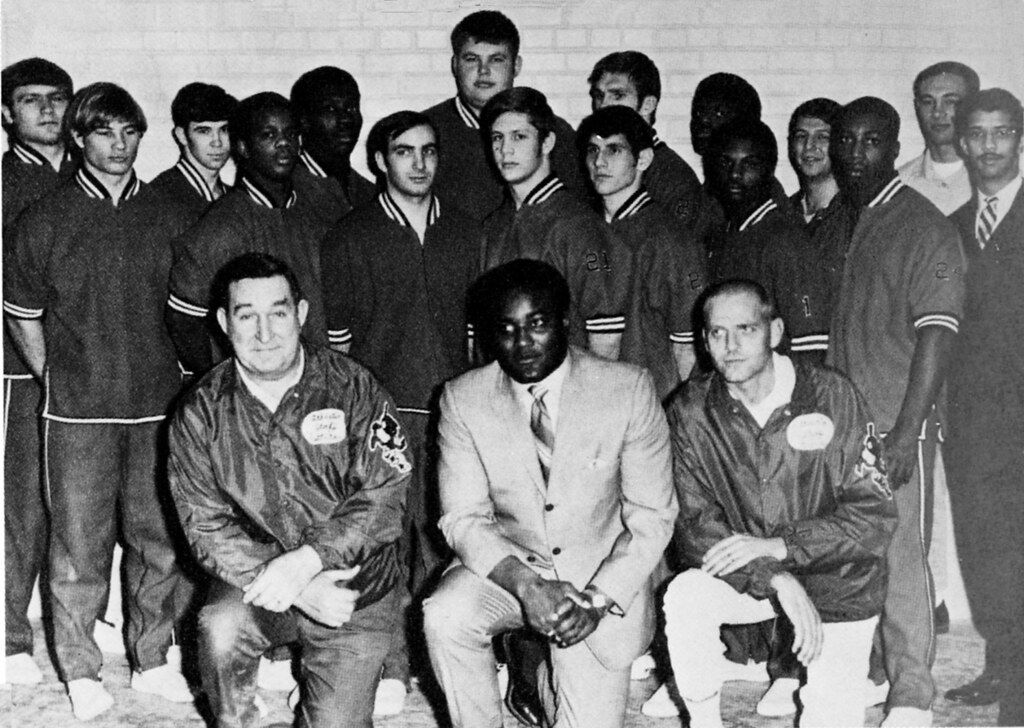
Don Benning: Man of Steel (from my Omaha Black Sports Legends series, Out to Win: The Roots of Greatness)
©by Leo Adam Biga
Originally published in The Reader (www.thereader.com) as part of my Omaha Black Sports Legends series, Out to Win: The Roots of Greatness)
Wrestling is a proving ground. In an ultimate test of will and endurance, the wrestler first battles himself and then his opponent until one is left standing with arms raised overhead in victory. In a life filled with mettle-testing experiences both inside and outside athletics, Don Benning has made the sport he became identified with a personal metaphor for grappling with the challenges a proud, strong black man like himself faces in a racially intolerant society.
A multi-sport athlete at North High School and then-Omaha University (now UNO), the inscrutable Benning brought the same confidence and discipline he displayed as a competitor on the mat and the field to his short but legendary coaching tenure at UNO and he’s applied those same qualities to his 42-year education career, most of it spent with the Omaha Public Schools. Along the way, this man of iron and integrity, who at 68 is as solid as his bedrock principles, made history.
At UNO, he forged new ground as America’s first black head coach of a major team sport at a mostly white university. He guided his 1969-70 squad to a national NAIA team championship, perhaps the first major team title won by a Nebraska college or university. His indomitable will led a diverse mix of student-athletes to success while his strong character steered them, in the face of racism, to a higher ground.
When, in 1963, UNO president Milo Bail gave the 26-year-old Benning, then a graduate fellow, the chance to he took the reins over the school’s fledgling wrestling program, the rookie coach knew full well he would be closely watched.
“Because of the uniqueness of the situation and the circumstances,” he said, “I knew if I failed I was not going to be judged by being Don Benning, it was going to be because I was African-American.”
Besides serving as head wrestling coach and as an assistant football staffer, he was hired as the school’s first full-time black faculty member, which in itself was enough to shake the rafters at the staid institution.
“Those old stereotypes were out there — Why give African-Americans a chance when they don’t really have the ability to achieve in higher education? I was very aware those pressures were on me,” he said, “and given those challenges I could not perform in an average manner — I had to perform at the highest level to pass all the scrutiny I would be having in a very visible situation.”
Benning’s life prepared him for proving himself and dealing with adversity.
“The fact of the matter is,” he said, “minorities have more difficult roads to travel to achieve the American Dream than the majority in our society. We’ve never experienced a level playing field. It’s always been crooked, up hill, down hill. To progress forward and to reach one’s best you have to know what the barriers or pitfalls are and how to navigate them. That adds to the difficulty of reaping the full benefits of our society but the absolute key is recognizing that and saying, ‘I’m not going to allow that to deter me from getting where I want to get.’ That was already a motivating factor for me from the day I got the job. I knew good enough wasn’t good enough — that I had to be better.”
Shortly after assuming his UNO posts his Pullman Porter father and domestic worker mother died only weeks apart. He dealt with those losses with his usual stoicism. As he likes to say, “Adversity makes you stronger.”
Toughing it out and never giving an inch has been a way of life for Benning since growing up the youngest of five siblings in the poor, working-class 16th and Fort Street area. He said, “Being the only black family in a predominantly white northeast Omaha neighborhood — where kids said nigger this or that or the other — it translated into a lot of fights, and I used to do that daily. In most cases we were friends…but if you said THAT word, well, that just meant we gotta fight.”

Despite their scant formal education, he said his parents taught him “some valuable lessons scholars aren’t able to teach.” Times were hard. Money and possessions, scarce. Then, as Benning began to shine in the classroom and on the field (he starred in football, wrestling and baseball), he saw a way out of the ghetto. Between his work at Kellom Community Center, where he later coached, and his growing academic-athletic success, Benning blossomed.
“It got me more involved, it expanded my horizons and it made me realize there were other things I wanted,” he said.
But even after earning high grades and all-city athletic honors, he still found doors closed to him. In grade school, a teacher informed him the color of his skin was enough to deny him a service club award for academic achievement. Despite his athletic prowess Nebraska and other major colleges spurned him.
At UNO, where he was an oft-injured football player and unbeaten senior wrestler, he languished on the scrubs until “knocking the snot” out of a star gridder in practice, prompting a belated promotion to the varsity. For a road game versus New Mexico A&M he and two black mates had to stay in a blighted area of El Paso, Texas — due to segregation laws in host Las Cruces, NM — while the rest of the squad stayed in plush El Paso quarters. Terming the incident “dehumanizing,” an irate Benning said his coaches “didn’t seem to fight on our behalf while we were asked to give everything for the team and the university.”
Upon earning his secondary education degree from UNO in 1958 he was dismayed to find OPS refusing blacks. He was set to leave for Chicago when Bail surprised him with a graduate fellowship (1959 to 1961). After working at the North Branch YMCA from ‘61 to ‘63, he rejoined UNO full-time. Still, he met racism when whites automatically assumed he was a student or manager, rather than a coach, even though his suit-and-tie and no-nonsense manner should have been dead giveaways. It was all part of being black in America.
To those who know the sanguine, seemingly unflappable Benning, it may be hard to believe he ever wrestled with doubts, but he did.
“I really had to have, and I didn’t know if I had it at that particular time, a maturity level to deal with these issues that belied my chronological age.”
Before being named UNO’s head coach, he’d only been a youth coach and grad assistant. Plus, he felt the enormous symbolic weight attending the historic spot he found himself in.
“You have to understand in the early 1960s, when I was first in these positions, there wasn’t a push nationally for diversity or participation in society,” he said. “The push for change came in 1964 with the Civil Rights Act, when organizations were forced to look at things differently. As conservative a community as Omaha was and still is it made my hiring more unusual. I was on the fast track…
“On the academic side or the athletic side, the bottom line was I had to get the job done. I was walking in water that hadn’t been walked in before. I could not afford not to be successful. Being black and young, there was tremendous pressure…not to mention the fact I needed to win.”
Win his teams did. In eight seasons at the helm Benning’s UNO wrestling teams compiled an 87-24-4 dual mark, including a dominating 55-3-2 record his last four years. Competing at the NAIA level, UNO won one national team title and finished second twice and third once, crowning several individual national champions. But what really set UNO apart is that it more than held its own with bigger schools, once even routing the University of Iowa in its own tournament. Soon, the Indians, as UNO was nicknamed, became known as such a tough draw that big-name programs avoided matching them, less they get embarrassed by the small school.
The real story behind the wrestling dynasty Benning built is that he did it amid the 1960s social revolution and despite meager resources on campus and hostile receptions away from home. Benning used the bad training facilities at UNO and the booing his teams got on the road as motivational points.
His diverse teams reflected the times in that they were comprised, like the ranks of Vietnam War draftees, of poor white, black and Hispanic kids. Most of the white athletes, like Bernie Hospodka, had little or no contact with blacks before joining the squad. The African-American athletes, empowered by the Black Power movement, educated their white teammates to inequality. Along the way, things happened — such as slights and slurs directed at Benning and his black athletes, including a dummy of UNO wrestler Mel Washington hung in effigy in North Carolina — that forged a common bond among this disparate group of men committed to making diversity work in the pressure-cooker arena of competition.
“We went through a lot of difficult times and into a lot of hostile environments together and Don was the perfect guy for the situation,” said Hospodka, the 1970 NAIA titlist at 190 pounds. “He was always controlled, always dignified, always right, but he always got his point across. He’s the most mentally tough person you’d ever want to meet. He’s one of a kind. We’re all grateful we got to wrestle for Don. He pushed us very hard. He made us all better. We would go to war with him anytime.”
Brothers Roy and Mel Washington, winners of five individual national titles, said Benning was a demanding “disciplinarian” whom, Mel said, “made champions not only on the mat but out there in the public eye, too. He was more than a coach, he was a role model, a brother, a father figure.” Curlee Alexander, 115-pound NAIA titlist in 1969 and a wildly successful Omaha prep wrestling coach, said the more naysayers “expected Don to fail, the more determined he was to excel. By his look, you could just tell he meant business. He had that kind of presence about him.”
Away from the mat, the white and black athletes may have gone their separate ways but where wrestling was concerned they were brothers rallying around their perceived identity as outcasts from the poor little school with the black coach.
“It’s tough enough to develop a team to such a high skill level that they win a national championship if you have no other factors in the equation,” Benning said, “but if you have in the equation prejudice and discrimination that you and the team have to face then that makes it even more difficult. But those things turned into a rallying point for the team.
“The white and black athletes came to understand they had more commonalities than differences. It was a sociological lesson for everyone. The key was how to get the athletes to share a common vision and goal. We were able to do that. The athletes that wrestled for me are still friends today. They learned about relationships and what the real important values are in life.”
His wrestlers still have the highest regard for him and what they shared.
“I don’t think I could have done what I did with anyone else,” Hospodka said. “Because of the things we went through together I’m convinced I’m a better human being. There’s a bond there I will never forget.” Mel Washington said, “I can’t tell you how much this man has done for me. I call him the legend.” The late Roy Washington, who changed his name to Dhafir Muhammad, said, “I still call coach for advice.” Alexander credits Benning with keeping him in school and inspiring his own coaching/teaching path.
After establishing himself as a leader Benning was courted by big-time schools to head their wrestling and football programs. Instead, he left the profession in 1971, at age 34, to pursue an educational administration career. Why leave coaching so young? Family and service. At the time he and wife Marcidene had begun a family — today they are parents to five grown children and two grandkids — and when coaching duties caused him to miss a daughter’s birthday, he began having second thoughts about the 24/7 grind athletics demands.
Besides, he said, he was driven to address “the inequities that existed in the school system. I thought I could make a difference in changing policies and perhaps making things better for all students, specifically minority students. My ultimate goal was to be superintendent.”

Working to affect change from within, Benning feels he “changed attitudes” by showing how “excellence could be achieved through diversity.” During his OPS tenure, he operated, just like at Omaha University, “in a fish bowl.” Making his situation precarious was the fact he straddled two worlds — the majority culture that viewed him variously as a token or a threat and the minority culture that saw him as a beacon of hope.
But even among the black community, Benning said, there was a militant segment that distrusted one of their own working for The Man.
“You really weren’t looked upon too kindly if you were viewed as part of the system,” he said. “On the other side of it, working in an overwhelmingly majority white situation presented its own particular set of challenges.”
What got him through it all was his own core faith in himself. “Evidently, some people would say I’m a confident individual. A few might say I’m arrogant. I would say I’m highly confident. I can’t overemphasize the fact you have to have a strong belief in self and you also have to realize that a lot of times a leader has to stand alone. There are issues and problems that set him or her apart from the crowd and you can’t hide from it. You either handle it or you fail and you’re out.”
Benning handled it with such aplomb that he: brought UNO to national prominence, laying the foundation for its four-decade run of excellence on the mat; became a distinguished assistant professor; and built an impressive resume as an OPS administrator, first as assistant principal at Central High School, then as director of the Department of Human-Community Relations and finally as assistant superintendent.
During his 26-year OPS career he spearheaded Omaha’s smooth desegregation plan, formed the nationally recognized Adopt-a-School business partnership and advocated for greater racial equity within the schools through such initiatives as the Minority Intern Program and the Pacesetter Academy, an after school program for at-risk kids. Driving him was the responsibility he felt to himself, and by extension, fellow blacks, to maximize his and others’ abilities.

“I had a vision and a mission for myself and I set about developing a plan so I could reach my goal, and that was basically to be the best I could be. As a coach and educator what I have really enjoyed is helping people grow and reach their potential to be the best they can be. That’s my goal, that’s my mission, and I try to hold to it.”
His OPS career ended prematurely when, in 1997, he retired after being snubbed for the district’s superintendency and being asked by current schools CEO John Mackiel to reapply for the assistant superintendent’s post he’d held since 1979. Benning called it “an affront” to his exemplary record and longtime service.
About his decision to leave OPS, he said, “I could have continued as assistant superintendent, but I chose not to because who I am and what I am is not negotiable.” A critic of neighborhood schools, he did not bend on a practice he deems detrimental to the quality of education for minorities. “I compromised on a lot of things but not on those issues. The thing I’ve tried not to do, and I don’t think I have, is negotiate away my integrity, my beliefs, my values.”
Sticking to his guns has exacted a toll. “I’ve battled against the odds all my life to achieve the successes I have and there’s been some huge prices to pay for those successes.”

Curlee Alexander
His unwavering stances have sometimes made him an unpopular figure. His staunch loyalty to his hometown has meant turning down offers to coach and run school districts elsewhere. His refusal to undermine his principles has found him traveling a hard, bitter, lonely road, but it’s a path whose direction is true to his heart.
“I found out long ago there were things I would do that didn’t please every one and in those types of experiences I had to kind of stand alone or submit. I developed a strong inner being where I somewhat turned inward for strength. I kind of said to myself, I just want to do what I know to be right and if people don’t like it, well, that’s the way it is. I was ready to deal with the consequences. That’s the personality I developed from a very young age.”
Those who’ve worked with Benning see a man of character and conviction. Former OPS superintendent Norbert Schuerman described him as “proud, determined, disciplined, opinionated, committed, confident, political,” adding, “Don kept himself very well informed on major issues and because he was not bashful in expressing his views, he was very helpful in sensitizing others to race relations. His integrity and his standing in the community helped minimize possible major conflicts.”
OPS Program Director Kenneth Butts said, “He’s a very principled man. He’s very demanding. He’s very much about doing what is right rather than what is politically expedient. He cares. He’s all about equity and folks being treated fairly.”
After the flap with OPS Benning left the job on his own terms rather than play the stooge, saying, “The Omaha Public Schools situation was a major disappointment to me…To use a boxing analogy, it staggered me, but it didn’t knock me down and it didn’t knock me out. Having been an athlete and a coach and won and lost a whole lot in my life I would be hypocritical if I let disappointment in life defeat me and to change who I am. I quickly moved on.”
Indeed, the same year he left OPS he joined the faculty at the University of Nebraska-Lincoln, where he is coordinator of urban education and senior lecturer in educational administration in its Teachers College. In his current position he helps prepare a new generation of educators to deal with the needs of an ever more diverse school and community population.
Even with the progress he’s seen blacks make, he’s acutely aware of how far America has to go in healing its racial divide.
“This still isn’t a color-blind society. I don’t say that bitterly — that’s just a fact of life. But until we resolve the race issue, it will not allow us to be the best we can be as individuals and as a country,” he said.
As his own trailblazing cross-cultural path has proven, the American ideal of epluribus unum — “out of many, one” — can be realized. He’s shown the way.
“As far as being a pioneer, I never set out to be a part of history. I feel very privileged and honored having accomplished things no one else had accomplished. So, I can’t help but feel that maybe I’ve made a difference in some people’s lives and helped foster inclusiveness in our society rather than exclusiveness. Hopefully, I haven’t given up the notion I still can be a positive force in trying to make things better.”
Related Articles
- Coaching diversity slowly rising at FBS schools (thegrio.com)
- University regents approve Nebraska-Omaha’s D-I move (sports.espn.go.com)
- UNO Wrestling Dynasty Built on a Tide of Social Change (leoadambiga.wordpress.com)
The Fighting Hernandez Brothers

Image via Wikipedia
Another of my boxing stories is featured here, this time about a family of fighters, the Hernandez brothers. It’s a story of overcoming odds, winning great victories, enduring brutal losses, experiencing tragic events, and, where possible, keeping on despite all the blows. Rarely has a single family produced as many good boxers as this one did, but as the story goes into, there was a price to be paid. The article originally appeared in a paper that no loner exists, the Omaha Weekly. Boxing seems to give journalists license to take a more literary approach and I pulled out all the stops in this one.
NOTE: The Hernandez brother who was perhaps the most accomplished in the ring, Art Hernandez, passed away recently. He was a world-ranked contender for a time, holding his own with some tough hombres. He once fought an aging but still dangerous Sugar Ray Robinson to a disputed draw in Omaha. Most observers felt Art should have been given the decision.
The Fighting Hernandez Brothers
©by Leo Adam Biga
Originally published in the Omaha Weekly
Armed with fists of fury and cajoles of brass, the Fighting Hernandez brothers strode into town from the sun-baked Panhandle to whip nearly all comers in Omaha ring events from the late 1950s through the mid-1970s. Ferd, Art and Dale Hernandez each left their mark on the amateur and professional boxing scene, not only here, but regionally and nationally as well. The brothers’ lives inside the ropes were filled with more than the usual pugilistic triumph and failure. Three of them achieved Top 10 rankings — Dale as a lightweight and both Ferd and Art as middleweights. They fought all over the globe. They crossed gloves with several world champions, including some legends. They held titles. They got robbed of some decisions. An injury ended the career of one. A bad beating spelled the beginning of the end for another. A fourth brother, Chuck, never really had the heart for boxing and quit after a brief and uneventful career.
Life outside the ring has also held more than its share of highs and lows. There have been wives, girlfriends, kids, breakups. Separated by a year in age and quite a bit older than their male siblings, Ferd and Art were fast buddies and, by all accounts, bad influences on each other — indulging in vices that fighters-in-training are supposed to avoid. “We had too much fun together,” Art said from the south Omaha home he shares with his wife, Mary, and their children. “We were bad — that’s for sure. I guess we had no will power.” He said things got so bad even his big brother realized it was best if he moved on. “He knew that if we were together we wouldn’t be right, so he went west. The greatest thing he ever did for himself and for me was to get the hell out of town.” Ferd went to Las Vegas of all places.
After compiling a 35-10-3 record as a pro, Ferd incurred a detached retina that forced him to retire early at age 33. He stayed on in Vegas, becoming a main event referee, a straight man in the “Minsky’s Burlesque” show at the Aladdin and a casino bartender, before contracting liver disease that killed him at 57. Art finished with a 44-20-2 pro mark. In his post-boxing life he worked the security detail at Douglas County Hospital, often responding to calls in the psyche ward, before becoming chief of security. A freak accident in 1997 led to his left leg’s amputation. Dale, the hardest puncher of the bunch, slugged his way to a 37-6 pro record, but his disdain for training led him to quit before ever maxing-out his ability. A trucker by trade, Dale has spent the last several years in and out of prison for assault. Today, he is persona non grata with his surviving brothers.
Born in Minatare, Neb., Art and Ferd moved with their family to Sidney, where the Hernandez boys were weaned on The Sweet Science by their father, Perfecto “Pete,” a former glove man himself. The old man worked his sons hard. For Perfecto, now caring for his Alzheimer’s-stricken wife and the mother of his six children, Rebecca, in Cheyenne, Wyo., boxing was an art form whose object was skillfully avoiding being hit while laying leather on your opponent. “His thing about boxing was defense,” said Art, the only brother still living in-state and, according to some local ring observers, the best boxer, pound-for-pound, produced by Nebraska the past 40 years. “His philosophy was, ‘Hit, and don’t get hit.’ We just moved and moved and moved and threw a lot of jabs. He never yelled. He just told you exactly what you were doing wrong. ‘Throw more jabs, boy. Throw more upper cuts, boy.’ It was always, ‘boy.’”
From the time they were 5 and 6 years old, respectively, Art and Ferd were urged to scrap by the old man, who fashioned a makeshift ring at home and ran a gym Sidney boxing boosters built for him in town. “That’s where we learned everything that we knew. There were always fights,” is how Art describes those early years. “He had us sparring all the time. He was a great inspiration.” The two tykes became a kind of novelty opening act on local fight cards when their dad had them fight exhibition matches before regularly scheduled bouts. Art said that while definitely pushed into boxing, he genuinely liked the sport and only threatened quitting once under his father’s heavy hand, “but it never happened.”
As the brothers began dominating the junior boxing circuit, they quickly made names for themselves as tough little hombres. The Midwest Golden Gloves tournament, once a huge draw at the Civic Auditorium, became their personal showcase. They represented the southwest Nebraska district out of Scottsbluff. Art so outclassed the field he became the first fighter to win five Midwest Gloves titles and, after capturing his fifth, tourney officials told the then-19 year-old he was not welcome back. Ferd won two Midwest crowns and used the second as a springboard to do something his younger brother could not — win a national Golden Gloves championship (taking the 1960 welterweight division title in Chicago). Despite the brothers being virtually the same size, their father kept them in separate weight divisions for good reasons: one, to double the family’s chances at winning trophies and titles; and, two, to placate Mama Hernandez, who forbade her sons from ever fighting each other “for real.”
Fresh off his championship, Ferd, along with Art, competed for spots on the 1960 United States Olympic boxing team during tryouts in Pocatello, Idaho. At the tryouts Ferd lost in the finals and Art bowed out in the first round. While their bid for Olympic glory ended before it could begin, they scored a coup when Idaho State University boxing coach Dubby Holt, scouting prospects for his program, offered them scholarships. “He wanted a brother team and, so, we said, ‘Sure, why not?’ and we went there,” Art said. Things did not pan out for the pair in Pocatello, where they spent more time carousing than working, a pattern that played out over and over again whenever they teamed-up. Back home for Christmas break, Perfecto sized up his sons and determined while they were not cut out for school, they just might have the right stuff for prizefighting.
Art turned pro first, signing with Omaha promoter Lee Sloan, who acted as his manager and matchmaker. “When I turned pro, Sloan asked me, ‘Do you think you can be a world champion?’ And I said, ‘Yeah.’ He said, ‘Well, then, you’re mine.’ That was a motivating thing my whole life.” He trained under the tutelage of veteran handler Sammy Musco, a former prizefighter. Musco refined his punching style. “When he first started training me, my left hook used to come all the way around, where his style of fighting was to stay in tight and just throw it with leverage. Just a real short punch. It worked all the time. He was a good trainer — no doubt about it. He’d make you work and make you work.”
Ferd entered the prizefighting arena a few months after Art’s debut. Once Art overcame those nagging doubts to resume his career, he and Ferd notched a few more wins under their belts. Then, according to local boxing historian and former matchmaker Tom Lovgren, their shared manager, Sloan, decided one or the other had to go. It seems the two were raising such hell together that, in Sloan’s view, they were holding each other back and, so, he decided to separate these modern Corsican Brothers. He reportedly asked a promoter friend to overmatch the boys, vowing to keep the one showing the most poise in defeat. The fights were made and, as expected, each lost. The verdict: Art stayed on, while Ferd left for Las Vegas, just then evolving into a hot fight market.
By the mid-60s the brothers’ careers began taking off — each emerging as middleweight contenders. Before long, they were fielding offers to fight each other. “Yeah, we had offers,” Art said. “Well, he was rated No. 2 and I was No. 3. I asked my dad what he thought about it and he said, ‘Hey, you’re in the game for money. If the money’s right, take it.’ But, you know, our mom said, ‘No,’ and that was it.” In 1964, a young, inexperienced but promising Art got his first brush with immortality when matched with six-time world champ Sugar Ray Robinson, by then in his 40s but, as the saying goes, possessing every trick in the book. When the fight was initially made, Hernandez admits he felt intimidated by the Robinson legend. “When my handlers first mentioned the fight I thought, ‘I’m going to be killed,’ but then as I was training I got in terrific shape and I thought, ‘Well, shit, I’ve got nothin’ to lose — I’ll give it all I got.’ Which I did.” A steamy Civic Auditorium was the site of the 10-rounder, which went the distance and ended in controversy when a cagey Robinson, sensing he was behind, twice hit Hernandez below the belt. No fouls were called, much to the fans’ dismay. “I’m sure he hit me below the belt intentionally, but…that’s the fight game, you know?” Hernandez said.
Most ringside observers gave the decision to Hernandez, but the judges scored the fight a draw. “I won that fight. There’s no doubt about it,” Hernandez said. “I boxed him superbly, and then he tried making a butt of me. He slipped a punch one time and spun a little bit and slapped me on the ass. It made the crowd laugh.” He said while Robinson was ring savvy, his arsenal had little else left. “He didn’t have real hard, sharp punches. It was mostly slapping stuff. He never hurt me.”
Mere months after that tussle, Hernandez’s manager, Sloan, died of a massive heart attack. “That broke my heart,” he said. For the next few years he fought for Dick Noland, also the manager of heavyweight Ron Stander, who often sparred with Hernandez at the old Fox Hole Gym and once said of his much smaller and more agile partner, “He’s harder to hit than a handful of rice.”
Ferd was at the Robinson fight and after seeing how well his kid brother performed he grew confident he too could trade leather with the best. He proved his point a year later by winning a split-decision over Sugar Ray at the Hacienda Hotel, among the venues Ferd headlined at during the “Strip Fight of the Week” cards his promoter, Bill Miller, founded. Although both brothers became top contenders in the middleweight division, neither ever got a title shot. Art always felt Ferd hampered his chances by letting his Las Vegas camp change his style from the pure boxing stratagem their father instilled to more of a close-in style ill-suited to him. “That was his downfall. Instead of moving and boxing and slipping punches, he became a come-in fighter. He got hit too much. Then, he got that detached retina (in 1968). It’s too bad…he was a terrific boxer.” As for himself, Art chalks up his lost opportunities to ring politics, bad breaks and stupid choices. In a career of what-might-have-beens, he was often only one win away from landing a championship bout, but could never quite close the deal.
Perhaps his biggest frustration came in a 1969 duel with former champ Emile Griffith, then still in his prime. Fought in Sioux Falls, S.D., the well-boxed bout went the full 10 rounds and, in a reversal of popular opinion, Griffith was given a split decision. “The fight was a good fight,” Hernandez recalled. “I loved it. He was well-versed in boxing. I can remember bulling him into the ropes and throwing a lot of body punches, which is something I never did. I just saw where he was susceptible to it.” As against Robinson, Hernandez felt he clearly won, but again fell victim to scoring vagaries. “I don’t think it was close at all. Those yokels that judged the fight for Griffith were completely out of line.” What hurt most, he said, was the fact a victory might have set-up a title challenge. “I knew I was at my peak when I fought Griffith. If I had won that fight I probably could have fought for a world championship.” In the end, he said, “I guess I wasn’t impressive enough. There’s a lot of politics in boxing with the judging and the ratings and all that kind of crap.”
Hernandez had other chances to catapult himself into a title slot, but he always came up short, whether it was bad breaks or just plain bad habits. For example, a cut he suffered to his eye forced the stoppage of his first fight with world champ Nino Benvenuti in Rome and a leg injury he suffered in preparation for his second fight with Benvenuti in Toronto hampered his movement during the 10-round fight, which he lost by unanimous decision. The night before his match with former champ Denny Moyer in Oakland, Art reverted to his old ways by partying with Ferd. He paid for it in the ring the next night, losing a unanimous 12-round decision. He had more than his share of success, too, twice winning the North American Boxing Federation middleweight title and evening the score with Moyer in a 12-round decision in Des Moines. Ferd also faced the best, losing to Benvenuti and Luis Rodriguez, beating Robinson and boxing to a draw with Jose Gonzalez for the World Boxing Association American middleweight title in Puerto Rico in 1966.
Art’s toughest opponent? “That would have to be Jimmy Lester. He never stopped coming. I was in very good shape for that fight, but God, he would just pump and pump and pump. He was a tough guy. He beat me in a split decision.” Hernandez said while he never made much money fighting, and didn’t care much about the size of his purses anyway, boxing did let him see the world. His favorite stop? Marseilles, France. “The Mediterranean. Beautiful, man.” The worst stop? Vietnam, where he went as part of a USO tour during the war. “It was really disheartening to see all those kids in hospitals with their arms and legs shot off. It was terrible.”
While an injury forced Ferd to stop fighting, it took Art getting KO’d three consecutive fights to finally call it quits in 1973. “Bennie Brisco stopped me in three. Jean-Claude Bouttier stopped me in nine. And, in the last fight I had, Tony Licata stopped me in eight. After that, I thought, ‘Well, there’s no place else to go.’ So, I just gave it up.” He made an aborted comeback attempt when he started sparring with his up-and-coming brother Dale. “Once, he hit me somewhere on my head and I just tingled all over. I took the gloves off and said ‘That’s it. I’m done forever.’” He turned his attention to helping train Dale, the last great fighter in the Hernandez line. Where Ferd and Art were consummate boxers, Dale was a classic slugger. “He was a terrific puncher,” said Art, who often worked his corner. “Dale’s whole idea was he could knock anybody out and so he didn’t think he had to train too much. That was his problem.” The approach worked well enough for a time, with Dale securing a No. 9 world lightweight ranking, but the gambit caught up to him in a junior welterweight bout against Lennox Blackmoore. The sight of his brother beaten to a pulp at the hands of the counter punching Blackmoore was too much for Art to take. “I about had a heart attack in that corner because he got the shit beat out of him. I told Dale at the end of the fight, ‘I’m done working in your corner. I will not take it anymore.’ I never worked his corner again.”
After that thumping, Dale was never the same again, falling farther and farther off the training wagon. Away from boxing, Dale’s behavior spiraled violently out of control. He has done hard time for a series of aggravated assaults, the latest of which finds him serving a stretch in a Cheyenne, Wyo. jail. He is estranged from his once close-knit family. “I don’t know what his problem is. I have nothing to do with him anymore,” Art said. “I don’t even talk to him.” Just thinking of what his brother once was and could have been makes Art sick. “He could have been world champion. At 135 pounds he could whip anybody in the world. At 142 pounds he was too small. But he wouldn’t train to get down to 135. He wanted to play.”
With Dale out of the picture and Chuck living quietly in Des Moines, Art pined for the old days with Ferd, but they were separated by miles and lifestyles. Then, when Ferd became terminally ill in the mid-90s, Art and his wife Mary, a nurse, flew him out to Omaha. The change in the former world-class athlete was drastic. “I did not recognize him,” Art said. The couple cared for him the last three weeks of his life. He died in their home on July 17, 1996. Most of all, Art misses his brother’s “sense of humor. He was a funny guy.”
Two years later Art experienced the next biggest test of his life when, while clearing storm-strewn branches from the roof of his father-in-law’s house, he slipped and fell to the pavement below, his lower left leg shattering upon impact. He underwent eight surgeries to repair the damage. Then his recovery suffered a severe setback when infection set-in. Faced with months more of painful rehab and the possibility of infection redeveloping, he opted to have the leg amputated below the knee. “I knew that in order to get well, it had to be done,” he said, massaging the stub under the prosthetic he wears. He fought depression. “A lot of times I thought, ‘What am I doing here?’” He credits his wife for seeing him through it all. “If it weren’t for this woman, I’d be dead.” Friends helped, too. His old sparring chum, Ron Stander, hooked Hernandez up with another ex-athlete amputee — legendary pro wrestler “Mad Dog” Vachon, who lives in Omaha. “Ron called me and said, ‘I’m going to take you to Mad Dog’s because he’s got a leg like yours,’ and from there we become friends.” Hernandez made a quick recovery, resuming work four months later. He retired a couple years ago and, today, draws a county pension, enjoys watching televised fights and, like many old jocks, doubts this era’s competitors could have stacked-up with his generation of warriors.
In an era when boxing is largely dead in the state, Hernandez is the last link to one of Nebraska’s great sports dynasties. Leave it to Omaha boxing historian Tom Lovgren to put the family boxing legacy in perspective. About Art and Ferd, he said, “They could step up to fight anybody in the world. They showed no fear. They were animals.” About Dale, he reminds us, “At 135 pounds, he could beat anybody in the world.” Today, many pounds over his fighting trim, Art Hernandez battles diabetes and high blood pressure, but this still proud man is not one to wallow in Why me? pity. “Things happen,” he said, “and you just gotta go with the flow.”
Related Articles
- Golden Gloves…& golden heart (nydailynews.com)
- Gildardo Garcia finds redemption in ring and in life (denverpost.com)
- “The Latin Snake” Sergio Mora Could Bite Shane Mosley In Three Weeks (bleacherreport.com)
Wright On, Adam Wright Has it All Figured Out Both On and Off the Football Field
Though not a sports writer per se, I love writing about sports and I think I have a certain flair for it. So while I write about anything and everything in the course of a typical year, and certainly do not specialize in sportswriting, I like to keep my hand in it. The following article is an example from about nine or 10 years ago. The subject is an impressive young man named Adam Wright who made his mark on the football field at Omaha Nigh High and at the University of Nebraska at Omaha, my alma mater, as a running back. He wasn’t recruited by the University of Nebraska-Lincoln but the way he developed and dominated at the Division II level at UNO he certainly indicated he could have excelled in Division I and helped the Huskers. He even made it all the way to the National Football League as a free agent, but successive knee injuries stopped him in his tracks before he ever got to play a down. This story originally appeared in the Omaha Weekly, a paper that no longer exists.
 |
Wright On, Adam Wright Has it All Figured Out Both On and Off the Football Field
©by Leo Adam Biga
Originally published in the Omaha Weekly
Adam Wright has been so indestructible for the streaking UNO Maverick football team this year that no one foresaw this walking Adonis being sidelined by injury. After all, the senior has been the one constant and main workhorse for the often sputtering UNO offense in 2000, lugging the ball 30 times per contest the first seven outings. Time and again, the big bruising tailback with the ripped body crashed into a human wall at the line of scrimmage and came out the other side still intact, if not unscathed. He has taken many hard knocks, but delivered some too, usually leaving a litter of bodies in his wake. “I take pride in knowing I’m not going to be stopped by any one guy, no matter who he is, no matter how big he is,” Wright said. “I’m always looking to turn into somebody to dish out some punishment.”
But Wright, a bright and amiable student-athlete with a career in engineering (he is a civil engineering major) awaiting him if a hoped-for stint in pro football fizzles, was not always so assertive. The Omaha North High School graduate played quarterback as a prepster and arrived at UNO lacking the requisite toughness to be a hard-nosed tailback. As a freshman, he was even moved to wide receiver for a week. His passivity on the field was an off-shoot of his desire to blend in off it, where he grew up in an interracial home struck by tragedy. After losing his father at age 8, he watched his two older siblings make some bad life choices and set about being a model child for the sake of his mother.
He did anything to avoid being branded a troublemaker, even to the point of not using his God-given size to run over smaller players on the gridiron. Even after bulking up in college from 195 to his present 230 pounds, the 6’1 back steered clear of putting all of himself into runs. It took an attitude change, plus watching tapes of great backs, before he became the physical runner he is today. UNO Offensive Coordinator Lance Leipold recalls a heart-to-heart talk he had with his ballcarrier: “I said, ‘You’ve built yourself into this big back, now you’ve got to play like one.’” He said Wright, a devoted weightlifter, now not only “finishes off runs” but possesses a keen sense for the game: “He’s learned the blocking schemes better. He knows what’s really happening up front — where the hole is going to hit.”
His brute-force style, smarts and occasional breakaway speed (He cut his 40-yard dash time by two-tenths of a second over the summer — to a 4.7 electronic.), put Wright atop the NCAA Division II individual rushing chart for a time and allowed him to shatter UNO’s career rushing mark. He has 1,216 yards this season (just 100 yards short of the UNO single season record) and 3,761 overall. Earlier this year he recorded a stretch of three straight 200-yard-plus rushing performances. It’s been that kind of productivity that’s made him a regional finalist for the Harlon Hill Trophy (Division II’s Heisman).
By mid-season, he was a bruised but unbowed target for opposing defenses, absorbing hit upon hit but always picking himself up off the turf to get back into the fray. More often than not, tacklers were worn down by game’s end, not him.
Late, when defenses are tiring, he said, “you go for the kill. You put your head down a little lower, squeeze the ball tighter, fire out and go stronger.” Indeed, his late game heroics sealed wins against Northern Colorado and South Dakota. But with one twist of the knee early in the first quarter of UNO’s October 28 game versus South Dakota State, Wright went down in a heap, the medial collateral ligament in his left knee sprained. The injury happened on his first carry, a draw designed to go up the middle that he bounced wide. A defensive back came up on the play, making helmet contact just below Wright’s bent knee. As Wright tried to pull out of the tackle, his leg extended back and he felt his knee “wobble.” Playing in pain all season from tendinitis, he stayed in for a second carry, then with the knee only “getting worse,” he limped off, unable to return to a game UNO won 24-7 thanks in part to the steady play of his backup, redshirt freshman Justin Kammrad.
After week-long treatments, Wright was available for emergency duty last Saturday but with UNO dominating and Kammrad running wild (for a school record 239 yards) in a 45-7 win over Augustana. Wright did not see action. Instead, he nervously paced the sidelines — loudly encouraging his teammates. He should be close to full strength for this Saturday’s regular season finale at home against Top 20 foe and North Central Conference rival North Dakota (8-2). A healthy Wright will be a timely addition, as the 1 p.m. contest at Al Caniglia Field has major regional and national implications. Featuring a swarming defense that allows less than 10 points a game and a battering-ram offense that runs the ball down opponents’ throats, No. 5 UNO, now 9-1 and on a nine-game winning streak, is poised to capture just its second outright NCC title ever and to secure home field for the opening rounds of the NCAA playoffs. With their go-to guy back, look for the Mavs to feed the ball to No. 6 and, if his knee holds up, to ride his strong back as many times as needed.
Wright will gladly bear the load, too. “If it takes 40 carries for our offense to be successful, then give it to me 40 times,” he said. Following a 37-carry, 151-yard performance versus UNC on October 7, including gaining 38 yards on a crucial 4th quarter drive, Wright gouged South Dakota for 130 yards on 34 attempts the very next week. The more carries he gets, the more he starts “getting into a rhythm.” When he and his linemen get into that flow, running turns effortless. “It seems like once the ball is snapped, I’m beyond the hole. I’m in the secondary already. It’s kind of weird. It’s like, all of a sudden I’m there. I don’t even remember the run.”
The last few minutes of the SDU game offered another gut-check for UNO and Wright when, tied 7-7 in the 4th, the Mavs ground out two drives — with Wright the main weapon — to secure a 21-7 victory. With only minutes left, he was feeling the effects of all the pounding, but refused to sit out for even a play. “To tell you the truth, there was a point in time when I got up really slow and I was pretty sore. It was ridiculous. It was like being hit by a car — twice. My teammates were telling me in the huddle to get out of the game, but I knew J.J. (reserve tailback James Johnson) had sprained his knee and that Justin Kammrad was only a redshirt freshman. I felt I had to stay in. It was a close ballgame. And with only four minutes to go, I was like, ‘Ah, I’ve already been hit 30 times, what’s four more?’” Wright made his last four carries count, too, tearing through a tiring Coyotes defense on a short drive he capped with a nifty 23-yard touchdown run.
Doing whatever it takes has been ingrained in Wright since he lost his father, Jesse, to cancer in 1985. He has fond memories of the man, who was a packing house laborer. “The weird thing is, I can hardly remember his face, but I can remember a lot of lessons he taught me about life — about honesty, about integrity, about loyalty.” Prior to his father’s death, Wright’s mother, Liz, had been a stay-at-home mom. She returned to school (to study nursing) and entered the work force to provide for her three children. The demands took her away from her family more than she wanted. By the time her two oldest kids reached their teens, they were running wild. Adam, the youngest, sat back and saw how much grief his siblings’ behavior caused her and determined he would do nothing to add to her worries.
“My brother and sister pushed the limits to see how far they could go,” he said. “I saw how hard our mom was working just so we could have a chance for a better life and I didn’t want to disappoint her and make all the things she was doing be in vain. I tried not to disappoint anybody. Today, all of us are on the straight and narrow, but we each took different paths to get there.”
Liz Wright, an RN, recalls how as a child Adam displayed a maturity beyond his years. “Adam sort of comes from an underdog situation — being of mixed race, growing up in a poor area of the city and losing his father so young. I could have easily lost him to the crime environment in north Omaha.” She said his coming of age amid the near northside’s gang culture offered real temptations he resisted. “He didn’t take that path. A lot of his friends did. And what I admire most about him now is he doesn’t judge people who live that life. He’s a fair person. He’s kind of a keeper of justice.” Such congeniality, combined with male model good looks and a penchant for doing the right thing (he mentors disadvantaged youths), endear Wright to just about anyone he meets. For example, he was elected co-captain of the football squad and was recently voted vice president of the UNO student government.
His coaches — past and present — uniformly sing his praises. Herman Colvin, the head football coach at North High during Wright’s two years on the varsity there, became a father figure to the player. “He’s somebody I have a tremendous amount of respect and love for,” said Colvin, now assistant principal at Monroe Middle School in Omaha. “I really love the guy. He has made some good choices and I’m really happy with his choices. Has he done a lot to make me proud? He certainly has.” UNO Head Football Coach Pat Behrns said, “Adam’s a great guy. He does any type of public service work we ask him to. He’s great with young people. He’s a very classy young man. We’re going to hate to see him go.” Wright’s position coach, Lance Leipold, added, “He’s been a pleasure to work with because of his outstanding work ethic. He’s done a lot of little things to make himself a very quality back for us. But he’s not going to be one of those guys who’s going to be real frustrated if pro football doesn’t work out. Adam, from day one, has had such a plan in life. Someday, I might be working for him.”
The man instrumental in getting Wright to refuse Division I scholarship offers for UNO, Mid-American Energy CEO and fellow North High alum David Sokol, also commends Wright, whom he speaks of as a kind of protege (Wright has been an intern at Mid-American since 1996). “He has two characteristics I think are particularly important. One is, he has a very high character level. He is very cautious about keeping himself out of situations where, you know, bad things are liable to happen. The second thing is, he is extremely hard working and he has his priorities pretty well laid out. I think he can probably do anything he wants to, whether it’s the NFL or corporate America. We certainly would be more than happy to hire him after graduation.”
Clearly, the NFL is not an all-or-nothing proposition for Wright. It remains what his mom calls “a little boy’s dream.” As Wright himself said, “I’m a realist. I know it’s extremely hard to get there. If the opportunity presents itself, fine. But I’m going to leave my options open and do what’s in the best interests for my future.”
Carrying extra weight as “a cushion” against all the wear and tear he can expect to incur, Wright has his sights set on helping the Mavs make a run for the national title. “The way our defense is playing, if our offense can just control the clock, grind out the yards, get first downs and keep getting in the end zone, we have the potential to win every game.” Being on the sidelines has almost been more than he can take. “It’s killing me. I want to be on the field when we win.” he said. He will do whatever it takes to return. “I’ll argue, scratch and claw to get out there.”
Related Articles
- Georgia Tech 2010 Offensive Preview: Running Backs (bleacherreport.com)
- Arby’s Pick Five should be ready soon (chicagonow.com)
The Two Jacks of the College World Series

Image via Wikipedia
The College World Series underway in Omaha is a major NCAA athletic championship that attracts legions of fans from all over America and grabs gobs of national media attention. With this being the last series played at the event’s home these past 60 years, Rosenblatt Stadium, there’s been more fan and media interest than ever before, although a spate of rain storms actually hurt attendance at the start of this year’s series. Inclement weather or not, the series is a great big love-in with its own Fan Fest. But it didn’t used to be this way. Indeed, for the first three decades of the event, it was a rather small, obscure championship that garnered little notice outside the schools participating. Omaha cultivated the event when few others wanted or cared about it, and all that nurturing has resulted in practically a permanent hold on the event, which has strong support from the corporate community, from the City of Omaha, from service clubs, and from the local hospitality industry. Two key players in securing and growing the series have been a father and son, the late Jack Diesing Sr. and Jack Diesing Jr., and they are the focus of this short story that recently appeared in a special CWS edition of The Reader (www.thereader.com) called The Daily Dugout. I have another story on this site from the Dugout — it features Greg Pivovar, one of the colorful characters who can be found at the series.
The Two Jacks of the College World Series
©by Leo Adam Biga
Originally appeared in The Reader (www.thereader.com)
In 1967 the late Jack Diesing Sr. founded College World Series Inc. as the local nonprofit organizing committee for the NCAA Division I men’s national collegiate baseball championship. He led efforts that turned a small, struggling event into a major national brand for Omaha.
When son Jack Diesing Jr. succeeded him as president, the young namesake continued building the brand as Jack Sr. stayed on as chairman.
While the CSW is not a business, it’s a growing enterprise annually generating an estimated $40-plus million for the local economy. More than 300,000 fans attend and millions more watch courtesy ESPN.
Papa Diesing was around to see all that growth, only passing away this past March at age 92. Jack Jr. said his father, who saw the event’s potential when few others did, never ceased being amazed “by how it kept getting bigger and better. The phrase he always said is, ‘This just flabbergasts me.'”
His father inherited a dog back in 1963. Jack Sr. was a J. L. Brandeis & Sons Department Store executive. His boss, Ed Pettis, chaired the CWS. The event lost money nine of its first 14 years here. When Pettis died, Jack Sr. was asked to take over. He refused at first. No wonder. The CWS was rinky-dink. Nothing about it promised great things ahead. The crowds were miniscule. The interest weak. But under his aegis an economically sustainable framework was put in place.
What’s become a gold standard event had an unlikely person guiding it.
“When my father got involved with the College World Series he had never attended a baseball game in his life. He didn’t really want to do it but basically he agreed to do it because it was the right thing to do for the city of Omaha,” said Jack Jr. “Over a period of time he developed a love affair with not only what it meant for the fans but what it meant for the city and what it meant for the kids playing in it. He always was looking to do whatever we could do here to make the event better for the kids playing the games and the fans attending the games and for the community. And the rest is history.”
“I certainly grew up behind the scenes. I can’t say he was purposely grooming me into anything. It’s just that I was exposed to the College World Series ever since I moved back into town in 1975. I’d go to the games, I was involved in sports in school and still was an avid sports follower after I got back.”
Diesing said the same sense of civic duty and love of community that motivated his father motivates him.
He still marvels at his father’s foresight.
“One of the things people credited him for was having tremendous vision about how to set up the infrastructure and make sure we had an organization moving forward that would stand the test of time. And he thought it would make sense to carry on a tradition with his son following him, and that was another thing he was right about.”
His father not only stabilized the CWS but set the stage for its prominence by partnering with the city and the local business community to placate the NCAA by investing millions in Rosenblatt Stadium improvements to create a showcase event for TV.
College baseball coaching legend Bobo Brayton admired how Jack Sr. nurtured the CWS. “I think he was the single person that really kept the world series there in Omaha. I went to a lot of meetings with Jack, I know how he worked. First, he’d feed everybody good, give them a few belts, and then start working on ‘em. He was fantastic, just outstanding. It’s too bad we lost him…but, of course, Jack Jr. is doing a good job too.”
As intrinsic as Rosenbatt’s been to the CWS, Jack Jr. said his father knew it was time for a change: “He could see and did see the needs and the benefits to move into the future. Certainly, I’m the first person to understand the nostalgia, the history, the ambience surrounding Rosenblatt. It’s going to be different down at the new stadium, and it’s just a matter of everybody figuring out a way to embrace the different.”
Diesing has no doubt the public-private partnership his father fostered will continue over the next 25 years that Omaha’s secured the series for and well beyond. He’s glad to carry the legacy of a man, a city and an event made for each other.
Related Articles
- Rosenblatt Stadium memories will live on (seattletimes.nwsource.com)
- College World Series: The 10 Greatest CWS Legends Omaha Has Ever Seen (bleacherreport.com)
- College World Series is Omaha’s party central (seattletimes.nwsource.com)
- 1st game at new Omaha ballpark sells out in hours (seattletimes.nwsource.com)
- The One That Got Away Is Still a Yankees Fan (nytimes.com)
The Little People’s Ambassador at the College World Series
UPDATE: Greg Pivovar’s Stadium View Sports Cards store was left high and dry when Rosenblatt Stadium was closed and the College World Series moved downtown to TD Ameritrade Park, but he does have a presence near the new site courtesy a tent set-up. My story below appeared on the eve of the 201o CWS, as Pivovar, whose shop stood directly across the street from Rosenblatt, prepped for his last dance with the old stadium.
As the College World Series enters the stretch run of the 2010 championship, I offer this story as a slice-of-life capsule of the local color that can be found in and around the event and its festival-like atmosphere. The subject is Greg Pivovar, who runs a sports memorabilia shop called Stadium View Sports Cards, across from Omaha‘s Rosenblatt Stadium, the venue where the CWS has been played for 60 years. This is the stadium’s last at-bat, so to speak, as it’s scheduled to be torn down next year, when the event moves to the new downtown TD Ameritrade Park. The ‘Blatt’s last hurrah is inspiring all manner of nostalgic farewells. Pivovar will be sad to see it go too, but he’s not the sentimental sort. In fact, he’s the cynical antidote to the otherwise perpetually cheery facade the city, the NCAA, and College World Series Inc. like to spin about the series, an event that Omaha has catered to to such an extent that there’s a fair amount of skepticism and animosity out there. Pivovar loves the series and the business it brings him, and he loves serving in the unofficial role of CWS ambassador for visitors from out of state, but he’s not Pollyannish about the event or the powers-that-be who run it. He just kind of says it like it is. His blog, stadiumview.wordpress.com, is a hoot for the way he skewers sacred cows.
I have posted another CWS story about a father and son legacy tied to the event.

Greg Pivovar, owner of the Stadium View shop, poses in his store in Omaha, Neb., Thursday, May 27, 2010. Pivovar is a one-man welcoming committee for College World Series fans. The Omaha attorney greets every (legal age) customer with a free can of beer and nudges them toward the barbecue, brats or, when LSU is in town, seafood jambalaya.(AP Photo/Nati Harnik) — AP
The Little People‘s Ambassador at the College World Series
©by Leo Adam Biga
Originally appeared in the The Reader (www.thereader.com)
Stadium View Sports Cards proprietor Greg Pivovar makes a colorful ambassador for the College World Series with his Hawaiian shirt, khaki shorts and blue-streak S’oud Omaha patter. This bona fide character champions “the little people who built” the CWS.
Enter his sports memorabilia shop across from Rosenblatt and his coarse, cranky, world-weary sarcasm greets you, his barbs delivered with a stiff drink in one hand and a cell phone in the other. He talks like he writes on his stadiumview.wordpress.com blog.
“A lot of it is funny and cynical, but a lot of it is from my heart,” he said..
His shop’s a popular way stop for CWS fans craving authentic Omaha. He’s dispensed free beer since opening the joint 19 years ago. “It’s meant as a gesture of friendship and welcome, not as, Hey, you want to stand around and get drunk here? Part of the ritual,” he said. In 2006 he “took a cheap ass plea” on a ticket scalping charge he claims was bogus. He said the company he keeps is what got him in trouble.
“I have a bunch of scalpers who hang around here,” he said. “They’re friends of mine. I like them, they’re an interesting breed of human being.”
The arrest made headlines. A recent AP story that went viral called him a one-man CWS welcoming committee. Ryan McGee profiled him in the book The Road to Omaha.
“Famous…infamous, I’ve been both,” said Pivovar.
His uncensored ways hardly conform to the Norman Rockwell image the NCAA prefers.
Pivovar, who also serves homemade barbecue and enchiladas during the CWS, and cooks up a mean jambalaya whenever LSU makes it, feels he contributes to a “festival atmosphere.” Vendor and hospitality tents dot the blue collar neighborhood, where enterprising residents make a sweet profit charging for parking spots and refreshments.
The NCAA’s tried distancing the CWS from the commercial, party vibe. A clean zone will be easier to enforce with the move to TD Ameritrade Park next year.
“Piv” likes a good time but acknowledges all “the temporary bars” can be “a negative,” adding, “There’s a few too many people coming down here just to get drunk, and that’s not the idea. That sounds hypocritical coming from a guy who’s given 40,000 beers away, but it really isn’t. Most of my beers are given away one, maybe two at a time.”
The Creighton University Law School grad and former Sarpy County public defender has a private practice he puts on hold for the series. This being Rosenblatt’s last year, he’s stocked extra beer for the record hordes expected to say adieu to the stadium.
His own ties to Rosenblatt go back to childhood. His collecting began with baseball cards, sports magazines, game programs, signed balls. He got serious after college, traveling to buy and sell wares. Eventually, he said, “my collection was pretty much overrunning my home. I’m a hoarder. I needed a place to store my hobby.” Thus, the store was born, although he insists: “It’s not a business, it’s never been a business. I don’t make any money at this, I never have. It’s kind of like a museum.”
Most of his million or so cards, he said, “are just firewood.”
What business he does do largely happens during the CWS. Even then he said I “barely pay the bills.” He doesn’t know what he’ll do after the ‘Blatt’s gone and the series moves downtown. “I’d love to carry my hobby down there but…If somebody comes and shits a couple hundred thousand dollars on my face it might happen, but other than that…”
If he closes shop, he’s unsure what will become of his stuff.
“I don’t even want to think about it. I suppose I could throw it all on e-bay and get a mere pittance for it. That’s the way that works. So much of it has zero to such a narrow market, and I knew that going in. It’s not like I was having any allusions of getting rich from this.”
He’s pissed about the “Blatt’s demise and suspects the new site will usher in a sterile, elitist era.
“I’m a conspiracy theorist. What this is all about is developing that north area (NoDo) and wanting to give the zoo what they need. The bastards are taking my ballpark. Like I end a lot of my blogs, I’ve got so many days until my world’s over. It’s kind of like writing your own obituary.”
At least he has his health. He’s cancer-free after a bout with cancer.
The “Save Rosenblatt” t-shirts he carried have been replaced with ones reading: “To Hell with Rosenblatt, Save Stadium View.”
Stadium View is at 3702 So. 13th St.
Related Articles
- College World Series Is Moving On (nytimes.com)
- College World Series is Omaha’s party central (seattletimes.nwsource.com)
- Rosenblatt Stadium memories will live on (seattletimes.nwsource.com)
- Vermont couple ties knot during CWS rain delay (seattletimes.nwsource.com)
- 1st game at new Omaha ballpark sells out in hours (seattletimes.nwsource.com)
A Rosenblatt Tribute

Image via Wikipedia
UPDATE: The summer of 2011 finds Rosenblatt Stadium in Omaha, Neb. now an empty shell and ghost of a ballpark, its parts being cannibalized and sold off, while the new home of the College World Series, TD Ameritrade Park, is a resounding hit with fans and media.
Eleven years ago or so I wrote this story about Rosenblatt Stadium in Omaha, the home of the College World Series. As I write this intro, the CWS is a day away from starting play in 2010, the last year the event will be played at the stadium that’s hosted NCCA Division I men’s baseball championship for 60 years. Rosenblatt is being razed in early 2011, when the series will move into a new downtown stadium now under construction. Rosenblatt has become the symbol for the series because of all the history bound up in it and the special relationship residents and fans have with it and with the blue collar neighborhood surrounding it. My story appeared in The Reader (www.thereader,com).

©Omaha World-Herald
When Rosenblatt was Municipal Stadium. At the first game, from left: Steve Rosenblatt; Rex Barney; Bob Hall, owner of the Omaha Cardinals; Duce Belford, Brooklyn Dodgers scout and Creighton athletic director; Richie Ashburn, a native of Tilden, Neb.; Johnny Rosenblatt; and Johnny Hopp of Hastings, Neb.
A Rosenblatt Tribute
©by Leo Adam Biga
Originally published in The Reader (www.thereader.com)
It’s baseball season again, and The Boys of Summer are haunting diamonds across the land to play this quintessentially American game. One rooted in the past, yet forever new. As a fan put it recently, “With baseball, it’s the same thing all over again, but it isn’t. Do you know what I mean?”
Yes. There’s a timelessness about baseball’s unhurried rhythm, classic symmetry and simple charm. The game is steeped in rules and rituals almost unchanged since the turn of the century. It’s an expression of the American character: both immutable and enigmatic.
Within baseball’s rigid standards, idiosyncrasy blooms. A contest is decided when 27 outs are recorded, but getting there can involve limitless innings, hours, plays. Stadiums may appear uniform, but each has its own personality — with distinctive wind patterns, sight lines, nooks and crannies.
Look in any American town and you’ll find a ballpark with deep ties to the sport and its barnstorming, sandlot origins. A shrine, if you will, for serious fans who savor old-time values and traditions. The real thing. Such a place is as near as Omaha’s Johnny Rosenblatt Stadium, the site the past 49 years of the annual College World Series.
The city and the stadium have become synonymous with the NCAA Division I national collegiate baseball championship. No other single location has hosted a major NCAA tournament for so long. More than 4 million fans have attended the event in Omaha since 1950.
The 1998 CWS is scheduled May 29-June 6.
In what has been a troubled era for organized ball, Rosenblatt reaffirms what is good about the game. There, far away from the distraction of major league free-agency squabbles, the threat of player/umpire strikes, and the posturing of superstars, baseball, in its purest form, takes center stage. Hungry players still hustle and display enthusiasm without making a show of it. Sportsmanship still abounds. Booing is almost never heard during the CWS. Fights are practically taboo.
The action unwinds with leisurely grace. The “friendly confines” offer the down-home appeal of a state fair. Where else but Omaha can the PA announcer ask fans to, “scooch-in a hair more,” and be obliged?
Undoubtedly, the series has been the stadium’s anchor and catalyst. In recent years, thanks in part to ESPN-CBS television coverage, the CWS has become a hugely popular event, regularly setting single game and series attendance records. The undeniable appeal, besides the determination of the players, is the chance to glimpse the game’s upcoming stars. Fans at Rosenblatt have seen scores of future big league greats perform in the tourney, including Mike Schmidt, Dave Winfield, Fred Lynn, Paul Molitor, Jimmy Key, Roger Clemens, Will Clark, Rafael Palmeiro, Albert Belle, Barry Bonds and Barry Larkin.
The stadium on the hill turns 50 this year. As large as the CWS looms in its history, it is just one part of an impressive baseball lineage. For example, Rosenblatt co-hosted the Japan-USA Collegiate Baseball Championship Series in the ‘70s and ‘80s, an event that fostered goodwill by matching all-star collegians from each country.
Countless high school and college games have been contested between its lines and still are on occasion.
Pro baseball has played a key role in the stadium’s history as well.
Negro League clubs passed through in the early years. The legendary Satchel Paige pitched there for the Kansas City Monarchs. Major league teams played exhibitions at Rosenblatt in the ‘50s and ‘60s. St. Louis Cardinal Hall of Famer Stan Musial “killed one” during an exhibition contest.
For all but eight of its 50 years Rosenblatt has hosted a minor league franchise. The Cardinals and Dodgers once based farm clubs there. Native son Hall of Famer Bob Gibson got his start with the Omaha Cardinals in ‘57. Since ‘69 Rosenblatt’s been home to the Class AAA Omaha Royals, the top farm team of the parent Kansas City Royals. More than 7 million fans have attended Omaha Royals home games. George Brett, Frank White and Willie Wilson apprenticed at the ballpark.
With its rich baseball heritage, Rosenblatt has the imprint of nostalgia all over it. Anyone who’s seen a game there has a favorite memory. The CWS has provided many. For Steve Rosenblatt, whose late father, Johnny, led the drive to construct the stadium that now bears his name, the early years hold special meaning. “The first two years of the series another boy and I had the privilege of being the bat boys. We did all the games. That was a great thrill because it was the beginning of the series, and to see how it’s grown today is incredible. They draw more people today in one session than they drew for the entire series in its first year or two.”
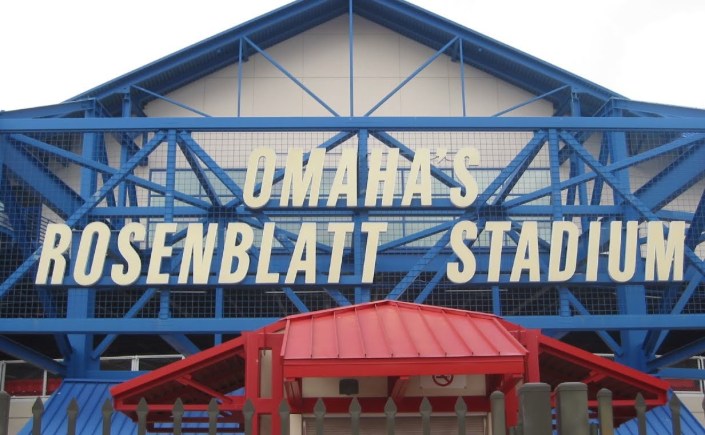
For Jack Payne, the series’ PA announcer since ‘64, “the dominant event took place just a couple years ago when Warren Morris’ two-run homer in the bottom of the ninth won the championship for LSU in ‘96. He hit a slider over the right field wall into the bleachers. That was dramatic. Paul Carey of Stanford unloaded a grand slam into the same bleacher area back in ‘87 to spark Stanford’s run to the title.”
Payne, a veteran sports broadcaster who began covering the Rosenblatt beat in ‘51, added, “There’s been some great coaching duels out there. Dick Siebert at Minnesota and Rod Dedeaux at USC had a great rivalry. They played chess games out there. As far as players, Dave Winfield was probably the greatest athlete I ever saw in the series. He pitched. He played outfield. He did it all.”
Terry Forsberg, the former Omaha city events manager under whose watch Rosenblatt was revamped, said, “Part of the appeal of the series is to see a young Dave Winfield or Roger Clemens. Players like that just stick out, and you know they’re going to go somewhere.” For Forsberg, the Creighton Bluejays’ Cinderella-run in the ‘91 CWS stands out. “That was a real thrill, particularly when they won a couple games. You couldn’t ask for anything more.”
The Creighton-Wichita State game that series, a breathtaking but ultimately heartbreaking 3-2 loss in 12 innings, is considered an all-time classic. Creighton’s CWS appearance, the first and only by an in-state school, ignited the Omaha crowd. Scott Sorenson, a right-handed pitcher on that Bluejay club, will never forget the electric atmosphere. “It was absolutely amazing to be on a hometown team in an event like that and to have an entire city pulling for you,” he said. “I played in a lot of ballparks across the nation, but I never saw anything like I did at Rosenblatt Stadium. I still get that tingling feeling whenever I’m back there.”
A game that’s always mentioned is the ‘73 USC comeback over Minnesota. The Gophers’ Winfield was overpowering on the mound that night, striking out 15 and hurling a shutout into the ninth with his team ahead 7-0. But a spent Winfield was chased from the mound and the Trojans completed a storybook eight-run last inning rally to win 8-7.
Poignant moments abound as well. Like the ‘64 ceremony renaming the former Municipal Stadium for Johnny Rosenblatt in recognition of his efforts to get the stadium built and bring the CWS to Omaha. A popular ex-mayor, Rosenblatt was forced to resign from office after developing Parkinson’s disease and already suffered from its effects at the rededication. He died in ‘79. Another emotional moment came in ‘94 when cancer-ridden Arizona State coach Jim Brock died only 10 days after making his final CWS appearance. “That got to me,” Payne said.
Like many others, Payne feels the stadium and the tourney are made for each other, “It’s always been a tremendous place to have a tournament like this, and fortunately there was room to grow. I don’t think you could have picked a finer facility at a better location, centrally located like it is, than Rosenblatt. It’s up high. The field’s big. The stadium’s spacious. It’s just gorgeous. And the people have just kept coming.”
Due to its storied link with the CWS, the stadium’s become the unofficial home of collegiate baseball. So much so that CWS boosters like Steve Rosenblatt and legendary ex-USC coach Rod Dedeaux, would like to see a college baseball/CWS Hall of Fame established there.
Baseball is, in fact, why the stadium was built. The lack of a suitable ballpark sparked the formation of a citizens committee in ‘44 that pushed for the stadium’s construction. The committee was a latter-day version of the recently disbanded Sokol Commission that led the drive for a new convention center-arena.
With a goal of putting the issue to a citywide vote, committee members campaigned hard for the stadium at public meetings and in smoke-filled back rooms. Backers got their wish when, in ‘45, voters approved by a 3 to 1 margin a $480,000 bond issue to finance the project.
Unlike the controversy surrounding the site for a convention center-arena today, the 40-acre tract chosen for the stadium was widely endorsed. The weed-strewn hill overlooking Riverview Park (the Henry Doorly Zoo today) was located in a relatively undeveloped area and lay unused itself except as prime rabbit hunting territory. Streetcars ran nearby, just as trolleys may in the near future. The site was also dirt cheap. The property had been purchased by the city a few years earlier for $17 at a tax foreclosure sale. Back taxes on the land were soon retired.
Dogged by high bids, rising costs and material delays, the stadium was finished in ‘48 only after design features were scaled back and a second bond issue passed. The final cost exceeded $1 million.
Baseball launched the stadium at its October 17, 1948 inaugural when a group of all-stars, featuring native Nebraskan big leaguers, beat a local Storz Brewery team 11-3 before a packed house of 10,000 fans.
Baseball has continued to be the main drawing card. The growth of the CWS prompted the stadium’s renovation and expansion, which began in earnest in the early ‘90s and is ongoing today.
Rosenblatt is at once a throwback to a bygone era — with its steel-girdered grandstand and concrete concourse — and a testament to New Age theme park design with its Royal Blue molded facade, interlaced metal truss, fancy press box and luxury View Club. The theme park analogy is accentuated by its close proximity to the popular Henry Doorly Zoo.
Some have suggested the new bigness and brashness have stolen the simple charm from the place.
“Maybe some of that charm’s gone now,” Forsberg said, “but we had to accommodate more people as the CWS got popular. But we still play on real grass under the stars. The setting is still absolutely beautiful. You can still look out over the fences and see green trees and see what mid-America is all about.”
Payne agrees. “I don’t think it’s taken away from any of the atmosphere or ambience,” he said. “If anything, I think it’s perpetuated it. The Grand Old Lady, as I call it, has weathered many a historical moment. She’s withstood the battle of time. And then in the ‘90s she got a facelift, so she’s paid her dues in 50 years. Very much so.”
Perched atop a hill overlooking the Missouri River and the tree-lined zoo, Rosenblatt hearkens back to baseball’s and, by extension, America’s idealized past. It reminds us of our own youthful romps in wide open spaces. Even with the stadium expansion, anywhere you sit gives you the sense you can reach out and touch its field of dreams.

NCAA officials, who’ve practically drawn the blueprint for the new look Rosenblatt, know they have a gem here.
“I think part of the reason why the College World Series will, in 1999, celebrate its 50th year in Omaha is because of the stadium we play in, and the fact that it is a state-of-the-art facility,” said Jim Wright, NCAA director of statistics and media coordinator for the CWS the past 20 years.
Wright believes there is a casual quality that distinguishes the event.
“Almost without exception writers coming to this event really do become taken with the city, with the stadium and with the laidback way this championship unfolds,” he said. “It has a little bit different feel to it, and certainly part of that is because we’re in Omaha, which has a lot of the big city advantages without having too many of the disadvantages.”
For Dedeaux, who led his Trojans to 10 national titles and still travels each year from his home in Southern California to attend the series, the marriage of the stadium-city-event makes for a one-of-a-kind experience.
“I love the feeling of it. The intimacy. Whenever I’m there I think of all the ball games, but also the fans and the people associated with the tournament, and the real hospitable feeling they’ve always had. I think it’s touched the lives of a lot of people,” he said.
Fans have their own take on what makes baseball and Rosenblatt such a good fit. Among the tribes of fans who throw tailgate parties in the stadium’s south lot is Harold Webster, an executive with an Omaha temporary employment firm. While he concedes the renovation is “nice,” he notes, “The city didn’t have to make any improvements for me. I was here when it wasn’t so nice. I just love being at the ballpark. I’m here for the game.” Not the frills, he might have added.
For Webster and fans like him, baseball’s a perennial rite of summer.
“To me, it’s the greatest thing in the world. I don’t buy season tickets to anything else — just baseball.”
Mark Eveloff, an associate judge in Council Bluffs, comes with his family. He said, “We always have fun because we sit in a large group of people we all know. You get to see a lot of your friends at the game and you get to see some good baseball. I’ve been coming to games here since I was a kid in the late ‘50s, when the Omaha Cardinals played. And from then to now, it’s come a long way. Every year, it looks better.”
Ginny Tworek is another fan for life. “I’ve been coming out here since I was eight-years old,” the Baby Boomer said. “My dad used to drop me and my two older brothers off at the ballpark. I just fell in love with the game. It’s a relaxing atmosphere.”
There is a Zen quality to baseball. With its sweet meandering pace you sometimes swear things are moving in slow motion. It provides an antidote to the hectic pace outside.
Baseball isn’t the whole story at Rosenblatt. Through the ‘70s it hosted high school (as Creighton Prep’s home field), collegiate (UNO) and pro football (Omaha Mustang and NFL exhibition) games as well as pro wrestling cards, boxing matches and soccer contests. Concerts filled the bill too, including major shows by the Beach Boys in ‘64 and ‘79. But that’s not all. It accomodated everything from the Ringling Brothers Circus to tractor pulls to political rallies to revival meetings. More recently, Fourth of July fireworks displays have been staged there.

Except for the annual fireworks show, however, the city now reserves the park for none but its one true calling, baseball, as a means of protecting its multimillion dollar investment.
“We made a commitment to the Omaha Royals and to the College World Series and the NCAA that the stadium would be maintained at a major league level. The new field is fairly sensitive. We don’t want to hurt the integrity of the field, so we made the decision to just play baseball there,” Omaha public events manager Larry Lahaie said.
A new $700,000 field was installed in 1991-92, complete with drainage and irrigation systems. Maintaining the field requires a groundskeeping crew whose size rivals that of some major league clubs.
Omaha’s desire to keep the CWS has made the stadium a priority.
As the series began drawing consistently large crowds in the ‘80s, the stadium experienced severe growing pains. Parking was at a premium. Traffic snarls drew loud complaints. To cope with overflow crowds, the city placed fans on the field’s cinder warning track. The growing media corps suffered inside a hot, cramped, outdated press box. With the arrival of national TV coverage in the ‘80s, the NCAA began fielding bids from other cities wanting to host the CWS.
By the late ‘80s Omaha faced a decision — improve Rosenblatt or lose the CWS. There was also the question of whether the city would retain the Royals. In ‘90 the club’s then owner, the late Chicago business magnate Irving “Gus” Cherry, was shopping the franchise around. There was no guarantee a buyer would be found locally, or, if one was, whether the franchise would stay. To the rescue came an unlikely troika of Union Pacific Railroad, billionaire investor Warren Buffett and Peter Kiewit Son’s, Inc. chairman Walter Scott, Jr., who together purchased the Royals in 1991.
Urged on by local CWS organizers, such as Jack Diesing Sr. and Jr., and emboldened by the Royals’ new ownership, the city anteed-up and started pouring money into Rosenblatt to rehab it according to NCAA specifications. The city has financed the improvements through private donations and from revenue derived from a $2 hotel-motel occupancy tax enacted in ‘91.
The makeover has transformed what was a quaint but antiquated facility into a modern baseball palace. By the time the latest work (to the player clubhouses, public restrooms and south pavilion) is completed next year, more than $20 million will have been spent on improvements.
The stadium itself is now an attraction. The retro exterior is highlighted by an Erector Set-style center truss whose interlocking, cantilevered steel beams, girders and columns jig-jag five-stories high. Then there’s the huge mock baseball mounted on one wall, the decorative blue-white skirt around the facade, the slick script lettering welcoming you there and the fancy View Club perched atop the right-field stands. The coup de grace is the spacious thatched-roof press box spanning the truss.
Rosenblatt today is a chic symbol of stability and progress in the blue collar south Omaha neighborhood it occupies. It is also a hub of activity that energizes the area. On game days lawn picnics proceed outside homes along 13th Street and tailgate parties unwind in the RV and minivan-choked lots. The aroma of grilled sausage, bratwurst and roasted peanuts fills the air. A line invariably forms at the nearby Zesto’s, an eatery famous for its quick comfort food.
There’s a carnival atmosphere inside the stadium. The scoreboard above the left-field stands is like a giant arcade game with its flashing lights, blaring horns, dizzying video displays and fireworks. Music cascades over the crowd — from prerecorded cuts of Queen’s “We Will Rock You” and the Village People’s “YMCA” to organist Lambert Bartak’s live renditions of “Sioux City Sue” and “Spanish Eyes.” Casey the Mascot dances atop the dugouts. Vendors hawk an assortment of food, drink and souvenirs. Freshly-scrubbed ushers guide you to your seat.
The addition that’s most altered the stadium is the sleek, shiny, glass-enclosed View Club. It boasts a bar, a restaurant, a south deck, a baseball memorabilia collection, cozy chairs and, naturally, a great catbird’s seat for watching the game from any of its three tiered-seating levels. But you won’t catch serious fans there very long. The hermetically-sealed, sound-proof interior sucks the life right out of the game, leaving you a remote voyeur. Removed from the din of the crowd, the ballyhoo of the scoreboard, the enticing scent of fresh air and the sound of a ball connecting with leather, wood or aluminum, you’re cut-off from the visceral current running through the grandstand. You miss its goosebump thrills.
“That’s the bad thing about it,” Tworek said. “You can’t hear the crack of the bat. You don’t pay as close attention to the game there.”
Even with all the bells and whistles, baseball still remains the main attraction. The refurbished Rosenblatt has seen CWS crowds go through the roof, reaching an all-time single series high of 203,000 last year. The Royals, bolstered by more aggressive marketing, have drawn 400,000-plus fans every year but one since ‘92. Fans have come regardless of the won-loss record. The top single-season attendance of 447,079 came in ‘94, when the club finished eight games under .500 and in 6th place.
Why? Fans come for the game’s inherent elegance, grace and drama. To see a well-turned double play, a masterful pitching performance or a majestic home run. For the chance of snaring a foul ball. For the traditional playing of the national anthem and throwing out of the first pitch. For singing along to you-know-what during the seventh inning stretch.
They come too for the kick-back conviviality of the park, where getting a tan, watching the sun set or making new friends is part of the bargain. There is a communal spirit to the game and its parks. Larry Hook, a retired firefighter, counts Tworek among his “baseball family,” a group of fans he and his grandson Nick have gotten acquainted with at the Blatt. “It’s become a regular meeting place for us guys and gals,” he said. “We talk a little baseball and watch a little baseball.
Once the game’s over everybody goes their separate ways and we say, ‘See ya next home stand.’
The season’s end brings withdrawal pains. “About the first couple months, I’m lost,” Hook said. “There’s nothing to look forward to.” Except the start of next season.
As dusk fell at Rosenblatt one recent night, Charles and Stephanie Martinez, a father and daughter from Omaha, shared their baseball credo with a visitor to their sanctuary above the third-base dugout. “I can never remember not loving baseball,” said Charles, a retired cop. “I enjoy the competition, the players and the company of the people I’m surrounded by.”
Serious fans like these stay until the final out. “Because anything can happen,” Stephanie said. “I like it l because it’s just so relaxed sitting out on a summer day. There’s such an ease to it. Part of it’s also the friends you make at the ballpark. It doesn’t matter where you go — if you sit down with another baseball fan, you can be friends in an instant.”
That familiar welcoming feeling may be baseball’s essential appeal. Coming to the ballpark, any ballpark, is like a homecoming. Its sense of reunion and renewal, palpable. Rosenblatt only accentuates that feeling. Like a family inheritance, baseball is passed from one generation to the next. It gets in your blood. So, take me out to the ball game, take me out to the crowd…
Related Articles
- Rosenblatt Stadium will never be forgotten (mlb.mlb.com)
- New CWS stadium gets good reviews (seattletimes.nwsource.com)
- Burke gets Rosenblatt scoreboard – Omaha.com (theprideofnebraska.blogspot.com)
- Rosenblatt Stadium memories will live on (seattletimes.nwsource.com)
Brotherhood of the Ring, Omaha’s CW Boxing Club
Brotherhood of the Ring, Omaha’s CW Boxing Club
©by Leo Adam Biga
A version of this story was originally published in the Omaha Weekly
It owns a rep as perhaps the toughest, most competitive boxing gym in town. Its junior and amateur fighters shine at local tournaments. It is the training ground for many of the area’s top prizefighters. It routinely matches young pugs with grizzled veterans in an effort to raise the level of beginners. Its members are primarily African-American, but include whites, Hispanics and Asians too.
It is a sanctuary for some and a springboard for others. It is a place filled with colorful ringside characters straight out of a Damon Runyon yarn. It is the CW Boxing Club at 1510 Cass Street, and its take-no-prisoners approach and chip-on-the-shoulder attitude makes it the envy and the outcast of the fractious Omaha boxing community.
Rivalries are strong on the Omaha boxing scene. Every gym has its own stable of fighters, its own turf and its own image to maintain and sometimes when conflicts erupt stupid things are said. When a fighter leaves one gym for another, he may be called disloyal or the other gym may be accused of stealing him away.
In the case of the CW, there is a perception that it caters only to blacks, which even a quick survey of its training roster soon dispels. Disparaging things are also said about the character of the fighters who train there, but in reality it is far from the wild-and-woolly den of thugs that some rival boxing coaches portray it as. Instead, the CW, which gets its name from founder and director Carl Washington, features a no-nonsense, professional environment where serious fighters work intensely under the watchful eyes of experienced trainers Midge Minor, Larry Littlejohn and Chucky Brizendine.
The gym itself is only one part of what Washington, who coached the club’s talented first crop of fighters to national prominence in the late 1970s and early 1980s, calls the CW Youth Resource Center. The center offers near north side youth a venue for making music, working out, hanging out and performing community service projects. According to Washington, the gym’s fighters often get booed or jeered at local competitions because of racism and because the CW’s history of success breeds jealousy. He said his club has nearly boycotted area Golden Gloves events due to the ill treatment he believes his fighters receive.

Every gym has its own vibe, and the insistent tone of the CW is set-off by the throbbing bass rhythms and the grating harsh lyrics of rap music blaring from a boom box that plays incessantly in the background. Unlike the foul language of the music, however, there is little profanity heard in the gym, whose walls are plastered not only with the usual boxing posters but emblazoned with a detailed list of rules (which include no spitting on the well-scuffed hardwood floor and no horse playing) and printed mantras that express the philosophy of the place: Lead with Speed, Follow with Power; Only the Strong Survive; and If You Want to Box, Train — If You Want to Win, Train Harder. It is a place where if you can hold your own, you earn respect, but that respect is always tinged with the tension of proving you belong or, if really brazen, proving you’re the top dog.
The gym is a study in contrasts. Take the way that Minor, a four-time Midwest Golden Gloves champion who got his training start at the noted Olympic Gym in Los Angeles, deals with fighters. He is a taskmaster when one of his guys needs pushing and a buddy when one of them needs a pat on the back.
As 13-year-old junior fighter Rosendo Robles prepares to enter the ring one night for some sparring, Minor fastens the headgear and laces the gloves of this angelic, wide-eyed youth with the attentive tenderness of a father helping his son. “Am I going three rounds?” the boy eagerly asks Minor. “If you’ve got three rounds in you,” his smiling coach replies, rubbing the boy’s shoulders. “I’m going to try and get comfortable with my jab first, and then when I get comfortable, I’m going to work on throwing combinations,” the lad tells Minor, his big eyes looking for approval. “That’s right. Your jab sets everything up. It sets up combinations,” Minor tells him in a way that confers the approval Robles seeks. “But I don’t want to see you in there jumping around wasting energy like a little Easter bunny.” Robles grins at his coach’s funny remonstration.
Meanwhile, as this gentle interlude plays out, a rapper performing on a CD explicitly describes various sex acts. The contradiction does not seem to faze anyone, not even born-again Christian Servando Perales, a professional fighter who found religion during a stint in federal prison. To take the contrast even further Minor has the little boy, Robles, spar with the grown man, Perales, in an attempt “to elevate” the kid’s abilities.
Throwing his youngest fighters in with the wolves is one of many ways in which the CW veers from business-as-usual in its training methods. Washington, who began the gym’s tradition of working young fighters with their more experienced counterparts, said, “The reason boxers from Nebraska usually come home after the first round of a national tournament is they don’t have the experience of fighting the skilled fighters you find on the east and west coasts. Guys have to know how to slip punches. You have to work around guys at a certain level or you’ll always be coming home early.” Minor follows the Washington formula with the C.W. crew: “I work all my guys. That’s how they learn,” he said. “Every once in a while I have to elevate them to see where they’re at. I work my fighters a little different than they (other gyms) do. I don’t breed nothing but winners.”
In Robles, Minor sees a kid with “a lot of promise. He wants to learn, That’s what I like about him.” The youth is following in the footsteps of his father and grandfather, both of whom boxed in their native Mexico. “My grandpa wants me to carry on with the tradition,” Robles said.
He has dreams of his own, too. “As soon as I can, I want to go to the Olympic Games, and if I do good there I’m thinking of a professional career when I get older.” As for training with adults, he appreciates the tricks of the trade he picks up from such savvy fighters. “I feel comfortable training with them because I learn from them in the ring. I like to learn new techniques. Sparring with these older guys is getting me prepared for bigger guys. Like with Servando (Perales), he puts pressure on me and I work on getting him off me. When I get done sparring I ask, ‘What’d you see wrong in me?’ and they tell me.” He also likes the attention his coach gives him. “I really like Midge. He shows interest in me. He says I’m his little project. That he’s going to build me up.”
Minor’s final words to Robles that night are, “Don’t be intimidated. Every chance you get you try and knock his ass off.” It is all well-supervised, with the adult Perales acting as a kind of moving punching bag — keeping his gloves open at all times to ensure he does not in any way injure the youth, whose father watches the action from ringside, yelling pointers to his son in Spanish.
During the three-round sparring session, Minor, leaning against the corner ropes from atop the ring apron, alternately shouts instructions to Robles with a sharp, disapproving edge in his voice and offers encouragement with a soft, approving tone. “You’ve got to move in closer. That’s the only way you’re gonna reach him,” he tells Robles, who is dwarfed by his sparring partner. “There you go, cut the ring off. Remember what I told you — if you miss with one hand, you lead with the other. Double jab. Stick — don’t wait on him. There you go. Shorten your hook up…too wide. Good hook.”
Robles, a surprisingly skilled little punching dynamo, is spent after the first round, but Minor denies him water. “You tellin’ me you’re tired? Like I care. You don’t need water yet. Show me you need some water.” After a rousing showing in rounds two and three, Minor lets his protege drink all he wants. As a soaked Robles climbs out of the ring, the chiseled Brezendine catches his eye and says, “If you keep fightin’ like that, you’ll be a world champion some day.” The boy’s eyes light up. “Really, Chucky?” “Certainly, Sando.”

Dreams of glory and chances at redemption are all over the gym. Take the story of Servando Perales, for example. The Omaha native showed tremendous promise as a junior competitor. Fighting for Kenny Wingo out of the Downtown Boxing Club, he won a National Silver Gloves title at 10 and captured second-place in the same competition at 14 in addition to winning a slew of city, state and regional championships. Then, just when Perales was on the verge of really making a name for himself in the sport, the bright, handsome young man got sidetracked by drugs, alcohol and gang-related mischief.
For Perales, the reunion with his buddy behind bars was a life-saving one that went well beyond mere chance. “I was like a walking time bomb. I had no peace in my life. No joy, No nothin’. I was really a heartless heart. I wouldn’t open up to anyone other than somebody that I trusted and knew from my barrio. And I’m just so grateful for Francisco being there in my path. God put him there for that reason.” Today, Perales does volunteer work with Granados and his Overcomers in Christ ministry in south Omaha, where they counsel kids to stay away from the drug and gang culture they got caught up in. Perales, who works full-time as a maintenance supervisor at Sapp Brothers, is married with three sons. A fourth son is being raised by his ex and her husband.
In an unusual move, Perales, who had not fought in several years, turned pro only months after his 1997 release from prison. He was 26 and out of shape, but hungry to rededicate himself to a sport he viewed as an expression of his new found faith. “Boxing is the only way for me to say to kids, Hey, this is where I was then, and now look at me today, when I have Christ within me. I believe Christianity and boxing are a lot alike. As a Christian you’re always under attack by the Devil. He knows your weaknesses. It takes a lot of discipline to stay strong. Just like with boxing, you can’t get comfortable. You’ve got to continue training. Besides, boxing is just something I’ve loved all my life. I’ve come up short of some victories, but my real victory has been beating drugs and alcohol.”

Servando Perales
When Perales decided to enter the pro ranks he shopped around for a gym to begin his comeback at and decided on the CW.
“It’s the toughest gym in Omaha. Everybody said, ‘If you can make it at the C.W., you can make it anywhere because here, when you spar, you don’t just spar — you go to war. Basically, it’s a test to see what you’re capable of. I came down here and I got my butt kicked the first three times until I got my timing and my punch back. It took me awhile.”
Regarded as a mediocre pro, Perales is 11-5 and has no real prospects of making a mark, although he is widely admired for his heart. At age 30 he knows his fighting days are numbered, but his sheer determination keeps him going, sometimes to his own detriment. “In a fight I lost in Las Vegas I was a bloody mess, but I wouldn’t quit. I’ve got too much heart. I came out in the 6th and final round and I almost knocked the guy out I was that determined to win, even though my nose was broken, my eyes were closed and my face was bloody.” He has vowed to his wife he will quit rather than endure that type of punishment again.
Once Omaha’s “Great White Hope” — heavyweight Dickie Ryan may soon be facing a crossroads of his own. The battle-scarred 33-year-old, a solid contender a few years ago, is one of the most successful local pros since Ron Stander, but after 56 bouts (his record is 51-5) and countless thousands of rounds sparring his best fighting days are surely well behind him. Like so many men of the ring, he is unwilling to admit he may be past his prime and should, for his own good, hang-up the gloves.
“Everyone says, ‘When you gonna retire?’ I don’t know. I still feel like I’m in good shape. I still like fighting. I’m still trying to develop the best skills I can bring out in me. I don’t think I’ve done that yet, but I’m working on it,” he said. “I’ve been a pro since I was 19. I’m glad I’ve carried on this long because I turned pro the same time as a lot of other guys but I’m the only one still around after all these years, which is special. I wish it could last forever, but unfortunately nothing lasts forever.”
Ask him if he worries about the risk of permanent head injury, and he shrugs off the question with, “If I get brain damage or whatever, than that was my choice. I made it. Just like Dale Earnhardt made his choice and died doing what he loved doing. I have a friend that has Parkinson’s and the doctors think it was caused from boxing. I don’t know. Who knows? Boxing’s been around forever, though. Even if it was banned there’d still be underground boxing, and I’d probably be the first one there, you know, because that’s how I make part of my living.”

Dick Ryan
Ryan has a passion for what might be called the Brotherhood of the Ring that he and other fighters share and it is this bond forged from sweat and courage and discipline that helps explain why he toils on. “We get these big muscle guys coming in the gym. These tough guys who knock everybody out on the street. They say, ‘I wanna box.’ We say, ‘Okay,’ and they box a couple days and we never see them back. I don’t know what it is, but it takes a special person. I won’t say it takes a tough person, but it takes a certain type of person to sacrifice your body the way we do. It really is hard. In boxing you can’t have a big ego because right when you think you’re all that somebody’s gonna knock you on your ass. And that’s the truth. If you’ve got an ego going into boxing, you’ll be humbled afterwards.”
According to Ryan, there is a camaraderie in the gym, any gym, that transcends race or religion or age. “It’s one of the only places you can go where there’s no racism at all. It’s neat. Everybody gets along. I never try hurtin’ no one in the gym. I can work with anybody. I can work with a guy that’s 150 pounds and I can work with a guy who’s 250 pounds. I can work with kids just coming up. I’ll help ‘em out. And hopefully by working with me they’re going to get better and then eventually they’re going to be good sparring partners. I’m helping them out and they’re helping me out. It works both ways.”
In a long career that’s seen him be a marquee sparring partner (for the likes of Lennox Lewis and Tommy Morrison) if seldom a main event draw, Ryan has trained at gyms across the country. He could train anywhere in Omaha, but the CW is where he’s gone to work the past eight years.
“I’ve been to Gleason’s Gym in New York and a lot of other big gyms and this (the CW) is as good as any gym around. Me and my manager, Mouse Strauss, seen that Midge (Minor) and Larry (Littlejohn) here were really good coaches and Mouse felt it would be good for me to come here. There’s a chemistry between me and my trainer Midge. He’s just a straight-up guy. He’s not the type of trainer to go, ‘You’ve got to kick his butt’ or ‘You’ve got to do this or do that.’ He’s just got a way of telling me to stay focused. He’s not afraid to cuss me out, though. He’s shows no favoritism.”
After 14 years of grinding out early morning runs and long nights hitting the bags and absorbing poundings as a much sought-after sparring partner Ryan said he stays motivated by the chance for a shot at the title or a big payday — even as remote as that possibility is now.
“I think a lot of it is just knowing in the back of your mind that, Hey, I’ve got to keep going because they might call me for that big fight and I’ve got to be ready.’ Before a fight I don’t have any fear at all because I know I’m in shape and ready to go.”
The closest he came to realizing his dream was when he upset Brian Nielsen in dramatic fashion before a hostile crowd in Denmark in 1999. In what was supposed to have been a tune-up bout for the Dane before an expected match-up with Mike Tyson, Ryan rallied late and knocked out Nielsen in the 10th and final round. Ryan said he was given the match with only two weeks notice but, as usual, was in peak condition. However, the victory did not earn Ryan any title shot but instead a rematch with Nielsen, which he lost.
Ryan, who describes himself as “mellow” even on the eve of bouts, is almost embarrassed to say that, apart from his work in the ring, he is not much of a fight fan. “Not really. I don’t go to the fights around here because I don’t like to see friends of mine get hit. It seems kind of weird, but that’s just how I am. I wish I wasn’t like that, but I am. I’d never encourage anyone else to fight. That’s just my opinion. Boxing’s been great for me. I’ve made a few bucks. It’s a good side job.”
The reality for pros fighting out of Omaha, a burg way off-the-beaten track in the boxing world, is that they must work regular jobs to support their pugilistic dreams. When not engaging in the Sweet Science, for example. Ryan is a meter reader for the Omaha Public Power District.
Featherweight Mike Juarez, another CW regular, is a part-time parcel handler at United Parcel Service. “If you’re in Omaha you’ve got to work a job. There’s no sponsorship around here like there is in big fight towns,” said Juarez, 31, who has compiled a 25-9 record during a 12-year pro career that has seen him fight and lose to several contenders and former world champions. The compactly-built Juarez has been something of a boxing vagabond over the years, including stops in Indianapolis and Vegas. After experiencing some hard knocks on the road, he’s returned to his Omaha roots.
“It’s pretty rough out there, you know? It’s a mean game. I didn’t get the fights. I went broke. I really wasn’t ready for the type of (mercenary) atmosphere that I put myself in. There’s nothin’ like being home around guys that I know,” he said while skipping rope one evening at the C.W. He feels the high-caliber training he gets at the Omaha gym sets it apart. “Midge Minor is a professional coach. He knows his stuff. He’s been in boxing forever,” he said. Like Dickie Ryan, Juarez is pushing the upper limits of his boxing career. He said the decision to retire will “depend on how long I can stay winning. There’s no money in it for losers, you know.”
In keeping with the CW’s belief that young fighters need pushing to reach the next level, Juarez often spars with amateurs much younger than him and possessing far less experience. Two of his regular partners are 20-year-old RayShawn Abram and 19-year-old Kevin Nauden, a pair of brash, promising fighters who, along with a third young phenom, Bernard Davis, are looking to make their marks as pros in the very near future. “I’m fast, I’m strong and nobody my size is going to touch me. I don’t lack for confidence,” said Abram, a 112-pounder sporting two gold front teeth. “I’m looking to win a national championship this year.”

He was introduced to the sport after being caught fighting in school by an administrator, who brought him down to the CW to get his hostility channeled inside the ring. In Midge Minor he has found a confidante and mentor. “I sometimes get in with the wrong crowd and I sometimes talk to him about it and he keeps me out of trouble. He also helped me get through the time my grandma died. I can call him anytime.”
Nauden and Abram feel they benefit from going against older foes when sparring, but there is no any doubt who is boss inside the ropes. “They’ve got that grown man strength that we ain’t got yet,” Nauden said. “When I first came here and I hit some of the pros with a hard shot, they let me know this ain’t gonna be goin’ on for long. They ain’t gonna hurt you or nothin, but they’ll tap you and let you know they could.”
While Abram won his weight class (as did the CW’s Bernard Davis at 125 pounds) in the recent Midwest Golden Gloves tourney at Harvey’s Casino and is prepping for the national gloves in Reno. Nev., Nauden lost. As for their future plans, the young men are weighing pro offers and, if the money is right, may end their amateur careers later this year and sign contracts to enter the prizefighting arena. They intend to stay under the training arm of Minor and company.
Whether Nauden and Abram ever make any real money in the fight game, they epitomize what the coaches and trainers at the CW strive to do — get the most out of their fighters.
“It’s like a challenge to me to see how I can develop somebody,” Minor said. “I don’t try to change their style. I just try to better the style they’ve got.” He said he can be blunt with fighters, but they seem to respond to his straight shooting. “If I see a bum, I call ‘em a bum. I’m kind of mean to ‘em. but they work for me, though. They perform for me.” Larry Littlejohn is also known as a hard-driving sort. “We do demand quite a bit of you if you’re going to stay in this gym. This is not the place to be down here joking around. We don’t want those guys. We work hard. We want to win,” Littlejohn said.
CW amateur fighter Shabia Bahati said that when Littlejohn shows up “there’s no cutting corners on your workout,” adding, “He keeps us honest. He’ll put us to the test.”
Bahati, a Midwest Golden Gloves runner up at heavyweight, has trained at other gyms in town and he said the C.W. is not for the faint of heart or the frivolous. “It’s real competitive down here. You’ve got to be on your toes when you come and spar. There’s no play time. They take the boxing down here serious.” Jacqui (Red) Spikes is another amateur fighter who has found the CW more rigorous than other gyms. “I was at a different gym and the training was soft there. Here, it’s all business. There are no wimps down here. It’s got the best pros and amateurs in town. They get the most out of you.”
Related Articles
- Golden Gloves…& golden heart (nydailynews.com)
- Gildardo Garcia finds redemption in ring and in life (denverpost.com)
- Strode king of the ring (denverpost.com)
- Canceled FX Boxing Show, ‘Lights Out,’ May Still Springboard Omahan Holt McCallany’s Career (leoadambiga.wordpress.com)
It’s a Hoops Culture at The SAL, Omaha’s Best Rec Basketball League

Image by Chapendra via Flickr
This is one of those scene-setting pieces I don’t do as much anymore. I like doing them, but they can take a lot of time and effort for very little return other than the satisfaction of doing these stories. The subject here is a recreational basketball league of the type that can be found in just about any urban neighborhood. The idea was to capture the vibe of this distinct subculture to the extent that I put you as the reader there in the bleachers with me. To make the story a visceral experience. The article originally appeared in The Reader (www.thereader.com). Written as a secondary feature, I was surprised when it ended up on the cover. It’s not the first time that’s happened and I suspect it won’t be the last.
It’s a Hoops Culture at The SAL, Omaha’s Best Rec Basketball League
©by Leo Adam Biga
Originally published in The Reader (www.thereader.com)
Once the hoops get rolling in the Sunday men’s recreational basketball league, the scene turns into the kind of urban soul fest you associate with Chicago, Detroit, Philly or New York. Only this is Omaha. In an intimate, interactive community setting, the best summer ball in town is played in The SAL, Omaha’s version of the Harlem Ruckers League.
Housed until recently in the Salvation Army North Corps center at 2424 Pratt Street, the league, by concensus, draws the area’s best players. Many have serious credentials. A typical game features jocks from the pro and college ranks, past and present, along with former and future legends from The Hood. All strut their stuff before a knowledgeable, appreciative, vociferous throng.
NBA journeyman Rodney Buford, the ex-Creighton star, is a regular, rarely missing a game or a mid-range jump shot. One Sunday, fellow NBA player and ex-Bluejay Kyle Korver showed, raining down 3s to the fans’ delight. The league is so competitive Buford’s teams have never won the title. “That lets you know right there” said team sponsor Talonno “Lon Mac” Wright. “If you can make it through here, you’re a player. It’s the best competition you’re going to get in the city,” league director Kurt Mayo said.
Former UNO Mav Eddie King, who grew up balling in Chicago, said, “I think it’s a staple of north Omaha and I think it’s the best basketball in Nebraska, period. Oh, yes, you’re going to get challenged every game. Every team has good players. You can never get comfortable.” He said the close confines and neighborhood feel create a special environment. “This is the best atmosphere because everyone has family and friends in the stands. It’s a small gym and everyone’s on top of each other. People talk a little smack. That makes it fun. Plus, it’s real competitive. It’s streetball, but at the same time it’s fundamental, because 80 percent of these guys played ball at a four-year college.”
Mayo formed the league with wife Melissa in 2002, reviving a gym fallen into disuse. Before the Salvation Army, the league operated under a differnt name at the LaFern Williams Center in south O and the Butler-Gast YMCA up the street, where it’s back again. Mayo met resistance when he announced plans to move things to the Y at 3501 Ames Avenue. Trading the homey, if dingy, old digs for the gleaming, if cold, new facilities was an issue. But “the grumbling” ceased when the league ended the summer season at the Y on August 7. By all accounts, the new venue’s a hit, even if it lacks character. It does, however, have a nice wood floor, not some tacky mat like the Salvation Army center has. Mayo hopes to reinvent the magic at the Y with an “elite” level men’s Sunday league starting September 11.
But The SAL is where the league gained the rep and made the memories. Where it found a fun yet gritty flavor as a combined sports venue and social club.
James Simpson is among many who come each Sunday. Besides enjoying friends play ball there, he said, “it’s good for the community. I’ll follow it wherever it goes.”

“It’s the thing to do,” Wright said. “It’s like, Let’s get dressed, we’re going to The SAL. Everyone comes to watch the games or to see the women. There’s music. You meet people. You see your friends. On a good day, it’s just wall-to-wall packed. It gets loud. The crowd gets into it. if they like you, they’re cheering on you. If they hate you, they’re booing on you. If someone does something good out on the court, they ‘oooh’ and ‘ahhh.’ Some people might run out on the court, just having fun. It’s just a nice hangout. No problems. Everybody gets along. A little fussing here and there, but no big deal.”
Ex-Husker Bruce Chubick said there’s no dogging it in The SAL: “You can’t really half step your way through because there are too many players that are good. Plus, you get a nice little crowd that comes out, and they’ll let you know about it if you make a bad play. So, you’ve got that motivation going. It’s entertaining.”
The league is a subculture unto itself. The many female fans include spouses, lovers and groupies. Some mothers have children in tow. The guys taking-it-in range from hoop junkies looking for another fix to coaches scouting talent to neighborhood cats looking to escape the weather. The common denominator is a love for the game. It’s why some folks view five or six contests in a single sitting.
The hold basketball has in urban America is a function of the sport’s simplicity and expressiveness. Only a ball and a bucket are needed, after all, for players to create signature moves on the floor and in the air that separate them, their game and their persona from the pack. Not surprisingly, the hip-hop scene grew out of streetball culture, where trash talking equals rap, where a sweet crossover dribble or soaring airborne slam resembles dance and where stylin’ gets you props from the crowd or your crew. Music and hoops go hand-in-hand.
The vast majority of players at The SAL and Butler-Gast Y are black, which makes it ironic that the two-time defending champs, Old School, are an all-white group of former Division I players led by Chubick. In what Mayo considers “a traditional” league, Old School is short on style but long on fundamentals.
Former Omaha South and University of Washington star Will Perkins said to cut it in this league, “you’ve got to be tough…you’ve got to be skilled. You can’t just take your college game or your streetball game here. You’ve got to have a mixture.”
As the action unfolds on the funky, tile-like court everybody complains about, the spectators join in a kind of call-and-response exchange with participants. A player jamming home a thunder dunk will stop, await his fate from the crowd, and then either get their love or take their poison. A guy blowing a dunk or a layup or drawing air on his jumper gets well-deserved catcalls. But here the good-natured smack directed at refs and players is often hurled right back.
“Man, you gotta finish that! What are you doing? You had a wide open layup. Hey, y’all gotta fight for this one, fellas. They’re not going to give it to you. C’mon!”
Unrestrained displays of emotion, usually shouted down from the bleaches, sometimes overflows onto the court. Despite threats and invectives, few incidents ever come to blows. Chest thumping and trash talking is just part of the heat and the edge. It’s all about respect out here. No one wants to be shown up.
As day wends into night, and one game bleeds into another, there’s a constant stream of humanity in and out of the cramped old gym, where music thumps from a boom box during time outs and between games, where burgers, dogs and nachos can be had on the cheap and where vendors hawk newly burned CDs and DVDs.
Amid the hustle and flow, players and fans intermingle, making it hard to tell them apart. There’s no barriers, no admission, no registration. It’s a straight-up come-and-go-as-you-please scene. As the small bleachers hold only a couple hundred people, the rest of the onlookers line both sides and ends of the court. Folks variously stand against walls, sit in folding chairs or sprawl on the floor.
The league serves many purposes. For college programs at UNO and Bellevue, it’s a way to keep teams sharp over the summer and toughened up for the coming NCAA season. Kevin McKenna, UNO head coach the past four years until rejoining the Creighton staff this summer, said, “I got my team to play down there the past few summers because I thought it was the best league. There was another league in town, but I felt this was the most competitive — where’d we get the most out of it.” Bellevue University coach Todd Eisner has recruited there. It helps Omaha Central grad and current Illinois-Chicago player Karl White get ready for the college grind.
For former college mates, like the Still Hoopin’ squad made up of such ex-Bluejays as Buford, Latrell Wrightsell and Duan Cole, it’s a chance to relive old times, stay fit and feed still hot competitive fires. For Buford, it’s one more workout in an off-season regimen before NBA training camps begin. For men pushing 30, 40 or older, it’s also a pride thing — to show they still have some game left. For them and guys not so far removed from the game like Alvin Mitchell, the former NU, Cincinnati and UNO player, or Andre Tarpley, a senior last year at UNO, or Luther Hall, a recent Bellevue U. grad, it’s both an outlet and a place to prep for pro tryouts.
Danai “Ice” Young, whose college hoops career stalled at NU, is using the league as a launching pad to try and make the ABA River City Ballers’ roster. Albert R. went from The SAL to a spot on the pro streetball tour, where he goes by “Memphis.”
For youngbloods, it’s a test to prove they can hang with the old dogs. “If you’re the best talent, or think you’re the best talent, this is where you’re going to be,” said veteran ref Mark LeFlore, Sr. Mayo said few high schoolers have had what it takes to play in The SAL. Two that did, guards Matt Culliver and Brandon McGruder, formed one of the highest scoring duos in the annals of the Metro Conference at Bryan High School last year. Both earned scholarships to play at the next level.
Another youth, Aaryon “Bird” Williams, is perhaps the most impressive of the pups as he’s only a senior-to-be at Omaha North, where he played in a handful of varsity games last year after moving here with his family from Gary, Indiana. Mayo sees a phenom in-the-making in Williams. “Man, he was dunkin’ on everybody. You have to see it to believe it. He’s definitely a man-child. He reminds me of a young K.G (Kevin Garnett), and I’m not exaggerating,” Mayo said. “He’s a beast.” It’s another example, Mayo said, of how top local talents “find their way” to the league. “I’m already missing The SAL, but I’m recreating it at the Y. The tradition continues.”
Related Articles
- King of the courts: Rucker Park defends its streetball crown (thegrio.com)
- Streetball legend ‘Homicide’ to turn in his kicks (nypost.com)
- Artest returns to streetball roots, wants second ring (nypost.com)
- Omaha Native Steve Marantz Looks Back at the City’s ’68 Racial Divide Through the Prism of Hoops in His New Book, ‘The Rhythm Boys of Omaha Central’ (leoadambiga.wordpress.com)
- Troy Jackson: Streetballer Nicknamed “Escalade” Dies at 35 (bleacherreport.com)
- Bismack Biyombo Breaks Out At Nike Hoop Summit As NBA-Ready Right Now (sbnation.com)
- Back in the Day, Native Omaha Days is Reunion, Homecoming, Heritage Celebration and Party All in One (leoadambiga.wordpress.com)
- The Ties that Bind, One Family’s Celebration of Native Omaha Days (leoadambiga.wordpress.com)
Rich Boys Town sports legacy recalled
If you’re interested in another Boys Town sports story, then check out my story, “A Good Deal: George Pfeifer and Tom Krehbiel are the Ties that Bind Boys Town Hoops” on this blog. More o f my Boys Town stories on this site cover various topics, including the classic 1938 MGM film Boys Town, the friendship of Fr. Edward Flanagan and Jewish attorney Henry Monsky, and the 1972 Sun Newspapers Pulitzer Prize-winning investigation of Boys Town finances.
The following story originally appeared in Nebraska Life Magazine. Look for more Boys Town stories in future posts.
Rich Boys Town sports legacy recalled
©by Leo Adam Biga
Originally published in Nebraska Life Magazine
“I didn’t know a jock strap from a toothbrush,” said alumnus George Pfeifer of his arrival at Boys Town from a Kansas farm in 1939. Like some of the finest athletes at Rev. Edward Flanagan’s home for “lost” boys, the future coach had never played organized sports before coming there. Most of the boys were either poor inner city or rural kids who’d played only sandlot ball or street ball. They came from all parts of the country, boys with different racial, ethnic and religious backgrounds, and on their shoulders was built an athletic dynasty that became the envy of the nation.
From the Great Depression through the 1960s, the Boys Town football team played elite Catholic prep schools and military academies in Los Angeles, Chicago, Detroit, Pittsburgh, New York, Miami and other cites. The games attracted dignitaries and made headlines. Playing against the nation’s toughest competition in large stadiums before tens of thousands of fans, the Cowboys won more than twice as often as they lost.
During the same era, Boys Town won multiple state championships in football and basketball, and produced scores of all-state athletes and individual champions, even some high school All-Americans. Its great track-and-field athletes include two-time Olympian Charles “Deacon” Jones (1956 and 1960) and quarter-miler Jimmy Johnson, who won the Pan Am Games only a few years after graduating.
It began with the dream of Boys Town’s founder, Father Flanagan, who was a fair soccer and handball player in his day, and a vocal champion of sports. He made sports an integral, even compulsory part of residents’ experience at Boys Town. Intramural athletics became a big deal. In those days, the boys lived in dorms and staged competitions between their respective buildings to see who were kings of the field or the court. By the mid-1930s, Flanagan hired a coach and pushed for Boys Town to compete in sanctioned interscholastic events.
Born and raised in Ireland, Flanagan made his long-held dream for Boys Town a reality through conviction, blarney and bluff. With his silver-tongued brogue and big sad eyes, he elicited sympathy and loosened purse strings for the plight of America’s orphaned. With his politician’s ability to build consensus, he got people of all persuasions and faiths to contribute to the home.
It didn’t hurt that Flanagan harbored a bit of P.T. Barnum in his soul. Almost from the start of the home in 1917, he made use of the media to further the cause of children’s care and rights. In the 1920s he hosted a nationally syndicated Sunday radio program, “Links of Love,” broadcast from the old WOW studios in Omaha. On a larger scale, there was the 1938 MGM box office smash “Boys Town,” starring Spencer Tracy and Mickey Rooney. Tracy won the Best Actor Oscar for his portrayal of Flanagan.
The movie made Flanagan and BT household names. He used his and the home’s growing reputation to bring national figures, including sports stars, to “the city of little men.” The BT archives detail visits by such sports icons as Babe Ruth, Lou Gehrig, Jack Dempsey and Joe Louis. Hollywood celebrities were also frequent visitors. “Deacon” Jones, then learning the barber trade at BT, recalls being summoned with his clippers to the quarters of Flanagan’s successor, Rev. Nicholas Wegner, where he found Spencer Tracy in need of a haircut. Jones complied.

Coach Skip Palrang had a great influence on the start of Boys Town’s famous sports teams
Just as Flanagan earlier made the school band and choir ambassadors for BT, so he did with football. The same year the movie “Boys Town” was released, the football squad boarded the Challenger super liner at Omaha’s Union Station for a trip west, where they played a benefit game against Black Foxe Military Institute of Los Angeles. The film’s producer, John Considine, Jr., made it happen. Among the 10,000 or so in attendance at Gilmore Stadium were numerous Hollywood stars. Boys Town won, 20-12.
The good turnout seems to have convinced Flanagan to take his football team on the road as a gypsy, bring-on-all-comers sideshow featuring orphans from the world-famous Boys Town. The bigger the stage, the tougher the opponent, the more Flanagan liked it.
He would often wend his way to wherever the football team appeared, posing for photos, making pre-game or halftime on-the-field speeches, and generally getting the Boys Town name in the press. A big banquet, often in his honor, usually preceded or followed the game, giving Flanagan another chance to spread the gospel.
 BT alum Ed Novotny of Omaha, who played for Boys Town in the early 1940s, recalls the time Flanagan was on the field during pre-game festivities in New Jersey. Novotny says a press photographer asked to snap a few pictures of the famous priest doing a mock kickoff. Sensing a good photo op, Flanagan obliged. As he lined up for the kick, Novotny turned to an opposing player and said, “He’s in a bad spot” – meaning the photographer crouched in front of the ball, holding a Speed Graphic camera overhead.
“What do you mean?” the other player said.
“Father Flanagan can kick. He’ll blast that thing right over the goal post.”
“Really? A priest?”
Novotny will never forget what happened next. “No sooner did I say, ‘Yeah,’ than he kicked that ball and knocked that camera right out of the guy’s hands.”
Novotny recalls Flanagan as an enthusiastic presence on the sideline or in the locker room. The priest stood in the players’ circle to lead pre-game prayers. At basketball games he sat on the end of the bench with players and coaches. He greeted guys by name or with his favorite terms of endearment, “Dear” or “Laddie.”
To compete with the nation’s best, Flanagan hired Maurice “Skip” Palrang, who came to Boys Town after successful stints at Omaha Creighton Prep and Creighton University. Over his 29-year career at Boys Town, he led Cowboy teams to football, basketball and baseball titles. He won National Coach of the Year honors from the Pop Warner Foundation of Philadelphia, Pa., and Nebraska High School coaching plaudits from the Omaha World-Herald.
As athletic director, Palrang oversaw construction of a mammoth field house, modeled after those at Purdue and Michigan State. Its classic brick facade features sculpted panels of Greek-like figures in various athletic poses, stained glass windows and a vast arched metal roof that spans the length of a football field. Great facilities like these helped set BT apart.
Palrang hired coaches to carry BT’s dominance into other sports, but it was best known for football. “It wasn’t like Boys Town would play the weakest teams we could find – we’d play the baddest teams we could find,” said ’50s star halfback “Deacon” Jones. “We knew we played the best teams Skip could get to play. A lot of the players we played against went on to make All-American in college. Some went to the pros. We traveled to play Aquinas in Rochester, N.Y. That was like a Notre Dame prep school. And, whew, they had some tough players.”

Boys Town Bus Travels to Florida for exhibition game
Under Palrang, the Cowboys went 75-33-6 in these intersectional matchups. BT also participated in intersectional basketball and baseball contests, but on a far more limited basis.
Jones said players got “five dollars per trip for eating and fun money.” For some, like him, it was their first time on a train, a big deal for “kids that didn’t have anything,” he added. Seeing the sights was part of the experience – Chicago’s Field Museum, New York’s Rockefeller Center and Radio City Music Hall. But the road trips, which lasted up to three weeks, were not all fun and games. An instructor traveled with the team and made sure they kept up on their schoolwork.
Lessons of another kind came on the few road trips south of the Mason-Dixon Line. “We would go to some areas where they wouldn’t allow the black kids on our team to stay in the same hotel as the whites,” Pfeifer said. “A few times we had to arrange for those kids to stay with some people in the community. It was a terrible blow to Fr. Flanagan. That’s probably why we didn’t play that much in the South.”
Wilburn Hollis was among a black contingent denied access to a hotel. Although from the Jim Crow South, he’d been shielded from the worst of segregation – the same at color-blind Boys Town. “We were buddies, but even more than that we felt like we were brothers and we just lived like that,” said Hollis, a Possum Trot, Miss. native who became a high school All America quarterback at Boys Town and a signal caller for an Iowa University team that won a share of the Big 10 title. “I never heard anything racial.”
“At Boys Town I never thought about ethnicity or race,” said Ken Geddes, who grew up in Florida and went on to play for Nebraska and in the National Football League. “…We were all part of a family.”
Within that family of athletes, Palrang was the unchallenged head of household. “He was about six-four and probably 220 pounds and he was mean as a goat,” Hollis said. “But he was a wonderful coach. He loved the kids, he loved Boys Town….”
Hollis told of an incident involving Flanagan’s successor, Rev. Nicholas Wegner. (Flanagan died in 1948 on a goodwill mission in Berlin, Germany). Like his predecessor, Wegner was a sports booster, but apparently didn’t share Skip Palrang’s competitive philosophy. Once when BT was losing a football game, the priest tried to deliver a halftime pep talk. Wegner advised the team to do their best, Hollis recalls, “and honestly he used that old cliché, ‘It’s not if you win or lose, it’s how you play the game.’ Well, Skip was pretty hot and he said, ‘Bulls__t. We’re going to win this game.’ Monsignor was like, Oh-oh. And we went out and won the game.”
But Palrang’s success was based on more than force of will. Stern but fair, he was known for his precise preparation, a quality that fit his favorite hobby of watch repair. Ex-sportscaster Jack Payne of Omaha recalls Palrang in his field house office “hovered over a well-lighted table…wearing an eye shade, jeweler’s glasses, meticulously at work on a watch.”
An innovator, Palrang used his vast contacts to learn new offensive and defensive schemes from college and professional colleagues, often implementing packages years before anyone else at the prep level. He’d get reels of game or practice film with the latest sets to study. Sought out for his expertise, he often conducted clinics around the country. Pfeifer said that once, at the request of an old buddy, Palrang sent BT quarterback Jimmy Mitchell to Kansas State to help Wildcat signal callers learn the T-formation Skip helped initiate in high school.
The Cowboys often played far from home, so Palrang sent an assistant ahead to scout. Palrang’s protégé, George Pfeifer, inherited the thankless job. In order to see distant teams, he traveled by plane, train, automobile or any available mode of transport. He once flew into Chicago’s Midway Airport on his way to see an opponent that night in Wisconsin. In Chicago he was bumped from the last connecting flight north. With only a few hours until game time and hundreds of miles between him and the stadium, he was stuck. Desperate, he asked, “Is there any other way?” He was directed to a helicopter pad. For $15 and a slight case of nausea, he arrived “just about the time they were kicking off.”

Boys Town graduate Charles “Deacon” Jones competes in the 1956 Olympic Games in Melbourne, Australia, finishing ninth in the 3,000-meter steeplechase. Four years later, he would finish seventh in the same event in the Rome Olympics.
Skip Palrang’s physician son, Art, who played for his father one year at BT, said besides the advantage Palrang got by scouting opponents “the Boys Town kids in those days… were really tough, tough boys. They weren’t very big but they were tough… There weren’t a lot of distractions out there, like girls. He had kind of a captive audience.”
Palrang also had the advantage of working with kids who came out of BT pee-wee, freshman and junior varsity programs imbued with his coaching systems. By the time they made varsity, kids were well-schooled in the Palrang way. It led to potent team chemistry.
Despite offers to leave, Palrang remained loyal to Boys Town. Art Palrang believes this allegiance stemmed from Skip being an orphan himself. “His mother died when he was two and left his father with three boys and three girls,” he said. “He was always sympathetic to the Boys Town kids, although he was typical Irish in that he would not show his emotions.”
Today, Palrang’s accomplishments are commemorated in a big memorial just inside the field house dedicated in his honor. The memorial is next to a long row of display cases reserved for trophies and plaques won by Boys Town coaches, athletes and teams. There are hundreds of items. There’d be more, except Palrang made a habit of giving them away to kids.
By the time Palrang retired in 1972, he was only coaching his main passion, football. Years earlier, he’d entrusted the basketball program to Pfeifer, another coach often described as a “no-nonsense father figure.” Pfeifer’s basketball teams went 202-45 (two state titles), and his track teams (two titles) were always a threat. He recently joined his mentor in the Nebraska High School Sports Hall of Fame.
Like his predecessor, Pfeifer encountered racist attitudes toward his players, as when he started five black players on his state championship basketball teams of 1965 and 1966. One morning after a game, a caller demanded, “Why you playing all them n_____s?”
“Because they’re my five best players,” Pfeifer replied.
Boys Town’s barnstorming era was prompted by publicity and the guaranteed payoff for its football games. But BT was also compelled to travel for another reason. Once it became a winner, it could find only a handful of area schools willing to schedule games.
Despite many attempts, BT was long denied membership in the Omaha Inter-City League, comprised of large Omaha area schools. Pfeifer said Wegner reportedly had to threaten to withdraw funds from local banks to gain admittance. It finally happened when the Inter-City League was disbanded and the new Metropolitan High School Activities Association was created in 1964.
Everyone has a theory about the blacklisting. Speculation ranges from envy over BT’s athletic riches to rumors, denied by BT alums, that it practiced off-season, suited older student-athletes, or recruited prospects. An image of BT suiting up juvenile delinquents, true or not, may have also accounted for schools not wanting to schedule the Cowboys. BT athletic equipment manager and head baseball coach Jim Bayly said that when he was a player at Omaha South, “we were afraid of Boys Town.”
Shane Hankins, quarterback for BT this past season, senses that the “jail” or “criminal” perception still haunts BT. But far from intimidating foes, he said it makes them “want to fight us even harder to prove we’re not tougher.” He concedes BT has some rough players, but points out that the Cowboys win sportsmanship awards.
Even without conference membership, Boys Town had a metro rival. “In the middle ’40s, when Boys Town was really taking off,” Art Palrang said, “Creighton Prep was also in its heyday and they played bitter, bitter battles. Rumor has it the archbishop said, ‘Hey, you guys have got to stop this. We can’t have two Catholic teams fighting each other.’” Adding fuel to the fire was the fact Palrang once coached Prep. There was no one he enjoyed beating more.
Aside from Prep, Palrang said, “Boys Town was obviously cleaning up on everybody and Omaha didn’t want ’em in their league because… Boys Town would have won everything.” By contrast, Prep had long been a conference member. And once let in, BT proved as dominant as feared by soon piling up Metro titles.
Perhaps nothing explains the ostracism better than what one alum called BT being “an island unto itself.” A certain arrogance surely came with all that independence, winning and notoriety. Besides, there was the perception – if not reality – that BT didn’t really need to be in a local athletic league. In fact, cross-country travel was expensive and eventually became cost-prohibitive.

The 1985-1966 Cowboys basketball team wins the school’s second straight state basketball championship.
By the time Boys Town’s reign ended in the mid-1970s, BT had evolved from a place where boys lived in dormitories to a family housing model where residents – girls too – live with teacher parents. Changes in the way BT works with youth lowered the number of residents from a high of about a thousand (elementary and high school combined) to about half that today, and decreased the average stay from six or eight years to about 18 months. The smaller enrollment forced BT to drop from the big school to small school ranks, and the shorter stays gave coaches less time to develop athletes and mold teams. For years, BT athletic prowess declined.
Today’s BT coaches are again turning out winning teams and top athletes, their job complicated by kids who present complex behavioral disorders. BT teams again compete for titles, but in Class C1, not Class A. The football team has its rivals, but a road trip today is an hour by bus, not overnight by train.
Girls and Boys Town (as the institution has been known since 2000) still uses athletics to further its mission of helping at-risk youth develop life skills that prepare them for adulthood. Head football coach Kevin Kush sets a high bar for his players, and makes no exceptions in holding them accountable. By late September 2006, he’d already let a few of his best players go for violating team rules, which brought his varsity squad down to 26. He could have supplemented the varsity by promoting JV players, but he refused, saying, “They haven’t paid the price. I’m not going to change my philosophy. I’m not going to lower my standards. See, these kids have standards lowered for them for their whole lives. We don’t do that. We want our kids to be committed to something and a lot of them have never been committed to anything.”
This past season’s star quarterback, Shane Hankins, said he appreciates that coaches and others care enough to make football special again. “Our goal is to achieve, to shoot for something in our lives some people say is impossible for us to do since we’re here. But we prove them wrong. We want to bring more winning to this campus because before we came here, most of us weren’t recognized as winners.”
All last basketball season, head boys basketball coach Tom Krehbiel relied heavily on an unofficial assistant, the 81-year-old George Pfeifer who, despite health woes, came to practices weekly to distill some of his wisdom to players young enough to be his great-grandchildren. Pfeifer’s championship teams of 1965 and ’66 are still regarded as two of Nebraska’s best high school basketball teams ever.
“I wanted to get him involved in the program,” Krehbiel said of Pfeifer. “I reached out to him. We ate lunch, hit it off and he’s been a big part of our program ever since. I don’t think it’s a coincidence we started winning since then. Coach has been a great mentor to me and just a great resource for us. For our current players he’s a link to success.”
After last year’s team won Boys Town’s first state basketball championship in 40 years, guard Dwaine Wright dedicated the victory to Pfeifer live on Nebraska Educational Television.
Pfeifer said that after a period of adjustment, he and the team forged a strong bond. “When I’d come out there, some of the kids warming up before the game would come over and say, ‘God, we’re glad to see you coach. You feeling alright? We’re going to play hard for you.’ That last night when they accepted the trophy the one kid held it up and said, ‘This is for you, Coach Pfeifer…’ Those are the kind of kids….” Choked with emotion, Pfeifer’s voice trailed off.
The experience brought him full circle to how as a kid he was welcomed and encouraged by Father Flanagan, Skip Palrang and others, and how he did the same for kids as a BT coach, vocational education teacher and middle school principal. “I knew I wanted to be there to help those type of kids,” Pfeifer said of Boys Town students past and present. “You know, they come there with a hole in their heart. Nobody cares about them, nobody encourages them – they just think there’s no way they can make it. We set up goals and objectives. We praise them when they succeed. When a kid comes up to you and says, ‘God, I wish you were my dad’…then you know you made a difference.”
Note: The Boys Town Hall of History features displays and a film that relive some of BT’s glory years in football.
Related Articles
- Valor Christian’s athletic excellence has arrived quickly (denverpost.com)
- Many college football dynasties have roots in strength training (sports.espn.go.com)
- Top 15 Traditions in All of Sports: A Closer Look at the Best of the Best (bleacherreport.com)
- The George Steinbrenner of junior football (theglobeandmail.com)
- Sun Reflection, Revisiting the Omaha Sun’s Pulitzer-Prize Winning Expose on Boys Town (leoadambiga.wordpress.com)


 Leo Adam Biga's My Inside Stories