Archive

Posts Tagged ‘Community’

2016 North Omaha Summer Arts schedule announced


2016 North Omaha Summer Arts schedule announced

We are delighted to announce that this June marks the 6th year for North Omaha Summer Arts (NOSA), a free, grassroots, community-based arts festival. Our mission is to bring the diverse experience of art in all forms to the community of North Omaha.

NOSA classes and events are open to everyone.


2016 Highlights include:

Gospel Concert in the Park

Saturday, June 18

5 to 7:30 pm

Miller Park

Featuring soloists, ensembles and choirs performing a mix of gospel styles. Free hot dogs and lemonade will be served. Bring a blanket or a chair and prepare to be inspired.


Women’s Writing Classes and Retreats 

Wednesdays, June 1 through July 27

5:30 dinner followed by 6 to 8 pm class

Trinity Lutheran Church on corner of 30th and Redick.

This summer we focus on “Getting Published.”

Facilitator Kim Louise is a playwright, best-selling romance novelist and veteran workshop presenter who guides participants in finding their inner writer’s voice.


Art and Gardening Class

Saturday, July 9

10:30 a.m. to 12:30 p.m.

Florence Branch Library

Combine your passion for making and growing things in a fun-filled session painting art on clay pots and planting flowers that attract pollinators.


Pop Up Art

July dates, times and venues to be announced.

Pop Up Art happenings around North Omaha will give people of all ages fun opportunities to unleash their creativity and express themselves through different mediums.


Arts Crawl 

Friday, August 12

6 to 9 pm

Reception at Charles Washington Branch Library 5:30-6:30 pm.

This walkable, continuous art show showcases the diverse work of emerging and established artists at venues on or near North 30th Street. The Crawl starts at the Metropolitan Community College Fort Omaha campus Mule Barn building and ends at the North Heartland Family Service with Church of the Resurrection, Nelson Mandela School and Trinity Lutheran in between. Walk or drive to view art in a wide variety of mediums, to watch visual art demonstrations and to speak with artists about their practice. Enjoy live music at some venues.

Free food and refreshments at each stop.


Watch for NOSA announcements through the spring and summer about each of these arts programs and events. Please share with friends and family. Let’s make this a beautiful art-filled season.

Like/follow NOSA on Facebook–

https://www.facebook.com/NorthOmahaSummerArts/?fref=ts

https://www.facebook.com/groups/1012756932152193/


For more information, to be a participating artist or to partner with NOSA, call 402-502-4669.


Cover Photo

Talking it out: Inclusive Communities makes hard conversations the featured menu item at Omaha Table Talk


My, how Omaha loves to talk about race and then not. Everyone has an opinion on race and the myriad issues bound up in it. Most of us save our opinions on this topic for private, close company encounters with friends and family. Only few dare to expose their beliefs in public or among strangers. Inclusive Communities organizes a forum called Omaha Table Talk for discussiing race and other sensitive subjects in small group settings led by a facililator over a meal. It is a safe meeting ground where folks can say what’s on their mind and hear another point of view over the communal experience of breaking bread. I am not sure what all this talking accomplishes in the final analysis since the people predisposed to participate in such forums are generally of like minds in terms of supporting inclusivity and respecting diversity. But I suppose there’s always a chance of learning something new and receiving a if-you-could-walk-in-my-shoes lesson or two that might expand your thinking and perception. For the voiceless masses, however, I think race remains an individually lived experience that only really gets expressed in our heads and among our small inner circle. But I suspect not much then either, except when we see something that angers us as a racially motivated hate crime or a blatant case of racism and discrimination. Otherwise, most of us keep a lid on it, lest we blow up and say something we regret because it might be misunderstood and taken as an insult or offense. The dichotomy of these times is that we live in an Anything Goes era within a Politically Correct culture. Therefore, we are encouraged to say what is on our mind and not. And thus the silent majority plods, often gitting their teeth, while talking heads let out torrents of vitriol or rhetoric.


Miles Main Event2


Talking it out: Inclusive Communities makes hard conversations the featured menu item at Omaha Table Talk

©by Leo Adam Biga

Originally appeared in the January-February 2016 issue of Omaha Magazine


When Catholic Charities of Omaha looked for somebody to take over its open race and identity forum, Omaha Table Talk, it found the right host in Inclusive Communities.

Formerly a chapter of the National Conference for Christians and Jews, the human relations organization started in 1938 to overcome racial and identity divisions. While the name it goes by today may be unfamiliar, the work Inclusive Communities does building bridges of understanding in order to surmount bigotry remains core to its mission. Many IC programs today are youth focused and happen in schools and residential camp settings. IC also takes programs into workplaces.

Table Talk became one of its community programs in 2012-2013. Where Table Talk used to convene people once a year around dinners in private homes to dialogue about black-white relations, under new leadership it’s evolved into a monthly event in public spaces tackling rotating topics. Participation is by registration only.

The November session dug into law enforcement and community. The annual interfaith dialogue happens Jan. 12. Reproductive rights and sex education is on tap March 22 and human trafficking is on the docket April 22,

The annual Main Event on February 9 is held at 20 metro area locations. As always, race and identity will be on the menu. Omaha North High Spanish teacher Alejandro García, a native of Spain, attended the October 13 Ethnic Potluck Table Talk and came away impressed with the exchanges that occurred.

“I had the opportunity to engage in very open conversations with people that shared amazing life stories,” he says. “I am drawn to things that relate to diversity, integration and tolerance. Even though I think I have a pretty open mind and I consider myself pretty tolerant I know this is an illusion. We all have big prejudices and fears of difference. So I think these opportunities allow us to get rid of preconceptions.”

OTT

New IC executive director Maggie Wood appreciates the platform Table Talk affords people to share their own stories and to learn other people’s stories.

“It’s exciting to be a part of a youth-driven organization that’s really looking to make a difference in the world. It’s about putting the mic in people’s hands and giving them the opportunity to voice what they feel is important.

“What I think Omaha Table Talk does is really give us the opportunity to have conversations we wouldn’t normally have in a structured way that helps us to think about other people’s ideas. Nobody else in town is doing this real conversation about tough topics.”

“These conversations do not happen in day-to-day life, at least not in my environment,” Garcia says. “I see people avoiding these topics. They find it uncomfortable and they are never in the mood to speak up for the things they might consider to be wrong and that need to be fixed. If you don’t talk about the problems in your community, you will never fix them.”

“The really beautiful thing about Omaha Table Talk,” Wood says, “is it really brings about hope for people who see how more alike we are than different.”


Maggie Wood


Operations director Krystal Boose says, “What makes Inclusive Communities special is we are very good at creating a safe space. It’s so interesting to see how quickly people open up about their identities. Part of it is the way we utilize our volunteers to help navigate and guide those conversations.”

Gabriela Martinez, who participated in IC youth programs, now helps coordinate Table Talk. She says no two conversations are alike. “They’re different at every site. You have a different group of people every single place with different facilitators. We have a set of guided questions but the conversation goes where people want to take it.”


Gabriela Martinez


Wood says the whole endeavor is quid pro quo.

“We need the participants as much as the participants need us. We need individuals to be there to help us drive the conversation in Omaha starting around the table. We’re now looking at how do we put the tools in participants’ hands to go out and advocate for the change they want to see.”

She says IC can connect people with organizations “doing work that’s important to them.”

IC staff feel Table Talk dialogues feed social capital.

“We’re planting seeds for future conversations” and “we’re giving a voice to a lot of people who think they don’t have one,” Martinez says.

“It’s not good enough to just empower them and give them voices and then release them into a world that’s not inclusive and shuts them back down,” Boose says. “It’s our responsibility to help create workplaces for them that value inclusivity and diversity.” Martinez, a recent Creighton University graduate, says milllennials like her “want and expect diversity and inclusion in workplaces – it’s not optional.”


Krsytal Boose


Boose says growing participation, including big turnouts for last summer’s North and South Omaha Table Talks and new community partners, “screams that Omaha is hungry for these conversations.”

Organizers say you don’t have to be a social justice warrior either to participate. Just come with an open mind.

Main Event registration closes January 15.

The IC Humanitarian Brunch is March 19 at Ramada Plaza Center. Keynote speaker is Omaha native and Bernie Sanders press secretary Symone Sanders. For details on these events and other programs, visit http://www.inclusive-communities.org/.

Making community and conversation where you find it: Stuart Chittenden’s quest for connection now an exhibit

January 30, 2016 1 comment

When Stuart Chittenden couldn’t meaningfully connect with others in his adopted hometown of Omaha he and his wife Amy began hosting conversation salons in their Midtown home.  That led to Chittenden starting a business, Squishtalks.  And that led him to embark on a project, 830 Nebraska, that saw him travel the state to explore making community and conversation.  His photos and audio recordings of people he met and spoke with are now an exhibit.  I profiled Stuart and his project last fall for Metro Magazine and you can find that piece on this blog, leoadambiga.com.  Here is a new feature I’ve written on Stuart and the 830 project.  The story appears in the February 2016 issue of The Reader (www.thereader.com).


Making community and conversation where you find it

Stuart Chittenden’s quest for connection now an exhibit

©by Leo Adam Biga

Appearing in the February 2016 issue of The Reader (www.thereader.com)


Last August Stuart Chittenden traversed Neb. to test drive the idea that interpersonal communication is intrinsic to building community.

He called the project “A Couple of 830 Mile Long Conversations.” With support from Humanities Nebraska, the Nebraska Cultural Endowment,  the Omaha Creative Institute, plus Indie GoGo funding, he set out to meet Nebraskans where they are. He communed in bars, bakeries, cafes, outside storefronts, at campsites, farms, ranches, fairgrounds.

The Omaha resident intentionally went to the great wide open spaces that make up Nebraska to find the connective thread of community running through cities and towns, the Sand Hills, the Panhandle, the Bohemian Alps and the Platte River Valley.

Wherever he pitched his talking tent, people happened by and conversation ensued. He was both facilitator and participant. The photographs and audio recordings he made of these meet-ups, including the stories people told about their lives and communities, plus the trials, joys and lessons bound up in them, comprise a new interactive exhibition at the W. Dale Clark Library.

Simply titled 830 Nebraska, the exhibit is curated by Alex Priest.

It features 20 8” x10” photographs of the people and places documented. Viewers can also listen to audio excerpts from the conversations, thereby putting voices and words to faces.

Hitting the highway in search of something has a nomadic romance about it. But this was no existential On the Road personal freedom ride fueled by sex, drugs, rock ‘n’ roll. No, this was a buttoned-down ex-pat Brit in an RV following a pre-determined path, albeit open to some detours along the way. Some of the folks he documented were encountered in the natural flow things and others pre-selected.

That’s not to say Chittenden, whose day job is Chief Curiosity Officer at Omaha branding company David Day Associates, doesn’t harbor a bohemian soul. In terms of exploring conversation, he’s both creative entrepreneur and mad amateur social scientist. He’s fascinated by the power of dialogue. So much so he and his wife Amy hosted conversation salons in their mid-town home. The salons begat a business, Squishtalks, that sees him package conversation programs for clients. Through guided talk sessions he helps organizations navigate public and community concerns.


The exhibit culled from his 830 Nebraska experiment follows a series of statewide talks he’s given in which he’s shared his takeaways from the project, The Reader recently caught up with Chittenden to get a fresh take on what he found out there, what he brought back and how it’s all part of his own quixotic journey of self-discovery.

This serial daydreamer’s youth in Great Britain was preoccupied by flights of fancy, his reveries often revolving around the very American archetypes he tapped decades later.

The pull of the American West once led him to live in Colorado. Though he’s resided in Neb. several years, living in Omaha made him feel isolated from much of the state. His travels for the project confirmed the divide between Omaha-Lincoln and the greater rural reaches. If his urban origins and British accent put off folks, he didn’t sense it. Indeed, he found he received the same good vibrations he put out. Call it the law of attraction

“If you approach any environment with a sincere openness and willingness to appreciate someone else’s voice, if you’re open to them, then it is door opening,” he says.

In that same communal spirit he found no doors closed, but rather heaping doses of hospitality and conviviality, though some folks politely declined going on the record. Whether shooting the bull with the boys at the bakery or chewing the fat with the guys at the barbershop, he was welcomed as a friend, not a stranger, and people expressed appreciation for his interest and invitation to just talk.

“That affirmation has buttressed my belief that conversation is not only something of benefit to communities and individuals but that this is my calling.”

By intent and intuition, he got people to say what’s on their hearts and minds in regards to what makes community.

“The more people talked the more other elements started to come out that suggested to me that community is a paradox. From the outside, if you try to create it, that is a very difficult thing to do. Community instead is a deliberate individual choice to behave and do things in ways that invest in something that is not directly related to you.”

Chittenden found a mix of rural communities, ranging from vibrant  cultural enclaves such as Dannebrog to robust Western outposts such as Chadron, and bedraggled hamlets in between.

“I had this expectation that rural life would be decimated and somewhat tired and there are those towns that do appear to be in a position of uncertainty,” he says. “You can feel they’re in stasis. They don’t know what circumstances are going to do to them and so they feel in flux, tired a little bit.

“Then there are those other towns that aren’t allowing circumstances to dictate what happens, they are looking at the available resources they have – people or place or history or whatever – and managing those things in ways that make them sustainable.”

He says residents in remote places like Scottsbluff or Valentine “don’t have any other choice but to fix things or make things  – you do it for yourself or it doesn’t get done,” adding, “Several people demonstrated this zest for self-determination, for sustaining themselves and coming together as they need to as people. They credit that spirit to the legacy of the pioneers.”

For Chittenden, there are larger implications for what conversation and community can mean to certain underserved and underrepresented populations. In Wayne, Neb., for example, he spoke with an openly gay couple who run a business in town. They told Chittenden they find more acceptance there than they do among young professionals in Omaha, where they get the feeling they’re not taken seriously because of the stigma that paints rural denizens as unsophisticated. More pernicious yet, Chittenden says, are the silos erected by different groups to talk over each other, not to each other.

“The more I look around me in our community in Omaha and in communities across the nation I see increasing division and inequality and I am morally outraged by that situation. As offended as I am by all the various types of inequality I see, wrapped up in very casual stereotypes and bigotry to those people on the other side of the fence, I’ve begun to see that my contribution to the better health of our society is just to increase understanding of the other. And the way to do that is to engage people in conversation.

“You don’t have to like them, you don’t have to agree with them but if you can do anything to increase rapport and understanding, you’ve already taken very bold steps to a more cohesive society.”

He says as he’s come to accept his role as conversation starter or convener, he’s reminded of an old saying he once heard that goes, “the point about conversation is that it has no point.” Thus, he’ll tell you, the real fruits of an exchange only come when the parties forget ego or agenda and genuinely listen to each other. In a world starved for rich authentic content, it doesn’t get any richer or truer than that.

The exhibit, which runs through February 29, is in the Michael Phipps Gallery on the first floor of the downtown library, 215 South 15th Street. The show is open during normal library hours. For more details, visit http://omahalibrary.org/w-dale-clark-library or call 402-444-4800.

Follow this wayfaring conversationalist at https://www.facebook.com/stuart.chittenden.

Better together: UNO Community Engagement Center a place for conversations and partnerships


Somehow I missed it, but for years now my alma mater the University of Nebraska at Omaha has been making itself a national leader in local community engagement efforts and service learning projects.  In doing this story for Metro Magazine (http://www.spiritofomaha.com/Metro-Magazine/The-Magazine/) about the still new UNO Community Engagement Center I was properly schooled on just how deeply interwoven the university is in the community.  Just in the few months since filing this piece I’ve found myself drawn to that center for a variety of events.


Better together: UNO Community Engagement Center a place for conversations and partnerships

Collaboration the hallmark of new university facility

Center in line with UNO’s metropolitan university mission

©by Leo Adam Biga

Appearing in the February/March/April 2015 edition of Metro Magazine (http://www.spiritofomaha.com/Metro-Magazine/The-Magazine/)
Since opening last March the Barbara Weitz Community Engagement Center at UNO has surpassed expectations in its role as a bridge between the university and the community.

“We knew it was going to be a benefit to the community,” CEC director Sara Woods says, “we just didn’t anticipate how much use it was going to get and how many organizations were going to take as much advantage of it as they have.”

In its first eight months alone the two-story, 60,000 square foot building located in the middle of the Dodge Street campus recorded 23,000 visits and hosted 1,100 events. The $24 million structure was paid for entirely by private funds. It’s namesake, Barbara Weitz, is a retired UNO School of Social Work faculty member. She and her husband, Wally Weitz, are longtime supporters of UNO’s service learning programs. The Weitz Family Foundation made the CEC’s lead gift.

As an outreach hub where the University of Nebraska at Omaha and nonprofits meet, the center welcomes users coming for meetings, projects and activities. Interaction unfolds transparently. Conference rooms have windows that allow participants look out and passersby look in. The glass-fronted facade offers scenic views of the campus and lets in ample sunlight. A central atrium creates an open, airy interior whose enclosed and commons areas invite interaction.

“This is a very public place and we want to keep it that way.” Woods says.

She, along with UNO colleagues, students and community stakeholders, worked closely with Holland Basham Architects to envision a collaborative environment that, she says, “feels different than any other campus building and offers incredible flexibility.” Project designer Todd Moeller says, “Spaces were intentionally arranged so that users would be prompted to utilize several parts of the building, thus increasing the opportunity for the spontaneous meeting.”

Artwork by several community artists adorns the walls. UNO junior art major Hugo Zamorano joined community artists in creating a 120-foot mural in the center’s parking garage.

Zamorano is a former tagger who found a positive outlet for his graffiti at the Kent Bellows Mentoring Program, under whose supervision he worked on several community murals. Now a mentor for the program, he joined two other artist mentors and three high school artists in creating the CEC mural symbolizing community engagement after input from UNO and community leaders.


UNO Large Meeting Area-Barbara Weitz Community Engagement Center  http://www.kurtjohnsonphotography.com/:


Diverse partners and spaces
Woods says the collaboration that went into the mural project mirrors the CECs intended purpose to “be a place where people gather, plan, collaborate to find ways to solve problems.” She says that’s exactly what’s happening, too. “People are holding workshops and meetings and conferences around critical community issues and these things are happening very organically, without any orchestration. We’re excited about the extent of use of it and the range of organizations using it. We’re excited about the debates, the dialogues, the forums.”

Nineteen entities – 11 nonprofits and eight university-based organizations – officed there last fall. Among the nonprofits are the Buffett Early Childhood Institute and Inclusive Communities. Signature UNO engagement efforts housed there include the Service Learning Academy and the Office of Civic and Social Responsibility. All have different focuses but each is in line with serving the common good.

“They all work side by side in this great collaborative environment we created,” Woods says. “Those organizations are thriving here with us. They’re great ambassadors. They take advantage of our volunteers, our interns, our graduate assistants, our service learning classes. They have students work on special projects for them.”

Service Learning Academy director Paul Sather and Office of Civic and Social Responsibility director Kathe Oelson Lyons report new partnerships resulting from the ease of collaboration the CEC fosters.

“I mean, you just walk down the hall to have conversations with people,” Sather says and new partnerships get formed.

Building namesake Barbara Weitz, who serves on many community boards, says the sheer variety and number of organizations that office or meet there means connections that might otherwise not happen occur.

“People engage in conversation and find they have common interests. There’s just so many possibilities. The communication just starts to ripple and in a way that’s easy for everybody and in an environment that encourages collaboration and creativity.”

She says many small organizations lack space of their own for meetings and the CEC, whose meeting rooms are free for nonprofits meeting certain criteria, provides a valuable central spot for confabs. Those rooms come in a range of sizes and are state-of-the-art.

Among the CEC’s many engaging spaces, the Union Pacific Atrium, honors the legacy of Jessica Lutton Bedient, a University of Nebraska-Lincoln graduate and UNL Foundation employee who devoted her short life to volunteering.

Nine additional organizations were slated to move in over the semester break. In a few years the current roster of community tenants will have moved out and a new group taken their place. Whoever’s there the center will continue being a funnel for community needs and a tangible expression of UNO’s metropolitan mission to respond to those needs.


Fulfilling a larger community mission
“A metropolitan university has an obligation and commitment to serving its urban community and we do that through purposely applying our student, faculty and staff resources through teaching, service and applied research,’ Woods says. “It’s reciprocal in that way. We don’t just treat the city as a laboratory, although we want to learn from it and gain knowledge from it, but we try to do work that benefits the community as opposed to being in an ivory tower where the university exists within a metropolitan area but doesn’t necessarily give back.

“We really see ourselves as a thriving part of the metropolitan community and because of that we have an obligation to contribute to it. That’s our metropolitan mission. Not only is it part of our DNA we believe urban universities like ours are going to become more and more important going forward.”

She says the ever enhanced reputation UNO enjoys in its hometown is a direct result of the university “connecting to our community and showing the value we offer our citizens in so many ways and you see a lot of these things come together in this building.”

Woods says UNO’s engagement legacy is strong and ever growing.

“There’s a sea change taking place in faculty seeing engagement, whether through their research or teaching or service, as a natural part of what they do. This campus allows that to happen. A lot of physical, student and faculty capital is going towards that. It’s wonderful watching it grow. The CEC is one giant mechanism to promote engagement throughout this campus. We hope to support, encourage and promote engagement wherever it takes place at UNO.”

She says the center is “the only stand-alone comprehensive engagement-focused facility of its kind in the United States,” adding, “We’re very unique and we’re getting a lot of national attention.” Because access is everything the center’s easily found just south of the landmark bell tower and has its own designated parking.


Service learning projects and volunteering opportunities connect students to community
Being intentional about engagement means that not only UNO faculty and staff connect with community at the center, so too do students, who use the CEC to find service projects and positions in the metro.

“We know those co-curricular experiences are really helpful in building a student’s professional portfolio,” Woods says. “If we can engage students as volunteers or inservice they are more likely to do well in school, to be retained, to graduate, to get a good job in a profession. When they are successfully employed they are more likely to be engaged in their community. We know that’s even more the case for first generation students and students of color.”

UNO annually offers more than 100 service learning courses across academic disciplines. In service learning projects UNO students gain experiential opportunities to apply classroom lessons to real-life nonprofits and neighborhoods. UNO students work collaboratively with K-12 students on projects. Some projects are long-standing, such as one between UNO gerontology students and seniors at the Adams Park Community Center. Other projects are nationally recognized, such as the aquaponics program at King Science Center, where UNO biology and chemistry students and urban farmer Greg Fripp teach kids to build and maintain sustainable systems for growing food.

A new project recently found UNO political science students partnering with the Northwest High School student council on the No Place to Hate dialogue process taught by the Anti-Defamation League’s Plains States Region. The ADL invited 100-plus students from nine high schools to the CEC for a discussion facilitated by UNO-ADL. In small groups participants shared views on bullying and racial attitudes and strategies to increase understanding and compassion.

“It’s very much integrated learning where you take learning and combine it with the needs of a nonprofit or a neighborhood or a community organization,” Woods says. “Part of students’ academic credit is earned working with a partner organization.”

Students find other service avenues through the Office of Civic and Social Responsibility (CSR), whose the Volunteer Connection and the Collaborative pair students with organizations’ short term and long-term needs, respectively. Woods says these service opportunities are designed to “put more meaning into students’ volunteer experiences” by putting them into leadership positions. In the Collaborative UNO students serve as project managers for a year with the nonprofits they’re matched with, giving students resume-enhancing experiences that assist organizations in completing projects or events.

CSR director Kathe Oelson Lyons says, “Corporations are more and more seeking employees who are willing to engage in the community. We know service enriches students’ educational experience and that stimulates success in academics and in the soft skills of learning how to interact with others and gaining an awareness of the greater community. We know our students will leave with a rich set of skills transferable to any work environment upon graduation.”

“Service is a great open door,” Lyons says. “Anybody can do it and everybody is welcome. It allows for access to all and that’s a wonderful leveler for community and university. When you have students out in a neighborhood rehabbing a home they’re interacting with neighbors, who see that these students aren’t so different from me. It’s a great equalizer. Students learn a great deal from the community, too. They learn more about what the needs are, what’s happening in areas of the community they’d never entered before.”


Lighting the way
As a conduit or liaison for community collaboration, Lyons says the center “isn’t the end point, it’s the connecting point – we still need to be out in the community” (beckoning-reaching out). “That’s the power of the building. It’s kind of a beacon. It always feels like to me it’s the lighthouse and it shines the light both ways. It’s a reflection of who the university is and the university is a reflection of who the community is.

“What a wonderful symbol of a metropolitan university – to be a lighthouse of stewardship and scholarship.”

Donor Barbara Weitz was turned on to the power of service learning as a UNO faculty member. She and her philanthropic family regularly see the benefit of engagement on the social justice causes they support. Weitz sees the UNO Community Engagement Center as the culmination of what UNO’s long been cultivating.

“For me it’s the embodiment of what everyone’s been working towards at UNO, including the chancellor. This idea that we’re a metropolitan university set in the middle of a community with rich resources but also huge needs. The fact that we can a have a place where we come together and through a variety of methods, not just service learning, and meet and talk about what we’re working, compare it with what other people are working on, and find ways to partner.

“It’s all about bringing people together to create the kind of energy it takes to make big change in a metropolitan area. It’s the kind of vital space that’s needed on a college campus.”

Connect with the CEC at http://www.unomaha.edu/community-engagement-center.

All Abide: Abide applies holistic approach to building community; Josh Dotzler now heads nonprofit started by his parents

December 5, 2014 1 comment

North Omaha has seen its share of organizations over the years impose programs on the community to address some of the endemic problems facing that area’s most challenged neighborhoods, most of which have to do with poverty. As well intentioned as those organizations and programs may be, too often they end up as temorary or incomplete responses that come off as missionary projects designed to save the disadvantaged and misbegotten. Decades of this has resulted in a certain skepticsim, even cynicsm, and downright resentment among residents tired of saviors riding in to save the day, and then leaving when either the work is supposedly done or proves too daunting or the grant funding runs dry. To be fair, plenty of these do-gooders have stayed to fight the good fight and to make a postive difference, block by block, neighborhood by neighborhood. One of these is Abide, which also goes by Abide Omaha and which used to be called the Abide Network. Whatever its name, Abide has put down some serious roots in North Omaha over its 25 year history and the seeds of its community building work are just now beginning to blossom. Read about how Josh Dotzler, a son of Abide founders Ron and Twany Dotzler, is now leading the nonprofit in building Lighthouses in neighborhoods to provide hope, stability, fellowship, and community. Read my cover story about Abide  now appearing in The Reader (http://www.thereader.com/).

NOTES: If you’re looking for a related story, then link to my 2013 piece on Apostle Vanessa Ward and the community block party she and her followers organize in a North Omaha neighborhood only a few blocks from where the Dotzlers and their Abide nonprofit operate: https://leoadambiga.wordpress.com/?s=vanessa+ward

Also, Ron and Twany Dotzler were one of the interracial couples I profile in a story I did at the start of 2014, Color Blind Love, that consistently gets dozens to hundreds of views a week: https://leoadambiga.wordpress.com/?s=color+blind+love


The Reader Dec. 4 - 10, 2014


All Abide: Abide applies holistic approach to building community; Josh Dotzler now heads nonprofit started by his parents

©by Leo Adam Biga

Now appearing in The Reader (http://www.thereader.com/)


Former Bellevue West hoops star and Creighton University point guard Josh Dotzler has lived through the saga of Abide, the northeast Omaha ministry his parents started in 1989.

Twenty-five years ago Ron and Twany Dotzler stepped out on faith to move their large multi-cultural family – he’s white and she’s black – from the suburbs to the inner city to pursue a community-focused calling. Gangs were first asserting themselves. Shootings and killings became endemic. Through their nonprofit the couple responded to conditions giving rise to crime, poverty and hopelessness.

Josh and his family have lost neighbors and friends to gun violence. Others have ended up in prison. Residents are skeptical of do-gooders coming in from outside. As Abide’s front person Ron Dotzler battled credibility issues as a white preacher in a black community. The light-skinned Josh and his rainbow-hued siblings – all 13 of them – had to prove themselves, too. After establishing the ministry as one not just passing through but there to stay, Abide made traction. Josh’s parents have since handed the leadership reins over to him.

He admires his parents’ courage to climb out on a limb as a mixed-race couple doing street missionary work while raising 14 kids. His parents feel being an interracial duo has been a help not a hinderance.

“I think that’s why I love what we do,” Twany Dotzler says. “We can be a bridge to expose people to those differences, to people who may not think like you do, act like you do, look like you do. If you can just be intentional about getting to know them through relationships you’ll see what we do have in common and what we can do together.”

“Most of what happens to try and bring people together is dialogue and while there’s importance to that and it definitely brings awareness,” Ron Dotzler says, “the reality is most of us don’t really change by dialogue. For our work in this community we intentionally get people together. The last two years we’ve had 15,000 volunteers come into this community from outside this community and that means they are now interacting with people. The result of our diversity is our work together, not our conversation.”

He says the Bridge church he launched as part of Abide is “very diverse” and openly discusses race. “I don’t know of too many churches that do that. If we’re going to have the deep meaningful relationships God called us to we’ve got to be honest with this stuff.”


Twany feels Abide’s accepted because it values people “right where they’re at” and makes the effort “to build relationships, to break down those denominational walls, those racial walls, those economic walls.” Ron says, “We intentionally create multicultural environments. You have to have people that really want to be bridges and not take sides.”

Josh admires the path his parents blazed for him to follow and the sacrifices and risks they took staying true to it.

“I feel like they’re groundbreakers and have gone through incredible odds. There’s been times when we had no money and my parents didn’t know if they’d be able to provide Christmas presents for us or have groceries for the next week. I can think of multiple times when they hit some of those lows but as children we never felt it. We were broke and poor and people turned their back but my parents never let on to us, ‘I don’t know if we’re going to keep going on,’ even though my dad shares now there were times he felt that way.”

Josh’s folks always found a way. They converted a trashed-out former hospital laundry facility that had originally been a horse-and-buggy fire station at 3335 Fowler St. into the home for their growing family and the headquarters for their organization. Josh and his older siblings pitched in. The couple opened a second community center at 3126 Lake St. that became the worship space for Bridge, which targets at-risk youth. The couple turned a nearby home into a half-way house and “Lighthouse.”

Seven years ago Abide went from tackling select problems such as gang activity to taking a holistic, immersive neighborhood approach. Together with church partners it began “adopting” blocks to make its presence felt through celebrations and cleanups. It also started acquiring, rehabbing and occupying abandoned homes to create Lighthouses that bring stability to transient areas. Abide networks with contractors and churches for donated materials and human resources.

This new approach is modeled after what the Dotzlers did on their own block to build community. Following their lead, neighbors fixed up their houses. Front porch talks became common. Criminal activity dropped.
Better Together


“We saw the change that was happening,” Josh says. The Omaha Police Department noticed, too. “The police came and said this neighborhood that was once one of the worst is now one of the best and we’d love to partner with you.” Dotzler says Abide is “the eyes and ears of the community.”

That partnership continues today. Omaha Police Department Capt. Scott Gray, who heads the Northeast Precinct that includes Abide’s operational territory, says, “We meet quarterly with them to discuss any issues that might be occurring in the neighborhood and how we can best solve them. They’ll communicate with us if there are any problems and they’ve actually been pretty instrumental in serving as a contact point for any police-community friction that needs to be resolved.”

He says Abide’s work to beautify properties and foster fellowship helps residents take more ownership in their community, which dovetails with OPD’s Neighborhood Stakeholder’s strategy. He says Abide’s well-attended events give police welcome opportunities to interact with the community in a positive light. He champions Abide taking rundown, vacant properties and flipping them into occupied homes again.

Dotzler says, “One abandoned house with broken windows can be a magnet for negative activity that messes up an entire neighborhood. We see that all over the place. Within a one-mile square radius of us there’s over 100 vacant homes. A Lighthouse can transform an entire community by providing light where there was dark.” He says these homes serve as safe anchors and resources. Lighthouse residents are supports and facilitators as well as conduits to Abide and Bridge.

“When we start to work on a Lighthouse we take on that entire neighborhood,” Dotzler says. “We go door to door to all the houses to connect with the families and invite them to community events. We have barbecues where we grill out front and invite everyone. We intentionally do things so neighbors get to know each other.”

He says because many inner city residents are in “survivor mode,” there’s “a relational drought” stemming from fear or mistrust. That’s why he says “building relationships is our biggest mission – it’s crucial.”

Lighthouse residents sign covenants pledging to engage neighbors in ongoing fellowship. It’s all part of Abide’s integrated approach to build community, one person, one family, one block at a time.


SpringCleanup


“You can’t just focus on one aspect of a person’s development or a community’s development,” he says. “You can’t just focus on education and expect crime to go down. You can’t just focus on building a house and expect that community to change. You have to focus on taking that dark side of the neighborhood, which was that abandoned house, fixing it up, putting a family or a person into that house that is a part of the change for that community, and providing the programs for people to develop, whether it’s in education or employment.

“You have to break down this huge challenge into bite size pieces, which is why we take a neighborhood approach (Better Together). You have to engage people at a grassroots level. You have to be in the neighborhood and community you want to see transformed. You have to have community buy-in, so most of our staff members actually live in the community we work in and many of them live in Lighthouses.”

Jennefer Avant, her husband Damone and their son DJ reside in a  two-story, three-bedroom Lighthouse on Larimore Avenue. The family reaches out to people on their block to create community.

“We do a neighborhood block party and clean-up. We do one-on-one outreach to neighbors,” Jennefer Avant says. “We have a neighbor renovating a home with no running water and we’ve made our outside spout available for him along with our outside electric sockets. We have extended our own time to help if he needs us, we’ve shared our wood for his outside fire pit, and we’ve provided a warm meal.

“We have an elderly neighbor that also cares for her ailing son. We help with her yard and we check on her and her son to make sure they’re safe. If they need something beyond what we can do we forward their needs to Abide-Bridge. When we talk to our neighbors we find out exactly what is needed and then inform Abide. Not everything is about money. Mostly we provide companionship.”

Dotzler says, “All our programs are built around providing relationships with people who can paint a picture of what life can be like.” Much of Bridge’s work is directed at youth and young adults. “It’s mentors coming alongside young people, spending time with them, speaking into their life, encouraging them and helping them become who we believe they’re created to be,” he says.
Hanging from a wall at the Abide offices is a city map with pins charting every homicide committed in Omaha since 1989.

Another map shows the city’s churches. It saddens Dotzler that the two maps could be overlaid and look identical, suggesting the mere presence of churches doesn’t curb violence. For churches to make a difference, he says, they must minister in the streets. Therefore, Bridge aims to be “about change,” he says. “I think the powerful thing about Bridge is it’s a church in the community for the community. We go and engage people on their terms, in their turf. We keep it real. We say, ‘We’re not anybody better than you but we’d love to help you in any way we can.'” That approach has found a receptive audience. It helps, he says, that


Basketball group


Bridge leaders are from the community and thus “have the relational equity to engage” with everyone from elders to Young Gs.
Avant says. “No matter how small, we have to do our part to keep each other safe, especially our kids.” She says Abide has become a well known and accepted player in the inner city “because of the investment of volunteers and staff that have made a difference and gained the trust of our neighborhood.” She adds, “Young and old alike always ask when the next event is. Yes, prizes are given away, but it is more than that. People receive prayer, hugs, acknowledgement, someone to listen and connect. If Abide or the churches they partner with were not around, our neighborhood would be in much worse condition.”

Omaha Police Capt. Scott Gray says, “We’ve seen a reduction in incidents, especially with violent crime in the areas where they operate. They do a lot of outreach in the community. They get that sense of community re-instilled in the neighborhood.”

Abide’s increased imprint has seen it go from a single adopted block to 100 and from one to 20 Lighthouses. Seven new Lighthouses are being readied for occupancy. Abide block parties have gone from a couple hundred attendees to 2,000-plus, outgrowing the Abide site and moving to nearby Skinner Magnet Center at 4304 No. 33rd St. Similarly, Bridge has outgrown the Lake St. building and now holds services at North High School, where 500 followers gather on Sundays. Thousands of volunteers annually work on Abide projects and programs, from painting houses to mowing lawns to mentoring kids.
Andrew and Tete


Skinner Magnet principal Tarina Cox says the block parties Abide throws at her school are inspiring.

“It is amazing to see the large number of kids, parents, volunteers, Abide Staff, community members, Skinner staff and members of Omaha Police Department come together to provide a fun and safe environment for our community.”

Skinner also partners with Abide on hosting an annual Thanksgiving dinner that draws hundreds as well as neighborhood festivals, Easter egg hunts, staff appreciation days and backpack giveaways.

Dotzler says he and his parents believe that overturning the foundational poverty that keeps people in despair or isolation requires addressing not only education, jobs and housing but “love, safety, care, nurture,” adding “People hunger for someone who actually cares and wants to see your needs met and see you become successful. At the heart of it is a hunger for spirituality, for purpose in life.

“In our holistic way of thinking you need housing, which provides safety and stability and which turns a negative spot in the community to a bright spot. You need family support programs which provide opportunities for individuals to grow and develop. You need community building activities and events to create a sense of camaraderie and neighborliness. We say we want to put the neighbor back in the hood. It’s a part of this bigger strategy in neighborhoods we’re working in on an ongoing basis and so it’s a building block.”


Abide’s growth has coincided with its more organic approach.

“We have partners come in and take on these specific neighborhoods, again not just doing a program but building relationships in that community that carry on past just a house getting refurbished. It’s more than providing a service, we’re creating a whole new culture and where you’re creating a new culture you better make sure you’re addressing the different cultural realities there.

“By being in and living in the neighborhoods we’ve been the ones who have been changed because our eyes have been opened, our perspective has been broadened. The longer I’m in it the more I realize what I don’t know and the more we realize we need to continue to learn from the community and the people were working with. We’re always figuring it out and evolving.”
Above all, he says, “we’re not here to save the day – we don’t want to be the organization that comes in and has the answer for everything but we’re here to provide resources and relationships so that people’s lives can be enhanced.”

Dotzler loves his work but didn’t expect to be doing this. The 2009 Creighton grad saw himself playing ball overseas and going into business. There was no succession plan for him to take over Abide but seeing his parents grow it made an impression on him.

“I got to see a picture of what it looked like to live with purpose, passion and something that was bigger than yourself,” he says.
Besides, he adds, “I think everybody wants to make a difference.”

But he didn’t think he was up for the job and so he resisted it even as his parents nudged him to be more involved.

“I’ve never seen people step back with more humility,” he says of his parents. “I wouldn’t even be here if it wasn’t for them pushing me here.

It was them saying, ‘You have it in you, we believe in you, we want you here.’ I never thought I was equipped or the person to do this and didn’t want to be but through encouragement from my dad and the rest of the family, my leadership capabilities just kind of emerged. My parents got more confident in me and I got more confident in my role.”

Finally, with his older siblings variously away or enmeshed in their own careers, he committed to Abide and for his own family – he and his wife have three kids – to live in a Lighthouse.

“My wife gave me a three month ultimatum. She said. ‘Let’s move here for three months and then move somewhere else.’ We both said let’s give it a try and see what happens, and we’re still trying it out five years later. But we really feel like this is where we’re supposed to be.

“It’s been nothing but a blessing.”


DotzlerWeb2


He says a good day on the job can mean many things.

“It can look so different, whether I’m coaching the 1st and 2nd grade basketball team and a kid attitude or behavior-wise made a step or trying to make this Lighthouse program go to another level so we can impact more neighborhoods.”

Making progress in any area satisfies him.

“Progress in individuals, progress in our own process as an organization, always moving forward. When we get better everybody gets better. I love that process of trying to get better every single day – to make a community and individuals better.”
He says it’s not about plaudits, though his parents have received their share and have many admirers.

“In these neighborhoods people may or may not know the name Abide but they would know we’re the group that does the block parties or goes door to door passing stuff out or they would know Bridge church. They definitely would know our family.”
Jennefer Avant makes no bones about the impact the Dotzlers make.

“Ron and Twany Dotzler are amazing people. Caring, down to earth.  God is definitely at work in their lives. Where they started to where they are now is such an awesome testimony to their faith and in turn strengthens mine. So many lives touched, including mine personally.”

Josh Dotzler just wants to take Abide where community needs lead it. He’d like to one day scale up to 700 Lighthouses. Whether that happens or not, he wants to make Abide a part of the solution.

“We feel very confident in terms of the pieces we have to see the neighborhoods transformed. Everything that’s happened over this past 25 years has kind of helped prepare us for this.”

Visit http://www.abideomaha.org.


Minne Lusa House, a North Omaha Sanctuary for Canning, Conversation and Community

September 27, 2013 6 comments

Neighborhoods.  It used to be the norm not the exception that neighbors knew one another and did things together.  A yearning to return to that communal model inspired a pair of Omaha women, Sharon Olson and Beth Richards, to create a neighborhood space that encourages togetherness over a shared passion for people, canning, conversation and community.  Their Minne Lusa House in North Omaha has become a popular gathering spot for folks looking to connect and collaborate.  Read my New Horizons cover story about these ladies and their special house.

Sharon Olson and Beth Richards

Minne Lusa House, a North Omaha Sanctuary for Canning, Conversation and Community

©by Leo Adam Biga

Now appearing in the New Horizons

Close friends Sharon Olson and Beth Richards are the neighborhood moms, porch ladies and activists behind a popular project in northeast Omaha, the Minne Lusa House, totally of their own making.

Without a grant or loan to assist them, they bought and restored an old, run down house in their Minne Lusa neighborhood for the express purpose of making it a place of social engagement. It’s an expression of their shared love for people, conversation, canning and community.

The tan, stucco structure at 2737 Mary St. is a kind of neighborhood clubhouse where folks come for private canning lessons, public workshops and the every Saturday Morning Brew open house. Groups hold meetings there. Writers, artists and others use it as a quiet sanctuary for creative inspiration and meditation.

The women fixed up the house with the sweat equity of friends, neighbors and local contractors, tearing down walls, gutting entire rooms, replacing the attic floor and making many major improvements.

They’ve done it all with their own money and without the aid of a church or community organization or government program. “And never will as far as I’m concerned,” says Olson, who believes in self-sufficiency. “Why wait until you die and give your money to somebody who doesn’t even care what happens when you can spend your money and do things in a neighborhood that maybe will make a change?”

The cozy home includes a pantry with metal shelving units filled with jars packed to the brim with canned tomatoes, bruschetta, spaghetti sauce, salsa, pickled peaches, sweet and dill pickles, relishes, jams and jellies. The pantry has two antique tools used during the canning process – a hanging scale and a pestle and mortar from her druggist grandfather. More shelving units store the pickling spices, flour and other ingredients used in the canning and baking that goes on there.

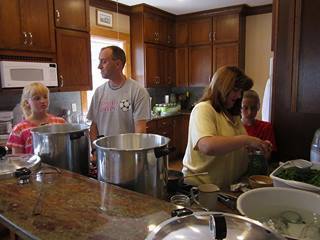
When truck loads of corn or bushelfuls of tomatoes come in from community gardens and local farms there’s a buzz of activity as folks gather to shuck, peel, chop, boil, spice and can the bounty. It’s a throwback to the canning parties and barn-raisings of yesteryear.

Right-hand gals Diane Franson-Krisor and Diana McIntosh, part of the crew that helped Olson and Richards rehab the house, are regulars at the Saturday brews that feature hot coffee and tea and assorted homemade toppings and spreads to garnish freshly baked biscuits, turnovers and bagels. Richards is the canner and Olson is the baker.

Cover Photo

Millard resident Betsy Scott has become a Saturday devotee.

“Instantly I felt welcomed,” she says. “I just felt at home with Sharon and Beth and Diane and Diana. Every week I kept coming back I got more and more excited to come up. It’s all about the apple turnovers and the fresh biscuits with the homemade jelly, it’s about ,’Here, try my tomato jam.’ It brings people together and that’s never a bad thing.”

Scott says the dozens of people who make it to those coffee klatches are attracted like she is to what Olson and Richards embody

“Their passion for community and for the house itself, their love of canning and their love of people. They make every single person feel welcome when they come in and by the time you leave you feel like you’ve known them forever. I think everyone walks away feeling like they’ve made some new friends. It’s kind of like Cheers but without the beer and without Norm.”

Franson-Krisor grew up in Minne Lusa and she cherishes what the project provides.

“I think it’s wonderful because every neighborhood needs a gathering place and they have really changed this area a lot. I’ve been here 52 years in a house on the corner and growing up was all about neighbors communing. That was the thing to do. All the mothers got together and the kids played. And this is bringing it back.

“Somebody referred to Beth and Sharon as the porch ladies, and that’s how it was when we were growing up. The women talked over coffee and the kids played, and that’s what’s coming back because of this place. It’s like we’re all one little family here.”

Because it’s neutral ground, elected officials and public servants come to hear concerns from their constituency. Everyone from Omaha City Council members to the police chief have visited there. It’s a safe house for children and adults escaping trouble at home. When there’s an issue in the neighborhood, whether illegal dumping or unkempt property or illicit drug dealing, residents view Olson and Richards as the go-to resources to contact the authorities. When there’s something that needs organizing, the “old ladies” at the Minne Lusa House are among the first ones people reach out to to get things done.

Richards says, “Some people who are afraid to call the police will call us and say, ‘This is going on on our block, can you help us out?’ Sharon is great politically. She’ll go to public hearings, listen and make her presence known. I’ll tell you right now when (Omaha City Council District 2 representative) Ben Gray sees Sharon he goes, Oh-oh.’ Sharon puts them to the task. They know her. That’s what it takes.”

“You have to be a tough person to be down here,” says Olson.

Both women are strong, assertive, plain-talking, live-out-loud types. Olson can be sarcastic. Richards is more diplomatic. Richards says they’re just enough different to “make it work because there is a balance between the yin and the yang.”


Minne Lusa House

Minne Lusa House

Friends say they personify the do-it-yourself independence, give-the-shirt-off-your-back generosity, puff-out-your-chest pride and glad-to-know-you warmth that characterizes Minne Lusa.

Situated between Miller Park and Florence in a tucked away sector east of North 30th Street, Minne Lusa was formed in 1916 by Charles Martin, who designed a neighborhood with California Bungalow-style homes of wood, stucco and brick. The homes were built in what was a cornfield. A pretty boulevard runs through the heart of the area. Many homes and yards are beautifully maintained. The area’s enjoying a resurgence of interest because its character-rich homes featuring natural wood floors, ample windows, fireplaces, generous porches and detached garages sell at highly affordable prices.

Richards says part of the motivation behind their project is “to get the name Minne Lusa out there because nobody before knew where Minne Lusa was. We’re not Florence, we’re Minne Lusa. We’re here to promote the neighborhood and to get people to know each other.”

The house has hosted an arts and crafts show and may host another this fall. It also organizes the annual Trick or Treat on the Boo-Levard during Halloween. Minne Lusa Blvd. is decorated for the occasion.

Efforts are underway to get Minne Lusa designated a National Register of Historic Places district. Olson and Richards support the initiative because they are so devoted to the neighborhood and generating appreciation for it and what makes it different.

These women of a certain age grew up in a time when tight-knit neighborhoods were the rule, not the exception. Olson, a retired phone company employee, resides in the same Minne Lusa house she was raised in and she does all she can to preserve the sense of neighborliness and community she’s valued there all her life.

Richards, who fell hard for Minne Lusa during 15 years as a mail carrier there, bought a house in the neighborhood and the retired U.S. Post office employee has made the area her home ever since. She’s flipped some homes there and she takes pains to only sell her properties to buyers with the same sense of community she has. Much as Olson did Richards too came of age knowing her neighbors, only not in Omaha but in the small town of Garwin, Iowa she grew up in. The friendly people of Minne Lusa made an impression on Richards because they reminded her of how the people in her hometown related to each other and she wanted to be part of that again.

“I really like the people,” says Richards. “There’s something about the people. I just fell in love with this neighborhood. It’s got a lot of promise, it’s got great homes. When I carried mail here for 15 years I knew everybody who lived between 30th and 24th, from Whitmore Street up to Sharon Drive, and I’d think, ‘Well. it’s too bad these people don’t know these people because they’d really get along.’ And so now I think we’re slowly getting those people to know each other.”

 Photo: Thanks to Diane Franson Krisor and Diana Lynn McIntosh, we will be ready to pickle watermelon rind tomorrow!

Among those she got to know on her route was Olson.

“Sharon and I talked a lot and we became friends over time.”

Richards says they both joined the Minne Lusa Neighborhood Association about the same time.

Their idea for the Minne Lusa House was to create an open space that draws people together.

“Our goal always was just bringing the neighborhood together,” says Olson. “People don’t talk to each other the way they used to. When I grew up neighbors spoke to one another. You didn’t have to love them, you didn’t have to break bread with them, but you were nice to them and talked to them. We don’t do that anymore. Well, we do on my block. So the goal was always to bring that back somehow.”

For years Olson held a block party on the stretch of Martin Ave. she lives on.

“I thought that was a good way to get everybody to know everybody.”

Richards says it’s just one of many ways her friend “was working” on strengthening neighborhood and community before Minne Lusa House. For both women it’s a personal mission.

“The old neighborhoods are all fractured because we have issues with landlords that own properties that don’t take care of their places,” says Olson. “We have landlords that rent indiscriminately to anyone and then it just ruins a neighborhood.”

Richards says, “That’s one of the things that drew us together because we’re both angry about what the landlords are doing to older neighborhoods and to our neighborhood.”

They don’t take things lying down either. When renters in a neighborhood house were causing frequent disturbances with loud music and late night partying, Richards spring into action.

“I got the landlord’s name and when the neighbors were partying I’d call the landlord at midnight and leave messages, saying, ‘We’ve got a problem here on Mary, we can’t sleep, the cops have been here, and if we can’t sleep you can’t sleep.’ The landlord finally called me to say they were woking on it and finally those people moved out.”

Richards says the landlord promised to be more diligent about who she rents to.

“They’ve got nice people in there now,” she adds.

Olson says the problem of absentee landlords “isn’t just in our neighborhood, it’s anywhere east of 72nd. People can walk in and buy these houses for $20,000 or $10,000 and they do not put a dime into them and then they’ve got people renting that aren’t going to take care of anything. They don’t better your neighborhood, they destroy your    neighborhood.” She and Richards say that many inner city vacant lots and abandoned homes are owned by landlords who live out of state and wont let go of the properties except for exorbitant prices.

Meanwhile, taxpayers absorb the costs of cutting overgrown weeds or razing structures. Neighbors are left to deal with the blight, eyesores and dangers that come with empty or unattended properties

“It’s wrong, this whole system,” says Olson.

“We’ve talked to Ben Gray about it,” says Richards. “We’re working on it.”

Opened in 2011, Minne Lusa House has become the very gathering spot and conduit for action the women envisioned

“When this house became available it was primary for us to say, ‘Let’s try this and see if it will work,’ and the means to doing that was canning. Canning brought people in. And as you can see there is nothing here that distracts them,” Olson says, referring to the TV-less kitchen, dining room and living room. The office, pantry and finished attic and basement have no TVs either. “People have to speak to one another and when you’re canning you have to talk to each other or you wont have a very good product when you get done.”

“The canning is fun,” says Richards.”The best part is when somebody tries it and goes, ‘Oh my God, this is great.’ That’s reward.”

Franson-Krisor says she’s learned to can, garden and do home improvement projects from working alongside Richards.
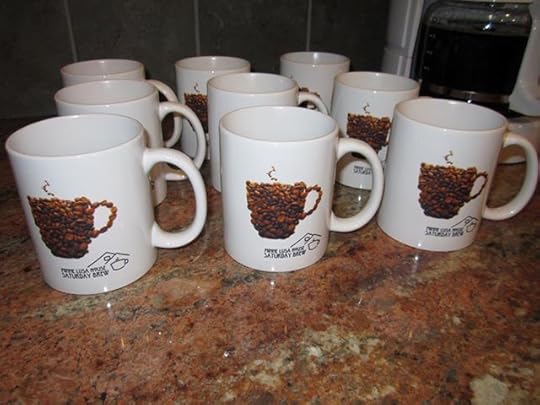
 

Photo: Come on by this morning from 9 to noon for coffee and try out our new coffee mugs, compliments of Sue Bigsby. Thank you Sue, these are great!!


Olson fondly recalls a woman who learned to can at the house. “She sent the cucumber relish she made all over the country to her family and was the hit at Christmas, so she’s a memory to me.” Then there’s the mother and daughter team who come. The mother insists on sampling everything while the daughter busies herself canning. Upon leaving, the mother beams about how much “WE’VE canned.” The camaraderie is what she’s really after. A surprising number of young people, including families with small children, come to can.

Two more Saturday morning regulars are husband and wife ministers John and Liz Backus, who live across the street and pastor at nearby Trinity Lutheran Church. Lots of laughter and stories ensue.

“Those are things you just can’t put a price tag on,” says Olson.”I think we get more from this then maybe anybody else does. We get to meet all these fun, interesting people. We have a good time with them. We tell people, ‘Don’t come if you don’t want to have a good time.'”

“We’re going to have fun,” adds Richards.

The women didn’t expect all the attention their endeavor’s attracted, including an Omaha World-Herald feature that helped put the Minne Lusa House on the map. As a result the house has become a magnet both for folks in the neighborhood and from well beyond its borders.

“We’ve had people from Council Bluffs, Papillion, Ralston, Gretna come down here for canning lessons,” says Olson.

The way it’s caught on has taken the founders by surprise.

Richards says, “When we started this we didn’t know know where this was going to go. We had no clue. We didn’t see that coming. We were just going to be a little neighborhood house and then slowly spread it through the neighborhood.”

Minne Lusa House captures people’s imagination. Donated boxes of jars and other canning supplies regularly arrive on the front porch. Harvested produce is left for the women to can. Proceeds from the products they make go right back into the house. A Minne Lusa native living in Florida discovered the project and sent personalized coffee mugs.

Olson says, “We have wonderful support.”
 

Photo

Photo

Photo

She and Richards don’t believe in planning too far ahead or following a strict plan. They just ride the wave and take things as they come.

“Today if you asked us what we would do next year we cannot tell you that. It just falls,” says Olson. “We don’t set goals. I worked 30 years for the phone company. I’m not putting together any business plan. I’m done with that. We fly by the seat of our pants. Too many years of structure, Beth had structure with the post office for God’s sake. We don’t need that. Nobody needs to tell us what to do.”

They’re not sure what the house’s future may be when they’re gone or decide to step down.

If something happens and we have to shut it down, then we shut it down, there’s no pressure,” says Richards.

Olson can’t see it continuing in its present form or with the same name under someone else’s leadership. “I mean, it’s the Minne Lusa House, it’s unique. If we couldn’t do it anymore and somebody wanted to buy it it couldn’t be Minne Lusa House anymore, at least not for me.”

Richards says it’s possible the house could always return to being a private residence. “We set it up that if we failed we’d probably lose money but we could sell it as a home for somebody to live in.”

The 1918 built home was occupied by several families over its history, the longest period, 45 years, by the Joseph and Clella Frolio family, who resided there from 1961 to 2005. The Frolio children left some indelible marks in the home, such as a pattern of BB gun pellet holes in one basement wall and handprints in another basement wall. Here and there are personal touches by Olson and Richards, including a vintage rocking chair that belonged to Beth’s great-grandmother.

A plaque hanging in the home’s front room details the chronology and names of the various people who dwelled there.

The women hope to create a Minne Lusa museum in the attic to display the photographs and articles they’ve collected about the neighborhood they feel such a kinship with.

The pair don’t like the bad rap North Omaha gets and they see the Minne Lusa House as a touchstone where people’s negative attitudes and perceptions about the area can be overturned.

“It’s a concept you have to change and it doesn’t get changed overnight,” says Richards.

“People go, ‘Oh my God, it’s North Omaha, there’s shootings, I can’t come there,” bemoans Olson. “People will not come down here because they’re scared they’re going to be shot. So when we have big groups of people we always say, ‘Do you know where you are?’ This is The Hood.’ Then they see for themselves what a beautiful area it is.”

Richards says, “We’re bringing people from out of the community into the community, where they find out it’s kind of nice up here. It’s by word of mouth and it spreads.” More than anything, she says, “what we’ve accomplished is that every day neighbors are getting to know each other.”

Keep up with doings there at http://www.facebook.com/minne.house.


MindMixer: Rethinking the town hall meeting

August 28, 2013 1 comment

MindMixer is more than a great name, it has a great concept and utility behind it too.  Entreprereurial partners Nick Bowden and Nathan Preheim have combined their urban planning and tech savvy skill sets to an online platform that is rethinking the town hall meeting.  My B2B Omaha Magazine story about the duo and their innovative Omaha-based business follows.


20130628_bs_2691

MindMixer founders Nathan Preheim (left) and Nick Bowden

Rethinking the town hall meeting

© Photography by Bill Sitzmann

Urban planners turned entrepreneurs Nick Bowden and Nathan Preheim never got used to the slim turnouts that town hall meetings drew for civic projects under review. It bothered them that so few people weighed in on decisions affecting so many.

Preheim, 39, and Bowden, 29, also didn’t feel comfortable cast in the roles of experts who knew what was in the best interests of citizens. They felt too many good ideas went unheard in the process.

The way the Omaha natives saw it, a new approach was needed to better engage people in civic discourse and therefore help build stronger communities. “Lucky for us, urban planning is really stodgy,” says Preheim. “Technology has not really infiltrated the inherent processes within the field, so there was a great opportunity for us to integrate technology into public participation. That’s where we kind of came up with the solution to a very common problem—how do you get more people engaged and interested in talking about community betterment?

Town halls had been and still are the primary vehicle by which cities solicit feedback. They’re hundreds of years old, and they really haven’t changed much at all. We saw an opportunity to enliven the conversation by inverting that model and empowering people to be a part of that change.”

The business partners developed a startup technology company called MindMixer (see related story on page 33) whose online platform offers a virtual front porch for ideas and opinions to be shared, noticed, and acted upon.


Nathan Preheim

Nathan Preheim


“We’ve always felt that people generally care for their community, but maybe it was an issue of convenience, not an issue of apathy, that prevented them from participating,” says co-founder and CEO Bowden. “Our founding premise is that technology can break that barrier of convenience and open up a bigger world of potential inputs.”

Co-founder and COO Preheim says, “There’s probably something I could learn from you; there’s probably something you could learn from me. We’re way smarter together than we are individually. I think some of that same mantra and guiding force influences what we’re trying to do here.”

“Our purpose is to build a stronger community by involving people in things that matter,” says Bowden. If the response from investors, clients, and everyday citizens is any indication, these visionaries have found a powerful engine to connect everyday people with local government bodies, schools, hospitals, and organizations of all kinds.

“We’ve always felt that people generally care for their community, but maybe it was an issue of convenience, not an issue of apathy, that prevented them from participating.” – Nick Bowden

Launched in 2011, MindMixer, which offices at the Mastercraft Building in North Downtown, has more than 400 clients and expects to reach 1,000 by year’s end. As of July, MindMixer had raised $6.2 million in venture capital, much of it from local investors, to develop its tool. The company’s roster of 30 employees is also expected to grow.

By digitizing the town hall, MindMixer facilitates discussions and debates for projects large and small, from rebranding the entire San Francisco public transit system to a crosswalk put in outside Omaha’s TD Ameritrade Park.

Whatever the idea, whether it relates to recreation or education or health care or some other quality of life issue, people now have a 24/7 avenue to have a say in it.

Preheim notes, “We think we’re the first company that’s trying to pull this off—to unify all those different communities and allow you to sort of contribute to each of them from a single place. It’s providing opportunities for people to give back or reinvest or make a contribution. We’re a funnel, we’re a vehicle, we’re kind of giving voice to people who may not have had that before. It’s empowering, it’s uplifting.

“We are part of something, call it a new movement if you will, that’s enabling better transparency and decision-making by stakeholders who are sort of tapping into the collective wisdom of their constituents. We’re kind of in the meaningful change business. That’s exciting stuff.”


20130628_bs_2712

Nick Bowden


Validation that they’re onto something big, Preheim says, also comes in the large “number of citizen-submitted ideas that have actually been carried forward and implemented” nationwide and the sheer participation happening on sponsored MindMixer sites.

“Last year, we engaged over 800,000 participants, and those 800,000 participants submitted over 38,000 ideas,” says Preheim. “Those are empowering statistics, these are encouraging numbers.” He projects two million-plus participants to submit upwards of 100,000 ideas in 2013.

Sometimes, projects respond to urgent human needs. For example, MindMixer-supported sites which assisted citizens organizing to fight back flood waters in Fargo, N.D., as well as those rebuilding neighborhoods in tornado-ravaged Tuscaloosa, Ala.

The startup’s success earned it 2013 Innovator of the Year honors from the Greater Omaha Chamber of Commerce and Technology Company of the Year recognition from the AIM Institute. Forbes magazine named Bowden an “up and comer.”

With the growth and attention come pressures to relocate, but Bowden and Preheim are determined to prove a tech company can make it big in Omaha. They believe there’s enough talented, smart people locally to lead the paradigm shift the company’s helping lead. MindMixer’s big aspiration is restoring the fabric of community by being the front porch of the internet, where people discuss things that matter and get involved in making positive change happen.

To see this story and other stories in this issue of Omaha B2B Magazine visit its website at: http://omahamagazine.com/category/publications/b2b-magazine/