Archive

Posts Tagged ‘North Omaha’

Ty and Terri Schenzel: Laying a Foundation of Hope

January 28, 2016 1 comment


I was privileged to write this Metro Magazine (http://www.spiritofomaha.com/Metro-Magazine/The-Magazine/) piece to commemorate the lives and works of the late Ty and Terri Schenzel as part of the pub’s Journeys series.  The new issue is themed Loving Legacies: Love that Lingers, Love that Lasts.  Anyone that knew the Schenzels will tell you that the couple embodied love.  Upon reading this story a friend of the Schenzels, named Ivy Jackson Ginn, posted, “Our best sentiments can never summate how much we loved and adored the Schenzels. Every day brings a new memory filled with laughter and fullness of life. They are irreplaceable and greatly loved by everyone they came in contact with. May each word bring joy and comfort over all who read them.” #carryingthebaton


Ty and Terri Schenzel: Laying a Foundation of Hope

Faith, Hope, Love, A Legacy

©by Leo Adam Biga

Appearing in the February-March-April 2016 issue of Metro Magazine (http://www.spiritofomaha.com/Metro-Magazine/The-Magazine/)


Where Love Resides

inspiring • compassionate • caring • loving • unconditional • dedicated • committed

When the shocking news of Ty and Terri Schenzel’s August 20 fatal automobile accident spread, it was as if the thousands whose lives they touched let out a collective gasp. Many questioned how this could occur to an admired couple whose gifts for engagement, invitation, acceptance and frivolity endeared them to many, A sentiment often expressed upon their passing is that they had the ability to make people feel a part of them even upon meeting for the first time.

This was not supposed to be how things ended for this golden, well-yoked pair, both popular pastors whose love affair began in seminary and never wavered in 30 years together. It seemed a cruel, premature exit for a duo who created a youth serving center and a marriage healing ministry founded and named after their core belief – Hope.

“When something like this happens there’s always questions like why and how could this happen,” says friend and fellow pastor Lincoln Murdoch. “They were getting ready to move into probably the sweetest time in their lives in ministry. These are questions that are never answered, especially when you consider how many marriages they would have impacted and saved through their ministry, and that makes it hard. But as I said at their funeral, we’re going to turn our why into thank you for knowing them, for being in our lives, for the influence they had on us and on so many others. We find some comfort when we go there with gratefulness.”

There is gratitude for all the work the Schenzels did at Trinity Church, where Ty was a youth minister, and the house of worship it transitioned into, Waypoint, where he was an associate pastor.

A ministry he and Terri developed out of Trinity led to their founding the Hope Center for Kids in North Omaha. There they leave behind not only a brick and mortar symbol of their community-based work but a thriving organization giving more and more at-risk youth the skills, services and resources needed for success.

At the October 2 annual Hope gala held in the CenturyLink Center Grand Ballroom, nearly 1,200 people attended and more than $600,000 was raised. It was direct confirmation of how far the Schenzels took what began as a vague dream in 1998. A video tribute and remarks by emcees and hosts paid homage to the Schenzels.

An earlier, much larger outpouring of love happened during the August 26 memorial service at Countryside Community Church, where 3,000-plus gathered to mourn their deaths and celebrate their lives. A pageant of people eulogized the Schenzels on that emotional occasion, when the loss was still fresh and raw. Speakers included the couple’s children, Emily, Annie, Tyler and Turner, along with old friends and colleagues.


Impact

In addition to their four children the Schenzels left behind two young grandchildren, with a third on the way. They left behind, too, scores of people they ministered to, worshiped with, counseled and advised. Their shared passion was helping people improve themselves and lead better lives.

‘They always had groups in their home they were leading, doing Bible studies with, mentoring,” Murdoch says. “You can’t just do that, you’ve got to have a gift to pull that off.”

Their legacy may also live on in the manuscripts each Schenzel was working on at the time of their deaths. The family is exploring their publication. Additionally, Ty left behind dozens of leather-bound journals he kept that could be a primer for faith, family and marriage.

The legacies left in the wake of their passing extend to countless friendships that came easily to the extroverted, fun-loving couple.

“I just miss the joy-filled friendship and the spontaneity of connecting,” Murdoch says, “and it was a real friendship formed over 35 years. They’re kind of rare nowadays and you don’t replace those.”

He referred to the times he and his wife spent with the Schenzels as “laughter therapy.”

“People loved being around them because within two minutes you were laughing. We loved getting together with them because if we were going through a hard time in ministry or in life we’d engage with them and laugh for a couple hours and feel a whole lot better by the end of the evening.”

Despite all the friendships they cultivated and the 24-7 demands of serving others, the three pillars of faith, marriage and family always came first for the Schenzels. That legacy lives on not only in the individuals they led to be born-again Christians, but in the way they raised their children and in the youth, family and marriage building work they did.

Murdoch always knew their wide impact but he was taken aback by the throng that came for their memorial. He was even more impressed by the fact they reached so many but still made family their priority.

“Yeah, really amazing, their influence was so wide. My wife and I were like, ‘Man, how did they have time to do that? How did they touch so many lives in the amount of years they had?’ They had this huge reach and yet amazingly enough they were able to give their family the best of themselves and everybody else got what was left over. But there was a lot left over. They were so engaged with their children, they spoke love and worth into their lives all the time.

“They had their values and priorities straight and they kept them straight. That’s a pretty rare thing nowadays. Even for well-intended people it’s tough to balance, especially in ministry because your job is never over. It can be like this black hole that never ends. But they were able to draw the boundaries they needed in their life. Great role models that way.”


Hope Center for Kids | Omaha, NE View Gallery »


Shining examples

The hurt of losing a couple that gave so much and had so much left to give runs deep but what consoles those who knew and loved the Schenzels is the assurance that they maximized their time on Earth.

Ivy Jackson was an original Hope staffer but she went back with the Schenzels before that – to when Ty did youth ministry at Trinity. If you knew one Schenzel, you knew the other. You became like family. She says their impact on her reflects how transformational a relationship with them could be.

“Everything Ty and Terri did, they were all in. You didn’t get half of them, you didn’t get a third of them, you got everything they were,” Jackson says. “Their legacy is that when you do find that thing you know you’ve been specifically made for – that’s something Ty was very big on –  you go in completely 100 percent and you do it well. Everything they did, they did well. They loved well, they ministered well, they laughed well. They did everything with all of their heart.

“They were all about what legacy will you leave in everything you do –when you kiss your children at night or talk to your spouse after a long day at work or engage with the checkout clerk at the grocery store.”

Because the Schenzels didn’t skimp on life, it makes their loss easier to accept, Jackson says.

“When you see everything they’d done up to this point you think to       yourself, It’s OK they’re gone because you didn’t see any holes in their lives. You couldn’t look back over their life together with regrets like, Oh, I wish Ty and Terri had a a better relationship with their kids or patched up that thing with so-and-so. They never left anything undone. So even though it’s hard to see them go and not be here…we know they lived life to the fullest. They could look at each other and say, ‘We did well.” I think that’s the legacy they leave to us – do it well, You love your children well, love your spouse well, and that’s what they did.”

The late couple’s eldest child, Emily Lanphier, agrees, saying, “They modeled well what it is to have a good life.”

“My parents were not perfect,” Lanphier adds, “but just authentically committed to their family. There wasn’t any double standard – like what you saw from the pulpit is what we experienced our whole life. There was a total authenticity and congruence. I think that is what made them so beloved because people sensed that when they met them. They were so genuine. Who they were is who they were to any person.”

Lincoln Murdoch says, “They were not pretentious, they were not overly spiritual in a religious kind of way and they were open with their lives, their marriage, their failures. They didn’t try to make you think they were something they weren’t and that’s endearing to anybody.”

Not long after being introduced to Ty Schenzel Level 3 Communication founder Mike Frank helped buy the former Boys and Girls Club building on North 20th Street as the Hope Center home. He only knew the Schenzels socially at first but then he got to experience their caring. That’s when he caught their vision.

“Ty was completely sincere, completely real,” Frank says. “He was guileless. And he was kind of geeky. He wasn’t like this really cool guy.  But his heart was really for the underdog, the disadvantaged and the hopeless. Terri just had a passion for living. She had a deep love for Ty and she was going to do everything she could to add to it. That was very contagious – that enthusiasm, that excitement.

“We became really close friends. Ty buried my youngest daughter and married my eldest daughter. He led my best friend to the Lord. Our lives were intertwined pretty deeply. When I was around Ty he made me be better because he was so in love with his wife and with Jesus. He was so passionate about the disadvantaged and so excited to serve and he called me up to be a better man.”

He says he carries with him the Schenzels’ example of “how to walk the talk.”

Emily Lanphier says her parents exemplified good living to everyone they came in contact with and that extended to her and her siblings.

“Their example of getting life right was such a gift to us because I think most people are trying to figure out how to do that, and we kind of know how that works. Not that life is perfect, we still have life issues, marriage is work and it takes a whole lot of effort. But it feels like we started out 10 steps ahead of everyone else in life just because of the kind of love we received growing up. All four of us are confident, we know who we are, we’re happy individuals.”

Nick Reuting and his wife Andria came under the Schenzels’ influence through the Hope Filled Marriage workshops Ty and Terri were making their ministry focus after stepping away from the Hope Center. Like everyone who came near their orbit, the Reutings got swept up in it.

“The image I’m left with is walking into their home, getting a hug from Ty, getting a hug from Terri, and the first things out of their mouth were, ‘How’s your heart, how’s your marriage?.’They were constant givers. They wanted to make sure you were all right, your marriage was all right. When you had a success there’d be such a joy in their faces,” Reuting says.

“They showed an example of what a healthy marriage looks like and what healthy commitment to work, to marriage and to faith looks like and how to balance that. They both freely admitted their own faults, which made it easier to accept that OK, I can make a mistake and it’s not the end of the world – everything can be worked out.”

Reuting and others have picked up where the Schenzels left off to continue the Hope Filled Marriage series.

He says he will miss the “warm loving feeling” that came with their radical hospitality.

“And I’m going to miss Terri’s cooking as well. She made a lot of lunches for me.”


Putting marriage and family first

Nurturing came naturally to the Schenzels, who never left any doubt they loved their kids.

“Even through our growing up we each had different times where we weren’t perfect kids and their loving commitment was so unconditional,” says Emily Lanphier. “They cared more about being connected to us as mom and dad than they did about us making the right choice. Our heart connection with them was really important.”

She says even with her parents’ busy schedules she and her siblings never felt neglected or shortchanged.

“They were incredibly intentional in making time for family. Sundays after church my mom would do lunch. There were different points during the week when we knew we were going to see them. They were really good at that.”

The kids maintained that closeness with them even in adulthood.

“When we had free time we would all want to spend it with our parents.

Like they were our friends, too. They loved being grandparents. My mom was actually present for the birth of both of my children. My dad was there with the second baby. That’s the kind of relationship we had. They were some of the most busy people I knew but my mom spent every Wednesday with me and the kids.

“I’m so grateful I got to know them as adults. When I’d see my mom she’d confide if she was struggling with something. She was so honest.

If she and my dad had a disagreement she’d acknowledge it without bashing him. They let you know life is messy. They would always say how hard they had to work on their marriage because they were so emotional, and my dad’s emotions would affect my mom, and her emotions would affect him, and they had to work through that.”

The vulnerability and transparency that friend and fellow minister Ron Dotzler referred to in an Omaha World-Herald commentary “was refreshing to see,” Lanphier says, “because it gives you a realistic perspective for relationships. It’s not like you’re perfect together and you never have any fights. No, you’re going to have to be so committed and love each other so much that you’re going to be willing to go through anything together.”

Lanphier admired that her parents made a rock solid commitment to staying together.

“When they were dating my dad said he told my mom, ‘Just so you know, if we decide to get married divorce will never be an option.’ And so they settled that even before they were engaged. They were like, We’re all in or we’re not going to do it.”

Ivy Jackson says the Schenzels embodied better than anyone she knows the basic values and principles for right living. She says their lives demonstrated that doing the right thing is both simple and hard.

“In my little circle when we talk about Ty and Terri it’s funny because all of the things we say sound like cliches, although they are hard to follow because they require intention and work. Ty and Terri almost seemed cheesy because they were so cliche but they had the fundamentals down and they did them well. That’s who they were. If they went down a list of morals, fundamentals, codes of how you live your life, they checked the box good. They were an inspiration.”

Jackson draws on that inspiration daily.

“Every day I wake up I am literally a changed person because I knew them. I cannot wait to do well, to love well. and I literally do that. Upon their passing I feel like that’s what I’m doing – I’m entering into what that meant in every sermon Ty said and what he did.”

Nick Reuting says Ty had a way of connecting with others.

“I thought of Ty as the best heart engineer you could think of. He could build a bridge from his heart to your heart quicker than anybody I’ve ever seen. There was immediate connection and give and take.”

Lincoln Murdoch says Terri had her own way of connecting.

“She loved to teach, she loved mentoring younger women. I think the ladies immediately felt this was a woman they could trust to open up their hearts to and that Terri would be a confidante.”

mentors • friends • parents • pastors • good shepherds

Good times and bad times

Not everything was hearts and roses for the Schenzels and the people they served.

Pastor Ed King was at Hope when “Ty didn’t know what he was doing but he knew he was supposed to do it.” They learned an inner city calling will have casualties when gangs rule some streets.

It angered the Schenzels so many lives were lost to gun violence and the metro seemed indifferent to it or tolerant of it.

“They felt the community needed to take more ownership in the inner city and what happens there,” daughter Emily Lanphier says. “They felt like this is our city, we should all be really upset that this is happening and do something to change it.”

Some kids the Schenzels served were lost in the carnage.

Fittingly for a mission called Hope, Schenzel held hope the center  positively changed lives.

“My dad always said he dreamed about a day when it was not just funerals but weddings, graduations, kids going to college and on mission trips all over the world, which did happen before he died. It’s so great to know he saw that in his lifetime – those tangible expressions of the difference the Hope Center made,” Lanphier says.

“The longer the Hope Employment and Learning Academy was around, more and more kids were graduating high school and going to college. That was huge for him.”

Ed King says the good experiences far outweighed the bad.

“Over 20 plus years of friendship we got a chance to experience a lot – from some of our kids who didn’t make it, going to court, going to jail,  presiding over their funerals. Ty always would tell the kids the day was going to come when we’re going to perform your guys weddings and that most definitely came to pass – we had the privilege of co-officiating the wedding of a former Hope youth.”


A father’s heart, a mother’s heart

Lincoln Murdoch says the Schenzels’ “huge hearts as parents bled out all over the place, so when they were called to North Omaha they saw and loved these kids as their own and the kids felt it. Something that made their ministry so powerful is they genuinely embraced those kids and had them to their home. Parenting the next generation was very powerful in their hearts. Ty was a great spiritual surrogate father to a lot of guys. Terri was phenomenal from the maternal side. She was a parent to anybody who hung around them at all.”

It wasn’t only adults who sang the Schenzels praises at the gala. In a video kids delivered personal tributes about the difference Hope’s made in their lives. Kids went table to table to testify to their experience. Most powerfully, a group on stage took turns flipping over cards in sync with a singer-guitarist’s performance of “Beautiful Things.” Kid by kid, card by card, the messages transitioned from where they were (“stressed out,” depressed,” “angry and alone,” struggling in school”)  to where they’ve come – “I look forward to my future,” “I make my parents proud,” “I get better grades,” “I have really good friends,” “I am more happy,” “I have less pain and sorrow.” Then all the kids held up cards that read, “Thanks for giving us Hope.”

Lanphier says the fact her parents regarded Hope youth as their own made it even tougher when the streets claimed some of them.

“There were a few kids they had relationships with who got shot in gang activity and that always devastated them. The funerals were always really hard on them.”

She says those tragedies reinforced their commitment to the mission.

“My dad would say, ‘This is why we’re doing what we’re doing, this cannot continue.'”


Picture


Unthinkable

Lanphier didn’t want to get the kind of news her folks got when people they cared about died. But she was the first of her siblings to learn her parents had lost their lives in a crash that also took the life of a family friend and of the driver of the truck that collided with their vehicle,

Authorities at the scene searched for hours to find identification in the remains of the fire that ignited after the head-on impact.

Emily recalls the horror of hearing the unimaginable:

“At 2:15 in the morning I heard a knock on my door. It freaked me out because my husband was away on a camping trip and I was home alone with my kids. My phone was on silent and I picked up and saw that the pastors at Waypoint. Matthew and Amanda (Anderson), were calling me. Amanda said, ‘Emily, come to the front door, we’re here.’ I was like, ‘What’s wrong?’ and she said, ‘You just need to come down.’ So I got dressed knowing something was really wrong.

“I opened the front door and there’s a police officer with Matthew and Amanda standing beside him. I thought, This is like in the movies, this is going to be really bad news.’ They came in and I was told by the officer what happened. A nightmare. And then I had to tell my siblings. It’s the worst, the worst. It’s bad to know but then when you have to tell people that’s like a whole other level of pain. I remember thinking, I cannot believe these words are coming out of my mouth.”

She prolonged sharing the news as long as possible.

“I actually waited to tell them. I decided to let them sleep because our lives were ruined and what difference would a few hours make.”

After the blur of memorial services and condolences, she posted an online remembrance of her parents that read in part:

“it is such a comfort to know their impact as i journey through this tunnel of grief. There are some moments I want to call them so bad and I feel like I might die from sadness but I keep digging and allowing myself to grieve and heal because I want to be the kind of parents they were.”

She says what “they put in me” provided the resiliency needed to work through the tragedy. She confides that in the immediate aftermath of her loss she didn’t feel so resilient until her training and kicked in.

“I remember thinking, Oh, my God, someone’s going to have to take care of my kids, my grief is incapacitating. And then all of a sudden I remembered, Are you kidding? I know exactly how I’m going to get through this – because everything I need to deal with this they’ve already given me. They prepared me my whole life how to be strong and to let my faith be the bedrock of who I am.”

She also learned from her folks it’s OK to feel your feelings and, if needed, to have a professional guide you through them.

“My parents were both highly emotional but they weren’t sufferers. They dealt with life and if they needed to get counseling they got counseling. It’s OK to be sad, it’s’ OK to need help.”

More profoundly yet, she and her siblings are all believers who know to call on their Higher Power for healing,

“Because this is the most pain I’ve ever felt in my life, I  know what to do and I can handle this because I have the Lord inside me.”


The tributes continued Wednesday for Ty and Terri Schenzel with a ceremony to unveil a commemorative street naming in their honor.


Moving on and carrying the torch

Lincoln Murdoch has a perspective on the tragedy that took Emily’s parents and his good friends just as they were transitioning from the Hope Center to their Hope Filled Marriage ministry and taking time out for themselves, too.

“It was almost like they put in 17 hard years at the Hope Center and the Lord said, Why don’t you take two or three months off, travel around, enjoy each other, and then I’m going to call you home. We just didn’t know what that would be.”

At their funeral he brandished a baton at the altar to symbolize taking on the vision of hope the Schenzels set forth.

“Being a runner I thought, Well, they left a big gap and they carried the baton and now somebody needs to pick it up. I challenged everybody there to take part of the baton Ty and Terri carried and let’s keep this vision going. It was a call for people to get involved.”

That call has resonated with friends and strangers as Murdoch and others have taken to carrying batons in races and other venues to bring awareness to the Hope Center mission.

“I had no idea the baton theme would kind of get a life of its own.”

It’s not so different than when the Schenzels left suburbia for the inner city on faith alone to plant seeds they never imagined would grow into such strong roots. What began with Ty and Terri as Johnny Appleseeds and Pied Pipers now has an army of soldiers following their lead in helping people bloom.

integrity • character • purpose-driven • faith-centered • family-focused • fun-loving


Visit http://www.hopecenterforkids.com and http://hopefilledmarriage.org.


Nelson Mandela School Adds Another Building Block to North Omaha’s Future

January 24, 2016 2 comments

If you know me or follow my work then you know I have a heart for North Omaha.  I grew up there.  Went to school there.  For a complex set of reasons having to do with how my life unfolded the first 42-plus years and North Omaha’s role in that, I found myself drawn to writing about some of the dynamics there – past and present.  I still do. I am for anything that has the potential to do good there and when I heard about the new Nelson Mandela Elementary School going into the former Blessed Sacrament campus on North 30th Street it certainly caught my attention.  Here is a story i recently did for Omaha Magazine (http://omahamagazine.com/) that gives a glimpse of the school through the perspective of two key people behind it, Susan Toohey and Dianne Lozier.


NelsonMandelaSchool1

The Nelson Mandela Way

New School Adds Another Building Block to North Omaha’s Future

Published in Omaha Magazine (http://omahamagazine.com/)

North Omaha may be reversing five decades of capital resources leaving the community with little else but social services coming in. Emerging business, housing, and community projects are spearheading a revitalization, and a new school with promise in its name, Nelson Mandela Elementary, is part of this turnaround.

The free, private school in the former Blessed Sacrament church and school on North 30th Street blends old and new. An addition housing the library and cafeteria joins the original structures. The sanctuary is now a gym with stained glass windows. Vintage stone walls and decorative arches create Harry Potteresque features. South African flag-inspired color schemes and Nelson Mandela-themed murals abound.

NelsonMandelaSchool2

The school that started with kindergarten and first grade and will add a grade each year is the vision of Dianne Seeman Lozier. Her husband, Allan Lozier, heads the Lozier store fixture manufacturing company that operates major north Omaha facilities. The couple’s Lozier Foundation supports Omaha Public Schools’ programs.

Their support is personal. They raised two grandsons who struggled to read as children. The odyssey to find effective remedies led Dianne Lozier to new approaches, such as the Spalding Method used at Mandela.

Mandela sets itself apart, too, using Singapore math, playing jazz and classical background music, requiring students to study violin, holding recess every 90 minutes, and having parents agree to volunteer. Mandela “scholars” take College for Kids classes at Metropolitan Community College’s Fort Omaha campus.

NelsonMandelaSchool4

It’s all in response to the high-poverty area the school serves, where low test scores prevail and families can’t always provide the enrichment kids need.

Most Mandela students are from single-parent homes. Sharon Moore loves sending her son, Garrett, to “a new school with new ideas.” Eric and Stacy Rafferty welcome the research-based innovations their boy, William, enjoys and the opportunity to be as involved as they want at school. Moore and the Raffertys report their sons are thriving there.

“Parents are really getting into this groove of being here,” says Principal Susan Toohey. “It’s building a community here and a sense that we are all in this together.”

Community is also important to the Loziers.

“We’re just really connected here,” Dianne Lozier says. “Allan and I have really strong beliefs that the economic inequality in the country and north Omaha is a microcosm of a huge issue. It’s a fairness issue and a belief that, if we want it badly enough, we can make a difference.”

She and Toohey are banking that the school demonstrates its strategies work as core curriculum, not just intervention.

“I’m hoping by the end of the first school year here we’ll be able to compare students’ literacy against other places and show that children have developed stronger reading skills,” Lozier says. “Our longterm goal is that all kids will be grade-level proficient readers by the end of third grade.”

For Toohey, launching and leading a school in a high-needs district is appealing.

NelsonMandelaSchool3

“What an incredible opportunity,” she says. “Rarely do you get a chance to start a school from the ground up and pick everything that’s going to happen there and hire every person that’s going to work there. I knew it was going to be a lot of work, but my heart has always been in urban education.”

In preparation for opening last August, she says, “I spent a year researching educational practices and curricula and developing relationships with people.” Her outreach forged partnerships with Metro, College of Saint Mary, the Omaha Conservatory of Music, The Big Garden, and others.

“We really want to be a model of what makes a school stronger, and I think having the community involved makes it stronger so it’s not working in isolation.”

Dianne Lozier, whose foundation funds the school with the William and Ruth Scott Family Foundation, is a frequent visitor.

NelsonMandelaSchool5“I help out with breakfast,” she explains. “I tie a lot of shoes. I get and give a lot of hugs.”

Lozier says her presence is meant to help “faculty and staff feel a little more supported—because this is hard. Every teacher and para-educator here, even the head of school, would say this is the hardest job they’ve ever had.”

Toohey says the difficulty stems from teaching a “very different curriculum” and “starting a culture from scratch. Families are getting to know us, we’re getting to know the families, and this is a really challenging population of kids. Many have not been in preschool programs that helped them moderate their behavior.”

Despite the challenges, Lozier says, “We have incredible families and kids.”

Drawing on the school’s inspirational namesake, each morning everyone recites “the Mandela mantra” of “Education is the most powerful weapon you can produce to change the world,” and “I will change the world with my hope, strength, service, unity, peace, and wisdom.”

“I hope all those things are what this community sees coming out of this school,” Toohey says, “and that our kids develop those qualities of grit and resilience so critical for success.”

Lozier adds that Mandela is a symbol of hope and opportunity.

“To accomplish the things we’re capable of,” she says, “we have to believe we can do that. It’s an opportunity to make improvements and get past impediments, to use internal strengths and be recognized for what you can bring.”

Visit nelsonmandelaelementary.org to learn more.

NelsonMandelaSchool1


Father Ken Vavrina Book Signing – Sunday, Jan. 3

December 28, 2015 Leave a comment


Sunday, January 3, 2016
at 10:30 AM – 12:00 PM
St Benedict The Moor, 2423 Grant Street, Omaha
Father Ken Vavrina will sign copies of his new book, “Crossing Bridges: A Priest’s Uplifting Life Among the Downtrodden,” from 10:30 a.m. to Noon on Sunday, Jan. 3 at St. Benedict the Moor Catholic Church, 2423 Grant Street, In North Omaha. The signing will take place in the social hall located in the church basement. The book chronicles Father’s inspiring life of service at home and abroad. As I helped Father Ken realize the book, I will be there as well. Come out and support Father Ken, a much beloved man of God and of the people whose ministry is both a testimony of faith and a call to action. This social justice champion has served parishes on reservtions and in Omaha’s inner city. He’s worked with lepers in Yemen and with the poorest of the poor in India. He’s aided war refugees in Liberia and earthquake surviors in Italy. He’s given all he has to give and now it’s time for the community to show its appreciation for this once close confidante and colleague of Mother Teresa.

Refreshments will be served. All are welcome. We hope to see you there.


Shining Light: News of Omaha Star publisher’s illness spurs admiration for her stewardship and interest in historic paper’s future

December 7, 2015 Leave a comment

Shining Light: News of Omaha Star publisher’s illness spurs admiration for her stewardship and interest in historic paper’s future

©by Leo Adam Biga

Appearing in the December 2015 issue of The Reader (www.thereader.com)


One of the things that makes North Omaha North Omaha is the Omaha Star, the historic black newspaper made famous by Mildred Brown. For the first time since Marguerita Washington took it over from her late aunt in 1989, the future of the 77-year-old newspaper is unclear as Washington battles cancer. But those close to the situation say under no circumstances will they let the paper fold because it means too much to the community it serves. Check out my Reader story about the legacy of the Star under Brown and Washington and how strongly people feel about it and what it’s meant to them. Read, too, about people’s admiration for what these black women did to give Black Omahans a voice.

News of Omaha Star publisher’s illness spurs admiration for her stewardship and interest in historic paper’s future

December 4, 2015 4 comments

North Omaha is more than a geographic district.  It is a culture and a state of mind.  That is particularly true of African-American North Omaha.  For generations the voice of that community has been the Omaha Star, which started in 1938.  Flamboyant Mildred Brown made the Star an institution as its publisher, managing editor and gudiing spirit.  When she passed in 1989 her niece Marguerita Washington, who grew up around her bigger-than-life elder and the advocacy-minded paper, took it over.  Washington’s kept the paper’s vital voice alive and relevant all these years, even as print publications have become endangered in the digital age.  She’s reportedly put everything she has into keeping it afloat.  Now though Washington is facing an end of life scenario that for the first time in her tenure as publisher – Washington never married and has no children – leaves the future of the Star in question.  Phyllis Hicks has been acting publisher during Washington’s health crisis.  But those close to the situation say there is no way the Star is going to fold if they have anything to do wth it.  My story below for The Reader (www.thereader.com) assesses what the Star has meant and continues to mean to people and what may happen with it moving forward should certain events play out.  I called on several folks for their perspective on the Star, past, present and future, and on the legacy of the two black women who have made it such a resource all this time.  Some of the most interesting comments are from Cathy Hughes, the Radio One and TV One communications titan from Omaha who got her media start at the Star and at KOWH.  This is at least the third time I’ve written about Washington, Brown and the Star and you can find the earlier stories on Leo Adam Biga’s My Inside Stories at leoadambiga.com.

statue

News of Omaha Star publisher’s illness spurs admiration for her stewardship and interest in historic paper’s future

©by Leo Adam Biga

Appearing in the December 2015 issue of The Reader (www.thereader.com)

The Omaha Star has given African-Americans a voice for 77 years. The newspaper is not only a vital mouthpiece for locals, but a valued hometown connection for natives living elsewhere.

It became an institution under the late Mildred D. Brown, a force of nature who became an icon with her ever-present smile, carnation and salesmanship. She charmed and challenged movers and shakers, near and far, with her insistent calls for equality. Through the Great Depression, the Second World War, the Cold War, the late 1960s riots, it never missed an issue. Upon Brown’s 1989 death, niece Marguerita Washington, who worked at the paper as a young woman, took over the helm. She reportedly used her own money to pay off debt her aunt accumulated. Despite financial shortfalls, this grassroots, advocacy, activist, community-minded paper has never missed a beat. Not through the 2008 economic collapse or the decline of print and concurrent rise of online media. While circulation’s dropped and the Star’s now published bi-weekly instead of weekly, its social conscience, watchdog, give-voice-to-the-voiceless roles remain intact.

For the first time though since Brown’s death, the Star’s future is unclear because Washington, the woman who’s carried the torch lit by her aunt, is now terminally ill. The 80-year-old Washington was diagnosed earlier this year with lung cancer. The cancer spread to her brain. Meanwhile, there’s no direct heir to inherit the Star because she never married and has no children. When Brown passed she divvied up shares to Washington and other family members. Washington is the majority share holder and out-of-town relatives who’ve never taken an active hand in its operations own the other shares.

Star advertising and marketing director Phyllis Hicks has been acting managing editor and publisher during Washington’s health crisis. Hicks began at the Star in 2005 and grew to be Washington’s closest colleague.

“It was a growing relationship that became more of a personal one than a business one,” Hicks says.


Phyllis Hicks


The two formed the Mildred D. Brown Memorial Study Center as a vehicle for preserving the paper’ legacy and the Junior Journalists program to encourage youth to enter the field. The pair obtained historic status for the Star building at 2216 North 24th Street.

Brown’s brash, bigger-than-life style lent the paper panache and edge. By contrast, the quiet, unassuming Washington, an academic with a Ph.D., exhibits a “walk softly and carry a big stick” tone,” said Hicks, adding, “Marguerita is not one to be vocal and take the lead and sound off, but she’s going to support from the background to do what she can to make it happen.” For each woman, the Star became a labor of love. Washington’s never drawn a salary as publisher and maintainer of a historic line of female leadership that made it the longest continuously published black newspaper owned and operated by women.

“The role of the Omaha Star in the history of this community cannot be overstated,” says Gail Baker, dean of the School of Communication, Fine Arts and Media at the University of Nebraska at Omaha. “The Star, like other black papers, is key to developing and maintaining the community. Under both Mildred Brown and Marguerita Washington, the Star’s voice has been loud, clear and critical. Whether championing the rights of African Americans, calling the community to action, covering the stories others did not see fit to print or just shining a light on what is important to its readers, the Star is that beacon of light leading the way. Its place in Omaha is without parallel.”

Chicago Crusader editor-publisher Dorothy Leavell writes in an email about Washington, “I appreciate all of her support of things I hold dear. I love her loyalty, sense of humor and dedication to the Black Press as well as the fighting spirit of Mildred Brown that we shared memories of. I know she is putting up the good fight…”

Hicks, who shares power of attorney for Washington, has watched her friend endure radiation and chemotherapy to try and arrest the cancer. She and other friends of the paper are weighing what might happen to the Star in the absence of Washington. Discussions have grown more urgent as doctors recently discontinued treatment.

Washington, who suffers from dementia, is cared for at a northwest Omaha assisted living facility.

Hicks and others close to the situation have been selling off some of Washington’s possessions and are looking for a buyer for her home.

“We’re dealing with her business, we’re dealing with her and her doctors and we’re trying to sell her things and her home so we can have money for her care,” Hicks says. “I guess at one time she was quite wealthy but with all the money going into the Star and her never taking a salary her wealth has dwindled. My goal is trying to make sure she’s safe for the remainder of her life.”

A means to continue the paper, including finding a buyer-publisher, is also being discussed.

For folks of a certain age the Star is part of what makes North Omaha, North Omaha. It’s a touchstone for those who reside here and for natives who left here. More than any other institution it holds fast the community memory of a people and a district. Those who grew up with the publication are bound and determined to do whatever it takes to keep it alive even as its leader nears the end.

“It’s my goal and her goal as well the paper remain in North Omaha and remain black owned if we can sell it,” Hicks says. “Some mention female owned. That’d be nice but I don’t have any desire to own and run a paper. Lots of folks have approached me and asked what’s going to happen, and it’s not up to me to make that determination. I’m power of attorney with one of her nieces in Kansas City.”

Asked if she sees any scenario in which the paper would close, she says, “I’m hoping that with the amount of people expressing interest and working towards its survival that that won’t happen. It’s my hope that somebody or somebodies will come forth.

“The officers of the Study Center are working on coming up with a plan. We’re looking at avenues and ways. We’re even looking at if the nonprofit Study Center could own the paper as a for-profit arm.”

Omaha Economic Development Corporation executive director Michael Maroney says, “A lot of people want to see it survive, that’s for sure, There will be a solution found, we just don’t know what it is yet. I’m quite confident it will survive in some form or fashion.”

“Now is a pivotal moment for the Omaha Star and the Near North Side community,” says Amy Forss, author of the biography, Black Print with a White Carnation: Mildred Brown and the Omaha Star. “I am emphatically stressing the need for a successor because if the Omaha Star ceases to exist, then the longest-running record no longer exists and neither does the regularly published voice of the black community and that would be a piece of history you cannot replace.”

Omaha native Cathy Hughes, a national media czar through her Radio One and TV One companies, has credited Mildred Brown and the Star, for whom she worked, as a direct influence on her own entrepreneurial communications career. She says much as Ernie Chambers has been its militant voice in recent years through his column, the late Star reporter Charlie Washington once served that “rabble rouser” role.

“Charlie and the Omaha Star actually showed me the true power of the communications industry,” she recalls. “The Star took the mute button off of the voice of the black community in Omaha. It was more than just advocacy, it was a safety net. It has fostered and nurtured and promoted progress. It glorifies the success and accomplishments of Africa Americans in that community, which says to our young people, ‘You too can do it.’ It has been a vehicle for inspiration and motivation.

“I think that’s why it’s been able to successfully survive all these years and I pray that it will continue for many decades more.”

Hughes admires what Washington’s done.

“She could have done a lot of things with her life,” she says of the publisher, “but instead she came home because. It’s in her blood.”

“I believe it was commendable of Marguerita to take up the banner. I think she understood and saw the need of what it meant to the community and she also had the desire to continue her aunt’s legacy,” OEDC’s Maroney offers.

Retired photojournalist Rudy Smith says, “To her credit she continued the legacy, integrity and mission of the Omaha Star. Mildred Brown was a pioneer and a trailblazer and it’s hard to follow a pioneer but Marguerita was able to do that..”


Marguerita Washington  Marguerita Washington

Mildred Brown


According to community activist Preston Love Jr., who pens a column for the Star, “There was pretty much a transparent and no wrinkle transition from Mildred to Marguerita. It happened without much of a blip in terms of the paper being published. I think Marguerita’s played several roles. To some degree early she played a caretaker role. Then she emerged to take more of an editor-in-chief role and she has moved into the role of publisher. So while the paper’s made a transition she has, too. She’s made some tough editorial decisions as well. All of that is a testament to her stewardship.”

Like her aunt before her, Washington’s been much honored for her work, including last summer by the Urban League of Nebraska. More recently, the City of Omaha proclaimed Tuesday, December 1 Marguerita Washington Day for her “commitment to the community and issues that have impacted African-American people” and for “her great sense of social justice and social responsibility.”

Her empowering marginalized people continued a long, unbroken line.

“The paper has been a staple to me and the community for generations.,” Love says. “Other African American newspapers have come and gone here over the years but the Omaha Star endured. In my generation it’s something we all grew up with and hold in very strong endearment.”

Love sold the paper as a boy and was Mildred Brown’s driver summers during college. His late father, musician-educator-author Preston Love, sold advertising for the Star. The son says it’s been a link for blacks here and who’ve moved away “like no other link – you can’t overstate how important that link is.”

If the Star should close, he says, “what would be lost is part of the personality of North Omaha. Embedded in that is history and culture.”

Hicks says blacks would lose a valuable platform for “telling it like it is in the community without having to always be politically correct.”

The Star may not have the readership or pull it once did, but that’s a function of these times.

“When I was growing up in Omaha the Star was all that we had,” Hughes recalls. “Now everyone is in the black lane competing for that black consumer market. When my company went into the cable industry 10 years ago there were two choices for black folks watching cable – BET or TV One. Now every cable and broadcast television station has some type of black programming, which makes it that much more difficult for us to secure advertising dollars.

“Well, Marguerita has really had that problem with the Omaha Star. When her aunt was running it Mildred could candidly say to the head of the electric company, ‘The only way you’re going to reach these black folks is through me.’ Well, that no longer is true, they can reach ’em in social media, in a whole host of other ways.”

It may not be the presence it once was but Hughes leaves no doubt it’s meaning for her.

“When I was on the front page of the Omaha Star I called up and ordered two dozen copies – I was sending my Omaha Star out to everybody. And I laughed at myself and said, ‘Boy, that’s the little girl still in you.’ It was like hometown approval. It’s more than just the hometown newspaper to me, it’s the approval of the folks in Omaha, it’s the cheering, it’s the you-did-good, we’re-proud-of-you vehicle

“It inspired me then and it still does today.”

She says she hasn’t been formally approached about how she might assist the Star but would entertain ideas.

Preston Love says such deep sentiments about the Star are not just based on its rich past but its vibrant life today.

“The contribution the paper is making today should not be overlooked.
So it is not just historical but the present and the future. What it does to provide a platform for columnists, churches, businesses, community organizations and individual accomplishments is all right now.”

He says he and other concerned observers “will fight tooth and nail” any transition not deemed in the best interests of North Omaha.

Having arrived at this each-one-to-teach one and it-takes-a-village juncture, the Star’s fate is in the people’s hands as never before.

Rudy Smith says the fact the Star is both a historical treasure and a still relevant and resonant voice bodes well for it continuing.

“Marguerita put in building blocks that will allow the Star to continue even after she’s gone.Years ago Marguerita and I had talks about the future of the Star and she told me, ‘My goal is for the Star to live beyond me.’ I know for a fact there are things in place now that will allow the Star to continue. Marguerita started preparing the community to embrace the Star years ago.

“I think the community is rallying around the Star more than it ever has
because the Star is a community institution and if it dies part of the fabric of the community dies. The community will not let it die. I’m familiar with some of the things going on now (behind the scenes) to ensure its survival and I’m encouraged.”

Somewhere, Mildred Brown is smiling that people care so much about the fate of the paper she and her niece devoted their lives to.


Mildred Brown met many dignitaries


RANDOM INSPIRATION

November 19, 2015 2 comments


RANDOM INSPIRATION
Got a call out of the blue yesterday afternoon from an 86-year-old man in Omaha. He’s a retired Jewish American retailer. He’d just finished reading my November Reader cover story about The Education of a WASP and the segregation issues that plagued Omaha. He just wanted to share how much he enjoyed it and how he felt it needed to be seen by more people. Within a few minutes it was clear the story also summoned up in him strong memories and feelings having to do with his own experiences of bigotry as a Jewish kid getting picked on and bullied and as a businessman taking a stand against discrimination by hiring black clerks in his stores. One of his stores was at 24th and Erskine in the heart of North Omaha and the African-American district there and that store employed all black staff. But he also hired blacks at other storees, including downtown and South Omaha, and some customers were not so accepting of it and he told them flat out they could take their business elsewhere. He also told a tale that I need to get more details about that had to do with a group of outsiders who warned-threatened him to close his North O business or else. His personal accounts jumped from there to serving in the military overseas to his two marriages, the second of which is 60 years strong now. He wanted to know why I don’t write for the Omaha World-Herald and I explained that and he was eager to hook me up with the Jewish Press, whereupon I informed him I contributed to it for about 15 years. I also shared that I have done work for the Nebraska Jewish Historical Society. It turns out the man who brought me and my work to the attention of the Press and the Historical Society, the late Ben Nachman, was this gentleman’s dentist. Small world. I also shared with him why I write so much about African-American subjects (it has to do in part with where and how I grew up). Anyway, it was a delightful interlude in my day talking to this man and I will be sure to talk with him again and hopefully meet him. He’s already assured me he will be calling back. I am eager for him to do so. It’s rare that people call me about my work and this unexpected reaching out and expression of appreciation by a reader who was a total stranger was most appreciated. That stranger is now a friend.

Here is the story that motivated that new friend to call me about:


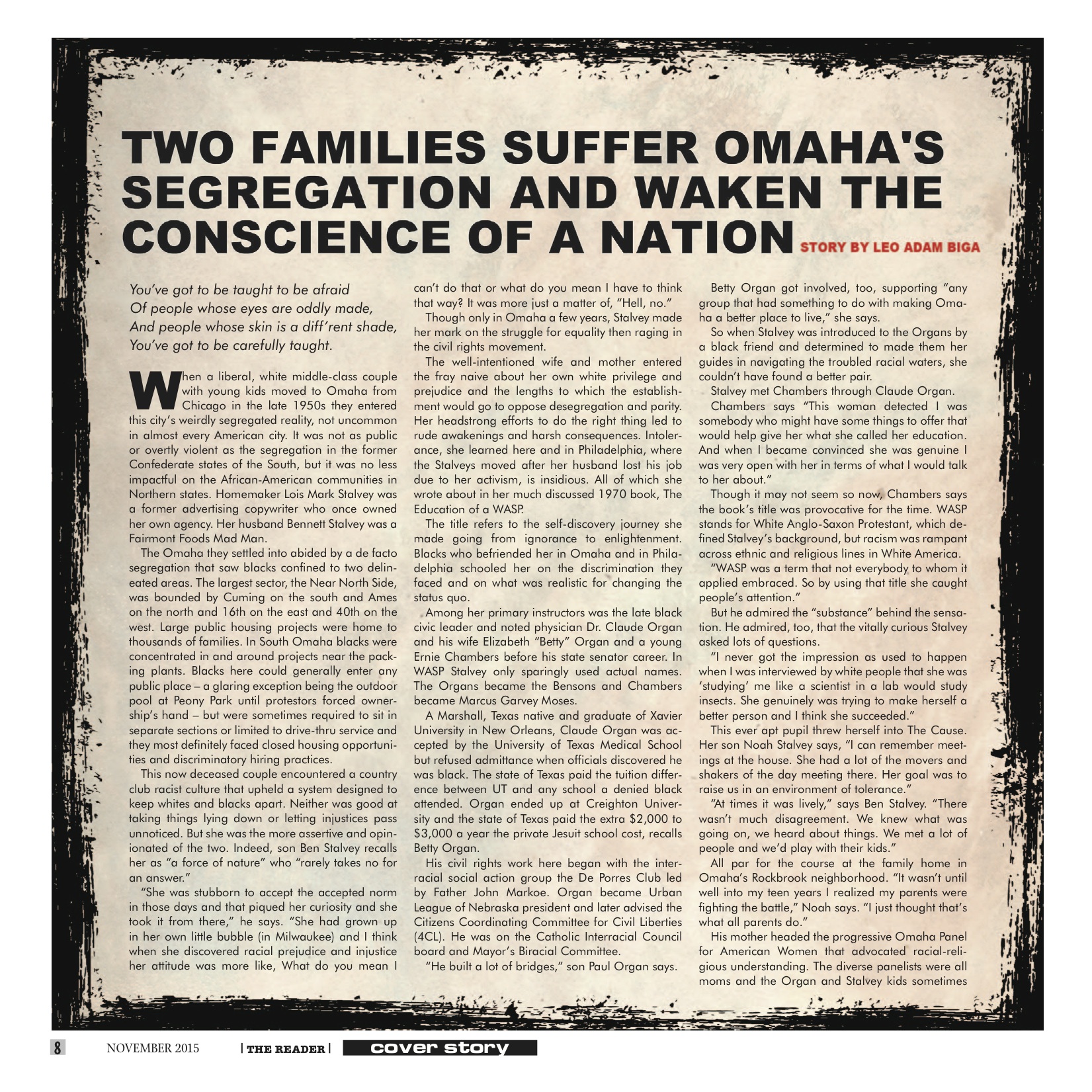
Page01-1 WASP

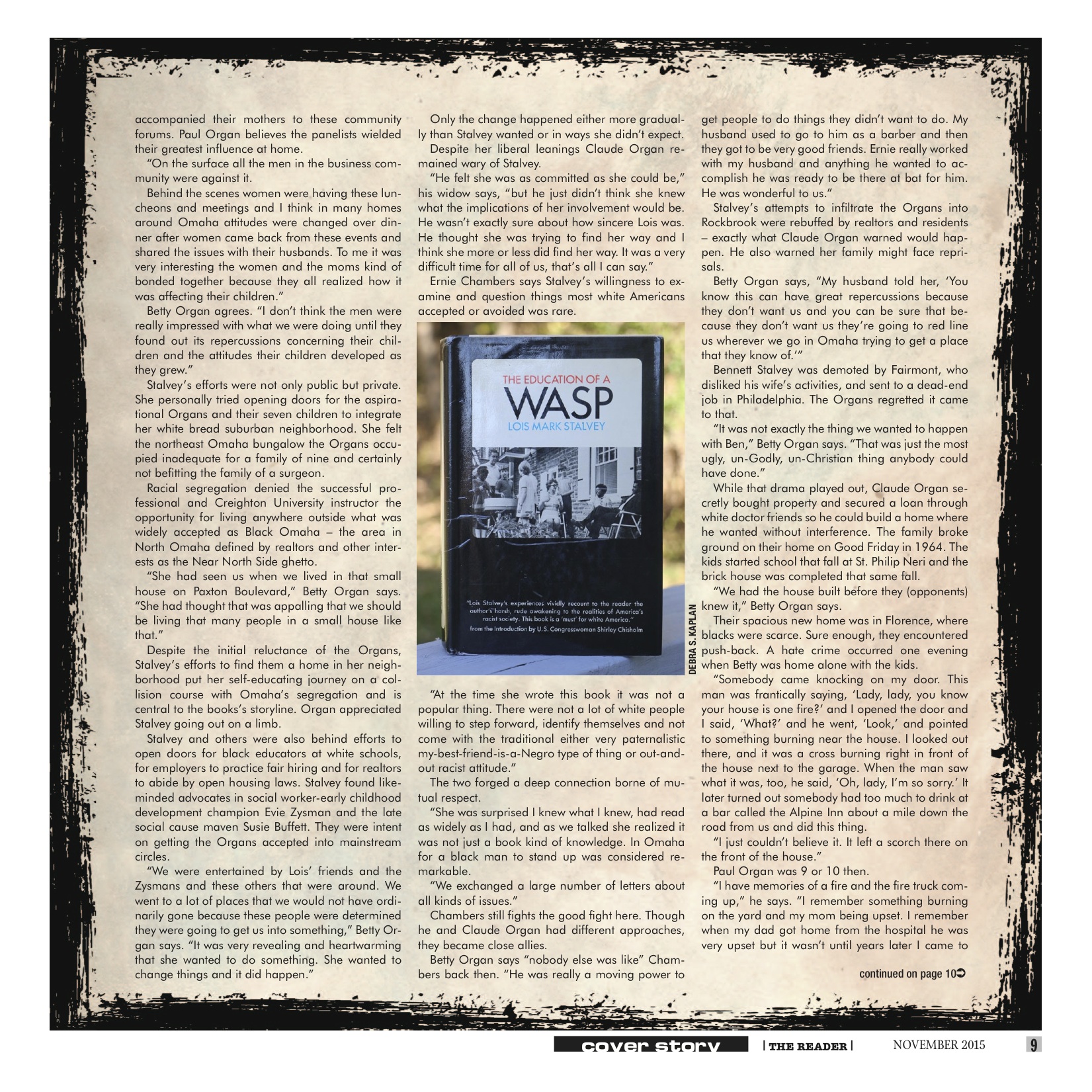
Page08-1 WASP

Page09- WASP

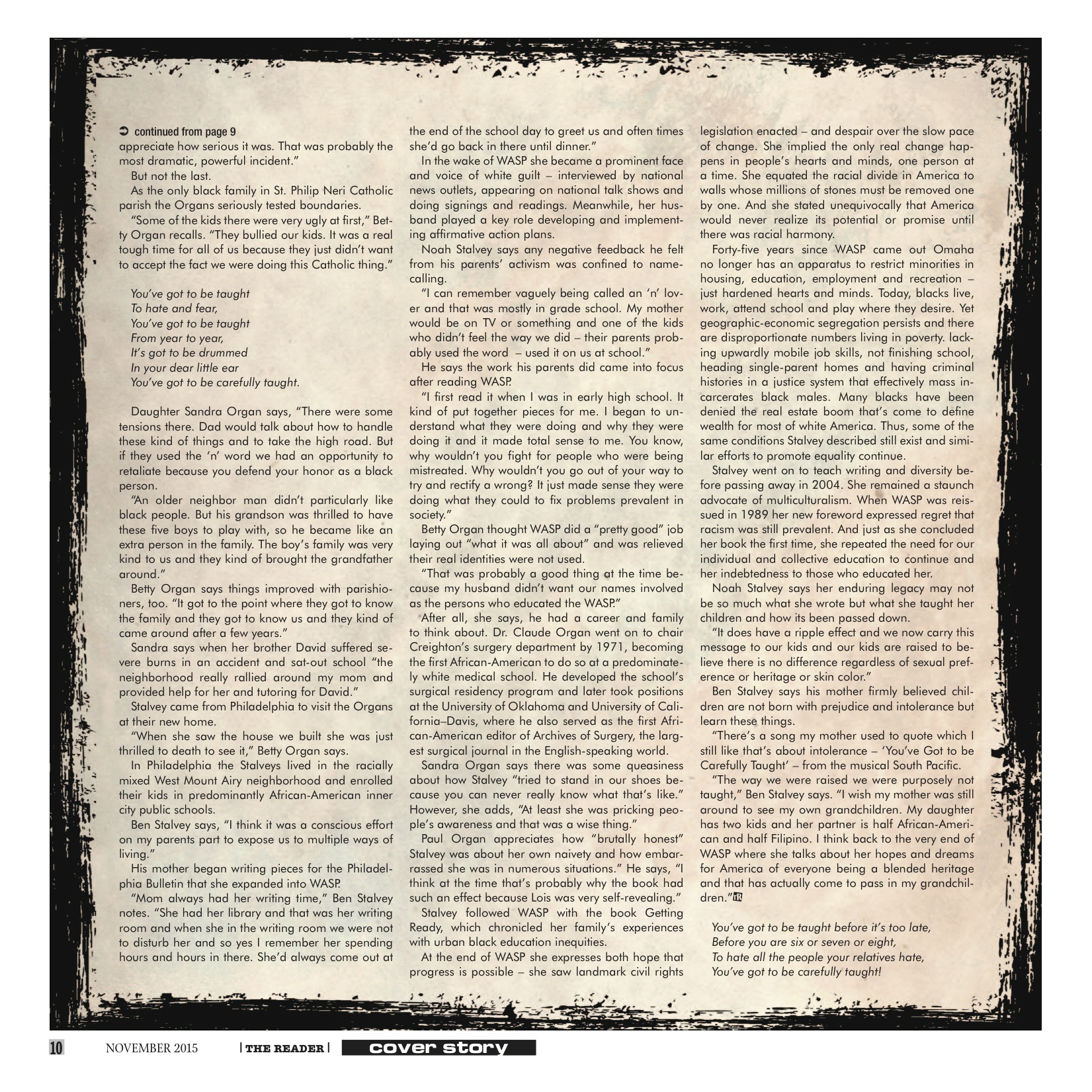
Page10 - WASP

Page12 - WASP

Pot Liquor Love: Chicken is King at Time Out Foods

October 28, 2015 4 comments

If you have a hankering for fried chicken in Omaha, two words are all you need to know – Time Out.  The North Omaha joint is famous for its signature item.  So much so that nearly everybody calls the place Time Out Chicken despite the fact it’s official name is Time Out Foods.  I grew up in North O but a few miles from this place and even though my work eventually took me in and out of that community on a regular basis I somehow went 55 of my first 57  years without having once tried it.  That’s all changed the last couple years and so I felt prepared to write this piece for Omaha Magazine (http://omahamagazine.com/) about the place and its popular dish.  Of course, to ensure my taste buds were sufficiently up to date on the fried chicken i went again to sample it and I interviewed Time Out owner Steve Mercer for his insights on how and why this fast food eatery and its secret recipe has captured the local market.

Follow my Pot Liquor Love food blogging at leoadambiga.com and on Facebook at My Inside Stories. And since food and movies are such a good pair, remember to follow my Hot Movie Takes on the same two social media platforms.


Time Out Sign


Pot Liquor Love:

Chicken is King at Time Out Foods

©by Leo Adam Biga

Appeared in the Nov.-Dec. 2015 issue of Omaha Magazine (http://omahamagazine.com/)


The name of a long-lived North Omaha black-owned and operated business reads Time Out Foods. “But Time Out Chicken is what everybody tags us as,” says owner Steve Mercer, He’s even bought that Google domain. “That’s the name the people gave us.”

With a sign proclaiming “Omaha’s Best Fried Chicken,” it’s no surprise what’s the signature dish at this 3518 North 30th Street landmark.

Credit for this grassroots branding, he says, goes to its fans.

“We didn’t just create this ourselves. It’s the people that buy it all the time that make it signature. They’re responsible for it.”

He says business keeps growing.

“Everything seems to be flowing and going. It’s been taking off.”

So much so he’s considering expanding and adding new locations.

“I feel like this is just the beginning of something else to happen. This is a good ride.”

The timing’s good with North O revitalization underway after years of stagnation.

“There’s so much more (positive) going on in North Omaha than there ever has been before. It benefits the area when they start putting more stuff in. There’s more people coming around spending money. There’s more traffic.”

Though chicken is clearly what keeps folks coming back, it was not the house staple when his parents bought the place in 1972. The Swanson Corporation famous for TV dinners opened Time Out in 1969 to develop a black-owned fast food franchise. Local sports legends Bob Boozer and Bob Gibson lent celebrity status. Only it struggled amid North O decline. Mercer’s parents saw opportunity and secured a loan to buy it. It was a slow go for a decade when, at 22, Mercer, who worked there since age 12, bought the business in 1982. He devised the chicken recipe that’s made it a hit.

Adding a drive-thru further boosted sales.

He won’t share the savory spicy recipe for his lip-smacking, mouth-watering chicken, but does reveal the battered bird is deep fried in peanut oil. Whatever the secret ingredients, he notes “all the customers say it makes them have a craving for it.” Regulars dining there one September morning variously raved about the moist, tender meat and crispy, never-greasy crust. They all admitted to a hankering that keeps them coming back for more.

Living in Atlanta, Georgia hasn’t dulled Omaha native Cheryl Berry-Neal’s craving. “Time Out is a must stop when we come to town,” she says. Ex-pats in for Native Omaha Days flood the joint for its familiar comfort food. Lines form year-round with the after-church crowd getting their down-home fix on in their Sunday finest. It daily draws a racial-social class mix reflective of those urban, inner-city environs.

Chicken’s the star but cheeseburgers and other hot sandwiches are plenty popular, too. The classic crinkle-style fries have their devotees. So do the pies supplied by an outside vendor.

Three generations of family work there, including Steve’s mother Jean.

“That’s what makes it work. We’ve been doing this for 40 (plus) years and we enjoy doing it,” says Mercer, a hands-on owner. “I’m here because I love being here. It’s my second home.”

More and more, he views Time Out as a community anchor.

“That’s what it is. I can’t let the community or anybody else down. We have to do whatever it takes to keep it going because anything else would just not be right. Failure’s not an option.”

Visit http://www.timeoutfoods.com.


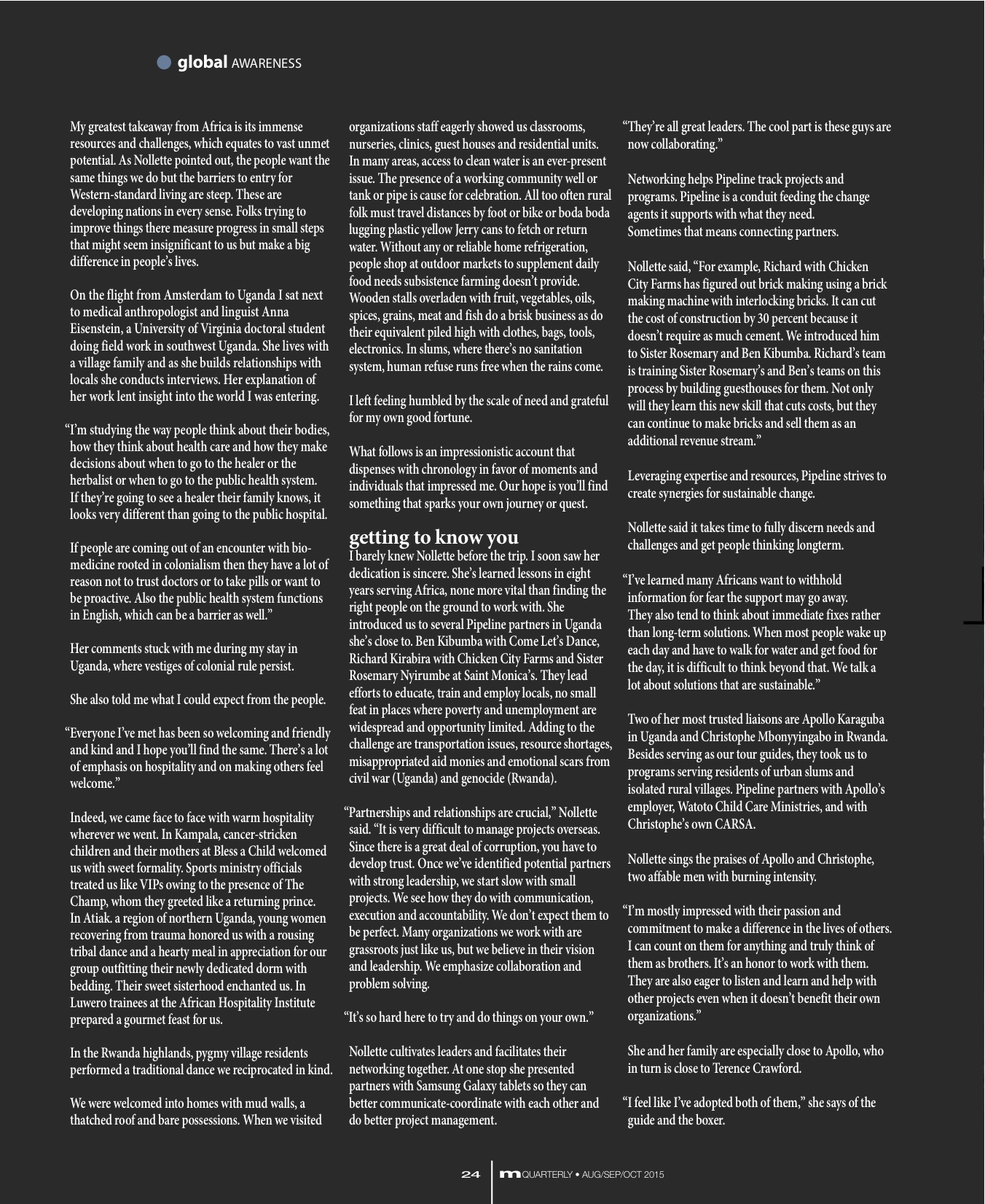
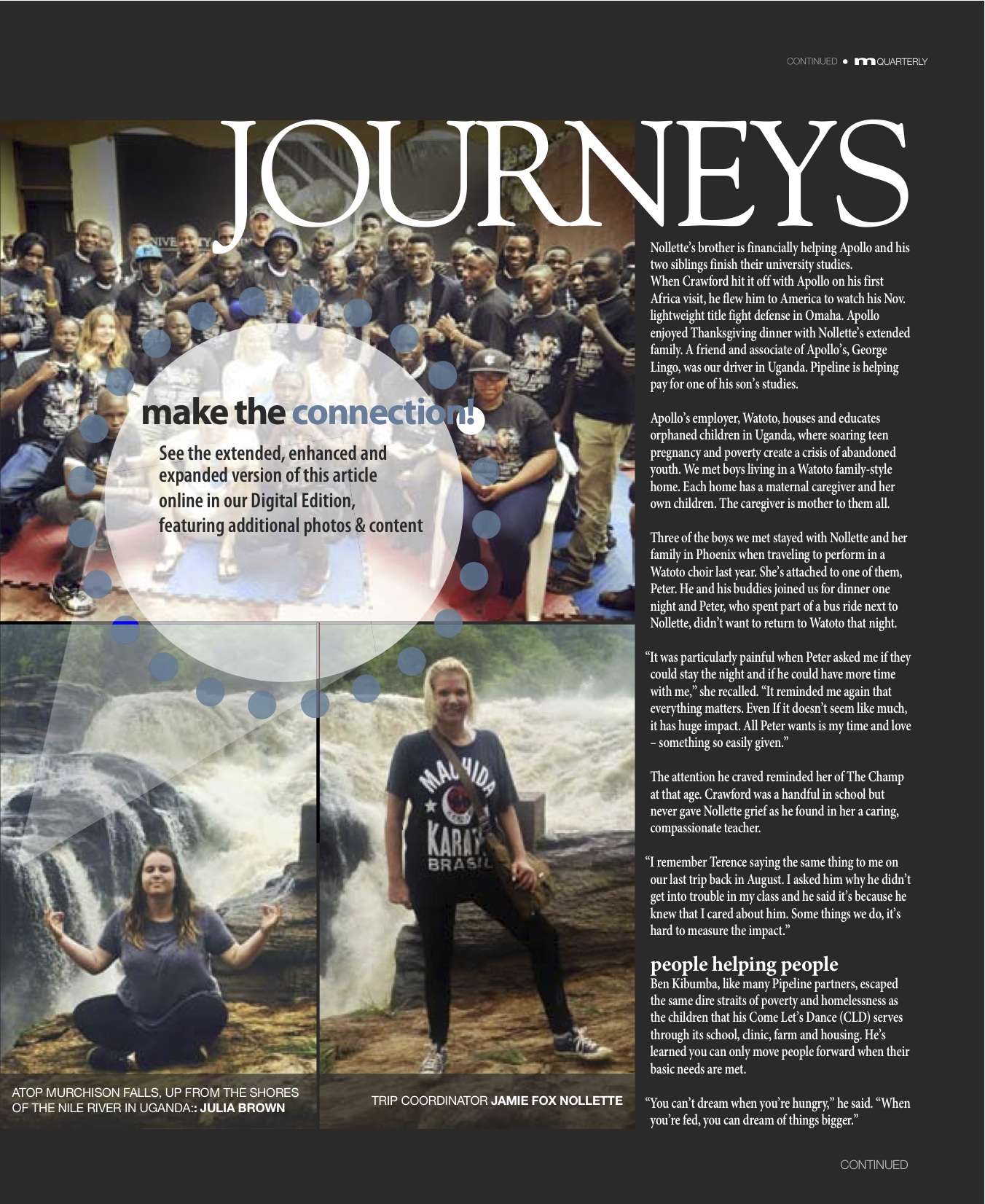
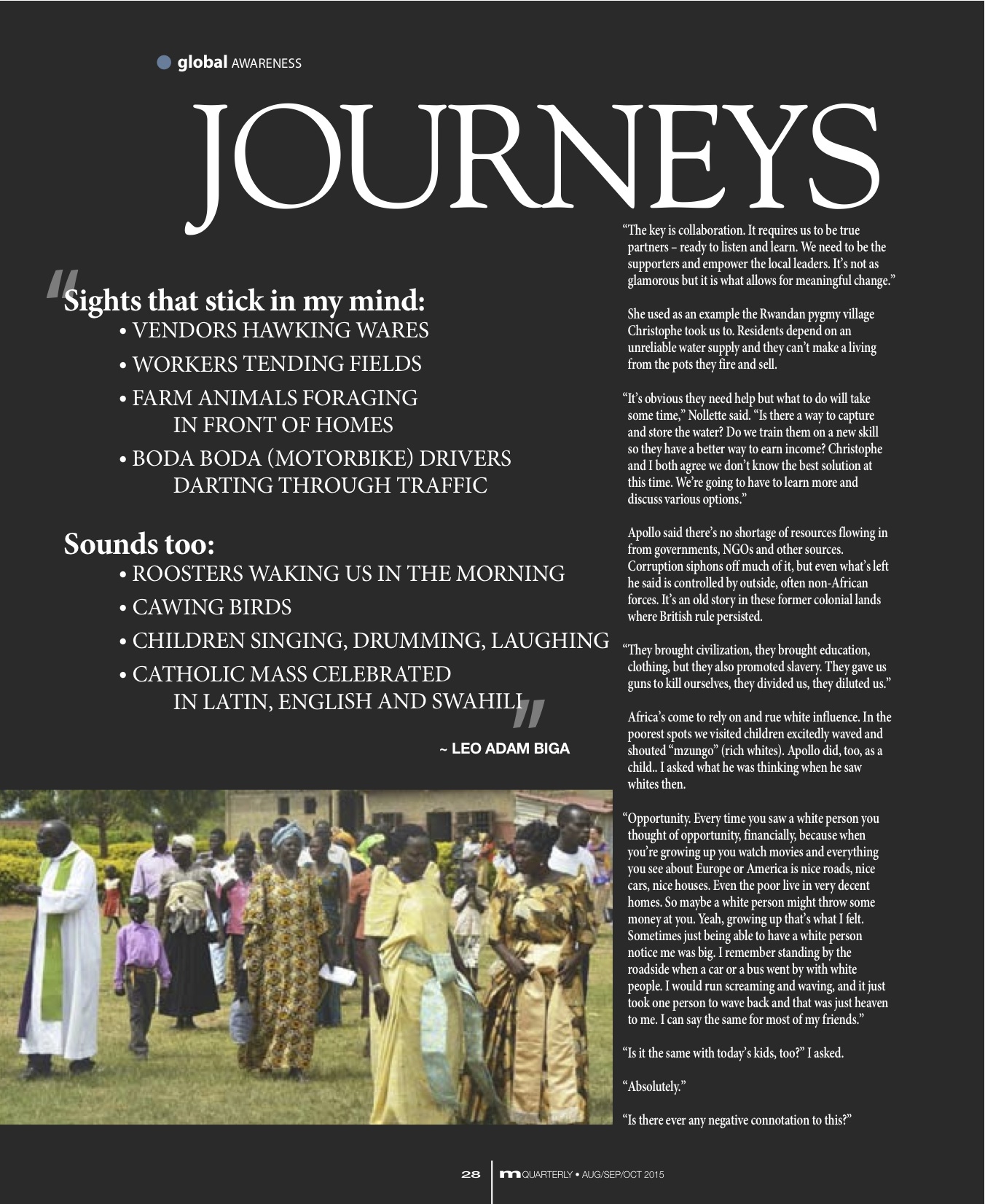
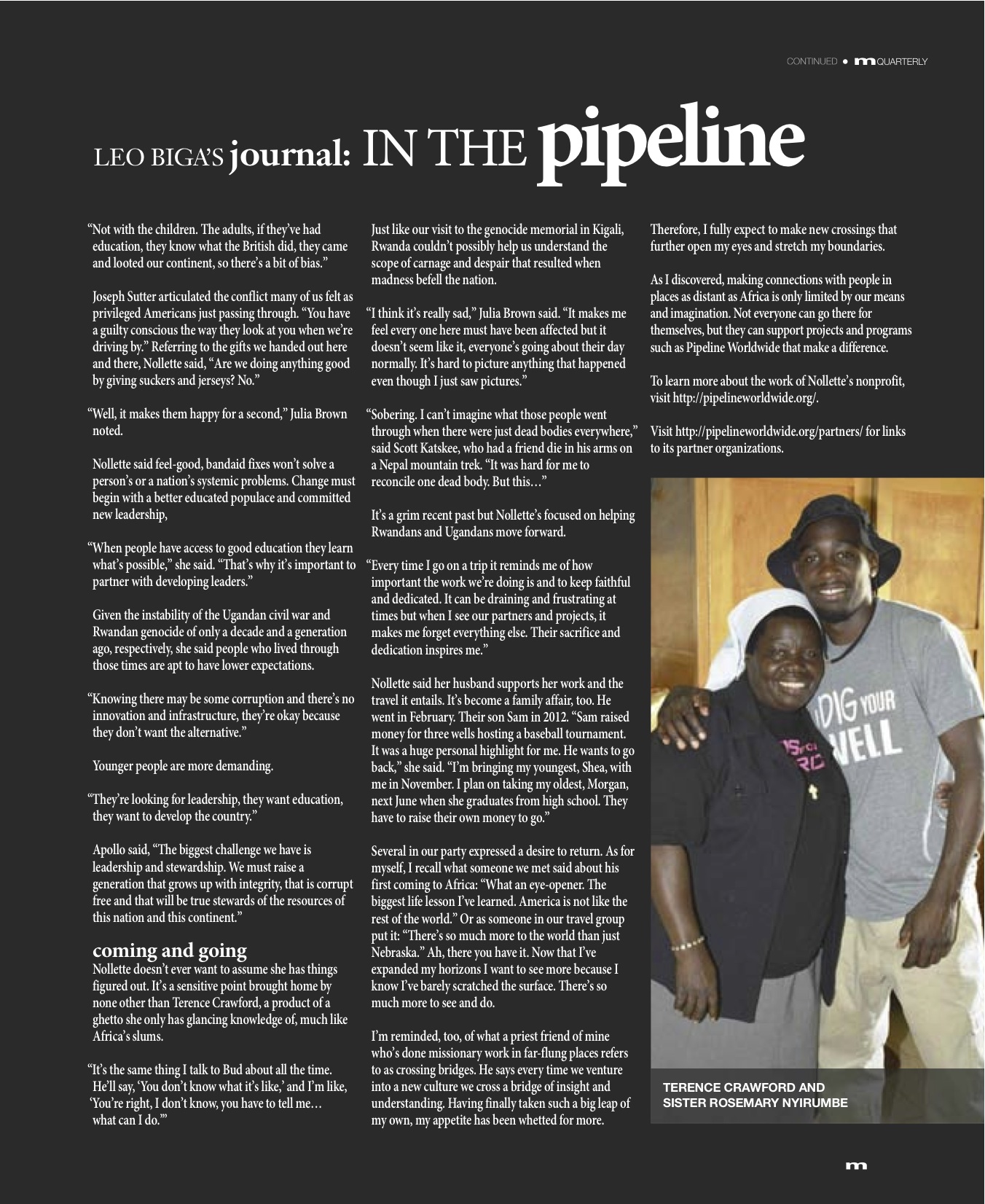
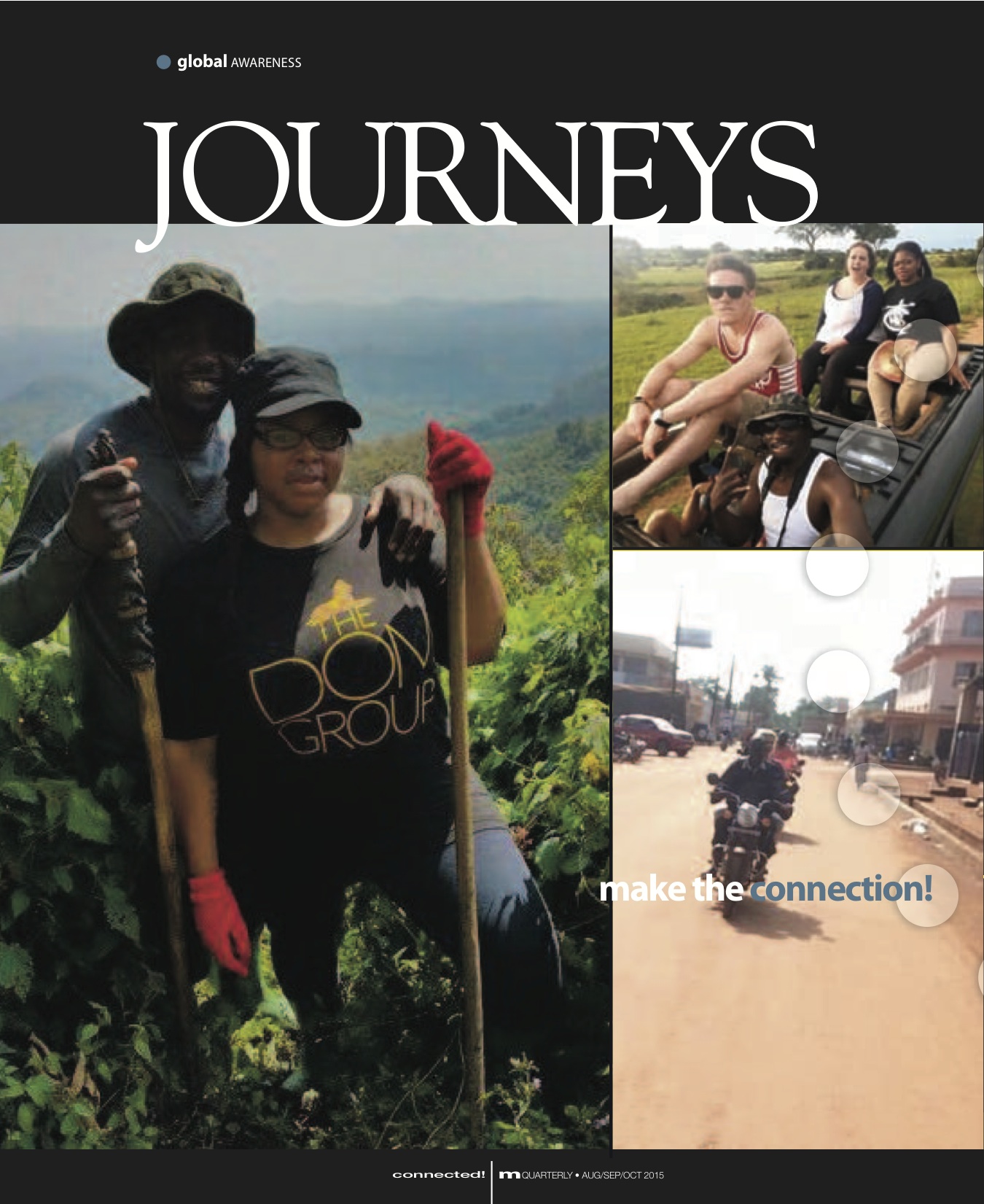
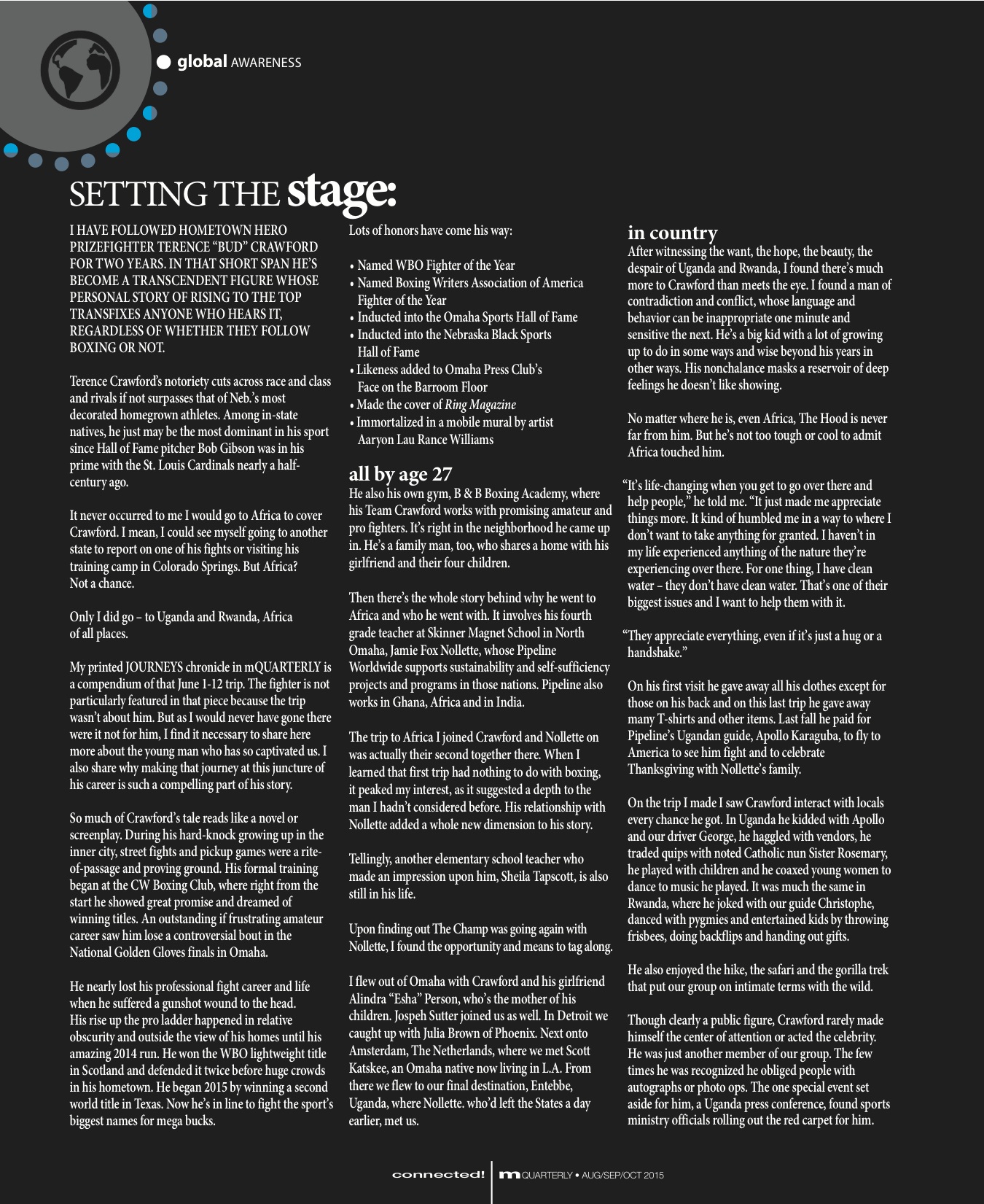
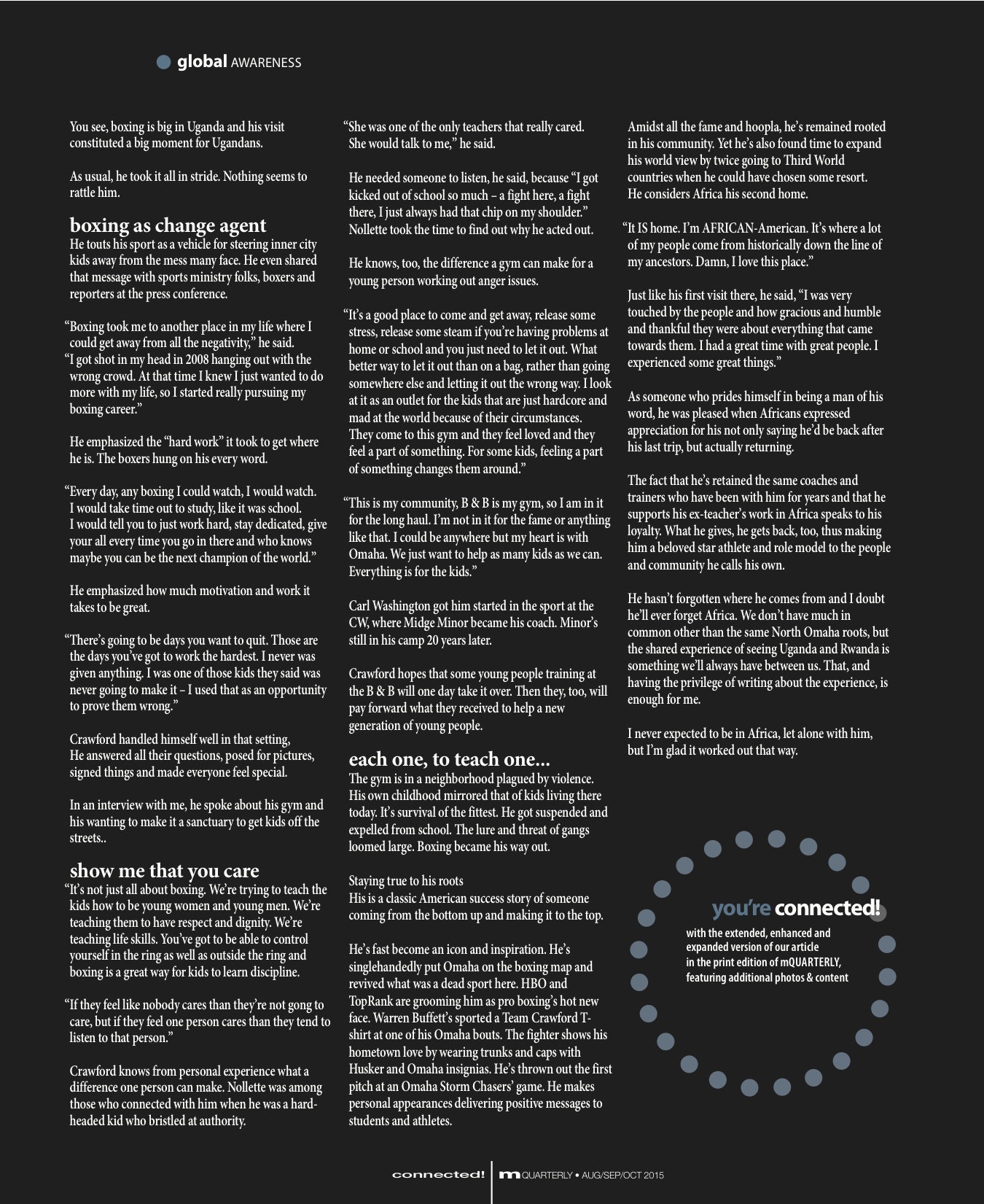
Leo Adam Biga’s Journey in the Pipeline; Following The Champ, Terence “Bud” Crawford in Africa

October 14, 2015 2 comments

Leo Adam Biga’s Journey in the Pipeline; Following The Champ, Terence “Bud” Crawford, in Africa

This is the first time i’ve posted the stories I wrote about my travels to Africa with boxing champ Terence “Bud’ Crawford just as they appeared in Metro Magazine (http://www.spiritofomaha.com/Metro-Magazine/The-Magazine/). The publisher and editor generously allotted several pages to this rather epic spread highlighting various facets of the two-week trip to Uganda and Rwanda.

NOTE: As originally presented for publication in metroMAGAZINE/mQUARTERLY August 2015 edition.

©by Leo Adam Biga

BTW: My blog features many other stories I’ve written about Crawford.

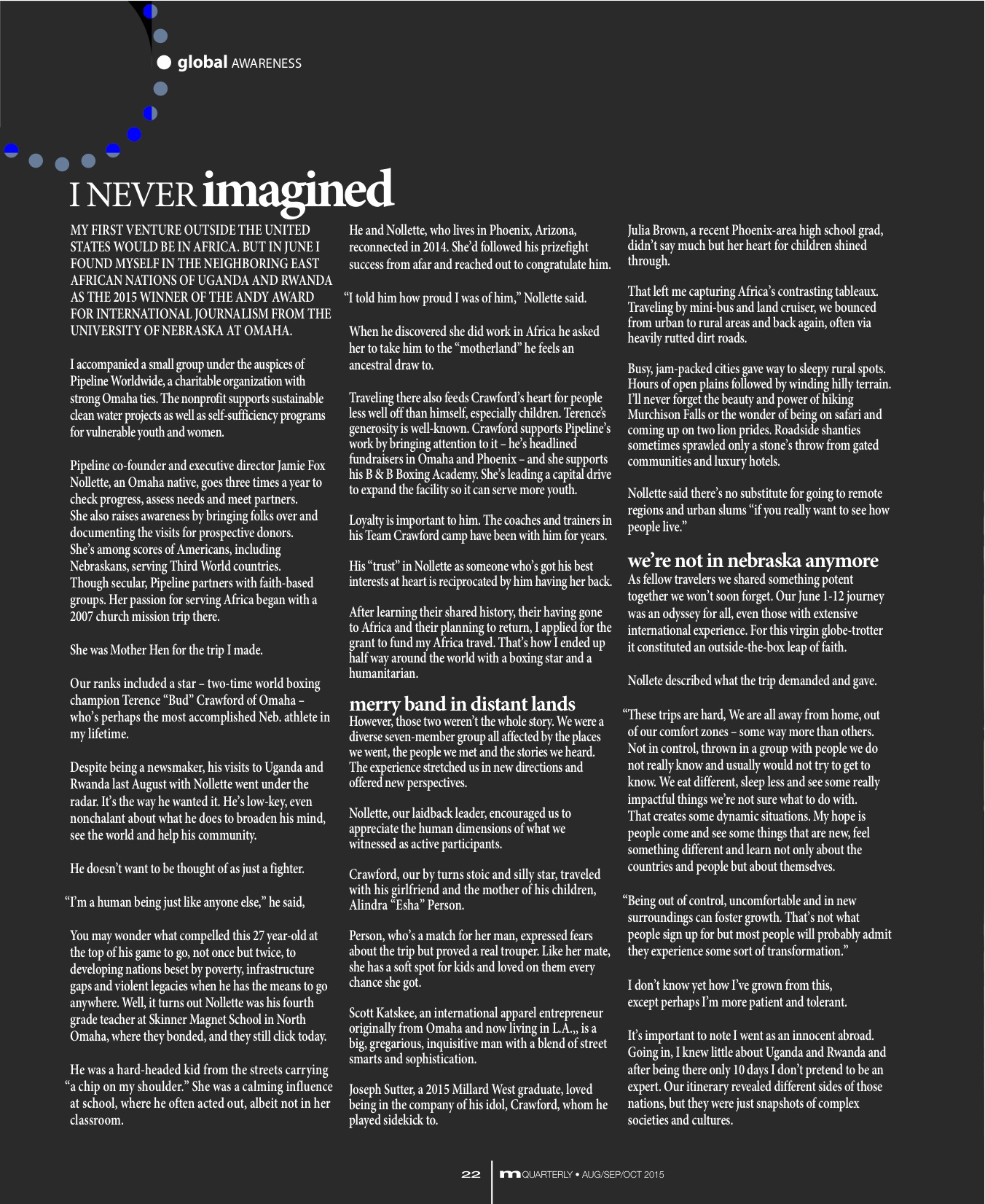
BIGA-JOURNEYS-815

BIGA-JOURNEYS-815

BIGA-JOURNEYS-815

BIGA-JOURNEYS-815

BIGA-JOURNEYS-815

BIGA-JOURNEYS-815

BIGA-JOURNEYS-815

BIGA-JOURNEYS-815

BIGA-JOURNEYS-815 BIGA-JOURNEYS-815

BIGA-JOURNEYS-815

BIGA-JOURNEYS-815

BIGA-JOURNEYS-815

BIGA-JOURNEYS-815

BIGA-JOURNEYS-815

BIGA-JOURNEYS-815

BIGA-JOURNEYS-815

BIGA-JOURNEYS-815 BIGA-JOURNEYS-815

BIGA-JOURNEYS-815

The Champ looks to impact more youth at his B&B Boxing Academy; Building campaign for Terence Crawford’s gym has goal of $1.2 million for repairs, renovations, expansion

October 14, 2015 3 comments

Here is some of my latest writing on Omaha’s own two-time world boxing champion, Terence “Bud” Crawford, this time centered around the $1.2 million buidling campaign to make much needed repairs and renovations and to do much needed expansion to his B&B Boxing Academy. The Champ and his friends have a beauiful vision in mind for the academy. See the renderings for the new and improved facility below and read about the heart Crawford has for his community and the role he sees his center playing in being a positive force for youth and young adults. And meet some of the members who train at B&B.


The Champ looks to impact more youth at his B&B Boxing Academy

Building campaign for Terence Crawford’s gym has goal of $1.2 million for repairs, renovations, expansion

©by Leo Adam Biga


Two-time world boxing champion Terence “Bud” Crawford is putting Omaha on the map with the title bouts he brings here, but he also hopes to steer attention to his B&B Boxing Academy.

The fight world’s focus will once again be on Omaha when Crawford defends his WBO junior welterweight title October 24 at the CenturyLink Center. The Champ wants people to know his roots extend far beyond the fights he has in Omaha to include his nonprofit gym serving youth and young adults in his hometown.

Located at 3034 Sprague Street in a former cold storage warehouse in the very neighborhood he grew up in, B&B is a nonprofit, community-based athletic center with a mission of building body, mind and character. Experienced coaches help members reach goals inside and outside the ring. Positive, structured activities teach confidence, discipline and healthy habits for a lifetime. Crawford started the gym with co-manager Brian “BoMac” McIntyre as a safe haven from the negative street influences that compete for young people’s attention. When Crawford isn’t away training, he and McIntyre are there at B&B, rubbing shoulders with the mix of amateur fighters who frequent it.

But the building housing the gym is in need of total renovation. Antiquated electrical, heating and plumbing fixtures need replacing. There’s no locker room. The single bathroom is shared by males and females. Because the roof leaks, the only thing keeping the Champ and others dry are tarps affixed to the ceiling. The walls leak, too.

Meanwhile, the gym’s reached physical capacity. On warm summer nights the place overflows with members going through their paces – running, working the bags, shadow boxing, sparring. To accommodate the overflow, the doors and fences are opened and the parking lot emptied to create a makeshift outdoor training site. If the numbers keep growing as expected members will need to train in shifts.All of this is prompting friends of the B&B to support a building campaign with a goal of $1.2 million to address the structural needs.

Omaha entrepreneur Willy Theisen is among those supporters.

“Terence and his gym have a true positive impact and he’s committed to B&B,” Theisen said. “He and Brian and the other coaches there do a great job of building champions but I think we must do better as far as the facility goes. We come from a very generous community that gives back and that pays ahead and I think we can get this thing done. A newly renovated building will help Terence and B&B have an even greater impact on the neighborhood and community.”

Currently B&B is only using a fraction of the available space. The vision is to convert the entire warehouse into a spacious, state-of-the-art gym that can also host community events. It is a huge undertaking.

The newly outfitted gym will add a second ring, more punching bags, new exercise equipment, a dedicated fitness-weight training room, meeting-activity spaces and offices. The renovations will also include boys and girls locker rooms and showers, and a community outreach kitchen that can be used for serving meals to the kids as well as hosting special events.

Friends of B&B such as Theisen, along with B&B Advisory Committee members Jamie Nollette Kenneth Patry, Jay R. Lerner, Jason Caskey and Garth Glissman, invite people to help build a gym and give youth a fighting a chance.

For donation inquiries, contact campaign manager Jamie Nollette at jnollette@pipelineworldwide.org or (623) 824-3273.

B&B’s Boxing Academy Renovation-verion4-100515

B&B’s Boxing Academy Renovation-verion4-100515

B&B’s Boxing Academy Renovation-verion4-100515

B&B’s Boxing Academy Renovation-verion4-100515

B&B’s Boxing Academy Renovation-verion4-100515

B&B’s Boxing Academy Renovation-verion4-100515

B&B’s Boxing Academy Renovation-verion4-100515

B&B’s Boxing Academy Renovation-verion4-100515

B&B’s Boxing Academy Renovation-verion4-100515

B&B’s Boxing Academy Renovation-verion4-100515

B&B’s Boxing Academy Renovation-verion4-100515

B&B’s Boxing Academy Renovation-verion4-100515

B&B’s Boxing Academy Renovation-verion4-100515

B&B’s Boxing Academy Renovation-verion4-100515

B&B’s Boxing Academy Renovation-verion4-100515

B&B’s Boxing Academy Renovation-verion4-100515

B&B’s Boxing Academy Renovation-verion4-100515

B&B’s Boxing Academy Renovation-verion4-100515

B&B’s Boxing Academy Renovation-verion4-100515

B&B’s Boxing Academy Renovation-verion4-100515

B&B’s Boxing Academy Renovation-verion4-100515

B&B’s Boxing Academy Renovation-verion4-100515

B&B’s Boxing Academy Renovation-verion4-100515

Life comes full circle for singer Carol Rogers

August 28, 2015 3 comments

A good portion of my life is spent interviewing and profiling artists and creatives of one type or another.  It’s a good challenge for me to try and give readers an authentic representation of the subject and his/her persona, spirit, character, and voice without reducing them to stereotype or generic personality.  I really strive to have you feel and hear the individual as I come to know them.  My encounters with these talented folks are often rich experiences for the lively give and take that happens as I more or less give them free rein to be themselves.  I want them to express themselves without holding back or self-censoring  One of my more recent experiences along these lines was with singer Carol Rogers and I thoroughly enjoyed our time together.  She is all positve love, light, and energy and she has a distinctive way of expressing herself that is poetic and soulful, earthy and esoteric, all at once.  I believe I’ve captured her many colors in this new cover piece for the September 2015 New Horizons.  Look for it at newstands or call 402-444-6654 for a free subscription to the monthy paper.  Make the call and you’ll have the issue with her story and every forthcoming issue sent to your home or business.

NOTE: For the same newspaper, New Horizons, I profiled Carol’s mother, singer-pianist Jeanne Rogers, and some other Omaha black women in music.  Jeanne was the music director and pianist at one of my regular places of worship in Omaha, Church of the Resurrection.

Here is a link to that earlier story on my blog-

https://leoadambiga.com/?s=black+women+in+music


Life comes full circle for singer Carol Rogers

©by Leo Adam Biga

Soon to appear in the September 2015 New Horizons


Since putting down Omaha roots again after years away pursuing her music career, free-spirited singer Carol Rogers is sure she’s exactly where she’s supposed to be.

This hipster hails from a revered musical heritage family that’s done great things with their craft. Like her brothers Donnie, Ronnie and Keith, she made a name for herself here but enjoyed her biggest success elsewhere. Her big break came earning a spot singing and recording with Brazilian star Sergio Mendes. It meant performing in English and Portuguese across myriad musical styles. Her virtuosity has inspired some in the biz to call her “a vocal god.”

Her stage persona and song interpretation can be sweet, salty or sultry. She can scat, sing jazz, R&B, soul, blues, country, pop, rock, even heavy metal. She once covered “Rage Against the Machine.”

Her association with Mendes put her in the company of celebrities and dignitaries. That heady period fulfilled a lifelong desire to feed the beat-of-a-distant-drummer leanings she’s always felt.

Despite growing up surrounded by the sounds of Motown’s black divas, Rogers said, “I used to think I was Doris Day. I would come down the stairs, ‘Que sera, sera, whatever will be, will be,’ and my brothers would wait for me at the bottom of the stairs to pummel me with, ‘Who do you think you are? Wake up, you skinny chicken head, wake up.’ So I kind of lived in a fantasy land. I never really saw myself like everyone else looks at themselves. I like to do things differently. I kind of was a hippy without the drugs because I liked the way they dressed.”

“Even as a young woman I couldn’t look like everybody else. To this day I feel most comfortable when I have on lots of colors.”

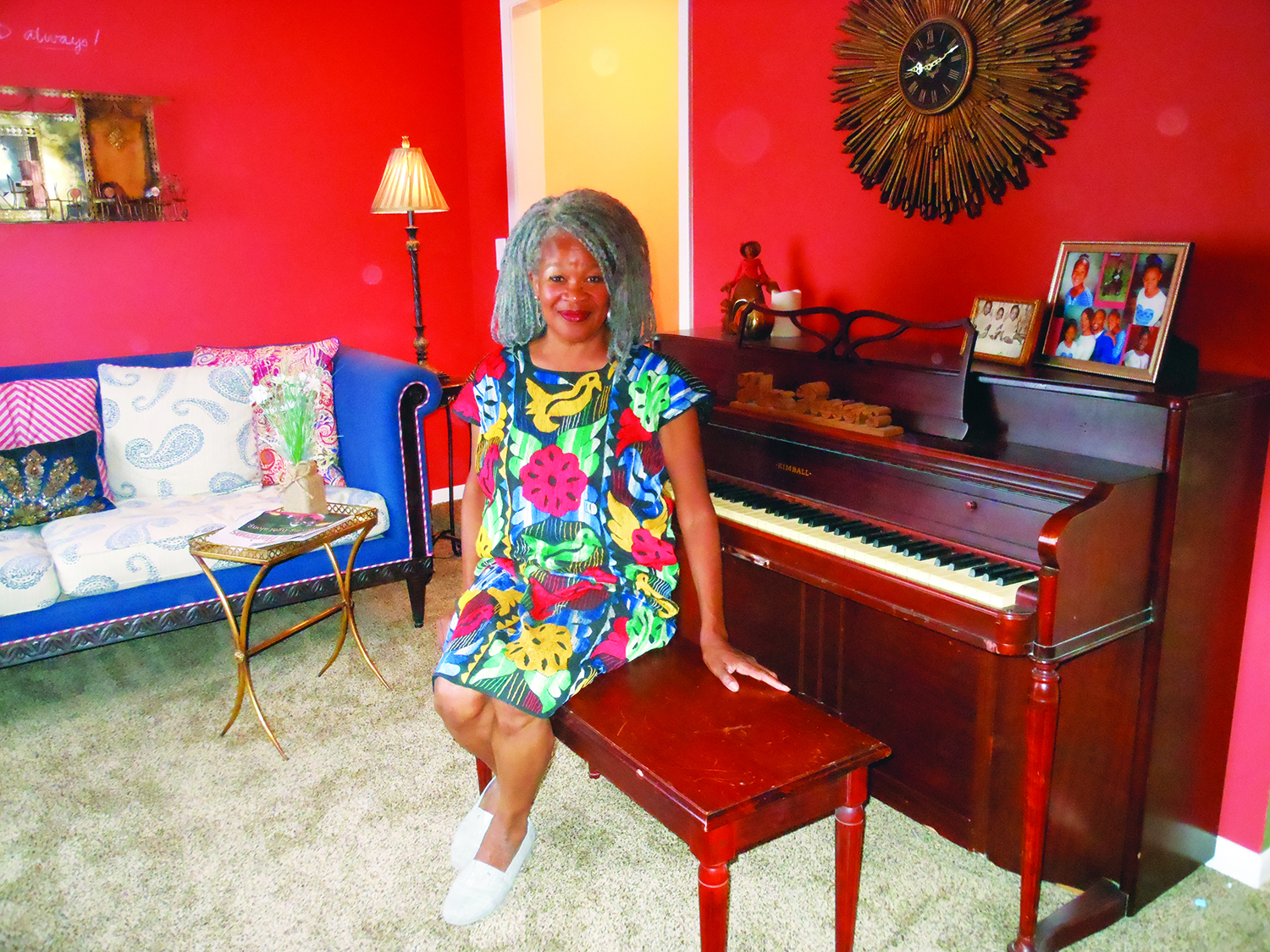
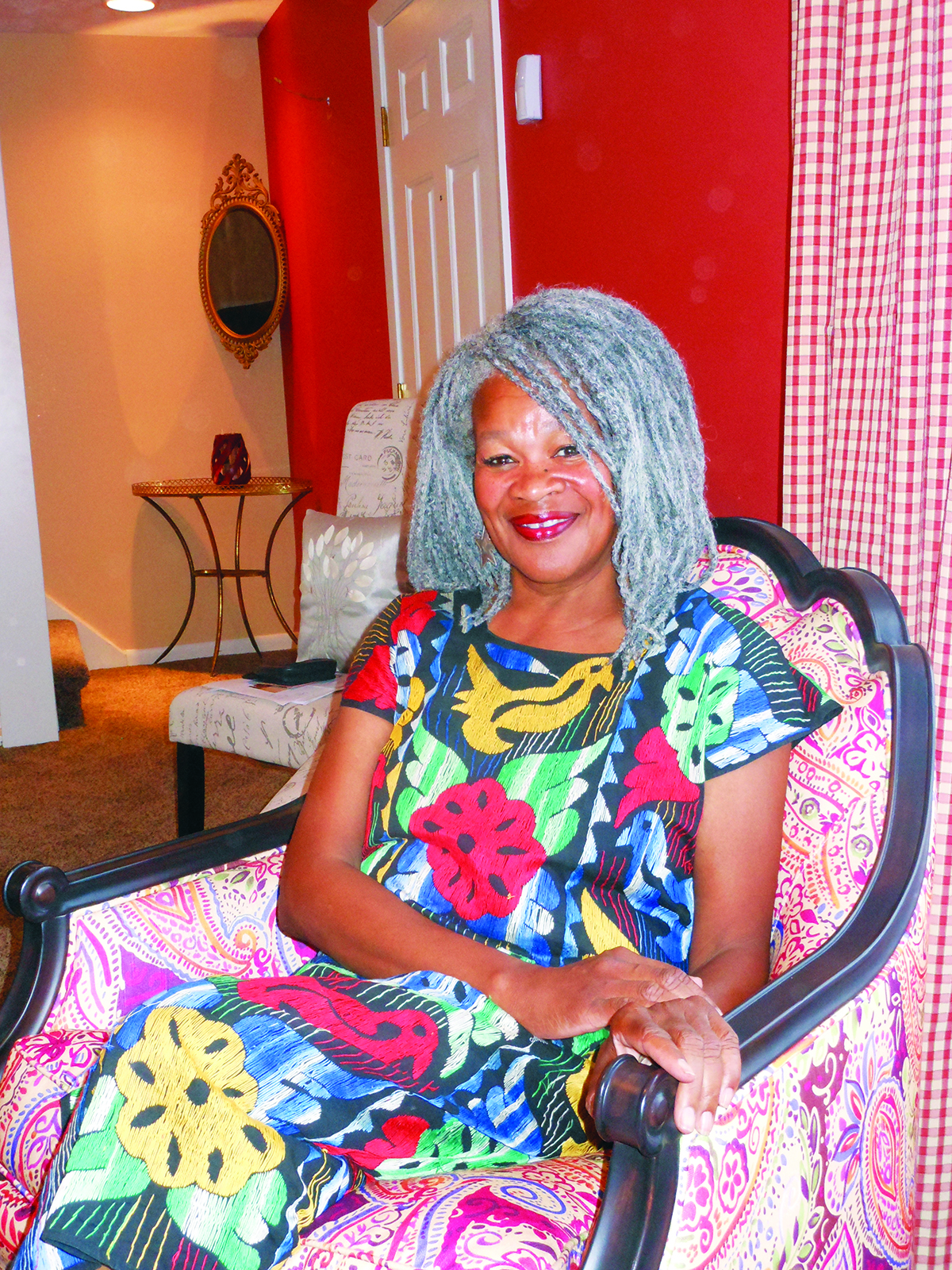
Her funky sensibility extends to a window treatment in her home that has a gingham curtain with a paisley print against a red wall, though she said she’s self-conscious enough to wonder if visitors think “I’m decorating like a crack-head in a brothel.” At the end of the day, she said, “I just want to celebrate and excite as I go and come.”

It’s why after dying her hair she’s let it go gray, proudly wearing the beauty of her age in dreadlocks that frame her queenly features.

“I began to embrace my gray. It’s a crown of righteousness if it’s accompanied by good works.”

Her righteous energy found expression in a Ladies Sing the Blues concert at Loves Jazz & Arts Center when she arrived in character as an elder negotiating a walker to the stage. Once there, she shed costume, wig and prosthetics to reveal her youthful, high-octane self and sleek legs. She then proceeded to tear up the joint with a full-throated, hip-swaying, table-topping blues performance in the spirit of Big Mama Thornton and Shemekia Copeland.

“Coming in with the girls, I knew I was going to break it down into something completely different,” Rogers said. “Yeah, I’m an entertainer. I think that’s what makes me different from other folks. I’m not afraid to put on fake boobs and a fake butt and act a little silly. I want to explore my uniqueness as an entertainer and to never compromise my professionalism.

“I don’t fit into anybody’s mold and I will not acquiesce.”
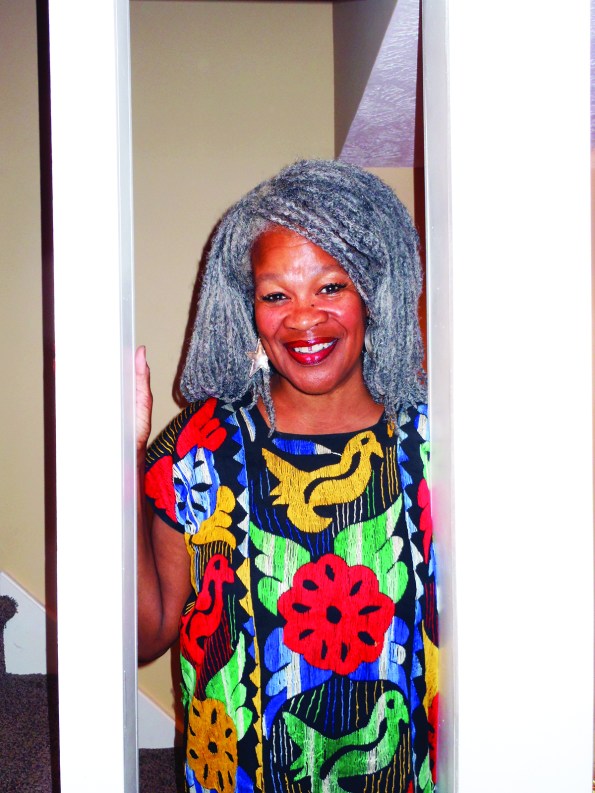


Rogers in stairwa (reduced)


During the kinetic A Happening concert she did at Carver Bank with new age musician Dereck Higgins she adorned herself in head band and glitter to help affect just the right groovy mood for this retro rave.

She feels certain her bohemian spirit is divinely directed, saying. “God was deciding my mind frame to think outside the box.”

The family matriarch who made music a family inheritance for Carol and her brothers is their mother Jeanne Rogers. She was a woman who did her own thing as well. Jeanne sang with area big bands and gigged as a jazz pianist-vocalist. A talent for music didn’t fall far from the tree, as Carol and her brothers have all made a living in music and joined their mother as Omaha Black Music Hall of Fame inductees.

Carol’s four children “all have voices,” too. Bethany, a recording sound engineer by trade, is especially gifted. Mom proudly watched her daughter “tear it up” one Sunday at One Way Ministry Apostles Doctrine Church, where the family worships.

Even when Jeanne became an Omaha Public Schools educator and administrator, she never left music behind. Indeed, she used it as a tool to reach kids. Carol, who as a girl used to accompany her mom to school to help her and other teachers set up their classrooms, followed in her footsteps to become a teacher herself, including running her own “kindergarten school of cool” that all her kids went through.

Carol, 61, also grew up under the influence of her grandmother Lilian Matilda Battle Hutch, She remembers her as an enterprising, tea-totaler who on a domestic worker’s wages managed buying multiple homes, subletting rooms for extra income. She sold Avon on the side.

“She could see opportunity and she was on the grind all the time. They called her ‘The General’ because she’d rifle out her demands – You comn’ in? I need you to go in the backyard and weed some stuff.'”

When Jeanne developed dementia, Carol’s trips back home increased to check on her mother and eventually take charge of her care. When Jeanne could no longer remain in her own home, Carol placed her in nursing facilities. She rests comfortably today at Douglas County Health Center. Carol’s since come back to stay. She and two of her kids reside in her mother’s former northeast Omaha home.


Kelly: Singer, whose mom has Alzheimer's, comes home to Omaha for 'the long goodbye'


As a homage to her educator mother, Carol has a kitchen wall double as a chalk board with scribbled reminders and appointments.

“Chalk is how she relayed things,” Carol said of her mom.

Both sides of a living room door are also chalk boards, only Rogers calls them “blessing boards. She has guests leave inscriptions and affirmations on one side and she writes scriptural passages on the other side. She calls it “seasoning” the door.

There in her home, one August morning, Rogers recounted her personal journey as an artist and a woman of faith who’s been born again. She recalled growing up in a bustling household on Bristol Street where she couldn’t help but be immersed in music between her siblings rehearsing and her mother and her musician friends jamming. That 24-7 creative hub imbued her with a love for performing.

“In the summertime it was just crawling with people because my brothers had instruments. In the basement they were always practicing. It got so I couldn’t study without a lot of noise. I still sleep with noise. If you didn’t get home in time and there was food you didn’t eat because the people who were in the house ate. It was first come-first served. That used to make me mad.

“But there was music. Folks would come. A typical weekend, Billy Rogers, not any relation, would come and jam. Everybody who was anybody came in and jammed. I didn’t know who they all were, all I knew there was always noise.”

The Rogers’ home was the place neighborhood kids congregated.

“My mother would boast that kids’ parents would say, ‘Why is my child always at your house?’ Because they’re welcome and there’s music. And so that’s just the way it was. That’s the way I remember the house. I didn’t have to go looking for people or excitement – it came to the house. There was always something going on.”

Her mother grew up near enough the old Dreamland Ballroom to hear the intoxicating rhythms of the black music greats who played there.

“That’s when she got bitten by the jazz bug,” Carol said. “She would go to sleep hearing the music playing at Dreamland.”

Carol enjoyed an even more intimate relationship with music because of the nightclub atmosphere Jeanne orchestrated at home.

“Oh, these jam sessions that mama would have. All I know is we would have to be whisked to bed. Of course, we could hear them at night. They would never go past 10 or so. Occasionally she would let us come down and just watch, which was a privilege. There’d be Basie Givens, who she played with forever, Clean Head Base, Cliff Dudley, the names go on of all the people who would come in. And they’d just jam, and she’d sing and play piano.

“It was a big party and to-do thing at the house. I would go to sleep hearing her and her friends play the jam sessions. Coming downstairs in the morning there was always somebody crashed out on the floor.
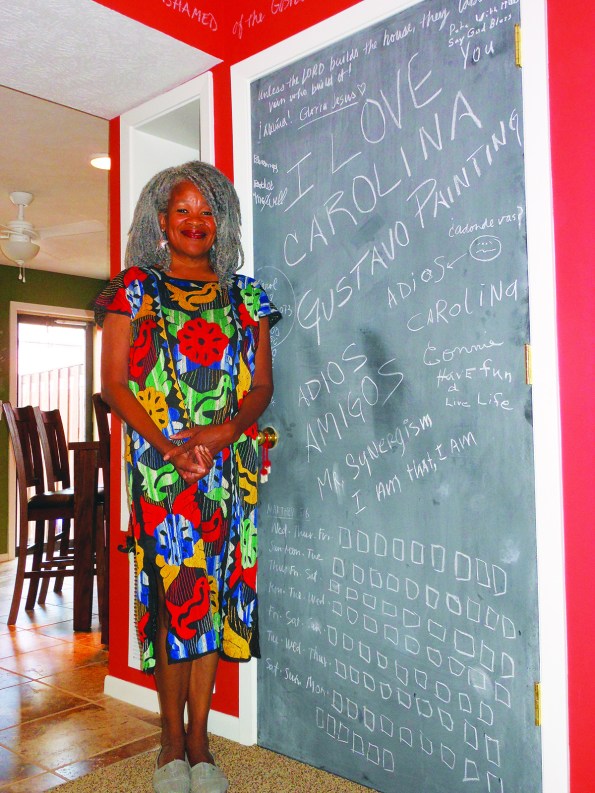


Rogers & board (reduced)


As a girl, Rogers was aware of the racism and discrimination that confined African-Americans to Omaha’s Near North Side.

“I didn’t venture past 72nd (Street) much.”

But she also saw how music broke down such barriers.

“Music was colorless and it brought everybody together. White folks would come into the neighborhood to play at my mother’s house. Italians, Jews were coming in. It was like a United Nations. Anybody could play, you came in.”

The diversity she was exposed to at home and at Omaha Central High School helped prepare her for the cultural smorgasbord she found with Mendes on international tours and in cosmopolitan Los Angeles.

It took a lot to finally get this restless singer to come back home to stay. She went through a stage when life was a series of gigs and parties. Then she settled down to raise her four kids as a single mom, eventually making her living as a much-in-demand vocal instructor.

She still works with artists today.

The truth is that even though Rogers is settled here now, there’s still a part of her yearning to go off somewhere. It’s why she’s in Rio de Janeiro this month working with an aspiring performing artist.

Now that she’s back home, she’s gigging at different venues around town. This is where it all started for her. Some of her earliest musical expressions came performing in youth Show Wagon concerts in Omaha city parks and in talent shows at the Omaha Civic Auditorium. She starred in Central High Road Shows. She appeared at Allen’s Showcase in North Omaha. She made her first television appearance on KETV’s Black on Black community affairs program.

The Omaha native first flew the coop as a teen with the Omaha Can Do Ambassadors on a tour to Greenland, Iceland and Canada.

Rogers, whose musical influences never seemed in synch with the times or her culture, as witnessed by her idolizing Judy Garland and Doris Day, eventually fixed on a suitable model.

“I wanted to be Diana Ross,” she said. “I wanted to stand up and sing, ‘Baby, baby…’ Yeah, that was my dream.”

She never found the solo career she craved but she did tour the U.S. with C.W, McCall in the wake of the “Convoy” hit record. Chip Davis later of Mannheim Steamroller fame, was the producer-composer-arranger. Playing red-neck honky-tonks with McCall she couldn’t be out front with her big personality because African-Americans weren’t always welcomed. Receding further into the background and having her spirit dampened was killing her.

She quit C.W. McCall and returned to Omaha, where she was the area’s most requested studio background singer for records and commercials, but she once again found the city too stultifying for her free spirit. This caged bird not only needed to fly but to soar far away.

She went out to Calif. to audition for Stevie Wonder but never really got a fair shake, not even meeting the famed artist. Dejected by that experience, she despaired what to do next.

“I was very depressed here because I knew I had to do something else. I said, I need something more. A true story: I was lying in bed knowing I should go to church – I hadn’t been born again at the time – when God’s voice told me to go back to California. There was no doubt in my mind who had spoken to me. I immediately put everything I wanted in my Volkswagen and left and and I haven’t had to look back. That mission was successful.”

She managed a face to face audition with Sergio Mendes, who needed singers for an upcoming tour. It came down to her and another girl and Carol won the spot. Rogers said it worked to her advantage she didn’t realize just how big a star Mendes was before trying out.

“Naivete was the angel’s wings I floated on with him. I had no idea how huge he was, otherwise I’d have panicked. I auditioned in the latter part of June 1976 and on July 4 he called to say, ‘If you want the job, it’s yours.’ I put the phone down and screamed.”

She said she reminded him that she’d earlier sent in an audio tape of her voice that he never acknowledged, to which he responded, “I never even listened to it and per that tape I would have never hired you.”

As the whirlwind touring commenced, she said she soon discovered like Dorothy in The Wizard of Oz, Toto, I’ve a feeling we’re not in Kansas anymore.’ Whew! But I was ready.” During nearly 25 years working together, she and Mendes became muses to each other.

“We fit because I was ready to totally immerse myself into something. I was fascinated with black people speaking another language. The ability to immerse myself in something and travel the world and get paid for it, well, it was a great education, it was a Ph.D.”
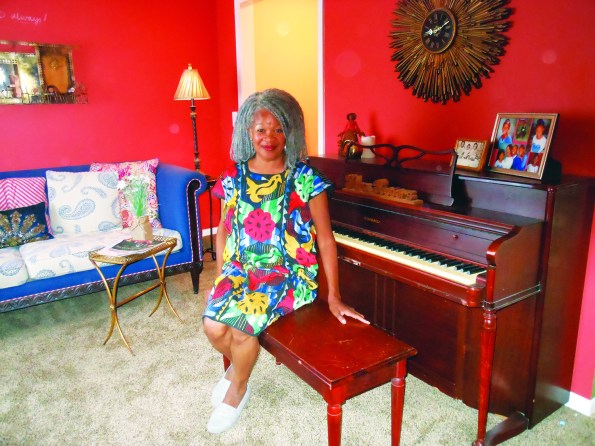


Rogers cover (reduced)


She got the adventure she sought but like many who get what they ask for, she found that career success alone didn’t complete her.

“I went through some things in L.A. Severely depressed for some years. Working top dollar but depressed because something was missing – I was separated from the Lord. I was still traveling with Sergio when I was reborn in 1980 coming off a long tour in Japan.

“I baby sat a friend’s house and I needed something to read, so I went to a bookstore and got Billy Graham’s book, How to be Born Again. I read it and knew that when Jesus went to that cross he died for me, too, It absolutely blew me away. I spontaneously started writing Christian songs.”

The words and music came flowing out of her as if supplied by a higher source.

“You see, when you’re first born again the Lord sojourns with you and he talks to you. Today, my faith is now seasoned with trials and rejoicing in trials.”

She found great satisfaction teaching at a prestigious L.A. performing arts school. At a certain point she developed a sort of alter ego for her teaching role – Mama O.

“Mama O came about when I needed an identity to separate me from the students. Everybody respects mama, so I decided I’m going to be Mama. And Mama what?. So, Mama O, in deference to my time in Brazilian culture.

“That got to my psyche so powerfully that I felt more powerful as a teacher. I’m not just Carol Rogers, no, I’m Mama. When Mama tells you to do something, you better do it. Mama won’t loan you no money, because I’m not that kind of mama. Mama might give you a little lecture because that’s what mamas do. But Mama’s going to show you how it’s done and Mama’s going to ask you to do it exactly.”

She said that bigger-than-life persona is “the rock side of me, the metal side of me.” Since relocating back to Omaha in 2013, Rogers said, “Mama’s a bit quieter here because nobody believes her. After I start teaching again (which she plans to do at the collegiate level) I would like to be called Mama O again.”

Even with work and faith, the L.A. scene became trying.

“California became my Canaan experience. Friendship is hard to find. Backsliding is very easy. But if you’re called and you know you’re born again, nobody can pluck you from God’s hand. Now, the deeper story. Everything closed for me in my life. You know when God closes a door but opens another? That’s exactly what was happening to me.”

She said though she was “a favorite, award-winning” teacher at the school where she taught, she endured a backlash from administrators because her forceful personality made her stand out. Students asked for her specifically.

“Kids would come thousands of miles from Europe, India, Japan and say, ‘We want Mama.’ They called me Mama. They were told, ‘Well, she’s taken, you can’t have her.’ I said, ‘Fix it, give me some more hours.'”

The young singers she worked with on all aspects of performance represented many vocal-music styles and Rogers determined she wouldn’t teach something unless she could do it herself.

“I had to do it all, even heavy metal. How can I tell to do something if I don’t show you I can do it? I was adamant about that and it set me apart from my contemporaries at school and for that reason the director of the school said, ‘You’re an easy target, we want everybody to be alike. But you stand out like a sore thumb.'”

As her situation there became tenuous, she was touched by students siding with her. But each time she spoke out, tensions only increased. She felt like the administration wanted to dampen her originality in order to make her conform.

“When my job began to become corporate, I couldn’t breathe, I couldn’t exercise my God-given uniqueness.”

So, she left, and in 2013 she finalized her move to Omaha.

“I didn’t want to come back to Omaha but I knew i had to come back for my mom because I became her guardian. I needed to be here in all of the Midwest’s mystery and awe and hummingbird moths and thunderstorms. I was telling my daughter during a beautiful thunderstorm that the lightning was God’s paparazzi.'”

She said she never imagined her two children living with her would ever take to Neb., but they have.

“They both marvel at the thunderstorms and the cicadas in the trees and the squirrels and wild turkeys running around. My oceans are the cicadas at night, the diminuendo and the crescendo.”

It’s not just her family who’s fond of Midwest living.

“If I describe this place to my Calif. friends – ‘Everything I need for a taco is running around free ‘ they think it’s paradise.”

She’s disheartened though Omaha now suffers from inner city woes like persistent gun violence that didn’t really exist back in her day. Like many from her generation, she longs for a return to the It-takes-a-village-to-raise-child culture she grew up in.

With some perspective now, she feels things worked out the way they were supposed to in bringing her back home to be with her mom. She never forgets the inspiration for her life’s journey in music.

“Mom gave us music and she gave us a house full of it all the time.”

Seeing her mom’s mental capacities diminish has been difficult. Seeing her no longer recall the words to songs she sang thousands of times, like “My Funny Valentine,” cuts deeply. No one is prepared for losing a loved one, piece by piece, to the fog of Alzheimer’s. All Rogers or anyone can do is be there for the afflicted.

“I’m glad I’m close by for her sake to remind her she’s loved and hopefully, even though she doesn’t recognize me, give her a familiarity.”

As if dealing with her mother’s odyssey were not enough, Rogers no sooner got situated here than the home she inherited from her suffered a disaster while she was away.

“I came back to find the pipes burst over the winter. The water in the basement was up to my knees. Then the tears began to roll because I’m thinking, You don’t know how much insurance will pay off. That winter was so terrible that they couldn’t get to me for five days. By the time they got to me this place stank of mildew and mold.”

There was insurance but it didn’t come near to covering the damage.

“I didn’t know what i was going to do but I knew God didn’t bring me this far for nothing.”

She attributes providence with bringing the home from disaster to rebirth and the blessings that came with it.

“A Christian couple to whom the Lord has given many gifts love my vocal ministry and they gave me $50,000 to put this house back together. The demolition guys came in like piranhas and took everything down to beams and joists. I could see the attic from downstairs.”

She was put up at a Residence Inn for five months while the heavy work was done. The result is essentially a brand new home.

“Everything is new,” she said. “As the guys were installing the appliances I was crying. Why? Because God has granted me favor beyond favor. The Lord impressed upon my heart the scripture that says, ‘In Christ, all things become new.’ It just doesn’t mean your spirit – you can get some new stuff, too. That’s OK.”

She’s given the home a Biblical name.

“I call my home Lazarus Resurrected because by the time they got to it, it stank, but Jesus resurrected it. My mission statement of this home is to serve. Just like my mother’s house did but with a little bit more decorum. Can’t just anybody get in and out of here.

“And once music begins I’m sure I’ll have more people coming through. Inevitably the basement will become my kick-it space like it was once before. I’ll be able to put instruments down and not fear water finding it’s mark again.”

Playing hostess will be new for her, she said, “because in L.A. I was too busy to have company. I’d come home after driving to and from and would want to collapse. So I’m learning hospitality and welcoming it. I look forward to it because this house is blessed, it’s anointed. It’s blessed me. It was an inherited blessing from my mother, it has to continue and it will. My kids are here.”
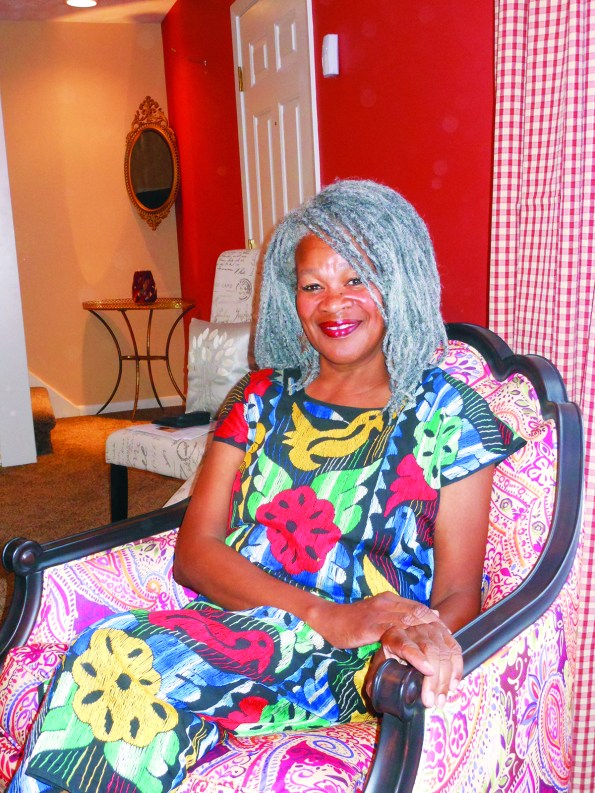


Rogers in chair (reduced)


She feels blessed, too, whenever she takes the stage.

“In this day in age when you’re inundated with the electronic ability to insulate yourself, I never ever count it anything less than a privilege to be heard by a live audience. That being the case, I have to prepare. I’m not so fast at learning things anymore, so it takes a long time to prepare these days,

“Yeah, it’s a privilege to be able to share my feelings and my life experience through my singing. Sometimes my nerves derail me but usually that means I needed to pay a little bit more attention to details.”

Just as she’s most alive when she freely expresses her uniqueness, she helps voice students find and nurture their own uniqueness.

The student she’s working with in Brazil has all the necessary vocal chops, Rogers said, but needs confidence in herself and in her ability to perform in front of live audiences. Rogers draws her own vast experience to try and get students to look at performing as a collaboration or communion. She likens it to a figure eight.

“The band is behind me and at the apex is me and then the audience is in front of me. Everything they do when I’m on stage comes through me and it’s just a circular exchange of credibility – we believe you, we give you our energy. And the band’s supporting me. What a privilege to have people backing me. They’ve got my back.

“To be in front at that apex, sharing it and feeling it come back to me through them is such a high. That is what I really concentrate on. It’s cathartic, especially as I’ve learned to sing the blues.”

Hanging on a wall of her home is a metal artwork depicting an after the club scene with unmanned band instruments and overturned chairs. It doesn’t take much imagination to picture her at the apex with a hot three-piece band behind her and a live wire crowd in front of her.

Rogers still records from time to time. On a 2011 visit to Omaha she met local jazz pianist, composer, arranger Chuck Marohnic at Countryside Community Church when she insinuated herself into a piece he was playing. He immediately asked her to be one of the singers from around the nation lending their voices to his Jazz Psalms Project that features original music for all 150 psalms in the Bible’s Book of Psalms.

“I’d never been asked to do something like this before,” she said, referring to jazz arrangements of scriptures. Ironically, her mother introduced jazz tinges to traditional hymns at Church of the Resurrection in Omaha when she was music director there.

For the Jazz Psalms Project Rogers said, “We did everything live. Oh, what a high. And the guys were great, including Chuck at the piano. It was absolutely amazing all of us playing together.”

Upon return from her coaching stint in Brazil she’ll no doubt grace various nightspots with her unique talents starting in the fall.

It’s a good time for Carol Rogers. She’s more comfortable in her own skin than she has been in a long while.

“Being home has helped. Having two of my kids here has helped. Also seeing God work miracles, ah, that’ll make you get your head right.”

This ever curious searcher just wants to keep creating and stretching herself. Her exploration, she said, “never done.”

Just don’t ask her to stay in the shadows.

“I want my light to shine.”

Follow the artist at http://www.carolrogersmusic.com.