Archive
Ben Nachman: At work in the fields of the righteous
A dear friend of mine passed away recently, and as a way of paying homage to him and his legacy I am posting some stories I wrote about him and his mission. Â My late friend, Ben Nachman, dedicated a good part of his adult life to researching aspects of the Holocaust, which claimed most of his extended family in Europe. Â Ben became a self-taught historian who focused on collecting the testimonies of survivors and rescuers. It became such a big part of his life that he accumulate a vast library of materials and a large network of contacts from around the world. Â Ben’s mission was to help develop and disseminate Holocaust history for the purpose of educating the general public, especially youth, and he did this through a variety of means, including videotaped interviews he conducted, sponsoring the development of curriculum for schools, and hosting visiting scholars. Â He also led this journalist to many stories about Holocaust survivors, rescuers, and educational efforts. Because of Ben I have been privileged to tell something like two dozen Holocaust stories, some of which ended up winning recognition from my peers. Â I have met some remarkable individuals thanks to Ben. Several of the stories he led me to and that I ended up writing are posted on this blog site under the Holocaust and History categories.
His interests ranged far beyond the Holocaust and therefore his work to preserve history extended to many oral histories he collected from Jewish individuals from all walks of life and speaking to different aspects of Jewish culture. He got me involved in some of these non-Holocaust projects as well through the Nebraska Jewish Historical Society, including a documentary on the Brandeis family of Nebraska and their J.L. Brandeis & Sons department store empire (see my Brandeis story on this blog site) and an in-progress book on Jewish grocers. Ben’s passion for history and his generous spirit for sharing it will be missed. Rest in peace my friend, you were truly one of the righteous.
NOTE: The following story is not about Ben, per se, but about one of the educational events he arranged to promote greater understanding and knowledge about the Holocaust. The story reports on a gathering that Ben and his wife hosted at their place for a discussion about the trauma of the hidden child.
Ben Nachman: At work in the fields of the righteous
©by Leo Adam Biga
Originally published in the Jewish Press
A gathering unlike any other took place the evening of September 24 at the home of Omaha Holocaust researcher Ben Nachman. Over the course of several hours a diverse group of guests heard three men discuss a shared legacy of survival — one that saw them persevere through the Shoah as hidden children in their native Belgium. Two of the men, Fred Kader and Tom Jaeger, are well known Omaha physicians. The third, Marcel Frydman, is professor emeritus at the University of Mons in Mons, Belgium, where he is a psychologist and the author of a book exploring the long-term traumatic effects of the hidden child experience.
Kader and Jaeger, who already knew each other, were eager to meet Frydman and hear his findings since they shared a common past and homeland. According to Kader, a pediatric neurologist, the hidden experience is one that unites men and women, even of different ages and nationalities, in a special fraternity. “Because of the nature of our experiences, whether in Holland or France or Belgium, you do form this kind of a bond with another hidden child. It’s a thing where we both survived, we both were hidden. The feelings we have just resonate back and forth. It’s a common understanding. It’s communication at a different level.”
Until recently, hidden children rarely spoke about their wartime experiences. For many, the events were simply too painful or too suppressed to tackle. But since a 1991 international hidden children’s conference attended by all three men, more and more long silent survivors have been seeking each other out to talk about their shared heritage in hiding.
Frydman, who came to Omaha at the invitation of Nachman and through the auspices of the Hidden Heroes of the Holocaust Foundation, hopes to have his French-language book published in English. Jaeger, a pediatric psychiatrist, has read the book and feels it offers valuable insights into the whole host of circumstances that determines how individuals cope with the emotional baggage of childhood trauma well into adulthood. He said the book provides a therapeutic framework for treating not only former hidden children but anyone suffering from post traumatic stress, which he added is a timely addition to research on the subject in light of the emotional toll the events of September 11 and after have taken on the damaged American psyche.
On hand that evening at Nachman’s were educators, lawyers and journalists, all of whom came to learn something about the ordeal the three men underwent. As the night unwound, it became clear from what was said that the hidden experience is one marked by profound separation anxiety, where youths taken from homes and families go into hiding among total strangers and try to conceal their Jewish identity in order to save their lives. As each survivor described the story of his survival, he revealed something of the psychological scars borne from these searing events so far outside the normal stream of human conduct. They explained how, even after escaping extermination and building successful adult lives now a half-century removed from their ordeal, they remain haunted by the specter of their hidden odyssey, an odyssey that has both driven them and frustrated them.

Ben Nachman Credit:
Nebraska Jewish Historical Society
There was something nearly sacred in this solemn exchange between the survivors and their rapt audience. The men and women huddled around the Nachman living room listened intently to every word uttered and asked questions that begged for more detail. The evening was also meaningful for the survivors. For Kader and Jaeger, meeting Frydman and learning of his work helped further validate their own hidden histories, which remained shrouded and inarticulated until they began piecing together their own backgrounds at that 1991 conference in New York.
Kader said a book like Frydman’s “gives more credence to the feelings that survivors have. When hidden children get together they end up talking about the same kinds of things and what they talk about has often been well-repressed.” Kader said the more hidden children he gets to know, the more he realizes “all of us, in our own way, have the same sort of common thread of experiences and we all go through the same kind of process of finding a way out of it (the trauma) to make something of ourselves.” He said Frydman’s work helps demonstrate survivors “can cope and manage. Even though you may have these recollections of traumatic experiences in the back of your mind you can get past that point and go on with your life. His research shows all sorts of common denominators. You realize what you’re going through is a natural evolution other survivors go through. It’s reassuring to know we’re all not crazy.”
For Frydman, whose work in this area was sparked by a group of survivors at the who asked him to lead their counseling sessions, the evening was a chance to share his findings with fellow countrymen who endured a similar fate during and after the war. In writing his 1999 book, The Trauma of the Hidden Child: Short and Long Term Repercussions, Frydman found an outlet for his own survivor issues and a forum for examining the consequences of the hidden experience, many of which he found overlap from one survivor to another.
For his book he returned to the very site where he was sheltered after the war — a home for hidden and abandoned children of both Jewish and non-Jewish descent — and to the same group of individuals with whom he shared his early adolescence. To his astonishment he discovered that in spite of their war deprivation many of these individuals have achieved great professional success, with an unusually high percentage ending up in the healing arts, as evidenced by himself, Kader and Jaeger. As he studied this population he identified elements and conditions that explained the apparent anomaly of survivors reaching such heights from such depths.
“In my opinion, two factors were important,” Frydman said. “First, the quality of family life before the war. These children knew there was a possibility of recovering the family unit. They felt forsaken but they knew their parents didn’t abandon them. This was very important when they were confronted with the conditions of an institution where the affective life was very low. The second factor was the quality of the environment in which the child was placed during and after the war. If this environment was good and supportive, he could find again a normal life, mobilize his potentialities and perform very high. It’s no accident that hidden children have chosen social or therapeutic professions. If you have experienced something as hard as we did you may be more skilled to help others.”
Frydman finds survivors exhibit a remarkable resilience as a result of having endured what they did. Jaeger believes he and his peers managed compensating for the trials and deficits of their interrupted childhood because attaining success, coming as it did against all odds, became an act of defiance. “Resiliency is an act of defiance in some ways,” Jaeger said. “It’s a way of saying, ‘You were wrong,’ to those people who said, You can’t do this, or, You won’t ever reach a certain point. As Marcel (Frydman) points out, the thing that contributed to this resilience was the love and nurturance we were inculcated with despite everything going on around us.”
Recently, Jaeger found poignant evidence of the love he was endowed with via two formal family photographs his mother, who escaped the Shoah, commissioned at the time of the roundups and deportations. “I was struck by the fact that she felt it was important to have a memory to sustain our family even in the midst of what was going on. It reinforced what Marcel said about how important the home environment was. It probably provided a buffer that sustained us when we left home and went via this underground railroad into hiding.”
Another impetus for survivors to strive so hard, Jaeger said, was their strong desire “to get on with things and to accomplish anything and everything we could. Most of us wanted to find acceptance — to be included in the mainstream.”
Frydman, Kader and Jaeger were hidden at several sites but their protective custody mainly came in institutions run by various good Samaritans, including Catholic nuns. They are glad to have ended up in such good, caring hands. Frydman said there long was an assumption children placed with foster families were more fortunate than those placed in institutions, “but now I can say that wasn’t true because the child placed in a family was alone in his stress — the family sheltered him but couldn’t share his loneliness and sense of forsakeness — whereas the child in an institution eventually discovered he was not alone and any stress experience is made more bearable when the stress is shared.”
In addition to drawing on his own experiences for the book, Frydman drew on his past work counseling “forsaken children” — orphaned or otherwise abandoned youths — which provided a field of reference from which to extrapolate. What Frydman found in comparing and contrasting hidden children with abandoned children is that “the trauma of the hidden group is more complex and is provoked not by one factor but by a succession of factors,” he said. For example, he points to the roundups of Jews that Nazi authorities began staging in the early part of the war that invariably sent detainees to death camps. The fear engendered by these roundups signaled to children that they, their families, their friends and their neighbors were in peril. He said, “Even if you were not deported you heard about what was happening from other Jews who witnessed these events and the anxiety of the adults was communicated to the children.”

As it became evident the only way to save children was to hide them, an underground network formed to shield them. Because it was easier and less conspicuous to hide a child alone as opposed to a family, children were usually separated from their parents.
“Little children couldn’t understand why they had to be hidden and without their parents,” Frydman said. “It was a safe thing to separate them, but for the children it wasn’t a healthy thing. They were lacking the presence of their parents. They were missing all the affective, emotional ties. And children understood there was a danger of being denounced. We were told not to reveal our real name and not to reveal our Jewish identity. The child understood this, but it increased his anxiety. He understood too that the parents were also in danger. Sometimes he knew one or both of the parents had been arrested and deported, and sometimes he hadn’t any news of there whereabouts. You don’t find these conditions when you study forsaken children.”
Prolonged exposure to such danger and distress left many former hidden children with deep-seated feelings of apprehension and insecurity, said Frydman. “Because they lived for years in an environment perceived as menacing they have some problems associated with anxiety. This has been fixed, at least on the unconscious level, and so they develop some defenses in order to adapt themselves. There’s often a lack of trust and a sense of guardedness toward others. Some of them think they must control every aspect of a relationship because during the war they had no control. For example, some of my subjects told me they resist forming new relationships because it means risking being forsaken another time.”
Even when in the same institution Frydman said hidden children demonstrated fewer issues of desertion than abandoned children because prior to being harbored hidden children presumably enjoyed a stable home life. “They had the chance to be in a normal family before,” he said, “so they were better prepared to confront the separation. They knew there might be a family to try and find after the war whereas the forsaken children knew there was no family to be found.” A striking difference he found in abandoned children versus hidden children is the slowed mental development of the former group compared with the latter group.
The author conducted his research for the book with the aid of one of his students. Interviews were completed with more than 50 adults who found sanctuary in Belgium or surrounding countries during the war. Frydman and his assistant used a non-invasive technique to draw subjects out, some of whom had never before verbalized their hidden past. “The interview was a non-directive one,” he said. “We didn’t ask questions. We just gave the subject the opportunity to evoke his experience and helped him to express what he had to say. For some of the subjects, recalling the past was an ordeal. Some cried. They couldn’t stop. The trauma came back. And, yes, for some it was the first time they’d spoken about it.”

The fact that so many hidden children remained resolutely silent about their past for so long is a phenomenon that Frydman has tried to explain in his book. He said it was a case of hidden children growing up in an atmosphere where the subject was viewed as too painful to revisit or misunderstood as something that could be easily dismissed.
“Just after the war hidden children didn’t feel they had the right to speak because speaking about the trauma implied reliving it,” he said. “They would have spoken if they could have found some help, but in post-war Europe we hadn’t any psychologists. And adults didn’t understand what to say, so if they spoke about the war at all, they said, ‘You were lucky.’ Of course, it’s true, we were lucky not to be deported, but we suffered. If every adult says to you, ‘You were lucky,’ you haven’t even the possibility to express your suffering.” Or, as Jaeger explains, “People were getting on with their lives and moving away from that ordeal and, in effect, really nobody was there who psychologically gave you permission to speak. That listening ear and that permission just weren’t there.”
As the trauma is denied or ignored, Jaeger said, it festers like an untreated wound, only buried out of view, yet never too far away to be reopened. “In psychology there’s a phenomenon where you either dissociate or you compartmentalize things that have been extremely bad. Children exposed to bad events can lose memory of those things. That’s a protective mechanism to enable you to go on, but those feelings are always there at the surface. Certain sounds can evoke fear and anxiety in former hidden children. The sound of a truck is one of the most feared sounds because trucks were used in the roundups. It was the sound of your future. Of being rounded up, deported to camps and confronting almost certain death. Vulnerability is always just below the surface for some of us.”
Jaeger said it was only recently, upon reading Frydman’s book, he recalled suffering panic attacks as a boy after the war. He remembers the episodes occured while riding in cars and presumes his anxiety was triggered by dim memories of deportations. Because Kader and Jaeger were quite young when they went into hiding, their memories are somewhat tenuous. Those who were older when hidden, like Frydman, retain clearer memories of the events and the trauma.
Symbols can also summon the horror of a perilous childhood. For example, Jaeger said some survivors have “a problem trusting authority or trusting the system” because they associate those things with the uniformed soldiers or officials who menaced them and their families.
Jaeger admires Frydman’s book for its clear, thorough assessment of the hidden experience. “It is an exquisite explanation of the dynamics of the experience and of its long term effects. It really has a kind of global description that applies to you no matter what your own hidden experiences were. He helps us understand how we arrived at where we are. Also, it’s really one of the best explanations of Post Traumatic Stress Disorder and its long term ramifications. There’s been lots written about PTSD, but this sampling of a population from a psychological point of view is somewhat unique in that here we have a group of people still living 50-plus years after the fact. It often takes that long for hidden children or camp survivors or other trauma victims to share their experiences because they evoke an emotional vulnerability that is not that easy to deal with. Everybody has to do it in their own way. There are people who to this day still don’t say anything. They haven’t reached that point. This is so applicable to what happened at the World Trade Center because that trauma will be imprinted over generations in some cases.”
Ultimately, only fellow survivors can truly understand what their brothers or sisters of the Holocaust have gone through. Still, every time they share their story with others it gives added meaning to their witness bearing — allowing their testimony to live on in others. The need to testify grows more urgent as the number of survivors dwindles. “Time is of the essence in that we’re the last generation of witnesses left,” Jaeger said, referring to hidden children like himself, Kader and Frydman. In an era when the nation’s moral fortitude is being tested by the threat of terrorism at home, he said, it is more vital than ever to stand up and speak out against evil.
Related Articles
- Terezín: music from a Nazi ghetto (guardian.co.uk)
- Anne Frank: the Book, the Life, the Afterlife by Francine Prose: Review (telegraph.co.uk)
- Holocaust-era deportation archives to be opened (thejc.com)
- Leo Adam Biga’s Survivor-Rescuer Stories Featured on Institute for Holocaust Education Website (leoadambiga.wordpress.com)
Bringing to light hidden heroes of the Holocaust
A dear friend of mine passed away recently, and as a way of paying homage to him and his legacy I am posting some stories I wrote about him and his mission. My late friend, Ben Nachman, dedicated a good part of his adult life to researching aspects of the Holocaust, which claimed most of his extended family in Europe. Ben became a self-taught historian who focused on collecting the testimonies of survivors and rescuers. It became such a big part of his life that he accumulate a vast library of materials and a large network of contacts from around the world. Ben’s mission was to help develop and disseminate Holocaust history for the purpose of educating the general public, especially youth, and he did this through a variety of means, including videotaped interviews he conducted, sponsoring the development of curriculum for schools, and hosting visiting scholars. He also led this journalist to many stories about Holocaust survivors, rescuers, and educational efforts. Because of Ben I have been privileged to tell something like two dozen Holocaust stories, some of which ended up winning recognition from my peers. I have met some remarkable individuals thanks to Ben. Several of the stories he led me to and that I ended up writing are posted on this blog site under the Holocaust and History categories.
The Hidden Heroes of the Holocaust Foundation that the following article discusses and that Ben founded was eventually absorbed into the Institute for Holocaust Education in Omaha.
Ben’s interests ranged far beyond the Holocaust and therefore his work to preserve history extended to many oral histories he collected from Jewish individuals from all walks of life and speaking to different aspects of Jewish culture. He got me involved in some of these non-Holocaust projects as well through the Nebraska Jewish Historical Society, including a documentary on the Brandeis family of Nebraska and their J.L. Brandeis & Sons department store empire (see my Brandeis story on this blog site) and an in-progress book on Jewish grocers. Ben’s passion for history and his generous spirit for sharing it will be missed. Rest in peace my friend, you were truly one of the righteous.

Bringing to light hidden heroes of the Holocaust
©by Leo Adam Biga
Originally published in The Reader (www.thereader.com)
A new Omaha foundation is looking to build awareness about an often overlooked chapter of the Holocaust — the rescuers, that small, disparate and courageous band of deliverers whose compassionate actions saved thousands of Jews from genocide. A school-age curriculum crafted by the aptly named Hidden Heroes of the Holocaust Foundation, focusing on the rescue efforts of Swiss diplomat Carl Lutz, is receiving a trial run at Westside High School this spring.
The rescuers came from every station in life. They included civil servants, farmers, shop keepers, nurses, clergy. They hid refugees and exiles wherever they could, often moving their charges from place to place as sanctuaries became unsafe. The mostly Christian rescuers hid Jews in their homes or placed them in convents, monasteries, schools, hospitals or other institutions. As a means of protecting those in their safekeeping, custodians provided new, non-Jewish identities.
While not everyone in hiding survived, many did and behind each story of survival is an accompanying story of rescue. And while not every rescuer acted selflessly — some exacted payment in return for their silence — the heroes that did — and there are more than commonly thought — offer proof that even lone individuals can make a difference against overwhelming odds. These individuals’ noble actions, whether done unilaterally or in concert with organized elements, helped preserve one of Europe’s richest cultural legacies.
Hidden Heroes is the brainchild of Ben Nachman, a retired Omaha dentist who decades ago began an in-depth quest to try and understand the madness that killed 23 members of his Jewish family in the former Ukraine. While his despairing search turned up no satisfactory answers, it did introduce him to Holocaust scholars around the world and to scores of survivors, whose personal stories of survival and rescue he found inspiring.
He said he formed the non-profit foundation “to promote specific Holocaust education efforts and to promote the good deeds of hidden heroes. Most people are aware of only a handful of individuals, like Oscar Schindler or Raoul Wallenberg, who rescued Jews but there were many more who risked their lives to save others. Our mission is to bring to light the stories of these dynamic people and organizations and their little known activities. We hear enough about the bad things that went on. We want to tell the story of the good things and so our focus is on life rather than on death.”
Before he came to celebrate rescuers, Nachman spent years documenting the heroic and defiant stories of survivors. Among the accounts that stirred him most were those of former hidden children residing in Nebraska. Belgian native Dr. Fred Kader avoided deportation through the ultimate sacrifice of his mother, the brave efforts of lay and clergy Christian rescuers and a confluence of fortunate circumstances. Belgian native Dr. Tom Jaeger found refuge through the foresight of his mother and an elaborate network of civilian rescuers, all of whom risked their lives to aid him. Lou Leviticus, a native of Holland, eluded arrest on several occasions through a combination of his own wiles, an active Dutch underground movement and the assistance of Christian families. Nachman interviewed each man for the Survivors of the Shoah Visual History Project (now known as the USC Shoah Foundation Institute for Visual History and Education), a worldwide endeavor filmmaker Steven Spielberg started after completing Schindler’s List.
Nachman’s work introduced him to individuals who, despite immeasurable loss, continued embracing life. “I built-up a tremendous love affair with the survivors,” he said. “They’re a wonderful bunch of people. They’ve endured a great deal. They live with what happened every day of their lives, yet hatred is not there — and they’ve got every reason in the world to hate. They’re the most morally correct people I’ve ever found. They’re my heroes.”
As he heard story after story of how survivors owed their lives to the actions of total strangers, the more curious he became about the men and women who defied the Nazi death machine by harboring and transporting Jews, falsifying documents, bribing officials and doing whatever else was necessary to keep the wolves at bay. “I got very interested in the rescuers of Jews,” he said. “I was interested in knowing what made them do what they did. I think most of them did it because of their own personal convictions rather than out of some government mandate. For them, it was the only thing to do. They were very, very special people.”
One rescuer in particular captured his imagination — the late Carl Lutz, a Swiss diplomat credited with saving 62,000 Jews in Hungary while posted to Budapest as vice consul during the Second World War. At the center of an elaborate conspiracy of hearts, Lutz defied all the odds in devising, implementing and maintaining a mammoth rescue operation in cooperation with members of the Jewish underground, the Chalutzim, and select Swiss and Hungarian officials. He established protective papers and safe houses that helped thousands avoid deportation and almost certain death in the camps.
 |
It is a story of how one seemingly insignificant statesman acted with uncommon courage in the face of enormous evil and personal risk and to do all this despite extreme pressure from Hungarian-German authorities and even his own superiors in Berne to stop. The more he has studied him, the more Nachman has come to admire Lutz, who died in 1975 — long before international acclaim caught up to him, including being named by Israel’s Yad Vashem as a Righteous Among the Nations.
What does he admire most about him? “Probably the fact he acted as a man of conviction rather than as a diplomat. He used the office of Swiss consul to shield a lot of what he was doing, but he did things he didn’t have to do. He was just an obstinate, stubborn man who felt right was the only way to go. Lutz was a very devout man and he felt he wanted to be on the side of God, not man.”
Nachman began searching for a way to make known to a wider audience little known acts of heroism like Lutz’s. In 2000 he and some friends, including former hidden child Lou Leviticus of Lincoln, formed Hidden Heroes. With Nachman as its president and guiding spirit, the foundation is a vehicle for researching, producing and distributing historically-based educational materials that reveal rarely told stories of rescue and resistance. It is the hope of Nachman and his fellow board members that the stories the foundation surfaces cast some light and hope on what is one of the darkest and bleakest chapters in human history.
One of the foundation’s first education projects, a curriculum program focusing on Lutz’s rescue efforts, is being piloted at Westside this spring. The curriculum, entitled Carl Lutz: Dangerous Diplomacy, includes a teacher’s guide, grade appropriate lesson plans, reading assignments, discussion activities and classroom resources, including extensive links to selected Holocaust web sites.
The curriculum was written by Christina Micek, a Holocaust studies graduate student and a third grade teacher at Springlake Elementary School in Omaha. With programs designed for the sixth and eighth grades and another for high school, Micek based the materials on the definitive book about Lutz and his heroic work in Hungary, Dangerous Diplomacy: The Story of Carl Lutz, Rescuer of 62,000 Hungarian Jews (2000, Eerdmans Publishing Co.) by noted Swiss historian Theo Tschuy, a consultant with the foundation. Micek developed the curriculum with the input of Tschuy, who made a foundation-sponsored speaking tour across Nebraska last winter.
Foundation secretary/treasurer Ellen Wright said, “The Holocaust was obviously one of the biggest travesties in history and we feel it is valuable to tell the stories of individuals like Carl Lutz who rose to the occasion and acted righteously.” Wright, who away from the foundation is deputy director of the Watanabe Charitable Trust, said the foundation wants the story of Lutz and other rescuers to serve as models for youths about how individuals can stand up to injustice and intolerance.
“Our youths’ heroes today are athletes and entertainers, which is an interesting commentary on our times. What we want to do is add to that plate of heroes by taking a look at an individual like Carl Lutz and seeing that while his actions were extraordinary he was just like you and I. The difference is, he saw a need and became not only impassioned but obsessed by it. When you consider the 62,000 lives he saved you realize he made it possible for generation after generation of descendants to live and do wonderful things around the world. It’s a remarkable feat and that’s what we want to impart.”
Wright added the foundation seeks to eventually make the Lutz curriculum available, at no cost, to schools in Nebraska, across the nation and around the world. In addition to the current curriculum package, she said, plans call for making an interactive CD-ROM as well as Tschuy’s book available to schools.
The idea of Hidden Heroes’ education mission, members say, is to go beyond facts and figures and to instead spark dialogue about what lies at the heart of bigotry and discrimination and to identify what people can do to combat hate. Curriculum author Christina Micek said she wants students using the materials “to get a personal connection to history” and has therefore created lesson plans that allow for discussion and inquiry. She said when dealing with the Holocaust, students should be encouraged to ask questions, search out answers and apply the lessons of the past to their own lives.
“I don’t see teaching history and social studies as something where a teacher is lecturing and the kids are writing down dates,” she said. “I really want students to feel they’re historians and to feel like they know Carl Lutz by the end of it. I want them to take a personal interest in the subject and to analyze the events and to be able to identify some of the moral issues of the Holocaust and to discuss them in an educated manner.”
The sense of discovery and empathy Micek wants the curriculum to inspire in youths is something quite personal for her. Recently, Micek, a Catholic since birth, discovered she is actually part Jewish. Her mother’s German emigre family, the Feldmans, were practicing Catholics as far back as anyone recalled. But the maternal branches of Micek’s family tree were shaken when relatives searching for records of descendants near Frankfurt, Germany came up empty and were instead directed to a local synagogue, where, to their surprise, they found marriage records of Josef Feldman, her maternal great-great-great grandfather.
Like many Jews in Europe hounded by pogroms, the Feldman family hid their Jewish identity and adopted Catholic traditions around the time they emigrated to America in the late 19th century. Some family members remained behind and perished in the Holocaust. This revelation of a lost heritage has been a life-transforming experience for Micek and one that informs her work with the foundation.
“I felt a great personal loss. My family was kind of cheated out of their culture and their religion,” she said. “And so, for me as educator, I feel it’s important that people realize what hate and not understanding other peoples can do to families and cultures. I was attracted to the Hidden Heroes mission because it shows children that, yes, the Holocaust was a terrible tragedy but that were good people who tried to help. It shows something more than the negative side.”
Micek field tested a revised version of the curriculum with her third grade class and found the compelling subject matter had a profound effect on her students.
“My classroom is 80 percent English-As-A-Second-Language children. Most are new immigrants from Mexico, and so they have a first-hand experience of what it is like to be discriminated against. They could relate to the prejudice Jews endured. It provided my class with a wonderful discussion forum to get into the issues raised by the Holocaust. I thought the kinds of questions my kids came up with were very adult: Why do people hate? How can we keep people from hating other people? It turned out to be really in-depth.
“And my kids have kind of become activists around the school based on this lesson. They’re more caring and they try to help other students when they hear negative messages in the hall. It’s gone a lot further than I ever thought it would.”
She anticipates older students using the lesson plan will also be spurred to look beyond the story of Lutz to examine what they can do when confronted with hate. “I hope that, like my third graders did, they take it beyond the classroom and incorporate it into their own lives To understand what prejudice and hate can do and maybe in their own little corner of the world try and make sure that doesn’t happen again.”
According to Tom Carman, head of the department of social studies in the Westside Community Schools, the Lutz curriculum is, for many reasons, an attractive addition to the district’s standard Holocaust studies.
“The material allows us to look beyond Oscar Schindler and Raoul Wallenberg, whose rescue efforts some people view as an aberration, in showing there were a number of people, granted not enough, who did some positive things at that time. It does take that rather depressing topic and give it some ray of hope. I was always looking for something that added some degree of positive humanity to it.
“And while I thought I was fairly familiar with the subject of the Holocaust, I had never heard of Carl Lutz, which surprised me. That was probably the main draw in our incorporating this curriculum. That and the fact it provides a framework for looking at the moral dilemmas posed by the Holocaust.
“Everybody asks, How could that happen? In the final analysis it happened because people allowed it to happen. It prods us to ask whether the pat answers given by perpetrators and witnesses — ‘I was only following orders’ or ‘I didn’t know’ — are acceptable answers because in figures like Carl Lutz we find there were people who behaved differently. Lutz and others said, This is wrong, and did something about it, unlike most people who took a much safer route and either feigned ignorance or looked the other way. It gives examples of people who acted correctly and that teaches there are options out there.”
Bill Hayes, a Westside social studies instructor applying the curriculum in his class, said, “I think it gives a message to kids that you don’t have to just stand by — there is something you can do. There may be some risk, but there is something you can do.”
Carman said the material provided by the Hidden Heroes Foundation is “done very well” and is “really complete.” He added it is written in such a way as to make it readily “adaptable” and “usable” within existing curriculum. District 66 superintendent Ken Bird said it’s rare for a non-profit to offer “a value-added” educational program that “so nicely augments our curriculum as this one does.”
Lutz became the subject of Hidden Heroes’ first major education project due to Nachman’s own extensive research and contacts.
“In my reading I ran across Lutz,” Nachman said, “and in writing, searching and chasing around the world I found his step-daughter, Agnes Hirschi, a writer in Bern, Switzerland. We started corresponding regularly. She introduced me to the man who is the biographer of Lutz — the Rev. Theo Tschuy — a Methodist minister living outside Geneva. He has done tremendous research into the rescuers and he particularly knows the story of Lutz. He and I have become about as close as two people can be.”

Nachman was instrumental in finding an American publisher (Eerdmans) for Tschuy’s book on Lutz. In addition to his work with the foundation, Nachman is a contributor and catalyst for other Holocaust projects. In conjunction with New Destiny Films, a production company with offices in Omaha and Sarasota, Fla., Nachman did research for two documentaries in development.
One film, which Nebraska Public Television may co-produce, profiles survivors who resettled in Nebraska and forged successful lives here, including Drs. Kader and Jaeger, a pediatric neurologist and psychiatrist, respectively, and Lou Leviticus, a retired UNL agricultural engineering professor. The other film, which American Public Television is to distribute, focuses on the rescue that Lutz engineered. The latter film, Carl Lutz: Dangerous Diplomacy, is intended as the first in a series (Hidden Heroes of the Holocaust) on rescuers.
Nachman and New Destiny’s Mike Moehring of Omaha have traveled to Europe to conduct interviews and pore over archives. The Swiss Consulate in Chicago has taken an interest in the Lutz film, providing financial (defraying airfare expenses) and logistical (cutting red-tape) support for research abroad. Swiss Consul General Eduard Jaun, who is excited about the project, said, “This will be the first comprehensive film about Lutz.”
Hidden Heroes is now working on creating new education programs featuring other rescuers. Micek is gathering data for a curriculum focusing on the late Portuguese diplomat Aristides de Sousa Mendes, who while stationed in France signed thousands of visas that spared the lives of their recipients, including many Jews.
Nachman serves on an international committee working to bring worldwide recognition to the humanitarian work of Mendes. Other subjects the foundation is researching are: Father Bruno Reynders, a Benedictine monk who found refuge for more than 200 Jewish children in Belgium; the individuals and organizations behind Belgium’s extensive rescue network, which successfully hid 4,500 children; and the rescue of children on the French and Swiss borders.
Wright said when she approaches potential donors about supporting the foundation she sometimes encounters cynical attitudes along the lines of — “I don’t want to hear anymore about the Holocaust” — which she views as an opportunity to explain what sets Hidden Heroes apart from other Holocaust education initiatives.
“While it’s true there’s a tremendous amount of information out there about the Holocaust,” she said, “what we’re trying to do is take a different approach. Through the stories of survivors and rescuers we want to talk about life. About how survivors did more than just survive — they went on to thrive, raise families and accomplish remarkable things. About how rescuers risked everything to save lives. We want to tell these stories in order to educate young people around the world. It is our hope that behaviors and attitudes can be changed, if even one person at a time, so that something like this never happens again.”
Among others, the foundation’s message of hope is being bought into by funding sources. The foundation recently gained the support of the National Anti-Defamation League, which has promised a major grant to fund its work. Hidden Heroes is close to securing a matching grant from a local donor. The foundation anticipates working cooperatively with the National Hidden Children’s Foundation, which is housed within the National ADL headquarters in New York. More funding is being sought to underwrite foundation research jaunts in Europe.
Because stories of rescue have as their counterpart stories of survival, Hidden Heroes is also involved in raising awareness about the survival experience. In a series of events ranging from receptions to lectures, the foundation presents occasional forums at which former hidden children speak about survival in terms of the trauma it exacts, the defiance it represents and the ultimate triumph over evil it achieves.
For example, the foundation sponsored a November visit by Belgian psychologist and author Marcel Frydman, a former hidden child who spoke about the lifelong ramifications of the hidden child experience, which he describes in his 1999 French-language book, The Trauma of the Hidden Child: Short and Long Term Repercussions. Nachman, who enjoys the role of facilitator, brought Frydman together with Drs. Kader and Jaeger, two countrymen who share his hidden child legacy, for an emotional meeting last fall.
Foundation members say each is participating in the work of the Hidden Heroes organization for his or her own reasons. For Ellen Wright, “it is the right thing to do.” For Nachman, it is a source of fulfillment unlike any other. “There’s nothing I’ve ever done that’s had more meaning and made more of an impact on me,” he said. He noted that as the aging population of survivors and rescuers dwindles each year, there is real urgency to recording the stories of survivors and rescuers before the participants in these stories are all gone.
With reports of anti-Semitism on the rise in Europe and elsewhere in the wake of the ongoing Israeli-Palestinian crisis, foundation members say there is even added urgency to telling stories of resilience, resolve and rescue during the Holocaust because these accounts demonstrate how, even in the midst of overwhelming evil, good can prevail.
Related Articles
- ‘American Schindler’ helped 4,000 Jews escape the Nazis (telegraph.co.uk)
- Righteous Gentiles honored in Warsaw (jta.org)
- Leo Adam Biga’s Survivor-Rescuer Stories Featured on Institute for Holocaust Education Website (leoadambiga.wordpress.com)
Ben Nachman remembered heroes of the Holocaust

Image via Wikipedia
A dear friend of mine passed away recently, and as a way of paying homage to him and his legacy I am posting some stories I wrote about him and his mission. My late friend, Ben Nachman, dedicated a good part of his adult life to researching aspects of the Holocaust, which claimed most of his extended family in Europe. Ben became a self-taught historian who focused on collecting the testimonies of survivors and rescuers. It became such a big part of his life that he accumulate a vast library of materials and a large network of contacts from around the world. Ben’s mission was to help develop and disseminate Holocaust history for the purpose of educating the general public, especially youth, and he did this through a variety of means, including videotaped interviews he conducted, sponsoring the development of curriculum for schools, and hosting visiting scholars. He also led this journalist to many stories about Holocaust survivors, rescuers, and educational efforts. Because of Ben I have been privileged to tell something like two dozen Holocaust stories, some of which ended up winning recognition from my peers. I have met some remarkable individuals thanks to Ben. Several of the stories he led me to and that I ended up writing are posted on this blog site under the Holocaust and History categories.
His interests ranged far beyond the Holocaust and therefore his work to preserve history extended to many oral histories he collected from Jewish individuals from all walks of life and speaking to different aspects of Jewish culture. He got me involved in some of these non-Holocaust projects as well through the Nebraska Jewish Historical Society, including a documentary on the Brandeis family of Nebraska and their J.L. Brandeis & Sons department store empire (see my Brandeis story on this blog site) and an in-progress book on Jewish grocers. Ben’s passion for history and his generous spirit for sharing it will be missed. Rest in peace my friend, you were truly one of the righteous.
Ben Nachman remembered heroes of the Holocaust
©by Leo Adam Biga
Originally appeared in New Horizons
What began as a hobby for retired Omaha dentist Ben Nachman has become his life’s work. For 30-plus years now Nachman, 70, has dedicated himself to researching the Holocaust. It is a subject this second generation Jewish American has personal ties to, as 23 members of his extended family perished at the hands of the Nazis in the former Ukraine.
For the past seven years this Creighton University graduate has documented the never-before-told stories of Holocaust survivors, including several transplanted Nebraskans, as well as the heroic efforts of European diplomats in rescuing Jews. As he has dug deeper into the Shoah, his work has brought him on close terms with survivors, rescuers and scholars and made him an authority on the subject, one he began probing in a quest to understand how his grandparents, uncles, aunts and cousins became victims of genocide.
His inquiries in this area have led him to establish an international network of contacts in Holocaust research circles and to participate in and serve as a catalyst for various projects seeking to shed light on the subject.
“It really is a tremendous network and it just came about over the years through exchanging letters, e-mails and faxes and visiting people and it just kind of opened up the floodgates,” he said.
He reads voraciously on the Holocaust, having accumulated a home library of thousands of books, and corresponds with some of the authors of those books. Only last September he and his wife Elaine hosted Belgian psychologist Marcel Frydman, the author of a book on the lifelong trauma faced by hidden children.
The first large-scale research undertaking he took part in was in conjunction with the Survivors of the Shoah Visual History Foundation (now called the USC Shoah Foundation Institute for Visual History and Education) and its five-year endeavor videotaping survivor testimonies. From 1995 to 1998 he was an official interviewer for the Los Angeles-based Foundation, which filmmaker Steven Spielberg started after completing Schindler’s List, the Oscar-winning film credited with sparking a revival of interest in the Holocaust.

For the Shoah project Nachman conducted exhaustive interviews with 70 survivors residing in the Midwest. Videographers captured the sessions on tape. His work introduced him to individuals who, despite immeasurable loss, have continued embracing life. He feels privileged to have been in the presence of men and women who have borne the burden of a lost generation with such grace.
“I built-up a tremendous love affair with the survivors,” Nachman said. “They’re a wonderful bunch of people. They’ve endured a great deal. They live with what happened every day of their lives, yet hatred is not there — and they’ve got every reason in the world to hate. They’re the most morally correct people I’ve ever found. They’re my heroes.”
Among the survivors Nachman interviewed is Lou Leviticus, a Lincoln, Neb. resident who as a hidden child in The Netherlands escaped the Nazis but lost virtually his entire family. Before the interview Leviticus, a former agricultural engineering professor at the University of Nebraska-Lincoln, had never before spoken of his ordeal.
Remaining silent about one’s own Holocaust history is a common refrain among survivors, especially hidden children, because the events are too painful to relive and the opportunity to speak too rarely afforded. Nachman also interviewed Omaha pediatric physicians Fred Kader and Tom Jaeger, whose survival as hidden children in their native Belgium was only made possible by the remarkable sacrifices and hazards undergone by their own families and by total strangers. Leviticus, Kader and Jaeger were among 50,000 or so people worldwide interviewed for the Shoah project, whose data is available to educators, historians and authors. In getting survivors to recount their stories in intimate detail, Nachman was unprepared for the impact the experience would have on him or his subjects.
“It was a very exacting interview we did with each survivor. We went into every little detail of exactly what happened to them during the war — whether they were in a concentration camp or a ghetto or in hiding. All the interviews lasted in excess of two hours. Many survivors were reluctant to talk about their lives, but we managed to get them to really open up. We had times when some startling things were said.
“A lady in Chicago told me about being raped. That’s a really shattering thing to sit and listen to. The trauma was still fresh in her mind. At times like that the survivor would break down. When we finished an interview the survivor and I were spent. It was an emotionally draining experience.”
A new project that has arisen from Nachman’s extensive contacts is the Hidden Heroes of the Holocaust Foundation, an Omaha-based organization whose aims are “to promote specific Holocaust education efforts and to promote the good deeds of hidden heroes,” Nachman said. “
Most people are aware of only a handful of individuals, like Oscar Schindler or Raoul Wallenburg, who rescued Jews but there were many more rescuers who risked their lives to save others. Our mission is to bring to light the stories of these dynamic people and organizations and their little known activities. We hear enough about the bad things that went on. We want to tell the story of the good things and so our focus is on life rather than on death.”
As an example of its educational mission, the foundation sponsored Marcel Frydman’s recent visit to Nebraska, where the author discussed what it means to have been separated from family as a hidden child, where survival depended on the good graces of ordinary citizens doing extraordinary things, and to deal with the lasting repercussions of that experience.
For his book, Frydman interviewed and studied dozens of former hidden children. Nachman said Frydman’s work is “the first to reveal that hidden children face trauma throughout their lives. It is an experience they are traumatized by forever. Their whole life is kind of governed by what happened to them.” In his role as a facilitator, Nachman arranged a meeting between Frydman, a former hidden child in Belgium, and Drs. Kader and Jaeger — who like Frydman were also hidden during the war in Belgium. The ensuing discussion at Nachman’s home proved emotional. “I knew if any of them opened up it was really going to be quite a dramatic evening and it did become that.”

Meanwhile, the foundation is underwriting research into rescue campaigns that went on in several European nations, with Nachman investigating Belgium and Hungary and collaborators examining Holland, France and Switzerland. Their results will inform articles, books, exhibits, films and other educational projects sponsored by the foundation.
Among these projects is an international committee Nachman serves on working to bring worldwide recognition to the humanitarian work of the late Portuguese diplomat, Aristides de Souza Mendes, and two documentary films — one profiling survivors who resettled in Nebraska to forge successful lives here and the other charting Swiss diplomat Carl Lutz’s defiant rescue of Hungarian Jews.
It is ironic Nachman has come to know the stories of hundreds of Holocaust heroes because his initial search was purely personal, as he followed what few leads there were of his ill-fated family in Europe.
His parents, who came to the U.S. in the early part of the last century, were from the former Ukrainian town of Kolomyja, which prior to the German invasion was part of Poland. Except for two uncles who survived in camps, all his relatives abroad perished. According to Nachman, Kolomyja was once home to 40,000 citizens, including 20,000 Jews. At the time of the Nazi occupation Jews from outlying areas were rounded-up and forced to live in two overcrowded ghettos within the town. He said some 55,000 Jews were interred there and “as best we can find there are only 200 survivors” today.
Nachman has ascertained few details about what happened. The skimpy facts he does know came from an uncle who survived a Siberian labor camp. “
I know only my grandfather was murdered in a forest outside of that town (Kolomyja) and my grandmother was murdered in her bed. I spent about a year trying to find some of the 200 survivors and I finally did. I phoned them. I wrote them letters. I did everything I could to try and piece together a story. But I’ve never really pieced together much of one. In all my contacts I’ve only had one occasion when someone remembered a member of my family. It was a man in Chicago, and when I showed him a picture of my grandfather he said, ‘Joseph Nachman, The Parquetnik,’ which referred to the fact my grandfather laid parquet floors” in the Old Country.
Determined to visit Kolomyja in the hope of unearthing more clues, Nachman pestered the Cultural Attache at the then-Soviet Embassy in Washington, D.C. to seek entry into what was a Soviet-controlled and, therefore, restricted region. In 1988 he and his wife were granted permission to visit, but only allowed a few hours on-site.
“We got to the Jewish cemetery there. It was in the most disastrous condition. Some graves were open clear down to the caskets. Some caskets were decayed to the point you could see bones within them. There was a huge mound in the middle of this cemetery, and that’s where several hundred people had been killed on the spot and put into a mass grave. I looked up, and there was a lady with a few goats feeding in the cemetery. She put her hand on the side of her face and shook her head as if she realized how terrible this must have been to me,” he said.
Dissatisfied by the brief visit he was accorded, he vowed to return one day. After the Soviet Union fell, he did return in 1992, accompanied by his daughter, and enjoyed freer access.

“We found the cemetery had been totally dug up. Any Jewish records in this town had been destroyed. At our escort’s suggestion we went to the local Catholic church, where she thought there might be duplicate records. We were able to find the birth certificate of a cousin born in November 1940 and murdered late in ‘41 or early in ‘42. I got a copy of the certificate and had it translated. That’s the only remnant I’ve ever been able to find of my family.”
His attempts at tracing the tragedy brought him face to face with the bleak reality of a terrible past now largely buried or forgotten. “My daughter and I walked into the forest where my grandfather was forced to dig his own grave and we saw several mounds of earth that I’m sure represented thousands of people. There were no markers. The survivors and their families were finally given permission to put up a memorial in 1993. I was asked to go back, but I didn’t. I didn’t want to.
“An uncle once told me, ‘You should never go back. There is nothing to see.’ And after having been back twice, I agree. The memorial erected there was originally inscribed with the words: ‘Here in this spot, several thousand Jews were murdered by the Nazis.’ After several months the Ukrainians took that inscription down and changed it to read: ‘Several thousand Ukrainians were killed here.’ So, you see, they really managed to erase any traces of what happened.”
His trip did yield one bonus when he and Sen. Jim Exon (D-Neb.) aided 10 Russian-Jews in obtaining long-refused exit visas that let them emigrate to America.
More recently, Nachman has turned his attention to a segment of survivors whose lives were spared only by the intervention of individuals who, at great risk, helped them evade capture, deportation and almost certain death in the camps.
“I got very interested in the rescuers of Jews. I was interested in knowing what made these rescuers do what they did,” he noted. “I think most of them did it because of their own personal convictions rather than out of some government mandate. For them, it was the only thing to do. They were very, very special people.”
One rescuer in particular captured his imagination — the late Carl Lutz. “In my reading I ran across Lutz. And in writing, searching and chasing around the world I found his step-daughter, Agnes Hirschi, a writer in Bern, Switzerland. We started corresponding regularly. She introduced me to the man who is the biographer of Lutz — the Rev. Theo Tschuy — a Methodist minister living outside Geneva. He has done tremendous research into the rescuers and he particularly knows the story of Lutz. He and I have become about as close as two people can be.”
Nachman has completed interviews with Hirschi and Tschuy for a documentary film now in development focusing on the massive rescue of Jews Lutz accomplished amid the Nazi regime in Budapest. The film, Carl Lutz: Dangerous Diplomacy, is intended as the first in a series on rescuers. The film, which the Hidden Heroes of the Holocaust Foundation is helping fund, is being made by New Destiny Films, a production company with offices in Omaha and Sarasota, Fla.

Carl Lutz
Nachman and New Destiny’s Mike Moehring have traveled to Europe to conduct interviews and pore over archives. The Swiss Consulate in Chicago has taken an interest in the film, providing financial (defraying airfare expenses) and logistical (cutting red-tape) support. Upon the film’s completion, American Public Television is set to distribute it. In her filmed interview, Hirschi describes her step-father as “almost obsessed by the idea of having to save these people.”
A full accounting of what Lutz did has been largely ignored. By the late spring of 1944, the Nazi occupation of Hungary was complete, the borders closed, emigration halted and the mass deportation of Jews under way. The situation was desperate. That is when a man of rare courage and insight — Lutz — then Swiss vice consul to Hungary, began a campaign to thwart the Final Solution.
By all accounts, Lutz embodied the fiercely independent nature of his homeland — specifically, the Appenzell region of Switzerland. A fervent Methodist, Lutz was American-educated. An early diplomatic tour in Palestine well-acquainted him with the Jews’ displaced status. In Hungary, he had already assisted the Budapest-based Jewish Agency of Palestine (JAP) in finding safe passage for 10,000 orphaned children. By April 1944 there were still 8,000 children under his protection waiting to leave for Palestine, but their passage was blocked.
Lutz negotiated with German and Hungarian officials to keep the group under his protection. When refused more exit permits, he took matters into his own hands. Overceding his authority and defying the wishes of his timid government, he made Swiss neutrality and the power of diplomatic immunity his weapons in taking assertive steps to safeguard Jews.
First, he granted hundreds of asylum seekers sanctuary in the American legation building. Next, he transformed the Budapest JAP into the Emigration Department of the Swiss Legation, thus securing a measure of protection for its workers and its aims. Then he began issuing Swiss Schutzbriefe or safety passes (which declared their holders to be under the protection of the Swiss) to thousands of Jews (men, women and children) beyond the original quota of 8,000. Thousands more Schutzbriefe were forged and distributed by Zionists.
Next, he established 76 Schutzhauser or safe houses where thousands of Jews took refuge. And, finally, he worked closely with the Hechalutz/Chalutzim (Jewish pioneers) to provide security for the safe houses and communication with the Jewish populace and he cultivated sympathetic members of the Hungarian police and parliament to alert him to any Nazi movements directed at the people in his charge.
Nachman said the protective measures Lutz instituted became models for other diplomatic rescuers, including Wallenburg, who came to Budapest months after these measures were implemented. He said scholars estimate Lutz’s actions saved as many as 62,000 Jews, a number far outstripping that attributed to higher-profile rescuers. Nachman and filmmaker Mike Moehring have interviewed recipients of the Schutzbriefe and visited safe houses, many of which survive.

According to Nachman, Lutz persisted in his rescue efforts in spite of repeated orders by authorities to stop, constant threats to his life and continued resistance from his superiors in Switzerland. His defiance even extended to Adolf Eichmann, whom he confronted on many occasions.
At one point, as a way of pressuring Lutz, the Nazis made him identify authentic Schutzbriefe from forgeries held by a group of Jews — thus forcing him to condemn some of the safe passage holders to death. Despite such pressure, he persevered. “He was just an obstinate, stubborn man who felt right was the only way to go. Lutz was a very devout man and he felt he wanted to be on the side of God, not man,” Nachman said.
The more he has studied him, the more Nachman has come to admire Lutz, who died in 1975 — long before international acclaim caught up to him. What does he admire most about him? “Probably the fact he acted as a man of conviction rather than as a diplomat. He used the office of Swiss consul to shield a lot of what he was doing, but he did things he didn’t have to do. This is one of the most wonderful men I’ve ever known of.”
Before his death, Lutz was honored by Yad Vashem in Israel as “a righteous among the nations.” He was posthumously nominated for the Nobel Peace Prize. Switzerland issued a stamp with his likeness on it. A touring exhibition, Visas for Life: The Righteous and Honorable Diplomats, includes a Lutz display.
Last year, Nachman was an invited guest at a United Nations program honoring the diplomatic rescuers and their families. An English language edition of Theo Tschuy’s biography on Lutz (Dangerous Diplomacy: The Story of Carl Lutz) came out last fall from Eerdmans Publishing Co. in Grand Rapids, Michigan. Early next year, Nachman will host a visit by Tschuy and will appear at public speaking engagements with him.
For Nachman, a modest man who dislikes publicity about his work, the investigation into the past goes on. There are more interviews, more archives, more stories to cultivate. “It has been the most exciting time of my life,” he said. “There’s nothing I’ve ever done that’s had more meaning and made more of an impact on me.”
Related Articles
- Steven Spielberg’s USC Shoah Foundation Institute trains teachers (hollywoodnews.com)
- Holocaust-era deportation archives to be opened (thejc.com)
- Nazi-hunter worked for Mossad, biography says (msnbc.msn.com)
- French railway faces criticism in US for WWII role (seattletimes.nwsource.com)
- Leo Adam Biga’s Survivor-Rescuer Stories Featured on Institute for Holocaust Education Website (leoadambiga.wordpress.com)
Ben Nachman’s mission
A dear friend of mine passed away recently, and as a way of paying homage to him and his legacy I am posting some stories I wrote about him and his mission. My late friend, Ben Nachman, dedicated a good part of his adult life to researching aspects of the Holocaust, which claimed most of his extended family in Europe. Ben became a self-taught historian who focused on collecting the testimonies of survivors and rescuers. It became such a big part of his life that he accumulate a vast library of materials and a large network of contacts from around the world. Ben’s mission was to help develop and disseminate Holocaust history for the purpose of educating the general public, especially youth, and he did this through a variety of means, including videotaped interviews he conducted, sponsoring the development of curriculum for schools, and hosting visiting scholars. He also led this journalist to many stories about Holocaust survivors, rescuers, and educational efforts. Because of Ben I have been privileged to tell something like two dozen Holocaust stories, some of which ended up winning recognition from my peers. I have met some remarkable individuals thanks to Ben. Several of the stories he led me to and that I ended up writing are posted on this blog site under the Holocaust and History categories.
His interests ranged far beyond the Holocaust and therefore his work to preserve history extended to many oral histories he collected from Jewish individuals from all walks of life and speaking to different aspects of Jewish culture. He got me involved in some of these non-Holocaust projects as well through the Nebraska Jewish Historical Society, including a documentary on the Brandeis family of Nebraska and their J.L. Brandeis & Sons department store empire (see my Brandeis story on this blog site) and an in-progress book on Jewish grocers. Ben’s passion for history and his generous spirit for sharing it will be missed. Rest in peace my friend, you were truly one of the righteous.
Ben Nachman’s mission
©by Leo Adam Biga
Originally published in the Jewish Press
Ben Nachman is on a mission.
For the past six years the Omaha native has documented the never-before-told stories of Holocaust survivors, including several Nebraska residents, as well as the heroic efforts of European diplomats in rescuing thousands of Jews during World War II. To date, he has applied his self-taught historical research skills to a pair of international projects — the Survivors of the Shoah Visual History Foundation (now known as the USC Shoah Foundation Institute for Visual History and Education) and an international committee working to bring worldwide recognition to the humanitarian work of the late Portuguese diplomat, Aristides de Souza Mendes.
More recently, New Destiny Films, a production company with offices in Omaha and Sarasota, Fla., has engaged Nachman to research survivors and rescuers for two documentaries now in development.
One film, which Nebraska Public Television may co-produce, profiles survivors who resettled in Nebraska and forged successful lives here. The other, which American Public Television is to distribute, focuses on the massive rescue of Jews that the late Swiss diplomat to Hungary, Carl Lutz, accomplished amid the Nazi regime in Budapest. The latter film, called Carl Lutz: Dangerous Diplomacy, is intended as the first in a series (Hidden Heroes of the Holocaust) on rescuers.
Nachman and New Destiny’s Mike Moehring of Omaha have traveled to Europe to conduct interviews and pore over archives. The Swiss Consulate in Chicago has taken an interest in the film, providing financial (defraying airfare expenses) and logistical (cutting red-tape) support for Nachman’s and Moehring’s work abroad. Swiss Consul General Eduard Jaun, who is excited about the project, said, “This will be the first comprehensive film about Lutz.”
As Nachman, 69, has dug deeper and deeper into the Holocaust, his work has brought him on close terms with survivors and scholars and made him an authority on the subject. While not a survivor himself, Nachman shares a common Jewish heritage and legacy of loss.
A retired Omaha dentist, the Creighton University graduate began probing the Holocaust 30-plus years ago in a quest to understand what led 23 members of his family (grandparents, uncles, aunts, cousins) to become victims of Nazi genocide. He read voraciously, eventually amassing a personal library of thousands of books. He began corresponding with some of the authors of those books. The more he found out about those dark events of the Second World War, the more drawn he was to the personal stories of survivors and rescuers.
His initial search was personal, following what few leads there were of his ill-fated family in Europe. His parents, who immigrated here in the early part of the last century, were from the former Ukrainian town of Kolomyja, which prior to the German invasion was part of Poland. Except for two uncles who survived in camps, all his relatives abroad perished.
According to Nachman, Kolomyja was once home to 40,000 citizens, including 20,000 Jews. At the time of the Nazi occupation Jews from outlying areas were rounded-up and forced to live in two overcrowded ghettos within the town. He said some 55,000 Jews were interred there and “as best we can find there are only 200 survivors” today.
Nachman has unearthed few details about what happened. The skimpy facts he does know came from an uncle who survived a Siberian labor camp.
“I know only my grandfather was murdered in a forest outside of that town (Kolomyja) and my grandmother was murdered in her bed. I spent about a year trying to find some of the 200 survivors and I finally did. I phoned them. I wrote them letters. I did everything I could to try and piece together a story. But I’ve never really pieced together much of one.
“In all my contacts I’ve only had one occasion when someone remembered a member of my family. It was a man in Chicago, and when I showed him a picture of my grandfather he said, ‘Joseph Nachman, The Parquetnik,’ which referred to the fact my grandfather laid parquet floors” in the Old Country.
Determined to visit Kolomyja in the hope of uncovering more clues, Nachman pestered the Cultural Attache at the then-Soviet Embassy in Washington, D.C. to seek entry into what was a Soviet-controlled and, therefore, restricted region. In 1988 he and his wife were granted permission to visit, but only allowed a few hours on-site.
“We got to the Jewish cemetery there. It was in the most disastrous condition. Some graves were open clear down to the caskets. Some caskets were decayed to the point you could see bones within them. There was a huge mound in the middle of this cemetery, and that’s where several hundred people had been killed on the spot and put into a mass grave. I looked up, and there was a lady with a few goats feeding in the cemetery. She put her hand on the side of her face and shook her head as if she realized how terrible this must have been to me,” he said.
Dissatisfied by the brief visit he was accorded, he vowed to return one day. After the Soviet Union fell, he did return in 1992, accompanied by his daughter, and enjoyed freer access. “We found the cemetery had been totally dug up. Any Jewish records in this town had been destroyed. At our escort’s suggestion we went to the local Catholic church, where she thought there might be duplicate records. We were able to find the birth certificate of a cousin born in November 1940 and murdered late in ‘41 or early in ‘42. I got a copy of the certificate and had it translated. That’s the only remnant I’ve ever been able to find of my family.”
His attempts at tracing the tragedy brought him face to face with the bleak reality of a terrible past now largely buried or forgotten.
“My daughter and I walked into the forest where my grandfather was forced to dig his own grave and we saw several mounds of earth that I’m sure represented thousands of people. There were no markers. The survivors and their families were finally given permission to put up a memorial in 1993. I was asked to go back, but I didn’t. I didn’t want to.
“An uncle once told me, ‘You should never go back. There is nothing to see.’ And after having been back twice, I agree. The memorial erected there was originally inscribed with the words: ‘Here in this spot, several thousand Jews were murdered by the Nazis.’ After several months the Ukrainians took that inscription down and changed it to read: ‘Several thousand Ukrainians were killed here.’ So, you see, they really managed to erase any traces of what happened.”
His trip did yield one bonus when he and Sen. Jim Exon (D-Nebr.) aided 10 Russians in obtaining long-refused exit visas. The Russians immigrated to the United States.
The opportunity of helping collect a permanent record of Holocaust stories convinced Nachman to participate in the Shoah Foundation’s five-year project videotaping survivor testimonies. From 1995 to 1998 he was an official interviewer for the Los Angeles-based Foundation, which filmmaker Steven Spielberg started shortly after completing Schindler’s List, the Oscar-winning film credited with sparking a revival of interest in the Holocaust.
For the Shoah project Nachman conducted exhaustive interviews with 70 survivors in the Midwest. Videographers captured the sessions on tape. His work introduced him to individuals who, despite immeasurable losses, have continued embracing life. He feels privileged to have been in the presence of men and women who have borne the burden of a lost generation with such grace.
“I built-up a tremendous love affair with the survivors,” Nachman said. “They’re a wonderful bunch of people. They’ve endured a great deal. They live with what happened every day of their lives, yet hatred is not there — and they’ve got every reason in the world to hate. They’re the most morally correct people I’ve ever found. They’re my heroes.”
Filmmaker Mike Moehring, who taped many of Nachman’s Shoah interviews, has also been affected by his work with survivors: “The thing I come away with from these people is their tremendous resiliency. I feel very fortunate and honored they share part of their experience with me. I know I’m a different person for it,” he said.
Among the survivors Nachman interviewed is Lou Leviticus of Lincoln, who as a hidden child in The Netherlands escaped the Nazis. He lost virtually his entire family. After the war Leviticus lived in Israel, working as an engineer, and later immigrated to America, where he was an agricultural engineering professor at the University of Nebraska-Lincoln. Before his Shoah interview, he had never spoken of his ordeal. He was one of 50,000 survivors worldwide interviewed for the Shoah project, whose data is available to educators, historians and authors.
Until his involvement, Nachman had rarely sat across from survivors to hear, first-hand, their personal trials of lives interrupted, of innocence stolen, of everything held dear ripped asunder. In getting them to recount their stories in intimate detail, he was not prepared for the impact the experience would have on him or his subjects.
“It was a very exacting interview we did with each survivor. We went into every little detail of exactly what happened to them during the war — whether they were in a concentration camp or a ghetto or in hiding. All the interviews lasted in excess of two hours. Many survivors were reluctant to talk about their lives, but we managed to get them to really open up. We had times when some startling things were said.
“A lady in Chicago told me about being raped. That’s a really shattering thing to sit and listen to. The trauma was still fresh in her mind. At times like that the survivor would break down. When we finished an interview the survivor and I were spent. It was an emotionally draining experience.”
More recently, Nachman has turned his attention to a segment of survivors whose lives were spared only by the intervention of individuals who, at great risk, helped them evade capture, deportation and almost certain death in the camps.
“I got very interested in the rescuers of Jews. I was interested in knowing what made these rescuers do what they did,” he noted. “I think most of them did it because of their own personal convictions rather than out of some government mandate. For them, it was the only thing to do. They were very, very special people.”

One rescuer in particular captured his imagination — Carl Lutz. “In my reading I ran across Lutz. And in writing, searching and chasing around the world I found his step-daughter, Agnes Hirschi, a writer in Bern, Switzerland. We started corresponding regularly. She introduced me to the man who is the biographer of Lutz — the Rev. Theo Tschuy — a Methodist minister living outside Geneva. He has done tremendous research into the rescuers and he particularly knows the story of Lutz. He and I have become about as close as two people can be.”
Nachman has completed interviews with Hirschi and Tschuy for the Lutz film. In her filmed interview, Hirschi describes her step-father as “almost obsessed by the idea of having to save these people. It was really like an obsession.”
While the deeds of some rescuers, like Oscar Schindler and Raoul Wallenberg, have been widely told, a full accounting of what Lutz did has been largely ignored. By the late spring of 1944, the Nazi occupation of Hungary was complete, the borders closed, emigration halted and the mass deportation of Jews under way. The situation was desperate. That is when a man of rare courage and insight — Lutz — then Swiss vice consul to Hungary, began a campaign to thwart the Final Solution.
By all accounts, Lutz embodied the fiercely independent nature of his homeland — specifically, the Appenzell region of Switzerland. A fervent Methodist, Lutz was American-educated. An early diplomatic tour in Palestine well-acquainted him with the Jews’ displaced status. In Hungary, he had already assisted the Budapest-based Jewish Agency of Palestine (JAP) in finding safe passage for 10,000 orphaned children. By April 1944 there were still 8,000 children under his protection waiting to leave for Palestine, but their passage was blocked.

One of the safe houses Carl Lutz kept
Lutz negotiated with German and Hungarian officials to keep the group under his protection. When refused more exit permits, he took matters into his own hands. Overceding his authority and defying the wishes of his timid government, he made Swiss neutrality and the power of diplomatic immunity his weapons in taking assertive steps to safeguard Jews.
First, he granted hundreds of asylum seekers sanctuary in the American legation building. Next, he transformed the Budapest JAP into the Emigration Department of the Swiss Legation, thus securing a measure of protection for its workers and its aims. Then he began issuing Swiss Schutzbriefe or safety passes (which declared their holders to be under the protection of the Swiss) to thousands of Jews (men, women and children) beyond the original quota of 8,000.
Thousands more Schutzbriefe were forged and distributed by Zionists. Next, he established 76 Schutzhauser or safe houses where thousands of Jews took refuge. And, finally, he worked closely with the Hechalutz/Chalutzim (Jewish pioneers) to provide security for the safe houses and communication with the Jewish populace and he cultivated sympathetic members of the Hungarian police and parliament to alert him to any Nazi movements directed at the people in his charge.
Nachman said the Schutzbriefe and Schutzhauser Lutz instituted became models for other diplomatic rescuers, including Wallenberg, who came to Budapest months after these measures were implemented. He said scholars estimate Lutz’s actions saved as many as 62,000 Jews, a number far outstripping that attributed to higher-profile rescuers. Nachman and filmmaker Mike Moehring have interviewed recipients of the Schutzbriefe and visited safe houses, many of which survive.
According to Nachman, Lutz persisted in his rescue efforts in spite of repeated orders by authorities to stop, constant threats to his life and continued resistance from his superiors in Switzerland. His defiance even extended to Adolf Eichmann, whom he confronted on many occasions.
At one point, as a way of pressuring Lutz, the Nazis made him identify authentic Schutzbriefe from forgeries held by a group of Jews — thus forcing him to condemn some of the safe passage holders to death. Despite such pressure, he persevered.
“He was just an obstinate, stubborn man who felt right was the only way to go. Lutz was a very devout man and he felt he wanted to be on the side of God, not man,” Nachman said.
The more he has studied him, the more Nachman has come to admire Lutz, who died in 1975 — long before international acclaim caught up to him. What does he admire most about him? “Probably the fact he acted as a man of conviction rather than as a diplomat. He used the office of Swiss consul to shield a lot of what he was doing, but he did things he didn’t have to do. This is one of the most wonderful men I’ve ever known of.”
Before his death, Lutz was honored by Yad Vashem in Israel as “a righteous among the nations.” He was posthumously nominated for the Nobel Peace Prize. Switzerland issued a stamp with his likeness on it. A touring exhibition, Visas for Life: The Righteous and Honorable Diplomats, includes a Lutz display.
In April, Nachman was an invited guest at a United Nations program honoring the diplomatic rescuers and their families. An English language edition of Theo Tschuy’s biography on Lutz (Dangerous Diplomacy: The Story of Carl Lutz) is due out this fall from Eerdmans Publishing Co. in Grand Rapids, Michigan.
For Nachman, who has begun speaking publicly about his work, the investigation into the past goes on. There are more interviews, more archives, more stories to cultivate. “It has been the most exciting time of my life,” he said. “There’s nothing I’ve ever done that’s had more meaning and made more of an impact on me.”
Related Articles
- French railway faces criticism in US for WWII role (seattletimes.nwsource.com)
- Steven Spielberg’s USC Shoah Foundation Institute trains teachers (hollywoodnews.com)
- Holocaust-era deportation archives to be opened (thejc.com)
- Leo Adam Biga’s Survivor-Rescuer Stories Featured on Institute for Holocaust Education Website (leoadambiga.wordpress.com)
- Sisters of the Shoah: Three Survivor Tales, Three Golden Fates, Three Iron Wills (leoadambiga.wordpress.com)
- Memories of the Jewish Midwest: Mom and Pop Grocery Stores, Omaha, Lincoln, Greater Nebraska and Southwest Iowa (leoadambiga.wordpress.com)
- A Not-so-average Joe Tells His Holocaust Story of Survival (leoadambiga.wordpress.com)
Related Articles
- Leo Adam Biga’s Survivor-Rescuer Stories Featured on Institute for Holocaust Education Website (leoadambiga.wordpress.com)
- Sisters of the Shoah: Three Survivor Tales, Three Golden Fates, Three Iron Wills (leoadambiga.wordpress.com)
- Memories of the Jewish Midwest: Mom and Pop Grocery Stores, Omaha, Lincoln, Greater Nebraska and Southwest Iowa (leoadambiga.wordpress.com)
- A Not-so-average Joe Tells His Holocaust Story of Survival (leoadambiga.wordpress.com)
Charles Jones: Looking Homeward

Image via Wikipedia
One of my favorite pieces from the past decade is this New Horizons profile of the late Charles Jones, a theater director who made quite an impression on the Omaha Community Playhouse and the city. Jones was in the autumn of his life when I met him, confined to a wheelchair as the result of a stroke, but his mind and spirit were still impetuous, his personality still charming. He was no longer directing shows at the Playhouse, the historic theater where Henry Fonda and Dorothy McGuire got their acting starts and where he turned his adaptation of A Christmas Carol into a phenomenon. Rather, he was working at small theaters and loving every minute of it because he was getting to work on things dear to his heart. A Southerner through and through, Jones was a sweet gentleman. His abiding warm memories and piquant descriptions of his childhood Southern home and haunts made me want to turn the story into a nostalgic, vivid , and by-turns irreverent remembrance of things past , sort of in the vein of Truman Capote or Flannery O’Connor.
Charles Jones: Looking Homeward
©by Leo Adam Biga
Originally published in the New Horizons
Former Omaha Community Playhouse director Charles Jones, a rake and raconteur of giant appetites, traces his deeply inquisitive nature to a childhood memory. Picture a Christmas-decorated parlor, circa 1941, at the Columbus, Ga. homestead of his maternal grandmother, Stella “Dovey” Trussell, a matriarchal Belle with an artistic bent. Charlie Jim peers over the edge of a table on tip-toes, a chubby 3-year-old teetering with wide-eyed wonder at his grammy’s handmade snow scene.
“Somehow, I think that memory of peeking over the edge of that big table to see what grandmother Trussell had done has influenced my whole life. I don’t know exactly how to explain that, except I’ve always been curious about things,” Jones said in his lilting native Georgia accent in an interview at the art-decorated home he shares with his wife Eleanor. From his warm wood-paneled den, the 61-year-old Jones, confined to a wheelchair since suffering a massive stroke in 1991, thinks a lot about the past these days. His nostalgia is due not to inactivity — he is busy writing, directing and volunteering — but to the richness of growing-up years filled with individuals and incidents as eccentric as any in a Southern Gothic novel.
His own first novel, The Sweet Breath of Cows, which he is writing with his younger sister Bunny (June), examines a way of life peculiar to the Deep South. One where the pious and profane, coarse and quaint, co-exist. Of his Southernism, he said, “I am so much a part of it. I am so much a product of the people” Yet, for one so steeped in the South, Jones feels at home in Nebraska. “There’s a wonderful attitude here that lets people live their lives.” His book charts gritty times on the family dairy farm and notorious exploits of a black sheep uncle, Louie, who left home to make his way in Prohibition-era Phenix City. Ala., then a wide-open town. “Here was a place that deliberately tried to create itself in the image of the devil. They loved the idea they were wicked. They took a certain bizarre pride in being the Sin City of America and in being able to maneuver around all the laws of the world. Bodies of soldiers were found every day floating in the Chattahoochee River. It was almost past belief a Southern town could have been like this, but my historical research has proven it true,” Jones said.
Louie’s equally improbable personal tale is true. Jones swears it. It seems after leaving home Louie was befriended by both a Sin City madam and a mother superior whose brothel and convent, respectively, did business in adjoining antebellum mansions. For Jones, “the juxtaposition of those sisters of love working next door to each other is amazing, and much of what the novel is about is the juxtaposition of life. I’m intrigued by the question, Is making love making God? It fascinates me.”
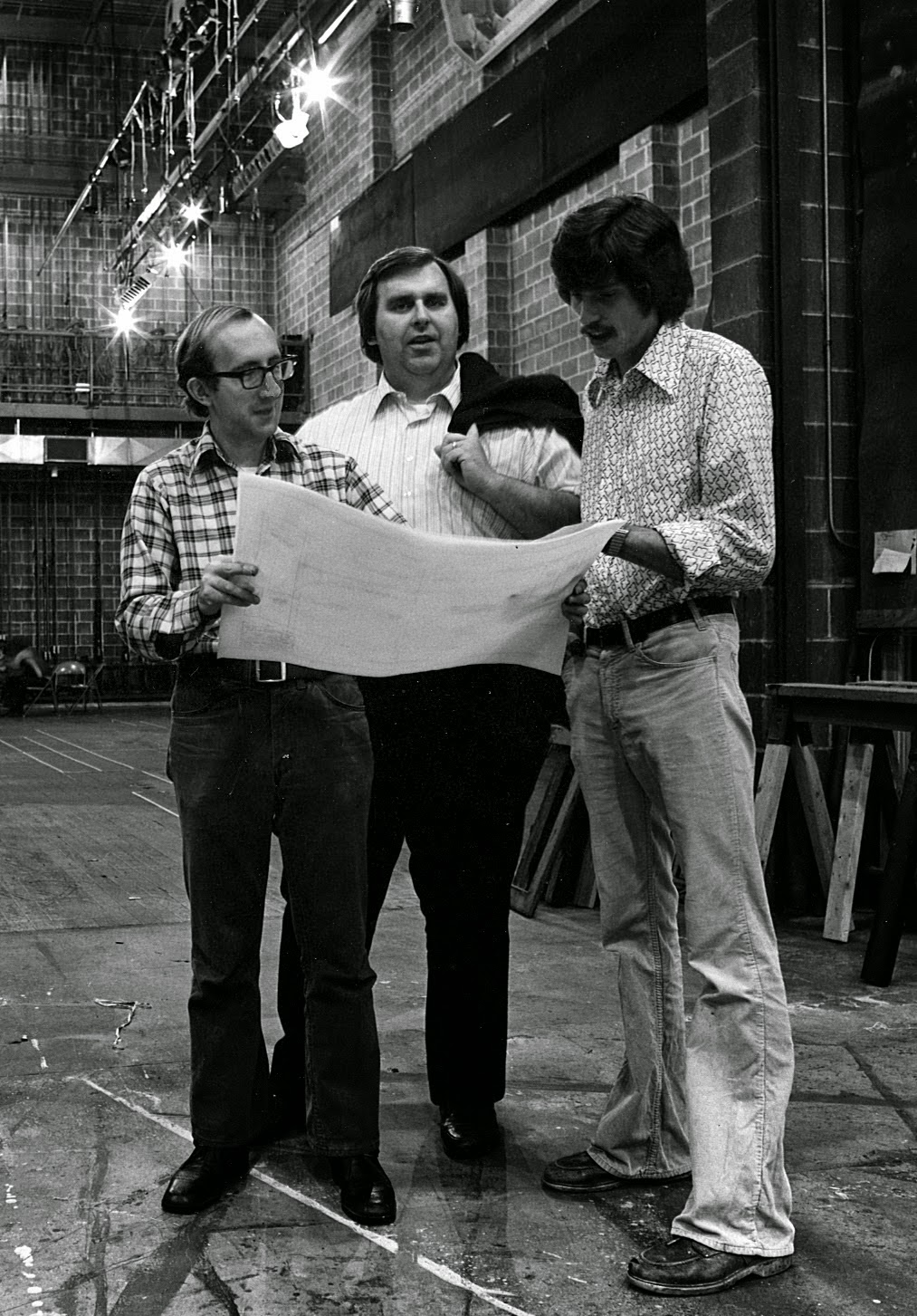
Charles Jones, center
While not all his relations were as colorful as Louie (a paratrooper in war and paramour in civilian life) Jones has only to look homeward to find ample inspiration for his work. Nearby Ft. Benning gave him a front row seat for the unfolding drama of the nation’s war mobilization. “Ft. Benning affected our lives from the time I was a child,” he said. “Columbus was only 38,000 people when the Second World War began. Then Benning was made the largest infantry training base and parachute school and suddenly there were 100,000 men there. It just mushroomed. And, of course, the soldiers’ families would come through too. So the war was very much a presence with us. And the fact Franklin Roosevelt had his Little White House retreat in Warm Springs, only 30 miles from our home, made his death, for us and for a lot of Georgians, an extremely personal experience.”
The Jones home, like many in the area, put-up military boarders during the conflict. Jones did his own part for the war effort when he used his gregarious verve to win a city-wide competition selling war bonds, earning the youngster a live on-air appearance on a local radio station. “Of course, I was so puffed-up, I was like a tiny little peacock just about to bust,” he said.
It was not his first brush with performing, however. From the time he could talk, he displayed an outgoing nature and impressive oratorical skills. He recalls standing on the steps of his family’s Baptist church and, like a preacher, greeting every churchgoer by name. He began exhibiting a vivid imagination at his paternal grandparents dairy farm in Smith Station, Ala., where he and his aunt Alice, only a few years his senior, devised and enacted 10-gallon plays, so named because the sketches lasted as long as it took for the cows’ milk to fill 10-gallon cans. Soon, nephew and aunt, more like brother and sister, began polishing their plays and performing them, complete with makeup, costumes, sets, outside the big farm house on Saturday nights. Their audiences, sprawled on the front porch or on the lawn, were mostly comprised of sympathetic kin but also included black tenant farming families whom the young thespians coaxed into attending. The plays became a family ritual for years. By all accounts, Charlie Jim (his legal name) was a big brash boy with a booming voice and captivating stage presence.
Far from genteel, Jones insists his family was a “dirt poor” lot that, if not as common as the folks in God’s Little Acre, were close cousins. “Our lives as children were visceral. We lived in a bare-footed world with mules and horses and manure. It was not up-town. It was not clean and nice.” But they knew how to have a good time. Weekends at the farm found the clan entertaining homesick GIs at picnics and parties full of Southern hospitality. “Many of the soldiers were farm kids who, stuck way out in the boonies, missed home,” he said. “Coming to Smith Station reminded them of home. It was very emotional for some of them. They’d even queue up to milk cows.”
Sunday dinners brought relations from all around. A preacher was often a feted guest but, man of God or not, he was subject to the same earthy treatment as everyone else. Jones explained: “One Sunday we had a preacher who was going on and on and on and just blessing everything. Finally, my little sister Julia, who was 2 at the time, said, ‘Oh, for Chris sakes, amen,’ and grabbed a chicken leg. Now, my aunts and uncles were the types who had a wonderful sense of humor and so they were just falling on the floor with laughter. And I’m sure Alice and I were laughing too. But my grandmother Jones was probably trying to spank all of us at one time.”
Down home religion offered Jones more grist for the mill. His mother’s family were ardent Methodists and his father’s devout Baptists. Jones found the country services at Smith Station Baptist Church “entertaining,” especially with cousin Samuel Jones present. “Sam was a brilliant man but became a religious fanatic at one time — growing this long beard — and as he took literally the Bible admonition for women to hold their tongues silent Sam would stomp out –clomp, clomp, clomp — in these big old farm boots whenever a woman stood up to testify. People thought his behavior stupid, but it was hysterical to me.”

Image via Wikipedia
He credits his family’s keen appreciation for the absurd for why he found “terribly funny” what others found incredulous. “I suppose it’s because my daddy and grand daddy had a real sense of theater in life. They were entertained by things, and so was I.” His passion for drama was fed whenever his father, Harry Jones, a packing house laborer turned food services magnate, returned from business trips to Chicago or New York and recounted the big stage shows he’d seen. For a boy in Columbus it was a link to far-off places and glamorous goings-on. “Daddy would come back from every trip and describe whatever play he had seen. He would act it out for me. Oh, the magic and imagination of it.”
His imagination was further fired by movies and books and by a local librarian, Miss Loretta Chapel, “a beautiful little bird of a woman” who read stories to he and his school chums. “Miss Loretta would sit in a huge casement window with us children at her feet and she would read, and as she read everything came totally to life. I saw it all acted out in my mind’s eye. It was just amazing. We worshiped her.”
Mad about make-believe, Charlie Jim knew the world of greasepaint was for him long before seeing his first legitimate play — a touring production of Kiss Me Kate — at age 13. He “loved” performing in his first school production, although he claims he was “dreadful.” By 16 he was a bright overweight lad ill at ease among his peers and struggling at school. Then, as if by fate, he was selected with 13 other “misfits” to complete his high school education in an experimental program at Emory University in Atlanta. There, under the tutelage of PhDs determined to teach students in an innovative way, new horizons opened for him and he flourished.
“Our textbooks were the original works of the Greek and Roman playwrights and philosophers. I was just wild about them. Our studies covered the Hebrew tradition, the Middle Ages, Chaucer, Shakespeare, Kierkegaard and so on. What these professors had in mind was to give us the heritage of Western thought and literature and civilization. It was really demanding and interesting. I didn’t appreciate it then but I realize now I had an extraordinary opportunity to read a body of literature that has stayed with me. It was very important to my life.”
Jones said something he read then motivated him to take a big bite out of life: “It was Plato’s statement about cave people living in a shadow world and never having the strength and courage to go through that threshold into the light — into the real world. I was so devastated by that. I thought, ‘That’s not what my life is going to be. I’m not going to allow myself to sit in a cave and not participate. I am going to go out there and try things.’ And I have. I’ve really been a participant.” His tendency to overindulge led to a lifelong battle with obesity, which he blames for the stroke that left him paralyzed on his right side. It’s a battle he’s lately won.
It was at La Grange College, a small Methodist school in La Grange, Ga., he devoted himself body and soul to the theater. He feels indebted to its “fabulous tyrant” of a dramatic arts teacher — Miss Irene Arnett. “She had a strict moral code. To her, we were all sinners going straight to hell. But, man, could she teach Tennessee Williams. Carnality was something she really understood.” After graduating in 1960 Jones promptly landed an acting job in Kentucky, where he enjoyed “the most decadent summer of my life.” When not sowing his wild oats, he did some directing in Columbus before getting his big break as an Equity Actor with the prestigious Barter Theater of Virginia, whose famous alumni include Jessica Tandy, Hume Cronyn and Ned Beatty, whom Jones replaced.
At the Barter Jones found a mentor in its founder and director, Robert Porterfield. “Once you were inside the Barter family then Bob just looked after you and would do anything for you. Bob was a role model for me in leading the Omaha Community Playhouse,” Jones said.
When his Barter Theater tour ended Jones found himself back home — out of work. At the invitation of friends he attended a performance of Tea and Sympathy and was taken with “a beautiful red-haired woman on stage,” Eleanor Brodie, a University of Alabama theater major. He recalled, “She had on a tight turquoise dress with one shoulder bare. She was the most gorgeous and provocative thing I’d ever seen. I was absolutely wild to meet her and I went backstage feeling like the cock-of-the-walk.” When she promptly put him down a peg or two with her sardonic wit, he was even more smitten. He arranged meeting her again through one of her friends and the two married three months later. Partners in life for 38 years now, Eleanor and Charles have two grown sons, Jonathan and Geoffrey, and one grand-daughter, Kathryn.
Of Eleanor, Jones said, “We both made such a total commitment to one another. She has been the most important person in my life. She has pulled me through more things than you can imagine. She’s a fierce lady and our relationship has not always been peaches and cream, but she believes in me. I’m just so damn lucky.”
Like many young actors the pair set their sights on New York, investing everything for their Big Apple fling. Jones found work, even understudying Zero Mostel on Broadway, but after three months of scraping by and enduring rejections he and Eleanor did some soul searching and decided their hearts were back home. “I was a big showy actor, but not nearly as good as many others. It was not ever going to be satisfactory,” he said. “We wanted to go home where we would have a chance to use our very expensive educations as teachers and theater directors. Fortunately, my hometown gave us the opportunity to do that.” He oversaw the restoration and reopening of the historic Springer Opera House, now the state theater of Georgia.
His success as a theater director/manager there prompted the Omaha Community Playhouse to hire him away in 1974. He soon sparked a rebirth of the venerable facility, severely damaged in the May 1975 tornado, by raising funds for its repair and, later, for an ambitious expansion. He launched its professional touring wing — the Nebraska Theater Caravan. His sumptuous adaptation of Dickens’ A Christmas Carol became an annual tradition. His musical extravaganzas dazzled audiences. Season memberships soared. Through it all, he felt the support of his father, who lived to see him grow the Playhouse into the nation’s largest community theater.
Jones finds his thoughts drifting more and more to his late father. “I realize now he was my strongest supporter. He really was.” He fondly recalls the time his father broke into the slated-for-demolition Springer Opera House to plead its case to reporters. The father’s dramatic stunt worked and the theater was saved for the son to guide. One early memory of his father lingers still. It was a Sunday afternoon on the farm. The extended family had finished dinner. Four-year-old Charlie Jim and grandfather Jones were feeding long sugar cane stalks into a mule-drawn mill to be ground into pulp for molasses. Jones tells what happened next: “I shoved a stalk in too far and my right hand got stuck, and the grinder clipped off the ends of all the fingers. I bled like a stuck pig. I can remember the women screaming and even my grandfather panicking. But the one in control was my daddy. He picked me up and he ran with me. All the while, my uncles were running alongside my father, a rather small man, telling him I was too heavy for him to carry, but my daddy would not give me away. He was determined to get me to a doctor, and he did too.”
“That memory of my daddy not giving me away is very powerful and it’s affected my whole life,” a sobbing Jones said, holding up nubby, scarred fingertips. “I wish I could tell him, ‘Thank you.’”
Today, Jones is drawing more and more on his past for his work. Sweet and sour Southern memories abound in his novel as well as in the nostalgic Papa’s Angels, a musical play written by North Carolinian Collin Wilcox Paxton in collaboration with Jones. The play had its premiere last winter with the Grand Olde Players and will be reprised this year. Currently, he is directing The Best Little Whorehouse in Texas for the Dundee Dinner Theater (it runs through May 6). Directing is still his passion: “I love putting the thing together. I love the process of rehearsing a play. That one-on-one with the cast and that working out how we’re going to do it is the fun for me,” he said. But directing is just one of many things he has immersed himself in since leaving the Playhouse due to health reasons in 1998. His work today includes serving on the board of directors for Theaters of the Midlands, a new non-profit corporation designed to support small community theaters in the area.
He is perhaps most excited working with Creighton University occupational therapy students to help them learn about stroke patients like himself. “If I have to endure this at least I can be purposeful by letting students work with me and ask me questions,” he said. “Maybe this will give them some knowledge they can’t get from a textbook and maybe that’s going to help somebody else who has this problem.” His ongoing post-stroke rehab includes aquatic therapy twice a week at Immanuel Rehabilitation Center, which honored him with its Victories Award for his dedication to “soar past limitations with determination, commitment and hope.” For a sensualist like Jones, any debilitation is a curse. Aside from the physical challenges he’s faced, including suffering severe falls and medical complications, his condition has extracted a heavy emotional toll. He credits Eleanor for his recovery. “She was just determined the stroke would not stop me, and it’s amazing how much creative work I’ve done since then.”
On his darkest days he recalls his father’s cheery nature. “He was the most optimistic person I’ve ever known and I feel blessed to have been born with his same optimism. I can be as low as a human being can get. I can think there’s no reason to go on living and then, it’s so incredible, I’ll wake up the next morning and feel, ‘Wow, let’s go.!’ I think one of the reasons I want to keep going is because I am so damn curious about things,” he said. “Part of my curiosity is to know how other people feel about life and what they have to deal with. Do we see things the same way? Do we feel things the same way? To me, that’s fascinating.”
Related Articles
- Stanley E. Williams left major mark in theater (sfgate.com)
- Theatre Building Chicago building theater without a building (timeoutny.com)
- Why the show must go on — and off — for local theater groups (commercialappeal.com)
Bill Ramsey, Marine: A Korean War Story
Journalists look for hooks to hang their stories on, and anniversaries of major events are always convenient pegs to use. On the 50th anniversary of the Korean War I profiled the combat experience of Bill Ramsey, an amiable man who made a rich life for himself after the conflict as a husband, father, PR professional, and community volunteer. He has devoted much of his life to veterans affairs, particularly memorializing fallen veterans. He’s also authored a handful of books. He’s still quite active today at age 80. Anyone who survives combat has a story worth repeating, and it was my privilege telling his story in the New Horizons. Now, in conjunction with the 60th anniversary of the Korean War, I offer the story again as a tribute to Ramsey and his fellow servicemen who fought this often forgotten conflict.
Bill Ramsey, Marine: A Korean War Story
©by Leo Adam Biga
Originally published in the New Horizons
Fifty years ago, Americans were piecing their lives back together in the aftermath of World War II when the best and brightest of the nation’s youth were once more sent-off to fight in a distant land. This time the call to arms came in defense of a small Asian nation few Americans were even aware of then — Korea. In June of 1950, Communist North Korean forces (with backing from the Soviet Union and Red China) launched an unprovoked attack on the fledgling democratic republic of South Korea, whose poorly prepared army was soon overrun. With North Korea on the verge of conquering their neighbors to the south, the United States and its Western allies drew a line in the sand against Communist expansionism in the strategically vital Far East and led a United Nations force to check the aggression.
Among those answering the call to service was a tall, strapping 20-year-old Marine reservist from Council Bluffs named Bill Ramsey. His wartime experience there became a crucible that indelibly marked him. “The war will always be the most defining experience in my life,” said Ramsey, 70, whose full postwar years have included careers as a newsman, advertising executive and public relations consultant. He and his wife of 46 years, Pat, raised five children and are grandparents to 14 and great-grandparents to one. This is his Korean War story.
In the fall of 1950, Ramsey was preparing to study journalism at then Omaha University. His plans were put on hold, however, with the outbreak of hostilities overseas. He followed the unfolding drama in newsreel and newspaper accounts, including the U.S. rushing-in army divisions grown soft from occupation duty in defeated Japan. The invaders pushed South Korean and American forces down the Korean peninsula. Ramsey sensed reserves might be recalled to active duty. He was right.
He was assigned a front line unit in the 5th Marine Regiment, 1st Marine Division, Reinforced. He was excited at the prospect of seeing action in a real shooting war, even one misleadingly termed “a police action.” His anticipation was fed not by bravery, but rather heady youthful zeal to be part of the Corps’ glorious tradition. The conflict offered a once-in-a-lifetime opportunity to test himself under fire. After all, he was too young to have fought in his older brother Jack’s war the previous decade. This would be his war. His proving ground. His adventure.
“I wanted to be in the front lines. I didn’t want to go all that way to end up sorting letters in Pusan,” he said. “I was curious to know how I would hold up in action.”
No stirring salute or fanfare saw the Marines off as their Navy attack transport ship, Thomas Jefferson, pulled out of San Diego harbor in March 1951. Ramsey was one of hundreds of young men crammed in the hull. They had been plucked away from factories, offices, schools, homes and families. Ramsey left behind his mother, brother and an aunt (his father died when he was 12). The GIs were going to defend a land they did not know and a people they never met. Their mission lacked the patriotic fervor of WWII. There was no Pearl Harbor to avenge this time. No, this was a freedom fight in a growing global struggle for people’s hearts and minds.

Bill Ramsey
Before ever setting foot on Korean soil, Ramsey smelled it from aboard ship in the Sea of Japan. Nearing Pusan harbor in the far southeastern tip of Korea, the heavy acrid odor of the war-ravaged countryside permeated the air. It was the stink of sulfur (the discharge from spent armaments), excrement (peasant farmers used it as fertilizer in their fields), fire and death. “That all mixed together made for quite a pungent odor,” he said. “It’s a stench that you never forget.”
Ramsey and his Able Company comrades were flown into a staging area near Chunchon in east-central Korea to await transport to the front. The city had sustained heavy damage. “It was pretty well leveled at that point,” he recalls. Standing on a wind-swept tarmac, he saw snaking down a road from the north a convoy of trucks carrying combat-weary GIs being rotated out of the line. These were veterans of the famous Chosin Reservoir Battle who defied all odds, including numerically superior enemy forces, to complete a withdrawal action that featured hand-to-hand combat. Ramsey and his green mates were their replacements.
“I remember when they got off the trucks they looked like zombies. Their faces were covered with a fine white powdery dust and their hands were blackened from the soot of the fires burning everywhere in the country,” Ramsey said. “I thought, ‘God, I’d give anything to have gone through what they’ve gone through and to be going home.” Among the dog-faced vets was a friend, Phil O’Neill, from Council Bluffs. “He tried to tell me what it was like. He didn’t exaggerate or try to make it any scarier than it was. He didn’t fool around or joke. He just gave me some good advice, like keep a low profile and keep your weapon dry.” After seeing and hearing what awaited him, Ramsey felt an overpowering desire to join the departing GIs. “They were going home. That really hurt. I was so envious.”
Ramsey’s unit headed for a position along the central front. Every village and field they passed was scarred and charred. “We drove all night. We could see fires burning. Again, we could smell the countryside,” he said.
Movement was the order of the day in a war of quickly shifting positions along the long and narrow Korean peninsula. “It was a very fluid war. We were moving constantly, sometimes by truck and sometimes marching 20 or 30 miles in a day to the next spot,” he said. Rough mountainous terrain, bad roads and inclement weather — marked by extreme temperatures, torrential rains, floods, snow and ice — made the going tough. “The farther north you go the more mountainous it becomes. You always had to go up a hill or some rocky face. No flat open fields. This was trees and rocks and cliffs. A really difficult place.” While he never had to endure the brutal winter, he described conditions “as miserably cold. And when it rained, which it did a lot, you were soaking wet, cold and knee-deep in mud. You thought you could never get through it, but you kept going.”
When his company first arrived, U.N. forces were striking out in a series of bold counteroffensives. By the summer, the war was bogged down in a stalemate. A single position (invariably a hill) would be taken, lost, and retaken several times. “It was pretty much hill by hill,” Ramsey said. Platoons were like firefighters rushing from one hot zone to another. A hundred yards or less might separate opposing forces. The basic objective was usually capturing or holding a perimeter on one of the endless sharp-edged ridge lines. Upon reaching a position, the Marines set-up machine gun posts and prepared cover by digging fox holes. Not only did the metal shards from incoming mortar and artillery pose threats, but splintered rock made deadly projectiles too. “
You always had to get some protection for yourself from shrapnel,” he said. Sleeping accommodations were standard-issue pup tents or makeshift bunkers (for extended stays). “Most of the time you stayed one night or two nights and then walked to another position, where you’d dig another hole.” The premium was on moving — no matter what. “You have aching feet. A sore back. You’re tired, discouraged. You’re cold, dirty. You’re sick (dysentery, encephalitis, etc.). But you can’t stop. You’re there, you’re on the move and there’s no way out unless a doctor says you just can’t go on and sends you to the rear.”
On rare occasions when his platoon remained in one spot, barbed wire was strung across the perimeter. The men had to be on constant alert for all-out charges or smaller probing raids looking for weaknesses in the line. “A lot of times they were through the position or in the position. They weren’t always stopped at the wire,” Ramsey said. Nightfall was the worst. The enemy preferred attacking then by frontal assault or flanking maneuvers. To keep a sharp defensive perimeter, men took turns sleeping and watching — two hours on and two hours off — through the night. “You never let your guard down. We were always ready,” he said, adding that the last two years of the conflict it got to be “almost like trench warfare.”
His first taste of combat came early in his hitch. His platoon was dug in for the night on some anonymous ridge line, the men extra wary because reconnaissance had spotted enemy massed nearby. “We were told the Chinese were going to be coming in some force. It was pretty hard to sleep anyway, and anticipating my first night under fire made it that much harder. Sure enough, they came that night. I remember a lot of noise. Mortars. Shots. All that firepower. I remember thinking, “I would love to be able to cram myself inside my helmet.” I somehow got through that night. The next morning they brought in some of our killed. They were in ponchos — their feet sticking out. They were carried down the hill.”
Sometimes, a noise from somewhere out in the pitch black warned of encroaching danger. Other times, a fire fight broke loose with no warning at all. “You would hear something or you would sense something. You laid down fire if you heard anything at all out there. Their movements might trigger a flare, which made it easier for you to see them moving but also made it easier for them to see you,” he said. “On occasion, they would purposely make some noise to try and shake you up. They would produce some tinny sound or blare a bugle or just shout out. It was a psychological ploy.” A dreaded eerie sound was the “zzziiippp” made by the infamous Chinese burp gun, an incredibly fast-firing tommy gun-like weapon.
Perhaps the most terrifying action he saw came the night his outfit’s position was nearly overrun. What began as a cold damp day worsened after sunset.
“We got to our positions pretty late that night. It was raining. We dug in as fast as we could. We’d been in quite a few fire fights in the days preceding that. We thought with the weather this might be one of those nights when the enemy didn’t do anything. We were wrong,” he said. “Our machine guns started firing, and when you heard those you knew they were coming. A few of the enemy broke through our position and came right in the camp. I was quite shocked. We’d never had that before. I saw them through flashes of fire. It was very confusing. A real nightmare. We finally pushed them back.”
There were casualties on both sides. Ramsey said the enemy took advantage of the night, the rain and his unit’s complacency. “They knew Americans were not that big on night fighting and that with the bad weather we might be more inclined to worry about staying dry than steeling for attack. I think what happened is somebody in our ranks did let down. That was the only time they got in our camp that way.” He said an enemy breaching the wire could “demoralize” the troops and, if not repelled, result in a much larger breakthrough.
He described “plenty of close calls” on Able Company’s grueling march north across the 38th Parallel to engage the Chinese in the Iron Triangle stronghold. There was the omnipresent threat of mortar and artillery fire. If you stayed in the field long enough, he said, “you could hear the difference in the sound” and distinguish mortars from artillery and what size they were. Where a mortar round or artillery shell whistling high overhead gave men time to find cover, the report of the Chinese mountain gun, which fired shells in a low trajectory, allowed little or no time to hit the dirt. “You heard the report and, BOOM, it was right there. It fired in on like a straight line.” And there was occasionally the danger of friendly fire, especially errant air strikes, raining hell down on you.
Fording the streams that flowed abundantly from the mountains in Korea presented still more hazards. As heavily weighed down as the men were with their poncho, pack, boots, rifle, helmet, and ammunition, one slip in crossing the clear, fast-rushing streams (more like surging rivers) could be fatal. “A few times I felt like I was going under for sure,” Ramsey said. “I wouldn’t have had a chance.” Carrying their rifles overhead to keep them dry, the men were sitting ducks for snipers. “We were exposed,” he said.
Once, he recalls his platoon just making it to the far bank when shots began splaying the shore from the hill above. “We couldn’t see too much because it was fairly steep. We finally did draw fire on this hill.” But when Ramsey got ready to fire his M1 rifle, he got a rude surprise. “I pulled the trigger and nothing happened. That was a terrible feeling. In all that sloshing through the water my weapon must have got wet. I used a wounded buddy’s carbine instead.”
A fire fight Ramsey will never forget erupted when his 1st squad was returning to the lines after completing a mission and saw the point squad ahead of them “get hit” in an ambush of machine gun fire. Several men were cut down in the ensuing action, including 1st’s squad leader and Ramsey’s good friend — Don Hanes. “He was shot in the chest. Another fellow and I went back up this hill to get him. The fire was really intense. I was amazed we weren’t all killed on the spot. We started taking him down and Don looked at us and said, ‘No, no, no, no, no…Just leave me. You’ve got to get out of here. I’m not going to make it.’ He was a brave fellow. He was hurt so badly. Well, we did get him out of there — across an open rice paddy. He was evacuated to a hospital, but it turned out he was mortally wounded. He died later. We had a number of other casualties we carried too. It was a grim day.”
At 20, Ramsey was named temporary squad leader. He already led a four-man fire team. In addition to M1s, the team carried a single Browning Automatic Rifle or BAR. Their mission: flushing out the enemy or scouting enemy lines. Sometimes, they ran sniper patrols. If the enemy was sighted (with the aid of a sniper scope), the team’s job was to “throw some fire in” and try to pick-off or pin down targets. “We wouldn’t necessarily hit them all the time,” he said. Days or weeks might pass without enemy contact. Once, Ramsey came face-to-face with his foe. It happened when taking a hill. He and another Marine surprised a North Korean soldier. “We both fired at him, and he fell dead. We went over to where he was lying on his back. There was a pouch. We opened it and found a photo of a woman and a child. I thought, ‘He’s just like me.’ We had been thinking of the enemy as a bunch of faceless fanatics, and here was a man with a wife and child. It made an impact.”
By November 1951, Ramsey had been in-country eight months. Despite steady combat, he’d escaped unscathed. He hoped his luck held out just a few months more — then his hitch would be up and he’d be back stateside. “You see people dropping everyday. You see friends maimed and killed. You see guys going out of their head. You wonder when your number’s going to come up next. You ask yourself, ‘How can I ever get out of here?’ It’s a sinking feeling,” he said. He feels what keeps men going in such awful conditions “is your intense desire to survive and to see your loved ones again. That kept me driving.”
On the morning of November 17, his fire team “headed out on a routine sniper patrol” down Hill 834. “It was one of our more permanent lines. The hill was a muddy mess. We weren’t out long when one of us tripped a land mine, and a piece of shrapnel caught my right arm.” The impact sent Ramsey skidding face down the hill. “I was in shock, but I knew it was pretty bad because my dungaree jacket was shredded and blood was all over the place.” Metal fragments had severed his ulnar nerve and fractured bones. His mates brought a Navy corpsman to his side. The corpsman applied a bandage and administered a shot of morphine. Ramsey’s buddies then carried him up the hill and down the reverse slope to a small, level clearing. There, a second casualty from down the line was stretchered in — missing a foot. Ramsey recalls an officer giving him a cigarette to drag on and saying, “You got a million dollar wound there, Bill…you’ll probably be going home.” Still, Ramsey worried he might lose his shattered arm, which burned with pain. A helicopter evacuated he and the other casualty to a nearby MASH unit.
Rushed into surgery, Ramsey awoke the next day to the news doctors had saved the arm. Wearing a cast, he was taken (by ambulance) to an Army hospital in the devastated capital of Seoul. “There was nothing standing,” he said. From there, he was flown (on a transport plane stacked with wounded) to an Army hospital in Osaka, Japan, spending days in agony (receiving no treatment as a non-Army patient) before transferred (via train) to a Navy hospital in Yukosuka, where he finally found some relief for the pain and slept for the first time in nine days.
In early December he hopped a four-engine prop bound for the states. He landed at Travis Air Force Base in southern California. His first impulse was to call home. He next reported to Oak Knoll Navy Hospital near Oakland, where he underwent skin grafts and three months of physical therapy. During his rehab, the Purple Heart recipient recalls being torn by two emotions: “I felt sick about leaving and letting my buddies down. But the other side of it was I was really thankful to get out. Eight months there was enough.” His long voyage back ended almost a year to the day his Korean odyssey began. A relieved Ramsey arrived to “the quiet of my wonderful home.” He downed a beer and thanked God the journey was over at last.
Upon his return (he graduated from Creighton University) he was dismayed by the indifference civilians expressed toward the raging conflict. From its start in June 1950 to its conclusion three years later, it never captured the public’s imagination. Many observers feel it came too quickly on the heels of World War II for Americans — then preoccupied with living the good life — to care. Cloaked under the murky misnomer “police action,” it became a shadow war.
President Harry S. Truman summed up the national mood when he called it “that dirty little war.” Its status as “the forgotten war” was sealed when it ended not with victory but an armistice leaving Korea still divided at the 38th Parallel (with a permanent American military presence there to keep the peace.) Lost on many was the fact the true objective — preserving a democratic South Korea — was accomplished. In the larger scheme of things, a free South Korea has emerged as a thriving economic juggernaut while a closed North Korea has withered in poverty. Ramsey saw for himself the economic miracle wrought in South Korea on a 1979 trip there. He met a people grateful for his and his comrades’ sacrifices. Monuments abound in recognition of the U.N. “freedom fighters.”
It is only recently, however, these veterans got their due in America. In 1995 the Korean War Memorial was dedicated in Washington, D.C. (Ramsey was there). In the late ‘70s Ramsey, whose post-war life has been devoted to causes, spearheaded the erection of a joint Korean-Vietnam War monument in Omaha’s Memorial Park. The monument has received a recent refurbishing and the addition of a flower garden. This year, he started a Nebraska chapter of the National Korean War Veterans Association.
For vets who went to hell and back, the war is never far from their thoughts. “I’m proud to have served. We stood fast. We saved the south. I can think of no higher compliment than to be called a freedom fighter,” said Ramsey, who, in 1997, faced a new enemy — prostate cancer. Aggressive treatments have left him cancer free. In August, he attended a reunion of his 1st Marine Division mates. “My admiration continues to grow for the Marines with whom I served,” he said. For their heroic actions there, the division received the rarely bestowed Presidential Unit Citation.
Related Articles
- Editorial: Korean War veterans are due recognition (knoxnews.com)
- Legacy of the Korean War (theworld.org)
- Stunning photo gallery remembers the Korean War (holykaw.alltop.com)
- Veteran laments long wait for Korean War day (cbc.ca)
Chuck Powell: A Berlin Airlift Story

Image via Wikipedia
One of the nice things about a blog like mine is that I can revive or resurrect stories long ago published and forgotten. Here’s a story I did about a man who had a remarkable military service record. His name was Chuck Powell. He passed away recently, and I post his story here as a kind of tribute or memorial. I did the story around an anniversary of the Berlin Airlift, which he participated in as a pilot. He also flew in World War II and in the Korean War. He nearly flew in Vietnam. Powell was a great big old Texican who had a way with words. He was an example to me of never judging a book by its cover. By that I mean he appeared to be one thing from the outside looking in but he was that and so much more. For example, by the time I met him he was pushing 80 and a tenured academic at my alma mater, the University of Nebraska at Omaha, but none of that suggested the many adventures he had experienced far removed from academia, adventures in and out of wartime, that added up to a wild and woolly life.
The profile originally appeared in the New Horizons and I think, like me, you’ll find Powell’s story compelling if for no other reason than all the history his life intersected with.
Chuck Powell: A Berlin Airlift Story
©by Leo Adam Biga
Originally published in the New Horizons
Somehow it’s fitting one-time aviator turned political scientist, gerontology professor, history buff and pundit Chuck Powell holds court from a third-floor office perch on the University of Nebraska at Omaha campus. There, far removed from the din of the crowd, he analyzes trends affecting older Americans, which, at 78, he knows a thing or two about.
On any given week his office, tucked high away in a corner of an old brick mansion, is visited by elected officials from across the political spectrum seeking advice on public policy and legislative matters.
“Most of the so-called issues are perennial. They don’t change. Most of the time people are searching for some magic silver bullet, but there isn’t any. My advice is usually pretty simple,” he says.
Don’t mistake Powell for some ivory tower dweller though. Whether offering sage counsel or merely shooting the bull in his down-home Texas drawl, this high flier and straight shooter draws as much on rich life experience as broad academic study with students and politicos alike.
And, oh, what a life he’s led thus far. During a 30-year military career he saw duty as a Navy combat pilot in the Pacific during World War II, a photo reconnaissance pilot in China and a C-54 jockey in the Berlin Airlift. Later, he flew combat cargo missions in Korea. By the time he retired a Naval officer in 1971 he’d seen action in two wars, plus the largest air transport operation in history, been stationed in nearly every corner of the globe and risen through the ranks from seaman to pilot to commander.
He’s gone on to earn three college degrees, teach in post-secondary education and travel widely for pleasure. Yet, for all his adventures and opinions, he’s rather taciturn talking about himself. Chalk it up to his self-effacing generation and stern east Texas roots. Nothing in his home or office betrays his military career. His wife, Betty Foster, said even friends were surprised to learn he’s a veteran of the 1948-49 airlift, a fact made public last spring when he and fellow veterans were honored in Berlin at a 50th anniversary event. Participating in “Operation Vittles” changed his life.
“There’s a strong feeling of public service among those of us who served in the airlift because it left us with the idea we could do great things without bombing the bejesus out of somebody,” he says.
While he has, until now, been reluctant to discuss his military service, his impressions, especially of the airlift, reveal much about the man and his take on the world and help explain why his advice is so eagerly sought out.
Born along the Texas-Louisiana border, he was reared in Tyler and a series of other small east Texas towns during the Depression. He hardly knew his father and was often separated from his mother. Shuttled back and forth among relatives in a kind of “kid of the month club,” as he jokingly refers to it, he spent much time living with an uncle and aunt — Claiborne Kelsey Powell III, an attorney and Texas political wheel, and his wife Ilsa, a University of Chicago–educated sociologist and Juilliard-trained musician.
One of Powell’s clearest childhood memories is Claiborne taking him to see the inimitable populist Huey Long stumping for a gubernatorial bid in nearby Vernon Parish, La. He recalls it “just like it was yesterday. The guy was so impressive. He was a big man. He had a large head and a full head of hair and wore a white linen suit with a string tie. He’d go, ‘My friends, and I say, you are my friends…’ Yeah, Huey man, he was a hoot.”
Surrounded by Claiborne’s political cronies and exposed to his and Ilsa’s keen wit and elevated tastes in music and books Powell was, without knowing it then, groomed to be a political animal and scholar. He credits his uncle with being “probably the most influential person in my life” and sparking an insatiable inquisitiveness. “I’m a curious person. I’m someone who likes to turn over every rock in sight,” Powell concedes. Betty, a gerontological educator and consultant, adds, “He doesn’t look at the surface of most things. He looks far deeper than most people do. Chuck is always looking at why we do things. He’s very, very bright.”
Searching for some direction early in life, Powell found it in the Navy at the outbreak of World War II. Besides serving his country, the military gave him a proving ground and a passport to new horizons.
“It provided a way out. I could hardly wait to get on the road.”
The sea first took him away. In a series of twists and turns he doesn’t elaborate on, his early wartime Naval service began as a sailor in the Atlantic and ended, improbably, as a fighter pilot in the Pacific. The only thing he shares about his combat flying experience then is: “I heard some gunshots, let’s put it that way, but by the time the war ended the overpowering might of the United States in the Pacific was such that you rarely got an opportunity to even see, let alone shoot at, the enemy.”
After a year’s duty in China he returned home and was assigned to the Military Air Transport Service (MATS). “I was in a Navy four-engine transport squadron that flew out of Washington National. We had nightly, non-stop routes that went from Washington to San Francisco.”
Then, in June 1948, the Soviets blockaded all ground and water routes in and out of West Berlin and Powell and his mates were redeployed to Germany to support the, at first, ragtag airlift of vital supplies into the isolated and beleaguered city. The first supplies were flown in June 25.
Powell’s first missions supported the airlift itself: “We started flying equipment and personnel to Rhein-Main,” a major air base and staging area near Frankfurt. Attached to Air Transport Squadron 8, he found himself thrown in with other airmen originally trained for combat duty. Its skipper, “Jumpin” Joe Clifton of Paducah, Ky., was a decorated fighter pilot.

The start of “Operation Vittles” was inauspicious. Men and material were scarce. The few supplies lifted-in fell woefully short of needs. The whole thing ran on a wing and a prayer. Allied commanders and German officials knew Berliners required a daily minimum 3,720 tons, including coal and food, to ensure their survival, yet Powell says,“there was no evidence they could lift this much tonnage daily. The first day they cobbled together a group of old C-47s and lifted 80 tons. That was 3,620 tons short.
The task, as it began, was very high on optimism and low on reality because Berlin’s huge, about 400 square miles, and we’re talking about supplying a city the size of Philadelphia by air.” All sorts of alternate supply schemes — from armored transport convoys to mass parachute drops — were rejected.
Hindering the early operation was a lack of infrastructure supporting so mammoth an effort.
To meet the supply goals hundreds of C-47s and C-54s had to be brought in from around the world and pipelines laid down from Bremerhaven to Frankfurt to carry fuel. All this — plus devising a schedule that could safely and efficiently load and unload planes, maintain them, get them in the air and keep them flying around-the-clock, in all weather — took months ironing out. Yet, even during this learning curve, the airlift went on, growing larger, more proficient each week. Still, it fell far short of targets as winter closed in, leaving the terrible but quite real prospect of women and children starving or freezing to death.
“The first six months of the airlift were nothing to write home about,” Powell recalls. “The stocks in Berlin were drawn down. All the trees were cut to be used for fuel. We watched that tonnage movement day by day and, intuitively, everybody on the line knew how bad things were headed.”
Historians agree the turning point was the appointment of Maj. Gen. William H. Tunner as commander of the combined American-British airlift task force. He arrived with a proven air transport record, having supplied forces over “The Hump” in India and China during the war. He and his staff brought much needed organization, streamlining things from top to bottom.
The number of flights completed and quantity of tons delivered increased, but when Tunner, “a bird dog” who observed operations first-hand, was on a transport during a gridlock that stacked planes up for hours, he insisted staff devise improved air traffic routes and rules that kept planes in a rhythmic flow The result, a loop dubbed “the bicycle chain,” smoothly fed planes through air corridors in strict three-minute intervals.
“Gen. Tunner was a tremendous leader. He knew you couldn’t turn a bunch of cowboys loose with these airplanes and expect precision. Under him, the airlift became a rigidly controlled operation. You had to fly just precisely, otherwise you were gonna be on the guy ahead of you or the guy behind you,” Powell says.
With so little spacing between planes, there was scarce margin for error, especially at night or in the foul weather that often hampered flying.
“With a guy coming in three minutes behind you, if you missed your first approach you didn’t have enough time to take another shot. You either made it the first time or you went home,” says Powell, who after a few weeks ferrying essentials to support the airlift’s launch, began carrying coal into Berlin’s Tempelhof airport from Rhein-Main (the base in the southern corridor reserved for C-54s). “If everything was going right you could do a turnaround (roundtrip) in four hours. If it wasn’t going right it could take you 24 hours. There were any number of things that could go wrong.”
Rules were one thing, says Powell, but they were often ignored in the face of the dire task at hand. “I can’t speak for anybody but myself but I never carried a load of coal back. There were times in the airplane when you set the glide path and the descent and the first you knew you’d landed is when you hit something.” To work, he explains, the airlift depended on men and machines going beyond the norm in “a max effort.”
“We were flying over manufacturers’ specified weights. Engines were a constant problem. We were wearing these things out. The airplane was actually being asked to do things it wasn’t even built to do, and everybody knew that. In wars and crises things are set aside. You take chances because you don’t have time to sit around and procrastinate. The Soviets were trying to starve the people of Berlin into submission. You got swept up in all this and pretty soon you were doing all you could. The only time I know of when it (the airlift) was shut down was one night when there were some violent thunderstorms. I was in the corridor and man, it was grim that night up there. Just before we were ready to take off at Tempelhof to come back home they shut the thing down for six or seven hours until that storm dissipated.”
Considering the scale of operations, blessedly few planes and lives were lost. During the entire 15-month duration, covering some 277,000 sorties, 24 Allied planes were lost and 48 Allied fliers killed. Another 31 people died on the ground. “I think it’s remarkable that with all the things that were required, we lost so few,” Powell says.
All the more remarkable because aside from the dangers presented by night flying, storms, fog, overtaxed planes and fatigued fliers, there were other risks as well. Take the Tempelhof approach for example.
“Tempelhof was the toughest of all the fields,” he notes, “because you were coming in over a nine-story bombed-out apartment building. You had a tremendous angle on your glide slope.”
Then there was the danger of transporting coal. A plane might blow if enough static electricity built-up and ignited the dust that settled over every nook and cranny. To ventilate planes crews flew with emergency exits off.

“It was noisy,” Powell says, “but you couldn’t argue with it because then you’d be arguing you want to get killed.”
Coal dust posed an added problem by fouling planes’ hydraulics and irritating fliers’ eyes. Powell was legally blind six months and grounded for two due to excess coal dust in his eyes. He says even the most benign loads, if not properly lashed down, could shift in mid-air and compromise flight stability.
“You didn’t want anything rockin’ around loose in the airplane.”
He reserves his highest praise for the Army Quartermaster and flight maintenance crews that kept things running like clockwork. German citizens made up part of the brigade of workers loading and unloading supplies and servicing planes.
“The crews were exceptional. They were absolutely incredible in their ability to perform this work and to perform quickly.”
The operation got so precise that a C-54 could be loaded with 22,000 to 25,000 pounds of supplies, refueled and lift-off — all within 20 minutes.
“It wasn’t going to run unless everybody did their job, and if one part broke down the whole thing broke down.”
He says many civil aviation advances taken for granted now were pioneered then, such as strobe lights lining runways and glowing wands used by grounds crew to steer planes to gates. All this happened in a pressure-cooker environment and the menacing presence of nearby Soviet forces. The Soviets used harassment tactics, including sending fighters to buzz transport planes and ordering ground-based anti-aircraft batteries to fire rounds at the corridors’ edges.
Powell says if the tactics were meant as intimidation, they failed.
“C’mon, we’d all been shot at before, give me a break. The ammunition made for a good fireworks display, but it made no impact. Probably the worst thing they did from my point of view was shine some very high-powered searchlights on the aircraft at night and jam the final control or frequency. You just had to keep driving and hope you made it all right.”
Make no mistake, it was a tense time. The blockade and airlift had put the world on the brink. One false move by either side could have triggered WWIII. Despite the threat, U.S. and British resolve held firm and the Cold War didn’t turn hot. By 1949 it was clear the airlift was succeeding beyond anyone’s wildest dreams. Tunner’s bicycle chain was humming along and with the weather improving that spring he chose Easter Sunday to kick the operation into overdrive. In what became known as The Easter Parade, the airlift’s spacing was dropped to one-minute intervals and in a single 24-hour stretch in April a record 1,390 flights delivered 12,940 tons into Berlin.
“A one-minute separation — that’s pretty close for big overloaded airplanes,” Powell says. “I don’t think we could have cut it any closer. But it was a beautiful day. The weather was ideal. You could see everybody. That made it easier. The Soviets of course were betting the next day would be a huge fall-off but we did something like 8,000 tons. By then we’d hit our stride and we were routinely lifting 8,000 to -9,000 tons a day. It sent a message to Joe Stalin. The next month the Soviets lifted the blockade.”
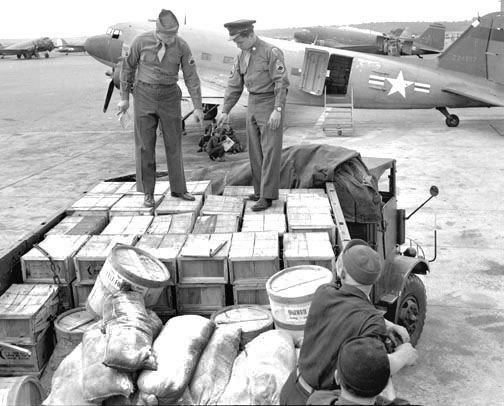
However, the airlift continued months afterward as a buffer against any further Soviet ploy. By operation’s end — September 30, 1949 — more than 2.3 million tons of supplies had been lifted-in and a world crisis averted.
For Powell, its success, along with rebuilding Europe, were America at its best. “We’re an amazing country. Sometimes we have a veritable uncanny propensity to do the right thing. It brought into rather sharp relief just what could be done. In my humble opinion the United States, between 1945 and 1950, could be compared to ancient Greece under Pericles. It as a golden era. We did virtually everything right and you can’t do that without leadership. We were deep in leadership after the war.”
He says the feeling in America then — “that everybody was in this together” — is hard for young people to understand. “Now, we’re so disparate. Everybody’s off doing their own thing. But I still put my faith in the willingness of the American people to do the right thing…given the right leadership.” The airlift’s legacy, he says, is the goodwill it generated. “Civic-minded Germans formed the Berlin Airlift Foundation to take care of the wives and children of the airmen killed in the lift.
When he joined other vets in Berlin last May he spoke with Germans who vividly recalled the airlift. “They all mentioned the omnipresent noise. One lady told us, ‘It didn’t bother us because we knew if the noise continued we would eat.’ He adds the warm outpouring of gratitude got him “a little choked up. We made generations of friends there.” He says if there’s any heroes in all this, it’s “the people of Berlin, because they could have very easily gone to the Soviet sector and been fed and clothed. No question. They were down to 1,200 calories a day but chose to stay and stick it out. These people sought self-determination.”
After the airlift Powell was set to study law when the Korean War erupted. He spent 21 more years in the service, moving from place to place “like a locust.” Posted in France during the ‘60s, he became a certified Francophile — enamored with the nation’s history, culture, people. He’s often returned there.
Along the way he married, raised a family (he has three grown children) and indulged a lifelong search for knowledge by reading and studying. He describes himself then as “a kind of journeyman” scholar. That all changed in 1964 when plans to join an F4 Phantom squadron off the coast of Vietnam were scuttled and he was assigned instead to Offutt Air Force Base.
Here, he finally stayed one place long enough to earn a degree (in business administration from Bellevue University). And here he’s remained. His post-military career saw him remake himself as an authority on public policy and aging issues, earning a master’s in public administration and a Ph.D. in political science. UNO hired him in 1973 to implement training programs under the Older Americans Act.
As a full professor today he teaches courses, advises students and collaborates with colleagues on
articles, surveys and studies. He’s applied the public service mission he took from the airlift to serve political campaigns, advise local and state government and participate in White House conferences on aging. Both his life and work dispel many myths about aging.
“We feel it’s wonderfully appropriate to have a 78-year-old teaching younger people all older people are not alike,” says James Thorson, UNO Department of Gerontology Chairman. “Dr. Powell is an excellent instructor and accomplished researcher. He’s wildly popular with students. He works long hours. He wants to wear out, not rust out, and I respect him for it.”
It was at UNO Powell met Betty. Both were recently divorced. He was teaching, she was doing grad work. They married in 1982. Everyone agrees they make a good match. They travel together and enjoy entertaining at their sprawling Keystone neighborhood home, where he often holes up in a study whose impressive library is stocked with volumes on American history (the presidents, the Civil War) and France. Travel is no idle pursuit for him. He researches destinations and prepares itineraries detailing sites and themes, from architecture to art to vineyards. He got in the habit in the service.
“It permits you to observe how other people do things and to see Americans don’t have a corner on how things are done.”
The couple prove growing older doesn’t necessarily mean slowing down. In typical fashion he and Betty plan ushering in the new millennium under the Eiffel Tower in Paris. “I’m really looking forward to it,” he says. In his office hangs an enlarged photo of the French landmark with an inscription that sums up his ageless sense of wanderlust: “Paris is like a lover. You may leave her, but you will never forget her.” It’s the same way with Chuck Powell: Once you meet him, you never forget him.
Related Articles
- Causes, Reasons and Results of the Berlin Airlift (brighthub.com)
- Trail of the unexpected: Tempelhof Park, Berlin (independent.co.uk)
- James Rodney Ferrell, 90 (kitsapsun.com)
- History: The Berlin Airlift (americanthings.wordpress.com)
- How much supplies did Berlin Airlift receive (wiki.answers.com)
- Candy Bomber: The Story of the Berlin Airlift’s Candy Bomber: The Story of the Berlin Airlift’s “Chocolate Pilot” by Michael O. Tunnell (alleganylibrarycollections.wordpress.com)
Omaha’s Tuskegee Airmen

English: Pilots of the 332nd Fighter Group, “Tuskegee Airmen,” the elite, all-African American 332nd Fighter Group at Ramitelli, Italy., from left to right, Lt. Dempsey W. Morgran, Lt. Carroll S. Woods, Lt. Robert H. Nelron, Jr., Capt. Andrew D. Turner, and Lt. Clarence P. Lester. (U.S. Air Force photo) (Photo credit: Wikipedia)
Meeting real life heroes and historical figures is not an every day occurrence, even in my line of work, and so given the great legacy of the Tuskegee Airmen it was a real honor and treat interviewing a handful of these men living in and around Omaha. Like most individuals of great achievement, they are both quite proud o what they did but also exceedingly humble about it. I did the story for the New Horizons on the tail end of a wave of recognition coming the Tuskegee Airmen’s way. More has followed since. It’s all well-deserved. On personal note, my own father, the late Leo M. Biga, was a ball turret gunner on a B-17 that flew in the 96th Squadron, 2nd Bomber Group, Fifteenth Air Force, and he attested to the fact that the escort fighters flown by Tuskegee Airmen, the famed Red Tails, saved his and his fellow airemen’s bacon on many an occasion during bomb runs over Europe. When I interviewed the Tuskegee veterans I didn’t know enough to give them my father’s whereabouts and assignments and air service dates to see if they might have been flying at the same time, on the same missions. I’d like to think they were.
Omaha’s Tuskegee Airmen
©by Leo Adam Biga
Originally published in the New Horizons
At the start, they were ordinary young black men of varied backgrounds. They came from around the country. Most were college graduates or undergrads. Some were just out of high school. They were drawn to “the experiment” by a desire to serve their country in World War II and, in so doing, help overturn racist attitudes. The experiment was the Army Air Corps black cadet training center at Tuskegee Institute, an historically black institution of higher learning. It was meant by supporters to demonstrate blacks were as capable as anyone and by detractors to reinforce minorities’ supposed inferiority in a then-segregated military and society.
As history now notes, the Tuskegee Airmen decisively proved blacks the equal of their white counterparts. More than 1,000 men graduated from the aviation school, including pilots, navigators and bombardiers. All were pioneers and trailblazers. In combat, flyers with the 332nd Fighter Group, including the 99th Fighter Squadron, became heroes, distinguishing themselves above all other U.S. flying units. Tuskegee fighter pilots never lost a single bomber to enemy fire in 200 escort missions over Europe. An unprecedented achievement.
So impressive a record that once skeptical bomber groups hotly lobbied to be escorted by these “Red Tail Angels,” so named for the red tail markings on their aircraft. The leader of the Tuskegee group, Col. Benjamin Davis, had emblazoned on his aircraft “By Request” — a reference to the many requests bomber groups made for the 332nd to cover them.
As the exploits of the Tuskegee flyers mounted, their reputation preceded them, even to Germany, where they were known as the “Black Bird Men.”
Now, some 60 years since World War II’s end, the ranks of Tuskegee Airmen grow thinner just as their status as national treasures looms ever larger. Their legacy is a testament to perseverance, loyalty, passion, talent and sacrifice. Their barrier-breaking contributions aided the nascent Civil Rights Movement. Their deeds “paved the path” for blacks in the military and other fields, said Air Force veteran Bobby McGlown, founder of Tuskegee Airmen, Inc.’s local Alfonza Davis Chapter.
Robert Rose, an Air Force vet who entered the service long after the Tuskegee men made their mark, feels indebted to them. “I’m the benefactor of their labors and sacrifice. To accomplish what they accomplished with all of the hardships and rigors of segregation, racism and war, is just phenomenal.” Even though his career came in what was — theoretically — a fully-integrated military, Rose still met racism and is amazed how those who went before him endured what they did “without the force of law behind them.” He felt such gratitude that in 2002 he assumed the presidency of the Alfonza Davis chapter in order “to make sure their legacy is perpetuated. They’re my heroes. They’re my friends. And I’m willing to do whatever I can to make this organization something they can be proud of.”
His efforts are culminating this year in the local chapter hosting the 33rd Tuskegee Airmen national convention. It’s only right Omaha plays host to the August 3 through 8 event, as several Tuskegee Airmen call this place home. The city’s most decorated Tuskegee flyer, Alfonza Davis, for whom the local chapter is named, was Tech High valedictorian in the class of 1937 and, later, an Omaha University student. He went missing in action in 1944 and was declared presumed dead in ‘45. In all, at least seven Omahans trained in the Tuskegee military aviation program. All but one of the known native Nebraskan Tuskegee Airmen have passed away. A few other “originals,” as they’re referred to, have made Nebraska home after long military careers. One graduated from UNO. The stories of these men are told here:
Alfonza Davis
Captain Alfonza Davis graduated the top of his flight class at Tuskegee and was the first black military aviator from Omaha to earn his wings. He scored the highest rating in Moving Target Marksmanship in his class and was chosen squadron leader. His first combat assignment was with the 302nd Fighter Squadron in Italy. Later, he was attached to Group Headquarters for the 332nd Fighter Group as its assistant group operations officer. The group, operating with the 15th Air Force, escorted bombers that struck objectives in Italy, France, Germany and many other European nations. His final assignment came as squadron commander of the 99th Pursuit Squadron (later renamed the 99th Fighter Squadron). He led one mission in which his flyers destroyed 83 German aircraft. On what proved to be his last flight, he piloted his P-51 “Mustang” on a reconnaissance sortie to Munich, when he was lost in overcast weather near the Gulf of Trieste and never heard from again.
Among his many awards and decorations are: the Purple Heart and Distinguished Flying Cross. He was credited with one aerial victory in the Mediterranean Theater of Operations. He left behind a wife and brother.

Lt. Col. Charles Lane Jr.
Lt. Col. (Retired) Charles Lane, Jr.
One of 13 children born to Verna and Charles Lane in the black section of St. Louis known as “The Ville,” Charles Lane, Jr. was attending Harriett Beecher Stowe Teachers College when war broke out. He volunteered for the aviation cadet program rather than be drafted. “The draft at that time was not treating blacks very well,” he said. “They normally ended up in service units.” He was inspired to join the corps by a former high school classmate, Wendell Pruitt, who’d already made it through the program and was speaking at a war bond drive. “He gave us all insight into what to study for and how to apply ourselves, and a lot of us did. Out of 12 of us, eight passed the exam” that qualified them for training.
Oddly, the first black military aviators were mustered and trained down south, at places like Keesler Field in Biloxi. Miss., where their presence was least tolerated. “It seemed ironic to us, too, but that was politics in those days,” said Lane.
Out of Lane’s original class of 138 cadet candidates, 78 made it to the Tuskegee Institute in Tuskegee, Ala., where they first learned to fly. The tough training there further weaned the class to 38. He said some very good men washed out, not because they couldn’t fly, but due to an unwritten quota system that passed a bare minimum flyers. Those that made it, like Lane, knew they must meet stringent standards. “We had the same curriculum as white cadets, but we held ourselves to higher standards,” he said, as instructors looked for “any excuse” to axe them.
Early flight training was with black instructors and primary training under the supervision of whites. “Some of them, of course, didn’t like our being there and let you know it. That got your attention,” he said. “But then there were others who were behind you and supportive. My instructor was one of those types. He said, ‘I can teach anybody to fly, and I want you to learn real fast.’ He was friendly.”
Lane joined the 99th Fighter Squadron in Ramitelli, Italy, near Foggia. He was 19 when he piloted a P-51 in combat. The P-51 was lighter and fleeter than the P-47 he trained in. “It was a very fanciful airplane,” he said. “Speedy. Maneuverable. Extensive strike range. All those things a fighter jock needs — it had them.” He was a wing man, meaning he protected “the shooters” whose wing he flew on.
He flew 26 missions escorting B-17s and B-24s on bombing runs. Escort missions took him as deep as Berlin. By the end of fighting in Europe, he said, the Germans’ “max effort” saw them throw up a barrage of fighters and anti-aircraft flak. He saw his flight leader and fellow St. Louis native, Hugh White, shot down in front of him while flying his wing. Another friend, Thurston Gaines, was shot down behind him. Both men bailed out and survived as POWs. White, whom the St. Louis Tuskegee chapter is named, became an attorney and Gaines a physician.
Others weren’t so fortunate. Lane said while he and his fellow flyers were proud of their sterling record of not losing a single bomber to enemy fire, they didn’t forget those lost in action. “We paid a price. Sixty-six of us were killed in action and 38 more ended up as prisoners of war. So, of the 450 pilots who saw combat, more than a hundred — or, in other words, every fifth pilot — was considered lost.”
He said their “by-the-book” commander, Col. Davis, was the reason black pilots were so disciplined in carrying out their bomber cover duty. “He told us, ‘You’re over here boys to protect the bombers.’ If a German fighter got two miles away, we left him alone. We broke off and came back and rejoined the formation. We didn’t stray out there and try to chase him. Our primary mission was to protect the bombers, and that’s the attitude we had.” Lane feels the ramrod straight Davis, who went through hell as a lone black West Pointer, developed the esprit de corps and high standards of the group. “We felt honored to have him around.” Plus, he said, Davis forever gained their allegiance by going up the chain of command to fight rigged reports meant to discredit the Tuskegee track record.
The program only continued, Lane said, due to the intervention of figures like Davis, who got Gen. George C. Marshall to listen to facts. First Lady Eleanor Roosevelt did her part by taking a much-publicized ride with a Tuskegee pilot. But public recognition for the flyers’ accomplishments was long denied. Lane recalls the 99th Fighter Squadron’s win in the 1949 national gunnery meet being unlisted in the record books until black servicemen raised hell. It took a decade to get it corrected. School history books made no mention of Tuskegee Airmen until quite recently. “My thought was we were the best kept secret of World War II,” he said.
After the war, Lane found to his dismay, as did his black comrades, “no change” on the racial front back home. “Well, we thought we were first class citizens in the air, second class citizens on the base and third class citizens outside the fence.” Undaunted, he made the military a 27-year career. He flew fighters, transports and the B-52 in the Korean and Vietnam conflicts. He and his family settled here after assigned to SAC. From 1970 to 1992 he headed Greater Omaha Community Action (GOCA), an Omaha-based poverty program. He’s been active in the Civil Air Patrol.

Lt. Col. (Retired) Harrison “Harry” Tull
Reared by his grandparents on their Woodbury, NJ truck farm, Harrison Tull and his family were the only black folks for miles around. The racial harmony he knew growing up there would be severely tested in the service, when he was subjected to its harsh segregation practices and hostile policies. He’d already graduated from Wilberforce University (Ohio) — the first black college established north of the Mason Dixon Line — when the war erupted. While at college, where he majored in biology, chemistry and history, he’d heard about the black aviation cadet program. Then, when the opportunity presented itself, he volunteered. “I was always interested in flying. I used to make model airplanes out of wood,” he said.
Tull’s first several months in the service saw him bounce around from bombardier to gunnery to pilot training. He received his rated observer wings in 1944 and was commissioned a second lieutenant. His first operational assignment was with the 477th Bombardment Group out of Godman Field, KY to fly in the B-25.
Despite never going overseas in World War II, being in such an elite unit motivated he and his fellow officers to carry themselves with pride and panache. “The pride among Tuskegee Airmen has always been there. We dressed sharp. When we were in our pinks and greens (dress office uniforms) we used to say you could cut your finger on the creases in our pants. And when we marched, we marched without cadence.” Instead, the men kept count in their head.
It would not be the last time Tull faced discrimination in the military. In what turned out to be a 27-year Air Force career that saw him distinguish himself as a reconnaissance officer in the Korean War and as an electronic warfare officer in the Cold War, he found promotions slow to come and attitudes slow to change. For example, it took 11 years for this college graduate to make first lieutenant. And in what was supposed to be an integrated force, he ran head on into racism at Ellington Air Force Base, Texas. “They put me on a B-29 and the major who was the head of the crew said, ‘You can’t be on my crew because you’re the wrong color.’ So, they took me off and put another guy on. They put me with another crew, who voted on me. They were all from the north, except one, and they all voted to put me on the crew and that’s where I flew. We had a good crew, too.”
He ended his military service by commanding the 55th Electronic Intelligence Operations Squadron based at SAC. After his 1970 retirement he and his family remained in the area. The Bellevue resident taught biology in the Omaha Public Schools (at Tech and, later, at Northwest) and served as a counselor at Monroe Middle School. He’s a volunteer with several Bellevue organizations.
Lt. Col. (Retired) James Warren
Growing up in the bitter South, James Warren’s family felt the full, awful brunt of Jim Crow segregation and intimidation. At age two, the Gurley, Ala. native’s ailing father was refused a surgeon and operating room reserved for whites and was instead operated on by a general practitioner in a makeshift OR . “It was a botched appendicitis operation and he died on the operating table,” Warren said.
As a boy, Warren was “frightened to death whenever the Ku Klux Klan marched down the road in their white sheets. I’d run under the house and hide.” Racial division, he said, was “absolute, rigid, complete. In those days, segregation was very lethal. There were lynchings going on and things like that. My mother was desperate to protect her son. She was able to acquire a job as a live-in maid in Winnetka, Ill. She saved enough money to buy me a train ticket and sent for me.” He arrived in 1938 to culture shock and a new life. In Winnetka, a wealthy North Shore bedroom community of Chicago, he worked as “a house boy” for a young couple, doing all the cooking and cleaning. It made studying for school a chore, but it was worth it. “I ended up going to New Trier Township High School — one of the best schools in the country,” he said. It had everything. Until then, he’d “never seen a library” nor attended class longer than five months any school year.
He was working as a drugstore cowboy when he read an American Magazine article, I Wanted Wings, by Charles DeBow, one of the first black Tuskegee graduates. “It brought tears to my eyes,” he said. “Never in my wildest dreams did I think I could be anywhere close to flying an airplane. That was my inspiration to go for the top.”

Warren found “every level of the cadet training intense. You knew you had to be the best.” He and his mates were aware of “being very critically scrutinized” as the fate of the Tuskegee experiment rested on their shoulders. “Not only were we aware of it, we were proud of it. We enjoyed the challenge because we knew we could meet the challenge. All we needed was the opportunity and once we got the opportunity, the whole ball game was over.” It was also understood they carried the hopes of others. “There were thousands of young black Americans who wanted to serve their country in an elite group like the air corps. They were qualified, too. They just didn’t get the opportunity. We had to make sure our performance didn’t allow the government to claim blacks could not perform satisfactorily in the job.”
Still, attempts to humiliate black aviators continued. In 1945 Warren was part of an incident he wrote about in a book, The Tuskegee Airmen: Mutiny at Freeman Field. Seymour, Indiana. was home to Freeman Field, where he was among a group of black officers with the 477th Bombardment Group arrested for entering a whites-only officers club. He and 100 fellow officers made “a stand” by refusing to sign a form barring them from the club. The men were moved to Godman Field, KY to await court martials. Even though Gen. George Marshall had the men released before such drastic action took place, a reprimand on their service records remained — blocking any promotion — and was only deleted 50 years later.
While Warren and the others never made it overseas, their civil rights stand did “get the attention” of President Harry S. Truman, who, in 1948, signed executive order 9981 to begin integrating the armed forces. Warren went on to an impressive military career that saw him fly, as a navigator, 173 combat missions in Korea and Vietnam. When he was not on active duty during peacetime, Warren worked as an architect. In 1964, he took advantage of then-Omaha University’s Bootstrap program to complete the college degree he’d never finished. After retiring from a 35-year military career that saw him win numerous honors, he was a personnel specialist for General Dynamics Corporation. He and his wife live in California. His book on the mutiny at Freeman Field is in its fifth edition from Conyers Publishing Co.
Lt. Col. (Retired) Paul Adams and Others
Greenville, SC native Paul Adams realized a long-held dream of flying a plane as a Tuskegee fighter pilot cadet in 1942. In 1943, he shipped overseas with the 332nd Fighter Group in Italy. He was a P-40 “Warthog” jockey and later flew the P-39 Belaire Cobra while patrolling the Naples harbor. After the war his military service continued in various posts. In his 20-year career he served in nine major campaigns and received the Commendation medal with three Oak Leaf Clusters. His final posting was as deputy base commander in Lincoln. After retiring from the service in 1963, he and his family remained in Lincoln, where he embarked on a teaching career with the Lincoln Public Schools, becoming one of its first black instructors.

Omahans Ralph Orduna, Edward W. Watkins, Lawrence King Sr., John L. Harrison Jr. and Woodrow F. Morgan and Council Bluffs native Clarence A. Oliphant were among the locals who made it through Tuskegee’s aviation training. All are gone now. A survivor who didn’t make the cut is Robert Holts, a Central High grad who said washing out of the pilot training program left him “very low…very morose. It was a very intense feeling of just wanting to be part of it. I still have that feeling today when I’m around Paul Adams, Chuck Lane and Harrison Tull.” Holts enlisted with five friends from Omaha, one of whom, the late Joe Carter, became an air crew member with the 477th, he said. Even though Holts didn’t make it as an airman, he was, as Lane put it, “behind us and understood us,” and contributed to the war effort in a variety of ways, including serving in the base statistical control squadron at Godman Field, KY. Holts later worked for the IRS and the U.S. Postal Service.
Above all, the legacy of the Tuskegee Airmen is one of service. Service to country and community. For example, the local originals have kept giving back by speaking before school kids and other audiences. “They didn’t stop with their accomplishments in the military and rest on their laurels. They continued to open doors and to bridge that link between their experiences and the experiences of everyone that’s come behind them,” said Emerson Mungin, Jr., an Air Force vet and Omaha chapter historian. Chapter president Robert Rose said, “There are not a lot of heroes around for today’s youths to follow. Youths need to look to these guys as the examples, as opposed to the examples some seem to be following.”
The main site for the Tuskegee Airmen convention is Omaha’s Qwest Center. Many speakers and activities are on tap. A related exhibition, Tuskegee Airmen: African-Americans in World War II, is showing now through January 8, 2005 at the Strategic Air Command & Space Museum near Ashland, Neb. The exhibit includes artifacts from Nebraska’s own Tuskegee veterans. For Tuskegee event details, call 292-8912.
Related Articles
- Church salutes vanishing Tuskegee Airmen heroes (dispatch.com)
- Slideshow: The Tuskegee Airmen’s legacy still soars (thegrio.com)
- Tuskegee Airman Buried at Arlington Cemetery (theroot.com)
- Tuskegee Airman Bill Holloman (seattletimes.nwsource.com)
- Black Faces of War: A Legacy of Honor from the American Revolution to Today by Robert V. Morris (collectedmiscellany.com)
- Jazz legend Terence Blanchard to Score George Lucas’ RED TAILS (geektyrant.com)
Three old wise men of journalism – Hlavacek, Michaels and Desfor – recall their foreign correspondent careers and reflect on the world today

Image via Wikipedia
As a kid I watched John Hlavacek on a local network television affiliate’s newscasts and documentaries, and as a young man I was aware of him serving on the Omaha City Council, and operating his own travel agency. I vaguely knew that he had been a foreign correspondent. It was only a few years ago though that I met him for the first time and got to know more of his story. He and his late wife Pegge were both reporters in the Golden Age of American journalism. Their life stories of living and working around the world are as amazing as those of the historical events and figures they covered. In the last few years John has had published several books authored by himself and Pegge that recount their adventures. I have also posted the story I wrote about John and Pegge and their adventures, but the following piece is about John and two old reporter friends of his from back in the day. The three men hadn’t seen each other in decades until John arranged for their meeting in Omaha for a panel discussion. I covered the event and wrote this story for The Reader (www.thereader.com).
Three old wise men of journalism – Hlavacek, Michaels and Desfor – recall their foreign correspondent careers and reflect on the world today
©by Leo Adam Biga
Originally appeared in The Reader (www.thereader.com)
They were three young lions of American journalism when they met far from home, a long time ago. John Hlavacek of Carleton College (Minn.) and Jim Michaels of Harvard were green United Press foreign correspondents based in post-World War II India. In wartime Hlavacek trucked medical supplies over the Burma Road for the International Red Cross. Michaels drove an American Field Service ambulance. Each was imprisoned there: Hlavacek for days; Michaels for months. New Yorker Max Desfor covered the war in the South Pacific as an Associated Press photographer.
The paths of these three men crossed in 1946, when their lives-careers intersected with India’s historic bid for independence from British colonial rule. Last spring, they came together for the first time in 60 years with the publication of a book, United Press Invades India, by Hlavacek, an Omaha resident who invited his colleagues to participate in public forums about their intrepid reporting days. The men shared stories and observations during two panel discussions in Omaha.
After being out of touch all that time Hlavacek began the process of reestablishing contact with his old colleagues while working on his memoir. Facts needed checking and where Hlavacek’s memory faltered, he relied on Desfor and Michaels to fill in the blanks. By the time the book was completed, Hlavacek suggested he and his comrades reunite. The men still correspond today.
John Hlavacek
The book that helped bring the old colleagues together was Hlavacek’s second volume of memoirs based on his overseas adventures in India and China, where he taught English in an American mission school in Fenyang as part of the Carleton in China exchange program. Hlavacek now has a third volume of memoirs out, Freelancing in Paradise, that recounts the years he and his wife Pegge, a fellow journalist he met and married in India, filed stories from the Caribbean for national media outlets. He’s also published two books authored by Pegge about her own far flung news career and the couple’s remarkable feat of raising five children while working in India, New York, Jamaica and Omaha.
For Hlavacek and Michaels, now in their late 80s, India began long, distinguished careers in journalism. As bureau chief in Bombay, Hlavacek built up UP’s presence there and under his aegis the news service proved a formidable rival to their bitter rival, the AP. He won what’s now called the Edward R. Murrow Fellowship for study at Columbia University, he covered the Caribbean and after moving with his family in the early 1960s to Omaha, where he was a television news correspondent/commentator, he filed a series of reports from Vietnam on area residents serving in the war.
Michaels got the scoop of a lifetime when he broke the story of Mahatma Gandhi’s assassination in 1948. He joined Forbes Magazine in 1954, was made editor in 1961, a post he held until 1999. He’s credited with turning Forbes into one of the world’s most read financial pubs. A VP today, he can be seen Sundays on Forbes On Fox.
Before India, Desfor already made memorable images: of the Enola Gay crew upon their return from the mission that dropped the atom bomb on Hiroshima; and of the Japanese surrender to the allies on the USS Missouri. Soon after his arrival in India in 1946, he snapped a famous picture of Gandhi and India’s first prime minister, Jawaharlal Nehru, in an unguarded moment of friendship. “You see the interchange, the compatibility, the simpatico. It’s just an enormous moment,” he said. The iconic pic was used as the basis for a popular Indian postage stamp.
Desfor won a Pulitzer Prize for news photos for his work in the Korean War. In all, he shot five wars, many conflicts and much civil strife. He later served as an AP photo executive/editor before retiring in 1979. That same year though he joined US News and World Report as director of photos. He made his 1984 retirement permanent, but he’s till snapping pics, only now with a digital camera. He’s 93.

Max Desfor posed in front of picture taken of himself during the Korean War
These young lions turned wise old men of journalism reunited for panel discussions in Omaha in 2006. They took to their role as pundits well. They spoke about the momentous events they reported on, the way the news biz has changed and how the India and China of today differ from the developing nations they knew then.
Hlavacek said the troika may be the only surviving American journalists to have met Gandhi. While his colleagues minimize Gandhi’s ultimate influence, Desfor said “he had a moral effect” of lasting import. Michaels said by the end Gandhi was “almost irrelevant” for opposing “industrialization or modernity. Had Gandhi lived, he said, “he would have been loved but nobody would have paid attention to his views.”
The ascetic led a huge movement yet was quite approachable. Unlike today’s restrictive climate, the press had unfettered access to major public figures then.
“A journalist’s access to events in those days was so much more intimate than it is today,” Michaels said. “Gandhi was a world figure, yet he had these prayer meetings when he was in Delhi that the public could come to. If you got there early you could sit right up in front and ask him questions. Or, as John (Hlavacek) did, you could go right up to him and ask for an interview. Today, you wouldn’t be able to get through the masses of hired guards, spin meisters, the whole lot.”
“Once, I wanted to interview the number two man in the cabinet of Independent India, Vallabhbhai Patel, a very important figure in Indian independence,” Michaels said. “So, I drove up in my little car to his place, knocked on the door, a servant answers and says, ‘What do you want?’ I say, ‘I’m from the United Press of America — I’d like to interview Vallabhbhai Patel’ He says, ‘Wait a minute,’ takes my card and five minutes later ushers me into the garden, where Patel and I had tea together and I had an interview. That kind of immediacy today simply does not exist.”
When Hlavacek wanted to interview Mohammed Ali Jinnah, a Muslim leader in the free India movement, he simply stopped by his flat. He had similar access to presidents (Nehru, Indira Gandhi), religious leaders (the Dalai Lama), royalty (Aga Kahn) and dictators (Juan Peron of Argentina, Zaldivar Batista of Cuba).
“There are many great stories I had the opportunity to cover,” Hlavacek said. “It was interesting. I had a lot of fun. I had a lot of worries from time to time, too. And you were always in competition. You were always trying to beat someone.”
“It was a wonderful era for being a correspondent,” said Desfor, who with his Speed Graphic made pictures of great personalities that “will live forever in history books. This is what gives me such great pleasure,” he said.
When Michaels arrived at the scene of the estate where Gandhi lay fatally shot, he was among the first there. The grounds were open and he could move freely about to ask questions and make observations. After sending off his first dispatches at a nearby cable office, he returned to find the area cordoned-off by police and a large group of reporters and peasants gathered outside the closed and guarded front gates. The reporters there earlier with him were now inside.
“I thought, Oh, my God, I’m going to get beat on this story. I better do something,” Michaels said. “So I went around the back. I knew the area pretty well. And I climbed through the hedges and, wow, staring me right in the face was an Indian constable. I desperately searched in my wallet for my old Geneva card, which I carried as an ambulance driver during the second world war. I flashed this card, which was very impressive, and he said, ‘OK, sahab.’ So I got in. I saw as they brought Gandhi’s body out on the balcony for the people to see. I saw a famous woman photographer (and correspondent) for Life Magazine, Margaret Bourke-White, thrown out physically when she refused to stop taking pictures.
“I saw all these great Indian leaders sitting around crying. I witnessed Nehru, the first prime minister of India, get up on the wall with tears streaming down his face declaring, ‘The father of our country is dead.’ I witnessed all these scenes.”
The phalanx of competing news groups was far smaller then, too, compared to the unwieldy mobs that descend on news events today.
“The independence of India was one of the great events of the century. It was huge news. Yet it was covered by less than 100 journalists,” Michaels said. “When Hong Kong became independent less than a decade ago, there were 8,000 journalists covering it and the ones that got there had to cover it by watching it on TV. Today, everything is staged. Access to events is tightly controlled.”
In the process, Michaels said, “something is lost between what you read and what happens. The whole nature of the profession has changed — I don’t think necessarily for the better. The news business today belongs more to presenters.” “You have to be an actor,” Hlavacek interjected.” “You have to be a performer,” Michaels agreed, “and what you get is filtered through these presenters.”
Another major difference between then and now is the rate at which news is disseminated. Filing stories from the field in Third World nations once meant getting the news out via mail or cable or teletype, all of which took time. Sometimes just getting from a news event to a dispatch office could take hours of travel. Now, stories can be filed from the most remote or dangerous regions, even war zones, almost instantaneously due to satellite phone lines and the Internet.
“The speed of communication is what’s really changed,” said Hlavacek, who adds “the 24-hour circuit” of news coverage puts hard copy newspapers in a tough spot. “You used to break a story in a special edition. It’s too late now.” Michaels believes the ever growing online info world “is killing newspapers.” To those who worry a point-and-click universe prevents analysis, Hlavacek said, “No, it doesn’t, but this is spot news and it never did. Analysis can come later.” He marvels at “the emergence of the Internet” and is encouraged that “there’s so much information out there. I don’t think you can control it. At least I don’t see that you can.”
The dynamic economies and rising technocracies of India and China have caught the men’s notice. Michaels often goes back to India, where he’s interviewed current prime minister Manmohan Singh. Michaels said India’s ascendancy “is one of the great unheralded revolutions of our time.” He said the planned socialist state under Nehru and his successors resulted in an India that “stagnated from the time of independence right through 1989.” Michaels, who calls Singh “a very impressive man,” credits him with engineering “a revolution from the top” that urged Indian leadership to abandon the old system in favor of “a free enterprise model.” The result, he said, is a “booming” economy. While India prospers, its caste system’s inequities still pervade the society, said Hlavacek, who’s also been back. The India-Pakistan divide, they agree, is one born of religious-political differences.
Last fall Hlavacek visited the mission school in Fenyang, China he taught at under Japanese occupation. On his 10-day China trip he was most impressed by all “the change,” he said. “That’s the difference.” He said while China is still “ostensibly a Communist country, they’re the greatest capitalists in the world.” “They call themselves Communists,” said Michaels, who’s been there, “but everybody winks and nobody really believes that.” The journalists believe China and India will grow as trading partners with each other and with the U.S. as their economies continue to grow. As the world changes at an ever faster rate, Hlavacek said journalism remains “a higher calling.”
For three old men, a lifetime of curiosity has not waned. The world is still their oyster. The news, their metier.
Related Articles
- Journalism veteran Daniel Schorr dies at 93 (cbc.ca)
- ‘Great Soul’: Joseph Lelyveld tells Mahatma Gandhi’s larger-than-life story (seattletimes.nwsource.com)
- Jesuit Photojournalist Don Doll of Creighton University Documents the Global Human Condition One Person, One Image at a Time (leoadambiga.wordpress.com)
- Omaha Address by Cuban Archbishop Jaime Ortega Sounds Hopeful Message that Repression in Cuba is Lifting (leoadambiga.wordpress.com)
- Returning To Society: New community collaboration, research and federal funding fight to hold the costs of criminal recidivism down (leoadambiga.wordpress.com)
The Two Wars of Ben Kuroki

Image via Wikipedia
Somewhere I read something about an old World War II U.S. military veteran receiving an award. The fact that his surname was Japanese caught my attention. When I looked into his story, it became readily apparent his wartime record was nothing short of extraordinary if for no other reason than the overwhelming barriers he had to navigate just to get into the service and then to see action. Ben Kuroki has been much honored in his lifetime and he realizes the recognition he receives always presents a new opportunity to educate the public about duty, sacrifice, the greater good, and fairness.
I first wrote about Ben for the New Horizons newspaper in Omaha. Then I adapted that story for Nebraska Life Magazine, a statewide publication published in Norfolk, Neb. I also wrote a short version of Ben’s story that was picked up by newspapers around the country. The long version here is what appeared in Nebraska Life.
The Two Wars of Ben Kuroki
After Pearl Harbor, Ben Kuroki wanted to fight for his country. But as a Japanese-American, he first had to fight against the prejudice and fear of his fellow Americans. The young sergeant from Hershey, Neb., proved equal to the task.
©by Leo Adam Biga
Originally published in Nebraska Life Magazine.
“I had to fight like hell just for the right to fight for my own country,” said Hershey, Neb., native Ben Kuroki. During World War II, he became one of only a handful of Japanese-Americans to see air combat, and was America’s only Nisei (child of Japanese immigrant parents) to see duty over mainland Japan.
For Kuroki, just being in the U.S. Army Air Corps was an anomaly. At the outset of war, Japanese-American servicemen were kicked out. Young men wanting to enlist encountered roadblocks. Those who enlisted later were mustered out or denied combat assignments. But Kuroki was desperate to prove his loyalty to America, and persisted in the face of racism and red tape. As an aerial gunner, he logged 58 combined missions, 30 on B-24s over Europe (including the legendary Ploesti raid) and 28 more on B-29s over the Pacific.
Between his European and Pacific tours, the war department put Kuroki on a speaking tour. He visited internment camps where many of his fellow Japanese-Americans were being held. He spoke to civic groups, and one of his speeches is said to have turned the tide of West Coast opinion about Japanese-Americans.
Few have faced as much to risk their life for an ungrateful nation. Even now, the 90-year-old retired newspaper editor asks, “Why the hell did I do it? I mean, why did I go to that extent? I was just young. I had no family – no children or wife or anything like that. I was all gung-ho to prove my loyalty.”
A new documentary film about Kuroki, “Most Honorable Son,” premiered in Lincoln in August and will be broadcast on PBS in September. For filmmaker Bill Kubota, who grew up hearing his father tell of Kuroki’s visit to the camp at which he was interned, Kuroki’s story is unique.
“It’s very rare you find one person that can carry a lot of different themes of the war with their own personal experience,” Kubota said. “He saw so many different things… It’s a remarkable story no matter who it is, but throw in the fact he’s basically the first Japanese-American war hero and you have even more of a story. He’s more than a footnote in Japanese-American history. One that needs to be better understood and more heard from. It’s a unique, different story that not only Asian Americans can relate to, but all Americans. That’s why I like this story.”
For years after the war he kept silent about his exploits. The humble Kuroki, like most of his generation, did not want a fuss made about events long past. He married, raised a family and worked as a newspaper publisher-editor, first with the York (Neb.) Republican and then the Williamston (Mich.) Enterprise. He later moved to Calif. where he worked as an editor with the Ventura Star-Free Press.

His story resurfaced with WWII 50th anniversary observances in the 1990s. At the invitation of the Nebraska State Historical Society he cut the ribbon for a new war exhibit. On the anniversary of Pearl Harbor he was the subject of a glowing New York Times editorial. More recently, he’s been feted with honors by the Nebraska Press Association and his alma mater, the University of Nebraska-Lincoln. As a result of all the new-found attention Kuroki and Shige have been invited guests to the White House on several occasions, most recently in May.
One key to what Kuroki calls his “all guts no brains” loyalty is his upbringing. His parents “pounded it into their children to never bring shame to yourself or your family,” he says in the film. “I hated the fact I was born Japanese. I wanted to try and avenge what they (Japan) had done for causing what we considered shame.”
From his home in Camarillo, Calif., where he lives with his wife, Shige, Kuroki added, “But I think in the long run I have to thank my Nebraska upbringing, my Nebraska roots for playing a real credible role in giving me a solid foundation for patriotism. It really was a way of life. Freedom was always something really I had the best of.”
Kuroki came from a poor family of 10 children. His parents emigrated from Japan with scant schooling and speaking no English. His father, Sam, arrived in San Francisco and worked his way west on Union Pacific section crews. The sight of fertile Nebraska land was enough to make the former sash salesman stay and become a farmer.
A small Japanese enclave formed in western Nebraska. Times were hard during the Great Depression and the years of drought, but Ben enjoyed a bucolic American youth, playing sports, hunting with friends and trucking potatoes down south and returning with fresh citrus.
Though accepted by the white majority, the newcomers were always aware they were different. “But at the same time,” Kuroki said, “I never encountered racial prejudice until after Pearl Harbor.”
On December 7, 1941, he was in a North Platte church basement for a meeting of the Japanese American Citizens League, a patriotic group fighting for equality at a time of heightened tensions with Japan. Mike Masaoka from the JACL national office was chairing the meeting when two men entered the hall and, without explanation, said something to Masaoka and led him out.
“Just like that, he was gone. We were just baffled,” Kuroki said, “so we just sort of scattered and by the time we got outside the church someone had a radio and said, ‘My God, Pearl Harbor has been bombed by the Japanese.’ That was a helluva experience for us the way we found out… It really was a traumatic day.”
They soon learned that Masaoka had been arrested by the FBI and jailed in North Platte. “I guess all suspects, so to speak, were taken into custody,” Kuroki said. Masaoka was soon released, but his arrest presaged the restrictive measures soon imposed on all Japanese-Americans. As part of the crackdown, their assets – including bank accounts – were frozen. As hysteria built on the West Coast, Executive Order 9066 forced the evacuation and relocation of individuals and entire families. Homes and jobs were lost, lives disrupted. As the Kurokis lived in the Midwest, they were spared internment.
Soon after Pearl Harbor, Kuroki and his younger brother Fred were surprised when their father urged them to volunteer for the armed services. As Kuroki recalls in the film, their father said, “This is your country, go ahead and fight for it.”
They went to the induction center in North Platte. They passed all the tests but kept waiting for their names to be called. “We knew we were getting the runaround then because all our friends in Hershey were going in right and left,” Kuroki said. The brothers left in frustration. “It was about two weeks later I heard this radio broadcast that the Air Corps was taking enlistments in Grand Island and so I immediately got on the phone and asked the recruiting sergeant if our nationality was any problem, and he said, ‘Hell, no, I get two bucks for everybody I sign up. C’mon down.’ So we drove 150 miles and gave our pledge of allegiance.”
The Omaha World-Herald ran a picture of the two brothers taking their loyalty oaths.
While on the train to Sheppard Field, Texas, for recruit training, the brothers got a taste of things to come. Kuroki recalled how “some smart aleck said, ‘What the hell are those damn Japs doing in the Army?’ That was the first shocker.”
Things were tense in the barracks as well. “I’ll never forget this one loudmouth yelled out, ‘I’m going to kill myself some goddamned Japs.’ I didn’t know whether he was talking about me or the enemy and I just felt like I wanted to crawl in a damn hole and hide.”
But at least the brothers had each other’s back. Then, without warning, Fred was transferred to a ditch-digging engineers outfit.
“My God, I feared for my life then,” Kuroki said.
As Kuroki learned, it was the rare Japanese-American who got in or stuck with the Air Corps – almost all served in the segregated 442nd Infantry Regiment that earned distinction. The brothers corresponded a few times during the war. Fred ended up seeing action in the Battle of the Bulge.
From Sheppard Field, Kuroki went to a clerical school in Fort Logan, Colo., and then to Barksdale Field (La.) where the 93rd Bomber Group, made up of B-24s, was being formed. As a clerk, he got stuck on KP several days and nights.
“I knew damn well they were giving me the shaft,” he said. “But I wasn’t about to complain because I was afraid if I did, the same thing would happen to me that happened to my brother – that I’d get kicked out of the Air Corps in a hurry.”
He took extra precautions. “I wouldn’t dare go near one (a B-24 bomber) because I was afraid somebody would think I’m going to do sabotage. That’s the way it was for me for a whole year. I walked on egg shells worried if I made one wrong move, if I was right or wrong, that would be the end of my career,” he said.
Then his worst fear came to pass. Orders were cut for him to transfer out, which would ground him before he ever got over enemy skies. That’s when he made the first of his pleas for a chance to serve his country in combat. He got a reprieve and went with his unit down to Fort Myers, Fla. – the last stop before England. But after three months training, he once again faced a transfer.
“I figured if I didn’t go with them then I’d be doing KP for the rest of my Army life,” he said. “And so I went in and begged with tears in my eyes to my squadron adjutant, Lt. Charles Brannan, and he said, ‘Kuroki, you’re going with us, and that’s that.’ All these decades later I’m forever grateful… because if it wasn’t for him I probably would never have gotten overseas.”
He made it to England – the great Allied staging area for the war in Europe – but he was still a long ways from getting to fly. He was still a clerk. But after the first bombing missions suffered heavy losses, there were many openings on bomber crews for gunners. Not leaving it to chance, he took his cause directly to his officers.

“I begged them for a chance to become an aerial gunner and they sent me to a two-week English gunnery school. I didn’t even fire a round of ammunition.”
In late ’42, Kuroki got word his outfit was headed to North Africa… and he was going with it. It took beseeching the 93rd’s commander, Ted Timberlake, whose unit came to be called The Flying Circus, before Kuroki got the final go-ahead. He was delighted, even though he had “practically no training.” As he would later tell an audience, “I really learned to shoot the hard way – in combat.”
Training or not, he finally felt the embrace of brother airmen around him.
“Once I got into flying missions with a regular crew and I was with my own guys, the whole world changed,” he said. “On my first mission I was just terrified by the enemy gunfire but I suddenly found peace. I mean, for the first time I felt like I belonged. And by God we flew together as a family after that. It was just unbelievable, the rapport. Of course we all knew we’re risking our lives together and fighting to save each others’ lives.”
One of his crewmates dubbed Kuroki “The Most Honorable Son.” It became the nickname of their B-24.
At the same time, Kuroki was reading accounts of extremists calling for all Japanese-Americans to be confined to concentration camps. Some nativists even suggested Japanese-Americans should be deported to Japan after the war.
But by then, Kuroki’s own battles were more with the enemy than with the military apparatus. His first action came on missions targeting the shipping lines of the “Desert Fox,” Erwin Rommel, whose Panzer tank divisions had caused havoc in North Africa. Kuroki was on missions that hit multiple locations in North Africa and Italy.
Kuroki and his crewmates made it through more than a dozen missions without incident. Then, on a return flight in ’43, their plane ran out of fuel and made an emergency landing in Spanish Morocco. Armed Arab horsemen converged on them. They feared for their lives, but Spanish cavalry rode to their rescue. The Spanish held the crew more as reluctant guests than as prisoners. But Kuroki tried to escape.
“I just had to prove my loyalty,” he says in the film. He was caught.
What ensued next was a limbo of bureaucratic haggling over what to do with the captured airmen. They were taken to Spain, where they were told they might sit out the rest of the war. For a time, it was welcome news for the crew, who stayed in luxurious quarters. But soon they felt they were missing out on the most momentous events of their lifetime.
Finally, the way was cleared for them to rejoin the 93rd, which soon moved to England for missions over Europe. Of all those bombing runs, the August 1, 1943 raid on Ploesti, Rumania, is forever burned in Kuroki’s memory. In a daylight mission, 177 B-24s came in at treetop level against heavily-fortified oil refineries deep in enemy territory. Nearly a third of the bombers failed to return. Hundreds of American lives were lost.
The legend of Kuroki grew when he reached the 25-mission rotation limit and volunteered to fly five more. His closest call came on his 30th trip, over Munster, when flak shattered the top of his plexiglass turret just as he ducked.
On an official leave home in early 1944, Kuroki was put to work winning hearts and minds. At a Santa Monica, Calif., rest/rehab center, he gave interviews and met celebrities. Stories about him appeared in Time magazine and the New York Times.
Then he was invited to speak at San Francisco’s Commonwealth Club. In preparation for the talk, Sgt. Bob Evans asked him to outline his experiences on paper, which Evans translated into the moving speech Kuroki gave. “He did a terrific job,” Kuroki said.

But before making the speech, Kuroki tried getting out of it. He was intimidated by the prospect of speaking before white dignitaries, and feared a hostile reception. A newspaper headline announced his appearance as “Jap to Address S.F. Club,” and the story ran next to others condemning Japanese atrocities during the Bataan Death March. Even the officer escorting Kuroki worried how the audience would react. Kuroki was the first Japanese-American to return to the West Coast since the mass evacuation.
“I realized I had a helluva responsibility,” Kuroki said.
Kuroki’s speech was broadcast on radio throughout California, and received wide news coverage.
“I learned more about democracy, for one thing, than you’ll find in all the books, because I saw it in action,” Kuroki told the audience. “When you live with men under combat conditions for 15 months you begin to understand what brotherhood, equality, tolerance and unselfishness really mean. They’re no longer just words…”
He went on to recount how a crewmate caught a piece of flak in his head on a mission. The co-pilot came back to give him a morphine injection, but Kuroki waved him off, remembering training that taught morphine could be fatal to head injuries at high altitude. The wounded airman recovered.
“What difference did it make” what a man’s ancestry was? “We had a job to do and we did it with a kind of comradeship that was the finest thing…”
He described his “nearly continuous struggle” to be assigned a flight crew. How he “wanted to get into combat more than anything in the world, so I kept after it.” How he was “waging two battles – one against the Axis and one against intolerance of my fellow Americans.” The prejudice he felt in basic training was so bad, he said, “I would rather go through my bombing missions again than face” it.
Reports refer to men crying and to a standing ovation that lasted 10 minutes. Kuroki confirmed this. Even his escort was in tears.
The reaction stunned Kuroki. He didn’t realize what it all meant until a letter from Club doyen Monroe Deutsch, University of California at Berkeley vice president, reached him overseas and reported what a difference the address made in tempering anti-Japanese sentiment.
Filmmaker Bill Kubota’s research convinces him that the address brought the matter “back to the forefront around the time it needed to be.” It helped people realize that “this is an issue they should think about and deal with.” Kubota said the speech is little known to most Japanese-American scholars because the JA community was prevented from hearing the talk; vital evidence for its profound effect is in Kuroki’s own files, not in public archives.
Before Kuroki went back overseas he appeared at internment camps in Idaho, where his visits drew mixed responses – enthusiasm from idealistic young Nisei wanting his autograph, but hostility from bitter older factions.
Kuroki’s ardent American patriotism and virulent anti-Japan rhetoric elicited “hissing and booing from some of those dissidents,” he said. “Some started calling me dirty names. This one leader called me a bullshitter. It got pretty bad. I didn’t take it too well. I figured I’d risked my life for the good of Japanese-Americans.”
Among the young Nisei who idolized Kuroki was Kubota’s father, a teenager who was impressed with the dashing, highly-decorated aerial gunner.
“My dad regards him as a hero, which is how pre-draft age Japanese-Americans saw him,” Kubota said. Because of the personal tie, the film “means more to me because it means more to my father than I had earlier realized.”
Liked or not, Kuroki said of his public relations work that he “felt very much used and I wasn’t cut out for that sort of thing. I got my belly full of it. I wanted to quit.”
Once back overseas, his bid for Pacific air duty was soon stalled. When Monroe Deutsch learned that a regulation stood in Kuroki’s way, he and others pressured top military brass to make an exception. Secretary of War Henry Stimson wrote a letter granting permission.
“They certainly were unusual people to go to bat for me at that time when war hysteria was so bad,” Kuroki said.
Even with his clearance, Kuroki still encountered resistance. Twice federal agents tried to keep him from going on flights – once at Kearney (Neb.) Air Base, and then again at Murtha Field (Calif.), where the agents carried sidearms. Each time he had to dig in his barracks bag to produce the Stimson letter.
“My pilot and bombardier were so damn mad because by this time they figured we were just getting harassed for nothing,” he said.
His B-29 crew flew out of Tinian Island, where their bomber was parked next to Enola Gay, the B-29 that would soon drop the first atomic bomb. Meanwhile, the fire bombings of Japanese cities left a horrible imprint.
While on Tinian, Kuroki could move safely about only in daylight, and then only flanked by crewmates, as “trigger-happy” sentries were liable to shoot anyone resembling the enemy. And after completing 58 missions unscathed, Kuroki was nearly murdered by a fellow American. When a drunken G.I. called Kuroki “a dirty Jap,” Kuroki started for him, but was waylaid by a knife to the head. The severe cut landed him in the hospital for the war’s duration.
“Just a fraction of an inch deeper and I wouldn’t be here talking today,” he said. “And it probably would never have happened if he hadn’t called me a Jap.”
As he says in the film, “That’s what my whole war was about – I didn’t want to be called a Jap.” Not “after all I had been through… the insults and all the things that hurt all the way back even in recruiting days.”
The irony that a fellow American, not the enemy, came closest to killing him was a bitter pill. Yet Kuroki has no regrets about serving his country. As Kubota said, “I think he knows what he did is the right thing and he’s proud he did it.”
“My parents were very proud, especially my father,” said Kuroki, who earned two Distinguished Flying Crosses during the war. “I know my dad was always bragging about me.” Kuroki presented his parents with a portrait of himself by Joseph Cummings Chase, whom the Smithsonian commissioned to do a separate portrait. When he was awarded the Distinguished Service Medal in 2005, Kuroki accepted it in his father’s honor.
Outside of Audie Murphy, Kuroki may have ended the war as the best known enlisted man to have served. Newspapers-magazine told his story during the war and a 1946 book, Boy From Nebraska, by Ralph Martin, told his story in-depth. When the war ended, Kuroki’s battles were finally over. He shipped home.
“For three or four months I did what I considered my ‘59th mission’ – I spoke to various groups under the auspices of the East and West Association, which was financed by (Nobel Prize-winning author) Pearl Buck. I spoke to high schools and Rotary clubs and that sort of thing and I got my fill of that. So I came home to relax and to forget about things.”
Kuroki didn’t know what he was going to do next, only that “I didn’t want to go back to farming. I was just kind of kicking around. Then I got inspired to go see Cal (former O’Neill, Neb., newspaperman Carroll Stewart) and that was the beginning of a new chapter in my life.”
Stewart, who as an Army PR man met Kuroki during the war, inspired Kuroki to study journalism at the University of Nebraska at Lincoln. After a brief stint with a newspaper, Kuroki bought the York Republican, a legal newspaper with a loyal following but hindered by ancient equipment.
He was held in such high esteem that Stewart joined veteran Nebraska newspapermen Emil Reutzel and Jim Cornwell to help Kuroki produce a 48-page first edition called “Operation Democracy.” The man from whom Kuroki purchased the newspaper said he’d never seen competitors band together to aid a rival like that.
“Considering Ben’s triumphs over wartime odds,” Stewart said, the newspapermen put competition aside and “gathered round to aid him.” What also drew people to Kuroki and still does, Stewart said, was “his humility, eagerness and commitment. Kuroki was sincere and modestly consistent to a fault. He placed everyone’s interests above his own.”
Years later, those same men, led by Stewart, spearheaded the push to get Kuroki the Distinguished Service Medal. Stewart also published a booklet, The Most Honorable Son. Kuroki nixed efforts to nominate him for the Medal of Honor, saying, “I didn’t deserve it.”
“That’s the miracle of the thing,” Kuroki said. “Those same people are still going to bat for me and pulling off all these things. It’s really heartwarming. That’s what makes this country so great. Where in the world would that sort of thing happen?”
Related Articles
- California Apologizes for Past Internment of Italian-Americans (immigration.change.org)
- ‘442’ tells of Japanese American WWII soldiers (sfgate.com)
- What if you were a Nisei would you have served in the war (wiki.answers.com)


 Leo Adam Biga's My Inside Stories