Archive
Take a Deeper Look Inside the Blog to Find Stories that Speak to You
Lots of new content added over the past week. Please browse away at all the new posts and old posts. You are sure to find a category or tag containing stories that interest you. If you know someone who might enjoy the site, please refer or link them to it. And by all means subscribe to the blog or bookmark it yourself.
If you have comments about anything you read on the site, then feel free to share them.
New postings will be coming soon. As usual, the articles will cover all different kinds of subjects.
The Brandeis Story: Great Plains family-owned department store empire
For anyone of a certain age, shopping at the downtown J.L. Brandeis & Sons Department Store in Omaha was a pinnacle experience for the sheer size, opulence, and wonder of it all. Any city of size had its equivalent, but I didn’t grow up in any city, I grew up in Omaha, and Brandeis was all I knew when it came to mega department stores. It was my Macy’s or Gimbels or Marshall Fields. This two-part story is my attempt at taking stock of the Brandeis legacy, which eventually grew to include many stores in many locations, although the downtown flagship store was always the one people remembered. I certainly did. I used to go there as a kid with my mom. It was always an occasion. The family that owned the downtown store and ultimately a whole chain of stores and other business enterprises lived liked royalty, and my story is as much about them as anything. Whether or not you grew up with Brandeis as I did, I hope you will find this interesting if for no other reason than the larger-than-life qualities of that store and that family. My story originally appeared in the Jewish Press and served as the basis for a script I wrote on the same subject for a documentary film.

Omaha, NE Brandeis & Sons Department Store entrance in 1938 (Photo credit: army.arch)
Although most remnants of the Brandeis department store empire are long gone, the jewel in the crown, namely, the downtown store building, remains intact, though retrofitted as a condominium tower. I know a man who lives atop that building in the fabled penthouse, but that’s a story for another day perhaps, another forum, not on this blog.
The Brandeis Story: Great Plains family-owned department store empire
Part I: On Becoming an Institution and Tradition
©by Leo Adam Biga
Originally published in the Jewish Press
There was a time when every great downtown featured an immense department store. New York had its Macy’s and Gimbels. Chicago had its Marshall Field’s. Further west, smack dab in the middle of the Great Plains, Omaha had Brandeis. As local family dynasties go, few evoke the nostalgia the Brandeis name conjures. That’s because for a century J.L. Brandeis & Sons ruled the department store market in Omaha, serving hundreds of thousands of customers each year.
In its heyday, the symbol of the company’s and the family’s success was the downtown store. Period advertisements billed it as “the greatest store in the West.” Modeled after Marshall Field’s, nothing quite as elaborate as Brandeis could be found from the Windy City to the Rockies.


Another exterior shot


“Any city of any pretension, any city of any caliber developed a huge department store,” said Omaha historian Dennis Mihelich. “When Brandeis built that store…Omaha was the 20th most populace city in the United States. That meant a city had arrived. It’s kind of like saying you’re a major league city today…If we go back to the turn of the century, what gave a city cachet…one thing would be that symbol. ‘Look where we get to shop.’ They were architectural symbols in the city.”
Designed by John Latenser Sr. in the Second Renaissance Revival style, the half-million square foot, brownstone edifice included ornate ceilings, Corinthian columns and marble floors. Its vast, sweeping spaces contained every imaginable good and service. So distinct was the store, it became a destination stop for anyone visiting Omaha. Its sheer size, fabulous amenities, everything under-one-roof selection and first-rate customer service set it apart from the competition.
“Brandeis was really the source of most of the things you wanted. It was where you bought your first suit. It was where you went to have dinner with your friends…it was 10 floors of just a wonderful array of things,” Omaha historian Barry Combs said.
All things have their seasons and as downtowns lost their competitive edge to suburban malls in the 1950s and 1960s department stores began to feel the pinch. Many closed in the ensuing years. Omaha and Brandeis were no exception. As the suburbs beckoned, Brandeis followed — building a mall, opening outlets.
At its peak in the early 1970s, the family-owned retail chain grew to 15 stores, 3,000 employees and $100 million in sales. As fewer folks shopped downtown the flagship store became a drag. When, in 1980, Brandeis closed the downtown store as part of a general downsizing, it marked the end of an era. A leaner Brandeis became profitable again by the time Younkers bought it in 1987. More than 100 years of Brandeis retailing was no more.
The dynasty dates back to company founder Jonas Leopold Brandeis. This family patriarch set The Great Man precedent. Born in 1837, the Austrian-Jewish immigrant was a tanner by trade in his native Prague. J.L. came to the U. S. in his late teens, part of a flood of immigrants helping settle the frontier. His self-made success story in America began as a merchant in the wilds of Wisconsin, where he traded with Indians. He married Fanny Teweles of Milwaukee and the couple made a life for themselves and their family in Manitowoc.
A sportsman tradition that runs through the Brandeis family began with J.L., whose prowess with a gun became legendary.
He next set his sights south on Omaha, a booming transportation, mercantile and livestock hub with excellent rail and river access. He, Fannie and their four children, Sara, Arthur, Emil and Hugo, moved to Omaha in the early 1880s. J.L. built the first of what would be several downtown Brandeis merchandising enterprises. The first retail venture, The Fair, opened at 506 South 13th Street. By 1888 J.L. and his boys were full partners when they rented a new site at 114 South 16th Street, calling it The Boston Store, a then-popular name for retail outlets. The J.L. Brandeis & Sons name first appeared over the door there and would appear, on building plates, on all future Brandeis stores.
Business soon outgrew that location and in 1891 the family built a second Boston store on the northwest corner of 16th and Douglas, near what would become the anchor spot for the burgeoning Brandeis empire. J.L. was determined to succeed and not even the total loss of the building in an 1894 fire could deter him. He built a new, larger, better store on the same site.
It didn’t take long for the mutton-chopped J.L. to make his mark, drawing much attention with lighted store windows at night and illustrations in newspaper ads. Every Saturday he released a dozen balloons containing coupons redeemable for a free suit of clothes. Thus, from the very start, Brandeis was known as a pacesetter and innovator. These qualities would distinguish the company and the family members who ran it throughout the 20th century.
“It seemed like Brandeis was always very progressive with the things they did,” said Omahan Ted Baer, whose father, the late Alan Baer, was a great-grandson of J.L and the company’s last owner/president.
As a savvy merchant, J.L. knew a prospering city and Jewish community meant more good will and business for Brandeis and so he and his wife immersed themselves in civic pursuits. He was involved in helping establish one of Nebraska’s first synagogues. He, along with Carl Brandeis, a relative he brought to Omaha, actively worked to create a chapter of the Independent Order of B’nai B’rith. An Omaha chapter was founded by Carl, who remained active in Jewish activities.
Fannie organized a sewing class for Russian Jewish immigrants and led efforts to establish the area’s first Jewish hospital — Wise Memorial — as a sanctuary from bias. When Fannie died the hospital board paid tribute to her with a resolution:
“With patience and perseverance, undaunted by discouragement, she courageously carried forward her plan of founding a permanent institution…open and free to the afflicted without distinction as to creed or race.”
Fannie and J.L. were also on the committee that promoted the largest event in Omaha history — the 1898 Trans-Mississippi & International Exposition, a five month-long fair of more than 4,000 exhibits on 108 city blocks that drew 2.5 million visitors. The Brandeis’ also served on the city parks commission that extended the system of parks and boulevards.
By the early 1900s the Brandeis name owned currency with customers and vendors. His sons were already running things and they embarked on the family’s biggest expansion to date, construction of the giant Brandeis store, between 16th and 17th and Douglas Streets. Work began in 1906 and the $1 million building opened to much fanfare in 1907, displaying the latest goods from the post London and Paris trade centers. Eleven-year-old E.John Brandeis — Arthur’s son — was accorded the honor of laying the cornerstone.
Originally 8-stories, the building qualified as a skyscraper by that era’s standards. Later additions brought the structure to its present height, complete with an Art Deco-style penthouse bungalow atop the 10th floor.
Ads ballyhooed the new store as “absolutely fireproof,” a reference to the fire that destroyed The Boston Store a dozen years earlier.
Brandeis pulled out all the stops to assure the public this store was unlike any before it. Elaborate window displays drew lines of spectators. Mihelich said, “Those window displays were virtual museum exhibits. They would change regularly and would reflect the seasons and the holidays. They were used to entice people in. People literally did window shop.”
Former Brandeis VP Gene Griffin of Omaha said it was a showplace: “People came from near and far to see what was going on…”
Gleaming glass counters and mirrors, polished marble floors and overbrimming bins filled the cavernous interior. “The display was key,” Mihelich said. “Christmas, of course, would be the most important of all.” At Christmas the 10th floor was transformed into Toy Land, a Santa’s workshop-inspired seasonal display that thousands of children and parents visited. Lines of kids waited to sit on Santa’s lap and to have their picture taken with Old Saint Nick. Ex-Brandeis VP Vic Mason of Omaha said, “People looked forward to going downtown and shopping at the store, especially at Christmas time, when they had those fabulous displays on the 16th and Douglas corner and the big Toy Land up on the 10th floor.”
Any time of year the main floor mezzanine was a take-your-breath-away sight with its gilded columns, hanging chandeliers, copper-plated ceiling and brass-fixtured elevators hand-operated by white gloved attendants. A large clock near the 17th Street entrance was a popular meeting spot. A mosaic-tiled balcony offered secluded shopping and custom services. The bargain basement floor attracted teeming crowds. An arcade included an array of eateries — the Pompeian Room, the Tea Room, Hamburger Heaven and a cafeteria.
“…there was a certain elegance to the department store. You had a shopping experience that you certainly wouldn’t have in a big box store today,” Omaha historian Harl Dalstrom said. “…just the surroundings, the showcases, the decor inside the building, the majestic construction of the buildings themselves, the high ceilings, the display of merchandise and, of course, the windows…”

The Brandeis brand stood for something special, representing an ultimate shopping experience unequaled in these parts. A one-time Brandeis VP, the late Sam Marchese, may have put it best when a newspaper quoted him saying:
“When my grandfather came to this country he could speak only three words of English: ‘Hello,’ ‘goodbye,’ and ‘Brandeis.’ From Omaha there are only four real institutions in the state: the University of Nebraska, the Omaha World-Herald, Creighton and Brandeis.”
More than a flagship, the downtown store was THE center for commerce. It’s where people shopped and dined and caught up with friends or associates. It’s where you went to be seen. Where big wigs did business, sealed deals, made plans. Brandeis hosted fashion shows, parties, receptions, graduations and meetings.
Dalstrom said, “You would find going to the big department stores such as Brandeis part of an overall urban experience. When you look at the Brandeis experience you need to consider it too as part of an overall orientation toward during important things downtown..,and so downtown shopping was very much the thing.”
Not to be overlooked, Brandeis was viewed as one of Omaha’s own.
“Locally-owned. Local ties. That was different than all the other department stores. It was kind of funny growing up because everybody I knew either had somebody in their family who did work or had worked at Brandeis,” Ted Baer said.
Every city has its movers and shakers. Big wheels turned early Omaha from a prairie town outfitting Western Plains settlers into a modern metropolis of railroad, meatpacking, livestock, banking and mercantile interests. The names of those who made it happen — Kountze, Storz, Joslyn, Dodge, Reed, Hitchcock, Clarkson, Millard, Doorly — adorn streets and public places. The Brandeis name lives on, too.
The executives guiding the company were more than merchants. They were part of the elite inner circle that called the shots. Through the years Brandeis family members filled the top executive slots in the company, but with its growth Brandeis increasingly looked outside the family. Family or not, the Brandeis name opened doors. When Brandeis spoke, people listened.
“At one time, Brandeis ran this town,” said former VP Helmuth Dahlke. “… in the heyday Brandeis pretty much controlled every corner of downtown Omaha, strategically, so that no one could move in. They controlled the real estate…owned the buildings, the properties. When we wanted something we called and one minute later they called you back. We had muscle.”
“Yes, the Brandeis family and other major corporate executives of Brandeis provided substantial leadership in the business community, in civic affairs, in philanthropy,” Mihelich said. “They did it individually, serving on things like the board of governors of Ak-Sar-Ben…In all of these numerous kinds of activities the Brandeis family and the Brandeis company certainly for the better part of a century were as influential as any of the other major Omaha players.”
Befitting their means, the Brandeis family lived like Midwestern rajahs with their mansions, stables of horses, recreational activities, parties, appointments, titles, world travels and charitable work. Newspapers detailed their comings and goings. Cousins George and E. John Brandeis cut dashing figures with their good looks and active pursuits. Fellow sportsmen, their exploits made much news: George with his prized horses and hunting of fowl in western Nebraska; and E. John riding, yachting, hunting on one of his big-game safaris or squiring eligible young women.
“The Brandeis family were like rock stars,” Ted Baer said. “One of them was on the Titanic. E. John lived like the young Howard Hughes, playing polo, flying all over the place and doing pretty much anything he wanted to do.”
There would be many stars in the Brandeis firmament, but none quite as bright as J.L. By his death in 1903, the company was already viewed as a linchpin in the local economy. An Omaha Bee article proclaimed:
“…its prosperity has been a part of the growth of the city and its faith in the city has been shown by its constant endeavor to grow within the city.”
Even in death, J.L. continued giving, as his will directed generous gifts to several charities, including the Creche, the Omaha Benevolent Society and Temple Israel, beginning a long tradition of charity by Brandeis heirs and descendants.
Following in his footsteps, J.L.’s sons continued as community stewards. Arthur, Hugo and George each served on the Ak-Sar-Ben board of governors. The family’s association with the civic-philanthropic organization would last generations.

After J.L.’s passing, his three sons found their niches. Arthur, the visionary, assumed the presidency. Emil, the builder, handled supervised construction and maintenance of the company’s early building projects. Hugo, the retailer, sent buyers to foreign markets and managed the store’s sales policies.
Cousin George Brandeis joined them at the department store, first at J.L.’s urging and later at Arthur’s. George’s presence proved invaluable when a series of tragedies struck down J.L.’s boys, leaving George to take over.
The first of these tragedies befell Emil. The lifelong bachelor had concluded his annual overseas trip in the spring of 1912, touring the European continent and Egypt with his niece and her husband. For his return trip, he boarded the Titanic as a first-class passenger and died in its sinking. He was 45. His body was recovered on an ice floe by the MacKay Bennett. He was wearing a dark suit, brown shirt with blue stripes, black shoes and silk socks. Among his effects were diamond cuff links, a gold knife, a platinum and diamond watch chain, a gold pencil case, a gold ring, a gold cigarette case and match box, a pearl tie-pin and a 500 francs note.
Personal accounts of the disaster to reach the Brandeis family placed Emil at a card table when the “unsinkable” luxury liner struck the iceberg that spelled its doom.
An old friend who survived the sinking, Mrs. Henry B. Harris, wired the family her own account of her and her husband dining with Emil on the ill-fated maiden voyage and how he proudly boasted to them of his recent travels. Once the ship was damaged and the evacuation begun, Mrs. Harris was put safely out to sea on a jampacked lifeboat and watched Emil and Mr. Harris remain among the throng of men on deck, stoically awaiting their fate, she reported, “without fear.”
Emil was remembered as a solid citizen in a statement issued by the Knights of Ak-Sar-Ben published in the Omaha World-Herald:
“In the consideration of his distinguished services in the upbuilding of Omaha and in appreciation in the loss of his loyal devotion to her interests that his home city has sustained in his tragic death, we…have called a public meeting in memory of our late fellow citizen, Emil Brandeis…”
Upon his death, Emil’s will directed funds to the Visiting Nurses Association, an organization the family continues supporting today.
Only months following Emil’s death, brother Hugo died, after an operation, leaving Arthur as the only Brandeis at the helm. Soon, Arthur cast his eye to diversify Brandeis interests with development of the Brandeis Theater, which opened up next door in 1910, joining the spate of motion picture houses downtown.

Meanwhile, Arthur’s son, E. John, began learning the business as a boy, occasionally accompanying his father on buying trips overseas.
With the loss of his two brothers, Arthur turned to cousin George, then manager of the Boston Store in Chicago, to join the family empire. By 1914 a restless Arthur left the store’s leadership to George in order to attend to his extensive realty holdings and to become vice president of Stern Brothers dry goods store in New York, where he took up residence. When Arthur died in 1916, his will left in excess of $1 million in personal property and real estate, in a trust, to his son, E. John.
As a boy E. John had laid the cornerstone of the Brandeis department store. E. John had worked under his father at Stern Brothers, but at 21 was not yet deemed ready to take over the reins at Brandeis, where George remained in charge as general manager. E. John would have to learn the business from the ground up. George mentored the heir apparent.
George’s tenure at the top lasted longer than anyone’s in Brandeis history. He grew up in Lieben, Austria. His uncle, old J.L., was already a success in America when he visited Lieben in the early 1890s. Impressed by his uncle’s tales of riches, young George returned to America with J.L., who put him to work at the family’s Boston Store in Omaha. George began humbly enough — checking parcels for customers.
Upon returning to Omaha to help manage Brandeis he told a reporter:
“It was one of the surprises of my life to find…Omaha has grown to such a thriving city. And I was also greatly surprised at the enormous amount of business my cousin is doing. Why, they are selling higher class goods here…than in Chicago.”
On his watch George is credited with growing the store’s market share. The growth continued despite the Great Depression and two world wars. Just as Arthur Brandeis brought George on board to guide the company, George brought in a key lieutenant of his own, only this time someone from outside the family, Karl Louis, a German immigrant. Brandeis and Louis met at Chicago’s Boston Store, where the two men forged a professional and personal relationship that lasted 36 years.
Louis got the nickname “Cyclone Kid,” as his arrival coincided with the horrific Easter Sunday tornado that laid waste to miles of Omaha on March 23rd, 1913.
Louis was George’s top aide and eventually made vice president and general merchandise manager. Helmuth Dahlke has fond memories of Louis. “He was a great merchant. He was a great guy. He ran the company all those years — under George — but he ran it. Longer than anyone else. I was in total awe of him.”
With Louis looking after the store, George Brandeis turned his attention to developing Omaha’s downtown business district. Always looking to consolidate the store’s position and spur growth around it, George directed the Brandeis Investment Company in providing the land and the impetus for construction of the Fontenelle Hotel, the Omaha Athletic Club, the Elks Club and the Medical Arts Building. All became fixtures on the vital downtown scene.
As Ak-Sar-Ben president George swelled the organization’s membership and led the drive to give Omaha toll-free bridges across the Missouri River. He was crowned King of Ak-Sar-Ben in 1931. Ak-Sar-Ben bestowed on him the honorary office of chairman of the board. Active in the Omaha Chamber of Commerce, George’s leadership extended to serving as a director of Omaha’s Union Stock Yards Company, operator of the world’s largest livestock market, and head of the Central Land and Cattle Company.
Mihelich said, “George Brandeis…was a mover and shaker…with a vision and a passion for his city…His name was associated with virtually everything going on.”
George raised and trained show horses on his farm west of Omaha. Many of his saddle and harness horses won ribbons on the show circuit. He also owned a prized thoroughbred gelding, Hal Mahone, once valued at $20,000. Long before media titan Ted Turner invested in Nebraska’s rich ranch lands, Brandeis purchased a 30,000-acre Sand Hills spread, the T-O, south of Valentine, where he raised cattle.
When Brandeis died in 1948 he was memorialized by newspapers as “a merchant and civic leader” and more:
“Mr. Brandeis’ civic-mindedness reached into all corners of Omaha life. The story of George Brandeis…is the oft-told tale of the immigrant who achieved great business success. It is the story of a man who worked to build his community while building businesses.”
With George gone, cousin E. John installed himself as president. His early immersion in the family business was interrupted by military service during World War I. E. John was assigned a machine-gun unit at Camp Funston, Kansas and later made inspections of aircraft production. After the war he returned to the fold, opening Brandeis’s New York office, from where he networked with big Eastern jobbers and traveled to European markets. He remained in the Army Reserves, retaining a captain’s commission. On many of his store buying trips — to acquire textiles, chinaware and leather goods — his companion was the “Cyclone Kid,” Karl Louis.
In 1924 E. John came into possession of the Brandeis store and investment company held in trust for him since his father’s death. Confident in cousin George’s management ability, he leftwell enough alone and remained a background figure. E. John bided his time, waiting for his chance at the top. t came in the late 1940s. He would guide Brandeis through the early 1970s.
A dynamic man with a penchant for high living and the outdoors, he spent most of his time at his ranch in California, where he moved in elite social circles. While on the coast or off on one of his many jaunts around the world, he received regular briefings on Brandeis affairs. On monthly visits to Omaha he attended to business. So it was this largely absentee owner oversaw the company at its time of greatest growth.
Change was in the wind, however, and Brandeis would meet new opportunities and challenges that forever changed the company and hinted at its fate.
The Brandeis Story: Great Plains family-owned department store empire
Part II: The Dynasty Has It’s Last Hurrah
©by Leo Adam Biga
Originally published in the Jewish Press
By 1948 Omaha department store J.L. Brandeis & Sons ruled the roost with its grand downtown emporium. Founder Jonas Leopold Brandeis built an empire that his three sons, Hugo, Emil and Arthur, and a nephew, George, grew. Arthur’s boy, E. John Brandeis, took over as president/owner following George’s death in ‘48.
When E. John assumed control Brandeis was still the only game in town. Its 10-story store was bigger, more impressive and offered more goods and services than any competitor around. Downtown was still the center of everything and Brandeis dominated that retail market. Things pretty well remained that way for the next decade. But the winds of change were blowing. By the late ‘50s-early ‘60s Brandeis faced an altered landscape. The new playing field changed the company’s status and forced a whole new way of doing business. Navigating Brandeis through this transition was E. John and his successor, nephew Alan Baer.
Each Brandeis titan exerted his own style and influence. Without a doubt, E. John proved the most flamboyant. Start with his California retreat, the Open Bar Diamond ranch, whose house was a replica of his favorite big game hunting lodge in Kenya, Africa. A man who indulged his passion for the outdoors, he worked the spread himself. He lived most of the year at the ranch, but stayed in his Omaha penthouse atop the 10th floor of the Brandeis building on monthly Omaha visits. He held court there, playing bridge and hosting parties. The penthouse, appointed in Native American art and big game head trophies he collected, was featured in an Architectural Digest spread. Its interior was inspired by his ranch’s rustic decor.
Despite spending much time away from Omaha and leaving daily operations to others, E. John professed a love affair for his hometown:
“I’m a million percent loyal to Omaha. This is my life. I’ve traveled everywhere, hunted everything, but I still love to come back to Omaha and the store. I was born and raised here and I’ve got a confidence in the Midwest.”
In an address he once made to store employees he spelled out just how closely Brandeis’ and Omaha’s fortunes were aligned. What set Brandeis apart from its competitors, he said, was its local-ownership and community-mindedness. He articulated how Brandeis ties to the area reaped loyal customers:
“This is the only Omaha store owned by Omaha, owned by Brandeis. Nobody can even touch us because we are Omaha and Omaha is Brandeis. All the other stores take it out of Omaha, but we put it back into Omaha and Nebraska. That’s why this is the best store. We are the only store that has EVERYTHING.”
The store that has everything became a mantra. For much of the store’s history it carried full hard and soft lines, from furniture to clothes, including all accessories and assundries. If Brandeis didn’t have something a customer wanted, it got it. No excuses. No questions asked. E. John made the policy crystal clear:
“…if I find we haven’t got EVERYTHING, we must have it…”
“We were very, very keen on making sure we had what the customer wanted,” former Brandeis vice president Helmuth Dahlke said. “Anytime a customer would come to the store and something wasn’t available our clerks had to write it down on a slip and it came through a system to central. It was typed up and then brought back to the buyer with the order, Buy this. The other thing is, we shopped our competition all the time for comparison.”

E. John’s disciplined habits found him riding and playing tennis most days. He was a regular at the Los Angeles Tennis Club, then the center for tennis in the U.S., and at Omaha’s Dewey Park courts. On the coast his playing partners included top pros and movie stars. When he wasn’t recreating, he was off on one of his hunting jaunts to Africa, India, Alaska or some other exotic locale. He bagged lions, tigers, rhinos, bears. He was on safari in Africa when word reached him the U.S. had entered World War II. At his request he went back on Army active duty, serving in the Transportation Corps at bases on the west coast. By war’s end he’d made the rank of lieutenant colonel. He remained on reserve status for years afterwards.
When at his California ranch, he called daily to get sales reports. A top-line man, he always insisted on 10 percent increases across the board, regardless of conditions. E. John declared:
“…I want the store to be running 10 percent ahead because if you don’t run 10 percent ahead you’re running behind…”
The bottom line and details didn’t interest him. He spent an average of one week a month in Omaha, where he conducted inspections, chaired meetings, presided over special functions and hosted guests. No big changes in the company happened without his approval. Said Dahlke, “There wasn’t anything major that would happen when E. John wasn’t around, without E. John giving his blessing. He would call every morning from wherever he was and want to know how business is. He knew exactly what was going on.”
Punctual to a fault, he expected the same from others, especially for the noon executive meeting or the two o’clock tennis game.
“If you were delayed, if it was even 12:01, you would not dare to enter the executive dining room,” Dahlke said. “If you got to the court at 2:01, you wouldn’t play. I mean, he was fiendish about it.”
E. John’s military-style inspections of the downtown store were legendary. With operations manager Ray Powers and other execs in tow, Brandeis would begin his tour on the 10th floor and work his way down to the basement, setting a brisk pace, alert to any speck of dirt or anything askew.
“He marched. He literally marched,” former VP Gene Griffin said. “And the executives that were with him — just making sure to keep up. If they saw something out of place they’d try to hide it before he got to it.”
“He was totally fanatical about cleanliness. I mean, if he saw anything amiss, he’d let you have it,” Dahlke noted.
Always immaculately attired and groomed, he expected the same from his employees, who could expect a stern dressing-down if they didn’t look just right. Knowing he despised long hair on men, managers scrambled to hide, out of sight, personnel with offending locks. Even worse was if he overheard an employee say the store didn’t carry a certain item.
And one never balked at an E. John order or request. “My predecessor made a big mistake one time,” Ray Powers recalled. “Mr. Brandeis was talking to him about something and this guy said, ‘Well, that’s not my job.’ I thought, ‘Oh, he’s dead,’ and he was dead,” Fired. On the spot.
“He was quite a formidable man, and you didn’t walk up to him just to say hello,” said Marcia Baer, whose late husband Alan Baer was E. John’s nephew and the man who succeeded him as president.
Dahlke saw another side of E. John. “He was a very direct, very strong, very firm leader. He was a dominant person but a good person and the most loyal person,” he said. “In those days we had some people that needed to be let go…and he would not allow it. He was very loyal to his people.”
As in any kingdom, Brandeis also had department heads who ruled over their territories like lords. Maury Aresty had the Bargain Basement. Meyer Reuben, “The Famous Fifth,” where high-trafficked hard-lines were sold. Lester Marcus, the main floor. Turf wars were common on the sales floor. It’s what came with high-pressure jobs, strong personalities and rivalries to see who sold more.
“These were the merchandise managers. They were tough guys. Brandeis was a rough-and-tumble environment. We had people working there that were big shots. I mean, they were kings,” Dahlke said.
Away from the fray of the sales floor, things were more serene — usually.
Much as George Brandeis immersed himself in shaping Omaha, E. John made it a point to convene meetings with fellow movers and shakers. These confabs, held in a private executive dining room at the downtown store, would bring Brandeis together with titans of commerce and industry. Their discussions put in motion projects to revive a restructured downtown amidst rapid westward expansion.
Dahlke recalled, “At Brandeis you made it when you became a member of the private dining room and I worked very hard to get there…You would have E. John Brandeis, Alan Baer, Peter Kiewit, Leo Daly, the head of At & T, the head of the World-Herald, and these people ran this town, period. It was a working lunch. Basically, they discussed the city. They discussed projects.”
In line with post-war trends that made Americans more dependent on creature-comforts, E. John, with Karl Louis and Ed Pettis now as his right-hand men, began a modernization program that saw the installation of escalators and air-conditioning. Responding to Americans’ love affair with their cars and a tight parking situation downtown, E. John ordered construction of the 18th Street parking garage.
Affordable vehicles and gas meant greater mobility, a vital economy meant more disposable income, prompting the Great American migration to the suburbs. All of which led Brandeis to look at expanding beyond downtown. Omaha’s mid-town Center Mall was a harbinger of the future. Brandeis kept a close eye on it. When VPs Karl Louis and Ed Pettis broached the idea of leasing land on the outskirts of Omaha, at 72nd and Dodge, for a future outlet, E. John approved the acquisition. Louis and Pettis drafted plans for a dramatic new chapter in Brandeis history.

“They had that property, which was pretty much the end of Omaha. That’s where the streetcars and the buses stopped. It was nothing but cornfields. And they were very nervous about it,” Dahlke said.
Ted Baer, a son of Alan and Marcia Baer, said, “That was pretty progressive thinking…Stores didn’t have outlets like that back in that time. There weren’t malls yet really. They probably took a lot of heat for it, too.” Marcia confirmed the skepticism, saying, “Yeah, it was, How crazy can they get to think this would work?” But it did work.
Brandeis took the plunge in 1959 qirh construction of the $10 million Crossroads Mall, anchored by the first new Brandeis store in half-a-century. Crossroads opened in 1960 to a lukewarm response before the mall caught on with the public.
“We were very disappointed with the grand opening and the initial performance of Crossroads,” Dahlke said. “It was so new, so different. But then gradually it took off and it became a $36-$40 million anchor store for us and a very, very successful shopping center for us.”
The project set in motion an era of unprecedented expansion, including the purchase of Gold’s department store in Lincoln, Neb. and construction of a massive distribution center in west Omaha.
“…the Brandeis family saw that expansion was necessary, that anchoring the entire business on the one store downtown was not likely to continue,” Omaha historian Dennis Mihelich said. Fellow Omaha historian Harl Dalstrom said it showed “Brandeis could and did adapt to the changing times.”
Guiding much of the later expansion was Alan Baer, the next generation to rise to prominence in the Brandeis dynasty. A nephew of E. John and a great-grandson of J.L., Baer was an Army veteran. He grew up in the San Francisco area. On summer visits to Omaha he got a taste of the retail trade. After the war E. John invited Alan to take a greater role in the store’s operations. Alan moved to Omaha and learned the ropes under Karl Louis, his mentor. With Louis’ death in 1959, Baer’s influence in the company grew. More and more, E. John deferred to Baer.
“They had a tremendous relationship,” Dahlke said.
Considered a visionary, Baer became the chief architect of Brandeis expansion with the addition of new stores in north, south and west Omaha, and for the first time — in out state Nebraska and in Iowa. Dahlke recalled, “Alan would have more ideas in an hour than most people have in a lifetime. He was an amazingly mentally agile person.” When E. John was still in charge, Baer would pitch him ideas, pushing for new stores, new ways of doing things. Not everything Baer proposed made the grade but enough did to keep Brandeis ahead of the curve.
“Basically the guy that would sell it to him was Alan Baer. He would sell it to him and he know how to sell it to him and many times he had to…” Dahlke said.
E. John put into words and Alan Baer put into action the Brandeis motto:
“We have to keep rolling. If you don’t go ahead, you fall behind.”
In his last few years, E. John’s active involvement waned except for pronouncements, groundbreakings, ribbon cuttings. He was more ceremonial figurehead than CEO. He continued making inspection tours. He also gave generously: $60,000 for construction of the Hanscom-Brandeis Indoor Tennis Center; and animals and big game trophies to the Henry Doorly Zoo.
Where E. John had little input in day-to-day business, VP Ed Pettis did. “He was a crusty old guy. Very strong,” Dahlke said of Pettis.
Pettis carried on the tradition of Brandeis executives involved in civic affairs. Dubbed “Mr. Omaha,” Pettis chaired the Golden Spike Days celebration in 1939 and directed Omaha Industrial Development Council activities. He lent his expertise to 4-H, United Community Services and Creighton University. He’s best remembered as general chairman of the College World Series when the popular event was still in its infancy. Pettis, along with advertising giant Maury Jacobs and Omaha mayor Johnny Rosenblatt, made the early CWS a success.
“Ed Pettis was the one who really got the College World Series going. Without him and Maury Jacobs, it wouldn’t have happened,” said former VP Vic Mason.
When Pettis died in 1963, Brandeis executive Jack Diesing Sr. assumed many of his duties, among them chairing the series. Diesing is credited with building the CWS into a national phenomenon and keeping it in Omaha. Today, his son, Jack Diesing Jr., heads College World Series, Inc.
“…I think Brandeis had a lot to do with the College World Series being here. There’s a lot of things Brandeis did as a community service,” Ted Baer said.
More than anyone except E. John, Jack Diesing Sr. became the face of Brandeis. From the early ‘60s through the early ‘70s, the executive team of E. John, Alan Baer, Diesing, Vic Mason, Lester Marcus and Ray Powers charted the course. Where E. John and Diesing were public ambassadors, the others were classic behind-the-scenes men.
Much as George Brandeis did with Karl Louis, E. John found in another German emigre, Helmuth Dahlke, an ambitious young man brought into the Brandeis sphere. As the trusted assistant to Alan Baer, Dahlke became an important cog in the Brandeis machine. He would remain with Baer long after the stores were sold.
E. John’s 1974 passing brought an end to an era of bigger-than-life leadership. A newspaper described him as “a fascinating and colorful figure.” In his eulogy, Rev. Carl Reinert said:
“Brandeis believed the God-given pleasures of this world are to be enjoyed with zest….He showed a fatherly concern for the large family of Brandeis employees.”
He was also a major supporter of the Pratt Institute for Individual Instruction. He left an estate valued at $12.7 million, half of which went to the E. John Brandeis Foundation, now the Alan and Marcia Baer Foundation. He also left $1.5 million to nephew Alan Baer, who took full control of Brandeis upon his death.
Where E. John was a fashionplate who lived large, Baer was an introspective eccentric whose austere, frugal, bargain basement tastes fit his simple lifestyle. In his unconventional way, Baer might plop himself down on the floor during a business meeting. “But that’s the way he operated. A little eccentric. But a brilliant mind,” former VP Gene Griffin said. “Totally disarming. He was what I call an ice-breaker,” Dahlke said.Where E. John made a show of inspections, Baer made himself inconspicuous, passing himself off as a shopper. His door was always open but he wasn’t always in his office. He might be out on the floor or playing tennis — he loved the game almost as much as his uncle — or traveling to some exotic spot.

By the late ‘70s Baer saw the changing retail landscape and realized it posed a threat. The emergence of national discounters like Target and the inroads made by departments store chains like Dillards and Younkers squeezed the market, cutting into Brandeis’ share and putting the Omaha company at a competitive disadvantage. A great booster of downtown — just as J.L., George and E. John were — Baer adored the flagship store but realized consumers preferred shopping at suburban malls. The times were making the giant downtown facility a white elephant.
“He was very interested and he was way ahead of the crew because he felt department stores as they existed in the ‘60s were dinosaurs,” Mason said, “and he was kind of right.”
“Brandeis was a big deal locally, but when you looked at it in the big picture, Dillards was ten, probably, a hundred times bigger,” Ted Baer said. “Brandeis could compete with a Dillards or with a Younkers, but we really couldn’t compete with both of them at the same time.”
“It was very apparent that going forward a private company like ours would have a tough, tough time staying in business with the big boys — the national companies,” Dahlke said.
In a move to streamline operations and maximize profits, Alan brought in new management teams from outside Omaha, the first led by Jim Gibson and the second by Sid Pearlman. Departments were scaled back. Hard line, big ticket items dropped. Brandeis could no longer afford to be “everything to everybody.”
The resulting staff downsizings were tough. Tougher decisions followed, none more so than the 1980 closing of the downtown store — the monument of the whole Brandeis empire — along with closing three other stores. The announcement made headlines. The downtown store’s last close-out days drew huge crowds. Generations of customers and employees expressed their nostalgia. It was like losing a beloved family member or dear friend.
The building remained as a mixed retail and office center but with Brandeis gone the tradition was lost.
The Brandeis store at the Crossroads became the chain’s new flagship. Renovations were made. But try as company officials might, it just wasn’t the same anymore. The oomph and awe were gone. Baer’s decision to close downtown was not made lightly. It meant letting go people who in some cases worked there decades. In larger terms, it meant abandoning the very core of what Brandeis represented. But as much as he wanted to keep the downtown store alive, he couldn’t.
Ted Baer recalled, “It definitely was not a popular decision, either in the Brandeis community or within the larger community, because Brandeis was really one of the last stores to hang on and keep downtown, downtown. I know it was a very, very tough decision for him. Gut-wrenching. It was a tradition, Brandeis.”
Still, Brandeis moved on and rebuilt its financial health. A fifth generation family member, Ted Baer, was being groomed to take over one day. Just as Alan and Marcia did, Ted and wife Kathy met working at Brandeis.
When Dillards and Younkers tendered attractive offers to buy the company, Alan Baer ran the numbers and decided to sell the family business to Younkers in 1987. The sale price: $33.9 million. It was a classic case of head over heart. He wanted to keep the stores that were his family’s legacy but Brandeis neither generated the profits nor owned the capital to stay competitive.
Once the deal was struck he didn’t look back, except to offer a hint of regret that Brandeis hadn’t parlayed its success to become a regional giant like Younkers.
He told a reporter: “My goal had been to hang in there until I died. If we had the bucks behind us…if we’d had the finances and the courage, we could have done what Younkers is doing.”
Alan kept ownership of Brandeis Food Service and began Alan Baer & Associates, an umbrella company for wide-ranging business interests — from coffee and nuts to travel services to publishing to sports teams to butterflies. Ted and his father’s longtime assistant, Helmuth Dahlke, joined Alan in the new venture, which gained a reputation for turning around small companies..
Dahlke remains a bit in awe of Alan Baer: “He was a man of incredible curiosity and quick wit. His energy was endless. Alan would ask lots of questions and, to be sure, he knew all of the answers…Alan was a networker. He always worked. He was always on the phone, always talking to someone. He was always exploring something. He went after everything. An uncommon common man.”
Father and son continued the family’s sportsmen tradition: Alan as an avid tennis player and Ted as a championship-level amateur bowler. They bought an amateur hockey team, the Omaha Lancers, that became a phenomenal success under Ted’s guidance. After his father’s death Ted went on to own a second amateur hockey franchise, the Tri-City Storm. He’s since divested himself of his hockey interests to concentrate his sports holdings in bowling with the Thunder Alley and Thunderbowl centers.
Another Brandeis tradition, philanthropy, has continued. “Alan and Marcia were very generous. A lot of their generosity got no publicity,” Dahlke said” Countless examples abound, he said, of them quietly paying the rent or medical/dental bills of Brandeis employees in need. As it has for decades, the Alan and Marcia Baer Foundation grants monies to local cultural, educational and health initiatives.
To the end Alan Baer searched for new endeavors to engage him, always on the look out for businesses to invest in, new challenges to overcome. It’s why Baer & Associates had a piece of so many different things.
“You know what I always thought it was? It was like Brandeis, but not under one roof, because we had everything. We did everything,” Ted Baer said.
Baer, who died in 2002, lived the credo that was the Brandeis slogan under his uncle. E. John Brandeis:
“To build a business that will never know completion, to create an enviable reputation and be worthy of it, to satisfy every customer individually, through quality merchandise and friendly service.”
Marcia Baer admits she doesn’t know much about early members of this fabulous family she married into. “I don’t know anything about them, except they obviously built a place called Brandeis,” she said.
The solid foundation J.L. laid down, and that successive generations added onto, stood Brandeis alone, at the top of the heap among retailers and the city’s leadership. All things have their season, and after a century of success, Brandeis left the scene. Except it will never quite be gone. The downtown building where so much of its history was made still stands. It still goes by the Brandeis name. A dynamic new use for it is under way. Then there are the memories, which never quite seem to fade.
Ted Baer said, “When we run into an old Brandeis employee it’s like we’re seeing an old family member we haven’t seen in awhile. It’s like old home week.” “Yeah, it’s like suddenly a step back in time, but it’s a good step back,” Marcia said.
“Yeah, it’s a very nice warm feeling,” added Ted.
Related Articles
- Target buys space for retail store downtown (seattletimes.nwsource.com)
- Epstein’s Retail Real Estate Prophecy Proven Right-On (prweb.com)
- My Seattle recession (seattletimes.nwsource.com)
- Native Omaha Days: A Black is Beautiful Celebration, Now, and All the Days Gone By (leoadambiga.wordpress.com)
- Native Omahans Take Stock of the African-American Experience in Their Hometown (leoadambiga.wordpress.com)
- Finding the Essence of Omaha in All the Right Places Leads You to Obvious and Obscure Sites (leoadambiga.wordpress.com)
Gospel playwright Llana Smith enjoys her Big Mama’s time

Image by Shavar Ross via Flickr
About a decade ago I became reacquainted with a former University of Nebraska at Omaha adjunct professor of photography, Rudy Smith, who was an award-winning photojournalist with the Omaha World-Herald. I was an abject failure as a photography student, but I have managed to fare somewhat better as a freelance writer-reporter. When I began covering aspects of Omaha‘s African-American community with some consistency, Rudy was someone I reached out to as a source and guide. We became friends along the way. I still call on him from time to time to offer me perspective and leads. I’ve gotten to know a bit of Rudy’s personal story, which includes coming out of poverty and making a life and career for himself as the first African-American employed in the Omaha World-Herald newsroom and agitating for social change on the UNO campus and in greater Omaha.
I have also come to know some members of his immediate family, including his wife Llana and their musical theater daughter Quiana or Q as she goes by professionally. Llana is a sweet woman who has her own story of survival and strength. She and and Rudy are devout Christians active in their church, Salem Baptist, where Llana continues a family legacy of writing-directing gospel dramas. She’s lately taken her craft outside Omaha as well. I have tried getting this story published in print publications to no avail. With no further adieu then, this is Llana’s story:
Gospel playwright Llana Smith enjoys her Big Mama’s time
©by Leo Adam Biga
When the spirit moves Llana Smith to write one of her gospel plays, she’s convinced she’s an instrument of the Lord in the burst of creative expression that follows. It’s her hand holding the pen and writing the words on a yellow note pad alright, but she believes a Higher Power guides her.
“I look at it as a gift. It’s not something I can just do. I’ve got to pray about it and kind of see where the Lord is leading me and then I can write,” said the former Llana Jones. “I’ll start writing and things just come. Without really praying about it I can write the messiest play you ever want to see.”
She said she can only be a vessel if she opens herself up “to be used.” It’s why she makes a distinction between an inspired gift and an innate talent. Her work, increasingly performed around the nation, is part of a legacy of faith and art that began with her late mother Pauline Beverly Jones Smith and that now extends to her daughter Quiana Smith.
The family’s long been a fixture at Salem Baptist Church in north Omaha. Pauline led the drama ministry program — writing-directing dramatic interpretations — before Llana succeeded her in the 1980s. For a time, their roles overlapped, with mom handling the adult drama programs and Llana the youth programs.
“My mother really was the one who started all this out,” Smith said. “She was gifted to do what she did and some of what she did she passed on to me.”
Married to photojournalist Rudy Smith, Llana and her mate’s three children grew up at Salem and she enlisted each to perform orations, sketches and songs. The youngest, Quiana, blossomed into a star vocalist/actress. She appeared on Broadway in a revival of Les Miserables. In 2004 Llana recruited Quiana, already a New York stage veteran by then, to take a featured role in an Easter production of her The Crucifixion: Through the Eyes of a Cross Maker at Salem.
Three generations of women expressing their faith. From one to the next to the other each has passed this gift on to her successor and grown it a bit more.

Pauline recognized it in Llana, who recalled her mother once remarked, “How do you come up with all this stuff? I could never have done that.” To which Llana replied, ‘Well, Mom, it just comes, it’s just a gift. You got it.” Pauline corrected her with, “No, I don’t have it like that. You really have the gift.”
“Them were some of the most important words she ever said to me,” Smith said.
Miss Pauline saw the calling in her granddaughter, too. “My mother would always say, ‘Quiana’s going to be the one to take this further — to take this higher.’ Well, sure enough, she has,” Smith said. “Quiana can write, she can direct, she can act and she can SING. She’s taken it all the way to New York. From my mother’s foundation all the way to what Quiana’s doing, it has just expanded to where we never could have imagined. It just went right on down the line.”
Whether writing a drama extracted from the gospels or lifted right from the streets, Smith is well-versed in the material and the territory. The conflict and redemption of gospel plays resonate with her own experience — from her chaotic childhood to the recent home invasion her family suffered.
Born in a Milford, Neb. home for young unwed mothers, Smith knew all about instability and poverty growing up in North O with her largely absentee, unemployed, single mom. Smith said years later Pauline admitted she wasn’t ready to be a mother then. For a long time Smith carried “a real resentment” about her childhood being stolen away. For example, she cared for her younger siblings while Pauline was off “running the streets.” “I did most of the cooking and cleaning and stuff,” Smith said. With so much on her shoulders she fared poorly in school.
She witnessed and endured physical abuse at the hands of her alcoholic step-father and discovered the man she thought was her daddy wasn’t at all. When her biological father entered her life she found out a school bully was actually her half-sister and a best friend was really her cousin.
It was only when the teenaged Llana married Rudy her mother did a “turnabout” and settled down, marrying a man with children she raised as her own. “She did a good job raising those kids. She became the church clerk. She was very well respected,” said Smith, who forgave her mother despite the abandonment she felt. “She ended up being my best friend. Nobody could have told me that.”
Until then, however, the only security Smith could count on was when her Aunt Annie and Uncle Bill gave her refuge or when she was at church. She’s sure what kept her from dropping out of school or getting hooked on drugs or turning tricks — some of the very things that befell classmates of hers — was her faith.
“Oh, definitely, no question about it, I could have went either way if it hadn’t really been for church.” she said. “It was the one basic foundation we had.”
In Rudy, she found a fellow believer. A few years older, he came from similar straits.
“I was poor and he was poor-poor,” she said. “We both knew we wanted more than what we had. We wanted out of this. We didn’t want it for our kids. To me, it was survival. I had to survive because I was looking at my sister and my brother and if they don’t have me well, then, sometimes they wouldn’t have nobody. I had to make it through. I never had any thought of giving up. I did wonder, Why me? But running away and leaving them, it never crossed my mind. We had to survive.”
Her personal journey gives her a real connection to the hard times and plaintive hopes that permeate black music and drama. She’s lived it. It’s why she feels a deep kinship with the black church and its tradition of using music and drama ministry to guide troubled souls from despair to joy.
Hilltop is a play she wrote about the driveby shootings and illicit drug activities plaguing the Hilltop-Pleasantview public housing project in Omaha. The drama looks at the real-life transformation some gangbangers made to leave it all behind.
Gospel plays use well-worn conventions, characters and situations to enact Biblical stories, to portray moments/figures in history or to examine modern social ills. Themes are interpreted through the prism of the black experience and the black church, lending the dramas an earthy yet moralistic tone. Even the more secular, contemporary allegories carry a scripturally-drawn message.
Not unlike an August Wilson play, you’ll find the hustler, the pimp, the addict, the loan shark, the Gs, the barber, the beauty salon operator, the mortician, the minister, the do-gooder, the gossip, the busy-body, the player, the slut, the gay guy, et cetera. Iconic settings are also popular. Smith’s Big Momma’s Prayer opens at a church, her These Walls Must Come Down switches between a beauty shop and a detail shop and her Against All Odds We Made It jumps back and forth from a nail shop to a hoops court.
The drama, typically infused with healthy doses of comedy, music, singing and dancing, revolves around the poor choices people make out of sheer willfulness. A breakup, an extramarital affair, a bad business investment, a drug habit or a resentment sets events in motion. There’s almost always a prodigal son or daughter that’s drifted away and become alienated from the family.
The wayward characters led astray come back into the fold of family and church only after some crucible. The end is almost always a celebration of their return, their atonement, their rebirth. It is affirmation raised to high praise and worship.
At the center of it all is the ubiquitous Big Mama figure who exists in many black families. This matriarch is the rock holding the entire works together.
“She’s just so real to a lot of us,” Smith said.
Aunt Annie was the Big Mama in Smith’s early life before her mother was finally ready to assume that role. Smith’s inherited the crown now.
If it all sounds familiar then it’s probably due to Tyler Perry, the actor-writer-director responsible for introducing Big Mama or Madea to white America through his popular plays and movies. His big screen successes are really just more sophisticated, secularized versions of the gospel plays that first made him a star. Where his plays originally found huge, albeit mostly black, audiences, his movies have found broad mainstream acceptance.
Madea is Perry’s signature character.
“When Madea talks she be talking stuff everybody can relate to,” Smith said. “Stuff that’s going on. Every day stuff. We can relate to any and everything she be saying. That character’s a trip. It’s the truth. One of my mother’s best friends was just like Madea. She smoked that cigarette, she talked from the corner of her mouth, she could cuss you out at the drop of a hat and she packed her knife in her bosom.”
Smith appreciates Perry’s groundbreaking work. “That is my idol…my icon. At the top of my list is to meet this man and to thank him for what he’s done,” she said. She also likes the fact “he attributes a lot of what he does to the Lord.”
Her own work shows gospel plays’ ever widening reach — with dramas produced at churches and at the Rose and Orpheum Theatres. She first made her mark with Black History Month presentations at Salem with actors portraying such figures as Medgar Evers, Harriet Tubman and Marian Anderson. Her mom once played Jean Pittman. A son played Martin Luther King Jr. She enjoys “bringing history to life.”

Her Easter-Christmas dramas grew ever grander. Much of that time she collaborated with Salem’s then-Minister of Music, Jay Terrell, and dance director, Shirley Terrell-Jordan. Smith’s recently stepped back from Salem to create plays outside Nebraska. That’s something not even her mother did, although Pauline’s Your Arms Are Too Short to Box with God did tour the Midwest and South.
At the urging of Terrell, a Gospel Workshop of America presenter and gospel music composer now at Beulahland Bible Church in Macon, Ga., Smith’s taking her gift “outside the walls of the church.” In 2005 her Big Momma’s Prayer was scored and directed by Terrell for a production at a Macon dinner theater. The drama played to packed houses. A couple years later he provided the music for her These Walls, which Smith directed to overflow audiences at Tabernacle Baptist Church in Wichita, Kansas. In 2008 her Against All Odds was a hit at Oakridge Missionary Baptist Church in Kansas City, Kan., where she, Terrell-Jordan and Jay Terrell worked with some 175 teens in dance-music-drama workshops.
Against All Odds took on new meaning for Smith when she wrote and staged the drama in the aftermath of a home invasion in which an intruder bound and gagged her, Rudy and a foster-daughter. Rudy suffered a concussion. A suspect in the incident was recently arrested and brought up on charges.
Smith’s work with Terrell is another way she continues the path her mother began. Doretha Wade was Salem’s music director when Pauline did her drama thing there. The two women collaborated on Your Arms Are Too Short, There’s a Stranger in Town and many other pieces. Wade brought the Salem Inspirational Choir its greatest triumph when she and gospel music legend Rev. James Cleveland directed the choir in recording the Grammy-nominated album My Arms Feel Noways Tired. Smith, an alto, sang in the choir, is on the album and went to the Grammys in L.A.
Terrell’s been a great encourager of Smith’s work and the two enjoy a collaboration similar to what Doretha and Pauline shared. “To see how Doretha and her worked to bring the music and the drama together was a big influence and, lo and behold, Jay and I have become the same,” she said.
Smith and Terrell have discussed holding gospel play workshops around the country. Meanwhile, she staged an elaborate production at Salem this past Easter. There’s talk of reviving a great big gospel show called Shout! that Llana wrote dramatic skits for and that packed The Rose Theatre. It’s all coming fast and furious for this Big Mama.
“This is like a whole new chapter in my life,” she said.
Related Articles
- Gospel revival (bbc.co.uk)
- Black church: A mix of faith, entertainment (cnn.com)
- Quiana Smith’s Dream Time (leoadambiga.wordpress.com)
Salem’s Voices of Victory Gospel Choir Gets Justified with the Lord
The morning I went to interview then Salem Baptist Church Minister of Music Jay Terrell the first televised news reports of the 9/11 terrorist attacks were being delivered. The uncertainty and fear of those events cast a strange heaviness over our meeting, but we proceeded nonetheless. Later, I saw him lead the church’s acclaimed gospel choir in rehearsal and in performance. My story here, which appeared in the Omaha Weekly, tries capturing the charisma and energy and spirit of that choir. It’s the kind of writing challenge I much enjoy. I hope reading the piece gives you some joy.
 Salem’s Voices of Victory Gospel Choir Gets Justified with the Lord
©by Leo Adam Biga
Originally published in the Omaha Weekly
The rafters tremble and the worshipers quake whenever the 110-member Salem Baptist Church mass choir, Voices of Victory, raises their collective voices to the heavens to sing, full-out, a soul-stirring, old-time religion gospel tune like Amazing Grace. Singing with gospel’s characteristic depth of feeling, the nationally renown touring and recording choir produces a big, rich, reverberating sound that, like a cascading wave, sweeps over the sanctuary, sends shivers down the spines of the faithful and spreads the Holy Spirit in every energized air particle in the place.
Voices of Victory is the signature choir among five resident choirs at Salem, 3131 Lake Street, a large, prestigious black church with a rich gospel tradition. Gospel is an integral part of the revival black church, whose energetic services are like choreographed musical dramas. The vibrant music is used as a resounding proclamation of faith and as a crusading tool for ministering to worshipers’ needs. It informs nearly every aspect of the proceedings, creating a mood in some spots and building towards a climax in others. It punctuates the minister’s charismatic spoken words. The music rises and falls, working folks into a fervor one moment and bringing them back down the next. With the robed choir positioned on a stand at the back of the altar, all eyes go to them. Their spirited singing, backed by idiomatic percussion, bass and keyboard, provides the impetus for the congregation’s praise and worship.
Besides being the heart of the black church, gospel is also a well-spring for other musical styles. Its influence can be heard in soul, rhythm and blues, rock ‘n’ roll. Many of today’s artists — from Aretha Franklin to Whitney Houston — got their start singing traditional gospel. As the tracks between gospel and commercial music have blended over the years, crossover forms have emerged.
Through all the changes, Salem’s gospel foundation has endured. The church has been a fixture at the Gospel Music Workshop of America, the nation’s most important yearly gathering of gospel artists. Original compositions by past and present Salem music ministers are performed in churches nationwide. Salem choir recordings have garnered wide acclaim, including the 1978 Grammy-award nominated album I Don’t Feel Noways Tired (Savoy Records), which the legendary James Cleveland, often referred to as the father of gospel music, collaborated on.
Now, after a hiatus of some 20 years, Salem has revived its recording activity under Minister of Music Jay Terrell, completing a months-long live recording project that culminated in the October-release of the new CD, They That Wait (2001, Blueberry Records), featuring guest soloist Bruce Parham.
Referring to the CD as “a sleeper,” reviewer Stan North of GospelFlava magazine writes, “Solid material dominates this album, as amazingly, every song grabs attention and merits props for both ministry and musicality. On this version of the classic Jesus Saves (from Jay Terrell, Rudolph Stanfield and Todd Harrison), the power of Parham is complemented by some terrific choir parts. Parham appears on just the one song, and while it is certainly the high point of the project, there truly are several other peaks.”
According to Terrell, a co-producer on They That Wait and a composer-arranger for many of its songs, “Salem has always been at the forefront in gospel music. We’ve had a track record for years. Prior to my coming here 15 years ago, Salem and its music directors were always part of the workshop. Back in the ‘70s and ‘80s every Baptist church in America was singing at least one or two songs off the No Ways Tired album. A lot of churches still sing the music that comes out of Salem.”
Formerly known as the Inspirational Choir, Voices is respected for its exuberance and excellence. Omaha Symphonic Chorus director Cina Crisara, who’s worked with the group, said, “I’m a huge fan of theirs. I think it’s probably the most sincere music that happens in this town in terms of their meaning what they say and their saying what they mean. It’s from the heart. They absolutely become that music. It’s a spirited group. They move every audience-congregation that they’re ever in front of. You can’t help, if you’re listening to them, to become completely engaged by them. And the choir members themselves are so warm and friendly, and they work so hard. They’re open to expanding their horizons and learning new things.”
President of the Omaha Mass Choir, Jesse R. Sawyer, said Voices stands out from other gospel choirs in town “because they have a style all of their own” and “a harmony that is outstanding. They really do. They have an excellent musical staff. Jay Terrell, their minister of music, is an excellent musician, conductor and teacher. And they’re a very versatile choir. It’s fantastic what that choir can do. They can arise to any occasion.”
Sawyer, who has closely followed Voices and other gospel choirs in the area, said Salem first reached prominence in the 1970s under the late Doretha Wade, whose father J.C. Wade was its longtime pastor. Sawyer said many of today’s leading Omaha gospel singers and musicians, including himself and Terrell, “came under” the Wades’ influence. “We all grew up in this gospel thing together. If you’re part of one choir, you’re part of another choir.”
Excellence is no accident at Salem. Terrell said the church invests heavily in music, maintaining a staff who write, arrange, perform and conduct much of the repertoire the choir presents. “Salem pays a lot of money here for music,” he said. “I would say about 40 percent of the music we do here is original music that I and my staff write. Most other churches are not blessed to have writers on staff.”
He said such an investment brings heavy expectations. “They don’t pay you to mess up. They’re a five-star church and the music needs to be at that level too. You can’t just kind of throw it together. I tell our choir it’s really important for us to work and to perfect our craft. Much is given and much is required.” Choir singer Billy Jordan said the expectations extend beyond singing. “We are really held in such high esteem that we know when we leave these four walls that people watch us. That holds us accountable and keeps us in line.”
Terrell feels the choir derives strength from the volunteers comprising it. He points to members’ “faithfulness, dedication, enthusiasm and spontaneity” and the fact that this choir, which is by-audition only, features the cream of the crop, vocally-speaking, around. “They don’t sound like a regular church choir. They sound like a professional community choir and what that means is you have picked voices, and when you have selected voices…it’s a different sound. And I think this particular choir does have a unique sound.”
He feels that sound results from the choir’s desire “to perfect the art,” adding, “That’s why they’re able to be a signature choir whose songs people sing all over the country.” That desire to get it right, Jordan said, comes in turn from Terrell, whom he describes as “a perfectionist,” adding, “He keeps us at it until we’re feeling what we’re singing. If we don’t feel what we’re singing, than we might as well stay home.” As Terrell said, qualifying for choir membership “isn’t so much, Can you sing?, as it is, Are you dedicated?”
Voices of Victory may indeed be the hardest working choir in town. In addition to singing twice every Sunday, at 8:30 and 11:30 a.m. worship services, the ensemble rehearses weekly and performs some 50 concerts annually, including statewide engagements for the Nebraska Arts Council and tour appearances outside the region.
Last summer, Voices performed in Missouri, Oklahoma, Arkansas and Texas. As a testament to its devotion and discipline, the choir recreates the same glorious sound whether singing at a Sunday morning service before a house-full of worshipers or at a week night rehearsal before mostly empty pews or at a concert hall before gospel devotees and neophytes.
A typical rehearsal finds Terrell working over and over on the smallest details of songs with, at first, sections of his choir and then the entire company until getting it right. “Worship him, you ought a worship him. In B-flat. One more time, go. Worship him, you oughta…Good job. Now, the altos. Sit tall, sit tall. I need some intensity. Right now, from the top. Worship…C’mon, put something into it. Help me out, help me out, that’s all I’m saying. Thank you. Now, sopranos. From the top…pull it, pull it, pull it. You’ve got to worship…One more time. We’ve got to get this for Sunday. C’mon. Whoa! Good job. Have a seat.”
Omaha Symphony Orchestra resident conductor Ernest Richardson marvels at the choir’s “flexibility” in quickly adapting to other musical styles. At, say, a symphony Holiday Fanfare concert, Voices may perform everything from patriotic tunes to hymns to gospel songs to operatic selections and do them with equal aplomb. Making that versatility all the more impressive is the fact the choir learns and performs music using rote memory rather than sheet music.
More than a powerful performing-recording musical ensemble or a means of punching-up Sunday liturgy, the choir is a vital instrument in Salem’s evangelical ministry that seeks to save, embolden or otherwise heal penitents and is a showcase vehicle for representing the church and its mission in the community. Choir members take their music ministry role seriously, too.
As veteran or “seasoned” choir member Betty Hughes said, “Our responsibility as a choir is to help draw the people into the service. People come to church with many different problems. They come looking for refuge or just looking. They may not even know what they’re looking for. We’re not there to put on a show. We’re the vehicle that leads them into the service. The music sets the tone for the service. It sets the background for the minister. That’s why the music always comes just before he comes. And there’s a certain way you have to bring that music in for people to be ready for The Word. Sometimes the music just flows perfectly and goes right into the message and enhances the message and helps drive that fire home to the hearts of people.”
Or, as choir member Michelle McCain put it, “It’s all about ministering to the soul — feeding the soul with what it needs through song.”
Inspiration is the essence of gospel. As McCain said, it’s all about stirring the soul, opening the heart and lightening the load. The music, which developed out of slave chants, and found refinement in the meter hymns, spirituals and call-and-response traditions of the Pentecostal black church, is at its core a call to Christ and an expression of thanksgiving.
“It’s good news,” Terrell said. “Gospel music means good news. It’s a celebration of life. It’s going to inspire you, it’s going to lift you up, it’s going to bring you joy. It’s a music that will basically give you goose bumps. It’s going to leave you with a smile on your face. And if it doesn’t do all that, then it’s not gospel music.”
Because gospel is vital and life-affirming, it leaves plenty of room for expressiveness and spontaneity. Terrell, who describes himself as “very open and unpredictable,” encourages his choir to move as the spirit moves them. “I would say our choir is really spontaneous because we allow the spirit to come in and take control. We can plan to do a song a certain way but after we get into it and see how it works, and with the Holy Spirit guiding us, that can then take it to a whole other place. I hate a choir that does not grab me, whether vocally, visually or with their delivery. I need all that in the choir. I need all that energy.”
It all starts with feeling. “You can’t sing it, if you don’t feel it,” Hughes said. “As my minister used to tell me, You can’t talk about a place that you haven’t been and you can’t talk about a person you haven’t met. And, so, you can’t sing gospel songs if you don’t feel them.” Billy Jordan said, “If you’re just singing and there’s no feeling there, you’re not ministering — you’re just doing something for show.” That feeling, according to Salem singers, is an individual’s faith-based response to the message in the music. “There’s a message in every song,” McCain said. “I can always go to that music and find a song that’s going to minister to me and to help me make it through whatever it is I’m going through. A song like What A Friend We Have in Jesus comforts me because it lets me know that, even when I feel like I don’t have any friends, I always have a friend in Jesus.”
Choir member Charnella Mims said, “When I’m in a song and I really feel that song, It takes you to a different level and you forget about all the people watching you or sitting around you. It’s just me and my Lord. For me, the tears come, and it’s not tears of sadness — it’s tears of joy, tears of understanding, tears that reinforce the fact I do believe that I am saved.”
Sharon Reed, another choir member, said, “Especially in this time of uncertainty and fear that we’re going through now the music kind of gives us peace inside. When I reflect on a song like Trust in the Lord I’m not fearing what’s going to happen next. I’m not worrying about it. I’m putting my trust in the Lord and I’m going on with my life.”
Reed said when the music becomes a personal expression of faith it resonates with a vigor unlike any other music. “You have to apply it to your own life and then it becomes meaningful to you and then once it’s meaningful to you that feeling is expressed in a sound that touches hearts because it’s already touched your heart.” She said it’s precisely when she and her fellow choir members give in to this heartfelt emotion that the songs develop a life of their own and the singers become vessels for whatever the songs impart.
Before moving people, Terrell said, “you’ve got to get people’s attention.” In a big church like Salem, where a single Sunday service draws 1,300 worshipers of all ages, that means performing a repertoire ranging from old-school gospel to contemporary gospel as a way of trying “to reach not only the grandmothers but the kids.”
He said gospel has undergone “major changes” in recent years with the advent of “crossover” gospel, a movement perhaps best epitomized by Kirk Franklin. “Now we have R&B gospel, jazz gospel, Latino gospel. I mean, choose any aspect of music and they have gospel in that same style now. Personally, I don’t like the flavor of real contemporary gospel music, but it has its place. Here, we do a little bit of everything. And if that means doing some rap or some rhythmic R&Bish songs or going back to some traditional songs for our seasoned people, then we do all of that to get everybody’s attention. We might even do some things where we’re clapping our hands, we’re dancing, we’re doing the whole nine yards.”
Terrell has little doubt his choir and the music it performs moves people. But he cautions his singers not to expect every audience to go into a charismatic fit. “I tell our people, Don’t judge your performance on the crowd’s response because different people respond in different ways. I mean, just because we clap and scream and holler over here doesn’t mean they’ll do the same at a Catholic church, where they’re more likely to sit there and cry on you and be in awe. Some songs will do that, too — they’ll just make you spellbound.”
Meanwhile, Terrell has big plans in store for his showcase choir. An east coast tour is scheduled next summer to New Jersey, New York and Washington, D.C. and a new CD recording project is in the works. The choir will also be featured at a Salem musical arts seminar next year that will explore, among other art forms, gospel music.
Terrell only wishes more Omaha radio stations would play gospel to provide a larger forum for the music. “There’s a big community of gospel music here. There’s talented singers and groups. But it’s hard to get the word out because, unfortunately, we don’t have gospel radio here. Our CD gets air play across the country, but not here. I wish I could hear it here. That would help.”
Related Articles
- Video: Harlem’s “Gospel for Teens” Choir (cbsnews.com)
- How Sweet the Sound Church Choir Competition Returns to Verizon Center (therogersrevue.wordpress.com)
- Saturday June 18 Tribute To Gospel Music Legends Panel At Fellowship Church, Salute To Sam Cooke (chicagonow.com)
Doug Marr, Diner Theater and keeping the faith

Image by mistress_f via Flickr
Omaha playwright Doug Marr first made a name for himself when he and some drama cohorts created Diner Theater, the blue collar, workingman’s version of dinner theater. It was an offshoot of the Circle Theatre he helped found. The concept of Diner Theater was just quirky and fun enough and Marr’s plays more than entertaining enough to develop a loyal following. Diner Theater is no more, but Doug’s gone on to write, produce and direct many more plays for many more venues. His wife Laura, a fine actress, has appeared in many of his works. The fact that Doug’s made a living at his art in his hometown speaks to his persistence, talent and imagination. I loved going to his Diner Theater plays in Benson, just a short drive from my then-home, and I somehow always knew I would write about him. I finally did and this profile is the result. It appeared in a short-lived paper called the Omaha Weekly. At the time I did this piece Doug’s Circe Theatre operated out of a church basement in mid-town. Today, it shares space with First United Methodist Church and Urban Abbey.
Doug Marr, Diner Theater and keeping the faith
©by Leo Adam Biga
Originally published in the Omaha Weekly
“One reason why I’m not intrigued by a lot of theater and literature being written today is because the dreams die too early on the page. The writing today is faithless, hopeless and destitute of any soul, and I can’t live in that world. I can’t.”
The words and sentiments belong to Omaha writer Doug Marr, whose life and work have put him on intimate terms with keeping the faith despite steep odds.
His best known creation, Diner Theater, encompasses a body of funny and poignant plays about a gallery of misfits who find surrogate homes in greasy spoon denizens of our collective imaginations. In 1983 Marr was the lone writer among a bunch of dramatic arts acolytes from the University of Nebraska at Omaha longing to bring theater “to the people.” Led by their guru, UNO dramatic arts professor Doug Paterson, the idealistic group planted the seed for what became the Circle Theater company at the wedding reception of Doug and his wife Laura, who had fallen head-over-heels for each other during a UNO production of Marat/Sade, a drama of lunatic asylum inmates enacting a play.
Crazy is what some called Marr when, desperate for a performing space, he and his cohorts settled on Joe & Judy’s Cafe, a real working diner smack dab in the heart of the Benson business district. Inspired is what they called him after he penned the first in a series of plays set in Phil’s, a place where life lessons are dished-up along with the blue plate special. The play launched the Circle in 1984. From the start, a genuine diner meal preceded each show, and thus was born Diner Theater, a charming and inspired concept that attracted a fiercely loyal following among new and veteran theatergoers alike.
More Phil’s plays followed, along with others set in assorted bars, cafes and road houses. Marr, who spent his share of time in working-class dives like the ones he wrote about, found a winning formula with his diner counter dramas, really morality plays infused with his loony humor, heartfelt sentimentality, deep social consciousness and abiding faith.
Back to the Future
Today, with all but the Marrs departed from the Circle, Doug and Laura have gone back to the future by relocating the theater from its diner home the past 17 years to Central Presbyterian Church, 55th and Leavenworth Streets, an unlikely venue until you learn the couple are active members (Doug teaches Sunday School) and the associate pastor, Dwight Williams, is a veteran Circle performer. Instead of Chapel Theater, though, the couple opted to resurrect the Circle name. Why move from the spot where the magic first happened? “It just didn’t feel right there anymore — creatively, spiritually, emotionally. We were ready for a change. We needed to be in a new place. To have a rebirth,” Marr, 47, said from the mid-town brick home he, Laura and their two young children, Dylan and Emma, share.

Publicity still from his play Starkweather
It may surprise some to learn Marr, that wild and crazy theater guy, is a devout Christian but then again he is all about defying expectations. For example, while best know for the Diner Theater cycle, his wide-ranging work includes the acclaimed stage drama Starkweather, whimsical stage adaptations of Mother Goose and Curious George, an historically-based Civil War dramatic feature film script, Ball Hill (which has been optioned) and a pair of mystery novels he’s now writing. He’s done a fair amount of directing for the stage. He’s encouraged new theater talent through a playwrighting competition. There is also his outreach work with special needs groups, school residencies and a new for-profit venture, Dramatic Results.
Life Lessons
A Cheyenne, Wyo. native, he grew up in a middle class family (his father was a high school music teacher and a professional jazz player and his mother worked office jobs) and at age 12 moved with his folks to Omaha. It was at Ralston High School where the avid reader, weaned on the rebellious ‘60s literature of Kerouac, Vonnegut and Heller, first dabbled in writing.
“I had always been in love with the written word. Literature spoke to me on a really deep level. I just liked what writers were telling me and the fact you could take away from literature whatever you wanted,” he said.
He wrote a well-received one-act play as a failing undergrad student at the University of Nebraska-Lincoln. When UNL officials urged him not to return in 1971, he dropped-out. His plan was to earn some money before giving college another try. He went to work for Wilson Meatpacking Co., where he got a gritty education no college could provide. His first job, on the night cleanup crew, found him “catching blood” in the blood pit. After a shackled cow was stunned and its throat slit, it was his task to prop a bucket under the thrashing animal’s head to catch the fountain of blood spurting out. By morning, he stood knee deep amid a river of red. Later, he was “promoted” to cleaning the chitlin machine and its tub full of intestinal worms from butchered hogs. “It was very surreal and very nightmarish at times,” he said of his three-year Wilson ordeal. It was there too he was indoctrinated to union machinations. “I was a young guy brought up with a strong work ethic but there, if you worked too hard, people pulled you aside and threatened you to slow down. So, I basically worked four hours and sat around the other four reading and hiding from the foreman.”
At the end of his shift Marr obeyed tradition by unwinding at South O watering holes, usually Mel’s or the Pork Chop Bar. The idea was to get numb. “The Pork Chop was a scary establishment. It was built sometime around the turn of the century and that was the last time it was cleaned too,” he said. “I remember the day they condemned the moose head over the bar. It was like the place the bartender in It’s A Wonderful Life describes, ‘We serve hard drinks in here for men who want to get drunk fast.’ That was it. You didn’t take your wife or date there. It’s where I had my first experience getting drunk at six in the morning, which was odd. Mel’s was a little nicer.”
It was at these joints Marr was exposed to some of the dreamers, schemers, drifters, losers, lushes and flophouse philosophers who would populate his fiction.
“Some of these guys, when they died, left behind stacks of uncashed checks in their little roominghouses because basically they lived to work and drink,” he said.
In his plays he purposely evokes a more romantic, less dreary image of those blue collar haunts. His lost souls seek not just oblivion but redemption. And, in the person of Phil, unlike real-life bartenders, they find a friend, a confessor, a soulmate. Long before Cheers, Marr portrayed a place where hope springs eternal for patrons and barkeeps who form an extended family. Phil is the head of that family, dysfunctional as it is. “Phil’s a guy who had dreams of having more. Of having a fuller life through material wealth. But what he ends up finding out, as do the people in his diner, is that they have real wealth in their connection to one another. In their friendship and love. They support their dreams even though they realize their dreams are maybe never going to come to fruition,” Marr said.
The allegorical stories have resonated for many. “Doug writes about the common man in a common language. You see a real caring for his fellow man in his plays and he does it with humor and insight” said Nebraska Shakespeare Festival Managing Director Mike Markey, a Circle co-founder and the originator of the character Phil.
Marr’s humanist bordering-on Honeymooners style is evident in this exchange between the whimsical Phil and the pragmatic Rudy regarding the joint’s dreamer of a dish washer, Daryl, from Phil Contemplates Putting a Jukebox in the Diner:
Phil:
“It’s just a phase. He’ll grow out of those comic books in
time.”
Rudy
“He’s 28 years old for God’s sake. His phases should have
been over with a long time ago. He’s going to turn into a
comic book character.”
Phil
“He’ll see the world as it really is soon enough, my friend.
Let him have his odd fantasy or two. Let him escape for
awhile. It never hurt nobody.”
Rudy
Escaping never earned anybody a living. It won’t bring home
the bacon.
Phil
Well, he has a little while before he needs to start worrying
about that.
Archetypes — from wisecracking waitresses to gruff old codgers to homeless vets to beleaguered laborers — abound in Marr’s work. “It’s a real skill to create a true, honest character that is a unique personality as an individual but that also represents a broad range of social type. Doug is really good at that,” said UNO’s Paterson, a Circle co-founder.
Marr acknowledges his work bears the influence of writers who plumbed the depths and eternal hopes of fringe dwellers. The clearest reverberation is with Eugene O’Neill’s The Iceman Cometh and its saloon-full of wash-outs awaiting a deliverance that may never come. The same types abound in John Steinbeck’s Cannery Row and Of Mice and Men, two of Marr’s favorite reads. “Even though they’re dreamers, the guys still have hope and faith. And that’s why these beautiful tragedies are so compelling and touching,” Marr said.
Marr’s grasp of life-on-the-brink despair and coming-out-of-the-dark hope comes from personal experience. After undergoing a risky operation for the removal of a tumor from his spine at a Denver hospital in 1975, he was left paralyzed from the waist down. He was 22. Confined to a wheelchair at first, he worked hard to make himself mobile again and, with the aid of crutches and leg braces, he has since gotten around with surprising facility. Ask him how his disability has impacted him and he’s apt to deflect the question by quipping, “What disability?” or “Nobody wants me to be on their bowling team” or “I get better parking.” After some prodding, he replies, “I think it’s helped me see the world in a truer light, as it really is, with all of its afflictions.” And with all its dreams, he might have added.
“Given what he’s had to deal with in losing the use of his legs, his ability to renegotiate his life in a way that is entirely creative is just extraordinary. Doug can be grim in his work, but he is such a fun and hopeful person,” Paterson said.
The Artist’s Path
After reordering his life Marr gave college a second try at UNO in the mid-70s. He enrolled in the Writer’s Workshop, where he fancied himself more a poet (he got his poetry degree in 1979) than a dramatist. “I was kind of taking the easy way out. I didn’t want to write novels or plays. I thought they were these impossible tasks. I really didn’t start writing plays again until we formed the Circle Theater in 1983, when the other members said, ‘Well, you’re the writer — write us some plays.’ So, I started writing, and I found it wasn’t so impossible. It was very fun. And in writing dialogue between characters I found my voice. It felt right.”
The voice he hit upon is nostalgic for an earlier, simpler, happier time but, in spite of deep lament, an ultimately sanguine expression of the Capraesque kind that views all people, even the discontented, as members of a larger community. Marr, who views theater as a healing process, believes his characters represent the void many people feel today. “I think sometimes people fight for things they don’t have instead of being satisfied with what they do have — human touch, conversation, interaction. They’re part of the integral pattern of the world but they don’t recognize it.” In Back at the Blue Dolphin Saloon an alienated young man cannot face the real demon haunting him. When the man finally breaks down, his sister and saloon friends are there for him.
UNO’s Paterson speculates these very themes are what struck a deep chord with Diner Theater audiences. “My theory is the Diner Theater space was an alternative community for folks hard hit by the recession then. And just like Phil’s provided a family for these alienated characters, I think the audience bought into a feeling of being part of this extended family that found meaning in being together. There’s something about sitting down and eating a meal together that’s a hopeful act, and so I think it was a great metaphor. And I think to this day the whole notion of the Diner Theater remains one of the really fresh inventions in the American theater,” said Paterson, a veteran Diner actor-director.
In Paterson’s view, Marr’s plots also “inventively broke the bounds of where theater is taking place.” In one play, a radio announcer is broadcasting a live on-air talent show from Phil’s when a fire erupts down the block and the announcer, corded mike in hand, rushes out to the street to report on the inferno as real passersby rubberneck to see what the commotion is all about. “That was great fun and it displayed Doug’s really wonderful dramatic imagination,” he said.
For Marr, the whole diner theater experience was “profoundly interesting.” He added, “Early on, when it was a real diner and there were no theater trappings, people got really caught up in it because they were almost like patrons in a cafe watching a real drama unfold. They were an integral part of it. The audience is very important in the collaborative process of theater but even more so when they’re two feet away from what’s going on. It was really unique.”
The plays became a phenomenon here and even in steely New York, where productions were mounted at eateries like the Third Street Grill, the Silver Dollar Cafe and the Hudson Diner. Others were produced in California. The rest is history.
Those early years Marr was a writing machine, penning five or six original plays per season. He was often working on the second half of a play while the first half was in rehearsal. Laura, a distinguished local actress and a member of the professional staff at the Omaha Theater for Young People, starred in most of the early plays. The Marrs soon became Nebraska’s leading theatrical couple. Eventually, even their kids got in on the act — appearing in several plays. While the Circle produced many works outside the Phil’s Diner series, it officially changed names — to the Diner Theater — to make capital of its market niche. And so it remained through a change in ownership, as Joe & Judy’s morphed into Vidlak’s Cafe before the diner finally ceased operations and the theater simply rented space in the building.
Along the way, the founding Circle/Diner gang left to pursue other opportunities. Some, like Amy Kunz and Mike Markey, became leading lights on their own. Eventually, only Doug and Laura remained, as artistic director and executive director, respectively. It became their baby and burden. Ironically, the theater faced competition from a slew of new community theaters (the Blue Barn, the Brigit St. Brigit, the Shelterbelt) whose start was inspired in part by the success of the Circle. By the late-‘90s, with crowds thinning, funding sources eroding (United Arts Omaha’s demise hurt) and Marr’s creative juices flowing elsewhere, the couple sought a new home and mission for their theater. Enter Central Presbyterian Church. Well, actually, its basement.
In February the newly incarnated Circle Theater premiered its first offering at its new digs with 84 Charing Cross Road, co-starring Laura. They followed that play with a Deaf Theater Project production of Plaza Suite. The Circle’s next offering, You Can’t Take It With You, is set for a June 28 through July 15 run. True to its Diner Theater roots, a catered dinner precedes each show.
When invited to assist the Nebraska School for the Deaf with stage productions in the early-’90s Marr found the experience so satisfying he and Laura formed the Deaf Theater Project, which integrates deaf and hearing individuals in plays under the Circle banner. “The Deaf Theater Project literally brings two cultures together — hearing and deaf. We’ve run across many wonderfully talented deaf individuals who are actors and directors.”
The couple are also adherents of “creative dramatics,” a healing-through-arts concept they apply to physically and mentally ill patients, whom they interact with through dramatic skits. “We’ve experienced incredibly positive feedback working with hospital patients. I remember us visiting this one boy, age 8 or 9, who was hooked up to IVs. We were told by staff he might not be up to seeing anyone that day, but we went into his room and made finger puppets and told really silly jokes and he just had a great time. And while we were waiting in the hall to go to another room, this same boy was walking down the hall, rolling his IV-tree beside him, and his mom came up to me and said, ‘You’re the best thing that happened to him today.’ That makes you feel extraordinarily good.”
Asked if his own disability motivates him to work with special needs populations, he replied. “I don’t differentiate between ability and disability. I have not run across any person who was not able to do something. Why should people be excluded from the performing arts because of some cultural difference?” Added Laura, “Doug is great at working with people of different ages and abilities — many with little theater experience — and at making them feel comfortable. I think it’s really hard to do. We share a similar vision for what challenging theater should be, including giving voice and opportunity to people in theater who don’t usually have it.”
The Marrs are also believers in the educational benefits of theater and, with a partner, recently formed a company, Dramatic Results, that finds them applying dramatic techniques to workplace sensitivity-diversity-creativity training.
Even with multiple irons in the fire, Marr is unabashedly not success-driven. He said, “I realize writing is not the most important thing in my life. It’s certainly not as important as my family and my relationship with God.” Between raising kids, mounting plays, finding funding sources and doing volunteer projects, the Marrs are busier and happier than ever.
“We have different things that keep us sustained as artists. That’s what keeps us going. And it’s great fun doing it with someone you love dearly and have grown with over the years. It’s still interesting, It’s still fun. The magic is still there.”
Related Articles
- Resurrecting Teresa Deevy’s Lost Irish Voice (nytimes.com)
- Review: Theatre /verv/ presents a catty world premiere (charlestoncitypaper.com)
- You: First Draft arm of Arlington theater aims to be matchmaker for audiences and new plays (washingtonpost.com)
- Arena Stage in Washington, D.C. Puts Playwrights on the Payroll (slog.thestranger.com)
- What Happens to a Dream Deferred? Beasley Theater Revisits Lorraine Hansberry’s ‘A Raisin in the Sun’ (leoadambiga.wordpress.com)
- Walking Behind to Freedom, A Musical Theater Examination of Race (leoadambiga.wordpress.com)
- Shakespeare on the Green, A Summertime Staple in Omaha (leoadambiga.wordpress.com)
John Beasley: Making his stand

Image via Wikipedia
It has been my privilege to write about actor-director John Beasley and his John Beasley Theater & Workshop a number of times. This is the first and most extensive piece I have done on him. Most of the other articles have been about productions at his theater, usually August Wilson plays. Look for me to post future Beasley pieces. John has been an actor and storyteller from an early age, but he did not enter professional acting until well into middle-age. He was too busy making a living the ways he knew how and raising his family. He’s like many of those old Hollywood stars and directors who lived rich, full lives before ever stepping foot in Hollywood. It shows in his work on screen and on the stage. If his name is not familiar, his face is. You’ve likely seen him in a film or TV series or two. The theater he was just starting up when this article appeared in the Omaha Weekly has become something of an institution by now. That paper was not so lucky — it no longer exists. John is sure to give us many more fine performances.
This blog also features stories about a Beasley Theater production of August Wilson’s Jitney, with more Beasley related stories to follow.
John Beasley: Making his stand
©by Leo Adam Biga
Originally published in the Omaha Weekly
Noted film and television character actor John Beasley of Omaha brings a reality and gravity to his roles that is more than an expression of his considerable craft, but also a product of the rich life he lived before ever becoming a fixture on the big and small screen.
For years, the solidly-built Beasley studied acting while working at just about anything to support his family. He served a hitch in the Army. He swung a hook as a longshoreman on the Philadelphia waterfront. He bluffed his way into a producing job at a Philly TV station and, later, finagled his way into a news director’s slot at now defunct Omaha radio station, KOWH.
He tried the entrepreneurial thing when he and his brother opened a Philly cheese steak sandwich shop. After finding success in Omaha theater circles in the 1980s, he continued laboring as a clerk and janitor at Union Pacific Railroad and as a machine operator at the now closed Vickers hydraulic manufacturing plant. He viewed it all as a means to an end — an actor’s life. Even though he was 45 by the time he got his first paying acting gig, he did not look upon himself or his situation as a failure, but rather as a-work-in-progress.
“I was content, even when I was a janitor, because I was doing what it is I love to do — the theater,” he said. “There were people who looked down on me and I always said to myself, ‘Well, just wait. I know who I am, and pretty soon you will know who I am.’ I’ve just always felt I could do whatever it is I wanted to do. A lot of times I would do things just to prove to myself I could do them and then, after doing that, I would move on because it didn’t matter anymore.”
Now, only a decade removed from his days as a nameless, blue-collar shift worker, the 58-year-old is a bankable property. Between his role as Chairman of the Joint Chiefs of Staff in the summer blockbuster The Sum of All Fears and his recurring role as the narrator in the new WB series, Everwood, which debuts this fall, Beasley has done the improbable — nearing the “A” list of Hollywood supporting players while living in Omaha, where he was born and raised and has resided virtually his entire life. In addition to his film and TV work, he has established a non-profit foundation that looks to revive the old Center Stage Theater in south Omaha. The actor hopes the newly renamed John Beasley Theater at the Center Stage, located in the LaFern Williams Center, opens its inaugural season in the fall.
It is all quite a leap for a man who, not long ago, cleaned toilets while nurturing his fledgling acting career. Those unfamiliar with Beasley’s background may see his recent prominence as an overnight success story when it is actually the result of a long journey that has given him a reservoir of experiences to draw on for his work. Instead of regretting his relatively late entry into the big leagues of acting, he views his gradual rise up through the ranks as a plus.
“There’s that life experience I have,” he said. “I’ve paid my dues, and I know that. The foundation was already set. I’ve always been content and confident that I could have made it as an actor years ago. But I wasn’t ready at that time to do what it would take. I mean, I had a young family that I was raising, and I love my family. I love the time I spent with them. And if I had started this (career) earlier I would have lost all of that. I have no regrets.”
While making a living always came first, Beasley built a solid base for his stagecraft. A life on stage was almost a birthright for Beasley, who grew up on the near northside immersed in the vivid stories told by his high-achieving family (His father was an electrician and his grandfather an entrepreneur who held interests in a movie theater, taxi stand and restaurant.).

“I’m from a family of storytellers. My uncle Pal (David Triplett) was a great storyteller. He’s a preacher and he would make up stories with characters out of the Bible. He had a character named Nicodemus McDooglesprout. He told stories about his dog Fritz. Kids came from blocks around to hear him. He’d put us in the stories, and if he put one of us in a bad light we’d start crying. As a little kid I always wanted to entertain…acting, singing songs. It’s just a passion. I really enjoy sharing my passion with other people. Sharing emotional moments. Making people cry. Making them laugh. Being able to emote is just a gift God has given me. I guess that’s just part of who I am.”
At Technical High School, the budding athlete came under the influence of drama and speech coach Kenneth Roy, winning awards for his oral interpretation of prose literature and performing in school plays. After three years in the service, he returned to Omaha and enrolled at then-Omaha University, where his focus was more on football (He was a two-way star as a freshman on a squad featuring future NFL great Marlin Briscoe.) than academics. Before dropping out of school, he participated in a couple stage projects there — Readers Theater and the play In White America.
His formal theater training came a few years later when, after living and working in Philadelphia (where he heeded the itch to act again at the Germantown Theater), he came back home and resumed his studies at UNO. He has high praise for the training he received from the dramatic arts staff there, particularly one William Smith, a former UNO instructor whom he is still in contact with today. “Bill taught me how to be an actor. He taught me movement and voice and things I still rely on when I go tackle a role. He got me to the next level.”
It was at a UNO theater workshop conducted by members of the visiting Royal Shakespeare Company that Beasley further honed his skills and gained added affirmation of his talent.
“I wanted to learn more, and the people from the Royal Shakespeare Company took to me. A lady instructor really kind of singled me out. She was having us do poetry readings. Then it was my turn, and so I read my thing and she whispered in my ear, ‘John, black people have soul…I want you to read that again and I want you to read it from here,’ and she put her hand on my stomach. I read it, and the class was just in silence. When I finished, everybody applauded. Right there, I learned to get out of my head and to get into my gut. That was a big learning point for me.” Another instructor was David Suchet (who played the title role in the A&E series Poirot). Suchet also saw something in Beasley and worked with him. “David Suchet taught me what it is to be a professional at what I do. During the workshop he cast me in A Streetcar Named Desire in the role of Mitch, the love interest of Blanche. I was the only black in the cast.”
Beasley said the color-blind casting he found at UNO was an exception for that era of Omaha theater.
“The script didn’t have to say, ‘a black actor,’ for UNO to cast me in a role. David Suchet said, ‘I don’t see why a black couldn’t play anything.’
An emboldened Beasley began auditioning at area community theaters, breaking down some color barriers along the way. He was cast by director Charles Jones as Horatio in an Omaha Community Playhouse production of Hamlet. Then, he and black Omaha actress Margaret Bates began testing the waters together, auditioning for the leads in On Golden Pond — which they did not get — and Come Back Little Sheba — which they did get and for which they received local theater guild nominations for Best Actor (he lost) and Best Actress (she won) in a dramatic play.
He went on to win many traditionally white roles in Omaha-area theater productions, including Willie Loman in Death of a Salesman at the Center Stage, Midge in I’m Not a Rappaport at the Chanticleer Theater in Council Bluffs and Big Julie in Guys and Dolls at the Firehouse Dinner Theater. Other venues were not so accommodating. “A lot of theaters and directors didn’t have the courage to do that,” he said. “Some directors felt if the script didn’t say ‘black,’ they weren’t going to look at you.” As far as opportunities for black actors in Omaha today, he said, “they’re not really great, and never have been to tell you the truth. I will say this for the theater community. If you show the talent, they will accept it and appreciate it, but they’re not going to go out looking for black actors.”
He believes many minority artists eliminate themselves from the running by not trying for non-ethnic specific parts when, in reality, directors may be open to casting minorities.
“A lot of times blacks won’t audition because they think, ‘Well, OK, there’s nothing for me,’ where, with me, I see the parts I want to do, like a Willie Loman or a Horatio, and I go after them.” Because racial stereotypes persist, Beasley makes it a point to infuse his characters with pride. It is something he learned from watching Sidney Poitier’s film performances. “Sidney Poitier brought dignity to everything he played. What that’s meant for me in my acting career is that I have never played a character that did not have dignity. That’s very important to me and I think that’s why I get the roles I do — because I bring a certain amount of dignity to a character.”
His goal for the Beasley Theater is to make it a showcase for minority drama. “I want to get up a production of Blood Knot (the Athol Fugard play about two brothers’ response to South African apartheid), and then do some August Wilson (the American playwright who chronicles black life) and then try to reach out to the large Hispanic community in south Omaha and see what it is they would like done. I don’t think of it as being just ‘a black theater.’ I want to involve the community. I want to do things not being done by other theaters in town, which is basically plays by and about minorities. August Wilson is arguably America’s greatest living playwright. His work is always well-received. But I still don’t see theaters around here taking on his plays. I think it’s essential, especially in Omaha where we really don’t have a minority media voice, to have this arena.”
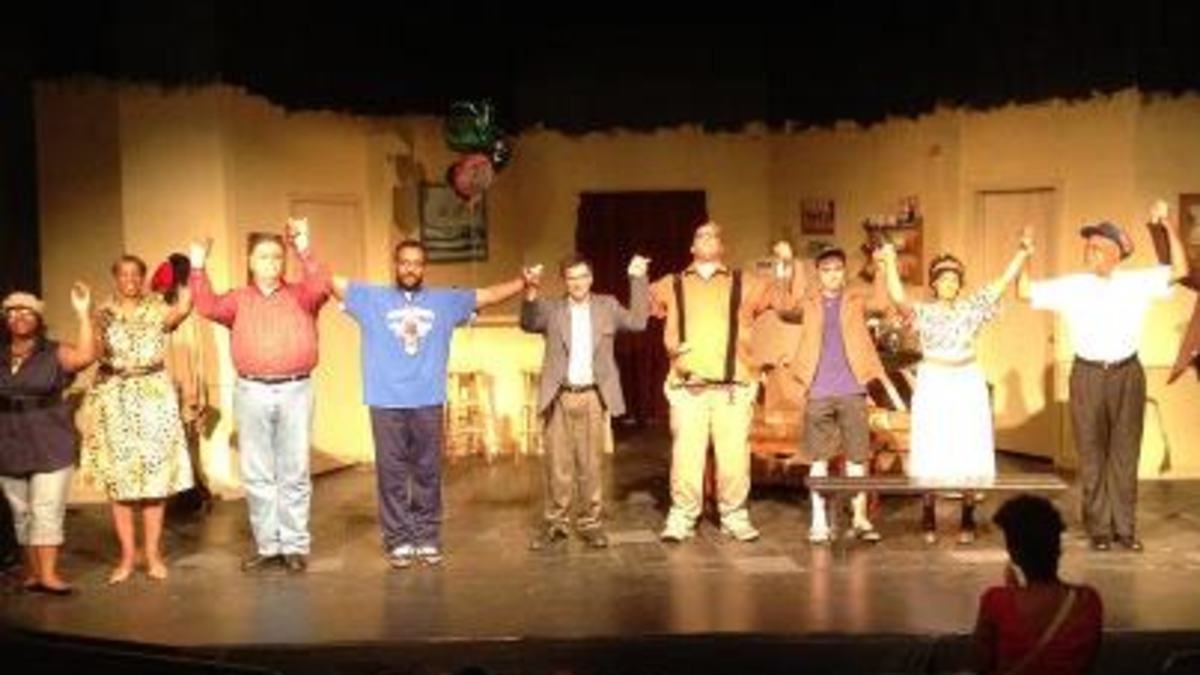 John Beasley Theater & Workshop
Race aside, Beasley made a name for himself on various Omaha stages in the ‘70s and ‘80s. Still, it was not until 1990 he abandoned the 9-to-5 routine and pursued acting as his livelihood. It was a daring thing to do for a middle-aged man with a family and mortgage, but he made the leap anyway. He figured the time was right. His youngest son was in college. He and his wife Judy, a medical secretary at UNMC, had a comfortable life. It was now or never.
“I was very dissatisfied (with the Vickers job), so I quit. I convinced my wife to let me try making it as an actor. She’d been fighting me all along. She didn’t want any part of being married to an actor. I didn’t do it earlier becaue I didn’t want her to suffer being married to a struggling actor,” he said. “But I finally told her, ‘I’m going to Minneapolis, and if I don’t make it in three weeks I’ll be back and I’ll get a normal job.’ She said, ‘OK.’ So, I went out there and within two-and-a-half weeks I was turning down plays.”
After taking the vibrant Minneapolis theater scene by storm, performing at the Mixed Blood Theater, he found success at major Equity theaters in Chicago (the Goodman) and Atlanta (the Alliance). Besides playing great roles in classic works, including Othello, he has shared the stage with notables Roscoe Lee Browne, Eric La Salle and Don Cheadle. As he made his presence known on the regional theater circuit, he helped pay the bills acting in commercials and corporate films.
He was so intent on making it he often undertook grueling road trips that found him driving from Omaha to Chicago to Minneapolis and back home again in a single 24-hour span. In the process, he became a much-in-demand interpreter of Pulitzer Prize-winning playwright August Wilson’s (Troy Maxson in Fences, Mr. West in Two Trains Running, Turnbo in Jitney) characters. Beasley adores the work of Wilson, whom he’s met, and even selected Wilson’s Fences, a story about a bitter father and his estranged son, as the play he reopened the Center Stage Theater with last summer. Beasley both starred-in and directed the production.
“I love August Wilson. Basically, he deals with every decade of the 20th century… with blacks migrating from the south to Pittsburgh (where Wilson is from) and what they faced once they got there. His characters talk about what happened back down south and touch on some of the reasons they came north. It’s always their stories. The plays deal with the era of urban renewal, when a lot of black businesses and neighborhoods were being boarded-up and blight set in and how, once redevelopment came in, blacks were being forced out. You can see the same pattern here in Omaha.
 |
John Beasley as Troy Maxson in Fences
“He’s really telling the black American story, but the thing about August’s work is it’s not just the black experience, it’s the human experience, and that’s why I love August. When I’ve done Fences I’ve had white men and women come up to me after the play with tears in their eyes and say, ‘That was my father.’ I mean, to me, Troy Maxson (the protagonist) is Willie Loman. Both of them are tragic figures who had a dream that was dashed. Troy could never let go of the fact he never got a chance to play major league baseball. That but for the color of his skin he could have been greater than any of them.”
While TV and film commitments limit the stage work he does these days, Beasley said he would still stop drop everything if a juicy part in a Wilson play opened up. For him. Wilson’s work is not only inspirational but instructive.
“August talks about relationships which, when I’m teaching acting workshops, is all I talk about. How we relate to each other. How we deal with each other from the heart. How we overcome obstacles. Because that’s what you have to bring to the table as an actor — that inner feeling. If you know what it feels like inside, then it’s going to come out.” Feelings tapped by a play sometimes cannot be contained within the boundaries of the stage. “I remember doing Willie Loman and how after each performance I’d just break down and cry because, emotionally, it’s such a draining experience. I found myself doing that every night. The same with Troy Maxson — I’d just have to breakdown. I had to get that release.”
He next made waves in episodic TV, including a 1990 role in Oprah Winfrey’s short-lived but much-talked-about series Brewster Place. Soon thereafter he landed his first feature film roles and became a regular TV guest star. He hasn’t stopped working in film and TV since.
He became a known commodity among moviegoers with small but convincing portrayals in the hits The Mighty Ducks and Rudy. He first caught the attention of critics with his strong supporting performance as a retired Southern preacher in Oscar-winner Robert Duvall’s 1998 critically-acclaimed film The Apostle.
He has appeared in other high-profile Hollywood pics (Losing Isaiah, The General’s Daughter) along with indie films (Journeyman). His TV appearances have included spots on Millennium, The Pretender, C.S.I. and Judging Amy and the TNT movie Freedom Song. He has worked with everyone from Duvall and Poitier (on a cable movie remake of To Sir With Love) to John Travolta, Melanie Griffith, Morgan Freeman and Della Reese.
His standing in the industry is such that he turned down a coveted lead role opposite Angela Bassett in John Sayles’ new film Gold Coast for a smaller but bigger-paying turn in The Sum of All Fears. While he rues having given up a lead, something he’s worked hard for, he feels the buzz around Sum, combined with his work on the well-reviewed Everwood, starring Treat Williams, have put him in line for more choice roles. He feels well-served to date by his keen eye for material. “I’ve been very picky about the things I’ve done on stage and I think that’s carried over into films.” He has also been promised a chance to direct episodes of Everwood and hopes to do more directing down the road.
With his career in high gear now, he is weighing buying a house in L.A. for those Tinseltown trips he makes every year. He insists, however, his lifestyle has not changed much from when he was just another middle-class Everyman. “I was never that interested in money, per se. My life has been full without money for a long time and now that I’m earning a little money, I’m not impressed with it still.”
He stays hungry and humble remembering where he came from and how far he has gone to reach his destination. His advice to aspiring actors: “Don’t be afraid to try and to leave your comfort zone.” He offers himself up as proof of how, with enough preparation and poise, an Omaha actor really can conquer Hollywood.
Related Articles
- Black Playwrights Convening, part 2: Isaac Butler reports (timeoutny.com)
- Bloggers cover the Black Playwrights Convening (timeoutny.com)
- Anthony Chisholm is in the House at the John Beasley Theater in Omaha (leoadambiga.wordpress.com)
- What Happens to a Dream Deferred? Beasley Theater Revisits Lorraine Hansberry’s ‘A Raisin in the Sun’ (leoadambiga.wordpress.com)
- Crowns: Black Women and Their Hats (leoadambiga.wordpress.com)
- Back in the Day, Native Omaha Days is Reunion, Homecoming, Heritage Celebration and Party All in One (leoadambiga.wordpress.com)
- Yolonda Ross is a Talent to Watch (leoadambiga.wordpress.com)
Kooky Swoosie: Actress Swoosie Kurtz conquers Broadway, film, television
It’s always a pleasure to interview a star you have admired. That certainly was the case when I did a phone interview with actress Swoosie Kurtz. The occasion was a Tony nomination for her role in Frozen, a drama co-produced by friends and family in her native Omaha, which if you’ve been reading my article posts you know by now is my hometown and place of residence. She was every bit the fun and funny bright spirit I had come to expect. The Omaha connection extended to her having worked with Alexander Payne on his debut feature, Citizen Ruth, which was shot here. My own career has intersected with Payne, whom I have been covering since he completed that project in the mid-1990s. As I write this, I am about to call Payne to arrange a face-to-face interview with him about his recent shoot of The Descendants in Hawaii, where he just wrapped on Friday. One final Omaha connection involving Swoosie is my having written about the Omaha company that co-produced Frozen and my scripting a documentary that that same company shot and edited. Small world.
My Swoosie piece appeared in The Reader (www.thereader.com).

Kooky Swoosie: Actress Swoosie Kurtz conquers Broadway, film, television
©by Leo Adam Biga
Originally published in The Reader (www.thereader.com)
Frozen
Omaha native Swoosie Kurtz, that sometimes kooky stage, film and television actress with the dizzy name to match, is dead serious about her work. The depth of this consummate artist’s craft is on full display in the current Broadway drama Frozen, in which she plays a mother coming to grips with the void of her missing daughter, whose terrible fate she doesn’t know for 20 years.
The story revolves around the daughter’s disappearance and how this event connects the girl, the mother, the serial killer that took her and the therapist trying to discover what set this tragedy in motion. The theme of child abuse looms large in the killer’s own past and drives him to revisit his horror on others. Brian O’Byrne won a Best Actor Tony for his performance as the killer. Critics are calling Kurtz’s Tony-nominated portrayal of the shattered mother a tour de force.

Brian O’Bryne and Swoosie Kurtz in Frozen
“My character goes through this 20-year journey of having her child taken and not knowing she’s dead. She goes through all the stages — mourning, anger, depression — and, finally, into acceptance, but in a very beautiful way. The second act of the play, particularly, is uplifting and life-affirming and redemptive,” said Kurtz.
Her process is a melding of the interior Method approach that uses emotional exploration and the more classical exterior approach that focuses on body, voice, movement, makeup, et cetera. “What works best for me is a kind of working from the outside in. When I can picture a character — how they sit, how they walk, the kind of clothes they wear — it tells me a lot about the inside of the character. The process is partly intuitive and partly technique. I think a lot of actors starting out today rely too much on the intuitive and the instinctual. You have to learn your craft,” she said in a 1999 Tony Awards Online interview.
Roots
Born in Omaha as the only child to a war hero father and society matron mother, she did part of her growing up here — attending Field Club School — before her family moved west. Her career military father, the late Col. Frank Kurtz, was the most decorated U.S. airman of World War II. She was named after the B-24 bomber he flew, dubbed the Swoose after a Kay Kyser song about a half swan, half goose. Before the war, Col. Kurtz was already famous as a world class platform diver. He won a bronze medal in the 1932 Olympics and competed in the ‘36 Berlin Games.
Her mother, the former Margo Rogers, authored a book, My Rival the Sky, about being the wife of an absent war hero. Margo hailed from an old money Nebraska family headed by her father, Arthur Rogers, a cattle tycoon who headed the Omaha Livestock Commission in the stockyards’ heyday. Kurtz recalls him taking her to the yards, plopping her atop a horse and playfully telling her to “wrangle those cattle. I weighed about 45 pounds, but because he told me to do it, I thought I could. I never questioned it.” Her enterprising grandma, Gigi Rogers (formerly Conant), built three downtown hotels — the Conant, the Sanford and the Henshaw.
Kurtz had one familial tie to show biz. A maternal great uncle, Homer Conant, was a set and costume designer for legendary impresarios Ziegfeld and Shubert in 1920s New York. “So, I’m revisiting the scene of the crime here on Broadway,” she said.
Kurtz stayed with her grandparents in Omaha when her much-traveled parents were away on missions and war bond drives. Of her grandparents, she said, “They were a huge influence on me in my formative years. They were incredible. They had this big country house that my mom grew up in and I partly grew up in. When I was in town doing Citizen Ruth (Alexander Payne’s 1996 film), I went to the house, just to see it, and it brought back amazing memories to revisit it.”
Her father’s many transfers meant frequent moves for her and her family. Being an only child forced her to cultivate her imagination. “I would play different games with myself and become different people and talk to myself in different voices. The characters would talk to each other. Only children have their own way of survival.”
A Eureka Moment
The theater first enchanted her when, as a kid, she attended Broadway plays with her folks. Her earliest stage acting came at Hollywood High. “I was in this drama class at Hollywood High and I did this scene from Dark Victory or some other Bette Davis movie and it was like, Whoah. Something fell into place in that moment and clicked and it was like, I can communicate with people this way better than I can on my own. It was just a eureka moment.” She began formal dramatic studies at the University of Southern California, where her parents graduated, before crossing the pond to complete her training at the London Academy of Music and Dramatic Art. There, she fully immersed herself in acting.
If anything, her Tony-nominated turn in Frozen is a reminder of Kurtz’s versatility and penchant for sinking her teeth into challenging roles. Much of her best-known work has seen her essay women-on-the-edge-of-a-nervous-breakdown in plays by some of the world’s greatest living dramaturgists. Her whimsical, lost souls are tinged with a deep well of sadness and display a sharp wit.
Among her stage triumphs are her turns as Gwen in Lanford Wilson’s The Fifth of July and as Amy John Guare’s The House of Blue Leaves. Her many film portrayals include: a hockey groupie in Slap Shot; the wry hooker in George Roy Hill’s The World According to Garp; the frothy wife in A Shock to the System; the ambitious mother in Stephen Frears’s Dangerous Liaisons; “the world’s laziest woman” in David Byrnes’s True Stories; and a scheming abortion war fanatic in Payne’s Citizen Ruth. For television, there was her Emmy Award-winning portrayal of high society living, cancer surviving Alex in the popular NBC-TV series Sisters and a socialite dying of AIDS in the HBO drama And the Band Played On.
Dangerous Ground
Even though its subject matter put her off, she felt compelled to do Frozen. The play’s executive producer is an Omaha cousin, Thompson Rogers, whose Oberon Properties owns the screen rights. “This play just knocked the breath out of me,” she said. “I hadn’t read anything like this ever. I think the issues of child abuse hit me the hardest. What struck me on my first reading of the play is that the serial killer character of Ralph, who takes my daughter, has been horribly abused as a child. And I firmly believe what the play is hypothesizing is that when children are abused…certain parts of their brain get stunted and the part that has empathy and compassion and remorse simply doesn’t develop in the way that it should.”
Playwright Bryony Lavery’s disarming examination of abuse, trauma, loss, regret, forgiveness and grace drew her in. “Just the sheer poetry of the way this subject is handled,” she said. “It’s a subject we see all the time on television and, so, we think we know all about it, and then this play comes along and presents this in a way that defies any expectation you have.”
She knew Frozen was a must-do project when reading it unnerved her. “When something scares me as much as this play did, I have to do it,” she said. “It’s so dangerous, this piece. It’s so risky. I thought, How are we going to rehearse this play? How the hell do you work on something like this and not just be a wreck? And, actually, we laughed a lot in rehearsal, which sounds really irreverent, but that was the whole key — to be irreverent about the material. Because the audience’s experience of it is very different from ours. We have to do it and go through it and it’s up to them to have the emotional response.”
Kurtz believes in challenging the gods rather than playing it safe. She recalls the time she essayed identical twins in Paula Vogel’s play The Mineola Twins, which not only required her to be two separate people, but to be on stage for all but a few seconds. Again, she asked herself, How am I going to do this? As usual, the motivation of the challenge allowed her to find a way to make it work. That discovery and accomplishment, she said, is what makes the journey into the abyss worthwhile. “And then it’s such a great feeling when you prove to yourself that you can,” she said. “You’re like, You know what? I did it. I took the leap.”
Making real the ultra-sensitive, bereaved, even mad characters she inhabits means muting the obvious comic notes to express the inner beauty. It’s about being nonjudgmental “and also having great compassion for the character,” she said. “I always find I turn a corner in rehearsal when somehow the character moves me.”
She said she learned not to play the fool when the legendary Jerry Zaks, with whom she worked on House of Blue Leaves, gave her “the best piece of direction I ever got. In my mind, I thought, I have to let the audience know right away that this woman, Amy, is a little out of touch with reality. I had this line, ‘Is it light yet?’ And I was doing it kind of spooky, like a strange woman would. And Jerry said, ‘Swoose, you are the happiest, most normal housewife in Queens.’ It was a brilliant thing that resonated through that whole piece and everything I do because people who are on the edge or neurotic or insane think they’re totally normal. And it’s that everydayness or normalcy what is sometimes so shocking.”
Citizen Ruth
If ever a performance has embodied the power of subtlety over histrionics it’s her rendering of Diane Siegler in Citizen Ruth. In this one character, Kurtz plays an arc of extreme types, but believably so within the framework of Diane’s fanaticsm. When we and the title character, Ruth Stoops (Laura Dern) first meet Diane, she appears to be a prim holier-than-thou pro-life advocate. Then, as we and Ruth learn, it turns out Diane’s only posing as a pro-lifer, but in reality is an openly gay pro-choice agitator who’s infiltrated the enemy camp in order to spy and reek carnage on their campaign. Diane’s hilarious “coming out,” complete with removing her dowdy wig and eye glasses to show her true identity and sympathies, is all the funnier and more surprising because Kurtz underplays it so matter-of-factly. “What was so great about that was I got to do play two people,” said Kurtz.

Swoosie Kurtz, Laura Dern, Kelly Preston from Citizen Ruth
She was impressed with fellow Omahan Alexander Payne, who co-wrote Citizen Ruth and made it his feature film directing debut. “He was so grounded and so real in his approach to everything,” she said. “Well, you know, he’s from Omaha. But he is so smart, on so many levels, that I think he sometimes had a plan in mind that we didn’t know about, and we didn’t have to know about it. He had his map in his head very clearly, but he was also very open to experimentation and open to whatever was happening in the moment.
“If we happened to ad-lib something, he was delighted with it and very often would use something. He just came up with these great sort of subversive, out-of-the-box ideas. He’d just throw some curve at us right before the take and it’d be something I would never have thought of in a million years.”
As an example, she recalls a scene in the kitchen at the country house where she and her lover (Kelly Preston), are putting up Ruth Stoops. The phone rings and Kurtz’s Diane Siegler “answers the phone as the lesbian liberal activist and then” — when it turns out the caller’s a pro-lifer — “I put on my (eye) glasses in order to talk to her. And that was Alexander’s idea. And I thought, Oh, my God. What an incredibly bizarre and amazing idea” to have her put her defense/disguise back on.
Payne is equally impressed with her. “I remember her as being so delightful and cooperative and professional. She knows her dialog. She comes prepared. She has good ideas. Highly directable. I mean, she’s a total pro. And she’s funny,” he said.
The film, still unappreciated among general movie audiences, is a favorite of hers. “I’ve never seen a movie like it. It’s just unto itself. It’s an amazing film,” she said.
Feeling the Most Alive on Stage
Kurtz has been nominated for eight Emmys (winning one for Carol and Company) and has stolen scenes in dozens of big and small screen pics, but her stage work is what makes her a living legend. She has two Best Actress Tonys to her credit (for Fifth of July and House of Blue Leaves) in addition to Drama Desk Awards, an Outer Critics Award and an Obie. She moves effortlessly from one medium to another, but the boards is her true calling. It’s where she feels most engaged as an artist.
“An actor on stage has more responsibility than in any other medium,” she said. “You are so much more responsible for what happens out there on the stage. Film is definitely the director’s medium. They shape the film. They take what of your performance they want. They choose what the audience is looking at at any particular point. Your face may not even be on camera at that moment. On stage, you control everything. You control your body, your voice…whether the audience is seeing your profile or the front or back of you. You control how loud you are. You control the timing of everything.
“I’m not sayng film and television are easier by any means, because they’re all enormously challenging, But, ultimately, you are much more accountable in the theater for what happens that night on stage.”
Acting, for Kurtz, feeds her like nothing else. “It’s when I feel most alive,” she said. “I definitely think when I’m acting I’m my true self. You know how in therapy they talk about your true self? I think that joy just comes out. I mean, I was on stage the other night thinking, I’m so happy right now. I’m so alive.” Where real life once seemed boring compared to acting’s hyper intensity, she sees it differently now.
“I’m getting a lot more enjoyment now out of real life. Thank God, because there’s a lot of that around,” she said, unleashing her happy, kooky, bright spirit’s laugh.
Related Articles
- Swoosie Kurtz discusses her new role on ‘Mike & Molly’ (hollywoodnews.com)
- New CBS Series Trailers: Shit My Dad Says, Hawaii 5-O, The Defenders, Blue Bloods and Mike & Molly (geektyrant.com)
- ‘Chuck’ Taps on Fred Willard and Swoosie Kurtz (buddytv.com)
- An Appraisal: Lanford Wilson’s Losers, Beloved by Their Creator (nytimes.com)
- Kevyn Morrow’s Homecoming (leoadambiga.wordpress.com)
- Playwright John Guare Talks Shop on Omaha Visit Celebrating His Acclaimed ‘Six Degrees of Separation’ (leoadambiga.wordpress.com)
- A Q & A with Theater Director Marshall Mason, Who Discusses the Process of Creating Life on Stage (leoadambiga.wordpress.com)
- Playwright/Director Glyn O’Malley, Measuring the Heartbeat of the American Theater (leoadambiga.wordpress.com)
- Omowale Akintunde’s In-Your-Face Race Film for the New Millennium, ‘Wigger,’ Introduces America to a New Cinema Voice (leoadambiga.wordpress.com)
New school ringing in Liberty for students
The thought of a new downtown elementary school housed in a massive former bus barn situated smack dab in a neighborhood rife with social ills caught my attention. The barn site was only temporary, but that nontraditional location, plus the red light district around and about it, was enough for me to file a story. Plus, I liked the fact the school would be serving a diverse student body of Latinos, Africans, African-Americans, and whites. The space was every bit as interesting and the students every bit as diverse as I had hoped. Then when I met the dynamo principal, Nancy Oberst, mother of indie rock star Conor Oberst, I was officially hooked. My story, which originally appeared in The Reader (www.thereader.com), is as much about her and and her staff’s passion as it is about this incongruent site for a school. Liberty Elementary has since moved into its built-from-the-ground up school building just down the street.
New school ringing in Liberty for students
©by Leo Adam Biga
Originally published in The Reader (www.thereader.com)
Like a Pied Piper, Liberty Elementary School principal Nancy Oberst set a brisk pace one evening in the Columbus Park neighborhood. It was one of several nights when Oberst and staff went door-to-door in the blue-collar, racially-diverse area to symbolically blow the horn about Liberty, the new downtown K-6 public school. Liberty, which opened August 19 with some 360 students (and more matriculating each day) was conceived in part to relieve overcrowding at two other OPS sites — Jackson Academy and Field Club Elementary — which Liberty is drawing many students from. Consistent with the new OPS emphasis on neighborhood schools,
Liberty is serving a growing school-age populace on downtown’s southside. Temporarily housed in a renovated warehouse running from 22nd to 20th and Leavenworth Streets, Liberty is in a kind of incubator phase while awaiting construction of its own building, slated to open in March 2004.
In naming the school, Oberst wanted something that “embraced as many people as possible and spoke to a lot of things inherent in this society.” Above the main entrance is a phrase from Roman philosopher Epictetus that reads, “Only the educated are free.” Fittingly, Liberty is a beacon of hope to a largely Hispanic ward of recent emigres. An education for these children is more than a right of passage — it is a burden of dreams. “These kids come from working class families that need to invest in something for the future,” she said. “They’re really wanting for their kids that old dream of learning English and being upwardly mobile.” It is why Oberst insists her staff be fully committed. “When I interview applicants, I say, ‘I’m really looking for people that have the will and the desire to make something special for kids who need a leg up.’” The impetus to learn, she said, is made even greater by the fact children often act as interpreters for their Spanish-speaking parents.
Because everyone is welcome at Liberty, parents are not pressed for their legal status. To register a child, a parent need only provide a birth certificate, an address and some record of the child’s past schooling, if any. Serving a highly-mobile population, Liberty expects to see a high student turnover rate.
Oberst, principal at Jackson the past three years, has many former students assigned to Liberty. During that night canvassing the hood she scanned a roster looking for familiar names. She found one in Diana Ramirez. In a wood-frame house perfumed by the rustic aroma of tortillas and accented by the folksy lilt of Spanish, Diana shyly emerged from a bedroom, bedecked in a fine pink dress, and when her big brown eyes locked on Oberst’s, she warmly embraced her. “There’s a beauty and a richness about a very urban group of kids,” Oberst said. “They’re the nicest kids I’ve ever been in contact with. Just well-behaved, very, very respectful children. They look forward coming to school. It’s very important to their day. I’ve never had one swing at me or push me. Sure, there’s times when one gets mad and tips over a desk or kicks a door, but you’d be amazed at how lovely these kids are. And, you know, the school has to set the tone. Kids have to know this is not just hanging out — this is different. That’s why we call kids if they don’t come and go get them if they can’t get here. They know we love them.”
While children from Spanish-speaking homes predominate, Liberty is also a magnate for area African-American, Sudanese, Asian and Caucasian families. Combined with NuStyle Development’s ongoing renovation of the historic and once stately Drake Court apartments on the north side of Liberty, the school is seen by many as an anchor of stability and a catalyst for redevelopment. The circa 1916-1921 Drake Court, a 14-building complex featuring Georgian Revival and Prairie style design elements, was once the centerpiece of this mixed residential-commercial zoned district. But when the apartments fell into disrepair in the 1970s, occupancy declined and the designated blighted area became a thoroughfare for transients. NuStyle has worked closely with the Nebraska Investment Finance Authority (NIFA) to qualify for low income tax credits for the Drake Court project. In anticipation of Liberty moving out in 2004, NuStyle is weighing various reuses of the warehouse, including a day care center, artist studios, a multi-media technology center and condos. It is also eying more area residential and commercial projects.
“There’s been an undercurrent that this is too tough a neighborhood for a school,” Oberst said. “Some of the families are worried. But OPS is saying we believe in Omaha — we believe neighborhoods can be redeveloped. We know what a renovated North High did on 34th and Ames. That has become a very safe place for people to live. When we held meetings with residents in the spring we said, ‘This is how you do it — this is how you change your neighborhood. You put an anchor in with a school. You make the streets safer for mothers and children to come to and from school.’ I’m a big believer in the community the school is in knowing about the school and being involved in it.”
She said she will do whatever it takes to make Liberty safe, from asking street denizens to respect school property to telling those engaging in illicit behavior to move on. “You want to be a good neighbor. You don’t want people mad at you. You have to do some co-existing. But you also have to draw some lines.” She said when problems surfaced at Jackson, from the school getting tagged with graffiti to men harassing girls, she had students spread the word the school was off-limits and she told harassers their actions were unwelcome. The problems, she said, vanished.
Despite assurances from OPS, extra police patrols and neighborhood watch efforts, some parents still voice concern. “I’m not happy with the location,” said Lisa Arellano, whose son, Gage, is a 5th grader. “We have a lot of homeless people and trouble up on Leavenworth. I can’t tell you how many times I’ve seen the police tackling someone on the ground. Walking to and from school is too scary. It puts kids in jeopardy. There’s always reassurances, but there’s no guarantees.” Gatdet Tut, whose daughter Hynalem is in kindergarten, said, “I don’t want my child to walk on these streets.” Other parents, like Craig Hinson, hope OPS-OPD vows to keep a sharp eye out are more than “lip service.”
Commerce of all kinds unfolds around the school. Across 20th Street is the 24-Hour Package Liquor Store and the Motor West used car lot. Three blocks east is the Douglas County Correctional Center. On the south side is Precision Industries. A little farther west is a St. Vincent DePaul Super Thrift store.
The eastern front of the old bus barn housing the school has two ongoing businesses — Grunwald Mechanical Contractors and an auto detailing shop — that maintain active garages. Robert Wilczewski, owner of the property occupied by the firms, feels the volume of kids passing by to enter and exit the school, whose main entrance is off an adjacent alleyway, poses hazards and hinders operations.
“It’s starting to complicate life around here,” he said. “We just have some serious concerns about safety and about restrictions on what we do here. It’s become intolerable. We want business back as usual. They’re going to need to find a different route for children to enter the school.” Wilczewski, who owns part of the alley and a piece of Grunwald, said the company and OPS are signatories to a 1930 agreement prohibiting public alley use. The parties are trying to reach an accord.
Harold Wrehe, co-owner of Motor West, echoed other area businessmen in expressing surprise at the number of Liberty students. “I didn’t believe there’d be that many children going to an elementary school in this area. But I like it. It brings people in. Everything helps.” Mike Nath, branch manager of nearby Motion Industries, agreed the school “will, in the long run, probably be a good thing. It could help clean up the neighborhood.”
The consensus is that whatever undesirable-incongruous elements surround it, Liberty, along with the Drake Court, reopening for occupancy next year, is a keystone for an emerging 20th Street Corridor some envision as an Old Market West. Oberst, busily forging alliances between Liberty and the nearby Omaha Children’s Museum, the YMCA and the Omaha Theater Company for Young People, joins others in referring to 20th Street, from Leavenworth to Farnam, as Children’s Row. As Liberty’s provisional site does not have many school amenities, including a gym or theater, students are attending P.E. classes at the Y and performances at the children’s theater.
For Roberta Wilhelm, executive director of the children’s theater, the concept of “a downtown school is a great idea,” with Liberty adding another dimension to the burgeoning arts-educational scene emerging along the 20th Street strip. “I think between the school, the Children’s Museum, the Y, us, and the Joslyn Art Museum, which is not that far away, the synergy is just going to be wonderful. We’re excited to have the school as a neighbor.”
She envisions the theater and school having an intimate rapport. “We see ourselves developing a very close relationship with Liberty,” said Wilhelm, whose home base, The Rose, is only a stroll away. We will be doing our Every Single Child program in their school…which is where every child — in each grade — has a different experience with the children’s theater through drama residency workshops and dance activities. And that, in my opinion, is just the beginning. I think there’s much more we can do with them in after-school programming. We’d like to see the arts infused in their school.”
Oberst wants that infusion as well. “We’re really wanting to bring art into the school, including artists from the community, and to bring our students to the arts. We hope to build relationships with the Joslyn Art Museum and the Bemis Center for Contemporary Arts. We have to take advantage of where we are.”
The idea of placing a school smack dab in the middle of a bustling urban district is not new for Omaha. Central Grade School operated for decades across from Central High School and in the shadow of the Joslyn and other downtown landmarks. Although Liberty is the first school in the Drake Court-Park East-Columbus Park district since Mason School closed in the 1980s, it is repeating history in that, like Mason, which once served a largely Italian immigrant population, it is educating many new arrivals from Mexico.
What makes Liberty different is that the school is operating — at least the next 18 months — from a makeshift site that once served as a maintenance barn for Greyhound Bus Lines and more recently as a paper-printing supply storage facility for Redfield & Co. The top-to-bottom refurbishment of the old bus barn has revealed a 49,000 square foot space highlighted by the second-story’s free-span, cathedral-high, vaulted wood beam ceiling and elaborate iron truss network. A massive skylight and banks of tall windows bathe the upper level in natural light. Large ceiling fans maintain a constant air flow.
The rehab was funded by NuStyle, which bought the structure from Robert Wilczewski, and designed by Alley-Poyner Architects. OPS, which leases the building from NuStyle, is using large partitions to create classrooms and resource centers in a modular, flexible floor plan. By opening day, each partitioned space was outfitted with all the usual fixtures of a traditional school setting.

In the time in takes for the permanent school to be erected — construction starts this fall — Liberty plans being an established player in the neighborhood by building coalitions that Oberst hopes makes the school a vital contributor to and welcome beneficiary of the revitalization happening around it.
“The idea is to form this community now and for the kids to participate in the building of the new school and to have the neighborhood be involved with the whole redevelopment going on with us and the Drake Court,” she said.
Drawing on her experience forging community ties at Jackson, where she found an Adopt-a-School partner in Picotte Elementary, formed a food pantry with ConAgra Foods and sponsored clothing drives with First Lutheran Church in Omaha, she is already lining-up Liberty collaboratives. A food pantry, serving poor residents, is in the works along with clothing and furniture drives. “Our families sometimes don’t have beds and other basic things and, so, we’ll do a lot of give aways. It’s meant to bridge the gap. That networking with the community is part of my job and, besides, it opens more doors for opportunity for our kids and parents. I’m always looking for an angle,” she said.
Opening day at Liberty was marked by two words: diversity and vitality. Beaming brown, black, yellow and white faces mingled in the old-new environs. The sing-song sound of Spanish and hip-hop reverberated throughout the cavernous space.
Craig Hinson, whose daughter Jamillah is attending the 6th grade, said the diverse urban setting is just what he wants for his child. “I think it’s great. To me, it just adds a little flavor. I think being downtown, where you have blacks and whites and Hispanics and Sudanese, it just gives kids a real sense of the real world.”
As a show of faith in Liberty 3rd grade teacher Michelle Grau enrolled her own daughter Jordan there even though her family lives in Field Club. “I think the more kinds of people and the more kind of cultural experiences you can be exposed to, the better,” Grau said. “That’s why Jordan’s coming here. And to be in on the ground floor — I’m really excited about that. It’s going to be a fantastic thing once it’s finally completed…if you can just see the big picture.”
The promise of bigger things to come is what led Barb and Jim Farho to place their two children at Liberty. “We’re probably one of the few families choosing to go there even though we’re not forced to,” said Barb Farho. “My husband and I are interested in seeing downtown rejuvenated and we think this is one way to do that. A lot of people are afraid of downtown, but we think there’s a lot of cultural experiences awaiting. We also know the principal is very good at getting the community involved and we just think those partnerships are only going to get better. The surrounding area is going to improve for having a school there. Plus, our kids are excited about the fact the new school will be built before their very eyes. It just seems like a fun place to be in on at the very beginning.”
Assuming the school thrives, Oberst anticipates that once the new building opens and the word spreads more pilgrims will flock to Liberty from around the metro. “We are expecting that once the new school is up and once the real cultural-corporate connections are evident that parents from other parts of the city will want to send their kids here.” The new Liberty will accommodate 600-plus kids, yet another reflection of the confidence school officials have in the enterprising area.
Whatever happens, Oberst is sure to stir the melting pot. “What that woman does for and gets out of kids is incredible,” said Linda Daly, an ESL resource teacher and one of several educators who followed Oberst to Liberty from Jackson. “She makes things happen for the kids. She is absolutely a dynamo.”
Related Articles
- For students, ringing bells all mean liberty (philly.com)
- Schools Serve – Uniting Schools Against Hunger (prweb.com)
It’s a Hoops Culture at The SAL, Omaha’s Best Rec Basketball League

Image by Chapendra via Flickr
This is one of those scene-setting pieces I don’t do as much anymore. I like doing them, but they can take a lot of time and effort for very little return other than the satisfaction of doing these stories. The subject here is a recreational basketball league of the type that can be found in just about any urban neighborhood. The idea was to capture the vibe of this distinct subculture to the extent that I put you as the reader there in the bleachers with me. To make the story a visceral experience. The article originally appeared in The Reader (www.thereader.com). Written as a secondary feature, I was surprised when it ended up on the cover. It’s not the first time that’s happened and I suspect it won’t be the last.
It’s a Hoops Culture at The SAL, Omaha’s Best Rec Basketball League
©by Leo Adam Biga
Originally published in The Reader (www.thereader.com)
Once the hoops get rolling in the Sunday men’s recreational basketball league, the scene turns into the kind of urban soul fest you associate with Chicago, Detroit, Philly or New York. Only this is Omaha. In an intimate, interactive community setting, the best summer ball in town is played in The SAL, Omaha’s version of the Harlem Ruckers League.
Housed until recently in the Salvation Army North Corps center at 2424 Pratt Street, the league, by concensus, draws the area’s best players. Many have serious credentials. A typical game features jocks from the pro and college ranks, past and present, along with former and future legends from The Hood. All strut their stuff before a knowledgeable, appreciative, vociferous throng.
NBA journeyman Rodney Buford, the ex-Creighton star, is a regular, rarely missing a game or a mid-range jump shot. One Sunday, fellow NBA player and ex-Bluejay Kyle Korver showed, raining down 3s to the fans’ delight. The league is so competitive Buford’s teams have never won the title. “That lets you know right there” said team sponsor Talonno “Lon Mac” Wright. “If you can make it through here, you’re a player. It’s the best competition you’re going to get in the city,” league director Kurt Mayo said.
Former UNO Mav Eddie King, who grew up balling in Chicago, said, “I think it’s a staple of north Omaha and I think it’s the best basketball in Nebraska, period. Oh, yes, you’re going to get challenged every game. Every team has good players. You can never get comfortable.” He said the close confines and neighborhood feel create a special environment. “This is the best atmosphere because everyone has family and friends in the stands. It’s a small gym and everyone’s on top of each other. People talk a little smack. That makes it fun. Plus, it’s real competitive. It’s streetball, but at the same time it’s fundamental, because 80 percent of these guys played ball at a four-year college.”
Mayo formed the league with wife Melissa in 2002, reviving a gym fallen into disuse. Before the Salvation Army, the league operated under a differnt name at the LaFern Williams Center in south O and the Butler-Gast YMCA up the street, where it’s back again. Mayo met resistance when he announced plans to move things to the Y at 3501 Ames Avenue. Trading the homey, if dingy, old digs for the gleaming, if cold, new facilities was an issue. But “the grumbling” ceased when the league ended the summer season at the Y on August 7. By all accounts, the new venue’s a hit, even if it lacks character. It does, however, have a nice wood floor, not some tacky mat like the Salvation Army center has. Mayo hopes to reinvent the magic at the Y with an “elite” level men’s Sunday league starting September 11.
But The SAL is where the league gained the rep and made the memories. Where it found a fun yet gritty flavor as a combined sports venue and social club.
James Simpson is among many who come each Sunday. Besides enjoying friends play ball there, he said, “it’s good for the community. I’ll follow it wherever it goes.”

“It’s the thing to do,” Wright said. “It’s like, Let’s get dressed, we’re going to The SAL. Everyone comes to watch the games or to see the women. There’s music. You meet people. You see your friends. On a good day, it’s just wall-to-wall packed. It gets loud. The crowd gets into it. if they like you, they’re cheering on you. If they hate you, they’re booing on you. If someone does something good out on the court, they ‘oooh’ and ‘ahhh.’ Some people might run out on the court, just having fun. It’s just a nice hangout. No problems. Everybody gets along. A little fussing here and there, but no big deal.”
Ex-Husker Bruce Chubick said there’s no dogging it in The SAL: “You can’t really half step your way through because there are too many players that are good. Plus, you get a nice little crowd that comes out, and they’ll let you know about it if you make a bad play. So, you’ve got that motivation going. It’s entertaining.”
The league is a subculture unto itself. The many female fans include spouses, lovers and groupies. Some mothers have children in tow. The guys taking-it-in range from hoop junkies looking for another fix to coaches scouting talent to neighborhood cats looking to escape the weather. The common denominator is a love for the game. It’s why some folks view five or six contests in a single sitting.
The hold basketball has in urban America is a function of the sport’s simplicity and expressiveness. Only a ball and a bucket are needed, after all, for players to create signature moves on the floor and in the air that separate them, their game and their persona from the pack. Not surprisingly, the hip-hop scene grew out of streetball culture, where trash talking equals rap, where a sweet crossover dribble or soaring airborne slam resembles dance and where stylin’ gets you props from the crowd or your crew. Music and hoops go hand-in-hand.
The vast majority of players at The SAL and Butler-Gast Y are black, which makes it ironic that the two-time defending champs, Old School, are an all-white group of former Division I players led by Chubick. In what Mayo considers “a traditional” league, Old School is short on style but long on fundamentals.
Former Omaha South and University of Washington star Will Perkins said to cut it in this league, “you’ve got to be tough…you’ve got to be skilled. You can’t just take your college game or your streetball game here. You’ve got to have a mixture.”
As the action unfolds on the funky, tile-like court everybody complains about, the spectators join in a kind of call-and-response exchange with participants. A player jamming home a thunder dunk will stop, await his fate from the crowd, and then either get their love or take their poison. A guy blowing a dunk or a layup or drawing air on his jumper gets well-deserved catcalls. But here the good-natured smack directed at refs and players is often hurled right back.
“Man, you gotta finish that! What are you doing? You had a wide open layup. Hey, y’all gotta fight for this one, fellas. They’re not going to give it to you. C’mon!”
Unrestrained displays of emotion, usually shouted down from the bleaches, sometimes overflows onto the court. Despite threats and invectives, few incidents ever come to blows. Chest thumping and trash talking is just part of the heat and the edge. It’s all about respect out here. No one wants to be shown up.
As day wends into night, and one game bleeds into another, there’s a constant stream of humanity in and out of the cramped old gym, where music thumps from a boom box during time outs and between games, where burgers, dogs and nachos can be had on the cheap and where vendors hawk newly burned CDs and DVDs.
Amid the hustle and flow, players and fans intermingle, making it hard to tell them apart. There’s no barriers, no admission, no registration. It’s a straight-up come-and-go-as-you-please scene. As the small bleachers hold only a couple hundred people, the rest of the onlookers line both sides and ends of the court. Folks variously stand against walls, sit in folding chairs or sprawl on the floor.
The league serves many purposes. For college programs at UNO and Bellevue, it’s a way to keep teams sharp over the summer and toughened up for the coming NCAA season. Kevin McKenna, UNO head coach the past four years until rejoining the Creighton staff this summer, said, “I got my team to play down there the past few summers because I thought it was the best league. There was another league in town, but I felt this was the most competitive — where’d we get the most out of it.” Bellevue University coach Todd Eisner has recruited there. It helps Omaha Central grad and current Illinois-Chicago player Karl White get ready for the college grind.
For former college mates, like the Still Hoopin’ squad made up of such ex-Bluejays as Buford, Latrell Wrightsell and Duan Cole, it’s a chance to relive old times, stay fit and feed still hot competitive fires. For Buford, it’s one more workout in an off-season regimen before NBA training camps begin. For men pushing 30, 40 or older, it’s also a pride thing — to show they still have some game left. For them and guys not so far removed from the game like Alvin Mitchell, the former NU, Cincinnati and UNO player, or Andre Tarpley, a senior last year at UNO, or Luther Hall, a recent Bellevue U. grad, it’s both an outlet and a place to prep for pro tryouts.
Danai “Ice” Young, whose college hoops career stalled at NU, is using the league as a launching pad to try and make the ABA River City Ballers’ roster. Albert R. went from The SAL to a spot on the pro streetball tour, where he goes by “Memphis.”
For youngbloods, it’s a test to prove they can hang with the old dogs. “If you’re the best talent, or think you’re the best talent, this is where you’re going to be,” said veteran ref Mark LeFlore, Sr. Mayo said few high schoolers have had what it takes to play in The SAL. Two that did, guards Matt Culliver and Brandon McGruder, formed one of the highest scoring duos in the annals of the Metro Conference at Bryan High School last year. Both earned scholarships to play at the next level.
Another youth, Aaryon “Bird” Williams, is perhaps the most impressive of the pups as he’s only a senior-to-be at Omaha North, where he played in a handful of varsity games last year after moving here with his family from Gary, Indiana. Mayo sees a phenom in-the-making in Williams. “Man, he was dunkin’ on everybody. You have to see it to believe it. He’s definitely a man-child. He reminds me of a young K.G (Kevin Garnett), and I’m not exaggerating,” Mayo said. “He’s a beast.” It’s another example, Mayo said, of how top local talents “find their way” to the league. “I’m already missing The SAL, but I’m recreating it at the Y. The tradition continues.”
Related Articles
- King of the courts: Rucker Park defends its streetball crown (thegrio.com)
- Streetball legend ‘Homicide’ to turn in his kicks (nypost.com)
- Artest returns to streetball roots, wants second ring (nypost.com)
- Omaha Native Steve Marantz Looks Back at the City’s ’68 Racial Divide Through the Prism of Hoops in His New Book, ‘The Rhythm Boys of Omaha Central’ (leoadambiga.wordpress.com)
- Troy Jackson: Streetballer Nicknamed “Escalade” Dies at 35 (bleacherreport.com)
- Bismack Biyombo Breaks Out At Nike Hoop Summit As NBA-Ready Right Now (sbnation.com)
- Back in the Day, Native Omaha Days is Reunion, Homecoming, Heritage Celebration and Party All in One (leoadambiga.wordpress.com)
- The Ties that Bind, One Family’s Celebration of Native Omaha Days (leoadambiga.wordpress.com)
When We Were Kings, A Vintage Pro Wrestling Story

Image by The Library of Congress via Flickr
All right, enough with the boxing stories for now. Keeping with the martial arts theme, however, try this pro wrestling story on for size. Growing up, my brothers and I religiously watched the televised pro wrestling matches from our living room’s ringside seats in front of the old Zenith. Omaha pro wrestling cards had the usual lineup of villains and heroes and their cheap theatrics. We loved the bravado and silliness of it all, right down to the animated pitch man hawking elixirs between matches. About 10 years ago I finally caught up with a few of the wrestling stars I used to gawk at on TV, including villain extraordinaire Maurice “Mad Dog” Vachon, for the following story I did for the now defunct Omaha Weekly. I had great fun working on this piece, which I think comes out in the writing.

Maurice “Mad Dog” Vachon giving an opponent the business
When We Were Kings, A Vintage Pro Wrestling Story
©by Leo Adam Biga
Originally published in the Omaha Weekly
“Like with any performer, we fed off the crowd and they fed off us. There’s nothing more difficult than wrestling in front of empty bleachers. But if it’s packed, it’s easy. The people do the work for you. They either love you or hate you,” said former profesional wrestling king Maurice Vachon, better known by his stage name — Mad Dog.
There was a time when Mad Dog and his old cohorts inside the ring lorded over the pro wrestling world.
For decades Omaha was a wrestling hotbed where matchmakers Max Clayton and Joe Dusek annually staged dozens of live cards featuring stars with monikers like Butcher, Bruiser, Crusher, Killer. Omaha produced wrestling greats of its own in The Baron, Dr. X, The Dirty Duseks, Iron Mike DiBiase and Jumpin’ Joe Scarpello. Rabid fans came out in droves. Locally televised All-Star Wrestling matches further stoked the fire of fans for upcoming arena bouts. It was a simple, grassroots thing. Then it all changed, and a way of wrestling passed with it.
Combining the comic mayhem of Jackie Chan, the pop flamboyance of Little Richard and the dynamic derring-do of the Flying Wallendas, pro wrestling today rules as the new Greatest Show on Earth. Long an over-the-top attraction, it has in recent years assumed a whole new theatricality courtesy of the World Wrestling Federation and its flashy costumes, inflated muscles, martial arts moves, elaborate sets, suggestive routines and intricate storylines. Depending on who you talk to, it is either a vulgar spectacle or a colorful romp. However you feel, there is no denying it is plugged into this era’s in-excess culture. “Sports and entertainment have become more extreme products. Like it or not, that’s the way it is. And the WWF has embraced and perfected that,” said lifelong wrestling fan Ray Whebbe, Jr. of Minneapolis, MN, where he is a veteran wrestling promoter, manager and agent.
Extreme has not always been part of the scene, however. Before the WWF became The Bomb, pro wrestling operated via regional promoters whose old school product, while wilder and woollier than its amateur counterpart, remained far tamer than today’s heavily scripted showpieces. Wrestlers of yesteryear were showmen too, just not cartoon action figures. Bouts were calculated for dramatic effect, just not off the charts crazy. In short, it was a lot of corn, just not borderline porn. It was a grittier, less-adorned brand of action in which the primal physical challenge of the ring, pitting heroes and villains in classic good versus evil duels, took center stage. Strip away the pay-per-view hype and that is still the essence of this popular sport-entertainment hybrid.
Whebbe, who admires the contributions made by wrestlers from the past, agrees the sport used to be “a lot less contrived and a lot more reality-based,” but adds, “it was also a lot more boring. There were fewer charismatic performers.” For fans like him, the Golden Age of pro wrestling is passe. Old time wrestlers, meanwhile, consider today’s new age product a travesty and dismiss it as coarse, brazen, rude, artificial. They rue the decline of their halcyon days, when they commanded huge, enthusiastic crowds with a mix of good old fashioned hand-to-hand combat and theater. These legends remind us they too were once wrestling kings.
Maurice “Mad Dog” Vachon was the prince of villains in the old American Wrestling Association (AWA), a Midwest federation run by Vachon’s main ring rival — clean cut Mr. Good Guy Verne Gagne. The man who made the sleeper hold famous, Gagne was among the few wrestlers of his era to cash-in as both a performer and an entrepreneur. After a stellar amateur career in his native Canada, including competing on the Canadian national team as a 174-pound freestyle wrestler in the 1948 Olympics, Vachon wrestled pro from 1951 to 1986. His early years in the business were a struggle. Before becoming Mad Dog, he had no real niche, no catchy nickname, no signature hold to establish himself. He was just another rough guy leading a gypsy-like existence from one bout to the next.
His breakthrough came during a stint on the Pacific Northwest circuit when a Portland, Ore. promoter suggested the short but stocky Vachon do a makeover emphasizing his fierce, dark looks. The plan was for him to act the bit of “a wild man from Algeria.” The promoter added, “And you better do something loud, otherwise you’re going to be hard to put over.” Vachon took the advice to heart.
“I knew I had to do something different, so five minutes before my first match I got the idea of attacking my opponent before the bell sounded. I was supposed to be this wild Algerian and I wanted to show the image I was trying to project. As soon as my opponent showed up I jumped on him and gave him a couple of body slams and then threw him out of the ring. The referee came over and I did the same to him. Then I dropped down out of the ring and gave them both a body slam on the floor. A police officer showed up and I threw him in the third row. Everybody thought I was crazy. The referee disqualified me and I got fined and suspended for two weeks,” said Vachon, a gentle, cultured man away from the mat.
“When I got back to the dressing room the promoter said, ‘You look just like a mad dog.’ And I said, ‘You know what? That sounds good.’ There’d never been a wrestler with the name Mad Dog and I took advantage of it. I would have been crazy not to. Plus, it fit my image. I had quite a few teeth missing, complements of my opponents, which made me look like I had fangs. My (guttural) voice was courtesy of injuries to my vocal chords and larynx. And I was born with hair on my chest. So, I looked like the Mad Dog, and when I was in the ring I acted like one.”
As part of his transformation Vachon perfected the snarling bad guy routine, complete with mean catch phrases (“It’s a dog eat dog world”) and dastardly maneuvers (like the pile driver). His publicity photos captured him straining to break free of chains wrapped round his hairy torso. One thing Vachon did not have to act was being tough. He grew up fighting in a Montreal ghetto. Before going pro he worked as a nightclub bouncer and punched-out more than his share of challengers. He said during his pro career he often had to prove himself off the mat, as his rep followed him wherever he went — like a gunslinger.
“I had to live it inside the ring and outside the ring. It was hard, but I was prepared for it. I could really wrestle. I had a lot of dog in me. Believe me. I had to do it. I had to do it for real. I had to be the Mad Dog to survive.”
For Omaha native Jim Raschke, a former collegiate wrestler and school teacher, the conversion from his normally mild-mannered self into the fearsome Baron Von Raschke, applicator of the dreaded Claw hold, was life-changing. “I started out life as a very shy, introverted person and when I became the Baron it kind of opened up doors for me. I could be what I wanted to be. Even if it was obnoxious, it was better than what I was. I enjoyed that part of it — letting my alter ego go,” said Raschke, who typically ended interviews with his enigmatic “That’s all the people need to know” declaration. His career floundered until he teamed up with Mad Dog, who convinced the imposing Raschke to discard his vanilla persona for the imperious Baron.

Baron Von Raschke
The tag team pair first made a splash in Quebec, where fans had never seen anything like them before. According to Raschke the two did not set out to be bad guys — it just worked out that way. “We walked out to the ring and the crowd started hissing and booing. It was just because of our physical appearance — a big ugly guy and a little ugly guy. It wasn’t anything we’d done. Neither of us had appeared in that area for awhile. Well, when they reacted that way we just reacted back and by the end of that first night we were made as villains. Our reputation spread throughout the province. We just went with it.”
Raschke said what helped keep the grind of wrestling fresh for him was the excitement generated by the fans and, in turn, playing to them. “The more excited they got, the more excited you got. That’s where a lot of the energy came from. It was the crowd’s response that determined what we did. It was always changing. That was part of the fun of it. You were always improvising.”
Raucous crowds worked into a frenzy are a hallmark of pro wrestling. Vachon recalls being spat on, punched and hit by beer bottles from overzealous fans. George Murphy, a former broadcaster who worked as ring announcer and timekeeper at Omaha Civic Auditorium matches, said of the fans, “They were passionate. They would throw things, they would stomp their feet, they would shout profanities, they would choose sides. Fans came there to get involved. I think that’s part of it. We had regulars, too. There was an older lady who sat in the same spot every week. She cursed and banged a beat-up umbrella on the floor. She wanted a piece of those wrestlers for some reason.” Verne Gagne recalls Omaha fans as generally knowledgeable — “they appreciated the wrestling side of it, not just the hammering” — which is not to say the town didn’t have its nuts too. Once, a crazed fan scaled the chain-link fence around the ring to enter the fray: “Jerry Blackwell, a mountain of a man, was waiting for his match to start one night when a little fella from the audience jumped over the fence and came after him,” Murphy said. “Wrong thing to do. Blackwell just grabbed him by the hair and punched him in the face. The police tried grabbing the guy by the legs to pull him out and Blackwell just kept hitting him. It took six police to put the guy out.”
The mayhem was not always confined to fans and performers. Murphy said he sometimes became an unwitting part of the act. “I never worked from a script. Whatever happened, happened. Once we had a Battle Royal where Mad Dog threw his opponent over the top rope and, as the ring announcer, I said, ‘Mad Dog Vachon is out of the match,’ and he hauled off and hit me right in the jaw. He was the only wrestler who ever hit him, and he was a friend. I didn’t know it was going to happen. If I did, I would have nixed it right away. Another time, The Crazy Polock carried one of his mother’s homemade sausages in the ring and shoved it in my mouth. I could either choke on it or eat it, so I ate it.” Then there was the time Murphy was prepping for a TV interview with wrestler Chris Markoff. “I said to him, ‘I’m going to say the way you won that match was terrible, Then I want you to get upset with me.’ He said, ‘Okay, George, I do that.’ So, we’re doing the interview and I begin, ‘Chris, the way you won that match was terrible…’ and he gave me a shove and I sailed about 15 feet. The director said, ‘Cut, we’re going to do it again,’ and I said, ‘No, we’re not.’”
Gimmicks, Vachon said, have always been part of pro wrestling, which traces its roots back to when carnivals still featured “freaks.” One tent invariably housed a ring inside which a burly, well-trained grappler took on locals sufficiently goaded by a barker to test their manhood. When this sideshow curiosity turned legitimate arena attraction it pitted genuine combatants in competitive matches long on technique but short on action. A few wrestlers, like Ed “Strangler” Lewis, became celebrities with their colorful nicknames, mysterious holds and exotic alter egos. Wrestling, once sanctioned by state sports authorities, began operating without restraints when it dropped all pretense of being real. Midgets, females, tag teams, cage matches and tantrums were added to the mix. The arrival of TV only loosened the reins more on wrestling, which embraced the medium with an over-the-top style that made instant stars of some performers. As Vachon said, “If you wanted to make it, you had to know how to talk when the mike was turned on.”
Among the most image-conscious performers then was Gorgeous George, who rose to stardom on the strength of his pretty boy image, complete with coiffured hair, flowing robe, vanity mirror and valet. “He was 40 years ahead of his time,” Vachon said. Indeed, many wrestlers in the ‘50s and ‘60s anticipated the personalities seen today. “It’s all been done before,” Whebbe said. “It’s just done differently now — a little more dramatically and with a little more depth of character.”
The men calling the shots behind the scenes then were a disparate band of independent promoters whose territories formed a loose circuit nationwide. Ruling their territories like czars, the promoters directed everything — from marketing campaigns to payouts to schedules. There were no standards for things like performance fees, although the general rule was each wrestler got paid based on the size of the gate. “Everybody had a reputation,” Vachon said. “Some were good, honest pay off men and some were crooks. The promoters paid you what they wanted. If they didn’t pay you right, you didn’t wrestle for them again. It was to their advantage that you were an attraction and that they treated you right.”
Still, wrestlers had little recourse or protection. They had no labor agreement, no arbitration board, no insurance. They still don’t. Vachon said he and his brother Paul (who wrestled as The Butcher) once led a bid to organize the ranks, but got no where due to fear of reprisals. “We called a meeting in Chicago and maybe only a dozen wrestlers showed up. The others were scared to death. They were afraid for their jobs. The promoters told them if they came they would never wrestle for them again. They wanted nothing to do with it. We tried, but it didn’t work out.”
Nebraska was considered “a hot territory” and its main promoter from 1957 until the late ‘70s-early ‘80s, the late Joe Dusek, enjoyed stature as one of the best payoff men in the business. Joanne Dusek, who kept books for her father, said, “People didn’t have to have a contract with him. If he told you something, you’d shake on it and that’s the way it was going to be.” Verne Gagne said, “Joe Dusek was one of the most honest guys I ever met. It was a delight always to work with him.” Jim Raschke said Dusek brought “the top stars of the time” here: “They would make more money in one night here than they would the rest of the week.”
During wrestling’s peak in Omaha, Joanne Dusek said her father held as many as 30 shows a year at the auditorium. Most, she said, were near sell-outs. “For those Saturday night shows we averaged 8,000 to 9,000 people, which for a town the size of Omaha was great. I think we had as many as 11,000 there once.” Crowds filled even bigger arenas in other cities, with overflow fans watching matches on closed circuit TV. In the summers before the Omaha auditorium was air conditioned, outdoor shows commenced at Rosenblatt Stadium. In two of the most famous matches wrestled there Verne Gagne won the AWA heavyweight title from Edouard Carpentier and beat the mysterious masked Dr. X, whose mask was removed to reveal he was none other than Dr. Bill Miller of Omaha. Then there was the stadium show that a heavy rainstorm halted only to see the entire program moved to the auditorium thanks to the foresight of its late manager, Charlie Mancuso, who had rigged the arena for wrestling in the event of just such an occurrence. “Everybody marched from the stadium down to the auditorium. We held up the show until they got there. And, by golly, they all went. It was really something,” Joanne said.

Verne Gagne
Besides Nebraska, Joe Dusek also handled parts of Iowa, Kansas and South Dakota. Before turning promoter he wrestled professionally with three of his brothers (Rudy, Ernie, Emil). Billed as the Dirty Duseks for their unruly demeanor in the ring, they often performed together — forming a wrestling dynasty. Joanne said the Duseks first hit it big on the east coast, where all four were often on the same card, and later “drew big crowds in Omaha” too.
The Duseks, said Vachon, “were legends.” As a boy, he saw two of his idols perform during their prime. “Ernie and Emil were the first tag team ever to come to the Montreal Forum. They came with their brush cuts and big cauliflower ears and stubby hands. They looked like the dirty, rowdy Duseks. When things went wrong in the ring they started fighting each other. It was no act, believe me.” The ornery brothers grew up on the banks of the Missouri River south of downtown Omaha. Their father was a commercial fisherman and employed his boys in hauling huge catches of catfish and carp. The oldest brother, Rudy, was the first and probably the best wrestler of the bunch. A former YMCA champ, he came under the tutelage of the renowned wrestler Farmer Burns. “Rudy built a ring on the river bank and Farmer Burns would bring his pupils down there. He’d lecture and Rudy would demonstrate the holds,” Joanne said.
Rudy turned pro in 1922, Joe followed him in 1932. Ernie and Emil came later. The Duseks long association with pro wrestling spanned most of its evolution in America. Rudy was the epitome of “scientific wrestling,” which emphasized technique over showmanship. “Back in those days everything was very scientific,” Joanne said. “They didn’t move around and have all the action like they did later. They might get a hold and lay on the mat for several minutes. I’m told one of Rudy’s matches lasted five hours.” As wrestling morphed into more of a no-holds-barred show, the brothers adapted with it and played their feisty, roughhouse roles to a tee.
Veteran Omaha sportscaster Joe Patrick, who worked with Joe Dusek on local wrestling telecasts and promotions, said, “You know, Joe swore there was nothing fake about it. He would always say, ‘This is all legit.’” As if to prove the point, Patrick said, Dusek once “invited anyone from the crowd to come up in the ring and wrestle one of the guys. A big kid who’d been a pretty tough college wrestler came up one night and the pro he wrestled almost crippled him. Afterwards, Joe said, ‘Well, the guy wanted to show the audience he could handle some of these pros but it didn’t turn out that way.’ Dusek was a throwback to the original tough guy. He used to say, ‘I’m one tough Bohonk,’ and, boy, he was.” But there was a kind side to the man, too. Patrick has fond memories of fishing with him. Jim Raschke recalls how Dusek “would pamper wrestlers. He’d sometimes drive us in his car to the next match. He’d feed us on the way up and on the way back. He was a big rugged guy but he was a real teddy bear of a man. A real sweetheart.”
The Duseks
Long after wrestling became a TV staple, the industry remained defensive whenever someone questioned its authenticity. In an infamous incident, ABC reporter John Stossel got rudely cuffed on the ear when he challenged wrestler David Schults with, “It’s all fake, isn’t it?” According to Whebbe, “At the time, David Schults did the right thing. He protected the business. It was pounded in people’s heads — you’ve got to protect the business.” Then, a funny thing happened. The old promoters were pushed aside in the mid to late 1980s by aggressive upstarts like Vince McMahon, Jr., who ignored the territorial fiefdoms to raid talent pools, buy TV time and exploit wrestling for all its dramatic worth. As the industry became a franchise, it started “letting people in on the joke.” Whebbe explained, “It’s an unusual business practice when you’re trying to trick the fans into believing you’re something you’re not. Everybody knows it’s fake — to a certain extent. It’s a pre-rehearsed match. In the end, the business bloomed a lot more when nobody worried about protecting the business and instead just sold the damn show.”
Asked what Joe Dusek would make of today’s product, Whebbe said, “He would be repulsed by it.” Joanne confirmed as much. Vachon and Raschke dislike what they see too. Vachon said, “It’s garbage. Indecent.” In Raschke’s view, “It’s gotten to be one of the lower forms of entertainment. It’s not wholesome. They should expurgate the name wrestling from what they do now because they do very little of what even looks like wrestling in those productions. I don’t have much respect for the business anymore.” In Gagne’s opinion, “There are hardly any real wrestlers in wrestling anymore. It’s just showbiz. Glitz.” However they feel now, Vachon and Raschke have participated in WWF events honoring their legends status.
More than the presentation of wrestling has changed, though. The whole way the business operates today is bigger, louder, more extreme than before. As Joe Patrick said, “It was a whole different atmosphere then.” Indeed, where today’s top wrestlers travel first class as part of huge entourages, the old time stars usually drove themselves by car. Vachon said, “We were on our own. We provided our own transportation. Always by car. For over 20 years I probably traveled 100,000 miles a year by car. People talk about how tough professional wrestling is. Never mind that. The traveling alone would kill the average human.” As Raschke said, “It was grueling all the time. We traveled every day.” Both men averaged 250 to 300 matches a year, forcing extended separations from their families. Vachon, who is married to his third wife, saw his first two marriages end in divorce. And where star wrestlers today may have agents, managers, handlers and personal trainers, old timers did it all themselves. “Everybody was a free agent,” Vachon said, adding the difficulties of that life had him “close to quitting” many times.
TV made celebrities of some wrestlers, but most languished in obscurity. “Mad Dog and I were among the lucky ones,” Raschke said. “We made a good living, but it wasn’t a fabulous living. We weren’t living the lifestyle of a rock star or anything like that. I’m sure it’s the same way today as it was then. There’s a handful of stars or featured wrestlers making the majority of the money and the rest are hanging on and probably not even making a living at it. In our time, there were a lot of part-timers. They were never going to make it. They just liked being around it.”
Despite hardships, including myriad injuries that still bother them, the old time wrestling kings cherish their glory days. They would not change a thing. “It was a wonderful life. I got to see the world. It was my ticket to freedom,” said Vachon, whose wrestling career took him to many far-off places (Japan, Europe, South America, Alaska) he dreamed of traveling to as a starry-eyed boy collecting stamps. “If I had to do it all over again, I would.” For Raschke, too, “it was a great experience that can never be duplicated. I met a lot of great people from all over the world. It was just fun.” By the end of their careers these two arch-villains became beloved figures, which they remain today. They are recognized wherever they go. Vachon, an icon in Quebec, enjoys the attention. “I’ve met so many nice people all over the world who tell me they grew up watching me wrestle.” For a wrestling king, the adulation never grows old. “We didn’t really do it for the money, you know. We did it for the applause,” said Vachon.
Related Articles
- Pro Wrestling Overload: Are We Being Hit With Too Much Wreslting? (bleacherreport.com)
- Pro Wrestling: How It Has Survived Over 100 Years (bleacherreport.com)
- The Fabulous Freebirds: The Greatest Tag Team In Pro Wrestling History (bleacherreport.com)
- The Diary of a Pro Wrestling Fan (Ch. 1): Getting Interested in Pro Wrestling (bleacherreport.com)
- Event to Honor Pro Wrestling Legend Boris Malenko (your-story.org)


 Leo Adam Biga's My Inside Stories