Photographer Monte Kruse’s new series of Hummel Park images is featured in the November exhibit at Connect Gallery. His ‘Incredilble Likeness of Being’ seen above focuse on his theme of mankind’s collision with nature.
Archive
Archive for the ‘Pop culture’ Category
Timothy Schaffert Gets Down and Dirty with his New Novel “Devils in the Sugar Shop”
August 29, 2010
1 comment

Image by PalFest via Flickr
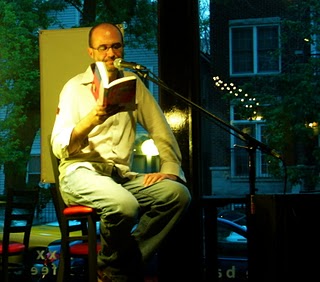
This is one of the latest stories I have written about author and literary maven Timothy Schaffert of Omaha, whose first three novels (The Hollow Limbs of the Rollow Sisters, The Singing and Dancing Daughters of God, and Devils in the Sugar Shop, which was just coming out when I wrote the piece, have all received high praise from reviewers. He has a fourth novel, The Coffins of Little Hope, due out next spring, and I expect it will only add to his reputation as a first-rate talent. His work is very funny and very insightful, and the literary festival he runs, the (downtown) Omaha Lit Fest, is a superb concentration on the written word. The 2010 event is September 10-11 and as usual features a strong lineup of guest authors and artists from all over America and representing many different kinds of literary work. Schaffert also runs a summer writing workshop at the University of Nebraska-Lincoln that also attracts top talent. He is at the forefront of a dynamic literary scene in Nebraska, a state that has produced an impressive list of literary icons (Willa Cather, Mari Sandoz, Wright Morris, John Neihardt, Loren Eiseley, Tillie Olsen, Ron Hansen, Richard Dooling, Kurt Andersen). He’s a sweet person, too. I look forward to attending the Omaha Lit Fest (a link for it is on this site) and to reading his new novel, and especially to seeing and talking to him again.
The story below originally appeared in The Reader (www.thereader.com). You’ll find more of my Schaffert and Omaha Lit Fest stories on this site, with more to come.
Timothy Schaffert Gets Down and Dirty with his New Novel “Devils in the Sugar Shop“
Originally published in The Reader (www.thereader.com)
©by Leo Adam Biga
An interview at the Papillion home he shares with his longtime partner found 38-year-old Omhaha author Timothy Schaffert in his usual no-fuss mode — bare feet, jeans, T-shirt, stubbled face, his two dogs panting for affection. Curled up on a sofa in the untidy, tiled, windowed sun room, his voice rose and fell with catty gossip and sober reflection, punctuated by a rat-a-tat-tat laugh. He’s one part John Waters and one part John Sayles, a duality expressed in his tabloid-literary roots.
Schaffert is hot-as-a-pistol these days. His much buzzed about new novel, Devils in the Sugar Shop (Unbridled Books), officially debuts in May. After the rural American Gothic goings-on of his first two books, Devils wryly explores an urban landscape of morally bankrupt subcultures. That the setting is Omaha makes it all the more delicious.
As the author of a third acclaimed novel in five years, the Omahan is a rising literary star. As founder/director of the (downtown) Omaha Lit Fest, he’s a tastemaker. As a creative writing, composition and literature teacher at the University of Nebraska-Lincoln, he’s an academic wheel. Much in demand, he’s asked to do readings/residencies around the country. Closer to home, he’s been invited to conduct workshops at the Nebraska Summer Writer’s Conference.
On a lazy Saturday morning he discussed various aspects of his rich writing life.
Before the novels he made waves on the local alternative journalism scene, first with The Reader, then Pulp. His assured literary style, imbued with sharp wit and imaginative whimsy and full of exacting details, unexpected digressions and eclectic references, set him apart. Schaffert still freelances — witness a current piece in Poets and Writers — but his attention is now firmly on fiction writing.
Besides novels, he writes short stories. He adapted one story, The Young Widow of Barcelona, for a Blue Barn Witching Hour-Omaha Lit Fest collaboration, Short Fictions and Maledictions, that melds literature and theater. Schaffert helped workshop the script before giving it over to the WH troupe, whose work he finds “invigorating.” The show runs April 28 through May 12 at the Blue Barn.
His first two books, The Phantom Limbs of the Rollow Sisters (2002) and The Singing and Dancing Daughters of God (2005), brought him much recognition. Devils is doing the same. Often noted is the splendor he finds in his characters’ imperfections. Ordinary people sorting through the chaos of their dysfunctional, interconnected lives. Dreams run up hard against reality. Desires conflict. Relationships strain. In true American Gothic tradition, Twisted humor and heightened language create a raw poetry. Never has neurosis seemed such an emblem of Americana.
Sisters is being reissued next fall by Unbridled Books. Daughters was a Barnes and Noble Discover Great New Writers pick in 2006. Now a candidate for the Omaha Public Library’s Omaha Reads citywide book club, Daughters is also being adapted as a screenplay by Joseph Krings, a music video/short filmmaker from Nebraska.
Devils already boasts strong advance press courtesy of comments like these from Publishers Weekly: “…consistently surprising and vibrant…Schaffert walks an uneasy line between the amusingly sexy and the scabrous.”
As Schaffert says of the book on his web site, “I’d say it has undertones of Woody Allen, overtones of old-school soap opera, duotones of Pedro Almodovar, halftones of Robert Altman, and dulcet tones of Mrs. Dalloway.”
He considers Devils “a modernist novel” in keeping with his “sense of the world” as “funny and absurd.” It’s the antithesis of the kind of “formulaic or prescriptive” approach he abhors. “What will cause me to put a book down is if it’s just too insufferably clear-eyed and its characters too level-headed,” he said. “I don’t want to use the words sterility or banality, but…
“I think sometimes our sense of what is typically called realism in fiction is not real at all,” he said. “It’s a construct. When we actually look at our lives and the lives of people we know, there’s all kinds of strangeness. It’s definitely messier than some of the contemporary fiction you see now. And I think part of that is because contemporary fiction tries to avoid melodrama and soap opera. It’s all about understatement, whereas mine is overstatement — more clawing our way through this existence until the day we die.”
Devils’ seven point-of-view characters propel us through a farcical, fun house tour of Omaha in Heat. Via a cast of artists, dilettantes, slackers, Old Market types and suburbanites we careen from Sugar Shop, Inc. sex-toy parties to erotica writing workshops to provocative art works to swinger parties to illicit trysts to homophobic rants to a stalker’s threats to a “reformed” dwarf’s advances to some drag queens’ credos. The effect of all this acting out is not titillation but illumination.
“We have these deep psychological stews and yet we all appear we’re salt-of-the-earth,” Schaffert said. “We’re all convinced we’re doing the right thing all the time. We’re representing ourselves exactly the way we should represent ourselves, meanwhile we’re just flailing.”

He hones in on human desperation, setting in relief the conflicts that rage within and that separate us from others, whether it is, as he says, our “fear of getting hurt or being violated in some sense or having different expectations from other people. That’s the stuff that fascinates me…trying to puzzle all that out.”
For the naughty bits he drew on a sex-toy party he attended and on interviews he did with swinger couples for a Reader article. The thought of soccer moms and dads getting silly over vibrators and lubes is something Schaffert finds irresistible. “It’s so hilarious that it’s become so non-sordid. It is almost like having a Tupperware party.” In his research on swingers, he said, “what surprised me was how many couples are part of this subculture. The people I talked to were pretty frank about why they’re involved with it and very little of it had to do with sex.”
His book touches on the schizoid place sex holds in America. “It’s blatant and ubiquitous and yet we want to pretend we’re all virgins and that the multi-billion dollar porn industry doesn’t have anything to do with us,” he said.
Other taboos are dealt with, too. The overtly gay Lee sleeps with both his girlfriend and boyfriend, a reflection, Schaffert said, of how young people “see sexuality as more fluid and flexible” than past generations. “Who they sleep with today is not going to effect who they sleep with tomorrow, which is an interesting thing to witness. And it makes sense. It’s cool to see young people expressing themselves in this Puritanical society in a way that doesn’t fit explicitly with the social structure. It’s certainly a more imaginative way of pursuing your relationships and your self-identity.” That doesn’t mean people still don’t get hurt, he added.
Lee’s homosexuality distresses the women in his life. “That was an interesting thing to explore,” Schaffert said. “These women are so invested in his heterosexuality that his being gay ends up being kind of life altering for a couple characters.”
Sex may drive the story, but the actual act is never depicted. “As I was working my way towards this,” he said, “I was like, Well, what do I portray about this? Do I have to write sex scenes? I didn’t really want to because that’s been so overdone that it’s almost impossible to do it in any way that’s not obnoxious. I modeled my approach after Edward Gorey’s in his great novel The Curious Sofa, where everything takes place behind a screen or a sofa, so you see a leg or arm or something.”
Like any good writer, Schaffert doesn’t make moral judgments about his characters. He said as he exposes flaws he takes pains to not let his humor turn a cruelty at his characters’ expense. Even though some readers may interpret it that way, he doesn’t intend to make fun of the predicaments that befall his dear misfits. He can’t afford to, as he gets too close to them during the creative process. He said, “When I’m writing I’m inhabiting these characters’ lives like an actor getting into character, figuring out exactly what they would say and how they would react to certain situations based on what I know to be true about the world — that it’s funny and absurd.”
As Devils’ assundry subplots unfold, there’s the added fun of identifying real-life Omaha figures and places dressed up in fictional clothes. In the book the work of a black female painter named Viv, whose edgy art, Schaffert writes, “tends to make people nervous,” is a barely disguised reference to the effect Omaha artist Wanda Ewing’s racially and sexually-charged work evokes. Ewing is a friend of Schaffert’s, who borrowed some of her work for inspiration. The book store Mermaids Singing, Used & Rare run by twins Peach and Plum is clearly the Old Market fixture Jackson Street Booksellers, which he adores.
His swingers expose may end up in a new project he’s developing that he said charts, “in a kind of fictionalized memoir,” the vagaries “of working as an editor for an alternative news weekly in a conservative town.” He was with The Reader, first as a contributing writer, then as managing editor and then editor-in-chief, from 1999 through 2002. He left over creative differences and soon thereafter headed up Pulp, the short-lived but lively salon mag. For part of his Reader tenure the paper was owned by the late Alan Baer, an eccentric millionaire who turned a blind eye to certain irregularities. Beyond a memoir, what makes this a departure for Schaffert is that it’s designed as a comic book, one he’ll both write and illustrate. He’s only taken notes thus far, but he’s eager to explore the form.
“I grew up loving the Dick Tracy comic strip and Fantastic Four and Archie comics. My entree into writing was comic books,” he said.
He’s become “more and more interested” in the graphic novel, citing the work of Chris Ware, Alison Bechdal, Sophie Crumb and Ivan Brunetti. He said his project “might end up being a series of mini-comics that I eventually collect into a book.”
He’s also taking notes for a new novel that, he said, is “picking up on some of the themes I’ve explored before: relationships between parents and their children; faith and religion; strained marriage.” Another short story or two and he’ll have enough for a collection.
With so much breaking his way, Schaffert could be excused for playing the big shot, but he doesn’t. Like one of his bemused characters, he looks with incredulity at all the fuss being made about him. He undercuts the floss by self-deprecatingly dishing on himself and his success. He calls the Lit Fest an act of “arrogant self-promotion.” Imagine the gall it takes, he went on, “to create a literary festival to bring more attention to myself.” In truth the fest focuses on all aspects of the written word, drawing much attention to the strong literary scene here and to dozens of writers not named Timothy Schaffert.
Any mention of the warm embrace given his work is quickly deflected.
“It’s been mainly through my publisher and my editor. I’ve been very fortunate,” he said. As Unbridled only publishes a few books a year, Schaffert reaps the benefits of a pampered author with name-above-the-title pull. “The press I work with approaches their works with the same vigorous attitude commercial presses do for their best selling authors, and in that sense when you only publish eight or ten books a year, a lot of attention gets shoved my way. They’re kind of a boutique press, but they’ve been in the business for years and years and so they know their way around in the publishing industry.”
Co-publishers Fred Ramey and Greg Michalson formed Unbridled in 2003 after stints at MacMurray & Beck and BlueHen Books, then a literary imprint of Putnam Press. BlueHen published Schaffert’s first novel. From the start Unbridled has gained a rep for publishing new talent. For public relations and tax purposes, the press is based in Denver, Col., but it is in reality a virtual press whose administrative and creative team live and work in disparate spots.
Schaffert appreciates the extra mile Unbridled goes, including the late spring-early summer Devils book tour they’ve scheduled, which will find him going to all the usual places in the Midwest, but also New York, Chicago and Atlanta.
“It’s such a luxury to have a publisher get behind the book in that way,” he said.
Much like the home he’s found at Unbridled, Schaffert enjoys the comfort of working within the very writing community he sprang from at UNL.
He’s discovered he teaches as he was taught. “That’s exactly my approach,” he said. “My philosophy about writing in general was really developed or helped along by professors I had in college — Gerry Shapiro and Judy Slater. My professors were very sensitive to this idea of there not being a right way or a wrong way to write fiction. Instead, you approach it on a story-by-story basis and examine what’s working within a particular piece to help it work better.
“It’s interesting to be going back to the university where I studied, you know. Every day I go to work it feels like a nostalgia trip a little bit. It feels like such a rare experience to be able to be mentored as a teacher by the same people who mentored me a writer. I mean, I talk to Gerry and Judy a lot about teaching, about students, about experiences in the classroom.”
Teaching was long in the back of his mind, but he couldn’t try it until he was ready. “You have to develop a body of work before you can be taken seriously as a teacher,” he said. Now that he’s doing it, he said, “I love it. You have a fair amount of freedom there in how you want to interpret the class, so I appreciate that.”
Having to articulate craft is instructive for a writer like himself. It’s not so different than “when I was a student in that studio workshop environment where you’re expected to read other students’ work and comment on it,” he said. “Obviously when it’s your work that’s up you benefit from the constructive criticism. But you also benefit from examining…and developing an aesthetic, really, of certain critical criteria that you discover as you’re talking about other people’s work.”
He said appraising his own work is something “I feel more adept at than I have in the past.” It’s vital, he said, “in order to seek out bad habits that I may have practiced in previous work and to see it happening now or to recognize it.” Besides the analytical discipline that informs his work, he said journalism makes him more discerning. “I think it comes from writing about dining and style, doing book and movie reviews, writing features about subjects you know nothing about. You develop insights into writing along those kinds of lines.”
All this work-for-hire’s left him undamaged. He said, “I have mostly made my career as a writer at some level and it seems like that can be potentially distracting when you’re trying to write fiction but you’re adapting another style. I think the fear is you could ruin yourself by writing work you don’t really care about, especially if you have to write in a particular kind of way that’s perhaps not good writing. I think it’s good for a writer to compartmentalize as much as possible. It’s a matter of figuring out those ways to slip back into the creative process.”
He’s found a way to protect himself from cross-contamination.
“Part of that is just the space I write in,” he said. “I have a home office where I do ‘paying work’ at a desk at a computer and I tend to write fiction in here,” he said, meaning the sun room. “I write on a laptop, with music going, pacing a lot.” The music he plays to induce a fugue-like state “depends on what I’m writing,” he said. “For Devils, I found myself listening to a lot of old pop and jazz standards. Typically, Miles Davis’s ‘Kind of Blue’ is on constant rotation no matter what I’m writing. I also tend to listen to Rickie Lee Jones, Erik Satie and Joe Henry.
He doesn’t miss “the 2AMers” that came with being a news weekly editor, when he’d awaken in the middle of the night, panic-stricken over the status of that week’s cover story. The strain of putting out a paper with “no staff writers” and “no budget” grew tiresome. The saving grace, he said, was taking “a creative approach” to the work and always “wanting the story to be exactly what it needed to be. Editing is a creative act all by itself.”
Until his summer book tour he’s doing local readings and commuting to Lincoln for classes. Those I-80 hops allow ideas to seep in. Once, while en route to Hastings, the characters for The Young Widow of Barcelona came to him as a Neko Case CD played. “I’m always tossing around things,” he said. “I have to spend a fair amount of time to have an idea gestate before I can write anything down.”
Related Articles
- 20 Writers to Watch – An Alternate List (emergingwriters.typepad.com)
- The New York Stories of Elizabeth Hardwick (guardian.co.uk)
- Jason Pinter: Jodi Picoult and Jennifer Weiner Speak Out On Franzen Feud: HuffPost Exclusive (huffingtonpost.com)
- Heartland of Darkness: Timothy Schaffert’s Midwestern Trilogy (themillions.com)
- With His New Novel, ‘The Coffins of Little Hope,’ Timothy Schaffert’s Back Delighting in the Curiosities of American Gothic (leoadambiga.wordpress.com)
- Great Plains Theatre Conference Ushers in New Era of Omaha Theater (leoadambiga.wordpress.com)
- Alice’s Wonderland, Former InStyle Accessories Editor Alice Kim Brings NYC Style Sense to Omaha’s Trocadero (leoadambiga.wordpress.com)
Categories: Authors/Literature, Omaha, Omaha Lit Fest, Pop culture, Timothy Schaffert, Writing
Authors/Books/Literature, Devils in the Sugar Shop, Loren Eiseley, Omaha, Omaha Lit Fest, Omaha Nebraska, Phantom Limbs of the Rollow Sisters, Pop Culture, Richard Dooling, Singing and Dancing Daughters of God, The Hollow Limbs of the Rollow Sisters, The Singing and Dancing Daughters of God, Timothy Schaffert, Unbridled Books, United States, Woody Allen, Writing
Radio DJ-actor-singer Dave Wingert, in the spotlight
August 25, 2010
28 comments

Image by kjeik via Flickr
UPDATE I: I have been noticing a major uptick in views of this Dave Wingert profile and I think at one point I even Googled his name to see if he was in the news, but I didn’t find anything. But the views kept right on aggregating. I just happened to email him Oct. 17 about something totally unrelated to this and he informed me he has been summarily let go by KGOR. Obviously a lot of you out there who listened to him knew about the situation. Apparently the dust-up had to do with an FCC violation – a listener calling-in unloosed a forbidden expletive on air that seems pretty tame to me and my ears, “bullshit,” and Wingy let it through and tried covering his ass just as you or I might do — and after serving a suspension he got canned for his trouble. Please explain how the many obscenities (and I don’t just mean words) of reality TV and shock-jock radio are acceptable, even in prime time, and yet its producers, writers, and hosts only seem to get richer, but a stray “bullshit” said over the radio is grounds for termination? He tells me he was fired without severance, only a goodbye and good luck. He wants to stay put and continue doing his radio gigging in Omaha. He and his agent are busily testing the waters. I hope he gets his wish and perhaps a measure of revenge against the station that dismissed him by killing them in the ratings.
UPDATE II: The story finally made the news, though the reports have him uttering the expletive. Does it really matter? I find it interesting that I broke the story via my blog Monday morning and yet that there was no mention by the Omaha World-Herald or other media of getting a lead on this news from this source and/or from readers of this blog, but I assume that’s precisely what happened.
UPDATE III: After fielding dozens of comments and questions about Wingert’s firing, I am happy to report what some of you probably already know – he’s landed at a new radio home in Omaha, KOOO-FM, 101.9, where he will be the morning host beginning Monday, Jan. 30. The station plays hits from the 1970s through today and targets a 25-54 demographic. Does this mean his loyal listeners from KGOR, many of them upset by the way he was let go, will follow him to the new station and boost its ratings? I wonder how many listeners spurned KGOR in the aftermath of his firing? Oh, well, all water under the bridge now. He’s back in the saddle again and if his fans want to hear him they know where to find him.
In my 52 years in Omaha, Neb. I am aware of only a few entertainers and personalities who can compare with Dave Wingert, a multi-talented gentleman who makes whatever medium he’s working in, whether radio or television or theater or cabaret, appear effortless. Those of us who have been around the block a time or two know from experience that things only appear effortless from the outside looking in, and that that apparent ease is only arrived after tremendous study and work. After admiring Wingert from afar for so many years it was a delight to finally meet him and get to know him a bit. I trust you will like the man I portray in this article for The Reader (www.thereader.com) as much as I do.
Radio DJ-actor-singerDave Wingert, in the spotlight
©by Leo Adam Biga
Originally published in The Reader (www.thereader.com)
The words fearless and morning radio personality don’t usually jive but they do in the case of Clear Channel KGOR 99.9-FM wake-up man Dave Wingert. Far from the madding crowd of shock jocks the veteran broadcaster and stage actor is brave enough to simply be himself on air. Enervating, effusive, empathetic, effeminate.
He’s gallant enough to have accepted the fact his biological father no sooner saw him as a newborn infant than went home and killed himself. His mother laid that messed-up heritage on him when he was a teenager.
“What do you with that?” Wingert asked rhetorically in an interview. What he did was learn all he could about his father, a man who was the love of his mother’s life but who also suffered from manic depression. The revelation of how he died came just as Wingert began pursuing radio and theater at Ohio University. That’s when he discovered his father had worked in those same fields in New York. Weird.
Wingert’s resilient enough to have survived a bullet to the chest in Omaha’s most famous shooting spree until the Van Maur tragedy. In 1977 he and Larry Williams had just begun their cabaret act before a packed house at now defunct Club 89 when Ulysses Cribbs opened fire with a 12-gauge shotgun. In a few seconds rampage that seemed to last forever the gunman killed one and injured 26, including Wingert, who luckily had the round deflect off his chest.
Superman went on the air the next day helping a city heal. He did the same after the Van Maur shootings. The earlier experience was a lesson in how precious life is. “Since that day I try not to take that for granted,” he said. A recent stalking incident made him relive some of that chaos. “Mr. Crazy” made veiled threats before being arrested. Wingert never missed a show.
A triple-threat actor/singer/dancer, he’s daring enough to take on demanding roles requiring huge commitments of time and energy. “I’m drawn to material, content,” he said. Recent roles in Six Degrees of Separation, Urinetown and The Goat fit the bill. Blue Barn Theatre artistic director Susan Clement Toberer, who directed him in Six Degrees andGoat, said, “His work ethic is purely professional yet he is very willing to try anything at least once. I love working with actors like Dave who are fearless and willing to jump off a ledge and not worry if they look the fool.”

Dave Wingert
He’s courageous enough to be an openly gay announcer in Omaha. Not in a flaming, militant way but with a breezy, emotive patter and Jewish motherly demeanor. By addressing, on-air, overtly heterosexual newsman Rich Dennison with, “Oh, honey!,” or female callers with, “Dahling.” He doesn’t use the show as a coming out platform but rather as context for being true to who he is.
“I have come out — if you listen for it. But it comes out in conversation. I haven’t made it a banner,” he said.
Three years ago Wingert showed the courage of his convictions by abandoning his dream for large market radio fame, which had led him from Omaha to the west coast, to venture back here in search of a permanent home to call his own.
More recently, Wingert proved he has the guts to leave a prime gig as a protest. In a show of solidarity with Omaha Community Playhouse artists who’d earlier resigned he and two fellow cast members deserted a production of Moonlight and Magnolias days before its scheduled opening last month. He, Ben Burkholtz and Connie Lee refused to go on in response to a dispute at the theater that led to the temporary departures of Playhouse artistic director Carl Beck, who directed Moonlight, and associate Susan Baer Collins. When Wingert and Co. exited, the show was canceled and Billy McGuigan booked as a fill-in.
Beck appreciated the gesture.
“I was terribly surprised and terribly moved. It received a lot of varied reaction around the city. Some people very much horrified actors would do that. Others, understanding what motivated the actors. I know those actors were taking an uncomfortable positiion and so I admire them seeing it through the way they have.”
Some may view what Wingert did as a grandstanding ploy that undermined the theater. Others, as the loyal action of a man guided by integrity. Either way, Wingert didn’t sit idly by while Rome burned.
Prompting this soap opera was a blunt force effort by executive director Tim Schmad and board president Mark Laughlin to bridge a budget shortfall. The pair reportedly told Beck and Collins their duties and salaries would be reduced. Beck and Collins balked and submitted their resignations. Insiders say it was a classic case of bean counters versus artists.
Once the story broke angry theater supporters deluged the Playhouse with calls and emails. Schmad and Laughlin faced the music at an April 16 open forum that announced the restoration of Beck and Collins to their original posts.
Wingert attended the session, which saw people rant against OCP administrators for what many viewed as their insensitivity, but the actor remained silent. Aside from a comment to a television reporter about Schmad’s well-publicized and much-derided lack of arts experience, Wingert let his actions speak for him.
“What’s really behind this is I keep a list of what I want to be here and do here and one is to make a difference, and this made such a huge difference as it played out,” said Wingert. “I think of that. I guess you could call it a protest. It was saying, ‘You can’t treat my friends this way, this is wrong, you can’t do this.’ It was all about people for me,” said Wingert, who’d worked with Beck before.

Wingert at a script reading
What impact the Wingert-led walkout made in causing Playhouse leaders to rethink their decision no one knows. While Beck and Collins are back on the job Moonlight never made it to curtain, unless you count the fully-dressed and lit but empty set that served as backdrop for the rancorous public forum. A fitting symbol for a show that would not go on in a house divided. Wingert equates what happened to a dysfunctional family airing out some issues.
“I think it’s much like a family having a blowup.”
He said “going to the brink” may have been just the “cathartic” awakening the complacent theater, which has lost much of its membership, needed in order to get both the business and art sides on the same page.
“I see this as all really good for the Playhouse, I really do,” said Wingert. “If this is a situation that has been brewing for some time than the place deserves to implode, it needs to get its shit together. Only time will tell.”
He feels the events that led to Moonlight being canceled sent a message to the Playhouse administration.
“It was more important not to do this show for the reasons we didn’t do it than to get on stage,” said Wingert, who refused overtures from management he reconsider his walkout. “Maybe it wasn’t meant to live.”
Still, he rues losing Moonlight. The play looks at a frantic few days in the making of Gone with the Wind. Wingert went after the plum role of screenwriter Ben Hecht, whose biography’s telling of these true-to-life events inspired the stage comedy. There’s discussion of finding new play dates for Moonlight but that may be difficult given the theater’s tight schedule. Wingert can hope though.
“I would love to play that part,” he said. “It’s so rich and fun.” Wingert said he initially had trouble finding Hecht’s voice, the instrument the actor relies on for fixing in on his characters. Once he did, he said, he “nailed the part.” What he hit upon, he said, was a wry, Woody Allenish, New Yorker smarty pants whine. “That voice had never come out of my mouth before.”

His real-life voice is a warm, mellifluous, inflection-rich concoction hinting at his Bensonhurst-Brooklyn background. It’s not hard to imagine this same voice charming listeners, especially when married with his dynamic personality. He seduces without resorting to blow-hard political agenda, cutesy alter-ago or phony banter. A more theatrical voice comes out for dramatic-comedic affect. “Well, radio lends itself to that, especially if you’re telling a story,” he said. “I mean, it is of course a little bit of extenuated realism there. There’s a bit of schtick.”
He projects a vaugely Jewish vibe, too, as the friendly mensch who says, “let’s check the morning schlep,” or, “love to schmooze with you.”
Filling time between playing what KGOR tags “the super hits of the the ‘60s and ‘70s” he indulges in canned jokes provided by a syndicator of prefab material. Most commercial stations subscribe to such services. The bits, mostly satiric pot shots at headline grabbers like OctaMom, stand on their own but work best when a host can riff on them. If nothing else, Wingert’s an extemporaneous whiz whose decades of live radio and theater experience make improvisation second nature to him.
It’s why he does his show, not from a chair but standing up, moving around, much the way he works on stage.
“I do my show standing up because I think best on my feet. It gives me more more energy.
Related Articles
- Omaha Arts-Culture Scene All Grown Up and Looking Fabulous (leoadambiga.wordpress.com)
- Camille Metoyer Moten, A Singer for All Seasons (leoadambiga.wordpress.com)
- Kevyn Morrow’s Homecoming (leoadambiga.wordpress.com)
- Playwright John Guare Talks Shop on Omaha Visit Celebrating His Acclaimed ‘Six Degrees of Separation’ (leoadambiga.wordpress.com)
- Lit Fest Brings Author Carleen Brice Back Home Flush with the Success of Her First Novel, ‘Orange Mint and Honey’ (leoadambiga.wordpress.com)
- Nomad Lounge, An Oasis for Creative Class Nomads (leoadambiga.wordpress.com)
- Great Plains Theatre Conference Ushers in New Era of Omaha Theater (leoadambiga.wordpress.com)
- Radio Day, ‘Michael Feldman’s Whad’Ya Know?’ Live from Omaha (leoadambiga.wordpress.com)
- John Beasley and Sons Make Acting a Family Thing at the John Beasley Theater & Workshop and Beyond (leoadambiga.wordpress.com)
- Tired of Being Tired Leads to a New Start at the John Beasley Theater (leoadambiga.wordpress.com)
- Home Boy Nicholas D’Agosto Makes Good on the Start ‘Election’ Gave Him; Nails Small But Showy Part in New Indie Flick ‘Dirty Girl’ (leoadambiga.wordpress.com)
- Miss Leola Says Goodbye (leoadambiga.wordpress.com)

Photographer Monte Kruse pushes boundaries
August 22, 2010
4 comments

Image via Wikipedia
I first wrote about Omaha photographer Monte Kruse more than 20 years ago, and even in all the intervening years and stories and personalities I’ve come across, he still rates as one of the most unforgettable characters I’ve ever met. One day I will post that story, as it’s always been one of my favorites — I think because of the subject and for the way I captured the essence of his otherness. Monte definitely marches to his own drummer. Like a lot of creatives, some can find him strange or difficult, but that’s just Monte being Monte. Of his talent, there is no question. When I encountered that first time he was doing great humanistic work and as I recall more or less living out of his car, flitting between places and assignments. He’s come a long way since then. The last time I ran into him, which was for the following story, he had a downtown loft that served as both residence and studio. I believe he’s still there, but I don’t know for sure. What I do know for sure is that wherever Monte lands he’ll always find a way to do things his own way.
This blog also contains stories of mine about several other Omaha-based photographers, including Jim Hendrickson and Don Doll, who are friends and mentors of Kruse, as well as Rudy Smith, Larry Ferguson, and David Radler. By the end of the year I will be posting a major piece on 2010 World Photographer of the Year Jim Krantz. Additionally, the blog features pieces on many filmmakers, including Alexander Payne, Nik Fackler, Dana Altman, Jon Jost, John Landis, Joan Micklin Silver, Gail Levin, and Charles Fairbanks.
Photographer Monte Kruse pushes boundaries
©by Leo Adam Biga
Originally appeared in The Reader (www.thereader.com)
When Omaha photographer Monte Kruse muses about his darkly erotic work “pushing the limits” and getting “him noticed” he sounds every bit the impetuous artist that he is. A sensualist in his life and in his art, Kruse makes striking nude images that actually fulfill his expressed intention to “stretch the bounds” with “edgy work” that elicits strong responses from viewers.
The large-format black-and-white images, which explore the male and female body in evocative contexts, have attracted the very attention he seeks via a slate of local gallery showings displaying his work and the recent gift of one of his prints, Debris IV, to the Joslyn Art Museum permanent collection. While holding court at an Old Market bistro one spring night, the enigmatic Kruse discussed what lies behind the improvisational approach and primal effect he has hit upon with his latest series of nudes.
“I was making money shooting standard portraits but I said to myself, ‘I’m not doing anything that stirs interest or makes people think. How can I do that?’ And I thought, ‘Well, the best way to do it is to photograph the nude, but not the classical nudes of beautiful bodies entwined on a beach with the ocean in the background. Instead, I wanted to do something more like snapshots — images that come out of found moments that have some mystery to them.’ So, I looked at a lot of film noir. I liked the darkness and the moodiness of it. The mystery of it. The detective-style quality to it. And that’s what I was searching for,” he said that night above the din of the busy bistro.
 |
The result, he explained, “is photojournalism, combined with mystery writing, imbued with a mood. It’s the kind of work not typically seen. It’s not real pretty. It’s dark, it’s personal, it’s edgy. It’s not so much about the person as it is the moment — the specific truth of the moment. I don’t want anything posed. I go in without any preconceived ideas, except to bring out a certain element of intrigue. It’s like a diary. It’s my experience with that person in that moment. There’s one like that of me and my girlfriend naked in a hotel room. It just happened. Another time, someone I was with took a shower and, boom, I shot it. Once, in a hotel, a person opened a window across the way and I said, ‘That’s it — I’ve got a photograph.’”
Striving for verisimilitude, Kruse often uses found locations and objects rather than sets or props, relying on available light and “a gut feeling.” When not shooting in a studio, he employs minimal artificial lighting and staging. The idea, he said, is to let the process be as natural and instinctive as possible. “I’m photographing without safety nets. I don’t want to do things that are going to be perfect. I don’t want to have it all sketched out. The more off-handed I get, the better I get. I let the subconscious free. I want to be surprised by my own images. The whole thing is just moving and keeping your energy flow up and shooting different angles and not being afraid to take chances. It’s like jazz — it moves from one thing to another. It’s free-flowing. It just goes.”
Later that same night in the Old Market Kruse retreated to his spacious Bemis loft apartment/studio, where he showed some acquaintances the very pictures he was describing. Upon seeing the pulp-fiction-like images, the assembled agreed the photos capture private, unguarded moments suggestive of any number of storylines or histories.
Snapped amid such naturalistic settings as bedrooms and bathrooms, the images offer views of nude individuals and couples in intimate, impromptu moments of a post-coital nature, although nothing overtly sexual is revealed: the shape of a voluptuous woman leaning with a nonchalant attitude in a hallway; a half-glimpsed man standing over a woman lying on her back in bed, gently stroking her pelvis; a well-hung man descending a staircase; a woman with a full bush getting dressed. The pictures, both stark and dreamy, offer a post-modernist’s view of the human form and make the viewer acutely aware of his/her role as voyeur and as purveyor of certain attitudes.
Janet Farber, associate curator of 20th century art at Joslyn Art Museum, said, where images of “the traditional nude” focus “on the beauty or the form of the human body in an isolated context,” Kruse’s images explore the nude in “contextual-narrative” ways that imply certain socio-psychological-sexual dynamics. She said his interest in evoking an atmosphere imbued with subtext is achieved in various ways.
“He’s really paying attention to the range of tones and the intensity of black and white. He creates a tension within the image that allows room for the viewer to bring something to it or add something to it in terms of the implied action. One of the ways he does that is by leaving important bits of information out. Quite often his models are anonymous or somehow their identity obscured. I think that’s part of the effect that brings into play the imagination of the viewer.”
Kruse said his increasing output of male nudes, which has included pictures of gay men interacting, compel people to confront things they may rather avoid, such as homophobia. “I’m not necessarily trying to shoot provocative images, but let’s just say the male nude is always something a little bit scarier. Anytime people see the male nude then all of a sudden there’s the assumption that you or the subject is gay, which doesn’t matter. People are going to bring those attitudes. But with my new series I’m trying to evoke some political questions about what love is and isn’t and what’s wrong with viewing the male body and what’s wrong with the gay culture. Of course, there’s nothing wrong with it.”
He said by presenting the male nude in different ways, he hopes people see beyond questions of sexual proclivity and instead view the male body as a natural and legitimate subject and one not yet exploited or perverted like the image of the female body. “When people ask, ‘Why are you interested in the male nude?, I say, ‘Well, because it’s beautiful.’ The female nude has been done to death. It’s a cliche. The male body has just as much validity as the female body. It’s just me pushing the parameters a bit. I take these snapshot-like images and blow them up into huge prints that people are forced to confront on a wall, where they’ll love it, hate it, whatever.”
Carol McCabe, who has printed many images by Kruse at her Professional Darkroom Services, said she saw the artist go through a phase where he ratcheted up the emotional tenor of his work to the point of shock value. She said where his work was once “more literal and straightforward” it now displays a “much more formal, sophisticated” and subtle interplay between elements in tension, whether shades of light and dark or moments of action and repose.
She said while “there’s a lot of physical power in the images, a big piece of what he wants to do is create ambiguity, as seen by his interest in androgyny. I think he pushes the envelope with his work more than anyone else I’ve seen in Omaha. He brings a passion and honesty and compassion to his work that makes people respond.” McCabe said Kruse is also meticulous, going to great pains to study how master visual artists have used light and paying close attention to every detail in the darkroom.
During a recent shoot in a side corridor at the Bemis building where he resides, Kruse photographed a nude male in a series of primal, pent-up “action” scenes against the backdrop of a brick wall. Beyond some minimal track lighting overhead, the only fill light Kruse brought to the location was something he calls “my genius light.”
Without any firm idea of what he would shoot, Kruse tried conjuring some compelling image into being out of thin air. He moved everywhere in the tight space, searching for angles, compositions, shadows, texture, depth, mood, feeling. He had the model, Greg, try any number of clinging, crouching stances along the wall, having him insinuate his body like a snake slithering across a rock face. In some cases he had Greg hoist himself up on a lead pipe and then twist his body and turn his face from the lens. In others, he had him make like he was scaling the wall, ala Spider-man, or else like a cat burglar or prowler caught with his pants down.

In a photo session Kruse charms his model like the seducer he is in order to get the results he wants. “You’ve got to be able to read people. You have to become their friend for that moment. You have to develop that trust. You have to be alert. You have to be open. You have to take risks.” he noted. In an almost constant patter, he reassures and directs his subject: “Beautiful, hold it right there. Bring your legs down. Bring ‘em up. Now, a little bit further down. Throw your head back. Yeah, that’s it. It’s gorgeous.” He also exchanges quips. “You kind of look like Jesus up there,” he told Greg, who at the time clung from a wall with his arms splayed out. “I’m feeling a lot like him right now,” answered a flushed Greg.
A frequent model for Kruse is Claudia Einecke, Curator of European Art at the Joslyn. Recently, she dropped over Kruse’s place while he was shooting painter Helen Braugh. After finishing with the petite and politely British brunette Braugh, he turned his attention to the sleek, blond Einecke, a German emigree who oozes a pouty sexuality without trying. As she nonchalantly sat on the arm of an easy chair, hands propped on her knees and long legs opened, Kruse clicked away from the floor with his Canon AE-1 camera. He also favors a Pentax 645.
Einecke described what it’s like being the object of his intense gaze: “Although it looks like he’s just waiting for something to happen,” she said, “there is an energy and a tension there because he’s making those things happen. It’s always impressive and interesting to see Monte at work and the concentration he brings to it. He’s always looking for the unplanned. Usually, his best photos come out of moments he recognizes that you and I would probably not see as photographs. Monte reminds me that at first I thought his new work was just awful, but now that I’ve gotten used to these images there are some that I think are really lyrical, beautiful and gentle.”
In some recent images, Kruse goes for extremities — capturing the taut muscles and bulging veins of, for example, Greg straining to support himself at the Bemis. “Where before I was dealing in found moments,” Kruse said, “now I’m trying to step-up the intensity. I’m after something real urban, real dark, real menacing. I’m pushing the model to the extremes. I’m capturing the pain, the tension, the exertion, the danger. I want to make it real hip, real cool, but not contrived.” In other shoots he’s done along these lines, he achieves ambiguity in images of naked men caught leaping through the air without a familiar context to ground their actions in. The models “are not objects,” Einecke said, “but are subjects in a narrative. You don’t know what’s going on, but you feel something is going on.”

For Kruse, photography is all about the possibilities it affords as a medium of self- expression and personal growth. The life of this former Iowa farm boy was transformed when he turned his back on a promising baseball career while a Creighton University student in the 1970s to pursue photography. With world-renowned photojournalist Don Doll and sculptor Richard Hunt as mentors Kruse developed into a sought-after image maker adept at capturing poetic human scenes for such diverse sources as news publications, galleries, corporations and private clients.
In the photo-journalistic vein, he has documented AIDS patients, homeless individuals, developmentally disabled residents and poverty-stricken natives of foreign lands. For the art market, he has shot a wide variety of stunning nudes. For a personal series of artist portraits, he has photographed such leading lights as author Studs Terkel, the late actor Jason Robards and filmmaker Sydney Pollock.
Ever the iconoclast, Kruse long ago eschewed a mainstream career for independence. His romantic idea of being an artist found him living out of his car between assignments and adventures in Israel, Haiti, the Dominican Republic, New York, Chicago, Los Angeles. He took his obsession with photography to the limit. “If I had a choice between buying film and food, it was generally food, but it was a really close call. I’ll be honest — I stole, I cheated, I lied — I did everything to keep going. And now I’m in a position where I don’t have to do that. I’m not as desperate as I was.”
With age and maturity he now lives a settled life, supporting himself by working as a hotel doorman. This solid foundation actually frees him to experiment more with his work. “Before, I was so desperate to please and to get other jobs that I’d shoot this stereotypical stuff. My photography was based on pictures I’d seen. Now, I’m doing individual images that are uniquely my own. I’m less self-conscious. I’m more confident. If I don’t want to work with you, I can say the two magic words in the English language, ‘F_ _ _ you.’ Plus, I can create here. When I lived in other places, like New York, I couldn’t create because I was so caught up in just surviving and making the rent. Here, I can shoot all day long.”
Finally, Kruse feels photography is what ultimately defines who he is and what his legacy will be. “I pick up the camera, man, every day. I shoot images every day. I’ve shot countless images in my life. My photos are like a diary of my life. I can look back at photos I shot years ago, and it’s like yesterday. They’re proof of my existence on earth. I think the last picture I’ll take, if I can, is of all the people gathered around my bedside.”
Related Articles
- Fashion, photography and the art of the nude (thestar.com)
- ‘Censor This’ erotic photography exhibit in Harrisburg draws critics before it opens (pennlive.com)
- Marie Claire: Nude Is The New Black, If You’re White, That Is [Color Patterns] (jezebel.com)
- Exploring the Female Nude (thelastnoel.blogspot.com)
- Frederick Brown’s Journey Through Art is a Passage Across Form and a Passing On of Legacy (leoadambiga.wordpress.com)
- Jesuit Photojournalist Don Doll of Creighton University Documents the Global Human Condition One Person, One Image at a Time (leoadambiga.wordpress.com)
Houston Alexander, “The Assassin”
August 22, 2010
1 comment
Fighters have always had a certain appeal, whether doing their fighting in the street or in the ring or, since the advent of mixed martial arts events, in the octagon. Houston Alexander of Omaha has pretty much done it all and he’s turned his talent for fisticuffs, combined with his good looks and charisma, into a bit of a run in the Ultimate Fighting Championship, although he ended up losing more than he won. He’s also a radio DJ, graffiti artist, self-styled hip-hop educator, and man-about-town, making him more than the sum of his parts. The following story I did on him for The Reader (www.thereader.com) hit just as he was on his way up, and even though his star has since dimmed, he’s a survivor who knows how to work his image. He and his family didn’t like some of the things in my story, but he also knows that comes with the territory.

DJ Doc Beat Box and Houston on a school Culture Shock Tour
Houston Alexander, “The Assassin“
©by Leo Adam Biga
Originally published in The Reader (www.thereader.com)
Ultimate fighter Houston “The Assassin” Alexander of Omaha is being a good soldier for the photo shoot. Stripping down to his trunks, he poses in the middle of a south downtown street one late summer afternoon. He’s asked to look menacing, hardly a stretch for the chiseled, tattooed, head-shaved graffiti artist-street thug turned Ultimate Fighting Championship contender. He remarks about “those guys looking out those windows” at his half-naked ass, meaning inmates at the Douglas County Correctional Center peering out the razor-wired windows of the facility just down the block. He once peered out those same windows upon this very street.
“I was inside the cage in ‘97. I just got through beating up a cop and they took me down,” he says matter-of-factly. “The cop tried to grab me and I swung back and hit the guy. It was illegal what he was trying to do to me in the first place. He was trying to beat me up. I didn’t get charged for hitting a cop. I got charged for something else. I did like six months.”
It’s not his only run-in with the law. He alludes to “a whole bunch of domestic,” referring to disturbances with a woman that police responded to.
The fact he has a record only seems to add to his street cred as one tough M.F.. His fans don’t seem to mind his indiscretions. Passersby shout out props. “What’s up, Houston Alexander?” a guy calls out from his sedan. Another, on foot, invites him to a suburban sports bar where, the homey says, “they all love you out there.”
Now that Alexander is a certified UFC warrior, he’s handling all the hoopla that goes with it like a man. He seems unfazed by the endorsement deals, sponsorships, personal appearance requests, interviews, blog appraisals and fan frenzy demands coming his way these days.
Increasingly recognized wherever he goes, he eagerly acknowledges the attention with his trademark greeting, “What’s up, brother?” and firm handshake, giving love to grown men and boys whose star-struck expressions gleam with admiration for his fighting prowess. The African-American community particularly embraces him as a home boy made good. A strong, hard-working single father of six who came up an urban legend for his scribbing and street fighting. He’s one of their own and it’s them he’ll most be representing come next fight night.
Barely three months have passed since his furious UFC debut on May 26, when the light heavyweight put an octagon whupping on contender Keith Jardine at UFC 71 in Las Vegas. After getting knocked down in the first 10 seconds, Alexander quickly regrouped. His relentless pressing style backed Jardine against the fence, where he unleashed a flurry of knees, elbows, uppercuts and hooks to score a technical knockout. Now Alexander’s primed for his next step up the sport’s elite ladder.
He and his local coaching-training team led by Mick Doyle and Curlee Alexander, the same men who got him ready for his dismantling of “The Dean of Mean“ Jardine, left for Great Britain on Monday to make final preparations for a September 8 clash with Italian Alessio Sakara on the UFC 75 card at London’s O2 Arena.
Doyle, a native of Ireland, is a former world champion martial arts fighter. His Mick Doyle Mixed Martial Arts Center at 108th and Blondo is the baddest gym around. He’s trained and worked the corner of several world champs. Curlee Alexander, a cousin of Houston’s, is a former NAIA All-America wrestler at UNO and the longtime head wrestling coach at North High School, where he’s produced numerous individual and team state champions.
Houston Alexander when to North, but other than brief forays in wrestling and football, he didn’t really compete in organized sports, unless you count weight lifting and body shaping. He was a two-time Mr. North. There was never enough money or time, he explains. By high school he was already a burgeoning entrepreneur with his art and music. Besides, he said, “I always had responsibilities at home.” But everyone knew he was gifted athletically.
The way Doyle puts it, Alexander’s “a freak” of nature for his rare combo of power and speed. The 205-pounder can bench press more than twice his body weight, yet he’s not muscle bound. He’s remarkably agile and flexible. Alexander came to him a “raw” specimen, but with abundant natural talent and instincts. Alexander knows he has a tendency to resort to street fighting, but Doyle recently reassured him by saying, “Everything we’re showing you sticks because it’s brand new. It’s not really replacing anything that anyone else taught you.” A blank slate.
“He wants to learn,” Doyle said. “He’s very confident, but he’s grounded. It’s a joy to coach someone like him.”
Curlee Alexander, a lifelong boxing devotee, has rarely seen the likes of his cousin, who’s made this old-school grappler a UFC convert. He, too, tells Houston not to change what’s worked, street fighting and all, but to harness it with technique. When Houston came to him eight months ago asking that he condition him, Curlee was dubious. Houston’s work ethic won him over. “He’s certainly determined.” His dismantling of Jardine convinced him he was in the corner of a special athlete.
“It was the most amazing night as far as being a coach I’ve ever had. All the things we had worked on were coming to fruition. He was doing it. He put all this stuff together at that moment. Incredible.”

For his part, The Assassin credits his coaches with getting him to the next level.
“Without Mick and Curlee, there’s no me. I had the raw skills, but they’re fine tuning what I have to turn me into this champ I need to be,” he said. “I love those guys. They’re the real deal. No joke. They know what they’re talking about. I do whatever they tell me to do. There’s no getting away with anything, brother, believe me. But I wouldn’t want to cheat myself anyway.”
With their help, he said, “I’m more technical and all the power and strength I have is programmed a whole different way. More controlled. But don’t get it twisted. If I need to turn it up and go hard in the paint, it can easily change.”
A win Saturday night should put the fighter in the Top 10 and that much closer to what some anticipate will be a world title challenge within a year. Doyle told Alexander as much after an August meeting to breakdown the tape of the Jardine fight. “I told you this would be a two-year process. We’re only three months into this deal and look how much better you’ve gotten. Just think in another year where you’re going to be. You’ll be able to get in the ring with Wanderlei Silva (the legendary Brazilian world champ, late of the PRIDE series, now a UFC star).”
“We understand the window of opportunity on this thing is short,” Doyle said. “We want to get it there.” Asked if Alexander’s age, 35, is part of the urgency, he said, “Maybe some of it. If he gets an injury he’s not going to heal like a 25-year-old. He’s got some years left, but let’s get him the money. He’s got six kids.”
The Sakara-Alexander tussle is key for both fighters. Doyle calls Sakara “a stepping stone” for his fighter, whom he said must “prove the Jardine thing wasn’t a fluke.” He describes it as “a make or break fight” for Sakara, who’s coming off two straight losses at 185 pounds. “He’s gotta win to stay in the UFC. Sakara’s in the way of bigger and better things, so he’s gotta go.”
Cool, suave, laidback, playful. Quick to crack on someone. Alexander’s extreme physicality manifests in the way he grabs your hand or brushes against you or delivers none too gentle love taps or engages in horse play. When he needs to, he can turn off the imp and attend to business. He’s all, ‘Yes, coach…‘Yes, sir,’ with his trainers, putting in hour after hour of roadwork, skipping rope, weight lifting, calisthenics, stretching, grappling, sparring and shadow boxing under their watch.
For months he’s trained three times a day, up to six to eight hours per day, six days a week, devoting full-time to what not long ago was just “a hobby.” He’s disciplined and motivated enough to have transformed his physique and refined his fight style. After years of itinerant club fighting, all without a manager or trainer, only himself to count on, he began formal, supervised training less than a year ago. He worked with Doyle a few weeks before the Jardine clash, which also marked the first time he prepped for a specific foe and followed a nutritional supplement regimen. By all accounts he followed the strategy laid out for him to a tee.
“I have no problem working,” he said. “I’ve been working all my life.”
Doing what needs to be done is how he’s handled himself as an artist, DJ, father, blue collar worker and pro fighter. Whatever’s come down, he’s been man enough to take it, from completing large mural projects to getting custody of his kids to donating a kidney to daughter Elan to breaking a hand in a bout yet toughing the injury out to win. “Most people don’t know I’m fighting with one kidney,” he said. He’s paid the price when he’s screwed up, too, serving time behind bars.
The UFC is all happening fast for Alexander, which is fine for this dynamo. But the thing is, he’s come to this breakthrough at an age when most folks settle into a comfortable rut. No playing it safe or easy for him though. The truth is this opportunity’s been a long time in the making for Alexander, who enjoyed local celebrity status way before the UFC entered his life.
The veteran Omaha hip hop culture scion, variously known as Scrib, FAS/ONE and The Strong Arm, has always rolled with the assurance of a self-made man and standup brother. All the way back to the day when he protected the honor of his siblings and cousins with his heavy fists, first on the mean streets of East St. Louis, Ill., then in north O, where his mother moved he and his two younger siblings after she left their father. Alexander was all of 8 when he became the man of the family.
“I’m the oldest, so I was always expected to be the leader of the whole bunch. See, I’ve fought all my life, and that’s no exaggeration. It was always a situation where I couldn’t walk away, like somebody putting their hands on my girl cousins. I got into a lot of fights because of my brother,” he said. “I don’t interfere with no one’s business, but if you put your hands on my family, then it becomes my business. A lot of people got beat up because of that.”
Respect is more than an Aretha Franklin anthem for him.
“I don’t go around disrespecting people unless they disrespect me. There’s always a line you can’t cross.”
Growing up in a single-parent home, he started hustling early on to help support the family. What began as childhood diversions — fighting and music — became careers. When he wasn’t busting heads on the street, he was rhyming, break dancing, producing and graffiti tagging as a local hip hop “pioneer.” His Midwest Alliance and B-Boys have opened for national acts. He had his own small record label for a time, His scrib work adorns buildings, bridges and railroad box cars in the area. He mostly does murals on commission these days but still goes out on occasion with his crew to scrib structures that just beg to be tagged.
It wasn’t until 2001 he began getting paid to fight, earning $500-$600 a bout. He estimates having more than 200 fights since then, of which he’s only been credited with seven by the UFC, sometimes getting in the ring multiple times per night, on small mixed martial arts cards in Omaha, Lincoln, Sioux City, Des Moines. These take-on-all-comers type of events, held at bars (Bourbon Street), concert venues (Royal Grove), outdoor volleyball courts, casinos, matched him against traditional boxers as well as kickboxers, wrestlers and practitioners of jujitsu and muay thai.
“I fought everybody, man. I fought every type of fighter there is,” he said. “Fat, short, tall. I fought a guy 400 pounds in Des Moines. Picked him up from behind and slammed him on his neck and beat him senseless. I’m a street fighter, man. When you street fight you don’t care what size and what style. It don’t matter.”
There were times he’d MC a rap concert and fight on the same venue. “Dude, it was funny, man, because first people would see me on stage saying, ‘Hey, get your hands in the air,’ and then five hours later I’m kicking somebody’s ass in the ring.”
MMA promoter Chad Mason, who promoted many of Alexander’s pre-UFC matches, confirmed the fighter saw an inordinate amount of action in a short time.
“Sometimes he was doing two-three fights in a night. He’d do ‘em in Des Moines and then turn around two days later and go to Sioux City and fight a couple more times there. So there were times he probably had six fights in a week,” Mason said. “Of course everybody he fought wasn’t top of the line competition, but he was beating Division I college wrestlers, pro boxers, pro kick boxers, guys that had years of experience. They could come out of the woodwork to just try against Houston, and he’d beat ‘em. I mean, he’d knock ‘em out.”
By Alexander’s own reckoning his personal record was fighting and winning five times in one night in Sioux City.
“I was feeling it that night. It was just crazy, man.”
He began fathering kids 15 years ago and now has custody of his three boys and three girls, by three different mothers. Four of the kids are from his ex-wife of 10 years. He, his kids and his hottie of a new girl friend, Elana, share a three-room northwest Omaha apartment until he finds the right house to buy. He has the perfect crib in mind — a three-bedroom brick house with wood floors.
As a single daddy he has a new appreciation for raising kids. He makes it work amid his training and other commitments with some old-fashioned parenting.

“My kids have structure. It’s all military style. We have to do everything together. We all have breakfast together. We all sit down at the table together for dinner. It can’t work any other way,” he said.
Between school and extracurricular activities, he said, “I try to keep them as active as I can.” He helps coach his boys club football team, the Gladiators. One girl’s in ballet, another in basketball. “I’m always moving, so they’re always moving.”
He vows his children, ranging in age from 15 to 4, are his prime motivation for making this fight thing pay off.
“I want to win to secure a financial future for my kids’ college education. Again it always goes back to the kids.”
To makes ends meet he worked on highway construction crews for nearly 10 years. Until the UFC discovered him, he was perhaps best known locally for his radio career, first at Hot 94.1 and now at Power 106.9, where he does everything from sales to promotions to engineering to hosting his own independent music show on Sunday nights.
He’s also an educator of sorts by virtue of his long-running School Culture Shock Tour that finds him presenting the history of hip hop to students.
Whatever it takes to put food on the table, he does. “I’m a hustler, man. This is true. That’s why I have Corn Hustler on my forearms,” he said, brandishing his massive, graffiti-inked limbs. “That’s a street term. I stay busy. I have always kept busy.”
He strives to be “well-rounded” and therefore “I’m always in that mode to where I’m doing something to better myself.”
Always looking for fresh angles, a pro sports career is right up his alley with its marketing possibilities and mix of athletics and entertainment. Besides catching on like wildfire, the sport is a crowd-pleasing showcase for men wishing to turn their cut bodies, mixed martial arts skills, macho facades, charismatic personalities and catchy names into national, even international, brands. Having built to this moment for years, he leaves little doubt he’s ready to take advantage of it, confident he will neither lose himself if he succeeds nor crash should he fail.
“I give myself five or six years, maybe more than that if I keep training and don’t get hurt. (Randy) Couture is 43 and he fought a younger guy and whupped his ass. If it doesn’t work out with the UFC, who cares? I was never a UFC fan anyway.”
Would he ever return to those $500 paydays in Sioux City? “Yeah, in a hearbeat. Why not? I love fighting, man. That’s the whole thing — I love fighting.”
What is it ultimately about fighting that’s such a turn on?
“I think it’s the rush,” he said. “I know have the ability to beat the guy, but it’s still the rush of not knowing. You’re out there to prove to this guy that you know how to whip his ass. You think Jardine had remotely in his mind he was going to get done like that? I don’t think so. But I knew. Because I know deep down in my heart what type of abilities I have.”
As he says, the UFC was never really his goal until promoter and friend Chad Mason hooked him up with fight manager Monty Cox. What little Alexander’s seen of the competition out there doesn’t impress him. No high octane attacks like his.
“I never really watched the UFC. When I started watching it all I saw was this assembly line of guys. I really haven’t seen anyone come with it or bring it. Maybe the guys they bring in are not as passionate about it as I am. I really love fighting. When I get in the ring I love doing it, so I’m going to bring it to the guy 110 percent. If a guy’s trying to slack off on me and he wants to me wear me down, nu-uh, we’re going to pick up the pace a little bit and we’re going to go at it.
“If you want to try to wrestle and do all that, OK, that’s fine, but you’re going to get kneed and you’re going to get elbowed and you’re going to get disrupted.”
Disruption could be his alter ego name inside the octagon. It’s a mantra for what he tries to do to opponents. “Always disrupt, man, always disrupt,” he said. “To where they can’t think, because if you can’t think, you can’t react. That’s been my concept through the years,”
He said a quick review of the Jardine fight will reveal “I had hands in his face all the time. I was so close to him to where he couldn’t use those long arms, and I kept applying the pressure. Like my coaches said, ‘Always apply the pressure,’ and that’s what I did with that guy. I kept him disrupted.”
Alexander puts much stock in his “explosiveness.” “Once a guy tries to attack me,” he said, “my counter moves are so swift and fast and powerful, that definitely we’ll take the guy out. They’re all in short bursts.”
Doyle doesn’t even want Alexander thinking about leaving his feet. He wants him to dispatch Sakara on Saturday night the same way he did Jardine — standing straight up, his trunk and feet forming a triangle base, throwing blunt force trauma blows with knees, elbows and fists. Back in July Doyle told his fighter, “Just like in the Jardine fight, you don’t need to go to the ground. We’re going to knock the guy out or make the referee stop it. That will get you a title quicker. He’s gotta go.”
“That’s our motto for 2007 — he’s gotta go. He’s in the way. The Italian guy has got to go. Chow, baby,” Alexander said of Sakara. “I really want to go in and knock this guy out or really do something bad to him. I want people to be scared when they look at the footage. I want to show them what I’ve got.”
In his soft Irish brogue Doyle explained to his fighter how keeping an element of mystery is a good thing.
“Dude, if you go out there and knock this guy out, people are still going to wonder, What else can Alexander do? You know what, let them try to find out. If we can finish this guy on our feet, let’s do it. You don’t need to show people any more of your game than what is necessary to get the job done — until you come up with an opponent who makes you show more,” he said. “Keep it simple.”
Doyle, a Dublin native who came to America in ‘86, has tried to prepare Alexander for any technical tricks opponents might try to spring on him. He’s had him go toe-to-toe with athletes skilled in boxing, wrestling, kicking, you name it, bringing in top sparring partners from places like Chicago and sending him to Minneapolis to work with world-class submission artists good enough to make him tap out.
The fighter will have seen everything that can be thrown at him by fight night.
“They’ll get that move on you one time, and that’ll be the last time,” Doyle told Alexander. “That way when you step in the ring, and a guy goes to make his moves, you’ll feel ‘em coming, you’ll see ‘em coming, you’ll know what to do.”
Doyle and his team have spent much time honing Alexander’s footwork and stance, making sure his weight is balanced. It’s all done to harness his natural power, which becomes “more dangerous” when leveraged from below. The uppercuts that devastated Jardine were practiced repeatedly. The force behind those vicious shots, Doyle reminded him, comes from “using your legs,” which is why he harps on Alexander to maintain the foundation of a solid base.
To improve his quickness, Alexander often spars with lighter, faster guys and wears heavy gloves, so that when fight time arrives his hands and feet move like lightning.
The gameplan with Sakara is to pepper him with double jabs, then push off or slide step in to follow up with an arsenal of kill shots. For all his bravado and bull-rush style, Alexander is all about “protecting myself,” which is why a point of emphasis for the Sakara fight has been to keep his hands up against this classical boxer.
“As long as you keep your hands up you’re not going to get hurt,” Doyle said after an August sparring session. “None of the guys out there are just like that much better than you. But if you give them a mistake, they are more experienced and more technical to capitalize on it than you are right now. In a year, it’s all going to be different. Just like this guy Sakara, we’re going to make him give us a mistake.”
Sakara’s habit of keeping his hands low is one Alexander expects to exploit.

One thing Alexander said he’ll never be is intimidated.
“It’s important to inject fear. Everyone gets scared of the way a guy looks. I truly believe that half these people get scared by looking at the guy in the ring. I think Jardine beat a lot of people by the way he looked,” he said. Not that it was ever a possibility in his own mind, but Alexander said Jardine lost whatever edge he might have had when he heard him give an interview and out came a voice that didn’t match the Mr. Mean persona. “There’s no way I’m going to get my butt kicked by a guy that sounds like Michael Jackson,” he said.
Jardine’s comments leading up to the fight led Alexander and his camp to believe the veteran UFC fighter took the newcomer lightly. Alexander warns future foes not to make the same mistake.
“If anybody approaches me the same way to where they’re not taking me serious, that’s what’s going to happen. Every time. I’m going to be passionate about it. I’m going to be right or die with it. That means I’ll die in the ring before I actually lose. That’s how I feel about winning. Winning is everything, I don’t care what nobody says. If I hadn’t of won…you wouldn’t be talking to me,” he told a reporter.
It’s not hard to imagine Alexander gets an edge, both by the ripped, powerful figure he projects, and the calm demeanor he exudes. His serenity is no act.
“I’m mentally prepared for this thing,” he said. “I’ve always been mentally strong…tough. Make no mistake about it, the mental game I have down. No one’s going to out-mental me. No one’s going to deter me left or right, forward or back, because I have it down. Guys ask me, ‘Are you going to be nervous going out in front of 50,000 people?’ No, because I’ve done it before. I’ve done it with concerts. I’ve hosted concerts with 10,000 people. I do the school thing every week with 700-800 kids. Kids are the worst critics ever. If you can’t get kids’ attention, you’re garbage, and every week I get those kids’ attention. My working in radio, having 30,000 people listening every time I crack that mike, that’s pressure. So for me being in front of a crowd is nothing.”
Like all supreme athletes, Alexander exudes a Zen-like tranquility. His senseis — Mick and Curlee and company — have brought out the samaurai in him. It’s why he’s such “a calm fighter” entering the octagon.
“What it comes down to, you just have to play it out all the way and see where the chips fall,” Alexander said. “Everything happens for a reason. It is what it is.”
Related Articles
- UFC cuts The Dean of Mean (theglobeandmail.com)
- The Ten Greatest Upsets in MMA History (bleacherreport.com)
- Five Fighters Who Failed to Live Up to the Hype (bleacherreport.com)
- Inside The Undercard! UFC on Versus Live – Jones vs. Matyushenko (fighters.com)
- Alexander-Irvin Rematch Ticketed for Shark Fights 14 (evilmasterreport.com)
Categories: African-American Culture, Athletics, Boxing, Houston Alexander, North Omaha, Pop culture, Sports, Wrestling, Writing
African-American Culture, Athletics, Houston Alexander, Mick Doyle, Mixed Martial Arts, North Omaha Nebraska, Pop Culture, Sports, Ultimate Fighting, Ultimate Fighting Championship
Gabrielle Union: A Star is Born
August 21, 2010
2 comments

Cover via Amazon
I have to believe that some folks are surprised to discover that the stunning actress Gabrielle Union is from Omaha, Neb. That’s because a large chunk of America either draws a blank when the city and state are mentioned or else conjure up images of corn fields and small towns devoid of black people. Well, it is true that most of Nebraska is crop and range land. This is a Great Plains agricultural state after all, and agriculture is what drives the state’s economy. It is also true that most of the communities dotting the state’s wide expanse are small towns that generally do have few residents of color, particularly African-Americans, although some have large Latino populations. But Nebraska also has two large cities in Lincoln and especially Omaha, and while the black population in Omaha has never been huge, its always been significant, in the tens of thousands, and African-Americans here own a long and rich heritage of cultural and intellectual achievement. She belongs to a large and prominent extended family whose annual reunion is more than a hundred years old and draws hundreds from all over the region and the nation. Gabrielle is proud of her roots and she usually makes it back for that reunion, particularly when it coincides with the biennial Native Omaha Days, a week-long black heritage celebration.
So, when you know the facts, you realize Gabrielle hails from an urban African-American environment here not so dissimilar from those in cities with major black populations, and through all her success she’s remained fiercely loyal to this place and the old haunts in the inner city. The following is the first of two cover stories I did on her for The Reader (www.thereader.com). This piece appeared just as she was breaking big on the national scene. Just as she’s done with other journalists, she spoke thoughtfully and candidly with me about a whole range of subjects, including her family, her growing up here, her surviving an assault, and her forging a career. Although she’s enjoyed a nice long run in film and television, I’m not sure she’s quite reached the heights that she or others saw ahead. But she’s still young, still fabulous, and still working hard to develop projects that provide positive images of African-Americans and that put her and other African-Americans in control of those images. To that end, she and director Nzingha Stewart have formed their own production company, Stew U. Good luck with it, Gabrielle, you are a face of poise, beauty, and strength for many females who see you as a role model. You also give America and the world a whole other idea of who lives in Omaha.
Look for my followup story about Gabrielle on this same site.

Gabrielle Union: A Star is Born
©by Leo Adam Biga
Originally published in The Reader (www.thereader.com)
The next Halle Berry?
If, as some predict, Gabrielle Union, co-star of the new action sequel Bad Boys II, is poised to be the next ebony screen idol, then don’t expect the rising young actress with the suave sultriness of a classic Hollywood siren to do any cartwheels in anticipation of It happening. Not that the hard-bodied ex-athlete — she competed in track, soccer and basketball while growing up in Omaha and Pleasanton, Calif. — couldn’t do a flip if she wanted. It’s just that this sophisticated lady, who first made an impression playing smart, sassy babes in the teen comedies Bring It On and She’s All That and who more recently revealed a deeper dramatic range as a hard-boiled seductress in Welcome to Collinwoodand as a meddling man-hater tamed by Mr. Right in Deliver Us From Eva, remains firmly grounded. After all, she well recalls the vagaries of her unexpected cinema ascent, which soared despite no formal acting training. Unlike some stars to whom success comes early on, she’s savvy enough to seek advice and hungry enough to hone the craft that first chose her. Sweet.
“I have no problem humbling myself and asking a lot of stupid questions of veteran actors and of people who’ve been there-done that. I’m not into taking myself so seriously that I can’t go, I’m in a little over my head — can you help me out here? Yeah, I think a director would rather have you ask questions than waste takes. Luckily, people have taken me under their wing and helped me along the way. I’ve found really great mentors the last couple of years who’ve helped me sort of deal with my insecurity and say, Obviously you’re doing something right — you’re working, so whatever it is you’re doing don’t stop that, but also don’t stop asking questions,” she explained by phone from the Los Angeles area home she shares with husband Chris Howard, a former University of Michigan and NFL football player.
One reason Union doesn’t think she’s all that is because she views her film career as a kind of fluke. Not so long ago she still held out the possibility of falling back on her sociology degree if this movie thing didn’t work out (Her mother and two aunts have worked as social workers.). You see, the UCLA grad stumbled into acting only when her striking good looks and poised manners got her mistaken for a model at an agency where she interned. Before she knew it she found herself going up for and landing parts in ads and then television shows, debuting on Moesha, doing guest spots on ER and Steve Harvey and nabbing recurring roles on Sister Sister, 7th Heaven and City Of Angels. A year ago she was just another fetching supporting player in a string of moderately successful films, but was still best known as the first African-American love interest on the hit NBC series Friends. It was really the buzz behind her Friends guest shots, combined with her scene-stealing turn as a diva head cheerleader in 2000’s Bring It On and her portrayal of a tough yet tender sista in 2001’s The Brothers that added steam to the career she never intended.
2003 is shaping up as a breakout year for Union between her performances in the already released Abandon, Cradle 2 the Grave and Eva and her featured appearance opposite Will Smith and Martin Lawrence in Bad Boys II. In the expected summer blockbuster she plays the vexing Syd, a woman raising the heat and danger for Miami police detectives Mike Lowrey (Smith), who falls for her, and Marcus Burnett (Lawrence), her half-brother. She may really turn heads with her on-the-limb portrayal of a disturbed mother in the now-under-production Neo Ned, a gritty project by indie director Van Fischer (Blink of An Eye, Urban Jungle). Her persona as a beautiful, brainy, brassy black woman coincides with the growing crossover appeal of women-of-color artists — from Jennifer Lopez to Beyonce Knowles to Halle Berry — whose urban, hip-hop vibe is redefining the image of female sex symbols. Where, only a few years before, Union doubted if she even belonged, she’s paid her dues and now finds herself on the verge of A-list status. Not coincidentally, she’s since fallen in love with acting.

“I have, actually. Certainly after working on Welcome to Collinwood with Joe and Anthony Russo — who are very much actors’ directors — they really made it a different kind of experience. It wasn’t just about coming to work and knowing your lines. It was — How can we elevate this material? How can we make this better? How can we make this completely organic? We’d be doing exercises on set. We’d be doing tons of rehearsals. And through that process there was so much more discovery about the character and about the text that I really became enamored with what they did. It’s definitely experiences like that that make me really enjoy what I do now. It’s not so much a means to an end.”
Challenges are something Union, a fierce competitor at Scrabble or anything she competes in, welcomes. Her never-say-die-attitude, which surfaced when she fought back against a rapist that attacked her at 19, was instilled by her old-school ex-Army and ex-jock father, Sylvester, who pushed her, like a drill instructor, to excel in sports and academics from the time she was a child. She feels this boot-camp rearing gives her an edge in swimming with the sharks. “I’ve learned how to navigate tough waters, whereas a lot of actors are used to being coddled. I have a very thick skin. Screaming directors or difficult actors or whatever…it’s not a big deal. I mean, after you’ve dealt with my father, it’s all easy.”
The mettle that comes from a trial-by-fire background is why Theresa Union is “not surprised” by her daughter’s success. “She’s very disciplined. She’s self-reliant. She’s a natural-born competitor. She takes advantage of things that come her way. Her confidence and ability to pick up things fast give her an edge,” she said.
After playing largely decorative roles early in her career, Union, who can now afford to be choosy, is embracing more ambitious parts. “With certain kinds of things I was doing it wasn’t that hard to figure out and you sort fell into a lull,” she said of the stock best friend and girl friend characters she played. “But as the projects got a little bit more complex and a little bit more challenging it became a lot more fun for me because I had to push myself to see what I could do better than the day before. For me, it’s like when I played up an age group in basketball or in soccer, where the players were bigger, faster, stronger, better and you had to kind of raise your level of ability to meet that challenge. It’s the same with acting. As the projects get a little bit more in-depth and complex you have to raise your game to work with the William H. Macys and the George Clooneys. You can’t just sort of rest on, Well, I did a few sitcoms for UPN. So, I work with a coach (acting) now to make sure I’m sharp and ready to compete.”
Of the tests posed by her latest films, Union said: “For Eva, the challenge was how to make this really difficult woman likable. For Bad Boys, it was how to do action and not make it seem like you’re just a cardboard cutout in this high-concept movie. This movie I’m shooting now — Neo Ned — will probably be my most challenging to date. I play this woman who was molested as a child. She’s a bed-wetter. She’s trying to deal with the shame that comes with these experiences. She keeps checking herself into mental institutions. She’s not necessarily crazy, she’s just very overwhelmed. She develops this character, if you will, of this girl who feels like she’s got the soul of Hitler trapped inside her. She goes as far as to learn German and she ends up falling for this neo-Nazi, Ned. So, it’s incredibly challenging on a lot of different levels.”
Making the role even more demanding for the actress is that it requires her to be more emotionally raw on screen than ever before. “Usually, I’m cast as someone strong — with bolder-type qualities. But with this, she’s damaged and sort of on the path of trying to put herself back together. I kind of wanted to challenge myself in that sense in being able to convey the vulnerability and the trust issues that victims have and some of the things that go along with being violated.”

Union is careful not to take on roles too close to the real-life trauma she endured, saying she accepted Neo Ned because it deals with the aftermath of the attack rather than its depiction. “I’ve turned down other projects where the character was brutally raped on-screen,” she said. “It’s not a problem talking about it or expressing it or conveying the emotions of what it feels like to have all control taken away from you, but to have someone physically simulate raping me, that would be above and beyond what I’m emotionally able to do. So, I know my limitations.” Her fear of having to relive her horror during a City of Angels shoot whose storyline concerned a serial rapist first led Union to divulge her own story. “I had so much anxiety that my character would be next that I was like, ‘Oh, my God, I can’t go through that again. You see, I never talked about it. No one ever knew to not write my character to be raped. That, combined with the very cavalier attitude a lot of people on the set were taking about the storyline, made me come out to a magazine reporter I was doing an interview with in the midst of all this. I just felt it was my duty to come out and use my voice for something worthwhile. Reporters ask you a lot of stupid questions, like who’s cuter — Freddie Prinze. Jr. or Paul Walker? Well, who cares? How about what I’ve experienced and what I’ve overcome. I still finished college and I still got a pretty cool career for myself in spite of all this. Why don’t we talk about that and help people?”
She said it’s only after “years and years of therapy” that she’s able to be “normal again and somewhat sane.” Although once the victim of a brutal crime, Union is no victim for life. Her defiant attitude then and now stems from the way she was brought-up. “My parents always said, Don’t ever start a fight, but you damn well better finish it. You know, it was like — Don’t bring your ass home defeated. I certainly never solicited to have that (rape) happen to me, but when I saw an opening to sort of take back control of the situation I gave it my all. I put up a really valiant fight and have the scars to prove it.” As first related to Vibe Magazine, she wrestled the armed perpetrator to the ground, flailing at him with her fists, and managed to grab his gun and fire. “But in the end I wasn’t successful. He went on to rape another girl and ultimately turned himself in. A part of me was disappointed I didn’t kill him or didn’t at least wing him, so he could be apprehended sooner. I wanted to be the one that put an end to it.” She is proud, however, for having “the tenacity and courage…to make sure he was prosecuted and served his time and got a little dose of good old-fashioned prison justice,” she said. “All of that definitely goes back to how I was raised.”
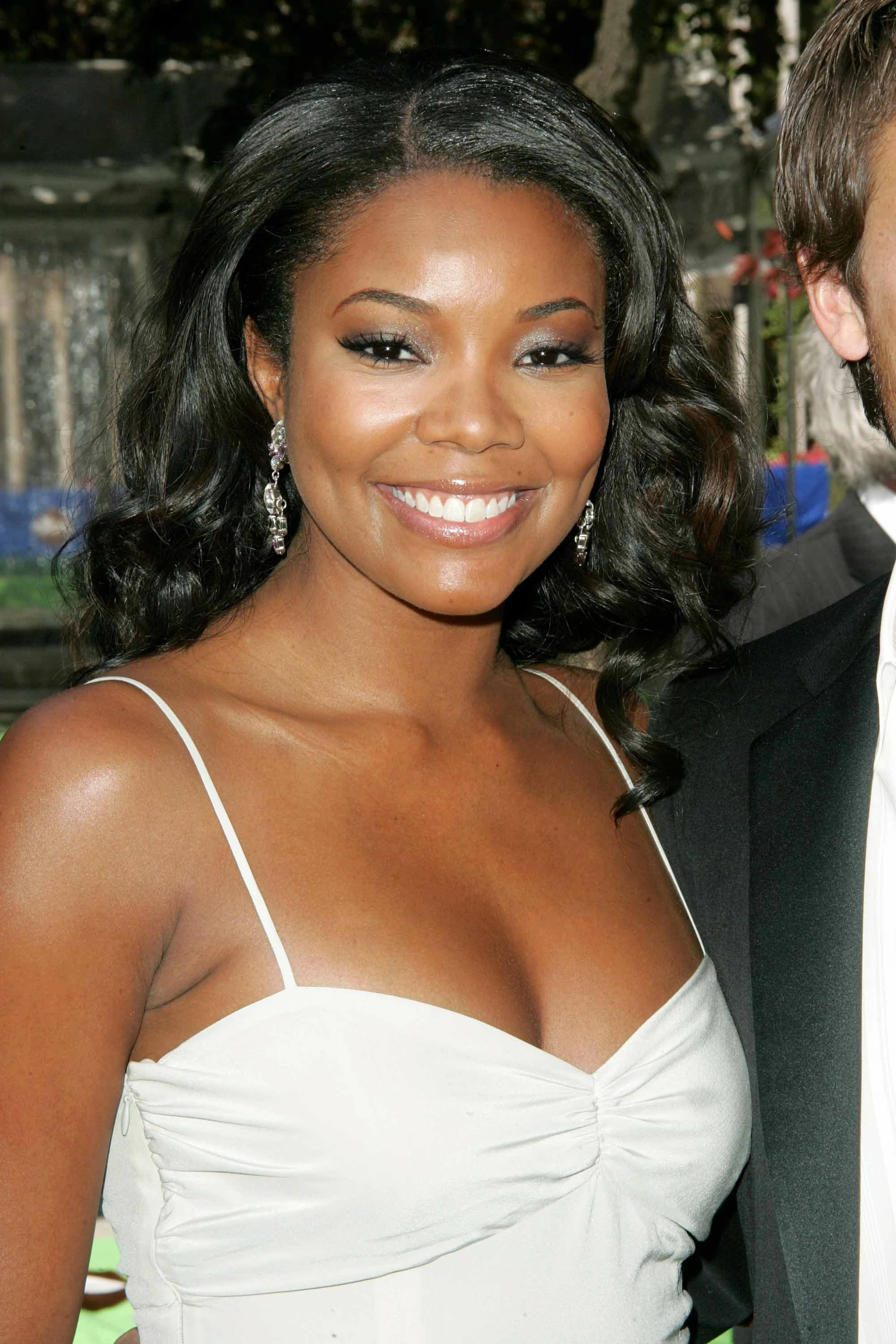
Where her father has been the driving disciplinarian in her life, her mother, Theresa, a former dancer, has been the nurturing, artistic influence. Her mother’s family, the Bryant-Fishers, is one of the oldest and largest black families in Nebraska. So entrenched are they that as part of their annual weekend-long August reunion — 85 years and running — the family stages their own parade down 24th Street. Union recalls that after her family moved from Omaha, where her father was an AT&T manager and her mother a social worker, her mom would take her and her two sisters to such Bay Area cultural events as poetry slams, ethnic festivals and gay pride parades. Union, a tomboy at heart, was 8 when she left Omaha but her ties led her to attend the University of Nebraska-Lincoln, whose women’s soccer team she competed on and whose football team she still madly cheers. Homesickness soon led her back to the coast, where she attended Cuesta College in San Luis Obispo before entering UCLA. After getting her B.A. she considered law school before being “discovered” at the Fontaine Modeling Agency.
Despite lacking a prestigious acting school pedigree, Union said, “I feel confident about what I bring to the table.” In a sense, she’s been in training from the start by being a keen observer. “I’ve always been the kind of person, even as a young kid, who would just sit somewhere and watch people. I’ve always been fascinated by human nature and by what motivates people to do certain things…and that’s kind of a big chunk of acting. That, coupled with the fact I was a sociology major and wrote tons of term papers on inter-group conflict and on what makes people tick…which is a lot of what goes into theater studies.”
Then, she said, there’s the side of the profession no drama school can simulate. “Nothing prepares you for Hollywood. There’s no class on how to deal with a psycho director or a co-star on cocaine or on how to get along with people. Those are just sort of common sense things and a lot of that goes into who works and why. A lot of it is just like manners. Being on time. Working well with others. Literally being one of those people that others like to spend three or four months out of a year with. Part of that is definitely being professional, but part of it too is not taking yourself so seriously that you don’t have a good time. I mean, if I’m going to work in Miami I’m taking a very professional attitude, which means I’m going to be at work on time, I’m going to know my lines, I’m going to hit my marks and you’re not going to have to wait for me. But I’m also going to have a good time while I’m there. No one’s ever going to accuse me of being a fuddy-duddy.”
The vivacious Union is also no shrinking violet. Having grown up in the suburbs, she’s used to being “the black girl” in classes, on teams and, more recently, on sets, which means taking on “the responsibility of sort of educating people, correcting people and letting people know…little different nuances of race and class. It can be a little tiresome. It’s so much different on the set of a predominantly minority cast and crew, when you can free yourself up to just work and not have to worry about somebody saying something offensive or not understanding why I need a black hair stylist or why pink lipstick doesn’t look so great on a black person. It’s nice not to have those little struggles.”
Union is riding a wave that is seeing a more inclusive American cinema than, say, 10 years ago. But, as she can attest, Hollywood is still no where near to being as diverse as the society it purports to mirror. “There’s so much more that needs to be done for minorities, period, just to make films reflective of a multicultural America. Unfortunately, most of the writers employed come from privileged, homogeneous backgrounds not representative of the changing face of America, especially among younger people who, with the infusion of hip-hop, have a completely different mind-set,” she said. “For the younger generation, it’s not a big deal to have a black person kissing a white person or to have a Latino and an Asian as a couple. If those are the dollars Hollywood’s trying to get, then the projects need to be reflective of those attitudes, which are much more open.”


Casting, she said, is still replete with racism. While Berry broke down barriers playing a Bond girl, the buzz behind that “goes away and it’s back to fighting to play certain roles not written race specific. Why does the star’s secretary have to be blond? Why does Tom Cruise’s love interest have to be white? What’s the problem?” More insidious, she said, is the practice of casting light-skinned minorities in positive roles and dark-skinned minorities in negative roles. “When I was auditioning to play the pretty girl friend or the well-educated snob, the other girls in the room were either very fair or biracial and it was like, OK, clearly we have a mind set about what’s attractive, what’s well-to-do and what those faces look like. But a single mother crack-head who just lost her baby’s daddy to a gangland shooting, oh yeah, those girls are going to be dark. It’s just what people feel comfortable with I guess. It’s weird. But hopefully we’re slowly changing that.”
Along with her counterparts, Union hopes to open doors for more actors-of-color. “People in Hollywood always say, It’s not a black thing or a white thing, it’s a green thing, and in a sense that’s true. I’ve been lucky enough that some of my films have made money. Deliver Us From Eva made triple its budget, which you can’t say about many other movies, and that means something to Hollywood, which says, Here’s a movie about four sisters who all have jobs, who all have relationships and it made made money — Hmmm, let’s have more of this.”
Black or white, part of being a starlet in Hollywood is glamming it up, something Union, who can otherwise be found kicking it at home in sweats or shorts, enjoys doing for occasional magazine spreads and industry bashes, when she looks as cool and posh and fabulous as anyone. “It’s an escape from reality and a nice release to be a part of that whole Hollywood glamour machine,” she said. “It’s a lot of fun, but it’s not something I could keep up every day, certainly.”
She still gets back to Omaha, most recently for the January funeral of her great-grandmother, Ora Glass, who was 110. And she keeps tabs on other native Omaha film artists, such as actress Yolonda Ross (Antwone Fisher). An admirer of Alexander Payne, who’s a fan of hers, she said if he ever shoots in town again she’s “willing to be a P.A. or grip to help him around north Omaha,” adding with her typical sauciness, “I love his work, but you don’t see all of Omaha reflected.” Hint, hint.
Related Articles
- Gabrielle Union & Dwyane Wade: Hard Rock Hotties (justjared.buzznet.com)
- Gabrielle Union joins possible “Army Wives” spinoff (reuters.com)
- Gabrielle Union & Jamie Foxx Get Cozy In Vegas [PHOTOS] (hellobeautiful.com)
- The Ties that Bind, One Family’s Celebration of Native Omaha Days (leoadambiga.wordpress.com)
- Native Omahans Take Stock of the African-American Experience in Their Hometown (leoadambiga.wordpress.com)
- Back in the Day, Native Omaha Days is Reunion, Homecoming, Heritage Celebration and Party All in One (leoadambiga.wordpress.com)
- Omowale Akintunde’s In-Your-Face Race Film for the New Millennium, ‘Wigger,’ Introduces America to a New Cinema Voice (leoadambiga.wordpress.com)
Ron Hull’s magical mystery journey through life, history and public television
July 11, 2010
5 comments
For years I only knew Ron Hull through the prism of television. He was an affable, erudite executive and sometime host on the PBS affiliate in my state, Nebraska Educational Television. I knew that he was a friend of Dick Cavett‘s and over the years I prevailed upon Hull more than once for his help in contacting Cavett for various projects I was working on. But it wasn’t until a couple years ago I finally met Hull, who proved as amiable and generous in person as he was by phone. I long wanted to profile him but had never quite gotten around to it. Then a couple things happened: In the course of interviewing Cavett, the former talk-show host mentioned some things about his longtime friend Hull that peaked my interest even more; and then I read a local newspaper story about Hull that hinted at some colorful origins I wanted to flesh out in more detail. That’s exactly what I do in the following profile, which originally appeared in the New Horizons. By the way, this blog site also contains some of the articles I’ve written about Cavett and at least one of those pieces references Hull.
Ron Hull’s magical mystery journey through life, history and public television
©by Leo Adam Biga
Originally published in the New Horizons
Only recently has Nebraska Educational Television pioneer Ron Hull, 77, come to appreciate the remarkable arc of his life, one that’s literally gone from bastard child of a bordello to chairing the board room.
“I went from that situation to this situation. It’s incredible when you think about it,” Hull said from his NET office in Lincoln.
His journey’s taken him around the world, introduced him to legends, given him access to inner circles of power and allowed him to indulge his love for the arts, the humanities and history. Perhaps none of it would have happened if not for the kindly madam, Dora DuFran, whose house of ill repute he began life in.
He’s come a long way from that dubious start in a Rapid City, S.D. den of inequity. He never knew his real parents. His adoptive parents, who got him as an infant, gave him a good home in town. His father was a mechanic and his mother, a former country school teacher, a realtor. His dad opened his own garage and used car lot. His folks made extra money buying old properties and renovating them for resell.
“There was never any doubt about how much they thought about me. I couldn’t have had better parents,” Hull said. “Coming out of the Depression my parents had nothing except each other and lots of integrity. But they really worked hard. They were very industrious people and they gave me every opportunity. I’m very lucky.”
From such modest roots, he’s forged a substantial public television career here and in the nation’s capitol. The Nebraska Broadcasters Association Hall of Fame inductee helped build the statewide NET network, considered one of the best in the PBS chain, and once wielded major influence in Washington, D.C.
In the course of his work he’s developed friendships with notables from the worlds of stage, screen, literature, media and politics. Talk show host Dick Cavett is a pal.
His much-traveled life has taken him from the Black Hills to Hollywood to New York City and back to the Midwest. Except when he worked back east as an executive with the Corporation for Public Broadcasting and with the Public Broadcasting System, Nebraska is where he’s made his home since 1955. There have also been extended stays as a guest lecturer in international broadcasting in Taiwan and as a television advisor to the government of South Vietnam during the Vietnam War.
The Lincoln, Neb. resident is still very much a citizen of the world. He’s as likely to be visiting favorite haunts in Manhattan or Los Angeles or off on some adventure in Asia, Europe or Africa as he is to be at home. He has friends all over the world.
After 52 years in public TV he’s still in the game. He serves as a special advisor at NET, where keeps a hand in programming, archiving, fundraising and just about anything he cares to involve himself in. He also teaches international broadcasting at the University of Nebraska-Lincoln, where he’s a professor emeritus.
History, though, remains a top priority for the man who helped initiate The American Experience, the acclaimed documentary series that remains a PBS staple. He pushed for the series while director of the CPB Program Fund, a $42 million annual kitty he controlled and doled out to producers from 1982 to 1988.
His D.C. stint taught him the vagaries of power and politics. Producers seeking funding for their projects schmoozed him. He had to separate what was real from what wasn’t. “Every morning I’d get out of bed the first thing I’d say to myself was, ‘It’s the money they like.’ That really kept me on a pretty even keel.” The CPB board he reported to was comprised of Presidential appointees who displayed their partisan colors. As conservative Republicans exerted more influence, he left.
Back home he’s nurtured NET’s film production unit, whose Oregon Trail, Willa Cather, Standing Bear and Monkey Trial documentaries have aired nationally. He’s the founder and director of the Nebraska Video Heritage Library, an archive of thousands of programs that touch on life in the state over the past half-century. Among these gems are interviews with Nebraska writers John G. Neihardt, Mari Sandoz and Wright Morris, actress Sandy Dennis and entertainer Dick Cavett as well as coverage of legislative sessions, political campaign debates, et cetera. Hull’s enlisted Cavett’s interviewing-vocal talents for many NET and UNL projects.

The history bug first bit when Hull produced the NET series, Your Nebraska History, which led to an association with Sandoz, whom he convinced to do several shows. He’s headed the Sandoz Society. He’s served on the board of the Willa Cather Pioneer Memorial in Red Cloud. Then there’s his decades-long work with the Neihardt Center in Bancroft. He emcees the annual Neihardt Days. Neihardt was another key figure in the early life of NET, he said, as the poet’s appearances lent credence to public TV as a prime cultural source. Hull also led the Lewis & Clark Bicentennial Commemoration committee for seven years.
Hull’s made it his mission as a broadcaster to satisfy what he says is a basic human desire for people “to know who they are” and “where they come from.” He often refers to something Cather noted. “She said, ‘The history of every country begins in the heart of a man or a woman.’” These questions and concepts have taken on personal import for Hull ever since learning at age 15 that he’s adopted.
“I discovered it by accident…I found a birth announcement in my grandmother’s house. Of course she disavowed that. I’m sure she was so embarrassed. I have to hand it to all the relatives. Nobody ever talked. Nobody ever told me. Not my grandparents. Not my aunt who lived nearby. Nobody. They had to of known.”
He didn’t broach the subject with his folks right away.
“I didn’t have the nerve to ask my parents,” he said. “It was about a year later I went down to the courthouse to check the birth records because I knew I was born in Pennington County. I took my best friend. We said were on a school assignment and had to see our birth records.
“They looked up my friend’s. ‘Yep, here you are,’ the clerk said. Then my turn came. ‘You’re not here.’ I said, ‘Well, I have to be. I know I was born in this county. If I was born in this county and I’m not listed here, why not?’ The clerk said, ‘Well, I’m sure this isn’t your case, but illegitimate children aren’t listed in the county of their birth, those records are at the state capitol in Pierre.’”
The disclosure, Hall said, was “a big clue.” As those records were under seal, his search was stymied for a long time. Unable to keep silent anymore, he confronted his mother. She admitted the truth. “She told me as much as she could. She didn’t know much,” he said. “She had a friend, Mrs. Benjamin, who ran the social agency and she told her they’d like to adopt. She liked my mother” and an arrangement was reached to contact the Halls should a child come available.
From the time of these revelations Hull’s life’s been all about seeking answers. His search intensified over time. In 2002 he obtained a court order to unseal his birth records. The discovery of his true identity and the unusual circumstances that led to his adoption made his journey from townie to sophisticate all the more unlikely.
The brothel he entered the world in was owned and operated by one of the American West’s best-known madams, Dora DuFran. “She’s a colorful character. I’ve done a lot of research into her,” he said. DuFran got her start in the sex trade in Deadwood, S.D., that infamous frontier outpost of wild and woolly goings on.
A late 19th century immigrant from England, DuFran settled in Nebraska before making her way north to Deadwood, a gold rush town she cleaned up in. She expanded to run stables of sporting girls at brothels in Sturgis, Rapid City and Belle Fourche. Like many a successful madam she cultivated strong allies in the form of her gambling magnate husband, Joseph DuFran, and local authorities, whose ranks no doubt included regular customers.

Deadwood
It was in Deadwood DuFran befriended Calamity Jane, a former scout under William F. Cody, aka Buffalo Bill, whose Wild West Show she performed in. Renowned for her horsemanship, shooting and rowdy ways, Calamity knew iconic gunman-turned-lawman Wild Bill Hickok. A young Calamity once worked for DuFran and when down- and-out near the end of her life DuFran took her in. Hull’s link to the notorious DuFran and her historical cohorts is more than passing. Among other things she was a midwife and, yes, it turns out she delivered Hull. On his birth certificate the word physician is crossed out. Written over it is “midwife” and “Dora DuFran.”
“And I only know this because my mother told me,” Hull said, “but Dora DuFran carried me herself down to the Alex Johnson Hotel where the social office was and gave me to Mrs. Benjamin. Mrs. Benjamin called my mother up and said, ‘Come and get him,’ and that was me. So, anyway, I owe Dora DuFran a lot.”
As a teen Hull worked as a bell hop summers at the Alex Johnson. He didn’t know then his connection to it. “I always wondered what brought me to apply there, but I never figured it out,” he said.
DuFran’s Rapid City house also served as a popular speakeasy during Prohibition. Upon her death in 1934 the Black Hills Pioneer referred to her as “a noted social worker.” Her grave in Mount Moriah Cemetery in Deadwood, which Hull’s visited, is near Calamity’s and Wild Bill’s plots. DuFran’s grave features four urns, each adorned with grinning imps in recognition of her four houses of pleasure. She authored a 1932 book entitled Low Down on Calamity Jane that contained her recollections of “the untamed woman of the wild, wild west.”
What Hull’s learned about DuFran, he likes.
“She was that proverbial madam,” he said, referring to her reputed heart of gold. “The sheriff, the police — everybody loved her. She’d be down at the railroad station on Thanksgiving bringing hoboes and bums back to her place to feed them Thanksgiving dinner. She was a midwife, she was a lot of things. And I was born in Dora DuFran’s house of prostitution in Rapid City. She had nine girls working for her at one time. It was a thriving business.”
This “back story” of unwanted pregnancy, abandonment and adoption has given Hull an inkling as to why he’s felt compelled to continually prove himself and why he’s rushed off to faraway places in search of some larger meaning.
“I can tell you one thing, I’m very sympathetic to anybody that’s adopted because if they’re like me you eternally wonder why somebody didn’t want you,” he said. “You could couch it another way. You can intellectualize it. She couldn’t take care of you, she couldn’t afford you, look how lucky you are…You can do all that, but the bottom line is — why didn’t they want me? And it hurts.
“It’s just something every adopted kid has to deal with…On the positive side, it’s a very powerful motivation to measure up. Am I going to be good enough? You always feel like you have to prove yourself. I decided I’d show ‘em.”
He feels strongly enough about giving lost children a home that he and his wife Naomi adopted their first child, Kevin. The couple added three children “the hard way.” Their son Brandon and his wife Linda continued the family tradition of adopting by flying off to China to bring home a baby girl, Eliza.
Hull continues trying to piece together his own pedigree. He knows the name of his birth mother, Jeanne May Ramsey, but doesn’t know if she worked as a prostitute at DuFran’s house or if she went there for help as “a girl in trouble.” He’s learned the name of his biological father, Paul Vaughn. Again, he’s unsure if he was a john or boyfriend or one night stand. He’s found his given name at birth was Theodore Vaughn Ramsey. Once adopted, his parents named him Kenneth, which he was called for a year or so, before they changed his name to Ronald.
However, he’s been unable to track down any more about his birth parents. “I have had no luck finding either parent,” he said. “I’ve really searched.” He just knows they weren’t married, which explains why his birth certificate has a box checked ‘No’ under the heading ‘Legitimate.’ He said the law changed at some point to remove “the stigma” of illegitimacy on birth records.
The intrigue of his own roots reminds Hull of life’s rich tapestry and how his work as a producer, director and programmer has tried to capture that richness.
He’s found a niche for himself in television, where he’s nurtured a lifelong love for the humanities, yet he fell into the field by happenstance. Still everything he did as a young man prepared him for his career.
Growing up in Rapid City his passion for the arts made him an odd duck. “I had certain proclivities for music,” he said. “I took piano. I loved theater.” He loved to read. His parents, meanwhile, “were not cultured people. They loved to dance, they loved to play cards. They had a lot of friends. They were very social. But I had the tickets to the concert series, to the Broadway theater league, they didn’t. All those things, from the time I was in the 7th grade, they saw to it I had them. You just have to say I was cut out of a different piece of cloth, and they knew that.”
He was delighted to move with his parents to North Hollywood, Calif. for his junior year of high school. “They always saw that as the end of the rainbow,” he said. “While I was perfectly happy out there my parents weren’t. It was just too hard for them to sever all the friendships, ties and everything. They realized they’d made a mistake.” He moved back with his folks for his senior year in Rapid City. It wasn’t long before he returned to Calif. — this time to study theater at the then-College of the Pacific. He gained valuable experience on stage in high school and college.
Hull once again went home, this time to please his strong Methodist parents by completing his theater studies at Dakota Wesleyan, a church-affiliated school in Mitchell, S.D. He and Naomi met there. Upon graduating Hull heeded the call many young people feel — to make it in the Big Apple. The military draft was hanging over his head and he, Naomi and friends opted to try their luck in New York.
“I just knew we had to get Manhattan under our belt. I knew an educated person had to have an appreciation for New York City — that’s the Acropolis of our culture. We all got jobs. Our intent was to see every play on Broadway and if we really saved our money — the Starlight Roof at the Waldorf Astoria.”
He also hoped to break into the New York theater world. “Yeah, that was always in the back of my head,” he said. Then, just as he feared, he got drafted. He wound up at Fort Sill, Okla., assigned to Special Services. He worked as a recreation equipment clerk — “…the most boring job in the world,” he recalled.
One day a sergeant came by and changed his life forever. A check of Hull’s file showed his theater background, which was enough for the young private to be offered a new job producing a TV show on Fort Sill for the post’s commander. Sensing a golden opportunity, Hull fibbed when he told the sergeant he knew something about TV when, in fact, “I didn’t know anything.”
Given only days to prepare a script, he went right to the base library to learn the basics. He spoke to a director at a local station to learn what cameras do. Before he knew it he was lining up members of the 89th Army Band to play music and signing up the wife of a major to sing in the studio. That just left interviews with soldiers coming back from or going off to Korea.
Producing-directing-writing-emceeing all came naturally to the then-22 year-old, which he chalks up to the fact that “I had a lot of experience in plays by then in summer theater.” He did 95 weekly TV shows before his hitch was over, enough experience to convince him he wanted a career in television.
“I thought, This is pretty good for me because, you know, television combines any aspect of life you want. I mean, there’s music, drama, culture, news, public affairs, documentary. It’s the whole thing.”
He used the GI Bill to study television at what’s now known as Syracuse University’s Newhouse School of Public Communications, where he earned a master’s degree. He’s since been invited back to speak as one of its distinguished alums. Naomi was with him at SU, working in the speech department. “That was a wonderful time in Syracuse. We loved it,” he said.
Hull assumed he would go into commercial broadcasting but while at SU he heard about this newfangled educational television “where you might do something, like Pollyanna, to improve people’s lives, and that really attracted me. Everybody said, ‘Well, you don’t want to go into that because you don’t make any money.’ They were certainly right about that,” he said, smiling.
He hit the road in search of a job, traversing the Midwest and South on a Greyhound Bus. “California was my goal — that golden green place out there,” he said. Except he didn’t go there. Instead, he stopped in Denver, Amarillo, Oklahoma City, Memphis, Atlanta and Chicago, leaving his resume everywhere he went, getting interviews here and there. Mostly he applied at commercial stations. Then he heard about an opening at the fledgling educational station in Lincoln, Neb.
“By this time I’d been on the road for about two weeks,” he said. “I was exhausted from the bus, from everything.”
He interviewed with Jack McBride, the father of NET and the man Hull considers his best friend. The final interview was with the university’s crusty old PR man, George Round. Hull, who had other offers, was noncommittal. Finally, Hull said, an impatient Round bluntly asked, Listen, do you want the job or not? Well, yeah, OK, Hull replied. “And I took the job,” he said. “I didn’t plan to stay here.” But Hull fell in love with Nebraska and its people. He’s remained loyal to his adopted state. He’s always returned to live here, even after extended stays abroad and back East.
“I don’t know if this place has claimed me but I certainly have claimed this place. It’s just who I am, you know. It’s where I established my family. It’s the values of the Midwest I revere. I think the people out here know how to work really hard and are basically honest. You can trust them.”
Among the first people he and Naomi met here were the parents of Dick Cavett. The Hulls, Cavetts and some other couples formed a social-cultural club called the CAs or Critics Anonymous, whose motto was, We criticize everything. A young Dick joined in on some of the activities. Hull and Cavett became close.
Upon accepting the state’s 2000 Sower Award for Humanities, Hull articulated the symbiosis he feels with Nebraskans. “We’re talking about relationships when we talk about the humanities,” he said “To me, relationships are the essence of our lives, the relationships that we have with each other…how fortunate I am, how thankful I am to have the privilege of being a part of you…in this state.”
In a real sense Hull feels he’s a steward for the state’s culture and history, not surprising when you realize he was there nearly from the start of what became NET. He arrived in October 1955. KUON had gone on the air only the previous November — the ninth public TV station to transmit. It was a humble launch.
“There’s nothing like starting at the beginning,” he said. “There were four of us. I was a producer-director, I wrote the continuity…You did everything. We were completely live. We had to be because we had no videotape, we had no network. We shared a studio with KOLN Channel 10. Our signal’s radius was maybe 35 miles.”
Live TV offered a visceral, ephemeral, enervating experience unlike any other.
“I really miss the live shows,” he said. “It makes such a demand on the people in front of the camera and behind the camera that you get a level of energy going all around. Every nerve ending is alive. It’s electrical. You can sense it, you can feel it. We used to say, ‘Poof in the night.’ You can’t replicate those experiences.”
On the down side, he said, “we made some terrible gaffes. You’ve got to be grateful there’s nobody to play those back.” A memorable one he recalled came when, “while introducing a travel film ‘live,’ our host, smiling into the camera, said, ‘Today we visit Hawaii — those lovely islands of beautiful beaches and flat sandy women.’”
Hull said video-digital technology not only eliminates the possibility of most mistakes, it “serves the viewer in the long run” by affording repeats. But he said live TV “was a little more honest” than today’s canned version.
He recalled an example of spontaneity that could never happen now.
“I was directing an interview with (Neb. Gov.) Frank Morrison, a big, lanky wonderful man. I’m sitting at the counsel (control booth) and the phone rang. ‘Hello.’ The voice at the other end said, ‘Ron, this is Maxine.’ ‘Oh, yes, Mrs. Morrison.’ ‘Tell Frank to sit up!’ ‘Yes, Ma’am.’ So I told the floor manager, ‘Make a big sign saying, Frank, sit up! — Maxine. I can still him going, Ohhhh…rolling his eyes and sitting up. Well, that’s live, interactive. It’s a different level of communication.”
Being responsive to people is a big part of public television.
“To me, one of the important things about public broadcasting is never to lose that local connection with local Nebraska people,” Hull said. “They own the station. So you’ve got to be in communication with them at every level you can be by listening to what they say and providing the things you think are useful to them and their lives. And we’ve always run this place based upon that.”
Legislative support for NET “has been wonderful,” he said. “They’ve provided us state-of-the-art equipment — millions of dollars worth. They believe in it.” Despite budget-staff cuts, NET boasts fine facilities, adequate resources and top talent.
Even as the Internet threatens TV’s hold on mass communication, the medium still reaches huge audiences and affords the possibility of informed public commerce.
“We’re trying and I think we’re getting closer and closer to make public broadcasting the central meeting place, the town hall where the issues are debated, where people have a say. I don’t detract from what commercial television does but we are the last vestige of local programming and documentaries.”
Where commercial TV once considered news-public affairs a higher calling, distinct from entertainment, he said it’s now part of the profit line along with situation comedies and reality shows. Networks and local stations don’t produce documentaries the way “they used to,” he said. “Those are expensive and nobody spends that money anymore. But you look at our schedule and we spend 600,000 bucks on Willa Cather: The Road is All documentary. That takes two years to produce but what you get is something that is worth people’s time to watch.”
Hull’s belief in the public service potential of TV remains undiminished.
“Television affects how people think. It goes right into their heads,” he said. “It is a terribly, terribly powerful instrument of persuasion that has the potential to be used for the good of the common man. I always identified with that from the beginning. The measure’s always been — Is this going to enhance somebody’s life?”
That doesn’t mean skirting hard realities or controversial subjects, he said, “because you have to show the other side of things and people have to be able to make up their own mind about things. But basically I have believed from the beginning we have an opportunity to make people’s lives better, to give people a perspective on the world and their place in it they can’t get any other way.”
He points to NOVA, Frontline, The News Hours, American Experience, American Masters and Great Performances as TV at its best. “To me, those series are the most thought-provoking, serious programs available to the American public.” Hull is proud, too, of public TV’s noyed work in children’s programming, led by Sesame Street, and how PBS has carried fare its commercial counterparts do not, such as American Playhouse, Meeting of the Minds, Steambath and Anyone for Tennyson?
New York producer Bill Perry had pitched his concept for Tennyson — mini-dramas bringing to life history’s great poets and their poems — to no avail until he approached Hull. “I liked the idea,” Hull said and the two put the series together at NET, enlisting such “brilliant actors” as Henry Fonda, Jack Lemmon, Claire Bloom, Irene Worth, Ruby Dee and Vincent Price. Hull became close friends with the show’s “first-class director,” the late Marshall Jamison. Hull, who calls the show “my favorite,” said it may have had a small audience but it made a big impact.
“I’ve never ever believed in measuring our success by the number of people who watch,” he said. “Rather you measure your success by what effect you had on people. It’s really hard to measure, but I prefer to believe there are people out there who learned from these programs.”
Similarly, he believes the programming he did in Vietnam made a difference. His experience trying “to win the hearts and minds” of its people gave him a new outlook on public service. Desiring an overseas adventure he parlayed state department contacts to get assigned a foreign service post as a TV advisor to South Vietnam. He was there in ‘66-67 and periodically the next few years to oversee construction and operation of stations in Saigon and outlying cities. Programming centered on public health and education — from potable water to immunizations.
The war raged around Saigon and casualties did not exclude those in the TV ranks.
“During the (1968) Tet Offensive all of our American engineers working at the Hue station were marched off and shot. I wasn’t in-country at the time,” he said.
He arrived in Vietnam a supporter of U.S. policy there but left convinced America “had made one of the major blunders in our country’s history.” He found distasteful the role that he and other Westerners played as outsiders looking in.
At the fancy Caravel Hotel in Saigon he and other noncombatants from the Free World bent their elbows at the rooftop Romeo and Juliet Bar. A frequent drinking companion was correspondent Peter Arnett. “We would look down at those streets to the Saigon River, the area beyond all controlled by the VC (Viet Cong). We would watch planes fly in and see the tracers any night of the week. The flares lit up the countryside. And we’re sitting there — who the hell are we? — drinking our little wine…I’m not proud of that,” he said. “But that’s the position we were in.
“Everybody who was there has to deal with the fact they were part of that war — I don’t care who you were or what your job was.”
Hull returned to Vietnam in 1999, in part to see the fruits of his labors there. Before going he was advised by foreign service veterans not to expect too much in the way of visible, tangible progress from the project he’d led.
He went to the very station in Saigon, now Ho Chi Minh City, he’d officed in decades earlier. He met with the station manager, a reserved man in a military uniform. The man answered Hull’s questions without any elaboration. Anxious to know more, Hull confided, “I was here teaching your people how to run this station in 1971-72. Where were you?” Hull said the manager “looked at me and said, ‘I was in Tay Ninh Province in the People’s Revolutionary Army. Mr. Hull, you and I were not on the same side.’ And then I knew where he was coming from. I said, ‘I knew what your people wanted. They wanted one Vietnam, one country. I am really happy you have your country.’ With that, his defenses went down. He showed me everything.”
What Hull saw impressed him. “My gosh, they had the news in French, Vietmanese, English. There was a ballet going on in one studio and the news being set up in another studio. The place was vibrant, alive and kicking, fabulous. I walked out of there with a happy heart. They’ve taken what we did and they’ve thrived.”
Asia is one of his favorite regions of the world. He occasionally visits China, where he stays with friends. On his last trip there he traveled via the Trans-Mongolian Railway from China to Russia, where he continued his trek on the Trans-Siberian Railway into Moscow. “It’s a fabulous trip. The cultures are fascinating,” he said. He continued on to Copenhagen to visit more friends. “I love travel,” he said.
An annual international broadcasting convention he attends takes him to exotic places. The next is set for Johannesburg, South Africa. He’s anxious to go — ever curious, ever eager to seek out new experiences.
“One of the secrets to having a good career is having a good time,” he said. “I always tell my kids, ‘If you’re not having a good time, you’re doing something wrong.’ It’s how I’ve lived. That’s the only way you stay healthy…”
Still, never far from his thoughts are nagging questions that may never find answers.
“I did find my niche in life, although I am forever this insecure, why-did-they-throw-me-away person who is still searching for Shangrila.”
Related Articles
- PBS chooses Bellingham to show sustainable economy (seattletimes.nwsource.com)
- PBS Ombudsman Criticizes Shultz Series (mediadecoder.blogs.nytimes.com)
- PBS fund searching for Explorer-friendly pitches – RealScreen (countercultureprodco.com)
Categories: Celebrity, Dick Cavett, Entertainment, Media, Pop culture, Ron Hull, Television, Writing
Dick Cavett, Dora DuFran, Entertainment, History, Mari Sandoz, Media, NET, PBS, Ron Hull, Television
The Saturday Night Bingo Brigade
July 11, 2010
3 comments
I grew up a member of Holy Name Catholic Church in Omaha. It’s the church my parents belonged to. The church my two brothers and I were baptized in, said our first communion in, and were confirmed in. It’s where my oldest brother Greg was married. Greg, my other brother Dan, and I attended the church’s K-12 school. We lived just four blocks from the church and school. For years our later mother worked in the cafeteria kitchen on bingo nights. Ah, bingo. The game was king at Holy Name, where hordes of players turned out and enough money was raked in to help keep the church and school afloat. I never saw more than the periphery of the bingo scene. Finally, a few years ago I decided to write about it. The crowd and the take were significantly reduced from bingo’s heyday, before the casinos across the river, the video slot machines everywhere, and online betting cut into the action, but what was the same was the passion and magnificent obsession of the die-hard players. That’s what I tried conveying in this story, which originally appeared in the New Horizons. It’s one of those slice-of-life stories I like doing from time to time. I hope you like it as much as I do.

The Saturday Night Bingo Brigade
©by Leo Adam Biga
Originally appeared in the New Horizons
Along about 6:30 on a Saturday night in the basement cafeteria of Holy Name Catholic Church, 2909 Fontenelle Blvd., regular troops in the local bingo brigade settle in their favorite seats in anticipation of the first game. Of the 200 or so faithful players gathered this evening, probably a little more than half are senior citizens.
For many in the crowd, bingo is a way of life that finds these dedicated souls playing this familiar game of chance as much as seven, eight or nine times a week. Beyond the cash prizes tendered, the game is a casual, pleasant pastime for widows and widowers alike who feel there are few other recreational options for older adults like them. It is also a relatively cheap night out for senior singles and couples who simply thrive on the gambling action and the laid back socializing that permeate this smoke-filled scene. Tanked-up on coffee and nicotine, the bingo brigade plays on.
Many in the Golden bingo set have been at it for decades. They make the rounds at the various bingo halls, sitting in the same spots and following the same routines night after night. Rituals are a big part of bingo and whether it’s a cherished charm or a favorite spot to sit in or a habitual pregame activity, everyone has their own way of courting Lady Luck.
Over in a recessed alcove is 82-year-old Ada McGargill, taking turns dragging on a cigarette and sipping coffee from a thermos mug. She arrives early to claim her spot and wiles away the time with her nose in a romance novel or playing solitaire. Across from her is retired railroad chef Frank O’Neal, a soft-spoken man of 87 with a display of talismans arranged before him, including a turkey wishbone that he hopes to “bring me some luck.”. A few tables back is retired geriatric nurse Virginia Wilson, a dynamic 80-year-old with a flair for clothes and jewelry and a penchant for laying out a menagerie of elephant amulets she hopes bring her good fortune.

Clear on the other side of the room are sisters Clara Langenbach and Betty Berg, who make a habit of attending mass at Holy Name Church before the Saturday bingo session starts downstairs. Whether they say a prayer to hit bingo or not, nobody knows, but that doesn’t stop friend and fellow player Marie Berg to ask for their indulgences. “If they do, it hasn’t helped me any, I’ll tell you that — because I don’t win very often,” said Berg. Then there is Betty “Bingo” Mittermeier, age 77, who has become a kind of bingo folk hero among her fellow players for her consistent winning ways, which she attributes not so much to luck as to good old fashioned pluck.
These are just a few of the bingo maniacs who frequent the various church and social halls that form a kind of loose bingo circuit in town. The people come from all walks of life and each individual has a story to tell about and apart from bingo. Some come for companionship. Some for love of the game. Some for the slim chance of repeating an earlier success.
Bingo first got in the blood of Ada McGargill as soon as she began going some four decades ago. Her husband was confined to a wheelchair after suffering a stroke and Ada, who cared for him at home, needed an outlet. When her husband died in 1972, she made bingo her great escape from grief and loneliness.
“There isn’t much a widow woman can do,” she said. “I had no desire to date or hang out in a beer joint or anything like that. Bingo is someplace to go. It’s getting away and getting out around people. You make a lot of friends. It’s just a good enjoyable night out for me. It’s something to do, and I guess I like to gamble a little bit.” There is also a certain comfort in coming to the same place and seeing the same faces all the time, said McGargill, who’s been coming to play at Holy Name since the church started bingo in the 1960s. “I see people here that I’ve seen since I started, which is 35 years ago. When I started, priests called the bingo games. You don’t see priests do that anymore.”
Winning a few bucks is another lure. But while McGargill said she has won the $1,000 jackpot six times, she emphasizes that is “not too many times considering I’ve played for almost 40 years.” Her luck has been especially sour of late. “I’ve been in a slump. I haven’t won for a long time. It’s like that. Sometimes you win every time you go, and then you don’t win for a long time.” Unlike many veteran bingo players who abandoned the game for the glitzy appeal of the casinos, McGargill has remained loyal. “I don’t go to the casinos very often. I don’t have that much money. I can sit here all night and play for $15-20, but at the casinos that’s nothing. That’d be gone in 15 minutes.” Her bingo schedule is so regular (“I go just about every night.”), she said, that “if one of my kids needs to reach me, they know to try the bingo halls. They know that’s where I am.”
Barb and Bob Smejkal and Tess Perry have been coming to Holy Name bingo for as long as the game has been played there. They remain faithful players out of a desire “to support the church,” Barb said, and because the cost to play is a lot more “reasonable” than casino gambling. Besides, she said, it offers a night out with “the gang.” For retired Omaha fire captain Pete Peterson, 70, and wife Nancy bingo is extra income — “We’ve been on a pretty good winning streak” — and a way “to just kind of relax and get your head off the rest of the world,” he said.
For Frank O’Neal, a night of bingo relieves the tedium of staying home and watching the boob tube. “TV gets boring. Bingo’s a way of getting out and meeting people. The older you get the more you coop yourself up and the only way for older people to get out of the house is through some recreation like this,” he said. “It’s an enjoyment for an older person.”
Besides, O’Neal has never been one to plant himself in front of the set like some couch potato. He has always had an itch to get up and go places. During a 40-year career as a chef/cook for the Burlington Railroad, the dining car was his privileged perch for seeing America.
“I enjoyed my work and I got to see a lot of the country, too. I started out in Lincoln, Neb. and then I got transferred to Chicago and then from Chicago I ran all over. During the war, I was running everywhere because the dining car went wherever the troops were. I was moving,” he said.
His favorite run, he added, took him from Chicago to California. He feels people of a certain age who only know passenger rail service via Amtrack missed out on a special chapter in American travel. “In the heyday, train travel was special. The food was special. No, it’s not special anymore. When I was riding the railroad we made everything fresh. They don’t do that now. The meals are already prepared and they put ‘em in the microwave. The way we did it, well, that’s something of the past,” said O’Neal, an Omaha native who with his wife raised a family during the Great Depression, when bingo first emerged as a popular game in America.
There’s something about the poised, confident way Virginia Wilson carries herself, even when merely setting up her array of daubing markers and good luck charms, that tells you she is her own woman. Growing up with a passel of siblings in the only black family in Beatrice, Neb., she learned early on about asserting herself.
During World War II she followed her seven brothers in the service by joining the WACs or the Women’s Army Corps. She actually began her tour of duty in its precursor organization — the Women’s Auxiliary Army Corps (WAAC). The pride she feels all these years later about her wartime service is evident in a photo she carries with her. The picture — of herself in her crisp GI-issued uniform — was taken while she was stationed in Paris. In addition to France, she served in England, Germany, Switzerland and Belgium. The experience changed her. Just imagine, she said, the impact that seeing the world had on “a little town country girl,” adding, “When I came out of the service, Beatrice was too small for me.” Her expanded dreams found her studying pre-law at the University of Nebraska-Lincoln before embarking on a career in nursing. She lived and worked in Denver and then moved to Omaha, where she raised three children as a single working mom.

By her own reckoning, Wilson has been a steady bingo player for some 55 years. She feels getting out to play the game beats sitting at home. “I get claustrophobia if I stay home. The walls close in on me,” she said. “Plus, I love to play.” Just how often does she play? “I play bingo every night, thank you.” She prefers the simple, direct charm of bingo to the casinos. “I don’t like to have the slot machines gulp my quarters. I don’t get any enjoyment out of it at all. Bingo’s more fun.”
Winning has become such a habit with Betty Mittermeier that she has not — not even once — dipped into her late husband’s Union Pacific pension checks. Indeed, bingo is such a steady source of income for her, she said, that she thinks of her playing nights as “my part-time job.” Recently widowed, Betty and her husband of 59 years raised five children. She used to take her youngest son with her to bingo, where she would play while he built model airplanes. Children are no longer allowed on the premises. Her magic at bingo has been there from the very start. She still wins money virtually every night and her success is so well known that she answers to “Betty Bingo” and finds players coming up to her and rubbing her for good luck, something she is not fond of, by the way. Mittermeier, who plays a large number of cards, doesn’t believe her success is due so much to luck as to persistence and to her increasing the odds in her favor by playing dozens of cards.
It is not uncommon for players like Betty to play up to 100 cards at once between the paper and the electronic bingo games offered. But the more cards one plays, the more money it costs and some folks, like Ada McGargill, cry foul. “Some people are playing 96 cards, and I can’t afford to do that. Most of us can’t afford to do that. So, they spoil it for everybody else, because they win all the time.”
Whether one wins or not, it is the mere possibility of hitting bingo that hooks people and keeps them coming back for more. “It’s the anticipation of how you’re going to do,” said Barbara Finkle, 68, a longtime player around town. “That’s what it is. Everything leading up to it is the exciting part of it. A couple of times I’ve won a $1,000 jackpot, but that’s not very often, let me tell you. But I keep coming back. I’m a sucker.” Or, as a regular at the Holy Name bingo game, John Speese, put it, “One night I did get the jackpot, and that’s what I keep coming back for.”
Yelling out “Bingo,” is nice, as is the cold hard cash a winning hand provides, but the real appeal for players like Marie Beran, 86, is the personal interaction the game affords. A widow whose children and grandchildren live outside the state, Beran would be alone without her bingo family. “I’m all by myself. All I have left is my bingo friends,” she said. “That’s my life — my bingo. If it wasn’t for that, I don’t know what I’d do.”
An every night player, she eats all her meals at bingo. She has been playing for more than half a century, making it a daily and sometimes twice a day affair since her husband died on their 52nd wedding anniversary in 1991. He had battled bone cancer for years. Marie had stayed home to care for him. After losing him and without any other family nearby, her life began to revolve around the game. She is independent enough to still live in her own home and to drive. “If it gets to the point I can’t drive anymore,” she said, “why then I’ll do something else. I just take it day by day.” She believes even more than the camaraderie she finds at bingo, she benefits from the activity it provides. “If you keep active, I think you keep going. Otherwise, I think you sit in a rocking chair and get old.”
Aside from the stimulus that a little gambling action affords, there is the concentrated focus bingo demands, which is not unlike completing a crossword puzzle. Aging experts agree such mental activity is healthy for older people. The focus required increases when playing paper bingo, where row upon row of numbers must be examined and matching numbers marked or daubed. “It takes concentration, especially when you’re playing a lot of cards,” Barbara Finkle said. “I play the paper because I like to be busy daubing. There’s definitely an art to it.”

(Photo by Bill Kelly, NET News)
Indeed, once a game begins and the first number called out, paper players are studies in concentration. An observer on the scene notices several things. First, the pregame drone of gabbing and chitter-chatter falls to a whisper, like in a church, which is ironic since Holy Name Church is directly above the bingo hall. Finkle said there is an unwritten rule to maintain silence when playing, something newcomers unknowingly violate through idle conversation.
“When you get some people in that haven’t played very much, they don’t realize that you should really be quiet and not talk during the game because people are trying to concentrate,” Finkle noted. Hushing such noisemakers is not uncommon. After all, as fellow player Clara Langenbach put it, “It’s serious business.” Then, once the game proceeds, it as if everyone has begun praying. There is a mass of furrowed brows and bobbing heads as each player first tilts their head upward to intently, silently, almost reverently scan the closed circuit TV or tote board for the current number in play and then bows their head back down to examine the sheets spread out before them in search of the corresponding number.
Next, you observe how the dauber is grasped in the hand and positioned above the paper like a fine brush held by an artist over a canvas. With each matching number, the inking begins in what can only be called brush strokes, and soon the sheets resemble the cross-hatched blotchings of a modern art painting. During the game, floorwalkers sell special games and pickle cards. Some in the crowd leave their seats to grab a snack, use the restroom or catch some fresh air. Most winners react in a fairly subdued manner, which is natural considering most payouts range from $20 to $100, but the $300 and up winners do occasionally hoot, holler, hug their neighbors or dance a jig in celebration.
Bingo attendance is not what it used to be. Many players left bingo behind once Council Bluffs opened its casinos. Still, enough loyal players remain to make the game a viable attraction for folks who don’t care for the casinos or can’t afford them. Like many parishes over the years, perpetually cash-starved Holy Name has sponsored bingo for decades as a prime source of income to help subsidize its church-school operations.
In addition to the games held in the cafeteria on Wednesday and Saturday nights, Holy Name also conducts bingo in a social hall at 60th and Hartman on Thursday and Sunday nights. Bingo once ruled at Holy Name. Game nights attracted near-capacity crowds on a regular basis. But then the state legislature imposed new restrictions on bingo (limiting the number of sessions any one sponsor can hold) and new competition arrived in the form of the lottery and the casinos. The parish’s annual bingo proceeds have fallen from nearly a quarter of a million dollars to about a fifth of that amount since casino gambling opened across the river, according to Holy Name Pastor, Rev. Richard Quinn. He said some parishioners advocate abandoning bingo altogether while others continue to embrace what has become a tradition and a steady, if diminished, revenue stream.
While it is true the casinos have taken away many veteran bingo players, Betty Mittermeier said, so has natural attrition — as more old-time players than she can count have passed away over the years with few new players replacing them. It has gotten to the point, she said, that she and her old time bingo buddies joke with each other that “whoever goes first should save a table for us up there.” While there may or not be bingo in heaven, chances are that as long as bingo maniacs like Betty are still around, the game will continue attracting crowds wherever it is played. Long live bingo!
Related Articles
- Bingo trouble in the cards (dispatch.com)
- Who knew bingo was so funny? (interbent.com)
- Bingo! Not for Seniors Only (nytimes.com)
- Bingo popularity growing uptown (nydailynews.com)
- Underground Rebel Bingo: Balls at the Blockley (independentphilly.com)
Categories: Bingo, Entertainment, Omaha, Pop culture, Writing
Bingo, Casino, Entertainment, Gambling, Games, Holy Name Catholic Church, Omaha, Online bingo, Pop Culture, Slot machine
The Pawnshop Beat
July 6, 2010
5 comments

Image via Wikipedia
The first and last time I walked into a pawnshop was when I did this story. On second thought, I may have been in a pawnshop or two when I was a kid, accompanying my dad on trips to find some bargain items, maybe a guitar for my older brother Greg or something like that. But otherwise my only take on pawnshops is derived from the movies and from books and articles. My research for this story didn’t necessarily overturn any assumptions I had about these places, other than the fact that they can be extremely large and profitable operations with vast warehouses full of merchandise that rival that of discount department stores. This story for the Omaha Weekly may not dispel any of your ideas about pawnshops either, but after doing the piece I did have a better appreciation for why they are so ubiquitous — simply put, they fill a need or demand that all the banks and loan offices cannot. I try in the piece to present the good, the bad, and the gray about these marketplace and moneychanging emporiums, where commerce of all kinds is transacted.
The Pawnshop Beat
©by Leo Adam Biga
Originally appeared in the Omaha Weekly
In what is a combination bazaar, everything-under-one-roof discount store and cash-on-the-barrelhead lending operation, the neighborhood pawnshop offers something for everyone. This marketplace for buying, trading and borrowing is a center of commerce where the down-and-out rub shoulders with the upwardly mobile in a common search for a good deal. From cars and boats to lawn mowers and weed whackers to guns and games to stereos and VCRs to rings and necklaces, pawnshops, which have been called the world’s greatest garage sale, deal in it all.
Because they are also historically dumping grounds for stolen goods, every single transaction is reviewed by law enforcement authorities, who, based on hunches and crime reports, look for red flags in the merchandise moved there and in the profiles of customers doing business there.
You generally don’t seek a loan at a pawnshop unless some life event — usually a bad one — has brought you to one. Maybe you’re out of work or in between pay checks. Maybe your credit cards and checking accounts are tapped out. Maybe your car’s on the blink. Maybe medical bills are due. Perhaps you’ve lost more than you can afford at Harvey’s.
Whatever your story, and there’s a million of them, you find yourself strapped for cash and unwilling or unable to borrow from family, friends, traditional lending institutions and more non-traditional sources like loan sharks. So, you grab whatever possessions you can lay your hands on and hock them for some greenbacks to help you get out of a bind. Often described as the bank of last resort, pawnshops are, for some, a stop-gap money source for when true crises arise and for others simply a way of life whose no-questions-asked ready-cash supply helps folks get by when other avenues are closed.
Jack Belmont, who’s been in the trade since growing up in the Great Depression, explained the basic appeal for people of doing business at a pawnshop as opposed, for example, to a bank. “It’s a quick deal,” he said from behind the main counter at Mid-City Jewelry & Loan, where he is a partner with owner Don Hoberman. “You walk in when you feel you’ve got something to pawn and you make the loan. You can be in and out of here inside of five minutes. You can come back anytime you want. Nobody knows your business. You don’t have to fill out a balance sheet or anything else like that. It’s very convenient, very quick.”
For those engaged in that left-handed form of human endeavor known as crime, pawnshops are convenient places to unload hot property and turn a fast buck, although the chances of avoiding detection are slim. Indeed, if it wasn’t for pawnshops, police officials say, many stolen goods would not be recovered. When stolen property in a pawnshop is detected and its rightful owner contacted to identify and retrieve it, the owner is invariably upset to find out he or she must pay to get the stuff back. This redemption charge, which is usually a fraction of the item’s cost, may seem somewhat heartless but is completely legal.
Clerking at a pawnshop is a little like being a bartender or a barber. Just about everyone who sidles up to the counter has a hard luck story to tell. Saul Kaiman, the introspective bearded owner of Sol’s Jewelry & Loan, which has four locations in the Omaha metro area, said, “When I first started working in pawnshops in the ‘50s I heard so many tales of people needing $50 to get to a funeral that I didn’t think there was anybody left alive in the United States. I was naive. I believed everything they said at first. After awhile, you know some of them are just stories and you just try to keep a straight face,” he said.

Christy, a pretty clerk in Sol’s downtown store at 514 N. 16th Street, said she has heard it all. “We get a lot of people who need help with their bills or need to get their car fixed or need to get their house repaired. Once in a while we get pawners who’ve never pawned before. They have some family emergency and they actually cry they’re so desperate.”
For a gun lover, getting a loan on a prized weapon can be as torturous as giving up a first-born son. At least that’s how painful it appeared for a man wearing a jacket and hat emblazoned with NRA slogans who came to Sol’s to pawn his Mossbach 810 rifle: “My car broke down and I needed to get it working again and this is all I had to get me what I need to get by,” he said, referring to the gun. “It’s a very fine gun. I just want to get it back.” He said it’s the first time he’s had to give up his gun. As with any pawn transaction in Nebraska, he has four months to redeem his weapon, with interest accruing from the date of the loan.
According to Tedi, a pert and petite clerk at Sol’s downtown store, “There’s a lot of people that come in here that feel bad about the circumstances they’re in. I tell them that it’s happened to everybody. That bad stuff happens and we all need money to get out of jams, and that’s what we’re here for. I try not to make them feel embarrassed about. I try to make them feel like it’s OK.”
Don Hoberman, the sardonic owner of Mid-City Jewelry and Loan at 515 So. 15th Street, explained there is an implied Don’t Ask-Don’t Tell pact in place at pawnshops to protect people’s privacy. “You don’t ask them why” they need the cash, he said. “It’s immaterial anyway. It’s their money. They don’t have to tell me why. Some people just walk in, borrow money and walk out. But some people feel they have to, so you listen,” he said.
A pretty but sad-eyed wife and mother of two recently entered Sol’s looking distraught as she used one hand to push an electric snowblower ahead of her and the other hand to cart a camera case. “I missed a payday at work and I needed a little help to pay some bills today. That way I won’t get behind and I know I still have time to come back down and get my stuff out. I’ve been dealing with Sol’s for 10 years and they don’t ask any questions — they just help if they can.” With her $275 loan in hand, she left with a smile.
Customers don’t always leave happy, however. In assessing the fair market value of a pawned item, for example, there is bound to be some difference of opinion. Christy at Sol’s said, “We get quite a few irate customers. They get mad because we don’t give them what they want or they think we’re gypping them. We’re not. We’re being fair with the game. When they sign the contract they know what they’re signing.” Tedi at Sol’s added, “No matter how hard we try to explain the loan process, you get some people that…don’t seem to understand that the item they pawned a year ago and never paid on is no longer here, because if you don’t come back for it or pay on it after four months we can sell it. A lot of times it was a sentimental thing, and they’re angry about it. Like it’s all our fault.”
Then there are the regulars. Take Judy Johnson, for example. She often pawns jewelry at Mid-City to help tide her over when things are tight. “Right now I’m painting my house, and I need extra money” for supplies, she said one morning at the shop. She still has several jewelry pieces in hock.
“I miss them a lot,” she said. She is one of several loyal customers to follow Belmont to Mid-City from the shop he and his late brother ran, and that their late father started, Crosstown Loan, which was located on N. 24th Street until it burned down in the 1969 riot, and which later moved to 16th Street. At Sol’s, the regulars include a mother-daughter combo who say they’re such frequent customers that “they should put a revolving door in for us.” Kaiman said many elderly customers, including a man who pawned his Colt. 38 revolver over and over again, make a habit of pawning as much for the social interaction as for the money.
Hoberman and partner Jack Belmont own a combined 90-plus years in the business. For them, the pawnshop is a kind of social laboratory and money changer in one where the disparate mix of human kind meet to haggle and strike a deal.

So, what’s the oddest thing someone has tried pawning? Hoberman recalled the man who came in once and asked, ‘Do you take anything?’ I said, ‘Yeah.’ He goes, ‘How about an eyeball?’ I said, ‘C’mon quit kidding.’ So, he popped it out and put in on the counter. And I said, ‘Make it wink.’ He couldn’t do it, so I had him put it back.” Then there was the World War II veteran who made a habit of pawning his prosthetic leg, which he never picked up — Veterans Administration Hospital workers did. Hoberman draws the line at living creatures. “We always figure if you gotta feed it or clean it, you don’t want it, so we don’t take it.”
You never know who will show up at a pawnshop, either. Back in the early 1980s then-Governor Bob Kerrey, who became a good friend of the store’s through his predecessor, former governor and senator Jim Exon, whom Hoberman knew from Exon’s days in the furniture business, stopped by to ask, “What do you give somebody who’s a movie star?” Kerrey was referring to his then girl-friend, screen actress Debra Winger. “I told him one of the fashionable things was pearls, and so we acquired 30-inch strand of pearls and he gave them to her for a present. Two day afterwards her picture was taken at some event and she had them on. He sent me the picture. He doesn’t have the girl anymore, but she still has the pearls.”
If all his years in the trade have taught him anything, Hoberman said, it is that people “from all walks of life” — from high rollers to penniless tramps — frequent pawnshops and the thing is you can’t always tell who’s who.
“You can’t qualify who comes through the front door and decide what they’re going to pawn or what they might be able to buy. It’s a lesson I learned a long time ago. I once had somebody pawn a $5 watch and then he wanted to look at a $1,000 ring. And I thought, Well, why should I show him this ring when he’s having trouble getting $5 together?
“But I soon learned you don’t look at it that way. The guy came back and he said, ‘Thank you for loaning me on the watch,” and he walked over to the jewelry case and plunked down cash to buy the ring. You see, you just don’t decide what they can and can’t do by what they look like.” In other words, assuming someone is broke just because he or she needs fast cash is a no-no. “It isn’t always because you’re broke,” Hoberman said, “it’s because you’re short.”
Or, as a distinguished looking black man said one morning at Sol’s, where he was redeeming a bracelet he originally bought there, “I get paid every two weeks and with utilities the way they are and everything in general going up, I get little shortfalls between paychecks, and so pawning’s a matter of just being able to make it and keep everything current with bills, groceries, bus fare and things like that.” He added, “You know, sometimes you don’t want to do it, but it just comes in handy as a safety net. It’s just another tool in helping you make it through.”
Besides, the kind of fast turnover loans made by pawnshops just aren’t available elsewhere. “Say you have a ring you bought at a retail store for $1,000, and now you need $200 for something. You can’t take it (the ring) to the bank because they don’t loan on products like that,” Hoberman said. “Even if the ring was worth $40,000, the bank still won’t loan on it. I have people come in with $10,000 in their pocket. They need another $4,000 to buy something and they’ve got to do it NOW. They come with something we can loan them $4,000 on and they’re out the door and they’re back.”

Hoberman believes most people find themselves financially short due to their own actions or decisions. He points to the casinos across the river as a major reason why some people end up on the margins or fringes. He said where items were once being redeemed at a nearly 80 percent rate, they are now redeemed at only 62 percent.
“The redemption percentage has dropped because I think people never recover from their gambling losses,” he said. “I have one gentleman who pawns his car here. He stops in on his way to the casino. We loan him money on the car, then we drive him over and drop him off at the boat, and we put his car into storage. On occasion…he hits and he’s back to get his car the same day.” Other times, the car sits in storage for days or weeks before he can afford to retrieve it.
Kaiman, of Sol’s, agrees that gambling addiction, along with drugs, accounts for the lower redemption rates being seen in pawnshops.
“My personal opinion is that a lot of people get financially hurt over at the casinos. You know they pawn their diamond ring or something with hopes of winning over there. They don’t win and they don’t have enough to get it back. The casinos have probably changed the way we operate more than anything than I can remember. It used to be a cyclical thing. From October to February more people were buying things and picking up things, and the rest of the months were more input — with people bringing things in more than picking up. But because the casinos are 12-months a year, 24-hours a day, that’s changed a lot. We get less pickups and just more coming in.”
It’s meant an ever expanding inventory at Sol’s, which must increasingly try to resell unredeemed items, often at close to cost just to reduce backlogs.
Detective Mike Salzbrenner of the Omaha Police Department’s Burglary/Pawn Unit works the local pawnshop beat. He, and his colleagues, follow a daily routine that finds them making the rounds at the local shops, where they scour through identification cards completed on every transaction. Each pawn card includes the customer’s name, address, telephone number, height weight and fingerprint as well as a summary of the transaction and a description of the items dealt. Rifling through the cards, the well-tanned and blue-suited Salzbrenner looks for anything that appears fishy.
“See, this one bothers me,” he tells a visitor one morning at Sol’s. “Here’s a young lady who just turned 18, which is the legal minimum age to pawn, and she brought in a $250-$300 tennis bracelet. Because of her age, that makes me think the bracelet’s her mother’s or somebody’s. That’s one I’ll call and speak with the mother about. I swear, half the time the mother will come back and say, ‘It’s not in my jewelry box.’ And I’ll tell her, ‘I’m sorry ma’am, but she just pawned it and you better find out why.” Often, Salzbrenner said, it’s to support a drug habit or to cover debts.

Although he has no hard evidence to prove it, Salzbrenner is sure that pawning — of stolen goods or not — has increased since the arrival of the casinos. Gambling debts, he said, force otherwise law-abiding citizens to take desperate measures. “A typical case I’m working on is somebody with a gambling problem. They get addicted to gambling and, of course, they run out of money. They turn around and start stealing from their employer. Well, a lot of these people are not common thieves. They wouldn’t know a fence out on the street. But they do know pawnshops, where they go and claim items as their own and get $20 for a watch or whatever. They go across the river, lose their money and they want to gamble again.” So, they steal again. And the cycle goes on.
The job, Salzbrenner acknowledges, calls for much interpretation. “We’re the judgment call beat. We’re looking for anything suspicious. Suspicious to us,” he said, includes youths bringing in merchandise not appropriate to their age or anyone selling things, especially new items, for a fraction of their value or customers not knowing much about the goods they represent as their own.
He said in following up on questionable deals, citizens often grow defensive about what they consider a hassle and an intrusion into their private lives. “We get a lot of accusations thrown at us. A lot of times they say, ‘If there’s no victim, then why are you bothering me?’ Well, I tell them, we’re trying to find out if there is one.”
When his nose tells him something stinks, he said, he’ll track the customer’s pawn and criminal records on the police computer, he’ll place phone calls and he’ll make other inquiries until he’s exhausted all lines of investigation. “Somebody’s going to have to satisfy me someplace,” he said. Until he has an answer, he can put a hold on any item, and it cannot be touched again until he releases it.
Salzbrenner’s superior, Sgt. Mary Bruner, said smart thieves either avoid pawnshops altogether — preferring to exchange their ill-gotten goods on the street — or else enlist accomplices, including residents of shelters, to pawn the booty, which makes suspect identification and apprehension more difficult. While only a fraction of all stolen goods is ever recovered, Bruner said the OPD’s Burglary/Pawn Unit cleared a record $752,000 in recovered stolen property last year. Contributing to that total, she said, was the unit cracking a couple large jewelry theft rings.
According to Hoberman, the way business is conducted at pawnshops these days — with paperwork filled out in triplicate and unredeemed items stockpiled in warehouses brimming with goods from floor to ceiling — some of the joy has gone out of the work. He said there isn’t quite the trust and conviviality there once was.
“People have changed. It used to be word was bond. Way back, a guy would come in with a two-cent lead pencil and you’d loan him $10 on it. Now, that may sound strange, but his word was bond. That’s all he had was his word. He would come back and get that lead pencil. Now, he knew he could go out and buy another pencil for two cents. He didn’t have to come back and pay that $10, but he would. It used to be a little more casual and a lot more fun. It’s still fun, but it’s more business. Back in the old days you could kind of fly by the seat of your pants. I used to keep a whistle under the counter and when it would get really crazy in here, I’d blow the whistle and say, ‘Wait a minute, let’s start this whole day over.’”
Related Articles
- Pawnshops finding unlikely customers (seattletimes.nwsource.com)
- Pawnshop oddities reflect Gulf struggles (cnn.com)
- Before the Wall Street Crisis, There Was “Poverty, Inc.” (politics.usnews.com)
- Pawning the family heirlooms (money.cnn.com)
- Pawnshops Becoming More Respectable (volokh.com)
- Groupon Founders Reinvent The Pawnshop (fastcompany.com)
- Pawnshops Flourish in Hard Times, Drawing Scrutiny (time.com)
Categories: Business, Crime, Entrepreneurial, Jewish Culture, Omaha, Pop culture, Writing
Business, Crime, Entrepreneurial, Financial Services, Jewish Culture, Loan, Pawnbroker, Pop Culture, Shopping
A Woman Under the Influence: Robinlyn Sayers as Hattie McDaniel
July 5, 2010
2 comments
Vivacious Robinlyn Sayers seemingly came out of nowhere to mesmerize Omaha theatergoers with her captivating portray of Hattie McDaniel in a one-woman show at the Blue Barn Theatre. The niece of football legend Gale Sayers and the daughter of the less well known but equally gifted Roger Sayers, Robinlyn was in the process of trying to reinvent herself when I met her. She was already a distinguished medical professional but she also possessed serious chops as a singer and actress and was intrigued with the idea of doing something professionally with those skills, too, perhaps even transforming herself into a full-time performer. The show at the Blue Barn was her Omaha stage debut and after its success she moved to Texas for another medical position. I lost contact with her along the way and now I see she’s working as the chief financial officer for Family Service Center of Galveston County. I trust she still performs now and then, because she’s been blessed with a great gift and it was her desire to heal people not just through health and medical services but through song and theater. My story about her originally appeared in the Omaha City Weekly.
A Woman Under the Influence: Robinlyn Sayers as Hattie McDaniel
©by Leo Adam Biga
Originally published by the Omaha City Weekly
After a diverse medical career that ranged from molecular research to community health, Omahan Robinlyn Sayers, M.D., now applies a form of healing arts, with a capital A, in service of the theater, where she’s found a home for her many dreams and talents. Fresh off a one-woman tour de force portraying the late Academy Award-winning actress Hattie McDaniel in the Blue Barn Theater production of Larry Parr‘s Hi Hat Hattie, for which her singing and acting drew raves, Sayers sees a parallel between what she did in medicine and what she does in drama. That congruence is like the kinship she feels with McDaniel, a kind of alter ego for her.
“I feel like I’m still healing on the stage,” said Sayers, a living-out-loud figure whose juke joint voice drips with honey, gin, sex and smoke and whose round, expressive eyes fill easily with tears. “I always wanted to cure. I never wanted to be somebody to just push a thermometer or check a yeast infection. I never wanted to be that simplistic. Now, it’s so gratifying to go up there for two hours on the stage and make people cry or smile or forget what happened at home. I just want to make people feel inspired, motivated, hopeful. Afterwards, they come to you and they’re so fulfilled. Like this is the best thing in their life. It’s like I’m their wonder drug.”
Sayers herself finds acting such an elixir that she’s put her work in medicine on hiatus to forge a new life in the theater, an arena she plans using to reach people. “I’m going to be very selective in the types of pieces I become involved in,” she said. “I really want to only be involved in things that are both educational and entertaining. They need to have some element of truth to them. They need to convey some sort of a message or theme or issue or be somewhat political.”
That she made her Omaha dramatic debut as Hattie McDaniel, a woman whose story intersects with her own, makes it all seem fated. “It was just God for me to be able to do this show,” Sayers said. “My goodness…there’s so many things that are similar in our lives.” Both are the youngest of Midwest families. Each dreamed of going on stage from an early age. Each married more than once without bearing a child. Like Hattie, Sayers possesses what Blue Barn artistic director Susan Clement-Toberer, who directed her in the play, called “a zest for life and a passion for the work. She’s so intelligent and she has such a desire to tell the story.”
Like Hattie, she’s soldiered on. “I like the struggles and challenges of life,” said Sayers, whose Birth of the Blues rendition is a soul-stirring summation of the black experience. And, like high-living Hattie, she said, “I give the best parties in town.”
Throwing herself into the demanding one-woman show that encompasses 80 pages of dialog and song, Sayers did extensive research on McDaniel and the Jazz Era and spent extra hours working with Toberer on character nuances. “I had to be so focused for that show,” Sayers said. “I had to isolate everybody from my life. I put in six hours a day with Susan (Toberer), not to mention what I did at home. I put a lot into it.” During the February 6 through 29 run Sayers also cultivated some rituals to help her get in character and commune with Hattie’s spirit. For example, before the curtain went up she got in the habit of quickly running through the show backstage and she enlisted the crew, including Toberer and the play’s musical director, Keith Hart, who also played the mute pianist on stage, to pray with her.
“It was all about ushering in Hattie,” Sayers explained. “There were times when we had ushered in so many feelings, it would be scary. I wouldn’t even feel like me. I mean, there were times I felt like I was Hattie McDaniel. There was one night, and it was the last night, when I really, truly felt it. She’d won her Oscar 65 years ago that same day (as brassy Mammy in Gone with the Wind).”
“Even now,” months removed from the show, “I’m not quite separated from her,” said Sayers, adding the experience of getting so close to a figure she admires “was magical for me.” The connection she feels is so acute, she said she likes to think that “if Hattie could have chosen someone to do this role — someone with balls enough to really get her record straight for the fabulous actress and entertainer she was — that I would be the one to do it.”
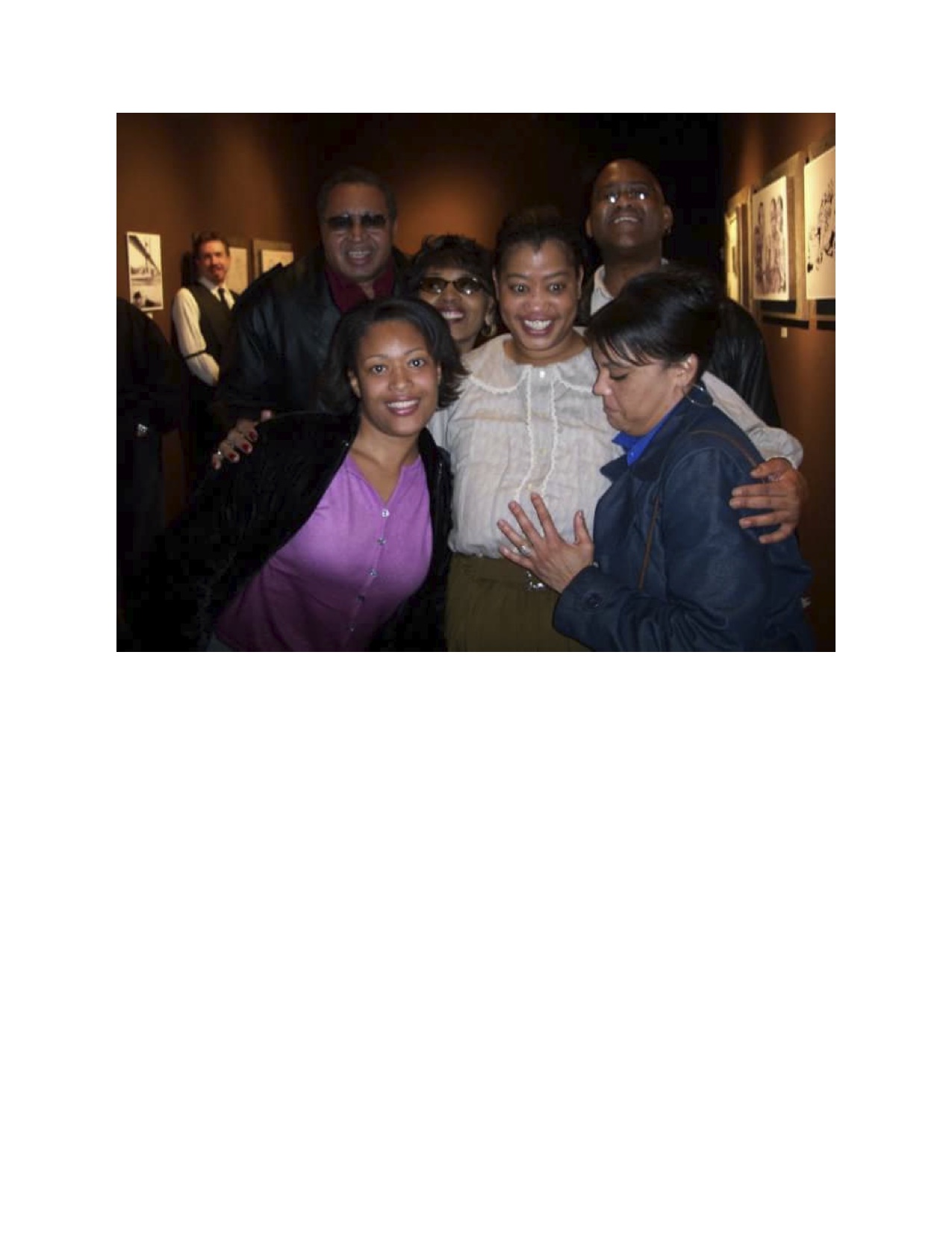 She’s likely to get a chance at playing Hattie again if the Blue Barn can secure the rights to the show for an as yet undetermined revival that may go on tour.
Performing has been a dream of Sayers, a native of north Omaha’s Florence area, forever. But until a couple years ago, she’d done little to heed her hunger aside from playing the lead in two Little Theater dramas at Tuskegee University, where she earned a biology degree. Despite scoring successes on stage in college, her drama aspirations were deferred in favor of her burgeoning genetic research career.
She first made a splash in academia when her research won her awards and opportunities to present papers at national conferences. Then, using her bravura persona to get noticed, she landed a job, at age 24, with the National Cancer Institute, a part of the National Institutes of Health in Bethesda, MD. Her NIH stint found her working in the lab of Robert Gallo, the renowned medical scientist who first isolated the AIDS virus. It was the late 1980s, a momentous period in the scientific-medical community’s investigation of AIDS and a heady time for Sayers.
“I was able to get into it (AIDS research) when it was just blowing up,” she said. “All the talents I have and all the things I learned over the years — to be able to isolate and sequence and clone — I got from working with the AIDS virus. I was blessed to be right there when they were just starting to do some really fundamental things in molecular biology. It just opened up a whole bunch of other things for me.”
Sayers has been something of a curiosity in the various labs she’s worked in over the years because she’s an M.D. without a Ph.D. “My expertise as a molecular biologist is just from OST — On the Job Training,” she said, adding there’s a weird gulf between holders of the alphabet soup titles, so much so that Ph.Ds responded to her with incredulity. “They were like, ‘Who do you think you are? We’ve gone to graduate school and defended our dissertations. Why didn’t you go to graduate school?’ And I’d tell ’em, ‘Because I have a million other things I want to do.’ And I didn’t ever want to be just clinical. Never did.”

Hattie McDaniel
Doing cutting edge research appealed to Sayers’ sense of discovery, but since she didn’t want always to be confined to a lab, she went after and got her M.D. from the University of Nebraska-Lincoln. Any acting thoughts were put on hold during medical school, especially when she got married. The marriage didn’t last.
After college, she worked with Boys Town National Research Hospital’s renowned Dominic Cosgrove in exploring Alports Syndrome, an inherited kidney disease that can result in deafness. Then, she and her second husband moved to Texas, where she was a microbiology and immunology research associate at the Baylor College of Medicine. Her days revolved around research, leaving little time for anything else.
“It’s a very consuming life. You’re talking 80 hours a week, seven days a week,” she said. “There’s a tremendous amount of pressure I had to put on my technicians and on myself to pay very close attention to details. In science, you can’t have flaws. Your data has to be statistically significant and reproducible. You spend many hours not sleeping because you’re worried whether your incubation period is going to work out and if the temperature is going to be all right.”
Deferring one dream to pursue another has been the pattern of her life. Acting just had to wait until her passion for research ran its course. “I’m a dreamer. And the thing with me is…I have all these dreams and I know it’s just a matter of time before I knock them all out. I just go for one, and go for the other, and go for the other…and just live.” For a long time, she kept her performing ambition to herself. “A lot of times I’m afraid to share my dreams because people, you know, poison them and get you distracted and make you doubt yourself,” she said.
The youngest child of straight-laced parents, Roger Sayers and Madeline Adams Sayers, she never acted before college, but instead threw herself into her passion for animals — she was forever bringing home stray dogs — and science — she and her brother dissected salamanders and frogs. She worked for local veterinarian Bill Lofton. Her love for animals was so great, she began her Tuskegee studies in animal science, but she changed her mind after a mentor convinced her that as a bright, bold African-American female she could go far in human medicine.
As a kid, she did sing briefly with the Salem Baptist Church youth choir. Otherwise, the Northwest High grad strutted her stuff in cheerleading, gymnastics, swimming and track activities. The fact she found an outlet for self-expression in sports is no accident, as she hails from one of Nebraska’s most prominent athletic families. Her father Roger was a top American sprinter and NAIA football player at then-Omaha University in the early 1960s. Her legendary uncle, Gale, is a member of both the college and pro football halls of fame following All-America and All-Pro careers with Kansas University and the Chicago Bears, respectively.
All her other performing was done privately, before friends and family, or secretly, as when she learned all the lines of a play her siblings appeared in at north Omaha’s old Afro-Academy. She was, she said, “a closet performer.” As she got older, she rarely performed publicly. There were the two plays she starred in in college. Then, while an NU Medical School student, she let her hair down singing a cover of Roberta Flack’s The First Time I Ever Saw Your Face at an on-campus multicultural affairs concert. When an unexpectedly large crowd showed up, she got stage fright. As if the packed house wasn’t bad enough, she was unfamiliar with the lyrics. Then, the canned music went out mid-song, forcing her to finish acapella.
“I went all the way back in the closet,” she said of that performance nightmare.
It wasn’t until moving to Texas she ventured on stage again when, at the prodding of her second husband, who “loved to hear me sing,” she sang at a string of honky tonk karaoke bars. With a penchant for singing country music and overturning people’s stereotypes, she’d go into a black bar and defiantly belt out a Shania Twain hit. “When the twang would start up,” she said, “people would be like,’Wrong song, wrong song,’ and by the end they would be like, ‘Yee-haw.’ We’d have ’em going, and it’d be so great that I’d think, Hey, I might be kinda good.”
Still, she didn’t try out for her first play in Omaha for two years after moving back here in 2001. Her second marriage had ended. She wasn’t ready. “I was down that I couldn’t stick it out like other women and stay married,” she said. As usual, she immersed herself in work, this time at the Charles Drew Health Center, advocating for the homeless and running the center’s chronic disease management program.
Finally, in 2003, she reached a now-or-never point in her drama dreams. “I was like, ‘I have left both of my husbands. I have no children. I’m about to turn 39, so go for it, girl, go for it.'” Without telling a soul, she auditioned for a staging of the Fats Waller revue Ain’t Misbehavin’ at the John Beasley Theater and won a part. Theater founder and guru, John Beasley, the film and TV actor, took her under his wing, telling her, “You∂ve got it” — meaning the acting gift. “She’s definitely got it,” he said. “She has the talent, the presence and the personality.”
She followed up Ain’t Misbehavin‘ with a part in Little Shop of Horrors at the Millenium. It was there she met Keith Hart, who told her she’d be perfect for Hi Hat Hattie, a production of which he’d worked in in Kansas City. He sold the Blue Barn on the play and about “how completely” Sayers “threw herself into a character and a song” and how “tough and gutsy” she was. “I knew Hattie needed to be kind of a tough broad,” Hart said. One thing led to another and the Blue Barn added the play to its season and Sayers won the part in an open audition.
As much as her talent impressed Toberer and Hart, her work ethic may have won them over even more. For the audition and rehearsal process, Sayers steeped herself in all things Hattie. Untrained as an actress, she gave herself over to Toberer’s direction, learning to “link” and “pull” emotions from her own life to serve her character; for certain scenes, she drew on troubled relationsips and disturbing memories of racism. “There was unlimited discovery for me,” she said.
Among the discoveries was a tolerance for things not going according to plan, something “the control freak” struggled with in the tyranny of the lab. “It’s made me, at 39, give myself a break in life,” she said. “The last week of the show, I felt like I was running track again. When you start rockin’ and you own the show, you feel like you’re in the starting blocks again. It’s fun…crazy…exciting. I love it.”
She hopes to “ride” the momentum from Hi Hat as long as it lasts. On John Beasley’s advice, she’s taken the plunge and is seeking regional theater and film gigs in larger markets, the very path he took in launching his career. Now residing in Galveston, Texas, she recently turned heads at a Houston audition where 25 theater directors saw her. “I’m auditioning like crazy. I get great comments every time. I have been using a monologue from Hi Hat Hattie. So Hattie is still helping me.” She’s intent on going after any role that interests her and on avoiding being typecast. If acting doesn’t work out, well, she’s already been back to school preparing for a health administration career and is in the running for a research associate spot. Either way, she said, “This is what I’m supposed to do…inspire people to dream.”
Related Articles
- Hattie McDaniel’s Oscar Missing From Howard U. (harlemworldblog.wordpress.com)
- All Original Open Mic Night at Hatties on the 26th (thevalleyvoice.org)
- The Peril of Racial Memories (theroot.com)
- Which black women won an oscar (wiki.answers.com)
- Do to racism what did Hattie McDaniel have to do in 1939 at the academy awards ceremony (wiki.answers.com)
- Playwright John Guare Talks Shop on Omaha Visit Celebrating His Acclaimed ‘Six Degrees of Separation’ (leoadambiga.wordpress.com)
- Great Plains Theatre Conference Ushers in New Era of Omaha Theater (leoadambiga.wordpress.com)
- Great Plains Theatre Conference Grows in New Directions (leoadambiga.wordpress.com)
- The Night Belongs To Hattie McDaniel [Video] (jezebel.com)
Categories: African-American Culture, Blue Barn Theatre, Entertainment, Gale Sayers, Omaha, Pop culture, Roger Sayers, Theater, Writing
Academy Award, African-American Culture, Blue Barn Theatre, Entertainment, Hattie McDaniel, National Institutes of Health, Omaha, Performing arts, Robert Gallo, Theater
Cool Cat Billy Melton and the Sportin’ Life
July 1, 2010
2 comments

Image via Wikipedia
The late Billy Melton began as a source for my writing-reporting on aspects of African-American culture in Omaha and he ended up being a friend. Like my late father, Billy was a World War II veteran. Some 35 years my senior. As a black man from an earlier generation Billy lived a very different life than I had as a white Baby Boomer, yet he never made those differences a barrier in our relationship. Rather, he used his life experience as an instructional point of departure for sharing lessons he’d learned. There were many.
I quoted Billy in several stories I wrote over the years. One of these stories, Omaha’s Sweet Sixteen, focused on the Quartermaster battalion he served in during the war. You can find that article on this blog site under the Military and African American categories or by doing a search with the key words, “Sweet Sixteen” or “Billy Melton.” The site also contains a piece, Puttin’ on the Ritz, that tells the story of the black owned and operated cab company Billy drove for, Ritz Cab. Search for the article by its title or in the African-American and Entrepreneurial categories.
The article presented here, Sportin’ Life, explores Billy’s passion and one might say magnificent obsession with music, and more specifically, with collecting it. Through his friendship with the late jazz musician Preston Love, Billy got to meet several jazz legends, which resulted in signed photos of these icons. He was in his early 80s when I did tise piece and he was much concerned about what would happen to his massive collection of records, tapes, and memorabilia when he was gone. He tried finding an institution that would accept the many thousands of items meticulously shelved and displayed in his basement. Though there was much interest, he could never secure a deal because he wanted compensation in return for the collection, and the museum officials he talked with didn’t have an acquisitions budget that could accommodate his demands. He also wanted assurance his collection would be kept on view and made accessible for the the general public, which was another condition officials found hard to make any promises about given the size of Billy’s collection.
Billy passed before anything was done with his collection. It still occupies the basement of the home he and his widow shared. Martha would like nothing more than to carry out Billy’s wishes and find a permanent repository for the collection. I’ve also has the distinct pleasure of getting to know his granddaughter, Carleen Brice, a fine novelist you’ll find my blog posts about on this site.

Dreamland Ballroom
Cool Cat Billy Melton and the Sportin’ Life
©by Leo Adam Biga
Originally appeared in The Reader (www.thereader.com)
The sportin’ life is what Billy Melton’s lived the better part of his 82 years. This party animal has haunted the best night clubs and after hours spots from here to Philadelphia. He’s seen the great entertainers perform. Wherever he’s gone, he’s hobnobbed with friends and stars. And, always, music — the subject of a lifetime collecting hobby — has been part of the action.
“I loved the social life. I had so many great friends out there. I was out roaming around the country, drinking, gambling, enjoying the single man’s life. All the time, adding to my collection and getting enjoyment out of music,” he said.
Even after settling down as a family man, music remained his overriding interest. But it’s more than that for this gregarious man. “Music’s a passion of mine. I love it. I love it all. And I’ve collected it all,” said Billy. No where is his ardor expressed more than in the distinctive musical notes detailing on his silver Chevy Caprice and in the showplace and archive he’s made his home. His modest Omaha residence houses a music collection of staggering size and breadth. He hopes it goes to a museum.
The music room in his basement is a glittering, overstuffed assemblage of music collectibles, novelties, instruments, records, tapes, eight-tracks, photos, posters, album covers and books. One of his two prized juke boxes sits there. Every inch of the floor, wall and ceiling is adorned with a musical motif, whether tiles decorated by music symbols or CDs hanging like Christmas ornaments. Another juke box shares space in an adjoining room with the washer and dryer. The bulk of the collection rests in a specially-built room just off the attached garage. Here, a maze of stacks, bins, trees and shelves hold tens of thousands of LPs, 45s, discs and tapes that encompass a world of musical styles, periods and performers, but with a special emphasis on jazz, blues, soul and Motown.
There are collections within the larger collection, including extensive, if not complete, sets of recorded works by such artists as Count Basie, his No. 1 idol.
Where It All Began
The Omaha Technical High School graduate traces the spark of his passion to the Kansas Vocational School he attended two years in Topeka, Kansas. There, in the late 1930s, he first listened to the seductive sounds of great musical artists, black and white alike. In fact, his original collection began with a Bing Crosby platter. Back in Omaha, where Billy was born and raised, his family was too poor to afford a radio. In Topeka, he scrounged up enough scratch to buy himself, first, a crystal set and, then, a Philco radio, which he listened to late at night in his dorm room. Picking up broadcasts from as far away as Chicago and New York that featured the great swing, jazz and blues bands of the day, he was hooked. “We listened to that music every night,” he said. “It just sounded so good.”
The Metropolitan Hall in Topeka is where he first saw Basie. The experience made him a fan for life. “I loved his music and his dynamic personality. He just lit up the house. He took it to another level. If you don’t like his music…” Well, then, let’s just say you’re not copacetic in Billy’s eyes.
As a young hep cat, Billy immersed himself in the music of the day. He fell for Duke Ellington, Cab Calloway, Lionel Hampton, Nat King Cole, Ray Charles, Jimmy Rushing, Jimmy Lunceford, Gene Ammons, Billie Holiday, Ella Fitzgerald, Dinah Washington, Jackie Wilson, Billy Eckstein, The Inkspots and others. “So many great talents. After I set to collecting these artists, I made it a point to go see them,” he said.” That early taste of Basie whet his appetite for more. He caught Basie, Ellington, Calloway, Hampton, Cole, Charles, et all, performing live on Omaha’s then-jumping live music strip on North 24th Street and at its many downtown theaters.
“As far as the big bands,” he said, “we didn’t have to go to Kansas City. They were right here in Omaha. Twenty fourth and Lake was nothing but music. Did you hear what I said? This was a fun-loving, musical town. We knew how to party.”
In Omaha, Jimmy Jewell’s Dreamland Ballroom was the mecca. “Oh, you had to go to the Dreamland.” Ask who he saw there, and he retorts, “Who didn’t I see there?” In a scrapbook, he has ticket stubs from some of the countless nights he let his hair down there in the ‘50s. The names read: Ray Charles, Fats Domino, Johnny Otis, Wynonie Harris, the Orioles and the Nat Towles territory band. “Sometimes, I’d stand there with my mouth wide open watching those guys perform.”
Jewell, Billy said, “knew music,” and had connections to book whistlestop gigs by touring performers traveling between K.C. and Chicago. As often noted by the late jazz musician and author Preston Love, who was a close friend of Billy’s, Omaha was ideally situated to attract top entertainers due to its central location, the presence of five major booking agencies and a happening live music scene.
The music wasn’t just confined to the Dreamland, either. “Musicians got together and jammed…every night. Local musicians and out of town musicians. Even the big names — Lionel Hampton and all those guys. After they’d get done playing, they’d come out north to the bars and after hours places and jam,” Billy said. Those informal improv sessions unfolded at juke joints named the Apex, the Blue Room, the M & M, Bob and Mary’s Chicken Hut, the Showcase and the Backstreet. “The whites used to come out here and enjoy that,” he said.
Big Fat Swingin’ Fun
When not hitting night spots, Billy hosted them. He and the late Nate Mills ran a gambling emporium out of different North O sites. His partner had the bar and Billy the dice and card games. The illicit thing finally grew old. Too many raids. Too many knives and guns pulled on him. “I ran into some ticklish situations where it was life and death. Finally, it got to the point where I said, ‘I’m going to have to roll away. It’s not worth it.’ And I pulled out.” Besides, he’d married “a church lady,” the former Martha Hall, who only tolerated his hijinks so much. Together now 52 years, the couple entertained like nobody’s business. It was always open house at their place for the steady stream friends and relatives passing through town.
Native Omaha Days found the couple throwing an epic bash. Jukeboxes played outside, where partygoers danced, liquor flowed and laughter resounded. Stories grew embellished with each round. Martha’s home made soul food fed the throng.
“It was a music thing,” he said. “Everybody just wanted to hear music.”
His memories of these high times always include “the people we shared them with” and the music they digged together. Music is associated with virtually all the fun in Billy’s life. By the time he and Martha were hitched, they began traveling the country, by car, for vacations that lasted three to six weeks at a time. Their itinerary might include such hot spots as Chicago, Detroit, Philadelphia and Atlantic City. Wherever they went, they had friends, and whenever they could, they caught music acts at swank clubs or partied the nights away at after hours joints.
Sports, another spectator’s-collector’s passion of Billy’s, was usually part of the mix, as the couple took in a pro baseball or football game here. Billy saw play, in their prime, such major league baseball greats as Willie Mays, Hank Aaron, Ernie Banks and Willie McCovey. He saw National Football League legend Johnny Unitas quarterback the Baltimore Colts versus the Detroit Lions. In his own expansive backyard, where a hoop was set up, athletic prodigies — from Gale Sayers to Marlin Briscoe to Johnny Rodgers — strutted their stuff in pick up games. Bob Boozer and Oscar Robertson visited.
But Billy wasn’t home long. When not working two jobs, as a Union Station janitor by day and Ritz cabbie by night, he prowled the night — indulging in games of chance. He was also a shoe shiner, messenger, mail handler, waiter and bell hop. The extra dough supported his wife and three kids and underwrote his fun. “You can’t smoke cigars, drink, gamble, travel, raise three kids and help grandkids through college on an ordinary salary. Working two jobs still wasn’t enough for the life I wanted to live,” said Billy, whose gambling earnings made up the difference. “I could always hustle some money. God gave me that energy to fulfill my dreams.”
He was also fortunate to have a friend, John Goodwin, and brother-in-law, Charles Hall, whose Fair Deal Cafe was a fixture on North 24th, he could go to for loans.
Doin’ the Town
Traveling’s no luxury, but a lifestyle component for Billy, who “just can’t sit at home.” He and Martha drove old Highway 6, en route to Chicago, via Des Moines, where they got down with friends. In ChiTown, they hooked up for a ball game at Wrigley Field before a night on the town. “They knew when we got there we were ready to have fun. That’s what it was all about,” he said. One north side spot they hit was the Archway Lounge, owned by “Killer” Johnson. “We’d almost spend all our money in Chicago before we got to Detroit.”
Doin’ it up right, he, Martha and Co. dressed to the nines for pricey outings. “Once, we went to the most exclusive place in Chicago — the Blue Note. Lionel Hampton was playing. By the time we paid the cover, ordered a round of drinks and had our pictures taken, we’d spent $80. It takes money to live.” At his irrepressible best, Billy sauntered over to Hampton to request a favorite tune, “On the Sunny Side of the Street.” During a break in his set, Hampton joined the Meltons’ table, which Billy has a picture of, before returning to the band stand. After recognizing the Omaha party, he proceeded to play a jumpin’ rendition of the song.
Ebullient Billy has never been shy approaching celebrities. After shows, Basie (“regular”), Calloway (“jovial”) and Hampton (“nice”) joined Billy and his bunch into the wee hours. Comedian turned-activist Dick Gregory “stayed up all night” with Billy’s crew. Billy cozied up to boxing legends Joe Louis, Sugar Ray Robinson and Joe Frazier. He’s got autographs of countless stars from the worlds of entertainment and athletics, with most of the signatures scrawled on $1 bills.

Native Omaha Club, photo by Lachance (Andrew Lachance)
Once, at a surprise birthday bash for his wife, he got comedian Red Foxx, then appearing in Omaha, to stop by. “He was the life of the party,” Billy said. “Down and dirty.” Billy’s penchant for music gained him entree into some privileged ranks. Preston Love arranged for Billy and Martha to attend private parties headlined by Count Basie and Fats Domino on the same night. “That was the most exhilirating night.” On one occasion, Love, a sideman with Basie in the ‘40s, brought Basie over Billy’s house. A photograph recording the visit hangs in Billy’s music room. Another time, Love had Billy join he and the Count on stage at the Orpheum Theater.
“Everybody knew I loved music,” Billy said, “and it led to lots of connections.” He even carried some of his music along with him on road trips in response to friends asking that he bring certain recordings they liked.
A Collector’s Dream
His collecting began in 1939. By the time he went off to serve in the all-black 530th Quartermaster Battalion in World War II, his holdings were significant. After tours of duty in North Africa, Italy — where he and his GI buddies enjoyed operas — and the Pacific, he returned home, only to find his albums warped from lying flat. Undaunted, he began collecting anew. “I really got serious after the war. I started buying records 90 miles a minute. Forty or fifty at a time,” said Billy, who spent a third of his $7 a week salary on music.
He purchased so many records at one music store, Lyon and Healey, that shop owner Bill McKenzie advised him to invest in a reel-to-reel recorder and tape player. It set him back $600 and took him five years to pay off. Then, from one music lover to another, McKenzie told Billy he could have his pick of any records in the store to transfer over to tape — for free. Over six or seven years, Billy estimates he brought home thousands of records that he put on tape. He “knows what’s on every tape” and cartridge, too, thanks to a catalog he’s prepared.
Hard-pressed to choose any aspect of his collection over another, he’s proudest of “the magnitude of it” and the fact it’s “not just one kind of music.” Despite not playing an instrument,he professes “an ear for music.” He even calls the best of rap “genius,” though it’s not his idea of music. Wife Martha Melton can attest to Billy’s wide-ranging tastes. “There is no form of music he does not love. He just loves music, period.” Indeed, his collection encompasses big band, jazz, blues, soul, gospel, spiritual, pop, rock, funk, classical, opera, international. She says he’s well-deserving of his self-proclaimed Doctor of Music degree. Eclecticism aside, it’s still “the black music” he “turns to” for personal pleasure. He favors “the old timers,” by which he means the big bands and vocalists of his youth. “They could do it all. Their charisma made them stand out above the rest.” And, for Billy, Basie’s in a league of his own. “If you feel down, his music will lift you up. Just that rhythm and beat in unison.” Play Basie’s “One O’clock Jump,” and he’s in heaven.
Like many music devotees, he prefers old wax records to CDs. “It’s the real thing. It takes you back. I like the scratches and the noise. You can almost see the guys.”
Billy wishes he could properly display his wares. “The only disappointment I have is I don’t have enough space to have everything in the same room, where I could appreciate it.” He’s looking for the right venue to preserve his treasures and use them as educational resources for the public. Dealers have tendered offers. He hopes a local museum, preferrably one with a black emphasis, makes him a deal. So far, he’s had preliminary talks with officials from one center about it being the home for his stuff. A potential hangup is the matter of compensation. “My life is in here,” he said. “I just can’t give away my life.”
Like the music of his life, Billy’s a swingin’ cat with few regrets. “My wife and I have done everything. There’s nothing we haven’t enjoyed from the fruits of our labor. The only sad part is we’ve lost so many of our friends that enjoyed life, too.”
Billy, who fashions himself a homespun philosopher, has one more thing to say about music. “If people could get along and blend together in harmony like these musicians do, oh, man, would this be a great world to live in.”
Related Articles
- Back in the Day, Native Omaha Days is Reunion, Homecoming, Heritage Celebration and Party All in One (leoadambiga.wordpress.com)
- Big Bad Buddy Miles (leoadambiga.wordpress.com)
- Enchantress “LadyMac” Gets Down (leoadambiga.wordpress.com)
- Arno Lucas, Serious Sidekick (leoadambiga.wordpress.com)
- Lit Fest Brings Author Carleen Brice Back Home Flush with the Success of Her First Novel, ‘Orange Mint and Honey’ (leoadambiga.wordpress.com)
- Native Omahans Take Stock of the African-American Experience in Their Hometown (leoadambiga.wordpress.com)
- A Rich Music History Long Untold is Revealed and Celebrated at the Omaha Black Music Hall of Fame (leoadambiga.wordpress.com)
Categories: African-American Culture, Billy Melton, Carleen Brice, Entertainment, History, Jazz, Music, Native Omaha Days, North Omaha, Pop culture, Preston Love, Writing
African-American Culture, Art, Billie Holiday, Count Basie, Duke Ellington, Entertainment, History, Jazz, Lionel Hampton, Music, Nat King Cole, Omaha, Pop Culture, Preston Love, Ray Charles


 Leo Adam Biga's My Inside Stories