Archive
St. Peter Claver Cristo Rey High: A school where dreams matriculate
Three years ago I did this story for The Reader (www.thereader.com) on the first Cristo Rey high school in Omaha. It’s a school where the students, mostly inner city Hispanic and African-American kids from families of little means, are required to work an office job to help defray the cost of tuition. The job is also an important learning avenue, exposing students to environments and experiences they would likely otherwise not see and helping them develop skills they likely otherwise wouldn’t feel compelled to cultivate. My story focuses on two students in the school’s inaugural freshman class, a Hispanic named Daniel and an African-American named Treasure. Although each tried to downplay it, their attending the school meant a great deal to them and their families. I may revisit the story of these two young people and their school next spring, when Daniel and Treasure, both of whom are doing quite well in the classroom and at the work site I am told, are set to graduate.
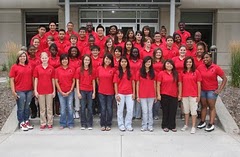
UPDATE: As updates go, this one is decidedly sad: In early February the Catholic Archdiocese of Omaha announced that St. Peter Claver Cristo Rey High School will close at the end of the 2010-2011 school year due to the school incurring a $7 million deficit in its brief four-year history. It seems the school was never really able to gain enough traction, in terms of numbers of students enrolled. There was a high turnover of students who could not or would not follow the school’s strict standards. Ultimately though the recession of the last three years may have dealt the biggest blow because the school could not find or maintain enough jobs with local employers for its students to work once the economy sagged, thus severely cutting into the revenues the school needed to operate. Without those jobs, which defrayed the cost of tuition, some families simply could not afford what it cost for their children to attend. The more financial burden the school and the archdiocese took on to cover the gap and the shorter the school came to meeting its enrollment projections the more untenable the situation became. I will be filing a story in the spring that revisits the stories of Daniel and Treasure — who were part of the school’s first freshmen class and will now be part of its first and last senior class. With the impending closing it becomes a poignant, bittersweet story for all concerned, but it doesn’t diminish the quality educational experience students experienced.
St. Peter Claver Cristo Rey High: A school where dreams matriculate
©by Leo Adam Biga
Originally published in The Reader (www.thereader.com)
Few school startups have attracted the attention of St. Peter Claver Cristo Rey. From the time plans for the new Catholic high school in south Omaha were first announced in 2005 through the end of its first academic year next week, the institution’s captured public imagination and media notice.
Claver’s housed in the former St. Mary’s school building at 36th and Q Streets, within walking distance of the historic stockyards site, Hispanic eateries and markets and Metropolitan Community College’s south campus. The Salvation Army‘s Kroc Center is going up down the road where the Wilson packing plant used to stand.

That the school’s elicited so much response is largely due to its membership in the national Cristo Rey Network, a branded nonprofit educational association based in Chicago. 60 Minutes profiled it. The private CR urban schools model gives disadvantaged inner city children a Catholic, college prepatory education and requires they work a paid internship in white collar Corporate America.
Wages earned help defray students’ tuition and provide schools a revenue stream. Member schools share 10 mission effectiveness standards. Staff from CR schools around the nation attend in-service workshops.
Cristo Rey’s pairing of high academics with real life work experiences is why the network’s grown from one to 19 schools in less than a decade. Three more will open their doors next fall. The model appeals to families who otherwise can’t afford a private school, much less expect their kids to work paid internships. Communities are also desperate for alternatives to America’s public education system, where resources for urban schools lag behind their suburban counterparts. Students of color in inner city public schools struggle, fail or drop out at higher than average rates. Relatively few go on to college, much less complete it, and most lack employability skills beyond low paying customer service jobs.
So when something new comes along to offer hope people jump at it. That’s what the Mayorga Alvarez and the Anderson families did. The Omaha working class families, one Hispanic and one African American, fit the demographic profile the school targets. Claver’s kids mostly come from poor Hispanic or black households qualifying for the federal free or reduced lunch program.
Some whites, black Africans and Native Americans also attend. CR schools typically serve small enrollments. Claver’s no exception with 67 students.
The Mayorga Alvarez family and the Anderson family saw the school as a gateway they couldn’t pass up. After year one their views haven’t changed. Each family sends a child there. Daniel Mayorga Alvarez and Treasure Anderson are both honor roll students.
Claver internship director Jim Pogge said it’s easy to see how much this means to families. “I participate in almost all of the application interviews and the hope in the parents’ eyes is evident.”
Families also find appealing the prospect of being in on the ground floor of a new kind of school, a theme embodied by the Claver team nickname, Trailblazers. A sign in front of the school reads, “Become a Trailblazer.” A symbol and legacy in one.
“We call ourselves Trailblazers for all kinds of different reasons,” Pogge said. “This is a trailblazing school, the students are trailblazers in their own lives.”
Daniel Mayorga Alvarez said, “We’re kind of proud we’re the first class. I guess it makes us feel more special.” Among the downsides, he said, is that Claver “doesn’t offer all the classes I wanted.”
School president Rev. Jim Keiter said Claver’s expanding its courses and staff, hiring full-time music, art and reading teachers for next fall and adding CAD drafting, culinary arts and Microsoft certification classes as early as spring ’09.

Fr. Jim Keiter
Christopher Anderson made his daughter, Treasure, among Claver’s initial enrollees last summer. He liked the idea of her being in a school “totally different than what she’s been used to. The structure, the dress, the work ethic. I mean, I wish I could have gone to a school like this. And then you get to thinking she’s going to be part of the first class,” he said, beaming.
Each Claver student works a full-time shift once a week, plus one extra day per month. The school day runs from 7:50 a.m. to 3:55 p.m. Most students stay after school an hour or two. On work days, a student reports to school, is taken by cab to his/her 8:30 a.m. to 4:30 p.m. job and then returned to school. It might be 6 before they get home.
The curriculum includes a mandatory business class addressing office skills and etiquette. Students apply classroom lessons to the workplace. Back at school they share on-the-job experiences with fellow interns. Pogge works closely with the 22 employer partners in Claver’s Hire-4-Ed program. Student job performance is reviewed and graded. Pogge said, “It’s real. They can get fired.” That’s happened. In those cases students get retrained for new jobs.
“All of our students have to work in order to make this thing work. They have to be employable. The work component actually drives the school,” he said.
Claver sets the tone in the summer with a mandatory three-week long boot camp orientation that introduces students to school-workplace expectations.
When kids can’t or won’t meet expectations they’re asked to leave Claver. A number have been expelled.
“We have a very rigorous academic program. I mean, it’s college prep. There’s no deviation. It’s very linear in its focus. We also have this work component that’s very demanding. These kids have to perform but not everyone’s up to that task. Personally, I have kids this age and I wonder how they would do,” Pogge said.
On the whole, he said, the work study program’s met expectations. “We have had bumps, but we have had far more successes. As of February, 82 percent of our students received ‘Good’ or ‘Outstanding’ job performance ratings.”
Students who do well on the job invariably gain confidence and maturity.
“We see it in changed behaviors here at school,” Pogge said. “They’re all of a sudden more focused, engaged. They communicate more effectively. They’re kind of coming out of their shell.”
Signs that Treasure’s growing up have surfaced since she started at Claver.
“She’s pretty mature. She missed a day of work, which they’re required to make up, and she made the arrangements without me asking her,” Anderson said.
Parents also like the strict dress code. Many students don’t. At Claver’s summer boot camp last August boys loosened or removed their required neck ties and girls pushed the envelope with revealing outfits. Staff reminders and reprimands were common.
Maria and Rodolfo Mayorga Alvarez made Daniel, their youngest child, an early enrollee. A bright boy with a sweet, outgoing personality, he previously attended public schools in south Omaha, where he, his two older brothers and his folks live in a snug bungalow within sight of Rosenblatt Stadium.
His Mexican immigrant parents work blue collar jobs. Their formal education is limited, as is their English. Daniel serves as interpreter. Translating for his mom, he said: “She wanted me to go to a school that was a different environment, a whole new experience. She says the work I’m doing and the interactions I’m having and the skills I’m learning will be really helpful to me in the future.”
His mother’s noticed a change in him now that he comports himself like a little man. “She says I try to correct myself more. She sees me setting more goals for myself. She likes how the school is more disciplined.”
Daniel enjoys being in a brand new school with few students and much diversity.
“It’s like you’re starting all over with a clean slate. You get to know a whole new group of people. You probably get closer to people because you’re going through the same thing…you get stronger relationships,” he said. “In this school you get to know different types of people. You get diverse friends. We’re all scattered. We’re from north Omaha, south Omaha, southeast Omaha. Everybody’s got their own story — where they live, how they grew up.”
He finds Claver more taxing than what’s he’s used to. “I put a bunch more effort into this school,” he said. “It’s hard to keep up a B or A. I come home tired.”
Treasure also finds Claver challenging. She said, “It’s not always easy or fun to get good grades but you have to. I’ve had to learn how to balance school and work. I’ve got responsibilities both ways.”
She and Daniel are keenly aware that “it looks good on a resume” to have a college prep diploma and professional internship among their credits.
Treasure’s native Omaha Baptist family has a history of Catholic education. Her dad and aunts attended Blessed Sacrament. Her aunts then went on to Dominican High. Treasure went a year at Sacred Heart, where her two younger siblings now attend.
Although she mostly attended public schools Treasure’s one year at Sacred Heart gave her an inkling of what to expect at Claver, where weekly Mass and daily religious instruction are the rule. In the end, she said, “it’s still kids. We get along, we don’t get along. It’s high school.”
Most of her friends now attend Marian, a school too pricey for her dad to afford. “I surely couldn’t,” he said. All her Claver tuition’s paid by her job earnings.
A shy, inquisitive girl with a big spirit, Treasure lives with her two younger siblings, her father and his girl friend in a big house on Florence Boulevard in North O. Her older sisters live on their own. The family attends Morningstar Baptist Church.
Her dad is separated from her mom, whom she sees regularly. Chris works at Walgreens. He’s battled kidney disease for 14 years. Last summer both kidneys were removed. He’s now awaiting a transplant. A grown step-daughter may be a match.
Claver Admissions Director Anita Farwell said Treasure hasn’t let her father’s illness stand in her way.
“I love how she keeps her mind focused. She’s not distracted. No excuses. She loves her father. She wants to succeed not only for him but also for herself. He’s a terrific man and he’s built it in her as well.”
Treasure has strong role models. One of her half sisters is in college and another’s gone back. An aunt’s in the Army. Her parents both have some college. Now Treasure’s a model for her little brother and sister. Twelve-year-old Tera and 7-year-old Trey Christopher can’t wait to join her at Claver. Anderson’s already determined they’ll be future Trailblazers.

Reporting to a job adds a new dynamic for Treasure and Daniel. They work in guest services at Immanuel Medical Center, where several Claver students intern. They variously escort patients/family members, answer the phone and do clerical tasks.
“It can be boring but it’s preparing us and that’s what we need,” Treasure said. “We’re not always going to like it but it’s the real world. It does help me with my communication and organizational skills. It’s helped me open up a little to people.”
Pogge said students get to see new worlds.
“These kids are now going into buildings they normally just drive by. Now they’re part of the process,” he said. “They’re exposed to jobs, professions they may have never thought of before, and they can transfer skills from one job or industry to another. Communication skills, attention-to-detail, punctuality, stick-toitiveness.”
The work’s not always cut-and-dried, either. In Immanuel’s Diagnostics and Procedures areas the interns interact with strangers — adult patients or loved ones. Worry is etched on people’s faces. Daniel said many of those he escorts remark on how young he is and a conversation inevitably ensues about the school. Staff say having Claver kids in this role disarms people, putting them more at ease. Daniel views it as a life skills learning experience.
“As you talk to them you get to know them and to know a whole different story. You feel so sorry for them and you want to do everything to help them,” he said. “I really do like helping people. That’s probably the most satisfying.”
Once, a woman broke down and cried in the arms of Treasure, who consoled her.
“I had to be there for her, I guess,” she said. “I just couldn’t leave her there. She was going through some hard times. Her husband wasn’t going to live. I’m not the best people person but I did learn I have to suck it up and just be there for people in order to help them.”
The incident reminded her of her father’s precarious condition.
“If my dad just died one day who would be there for me? You gotta give in order to receive. So I try my best.”
“She doesn’t like to talk about it but I’m a realist, I know on any given day,” said Anderson, his voice trailing off. “So I always tell her, You know if something was to happen to me you would kind of be the glue to hold them together,” he said, referring to her younger siblings. “If your sister or brother were doing something wrong you’d say, What would Daddy say? I’ve raised her enough now that she knows what I expect of her and them. We talk about real things.”
Same for the Mayorga Alvarez family. They were due to make their next pilgrimage to Mexico this summer but tight finances postponed those plans. His parents don’t hide the fact it’s a struggle these days.
“When Mom’s right about to finish all the bills, to pay the school off, this off, that off, then all of a sudden something breaks down and we have something else to pay,” he said. “We always have this conversation. We feel we’re right about to hit the point when we’re living free and then something else happens. We’ll probably use the vacation money to pay off the truck so next year we’ll be a little more debt free.”
If the Mayorga Alvarez family don’t make it across the border this year it’ll mark only the second time in Daniel’s memory they haven’t. Their faith sees them through hard times. On Sundays the family attends St. Agnes or Our Lady of Guadalupe churches, whose congregations are filled with aspiring, upwardly mobile young families just like them.
The family’s hopes of moving up are pinned on Daniel’s shoulders, an academic star who envisions a medical career, perhaps as a doctor. He’s already found he far prefers office work to the roofing jobs he went on with his father and brothers.
“This is way better than that. I’d rather exhaust myself mentally,” he said.
Conversely, his brother Jesus was a less than stellar high school student who’s now looking for work. His other brother, Renne, a South High sophomore, is not excited by school but does plan on college. The brothers feel while Claver may not be for them, it’s right for Daniel.
“I think it’s good because it teaches the kids how to be responsible,” said Renne, who works at a Hy-Vee. “It gives them a taste of life — of how it’s going to be.”
Daniel said his mother often expresses her fondest desires for her boys.
“She wants us to become kind of independent, finish school, get good jobs, become better people. Even though both my parents work it’s still not enough to pay for everything. She wants us to do our part and to find our own way.”
Maria Mayorga Alvarez said she dreams of the ranchero she grew up on in a small, isolated village in central Mexico. Life was simple but happy there. She loves visiting home. She sees then how far she’s come. She hopes once her boys move on they’ll return to the family’s Omaha home and appreciate how far they’ve progressed.
Rodolfo Mayorga Alvarez’s poured his heart, soul and sweat into improving the small house. When his boys leave home they carry his and Maria’s dreams for better tomorrows.
Farwell admires how Daniel’s parents “have raised him to, ‘Do your best son.’ He loves them and he’s so thankful for what they’ve done for him. That is one of the motivating factors for him to do his best.”
Maria and Rodolfo Mayorga Alvarez and Christopher Anderson harbor the classic dream that their children do better than them. Their dreams are bound up in the promise of a school whose Catholic priest namesake tended to black Africans taken off slave ships in Colombia, South America. Claver reaches out to at-risk kids with a step ladder to success. Students, though, must make the climb themselves.
“All we’re really doing here is cracking open the door. It’s up to them to walk through it, run through it, and many of them are sprinting through it,” Pogge said.
As symbols go, what could be more dramatic than a school, with all its promise for new life, situated next to a burial ground, where dreams go to die? The east and south sides of Claver look out over St. Mary’s Catholic Cemetery. Just beyond the cemetery South O’s booming economy is evident.
It’s not only kids and families inspired by the opportunities the school affords but teachers, administrators and corporate internship partners as well. Pogge said businesses see the connection between profit and opportunity.
“The corporate response has been outstanding. These companies have a real need for this clerical work to be done. Why not give our students a chance to perform and develop? Every decision maker I have met has told me they want to have a hand in developing the future workforce of this city,” he said. “These students will either be a part of that workforce or will fade away from it. If they fade away from it, then everybody loses. If they are actively engaged at a young age, then the future is very bright indeed.
“These companies believe these students have real and tremendous potential.”
Educators and employers want to be part of a journey that propels young people forward — past the traditional barriers in their path. As the Claver mantra says, “to serve those who desire it the most but can afford it the least.”
“It’s inspiring and humbling and exciting,” Pogge said, “It just makes absolute sense to give people a vision of what they can become, and that’s what this school is all about. It’s so tangible. It’s very real.”
“Our kids come from poverty and it’s really hard for them to see the consequences of getting an education or not getting an education and what it means to their future success or failure,” said Claver Principal Leigh McKeehan. “But when you expose them to careers then they can start putting two and two together and create a plan for their lives.”
The needs of Claver students are great. About half arrive below grade level, some two-three grades below in reading and math. While this first year was comprised solely of a freshmen class, some 16-17-year-olds were in the ranks of otherwise 14-year-olds. The older kids dropped out of schools at one time or another and desired what Keiter termed “a fresh start.”
Farwell said some kids come from single parent homes and others from homes where grandparents or guardians raise them. Kids may have moved several times.
“They’re 14 and they have gone through so much in life, they’ve seen so much,” she said, “and we’re trying to give them stability. We want them to know they can succeed. It doesn’t matter what their past has been. Go forward.”
“They can do it,” said Pogge, who refers to the entire staff as having “a calling” to this mission. Daniel said the staff’s dedication to “go the extra mile” is noticed.
Farwell said two of the school’s biggest selling points are its negotiated tuition and the transportation provided students to and from school (bus) and work (cab).
Interest is high. But the application-registration process can be daunting for Spanish speaking newcomers. Many parents work on hourly production lines and can’t easily arrange or afford missing work to fill out forms or go through school interviews. Claver’s simplified things by reducing the number of forms and expanding its hours — making admissions more of a one-stop process. Most Claver staffers speak some Spanish. A few, like Farwell and McKeehan, are fluent, which they say helps build trust.
Then there are the school’s high academic and accountability standards, which extend to students and parents signing a contract. Farwell said many parents expressing interest in the school the first year weren’t aware of its college prep rigor but adds that inquiries today seem more informed. That should mean fewer mismatches between the school and students and, thus, fewer expulsions.
As Keiter said he’s come to realize, “we can’t be the savior school for all students and families. Not every school is meant for every student.” He’s expelled 11 kids since August. Others withdrew after recognizing Claver was not for them. The attrition’s cut deep into the rolls of an already small student body.
When registration closed last summer Claver counted 106 students. Only 95 actually showed for the boot camp. By the time the school year began that number fell to 86. Enrollment now stands at 67.
Back in August Keiter already wrestled with “the savior complex.” One early morning he assembled the students at St. Mary’s Church across the parking lot and tearfully addressed them from the foot of the altar.
“Yesterday was probably one of the hardest days I’ve ever had. I removed four students from this school for behavior.”
He talked about the need to follow directions, make good choices and work together for the common good. Using the bad apple analogy, he said one or two rotten ones can spoil the whole bunch. Removing the students, he said, was “for the good of all of you.” He pledged he’d make more hard decisions as necessary.
“We have only one chance to set the bar and create the reputation of the school, and we want that reputation to be a school that is safe and a great learning environment preparing all our students for college and work,” he said.
Two of Daniel’s friends were expelled. “It was because of the dress code,” Daniel said. “I think for some of them it opened up their eyes. They’re going to come back next year hopefully. Their parents want to enroll them.” The dress code’s been enough of an issue that Claver’s introducing uniforms next year.
Casualties are inevitable.
“We are giving some second chances and they are excelling,” Keiter said. “That is what it is about, but for the whole to excel we will at times have to remove students who are not accepting or not wanting to accept this new way of learning at school and work. If they are disruptive, et cetera, it is not fair to those who are working hard to succeed.”
He said the school’s “being more diligent” about keeping standards high and not diluting them for the sake of “wanting to help or ‘save’ one. We have to be honest about who our school can serve best, not for our betterment but for each student’s betterment.”
Farwell’s actively recruiting freshmen and sophomores for next school year. Applications and acceptances are ahead of last year. June 12 and July 10 All Admissions days are planned. The boot camp’s being revamped to include a several nights retreat away from school that promotes relationship building.
Meanwhile, the school’s secured $5 million in its $7 million capital campaign and has renderings for a planned physical expansion.
Keiter said the strength of CR schools is their “outside the box” approach of being neither tuition nor philanthropy driven but enrollment and jobs driven. Aside from that bottom line, dreams most drive what goes on there. The long hours and stringent rules are not popular with kids but the ones that stay, like Treasure and Daniel, sense a higher purpose at work. They know how much is riding on this for their folks.
When Treasure omplains how hard it is her dad reminds her, “That’s the reason we chose the school — you’re getting more out of it.” Chris Anderson added, “Me and a couple other parents talk all the time about what a great opportunity it is. I could not be any happier. She’s excelling. I have faith in her and in the school.”
Related Articles
- Another Harlem Shining Star (harlemworldblog.wordpress.com)
- You: Progress slows in closing achievement gaps in D.C. schools (washingtonpost.com)
- Cristo Rey: Part of the Solution for Education Today (prnewswire.com)
- School for poor kids would make them work for tuition (thestar.com)
Related Articles
- Cristo Rey: Part of the Solution for Education Today (prnewswire.com)
- School for poor kids would make them work for tuition (thestar.com)
New school ringing in Liberty for students
The thought of a new downtown elementary school housed in a massive former bus barn situated smack dab in a neighborhood rife with social ills caught my attention. The barn site was only temporary, but that nontraditional location, plus the red light district around and about it, was enough for me to file a story. Plus, I liked the fact the school would be serving a diverse student body of Latinos, Africans, African-Americans, and whites. The space was every bit as interesting and the students every bit as diverse as I had hoped. Then when I met the dynamo principal, Nancy Oberst, mother of indie rock star Conor Oberst, I was officially hooked. My story, which originally appeared in The Reader (www.thereader.com), is as much about her and and her staff’s passion as it is about this incongruent site for a school. Liberty Elementary has since moved into its built-from-the-ground up school building just down the street.
New school ringing in Liberty for students
©by Leo Adam Biga
Originally published in The Reader (www.thereader.com)
Like a Pied Piper, Liberty Elementary School principal Nancy Oberst set a brisk pace one evening in the Columbus Park neighborhood. It was one of several nights when Oberst and staff went door-to-door in the blue-collar, racially-diverse area to symbolically blow the horn about Liberty, the new downtown K-6 public school. Liberty, which opened August 19 with some 360 students (and more matriculating each day) was conceived in part to relieve overcrowding at two other OPS sites — Jackson Academy and Field Club Elementary — which Liberty is drawing many students from. Consistent with the new OPS emphasis on neighborhood schools,
Liberty is serving a growing school-age populace on downtown’s southside. Temporarily housed in a renovated warehouse running from 22nd to 20th and Leavenworth Streets, Liberty is in a kind of incubator phase while awaiting construction of its own building, slated to open in March 2004.
In naming the school, Oberst wanted something that “embraced as many people as possible and spoke to a lot of things inherent in this society.” Above the main entrance is a phrase from Roman philosopher Epictetus that reads, “Only the educated are free.” Fittingly, Liberty is a beacon of hope to a largely Hispanic ward of recent emigres. An education for these children is more than a right of passage — it is a burden of dreams. “These kids come from working class families that need to invest in something for the future,” she said. “They’re really wanting for their kids that old dream of learning English and being upwardly mobile.” It is why Oberst insists her staff be fully committed. “When I interview applicants, I say, ‘I’m really looking for people that have the will and the desire to make something special for kids who need a leg up.’” The impetus to learn, she said, is made even greater by the fact children often act as interpreters for their Spanish-speaking parents.
Because everyone is welcome at Liberty, parents are not pressed for their legal status. To register a child, a parent need only provide a birth certificate, an address and some record of the child’s past schooling, if any. Serving a highly-mobile population, Liberty expects to see a high student turnover rate.
Oberst, principal at Jackson the past three years, has many former students assigned to Liberty. During that night canvassing the hood she scanned a roster looking for familiar names. She found one in Diana Ramirez. In a wood-frame house perfumed by the rustic aroma of tortillas and accented by the folksy lilt of Spanish, Diana shyly emerged from a bedroom, bedecked in a fine pink dress, and when her big brown eyes locked on Oberst’s, she warmly embraced her. “There’s a beauty and a richness about a very urban group of kids,” Oberst said. “They’re the nicest kids I’ve ever been in contact with. Just well-behaved, very, very respectful children. They look forward coming to school. It’s very important to their day. I’ve never had one swing at me or push me. Sure, there’s times when one gets mad and tips over a desk or kicks a door, but you’d be amazed at how lovely these kids are. And, you know, the school has to set the tone. Kids have to know this is not just hanging out — this is different. That’s why we call kids if they don’t come and go get them if they can’t get here. They know we love them.”
While children from Spanish-speaking homes predominate, Liberty is also a magnate for area African-American, Sudanese, Asian and Caucasian families. Combined with NuStyle Development’s ongoing renovation of the historic and once stately Drake Court apartments on the north side of Liberty, the school is seen by many as an anchor of stability and a catalyst for redevelopment. The circa 1916-1921 Drake Court, a 14-building complex featuring Georgian Revival and Prairie style design elements, was once the centerpiece of this mixed residential-commercial zoned district. But when the apartments fell into disrepair in the 1970s, occupancy declined and the designated blighted area became a thoroughfare for transients. NuStyle has worked closely with the Nebraska Investment Finance Authority (NIFA) to qualify for low income tax credits for the Drake Court project. In anticipation of Liberty moving out in 2004, NuStyle is weighing various reuses of the warehouse, including a day care center, artist studios, a multi-media technology center and condos. It is also eying more area residential and commercial projects.
“There’s been an undercurrent that this is too tough a neighborhood for a school,” Oberst said. “Some of the families are worried. But OPS is saying we believe in Omaha — we believe neighborhoods can be redeveloped. We know what a renovated North High did on 34th and Ames. That has become a very safe place for people to live. When we held meetings with residents in the spring we said, ‘This is how you do it — this is how you change your neighborhood. You put an anchor in with a school. You make the streets safer for mothers and children to come to and from school.’ I’m a big believer in the community the school is in knowing about the school and being involved in it.”
She said she will do whatever it takes to make Liberty safe, from asking street denizens to respect school property to telling those engaging in illicit behavior to move on. “You want to be a good neighbor. You don’t want people mad at you. You have to do some co-existing. But you also have to draw some lines.” She said when problems surfaced at Jackson, from the school getting tagged with graffiti to men harassing girls, she had students spread the word the school was off-limits and she told harassers their actions were unwelcome. The problems, she said, vanished.
Despite assurances from OPS, extra police patrols and neighborhood watch efforts, some parents still voice concern. “I’m not happy with the location,” said Lisa Arellano, whose son, Gage, is a 5th grader. “We have a lot of homeless people and trouble up on Leavenworth. I can’t tell you how many times I’ve seen the police tackling someone on the ground. Walking to and from school is too scary. It puts kids in jeopardy. There’s always reassurances, but there’s no guarantees.” Gatdet Tut, whose daughter Hynalem is in kindergarten, said, “I don’t want my child to walk on these streets.” Other parents, like Craig Hinson, hope OPS-OPD vows to keep a sharp eye out are more than “lip service.”
Commerce of all kinds unfolds around the school. Across 20th Street is the 24-Hour Package Liquor Store and the Motor West used car lot. Three blocks east is the Douglas County Correctional Center. On the south side is Precision Industries. A little farther west is a St. Vincent DePaul Super Thrift store.
The eastern front of the old bus barn housing the school has two ongoing businesses — Grunwald Mechanical Contractors and an auto detailing shop — that maintain active garages. Robert Wilczewski, owner of the property occupied by the firms, feels the volume of kids passing by to enter and exit the school, whose main entrance is off an adjacent alleyway, poses hazards and hinders operations.
“It’s starting to complicate life around here,” he said. “We just have some serious concerns about safety and about restrictions on what we do here. It’s become intolerable. We want business back as usual. They’re going to need to find a different route for children to enter the school.” Wilczewski, who owns part of the alley and a piece of Grunwald, said the company and OPS are signatories to a 1930 agreement prohibiting public alley use. The parties are trying to reach an accord.
Harold Wrehe, co-owner of Motor West, echoed other area businessmen in expressing surprise at the number of Liberty students. “I didn’t believe there’d be that many children going to an elementary school in this area. But I like it. It brings people in. Everything helps.” Mike Nath, branch manager of nearby Motion Industries, agreed the school “will, in the long run, probably be a good thing. It could help clean up the neighborhood.”
The consensus is that whatever undesirable-incongruous elements surround it, Liberty, along with the Drake Court, reopening for occupancy next year, is a keystone for an emerging 20th Street Corridor some envision as an Old Market West. Oberst, busily forging alliances between Liberty and the nearby Omaha Children’s Museum, the YMCA and the Omaha Theater Company for Young People, joins others in referring to 20th Street, from Leavenworth to Farnam, as Children’s Row. As Liberty’s provisional site does not have many school amenities, including a gym or theater, students are attending P.E. classes at the Y and performances at the children’s theater.
For Roberta Wilhelm, executive director of the children’s theater, the concept of “a downtown school is a great idea,” with Liberty adding another dimension to the burgeoning arts-educational scene emerging along the 20th Street strip. “I think between the school, the Children’s Museum, the Y, us, and the Joslyn Art Museum, which is not that far away, the synergy is just going to be wonderful. We’re excited to have the school as a neighbor.”
She envisions the theater and school having an intimate rapport. “We see ourselves developing a very close relationship with Liberty,” said Wilhelm, whose home base, The Rose, is only a stroll away. We will be doing our Every Single Child program in their school…which is where every child — in each grade — has a different experience with the children’s theater through drama residency workshops and dance activities. And that, in my opinion, is just the beginning. I think there’s much more we can do with them in after-school programming. We’d like to see the arts infused in their school.”
Oberst wants that infusion as well. “We’re really wanting to bring art into the school, including artists from the community, and to bring our students to the arts. We hope to build relationships with the Joslyn Art Museum and the Bemis Center for Contemporary Arts. We have to take advantage of where we are.”
The idea of placing a school smack dab in the middle of a bustling urban district is not new for Omaha. Central Grade School operated for decades across from Central High School and in the shadow of the Joslyn and other downtown landmarks. Although Liberty is the first school in the Drake Court-Park East-Columbus Park district since Mason School closed in the 1980s, it is repeating history in that, like Mason, which once served a largely Italian immigrant population, it is educating many new arrivals from Mexico.
What makes Liberty different is that the school is operating — at least the next 18 months — from a makeshift site that once served as a maintenance barn for Greyhound Bus Lines and more recently as a paper-printing supply storage facility for Redfield & Co. The top-to-bottom refurbishment of the old bus barn has revealed a 49,000 square foot space highlighted by the second-story’s free-span, cathedral-high, vaulted wood beam ceiling and elaborate iron truss network. A massive skylight and banks of tall windows bathe the upper level in natural light. Large ceiling fans maintain a constant air flow.
The rehab was funded by NuStyle, which bought the structure from Robert Wilczewski, and designed by Alley-Poyner Architects. OPS, which leases the building from NuStyle, is using large partitions to create classrooms and resource centers in a modular, flexible floor plan. By opening day, each partitioned space was outfitted with all the usual fixtures of a traditional school setting.

In the time in takes for the permanent school to be erected — construction starts this fall — Liberty plans being an established player in the neighborhood by building coalitions that Oberst hopes makes the school a vital contributor to and welcome beneficiary of the revitalization happening around it.
“The idea is to form this community now and for the kids to participate in the building of the new school and to have the neighborhood be involved with the whole redevelopment going on with us and the Drake Court,” she said.
Drawing on her experience forging community ties at Jackson, where she found an Adopt-a-School partner in Picotte Elementary, formed a food pantry with ConAgra Foods and sponsored clothing drives with First Lutheran Church in Omaha, she is already lining-up Liberty collaboratives. A food pantry, serving poor residents, is in the works along with clothing and furniture drives. “Our families sometimes don’t have beds and other basic things and, so, we’ll do a lot of give aways. It’s meant to bridge the gap. That networking with the community is part of my job and, besides, it opens more doors for opportunity for our kids and parents. I’m always looking for an angle,” she said.
Opening day at Liberty was marked by two words: diversity and vitality. Beaming brown, black, yellow and white faces mingled in the old-new environs. The sing-song sound of Spanish and hip-hop reverberated throughout the cavernous space.
Craig Hinson, whose daughter Jamillah is attending the 6th grade, said the diverse urban setting is just what he wants for his child. “I think it’s great. To me, it just adds a little flavor. I think being downtown, where you have blacks and whites and Hispanics and Sudanese, it just gives kids a real sense of the real world.”
As a show of faith in Liberty 3rd grade teacher Michelle Grau enrolled her own daughter Jordan there even though her family lives in Field Club. “I think the more kinds of people and the more kind of cultural experiences you can be exposed to, the better,” Grau said. “That’s why Jordan’s coming here. And to be in on the ground floor — I’m really excited about that. It’s going to be a fantastic thing once it’s finally completed…if you can just see the big picture.”
The promise of bigger things to come is what led Barb and Jim Farho to place their two children at Liberty. “We’re probably one of the few families choosing to go there even though we’re not forced to,” said Barb Farho. “My husband and I are interested in seeing downtown rejuvenated and we think this is one way to do that. A lot of people are afraid of downtown, but we think there’s a lot of cultural experiences awaiting. We also know the principal is very good at getting the community involved and we just think those partnerships are only going to get better. The surrounding area is going to improve for having a school there. Plus, our kids are excited about the fact the new school will be built before their very eyes. It just seems like a fun place to be in on at the very beginning.”
Assuming the school thrives, Oberst anticipates that once the new building opens and the word spreads more pilgrims will flock to Liberty from around the metro. “We are expecting that once the new school is up and once the real cultural-corporate connections are evident that parents from other parts of the city will want to send their kids here.” The new Liberty will accommodate 600-plus kids, yet another reflection of the confidence school officials have in the enterprising area.
Whatever happens, Oberst is sure to stir the melting pot. “What that woman does for and gets out of kids is incredible,” said Linda Daly, an ESL resource teacher and one of several educators who followed Oberst to Liberty from Jackson. “She makes things happen for the kids. She is absolutely a dynamo.”
Related Articles
- For students, ringing bells all mean liberty (philly.com)
- Schools Serve – Uniting Schools Against Hunger (prweb.com)


 Leo Adam Biga's My Inside Stories