
Archive
Archive for June, 2016
Omaha fight doctor Jack Lewis of two minds about boxing
June 21, 2016
1 comment
Omaha’s fight doctor, the late Jack Lewis, was of two minds about boxing. He championed the closely regulated amateur side of the sport but he decried the anything-goes excesses of the professional game. He saw more fights than he could remember as a ringside physician. He was also a sideline physician at countless football games in his role as team doctor for his alma mater, Omaha Central High School. He was an athlete and scholar there and he went on to be an athlete and scholar at Stanford University. The story I’m posting here is an advance piece I did about the 2006 National Golden Gloves tournament held in Omaha. I got Dr. Lewis and two other venerable members of the local boxing community, Harley Cooper and Tom Lovgren, to weigh in on the event and the sport. Lewis was a much honored member of Omaha’s sports and medical community. He was an inductee in the Central High Hall of Fame as well as the Nebraska High School Sports Hall of Fame. He, his father and his son comprised three generations of physicians.
It is worth noting that world pro boxing champion Terence Crawford of Omaha made it to the finals of that National Golden Gloves tournament in his hometown only to lose a controversial decision. It pretty much marked the end of his amateur career and the last time he fought in Omaha until defending his newly won WBO lightweight title at the big arena downtown, which by that time was renamed the CenturyLink Center.
Before leading you to the story, here is an Omaha Central High Foundation announcement about Dr. Jack’s passing:
It is with heavy hearts that we share the passing of Dr. Jack Lewis. A 1952 graduate of Central, Dr. Lewis served as the team doctor at Central for over 50 years, performing thousands of physicals and walking the sidelines of hundreds of football games. Dr. Lewis received numerous recognitions and sat on many different boards, including being inducted into the inaugural Central High School Hall of Fame in 1999, Nebraska High School Sports Hall of Fame, and Omaha Public Schools Athletic Hall of Fame. After receiving his first degree from Stanford University, Dr. Lewis obtained his medical degree from the University of Nebraska College of Medicine where he then served as a professor of internal medicine. Football games won’t feel the same this fall when Dr. Lewis isn’t on the sideline, offering decades of expertise to our student athletes. Dr. Lewis loved Central, and we will miss him dearly.
The visitation will be held on Thursday, June 23, from 4 – 6:30 pm at the Heafey-Hoffmann Dworak & Cutler Bel Air Chapel on 12100 West Center Road. The service will be held on Friday, June 24, at 11 am at the Presbyterian Church of the Cross on 1517 S 114th Street.

Dr. Jack Lewis
Omaha fight doctor Jack Lewis of two minds about boxing as the city readies to host the National Golden Gloves
©by Leo Adam Biga
Originally published in the New Horizons
For the first time since 1988, Omaha plays host to the National Golden Gloves boxing tournament, one of the nation’s showcases for amateur boxing. The 2006 tourney is a six-day event scheduled for April 24-29 at two downtown venues. The preliminary and quarterfinal rounds will be fought at the Civic Auditorium the first four days, with the semi-final and championship bouts at the Qwest Center Omaha the final two days.
Historically, the national Golden Gloves has produced scores of Olympic and world champions. Former Gloves greats include Joe Louis, Ezzard Charles, Muhammad Ali, Sugar Ray Leonard, Evander Holyfield and Roy Jones Jr.
Three men with long ties to the local boxing scene recently shared their thoughts on the Gloves with the New Horizons.
The man heading up the event is Omaha’s fight doctor, Dr. Jack Lewis, a 71-year-old internal medicine physician. As a doctor who loves a sport that gets a bad name from the medical community, he’s a paradox. While a staunch supporter of amateur boxing, Lewis is a fierce critic of the professional fight game, which he has come to abhor.
His experience in the prizefighting arena included serving as ringside physician for the 1972 world heavyweight title fight in Omaha between champ Joe Frazier and contender Ron Stander from Council Bluffs. Lewis stopped the fight after the fourth round with a battered Stander blinded by blood in his eyes.
“I love the sport of amateur boxing. I was involved in pro boxing and I didn’t like that from a medical standpoint,” Lewis said. “After just a few years working with the pros, I quit. In some cases, I didn’t know who the fighters were. They were fighting under fake names. I’d ask all these questions and the boxer would say the last time he lost a fight was a month ago in Chicago, and then some guy would come up later and tell me that same guy got knocked out last night in Chicago.
“Those pro boxers move around, have fake names, won’t give you their true medical history.”
Lewis continued, “Those pro boxing days are behind me. That sport needs to be cleaned up.”
More than just a fan of amateur boxing, Lewis is a veteran ringside doctor and longtime president of the Great Plains Boxing Association, the main organizing body for amateur boxing in Nebraska. This is the second time under his leadership his hometown of Omaha is presenting the Golden Gloves nationals.
Lewis is optimistic the event will fare better than recent national Gloves tourneys in cities like Kansas City, where the event failed miserably at the gate.
“We’ve done this before. I think our sales are going very well,” he said.
With Omaha’s success as College World Series host, with the Qwest Center filled to capacity for Creighton University men’s basketball home games, with the arena slated to host a slew of NCAA post-season events over the next several years, plus the U.S. Olympic swimming trials, the Omaha’s known as an amateur sports-friendly town. That’s why there’s talk of Omaha trying to host the Golden Gloves on a regular basis. The event is bid out a few years in advance, so it would be awhile before Omaha could host the event again after 2006.
“Omaha knows how to put people in the seats. Plus, this is really a fight town,” said Harley Cooper of Omaha. The former two-time national Gloves champion is seving as the 2006 tournament director. “It’s an outstanding event, Fans will see the best boxing in the country and probably see some future Olympic and professional champions.”
Omaha boxing historian Tom Lovgren joins many others in calling the Qwest “a great facility for boxing.” “The people there do a superb job,” he added.
While he never boxed, Lewis lettered in football and rugby at Stanford University, backing up future NFL great John Brodie at quarterback in the late 1950s. He said his athletic background and internal medicine specialization “lent itself” to begin treating athletes.
After graduation from Standford and the University of Nebraska Medical School, Lewis did his internal medicine residency in Oakland, California. He came back to Omaha in 1964 to practice with his physician father.
Right away, Lewis’ sports medicine interest found him treating a variety of athletes – jockeys at the Ak-Sar-Ben thoroughbred race track, football players at his alma mater Central high School, where he has been team physician since 1964, and boxers at the Omaha and Midwest Golden Gloves tournaments.
Lewis’ passion for amateur boxing has only grown. He enjoys the purity of the sport. He applauds the protective headgear and other measures taken to ensure fighters’ safety. He believes the competition inside the ropes instills discipline in its participants.
“I think the greatest athlete is the guy that steps in the ring and some guy comes after you. I think it builds character. I think it teaches you resraint. It helps you collect yourself. Through those years I’ve been to many meetings and been to many nationals. I’ve been he ringside physician at hundreds of fights and taken care of a lot of medical problems at the fights. Even though I never fought, I’ve educated myself in boxing and in all the trials and tribulations of the kids.”
Lewis said amateur boxing has suffered unfairly from the ills of its pro counterpart.
“There has been a lot of deaths and those deaths really hurt amateur boxing because then parents don’t want their kids to go into boxing. There’s been a lot of unscrupulous stuff. When I started it was a more popular sport. Today, kids are into doing all kinds of other things. They just don’t go into boxing anymore. And the coaching ranks have really declined. It’s an uphill battle.”
Despite the smaller number of young boxers, Tom Lovgren said “there are kids around that can fight and the Golden Gloves is still a major contributor to the U.S. Olympic boxing team. He said a Gloves title still carries weight in the world of boxing.
“If you are a national Golden Gloves champion, you’re highly respected when you make a turn to the pro ranks.”
Lewis said another thing unchanged in the sport over the years is that ethnic-racial minorities are disproportionately drawn to boxing.
“Our best known boxers in the state now are Latino. There’s been a great influx of Spanish-speaking kids. Unfortunately, many of them don’t have U.S. citizenship and the rules require you to be a citizen in order to compete at nationals (Golden Gloves).”
In the history of the Golden Gloves there have been but five national champions from Nebraska. According to Lovgren, the best of the bunch was Harley Cooper, who won his titles in 1963 and 1964 (the first at heavyweight and the second at light heavyweight). He won those titles when he was in his late 20s. which is much older than the typical Gloves fighter. Since retiring from the ring, Cooper’s devoted time to developing and suporting area amateur boxing. He never turned pro.
“Everybody wanted him to fight for them,” said Lovgran, a former prize fight matchmaker and a longtime observer of the local fight scene. “The first time anybody saw hiim in the gym they knew this guy was going to be a national champion. He could punch. He could box. He could do it all. He was the most complete fighter I ever saw from around here. I never saw Harley Cooper lose a round in amateur fights in Omaha. He was that dominant.”
Besides Cooper, the only other Nebraska boxers crowned national Gloves champions were Carl Vinciquerra and Paul Hartneck in 1936, Hartneck again in ’37, Ferd Hernandez in 1960 and most recently Lamont Kirkland in 1980. A number of other Nebraskans advanced to the semi-finals or finals, only to lose.
In general, Lewis said, area kids are at a distinct disavantage.
“Amateur programs here are not strong. We don’t have enough coaches to train these kids. We don’t have enough fighters to have regular smokers that season them. Every year, our kids go to nationals with maybe 10 to 12 fights under their belt and they face opponents with 70 to 80 fights.”
Harley Cooper said Omaha holding the nationals can only help raise the level of the amateur boxing scene here.
“It wil let our kids see what they have to strive to obtain – the different skills and knowledge they will need to be a world-class boxer. Seeing is much better than someone explaining it to you.”
He added the biggest difference between “our boxers and the fighters from bigger cities is the opponents’ strength, size and skill.”
“It’s going to be a great weekend for amateur boxing in Omaha, Nebraska” Lovgren said. “I just hope a couple of guys from Omaha can go as far as the finals.
A raucous home crowd could help spur a local fighter to do great things.
“It can’t hurt,” Lovgren said. “Who knows? Anything can happen. Boxing’s a funny game.”
“There’s still some kids out there. We should see some real good boxing,” Lewis said.
A final elimination stage before the nationals will be held March 17 and 18 at the Omaha Civic Auditorium’s Mancuso Hall. Winners in this Midwest Golden Gloves Tournament of Champions will complete Nebraska’s 11-man contingent for the April national tourney.
Tickets for the nationals may be purchased at the Qwest Center box office or via Ticketmaster by phone at 402-1212, or online at http://www.ticketmaster.com.
For more details, call the Qwest Center at 997-9378 or go online at http://www.qwestcenteromaha.com.
Through a lens starkly: Alexander Payne films Nebraska
June 20, 2016
1 comment
Through a lens starkly: Alexander Payne films Nebraska
EXCERPTS FROM ALEXANDER PAYNE: HIS JOURNEY IN FILM
New edition now available
©by Leo Adam Biga
Nebraska
Even though Alexander Payne demonstrates time and again that commercial considerations mean very little to him, following the breakaway success of The Descendants (2011) there was every reasonable expectation he might lean a bit more again in the direction of mainstream with his next film. I say again because I count The Descendants as a conventional, even mainstream work even though its protagonist rails against his comatose wife and sets out to wreck the life of the man she was cheating with, all the while trying not to lose it with his two grieving daughters in tow.
Payne soon quashed any notion of playing it safe when he announced the small, insular back roads comedy-drama Nebraska (2013) as his new feature project. It did not help its bottom line chances that the film is set in rural Nebraska, which for most filmgoers may as well be the dark side of the moon for its unfamiliarity, remoteness, and perceived barrenness. Indeed, if Nebraska conjures any image at all it is of endless cornfields, cows, and monotonously flat, uninspired scenery. When the story laid over such a setting features a confused, depressed old cuss alienated from family and friends and wandering around in a bleak wasteland made even bleaker by black and white photography and desolate late fall, post-harvest locations, it does not exactly engender excitement. The prospect of a dour, feel-bad experience devoid of life and color does not get tongues a-wagging to generate the all important buzz that sells tickets.
Of course, anyone who has seen Nebraska knows the film is not the downer it may appear to be from glimpsing a thirty second trailer or hearing a thirty second sound bite, but that it is ultimately a sweet, deeply affecting film filled with familiar truths amid its very Nebraskaesque yet also quite universal archetypes.
Payne’s insistence on shooting in black and white was a completely legitimate aesthetic choice given the storyline and tone of this stark, autumnal mood piece about an old man having his last hurrah. But it also meant a definite disadvantage in appealing to average or general movie fans, many of whom automatically pass on any non-color film. Compounding the aversion that many moviegoers have with black and white is the fact that most studio executives, distributors, and theater bookers share this aversion, not on aesthetic grounds, but based on the long-held, much repeated argument that black and white films fare poorly at the box office. Of course, there is a self- fulfilling prophecy at work here that starts with studio resistance and reluctance to greenlight black and white features and even when a studio does approve the rare black and white entry executives seem to half-heartedly market and release these pics. It is almost as if the bean counters are out to perversely prove a point, even at the risk of injuring the chances of one of their own pictures at finding a sizable audience. Then when the picture lags, it gives the powerbrokers the platform to say, I told you so. No wonder then – and this is assuming the argument is true – most black and white flicks don’t perform well compared with their color counterparts. Except, how does one arrive at anything like a fair comparison of films based on color versus black and white? Even if the films under review are of the same genre and released in the same period, each is individually, intrinsically its own experience and any comparison inevitably ends up being a futile apples and oranges debate. Besides, there are exceptions to the supposed rule that all black and white films struggle. From the 1970s on The Last Picture Show, Paper Moon, Young Frankenstein, Manhattan, Raging Bull, Schindler’s List, Ed Wood, and The Artist are among the black and white films to have found wide success. It is admittedly a short list but it does prove black and white need not be a death sentence.
To no one’s surprise Paramount did what practically any studio would have done in the same situation, which was to fight Payne on the black and white decision. In no uncertain terms Payne wanted to make Nebraska in black and white and just as adamantly the studio wanted no part of it. He pushed and they pushed back. He would not compromise his vision because from the moment he first read Bob Nelson’s screenplay he clearly saw in his mind’s eye the world of this story play out in in shades of black and white. It just fit. It fit the characters and the settings and the emotions and as far as he was concerned that was that. No questions asked. No concessions made.
I do not claim to know all the details of this protracted dispute or should I say discussion but I do know from what Payne and cinematographer Phedon Papamichael have told me that the issue became a point of some contention. I do not know if it ever reached an impasse where Payne more or less indicated by word or action he was prepared to walk and take the project with him (his own Ad Hominem production company brought the property to Paramount). It certainly wouldn’t surprise me that he let it be known, subtly or not, that he was willing to make the project with another studio if it came to that. It is a moot point now since Paramount eventually acceded to his wishes, though not insignificantly the studio did cut some of the picture’s already small budget as a kind of hedge I suppose against the small business they expected the film to do. The smaller the budget, and in this case it was $12 million, the smaller the risk of not recouping its cost.
Given Payne’s even temperament and gentility, I doubt if things reached the level of shouting or angry exchanges, though he undoubtedly expressed displeasure with their interference and pettiness. I have to think he wore the execs down with his patience and persistence to win the black and white battle but at the end of the day he was willing to give up a couple million dollars in exchange for realizing his vision. I know he said that losing a million dollars is a huge loss when it comes to small-budgeted films like this one and I understand that in order to get the film made within those constraints he and others worked for scale in return for some points on the back end.

Hampered as it was by the limited release, Nebraska still pulled in nearly $18 million domestically and I am sure when all the figures are added up from North America and overseas, where I predict the film will fare well, especially in Europe, its total gross will be in excess of $25 million. By the time all the home viewing rentals and purchases are taken into account a year from now, I wager the film will have done some $30 million in business, which would more than double its production costs. That is quite a return on a small film that did not get much studio support beyond the bare basics.
Payne could have made things easier for himself and the studio by filming in color and securing a superstar. Nebraska marked quite a departure from the lush, color-filled canvas of Hawaii he captured in The Descendants and the equally verdant California wine country he committed to celluloid in Sideways. Never mind the fact the stories of those earlier films, despite the radical differences of their physical locations, actually share much in common tonally and thematically with Nebraska. The dark comic tone and theme of Payne’s films can threaten to be overshadowed when a star the magnitude of Jack Nicholson (About Schmidt) or George Clooney (The Descendants) attaches himself to one of his projects. But as anyone who is familiar with the subdued star turns of those two actors in those particular films will tell you, Nicholson departed far from his trademark insouciance and braggadocio to totally inhabit his repressed, depressive title character in Schmidt just as Clooney left behind much of his breezy, cocksure charm to essay his neurotic somewhat desperate character in Descendants. Each star was eager to shed his well-practiced, bigger- than-life persona in service of scripts and parts that called for them to play against type. Instead of their usual live-out-loud, testosterone-high roles, they play quiet, wounded, vulnerable men in trouble. For that matter, the men-children Paul Giamatti and Thomas Haden Church play in Sideways are seemingly complete opposites but in actuality are emotionally-stunted, damaged souls using oblivion, alcohol, and sex to medicate their pain and avoid reality. The beauty of the California and Hawaii locales work as contrast and counterpoint to the chaotic lives of these lost figures careening toward catharsis. In Schmidt Omaha is the perfect washed-out backdrop for a man undergoing a full-scale identity and spiritual crisis once he retires and his domineering wife dies.
That brings us to Woody Grant, the crotchety so-and-so at the center of Nebraska. When we meet this reprobate he is near the end of a largely misspent life. Facing his inevitable and nearing mortality he doesn’t much like what he sees when he reviews his life and where he has landed. He is dealing with many deficits in his old age. His body is falling apart. He walks stiffly, haltingly. His alcoholism has been unaddressed and it contributes to his foggy mind, mood swings, propensity to fall and hurt himself, and to utter hurtful things. He seems to derive no joy or satisfaction from his wife of many years and his two adult sons. He almost regards them as inconvenient reminders of his own failings as a husband and father. On top of all this, he is poor and in no position to leave his family anything like a tangible legacy.
This miserable wretch has seized upon what he believes to be his last chance at assuaging a deep well of shame, guilt, bitterness, and resentment. His mistaken belief there is a sweepstakes prize for him to redeem becomes a search for his own personal redemption or salvation. He desperately wants something, namely a truck, to leave his boys. The true meaning of the road trip he embarks on with his son David is only revealed to us and to his boy along the way and that gradual discovery adds layers of poignancy to the story.
When Woody arrives back in his hometown of Hawthorne, Nebraska word spreads he is on his way to collect a million dollars sweepstakes prize. For a few moments he becomes a person of substance in the eyes of his extended family and the town’s other residents. Some family members and one old friend turn vultures and demand they get a share of his windfall as compensation for favors they did or loans they made that were never returned. But there is another side to that story. We find out Woody has a kind heart beneath his gruff exterior, so much so that he’s been known to do favors and to give money away without ever expecting repayment. That has led him to be taken advantage of over the years. Then when the truth gets out Woody has not won anything but has misinterpreted a marketing piece for a confirmation letter of his supposed million in winnings, he is publicly humiliated and made out to be a fool.
For Nebraska Payne went one step further in distancing himself from commercial considerations by casting as his two leads Bruce Dern and Will Forte, who at first glance form an unlikely combination but in fact play wonderfully off each other. Dern’s acclaimed performance as Woody Grant earned him a Best Actor prize at Cannes and nominations from the Golden Globes and the Academy of Motion Picture Arts and Sciences. Saturday Night Live alumnus Forte is triumphant in his first dramatic role as the sympathetic son David. The next largest part belongs to June Squibb, who until this film was a somewhat familiar face if not a household name (she played Nicholson’s wife in Schmidt). Her stellar work in a colorful role as Woody’s piss-and- vinegar wife Kate has brought her the most attention she’s received in a very long and productive career. Arguably, the biggest name in the picture belongs to Stacy Keach, a veteran of film, television, and stage who has little screen time in the picture but makes the most of it in a powerfully indelible turn as the story’s heavy, Ed Pegram. As strong as these performances are Payne did not do his film any box office favors by choosing actors so far off the radar of moviegoers. That is not a criticism, it is simply a fact. At least a dozen more speaking parts are filled by no-name actors, nonprofessional actors, and nonactors, all of whom add great authenticity to the film but whose obscurity hurts rather than helps the marketing cause.
It may take a while, but I am quite confident Nebraska will eventually find the large audience it deserves. In my opinion it will be a much viewed and discussed stand-the-test-of-time film for its many cinema art merits. As good as Payne’s earlier films have been I believe this to be his finest work to date because it is in my view the fullest expression of his filmmaking talents. Visually, it is a tone poem of the first order and on that basis alone it is a film to be reckoned with. Payne and cinematographer Phedon Papamichael have achieved an expressive black and white palette whose hues perfectly articulate the heavy heart of the story. But Payne also found unobtrusive ways to position the camera and, with editor Kevin Tent, to cut scenes so as to amplify its many moments of humor without ever detracting from its elegiac, soulful mood. Mark Orton’s original music, plus the incidental music used here and there, add more nuances of mood. Payne artfully composed images for the wide screen format he shot in to glean added depth and meaning from the action. Within the same frame he intentionally juxtaposed characters with the stark landscapes, townscapes, and homes they inhabit. Many of these scenes emphasize sadness, stillness and desolation. Irony infuses it all. The result is an ongoing dialogue between people and their environments. Each informs the other and by consequence us.
The filmmaker’s economy of style has never been more evident. He has reached the point of communicating so much with simple brush strokes. Take for instance the way Woody’s harsh childhood experience is encapsulated when the old man and his family visit the abandoned farm house he grew up in. Payne has the camera fluidly glide over the detritus of this once proud home turned wreck and to peak into rooms that carry so much psychic-emotional pain for Woody, who was beaten as a boy. Payne clearly indicates this is a private, anguished, cathartic return for Woody, who has avoided this place and its memories for years.

Or consider that gathering of taciturn men in Woody’s family at his brother’s home in town. Payne arranges the uncles, brothers, sons, nephews, cousins in an American Gothic pose around the TV set, where the men engage in the almost wordless ritualistic viewing of a football game. It is at once a funny and powerful expression of their tribal, tight-lipped bond. A bond more about association by blood than affinity.
Then there are the almost incidental shots of boarded up buildings in town that symbolize and speak to the economic hard times to have befallen so many small towns like the fictional Hawthorne. In a short scene Payne conveys an important way in which the times have changed there and in towns like it when he has Woody visit the auto service station he used to own and he finds the new owners are Spanish- speaking Hispanics. Woody thus personally encounters a demographic shift that has altered the face of his hometown and much of rural Nebraska. No more is made of it then that simple reality and the brief exchange between Woody and the “newcomers,” but it is enough to say that times have moved on and the Hawthorne he knew has evolved in some ways and remained unchanged in others.
Perhaps the best example of Payne distilling things down to their simplest, purest, most elemental form is the end sequence when David and Woody are in the truck David has purchased and registered in his father’s name. David, who is at the wheel with Woody beside him, stops the truck on the edge of town and invites Woody to take the wheel and drive down main street in his new rig. What follows is one of the most moving denouements in contemporary American cinema. Woody is granted a rare gift when he accepts the invitation to take a celebratory ride down main street. As the truck slowly passes through town he wins more than any prize money could provide when four people from his past catch sight of him and look at him with a combination of awe, admiration, and surprise. It is a perfect moment in the sun vindication for a beleaguered, bedraggled man who suddenly brims with confidence and purpose. Woody leaves town on his own terms, his dignity and pride intact.
What makes that valedictory ride so special is that his sympathetic son David is there to grant him it and to bask in it with him. These two who began the road trip not really knowing each other and often at odds with each other have traveled a journey together that has brought them a measure of acceptance, healing, and peace. David has finally come to understand why his father is the way he is. His fondest desire is realized when he gives Woody that movie-movie opportunity to prove he is not the loser or fool this day. As Woody sits high in the cab of the truck, with David lovingly looking on from the floor, and drives past the artifacts of his past and the denizens of that town, he may as well be a cowboy sitting tall in the saddle of his horse riding into the sunset. He graciously accepts the congratulations of town chatterbox Bernie Bowen. He stares down his former friend Ed Pegram, who now looks the shamed fool. Woody’s heart stirs again for old flame Peg Nagy, whose wistful expression wonders what might have been. As he heads out of town Woody said a fond goodbye to Albert, the Grant brother whose favorite pastime is siting beside the road waving at the occupants of passing cars.
Outside of town the truck stops at the bottom of a hill and Woody and David once again exchange places. Doing this out of the view of onlookers preserves Woody’s glorious farewell and signals Woody now accepts his limitations and David’s love for him. With David back behind the wheel and Woody beside him father and son drive off to meet the future together. The fact that almost all of this sequence plays out wordlessly and still conveys so much meaning is a testament to the work of Payne and his collaborators in extracting the essence of these scenes through beautifully executed shots that give full weight to glances gestures, postures, and backdrops.
I had been anticipating the ending for a long while because it was some years ago Payne first shared the Nelson screenplay with me. The script had come to him way back around the time he was making Sideways (2004). He kept it in reserve all those years that passed between Sideways’s production and release and his starting production on The Descendants. By the time he shared the Nebraska script with me Payne had already changed the ending (he always rewrites scripts he inherits) and I remember him being particularly proud of what he had achieved with the close of that story. I was completely taken by the entire script and especially that ending. In my book he really nailed it and came as close as one could to realizing what was on the page.
It is hard to find antecedents for the film. The closest I came up with are Frank Capra’s Meet John Doe, Preston Sturges’s Sullivan’s Travels, Federico Felllini’s La Strada, Jerry Schatzberg’s Scarecrow, Peter Bogdanovich’s Paper Moon, Paul Mazursky’s Harry and Tonto, and David Lynch’s The Straight Story. That is quite a range of work and it gives you an idea of the breadth of potential influences that can be found in it, though I am not suggesting Payne had any of those specific films or others in mind when he made Nebraska. There is at least a similar sense of alienation and a crazy intrepid spirit running through their restless storylines. They share a similar visual sensibility as well. Of course the most obvious thing they share in common is the road story template. While the protagonists are very different from each other, they are all running to or from something.
In terms of my coverage of Nebraska, I interviewed him twice before he began production, I visited the northeast Nebraska set for a couple days and witnessed a few scenes being shot, including one major exterior scene (outside the abandoned family farmhouse) and one major interior scene (at the home of Woody’s brother in Hawthorne). I did followup interviews with Payne during and immediately after the shoot. Then I traveled to Los Angeles to sit in on five days of the final mixing process just before the film had its world premiere at Cannes. During my L.A. stay I got to see many fixes made to the film and watched a private run through of the entire film at a screening room on the Paramount Studios lot.
I got a second opportunity to watch the film ahead of its general release at a special Paramount screening put on by the Nebraska Coast Connection, an affiliation of Nebraskans working in the film and television industry. The organization hosts a monthly Hollywood Salon that features guest speakers and I attended the fall salon featuring Payne, who was interviewed by NCC founder and president Todd Nelson before a live audience at the Culver Hotel in Culver City. Much of that event focused on the making of Nebraska. I also attended the fall Film Streams Feature Event in Omaha that saw novelist and Studio 360 host Kurt Andersen interview Payne, co-stars Dern, Forte, and Squibb live on stage at the Holland Performing Arts Center. In addition to the earlier interviews I did with Payne, I had interviewed all of those actors, with the exception of Squibb. I also interviewed Keach, screenwriter Bob Nelson, producer Albert Berger, and cinematographer Phedon Papamichael.
All in all, I accumulated as much or more material about Nebraska than I did for any of Payne’s previous films and more than enough to warrant this new edition.
Much of what is communicated in Nebraska has to do with dislocation and disconnection. The characters harbor potent, not always pleasant memories of their shared past. Woody is a man broken off from the people and places of his past and when he revisits them in pursuit of his phantom winnings he is flooded with mixed feelings he doesn’t quite know what to do with. Woody’s woundedness is bound up in the incidents of his childhood and young adulthood. Distancing himself from that past has only separated himself from himself. Thus, he is a broken man who has left pieces of himself scattered in his wake. The story is not so much about him picking up the pieces of his life and putting them back together, although some of that occurs to make him more whole again, as it is about his son David using those fragments as puzzle pieces to more fully appreciate who his father is and the path he’s walked. Because the story is about people who don’t have much to say to each other, at least emotionally speaking, the emotional life of the story is rooted as much in the subtext as it is in the context of scenes. Therefore, the film’s power resides as much in what is left unsaid or in what is referred to as it is in what is actually said and shown. This nonliteral approach is unusual for American films. Indeed, the film’s oblique style and deliberate rhythms are very much those of a European or a Latin American film.
A final note about Nebraska and its reception from Nebraskans is in order. As respected and admired a figure as Payne is among the home state set, his films made in Nebraska elicit strange reactions from a certain segment who bemoan the unflattering light they feel he presents the state and its residents in. This is a classic case of it-is- what-it-is. There is no doubt Citizen Ruth, Election, About Schmidt, and Nebraska, his quartet of films made almost entirely on his native turf, focus on mundane and malicious aspects of life that, though found everywhere, no one wants associated with their state. It can be a particularly sensitive subject in Nebraska. because this small population state already battles an image problem. That is to say greater Nebraska and its one true metropolitan center, Omaha, do not have a strong, readily identifiable or sexy profile and presence on the national-international stages. Nebraska simply blends in with that vast homogenized Midwest and Great Plains. Outsiders dismiss it as a place of no consequence with bland surroundings, unsophisticated inhabitants, and insignificant happenings and therefore the very antithesis of the coasts. Some of those same perceptions explain why Nebraska struggles to retain its best and brightest and rarely draws a major new employer.
Nebraskans upset by Payne’s portrayals of their state refer to the dull, dingy, dysfunctional portraits he paints, forgetting that he is in service to the stories he tells. Some wonder why he doesn’t make Nebraska look better, more colorful, more pleasant, more positive, like the way he portrayed California or Hawaii, once again forgetting that aside from the countryside and oceanside idylls briefly glimpsed in those pictures he mainly showed the seamy, messy undersides of people’s personal travails.
What Payne-bashers largely don’t get is that his “negative” depictions stand out because outside of the films he makes in Nebraska, virtually no other films made there get seen by anything approaching a mass audience. If there were five or ten other filmmakers giving their take on Nebraska then it would be a very different conversation because there would be multiple storylines, interpretations, inclinations, perspectives, not just his. New Yorkers don’t complain that Woody Allen only concerns himself with the foibles of upper middle class and upper crust Manhattan. Los Angelenos don’t take Quentin Tarantino to task for his focus on violent denizens of the L.A. underworld. Each of those filmmakers is one of many putting a lens on those cities and so the vision and voice of Allen and Tarantino become part of a much greater and diverse whole that contains many different visions and voices. It only follows then that there are many varied looks at New York and L.A. for the taking, some of which may conform to residents’ own views and some of which may not. The point is, there is more than enough to go around for you to find something that speaks to you. Unless and until more features get made in Nebraska by more filmmakers, Payne’s personal, idiosyncratic representations of the state will remain the predominant ones, if not the only ones. Don’t expect him to change. He is only being true to his material and to himself. Hard to fault someone for that, especially when his films are heralded, and rightly so, for the fidelity of their vision. He doesn’t pretend his Nebraska films are true to life portraits of all Nebraskans or of all Nebraska He is only being true to the characters and settings of his stories. That is the singular world he plays God over.
It would be good too for folks to consider that in Nebraska Payne and screenwriter Bob Nelson have delivered archetypal characters and settings that are true to Nebraska, yes, but to a whole universe of other places as well. The equivalents of Woody and his orbit of quirky family and friends can be found everywhere.
Nebraskans bent out of shape by the bad light they think Payne casts them, in should remember he is an artist unbound by marketing motivations. He has no desire, nor should he, to skew his work to reflect some fanciful postcard image of this or any other place to placate critics or to make insecure folks feel better about themselves. Besides, Payne gives far more back to the state than any potential “damage” his films do because were it not for him bringing his films there Nebraska would have no Hollywood production of any sustained size, much less any kind of frequency. Outside of his About Schmidt and Nebraska and apart from some micro-budgeted indies (under a million dollars) one would be hard pressed to name another Hollywood project that shot in state for more than a couple days in the last dozen years. His commitment to growing the film industry there is well-documented.
Oh, and by the way, using the state’s name as the title for his acclaimed film is a gift that will keep on giving as long as the film endures and in my estimation the film will long outlast any silly quibbles or dissatisfaction from the nitwits who want him to make Nebraska look like everywhere else. Payne actually cares enough to show facets of Nebraska exactly as they are, without artificial adornments that become distortions of his overriding concern – the truth. He also cares enough to faithfully show his home land as it has never been seen before on the big screen. I dare say with Nebraska he has given most natives and residents a glimpse at their own state they have never beheld. That is more than most art and entertainment delivers. Indeed, by repeatedly bringing the industry to his home state through the films he makes and the cinema figures he hosts he does far more than what most of the people who purportedly have Nebraska’s best interests at heart, i.e. state business leaders and elected officials, do. Outside of Warren Buffett he is the state’s leading ambassador to the nation and to the world and the impact he and his work have in enhancing the state’s name is incalculable. Should he never make another film in Nebraska again (in fact he immediately did, by shooting part of Downsizing there.) he will have endowed the state with four significant works that bear its imprint and inspiration and in the case of his latest work, its name. Although Sideways and The Descendants were made elsewhere they cannot be considered apart from his Nebraska quartet. The way Payne observes the human condition and the way he navigates the world in his personal and professional life is inextricably linked to his native experience. He carries it with him wherever he goes. His Nebraskan sensibility informs everything he does. That is why you can only separate his two features made outside Nebraska from his features made in Nebraska on the most superficial levels. Apart from the specific physical locations he must be true to and is, all his films, no matter where they are set and filmed, are cut from the same cloth emotionally and dramatically speaking. Thus, all his work bears a stamp of Nebraska on it. Besides, Nebraskans rightfully claim all his triumphs, regardless of where they were executed, as a part of their own. As a fellow Nebraskan myself, I certainly do. Payne’s affinity for his home state is already one of the great documented love affairs an artist has had with his place of origin and with any luck at all he will only keep adding to this singular narrative.

Payne’s Nebraska a blend of old and new as he brings Indiewood back to the state and reconnects with tried and true crew on his first black and white film
©by Leo Adam Biga
Published in a 2012 issue of The Reader
Coming home in black and white
Alexander Payne’s decision to make Nebraska in his home state brought into sharp relief some realities with large implications for his own work and prospects for more studio films getting made here.
The state’s favorite son had not shot a single frame here since About Schmidt in 2001. With Nebraska, whose principal photography went from October 15 through November, he continued a tradition of shooting here and surrounding himself with crew with whom he has a long history. Some key locals are part of his creative team, too, including one metro resident he calls “my secret weapon.”
Aesthetically and technically speaking, Payne also stretched himself by lensing for the first time in black and white, wide screen and digital. He said abandoning celluloid marks a concession to the new digital norm and to the fact today’s black and white film stock options are limited.
Cinematographer Phedon Papamichael said digital “allows us to work more with natural light and not have to carry a larger equipment package. We did specific black and white tests to choose the texture and quality in terms of contrast and film grain level we want for the picture. So we went into it knowing exactly where we want to be at.”
Natural light and locations
Papamichael added, “Digital means needing less light, so we can do tighter interiors, which is important on this show because we’re entirely a location picture. We don’t have anything built. A lot of these interior spaces are very small and whatever space we can save in terms of lighting and camera equipment is helpful. Rather than having traditional bigger car rigs and following cars with camera cars we’re able to just get in the car hand-held. Also, these newer cameras allow us to do good car work without lighting. It just helps the whole natural feel we’re going for.”
At the end of the day, said Payne, digital “doesn’t matter to me because my process stays exactly the same.” His process is all about arriving at the truth. Capturing the windswept plains and fall after-harvest season figured prominently in that this time. Papamichael and Payne sought ways to juxtapose characters with the prairie, the open road and small town life milieu. In a story of taciturn people rooted to the land and whose conversations consist of terse exchanges, context and subtext are everything. Therefore, the filmmakers extracted all the metaphor and atmosphere possible from actual locations, geography and weather.
Film as business
Payne doesn’t belabor the point but he received pressure from various quarters to shoot the picture elsewhere. The suits pressed going to states with serious film tax credits. Many locales could approximate Nebraska while saving producers money. He finds himself in the awkward position of having lobbied long and hard to try and convince the governor and state legislators to support film incentives only to see his entreaties largely ignored. As much as he and his projects are embraced, his moviemaking forays in the state seem taken for granted. But the fact is he only ended up shooting here because he had the motivation and clout to do so.
If not for Nebraska there would have been no feature film activity of any significance here during 2012. Minus his Citizen Ruth, Election, and Schmidt, the state has precious little feature film activity of any size to show for it. Refusing to cheat the script’s Nebraska settings, Payne brought Indiewood feature filmmaking of scale back home for the first time in a decade. Basing his production in Norfolk provided a boost to the northeast part of the state.
Norfolk director of economic development Courtney Klein-Faust said the total impact the project had on the local economy has yet to be tabulated but that just in lodging alone the production spent more than a half-million dollars accommodating its one hundred cast and crew members. She said the film bought local goods and services whenever possible. She feels the experience will serve as “a case study” for elected officials to assess the trickle down effect of mid-major features and will be used by supporters of tax credits to push for more film industry friendly measures.
AP’s stock company’s master of light Phedon Papamichael
Like many filmmakers who develop a track record of success Payne’s cultivated around him a stock company of crew he works with from project to project. During a mid-November visit to the Nebraska set it was evident he enjoys the same easy rapport with and loyalty to crew he had before his two Oscar wins. The only time this visitor saw Payne betray even mild upset came after a principal actor was not in place when ready to roll and the filmmaker emphatically tapped his watch as if to say, “Time is money.” He expressed mild frustration when cows drifted out of frame and it took awhile for production assistants to wrangle them back in position.
On Nebraska he collaborated for the third consecutive time with Papamichael, the director of photography for The Descendants and Sideways. Their relationship entered a new dimension as they devised a black and white and widescreen visual palette to accentuate Nebraska’s stark characters and settings. That meant fixing on the right tools to capture that look.
“We did a bunch of testing and dialed in a look we’d like for our black and white because there are many different ways to go about black and white,” said Papamichael. Some of the expressive light and shadow images extracted by Papamichael and Payne recall memorable black and white treatments from cinema past, including Shadow of a Doubt, Night of the Hunter, Touch of Evil and It’s a Wonderful Life.
Seeking and getting the right look
“It’s not really a film noir look, it’s definitely a high con(trast) with natural lighting” Papamichael said. “We were very diligent in selecting our lens package, which is Panavision C Series anamorphic. That’s from the ‘70s, so it has a little bit of a less defined, less sharp quality and that helps the look. We’re adding quite a bit of actual film grain to it which will feel like you’re watching a film projection. We’re even talking about possibly adding some projector flicker imposed. So we’re really going for a film look. And through a series of tests we’ve been able to achieve that.”
A week into filming, Papamichael was pleased by what he and Payne cultivated. “There’s an overall excitement the whole crew has. Everybody feels we’re doing something very special and unique and the black and white has a lot to do with it. After you work with it for awhile it becomes the way you see things. In a way we’re learning the power of black and white as we go. We’re really coming to appreciate and love the poetic power of the black and white in combination with these landscapes and, of course, the landscapes are playing a huge role in this story – just scaling the human drama and comedy. The black and white is becoming a very powerful character in this film just in terms of setting the mood for this.”
Grizzled Bruce Dern as the gone-to-seed protagonist Woody is a walking emblem of the forlorn but enduring fields and played out towns that form the story’s backdrop. His tangle of white hair resembles shocks of frosted wheat. His drab working man clothes hang on him as if he’s a scarecrow. His gait is halting and he lists to one side. His Woody is as worn and weathered as the abandoned farmhouse of the character’s youth. But just like the artifacts of Woody’s past, this physical-emotional derelict holds on from sheer cussedness.
Papamichael said part of the fun became “discovering Bruce Dern’s great visual qualities – his face, the textures and everything that are emphasized through the black and white.”
Sense of place
The film’s full of Nebraskesque places and faces. There’s that farmhouse a few minutes outside Plainview. There’s the town of Plainview itself standing in for the fictional Hawthorne. There’s an American Legion hall, some bars, farm implement dealerships and mottled fields full of lowing cows. There are earnest farmers, shopkeeps, housewives and barmaids, plain as the day is long.
“Alexander is very diligent about finding the exact right spot for everything,” said Papamichael. The original screenplay is by Bob Nelson, whose parents grew up in the very northeast environs of the state the film’s set in. He’s also impressed by how rigorous Payne is in location scouting. Nelson said “I think he’s done a great job of finding a combination of things around Norfolk. I’ve seen the location photos and it’s pretty stunning to see it in black and white. You know it has that The Last Picture Show quality to it. It is funny to see these things that were in your mind, like the abandoned farmhouse, come to life. I don’t know how they found it, it must have been a chore, but they came up with a good one. Almost everything I saw was spot-on perfect.”
The locations are pregnant with memories and incidents, thus Payne and Papamichael chose ones most reflecting the characters and situations and they cast actors and nonactors alike who most represent these places and lifestyles. “For him it’s not all about trying to capture something truthful and comedically grim about the American landscape but also something archetypal,” said producer Albert Berger.
Completing the stock company
Whenever Payne works with Papamichael it means inheriting the camera and lighting crew the celebrated DP brings with him, including chief lighting technician Rafael Sanchez and key grip Ray Garcia.
Boom operator Jonathan Fuh is a regular on Payne sets as well as costume designer Wendy Chuck.
Then there’s veteran Payne collaborator Jose Antonio Garcia, the sound mixer on the writer-director’s last three films. George Parra goes back as far as Election in capacities ranging from assistant director to co-producer to production manager. He executive produced Nebraska.
Production designer Jane Ann Stewart had been on every Payne show since Citizen Ruth but J. Dennis Washington took over that job on Nebraska. Interestingly, a Hollywood art director who lives in Nebraska, Sandy Veneziano, joined the crew to mark her first Payne production. Omaha resident Jamie Vesay, a key assistant location manager, crewed along with other locals, including set medic Kevin O’Leary.
Screenwriter Nelson is a Nebraskan by proxy. His folks hailed from Hartington and growing up in the Pacific Northwest he visited relatives back here, several of whom were models for his characters. Woody is closely patterned after his father. Payne conferred with Nelson as he tweaked the writer’s work. “Yeah, every time I’d do a pass on the script I’d send it to him and see what he thought, and he seemed to like it,” Payne said. “Sometimes there were certain moments or a certain scene I’d want a little more information about. Like one scene I really like in the script is when the family visits the house where Woody grew up and it’s now an abandoned farmhouse. And there Woody delivers a speech about having found the hail adjuster’s knife in the field, and it’s really the only time Woody speaks in the film, and I just remember asking Bob where that came from.”
Nelson said that American Gothic scene when Woody tells his son David (WIll Forte) “a story about how the hell adjustor tried to screw them out of their insurance is actually a true story based on visiting an uncle near Wausa on his farm. That’s almost verbatim.” Payne said Nelson also helped inform some creative decisions. “He sent me some old photographs of his actual family from Hartington to serve as something of a reference for casting and costuming.”
Casting director John Jackson
The colleague Payne refers to as “my secret weapon,” casting director John Jackson of Council Bluffs, is undoubtedly the most influential local in the filmmaker’s close circle of collaborators. “We just have really similar tastes and in honing our working method since 1995 we just have developed a very similar aesthetic of what we want to see in a film, the type of reality we want,” Payne said of Jackson. “And also I think the two of us have developed a pretty good eye for spotting acting talent in nonactors—talent they may not even know they have —and by talent I just mean the ability to be in front of a camera playing some version of themselves and saying dialogue believably and without getting freaked out.”
“People can be cinematic just by being themselves and being appropriately placed where they need to be, people can be brilliant by just doing what they do, listening or talking or moving,” said Jackson, who along with Payne is excited about several of their nonactor discoveries on Nebraska. “Glendora Stitt, the woman that plays Aunt Betty, what a find. Dennis McCoIg, who plays Uncle Cecil, is like Gary Cooper. Scott Goodman, the barista who served me at the Scooters drive-thru in Norfolk was hilarious without trying and I cast him in a tiny role. John “Jack” Reynolds, who plays Bernie Bowen, an old friend of Woody’s, is right out of a Preston Sturges and Frank Capra movie. He’s the face of the rolling plains and hilariously funny.”
Jackson said he thinks of filling out the people who inhabit any movie, such as Woody’s clan, ”in terms of I’ve got to build the family, and then, ‘Who are the next door neighbors? who are his friends? what do they do for a living?’ I always have a back story for them. It’s not like I sit down and make it up, the script tells me what it is by the things they say.”
Kindred Spirits
“Obviously it’s worked well,” said Payne. “Together we cast Chris Klein, Nick D’Agosto going as far back as Election. In the traditional American filmmaking model for casting you have one casting director, typically out of New York or L.A. or Chicago with whom you cast the lead parts, maybe the top five or 10 or 15 speaking parts. And then if you’re shooting on location you have a second casting person, a local casting person. That’s what John Jackson was for me on the first three films. And then you have a third person who’s in charge of extras. And I somehow thought that one person should be in charge of all of the flesh. There should be one vision guiding all of it. You can’t get anyone in L.A. or New York to do that, so the person I want to do that is John Jackson.” Jackson said his guide in casting is looking at “what does the script say,” and then conferring with Payne. “We talk a lot about the characters in relationship to the text. I frequently find myself asking him questions like, ‘At this point in the movie what do you want the audience to feel? what do you want them to think? what do you want them to say as they walk out of the theater?’ One of the things I learned from him is to look at a moment in the story and to ask questions like, ‘Who’s funnier doing this? who’s more believable doing that? who breaks my heart more?’
“I remember when we were doing Schmidt and it was between this woman in New York, June Squibb, and a woman in L.A. the studio was pushing and I said to him, ‘Well, it has to be her,’ meaning June Squibb, and he said, ‘Why?’ and I said, ‘Because in that moment when she surprises him with the motor home and she’s seated at the table and said, Isn’t it going to be great? you know he’s hating every minute of it. Somebody needs to break my heart, and June Squibb breaks my heart. At that moment I feel for her. I feel pain for him, but I really feel for her, so when she dies I’m going to hurt, whereas this other woman I don’t feel anything.’” Squibb plays Woody’s wife Kate in Nebraska.
Give and take
“Those are the kinds of conversations we have,” Jackson said of he and Payne. “We never talk about, as other producers do, ‘Well, you know, this person’s presence in the film would be great because they’re so huge in terms of DVD sales.’ I never have those conversations with him. I’ve tried in the past and he’ll just look at me like, ‘What the fuck are you talking about? I don’t want to hear it, I don’t want to know.’ So it’s cleansed me.”
Jackson said he’s learned not to try and anticipate what Payne wants. “He constantly surprises me, he constantly challenges me. I wouldn’t want it any other way. What he’s looking for, I don’t know, I don’t know that he even knows, but I know one thing – when it’s there he recognizes it. That’s alchemy.”
No two projects are alike, Jackson said. “Every single one of these films is a completely different organic living thing and the challenge is to honor that and to help that grow and evolve and become whatever it’s going to become and Alexander is the guide to all of that.”
Payne and longtime editor Kevin Tent will be cutting Nebraska through the spring and the film will likely start playing festivals in late summer-early fall in advance of a end of 2013 general release.

YOU CAN READ THE REST IN THE NEW EDITION OF MY BOOK-
Alexander Payne: His Journey in Film
(The new edition encompasses the Oscar-winning filmmaker’s work from the mid-1990s through Nebraska in 2013 and his new film Downsizing releasing in 2017 )
Now available at Barnes & Noble and other fine booktores nationwide as well as on Amazon and for Kindle. In Nebraska, you can find it at all Barnes & Noble stores, The Bookworm and Our Bookstore in Omaha, Indigo Bridge Books in Lincoln and in select gift shops statewide. You can also order signed copies through the author’s blog leoadambiga.com or via http://www.facebook.com/LeoAdamBiga or by emailing leo32158@cox,net.
For more information. visit– https://www.facebook.com/pg/AlexanderPayneExpert/about/?ref=page_internal
Alexander Payne’s Nebraska comes home to roost
©by Leo Adam Biga
Published in a 2012 issue of The Reader
In 1968 Francis Ford Coppola led a small cinema caravan to Ogallala, Nebraska for the final weeks shooting on his independent road pic- ture The Rain People starring Shirley Knight. Joining them were future fellow film legends George Lucas, Bill Butler, Robert Duvall and James Caan.
Now a road pic of another kind, Nebraska, is underway here by native prodigal son Alexander Payne. For his first filming on his home turf since 2001 Payne’s lit out into northeast Nebraska to make a fourth consecutive road movie after the wandering souls of his About Schmidt, Sideways and The Descendants. Nebraska began shooting October 15 around Norfolk, where the production’s headquartered, and will complete thirty five days of principal photography by the end of November. A week of second unit work will run into early December. The project is by Payne, Jim Taylor and Jim Burke’s Ad Hominem Enterprises in collaboration with Albert Berger and Ron Yerxa’s Bona Fide Productions and Paramount Pictures.
On the road again
Despite proclamations he doesn’t care for road movies, much less shooting in cars, Payne’s once again attached himself to a story of lost and broken people careening to some revelation about themselves. Asked why he keeps returning to this theme or structure, he said, “I have no idea, I personally don’t really like road movies all that much and it’s all I seem to make. No, none of it’s intentional, I’m a victim. Yeah, it just happened.”
Characters hitting the road is a classic metaphorical device for any life-as-journey exploration and Payne’s not so much reinvented this template as made it his own. “I think self-discovery is a big theme in his movies,” said Berger. The protagonist of Schmidt (Jack Nicholson) goes in search of meaning via his mobile home after his life is knocked asunder. In Sideways buddies Miles (Paul Giamatti) and Jack (Thomas Haden Church) indulge in a debauched tour of California wine country that rekindles the love impulse in one and confirms the unreliability of the other. The by-car, boat and foot journey of The Descendants is propelled when Matt King (George Clooney) discovers his dying wife’s infidelity and sets off to find her lover. What he really finds is closure for his pain and the father within him he’d forgotten.
The bickering father-son of Nebraska, Woody (Bruce Dern) and David (Will Forte), hold different agendas for their trek along the highways and byways of Montana, Wyoming, South Dakota and Nebraska. Woody, a unrepentant, alcoholic old coot estranged from everyone in his life, is hellbent on collecting a sweepstakes prize that doesn’t exist. David, the good-hearted but exasperated son, decides
to placate his pops by promising to drive him from Billings. Montana to the prize company’s home office in Lincoln, Nebraska by way of sev- eral detours. He’s sure his father will come to his senses long before their destination.
This mismatched pair’s road-less-traveled adventure in the son’s Suzuki Forenza finds them passing through Woody’s old haunts, including his hometown, the fictional Hawthorne, Nebraska, a composite of Hartington, Wausa, Bloomfield, Norfolk and other rural burgs. At nearly every stop they encounter the detritus from Woody’s life, which like the broken down Ford pickup in his garage he can’t get to run is a shambles of regret and recrimination. Woody’s made the fool wherever he goes. A longtime nemesis, Ed Pegram (Stacy Keach), is a menacing presence. By story’s end this father-son journey becomes a requiem. To salve his father’s broken spirit David performs a simple act of grace that involves a valedictory cruise down main street that gives Woody the last laugh.
Coming to Nebraska-Nebraska
Producer partners Berger and Yerxa (Little Miss Sunshine), who shepherded Payne’s Election in conjunction with Paramount and MTV Films (1999), brought Bob Nelson’s original script for Nebraska to the filmmaker’s attention a decade ago. Payne said, “Albert Berger and Ron Yerxa had gotten a hold of it, and asked me to read it, not thinking I would want to direct it myself. They wanted to know if there was some young up and coming Nebraska director I knew about who could make it for a very, very low sum, and I read it and I liked it and I said, ‘How about me and for a sum not quite so low?’ And so it was, and they’ve been kind enough to wait for me these eight or nine years since I first read it.
“I read it before making Sideways but I didn’t want to follow up Sideways with another road trip. I was tired of shooting in cars. I didn’t think it would take this long, I didn’t think Downsizing (his comedy about miniaturization) would take so long to write in between. And then The Descendants came along and now I’ve circled back around to this austere Nebraska road trip story.”
The story’s essential appeal for Payne is its deceptive simplicity. “I liked its austerity, I liked its deadpan humor, I like how the writer clearly was writing about people he knew and representing them faithfully to a certain degree but also sardonically. And I’ve never seen a deadpan, almost Jim Jarmusch sort of comedy that takes place in rural Nebraska.”
A black and white palette
The barren, existential landscape should find ample expressive possibilities in the black-and-white, wide-screen visuals Payne and cinematographer Phedon Papamichael (Sideways, The Descendants) plan capturing. Papamichael said the palette they’ve hit upon after much testing emphasizes natural lighting and texture. They’re using a high contrast stock from the ‘70s that’s less sharp or defined. Film grain is being added to it. “We’re really coming to appreciate and love the poetic power of the black and white in combination with these landscapes,” said Papamichael, “and of course the landscapes are playing a huge role in this story. It’s scaling the human drama and comedy with this vast landscape. It’s a road movie but it’s also a very intimate, small personal story.”
“Well, I certainly wanted to make one feature film in my career in black and white because black and white when well-done is just so beautiful,” said Payne. “And I knew that whatever film I made in black and white couldn’t have a huge budget, so this one seemed to lend itself to that that way. Then also in reading it I wanted the austerity of the characters and of their world represented also in a fairly austere way and I thought black and white in the fall could be very nice. By that I mean ideally after the trees have lost their leaves – to just get that look. Sometimes where you’re in rural America there is a certain timeless quality in all those small towns which have the old buildings. You know, change comes slowly to these places.” In terms of visual models, he said, “we’ve looked at a number of black and white films and pho- tographs but it’s not like I’m consciously saying, ‘Oh, Walker Evans or Dorothea Lange’ (or The Last Picture Show) or something like that. No, not really. I mean, I’ve seen them. We’re just going to follow in- stinct in how this one should look like.”
Albert Berger on Payne and process
Berger supports Payne’s aesthetic choice, though it came with a price and a fight as Paramount execs reportedly resisted the decision to forgo color. But Payne and Papamichael held firm. Berger feels the project gives Payne a new creative space to work in. “I always was excited artistically about what he was trying to accomplish,” said Berger. “Clearly we would have gotten a lot more money if we didn’t film in black and white and life would have been a lot easier for the production. Alexander’s films have always had a very authentic look. He’s obviously a great appreciator of cinema and he has a wonderful eye and I think in a way this is his first opportunity to showcase a more iconic, archetypal look.”
Payne may just do for the north Sand Hills what John Ford did for Utah’s Monument Valley in capturing a certain beautiful desolation. The play of light on wind, barns, trees and wide open spaces offers evocative chiaroscuro possibilities. “I think it’s exciting to see what he and Phedon will come up with here,” said Berger. “And it’s scope as well and so that will add yet another dimension. And digital for the first time for him and it’s going to be interesting how that helps us getting in tight spaces like cars and using low level lighting. There’s all sorts of tools at his disposal on this one that he hasn’t had before.”
Berger’s come to know Payne’s meticulous eye for finding locations and actors that ring true. “Once the script is right and once the cast and the locations are in place I feel he’s completely ready to make the movie. I wouldn’t say the rest is easy but I think that is the critical bedrock upon which his movies are made. I think he’s a filmmaker who’s completely in-tune with what he’s trying to say both emotionally and comedically. It’s been a real pleasure to be able to watch this evolution in his work.”
Casting
Payne said the more specific the character on the page the harder it is to cast, which is why his search for the right Woody and David took so long. “I just know in the time frame in which I was trying to get this film made these guys rose to the top of my research and struck me and John Jackson, my casting director, as being the right fit,” he said of Dern and Forte.
The irascible Woody proved most difficult. “In this case Woody’s a very, very specifically rendered character and I just couldn’t plug any actor in there,” Payne said. He interviewed-auditioned many, including big names. For the longest time no one matched his conceptions. “In today’s world it was kind of hard to find someone whom I believed in that part and I didn’t want it to change the character of Woody.” No compromising.
He finally found his Woody in Bruce Dern, whose daughter Laura Dern starred in Payne’s Citizen Ruth and remains a close friend. What made Papa Dern (Silent Running, Coming Home, Family Plot) the perfect Woody? “Well, he’s of the right age now and he can be both ingenuous and ornery. And he’s a cool actor. And in a contextual level I haven’t seen on the big screen a great Bruce Dern performance in a few years and I’m curious to see what he can do. He’s a helluva nice guy as well.”
Dern and Will Forte (Saturday Night Live) didn’t meet until they arrived in Norfolk in early October to participate in table readings with other principal cast. Any chemistry they produce will be worked out on set. That’s how it worked between Giamatti and Haden Church on Sideways. “I cast those two guys in Sideways separately. They never met before ten days or two weeks before we started shooting. Or George Clooney and Shailene Woodley, they had never met before. I’ve just had good luck with that. Actors know it’s their job to develop some sort of chemistry, hopefully not force it but develop it, and then of course film has a wonderful capacity to lie.”
The casting of Forte surprised many. Not surprisingly, Payne has a considered rationale for the choice. “Will Forte, physically, I believed could be the son of Bruce Dern and June Squibb (who play’s Woody’s long-suffering wife, Kate). and then I just believe him as a guy I would know around Omaha or meet in Billings. He has a very, very believable quality. And I also think for the character of David he is capable of communicating a certain wide-eyed quality toward life and also damage – like he’s been damaged somehow, somewhere.”
A singular story by Bob Nelson
Payne’s confident he has a stand-alone project. “I don’t think you would have seen anyone portray characters like these before. I mean, I’ve never seen exactly this movie with exactly this dynamic.” Payne revised Bob Nelson’s script alone, then had Phil Johnston (Cedar Rapids) take a pass, before revising it again. He admires how close the material is to Nelson’s experience. “His parents were from Hartington, Nebraska and I think Wausa (Nebraska) but he grew up in Snohomish Washington. You know how other people summer in the south of France or the Caribbean? Well, this guy used to summer in Hartington, that’s where he would spend time with his many uncles on his father’s side.” Nelson confirms the hard-tack individualists and towns of Nebraska are composites of relatives and places there and in rural Washington, though Woody is directly based on his late father. He darkened characters and incidents for dramatic effect and invented the sweepstakes storyline. Nelson’s best-known writing credit before Nebraska was for the award-winning Seattle television show, It’s Almost Live. He meant to shop his feature script around L.A. but it quickly got into the hands of Payne, who instantly committed to making it and never reneged. Getting Payne behind it, he said, “changed everything.”
To his surprise and delight, Payne didn’t overhaul his script. “I’m pretty sure I would have been happy no matter what he did with it because I believed in him as a filmmaker. The fact that so much of my dialogue and so many of the scenes remain is really almost unheard of if you have a writer-director taking over,” Nelson said. “That’s another thing that impressed me. I could tell he didn’t go in and try to turn it into his own screenplay. He wasn’t driven to put his own stamp on it just to do that. He went through it and thoughtfully changed things he thought could use changing but he left in things he thought could work well. For that I’ll always be grateful. “When he’s rewriting it I think he’s turning in a way already into
a director who’s thinking, ‘Do I really want to shoot this scene and do I want to shoot it like that? Is there anything that could make this better?’ You can almost see that going on in his mind. The one thing you hope when your work is adapted is that it will be made better and he’s one of the few guys in Hollywood you’re almost certain will make it better. I really trust him.”
Rooted in Nebraska
Payne rooted the production in Norfolk after a long search. “I spent a year driving around Nebraska when I had free time—a wonderful education on the state. I considered places like Columbus, Grand Island, Hastings, but I landed on Norfolk because Norfolk has a pretty good number of small towns of about fifteen hundred people orbiting it, and maybe it’s also no coincidence that that’s the area Robert Nelson was writing about. Hartington is within spitting distance of Norfolk.”
Earlier this year Payne and Papamichael followed the route Woody and David make in the film, traveling for three days in a Toyota owned by Payne’s mother, Peggy, “just to get a feel for the land,” said Papamichael. “He really wanted to convey the feeling of the land to me and that was very helpful. I took a lot of black and white stills.” Nelson, who’s seen footage and visited the set, said the film’s locations are spot-on.
Finalizing locations and cast members led Payne to make certain tweaks. “Yeah, as it always does,” he said. “I start incorporating locations more into the script and I might steal a line of dialogue or two from an actor in an audition who can’t remember his line or adds an improv that I think is quite good. Or as I’m going along I just think of things which could be better.” He’s continued tinkering.
After seven years between his last two features he’s moving quickly from project to project now. He expects to jump from Nebraska, whose editing he should finish in the spring, into Wilson, his adaptation of the Daniel Clowes’ graphic novel slated to shoot on the west coast next fall.
When a film becomes a film: the shaping of Nebraska A shorter version of this story appeared in a 2013 issue of The Reader
After wrapping the Nebraska shoot the end of 2012 Alexander Payne holed up with editor Kevin Tent in L.A. to edit the film starting Jan. 7 and finally put the project to bed the beginning of August. When I caught up with Payne and a small post crew in mid-May at The Lot in Old Hollywood they were mere days from completing a mix before the film’s world premiere at the Cannes Film Festival in Nice, France.
The edit-mix process is one few outside the inner circle are allowed to witness. It’s where a film becomes a film. Over a four-day period at the Audio Head post facility, with its long console of digital controls and theater projection screen, I watch Payne, Tent, mixer Patrick Cyccone, sound designer Frank Gaeta, music editor Richard Ford and others engage in the rather anal exercise of extracting nuance from the minutiae of sound and image, time and space that comprise a film.
I ask Payne how much more can really be massaged this late into the edit. I mean, isn’t the soundtrack a relatively simple proposition?
The art and science of sound mixing
“Seemingly simple,” he said. “There’s always little complicated stuff to modulate and calibrate.” It may be a snippet of dialogue or the sound of a character walking across a wood floor or music from a jukebox or the rustle of wind. It may be how long or short an actor’s beat or a shot is held. Nothing’s too small or incidental to escape scrutiny. Anything even vaguely amiss is ripe for “a fix” often only arrived at after several adjustments that might involve raising a level here, dropping a level there, sweetening the pot with a bank of recorded sounds or snipping a frame.
To the untrained eye and ear, few problems appear obvious or even to be flaws at all. Many are flat out undetectable until brought to your attention. But to the hyper-attuned Payne and his crew, who’ve watched the footage hundreds, even thousands of times, the slightest element out of synch is a jarring distraction. When something really bothers Payne he’s apt to say, “That’s hideous.”
There’s a poignant scene in Robert Nelson’s original screenplay when taciturn protagonist Woody Grant (Bruce Dern) looks out on a field spread before his family’s old abandoned farmhouse and relates a childhood story to his son David (Will Forte) about his father, a hail adjustor and a knife. I was visiting the northeast Nebraska set in November when the scene was shot. The rather barren, wind-swept location with its forlorn wooden farmhouse and rough-hewn harvested fields made an evocative backdrop for the nostalgic moment. But the part where Woody reveals this incident from the past didn’t make it in the final cut because try as he might Payne decided it just didn’t work.
“You know, so much of filmmaking is if you can’t make a perfect omelette you try to make perfect scrambled eggs,” he said. “So we just cut the scene down.” As I glimpse the mix process Payne asks me more than once, “Are you finding this interesting or are you bored out of your skull?” I admit the attention to detail is surprising, to which he replies, “It’s all important though . . . because there’s always discovery. You’re discovering it frame by frame. Ways to make it delightful so it never breaks the spell it has over the audience. Kevin (Tent) and I will have knock down-drag out fights over two frames, over tenths of a second.” I ask if he ever fears he’s micromanaging the life out of a picture. “I never worry about that,” Payne answers.
Fractions of frames and seconds
Even to the filmmakers themselves the fixes can be hard to quantify. At the end of July Payne told me in a phone interview, “I was just watch- ing the film with Phedon (Papamichael), the DP. He had seen it in Cannes and then he saw it again here in L.A. and he said, ‘It feels so much better,’ I mean, it’s the same movie but after Cannes Kevin and I came back and spent two weeks doing some more picture cutting. Two frames here, six frames there, 12 frames there, you know, fractions of seconds. And we did another pass of course on the mix. We remixed it. It smoothed out some of the way the music was functioning. It made it less repetitive and more emotional. Film is in detail and squeezing that last one, two, three, four percent out of a film like in any creative work makes a big difference. And there’s nothing you can even concretely point to. It just feels better, it just feels more like a real movie.”
Tent, who’s edited all of Payne’s features, said the filmmaker is “more involved than most (directors) with the small details.” Payne said what makes he and Tent a good team is, “number one we get along really well and number two we both want to be and are the actor’s best friend. We go through the takes over and over again to make sure we’re getting the best stuff up on screen in terms of what represents the actor’s work and then, of course, what’s appropriate for the character. And then beyond that I think we both have a pretty good storytelling sense—telling a story effectively and making it rhythmic.”
Located on Santa Monica Boulevard, The Lot owns a storied history as the Fairbanks-Pickford Studio and original home of United Artists. For most of its life though it was the Warner Hollywood Studio that served as the smaller sister studio to the main Warner Brothers Studio in Burbank. Some film-television production still happens in the cavernous sound stages there but today it’s mostly a post site for finishing films. It’s one of countless L.A. industry venues where films of every imaginable type are supported and tweaked behind closed doors. It’s safe to say two-time Oscar-winner Payne was the star resident client at The Lot with his Cannes-bound project.
Payne’s sixth feature enjoyed a warm reception at the fabled film bazaar, where star Bruce Dern won the Best Actor prize. Payne, who accepted the award for Dern, said even a stellar performance like Dern’s is partly shaped in the editing room. “It’s definitely what the actor’s doing but its also the work of editing where you’re combing through and getting the best of every set up and then creating both from what they gave you and from what you’re choosing and culling as absolutely necessary to tell the story. You tease out a great consistency to performance and to the creation of the character and then once we do that the work the actor’s done really starts to pop. Bruce did a good job.”
During my visit last spring to the Audio Head suite Payne introduced me to the insular post production world where he and his crew were under the gun preparing the film for its Cannes debut. “We’ve been working twelve-hour days. It’s been very much a mad dash to the finish because we’re getting ready for Mr. Frenchy,” Payne said to me shortly upon my arrival.
Notes and tweaks
Nebraska is a six-reel picture. Each pass through a reel takes put to six hours. It’s time consuming because each team member has notes made from previous screenings of what fixes need addressing. With each successive pass, there are new notes to respond to. After a screening of the twenty-minute reel five with a running time count on the screen Payne said to his collaborators, “I have a bunch of little things, so maybe we should fast track.” After noting several areas of concern and the corresponding time they appear in the reel, everything from extraneous noises to wanting some bits louder and others quieter, he said, “Sorry, I have a lot of notes here guys.”
Then Payne invites Tent and the others to chime in with their own notes. Payne interjects, “I’m looking froward to our whole film playback so we can gauge all of these things.” He asks for input from personal assistant and aspiring filmmaker Anna Musso and first assistant editor Mindy Elliott before asking, “Anyone else?”That’s how it rolls, day after day.
During my stay I watch an uninterrupted playback of the entire film at a large screening room on the Paramount lot with Payne and the edit-mix team poised with notepads and pens in laps. Several folks are moved to tears despite having seen the film countless times. For the duration of the edit-mix the post crew becomes Payne’s family. It’s the most time intensive segment of creating a film. “I spend more time with the post production crew than with the other (the shooting crew) and each thinks it’s THE filmmaking family. Many of them never meet each other. But I meet all of them, down to the musicians who play on it or to the guy who designs the titles.”
Recently, Payne told me that post work on Nebraska took twenty eight weeks but even with that it still marked the shortest “period of time I’ve posted a film. I think The Descendants was about thirty eight weeks total. And in these twenty eight weeks I took time out to go to Cannes, I took a week off after Cannes. I went to Bologna, Italy to watch old movies. Even within there it’s been a faster process than my previous films.”
Austerity
Ever since he began talking about Nebraska he’s described his vision for it as “austere,” referring to the small budget ($12 million), tight shoot schedule (six weeks), short script (ninety five pages) and minimal camera set-ups. The script’s lack of a voiceover motif, something most of his films have featured, was the biggest time saver in the edit room. “It was shot in a more austere style so I had fewer camera angles to do deal with. I wanted to be complete in my coverage but very limited in the coverage and to have as much play out as possible in single takes, and cut as little as possible. Plus no voiceover. Ask anybody who does a voiceover picture—voiceover adds a whole level of time to the editing of the film to calibrate, to get the voice over just right. It’s a rather musical element really. Dramatic and musical.” He said he was never tempted to impose a narrator on the story. “Absolutely not, no way, that’s not how it’s conceived. Voiceover isn’t something you decide to add later. Usually people only do that when the film’s in trouble. For me, voiceover’s always been an integral part of the conception of a film.”
Although a purely aesthetic choice, the film’s middle range black and white photography that’s neither expressionistic nor impressionistic is congruent with its austerity, Payne said Paramount, the studio that bankrolled the picture and is releasing it this fall, initially resisted his making it in black and white because that’s what suits and bean counters do to appease shareholders. Payne held out and when push came to shove he got his way. “They said they were glad I stuck to my guns because they like it so much. They’ve been great. I’ve had a great experience with Paramount, honestly. Once we were able to make it at a budget level they were comfortable with given the fact it was black and white with no major stars in a non-rebate state then I couldn’t have asked for a more supportive group. I couldn’t be more happy about it.”
So was their resistance a bluff to see how committed he was to black and white? “Kind of,” he said. “I mean, they want you to, they don’t want you to, which is fine, that’s their job. Color makes more money apparently. But they trusted me and then it’s just about the budget at that point.” “I guess I traded in my last Oscar for a black and white movie,” Payne adds jokingly.
Heart and soul getting personal
It’s a black and white movie with perhaps more heart and soul than Payne realized. After living with the film for months he recognized it has more emotional depth than he initially appreciated and part of that was him informing the story with things from his own life. “The script had a kind of deadpan hilarity. I think the direction and the acting and the music are bringing out a lot of sweetness in the film thats making it a more heartfelt film than maybe the screenplay might have suggested at first glance.
“The other thing, too, I was able to make it quite personal in certain details related to David taking care of his older folks. I’m at that age and everyone I know of my generation is at that age where our parents are getting on and need a little special attention. We love them to death and they drive us crazy as we figure out how to take care of them and accommodate them and all those things, including how far do we extend ourselves to be dutiful and at what point do we cut it off. All those questions. I was able to insert some of my own experiences with that in the film. Even though I didn’t originate it it wound up being because of the time in my life when I was making it quite personal and I think that helps the film. It always helps a film if you can put some of yourself in there.” Payne’s pleased by a common refrain he hears from those who’ve seen the film. “A lot of people tell me it makes them think about their parents and I was stopped a number of times in the street in Cannes by people who’d seen the film who said, ‘I was very touched by the film.’”
Woody Grant, the geezer Bruce Dern plays so effectively, is a wreck and wretch demanding attention be paid near the end of a misspent life. Payne’s appreciation for the character and the way Dern portrays him grew during the project. He said Woody has “a lot more in common” with the title character Jack Nicholson played in Payne’s About Schmidt than he might have imagined. While Woody’s not as articulate as Schmidt is by the end, both share a similar existential angst about the value of their lives. “People sometimes come to the end of their lives and are overwhelmed with the feeling they have nothing to show for it. I think that’s certainly whats driving Woody’s crazy mission (to redeem a worthless sweepstakes prize mailer) in some part.”
While Payne finds “kind of sweet the smallness of Woody’s dreams” —he only wants a new pickup truck and a compressor—he said Woody’s admission that he wants “to leave something” for his boys is generous but also selfish. “He wants to know he’s done something.” David, the sweet son who elects to take Woody on the road trip to retrieve the prize, feels many things about his father during the course of that journey but by the end, Payne said, it’s “unconditional love.” He said David is a classic case of “how you seek the love of those who belittle you. Look at his father, who’s a nothing anyway, and how he has to take out his low esteem by belittling others, including his son. So I think the end is complicated. He’s still seeking approval but also granting a last wish.”
Along the way, said Payne, David “finds some understanding” for why his father is the way he is. “Like the graveyard scene with the irreverent things the mother is saying about all the deceased but David is taking all this in for the first time and learning. And when they go to the old farmhouse and then in the bar. Why did you have us? David asks his dad. Well, I liked to screw, Woody said. Again it’s kind of a weird, disturbing yet comic scene. David drank the elixir and is able to wander into his father’s turf and ask him questions he never asked him before.”
Payne said his appreciation for Will Forte’s work also “deepened.” As the sweet son desperate for approval Forte plays a guileless Everyman we all know from our own lives.
Little seen America
The film is filled with sweet and savory small town archetypes. After the Cannes screening Payne said many viewers commented, “We haven’t seen these Americans in a long time. It’s as though they’re forgotten. We never see them in the cinema,” referring to the average types that populate the pic. “I thought it interesting they really feel they’re seeing Americans they’ve never seen before. Of course I really appreciate that. I’ve been saying for a long time Americans make films but not American films about Americans. We make cartoons easily digestible for the rest of the world. But we’re not showing ourselves to ourselves.
“I like when art is a mirror somehow to represent or reflect or distort or refract just to see ourselves, like our film in the ‘70s was, to see common people doing every day things to some degree. It makes me think of what Martin Scorsese said in his documentary about Elia Kazan—that when he was a kid and saw the faces from the street used in On the Waterfront suddenly it was as though the people he knew mattered. People want to see themselves. In general we Americans need to see Americans we recognize in our films but we kind of don’t. Within that to see Midwesterners is an even more uncommon thing.”
The film is a singular Nebraskaesque work. There’s the title, which has never graced a feature before. Then there’s the rarely seen northeast Nebraska locale and by extension the rarely glimpsed denizens of its rural hamlets. And the film’s writer and director both have strong Nebraska ties. Of all the Nebraskans who’ve gone on to Hollywood careers few have been filmmakers. Payne’s the only one to have returned to make films here about the people and places he knows. “Yeah, it’s as though the people I knew mattered and in that way I think I’m lucky I’m from Nebraska in that I have a virgin territory to show in movies,” he said. “And maybe the fact I’ve seen so many movies informs the fact that I can know even unconsciously what would be new. I don’t want to make derivative films. I want to do something new.
“Rachel Jacobson asked me to program a series of films in the fall at Film Streams that have influenced this one and I kind of can’t think of any. Maybe I can, but in general I can’t. It’s like the Latin phrase, suis generis – of its own kind or genus.”
Nothing particularly emphatic or dramatic happens in the story. The NEBRASKA 245
way Payne puts it is: “The movie has a lot of anti-climaxes,” What does happen is authentic and delivering the truth is always his overriding goal, which is why he’s “proud” of the work of the nonactors he and casting director John Jackson found for the film.
Payne’s among the leaders of the Indiewood movement that finds filmmakers like himself making independent movies with studio backing. He’s defied all odds by not having a single critical miss in his growing body of work. His last three features (About Schmidt, Sideways, The Descendants) have been commercial successes.
How Nebraska fares is anyone’s guess but it’s well positioned to generate buzz between its Cannes reception and expected screenings at the Telluride and New York Film Festivals. After the film opens in late November it should be a prime contender come awards season.
The Nov. 24 Film Streams Feature Event welcomes Payne, Dern and Forte in conversation with Kurt Andersen.

Local color: Payne and Co. mine the prairie poetry of Nebraska
©by Leo Adam Biga
Published in a 2014 issue of The Reader
Local color, of the achingly human variety, is where Alexander Payne’s new black and white film Nebraska most deeply comes to life. After fall festival premieres abroad and across the U.S., Payne’s coming home to show off the film named for his native state and primarily shot and set here. Nebraska had an exclusive limited run at Film Streams. On Nov. 24 Payne joins stars Bruce Dern and Will Forte at the Holland Per- forming Arts Center for the sold-out Film Streams fundraiser, Feature V, that will find the troika interviewed on stage by Studio 360 host and novelist Kurt Andersen. The following day Payne and Dern travel to Norfolk, Nebraska, the production’s base camp last fall while the proj- ect filmed in nearby Hartington, Plainview and environs, to premiere the picture there.
Ringing true and finding Woody
Oscar-winner Payne is a stickler for the truth and with the by-turns elegiac and silly Nebraska he went to extreme lengths finding the people and places that ring true to his and screenwriter Bob Nelson’s vision of Midwest America. “This is the most authentically Nebraska feature film I’ve released to date,” said Payne, who previously made Citizen Ruth, Election and About Schmidt in-state.
Casting director John Jackson and Payne searched long and hard for the right players to animate the oddball yet familiar characters Nelson created on the page. In a rare star turn winning him much acclaim Bruce Dern so fully inhabits his old codger of a character, Woody Grant, that despite the actor’s well known face and voice he disappears into the part to become just another of the story’s small town residents. Dern plays Woody as written: a taciturn man of stoic roots and repressed pain long alienated from everyone around him. Feeling a failure near the end of his life, he’s desperate for some validation and so gets it in his head that he’s a sweepstakes winner. His son David, played by Will Forte, takes him on an epic journey to claim the prize. Amid the missteps and detours comes discovery, empathy and closure. As their strained relationship warms the son gives his father a gift born of understanding, forgiveness and love.
One of the reasons Payne said Dern leapt to mind when he originally read the script a decade ago is that like the actor’s actress daughter Laura Dern, who starred in Payne’s feature debut Citizen Ruth, he doesn’t worry about what he looks like on screen. To convincingly play the gone-to-seed Woody the actor inhabiting the role had to look a wreck. “Those Derns don’t have vanity,” Payne said admiringly. “They’ll do anything, they want to do anything. When working they’re more inter- ested in hitting a certain level of truth, an often ugly truth or pathetic truth, and now you’re talking my language.”
Payne elaborated on what made Dern the right fit, “Bruce is a handsome guy when he’s cleaned up and obviously as you can see in the film when he’s not cleaned up he can really look like a coot and a weirdo. If you took many other actors and tried to do the same thing they’d look fake. The guy would have to portray someone cut off from others and lost in his own world. Woody’s probably been like that somewhat his whole life but as a young man they just thought he was reticent. Now he’s a coot and ornery and pissed off at himself that he hasn’t done anything with his life and now he’s about to start taking a dirt nap. I think that’s certainly what’s driving Woody’s crazy mission in some part.
“When I thought about who could communicate that I thought of Bruce.” Payne felt Dern could express the two sides of Woody as both prick and pushover who can’t refuse doing favors, even if it means be- ing taken advantage of. He also detected “a certain childlike nature” in Dern that aligned with Woody’s fragility. “I think within Woody’s ornery crust there is something of a child – of a very disillusioned and disappointed child.” Indeed, we first meet Woody as he’s running away from home. “There’s also a sweetness about Woody and Bruce is a sweet guy. He hasn’t often played that.”
Dern acknowledges it’s a departure for him. “Throughout my career I’ve been flamboyant in a lot of roles, especially flamboyantly evil, and there’s a certain style that goes with that.” Nebraska called for him to be a dull, muted, passive presence. “What the role demanded was a character who appeared to not be touched too much or too little,” he said, “and probably not touched at all. And if he touches other people it’s without planning to do it. He’s just who he is and he’s always going to be that way. I think he’s a fair man, Woody, and that’s another thing I based the character on a lot. Because he’s fair he believes what people tell him because he doesn’t know why anybody would want to lie to him about anything.”
The tangibles and intangibles of a character go into any casting decision. “When you cast someone in a lead you’re not casting just his or her ability to act,” explained Payne. “you’re casting the substance or essence of their person. There’s two things going on simultaneously seemingly contradictory but not. One is you want them to become that person in the script yet at the same time not act.”
Actor and director arriving to the truth
Dern said Payne has an uncanny way of communicating what he wants, variously tapping “your strengths and weaknesses and sometimes invading your privacy” to extract the emotion or tone he’s after. Actors Studio veteran Dern believes he achieved a progressive in-the-moment reality in Nebraska he’d never accomplished before on a film. “I’ve always wanted to be a human being and just kind of acting—otherwise leave myself alone and not perform and I don’t think there’s really a moment in the movie where I perform—in other words take it above the context of what it really is. The first day of the movie Alexander said to me, ‘I’d like you to let Mr. Papamichael (cinematographer) and I do our jobs,’ meaning don’t show me anything, let me find it with the camera, and that’s what he did and that’s what you see.
“That doesn’t mean I wasn’t acting. It was as hard a role as I’ve had to take on but I feel I owed it to the material and to my career for just once in my life to try and have as many consecutive moment- to-moment pure moments of behavior. That’s what I began when I worked with Mr. Kazan and Mr. Strasberg in the Actors Studio—how much moment to moment real behavior can you have? And I think in Nebraska I’ve done far and away the most I’ve had in an entire film.”
Forte, a relative newcomer to acting after years writing for television, said he learned a lot from his co-star. “Bruce would always say, ‘Just be truthful,’ and that always sounded like acting mumbo jumbo to me coming in but for some reason the way he would explain it and describe it it made sense. There’s such an honesty that comes from his performance and all the performances that it really taught me a lot to watch everyone work.”
Dern said Payne lived up to what his daughter Laura and his old acting chum Jack Nicholson, who starred in the director’s About Schmidt, told him about the filmmaker: “They both said in separate conversations, ‘He’ll be the best teammate you’ve ever had.’ They were right. I feel it’s the best team, overall, I’ve ever had.”
Payne, whose sets are famously relaxed, said he also casts with an eye to who will “be nice to work with” and contribute to the playfulness he believes essential to good filmmaking. “I want to be there to play. I don’t know exactly how it (any scene) should be, I’m there to sort of say, ‘Oh, well, let’s try this and let’s try that, nudging the machine toward a certain direction. It’s not all preconceived, you’re discovering it day by day, so I think you want actors who are willing to have a sense of, Let’s be playful and free. It’s all about having fun, and that will create something none of us have thought of exactly.”
Dern said he’s glad it took nearly a decade to get the film made – the project came to Payne as the filmmaker was setting up Sideways – because “I wasn’t ready to play this role a few years ago.” The passage of time put some more natural wear and tear on Dern, both physically and emotionally. The limp he walks with in the film is real, if exaggerated, and the way Woody leaves things unsaid is something Dern said he’s been guilty of himself and regrets.
Life informing art
Similarly, Payne’s personal life caught up with the experience of David in Nebraska as an adult child dealing with aging parents. Payne’s father is in a nursing home and his mother recently survived a serious health scare. “I was able to make it quite personal in certain details related to David taking care of his older folks,” Payne said. “Everyone I know of my generation at that age has parents that are getting on and need a little special attention. We love them to death and they drive us crazy. How we take care of them and accommodate them and all those things, and how far do we extend ourselves to be dutiful and at what point do we cut it off, all those questions. It wound up being because of the time in my life when I was making it quite personal. The fact that I had that much more life experience for this film with respect to my parents, I think helps the film. It always helps a film if you can put some of yourself in there.”
Payne said the bottomed-out economy also enhanced the austere shooting style and stark look of the film, adding, “Those winds blew their way into the film as well and it becomes more of a Depression Era film.” Undoubtedly some will take umbrage at the film’s portrayals of quirky. salt-of-the-earth types. But if the strong reception the picture’s received at the Cannes, Telluride and New York Film Festivals, among others, is any indication, than most audiences realize Payne and his collaborators sought archetype, not caricature in bringing to life small town inhabitants and the dysfunctional Grant family.
“I hope what people take away from this movie is his genuine love for Nebraska because he really does love Nebraska” said Forte. Dern calls the film “a love poem” to Nebraska from Payne.
Payne, Nelson, Jackson, Papamichael, editor Kevin Tent, assorted other crew and the ensemble cast all committed to realizing authentic portraits of this comic-dramatic Midwest Gothic tale. As Payne is both a writer and a director he made his own pass on the Nelson script. He’s particularly proud of the simple yet sublime and nearly wordless ending he hit upon that may just go down as one of the most memorable and moving conclusions in the annals of American cinema. A series of telling looks are exchanged that say more than any words can. He’s pleased too by his handling of the film’s black and white and wide screen that help make Nebraska an expressionistic experience for the way he and Papamichael evoke mood from light, shadow, landscape and framing. The juxtaposition of persons and places carries meaning.
Creating a world through casting
But what Payne’s most eager to talk about is how Nebraska lives and breathes on the strength of its casting and melding of actors and extras. “Whatever achievements this film Nebraska may or may not have for me its greatest achievement is its most significant marriage of profes- sional and nonprofessional actors and nonactors because to create that world it’s dependent equally on production design and casting. That’s what suggests that world is that flesh. We spent over a year doing it so that they all seem like they’re in the same movie. Finding those vivid nonactors takes time.
“Official preproduction is going to start maybe fifteen weeks out but I need casting and location scouting to start many, many weeks before that and I do a lot of the scouting way in advance of a greenlight. Whenever I’d have three free days I’d just take off in my car around the state.” He’s come to know rural Nebraska quite well. It’s why he’s confident he cast not only the right locales but the right faces and voices. He goes so far as to say, “Casting is the most important thing” and “The best thing I do as a director is cast. You can’t f___ up casting. You’ve got to get the right people in every part and of course the leads and the secondary, tertiary parts have to be exactly right. It’s creating a world.” He likes saying his movie is as much “anthropological” as anything.
Prepping the movie, he said, “I looked at a number of small town American films. One of them in particular is an excellent film and it has professional actors but also people cast from that small town. But there’s a great chasm between the acting styles of the two. It’s like the faces of the real people lend what they’re supposed to lend which is authenticity, verisimilitude and all that but they’re not acting properly, even as versions of themselves.
“So I knew we had to spend time to get local people who could act as vividly as possible as versions as themselves but also to have the professional actors act flatter. They both had to meet in between. I like when professional actors act more flatly like people do in real life. People don’t gesticulate, go into histrionics in real life, not Midwesterners anyway.”
A cinema seldom seen
Truth is always the litmus test for Payne. “When I’m in a casting session it’s no different from how I am on the set, which is the moment they start acting I pretend in my mind that we’re not making a movie, that I’m just there invisible watching something. Do I believe it? That’s the trick. Do I buy it? Do I think these are real people?”
Payne’s likely to return to Nebraska again to make films. It’s only natural. “Other directors continue to make films in the cities where they grew up. Paul Thomas Anderson and Quentin Tarantino shoot in L.A. Woody Allen and Martin Scorsese and so many others in New York. Kurosawa would never leave Tokyo. Pedro Almodovar hasn’t made a movie outside of Spain. Fellini never made a movie outside of Italy. They were courted and invited a lot. ‘No, no, this is where I feel comfortable, where I feel like I know the people and where I can get the details right.’”
It’s the same reasoning Payne uses for making movies here. Then there’s the fact that by tackling subjects so close to home he can show a segment of America too often missing from today’s cinema. “I think in general we Americans need to see Americans in our films but we kind of don’t, we see cartoons largely. As Americans we make cartoons easily digestible for the rest of the world but we’re not showing ourselves to ourselves. I like when art is a mirror somehow to represent or reflect or distort or refract, just to see ourselves like our film in the ‘70s, showing common people doing every day things. . . .”
He said a recurring comment he hears about Nebraska is that “we haven’t seen these Americans in a long time. It’s as though they’re forgotten, we never see them in the cinema. I thought that was interesting that people really feel they’re seeing Americans they’ve never seen before. Of course, I really appreciate that.”
As one of only a handful of Nebraska feature filmmakers who’s cultivated the state on screen, he said, “I think I’m lucky I’m from Nebraska and that I have a virgin territory to show in movies. Maybe the fact I’ve seen so many movies informs the fact that I can know even unconsciously what would be new. I don’t want to make derivative films, I want to do something new.”
By the same token, Payne, who reveres classic cinema, said, “People have said of Nebraska, ‘This is a film like they used to make,’ and that makes me feel good because I’m trying to make films like how they used to make. I’m trying to make the films I myself would like to see, which is film from the ‘70s and before.”
In truth, Payne’s made a timeless film that plays like a loony requiem set to its own internal rhythm and logic. It unfolds slowly but surely and from the mix of somber, sweet and surreal emerges a lyrical comic- drama unlike any other. Because of this cinematic prairie poem the state will surely never be looked at the same again.
Categories: Alexander Payne, Alexander Payne's "Nebraska", Alexander Payne: His Journey in Film, Cinema, Cinematography, Film, Hollywood, Leo Adam Biga, Movies, Nebraska, Phedon Papamichael, Photography, Writing
Alexander Payne, Alexander Payne's Nebraska, Alexander Payne: His Journey in Film, Black and White Cinematography, Cinematography, Film, Leo Adam Biga, Nebraska, Phedon Papamichael
Omaha’s Old Market: History, stories, places, personalities, characters
June 19, 2016
6 comments
Omaha’s Old Market: History, stories, places, personalities, characters
©by Leo Adam Biga
The Old Market represents different things to different people but it is undeniably one of the few go-to destinations Omaha has to offer. It is a concentrated mish-mash of local culture, though still predominantly a white-bread, precious experience. It could use a healthy dose of diversity and grit, which is to say it could use some broader community representation that brings in some fresh entrepreneurial and cultural experiences and perspectives. But however you feel about it or view it, the Old Market holds some of the richest history in this city and it has been home to a fascinating mix of places, personalities and characters. Here is a compilation of some of my Old Market stories featuring some of that history and some of those venues and figures.
One of the biggest champions of Omaha’s Old Market and the history of the place has died. George Eisenberg devoted much of his life to the historic warehouse district. As boys and young men he and his brother Hymie worked alongside their father, Benjamin, manning a fruit and vegetable stand when the area was home to the Omaha Wholesale Produce Market. Later, the brothers revolutionized the family business to become niche suppliers of potatoes and onions to major food processors, operating out of offices in the commercial center. When the wholesale district declined and largely disbanded altogether the area was transformed into an arts-culture haven and George, who never left and owned substantial property there, became a landlord and an active Old Market Association member. In his later years he was advocate and amateur historian for the Old Market and proudly led an effort to get decorative street lamps installed and other improvements made. He contributed some anecdotes to a section I wrote on the history of the Old Market for a recent book, Memories of the Jewish Midwest: Mom and Pop Grocery Stores published by the Nebraska Jewish Historical Society. An excerpt with that section can be found on this blog. George was one of the last of the go-to sources who personally worked in the Omaha City Market. He enjoyed reliving that history and as he saw it educating the public about a way of commerce and life that is largely no more. His enthusiasm for the subject will be missed. I did the following short profile of George about five years ago for Omaha Magazine and now as fate would have it I will soon be writing an in-memoriam piece about him for the same publication. That rememberance will join one I wrote about another Old Market legend who died recently, Joe Vitale. You can find the Vitale story on this blog.
George Eisenberg’s Love for Omaha‘s Old Market Never Grows Old
@by Leo Adam Biga
Originally appeared in Omaha Magazine
Old Market icon George Eisenberg has more than the usual attachment to the historic warehouse district that once was the area’s nexus for produce dealers, buyers and transporters. His late father Benjamin was a peddler in what used to be called the City Market. As boys Eisenberg and his brother Hymie worked alongside their dad in the leased open air sidewalk stalls whose overhead metal canopies still adorn many of the 19th century-era buildings preserved there. Once home to wholesellers and outfitters, the brick structures now house the Old Market’s mix of condos, restaurants, shops, artist studios and galleries.
After serving in the U.S. Army in World War II Eisenberg rejoined his father, delivering items by truck, and by the early ‘60s he’d modernized and expanded the enterprise and bought out papa. In 1972 his brother Hymie partnered with him. Innovations gave the company such a competitive advantage that the brothers were dubbed “the potato and onion kings of the United States” supplying millions of pounds a week to commercial customers across America and into Canada. They made their fortune and retired in 1983. Hymie died in ‘91.
The 83-year-old is proud to be a peddler’s son. He’s also proud of his continuing relationship with the district. He’s a property owner and an active volunteer with the Old Market Business Association and Downtown Omaha Inc.. Eisenberg secured the authentic lamp posts that lend such a distinctive design element to the 10th Street Bridge. He played a key role, too, in making the 11th and Jackson Street parking garage a reality. Downtown Omaha Inc. honored him with its 2007 Economic Development Award.
He’s a model landlord for the tasteful restoration he’s done and solid tenants he’s brought to his 414-418 South 10th Street buildings, properties originally owned by his father for wholesale storage, distribution and offices.
Generous with advice, he’s given counsel to many Old Market entrepreneurs, including Nouvelle Eve/Jackson Artworks owner Kat Moser.
As much as he’s involved in the “new” Old Market’s destination place identity and as much as he supports the emerging SoMa and NoDo developments, he enjoys looking back to the Market’s past. Back when ethnic blue collar produce vendors pitched their wares in the ancient tradition of the open air market. When pockets took the place of cash registers and vendors took a break from 14-hour days by reclining on bales of hay or overturned crates. It was a boisterous, press-the-flesh carnival of men, women and children using sing-song chants to hawk fresh fruits, vegetables, flowers and plants. Shoppers hailed from all walks of life.
A chorus of Eisenberg shouting, “Get your watermelon — red, ripe and sweet watermelon,” blended with the pitch, dicker and banter of hundreds of merchants-customers. Accents were common among the mostly Jewish, Italian and Syrian vendors. “English was the primary language spoken,” he said, but many foreign-born merchants, like his Russian immigrant father, “conversed among themselves in their native tongues. Every ethnic group was represented in one way or another.”
All those peddlers packed in a small space shouting to get customers’ attention created quite a racket. “Our advertisement was our voice,” he said. “It was noisy, yeah.” But that noise was sweet “music.”” Besides, he said, the ruckus and color “were part of the charm of the market.”
Hawking’s not for wallflowers. “If you’re shy you don’t belong in marketing,” he said. Things only quieted down, he said, after a warning from the market master, whose job was to collect monthly fees from vendors and mediate disputes among them. Once gone, the din began again. It was a special time and place.
“It was fun,” Eisenberg said. “There was excitement.”
He said his father steeped him in the market’s history. Ben Eisenberg got into the trade through his father-in-law Solomon Silverman, whose daughter Elsie became Ben’s wife and George and Hymie’s mother. Just as Silverman began as a door-to-door peddler with a horse and wagon, Ben followed suit. Just as Solomon leased stalls in the market, so did Ben. In the early 1900s, Eisenberg learned, a bidding process divvied up the stalls. Some locations were better than others. Getting outbid caused sore feelings and fistfights broke out. The bidding system was disbanded, he said, and exisiting stalls grandfathered in. Ben had four choice spots at the northeast corner of 11th and Jackson as well as his own wholesale house.
In an era before “Thanks for shopping…come again,” he said many vendors lacked good customer relation skills. His dad, though, had a gift with people.
“My dad was a really good salesman and he separated himself from everybody else because he was very polite, businesslike, and his word was his bond. If my dad said, ‘You got it,’ you didn’t need a contract — that’s it.” Eisenberg said.
He said his father “bought and sold in big quantities,” a practice Eisenberg continued. Many of Ben’s grocery-supermarket customers were former peddlers like himself. “My dad knew all the peddlers, so when he got in the wholesale business all the peddlers came to do business with dad. They knew he was going to give them the right price and not insult them.”
Like his father before him, Eisenberg served as vice president of the Omaha Wholesale Fruit Dealers Association, a predecessor of the Old Market Business Association. In some ways he’s still hawking, still looking after the best interests of his beloved Old Market. “I love business. I love marketing. I welcome anybody who wants to hang up their shingle and start their business.” He embraces the growing community there. “That’s the district’s salvation — it’s a neighborhood now.”
Related articles
- In Memory of a Omaha Old Market Original, Fruit and Vegetable Peddler Joe Vitale (leoadambiga.wordpress.com)
- Allan Noddle’s Adventures in the Food Industry Show Him the World (leoadambiga.wordpress.com)
_____________________________________________

Oh, for the days when there was almost literally a grocery store on every corner and a movie theater in every neighborhood. I only know those days through articles, books, movies, photographs, and reminiscences and I am sure the reality did not match my romanticism about them. As fate would have it, the Mom and Pop grocery phenomenon I only got a glimmer of during my childhood became the subject of an assignment I was offered and gladly accepted: as co-editor and lead writer for a NebraskaJewish Historical Society book project that commemmorates and documents the Mom and Pop Jewish grocery stores that operated in and around the Omaha metropolitan area from approximately the beginning of the 20th century through the 1960s-1970s. But it was Ben Nachman, along with Renee Ratner-Corcoran, who I worked with on the project, that truly realized the book . Ben’s vision and energy got it started and Renee’s commitment and persistence saw it through. I just helped pick up the pieces once Ben passed away a year or so into the project. Ultimately, the book belongs to all the families and individuals who contributed anecdotes, stories, essays, photos, and ads about their grocery stores.
Immediately below is Jewish Press story about the project, followed by an excerpt from the book.
The book is dedicated to the man who inaugurated the project, the late Ben Nachman, who was responsible for starting what is now my long association with both the Jewish Press and the Nebraska Jewish Historical Society. Ben led me to many Holocaust survivor and rescuer stories I ended up writing, many of which can be found on this blog. My stories about Ben and his work as an amatuer but highy dedicated historian can also be found here. I also collaborated with Ben and Renee, as the writer to their producder-roles, on a documentary film about the Brandeis Department Store empire of Nebraska. A very long two-part story I did for the Jewish Press on the Brandeis family and their empire served as the basis for the script I wrote. You can find that story on this blog.
Historical Society publishes grocery store history
by Rita Shelley
11.11.11 issue, Jewish Press
Freshly arrived from Europe a century ago, thousands of men and women found work in South Omaha’s packinghouse and stockyards.
South 24th Street grocer Witte Fried, also a first generation American and a widow with children from ages 2 to 7, knew something of her neighbors’ struggles to survive and prosper. She also knew they needed to eat. According to her descendants, Fried took care to mark prices on the merchandise in her store in several languages. She wanted her customers, regardless of their German, Irish, Italian, Russian, Polish, Greek, Czech or other origins, to have an easier transition into their new world.
Fried’s story is one of many featured in Memories of the Jewish Midwest: Mom and Pop Grocery Stores. Scheduled to be published in November by the Nebraska Jewish Historical Society (NJHS), the book includes recollections of Jewish grocers and members of the families who operated stores throughout Omaha, Lincoln, Council Bluffs and surrounding areas from the early 1900s to the present.

“A history of Jewish owned stores is also a history of the grocery business,” Renee Ratner-Corcoran, NJHS executive director, said. “Beginning with peddlers who traveled from farm to farm to trade their wares for farm produce to sell in the cities, through one-room Mom and Pop stores with adjoining living quarters, to the first large self-service grocery stores, to today’s discount stores that sell housewares and groceries under the same roof, the Jewish community played a vital role in the grocery industry.The book was a dream of Dr. Ben Nachman, an NJHS volunteer whose father owned a small store on North 27th Street. Dr. Nachman died in 2010; publication of the book is dedicated to his memory.
Children of early Jewish grocers who were interviewed for the book or submitted recollections recall the hustle and bustle of buying produce from open air stalls downtown (today’s Old Market) as early as 4 a.m. to stay ahead of the competition. Before there were automobiles, grocers’ children were responsible for the care of the horses that pulled delivery buggies. Mixing the flour and water paste to use for painting prices of the week’s specials on the front window was also the responsibility of children. So were dividing 100-pound sacks of potatoes into five- and 10-pound packages, grinding and bagging coffee, and feeding the chickens. (A kerosene barrel and a chicken coop were located side-by-side in at least one family’s store.).
The book’s publication was underwritten by the Herbert Goldsten Trust, the Special Donor Advised Fund of the Jewish Federation of Omaha Foundation, the Milton S. & Corinne N. Livingston Foundation, Inc., the Murray H. and Sharee C. Newman Supporting Foundation, Doris and Bill Alloy, Sheila and John Anderson, Edith Toby Fellman, Doris Raduziner Marks, In honor of Larry Roffman’s 80th Birthday, and Stanley and Norma Silverman.Increasing prosperity meant housewives had more money to spend. Innovations in transportation and refrigeration also brought changes to the grocery industry, and Jewish grocers were among the first to embrace those changes. More recently, Jewish Nebraskans “invented” some of the country’s first discount chains and wholesale distribution networks, as well as the data processing innovations that made them profitable.
For additional information, contact Renee Ratner-Corcoran by e-mail at rcorcoran@jewishomaha.org or by phone at 402.334.6442.
Excerpts from the book-
©by Leo Adam Biga
Memories of the Jewish Midwest: Mom and Pop Grocery Stores Omaha, Lincoln, Greater Nebraska and Southwest Iowa

Jews have a proud history as entrepreneurs and merchants. When Jewish immigrants began coming to America in greater and greater numbers during the late 19th century and early 20th century, many gravitated to the food industry, some as peddlers and fresh produce market stall hawkers, others as wholesalers, and still others as grocers.
Most Jews who settled in Nebraska came from Russia and Poland, with smaller segments from Hungary, Germany, and other central and Eastern European nations. They were variously escaping pogroms, revolution, war, and poverty. The prospect of freedom and opportunity motivated Jews, just as it did other peoples, to flock here.
At a time when Jews were restricted from entering certain fields, the food business was relatively wide open and affordable to enter. There was a time when for a few hundred dollars one could put a down payment on a small store. That was still a considerable amount of money before 1960, but it was not out of reach of most working men who scrimped and put away a little every week. And that was a good thing too because obtaining capital to launch a store was difficult. Most banks would not lend credit to Jews and other minorities until after World War II.
The most likely route that Jews took to becoming grocers was first working as a peddler, selling feed, selling produce by horse and wagon or truck, or apprenticing in someone else’s store. Some came to the grocery business from other endeavors or industries. The goal was the same – to save enough to buy or open a store of their own. By whatever means Jews found to enter the grocery business, enough did that during the height of this self-made era, from roughly the 1920s through the 1950s, there may have been a hundred or more Jewish-owned and operated grocery stores in the metro area at any given time.
Jewish grocers almost always started out modestly, owning and operating small Mom and Pop neighborhood stores that catered to residents in the immediate area. By custom and convenience, most Jewish grocer families lived above or behind the store, although the more prosperous were able to buy or build their own free-standing home.
Since most customers in Nebraska and Iowa were non-Jewish, store inventories reflected that fact, thus featuring mostly mainstream food and nonfood items, with only limited Jewish items and even fewer kosher goods. The exception to that rule was during Passover and other Jewish high holidays, when traditional Jewish fare was highlighted.
Business could never be taken for granted. In lean times it could be a real struggle. Because the margin between making it and not making was often quite slim many Jewish grocers stayed open from early morning to early evening, seven days a week, even during the Sabbath, although some stores were closed a half-day on the weekend. Jewish stores that did close for the Sabbath were open on Sunday.
Jewish grocery stores almost always became multi-generation family affairs. The classic story was for a husband and wife to open a store and for their children to “grow up” in it. In some families there was a definite expectation for the children to follow and succeed their parents in the business. But there were as many variations on this story as families themselves. In some cases, the founder, almost always a male, was joined in the business by a brother or brothers or perhaps a brother in law. Therefore, a child born into a grocer family might have one or both parents and some combination of uncles, aunts, siblings, and cousins working there, too.
Of course, not every child followed his folks into the family business. Because most early Jewish grocers did not have much in the way of a formal education, the family business was viewed as a springboard for their children to complete an education, even to go onto college. It was a means by which the next generation could advance farther than their parents had, whether in the family grocery business or in a professional field far removed from stocking shelves and bagging groceries.
Some Jewish grocers went in and out of business in a short time, but many enjoyed long runs, extending over generations. Some proprietors stayed small, with never more than a single store, while others added more stores to form chains (the Tuchman brothers) and others (like the Bakers and the Newmans) graduated from Mom and Pop shops to supermarkets. Some owners made their success as grocers only to leave that segment of the food business behind to become wholesale suppliers and distributors (Floyd Kulkin), even food manufacturers (Louis Albert).
Whatever path Jewish grocers took, the core goal was the same, namely to provide for their families and to stake out a place of their own that offered continued prosperity. For a Jewish family, especially an immigrant Jewish family, owning a store meant self-sufficiency and independence. It was a means to an end in terms of assimilation and acceptance. It was a real, tangible sign that a family had arrived and made it. Most Jewish grocers didn’t get rich, but most managed to purchase their own homes and send their kids to college. It was a legitimate, honorable gateway to achieving the American Dream, and one well within reach of people of modest means.
For much of the last century Jewish grocery stores could be found all over the area, in rural as well as in urban locales, doing business where there were no other Jews and where there was a concentration of Jews. In Nebraska and Western Iowa there have historically been few Jewish enclaves, meaning that Jewish grocers depended upon Gentiles for the bulk of their business. Dealing with a diverse clientele was a necessity.
In some instances, Jewish grocers and their fellow Jewish business owners catered to distinct ethnic groups. For example, from the 1920s through the 1960s the North 24th Street business district in Omaha was the commercial hub for the area’s largely African-American community. During that period the preponderance of business owners along and around that strip were Jewish, including several grocers, some of whom lived in the neighborhood. These circumstances meant that Jews and blacks in Omaha were mutually dependent on each other in a manner that didn’t exist before and hasn’t existed since. When the last in a series of civil disturbances in the district did significant damage there, the last of the Jewish merchants moved out. Only a few Jewish owned grocery stores remained in what was the Near Northside.
Until mechanical refrigeration became standard, customers had to shop daily or at least every other day to buy fresh products to replenish their ice boxes and pantries. Having to shop so frequently at a small, family-run neighborhood store meant that customers and grocers developed closer, more personal relationships than they generally do today. Grocers not only knew their regular customers by name but knew their buying patterns so well that they could fill an order without even looking at a list.
Home delivery was a standard service offered by most grocers back in the day. Some stores were mainly cash and carry operations and others primarily charge and delivery endeavors. Taking grocery orders by phone was commonplace.
Most grocers extended credit to existing customers, even carrying them during rough times. It was simply the way business was conducted then. A person’s word was their bond.
Fridays were generally the busiest day in the grocery business because it’s when most laborers got paid and it’s when families stocked up for the big weekend meal most households prepared.
Jewish grocers were among the founders and directors of cooperatives, such as the United Associated Grocers Co-op or United AG and the Lincoln Grocers Association, that gave grocers increased buying power on the open market.
With only a few exceptions today, the intimate, family neighborhood stores are a thing of the past. As automobiles and highways changed the landscape to accommodate the burgeoning suburbs, newer, larger chain stores and supermarkets emerged whose buying and selling power the Mom and Pops could not compete with on anything like an even basis. Thus, the Mom and Pop stores, Jewish and non-Jewish alike, began fading away.
Because Jewish grocers were such familiar, even ubiquitous fixtures in the community, the majority population gave little thought to the fact that Omaha Jewish merchants like the Bakers (Baker’s Supermarkets) or the Newmans (Hinky Dinky), who began with Mom and Pop stores, led the transition to supermarket chains. For much of the metro’s history then, Jews controlled a large share of the grocery market, helping streamline and modernize the way in which grocers did business and consumers shopped.
It is true the one-to-one bond between grocer and consumer may have all but disappeared with the advent of the supermarket and discount store phenomenon. The days of grocers filling each customer order individually went by the wayside in the new age of self-service.
One thing that’s never changed is the fact that everybody has to eat and Jews have been at the forefront of fulfilling that basic human need for time immemorial. The Jewish grocer was an extension of the friendly neighborhood bubbe or zayde or mensch in making sure his or her customers always had enough to eat.


 _____________________________________________
Omaha’s signature arts-entertainment district the Old Market was never a foregone conclusion. It only came into being because a few people with the vision and guts to make it happen could see the potential of a derelict old produce center to be the base for a mixed-use urban village with residences, restaurants, shops, galleries, bookstores, live music, theater, and all sorts of funky creative spaces. What long ago became a chic destination place was forged from rough-hewn beginnings that to most looked unpromising. A band of artists, hipsters, and entrepreneurs applied their individual and collective talents to transforming a history-laden area into something entirely new and 45 years later it continues to be a vital melting pot for culture and creativity. The following story for The Reader (www.thereader.com) attempts to explore how the Old Market emerged and who was there at the beginning to see its possibilities and to help shape those possibilities into reality.
Once Upon a Time an Urban Dead End Became Omaha’s Lively Old Market
Popular Arts-Entertainment District Emerged in Late 1960s-Early ’70s Thanks to Artists and Entrepreneurs
©by Leo Adam Biga
Originally appeared in The Reader (www.thereader.com)
In a state with few destination attractions, Omaha‘s Old Market arts-entertainment district packs them in. The draw is not any one or two venues, but a collective of shops, restaurants, bars, galleries and creative spaces, along with the historic character of those places.
Designer Roger duRand opened one of the first businesses there, the head shop The Farthest Outpost, with Wade Wright in 1968. duRand later designed businesses and apartments there. He was struck then as he is now by the area’s contiguous array of late 19th-early 20th century warehouses.
“I was really charmed by how coherent the neighborhood was. It was really intact. The buildings all had a relationship with each other, they were all of the same general age. They were all designed in a very unselfconsciously commercial style. They’re very honest buildings.”
If density and diversity define vital urban areas, then the Market is Omaha’s most lively concentration of eclectic spots.
It’s also a neighborhood whose residents add to the vibe.
“Having people live here makes it a 24-hour alive place,” says Ree Kaneko, an Old Market artist, arts administrator and resident whose presence there goes back 40-plus years.
Nicholas Bonham-Carter a nephew of the Market’s late godfather, Sam Mercer, says, “The Old Market works because of the multiplicity of things going on. In other historical districts they have no residence portion at all so at night when the shops close it looks dead. But in the Old Market when the shops close you know people are living upstairs. Even if you can’t see them the knowledge they’re there gives it life;”
In this same year the Market turned 45 years old its guiding light, Sam Mercer, died (Feb. 5). The Mercers are longtime property owners and landlords there. When the idea for it surfaced they were perhaps the only locals with the resources and inclination to make it over on the scale required to turn the abandoned produce center into a chic oasis.
In the mid-’60s Mercer began heeding advice that the dying wholesale district could be revived for a new use. It took vision and guts as the old buildings were in bad shape and no one knew if enough entrepreneurs would take the plunge. The four-square block area became a real life assemblage or installation that creatives reclaimed and rebirthed, one building, one endeavor at a time
Cedric Hartman and Judy Wigton put the proverbial bug in Mercer’s ear. He’s an internationally known lighting and furniture designer who keeps a low profile at his factory on the Market’s southeast edge. She’s an arts lover. Their shared appreciation for the finer things led them to open a mid-town high-end shop, The Afternoon (the Omaha store by that name today has no relationship to the earlier store).
In 1964 the business partners went on a buying trip to Chicago and discovered Old Town – a mix of quality shops in repurposed buildings.
Wigton recalls coming back and driving around Omaha’s city market “looking for a likely area” to relocate The Afternoon and finding a For Rent sign. She made the necessary inquiries and, she says, “On a very cold day in Dec. 1964 we met Sam Mercer. He showed us the property. We indicated it wouldn’t work if we were the only ones down there. We wanted there to be a number of shops. He seemed very doubtful about our idea for a community of shops and restaurants.”
But Wigton and Hartman persisted and kept pitching the concept.
“We became great friends. One evening we took Sam to see Jim Shugart’s wonderful house in a former Budweiser building at 1215 Jones. It made a good impression on Sam who then said that maybe what we were talking about would work. Eventually he seemed to be coming around. He certainly had a great appreciation for old buildings and also a need to fill the empty places with new tenants.
“We also appreciated old buildings. Cedric and I had special interest in architectural history. I had started the drive to try to save the old Omaha City Hall from destruction, but when we met with Mayor (A.V.) Sorenson about it, he made it clear a serious goal of his and city fathers was to get rid of old buildings. That conflict continued for years.
“All through 1965-1967 we talked about possibilities for the area.”

Sam Mercer
The Market happened in spite of meek support and sometimes outright opposition from Omaha city government and business leadership. The very idea of it flew in the face of conservative, parochial Omaha.
Old buildings were razed with alarming frequency then. Aging inner city neighborhoods were neglected. The Great Suburban Boom was on and new was preferred to old. Downtown Omaha was already slipping and would soon find its once vibrant retail base gone. Flipping, reinventing, transforming massive buildings simply didn’t occur here.
Bonham-Carter echoes others in arguing the Market “provided sort of the initial shove for the rebirth of downtown.”
The Market’s success undoubtedly made Omaha more receptive to preservation and revitalizing areas like the riverfront and north downtown. Even its example though couldn’t save Jobbers Canyon and its historic buildings just east of the Market.
Hard as it may be to imagine now, the warehouses comprising the Market were mostly viewed as eyesores, not assets.
Hartman and Wigton saw things differently and their dogged pursuit of what to others seemed a pipe dream paid off.
Kaneko says few realize how vital they were to the Market coming into being.
“Nobody wanted to take on these brick warehouses. The idea was planted with Sam with Cedric’s help and as these Old Market spaces were renovated Cedric provided much good advice.”
Bonham-Carter, who spearheaded the creation of the Passageway in the Market, says Hartman “sowed the seeds of what could be done. He’s a real genius.”

The Passageway
Hartman was so convinced of its potential he recalls “I couldn’t stop on the subject. Judy was enthused too.” His motivation was to break Omaha from its dull status quo. He’d lived in Chicago and New York, studied in France, and upon returning to Omaha found “it dreadful, nothing happening here, it seemed like a very unsophisticated place to me. I was interested in seeing something happen downtown.”
He says there was resignation nothing would really ever change.”Most people droned, ‘It seems like nobody will ever do that here, this is Omaha, forget it.'” He wasn’t deterred. “I just kept talking it up.”
In Mercer Hartman and Wigton found the receptive audience they craved and someone in a position to do something about it.
“We were quite surprised to find such a person,” says Hartman.”He was very smart and a very worldly and sophisticated character with great personal charm. We were both flabbergasted, dazzled by his personal style. We were taken with him and in his way he was with us.
“He did respond to us in a great way and I think he was genuine. We were a couple of really arty kids and he was really arty, too, so it couldn’t have been a better association. He was a kindred spirit in so many ways.”
Hartman recalls walking around the Market with Mercer when it was a warehouse graveyard “trying to imagine what could be done.”
With Mercer on board Wigton helped raise public awareness of the proposed redevelopment by hosting luncheons at the old Omaha Club where Mercer bent the ear of stakeholders and tastemakers.
“Sam was invariably charming and interesting and would lay out the possibilities in a very persuasive way. I especially remember a lunch there with (the late columnist) Robert McMorris which seemed to result in dozens of favorable stories in the World-Herald. Another was with city planning director Alden Aust, whose advocacy became invaluable.”
The initial businesses in the fledgling district opened in 1968. Percy Roche’s British Imports was the first.
Omaha businessman Tom Davis invested in several ventures there.
The French Cafe
It was very much a combination of the right people in the right place at the right time,” says Wigton “And then it was very fortunate that Sam’s family, Mark and Vera Mercer and Nicholas and Jane Bonham-Carter were able to move here when they did and keep everything going. It hasn’t been easy and I don’t think any other family could have done it.”
Wigton suggests, and others agree, that “perhaps it really began to come together” when the French Cafe was born in 1969. But even that anchor, signature eatery only happened because Hartman was in the right place at the right time. He spotted a condemnation notice posted on the Solomon Gilinsky Fruit Market building and contacted Mercer.
“That’s a building I promoted finding. It was not a Mercer property, it belonged to the Gilinsky family. I said, ‘Sam, we really ought to buy this building.'” Hartman’s concern was that if the structure, situated mid-way on Howard St., were razed it would interrupt the flow of what they hoped to do with the other buildings.
“If we were working on separated buildings and somebody would do something else that didn’t quite fit in that could have destroyed the atmosphere for the whole place,” says Bonham-Carter.
Mercer and Gilinsky made the deal but even then last minute fast talking was required because, Hartman says, Gilinsky had a contract with a wrecking firm to take the building down. Demolition was set for the following morning. After some frantic calls the order was canceled.
The idea to open a French restaurant there was entirely Sam’s. Hartman designed the space. He admires the chance Mercer took.
“It was a risky thing for them. Who knew if that would work?”

Roger duRand
Kaneko says if Hartman hadn’t prevailed on Mercer at that critical juncture there might not have been a French Cafe or Old Market.
She says “credit for building the Old Market belongs to many people over the years who put their ideas, dreams and patina on the spaces in these handsome, left behind buildings. Yes, it’s true the Mercer family had the financial ability to make lots of things happen and the flare to do it right, but I would guess had it not been for Cedric Hartman who called Sam Mercer in Paris to inform him that a building in the middle of the block of Howard St. was about to be torn down that maybe it would not have happened at all.
“Paris is a long ways away for one to keep an eye on what’s happening down the block. The idea was planted with Sam…And so it started this way – the idea, the saving of a structure, then the investment in the renovation and all the wonderful ideas and people that followed.
“So many interesting people shaped this area with their ideas and energy. Each person added to the growth of the dream. They were the fiber of the place. They came to work here, they lived here, they ate here, they hung out here. They were neighbors…they were friends.”
Bonham-Carter says, “I think everyone who was down here was in some way or another very unique and we couldn’t have done it without them.”
The Edison Exposure and Omaha Magic Theatre were cutting-edge venues. The Antiquarium and Homer’s were counter-culture bastions.
The French Cafe helped legitimize or mainstream the district.
“It was getting the so-called aristocracy of Omaha to come down to our area. It was very sophisticated and its image rubbed off on the rest of the Old Market. so I think it was very important. And it generated traffic. It became sort of a magnet,” says Bonham-Carter, who helped shepherd the Cafe its first couple years.
Bonham-Cartern notes that the Market ultimately benefited from the family having meager development funds because it reinforced leaving the buildings largely alone, to retain their historic integrity. “We had a lot of bricks and mortar but not much money,” he says, “so we were always having to sort of economize and so as a result that probably made it less likely for us to make some expensive mistakes.”
The last thing the family wanted was to make the Market a glossy theme park whitewashed of age.
For Kaneko the great attraction was “space, space and more space. It’s just what artists needed. And at that time the visual arts were the poor sister in town. So this was a big deal.” She was among the early vanguard to move in as working artists. She says despite a lack of creature comforts they felt impassioned.
“It was a no-man’s land but very exciting because you were making a change happen. We felt we were doing something very important and very radical. We were saving this wonderful architecture and bringing new life to these discarded places. We had nothing but our dreams and hard work and intense desire to make it happen.”

The Bemis
duRand, who was there even earlier, says, “It was exhilarating really because it was all new and it was a creative process. The whole venture was kind of an artwork really. Making something out of nothing – that was really the fun part.”
He recalls the Market as “a really interesting urban environment” where hippies and artists commingled with blue collar laborers. Some wholesalers were still operating. Cafes catered to truckers and railroaders. “A lot of jobbing went on – suppliers of all kinds of mechanical stuff. The railroad cars would go up and down the alleys at night where freight was loaded and unloaded.”
For years Sam’s son Mark Mercer and his wife Vera Mercer have stewarded the family’s various holdings and ventures. Mark developed V Mertz restaurant in the Passageway. The couple later created La Buvette and The Boiler Room. They’re now developing a new eatery at the site of the French Cafe, which closed last year. Mercer says their guiding philosophy is the same as Sam’s was:
“We want to create things that are attractive and different than other places that have been infected by chains and franchises or things like that because than it’d be just like anywhere else. We pick things we think to rent to or to do ourselves that fit our tastes and our interests.”
“Something that has made the difference between the way we did it and the way other people would do it is that we determined the only businesses we would get there would be home grown, locally owned,” says Bonham-Carter. “I think we are today exactly where we hoped we would be in having a pretty good mix of tenants down there.”
Kaneko says, “The Mercers are wonderful at allowing things to take shape. They know it is a slow process, so if you come to them with a good idea and they believe it fits with their dream for the Old Market you could probably have a good chance at succeeding. They have a great sense of the mix of things that need to happen to make the Market exciting.”
duRand says the Market succeeded “because it was genuine, it wasn’t really contrived. it evolved authentically. The main criterion wasn’t profit it was for interesting things to happen. The Mercers made it very easy for interesting people to get a foothold here. A lot of times the rent was negligible. You could give receipts for improvements in lieu of rent money, and it helped everybody. It helped people on a shoestring build something for themselves and the owners got improvements at no expense to them, so it was a win-win.”
“For a long time,” he says, “Mercer Management kept the rents low and took a percentage of profit so that if people were struggling it didn’t cost them so much to be here and then if they were successful the Mercers shared in that success. It was a nice formula.”

Mark Mercer
Mercer says it didn’t take long for the Market to attract tenants.
“It really did take off pretty quickly in the sense of these groups of artists and the French Cafe and then M’s Pub in 1972, and the galleries. Rusty Harmsen did the Toad and Spaghetti Works. Then a little bit later we did the Passageway and V Mertz.
“A lot of people were excited because maybe there wasn’t something like that in Omaha, a place where you could combine music and art and new kinds of food. We didn’t have any French restaurants in Omaha at that time. There was a hunger too for a pedestrian area and arts and books and different kinds of movies that could combine. So it all seemed to get established in a couple-three years, although there were still problems with how to deal with building code inspectors. But it seemed it had gained enough momentum by then to attract people and as long as people were coming and finding it exciting…”
Kaneko says, “Things were happening and being presented in the Old Market you could not find anywhere else in the region.” Arts were always a part of the scene but the early emphasis was all local artists. The Bemis artist residency program she founded in 1981 with Jun Kaneko, Tony Hepburn and Lorne Falk introduced artists “from all over the world who added to this conversation,” she says. “The spillover into the community has been the benefit. Hard to measure but it’s alive and it’s there. The more artists and creative people in your community from all walks of life, makes for a much better place to live.”
It’s helped that the Mercers are art lovers. Sam painted as a hobby. Vera’s a noted photographer and painter. Mark’s designed the family’s restaurants.

Vera Mercer
Not everyone agrees with the direction the Market’s gone. duRand feels it’s over-gentrified compared to its counter-culture roots. Underground newspapers were published there. Edgy film, theater and art happened there. The drug culture flourished there.
Mercer concedes it may have been more adventurous early only.
“Maybe in the beginning it was a little more rebellious and exciting in finding different things,” he says. “In the early days it was, well, newer. Maybe a little more controversial and a little more avant garde.”
Hartman despairs the Market’s overrun with bars and restaurants.
Bonham-Carter feels it might be time for another big project, adding that “a little extra sprucing up might be nice to do over the years – tuck pointing here and there. We don’t want it to look too worn out or too overdone.” The recently announced $12.8 million Jones13 apartment project at 13th and Jones may be the next large scale endeavor. It’s being developed by a private company.
Mark Mercer says, “As long as we can I guess we’ll keep trying to do new things and find new things that will enhance the Market, enhance the area,” Vera Mercer says the passion still burns. “I think we are as excited as before about doing something new. We are still looking for new things.” As for who will carry the torch in the future since the couple have no children, he says, “We have to think more about that.”
Kaneko, who with her husband, artist Jun Kaneko, has developed an arts campus there says the district illustrates how the arts act as a catalyst for renewal. Looking ahead, she says, “The next period of time in the Old Market’s life is what I call cultural in-fill. A time of refinement. If we are lucky and if we are wise we will maintain the quality, respect and excitement that this urban area needs and this city deserves.”
Related articles
- Omaha for Art Lovers (apartmentguide.com)
- Tapestries to celebrate Omaha neighborhoods; Theater by any other name (leoadambiga.wordpress.com)
- Jazz Pianist Paul Serrato is Back in His Hometown of Omaha After Decades in New York City (leoadambiga.wordpress.com)
- Artists running with opportunity to go to the next level; Carver Bank resident artists bring new life to area (leoadambiga.wordpress.com)
_____________________________________________
Any urban place worth its salt as a destination to visit bears the imprint of the people who shaped it. Omaha isn’t known for much outside Nebraska but one area just south of downtown has become its primary tourist destination, the Old Market, which at its core is a historic district whose collection of late 19th and early 20th century warehouses offers the city’s most eclectic concentration of restaurants, shops, and arts-cultural venues. Many people have had a hand in molding the Old Market but the most critical guiding hand belonged to the late Sam Mercer, who had the vision to see what only a few others saw in terms of the potential of transforming this old produce warehouse market into a arts-culture-entertainment haven. My story about Mercer and the small coterie of fellow visionaries he developed a consipiracy of hearts with in creating the Old Market appears in Encouner Magazine. You’ll find some other Old Market-related stories on this blog and coming this spring I will be postiing a retrospective piece on how this creative hub became the Old Market and how it survived and thrived against all odds. I will introduce you to the people who turned the spark of an idea into reality.
 Sam Mercer, center ©Photograph by Vera Mercer
The Old Market’s Late Godfather Samuel Mercer Casts Long Shadow in Omaha
©by Leo Adam Biga
Originally appeared in Encounter Magazine
Sam Mercer; By: THE WORLD-HERALD
The Old Market’s undisputed godfather, Samuel Mercer, passed away Feb. 5 at his home in Honfleur, France. He was 92. Services were held at Trinity Episcopal Church in Omaha.
This continental bon vivant was not a typical Nebraskan. The son of prominent Omaha physician and landowner Nelson Mercer, he was born and raised in privileged circumstances in London, England and educated at Oxford and Yale. After living in Washington D.C. he based his law practice in Paris, where he mostly lived the rest of his life. He held dual citizenship.
In Paris he cultivated relationships with avant garde artists, A watercolorist himself, he made artist Eva Aeppli his second wife.
On his handful of trips to Omaha each year he cut an indelible figure between his shock of shoulder-length gray hair, his Trans-Atlantic accent and his waxing on far-ranging subjects. He spoke perfect French.
“He projected an aura of unpretentious aristocracy…I liked him immediately and enormously,” says designer Roger duRand, who with Percy Roche opened the Old Market’s first business, The Farthest Outpost.
When the death of his father in 1963 Mercer inherited his family’s property holdings and he took charge of their Mercer Management company here. He appreciated the century-old brick warehouses, some Mercer-owned, comprising the wholesale produce market just southeast of downtown. But it was someone his junior, designer Cedric Hartman, who first advocated doing something with those buildings, which by the mid-1960s were largely abandoned and in disrepair.
Hartman, an acclaimed designer of lighting and furniture pieces made at his 1414 Marcy St. factory, recalls the genesis of the Old Market. He and Judy Wigton were partners in a high end gift shop. Like Mercer they admired the dying produce district’s buildings and in 1964 began meeting with him about these structures as potential sites for exciting new ventures, such as fine shops, galleries and restaurants. Those conservations in turn sparked Sam’s efforts to preserve and repurpose the Market as an arts-culture haven.
“We were quite surprised to find such a person,” says Hartman. “He was a very smart, very worldly and sophisticated character with great personal charm. We were both wowed by him and in his way he was with us.”
Wigton says, “He certainly had a great appreciation for old buildings and also a need to fill the empty places with new tenants.”
“He did respond to us in a great way,” Hartman notes. “We were a couple of really arty kids and he was really arty, so it couldn’t have been a better association. He was a kindred spirit in so many ways.”
Those early encounters formulated the vision for what became the Old Market.
“I remember we walked around the streets trying to imagine what could be done. I’d say, ‘Now look at this building, here’s we could do this with it,’ and he’d just respond right in kind,” says Hartman. “I couldn’t have done that with anybody else. He hooked into all this stuff really fast.”
A sense of urgency set in when city officials and property owners began eying some Market buildings for demolition.
Hartman tipped off Mercer to the condemnation of the Gilinsky building that sat in the middle of Mercer-owned properties on Howard Street. It was Hartman too who brokered a meeting between Mercer and Peaches Gilinsky. A deal was struck that led Mercer to acquire the site.
By 1968 Mercer moved strategically to gain control of a collection of buildings there.
“Sam did not want anything said about the project until he could acquire options on enough other properties in the area to insure the success of the redevelopment,” says Wigton.
It was Mercer’s idea to make the groundfloor space of the former Gilinsky fruit company into a French restaurant. There, Hartman designed the Old Market’s signature spot, the French Cafe, as well as apartments above it. Ree Kaneko, a fellow Old Market pioneer, says the restaurant, opened in 1969, was “very important” in helping solidify and legitimize the Market.
“It was a risky thing for him to do,” Hartman says “Who knew if that would work? However, it was a great success.”

Mark Mercer, left, with Sam Mercer in 1982. By: THE WORLD-HERALD
More anchor attractions followed – Homer’s, M’s Pub, Mr. Toad, the Spaghetti Works, Nouvelle Eve, eh Firehouse Dinner Theater, the Bemis.
Designers duRand and Hartman advised Mercer and his son Mark, daughter-in-law Vera, nephew Nicholas Bonham-Carter on this never planned but organically developed area. The Mercers created one of the Market’s most distinct features, The Passageway, and later opened their own distinguished enterprises – V Mertz, La Buvette and The Boiler Room.
“We worked to shape the Old Market neighborhood in the most authentic and benign ways possible, gently guiding new tenants away from the cliched and vulgar, and to more thoughtful and honest approaches to development of the beautiful old structures,” says duRand. “Even though Sam lived and worked in Paris, his presence was in every decision of significance in nurturing the Market. He made frequent visits to Omaha in the early days, and was instrumental in bringing the city fathers around to acceptance, then eventual approval, and finally enthusiasm for the preservation and rebirth of our neighborhood.
“His passing leaves a permanent and poignant void.”
Sam Mercer viewed the Market as an evolving social experiment and art project aligned with his own desires. Mark Mercer says the family’s continued that philosophy by encouraging unique ventures that “fit our tastes and interests.” He and his wife, artist Vera Mercer, say “creating” new things is their passion.
Ree Kaneko has high praise for the Mercers’ stewardship and their “allowing things to take shape” by nurturing select endeavors. She adds, “They know it’s a slow process,. They have a great sense of the mix of things that need to happen to make the Market exciting.”
“It hasn’t been easy and I don’t think any other family could have done it,” Wigton says.
Mark and Vera Mercer say Sam remained “very interested” in the Market. They vow retaining the vibrant charm of this historic neighborhood he lovingly made happen.
____________________________________________
Omaha’s popular arts-culture district the Old Market didn’t happen by accident, it evolved with the careful nurturing of landlords, entrepreneurs, and artists whose vision for the city’s historic wholesale produce center went against the tide at a time the district’s future was up for grabs. The late 19th and early 20th century warehouses that now are home to shops, restaurants, galleries, and condos might easily have been lost to the wrecking ball if not for visionaries and pioneers like Roger duRand, a designer who took a firm hand in becoming a creative stakeholder there. This short profile of duRand for Encounter Magazine provides some insight into the forces that helped shape the Old Market in the face of certain obstacles.
Roger duRand
Old Market Pioneer Roger duRand
©by Leo Adam Biga
Originally appeared in Encounter Magazine
Omaha designer Roger duRand didn’t invent the Old Market, but he played a key role shaping the former wholesale produce and jobbing center into a lively arts-culture district.
His imprint on this historic urban residential-commercial environment is everywhere. He’s designed everything from Old Market business logos to chic condos over the French Cafe and Vivace to shop interiors. He’s served as an “aesthetic consultant” to property and business owners.
He’s been a business owner there himself. He once directed the Gallery at the Market. For decades he made his home and office in the Old Market.
The Omaha native goes back to the very start when the Old Market lacked a name and identity. It consisted of old, abandoned warehouses full of broken windows, and pigeon and bat droppings. City leaders saw no future for the buildings and planned tearing them down. Only a few visionaries like duRand saw their potential.
He’d apprenticed under his engineer-architect father, the late William Durand, a Renaissance Man who also designed and flew experimental aircraft. The son had resettled in Omaha after cross-country road trips to connect with the burgeoning counter-culture movement, working odd jobs to support himself, from fry cook to folk singer to sign painter to construction worker. He even shot pool for money.
He and a business partner, Wade Wright, ran the head shop The Farthest Outpost in midtown. A friend, Percy Roche, who had a British import store nearby, told them about the Old Market buildings owned by the Mercer family. Nicholas Bonham Carter, a nephew of Mercer family patriarch Samuel Mercer, led a tour.
“We trudged through all the empty buildings and I was really charmed by how coherent the neighborhood was,” says duRand. “It was really intact. The buildings all had a relationship with each other, they were all of the same general age, they were all designed in a very unselfconsciously commercial style.
“They were such an asset.”
Remnants and rituals of the once bustling marketplace remained.
“When I first came down here the space where M’s Pub is now was Subby Sortino’s potato warehouse and there were potatoes to the ceiling,” recalls duRand. “Across the street was his brother John Sortino, an onion broker. There were produce brokerage offices in some of the upper floors. There were a couple cafes that catered to the truck drivers and railroad guys. There was a lot of jobbing, with suppliers of all kinds of mechanical stuff – heating and cooling, plumbing and industrial supplies. The railroad cars would go up and down the alleys at night for freight to be loaded and unloaded.
“A really interesting urban environment.”
He thought this gritty, rich-in-character built domain could be transformed into Omaha’s Greenwich Village.
“I had in mind kind of an arts neighborhood with lots of galleries and artist lofts.”
That eventually happened thanks to Ree (Schonlau) Kaneko and the Bemis Center for Contemporary Arts.
duRand and Wright’s head shop at 1106 Howard St. was joined by more entrepreneurs and artists doing their thing.
The early Market scene became an underground haven.
“In 1968 it was really artsy, edgy, political, kind of druggy,” says duRand.
Experimental art, film, theater and alternative newspapers flourished there.
City officials looked with suspicion on the young, long-haired vendors and customers.
“We had all kinds of trouble with building inspectors,” whom he said resisted attempts to repurpose the structures. “The idea of a hippie neighborhood really troubled a lot of people. This was going to be the end of civilization as they knew it if they allowed hippies to get a foothold. It was quite a struggle the first few years. We really had a lot of obstacles thrown in our path, but we persevered. It succeeded in spite of the obstructionists.
“And then it became more fashionable with the little clothing stores, bars and gift shops. Adventuresome young professionals would come down to have cocktails and to shop.”
The French Cafe helped establish the Old Market as viable and respectable.
Te social experiment of the Old Market thrived, he says, “because it was genuine, it wasn’t really contrived, it evolved authentically,” which jives with his philosophy of “authentic design” that’s unobtrusive and rooted in the personality of the client or space. “Sometimes the best thing to do is nothing at all. The main criterion wasn’t profit, it was for interesting things to happen. We made it very easy for interesting people to get a foothold here.”
Having a hand in its transformation, he says, “was interesting, exciting, exhilarating because it was all new and it was a creative process. The whole venture was kind of an artwork really. I do have a sense of accomplishment in making something out of nothing. That was really the fun part.”
He fears as the Market’s become gentrified – “really almost beyond recognition – it’s lost some of its edge though he concedes remains a hipster hub. “I’m a little awed by the juggernaut it’s become. It’s taken on a much bigger life than I imagined it would. I never imagined I would be designing million-dollar condos in the Old Market or that a Hyatt hotel would go in.”
duRand and his wife Jody don’t live in the Market anymore but he still does work for clients there and it’s where he still prefers hanging out. Besides, all pathways seem take this Old Market pioneer back to where it all began anyway.
Learn about his authentic design at http://rogerdurand.com.

A duRand designed interior
Related articles
- Carver Building Rebirthed as Arts-culture Haven; Theaster Gates, Rebuild and Bemis Reimagine North Omaha (leoadambiga.wordpress.com)
_____________________________________________
The Old Market. Make that Omaha’s Old Market. Sure, it’s a place, in this case a historic warehouse district that’s been gentrified into an arts-cultural hub and destination stop for locals and tourists alike. But like any place worth it’s salt, it’s the people that make it. One of the real holdover characters there from when the Old Market was still a wholesale produce center was Joe Vitale. As the area transformed from industrial to retail consumer mecca he stayed on with his fruit and vegetable stand , still doing his thing amidst head shops, galleries, restaurants, bars, and live music spots. When Joe passed away a couple years ago a little piece of the Old Market passed with him. The following story for Omaha Magazine is a kind of homage to Joe and the slice of Old World commerce he kept alive.

Vitale Corner
Remembering Omaha Old Market Original, Fruit and Vegetable Peddler Joe Vitale
©by Leo Adam Biga
Originally appeared in Omaha Magazine
The late Joe Vitale was the last of the old-time produce vendors plying his trade in the Old Market. Long after the Omaha City Market closed, Joe stayed on.
The World War II combat veteran made a good living back in the day, first working for his parents Angelo and Lucia, and then with his business partner, Sam Monaco. By the time the Old Market took off, Vitale was set for life and well past retirement age, but he hung on there, wintering in Las Vegas.
Why keep at it, even into his 80s?
“He did it because of the love of doing business, being self employed, selling to new customers and former customers who wanted to buy something from the historic Old Market,” says George Eisenberg, a former wholesaler who did business with Joe.
“He was not only a throwback but he was the only one of the original market vendors that lasted that long.”
“I guess he enjoyed being down there with the people and doing his work,” says Tootsie Bonofede, who grew up with Joe. “You know, when you enjoy something you don’t want to give it up.”
Joe stayed through the area’s transformation from a wholesale-retail produce center to its rebirth as a cultural district. Manning the corner of 11th and Howard, he and his stand were fixtures before the modern Omaha Farmers Market started up.
Vitale, who died March 29 at age 92, was a popular figure among tourists, business owners and residents, who viewed him as a vital, living remnant of what used to be.
“He brightened up that corner,” says Mary Thompson, whose mother, Lucile Schaaf, was an Old Market entrepreneur and favorite of Joe’s. “He was a super guy. He was an energetic, happy person, and he always had a good word to everybody. He had been there for so many years, you could say he was almost the last of the originals.”
More than a merchant dealing in fruits and vegetables, Vitale was an engaging presence. “He had a lot of personality,” says Bonofede.
Douglas Country Commissioner and former Omaha mayorMike Boyle, a longtime Old Market resident, recalls helping Joe out with an insurance claim once and being repaid with a basket of plums.
“That was about the lowest fee I’ve ever collected,” says Boyle. “Joe was really one of life’s great characters. He had a wonderful sense of humor and added a lot of color to that corner.”
Samuel Troia recalls he and his brothers going to Joe for business advice, not expecting much, but getting more than they bargained for.
“It was a great meeting and he helped us out tremendously, and with nothing to gain, other than to help these young kids, because we were in our 20s. He sat us down and said, ‘OK, this is who to talk to, and I’ll make a phone call for you.’ He told us about delivering what you promise. Joe talked to us just like he was our father.”
From that time on, says Troia, “every time he saw me he’d holler, ‘Troia,’ and my wife and I would walk over and buy fruit, and he’d wash it for us. It was so nice and refreshing to see him. It was just like having a family member down there in the Old Market.”
Joe treated everyone like a family member or friend.
“He was one of the most down to earth guys you’d ever want to meet,” says Troia.
“Everybody knew him and everybody loved him,” says Bonofede. “They can’t say anything bad about Joe. He was so kind to everybody.”
Related articles
- George Eisenberg’s Love for Omaha’s Old Market Never Grows Old (leoadambiga.wordpress.com)
_____________________________________________
For better or worse, the following story for the New Horizons is a reflection of what I do as a writer when allowed the opportunity to tell a story at length. I don’t claim that there’s anything special about my work, but if it is distinguished by anything, it is my interest in tapping into stories of passion and magnificent obsession, which is very much how I think of the subject of this piece – the late Lucile Schaaf. I then take that interest and try to express it to the best of my ability. I always wanted to tell this particular story, that is Lucile’s story. I never met the woman, but I heard tales about her and then I got to know one of her daughters, Mary Thompson, who is quoted extensively in the piece. I earlier profiled Mary in a story you can find on this blog entitled, Extremities. Mary’s mother, Lucile, the profile subject of the story below, was a kind of patron saint of the Old Market, the historic district in Omaha, Neb. that has been transformed from the former wholesale produce center to the cultural hub of the city. To get to the heart of a story like hers requires some space, and New Horizons editor Jeff Reinhardt is about the only one left around here that accords me the space I need to tell a story like this at the length I believe I need to communicate its layers and nuances. The Old Market was made by people like Lucile, eccentric visionaries who did their own thing and followed their own muse. There are many more Old Market stories I would like to tell. Writing this piece also only confirmed my very intentional niche as a journalist who tells the stories of people, their passions, and their magnificent obsessions. Like I said at the top, for better or worse it is my brand as a writer and it is what keeps me doing what I do.
My story about Lucile’s daughter, Mary Thompson, who is much quoted here, can be found on this blog. It’s entitled, “Extremities.”

Lucile looking out a window of her Old Market residence
Lucile’s Old Market, Mother Hubbard Magnificent Obsession: From One Eccentric to Another – Mary Thompson on her Late Mother, Lucile Schaaf
©by Leo Adam Biga
Originally published in the New Horizons
As once upon a time stories go, the late Lucile Ann Schaaf’s saga is a fractured fairy tale that like the pint-sized woman embodied herself, is made up of quirky twists and turns that leave you scratching your head or smiling.
When she passed away in 2009 at age 91, Schaaf was variously remembered as a mother, grandmother, entrepreneur, collector, preservationist, Christmas fanatic, and someone for whom the color orange was a personal brand.
After her marriage ended in divorce, Lucile, her children grown and flown the coop by then, asserted her independence and curiosity in a series of enterprising and creative adventures. Earlier in life, the former Lucile Duda exhibited an adventurous streak when, fresh out of Central High School, she left home to attend Scripps College, a women’s school in Claremont, Calif, where she studied art and architecture at a time when women pursuing higher education was a rarity.
Given the moxie it took to leave home for the west coast, it’s not surprising that years later she thought nothing of journeying all around the Midwest in search of architectural remnants from buildings and homes under the wrecking ball. Lucile developed a network of contacts in the demolition and salvage field that tipped her off to projects that might contain objects of interest. Whenever she got a lead on something, whether furniture or ornamental design elements, she set out to acquire it. Daughter Mary Thompson often accompanied Lucile on these treasure hunting jaunts.
“Mother became acquainted with a gentleman called Rock the Wrecker. I worked for him for many years driving a pickup and hauling all kinds of stuff. I would go to sites and I would help salvage and bring stuff back for Mother, and Mother and I would go on trips to demolition sites to gather materials. I carried wrecking tools behind the seat in my truck. Mom and I would take off and drive down to Kansas or over in Iowa or up to South Dakota if Rock would call to say, ‘We’ve got something, come get it,” said Thompson.
“We went to Des Moines (Iowa) one time time to get some marble clocks. It was rush hour and there were fire engines all over the place and when we finally got to the building it was on fire, but we got our stuff. Another time we drove to Coffeyville Kansas and we picked up an 18-foot chandelier, put it in the back of my El Camino and drove it back home.”
Then there was the time Lucile got it in her head that she had to have a double decker bus for sale two thousand miles away. This was in January. So, Thompson and her mother flew to High Point, N.C. and the intrepid duo drove the bus back to Omaha in the dead of winter.
“The whole trip was hilarious because we had all kinds of problems and everything else,” Thompson said of the experience as if were a big lark. “It was 20 below zero when we pulled into Omaha, wearing our snow mobile suits.”
But why a double decker bus?
“We used it for tours around the city,” said Thompson. “We’d take ladies groups, school groups. My kids were going to Jackson Elementary School at the time and anytime there was something the school needed to go to everybody from Jackson went in the double decker bus. They thought that was pretty nifty, and it was.”

Lucile’s daughter, Mary Thompson
The bus and tours were examples of Lucile and Mary, who closely resembles her mother, doing something just for the fun of it, no matter how impractical.
“That’s exactly right,” said Thompson,
Whatever Lucile thought up, her family fell right in line.
“We never questioned her or anything she did,” said Thompson. “It seemed, ‘Well, Mom did it, it must be right.’”
Thompson inherited Lucile’s sense of adventure and compulsion for collecting things. But where Mary’s collected most everything at one time or another, Lucile’s stockpiling was more focused on assembling stores of antique architectural details and Christmas decorations.
Said Thompson, “Her collecting was like anything, once you start, you can’t stop. You find a coin you’re really intrigued with and so you think, I’ll start collecting more coins like this, and pretty soon you’ve got an entire collection. If it’s a gorgeous stained glass window, well there’s another one, and so you get yourself to the point where pretty soon you’ve got a fabulous collection.”
For Lucile it meant acquiring everything from stained glass windows to bannisters to fancy doors to fireplace surrounds to built in wall units, and just about anything in between that caught her eye or captured her fancy.
“It just became more and more and more and more,” said Thompson. “People brought it to her too.”
The operating principle Lucile came to live by, said Thompson, is that “if it’s something that still has some life in it, it’s good, let’s not destroy it, let’s not put in the landfill. So she started acquiring all this stuff and saving it. It just goes back to the old adage that one person’s trash is somebody else’s treasure. That’s the fun of it ”
“Work with what you have” was one of Lucile’s favorite sayings.
In this sense, said Thompson, Lucile’s emphasis on recycling things and preservation was well ahead of the curve.
Lucile’s obsessive collecting accumulated so many objects that she turned her passionate hobby into a business. Needing a place to store everything, she bought an abandoned Danish Lutheran church near downtown Omaha and converted it into an antique shop that she called Steeple Studios.
According to Thompson, “At one time Mother had the largest collection of antique architectural details between Chicago and San Francisco and people came from all over the country because they knew she had all this stuff.”
Lucile brought her business acumen and appreciation for history to the Old Market, where she became one of the pioneering merchants and denizens of that then fledgling enclave. In the late 1960s she was one of the early shop owners and one of the few residents in the former wholesale produce district that most city leaders and developers viewed as a wasteland.
Jeff Jorgensen and Joe Montello, whose Tannenbaum Christmas Shop in the Old Market occupies the same bay Lucile did business in at the southwest corner of 10th and Howard, got to know her as a benevolent landlord and neighbor. Montello had worked for her at The Place. They respected her as an Old Market original.
“She was definitely one of the first people who saw the potential of the Old Market,” said Jorgensen, adding that she recognized the area as not only a burgeoning commercial center and cultural-arts oasis but as a historic district in need of preservation. “I think what motivated her was finding new value in old things. It’s what made her such a natural to be an Old Market pioneer.”
Lucile put her money where her mouth was as owner-operator of The Place, a gift shop that expressed her eclectic tastes. She later had the Christmas Shop, a one-stop decorations and collectibles store, and The T Room sandwich shop. Lucile laid the brick walkway in front of her Howard Street bays. She was also active in the Old Market Business Association.
“I always thought she was pleased to see a Christmas shop continue here within her domain,” said Jorgensen. I think the fact that Joe worked for her and was involved here meant a lot to her too.”
She purchased adjoining buildings between the southwest corners of 10th and Howard and 10th and Jackson and converted them into her personal residence. What once housed Frank’e Cafe, the Pickwick Bar, Pioneer Uniform, a flophouse and a whorehouse, among other enterprises, became this lovable eccentric’s home. A walled-in courtyard or secret garden was created in back to offer a tranquil, private sanctuary amidst the Market’s hustle and bustle.
Schaaf was a recognizable figure in the Market or wherever she went because of her penchant for dressing entirely in orange, no matter the occasion. It’s hard to find a color photo of Lucile that doesn’t picture here in her flaming shade of choice.
There is an orange room in the Old Market residence. At one time Lucile had it entirely done over in her favorite color, complete with decorations and clothes, beautiful things, plain things, but in all instances orange things.
Antique dealer Vic Chickinelli hired her once and when he went out one day he came back to find she had painted the walls and shelving a bright orange. If Chickinelli asked her, as many did, Why orange?, her comeback would have probably been what she always said when people questioned her about it:
“Is there any other color?”
“She decided that that was the color of her life,” is how Thompson explains it.
So identified was Lucile with the color that she came to be known affectionally as the Orange Lady. At her Old Market shops she not only greeted you in full orange regalia, from head to foot, but took to wearing a clock around her waist set to ten minutes to four, or tea time, a reference to the tea party in Alice in Wonderland, a story she loved. She also loved throwing tea parties.

All in all, she fit right in with the other free spirits, artists and bohemians populating the Old Market.
“It was a good place for her,” said fellow Old Market pioneer Roger Durand, a designer and architect who opened a head shop there. “She was a real character, she was a real original, and she was a very colorful personality. Back in the early days it really took an adventuresome spirit to try and establish anything down there. It was an uphill struggle.”
For 30-some years Lucile’s 10th and Howard building was as much a warehouse for her collection of salvaged architectural remnants as it was a residence. Her dream was to incorporate these myriad details into the decor.
Working with an old-school master craftsman, Walt the Carpenter, the project made progress but then Walt took a bad fall, breaking his leg, and then her arthritis began slowing her down. However, she remained active enough to teach a water aerobics class at the YMCA.
Another daughter, the late Stephanie Schaaf, took it upon herself to fulfill Lucile’s dream. She hired a team of craftsmen to install, in some cases repurposing, hundreds of items — ranging from chandeliers to doors to stained glass windows to wrought iron gates — throughout the 7,300 square foot structure.
A kindred spirit of Lucile’s, Omaha architectural recycler Frank Horejsi, also described as an “urban miner,” said he liked what Lucile was doing with the place and he assisted Stefanie with getting the project done.
“If they had problems, I was kind of a go-to guy. It’s neat to see that old historic stuff incorporated. It’s a neat place.”
The result is a mosaic of a home of mixed and matched elements:
• Griffons from the original First National Bank Building adorn the exterior sides of Lucile’s place facing 10th Street and Jackson Street
• Crown molding from the old Cornhusker Hotel gilds the foyer
• Skylights from the Packers National Bank bathe the foyer in natural light
• Mahogany walls and stained glass cabinets from the City National Bank appoint the dining room
• Murphy bed doors from the Morris Hotel serve as ceiling panels above the dining room
• The great room, where receptions or dinner parties are held today, utilizes office doors from the City National Bank as wall panels, some with the names of the executives who toiled away behind them
• Telephone booth walls from the City National cover the ceiling
• The solid oak fireplace and leaded glass window in the sunroom hail from the Wilcox house in Council Bluffs
• Massive cabinets come from a physician’s home in Norfolk, Neb.
• French doors come from an opera house in Carroll, Iowa
And so it goes, on and on.

Roger Durand said the home is an expression of “the architectural odds and ends she found unusual uses for, and in aggregate they create sort of a world of Lucile.”
Before she moved there, the space was long abandoned, its insides an empty shell.
“What people sometimes don’t comprehend is that there was nothing here, it was a blank canvas, and it was my mom’s vision in putting things together and making it a whole unit that brought it to life,” Thompson said with admiration.
Almost everything in Lucile’s Old Market retreat originated elsewhere, salvaged off-site and brought there, like pieces of a giant jigsaw puzzle. Only Lucile knew how they were supposed to fit together.
“She could find things and just know exactly where she was going to put the pieces in,” said granddaughter Amy Waskel, whose mother, Stefanie, became Lucile’s caregiver and legacy keeper.
Not everything Lucile collected at the Old Market place was used. There was so much inventory left over that an estate sale was held over two weekends.

The Old Market residence was not Lucile’s first salvage project. Thompson said her mother built a cabin near Merritt’s Beach using almost entirely recycled materials. There was apparently a recycle streak in the family’s DNA because Thompson said her grandparents built a farmhouse out of reclaimed materials long before that.
“The apple doesn’t fall too far from the tree,” is how Thompson puts it. “Mom had the ability to visualize something not for what it was but for what it could be, and I feel I’m blessed with that also because if you look at my house you see how I intertwined everything into it.”
Mary’s Little Italy area home and another she owns next door overbrim with the surplus of her own collecting habit. Her affliction for acquiring and holding onto things was portrayed earlier this year on TLC’s “Hoarding: Buried Alive” reality television series.
There is a like-mother-like daughter pattern at play in the family. Other ways Mary takes after her mother is with a flair for entertaining and a wardrobe fixation, not with a certain color per se, but with hats. Mary’s fondness for hats grew to a collection of hundreds. So identified is Mary with her crowns of glory that she’s known as the Hat Lady. Until “Hoarding” she was perhaps best known as the Tax Lady for all the returns she filed for people as an IRS agent and AARP volunteer.
Mary doesn’t mind being known as a hoarder now that she’s taken steps to declutter her life with the help of professionals, friends and family, including a “Stuff” sale at the Bancroft Street Market in September.
For a long time, said Mary, her mother’s Old Market residence was overrun with artifacts that sat unboxed and uncovered, subject to the effects of not just dust but of the many critters, mostly cats and dogs, she kept. Mary’s also a cat lover.
“Stuff had been heaped in piles for so long,” Thompson said of her mother’s place.
Lucile was renowned for how elaborately she decorated her previous home in the Gold Coast neighborhood, but for the longest time the Old Market residence was more a storage and work space then a living space — more potential than realization, awaiting the day when Lucile’s vision for it would be complete.
“It wasn’t a pretty house like she was used to,” said Waskel. “Moving in here she just got down and dirty. That’s why finishing it was so important and that’s why it’s fun showing it off now and why it’s going to be fun decorating it for the holidays.”
Even though Lucile’s gone now, Waskel said she and other family members feel her presence watching over them, noting their every move. “She knows we’re not going to do it as well as she did. The joke within the family is that she’s going to be sitting there going, ‘You should do this.’ She was a perfectionist.”
Despite never decorating the place for Christmas, Lucile’s main floor bedroom was trussed up for the holidays once she became bed-ridden in 2004, and even then she liked calling the shots.
“We would decorate her room for her,” said Waskel. “We would put up a little Christmas tree for her and she enjoyed that because she enjoyed telling people how to do it and it never being right — well, not to her standards.”
An incongruity about Lucile was that she could be a stickler about everything being just so, yet she could live like an Old Mother Hubbard surrounded by artifacts strewn loosely everywhere. Her Gold Coast home was impressive, said Mary, yet Lucile shared the place with her cats and even a pet rooster. Things only got more unkempt in the Old Market.
Waskel said Nebraska Educational Television did a story on her grandmother as an example of “how not to save your antiques — like this is what you don’t do. We have a lot of damage to wood. Some of the stuff is just so far gone. The whole back area was just full of wood and dust and dirt. A lot of it was junk.”
She said it took countless man hours to clean up the mess.
“We had to finish everything,” said Waskel, who helped Stefanie in completing Lucile’s dream. “And we’re still working on it.”
Waskel, who as event coordinator at what is now called Lucile’s Old Market is tasked with booking events there and maintaining the cavernous space, has a new appreciation for all that her grandmother and mother did.
“I’m here everyday and there’s not nearly the work to do that my mom did or that my grandmother did and I still feel overwhelmed and go, How the hell did they do it?”
Lucile’s is still in the family, only now as a singular rental showplace that hosts weddings, dinners and all manner of private parties and receptions. Tours are available by appointment. Old Market Gallery Walks generally include a stop there. And it’s a featured spot on the December 11 Holiday Lights Tour

The woman for whom the building is named never saw the project completed as her eyesight declined severely in old age. Due to her diminished vision she became somewhat reclusive near the end of her life. For a long time though she was a public figure whose passions grew into magnificent obsessions enjoyed by thousands.
First, there was her fixation with Christmas displays. For the first half of her life she contented herself with the usual yuletide garnishes. But when she moved into the big home at 38th and Dewey Avenue it’s like a switch went on and she felt inspired to trim the multi-story edifice from top to bottom, complete with fully dressed trees, wreaths, garland, candy canes, stockings, Santas and lights.
It all started with a Christmas tea organized by Lucile.
Mary Thompson remembers how what began as a small, semi-private affair for mothers and daughters grew into a public extravaganza:
“My older sister’s class was invited and we made little cut-out white bread finger sandwiches with butter and powdered sugar over them, and Mom had us stand in a receiving line to meet everybody. It became a Christmas tradition. Every year a little more was added. Pretty soon it got so that during the month of December Mom had the house decorated from top to bottom, and every year it got bigger and better.
“We invited people from church and school. Others heard about it and came. We would all dress up. The last Christmas tea we had became an open house and we probably had about a thousand people. People came from all around.”
The Christmas House became a destination stop, complete with tours.
By the time Lucile stopped putting on the Christmas tea in the 1970s, she and her soiree and decorations had become so well known, said Thompson, that “people that wanted to get a hold of Mother would address mail to the ‘Christmas House, Omaha, Neb.‘ and it actually came to the house.”
Lucile didn’t stop at decorating her home. She also took charge of decorating the sanctuary at First Presbyterian Church and the big Xmas tree at the old Union Station (Durham Museum). Then there was the Christmas Shop. It’s why Lucile was known as the Christmas Lady.
“The whole situation became such a passion for Mom,” said Thompson. “This was her outlet.”
Whether people knew her as the Orange Lady or the Christmas Lady, Jeff Jorgensen said “she enjoyed both of those roles very much. She made an impression on lots of people she came into contact with. She really wasn’t eccentric at all but if you thought she was I think that probably made her very happy.” On reflection, Jorgensen added, “Maybe she was a little.” Or as Joe Montello once described her: “She wasn’t afraid to be unique in her own way.”
The phrase “let your freak flag fly” refers to the uninhibited Luciles of the world.
The decorum at the fancy tea parties was sometimes shattered by a silly or peculiar happening, like the time Lucile’s pet rooster, Lucky, turned party crasher.
“One time this woman was sitting on the couch with her coffee and cake and there comes Lucky out of the kitchen. It looks around and comes over and takes that cake right off the lady’s plate,” said Thompson.
Another time, a visitor got more than she bargained for on a tour.
“When my two kids and I were living at Mother’s home our rooms were up on the third floor, and since the bedrooms were all decorated we slept in the 7-by-12 walk-in closets,” said Thompson. “This one time I put the kids to bed and Mother phoned from downstairs that these people were on their way up. So I stepped into my closet, closed the door and sat on a chair waiting for the tour to come through. I’m sitting in there when this woman opens the door — and the look on her face was priceless. I just said, ‘Hello,’ and she stepped backward, closing the door behind her. I could hardly wait for them to leave so I could run downstairs and tell Mother.”
They had a good laugh over that one.
Faux pause aside, Thompson said Lucile had a lot of Martha Stewart in her.
“She was a gracious, grand hostess, and she set a beautiful table. She was a fabulous cook. My sister and I learned all these culinary skills from our mother. These are things we did automatically and we didn’t even think about it.”
Lucile never got to play grand hostess at her Old Market residence, but she approved of opening it up to parties and took vicarious pleasure in the first events held there a few years ago. And even though by the end she couldn’t see much besides light, she helped guide her daughter Stefanie and her granddaughter Amy in finishing out the place. All concerned are satisfied the interior is a close approximation of what Lucile intended.
Until opened as a rental space, the building’s street-level windows were boarded up, peaking the curiosity of passersby, who could only make out tantalizing tidbits. Some peepers climbed the gates for a glimpse inside a second floor window.
Thompson said some naturally mistook the residence for an antique shop. Only family, friends and area merchants and residents knew the truth. Now that it’s a much-in-demand rental space, the reputation and history behind it, and the story of the woman who made it possible, Lucile Schaaf, are becoming more widely known. Yet Amy Waskel said most first-time visitors remark “we had no idea this was here.”
“The whole thing just started with, ‘I’ve got these things, I’ve got this place, I’ve got this box, I’ve got all these things inside it, let’s put it together. It was thinking outside the box,” said Thompson, “and look at what she’s got, she’s got a box of fabulous things and wonderful memories. I’m hoping one day it’s a museum. I think more people could enjoy it if we could do more with it. But it’s an old building and it needs a lot of things done to it.”
Old and imperfect as it is, Jorgensen said, “it’s perfect for the Old Market. I mean, it’s adaptive reuse, it’s work-with-what-you-have, it’s an example of finding new faces for old places. That’s what she did. She found new life for a building and an area that needed a new reason to exist. Lucile had that vision for what it could be.”
The Mercer family of Omaha, headed by Samuel Mercer, led early efforts in transforming the former City Market into the Old Market. Mercer Management, which Sam’s son, Mark, heads, is still the primary property owner and developer there. Mark said his father felt that he and Lucile “shared a desire to see the Old Market buildings restored and reanimated by local individual businesses. He always had a cordial and friendly relation with her.”
Artist and arts administrator Ree Kaneko, who first got to know Lucile during the Old Market’s emergence in the late ’60s-early ’70s, said, “the Lady in Orange was a wonderful soul.”
Jorgensen said not having Lucile around is “a major loss.” But her world lives on at Lucile’s Old Market, 510 South 10th Street. To book an event or arrange a tour, call 341-3100 or visit http://www.lucilesoldmarket.com.
Related Articles
- Gary Kastrick’s Project OMAHA Loses its Home Base (leoadambiga.wordpress.com)
- A Passion for Fashion (leoadambiga.wordpress.com)
- Long and Winding Saga of the Great Plains Black History Museum Takes a New Turn (leoadambiga.wordpress.com)
- Olde Good Things Store Profile (apartmenttherapy.com)
- A Guide to the New Ruins of Great Britain by Owen Hatherley (guardian.co.uk)
- Not Built to Last: China’s Overused Wrecking Ball (time.com)
_____________________________________________
The Old Market in Omaha is a both major attraction and a laidback state of mind that’s made up of the places and personalities, past and present, expressed there. Two of this historic arts and culture district’s longest sustained restaurants, M’s Pub and Vivace, share the same owners and executive chef, and in 2013 these each of these eateries celebrates a milestone anniversary. M’s Pub is 40 years old and Vivace 20 years old. Owners Ann Mellen and Ron Samuelson discuss their successful enterprises in the following story I did for The Reader (www.thereader.com) and along with Old Market pioneer Roger duRand they look back at the force of nature who started M’s, Mary Vogel, and who personified the visionaries and characters that have made the Market the singular destination and experience that it is.
Two Old Market Fixtures Celebrate Milestones
©by Leo Adam Biga
Originally appeared in The Reader (www.thereader.com)
Signature Old Market spot M’sPub celebrates 40 years in business this year. It’s a milestone for any independently owned restaurant. But reaching four decades takes on added meaning because when M’s opened in 1973 (a planned 1972 opening was delayed), the fledgling Market’s survival looked unsure.
The Market though went from counter culture social experiment to mixed use success story. M’s owners Ann Mellen and Ron Samuelson doubly appreciate a thriving Market as their highly reviewed eatery is a fixture along with a second respected restaurant they own there, Vivace, which marks its 20th anniversary this fall. The establishments are emblems of the district’s sustainability and growth.
The well-connected woman who founded “M’s” and was its namesake, the late Mary Vogel, wanted to be part of the emerging Market scene. She commissioned architect John Morford from the Omaha firm headed by Cedric Hartman, who designed the French Cafe, to transform the former Sortino Fruit Company warehouse into a sophisticated, cozy environs inspired by her favorite dining-drinking nooks from around the globe, particularly the pubs of England and Washington DC. Some argue M’s is more bistro than pub but whatever it is M’s owns a reputation for quality food, superior service and laid-back charm that’s both cosmopolitan chic and homespun Midwest.
The small space is dominated by a three-sided green marble topped bar, exposed white brick work, a high ceiling, large mirrors, which make the room seem bigger, and picture windows that provide a glimpse of 11th Street on the east and peer into Nouvelle Eve on the south. The open kitchen is about the size and shape of a train’s dining car and overflows with activity, though the culinary action mostly happens in the downstairs prep rooms.
“It’s just a great open plan,” says Samuelson. “Timeless. And that’s why we don’t change anything about it because we see a lot of fads come and go and as tempting as you might be to say, ‘Well, it seems like that’s what everybody’s doing today – maybe we should try that,’ it’s not going to work here.”

M’s is indelibly of the Old Market. Like its neighbor shops it resides in a historic, 19th century building that exudes character earned with age. It adheres to tradition. It pays attention to detail. Its personality can’t be replicated or franchised.
“I don’t think we could take our sign and throw it in a place out west or anywhere else really,” Samuelson says. “I just don’t think it would transfer.”
The affable, attentive, knowledgable wait staff wear crisp white and black uniforms with none of the attendant starch.
Samuelson says, “We’ve worked really hard for a really long time to position ourselves as a place where you can come sit by side with the table that has a $150 bottle of wine and a couple steaks and you can have a beer and a Greek sandwich and not be treated any differently by the waiter. A lot of our people have been around here for a really long time. We have people that we trust.”
When Vogel sold M’s in 1979 to Mellen’s parents Floyd and Kate Mellen she stayed on as hostess and matriarch. Ann Mellen began working there around then and she soon grew fond of this force of nature.
“She would sit at the bar every day after lunch and count how many drinks we sold,” Mellen says of Vogel. “She was a trip. A very energetic lady, very world traveled, very knowledgable, very opinionated. But very helpful – when things went wrong here she knew who to call.
“She had a passion for this place. She knew exactly what she wanted it to be and she did it right. She totally designed M’s after her favorite places all over the world. She was like the mother of M’s pub. It was her baby.”
Market pioneer Roger duRand writes:
“Mary Vogel was a dame, A socialite with a heart of brass (polished). Mary was equal parts Mayflower pedigree, finishing school gloss and ribald cocktail raconteur. When she courageously cast her lot with the Old Market demimonde of 1972, she found a welcoming environment among the artists and adventurers. Her vision of a tearoom for ‘ladies who lunch’ that doubled as a bistro for ‘lads who lust’ became the elegant and reliably satisfying M’s Pub that remains little changed from its first days.”
Samuelson, who went to work there in 1986 after restaurant experience in Omaha, Texas and Colorado and then quickly partnered with Mellen, admired Vogel’s “indomitable spirit,” adding, “I think she was way ahead of her time. I think that’s probably why she got along with the Mercers so well. They needed people like that to incubate ideas and to establish a core of anchor businesses.”
Mellen’s parents, who’d never operated a restaurant before, bought it with the intent of their restauranteur son Joe running it but when he passed Ann stepped in to lend her folks a hand. Her passion for the business bloomed.
“I liked working for myself basically,” says Mellen, a University of Nebraska-Lincoln journalism grad who worked as a reporter and advertising copywriter before M’s. “Then I came here and never left.”
She and Samuelson pride themselves on being hands-on owners. One or the other or both are at their restaurants most days. A tunnel connects the two sites.
Though an institution today, M’s first decade was a struggle.
“Times were hard,” she says. “The Old Market was a totally different place then.
The Omaha (homeless) mission was just up the street. A lot of people were afraid of the Old Market. But even then it had a family, neighborhood feeling and I liked that a lot.”
“It gets under your skin,” Samuelson says of the Market.
By the early ’80s, Mellen determined the Market was here to stay.
“It just got busier and busier and we saw more tourists coming to the area. You could just tell it was an exciting, upcoming area.”
She and Samuelson, both Omaha natives, make a good team.
“We’re a good fit personality-wise and professionally,” he says. “We share the same passion for the Old Market and the same visions and goals for M’s and Vivace. It’s rare we have a disagreement about and when we do we do it respectfully.”
“I don’t want to seem like an old married couple but a lot of people think we’re married. We’re not,” says Mellen.
She does all the books. An acknowledged foodie, he deals more with the culinary side. Both partners enjoy engaging with people.
“We feel the same way about how to treat people – our clientele as well as our employees,” he says.

The fierce devotion of M’s regulars is appreciated but it can be too much.
“Somebody who’s been coming here for awhile may have an opinion about what you’re doing and if you don’t take their advice you can ruffle some feathers that way,” says Samuelson. “We listen to people a lot and we always end up making decisions based on the good of the whole, which I think is responsible ownership.”
He says that with M’s “in good hands” he and Mellen decided to launch Vivace in 1993 ” to fill a gap we saw in the landscape of the restaurant scene in Omaha for Mediterranean-influenced Italian food. We wanted to fill a niche for the community but also complement what we do at M’s.” He’s proud of its pasta and pizza.
Vivace’s larger space is perhaps warmer than M’s but not as intimate.
Executive chef Bobby Mekiney is in charge of both kitchens. “He’s young and kind of bridges the generation gap for us in a lot of ways,” says Samuelson. “He’s as talented a guy as we’ve ever had here. He makes it work.”
Samuelson’s proud that M’s Pub and Vivace express the same “meticulously adhered-to, single-minded vision of passionate, locally-owned” venues that make the Market “a community treasure.”
For hours and menus, visit http://www.mspubomaha.com and http://www.vivaceomaha.com.
Related articles
- Old Market Pioneer Roger duRand (leoadambiga.wordpress.com)
- OmahaNightOutGuide.com Announces its Arrival as Omaha’s New Internet Directory for Dining, Entertainment and Night Life; Making it Easy to find something to do in Omaha. (prweb.com)
- The Troy Davis Story: From Beyond the Fringe to Fringes Salon (leoadambiga.wordpress.com)
____________________________________________
Here’s another story from deep in my archives, this one from 1990, about Dick Mueller and the revival he led of his Firehouse Theatre in Omaha. Though this bid to remake the former dinner theater into a nonprofit began promisingly enough it soon fell under its own weight. The tone of this piece is expressly optimistic because that’s how Mueller sounded a couple years into the experiment. Even though the Firehouse didn’t make it in its reinvented state, the topic of theater and arts sustainability, which was very much on Mueller’s mind at the time, remains as cogent today as it was then. Only a few weeks ago a well-known local theater, the John Beasley Theater & Workshop, announced it was on the verge of closing unless it could secure donations and pledges in excess of $10,000, which it thankfully did. Mueller did not have the best opinion of the Omaha theater scene then, and I wonder what he thinks of it today. In some respects, there’s been no change from the status quo, in that Omaha now as then has little in the way of professional, Equity theater. However, several new theater companies have sprung up in the intervening years and the Great Plains Theatre Conference has emerged as a vital event and presence.

From the Archives: Golden Boy Dick Mueller of Omaha Leads Firehouse Theatre Revival
©by Leo Adam Biga
Originally published in the Midlands Business Journal
It is tempting to frame Firehouse Theatre founder Dick Mueller’s story in dramatic terms. The 53-year-old impresario, director and actor has the youthful gleam and gait of, well, a Golden Boy whose future success seems assured despite adversity.
Like the boxer-violinst of the Clifford Odets play, Mueller is both a fighter and a dreamer who has battled steep odds to make his fondest wishes come true. He’s the Golden Boy of Omaha theater. He has recently rebounded from bankruptcy and the closing of the Firehouse to reopen the theater and set it on a bold new course he hopes will shake up lethargic old Omaha.
A life in the theater has been Mueller’s destiny since a night in 1961 when he saw a play and was stagestruck.
The Omaha native sang professionally at the time with a quartet called The Bachelors, which began at his alma mater – Central High School. The group was making the rounds on the national nighclub circuit and recording on the Epic Records label when Mueller followed a hunch and caught a new Broadway show. The show was Lerner and Loewe‘s My Fair Lady and “that theater experience is probably why I’m sitting here today in 1990,” said Mueller from the Firehouse stage. “I had no idea what theater was. I thought the ultimate entertainment experience was in a nightclub.”
He said, “I bought a standing room ticket for $3 and saw the original production of My Fair Lady, and there was no question in my mind when I walked out of that room three hours later that I was wrong – the nightclub did not offer the ultimate experience.
“Since then I’ve had 10 or 12 nights in the theater that really changed my life and I think it happened for other people in this room,” he said, referring to the Firehouse. “It has to do with what happens between a playwright, a good director and good actors telling a good story. It doesn’t happen very often, but you’ve got to have some of those nights…otherwise you stop going back to the theater. It can’t happen to me here (the Firehouse) because you really have to be a virgin. If you’re too involved in the production it won’t happen.”
Mueller turned his back on a singing career to do the starving actor’s bit. He returned home some years later a veteran of Broadway tryouts and Saratoga summer stock to start the Firehouse Dinner Theatre in 1972 in the then-fledgling Old Market. It was an instant hit. He and the theater, which dropped the buffett a few years ago, are synonomous. One cannot be discussed without the other.
After years of near uninterrupted success – revivals staged by the likes of Joshua Logan, critically praised world premieres and strong box office performances the Firehouse slumped in the mid-’80s. Eventually, Mueller declared bankruptcy and the theater closed New Year’s Day, 1989. The New York Times even chronicled Mueller’s travails in a January 1, 1989 article.
Always the scrapper and visionary, Mueller announced almost immediately he would be back. His never-say-die tenacity, combined with about $50,000 in donations from a fund-raising appeal, got the theater back on its feet and reopened by that April.
Mueller surprised many local arts observers by resurrecting the Firehouse in a new guise, Frustrated by his theater’s future hanging on uncertain box-office receipts – its primary source of income since Day One – the reorganized the for-profit business as a nonprofit corporation.
Mueller, who was the theater’s sole owner at the time of its demise, has given up proprietary interest and turned the facility’s management over to a board of directors and professional staff. He’s glad to do it, he said, because now as artistic director he can focus on the plays without worrying about the business.
Jeff Taxman, 37, has been hired as the theater’s managing director, and both he and Mueller sit on the board, whose president is Louis Lamberty.
So within two years the Firehouse has gone, as Mueller put it, “legit” – from a full-fledged commercial dinner theater to a non-profit producing organization with ambitions of being what he terms “the Heartland’s regional theater.”
According to Barbara Janowitz of Theater Communications Group in New York, which publishes American Theatre magazine, the Firehouse metamorphosis is indeed “unusual.”
Mueller said the jump from the for-profit to the non-profit world was his only option to secure the theater’s financial future and one he’d been contemplating.
“To be honest, this place has been 20 years of my life and I always saw it becoming a non-profit regional theater because I’d like to see it last. It wasn’t something that I wasn’t prepared to see happen at some point. I only wish it happened under better circumstances, but…by the time we ran into the wall financially the non-profit corporation was already in existence and just sped up the transition process.”
He didn’t want to sell the business to new owners who eventually might get tired of it. “Then it just dies and goes away,” he said.
He feels some factors made it diffiult for the Firehouse to survive on ticket sales alone. Principally, he blames the depressed economy of the mid-’80s for cutting into one of the theater’s most vital markets – the rural tourist trade.
“This theater has always drawn from hundreds of miles away. Bus loads from small towns put together by tour brokers or banks come to Omaha for their theater. And we lost an awful lot of that business because the people who supported it lost their income and in many cases lost their farms or buisnesses,” he said.
“Group sales have always veen a mainstay of this theater. We do 10,000-piece mailings to every tour group within 500 or 600 miles of here.”
The Greater Omaha Convention and Visitors Bureau ranked the Firehouse as one of the city’s top tourist attractions as recently as 1988. Mueller said the theater’s sales efforts to groups outside Omaha promote other attractions “because we feel it’s easier for us to get people to Omaha if there’s a variety of great experiences. We’ve been a minor Chamber of Commerce here for 18 years.”
He estimates “at least 50 percent” of its annual ticket sales are to patrons outside the city. He said after a slow start the theater is regaining its audience now that the bankruptcy and closing are old news and the farm economy has recovered.
“Thank God we’re beyond it and we’re building back. People have forgotten about that. We worked real hard to make good to all those people who had season tickets and gift certificates because we didn’t want them to think bad about our efforts to run this place.
“We opened with very little strength a year-and-a-half ago, but life is getting better for us. We wouldn’t be here today if it hadn’t started to come back a little already.”
The current production, Driving Miss Daisy, has “the largest pre-sale of group business of any show I can remember,” he said. Two mid-week matinees have been added “because the demand is there and probably 90 percent of that demand is from out of town. I hope we’ll build on that momentum and in a year from now it’ll be even better.”

Jeff Taxman said the realities of the business are such that “it takes 30 to 40 percent of the house to cover the cost of running the theater” or break even. “Daisy looks like it’s going to do better than that, so this will be a surplus.”
One of Mueller’s long-range goals is to average 80 percent of capacity per year. “Eighty percent would be a big surplus position and would create the capital to do all kinds of innovative things,” Taxman noted. The theater’s best one-year box-office showing netted a 70 percent house average.
Another factor Mueller said adversely affected the Firehouse was the competitive advantage he feels non-profit theaters have in seeking donations, grants and other public and private forms of funding generally unavailable to private business.
“We had no means, unless someone was crazy, to get donations because people wouldn’t get any tax benefits by giving their money to us,” he said.
“The funding of the arts, in some respects, has legislated business out of the arts. This place did very well as a commercial theater for a long time and today it’s very difficult for us to compete with the advertising that even small community theaters are seemingly able to muster. You add that to their volunteer help…and I think the non-profit world was successful to the detriment of the commercial world in the arts.”
He feels fortunate the Firehouse is an established entity now that it seeks funds from the same pool or resources as other non-profits. “I think it would be impossible to start something new in Omaha today. You’re not going to get funding right away because that’s sort of locked in – in the funding apparatus out there,” he said.
“And the public is not as curious and willing to function on their own as they were 15 years ago, so it’s more difficult to get people in the seats.”
He believes one reason why people are less adventurous is the lack of professional theater locally. The Firehouse, which uses Actors Equity performers, is the city’s only professional theater operating year-round and paying its actors a living wage. “The place plays 52 weeks, or close to it, a year,” said Taxman, “and that’s a unique aspect of what we do.”
“I’d like to see another professional theater right accross the street. I think it would be good for us, but I also think I’m totally alone in that philosophy,” Mueller said. “If they can excite their audience then I’ve got a chance of getting their audience.”
He added that another theater would also bolster Omaha’s shallow talent pool by enticing more artists to come here and more natives to stay. He noted Omaha was a theater hotbed in the early ’70s, when the Firehouse, Westroads Dinner Theater and The Talk of the Town all operated. “It was great fun and it was much easier to cast because there was more talent.”
Mueller feels Omahans suffer an acute case of provincialism in warily embracing new arts groups or concepts: “The arts community gets very protective of their own organizations and takes a very limited view. It’s always puzzled me.”
He wants to assuage any fear other theaters might have that the Firehouse is somehow a threat to them. The scenario reminds him of when the Guthrie Theatre opened amid “epidemic fear that it was going to kill all of the community theaters in Minneapolis. And, you know, the Guthrie did nothing but good for the theater community. It busted it wide open. None of those fears, I suspect, had any basis in reality.”
While Mueller has received a few letters indicating Omaha can survive nicely without the Firehouse, he said most of the reaction to its reopening has been positive.
Taxman, who is designing the theater’s development program, said, “I find those people I talk to are very happy to visit and are excited about the idea. The real measure in terms of opening checkbooks is still an open question, but we’ve only been at it three or four weeks.”
Mueller said that besides a $15,000 grant from Douglas County “our non-profit status has not produced any mother-lode. We’re still pretty much making it on our own.”
Taxman is working to change that. He is writing grant applications to private foundations, corporations and government agencies as well as coordinating a direct mail campaign aimed at the theater’s long-time patrons – its season ticket holders and group tour participants. He expects to conduct a community-wide public campaign by the fall.
He said individual giving is vital in demonstrating to grant review panels “there’s a lot of local support” and is confident that support will come. He anticipates the theater’s fundraising efforts to show “some significant” gains within 12 months. The theater, he said, sells itself.
“This is an institution that generates 90 to 100 percent of its nut from earned income. So every dollar you give really is leveraged 9 or 10 times in terms of the organization’s effectiveness. It’s been around for a long time and has a long track record of excellent performances.
“One of the positive aspects is that the amount of money that has to be raised to make this place work and healthy is not a staggering number. And because of that I think its future is very viable – without the community sagging under the burden of another institution to support.”
The Firehouse budget is $978,000. The theater is labor-intensive and about half the weekly $4,500-$5,000 costs of staging Daisy, for example, are for actors’ salaries. An expense that has risen dramatically in recent years is the royalties fee, which for Daisy is about 10 percent of the weekly box office take. Mueller recalls doing Noel Coward for $100 a week.
“The overhead of the theater is really very efficient and stable, so the variable is really the production costs,” said Taxman.
Another priority is recruiting board members who share Mueller’s vision of the theater. Although no longer the owner or manager, he is still very much the Firehouse Svengali. He’s proud and protective of its past and bullish on its future.

“This room has provided just a little over 9,000 weeks of gainful employment for theater talent – actors, directors and musicians – since it opened. And I don’t believe there’s ever been a theater in Nebraska that has even come close to that,” he said. “That room is as good as any in the country for a Daisy or Steel Magnolias, which is the kind of kind of material I really like to do – actor-intensive, not spectacle. Intimate theater.”
He said that while the “dinner theater concept made this place,” the new Firehouse is more to his liking. “It makes a much better, more comfortable and cleaner theater. Eighteen years ago dinner theater was really an exciting new thing and there are still some places making it work, but I think it’s had its major day.” Besides, he said the Firehouse can book dinner for patrons downstairs at Harrigans (a nouvelle pub) if they do wish.
Mueller wants the theater to continue doing what it’s done best in the past and to branch out in some new areas.
“I would like to see us do at least one new production a year. In five years it would be nice to think one of those had made it to New York or Chicago as a modest success.”
The Firehouse has presented four world premieres and is bringing another , Lawrence Broch’s Joan in October. Mueller is considering restaging a work that premiered there in 1982, Dale Wasserman’s Shakespeare and the Indians. To this day he rues not having the time or foresight to perfect that play and then take it to London, where he thinks audiences would have eaten it up.
“But that takes perspective and having other people to shoulder some of the day-to-day operations. We didn’t have that luxury then.”
The Firehouse does now and that’s why Mueller is anxious “to turn Omaha on its ear” with more premieres and “a broader menu of material.”
“I feel what we’ve done for 18 years is pretty much the program. It’s true I’d like to expand on that, but it’s not like we’re turning our back on everything we did and going in a different direction. We know we can do certain showd every bit as good on this stage as the Guthrie or Broadway could do on those stages. We’ve got a pretty decent national reputation right now and I’d like to see that improved.”
He does see a possibility of producing on other stages when it’s appropriate to the material, as the Firehouse did at the University of Nebraska at Omaha with Battle Hymn.
He also said the theater may one day tour productions. One thing he rules out is forming a resident acting company.
What he wants most, however, is for the Firehouse to lead a theater renasissance of sorts in Omaha. For the city to be a theater center where people can have more experiences like the one in New York 30 years ago that changed his life.
“I’d love to see every theater in town producing those kinds of experiences because then we’d have a potential audience in town that is far larger then what it is now. Good theater begets more and hopefully better theater and less is on the way to a ghost town.”
Related articles
- John Beasley and Sons Make Acting a Family Thing at the John Beasley Theater & Workshop and Beyond (leoadambiga.wordpress.com)
- Omaha Is Over-the-moon for Jersey Boys (boneaubryanbrown.com)
- For Chicago Actress, A Broadway Debut Opposite Connick in “On a Clear Day” (artsbeat.blogs.nytimes.com)
- From the Archives: Monika Kelly Recalls her Late Father, the Beloved Clown and Ringling Brothers and Barnum & Bailey Circus Legend, Emmett Kelly Sr. (leoadambiga.wordpress.com)
Categories: Artists, Arts-Entertainment-Culture, Cedric Hartman, Community/Neighborhoods, Creatives, Entrepreneurial, Historic Preservation, History, Old Market, Omaha Archdiocese, Roger duRand, Sam Mercer, Uncategorized, Writing
Arts Entertainment Culture District, Cedric Hartman, Historic Preservation, History, Old Market, Omaha, Roger duRand, Sam Mercer, The Mercers
Go Bold and Build Big Omaha – A Contrarian’s View
June 18, 2016
Leave a comment
Go Bold and Build Big Omaha
A Contrarian’s View
With the College World Series upon us again, the contrarian in me comes out. First, let me say that I embrace the CWS as a cornerstone and touchstone event for the city. It is great that Omaha has hosted this NCAA championship for so long and has truly made it its own. The CWS is in many ways emblematic of Omaha itself. Stolid, stable, safe, conservative, family-friendly. Those qualities are certainly admirable in the context of a mass appeal, community-oriented event. But the CWS is also representative of Omaha settling for things that are, well, less than perhaps they could be. I refer to our fair city’s lack of truly major attractions and of monumental places and spaces to visit and gather in. Yes, I know all about the Henry Doorly Zoo and Aquarium. But for many of us a zoo is a zoo is a zoo, no matter how many new exhibits you add, and frankly a zoo is a very niche thing that doesn’t even fall into the monumental places and spaces conversation. Indeed, a zoo is the antithesis of wide open expanses by the very nature of its secured confinement fences, gates, enclosures and borders. No, what I mean is an urban park or square or plaza that is rather epic in scope and scale. Something measured in a few acres or a couple square miles. A place where many thousands can gather without being on top of each other. Something where permanent attractions and features are part of the landscape, such as wide walkways, extensive gardens, fountains, sculptures, gazebos, amphitheaters, et cetera. It might also be home to brick and mortar museums, theaters, nature conservancies and other large attractions. The actual outdoor area should be conducive to concerts, plays, arts festivals, hot air balloon launches and any number of other things.
It would be expansive enough to accommodate more than one of these activities at the same time. The closest thing we have to anything like that in Omaha is Memorial Park, which is quite nice for what it is but it is a rather small park with limited features and it certainly strains to the limit when a major concert is held there once a year. There’s the park, a small garden area, the memorial and one big event a year, and that’s it.
The city fathers have missed many opportunities to put something of this scale in place. The planners of the 1898 Trans-Miss Exposition designed something along these proportions but did not have the foresight or will or funding to build permanent structures and thus that magnificent faux city disappeared. Another missed opportunity came in the first quarter of the last century, when Omaha was being built out as a finished city, but nothing even approaching monumental arose. None of our major vintage public spaces compares in size or grandeur to those in similar sized Midwestern cities such as Kansas City, St. Louis, Chicago, Minneapolis or our far west neighbor Denver. Was this because of lack of vision or support? It doesn’t really matter now, except that we are left with what we are left in a rather fixed downtown and inner city landscape. But even within those restrictions more opportunities presented themselves – only Omaha failed miserably each time to realize what could have been. Whether you think it was a good idea or not, the Gene Leahy Mall presented a chance for Omaha to create a big open green space right in the heart of downtown but the leaders got it terribly wrong when they built a smallish sunken mall/park that has virtually no open space to speak of it is so densely designed and its main feature, a filthy lagoon or pond, is less than breathtaking.

Then there was Jobbers Canyon. Of course, it should have remained just it was – a huge cluster of historic multi-story warehouse buildings begging to be redeveloped for commercial and nonprofit uses. If in the end it did have to be razed, then at least ConAgra and the city should have worked out a deal to create a truly impressive public use park with grand features and spaces. That was not done. What was created is nice enough, but it pales to what could have and should have been. Ah, then there’s the rest of the riverfront development that ensued. Again, it’s a good thing that Omaha finally made it back to the river and cleaned up what had become an environmental wasteland, but leaders were far too timid and constrained with how they repurposed the area. They wasted what was a once in a lifetime opportunity to make a bold statement. What’s there is okay. but that’s the point, it’s merely okay, and mediocre and uninspiring. The biggest fault is that there is just not enough there, there. It needs much more open space and many more amenities. The pedestrian bridge is yet another underwhelming structure. None of these things standup to their counterparts in peer cities. Where is our Arch? Our Forest Park? Our Walker Art Center? Our Millennium Park? Our Lincoln Park? Our City Park? Our Liberty Memorial? Our Nelson Atkins?
Another lost opportunity saw the city never follow through and finish the grand boulevard and parks system that would have given Omaha an enduring and distinguishing urban design highlight.
While I am at it, Omaha also lacks a super wide city street to accommodate a truly massive parade with large floats and inflatables and armies of paraders or protestors, as the case may be.
A whole related conversation could be had about all the historic buildings the city has let go and that would have contributed to a much more interesting architectural aesthetic than the one we are left with today.
Perhaps Omaha is a victim of its own easy to please nature. It is ironic though that just as a new generation of creatives and dreamers have emerged in the city, many of them doing bold entrepreneurial things that enrich the culture, they and the rest of us are stuck with a blah city landscape that does not do justice to their/our aesthetics and aspirations. I wish the design of Omaha could start all over again from scratch but since that is not happening, I pray that some dreamers mesh their grand vision with big dollars to create the kind of space and place I describe. Only where would it go? North Downtown and Northeast Omaha would seem the most likely urban, inner city prospects.
Since Omaha will never have an ocean front or a mountain backdrop or dramatic skyline, much less a major professional sports team, it needs a defining, image-making place or space, not just for branding purposes outside the city, but as a point of pride celebration and destination gathering spot for us residents. Nothing we presently have even comes close to cutting it. Perhaps it’s not too late for a major redesign that would build a public park that encompasses the east Creighton Campus and its arts and sports amenities along with the Joslyn Art Museum, the Rose Theatre and the Omaha Children’s Museum, with new amenities added to the mix, in one contiguous park complex. Nah, wouldn’t work. you say. Probably not. Then again, why not, or why not something like it somewhere else? Why not a grand design element that somehow ties together the string of amenities up and down 10th Street from North Downtown to the new Blue Barn and beyond to the Lauritzen Gardens and the Zoo. Perhaps it involves somehow making 10th Street a wider, prettier thoroughfare that includes a landscaped promenade with extra wide sidewalks and plenty of perches for vendors. And a true trolley system serving that stretch and the greater downtown and midtown districts.
You can’t tell me that the resources are not available do something of scale given the level of private philanthropy here and the kinds of public monies that can be had for projects that redevelop so-called distressed or blighted areas. It’s just a matter of where the funds are directed or diverted. And what the priorities are. But we’re talking vision here, not soup and nuts. And this city is starving for a big bold vision. We just need enough deep-pocketed folks to catch the vision.
I dread having to go through this litany again in a decade or two. That’s why I say, Go Bold and Build Big Omaha. What are we afraid of?
REMINDER: North Omaha Summer Arts presents Gospel Concert in the Park – Saturday, June 18
June 16, 2016
Leave a comment
REMINDER: Gospel Concert in the Park this Saturday, June 18
Miller Park, 5 to 7:30 pm, Free, Hot dogs & refreshments provided.
Soak up the rays and the praise at this community concert.
Enjoy soul-stirring music for thanksgiving and healing.
Please come enjoy with friends and family. Hope to see you.
Gospel Concert in the Park
Saturday, June 18
5 to 7:30 pm
Miller Park (southeast section, Kansas Ave. between 24th and 27th Streets)
Free
Saturday, June 18
5 to 7:30 pm
Miller Park (southeast section, Kansas Ave. between 24th and 27th Streets)
Free
North Omaha Summer Arts (NOSA) presents:
6th annual Gospel Concert in Miller Park
This free concert features soloists, duets, ensembles and choirs from North Omaha performing diverse gospel styles.
Performing artists include:
Dani Cleveland
D. Kevin Williams
Franklena Durham
Eric and Doriette Jordan and family
Allen and Angelica Stevenson and friends
First Lutheran Church choir
and more…
Free hot dogs and refreshments. Bring a blanket or chair, get comfy, and soak up the rays and the praise. Enjoy soul-stirring music for thanksgiving and healing. Lift up your own voice and sing along if the spirit moves you. Music in the park is a beautiful thing. Enjoy this family-friendly event.
NOSA is a completely free community-based arts festival dedicated to the proposition that art, in all its forms, can positively change the world. There is a full slate of events and activities for the whole family throughout the summer.
Like/Follow NOSA and see/share the schedule at–
https://www.facebook.com/NorthOmahaSummerArts/
https://www.facebook.com/groups/1012756932152193/

More 2016 Highlights include:
Art and Gardening Class
Saturday, July 910:30 am to 12:30 pm
Florence Branch Library
Combine your passion for making and growing things in a fun-filled session painting art on clay pots and planting flowers that attract pollinators.
Florence Branch Library
Combine your passion for making and growing things in a fun-filled session painting art on clay pots and planting flowers that attract pollinators.
NEW EVENT
Pop-Up Art
Various locations TBA
Happening throughout July, Pop-Up Art gives adults and children the opportunity to create art at different locations around North Omaha.
Arts Crawl
Friday, August 12
Reception at Charles Washington Branch Library
5:30-6:30 pm.
The Crawl at several venues on or near North 30th Street
6 to 9 pm
This walkable, continuous art show showcases the diverse work of emerging and established artists at venues on or near North 30th Street. The 6th Annual Crawl starts at the Metropolitan Community College Fort Omaha campus Mule Barn building and ends at the North Heartland Family Service – with Church of the Resurrection, Nelson Mandela School and Trinity Lutheran in between. Walk or drive to view art in a wide variety of mediums, to watch visual art demonstrations and to speak with artists about their practice. Enjoy live music at some venues.
NOTE: Watch for posts about The Crawl’s visual and performing artists roster.

Alexander Payne on working with Jack Nicholson
June 14, 2016
Leave a comment
Alexander Payne on working with Jack Nicholson
©by Leo Adam Biga
Drawn from my book Alexander Payne: His Journey in Film
As I wade through the edit on the new edition of my Alexander Payne book, I am coming across some things that I am selectively posting, including this aggregation of quotes and musings in which Payne refers to working with Jack Nicholson on About Schmidt. Getting Nicholson to star in the film, in a part that requires he be on screen for virtually its entire duration, was a huge turning point in Payne’s career trajectory but what really catapulted Payne to the upper echelon of cinema was the great performance he elicited from Nicholson in the lead part of a killer script that Payne co-wrote with Jim Taylor and that Payne brought to the screen as the film’s director. Payne grew up watching Nicholson’s work in that decade of 1970s American film that was so foundational for the filmmaker and his own work as a writer-director. It meant a lot to Payne to have Nicholson deliver the goods in what was Payne’s biggest film, in terms of budget, prestige and risk, up to that point.
NOTE: The new edition of Alexander Payne: His Journey in Film releases September 1. It is the only comprehensive treatment of the Oscar-winning Payne in print or online. It is a collection of articles and essays I have written about Payne and his work over a 20-year span. I have basically covered him from the start of his filmmaking career through today. The book takes the reader through the arc of his filmmaking journey and puts you deep inside his creative process. There is much from Payne himself in the pages of the book since most of the content is drawn from interviews I have done with him and from observations I have made on his sets. I also have a good amount of material from some of his key collaborators.
I self-pubished the book in late 2012. It has received strong reviews and endorsements. I am releasing a new edition this summer with the help of a boutique press here, River Junction Press, and its publisher Kira Gale. The new edition features major content additions, mostly related to Payne’s Nebraska and Downsizing. It will also feature, for the first time, a Discussion Guide and Index, because we believe the book has potential in the education space with film studies programs, instructors, and students. But I want to emphasize that the book is definitely written with the general film fan in mind and it has great appeal to anyone who identifies as a film buff, film lover, film critic, film blogger. It has also been well received by filmmakers,
Kira and I feel hope to put the book in front of the wider cinema community around the world, including producers, directors, screenwriters, festival organizers, art cinema programmers. We feel it will be warmly embraced because Payne is one of the world’s most respected film artists and everyone wants to work with him. People inside and outside the industry want to learn his secrets and insights about the screen trade and about what makes him tick as an artist.
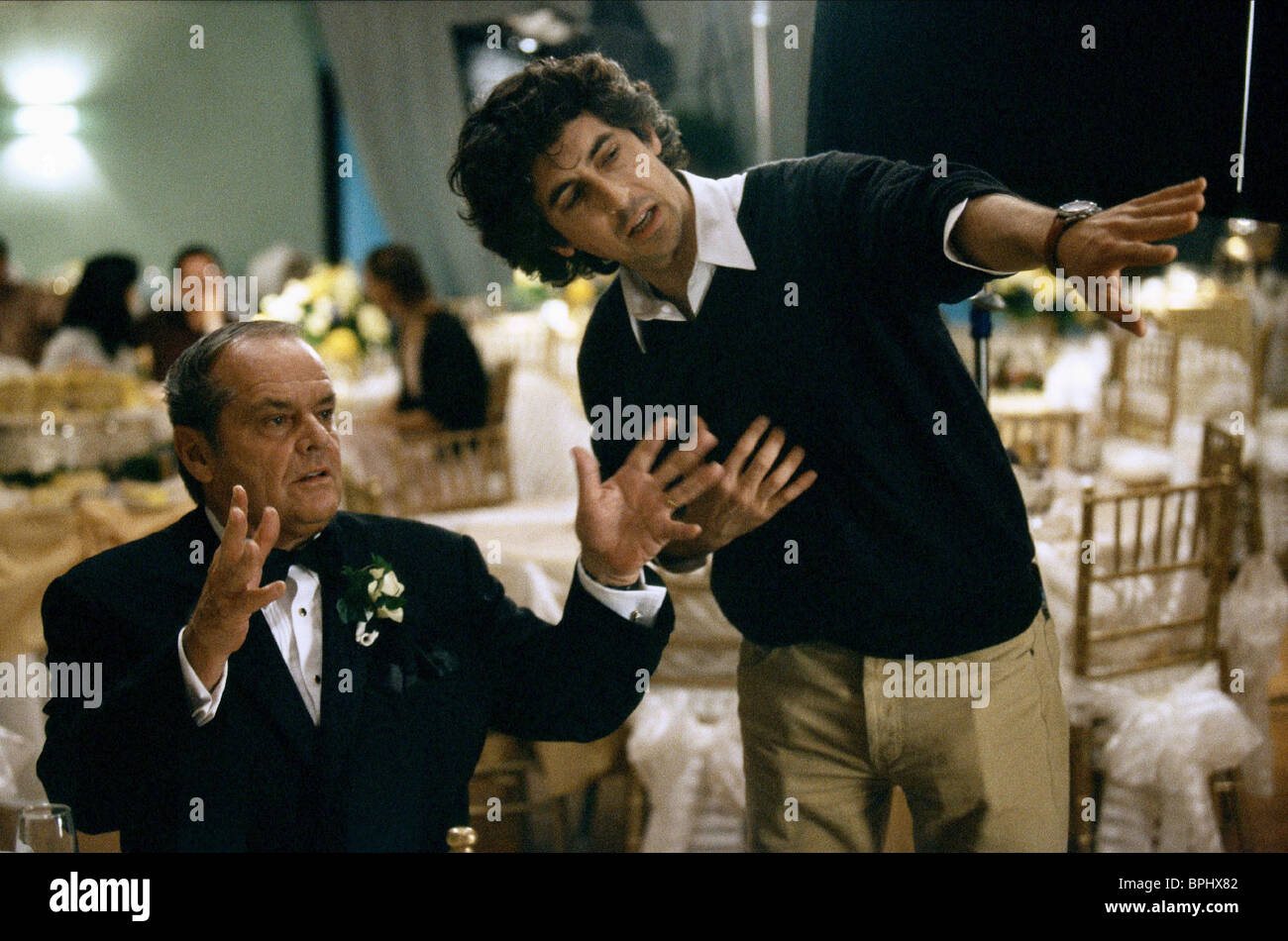
Alexander Payne on working with Jack Nicholson
NOTE: These excerpts are from 2001-2002 articles I wrote and that appear in my book
Alexander Payne derives much of his aesthetic from the gutsy, electric cinema of the 1970s and therefore having the actor whose work dominated that decade, Jack Nicholson, anchor his film About Schmidt is priceless.
“One thing I like about him appearing in this film is that part of his voice in the ‘70s kind of captured alienation in a way,” Payne said, “and this is very much using that icon of alienation, but not as someone who is by nature a rebel, but rather now someone who has played by the rules and is now questioning whether he should have. So, for me, it’s using that iconography of alienation, which is really cool.”
Beyond the cantankerous image he brings, Nicholson bears a larger-than-life mystique born of his dominant position in American cinema these past thirty-odd years. “He has done a body of film work,” Payne said. “Certainly, his work in the ‘70s is as cohesive a body of work as any film director’s. He’s been lucky enough to have been offered and been smart enough to have chosen roles that allow him to express his voice as a human being and as an artist. He’s always been attracted to risky parts where he has to expose certain vulnerabilities.”
The film’s title character, Warren Schmidt, is a man adrift in a late life crisis where the underpinnings of his safe world come unhinged, sending him reeling into an on-the-road oblivion that becomes a search for redemption. Because the story is really about a man’s inner journey or state of mind the film is not so much driven by traditional narrative as it is subtext.
“This film isn’t so much about the story because there isn’t really much of a story. It’s about a man and kind of about a way of life,” Payne said. “And it’s a way of life I kind of witnessed in Omaha. Not that it doesn’t exist elsewhere and not that many different lives don’t exist in Omaha. But, from time to time, it has a whiff of something that’s very genuine. It’s just a feeling, and I’d be hard-pressed to describe it beyond that.”
As an artist, Payne does not like limiting himself to expository narrative. He understands how seemingly whimsical, quirky or incidental elements, like the moon serenade in Citizen Ruth or the lesbian romance in Election, have value too.
“One thing Hollywood filmmaking urges you always to do is tell the story. If it’s not germane to the story, then leave it out. And I kind of disagree with that,” he said. “I mean, I like stories. I like seeing movies that tell stories. I like my movies to tell stories. But films don’t operate only on a story level. There’s a quote I like that says, ‘A story exists only as an excuse to enter into the realm of the cinema.’ Films operate on emotions, moods, sub-themes and maybe even poetry, if you’re lucky enough to have a bit of mystery and poetry in your film.”
If the screenplay is any guide, then reading it reveals Schmidt as a man who has built his life around convention and conformity but who, along the way, has lost touch with what he really is and wants. The things in his well-ordered life have become his identity. His actuarial job with Woodmen of the World Life Insurance. His office. His home. His routine. His marriage. When, in short order, he retires, his wife dies and his estranged daughter prepares to marry a man he does not like, he realizes he is alone, at odds, angry and restless to find answers to why his supposedly full life seems so empty.
What makes Schmidt’s dilemma more complex is that he is not a wholly likable man. He is a square, a miser, a malcontent. Payne is drawn to such richly shaded and often unsympathetic characters because they are more interesting, more real, more truthful. Just think of inhalant addict mother-to-be Ruth Stoops in Citizen Ruth or arrogant, spiteful teacher Jim McAllister in Election. Neither is totally a shit, though. Stoops is brave, outspoken, independent. McAllister is sincere, caring, dedicated. And, so, Schmidt is solicitous, careful, reflective. As he begins defining a new life for himself without a job or wife, he begins behaving in ways that defy family-societal expectations.

In this way, the film is an indictment of the prefabricated mold people are expected to fit. With Schmidt, Nicholson mutely echoes the alienated character (Bobby Dupea) he essayed in 1970’s Five Easy Pieces. Just as Dupea turns his back on his classical piano career and blue blood roots to work the oil fields, Schmidt shucks his constraints to embark on a road trip that is as much escape as quest.
Then there’s the whole star power thing Nicholson brings. The clout Nicholson wields. The Player label he wears. The attention he commands. Payne is savvy enough to know that having Nicholson on the project boosts the prestige and the pressure that goes with it. That’s why this production is a little more all-business and a little less laid back than Payne’s previous two. For example, the filmmaker is, for the time being anyway, giving no interviews (outside this one) and the set is closed to reporters.
This limited access all gets back to the Nicholson factor. It means catering to him and shielding him.
Or, as Payne put, “we have a big fish on this one. Everyone knows him. Most everyone is a fan of his. Plus, there’s the Pop stuff of his winning three Academy Awards and having been in very many popular and artistic films. So, he’s a big presence in American culture. And all of us, certainly from me down to the crew, want him to be impressed. We want him to feel protected and supported. We want to feel that we have his approval. And, as director, I’m really bending over backwards to make sure he feels comfortable enough so he will expose vulnerabilities and really dive into the part. So, just because of his stature there is a heightened will among the film company and crew to do a good job.”
Making no bones about what a fan he is of Nicholson, Payne said his star has thus far been a filmmaker’s dream.
“Sometimes, you think about a movie star as being more star than actor, kind of playing some version of themselves. That’s not the case with Mr. Nicholson. He’s all about the character. He really dives into who is that person. He’s a consummate actor. I’ve been really impressed with what I’ve seen so far. And I think watching the character unfold through him is going to be really amazing.”
Instead of full-blown rehearsal periods for the film, Payne, Nicholson and the film’s other name actors, who include June Squibb as nis wife, Hope Davis as the daughter, Dermot Mulroney as the future son-in-law and Oscar-winner Kathy Bates as the future in-law, have held script readings. According to Payne, Nicholson is not throwing his weight around, as one might expect, but rather acting as a colleague and collaborator.
“My experience so far is that he expresses his opinions as he sees them and he tries to be helpful to me and to the process. He seems to respect the filmmaker. So far, it’s been a really interesting collaboration. And I also think I have much to learn from him, so I welcome his input.”
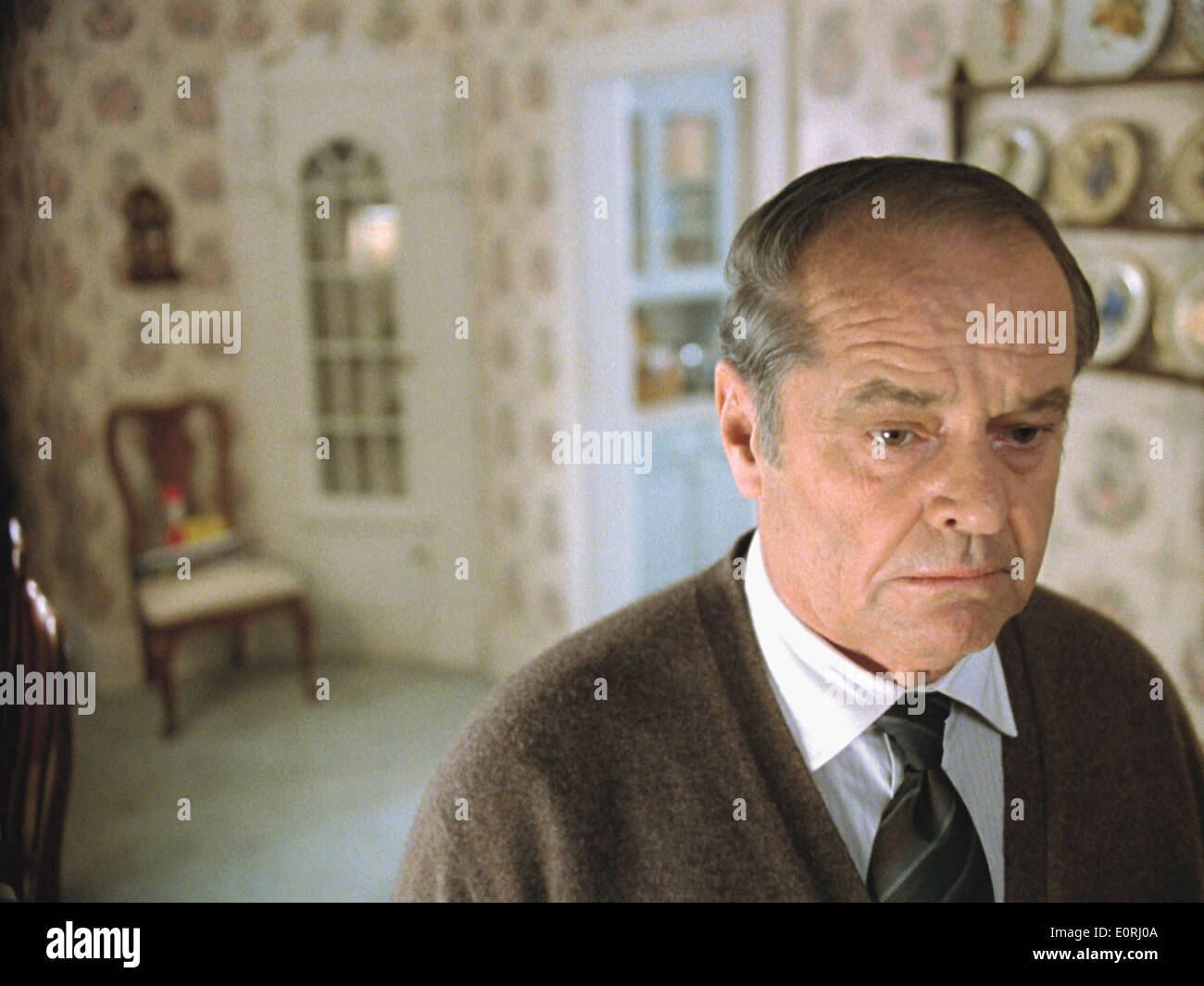
Nicholson became attached to the project through the kind of old-boy networking Hollywood thrives on. The actor was given Begley’s book by his old friend, producer Harry Gittes (whose name Nicholson appropriated for the private eye he played in Chinatown). Then, Payne came on board, writing the script with Taylor and being assigned directorial chores as well. All Payne knew was that Nicholson would read the finished script first.
“And, oh, thank God he liked and agreed to do it,” Payne said. On a practical level, Nicholson’s participation has meant a much bigger budget than Payne has worked with before. “It’s around $30 million. Mr. Nicholson’s getting a salary which is larger than actors have gotten in my previous movies. Another factor is that this is a union movie, where my previous two were non-union, so there’s a little added cost there.
“Thirty (million) is actually quite modest – it’s hard to believe, I know – by Hollywood standards. And it’s really amazing this script is getting made with this caliber of star at that budget level, because there’s no gimmicks, no special effects, no guns. It’s just a guy in crisis.”
Nicholson’s presence netted a bigger budget than Payne ever had before, which meant New Line insisted he use sound stages and multiple cameras as safeguards against cost overruns caused by shooting delays.
“Because it’s not a terribly commercial film and because it’s somewhat costly I was urged to not go over budget. I had to make all my days, so in order to do that I shot more on sound stages and I sometimes threw up two or three cameras. I’d used sound stages on a limited basis before because, one, we didn’t have the budget to build sets and, two, I don’t really trust it, I trust what exists. But practical locations, as they’re called, are difficult. They’re tight. You wreck people’s front lawns.
“Building sets and shooting on them poses its own logistical problems, but it also solves a lot of problems. And rather than shoot from one angle and then move in closer, I tried to get both (shots) at once. I like doing it precisely for the reason of not wearing out the actors and saving time.” In the end, Payne did meet his sixty two-day schedule.
Despite the hike in budget, the presence of a superstar and the imposition of union realities, Payne insists the film, which is being made for New Line, remains closer to his first two intimate independent features than to overblown mainstream Hollywood pics.
“The scale of filmmaking is, for me, not that much different than my previous two. A lot of directors, as they get older or have more films under their belt or have more success or whatever, they consistently make bigger, more impersonal films. I am conscious of wanting to make increasingly more personal films.”
Directing Nicholson allowed Payne to work with an actor he greatly admires and solidified his own status as a sought-after filmmaker. He found Nicholson to be a consummate professional and supreme artist.
“Nicholson does a lot of work on his character before shooting. Now, a lot of actors do that, but he REALLY does it. To the point where, as he describes it, he’s so in character and so relaxed that if he’s in the middle of a take and one of the movie lights falls or a train goes through or anything, he’ll react to it in character. He won’t break.” Payne said Nicholson doesn’t like a lot of rehearsal “because he believes in cinema as the meeting of the spontaneous and the moment. His attitude is, ‘What if something good happens and the camera wasn’t on?’”
By design, Nicholson carries the film. He is in virtually every scene. That Payne got him to play the lead in the first place was a coup. That he worked with an artist he’s long admired was cool. In an interview Payne gave the Omaha Weekly only days before shooting began, he said the actor was accommodating in every way, immersing himself in the part and making himself available to the entire process during script readings. Now months removed from the shoot, Payne said Nicholson remained a pro throughout the production and his extraordinary talent provided him as a director with endless choices.
“I had a very excellent experience working with him. He was extremely professional and committed to his part. Jack Nicholson is a movie star and an icon and that’s fine, but in the moment of doing it and really who he is in his heart he’s an actor who gets nervous like other actors and wants to do a good job like other actors and hopes he got it right like other actors and needs reassurance like other actors.
“What was great about directing him was that unlike many situations where you give the direction and hope to God the actor can do it just the way you’d like him to or you hope you’ve thought of the right words that will trigger the right response, with Nicholson I had to be careful with what I told him because not only would he do it, he could do it. He just has an excellent instrument. Sometimes, when I’d impose blocking or I wanted a certain scene a certain way, I’d say, ‘Is that all right with you’ and he’d go, ‘Well, anything you come up with I can find a way to justify it to myself, so, what do you want?’ I was like, ‘Ohhhh…’ He makes every possible choice doable.”
Payne said, “There’s always a bit of nerves between actors and director the first couple weeks as you’re learning to trust one another.” That was true at the start of Schmidt, as Nicholson felt Payne out, but in short time “he made it very easy to direct him. He put a lot of appreciated effort into breaking the ice with those around him. He was very professional and very cool and very kind.”
The crowds of fans that followed the Schmidt traveling all-star band from location to location have long dispersed since production wrapped.
If reaction to the film by preview audiences is any gauge, than Payne may be striking the right chords with this gray, introspective story. He said test cards consistently use words like “real,” “true-to-life,” “genuine,” “naturalistic” and “not funny” to describe it. “And that’s been kind of nice,” said Payne, whose aesthetic is informed by the European and American cinema of the last Golden Age (the 1960s and ‘70s) when the best films were about real life. Payne said the September 11 terrorist attacks “helped cement more than ever my already existing desire to make human films – films which are about people.”
Categories: About Schmidt, Actor/Acting, Alexander Payne, Alexander Payne: His Journey in Film, Cinema, Directors/Directing, Film, Hollywood, Jack Nicholson, Movies, Omaha, Writing
About Schmidt, Actors/Acting, Alexander Payne, Alexander Payne: His Journey in Film, Cinema, Directors/Directiing, Film, Hollywood, Jack Nicholson, Movies, Omaha
Laura Dern and Alexander Payne: An actor-director marriage made in heaven
June 14, 2016
Leave a comment
Laura Dern and Alexander Payne: An actor-director marriage made in heaven
©by Leo Adam Biga
A version of this story appears in my book Alexander Payne: His Journey in Film
Doing some more proofs and edits to the new edition of my Alexander Payne book reacquainted me with this piece I did about the close friendship and great working relationship the filmmaker forged with Laura Dern when making his debut feature Citizen Ruth. The two remain chums 20-plus years later. Payne brought her to Omaha for a Film Streams Feature Event that saw him conversate with her at the Holland Center. She’s come back to Omaha at his invitation a few other times as well. In the interviews I did with Payne and with Dern for this story I probably dug deeper than I ever have before or since in fleshing out the collaborative director-actor dynamic. I share the story with you now. As the story reveals, it turns out Citizen Ruth might have never happened if Dern hadn’t fallen in love with the script and championed the project. What was origially called The Devil Inside was going nowhere until she fought for the part and once she got it she fought for the project. Indeed, Payne credits her for getting it made. In my opinion, her performance is one of the bravest pieces of acting I’ve ever seen by a major female lead and the film remains the most raw and real, if not the best, of Payne’s work.
NOTE: The new edition of Alexander Payne: His Journey in Film releases September 1. It is the only comprehensive treatment of the Oscar-winning Payne in print or online. It is a collection of articles and essays I have written about Payne and his work over a 20-year span. I have basically covered him from the start of his filmmaking career through today. The book takes the reader through the arc of his filmmaking journey and puts you deep inside his creative process. There is much from Payne himself in the pages of the book since most of the content is drawn from interviews I have done with him and from observations I have made on his sets. I also have a good amount of material from some of his key collaborators.
I self-pubished the book in late 2012. It has received strong reviews and endorsements. I am releasing a new edition this summer with the help of a boutique press here, River Junction Press, and its publisher Kira Gale. The new edition features major content additions, mostly related to Payne’s Nebraska and Downsizing. It will also feature, for the first time, a Discussion Guide and Index, because we believe the book has potential in the education space with film studies programs, instructors, and students. But I want to emphasize that the book is definitely written with the general film fan in mind and it has great appeal to anyone who identifies as a film buff, film lover, film critic, film blogger. It has also been well received by filmmakers,
Kira and I feel hope to put the book in front of the wider cinema community around the world, including producers, directors, screenwriters, festival organizers, art cinema programmers. We feel it will be warmly embraced because Payne is one of the world’s most respected film artists and everyone wants to work with him. People inside and outside the industry want to learn his secrets and insights about the screen trade and about what makes him tick as an artist.

When Laura Met Alex: Laura Dern & Alexander Payne Get Deep About Making Citizen Ruth and Their Shared Cinema Sensibilities
Published in July 10-16, 2008, Vol. 15, 20, issue of The Reader
Citizen Stirrings
When Alexander Payne and Laura Dern chat on the Holland Performing Arts Center main stage July 13 for Films Streams’ first annual fundraiser they’ll naturally get around to Citizen Ruth. The 1996 abortion comedy he co-wrote with Jim Taylor marked Payne’s directorial debut and Dern’s portrayal of title character Ruth Stoops earned her critical acclaim.
What the pair may or may not discuss is how pivotal their collaboration proved.
Sixteen years ago Payne was still an aspiring feature filmmaker. His UCLA graduate thesis project from a few years before, The Passion of Martin, turned heads. The newcomer showed enough promise to land a studio development deal, analogous to a college baseball star getting drafted by a major league franchise, inking a fat contract and getting assigned to the high minors.
But he hadn’t broken through yet. He and Taylor did finish their abortion comedy script, then-known as The Devil Inside, that fall. They were trying to get it set up for Payne to direct. The script made the rounds, generating heat, but nobody wanted to finance it. Too risky. Too political. Too controversial. It didn’t help that Payne was untested in features.
Cut to Dern, by then established as an edgy screen actress for bare-her-soul performances in Joyce Chopra’s Smooth Talk, Peter Bogdanovich’s Mask, David Lynch’s Blue Velvet and Wild at Heart and Steven Spielberg’s Jurassic Park. She was already Oscar-nominated as the free spirit title character in Martha Coolidge’s Rambling Rose, for which her mother, Diane Ladd, was also nominated. Her acting genes extend to her father and fellow Oscar nominee, Bruce Dern.
Reminiscent of a young Barbara Stanwyck in her ability to play innocence and guile, sweetness and toughness, Dern was a catch for any director. Payne was a big fan of her work but never thought of her for messed-up Ruth Stoops. He probably didn’t think he could get her. That changed when, unbeknownst to him, Dern’s then-beau, actor Jeff Goldblum, got ahold of the Devil script and gave it to Laura.
“And I just was obsessed the moment I read it,” she said by phone from the L.A. set of a short film she’s appearing in. “I just forced their hands.”
Shared Cinephile Leanings
What did she respond to so strongly?
“Well, in terms of the material,” she said, “it’s a very unique and hilarious and extremely honest voice about this country and about what happens when you get two opposing sides in America, on any subject frankly. And the idea of putting this not just flawed but impossible protagonist at the middle of it is just completely genius. I felt I had something to bring to it that was unique.
“My love for finding empathy and voice in untenable human territory made me determined to force myself on them. I could love nothing more as an actor than one specific challenge, which is finding an empathetic place for a character we would ordinarily have disdain for, and Alexander happens to love that, too. Alexander, Jim (Taylor) and I have the same sensibility and that’s a very rare thing to find.”
Studio execs often express dismay at Payne’s unsympathetic protagonists. “My response is always, ‘It hasn’t been cast yet.’ I think it’s the actor who brings the humanity and the sympathy to that part,” he said. “Yeah, of course, how the film is directed and the tone contribute also, but that’s the actor’s job – to bring us a really full human person, and I’d like to think that truth is always sympathetic.”
“And the goal probably isn’t finding the sympathy, the goal is finding a multi-dimensional authentic person,” Dern said. “Everyone is filled with their own dark and light places.”
She said the sensibility she and Payne share derives from their cinema weaning.
“Alexander and I both grew up on the humanist films from the ‘70s. In the ‘70s there was a blossoming of the auteurist view and in the very specific way directors worked with their actors to find a singular voice. I think probably because humanity was the goal. The bottom line is it’s up to your actor to find the humanity in a way that can only happen through behavior. That was the focus those directors had and it seems to be such a focus of Alexander’s work as well.”
Putting Herself On the Line
The only other time Dern’s gone after a role so aggressively, she said, is Rambling Rose. Her commitment to Ruth changed everything.
“Laura’s presence helped finance the film,” Payne said by phone from his Topanga Canyon, Calif. home. Her involvement also lured other cast members. “I know Laura’s presence helped woo Burt Reynolds. These things catch their momentum however they catch their momentum. The script opened doors and then Laura liked the script and then the snowball stated growing.”
Finally, Payne secured the financing, which, he added, “was still hard to get even with Laura attached. This film almost wasn’t made.” He said it was only by the slimmest of margins the money came through.
Few besides Payne and Dern know how close it all came to not happening and how long it took to be realized.
“We finished our first draft in the fall of ‘92 and I wasn’t shooting until fall of ‘95,” he said. “I was so frustrated I left L.A., in a kind of self-imposed exile, wondering, What does it take to get a film made?”
Without Dern the project might have died or at least been delayed and Payne’s dream to direct deferred. When she signed on he recognized his good fortune.
“Yeah, and the exciting thing was that she kind of came after me,” he said. “I had lunch with her and she evinced such enthusiasm for the part and understanding of the role that she was the one.”
To help make the small-budgeted indie pic feasible Dern agreed to work for SAG scale along with everyone else.
“Here she was a big movie star coming to Omaha, Nebraska to play a pregnant drug addict,” he said. “She was getting, I don’t know, four thousand dollars a week or something, so that proved she was there because she wanted to be there. It wasn’t for any other reason than for the pleasure, for the joy of it.”
Said Dern, “We were all there for our passion and it made for an incredibly creative and professional experience for all of us.”
On the set he soon discovered her reputation for putting herself out there, on the line, totally exposed, for her art is well deserved.
“Yeah, that’s where she’s most comfortable,” he said. “She gives one hundred percent to the role.”


A Safe Place
Ruth Stoops is among many roles in which she’s gone to emotional extremes and done provocative scenes. There’s no holding back. No hedging or softening. She lays it all out to see. She clearly enjoys pushing boundaries.
“I mean, for whatever reason it is my favorite thing to do,” said Dern, who won her legal emancipation from her parents at age sixteen in order to pursue her craft full-time. “And I have a feeling that being raised by Bruce Dern and Diane Ladd had something to do with it, both in my film life and in my life. I definitely seek it out.”
Before she can put herself out there she has to feel she’s in good hands. Despite Payne’s inexperience, she felt protected.
“I must say I had implicit trust in him. I never questioned him. I don’t think I ever will. I believed in him and I think like we felt we knew each other, and that’s a bond where you can’t go wrong. That’s some kind of innate knowing. If there was a feeling out process it was really just – What do you like? How do you like to work?
On that level. Just on the day to day things.”
Payne said it’s inevitable a director and a lead actor size each other up.
“Oh yeah, you know I was so happy she was going to be in my movie but still the director thinks, I hope this person doesn’t screw up my movie,” he said. “And the actor might think, Who’s this director who’s going to screw up my performance?”
In their case, he said, it helped that she’d checked his work out.
“She liked The Passion of Martin, my student film, so she did her homework in watching that.”
Still, he was a newbie. He soon found out about her astute grasp of cinema.
“Of course she was justifiably concerned as to who my other partners were going to be – who my cinematographer was, my editor…because that’s the thing, she really understands the filmmaking process and how it’s not just about the actor or the director,” he said, “it’s about everyone involved. It’s such a huge effort. And she really gets all of that.
“So, yeah, she wanted to know she was going to be placing her hard work in safe hands and I think once she felt that, then she was able to give her all. And once I felt she was going to give me what I wanted and even more, then I felt safe, and then we just skyrocketed.”
Dern had a hand in a key crew member coming on board.
“One thing that worked out really well on the film – it both made her feel safe and it began a friendship and a professional collaboration that lasted through three films – is that she introduced me to Jim Glennon, the cinematographer” he said.
Jim had shot her in Smooth Talk, her kind of star-making film, back in ‘85, and she recommended him. I went to meet him, if nothing else just as a courtesy to Laura, thinking, Well, I’ll be able to tell her I met him but I didn’t like him. And I adored him, and so that was a right move in many ways.”
The late Glennon went on to shoot Payne’s Election and About Schmidt.
In Synch
Payne and Dern meshed in that way only two artists who respect each other can.
“Look, we worked together extremely well,” he said. “It’s one of the richest collaborations I’ve ever had with an actor and I was so happy it was happening on my first feature film. We really got in tune with each other pretty early on and we really felt a partnership.
“I mean, when you make a film your production designer is your partner and your cinematographer is your partner and your editor is your partner. And it’s nice when the lead actor is your partner in the same way and it’s not somebody you have to handle or manipulate or anything.”
For her part, Dern said, “I consider one of the best moments of my life was working on Ruth with Alexander. I had been acting for sixteen-seventeen years. I’d worked with extraordinary people, for sure. I think that speaks so much to his innate abilities and instincts.”
The comfort level she felt with him and Glennon helped her tap into an aspect of Ruth and women like her she feels deeply about.
“One of the things I always loved about Ruth, why I felt like I understood her so completely, was that Ruth isn’t just a character trying to find her voice but she’s a character who doesn’t now she’s entitled to one, and I long to play women who are in that struggle,” Dern said. “I think Rose in Rambling Rose is similar that way.
“And I know they’re the two that have probably penetrated my heart the most as characters I really love and find really relatable for women in this country. I really crave playing women who are on that discovery.”
Mutual Admiration Society
Payne said Dern’s commitment to craft isn’t a self-absorbed ego trip. She’s not just concerned with her own performance but with contributing to a fully realized film.
“She gives a hundred percent to the role and she also is a good kind of team captain for the entire cast,” he said. “The rest of the cast look to the lead actor – how is he or she feeling about the film…and she always had such great enthusiasm and professionalism.”
Payne couldn’t have asked for anything more. But he got it. When he and Kevin Tent were editing the film he got another glimpse of Dern’s cinema savvy.
“She has such a knack for film acting. I mean, many months later when I was editing I would talk to her by phone or she would come by the cutting room and I’d say we’re cutting a scene a certain way or she’d see how a scene was cutting and she’d say, ‘You know, I think in that shot on take three I did something kind of interesting. You might want to take a look at that.’ She had a prodigious memory for what she did in what scenes and what other actors did.
“I’ve read recently about her performance in Recount. That she would do many scenes three ways – underplayed, over the top and then kind of neutral, so that Jay Roach, the director, would have choices to calibrate her performance in the cutting room. And that’s just like textbook Laura. She understands film to the nth degree. She knows it’s about editing and she gives you choices in editing.”
Payne went on to have the same experience with Jack Nicholson on Schmidt.
“Oh, yeah, that’s the kind of actor you want. Everyone has to understand it’s not about what happens on set, it’s about what you harvest on set to get to the cutting room.”
For Payne, Dern’s enduring gift was the example she set “that one can work the way one wants to, which is with a real sense of partnership with the lead actor,” he said. “That it really can be the way it should be. And have fun. I mean, we all had a really good time making Citizen Ruth. A really good time. She’s a blast. I’d like to think it set a tone for what the rest of my films have been.”
Both would like the opportunity to work together again.
“We’ve definitely talked about,” Dern said.
“I’d love to work with her again but I haven’t had a part for her,” said Payne, who doesn’t know yet whether his upcoming film, Downsizing, may include a role for her. An original screenplay written with Jim Taylor, Downsizing’s described by Payne as “a large-scale, possibly ‘epic’ comedy that uses a science-fiction premise as a way to paint a fairly large satiric mural of today’s world.”
Just as Payne surrounds himself with a family of film artists on project after project, Dern enjoys longstanding collaborations.
“I’m a big believer in it and I feel like I have found a tribe of people I’ve worked with over and over again, someone who gets you, and you feel like you can do your best work with someone who gets you.”
The two know each other so well, he said, he’s not preparing copious-James Lipton notes for the Holland event but rather winging it. “I mean, look, all we have to do is start talking and it’ll all come out.” Maybe he’ll wear his lucky Ruth pants, white jeans whose pants leg was torn by a dog that bit him on a location scout.
Flashback to June 2015: Visiting Africa with Terence “Bud” Crawford
June 14, 2016
1 comment
Flashback to June 2015: Visiting Africa with Terence “Bud” Crawford
Leo Biga’s Journey in the Pipeline; Following The Champ, Terence “Bud” Crawford, in Africa
©by Leo Adam Biga
These are stories I wrote about my travels to Africa with boxing champ Terence “Bud’ Crawford. The pieces highlight various facets of the two-week trip to Uganda and Rwanda. The first is for Metro Magazine (http://www.spiritofomaha.com/Metro-Magazine/The-Magazine/) and the second is for The Reader (www.thereader.com).
In June 2015 I traveled to Uganda and Rwanda, Africa with the help of the Andy Award for international journalism from the University of Nebraska at Omaha.
Our travel party of seven included two-time world boxing champion Terence “Bud” Crawford of Omaha. I have been chronicling his rise to boxing prominence for four years and though he is a fighter through and through there is more to him than that. I have seen he has a real heart for his family and community as well as deep loyalty to those around him. He has single-handedly resurrected the sport of boxing in his hometown by fighting several title defenses here before huge crowds at the CenturyLink Center. He operates a gym that is a sanctuary for at-risk youth and young adults, providing them structured, positive activities that teach them lessons inside and outside the ring. Friends of Crawford have embarked on a major building campaign to renovate and expand the gym so that it can serve more people.
When I heard he had gone to Africa in August if 2014 I was intrigued. My interest grew when I learned he traveled to Uganda and Rwanda, two developing nations that have endured much conflict, killing and deprivation. Then I learned the story behind why he went and whom he went with and that motivated me to want to accompany him on the 2015 trip he was making to those same countries. It turns out that in the summer of 2014 Bud and his former fourth grade teacher at Skinner Magnet School in North O, Jamie Nollette, reconnected through social media. She congratulated him on all his success as a fighter and let him know how proud she is of him. When he learned what she does today as the founder and executive director of Pipeline Worldwide, a nonprofit that supports sustainability and self-sufficiency programs in Africa, he was fascinated to go to with her on her next trip.
For the African-American Crawford it was an opportunity to visit what he regards as the Motherland and to see how people there live. His first trip to Africa was indeed an awakening for him as he saw everything from people living in want and healing from trauma to people working regular jobs, going to market and living in comfortable housing. He visited villages and organizations that Pipeline Worldwide assists with funding to build fresh water wells and dormitories and to support programming that helps youth, women and families. He met survivors of civil war, abduction, abuse and genocide. He played with and comforted sick and orphaned children. He gave away lots of things. He also visited natural wonders.
I applied for and received the Andy Award grant from UNO to fund my way to Africa with Crawford, Nollette and four others for the June 1-12, 2015 journey. Our travel party saw everything described above and more. I was there to observe and report on it all. It was my first trip outside the United States and so it was naturally an awakening for me, too.
We met African, American and European program directors, educators, aid workers and humanitarians. We met survivors and perpetrators of violence. Crawford was feted as a visiting prince by sports officials who organized a press conference he handled with aplomb. We spent part of our time in urban centers and part of our time in rural areas. We shopped at open air markets and enclosed malls. We were treated to great hospitality wherever we went and we sampled all manner of the local cultures in the food and fashion and in the dance and music we were exposed to. We also did some service work at one stop. We went on safari and a gorilla trek. All in all, the two weeks added up to an eye opening experience that none of us will soon forget.
From a journalistic perspective, it was a challenge seeing so much in such a short time and capturing as much of it as possible. In my reporting I tried to be as faithful to the experience as time and space limitations allowed. The project did confirm what prompted me to go in the first place – that you should follow your instincts as a reporter and that you should stretch yourself beyond your routine comfort zones. I know I have grown as a result of the experience even if I can’t yet articulate how.
One of the takeaways from it all is that there are many Africans and non-Africans alike working hard to improve conditions and raise quality of life in the countries we visited. While I often felt like a tourist who was only glimpsing small aspects of life there at any given time, I do feel the totality of the journey gave me at least a rough appreciation for how people live.
And, as expected, traveling for two weeks with Crawford gave me new insights into him. I also developed a deeper appreciation for what Nollette and her Pipeline Worldwide does. If anything, the relationship between Crawford and Nollette has grown through their travels together. He helps bring awareness to her Pipeline Worldwide and the programs and projects it supports and she is helping lead the campaign to renovate and expand his B&B Boxing Academy.
There is another dynamic about the trip I made with them that is important to note. Six of the seven in the travel party are from Omaha. Four of us had never been to Africa before and in fact had done little or no travel abroad. Certainly our awareness of conditions, challenges and opportunities in those African nations was greatly increased by that experience and exposure. Eever since coming back I have been writing and presenting about the trip.
AFRICA TALES IN IMAGES
Here is a link to a video slideshow of the June trip I made to Uganda and Rwanda, Africa with The Champ.
The visuals were edited, set to music, given movement and in some cases captioned by my friend Victoria White, an Omaha filmmaker.
NOTE: I am available to make public presentations about the trip.
BTW: My blog, leoadambiga.com, features many other stories I’ve written about Crawford.

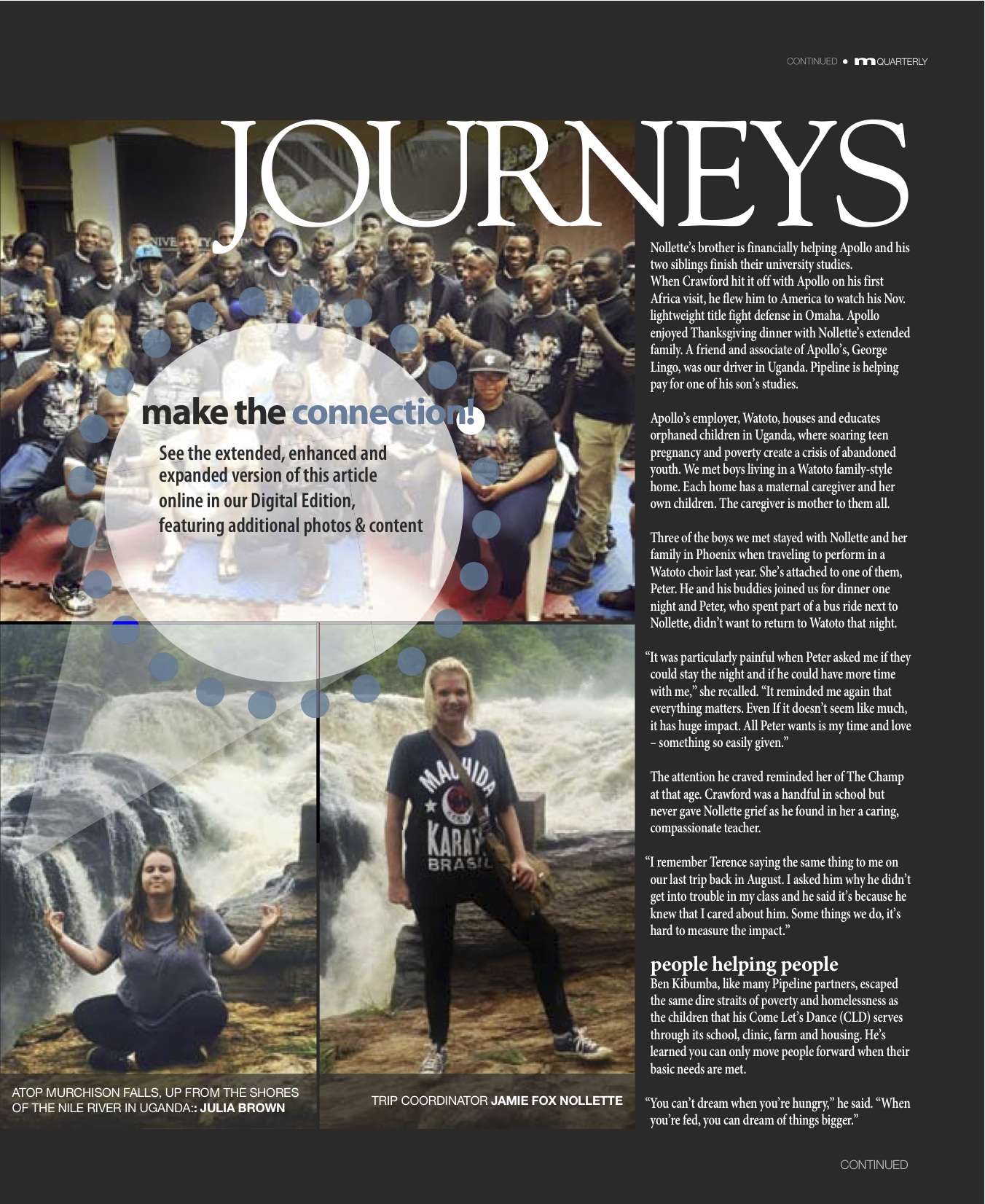


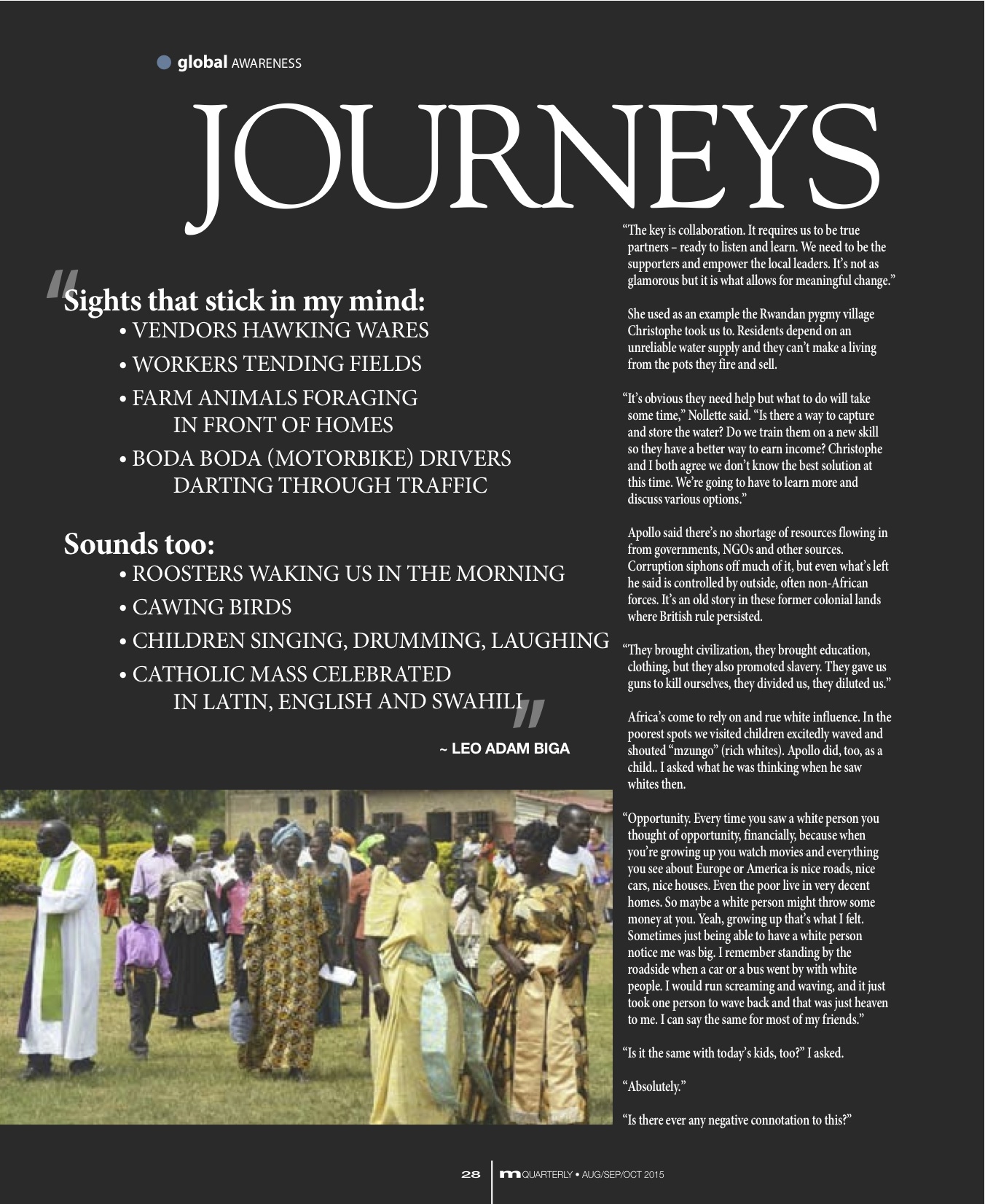
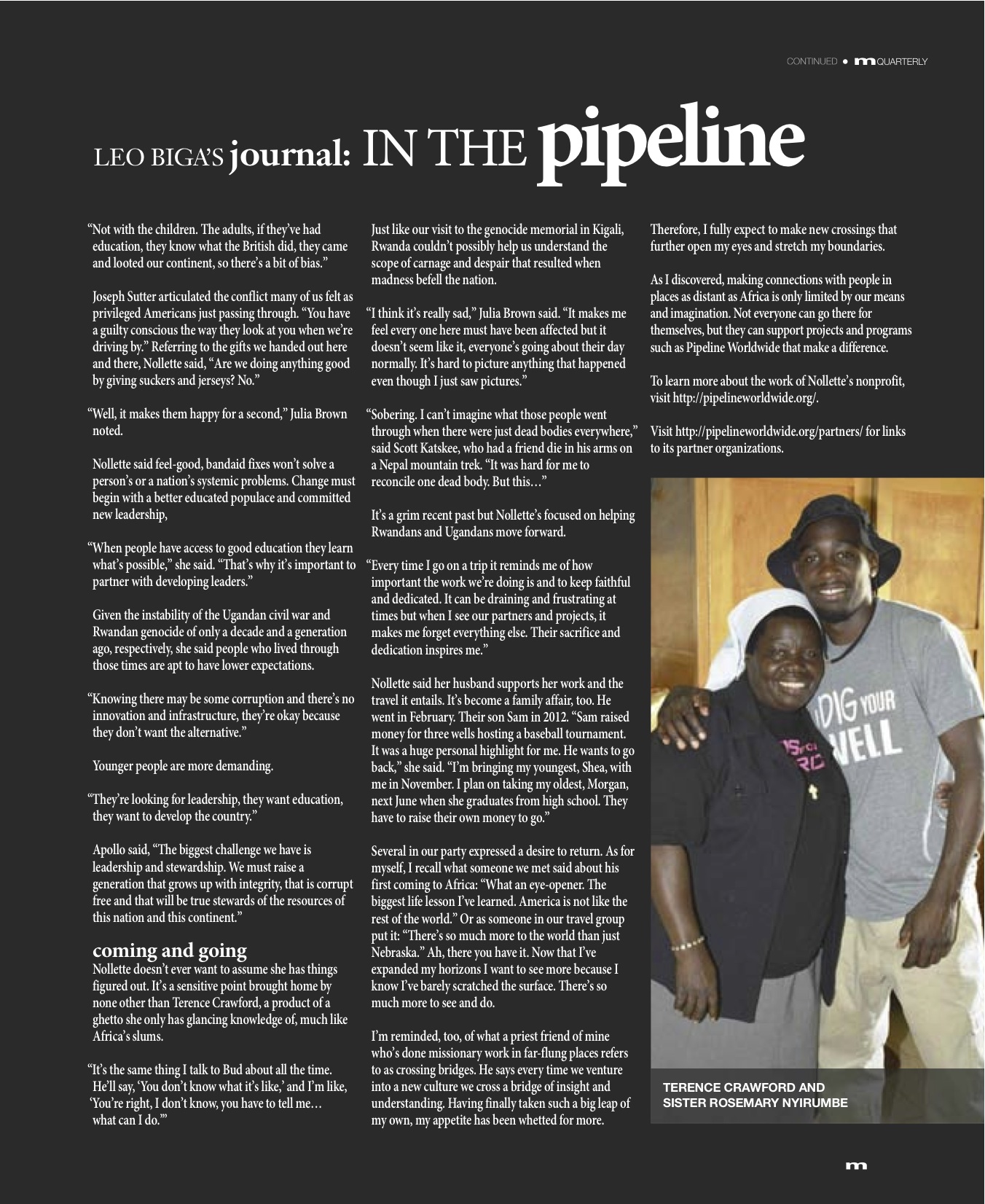
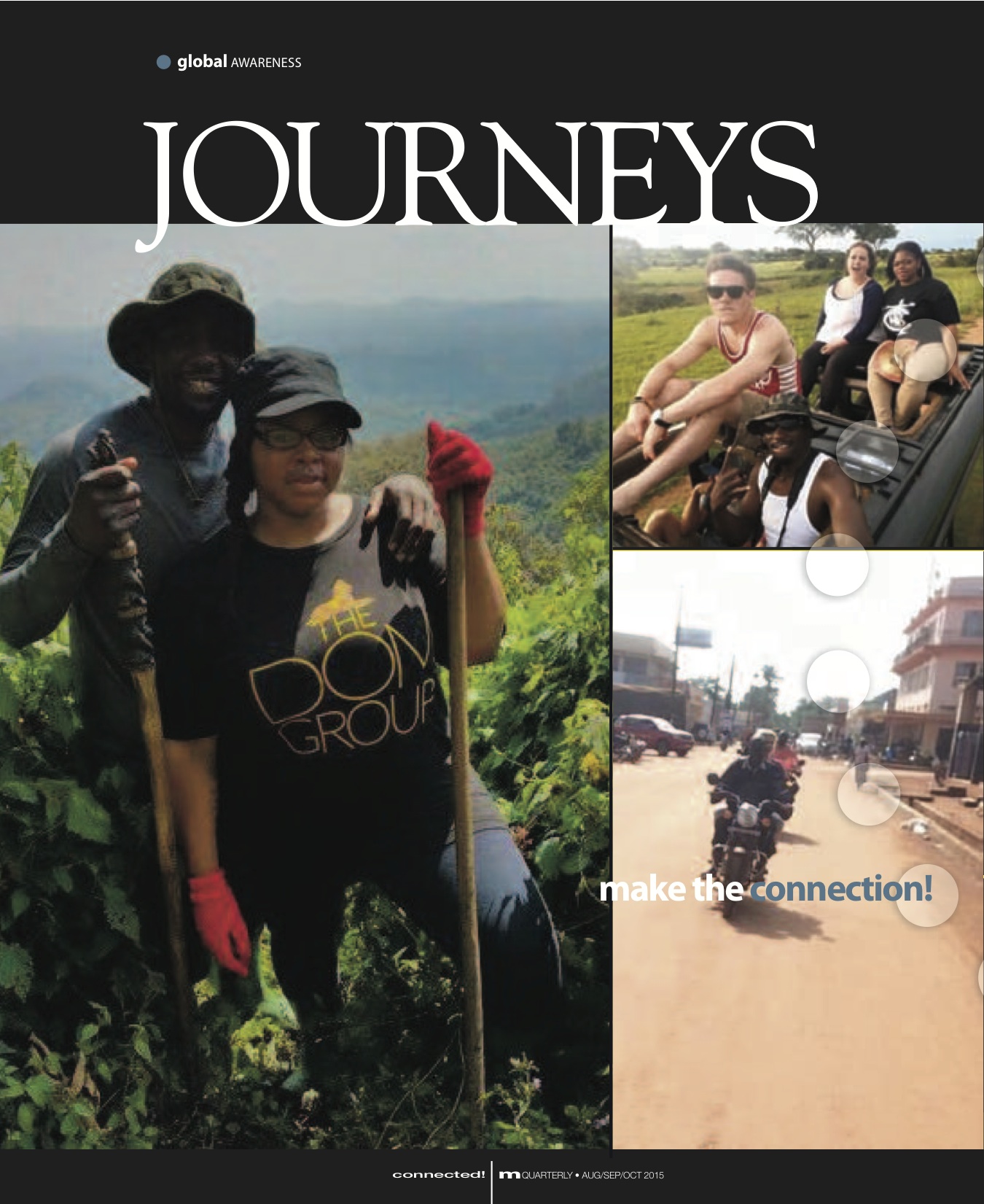






– – –
The Champ Goes to Africa
Terence Crawford Visits Uganda and Rwanda with his former teacher, this reporter and friends
Two-time world boxing champ Terence Crawford of Omaha has the means to do anything he wants. You might not expect then that in the space of less than a year he chose to travel not once but twice to a pair of developing nations in Africa wracked by poverty, infrastructure problems and atrocity scars: Uganda and Rwanda, I accompanied his last trip as the 2015 winner of the Andy Award for international journalism from the University of Nebraska at Omaha. Until now I’ve posted a little about the grant that took me to Africa along with a few pictures and anecdotes from the trip. But now I’m sharing the first in a collection of stories I’m writing about the experience, which is of course why I went there in fhe first place. This cover story in the coming July issue of The Reader (www.thereader.com) emphasizes Crawford within the larger context of what he and the rest of us saw, who we met and what we did. Future pieces for other publications will go even more into where his Africa sojourns fit into his evolving story as a person and as an athlete. But at least one of my upcoming stories from the trip will try to convey the totality of the experience from my point of view and that of others. I feel privilged to have been given the opportunity to chronicle this journey. Look for new posts and updates and announcements related to this and future stories from my Africa Tales series.

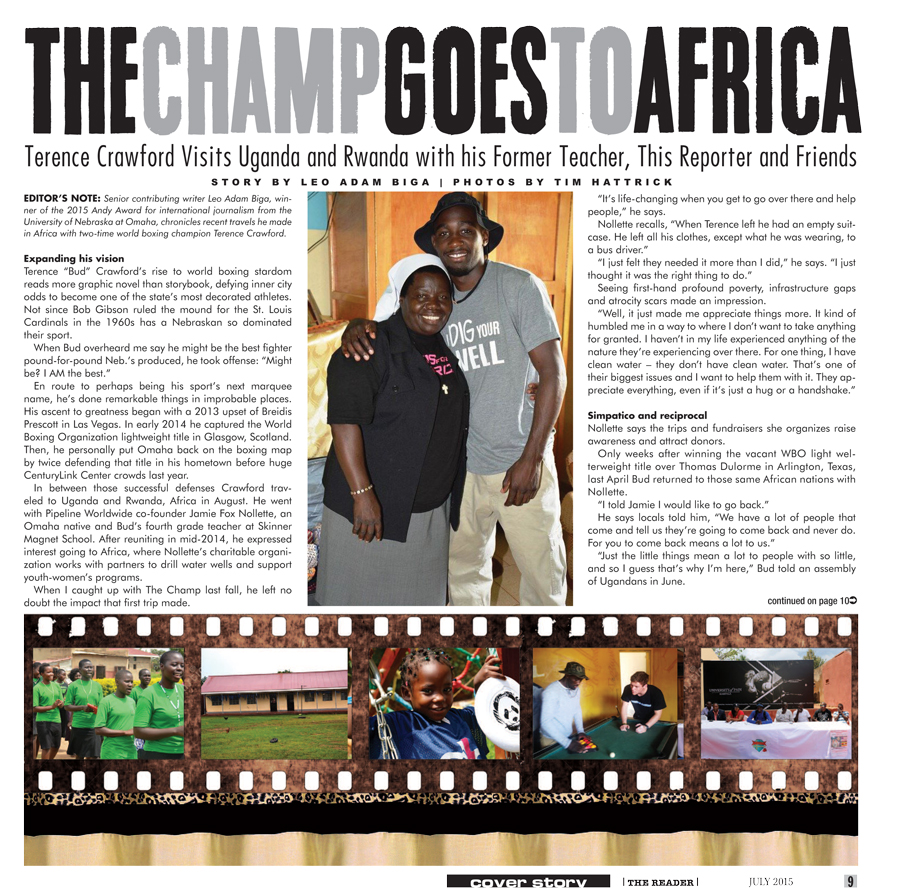



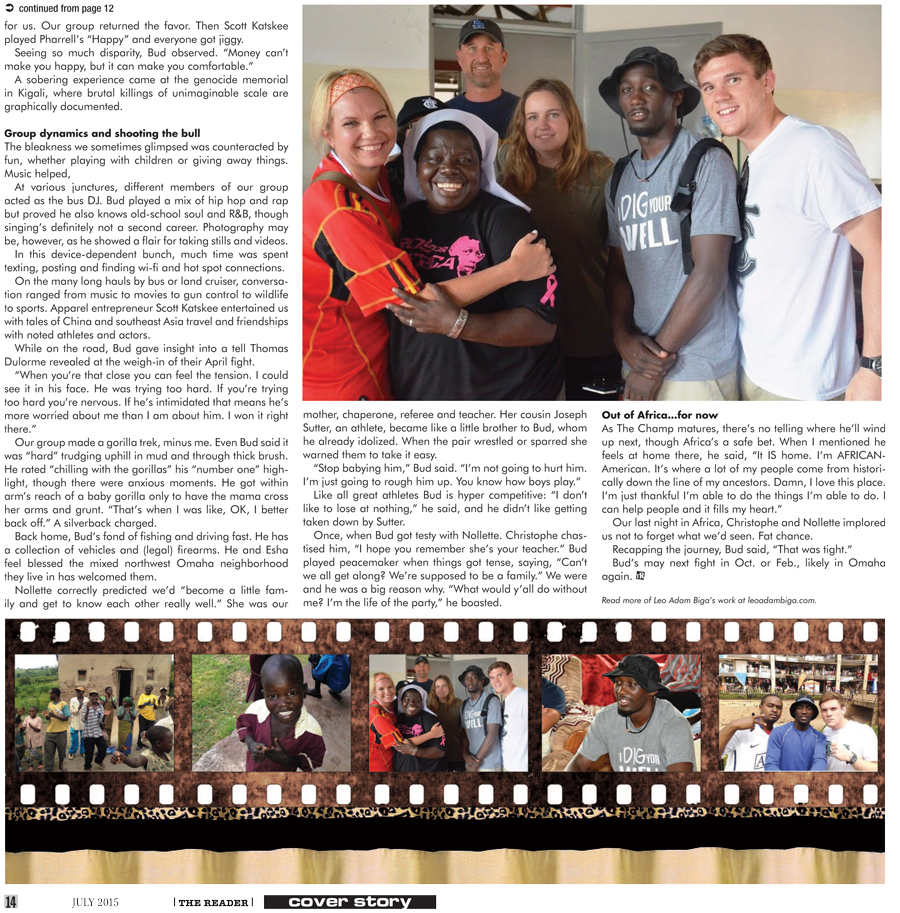
(Below is a text-only format of the same article)
The Champ Goes to Africa
Terence Crawford Visits Uganda and Rwanda with his former teacher, this reporter and friends
©by Leo Adam Biga
Originally appeared in The Reader (www.thereader.com)
EDITOR’S NOTE:
Senior contributing writer Leo Adam Biga, winner of the 2015 Andy Award for international journalism from the University of Nebraska at Omaha, chronicles recent travels he made in Africa with two-time world boxing champion Terence Crawford.
Expanding his vision
Terence “Bud” Crawford’s rise to world boxing stardom reads more graphic novel than storybook, defying inner city odds to become one of the state’s most decorated athletes. Not since Bob Gibson ruled the mound for the St. Louis Cardinals in the 1960s has a Nebraskan so dominated his sport.
When Bud overheard me say he might be the best fighter pound-for-pound Neb.’s produced, he took offense:. “Might be? I AM the best.”
En route to perhaps being his sport’s next marquee name, he’s done remarkable things in improbable places. His ascent to greatness began with a 2013 upset of Breidis Prescott in Las Vegas, In early 2014 he captured the WBO lightweight title in Glasgow, Scotland. He personally put Omaha back on the boxing map by twice defending that title in his hometown before huge CenturyLink Center crowds last year.
In between those successful defenses he traveled to Uganda and Rwanda, Africa in August. He went with Pipeline Worldwide co-founder Jamie Fox Nollette, an Omaha native and Bud’s fourth grade teacher at Skinner Magnet School. After reuniting in mid-2014, he expressed interest going to Africa, where her charitable organization works with partners to drill water wells and to support youth-women’s programs.
When I caught up with The Champ last fall, he left no doubt the impact that first trip made.
“It’s life-changing when you get to go over there and help people,” he says.
Nollette recalls, “When Terence left he had an empty suitcase. He left all his clothes, except what he was wearing, to a bus driver.”
“I just felt they needed it more than I did,” he says. ‘I just thought it was the right thing to do.”
Seeing first-hand profound poverty, infrastructure gaps and atrocity scars made an impression.
“Well, it just made me appreciate things more. It kind of humbled me in a way to where I don’t want to take anything for granted. I haven’t in my life experienced anything of the nature they’re experiencing over there. For one thing, I have clean water – they don’t have clean water. That’s one of their biggest issues and I want to help them with it. They appreciate everything, even if it’s just a hug or a handshake.”
Simpatico and reciprocal
Nollette says the trips and fundraisers she organizes raise awareness and attract donors.
Only weeks after winning the vacant WBO light welterweight title over Thomas Dulorme in Arlington, Texas last April Bud returned to those same African nations with Nollette.
“I told Jamie I would like to go back.”
He says locals told him, “We have a lot of people that come and tell us they’re going to come back and never do. For you to come back means a lot to us.”
“Just the little things mean a lot to people with so little, and so I guess that’s why I’m here,” Bud told an assembly of Ugandans in June.
None of this may have happened if he and Nollettte didn’t reconnect. Their bond transcends his black urban and her white suburban background. He supports Pipeline’s work and she raises funds for his B&B Boxing Academy in North O.
His first Africa trip never made the news because he didn’t publicize it. His June 1 through 12 trip is a different matter.
What about Africa drew this streetwise athlete to go twice in 10 months when so much is coming at him in terms of requests and appearances, on top of training and family obligations?
Beyond the cool machismo, he has a sweet, soft side and burning curiosity. “He really listens to what people say,” Nollette notes. “He wants to understand things.”
His pensive nature gets overshadowed by his mischievous teasing, incessant horseplay and coarse language.
This father of four is easy around children, who gravitate to him. He supports anything, here or in Africa, that gets youth off the streets.
He gives money to family, friends, homies and complete strangers. In 2014 he so bonded with Pipeline’s Uganda guide, Apollo Karaguba, that he flew him to America to watch his Nov. fight in Omaha.
“When I met Apollo I felt like I’ve been knowing him for years. I just liked the vibe I got. He’s a nice guy, he’s caring. He took real good care of us while we were out there.”
Bud says paying his way “was my turn to show him my heart.”
He respects Nollette enough he let her form an advisory committee for his business affairs as his fame and fortune grow.
Even with a lifelong desire to see “the motherland” and a fascination with African wildlife, it took Nollette reentering his life for him to go.
“Certain opportunities don’t come every day. She goes all the time and I trust her.”
His fondness for her goes back to when they were at Skinner. “She was one of the only teachers that really cared. She would talk to me.”
He needed empathy, he says, because “I got kicked out of school so much – a fight here, a fight there, I just always had that chip on my shoulder.” He says she took the time to find out why he acted out.
Catching the vision
Boxing eventually superseded school.
“I used to fall asleep studying boxing.”
Meanwhile, Nollette moved to Phoenix. On a 2007 church mission trip to Uganda she found her calling to do service there.
“It really impacted me,” she says. “I’ve always had a heart for kids and
I always had an interest in Africa.”
She went several times.
“There’s not really anything that can prepare you for it. The volume of people. The overwhelming poverty. Driving for hours and seeing all the want. I didn’t know what possibly could be done because everything seemed so daunting.
“But once I had a chance to go into some villages I started to see things that gave me hope. I was absolutely amazed at the generosity and spirit of these people – their hospitality and kindness, their gratitude. You go there expecting to serve and after you’re there you walk away feeling like you’ve been given a lot more. I was hooked.”
Bud got hooked, too, or as ex-pats say in Africa, “caught the vision.”
“I was very touched by the people and how gracious and humble and thankful they were about everything that came towards them. I had a great time with great people. I experienced some great things.”
Coming to Africa i:
Uganda
For this second trip via KLM Delta he brought girlfriend Alindra “Esha” Person, who’s the mother of his children. Joseph Sutter of Omaha and myself tagged along, Julia Brown of Phoenix joined us in Detroit and Scott Katskee, a native Omahan living in Los Angeles, added to our ranks in Amsterdam. Nollette arrived in Uganda a day early and met us in Entebbe, where Bud and Apollo enjoyed a warm reunion.
The next seven days in Uganda, which endured civil war only a decade ago, were a blur made foggier by jet lag and itinerary overload. Dividing our time between Kampala and rural areas we saw much.
Roadside shanties. Open market vendors. Christian schools, clinics, worship places. Vast, wild, lush open landscapes. Every shade of green vegetation contrasted with red dirt and blue-white-orange skies. Immense Lake Victoria. Crossing the storied Nile by bridge and boat.
The press of people. Folks variously balancing fruit or other items on their head. Unregulated, congested street traffic. Everything open overnight. Boda bodas (motor bikes) jutting amid cars, trucks, buses, pedestrians. One morning our group, sans me, rode aback boda bodas just for the thrill. I suggested to Bud Top Rank wouldn’t like him risking injury, and he bristled, “I run my life, you feel me? Ain’t nobody tell me what to do, nobody. Not even my mom or my dad.”
Ubiquitous Jerry cans – plastic yellow motor oil containers reused to carry and store water – carted by men, women, children, sometimes in long queues. “All waiting on water, that’s crazy,” Bud commented.
Stark contrasts of open slums and gated communities near each other. Mud huts with thatched roofs in the bush.
Long drives on unpaved roads rattled our bodies and mini-bus.
Whenever delays occurred it reminded us schedules don’t mean much there. Bud calls it TIA (This is Africa). “Just live in the moment…go with the flow,” he advised.
In a country where development’s piecemeal, Apollo says, “We’re not there yet, but we’re somewhere.”
Africans engaged in social action say they’ve all overcome struggles to raise themselves and their countrymen. “I was one of the lucky few to get out (of the slums),” Apollo says. They want partners from the developed world, but not at the expense of autonomy.
Many good works there are done by faith-based groups. Apollo works for Watoto Child Care Ministries, whose campus we toured. Three resident boys close to Nollette bonded with Bud on his last trip. The boys joined us for dinner one night.
We spent a day with Sister Rosemary Nyirumbe, whose vocational work with exploited females has won acclaim. Last year Nollette produced a video showing Bud training Sister for a mock fight with Stephen Colbert. This time, Nollette, Bud and Co. outfitted a dormitory for her girls in Atiak, where Pipeline built a well. Bud played music the girls danced to. They honored us with a traditional dinner and dance.
We toured Pastor Ben Kibumba’s Come Let’s Dance (CLD) community development organization. Bud and others gave out jerseys to kids.
Nakavuma Mercy directs CLD’s Thread of Life empowerment program for single moms in Kampala’s Katanga slum.
We met Patricia at Bless a Child, which serves cancer-stricken kids in Kampala, and Moses, who’s opening a second site in Gulu. We met young entrepreneurs Charles Mugabi and Richard Kirabira, whose Connect Enterprise and Chicken City Farms, respectively, are part of a creative class Pipeline partners with.
“One of the things I see is that you have a lot of young people with strong leadership skills and I want to be able to come alongside them and support them in their efforts,” Nollette says.
Apollo says Uganda needs new leadership that’s corruption-free and focused on good resource stewardship.
Nollette says she offers “a pipeline to connect people in the States with opportunities and projects in Africa that are really trying to make a difference in their communities.”
It’s all about leveraging relationships and expertise for maximum affect.
We met ex-pats living and work there: Todd Ellingson with City of Joy and Maggie Josiah with African Hospitality Institute.
Josiah offered this advice:
“A lot of times, especially we Americans come over thinking we have all the answers and we know how to fix all the problems, and really we don’t need to fix any of the African problems. They will fix them themselves in their own time. But come over and listen and learn from them. The Africans have so much to teach us about joy when we have very little, they have so much to teach us about what it really means to live in community, what it means to live the abundant life…”
Hail, hail, The Champ is here
Having a world champ visit proved a big deal to Ugandans, who take their boxing seriously. The nation’s sports ministry feted Bud like visiting royalty at a meeting and press conference. He gained extra cred revealing he’s friends with two Ugandan fighters in the U.S., Ismail Muwendo and Sharif Bogere.
“I want to come back with Ismail.”
Ministry official Mindra Celestino appealed to Bud “to be our ambassador for Uganda.” Celestino listed a litany of needs.
“Whatever I can do to help, I’d like to help out,” Bud said. “I’m currently helping out Ismail. He fought on the undercard of my last fight. We’re building him up.”
Bud won over officials, media and boxers with his honesty and generosity, signing t-shits and gloves, posing for pics, sharing his highlight video and delivering an inspirational message.
“For me coming up was kind of hard. You’ve got gangs, you’ve got drugs, you’ve got violence. I got into a lot of things and I just felt like boxing took me to another place in my life where I could get away from all the negativity. I got shot in my head in 2008 hanging out with the wrong crowd. At that time I knew I just wanted to do more with my life, so I started really pursuing my boxing career.
“I had a lot of days I wanted to quit. For you boxers out there this ain’t no easy sport. It’s hard, taking those punches. You might be in the best shape of your life, but mentally if you’re not in shape you’re going to break down.”
He emphasized how much work it takes to be great.
“Every day, any boxing I could watch, I would watch. I would take time out to study, like it was school. I would tell you to just work hard, stay dedicated, give your all every time you go in there and who knows maybe you can be the next champion of the world.”
He referred to the passion, discipline and motivation necessary to carry you past exhaustion or complacency.
“There’s going to be days you want to quit. Those are the days you’ve got to work the hardest. I never was given anything. I was one of those kids they said was never going to make it – I used that as an opportunity to prove them wrong.”
We did take time out to enjoy the outdoors, hiking to the top of Murchison Falls and going on safari at Paraa game preserve. I brought up the rear on the hike and Bud hung back to encourage me: “I’ve got you, Leo…you can do it.” On safari his fondest wish of seeing big cats was fulfilled when we came across two lion prides. He earlier spotted a rare leopard perched on a cliff.
Into Africa II:
Rwanda
Uganda still swam in our heads after flying into Kigali, Rwanda, a city less teeming than Kampala. Despite only a generation removed from genocide, urban Rwanda’s more developed than Uganda. There are even some street lights and stop signs, plus more Western-style construction. In the rural reaches, it’s a sprawling complex of hills and valleys unlike Uganda’s flatlands.
Our guide, Christophe Mbonyingabo, reunited with Bud at the airport.
Just as Bud was mistaken for Ugandan, Rwandans mistook him for one of theirs, too. He delighted in it, especially when residents tried engaging him in their language and he begged off, “I’m American.”
In both countries, access to clean water is a daily challenge.
“Whether you’re passionate about women or children or health or education, once a village gets access to clean drinking water, this very basic need, it just changes everything,” says Nollette. “If a village gets a well it all of a sudden gets a school, a clinic, some agriculture.”
We met young men hoping to make a difference when they complete their U.S. studies. Another, Olivier, lost his entire family in the genocide but has gone on to become a physician.
As Bud put it, we were “happy to meet new friends, new faces.”
Like the work Apollo does in Uganda, Christophe works to heal people in Rwanda. The eastern Congo native needed healing himself after losing his father and two brothers to violence there. He credits being spiritually saved with his founding CARSA (Christian Action for Reconciliation and Social Assistance), which counsels genocide survivors and perpetrators to find forgiveness. We met a man and woman – he was complicit in her husband’s murder and stole from her – who’ve come to a serene coexistence. They now share a cow.
All of us expressed awe at this turning-the-other-cheek model.
“They love each other, too, that’s the crazy part,” says Bud, though Christophe said not every survivor forgives and not every perpetrator makes amends.
Bud summed it up with, “Life’s about choices.”
We met a survivor widow for whom Pipeline’s building a new home.
Bud caught up with two boys he met last year. He nearly caused a riot when the gifts he gave and the backflips he performed were spent and a crowd of kids clamored for more.
On the drive into the hills, the stunning vistas resembled Calif. or Mediterranean wine country. It’s a sensory explosion of nature’s verdant, colorful abundance and folks plodding the roadsides on foot and bike, selling wares, hauling bundles, Jerry cans,. you name it.
Upon hiking into a pygmy village, a young woman, Agnes, impressed on us residents’ extreme poverty. Their subsistence living and limited water source pose problems. She shared aspirations to finish school. The villagers danced for us. Our group returned the favor. Then Scott Katskee played Pharrell’s “Happy” and everyone got jiggy.
Seeing so much disparity, Bud observed. “Money can’t make you happy, but it can make you comfortable.”
A sobering experience came at the genocide memorial in Kigali, where brutal killings of unimaginable scale are graphically documented.
Group dynamics and shooting the bull
The bleakness we sometimes glimpsed was counteracted by fun, whether playing with children or giving away things. Music helped. At various junctures, different members of our group acted as the bus DJ. Bud played a mix of hip hop and rap but proved he also knows old-school soul and R&B, though singing’s definitely not a second career. Photography may be, as he showed a flair for taking stills and videos.
In this device-dependent bunch, much time was spent texting, posting and finding wi-fi and hot spot connections.
On the many long hauls by bus or land cruiser, conversation ranged from music to movies to gun control to wildlife to sports. Apparel entrepreneur Scott Katskee entertained us with tales of China and southeast Asia travel and friendships with noted athletes and actors.
Bud gave insight into a tell Thomas Dulorme revealed at the weigh-in of their April fight.
“When you’re that close you can feel the tension. I could see it in his face. He was trying too hard. If you’re trying too hard you’re nervous. If he’s intimidated that means he’s more worried about me than I am about him. I won it right there.”
Our group made a gorilla trek, minus me. Even Bud said it was “hard” trudging uphill in mud and through thick brush. He rated “chilling with the gorillas” his “number one” highlight, though there were anxious moments. He got within arm’s reach of a baby gorilla only to have the mama cross her arms and grunt. “That’s when I was like, OK, I better back off.” A silverback charged.
Back home, Bud’s fond of fishing and driving fast. He has a collection of vehicles and (legal) firearms. He and Esha feel blessed the mixed northwest Omaha neighborhood they live in has welcomed them.
Nollette correctly predicted we’d “become a little family and get to know each other really well.” She was our mother, chaperone, referee and teacher. Her cousin Joseph Sutter, an athlete, became like a little brother to Bud, whom he already idolized. When the pair wrestled or sparred she warned them to take it easy.
“Stop babying him,” Bud said. “I’m not going to hurt him. I’m just going to rough him up. You know how boys play.”
Like all great athletes Bud’s hyper competitive – “I don’t like to lose at nothing,” he said – and he didn’t like getting taken down by Suetter.
Once, when Bud got testy with Nollette. Christophe chastised him, “I hope you remember she’s your teacher.” Bud played peacemaker when things got tense, saying, “Can’t we all get along? We’re supposed to be a family.” We were and he was a big reason why. “What would y’all do without me? I’m the life of the party,” he boasted.
Out of Africa…for now
As The Champ matures, there’s no telling where he’ll wind up next, though Africa’s a safe bet. When I mentioned he feels at home there, he said, “It IS home. I’m AFRICAN-American. It’s where a lot of my people come from historically down the line of my ancestors. Damn, I love this place. I’m just thankful I’m able to do the things I’m able to do. I can help people and it fills my heart.”
Our last night in Africa Christophe and Nollette implored us not to forget what we’d seen. Fat chance.
Recapping the journey, Bud said, “That was tight.”
Bud may next fight in Oct. or Feb., likely in Omaha again.
_ _ _
Missing Jack Nicholson: A Reflection
June 13, 2016
Leave a comment
Missing Jack Nicholson: A Reflection
©by Leo Adam Biga
A version of this story appears in my book Alexander Payne: His Journey in Film
Does anyone else miss Jack Nicholson? He has not been in a film since 2010 and I think the cinema landscape has been poorer for it. He is not officially retired. Some reports have indicated he cannot remember lines anymore but he has gone on the record to say his mind and his memory are not the issue, rather he’s simply taken time off to live life until a project comes to him that inspires him. His filmography is as rich and deep as any actor’s ever. While I am not entirely sure he is a great actor, he is certainly one you cannot ignore or dismiss because of the sheer force of his talent and personality and because he has been in so many great films. He makes bold and usually great choices in the parts he takes and in the way he interprets the characters. He is as great a star actor as there has ever been in that sense. Anyway, in proofing and editing the new edition of my Alexander Payne book I came upon an essay I wrote about Jack and his place in film at the time he was making About Schmidt in Omaha under Payne’s direction. In doing so. I was reminded of his absence and I felt compelled to post the piece here.
NOTE: The new edition of Alexander Payne: His Journey in Film releases September 1. It is the only comprehensive treatment of the Oscar-winning Payne in print or online. It is a collection of articles and essays I have written about Payne and his work over a 20-year span. I have basically covered him from the start of his filmmaking career through today. The book takes the reader through the arc of his filmmaking journey and puts you deep inside his creative process. There is much from Payne himself in the pages of the book since most of the content is drawn from interviews I have done with him and from observations I have made on his sets. I also have a good amount of material from some of his key collaborators.
I self-pubished the book in late 2012. It has received strong reviews and endorsements. I am releasing a new edition this summer with the help of a boutique press here, River Junction Press, and its publisher Kira Gale. The new edition features major content additions, mostly related to Payne’s Nebraska and Downsizing. It will also feature, for the first time, a Discussion Guide and Index, because we believe the book has potential in the education space with film studies programs, instructors, and students. But I want to emphasize that the book is definitely written with the general film fan in mind and it has great appeal to anyone who identifies as a film buff, film lover, film critic, film blogger. It has also been well received by filmmakers,
Kira and I feel hope to put the book in front of the wider cinema community around the world, including producers, directors, screenwriters, festival organizers, art cinema programmers. We feel it will be warmly embraced because Payne is one of the world’s most respected film artists and everyone wants to work with him. People inside and outside the industry want to learn his secrets and insights about the screen trade and about what makes him tick as an artist.

Being Jack Nicholson
Published in the April 5, 2001 issue #57 of the Omaha Weekly
Bigger Than Life
With filming proceeding in earnest on Alexander Payne’s latest made-in-Omaha film, About Schmidt, real and imagined sightings of its world-famous lead actor, Jack Nicholson, are no-doubt filtering-in from starstruck citizenry. Not since Sean Penn stirred things up here with his directorial debut, The Indian Runner, largely shot in and around Plattsmouth, Neb., have locals been as frenzied about catching a glimpse of some celebrity.
The fuss is well-merited this time. For as great an actor as Penn is, Nicholson is a star on the order of the old-time greats. A genuine Hollywood legend. From his trademark shades to his romantic intrigues to his public indiscretions to his classic rebellious roles to his three Oscars, he is everything we want in a star. Cool. Sexy. Enigmatic. Independent. Well-respected. Justly rewarded. With greatness in our midst, now is as good a time as any to consider just why he looms so large in our collective movie consciousness.
The mere mention of Jack’s name conjures a portrait in rascality. From the devil-may-care glint in the eye to the sardonic smile to the sarcastic voice, he is the lovable scoundrel of our imagination, saying and doing things we only wish we could. He is, like the best screen actors, a romantic projection of our liberated inner selves. The sly, shrewd man on the make. The ageless rebel. The unreformed rake. The eternal carouser. The agitator who stirs things up. The sharp-tongued wit cutting people down to size. The volatile time-bomb ready to explode.
In an amazing display of durability he has gone from being the embodiment of the rebellious 1960s and 1970s to essaying the angst of that same generation now grown old and disillusioned in the wake of chasing love and money and happiness in all the wrong places. At a pudgy sixth three, he shows the wear-and-tear of a sometimes hedonistic life. After all, he came to fame and fortune just as America entered the indulgent 1970s, emerging from the limbo of the B movie fringe to the heights and perks of major Hollywood screen stardom on the strength of remarkable performances in a string of fine films made between 1969-1975.
Nicholson was launched from obscurity into the front ranks of the industry with his scene-stealing turn in 1969’s Easy Rider as a conventional southern lawyer gone-to-seed and turned-on to the counter-culture by hippie bikers Dennis Hopper and Peter Fonda. More memorable roles soon followed. Think of the best films of the 1970s and ‘80s and Nicholson appears in an inordinate number of them: Five Easy Pieces; Carnal Knowledge; The Last Detail; Chinatown; One Flew Over the Cuckoo’s Nest; The Missouri Breaks; The Shining; Reds; Terms of Endearment; Prizzi’s Honor. As disparate as these films and their stories are, the characters Nicholson creates are largely variations on a theme, namely, a man fighting alone to protect his identity or independence in the face of forces he cannot hope to defeat. In one way or another he is playing the existential modern man trying to save himself amid the complex crush of the system or society or fate or nature.
Unlike many contemporary actors, Nicholson, even in his early groundbreaking work, brings a weight to his performances only gained from years of working at his craft and from living a full life away from film sets. Like the great actors of Hollywood’s Golden Age (Tracy, March, Cagney, Bogart, Gable, Mitchum, Lancaster, Douglas) you get the sense he has been around the block a few times. That he is not merely an actor, but a complex human being with a rich personal history behind him. Besides technique, it’s what lends his performances a certain credence and gravity you don’t find very often these days outside warhorses like him, Nick Nolte, Gene Hackman, James Caan, Sean Connery, Morgan Freeman and a few others.
Nicholson captures our fancy with the combination of his snake oil charm, angry defiance and fierce intelligence. Behind that leering smile lurks something wild and dangerous and mysterious. It helps account for his appeal with both men and women. In classic rebel tradition he is the iconoclast or nonconformist at odds with the world, raging against the tide. He is the master of the slow burn and of the sudden violent outburst.
 CBS NEWS
Signature Seventies Roles
Each of his signature roles from the ‘70s features scenes in which he acts out a full-blooded tantrum, from his famous table-clearing tirade at the truck stop cafe in Five Easy Pieces to his confrontation with a bartender in The Last Detail to his brutal interrogation of his lover in Chinatown to his fighting back against brutal guards in One Flew Over the Cuckoo’s Nest. His star making turns in the ‘70s found him working on the very edge of his craft, daring to go for deep emotional truths and idiosyncratic behaviors that reveal vital shades and nuances of his complex characters.
In Bob Rafelson’s 1970 Five Easy Pieces Nicholson is frustrated former concert pianist Bobby Dupea, a man weighed-down by the burden of expectation from his well-heeled family. He finds relief from the pressure of conformity by running away from the classical music world to work in the oil fields, where he is just another hand looking for a paycheck and a good lay. Ironically, his constant flight from his past leads him right back to where he started – to a family he can neither ever quite measure up to nor escape.
The 1971 Mike Nichols-directed and Jules Feiffer-penned Carnal Knowledge finds Nicholson as the callow Jonathan, who tries negotiating the attitudes, mores and politics at work in the male-female dynamic during the dawn of the sexual liberation and feminist movement. No matter how the times and the terms of engagement change, he is still a predator and women are still his prey. The finer points of relationships seem to bore him. Emotions scare him. For men like him, love, commitment and communication are mere decorative foreplay for making it.
In Hal Ashby’s 1974 The Last Detail Nicholson stars as foul-mouthed, free-spirited Everyman Billy “Bad Ass” Buddusky, one of two career sailors reluctantly escorting a fellow sailor to prison. What is supposed to be an uneventful transfer over to authorities turns into a wild romp when Buddusky and his mate grow fond of the young, naive prisoner (Randy Quaid) and decide to show him a good time en route. Nicholson’s tragic-comic performance never misses a beat.
In the Roman Polanski-directed and William Goldman-scripted Chinatown (1974) Nicholson lends his interpretation to the classic private eye with a stunning evocation of Jake Gittes, a cocky and seedy PI haunted by a love gone bad. When he stumbles onto a new case with giant implications for arid Depression-era Los Angeles, he finds himself sucked-into a whirlpool of deceit by a femme fatale (Faye Dunaway) he can’t resist. By the time the chips fall where they may, Gittes is a broken man undone in the same Chinatown district that undid him once before.
Forever cementing his rebel image, Nicholson plays Randall P. McMurphy with the sensitive brio of an underdog beaten down by an uncaring system in Milos Forman’s 1975 adaptation of Ken Kesey’s counterculture novel One Flew Over the Cuckoo’s Nest. It is the kind of martyr role that all of the great screen rebels – from Cagney to Garfield to Brando to Clift to Dean to Newman to McQueen – have portrayed.
Later Work
Nicholson achieves a tour de force in Stanley Kubrick’s 1980 version of Stephen King’s The Shining by brilliantly detailing the mental breakdown of writer Jack Torrance, a tortured man caught in the grip of some awful supernatural force compelling him to kill his family in the eerie isolation of the Overlook Hotel. In a performance that is by-turns finely controlled and manic (“Here’s…Johnny”) Jack displays astonishing range and courage by essaying a madman you loathe but pity too.
Terms of Endearment casts Nicholson as retired astronaut Garrett Breedlove, a man used to having his way with the ladies. Playing his age for a change, he strikes just the right note as an aging Lothario who meets his match in the figure of neighbor Aurora Greenway (Shirley MacLaine), whom he eventually beds but not without making a commitment to her. Both Nicholson and MacLaine won well-deserved Oscars for their strong supporting performances.
Besides these stand-the-test-of-time roles, Jack’s given compelling performances in otherwise flawed films like The Fortune, The Last Tycoon, The Postman Always Rings Twice, The Border and Heartburn. By the time he reached icon status as the guy with the wink in his eye, he parlayed his legendary facade into some made-to-order parts where he hammed things up, including a horny Lucifer in The Witches of Eastwick, a pompous Joker in Batman. an egomaniacal colonel in A Few Good Men, and a bigoted curmudgeon in As Good As It Gets. His recent collaborations with actor-director Sean Penn have seen a new, more mature and darker Nicholson emerge. In both The Crossing Guard and the current The Pledge he plays damaged older men seeking catharsis in extreme circumstances but instead finding only more pain. Gone is the impish and ironic persona of the younger Jack and in its place is a restless, brooding character that could very well be Bobby Dupea or Jake Gittes twenty five years later.


Jack as Everyman Warren Schmidt
Now, About Schmidt offers Nicholson yet another chance to play out the secret anxieties, regrets and desires of a man his own age. The character of Schmidt is a bitter Woodmen of the World actuary retiree undergoing a crisis of conscience in the aftermath of his longtime wife’s death. As the facade of his well-ordered world crumbles around him, the repressed Schmidt must confront some uneasy truths about himself. His struggle to make meaning of his life propels him on a road trip across Nebraska during which he comes into contact with an odd assortment of characters. With his feelings reawakened, life becomes an adventure again rather than a burden.
The passive title role of the Alexander Payne-Jim Taylor penned script they adapted from the Louis Begley novel and from an early, unproduced Payne screenplay appears in some ways a departure for Nicholson. But the implosion of his character is actually in line with the roles he’s played for Penn.
As usual, Payne will try to extract the humor from what promises to be a sharply-observed story of loss, loneliness, introspection and discovery. The vulnerable figure of Schmidt offers a ripe and fitting part for Nicholson at this stage in his career. However the film turns out, Nicholson is sure to deliver the goods under the direction of Payne, who is known for eliciting strong performances from his leads.
North Omaha Summer Arts Presents: Gospel Concert in the Park
June 13, 2016
Leave a comment
Enjoy some of Omaha’s best gospel music talent at this free outdoor concert in the park.

Gospel Concert in the Park
Saturday, June 18
5 to 7:30 pm
Miller Park (southeast section, Kansas Ave. between 24th and 27th Streets)
Free
North Omaha Summer Arts (NOSA) presents:
6th annual Gospel Concert in Miller Park
This free concert features soloists, duets, ensembles and choirs from North Omaha performing diverse gospel styles.
Featured performing artists include:
Dani Cleveland
D. Kevin Williams
Franklena Durham
Eric and Doriette Jordan and family
Allen and Angelica Stevenson and friends
First Lutheran Church choir
and more…
Free hot dogs and refreshments. Bring a blanket or chair, get comfy, and soak up the rays and the praise. Lift up your own voice and sing along if the spirit moves you. Music in the park is a beautiful thing. Enjoy this family-friendly event.
Let us know you’re coming by visiting the Concert’s Facebook Event page at–
https://www.facebook.com/events/108638452893197/notif_t=plan_user_joined¬if_id=1465825659929736
NOSA is a completely free community-based arts festival dedicated to the proposition that art, in all its forms, can positively change the world. There is a full slate of events and activities for the whole family throughout the summer.
Like/Follow NOSA and see/share the full schedule of visual and performing arts at–
https://www.facebook.com/NorthOmahaSummerArts/
https://www.facebook.com/groups/1012756932152193/

North Omaha Summer Arts (NOSA): Bringing together the experience of art in all its forms to the community of North Omaha.
For more info or to volunteer or to participate as an artist, call 402-502-4669.


 Leo Adam Biga's My Inside Stories