Archive
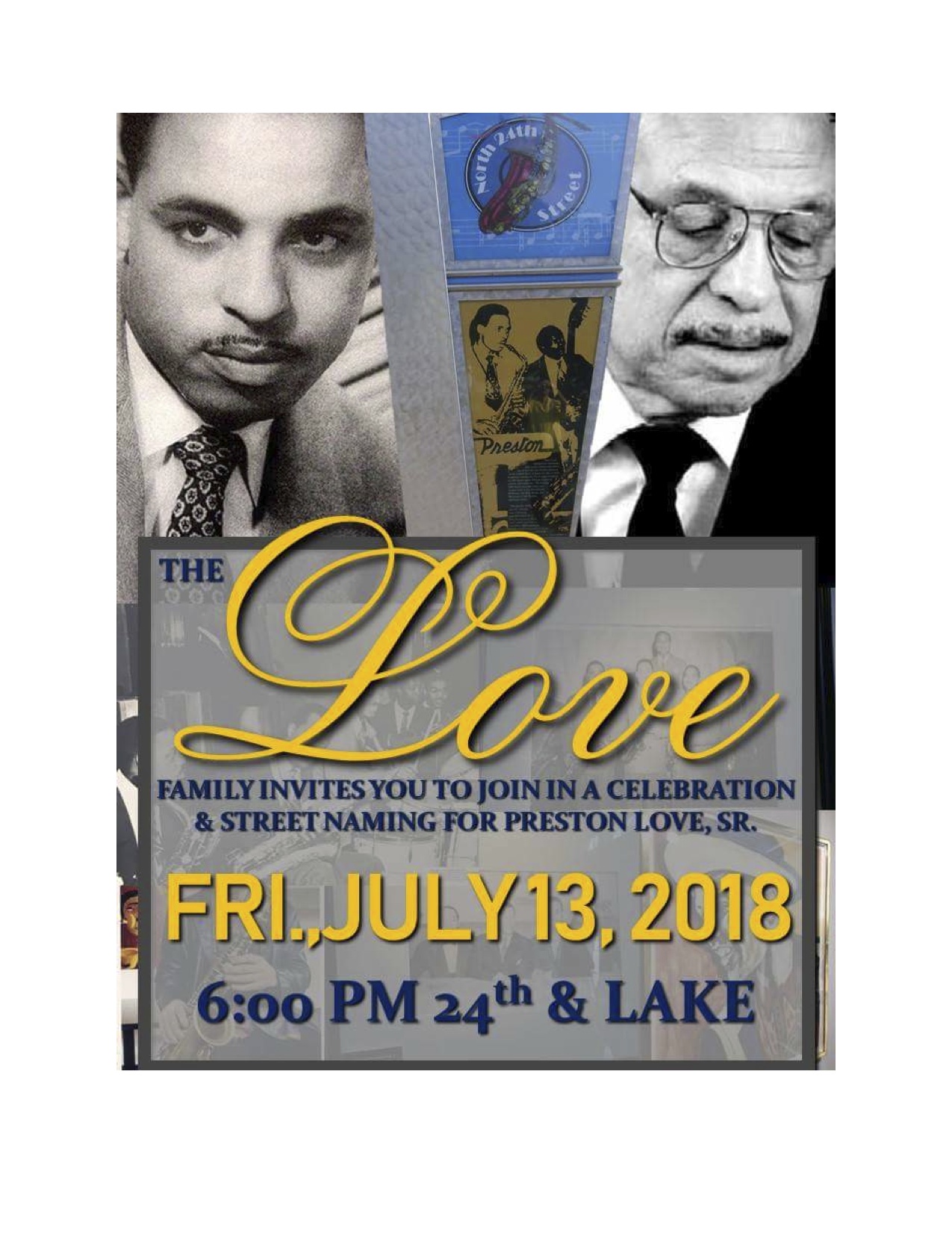
Omaha’s Love Family hosts celebration and street naming for Preston Love Sr.
Omaha’s Love Family hosts celebration and street naming for Preston Love Sr.
Friday, July 13
6 p.m.
24th and Lake
Preston Love Sr. Street
Speakers to include John Beasley and Curly Martin sharing stories about the late jazz musician, composer, arranger, band leader, educator, commentator and author. Preston Love Sr. was a charter member of the Omaha Black Music Hall of Fame, the namesake of Loves Jazz & Arts Center and the author of the critically acclaimed memoir “A Thousand Honey Creeks Later.”
Musical tribute concert immediately following at Loves Jazz & Arts Center by some of Omaha’s finest artists. Featuring songs performed and loved by Preston Love.
$7 donation
ON A PERSONAL NOTE:
When I began writing about North Omaha’s African-American community 20 years ago or so, Preston Love Sr. was one of the first persons I reached out to. He became a source for the and the subject of many of those early stories. He was a wise and loquacious sage with a real sense of history about his music, his people and his community.
The first article I got published in a national magazine was about Preston.
A good share of my work about him appeared around the time of the release of his long-in-the-making and highly regarded memoir, “A Thousand Honey Creeks Later.”
Upon his death, I was asked to write an in memoriam piece for The Reader.
A few years ago, I wrote a new piece compiled from my many stories about him, and read it at Loves Jazz before a packed house.
I have also written some about his son Preston Love Jr. and his daughters Portia Love and Laura Love.
Whether you knew the man and his legacy or not, here is a list of articles I featured him in that hopefully provide a fair representation of the man and the artist:
https://leoadambiga.com/2016/05/05/preston-love-a-t…late-hepcat-king/
https://leoadambiga.com/2010/06/03/preston-love-192…ed-at-everything
https://leoadambiga.com/2010/06/03/omaha-blues-and-…end-preston-love
https://leoadambiga.com/2010/06/03/preston-love-his…l-not-be-stilled
https://leoadambiga.com/2010/06/03/mr-saturday-night
There are several more stories in which I quoted him about everything from Native Omaha Days to soul food or referenced him in relationship to North Omaha’s live music scene and the area’s attempted revitalization.
Positively, no negativity: Nick Hernandez

Positively, no negativity: Nick Hernandez
©by Leo Adam Biga
Appearing in the July 5, 2018 issue of El Perico (el-perico.com)
Some call it bliss. Others, serenity. For Nick Hernandez of Lincoln, Nebraska, the study and practice of positive psychology is both way of life and career.
The 41-year-old couldn’t have imagined this two decades ago. Back then, the Olathe, Kansas native was a married post-graduate student who looked at people and life critically. Now he’s co-founder and evangelist for an organization called Posiivity Matters, He hosts Community Matters on KZUM 89.3 FM, conducts coaching-team building workshops, makes presentations and organizes activities – all around the notion that individuals and communities thrive when engaged in nurturing activities.
He’s convened regional and citywide summits (Happiness Lincoln) and contributed to events (Cameron Effect and Seeds of Kindness) on the subject.
Before finding his niche, he got divorced and entered recovery for a problem drinking habit. The seeds of his “community-building” were planted earlier through Hispanic leadership opportunity and Midwest Center for Nonprofit Leadership programs he completed in Kansas City, Missouri.
He earned a bachelor’s degree from liberal arts Benedictine College in Atchison, Kansas and did graduate studies in economics at the University of Texas at Austin.
When he lost his job as an economist with the Texas Department of Labor, he found a matching job with the Nebraska Department of Labor in 2002. When his unit took the Gallup organization’s Strengths Finder test, he learned a new way of thinking and being. “It was a very meaningful experience,” he said. “I then discovered there is a field called positive psychology.” In reading up on it, he became convinced he found the holistic pathway he’d been missing.
“It was a shift in mindset. I had a real critical mindset that wasn’t focused on strengths before. It opened up new territory for how how I saw myself and others.”
Newly aware he was by nature and nurture a convener, a leader, an affirmer and an appreciator, he embraced “hooking up with good in ourselves” and became “an encourager for others to grow into potential you see in them that they may not be aware of.”
“I found it really fulfilling to be in that role for others.”
Meanwhile, he sounded out experts who further encouraged his interest in the philosophy and science of positive psychology, well-being and human flourishing.
“That deepened my sense that maybe I’m onto something here.”
He then broadened his reach of influence.
“I started getting involved more in the community.”Nick

Nick Hernandez
Upon completing the Great Neighborhoods program offered by Neighbor Works Lincoln, he said, “I found myself feeling a sense of purpose to see if it could be put into action at the neighborhood association level.”
In 2007 he restarted the dormant Havelock Neighborhood Association and revived its fall festival.
“It was quite an enriching experience to create an occasion for people from different places in the neighborhood to get together. I enjoy coming up with activities that make mindfulness fun and accessible.”
He helped lead kindness campaigns in Lincoln that inspired participation by adults and youth.
“Kindness hopefully has a double effect. The stories we tell ourselves when we volunteer or do random acts of kindness are self-affirming. We think, ‘I’m the kind of person that practices generosity, kindness and compassion.’ That alters the story of who we are in our identity.’
Hernandez’s journey has been far more than academic.
“It was spurred by my own experiences in recovery and then getting involved in service work. What I found eventually was a profound sense of fulfillment by volunteering to take a recovery meeting into the Lancaster County adult detention center.
“That’s where I really felt I started taking this idea of practicing generosity as a way of life and really committed myself to doing it in a systematic way.”
His recovery has paralleled his well-being quest.
“Once I got into recovery I realized I felt a deep sense of loneliness. I know there were people around me who loved and cared for me, but for some reason I wasn’t letting it connect. Through being in recovery and getting in service, I finally felt that sense of connectedness.”
Since humans are genetically wired to be on high alert, he said, we must consciously choose positive thoughts. He’s convinced our basic desire and need for well-being is achieved “when we’re able to share our sense of self, our core ideas with others in a positive relationship, whether friendship or romantic, who really care about us growing into that.”
“That’s the direction I’m trying to take this habit of kindness and generosity. I am exploring if this can be something fostered through small group conversation grounded in the philosophy and science of well-being.”
He’s long organized discussion groups promoting positive psychology research and the benefits of practicing mindfulness. His 2015 Happiness Lincoln summit at the University of Nebraska-Lincoln featured scholars on the 15th anniversary of America’s first national positive psychology conference held in Lincoln, a community that ranks high in well-being measures.
His Community Matters radio show facilitates discussions with well-being experts from around world, including a recent guest he Skyped-in from Israel.
On May 20 he organized a community conversation on collaboration at Lincoln’s Constellation Studios with fiber artist Karen Kunc, a philosophy professor and a public health advocate.
His speaking, coaching, team building doesn’t pay all the bills, thus he makes money other ways, including teaching social dance – swing, salsa, tango, ballroom.
“That’s personally an extremely fun, positive psychology intervention – cognitive, social, physical well-being all in one.”
He’s now actively pursuing work in the human resources field.
Follow him on Facebook and YouTube. His show broadcasts Mondays from 11:30 a.m. to Noon and streams at http://kzum.org.
Read more of Leo Adam Biga’s work at leoadambiga.com.
If the play’s the thing, then what about gender?
If the play’s the thing, then what about gender?
©by Leo Adam Biga
Appearing in the July 2018 issue of The Reader (www.thereader.com)
Theater offers windows on the world, yet only a fraction of plays produced anywhere are written by women. This arts parity issue has urgency with national initiatives extending to Omaha, where theater artists variously discuss the problem and implement remedies.
“The initiatives have been around for about a decade now,” said Creighton University theater professor Amy Lane. “The most well-known, 50/50 by 2020, started in response to a study that revealed women’s voices grossly underrepresented in theaters.”
In 2006, 17 percent of plays professionally produced nationwide (12 percent on Broadway) were written by women. “Surprising,” Lane said, given that “60 percent of the theater audience is women.”
She wonders if “there will be true gender equity by 2020” and what “progress” has been made thus far.
UNO theater professor Cindy Melby Phaneuf echoes many when she says, “My opinion is we are moving in the right direction, but still have a long way to go.” She heads the National Theatre Conference, whose Women Playwright Initiative has produced 500 plays by women since 2011 and expects to reach 1,000 by 2020. “I am encouraged by the energy and interest in gender parity, but am most interested in taking action.”

“I support these initiatives and applaud the theaters implementing them,” said Omaha playwright Ellen Struve.
Struve’s had plays mounted at the Omaha Community Playhouse (OCP) and Shelterbelt Theatre and across the nation.
“When I began writing plays, I didn’t know many other women getting produced on a regular basis. This past year I was able to invite more than a dozen Omaha-based women playwrights to participate in the 365 Women A Year project. It was so exhilarating to look at that list of writers. Even better was to see a few of the plays fully-produced by Denise Chapman at the Union for Contemporary Art.”

2017 panels hosted by the Blue Barn Theater and the University of Nebraska at Omaha dialogued about the social-economic context behind exclusion and why plays written by women would enrich any season.
“Panels are great for raising awareness. Representation matters: for women and female-identifying playwrights, directors, actors, designers, crews, administrators. Discussions are fine, but action is what is needed,” said Lane.
She created the 21 & Over series at OCP “to introduce Omaha to new works and new voices.” 21 & Over seasons were 50/50 by 2020 compliant, she said..
OCP’s ongoing Alternative Programming series continues to be diverse.
Creighton and UNO are devoting their respective theater departments’ entire 2018-2019 performance seasons to works by women playwrights.
Lane said Creighton’s “made a commitment to continue with the 50/50 by 2020 Movement” beyond this season.
Phaneuf and colleagues want to move things forward.
“UNO and Creighton have agreed to shine a light on what our greater Omaha community is doing already and look to the future to provide more opportunities to revel in women’s voices. The goal is gender parity on a permanent basis as an ordinary way of programming our seasons representing diverse voices. With parity also comes a desire to produce plays by writers of color. We are constantly on the lookout for plays that represent a variety of cultures and heritages.”
Outside the academic setting, Omaha presents a mixed bag in theater gender parity.
Phaneuf said despite some gains, many Omaha theaters present seasons with only one or two works by women. Sometimes, none.
“Those making artistic decisions at Omaha theaters either care about this issue or they don’t. If they care, then it is not a difficult task to make sure a theater’s season includes works by women,” Lane said. “There are plenty of terrific plays out there and plenty of resources to find them. If this is not an issue that matters to them, then they shouldn’t be surprised if they get called out. I think more of us who do care should speak out more when we see gender parity ignored.”
OCP artistic director Kimberly Hickman said “more opportunities for female artists is among her programming guidelines.” This past season several OCP playwrights and composers identified as women as did all its guest directors and many designers.
“Those priorities remain in place for 2018-2019.”
“Parity in theater is a complex issue that can’t be simplified to only gender,” Hickman said.
A session on female leadership she attended at a recent conference for regional theaters brought this home.

Photo by Colin Conces
“While the room of women had many things in common, our experiences were very different due to ethnicity, sexuality, economic status, academic background, location. All these factors need to be taken into consideration. I believe the best way to make progress is to look at who is at the table making decisions. If the people all look the same, that is a problem and steps need to be taken to evolve. I also think accountability is important. I have intentionally surrounded myself with people I know will hold me accountable.”
The Shelterbelt has a demonstrated “strong commitment to gender parity, not only for playwrights, but for all production positions,” said executive director Roxanne Wach. “We do try to include at least 50 percent women playwrights in a season, while still creating a balance in storytelling and genres. It’s a conscious choice by our reading committee and a shared vision of our board.
“I personally feel if we don’t start with parity in the small theaters, it will never happen in larger theaters.”
Shelterbelt’s won recognition from the International Centre for Women Playwrights for reaching equity goals.
“To look just at playwrights is only scratching the surface,” Wach adds. “We’ve got to start valuing the work women bring to all areas of theater production and the great value in having different points of view.”
Omaha’s largest footprint on the national theater scene, the Great Plains Theatre Conference (GPTC), uses a 100 percent blind reading process selecting plays.
“We are one of the few major development programs that do this,” producing artistic director Kevin Lawler said. “We have had many long debates about whether we should change to have predetermined selection percentages to include gender, race, identity, but the overwhelming consensus by our staff and those who attend the conference is to keep the selections blind.
“Even with a blind selection we have always been close to parity. This year was a clean 50-50 split. Our women playwrights often appear on the Kilroys List (of most recommended unproduced or underproduced plays).”
UNO’s new Connections series is being curated from GPTC works by underrepresented playwrights.
GPTC playwright Sara Farrington terms parity “a triggery question” and initiatives to date “a baby step.”
“Many people simply don’t and won’t trust plays by women. It is astonishing people still assume women can or will only write about being imprisoned by their bodies or men. That idea has been beaten into a mass theater-going audience by over-produced, overrated, wildly misogynistic male playwrights and producers and by artistic directors financing and programming plays with reductive and fearful depictions of female characters.
“Women playwrights have a deep, refined, 200-proof rage. Rage makes for badass and innovative storytelling. Women playwrights tell stories backwards, sideways, in a spiral, upside down, from angles you’d never expect. They are utterly complex, psychologically profound and contemporary.”
Fellow GPTC playwright Shayne Kennedy, a Creighton grad, calls for systemic change.
“I believe men and women tell stories differently and because the creative industries have long been dominated by male voices, we as a culture have become conditioned to hear in those voices. I think to correct the imbalance we are going to need some risk-takers, visionaries and deliberately opened minds.”
Read more of Leo Adam Biga’s work at leoadambiga.com.
Link to the 2018-2019 UNO theater season at:
http://www.unomaha.edu/college-of-communication-fine-arts-and-media/theatre/index.php
Select UNO Theater 2018-2019 season:
TARTUFFE (Studio)
by Molière, adapted by Constance Congdon from a literal prose translation by Virginia Scott
Director Jackson Newman
August 23-25
THE CLEARING
by Helen Edmundson
Director Lara Marsh
September 26-29, October 3-6
SECRET GARDEN
Book & Lyrics by Marsha Norman, Music by Lucy Simon
Director D. Scott Glasser, Musical Director Shelby VanNordstand
October 31-November 3, 7-10, 14-18
CONNECTIONS
Director Dr. Ron Zank
February 20-23, 27- March 2
MR. BURNS, A POST-ELECTRIC PLAY
by Anne Washburn
Director: Jeremy Stoll
March 14-17, 2019
THE WOLVES
by Sarah DeLappe
Director Dr. Cindy Melby Phaneuf
April 10-13, 17-20, 2019
___________________________
Link to the 2018-2019 Creighton theater season at:
https://www.creighton.edu/ccas/fineandperformingarts/boxoffice/
Select Creighton Theater 2018-2019 season:
HANDLED
Written by Shayne Kennedy
World premiere play/Mainstage Theater
October 31 – November 4, 2018
KINDERTRANSPORT
Written by Diane Samuels
Play/Studio Theater
February 13 -17, 2019
LEGALLY BLONDE THE MUSICAL
Book by Heather Hach; Music and Lyrics by Laurence O’Keefe and Nell Benajmin
Musical/Mainstage Theater
March 27-31, 2019


 Leo Adam Biga's My Inside Stories