Archive
Thoughts on recent gathering of Omaha Black Sports Legends

From left, Bob Gibson, Marlin Briscoe, Johnny Rodgers and Ron Boone pose for a picture during a special dinner “An Evening With the Magician” honoring Marlin Briscoe at Baxter Arena on Thursday.
Thoughts on recent gathering of Omaha Black Sports Legends
It is unlikely there will be another communion of Omaha Black Sports Legends like the one that happened on September 22 at Baxter Arena in Omaha. That’s because in a single room there were Omaha native greats of a certain age whose achievements in football, basketball and baseball saw them reach the pinnacles of their sports.
Just consider who was present:
Bob Gibson – Baseball Hall of Fame inductee, CY Young Award-winner, two-time World Series MVP and multiple All-Star with the St. Louis Cardinals
Roger Sayers – Elite sprinter and dynamic football player at the then-University of Omaha set school records in each sport
Marlin Briscoe – College Football Hall of Fame inductee, Small College All-American at Omaha University, NFL’s first black starting quarterback and member of two Super Bowl-winning teams
Ron Boone – Pro basketball “iron man” who led Utah to an ABA title
Johnny Rodgers – College Football Hall of Fame inductee, Heisman Trophy Winner and member of two national championship teams at Nebraska
Who was not there:
Gale Sayers – College and Pro Football Hall of Fame inductee, All-American at Nebraska and All-Pro with the Chicago Bears
Mike McGee – All-American at Michigan and member of NBA title team with the Los Angeles Lakers
Don Benning – If not for illness that finds him living in a memory care facility, Benning, the first African-American head coach at a predominantly white university, would have been there. Benning began the wrestling dynasty at UNO, where he was a mentor to many.
Bob Boozer – The late Boozer, who won both Olympic gold and an NBA title, would have fit right in with his fellow legends; as would have the late Marion Hudson, who not only integrated Dana College but set football and track and field records there that still stood six decades later.
And lest we forget, the late Fred Hare, the Omaha Technical High and University of Nebraska great, would have been right at home among his peers.

The fact that so many deserving figures were not there due to scheduling conflict, illness or death underscores the fact that these legends are leaving us and will continue leaving us as time marches on. Gibson, Sayers, Briscoe Boone and Rodgers look great for their ages, but they are 80, 73, 70, 71 and 65, respectively. I mean, God grant them many more years but the fact is even these legends will eventually pass on to meet their eternal just reward. Yes, as unthinkable as it is, they will one day all be gone, too.
So, kudos to the committee that organized the An Evening with the Magician event for bringing all these gentlemen together for what could very well be the last time. Without this fitting tribute to one of their own, Marlin Briscoe, happening when it did it could have proved too late if left to some indeterminate time in the future.
That Omaha native film, TV, stage actor John Beasley served on the committee that made it happen was apt since he and Briscoe were teammates at then-Omaha U. and he is producing a major motion picture of Marlin’s life called The Magician.
What an experience it was to be in the presence of these guys who made history in their respective sports. All know and respect each other. Some grew up together. Some tested their abilities against each other. All learned lessons in the tight-knit inner communities they grew up in that, as Briscoe said in his remarks that night, prepared them for the rigors of life. Their personal stories and life experiences have much to teach us. It was great that upwards of 200 Omaha Public Schools students were on hand to witness much of the evening. This is important local history they were exposed to.
More than a decade ago I had the distinct pleasure of interviewing these historic figures (minus McGee) and others for a series I wrote called Out to Win: The Roots of Greatness – Omaha’s Black Sports Legends. I personally look forward to catching up with the legends still living for a book I intend writing about their shared Omaha background and athletic success at the highest levels of their sports.
You can check out my series at–
OUT TO WIN – THE ROOTS OF GREATNESS: OMAHA’S BLACK SPORTS LEGENDS
Will the time come when more contemporary Omaha Black Sports Legends have the occasion to gather like their predecessors did Sept. 22? Will John C. Johnson, Larry Station, Randy Brooks, Kerry Trotter, Andre Woolridge, Ron Kellogg, Cedric Hunter, Keith Jones, Calvin Jones, Ahman Green, the Wrestling Olivers, Terence Crawford, Kenzo Cotton, and others find a reason to come together? Will they turn out to celebrate one of their own or to honor their shared roots? I don’t know. But here’s wishing they will – because they should. Not only for themselves, but for the community.
And what about the women? Maurtice Ivy, Mallery Ivy, Jessica Haynes, Angee Henry, Peaches James, Reshea Bristol, LaQue Moen-Davis, Brianna McGhee, Chloe Akin-Otiko and many more, have distinguished themselves through athletics. They deserve their due, too.
Thanks to Ernie Britt for being the driving force behind the Nebraska Black Sports Hall of Fame that does indeed recognize these figures and provide a forum for bringing them together.
Here’s hoping these celebrations continue happening. I would recommend that whenever possible sponsors be found to make these events free and open to the public so that more segments of the community can share in them. And wherever possible, students should be invited to these events. I also advocate that the stories of these and other high achieving African-Americans from Omaha and greater Nebraska be part of an ongoing curriculum in the Omaha Public Schools. Let’s not wait until these figures are gone, Tell these stories while these figures are still alive and cthey an visit classrooms and speak before school assemblies and be the suhject of programs like Making Invisible Histories Visible.
North Omaha Summer Arts continues its art and nature themes with Thoreau Meets The Harlem Renaissance – Friday, July 15
 g
g
North Omaha Summer Arts continues its art and nature themes with:
Thoreau Meets The Harlem Renaissance
Come and join us…
Friday, July 15
9 am to 1 pm
Malcolm X Mermorial Foundation
3463 Evans Street
We are exploring the connection between American author, poet, philosopher, abolitionist, naturalist and historian Henry David Thoreau with The Harlem Renaissance.
Drawing instruction by artist Ronald Sykes.
Writing instruction facilitated by author Kim Louise.
We will take time to walk, draw and write in the beautiful woods located in the middle of North Omaha at the Malcolm X birthsite.
Lunch and discussion, plus spoken word performance by Felicia WithLove Webster. And we will document pictures of your creations for our virtual gallery on the North Omaha Summer Arts (NOSA) Facebook page.
No drawing or writing experience necessary.
Supplies provided
This class is free of charge.
Bring your chairs and blankets
For registration or questions, call 402-502-4669.
Follow and like NOSA’s free community-based arts festival at–
https://www.facebook.com/NorthOmahaSummerArts/
Mark you calendars for the 6th Annual Arts Crawl on Friday, August 12 from 6 to 9 pm at several North 30th Street venues.
An Ode to Ali: Forever the Greatest
An Ode to Ali: Forever the Greatest
©by Leo Adam Biga
When Muhammad Ali burst onto the scene as a provocateur and poet among athletes, he was a revelation. He freely drew from bigger than life sports personas who preceded him to create an image that was one part schtick and one part deeply held personal conviction. Because of his boxing brilliance, his charming demeanor, his bold attitudes, his outspokenness and his genius for using the mass media times he intersected with, he gained an unprecedented platform and emerged as an original among citizen-athletes. Before his arrival there were athletic figures who transcended their sports, such as Jim Thorpe, Babe Ruth, Bobby Jones, Jesse Owens, Bill Tilden, Joe Louis, Babe Didrikson and Jackie Robinson, but none even came close to the impact Ali eventually made. That’s because he was a black man who openly defied the system in support of his own beliefs. His braggadocio and conversion to Islam did not endear him to many at the time. Indeed, his words and actions were viewed as a threat by most outside the black community. His refusal to enter the Army during wartime on conscientious objector grounds earned him support and respect in some quarters but made him a pariah most everywhere else. At the height of the Civil Rights and Black Power movements he became a powerful symbol of defiance and a powerful advocate for social justice. For many African-Americans, he embodied what it meant to be a strong, self-determined black person. He represented Black Pride and he unabashedly pronounced that Black is Beautiful. His message affirmed self-love as well as love of one’s heritage and people. At the very peak of his boxing greatness, he was stripped of his world heavyweight title and denied the opportunity to make his livelihood in the ring. Instead of wallowing in bitterness, he fought for his rights and he celebrated his blackness at the very moment when the struggle for equality and true emancipation reached its zenith. Having risen to the top and taken a fall, he then came back bigger than before to reclaim his former title and glory. That’s when he transformed from star to living legend and icon. Then, when Parkinson’s ravaged his body, he didn’t let that setback define him as some tragic figure who retreated into the shadows, rather he used his fame as a tool for humanitarianism. Has there ever been anyone who once antagonized and alienated so many and then went on to become such a universally beloved figure? No athlete since him has come close to being the worldwide icone he became, not even Michael Jordan. Indeed, no popular enterrtainer or public figure of any kind has come close to his impact. Ali did nothing less than inspire billions of people by appealing to our shared humanity and challenging us to live up to our better ideals and to realize our potential. His legacy is all about breaking down barriers and building bridges. It’s all about dreaming and walking into Greatness. When he boasted that he could “float like a butterfly and sting like a bee” he was really instructiing us to follow his example and to move through life and through whatever it is that we do with grace and purpose. He touched our hearts and expanded our minds by speaking the truth and having the courage of his convictions. Rest in Peace. Forever the Greatest.

A North Omaha Reflection
A North Omaha Reflection

Here are my reflections on his post:
Adam Fletcher Sasse, your Forgotten Omaha posts tonight about the way things used to be in North Omaha, using the example of Conestoga Place Neighborhood as an illustration, touches a nerve with residents, past and present. The segregation and confinement of African-Americans in North Omaha had mixed results for blacks and the community as a whole. There is no doubt that at every level of public and private leadership, North O was systematically drained of its resources or denied the resources that other districts enjoyed. With everything working against it, North O, by which I mean northeast Omaha for the purposes of this opinion piece, the neighborhood devolved. Using a living organism analogy, once businesses left en masse, once the packinghouse and railroad jobs disappeared, once the riots left physical and psychological scars, once aspirational and disenchanted blacks fled for greener pastures, once the North Freeway and other urban renewal projects ruptured the community and displaced hundreds, if not thousands more residents, once the gang culture took root, well, you see, North O got sicker and weaker and no longer had enough of an immune system (infrastructure, amenities, jobs, professional class middle class) to heal itself and fend off the poison. There is no doubt the powers that be, including the Great White Fathers who controlled the city then and still control it now, implicity and explicity allowed it to happen and in some cases instigated or directed the very forces that infected and spread this disease of despair and ruin. The wasteland that became sections and swaths of North O did not have to happen and even if there was no stopping it there is no rationale or justiiable reason why redevelopment waited, stalled or occurred in feeble fits and starts and in pockets that only made the contrast between ghetto and renewal more glaring and disturbing. North O’s woes were and are a public health problem and the strong intervening treatments needed have been sorely lacking. As many of us believe, the revitalization underway there today is badly, sadly long overdue. It is appreciated for sure but it is still far too conservative and slow and small compared to the outsized needs. And it may not have happened at all if not for the Great White Fathers being embarrased by Omaha’s shockingly high poverty rates and all the attendant problems associated with poor living conditions, limited opportunities and hopeless attitudes. If not for North Downtown’s emergence, the connecting corridors of North 30th, North 24th and North 16th Streets would likely still be languishing in neglect. Seeing images of what was once a thriving Conestoga neighborhood gone to seed says more than my words could ever say and the sad truth of the matter is is that Adam could post dozens more images of other North O neighborhoods or blocks that suffered the same fate. So much commerce and potential has been lost there. What about reparations for North O? The couple hundred million dollars of recent and in progress construction and the infusion of some new businesses is a drop in the bucket compared to what was lost, stolen, sucked dry, displaced, denied, diverted, misspent, wasted. I know hundreds more millions of dollars are slated to be invested there, but it’s still not getting the job done. It’s like a slow drip IV managing the pain rather than healing the patient. I know that the infusion of money and development are not the only fixes, but it is absolutely necessary and the patient can’t get well and prosper unless there’s enough of it and unless it’s delivered on time. I just hope it’s not too little too late. And like many North Omahans, I’d feel better if residents had more of a say in how their/our community gets redeveloped. I’d feel better if we controlled the pursestrings. We are the stakeholders. Beware of the carpetbaggers.
Girls Inc. makes big statement with addition to renamed North Omaha center
Girls Inc. of Omaha has added to the heavy slate of north side inner city redevelopment with a major addition that’s prompted the renaming of its North O facility to the Katherine Fletcher Center. Though the center’s longtime home, the former Clifton Hill Elementary School building, remains in use by Girls Inc. and is getting a makeover, the connected 55,000 square foot addition is so big and colorful and adds so much space for expanded programs and new services that it is the eye candy of this story. Here is a sneak peek at my story for the June issue of The Reader (www.thereader.com) about what the addition will mean to this organization and to the at-risk girls it inspires to be “strong, smart and bold.” The $15 million project is another investment in youth, opportunity and community in North O on top of what has already happened there in recent years (NorthStar Foundation, No More Empty Pots, Nelson Mandela School) and what is happening there right now (Union for Contemporary Art getting set to move into the renovated Blue Lion Center, the North 75 Highlander Village under construction, the three new trades training buildings going up on the Metro Fort Omaha campus). But so much more yet is needed.

North Omaha Girls Inc. makes big statement with addition
New Katherine Fletcher Center offers expanded facilities, programs
©by Leo Adam Biga
Appeared in the June 2016 issue of The Reader (www.thereader.com)
A poor inner city North Omaha neighborhood recently gained a $15 million new investment in its at-risk youth.
The Girls Inc. center at 2811 North 45th Street long ago outgrew its digs in the former Clifton Hill Elementary School but somehow made do in cramped, out-dated quarters. Last month the nonprofit dedicated renovations to the old building as well as the addition of an adjoining 55.000 square foot structure whose extra space and new facilities allow expanded programming and invite more community participation. The changes prompted the complex being renamed the Katherine Fletcher Center in honor of the late Omaha educator who broke barriers and fought for civil rights. The addition is among many recently completed and ongoing North O building projects worth hundreds of millions dollars in new development there.
This local after school affiliate of the national Girls Inc. takes a holistic approach to life skills, mentoring, career readiness, education enrichment and health-wellness opportunities it provides girls ages 5 through 18. Members are largely African-American, many from single parent homes. Others are in foster care. Young girls take pre-STEM Operation SMART through the College of Saint Mary. Older girls take the Eureka STEM program through the University of Nebraska at Omaha. There are also healthy cooking classes, aquaponics, arts, crafts, gardening, sports, field trips and an annual excursion outside Nebraska. Girls Inc. also awards secondary and post-secondary scholarships.
The addition emphasizes health and wellness through a gymnasium featuring a regulation size basketball court with overhead track, a fitness room, a health clinic operated by the University of Nebraska Medical Center, a space devoted to yoga, meditation, massage and a media room. Amenities such as the gym and clinic and an outdoor playground are open to the public. The clinic’s goal is to encourage more young women, including expectant and new mothers, to access health care, undergo screenings and get inoculations.
Dedicated teen rooms give older girls their own spaces to hang out or study rather than share space with younger girls as in the older facility. Multi-use spaces there became inadequate to serve the 200 or so girls who daily frequent the center.
“I think we’ll see more teens in our programs because this expansion separates them from the younger girls and provides more opportunities to get drawn into our programs,” says executive director Roberta Wilhelm. “They may start as drop-ins but we foresee them getting involved in the more core programs and becoming consistent members. So, we think we’ll impact more girls and families.”
A big, bright, open indoor commons area, the Girls Hub, is where the brick, circa 1917 historic landmark meets the glass and steel addition.
“The design team showed great respect for how to best join the two buildings and for the importance of this space and for the social aspects of how girls gather and interact,” Wilhelm says.
The impressive, brightly colored, prominently placed new addition – atop a hill with a commanding view – gives the organization a visual equivalent to its “strong, smart and bold” slogan.
“It’s a big statement,” says director of health access Carolyn Green. “It speaks loudly, it brings awareness, it turns heads. People can’t wait to come through and see what is all in here.”

Before the open house program director Emily Mwaja referenced the high anticipation. saying, “I’m ready, the girls are ready, we’re ready for everything.”
Girls Inc. member Desyree McGhee, 14, says, “I’m excited for the new building. I feel it’s giving us girls the opportunity for bigger and better things and bringing us together with the community. I just feel like a lot of good things could come from it.” Her grandmother, Cheryl Greer, who lives across the street, appreciates what it does for youth like Desyree and for the neighborhood. “It’s just like home away from home. I have seen her grow. She’s turning into a very mature, respectful young lady. I think Girls Inc. is a wonderful experience for these girls to grow up to be independent, educated adults. The center is a great asset for them and the community.”
McGhee says Girls Inc. empowers her “to not just settle for the bare minimum but to go beyond and follow your dreams. It’s really given me the confidence to thrive in this world. They really want you to go out and leave your mark. I love Girls Inc. That’s my second family.”
Girls Inc. alum Camille Ehlers, a University of Nebraska-Lincoln graduate, says caring adults “pour into you” the expectations and rewards youth need. “It was motivating to me to see how working hard would pay off.” She says she felt called to be strong, smart and bold. “That’s what I can make my life – I can create that.” Mentors nudged her to follow her passion for serving at-risk students, which she does at a South Side of Chicago nonprofit. Denai Fraction, a UNL pre-med grad now taking courses at UNO before medical school, says Girls Inc. nurtured her dream of being a doctor. Both benefited from opportunities that stretched them and their horizons. McGhee is inspired by alums like them and Bernie Sanders National Press Secretary Symone Sanders who prove anything is possible.
Wilhelm says, “Girls Inc. removes barriers to help girls find their natural strengths and talents and when you do that over a period of years with groups of girls you’re helping affect positive change. A lot of the girls are strong and resilient and have chops to get through life and school but if we can remove some barriers they will go so much farther and be able to accomplish so much more. We see ourselves in that business.
“If you help a girl delay pregnancy so she’s not a teen mom, it’s a health outcome, an education outcome, a job outcome, it’s all of those things, they’re all tied together. If you are feeding girls who are hungry that impacts academics and also impacts growing bodies. I do think our holistic model has become more intentional, more focused. We use a lot more partners in the community who bring expertise, We are all partners with parents and families in lifting up girls. The Girls Inc. experience is all these things but the secret sauce is the relationships adult mentors, staff and volunteers cultivate with youth.” Alums come back to engage girls in real talk about college, career and relationships. The shared Girls Inc. expereince creates networking bonds.
She says support doesn’t stop when girls age out. “Even after they graduate they call us for help. We encourage that reaching out. They know there’s someone on the other end of the phone they can trust.”Assistance can mean advice, referrals, funds or most anything.
Everyone from alums and members to staff and volunteers feel invested in the bigger, bolder, smarter Girls Inc.
“It’s not just about the million dollar donors,” Wilhelm says. “We all have ownership in this. I always tell the girls, ‘The community invests in you for a reason. They want you to create a better future for yourself, to be a good student, to focus on education, to live healthy, to make good choices. They think you’re worth this investment.'”
She says there’s no better investment than girls.
“Girls make decisions when they grow up for their families for education and health. To the extent you can educate girls to make wise decisions and choices you really do start to see cycle breaking changes. How you educate girls, how you treat girls, how you invest in girls matters over time and we’re a piece of that, so we’re foundational.
The girls graduating college now are maybe going to be living and working in this community and hopefully be a part of the solution to make North O more attractive to retain the best and brightest.”
Visit girlsincomaha.org.
Bob Boozer, basketball immortal, posthumously inducted into the National Collegiate Basketball Hall of Fame
Bob Boozer, basketball immortal, posthumously inducted into the National Collegiate Basketball Hall of Fame
I posted this four years ago about Bob Boozer, the best basketball player to ever come out of the state of Nebraska, on the occasion of his death at age 75. Because his playing career happened when college and pro hoops did not have anything like the media presence it has today and because he was overshadowed by some of his contemporaries, he never really got the full credit he deserved. After a stellar career at Omaha Tech High, he was a brilliant three year starter at powerhouse Kansas State, where he was a two-time consensus first-team All-American and still considered one of the four or five best players to ever hit the court for the Wildcats. He averaged a double-double in his 77-game career with 21.9 points and 10.7 rebounds. He played on the first Dream Team, the 1960 U.S. Olympic team that won gold in Rome. He enjoyed a solid NBA journeyman career that twice saw him average a double-double in scoring and rebounding for a season. In two other seasons he averaged more than 20 points a game. In his final season he was the 6th man for the Milwaukee Bucks only NBA title team. He received lots of recognition for his feats during his life and he was a member of multiple halls of fame but the most glaring omisson was his inexplicable exclusion from the National Collegiate Basketball Hall of Fame. Well, that neglect is finally being remedied this year when he will be posthumously inducted in November. It is hard to believe that someone who put up the numbers he did on very good KSU teams that won 62 games over three seasons and ended one of those regular seasons ranked No. 1, could have gone this long without inclusion in that hall. But Boozer somehow got lost in the shuffle even though he was clearly one of the greatest collegiate players of all time. Players joining him in this induction class are Mark Aguirre of DePaul, Doug Collins of Illinois State, Lionel Simmons of La Salle, Jamaal Wilkes of UCLA and Dominique Wilkins of Georgia. Good company. For him and them. Too bad Bob didn’t live to see this. If things had worked out they way they should have, he would been inducted years ago and gotten to partake in the ceremony.
I originally wrote this profile of Boozer for my Omaha Black Sports Legends Series: Out to Win: The Roots of Greatness. You can access that entire collection at this link–
https://leoadambiga.com/out-to-win-the-roots-of-greatness-…/
I also did one of the last interviws Boozer ever gave when he unexpectedly arrived back stage at the Orpheum Theater in Omaha to visit his good buddy, Bill Cosby, with whom I was in the process of wrapping up an interview. When Boozer came into the dressing room, the photographer and I stayed and we got more of a story than we ever counted on. Here is a link to that piece–
Bill Cosby on his own terms: Backstage with the comedy legend and old friend Bob Boozer
Charles Hall’s Fair Deal Cafe
For years Omaha’s most famous purveyor of soul food was the Fair Deal Cafe. Its proprietor, the late Charles Hall, served up some righteous fare at his North 24th Street place that was also known as Omaha’s Black City Hall for being a popular spot where community leaders and concerned citizens gathered to discuss civil rights and politics. Mr. Hall and the Fair Deal are gone and sadly the building has been razed. But at least a new development on the site will be taking part of the name as a homage to the history made there and the good times had there. On my blog you can find another story I did that used the Fair Deal as the backdrop for an examination of what makes soul food, soul food. I gathered together some old school black folks to share their wisdom and passion about this cuisine. I called that piece, A Soul Food Summit.
Charles Hall’s Fair Deal Cafe
©by Leo Adam Biga
Originally appeared in the New Horizons and The Reader
As landmarks go, the Fair Deal Cafe doesn’t look like much. The drab exterior is distressed by age and weather. Inside, it is a plain throwback to classic diners with its formica-topped tables, tile floor, glass-encased dessert counter and tin-stamped ceiling. Like the decor, the prices seem left over from another era, with most meals costing well under $6. What it lacks in ambience, it makes up for in the quality of its food, which has been praised in newspapers from Denver to Chicago.
Owner and chef Charles Hall has made The Fair Deal the main course in Omaha for authentic soul food since the early 1950s, dishing-up delicious down home fare with a liberal dose of Southern seasoning and Midwest hospitality. Known near and far, the Fair Deal has seen some high old times in its day.
Located at 2118 No. 24th Street, the cafe is where Hall met his second wife, Audentria (Dennie), his partner at home and in business for 40 years. She died in 1997. The couple shared kitchen duties (“She bringing up breakfast and me bringing up dinner,” is how Hall puts it.) until she fell ill in 1996. These days, without his beloved wife around “looking over my shoulder and telling me what to do,” the place seems awfully empty to Hall. “It’s nothing like it used to be,” he said. In its prime, it was open dawn to midnight six days a week, and celebrities (from Bill Cosby to Ella Fitzgerald to Jesse Jackson) often passed through. When still open Sundays, it was THE meeting place for the after-church crowd. Today, it is only open for lunch and breakfast.
The place, virtually unchanged since it opened sometime in the 1940s (nobody is exactly sure when), is one of those hole-in-the-wall joints steeped in history and character. During the Civil Rights struggle it was commonly referred to as “the black city hall” for the melting pot of activists, politicos and dignitaries gathered there to hash-out issues over steaming plates of food. While not quite the bustling crossroads or nerve center it once was, a faithful crowd of blue and white collar diners still enjoy good eats and robust conversation there.
 |
Fair Deal Cafe

Running the place is more of “a chore” now for Hall, whose step-grandson Troy helps out. After years of talking about selling the place, Hall is finally preparing to turn it over to new blood, although he expects to stay on awhile to break-in the new, as of now unannounced, owners. “I’m so happy,” he said. “I’ve been trying so hard and so long to sell it. I’m going to help the new owners ease into it as much as I can and teach them what I have been doing, because I want them to make it.” What will Hall do with all his new spare time? “I don’t know, but I look forward to sitting on my butt for a few months.” After years of rising at 4:30 a.m. to get a head-start on preparing grits, rice and potatoes for the cafe’s popular breakfast offerings, he can finally sleep past dawn.
The 80-year-old Hall is justifiably proud of the legacy he will leave behind. The secret to his and the cafe’s success, he said, is really no secret at all — just “hard work.” No short-cuts are taken in preparing its genuine comfort food, whose made-from-scratch favorites include greens, beans, black-eyed peas, corn bread, chops, chitlins, sirloin tips, ham-hocks, pig’s feet, ox tails and candied sweet potatoes.
In the cafe’s halcyon days, Charles and Dennie did it all together, with nary a cross word uttered between them. What was their magic? “I can’t put my finger on it except to say it was very evident we were in love,” he said. “We worked together over 40 years and we never argued. We were partners and friends and mates and lovers.” There was a time when the cafe was one of countless black-owned businesses in the district. “North 24th Street had every type of business anybody would need. Every block was jammed,” Hall recalls. After the civil unrest of the late ‘60s, many entrepreneurs pulled up stakes. But the Halls remained. “I had a going business, and just to close the doors and watch it crumble to dust didn’t seem like a reasonable idea. My wife and I managed to eke out a living. We never did get rich, but we stayed and fought the battle.” They also gave back to the community, hiring many young people as wait staff and lending money for their college studies.
Besides his service in the U.S. Army during World War II, when he was an officer in the Medical Administrative Corps assigned to China, India, Burma, Japan and the Philippines, Hall has remained a home body. Born in Horatio, Arkansas in 1920, he moved with his family to Omaha at age 4 and grew up just blocks from the cafe. “Almost all my life I have lived within a four or mile radius of this area. I didn’t plan it that way. But, in retrospect, it just felt right. It’s home,” he said. After working as a butcher, he got a job at the cafe, little knowing the owners would move away six months later to leave him with the place to run. He fell in love with both Dennie and the joint, and the rest is history. “I guess it was meant to be.”
“The Bystanders” by Kim Louise takes searing, moving look at domestic violence as a public health issue
Last night I had the privilege of experiencing as searing and moving a piece of live theater that I have seen in a long time. It was a staged reading of a new play, “The Bystanders,” by Kim Louise of Omaha. It tells the story of four friends who hear an incident of domestic abuse in the apartment next door. They are split on what to do next. The play asks – What would you do? The play is touring this week as part of the Metropolitan Community College Theatre Program’s Spring Tour. The program annually features a play written by an MCC student playwright in a staged reading format produced and performed by theater professionals. Kim’s “The Bystanders” is this year’s featured work. She first got inspired to write the piece some years ago and she has more recently developed it under the guidance of MCC theater program instructor Scott Working, who directs the production. The playwright, whom you may know as Kim Whiteside, is a much published author and veteran writing workshop faciliator under the pen name Kim Louise. She has writen a powerful piece whose heavy truth is impossible to ignore and to forget.
Some leading local theater talents comprise the cast:
Victoria – Beaufield Berry
OthaJean – Pamela Jo Berry
Benet – TammyRa’ Jackson
Ashland – Felicia Webster
Carla – Doriette Jordan
Cullen – Developing Crisp
Performances are free and open to the public, but you only have two chances left to see this staged reading:
Wednesday, May 11th at 11:00 am in the Conference Room of the MCC Sarpy Center, 9110 Giles Road.
Thursday, May 12th at 12:30 pm in ITC Building Room120 at MCC’s South Omaha Campus, 27th and Q Streets.
What the play utilmately confronts us with is the fact that domestic violence is a public health issue that none of us can stand by and allow to happen without speaking out against or taking action to prevent it from happening again. Otherwise, we are as complicit in the situation as the person who commits the violence and the person who lives with the violence. This is a community problem we all have a share in. As witness, as advocate, as friend, as advisor, as safe house, as 911 caller, as whatever it takes or whatever we are prepared to do. Just don’t stay silent or do nothing. That’s how battered women end up traumatized or dead.
A MOTHER’S DAY TRIBUTE Mother-Daughter Music Legacy and Inheritance: Jeanne and Carol Rogers
As musical families go, the Rogers of Omaha have few peers. The mother, Jeanne Rogers, and her three sons and one daughter have all achieved a level of notoriety in their professional music careers, including each being an individual inductee in the Omaha Black Music Hall of Fame. This musical lineage has its strongest and most poignant link in the relationship between the family matriarch Jeanne and her daughter Carol Rogers. There is a powerful mother-daughter music legacy and inheritance that is powerful and only made more powerful by the fact that Jeanne today suffers from Alzheimer’s and Carol is her legal guardian. Jeanne is cared for in a nursing facility and Carol lives in her mother’s last home, where Jeanne’s presence still infuses the space. Carol and her brothers grew up in an earlier home their mother owned and it was in that music filled dwelling the siblings became initiated into the world of jazz, blues, soul and so much more. They listened in to the jam sessions and stories that their mother and her hepcat friends plied the night away with. When they were old enough the siblings made and played music of their own in that house and in talent shows and gigs around town. One by one the siblings made a name for themselves in music here and beyond Omaha. Carol’s singing career took her around the world. But when her mother fell ill she came back home to be here with her.
The following Mother’s Day Tribute is culled together from two separate stories I previously wrote: one about Carol Rogers and one about Jeanne Rogers. You can link to those stories at–
https://leoadambiga.com/?s=jeanne+rogers
A MOTHER’S DAY TRIBUTE
Mother-Daughter Music Legacy and Inheritance: Jeanne and Carol Rogers
©by Leo Adam Biga
Culled together from two previous stories I wrote
Jeanne Rogers headed a household full of music in North Omaha. The jazz singer and pianist, who suffers from dementia today, made music such a family inheritance that all of her children ended up being professional musicians like herself. Jeanne sang with area big bands and gigged as a solo jazz pianist-vocalist. A talent for music didn’t fall far from the tree, as her daughter Carol and her sons have all made a living in music and joined their mother as Omaha Black Music Hall of Fame inductees.
Carol has enjoyed a national and international singing career. And like her mom, who became an educator, Carol teaches, too. After years touring the world and making her home base in California, where she sang, recorded and taught, Carol moved back to her hometown of Omaha in 2013 in order to be near her mother. Carol feels things worked out the way they were supposed to in bringing her back home to be with her mom. She never forgets the inspiration for her life’s journey in music.
“Mom gave us music and she gave us a house full of it all the time.”
Seeing her mom’s mental capacities diminish has been difficult. Seeing her no longer recall the words to songs she sang thousands of times, like “My Funny Valentine,” cuts deeply. No one is prepared for losing a loved one, piece by piece, to the fog of Alzheimer’s. All Rogers or anyone can do is be there for the afflicted.
“I’m glad I’m close by for her sake to remind her she’s loved and hopefully, even though she doesn’t recognize me, give her a familiarity.”
Even when Jeanne became an Omaha Public Schools educator and administrator, she never left music behind. Indeed, she used it as a tool to reach kids. Carol, who as a girl used to accompany her mom to school to help her and other teachers set up their classrooms, followed in her footsteps to become a teacher herself, including running her own “kindergarten school of cool” that all her kids went through.
Carol, 61, also grew up under the influence of her grandmother Lilian Matilda Battle Hutch, She remembers her as an enterprising, tea-totaler who on a domestic worker’s wages managed buying multiple homes, subletting rooms for extra income. She sold Avon on the side.
“She could see opportunity and she was on the grind all the time. They called her ‘The General’ because she’d rifle out her demands – You comn’ in? I need you to go in the backyard and weed some stuff.’”
When Jeanne developed dementia, Carol’s trips back home increased to check on her mother and eventually take charge of her care. When Jeanne could no longer remain in her own home, Carol placed her in nursing facilities. She rests comfortably today at Douglas County Health Center. Carol’s since come back to stay. She and two of her kids reside in her mother’s former northeast Omaha home.
As a homage to her educator mother, Carol has a kitchen wall double as a chalk board with scribbled reminders and appointments.
“Chalk is how she relayed things,” Carol said of her mom.

Carol Rogers, with her mother Jeanne Rogers
“Music is my life. I can’t live without music.” Omaha jazz singer-pianist Jeanne Rogers recites the words as a solemn oath. As early as age 4, she said, her fascination with music began. This only child lived in her birthplace of Houston, Texas then. She’d go with her mother Matilda to Baptist church services, where young Jean was enthralled by the organist working the pedals and stops. Once, after a service, Jean recalls “noodling around” on the church piano when her mom asked, “‘What are you doing, baby?’ ‘I’m playing what the choir was singing.’ So, she tells my daddy, ‘Robert, the baby needs a piano.’ They let me pick out my piano. I still have it. All my kids learned to play on it. I just can’t get rid of it,” said Rogers, who proudly proclaims “four of my five kids are in music.”
Blessed with the ability to play by ear, she took to music easily. “I’d hear things and I’d want to play ‘em and I’d play ‘em,” she said. She took to singing too, as her alto voice “matured itself.” After moving with her family to Omaha during World War II, she indulged her passion at school (Lake Elementary) and church (Zion Baptist) and via lessons from Florentine Pinkston and Cecil Berryman. At Central High she found an ally in music teacher Elsie Howe Swanson, who “validated that talent I had. Mrs Swanson let me do my thing and I was like on Cloud Nine,” she said. Growing up, Rogers was expected by the family matriarchs to devote herself to sacred or classical music, but she far preferred the forbidden sounds of jazz or blues wafting through the neighborhood on summer nights.
“Secular was my thing,” she said. When her mother or aunt weren’t around, she’d secretly jam.
The family lived near the Dreamland Ballroom, a North 24th Street landmark whose doors and windows were opened on hot nights to cool off the joint in an era before AC. She said the music from inside “permeated the whole area. I would listen to the music coming out and, oh, I thought that was the nicest music. Mama couldn’t stop me from listening to what the bands were playing. That’s the kind of music I wanted to play. I wanted to play with a band. I was told, ‘Oh, no, you can’t do that. Nothing but trash is up in that ballroom. There’s no need your going to college if that’s all you want to play.’ But, hey, I finally ended up doing what I wanted to do. And playing music in the nightclubs paid my way through college.”
Do-gooders’ “hoity-toity,” attitude rubbed her the wrong way, especially when she “found out folks in church were doing the same thing folks in the street were.”
Rogers, who became a mother quite young, bit at the first chance to live out her music dream. When someone told her local bandleader Cliff Dudley was looking for a singer she auditioned and won the job. “That’s how I got into the singing,” she said. “I was scared to death.” She sang standard ballads of the day and would “do a little blues.” Later, when the band’s pianist dropped out, she took over for him. “And that’s how I got started playing with the band.” Her fellow musicians included a young Luigi Waites on drums. The group played all over town. She later formed her own jazz trio. She’d started college at then-Omaha University, but when the chance to tour came up, she left school and put her kids in her mother’s care.
The reality of life on the road didn’t live up to the glamour she’d imagined. “That’s a drag,” she said of living out of suitcases. Besides, she added, “I missed my kids.” Letters from home let her know how much she was missed and that her mother couldn’t handle the kids anymore. “She needed me,” Rogers said. “I mean, there were five kids, three of them hard-headed boys. So I came back home.”
The Jewell Building once housed the Dreamland Ballroom
She resumed college, resigned to getting an education degree. “All I wanted to do was play the piano in the band. But I ended up doing what I had to do,” she said.
To support her studies she still played gigs at local clubs. And she nurtured her kids’ and their friends’ love of music by opening up the family home to anyone who wanted to play, turning it into a kind of informal music studio/academy.
“My house on Bristol Street was the house where everybody’s kids came to play music,” she said. Her twin boys Ronnie and Donnie Beck practiced with their bands upstairs while younger brother Keith Rogers’ band jammed downstairs. Their sister, singer Carol Rogers, imitated soul songstresses. Some youths who made music there went on to fine careers, including the late guitarist Billy Rogers (no relation). Ronnie played with Tower of Power and still works as a drummer-singer with top artists. Donnie left Omaha with drummer Buddy Miles and now works as a studio musician and sideman. Keith is a veteran music producer. His twin sister Carol performed with Preston Love and Sergio Mendes, among other greats.
Years later Carol recalled growing up in that bustling household on Bristol Street where she couldn’t help but be immersed in music between her siblings rehearsing and her mother and her musician friends jamming. That 24-7 creative hub imbued her with a love for performing.
“In the summertime it was just crawling with people because my brothers had instruments. In the basement they were always practicing. It got so I couldn’t study without a lot of noise. I still sleep with noise. If you didn’t get home in time and there was food you didn’t eat because the people who were in the house ate. It was first come-first served. That used to make me mad.
“But there was music. Folks would come. A typical weekend, Billy Rogers, not any relation, would come and jam. Everybody who was anybody came in and jammed. I didn’t know who they all were, all I knew there was always noise.”
She confirms the Rogers’ home was the place neighborhood kids congregated.
“My mother would boast that kids’ parents would say, ‘Why is my child always at your house?’ Because they’re welcome and there’s music. And so that’s just the way it was. That’s the way I remember the house. I didn’t have to go looking for people or excitement – it came to the house. There was always something going on.”
Her mother grew up near enough the old Dreamland Ballroom to hear the intoxicating rhythms of the black music greats who played there.
“That’s when she got bitten by the jazz bug,” Carol said. “She would go to sleep hearing the music playing at Dreamland.”
Carol enjoyed an even more intimate relationship with music because of the nightclub atmosphere Jeanne orchestrated at home.
“Oh, these jam sessions that mama would have. All I know is we would have to be whisked to bed. Of course, we could hear them at night. They would never go past 10 or so. Occasionally she would let us come down and just watch, which was a privilege. There’d be Basie Givens, who she played with forever, Clean Head Base, Cliff Dudley, the names go on of all the people who would come in. And they’d just jam, and she’d sing and play piano.
“It was a big party and to-do thing at the house. I would go to sleep hearing her and her friends play the jam sessions. Coming downstairs in the morning there was always somebody crashed out on the floor.
Carol didn’t have plans to come back to Omaha but when her mother’s illness progressed, she had no choice.
“I knew I had to come back for my mom because I became her guardian.”
Seeing her mom’s mental capacities diminish has been difficult. Seeing her no longer recall the words to songs she sang thousands of times, like “My Funny Valentine,” cuts deeply. No one is prepared for losing a loved one, piece by piece, to the fog of Alzheimer’s. All Rogers or anyone can do is be there for the afflicted.
“I’m glad I’m close by for her sake to remind her she’s loved and hopefully, even though she doesn’t recognize me, give her a familiarity.”
Two of Carol’s four children live with her in Omaha and they, too, have inherited the musical gene and give Jeannie yet more family and love to be around.
Preston Love: A Tribute to Omaha’s Late Hepcat King
Preston Love: A Tribute to Omaha’s Late Hepcat king
©by Leo Adam Biga
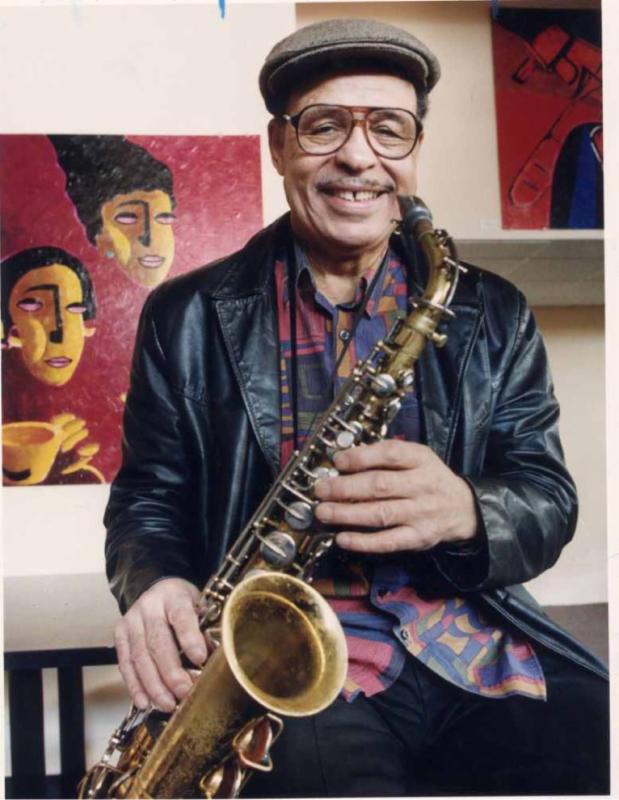
An early January evening at the Bistro finds diners luxuriating in the richly textured tone and sweetly bended notes of flutist-saxophonist Preston Love Sr., the eternal Omaha hipster…
By eleven, the crowd’s thinned, but the 75-year-old jams on, holding the night owls with his masterful playing and magnetic personality. His tight four-piece ensemble expertly interprets classic jazz, swing and blues tunes he helped immortalize as a Golden Era lead alto sax player, band leader and arranger.
Love lives for moments like these, when his band really grooves and the crowd really digs it:
“There’s no fulfillment…like playing in a great musical environment. It’s spiritual. It’s everything. Anything less than that is unacceptable. If you strike that responsive chord in an audience, they’ll get it too – with that beat and that feeling and that rhythm. Those vibes are in turn transmitted to the band, and inspire the band.”
For him, music never gets tired, never grows old. More than a livelihood, it’s his means self-expression, his life, his calling.
Music’s sustained during a varied career. Whether rapping with the audience in his slightly barbed, anecdotal way or soaring on a fluid solo, this vibrant man and consummate musician is totally at home on stage.
Love’s let-it-all-hang-out persona is matched by his tell-it-like-it-is style as a music columnist, classroom lecturer and public radio host. He fiercely champions jazz and blues as significant, distinctly African-American art forms and cultural inheritances. This direct inheritor and accomplished interpreter feels bound to protect its faithful presentation and to rail against its misrepresentation.
His autobiography, “A Thousand Honey Creeks Later,” gave him his largest forum and career capstone.
“It’s my story and it’s my legacy to my progeny.”
He’s long criticized others appropriating the music from its black roots and reinventing it as something it’s not.
“It’s written in protest. I’m an angry man. I started my autobiography…in dissatisfaction with whats transpired in America in the music business and, of course, with the racial thing that’s still very prevalent. Blacks have almost been eliminated from their own art. That’s unreal. False. Fraudulent.
“They’re passing it off as something it isn’t. It’s spurious jazz. Synthetic. Third-rate. Others are going to play our music, and in many cases play it very well. We don’t own any exclusivity on it. But it’s still black music, and all the great styles, all the great developments, have been black, whether they want to admit it or not. So why shouldn’t we protect our art?
“When you muddy the water or disturb the trend or tell the truth even, you make people angry, because they’d rather leave the status quo as it is. But I’m not afraid of the repercussions. I will fight for my people’s music and its preservation.”
When he gets on a roll like this, his intense speaking style belongs both to the bandstand and the pulpit. His dulcet voice carries the inflection and intonation of an improvisational riff and the bravura of an evangelical sermon, rising in a brimstone rant before falling to a confessional whisper.
Love feels his far-flung experience uniquely qualifies him to address the American black music scene of his generation.
“The fact that mine’s been a different, unlikely and multifaceted career is why publishers became interested in my book.”
From a young age, he heard the period’s great black performers on the family radio and phonograph and hung-out on then teeming North 24th Street to catch a glimpse and an autograph of visiting artists playing the fabled Dreamland Ballroom and staying at nearby rooming houses and hotels.
“Twenty-fourth street was the total hub of the black neighborhood here. This street abounded with great players of this art form.”
By his teens, he was old enough to see his idols perform at the Orpheum and Dreamland.
“All of the great black geniuses of my time played that ballroom. Jazz was all black then…and here were people you admired and worshiped, and now you were standing two feet from them and could talk to them and hear their artistry. To hear the harmony of those black musicians, with that sorrowful, plaintive thing that only blacks have, and a lot of blacks don’t get it. That pain in their playing. That indefinable, elusive blue note. That’s what jazz is.
“The Benny Goodmans and those guys never got it.”
The music once heard from every street corner, bar, restaurant, club has been silenced or replaced by discordant new sounds.
That loss hurts Love because he remembers well when Omaha was a major music center, supporting many big bands and clubs and drawing musicians from around the region. It was a launching ground for him and many others.
“This was like the Triple A of baseball for black music. The next stop was the big leagues.”
He regrets many young blacks are uninformed about this vital part of their heritage.
“If I were to be remembered for some contribution, it would be to remind people what’s going on today with the black youth and their rap…has nothing to do with their history. It’s a renunciation of their true music — blues, rhythm and blues and jazz.”
He taught himself to play, picking up pointers from veteran musicians and from masters whose recordings he listened to “over and over again.” Late night jam sessions at the Blue Room and other venues were his proving ground, He began seeing music as a way out.
“There was no escape for blacks from poverty and obscurity except through show business. I’d listen to the radio’s late night coast-to-coast broadcasts of those great bands and go to sleep and just dream of going to New York to play the Cotton Club and dream of playing the Grand Terrace in Chicago. I dreamed of someday making it – and I did make it. Everything else in my life would be anticlimactic, because I realized my dream.”
He made himself an accomplished enough player that Count Basie hired him to play with his band.
“I had the natural gift for sound – a good tone – which is important. Some people never have it. I was self-motivated. No one had to make me practice…And being good at mathematics, I was able to read music with the very least instruction.”
Music keeps him youthful. He’s no “moldy fig,” the term boppers coined to describe musicians out-of-step with the times.
He burns with stage presence with his insouciant smile and his patter between sets that combines jive, scat and stand-up. Then there’s his serious side. He coaxes a smooth, bittersweet tone from the sax and flute developed over a lifetime.
If nothing else, he’s endured, surviving fads and changing musical tastes, adapting from the big band swing era to Motown to funk. He’s risen above the neglect he felt in his own hometown to keep right on playing and speaking his mind.
“I refuse to be an ancient fossil or an anachronism, I am eternally vital. I am energetic, indefatigable. It’s just my credo and the way I am as a person.”
A Soul Man to the end.
“I think the term ‘soul’ was first applied to us as a people to describe the feeling of our expressions and attitudes and language. It means a lot of heart and a depth of feeling. It refers to the pathos in our expression, musically and colloquially.”
He says a genius for spontaneity is a hallmark of blacks in creative endeavors — from music and dancing to cooking.
“The limitations we lived under gave birth to these embellishments and improvisations. That’s what we did. We were masters of embellishment.”
He left his hometown many times, but always came back. Back to where his dream first took flight and came true. Back to the mistress – music – that still holds him enthralled. To be our conscience, guide, inspiration.
That January night at the Bistro, a beaming Love, gold horn slung over one shoulder, tells his audience, “I love this. I look forward coming to work. Preston Love’s an alto player, and you want to hear him play alto, right? Listen to this.” Supplying the downbeat, he fills the room with the golden strain of “Mr. Saturday Night.” Play on, Mr. Saturday Night, play on.


 Leo Adam Biga's My Inside Stories