Archive
St. Peter Claver Cristo Rey High: A school where dreams matriculate
Three years ago I did this story for The Reader (www.thereader.com) on the first Cristo Rey high school in Omaha. It’s a school where the students, mostly inner city Hispanic and African-American kids from families of little means, are required to work an office job to help defray the cost of tuition. The job is also an important learning avenue, exposing students to environments and experiences they would likely otherwise not see and helping them develop skills they likely otherwise wouldn’t feel compelled to cultivate. My story focuses on two students in the school’s inaugural freshman class, a Hispanic named Daniel and an African-American named Treasure. Although each tried to downplay it, their attending the school meant a great deal to them and their families. I may revisit the story of these two young people and their school next spring, when Daniel and Treasure, both of whom are doing quite well in the classroom and at the work site I am told, are set to graduate.
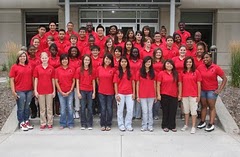
UPDATE: As updates go, this one is decidedly sad: In early February the Catholic Archdiocese of Omaha announced that St. Peter Claver Cristo Rey High School will close at the end of the 2010-2011 school year due to the school incurring a $7 million deficit in its brief four-year history. It seems the school was never really able to gain enough traction, in terms of numbers of students enrolled. There was a high turnover of students who could not or would not follow the school’s strict standards. Ultimately though the recession of the last three years may have dealt the biggest blow because the school could not find or maintain enough jobs with local employers for its students to work once the economy sagged, thus severely cutting into the revenues the school needed to operate. Without those jobs, which defrayed the cost of tuition, some families simply could not afford what it cost for their children to attend. The more financial burden the school and the archdiocese took on to cover the gap and the shorter the school came to meeting its enrollment projections the more untenable the situation became. I will be filing a story in the spring that revisits the stories of Daniel and Treasure — who were part of the school’s first freshmen class and will now be part of its first and last senior class. With the impending closing it becomes a poignant, bittersweet story for all concerned, but it doesn’t diminish the quality educational experience students experienced.
St. Peter Claver Cristo Rey High: A school where dreams matriculate
©by Leo Adam Biga
Originally published in The Reader (www.thereader.com)
Few school startups have attracted the attention of St. Peter Claver Cristo Rey. From the time plans for the new Catholic high school in south Omaha were first announced in 2005 through the end of its first academic year next week, the institution’s captured public imagination and media notice.
Claver’s housed in the former St. Mary’s school building at 36th and Q Streets, within walking distance of the historic stockyards site, Hispanic eateries and markets and Metropolitan Community College’s south campus. The Salvation Army‘s Kroc Center is going up down the road where the Wilson packing plant used to stand.

That the school’s elicited so much response is largely due to its membership in the national Cristo Rey Network, a branded nonprofit educational association based in Chicago. 60 Minutes profiled it. The private CR urban schools model gives disadvantaged inner city children a Catholic, college prepatory education and requires they work a paid internship in white collar Corporate America.
Wages earned help defray students’ tuition and provide schools a revenue stream. Member schools share 10 mission effectiveness standards. Staff from CR schools around the nation attend in-service workshops.
Cristo Rey’s pairing of high academics with real life work experiences is why the network’s grown from one to 19 schools in less than a decade. Three more will open their doors next fall. The model appeals to families who otherwise can’t afford a private school, much less expect their kids to work paid internships. Communities are also desperate for alternatives to America’s public education system, where resources for urban schools lag behind their suburban counterparts. Students of color in inner city public schools struggle, fail or drop out at higher than average rates. Relatively few go on to college, much less complete it, and most lack employability skills beyond low paying customer service jobs.
So when something new comes along to offer hope people jump at it. That’s what the Mayorga Alvarez and the Anderson families did. The Omaha working class families, one Hispanic and one African American, fit the demographic profile the school targets. Claver’s kids mostly come from poor Hispanic or black households qualifying for the federal free or reduced lunch program.
Some whites, black Africans and Native Americans also attend. CR schools typically serve small enrollments. Claver’s no exception with 67 students.
The Mayorga Alvarez family and the Anderson family saw the school as a gateway they couldn’t pass up. After year one their views haven’t changed. Each family sends a child there. Daniel Mayorga Alvarez and Treasure Anderson are both honor roll students.
Claver internship director Jim Pogge said it’s easy to see how much this means to families. “I participate in almost all of the application interviews and the hope in the parents’ eyes is evident.”
Families also find appealing the prospect of being in on the ground floor of a new kind of school, a theme embodied by the Claver team nickname, Trailblazers. A sign in front of the school reads, “Become a Trailblazer.” A symbol and legacy in one.
“We call ourselves Trailblazers for all kinds of different reasons,” Pogge said. “This is a trailblazing school, the students are trailblazers in their own lives.”
Daniel Mayorga Alvarez said, “We’re kind of proud we’re the first class. I guess it makes us feel more special.” Among the downsides, he said, is that Claver “doesn’t offer all the classes I wanted.”
School president Rev. Jim Keiter said Claver’s expanding its courses and staff, hiring full-time music, art and reading teachers for next fall and adding CAD drafting, culinary arts and Microsoft certification classes as early as spring ’09.

Fr. Jim Keiter
Christopher Anderson made his daughter, Treasure, among Claver’s initial enrollees last summer. He liked the idea of her being in a school “totally different than what she’s been used to. The structure, the dress, the work ethic. I mean, I wish I could have gone to a school like this. And then you get to thinking she’s going to be part of the first class,” he said, beaming.
Each Claver student works a full-time shift once a week, plus one extra day per month. The school day runs from 7:50 a.m. to 3:55 p.m. Most students stay after school an hour or two. On work days, a student reports to school, is taken by cab to his/her 8:30 a.m. to 4:30 p.m. job and then returned to school. It might be 6 before they get home.
The curriculum includes a mandatory business class addressing office skills and etiquette. Students apply classroom lessons to the workplace. Back at school they share on-the-job experiences with fellow interns. Pogge works closely with the 22 employer partners in Claver’s Hire-4-Ed program. Student job performance is reviewed and graded. Pogge said, “It’s real. They can get fired.” That’s happened. In those cases students get retrained for new jobs.
“All of our students have to work in order to make this thing work. They have to be employable. The work component actually drives the school,” he said.
Claver sets the tone in the summer with a mandatory three-week long boot camp orientation that introduces students to school-workplace expectations.
When kids can’t or won’t meet expectations they’re asked to leave Claver. A number have been expelled.
“We have a very rigorous academic program. I mean, it’s college prep. There’s no deviation. It’s very linear in its focus. We also have this work component that’s very demanding. These kids have to perform but not everyone’s up to that task. Personally, I have kids this age and I wonder how they would do,” Pogge said.
On the whole, he said, the work study program’s met expectations. “We have had bumps, but we have had far more successes. As of February, 82 percent of our students received ‘Good’ or ‘Outstanding’ job performance ratings.”
Students who do well on the job invariably gain confidence and maturity.
“We see it in changed behaviors here at school,” Pogge said. “They’re all of a sudden more focused, engaged. They communicate more effectively. They’re kind of coming out of their shell.”
Signs that Treasure’s growing up have surfaced since she started at Claver.
“She’s pretty mature. She missed a day of work, which they’re required to make up, and she made the arrangements without me asking her,” Anderson said.
Parents also like the strict dress code. Many students don’t. At Claver’s summer boot camp last August boys loosened or removed their required neck ties and girls pushed the envelope with revealing outfits. Staff reminders and reprimands were common.
Maria and Rodolfo Mayorga Alvarez made Daniel, their youngest child, an early enrollee. A bright boy with a sweet, outgoing personality, he previously attended public schools in south Omaha, where he, his two older brothers and his folks live in a snug bungalow within sight of Rosenblatt Stadium.
His Mexican immigrant parents work blue collar jobs. Their formal education is limited, as is their English. Daniel serves as interpreter. Translating for his mom, he said: “She wanted me to go to a school that was a different environment, a whole new experience. She says the work I’m doing and the interactions I’m having and the skills I’m learning will be really helpful to me in the future.”
His mother’s noticed a change in him now that he comports himself like a little man. “She says I try to correct myself more. She sees me setting more goals for myself. She likes how the school is more disciplined.”
Daniel enjoys being in a brand new school with few students and much diversity.
“It’s like you’re starting all over with a clean slate. You get to know a whole new group of people. You probably get closer to people because you’re going through the same thing…you get stronger relationships,” he said. “In this school you get to know different types of people. You get diverse friends. We’re all scattered. We’re from north Omaha, south Omaha, southeast Omaha. Everybody’s got their own story — where they live, how they grew up.”
He finds Claver more taxing than what’s he’s used to. “I put a bunch more effort into this school,” he said. “It’s hard to keep up a B or A. I come home tired.”
Treasure also finds Claver challenging. She said, “It’s not always easy or fun to get good grades but you have to. I’ve had to learn how to balance school and work. I’ve got responsibilities both ways.”
She and Daniel are keenly aware that “it looks good on a resume” to have a college prep diploma and professional internship among their credits.
Treasure’s native Omaha Baptist family has a history of Catholic education. Her dad and aunts attended Blessed Sacrament. Her aunts then went on to Dominican High. Treasure went a year at Sacred Heart, where her two younger siblings now attend.
Although she mostly attended public schools Treasure’s one year at Sacred Heart gave her an inkling of what to expect at Claver, where weekly Mass and daily religious instruction are the rule. In the end, she said, “it’s still kids. We get along, we don’t get along. It’s high school.”
Most of her friends now attend Marian, a school too pricey for her dad to afford. “I surely couldn’t,” he said. All her Claver tuition’s paid by her job earnings.
A shy, inquisitive girl with a big spirit, Treasure lives with her two younger siblings, her father and his girl friend in a big house on Florence Boulevard in North O. Her older sisters live on their own. The family attends Morningstar Baptist Church.
Her dad is separated from her mom, whom she sees regularly. Chris works at Walgreens. He’s battled kidney disease for 14 years. Last summer both kidneys were removed. He’s now awaiting a transplant. A grown step-daughter may be a match.
Claver Admissions Director Anita Farwell said Treasure hasn’t let her father’s illness stand in her way.
“I love how she keeps her mind focused. She’s not distracted. No excuses. She loves her father. She wants to succeed not only for him but also for herself. He’s a terrific man and he’s built it in her as well.”
Treasure has strong role models. One of her half sisters is in college and another’s gone back. An aunt’s in the Army. Her parents both have some college. Now Treasure’s a model for her little brother and sister. Twelve-year-old Tera and 7-year-old Trey Christopher can’t wait to join her at Claver. Anderson’s already determined they’ll be future Trailblazers.

Reporting to a job adds a new dynamic for Treasure and Daniel. They work in guest services at Immanuel Medical Center, where several Claver students intern. They variously escort patients/family members, answer the phone and do clerical tasks.
“It can be boring but it’s preparing us and that’s what we need,” Treasure said. “We’re not always going to like it but it’s the real world. It does help me with my communication and organizational skills. It’s helped me open up a little to people.”
Pogge said students get to see new worlds.
“These kids are now going into buildings they normally just drive by. Now they’re part of the process,” he said. “They’re exposed to jobs, professions they may have never thought of before, and they can transfer skills from one job or industry to another. Communication skills, attention-to-detail, punctuality, stick-toitiveness.”
The work’s not always cut-and-dried, either. In Immanuel’s Diagnostics and Procedures areas the interns interact with strangers — adult patients or loved ones. Worry is etched on people’s faces. Daniel said many of those he escorts remark on how young he is and a conversation inevitably ensues about the school. Staff say having Claver kids in this role disarms people, putting them more at ease. Daniel views it as a life skills learning experience.
“As you talk to them you get to know them and to know a whole different story. You feel so sorry for them and you want to do everything to help them,” he said. “I really do like helping people. That’s probably the most satisfying.”
Once, a woman broke down and cried in the arms of Treasure, who consoled her.
“I had to be there for her, I guess,” she said. “I just couldn’t leave her there. She was going through some hard times. Her husband wasn’t going to live. I’m not the best people person but I did learn I have to suck it up and just be there for people in order to help them.”
The incident reminded her of her father’s precarious condition.
“If my dad just died one day who would be there for me? You gotta give in order to receive. So I try my best.”
“She doesn’t like to talk about it but I’m a realist, I know on any given day,” said Anderson, his voice trailing off. “So I always tell her, You know if something was to happen to me you would kind of be the glue to hold them together,” he said, referring to her younger siblings. “If your sister or brother were doing something wrong you’d say, What would Daddy say? I’ve raised her enough now that she knows what I expect of her and them. We talk about real things.”
Same for the Mayorga Alvarez family. They were due to make their next pilgrimage to Mexico this summer but tight finances postponed those plans. His parents don’t hide the fact it’s a struggle these days.
“When Mom’s right about to finish all the bills, to pay the school off, this off, that off, then all of a sudden something breaks down and we have something else to pay,” he said. “We always have this conversation. We feel we’re right about to hit the point when we’re living free and then something else happens. We’ll probably use the vacation money to pay off the truck so next year we’ll be a little more debt free.”
If the Mayorga Alvarez family don’t make it across the border this year it’ll mark only the second time in Daniel’s memory they haven’t. Their faith sees them through hard times. On Sundays the family attends St. Agnes or Our Lady of Guadalupe churches, whose congregations are filled with aspiring, upwardly mobile young families just like them.
The family’s hopes of moving up are pinned on Daniel’s shoulders, an academic star who envisions a medical career, perhaps as a doctor. He’s already found he far prefers office work to the roofing jobs he went on with his father and brothers.
“This is way better than that. I’d rather exhaust myself mentally,” he said.
Conversely, his brother Jesus was a less than stellar high school student who’s now looking for work. His other brother, Renne, a South High sophomore, is not excited by school but does plan on college. The brothers feel while Claver may not be for them, it’s right for Daniel.
“I think it’s good because it teaches the kids how to be responsible,” said Renne, who works at a Hy-Vee. “It gives them a taste of life — of how it’s going to be.”
Daniel said his mother often expresses her fondest desires for her boys.
“She wants us to become kind of independent, finish school, get good jobs, become better people. Even though both my parents work it’s still not enough to pay for everything. She wants us to do our part and to find our own way.”
Maria Mayorga Alvarez said she dreams of the ranchero she grew up on in a small, isolated village in central Mexico. Life was simple but happy there. She loves visiting home. She sees then how far she’s come. She hopes once her boys move on they’ll return to the family’s Omaha home and appreciate how far they’ve progressed.
Rodolfo Mayorga Alvarez’s poured his heart, soul and sweat into improving the small house. When his boys leave home they carry his and Maria’s dreams for better tomorrows.
Farwell admires how Daniel’s parents “have raised him to, ‘Do your best son.’ He loves them and he’s so thankful for what they’ve done for him. That is one of the motivating factors for him to do his best.”
Maria and Rodolfo Mayorga Alvarez and Christopher Anderson harbor the classic dream that their children do better than them. Their dreams are bound up in the promise of a school whose Catholic priest namesake tended to black Africans taken off slave ships in Colombia, South America. Claver reaches out to at-risk kids with a step ladder to success. Students, though, must make the climb themselves.
“All we’re really doing here is cracking open the door. It’s up to them to walk through it, run through it, and many of them are sprinting through it,” Pogge said.
As symbols go, what could be more dramatic than a school, with all its promise for new life, situated next to a burial ground, where dreams go to die? The east and south sides of Claver look out over St. Mary’s Catholic Cemetery. Just beyond the cemetery South O’s booming economy is evident.
It’s not only kids and families inspired by the opportunities the school affords but teachers, administrators and corporate internship partners as well. Pogge said businesses see the connection between profit and opportunity.
“The corporate response has been outstanding. These companies have a real need for this clerical work to be done. Why not give our students a chance to perform and develop? Every decision maker I have met has told me they want to have a hand in developing the future workforce of this city,” he said. “These students will either be a part of that workforce or will fade away from it. If they fade away from it, then everybody loses. If they are actively engaged at a young age, then the future is very bright indeed.
“These companies believe these students have real and tremendous potential.”
Educators and employers want to be part of a journey that propels young people forward — past the traditional barriers in their path. As the Claver mantra says, “to serve those who desire it the most but can afford it the least.”
“It’s inspiring and humbling and exciting,” Pogge said, “It just makes absolute sense to give people a vision of what they can become, and that’s what this school is all about. It’s so tangible. It’s very real.”
“Our kids come from poverty and it’s really hard for them to see the consequences of getting an education or not getting an education and what it means to their future success or failure,” said Claver Principal Leigh McKeehan. “But when you expose them to careers then they can start putting two and two together and create a plan for their lives.”
The needs of Claver students are great. About half arrive below grade level, some two-three grades below in reading and math. While this first year was comprised solely of a freshmen class, some 16-17-year-olds were in the ranks of otherwise 14-year-olds. The older kids dropped out of schools at one time or another and desired what Keiter termed “a fresh start.”
Farwell said some kids come from single parent homes and others from homes where grandparents or guardians raise them. Kids may have moved several times.
“They’re 14 and they have gone through so much in life, they’ve seen so much,” she said, “and we’re trying to give them stability. We want them to know they can succeed. It doesn’t matter what their past has been. Go forward.”
“They can do it,” said Pogge, who refers to the entire staff as having “a calling” to this mission. Daniel said the staff’s dedication to “go the extra mile” is noticed.
Farwell said two of the school’s biggest selling points are its negotiated tuition and the transportation provided students to and from school (bus) and work (cab).
Interest is high. But the application-registration process can be daunting for Spanish speaking newcomers. Many parents work on hourly production lines and can’t easily arrange or afford missing work to fill out forms or go through school interviews. Claver’s simplified things by reducing the number of forms and expanding its hours — making admissions more of a one-stop process. Most Claver staffers speak some Spanish. A few, like Farwell and McKeehan, are fluent, which they say helps build trust.
Then there are the school’s high academic and accountability standards, which extend to students and parents signing a contract. Farwell said many parents expressing interest in the school the first year weren’t aware of its college prep rigor but adds that inquiries today seem more informed. That should mean fewer mismatches between the school and students and, thus, fewer expulsions.
As Keiter said he’s come to realize, “we can’t be the savior school for all students and families. Not every school is meant for every student.” He’s expelled 11 kids since August. Others withdrew after recognizing Claver was not for them. The attrition’s cut deep into the rolls of an already small student body.
When registration closed last summer Claver counted 106 students. Only 95 actually showed for the boot camp. By the time the school year began that number fell to 86. Enrollment now stands at 67.
Back in August Keiter already wrestled with “the savior complex.” One early morning he assembled the students at St. Mary’s Church across the parking lot and tearfully addressed them from the foot of the altar.
“Yesterday was probably one of the hardest days I’ve ever had. I removed four students from this school for behavior.”
He talked about the need to follow directions, make good choices and work together for the common good. Using the bad apple analogy, he said one or two rotten ones can spoil the whole bunch. Removing the students, he said, was “for the good of all of you.” He pledged he’d make more hard decisions as necessary.
“We have only one chance to set the bar and create the reputation of the school, and we want that reputation to be a school that is safe and a great learning environment preparing all our students for college and work,” he said.
Two of Daniel’s friends were expelled. “It was because of the dress code,” Daniel said. “I think for some of them it opened up their eyes. They’re going to come back next year hopefully. Their parents want to enroll them.” The dress code’s been enough of an issue that Claver’s introducing uniforms next year.
Casualties are inevitable.
“We are giving some second chances and they are excelling,” Keiter said. “That is what it is about, but for the whole to excel we will at times have to remove students who are not accepting or not wanting to accept this new way of learning at school and work. If they are disruptive, et cetera, it is not fair to those who are working hard to succeed.”
He said the school’s “being more diligent” about keeping standards high and not diluting them for the sake of “wanting to help or ‘save’ one. We have to be honest about who our school can serve best, not for our betterment but for each student’s betterment.”
Farwell’s actively recruiting freshmen and sophomores for next school year. Applications and acceptances are ahead of last year. June 12 and July 10 All Admissions days are planned. The boot camp’s being revamped to include a several nights retreat away from school that promotes relationship building.
Meanwhile, the school’s secured $5 million in its $7 million capital campaign and has renderings for a planned physical expansion.
Keiter said the strength of CR schools is their “outside the box” approach of being neither tuition nor philanthropy driven but enrollment and jobs driven. Aside from that bottom line, dreams most drive what goes on there. The long hours and stringent rules are not popular with kids but the ones that stay, like Treasure and Daniel, sense a higher purpose at work. They know how much is riding on this for their folks.
When Treasure omplains how hard it is her dad reminds her, “That’s the reason we chose the school — you’re getting more out of it.” Chris Anderson added, “Me and a couple other parents talk all the time about what a great opportunity it is. I could not be any happier. She’s excelling. I have faith in her and in the school.”
Related Articles
- Another Harlem Shining Star (harlemworldblog.wordpress.com)
- You: Progress slows in closing achievement gaps in D.C. schools (washingtonpost.com)
- Cristo Rey: Part of the Solution for Education Today (prnewswire.com)
- School for poor kids would make them work for tuition (thestar.com)
Related Articles
- Cristo Rey: Part of the Solution for Education Today (prnewswire.com)
- School for poor kids would make them work for tuition (thestar.com)
Golf shots: Patrick Drickey lives dream photographing the world’s great golf courses
This successful art and commercial photographer has in recent years found his niche making panoramic images of the world’s great golf courses. The creative artist’s early work goes back to the founding, fledgling years of Omaha’s Old Market. He never really left the Market in his heart and when he could he bought property. He’s developed cool living-work-community spaces out of old buildings tastefully renovated to retain their charming urban historical character. Subsequent to this profile being published he’s opened a popular art gallery and event space, the 1516 Gallery, in one of his buildings. Those who know of Drickey or who know only one aspect of his life and work will likely be surprised by the breadth and depth of his experience and of his output. With any profile subject it’s best to get to know their passion because once you know that then you get to know the man or woman you’re writing or reading about. If nothing else, I hope this adequately expresses the extent of Drickey’s passion.

Golf shots: Patrick Drickey lives dream photographing the world’s great golf courses
©by Leo Adam Biga
As published in the current edition (August 2010) of the New Horizons
The same wanderlust that sent Patrick Drickey off to see the world at 17 in the U.S. Navy Reserve carries him today on photographic shoots around America and overseas.
After working as an art, architectural, food and agricultural photographer, Drickey hit upon an idea for photographing the world’s great golf courses. He saw a market for indelibly commemorating the signature golf holes that make these green meccas and Elysian Fields iconic symbols for everyone from professionals to weekend duffers.
He appreciates the irony of being one of the world’s most in-demand golf photographers yet not having grown up playing the game. Though he plays now, he’s hardly accomplished as a 25-handicapper. But this “history buff” is well-versed in the game’s heritage. He knows its hallowed grounds, having trod many of those very links himself. He is schooled in its legends, many of whom he’s met and photographed, including Jack Nicklaus and Arnold Palmer.
He also enjoys reviving his own family’s golf legacy. His late maternal grandmother Helen Burmester was a local amateur champion in the 1930s. His mother didn’t play the game, therefore he didn’t. The images he makes today would have surely pleased grandma. He displays her antique clubs at Stonehouse.
His is the ultimate niche business specializing in panoramic images of picturesque places like Pebble Beach and St. Andrews. Drickey and his staff employ a rigorous production process to create archival quality prints imbued with painterly attributes. Customers collect framed Stonehouse prints the way some folks collect fine art works.
None of that was on his mind 44 years ago. In 1966 he was a bored Omaha Burke High School junior, just marking time before going off on some undefined adventure. He got what he wanted when he joined the Navy — both to see the world and escape the military draft for the escalating Vietnam War.
He counted on being assigned a cushy, scenic port of call out of harm’s way. He got his wish in Guam. Then in January ’68 he was sent to a naval supply facility in Saigon, where as “a storekeeper” he was in charge of procuring most everything for delta patrol boat crews and construction battalions.
“It was like being given the keys to the kingdom as an enlisted man,” he said. The job gave him latitude as the point person who could lay his hands on whatever people wanted. “Pretty much anytime anything needed to be greased, they’d come to me.”
He would apply that keep-everybody-happy skill set to his professional photography career, where pitching and pleasing clients is paramount.
He knew Saigon was far from the front line action and so he had little cause for worry.
“I had no idea what to expect, except Saigon was considered a safe zone, so I wasn’t that concerned about anything. We were at a place called the Annapolis, like a temporary Navy billet right outside Tan Son Nhut Air Base (the near Saigon base accommodated military personnel from each branch). From there guys would get assignments and be sent everywhere in the country. Because we were on temporary assignment they had us staying there. We would drive to the main warehouse compound early in the morning.”
On his third morning there he and fellow supply personnel left for the drive into Saigon, unaware the area they left behind would come under attack by Viet Cong forces in the Tet Offensive, which took its name from the traditional Vietnamese holiday it coincided with.
The VC flooded into the south by the tens of thousands. Fire fights and full scale battles erupted over a wide battlefront. Except Drickey and his mates didn’t know it was happening until almost too late.
“The morning Tet started we all piled on a two-and-a-half ton flatbed stake truck. The streets were dead quiet and we didn’t really think anything of it. There was no machine gun fire going off or anything like that. The three days prior the streets were filled and fire works were going off in celebration of Tet. That’s a big event for those people. Kind of like the Fourth of July in America.”
He and his mates figured the quiet was the post-holiday lull, but they were then jolted into reality.
“We went past the U.S. embassy and we noticed damage to the facade, like big mortar or artillery rounds hit it. We got down to the compound and the gates were closed, which was unusual. Then guards popped up from over the top, outfitted in flak jackets, brandishing M-16s. They asked, ‘What are you guys doing — haven’t you heard?’ We hadn’t heard anything.”
Strategic parts of Saigon were, Drickey said, “under siege,” a situation in which “anything could happen.” He recalled,,” We got in the compound and spent the next seven days isolated there. We did come under sniper fire. We had guard duty on all the perimeters. No (regular) food, we had to break out sea rations.”
Though the offensive was repelled, it put everyone on edge.
“You didn’t go anyplace after that without firearms,” he said. “I had my own vehicle, and they issued anybody who was driving a truck a sawed-off shotgun because the blast pattern was so big that all you had to do was point and shoot and it would take out anything.”

Drickey was stationed in Saigon during the Tet Offensive
Even his “sweet sawed-off” was no gauranteed protection against tactics targeting U.S. military. In those tropical climes he said it was standard practice to drive with vehicle windows rolled down, making drivers and passengers susceptible to a grenade or other explosive being thrown inside or someone taking pot shots at them. Drickey luckily escaped injury.
Indeed, he settled into a familiar, comfortable routine. Along the way, he was exposed to an intrepid band of men who inspired a new vision for what he might do with his life. The backdrop for this revelation were great big R & R bashes the local commander of Naval supply operations threw.
“The old man was interested in camaraderie among the troops,” Drickey explained. “There were seven warehouses in Saigon and once a month you’d get together at one of them for an afternoon of barbecue, volleyball, poker, and shoot-the-shit. It was also a time to get grievances ironed out. The food during those events was always top rate, and that was attractive to the AP (Associated Press) and UPI (United Press International) photographers, who would spend time in our compound.”
These photojournalists covering the war were a breed apart. Their independence and their enthusiasm for their work made a distinct impression on Drickey.
“I was just a kid and they were the first people I met who never complained about their jobs. They couldn’t wait to get their next assignment, wherever it was going take them around the world, and that intrigued me,” he said. “It was their attitude. I said, Wow, that’s the kind of adventure I want my life to be.”
Before encountering the lensmen, he’d never considered photography a career choice. He’d only fiddled with a Brownie back home. Until ‘Nam, no photographer served as a model he might follow.
“My only experience with a photographer was posing for one at a wedding or for high school portraits. I had absolutely no interest in that. But the adventure of photojournalism hooked me.”
Back home in the States in ’69, he pursued his new found aspiration. He used the GI Bill of Rights to enroll at the University of Nebraska at Omaha but between meager funds and a requirement he take writing-reporting classes, he dropped out. At the time, he said there was no focused photojournalism program or track at any area school, and so he pieced together his own by taking a course here and a course there.
“I wound up auditing courses for photography at Bellevue College and Creighton University. I took a course over at Iowa State specializing in architectural photography. My dad was a carpenter and contractor, so for me getting involved with buildings seemed like a natural choice.”
Drickey never became a news hound like those romantic figures who sparked his imagination. But he learned the craft bit by bit, carving out a place for himself that, while hardly heroic, made him a nice living and ultimately provided the freedom to find his passion and travel the world.
Early on, he identified himself as an art photographer.
“I was doing black and white still-lifes then. I had a show with Judith Welk (Omaha acrylic and oil painter) called “Fresh Produce,” all based on still llfes and a visit to Seattle. I was somewhat successful with that but I soon realized it wasn’t a career move for me unless I decided to get a degree and become a teacher.”
In the early ’70s Drickey immersed himself in the emerging Old Market counterculture scene. “I was always drawn to it. Everybody down there was very independent thinking. I was one of the founding members of the Artists Cooperative Gallery, when it was above M’s Pub. It was a true coop . You were required to work one period a month, typically a Friday night opening. It taught me the discipline of pulling together a show and what that takes.”
Other pioneering Old Market artists whose paths he crossed then included the late Lee Lubbers, installation artist Catherine Ferguson and the former Ree Schonlau, now Ree Kaneko. Ree’s husband is celebrated ceramic artist Jun Kaneko. Ree founded the Bemis Center for Contemporary Arts, whose artist-in-residency program has brought hundreds of artists from around the world to live, work, and exhibit in Omaha.
“Ree’s my all time hero in the city. Her vision for what could be, can be, is still amazing to me. She is just one-of-a-kind and an absolute Omaha treasure. She was one of four women who had an operation called the Craftsmen’s Guild. Ree was the potter. I was a young photographer looking for space and they had an upper floor open I considered doing a studio in. For whatever reason the deal fell apart but I maintained a relationship with Ree. She always had me photograph the artists’ work for the invitations.”
That led to contacts with other local artists. He’s collected their work ever since. His artist friends include Larry Sasso and the Kanekos. He was close to the late Kent Bellows, whose hyper realistic drawings are the basis for a fall Joslyn Art Museum retrospective Drickey’s helped organize.
The Old Market remains his artistic home. He’s maintained property in the historic district for years, always making his studio and office there, though never residing there.
“I started in a basement at 12th and Harney. Back then I paid $175 a month rent. It was affordable, it was doable, I don’t know that anybody can do that (starting out) today. I bought my first building at 14th and Howard.”
The two-story red brick building his Stonehouse Publishing occupies at 1508 Leavenworth was originally St. Philomena school. As he tells the story, a fire led to the third floor being removed. At some point, he said, a tractor supply company bought the entire block and combined that building with two adjacent ones. A porch addition was made to the original structure.

In the ‘70s Omaha businessman and politico Leo Kraft bought the complex, converting it into a home and studio (his wife Frances Kraft was an artist) . Drickey and his wife Karen, a Bryan High School art teacher, led efforts to preserve Tomlinson Woods as a public arboretum and they found an ally in Kraft, the then-Omaha City Council president.
“We came there for a brunch one Sunday with kind of an eclectic mix of people and I never forgot the space. That was the first time I’d witnessed anything like this,” Drickey said, referring to the urban loft space with exposed original brick and wood work.
Drickey’s appreciation for well designed historic buildings was instilled in him by his father and honed by the photography he did for HDR and for Leo A. Daly. His work for Daly sent him all over the country, photographing their projects.
When the Krafts passed away Drickey approached their son Marc about the property but, he recalled, “it was so close to the family’s hearts I couldn’t ever see a chance when they’d part with it.” In 2000 he saw a for sale sign out front. He acted quickly to purchase the site. He’s put much sweat equity into renovating the studio-office space. He and his three brothers learned the construction trades from their father.
“Construction is in our blood,” he said. “We all know how to do stuff. I know how to dig a footing and put up a building. There’s nothing I can’t do.”
His blue collar sensibility is why his closest relationships in golf are with the course superintendents.
“Let’s just say in the world of golf I probably get along better with the golf course superintendents than anyone else,” he said. “I’m more drawn to those guys. They’re the unsung heroes to me because they are the ones out there providing what it takes to make that course a beautiful challenge. I’ve made so many friends on the superintendents side.”
When he finishes a golf project he generally gives a limited edition print to the course super as a thank you for the courtesy and access they provide on a shoot.
Drickey’s pathway to golf photography came via ag photography. His apprenticeship included a five-year stint with Walter and Nancy Griffith and their Photographers Associated. He said it was under Walter Griffith’s tutelage “where I learned how to be a studio photographer. He had an extraordinary studio.”
One of Griffith’s big accounts was Omaha Steaks, and Drickey went on to build his own food clientele, including Godfather’s Pizza.
Griffith also introduced Drickey to the panoramic format for shooting outdoor landscapes by way of a panoramic camera he built himself for the ag business. When Fuji came out with a panoramic camera Drickey was one of the first in this area to get one.
“Whenever you looked at those panoramic images on the light table and studied them with a loop it was like you were standing in the field,” said Drickey. “I knew the power of that image. That had great impact on me.”
Subsequently, Drickey said, “I chased the ag business.” He felt at ease with the farmers and ranchers he met on projects, saying, “They just have a different quality about them.” He came to appreciate the unexpected similarities of how light and shadow fall on the contours of a food and ag landscape.
“It’s funny because I aways heard that shooting food is like shooting landscapes, just on a different scale, and it’s true. A successful food shoot is a landscape, in how it’s lit, all of the elements are there.”
Reinventing himself as a golf photographer came about in a mother-of-invention way. A client, Cushman, a leading manufacturer of golf carts and lawn maintenance equipment, put out an annual calendar using “the tool girl” concept of a Playboy centerfold posing with products. “It worked for years,” he said. When a new, female marketing director asked him to take the calendar in a whole new direction, he hit upon the idea of picturing Cushman products against the backdrop of the world’s best golf courses.
The marketer loved the idea but then Cushman was sold and the new owners ditched the campaign. Fortunately for Drickey his idea was shared with Cushman’s advertising agency. They liked it so much they pitched the idea to another client, Rainbird Irrigation, which serviced many top courses, and they bought it.
“The next thing I knew I was on a worldwide, whirlwind tour of all the world’s best courses, starting with Pebble Beach,” Drickey said.
That very first assignment at Pebble Beach in 1995 proved pivotal. He was there to get a shot of its famed No. 7 hole, only the weather didn’t cooperate.
“I waited there in the rain for six days for it to stop raining, and on the seventh day the sun shone and I got a beautiful panoramic shot.”
The shot remains the best-selling print in the Stonehouse archive. When 600 prints of that image sold at the 1996 AT & T Pebble Beach National Pro-Am, he said, “that’s when I knew this could be a business. it’s been a fun ride, a bit of a roller coaster, but a fun ride ever since.” He sold his ag-food photography business to form Stonehouse, whose name comes from the field stone lake house he kept in Iowa.
The USGA (United States Golf Association) saw the image, and, he said, “they embraced it and put in their catalogue and it was like the top selling item for six consecutive issues.” That exposure, he said, “got the attention of some folks at The Open (the British Open), and I wound up doing all of the British open rotation courses, including some of the historic ones, like Royal Port Rush in Northern Ireland.”

This year Stonehouse was selected as one of the official images by St. Andrews Links, which runs the course on which the 2010 Open at St. Andrews was played. Contestants autographed the picture for permanent display in the St. Andrews clubhouse, a rare honor accorded a Yank photographer.
“It validates my career in the manner Kent Bellows was validated when the New York Metropolitan Museum acquired his work for their permanent collection,” said Drickey.
He’s also been privileged to do special projects for living legends Jack Nicklaus and Arnold Palmer. The Nicklaus project involved Drickey documenting Jack’s last round as a player at St. Andrews.
“That turned out to be great, but totally unnerving for me because it’s not something I specialize in. I was like, OK, what are you going to do to capture this icon within an icon in a panoramic format? You preview these things in your head, what you expect, where you’re going to be, where he’s going to be, and it’s not a matter of, Hey Jack, look over here. You don’t get that opportunity.
“I took my son on that and that was a great experience for him.”
It turned out one of Nicklaus’s sons caddied for Jack that day.
Drickey failed to get a hoped-for element in the shot but made up for it by nailing another: “Jack was playing with Tom Watson and Luke Donald. I wanted the leader standard in the shot to show where the players stood in the tournament, but when Jack lined up for his putt on No. 1, I was limited to where I could be, and I couldn’t control where those guys were.”
Thus, the leader standard ended up out of frame. But Drickey did get Jack in the sweater he wore when he won his last British Open. Picturing the golf god in it took on added importance when Jack then removed it, giving Drickey one of the only shots of the Golden Bear in that sentimental garb on the Old Course.
“It’s the shot I’m the most proud of,” said Drickey. “We did a big print of it and sent it down to Jack, and his people called me and said that Jack added the prints to his personal collection.”
At the storied Latrobe Country Club in Latrobe, Penn. the course that Palmer’s father designed and where Arnie learned to play, Drickey got to contribute to the Palmer lore by shooting an assignment there. He said the only instruction given by club officials was “to pay special attention to the back nine, where the covered bridges are — those are real special to Mr. Palmer.”
“I knew it was significant to the Palmers. I walked out on this course…I had misty early morning light. Then I got to No. 11, and the sun came out in such a way that it kind of highlighted the bridge, with the mist rolling back. That’s how Pennsylvania people see their countryside all the time in their mind’s eye. and I got the shot. I said, I don’t need to do anything else on this course, this is it.”

The framed print was sent to Palmer, who invited Drickey to a licensee event at Latrobe. It was there Drickey learned his print made quite an impact.
“I ate dinner with his brother Jerry, and I had brought these mini-prints I give out as examples of who we are, and he said, ‘Oh you’re this guy, I gotta tell you this story: When you sent that framed print Arnie’s assistant put it on an easel for him to see it and all of us were standing around just to see his reaction. Arnie looked at it, he had a tear in his eye, and he said, Boy did you ever think this place could look this good?'”
Drickey said he was told Palmer got so “emotional” that he purportedly declared, “When I’m dead and in a coffin one of those prints is going to be buried with me.” The photographer also learned some of his images hang in Palmer’s office. Having Palmer as a fan, he said, has “opened some doors for us like you can’t believe.” For example, the Golf Channel did a piece on Drickey and now carry Stonehouse prints online.
In addition to being endorsed by some of golf’s top names, Stonehouse is licensed by major courses, by the USGA and by the PGA, giving him access to virtually any fairway and green. From Pinehurst to Medinah to many other championship courses with rich histories, Stonehouse and Drickey are recognized names with carte blanche access.
“Which is a significant deal,” he said, ”because we are becoming that embedded in the lore of golf.”
Additionally, he said more than 600,000 Stonehouse prints are now in circulation.”We’ve branded the panoramic format for golf,” he said “That belongs to Stonehouse. One of the things I like about what I’ve been able to do is carve out a niche that goes beyond the confines of Omaha.”
Employing all-digital equipment in the field and in the studio, Drickey applies exacting standards to his imagemaking not possible with film. Digital enhancements bring clarity from shadows and achieve truer, more balanced colors, he said. Even a sand trap can be digitally raked.
“It’s just incredible what you can do — the control you have,” he said.
The refinements or touch-ups accomplished in the post-production process are why he calls what he does “more photo illustration than straight photography.”
He said Stonehouse has adopted the fine art Giclee process to its own printmaking methods, which entails using expensive pigmented archival inks on acid free watercolor paper to ensure prints of lustrous, enduring quality.
“I want to produce a product that’s going to be around for a long time. The color hits that paper and stays with it — it will not fade,” he said.
He feels another reason for Stonehouse’s success is its images portray the timeless characteristics that distinguish a scenic hole or course. He strives to fix each scene into a frieze that expresses the design, the physical beauty, the tradition. His eye for detail helps him bring out “the architecture” of it all.
The clubhouse is often featured in shots because club members expect to see it.
Getting the composition just how he wants it means “waiting for the right light,” he said, adding, “Even a tree shadow coming across the green will change the dynamics of that composition.” Waiting for magic time can mean hours or days.
Much care and research go into finding the one idyllic, golden-hued shot that will speak to avid golfers. That’s who Stonehouse prints are marketed to. He said a typical customer wants a print of the famous hole or course they challenged, much like a hunter wants the head of the game he bagged.
Building-updating Stonehouse’s image collection keeps Drickey on the road several days a month. He’s half-way to his goal of photographing the world’s top 100 courses. One he’s still waiting to shoot is Augusta, home to the Masters.
“That’s one of America’s crown jewels. We are present at the other majors and we’d like to have a presence there. It’s just a matter of time. Those introductions have been made,” he said.


Glimpses at the 1516 Gallery he’s opened and directs
Stonehouse prints grace books-periodicals-calendars and other publications. Some of its images are included in the coffee table book, Planet Golf.
Not all his assignments are outside Nebraska. He often shoots in-state courses, at least one of which — the Sand Hills Golf Club near Mullen — is regarded as world-class. Its managing partner, Dick Youngscap, said Drickey “does all of our work. He’s a premier photographer. He’s the best I’ve been around. Pat seems to have an empathy for not only the golf course but the physical environment — the scale and the scope of it. He’s just special, both as a human being and as a talented artist.”
Whether trudging across the Sand Hills or the Scottish Moors, Drickey always brings his clubs along in case the mood strikes to shoot a round or two. He said club officials “always offer” an invitation to play. “They assume I’m a golfer first and a photographer second, and that’s not true. I am a photographer first. I love the game, not that I have what I would call a game. I just like being out there. I don’t keep score. I stopped a long time ago. It makes it a much more enjoyable game. What’s the point? I guess to see if you’ve improved, but I know when I’ve hit a good shot, and that’s all I care about.”
Just like he knows when he’s composed a winning photograph.
He realizes how lucky he is to visit such oases for his job. “They’re beautiful places, absolutely stunning,” he said. It’s his dream job come true.
“I’m doing exactly what I want to do.”
Visit the Stonehouse website at http://www.stonehousegolf.com or call 1-800-949-7274.
Related Articles
- How to Photograph a Golf Course (brighthub.com)
- Masters 2011: Woods, Mickelson and McIlroy Remind Us of the Human Side of Golf (bleacherreport.com)
- Fairways Where Golf Becomes the City Game (travel.nytimes.com)
Last days and halcyon times of the Omaha Stockyards remembered

Image via Wikipedia
In 1999 the Omaha Stockyards was in its final throes. An industry that helped build a city was being unceremoniously shown the way out of town, its messy, malodorous business no longer desired in an urban setting. I had long been fascinated with the stockyards, going all the way back to my childhood, when my parents would take me and my brothers to visit my dad’s parents in South Omaha, my grandparents’ home located only a few blocks from the vast network of pens and chutes and alleys and from the massive packing plants that surrounded them. My paternal grandfather, Adam Biga, worked as a meat cutter at one of those plants for something like half a century. My dad took me on a couple visits to the yards, where I believe he and his brothers may have worked odd jobs summers as youths or where they certainly hung around. I can remember at least one school field trip there. I didn’t have a reason to visit there again until years later, when I filed the following story for the New Horizons. I really enjoyed steeping myself in the history of the place and interviewing a cross-section of folks associated with it. In the near future I will post an even more extensive piece I did on the stockyards and its history for another publication. My intent with both stories was to bring that history alive and to express just how strongly the people who worked in the yards felt about it all, including their sadness over the impending move.
The story also makes the point that as vital as the yards and plants were to Omaha, the city seemed rather cavalier about their demise. It turns out that once the stockyards and Big Four plants did leave and their properties were redeveloped, some markers were erected. But it seems as though something more significant, such as a museum, would commemorate this epic history.
Last days and halcyon times of the Omaha Stockyards
©by Leo Adam Biga
Originally published in the New Horizons
By the turn of the 21st century the historic Omaha stockyards will be gone from the site it’s operated at for 114 years, leaving an uncertain future for one of Omaha’s oldest active businesses. The move, prompted by a city-sponsored redevelopment project, will mark the end of a once mighty enterprise built on brains, brawn, guts and ambition. After surviving ownership changes, world wars and wild economic swings, the stockyards will finally succumb to changing times and attitudes.
A throwback to an earlier era, the stockyards was a male-dominated arena where high finance met Midwestern hospitality. Where a man’s word was his bond and an honest day’s work his measure. Its departure will close a rich, muscular chapter in Omaha’s working life — one whose like may not be seen again. One where men moved a constant flow of animals through a maze of tracks, chutes, alleys and pens spanning 200-plus acres.
“This was a huge, huge operation. A big mammoth place. At one time we employed 350 to 400 people. We stretched from the railroad yards at about 26th Street clear up to 36th Street. We were beyond ‘L’ Street to the north and beyond Gomez Avenue to the south. We ran crews 24 hours-a-day, seven days-a-week. There was always something going on. At times you never thought you had enough help with all the pens and animals to maintain,” said Carl Hatcher, a 43-year veteran at the yards and current manager of the Omaha Livestock Market.
The stockyards teemed with activity its first 100 years. In 1955 Omaha overtook Chicago as the nation’s largest livestock market and meatpacking center, a position it held until 1973.
Today, the stockyards is but a shell of its former self. With receipts in steady decline for three decades, it’s systematically shrunk operations to the present 15 acres, dramatically scaled back the market schedule and severely downsized the workforce. Abandoned pens and dilapidated buildings stand as forlorn reminders of its former greatness.
“We’re not the big yards we used to be,” Hatcher, 60, said. “It’s not a thriving business the way it used to be. The only way we’ve been able to keep in business is to reduce the facility in proportion to the reduced demand in the industry.” Those, like Hatcher, who recall the glory years know there can never be a return to the daily spectacle along “L” Street when livestock-laden trucks arriving from points near and far lined-up in a procession running from 36th to 60th, waiting to unload their mooing, squealing, bleating cargo.
“It was a sight to see,” said the City of Omaha’s official historian, Jean Dunbar, who saw the epic lines of trucks with his own eyes.
James Rosse, 95, a former editor with the Daily Journal Stockman and past executive with Livestock Conservation Inc., recalls a banner 1944 pig crop brought a convoy of hog-filled trucks extending to 72nd Street. The congestion got so bad that stockmen often doubled as traffic cops to keep trucks moving smoothly on and off the “L” Street viaduct. Truckers at the end of the line waited hours before unloading.
“We would on occasion send out coffee and sandwiches to the truckers,” recalls Harold Norman, 77, retired secretary-treasurer of the stockyards. To try and avert logjams, he said, stalled trucks were pushed to the side. The addition of chutes speeded up the delivery process.
While trucks replaced trains as the dominant mode of transporting livestock by the 1940s, large numbers of animals continued being shipped by rail through the ‘60s. The stockyards even operated its own railway to handle incoming and outgoing loads.
“It was a continuous thing of livestock coming in here one day, being sold and then moving out,” Hatcher said from his office in the Livestock Exchange Building, the grand South Omaha landmark that’s long been the headquarters and hub for the livestock industry here. “Whenever you’ve got thousands and thousands of head of livestock being moved, it’s a real challenge to do that on an orderly basis. You never had a time, even in the wee hours of the morning, that there wasn’t some livestock either arriving or being delivered out of here. It was amazing.”
“We were essentially a hotel for livestock — a place to bed, feed and water,” said Norman, adding the company had no stake in animal sales or purchases, but instead made money from yardage fees and office rentals.
More than a hotel, the yards constituted THE central market for livestock producers and buyers in the region. During its peak years, anywhere from 30,000 to 50,000 head of cattle, 40,000 to 60,000 head of hogs and 10,000 to 20,000 head of sheep arrived weekly via rail and truck. In a single year as many as six million head of livestock were received, with an estimated value of more than half-a-billion dollars. By comparison, a good week’s receipts today total 1,000 cattle and 3,000 hogs.
With such a huge volume of activity, crews had to work effiiciently unloading unruly animals, flogging them down chutes and herding them through alleys into open pens. Once stock was yarded, the real business of the marketplace commenced. Commission men representing producers negotiated with buyers to obtain the fairest price on cattle, hogs, sheep. Once a sale was made, the animals were driven to a scalehouse, weighed, and held in pens until the buyer led them off to slaughter or feed.
Somehow, it all worked like a well-oiled machine. And the next day, the process began all over again. It still works the same way today, only on a much smaller scale.
The bustling market was a melting pot of diverse interests and types. A central gathering point where rural and urban America merged. Where rich cattlemen in gabardine splendor and dapper bankers in double-breasted finery rubbed shoulders with overall-clad farmers and blood, mud, manure-stained laborers. The massive Exchange Building was an oasis where one could eat a good meal, down a few drinks, buy a cigar, get a haircut, send a telegram and dance the night away in its ballroom.
“I’d like to live those days over again,” Rosse said, “because that was exciting. There was always something new.”
For all the market’s staggering numbers and feats, one item bears special notice: Then, as now, livestock deals were made verbally, without a written contract, and sealed with a handshake.
“Millions of dollars changed hands there just on a handshake,” Hatcher said. “It’s not done in other businesses, where you gotta have contracts and a lawyer standing over each shoulder to make sure all the Is are dotted and Ts are crossed.”
“I can’t believe it yet,” said Rosse, who was also struck by the frank manner buyers and sellers transacted business. “The way they talked to each other, you’d think they’d never speak to each other again. They were rather a rough bunch. They didn’t spend much time at it. It was either yes or no, and away they’d go. It was a tough business, and yet they were pals again when they weren’t working. There was a lot of camaraderie.”
If the stockyards supplied the fuel for this powerful industrial machine, then its engine resided in the many meatpacking plants surrounding it. Between the plants’ smokestacks and the waste-ridden yards, an acrid odor formed that carried for miles. The yards, which earned the wrath of neighbors who daily lived with the stench, formed a Stink Committee to handle complaints and find solutions. “The Smell of Money,” as Omaha historian Jean Dunbar describes it, was a small price to pay as the industry employed thousands and provided thousands more customers for area businesses (bars, eateries, stores) catering to the stock-packing trade.
Said Hatcher, “A lot of businesses sprang up around here and thrived and survived on the people who worked at the market and the packing houses.” Johnny’s Cafe, the noted steakhouse just east of the yards, benefited from the traffic streaming through. “There was just a huge concentration of people moving in and out of the ag business around here. We served meals around the clock to the truckers, the cattlemen, the bankers, the commission men…anybody that had anything to do with the livestock industry,” said Jack Kawa, Johnny’s proprietor and a son of its founder, the late Frank Kawa.
After selling livestock at market many producers spent their profits in South Omaha — on lavish meals or shopping sprees. “It was kind of a culmination and celebration of feeding cattle or hogs for six or nine months,” Kawa said. He adds these hearty men lived hard and played hard and concedes the restaurant’s heavy, masculine, western decor and emphasis on beef reflected their tastes.
The combined purchasing power of the stockmen and packers, as well as their customers, pumped countless millions into the South Omaha economy. Indeed, the community owes its very existence to the stockyards. What was farm and scrub land sprouted into the city of South Omaha soon after the yards opened in 1884. An envious Omaha coveted its neighbor to the south and after much resistance finally annexed it in 1916.
If Chicago could rightly be called the city of broad shoulders, then surely Omaha was its husky little brother. Early Omaha survived as an outfitting haven for Western pioneers and settlers. The growing city continued drawing industry here because of its direct river access and central location. The event that opened Omaha to serious expansion was the transcontinental railroad’s coming through in the late 1860s. With Omaha established as a major rail center, it fast became a convenient gateway for transporting goods and services east and west.
It wasn’t long before a group of Omaha businessmen, led by the formidable William A. Paxton, saw the potential for forming a stockyards that could provide a central market for western livestock producers and eastern packers. At the time, Chicago was the nearest market for western producers, but with further westward expansion it became burdensome to ship cattle so far east.
Paxton, an ex-mule skinner, cattle ranch operator and bridge builder, defended his stake in the venture from powerful interests that prized it too.
“He definitely was a guy who played hard ball. He was a very hard-driving guy. He was truly one of the ground-floor men,” said University of Nebraska at Omaha history professor Harl Dalstrom.
The stockyards deal swung on Paxton securing the backing of Wyoming cattle baron Alexander Swan, who craved a central market for his own vast herds. Together with such local powerbrokers as John A. McShane and John A. Creighton, these men formed what became known as the Syndicate. They bought 2,000 acres south of early Omaha, setting aside 200 for the stockyards and the rest for the community they envisioned developing around it. The Union Stockyards Company opened in 1884 and, just as expected, a full-fledged city soon emerged.
“South Omaha grew up all of a sudden…in less than a generation. It was a boom town,” said historian Jean Dunbar. “It did not create the instant rich men that oil or mining towns produced. South Omaha’s boom produced a lot of good jobs for a lot of immigrants. It was an immigrant community. A mosaic of Czechs, Poles, Irish and others. For them, it was an opportunity to find a new life. It was hard, dangerous work that took a strong, remarkable breed of men, just like the men it took to farm on the dusty, desert-like Great Plains.”
At first the yards served as little more than a feeding station for stock in-transit to Chicago, and would have remained so without meatpackers opening plants. To entice the packers the Syndicate gave away money, land, buildings and shares of stock in the company, and one by one they came, led by the Big Four — Cudahy, Swift, Armour and Wilson.
“The owners of the stockyards paid off these big packers and offered them inducements to do business here,” Dunbar said. “These were big, powerful men of tremendous personality. Of course they were acting in their self-interest, but they also risked great sums of their own personal fortune to make Omaha a great city and Nebraska a great state.”
With the packers in place, the yards flourished. “The stockyards were only the catalyst. The packing houses were the key. They’re the ones that employed people by the thousands. The one’s the dog, the other’s the tail,” Dunbar said.
But after four generations of nearly unbroken success, the tide slowly turned and the frontier empire that rose up from nothing diminished in size and importance. There are many reasons for the decline, but it really all boils down to economics. It goes back to the mid-1960s, when a shift occurred away from central markets like Omaha’s to a more diffuse, direct marketing system. When the Big Four found their massive multi-story plants too costly to modernize, they closed them and built smaller ones in rural areas closer to producers and feeders.
Large producers soon realized they had no need to ship to a central market, much less consign livestock to an agent, since packer-buyers were eagerly knocking on their door. Instead, producers sold directly to buyers, who also found it a more economical way of doing business. Thus, the traditional role played by a central market like Omaha’s — of bringing together producers and buyers in a competitive arena, became obsolete for most large producers. The need for a middle man had vanished except for the smallest farmers or ranchers.
A concurrent trend found livestock being raised by fewer and fewer hands, as small farmers-ranchers were bought out or went belly up, leaving production in the hands of relatively few mega-producers who dealt directly with packers. Consequently, the stockyards lost much of its customer-base, causing receipts and profits to dwindle, forcing cutbacks, et cetera.
Another factor accounting for the decline was that as the local livestock industry shrunk, it lost the economic-political clout it once wielded. The stockyards also lost any leverage it might have still had when, in 1989, the Minneapolis-based United Marketing Services purchased the livestock operation from Canal Capital Corp. of New York. The deal let Canal retain ownership of all the stockyards’ property and structures, leaving United a tenant subject to the whims of its landlord. Prior to that the stockyards or its parent company always owned the property and buildings it occupied.
Making matters worse, as the stockyards consolidated on fewer and fewer acres, Canal let abandoned grounds and facilities fall into disrepair. The blighted areas gave the stockyards a black eye as the public assumed it owned the problem, when Canal actually held title to the land, including buildings the city deemed “unsafe and dangerous” and had begun condemnation procedures on.
“I think we’re taking the rap for their (Canal’s) bad management. Any of the property we’ve vacated has become an eyesore. It looks bad for the city. It looks bad for our livestock operation. We would dearly love to have it cleaned up and made presentable,” Hatcher said.
A face-lift can’t save the stockyards now, however. Bowing to pressure, the financially-ailing Canal entered negotiations two years ago with the city for the sale of 57 acres, including all of the stockyards. Last November, Mayor Hal Daub unveiled the city’s plans for an office park at the site — minus the stockyards. Metro Community College plans expanding there and is viewed as a magnet for attracting further development.
Hatcher and his bosses tried convincing city officials to allow the stockyards to remain on-site, even on half its present acreage, but officials wouldn’t budge, leaving the company with a December 31, 1999 deadline to leave. In September, the city completed its purchase of the site. Plans call for all traces of the stockyards to be razed, except for the Exchange Building, which is slated for renovation.
Meanwhile, Hatcher is looking for new office space for himself and his staff, as the Exchange Building must be vacated by March 31, and is searching for a new site the stockyards may relocate on. United is commited to keeping a livestock market in the area, but will only relocate if a new site “makes economic sense,” Hatcher said. The city is legally obligated to help pay the costs of any relocation.
Hatcher is unhappy with the stockyards’ rather ignoble fate, but he realizes why it came about. In part, it’s a sign of the times. As Omaha has moved further from its frontier roots and traditional ag-industrial base, the stockyards is viewed as an unwelcome remnant of the past in what is a politically-correct, environmentally-conscious age. Neighbors and public officials no longer want livestock, or the unpleasant trappings they bring, confined in the middle of a modern city whose mayor is “re-imaging” it as clean, new age, high-tech — not grimy, old world, blue collar.
“People are not tolerant that way anymore,” Hatcher said. “Manure being spilled on the streets is not tolerated today. The smells are not tolerated. The packing houses are not as welcome as they used to be. People don’t depend on them for their livelihood. A lot of the people in the city administration, on the city council and in the community don’t think the stockyards and packing houses pay a living wage. They don’t feel we’re the type of industry they want in their glorious city. And I feel sorry for them and feel doubly sorry for us and for our customers that depend on us.”
For Harold Norman, the stockyards ex-secretary-treasurer, it’s “a feeling of rejection, because the company was held in high repute for many, many years and now it seems like we don’t have any friends anymore. Over the years there were people who opposed us but we were big enough that we could stand our own with them, but today…”
“The negative influences created by the livestock market were not desirable to retain in the future,” said Bob Peters, Omaha’s Acting City Planning Director. “There is a great deal of respect and sympathy for the livestock market and its employees…and a great deal of warm and wonderful memories of the past heydays of the marketplace, however there is a realization that time has passed the market by.”
Hatcher disagrees. “The stockyards is still a viable, profitable business,” he said. “We paid all our bills. We paid our taxes. We had all our permits and licenses. We were not asking anyone to subsidize our business. But the city has told us they don’t want us here anymore. To see this all come to an end and to think…there will be no legacy…no more ongoing central market here in Omaha, yeah, that saddens me.”
He will miss the yards, but most of all the people. “I love the people and this business. It’s been my life. There are still some young people in the industry who would like to see this particular operation continue. There’s still a lot of producers out there that would like to see us continue because they have no other choice to market their livestock. This location is ideal for our customers in Nebraska and Iowa.”
According to James Rosse, “The city fathers have never appreciated what the stockyards meant to them or to the larger agribusiness economy. This was a livestock center of national and international importance, but they’re trying now to eliminate that picture of Omaha.”
However, Peters insists the city does recognize the stockyards’ significance. He adds the use of federal funds for the planned redevelopment requires the city to conduct an historic recordation of the stockyards so “the historical and cultural importance of that site is not lost and will be perpetuated forever in a series of documents, drawings, photographs and essays that deal with its development and its relationship to the development of the city and the region.” The materials will be filed with the Library of Congress.
With the stockyards’ days numbered, perhaps it’s time some thought be given to erecting a permanent display commemorating the enormous commerce it generated and the vital impact it made. Norman has tried unsuccessfully to launch such a display. The city has no plans for one.
“It’s obvious this is a big part of our history and I think it needs to be preserved and interpreted to subsequent generations as effectively as we can,” UNO’s Dalstrom said. Dunbar agrees, suggesting “a Magic City museum could tell the history of a great era in South Omaha.”
Absent any reminder, Omaha may re-cast itself as an ultra modern city but at the expense of sanitizing its rough-and-tumble roots right into oblivion. With the stockyards demise, more than its mere physical presence will be lost. Lost too will be a direct link to Omaha’s frontier heritage. It will join Jobbers Canyon as a casualty to ‘progress,’ leaving one less trace of the burly, brawling, booming industrial center Omaha has been and still is.
Ironically, “stockyards” will likely be part of any name chosen for the office park replacing it. The question is: Will future generations know the rich story behind the name?
Related Articles
- USDA Tells Big Ag to Stop Bullying Small Livestock Farmers (food.change.org)
- New Rules Proposed for Meatpacking Industry (nytimes.com)
- USDA touts tighter meat industry antitrust rules (sfgate.com)
- A requiem for the stockyards (weeklygrist.wordpress.com)
- “One for the Road:” The Chicago Stockyard Kilty Band (chicagoist.com)
- El Museo Latino in Omaha Opened as the First Latino Art and History Museum and Cultural Center in the Midwest (leoadambiga.wordpress.com)
- A South Omaha Renaissance (leoadambiga.wordpress.com)
The Myers Legacy of Caring and Community

Image by New York Public Library via Flickr
Myers Funeral Home is an institution in northeast Omaha‘s African-American community, and like with any long-standing family business there is a story behind the facade, in this case a legacy of caring and community. My article originally appeared in the New Horizons.
The Myers Legacy of Caring and Community
©by Leo Adam Biga
Originally published in the New Horizons
Strictly speaking, a funeral home is in the business of death. But in the larger scheme of things, a mortuary is where people gather to celebrate life. It’s where tributes are paid, memories are recalled, mourning is done. It’s a place for taking stock. One where offering condolences shares equal billing with commemorating high times. In a combination of sacred and secular under one roof, everything from prayers are said to stories told to secrets shared. It encapsulates the end of some things and the continuation of others. It’s where we face both our own mortality and the imperative that life goes on. Perhaps more than anywhere outside a place of worship, the mortuary engages our deepest sense of family and community.
Besides organizing the myriad of details that services encompass, funeral directors act as surrogate family members for grieving loved ones, providing advice on legal, financial and assundry other matters. It means being a good neighbor and citizen. It’s all part of being a trusted and committed member of the community.
“It’s more than just being a funeral director. It’s like I used to tell people, ‘Look, you called me to perform a service, and I’m here to do it. Think of me really as a part of the family. We’re all working together because we have a job to do. My role is to see it goes the way it’s supposed to go,” said Robert L. Myers, former owner and retired director of Myers Funeral Home in Omaha. The dapper 86-year-old with the Cab Calloway looks and savoir-faire ways lives with his wife of 54 years, Bertha, a retired music educator, guidance counselor, choir director and concert pianist, at Immanuel Village in northwest Omaha. After the death of his first wife, with whom he had two daughters, he married Bertha, who raised the girls as her own. They became educators like her.
For Myers, community service extended to social causes. Much of his volunteering focused on improving the plight of he and his fellow African-Americans at a time when de facto segregation treated them as second-class citizens.
He learned the importance of civic-minded conviction from his father, W.L. Myers, the revered founder of Myers Funeral Home — 2416 North 22nd Street — Nebraska’s oldest continuously run African-American owned and operated business. Since the funeral parlor’s 1921 Omaha opening, three generations of Myers have overseen it. W.L. ran things from 1921 until 1947, when his eldest son, Robert, went into partnership with him. Then, in 1950, W.L. retired and Robert took over. He was soon joined by his brother, Kenneth, with whom he formed a partnership before they incorporated. In the early ‘70s, Kenneth handed over the enterprise to his son and Robert’s nephew, Larry Myers, Jr, who still owns and operates it today.
The Myers name has been a fixture on the northeast Omaha landscape for 84 years. From its start until now, it’s presided over everyone from the who’s-who of the local African-American scene to the working class to the indigent.
W.L. saw to it no one was turned away for lack of funds. He assisted people in their time of need with more than a well-turned out funeral, too.
“Families come in helpless. They’ve had a death. It’s a traumatic event. They don’t know what to do. They’re upset. They need some guidance. Dad was more interested in counseling and guiding people than he was in the financial part of it,” Myers said. “He’d tell them which way to go. What extra step they should take. How to handle their business affairs. How to dispose of their property. They’d plead, ‘What am I going to do, Mr. Myers?’ He’d say, ‘Don’t worry about it. You just ask me anything you want.’ I’d say the same thing. That’s where I learned a lot from him. Be fair and be truthful. He was that, so people would call him because they knew he would lead them in the right way. Money was secondary.”
Myers said his father’s goodwill helped build a reputation for fairness that served him and the funeral home well.
“A lot of times, people couldn’t pay him, especially back in the Depression days. He did a lot of charity service. He would talk to Mom about it. ‘They don’t have any money,’ he’d say. ‘Well, go ahead and give ‘em a service,’ she’d tell him. He’d try and reassure her with, ‘It’ll come back some way or another down the line.’ And as a result, he got a lot of repeat business. The next time those people came back, why they were able to pay him. They’d say, ‘I remember you helped me out. I’ll never forget that and I want to employ you again, and this time I’ll take care of it myself.’ Word of mouth about his generosity built his business.”
The Golden Rule became the family credo. “Compassion. That’s what we learned from Dad. He wouldn’t let anybody take advantage of our people. He looked out for our people and saw that they were treated fairly,” he said.
“Back in those days, a lot of our people couldn’t read and write and were afraid of dealing with white collar types, who were usually Caucasian and liked to assert their authority over minorities. Dad used to take folks to the insurance office or the social security office or the pension office, so he could talk eyeball to eyeball with these bureaucrats. That way, our people wouldn’t be intimidated. If the suits got confrontational, he would take over and intercede. He’d say, ‘Wait a minute. Back off.’ He’d speak for the people. ‘Now then, she has what coming to her?’ He’d do the paperwork for them. We’d carry people through the process.”
Myers said his father rarely if ever made a promise he couldn’t keep.
“The word is the bond. That was my dad,” Myers said. “And that’s what I developed, too, in dealing with people. If I say something, you can go to the bank with it.” That reputation for integrity carries a solemn responsibility. “People reveal confidences to you that you would not divulge for love of money. Everything is confidential. You appreciate that type of trust.”
His father no sooner got the funeral home rolling than the Great Depression hit. W.L. plowed profits right back into his business, including relocating to its present site and making expansions. He never skimped on services to clients.
In an era before specialization, Myers said, a funeral director was a jack-of-all-trades. “We did everything from car mechanics to medicine to law to vocal singing to counseling to barber-beautician work to yard work.” Keeping a fleet of cars running meant doing repairs themselves. W.L. graced services with his fine singing voice, an inherited talent Robert shared with mourners. Robert’s mother, Essie, played organ. His wife, Bertha did, too. Describing his father as “a self-made and self-educated man,” Myers said W.L. enjoyed the challenge of doing for himself, no matter how far afield the endeavor was from his formal mortuary training.
“He was very hungry for knowledge. He read incessantly. Anything pertaining to this line of work, to business, to the law…He sent off for correspondence courses. He just wanted to know as much as he could about everything. He knew a lot more than some of these so-called educated people. He could stand toe-to-toe and converse. Doctors and lawyers respected his intellect.”
The patriarch’s “classic American success story” began in New London, Mo., a rural enclave near Hannibal. He sprang from white, black and Native American ancestry. His folks were poor, hard-working, God-fearing farmers. His mother also ran a cafe catering to farmers. Born in 1883, W.L. enjoyed the country life immortalized by Mark Twain. Myers said his father felt compelled from an early age to intern the remains of wildlife he came upon during his Huck Finn-like youth. “He just felt every living thing should have a decent burial. That was his compassion. He just loved to funeralize — to speak words and what-not in a service. I think he had the calling before he realized what he was doing. That just led him into the real thing.”
But W.L.’s journey to full-fledged mortician took many hard turns before coming to fruition. As a young man he found part-time work burying Indians for the State of Oklahoma. Later, he worked in a coal mine in Buxton, Iowa, a largely-black company town that died when the coal ran out. He eventually scraped together enough money to enter the Worsham School of Embalming in St. Louis. When his money was exhausted, he took a garment factory job in Minneapolis, where he was gainfully employed the next eight years. He made foreman. In 1908 he married Essie, mother of Robert, Kenneth and their now deceased older sisters, Florence and Hazel.
The good times ended when W.L.’s black heritage was discovered and he was summarily fired — accused of “passing.” With a family to support, he next made the brave move of picking up and moving to Chicago. There, he worked odd jobs while studying at Barnes School of Anatomy in pursuit of his mortuary dream.
Upon graduating from Barnes in 1910 he was hired as an embalmer at a Muskogee, Ok. funeral home. After a long tenure there he was again betrayed when the owner, whom he taught the embalming art, fired him, saying he no longer needed his services. It was a slap in the face to a loyal employee.
Tired of the abuse, W.L. opened the original Myers Funeral Home in 1918 in Hannibal, where Robert was born. When slow to recover from a bout of typhoid fever he’d contracted down south, doctors ordered W.L. to more northern climes. So, in 1921 he packed his family in a touring car en route to Minneapolis when a fateful stopover in Omaha to visit friends changed the course of their lives.
It just so happened a former Omaha funeral home at 2518 Lake Street was up for grabs in an estate sale. W.L. liked the set-up and the fact Omaha was a thriving town. North 24th Street teemed with commerce then. The packing houses and railroads employed many blacks. Despite little cash, he rashly proposed putting down what little scratch he had between his own meager finances and what friends contributed and to pay the balance out of the proceeds of his planned business. The deal was struck and that’s how W.L. and Myers Funeral Home came to be Omaha institutions. As his son Robert said, “He wasn’t heading here. He was stopped here.” Character and compassion did the rest.
Myers admires his parents’ fortitude. “Dad was a school-of-hard-knocks guy. He was determined to do what he wanted and to make it on his own, and he succeeded in spite of many obstacles. I always appreciated how our mother and father sacrificed to give us advantages they did not have. They put all four of us through college.”
Old W.L.’s instincts about relocating here proved right. Under his aegis, Myers Funeral Home soon established itself as the premiere black mortuary in Omaha.
“He had a little competition when he came in, but it all faded away,” Myers said. “Some of the black funeral homes were fronts for whites. They didn’t have the training, the skills, the know-how, nor the techniques Dad developed over the years. Plus, he was very personable. People took to him. The clientele came to him, and he ran with it.”
“Everybody was pretty much in the same boat. But we had community. We had fellowship. We had a bond through the church and what-not. So, everybody kind of looked out for everybody else,” Myers said.
As youths, Robert and Kenneth had little to do with the family business, but since the Myers lived above the mortuary, they were surrounded by its activities and the stream of people who filed through to select caskets, seek counsel, view departed. Their mother answered the phone and ushered in visitors. The boys were curious what went on in the embalming room but were forbidden inside. They knew their father expected them to follow him in the field.
“It was kind of understood. When I was in school, I looked into other areas like pharmacy and law and this, that and the other thing, but it didn’t go anywhere,” Myers said. “I guess Dad’s blood got into me because there was really nothing else I wanted to do. Besides, I liked what he was doing and the way he was doing it. I always felt the same way he did with people.”
A Lake Elementary School and Technical High School grad, Myers earned his bachelor’s degree from prestigious, historically black Howard University in Washington, D.C., where Kenneth followed him. After graduating from San Francisco College of Mortuary Science, he worked in an Oakland funeral home three years. He intended staying on the west coast, but events soon changed his mind. Frustrated by an employer who resisted the modern methods Robert tried introducing, he then got word that W.L. had lost his chief assistant and could use a hand back home. The clincher was America’s entrance in World War II. Robert got a deferment from the military in light of the essential services he performed.
From 1943 until the mid-’60s, Myers had a ringside seat for some fat times in Omaha’s black community. Those and earlier halcyon days are long gone. Recalling all that the area once was and is no more is depressing.
“It is because I can think back to the Dreamland Ballroom and all the big bands that used to come there when we were kids. We used to stand outside on summer nights. They’d have a big crowd out there. The windows would be open and we could hear all this good music and, ohhhh, we’d just sit back and enjoy every minute of it. Yeah, I think back on all those things. How at night we used to stroll up and down 24th Street. Everybody knew everybody pretty much. We’d stand, greet and talk. You didn’t have to worry about anything. Yeah, I miss all that part.”
The northside featured any good or service one might seek. Social clubs abounded.
“We had a lot of black professional people there — doctors, lawyers, dentists, pharmacists. They intermingled with the white merchants, too,” he said. Then it all changed. “Between the riots’ destruction and the North Freeway’s division of a once unified community, it started going down hill. And, in later years, after the civil rights movement brought in open housing laws and our people had a chance to better themselves, many began moving out of the area’s substandard housing.”

He said northeast Omaha might have staved-off wide-spread decline had blacks been able to get home loans from banks to upgrade existing properties, but restrictive red lining practices prevented that. Through it all — the riots, white flight, the black brain drain, gang violence — Myers
Funeral Home remained.
“No, we never considered moving away from there. Even though North 24th Street was pretty well shot, the churches were still central to the life of the community. People still came back into the area to attend church,” he said.
Emboldened by the civil rights movement, Robert and Bertha put themselves and their careers on the line to improve conditions. As a lifetime member of the NAACP and Urban League, he supported equal rights efforts. As a founder of the 4CL (Citizens Coordinating Committee for Civil Liberties) he organized and joined picket lines in the struggle to overturn racial discrimination. As a member of Mayor A.V. Sorensen’s Biracial Commitee and Human Relations Board and a director of the National Association of Christians and Jews, he promoted racial harmony. As the first black on the Omaha Board of Education (1964-1969), he fought behind the scenes to create greater opportunities for black educators.
With blacks still denied jobs by some employers, refused access to select public places and prevented from living in certain areas, Myers was among a group of black businessmen and ministers to form the 4CL and wage protest actions. The short-lived group initiated dialogues and broke down barriers, including integrating the Peony Park swimming pool. In his 4CL role, he went on the record exposing Omaha’s shameful legacy of restrictive housing covenants.
In a 1963 Omaha Star article, Myers is quoted as saying, “The wall of housing segregation” here is “just as formidable as the Berlin Wall in Germany or the Iron Curtain in Russia.” Labeling Omaha as the “Mississippi of the North,” he said the attitudes of realtors is “one of down right ghetto planning.” He and Bertha raised the issues of unfair housing practices in a personal way when they went public with their ‘60s ordeal searching for a ranch-style home in all-white districts. Realtors steered them away, some discreetly, others bluntly. The Myers finally resorted to using a front — a sympathetic white couple — for building a new residence in the Cottonwood Heights subdivision. When the Myers were revealed as the actual owners, a fight ensued. Subjected to threats and insults, they endured it all and stayed.
“That’s what my dad gave me an education for — to not accept these things. To see it for what it’s worth and to do something about it,” said Myers, who replied to a developer’s offer to move elsewhere with — “You don’t assign us a place to live.”
In a letter to the developer, Myers wrote, “Let me remind you that this is America in 1965 and…you must accept the fact there are some things money, threats or circumstances cannot change. We knew we could expect some trouble, we just figured it was part of the price we have to pay for living in a new area.”
Myers also worked for change from the inside as a member of the Omaha school board. The board had a lamentable policy that largely limited the hiring of black teachers to substitute status or, if hired full-time, placed them only in all-black schools and blocked promotion to administrative ranks. Even black educators with advanced degrees were routinely shut out.
“That was my wife’s situation. After she finished Northwestern University School of Music she couldn’t get a job here. She had to go to Detroit,” he said. Bit by bit, he got OPS to relax its policies. “The majority of school board members were in the frame of mind that they saw the unfairness of it. I was the catalyst, so to speak. All my work was done in the background in what’s called the smoke-filled back room.”
Advocating for change in a period of raging discontent brought Myers unwanted attention. He got “flak” from blacks and whites — including some who thought he was pushing too hard-too fast and others who alleged he was moving too soft-too slow. “I became something of a hot potato,” he said. “I thought I was independent and could do what I wanted because I didn’t have to rely on whites for business, but I found out people in my own community could get to me.”
The experience led Robert to retreat from public life. At least he had the satisfaction of knowing he’d carried on where his father left off. An anecdote Myers shared reveals how much his father’s approval meant to him.
“I handled a service one time when Dad was out sick. This was before my brother had joined us, so everything fell on me. I was scared,” he said. “There’s a lot to deal with. The mourners. The minister. The choir. The pallbearers. The employees. And you’re in charge of the whole thing. The whole operation has got to jell with just the right timing — from when to cue the mourners to exit to what speed the cars are to be driven. It’s all done silently — with expressions and gestures.
“Well, we went through the whole service OK. Later, a friend of the family told me. ‘Your old man told me to keep an eye on you and to watch everything you do and report back to him.’ He said he told my dad “everything was perfect — that I handled things just the way he would have’ and that my dad said, ‘That’s all I wanted to know.’ So, in that respect, Dad was still watching over me. It made me feel good to know I’d pleased him.”
Related Articles
- Woman Claims ‘Death at a Funeral’ Ripped Off Her Real-Life Funeral Nonsense (cinematical.com)
- A Dying Industry to Die For (fool.com)
- Home funerals making a comeback (nj.com)
The Pawnshop Beat

Image via Wikipedia
The first and last time I walked into a pawnshop was when I did this story. On second thought, I may have been in a pawnshop or two when I was a kid, accompanying my dad on trips to find some bargain items, maybe a guitar for my older brother Greg or something like that. But otherwise my only take on pawnshops is derived from the movies and from books and articles. My research for this story didn’t necessarily overturn any assumptions I had about these places, other than the fact that they can be extremely large and profitable operations with vast warehouses full of merchandise that rival that of discount department stores. This story for the Omaha Weekly may not dispel any of your ideas about pawnshops either, but after doing the piece I did have a better appreciation for why they are so ubiquitous — simply put, they fill a need or demand that all the banks and loan offices cannot. I try in the piece to present the good, the bad, and the gray about these marketplace and moneychanging emporiums, where commerce of all kinds is transacted.
The Pawnshop Beat
©by Leo Adam Biga
Originally appeared in the Omaha Weekly
In what is a combination bazaar, everything-under-one-roof discount store and cash-on-the-barrelhead lending operation, the neighborhood pawnshop offers something for everyone. This marketplace for buying, trading and borrowing is a center of commerce where the down-and-out rub shoulders with the upwardly mobile in a common search for a good deal. From cars and boats to lawn mowers and weed whackers to guns and games to stereos and VCRs to rings and necklaces, pawnshops, which have been called the world’s greatest garage sale, deal in it all.
Because they are also historically dumping grounds for stolen goods, every single transaction is reviewed by law enforcement authorities, who, based on hunches and crime reports, look for red flags in the merchandise moved there and in the profiles of customers doing business there.
You generally don’t seek a loan at a pawnshop unless some life event — usually a bad one — has brought you to one. Maybe you’re out of work or in between pay checks. Maybe your credit cards and checking accounts are tapped out. Maybe your car’s on the blink. Maybe medical bills are due. Perhaps you’ve lost more than you can afford at Harvey’s.
Whatever your story, and there’s a million of them, you find yourself strapped for cash and unwilling or unable to borrow from family, friends, traditional lending institutions and more non-traditional sources like loan sharks. So, you grab whatever possessions you can lay your hands on and hock them for some greenbacks to help you get out of a bind. Often described as the bank of last resort, pawnshops are, for some, a stop-gap money source for when true crises arise and for others simply a way of life whose no-questions-asked ready-cash supply helps folks get by when other avenues are closed.
Jack Belmont, who’s been in the trade since growing up in the Great Depression, explained the basic appeal for people of doing business at a pawnshop as opposed, for example, to a bank. “It’s a quick deal,” he said from behind the main counter at Mid-City Jewelry & Loan, where he is a partner with owner Don Hoberman. “You walk in when you feel you’ve got something to pawn and you make the loan. You can be in and out of here inside of five minutes. You can come back anytime you want. Nobody knows your business. You don’t have to fill out a balance sheet or anything else like that. It’s very convenient, very quick.”
For those engaged in that left-handed form of human endeavor known as crime, pawnshops are convenient places to unload hot property and turn a fast buck, although the chances of avoiding detection are slim. Indeed, if it wasn’t for pawnshops, police officials say, many stolen goods would not be recovered. When stolen property in a pawnshop is detected and its rightful owner contacted to identify and retrieve it, the owner is invariably upset to find out he or she must pay to get the stuff back. This redemption charge, which is usually a fraction of the item’s cost, may seem somewhat heartless but is completely legal.
Clerking at a pawnshop is a little like being a bartender or a barber. Just about everyone who sidles up to the counter has a hard luck story to tell. Saul Kaiman, the introspective bearded owner of Sol’s Jewelry & Loan, which has four locations in the Omaha metro area, said, “When I first started working in pawnshops in the ‘50s I heard so many tales of people needing $50 to get to a funeral that I didn’t think there was anybody left alive in the United States. I was naive. I believed everything they said at first. After awhile, you know some of them are just stories and you just try to keep a straight face,” he said.

Christy, a pretty clerk in Sol’s downtown store at 514 N. 16th Street, said she has heard it all. “We get a lot of people who need help with their bills or need to get their car fixed or need to get their house repaired. Once in a while we get pawners who’ve never pawned before. They have some family emergency and they actually cry they’re so desperate.”
For a gun lover, getting a loan on a prized weapon can be as torturous as giving up a first-born son. At least that’s how painful it appeared for a man wearing a jacket and hat emblazoned with NRA slogans who came to Sol’s to pawn his Mossbach 810 rifle: “My car broke down and I needed to get it working again and this is all I had to get me what I need to get by,” he said, referring to the gun. “It’s a very fine gun. I just want to get it back.” He said it’s the first time he’s had to give up his gun. As with any pawn transaction in Nebraska, he has four months to redeem his weapon, with interest accruing from the date of the loan.
According to Tedi, a pert and petite clerk at Sol’s downtown store, “There’s a lot of people that come in here that feel bad about the circumstances they’re in. I tell them that it’s happened to everybody. That bad stuff happens and we all need money to get out of jams, and that’s what we’re here for. I try not to make them feel embarrassed about. I try to make them feel like it’s OK.”
Don Hoberman, the sardonic owner of Mid-City Jewelry and Loan at 515 So. 15th Street, explained there is an implied Don’t Ask-Don’t Tell pact in place at pawnshops to protect people’s privacy. “You don’t ask them why” they need the cash, he said. “It’s immaterial anyway. It’s their money. They don’t have to tell me why. Some people just walk in, borrow money and walk out. But some people feel they have to, so you listen,” he said.
A pretty but sad-eyed wife and mother of two recently entered Sol’s looking distraught as she used one hand to push an electric snowblower ahead of her and the other hand to cart a camera case. “I missed a payday at work and I needed a little help to pay some bills today. That way I won’t get behind and I know I still have time to come back down and get my stuff out. I’ve been dealing with Sol’s for 10 years and they don’t ask any questions — they just help if they can.” With her $275 loan in hand, she left with a smile.
Customers don’t always leave happy, however. In assessing the fair market value of a pawned item, for example, there is bound to be some difference of opinion. Christy at Sol’s said, “We get quite a few irate customers. They get mad because we don’t give them what they want or they think we’re gypping them. We’re not. We’re being fair with the game. When they sign the contract they know what they’re signing.” Tedi at Sol’s added, “No matter how hard we try to explain the loan process, you get some people that…don’t seem to understand that the item they pawned a year ago and never paid on is no longer here, because if you don’t come back for it or pay on it after four months we can sell it. A lot of times it was a sentimental thing, and they’re angry about it. Like it’s all our fault.”
Then there are the regulars. Take Judy Johnson, for example. She often pawns jewelry at Mid-City to help tide her over when things are tight. “Right now I’m painting my house, and I need extra money” for supplies, she said one morning at the shop. She still has several jewelry pieces in hock.
“I miss them a lot,” she said. She is one of several loyal customers to follow Belmont to Mid-City from the shop he and his late brother ran, and that their late father started, Crosstown Loan, which was located on N. 24th Street until it burned down in the 1969 riot, and which later moved to 16th Street. At Sol’s, the regulars include a mother-daughter combo who say they’re such frequent customers that “they should put a revolving door in for us.” Kaiman said many elderly customers, including a man who pawned his Colt. 38 revolver over and over again, make a habit of pawning as much for the social interaction as for the money.
Hoberman and partner Jack Belmont own a combined 90-plus years in the business. For them, the pawnshop is a kind of social laboratory and money changer in one where the disparate mix of human kind meet to haggle and strike a deal.

So, what’s the oddest thing someone has tried pawning? Hoberman recalled the man who came in once and asked, ‘Do you take anything?’ I said, ‘Yeah.’ He goes, ‘How about an eyeball?’ I said, ‘C’mon quit kidding.’ So, he popped it out and put in on the counter. And I said, ‘Make it wink.’ He couldn’t do it, so I had him put it back.” Then there was the World War II veteran who made a habit of pawning his prosthetic leg, which he never picked up — Veterans Administration Hospital workers did. Hoberman draws the line at living creatures. “We always figure if you gotta feed it or clean it, you don’t want it, so we don’t take it.”
You never know who will show up at a pawnshop, either. Back in the early 1980s then-Governor Bob Kerrey, who became a good friend of the store’s through his predecessor, former governor and senator Jim Exon, whom Hoberman knew from Exon’s days in the furniture business, stopped by to ask, “What do you give somebody who’s a movie star?” Kerrey was referring to his then girl-friend, screen actress Debra Winger. “I told him one of the fashionable things was pearls, and so we acquired 30-inch strand of pearls and he gave them to her for a present. Two day afterwards her picture was taken at some event and she had them on. He sent me the picture. He doesn’t have the girl anymore, but she still has the pearls.”
If all his years in the trade have taught him anything, Hoberman said, it is that people “from all walks of life” — from high rollers to penniless tramps — frequent pawnshops and the thing is you can’t always tell who’s who.
“You can’t qualify who comes through the front door and decide what they’re going to pawn or what they might be able to buy. It’s a lesson I learned a long time ago. I once had somebody pawn a $5 watch and then he wanted to look at a $1,000 ring. And I thought, Well, why should I show him this ring when he’s having trouble getting $5 together?
“But I soon learned you don’t look at it that way. The guy came back and he said, ‘Thank you for loaning me on the watch,” and he walked over to the jewelry case and plunked down cash to buy the ring. You see, you just don’t decide what they can and can’t do by what they look like.” In other words, assuming someone is broke just because he or she needs fast cash is a no-no. “It isn’t always because you’re broke,” Hoberman said, “it’s because you’re short.”
Or, as a distinguished looking black man said one morning at Sol’s, where he was redeeming a bracelet he originally bought there, “I get paid every two weeks and with utilities the way they are and everything in general going up, I get little shortfalls between paychecks, and so pawning’s a matter of just being able to make it and keep everything current with bills, groceries, bus fare and things like that.” He added, “You know, sometimes you don’t want to do it, but it just comes in handy as a safety net. It’s just another tool in helping you make it through.”
Besides, the kind of fast turnover loans made by pawnshops just aren’t available elsewhere. “Say you have a ring you bought at a retail store for $1,000, and now you need $200 for something. You can’t take it (the ring) to the bank because they don’t loan on products like that,” Hoberman said. “Even if the ring was worth $40,000, the bank still won’t loan on it. I have people come in with $10,000 in their pocket. They need another $4,000 to buy something and they’ve got to do it NOW. They come with something we can loan them $4,000 on and they’re out the door and they’re back.”

Hoberman believes most people find themselves financially short due to their own actions or decisions. He points to the casinos across the river as a major reason why some people end up on the margins or fringes. He said where items were once being redeemed at a nearly 80 percent rate, they are now redeemed at only 62 percent.
“The redemption percentage has dropped because I think people never recover from their gambling losses,” he said. “I have one gentleman who pawns his car here. He stops in on his way to the casino. We loan him money on the car, then we drive him over and drop him off at the boat, and we put his car into storage. On occasion…he hits and he’s back to get his car the same day.” Other times, the car sits in storage for days or weeks before he can afford to retrieve it.
Kaiman, of Sol’s, agrees that gambling addiction, along with drugs, accounts for the lower redemption rates being seen in pawnshops.
“My personal opinion is that a lot of people get financially hurt over at the casinos. You know they pawn their diamond ring or something with hopes of winning over there. They don’t win and they don’t have enough to get it back. The casinos have probably changed the way we operate more than anything than I can remember. It used to be a cyclical thing. From October to February more people were buying things and picking up things, and the rest of the months were more input — with people bringing things in more than picking up. But because the casinos are 12-months a year, 24-hours a day, that’s changed a lot. We get less pickups and just more coming in.”
It’s meant an ever expanding inventory at Sol’s, which must increasingly try to resell unredeemed items, often at close to cost just to reduce backlogs.
Detective Mike Salzbrenner of the Omaha Police Department’s Burglary/Pawn Unit works the local pawnshop beat. He, and his colleagues, follow a daily routine that finds them making the rounds at the local shops, where they scour through identification cards completed on every transaction. Each pawn card includes the customer’s name, address, telephone number, height weight and fingerprint as well as a summary of the transaction and a description of the items dealt. Rifling through the cards, the well-tanned and blue-suited Salzbrenner looks for anything that appears fishy.
“See, this one bothers me,” he tells a visitor one morning at Sol’s. “Here’s a young lady who just turned 18, which is the legal minimum age to pawn, and she brought in a $250-$300 tennis bracelet. Because of her age, that makes me think the bracelet’s her mother’s or somebody’s. That’s one I’ll call and speak with the mother about. I swear, half the time the mother will come back and say, ‘It’s not in my jewelry box.’ And I’ll tell her, ‘I’m sorry ma’am, but she just pawned it and you better find out why.” Often, Salzbrenner said, it’s to support a drug habit or to cover debts.

Although he has no hard evidence to prove it, Salzbrenner is sure that pawning — of stolen goods or not — has increased since the arrival of the casinos. Gambling debts, he said, force otherwise law-abiding citizens to take desperate measures. “A typical case I’m working on is somebody with a gambling problem. They get addicted to gambling and, of course, they run out of money. They turn around and start stealing from their employer. Well, a lot of these people are not common thieves. They wouldn’t know a fence out on the street. But they do know pawnshops, where they go and claim items as their own and get $20 for a watch or whatever. They go across the river, lose their money and they want to gamble again.” So, they steal again. And the cycle goes on.
The job, Salzbrenner acknowledges, calls for much interpretation. “We’re the judgment call beat. We’re looking for anything suspicious. Suspicious to us,” he said, includes youths bringing in merchandise not appropriate to their age or anyone selling things, especially new items, for a fraction of their value or customers not knowing much about the goods they represent as their own.
He said in following up on questionable deals, citizens often grow defensive about what they consider a hassle and an intrusion into their private lives. “We get a lot of accusations thrown at us. A lot of times they say, ‘If there’s no victim, then why are you bothering me?’ Well, I tell them, we’re trying to find out if there is one.”
When his nose tells him something stinks, he said, he’ll track the customer’s pawn and criminal records on the police computer, he’ll place phone calls and he’ll make other inquiries until he’s exhausted all lines of investigation. “Somebody’s going to have to satisfy me someplace,” he said. Until he has an answer, he can put a hold on any item, and it cannot be touched again until he releases it.
Salzbrenner’s superior, Sgt. Mary Bruner, said smart thieves either avoid pawnshops altogether — preferring to exchange their ill-gotten goods on the street — or else enlist accomplices, including residents of shelters, to pawn the booty, which makes suspect identification and apprehension more difficult. While only a fraction of all stolen goods is ever recovered, Bruner said the OPD’s Burglary/Pawn Unit cleared a record $752,000 in recovered stolen property last year. Contributing to that total, she said, was the unit cracking a couple large jewelry theft rings.
According to Hoberman, the way business is conducted at pawnshops these days — with paperwork filled out in triplicate and unredeemed items stockpiled in warehouses brimming with goods from floor to ceiling — some of the joy has gone out of the work. He said there isn’t quite the trust and conviviality there once was.
“People have changed. It used to be word was bond. Way back, a guy would come in with a two-cent lead pencil and you’d loan him $10 on it. Now, that may sound strange, but his word was bond. That’s all he had was his word. He would come back and get that lead pencil. Now, he knew he could go out and buy another pencil for two cents. He didn’t have to come back and pay that $10, but he would. It used to be a little more casual and a lot more fun. It’s still fun, but it’s more business. Back in the old days you could kind of fly by the seat of your pants. I used to keep a whistle under the counter and when it would get really crazy in here, I’d blow the whistle and say, ‘Wait a minute, let’s start this whole day over.’”
Related Articles
- Pawnshops finding unlikely customers (seattletimes.nwsource.com)
- Pawnshop oddities reflect Gulf struggles (cnn.com)
- Before the Wall Street Crisis, There Was “Poverty, Inc.” (politics.usnews.com)
- Pawning the family heirlooms (money.cnn.com)
- Pawnshops Becoming More Respectable (volokh.com)
- Groupon Founders Reinvent The Pawnshop (fastcompany.com)
- Pawnshops Flourish in Hard Times, Drawing Scrutiny (time.com)
The Little People’s Ambassador at the College World Series
UPDATE: Greg Pivovar’s Stadium View Sports Cards store was left high and dry when Rosenblatt Stadium was closed and the College World Series moved downtown to TD Ameritrade Park, but he does have a presence near the new site courtesy a tent set-up. My story below appeared on the eve of the 201o CWS, as Pivovar, whose shop stood directly across the street from Rosenblatt, prepped for his last dance with the old stadium.
As the College World Series enters the stretch run of the 2010 championship, I offer this story as a slice-of-life capsule of the local color that can be found in and around the event and its festival-like atmosphere. The subject is Greg Pivovar, who runs a sports memorabilia shop called Stadium View Sports Cards, across from Omaha‘s Rosenblatt Stadium, the venue where the CWS has been played for 60 years. This is the stadium’s last at-bat, so to speak, as it’s scheduled to be torn down next year, when the event moves to the new downtown TD Ameritrade Park. The ‘Blatt’s last hurrah is inspiring all manner of nostalgic farewells. Pivovar will be sad to see it go too, but he’s not the sentimental sort. In fact, he’s the cynical antidote to the otherwise perpetually cheery facade the city, the NCAA, and College World Series Inc. like to spin about the series, an event that Omaha has catered to to such an extent that there’s a fair amount of skepticism and animosity out there. Pivovar loves the series and the business it brings him, and he loves serving in the unofficial role of CWS ambassador for visitors from out of state, but he’s not Pollyannish about the event or the powers-that-be who run it. He just kind of says it like it is. His blog, stadiumview.wordpress.com, is a hoot for the way he skewers sacred cows.
I have posted another CWS story about a father and son legacy tied to the event.

Greg Pivovar, owner of the Stadium View shop, poses in his store in Omaha, Neb., Thursday, May 27, 2010. Pivovar is a one-man welcoming committee for College World Series fans. The Omaha attorney greets every (legal age) customer with a free can of beer and nudges them toward the barbecue, brats or, when LSU is in town, seafood jambalaya.(AP Photo/Nati Harnik) — AP
The Little People‘s Ambassador at the College World Series
©by Leo Adam Biga
Originally appeared in the The Reader (www.thereader.com)
Stadium View Sports Cards proprietor Greg Pivovar makes a colorful ambassador for the College World Series with his Hawaiian shirt, khaki shorts and blue-streak S’oud Omaha patter. This bona fide character champions “the little people who built” the CWS.
Enter his sports memorabilia shop across from Rosenblatt and his coarse, cranky, world-weary sarcasm greets you, his barbs delivered with a stiff drink in one hand and a cell phone in the other. He talks like he writes on his stadiumview.wordpress.com blog.
“A lot of it is funny and cynical, but a lot of it is from my heart,” he said..
His shop’s a popular way stop for CWS fans craving authentic Omaha. He’s dispensed free beer since opening the joint 19 years ago. “It’s meant as a gesture of friendship and welcome, not as, Hey, you want to stand around and get drunk here? Part of the ritual,” he said. In 2006 he “took a cheap ass plea” on a ticket scalping charge he claims was bogus. He said the company he keeps is what got him in trouble.
“I have a bunch of scalpers who hang around here,” he said. “They’re friends of mine. I like them, they’re an interesting breed of human being.”
The arrest made headlines. A recent AP story that went viral called him a one-man CWS welcoming committee. Ryan McGee profiled him in the book The Road to Omaha.
“Famous…infamous, I’ve been both,” said Pivovar.
His uncensored ways hardly conform to the Norman Rockwell image the NCAA prefers.
Pivovar, who also serves homemade barbecue and enchiladas during the CWS, and cooks up a mean jambalaya whenever LSU makes it, feels he contributes to a “festival atmosphere.” Vendor and hospitality tents dot the blue collar neighborhood, where enterprising residents make a sweet profit charging for parking spots and refreshments.
The NCAA’s tried distancing the CWS from the commercial, party vibe. A clean zone will be easier to enforce with the move to TD Ameritrade Park next year.
“Piv” likes a good time but acknowledges all “the temporary bars” can be “a negative,” adding, “There’s a few too many people coming down here just to get drunk, and that’s not the idea. That sounds hypocritical coming from a guy who’s given 40,000 beers away, but it really isn’t. Most of my beers are given away one, maybe two at a time.”
The Creighton University Law School grad and former Sarpy County public defender has a private practice he puts on hold for the series. This being Rosenblatt’s last year, he’s stocked extra beer for the record hordes expected to say adieu to the stadium.
His own ties to Rosenblatt go back to childhood. His collecting began with baseball cards, sports magazines, game programs, signed balls. He got serious after college, traveling to buy and sell wares. Eventually, he said, “my collection was pretty much overrunning my home. I’m a hoarder. I needed a place to store my hobby.” Thus, the store was born, although he insists: “It’s not a business, it’s never been a business. I don’t make any money at this, I never have. It’s kind of like a museum.”
Most of his million or so cards, he said, “are just firewood.”
What business he does do largely happens during the CWS. Even then he said I “barely pay the bills.” He doesn’t know what he’ll do after the ‘Blatt’s gone and the series moves downtown. “I’d love to carry my hobby down there but…If somebody comes and shits a couple hundred thousand dollars on my face it might happen, but other than that…”
If he closes shop, he’s unsure what will become of his stuff.
“I don’t even want to think about it. I suppose I could throw it all on e-bay and get a mere pittance for it. That’s the way that works. So much of it has zero to such a narrow market, and I knew that going in. It’s not like I was having any allusions of getting rich from this.”
He’s pissed about the “Blatt’s demise and suspects the new site will usher in a sterile, elitist era.
“I’m a conspiracy theorist. What this is all about is developing that north area (NoDo) and wanting to give the zoo what they need. The bastards are taking my ballpark. Like I end a lot of my blogs, I’ve got so many days until my world’s over. It’s kind of like writing your own obituary.”
At least he has his health. He’s cancer-free after a bout with cancer.
The “Save Rosenblatt” t-shirts he carried have been replaced with ones reading: “To Hell with Rosenblatt, Save Stadium View.”
Stadium View is at 3702 So. 13th St.
Related Articles
- College World Series Is Moving On (nytimes.com)
- College World Series is Omaha’s party central (seattletimes.nwsource.com)
- Rosenblatt Stadium memories will live on (seattletimes.nwsource.com)
- Vermont couple ties knot during CWS rain delay (seattletimes.nwsource.com)
- 1st game at new Omaha ballpark sells out in hours (seattletimes.nwsource.com)
Art Missionaries, Bob and Roberta Rogers and their Gallery 72

Image by Smithsonian Institution via Flickr
If you saw the odd little old couple on the street you would never guess they were serious art connoisseurs. But get them in their element, at a museum or at a gallery opening, and get them talking art, and then there would be no doubt that Bob and Roberta Rogers were much more than some stereotypical representation of narrow minded, buttoned down old fogies. Then you would see them for who they really were — savvy, sophisticated art collectors and dealers whose open minds saw them champion all sorts of edgy art. Together, they owned and operated perhaps the most respected private gallery in Omaha. They made their Gallery 72 a fixture on the local art scene. When Roberta died Bob carried on for a while on his own. Then his son John joined him. By the time Bob died, the gallery was fully in the hands of John, who moved the business to an emerging arts hub on Vinton Street in South Omaha. My story about the couple originally appeared in the New Horizons.
Art Missionaries, Bob and Roberta Rogers and their Gallery 72
©by Leo Adam Biga
Originally published in the New Horizons
For the longest time, Bob and Roberta Rogers of Omaha were models of conventionality. He did the 9 to 5 office routine. She stayed home to raise their two sons. Their lives revolved around work, family, home, church, school. Then, in middle age, a funny thing happened. The 1960s arrived with a bang and they found themselves drawn to the decade’s vital counter-culture movement.
Unlike most of their generation, who resisted the tumult, the Rogers embraced the era’s provocative art, film, music, literature. They were especially taken with the Pop Art scene and the groundbreaking work of artists like Andy Warhol. Their new found passion led to a whole new way of life. She began hanging out at Old Market head shops. He started breaking out of the corporate mold by opening a donut business. And although not artists themselves, they became ardent art admirers and collectors. So much so, they started their own gallery in 1972.
“We learned so much about art by just looking at it. We just got to looking. And we both got interested in doing something creative,” Roberta said in the sweet, meandering accent of her native Mississippi. “In both of our cases we were finally getting around to doing something we should have done when we were younger.”
Better late than never. Twenty-six years later their Gallery 72 at 2709 Leavenworth Street is a respected venue presenting and selling contemporary works by top American and foreign artists. They feel a life in art was somehow meant for them.
“I think this is to a certain extent something you almost get a calling for,” Roberta said. “What we wanted to do was to bring the kind of art people should be looking at and collecting in Omaha — really good contemporary art. That was our mission. I guess we wanted to be art missionaries, and any true missionary doesn’t think too much about the consequences or they wouldn’t become missionaries. It was awful tough getting started, but we survived through various ways and sundry miracles.”

Bob Rogers
Their mission has taken them far beyond their gallery walls. They have long been fixtures at local art shows. She has been a Joslyn Art Museum docent and a presenter of art educational programs at area schools. He has advised galleries, museums, corporations and private collectors. Their undying devotion to art has won them many admirers.
“A lot of people get into gallery work because they know a little bit about art and may have a good eye, but they still look on it as a business,” said Joslyn Art Museum registrar Penelope Smith. “Bob and Roberta look on it as a vocation. They really believe in the art they’re exhibiting and they really care about it.”
The couple has acquired a reputation as astute art appraisers, collectors and exhibitors as well as enthusiastic art lovers. Their contributions to the visual arts in Nebraska were recognized with the 1990 Governor’s Art Award.
“I don’t know of anybody within the state that has more personal passion for and commitment to art and artists,” said George Neubert, director of the Sheldon Memorial Art Gallery in Lincoln. Neubert, a sculptor, has shown at Gallery 72. “It’s a full range of support and nurturing they provide, whether it’s at one of their famous potlucks, where they gather together a wonderful strange mix of people interested in art, or whether it’s selling works to museums for their collections.”
Omaha painter Stephen Roberts notes the “very warm atmosphere” the Rogers extend to artists like himself and the fact “they show things they really love. I think sales are really secondary to them.”
Married 54 years, the Rogers are such stalwart partners in their life and vocation that you can’t think of one without the other. “I think it was fate that I met Bob,” Roberta said. “I’d had several young men that were interested, but they didn’t care for the same things that I liked. We just both liked the same things. We’ve always done nutty things.”
If nothing else, they prove appearances can be deceiving. A casual glance at their storefront gallery, across from St. Peter’s Catholic Church in downtown’s Park East area, suggests a curio shop. But on closer inspection it is a showplace whose spare neutral interior is a perfect backdrop for the paintings, drawings, prints and sculptures displayed there. The unassuming Rogers are Omaha’s mom and pop art missionaries all right, and so much more. These forever youthful codgers are full of surprises. She’s an effusive Southern sprite with a biting wit. He’s a gruff stoic curmudgeon with a stubborn free-spirit. Together, they’re quite a pair.
Their apartment above the gallery is a single-level New York-style loft whose tall windows overlook St. Peter’s. Nearly every available inch of space is covered by art from their extensive, eclectic personal collection. Book shelves bulge with volumes on art. A huge industrial cabinet and table double as a kitchen pantry and dining surface, respectively. Magazines and newspapers are strewn everywhere. Potted plants adorn one corner. It is a home resonating with the energy of lives lived well and fully.
Although slowed by age — he’s 79, she’s 83 — their intense feeling for art remains undiminished. To understand the depth of that feeling, one must return to when their lives were transformed. They credit their sons, John and Robert, with introducing them to the vital art scene emerging in the ‘60s. Robert attended the Kansas City Art Institute at the time.
“He came back and told us about all these exciting things going on,” Roberta said. “Those were the days when the modern old masters were struggling young artists.”
Innovative modern artists like Jasper Johns, Robert Rauschenberg, Claes Oldenburg and Frank Stella “changed the history of art forever,” Bob said in the low, flat rumble he speaks in. Adds Roberta, “When I found out about people like Stella and Oldenburg and great foreign movies by Francois Truffaut and Federico Fellini and music by Pete Seeger, Arlo Guthrie, and the Doors, it was like I was finally coming alive. It almost seemed like we were waiting for something to come along, and when we discovered all these wonderful things, we were ready. It seems like I had been just kind of existing up till then. As I tell people, I think I was really born in the ‘60s.”
Bob was equally inspired by the fervor of the times. “There was a tremendous amount of energy in America that we don’t have now,” he said. What many of their generation viewed as a threat, he and Roberta saw as an exciting new experience full of personal growth opportunities. Instead of rejecting youth, they followed their lead.
“In those days all the parents were screaming about ‘my children won’t talk to me,’ but I never felt we had that problem,” he said. “We never had a void in our relations. We let our sons educate us. They brought us into the 20th century.”
The Rogers, though, were hardly art neophytes. Each was brought up to appreciate the finer things. That mutual interest was a point of attraction when they met during World War II. But even after they married, circumstances left little time or money to pursue their shared passion.
She grew up in a series of Midwestern and Southern towns, moving with her family wherever her father’s civil engineering job with the Illinois Central Railroad took them. Her mother was an arts devotee and Roberta often accompanied her on cultural outings.

“My mother had friends who were artists, so I got a feeling for what they were trying to do. My mother recognized these things were necessary. She loved music. She loved the theater. And when we were in a place where we could go, why we went.”
Roberta’s many travels even brought her, as a teen, to Omaha, where she and her family lived during 1928-29. She attended Saunders School (since closed) and lived in the Austin Apartments near the Joslyn Castle. She recalls seeing Al Jolson in the first motion picture talkie, “The Jazz Singer,” at the Riviera Theater (now The Rose) and taking the streetcar to attend Saturday afternoon matinees as well as repertory plays at the now defunct Brandeis Theater.
Bob, an Iowa native, fed his artistic muse dabbling in theater at Northwestern University, where he majored in business administration to please his father, a sales manager at John Morrell meatpacking company.
“My father had a dream that I was supposed to carry on what he was doing,” he explains. “Well, he overlooked the fact that every human that’s born is different. His idea of what I should do in my life was 180 degrees from what I wanted to do, but you couldn’t tell your father that. If I could have kicked over the traces I would of got a job in the front-office of the Chicago Cubs baseball team. I was a baseball fanatic in those days. If that hadn’t of worked out I probably would have gone in the technical end of the theater in Chicago.”
But like a good son he followed his father’s wishes and obediently punched the clock at Morrell even though he felt stifled there. Then the war came and with it his active duty in the Army Quartermasters and eventually action in Europe. His stint in the service also led him to Roberta. It was while stationed at Camp Shelby in Hattiesburg, Miss. that their lives intersected in 1941.
“We were living in Gulfport at the time. My father had a little house up in the piney woods about 18 miles from the Gulf Coast. There was a place where soldiers with a weekend pass could get away from camp and swim and go to movies” Roberta recalls. “Every Saturday night the ladies in Gulfport had a dance at the community center. A band came over from Biloxi to play.
“They recruited all the young unmarried women in Gulfport to come. It was Labor Day weekend and most of the troops from Camp Shelby were over in Louisiana on maneuvers, and so it was one of the few times there were about as many men as there were women. And that’s how Bob and I got to talkin’ and all. I liked him. He was a nice quiet young man. As we got to know each other and visit more and all, why we just found out we had a lot of common interests.”
The only potential obstacle was their families’ diametrically opposed politics. Her people were staunch Democrats. His, dyed-in-the-wool Republicans. Fortunately, her father was a Northerner by birth and a Republican by nature. The match could go on.
After an 18-month engagement the couple married in 1943 in San Bernardino, Calif., near the training center Bob was assigned. After the war he resumed working for Morrell. It was around this time his father died, and as Bob says, “I really didn’t feel like I had to fulfill his dream anymore.”
He then went from job to job, searching for his niche, but always ending up frustrated. His job with a packaging services firm led the couple to Omaha in 1958. Soon he got fed up again and tried a drastic change.
“Bob was seeking. He felt getting into the donut business was really a creative kind of thing and so we started the Mr. Donut shops here in 1964. It took off pretty well but then after several years we began to have problems with getting good help,” she said. “Then Bob just asked one day, ‘What would you think of opening an art gallery?’ And I said, ‘I guess it would be okay.’ We both knew it was going to be an uphill battle with art in Omaha. But the boys were raised and we decided we could sink or swim or starve in an attic and start our own art gallery.”
Unlike today, galleries were rare then in Omaha. Still, there was no looking back. “Once the bug bites you, you’re bitten. That’s the way it is,” she said. They sacrificed everything for the project, opening in a strip mall on 72nd Street, hence the name.
“We pared our living expenses way down,” she said. “But it didn’t work out too well out there… and so we sold the house we were living in and we looked around for a building.”
They found the building they occupy now, formerly offices of the Association for the Blind, and after renovating it, re-opened the gallery in 1974. She said their mission has remained constant: “It was to show the best of contemporary art, because we live in a contemporary world. Another thing we felt was that the work had to be of museum quality. In all these years we’ve only had one show where everything in it was not of museum quality. And we’ve never gone into making a living off of crafts and jewelry. Just art. We felt like that would be lowering our standards.”
With the advent of area artist cooperatives, the gallery shows fewer local artists than in the past. The art market has also changed drastically since Gallery 72 opened. “Then you could get a good fine art print by the best artist for $150. Now that these artists have become so much better known their prints come out at $3000 or $4000 or $5000 each,” she said.
Three woodcuts the Rogers acquired years ago (by Francesco Clemente, William T. Wiley and Pat Steir) have risen in value many times over. “I sold a little bit of stock I had and with that and a few dollars Bob put in we got the three of them wholesale. They were real bargains. Any one of ‘em is way more valuable than the dividend would have been. And I feel like I’m getting a good dividend just because I look at ‘em all the time.”
Bob said the law of supply and demand accounts for such steep price increases. “There’s a limited amount of these things, and a ton of people who want it. People are always asking me, Do you think this will go up in value? Well, I never sell anybody art for an investment because there’s very little way you can tell for sure.”
Roberta said the true reward of art is not the money it brings, but the satisfaction it affords. “Art is something that when it gets in your blood, your mind, your being, it just adds so much to your life and how you feel about yourself. When you look at a piece of art you’ve got a relationship with this artist’s mind. It’s like a conversation. It says something to you, you say something back, and it becomes a visual dialogue.”
Bob, who makes all decisions concerning which artists to show, said too often people fret over the meaning of a work rather than just respond to it instinctually. “Don’t analyze anything,” he suggests. “If you went to the artist and asked him, he probably wouldn’t be able to tell you, or if he did, it’d be something he made up.”
For him, the best art provokes thoughts and feelings that broaden your mind. One’s likes or dislikes, he said, have “a lot to do with what you’re willing to accept” and what “you’ve been exposed” to. As far as his and Roberta’s preferences, they both like geometric abstraction. He prefers minimalist art more than she does. Although their tastes do diverge, they say they never argue over a piece or artist for the gallery.
To stay abreast of art and cultural trends, he reads art and news publications daily. He finds artists for the gallery in several ways. “
One of the best sources we have is the artists we work with,” he said. Seeing exhibitions is another. In May Bob attended the annual Navy Pier show in Chicago, featuring some 200 galleries from around the world. The couple used to make the rounds in New York, but can’t any longer due to physical/ financial constraints. Now, she said, “We bring the world to us. We’ve brought artists from Spain, Cuba, New York, Chicago, the West Coast. It’s made life very interesting.”
The Rogers know their gallery has limited appeal. That’s why they’ve tried developing their own market, largely through word-of-mouth. “And that’s difficult to do,” Bob said, “because the average run of people will buy a picture of a butterfly, but they would never buy a Claes Oldenburg painting or print of a clothespin sitting in the middle of Philadelphia. So we have to develop the kind of people that will relate to that.”
Many of their best customers are art-savvy residents who’ve moved here from either coast. The Rogers are known for hosting fun, informal potluck dinners, occasions they use to develop potential clients and to give guests a forum for “exchanging ideas.”
“People who don’t know each other, know each other when they leave. And so far we’ve never had a food fight,” Roberta said with a smile.
The couple has no plans to retire. “You don’t retire in art, you die in art,” she said. “It keeps us young.”
Besides, their mission continues.
“There’s so much to learn about art,’ said Roberta. “There’s so many different styles and types. And whether people come in and buy or not, we feel like our role is to educate them.”
Related Articles
- Art Dealers Re-up (observer.com)
- Now Showing | “Dennis Hopper Double Standard” (tmagazine.blogs.nytimes.com)
- A Collector of People Along With Art (nytimes.com)
- Fine Art Collector Magazine (castlegallerieschester.wordpress.com)
- Once More With Feeling, Loves Jazz & Arts Center Back from Hiatus (leoadambiga.wordpress.com)
Puttin’ On the Ritz, Billy Melton and the crew Rrcall the Ritz Cab Co.
This is another of the many stories I’ve filed on aspects of Omaha‘s African-American culture, in this case a retrospective piece on a long defunct black owned and operated taxi company, Ritz Cab. An old of age but young in spirit gentleman by the name of Billy Melton, who’s now gone, drove for Ritz, and one evening I interviewed Billy and some of his old Ritz cronies for the story. I enjoyed the way they swapped tales in a mood of sweet nostalgia. The story originally appeared in the New Horizons. Look for a related post in which I write about an Omaha theater company‘s production of August Wilson‘s play Jitney, which refers to the gypsy or illegal cabs that were and still are a presence in many inner cities.
Puttin’ On the Ritz, Billy Melton and the crew recall the Ritz Cab Co.
©by Leo Adam Biga
Originally appeared in the New Horizons
With his snappy uniform cap, neatly pressed shirt, swank leather jacket and polished silver badge, Ritz Cab Company driver Billy O. Melton cut a jaunty figure behind the steering wheel of his gleaming new Chevrolet Bel Air sedan in the 1950s. Gliding down North 24th Street, he either raced to his next call or else coasted along knowing he could have his pick of fares from the throng of people shopping, strolling or spilling out of the district’s many night spots in search of a good time.
In an area teeming with activity, Ritz cabs always seemed to be where the action was and customers could always hail one with a wave, a whistle, a shout or a knock on the cab’s side window. Or, you could always call to order one. In what were heady times then, the North 24th strip jumped from dusk to dawn and Ritz Cab did a hopping business as the largest black owned and operated taxi line in Omaha.
Dedicated to providing speedy, polite service, Ritz cabbies carried themselves with a certain swagger. It had to do with their pride in being part of a brotherhood of black men (although some women and non-blacks were included among their ranks) banding together to forge a successful business on their own terms.
When Ritz Cab shut down in 1969 after 30 years of running hacks, it marked the end of an important but little known African-American enterprise in Nebraska. At the company’s peak in the 1950s, it was reputedly the largest black employer in north Omaha, boasting a crew of several dozen full and part-time drivers for a fleet of 30-plus taxis. Additionally, it employed a full-time mechanic and several operators and dispatchers. At a time when segregation still ruled, the company covered not only the north side but all parts of Omaha and the surrounding metro area as well.
Recently, some Ritz veterans, led by the irrepressible Melton, reunited to recall their days tearing up the streets around town as taxi men. Each spoke of a fierce devotion to his fellow drivers, to the job, to the company and to the brothers who started it all, the late Reuben and Chesley Pierce.
The Pierces, including a third brother named Claude, hailed from Jonesville, Texas. Facing hard times, they followed the great black migration up north around the time the Great Depression began. Reuben and Claude came first, followed by Chesley. It was Chesley who founded the family cab company in 1940 and, after serving in the U.S. Navy during the war, he continued as owner-operator of the business, which was located at 24th and Patrick, with his brothers. In Ritz’s final years, ownership passed to Chesley’s son, the late Chesley Pierce, Jr., under whose aegis it finally closed.
During Ritz’s heyday, Reuben and Chesley managed the business on a day to day basis and, like true entrepeneurs, “they put everything they had into it,” said Elgie Woods, one of Chesley’s daughters. “They were very dedicated to it. When they put their mind to something, they did it,” added Kathleen Pierce Greer, whose father was Reuben.
Those who knew them say the brothers were country folks with a penchant for wearing overalls and for abiding by down home principles. They possessed strong but opposite demeanors, with Reuben the loud, formidable enforcer and Chesley the quiet, mild-mannered appeaser. “Daddy had a rumbling, deep voice. It was a commanding voice,” said Pierce Greer. Freddie Judson, who began driving for Ritz in 1954, said, “Reuben would slap you down with a harsh word and Chesley would pick you up with a soft word.” Or, as longtime Ritz cabby John Butler put it, “Reuben would set you straight and then Chesley would make peace. There was a certain atmosphere set by those two that kept us all in line. Those two personalities made the system.”
Men being men, Ritz drivers needed some disciplining too. Judson tells of the time the cabbies disobeyed orders by breakfasting en mass at a local eatery where the coffee was hot, the food filling and the jukebox played all day long. While the men unwound inside, their cabs were parked around the joint — out of service, costing the Pierce brothers money. When Reuben found out where the men were holed-up, he taught the guys a lesson by going to the diner and driving, one-by-one, each cab back to the Ritz garage, forcing the embarrassed drivers to walk back to the garage to fetch their vehicles. The ringleaders behind the breakfast brigade were suspended for three days. Then, Judson said, there were those occasions when a cabby had celebrated too much the night before and was in no condition to drive, leaving Reuben to lay down the law with a simple but effective edict — “park it” — meaning you were off the streets until you sobered up.
The brothers were also known for being fair.
“They’d give anybody a job,” said Billy Melton, who drove for Ritz from 1948 until its demise. Melton said where Chesley was willing to tolerate the men dipping into the day’s take or collecting fares off the meter– as long as they eventually made good — Reuben was not so inclined. The way it was supposed to work was drivers got 40 cents out of every dollar, with the rest going to the brothers, but cabbies often helped themselves to more. “It was his (Chesley’s) money, but it was yours too because you had first count. Invariably, we’d check in short, but we tried to make it up before payday,” Melton said. But, when it came to Reuben, he added, “You didn’t mess with his money. He was looking for his money every morning. None of the guys would drive for him because they knew they had to turn in all their cash. But those brothers never fired anybody. They just took it out of your salary. A lot of times payday would come and a lot of drivers didn’t have anything coming.”
That’s because “they’d already got theirs,” said Stanley Pierce, whose father was Claude.

The lure of fast and easy bucks is why many of the men kept coming back year after year. “Fresh money every night. That was the bottom line. You came to work broke and you knew you’re going to make some money. On the first drive you’re going to make some money,” Melton said. Because most runs were short, fares usually ranged from as little as 35 to 55 cents. Therefore, men depended on tips to get by. Getting a dollar bill for a 35 cent fare and hearing the words “Keep the change” was music to their ears. “It all added up,” Melton said. “If you ran $20 (in tips) you had a spectacular day.” He and his cabby cohorts said the best tippers included packinghouse workers and railroaders. But there was a downside to handling all that loose change. As fast as it came in, it went out just as fast too. “It’s hard to save money when you’re making money every night,” Melton said.
For many years Ritz enjoyed a steady cash flow by nearly cornering the north Omaha taxi market. The big cab concerns — Yellow, Checker, Safeway — catered primarily to a white clientele. Ritz’s main competition on its home turf was United Cab Co., another black owned and operated firm, and the large number of unlicensed jitney or gypsy cab services then operating. According to Pierce family members and former Ritz drivers, it was the illegal jitneys, which operated off the books and outside state insurance, transportation and tax regulations, that eroded Ritz’s market share and eventually forced it out of business.
When it was still a thriving district, just the North 24th Street corridor alone provided Ritz with all the traffic it needed. “On Friday-Saturday nights we couldn’t handle the business right here in north Omaha. We had to run and hide from people. We were that busy,” Melton said. “Ninety-nine percent of our business was black.” Even Sundays brought a steady flow of customers. “On Sunday mornings, when we took people to church, we were booming,” said Butler, whose wife Juanita is one of Chesley Pierce’s daughters. “We were zip, zap, zip…I mean, we never stopped until church was over. You might carry 50 people.”
But it was Friday-Saturday nights when things really exploded. The district’s sidewalks and streets overflowed with patrons of its many theaters, clubs, bars, restaurants, pool halls, gambling dens, rooming houses and more unmentionable hangouts. The traffic continued all through the night and, unlike today, pedestrians and drivers felt safe. “We’d sit and park with the window down — with a pocketful of money — and go to sleep, and nobody would bother us,” Melton said.
Half the battle for any cabby, he said, is being well-acquainted with the city and its various virtues and vices. “To be a cab driver, you have to know the city. When a guy got in your cab and said, ‘I’m new in town, where can I get a good meal? or Where can I get a drink? or Where can I have some fun?’ — you had to know. As cab drivers you got around. You saw the whole town.” As Butler said, “We knew every place. There was nothing we didn’t know about. If you were a cab driver and they wanted to know where something was going on, we could tell you.”
Evenings brought out a special breed of merrymakers. “Some people just don’t want to go to bed. Those are night people. All they want to do is drink, eat, hang out and have fun. There were a lot of temptations out there,” Melton said. Whether it was wine or women or barbecue these night owls sought, Ritz cabs transported people back and forth to venues that stayed open all night long.
Then there were those occasional lusty passengers who could not resist giving into passion while the meter was still running. “A lot of cab drivers didn’t want that, but those people paid well. Sometimes you were in a position where you didn’t know it was happening. And then, when you did, what were you going to do? You couldn’t put ‘em out. They hadn’t paid yet. So, you pulled into an alley or somewhere to be discreet,” Melton said.
Sometimes, cabbies were put in the indelicate position of ferrying mates who, unbeknownst to the other, were stepping out for a night on the town with someone else.
“You’d be surprised how many times I took a man to a spot and his wife to the same spot, but with someone different. I’d have to rig it so I took one back and picked the other one up without them running into each other,” Freddie Judson recalled. Melton recalled that “the worst scenario you got into was when a good friend of yours would ask, ‘Hey Billy, I notice my wife called a cab — where did you take her?’ Right away I would say, ‘Look, you’re a friend of mine. Now, suppose your wife called me and said, ‘Where did you take my husband?’ You know, what’s good for the gander, is good for the goose.”
Like bartenders and barbers, cabbies are privy to people’s private intrigues. The Ritz drivers heard a litany of heartache tales from folks fighting the blues.
“They told you all their problems,” Judson said. “Sometimes, you’d pick up a man and he wouldn’t be goin’ no particular place. He just wanted to ride and somebody to talk to about his woman troubles. Nine times out of ten he had a bottle back there. ‘C’mon, take a drink with me,” he’d say. And I might take a little sip, just to satisfy him. He just wanted somebody to listen to him.” Melton said he sometimes had no choice but to imbibe if he wanted his money. “I had guys who wouldn’t pay me unless I drank with them. Hey, that was all right.”

Because a cabby is a kind of amateur counselor whom people let their hair down around and pour their souls out to, they are entrusted with secrets they are wise not to reveal.
“A cab driver has got to keep his mouth shut. He knows too much,” Melton said.
Butler credits Melton with taking “me under his wing” and showing “me the ropes” when it came to maintaining confidentiality.
“One of the important things Billy said was, ‘Now, if you want to make money in this business you’ve got to learn how to take care of your customers, and whatever they tell you — don’t repeat it to anyone else.’ I got more customers that way, too, because I would never repeat what I heard. I got customers personally calling for me because I kept my mouth shut. I never forgot that.”
In a business where service was and still is the name of the game, virtually every Ritz driver cultivated their own stable of customers who, when needing a cab ride, specifically requested them. The better service you provided, the more personal calls you got. “I had so much business that when I came to work in the morning I would have 10 personal calls I had to make before I even took a call from the dispatcher,” Butler said. “We’d have customers call back for us every time,” Stanley Pierce added.
Melton said enough trust developed between cabbies and their frequent fares that payment was often deferred until they scraped up enough cash. “We had regular fares we took to work every morning, and sometimes they’d be short of cash until the weekend. They paid us when they got paid,” he said.
Ritz drivers prided themselves on going the extra mile. “We gave good service. We knew how to treat the public,” said Butler. “It was just known we were going to get out of the cab and carry your groceries or your luggage for you. People would tip you when you did that.” Stanley Pierce said, “We’d even carry your groceries in the house and put ‘em on the counter too.”
In what Melton said was an often “thankless job” devoid of health insurance benefits and looked down on as a kind of last resort for undesirables, the men of the Ritz Cab Company never forgot they were, in fact, “public servants.” The dignity they felt for themselves and the job they performed was reflected in the slick appearance they came to be known for.
“The image you projected helped a lot,” Melton said, “and we were always clean and well-dressed. We had uniforms, but not all of us could afford them. You could wear your own clothes, as long as they were neat and clean, but we all wore the cap and our badge. One of our drivers, Bill Smith, would come to work every day with a white shirt and black tie. And I don’t care how many orders were waiting, he would take a rag and wipe his cab off and sweep it out.”
Besides their spiffy appearance and super service, Ritz cabbies were known for one more thing — their fast driving. This was particularly true before two-way radios were installed when, after completing each run, a cabby had to return to Ritz headquarters to get his next order, meaning he was racing the clock and his mates. “We had to drive fast to get back and get another order. We drove fast to make some bucks,” Butler said. Between their careening through town, overturning an occasional cab and causing some accidents, Ritz cabs came to be jokingly called “death wagons,” Butler said. “People got out of the way when we were coming.”

Outside their lead feet and their various high jinks, drivers were expected to follow a rigid code of conduct, which the more experienced hands imparted to newcomers. It was all part of the esprit de corps the men say they felt and this tight bond saw them through many rough spots.
“The cab drivers were together with one another, they helped one another, they taught one another and they looked after one another,” Butler said. “That was the bottom line — the unity we had together.”
For Melton, “it was a family thing…a brotherhood.” Judson described it this way: “If something happened to one of us, it happened to all of us. If one Ritz cab got in a problem, you would have every other Ritz cab there in 10 minutes.”
Butler can attest to that: “I remember one time in about 1956 I ran into a car at 24th and Clark and the other driver…a big guy…jumped on me,” he said. “I’ll bet we weren’t there 10 minutes fighting and fussing before half the cab stand was there. I don’t know how they knew it, because we didn’t have radios then, but they stopped the fight.”
Melton recalls how once two-way radios were installed many altercations were averted by drivers radioing their comrades for aid. “A lot of times people had been drinking and they gave you a bad time. They didn’t want to pay or they wanted to fight. And we’d just get on the horn and say, ‘Hey, we’ve got a problem,’ and they’d all come. We were protective of each other. It was a family affair.”
The predominately black Ritz drivers say they were subjected to name calling and other slights because of the color of their skin. Although by law Ritz was constrained to operate on the north side, the company routinely ignored those boundaries to taxi fares all around town. It was a common practice and usually the authorities looked the other way. But sometimes drivers found themselves unwelcome outside some of Omaha’s posher hotels or restaurants, and police might show up “to bother us,” Butler said.
The Ritz men were also persona non grata with the major cab lines, which for a long time were segregated outfits. Where the Yellow, Checker and Safeway lines had reserved spaces in cab stands outside the train and bus stations and airport terminal, Ritz did not, but the enterprising Ritz men still found a way to snare their share of fares, which upset the competition. Ritz veterans say that as time wore on and attitudes changed, they finally got their due.
“Finally, the other cab companies gained respect for us,” Melton said, “because so many people gave us their business. They didn’t bother us anymore.” For Butler, it meant “the barriers started breaking down.”
Perhaps the biggest drawback to driving for Ritz was the long hours, as the men generally worked 12 hour shifts. “I think the worst part about driving a cab is you’re away from your family a lot,” Melton said. According to Butler, many relationships suffered under the strain, adding that he and Melton and Judson were lucky enough to have understanding wives. “The only reason any of us stayed married is we had a good woman who tolerated us.”
If there is one thing the men miss about their days behind the wheel it is the interaction they had with all kinds of people. As Melton said, “You never knew who was going to get in your cab.” Once, Butler said he found himself carting around Fats Domino. Judson said he gave Dean Martin a tour of Omaha during a stopover the crooner-actor had here. Celebrities aside, Butler said, “I liked the chance it gave me to meet new people all the time.” He used the contacts he made driving hacks to forge a career as an insurance agent. “I enjoyed meeting different people,” echoed Stanley Pierce. “We had fun.” Amen, the others chimed in.
Finally, the men feel it is important their story and the story of the Ritz Cab Co. be remembered. Why?
“Because it’s history,” Billy Melton said. “We laid the groundwork for young people today. We did a good job too. It’s a shame, but a lot of young people don’t even know what came before them.”
To put it in perspective, John Butler recalled a Pierce family reunion three years ago at which family members dressed-up a car to look like a Ritz cab and drove it in the Native Omaha Days parade along the very North 24th Street strip the taxi line served. “You should have seen the response that got. When people learned about there having been a black cab company here, they were amazed.”
Related Articles
- Omaha Native Steve Marantz Looks Back at the City’s ’68 Racial Divide Through the Prism of Hoops in His New Book, ‘The Rhythm Boys of Omaha Central’ (leoadambiga.wordpress.com)
- Once More With Feeling, Loves Jazz & Arts Center Back from Hiatus (leoadambiga.wordpress.com)
- Back in the Day, Native Omaha Days is Reunion, Homecoming, Heritage Celebration and Party All in One (leoadambiga.wordpress.com)
- Leola Keeps the Faith at Her North Side Music Shop (leoadambiga.wordpress.com)
This version of Simon Says positions Omaha Steaks as food service juggernaut

Image by jasonlam via Flickr
Nebraska doesn’t have mountains or oceanfront beaches. What few iconic things it does have speak to the work ethic of its people. Omaha Steaks is a national brand, like Mutual of Omaha insurance or Berkshire Hathaway and Warren Buffett, that people know and trust. It’s dependable, just like Nebraskans and the Nebraska family that founded the company and still run it today. This story, which originally appeared in the Jewish Press, is an appreciation for the history and growth of this food industry titan.
This version of Simon Says positions Omaha Steaks as food service juggernaut
©by Leo Adam Biga
Originally published in the Jewish Press
First cousins Bruce and Todd Simon engage in the back and forth banter of media talk-jocks, except theirs isn’t idle chat but the dialogue of two men at the top of a food service industry company giant whose annual sales fast approach a half-billion dollars. In an interview at the headquarters of their family-owned Omaha Steaks empire, 11030 “O” Street, they revealed themselves as wry sophisticates with a knack for brokering deals, managing people and anticipating the next big thing.
After working together 20 years, their close familiarity finds each interrupting the other to complete a sentence or to make a point or to poke fun. They seem to enjoy the give and take. It’s all part of being the next generation, the fifth to be exact, to lead the corporate giant. Each apprenticed under his dad. Each holds fast to cherished lessons passed down from above.
For 89 years the company’s found innovative ways to market fine meat and other foods to residential and commercial customers around the nation and the world. Along the way the Omaha Steaks name has become such an icon synonymous with quality beef that its hometown enjoys crossover brand recognition.
Bruce is president/COO and Todd is senior vice president, but their bond supersedes titles or labels. They’re family. Two in a long line to lead the business.
“You know what we have? What we have here, we have an entire company of people who we trust — that we feel like we’re family with. That’s what we have here,” Bruce said. “That blood bond is really a family bond and it traverses not only the Simon family, it includes our executive committee, all the way down. There are guys I know in the plant that were there the day I started and I feel the same bond with them as I do to my cousin Todd. We all feel a responsibility to each other to make this place successful.”
As is their habit, Bruce turned to Todd, asking, “Don’t you think?” Whereupon Todd opined, “Well, I think it starts with the fact we’re a family business that allows us to really take those kind of family values into the whole business.”
“Not in a Bush sort of way,” Bruce joked. A nonplused Todd continued, “And it shows in the benefits we provide for our team in terms of family leave benefits or vacation benefits or day care. Scholarships.” “All that stuff,” Bruce interjected.
Legacy is never far removed from the Simons’ thoughts, as their fathers still take an active part in the company, always looking over their sons’ shoulders to ensure the family jewel is well-preserved. Bruce’s father, Alan Simon, is chairman of the board/CEO. Todd’s dad, Fred Simon, is executive vice president. The cousins’ late uncle, Steve Simon, died recently after years serving as senior VP and GM.
“My dad was and is pretty much the operational guy. He’s the guy who ran the meatpacking plant and who was the bean counter,” Bruce said. “Bought the meat,” Todd offered. “Yeah, bought the meat,” Bruce confirmed. “And Todd’s dad was the real marketing guy and Steve (Simon) was the sales guy.”
The three brothers — Alan, Fred and Steve — learned the business from their father Lester Simon, who in turn learned it from his father B.A. Simon. It all began when B.A. and his father J.J. Simon, both butchers, left Latvia for America in 1898 to escape religious persecution. With the meat business in their blood, J.J. and B.A. settled in Omaha, a meatpacking center, and worked in several area markets. In 1917 father and son opened their own meat shop, Table Supply Meat Company, downtown. Their niche was to process and sell beef to restaurants and grocers.
As the decades progressed Table Supply responded to the growing food service sector by supplying meat to Union Pacific Railroad in support of its large dining car services as well as to more and more restaurants here and in other parts of the country. Cruise lines, airlines, hotels and resorts became major customers. Lester Simon first took Table Supply to the public via mail order ads that enabled households to receive packaged shipments of cut beef. In 1963 the company published its first mail order catalog, whose product offerings soon extended far beyond beef steaks. Shipping-packaging advances improved efficiency, helping widen the company’s increasingly national and international reach.
By 1966 all this growth warranted an expansion in the form of a new plant and headquarters on South 96th Street. With the new facilities came a new name, Omaha Steaks International.
The 1970s saw Omaha Steaks take new steps in customer convenience by adding inbound and outbound call centers and a mail order industry-first toll-free customer service line. An automated order entry system was installed in 1987. The first of its retail stores opened in 1976. There are now 75 and counting in 19 states. Visioning the online explosion to follow, Omaha Steaks helped pioneer electronic marketing as far back as 1990. Omahasteaks.com became the banner web site for what is the company’s fastest growing business segment. A new web site, alazing.com. promotes the company’s convenience meals brand, A La Zing, which offers a line of complete frozen prepared meals.
Omaha Steaks underwent another expansion phase in the ‘80 and ‘90s, consolidating administration and marketing in two new multi-story glass and steel buildings whose sleek interiors abound with examples from the Simons’ extensive art collections and displays that tell the history of the family business.
In a family of arts supporters, Todd’s an elected member of the Board of United States Artists and board president of the Bemis Center for Contemporary Arts.
If Bruce and Todd feel burdened carrying the legacy of a company that boasts two million-plus customers and employs some 2,000 folks, they don’t show it. Guiding their interaction in family and business dealings are the principles they picked up from their elders. By living those principles they fulfill their obligation.
“Our parents taught us to do the right thing. That’s really the only responsibility we have — just do the right thing. Do it all the time. Try to produce every single box of product perfectly. Try to satisfy every single customer perfectly. Do it right every time,” Bruce said. “It’s all about being honest. Everybody in our family has been impeccably honest. We don’t take advantage of people. We sleep good.”
“Right,” Todd said, “and I think it also extends to the environment we create. We could sit around and stress out about the fact we have 2,000 employees and their livelihoods in a lot of ways depend on the decisions we make. And I think we always have that in mind. I also think one of the things that makes it so we don’t stress out is that so many of those 2,000 people think the same we do and they take responsibility for what they need to take responsibility for. And because they do that the stress we carry is minimized.”
“But the whole thing is doing the right thing,” Bruce said. “I mean, if you’ve got building blocks and you set them up properly you’re going to have a very strong building. And that’s what we have and it’s because of every single block. Look, if spacemen came and took either one of us away there’s no question in my mind…this place would continue on because of the values that J.J., B.A., Lester, Alan, Fred, Steve and now Todd and I hold dear. It’s our whole corporate culture.”
The confidence they exude may be attributed in part to the up-through-the-family-ranks training the pair got and to the well-balanced team they form.
“It’s interesting,” Todd said, “because I think in a lot of ways we’ve both sort of followed in our fathers’ footsteps. You know, Bruce is very strong operationally, purchasing, finance…All the sort of back-office stuff is his forte. And mine is the out-front stuff — the marketing, sales. Managing the customer service aspect of that, motivating the front-line people to be people-people.”
“And somebody has to manage him, too,” kidded Bruce, before turning serious again. “Yeah, I think that when you’re a leader sometimes you’ve got to fake it. My dad used to say to me, ‘When in command, command.’ And that’s what I think we do. I mean, our dads built a helluva business and, you know, you always want to top it. I mean, George W. (Bush) just had to get Saddam and we’ve just got to sale a steak to every Chinaman,” Bruce said, smiling.
Unfazed, Todd said, “I think Bruce and I really complement each other well. I would say I’m an optimist and Bruce isn’t as much an optimist…in the sense that when we both come up with ideas I’ll see one side of the picture and he’ll see the other side of the picture. And since we’re both open too each other’s perspective on it, it really helps us balance it out.”
The way Bruce puts it, “I think our management styles complement each other as well. He is really detail-oriented sometimes and I am really detail-oriented when he’s not. And about different things. There’s some stuff that Todd goes, ‘Well, so, get it shipped.’ And I just look at him and I go, ‘OK…well, just sell it.’ He looks at me and says, ‘OK.’” Whatever the situation, they make it work. “Yeah, we do,” Bruce said, “and we get along, which is great, too.”
With two father-son teams comprising the ownership-executive ranks, the potential exists for family disputes that upset the company’s inner workings. The Simons diffuse those bombs with open dialogue and transparent dealings.
“For as long as I can remember the way we operate as a family is we get our ideas out,” Todd said. “We don’t bulldoze over each other. We’re all forceful about our ideas and our opinions, and we’ll raise our voices and we’ll do whatever we need to do to get our point across. But we basically come to consensus and we don’t leave the room unless everyone’s comfortable with the direction we’re moving in.”
“Right,” Bruce said. “We don’t fight about things. If there’s a reason to do something we discuss it and we figure it out. Because, hell, we’re all on the same page. What’s good for one is good for all. We’re never very formal, either. Usually we’ll discuss things over lunch.”
Talking business within the family doesn’t follow a 9 to 5 schedule. “Business doesn’t stop and start at the office for us,” Todd said. “I mean, Bruce could be on vacation and just decide to call me about something that’s on his mind.” “Well, technically, what will happen,” Bruce said, “is when you’re away from the place and the day-to-day that’s when you really get some good ideas and then we’ll call each other. I remember before cell phone were prolific I was in Italy and Todd was in Japan and we had this fax dialogue going on.”
Vision is important in any organization and each year Omaha Steaks holds an off-site brainstorm session with its top managers. Ideas and initiatives fly. “A lot of times those come not from me or Bruce but from the people out there in the trenches dealing with our customers every day,” Todd said. In the end, “Todd and I decide with our fathers where we’re going” as a company, Bruce said.
Two affiliate companies sprung from this visioning — the A La Zing line of convenience meals and OS SalesCo., an incentive division. Fred Simon entered the publishing world with The Steak Lover’s Companion, a cookbook co-authored with Mark Kiffen. Simon adapted classic dishes from recipes developed by James Beard, an Omaha Steaks consultant for many years. More cookbooks followed. Simon’s developed Omaha Steaks-affiliated restaurants. Many more restaurants exclusively serve the Omaha Steaks brand on their menus. The company’s also approaching 100 of its own retail stores nationwide.
Trust in themselves and in the team they’ve assembled explains why the Simons are open to new marketing avenues and new technologies that enhance the ability of the company to serve customers. A toll-free customer service line. Online ordering. In-store purchases. New product lines. Seasonings, sides, desserts. Whatever passes muster with the Simons or in the Omaha Steaks test kitchens gets rolled out.
“While we have innovated a lot here and we’ve developed a lot of proprietary tools and analysis and internal stuff, I wouldn’t say we’ve been on the bleeding edge of technology,” Todd said. “Because I think what we want to do is to use technology that’s going to help us to help our customers. We were one of the first companies to put in an 800 number because it made sense to help our customers communicate with us. When we implemented a centralized computer system one of the first applications was order taking.”
“We’ve had to do these things. The Internet was just very logical — Sure, we should have that. And the fact the entire world put a PC in their living room helped,” Bruce said. “But it was easy for us because when you think about it we were just bypassing the guy on the phone.”
As “easy” as he makes it sound, Bruce added Omaha Steaks has taken great pains to enhance its order-processing systems via the Web and the phone. “I’ve seen a lot of them and I’m proud of ours — I think it’s the best one I’ve ever seen. Our development team has done such an outstanding job with those products.”
“I still think what it gets back to is that we say to ourselves, How do we solve a problem for our customers? Whether that problem is placing an order quickly and efficiently or being able to log onto the web site and access their gift list or whatever it is. And then asking, Can technology help us with that? As opposed to implementing technology in search of a problem” to solve,” Todd said.
Online sales account for an increasing chunk of the company’s profits and Omaha Steaks will accommodate the dot com craze as the demand dictates.
“Our philosophy is be wherever your customers want you to be,” Todd said. “A lot of people love to shop online. I’m one of those people. But we’ve got a lot of customers today that don’t. People still fax orders in. People still mail orders in. People like to come into our stores. So, whatever works.”
The retail segment has “grown as fast as we’ve been willing to add resources internally to support it,” Todd said. Plans call for 15 more stores this year alone. That may seem an odd way to go with cyber commerce on the rise, but he said even a cursory look around town reveals a boon in retail development. “So the economy is alive and well for a number of different sales channels to prosper.”
Success may make some tycoons complacent but not the Simons.
“I feel like with this business I can be an entrepreneur. There’s always new challenges, new products to be developed or whatever. That gives me a lot of satisfaction,” Todd said. “What gives me a charge is just seeing the business grow, being successful in business, messing around with our dads in the business. And just the sheer volume of product we go through — it’s just staggering sometimes,” said Bruce, who figures Omaha Steaks processes up to 250,000 pounds of just top sirloin each week and close to 50,000 pounds of tenderloin a week. That’s tens of millions of pounds of beef a year.
They’ve been at Omaha Steaks a combined 46 years now — Bruce since 1980 and
Todd since 1986 — and there’s no reason to think they won’t be there 46 more. But it was never a lock they’d be there in the first place. University of Pennsylvania grads, like their fathers, each weighed other paths before falling in line. Bruce came aboard first. Right out of college. But not before he looked at “a couple other opportunities.” Neither his first nor only option, Omaha Steaks was a sure thing. He worked there as a kid. “I wanted to do it. I liked the business. I understood the business. When I was at school I thought about the business.” What finally swayed him, was the offer of $1,000 signing bonus his dad put on the table.
When it was time for Todd to graduate a few years later he faced a similar dilemma. “My dad was encouraging me. I think he wanted to work with me. I was a little bit hesitant,” Todd said. Like Bruce, Todd too worked at Omaha Steaks as a kid. But he and some college friends had started a sound production company (they later sold). He had other career choices. He turned to his cousin for advice, asking, Is this a good thing? Bruce assured him it was. The pull of family won out. “I kind of at the end of the day felt like I owed it to my family,” Todd said. “This family has provided so much for me.”
Neither is sorry he made the leap into the family pond. “Yeah, it’s turned out OK,” Todd said in a classic understatement. Working with their fathers has meant learning from the best. Their dads, along with their late uncle Steve, were recently inducted into the Omaha Business Hall of Fame. Todd’s dad Fred is an inductee in the national Direct Marketing Association Hall of Fame. The company’s won awards and praise for its marketing and technology applications.
As for the cousins’ fathers retiring anytime soon, Bruce said, “We don’t say that word. They will never retire. They will never semi-retire. And the minute anyone would suggest such a ludicrous thing they would start coming into the office every day raising hell about every item on the balance sheet. They’ll never retire. They might go on vacation…” And that vacation may last for some time. But retire? No.
A sixth generation of Simons entering the business may be on the horizon. Todd
doesn’t have children and Bruce’s are still quite young. However, Bruce can see one of his daughters already thinking like a future mogul. On a visit to the zoo they waited in a long line at a concession stand, noting how the supervisor let the workers fall way behind, whereupon Bruce’s little girl said, “You know, Daddy, I don’t think that person is doing a very good job of managing that stand. That’s not a very good operation is it, Daddy?” He had to agree, his chest puffed with pride.
Related Articles
- The Meat Lessons: The secret to beef striploin (life.nationalpost.com)
- $9 footlong? Subway teaches you how to raise your price. (thoughtgadgets.com)
- Omaha Arts-Culture Scene All Grown Up and Looking Fabulous (leoadambiga.wordpress.com)
- *Knock* *Knock* Omaha Steaks! (localnourishment.com)
- Omaha Steaks Steak Time makes for a delicious iPad 2 experience (intomobile.com)
- Omaha Steaks App Comes to Android (appscout.com)
- Dick Holland Responds to Far Reaching Needs in Omaha (leoadambiga.wordpress.com)
- Chef Mike Does a Rebirth at the Community Cafe (leoadambiga.wordpress.com)

The Storz Saga: A Family Dynasty – Their Mansion, the Brewery that Built It, the Man Who Loved It, a Legacy of Giving, the Loss of a Dream
The story that follows is a kind of sequel to the first story I did on Art Storz Jr., the beloved Omaha eccentric who had a magnificent obsession with his family dynasty and the mansion they built and that he tried to preserve as a lasting tribute. That initial story is also posted on this site. This follow up story was published in The Reader (www.thereader.com). Art fought the good fight to retain the mansion but in the end he had to give it up. The historic home was donated to Creighton University, which has since sold it to an Omaha couple who now reside in it and are restoring it. That would have made Art happy.
The Storz Saga: A Family Dynasty – Their Mansion, the Brewery that Built It, the Man Who Loved It, a Legacy of Giving, the Loss of a Dream
©by Leo Adam Biga
Originally published in The Reader (www.thereader.com)
Once the centerpiece of an Omaha German-American family’s brewing empire, the brawny Storz mansion at 3708 Farnam Street is the brewmeister house that beer built. Much like the Storz brewery ranked as a dominant family-run business for 90 years until sold by the clan in 1966 and shutting down five years later, the big gabled house was a high society icon during the 20th century but now, for the first time, it’s fallen out of the family’s hands.
This is a story about a house that defined an era in Omaha affluence and connoted the influence a family wielded in shaping the city. It is the tale of a magnificent obsession by one Art Storz, Jr., a third-generation heir and self-described black sheep of the family, who, with the aid of a gambling tycoon, warded off creditors in trying to make the house a brick-and-mortar tribute to the Storz heritage. It is a story of industry, intrigue, money, love, fear, desire, loss and legacy played out in public and private arenas.
A fitting symbol for a family enriched by their conspicuous manufacturing success and openhanded with their generous community support, the 27-room residence was built from 1904 to 1907 to the scale and opulence of the area’s affluent Gold Coast standards by Storz Brewing Co. founder Gottlieb Storz. The German emigre, an honored citizen in his native Benningenam, worked as a brewmaster before starting the company that bore his name at age 24. Boasting a third-floor ballroom serviced by an elevator, a sun room patterned after the solarium aboard the Bremen oceanliner, a music room, servants quarters, a grand foyer and a richly appointed decor featuring mosaic-tiled fireplaces, quarter sawn oak woodwork and stained glass windows, the mansion was designed by architects George Fisher and Harry Lawrie in the Jacobethan Revival style. The exterior includes relief panels displaying key ingredients in the brewer’s art: barley, hops, grain. A carriage house adjoins the mansion.

Guests were, by definition, members of the social elite and therefore feted in the Victorian era’s rich style. Family lore has it that as children Fred and Adele Astaire, son and daughter of Fritz Austerlitz, Storz Brewing Co. employee, often whirled around the ballroom at parties and recitals. Holidays were marked by extravagant celebrations and decorations. The house, which outside the Joslyn Castle has few local counterparts in its old-style grandiosity, is on the National Register of Historic Places. Preservation Magazine once featured it in a spread. “They’re not going to be building houses like that anymore,” said Art Storz, Jr., 82, the last member of the family to occupy it.
After the family patriarch, Gottlieb, died in 1939, the mansion was home to one of four sons, Arthur C. Storz, Sr., and his family. During his reign as master of the manor, Arthur, Sr., a brewery VP and president, made the home into what Art Storz, Jr., the eldest of Arthur’s two sons, called “a showplace.” A combination bon vivant and man’s man, Arthur C. Storz was a race car driver and World War I aviator, a rugged outdoorsman, an amateur gourmand, an astute business executive and a classic hail fellow-well met chap. He hosted lavish black-tie bashes, trimmed with elegant place-settings and floral arrangements, for an eclectic and gilded circle of friends.
For special occasions, the house was transformed into giant set pieces, once as a replica of a showboat and another time as an airplane. “They were just fantastic parties,” Art recalled. His father imported finely-trained German chefs and butlers to head the domestic staff. Art likes painting his folks as common people, saying, “My mother and dad were not ostentatious. If any of us kids would of showed any inkling of that, I think they would have kicked our butts.” Still, their privileged lifestyle set them apart. Art and his brother Bob actually grew up in a Field Club area home with an indoor boxing ring, rifle range and pool room.

THE WORLD-HERALD
A meticulous person who demanded order in everything he did, the old man ruled with an iron hand at home and at work. One who never suffered fools gladly, he could reduce anyone to putty with his withering stare and sharp tongue. “My dad scared a lot of people. He was a tough guy. He’d rip ya, but once it was all over, it was done. He’d never hold a grudge,” Art said. Expressions of affection were rare. “My dad knew the word love but he didn’t use it.”
With his charisma and connections the senior Storz became a powerful civilian advocate for the U.S. Air Force and the airline industry, using his abode and his storied hunting sanctuary, Ducklore Lodge, near Lisco, Neb., to court military brass, industry titans, politicos, celebrities and assorted movers-and-shakers. Among the who’s-who attending Storz sprees were cinema star Jimmy Stewart, a former flyer himself, broadcasting personality Arthur Godfrey, SAC commander Gen. Curtis LeMay, wartime hero Jimmy Doolittle, WWI ace and race car legend Eddie Rickenbacker, whom Arthur Sr. flew with and raced against, and various big-wigs, including Omaha moguls Peter Kiewit, W. Dale Clark and Leo A. Daly.
In son Art’s opinion, the mansion may be without peer locally as a historic residence: “I doubt if any home in Omaha can even come close to it as far as history and the significant people that have been in and out of there over the years.”
Arthur C. Storz Jr. or as I knew him, Art Storz Jr.
The same was true at the handsomely outfitted Ducklore refuge, where Arthur Sr. hosted everyone from Hollywood legends Wallace Beery and Robert Taylor to Air Force top dogs to the heads of General Motors and Union Pacific. But the place was not just reserved for blue bloods. Enlisted men were welcome there along with Storz employees. An annual Storz-led Armistice Day celebration in nearby Lisco fed and entertained thousands.
Also a strong advocate for the city and state, Arthur Sr. is credited with influencing the placement of the Strategic Air Command at Offutt Air Force Base as a player in the Air Force Association and steering the early growth of Eppley Airfield as Omaha Airport Authority chairman. His staunch support of air power netted him the Exceptional Service Award, the highest civilian citation the Air Force bestows. With Arthur Sr.’s death in 1978, his son Art said Omaha “lost a real champion for this area.”
Two of Arthur Sr.’s brothers and Art’s uncles made names for themselves, too. Adolph, who headed the United States Brewers Foundation, was a noted breeder and exhibitor of show horses. Through his two marriages he merged the Storz’ with two other preeminent American families, the Haydens, owners of the former Hayden Brothers Department Store, and the Anheusers, of the St. Louis brewing company fame.
Robert Herman Storz’s many interests included raising prized cattle, serving on such community boards as the Chamber of Commerce and Ak-Sar-Ben, spearheading the building of Clarkson Hospital and the development of Memorial Park, whose dedication President Harry S. Truman attended, and donating millions to the Joslyn Art Museum and Omaha Community Playhouse. Also a media baron, in 1949 he joined his son Todd in purchasing Omaha radio station KOWH, which anchored Storz Broadcasting Co., a chain of radio stations Robert Herman Storz became president of after the tragic 1964 death of his son, at age 39, of a cerebral hemorrhage.
As a long-standing family brewing dynasty, the Storz’ moved easily in the high society echelons of the brew world, where many German emigres made their fortunes. While the families socialized together, their empires engaged in fierce fights for consumer preference. “My folks were very close with the Coors’, the Metz’s, the Millers, the Strohs and others,” said Art, “but they were awful competitive, too.” At its peak, he said, Storz didn’t take a back seat to anyone. “We were an old-line company. We’d been successful, like the other companies, in selling the family name and been a leader for year after year after year.”
Art Storz, Jr. assumed his role in the brewery in the 1950s, directing its marketing and advertising. After its sale and the death of his parents, he dedicated his life to preserving the mansion. His late brother, Robert Hart Storz, was also a brewery executive. When World War II erupted each brother, like their father before them, became a flyer in the service of their country. But where Bob served with distinction, leading the famed 1943 raid on the Romanian Ploesti oil fields, Art got dressed-down for a stupid stunt. It would always be that way — with Bob, the dashing chip-off-the-old-block, seemingly doing no wrong and Art, the insecure one, never measuring up to their father’s “stringent yardstick.”
Besides making the house his residence, Art rented it out for receptions, gave tours and led an effort to turn the residence into a museum. His life there was a contradiction. Amid all the opulence, he lived austerely after renouncing his inheritance in a dispute with family members over the disposition of the home. He handled much of the house’s and property’s upkeep himself. He had no car. He dressed like a handyman, preferring corduroys, jeans or shorts, a t-shirt and a cap. Despite acute shyness, he often opened the home to guests and visitors.
Despite his near pauper status the Storz name gained him entry into powerbroker circles. While unable to raise sufficient funds for the house’s restoration or rebirth, he did make it a kind of living-working museum by keeping its possessions largely intact and displaying memorabilia relating to his father’s exploits. Eventually, he ran into financial difficulty, owing some $70,000 in back taxes, and came close to losing it all in the late ‘80s, but was bailed out by a family friend, Michael Gaughan, the son of Art’s former Creighton Prep-Creighton University classmate, Jackie Gaughan, who made millions as a Nevada casino-hotel owner. The younger Gaughan, also a well-monied Las Vegas casino-hotel magnate, paid the back taxes, bought the property and subsidized its upkeep. In an oft-quoted assessment of why he intervened Gaughan, who once worked at the brewery, said it wasn’t so much historic preservation as it was “to preserve Art” (Storz).
When, last June, Art took a bad fall at home, breaking a hip, his nieces convinced him it was no longer safe for him to be cooped-up all alone in such a massive place — there had been break-ins and items stolen — and moved him into the Westgate assisted living facility, where he remains today. He resisted the move. He wanted to return home. But since he was a tenant, not a title-holder, he had little say.


Meanwhile, the house he made into a shrine was donated to Creighton by its owner and his benefactor — CU alumnus Michael Gaughan. The university has not announced plans for the house, although it will likely host tony alumni affairs. Family members offered up a variety of objects and furnishings from the house in an estate sale last December at Collectors Choice. Storz, who hates being separated from the place he fought very public battles over, is upset with himself for not securing it as a permanent memorial to his family and their deeds.
“I saw this coming,” he said. “I get pretty down on myself over the home because I feel I didn’t do the job I should have done. I was in over my head with this thing, but I couldn’t walk away. I was in love with the whole damn place. And, well, now I guess Creighton’s paying the bills.” His mind often rehashes his fight to hang-on to the home. “I think it was kind of crazy, you know, trying to do what I was doing because I didn’t have this,” he said, rubbing his fingers together to indicate money. “I let my love get involved with it. It hurt me, too, boy. I feel bad because a lot of people helped financially, none more than the Gaughans, and I failed.”
Hardly a failure. After all, it still stands as a proud symbol. Since moving he’s received an outpouring of notes and cards from people expressing cherished memories of the home and admiration for his fight to save it.
As for the home itself, he hopes something of the Storz legacy is “retained” in whatever new life Creighton decides for it and that, under no circumstances, it be converted into a frat house, the fate of another vintage Storz mansion, at 40th and Dewey, also owned by Creighton. A third old Storz dwelling, at 39th and Harney, has found new life as the Renaissance Mansion. Two other Storz homes were long ago razed by the University of Nebraska at Omaha to accommodate parking and new construction on campus.
During his travails to retain the house Storz was dogged by the irony that he, of all his polished relations, should be carrying the Storz banner given youthful indiscretions that brought unwanted attention to the family.
There was the “buzz job” he pulled during World War II when, as an Air Force pilot he flew his Flying Fortress low over a wide swath of Omaha, just for the thrill of “showing off.” At one point he maneuvered the four-engine B-17 bomber close to the old Blackstone Hotel, right across from the mansion, swooped by the spires of St. Cecilia Cathedral and roared over the homes of an uncle and aunt. A general panic ensued and, once his superiors got wind of it, he was court-martialed, never rising above the rank of captain.

There was also his penchant for speeding in cars. “I was a rebel,” Art said of his heller days. “I took some tremendous chances.” Then, in the early ‘50s, a breech-of-promise suit surfaced weeks after his only marriage, which ended in divorce. His wife, a member of a Nebraska ranching family, got custody of their two kids. He’s had little contact with them over the years, especially after fighting-off his adult children’s attempts to claim the house in the ‘80s.
Being a Storz has often been a burden.
“I felt terribly intimidated by it all,” he said. It didn’t help that his milquetoast personality was no match for his father’s and uncles’ domineering presence and the looming shadows they cast. “I’ve always been very insecure because I’ve known there’s no way I was ever going to walk in any of my family’s footprints,” he said from the one-room apartment he’s turned into a mini-Storz hall of fame at the Westgate care center he resides in. “I just wasn’t cut out to be what they were. My family left some big footprints, you know.” They were, he said sheepishly, “a hard act to follow.”
Still, his devotion to his family never wavered. Perhaps it was his desire to still measure up in his father’s eyes, but he wanted the Storz’ many contributions to the community remembered. In a sense, they are. The Storz Expressway is named after his father and everything from a hospital wing to a museum gallery is named in honor of his uncle, Robert Herman Storz, and his wife Mildred, whose $1 million gift renovated the Joslyn fountain court.
“Our family played such a prominent role,” Storz said. “When you think of the economic contributions Storz Brewing alone meant and then how my family always got involved in so many civic things, I think we’re an awful important part of this area. It makes me proud.” The family keeps giving, too. The Robert Herman Storz Foundation, with assets of more than $7 million, supports a wide range of community organizations.
The thriving business that provided the capital to pay for the Farnam Street Storz mansion along with the other palatial Storz estates, and that made possible the family’s well-known civic philanthropy is largely unknown today except by oldsters. Only the red brick smokestack and a scattering of buildings, now in disrepair, still stand as reminders of this industrial juggernaut. Spread-out over a multi-acre site along North 16th Street, the Storz Brewing Co., which operated from 1876 to 1966 under family ownership, employed anywhere from 300 to 500 workers and produced more than 350,000 barrels of beer a year. A strong regional and select national brand in Nebraska, the Midwest and on Air Force bases (courtesy the family’s Air Force ties) Storz was the most prominent player in what was once a booming local brewing scene and a name that prompted strong loyalty among consumers.
Its state-of-the-art production and packaging operation, occupying more than 15 buildings, featured spotless red tiled floors and walls, burnished stainless steel and copper fixtures, millions of dollars worth of gleaming equipment, ranging from mashers and brew tubs to bottling and labeling machines, along with massive cellars for storing beer and huge garages for sheltering and maintaining the company’s large fleet of delivery trucks.
Railroad tracks ran right up to the back of one building to allow for direct box car access — with imported hops, barley and grain off-loaded and cases of beer on-loaded. A hospitality room, patterned after a brewhause and hunting lodge and adorned with the stuffed heads of big game bagged by Arthur C. Storz, treated employees and customers alike to food and beverages. A Storz-owned tavern, one of many the brewery had, was adjacent to the plant.
The whole works ran with the Prussian-like precision and efficiency demanded by the Storz’, who oversaw every step. To assure quality, early brewmasters were brought over from Germany, where Gottlieb himself learned the brewing arts, and later brewmasters trained under their fathers. It was, as Art likes to put it, “a class deal. Everything was immaculate. All I can say is is that everything was of the finest quality. We had a top-level operation.”
That quality extended to Storz marketing-advertising campaigns, which spared no expense in using the finest materials and devising the most discriminating images for positioning its beer as the purest brew around. Outdoors themes became a Storz trademark. A classic ad pictured snow-capped mountain peaks and green Douglas firs in the background as cowboys on horseback ford an icy-cold river and make their way to a big frothy mug of Storz beer in the foreground with the pitch — “Refreshing as the whole outdoors…take some home for your weekend pleasure” — scripted below the idyllic scene.

A cursory web search finds Storz memorabilia bringing prices comparable to bigger brand names. “It says to me we did things very well,” Art said. “Our material never looked ma-and-pa. It held its own against anybody.” He has the awards to prove it. Storz also got in on the ground floor of tying their product to sports, as the company hired gridiron legend Red Grange and diamond legend Leo Durocher as spokesmen for early network telecasts of NFL football and major league baseball, respectively, that Storz helped sponsor.
Almost from the start, the brewery enjoyed fat times. Then, when Prohibition went into effect in 1920, lean times hit. The company laid off much of its work force but unlike other breweries continued operating, making near beer, ginger ale, soft drinks and ice. When Prohibition was repealed in 1933, Storz picked up where it had left off. Over the years the Omaha-brew won medals in Paris and Brussels and gained increased market shares.
By the early 1960s Storz controlled 51 percent of the Nebraska market, outselling all its competitors combined. It finally met its match when national brewers began selectively underpricing their beer in Storz home markets.
“The national brewers never could make any inroads in our markets, but then they started playing dirty,” Art said. “It was pretty obvious they were trying to get us. That always burned me up, too. I will always wonder how they got away with that. That had to be a bitter pill for my dad. My father had great love for the business and he wouldn’t have sold unless” declining profits and rising expenses forced his hand.
In 1966 Arthur Sr. and one of his brothers, who together owned all the stock, sold the brewery to Iowa Business Investment Corp., a consortium of Iowa investors that then leased the operation to Grain Belt Breweries of Minneapolis, under whose management the brewery lasted a few more years before finally closing for good in 1972. The former brewery buildings have found some reuse in the years since.
Art rues that he and his brother Bob “never had the opportunity to carry-on the family business.” Art tried getting his father to meet the nationals “head-on, but he wouldn’t go for that,” opting instead to sell rather than fight.Art used to visit the old brewery site, but it’s too painful for him to see the ruins left behind.
“I could cry when I look at it now. It’s all torn to hell. My family worked very hard to make the Storz name whatever people think of it today. My family was one of Omaha’s very few industrialists. We made our own product and we marketed it successfully against the biggest names in the land.” As for the imposing family mansion that sits empty and that no he longer has a key to, he said, “I would have gone to hell for this house. I know it sounds crazy, but I would have died for this house. It was a love affair.”
Related Articles
- A. Marino Grocery Closes: An Omaha Italian Landmark Calls It Quits (leoadambiga.wordpress.com)
- The Ties that Bind, One Family’s Celebration of Native Omaha Days (leoadambiga.wordpress.com)
- Clever use of an old mansion to promote “new” thinking by students (thegrantcoaches.com)
- Knowsy Knoxville: Craighead-Jackson House at Blount Mansion (knoxnews.com)
- Consumerism: The Graceland Mansion Tour (popdose.com)


 Leo Adam Biga's My Inside Stories